
Spring 2026, Taft Bulletin

Page 1


An experiential learning experience for Taft’s Dance Ensemble members with Pilobolus

and then built a collaborative, five-workshop series.

Artistic Associate Derion Loman, who spent time with Sarah Surber’s dance classes,

SPRING 2026

Volume 96, Number 1

DIRECTOR OF MARKETING AND COMMUNICATIONS

Kaitlin Thomas Orfitelli

SENIOR ASSOCIATE DIRECTOR OF MARKETING AND COMMUNICATIONS

Debra Meyers

EDITOR

Linda Hedman Beyus

ASSOCIATE EDITOR

Lee Juvan

WEBSITE AND SPORTS INFORMATION MANAGER

Seamus F. Conway

PHOTOGRAPHY

Robert Falcetti

DESIGN

Good Design, LLC | gooddesignusa.com

SEND ALUMNI NEWS TO taftbulletin@taftschool.org or write

Taft Bulletin 110 Woodbury Road Watertown, CT 06795-2100

CLASS NOTES DEADLINES

Winter–September 1 Spring–December 1 Fall–May 1

860-945-7777

TAFTALUMNI.COM

CONTACT EDITOR

Email lindabeyus@taftschool.org or write

Linda Hedman Beyus, editor

Taft Bulletin 110 Woodbury Road Watertown, CT 06795-2100

SEND ADDRESS CORRECTIONS TO taftrhino@taftschool.org or write

Alumni Records

The Taft School 110 Woodbury Road Watertown, CT 06795-2100

ON THE COVER

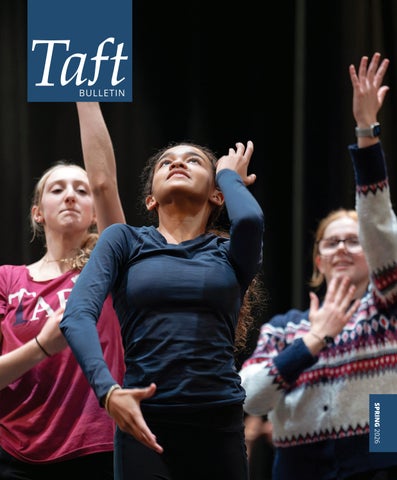
In the fall, Taft dance students worked with the Pilobolus dance company’s Artistic Associate Derion Loman in a series of workshops. Through his work, Taft artists have become immersed in the “world of Pilobolus,” says Dance Teacher Sarah Surber, and have begun to both feel and understand the transformative nature of the collaborative process.

ROBERT FALCETTI

On MAIN HALL

A WORD WITH HEAD OF SCHOOL PETER BECKER ’95

The Portrait in Practice: Wisdom

EDUCATION, LIKE ANY INDUSTRY, MOVES THROUGH TRENDS and fads. Ideas take hold, schools adopt them—or don’t—and eventually new approaches emerge. Shifting approaches to phonics and math, debates over skills versus content, “flipped classrooms,” physics-first, and even Advanced Placement programs all reflect this pattern. None is so definitively right that schools harm students by embracing or rejecting it.

The challenge, then, is not whether to follow trends but how to make wise decisions. Without a clear “true north,” a school risks drifting from one idea to the next. At Taft, three enduring principles provide that orientation: work hard, without regard for public acclaim; develop all of your talents—academic, artistic, and athletic; and, most important, give of yourself to others.

The Portrait of a Learner, the foundation of Taft’s strategic plan, builds on this foundation, articulating what we hope Taft students develop today. The Portrait will inform how we shape student life at Taft, both inside and outside of the classroom. We believe that intentionally integrating each element of the student experience to develop the seven elements of the Portrait will set a Taft education apart as best in class, not just in American boarding schools but among all high school options.

In the previous Bulletin, we highlighted honor. In the coming issues, I will reflect on the remaining elements of the Portrait, beginning with wisdom.

Wisdom is an ancient concept with roots in nearly every culture and tradition. At its core, it captures a few interrelated capacities. First, wisdom is distinct from, and deeper than, pure intelligence. Wisdom develops through lived experience, particularly through reflection on that experience. It develops in relationships and communities of trust, in which we learn from those around us. Wisdom is the capacity to seek to understand both what happened and why it happened—to look beyond an effect to the cause. Wisdom suggests the instinct and ability to put something in perspective, to understand its origins. In this sense, it includes the instincts and practices of historians: to take the long view and to

“Wisdom suggests a kind of discernment, which is all the more difficult and valuable at a time when we are habituated to react without thinking.”

understand time (and the passage of time) in a certain way. This orientation to time is all the more relevant in the immediacy of the digital age—as the internet flattens both time and space and as the forces of the market often dictate a self-defeating short-termism.

Wisdom suggests a kind of discernment, which is all the more difficult and valuable at a time when we are habituated to react without thinking. Wise discernment, though, is different from pure skepticism or cynicism. Discernment also suggests a certain moral element to wisdom, in that one differentiates between better and worse, higher and lower, perhaps depending on the circumstances, rather than a relativistic “anything goes” that requires choice but not discernment. This certainly is not an exhaustive definition of wisdom, but it points to its complexity

In their book Practical Wisdom, Barry Schwartz and Kenneth Sharp, following Aristotle, define wisdom as “figuring out the right way to do the right thing in a particular circumstance, with a particular person, at a particular time.” Crucially, wisdom requires, according to Schwartz and Sharp (and Aristotle), understanding the

“proper aim or goals—the telos—of a particular activity.” They go on to state that, “character and practical wisdom must be cultivated by the major institutions in which we practice,” but that “well-meaning reformers are often engaged in a kind of unintended stealth war on wisdom.” This is a caution worth heeding. The nature of reform is to question the status quo. It is good to do this because it forces us to check our blind spots and reevaluate our commitments—but it can lead quickly to drifting away from core commitments and being carried along by the tide, which is unwise.

Wisdom is all the more important to cultivate in Taft students today because they are the first generation to grow up marinating in the digital world. Whatever its virtues, the norms and practices of the digital world seem purpose-made to undermine, avoid, and erode the development of wisdom. If wisdom requires the instinct to pause and reflect (unless your life is in danger), the digital world trains students to react in the moment (as if your life is in danger). The digital world encourages the expression of unfiltered thought, even though first thoughts are rarely the best thoughts. It thwarts

“Whatever its virtues, the norms and practices of the digital world seem purpose-made to undermine, avoid, and erode the development of wisdom.”

PORTRAIT OF A LEARNER

Taft Graduates Will:

> Strive for Wisdom

> Practice Humility

> Find Joy in Purpose

> Pursue Excellence

> Nurture Relationships

> Live with Honor

> Build Resilience

reflection and fragments attention because there is always the next incoming bit to react to. Coupled with consumerism, the digital directs the gaze to the immediate rather than to wondering about a thing’s roots, origins, or telos. Don’t think, just do it.

Yet schools remain one of the most powerful places to cultivate wisdom. At Taft, opportunities abound: teaching not only what we know but how knowledge develops; helping students understand the history and purpose of the places they inhabit, including Taft itself; engaging thoughtfully with multiple perspectives on complex issues; spending time outdoors, where preparation, humility, and judgment matter; encouraging students to try new things and learn from failure; and fostering relationships—especially across differences— that challenge assumptions.

Most importantly, wisdom grows through reflection, guided by trusted mentors. Advisors, teachers, coaches, older students, and alumni all play a role in helping students step back, examine their experiences, and learn from them.

As I meet Taft alumni and parents, I am continually struck by the wisdom you carry. I invite you to share how you define wisdom, what experiences shaped it, and what experiences you believe help cultivate it in young people. Please email hos@taftschool.org if you’d like to share your thoughts.

Thank you for your continued support of Taft. I hope to see you in Watertown soon.

Peter Becker ’95

Students in the renovated lobby of the Lady Ivy Kwok Wu Science and Mathematics Center

Alumni SPOTLIGHT

Science That Serves the Community

IN EARLY DECEMBER, students in Dr. Jessica Black’s Environmental Science 101 class at Heritage University were wrapping up a semester-long, self-directed research project using red wiggler worms. One student was testing the impact of flooding, another the effects of wildfire ash.

“I told the students there were no ‘right answers,’ which is uncomfortable at first—but then it’s liberating,” Black, Class of ’94, says. “Rather than memorizing steps of the scientific method,

they’re actually practicing science from their first class—asking questions, testing hypotheses, grappling with real data.”

Heritage is an open access, nonprofit, private university surrounded by the Yakama Indian Reservation in Toppenish, Washington, where 11% of students identify as Native American and 73% as Hispanic. Black, who is Mexican American and has a Ph.D. in geological sciences from the University of Colorado Boulder, has also served as Heritage’s director

of the Center for Indigenous Health, Culture & the Environment since 2016.

“We support and develop Indigenous students as researchers and undertake community-based initiatives, both regionally and globally,” Black explains. The Center’s research projects are designed to connect students directly with community concerns.

“In the Yakima Valley, environmental justice challenges surround us—pesticide and herbicide exposure,

Dr. Jessica Black ’94, director of the Center for Indigenous Health, Culture, and the Environment at Heritage University, in comarca Ngäbe Buglé, Panama
Environmental Science students and Black worked with the Confederated Tribes of the Umatilla Indian Reservation on their burrowing owl banding conservation project.

concentrated animal feeding operations, nitrate-contaminated drinking water, and increasingly severe wildfire smoke,” she says. “When students research issues directly affecting their families and communities, their engagement deepens.”

The work isn’t just theoretical. When an invasive fruit fly was detected in culturally significant huckleberry fields around Mount Adams, Black built a studentdriven research initiative to track it. She secured grants and coordinated with Tribal wildlife experts from the Yakama Nation and regional academic partners.

“Different departments within the Yakama Nation will use the students’ data to formulate ways to address the problem,” she says. “The community really embraced this project.”

Black is committed to equity in STEM education. Hispanic and Native American individuals remain significantly underrepresented in the STEM workforce, comprising only 8 percent and 0.3 percent respectively, according to the National Science Foundation’s 2023 report. “We use undergraduate research opportunities to help level the playing field for this next generation,” she says.

She has also redesigned Heritage’s B.S. environmental science program to prepare students for graduate-level STEM work and created a B.A. environmental studies

degree for those pursuing roles in policy, nonprofits, or environmental law. She has also facilitated short-term international undergraduate research experiences in Costa Rica and Panama with Indigenous community partners. Built on principles of reciprocity, these programs create global Indigenous exchange opportunities and expand equitable access to international study abroad for students traditionally excluded from such opportunities.

Her own path to science wasn’t linear. She entered Taft as a middler “needing a lot of support, but Taft helped me catch up,” she says. “And without Taft, I wouldn’t have gotten into Wellesley,” where she found her calling in a geology class.

“I just loved it—the rocks, the breaking stuff with hammers, the minerals, the learning about how Earth was formed—it just spoke to me,” she says. She went on to earn a master’s in quaternary and climate studies from the University of Maine.

At Heritage, Black discovered a new love: teaching. “As soon as I got here, I didn’t want to leave,” she says. “I love the students. They’re so creative, and fun, and interesting, and they all come from different backgrounds and cultures. I like to show them that we’re all part of one community, and that community is STEM.”

She’s also hoping to give students that same “light bulb moment,” she had at Wellesley, helping them leverage their agricultural roots as they pursue careers in STEM.

“Many of our students haven’t realized how lucrative agriculture can be,” she says.

“Their family backgrounds in orchards, fields, and warehouses—plus the fact that many are bilingual—give them a huge advantage. My mother came to this valley as a migrant agricultural worker and retired as a high school teacher. Her path showed me how to help students transform what many once viewed as a disadvantage into a source of pride and professional strength.” B

Top: Black with Intro to Environmental Science 101 students on the Cle Elum River in Washington, on a sockeye salmon reintroduction project

Above: Black with Heritage University students working on their field microbiology research project in the Deschutes National Forest, Oregon, as part of the People of the Big River field class

Left: Evaluating macroinvertebrates on the Río San Félix, Panama, with Ngäbe community partners

Thoughtful Design

FOR MUCH OF THE 20TH CENTURY, Philadelphia drew electricity from the Delaware Generating Station, a coal-fired power plant on the banks of the Delaware River. The Beaux-Arts giant went partially dark in 1969 and was fully decommissioned in 2008, leaving behind a steel-and-concrete shell weathered by decades of neglect.

When architect Christopher Kenney ’82 first toured the station in 2017, nature

had already begun to reclaim it. Trees sprouted from the roof. Fish swam through the turbine hall, where train tunnel-sized conduits opened to the river.

Kenney, a principal at the Philadelphia design firm Strada, had been hired to help transform the ruins into The Battery, a mixed-use complex with two hotels, apartments, an event venue, and a high-end fitness club.

Above: Architect Christopher Kenney ’82, principal at Philadelphia-based Strada MATTHEW HAMILTON
Left: The Battery’s apartment lobby with restored condensate tank JEFFREY TOTARO
Right: The generating station around 2018 STRADA LLC
Below: An exterior view of The Battery looking north up the Delaware River JEFFREY TOTARO
“The

whole site was really a giant machine and not intended for people. You walked around inside on catwalks and rickety stairs and rusted ladders.”

“It was the opportunity of a lifetime,” Kenney says.

It was also a puzzle of unusual complexity. “The whole site was really a giant machine,” he explains. “It was not intended for people. You walked around inside on catwalks and rickety stairs and rusted ladders. But there weren’t really many floors as such.”

The original plant covered 128,000 square feet. By the time The Battery opened in 2024, it had grown to 544,000—a feat of design and engineering that added new life while preserving the building’s historic fabric.

After the machinery was removed, Kenney’s team digitally scanned the structure and began planning for its adaptive reuse. With years of preservation experience, he understood the challenge of aligning a developer’s ambitions with federal regulations.

The developer wanted habitable space and the National Park Service (NPS), the plant’s steward, insisted on protecting its configuration. “It was a technical challenge of how to add floors while making them invisible from the exterior, which is a neat trick of construction,” Kenney says.

Eventually, the NPS accepted the plan Kenney and the structural engineer devised to control sightlines and avoid distracting from the building’s historic character. “Usually the park service will let you build one story tops, and we were able to convince them that we could get two stories up there and it wouldn’t trash the place—to use the technical term,” Kenney adds with a laugh. “Evidently, we were successful enough that people like it.”

In 2025, the National Trust for Historic Preservation gave The Battery a National Preservation Award, recognizing the project as a landmark achievement in

Right: Exhaust stacks looking skyward JEFFREY TOTARO

adaptive reuse. It was a career-defining moment for Kenney, whose love of making things traces back to his earliest days.

Growing up in North Haven, Connecticut, Kenney spent endless hours building with Legos. “Never underestimate Legos,” he says. His father taught him to use power tools, and weekends found him in the basement woodshop, emerging at dinner covered in sawdust with a new creation.

At Taft, he forged lifelong friendships and found mentors who shaped his growth. John Small, the legendary Latin teacher and cross-country coach, left a lasting impression. “I still think of things he said to me and the ways he helped me feel seen as a person,” Kenney says.

He studied religion at Colgate University and earned a master’s at Harvard Divinity School. Though he briefly considered academia, he worked as a carpenter and construction manager during college and never lost his attachment to building.

The Battery may be the project of a lifetime, but Kenney isn’t worried about topping it. “That’s one of those things that’s great about architecture—the longer you

practice, the more you learn,” he says.

One of his current projects is an addition to a high school that unites three centuries of construction. He’s designing a new STEM center with an atrium featuring a Foucault Pendulum—a device that hangs from an oculus and tracks Earth’s rotation.

“You know, it’s not a power plant,” Kenney says. “But it’s pretty great.” B

“It was a technical challenge of how to add floors while making them invisible from the exterior . . .”

Above: Switch House Cescaphe event venue at The Battery after construction STRADA LLC
RIght: The generating station’s Switch House interior before construction STRADA LLC

Keeping It Real

“. . . no effects, no Auto-Tune, no overproduction. I just want to keep it real, keep it pointed toward truth.”
—Coleman Jennings ’20

THE FIRST TIME YOU HEAR COLEMAN

Jennings ’20 sing, you could easily believe that his richly resonant, slightly melancholic baritone belongs to a country crooner from a bygone era. “This voice just came out of me—there’s no other explanation than that,” says the rising star, who, at just 25 years old, recently signed a major deal with Big Loud Texas and Mercury Records. “I had been singing my entire life, but I was always stuck in a choir voice. All of a sudden, I was able to sing differently, and I’ve just kept doing it.”

Growing up, Jennings says, music was a constant presence. He and his sister took voice lessons and performed in children’s shows from an early age. But it wasn’t until he arrived at Taft that music became his primary focus. “All I did was play guitar. I would play in the morning, at lunch, and in the 30 minutes between the end of classes and the start of sports. I pretty much played music and did homework,” he says.

At the same time, Jennings steeped himself in the music of past greats, counting among his most important musical idols Blaze Foley, Townes Van Zandt, Gordon Lightfoot, Jim Croce, and Merle Haggard—artists he says “actually lived the lives they sang about.”

Left: Jennings at Floore’s Country Store in Helotes, Texas, opening for Charles

Enrolling in the University of Texas at Austin, Jennings carried his love of music with him. He performed in a country cover band for a year before starting a new group to play his own original music, headlining concerts all over campus and becoming a hit on social media. To date, he has more than 200,000 followers across TikTok and Instagram alone.

Inspired by the incomparable artists who came before him, Jennings describes his style as “an old style, but not necessarily on purpose, just because that’s what I love—no effects, no Auto-Tune, no overproduction. I just want to keep it real, keep it pointed toward truth.”

Clearly, his music struck a chord with audiences. As a junior at UT Austin, Jennings secured a manager, and by 2025, he had recorded his first major album with Big Loud Texas and Mercury Records. Slated for release later this year, the album was doubly meaningful as it marked his first collaboration with legendary music producer Dave Cobb, whose illustrious list

of clients also includes Chris Stapleton, Jason Isbell, and Brandi Carlile. “The first time I met him, it felt like I already knew him. We had the exact same ideas on art and music. We recorded the whole album in just four days,” Jennings says.

At the same time, Jennings expanded his tour schedule beyond college students, crisscrossing the country to play for everincreasing crowds—including one memorable night in Lubbock, Texas, when he opened for Willie Nelson in front of nearly 15,000 people.

But as gratified as he is by his growing success, Jennings hopes his art gains him more than just fame and fortune. “Life is about more than money, and I think you can tell when a human being writes a piece of music for the sake of something other than the music,” he says.

“More than anything, I want to stay true to myself and pursue making good art. Because ultimately that’s what all great art does: it points toward truth.” B

—Christopher Browner ’12

Opposite page: Texas-based musician Coleman Jennings ’20 JODY DOMINGUE STUDIOS
Wesley Godwin

Treating Service Members & Families

GROWING UP IN DAYTON, OHIO, Ciara Rakestraw ’01 always knew she wanted to be a doctor. But she never expected her medical career to take her all over the world.

Rakestraw now serves as the deputy chief medical officer for Landstuhl Regional Medical Center in Landstuhl, Germany, the U.S. military’s largest medical center in a foreign country.

Her career as an obstetriciangynecologist (OB-GYN) in the U.S. Army has taken her to military hospitals in Alaska, New York, and Hawaii, and on medical training missions to Ethiopia, Ghana, and the United Kingdom.

“That aspect [I] would not have gotten as a civilian,” Rakestraw, a lieutenant colonel, says of her globe-trotting career.

She remembers being intrigued by hospitals, doctors, and nurses from a very young age. “Growing up—this sounds bad—but I wanted to have a broken leg or something that would get me to the hospital,” she laughs.

She began considering a military career when she learned the U.S. government covers the cost of medical training. After earning a bachelor’s degree from Vanderbilt University, she enrolled in Morehouse School of Medicine on a military scholarship.

Rakestraw says she chose OB-GYN as her specialty because it promised to mix routine patient care with fast-paced labor and delivery work. She completed her residency at Tripler Army Medical Center in Hawaii and has worked on Army bases treating service members and their families ever since.

Right: Lt. Col. Ciara Rakestraw, MD ’01, assistant deputy chief of clinical services/OB-GYN physician, at the USO Warrior Center in Landstuhl, Germany, with the Atlanta Falcons cheerleaders during the Salute to Service event. Rakestraw is based at the U.S. Army Landstuhl Regional Medical Center.

As her career has advanced, Rakestraw has taken on more administrative responsibilities. She says she’s been surprised by how much she has enjoyed moving into leadership roles, such as her current role at Landstuhl.

“I was shocked, because I thought I was going to miss patient care more,” Rakestraw says. “It’s fun being at the table, being able to make some of the decisions for more than just your clinic, but for the hospital.”

She can still see patients occasionally, she notes. “I’m lucky enough that we do have OB-GYN [services] in our hospital, so I can deliver babies when I get the itch.”

Being a military doctor also has given Rakestraw the opportunity to participate in military global health engagements. These are opportunities for military physicians to work with colleagues in allied nations to share expertise, practice working together, and team up to address global health threats.

Rakestraw was part of a team of U.S. military medical personnel that traveled to Ghana in 2024 to perform surgeries and see patients alongside doctors in the Ghanaian Armed Forces. Such missions help U.S. military doctors learn about international medical standards and understand how doctors

in other countries perform surgeries and manage equipment, Rakestraw says.

The always-on culture of the military has its drawbacks, she says. “You pretty much are considered active duty,” she says. “You’re 24/7. They can call on you whenever they need you.”

But one of the biggest perks of her career has been the opportunity to travel, both for work and for fun. “I love traveling,” she says. “If I could travel for a job all the time, I definitely would.” B

Left: Rakestraw performs an operation with Ghanaian OB-GYNs during a U.S. Army/Ghana Medical Exercise at the 37th Military Hospital, Accra, Ghana.

Below: Rakestraw training Ghanaian midwives in a simulation exercise for obstetric emergencies during Ghana Medrex 2024 at the 37th Military Hospital in Accra, Ghana

Quinton ’06

More of the Good in Education

FOR MORE THAN THREE DECADES, Derek Pierce ’84 lived the life of a school educator and leader. As the founding principal of Casco Bay High School in Portland, Maine, he helped shape a school culture that became nationally recognized for innovation, student voice, and

community-driven learning. When he stepped away in 2024, it was not because he had grown tired of the work. It was because he wanted to take what he had learned and amplify it in a new direction.

“I didn’t want to be the guy people whispered about—‘He used to be a good

principal,’” Pierce says. “I knew I could never be a principal anywhere else, because it was just too great [at Casco Bay]. That phase of my life needed to come to an end.”

That ending quickly became a beginning. After leaving Casco Bay, Pierce took time away to reflect, travel, and campaign for

“We want to shift public understanding of what’s actually happening in schools—and what’s possible.”

Kamala Harris in rural Wisconsin. He found himself thinking about the great work public schools do—and how rarely that work is celebrated. While the public conversation around education has grown increasingly negative, polarized, and focused on test scores, book bans, and politics, Pierce saw a different reality when he visited classrooms.

“It felt to me that the stories that are told about schools are usually from a deficit model,” he says. “It’s about how the test scores are lousy, or who should be allowed to use which bathroom, or which books aren’t in the library. They’re very rarely about actual teaching and learning

and what’s happening in classrooms and what teachers are doing with kids.”

That concern became the foundation for Pierce’s next act: Learning from Maine, a video documentary project dedicated to showcasing exciting and replicable innovations happening in public schools across the state. The idea was not just to highlight extraordinary teachers or standout students, but to demonstrate what is possible—and repeatable—when a community believes in its schools.

The project came together at the perfect moment. A statewide initiative, “Maine Loves Public Schools,” was looking to strengthen the positive narrative around public education, and Pierce had the concept and vision to make it happen. With support from the Maine School Management Association, local foundations, and eventually Maine Public Television, Learning from Maine launched its first season last year, featuring longerform video stories with social media reach.

Pierce’s belief in the power of inspiration runs deep. “From my own experience as an educator, I was most inspired when I could see another school doing something that I hadn’t done or that my school hadn’t done,” he says. “It was like a little loving kick in the pants—‘Wow, that’s possible.’”

Today, the series is in its second season, now coproduced with Maine Public Television. Pierce and his collaborator, former journalist Robbie Feinberg,

spend two to three days in schools filming interviews, classroom experiences, and community interactions. The goal: to show the innovations in teaching and learning through the voices of the educators and students themselves. They choose schools based on replicable programs, ideas that could be scaled statewide, and topics that reflect current educational challenges—from early literacy and universal pre-K to AI in the classroom.

“We want to shift public understanding of what’s actually happening in schools— and what’s possible,” Pierce says. “If people see what’s working in one community, maybe they’ll want that for their own.”

Screenings draw audiences. Universities use the films in teacher preparation courses. School boards discuss the ideas. For Pierce, that response reinforces his belief that stories can spark change.

“In a world where media so often tilts toward the toxic, there’s a scarcity of stories that are joyful, real, and hopeful,” he says. “We need more of the good out there.” B

—Bonnie Blackburn-Penhollow ’84

Top right: Derek Pierce ’84, documentary series producer of Learning from Maine, speaks at a screening in Portland, Maine, at Unum.
Above: Pierce talks with a Maine student featured in the pilot episode of the education series.

Around THE POND

Investing in Taft Faculty

EACH YEAR, WE REPORT ON THE transformative Summer Journeys that take Taft students across the globe to learn, serve, teach, and to explore their passions with support from endowed travel and study funds. Similarly, Taft invites faculty members to apply for grants to pursue opportunities for professional growth, advancing Taft’s curriculum, and personal

enrichment. Last summer, close to 40 faculty summer grants were awarded.

Like Taft students, faculty members traveled in service to communities across the globe. Notably, History and Global Studies teacher Alex Rivenburgh served at the School of Leadership, Afghanistan (SOLA), a boarding school for Afghan girls. Under Taliban rule, Afghan girls could not attend

school. When the Taliban fell in 2001, doors began to open—slowly—though many barriers remained. In 2016, SOLA welcomed 24 young women to a new and safe learning environment; five years later, the Taliban returned to power, and SOLA left Afghanistan to protect the then 100 young women enrolled at the school. They resumed operations in Rwanda, where Rivenburgh was among their teachers last summer.

“Perspective is the greatest,” says Rivenburgh. “Seeing some students so intently seek education that they will leave their lives and families behind was awe-inspiring. The girls at SOLA have been through so much and are willing to push through simply for the act of being educated.”

Faculty members also participated in world-renowned programs and workshops, including English Teacher Roddy Pratt, who attended the celebrated Bread Loaf Writers’ Conference at Middlebury College, and Arts Department Head and Dance Teacher Sarah Surber, who studied at the Limón Institute, home to the Limón Dance Company, the vanguard of American modern dance since its inception in 1946 and one of the world’s most celebrated dance companies. Mathematics Teacher Dr. Mostafa Mirabi traveled to Harvard and

Left: Alex Rivenburgh traveled to Rwanda to serve students at the School of Leadership, Afghanistan (SOLA). Taft’s connection to SOLA began when two Afghani students enrolled at Taft after the Taliban returned to power.

SOLA Founder Shabana Basij-Rasikh, in photo, attended their Taft Commencement.

Princeton to continue work with fellow mathematicians on the high-level, awardwinning and innovative research that has become a hallmark of his academic career.

Science Teacher Dr. Amanda Benedict traveled to the Colorado Rockies for an educator’s expedition at the High Mountain Institute. English and Art History Teacher Alex Werrell traveled to Italy; History Teachers Rachael Ryan and Greg Hawes ’85 traveled through Europe; and History and Global Studies Teacher Brian Lundgren spent six weeks exploring four countries in Central Asia: Uzbekistan, Tajikistan, Kyrgyzstan, and Kazakhstan.

“A particular focus for me was the development of national identities since the collapse of the Soviet Union and

the ways in which this period is remembered. Both in my day-to-day travels and during longer guided excursions off the beaten path, I had numerous opportunities to explore these themes and engage in thoughtful conversations about them,” explains Lundgren. “These experiences and perspectives will certainly inform both my Imperial Russia elective and History of the Soviet Union course.”

Like Lundgren, other faculty members bolstered Taft’s curriculum by using grant funds to support the course development and enhancements: Robert Ganung worked on Perennial Philosophy East and West; Marc Hess is developing new computer science electives; Dana Hill is building new Human Geography electives; Rachael Ryan dedicated time to Honors Psychology of Politics; Alex Rivenburgh

Right and below: Brian Lundgren’s six weeks in Central Asia brought deep learning and spectacular views.

worked on his Legal Studies curriculum; and Mostafa Mirabi shaped a new postcalculus elective, to name just a few.

A number of funds support faculty members engaged in graduate-level studies and ongoing degree programs. Among those faculty members continuing their formal education with support from endowed funds last summer were Dean of Students Lindsay Leal, School Counselor Gaby Dorval, Assistant Director of Admission and Boys’ Head Hockey Coach Ryan Shannon ’01, Science

Teacher Kevin Conroy, and History and Global Studies Department Head and GLI Director Bri Foley.

Faculty members also worked on textbooks and course updates and participated in a vast array of workshops and programs hosted by professional associations and peer schools. Finally, members of the English department developed an approach to enhancing students’ AI literacy that, notes Co-Dean of Faculty Jillian Danaher, could serve as a model for other departments at Taft. B

Above: Art History Teacher Alex Werrell spent a month in Italy visiting churches, museums, and research institutions, gathering insights and material for his courses at Taft. He also explored new ways of bringing material to life in his classroom—among them, the development of a unit on reflection and sympathy. Werrell shot thousands (literally) of photographs, which he will incorporate into his course materials, including this photograph of Gian Lorenzo Bernini’s Apollo and Daphne, created between 1622–1625. The well-known marble sculpture is housed in Rome’s Borghese Gallery.

Left: Science Teacher Dr. Amanda Benedict attended the High Mountain Institute Educator Expedition backpacking trip in Colorado. HMI faculty shared the methods and systems they use to teach students about building community, leadership, and skills in the backcountry. Benedict carried a very heavy pack at altitudes between 10,200 feet and 11,800 feet while learning to navigate via topographical maps off-trail, cook, and stay warm, dry, and safe in a lightning storm. “More importantly,” says Benedict, “they taught us how to build community quickly through shared experience in nature.”

The following funds supported faculty work last summer:

> Regina and Earle W. Brauer, M.D. Faculty Enrichment Fund

> Davis Family Junior Faculty Fund

> Gillikin Family Faculty Fund

> Alice and Arthur Greer Faculty Fund

> Lo Fellowships for Technology

> John Lyman Fellowship

> Lance Odden Summer

Sabbatical Teacher’s Fund

> Sheppard Family Grant

> Stroud Family Faculty Fund

> Penny and Michael Townsend Faculty Fund

> Won Family Endowment for Service and Cultural Knowledge

Legal Studies at Taft Law and Justice

HISTORY AND GLOBAL STUDIES

Teacher Alex Rivenburgh used grant funds to develop and refine curricula for his legal studies courses. The fruits of his labor were, in part, shared with the broader Taft community during a “mock trial.” While his Law and Justice students acted as prosecutors and defense attorneys in the case, students not enrolled in the course, along with faculty and staff, were invited to serve as jurors.

“The case involved a great deal of pretrial preparation,” notes Rivenburgh. “Some students served as lead attorneys,

others as associates, and some as witnesses. All had unique perspectives on the case.”

The mock trial was based on the case of United States v. Dominique Stephens. In it, a woman admits to shooting and killing her husband and is charged with first-degree murder. She asserts that she acted in self-defense after suffering years of severe physical and emotional abuse.

To prepare for the trial, Rivenburgh took students through a unit on trial etiquette and how to develop arguments, questioning, and objections. They studied due process and the rights protected by U.S. courts. They analyzed

cases, wrote briefs, and worked cooperatively to build what were, in the end, compelling and persuasive arguments on both sides. B

Below left: Judge Rivenburgh addresses the courtroom.
Below right: Attorney Melissa Maselli ’26 questions Alex Tombaugh ’28 on the stand in front of the trial jury.
Bottom left: The jury takes notes while Attorney Cullen Tully ’26 (left) questions witness Jonah Ziv ’27.
Bottom right: Attorney Maddy Pope ’26 watches the proceedings closely while referencing her detailed orange sticky note and trial-prep binder.

MLK Week Rooted in Art

OUR 2026 MLK WEEK COMMUNITY

Experience was rooted in the arts—in the influence of Black music on the Civil Rights Movement. Dr. Martin Luther King Jr. gave the movement King’s words, noted Dean of Community, Justice, and Belonging Thomas Allen during his MLK Week address, but it was the music—and the musicians—that gave it its soul. Their music, he said, remains a testament to the power of art in the face of injustice.

Exploring the movement through music was an idea that took root when Taft’s 2025–26 Legacy 6 Cohort—Ethan Harry ’28, Mehar Trehan ’26, Sydney Anya ’28, Erin Arole ’28, Zoë Woodhall ’27, and Wilson Littman ’28—visited Memphis, Tennessee, in the fall. They spent time at the National Civil Rights Museum, housed in the former Lorraine Motel, the site of King’s assassination on April 4, 1968. They visited the Stax Museum of American Soul Music, the Memphis Rock ’n’ Soul Museum, and Sun Studio, known worldwide as “the birthplace of rock ’n’ roll.”

In visiting these sites, the Legacy 6 recognized a deep and inextricable bond between the evolution of Black music, the Civil Rights Movement, and Dr. King’s messages of beloved community and communities of love, courage in the face of injustice, and nonviolent resistance. The

Legacy 6 shared what they learned and felt with the Taft community through a Morning Meeting talk and through an ambitious, powerful, and interactive experience—a living museum. Museum spaces filled Taft’s campus with curated performances by Collegium Musicum, Taft’s Jazz Band and Orchestra members, faculty performers and Taft’s Step Team, each representing musical genres across time. The Legacy 6 members introduced each genre and performance and shared insights and knowledge gleaned in Memphis. It was an extraordinary experience for the Taft community—one of connection, learning, and understanding. B

1 The Legacy 6 began their journey in Memphis, Tennessee, at the National Civil Rights Museum. It is housed in the former Lorraine Motel, the site of Dr. Martin Luther King Jr.’s assassination.

2 “To celebrate Black music is to honor the voices that turn history into harmony and pain into power.”—Legacy 6 member Ethan Harry ’28, from his Morning Meeting talk about his time in Memphis

3 “Music reaches parts of your soul that words alone cannot.”—Jabari King ’26, from his Morning Meeting talk. Photo: A moment of reflection at the Lorraine Hotel in Memphis

4 Legacy 6 members, including Sydney Anya ’28 (in photo), brought all of their learning and experiences in Memphis to bear in an extraordinary 2026 MLK Week Community Experience.

Scan the QR code to view a short video of Taft’s MLK Week Community Experience: A Celebration of Black Music. >

5 “Black people fought to rewrite and reclaim their story. In celebrating their cultures and traditions, music became their narrative—a way to amplify their stories. The National Civil Rights Museum not only highlighted the journey toward greater social and economic equality, but the role of music in that journey.”—Legacy 6 member Zoë Woodhall ’27. In photo: Zoë in a Taft museum space dedicated to the origins of Black music in America

6 Individual spaces in Taft’s living museum were dedicated to the evolution and influences of Black music and musical genres. Members of Taft’s faculty band represented rock ’n’ roll and performed Chuck Berry’s “Johnny B. Goode” as community members made their way through the museum throughout the day. Berry penned the song, which he said was somewhat autobiographical, in 1955. It tells the story of an uneducated “country boy” from New Orleans whose musical talent allows him to dream of seeing his “name in lights.” Berry noted that although the original lyrics referred to Johnny as a “colored boy,” he changed them to “country boy” for radio play. Legacy 6 member Erin Arole ’28 provided history and commentary.

7 Collegium Musicum performed “This Little Light of Mine” in one of Taft’s living museum spaces during the 2026 MLK Week Community Experience. Although

the American gospel classic was written in the 1920s, it later became a power anthem of strength, unity, and defiance for Civil Rights activists. Collegium Director Dr. Jessica Pierpont was among the faculty members who traveled to Memphis with the Legacy 6.

8 Dean of Community, Justice, and Belonging Thomas Allen centered his Morning Meeting talk on three of the many voices that made up the soundtrack of the Civil Rights Movement. These three stood out in ways that marked the progression of the movement: the fury, the faith, and the change—Nina Simone, Mahalia Jackson, and Sam Cooke, respectively. The program concluded with a moving performance of Cooke’s “A Change Is Gonna Come,” in which vocalist Isaac Obeng ’26 was accompanied by Instrumental Music Teacher TJ Thompson and members of Taft’s Chamber Orchestra.

9 MLK Week included a Morning Meeting talk by author, educator, and DJ Dr. Todd Craig. “Hip-hop culture is over 50 years old,” Dr. Craig told the Taft community. “It was able to make its way through the commentary of the first 10 to 15 years of its sonic, artistic, and visual existence. That commentary was, ‘It’s a fad. It’ll die down next year. These kids will get sick of it real soon.’ Fifty years later, nobody is sick of it. As a matter of fact, 50 years later, hip-hop is a global popular culture that stems from Black artistic production.”

^ Scan the QR code to watch Isaac Obeng ’26 perform Sam Cooke’s song “A Change Is Gonna Come,” accompanied by Instrumental Music Teacher TJ Thompson and members of Taft’s Chamber Orchestra.

Creative Possibility

EACH SCHOOL YEAR, the Taft community collectively explores consequential concepts and issues through a single guiding question that shapes the content of our yearlong outside speaker series. Among the “speakers” this year is Pilobolus, a world-renowned dance company. The company is helping our community answer the question, “What does it mean to be human?”

“To include an artistic way of expressing what it means to be human in a speaker series—and beyond that, to do so through

dance, a nonverbal medium—is pretty powerful,” notes Arts Department Head and Dance Teacher Sarah Surber, who spent a year and a half working with Pilobolus and Speaker Series Coordinator Amy Julia Becker ’94 to build a program for the Taft community. “We are creating opportunities that are meaningful and accessible to a broad audience, not just those familiar with dance.”

Founded as a “rebellious” dance company in 1971, Pilobolus’s art is rooted in what some argue is the essence

“Through weight-shifting exercises, we made shapes with our bodies that required us to be fully dependent on our partners, creating possibilities for movement and design that would not be possible alone.”

of the human condition: connection, collaboration, and shared experiences.

“In September, company members came and did a day of workshops with my intermediate- and advanced-level classes,” says Surber. “Through weightshifting exercises, we made shapes with our bodies that required us to be fully dependent on our partners, creating possibilities for movement and design that would not be possible alone.”

That message—and physical exploration—of creative possibility through collaboration is one that Pilobolus has brought to organizations like Google through corporate workshops, and to the full Taft community during their full day of all-school interactive speaker series programming. It is built on their “expertise telling stories with the human form” in ways that help organizations “maximize group creativity, solve problems, create surprise, and generate joy through the power of nonverbal communication.”

In addition to their all-school work, Pilobolus Artistic Associate Derion Loman spent time with Surber’s classes, then built a collaborative, five-workshop series for members of Taft’s Dance Ensemble. The workshops served as a foundation for a collaborative performance piece featured

in the Ensemble’s winter dance showcase.

“One of the amazing things about working with students when you’re in Pilobolus and part of the Pilobolus ethos is that we create things collaboratively, so every person in the room has the responsibility to contribute to the piece,” says Loman. “My job is to help steer and shape all the creativity that’s coming out of the dancers in this program. We’re really tapping into what it means to be a part of a group and an ensemble, but also learning how to find your individual voice within a group.”

Through his work, Taft artists have become immersed in the “world of Pilobolus,” says Surber, and have begun to both feel and understand the transformative nature of the collaborative process.

“When a flock of birds is flying, there is a leader—a bird at the tip of the vee formation you so often see,” explains Surber. “But the instant the flock changes direction, a new leader naturally emerges. With each directional change, there is a constant, easy pass-off from being a leader to a follower—giving away the leadership and receiving leadership without question. That is a concept our students are experiencing in their work with Derion Loman. How beautiful that concept is, and how essential it is to being human.” B

Opposite page bottom: Pilobolus Artistic Associate Derion Loman guides members of Taft’s Dance Ensemble during a workshop in Bingham.
Below: Pilobolus Artistic Associate Derion Loman in Bingham Auditorium

Pippin!

THE ENERGY GENERATED BY ONE OF THE MOST EXTRAORDINARY PRODUCTIONS EVER TO HIT THE TAFT STAGE HAD BINGHAM AUDITORIUM—AND THE COMMUNITY—BUZZING! THE PASSION, JOY, AND HARD WORK EVERYONE POURED INTO PIPPIN WILL LONG BE REMEMBERED.

Bravo!

Assistant Head of School for Student Life Jeremy LaCasse was named a 2025 Burch Ford Kaleidoscope Award for Excellence in Student & Residential Life honoree. The award is presented each year by The Association of Boarding Schools (TABS). TABS President Susan Baldridge announced the award—to a rousing ovation by the Taft community— during an all-school gathering on campus.

Taft Mathematics Teacher Dr. Mostafa Mirabi was awarded the 2025 Christine Ladd-Franklin Logic Prize as coauthor of the paper “Forcing with Invariant Measures.” The prize is presented every three years for groundbreaking work in mathematical logic and computer science.

Fair Chance Initiative (FCI), a student-led group making its mark through mental health advocacy, community engagement, resource development, advocacy campaigns, and educational workshops, hosted Voices Unmuted, a mental health summit at Taft. Students and educators from across the region were invited to attend. Guest speakers, workshops, and other activities allowed participants and students to connect, learn, and develop strategies for raising awareness of and prioritizing mental health.

“The idea of objectivity itself has remained, perpetually, an ambiguous topic,” wrote Lucya Yang ’28. “As scholars delve deeper into the psychological quandary of whether objectivity is truly objective, the conclusion on whether there is an external definitive establishment of an objective reality has become more complex and ambiguous.” Lucya worked to untangle that ambiguity in her extraordinary, award-winning treatise for the John Locke Institute’s 2025 Global Essay Competition. Her entry—one of more than 63,000 considered by Institute judges this year—asked, “Is objectivity all in the mind?” For her work, she earned High Commendation/Distinction, a level of recognition awarded to essays that are “exceptional, demonstrating excellent writing skills and innovative perspectives” and “places the essay among the top entries of the John Locke Global Essay Competition.”

Art Teacher Meghan Balliett led an effort on campus that brought almost two dozen members of the Taft community together—faculty members, staff, students, and even a few retired faculty—to share their talents and hearts in service to clients of the St. Vincent DePaul Mission in Waterbury, Connecticut. Using generously donated yarn and needles, Taft knitters crafted 33 scarves (and one hat!).

As part of his summer internship at The New York Botanical Garden (NYBG), Ethan Harry ’28 worked with scientist Cecilia Zumajo-Cardona, an assistant curator in the Laboratory for Integrative Biodiversity Research, cataloging anatomical section slides. Ethan took the work a step further, conducting additional research and organizing his findings into a publication for NYBG’s C.V. Starr Virtual Herbarium. The publication, Bassett and Celia Maguire: A Legacy in Leaves and Lenses, is now live; Ethan shares a byline with Dr. Zumajo-Cardona. B

Heart and Soul

THE ANNUAL DANCE SHOWCASE REPRESENTS THE CULMINATION OF A SEMESTER OF DANCERS LEARNING, GROWING, AND CREATING. TAFT ARTISTS BROUGHT TALENT TO THE STAGE THAT WAS BREATHTAKING AND AWE-INSPIRING. STUDENTS CREATED ORIGINAL PIECES THAT EXPLORED THEMES OF FRIENDSHIP, INDIVIDUALITY, ENERGY AND PLAYFUL CONFIDENCE, APPRECIATION, A MELDING OF PERSONALITIES, AND HOLDING ONTO CONNECTIONS ACROSS TIME, DISTANCE, AND CHAOS.

THE ART—LAID BARE ON STAGE THROUGH CHOREOGRAPHY, PERFORMANCE, LIGHTING, COSTUMES, AND MUSIC—CAME FROM THE HEARTS, MINDS, AND SOULS OF OUR TALENTED STUDENTS.

Around the Pond & Beyond

Art, business, and experiential learning came together for students in Meghan Balliett’s printmaking class when they visited Curtis Packaging, an innovative pioneer in the luxury packaging industry. Curtis Packaging clients include companies like Glossier and Titleist. Tafties were hosted by CEO Don Droppo P’27.

Max Stossel is an award-winning poet, filmmaker, and speaker, named by Forbes as one of the best storytellers of the year. He is also the founder of Social Awakening, an organization that helps students, parents, and educators understand and effect the impact that social media and technology has on traditional and emotional learning, relationships, and mental health. He shared his insights on the impacts of social media with Taft students during an all-school meeting and with parents through a recorded Q&A with Amy Julia Becker ’94. Both were part of our 2025–26 Speaker Series.

Contemporary artist Jorge Vascano creates works that are complex and deep; his show, Antología, brought the wonder and introspection he seeks through his work to Taft’s Potter Gallery. The show featured sculptures, drawings, and carvings, all reflecting the influence of Vascano’s childhood in the Peruvian Amazon. He also led workshops for Taft students during his residency. B

THANKS TO THE GENEROSITY of an anonymous donor, Taft recently purchased a property adjacent to campus for faculty housing. Now known as the Stuyvesant House, the acquisition of 31 Woodbury Road represents a step in advancing Taft’s strategic priority to recruit, support, and retain exceptional faculty.

The home was previously owned by Sted Sweet ’54 and family, longtime friends of the school, who cared for the property for more than six decades. See page 42 for remembrances of the house as a connector of generations of Taft students. B

Honoring Those Who Support and Inspire

Through a new initiative called Shirt Off My Back, senior players on the boys’ varsity hockey team honored a Taft community member who supported, guided, or inspired them during their time at Taft. Honorees were invited to the appreciation ceremony, which took place on the ice before a late-January game. Players read words of praise and reflection and presented their mentors and guides with gifts of gratitude— including boys’ hockey T-shirts.

< Scan the QR code to read more.

“We wanted this project to represent gratitude and recognition and to literally give the ‘shirts off our backs’ to honor the people who helped us become better students, teammates, and people.”

Fall SPORTS wrap-up

NEPSAC CLASS A CHAMPIONS ; FOUNDERS LEAGUE CO-CHAMPIONS

Alex Calabro ’27 puts the ball on goal against Choate in the NEPSAC Class A Semifinal on November 15.

Photography by Robert Falcetti

Boys’ Soccer Repeats as Back-to-Back

NEPSAC Class A Champions

BOYS’ SOCCER FACED OFF AGAINST Nobles in the NEPSAC Class A Championship at Brooks, looking to finish its remarkable season with a title. The Rhinos were tested immediately, conceding a goal within the opening minutes and finding themselves in an early deficit.

The boys got on the board with a goal from James Cooper ’26. Alex Calabro ’27 gave the Rhinos the lead with his second goal coming early in the second half. Fields DeShaw ’27 finished off the scoring, finding the back of the net late in the second half.

With the 4–1 victory, the Rhinos completed an undefeated season and secured their second straight NEPSAC Class A Championship. B

NEPSAC CLASS A QUARTERFINALISTS

Hannah Zhang ’27 looks to put a shot on net versus Williston on October 15.

Girls’ Soccer

7–8–3

Football

5–4

Ruth Amponsah ’27 in action against Greenwich Country Day on September 10
Xavier Hairston ’28 rushes up the field versus Loomis on September 20. KAIYUN XU ’27

Volleyball

12–7

gets

Boys’ Cross Country 4–5

SIXTH PLACE, FOUNDERS

LEAGUE CHAMPIONSHIP; 13TH PLACE, NEPSTA

DIVISION I CHAMPIONSHIP

Eli Arroyo ’26 races towards the finish line in the New England Championship on November 8. YUQI QIAN ’27

Girls’ Cross Country

2–6

FOURTH PLACE, FOUNDERS

LEAGUE CHAMPIONSHIP; 13TH PLACE, NEPSTA

DIVISION I CHAMPIONSHIP

Maya Woodhall ’27 pushes up the hill in the New England Championship on November 8. YUQI QIAN ’27

Faith McEvoy ’28
set to serve against Berkshire on September 24. KAIYUN XU ’27

Hotchkiss Day 2025

In early November, on the last day of the regular season, the Rhinos headed north to Lakeville for this year’s edition of Hotchkiss Day. Taft emerged victorious in two of the five varsity contests, with one draw. Football (42–27) and boys’ soccer (3–0) were victorious, girls’ soccer was a 1–1 draw, and field hockey (2–1) and volleyball (3–1) battled hard but were both unfortunately defeated by the Bearcats. With their victory, b oys’ s occer claimed a share of the Founders League title—the program’s third consecutive and the fifth time in the past six seasons. B

FALL 2025 ATHLETIC AWARDS

Boys’ Soccer

Livingston Carroll Soccer Award—Marcos Santana ’26

All-NEPSAC—Mathis Elissaint ’26, Marcos Santana ’26

NEPSAC Honorable Mention—Vincent Levasseur ’26, Will Murray ’26

NEPSAC Player of the Year—Alex Calabro ’27

Field Hockey

Field Hockey Award—Caroline Traina ’26

All-NEPSAC—Eva Layton ’27, Caroline Traina ’26

NEPSAC Honorable Mention—Alexa Blaha ’26, Hannah Zhang ’27

Girls’ Soccer

1976 Girls’ Soccer Award—Elly Ouellette ’26

All WNEPSSA—Sofia Lombardo Varisco ’26, Elly Ouellette ’26

Football

Black Cup Award—Will Palmer ’26

Harry K. Cross Football Award—Gilbert Kimrin ’26

All-NEPSAC Class A—Jude Okeleke ’26, Brian Oliver ’26

All-NEPSAC Class A Honorable Mention—Max Hoke ’27, Will Palmer ’26

NEPSAC Class A Group One Defensive Player of the Year Jude Okeleke ’26

NEPSAC Class A Group One All-League First Team Will Palmer ’26, Brian Oliver ’26, Jude Okeleke ’26, Steve Soares ’28

NEPSAC Class A Group One All-League Second Team—Xavier Hairston ’28, Chris Pangaro ’27, Max Hoke ’27, Damon Hibbert ’27, Jaiden Allen ’27

NEPSAC Class A Group One All-League Honorable Mention Gilbert Kimrin ’26, Jonah Oquendo ’26, Colin Overy ’26, Mac Trombley ’26

Volleyball

Volleyball Award—Koni Kucz ’26

Boys’ Cross Country

John B. Small Boys’ Cross Country Award—Will Post ’26

Girls’ Cross Country

Girls’ Cross Country Award—Lydia Wilson ’26

D’Arco

Cup

In early December, boys’ varsity hockey defeated Berkshire by a score of 5–2 in the annual Lucille A. D’Arco Cup. Lucille was a passionate fan and supporter of both schools: her son, Brad ’99, captained the Taft team as a student, then went on to coach the Berkshire team after college. In 2008, Lucille lost a courageous battle with breast cancer. Since then, the two schools have honored her legacy on the ice in a game dedicated to her memory, to raising funds and awareness around breast cancer, and to commemorate the D’Arco family’s involvement with and love for both institutions. B

42nd Annual Patsy K. Odden Girls’ Invitational Hockey Tournament

The 42nd Annual Patsy K. Odden Girls’ Invitational Hockey Tournament took place on Thursday, December 18, and Friday, December 19. The teams that competed in this year’s tournament were Taft, Andover, Choate, Hotchkiss, Kent, Lawrenceville, Loomis, and Tabor. After two full days of games, Loomis and Andover faced off in the championship game, with Loomis taking home the tournament title, besting Andover by a score of 4–3. B

The Taft School

110 Woodbury Road

Watertown, CT 06795-2100

860-945-7777

taftschool.org/bulletin

From the Fleeting Thoughts student winter exhibit on display in the Mark W. Potter ’48 Art Gallery

Turn static files into dynamic content formats.
Create a flipbook