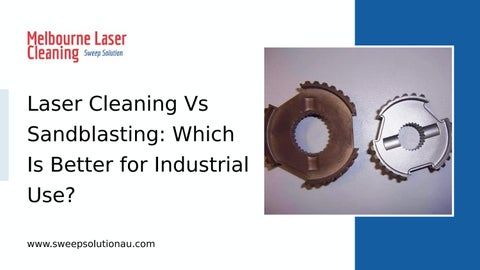
Laser Cleaning Vs Sandblasting: Which Is Better for Industrial Use?
Page 1


Introduction

Are you seeking cleaning solutions for large-scale production?

Laser cleaning vs sandblasting is a never-ending debate. Let’s understand which one is better for industrial use.

When choosing between laser cleaning and sandblasting, the choice depends on specific industrial needs. Laser cleaning is better suited for precision and delicate materials. In contrast, sandblasting is ideal for large areas and heavy-duty jobs, such as removing thick rust and multiple layers of paint.

Understanding the key differences between laser cleaning and sandblasting can help you make an informed decision.

Let’s explore the key differences between laser cleaning and sandblasting to help you understand which one is better for industrial use.

A Complete Guide to Laser Cleaning Vs Sandblasting

Here are the key differences between laser cleaning and sandblasting, and which one is better for industrial use.

What Is Laser Cleaning?

Laser cleaning is a non-abrasive, non-contact method that uses high-precision laser pulses to remove paint, rust, coatings, grease, carbon buildup, and other contaminants.

Think of it like a controlled beam that vaporises the unwanted layer without touching the base material. No grinding. No blasting. No dust explosions waiting to happen.

Here’s why many industries prefer laser cleaning:

• Zero abrasion to the underlying material

• Environmentally friendly

• Exceptional control, even for delicate substrates

• Minimal cleanup with no waste residue apart from the removed layer

• Highly efficient for repetitive industrial use

Not only is it technology-forward, but it is also surfacefriendly.

What Is Sandblasting?

On the other hand, sandblasting uses abrasive particles shot at high speed to remove coatings, corrosion, or buildup. It’s been the industry standard for decades.

Where sandblasting still works well on:

• Large surfaces requiring heavy material removal

• Thick rust or coatings

• Outdoor industrial environments

• Jobs where abrasion isn’t a concern

Sandblasting can be harsh, as it alters the base material, creates significant cleanup, and generates dust that requires strict safety measures.

Laser Cleaning Vs Sandblasting: A Practical

Comparison

When comparing laser cleaning vs sandblasting, it’s not just about efficiency. It’s about safety, cost, long-term value, and suitability for modern industrial expectations.

Here is a breakdown that can help the industrial team:

1. Surface Impact

• Laser Cleaning: It is a completely non-abrasive process that preserves fine details and structural integrity.

• Sandblasting: It removes contaminants and part of the substrate that can cause pitting or texture changes.

For industries that deal with precision machinery, heritage structures, molds, or high-value components, laser cleaning is the clear winner.

2. Environmental & Safety Considerations

• Laser: No chemicals, no media, low noise, minimal dust.

• Sandblasting: Generates dust clouds, requires respiratory protection, and produces large amounts of waste.

In an era of tightening workplace safety regulations, this difference matters more than ever

3. Operating Costs

Most people think that laser cleaning is expensive, but the truth is that the initial equipment investment is higher, but:

• No media to purchase

• No disposal costs

• Less downtime

• Minimal safety gear

• Lower maintenance

For facilities running frequent or long-term cleaning tasks, laser cleaning often becomes a more cost-effective solution.

4. Precision & Control

Laser cleaning enables technicians to precisely adjust the power, width, and depth settings. You can remove microns of material if needed. Whereas sandblasting is far less precise. It’s powerful but not delicate.

If your operation involves molds, welding preparation, aerospace-grade materials, or anything requiring precision, laser cleaning is the safer choice.

5. Surface Size & Nature

Sandblasting still has its place, especially for:

• Ship hulls

• Outdoor steel structures

• Large-scale paint removal

• Heavy-duty industrial surfaces

Laser cleaning excels when it comes to small or delicate items. These pieces generally require minimal processing time, and pricing for smaller items typically starts from $199, with an option for a 20% discount depending on the level of buildup and surface condition.

For bigger industrial items and large rusted surfaces, the cleaning process is more intensive. These projects usually start from $499, and this includes a protective sealing layer to prevent the cleaned metal from re-rusting immediately.

Sandblasting still works well for extremely large exterior surfaces, but it does not offer the same precision or postcleaning protection that laser cleaning provides.

Conclusion

Choosing between laser cleaning and sandblasting depends on the requirements of your industrial environment. If your preference is safety, reduced waste, precision, nonabrasive, and eco-friendly cleaning, then laser cleaning is a clear winner. If you are looking for an effective cleaning solution, visit Melbourne Laser Cleaning Sweep Solution.

At Melbourne Laser Cleaning Sweep Solution, we offer mobile rust cleaning, oxide removal, paint stripping service, oil cleaning service, and engine cleaning services in Melbourne. Our laser cleaning solution delivers rapid, precise, and consistent results, removing rust, coatings, and contaminants in a single pass with minimal waste. Contact us to reduce your cleanup time compared to traditional methods.

Turn static files into dynamic content formats.

Create a flipbook
Issuu converts static files into: digital portfolios, online yearbooks, online catalogs, digital photo albums and more. Sign up and create your flipbook.
Laser Cleaning Vs Sandblasting: Which Is Better for Industrial Use? by Sweep Solution - Issuu