Artist Spotlights
Demian DinéYazhi’
Did you use this guide in your classroom? If so, tag SVMoA on social media (@sunvalleymuseum) or email us at education@svmoa.org
Focus: Structures of power, resistance, and Indigenous futures.
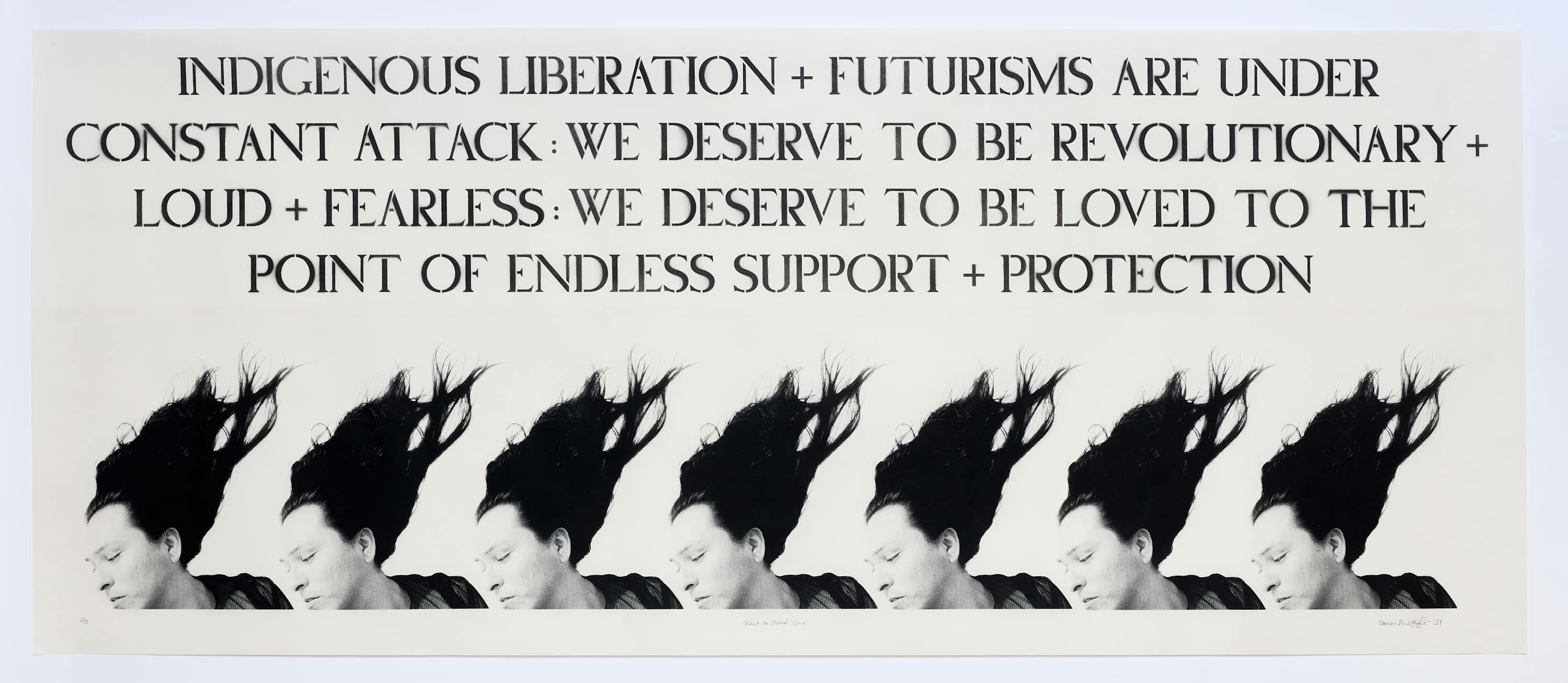
Key Work: ProtecttheSacredVoice(2024). Created in collaboration with Master Printer Paul Mullowney, featuring screenprint and spray paint stencil on Sekishu paper. The artist has also created a commissioned neon sculpture.
Practice: Based in Portland, Oregon, DinéYazhi’ is a multidisciplinary artist whose work questions systems of power. Their practice involves interventions, installation, written word, and performance. They are the founder of Radical Indigenous Survivance & Empowerment (R.I.S.E.), an activist initiative dedicated to the education and preservation of Indigenous art and culture.
Discussion Points:
• How does the juxtaposition of neon (a modern industrial material) with traditional printmaking on paper reflect the artist’s interest in Indigenous futures?
• The "written word" is a central tool in DinéYazhi’s practice. How do visual artists use written language to as part of their artwork?
• How does the involvement of a Master Printer (Paul Mullowney) change our understanding of the "Sacred Voice" as a community or collaborative effort?
Demian DinéYazhi’ ProtecttheSacredVoice, 2024 Screen print and spray paint stencil on Sekishu paper Courtesy the artist and Mullowney Printing, Portland
Caroline Monnet
Did you use this guide in your classroom? If so, tag SVMoA on social media (@sunvalleymuseum) or email us at education@svmoa.org
Focus: Bicultural existence, industrial materials, birch bark biting traditions, and self- determination.
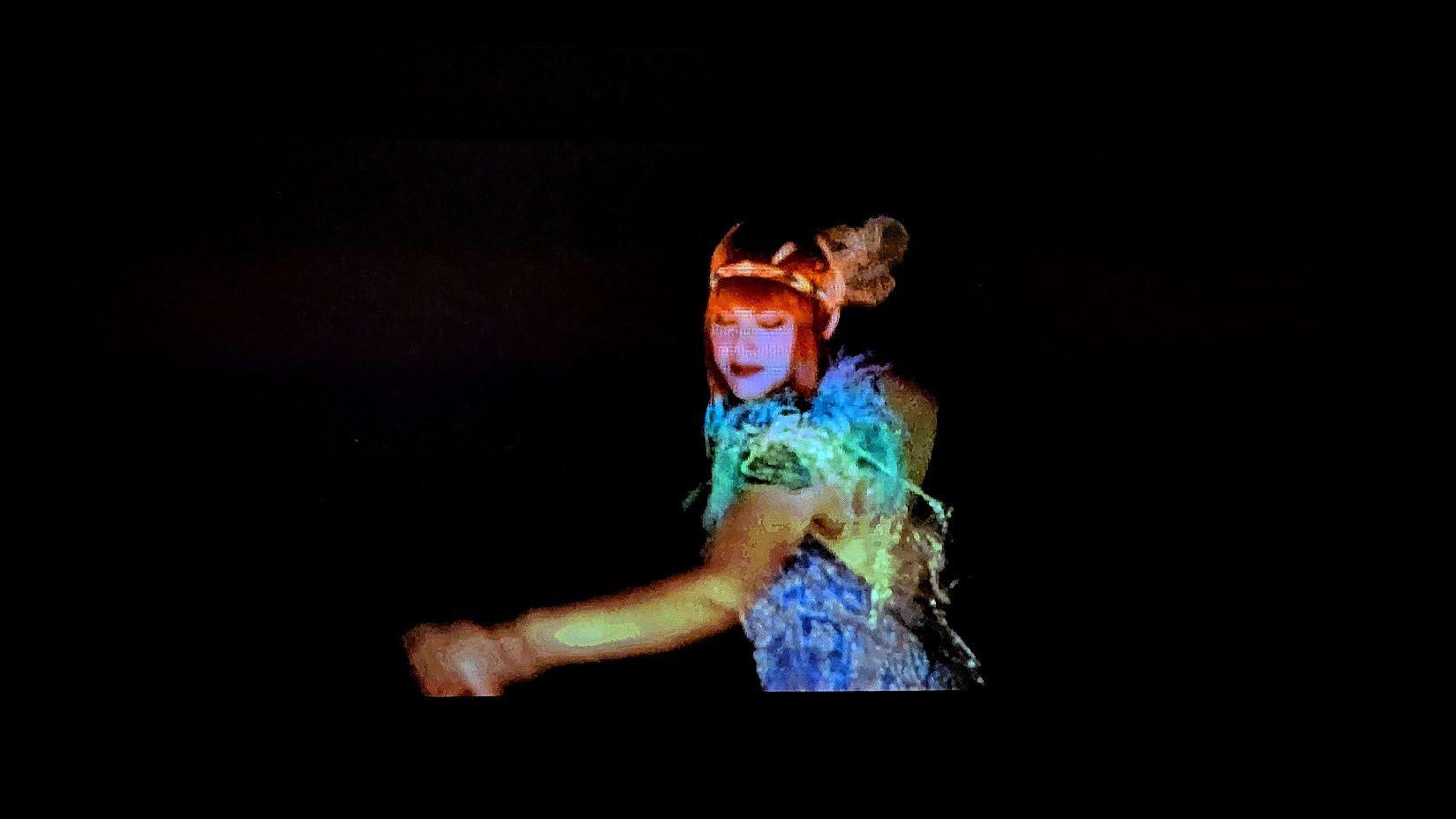
Key Work: PIDIKWE(Rumble)(2025). This 16mm film features Indigenous women of various generations. Monnet uses the 16mm medium to evoke and critique the representation of the female body in early cinema allowing her subjects to regain control of their image.
Practice: Anishinaabe and French artist Caroline Monnet, based in Montreal, works across film, sculpture, and 3D printing to communicate complex ideas on bicultural existence. She often employs industrial materials to unsettle outdated systems and foreground Indigenous methodological approaches. Monnet grew up in a family that renovated houses to earn a living, and she is concerned with availability and quality of government housing provided for Native peoples. Construction and housing are often references in her work.
Discussion Points:
• Monnet uses industrial "air barrier membranes" in her textile work Swaneige. Why use construction materials to reference the traditional practice of birch bark biting?
• How does the artist achieve her goal of self- determination for the women in her film?
• What is the connection between Monnet’s use of materials and her family history?
• Why does Monnet make wearable sculptures or garments?
Caroline Monnet , PIDIKWE(Rumble), 2025. Single channel video with sound Courtesy the artist and La Distributrice
Adnan Razvi
Did you use this guide in your classroom? If so, tag SVMoA on social media (@sunvalleymuseum) or email us at education@svmoa.org
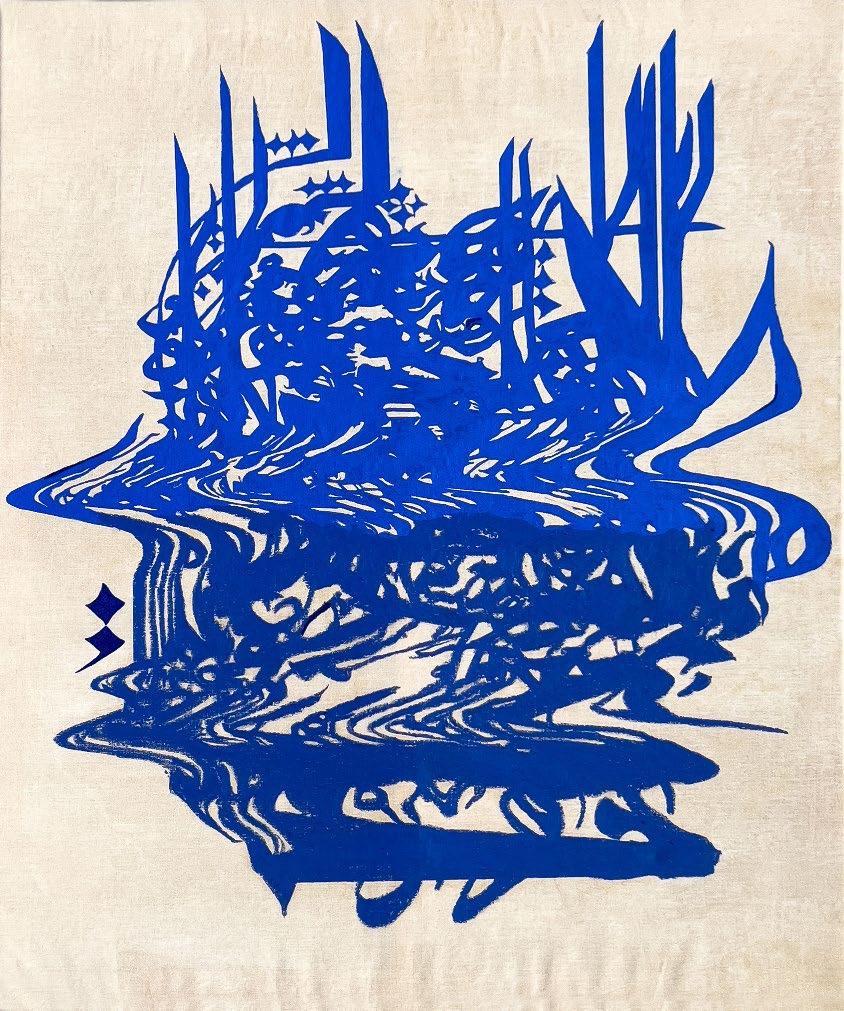
Razvi, MAWIMBI002:SurfsideBeach, Texas, 2023. Acrylic, oil stick, water, sediment, sand and hand-embroidered cotton on
Focus: Ecology and waterways, abstract futurism, global migration metaphors, and Afro -Asian culture.
Key Work: MAWIMBI series. Large-scale paintings on framed linen created using acrylic, oil stick, water, and sediment (sand, salt, minerals) from global sites like the Dead Sea or the Gulf of Mexico. These works incorporate hand- embroidered cotton and references to Ajami and Kufic script.
Practice: A Ugandan Pakistani American artist based in Dallas, Razvi explores ecology, migration, and memory. His process involves direct interaction with waterways, where he builds multi- dimensional paintings using the environment itself as a medium.
Discussion Points:
• If the sediment is the "truth" of the land, what does it mean when that physical land is moved and pinned to a wall in a museum?
• Razvi uses Ajami and Kufic scripts as abstract forms. How does this reference to specific cultural history expand the concept of a "landscape"?
• How does the collaborative video with Taylor Cleveland animate the "past" of the sediment into a "future" movement?
Adnan
framed linen. Courtesy the artist.
Laura Skehan
Did you use this guide in your classroom? If so, tag SVMoA on social media (@sunvalleymuseum) or email us at education@svmoa.org
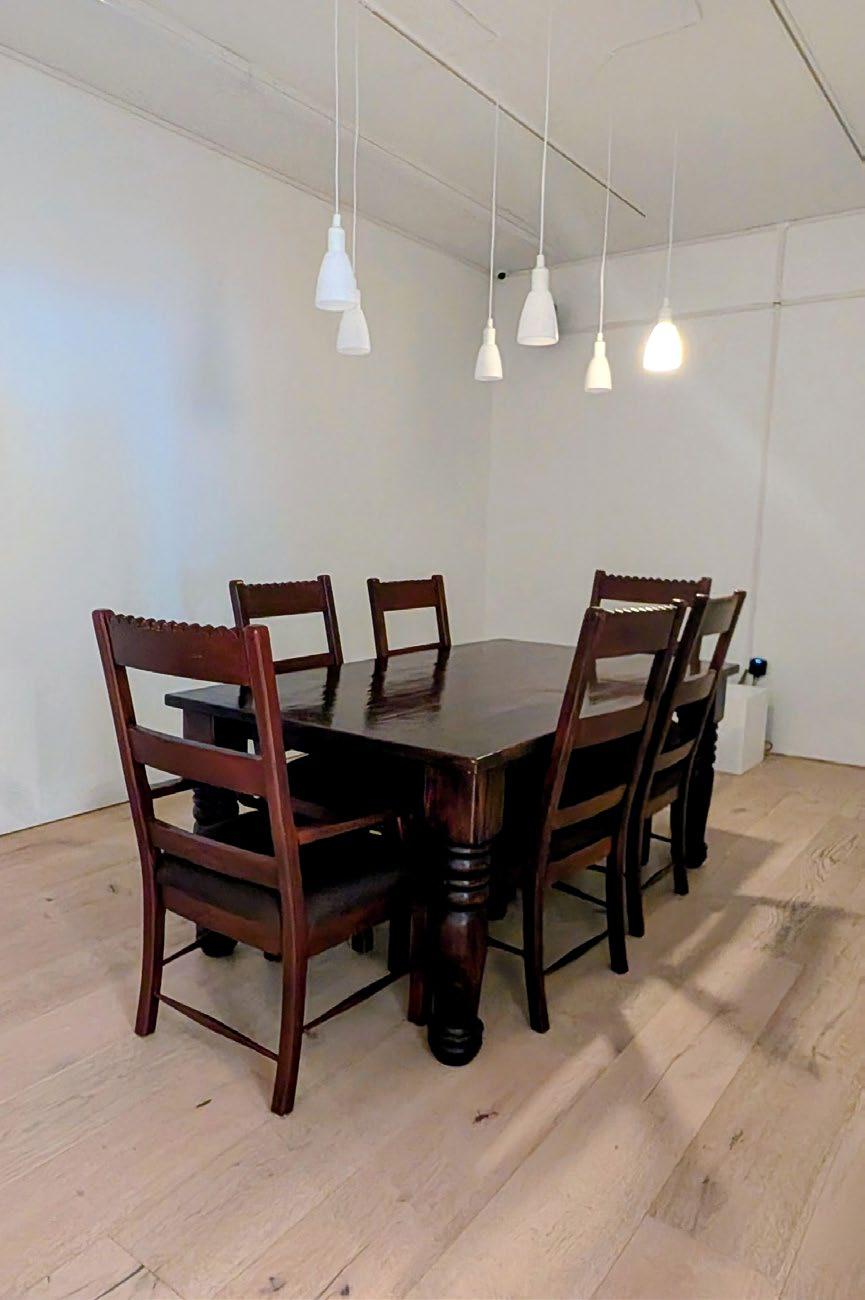
Laura Skehan, IntheAbsenceofResolution,WeBreakBread, 2025. Site-specific installation: sound, light, table, chairs Courtesy the artist
Focus: Human-nature relationship, foodways and sustenance, colonization impacts, and migrated histories.
Key Work: IntheAbsenceofResolution,WeBreakBread(2025). A site-specific sound and light installation incorporating recordings from communal dinners in Berlin. It explores "foodways" the cultural, social, and economic practices relating to the production and consumption of food.
Practice: Working between Dublin and Berlin, Skehan uses sound, sculptural installation, and moving images to consider the interconnected structure of our human relationship to nature. She connects natural forms with philosophical and political histories.
Discussion Points:
• What is the significance of "breaking bread" when discussing histories of migration and the impacts of colonization on food traditions?
• How does an interconnected structure to nature serve as a metaphor for the migration stories shared during her community dinners?
• How do sound and light create a different emotional "map" of migration compared to a traditional photograph?
Rodrigo Valenzuela
Did you use this guide in your classroom? If so, tag SVMoA on social media (@sunvalleymuseum) or email us at education@svmoa.org
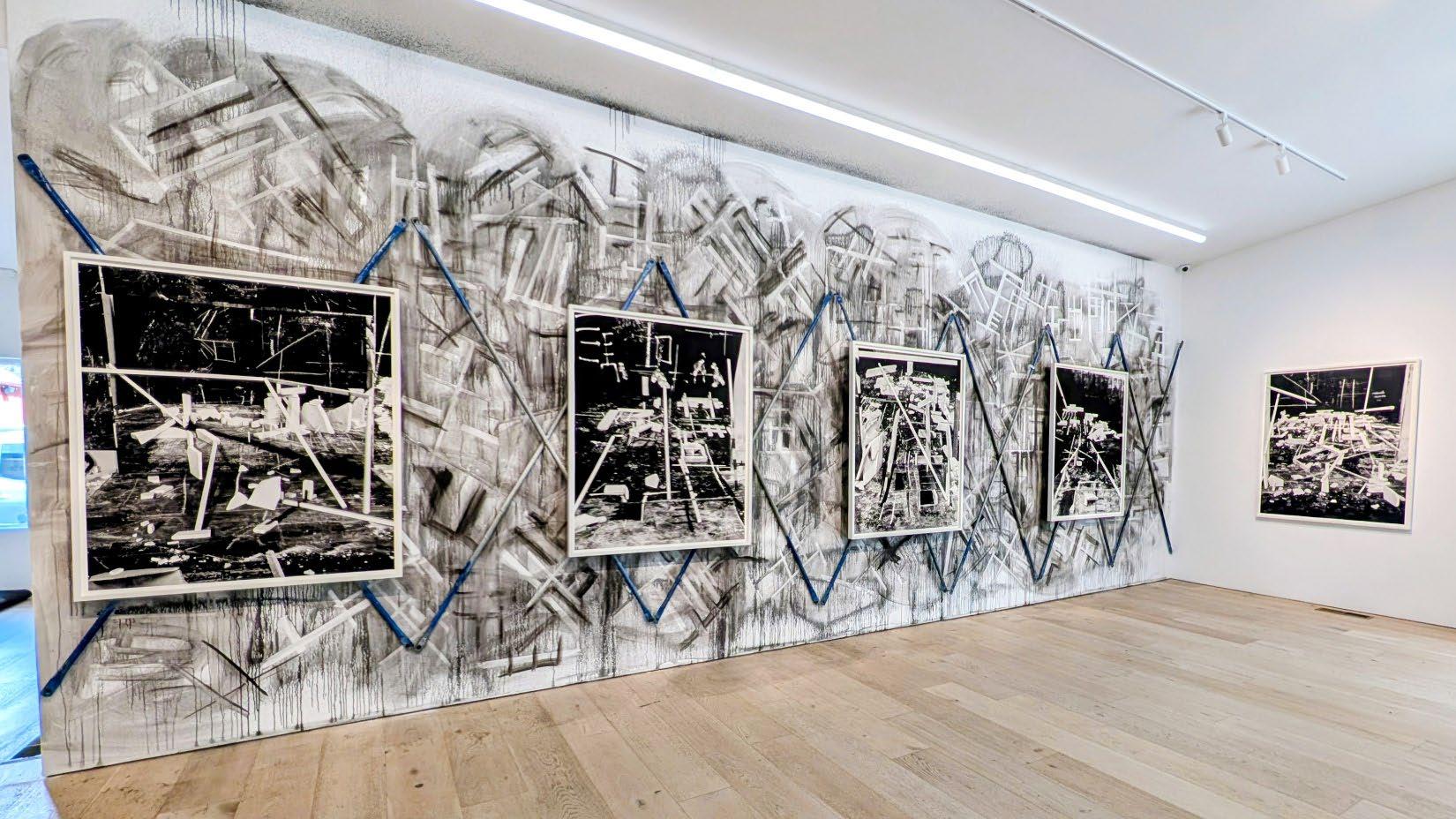
Rodrigo Valenzuela, FutureRuins, 2018. Site-specific installation: paint, scaffolding, photographs Courtesy the artist
Focus: Labor constructs, architectural ruins, staged photography, and invented narratives.
Key Work: FutureRuins(2018). An installation utilizing paint, scaffolding, and photography. Valenzuela uses simple building materials pipes, wooden pallets, and cinderblocks to construct studio scenes that he then photographs.
Practice: A Los Angeles-based artist and UCLA professor, Valenzuela was born in Chile and worked as a day laborer in the U.S. This personal history of labor is central to his work, which considers the constructs of art and architecture. Valenzuela also addresses the history of labor using materials like scaffolding and cinderblocks. His work blurs the line between photography’s perceived "truth" as a documentary medium and the active construction of an image.
Discussion Points:
• Valenzuela explicitly uses materials from his own history as a day laborer (scaffolding, pipes). How does this change the way you view the "ruin"? Is it a building falling apart or one being built?
• How does this work challenge the "documentary truth" of photography?
• In what ways do these "imagined ruins" reflect the realities and invisibility of migrant labor in America?
Link to Matterport (forthcoming)
to Photo Gallery (forthcoming)
Link
Did you use this guide in your classroom? If so, tag SVMoA on social media (@sunvalleymuseum) or email us at education@svmoa.org
If participating in an Exhibition Tour or Classroom Connections, students will re-visit and discuss these works as well as others during the SVMoA tour/visit and project. They will also create their own visual and/or written work that reflects the ideas explored by artists in the exhibition.
MemoryofaFutureOnceImagined
Before Your Visit
Prepare participants to think critically about migration, time/history, and cultural memory
General Questions:
• How do we usually measure time? Can you imagine a way of experiencing time that isn't a straight line, but rather a circle or a layered web where the past and future happen at once?
• If you had to move to a new country and could only bring things that aren't physical (stories, recipes, songs), which ones would be most important to your identity?
• How does the physical earth (sand, soil, water) hold onto the history of the people who lived there?
Artist-Specific Prompts:
• DinéYazhi’: How can an artist use the written word or light (like neon) to challenge existing structures of power? What might an "Indigenous future" look like in your imagination?
• Monnet: How can "modern" industrial building materials (like insulation wool or air barrier membranes) be used to modernize and protect an ancient cultural tradition like birch bark biting?
During Your Visit
Encourage active engagement through close-looking strategies and group discussions.
Close-Looking Strategies:
Observation Pairs: Spend 30 seconds looking at one work in silence. Describe one small detail to your partner that they might have missed (a thread, a grain of sand, a reflection).
Think, Feel, Wonder:
What do you notice in the physical textures? How does the scale of the installation make you feel? What does the work make you wonder about the artist’s journey?
Artist-Specific Prompts:
• Razvi: Look closely at the surface of the linen. Can you see the oil stick and the specific grains of salt or sand? How do these textures change the "truth" of the painting?
• Valenzuela: Focus on the scaffolding and pipes. How does the artist use these industrial objects to create a sense of history or "ruin"?
• Monnet: Find the geometric patterns in the air barrier membranes. How does the artist use industrial building supplies to reference the traditional Anishinaabe practice of birch bark biting?
After Your Visit
Encourage students to reflect on their experience and how it has deepened their understanding of migration, expansive continuums of time, and the ways cultural memory and nostalgia shape our visions of Indigenous futures.
Reflection Questions:
• The exhibition title is Memory ofaFutureOnceImagined Based on the works you saw, how can an artist "remember" a future that hasn't happened yet?
• Did any artist successfully unsettle your idea of "linear time"? Which one, and what visual evidence did they use to do so?
• How did the use of physical materials (sediment, construction supplies, or recorded voices) help you understand the concept of a "continuum of culture" rather than a culture that has been lost?
• Razvi: If you collected physical elements like sand, salt, or sediment from a body of water, what stories could those materials tell about the movement of people across the world?
• Skehan: Think about a special meal or food tradition in your family. How does sharing a meal "break bread" help preserve a history that has migrated from another place?
• Valenzuela: When you see a photograph of a construction site or a "ruin," do you assume it is showing you a real, documented place? How might an artist "stage" a scene to tell a deeper story about the reality of labor?
Related Activities
Did you use this guide in your classroom? If so, tag SVMoA on social media (@sunvalleymuseum) or email us at education@svmoa.org
• Skehan: Sit within the installation. How do the shared stories and the light change the way you perceive the objects in the room?
• DinéYazhi’: Look at the neon and the Sekishu paper. How does the "Sacred Voice" change when it is glowing versus when it is printed?
Engaging in creative activities after exploring MemoryofaFutureOnceImaginedcan deepen understanding and inspire reflection. SVMoA encourages educators to adapt any of the following activities to their classrooms:
ACTIVITY 1
: Language and Resistance (Inspired by Demian DinéYazhi’)
Objective: Explore the power of the written word to advocate for community renewal.
Prompt: Working with a partner, develop a short phrase that represents "resistance" or "Indigenous futures." Using markers or simple printmaking, create a "broadside" (a large poster). Focus on how the visual style of the letters adds weight to the meaning of the words.
ACTIVITY 2: Industrial Material
Remix (Inspired by Caroline Monnet)
Objective: Use non-traditional materials to unsettle outdated systems of representation.
Prompt: Using building materials (cardboard, tape, plastic sheeting, insulation), create a textile or sculpture that incorporates a geometric pattern from your own heritage. How does using "detritus" change the meaning of your traditional pattern?
Did you use this guide in your classroom? If so, tag SVMoA on social media (@sunvalleymuseum) or email us at education@svmoa.org
ACTIVITY 3: Ecological Texture Painting (Inspired
by Adnan Razvi)
Objective: Create art physically connected to a specific ecological site.
Prompt: Collect a small sample of soil or sediment from a local waterway. Mix it with clear glue or acrylic medium. Using this "earth-paint" and an oil stick, create an abstract representation of that location on fabric. Think about how the Ajami script might inspire your marks.
ACTIVITY 4: The Sound of Sustenance (Inspired
by Laura Skehan)
Objective: Document the intersection of foodways, memory, and migration.
Prompt: Record a 2-minute interview with someone about a specific food tradition. Pedagogical Tip: Ask the interviewee to focus on the soundsof the tradition the rhythm of the chopping, the cadence of the storyteller, or the specific kitchen sounds that signify "home." How does this audio "map" a history?
ACTIVITY 5: "Future Ruins" Photography (Inspired
by Rodrigo Valenzuela)
Objective: Challenge the "documentary truth" of photography using found construction objects.
Prompt: Build a small-scale "ruin" using twigs, blocks, pipes, or wire. Photograph your scene from a very low angle using a smartphone. Does the photograph make the small objects look like a massive architectural history?
Through these activities and reflections, MemoryofaFutureOnceImagined encourages participants to explore the intersection of movement across time, space, and land, unsettling colonial narratives to embrace expansive continuums of culture and Indigenous futures through creative expression.
Did you use this guide in your classroom? If so, tag SVMoA on social media (@sunvalleymuseum) or email us at education@svmoa.org
Educator Guide to Idaho Content Standards
MemoryofaFutureOnceImagined
The following Idaho standards align with the themes, activities, and engagement strategies in MemoryofaFutureOnce Imagined. These standards support critical thinking, creative expression, and cultural understanding across Visual Arts, Social Studies, English Language Arts (ELA), and Science. This exhibition explores the intersections of migration, Indigenous traditions, environmental repair, cultural preservation, and the concept of mending both physical and metaphorical.
Idaho Content Standards for Visual Arts Grades K -5
• K-2.VA.1.2: Explore uses of materials and tools to create works of art or design. Application: Students can investigate how Caroline Monnet utilizes industrial and non-traditional materials, such as air barrier membranes, insulation wool, and polyethylene, to create her textile sculptures and two-dimensional works. They can discuss how these "unconventional" tools and materials help her translate the traditional Anishinaabe practice of birch bark biting into a contemporary visual language.
• K-2.VA.4.2: Interpret art by identifying subject matter and describing relevant details. Application: Students can identify specific symbols related to identity and protection in Monnet’s geometric works or DinéYazhi’s neon installations.
• 3-5.VA.5.1: Identify how art is used to inform or change beliefs, values, or behaviors. Application: Students can discuss how the exhibition seeks to "unsettle" Western ideas of time and change the viewer's perception of history and migration.
• 3-5.VA.4.1: Analyze or evaluate components in visual imagery that convey messages, ideas, and mood. Application: Students can evaluate how Adnan Razvi uses texture and physical components such as sediment, sand, bromine, and salt collected from global waterways to convey a specific mood of "abstract futurism". They can discuss how these textured layers serve as visual metaphors for the movement of peoples across the world.
Idaho Content Standards for Visual Arts Grades 6-12
• 6-8.VA.5.1: Analyze and/or demonstrate how art reflects changing times, traditions, resources, and cultural uses. Application: Students can explore how Caroline Monnet uses industrial materials (like air barrier membranes) to reinterpret the traditional practice of birch bark biting.
• 6-8.VA.2.2: Apply visual organizational strategies to design and produce a work of art that communicates information or ideas. Application: Students can analyze how Rodrigo Valenzuela organizes building materials such as scaffolding, cinderblocks, wooden pallets, and pipes within a studio setting to create the "staged" photography found in his FutureRuinsinstallation. They can discuss how this specific visual arrangement is used to communicate ideas about the social and architectural constructs of labor.
Did you use this guide in your classroom? If so, tag SVMoA on social media (@sunvalleymuseum) or email us at education@svmoa.org
• 9-12.VA.4.1: Analyze and/or demonstrate how one’s understanding of the world is affected by art. Application: Students can reflect on how the exhibition’s diverse perspectives on migration, memory, and nostalgia shift their personal understanding of history.
• 9-12.VA.5.1: Describe how knowledge of culture, traditions, and history may influence personal responses to art. Application: Students can reflect on how their personal response to Demian DinéYazhi’'s site-specific neon installation is shaped by an understanding of Indigenous history and resistance. By exploring the artist's focus on "Radical Indigenous Queer Feminist Art" and the history of colonial occupation, students can describe how this cultural knowledge deepens their comprehension of the work's themes of renewal and Indigenous futures.
Idaho Content Standards for Social Studies Grades K-5
• K.SS.1.1: Describe how individuals have similarities and differences by sharing stories, pictures, and music. Application: Students can engage with the shared and unique migration stories captured in Skehan’s sound installation IntheAbsenceofResolution,WeBreakBread.
• 3.SS.1.4: Describe how migration and immigration are continuous processes and how they are influenced by voluntary and involuntary movement. Application: This standard aligns directly with the exhibition's goal to consider migration as an expansive continuum of movement across time and land.
• 4.SS.5.1: Analyze the roles and relationships of diverse groups of people who have impacted the state's history and contributed to cultural heritage. Application: Students can discuss how the Indigenous perspectives shared by DinéYazhi’ and Monnet contribute to a broader understanding of land and settlement.
Idaho Content Standards for Social Studies Grades 6-12
• 6-9.WG.2.9: Identify patterns of population distribution and growth and explain changes that have occurred over time. Application: Students can use Razvi’s MAWIMBIworks as a lens to discuss global population movement and the role of ecological features like waterways.
• 9-12.US2.1: Analyze the effects of migration and colonization on Native American communities. Application: Direct alignment with the work of Demian DinéYazhi’ and Caroline Monnet, which explicitly addresses the impacts of colonial occupation and resistance.
• 9-12.US2.44: Evaluate how the rise of alternative media and technology affect United States culture, society, and politics. Application: Students can analyze how Adnan Razvi and Taylor Cleveland use video and animation to amplify contemporary ecological and migration narratives.
Idaho Content Standards for English Language Arts (ELA) Grades K-5
• K.RC.5 / K.RL.5: With support, use evidence from literature (or stories heard) to demonstrate understanding of grade -level texts. Application: Students can listen to the migration journeys shared in Laura Skehan’s sound installation and identify key details about the participants' experiences.
Did you use this guide in your classroom? If so, tag SVMoA on social media (@sunvalleymuseum) or email us at education@svmoa.org
• 2.RC.5 / 2.RL.5: Identify the central message, lesson, or moral of stories from diverse cultures. Application: Students can explore the cultural messages regarding Anishinaabe identity and selfdetermination in Caroline Monnet’s film PIDIKWE.
• 3.RC.6e: Compare and contrast important points and key supporting details presented in two texts on the same topic. Application: Students can compare how Adnan Razvi uses water as a metaphor for migration versus how Rodrigo Valenzuela uses "ruins" to tell stories of labor and settlement.
Idaho Content Standards for English Language Arts (ELA) Grades 6-12
• 6.RC.6d: Trace the argument and specific claims in texts, distinguishing claims supported by evidence from those that are not. Application: Students can analyze the "arguments" Rodrigo Valenzuela makes regarding the construction of labor histories through his staged photographic installations.
• 8.RC.5e: Relate themes, patterns of events, or character types from traditional works to contemporary stories. Application: Students can connect Monnet’s use of traditional birch bark biting patterns to her contemporary textile and video works.
• 9/10.RC.5d: Analyze points of view or cultural experiences that represent diverse voices and perspectives in works of literature (or art). Application: Students can analyze the "Radical Indigenous Queer Feminist" perspective of Demian DinéYazhi’ and how it informs their sitespecific neon installation.
Idaho Content Standards for Science Grades K-5
• K-ESS-1.2: Use evidence to construct an explanation of how plants and animals interact with their environment. Application: Students can observe how Razvi directly interacts with natural environments by using sediment and water from global sites to create his artworks.
• 2-ESS-2.2: Develop a model to represent the shapes and kinds of land and bodies of water. Application: Students can view Razvi’s MAWIMBIseries as abstract models of specific Earth features and water systems.
• 4-ESS-2.2: Analyze and interpret data from maps to describe patterns of Earth’s features. Application: Students can discuss how the physical features of the Earth (oceans, deserts, mountains) have shaped historical and contemporary migration routes.
Idaho Content Standards for Science Grades 6-12
• MS-ESS-3.4: Construct an argument based on evidence for how changes in human population and per- capita consumption of natural resources affect Earth’s systems. Application: Students can discuss Razvi’s work in the context of human ecological impact on waterways and the environment.
Did you use this guide in your classroom? If so, tag SVMoA on social media (@sunvalleymuseum) or email us at education@svmoa.org
• HS-ESS-3.5: Analyze geoscience data to make an evidence-based explanation of how climate variability can affect Earth’s systems. Application: Using the exhibition’s focus on the "future," students can project how climate change will influence migration patterns and the preservation of cultural heritage in the coming years.
Idaho Content Standards for Mathematics Grades K-6
• K.G.A.1: Describe objects in the environment using names of shapes and relative positions. Application: Students can describe the geometric patterns and symmetrical shapes found in Monnet’s birch bark biting practices.
• 1.G.A.2: Compose two - dimensional or three- dimensional shapes to create a composite shape. Application: Students can observe how Rodrigo Valenzuela assembles building materials like scaffolding and cinderblocks to create the "ruins" in his studio scenes.
• 5.G.A.1: Describe and understand the key attributes of the coordinate plane. Application: Students can use latitude and longitude to map the global locations of the bodies of water Razvi visited for his MAWIMBI series, such as Surfside Beach, Texas, and the Dead Sea, Jordan.
Idaho Content Standards for Mathematics Grades 6-12
• 7.G.A.1: Solve problems involving scale drawings of geometric figures, including computing actual lengths and areas. Application: Students can analyze the scale of Valenzuela’s installations compared to the real-world architecture they reference.
• 8.G.A.3: Describe the effect of translations, rotations, reflections, and dilations on twodimensional figures. Application: Students can identify reflections and rotations in the geometric compositions of Monnet’s textile sculptures.
• 9-12.S.ID.A.2: Represent measurement data with plots on the real number line. Application: Students can create data visualizations representing the historical and contemporary migration routes referenced throughout the exhibition.
Did you use this guide in your classroom? If so, tag SVMoA on social media (@sunvalleymuseum) or email us at education@svmoa.org
Online Resource for Exploring Art, Images, and Objects
Project Zero Thinking Routines Toolbox
Link to Exploring Art, Images, and Objects
This resource provides various thinking routines to engage students in deep observation and critical thinking about art. It helps students interpret, question, and connect with the artworks in the Memoryof aFutureOnceImaginedexhibition.
1. Looking Ten Times Two
Purpose: Encourages detailed observation and helps students practice noticing multiple aspects of an image, promoting careful and deliberate engagement with art.
Steps:
• Look at the image for 30 seconds, letting your eyes wander.
• List 10 words or phrases about any aspect of the image.
• Repeat the process, adding 10 more words or phrases. Focus the second round of observation on specific features (e.g., colors, shapes, or lines).
Skills Developed:
• Observation: Students practice noticing fine details.
• Interpretation: The variety of words and phrases helps students interpret what they see from different perspectives.
• Questioning: Encourages curiosity as students ask themselves about specific aspects to focus on (e.g., why are certain elements prominent?).
2. Think, Feel, Care
Purpose: This routine is aimed at understanding the emotional and personal context of the artwork, fostering empathy and deeper engagement with the content.
Steps:
• Think: Ask students, "If you were this person (in the artwork), what would you think?"
• Feel: Ask, "How would you feel? Why would you feel this way?"
• Care: Ask, "What would be important to you? What would you care about?"
Skills Developed:
• Observation: Students focus on interpreting the emotions conveyed by the artwork and its subject matter.
• Interpretation: Students interpret emotional and personal aspects of the artwork.
• Questioning: Encourages questioning of the subject’s mindset, values, and motivations.
3. Find, Capture, Explain, Wonder
Did you use this guide in your classroom? If so, tag SVMoA on social media (@sunvalleymuseum) or email us at education@svmoa.org
Purpose: Promotes deep reflection and inquiry by guiding students through a step-by-step process of identifying, creating, explaining, and reflecting on the artwork.
Steps:
• FIND: Ask, "How would you describe this artwork in a word or phrase?"
• CAPTURE: Students make a drawing of the artwork, paying attention to detail.
• EXPLAIN: Ask students to explain how the artwork is complex considering the multiple elements or ideas involved.
• WONDER: Encourage students to ask new questions about the artwork and explore areas they find intriguing.
Skills Developed:
• Observation: Through drawing, students practice observing the artwork closely.
• Interpretation: Encourages reflection on the complexity of the artwork.
• Questioning: Fosters curiosity and deeper exploration, prompting students to generate their own questions.
ThisEducatorGuidewaspreparedand writtenbyDianneSánchez, March12, 2026