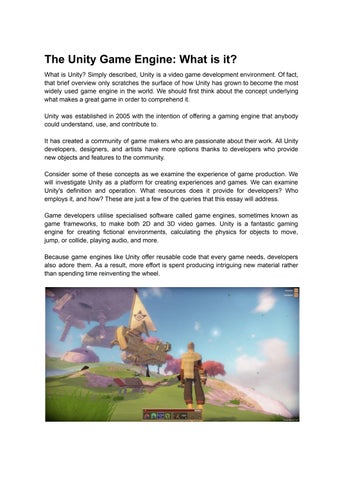
The Unity Game Engine: What is it? What is Unity? Simply described, Unity is a video game development environment. Of fact, that brief overview only scratches the surface of how Unity has grown to become the most widely used game engine in the world. We should first think about the concept underlying what makes a great game in order to comprehend it. Unity was established in 2005 with the intention of offering a gaming engine that anybody could understand, use, and contribute to. It has created a community of game makers who are passionate about their work. All Unity developers, designers, and artists have more options thanks to developers who provide new objects and features to the community. Consider some of these concepts as we examine the experience of game production. We will investigate Unity as a platform for creating experiences and games. We can examine Unity's definition and operation. What resources does it provide for developers? Who employs it, and how? These are just a few of the queries that this essay will address. Game developers utilise specialised software called game engines, sometimes known as game frameworks, to make both 2D and 3D video games. Unity is a fantastic gaming engine for creating fictional environments, calculating the physics for objects to move, jump, or collide, playing audio, and more. Because game engines like Unity offer reusable code that every game needs, developers also adore them. As a result, more effort is spent producing intriguing new material rather than spending time reinventing the wheel.
Unity contains five parts, like the majority of game engines. The main part is a programme that creates 3D animated images and houses the rendering engine for the game logic. Algorithms are provided by an audio engine component to produce and alter sounds. A physics engine controls movement and collisions for physical rules. There is an Artificial Intelligence (AI) component for non-player activities and decisions. In gaming engines, models that produce images and illuminate an environment are easily accessible. Characters with physical behaviours can be easily created. These technologies provide designers and developers more time to concentrate on game logic and flow. Developers have the chance to share their "middleware" software and contribute to the game engine by using this object-oriented, modular approach. The game engine is enhanced and given new functionality by this programme. Components of middleware handle particular tasks.
Features and Components of Unity To aid developers in the creation, release, and monetization of games and experiences, Unity comes with a comprehensive collection of capabilities. ● Graphics in 2D and 3D Utilizing 3D geometry, objects in 3D games seem as solid worlds with materials and textures. A camera is used in 3D games to create perspective. If an object is near the camera, it appears larger. Instead of using the standard viewpoint, orthographic 3D employs an orthographic camera. This provides a bird's-eye view of the action, similar to a street-view map! A Unity Game Development Company- Suffescom Solutions Inc. transforms concepts into innovations that are loved by millions of avid players. The graphics in 2D games are flat, and there is no camera perspective at all. 3D visuals may add depth and flair to 2D experiences. ● Physics The Unity physics engine enables the developer to guarantee that objects accelerate properly. Collisions between objects, gravity, and other natural forces are handled by the physics engine. Object-oriented physics is the default of the two physics engines that Unity offers. These interactions take place on a single thread and core. Unity uses a more recent data-oriented technological stack. It has a quicker, lighter, and multi-threading-focused internal architecture. ● Scripting Unity is a programme that requires scripting. The C# code is what reacts to user input. It controls the object hierarchy and schedules events to take place at the appropriate times. Unity scripts direct the physical behaviour of objects and produce graphical effects. The AI technology that powers the experience's characters is managed via scripts.
● Video and audio Unity has 3D special sound support. It offers equipment for mixing and mastering audio with built-in effects. The user can incorporate video into the experience thanks to the video component. Outside of Unity, developers and artists can create audio and visual snippets and include them into game experiences. ● User Experience For developers looking to create content, Unity offers three possibilities. UIElements are used by users to create user interfaces. Data persistence, dynamic and contextual event handling, and stylesheets are all used. The user interface can be organised, positioned, and styled using the Unity UI toolkit. It is an object-based UI that makes use of both the Game View and components. IMGUI is a user interface in graphical mode. Developers can create in-game debugging panels using the IMGUI tool. It is not the ideal method for creating the user interface. ● Pathfinding and navigation The ability to navigate throughout the game world is provided by the navigation system. Because of the game's Scene geometry, navigation meshes are automatically generated. Opening doors and jumping off ledges are both possible with off-mesh connections. Runtime character navigations are sparked by dynamic barriers.
Wrapping Up The abundance of games and game engines might occasionally lead people to believe that making games is simple. There isn't a magic button, in actuality. The creation of video games and other visual experiences is a career that many people truly enjoy. Unity develops a game engine for your games, not actual games themselves. Unity is a platform for everyone since it is a free product and comes with significant training and resources. Unity actively promotes and seeks out partners to provide community assistance and educational programmes. Unity actively promotes idea generation and cross-ideation within the community through the provision of free hosted sites for developers to contribute their code, concepts, and skills. Every day, more individuals from all around the world join Unity and add new experiences to the platform.