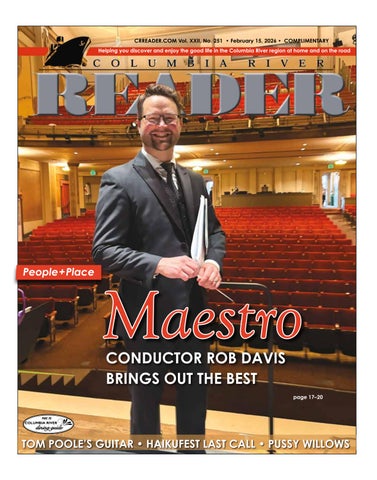
Columbia River Reader Feb 2026

Page 1


THE TIDEWATER REACH

Field Guide to the Lower Columbia River in Poems and Pictures By Robert Michael Pyle and Judy VanderMaten.

Gabriel Franchére $21.95

11 issues mailed to your home or business $85

In three editions:

• Boxed Signature Edition, with color $50

• Collectors Edition, with color $35

• Trade paperback B/W $25

Rex Ziak’s edited and annotated edition of Franchére’s 1820 journal, The First American Settlement on the Pacific. COLLECTORS CLUB ANNUAL SUBSCRIPTION THOUGHTFUL GIFTS... FOR YOURSELF OR FOR A FRIEND

Southwest Washington author and explorer Rex Ziak revolutionized historical scholarship by documenting minute-by-minute the Corps’ dangerous days at the mouth of the Columbia.

WORDS AND WOOD

Pacific Northwest Woodcuts and Haiku by Debby Neely •Boxed, Gift Edition with tasseled bookmark $35

COLLECTORS CLUB / BOOK MAIL ORDER FORM

BOOKS: PERFECT GIFTS!

AVAILABLE FOR IN-PERSON PICK-UP at 1333 14th Ave., Longview WA 98632. Cash, checks, credit card

• 11–3

360-749-1021 to order with free Lgv-Kelso delivery

make check payable to CRR Press. To use credit card, visit www.crreader.com/crrpress or call 360-749-1021

14th Ave.

DISPATCHES FROM THE DISCOVERY TRAIL

A Layman’s Lewis & Clark by Michael O. Perry.

•BW Edition $35

•220 historic photos •Boxed, signed. $50.

Winter doldrums? Maybe it’s time for a mood elevator.

HaikuFest is here — Columbia River Reader’s annual avenue to calming your mind, quickening your heart, and quieting your soul. It doesn’t require thousands of dollars, a flight to a sunnier climate, or excessive consumption of what’s not good for you.

Haiku are more than therapeutic. They invite us to distill our observations, thoughts, and feelings down to a mere 17 syllables — an enlightening exercise in “less is more.”

The submission deadline is March 1st — see details in this issue p. 26.

If you insist on measuring your mood elevation more objectively, consider the arrival of Daylight Savings Time on March 8, a similar harbinger of hope.

Justice

The postal service delivered me a mood elevator a few days ago — a $38 check in the mail. It was, presumably, the first in a series of retribution payments I will receive for my stolen laptop.

Publisher/Editor: Susan P. Piper

Columnists and contributors:

Merrilee Bauman

Hal Calbom

Nancy Chennault

Tiffany Dicjkinson

Alice Dietz

Joseph Govednik

Tony Indriolo

Michael Perry

Ned Piper

Tom Poole

Robert Michael Pyle

Marc Roland

Alan Rose

Greg Smith

Andre Stepankowsky

Judy VanderMaten

Dennis Weber

Karley Whitworth

Editorial/Proofreading Assistants: Merrilee Bauman, Michael Perry, Marilyn Perry, Susan Nordin, Tiffany Dickinson, Ned Piper

Advertising Manager: Ned Piper, 360-749-2632

Columbia River Reader, llc 1333 14th Ave, Longview, WA 98632

P.O. Box 1643 • Rainier, OR 97048

Office Hours: M-W-F

*Other times by chance or

E-mail: publisher@crreader.com Phone: 360-749-1021

Sue’s Views

Some 10 years ago a burglar climbed through an unlocked window, walked around inside our house, and made off with my laptop and purse.

Columbia

A few weeks later, I learned that this person had been arrested and was in jail. I actually considered going to visit. Ha! Bad idea, everyone told me.

But the urge to express my sense of indignation and loss, along with trying to make a compassionate, human connection with an offer of forgiveness, were strong.

Not all urges must be acted upon, my friends reminded me. I still wonder how our meeting might have gone. I did eventually get my purse back, thankfully.

Fast forward to now. Evidently “my burglar” has gotten back on track and now has a job which is making possible his repayment to me and the others he stole from. I’m pleased for him and certainly wish him the best. Perhaps he knew I’d thought about him mercifully.

Amateur hour

Editing the paper this month I came across the phrase “gifted amateur” in one of our pieces.

Amateur. Giving it a moment’s thought, I realized that many don’t appreciate or embrace the true meaning of that common word. Rather than a putdown, or implication that someone is not quite up to par, the word amateur, from the Latin amare , meaning “to love,” actually refers to someone who loves what they are doing.

Amateur is not really the antonym for “professional,” and ideally, the two words would overlap in their meaning.

Enjoy and exert your own gifted amateurism this month — and why not coalesce it in a haiku?

Spring is coming. The mood elevator is going up!

Rob Davis on stage
The Mood Elevator: Going UP!

Spirit in the sky

Letter to the Editor

Like many folks, I complain that there are just not many honest folks in this world. Recently, something happened to me that was a serious wakeup call in more than one respect.

I am an old dude, close to 80, and not saying which side I am closer to. I stopped at Safeway for a snack and headed back out to the rig to eat it. Then to my shock, I noticed my wallet wasn’t stuffed comfortable in my jeans. I crawled all over the truck looking for it. The only luck I had was bad.

Then I examined the Safeway parking lot with the same luck and checked the deli and customer service counter with the same dismal luck. The only option: Call my wife and figure out what to do...cancel the cards, license, etc., start calling for replacements and just write off the cash.

As I was heading for the first bank to begin canceling, my wife called back. She, almost in tears, said to me, “I have your wallet in my hand.”

It turns out that the fellow at the door was a guy I had yarded out of the mud 40 years ago. He told my wife he’d waited 40 years to give me a payback.

The fellow who returned my wallet happened to have taken his mother shopping at Safeway and normally would’ve been alone in his rig. Some other honest person had picked up my wallet and stuffed it in the passenger side door handle, where it became evident only later when the mother opened her door.

The whole thing was an amazingly beautiful happening for me. Two very honest folks directed by the Spirit in the sky. I did say a very serious prayer of thanks and donated a bit more this month!

Bill Ott

Longview, Wash.

AND MY PIANO*

*or other instrument

Spanning a vast grand canyon From learning guitar to playing LOUD

Oakland California, 1985: My girlfriend was pregnant and thought it was a good time to buy an electric guitar.

We went to Subway Guitars in Berkeley and I got a cheap Stratocaster copy. Subway owner Fat Dog said, “You’ll have a baby soon, I don’t think you need an electric guitar.”

But I did, and have rebuilt it many times. The part of the guitar attaching

At left: Tom Poole, 30-something, in a BW photo taken with Tri-X film and printed in his bathroom around 1990. “Those were the days,” he recalled. Tom Poole

the strings — the bridge — was made of cheap zinc, so I replaced it with brass. I refitted the spring whammy bar to include animal hide glue (it dries like solid glass) where the springs attach to the body, and now the guitar has lengthy sustain.

Since then, I have gone on to build many guitars, all with the thought of increasing sustain. You really get the feeling of wild precision with multiple outputs. The neck pickup goes to one amp on the left, and the bridge pickup goes to a different amp on the right (see the John Cipollina amp stack johncipollina. com). Now you can blend each pickup with a unique filtered stereo tone — one thick with midrange, and the other with chorus / delay, a thinner, more trebly tone. Stereo guitar is fantastic. Then I did three outputs, but in the end I tried seven outputs, one for each string, and one for all six strings. That really burned me out and I stopped making guitars.

After seeing Jimi Hendrix three times, guitar playing became an obsession. So I kept at it, learning classical guitar and then jazz guitar. Once you learn the A Minor pentatonic scale, you can jam with any Allman Brothers song. But learning never stops.

Me & My Piano

It is an odd quagmire all guitar players come to. You learn the chords and know the scales and gradually see what the great guitar players are doing. When the knowledge of music is combined with an advanced skill set, an odd secret door opens and you can see through it with

quite a bit of clarity. What the great players (Duane, Eric, Jaco, John McLaughlin, Jimi, Pat Metheny) are doing becomes less mysterious. You realize what it would take to do that, to get there. The better you get (and let me tell you, it’s fun to be good and fast and loud), the more you understand the distance between you and greatness. You realize it’s a vast open grand canyon. It’s a really long way to go, to learn, to focus. It’s a blast when you can play without thinking, a vague musical idea to begin with, one idea leads to another and you achieve flow, it feels authentic and comfortable! One thing stays constant: You’re never happy with one or two or three guitars or happy with your own playing. The recording doesn’t lie and you know it. We now live in St. Helens, Oregon, on a family compound, on mountaintop acreage my son (born in 1985) and his husband own. Here, I can continue to learn and get really loud.

READER SUBMISSIONS INVITED!

Share your unique story of you and your relationship with a musical instrument in 500 words or less and mail to CRR, 1333 14th Ave., Longview, WA 98632, or email to publisher@ crreader.com. Note “Me and My Piano” in the subject line and if possible attach/include a current mugshot and/or a photo of you with your instrument, then or now.

Don’t worry about perfect spelling or syntax. If your story is chosen, we will provide editing services and will contact you for additional details or embellishments as needed.

Looking UP

February 17th – March 17th

The Evening Sky

A clear sky is needed.

Late February (23rd) will have the moon next to the Pleiades star cluster. Jupiter is located in the constellation of Gemini which is virtually straight overhead. Saturn will be low in the western sky around 7pm. Orion the bold constellation will be high in the southern sky. This is the best time for viewing the star forming region of the nebula in Orion’s sword that hangs down from the three star belt. Even a small telescope will bring out the nebula very well and is a marvel to observe.

The Morning Sky

A cloudless eastern horizon sky is required. The summer triangle of Vega and Deneb and Altair are rising in the early morning (6am) eastern sky. No planets are visible at this time.

Night Sky Spectacle

A clear dark sky is a must. Two lovely star clusters are in view by 7:30pm. The first is the Pleiades (M45). It looks like a tiny cup that will be near the moon on Feb. 23rd and then the Beehive cluster in the faint constellation of Cancer to the left of Gemini. On Feb. 28th the nearly full moon will be right next to it. The moon may wash out seeing it with the naked eye, but binoculars should still bring it out. It is a large spread out grouping of stars. It sort of looks like a swarm of bees at a hive, thus the name Beehive cluster (M44).

Daylight Savings Time begins Sunday, March 8

MOON PHASES:

New Moon, Tues, Feb. 17th

1st Quarter, Tues, Feb. 24th

Full Moon: Tues. Mar. 3rd

Third Quarter: Wed, Mar. 11th

END OF TWILIGHT:

When the brightest stars start to come out. Allow about an hour more to see a lot of stars.

Thurs, Feb. 19th • 6:14p

Thurs, Feb. 26th • 6:24pm

Thurs, Mar. 5th • 6:33pm

Thurs, Mar. 12th • 7:43pm

SUNSET

Thurs, Feb. 19th, 5:47pm

Thurs, Feb. 26th • 5:55pm

Thurs, Mar. 5th • 6:05pm

Thurs, Mar. 12th • 7:15pm

Longview resident Greg Smith is past president of Friends of Galileo. Meet him and other club members at monthly meetings in Longview. For more info about FOG, visit friendsofgalileo.com.

ROLAND ON WINE

TPlan ahead, arrange a ride, take a bottle home

he Washington State Senate has passed a bill to lower the blood alcohol legal limit for driving from 0.08 to 0.05. If it becomes law, it is slated to go into effect in July this year. Is this something to be proud of or something to be concerned about?

Most European countries have long operated under a standard of 0.05 or lower. In those places, wine is not treated as something bad. It is treated as part of a culture. Because it is a central part of social life, people have learned to be responsible by planning ahead and showing restraint. Some point out that people in Europe don’t drive as much as we do, but there are still good reasons to think about our overall relationship with drinking and driving.

As a business owner in the wine industry, I am keenly aware and support the ideal that people not drink and drive. That position is not in conflict with producing and celebrating wine. But it is central to doing so responsibly. Studies from the U.S. and abroad show that lowering the legal limit saves lives. Impairment begins well before 0.08, and laws that reflect that reality change behavior. People plan rides, they drink less when they know they will need to drive. In places where there is data, it shows that fatalities decline.

Critics raise legitimate concern

Some argue that a 0.05 limit risks criminalizing moderate drinkers who are not meaningfully unsafe behind the wheel. Others believe enforcement resources would be better focused on high-BAC (blood alcohol concentration) drivers and repeat offenders, who account for a disproportionate share of serious injuries and deaths.

that demonizes all drinking. Public education could help by presenting a more nuanced view of the social benefits of responsible drinking. My main concern would be that a lower limit would become a ‘gotcha’ instrument or a revenue tool, instead of a tool to change irresponsible, dangerous behavior.

From the perspective of the wine industry, the answer is not to resist safety standards but to use them to make our places more safe and healthy. That means encouraging designated drivers, supporting rideshare access, promoting responsible tasting sizes, and reinforcing the idea that enjoying wine with friends is a gift but not if we abuse it. We also need to think ahead of time how will we get home safely. Wine is about pleasure, place, and connection. None of that is undermined by stronger norms around safety. If anything, it strengthens public trust.

Lowering the limit is not anti-wine. It is a statement about our relationship with alcohol. People around the world have enjoyed wine for thousands of years and have found ways to use it without harming themselves or others. The question is not whether we value wine or safety. A responsible culture insists on both.

Tip: Wine is meant to be enjoyed, not rushed. A typical 5 oz glass counts as one drink, and for many people, two glasses within an hour can bring BAC close to 0.05. Since everyone processes alcohol differently, the safest move if you’re driving is to stick to one or two glasses over a couple hours.

More than that, plan a ride. If you want to help your favorite winery, buy a bottle to take home.

Those concerns should not be dismissed, but a successful policy needs an enforcement strategy, focused on the most dangerous drivers. Also its seems to me that it is time to throw off the prohibition mentality

Thanks for helping us keep wine culture safe and responsible.

Longview resident and former Kelso teacher Marc Roland started making wine in 2008 in his garage. He and his wife, Nancy, now operate Roland Wines at 1106 Florida Street in Longview’s new “barrel district.” For wine tasting hours, call 360-846-7304.

NOTES FROM MY LIVES

Labor of love

Big-scale home remodel forges new father-daughter bond

his was not a typical father-daughter bonding experience.

Three years ago, my daughter Anastasia and I launched a major expansion of her home in Bothel, a Seattle suburb.

The project added 400 square feet, required the demolition of a quarter of the roof and created a new bathroom and expansive room with a 3-foot high cathedral ceiling that spans a new kitchen, dining area, pool table and TV lounging area. I had done a lot of remodeling before, but never on a scale this big.

Except for a detail or two, the project is finished and looks grand. Anastasia and I are still talking despite engaging in a shouting match or two. In fact, the best part was getting to visit often and conversing nearly every night to coordinate material purchases and construction sequences.

It took so long because I did most of the work on weekends and short trips, often combining visits with attendance at Mariners baseball and UW Husky football games.

Anastasia and her boyfriend, Collin, had to live in the house during demolition and reconstruction. This required very deliberate phasing of the work to keep water and electricity flowing. They had to walk and cook around dangling wires, stacks of lumber and insulation. And they endured frigid cold when temperatures sank to single digits last winter.

Anastasia’s friend Pablo and boyfriend Collin helped me. Anastasia shopped for materials and lined up the few subs we used. We did almost all the work ourselves. That meant dirty forays in the old crawl space, masking up for dust storms during insulation removal, and enduring temporary nerve damage to my hand from demolition saw vibration.

As remodels go, this one went off pretty smoothly. But there’s a saying about home renovation: Expect the unexpected. This one had its share of unwelcome surprises.

One was discovering that the kitchen sink drain pipe was badly corroded inside an exterior wall,

allowing wash water to run down undetected and seep between floor layers. It accounted for a hideous underthe-sink smell and a mold-blackened subfloor.

I found that the old floor decking had sagged more than an inch due to inadequate framing. The exterior walls were unsheathed under the cedar siding.

The architect’s drawings caused problems, too. They specified a new crawl space entry in an impossible location. Several anchor bolts just could not go in places on the old foundation that the blueprints indicated.

But there were moments of exhilaration, the biggest of which for me came when a crane placed a 25-foot-long, glue-laminated wood beam atop two columns to support the new cathedral roof. It laid perfectly level, prompting me to bellow a hoot heard around the neighborhood.

I confess to secretly panicking when I saw the blueprints outlining the scale of this project. It became far more than a labor of love. And the lesson here is that anyone thinking about taking on a project of this scope should reconsider — unless they love the work in addition to their child.

Still, as long as she lives in that house, Anastasia will remember her dad with almost everything she touches. Every time she opens her kitchen cabinets — all fabricated from scratch in my garage— she’ll think of me and my late brother, who milled some of the striking figured maple that went into them.

More importantly, Anastasia — a cancer researcher —will have learned a lot about construction, a valuable homeowning skill whether you do the work or hire it out. Finally, it will reinforce her courage and confidence to take on tasks that may appear too formidable and beyond her ability.

That, especially, is a bond we will always share.

Award-winning journalist Andre Stepankowsky is a former reporter and editor for The Daily News in Longview. His Columbia River Reader columns spring from his many interests, including hiking, rose gardening, music, and woodworking. More of his writing can be found under “Lower Columbia Currents,” on substack.com.

Anastasia works behind the skeleton of what became a finished island in the new kitchen, part of a 400-square foot expansion project on her Bothel, Wash. home.
Diane Kenneway Escrow Closer / Assistant Celinda Northrup Escrow Officer / LPO
Alison Peters Escrow Officer / LPO
Logan Parcel Escrow Closer / LPO

DISPATCHES FROM THE DISCOVERY TRAIL

Smelt Dip

EPISODE 22

Smelt Dip Homeward Bound!

O n F eb . 24, while still at F O rt ClatsOp, the Corps obtained some smelt from Chief Comowooll and a dozen members of the Clatsop Indians. In 1806 Lewis wrote that smelt were “a species of small fish which now begin to run, and are taken in great quantities in the Columbia R. about 40 miles above us by means of skiming or scooping nets. On this page I have drawn the likeness of them as large as life… the scales of this little fish are so small and thin that without minute inspection you would suppose they to have none. I find them best when cooked in Indian stile, which is by roasting a number of them together on a wooden spit without any previous preparation whatever.” The greasy little fish were a favorite of the Corps.

Homeward Bound!

While everyone was anxious to leave wet and dreary Fort Clatsop, they knew it would be impossible to cross the Rocky Mountains until the passes were clear of snow. If they started too soon, they would have to survive in a land where elk and deer were non-existent, and firewood was unavailable. Lewis wrote, “two handkercheifs would now contain all the small articles of merchandize which we possess.” Clark wrote, “On this stock we have wholy to depend for the purchase of horses and such portion of our subsistence from the Indians as it will be in our powers to obtain.”

Earlier in 1806, Meriwether Lewis and William Clark had decided to wait until April 1 to begin their journey home. The Corps of Discovery hoped a trading ship might arrive before they left the mouth of the Columbia. President Jefferson had recognized it might be “imprudent to hazard a return” by land, so he gave Lewis a letter of credit to purchase passage home on a trading ship, or to purchase supplies for the journey home overland. Unfortunately, no ships visited during the four months the Corps was at the mouth of the Columbia.

If the Corps hadn’t taken so long to get around the Great Falls in Montana or across the Rocky Mountains in

1805, they would almost certainly have found a trading ship waiting for them at the mouth of the Columbia. Captain Samuel Hill and his ship, the Lydia, had departed Boston in August 1804, and were at the mouth of the Columbia in November, 1805. However, the Lydia left shortly before Lewis and Clark arrived in midNovember.

Decisions, Decisions…

On March 14, 1806, the Clatsop Indians told Clark that the Makah Indians, who lived on the Olympic Peninsula, reported four trading ships were visiting them. Thus, it is strange that Lewis and Clark decided not to wait for a ship to visit the mouth of the Columbia. But low morale among the men and a fear storms might delay their departure worried them. Food was becoming scarce at Fort Clatsop. The Corps had killed most of the elk, and those remaining were moving to higher ground now that winter was over. Many of the men were ill from the constant exposure to the cold

rain and poor diet. So they decided to leave a week early, on March 23. But before leaving, they needed to obtain two more canoes.

The End Justifies the Means

Lewis’s dress uniform jacket was traded for one canoe, but when attempts to buy another canoe failed, Lewis and Clark did something they had vowed never to do: They decided to steal a canoe from the Indians. They justified it by the fact some Clatsop Indians stole six elk killed by the Corps earlier that winter. When the owner of the canoe confronted the Corps a day after they left Fort Clatsop, demanding the return of his canoe, the 32 riflemen were able to convince him to accept a dressed elk hide in trade.

Home For Sale – Cheap!

Lewis and Clark gave Fort Clatsop and all the contents to Chief Coboway. He would live in the fort for several years, and in 1899 his grandson was able to point out where it had been located. Copies of a letter were given to various Indian chiefs, listing all the men and the

cont page 10

Five years ago, we introduced a revised version oF Michael Perry’s popular series which had begun with CRR’s April 15, 2004 inaugural issue and was reprised three times and then expanded In the new book, Dispatches from the Discovery Trail, edited by Hal Calbom and published by CRRPress. It includes an in-depth author interview and new illustrations and commentary.

Cape Horn and Cigar Rock. As they headed home, the Expedition members enjoyed re-visiting landmarks noted on their trip downriver. The Corps of Discovery camped near Cape Horn, east of Camas, on Nov. 6, 1805. Postcard from the author s Private collection
Beacon Rock, on the Washington side of the river, is now a state park and recreation area. Lewis and Clark noted tidal action and movement at the rock, indicating they were nearing the ocean, or at least its tidewater reach. Postcard from the author ’ s Private collection

purpose of the Expedition along with a map showing their route from St. Louis to the Pacific. The hope was that a visiting trading ship might obtain one of these letters and take it back to President Jefferson. Unfortunately, the ship that had been anchored at the mouth of the Columbia in November 1805, just before Lewis and Clark arrived, returned soon after they left in 1806. Indians gave the letter to Captain Hill when the Lydia sailed to China, eventually arriving at Philadelphia in January 1807 where the letter was forwarded to President Jefferson. However, Lewis and Clark had safely returned to St. Louis four months before the letter arrived. Still, if they had met some misfortune, Jefferson would have learned they had at least reached the Pacific Ocean.

Slow Going

On March 24th, they purchased wapato and a dog at an Indian village, near present-day Knappa, Oregon, to feed to the sickest men. They camped opposite present-day Skamokawa that night, and opposite presentday Cathlamet on March 25th. On March 26th, they camped on Fisher Island, downstream from present-day Longview, adjacent to Willow Grove. All winter long, the Expedition had been buying fish and wapato roots at high prices from the Clatsop Indians. As they headed up the Columbia, they soon realized the prices were lower as they went upstream, due to eliminating the middlemen.

On March 27th, the Expedition stopped at a Skillute village downstream from present-day Rainier, where the Indians welcomed the men and gave them all the sturgeon, camas and wappato they could eat. Two miles further, they passed the mouth of the Coweliskee River (present-day Cowlitz River).

Clark wrote, “we Saw Several fishing camps of the Skillutes on both Sides of the Columbia, and also on both Sides of this river. The principal village of the Skil-lutes is Situated on the lower Side of the Cow-e-lis-kee river a fiew miles from it’s enterance into the Columbia. those people are Said to be noumerous, in their dress, habits, manners and Language they differ but little from the Clatsops, Chinooks &c.”

Lewis wrote, “The Coweliskee is 150 yards wide, is deep and from indian Information navigable a very considerable distance for canoes. it discharges itself into the Columbia about three miles above a remarkable high rocky nole which is situated on the N. side of the river by

which it is washed on the South side and is separated from the Northern hills of the river by a wide bottom of several miles to which it is united.” The “rocky nole” Lewis described was Mount Coffin, a 225-foot tall basaltic column that was an Indian burial ground and historic landmark. Sadly, a Portland sand and gravel company leveled the rock in the early 20th century. In 1954, Weyerhaeuser Company purchased the land to build a chlorine plant.

Wapato Island

They camped somewhere between present-day Goble and the site of the decommissioned Trojan nuclear plant on March 27th. Then, on March 28th, they camped on Deer Island after spending all day repairing their canoes and hunting deer. On March 29th, they reached Wapato Island (present-day Sauvie Island), across from the Lewis River. In 1806, there were more people living on that island than there are today. This was where much of the wapato was grown. In fact, you can still see large patches of wapato in lakes and marshes on Sauvie Island.

Future Metropolis

They then crossed the river to the Cathlapotle village near the mouth of the Lewis River and bought 12 dogs and more wapato. They camped near present-day Ridgefield that night. The next night, they camped downstream of today’s I-5 bridge near Vancouver. Lewis wrote, “I took a walk of a few miles through the prarie… this valley would be copetent to the mantainance of 40 or 50 thousand souls if properly cultivated and is indeed the only desireable situation for a settlement which I have seen on the West side of the Rocky mountains.” The timber growing in the flat bottomland was abundant and impressive; Clark described a fallen fir tree measuring 318 feet long and just three feet in diameter near the Sandy River.

The Corps spent a week east of the Washougal River (which they named Seal River due to the abundance of seals at its mouth). Many Indians were visiting the area and reported a great scarcity of food upstream since the spring salmon run was not expected for another month. Clark wrote, “this information gives us much uneasiness with respect to our future means of subsistence.” Thus, they decided to stay there until they had obtained enough meat to get to the Nez Perce lands.

Smelt exceed Meriwether’s standard of excellence

Captain Meriwether Lewis’s eulachon sketch made on Feb. 24, 1806. “I think them superior to any fish I ever tasted, even more delicate and lussious than the white fish of the lakes which have heretofore formed my standard of excellence among the fishes.”

“Lost” River

Several men were sent to explore the Quicksand River (presentday Sandy River). Based on the lay of the land, Clark knew there had to be another river that emptied into the south side of the Columbia. Since islands hid the mouth of the presentday Willamette River, the Corps had missed it going down and

then back up the Columbia. Local Indians told Clark about the river (they called it the Multnomah River), and he hired a guide to show him where it was. Clark explored 10 miles up the river, to presentday northwest Portland.

Amateur Magician

While in an Indian lodge, Clark offered several things in exchange for some wapato. The Indians refused to trade with him, so Clark resorted to showing off his technology. He threw a piece of fuse-cord in the fire, which sizzled and burned like gunpowder. At the same time, he used a hidden magnet to make the needle of his compass spin rapidly. As they begged him to put out the bad fire, it quit burning by itself. The Indians gave him a basket of wapato, thinking he was “Big Medicine.” They were terrified of the white explorer. Clark paid for the wapato and left.

Windsurfing, Anyone?

On April 6th, the journey resumed up the Columbia. Violent winds blowing through the Columbia Gorge halted progress several times, but by April 9th they reached the Cascades of the Columbia, near present-day Bonneville Dam. They noticed the water level at 700-foot tall Beacon Rock was 12-feet higher than it

... they purchased wapato and a dog ...

Wapato grew abundantly and was eaten by many Native American tribes throughout Washington and Oregon. Often known as the “Indian Potato,” the tubers were widely traded and given to the Expedition during times of food scarcity. Often, along the middle and lower Columbia, families owned patches of wapato, and camped beside these sites during harvesting season. Sauvie Island, in Multnomah County, Oregon, was named “Wappetoe Island” by Lewis and Clark. On March 29, 1806, Clark recorded how the women harvested wapato:

“by getting into the water, Sometimes to their necks holding by a Small canoe and with their feet loosen the wappato or bulb of the root from the bottom from the Fibers, and it imedeately rises to the top of the water, they Collect & throw them into the Canoe, those deep roots are the largest and best roots.”

had been the previous November. This was interpreted to mean the snow on the east side of the Cascades was rapidly melting, and gave the Corps reason to hope they might find the Rocky Mountain passes to be snow-free when they got there. That would prove to be wishful thinking!

DEAR MISS MANNERS: My husband thinks it is acceptable to go out in public with a toothpick in his mouth. This includes stores, restaurants and other people’s homes.

When I tell him it is low-class and disrespectful, he responds that I am wrong. What should one do?

GENTLE READER: Feed him only soft foods.

DEAR MISS MANNERS: I am wondering how one responds to people who offer rude and unsolicited commentary on one’s alma mater.

I was introduced to the friends of a neighbor, and the question “Where do you go to school?” came up. I told them, and one of them responded, “I’m sorry.” He evidently thought himself the soul of wit, but, as I have to look for a job with my degree from this school, I did not find his comment at all amusing. I laughed with him anyway, partially because it was expected, but mostly because I was startled. Later on, I felt like a twit for laughing. Is there any polite response to a comment such as this one? I do not wish to laugh at the reputation of a school at which I have had a good experience as a student, nor do I wish to respond with rudeness.

GENTLE READER: “Why?” comes to Miss Manners’ mind. Or genuinely asking what is funny. Nothing disarms a bad joke like taking it seriously. And watching the joker splutter an explanation is what really makes it amusing.

DEAR MISS MANNERS: When there are service providers at my house (landscapers, plumbers, electricians, etc.) what, if anything, are my hostess obligations?

Should I offer them a sandwich? A glass of iced tea? Is there a difference if they are working inside or outside my home?

GENTLE READER: You do not have any hostess obligations, but you do have the obligations of a good employer. That means always treating employees with dignity and providing decent

working conditions -- which may include sandwiches and iced tea depending on the hours, the work, and the availability of food and drink in the area.

DEAR MISS MANNERS: I had lunch with a person I consider to be a Very Good Friend. This is someone I see a few times each month and with whom I have traveled.

My friend was excited about a new gourmet group they were forming -- a rotating dinner party. I told my friend that the idea seemed fun and that I was interested.

The next time we met up, my friend raised the subject of the group once again. I was shocked and upset when I was told, in a roundabout way, that I would not be included. My friend said, “I am going to be very selective about who I include because there are some people who seem to think ‘the more, the merrier,’ and we just can’t have that. The time you asked me to include your mother at Easter, my table was at its max capacity.”

I was shocked. That request was made 10 years ago and was cheerfully accommodated. I would have stayed home with Mother had I been rebuffed. To have this held as a trespass on my part is very upsetting.

I no longer wish to be considered for this “elite” group. Do I have a choice, other than complaining or abandoning the friendship?

GENTLE READER: You do have a choice, but it’s not a tasty one.

Your Very Rude Friend is expecting that you will promise not to transgress again, after which you will be issued an invitation to the new group. If you understandably do not wish to eat crow as a precursor to more gourmet delicacies, you should abandon hope of entry into the new group, abandon the friendship, or both.

Although she generally agrees that guests are not supposed to ask to bring additional guests, Miss Manners notes that an advance discussion about a mother at an Easter dinner might have been raised in an inoffensive way -- and that 10 years is a long time to hold a grudge.

Biz Buzz

What’s Happening Around the River

Biz Buzz notes news in local business and professional circles. As space allows, we include news of innovations, improvements, new ventures and significant employee milestones of interest to readers. Please email to publisher@crreader.com

Supply chain issues change Kalama pedestrian overpass timeline

Demolition of the Port of Kalama’s long-planned pedestrian overpass replacement is now likely in late 2026.

First, the good news: This summer, the public will still enjoy a pedestrian connection between downtown and the Port’s waterfront — no full closure during peak visitor season!

Now, the not-so-bad news: Due to supply chain challenges with elevators and essential materials, the full demolition of the current 50-year-old structure is now planned for later this year, pushing the grand opening of the new overpass to mid-2027. When complete, the new span will enhance safety and strengthen ties between the Port and the City for years to come. The Port has made real progress by awarding the construction contract and is now working closely with the contractor on the demolition and build schedule.

Port of Kalama news briefs provided by Dan Polacek, Legislative/Public Relations Administrator

Proposed new overpass coming to Kalama in 2027.

Weyerhaeuser

names Tim Temples a Volunteer of the Year; awards $5K Grant to share

Longview resident Tim Temples was recently named one of Weyerhaeuser Company’s 2025 Volunteers of the Year and awarded a $5,000 TREEmendous Matching Grants, which he is distributing to several organizations he supports, to be used for educational initiatives, homeless programs, and various Rotary community projects. Temples is the shipper for Weyerhaeuser’s Longview mill, a role he has filled for several years. He said he enjoys the challenge of making sure products arrive — by truck, rail, and barge — to customers on the West Coast. A feature article will be published soon in the company’s publication, Weyerhaeuser Company News.

Caregiver support group welcomes

new attendees

The Alzheimer’s Association’s Longview Caregiver Support Group meets in the Fireside Room, Emmanuel Lutheran Church, located at 2218 E. Kessler Blvd., Longview, Wash., 2pm, first Wednesday monthly.

Walk-ins are welcome; new attendees, please register online at alz.org.crf otherwise inform facilitators you did not register in advance. Current members need not pre-register every month.

Anyone needing help registering, or who wants to learn more about a cloass or support group, call 24/7 Helpline at 800-272-3900 for immediate assistance.

GLIMPSES OF HISTORY

Much has been written about Longview founders, movers, and shakers, but we seldom get “up close and personal” with the families of mill workers attracted by the prospect of jobs in “The Planned City.”

In a recent series of articles in the Cowlitz Historic Quarterly, we got a glimpse into the life experiences of 84year old South Dakota native Ramona Rasmussen Payder, whose parents brought her and her four older siblings to Longview in 1941. In “My Dad’s Dream,” a poem Ramona wrote, she described what attracted him: “… The newspapers had advertised the mills and Longview’s charms. He brought his wife and children. He left the farm … He thought the place was paradise with weather so mild to entice. After a morning’s gentle sprinkle, the grass so green was all a-twinkle. He loved the Civic Center from the start – a wagon wheel touched his heart. …”

Ramona had many adventures growing up in Longview while attending St. Helens Grade School and R. A. Long High School. She walked to school through an area cleared of big trees on “a boardwalk lined with wild shrubs, blackberry bushes and small alder trees. Sometimes we would walk in a big concrete culvert which lay in the open slough beneath the bridge.” The year she got a bike for Christmas, Ramona and her friends rode “for hours, from the 300 block of 19th out to Eufala Heights, about ten miles from where I lived. I remember how it felt out in that cool and sunny day.”

More of Ramona’s adventures can be read in the Fall and Winter 2025 Quarterlies found in most public libraries or by joining the Cowlitz Historical Society. Thanks to D’Arci Klinginsmith for writing the articles and Joseph Govednik at the Cowlitz County Museum.

Dennis Weber, retired Longview mayor, is an award-winning writer of local history and works through Friends of Longview, a 501(c)(3) nonprofit, to enhance appreciation for Longview’s history and development.

Tim Temples

RNew Kid on the Block! Olympia’s AHA Museum & Visitor Center

Story & photos by Joseph Govednik, Director, Cowlitz County Historical Museum

ecently I attended the annual Arts, Heritage, and Science week in Olympia. This is one of two annual events in Washington where museum and heritage professionals connect, network, and attend workshops.

Attendees were invited to visit local partnering heritage organizations during open houses, one of which was an the newly launched Olympia AHA Museum and Visitor Center, or Oly AHA.

AHA is for “Arts and Heritage Alliance,” the non-profit that operates the museum. The Oly AHA fills a void that has existed in Olympia for decades, as the city lacked its own museum. Greeting my colleagues and me was Exhibitions and Programs Manager, Ruth Kodish-Eskind, who kindly showed us around.

The museum is in Olympia’s vibrant downtown shopping area, and just a block from Percival Landing, which includes a park and esplanade to stroll about and enjoy the waterfront.

Exhibitions and Program Manager Ruth Kodish-Eskind explains a display to a visitor.

VISITOR CENTERS

Maps • Brochures Directions

Camas-Washougal Chamber of Commerce / Visitors Center 422 NE 4th Ave, Camas, Wash. • 360-834-2472. M-F 10:30am–3pm

• Kelso-Longview Chamber of Commerce Kelso Visitor Center I-5 Exit 39. 105 Minor Road, Kelso,Wash. • 360-577-8058

• Wahkiakum Chamber 102 Main St, Cathlamet • 360-795-9996

• Castle Rock Visitor Center Exit 49, west side of I-5, 890 Huntington Ave. N. Open M-F 11–3.

• Appelo Archives Center 1056 SR 4, Naselle, Wash. 360-484-7103. Pacific County Museum & Visitor Center Hwy 101, South Bend, Wash. 360-875-5224

• Long Beach Peninsula Visitors Bureau 3914 Pacific Way (corner Hwy 101/Hwy 103) Long Beach, Wash. 360-642-2400 • 800-451-2542

• Ocean Park Area Chamber of Commerce 1715 Bay Ave., #1, Ocean Park, Wash.

• South Columbia County Chamber Columbia Blvd/Hwy 30, St. Helens, Ore • 503-397-0685

• Seaside, Ore 989 Broadway, 503-738-3097; 888-306-2326

• Astoria-Warrenton Chamber/Ore Welcome Center 111 W. Marine Dr., Astoria 503-325-6311 or 800-875-6807

The museum features artifacts from logging, fishing, and other early regional industries.
Olympia’s new AHA Museum is in the center of the city’s vibrant downtwon, near the waterfront.

The Oly AHA also serves as a visitor center, where people can start their exploration of Olympia and soak up some history, culture, and arts scene as an “appetizer” to the “menu” of flavors Olympia offers.

The museum makes efficient use of its modest footprint, dividing into three gallery spaces. The largest gallery, the South Gallery, has a featured exhibit “Our Town Through Sylvester’s Windows,” which showcases a snapshot of Olympia through eight panels, each highlighting a point in time from the perspective of downtown’s Sylvester Park, facing north.

The collection of eight paintings with interpretive panels walks visitors through a nearly 200-year journey of time. Another timely exhibit during this dark season is “Light in the Dark”, an exhibit incorporating illuminated artwork and the story of how electric light transformed Olympia’s streets.

The Oly AHA is your first stop on a day trip adventure to explore Olympia and beyond!

IF YOU GO

Olympia AHA Museum & Visitor Center

“Where Arts, History, and Cultures Come to Life”

102 Columbia Street NW, Olympia, Wash.

Winter hours: Friday 12–4pm, Sat 10am–4pm, Sun 12–4pm

Private tours may be arranged. 360-800-7210 • olyaha.org info@ olyaha.org

A monthly feature written and photographed by Southwest Washington native and Emmy Award-winning journalist Hal Calbom

Production notes

The Ultimate User Experience

R ecently , a S eattle con S ultant reported on why the arts programs in so many of our great urban cultural centers were struggling with attendance and revenue.

It more or less came down to the hassle factor. People had to pay too much, travel too far, and were too uncertain about the quality of what they might see or hear.

They also, in these days of the double income household and the urban traffic snarl, said that at the end of their long days they were simply too tired to go back out. Crowds, costs, and competition for entertainment dollars all contributed.

Like much else lately, this recollection caused me to more fully appreciate Longview and the Lower Columbia region and our quality of life.

Profiling Conductor Rob Davis brought it into focus, and seeing pianist Tien Hsieh underscored it. We are exceptionally rich in not only featuring truly exceptional talent, but also presenting it with class, convenience and cost-effectiveness.

Davis and the all-volunteer Southwest Washington Symphony presented a remarkable Family Concert appealing to virtually any musical taste, from Smetana to “The Sound of Music.” And Tien Hsieh, the Taiwanese legend, rattled the rafters with crashing, then caressing, treatments of Liszt and Chopin at a Columbia Theatre Stage Door concert.

Two consecutive days a couple of weeks ago: Three minutes to drive to the venue. Easy parking. The symphony concert free. Accompanying the Stage Door show (not free, but affordable), a buffet and open bar, with seats at a table 10 feet from a world-class artist.

We have no excuse, ever, here in this remarkably cosmopolitan community, for letting our arts scene languish. Its sponsors and curators work overtime developing enlightening and amazing programs, elegantly staged and bargainpriced.

All we’re left to do is get off the couch.

people+place

Maestro! Conductor Rob Davis brings out the best

Rob Davis is the opposite of stodgy.

Boyish, energetic, with an easy smile, he bounces around therehearsalhalls,practicespaces,officesandclassroomsof Lower Columbia College’s Rose Center for the Arts.

You’d hardly guess the weight of responsibility he carries: shepherding students day-to-day while wielding the baton over two of the area’s premiere classical troupes, the SouthwestWashingtonSymphonyandtheLCCSymphonic Band.

Davis’s embrace of the music and good humor radiate from the podium and through his players. Their shared results delight their audiences. And, like many of the disproportionatelygiftedamongus,RobDavisalmostmakes it look easy.

It’s not. This is simply one mellow maestro.

“I feel like maybe the fundamental job of the conductor is to empower,” Davis said. “I’m the only one on the stage who’s not making any sound.”

I’M THE ONLY ONE ON THE STAGE WHO’S NOT MAKING ANY SOUND

Remarkably, this orchestral magic is worked entirely by volunteers: in the case of the Symphony, 10 percent precocious students and 90 percent professional musicians, music educators, and “gifted amateurs,” many of whom count their group membership in decades.

Their camaraderie and love of their art form is obvious from rehearsals in denims to performances in evening wear.

Davis’s empowering process begins with selection of compelling and appropriate repertoire, no easy task when you’re working with a wide variety of skill levels and different combinations of available instruments.

“I am enabling all of them, all of my friends, my workers in the combined effort, to do their best,” he said. “Most of my work comes when I’m choosing the music. And if I choose well, the groups will, hopefully, play well.”

Rob Davis

More Empathy, Less Tyranny Davis uses his experience as a solo performer — playing the demanding French horn — to bridge the gap between conductor and player.

“The performance was always the really stressful part, the stage fright, ‘Am I going to do it right, play it right?’ And that’s not always in the negative way. That performance pressure can also bring out the best in people, and often does.”

Unlike the stereotypical maestro, often a synonym for “formidable,

intimidating, impatient, and vain,” Davis feels the opposite, more a fellow traveler, a comrade in arms.

“I think my background as a performer is probably my best quality as a conductor,” he said, describing himself as “extremely empathetic.”

“I’m up there waving my stick and hoping that John doesn’t forget to come in; I’m hoping that Beth will be able to play that one note in tune that she’s struggled with. But mostly I’m trusting, that they’ll play even better with the audience input of energy.”

Revelation on a Bus Bench

Although taught and nurtured as a skilled horn player growing up, the young Davis was still a pre-med major when he experienced a defining moment while on a church mission in Mexico.

“Music was a good differentiation for med school,” he said, “so I wasn’t just another zoology and chemistry major.”

He acknowledges that a music major was “not a great career

option” — and still isn’t for most aspiring virtuosos. However, sitting waiting for a bus in a dusty Mexican plaza on that hot afternoon, 20 years old, he was startled, then moved, by a rising flurry of birds taking to the air.

“And I was reminded of the scripture in Matthew where the Lord says to consider the birds of the skies, who toil not, spin not, but he feeds them,” he said.

“And ultimately I just felt strongly that I could give it a go. I should try.”

his own extraordinary schedule: Symphonic Band and Southwest Washington Symphony Conductor, LCC’s Director of Instrumental Studies, music theory and French horn instructor, and guest conductorships when they arise?

I’M UP THERE WAVING MY STICK AND HOPING ...

The irony is not lost on him that many of his peers experience precisely the opposite effect during their service abroad, getting serious after experiencing first-hand how the rest of the world lives: “I joked that I was the only one who left as a pre-med student and came back as a music major. It’s usually the other way around.”

Software to the Rescue

Among his multiple practice commitments, instructional sessions, administrative work, and gigs, I squeezed in the obvious question: How on earth does he orchestrate

For a practitioner of “high touch” media, his answer surprised me, and drew laughter from us both.

“Probably the key to my success is, of all things just…technology!” he said.

“We have so many wonderful teaching tools these days. Wonderful learning management softwares like Canvas, for instance.”

He explained that a great deal of contemporary teaching and learning, not just in his own disciplines, is not only online but also “asynchronous,” not live nor in real time.

We appreciate that Columbia River Reader helps us understand both the places and the people of the Columbia River region. The breadth of CRR’s reporting highlights the interconnections among us — past, present and future.

George and Holly Roe

Rob Davis feels selecting appropriate music is his most important job as conductor. Above: Band members settle in for the first rehearsal of winter quarter, to culminate at their March 6 concert.

“I teach a fundamentals of music class. Many of the students are at non-drivable distances. There are no actual group meetings. Everything is recorded in advance.

So I have a lot of demonstration videos, explanatory videos and screens that the students will read through. And then, of course, I’m always available.”

Students can then submit their own responses, questions, answers, even their own videos for evaluation and testing. People Power

However, instruction isn’t performance, Davis insisted.

He emphasizes that the conducting and performance side of his life is emphatically the opposite. The ultimate realtime “synchronous” experience may be a rapt audience sitting before a powerful, inspired orchestra playing from its head and heart.

“I spent a long time thinking it’s about sound and how to produce the best sound,” he said. “That’s the medium through which it happens, but ultimately, it’s an art that’s about people, bringing people together both to listen and to perform, to share”

And he considers the people he’s encountered truly special. Both students and community members are passionate, gifted — and unpaid. And, thanks to its endowment, the Symphony presents its gifts to the community for free, a remarkable and rare generosity.

“I’ve just been constantly delighted at the strong musical scene that is here,” he said.

“I don’t claim any credit for what exists here other than that I’ve helped it along.”

Class and Classics

Both band and orchestra range liberally in their repertoire — integrating contemporary and popular music into their programs. But Davis still relies on the bedrock tradition of Western classical music, which has proved durable and popular.

“Classical music is so much different than anything else — a lot of it has been around for hundreds of years, and it still speaks to people, and it’s still moving, and fascinating, and thrilling. Just because it’s so deep, it has so much to offer.”

The Symphony’s recent Family Concert, “Once Upon a Tune,” featured both range and depth. Besides the hypnotic “Moldau” by Smetana, the players offered an entertaining and diverse collection with wide appeal — music from “Robin Hood: Prince of Thieves,” “The Little Mermaid,” “The Sound of Music,” and an extraordinary narrated version of John Lithgow’s children’s tale, “The Legendary Sparkle McBride.”

cont page 20

IT’S STILL MOVING, AND FASCINATING, AND THRILLING

ANNUAL FUNDRAISER NOW UNDERWAY

The Cowlitz County Commissioners are offering to match all individual and local business donations up to $50,000. For information or to donate online, visit emergencysupportshelter.com

Checks and cash donations may be mailed or dropped off at 1330 11th Ave., Longview, WA 98632

Please join us in supporting the mission and programs of the EMERGENCY SUPPORT SHELTER Providing

Lower Columbia College first and second year students, left to right: Emmalia Wilson, Rainier, Ore.; Brody Potts, Longview, Wash.; Wakelee Rogers (also in top photo), Longview, Wash.; Jade Minyard, Kelso, Wash.; Christopher Marier, Longview. All five intend to major in music.

Two days prior to the concert, more than 2,000 fourth and fifth graders, arrived by school bus for the Annual Student Concerts, three separate preview performances. Many of the students will soon get the opportunity to choose band or orchestra in school.

“There’s a misunderstanding that you can sign up for orchestra or band like you’d sign up for soccer,” said Davis, “learn the game, go to practice, and have that be all you do.”

WE HAVE REMARKABLE RESOURCES OF BOTH TEACHERS AND PLAYERS

LOWER COLUMBIA COLLEGE SYMPHONIC BAND “Courtly Airs and Dances”

Friday, March 6, 7:30pm Rose Center for the Arts

Lower Columbia College Longview, Wash.

SW WASHINGTON SYMPHONY Spring Young Artist Concerts

Sat, Apr 18, 7pm • Sun, Apr 19, 3pm LCC Rose Center for the Arts Free Admission, Thanks to generous donors.

He urges parents to consider a larger commitment — in a spirit similar to sending a child to a basketball or soccer camp — to learning and practicing a musical instrument.

“If I had my druthers I’d have every kid who cares at all, every kid that’s in orchestra or choir, taking private lessons.”

Davis points out that many students who begin enthusiastically and show

early interest and promise grow discouraged through lack of support and practice. “A lot of folks misunderstand how much more you can get out of it if you’re willing to invest a little bit. We have remarkable resources of both teachers and players.”

Sharing the Wealth

“I always seem to have music in my head,” said Davis, “whatever we’ve just played, or whatever we’re working on, or what we’re about to play.”

What makes his enthusiasm transformative is all that he shares beyond his moments on the podium wielding the baton. Planning is already underway for a June Summer Music Camp at LCC for sixth to twelfth graders, who will train under veteran conductors and give their own concert at its conclusion.

Driving it all is the conviction formed in that Mexican plaza 25 years ago, and the “flights” that a lifetime of music might offer.

Hal Calbom, a third-generation Longview native and author of Empire of Trees: America’s Planned City and the Last Frontier, produces CRR’s People+Place monthly feature, and is CRRPress associate publisher.

OTo-die-for Potatoes Melva courtesy of Hump’s MAN IN THE KITCHEN CLASSICS

ccasionally, I’m assigned a recipe to try and then write about. I’m happy to do it, but it’s sometimes difficult to become inspired, particularly when it’s time to write. Not this time. This assignment brought back memories of the real home cookin’ many of us grew up with.

It all started with a CRR writers’ party at Hump’s Restaurant in Clatskanie, Oregon. Potatoes Melva was served, along with a home-style buffet. We all went back for seconds. You will, too.

Pam and Eric Sellix, Hump’s owners, later shared with us the recipe for Potatoes Melva, originated by her Aunt Melva Clarke. Most restaurants won’t do this. You’ll be pleased Hump’s did. Like many casserole recipes from our youth, cream of chicken or cream of

mushroom soup is the basis for this one. What would a church potluck be without casseroles made from those and cheese soups as a base?

Potatoes Melva is several notches above scalloped potatoes and much easier to make. The recipe included here is cut to one-fourth the quantity Humps makes.

Potatoes Melva (serves 6-8)

1/2 C. diced yellow onions

4 Tbl. butter

1-1/2 lbs diced hash brown potatoes

1-14.5 oz can cream of chicken or cream of mushroom soup

1-1/4 C. cheddar cheese, grated 1/2 C. sour cream

Salt and black pepper to taste

Corn flakes

Saute the onions in butter until softened, about 5 minutes. Add all the ingredients except the corn flakes and mix well.

Humps makes their own hash browns. I used diced, frozen hash browns.

Spray a casserole dish with nonstick spray (I used a 6” x 10” x 2” dish); fill with potato mixture and cover with crushed corn flakes. Cover and place in a 350-degree oven for 45 minutes. Remove the cover and continue cooking another 25 minutes.

The crunchy, browned top covers tender morsels of cheesy potatoes.

Paul Thompson wrote his popular “Man in the Kitchen” column and other features since CRR’s first issue until he died in 2021. We re-run some of his classic recipes and column excerpts from time to time, in fond remembrance and appreciation for his friendship and role in developing CRR’s zeitgeist.

The addition of chives, frozen peas or a dash of hot sauce might be fun to try. When I prepare it next time, I may substitute potato chips for the corn flakes. It won’t stay as crispy for leftovers, but I’ll like the salty taste. Thanks for sharing, Humps. You’re a favorite stop, going to and from the beach.

Editor’s note: Hump’s was a longtime, popular landmark in Clatskanie. It closed a few years ago.

A sure sign of Spring?

Pussy will ws

Take a mid-winter walk along local waterways and you’ll likely see willow branches heavy with swollen buds. These buds, not yet showing their soft gray “fur,” line the branches of a shrub fondly known as “pussy willow.” They can be found growing wild or cultivated in a garden setting. The buds, called “catkins,” begin to swell in mid-January with each day of warming temperatures, only to tighten and close when the ice and snow of winter return. Pussy willow buds are one of our first signs that spring is on the way. Their appearance and then departure teases our senses, as we wait for true spring-like weather to arrive.

The pussy willow shrub grown in home gardens or cultivated as cut flowers is most often the North American native, Salix discolor, or the European Salix caprea. Hybridization, (crossbreeding), has created cultivars of each species with exceptionally beautiful catkins. Once the buds fully open and show the bright yellow blossoms, they are considered spent and no longer attractive.

Nurseries and garden centers stock a selection of pussy willows suitable for home gardens. French Pink Pussy Willow, (Salix discolor rosea) is the most widely available. The fuzzy catkins are pink when they first open and then quickly turn warm silver. The common French Pussy Willow (Salix discolor), does not have the initial pink tone to the gray buds. The introduction of Black Pussy Willow (Salix gracilistyla ‘Melanostchys’), to the cut flower market has prompted home gardeners to seek this plant for landscape purposes. The many small, jet-black catkins coat the stems and make a striking addition to winter flower arrangements or

planted in the garden against an evergreen backdrop. The Weeping Pussy Willow (Salix caprea ‘pendula’) is a dwarf weeping form of willow that works well in Northwest gardens as a specimen accent plant.

The supple branches of willow bend but rarely break and that is true of the pussy willow, as well. Newly clipped branches can be woven into a decorative wreath for your front porch or brought inside as an everlasting dried arrangement. Many florist and craft stores will have wreaths ready to hang. Embellish one, or make your own; instructions for creating your own and stepby-step directions are easy to find online.

LOWER COLUMBIA CURRENTS

TIP OF
Does an area of your garden/ landscape always seems to be soggy in winter and spring?

Plant a thirsty pussy willow. It will naturally absorb the excess water and will thrive, its tenacious root system multiplying vigorously and aerating compacted soil.

Nancy Chennault and her husband, Jim, operated a landscaping business and independent nursery/ garden center for 20+ years. She wrote CRR’s Northwest Gardener in CRR’s early years. After a hiatus, she re-joined CRR to reconnect us with some of her favorite gardening topics. Nancy is founder of “Castle Rock Blooms” community team of volunteers.

The roots contain compounds, which act as an eco-friendly filtration system for water seeping towards ponds, streams, or storm water drains. Avoid planting willows close to septic drain fields, sprinkler systems, sewer lines or waterlines that may leak. Their adventurous root system will travel a long way and may seek a water source other than the one you intended. Provide ample water during periods

Miss Manners from page 11

DEAR MISS MANNERS: An acquaintance is expecting her first child soon, and I would like to send some kind of gift. I have known her since we were young children, but I currently engage with her only occasionally, in a professional (yet friendly) capacity. I am not sure what is appropriate, or whether giving a gift in this context -when I am only on the periphery of her social and professional circles -- could somehow be considered rude. I really just want to do something nice, but I’m not sure what is correct.

GENTLE READER: People do not generally express rudeness through presents. Unless, of course, they send objects that are set to explode when opened.

Nevertheless, Miss Manners appreciates your delicacy in not wanting to make this old acquaintance feel that she has been socially neglectful of you, and that she must, for example, hastily ask that you be added to the guest list for the baby shower.

You could avoid that by waiting until the baby is born, and then sending a token present with your congratulations -- nothing overwhelming, and perhaps with a fond reference to your shared childhoods.

Anyone who is not touched with that, much less anyone who would consider it rude, should probably not be rearing a child.

DEAR MISS MANNERS: I attended a music festival, where I wore pasties instead of a top. While there, I actually

Mount St. Helens Club

HIKES

(E) - Easier: relatively flat ground (up to 5 miles and/or less than 500 ft. e.g.) (M) - Moderate: Longer, more elevation gain (over 5 miles and/or 500+ ft. e.g.) (S) - Strenuous: Long and/or elevation gain (over 8 miles and/or 1200+ ft. e.g.) Call leader to join outing or for more info. Non-members welcome. Driving distances are from Longview, Wash. (SS) – Snow Shoe (XC) – Cross Country Ski (K) – Kayak (B) – Bicycle RT - round trip e.g. - elevation gain

Feb 18 - Wed   Coweeman River Dike (E)    Hike 3+ miles on level gravel path with little e.g.  Leader John R. 360-431-1122

Feb 20 - Fri

Archer Mountain Loop (S)  Drive 140 miles r.t.  Hike 4.8 miles r.t. with1548’ e.g., past several nice views of the Columbia River underneath tree canopy. Leader: Charles R. 360-751-0098

Feb 25 - Wed     Vancouver Urban Hike (E/M) Drive 80 miles r.t.  Hike 6.5 miles on paved trail with 160’ e.g.  Leader: Moe B. 360-449-9488

Feb 28 - Sat      Mounts Talbert and Scott (M)    Drive 110 miles r.t.  Mount Talbert is a cinder cone in Clackamas County.  This hill hike is about 8 miles with 800’ e.g., including the longest staircase in Oregon. Leaders: Barbara R. 360-431-1131; Bruce M. 360-425-0256

Mar 7 - Sat      Lake Sacajawea (E)

Walk 4 miles on flat ground around the whole lake or any loop/portion for shorter walk.  NOTE: This walk is designed for super seniors and/or people with physical limitations at a slow pace. Leader: Susan S. 360430-9914

Mar 11 - Wed

Lucia/Moulton Falls (E-M)

Hike a leisurely 7.5 miles with 450’ e.g. on a mostly level and wellmaintained trail with views of the Lewis River and waterfalls. Leader: Barbara R. 360-431-1131

Mar 13 - Fri        Gnat Creek (E) Drive 60 miles r.t.  Hike 4.5 miles on upper trail with 770’ e.g. Those wishing for a longer hike can hike a total of 7.3 miles r.t. Leaders: Dave K. and Belinda L. 360-4309879

ran into a group of co-workers, who all had a good laugh at seeing me in such a state of undress.

When I return to work, should I address the incident in any way, or should I pretend it never happened? Do I just laugh it off? I am pretty sure people will spread this story around the office, and it was obviously a bit embarrassing.

GENTLE READER: Let them have their laughs. Presumably you followed the festival directive: Scantily clad for maximum airflow.

Unless there are even more embarrassing photographs on social media, you need not submit your off-work life to their judgment. And if there are, Miss Manners suggests you delete them immediately.

(Please send your questions to Miss Manners at her website, www.missmanners.com; to her email, gentlereader@missmanners.com; or through postal mail to Miss Manners, Andrews McMeel Syndication, 1130 Walnut St., Kansas City, MO 64106.)

DVD’s & Blu-Ray Movies

sketch by the late Deena martinson

Submission Guidelines

Letters to the Editor (up to 200 words) relevant to the publication’s purpose — helping readers discover and enjoy the good life in the Columbia River region, at home and on the road — are welcome. Longer pieces, or excerpts thereof, in response to previously-published articles, may be printed at the discretion of the publisher and subject to editing and space limitations.

Items sent to CRR will be considered for publication unless the writer specifies otherwise. Writer’s name and phone number must be included; anonymous submissions will not be considered.

Political Endorsements CRR is a monthly publication serving readers in several towns, three counties, two states and beyond, and does not publish Letters to the Editor that are endorsements or criticisms of political candidates or controversial issues. (Paid ad space is available.)

Unsolicited submissions may be considered, provided they are consistent with the publication’s purpose. Advance contact with the editor is recommended. Information of general interest submitted by readers may be used as background or incorporated in future articles.

Outings & Events calendar (free listing): Events must be open to the public. Non-profit organizations and the arts, entertainment, educational and recreational opportunities and community cultural events will receive listing priority. Fundraisers must be sanctioned/sponsored by the benefiting non-profit organization. Commercial projects, businesses and organizations wishing to promote their particular products or services are invited to purchase advertising.

ADVERTISING Deadlines, see page 8 Ned Piper, Manager 360-749-2632 nedpiper@gmail.com

General inquiries: publisher@crreader.com 360-749-1021

HOW TO PUBLICIZE YOUR NON-PROFIT EVENT IN CRR

Send your non-commercial community event info (incl name of event, non-profit beneficiary/sponsor, date & time, location, brief description and contact info) to publisher@crreader.com

Or mail or hand-deliver (in person or via mail slot) to: Columbia River Reader 1333 14th, Longview, WA 98632

Submission Deadlines

Events occurring:

Mar 18 – April 20, 2026 by Feb 25 for Mar 15 issue

April 18 – May 20, 2026 by Jan 26 for Feb 15 issue

Calendar submissions are considered for inclusion, subject to lead time, relevance to readers, and space limitations. See Submission Guidelines above.

Art Exhibit by Kelso artist Leon Lowman Large, abstract paintings by Kelso artist Leon Lowman. Through Feb. 28. Koth Gallery, Longview Public Library.

LongCon Saturday, Feb. 21, 10am–5pm, Longview Public Library’s family-friendly mini-con, filling the library with creativity, fun, and fandom! Enjoy vendors, panel discussions, hands-on workshops, a Lip Sync Contest, Hair & Make-Up Workshops, Kids’ Crafts, and more. https://longviewlibrary org/908/LongCon-2026

Cinderella Feb 25, 7pm. World Ballet Theatre spectacular Broadway-style production of beloved fairy tale in classic ballet. Columbia Theatre for the Peforming Arts, 1231 Vandercook Way, Longview Wash. Ticket price range approx $60–100. columbiatheatre.com, box office M-F 11:30–5:30, phone 360-575-8499. Kiosk, two hours prior to showtime.

“The Farndale Ave. Housing Estate Townswoman’s Guild Dramatic Society’s Murder Mystery” Madcap comedy. Stageworks Northwest Theatre, 1433 Commerce Ave., Longview, Wash. Feb. 27-28–Mar.1, Mar. 6-7-8 and 13-1415. Curtain 7:30pm, Fri-Sat; 2pm, Sun. Directed by Kevin Haddenham. Featuring Valorie Futcher, Angela Walker, Joni Byrnes, Sarah Lawrence, Patrick Hale. Tickets $25 general, $18 students/seniors/ veterans, $12 children. Group discounts available. www.stageworksnorthwest.com. 360-636-4488.

Annual R.A. Long High School Hall of Fame ceremony Saturday, March 20, R.A. Long High School auditorium beginning at 6pm. Graduates, teams and others selected by the Hall of Fame committee will be honored and inducted into the Hall of Fame. Free. Public welcome.

Lower Columbia College Symphonic Band “Courtly Airs and Dances.” Friday, March 6, 7:30pm. Rose Center for the Arts.

Outings & Events

Community Volunteer Fair Sat., March 7th, 10am–1pm. Info in ad on facing page.

Did Your Ancestor Work on the Railroad? James Tanner, genealogist speaker at the Lower Columbia Genealogical Society’s March 12th Zoom meeting. Virtual doors open 9:30am. Speaker’s program begins 9:45am. The public is invited to attend. Please consider joining LCGS for $20/yr. For a link to join the meeting or to join the Society, contact lcgsgen@yahoo.com 24hrs prior to the event.

newcomers welcome

See schedule,

THE MINTHORN COLLECTION OF INTERNATIONAL ART

A gift to the community from Dr. and Mrs. H. Minthorn via Lower Columbia College Foundation, The Minthorn Collection of Chinese Art encompasses a wide range of styles and is displayed in the upper level of the Forsberg Gallery in LCC’s Rose Center, open M-Th 10–3. Free.

Annual Kids’ Fish-In April 25 at Martin Dock on Lake Sacajawea for youth ages 5–14. Nine sessions of 50 participants each. First session starts at 8:00am; last one starts 4:00pm. Registration fee $10 per registrant paid with registration. Donations, mailed to Rotary Club of Longview Early Edition, P.O. Box 2064 Longview WA. 98632, are gladly accepted since WDFW is no longer providing grant monies. Early registration is strongly recommended. Longview Parks & Recreation at “my longview. com” or call 360-442-5400.

Looking for a writing group? Is this the year you will write that memoir, or mystery, or children’s book? Looking for support, suggestions and feedback? Email Alan at alan@alan-rose.com to join a group. Do it while the resolutions are hot!

Sunday, Mar 8th • 3pm

Tickets: Adult $25; Senior/ Students $23, Child $20

CLATSKANIE ARTS COMMISSION Performance at Birkenfeld Theatre, Clatskanie Cultural Center, Clatskanie, Ore. Tickets / Info: www.clatskaniearts.org

WatercolorizeD sketch by the late Deena martinsen,
page 23.
Mount St. Helens Club HIKES

BROADWAY GALLERY

1418 Commerce Avenue, Longview

Tues thru Sat, 11–4. Visit the Gallery to see new work. For event updates check our website: the-broadwaygallery.com, at Broadway Gallery on Facebook, and broadway gallery longview on Instagram.

FEATURED ARTISTS

Feb Guest artist Chris Wise (painting & ceranic art)

March Guest artists JoyLynn Woodard (watercolor); Jules Koch (mosaics)

See ad, page XX

FIRST THURSDAY

March 5 • 5:30–7pm

Join us for refreshments and music by Freelance Mix

Check out our new Winter Classes, Workshops, and Paint & Sips by visiting our gallery or our website.

OPEN

Tues - Sat 11–4

Voted one of top 3 Galleries in SW Washington.

Free Gift Wrap on request.

Find a unique gift! We have beautiful artisan cards, jewelry, books by local authors, wearable art, original paintings, pottery, sculpture, photographs and so much more.

the spotlight

GEEK ALERT! Contraptions, Gadgets, and Magic… Coming to CTPA

It’s an entire, fantastical world. Trucked and trailered from city to city. Then tented, wired, lit, clowned and popcorned.

One big top at a time. It’s the circus, of course. This month the wizards at Cirque Mechanics share its secrets, and join us IN THE SPOTLIGHT...

This show is a gear head’s dream.

All of us who are sometimes as curious about what goes on behind the curtain as in front of it will revel in the new Cirque Mechanics show, “Tilt,” coming to Columbia Theatre for the Performing Arts Friday, March 13th.

“We’re all about gadgets, contraptions, the machinery behind the effects,” said founder and chief machinist Chris Lashua.

He suggested thinking of Cirque Mechanics (the term is French and a cousin of Cirque de Soleil in its inception and influences) as an indoor circus — where theater meets dance meets acrobatics, all facilitated by original, outlandish, creative contraptions.

The Ghost in the Machine

“I started off as a crazy BMX bicyclist, seeing how far I could pump a wheelie down the street,” said Lashua, “and ended up doing shows, and inventing tricks, and of all things ended up in China meeting the founders of Cirque de Soleil.”

Hal Calbom is associate publisher with CRRPress, and produces CRR’s monthly “People+Place” feature, see page 27.

He became obsessed with “apparatuses,” all the levers and pulleys and wires and gear that made for magical, and spectacular effects that are the heartbeat of great circuses.

“Circus is different from conventional theater,” he said.

For one thing, it’s more a populist form of entertainment. Think gypsies, carnivals, caravans. It’s a pageant for the common man, woman, or child.

“This is really a show for engineers,” said Lashua. “We get people, mostly men, dragged to the show by their wives and saying it’s the coolest thing they’ve ever seen.” cont page 32

IF YOU GO

Cirque Mechanics – TILT!

Friday, March 13 • 7:30pm

Columbia Theatre for the Performing Arts 1231 Vandercook Way Longview, Wash.

Tickets $25/50/25 online or by phone, 360575-8499, Box Office 11:30am–5:30pm M-F, and kiosk two hours before performances. columbiatheatre.com

courtesy photo

Where to pick up YOUR copy of Columbia River Reader

It’s delivered all around the River by the 15th of each month (except the Holiday edition, which comes out Nov. 25th). Here’s the handy, regularly-refilled box and rack locations where you can pick up a copy.

LONGVIEW

Post Office

Forever Fit - 1211 18th Ave

Bob’s (rack, main check-out)

In front of 1232 Commerce Ave

In front of 1323 Commerce Ave

In front of Stash Records 1420 Commerce

Teri’s on Broadway (side entry)

In front of Freddy’s 1110 Commerce

YMCA

Fred Meyer (rack, service desk)

Grocery Outlet, OB Hwy

Fibre Fed’l CU - Commerce Ave

Monticello Hotel (front entrance)

Kaiser Permanente

St. John Medical Center (rack, Park Lake Café)

LCC Student Center

Columbia River Reader Office 1333 14th Ave (box at door)

Omelettes & More (entry rack)

KELSO

Visitors’ Center / Kelso-Longview Chamber of Commerce

KALAMA

Etc Mercantile

Fibre Fed’l CU

Kalama Shopping Center corner of First & Fir

Columbia Inn

McMenamin’s Harbor Lodge (rack)

Luckmans Coffee, Mountain Timber Market, Port of Kalama

WOODLAND

Grocery Outlet

Luckman Coffee

Park &Ride lot (former Vis. Ctr)

CASTLE ROCK

In front of CR Blooms Center

Cowlitz St. W., near Vault Books & Brew

Visitors’ Ctr, 890 Huntington Ave N., Exit 49, west side of I-5

Cascade Select Market

Fibre Fed’l CU

VADER

Little Crane Café

RYDERWOOD

Café porch

TOUTLE

Drew’s Grocery & Service

CLATSKANIE, ORE

Post Office

Mobil / Mini-Mart

Fultano’s Pizza

WESTPORT

Berry Patch (entry rack)

RAINIER

Post Office

Cornerstone Café

Rainier Hardware (rack, entry)

Earth ‘n’ Sun (on Hwy 30)

El Tapatio (entry rack)

Grocery Outlet (rack by front door)

Senior Center (rack at front door)

DEER ISLAND

Deer Island Store

COLUMBIA CITY

Post Office

ST HELENS

Chamber of Commerce

Sunshine Pizza

St. Helens Market Fresh

Olde Town (near 2-Cs Vendor Mall)

Big River Tap Room

Safeway

WARREN

Warren Country Inn

SCAPPOOSE

Post Office

Road Runner

Fultano’s

Ace Hardware

WARRENTON

Fred Meyer

CATHLAMET

Cathlamet Pharmacy

Tsuga Gallery (entry rack)

Computer Link NW

Puget Island Ferry Landing

SKAMOKAWA

Skamokawa General Store

NASELLE

Appelo Archives & Café

Johnson’s One-Stop

Oakie’s (rack inside)

ILWACO

Time Enough Books (entry table)

OCEAN PARK

Ocean Park Chamber of Commerce, 1715 Bay Ave

GARY MEYERS MEMORIAL HaikuFest 2026

Get out your pen ... the deadline looms!

CRR’s HAIKUFEST honors the name and spirit of founder Gary Myers. The HaikuFest is now inviting entries in three categories: Traditional, Pop, and Youth (under age 18).

Submit up to five previously-unpublished haiku with three lines of five, seven and five syllables. Judges will place special emphasis on: regional themes, flora and fauna; our Columbia River heritage and traditions; and the essence of “the good life” we evoke in CRR’s own mission statement.

Please submit your haiku via email to: Publisher@crreader.com , noting “Haikufest” in the subject line; or via US mail to CRR HaikuFest, 1333 14th Ave. Longview, WA 98632. Students under age 18, please indicate age and school you attend.

Submissions deadline: Must be postmarked or received via email by 12:00 Midnight PST, March 1st, 2026. Selections chosen by the judges will be announced and published in the March 15 CRR. Haiku submitted become the property of CRR.

Gary Meyers, CRR’s HaikuFest Founder and Chief Judge , died in June 2023, but not before writing — in the hospital in Honolulu — some Longview Centennial haikus, one of which was selected and read at CRR’s “From Page to Stage” Empire of Trees Book Launch and Centennial Gala on June 30th that year.

For your inspiration... Samples from past HaikuFests

Darkness ebbing in Like ink clawing at fibers

Of a tattered cloth

Adele Brown, Longview, Wash.

An eerie darkness

A child weeps in the forest Rescuers find her Ray Iwamoto, Honolulu, Hawaii

With timber at heart

A visionary came forth R.A. Long view born Phillip Nolan (pen name used by Gary Meyers), written for Longview’s Centennial in 2023.

Gary had used a pen name, and the judges were unaware that one of the winning entries was actually his, making for a sad, but sweet, irony.

Your columbia river reaDer

Read it • Enjoy it Share it • Recycle it

Columbia River Reader is printed with environmentally-sensitive soybased inks on paper manufactured in the Pacific Northwest utilizing the highest percentage of “post-consumer waste” recycled content available on the market.

We share Gary’s haiku above, in fond remembrance of our quirky, generous, humorous, dear friend. We miss him dearly.

Photo, above: Gary Meyers in Tokyo while visiting the Basho Museum honoring Matsuo Basho, the 17th-century Japanese haiku master. The photo was taken in Jan. 2015, just before that year’s HaikuFest deadline. Gary joked that he was in Japan in his role of founder, conducting research for CRR’s HaikuFest.

UIPS & QUOTES Q

As long as you have a window, life is exciting. --Gladys Taber, American author and columnist, 1899-1980

Walking is the perfect way of moving if you want to see into the life of things. It is the one way of freedom. If you go to a place on anything but your own feet, you are taken there too fast, and miss a thousand delicate joys that were waiting for you by the wayside. --Elizabeth von Arnim, English novelist, 1866-1941

Doing nothing for others is the undoing of ourselves. --Horace Mann, American education reformer, abolitionist, and politician, 1796-1859

All of the rocky and metallic material we stand on, the iron in our blood, the calcium in our teeth, the carbon in our genes were produced billions of years ago in the interior of a red giant star. We are made of starstuff. --Carl Sagan, American astronomer and author, 1934-1996

The longer I live, the more convinced I am that this planet is used by other planets as a lunatic asylum.

--George Bernard Shaw, Irish playwright, 1856-1950

Behind all your stories is always your mother’s story, because hers is where yours begins.

--Mitch Albom, American author and journalist, 1958-

Moderation. Small helpings. Sample a little bit of everything. These are the secrets of happiness and good health. You need to enjoy the good things in life, but you need not overindulge.

--Julia Child, American cooking teacher, author, and television personality, 19122004

B

ecause grandparents are usually free to love and guide and befriend the young and without having to take daily responsibility for them, they can often reach out past pride and fear of failure and close the space between generations.

--Jimmy Carter, 39th president of the US, 1924-–2024.

Sleep is the Swiss Army knife of health. When sleep is deficient, there is sickness and disease. And when sleep is abundant, there is vitality and health.

--Matthew Walker, English scientist and professor at UC Berkeley, 1974--

What are you reading?

The Freedom of the Day: Everyday Silver Linings by

Local author Jan Bono was born and grew up in Seattle. Fortune and fate brought her to the Long Beach Peninsula where she planned to stay two years but remained after falling in love with the area.

The book starts with Jan’s birth, where we meet her parents whose personalities will strongly affect Jan’s. We learn about her first steps, watching her go from toddling to running to bicycling to boating to flying. We learn about her personal, professional, emotional and spiritual growth. She knew from a very young age that she would become a teacher, and insisted Santa Claus bring her a blackboard and chalk so she could practice teaching on her siblings and the neighbors’ children.

Jan saves enough money, starting from eleven years old, to attend Central Washington College in Ellensburg. She completes her four-year degree in two years and eleven months and departs college debt-free.

Tony Indriolo was born and raised in the Greater Cleveland Area, living in Ohio, Tennessee, and Missouri, before moving to Longview in 2015 after retiring.

Unlike Jan Bono, Tony “crammed a fouryear degree into 20.” An avid reader all his life, his primary goal is “to find something to smile about as often as possible and to give other people reasons to smile.”

The stories take us through Jan’s life. Trust me when I say you will laugh frequently while reading this book, but you may cry just as often. It takes courage to reveal so much about oneself, revelations most of us would hesitate to share even with closest friends.

I have now read several of Jan’s books. This is, without doubt, her best. The perspective it provides can change your life. If you are tempted to buy a copy, don’t. Buy five copies. Yes, it is THAT kind of book, the kind your friends and family must also read. Save yourself the trouble of having to go back to get more copies.

Drink Good Coffee, Read Good Books

Located in the historic Castle Rock Bank Building 20 Cowlitz Street West Mon-Sat 8:30–5 • Sun 10–4 360-916-1377

Freshest Seafood in Town Now Serving Beer, Wine, Spirits, Cocktails OPEN 7 DAYS A WEEK M-Sat 10am–8pm • Sun 11am–8pm

feature coordinated by Alan Rose

ATTENTION READERS

Read a good book lately? Share your impressions and thoughts with other CRR readers. Email alan@alan-rose.com or publisher@crreader.com for info. Writers and non-writers welcome, editing services provided, and can be based on phone miniinterview if preferred.

1. Theo of Golden Allen Levi, Atria Books, $20

2. Dungeon Crawler

Carl Matt Dinniman, Ace, $20

3. Hamnet

Maggie O’Farrell, Vintage, $19, 4. Project Hail Mary Andy Weir, Ballantine, $22,

5. Heated Rivalry

Rachel Reid, Carina Press, $18.99

6. The Long Game

Rachel Reid, Carina Press, $18.99

7. Game Changer

Rachel Reid, Carina Press, $18.99

8. I Who Have Never Known Men

Jacqueline Harpman, Transit Books, $16.95

9. Remarkably Bright Creatures

Shelby Van Pelt, Ecco, $19.99

10. The Frozen River Ariel Lawhon, Vintage, $18

Brought to you by Book Sense and Pacific Northwest Booksellers Association, dated Feb. 1, 2026, based on reporting from the independent bookstores of Alaska, Washington, Oregon, Idaho and Montana. For the Book Sense store nearest you, visit www.booksense.com

PAPERBACK NON-FICTION

1. On Tyranny: Twenty Lessons from the Twentieth Century Timothy Snyder, Crown, $14

2. Braiding Sweetgrass: Indigenous Wisdom, Scientific Knowledge, and the Teachings of Plants Robin Wall Kimmerer, Milkweed Editions, $22

3. Breath: The New Science of a Lost Art James Nestor, Riverhead Books, $20

4. A People’s History of the United States Howard Zinn, Harper Perennial Modern Classics, $23.99

5. Want: Sexual Fantasies by Anonymous Gillian Anderson, Harry N. Abrams, $18

6. The Wager: A Tale of Shipwreck, Mutiny and Murder

David Grann, Vintage, $21

7. Meditations for Mortals: Four Weeks to Embrace Your Limitations and Make Time for What Counts Oliver Burkeman, Picador, $19

8. The Body Keeps the Score: Brain, Mind, and Body in the Healing of Trauma Bessel van der Kolk, M.D., Penguin, $19

9. I’m Glad My Mom Died Jennette McCurdy, Simon & Schuster, $19.99

10. Solito: A Memoir Javier Zamora, Hogarth, $19

1. The Correspondent Virginia Evans, Crown, $28

2. Vigil George Saunders, Random House, $28,

3. Half His Age Jennette McCurdy, Ballantine Books, $30

4. Carl’s Doomsday Scenario

Matt Dinniman, Ace, $30

5. Evelyn in Transit David Guterson, W. W. Norton & Company, $29.99

6. Wild Dark Shore Charlotte McConaghy, Flatiron Books, $28.99

7. Heart the Lover Lily King, Grove Press, $28

8. My Friends

Fredrik Backman, Atria Books, $29.99

9. The Dungeon Anarchist’s Cookbook

Matt Dinniman, Ace, $30

10. Twelve Months Jim Butcher, Ace, $30

1. One Day, Everyone Will Have Always Been Against This Omar El Akkad, Knopf, $28

2. A Marriage at Sea: A True Story of Love, Obsession, and Shipwreck Sophie Elmhirst, Riverhead Books, $28

3. Football Chuck Klosterman, Penguin Press, $32

4. Everything Is Tuberculosis: The History and Persistence of Our Deadliest Infection John Green, Crash Course Books, $28

5. Always Remember: The Boy, the Mole, the Fox, the Horse and the Storm Charlie Mackesy, Penguin Life, $27

6. The Serviceberry: Abundance and Reciprocity in the Natural World Robin Wall Kimmerer, John Burgoyne (Illus.), Scribner, $20

7. The Gales of November: The Untold Story of the Edmund Fitzgerald John U. Bacon, Liveright, $35,

8. The Let Them Theory: A LifeChanging Tool That Millions of People Can’t Stop Talking About Mel Robbins, Sawyer Robbins, Hay House LLC, $29.99

9. Lessons from Cats for Surviving Fascism Stewart Reynolds, Grand Central Publishing, $13

10. Separation of Church and Hate: A Sane Person’s Guide to Taking Back the Bible from Fundamentalists, Fascists, and Flock-Fleecing Frauds John Fugelsang, Avid Reader Press/ Simon & Schuster, $29.99

BOOK REVIEW Soul-trying times

The Fate of the Day The War for America, Fort Ticonderoga to Charleston, 1777–1780

Rick Atkinson. Crown

$42

These are the times that try men’s souls…

When Thomas Paine wrote those words in December 1776, things were looking pretty bleak for the American colonies in their war with England. The goal of the rebellion had changed since Lexington and Concord (1775), “from a demand to be fully British in rights and privileges, to not being British at all but, rather, a free, independent people.”

This is the second volume of Rick Atkinson’s Revolution Trilogy, following The British Are Coming (2019), covering the years 1777 to 1780. Through his vivid storytelling, Atkinson plunges us into those soul-trying times.

Making extensive use of people’s diaries and letters, he brings a visceral immediacy to events. Periwigged portraits become living, breathing persons with their personal faults and individual genius, their egotism and idealism, their griefs and grudges. Benjamin Franklin is in Paris, playing America’s Artful Dodger and diplomat, patiently charming and scheming to induce the French into allying with the American cause. (The French didn’t necessarily want the Americans to win; they just wanted the British to lose.) His grasp of their language was “ungrammatical if fearless”—“If you Frenchmen would only talk no more than four at a time, I might understand you.”

Alan’s haunting novel of the AIDS epidemic, As If Death Summoned, won the Foreword INDIES Book of the Year Award (LGBT category). He organizes the monthly Word Fest gathering (info on facing page). Reach him at www.alan-rose.com.

Top 10 Bestsellers

1. For the Fans! (KPop Demon Hunters): Official Storybook (Little Golden Book) Golden Books, $6.99

2. The Wildest Thing Emily Winfield Martin, Random House Books for Young Readers, $19.99

3. Little Blue Truck’s Valentine Alice Schertle, Jill McElmurry (Illus.), Clarion Books, $13.99

4. The Very Hungry Caterpillar Eric Carle, World of Eric Carle, $10.99

5. Brown Bear, Brown Bear, What Do You See?

Bill Martin, Jr., Eric Carle (Illus.), Henry Holt and Co. BYR, $8.99

6. Goodnight Moon Margaret Wise Brown, Clement Hurd (Illus.), Harper, $10.99

7. Fireworks

Matthew Burgess, Cátia Chien (Illus.), Clarion Books, $19.99

8. Where the Wild Things Are Maurice Sendak, Harper, $21.99

9. Your Truck Jon Klassen, Candlewick, $8.99

10. All the World

Liz Garton Scanlon, Marla Frazee (Illus.), Little Simon, $8.99

Among the many colorful characters is Prussian Baron von Steuben. Without knowing a word of English, he shaped the continental soldiers into a disciplined army. Escaping scandal at home, he had requested “compensation only for his expenses and for the loss of his European income, declining to mention that he had none.” There is also the fabulously wealthy 19-year-old Gilbert du Motier, better known to us as the Marquis de Lafayette, inflamed with revolutionary ideals. And towering over them all is George Washington, embodying the classical virtues of integrity, prudence, and dedication to his country, if not exactly brilliant generalship. “In an era of great men, he already was in the front rank.”

Atkinson describes the heroism and courage on both sides, along with unimaginable brutality. Diseases ravaged the troops more than bullets and cannonballs—not surprising since “fewer than 1 percent of musket balls fired in combat typically hit their target.” Desertion remained an ongoing issue, causing Washington to lament, “We shall be obliged to detach one-half of the army to bring back the other.”

1. All the Blues in the Sky Renée Watson, Bloomsbury Children’s Books, $17.99

2. Impossible Creatures Katherine Rundell, Ashley Mackenzie (Illus.), Yearling, $11.99

3. Winging It: A Graphic Novel

Megan Wagner Lloyd, Michelle Mee Nutter (Illus.), Graphix, $14.99

4. Hatchet Gary Paulsen, Simon & Schuster Books for Young Readers, $9.99

5. The Lost Library

Rebecca Stead, Wendy Mass, Square Fish, $8.99

6. Super Duper Extra Deluxe Essential Handbook (Pokémon) Scholastic, $16.99

7. A Wrinkle in Time Madeleine L’Engle, Square Fish, $8.99

8. The New Girl: A Graphic Novel Cassandra Calin, Graphix, $12.99

9. Odder Katherine Applegate, Charles Santoso (Illus.), Feiwel & Friends, $16.99

10. Refugee: The Graphic Novel Alan Gratz, Syd Fini (Illus.), Graphix, $14.99

When frustrated or irate “(General von Steuben) began to swear in German, then in French, and then in both languages together,” his secretary, Peter Du Ponceau, reported. If that failed to bring results, he would tell Du Ponceau, “Come and swear for me in English” […] Americans, he soon recognized, were unaccustomed to blind obedience. To a Prussian friend he wrote, “You say to your soldier, ‘Do this,’ and he does it. But I am obliged to say, ‘This is the reason why you ought to do that.’ And then he does it.”

-- from The Fate of the Day

In reading history, there is often an Of-course -ness to the past. History as foregone conclusion, history as fate. But Atkinson captures the precariousness and uncertainty of that time, how close the colonies come to losing the war. History before it was written.

Along with his many fans, I eagerly await Atkinson’s third and final volume to see how it’s all going to end.

Clatskanie, Ore.

Fultano’s Pizza

770 E. Columbia River Hwy

Family style with unique pizza offerings, hot grill items & more!

Dine-in,Take-out and Home Delivery. Visit Fultanos.com for streamlined menu. 503-728-2922

Ixtapa Fine Mexican Restaurant

640 E. Columbia River Hwy

Fine Mexican cuisine. Daily specials. The best margarita in town. Daily drink specials. Dine-in, curbside pickup. M-Th 11am–9:30pm; Fri & Sat 11am–10:30pm; Sun 11am–9pm. 503-728-3344

Rainier. Ore.

102 East “A” Street

Microbrews, wines & spirits 7am–8pm Daily. Inside dining.

Interstate Tavern 119 E. “B” St., (Hwy 30) Crab Louie/Crab cocktails, crab-stuffed avocados. 17 hot and cold sandwiches. Amazing crab sandwiches. Full bar service. Catering for groups. 503-556-9950. interstatetavern@yahoo.com

El Tapatio

117 W. ‘A’ Street

Mexican Family Restaurant. Open Fri-Sat 11am-11pm, rest of week 11am-10pm. Full bar. 8-11pm. Patio seating. 503-556-8323.

Longview, Wash.

Formerly The Carriage Restaurant & Lounge located on 14th Ave. 3353 Washington Way Chinese & American cuisine. Full bar, banquet room stage room with balcony; available for groups, special events. Restaurant: 11am–9pm, Lounge 11am–1:00am. 360425-8680.

The Corner Cafe

796 Commerce Ave. Breakfast, Lunch, Dinner. Daily Soup & Sandwich, breakfast specials. Tues-Fri, 7am-8pm. Sat 7am-3pm. Closed Sun-Mon. 360-353-5420. Email: sndcoffeeshop@comcast.net

Eclipse Coffee & Tea

In the Merk (1339 Commerce Ave., #113) 360-998-2139. Mon-Fri 8am–4pm. Specialty coffees, teas, bubble teas and pastries....drinks with a smile. Takeout and on-site.

COLUMBIA RIVER dining guide

Freddy’s Just for the Halibut

1110 Commerce Ave.

Cod, Alaskan halibut fish and chips, awardwinning clam chowder. Burgers, steaks, pasta. Beer and wine. M-Wed 10am–8pm, Th-Sat 10am–9pm, Sunday 11am–8pm. Inside dining, Drive-thru, outdoor seating. 360-414-3288. See ad, page 28.

The Gifted Kitchen

711 Vandercook Way

Friendly neighborhood kitchen open 7am–6pm M-F. Sandwiches, soups, entreés, salads. thegiftedkitchen.com. 360-261-7697

Hop N Grape 924 15th Ave., Longview Tues–Thurs 11am–8pm; Fri & Sat 11am–9pm. BBQ meat slow-cooked on site. Pulled pork, chicken, brisket, ribs, turkey, salmon. Worldfamous mac & cheese. 360-577-1541.

Kyoto Sushi Steakhouse

760 Ocean Beach Hwy, Suite J

360-425-9696. Japanese food, i.e. Hibachi, Bento boxes, Teppanyaki; Sushi. Mon-Th 11-2:30, 4:30-9:30. Fri-Sat 11am10pm. Sun 11am-9pm. 360-425-9696.

Lynn’s Deli & Catering 1133 14th Ave. Soups & sandwiches, specializing in paninis, box lunches, deli sandwiches and party platters. Mon-Fri 8-3, Saturday 10-2. 360-577-5656

OMELETTES & MORE

3120 Washington Way

Open M-F 7am – 1:30pm, Sat and Sun til 2pm. Home-cooked comfort foods. Breakfast & lunch classics. Dine in or order online at omelettesandmore.com. 10% Senior Discount everyday. 360-425-9260.

Roland Wines

1106 Florida St., Longview. Authentic Italian wood-fired pizza, wine, beer, specialty cocktails. Casual ambience. 5–9pm Wed-Sat, 360-846-7304 See ad, page 32.

Scythe Brewing Company

1217 3rd Avenue #150 360-353-3851

Mon-Thurs 11:30am -8pm; FriSat 11:30am -10pm. Sun 12-8pm. Family-friendly brewery/restaurant with upscale, casual dining, lunch and dinner.

Teri’s Café on Broadway

1133 Broadway. Lunch and Dinner, full bar. Mon12–8pm. Tues-Thurs 11am–8pm, Fri 11am–9pm; Sat 12–9pm. 360-577-0717

Castle Rock, Wash

Luckman’s Coffee Company 239 Huntington Ave. North, Drive-thru. Pastries, sandwiches, salads, quiche.

Vault Books & Brew 20 Cowlitz Street West, Castle Rock. Coffee and specialty drinks, quick eats & sweets. See ad, page 28

Kalama, Wash.

LUCKMAN’S COFFEE Mountain Timber Market, Port of Kalama. Open 8am–7pm. 360-673-4586.

215 N. Hendrickson Dr., Port of Kalama. A Northwest pub and unique bars serving breakfast, lunch & dinner daily. Info & reservations, bar hours at mcmenamins.com. 8am–midnight daily. 360673-9210. Indoor dining, covered outdoor seating.

Antique Deli 413N. First. M-F, 10–3. Call for daily sandwich special. 360-673-3310.

FIRESIDE CAFE 5055 Meeker Dr., Kalama. Open Wed-Sun, 9–4. 360-673-3473.

St. Helens, Ore.

Sunshine Pizza & Catering 2124 Columbia Blvd. Hot pizza, cool salad bar. Beer & wine. Limited inside seating, curbside pickup and delivery. 503-397-3211 See ad, page 10.

Big River Tap Room 313 Strand Street on the Riverfront.

Lunch/Dinner Tue-Thurs 12–8pm; Fri-Sat 12–9pm. Chicago-style hot dogs, Italian beef, pastrami. Weekend Burrito Breakfast, Sat 8-11, Sun 8am-3pm.

Scappoose, Ore.

Fultano’s Pizza 51511 SE 2nd. Family style with unique pizza offerings, hot grill items & more! “Best pizza around!” Sun–Th 11:30am–9pm; Fri-Sat 11:30am–10pm. Full bar service ‘til 10pm Fri & Sat. Deliveries in Scappoose. 503-543-5100. Inside Dining.

Ixtapa Fine Mexican Restaurant 33452 Havlik Rd. Fine Mexican cuisine. Daily specials. The best margarita in town. Daily drink specials. M-Th 11am–9:30pm; Fri & Sat 11am–11:30pm; Sun 11am–9pm. 503-543-3017

Warren, Ore.

Warren Country Inn 56575 Columbia River Hwy. Fine family dining. Breakfast, lunch & dinner.

Toutle, Wash.

Restaurant operators: To advertise in Columbia River Dining Guide, call Ned Piper 360-749-2632

The Klondike

The Klondike 71 Cowlitz St, Historic Riverfront District. Steaks, seafood, burgers. Daily specials M-Th. Catering. Full bar. klondiketavern.com. 503-396-5036.

Ned Piper assists with CRR, inside out and all around the edges.

TRACKS Bird life remains abundant in the tidewater reach.

In fact, thanks to habitat we have provided, the double-crested cormorant has become super-abundant, preying on young salmon and befouling the Astoria bridge with guano. Lewis and Clark paid special attention to bird life. One accounting claims the expedition discovered and named more than 50 new species of birds, while recording the presence of 120 familiar fowl.

Dredge Spoils

And so the manufactured islands and beaches grow from sand scraped out for ships and spewed from the gullets of dredges, onto new shores.

Valuable, to build beaches against the wakes of ships, protect the houses of Sunny Shores, while deepening the channel for commerce up and down the river of return.

Downright useful, too, for all the plants and creatures that come to lodge upon their gritty mounds. Cormorants and Caspian terns, horned larks and hellebores.

Whole islands straddle the state line that were not there before. Once I convinced my kids that Washington and Oregon fought a war over them

and that wasn’t far off: Sand Island attracted the Marines on one side, the National Guard on the other, though neither state has made much use of it since.

These islands are “spoils” more like booty, than ruined, from the animals’ standpoint. How funny that a word can mean its own opposite, like sanction, cleave, or spoil.

How strong the urge of life to make every inch of habitat count for all it’s worth.

WORDS AND WOOD

PACIFIC NORTHWEST WOODCUTS AND HAIKU

EMPIRE OF TREES

The kype and humped back Say he is ready to fight

Spawning time has come Native Sockeye

AMERICA’S PLANNED CITY AND THE LAST FRONTIER by Hal

Contestants in the doll contest after Easter eggs had been distributedd to the children of Longview by the Lions Club, Easter Sunday, April 1927.

Fact, Fiction,Folklore

We’re too young, still, to have a textbook-style history — which requires distancing and debate and consensus building, besides a record of events — and yet too old to simply trust our memories alone. Our history is cobbled together right now with snippets from the newspaper, high school yearbooks, family memories, scrapbooks and anecdotes.

We’re in the realm of folklore, still passed mainly by word of mouth. And all the richer for it.

This page and pg. 8 feature excerpts from CRRPress books.

CRRPRESS was founded in 2020, with the first printing of Tidewater Reach, followed by Dispatches from the Discovery Trail (see current episode, page 9), Empire of Trees, Words and Wood, and A Lifetime of Art. Purchase info, see page 2.

Poem by Robert Michael Pyle • Photograph by Judy VanderMaten • Production Note by Hal Calbom
photo courtesy of longvieW public library

In the Spotlight

from page 25

“Tilt,” like typical Cirque Mechanics shows, offers a story line solely through action, no narrative, one reason the troupe has done so well internationally.

“This one takes place in an amusement park,” Lashua told me, “with a healthy amount of our trademark contraptions.”

Engineering marvels

The troupe numbers 14, nine artists and five machinery geeks. “One of our most amazing tricks is stuffing a whole stageful of gear and scenery in a 26-foot truck,” he said.

I asked Chris what was more typical of audience reactions, applause or “oohs and ahs.” He said the latter, by a wide margin.

They fly, they jump, they dance, they climb and swing. They are Cirque Mechanics, and they’ve engineered a very special show for Southwest Washington on March 13th.

Alex Nielson MD, ABFM
Richard A. Kirkpatrick MD, FACP
Rachel Roylance BS, MPAP, PA-C
Dr. Toddrick Tookes DPM, Podiatrist
PA-C
PA-C
Shannon Smith MPAS, PA-C

Where do you read THE READER?

Across state lines Rainier residents Gary and Jackie Schiedler reading the Reader on a recent trip to New Mexico. Here, they are visiting the “Four Corners,” the only location in the U.S. where four states (New Mexico, Arizona, Colorado, and Utah) meet at a single point.

Lean on us!

Left to right: Nancy Harris, Kelso, Wash., Judith Taylor, Rainier , Ore., Glenda Malakowsky, Kelso, Wash. The three have been sewing together for over 20 years and had a great trip to Italy in September. They are shown here in Pisa..

At Iguazu Falls near the Argentian-Brazil border in early November (springtime there): Left, Terry Laboy, of New Jersey, and her mother from Miami, Florida, friends of Roman Fedorka, of Kelso, Wash., who took the photo.

WHERE DO YOU READ THE READER?

Send your photo reading the Reader (high-resolution JPEG) to publisher@crreader.com. For cell phone photos, choose the largest file size up to 2 MB. Include names and cities of residence. Expect an acknowledgment within 5 days of submission; otherwise, please re-send. Thank you for your participation and patience, we usually have a small backlog!

H.M.S. For two weeks last September, David and Marcia Farrell (left) and PJ Peterson and Steve Jones (right) traveled through Scotland, Wales, and England. The foursome is pictured here on the Royal Britannia outside of Edinburgh, Scotland. They toured this yacht, the home for Queen Elizabeth and Prince Philip on their many worldwide voyages visiting the British Commonwealth countries. The yacht clocked over 10 million nautical miles during the years it was commissioned on the seas.

Brothers meet in Portugal for Christmas Perry and Rees Piper at the Belém Monument honoring explorers of the

Age of Discovery, The structure is located on the northern bank of the Tagus River Estuary in Lisbon.

Ethe spectator by

ned piper

The first perfect issue?

leven times a year, six dedicated individuals meet at the CRR office to proofread the next Reader, looking for errors large or small. When we arrive, the tables have been cleared off, six red ink pens and the stack of preliminary pages await in the middle. The fragrance of coffee is in the air, and a plate of cookies await, ready to tempt us.

After a few moments of greetings, we each take a few pages and a pen and begin going line by line, searching for misspelled words, punctuation bloopers, or possible inaccuracies in the editorial content and ads.

When an incorrect word or punctuation mistake is discovered, the red pen goes to work, circling the word and drawing a line into the margin with the correction noted. Most of us check the facts and spelling on our cell phones, the fairlyreliable gateway to encyclopedic knowledge. Often, someone’s questioning a detail out loud leads to a conversation.

Then, off we go on a tangent that could take several minutes to relate personal stories, usually humorous. Among six people lies a wealth of interesting experiences and connections.

Eventually, we get back to work.

Once we finish proofing a page, we initial the top of it. Along the way, one of us double-checks the page jump references (to make certain that a story “cont. page 19” actually does continue on page 19), and verify that days of the week match the dates shown, and that websites and QR codes actually work.

Once the team has scrutinized all the pages, we go out to a relaxing dinner. It seems at that point every month, we sigh and say, “Finally, the first perfect issue!” The next day, Sue makes the corrections before sending the digital files to the printer, Eagle Web Press, in Salem.

Three days later when the bundles arrive, as we page through the new issue —shocked by glitches we all somehow overlooked — we are reminded we are only human.

I’ve never made a perfect landing. But I survive,

But we prefer to say we are perfectly human. And there is always next month.

Longview resident Ned Piper is mostly retired, but assists with CRR ads, distribution and, of course, proofreading when he is not enjoying TV sports, movies, or political talk (wrangling) shows.

COLUMBIA RIVER READER

Crisp in your hands

PLUGGED IN TO COWLITZ PUD

Helping our community stay warm: A Guide to Cowlitz PUD’s assistance programs

As energy needs rise in the colder months, Cowlitz PUD is committed to ensuring every customer has access to safe, reliable heat, regardless of financial circumstance. Whether you’re facing a temporary setback or navigating long-term financial challenges, several programs are available to help lighten the load. Here’s a simple guide to the assistance options in our community.

LIHEAP – Federal Energy Assistance

This program, administered locally by Lower Columbia CAP, helps eligible low-income residents with their heating bills. What to know:

•LIHEAP is not managed by Cowlitz PUD; all eligibility requirements and appointments are handled through Lower Columbia CAP.

•Assistance is available for qualifying households based on income and other federal guidelines. How to apply: Visit lowercolumbiacap.org to complete a preapplication and schedule an appointment. If you’re unsure whether you qualify, CAP can help walk you through the process.

Cowlitz PUD’s Discounted Rate Program

The Discounted Rate Program is for customers living on fixed or limited incomes and who meet income and household criteria. Who’s eligible?

•Households with income up to 200% of the Federal Poverty Level (FPL) or 80% of Area Median Income (AMI).

•Customers 62 or older, permanently disabled, active military, or veterans.

•20% discount for customers up to 200% FPL

•30% discount for customers up to 150% FPL

This program is designed to reduce monthly energy costs and help eligible households maintain long-term stability.

Warm Neighbor Program

Sometimes, life throws surprises our way, a medical bill, unexpected repair, or job change can suddenly make it difficult to keep up with monthly expenses. The Warm Neighbor Program is funded entirely through the generosity of Cowlitz PUD customers and fundraising efforts, Warm Neighbor provides short-term, emergency assistance. Eligibility includes:

•Household income up to 200% of FPL or 80% of AMI

•An active Cowlitz PUD account with a disconnect notice. What the program provides:

•Up to $300 in assistance every 12 months

•One application per household per year

Doesn’t break if you drop it

Hand-crafted page-by-page

Old-school standards

Made with love

A month of enjoyment

Warm Neighbor is a bridge during difficult times, ensuring no family is left without electricity due to temporary hardship. If you or someone you know could benefit from these programs, please reach out. Cowlitz PUD remains committed to supporting our neighbors, strengthening our community, and ensuring every household has access to essential energy services.

Alice Dietz may be reached at adietz@cowlitzpud.org, or 360501-9146.

WHAT’S UP AT THE PORT?

Port of Longview’s continued growth reflects foresight and leadership

For more than a century, the mission of the Port, and ports in general, has been to promote commerce and economic development for the benefit of the communities we serve. The continued growth of the Port of Longview reflects the foresight and leadership of our CEO and Board of Commissioners, who are committed to supporting our stakeholders and strengthening the long-term fiscal health of our community.

You may know us as Washington’s Working Port, a title that reflects both our blue-collar roots and our hands-on approach. We control the majority of our docks and are directly involved in nearly every aspect of daily operations. The Port and our business partners prioritize hiring local workers and purchasing goods and services locally, keeping the investment close to home.

Our impact reaches far beyond the waterfront. Local businesses play a vital role in Port operations, supplying the goods and services that keep cargo moving. When dollars are spent here, they stay here supporting local paychecks and circulating through our community in everyday ways.

With the Industrial Rail Corridor Expansion (IRCE) project underway and potential redevelopment at Berth 4, the Port is poised for continued growth. As citizens of the Port District, you have a voice in our future through your elected Commissioners. After all, the Port of Longview is your Port. Commission meetings are held on the second and fourth Wednesday of each month at 9:00am at the Port office at 10 International Way, Longview, and online via KLTV.org. Learn more at portoflongview.com.

Turn static files into dynamic content formats.

Create a flipbook