Helical X,Y Axis Rack and Pinion Do Less. Produce More.
5,000-24,000 RPM 8 Position-Automatic Tool Changing System
When your work revolves around sheets and panels, precision and speed can’t be optional. The SmartShop® 2 Elite pairs a 12HP HSD spindle (5,000–24,000 RPM) with a multi-zone universal vacuum table to keep full sheets flat, secure, and perfectly registered from the first cut to the last. Helical X/Y rack and pinion drive delivers smooth, accurate motion across the entire table, ideal for nested-based manufacturing and repeatable panel processing. With an 8-position automatic tool changer, you can move from drilling to cutting to profiling without breaking workflow.
FOR INQUIRIES (800) 234-1976
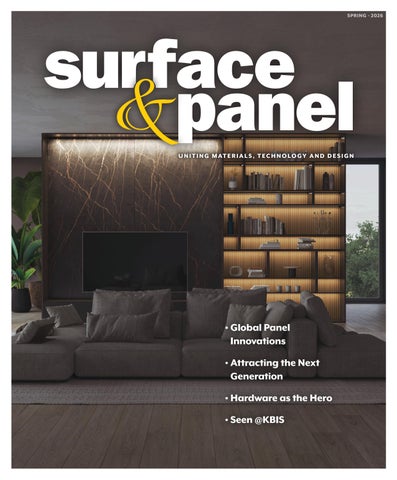
UNITING MATERIALS, TECHNOLOGY AND DESIGN
FEATURES
8 Global Innovations in Panel Products & Wood Technology
New materials, smarter manufacturing & sustainable design are reshaping the future of surfaces worldwide
From architectural statements to invisible systems, hardware is shaping interiors from the inside out
24 First Thinking in the Era of Variable Manufacturing Aligning surface decoration with modern panel workflows
26 Top 3 Closet Innovations Spotted @KBIS
Eric Marshall shares his standout picks from the show floor
30 How R&D is Redefining the Future of Panel Surfaces
As the surfacing industry continues to evolve, panel products are being pushed to do more than ever before
32 Distribution Matters
Olympic Spirit: U.S. & Canadian distros compete, collaborate
34 Real American Hardwood: A sustainable, deforestation-free choice
40 And That's a Wrap!
The final Orlando edition of the Kitchen & Bath Industry Show delivered big energy, smart ideas and a clear focus on integrated design
43 Seen @KBIS
DEPARTMENTS
6 From the Publisher Navigating without a map
36 Human Resources Preparing your workplace for AI
47 @ The Show
Three spring trade shows to watch
49 Ad Index
50 S&P By Design
PRESIDENT/PUBLISHER
Patrick Adams
PH: 714-486-2735 padams@526mediagroup.com
VICE PRESIDENT
Shelly Adams
MANAGING EDITOR
Jennifer Williams
PH: 714-486-2735 jwilliams@526mediagroup.com
David Koenig, DIRECTOR OF EDITORIAL
Sara Graves, SENIOR EDITOR
GUEST COLUMNISTS & CONTRIBUTORS
Keith Christman
Eric Marshall
Paige McAllister
Jim Mizer
Lon Riley
Michael Wilbur
SALES
Nick Kosan
PH: 714-486-2735 nkosan@526mediagroup.com
Chuck Casey
PH: 714-486-2735 ccasey@526mediagroup.com
John Haugh
PH: 714-486-2735 jhaugh@526mediagroup.com
GRAPHIC DESIGN
Greg Lane
DIGITAL SUPPORT
Katherine Williams kwilliams@526mediagroup.com
CIRCULATION/SUPPORT
PH: 714-486-2735 info@526mediagroup.com
526 MEDIA GROUP 151 Kalmus Drive, Ste. J3 Costa Mesa, CA 92626
PH: 714-486-2735
Three high-impact components engineered to help you deliver curved forms, refined textures, and hospitalitygrade detailing—without adding fabrication complexity.
Our Flexible Tambour bends to your radius. Chevron Italian Mesh integrates seamlessly into panel applications. And our award-winning NEW Brass Foot Rail system installs cleanly for commercial or residential use.
Specify smarter. Fabricate efficiently. Deliver elevated design that protects your margin.
Chevron Italian Mesh & Brass Foot Rail
10 ft. Custom Beaded Tambour
Flexible Bead Tambour
Flexible Tambour Chevron Italian Mesh NEW! Brass Foot Rail
Navigating Without a Map
Some of the most meaningful journeys in history began without a clear map. Explorers set out not knowing exactly what they would find, only that standing still was not an option. They crossed unfamiliar terrain, faced unpredictable conditions, and learned as they went. Progress came not from certainty, but from conviction — a belief that the destination was worth the risk and that adaptability would be required along the way. Improvise, Adapt, Overcome.
Lately, that idea has been on my mind. We are navigating a season where clarity can feel elusive. Markets shift quickly. Conditions change faster than plans can be written. The familiar landmarks we once relied on don’t always offer the same reassurance they used to. For many, the instinct is to wait for certainty before moving forward. But history — and experience — tells us that certainty rarely arrives in advance.
This is where leadership reveals itself. True leaders are not those who only move when conditions are perfect. They are the ones willing to step forward when the path isn’t fully visible, guided not by comfort but by values. They understand that momentum matters, that learning happens in motion, and that standing still often carries greater risk than moving carefully ahead.
Every great discovery required perseverance through challenging environments. Storms were encountered. Wrong turns were taken. Adjustments were made. Yet those journeys reshaped what was possible, not just for the individuals who took them, but for everyone who followed.
Our industry knows this well. Those of you who have built businesses, grown teams, and weathered multiple cycles understand that success is rarely linear. You’ve made decisions with incomplete information. You’ve trusted experience when data lagged behind reality. You’ve leaned on principles — integrity, stewardship, responsibility — when short-term answers were unclear.
A guiding value system becomes the compass when the map is unfinished.
Values don’t eliminate obstacles, but they clarify decisions. They help determine which opportunities align with who you are and which distractions to pass by. They anchor perseverance when conditions test resolve. Paired with a clear long-term goal, values create direction even when the route itself must evolve.
I’ve learned that perseverance isn’t blind persistence. It’s informed endurance and discipline. It’s the willingness to adapt without abandoning purpose. To adjust tactics while protecting principles. To accept uncertainty without surrendering momentum.
Uncharted paths demand patience and humility. They demand courage. They demand discipline — doing what you sometimes hate to do, but doing it like you love it.
The leaders who inspire me most are not those who claim to have all the answers, but those who remain steady when answers are still forming. They listen, learn and move forward with intention. They create confidence not by predicting the future, but by demonstrating consistency in how they respond to it.
That steadiness matters now.
For those feeling the weight of uncertainty, know this: navigating without a map does not mean navigating without direction. If your values are clear and your goal remains intact, the path will reveal itself step by step. Progress may be slower at times, but it will be meaningful.
I continue to be encouraged by this industry — by its resilience, its work ethic, and its willingness to move forward even when conditions are less than ideal. You remind me that the most rewarding journeys are rarely the easiest, but they are always the ones that shape us the most.
Thank you for the trust you place in us, and for the leadership you demonstrate every day by choosing progress over paralysis. It is an honor to serve you as we continue navigating what lies ahead — together.
Patrick Adams, Publisher, Surface & Panel,
526 Media Group
SUPERCELL
The Supercell exceeded my expectations! Every aspect of this machine is well designed. From the very high pressure, to high CFM, to the ease of chip disposal and filter cleaning. An exceptional value.
Adam D.
Global Innovations in Panel Products & Wood Technology
New materials, smarter manufacturing & sustainable design are reshaping the future of surfaces worldwide
BY JENNIFER WILLIAMS
From hyper-realistic woodgrain textures to digitally connected manufacturing lines, innovation in panel products is accelerating across continents.
Driven by sustainability goals, evolving design expectations, and advanced production technologies, manufacturers are redefining what panels can do — not only as structural substrates, but as high-performance design elements.
For fabricators, architects, and specifiers, the result is a new generation of panels that balance aesthetics, durability, and environmental responsibility while integrating seamlessly into modern digital workflows.
Texture, Realism, and
the
Rise of Design-Driven Surfaces
One of the most visible global trends is the push toward panels that replicate the authenticity of natural materials — without the limitations of solid wood.
Kyle McAllister, Head of Product and Design for EGGER North America, points to the growing importance of tactile realism. “As
panels are specified by designers and architects across international markets, it’s critical that our designs and textures reflect the broader direction of global interiors,” he says. EGGER’s ST40
Feelwood Oakgrain texture, for example, aligns with global pref-
EGGER's Feelwood Oakgrain
erences for natural materials and authentic finishes. “Its character and versatility allow it to translate seamlessly across various regions, design styles and applications.”
Wilsonart is seeing a similar shift. “Texture has become the frontier of realism,” says Audra Keiber, Director of Product Design at Wilsonart. “With advanced embossing technology, we’ve achieved a level of quality and precision in finishes that was once unattainable.”
These innovations are allowing panel products to deliver the warmth and visual richness of natural wood while maintaining the stability, scalability, and efficiency required for commercial and residential applications.
Textured melamine panels, in particular, are gaining traction for their performance and flexibility. “Textured melamine panels offer strong global potential due to their durability, efficient use of raw materials, and consistent visual performance,” says Scot Motzny, President of Premier Eurocase and Primary Kitchen. “They provide a cost-effective, high-performance surface solution that supports mass customization.”
Sustainability Without Compromise
Alongside aesthetics, sustainability has become a central driver of panel innovation. Manufacturers are increasingly designing products and processes that reduce environmental impact while maintaining performance standards.
“Balancing sustainability with high performance is central to how we develop next-generation wood-based and composite panels,” McAllister explains. EGGER has expanded its FSC-certified product offerings across particleboard, laminates, and MDF, allowing customers to meet environmental targets while maintaining material reliability.
Equally important is circular manufacturing. EGGER’s North Carolina operations include a dedicated recycling center and its Timberpak subsidiary, which collects and reintegrates recovered wood materials into production. “Together, these facilities maximize resource efficiency, reduce landfill burden, and extend the lifecycle of the wood materials used in our products,” McAllister says.
Wilsonart is also embedding sustainability into product design. “Our Wilsonart Woodgrains capture the beauty and warmth of real wood, while embracing sustainability through post-consumer recycled content and industry-leading environmental certifications,” says Arvind Karthikeyan, Director of Product Management at Wilsonart. “It’s a smarter, more responsible way to design.”
Premier Eurocase emphasizes material efficiency and lifecycle performance as well. “We prioritize the use of recycled materials wherever possible and leverage advanced material engineering to ensure performance is built in from the start,” Motzny says.
Beyond Structure and Appearance
While aesthetics and sustainability are leading priorities, panel manufacturers are also responding to growing demand for functional performance — particularly in commercial environments.
One of the most significant emerging categories is acoustic performance. Wilsonart reports increased demand for surfaces
Aluminum oxide is utilized in acoustic panels through anodized aluminum surfaces and porous aluminum foam (alumina foam), providing, durable, lightweight, fireproof, and corrosion-resistant sound absorption.
Cross Edge Dual Edgebanding Innovation from Premier Eurocase— featuring end grain edgebanding in their Roücke textured melamine door styles. Cross Edge Innovation maintains the look of real, solid wood— bringing a whole new level of authenticity to cabinetry design.
Details from EGGER's Feelwood Oakgrain texture.
that contribute to sound management in offices, hospitality environments, and public spaces. Demand for acoustic properties in commercial interiors has grown significantly over the past few years, company officials note, adding that it is actively developing new solutions to support this expanding need.
At the same time, manufacturers are building flexibility into their production systems to adapt as demand evolves. “Our scalable manufacturing platform allows us to adapt quickly as customer requirements evolve,” Motzny says. This agility is increasingly important as specifiers seek panels that serve multiple roles— structural, decorative, and functional.
Digital Manufacturing and Data-Driven Production
Behind the scenes, digital tools are transforming how panels are designed, produced, and specified.
Premier Eurocase has invested heavily in automated, dataconnected production infrastructure. “Integrated material handling systems and automated panel storage provide real-time visibility into inventory, panel attributes, and production status,” Motzny explains. Digitally coordinated saws, edgebanders, and finishing lines allow the company to streamline workflows and
improve consistency.
“These technologies enable faster lead times, greater precision, and a highly repeatable production process,” he says.
Digital integration extends beyond manufacturing into the specification process itself. Wilsonart has made BIM integration a priority, recognizing its importance to architects and designers. Officials say that integrating Wilsonart’s designs into digital platforms such as BIM is a strategic priority, as these tools are foundational to how specifiers plan, select, and specify products.
This digital connectivity allows materials to move more efficiently from design concept to fabrication to installation, reducing errors and accelerating project timelines.
Expanding Globally in a Competitive Market
Despite these advances, bringing innovative panel products to new markets presents challenges. Awareness, certification requirements, and competitive pressures all play a role.
• UP TO 12 FEET WITHOUT REPEATS
• FIVE 12-INCH-WIDE LEAVES
McAllister notes that North America’s mature market presents unique obstacles. “North America is an extremely mature and hyper-competitive environment, and as a relatively new player in this region, EGGER is still building market familiarity and brand recognition,” he says. However, exposure and hands-on experience are steadily driving adoption.
Wilsonart sees similar dynamics, with officials noting that the industry is increasingly crowded, with more products and options than ever competing for attention. To address this, the company focuses on digital specification tools, partnerships, and education initiatives that help specifiers understand and adopt new materials.
Meanwhile, Premier Eurocase highlights the importance of operational readiness. “Key considerations include regulatory compliance, logistics optimization, and maintaining consistent service levels at scale,” Motzny says. Investments in automation and traceability help ensure reliability while supporting expansion.
The Future of Panel Innovation
Across regions and product categories, several themes are clear: panels are becoming more realistic, more sustainable, more functional, and more digitally integrated.
Advances in surface realism are redefining design possibilities. Circular manufacturing and recycled content are reshaping sustainability expectations. Automation and digital tools are accelerating production and improving traceability.
Perhaps most importantly, these innovations are making highperformance panel materials accessible across a broader range of applications, from residential cabinetry and commercial interiors to global architectural projects.
As manufacturers continue to innovate, the next generation of panel products will do more than fill a structural role — they will actively shape how spaces look, perform, and evolve. S P
Typical HPL Woodgrains: HPL often utilizes balanced or random layouts of printed woodgrain. Notice the overal consistency and potential absence of a distinct, mirrored patter across the surface.
The PB Series is created with sequenced leaves, mirrored to create a sense of harmony and visual interest perfect for large surface applications.
MERIVOBOX
MERIVOBOX adapts to a wide range of applications, lifestyles and spaces. Its platform design covers multiple configurations, reducing complexity, speeding up installs and delivering consistent, high-quality drawer performance.
Once associated primarily with entry-level furniture and DIY assembly, flat-pack and modular construction have entered a new phase — one defined by engineered substrates, precision machining, and connector systems that rival traditional joinery in strength and aesthetics.
Today’s ready-to-assemble (RTA) and modular panel systems are increasingly finding their place in multifamily housing, hospitality, office environments, and high-end residential projects, where efficiency, flexibility, and design integrity must coexist.
Driven by advances in substrates, hardware, and manufacturing workflows, modular construction is no longer simply about reducing shipping costs, but also enabling smarter production and adaptable environments.
Engineering the Core: Materials and Connector Systems Evolve
At the heart of modern flat-pack innovation is a renewed focus on material performance and connection integrity. Engineered wood products — particularly particleboard — remain foundational to modular construction due to their consistency and machinability.
“We are firm believers that quality engineered particleboard is the best substrate for RTA products based on its engineered core to maximize hardware holding strength and deliver repeatable quality and consistency,” says Jonathan Zublena, Executive Vice President of Sauder Building Products.
The uniform density and predictable structure of engineered panels allow manufacturers to rely on precision-placed hardware and repeatable production processes.
Equally transformative are advancements in connector systems designed to simplify assembly while preserving structural strength and clean aesthetics. Jason Howell, CEO of Lockdowel, notes that modern connector systems are fundamentally changing how modular components come together.
“Innovative connector systems are revolutionizing assembly by maximizing speed and simplicity — all while remaining completely invisible,” Howell says. “By eliminating traditional glue and clamps, these systems maintain premium aesthetics without sacrificing durability.”
These new systems allow panels to be assembled quickly on site, often with minimal tools, reducing labor requirements and
Jonathan Zublena
making modular casework viable for commercial installations with tight timelines.
Similarly, Välinge has introduced clickbased connector technologies that build on concepts long used in flooring and has adapted them to cabinetry and furniture. “We’ve developed two click technologies for the flat-pack industry, both being well received by the market as user-friendly, suitable for large-scale production, and price competitive compared to other component fittings,” says Ola Kronvall, Business Unit Director, Furniture at Välinge. These systems allow fast assembly and disassembly across applications ranging from kitchens to office furniture.
Manufacturing for Modularity: Precision and Scale
As hardware and material technologies evolve, manufacturers are also adapting production workflows to support both mass efficiency and customization.
Sauder Building Products, whose parent company has decades of experience in ready-to-assemble furniture, has leveraged existing manufacturing strengths to support modular cabinetry production. “We have leveraged our long-run pack line process combined with the uniformity of cabinetry construction to develop a flexible packing process…that allows us to pack to order with increased efficiencies,” Zublena explains.
By using the same base components for both assembled and RTA products, manufacturers can maximize production consistency and reduce complexity. Secondary processes, including hardware boring and dowel insertion, are integrated downstream to support modular assembly without disrupting high-volume manufacturing.
CNC machining plays a critical role in this balance between scale and customization. “CNC programming helps to produce the right quantity of less common parts for specialty and modified cabinets,” Zublena says, allowing manufacturers to maintain flexibility without sacrificing throughput.
Connector technology providers are also working closely with equipment manufacturers to streamline production integration. Välinge collaborates with machine suppliers globally to ensure manufacturers can implement click-technology systems efficiently. “We work with all major machine suppliers globally and can therefore offer machine solutions…from affordable to premium machines,” Kronvall says. While integration may require equipment investment, the payoff is greater efficiency, reduced assembly time, and improved transportation logistics.
Balancing Customization, Value, and Logistics
Despite clear advantages, modular construction presents challenges — particularly when balancing customization with production efficiency.
“For Sauder, managing customer desires for customization
and value is key,” Zublena says. Multifamily developers and architects often seek distinct finishes or design details to differentiate projects, but excessive variation can undermine manufacturing efficiency.
Sauder addresses this by offering curated finish selections aligned with widely adopted design trends. “By keeping finishes to a relatively small number, we can deliver value,” Zublena explains.
Connector and hardware providers face a different challenge: educating customers and retailers about the benefits of modular assembly. Kronvall notes that communicating ease-of-use is essential. “It is always a challenge to communicate the benefits of easy assembly for the retailer,” he says. To overcome this, companies invest in instructional materials, demonstrations, and digital content that showcase assembly simplicity and durability.
For manufacturers and installers alike, reliability and ease of assembly remain critical factors—particularly in commercial environments where time and labor costs can make or break a project’s viability.
Changing Expectations in Residential and Commercial Spaces
As modular systems mature, customer expectations are evolving beyond basic assembly convenience. Today’s buyers expect modular products to deliver the same performance, durability, and design flexibility as fully assembled alternatives.
In cabinetry, accessibility and flexibility are increasingly important. “We are seeing more value-based solutions to meet ADA
Sauder Core34 Kitchen - Glacier White & Ashton
Ola Kronvall
requirements like sink bases with removable toe kicks,” Zublena says, highlighting how modular systems can support evolving regulatory and functional needs.
Storage expectations are also shifting. “On the closets and storage side, we see more built-ins with depths of 24 inches so users can opt to conceal hanging clothing if needed,” he adds. These systems offer flexibility without requiring permanent structural modifications, making them especially attractive for multifamily and urban housing applications.
In commercial environments such as retail and offices, modular systems allow layouts to evolve alongside changing tenant needs. Click-based connectors and modular hardware enable fixtures and displays to be reconfigured or relocated without damaging materials or requiring full replacement.
Howell points to the broader economic advantages driving adoption: modular connector systems can “slash assembly time, labor, and transport costs by up to 60%,” significantly improving project efficiency.
The Future of Modular Panel Systems
Looking ahead, the trajectory of modular construction points toward greater integration between materials, hardware, and manufacturing processes. As connector systems become more sophisticated and production workflows more automated, modular panels will continue to move upmarket — serving not just valuedriven applications, but premium architectural environments.
Advances in CNC machining, engineered substrates, and connector technology are enabling modular systems that combine speed, strength, and design flexibility. Just as importantly, these systems allow manufacturers to respond to changing market demands without fundamentally restructuring production.
What was once seen as a compromise solution is now a strategic advantage. For manufacturers, fabricators, and designers alike, flat-pack and modular innovation represents a fundamental shift — not away from craftsmanship, but toward smarter, more efficient ways of delivering it. S P
Top 5 Flat-Pack-Friendly Panel Features
As flat-pack and modular construction moves into commercial and high-end applications, panel performance and compatibility with modern connector systems have never been more critical. These five features help ensure strength, efficiency, and long-term durability:
1. Engineered Core Consistency
Uniform density particleboard and MDF provide reliable fastener holding strength and predictable machining — essential for cam locks, dowels, and click-connect hardware.
2. Precision Machinability
Panels must withstand high-speed CNC routing and boring without tear-out or core blowout. Clean machining ensures connectors align properly and assemblies remain square and stable.
3. Durable, Pre-Finished Surfaces
Scratch-resistant laminates and TFL finishes allow parts to ship and assemble without additional finishing, reducing production steps and protecting surfaces during transport and installation.
4. Connector Compatibility
Panels engineered to work with modern invisible fasteners, cam-and-dowel systems, or click-technology connectors enable faster assembly, improved aesthetics, and easier reconfiguration.
5. Lightweight Strength for Shipping Efficiency
Optimized panel construction balances structural rigidity with manageable weight—reducing freight costs while ensuring longterm performance in cabinetry, closets, and architectural millwork. Flat-pack success depends on more than hardware alone. When panel substrates, machining, and connector systems are designed to work together, manufacturers can deliver modular solutions that assemble quickly, perform reliably, and meet the expectations of today’s commercial and residential environments.
Attracting the Next Generation
Investing in People, Technology & Purpose
BY JENNIFER WILLIAMS
For decades, the wood products and panel industries have relied on skilled workers whose expertise was built through years of hands-on experience. Today, however, the industry faces a critical challenge…and opportunity: attracting a younger generation that values technology, sustainability, and clear career pathways as much as traditional craftsmanship.
Companies across the supply chain — from manufacturers to distributors to equipment providers — are responding with expanded training programs, mentorship initiatives, digital tools, and sustainability commitments designed to show young professionals that this industry offers not just jobs, but meaningful, future-focused careers.
Education as the Foundation for Growth
For many companies, education is the first and most powerful tool for bringing new talent into the industry.
“At Sierra, we believe education is the best investment you can make in people,” says James Morris, VP, Human Resources USA & Sales Operations at Sierra Forest Products. “Today’s workforce expects opportunities to learn and grow, so we’ve built our training
around that. It’s structured and consistent, but flexible enough to meet people where they are.”
Sierra blends on-demand learning, hands-on training, and peer mentorship, focusing not only on technical skills but also leadership and workplace culture. “We don’t limit learning to technical topics,” Morris says. “We also focus on things like workplace civility, culture, and leadership, because those matter just as much to someone’s success here.”
Manufacturers are also strengthening ties with educational
Photo from Sierra Forest Products
institutions. EGGER North America, for example, partners directly with Davidson-Davie Community College and offers a formal apprenticeship program designed to connect students with careers in advanced manufacturing.
“Our robust Apprenticeship Program partners directly with our local community college,” says Philip Tacy, Head of Human Resources for EGGER North America. “We also offer free licenses to all employees that allow them full access to LinkedIn Learning, EGGER Campus, and Rosetta Stone.”
These programs not only build technical competency — they demonstrate to young workers that long-term career development is a priority.
Equipment providers are reinforcing this message through industry-wide training efforts. “Through Stiles University, we provide hands-on training for manufacturers and their teams, helping them feel confident using advanced technology and building real technical skill,” says Casey Reams, Stiles University Manager at Stiles Machinery. “When people see there’s a path forward tied to relevant technology, manufacturing, and the vendors who support it, it becomes a much more compelling place to build a career.”
Elevating Operational Roles Through Safety and Professionalism
For younger workers entering roles such as warehousing, logistics, and driving, safety and clear career pathways are essential.
“Younger workers want to know they’ll be set up for success, and that starts with safety and training,” Morris explains. Sierra uses real-time performance data and structured feedback to
help employees track their progress. “We use real-time data and quarterly scorecards to give drivers useful feedback and recognition. It’s data-driven, transparent, and gives people a clear view of their performance.”
Just as important is how companies communicate the value of these roles. “We treat operational roles like the skilled, professional jobs they are, with real responsibility and career potential behind them,” Morris says.
This approach helps shift perceptions, showing younger workers that operational careers offer advancement opportunities and professional growth.
Sustainability and Innovation as Career Drivers
For many entering the workforce today, sustainability isn’t a bonus — it’s an expectation. Companies that integrate environmental responsibility into their core operations are better positioned to attract purpose-driven talent.
“Younger professionals expect ethical, transparent operations,” says Tacy. “EGGER’s practices around certified wood sourcing, traceability, and public sustainability reporting demonstrate accountability that builds trust and attracts talent who care about corporate responsibility.”
Sierra Forest Products has embedded sustainability deeply into its culture as well. “We earned our FSC Chain of Custody Certification in 2003, and since then, our supplier base has grown to include over 140 FSC-certified suppliers,” Morris says. “It’s rewarding when we can connect with the next generation on something that matters to them, showing that the materials surrounding us every day can have a positive, tangible impact.”
Technology and automation also play a major role in reshaping perceptions of the industry.
“Younger professionals want to be part of something forwardthinking,” Reams says. “When they see robotics, automation, and data-driven systems being used to reduce waste and improve processes, it challenges outdated perceptions of what this industry looks like.”
Building Awareness Through Partnerships and Early Career Programs
Exposure remains one of the biggest barriers to recruiting young talent. Many simply don’t realize the breadth of opportunities available in the wood products and panel industries.
Programs like EGGER’s internship initiative are helping close that gap. “Our Internship Program is growing year after year and gaining recognition rapidly,” Tacy says. “It offers opportunities
Phillip Tacy
Stiles University offers hands-on training for manufacturers as well as Stiles Machinery employees.
James Morris
Casey Reams
throughout the entire plant.”
Industry-wide initiatives are also playing a role. Morris points to the NBMDA Emerging Leaders Program and Sierra’s own Leadership Academy as key tools. “Candidates often mention our Leadership Academy because it demonstrates that we back our words with development resources,” he says.
Partnerships with innovative material suppliers further help demonstrate the industry’s relevance. “When students see innovative materials and technologies tied to an industry like ours, it changes their perception of what a career in wood products can look like,” Morris adds.
Mentorship and Knowledge Sharing Across Generations
Mentorship remains one of the most effective tools for helping new employees succeed, especially those entering manufacturing or distribution for the first time.
“When someone joins Sierra, especially if it’s their first experience in this industry, we want them to have people they can go to right away,” Morris says. “We pair new team members with internal mentors or coaches to help them navigate the first few months.”
EGGER takes a similarly structured approach. “Structured mentorship, pair-learning, and documented knowledge resources help reduce newcomer anxiety and speed competence development,”
Tacy explains. These systems ensure that institutional knowledge is preserved while helping new hires feel supported.
At Stiles Machinery, mentorship is deeply ingrained in company culture. “Mentorship, shadowing, and knowledge sharing are very intentional parts of how we onboard and develop people,” Reams says. “That support system helps new hires feel confident, capable, and part of the team from day one.”
Cross-generational collaboration is seen as a competitive advantage rather than a challenge. “Experienced team members bring invaluable experience, while younger professionals bring fresh perspectives and confidence with technology,” Reams says.
Photo from Sierra Forest Products
“When we join those strengths, it keeps us growing together.”
Technology Creates a Modern, Connected Workplace
Digital tools are transforming how employees learn, communicate, and engage with their work.
At Sierra, real-time performance tools help employees track safety and productivity in accessible ways. “Technology has completely changed how people expect to learn,” Morris says. “Modules, assessments, and short explainer videos keep things practical and easier to digest.”
EGGER has developed its own mobile platform to keep employees connected. “The EGGER Mobile application allows team members to access benefits information, track hours, view career paths, and stay updated on company news — all from their personal devices,” Tacy explains. “This supports smoother onboarding and allows younger employees — who naturally gravitate toward mobile-first tools — to feel instantly connected.”
Stiles Machinery uses digital training tools alongside handson instruction. “Whether we are hosting an interactive course or utilizing real-time video and webinars, we use technology to train our workforce,” Reams says. “This commitment keeps our team engaged and excited.”
Investing in the Industry’s Future
The effort to attract younger professionals isn’t about replacing experience — it’s about building continuity.
Companies that invest in training, sustainability, mentorship, and technology are demonstrating that the surface & panel industry is not rooted in the past but actively shaping the future.
By creating environments where employees can learn, innovate, and grow, the industry is ensuring that the next generation doesn’t just join, but stays, contributes, and leads.
As Morris puts it, “It’s not about using technology or training for the sake of it — it’s about making information easier to find, learn, and apply. That’s what really keeps people engaged.” S P
Stiles University provides more than 20 in-person accredited courses as well as online learning to meet manufacturers where they are at.
Hardware as the Hero
How Decorative Components are Driving Design in 2026
BY JENNIFER WILLIAMS
In 2026, hardware is no longer the last line item on a specification sheet. It’s a design driver.
From walking the floor at KBIS to stepping inside today’s most thoughtfully designed kitchens, closets and multi-functional living spaces, one thing is clear: hardware has stepped into the spotlight. Whether it disappears seamlessly into millwork or commands attention with bold scale and layered finishes, hardware is influencing layout decisions, material choices and the overall user experience.
Across the industry, manufacturers agree: the shift is real, and it’s accelerating.
From Afterthought to Anchor
For years, hardware was often selected at the end of a project— an aesthetic add-on once cabinetry, surfaces and fixtures were finalized. That hierarchy has flipped.
“We’re seeing more focus on hardware at the very beginning of the design process rather than as a finishing touch or an add-on with what’s leftover in the budget,” says Lucie Crane, Marketing Coordinator North America for Kesseböhmer. “Functional elements are
influencing cabinet dimensions, layout planning, and even how storage zones are organized.”
That early integration is reshaping the way designers and fabricators approach projects. Hardware is helping define how spaces function — and how they feel.
Mark Kamppinen, Director of Category Management at Häfele America Co., echoes the shift: “Hardware is no longer a finishing layer — it’s shaping design decisions from the very start. We’re seeing hardware, lighting, and storage systems influence layout planning, material selection, and color palettes early in the process.”
Instead of being applied to completed millwork, hardware is increasingly integrated into it, engineered into the architecture of the space itself. The result is cabinetry and interiors where surfaces, structure and systems operate as a unified whole.
Intentional Design: Disappear — or Make a Statement
One of the most compelling aspects of 2026 hardware trends is the duality at play. Hardware is either designed to vanish entirely or to stand boldly at the forefront.
From architectural statements to invisible performance systems, hardware is shaping interiors from the inside out.
Lucie Crane
Mark Kamppinen
Toasted Bronze is a recent addition to Berenson’s varied finish offering and quickly becoming a favorite due to its deep layers, featuring a dark brown base with light brushing. Photo courtesy of Berenson
“In 2026, we’re seeing strong momentum around architectural hardware that’s fully integrated into the millwork rather than applied as an afterthought,” Kamppinen explains. “Designers and fabricators are gravitating toward minimal profiles, concealed mechanisms, and precision-engineered systems that support clean, intentional spaces while standing up to daily use.”
At the same time, there is growing demand for contrast and visual punctuation.
“Designers are intentionally pairing complementary or contrasting finishes to add depth, character, and a more curated, custom feel — moving away from uniform, one-finish spaces,” says Tara Daggett, Marketing Director at Berenson Corp.
Mixed metals, layered finishes and scaled-up appliance pulls are redefining cabinetry aesthetics. appliance pulls, in particular, are no longer confined to refrigerators and dishwashers. “We are seeing Appliance Pulls expand beyond kitchens and appliances into applications like barn doors, pocket doors, and Murphy beds,” Daggett notes, reflecting a broader move toward hardware that delivers both strength and a design-forward presence.
The industry is also seeing refined interior details become part of the visual narrative. Whitney Hicks, A&D Sales Rep with Blum, points out that designers are using interior hardware finishes intentionally. “For aesthetics, designers have been using [our]
onyx black hinges to add a design detail inside of the cabinetry since the finish works well with both light and dark color palettes.”
Whether bold or discreet, hardware is no longer neutral — it is deliberate.
The Rise of Multifunctional Living
Behind the aesthetic evolution lies a powerful functional driver: the demand for flexible, highperformance spaces.
“Designers and fabricators are gravitating toward hardware that marries tactile performance with expressive design — everyone is looking for pieces that do more, store more, and give more access,” Crane says. “These trends reflect a broader shift toward hardware as a defining design element, not just a utility.”
As square footage becomes more valuable and homes increasingly serve multiple roles — workplace, entertainment hub, retreat — hardware is enabling that adaptability.
Hicks highlights the growing popularity of pocket door systems as a response to this shift. “Pocket door systems… are increasing in popularity with designers, fabricators, and end-users as the need for multifunctional spaces increases, along with the preference of concealing areas when they are not in use,” she says.
From appliance garages to hidden home offices, hardware allows entire zones to appear and disappear as needed, supporting the clean, flexible interiors that define contemporary design.
Space-Saving, High-Performance Solutions Gain Ground
While decorative pulls and layered finishes are commanding attention, utilitarian innovation is advancing just as quickly.
“Space-saving and high-performance solutions continue to
Black Nickel from Berenson Hardware has an intriguing, reflective appearance that is always changing with perspective.
Photo courtesy of Berenson
REVEGO, Blum’s new pocket door system, allows spaces to be open when in use and completely concealed when they are not needed. Photo courtesy of Blum
Tara Daggett
Whitney Hicks
gain momentum as designers look to make every square foot work harder without adding visual complexity,” Kamppinen says. Advanced lift systems, pivoting and pocketing door mechanisms, concealed hinges, pull-down storage and modular organization systems are being specified more frequently across kitchens, closets and multi-functional spaces.
Crane has noticed similar traction. “We’re already seeing strong momentum around full-access pull-out systems like pantries and base cabinet pull-outs, assisted lift mechanisms in both closets and kitchens, and a bigger focus on slim-profile hardware that maximizes storage in tight footprints without compromising aesthetics.”
These systems are not simply mechanical upgrades; they influence how cabinetry is built and how spaces are planned. Ergonomic considerations — particularly for aging-in-place and accessible design — are shaping specifications.
“When designing for aging in place, ensuring there are ergonomic applications supported by functional hardware such as full extension drawers on lower cabinetry (versus doors with shelves)… these early layout decisions are key to a well-planned space,” Hicks explains.
Metal drawer systems, long the darling of the European market, are gaining ground in North America, valued for their durability, capacity and streamlined aesthetics. Hicks notes that such systems offer “more storage space compared to wooden drawer boxes…integrated soft-close… high load capacity for added durability,” all while allowing for material and finish customization.
At the hinge and door level, performance remains paramount.
Frank Fahnenschmidt, Product & Marketing Director at Titus Americas, says designers are prioritizing solutions that are “intentional and precisely engineered,” with soft-closing systems leading the conversation across sliding architectural, shower, pocket and closet doors.
“High-performance concealed hinges, soft-close systems, push-to-open and toolfree mounting solutions are gaining traction because they pair sleek aesthetics with effortless motion and durability,” he adds.
The common thread: performance is expected — but it must be quiet, refined and architecturally aligned.
Hardware as a Palette Builder
Beyond performance, hardware is also helping shape broader aesthetic direction.
“With more designs, more options, and broader finish selections than ever before, hardware is being selected earlier in the design process and used as a foundation,” Daggett says. “Finishes and forms are helping guide material choices, color palettes, and the overall aesthetic direction of the space.”
Dark, refined finishes and architectural tones are acting as visual anchors, while designers leverage contrast to tie together plumbing, lighting and millwork.
Fahnenschmidt notes that deep, dark finishes are being used “as a visual anchor from the earliest planning stages… giving designers the flexibility to build cohesive palettes, define contrast,
The T-type PressTo from Titus features toolless hinge cup mounting for even faster and easier installation onto the cabinet door. The latest color, Noir, offers a visually appealing solution that reduces the prominence of hardware in cabinets. Photo courtesy of Titus
Fittings and connectors from Titus, including the Quicklift TL5 ‘Full Metal Jacket’ connector, provide strength and reliability with toolless insertion technology. Photo courtesy of Titus
Frank Fahnenschmidt
and carry a consistent design language across kitchens, living spaces, and beyond.”
Hardware, in other words, is no longer simply coordinated — it is compositional.
Engineering Meets Emotion
What ultimately defines 2026’s hardware movement is the seamless blend of engineering and experience.
Kamppinen describes interiors where “architecture, surfaces, and systems work as one.” Crane points to solutions that are “clean, integrated” and “ergonomic.” And Fahnenschmidt emphasizes compact, customizable systems that support “elevated user experiences.”
The message is clear: hardware is expected to perform flawlessly — but also to feel intentional, tactile and visually resolved.
As the industry moves forward from KBIS 2026, one trend stands out above all: hardware has become both the backbone and the highlight of modern interiors. Whether concealed within precision millwork or scaled up as a sculptural statement, today’s decorative and functional components are redefining how designers and fabricators think about space.
Hardware is no longer supporting the story.
It is helping to write it. S P
HAWA Concepta III from Häfele provides the option to either conceal the inner contents of your cabinets (or not!), while providing the flexibility to not have doors protruding into the room. Concepta doors are designed to pivot and slide into the cabinet pocket, then gently tapped to be brought out again and closed flush with the surface. Photo courtesy of Häfele
ARENA variants from Kesseböhmer offer ideal functions, elegant appearance and optimum use of space, thanks to the rail mounted on the outside of the tray. Photo courtesy of Kesseböhmer
First Thinking in the Era of Variable Manufacturing Aligning
BY LON RILEY
Surface Decoration with Modern Panel Workflows
Manufacturing efficiency rarely depends on a single piece of equipment. It depends on alignment. When cutting, assembly, scheduling, and finishing operate at compatible speeds and respond to the same production information, workflow becomes predictable and manageable. When one area functions on a different cadence, inefficiencies begin to surface, often gradually but consistently.
Over the past decade, panel processing facilities have made substantial investments in digital infrastructure. CNC platforms are tightly programmed and integrated with ERP systems. Production schedules are optimized through data. Material yield is calculated before sheets reach the router. Job information moves electronically from planning through execution. In many operations, automation supports material handling and staging. The structural framework of manufacturing has become increasingly data driven and interconnected.
Surface decoration often remains outside that level of integration. Traditional decoration methods rely on tooling, screens, plates,
or dedicated mechanical setups. These systems are well suited to long run environments where designs remain stable over time. However, as run lengths shorten and SKU variation expands, hardware-based changeovers introduce additional steps into workflows that are otherwise designed for digital responsiveness.
Manufacturers today face growing SKU counts, more frequent finish updates, and project specific variation driven by architectural, hospitality, and modular applications. A cabinet structure may remain consistent, while surface treatments vary by region or client specification. Identification panels, decorative overlays, and limited run finishes must often be produced without interrupting broader production schedules.
Under these conditions, customization becomes part of normal operations rather than a separate marketing initiative. Productionfirst thinking requires evaluating whether each system on the plant floor supports that operational reality. If CNC programs can shift instantly from one job file to another but decoration requires mechanical setup changes, the rhythm of the line becomes uneven. If ERP systems manage production data seamlessly while
Photo courtesy
DPI Laboratory
finishing remains disconnected from that information flow, coordination becomes more manual than necessary.
Digital direct to substrate decoration operates differently. Instead of relying on physical tooling to generate surface graphics or markings, design changes occur at the file level. Transitioning between SKUs does not require replacing screens or plates. In environments where variation is routine, this shifts changeover from mechanical adjustment to digital instruction, which more closely mirrors the way upstream equipment operates.
When surface decoration functions as a data responsive process, it aligns more naturally with the rest of the production system. Job level information can inform decoration output directly. Version changes can be implemented without extended downtime. Short run batches can be produced without absorbing disproportionate setup time relative to volume.
Curing time is also an operational consideration. Many conventional ink systems require drying periods or secondary handling before parts can move forward in the workflow. UV-based digital systems cure ink immediately under LED light, which allows panels to be handled, assembled, or packaged without delay. In facilities where time and staging space are closely managed, reducing waiting periods decreases work in progress and simplifies material flow.
Modern panel facilities are increasingly organized around timing and information exchange. When surface systems are capable of printing directly onto rigid substrates such as MDF, engineered wood, laminates, or coated panels and curing immediately, they can be positioned within the production sequence rather than following it as a separate step. Decoration becomes integrated into the overall workflow rather than isolated from it.
This integration is particularly relevant in modular and flat pack manufacturing models. These systems combine structural consistency with surface variation. A standardized component may support multiple decorative finishes depending on distribution channel, geography, or project requirements. Maintaining large inventories of pre-finished goods under these conditions can consume storage capacity and limit flexibility.
Digital surface systems make it possible to introduce variation closer to final assembly or shipment. Instead of committing tooling to every finish variation, manufacturers can produce shorter batches economically because file adjustments replace mechanical reconfiguration. The cost structure of smaller runs becomes more manageable when setup is driven by software rather than hardware.
Established analog finishing processes continue to serve high volume and stable SKUs effectively. Production-first thinking does not require eliminating proven systems. It requires identifying where digital flexibility reduces friction in environments characterized by variability. The objective is to complement existing processes where operational alignment improves efficiency.
Across the industry, considerable attention is given to CNC precision, ERP integration, and automation investments. These initiatives strengthen the structural core of manufacturing. When surface decoration remains outside that digital framework, however, the system remains partially fragmented. Integrating digital decoration into the same information ecosystem strengthens continuity across the plant.
Software-driven workflows, color management systems, and integrated RIP environments allow surface output to operate within the same production architecture as upstream equipment. Rather than functioning as a separate creative stage, decoration becomes part of a coordinated manufacturing strategy.
Manufacturers continue to navigate pressure from labor costs, margin constraints, sustainability requirements, and increasing product complexity. Systems that once operated under long-run stability must now respond to more dynamic demand patterns. Changeovers occur more frequently. SKU counts continue to expand. Production flexibility must be achieved without sacrificing consistency.
Evaluating surface technology with the same discipline applied to CNC and ERP systems supports that objective. Considerations such as mechanical changeover time, alignment with production data, staging requirements, and impact on work in progress become central to equipment decisions. When those factors guide investment, improvements tend to accumulate steadily through reduced friction and improved predictability.
As panel manufacturing evolves toward modularity and controlled flexibility, surface decoration must support the pace of the line. Digital UV direct to substrate systems represent one approach to achieving that alignment by enabling file driven variation, immediate curing, and integration with data-based workflows. In that context, decoration functions as a production asset rather than an isolated finishing step.
Production-first thinking ultimately centers on removing constraints within the workflow. When decoration, cutting, and scheduling operate within the same coordinated framework, manufacturing gains stability even as variability increases. S P
Lon Riley is the founder of DPI Laboratory and the architect behind the Catalyst Printing Platform, an integrated UV printing ecosystem engineered for speed, uptime, and scalable production. With more than 30 years in digital printing, engineering, and workflow optimization, Lon applies systems thinking and design thinking to modern UV manufacturing. Lon contributes to industry discussions on UV system architecture and workflow design, drawing from hands-on experience in building and optimizing production environments. www.dpi-lab.com
Top 3 Closet Innovations Spotted @KBIS 2026
Closet Guru Eric Marshall shares his standout picks from his recent Secret Closet Tour
KBIS is always a playground for kitchen and bath innovation — but if you know where to look, it’s also one of the best places to spot where the closet category is headed next. During his “Secret Closet Tour,” industry expert Eric Marshall called out three standouts that captured the show’s biggest themes: high-design personalization, smarter storage engineering, and elevated materials that feel more like luxury furniture than built-ins.
Here are Marshall’s Top 3 closet innovations from the show — straight from his tour notes.
Marshall’s top pick was a one-two punch of bold aesthetics and custom function, spotlighting Plain & Fancy’s statement-making approach to closet design.
“One of my top picks is Plain and Fancy with their pink “her” closet and brown “his” closet that featured custom pullouts and leather finishes.”
Why it stood out:
• Color-forward closets: A pink closet for “her” paired with a rich brown closet for “him” reflects a growing shift toward closets that feel like personal spaces — not utility rooms.
• Custom pullouts: Thoughtful internal accessories and pullout storage reinforce how “luxury” today is as much about ease and access as it is about looks.
• Leather finishes: Soft-touch, high-end materials are moving inside the closet — bringing a boutique/furniture-grade feel to interiors and drawer details.
Trend takeaway: Closets are increasingly designed like styled rooms, with layered finishes and tactile materials that signal “this space is intentional.”
2) Vauth-Sagel: Next-Gen Pullouts
Designed for the U.S. Market
Marshall’s second choice was all about engineering that looks good — and fits how North American closets and cabinets are built.
“Definitely Vauth-Sagel with their made-for-U.S. pullouts with wood finishes. They showed the Lazy Susan without a center post... and their base cabinet pullouts with multiple trash can and laundry hamper options.”
What made it innovative:
• Pullouts with wood finishes: Function-forward accessories from Europe are getting a design upgrade, blending into higherend interiors instead of looking purely utilitarian.
• Lazy Susan without a center post: A small change with a big impact — freeing up usable space and improving accessibility (especially for larger items).
Plain & Fancy's Brown "His" Closet
< CONTINUED
• Base cabinet pullouts with multiple options: While shown in a kitchen context, the logic transfers directly to closets — think multi-stream sorting, linen management, and hidden utility zones built into cabinetry-style systems.
Trend takeaway: Closet organization is borrowing heavily from kitchen storage innovation, with more modularity, capacity, and “invisible” integration.
3) Designs of Distinction: Wood + Metal + Leather Doors (Element Designs x EcoDomo)
Marshall’s third pick captured one of the most exciting evolutions in closet design: material mixing that feels architectural.
“I have to pick Designs of Distinction and their collaboration with Element Designs and EcoDomo…making cabinet and closet doors out of wood, metal and leather," he said. Why this matters:
• Hybrid door construction pushes closet fronts beyond slab/ Shaker norms and into a space that feels custom, boutique, and furniture-inspired.
• Metal + wood adds structure and contrast; leather introduces softness and an unmistakably premium feel.
• The collaboration signals how closets are becoming a hub for design partnerships, where component brands combine strengths to create something more elevated than standard “systems.”
Trend takeaway: Closet doors are becoming design statements, and surfaced materials — especially leather-like looks — are showing up as key differentiators.
What Eric’s Top 3 Say About Closet Design Right Now
Across all three picks, the throughline is clear: closets are leveling up. The category is pushing toward:
• More personality (color, bold styling, “his/hers” identity)
• Smarter mechanics (better access, more capacity, fewer obstructions)
If KBIS 2026 is any indication, the “secret” is out: the closet space is no longer an afterthought — it’s becoming one of the most designdriven zones in the home. S P
Vauth-Sagel
Designs of Distinction
How R&D is Redefining the Future of Panel Surfaces
BY JIM MIZER
As the surfacing industry continues to evolve, panel products are being pushed to do more than ever before. Today’s global marketplace demands materials that are visually compelling, high performing and increasingly sustainable without sacrificing durability or value. At the center of this evolution is research and development, where innovation is shaped not only by design trends, but also by performance expectations, manufacturing realities and environmental stewardship.
Formica Group operates within a truly global ecosystem as part of Broadview Materials — a worldwide network that allows research and development (R&D) teams to collaborate across regions, contributing to and building upon advancements in panel products around the world. Rather than working in isolation, we leverage shared expertise and manufacturing capabilities to develop products that reflect global insights while meeting local market needs.
Design Realism Meets Market Demand
One of the most significant shifts in panel products has been the evolution of design realism. High-pressure laminate (HPL) has advanced dramatically, with designs and textures now closely mimicking natural stone and wood. This progression is driven by the need to compete visually with natural materials while offering greater consistency, durability and cost efficiency.
Innovation in this space is continuous. InDepth Surfacing, which Formica launched in June 2024, exemplifies this evolution. The product introduced enhanced texture and visual depth to HPL and was recognized with multiple awards at NeoCon last year. It underscores how thoughtful research and development can elevate a traditional category through design-led innovation.
Performance First, Always
While aesthetics continue to push boundaries, performance remains the foundation of panel product innovation. From a research and development perspective, visual appeal cannot come at the expense of durability. Surfaces must perform in real world environments, resisting scratches, impact, heat and wear over time.
HPL products rely on carefully engineered paper and resin systems, with melamine resins contributing to scratch resistance, durability and heat/fire resistance. The pressing process and resin formulations are designed to ensure that innovation enhances rather than compromises core performance properties.
Collaboration from Lab to Job Site
Successful innovation doesn’t stop in the lab. Product development begins with rigorous in-house testing, followed by third-party verification to ensure required properties are met. But perhaps some
of the most important insights come from testing in the field, and manufacturers can gain valuable insights from fabricators who provide real-world feedback, validating how products perform during fabrication and installation.
This collaborative approach helps bridge the gap between concept and application, ensuring that new panel products are not only innovative but practical and reliable in the field.
Sustainability Beyond Materials
Sustainable innovation in panel manufacturing extends far beyond raw materials. For manufacturers to truly be sustainable, they must also consider process improvements and operational changes. In recent years, Formica Group transitioned all its North America factories to green electricity, reducing environmental impact across the manufacturing footprint. Research and development teams are also increasingly focused on scrap reduction and process efficiency.
Material optimization plays a role as well. Reducing product thickness, for example, can lower energy use and raw material consumption without sacrificing performance. These efforts are guided by regional regulations and certification requirements, which vary globally and influence how products are developed for different markets. Another way to optimize materials is to expand the use of biobased content. We offer HPL products that achieve USDA BioPreferred certification, reaching 72 percent biobased content.
Longevity as a Sustainability Strategy
Durability and timeless design are key contributors to sustainability. Long-lasting, high-performance panels reduce mate -
rial waste by extending replacement cycles. HPL has a long-standing reputation for durability, and offering HPL products in classic, enduring designs helps surfaces remain relevant over time, minimizing the need for frequent updates driven by changing trends.
Defining the Next Generation of Panels
Looking ahead, the next generation of panel products will be defined by a balance of beauty, performance and sustainability. Biorenewable materials will play a larger role, but value will remain critical. Market feedback consistently shows that while customers want sustainable solutions, cost sensitivity remains.
For the industry as a whole, the greatest opportunity lies in rethinking value engineering, recognizing that investing in durable, high-performance surfaces deliver long-term value far beyond initial cost. With continued global collaboration and R&D leadership, panel products are well-positioned to shape more resilient, adaptable built environments for the future. S P
Jim Mizer is the R&D Manager at Nemho Center of Excellence Cincinnati, where he brings 25 years combined in engineering and research and development experience to his role. For the last 18 years, he has brought his operational background and research and development leadership to Formica Group. A graduate of Ohio State University, Jim is passionate about data-driven methodologies, bringing innovation to the market and mentoring teams to bring new ideas from concept to commercialization. Jim is a certified six sigma black belt who enjoys outdoor activities with family and friends. www.formica.com
OLYMPIC SPIRIT:
US and Canadian Distros Compete, Collaborate
BY MICHAEL WILBUR
The closing ceremonies now a distant memory, the athletic elite of the world have returned home from Milano Cortina, Italy, host of the 2026 Winter Olympics. Some left basking in the afterglow of the greatest achievement of their lives, others choking back the bitter taste of disappointment and already looking ahead to their next shot at glory in four years.
All, undoubtedly, are forever changed.
Every unbeatable opponent sharpened the skills of the contender; and every loss carried with it a lesson to apply toward future greatness. In that respect, each participant — after leaving it all on the ice, snow, or track — went home a winner, with or without a medal around their neck.
Blood-Sport Competition and Winning Partnerships
Their tenacious commitment to the pursuit of excellence is so familiar to me because I see it daily in my role managing an association of building material distributors that, by virtue of their shared focus, are natural rivals from a regional, national, and even international perspective.
In distribution, corporate contests to gain a favored position with a key supplier, to attract the best new talent, to produce the top sales numbers, to have the best warehouse safety record, to lead in customer service, etc., can be Olympics-level fierce. They can match the intensity of Chloe Kim’s (unfortunately unsuccess -
ful) mission to win a gold medal in the halfpipe for a third consecutive Games or channel the go-get-it mentality of a U.S. women’s hockey team stalking gold for its third, albeit not consecutive, time (more on that in a minute).
A bit of a stretch? Maybe. Though the competition between NBMDA’s members out in the free market is palpable. But so, too, are the extensive collaboration and deep relationships that take shape as a direct byproduct of belonging to the same larger community — whether that’s a curling club, hockey league or, in this case, trade association. A great example from the Olympics ecosystem is “Team Avalanche,” a self-organized group of cross-country skiers who represent smaller nations or countries where winter sports have a low profile, if they have one at all. Participants from countries in Africa, the Caribbean, Asia, and even some parts of Europe give each other training tips, help one another navigate the complexities of Olympics processes, and lend resources and support — all while forging close personal friendships. They are all competing for the right to get to the Olympics and competing against one another once they make it to the Games, but they show up for one another in a way that makes everyone better in the process.
At NBMDA, there’s a similar spirit of partnership, camaraderie, and support across geographic regions and, especially, across the U.S.-Canadian border. Cultivated through engagement with networking and educational opportunities, this dynamic also works
toward the collective good of distribution. As a result:
• In the event of an unexpected turn of events on the playing field (think tariffs), we don’t give up and quit — we regain our composure, recover, and turn in the best performance we can from that point, because we know our “teammates” are counting on us.
• During those tough “grudge matches” (i.e., lean economic cycles), we stay in the game by tapping into a deep bench of talent, both employees and trade partners.
• The net doesn’t move in ice hockey, so you must be agile in your approach. We embrace innovation because as “The Great One,” Wayne Gretsky, once said, “You miss 100% of the shots you don’t take!”
• We think strategically rather than respond reactively. Members pay close attention to the research and market forecasts that NBMDA issues, and then they skate to where the puck is going.
Sports Showdown Speaks Volumes
The intersection of competition and collaboration within the distribution community is interesting in that while it certainly lives in a cross-country setting, there is also the cross-border dynamic to consider.
Again, we look to Italy, where one of the most exciting highlights of these recent Olympic Games was the grueling battle of the blades for the gold medal in ice hockey. The final match, for both the men’s and the women’s teams, pitted the United States against its neighbor to the north. Fans reveled in the match-ups, hyped by the kind of rivalry legends are made of. In each scenario, reg -
“You miss 100% of the shots you don’t take!”
- WAYNE GRETZKY
ulation play ended with a tie, sending the face-off into the heart-pounding thrill of overtime. Ultimately, it was the Americans who persevered, claiming victory in dramatic and rousing fashion.
But in the end, both teams took their respective places on the ice, where they stood together as examples of greatness to the rest of the world. And just like the opening session of every NBMDA Annual Convention, both national anthems played as all in attendance stood at attention. These memorable Olympic moments showcased a reality
that we’ve always known to be true: that the United States and Canada push each other to be better — including in distribution. S P
Michael Wilbur serves as the Executive Vice President for the North American Material Distribution Association (NBMDA). He has a long track record of excellence in serving trade associations, covering roles from leadership and board governance to membership and events management. www.nbmda.org
REAL AMERICAN HARDWOOD:
A Sustainable, Deforestation-Free Choice
BY KEITH CHRISTMAN
American hardwood stands apart in the global marketplace as a responsibly sourced, environmentally sound material. At a time when regulators, designers, manufacturers, and consumers are demanding proof of sustainability and deforestation-free supply chains, new data confirms what the U.S. hardwood industry has long demonstrated in practice: American hardwood is a low-risk, highly sustainable resource.
A New Benchmark in Deforestation Risk Assessment
The American Hardwood Assured (AHA) program recently released its 2024 Deforestation-Risk Assessment Annual Summary Report, introducing one of the most sophisticated and transparent risk-screening systems in the global wood products sector.
The AHA platform is a bespoke system designed exclusively for U.S.-based hardwoods, uniquely capable of assessing deforestation risk not only at the state level, but at the county (“micro-jurisdiction”) level.
Using long-term USDA earth-observation data, advanced artificial intelligence (AI), statistical analysis, and expert human review, the system evaluates land-use change from 2016 onward, focusing specifically on commodity-driven deforestation — defined as the conversion of hardwood forest to agricultural land.
Exceptionally Low National Risk
Across the 33 U.S. hardwood-producing states assessed, the findings are clear: the risk of American hardwood originating from deforested land is extremely low.
Between 2020 and 2024, only 0.0099 percent of forest land was converted annually to agriculture across these states. Wood sourced
from potentially converted land represented just 0.0099 percent of total wood harvested in 2024. In practical terms, for every 10,000 cubic meters of hardwood sawlogs harvested in the United States, only one cubic meter could be associated with agriculturally driven deforestation risk.
When compared with other major hardwood-producing countries, American hardwood’s relative risk is negligible and significantly below the global average.
Even Lower Risk Where Hardwood Is Harvested
When the analysis focuses solely on counties that actively produce hardwood sawlogs, deforestation risk declines even further. Hardwood-producing counties experienced an average annual forest conversion rate of just 0.0084 percent between 2020 and 2024.
Of more than 2,500 counties assessed, hundreds showed zero measurable risk, while many others demonstrated levels so low they
Global Average Democratic Republic of Congo Indonesia
USA - Hardwood producing states
Figure 1 - Comparison of risk exposure across a range of countries. N=1 estimated number of commercial sawlog m3 originating from deforestation per 10,000 m3 of commercial sawlog production in 2024
equate to approximately one cubic meter per year from potentially converted land. Only 19 counties were identified as having higher potential deforestation rates, and collectively they account for just 0.6 percent of total U.S. hardwood sawlog harvest.
Sustainability Confirmed by Forest Inventory Data
The AHA assessment is reinforced by long-established U.S. Forest Service Forest Inventory & Analysis (FIA) data, which consistently shows that U.S. hardwood forests are highly sustainable. Annual hardwood growth exceeds the combined volume of harvest and natural mortality, meaning the resource is expanding over time rather than being depleted.
This favorable growth-to-harvest balance reflects decades of responsible forest management by a diverse ownership base, supported by conservation programs, extension services, and regulatory frameworks that encourage long-term forest retention.
According to a recent statistical update by the United States Department of Agriculture (USDA):
• Between 1953 and 2017 the volume of U.S. hardwood growing stock increased from 5.2 billion cubic meters to 12.0 billion cubic meters, a gain of more than 130 percent.
• U.S. hardwood forests are aging and more trees are being allowed to grow to size before being harvested. The volume of hardwood trees with diameters 48cm or greater increased nearly four-fold from 0.73 billion cubic meters in 1953 to 2.8 billion cubic meters in 2017. The proportion of hardwood trees in this mature age class increased from 14 percent in 1953 to 24 percent in 2017.
• The total area of hardwood and mixed hardwood and softwood forest types in the U.S. increased from 99 million hectares in 1953 to 117 million hectares in 2017, an average of 280,000 hectares per year — that’s equivalent to adding an area the size of a soccer pitch every 90 seconds throughout the entire 64 year period.
A Deforestation-Free Choice for Global Markets
Taken together, the evidence is compelling. American hardwood is a demonstrably low-risk, sustainable, and deforestation-free material choice. With transparent data, advanced monitoring, and forest growth that exceeds removals, Real American Hardwood provides confidence for manufacturers, designers, policymakers, and consumers seeking responsible, future-proof supply chains. S P
Keith Christman is president of the Decorative Hardwoods Association, formerly known as Hardwood Plywood and Veneer Association. He welcomes your thoughts and questions at kchristman@decorativehardwoods.org. Visit the DHA at www. decorativehardwoods.org.
2. USDA National Agricultural Statistics Service. Cropland Data Layer (CDL).
3. U.S. Forest Service. Forest Inventory & Analysis (FIA) Program.
4. FAO. Global Forest Resources Assessment 2020.
Preparing Your Workplace for AI
BY PAIGE MCALLISTER
First, a quick disclaimer: I am an HR professional, not an IT expert. When it comes to the technical aspects of your computer infrastructure, including integrating AI, please consult with people knowledgeable with that technology and who you trust to help you determine what is right for you.
Artificial Intelligence (AI) is everywhere whether you want it to be or not. In the short time AI has been part of the public domain, its uses and access have increased exponentially. A large number of software programs and platforms automatically offer their users some sort of AI assistance.
During the course of writing this article, my email offered to draft my reply to the request to write it, my internet browser summarized its findings from my search inquiry before listing some of the links for me to read myself, and my word processing program offered to draft the whole article for me based on whatever prompts I entered in (good news, bad news — I opted to write it all myself). All of this was available to me without my downloading or accessing any AI-specific programs; these functions are now just part of the programs I have been using for years.
Since the issue is no longer if you want AI to be part of your day,
you need to assess when and how the people in your company will use it. In most cases, AI does not replace people. Instead, when done right, AI allows employees to work smarter by eliminating mindless, repetitive tasks and improving their performance by supporting them with their job tasks.
AI can be used in management, operations, finance, IT, HR, marketing, administration, research, etc. There are very few jobs that could not recognize a benefit from using AI. Therefore, I recommend every company include an initiative in their 2026 planning to explore AI implementation and usage.
However, it is critical to realize AI’s limitations and know it is just one tool in your toolbox. For example, we have researched and experimented with how AI can help with various HR functions, including drafting a handbook, doing research, and screening candidates with the following results:
• Handbooks – After entering specific criteria we use to develop handbooks, the AI-developed handbook did not include all recommended policies or required state laws and was written in a way that would be hard for many employees to understand.
• Research – While gathering information on a topic, the AI-generated summary conflicted with the actual state law
even though it provided it as a reference.
• Screening – After inputting a job description, the results of the AI-based screening of applicants eliminated some very qualified candidates and included some that did not meet the basic criteria. Additionally, when used to select candidates, any AI tool must be properly vetted and tested to ensure it is not generating discriminatory results.
How to use AI
Here are just a few of the unlimited examples of how AI can help your employees (and therefore your company) perform better.
1. Productivity: Help employees use their work time more constructively, freeing them up to focus on more strategic and profitable responsibilities.
• Task management – Pull action items from emails, virtual meetings and recorded meetings and track their progress.
• Time management – Plan the time it takes to complete tasks or projects while planning an optimized workday to get everything done.
• Team coordination – Develop team boards for better collaboration and communication.
Caution: Every employee has different ways they work so make sure all tools support, not restrict, how they work best.
2. Writing: Help employees, especially those having issues, draft better communication.
• Save time – Create an initial draft using basic information and parameters.
• Improve readability – Polish up an employee’s first draft and make it suitable for the target audience.
• Correct grammar – Clean up tricky formatting such as citations to avoid plagiarism.
Caution: Be sure to review and refine any AI-drafted communication to ensure it is accurate, on message, and has a personal tone and style.
3. Research: Help employees find improved topics and sources and to better understand the content.
• Brainstorming – Generate new ideas and refine topics from broad concepts to determine your next course of action.
• Find more sources – Find different and more on-target resources for material.
• Analysis – Have complex documents summarized or specific information extracted to match topic.
Caution: Verify all sources before relying on the information and be sure all references are properly cited.
How to get started
Regardless of how you plan to use AI in your company, you should include the following steps in your implementation plan.
• Determine how you want or may want AI used to meet the needs of applicable departments, positions, and/or employees.
• Designate a person or, preferably, a team with IT, operational, legal, and financial responsibilities to investigate valid options which will perform the tasks needed at the budgeted price without compromising network security.
• Research the laws and regulations in your state, if applicable, to ensure you are using AI properly and compliantly. More states are passing such legislation so stay up-to-date on any changes.
• Ensure your options protect the confidentiality of private and proprietary information.
• Assess the skill and aptitude of the individuals who will be using AI to ensure they can use the selected tools. DO NOT make assumptions based on protected groups (i.e., age, gender, national origin, disability) as to who will and will not be able to use AI effectively.
• Explain what AI is meant to do (i.e., save time by reducing repetitive
tasks) and not do (i.e., replace your human capital).
• Find opportunities to train employees in how they can and are expected to use AI in their jobs and then have them relay what they learn to others.
• Encourage employees to safely experiment with AI to find other ways to improve productivity, clarity, profitability, etc.
How to protect yourself
When implementing a new structure in the workplace, especially an emerging technology, it is critical to create a solid foundation which includes the following:
• Until you have a defined company-approved usage, issue a clear policy to all employees prohibiting them to use AI without specific management approval.
• Set guidelines for what tools can and cannot be used and who can use them for what tasks.
• Draft and publish policies and procedures covering tools that are and are not selected by the company.
• Monitor employee use and consistently enforce your policies to ensure proper usage but, more importantly, to ensure confidentiality is not violated.
• Experiment safely using a well-trained group to determine what works before rolling out to everyone.
• Keep communication open so employees know they can ask questions.
• Reassure employees that AI is being used as a tool to enhance their performance, not to replace them.
• Keep your other protocols since AI is not perfect—check for mistakes, do your own research, proofread the document, and ensure the message is what you want and the tone is personal/not artificial.
While AI can seem intimidating, every company needs to accept that AI is impacting every aspect of our lives in some way. Companies that refuse to address how AI can help them will be outpaced by their competitors who do.
The Workplace Advisors can help you move from AI curiosity to AI clarity. We offer a customizable “Use of AI” policy template to help you set guardrails, protect your organization, and give employees clear guidance. Email us at hello@theworkplaceadvisors.com to request a copy. S P
Paige McAllister, SPHR, SHRM-SCP, is vice president for compliance with The Workplace Advisors, Inc. Reach her at (877) 660-6400 or paige@ theworkplaceadvisors.com.
HUMAN RESOURCES Q&A
Q. We have an employee who regularly needs to be reminded to do certain tasks. They manage most of their workload well, but there are one or two monthly responsibilities we need to remind them to do almost every month. What can and should we do?
A. Holding an employee accountable to performing their job duties is an important part of every supervisor’s and manager’s job. However, what that will look like will depend on factors such as the critical nature of the task, other employees being able to perform the task, the employee’s ability to do the task correctly, and/or their time availability to perform the task when needed.
The more important a task is or the more critical that a particular employee performs that task escalates the reaction. That may be a written warning or two before eventually a final warning and possibly termination for failing to perform the job duties. A truly critical task should have a backup employee trained and ready to step in as part of a smart contingency plan.
However, if the task is minor or can be done by someone else or if the employee doesn’t have the time or capability to perform the task, disciplinary action may not help. Instead consider reevaluating the task (timing, technique, need, etc.) or assigning it to someone else. Or perhaps find ways to remind the employee of the deadline by sending an email each month or putting a reminder on their calendar so they don’t forget.
DAUBOND PUR: ALL ANGLES COVERED.
MADE TO FIT THE MOLD
No matter what kind of lamination you need, Daubond® PUR adhesives are made to fit the mold. We’re committed to finding the best solution for you, offering guidance and support every step of the way. When you work with Daubert®, you get a team dedicated to meeting your needs and helping you achieve success that sticks.
- 3D LAMINATING & THERMOFOIL - FLAT LAMINATING
- PROFILE WRAPPING
- EDGE BANDING - AUTOMOTIVE
- ASSEMBLY
- CLEANING & LUBRICATING PRODUCTS
- AND MORE
And That’s a Wrap
BY JENNIFER WILLIAMS
From Innovation Hour to standout booths and familiar crowd favorites, the final Orlando edition of the Kitchen & Bath Industry Show delivered big energy, smart ideas and a clear focus on integrated design.
KBIS 2026 wrapped with the kind of momentum that feels bigger than a single show cycle. This year’s event wasn’t just about product launches — it was about seeing how materials, hardware, fabrication, and tech are increasingly presented as one connected design-and-build ecosystem.
Held February 17–19 at the Orange County Convention Center in Orlando, Florida, KBIS again ran alongside IBS as part of Design & Construction Week (DCW). The scale was hard to ignore: KBIS
officials reported 117,000 industry professionals at the final DCW in Orlando before the event permanently moves to Las Vegas in 2027.
That “last Orlando edition” detail gave this year’s show a little extra emotion. It still had the usual big-show buzz, but there was also a strong sense of appreciation and urgency —people seemed intent on making the most of it. KBIS leadership described the show as a major success that “reignited enthusiasm” and helped attendees build meaningful connections, and that rings true with the overall tone across the floor.
The best word for KBIS 2026 was energized.
Not just crowded — engaged. The official wrap-ups from KBIS emphasized attendee participation, demos, networking, and education, and the show-floor design itself reflected where the market is leaning: KBIS’ Best Booth Awards recap specifically called out warm saturated hues, organic materials, tech-forward interfacing, graphic surfacing moments, and a health-and-wellness focus as
defining visual and thematic signals.
That combination matters. It confirms what many shops, distributors, and specifiers are already seeing: design is trending warmer and more tactile but remains highly performance-driven. And manufacturers are getting better at telling that story in a way that connects surfaces, cabinetry, hardware, and workflow.
Recurring Features that Still Anchor the Show
KBIS remains strong because its core “repeat” features are still doing real work for the industry and not just filling a schedule.
Design & Construction Week co-location (KBIS + IBS)
This is still one of KBIS’s biggest strengths. The shared access model and co-location with IBS keeps the crowd mixed and highly practical — designers, builders, remodelers, fabricators, dealers, and manufacturers all moving through adjacent spaces. For S&P professionals, that means better context: you’re not just seeing a new finish or fitting, you’re seeing how it lands in the broader residential build pipeline.
Voices From the Industry (VFTI)
VFTI continues to be a major recurring education pillar. KBIS and NKBA promoted it as the forward-looking conference track, and NKBA’s pre-show welcome noted 50+ on-site and on-demand sessions with CEUs and actionable content across business,
design, tech, and professional development. That breadth is part of why KBIS keeps its relevance beyond product launches.
NEXTStage Programming
NEXTStage remains one of the show’s most important recurring idea platforms. KBIS positions it as the place where design leaders and innovators gather to explore emerging trends and technologies, and in practice it continues to serve as the “signal amplifier” for what’s gaining traction.
Luxury Lounge
This intimate setting on the show floor (complete with cupcakes and other goodies!) offered an opportunity to learn from high-end designers as they discussed trends and shared what truly defines luxury in design.
Protect your precious cargo! From peanuts to padding, Uline has hundreds of cushioning items to fill your void. Order by 6 PM for same day shipping. Best service and selection – experience the difference. Call 1-800-295-5510 or visit uline.com
Best of KBIS Awards
Still a cornerstone — and one of the fastest ways to read the room. The 2026 winners and judges’ commentary pointed to trends that align closely with what the S&P industry cares about: durability, tech that simplifies daily life, and a growing interest in outdoor living and longevity-minded design decisions.
Best Booth Awards
The Best Booth Awards have also become more than just a design contest — they’re a visual barometer. The 2026 recap emphasized artistry, craftsmanship, and technology integration, and the awards structure now spotlights both booth size and product categories (including surfaces, cabinetry, and hardware/lighting/accessories), which makes the results especially useful for identifying where brands are investing and how they want to be perceived.
New and Newer Features Adding Fresh Energy
Inaugural KBIS Innovation Hour
The biggest “new” addition this year was the inaugural KBIS Innovation Hour, held on NEXTStage on opening day. KBIS described it as a fast-paced, design-forward “show + tell” with live audience voting, and the winner categories (“Most Innovative,”
This innovative format created space for materials, features, and details that might not dominate a giant booth but can still have outsized impact in specification, fabrication, and installation.
Homeworthy x KBIS Live Studio; KBIS Podcast Studio
Also launched at this year’s show, the Live Studio emerged as one of the most thrilling new destinations at KBIS, showcasing design’s brightest voices in real time from the show floor. The Live Studio was not to be confused with the returning KBIS Podcast Studio, which returned this year and recorded live from the show floor, exploring powerful industry conversations in a soundproof booth.
New Daily Wine & Design Sessions (Within VFTI)
NKBA also introduced daily Wine & Design events for pre-registered VFTI attendees, positioned as a more relaxed educational/ networking format. It’s a small addition, but a meaningful one: KBIS is continuing to make room for both high-energy show-floor activity and lower-pressure, high-value conversations.
Overall, KBIS 2026 had the scale and spectacle people expect, but the attitude was notably practical. Attendees seemed focused on what they could actually specify, sell, fabricate, and build next. That’s a great sign for the S&P industry heading into the rest of 2026.
KBIS returns to the Las Vegas Convention Center next year, scheduled for February 2-4, 2027. S P
Seen @KBIS
Some of the standout products seen on the floor at this year’s KBIS
KBIS 2026 felt especially relevant for the S&P industry because the most interesting ideas weren’t just “pretty products” — they were about how surfaces, hardware, and fabrication-friendly tech are being designed together from the start.
The crowds in Orlando were an indication that the show floor served as a real signal for where specs and buying decisions are headed next.
This year’s show had a clear through-line: integration.
The most memorable products and booths weren’t isolated innovations. They connected:
• surface aesthetics with performance,
• hardware with accessibility and storage planning,
• and technology with real everyday use.
Even the visual language of the show — organic textures, warmer palettes, bold surfacing moments, cleaner interfaces — supported that same message. KBIS 2026 felt less like a collection of categories and more like a preview of how the industry is packaging complete solutions.
Lighting, Lighting Everywhere!
One of the most obvious things seen while walking the floor at KBIS was the integration of lighting. Everywhere. Integrating inside drawers and cabinets, bookshelves and even cabinets themselves — lighting is definitely in its heyday.
After debuting at KBIS 2025, Hettich's show-stopping FurnSpin technology has again raised the bar with illumination from within. With an effortless tap, a cabinet outfitted with FurnSpin Illumination glides forward and rotates to reveal a glowing interior, with lighting activated by the swivel itself. The smooth, stable motion of FurnSpin
keeps fragile objects secure, while the game-changing integrated lighting turns on to create a showstopper.
Also a semifinalist in the game-changing innovation category
The InFocus Drawer, a collaboration between Fabuwood and FreePower, was a semifinalist in the KBIS Game-Changer category.
FurnSpin- Hettich's show-stopping FurnSpin technology has again raised the bar with illumination from within.
was VIBE by CNC, the “world's first color-changing cabinet door,” transforming cabinetry from functional storage into an adaptive design element. With integrated lighting and mobile control, VIBE lets you shift the tone of your space in seconds-moving from clarity to calm, focus to hosting mode, all through responsive surfaces that shape the atmosphere as much as they serve utility.
Surfaces Moving Beyond “Look”
One of the clearest signs: Cosentino’s Sensa Expanded
Quartzite Collection won Best of KBIS 2026 in Style Statement: Bath (Gold), while the same show also elevated products tied to durability and function in other categories. That mix says a lot— design still matters, but performance is now part of the design conversation.
For fabricators and designers, this is the big takeaway: the innovation is no longer just “new colorways.” It’s manufacturing method + install application + safety/performance positioning all wrapped together in one launch.
Hardware Fully in the Design Spotlight
KBIS awards and exhibitor messaging both reinforced what many in the industry have been seeing: hardware is no longer a late-stage decision [for an expanded look at this, see our article on page xx].
Richelieu had a strong showing, with its Atipica Decorative Hardware earning Style Statement: Kitchen – Silver at Best of KBIS and its electric lift for upper cabinets, VERTI 840, winning Wellness Trailblazer – Gold.
The Atipica Decorative Hardware collection from Richelieu surprises and delights in a range of unexpected geometric shapes and unique textures, helping cabinetry and furniture become complete showstoppers.
And at their booth, Richelieu leaned hard into exactly what matters to the industry:
• Decorative hardware collections with “on-trend finishes”
• Space-maximizing organizational systems
• Accessibility solutions
• Various lighting options
• Decorative panels and cabinet doors (including matte, gloss, and textured options) as part of a complete specification story.
That’s a meaningful shift: the “interesting” products weren’t isolated SKUs. They were shown as systems — hardware, lighting, storage, and decorative surfaces working together.
VIBE by CNC is transforming cabinetry from functional storage into an adaptive design element through responsive surfaces that shape the atmosphere as much as they serve utility.
Cosentino’s Sensa Expanded Quartzite Collection proves that design still matters, but performance is now part of the design conversation.
Storage innovation is getting more practical, modular, and U.S.-market specific
Another KBIS standout was the continued push in cabinet storage systems, especially with a stronger distribution angle and European influence.
Vauth-Sagel used KBIS 2026 to highlight:
• Its expanded U.S. presence,
• The market launch of its broader distribution partnership with Richelieu,
• And several product highlights including Ligano (wood-based storage for the U.S. market), VS WASH Space (concealed laundry management), VS CORNERSTONE Maxx (corner cabinet system) and VS SUB Pantry (modular pull-out storage for compact spaces).
Rev-A-Shelf was recognized as a semifinalist for Style Statement-Kitchen for its Walnut Craftsman Pullout Waste System for 18” full-height base cabinets, which features a solid wood frame with matte black accents and soft-close slides from Blum.
These things matter because these are not just “cool;” they are innovations that directly impact:
• How cabinet boxes are planned,
• How interior components are spec’d,
• And what products are actually easier to source nationally.
For shops, dealers, and manufacturers, availability and logistics are part of innovation too — and KBIS 2026 made that pretty clear.
Embedded Countertop Tech
FreePower once again wowed the KBIS audience, taking the Game-Changing Innovation-Gold title for their Countertop 2 system, two years after their Best of Show win at KBIS 2024. FreePower continues to raise the bar for wireless charging innovation with this latest embedded countertop charger, powering devices faster, more precisely and more efficiently than ever.
FreePower also showcased an innovative collaboration with Fabuwood, the InFocus Drawer (a semifinalist in the same GameChamging category), and an impressive prototype for the next level of countertop power in their Concept Café, where they demonstrated wireless appliances in action.
What makes this especially interesting is that FreePower offers not just gadgets — they are fabrication-integrated countertop solutions.
Richelieu’s Damiano Saracino shows the various lighting options available from the company at KBIS 2026.
Vauth-Sagel’s CORNERSTONE Maxx Scalea in maple-platinum offers European styling and engineering to the North American market.
With a subtle restyle, Rev-A-Shelf updated its pull-out waste drawer and garnered a spot in the semifinals for Style Statement-Kitchen.
In practical terms, this is where things are headed:
• surfaces are becoming functional interfaces
• fabricators are becoming part of the tech-install process
• and designers can add a “wow factor” without adding countertop clutter
That’s exactly the kind of cross-discipline innovation (surface + tech + fabrication) that tends to stick after a show.
The Bottom Line
KBIS 2026’s most interesting innovations weren’t just “new products.” They reflected a broader shift toward:
• surface systems, not standalone slabs
• hardware as a design driver
• storage built around real workflows
• embedded technology in fabricated surfaces
• durability and maintenance as premium value
• accessibility/wellness features integrated into core cabinetry design
KBIS 2026 showed that the next wave of innovation is happening at the intersection of materials, hardware, and everyday usability — not in isolated categories. S P
Visit tafisa.ca for more information.
INTRODUCING OUR NEW SOMMET® TEXTURE
FreePower showcased an impressive prototype for the next level of countertop power in their Concept Café, where they demonstrated wireless appliances in action.
Spring Trade Shows to Watch 3
After the buzz of KBIS, the next wave of events on the calendar offers a different kind of value for our industry: broader sourcing, deeper materials exploration, and a wider look at how design, manufacturing, and interiors are evolving across global markets.
Three shows in particular are worth watching this spring: High Point Market (Spring 2026) in North Carolina, the debut edition of imm india in New Delhi, and CIFM / interzum guangzhou 2026 in China. Each serves a different lane — but together, they give fabricators, suppliers, designers, and specifiers a strong read on where demand is heading.
HighPoint Spring Market
April 25-29, 2026
High Point, North Carolina
www.highpointmarket.org
High Point is not a kitchen-and-bath show in the KBIS sense, but it remains highly relevant because it’s one of the best places to track interior direction, finish trends, color/material palettes, and furniture-driven design preferences that often flow into cabinetry, decorative surfaces, and millwork.
The scale alone makes it worth watching. High Point Market Authority looks to highlight more than 11.5 million square feet of showroom space at this Spring’s Market — offering a huge range of product categories and style cues in one place.
What makes High Point especially useful this year is the mix of education and trend programming layered on top of the showrooms. The Market’s events calendar includes educational sessions tied to current design outlooks, including an ASID-focused discussion on 2026 trends emphasizing personality-driven interiors, craftsmanship, and performance-minded design. That kind of conversation can be a strong signal for what specifiers and consumers will expect next in surfaces and interior materials.
Another standout is the Spring 2026 keynote programming, including a session on health-based design, neuroaesthetics, and biophilia presented through a virtual showhouse format. That matters because wellness-driven design often shapes material choices — texture, warmth, reflectivity, wood looks, and how spaces “feel” beyond pure aesthetics.
High Point also leans into market usability with built-in planning tools and on-site experiences such as seminars, market tours, and signature events, which helps attendees turn a very large show into a more strategic sourcing trip.
March 11-14, 2026
The biggest “new” trade-show story on this list is imm india, which Koelnmesse is launching as a new B2B interiors platform in India. This is a show to watch not just for products, but for market intelligence: it’s aimed squarely at connecting global buyers with India’s fast-growing furniture and interiors sector.
Organizers position imm india as a strategic extension of the imm
brand and say the inaugural event is expected to bring together exhibitors and more than 5,000 buyers from India and abroad. Their launch messaging also points to India’s rapid furniture market growth and frames the event as a gateway for both inbound sourcing and exportoriented business development.
The product mix is broad in a useful way. The exhibitor profile includes:
That blend makes imm india especially relevant for companies tracking how materials, interiors, and integrated living systems are converging. It’s also notable that the show’s “why visit” and hosted buyer messaging emphasize direct manufacturer engagement, material diversity (including wood, metal, upholstery, and eco-design), and curated buyer-seller meetings — signals that this event is being built as a serious sourcing and business platform, not just a trend showcase.
For North American and European audiences, imm india may become one of the more interesting long-view shows on the calendar, especially for design-led sourcing and partnerships.
For the S&P industry, this one is especially on-target. Organizers say the 2026 show will span 180,000 square meters and feature more than 1,600 exhibitors, with the event positioned around the theme “Smart Revolution.” The messaging is very much aligned with where the industry is moving: intelligent production, sustainable materials, automation, and flexible manufacturing.
There are several reasons this show stands out:
• International machinery focus: The show’s International Machinery Zones will spotlight automation, digitalization, and flexible production for woodworking and upholstered furniture.
• Materials and components focus: The International Halls are positioned as an innovation hub for interior materials, hardware/components, and textiles/upholstery accessories, with an emphasis on eco-friendly and high-performance products.
• Strong global participation: Organizers highlight returning international pavilions (including German, Turkish, and Taiwan machinery groups) and note the event’s continued role as EUMABOIS’s exclusive woodworking machinery partner event in China.
• Thought leadership and networking: The VSIL Forum returns in 2026 under a theme that connects smart manufacturing to design and commercialization, alongside seminars, awards, and business matching activity.
In short, interzum guangzhou is likely to be one of the strongest “what’s next” indicators this year for surface materials, décor papers/ films, hardware systems, adhesives, production technologies, and the broader supply ecosystem.
The Big Picture
Taken together, these three events make a strong spring roadmap for our industry:
• High Point for design direction and finish-forward demand signals
• imm india for global sourcing and emerging-market interiors momentum
• interzum guangzhou for manufacturing, materials, and production innovation
If High Point is where you watch style and market mood, and imm india is where you scout a rising interiors platform, interzum guangzhou is where you go deep on the industrial and materials side of the furniture and interior supply chain.
Each show brings a different lens, but all three point to the same larger trend: the market is moving toward more integrated solutions, where surfaces, hardware, technology, and manufacturing strategy are increasingly part of one conversation. S P
BY DESIGNS P
We at Surface & Panel are constantly amazed by the new products and their applications in our industry. S&P By Design is an opportunity to share some of those innovations used in real projects around the world.
UNDER WRAPS
How HPL and Plywood Are Powering the Rise of “Temporary” Facades
As major renovations and mixed-use redevelopments reshape city centers, the “construction wrap” has quietly become a design medium of its own.
What used to be a utilitarian barrier has evolved into a temporary façade system that protects pedestrians, manages brand visibility, and, increasingly, preserves a project’s architectural dignity while the real work happens behind the scenes. In high-profile corridors, developers and designers are treating the construction period as part of the public experience, using wraps to maintain streetscape continuity, communicate what’s coming, and minimize the visual fatigue that long-duration projects can create.
Behind the most convincing installations is a material story that feels right at home in the Surface & Panel world: rigid surfaced panels doing the heavy lifting. Large-format printed mesh may deliver the “billboard” moment, but it’s plywood substrates that often provide the fast, dependable backbone—easy to install, readily replaced, and strong enough to take abuse at street level. Layer in HPL-faced boards and compact HPL panels and the wrap starts behaving less like signage and more like a true exterior surface: flatter, cleaner, more impact-resistant, and more weathertolerant. The result is a hybrid approach—lightweight skins where wind and scale demand it, and surfaced panels where crisp edges, durability, and a premium finish make the illusion believable.
For specifiers and fabricators, this trend signals a growing, practical niche: temporary environments that still require permanent-grade thinking. As cities push for safer sidewalks and better-looking job sites — and as brands look to turn construction phases into curated touchpoints — HPL and plywood-based panel systems are becoming key components in the next generation of “wrapped” projects. S P
a destination — a branded, architectural object masking a major redevelopment. The hotel is scheduled to open in 2026. Instagram photo, various sources
The Admiralty Arch CGI scaffold wrap in London, currently being transformed into the Waldorf Astoria London and expected to open later this year, features plywood cladding on the gantry structure plus printed ACP panels at lower levels (where durability matters). Embrace Building Wraps photo
If you have an interesting and innovative project to consider for S&P By Design, submit 1-3 images and a brief explanation of the project, including materials used, along with your company name and URL to jwilliams@526mediagroup.com. You will be contacted if your project is selected for publication in an upcoming issue.
The Louis Vuitton Hotel “trunk” wrap on the ChampsÉlysées in Paris is the clearest recent example of a wrap becoming
the most complete lumber-specific credit and business information in the world. Manage your business with insights from 250,000 credit references and business profiles
Manage your business with insights from 250,000 credit references and business pro les
Limit your nancial risk with $25 billion of A/R captured
Limit your financial risk with $25 billion of A/R captured Accelerate your growth with access to over 20,000 industry contacts and key decision makers
Accelerate your growth with access to over 20,000 industry contacts and key decision makers
OPENING LIFTING SLIDING STORING… ALL FROM SALICE
For every type of movement… the answer is Salice. A comprehensive range of products that combines excellence in research-based design and technical expertise to provide solutions for every cabinetry application.