
Touchstone 2026

Page 1


sTfF pAe

Sheridan Macon Executive Editor Phoenix Medley Associate Editor

Sara Ward Editor-in-Chief

DeiG

Maria Latour, Creative Director

Melina Carter, Touchstone Staffer

Ginger Anders, Touchstone Staffer

Travis Romero, Touchstone Staffer

Maria Latour Creative Director

Allie Bourgeois

Aviv Maddron

Colin James Rhoads

Jordan Brewster

Daniel Wong

Kyra Sullivan

Laney Sprinkle

Riley Chapman

Maria Latour

Isabella McKinney

Ash Miller ‘28
Breanna Gergen ‘28
Bun Shamsidin ‘27
Charlotte Mears ‘29
Ginger Anders ‘27
Justine Gouldsbrough ‘26
Lucrezia Chiesa ‘26
Lydia Bagamery ‘27
Melina Carter ‘29
Mia Martinez ‘27
Natalie Reese McCoy ‘28
Reagan Swayze ‘26
Travis Romero ‘29
Rowan Geddes ‘26

EDtO ltTrS

Dearest Reader,

In your hands you hold the product of an insurmountable amount of passion, love, and joy. This year, our magazine not only has a new, gorgeous cover material, but it’s twenty pages longer than it has been for the past three years, and it marks the rebirth of both the multimedia genre (which was present in printed Touchstones from 2009–2014 in CD form) and the Genre Awards (which disappeared in 2018). I am so incredibly proud of all of the hard work, skill, and dedication that went into the creation of this mag. Thank you to everyone in and around Hatter Network who has helped Touchstone thrive this year — whether that be by attending Uncouth Hour every week, submitting your work for selection, volunteering to be a part of the selection committees, or being a part of our amazing staff. A huge thank you to my partner, Ginger, who has lovingly kept from falling apart throughout this entire process. And the hugest thanks to Phoenix, my Associate Editor. It was such an honor to birth this magazine with you, Pheenie. I can’t wait to look back on this artifact of the strength of our friendship and partnership years down the road. I can’t wait to be reflled with all its love and joy every time. I love you!

The themes of nostalgia, memory, and investigation of the past present in this year’s Touchstone, alongside our color palette and geometric childhood imagery, all came from the brilliant mind of our beloved Phoenix. Right now in our lives, as we have just fallen from the precipice of childhood and can only barely make out the chasm of adulthood yet to come, we need a space to look back and process all that came before this point. I know that, as a soon-to-be Stetson Alumni, I need it now more than ever. I hope that this year’s Touchstone can provide that space to both the artists featured in our pages and to you, dear reader.

All my best to you, with all the love in my heart, Sheridan Macon, Executive Editor of Touchstone

Dear Reader,

The concept of this year’s Touchstone revolves around how the past continues to sculpt the work we make in the present. Art is a vehicle for refection, investigation, and connection with history, whether that is through processing harbored emotions, memorializing a moment, or reaching the excellence your younger self never expected you to achieve. This book is a time capsule of this singular period, but is also tethered to the long line of artistry, passion, and dedication exhibited before me and will surely exist after I leave. In this way, Touchstone not only connects us to our past, but also creates an unbreakable tie to our future. I dedicate this year’s Touchstone to all those who came before me, but more importantly, all those who will bear the torch long after I am gone.

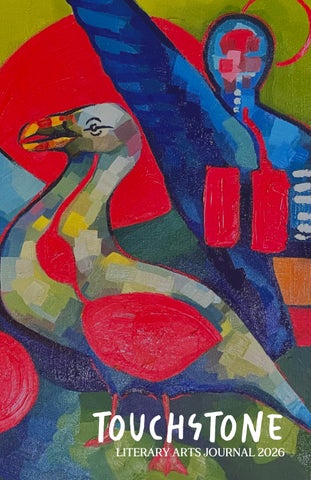
I am more than grateful to have spent my senior year compiling this journal, and I certainly didn’t do it alone. I must thank our entire staff for remaining fexible and enthusiastic in the face of every change, challenge, and complicated attempt at scheduling. Maria, on top of being Creative Director, thank you for taking on the responsibility of being our cover artist. Your work is the heartbeat of this journal, and I am honored to have the privilege of featuring it in this year’s edition. To Sara, thank you for your quiet leadership as Editor-inChief of Hatter Network, and for your unwavering trust in me and Sheridan. And fnally, to Sheridan, my executive editor, thank you for giving me the freedom to make this book my own. I will cherish our time together, from the late nights of work listening to the same three songs on repeat, to the rides back to my dorm after Uncouth Hour. Thank you for always showing up for me. You are one of my best friends, and I couldn’t have done this with anyone else.

Reader, as you make your way through this magazine, open yourself up to feelings of melancholic nostalgia. I ask you to refect on your own memory, take the time to appreciate the seasons of joy, growth, and grief, and to let go of those which no longer serve you. Thank you for spending a moment with this year’s Touchstone, however brief.

Live, laugh, love, Phoenix Medley, Associate Editor of Touchstone

Dear Reader,

What an incredible honor it is to have been involved with the creation of the 46th edition of Touchstone. The magazine you hold in your hands represents a collaboration between artists, writers, and musicians from across campus, as well as the incredibly talented Touchstone team. Three years ago, I was introduced to Hatter Network through Touchstone, and for the rest of my college career this magazine has inspired me, grown my confdence, and brought me to some of the most incredible people I’ve known. It was Touchstone that led me down my path to Creative Director, and I couldn’t be prouder of the artist I’ve become as a result. I feel so lucky to be leaving Stetson with so many happy memories, and how wonderful for Touchstone to be one of them.

In case I don’t see ya, good afternoon, good evening, and good night! Maria Latour, Creative Director of Hatter Network

Dear Reader,

It’s a privilege to play even a small role in an organization like Touchstone. One of my favorite things about Hatter Network is that it creates space for people from different backgrounds to come together and share their creativity honestly. That kind of community doesn’t build itself, and Sheridan and Phoenix have led it with clarity and steady care. With this edition’s focus on memory, I’ve been thinking about why creative work matters. I’ve had a camera in my hands since I was ten years old, and I’m still learning something new every day about perspective, about timing and about paying attention. A camera can pause a moment that might otherwise pass unnoticed. In many ways, this publication does the same thing. It captures where we are right now. What we’re thinking about, creating and becoming.

Thank you for being part of that process. Signing off, Sara Ward, Editor-in-Chief of Hatter Network

TAlE oF COtEtS

42 Too Loud for Little Ears

Christine Glezer

44 Scrapbook Sounds

Ezra Tatterson

46 route crosses time zones.

Melina Carter

47 I can’t remember the storm’s name, but I think it was yours

Mia Martinez

48 Hypoxia

Kyra Sullivan

49 Face in Space

Riley Chapman

50 Jigsaw Falling Into Place

Bun Shamsidin

51 It won’t stretch and make room for you

Mackenzie Enteado

54 The Things We Leave Behind

Joshua Weaver

55 Modern Kamikaze

Breanna Gergen

56 fnd me here Indya Mckoy

57 FoRmAlDeHyDe Mackenzie Enteado

58 wait Indya Mckoy

59 Quail Kyra Sullivan

61 Diaspora Midrash

Reagan Swayze

63 Fission Fuel - “Emergency Warning System/ Farewell” John Young

66 SPOILERS: they killed Jesus in this one too :( Isabella McKinney

67 MacDonald’s

Nathan Pyle

69 Two By Two By Two

By Two

Maria Latour

71 Strawberry Leopard Dreams

Robbie Gonzalez

72 Snake & Lizards & Rock & Roll Aviv Maddron

73 To the End of the Night

Miles Reynolds

74 Arcade

Tyler Gantert

75 Blurred

Reagan Shivers

76 Where The Light Rests

Jacob Butler

77 Through the Prism

Cody Desrosiers

79 Homecoming

Charlotte Holley

80 Alabama Summer

Natalie Reese McCoy

81 Butterfies

Robbie Gonzalez

GErE AWrD WInEs

84 Immortal Garden

Breanna Gergen

85 Mermaids Olly Paradiso

88 Centered Stranger Indya Mckoy

90 are we there yet?demo

Colin James Rhoads, Natalie Reese McCoy

92 Random-Access Memories

Alex Alvarado

94 Ampersand with Maria Latour

Editor Piece

Whenever this symbol appears throughout the book, it means that the featured multimedia piece is on a playlist which can be found by scanning this QR code.

SPcIl ThAkS

We would like to extend a special thank you to our new staff advisor, Allie Bourgeois! Despite being new to both Hatter Network and Stetson University, your dedication to our organization’s success has been unwavering. We appreciate you and look forward to our continued future together!

Friendship

ThE dOOr To ThE wORlD

At the edge of childhood, there sits a door. Modest and simple in appearance, but still it waits. Many have gone through it before me—the Door to The World, they call it. The place you walk to when childhood slips between your fngers, and you are to begin the rest of your life. It was my turn at last. But as I reached for it, I hesitated.

My childhood had ended without ceremony. There was no moment of realization the last evening my brothers and I told each other stories, nor in the small instance when I stopped playing with my dolls. I barely noticed the little girl I used to be slip away from me. The girl who had curiosity shoved in her pockets, and wit resting upon her brow. She was careless and wild, and yet still compassionate. Still whole. Her eyes were sharp and daring and full of wonder. She had wild dreams of becoming the greatest

actress, or the noblest princess, or the bravest hero. She told her friends the loveliest stories, which were typically of dragons and elves and enchanted princesses. She so adored to share what she loved. Her heart was worn on her sleeve and she believed, truly, that everyone was good. She knew exactly who she was. I think fondly of that little girl I used to be, and begin to wonder when she faded away. The curiosity was moved from my pockets to my notebooks. The wit remained, but was often mistaken for cynicism. My eyes were still sharp, but calculated and thoughtful. I remained compassionate, but practicality had taken the place of those glimmering, impossible dreams. I was no longer sure who I was.

Ah, but one thing remained, reader.

I never stopped telling stories.

Yes the stories changed through time, and perhaps so did my way of telling them. Stories I whispered to dolls became stories told aloud, then stories written in between the silent lines of journals. The stories I told never quite vanished. The tales themselves remained mostly the same, but the endings often shifted with time. They weren’t

always happy, but they were always good, because that little girl believed in good endings. Stories don’t fade, not really. They grow with us, emboldening us, moving us forward.

As I look at the Door to The World, I realize it does not rush me, it waits for the moment I’m ready.

And suddenly, I realize that I am. Because I will take my stories with me. What a strange, tender thing; to have pieces of life scattered through your mind, memories stowed away and retold. And there are the memories that are not even my own, but belong to the characters in the stories I read. Heroes, villains, strangers, and friends, I have seen through the eyes of them all. But then, there were the tales I had painted for myself; lessons learned in my childhood home, laughter shared over the kitchen counter, whispers exchanged in the depths of a pillow fort. Moments that showed me to take life as it comes, whether wrapped in ribbon or string.

Suddenly, for the frst time in a long time, I feel like that little girl again, pockets heavy with wonder.

I scoop up my stories and open the door, stepping into the world before me.

Joshua Weaver

LO-hnGnG FRiT

Why must we reach for the low-hanging fruit?

I pray to sing a poem about guayaba soon— for which, I always had to scramble up the trunk of my hickory-toned abuelito— he is my favorite tree—

scrabble at the scruff of his gristly goatee, lace my fngers about his sleek cross necklace, and almost slip,

just so he could catch me in his loving limbs and tease, cierra tus ojos y abre tu boca, as if it was some surprise what would come next—

sticky fngers licked by guayaba glossed lips, smacked and savoring a summer’s ripe kiss,

muffing my mouth before I quiet the coquís who never sing like me— too treacly for the simple truth: guayaba is not a low-hanging fruit.

TH ilAd I RmEbE

My fsts pound the sand

My offering of fruit drifts on the waves. Sea levels rise with the drop of each tear, The strait widening, Ninety miles stretch into ninety million.

Memories billow like cigar smoke

Leaving their tar on every one of my synapses. I ache for what I never had A rooster’s crow caught in my throat

As I caw out at the open ocean.

Woman in a white dress dances to the beat of my racing pulse, She kicks up sand and ash, And in her heated cadence, It’s as if the sand will turn to glass at her feet

Guiding my grandparents to their fnal resting place The Island They Remember.

I am left alone, with nothing but the memories of what I never experienced. of what I can never experience. For fear of The Island They Remember–Paradisic in picture, A prison in practice.

Cane felds bend in the wind like my spirit under this weight

As the scent of tobacco and rose talcum wafts between them.

Celadon palms and cerulean waves

Rendezvous under the endless stars

Like a dance I somehow know the steps of.

I remember my feet on shores I have never stepped in. The seafoam lapping at my ankles, As if it wants to beckon me forward, But does not have the vocabulary.

I remember my hands drawing rhythm on drums that echo without dancers. The sound reverberates off of hot cobble I will never get to walk.

I remember what never happened.

Memories of a lush island, Born in a cramped Sweetwater backyard, Full of potted plants, Arranged to mimic what she remembered of home. As she sprays me with mimitos To diminish the smell of a day in the sun The aroma of manzanilla transports us To somewhere we remember.

I know they wanted to show me one day, But their island only exists where they rest. My island has never existed.

As Yemayá oversees their journey home, I wonder where she will take me when my time comes. I pray that it is to where my fruit may foat: The Island I Remember.

Searching for Seashells
Mia Martinez

PaNGeA aFTeR tHE DRiFT

Phoenix Medley

Wegener looked at a globe and saw a puzzle, saw where the curves of South America may have kissed Africa. Ramirez looked at the smattering of ice surrounding our solar system and only saw a hole where a sister sun must have been, could only think of the loss. Academics are always looking in the gaps.

And in the three and a half hour gap between us, what would they fnd? What shape does your life take without me? How does my absence fll in, the way water pours into a hole dug into beach sand.

And I hope you know I’m left gaping. I hope everyone here sees it, too, the way I gasp like a fsh on a hook, taken from the only thing I’ve ever known, pulled from the coral tower, my favorite hiding place.

And I count down the days until I can be subsumed by the warm ocean water of your presence, the way we tuck into each other, take turns being mollusk and clam shell.

And both of us born in the cold of the Atlantic— temperamental East Coast waves carried me to you, no wonder I couldn’t bear to leave that place. No wonder I crave the drying salt wind, the South Florida sun-bleach of your hair.

And when they look at you they see a frost-bitten city, maybe the remnants of me— the chestnut colored sand you’re covered in, the citrine sunshine stuck to your skin, the calcifed seashell altar of us.

Because three and a half hours away I am here, scuttling along the ocean foor, drafting drift lines in foreign sand, only to be swept away by the tide, only for me to draw them again and again for you.

wish you were here

WhEN A sTAr DiES

Breanna Gergen

Astronomists say a star’s death is nebulous, crystalline hydrogen-clusters isolating themselves from the matter that once was to form a new one entirely.

I wonder if there was a fash of nebulae as that car fender met your white fur, sweet boy. I wonder if the rest of the Milky Way felt it, if my mother saw on her knees the white-light aftermath in midst of prayer. I hope that light, your own refraction was the last spectacle to grace your eyes as it left your tawny gaze, my beloved. Abyss glazing over.

For in their telescopes the astronomists never saw a dog as radiant as you, Star.

You fnally caught the UPS truck.

Self Suffcient
Alex Alvarado

A TAlE oF cATs AnD gHOsTS

13 Years Together (Toby)

DEr ChAlOtE

I know we both dread the cacophony of Sunday mornings, the gaggle of gaudily gossiping girls in the corner and clumps of clashing boys crashing into desks and only you and two others paying any attention.

You fashed me your front-teeth-less grin when you showed off your Rosh Hashanah card. Tiny, scribbly you commands “stop” To the two stick-adults she mediates who relent, “okay.”

“For Rosh Hashanah, I wish for my parents to stop fghting” tucked in the bottom corner of the page. In yellow colored pencil, bright but barely visible, hides the near-illegible plea of the beaming child who scurried to grab napkins for her classmate’s spilled drink.

My dear Charlotte, In my hand I hold your round face, the mirror forcing me to see double.

Our princess-golden hair cascades over big, blue pleading eyes, waiting for the gentleness of an adult. We spend recess tucked under the slide, blood soaking the hem of our pink checkered shorts scraped knees speckled with mulch. We will earn kindness by being easy.

Can you see the mirror too?

When you ask to hold my hand in the halls, sit stuck to my side in the sanctuary, insist upon standing at my fank, do you stare twelve years into my past, stick your tongue through your tooth gap, and encourage her to smile?

Ginger Anders

BAgE u pt

DEiCtE T eeN

Nico Alonso

Cast aluminum sizzled red over a hot stove

Bottom now black from years over fre

Sweltering heat smelts

Salt, fat, acid, and sweet

Tendons and fbers tense as their surface sears into a deep brown char. Hot metal screeches as stock separates the contents from the fond; Glistening oil pools at the top, In which I see our refection.

I see my past and my future in those bubbles

My baby face, save from tarnish and exhaust; and her textured expression, Each line etched through laughter Or her days in the sun.

Clanging of pots sealed, The scent flls the house and wafts out the open window.

Out on the porch, We share a wicker rocker Baby’s breath and giggles

Become a melody against Her trebled smoker’s laugh.

Que bella tu eres, coño!

Before she nibbled my shoulder

Eruption into laughter, Eruption past the seal, As the pot boils over.

Steam billowing, Carbon forms on the glass top

The smell of sancocho, stuck and stained.

She rubs my back, Ah, ‘ta bien.

I remember that gentle patience As she cleaned the pot, The stove, and the sink.

Ten years later, I’d be by her side, Searching her face, Finding nothing but empty expression.

I grip her hand, she grips mine I think of her and the stove. I wonder if she can remember. I wonder if she will remember.

A week goes by, My tears have run dry,

I stare at that same banged up pot. So does my family.

And no one knows what to do with it.

PuNNeTT SQuARe

I hate touch. I was never taught to speak the language of body heat and hands on skin. Genetics promised me lips that stumble over empty platitudes. I inherited distance from my mother’s mother, like my middle name. Tucking me in at night, the way her hands would hover just above my spine—the chill snuck its way in. I learned to associate my blood pulling back from my hands with the unrelenting burn of another person tapping me on the shoulder.

But when I hug my mother’s mother, the frst person I learned to babble the name of when everything twinkled like starlight, time suspends. I feel the sinewy corded muscle of her back. The hanging fat she glares at in the mirror; I feel its warmth as her arms drape across my shoulders. I feel her heart beating in time with mine as if to say look. Look how much I love you. I don’t mind that you have to leave. I’ll love the space you leave behind.

My mother’s mother has never known kind hands. But when she holds me in a loose grip as I slip away, promising to come back soon, her heart holds a blaze I’ll never reach. Her hands hold me with a kindness the world is not adept enough to accept.

SOeTiN AoU Te nIeRaLtY oF NsTlGa aKs iT fOevr aR

— Natalie Reese McCoy, Class of ‘28

— Breanna Gergen, Class of ‘28

I’m SiX

Sometimes, I lie awake at night counting the bumps and ridges on my ceiling. Finding shapes in the abstractness of the paint that looks like an orange peel.

I can’t sleep.

My pajamas feel too sharp on my skin and my blanket isn’t heavy enough, so I foat.

I hear whispered words sneak in through the cracks and crevices of a house that I’ve lived in for six years, four months, and three days.

Seven months and twenty-seven days until I’m seven.

The whispered words whispered words whispered words whispered words The whispered words reach my ears.

“You know the family doesn’t believe in doctors,” my mommy says in a sad tone.

“What are we going to do if she actually is…” She says a word I don’t recognize.

My stomach twists. The same way it twists when I have to talk to my shoulder partner at school.

The same way it twists when the toilet fushes and makes a Too-Loud Sound.

The same way it twists when I look into eyes and feel them looking back.

They’re talking about me.

My mommy is sad.

Daddy keeps sighing.

They talk about my grandmas and grandpas, my aunts, my uncles, even Uncle Tommy, who nobody talks about because he acted weird and was picky with his food.

Kinda like me.

I sit up in bed.

My hands go to either side of me, feeling the mattress equally as I swing my feet over the edge of the bed.

My feet touch the ground. Right foot frst, then my left. I lift them up and place them back down, but in the opposite order. Left, then right. I do this until it feels okay to stand up.

I hear mommy’s voice creep in from the hall as I walk to my door.

“What did we do to deserve this?”

I freeze.

I’d known they felt like this.

Pursed lips when I cover my ears. Rolled eyes at the fapping of hands to calm my nerves. “Shut your mouth!” leaving my daddy’s lips when I melt down in public.

Still, it hurts to hear.

I’m six years old.

I don’t know why the vacuum sound makes me feel like I’m being set on fre.

Why the seams on my socks feel like knives sticking into my toes. Why a hug feels like fre ants crawling and biting me all over. Why a strawberry poptart is the only thing I can stomach in the mornings.

I’m six, and I know that I’m weird.

I don’t know how to stop The Big Feelings or The Too-Loud Sounds or the weird way my thoughts bounce around in my head.

I’m six, and I know the grown-ups talk about me.

My auntie says I’ll grow out of it. My grandpa doesn’t look at me. My mommy says, “I don’t know why you can’t be like the other kids.”

I’m six, and I know that my mommy and daddy don’t love me.

I know why mommy’s face goes tight like shoelaces

Too Loud for Little Ears
Christine Glezer

when I rock back and forth in my seat.

And why daddy groans when I ask the same question for the ffteenth time not because I don’t understand but if I don’t say it it feels like bees are in my head buzzing buzzing buzzing until I cry.

I’m six, and I don’t know how to tell mommy and daddy that I love them.

They say “use your words” and I do, but they don’t understand because I only started using real words three months, four days, and eight hours ago.

I don’t know how to explain that I’m trying my best. I try so hard it makes my head hurt.

I just know that when they look at me with hatred in their eyes disgust in their hearts and anger in their actions that I’m sad and my chest feels tight like it’s all my fault even though I don’t know what I did wrong.

I’m not trying to be wrong.

I’m trying to be me. The me who loves when numbers line up just right strawberry poptarts toasted to the third setting on the toaster oranges peeled in one smooth ring quietness from a house when everyone sleeps routines that help me know what to do and patterns that make my body feel even.

I just wish that my parents would love me for me and stop mourning the girl who never existed.

SCaPoO suNs

My degree arrived in the mail today. An ordinary envelope, unassuming, and it’s hit me now, that there is no going back.

There are days I cling to the past— scratching, clawing like a mad animal to hold onto these feelings that are so quick to disappear.

Steadfast, ultimately losing, against the passage of time, I scream to the void: “please, please, I want to go back.”

I miss when depression, fatigue, grief, were just words to spell in English class. When touch felt less like an insurmountable climb and more like a warm welcome home.

The void screams back: “it is in our nature to miss most what was taken for granted.” But I am so angry, and I feel so alone. I refuse! Tell the universe I refuse!

Then the noise clears, and on the days when I am not a wild, raging thing, I close my eyes and I am back to 17, 15, 12—

I am playing games under the shade of an oak tree, or chasing the waves across the shoreline. I am warming cold hands over the campfre, home amongst the embers foating up and away like frefies, or moths under lamplight.

An admission: when I feel lost I long for the cold tiles of my childhood home on the soles of my feet and the cool glass of the bus window as I fall asleep.

That with focus, I can hear the pouring rain against the classroom window. Feel your leading hand in mind, as we run from building to building, wet hair clinging to smiling faces. I can’t remember your laugh, so I’ll make one up. I don’t think you’d mind.

And on these days, I will bargain: I will beg to stay here, where things don’t hurt. Though the truth is I know I can’t. That no matter the rage, the acceptance, the fear: there is no turning back to the safety of a home you no longer know.

Still, I think I’ll write to you today; it’s been a while. Or maybe I’ll just go take a nap; I’ve been tired for years, now. I’ll call you tomorrow, maybe. If I do, will you please pick up?

tIe oNs.

Consider fgure 1.G.

Your brother lives right down the hall. You leave your room and within two steps he’s there, playing an Xbox game you’ll never learn the name of. You crawl into his bed to watch and he smiles at you. It feels like a secret, how openly he loves you. Your cheeks burn with pride when your friends complain about their older siblings—the screaming matches that devolve deep into the night. You don’t notice the concerned stares from your teacher as you open your lunchbox, flled sparsely with what your brother packed for you that morning. You don’t know anything, but the warm nights of laughter heaved from his strained body. How long can you ignore the silence?

Consider fgure 2.G.

Your brother lives 46 minutes away. You don’t tell anyone what happened, no one tells you why it did. Moments with him are stuck in your throat and you beg your mom to drive you to his football games. You’ve stopped crying, but loneliness flls your lungs with every choking breath. You feel guilty asking your dad to spend the weekend going to his theater shows, and sometimes, when you know he’s just backstage, you need to step outside for reasons you can’t explain. You hug him tight, tighter than you feel comfortable with, your skin not feeling like your own, and despite the impossibility you feel water gather in your eyes. How much grief can your body hold?

Consider fgure 3.G.

Your brother lives 8 hours and 31 minutes away. He’s the happiest he’s ever been, but you see how his skin outlines his bones. You’re the most scared you’ve ever been, and you feel like it’s your job to save him. You’re only 17. You don’t believe in God, but suddenly every night you’re praying that the distance shrinks to 23 minutes. Tennessee is flled with everything you love, and you must be selfsh to travel the distance. How much are you willing to give up?

i can’t remember the storm’s name but i think it was yours Mia Martinez

Consider fgure 4.G.

You live 4 hours and 52 minutes away, but you’re not there right now. Right now, you’re sitting at the table painting loose-leaf with your sisterin-law. The dogs are outside, bellies full and fur warm from the sun. Your brother is in the kitchen cooking dinner, and you’ll stay until it gets too late to justify. Your ribs ache without hunger or a yawning wound. The porch light watches you say goodbye, blinking “see you soon” in Morse code. You miss this place, but it doesn’t feel as heavy.

HYoXa

I am best loved at arm’s length.

When I was a young girl, I tried to be maternal Saving up my birthday money each year to buy a baby doll

It wasn’t something I wanted It was something I wanted to want, so bad Each year I donated it. leaving the handcrafted wooden cradle empty

I couldn’t love it

I didn’t understand why I was like all the other girls, in every other way I liked the founcy, sparkly dresses, I wanted to paint my room hot pink I chased boys around the playground played the princess waiting to be saved. I just could not love a doll.

I never volunteered to be the mom while playing house. I preferred stuffed toys of dogs and cats. The human visage made of malleable plastic was lost on me.

The one time my motherly instincts succeeded it wasn’t a baby doll

It was a small pillow I had dressed in a preemie diaper. Before long, I got curious about what was inside, and cut it open The small plastic beads spilled out like rivulets of blood I hated myself for harming that which I had loved.

I just couldn’t help it.

There is too much within me, and when it all comes spilling out, It drowns everything around me, leaving barrenness.

I want to break your legs and nurse you back to health So, you rely on me

Lock the doors and nail the windows shut, live in a house of stale air and rot

I would keep your corpse in my bed, swallow you piece by piece to keep you with me

fll the house with poison so we can die lying side by side like Romeo and Juliet.

I want to crawl inside your ribcage

Assess the bones protecting your heart and decide they’re not enough

I’ll let you go instead

Before I slit you open, too. Just to see what’s inside Maybe it’s how I learned from those older than me That scorched-earth type of love

My mother was best loved at arm’s length, too Bristling at touch.

I don’t know how to love you without violence.

I am going to burn this house to the ground with us both inside it.

Face in Space
Jigsaw Falling Into Place
Bun Shamsidin

iT

mAe oO Fr oU

A man’s heart is a wretched thing

It is not like a woman’s womb

It won’t bleed

It won’t stretch and make room for you

I swear that her entire soul reshaped itself the day I came into existence and it wasn’t the beautiful miracle that everyone makes it out to be

They took a knife to her swollen belly for the baby too smart to enter the world willingly

Reality reclaimed me, bloody and screaming.

Fear that could have claimed the lives of thousands of men held taut between two women in a hospital bed

Mutilated, humiliated, terrifed: she smiled and promised to love me endlessly

Body broken to provide breath to a being yet to understand the signifcance

She broke her back to feed me; ruined hands to provide me with a harvest

She is not a grain of what she once was and yet she is more than he ever will be.

Rowan Geddes, Class of

The Things We Leave Behind

MOeR kmIaZ

Was it self-sabotage to worship the inertia of one’s own hemlock-laced casket plunging from the abstract, (stratospheric what-ifs, ivory fantasies tied to a tourniquet) A chemical reaction turned addiction to suicide weapon, metal wings polished from cinders, plane ticket now debris of velvet cigarette kiss. Is it denying God to play Icarus, to singe celestial cord and plummet to your rose-thorn fesh? My nest? For I know this garden’s trellis, nurture Sloth and Envy at once to water its sienna-soil grit. Purple fashdance, bodies fit as angelfsh would when they see your arm hooked to my (bait) neck. Your bullets would have preserved me but the innards were already holed empty, like roadkill that already had rabies.

fnd me here

Indya Mckoy

FORmaDEHyd

Daddy has a collection of broken hearts in glass jars that he can’t seem to keep clean, maintained through years of one-sided solitude and self-sabotage. The leather seats of his Lexus are left warm, warn, and cracking from sweat and too much Chanel no. 5.

The record player turns to unveil the wise-words of Celine Dion and I am 6-years-old, waiting in the wanton rain for daddy to get home from work, dreaming of the gravel crunch from tires and turntables, all that comes are tears.

It’s 1983 and torment is the game I played when wanna-be-mothers took supper in our dining room and drank all of mom’s wine.

These revolving-door-women stained his soul like the Cabernet, and I, the stemless goblet, shattered in his touch.

The rebellion began off-handed, food was the frst enemy, when that didn’t work, it was myself.

The refection of his wrong-doings: brought to life with a ropy gasstation-condom and years of tough love passed down from his father, and his father before him.

I don’t wear my big, fuzzy socks anymore because we don’t dance across the kitchen tiles like we used to.

Those foors are reserved for “adult activities” as is most of the house we used to call a home, and so I am condemned to my self-sequestration.

Now I clean daddy’s collection of broken hearts in glass jars because I know that mine will be in there soon too, and I never want to be as dirty as daddy

Indya Mckoy

qUiL

Mary, how did you give birth to your fesh and blood knowing the horrors he would go through? Was the better that he created worth the pain of losing him? I can’t handle the thought of handing the pain to another, someone I would love.

I told my mother that if I have to suffer I would rather I had taken all her pain, absorbed it, like Christ dying for our sins I would bear the family’s hurt on my neck and hips, my shoulders, ripping from their place my spine, crumbling beneath my skin

My mother would be free and her mother before her It could end with me.

It seems that it gets younger, the hurt. My mother made it to her 30s before the pain started to rip her apart, I barely made it through my teens. If I have a daughter, will she break in elementary school? Hands struggling to grip the crayons the way I cannot hold a pen on my worst days. Would she trip in P.E., not because her shoelace is untied But because the shooting pains that she inherited ran up her legs? I used to be able to run. I miss it sometimes. Even walking, I can feel the bones trying to rip through the front of my shin.

My mother says that she wishes I would never hurt at all. When I was in 3rd grade, I shattered my ankle, and they had to rebreak it for it to heal properly. I screamed, my face pressed into the paper on the exam table, making water marks with my tears

My mother cried. She promised me anything to make my screams stop. No parent wants to hear their child hurt. Even if it is to help them. Even if they’re the reason.

I think if I had a child, I would hurt them without knowing. Suffocate them with my love.

Swallow them whole like Kronos to keep them with me. hurt him, to save him. I cannot love properly I love too much, and I can’t let go.

My brother keeps quail

The female quail get stressed if there are too many males in the coop

The male birds are too rough, pulling out the hens’ feathers for their affection

You can’t tell when incubating how they’ll turn out

Mother, when I was in your womb did you know that I wouldn’t be able to hold someone gently?

My brother wraps the quail in cloth and snaps their necks

It is a quick and painless death. He cries anyway.

DiAS pOR a M iDR aS H

I. At the beginning...G-d.....

Nothing remains of the ghetto where my great grandfather was born. It wasn’t the ghetto. Not yet. And Poland was Poland, but the kind of Poland partitioned under a tsar, served on fne china. My family as piecemeal as our collective motherland. Warsaw brood. Lodz stock. Singer’s Ashkenazi Brothers veiled in candlelight. Choked by smog. Bubbe cursed in Yiddish. Babcia in Polish. They belong now only to the echoes of the shtetl, a slumbering world carved out of wood and the Word. They belong to the Commie, urbane Yids.

After ‘17, nothing but Bolshevik loving bastards. Street names and addresses that no longer exist, razed by war.

1939 and great grandpa was long long gone from Poland. Now just Poland. Pilsudski and that g-dammed miracle on the Visla. Slumming it up in little Poland. Polish Jerusalem in the USA. Milwaukee. Fell far from the role of cantor’s son, he did. Icarus and the not-wax of the Shabbat candle. Turned away from the drink of the Kiddush cup towards the sweet, sweet moonshine boiling in a pot in the closest of the small apartment above the shop you advertised

in the Jewish newspaper. Keep stirring the brew, zayde. Double double toil trouble. Before his muscles could cramp, he went to jail. Memory caged in a state penitentiary. Before it traveled down a winding country road, past squat cottages, leading to a place where cholent roils on the stove. Or to where babka rises in

MY bEovd mOhElAd, fOeIn aN, POaN, o aN, JE LnD n LnD fO U jwS wo wIl aK Or mEoR I?

the oven. Verdant path through a deadened forest. Rosemary springs in the wake of the horse’s hooves. It kicks up the dirt of the village and the stink of the city before it stops. I inherit this legacy, daughter of some mother.

My beloved motherland, foreign land, Poland, no land, Jew land. No land for us Jews. Who will take our

II. Return..Moses...I part the red, hemophilic sea

The bloodlands are my birthright. Between Red and Red, Nazi and Soviet, my motherland, corpse-like and pale, ready to burst. Autopsy to be performed by Arendt, examined by the passing of immobile time. The voiceless Landsberg cried out; tongues turned to ash.

Did you know fowers grow in Auschwitz? Did you know that there is a suitcase with our name scrawled on a leather cadaver, shielded by plexiglass? Cousin. Aunt. Uncle. Amongst the dispossessed and dead, shoes and teeth, striped uniforms too big for little skeletons. I dwell on the railroad tracks.

III. ..... I shall dwell among you...

August was old and new and ripened like peaches in a sticky feld beneath a sticky sun. I arrived on the bus to Warsaw on the anniversary of the Uprising. Red upon white, endless sea of fags. Pilsudski returned once more to the shores of the river. (Ukrainian scrawled on every advertisement in the station. Ghosts are being disturbed across the great, wide border...) It is an impossible city where my blood once walked through. I am the frst since the Shoah to revel in its reconstructed history. Fairytale illustrations. Gleaming teeth gnawing towards a cloudy sky. When I sleep in my

hotel, I sleep with the knowledge that beneath me is the rubble of the ghetto.

It is an archeological dig now. The Jewish home on Polish soil. I am in Crete watching Schliemann unearth labyrinthine palaces. Instead of a minotaur, they fnd bullet casings. Bones. I asked myself, where are the Warsaw Jews? I know I stepped on their ashes and consumed their fnal breaths at Auschwitz. I knew my family was still there, somewhere. Beneath the bombed-out chambers. Within the petals of a fower.

I never saw a synagogue in Warsaw. Worship in pieces, blown to rubble with G-d in ‘44. It is no wonder why, great-grandpa, Noah on the lonesome Landsberg ark, turned to drink and vice.

IV. ... whom the Lord knew face to face

Moses died and is in my backyard. Think I saw him at my family gathering with a cold can of lite beer, ten Jews in a room bitchin. One of my aunts asked me if I saw the place where ol’ grandpa was born. Moment of silence before we realize the answer is not ours to have. Memories of a war we did not know or taste battle onward in our DNA. We do not remember. I do not remember, though I dream of song and prayer in a dim synagogue and the ancient alleyways of Jerusalem where long, long, long ago young Jewish

girls like me ran barefoot with pomegranate-stained grins. I dream of the girls of Lodz, reading on balconies as the warplane

concerto braided the air with shells on a warm September day. And yet. Nothing remains of the ghetto where...

FiSSiON FUeL“EmERgENcY wARnINg SySTeM/fAReWElL”

THrE iS a hOoGaPy iEe n hE KNxvlL msEm f ArT tIlE feS B JEiM seHi. SThL UiLzE A mIrO

aN A cAeR bcKrO T At s  vyEr  RlAiOsHp iTiN

aCoS TiS pIcE I

oF tH FrEgN fElIg

p n  BdY tHt iD nO  On. IT rEiNeD mE

O WsH tO fEl iK i

eD sOeWeR IsTaD oF a lAs o e tAeD aT

R B RmIdIg e hA

iP wIh y aS

TeThMrK RmId mE oF mY eAiN DsOdE I Te 5tH gRdE m

hAd S rEiN M O M BoTeR’s aR HgS i sErC TrOgH mY mOaR Fr eMnDrS oF mY gRnDoTeR’s oOiN. My aS I I M BoO, sWaT Ad eAs, evn s I CnTnU T MvE

— Melina Carter, Class of ‘29

SPOILERS: they killed Jesus in this one too :(

Ekphrastic work based on Jesus Christ Superstar 2000

MA D O aL ’s

BART

Scene 1

Enter Macbeth and Bart

Welcome to McDonald’s. May I take your order?

MACBETH

How now, humble serf? Seyton is thy name No doubt. I gaze upon you like I were Zelus, For your head rests no crown, your shoulders no Burden, and hands that bare no blood between The nails. Maybe Adam is thy title, ‘Fore he bit the cursèd apple, that is.

BART

My name’s Bart.

MACBETH

Bartholomew. There is a famished itch That you must scratch. Fear lays siege upon my Troubled head. An incessant buzzing stills My thoughts. How can one rule if he cannot Rule himself? I trust you alone with this Information, Bartholomew, for thee Shall provide the relief. A meal for me. Bring one, knave, and they shall replace the word Loyalty with Bartholomew. Flee, boy!

BART

I don’t know, man. Do you want a Big Mac?

MACBETH

Big Mac?! I abhor this! Shame on thee, knave. No doubt, you allude to the fend Macduff. Villain! Doth your loyalty lie with him? Heavy are my eyes which gaze upon my

Thought-to-be friend. Look, as the spirit of Banquo foats above thou. From his hands, strings Wrap ‘round your wrists. I shall call you Bart, for You must re-earn the holomew. Fie! Fie!

BART I don’t really care what you call me.

MACBETH

A rapture for the slander thou speaketh! The worth of any decent man is found In the title he bears. A king’s a king, For he is ambitious and mighty. But, A fool’s a fool, for he is a mere joke. Every word spoken through your evil lips, A seed which sprouts coil; each treacherous Stem chokes sorrow and despair from my mouth.

BART Whatever, dude.

MACBETH

[aside]

Truly, this day is one of punishment. Pray God, why must it be a sin to want? Why hath thou written my fate with blood? Was I not your absolute son before those Vile witches cursed me with their knowledge? Why hath thou placed a sword in my hand and Ambition in my mind? Pray God, tell me. When? When will it end? When will the trees of Birnam fnally move? Cruel Bart, a fool With jests of fre. “I don’t really care What you call me”. Bah! Had this burden been His, would he learn the worth of a title?

BART Who are you talking to?

MACBETH

[aside, continued] Nay! He would not! Wast it Bart who had met

BART

The witches three, ‘twould take a mere word from His mouth to blow out their candles. Not by His fault, but rather, by the choice of the Hags.

Can you order something already? My shift’s almost over and I just want to go home.

MACBETH

Silence, egg! Lest your ghost be freed from Thy mortal coil!

Two By Two By Two By Two
Maria Latour

BART

I can just get you a burger, man. Especially if it’ll shut you up.

MACBETH

Ha! Bart would like to barter. Hie thee Hither with the burger, knave.

BART Don’t worry, it’s not poisoned.

MACBETH

Were you born of woman?

BART

I never really knew my mom, but I assume so.

MACBETH

Then I shan’t fear. This burger has met no Poison.

BART I need a new job.

MACBETH

A place within my army awaits you, Bartholomew. Foolish am I for this Charade. Forgive me, for my days since I Met the witches have been pain and sorrow.

BART Type shit.

MACBETH

[Bart pulls out a bag.]

[Macbeth takes the bag]

Fare thee well, Bartholomew. You hath served me well.

[Exit Macbeth]

Strawberry Leopard Dreams

Robbie Gonzalez

SNkE & LIaRs & ROk & rlL

TO tH e d f hE NI hT

Summer is an experience. You wait for it for so long. School has its upsides, and it has its downsides. But either way, you look forward to what comes after every school year. The days become longer. The nights become shorter. And best of all, adventure awaits you.

After ten weeks passed, you realize just how long it’s been. But you take a moment to consider something different beyond the days of summer. Every summer day was refreshed by the night. Nothing happened. But you decided that a particular night was different. It belonged to you.

When dinner is fnished, you leave the house and step out. The pavement feels warm under your feet, and you sit down on the curb to watch the sun set. The sun lowers its head to bid you farewell, and the sky changes slowly. As the blue sky changes to yellow, and then orange, and then stripes of crimson, violet, and pink, it feels like that moment will last forever. The shadows of the trees grow bigger, but you don’t notice. After a long time, the moon lifts its head as the sky becomes dark.

The lights of the homes you see fick on one by one. And the moon

hung over like the biggest porch light of them all, one for the whole world. You wondered why the moon appeared everywhere, but a wise person told you that the moon decided it liked you, and it wanted to see wherever you went and the adventures you had. The

AS

tH

BuE

sK cHnGs o eLoW aN TeN oRnG, aN TeN sTiPs oF cRmSn, vIlE, aN PnK I FeL lIe hA MmEt wIl aS FrEeR

stars similarly twinkled above as you looked up. You fnd yourself looking closely at what you see, memorizing the details. No night will be the same as this one.

You decide to walk around your block. The streets and sidewalks are empty, say for the crickets flling the air with their chirping, as if they want to keep the night awake. As you walk, you hope that the night will last. You arrive back where you started sooner than you

expected. Before returning home, you stay outside. Standing still. Watching the sky. You commit everything you see around you to memory. And then you decide to go back inside once more.

When you go to bed, you look around one more time. The morning waited like a backpack by the door. Before sleeping, you

look out the window again. The scenery is breathtaking. You fnally lay down to sleep. But before falling asleep, you know you will remember the night you saw. More than most others. Nothing special happened tonight. But that’s why it matters. You’ll return to this night often. Many times. Until the summer nights come to sparkle once more.

Arcade
Tyler Gantert
Blurred

WHrE TH lgH rsT

THoU  h hE P Rs M

Cody Desrosiers

A beam of light strikes the prism, not to pass through unchanged, but to be broken, scattered, transformed. What emerges is no longer singular, but many: fragments cast in different directions, each with its own hue, its own path. So it is with the human experience. No one emerges from life untouched. We are shaped by moments we remember and those we

try to forget, refracted by love, loss, silence, and noise. Our understanding of the world becomes a spectrum, colored by the places we’ve been, the people we’ve become, and the things we carry.

To be human is to carry that spectrum, to walk the world not as a blank beam of light, but as a shifting array of colors, each shade a memory, a lesson, a scar. We speak, we love, we fear, not from the place we began, but from all the places we’ve been scattered to. And though no two people emerge with the same pattern, we often forget that everyone else is carrying their own refractions too.

Maybe the tragedy is not in the breaking, but in forgetting that we were all broken differently. And maybe the grace is in learning to see the full light in others despite the angles of our own prism. Perhaps the more we understand our own spectrum, the more we can hold space for someone else’s.

Empathy becomes sacred in this light, not an act of kindness, but of reverence. A silent prayer that says: “I see you, even if I cannot understand all of you.” It is the soul

recognizing another soul as equally scattered, equally shaped by something larger than either of us. In honoring the complexity of others, we begin to forgive the complexity in ourselves.

And maybe that is the greater meaning: that we are not meant to return to a singular light. That divinity itself may live in the scattering. In the radiant, messy, beautiful spectrum of what it means to be alive.

WE aR SaPd bY mOeNs e

rEeMeR aN

tHsE wE tR T

fOgE, eFaCeD bY lOe, lOs, sIeNe, aN NiS. OuR uNeRtAdIg f

tH WrL BcOeS

a pEtRm, cOoRd bY tH PaCs e’vE

bEn, tH PoPe

wE’vE bEoM, aN Te hIgS

wE cArY

ALbAa SuMeR

Red clay and rusty tire swings make beautiful dead things out the rims of fraying trampolines sagging with the memory of unremembered weight and wet feet from the creek where crawdads are dumped into buckets or emptied into pockets and brought back between the toes as mawmaw blanches, white as church paint,

“Holy Ghost of Alabama summer!”

I feel you in the air conditioning and, closer still, the fnal mercy of the fight we all take for a moment

when we fall from weightlessness in the middle of woods and watch it bleed the cheapest gasoline in all the nation’s states, right where we land.

GENRE WINNE AWA

RS RD

For a piece to have been chosen as a Genre Award Winner, it had to exhibit both a signifcant mastery of its genre’s craft and exemplary representation of the themes of nostalgia, memory, and investigation of the past which bind together this year’s edition of Touchstone. Genre Award Winners were selected by the Executive and Associate editors with input from each genre’s selection committee.

ImMOrTAl GaRDeN

Breanna Gergen

Petals of pastels, pastoral members; Their sweet stems reached our denim hems, like abandoned valley-lovers: Craving the passerby to right them, so false stamen and flament could inject pollen to our veins and Cupid-nectar soon clogged any sense by the Alabama sun I had yet to regain.

That winter your verdant gaze Infused mine with honeyed confection under Athena’s statue, who to some wealthy man’s wife stands oxidized blue as beloved, undying tribute. Leaves rushed, hushed our lips, Scarlet-still and your cheeks were rose-hips. Yet again we passed those immortal towers, and I righted any plastic fower fallen, wondered if it would be your name next to mine one day in a graveside garden.

Immortal Garden was written on the road, in the aftermath of one of those lucid, all-too-real and yet dreamlike moments that we all long to re-live just once more. It is the irony of being young, in love, walking through gravestones whose foral tributes have gone unreplaced. For readers, I hope this piece takes you back to one of those times, when life contradicts mortality, when trivial beauties are amplifed once one notices the clock’s hand.

M eR Ma IDs

Olly Paradiso

f

hA GaY

eAd S INtEd f aL tOnHuSs, tH

nEgHoRoO Ws

mAe p f qUt

bRcK hOsE

wIh uRiCnE

sHtTrS aN

pLnTrS fUl f rAnBw-eAeD pLnT.

In the summer of 2015, we left the Potomac behind and moved to Panama City, nestled in the curve of the Emerald Coast. Our backyard changed from pine forests to beaches, and we bade a permanent farewell to snow days and frozen pipes. Instead of kudzu hair, the trees had gray moss beards. Instead of tall townhouses, the neighborhood

was made up of squat brick houses with hurricane shutters and planters full of rainbowleaved plants. It was sweltering hot and so humid my waves laid fat on my head like they’d been ironed straight. But my older sister and I spent the entire frst day in our new town patrolling the brick-lined sidewalks, dazzled by the tree beards and neon-green lizards and the distant musk of the Bay.

I was still a sister at the time. I would be for some time more, but there on the Emerald Coast, I began to have my doubts.

Every day Sofa and I walked the measly two blocks from our house to the seawall. There were long-abandoned docks jutting into the water, and there was no obvious entrance down onto the sand; we just climbed the railing, then down the creaky wooden steps obviously not put there by anyone offcial leading onto the narrow, narrow stretch of beach.

The Bay wasn’t a picturesque Floridian beach: it stank like fsh brine and was as dark as

named Silena with black hair and a blue tail. I could never decide on a name for myself.

“I wanna be a merman,” I said to her one day, as we were swimming along the coastline, away from our block toward clearer waters by the big condominiums. We could swim a mile in a day or more.

eT; aN aWrEeS O Hr

eR gIlHoD Ad eIg iT Hr, I fEt oMtHnG I aN oNy cCrAeL iDnTfY nO I HnDiGt: tHt hE evnIg f y hIdHoD wOlD cOe oN Dy, aN TeN I’d e  MrMiD iN aN oCaN oF sCrY MnSrOs mEmE.

mud. But it was ours. The water was still and the waves were like gentle, beckoning hands inviting us down to play. Sofa and I waded in with shuffing feet to drive away the skates, then dove into the water in full force once it was up to our bikini-bare stomachs. Close calls were had with skates hunting for food near the wooden beams of the dock, once with a fsh Sofa swore was a venomous rockfsh, but we were happy and at ease with the other residents of the sea. If we weren’t swimming, we were fshing; if we weren’t fshing, we were sunning ourselves on the chunky sand, eating giant, sweet strawberries and probably a fair bit of sand, too.

Our mother called us mermaids. So mermaids we became. My sister was a beautiful mermaid

“Why d’you wanna be a merman?” My sister replied. “Mermen are ugly-looking and scary. They’re like animals. They live in caves and only come out at night time to eat or mate.”

My sister was, of course, thinking of the mermen from our favorite book series at the time, The Spiderwick Chronicles, who were indeed ugly and beastly.

“Well, can we just pretend mermen are like mermaids? Just regular guys?” I said, out of breath as the water lapped at my chin.

“We can have merman husbands who look normal, how about that? But they’re away right now on migration…”

I was very disappointed by that compromise, because I had a name and a face and a tail picked out for my merman and nothing for my mermaid.

We swam, kept swimming, till we reached the condominiums where the Bay was clearer and bluer and overall more appealing to the sorts who lived in big condominiums, instead of squat brick houses. They all had their own private docks to park motorboats, but no one ever used them, so we climbed on the dock, jumped off it, dove underwater by the support beams. Whole little ecosystems were alive there by the docks, and we held our breath for a minute at a time watching the colorful fsh swim

around and dart away from our grabbing hands.

I thought that if I could have any superpower, it would be to breathe underwater so I’d never have to go back up to the surface. But indeed, we had to. We crawled onto the jetties and chased hermit crabs and scraped our knees. Then the sky began to turn as orange as our crabs and back home we swam to squat brick houses and briny, smelly water that rolled in from the marina.

My sister and I were getting older. I was eleven, and she was thirteen, almost fourteen. She had an understanding of the world that I did not, yet; an awareness of her body, her girlhood, and being with her, I felt something I can only accurately identify now in hindsight: that the evening of my childhood would come one day, and then I’d be a mermaid in an ocean of scary, monstrous mermen.

I couldn’t name a singular reason for why I stopped being a sister. But this was one.

“Mermaids” is one vignette from a larger piece about growing up on the Florida coast. It’s a short and sweet memento to the town—and sister—that raised me, through good times and bad. The Bay wasn’t always pretty, but it’ll always be ours.

CeNTeREd StRAnGEr

This piece was taken during a study abroad trip to Innsbruck, when my lovely friends/roommates and I decided to take a day trip to Salzburg, Austria. I absolutely adore the whimsical nature of long exposure photography, and love experimenting with it, so I decided to squat near a bench and create. The woman in the photo, also known as the “Centered Stranger,” just so happened to be in the right place at the right time!

ArE wE tHErE yET?

DEmO

Photo Credits: Jackson Keller

Natalie’s greatest fear is that she’s fallen asleep on a family road trip and still hasn’t woken up, but she’s learned to call this nostalgia.

Colin’s greatest fear is Natalie telling him to play guitar riffs faster, but he’s learned to just do that anyway. are we there yet? — demo is, of course, a demo of a song we wrote from both of these, but also for our generation’s fear of losing the things that made our childhood our childhood in order to grow up.

RaNDoM-aCCeSS MeMOrIEs

There are so many different aspects of this piece that I could touch on, however the main idea would be about the passage of time. The way that we feel when we fnd ourselves reminiscing, it’s a feeling that’s hard to describe, but I tried to encapsulate it anyway. It’s hazy, almost dreamlike, whether in a positive or negative light.

AMeRaN

“The Albatross About My Neck Was Hung”

What fuels your passion and motivation to create?

I’d say that my passion and motivation to create is fueled mostly by a need to get what I see in my head on paper or in a visual form. When I create, I am trying to get these complex thoughts and feelings and dreams and ambitions and ideas that I have about the world in a visual format. I’m trying to say what I’m feeling when I’m thinking through colors and composition and sometimes surreal images. But it always goes back to trying to tell a truth about, maybe, myself or about the world. And I am just trying to say that in the only way I can think to, which is painting or drawing.

How do you discover or seek out new inspiration for your work?

I look for new inspiration a lot in my friends and nature and the world around me. I am inspired a lot by natural formations or phenomenons. I am really into biology, especially marine biology. And a lot of my work sort of traces back to that kind of obsession with weird animals or natural phenomena.

Can you share the story or concept beside behind “The Albatross About My Neck Was Hung” and what inspired it?

The idea behind my painting was the idea of reincarnation and rebirth. So, the albatross is like a

symbol of guilt and, like, a never ending presence. And I kind of wanted to take that and bring it into the idea of, like, there’s a cycle present—there’s like a cycle of guilt, there’s a cycle of getting hurt or hurting people. And that made me think about reincarnation, rebirth, sort of like that never ending cycle. So, I’m sort of bringing the idea [that] the guilt that you carry will be reborn into another form. So, maybe it starts out in one shape and turns into a

“The Garden of Eden (3,000m Down)”

different shape. So, you have the Albatross and the human form. And I also was just really interested in the colors of green and red and how they play with each other. And that was my frst diptych in a while. So, I was just playing around with those ideas and those concepts.

Would you consider painting your main medium? And if it is, what is it about this medium that resonates with you most?

Currently, I’d say that painting, specifcally oil painting, is my main medium, mostly because my studio art senior project is all oil paint based. So, that’s pretty much all I’ve been doing for the past year or so. But I like to dabble in other mediums, and I’m hoping

that when I’m fnished with the senior project, I can go back into those other forms of art that I really love, like drawing and watercolor painting. But currently, yeah, I’d say I’m an oil painter.

Has your style or approach to art changed over time? And if so, how?

I would defnitely say that my approach to art has changed over time. I feel like now I’m a pretty conceptual painter, but I feel like that’s defnitely come with education and learning about myself and the kind of painter I want to be. I have kind of developed my own style over the course of my studio art degree, and I’ve defnitely become a lot more into fgure painting and self portraiture. So, all those things I feel like really contribute to the style I have now, but I defnitely wasn’t always painting that sort of thing. But I feel like there’s kind of a through line in all my work. Ever since I was like a kid, I feel like I’ve always, you know, loved animals and loved nature, and I’ve always wanted to express that in my work. I’ve defnitely developed but that core is still there.

This year’s edition of Touchstone focuses on refection, nostalgia and the way artists integrate time into their work. Are these normally themes you touch on in your art, and how does time generally manifest itself in what you create?

“One Way Trip”

I feel like the Albatross painting specifcally is a pretty good example of how I see that theme of time and just that endless cycle, the cycle of time. I feel like I think a lot about cycles and the cyclical nature of things in my work. A lot of the times I like to express kind of a never ending, as above so below, sort of concept in a lot of my work. I’d say that time shows up in my work as the idea [that] the past will come back. You know, it’s a cycle. So, I feel like that is usually how it presents in my work.

Do you fnd yourself connecting with your younger self through your art in a lot of ways?

Yeah, I would say that, like I said, I’m painting pretty similar things [to] what I would have wanted to draw when I was a kid. I’ve always loved animals. I’ve always been obsessed with portraying animals. When I was a kid, it was mostly, like, drawing Warrior Cats. But

now it’s evolved into, let me think about biology, let me think about natural phenomena. But, I think what I’m drawing is what a little kid version of me would have thought was really cool. So, I defnitely feel like I connect with my younger self when I draw.

Looking ahead, what’s next for you creatively, especially as you come upon graduation?

My biggest creative goal for the next few months is fnishing my senior project and exhibiting at the Hand Art Center. So, that is a huge step, I feel, in my artistic goal. I am almost fnished, but, you know, it’s still, it’s a process. [...] Then after that, I am hoping to keep experimenting, keep exhibiting, hopefully, but just keep developing, you know, because it’s a never ending process. I want to keep developing my style, developing my concepts, and hopefully, become the best artist I can.

COoPoN

The 46th volume of Touchstone Literary Arts Journal was printed by Independent Printing in Daytona Beach, Florida, with a press run of 650 copies. This journal was created by student designers using Adobe InDesign and Photoshop on iMac computers. The 2026 edition of Touchstone consists of 100 pages, and fonts including Salted (Regular) by PintassilgoPrints with a purchased desktop license, and LT Cushion. The 4-colour process cover is printed on Neenah Pearlized White paper.

Touchstone also features virtual content on hatternetwork.com and on Instagram @touchstonelitart, which is entirely student created, managed, and produced. All submissions to Touchstone are reviewed, selected, and edited by Touchstone staff and selection committee. All works featured are created by Stetson University students. Special thanks to those who submitted their work and to our supporters.

DIcLiMr

Touchstone exclusively features work of Stetson University students. Each staff and selection committee member reviewed and ranked submissions blindly, and if they knew the creator of the piece, or they themselves were the creator, they were not allowed input.

Touchstone Literary Arts Journal. 46th Edition, Spring 2026. Stetson University. Copyright 2026 Touchstone Literary Arts Journal. All artwork, photography, and literature are copyright 2026 to their respective creators. The ideas and opinions expressed belong to the respective creators, and do not necessarily refect those of the editors of the 46th edition of the Touchstone Literary Arts Journal, or the Stetson University administrators and community. Any similarities to persons living or deceased are purely coincidental. None of the contents of this edition may be reprinted without the permission of the individual creator.

Associate Editor, dated 2008 (Age 3)
Executive Editor, dated 2008 (Age 3)

Turn static files into dynamic content formats.
Create a flipbook