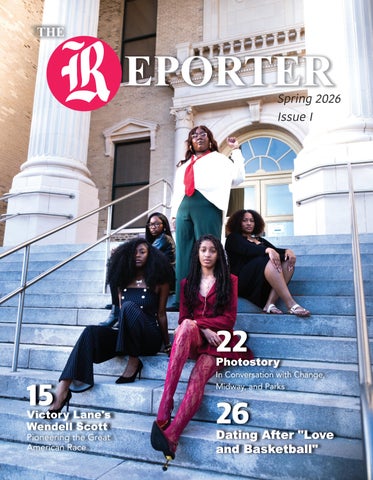
The Reporter: Spring 2025 Issue I

Page 1


EdiTORs EdiTORs EdiTORs Letters From Our

Black History is not confined to a revisionist lesson that lives in a middle school textbook, only opened during February, it is a living and changing movement expressed through different mediums. Art, language, literature, journalism and so much more presents opportunities for narratives to be unflattened, acting as an active resistance to colonial norms. How do you reflect this in your work/life ALL year, not just in February?

One of the most important facets of my work in journalism – at least to me – is to unflatten typical narratives, question who has been telling the story all this time, and to pursue the truth. One of the ways I do this is by acknowledging the harmful rhetoric posed against people of color and the blatant overlooking of POC in news media coverage and representation. My efforts, in both my journalism and academic research, are not only year-round, but lifelong, as I do my part in shifting narratives to focus on what happened, who was impacted, and what I can do to uplift their stories to the mainstream.

EXECUTiVE EDiTOR

NiCO ALONSO '26

Black History is one of evolution, which makes it a natural extension of human need and inherent limitation. To evolve – despite our inherent shortcomings and desire for progress, even as movement can seem slow – requires an ever-changing relationship to what we constitute as valuable. If we expect this deemed valuation to contribute to something lasting, larger than ourselves, it needs to be communal. Whether through work like this magazine, cook-outs or late-night conversations in temporal locations, I reach out for the community that negotiates these values with me.

Any worthwhile artist will tell you that art history IS Black history. Black art has shaped our place in the art world today. Taking a look back through history’s favorite artists, you’ll notice a disturbing pattern of silencing and exploitation. Pablo Picasso, the father of cubism, neglected to mention the Dan and Pende people from whom he was inspired. Andy Warhol, a pop-art icon, needed the great Jean Michel-Basquiat to prop up his own fame. Art is storytelling, but all too often it's only one story being heard. This month, and all year-round, I encourage you to think critically about the stories you consume. Seek out Black art. Lift up Black voices.

'26

Growing up as a Black woman in a society that was created to make life more difficult, I find that it is important to uplift my community as a way of silencing the negativity. I enjoy doing this throughout my daily life, as well as through photography and collage. As my history is continuously being erased, we must find creative ways of making sure it remains alive for future generations. MANAGiNG

Photographer, Indya Mckoy '26

EdITORs

EdITORs Editors

Indya McKoy Photo Editor
Katie Eudy Copy Editor / Fact Checker
Breanna Gergen Arts & Culture Editor
De’Vanese John-Baptiste Managing Editor
Maria Latour Creative Director
Nico Alonso Executive Editor
Sara Ward Editor-in-Chief
Michaela Hawthorne News Editor
Natalie Reese McCoy Web Editor

RePOrTeR

Gail Anderson

RePOrTeR

Cruz

Gwen Ifill

Phyllis Wheatley

staff

Sara Ward, Editor-in-Chief

Maria Latour, Creative Director

Indya McKoy, Photo Editor

Nico Alonso, Executive Editor

Who is one figure of Black History, past or present, that has influenced you?

Stacy Plaskett

De'Vanese John-Baptise, Managing Editor

Michaela Hawthorne, News Editor

Malcom X Doechii

Lisa "Left Eye" Lopes

Marsha P Johnson

JOINING US

Katie Eudy, Copy Editor & Fact Checker

Breanna Gergen, Arts & Culture Editor

Natalie Reese McCoy, Web Editor

Jomar Rosado, Staff Writer

Nathan Pyle, Staff Writer

Joshua Weaver, Staff Writer & Photographer

Marissa Stanley, Staff Writer

Michael Terezazakis, Staff Writer

Parker Moore, Spread & Graphic Designer

Riley Cate, Spread & Graphic Designer

Kayla Lewis, Spread & Graphic Designer

Kiara McNeil, Photographer

Francheska Tellez, Photographer

Ash Miller, Photographer

Jett Scheingoltz, Photographer

Sully Sullivan, Social Media Director

When it comes to joining Hatter Network, we are never not excited about someone wanting to join our ranks. If you want to write, The Reporter is the place. If you like to appreciate art, music and writing, Touchstone Literary Arts Journal is where it’s at. If you want to create your own podcast, or learn how to use the tech in our radio station, WHAT Radio is there. Hatter Network is an extacurricular media program run by students, for students, to provide them with the information we think they need to know, or an outlet for their creative endeavors.

If you’re interesed in getting involved, please email our Editorin-Chief, Sara Ward, at sward@stetson.edu or apply on Engage.

Ida B Wells

Huey P Newton

James Baldwin

ABOUT US

The Reporter, as part of Hatter Network, is the oldest collegiate magazine in the state of Florida. We publish four times per year, twice per semester. Florida Sun Printing prints 300 copies per issue on 8.5 x 11 inch, 80# Gloss Test. Most body text is set at 11 point Adobe Garamond Pro or Times New Roman with 13 point leading set with a combination of regular, italic and bold. All pages are designed using Adobe Creative Suite Photoshop, Illustrator, and Indesign. For additional information please visit hatternetwork.com.

Questions or concerns can be mailed to 421 N Woodland Blvd. Deland, FL 32723 or emailed to hatternetwork@hatternetwork. com.

Celia
My Mom

cOnTeNts

cOnTeNts

08 13 15 18 22 26

Ancestries, Archives and Activism

Stetson MFA and Undergraduate Students Speak from Silence

Crucian Carnival

Christmas Tradition and Colonial Resistance

Victory Lane’s Wendell Scott

Pioneering The Great American Race

Future Legal Leaders Found Stetson NBLSA Chapter

Photostory

In Conversation with Change, Midway, and Parks

Dating After "Love & Basketball"

Ancestries , Archives, & Activism

Poetry and art, while encouraging connection and challenging societal norms, is still seen as taboo. Some topics are seen as too graphic or too personal. Artists and writers often selfcensor to avoid sharing realities that might overwhelm their audience, but sacrifice artistic honesty while they do so. There are blossoming writers who are tackling this issue head-on, and they are right here at Stetson University. Kendal Gailyard ‘29 is an undergraduate freshman, whose poetry and song-writing speak of generational issues and the struggle of cementing independence.

Ayoola Olubukola Ogunyimika ‘26 MFA is a graduate student in her final year of the Masters of Fine Arts of the Americas (MFAotA) Program. Her mutli-medium artwork and her poetry tackle what it means to be a Nigerian firstborn daughter living in America, and fighting sickle cell disease. Lineage and history are foundational in her pieces, and she does not shy away from any difficult subject matter. The work of both of these artists rejects silence and actively resists the erasure of their unique voices.

Kendal Gailyard ‘29 ~

Kendal Gailyard is a first-year student at Stetson. While his major is currently undecided, Gailyard plans a switch to Digital Arts with a minor in music. Kendal introduces himself as a writer, not just a poet – he details his work through creating songs, visual art and creative writing. Despite rejecting the title of poet alone, Gailyard has written poetry often since coming to Stetson.

”[I] started writing poetry as an escape from going into songwriting,” Gailyard said, identifying it as a creative outlet to avoid the vulnerability of music. Both his music

and poetry depict themes of “resilience, connection, love and independence.” Having become a go-to creative outlet for him, Gailyard admitted that poetry “takes the most amount of reflection… it takes a lot of patience and a lot of honesty.” His first year at Stetson has helped propel him toward a more confident version of himself, which resonates through his work. Gailyard highlighted how poetry allows audience members to hear a “different story from each poet,” and he has not shied away from carving out a space for his story to shine.

Story by Natalie Reese McCoy & Marissa Stanley Graphics and Layout by Parker Moore

Breaking Free (Verse) from Generational Curses

Gailyard considers writing — be it through poetry, prose or songwriting — to be “basically, a conversation.” In one sense, writing itself is a visualization of conversation or speech; Gailyard is especially inspired by the idea of “writing as conversation” when he writes poetry. “What makes poetry such a powerful form of human expression is that it combines speech and rhythm patterns,” Gailyard said. In another sense, this combination of “speech and rhythm” in writing has the power to not only imitate conversation, but also invite others to participate in it. “[Poetry] speaks to people in a bunch of different circumstances,” Gailyard said.

The process of imagining writing as a conversation has helped Gailyard to process his identity and independence while sharing about his family, culture and history.

“[There] was a lot that I didn’t know before writing… After looking inward, and… recalling how I was born and raised,… the things I might have kept hidden, or maybe the things that I didn’t want to look too deep into to resurrect… I could start learning to heal,” Gailyard said. Like many first-years in college, “I’m at a point in my life where I’m starting to seek… independence as I grow into being an adult and everything,” and, through writing, “[I’m] learning who I am and being confident with who I am.”

This has influenced Gailyard to write about how his identity and relationships in his family — and his family’s identity and relationships with what he calls “generational curses”— form him. “It’s important to talk about family, because, at the end of the day, our family is really what we have left. I mean, we have our friends, we have friends that we think of like family, but nothing’s gonna quite be the same as the people you were born into, people you were raised with,” Gailyard said.

“I believe those connections might be the most powerful… When you understand the people around you and your family… you know how they influence you, and then you

start to understand yourself a bit better… What parts of them are like you, and what parts would you rather stay away from?”

To wrestle with these questions, Gailyard structures his poetry in what he described as “a mix between sonnet and… free verse.”

He compares the way he uses free verse to break from the patterned verse of sonnet form — a poem composed of fourteen, usually rhyming, lines of iambic pentameter — to the way he hopes to break from the patterns of ‘generational curses.’ Considering “culture and history and everything like that, those generational curses and fears” are “implemented a lot from childhood because… it’s a lot of what you’re taught, and for a while you don’t really get independent learning and education, especially in black households… you really know what you’re told,” Gailyard said. “Writing definitely does help with breaking those curses and fears.”

Gailyard shared the following excerpt of “Growing Pains,” a poem written from both his and his mother’s perspectives to each other:

“So you’re almost 18 and I’m happy for you I couldn’t be more proud

You’re a man. What’s the plan?

Finish school, go to college, start a fam

Not too soon cuz I don’t want no grandbabies till I’m good and ready

So you better stay up out them wombs

Better stay up in that room, study hard, don’t ever slack I don’t pay for you to be lazy.

Now you complain I’m on your back?

So since you’re almost 18, you’re a man?

You the man? Nah you’re a boy,” and the standout lines, “Breaking out of patterns I prescribe some better rules,” as well as, “I know I’m almost a man but don’t forget that I’m your son.”

“Dear Mama”

Another one of Gailyard’s poems, “Dear Mama,” leans heavily into the nuances of fighting and self-reflection. In the poem, there is a mention of “choosing sides,” which Gailyard admits is a reference to the divorce of his parents during his childhood. The pain of a child being cast into the middle of a battle between parents is evident, and Gailyard said he hates choosing sides even now, because “no matter which side I choose, it would always feel like a lose-lose [situation].” In the following excerpt of “Dear Mama,” Gailyard pours out his pain in an attempt to find the truth in an emotionally volatile situation:

“Dear Mama, You wonder where I went wrong

“I

When did I lose that smile?

When did I become so debatable?

Stomping off the kitchen tile

Slamming doors, punching walls

Attacking you with my words

Feeling validated in the insults

The euphoric feeling, superb

Arguments in the marriage

Choosing sides like court proceedings

Anxiety reaching new heights

Never finding a ceiling

And I was always guilty

Of picking sides

Always a lose-lose

Choosing between parents

Now you wonder why I’ve got some screws loose.”

prescribe some better rules”

Gailyard doesn’t just write to break his own family’s generational curses, but also to understand his own identity and independence, and share about his own family, culture and history. For example, just as he says in “Growing Pains,” he writes to “prescribe some better rules” and inspire

people to do the same. This poem “show[s] people they’re not alone in how they’re feeling, and that [there’s] a lot of stuff that we hide [from] ourselves that we think isn’t normal but really is,” Gailyard said. “At the end of the day, we really just want to be heard.”

Ayoola Olubukola Ogunyimika ‘26 MFA ~

Emerging writers like Kendal Gailyard are not without other writers to read, speak with and learn from, such as Ayoola Olubukola Ogunyimika. She is studying Creative Writing with a concentration in Poetry in the Expanded Field, which she describes as “poetics with research and poetics being outside the page.” Which, in essence, means “movement, sound, music, singing, cooking, artwork,” or anything else that comes to her mind.

“For me, the ‘Expanded Field’ is like pushing through a physical threshold of what poetry seems to be and just getting out of [my] comfort zone and creating something new,”

Ogunyimika said.

The Expanded Field is nothing foreign to Ogunyimika. For her undergraduate capstone project, she created a 34-page anthology of poetry “that was filled with medical illustrations, historical context, interviews and much more … based on living with sickle cell.” Ogunyimika’s anthology speaks from the archive’s silence surrounding the “history and timeline of sickle cell” from eras that predate the 1910s — when sickle cell disease was discovered — all the way to modern day. To reflect that sickle cell existed long before that, Ogunyimika said she likes“to use [her] family history as a way to emphasize how

new the… discovery is in the United States.”

For example, “my grandfathers— they have birth years around 1910, and my paternal grandfather definitely did have sickle cell, even though he didn’t have a ‘diagnosis’ at that time in Nigeria.”

Ogunyimika’s work, which has received awards from the Sickle Cell Disease

Association of America, still “[dissects] the culture of silence from an African diaspora narrative based on health disparities affecting individuals living with sickle cell disease,” including her own “experience of being a mother, being a parent, [her] spirituality, ways to cope, medicine,” which, “you know, is my artwork,” Ogunyimika said.

A Self-titled Griot

When describing the motifs of her work, Ogunyimika said,“I really emphasize narrations on my lineage, intergenerational inheritances, cultural identities [and] medical experiences.” Her writing revolves around what makes her Ayoola. Ogunyimika describes how west African roots guide her poetic voice: Ogunyimika said, “I am a self titled Griot…in west Africa that’s a general term that is used for a storyteller, a poet, a narrator, someone that is reciting a historical

“pain

narration of the times,” Ogunyimika said. Her parents had endless stories of the elders in her family. Born in Nigeria, Ogunyimika had the opportunity to “[hear] stories of the people that are no longer here, but are part of the family history.” To Ogunyimika, being a Nigerian first daughter is the foundation from which her writing springs forth. She says, “It defines from the center [of me] from where I’m getting my stories.”

written as epitaph”

Though her storytelling as a Nigerian firstborn daughter and title of “Griot” is certainly familial, Ogunyimika still feels like it is something she chose. “It’s intentional for me. With living with sickle cell, I feel like the reason why I write the way I do is because I write a lot about taboo things, or things that make people uncomfortable to hear. I like to say that I turn traumatic things into things that are divinely beautiful.”

Through living and, “surviving” as Ogunyimika puts it in one of her poems, with the challenges of sickle cell inspires her to write for others living with the same. It is crucial to Ogunyimika, as well as others within the “sickle cell community,” that the aesthetics of her work do not distract from its confrontation of pain. Rather, she wants to use the aesthetic “to speak more truthfully about [her] own life story,” and her experience “in the sickle cell community… giving, providing service and collaborating with different organizations, being a creative

researcher, presenting at different conferences, being on pharmaceutical advisory boards, art shows, commissions”— all of which she has been doing for 15 years. “I think it just feels very archival and, in a way, ancestral, of going back and bringing forth things that I know people that came before me thought of or worried about,” such as how “sickle cell impacted the Atlantic slave trade,” shared Ogunyimika.

Ogunyimika often works in the ekphrastic style, which she defines as “a literary device, an artistic device that can be used to create poems and different artworks after original or any type of piece, like looking at a painting and making a poem, hearing a song and creating an art piece… seeing a poem and creating a dance…” This ‘art from art’ exchange of ekphrasis has allowed Ogunyimika to “move” her and her family’s, community’s and culture’s lived experiences “through catharsis … [or] the intentional need and action of purging great emotions

to get a release, to get comfort… I always work through catharsis,” Ogunyimika said, “because I live with chronic pain.” Her profession as a health coach has taught her “how [catharsis] works somatically in the body as well, to relieve a lot of stress and tension that we don’t know we have,” and how that, too, is an ekphrastic experience.

Ogunyimika shared the following ekphrastic work of hers, in which she wrote the poem “My People: Wet & Bloody” after her own painting, “Shackled in Sickles.”

“‘My People: Wet & Bloody’ This water is sacred Still and waiting; it welcomes this blood as sacred grace, my bones carry the memories of a passage through space as vessel pain written as epitaph. I’ve often thought of, since I was young(er), the Sickle Cell Warriors who were in the

Atlantic slave trade.

To think those souls survived, and their descendants are trying to do the same And because Sickle Cell is genetic, I can’t help but think of my great great ancestors who suffered with pain everyday not knowing their bodies weren’t demons.

To think those souls dreamt of me, and I am somehow surviving”

Ogunyimika explained how the color red is represented within the sickle cell community.

“That’s actually the color for our ribbon, but red for the red blood cell [too]” Ogunyimika said “The brightness of the blue, the blonde, the brown skin looking [like] decay and then the contrast of the red” represent “the pain that is internalized with sickle cell.” To describe the imagery itself, ““there’s sickle everywhere,” Ogunyimika added, “if you noticed the curvature” even on the “hair on the body.”

Stories Into Histories

Ogunyimika is keenly aware of how her work fits into the broader world. She does not write in a vacuum, but instead acts as a historian for others to learn from and reflect upon. She says “I think it’s so important for people to have the power to express their own voice and take autonomy of their own story, because no one else is going to tell your experience but you. And it’s very important that in history, your pain doesn’t get turned into something that you enjoyed or lied about later.”

Ogunyimika’s work highlights the need for one to insert themselves into history, and find where their story fits into the histories of their countries, communities and families.

“It’s very important for you to have a voice and a face to the things you’re experiencing, the things that came before you, the things you’re hopeful for the future in your culture, cultural identities, to show people that it’s possible… as a Nigerian living in America as a first daughter, living with chronic illnesses.”

When it comes to future plans,Ogunyimika says, “I look forward to really being able to publish more of my work, and some things are physically shared with everyone, hopefully these next few years, for some actual manuscript for everyone to buy.”

Ogunyimika’s work can be found at the following link: https://linktr.ee/Arby_ayot

Crucian Carnival

Christmas Tradition and Colonial Resistance

Nat+Marissa

In St. Croix, U.S. Virgin Islands, carnival is a massive, month-long Christmas celebration that spills out into the streets with huge parades, local food, and free concerts every night, from December 6th, all the way through Three Kings’ Day on January 6th. Carnival is the one time of year the whole island “links up” to celebrate its rich history and culture through colorful costumes, loud music, and good vibes.

Carnival is celebrated differently across the world, with many cultures even hosting their celebrations at varying points of the calendar year. St. Croix’s carnival also showcases many festivals, parades, village nights and cultural exhibits during this time. We keep our history alive and culture strong during carnival through numerous outlets: the materials in our clothes — often made with a multicolored, patterned fabric called madras — the Soca, Bouyon, Calypso and Reggae music we play, and traditional foods. All of these practices are dedicated solely to highlighting the intricacies of Crucian identity.

The Festival Village, colloquially referred to as just “Village” on the island, are the grounds where much of the festivities take place. The days after Christmas kick off the first two nights of Village, bringing with it the Princess and Queen shows as the two parts of the Miss St. Croix pageant. Despite its title, the pageant is gender neutral, allowing both young women and men to compete. The competition days are widely considered the “soft opening” to carnival, to which Governor Albert Bryan Jr. announced, the effective marking of December 28 as the official start date of Village. Village nights are essentially music festivals headlined by artists who specialize in a highlighted genre. With nights such as Calypso monarch, where Calypso artists compete to see who can get the crowd most involved in their performance.

The winner of thiscompetition receives a trophy and $10,000 cash. The same prizes are awarded for Soca monarch night. Soca is a music genre originated out of Trinidad and Tobago that is short for “the soul of calypso.” Despite these competitions, there are nights where numerous artists perform without a cash incentive, and the crowd comes exclusively to appreciate the music and the artists on stage. The two biggest nights which celebrate music are Latin night, to show appreciation for our prominent Hispanic community on the island, and Reggae night which often pulls in the largest crowd overall.

Story by Jomar Rosado
Graphics and Layout by Kayla Lewis

A staple of carnival is the Jouvert (pronounced joo-vay), which is done before the sunrise on a certain day within the span of December 31 and January 3. The specific date depends on the official appointment of the Governer. Because it is shorter and more organized than the adult version, it is the preferred event for families with small children. You will see local youth royalty waving from the back of cars designed as small floats, and the float decoration themes often emphasize education, folklore and the preservation of Crucian heritage.

The term Jouvert itself is of French Creole origin from the 18th and 19th century during slavery and means “day break” or “opening of the day.”

After Emancipation in 1838, Jouvert became a celebration of liberation. People smeared themselves with oil, mud, and molasses to avoid being recognized by former masters and to symbolize their struggle, their connection to the earth and their new freedom. In the current day we cover ourselves in paint and powder — even though some still keep doing the oil as well. Unlike a standard parade where you watch from the sidewalk, at Jouvert, you are a part of it.

Jomar

You “ramp” — a form of shuffling walk/dance — behind massive trucks carrying live bands or DJs.

The parades are the next event of carnival and they are separated into two days, so that the kids and adults have their own designated days for parade. The kids’ parade is always the first of the two, where we highlight the youth of the island.

It serves as a rite of passage for the kids, where students from various schools and youth organizations showcase their talent and pride.

This features the little majorettes, baton twirlers, the Rising Stars youth steel pan orchestra and many mini versions of traditional carnival troupes.

The adult parade is the closer to carnival season where troupes of hundreds of people ramp down the road in Frederiksted, (the town on the west of the island). The troupes wear hand-crafted costumes layered with all kinds of feathers, gemstones and crystals which tell stories about the troupe and the culture throughout the respective pieces of the costume. The same massive trucks used in the jouvert go down the road along with each troupe and carry these enormous speakers blasting Soca, Bouyon, or BRAM (bass, rhythm and melody) which has become a more recent cultural staple over the past ten years straight out of the Virgin Islands.

While the Children’s Parade is about tradition and cuteness, the Adults Parade is about artistic competition, physical endurance, and pure celebration. It is here you will see the most spectacular Moko Jumbies and the massive, mechanical costumes of the “King and Queen of the Band” as they compete for the title of “Best Troupe” before the judging stands.

VICTORY LANE’S Wendell Scott

A Short Track Star is Born

Bearing checkered flags and NASCAR’s infamous rainbow emblem, Daytona Beach and its beloved Daytona International Speedway is a place Hatters have called home since the Speedway’s inaugural race held in 1959, which introduced it as the the lifeblood of Volusia county’s cultural scene. Since the ‘60s, countless Stetson students have spent their first days of the semester in the grandstands for the Coke Zero Sugar 400 — back then it was the ‘Firecracker 400.’ Spring break goers, too, kick off their vacations with “The Great American Race” – as the Daytona 500 is often referred to – to open the Cup Series’ season. I, myself, have religiously been one of those track-goers, long before my Stetson career. However, few of today’s Speedway regulars, with the exception of true-blue NASCAR fans, know

the name of Wendell Scott, the first Black driver to race in the NASCAR premier series and for nearly 60 years was the only one to ever win a Cup race.

Perhaps one of the most notable of these attributes: Scott was the only driver to ever have his trophy wrongfully taken from him by race officials – who feared any prospective spark of Black publicity.

In hindsight, Scott is now revered as a pioneer of the asphalt, who paved the way for Black drivers like Bubba Wallace, Jesse Iwuji and Chase Austin who followed in his footsteps. “He was a good driver,” said Don Cooper, Operations Manager of the Motorsports Hall of Fame at Daytona International Speedway.

“He was a good driver,” -Don Cooper
Story by Breana Gergen Graphics and Layout by Parker Moore

T he Prodigal Trophy

Before he ever got behind the wheel, Scott served in WWII for three years as a mechanic and then owned an auto repair shop in his home state of Virginia. With a wife and seven children’s mouths to feed, he also worked side gigs as a taxi driver and moonshine hauler.

It was on May 23, 1952, at Indiana’s Danville Fairgrounds dirt track that Scott drove beneath his first green flag in an old Ford. He left Danville that day with a third-place finish and a $50 payout – equivalent to almost $600 today, according to the American Institute of Economic Research – driving him to pursue short track racing full-time. Scott would go on to compete on a tight budget; for most of his career, he purchased used cars from other drivers, repairing and modifying them himself to compete against teams with substantially greater funding. Thanks to his grit, by March 1961, he was racing for NASCAR.

Although Scott has quite a posthumous reputation, his living career was riddled with racial discrimination. After all, Scott began racing competitively in the still-segregated South of the ‘50s. Scott would be the first in the sport to navigate a society still comfortably nestled in its prejudice, and reluctant to legitimize his success as a driver.

Traveling the country in the pre-Civil Rights era proved difficult for Scott. Oftentimes he and his family were denied hotel and restaurant access, simply because of the color of their skin. Unfortunately, the same strand of discrimination followed Scott onto the racetrack.

On December 1, 1963, at a Grand National –now referred to as “the Cup” – Series race held at the former Jacksonville Speedway Park, Scott officially struck his first victory in the big leagues. Yet, race officials devastatingly declared Buck Baker, the second-place – and “coincidentally” white driver – as the winner, presenting the unearned trophy to him in victory lane. It has since been confirmed that the officials did so in fear of a Black driver being seen publicly accepting the award from a white trophy girl. Trophy girls were a central part of NASCAR’s racing tradition at the time, and tradition usually called for the winning driver to kiss the girl who handed over the Cup. Of course, for the officials, the mere thought of Scott engaging in this particular tradition barred him from claiming his rightful top-step on the podium. It was not only underlying prejudice but an outright, outspoken act of racism that robbed a champion of stardom – all because the flag-bearers claimed sovereignty over asphalt that was not theirs to rule.

Posthumous Legend Steps to the Podium

Despite this bleak moment in Scott’s career, the racer refused to lose his spark of passion for the sport. He went on to compete for another decade until 1973, when he officially stepped back from NASCAR with a total of 495 series starts. Up until his death in 1990, Scott still religiously competed as a ‘weekend warrior’ short track driver, racing locally simply for the love of it.

Motorsports Hall of Fame Manager Don Cooper recalls the racer’s son, Frank Scott, testifying to this. “Three years ago we had a museum exhibit set up at a show right across the street [here] in Daytona, and up to the booth walks Wendell’s son,” said Cooper. “We chatted for a little bit, and he told me…about the trophy incident, and…that right up until a few years before he [Scott] passed away, he was still playing around with late model cars…[at] a few local short tracks and a dirt track now and then.”

By 2015, Scott, though no longer present to see it, began to earn long-past-due credit when he was posthumously inducted into the NASCAR Hall of Fame – the most prestigious of honors a driver could boast. What’s more, he entered a mystic, seemingly-unattainable realm of prestige as the honor made him the first Black driver to earn the title.

Yet it took six more years for Scott’s 1963 victory at Jacksonville to be rightly made tangible in silver. On August 28, 2021, the eve of NASCAR’s Coke Zero Sugar 400 race, NASCAR executives presented a custom-built trophy to Scott’s family in tribute (if not a few decades late) to his win

that day. More than 57 years had passed since that checkered flag flew and the racial injustice that had followed it, but the gleaming cup, engraved with the word ‘WINNER,’ made the wait worthwhile for Scott’s children and grandchildren.

Warrick Scott, Wendell’s grandson, told NBC Sports that the trophy was “a tangible artifact that, naturally, he earned, but it is something that will be an inspiration for [an] untold amount of people going forward.” Warrick also commended NASCAR for its growing efforts towards an ideal of inclusivity. “I see the growth in NASCAR and I see the growth in diversity that didn’t use[d] to exist, and I think that’s something that this will lay a really solid foundation to build on… When you learn better, you do better…We’re not getting stuck in the past,” Scott said. Regardless of whether or not you are a NASCAR fan, there is no doubt that Wendell Scott was a historical contributor to something larger than just the world of racing and burnt rubber. He set a courageous precedent for those that came after him, both for Black men and women who shared in his love for adrenaline fixes, and for those that did not. Scott defied the prejudices of his waking era, stepping into the limelight pre-Civil Rights movement, and continuing to chase finish lines throughout it. As a cultural and societal figure, Scott takes the crown (or helmet) as one who current generations can see as an embodiment of racial justice.

“When you learn better, you do better…We’re not getting stuck in the past,”
-Warrick Scott

Future LeGal Leaders Found Stetson NB LSA Chapter

Five percent of U.S. lawyers are African American according to a 2024 report from the the American Bar Association. To Temi Adediji, ‘27 and Collin Hughley ‘27, these numbers are reflected in the lack of diversity in Stetson’s pre-law program.Back in January 2025, Hughley scrolled Instagram and realized that his future career prospects have expanded, leading him to Fall Semester 2025, where his goal to change the lives of future attorneys would take root at Stetson.

Hughley, a double major in political science and religious studies, was inspired when he saw that fateful post from a former speech and debate opponent he had competed against in high school. This competitor was elected as the president of the University of Central Florida’s Pre-Law Chapter for the National Black Law Students Association (NBLSA). Motivated by what he saw, Hughley raised the idea of starting a pre-law chapter of the NBLSA at Stetson toTemi Adediji, ‘27 and alumna Tori Watson ‘25.

Co-Presidents

“When [Hughley] brought the idea to me, I was immediately on board. I was ecstatic, because I knew that it was something that Stetson needed and I knew that it was something that Stetson would benefit from,” Adediji said. With the support of his peers along with Lila Jaber and Simone Marsteller – current and former board of trustee members, respectively – Hughley was able to get into expedited contact with the NBLSA.

Now, Hughley and Adediji are beginning their second semester as co-presidents of the Stetson NBLSA Pre-Law Chapter.

Collin Hughley and Temi Adediji attend the Southern Region of the National Black Law Students Association’s Academic Retreat in Miami, FL.
Story by Michaela Hawthorne Graphics and Layout by Riley Cate
“We are creating lawyers who desire to make a difference, who desire to see

Along with the organization name, Hughley and Adediji intentionally bring the national mission of the NBLSA to Stetson. The core values of the NBLSA consist of promoting culturally responsible black and minority attorneys who excel academically, exceed professionally and impact their communities. Looking back on the semester, Adediji highlighted some achievements that contributed to this mission. Adediji’s expectations for involvement were pleasantly surpassed. His expectation of five-to-ten members was exceeded when about 25 members joined the organization, which is the biggest accomplishment in his eyes. “Students came in from left and right and they really, really, bought into BLSA’s mission,” Adediji said. The organization has also had networking opportunities through their newfound connection with the Virgil Hawkins Florida chapter of the National Black Bar Association – which consists of a network of over 1,500 attorneys statewide.

Co-President of NBLSA
Temi Adediji ‘27

They also took part in an initiative put on by the southern region of the NBLSA called “Letters of Love.” As part of this initiative, Adediji described a competition to write the most letters to people in need, including the incarcerated, people experiencing poverty and children in foster homes. Stetson’s chapter won the contest, writing about 200 letters. “To me, that was a very meaningful accomplishment, because it just showed me that what we brought to Stetson, it is doing exactly what we hoped it would do,” Adediji said. “We are creating lawyers who desire to make a difference, who desire to see change.”

Complimenting Adediji’s list of accomplishments, Hughley made the point to further elaborate on what he calls the “personal” side of the organization’s accomplishments. The impact of the organization on student’s lives makes Hughley feel accomplished when he reflects on the past, when it was even more difficult for black law students to excel.

Specifically, Hughley explained how he helped another student get into law school. Hughley described the student as someone who had experienced hardship and was questioning if she belonged in the legal profession. “The [NBLSA] mission statement stuck to my heart, to increase the number of culturally responsible black and minority

The first members of Stetson’s NBLSA prelaw chapter raise their hands and declare their oaths at their inductee ceremony in

attorneys. And so I worked [with] and I helped her with her personal statement; I helped her with her application holistically,” Hughley said. “To hear that she got accepted [to law school]...It’s one of the reasons why we chartered this chapter.”

In their Instagram bio, the NBLSA defines themselves as a non-profit that “promotes the development of socially conscious future lawyers.” Prompting personal reflection, Hughley and Adediji defined what being “socially conscious” means to them and their roles in this chapter: Hughley describes being socially conscious as having an awareness “of how race, structural racism and power dynamics in certain institutions – specifically being we’re in undergrad-educational institutions – how they impact minority or African Americans lives via education and community while simultaneously engaging in actions, challenging these systems,” Hughley said. “I think it involves developing a strong but positive racial identity and using that identity to…resist the negative societal stereotypes that exist around our community.”

As he enters this semester, Hughley looks forward to further implementing the NBLSA’s values. “We’re all focusing on those three points of their mission statement this semester in our programming. So January is ‘excel academically’, February will be ‘succeed professionally’ [and] March will be ‘positively impacting our community with volunteer work,’” Hughley said. As part of their volunteer work, the organization is also planning for community service at a high school in Orlando. Adding onto Hughley’s interpretation around awareness, Adediji said, “I think the root of awareness is knowledge, right? I think allowing yourself to be educated and informed on the systems around you and how race and power dynamics factor into those systems, is how you build awareness to the fact that those systems even exist.” As an aspiring law student, Adediji sees consequences in failing to open yourself up to such knowledge. “The biggest danger of failing to be a socially conscious lawyer is that A) you end up perpetuating the very systems that were designed to

“THe biggest danger of failing to be a socialLy conscious lawyer is that A) you end up perpetuating tHe very systems that were designed to work against you, and B) you end up losing power just because you don’t know what’s going on around you.”
Co-President of NBLSA Temi Adediji ‘27
Law and pre-law students from multiple southern chapters of the NBLSA gather at the St. Thomas University College of Law for an academic retreat in September 2025.

work against you, and B) you end up losing power just because you don’t know what’s going on around you.”

For the club members’ academic development, the co-presidents are looking to implement something they see as lacking at Stetson: a structured LSAT pipeline.

“We noticed that at Stetson, there isn’t really a curriculum for [reinforcing LSAT preparation]. There’s no courses.There’s no professors who necessarily teach about the LSAT,” Adediji said. Stetson’s NBLSA chapter is looking to change this and their first step is bringing in former Hatter Tristyn Rampersad ‘25, who Adediji says received a great LSAT score, to give an introductory course on the LSAT to students. “I know when we were freshmen, we were ignorant to the LSAT and its importance, Adediji said. “And it’s very important as pre-law students that we know exactly what we’re working towards and how to best prepare for it, because the earlier you start preparing, the better that you’ll succeed.”

When pondering their legacy after they graduate in 2027, the copresidents hope that they have laid the foundation for the future success of the organization, including a potential endowment of the organization so it can grow even further. Hughley hopes that the underclassmen on their executive board will step into higher leadership positions and that the cycle of growth in the organization can continue.

“It’ll just be a continuous cycle of helping black and minority students get into law school. That’s our simple goal,” Hughley said. Adediji hopes that the organization will remain at the university to continue to uplift diversity on campus. “It wasn’t too long ago that Stetson was the opposite of a diverse institution. We all know that Stetson’s a PWI, but it wasn’t very long [ago] that we didn’t have a lot of diversity at Stetson,”

Adediji said. “So this organization is something that means a lot to a lot of people and I know for both of us, it’s something that we want to live long after us.”

“So this organization is something that means a lot to a lot of people and I know for both of us, it’s something that we want to live long after us.”
Co-President

of NBLSA

Temi Adediji ‘27

From left to right, Stetson BLSA Copresidents Temi Adediji and Collin Hughley pose with Justice Peggy Quince, Virgil Hawkins Florida Chapter of the National Bar Association President Brendalyn A. Edwards, Stetson BLSA VP of Operations Tori Watson, and Stetson BLSA Membership chair Siesie Nuefville. The group poses at the Quarterly Membership Meeting for the VHF Chapter of the NBA in September 2025.

In Conversation with Change, Midway, & Parks Photo Story

Born on November 30, 1912, in Kansas, Gordon Parks bought his first camera, a Voigtlander Brilliant for $7.50 at a pawnshop (Deborah Willis, 1999). Later, his photographs in Daytona Beach’s Midway would shed light on how the severity of segregation and varied education led to unequal experiences for African Americans, even as change and discussion of its possibilities took root.

“With chaste eyes, some sitters and some cameras can say yes or no without realizing what the other has on its mind. The sitter, somewhat skeptical, looks into the camera, asking, “Do you know who I really am?” The camera, in search of an answer stares at the face, the mannerisms, the clothes - even the shoes and socks, then does whatever it feels like doing … “

-Gordon Parks, 1997

John Young ‘26, a Stetson University student, is pictured on the right. Photographed beside him is an agricultural worker, captured on film by Gordon Parks in 1943. In 1999, Leonard Lepel looked back to document the working conditions for African-Americans post-war. As the “percentage of black workers who held skilled or professional jobs increased from eleven to fifteen between 1940 and 1950”, agricultural workers, including celery workers, often worked for sparse wages with little to no inclusion in early labor laws or Social Security Benefits. Since that time, Bethune-Cookman University (B-C U), recognized as a landmark of the Midway Historic District, has served as a professional pipeline for young African American leaders. Jesse Walter Dees, Jr., documented B-C U awarding its first baccalaureate degrees in 1949 (Social Security Act of 1935, Pub. L. No. 74-271, § 210(b)(1), 49 Stat. 620, 625 & Fair Labor Standards Act of 1938, 29 U.S.C. § 213(a)(6).)

Story by De'Vanese John-Baptiste Photography by Joshua Weaver Graphics and Layout by Riley Cate

Dr. Mary McLeod Bethune Boulevard was called Second Avenue in 1938, according to the “Historic Second Avenue” oral history project from Bethune-Cookman University. In Parks’ photograph originally captioned “celery workers, dressed up on Sunday Morning” by the Library of Congress, one can see the advertisement for C.C Sweet Snuff, a former smokeless tobacco sold in the building that housed McGill’s Fish Market and Fann Lunchroom. Now, a parking lot stands in its place.

Keyser Elementary School was a “laboratory school” for college students to practice their teaching skills. Housed at BethuneCookman College, the school was one of the lasting contributions of Dr. Mary McLeod Bethune (Stars Library at the University of Central Florida). In collaboration with her colleague, Frances Reynold Keyser, the elementary school was founded as an alternative to the surrounding public schools, which were regarded as underfunded within the community (Report on the Educational Opportunities for Negroes in Florida, 1941). Recalling this contribution, BethuneCookman undegraduates, Kamaih Nunn ‘26 and Maitae Freeman ‘26, were photographed near Dr. Bethune’s gravesite.

Dr. Mary McLeod Bethune was one of the first in her family not to be born into slavery. Bethune would use this freedom to become a pioneer for change in Midway. When she encountered educational, civil rights, and health disparities, she often responded by founding or leading an organization that would fill the gap. The photograph on the right honors Dr. Bethune’s legacy.

According to Leonard Lempel, in 1926, Daytona merged with the beachside towns of Seabreeze and Daytona Beach. It brought with it rigid segregation, although milder in comparison to neighboring cities in the American South. Daytona Beach, a 5-minute drive from Mary McLeod Boulevard, denied entry to African Americans at the time of Parks’ photographs in Midway

Fur coats, fedoras and knit cloche-style hats dominated Midway’s 1940’s fashion scene. Members of the community could often be seen wearing their “Sunday Best” for community events and church services. In the current day, the Richard V. Moore Community Center: Black Box Theater is a home for civic gatherings and other productions of the Midtown community. The Center restricts activities to private rentals on Saturdays and Sundays.

LOVE

&BASKETBALL Da ng aft LOVE BASKETBALL

Black Stetson students may have grown up tucked in the corner of a living room couch as their parents watched the likes of “Moesha” and “Martin”. No doubt, those same parents hope the family values in these old network shows rubbed off on the next generation as we watch “Love & Basketball” or stream “Insecure.” The shifting portrayal of Black love in the media from homes to ritualized situationships has been noticed, but what does this translate to off-screen?

“I feel like social media definitely [pushes] through the algorithm, like you have to be basically slim-thick, short, this [X] inches, [X] inches of hair … this specific curl pattern or this specific complexion in order to be loved or be in a relationship … I can really count on one hand the YouTubers I watched [growing up who] were dark- skinned, Black females. Most of them were light-skinned or brown

…Speaking from my perspective of being a dark female, it's not really that much positive [representation] …nine times out of ten, the male is the one that's dark [skinned], and then the female is a lighter skin reflection. So that inherently just tells people, ‘This is the standard.’”

-Melissa Ndiaye ‘27 M.S.

“I'm not saying we don't have real love today, but I think there was a lot more depictions of

“WHAT DO YOU KNOW ABOUT THIS?”

a strong family unit … back then, that isn't shown a whole lot now … Think about reality TV, and you're seeing people cheating all the time and having kids while not being married. I'm not some kind of conservative in that regard, but I do think when you're seeing that so often, it becomes normal, now and then.”

-Josh Dennis ‘26 M.B.A.

“This whole persona of people in Black relationships being like, ‘Oh, we’re going to stick together. Get it out the mud. I’mma be down for you no matter what.’ That whole thing is crazy…I feel like if you’re dating someone and you don’t have your stuff together, then you shouldn’t be dating someone.”

-Chesteria R. Purifoy ‘27

“I feel like for a lot of people, there's a sense of entitlement that comes with relationships, ‘Well, if I dress up for it, then that means XYZ should happen,’ or ‘If I am the one texting them, then this is what should happen afterwards.’ So I think I put [my foot forward in] relationships [both platonic and romantic] with the more grateful approach of just kind of understanding that this is something that's supposed to add to the human experience and not take away from it.”

-Soleille Vertus ‘26

“To have so much divorce and breakups in these Black celebrity relationships just made a lot of women feel, ‘Damn, is Black love even real anymore?’ Nowadays, it’s always interracial love, and there’s nothing wrong with interracial love, but it's going to be [a] problem if the colorism stigma is there … you have dating books … Why is the Black character always in a gang? Why is the Black character always a baby mama? Why is it always ‘thug love?’ Why can’t Black people have the same type of love

white people have? ... When you read books, especially on the Kindle … [Urban is] probably not a bad word, but to me, it equals a bad word in the sense of, ‘why do we have to say this word, and why can’t we say this word’ – Urban Love. I feel like, why can't we say ‘Black love’? I'm sorry, but I'm not sorry. [Authors use the Black love tag for interracial love]. Interracial love is not Black love. Black love is two Black people.”

-Bianca Smith ‘27

ARE THERE ANY GOOD [X] OUT THERE?

As Generation Z has navigated their fair share of once-in-a-lifetime moments, their taste for apocalyptic predictions should come as no surprise. Love, unfortunately, is not immune to this predilection, and a scarcity mindset may be at the center of some romantic woes. Where there is the perception of a lack, some Black students and staff may find that being at a predominantly white institution (PWI), like Stetson University, amplifies existing dating dilemmas. While others find it to be a unique opportunity for exploration.

“There was this guy who sent me a request [on social media] … Basically, in his bio, he was saying, ‘Oh, I'm just a white guy who you know has a fetish for Black women.’ I just find that very disgusting, because I'm not saying as a white man that you can't prefer Black women. … It's the way you go about it.”

-Tashema Andrews ‘27

“I'm not sure how many people can attest to this, but being at a predominantly white school, you get a lot of weird stares. It almost makes you uncomfortable to the point where you wouldn't even want to push to have a relationship with anyone. Not saying it's everyone, but those stares make you question.”

-Jamcy Laplante ‘26

“ Being the only … dark-skinned girl on the cheer team … I definitely experienced colorism here, in the sense that some football players … people who I interacted with from freshman year — who don't go here anymore — thought I was ‘loud and ghetto’. They thought that all

because I was dark-skinned, because I was Black … but it's like, you can't make assumptions about me because of my skin color when you don't know me.”

-Bianca Smith ‘27

“It definitely does hinder it a lot because you don’t see a lot of people that look like us, so it’s interesting because that’s my type.” Purifoy said, laughing, “I like people that look like me … It’s also — you have to think about the culture, like blending your culture with other people. It’s difficult to explain how you grew up versus how someone else grew up, and for them to understand it and validate it. It’s just that sense of community you have between people that are like you.”

-Chesteria R. Purifoy ‘27

“ I honestly think it gave me a broader scope of what's out there. I don't think I would have had the experiences, dating wise, at an HBCU compared to somewhere like Stetson …Yes, this is a PWI, but there's so many different people who come from so many different cultures here. When you go to somewhere like FAMU or Howard, those are still excellent schools, but they're predominantly Black for a reason, so you're not seeing a whole lot of difference. Not to say that Black people are some kind of monolith or anything like that.”

“In the UK, you see a lot more biracial couples… I don't really see that a lot in [Stetson’s] campus, and that's okay, because I know people are entitled to [their] types. So

that was kind of like a shift, because I don't have a type, personally. I had a boyfriend that was white before I moved here. So just seeing that, it's kind of, I don't want to say hard, but rare for you to actually know if a guy genuinely likes you or [if] he has a fetish or something.”

-Natasha Aniobi ‘27

“I realized there still needs to be a sort of likeness that we both [in a relationship] share … I mean like values and outlooks on certain things… we're getting individuals from all walks of life. So there's not just that personality likeness to it. There's also the fact that their family might not like Black people or they might not care to learn about your culture [etc]...Social politics in the world right now, I think it makes you have harder conversations before you're even able to know the person, because… I feel like you kind of have to know [politics] before even getting there. Especially now, because it's

LOVE ME … LOVE ME NOT

Despite mixed messaging, Black students and staff alike are attempting to define what love looks like for them. Especially when it does not adhere to traditional scripts.

“'I’m bi-curious. I think specifically as a Black student that is a little bit difficult … There's already a stigma about being a Black man. There's even more of a stigma about being a queer Black man. So I often feel like I have to show that I'm still just as masculine as a straight man… Black people in general, we kind of have a stigma about queerness… I went to a party… at Lambda Chi Alpha, and I was dancing with a guy. I [had] never danced with a guy in such a public space that wasn't designated for queer people specifically. And for the most part, no one said anything … But I do recall a group of Black men, making remarks like, ‘Oh, that's what we're doing’. And not that it made me stop, but it was just kind of, ‘this is why it's hard to be in these kinds of spaces.’ At the same time, some of those men be ‘DL’ anyway.”

-Josh Dennis ‘26 M.B.A.

“I struggled [for] the longest time being like ‘oh my gosh, I’m a bigger girl, so no one’s going to like me.’ That’s not the case … the people I have dated have always encouraged me to be myself … It’s never been a downplayment of

becoming a bit more dangerous.”

-Soleille Vertus ‘26

“I also attended a predominantly white institution myself in college, so I kind of go back to that experience, and I think those same mindsets that are kind of promoted in [the] culture of ‘There aren’t that many good men. If there are good men, there's only a few.’ All of those things felt very real while I was in college, because it was a small Black community, and as somebody, like, unashamedly [so], I wanted to marry a Black man … I think it really was a scarcity mentality around men … And then around, like, visibility and invisibility, feeling like both were true as a Black woman at a predominantly white institution. It felt like hypervisibility and invisibility at the same time..”

-Alexandria Belk, Associate Director of the Cross-Cultural Center

my personality or my looks, so I appreciate that.”

-Chesteria R. Purifoy ‘27

“Growing up in my household, it was ‘no boys at all, until you're 18.’ And I turned 18, and everybody was like, ‘Oh, do you have a boyfriend?’ So it was like I couldn't do it and then suddenly, I could, and nobody told me … I feel like I don't really know how to approach men or what to do when I'm approached … I've learned, I would say, that I still don't really have a desire to really [date].”

-Joi Turner ‘27

“[Of things I prioritize in relationships], I think the biggest one is being healed or healing. I think there's not much good from two broken people being together or one broken person being with someone who's farther along in their healing journey. While there are cases where you know that healing kind of rubs off on the other partner… the thing that I learned that became non-negotiable was that it is not my job to heal you in our relationship. We should be two relatively whole people coming together, not to have [or create] the whole, because I feel like that creates insecurity and just conflict within relationships.”

-Soleille Vertus ‘26

“I remember being 20 years old, and having, what I feel like for me, was an encounter with God and [Him] being like, ‘you want somebody to choose you so bad, you have to know that you're already chosen.’ I don't have it within myself to love unless I'm able to, at a great rate, receive love and [God’s love] that is for me, perfect love.”

Center

“In a relationship, I feel like … we all go through a phase where someone like our significant other would do something, and it'd make us feel a certain way, but we try to brush it off. Because, you know, we love that person, or we feel a certain way towards that person. But I would say, if you feel some way, trust that instinct …It's there for a reason. I don't want to say act on it, but I would say, trust that

instinct.”

“A lot more communication and understanding of one another, because I feel like we have a communication problem. Knowing how to love yourself…because even that kind of selfhate comes into the relationship, because then you're getting paranoid or jealous… but that's stemming from the insecurities you're holding within yourself. [Also], patience. I feel like a lot of people are just on ‘go’, we don't take the time to slow down and just be present. Don't get all caught up in the social media facade of what a relationship [is] supposed to be like. Monetary wise, [for example], because that’s just setting unrealistic expectations…when you can really grow with the person.”

BLACK STUDENTS DESERVE...

“I would say reading groups are more important than dating…What if instead of dating, people focused on what these topics are … you're dating to find love, but you haven't even defined it. You don't even know what it is specifically, right?... I would go and argue that you'd have a better chance of finding it if you're just focusing on, like trying to understand the concepts, [like vulnerability and love] themselves.”

-Montaque Reynolds, Assistant Professor of Philosophy

“Just know yourself before you try to figure out another person. That's all I have, because I feel like a lot of people don't know themselves before they start dating and then try to find themselves while dating, which is not a good combination.”

-Melissa Ndiaye ‘27 M.S.

“Talking about like Black women and dating, I don't like the fact that people are always like, quick to say, “We're aggressive” and “We're too much.”... They put that label more on Black people, well, Black women, actually. I just feel like maybe, if that stopped, it would be easier.. I know a lot of people actually want a genuine connection, and they don't want to be judged.”

-Natasha Aniobi ‘27

“I think there's a stigma on both sides of the aisle. Whether it's Black men or Black women, or Black in between, you. And it kind of goes to what we see in media. People might say, ‘All men do this,’ or ‘All women do that,’ and then they go into these relationships already having that preconceived notion about someone else … I feel like Black students specifically deserve to be able to see each other for them, not see each other for what society says.”

-Josh Dennis ‘26 M.B.A.

“When I first started working at Stetson… in Student Development and Campus Vibrancy…I really [hoped] to be able to inspire students in courage and to really help just cultivate that … because that's what we need … I think one of the most underrated things in the world is friendship. I think that … emphasis is put on romantic love … so much focus is put on that that I feel like friendship is like one of the most underrated joys, intimacy, connection points, strengthening points in the world. I heard somebody say, ‘we all have baggage, but if you learn what's in yours, and you're able to communicate that with other people, a little bit better, things go a lot better for you,’ and I believe that. And so just the things that help us not to avoid the mess of being human, but to get into it, and to actually start to love it.”

-Alexandria Belk, Associate Director of the Cross-Cultural Center

Where Hatters Lead

Stetson University Black Student Union

PlAyLisT BlAcK HisTOrY

BlAcK HisTOrY PlAyLisT

43 songs, 3 hr 1 min

Osmic Love- Monaleo

Groupie - Leonie Biney

Giveon- Still Your Best

Comedy - Infinity Song

When I See You- Fantasia

Losin’ It- R. City

Shawty- Plies (ft. T-Pain)

American Love Song - Infinity S

Webbie - Independent (feat. Boosie Badazz & Lil Phat

Morning in America-Durand Jones & The

Indications

Saints - Prequel

Attention-Doja Cat

Choppws N Skrewed- T-Pain, Ludacris

Pride - Kenrick Lamar

Check the Rhime - A Tribe Called Quest

Mutt - Leon Thomas

(3 Is) The Magic Number - De La Soul

Hey Jane - Tyler, the Creator

Runnin’ - The Pharcyde

Taio Cruz- She’s Like A Star

Al Green- Love and Happiness

Jackson 5- Who’s Lovin’ You

The Internet- Girl

Uknowhowwedu - Bahamadia

CATS GROOVE - Kaelin Ellis, Tony Rosenberg

Gentleman - Fela Kuti

Excursions - A Tribe Called Quest

Funky Snakefoot - Alphonse Mouzon

Rebirth of Slick - Digable Planets

Friday - Ice Cube

Hit ‘Em Up - 2Pac, Outlawz

Rose in Harlem- Teyana Taylor

Family Ties- Baby Keem, Kendrick Lamar

Coretta- Zay Lewis

Walkin- Denzel Curry

Dog Food- SWAVAY

Wat’s Wrong- Isaiah Rashad, Zacari, Kendrick Lamar

Ivy- Frank Ocean

Infrunami- Steve Lacy

911/Mr. Lonely- Tyler, The Creator

Bad Religion- Frank Ocean.

Superpower- Beyonce, Frank Ocean

Didn’t Cha Know- Erykah Badu

Probably Nu It- Tree

Photographer, Indya Mckoy '26 Model, Shannise Walker '28

Turn static files into dynamic content formats.

Create a flipbook