An Engine to Unlock the Solar System
Adam Paigge, CC-BY Supernova Labs 2025 Multi-propellent Aerospike VASIMIR Engine

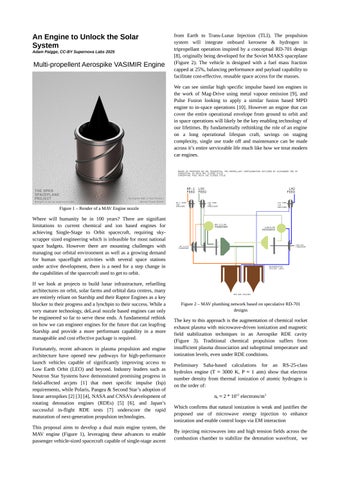
Figure 1 – Render of a MAV Engine nozzle
Where will humanity be in 100 years? There are signifiant limitations to current chemical and ion based engines for achieving Single-Stage to Orbit spacecraft, requiring skyscrapper sized engineering which is infeasible for most national space budgets. However there are mounting challenges with managing our orbital environment as well as a growing demand for human spaceflight activities with several space stations under active development, there is a need for a step change in the capabilities of the spacecraft used to get to orbit.
If we look at projects to build lunar infrastructure, refuelling architectures on orbit, solar farms and orbital data centres, many are entirely reliant on Starship and their Raptor Engines as a key blocker to their progress and a lynchpin to their success. While a very mature technology, deLaval nozzle based engines can only be engineered so far to serve these ends. A fundamental rethink on how we can engineer engines for the future that can leapfrog Starship and provide a more performant capability in a more manageable and cost effective package is required.
Fortunately, recent advances in plasma propulsion and engine architecture have opened new pathways for high-performance launch vehicles capable of significantly improving access to Low Earth Orbit (LEO) and beyond. Industry leaders such as Neutron Star Systems have demonstrated promising progress in field-affected arcjets [1] that meet specific impulse (Isp) requirements, while Polaris, Pangea & Second Star’s adoption of linear aerospikes [2] [3] [4], NASA and CNSA’s development of rotating detonation engines (RDEs) [5] [6], and Japan’s successful in-flight RDE tests [7] underscore the rapid maturation of next-generation propulsion technologies.
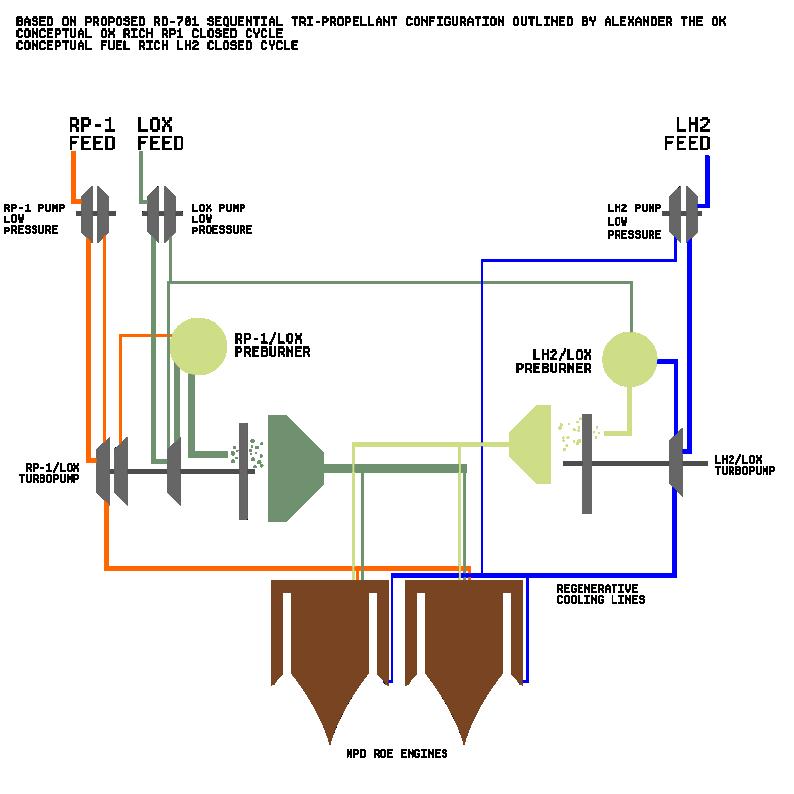
This proposal aims to develop a dual main engine system, the MAV engine (Figure 1), leveraging these advances to enable passenger vehicle-sized spacecraft capable of single-stage ascent
from Earth to Trans-Lunar Injection (TLI). The propulsion system will integrate onboard kerosene & hydrogen in tripropellant operation inspired by a conceptual RD-701 design [8], originally being developed for the Soviet MAKS spaceplane (Figure 2). The vehicle is designed with a fuel mass fraction capped at 25%, balancing performance and payload capability to facilitate cost-effective, reusable space access for the masses.
We can see similar high specific impulse based ion engines in the work of Mag-Drive using metal vapour emission [9], and Pulse Fusion looking to apply a similar fusion based MPD engine to in-space operations [10]. However an engine that can cover the entire operational envelope from ground to orbit and in space operations will likely be the key enabling technology of our lifetimes. By fundamentally rethinking the role of an engine on a long operational lifespan craft, savings on staging complexity, single use trade off and maintenance can be made across it’s entire serviceable life much like how we treat modern car engines.
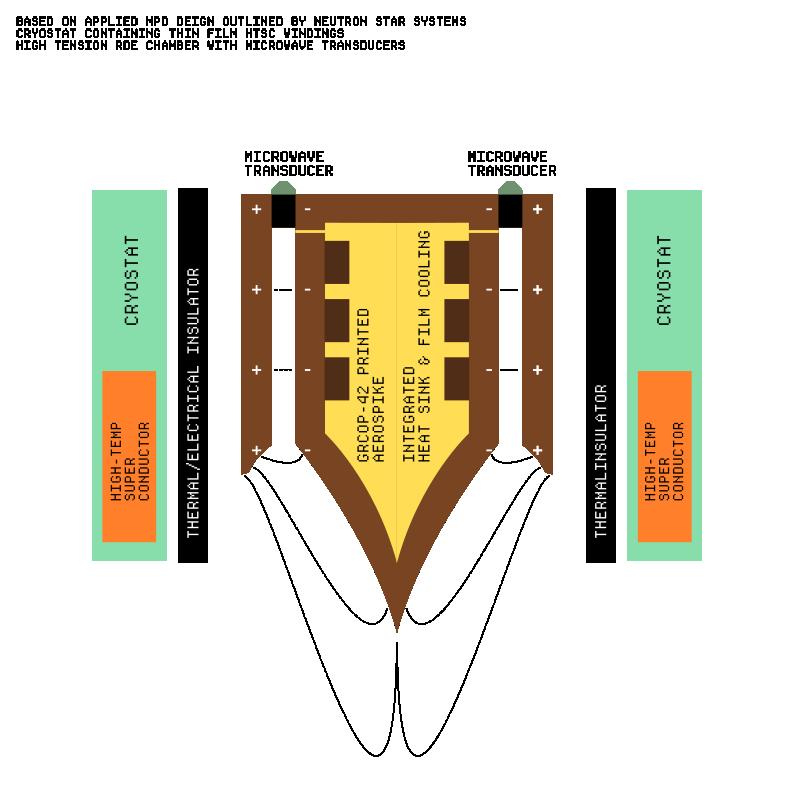
The key to this approach is the augmentation of chemical rocket exhaust plasma with microwave-driven ionization and magnetic field stabilization techniques in an Aerospike RDE cavity (Figure 3). Traditional chemical propulsion suffers from insufficient plasma dissociation and suboptimal temperature and ionization levels, even under RDE conditions.
Preliminary Saha-based calculations for an RS-25-class hydrolox engine (T ≈ 3000 K, P ≈ 1 atm) show that electron number density from thermal ionization of atomic hydrogen is on the order of:
ne ≈ 2 * 1012 electrons/m3
Which confirms that natural ionization is weak and justifies the proposed use of microwave energy injection to enhance ionization and enable control loops via EM interaction
By injecting microwaves into and high tension fields across the combustion chamber to stabilize the detonation wavefront, we
anticipate tighter plasma filamentation along magnetic field lines, resulting in improved enthalpy transfer and overall propulsion efficiency.
In an ideal performance case utilising the abundant low mass power generation of an onboard fusion reactor, we consider a system using two Magnetoplasmadynamic (MPD) thrusters, each with a specific impulse of 5000 seconds, delivering a combined 20 kN of thrust. This results in an effective exhaust velocity of:
ve =Ispg = 50009.81 ≈ 49, 035 m/s
Using the rocket equation:
Δv = ve * ln(mi / mf)
We examine a vehicle with an initial mass of 2000 kg. To reach Low Earth Orbit (LEO) with a ∆v of 10,000 m/s, the required final mass is:
mf = 2000/ e (10000 / 49035) ≈ 1631 kg
To continue from LEO to a Trans-Lunar Injection (TLI) with ∆v of 3200 m/s:
mf = 1631/ e (3200 / 49035) ≈ 1572 kg
This implies total propellant usage of 472 kg for both burns.
Given the thrust and exhaust velocity, the mass flow rate is:
ṁ = F / ve = 20000 / 49035 ≈ 0.41 kg/s
Resulting in total burn times of:
• To LEO: 369 / 0.41 ≈ 900 s
• LEO to TLI: 103 / 0.41 ≈ 251 s
Total burn duration is approximately 19 minutes, which is practical for high-thrust electric propulsion in a cis-lunar architecture and cleaner negating any need for nuclear thermal engines. However fitting the engine weight of magnets, cryostat and payload in the remaining mass will pose a significant
challenge and relies heavily on miniaturisation of current technologies.
Some considerations, while full-scale MAV thruster operation is calculated to be a ≈ 500 MW and is beyond the limits of existing technology, scaled experimental platforms (100 kW-1MW) can be used to validate core plasma behaviour and energy deposition strategies such as microwave-assisted ionization. These testbeds will provide critical data for extrapolating performance to higher-power regimes through validated physical models. If power requirements are limited to ~1MW (within the range of modern jet fighters and passenger jets) significant improvements to thrust and therefore mass fraction to orbit.
In conclusion, we anticipate a wealth of research opportunity in establishing the limits of the technologies available to us today, balancing engineering/material/physical constraints and building scaled demonstrator engines for use on orbit or as a staged system. Further study to build interdisciplinary partnerships across a network of universities in Europe is encouraged; Glasgow University has already expressed interest in delivering environmental testing and Westcott for hot fire engine testing.
The application of microwave induced plasma acceleration and focusing magnets on a typical RDE engine is a challenging and necessary evolution of rocket technology as a prerequisite to SSTO vehicles with onboard fusion reactors to serve a future where anyone can live and work in space.
In the words of Carl Sagan, “Maybe it’s a little early, maybe the time is not quite yet, but those are the worlds promising untold opportunities, beckoning.”
References
[1] IAC-22,C4,5,x70448 - State of the Art Review in Superconductor-based Applied-Field Magnetoplasmadynamic thruster technology - Marcus Collier/Wright et al
[2] Polaris Website – Aerospike Engines https://www.polarisraumflugzeuge.de/Technology/Aerospike-Engines
[3] Second Stars Website - https://secondstar.space/
[4] Pangea ARCOS - https://www.pangeapropulsion.com/en/
[5] RDE Nozzle Computational Design Methodology Development and Application - Kenji Miki et al. https://doi.org/10.2514/6.2020-3872
[6] arXiv:2311.01088 - Primary Investigation on Ram-Rotor Detonation Engine - Haocheng Wen, Bing Wang
[7] World First! Successful Space Flight Demonstration of Detonation Engines for Deep Space Exploration
[8] RD-701: A Rocket Engine Too Beautiful For This World –Alexander Hall https://www.youtube.com/watch? v=5MHDLHgsRi4
[9] Mag-Drivehttps://news.satnews.com/2024/08/05/magdrive-and-d-orbitcollaborate-to-test-their-electrical-propulsion-system/
[10] Pulsar Fusionhttps://www.satelliteevolution.com/post/scientists-successfullytest-largest-space-engine-ever-fired-in-britain