4 . 11 . 2023
Page intentionally left blank.
4 . 11 . 2023
Page intentionally left blank.
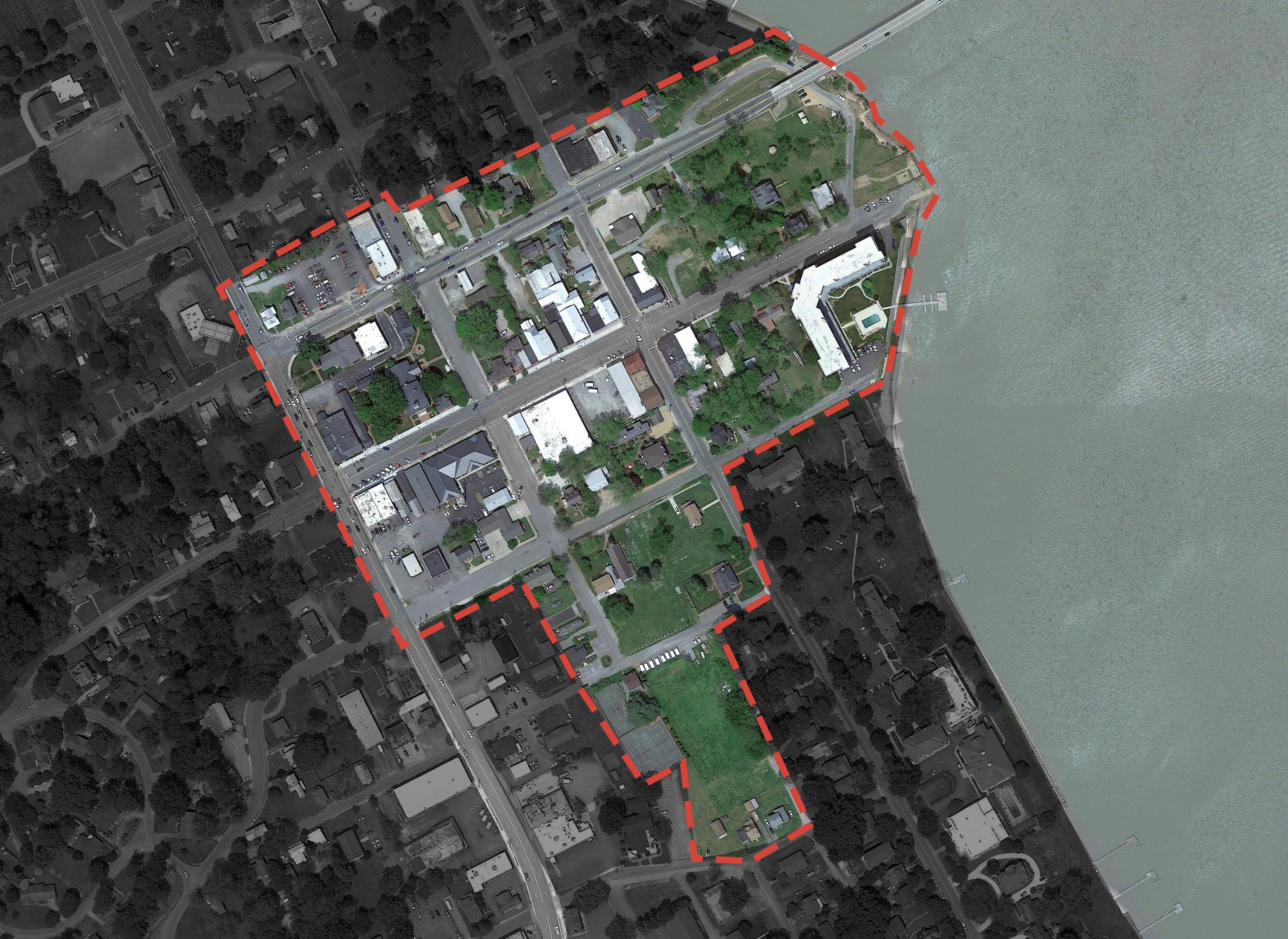
This plan was created starting between the end of 2022 and the beginning of 2023. The process was funded by the Virginia Department of Housing and Communtiy Development in collaboration with Tappahannock Main Street, one of Virginia’s active Main Street programs. The plan is organized into two parts, the “Economic Restructuring Plan,” and the “Branding + Marketing Plan.” These two plans involve different aspects of revitalization and contain their own recommendations, however together they create the overall “Downtown Revitalization Plan” with Preliminary Engineering Report (PER) and Environmental Record Review (ERR) included in the Appendix. The PER and ERR include more detailed information about proposed physical improvements within the Plan should the Town pursue further funding for their implementation, as well as analysis per state and federal regulations. The image below depicts the study area, which constitutes most of what is considered the “Downtown Area,” however, there are many other businesses along Tidewater Trail that should also be considered downtown businesses. The reason for narrowing the focus is explained in the Economic Restructuring Plan.
The plan is to be used to provide references and ideas for revitalizing Tappahannock’s downtown area. It presents concepts, ideas, actions, and potential projects that can each individually be targeted for further detail, funding, and implementation.
Throughout the process of creating the Economic Restructuring and Branding + Markteing Plans, the project team identified many different areas that could be improved to revitalize the Downtown area. These specific improvements have been noted and hand-drawn illustrations of what the identified project areas, of the Waterfront, Queen Street, and Prince Street, could look like in the future have been created. These images are conceptual in nature and meant only to excite and provide a vision for what these areas could look like as they improve. However, the physical improvements depicted in them are real potential projects that could be funded and completed as grant funding or Town funds are made available for them.
The steps outlined in the plan are incremental and the potential projects are varied. There are many locations throughout the downtown area in need of improvement. The plan is meant to inspire thought, conversation, and action for the community to find ways to contribute to the implementation of the plan. “Revitalizing” the downtown area is a difficult, but important goal. Downtowns are the historic, geographic, social, and cultural hearts of communities.
Tappahannock’s unfortunate loss of many of the businesses and homes on the 200 block of Prince Street due to fire in July of 2022 makes the need for action even more necessary. If the plan were to sit on a shelf, it is undefined when further funding and construction of proposed projects would occur and they may never happen. In the interim, every community member, local business, non-profit, government agency, or other organization has a part in shaping the future and furthering the implementation of this revitalization plan. New ideas for events or improvements are encouraged to be piloted and tested to make the downtown area safer, more attractive, and ultimately more lively. While many of the proposed projects will take a long time to materialize, others can begin tomorrow with some basic organizing, paint, and tools.
Tappahannock is a historic town located on the south side of the Rappahannock River within the eastern portion of Essex County. Its name comes from the Algonquin language, meaning “Town on the rise and fall of the water.” Regionally, it is part of the urban crescent across Virginia, from Hampton Roads and Richmond to the south, and Washington D.C. to the north. Outside of the Town’s historic downtown are more recent residential subdivisions and strip commercial developments with some industrial developments.
Colonists first arrived in the area in the 1600s and established the Town of “New Plymouth.” The settlement grew as a port due to access to the Rappahannock River. Tappahannock became an incorporated entity in 1926 and annexed additional territory from Essex County in 1939, 1966, and 1976. Today, the Town continues to serve as a commercial hub and economic base for Essex County and when combined, the population makes up for around a quarter of Essex’s population.
The Town and County work together to address mutual concerns, and in the Downtown Revitalization Plan stakeholder communities, the distinction between the two entities was often blurred with “the community” referencing a desire to attract the whole area to Downtown Tappahannock. The Town is a central location for the local schools, library, health department, and social services. The Town and County are also both members of the Middle Peninsula Planning District Commission.
Tappahannock is a central node in the region for both communities north across the Rappahannock on the Northern Neck, and its surrounding areas on the Middle Peninsula. It is also located not far from larger centers of Fredericksburg and Richmond, giving it a geographic position full of opportunities for future growth.
Despite its positioning, the historic Downtown core has faced challenges. Limited available commercial space and a lack of diverse types of businesses have left the community feeling that there is not much to do in the area. This plan seeks to provide a way forward that engages the community, reactivates underutilized space, and creates the vibrant Downtown full of locals and visitors the community has expressed a desire for.
This economic restructuring plan can be summarized in a handful of “core principles” to help guide future decision-making.
1. “Start small” and build up
Focus first on small projects that work to implement the whole, utilize affordable materials to act quickly. Use momentum to tackle large projects.
2. Pedestrian and Bicycle Safety are Key
If everyone were to start arriving in Downtown Tappahannock tomorrow by car, it would be congested, loud, and unsafe. Everyone who is local should be able to reach their Downtown safely through walking or biking.
3. Test and Implement Ideas
The community may have thousands of ideas for the Downtown, including exhibits, events, games, or other activities that can help revitalize the area. Be flexible, and assist them in testing out new ideas.
Improve and Make Permanent Over Time
Once different activities or ideas are identified as working, seek to improve them with more permanent and easy to maintain materials.
5. Big Projects for Many Users
Utilize the implementation of “big projects” like a new pier to serve as many functions as possible. For example, a fishing pier can be an observation deck, a kayak launch, or other functions if designed for it. Projects should try to attract as many different types of people as possible to Downtown.
6. Connect with the World
Social media and other forms of communication can assist Tappahannock in sharing its progress with other like-minded communities. Good ideas from other areas might be easily transferred to the Town.
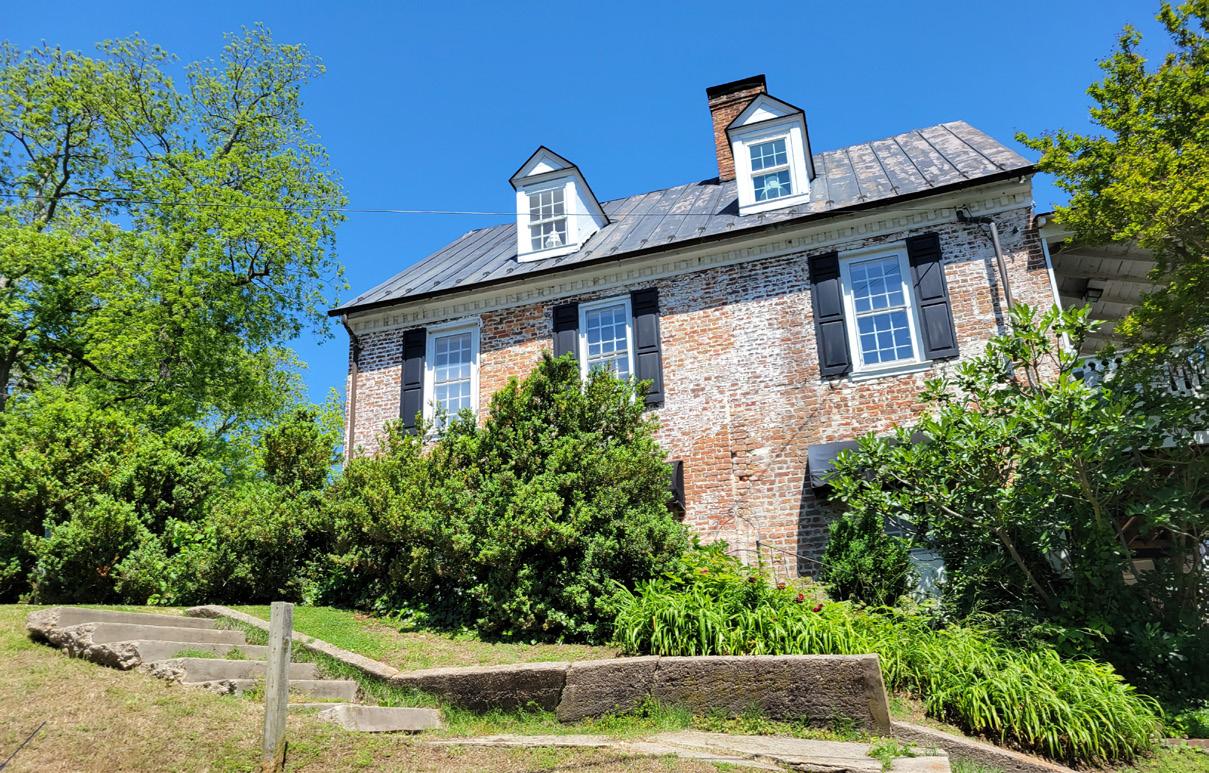
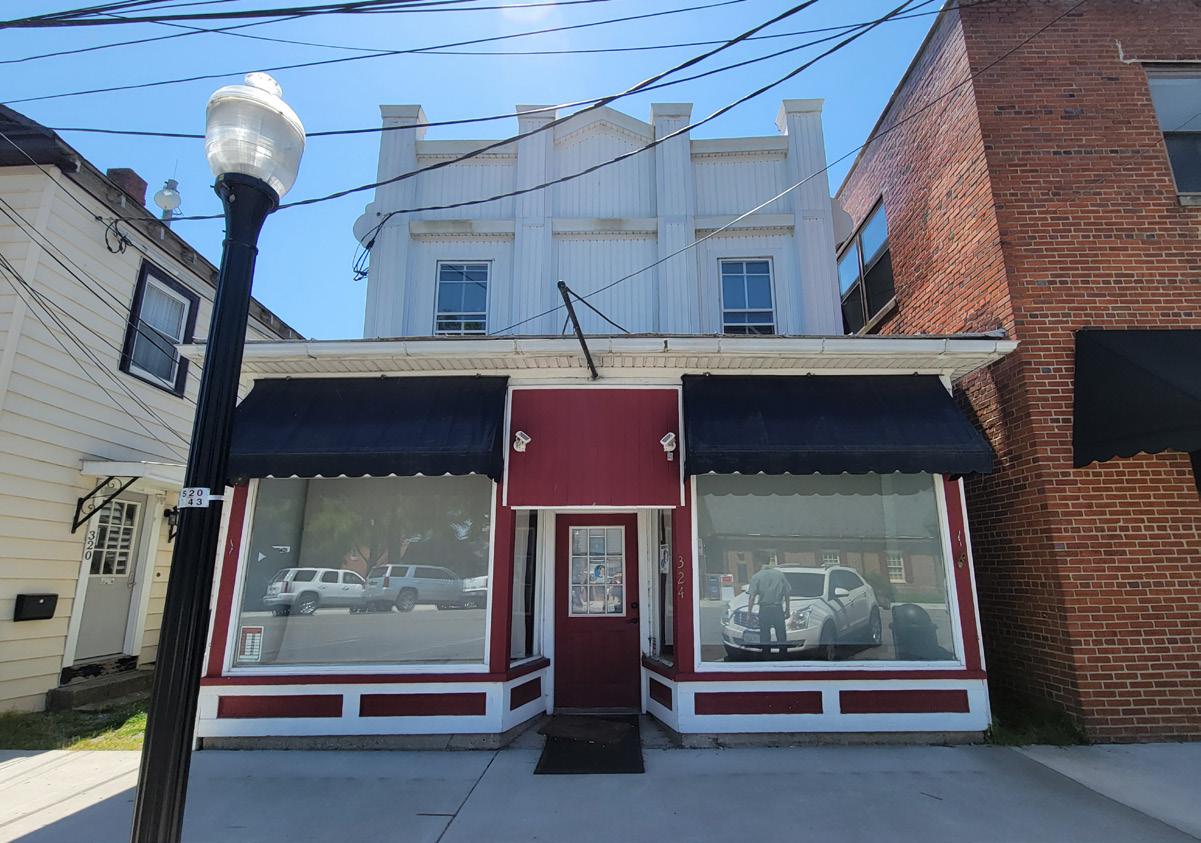
Tappahannock is a small town rich in history and natural amenities. Efforts are being made to leverage the town’s environmental features and human capital to revitalize the downtown area, including a study produced in collaboration with Main Street America, published in 2021. This recent report included a survey of 236 Tappahannock residents and an assessment of economic conditions. Main Street America familiarized themselves with Tappahannock by reading background materials, conducting an asset mapping exercise, and creating stakeholder focus groups. They also utilized Esri Business Analyst data sets for demographics, psychographics, buying power, sales leakage, and business inventory. This combination of site visit, market data, and community feedback allowed them to create three possible “Transformation Strategies.”
The Downtown Tappahannock Revitalization Plan team reviewed this material extensively to pull out key findings to help tell the story of the “economic climate” as a foundation for drafting a plan for restructuring as well as informing marketing and physical improvements. With the Main Street America report being published in 2021, the team wanted to utilize this fresh information to save time and resources as well as focus the plan into targeted actions that could be taken to actively begin the transformation of the downtown area.
These findings have been presented as insights rather than in the order of the original survey questions in order to focus more on what the survey might be “telling” about life in Tappahannock, rather than resummarizing the previous report. It should also be noted that the majority of respondents to the Main Street America survey skewed towards older white women, which is not an accurate reflection of Tappahannock’s demographics – over 65% of the town population is under the age of 55 years, and 45% of the population is African American. Additional community engagement efforts were used to supplement previous findings while reaching a more diverse audience.
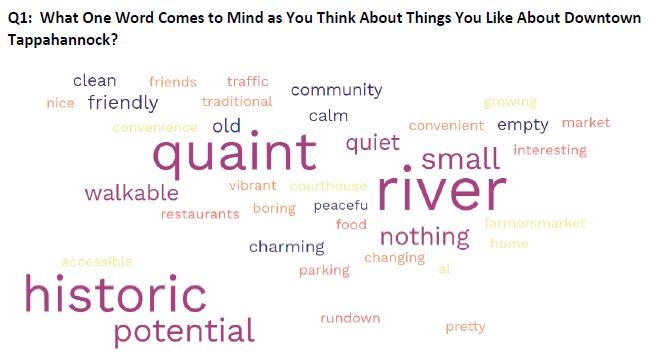
Question 1 from the 2021 Main Street America Survey
Main Street America Survey Findings (Input 1/2)
These findings are presented as “statements” that give insight from the Main Street America stakeholder focus groups (input 1) and the survey responses (input 2).
People are optimistic, but bored.
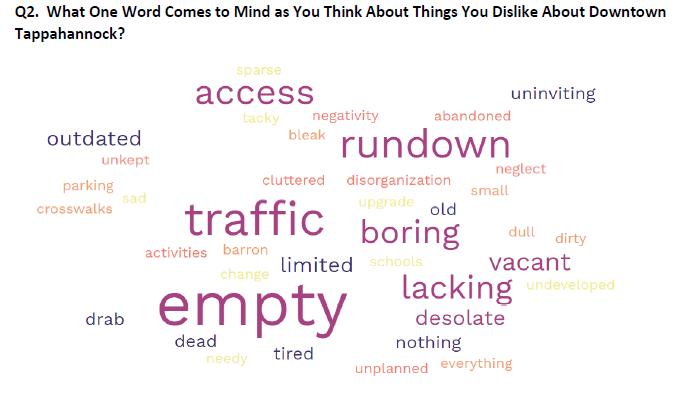
When asked about what one word came to mind when a survey participant thought about what they like in the downtown area, people thought it was quaint, they enjoyed the river, enjoyed the historic architecture, and that it was walkable. Potential was a word that appeared often. However, when asked what they dislike about the downtown, people said it was boring, rundown, empty, lacking, or desolate.
People are not scared of crime downtown.
People are not perceptive of a “crime” issue or a lack of safety in the downtown area. Less than 5% of survey respondents cited crime as an issue in downtown Tappahannock, other low response rates were recorded for homelessness, drug addiction, or panhandling. In contrast, Residents and visitors are perceptive to how “empty” and “desolate” downtown feels, but that is more a function of the vacant storefronts and underutilized space. Over 75% of survey respondents stated that there were not enough interesting or attractive businesses
downtown. People additionally replied that they would not live downtown mostly for the lack of things to do or places to shop/eat nearby, rather than too much crime or feeling unsafe.
Programming is successful.
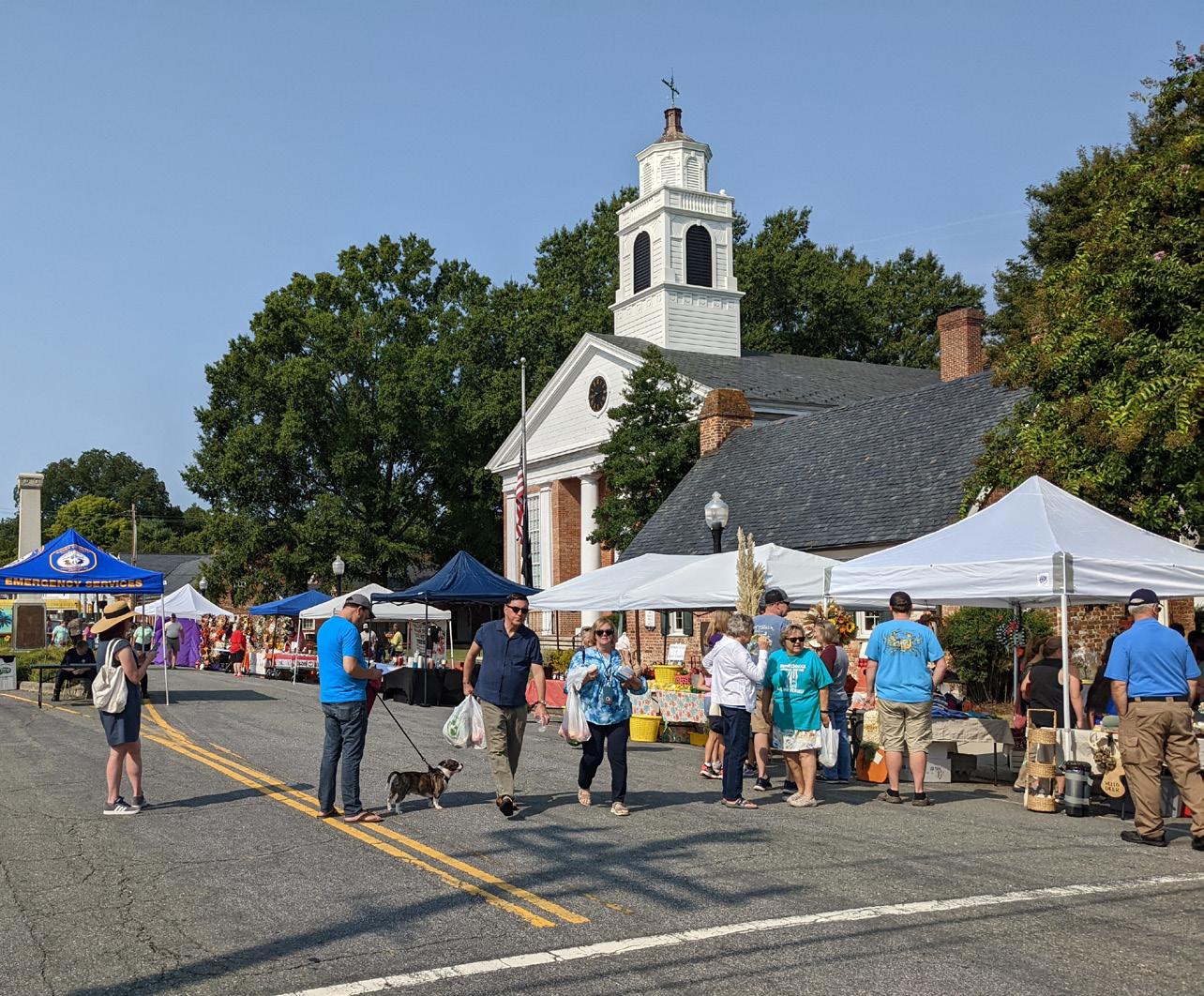
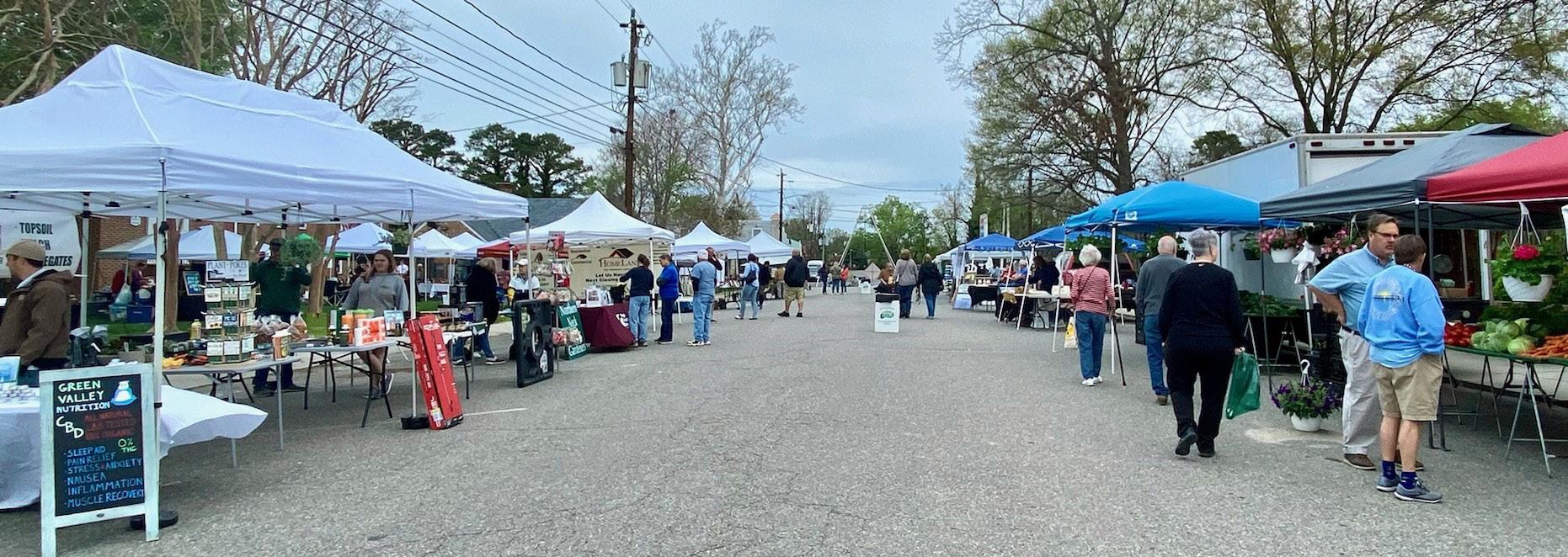
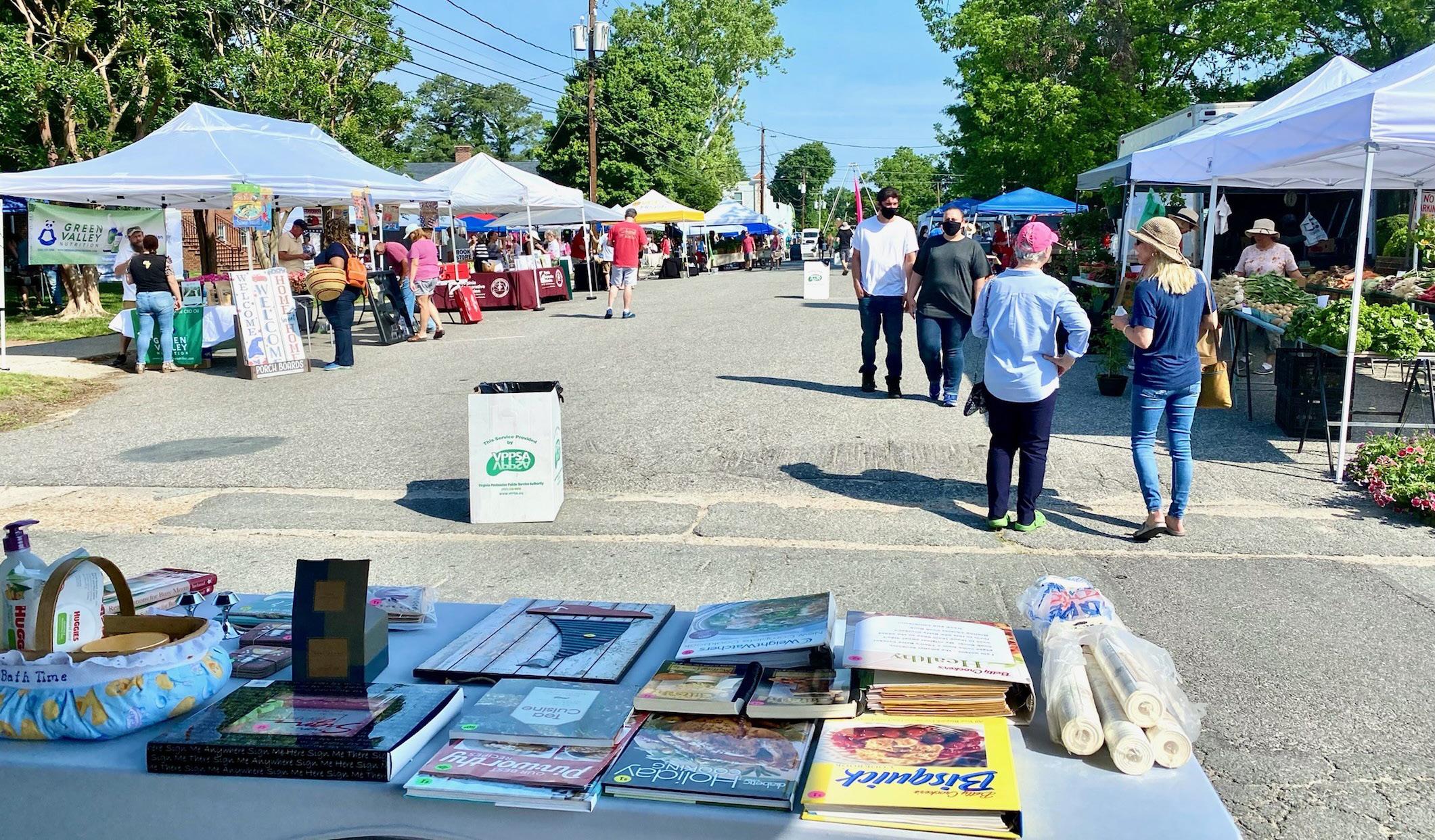
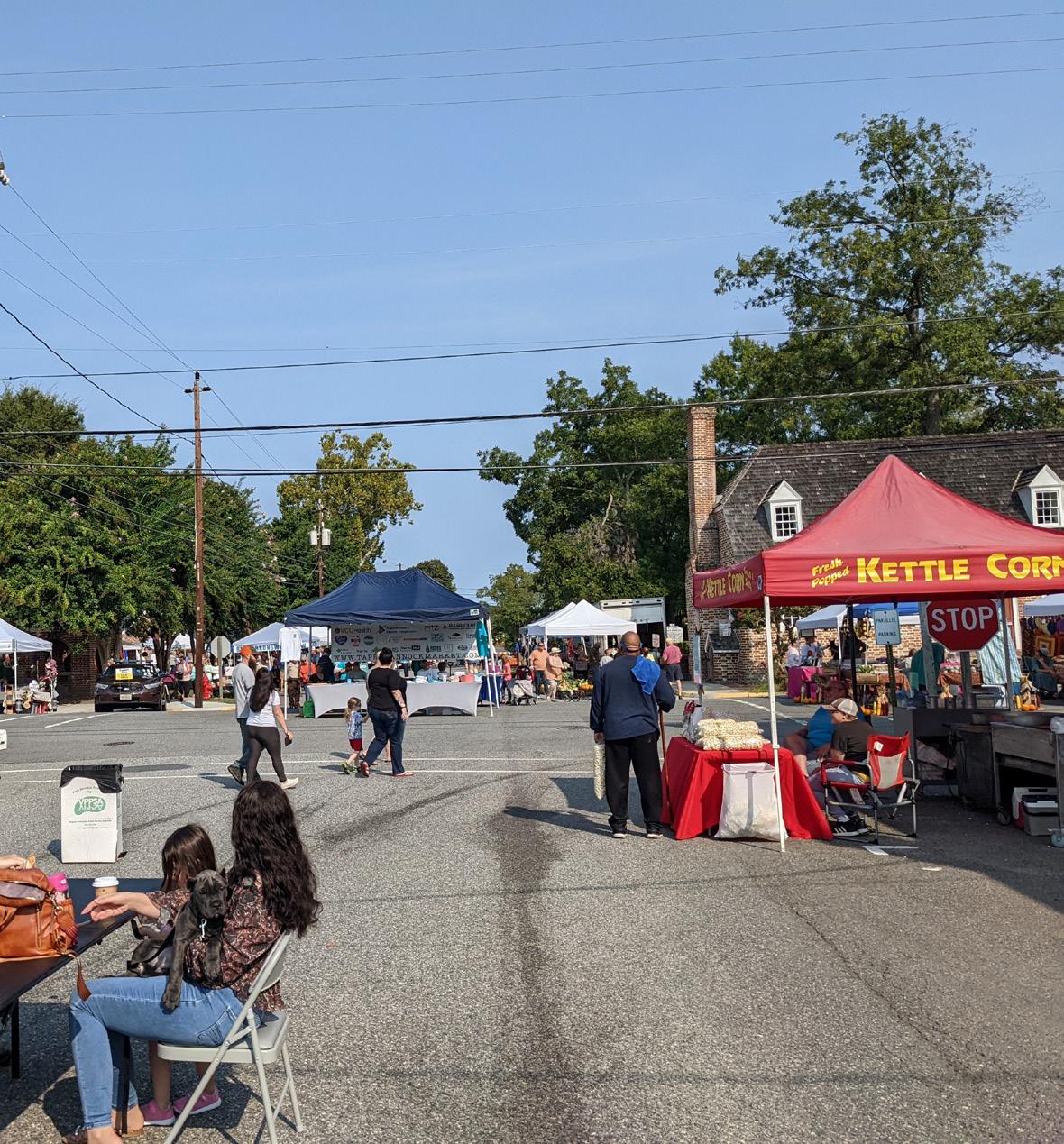
The 3rd Thursday events hosted by Tappahannock Main Street, the Saturday Farmers Market (with ~110 vendors!), and the Winter Market bring large crowds of residents and visitors to the downtown area. These events demonstrate that downtown Tappahannock can be a vibrant activity hub with creative event planning and opportunities for flexible use of space. A key question for this study is “How can we bring the same level of activity to downtown throughout the week, month, and year?”
There is a need for gathering places.
One of the top priorities for economic restructuring in Tappahannock is the development of “third places” – areas outside of home (“first places”) and the workplace (“second places”) where people can spend time, build relationships, exchange ideas, etc. Roughly 22% of Main Street Transformation Survey respondents stated that they would not live in downtown Tappahannock because there are “not enough things to do or enough places to shop/ eat nearby.” Providing further insight, over 70%
of respondents stated that Tappahannock had an “inadequate number of places to gather and/or dine outside.” When asked about what issues are in the downtown Tappahannock, the highest responses were not enough interesting or attractive businesses, not enough businesses consistently open when I’m out, too many vacant storefronts or vacant lots, inadequate number of places to gather and/ or dine outside, inadequate or poor-quality bicycle infrastructure, and the availability to safe, clean, and accessible public bathrooms. These responses were also noted as more serious in the survey than other responses, with “too many vacant storefronts or vacant lots” and “not enough interesting or attractive businesses” being the most “extremely serious” issue facing downtown.
Residents desire additional night life activities downtown.
Tappahannock has significant market leakages in entertainment, leisure, and night life. In other words, those who live and/or work in Tappahannock are traveling outside of town to spend money in these sectors. This pattern represents missed opportunities, in terms of both the local economy and social networks. A lack of opportunities to socialize, recreate, and meet new people makes it more challenging to build a sense of community and a town identify. Businesses that fill this market gap,
Question 2 from the 2021 Main Street America Survey
both new businesses and existing establishments expanding their hours or restructuring, should be a top priority. When asked what types of businesses they would like to see more of in downtown Tappahannock, 51.43%, 50.95%, and 41.90% of respondents answered pub or restaurant, coffee shop or bakery, and brewery, respectively. Additionally, 39.05% of respondents also stated that they want to see more entertainment businesses downtown.
The riverfront is an underutilized asset.
As reported in focus groups for the Main Street America study, “there is an abundance of natural resources, but access and connectivity remain issues.” Amenities and programming that attract people to the riverfront will also bring business to shops and restaurants in downtown. Efforts to make better use of the town’s riverfront can also help address the need for businesses and activities that are kid or family-friendly, as reported by 54.24% of survey respondents. Additionally, the riverfront provides an opportunity to better define Tappahannock’s identity through a town rebranding that coincides with economic development strategies. The Town’s history is intertwined with that of the Rappahannock river. Other neighboring localities on the Northern Neck have combined efforts to brand their region as “Virginia’s River Realm.” There is the potential
for Tappahannock to join these marketing efforts, that will be discussed later in this plan, however, incremental improvements can be made along the Downtown’s waterfront that can leverage multiple goals.
New development needs to be directed downtown.
According to the Main Street America study, Tappahannock had 22 new businesses open during the COVID-19 pandemic. Despite this progress, the sprawling developments along Routes 17 and 360 conflict with downtown revitalization goals. New auto-oriented businesses that cater to those passing through town detract from the market share for other businesses in a way that undermines walkability and longer stays downtown.
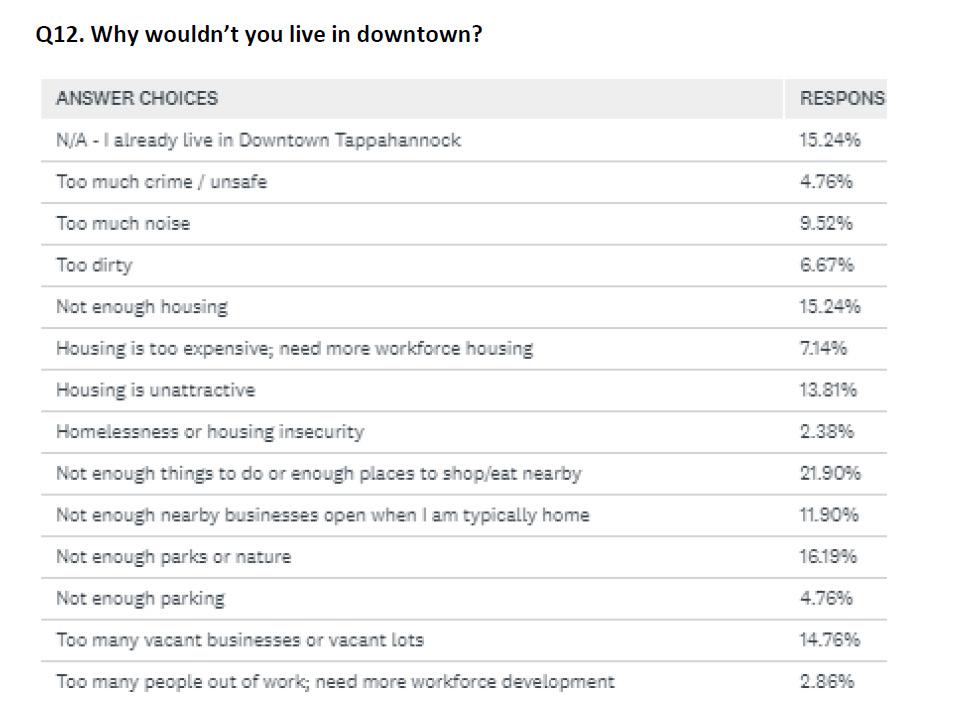
Question 12 from the 2021 Main Street America Survey.
The Main Street America report additionally conducted asset mapping with Tappahannock’s stakeholder focus groups, arranging an inventory of all valued assets in the community. The assets were arranged into five pillars including Natural, Social, Built, Economic, and Service assets and have been presented above without edit.
Natural Social Built Economic Service
Rappahannock River
Marina
Wildlife & birding, especially fish, crabs, bald eagles, osprey, geese, ducks)
Boating/kayaking
Rappahannock River Valley Natl. Wildlife Refuge
Tappahannock Park on the River Location of old Steamboat Wharf (which hopefully will be replaced with new wharf)
600+ acres Rotary-Poor House Farm Park off Kino Rd. near recycling center
District bordered by water on three sides: Rappahannock River and tributaries Ticknors and Hoskins Creek.
Virginia State designated Scenic River status
Town sits at the approximate salt wedge of Rappahannock (where fresh and saltwater meet). In years of extreme drought it is not unheard of to see the occasional dolphin and other saltwater species make their way up from the Bay.
Essex County Business Forum
The Artisan Trail Network
Essex County Museum
Tappahannock Farmers’ Market
Essex Churches Together (feel this belongs in Service)
Bay Transit (feel this also belongs under Service)
Churches of many faiths available in the Town/ County
Tappahannock Moose Lodge
3rd Thursdays
Winterfest, parade, etc.
Sense of community during difficult times.
Many walks of life are tied and interwoven in shared memories, nostalgia, identity, and pride that is passed down through generations and stories told.
A dutifully understood lifelong (good fun) local obligation and loyalty to the century old cross river rivalry with our neighbors in Warsaw, Richmond County. Rivalry is celebrated by both sides enthusiastically through locals.
Accessibility by 2 major roadways High traffic flow through (22k/day)
Historic buildings (Old Courthouses; Old Jail/ Treasurer’s office; Customs House; Ritchie House; Brockenborough House; Essex Inn; St. John’s Church; etc.)
Airport (Site)
Rich History (precolonial, early American) DAW Theater (in process of revitalization)
Churches in town: St. John’s, Tappahannock Memorial UMC, First Baptist etc.
Nationally recognized Historic District with more than a dozen buildings original to the Early ColonialAntebellum period.
Historic Churches: St. John’s Episcopal built in 1950, Tappahannock Methodist built in 1939 and First Baptist Church, founded in 1867 (present building 1890’s) by formerly enslave African Americans 2 years after the Civil war.
The town is made of a neat grid of 1/2 acre square blocks that are still intact.
Essex County EDA
Tappahannock Farmers’ Market
Regional shopping destination (primarily in “new” Tappahannock)
Essex County Public Schools (as an employer)
Possibly list the businesses on/near Airport Road
Agricultural-Perdue Plant
Low Cost of Living in peaceful surroundings
New businesses (Norwoods, Acors, The Hanger, Prince Street Cafe, Squirrels Nest, Mums ‘n Bubs just to name a few.) Good # of restaurants for size of population
Virginia is ranked #1 by Forbes in best states for business/quality of life.
More than 4,600 supply chain operations are located throughout Virginia, increasing direct access to products and operational capabilities and mitigating logistical supply chain risks.
St. Margaret’s School
Essex County Public Schools (as a service to the children)
Ledwith Lewis Free Clinic
Essex Public Library
Service & Civic Organizations (Rotary, Women’s Club, Jr. Woman’s Club etc.)
Historic B&B Essex Inn
VCU Health Tapp. Hospital
Two Radio StationsWRAR and HOT MIX
Essex Churches Together Bay Transit
Parker Marina...boat launching/storage
Free boat launch by the Moose
All County and Town government municipal offices within walking distance (aside from the Tapp. Police Dept.)
4 restaurants: Squirrels Nest/Prince Street Cafe [2 others may have been cut off bottom of the table by mistake]
Reflecting on these mapped assets, it is great to see there are so many potential sources for downtown Tappahannock’s reinvigoration. There are many different potential organizations to collaborate with, and many historic and natural assets that are unique to the Town. These assets can all be leveraged to achieve more activity, however, in their current form, more work needs to be done to “weave them together” in ways that benefit each other.
One example of this is the success of the Farmers’ Market. While this brings a great number of vendors and customers into Town on particular days, what if there was a way to allow some of those vendors to maintain a constant presence in vacant space on Prince Street? This could be one way to “increase the amount of things to do” that eventually could even lead to a new restaurant opening in the long term. While there is a new central park coming with play areas for children, what if Essex County Public Schools was engaged to allow children to co-design what amenities they’d like to see at the Tappahannock Park waterfront? Or the various Civic Organizations? They could become potential volunteers and stewards for these spaces, assisting the Town with maintenance or fundraising as needed. However, these partnerships are not always obvious and may take some extra community networking to recognize where these different assets, whether Natural, Social, Built, Economic, or Service can overlap and work together to achieve a common vision of a vibrant Downtown Tappahannock.
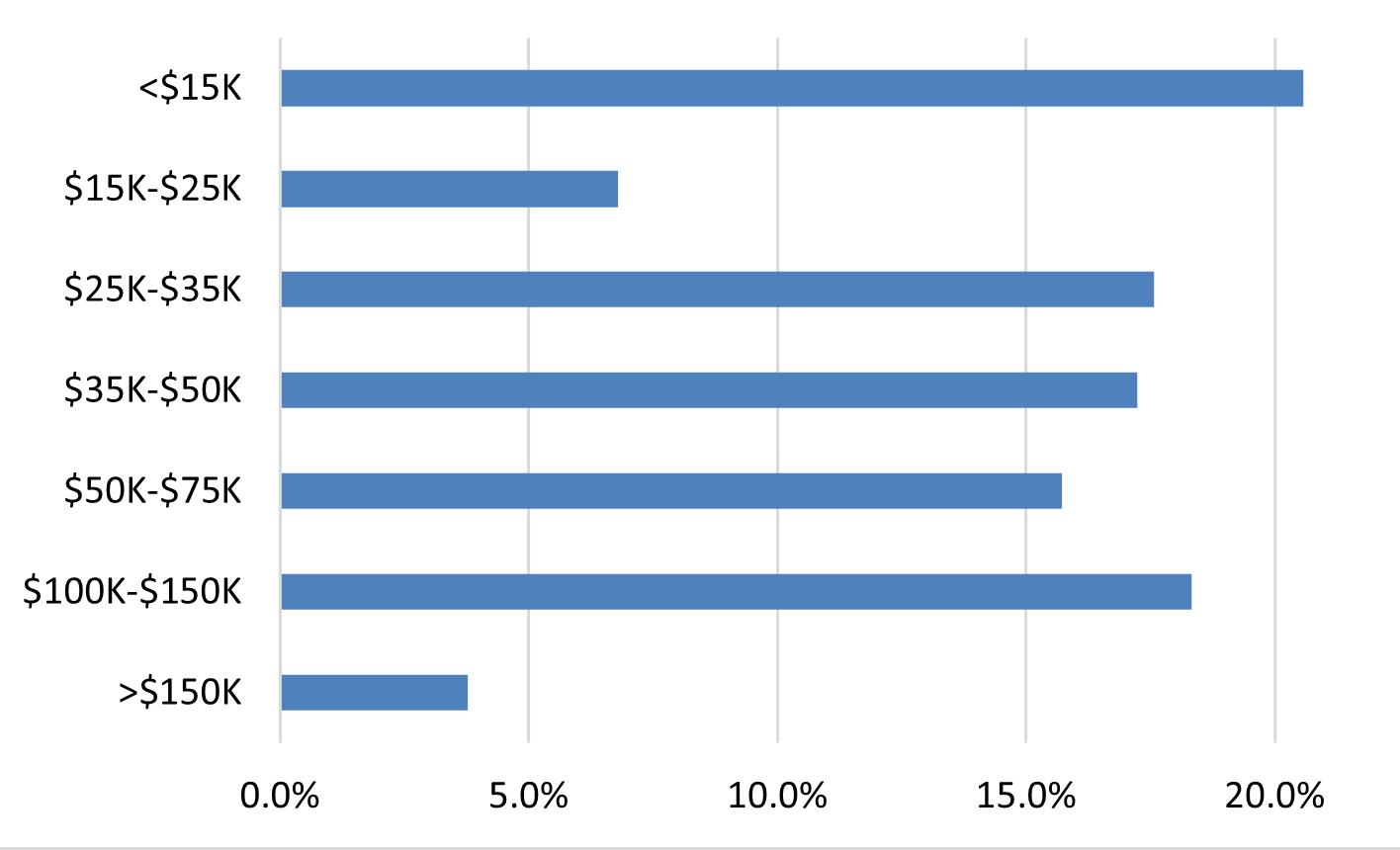
The Main Street America report included demographics from Esri Business Analyst and ACS 2020 5-yr Estimates, which have been updated for use in this downtown revitalization plan.
The outlook demand examines anticipated growth in a number of retail categories over the next five years. Overall, it is anticipated that the average retail trade growth is forecasted at around 8.35%. However, with the impacts of online shopping or events such as the COVID-19 pandemic, this projection is uncertain. The previous Main Street America study had a robust growth of sales at 12.7% over the next 5 years in 2021, likely forecasted before the effects of the pandemic had caught up to the economy. Despite this, expected positive economic growth presents the opportunity to steer that growth towards the downtown area geographically. The source is Esri Business Analyst forecasting.
Grocery sales expected to grow by $311,155
Apparel & Clothing expected to grow by $114,028
Restaurants & Drinking Establishments expected to grow by $204,973
$76,521
Entertainment & Recreation expected to grow by $183,412
The Esri Business Analyst “Tapestry Segment” data provides insights on personalities, opinions, attitudes, interests, and lifestyles of a population. While these insights can never capture the true diversity of a place’s residents as individuals, they can provide a higher level understanding who is residing in Town and what their interests might be. The table below shows the percentages of each “lifestyle group” in comparison to the totals of the United States overall. See the Appendix for complete profiles of each of these groups.
“Small Town Sincerity includes young families and senior householders that are bound by community ties. The lifestyle is down-to-earth and semirural, with television for entertainment and news, and emphasis on convenience for both young parents and senior citizens. Residents embark on pursuits including online computer games, renting movies, indoor gardening, and rural activities like hunting and fishing. Residents keep their finances simple— paying bills in person and avoiding debt.”
Market Profile
“Small Town Sincerity features a semirural lifestyle, complete with domestic trucks and SUVs, ATVs, and vegetable gardens. Residents enjoy outdoor activities like hunting and fishing as well as watching NASCAR and college football and basketball on TV. A large senior population visit doctors and health practitioners regularly. A largely single population favors convenience over cooking— frozen meals and fast food. Home improvement is not a priority, but vehicle maintenance is.”
Independent, active seniors nearing the end of their careers or already in retirement best describes Golden Years residents. This market is primarily singles living alone or empty nesters. Those still active in the labor force are employed in professional occupations; however, these consumers are actively pursuing a variety of leisure interests— travel, sports, dining out, museums, and concerts. They are involved, focused on physical fitness, and enjoying their lives. This market is smaller, but growing, and financially secure.
Avid readers, they regularly read daily newspapers, particularly the Sunday edition. They subscribe to cable TV; news and sports programs are popular as well as on-demand movies. They use professional services to maintain their homes inside and out and minimize their chores. Leisure time is spent on sports (tennis, golf, boating, and fishing) or simple exercise like walking. Good health is a priority; they believe in healthy eating, coupled with vitamins and dietary supplements. Active social lives include travel, especially abroad, plus going to concerts and museums. Residents maintain actively managed financial portfolios that include a range of instruments such as IRAs, common stocks, and certificates of deposit (more than six months).
Southern Satellites is the second largest market found in rural settlements but within metropolitan areas located primarily in the South. This market is typically slightly older, settled married-couple families, who own their homes. Two-thirds of the homes are single-family structures; almost a third are mobile homes. Median household income and home value are below average. Workers are employed in a variety of industries, such as manufacturing, health care, retail trade, and construction, with higher proportions in mining and agriculture than the US. Residents enjoy country living, preferring outdoor activities and DIY home projects.
Usually own a truck; likely to service it themselves. Frequent the convenience store, usually to fill up a vehicle with gas. Typical household has a satellite dish. Work on home improvement and remodeling projects. Own a pet, commonly a dog. Participate in fishing and hunting. Prefer to listen to country music and watch CMT. Read fishing and hunting and home service magazines. Partial to eating at low-cost family restaurants and drive-ins. Use Walmart for all their shopping needs (groceries, clothing, pharmacy, etc.).
Before and after the initial stakeholder meeting on May 17th, 2022, the Planning team conducted a walking inventory of the core of Tappahannock’s downtown, and a driving tour of adjacent neighborhoods and amenities across town, taking photographs and gathering impressions. For most of the day Eric Pollitt, Tappahannock’s Town Manager, accompanied the team and provided background and context for the tour.
The team got a tour of the DAW Theater, currently under renovation, as well as the Ordinary, also currently under renovation. The walking tour provided a basic understanding of Tappahannock’s downtown, which is essential to the creation of the Downtown Revitalization Project.
Our visit concluded the following observations:
• There is an absence of street trees and narrow sidewalks along most streets of the downtown. Particularly on Prince Street, due to the wide right of way of the road with parking on both sides, temperatures feel very hot (also likely cold/windy during the winter) due to the amount of pavement. This is an issue for stormwater and water quality due to runoff, but it also makes the downtown area less hospitable for increased stays.
• While there are historic buildings that have been returned to commercial use, there are many vacant parcels throughout the downtown area that are utilized for parking which is an inefficient use of valuable downtown land.
• Many buildings are owned by a handful of owners, particularly a furniture store owns half of a block on the north and south sides of Prince St. at the center of downtown, using most of the space for storage.
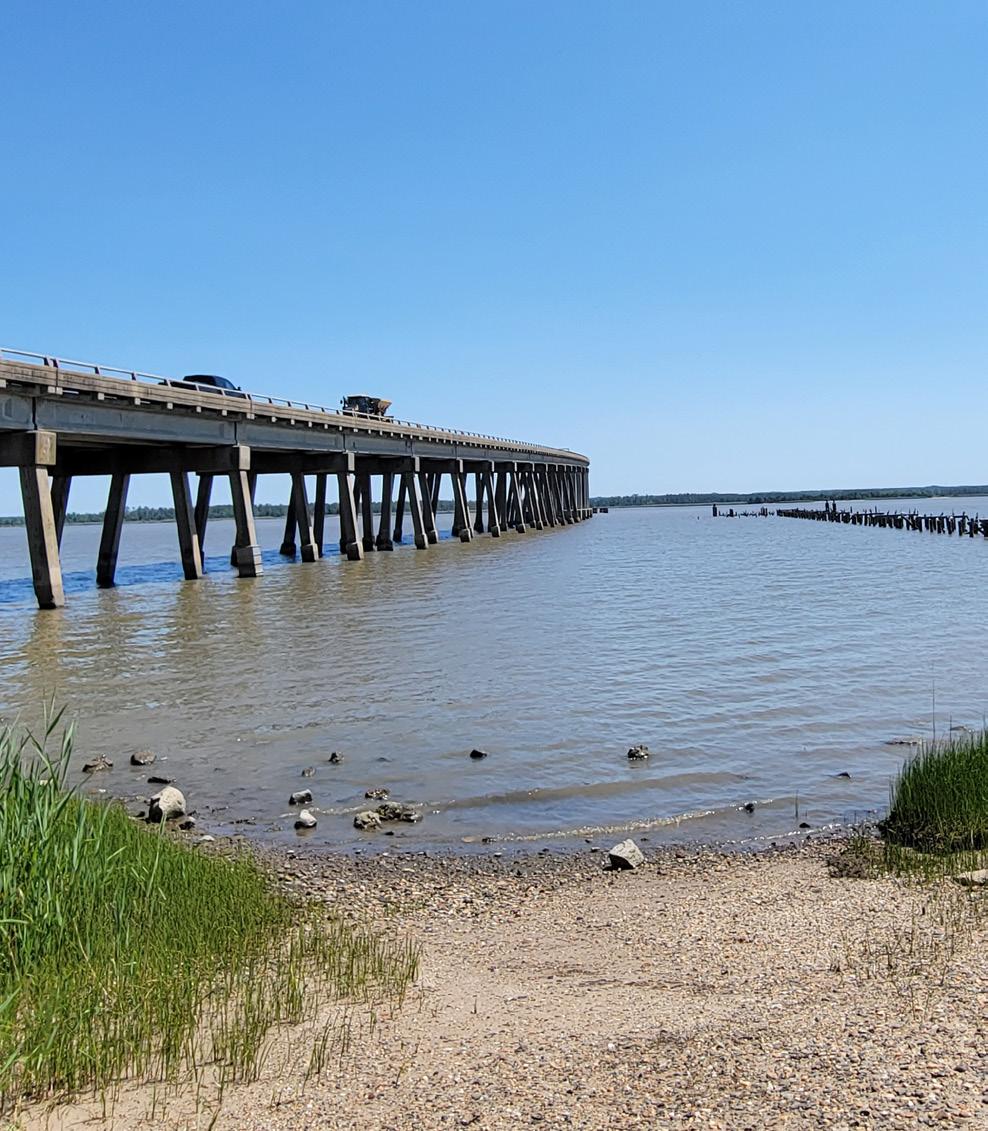
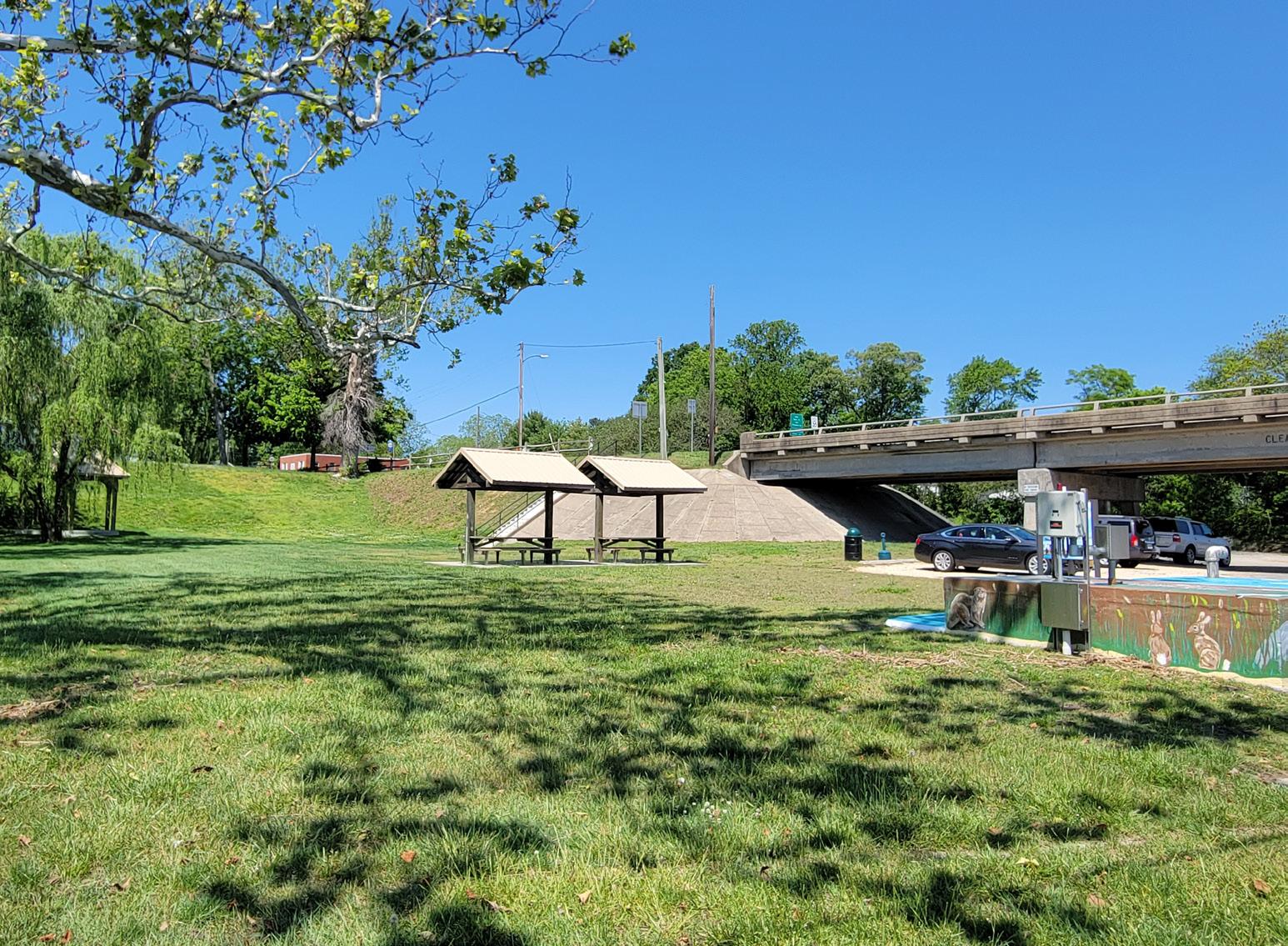
• Tappahannock Park on the Rappahannock River features excellent views and some recent improvements such as new John Smith Trail signage, covered picnic tables, and a gazebo, however the water’s edge and the rest of the park is generally unimproved. There is a sharp topographic drop between the upper and lower areas of the park, accessible generally by exiting and reentering the space. Prince Street additionally terminates at the water’s edge with a small boat ramp as well as some parking spaces. This area is used for recreational fishing, but there are no “formal” improvements to the space.
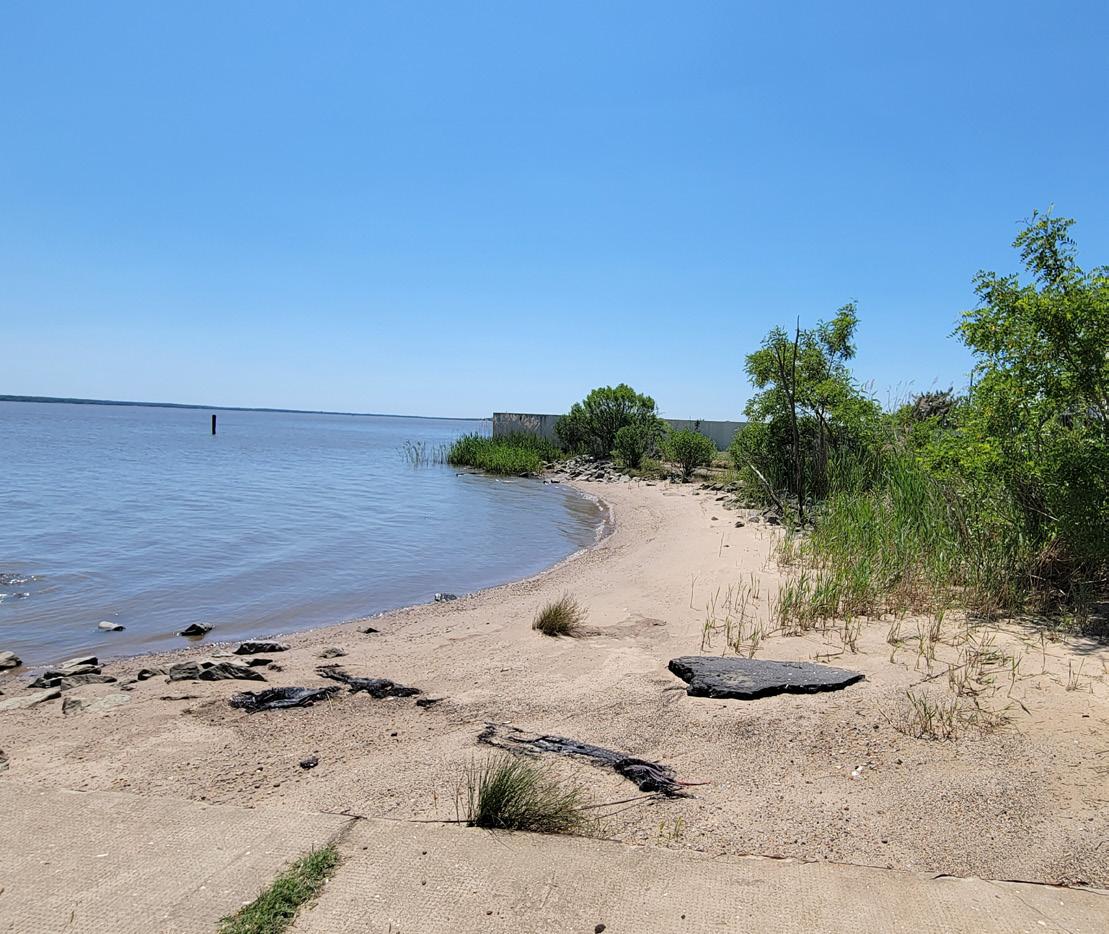
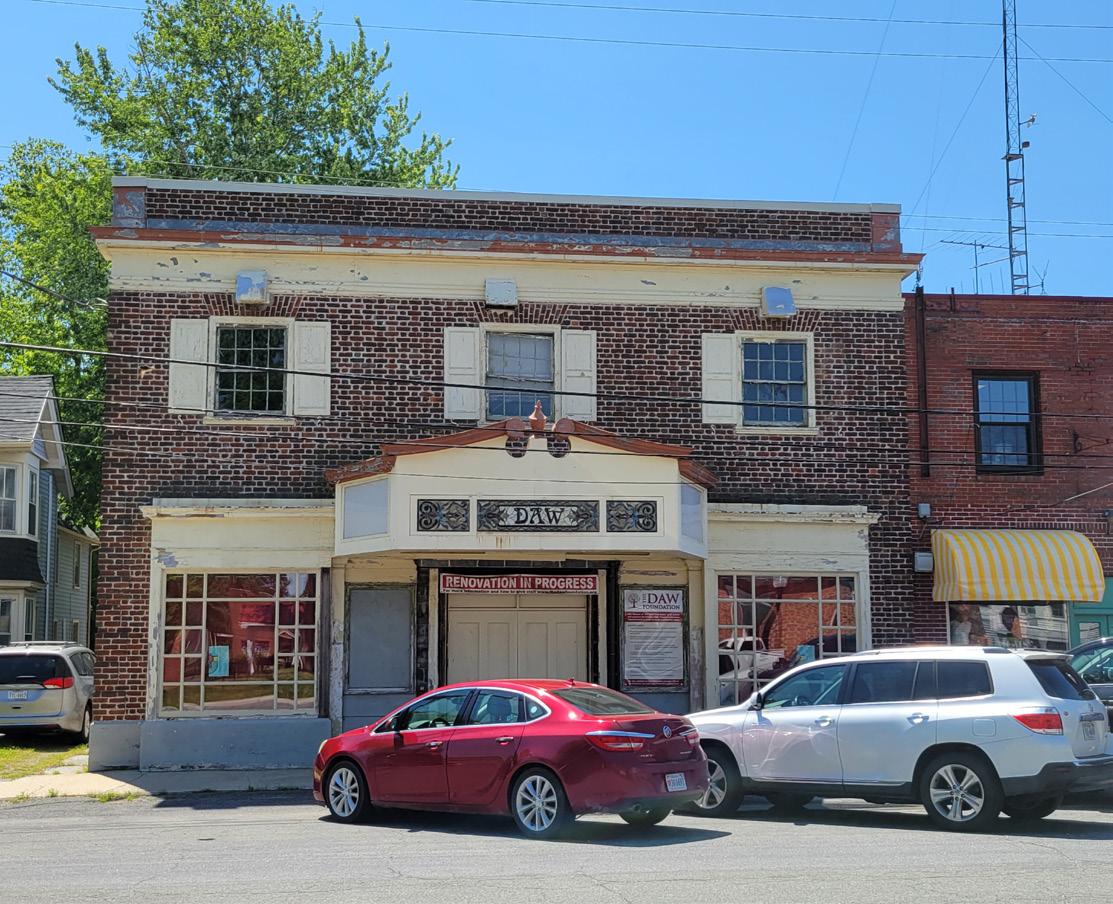
• While there are some restaurants and shops, there are still generally limited options that do not support many different combinations of how a day could be spent in downtown Tappahannock. (Breakfast -> Lunch -> Activity -> Dinner, etc.)
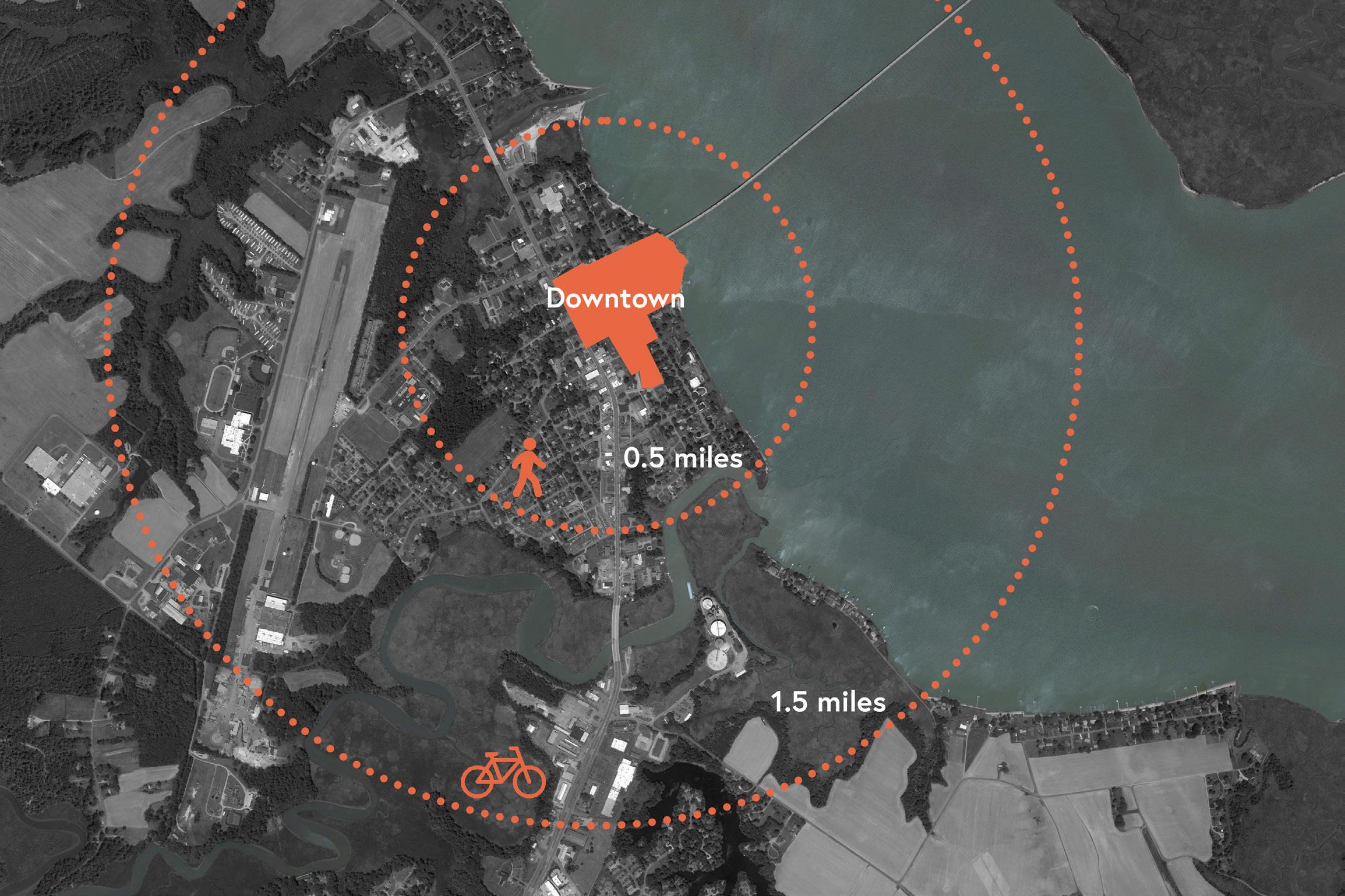
• There were no noticeable bicycle parking facilities or visible transit stops. As mentioned, many streets featured narrow sidewalks with limited ADA compliant access. With many residential areas located within less than a half a mile, there is an opportunity for convenient pedestrian and bicycle access.
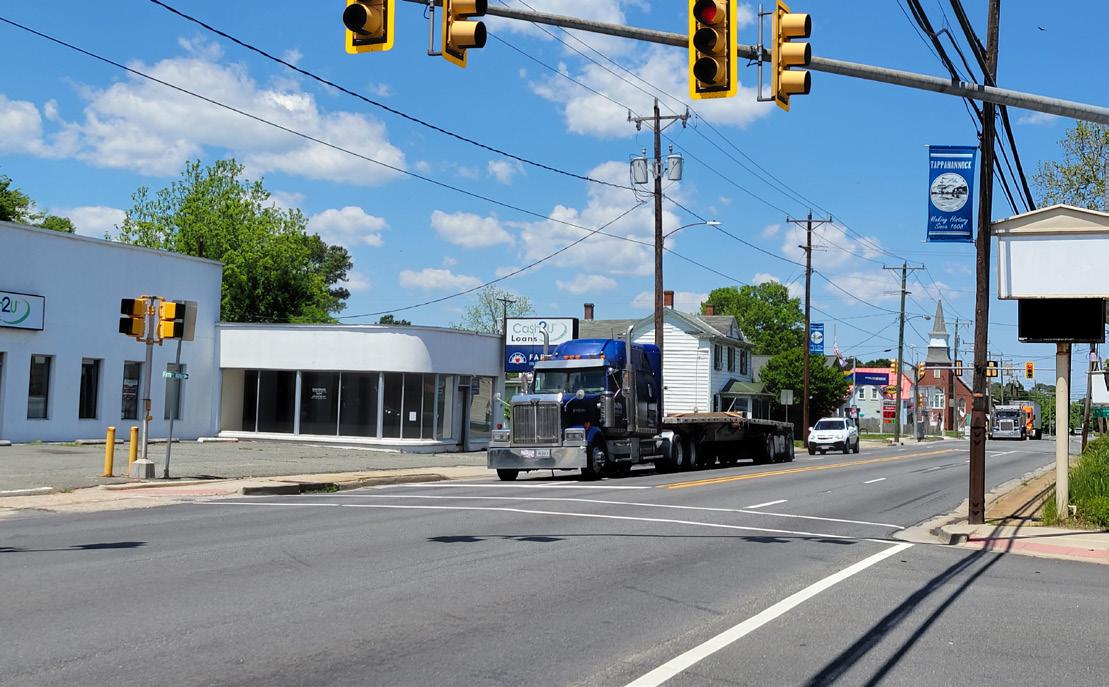
• Rt. 360/Queen St. is particularly loud from fast moving vehicular traffic that includes large trucks. With narrow sidewalks, it is a particularly inhospitable pedestrian environment despite being a main thoroughfare through the Town.
• There is limited street furniture outside of designated park areas.
• The existing building stock downtown generally appears to be in good condition.
• There is no readily accessible public bathroom that would allow people to linger.
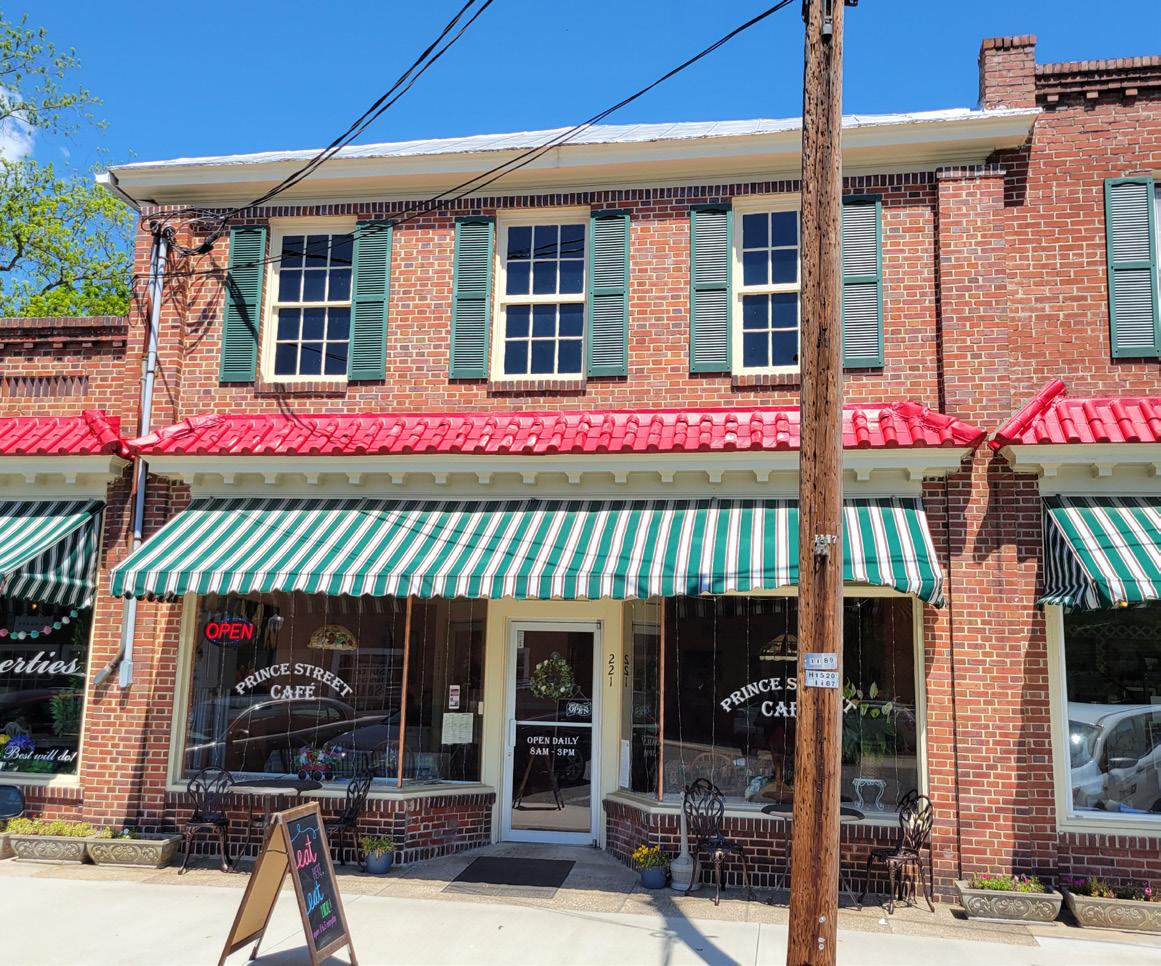
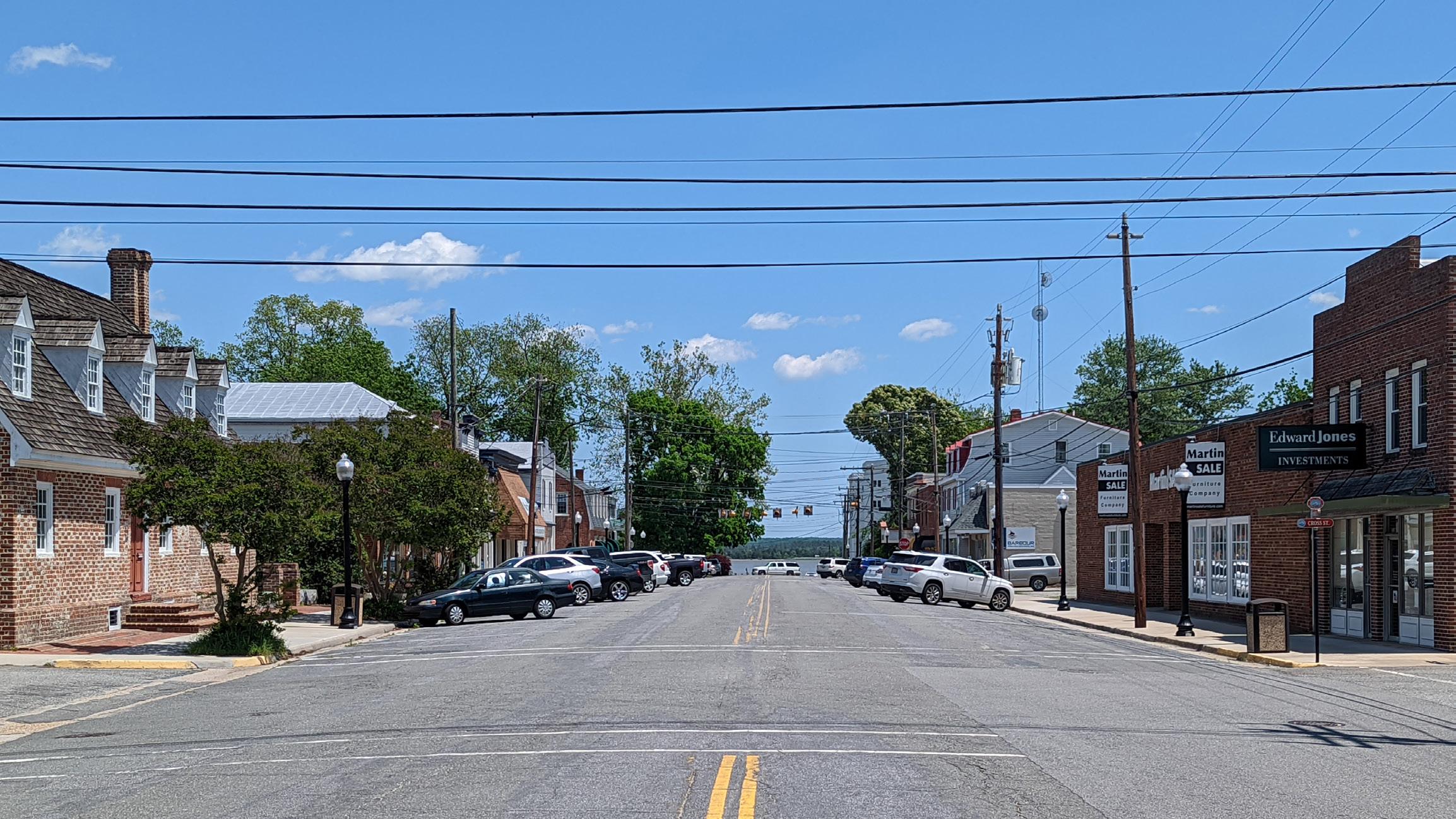
The Planning Team held meetings with various stakeholders tasked with guiding the project. This included local business and property owners, Tappahannock’s Main Street organization, and Town Council members. The meetings included candid discussion about the state of downtown and what needs they hoped would be met by the planning process and eventual outcomes. Some key discussion points are summarized below:
• Downtown should be a place you see your community out walking, especially in the evenings there should be more stuff to do.
• Utilities poles are taking up sidewalk space and there are many hanging wires crossing the streets. Human scale street lights would be desirable on streets besides Prince.
• Ordinances for signs and flags need to be assessed.
• The Town has a sizeable stock of historic buildings arranged into an “architectural tour,” yet aside from a one page print out, there is no signage in front of these buildings.
• There is a connection between visitors staying at the Essex Inn and regional attractions, but there is not much else to do in Town to make them stay longer.
• There are great ideas for local partnerships that could involve local ecology and water education, or tours utilizing deadrise fishing boats.
• Memories remain of the old Steam Wharf that was the main source of Tappahannock’s social and economic activity. A ferry once crossed the Rappahannock near where the bridge currently is.
• There’s the potential for a pier that would attract boaters along the Rappahannock to visit.
• Connection to Northern Neck Tourism would be appreciated, the Town is not technically on the Northern Neck and outside Virginia’s River Realm, but there’s the opportunity to connect.
These suggestions were a great source of inspiration for the physical restructuring of downtown, as well as the forthcoming Branding and Marketing plans that will be conducted as part of this process.
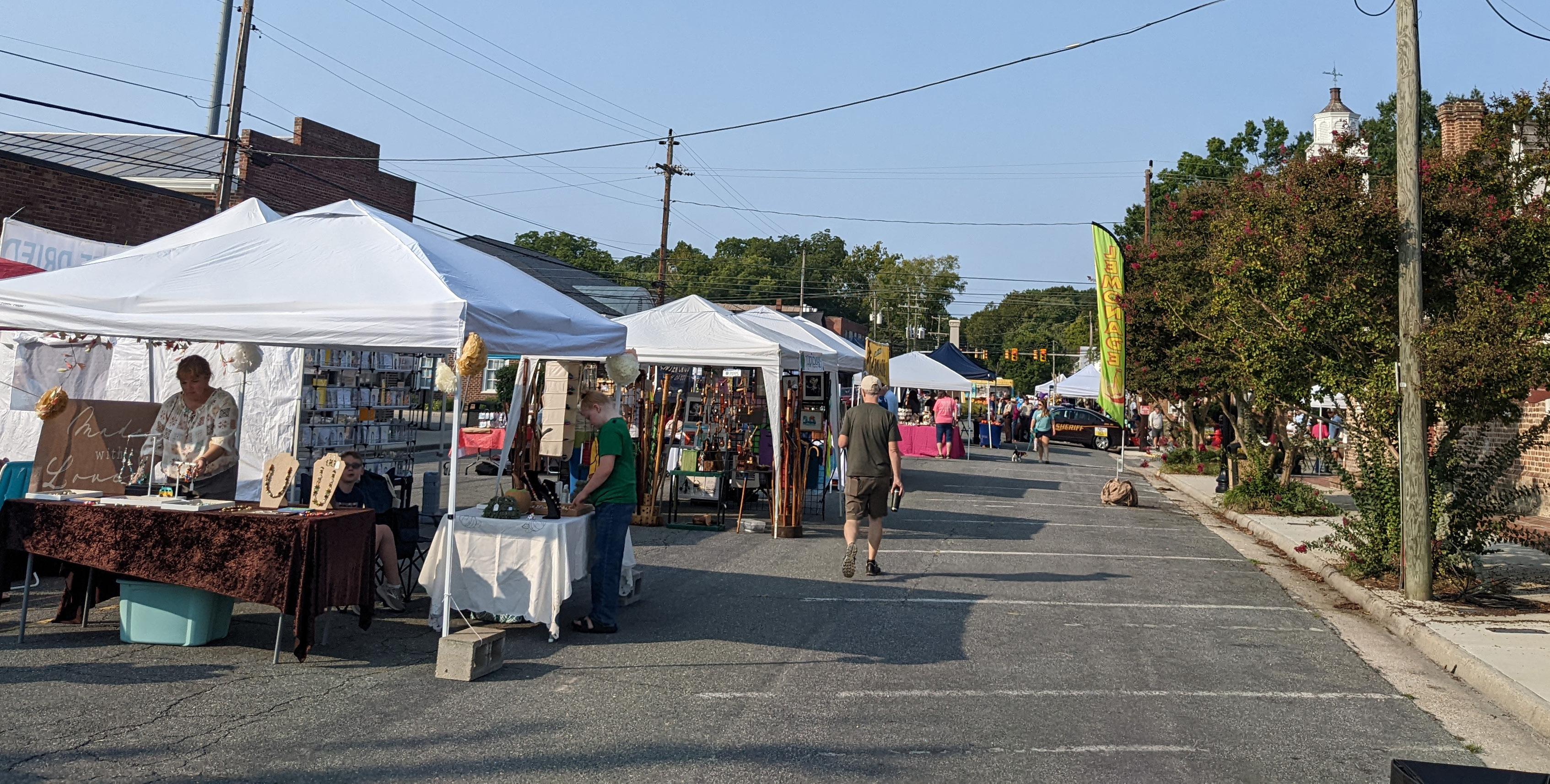
To gain perspective on why individuals and groups visit Downtown Tappahannock, as well as what changes could be made to encourage more frequent and/or longer stays, the consultant conducted an intercept survey at the September 2022 farmers market. Unlike other surveys where respondents are those who choose to follow a survey link or complete a paper survey at a government facility, intercept surveys are conducted by meeting a target audience at a place or event where they tend to gather. In the case of the farmers market intercept survey, the target audience was individuals who spend time in Downtown Tappahannock and may be willing to visit more frequently or stay longer if improvements are made. Along with the Third Thursday events, the farmers market brings Tappahannock residents, as well as those living in nearby localities, downtown on a regular basis. This provided an opportunity to gauge the opinions of residents and visitors who already have some familiarity with the downtown area and its potential.
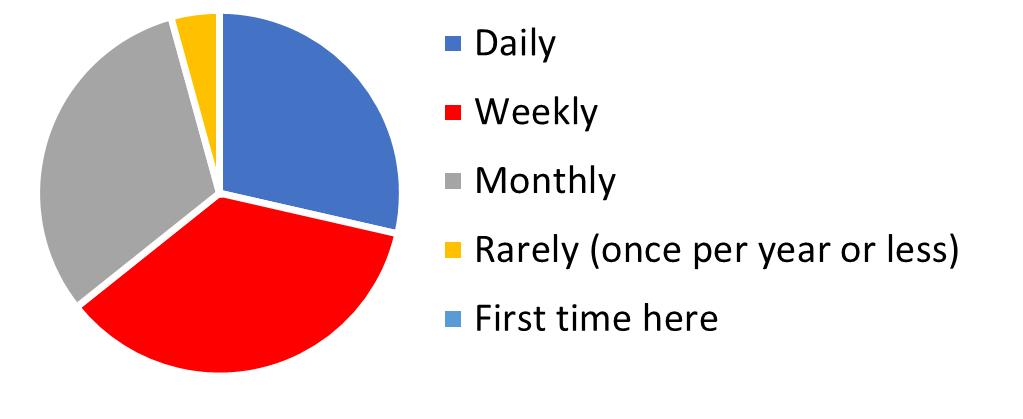
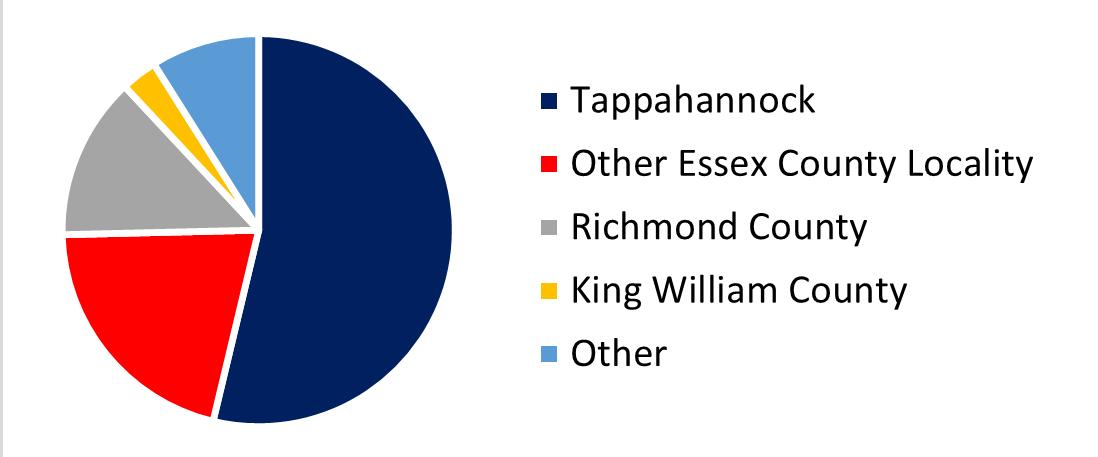
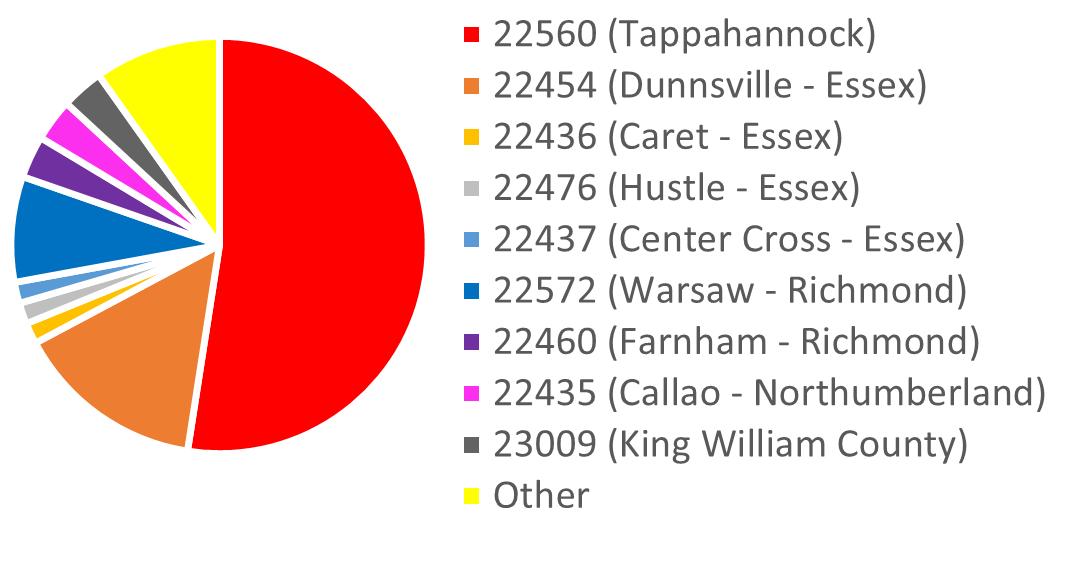
In total, 72 surveys were completed on paper over the span of several hours. Events like the Farmers Market attract residents and visitors from nearby localities. The majority of respondents were either from the Town of Tappahannock (54%) or another Essex County locality (21%). There were also a significant number of respondents from Richmond County (13%), which is on the opposite bank of the Rappahannock River from Tappahannock.
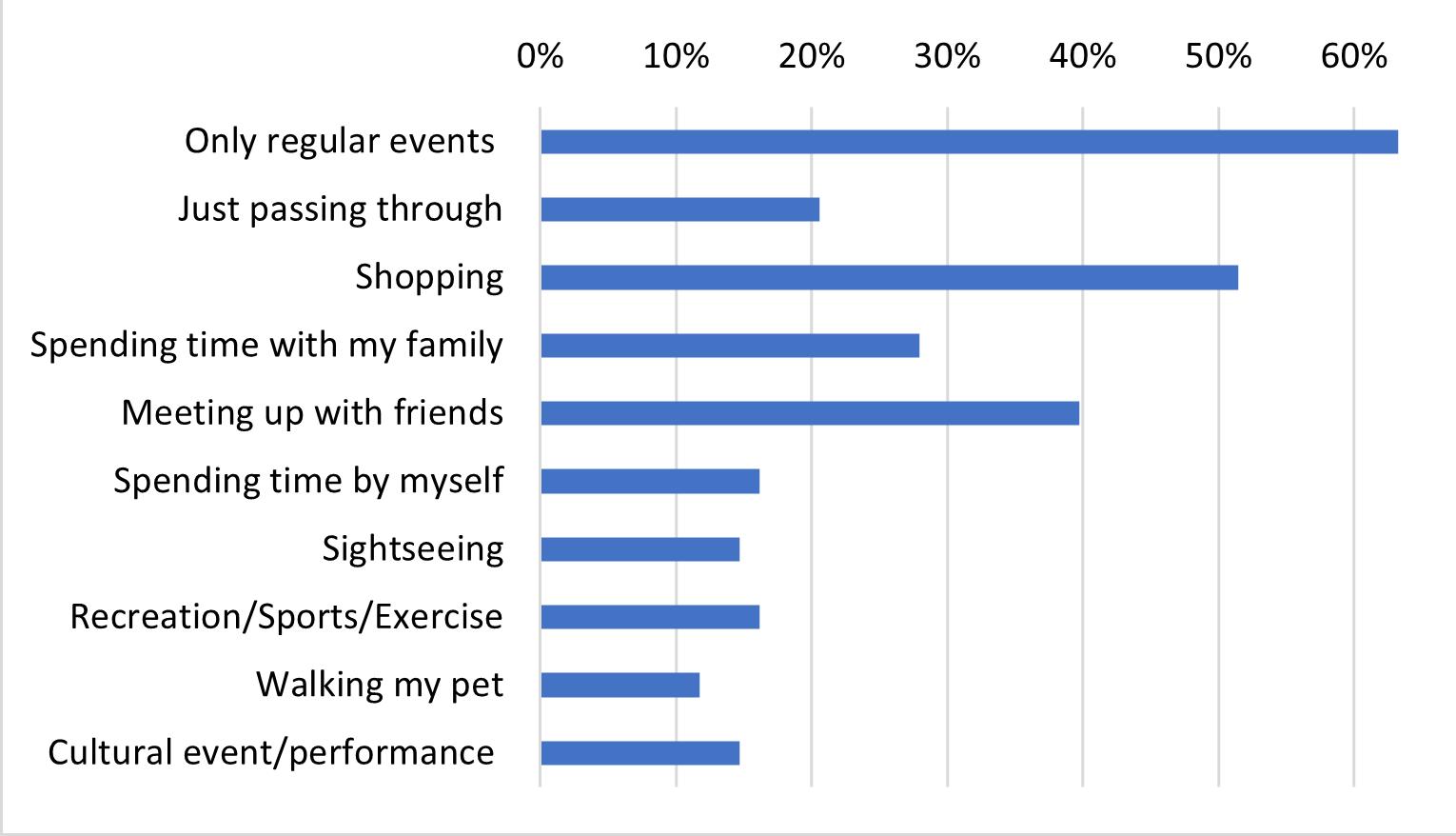
Additional events, amenities, and businesses can help bring residents and visitors to Downtown Tappahannock outside of regularly scheduled programming, such as the Farmers Market and Third Thursdays. A majority of respondents (51%) stated that they visit downtown to shop; however, relatively few visit the area to meet up with friends (40%), spend time with their family (28%), or take part in recreation/sports/exercise (16%). With targeted investment, marketing, and business development, Downtown Tappahannock can be a destination where people in Essex County, the Middle Peninsula, and the Northern Neck go to meet friends at a local restaurant, blow off steam by the river, or take their children to play.
The majority of respondents drove to the market, but better bicycle and pedestrian infrastructure can increase the viability of other transportation options. Despite the fact that 54% of respondents live in the Town of Tappahannock, 87% of respondents drove to the Farmers Market. Tappahannock is less than 3 square-miles in area, and a significant number of local trips could be made on foot or by bicycle if safe, comfortable networks are implemented in the town. Additional streetlights, sidewalk improvements, shade trees, and dedicated bicycle lanes can go a long way to enhancing the active transportation network in Tappahannock.
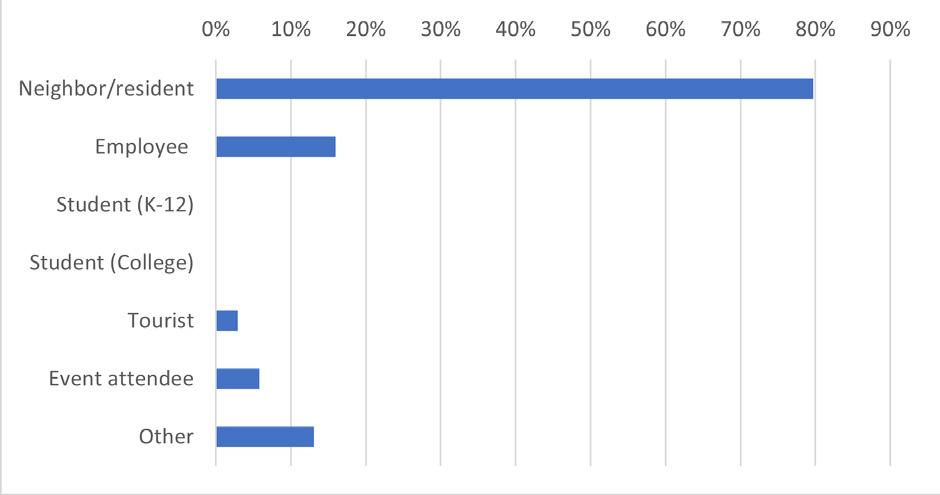
Events in Tappahannock attract residents throughout the region, but there is potential to establish the town as a stronger tourist destination. As previously stated, the Farmers Market attracts Essex County residents and those from some surrounding counties. Only 2 of the respondents (3%) described themselves as tourists. It is important to note that September is outside of the typical “tourist season,” and that tourists or visitors may have been less comfortable completing a survey.
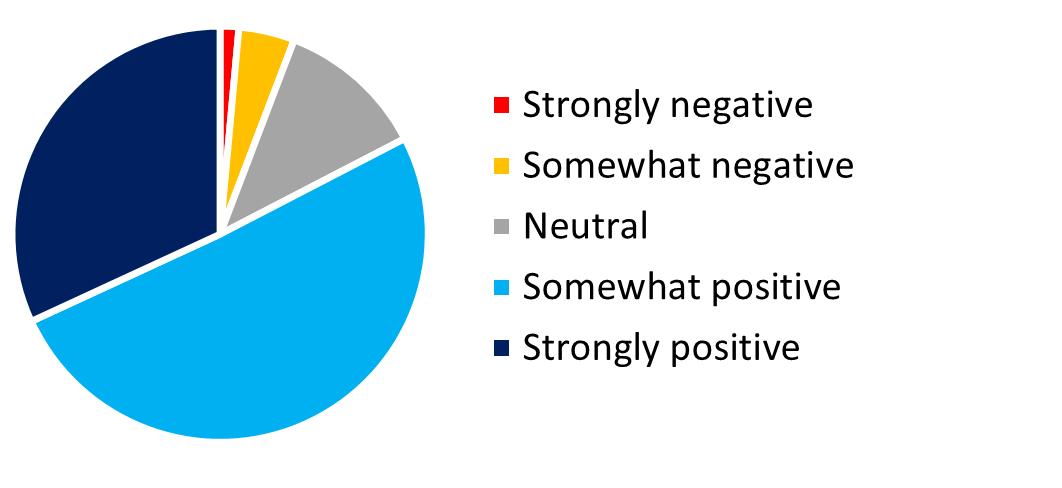
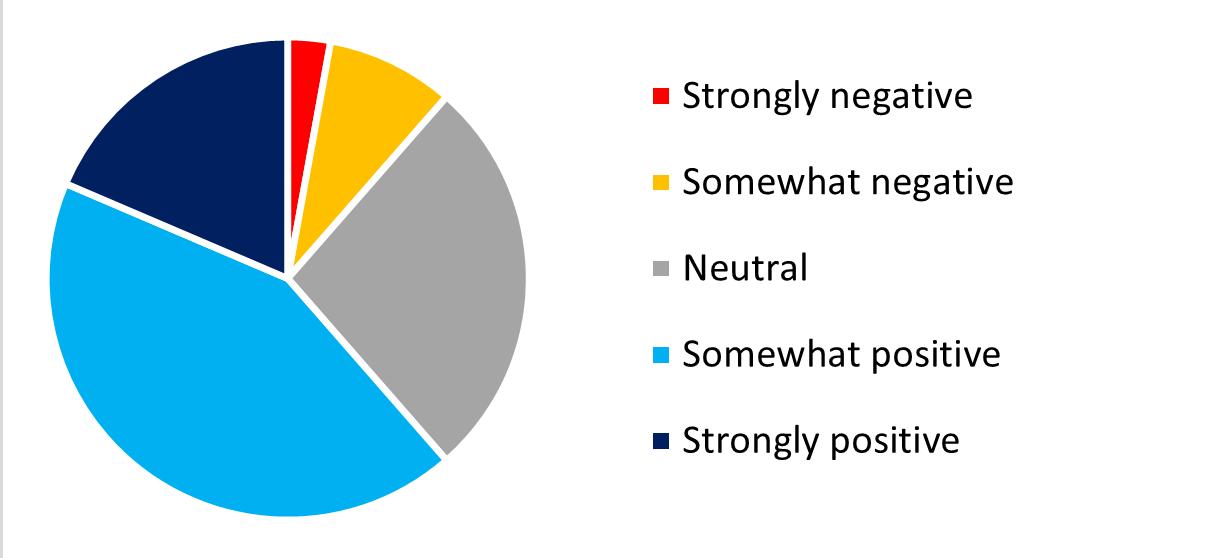
Residents and visitors feel positively about Downtown; however, many desire improvements in public spaces. Respondents assigned favorable ratings to both Downtown Tappahannock (32% somewhat positive, 51% somewhat positive) and the
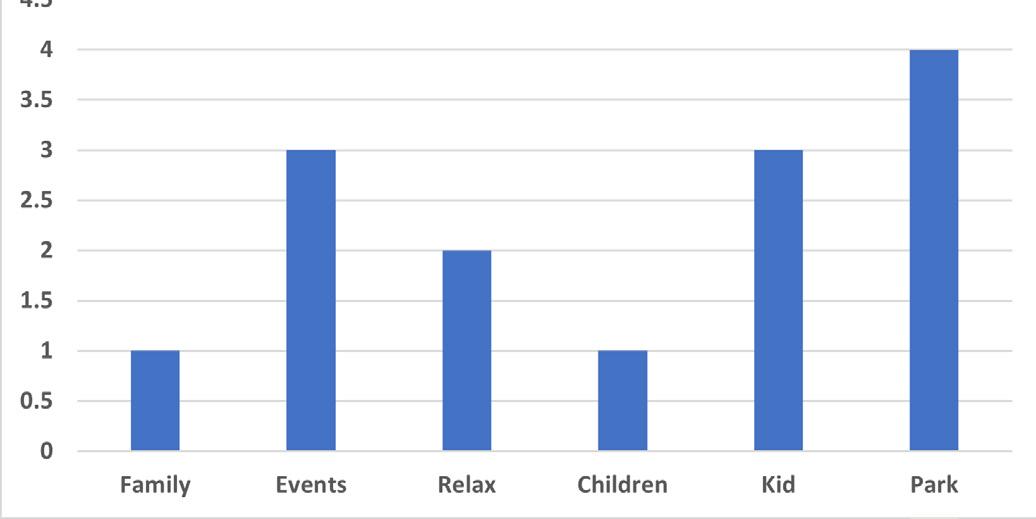
public spaces in Downtown (19% strongly positive, 43% somewhat positive). Responses highlight the opportunity to improve feelings on Downtown Tappahannock through public space enhancements. Additional parks, amenities for children/families, and spaces to relax (especially by the water) can help revitalize the public spaces in downtown, as stated by respondents when asked what activities they wish they were able to do in Tappahannock’s public spaces.
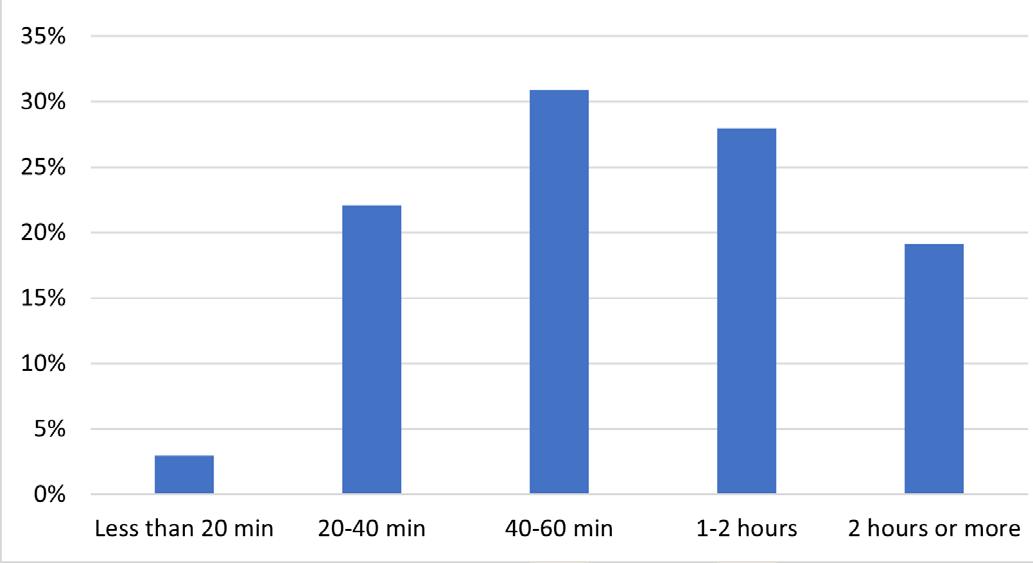
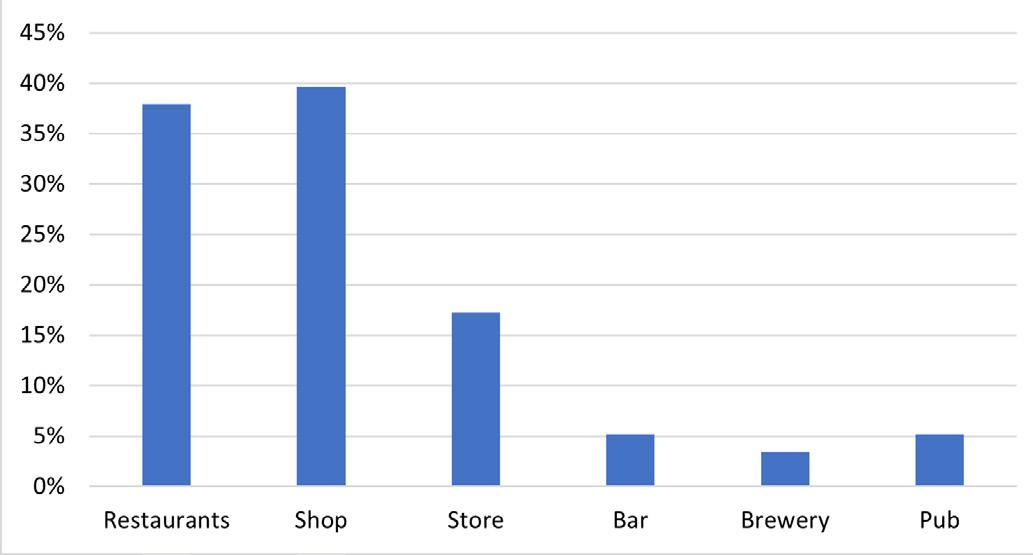
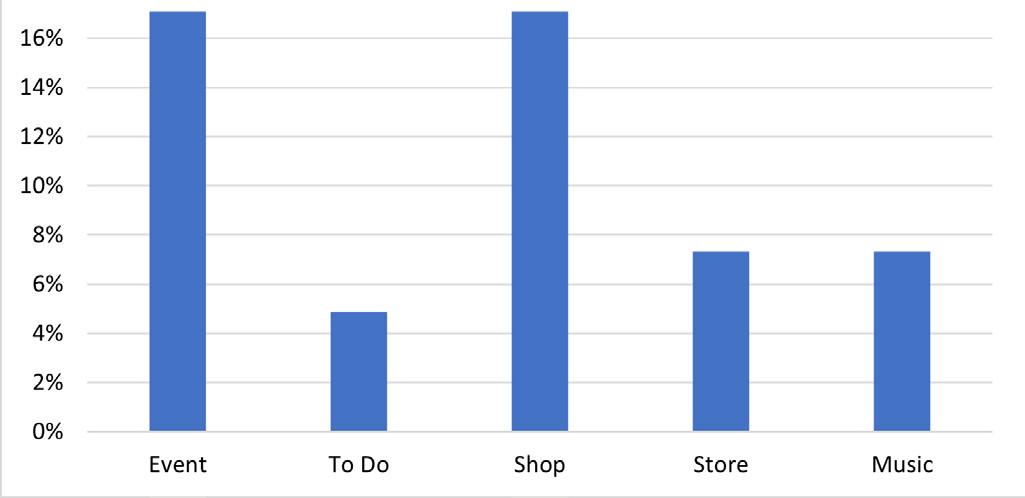
Additional businesses and events can encourage visitors and residents to visit Downtown Tappahannock more frequently and lengthen their stays. 53% of respondents stated that they generally spend between 20 and 60 minutes in Downtown Tappahannock. Some of the top responses for business types that would attract respondents to spend more time in Downtown were restaurants and various types of shops/stores. Similarly, when asked about what would make them feel more interested or spend more time in Downtown, many responses included the phrases “to do,” “shop,” “store,” and/or “event.”
How often do you visit Downtown Tappahannock? If you do not live in Tappahannock, where do you live?
How did you get here today (select option traveled for the longest distance)?

What best describes your relationship to this area? (check all that apply)
How do you feel about Downtown Tappahannock?
What brings you to Downtown Tappahannock, generally? (check all that apply)
How much time do you spend in Downtown Tappahannock, generally?
What types of businesses might attract you to spend more time in Downtown Tappahannock?
How do you feel about Downtown’s public spaces?
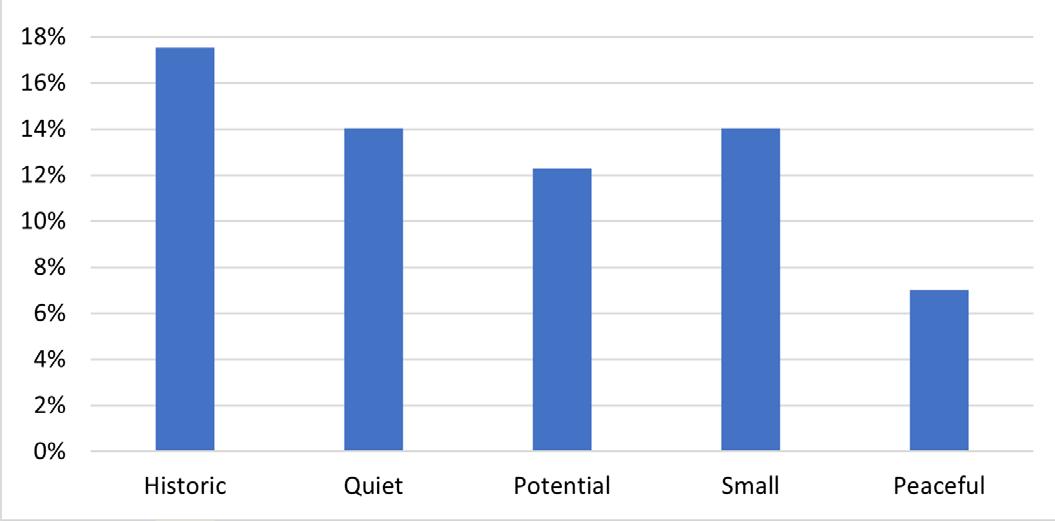
What three words would you use to describe Downtown Tappahannock?
What things would you like to do in the public spaces Downtown that you can’t do now? - Selected keywords shown below
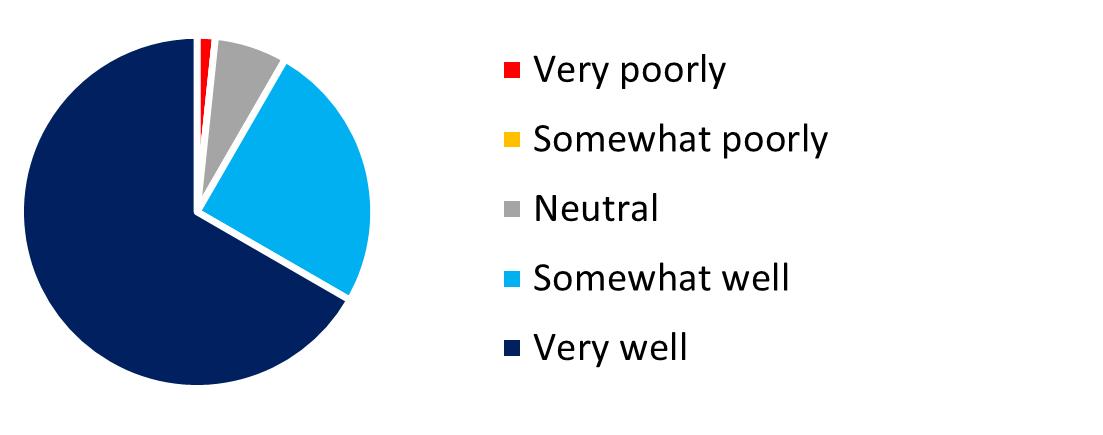
How would you rate your feeling of personal safety in this space generally?
What would make you feel more interested or spend more time in Downtown Tappahannock or its public spaces?Selected keywords shown below
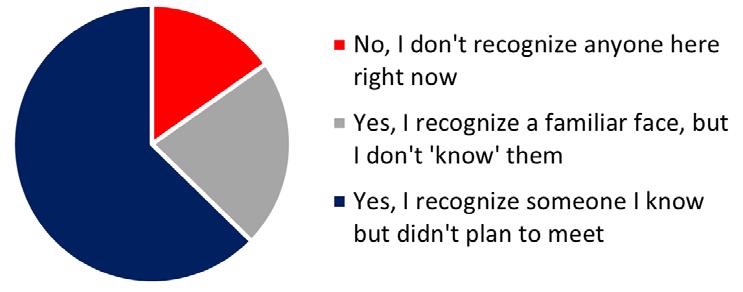
Please take a few moments to look at the people here. Do you recognize anyone you weren’t already planning to meet?
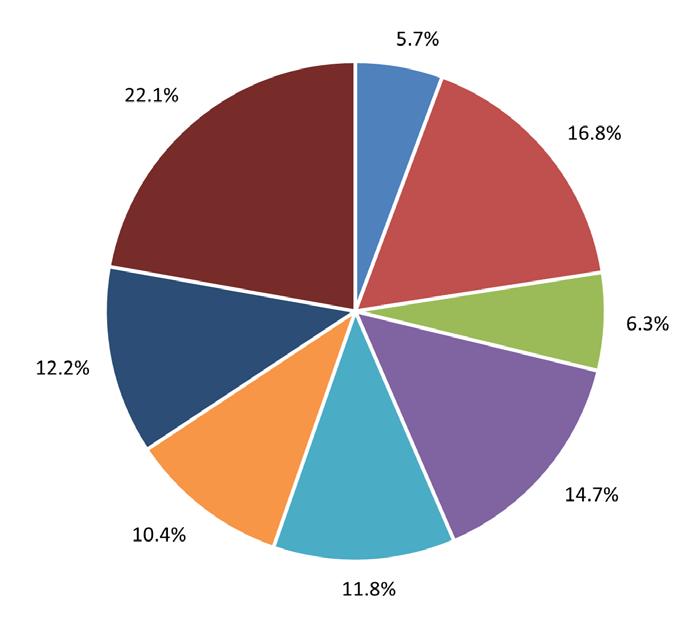
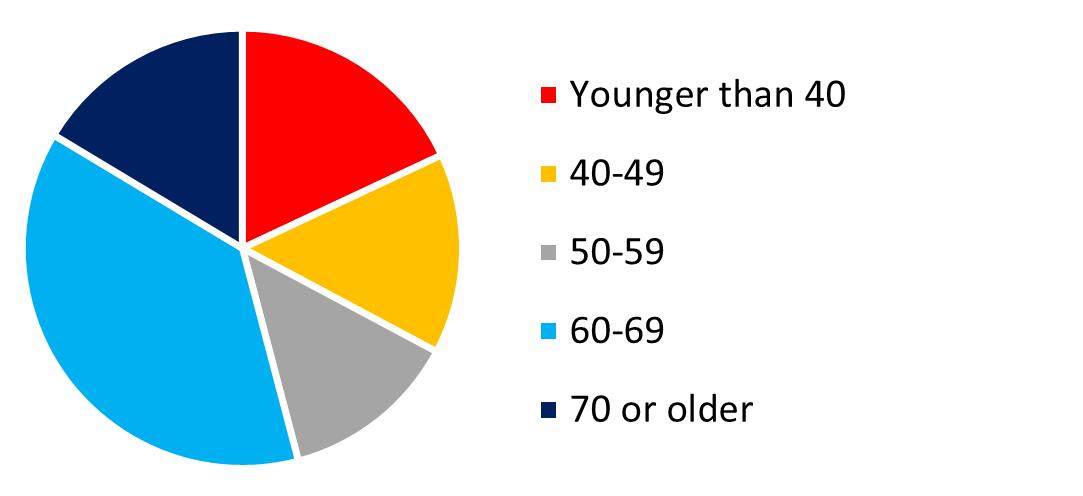
What is your age?
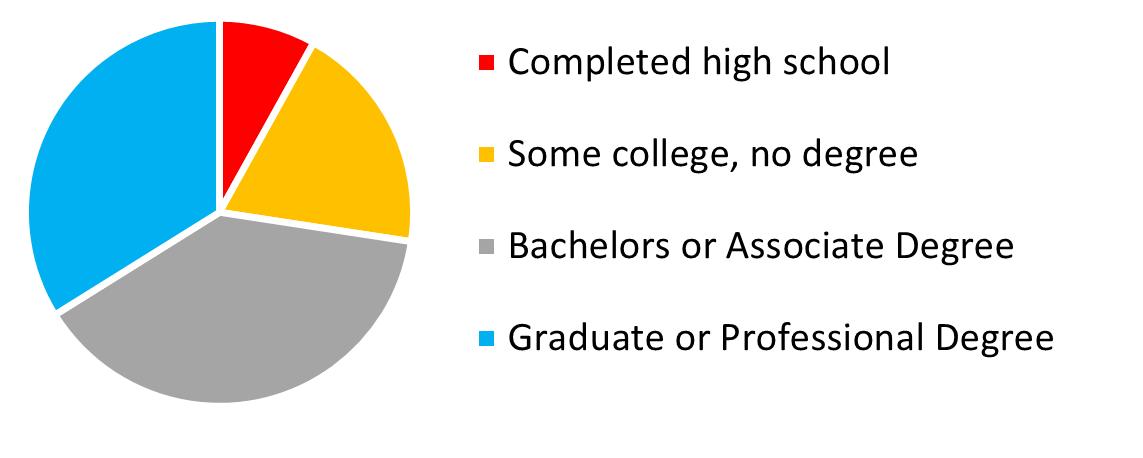
What is the highest level of education you have completed?
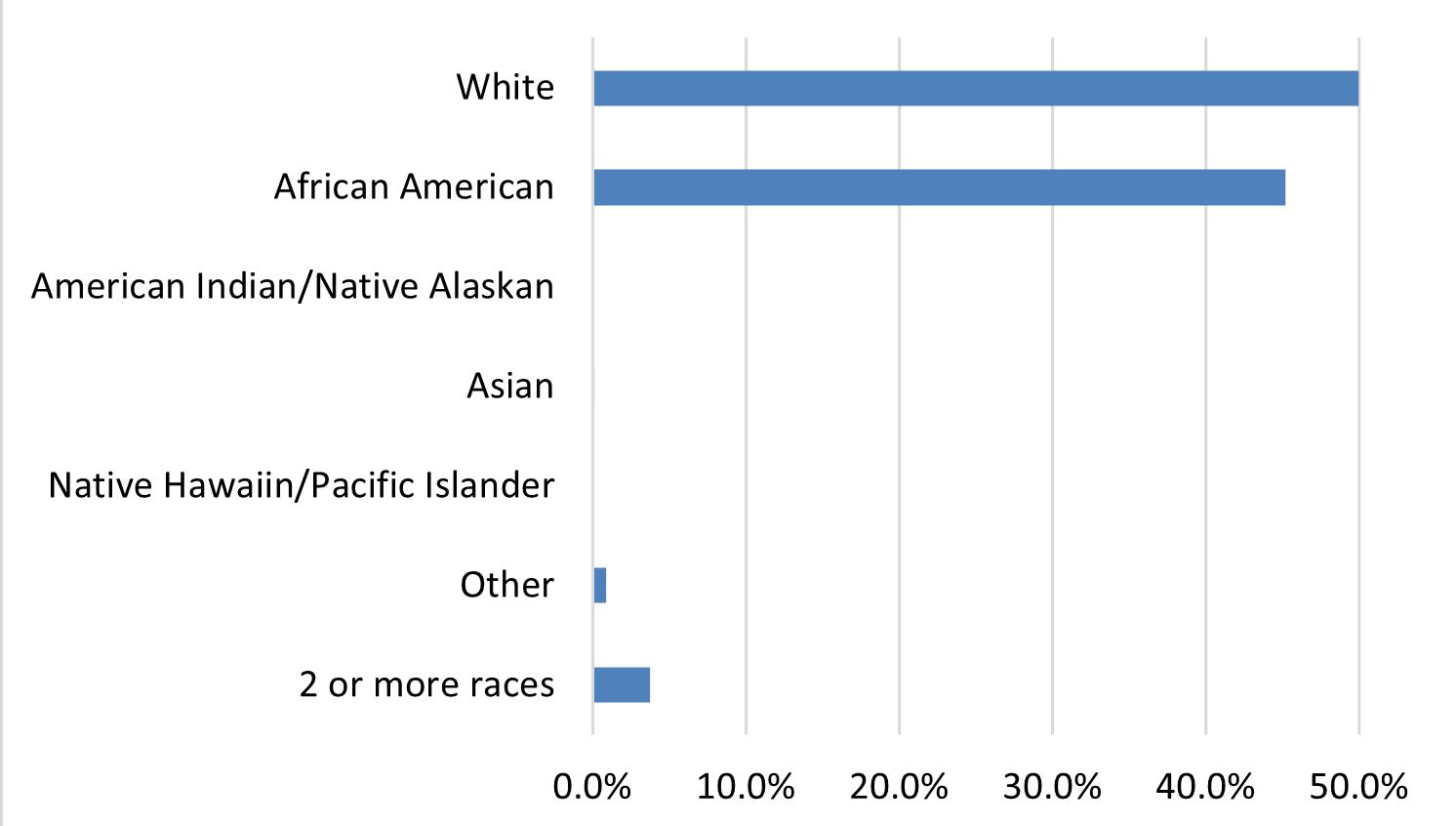
Do you identify as? (mark one or more boxes + specify if you wish)
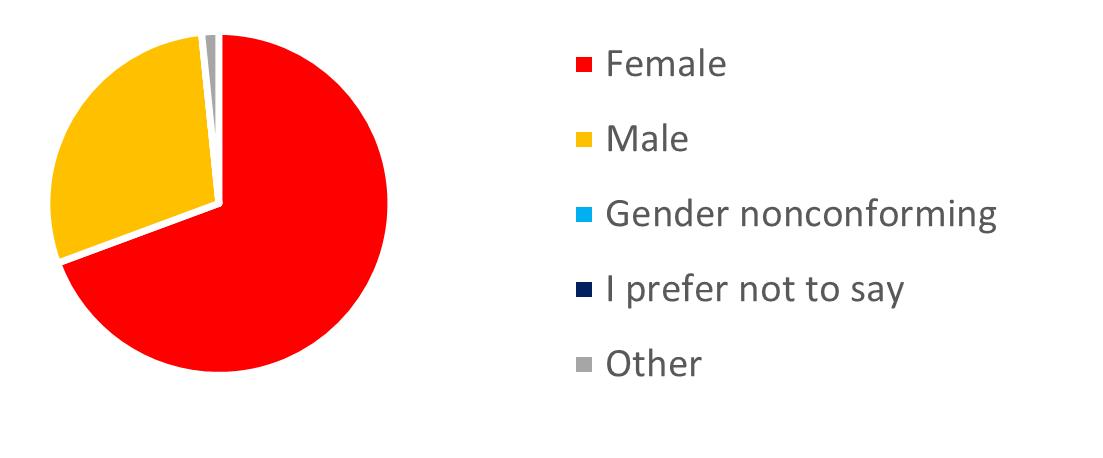
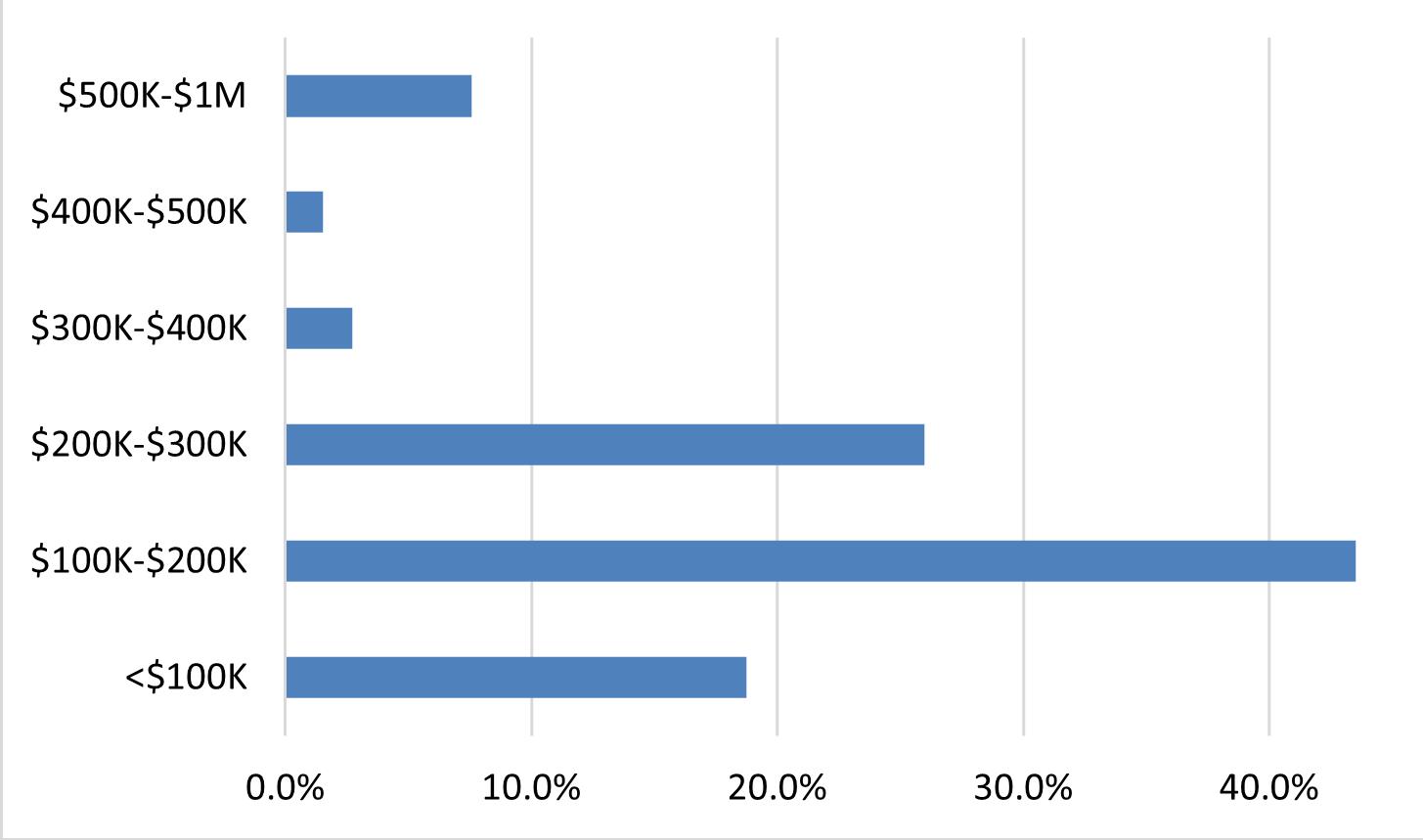
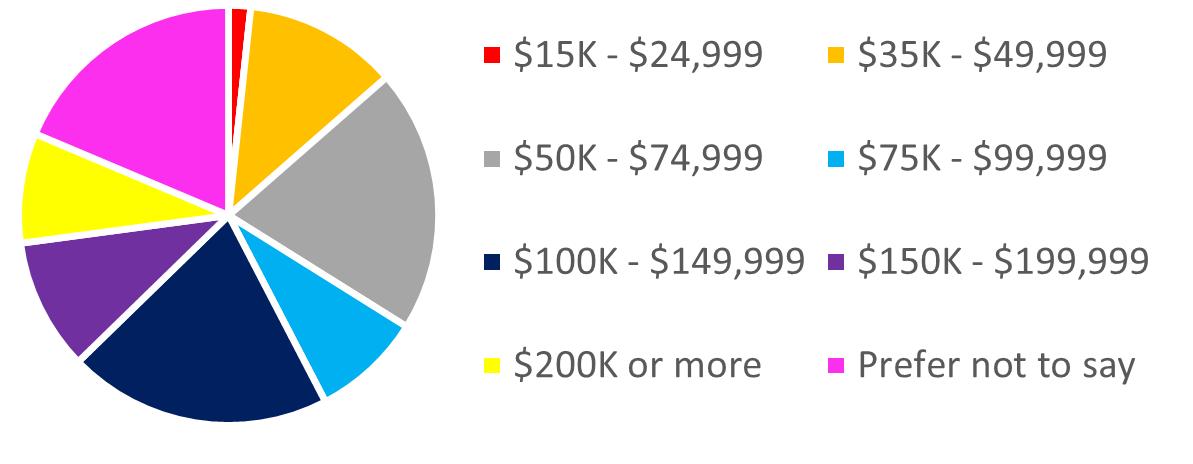
What is the combined annual income of all working adults in your household?
What is your home zip code?
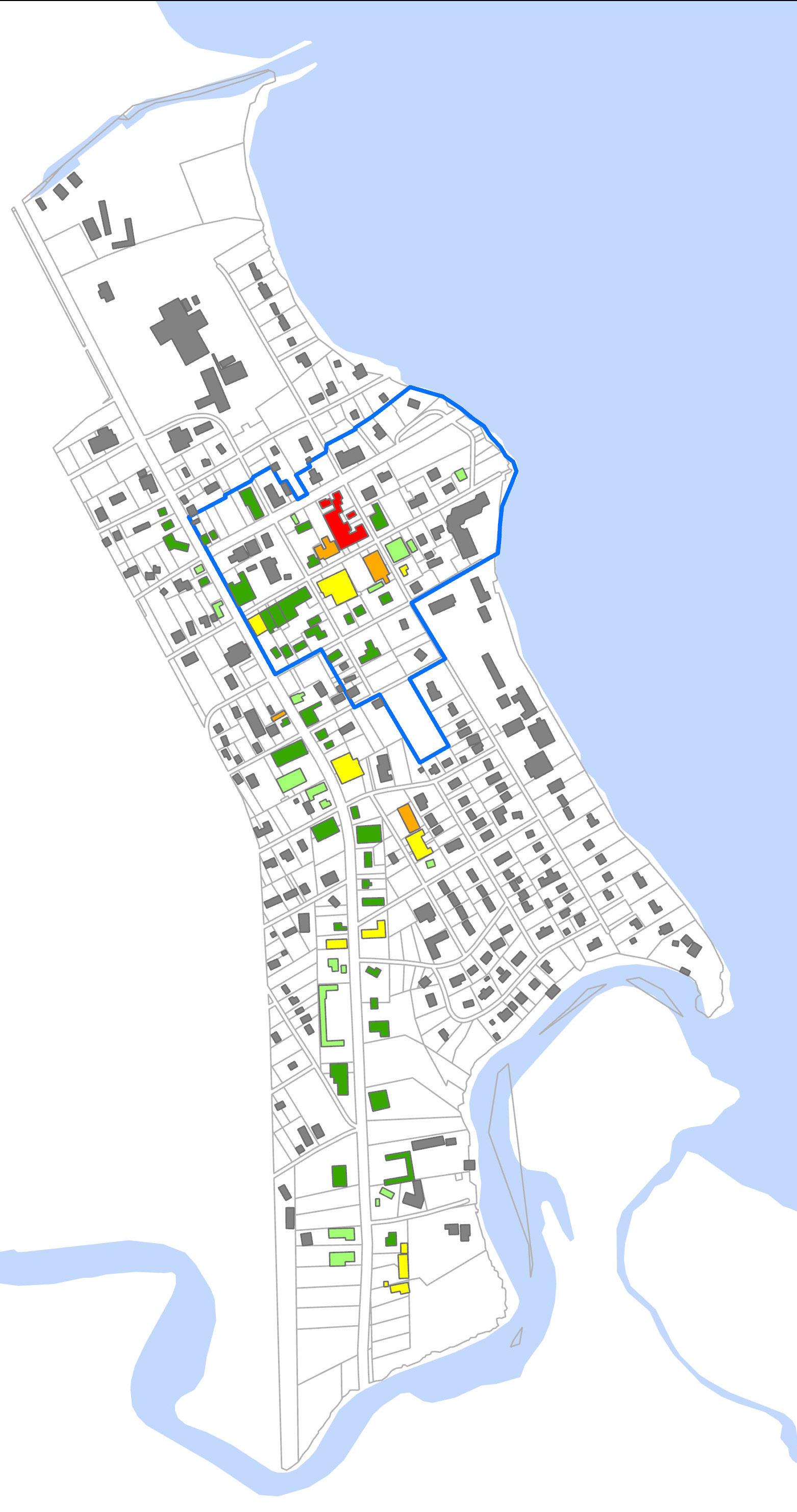
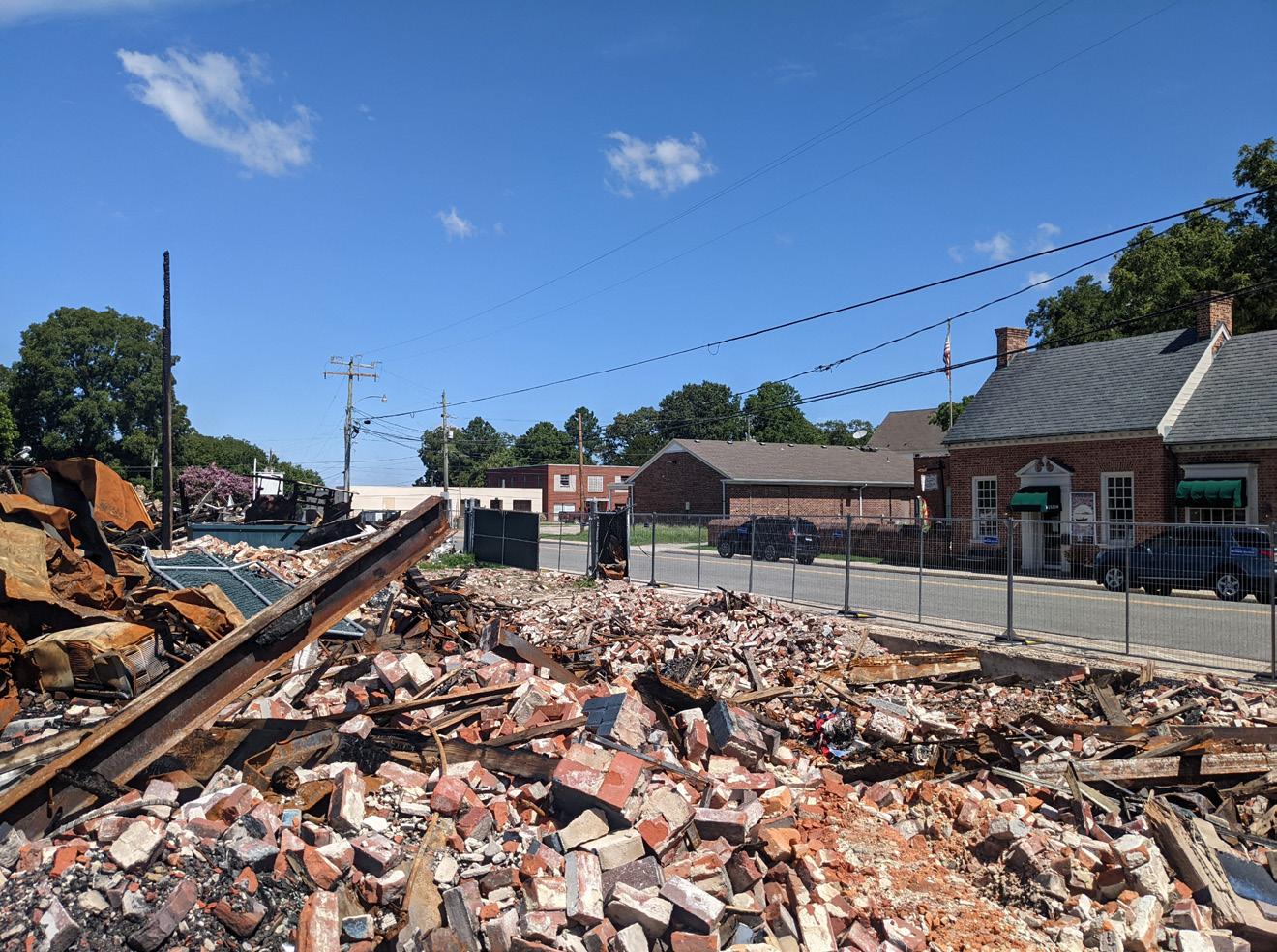
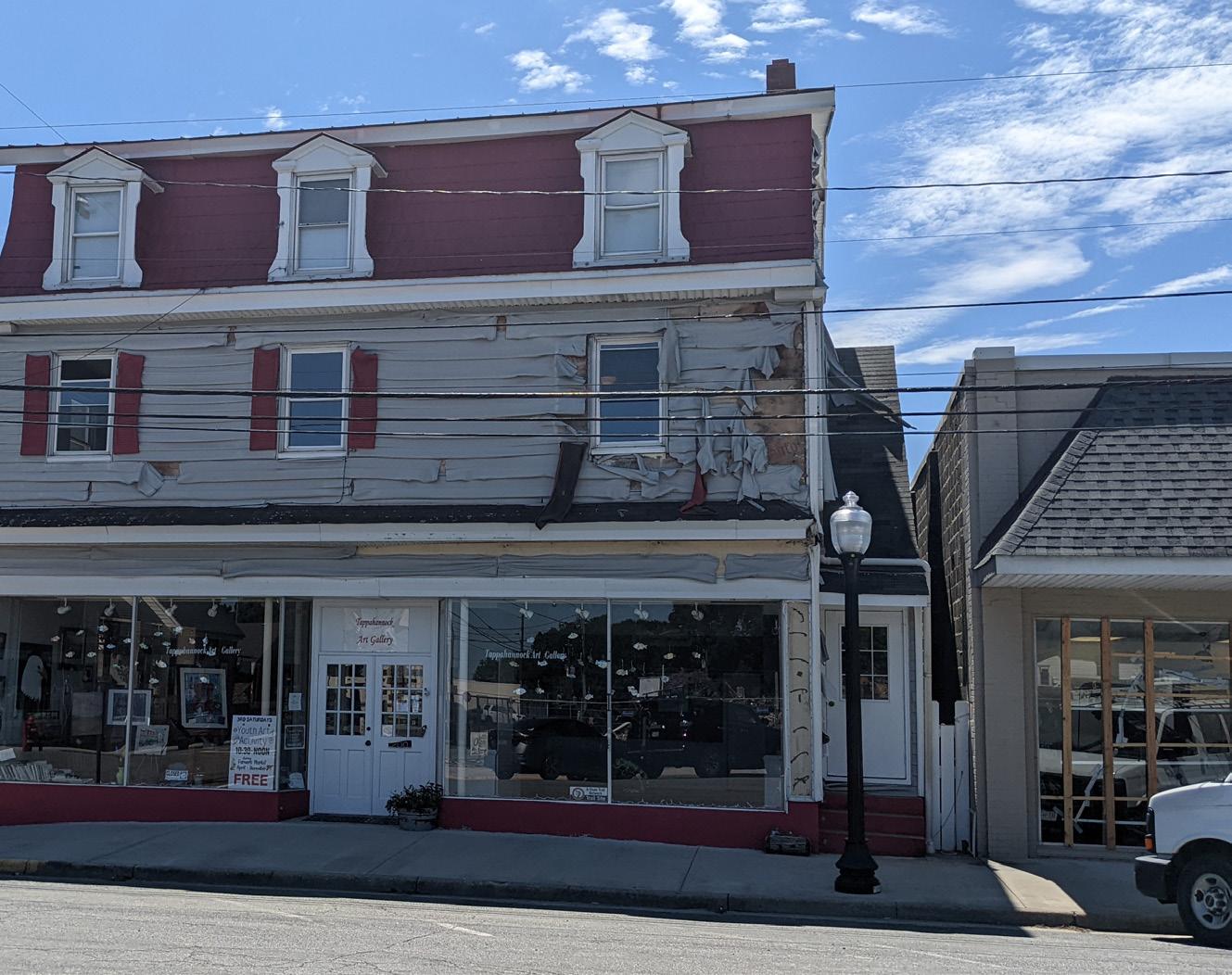
On August 1, 2022, the Planning team conducted a quick windshield survey of building conditions within and just outside the study area of commercial properties. The properties were scored from 1-5 with 1-2 being in majorly deficient or dilapidated condition and 3-5 being intermediate to sound condition. Most commercial properties in the downtown area are in good condition. However, the site of the fire on Prince Street eliminated many commercial structures and damaged nearby properties by melting siding and warping glass windows. There are also other issues, such as missing windows at the corner of Prince and Church lane. Overall, there are many vacancies or uses that do not generally have a publicfacing component, such as offices for contracting businesses or others. While the building may be in fine condition, aesthetically the facades are left to fade and otherwise remain stagnant year to year.

Tappahannock and Essex County recently worked with Consociate Media to develop a rebranding strategy for the community as a river town surrounded by a rich agricultural heritage. Stakeholders were assembled representing many different entities in the area. A local marina owner, the Chief of the Rappahannock Tribe, community activists, local wineries, a historian, and the Director of the Essex County Museum were all representatives of the area for the consultants to interview about barriers to overcome for the community to reach its full thriving potential. The results of this work are summarized below.
• Tappahannock and Essex County should follow the lead of neighboring town Warsaw in applying for grants and funding that promote growth and tourism. Cohesion needed to promote the entire area as one.
• What is there to do in Tappahannock and Essex County? Many of the stakeholders said currently there is not enough to draw people to town. Driving through the area along a seedy part of Route 17 doesn’t answer that question; most people pass through without stopping. Give people a reason to come and they will given the ideal geography and proximity to the Rappahannock River.
• More community spaces needed, including increased river/boast public access. More parks, walking trails and playgrounds — making Tappahannock’s downtown walkable — would entice families and visitors to linger in town for a day or weekend.
• An annual outdoor signature event would draw people to town. It should not be held in the heat of summer as Riverfest was.
• Renovations being done to the Essex Inn considered a positive for future growth.
• Recently renovated Essex County Museum courtyard holds potential to host events/visitors.
• Debate continues over whether the town needs a wharf to attract restaurants and retail shops.
• Martin-Sale Furniture’s dominant presence along Main Street prevents other businesses from setting up shop there.
• Downtown “Main Street” does not offer enough to do for locals/visitors.
• Encourage diversity and inclusion in planning of future events and projects. Success of these depends on buy-in from the entire community.
• Community needs initiative and cohesion rather than bickering over jurisdiction and maintaining a defeatist attitude of nothing is going to change.
• The Return to the River project and the cultural center for the Rappahannock tribe will enhance the area when renovations are complete in 2023.
• Untapped potential/hidden gems that could be leveraged include local architecture/churches, river steward deadrise tours, Artists Guild and Blandfield Plantation. Community could be marketed as a day trip for Richmonders.
• Need to find expertise to navigate obstacles presented by the Chesapeake Bay Act.
These findings were repeated in this Downtown Revitalization planning process, showing that energy and activity are needed in general to make community an attractive and vibrant destination. The logo below was created as part of Consociate Media’s finished report.
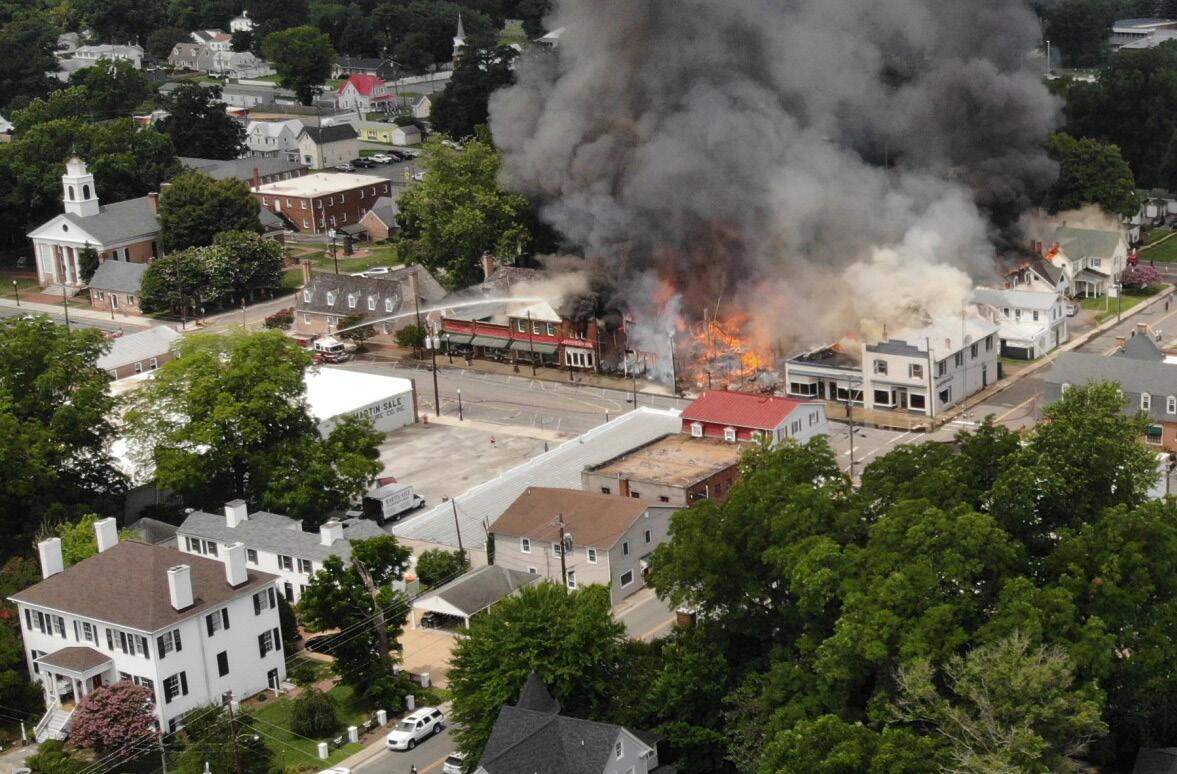
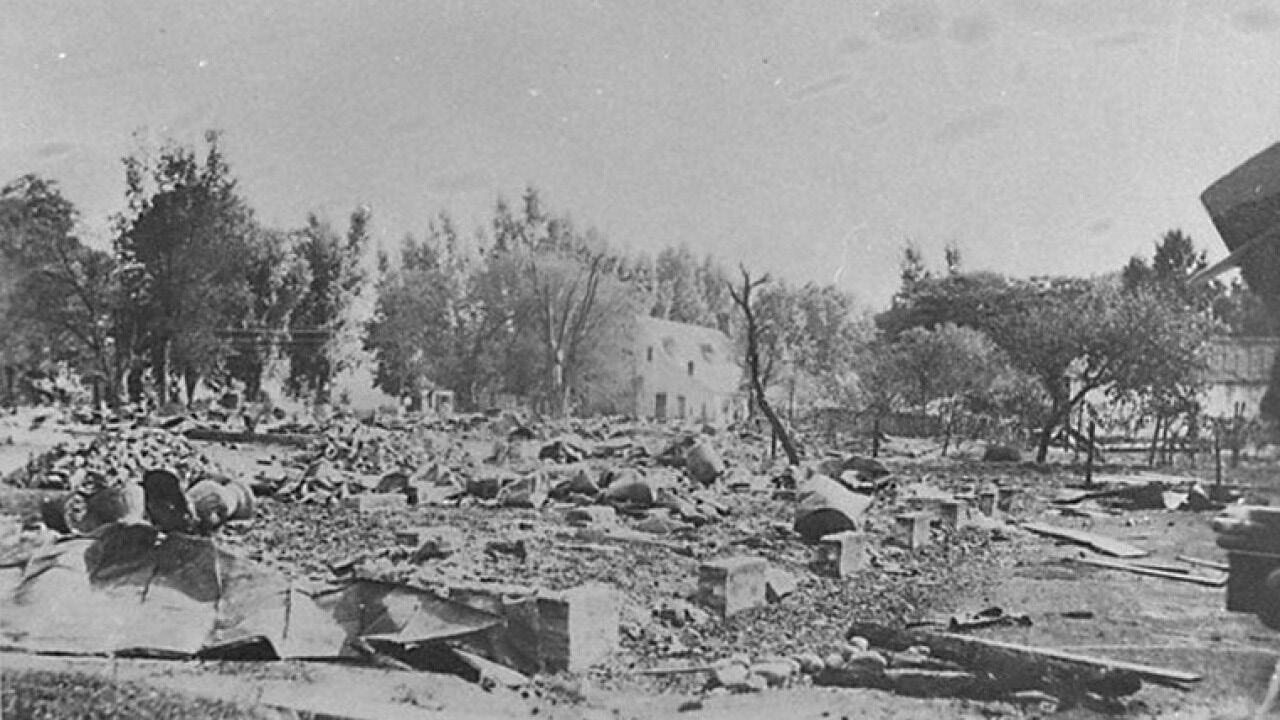
Unfortunately, during the planning process a major fire razed most of the 200 block of Prince Street near Water Lane on July 15, 2022. The fire began in one of the Martin-Sale Furniture Buildings and quickly spread to adjacent buildings. Tragically, many historic storefronts were destroyed including the often survey-mentioned Prince Street Cafe. Other buildings that were ruined were community members homes. The site remains fenced off and covered in the ruins of the buildings. Adjacent buildings across the street had their siding melted and glass warped from the heat of the fire. However, the fire did not spread beyond the eastern side of the block, and the historic building on the western corner was able to be saved.
Local research showed that this same block had burned down previously in 1917, showing that what was rebuilt in the years since was a sign of resilience. In a similar manner, this Economic Restructuring Plan, sets forth a clear vision for the downtown area
that will guide future changes to the local Zoning Ordinance and development regulations to allow for new high quality redevelopment of the site. This will ensure that Tappahannock, although suffering a great tragedy, will revitalize its downtown area both expediently and successfully. Through collaboration with local business and property owners, and residents, the Town can look to the future with optimism.
It is important that redevelopment of this area borrows from key characteristics of its historic footprint. For example, the narrow buildings had many storefronts that fronted onto Prince Street. Throughout Tappahannock’s history, this allowed for many reasons to come to downtown. If redevelopment has only one restaurant take up an entire corner, for instance, the Town is losing the opportunity for many diverse uses along its main corridor through Downtown.
The buildings that were destroyed were additionally of no more than two stories in height. Noise from Queen Street and Tidewater Trail’s fast moving truck and car traffic is audible throughout the downtown. However, by allowing taller buildings, more opportunities for the downtown are enabled such as:
• Incentivizing redevelopment to recover more quickly.
• Allowing for more housing, office, or commercial space.
• Enabling more interesting building design, such as interior atriums, courtyard space, active rooftops, or other features.
• Buffering the core of Downtown from noise pollution from Tidewater Trail (Rt. 360) and Queen Street.
• Providing an opportunity for eye-catching architecture or other gateway features as people come across the bridge into Town.
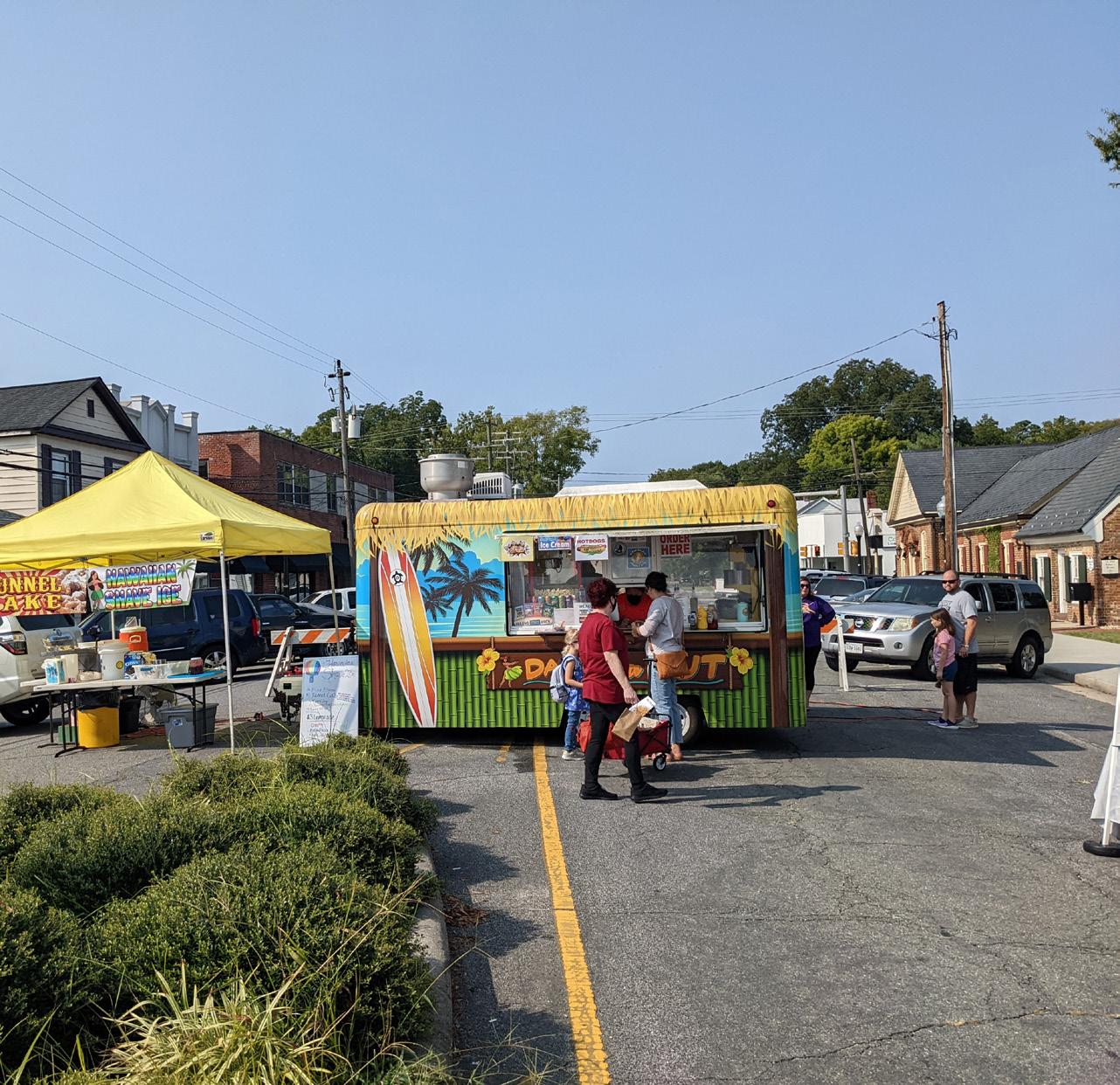
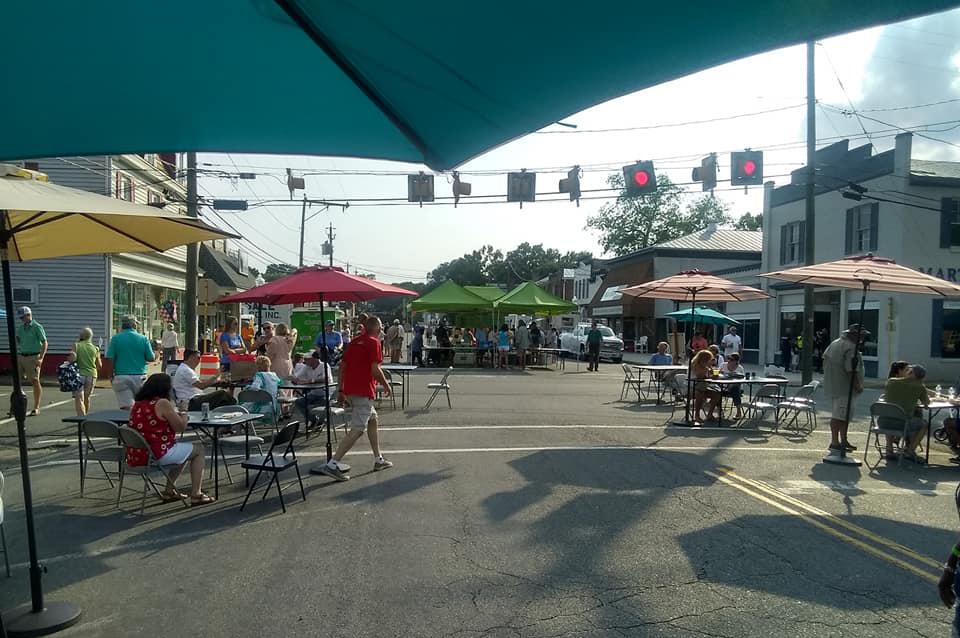
In the meantime, interim uses such as allowing food trucks, vendors, pop-up seating, and other games and activities in the street in front of the 200 block, can activate the space and continue making use of the Downtown area. This can be done with a constant presence Downtown by Tappahannock’s Town government engaging the local community about their aspirations for the area.
“Tappahannock’s downtown is charming and vibrant, alive with locals and visitors alike. There are diverse experiences, opportunities, and reasons to stay and enjoy every moment.”
Through looking at the downtown area’s economic climate, previous studies, and observations, it is evident that people are not spending time nor do they have reasons to spend time in the area. One stakeholder remarked that they merely wanted to see families walking and people out enjoying the downtown area or relaxing by the waterfront. To achieve this liveliness or “vibrancy,” activity must be generated by making the spaces of downtown attractive. Whether they’re locals, or visitors, downtown must be return to being a historic heart for the area. This means there are many different pleasant experiences one can have, or a diversity of places to go within the downtown. Diversity in the types of stores open at a diversity of times, must also be achieved. When people finally arrive in the downtown area, they must also be able to stay downtown, through the use of additional seating, or public space elements, the downtown area is not only experienced in the “interiors” of shops or restaurants, but life is also allowed to spill out into the street scene with many places to rest and “people watch.”
This vision statement is supported by the survey responses, stakeholder meetings, and observational data regarding the downtown area. The survey responses confirmed that the community felt the downtown area was generally lifeless outside of events, and that they wished there was more to do there. The stakeholder meetings reminisced on the history of Tappahannock’s waterfront as a center of social life in the community, this vision seeks to restore that condition. Our site visit also noted the potential for design interventions that would assist in “activating” the streets of Town at various locations.
The plan vision statement also aligns with the Town’s overall vision statement:
“Tappahannock is a proud community, supported by over 400 years of history and dedicated to maintaining its attractive and safe environment. Cradled on the shore of the Rappahannock River, it is strategically placed at the crossroads of Central and Tidewater Virginia. The Town hosts world class medical services, modern infrastructure and provides opportunities to live, work and recreate where tradition meets the future. We celebrate and embrace a diverse, unified, and involved community. The Tappahannock experience brings you back for life.”
The vision shares the theme of an attractive, safe, and comfortable environment making full use of its advantageous position on the river, its historic resources, and forward looking pursuit of growth. The diverse and involved community are invited to help create these experiences and reasons to stay and enjoy every moment. With transformative strategies, the revitalization plan will assist in bringing Tappahannock to life.
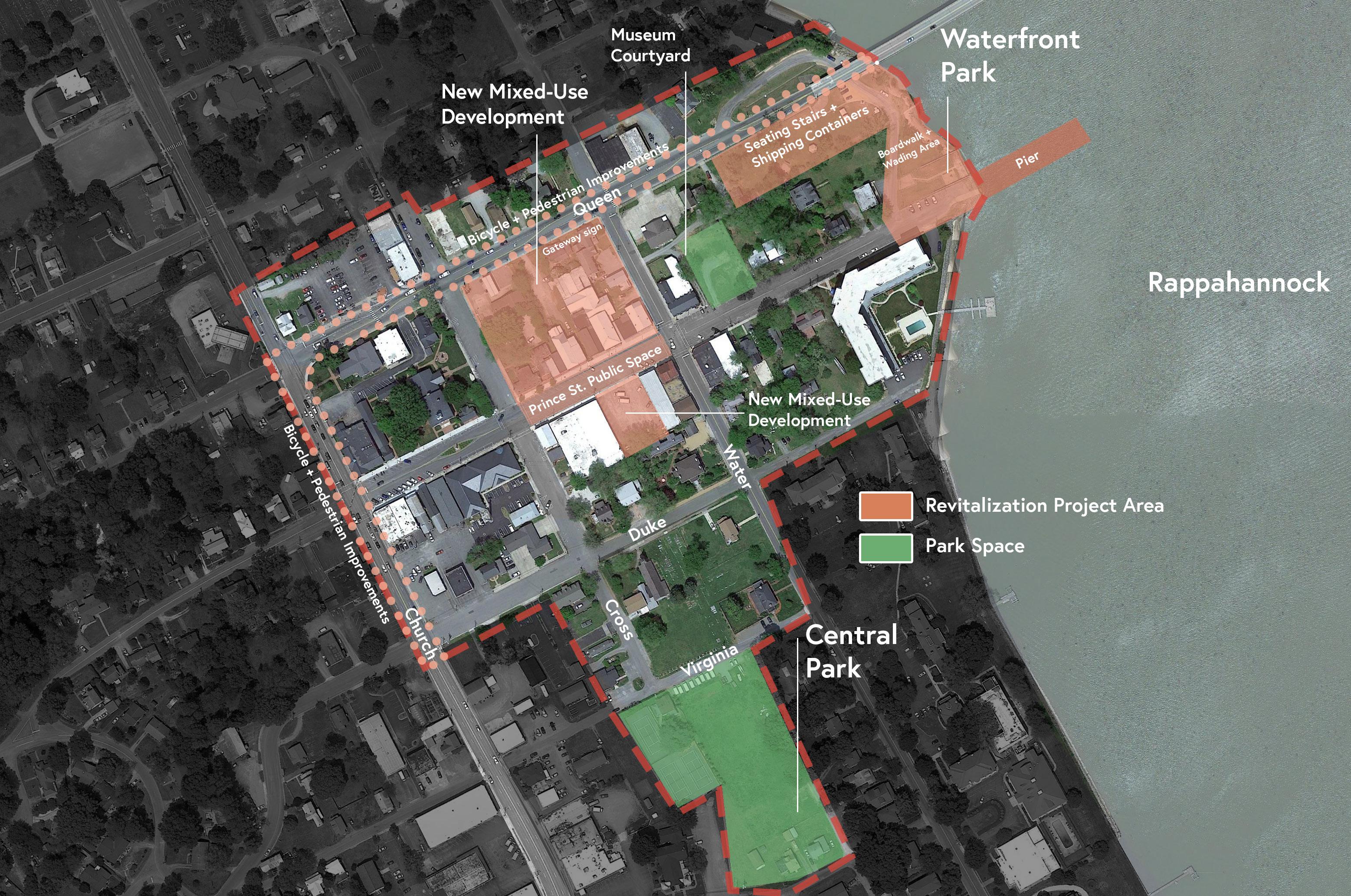
Tappahannock’s downtown area is quite large. There are substantial investments that will need to be made in traffic calming Church and Queen streets, and vacant parcels in need of incentives or new economic activity to spur development. In response to this great need across the entire downtown, the Downtown Revitalization Plan will “narrow the focus” to connected sites that will act as a core for bringing new life into the core of the area. These sites are:
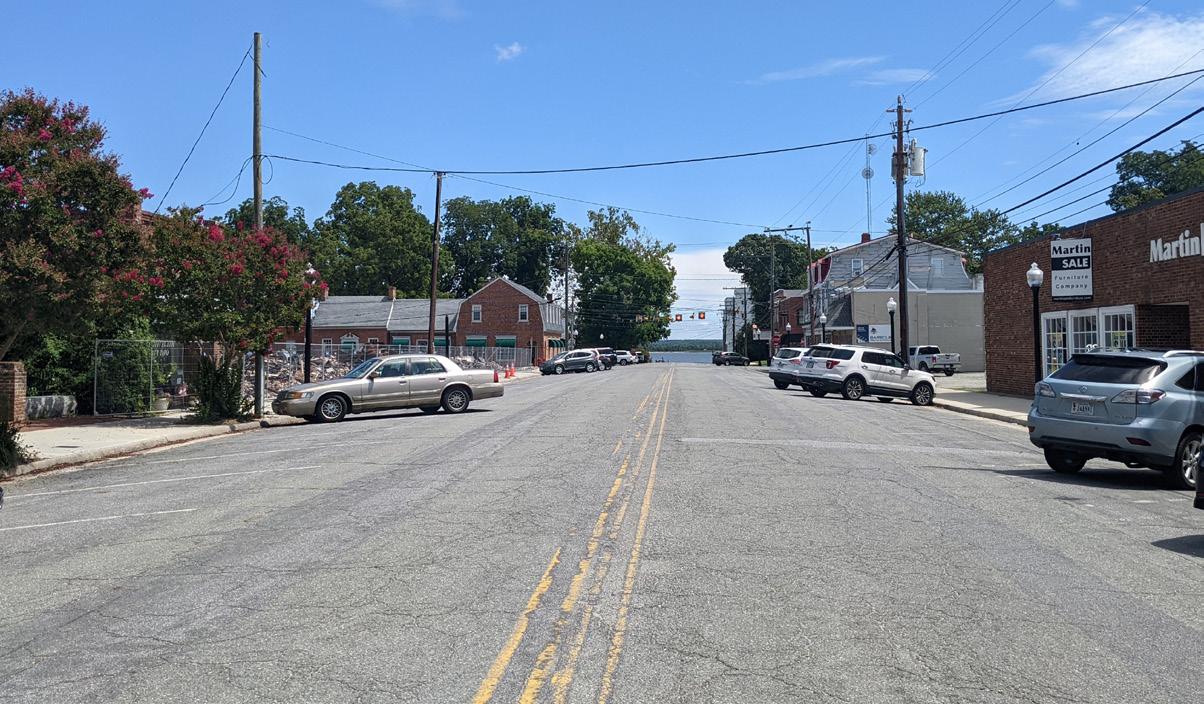
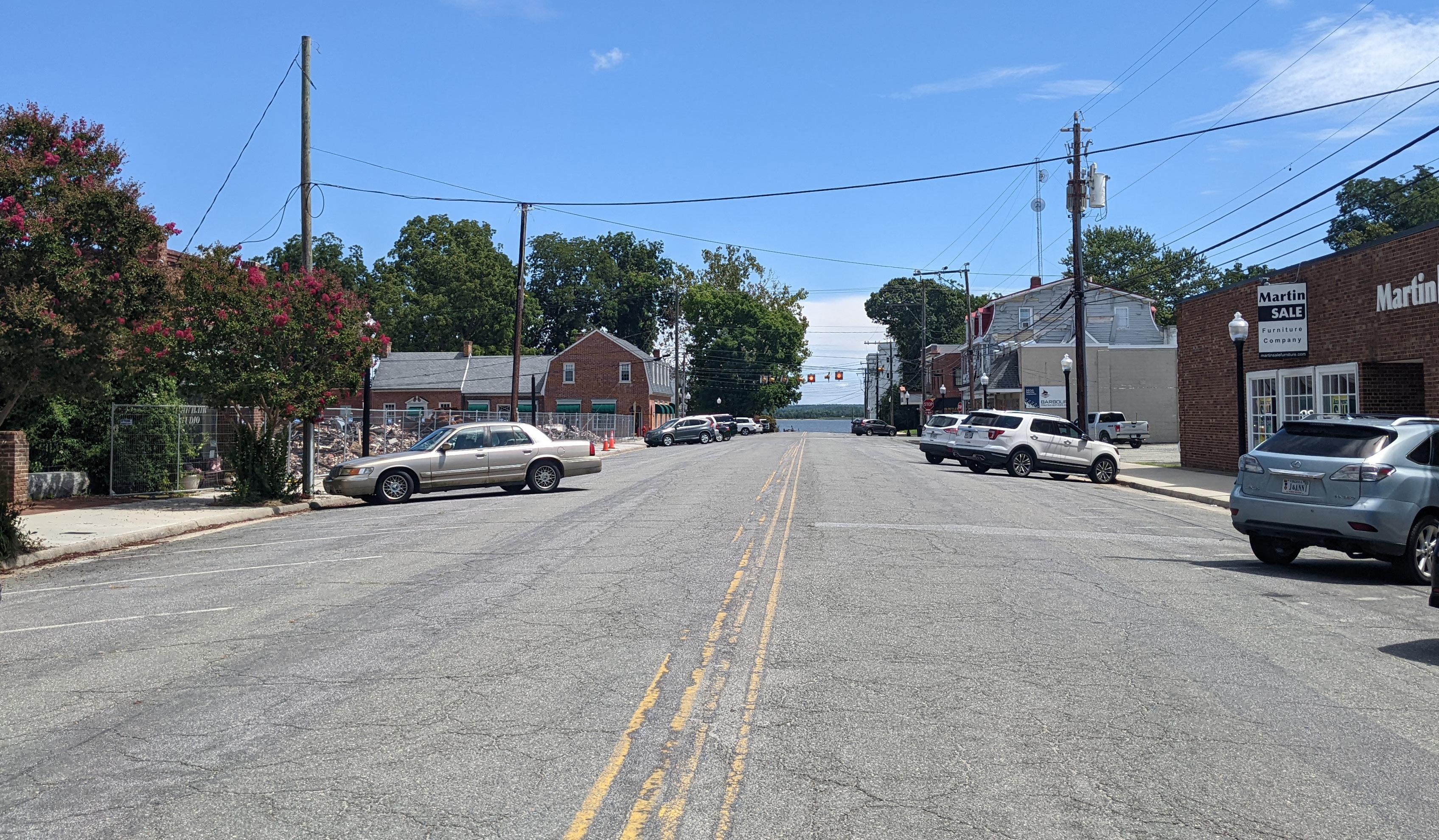
The head of Prince Street has active businesses on its south side and the Essex County Courthouse on its north. Further down, there are more businesses in historic storefronts, and the unfortunate site of the recent fire. There is a wide berth of asphalt that accommodates front-in diagonal parking on both sides of the street. Sidewalks are full of utility poles, light fixtures, and trash cans, and in some cases are not wide enough to accommodate two people. There is a new courtyard as part of the Essex Museum, however, there is an iron fence making it seem unclear how access is granted to the courtyard as well as an abundance of benches placed somewhat at random throughout the courtyard. The fire site and the underutilized gravel parcel used for parking across the street bring the potential for infill and redevelopment.
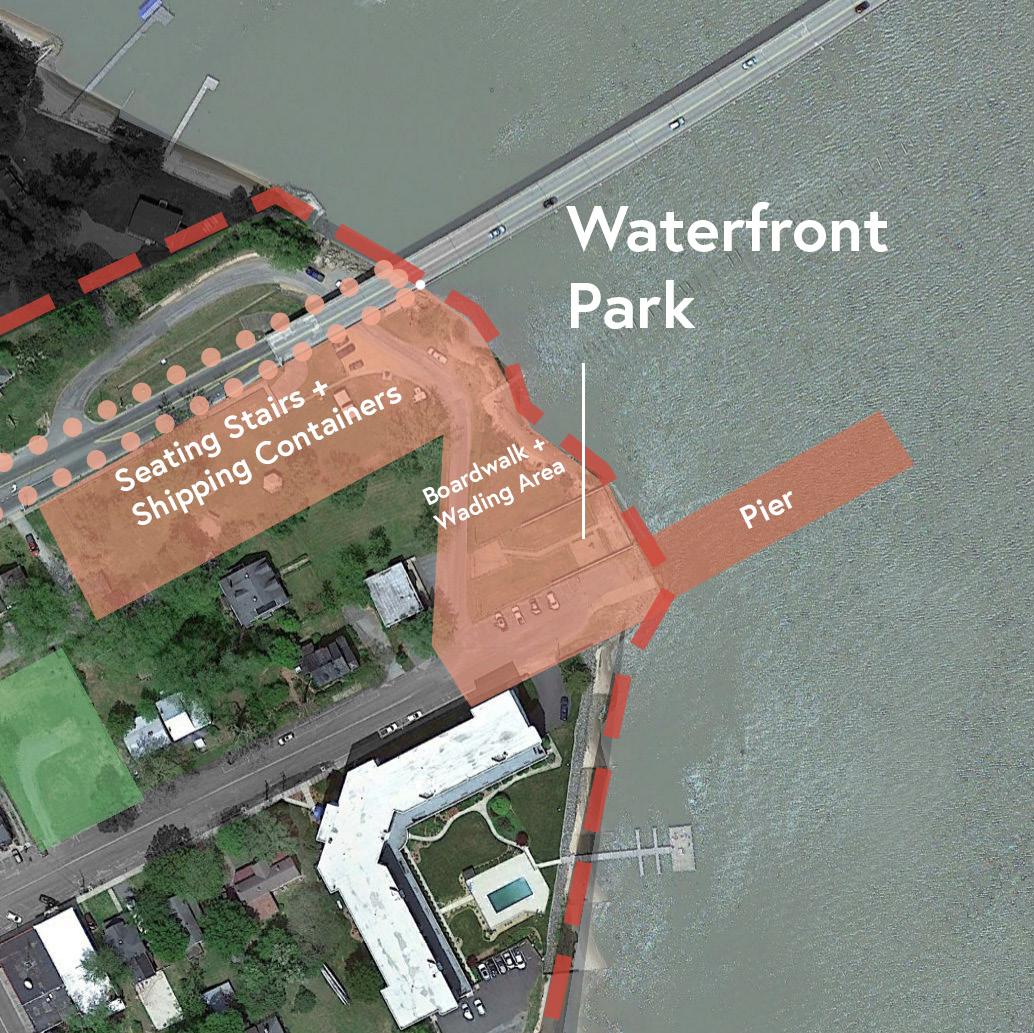
Prince Street terminates awkwardly with some parking spaces and a makeshift boat launch where it reaches the Rappahannock River. The Tappahannock Waterfront Park is improved with some covered picnic tables, a LOVE sign, and signage for the National Park Service Captain John Smith Trail. However, the water’s edge is unimproved with some rough beaches and the pilings of a former pier out into the water. Being next to the river affords amazing views, a pleasant climate during the summer, and a window into the history of Tappahannock’s growth.
Church & Queen are heavily utilized streets to pass through the Town. Currently, they are inhospitable to pedestrians and bicyclists and act as a loud barrier to access into the Downtown area. There are also many vacant businesses and no visual cues that encourage visitors to stop and enter the Downtown core area.
The recommendations for these sites, and for the larger downtown area should be thought of in terms of incremental change. Short term interventions to these sites focus on quickly implemented, affordable, and creative ideas. These allow the community to see an immediate impact without taking on the risk of larger investments that may come with unforeseen issues. They also can be a lot of fun and bring a sense of ownership to the community as new ideas such as cornhole, a bocce court, or other games and activities can be made with affordable materials and implemented in the street, changing the character from a lifeless thoroughfare to a more active heart of the Town. Long term interventions are generally expensive and require more careful planning. However, they are more permanent and made out of higher quality materials that improve the downtown and waterfront streetscape. By changing the downtown incrementally, trust can be facilitated with ongoing engagement. As the community sees new ideas implemented and eventual larger projects funded and completed, they can confidently see themselves in achieving the vision of Tappahannock’s downtown as a lively and vibrant place to spend time.
The overall strategy from downtown, informed by the survey and observational data, is to create a place that is active and full of life. In its current condition, the downtown area is generally underutilized outside of planned events and there is a desire in the community for more shopping and dining experiences, longer hours that businesses are open, and more entertaining activities. Another way of saying that the downtown area is lifeless is to say it has a weak “sense of place.” There is a generally weak identity to the downtown. To foster physical and emotional attachment, people must spend more time in the place and when they do so together as a community or with visitors, they strengthen the “sense of place.” Placemaking has emerged as a practice across the world to change the character of lifeless places and fill them with activities, art, food, seating, or any other possible intervention that helps bring people into public space. The Town is more able to affect what happens in its parks and public spaces immediately, rather than waiting for private development to fill in vacant parcels. Additionally, when the community sees new activity happening downtown, it may incentivize landowners to further redevelop their own properties to maximize the potential of downtown.
Redevelopment of the 200 Block of Prince Street.
Rebuilt Waterfront Pier
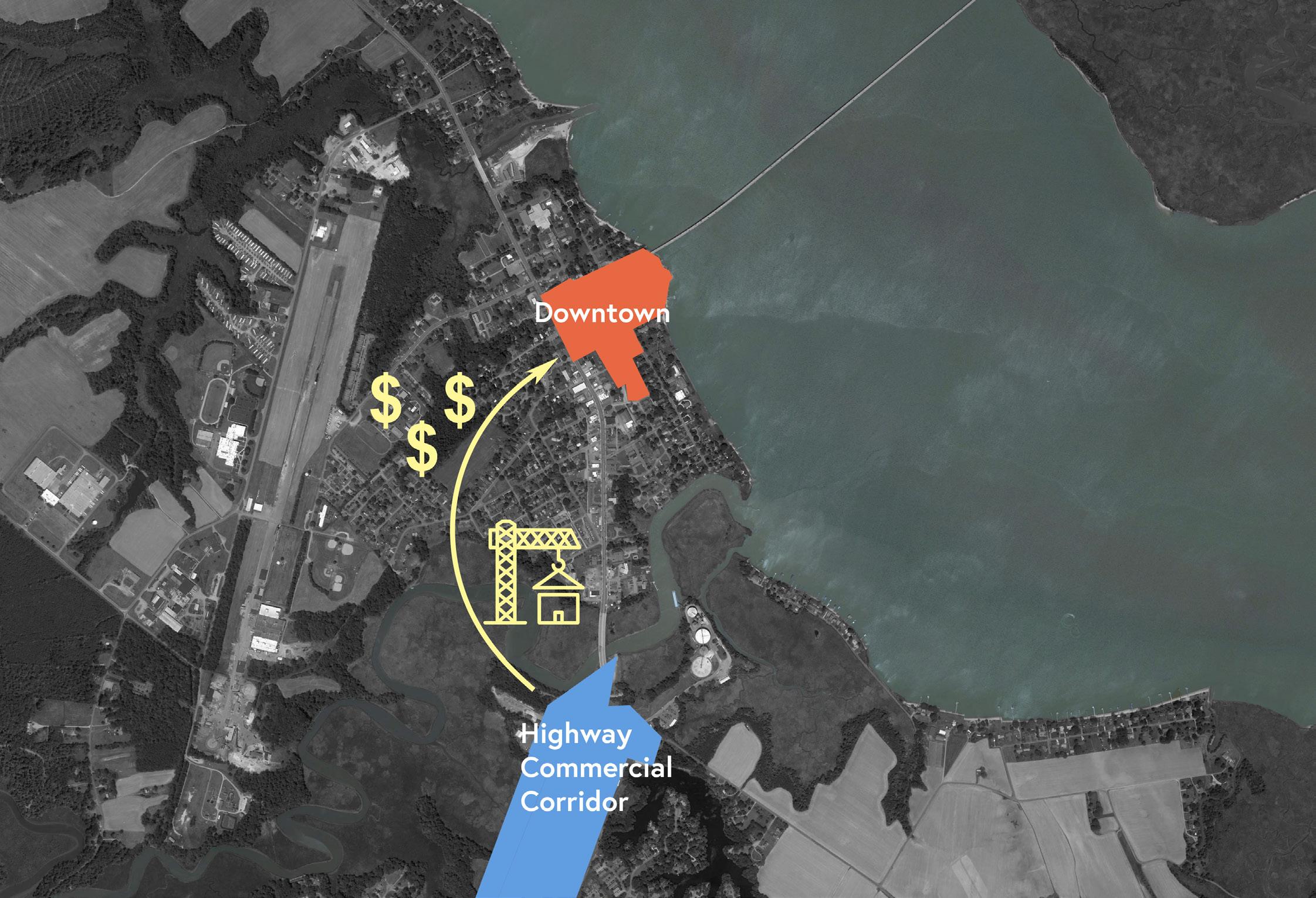
As Tappahannock grows, development should be ideally directed downtown, as opposed to autooriented development on the periphery of town. Vacant parcels and/or under-utilized parcels, such as surface parking lots, should be identified as potential sites for development. Town officials and partnering organizations, such as the Department of Housing and Community Development and the Middle Peninsula Planning District Commission, can study the viability of these parcels for development and identify financial incentives for developers. Concentrating development will be crucial in enhancing the walkability of downtown and bringing the center of economic activity away from the periphery back to the core of the Town. Adding density through infill development and adapting historic buildings for modern uses will be essential for revitalization. These techniques can be made difficult by outdated Zoning Ordinances and/or development standards, including setback requirements, parking minimums, and zoning districts that allow for little flexibility in use types.
Development regulations, especially the Zoning Ordinance should be reviewed to support sustainable growth in downtown Tappahannock that maintains and enhances the historic character of the area. For example, say a restaurant wants to open up and have a live performer play. An outdated Zoning Ordinance may classify this “entertainment use” separately from the “restaurant use,” making it legally difficult to allow. By auditing barriers to downtown development, the Town can further incentivize new growth.
The diagram below simplifies this strategy. While the highway commercial area provides many benefits to the Town, most of the money and time being spent in that area is time that could otherwise be spent Downtown. When future rezoning and development decisions are made, impacts to the viability of Downtown should be considered.
Downtown Tappahannock, and the town as a whole, requires a multimodal transportation network for residents and visitors to safely travel between destinations on foot, by bicycle, using public transportation, or by car, without any one mode dominating public space unsafely. Key pedestrian corridors should feature clearly marked street crossings, starting first with painted curb extensions. These low-cost improvements should be followed by long-term infrastructure changes, such as wider sidewalks, new pedestrian-scale LED lighting, vegetated “bump outs,” and pedestrian wayfinding signs. Simple, yet attractive bicycle parking should be installed in front of major public spaces and businesses. Temporary bicycle parking can be made using heavy steel bases and pipes as the capacity of and locations for permanent bicycle parking facilities are determined. Temporary bicycle paths into downtown can be made using cones and replaced later upgraded to more permanent infrastructure with street markings and protective bollards. As downtown Tappahannock continues to develop,
studies should be conducted to help inform bus service connecting downtown to residential areas of town or other parts of the county. Easy car travel into downtown will be maintained; however, a key element of revitalization efforts is getting people out of their cars to walk throughout the streets. As such, some of the space dedicated to cars will be dedicated to other transportation modes, such as parking spaces that are turned into parklets for seating and/ or outdoor displays and surface parking lots that are used for public gathering spaces. Long term, parking lots should be consolidated to the edge of downtown, and noise mitigation through landscaping and development can “shield” downtown from Church and Queen Street traffic.
The image below displays the distances of 0.5 miles and 1.5 miles. This is about a 5-10 minute walk, or a 6-8 minute bike ride depending on the speed of the rider. The Downtown core is located centrally with almost all Tappahannock residents within comfortable, easy, and convenient distance if infrastructure is improved.
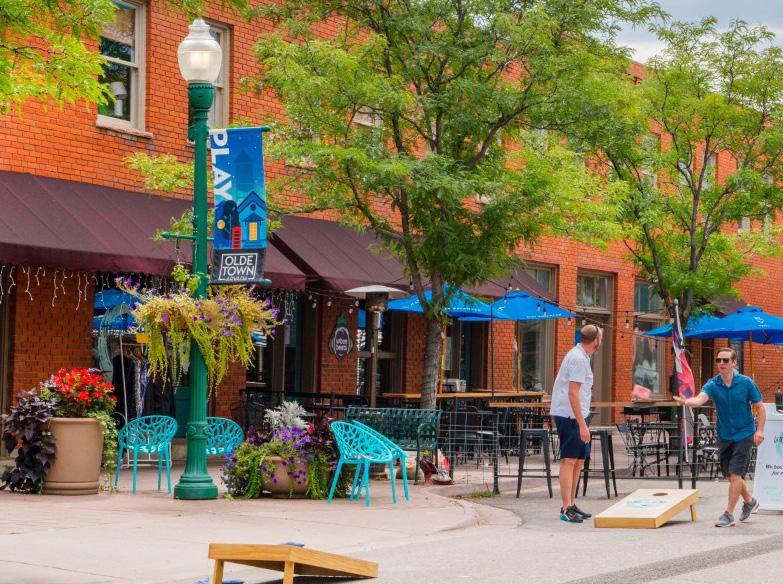
With these priorities, Tappahannock will join communities around the world in their efforts to become more economically prosperous, environmentally friendly, safe, and enjoyable as a social and attractive downtown. Through “Placemaking” and related initiatives that improve the built environment, places around the world are becoming more “people-friendly” and inviting longer stays.
Image 1: Arvada, Colorado redeveloped their main street into a pedestrian thoroughfare. Today, restaurants and shops spill out onto the sidewalk and games, such as cornhole, are available for play. Image Credit: The Denver Post.
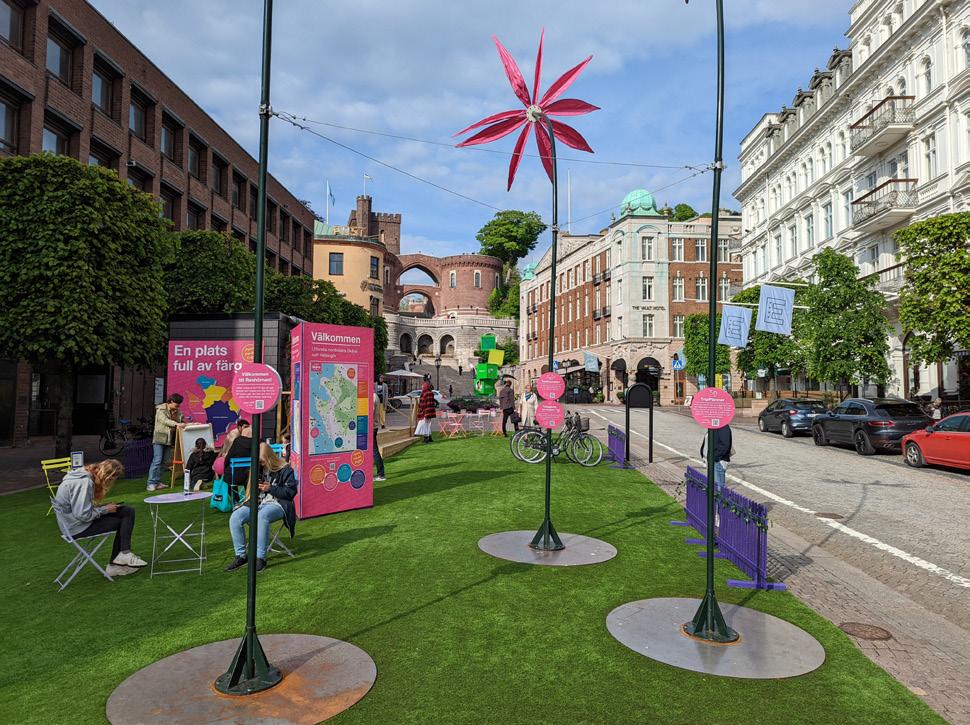
Image 2: The City of Helsingborg, Sweden, is activating its streets and former parking spaces by rolling out the astro-turf and implementing temporary play elements, seating, and colorful art and signage to inform the public about the City’s ongoing projects as well as information about things to do in the region.
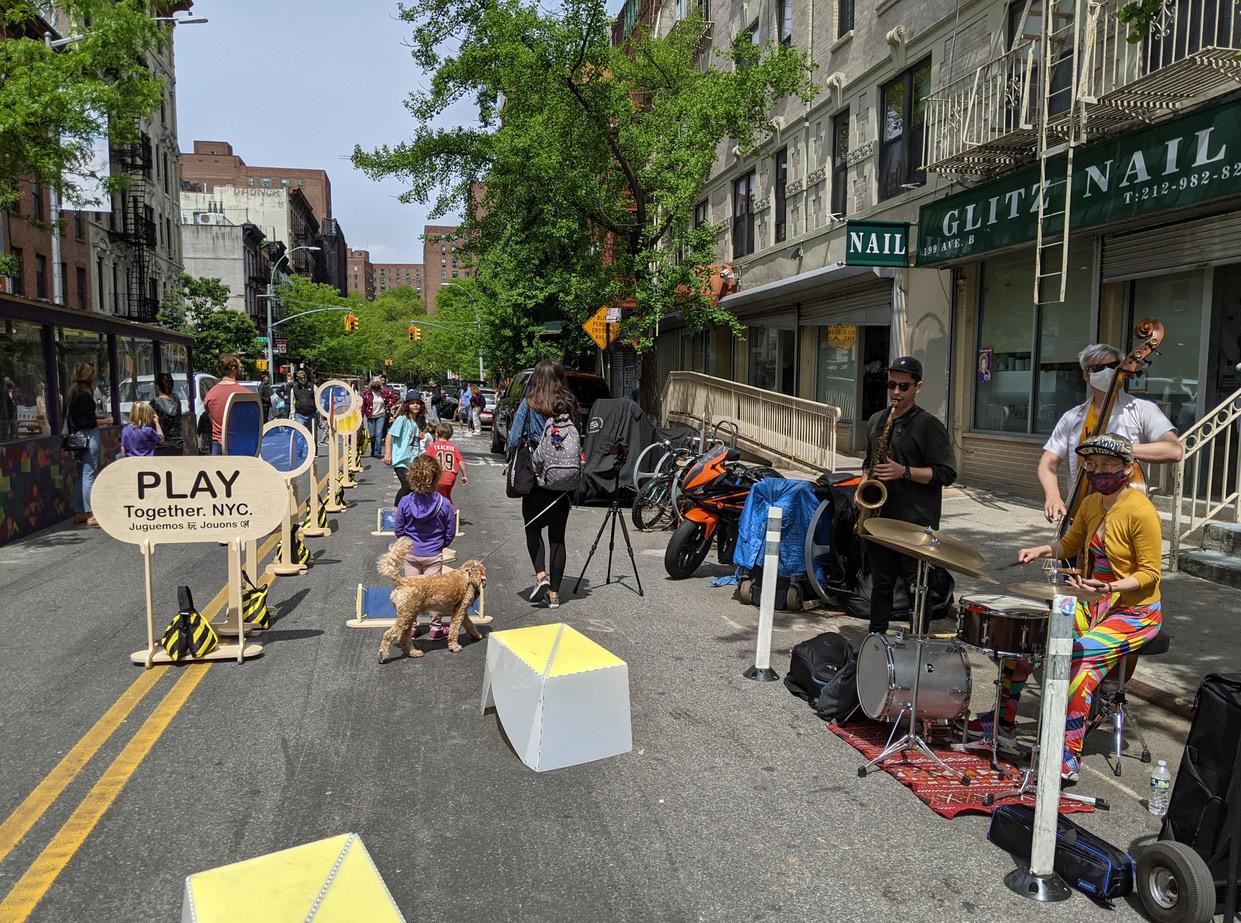
Image 3: The Avenue B Open Street in Manhattan, hosted by the Loisaida Open Streets Community Coalition as part of PLAY NYC offers a colorful obstacle course that offers safe, hands-free play for children on newly closed off streets. A local jazz band plays while the community strolls by. Image Credit: Street Lab
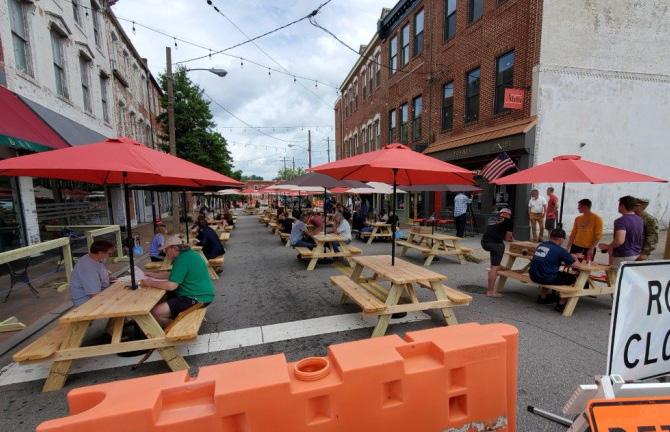
Image 4: Although now removed, Petersburg, Virginia reacted quickly during the pandemic to implement rows of picnic tables and umbrellas on a closed street to support their restaurants and create an instant food court. With the addition of string lights, the atmosphere helped continue to bring people downtown and patronizing businesses. Image Credit: ABC 8 News
1
2
3
4
If all goes according to plan, with necessary adjustments to meet Tappahannock’s needs, there will be a quantifiable difference in the Downtown area. Metrics such as the number of pedestrians, bicyclists, local sales, hotel reservations, length of stays, distance visitors have traveled, number of new businesses opening, and more all become indicators of increasing success. The qualitative difference will be felt in a more comfortable environment with increased shade, less noise from automobiles, or new places to sit and enjoy the waterfront. This plan works to re-orient Downtown from simply being a transactional space of parking, shopping, and leaving, to one that feels like an extension of home and a place to meet others.
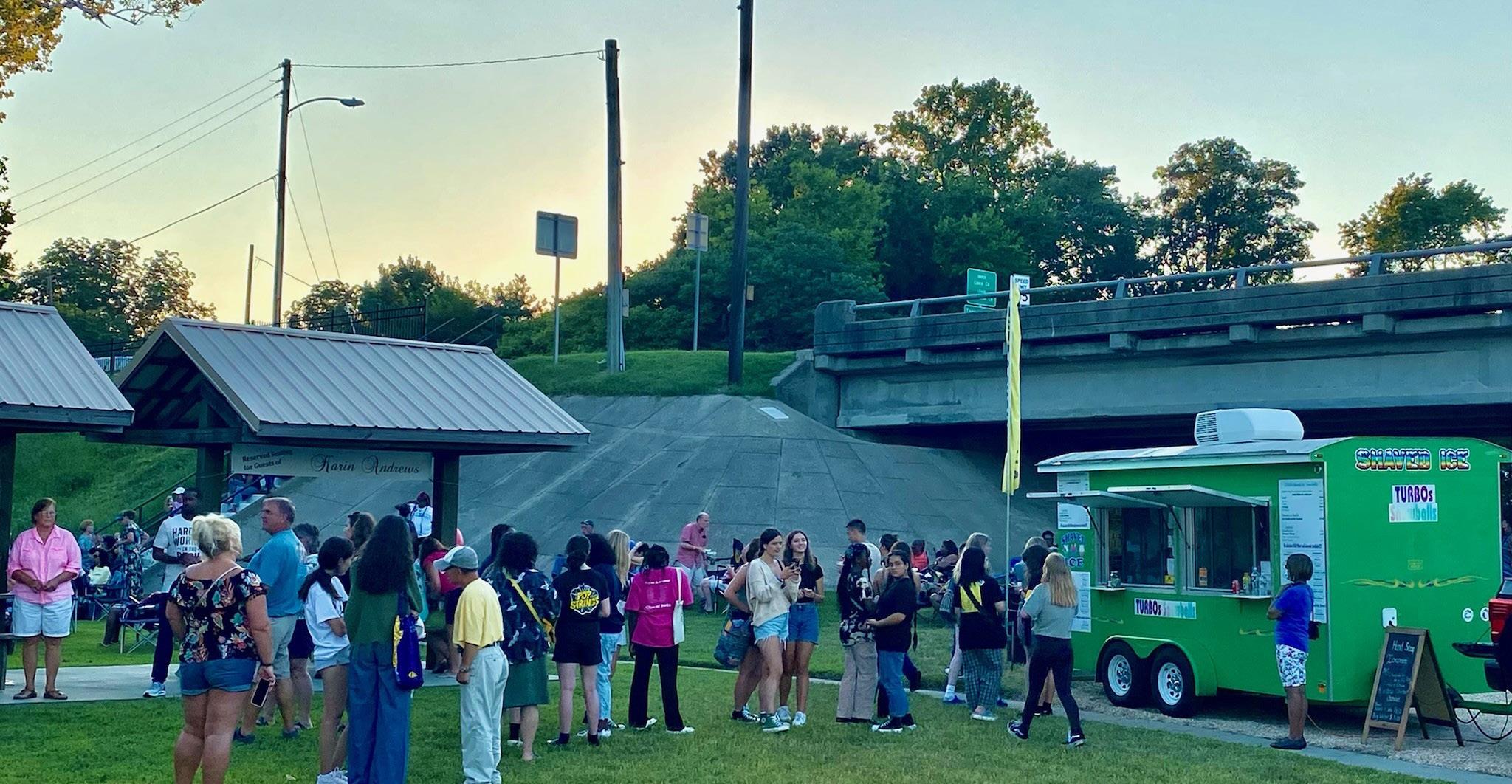
3rd Thursday
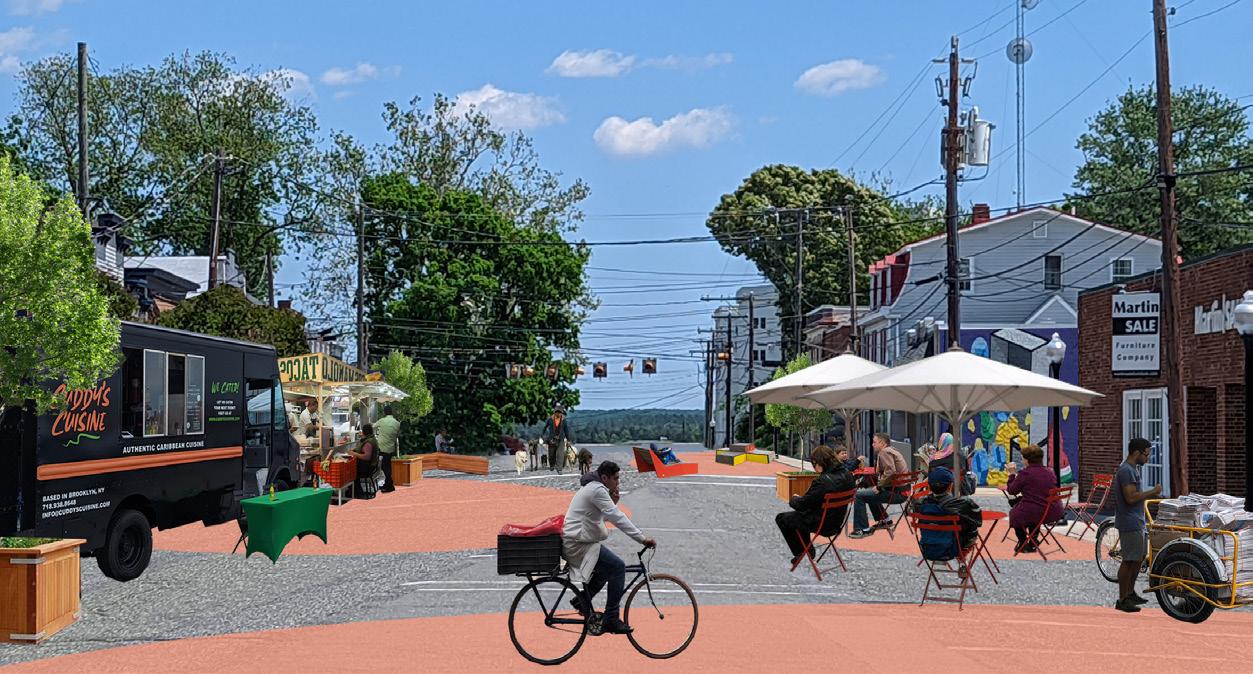
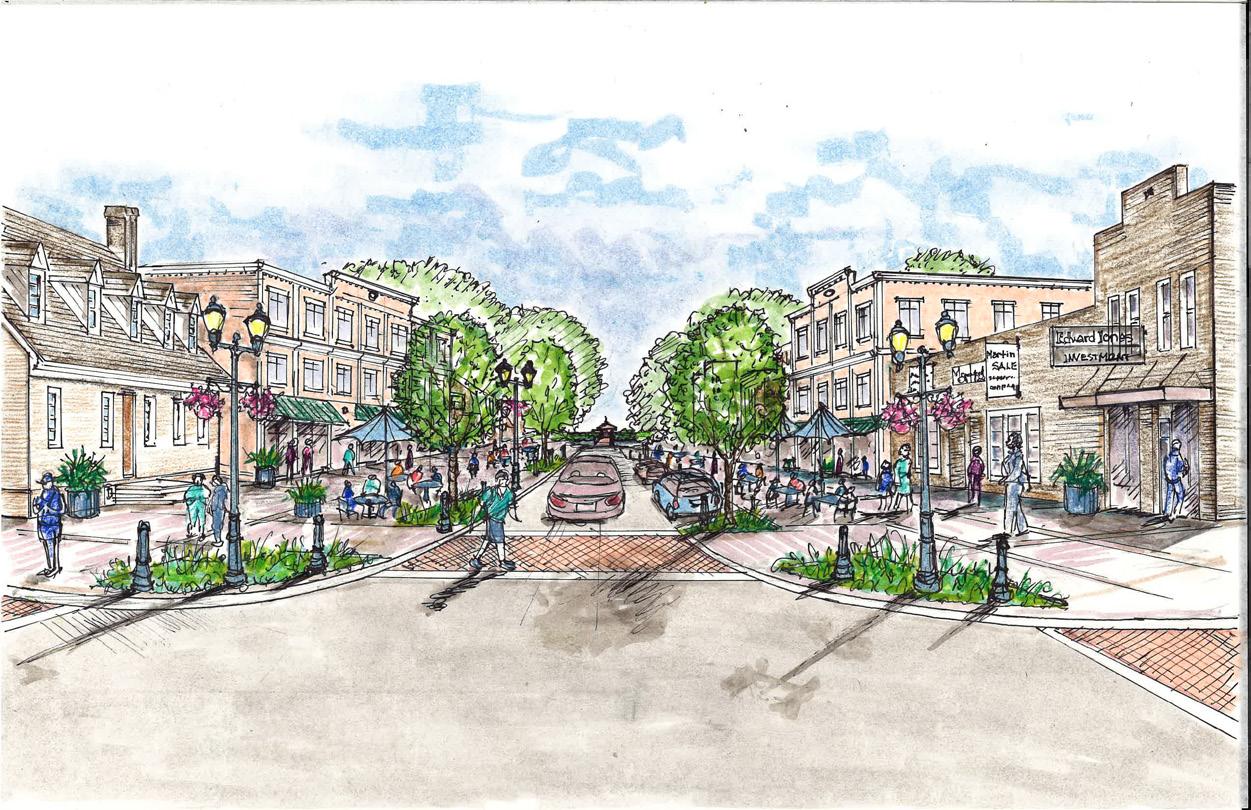
In the future: As the heart of Downtown, Prince Street is reimagined into a pedestrian and bicycle friendly avenue. There are new seating elements, umbrellas, planters full of trees and flowers. New bicycle corrals are easily identified for use. Food Trucks and other vendors are invited to occupy space on the Main Street. There is a strong vision for many small storefronts with apartment buildings in new mixed use development over the site of the fire. New murals on blank walls and the asphalt bring color to the space. Cars are able to slowly traverse the site as guests in the new public space. Over time, improvements to the space are made more permanent. Wider sidewalks, new lighting elements, public art, or other hard infrastructure is implemented to further make the street more green, people-friendly, and active.
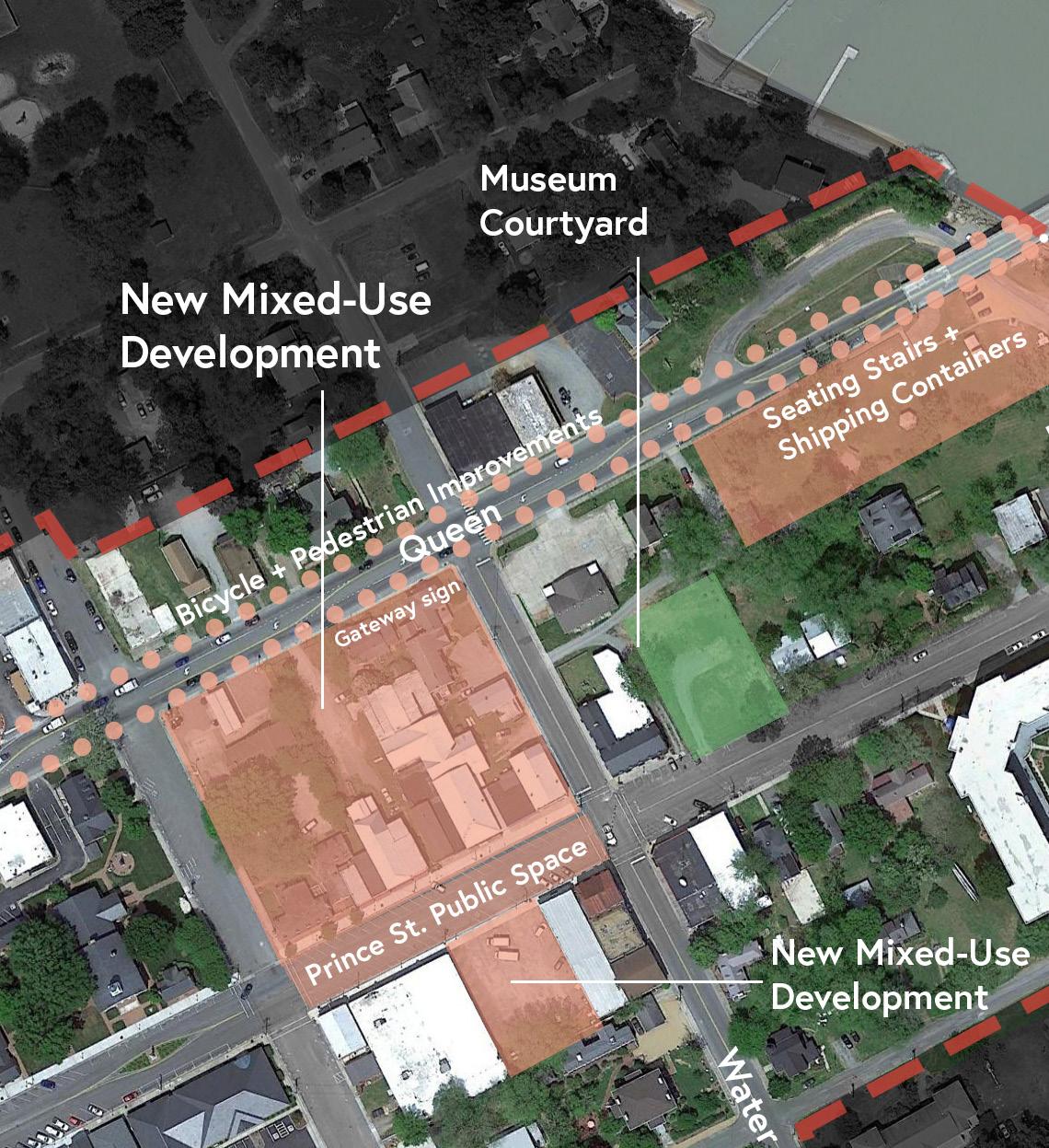
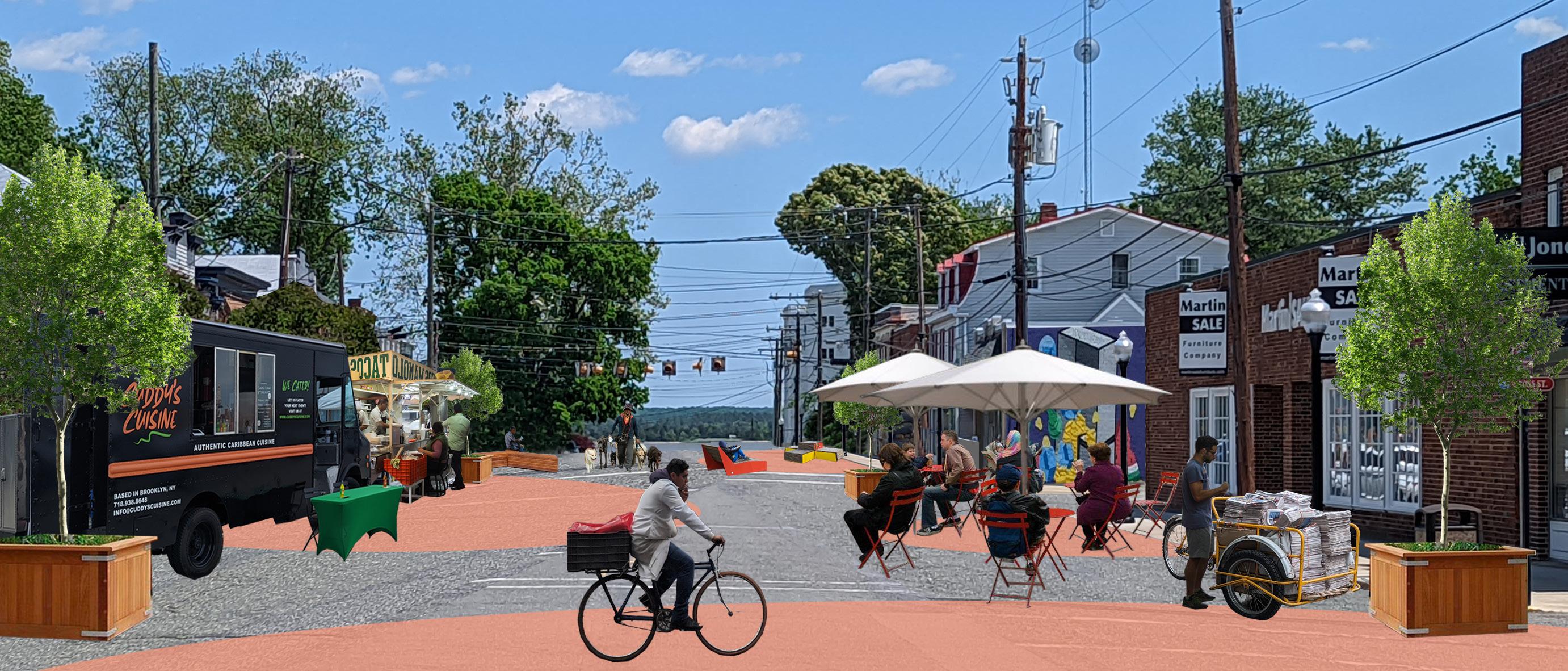
1. Implement planters of varying sizes with native flowers and trees.
a. Planters should be located to protect newly implemented seating areas or activities in the street.
2. Coordinate with VDOT to explore painting the asphalt with murals or other colors.
a. The selected colors should be generally lighter in tone to reflect light and vibrant.
b. The design should be generally consistent through the whole street, such as stripes, polka dots, or flowers.
3. Create standing frames to exhibit local art as well as information about the street transformation to the public.
a. Official Tappahannock Government and Tappahannock Main Street branding should be used to communicate.
4. Outdoor street furniture should be procured and implemented in clusters down the street.
a. This may include wooden structures made out of pallets or other materials to create benches or other seating elements.
b. Umbrellas and movable cafe tables and chairs should be procured and implemented in clusters, preferably in a uniform color for branding.
5. Activate the street with temporary vendors and activities.
a. Allow for food trucks to set up along Prince Street, particularly in front of the 200 block as an interim use. Other vendors from events, such as the Farmers Market, could also be invited.
b. Procure or construct new games and activities, such as hopscotch, street checkers or chess, cornhole, bocce courts, or any other possible new activity for the street.
6. Create a volunteer corps to assist in the painting, construction, and ongoing maintenance of Prince Street and the Waterfront Park. These efforts should engage and be led by historically marginalized groups.
7. Provide Town funds and seek outside grant funding where possible to continually implement various aspects of the overall plan.
8. Amend the Town’s Zoning Ordinance and Future Land Use Map for a new mixed-use zone permissive of increased density and encouraging of high quality architectural detailing.
a. There should be as many small storefronts along the 200 block of Prince Street as possible to accommodate local businesses and create activity for the downtown.
b. Increased density provides the opportunity for quality architecture that can draw attention from people passing through Town to the downtown area. Taller buildings also can act as a barrier to noise pollution.
c. Interior courtyards in the block semiaccessible to the public can provide additional space for businesses or residential amenities.
9. Public restroom facilities should be implemented and maintained where possible along the Prince Street.
1. Widen sidewalks to 6 feet down the length of Prince Street.
a. Explore the feasibility of a “shared surface” in front of Prince Street’s 200 block that could be blocked with bollards to make a public plaza.
2. In addition to improving street lights, explore working with a lighting designer to create interesting or interactive street lighting installations for the street. Consider solar-powered options.
3. Re-paint all crosswalks along Prince Street, implement curb “bump outs” at all intersections to provide for pedestrian safety.
4. Replace less durable material planters or seating elements with more permanent materials.
5. Implement public art such as murals and sculpture along Prince Street.
6. Research and pursue funding opportunities to continually implement various aspects of the overall plan.
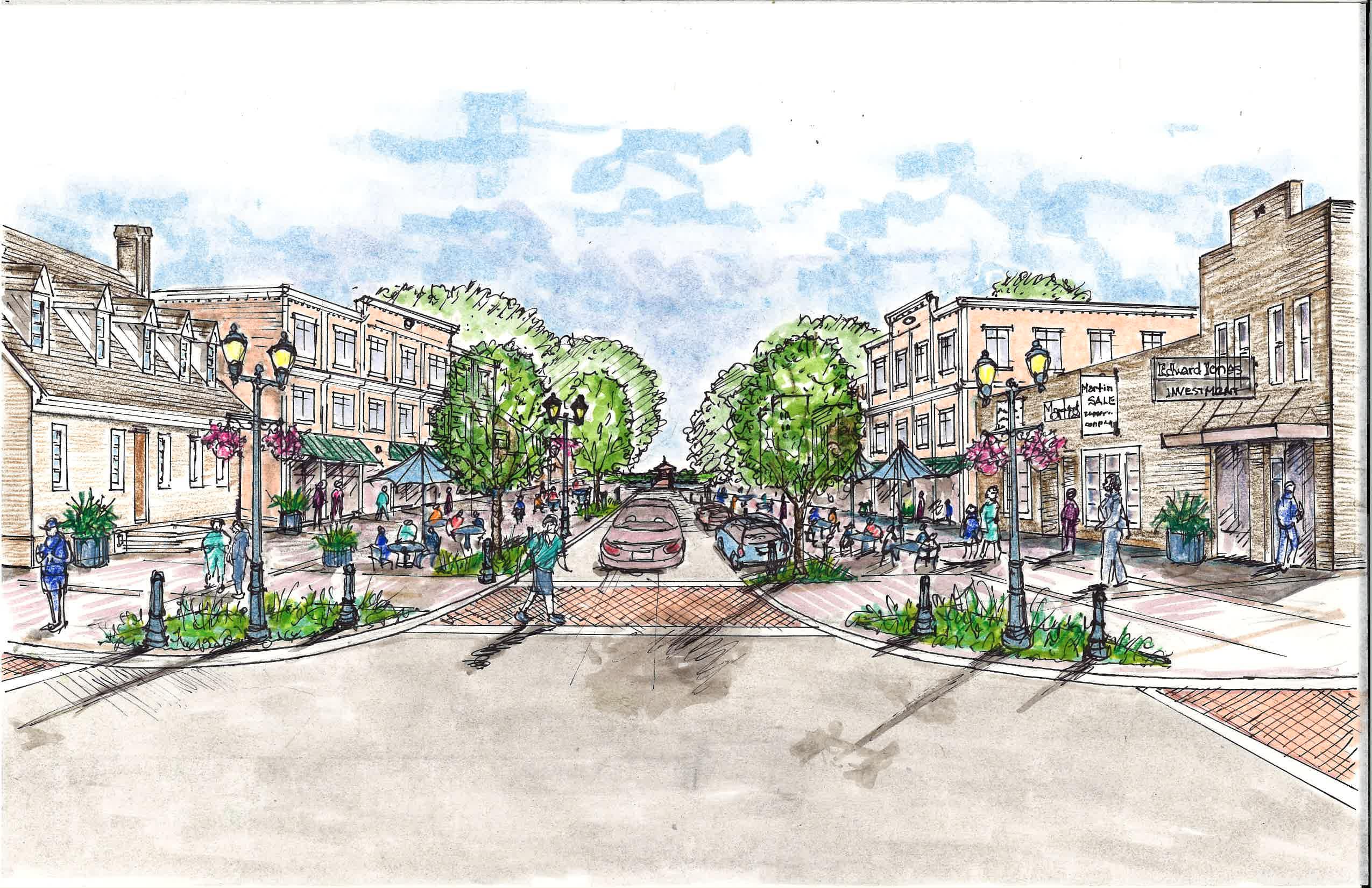
This is a conceptual illustration depicting what future amenities, infrastructure, and new development in the Prince Street area may look like in the future.
In the future: The Rappahannock River Park is improved with generous new amenities. There is a new adventure-playground structure with various imaginative elements. New types of varied seating areas are found throughout the park, and there are spaces for other games and activities. There is a small amphitheater equipped with outdoor Bluetooth enabled speakers. The water’s edge features a new boardwalk with seating stairs down to the water’s surface. There are new “living shoreline” protections implemented to prevent erosion and enhance environmental quality.
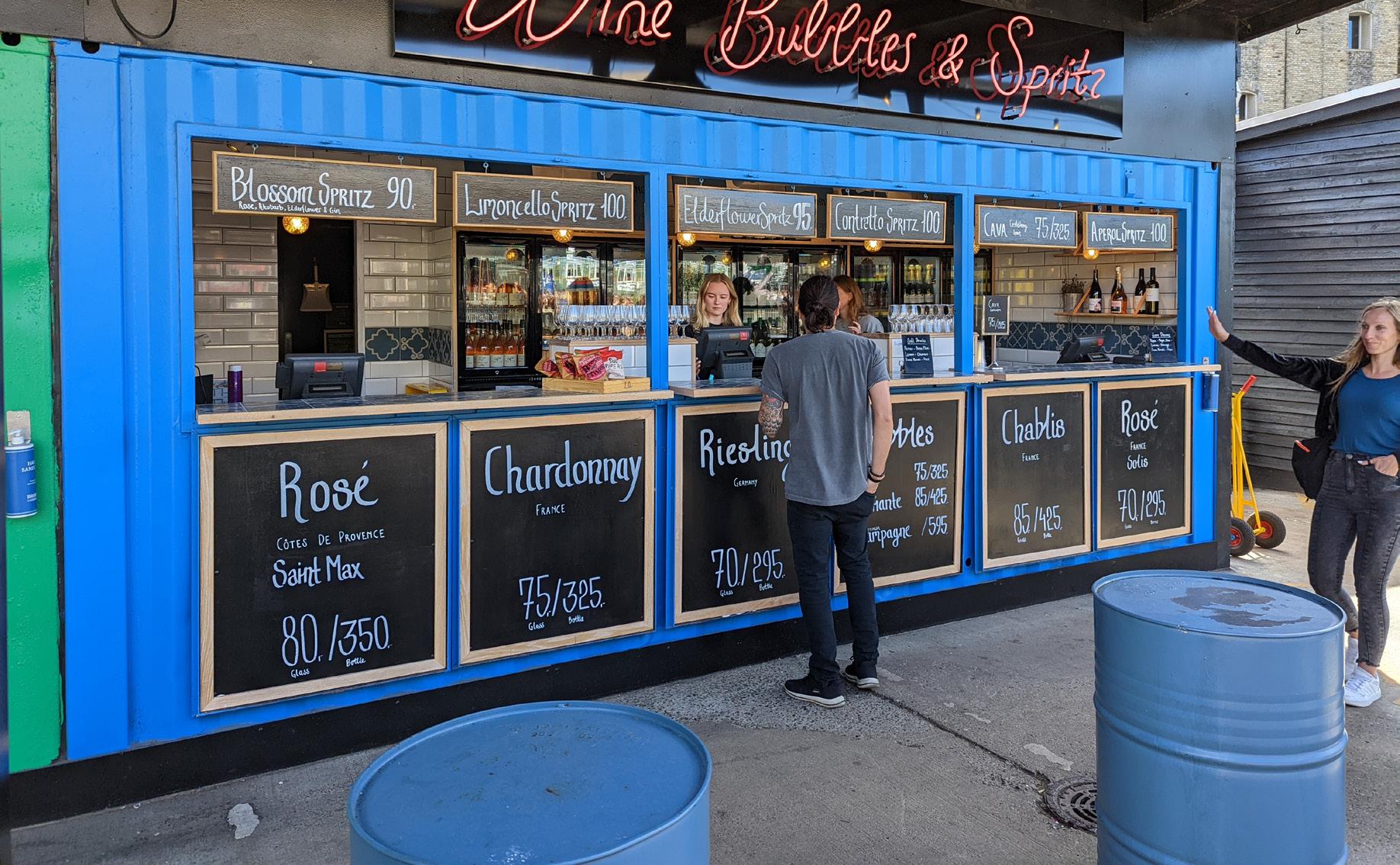
At the rear of the Tappahannock River Park, or at the end of Prince Street, yet away from the water’s edge, there are new retrofitted shipping container structures serving exciting foods, such as oysters from the Rappahannock River itself. The end of Prince Street terminates at the future site of a new pier, with space for fishing, sightseeing, and space for a kayak rental.
1. Seek funding for the design and construction of a new playground structure at the park.
a. Prioritize “adventure play” designs that are additionally suitable for children of slightly older ages as well as younger children.
b. Playspaces can be combined with educational elements about the local environment.
2. Procure and implement new seating varied, colorful, and creative seating elements, such as moveable cafe chairs, wooden reclining seats or benches, or public hammocks.
3. Secure funding for the design and construction of a small amphitheater and platform, as well as amenities such as a public Bluetooth speaker.
4. Secure funding for the design and implementation of “living shoreline” protections for the water’s edge.
6. Coordinate with the Virginia Department of Transportation the abandonment of the end of the Prince Street and Newbill Drive right-of-way.
7. Invite Food Trucks to occupy the parking spaces at the end of Prince Street, particularly during typical Lunch and Dinner hours and on weekends.
8. Seek funding for the implementation of creatively designed lighting installations.
1. Seek funding for design and construction of a small boardwalk with seating stair elements at the water’s edge.
2. Secure funding for the design and construction of a pier structure and kayak launch at the end of Prince Street.
3. Procure, design, and implement 2-3 retrofitted shipping containers at the end of Prince Street, yet away from the water’s edge or at the rear of the Waterfront Park.
a. Seek tenants for these containers that offer cuisine not available in Town, or can be an extension of an existing local business.
b. Local fare, such as oysters from the Rappahannock, can help build on sense of place.
4. Once the end of the end of Prince Street is abandoned, explore changing the materials of the ground cover from asphalt to include more landscaping, “living shoreline” elements, and pedestrian friendly pavers.
5. Public restroom facilities should be funded, constructed and maintained to encourage longer stays in the space.
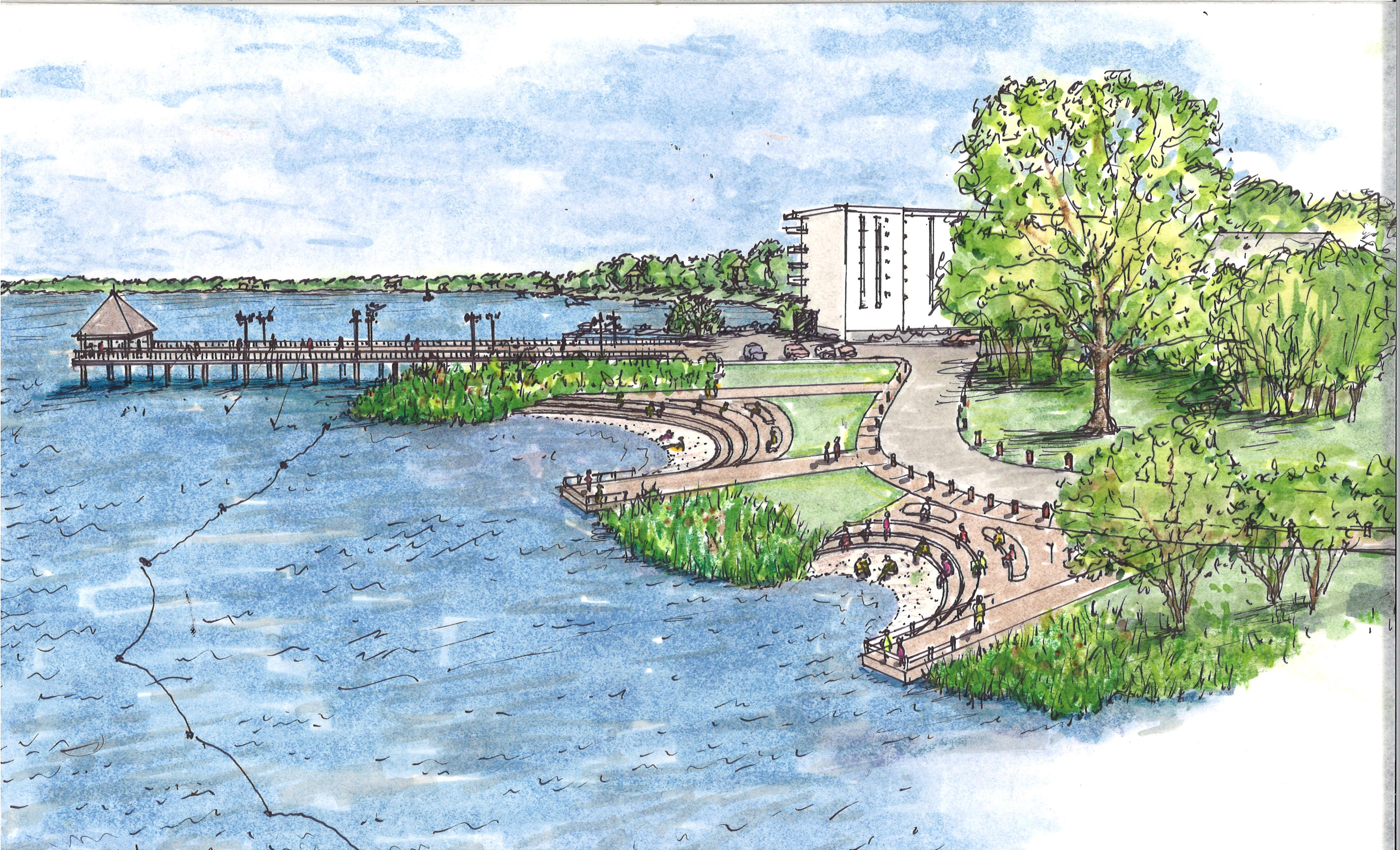
Parking Observation Jetty
This is a conceptual illustration depicting what future amenities and infrastructure in the Waterfront area may look like in the future.
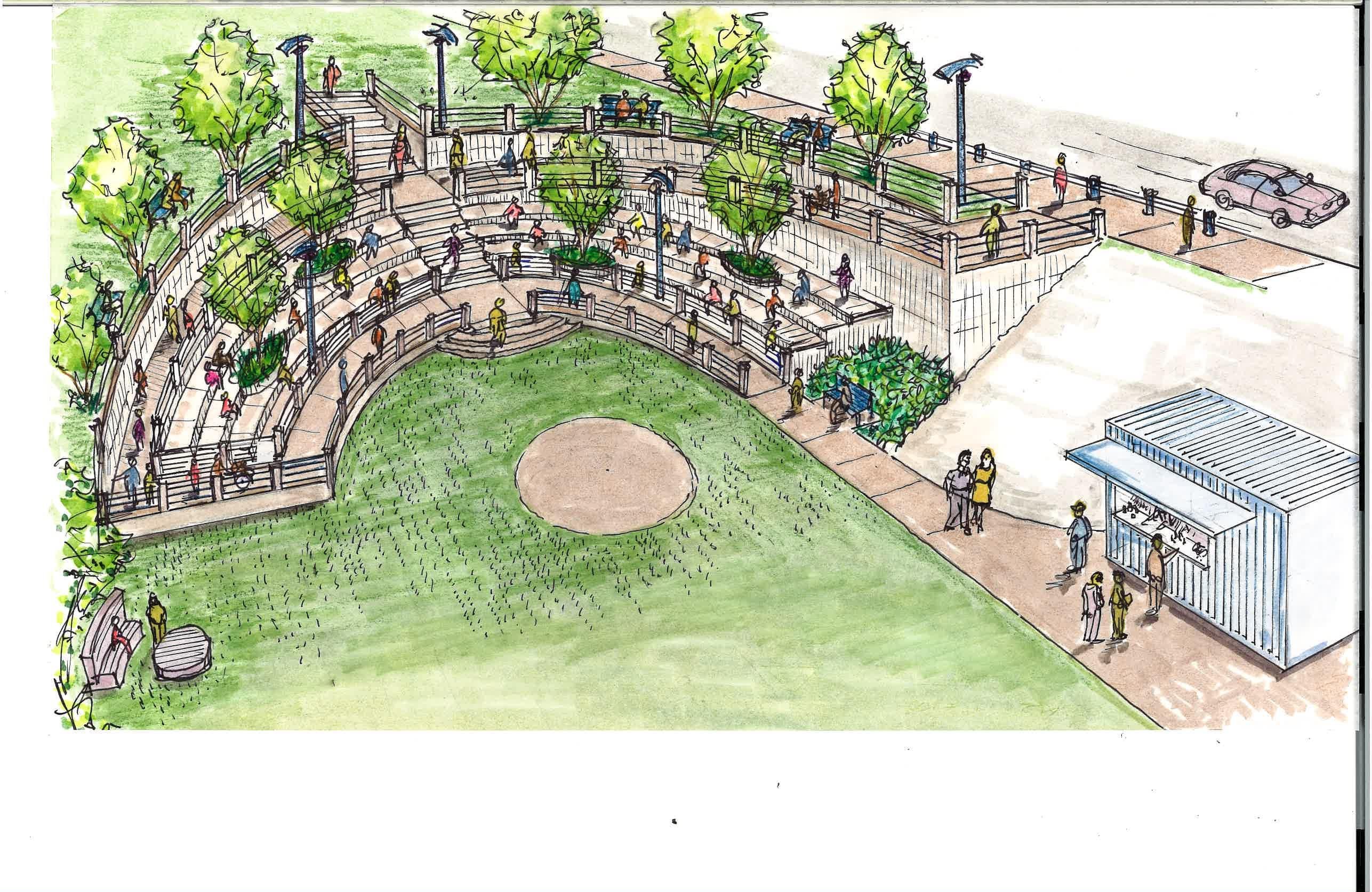
This is a conceptual illustration depicting what future amenities and infrastructure in the Waterfront area may look like in the future.
In the future: Queen Street and Church Lane are highly utilized roadways through the Town of Tappahannock, generating many trips per day. Despite this character, the narrow street right-of-way and shallow setbacks of buildings along the street show evidence of the corridor’s importance to the local economy. The future of Queen and Church streets is one that features wide sidewalks for pedestrians, with safe crossing points and traffic calming measures, that allow the community to easily make their way into the Downtown area. There are many businesses located along the corridor that can be accessed as easily by walking and bicycling as they are by car. Traffic calming helps reduce the noise from car and truck traffic. While not the core of Tappahannock’s Downtown, these streets no longer act as a barrier. Vacant and underutilized parcels begin to see infill development. At the intersections of Queen and Water streets and Prince and Church streets, there are new landscaping, signage, landscaping, and art, redevelopment of corner parcels enhances the aesthetics and draws potential visitors into the Downtown core.
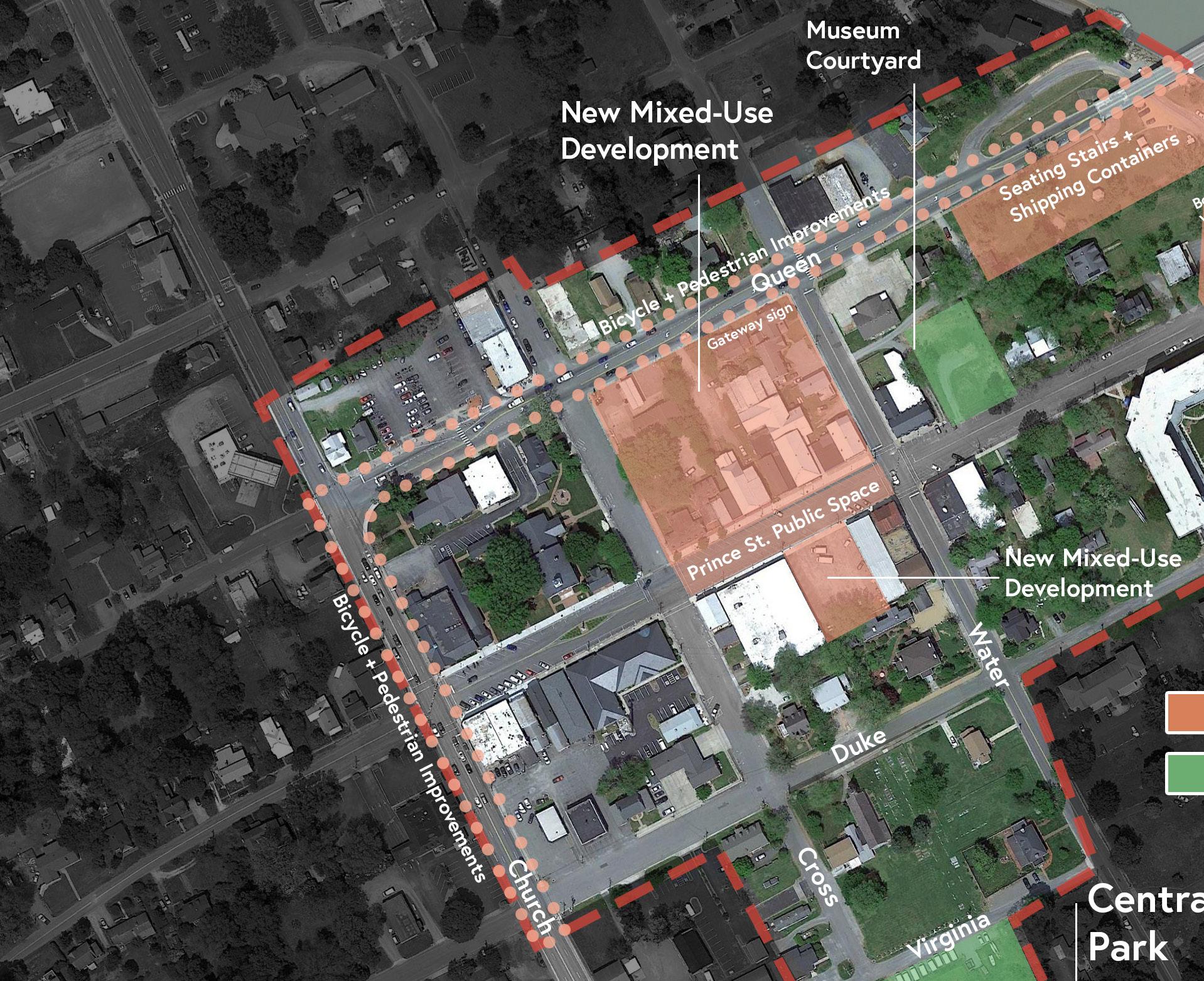
1. Invest in public art or other gateway signage for the Downtown to be located at the intersection of Queen and Water Street and/or Prince and Church Street.
2. Maintain existing landscaping and plan for new landscaping along Queen and Church Street where needed.
3. Follow and give input to Virginia Department of Transportation plans regarding any redesign of Queen and Church Street, ensuring that there are safe and comfortable accommodations for bicycles and pedestrians.
a. Many parcels along these streets feature narrow sidewalks or they are too narrow where existing.
b. Mid-block crosswalks exist, but do not have any curb extensions or additional lighting to allow pedestrians to cross with priority.
c. The intersection of Queen and Church streets has incomplete crosswalks across the intersection, these need to be painted with blocks for visibility and cross all four sides.
4. Buildings are generally in good condition along these streets, however, there are some windows that could be replaced and vacant commercial units to be filled. Signage is currently auto-oriented in scale,
and could be consolidated or made pedestrian scale. Many of the buildings are generally white, beige, or brick. Repainting this area with color could bring more visual interest.
1. Ensure that Virginia Department of Transportation improvements to the Downtown area and along Queen and Church Street greatly improve safety and comfort for pedestrians and bicyclists.
2. Assist businesses with improving their facades with color or accessory improvements, such as canopies or outdoor seating areas.
3. Assess the Zoning regulations and Development Standards of the area to encourage mixed use redevelopment of vacant and underutilized parcels.
a. Reform minimum parking standards to allow new development to mimic the traditional form of buildings along Prince Street.
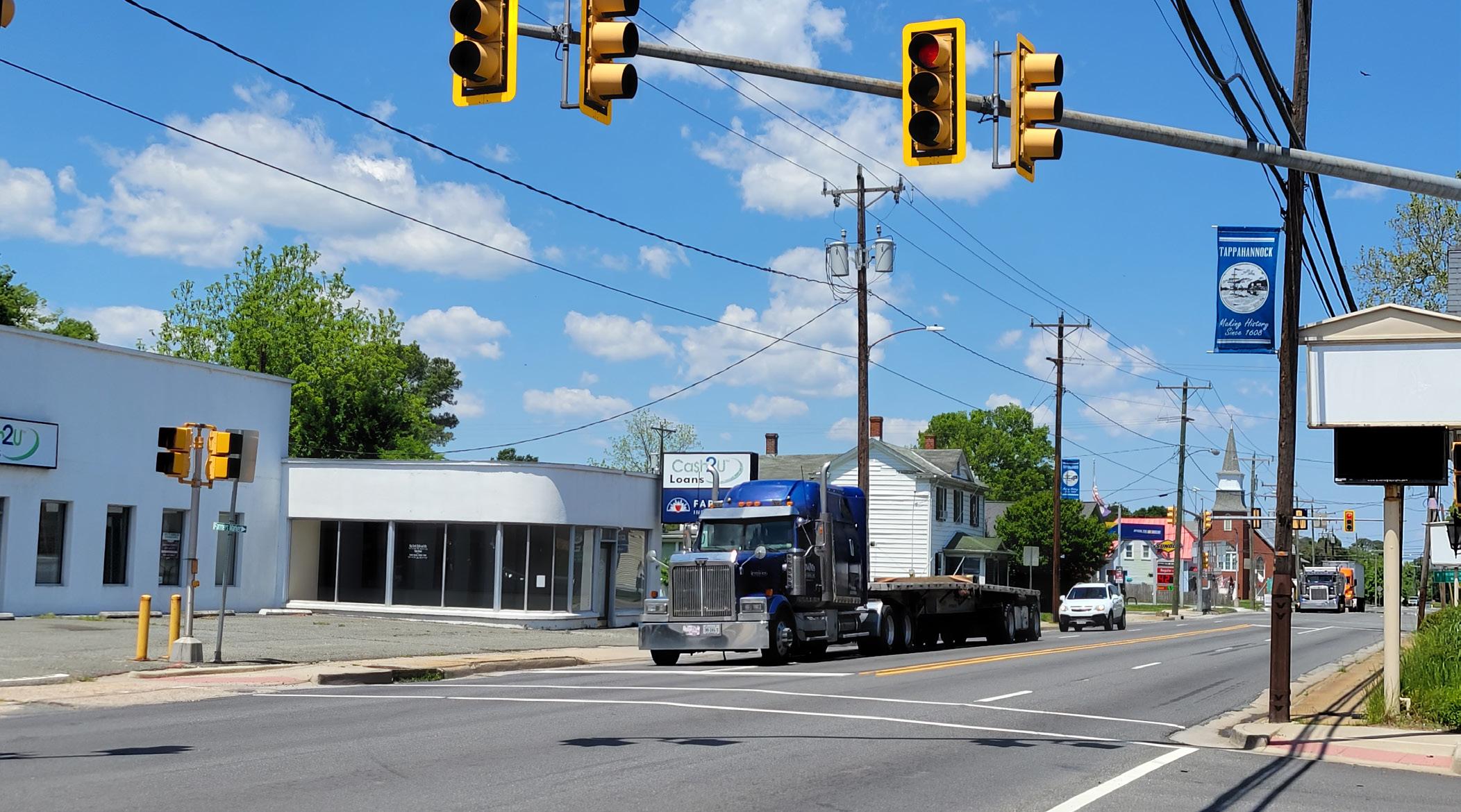
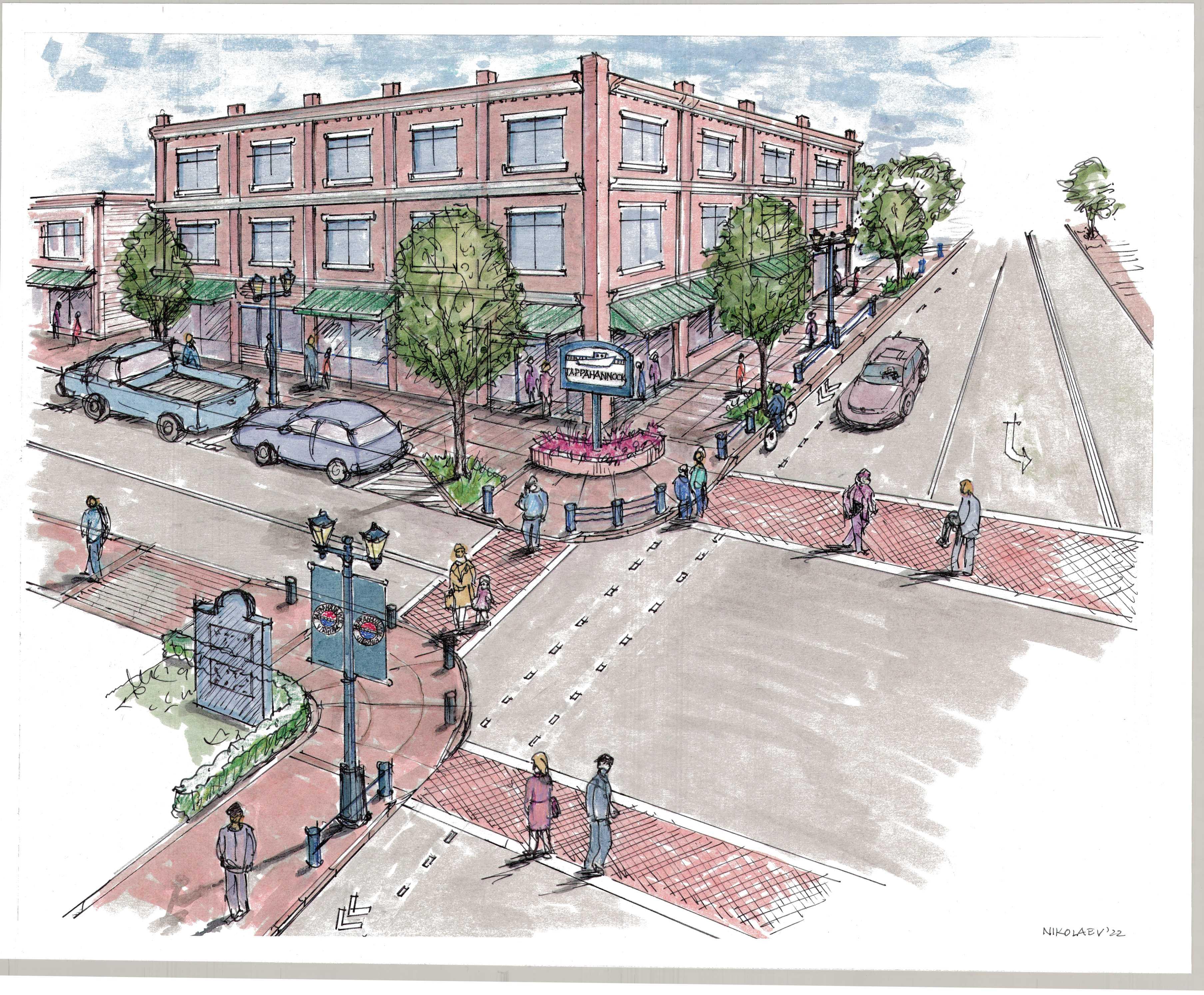
This is a conceptual illustration depicting what future amenities, infrastructure, and new development in the Queen Street area may look like in the future.
“Tappahannock’s downtown is charming and vibrant, alive with locals and visitors alike. There are diverse experiences, opportunities, and reasons to stay and enjoy every moment.”
- Downtown Vision Statement, Economic Restructuring Plan
Through discussions with stakeholders and reviewing the public input data gathered as part of the economic restructuring plan, as well as obsservations of the Town through site visits, impressions were developed about the community to help inform the “brand.”
Tappahannock is a historic Town, featuring a significant stock of contributing buildings that give character to the downtown area. It is also a waterfront community, with an economic history clearly tied to the Rappahannock River. The Town functions as the “heart” of the area, particularly for the surrounding Essex County, acting as a center for economic, cultural, and social life.
The Town enjoys many active events that bring the community and visitors together throughout the year. However, during the average day, there are not many visitors to the downtown area that are not there for the Essex Courthouse or the handful of businesses lining Prince Street. The Downtown Revitalization Plan seeks to strategically realign planning decisions in the downtown area regarding public spaces by replacing parking spaces and asphalt with amenities and temporary uses, as well as encouraging infill development and reuse of vacant properties.
This plan seeks to attract more people to take advantage of Tappahannock’s beautiful location on the Rappahannock River to boost the economy, foster community and stewardship, and build social ties that will make the Town an even better place to live.
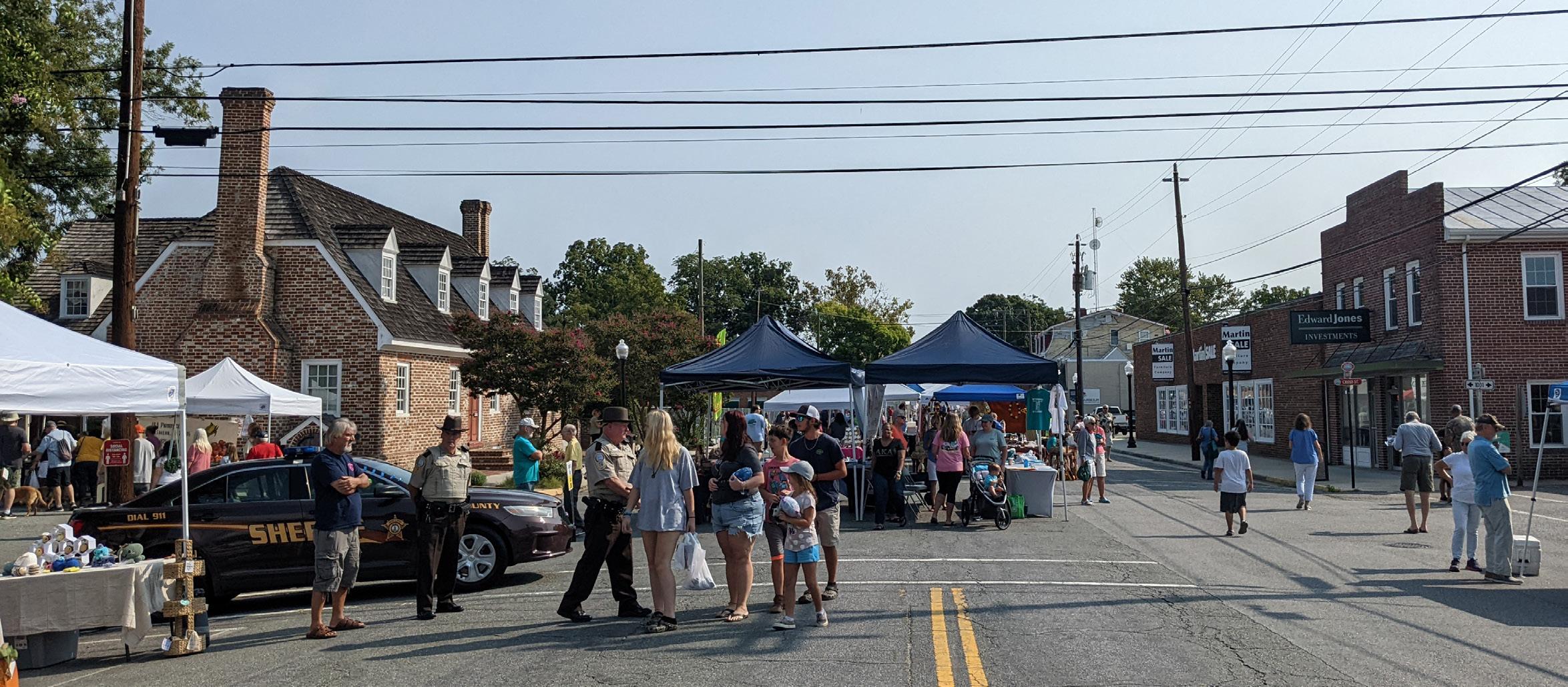
The following themes are where inspiration has been drawn for the branding and marketing materials found in this plan.
Human beings have been drawn to bodies of water for many reasons. In Tappahannock, it has long been a driver of the local economy, a source of food, an aesthetically beautiful amenity, and a place for recreation. Environmentally based tourism is also a potential area of growth for the Town.
The diversity and strength of social bonds in Town are celebrated in the many regular events throughout the year. This was also evident during the major fire in July 2022, when the Town came together to raise money to support those in need.
From “Tappahannock’s” Algonquin origins through the many eras of history visible through the significant stock of historic buildings in the downtown area contributing to its National Register of Historic Places designation, the Town has significant character.
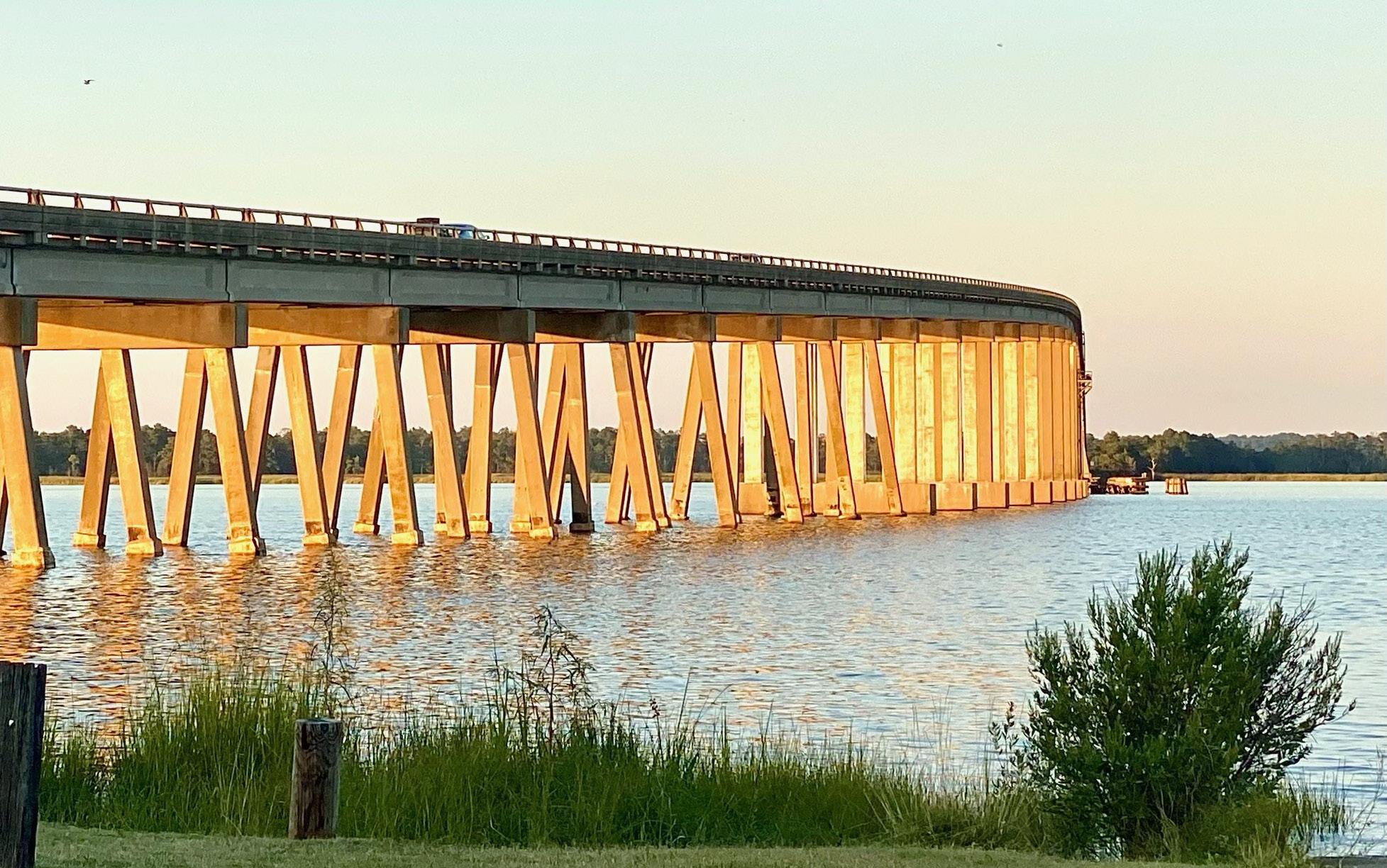
Some of the existing logos around Town are displayed. They feature different colors, symbols, and messages. As they represent different organizations, it is understandable, however, to the casual observer or potential visitor from outside the communnity, it can be unclear “who is resposible for what.”
The Town adopted this new circular logo in 2021, featuring red skies and blue water overlayed with the tidal charts of the Rappahannock River and the Downing Bridge. The font is reminiscent of those used to advertise riverboats, in keeping with the Town’s long history. The logo is displayed prominently on the Town’s website and gateway “Welcome to Tappahannock” signs. The logo is also used on Town vehicles and stationary letterhead as the “official logo.”
This logo features different shades of blue with an orange ring, the silhouette of an osprey, and sans serif fonts. The slogans “Life at a River’s Pace,” “Shop Discover Dine,” and “Est. 1682” are displayed. Main Street is a non-profit responsible for running the Town’s events, such as 3rd Thursdays and the Farmers’ Markets, as well as advertising the local businesses, experiences, and history of the area. The organization is an affiliate of the national Main Street America program, which seeks to provide a path to locally-owned and driven economic revitalization.
The Town and Essex County has unveiled the new joint-tourism logo and branding. The logo features the sun rising over the fields of Essex and the waters of the Rappahannock river with Tappahannock written on a banner over the shield-crest’s face. The particular emphasis on nature encourages eco-tourism and celebrates the natural setting of the community.


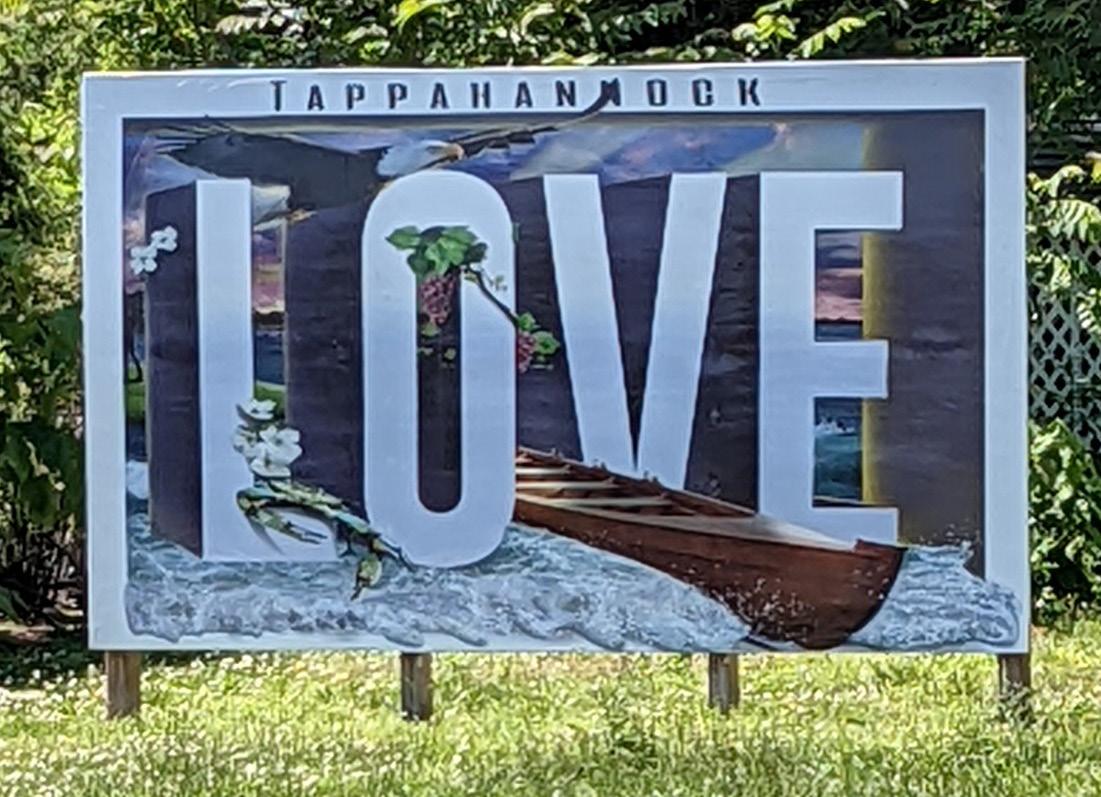
The Rappahannock River Park’s love sign features flowing water, a canoe, dogwood flowers, grape vines, and a blue crab with an eagle soaring above.
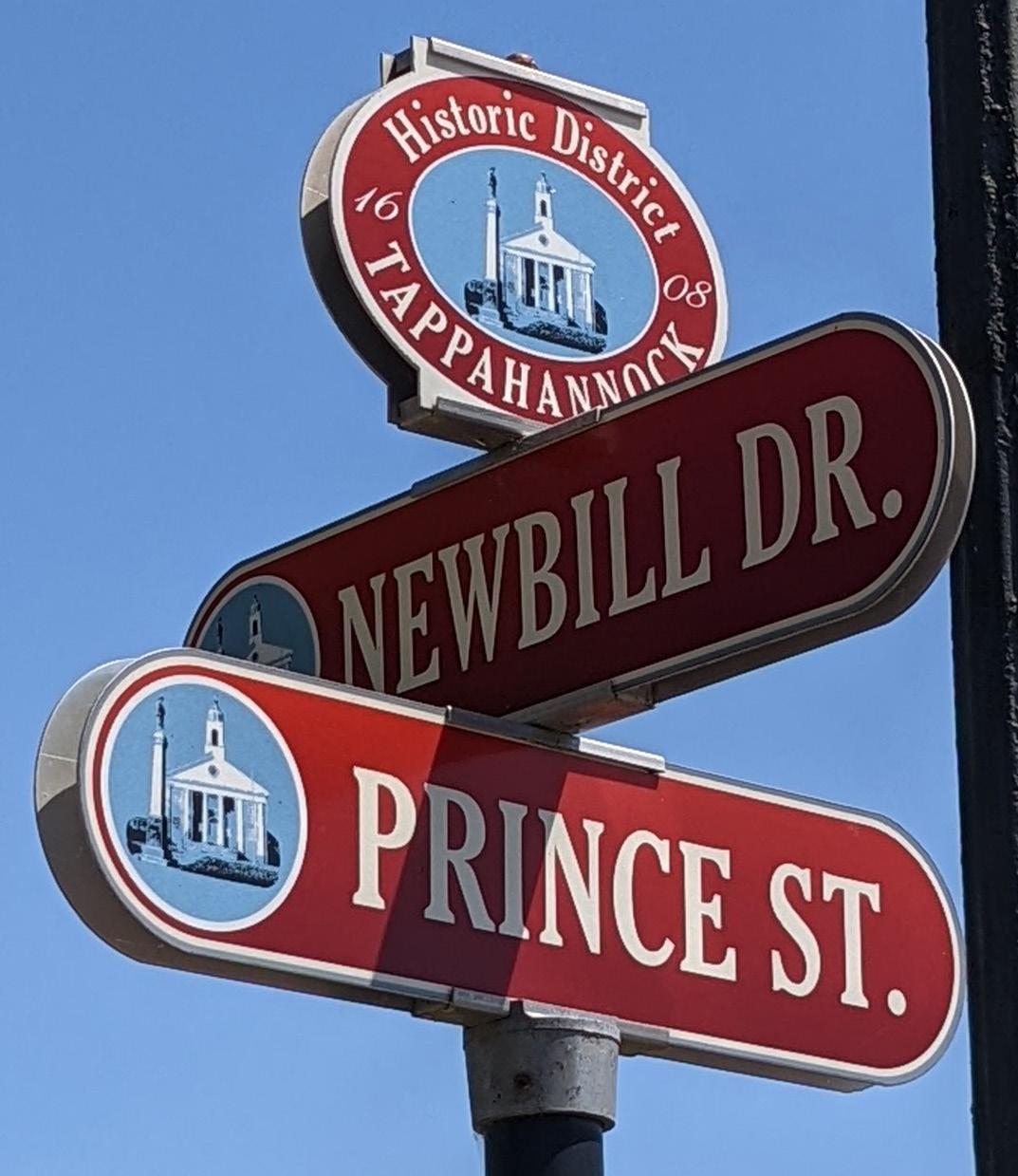
Tappahannock’s historic district features red street signs with a circular logo depicting the historic Essex Courthouse with the recently removed Confederate statue and (still standing) obelisk out front on Prince Street.
Tappahannock’s recent efforts in tourism and branding should build off of one another to be continued in the future. Utilizing the same colors, similar fonts, and messaging can allow the community as well as visitors to build recognition and association with the Town. Some example concepts for Tappahannock’s overall brand have been created with the intention of informing further updates at a later time. The strategies for how this brand can be used regardless of logo, however, the Town should continue using the Primary Logo as the highest level of the brand hierarchy with the Deadrise and Square Logos used as alternatives.
The recently created round red and blue logo should be used as the highest level of the brand hierarchy.
The deadrise ship is the iconic traditional fishing boat used in the Chesapeake Bay and its feeding rivers, such as the Rappahannock. The blue colors utilized are pulled from the Town’s latest logo, and this can be utilized on branded merchandise, banners, stickers, or other promotional material. This logo pays homage to local industry and recognizes Tappahannock’s prominent location on the water. The Town’s name is featured proudly front and center as the only place in the world bearing the name.
Tappahannock’s name divides into a 3x4 square to create a simple square logo that is simple and easily recognized. The square shape differentiates it from the Town’s other circular logos as well as creates a distinct appearance from other logos or branding in the region. It is also reflective of the Town’s historic planned square street grid system that are still intact today.
The colors selected for the logo include Yale Blue, Harvard Red, and alternative colors of a cornflower blue, and a cream tone. These were selected specifically to tie this logo in with the recently adopted Town logo for consistency. They are also evocative of the red-brick of the historic buildings and the blue waters of the Rappahannock ever present in the Town’s past and future.
Font
The font utilized for the logo is an Adobe Font called “Victorian Orchid.” The font evokes the history of Tappahannock while presenting an aesthetically clean and simple face. The font can also be paired with sans serif fonts for visual hierarchy.
The Town’s messaging strategy will evolve naturally overtime. However, it should consistently seek to raise pride in the community, awareness for potential visitors, and differentiate the Town from its neighbors in the area. An example messaging strategy is to rely on Tappahannock’s many events and connection to the water and natural landscape, as well as its history, but also to express its forward-looking desire for growth. A draft “Positioning Statement” below demonstrates how the Town can place itself as the place to visit in the region. This statement references the lyrics to the song “Old Country Rock” by William “Bill” Moore, a local historic blues and ragtime musician.
Come on down the Rappahannock to Tappahannock and discover why this special place has been the beating heart of the region for hundreds of years.
There are many different promotional materials that can be made using the logo and brand colors. Building out a full suite of branded merchandise available through the Town or at local shops, can help raise community pride and increase brand recognition. Examples of successful promotional merchandise include the North Carolina Outer Banks “OBX” stickers that became ubiquitous, as other localities began putting their own spin on the abbreviated name trend. While this draft merchandise shows what is possible with consistent logos and branding, there are likely many creative minds in Tappahannock that would love the chance to produce new designs for the Town. Local retailers will also continue to create their own marketing for the Town that will contribute to the strength of the overall brand.
Maintaining an official flyer, handout, or brochure to market the community is an affordable and quick way to share information about the community. However, there are many considerations that must go into the design of the document to ensure that it is high quality and representative of the community. What photographs will be used? What statistics will be used? What material will the document be printed on? These are some of the questions that factor into the design and can vary greatly depending on the intended audience. An example tri-fold brochure is shown below.
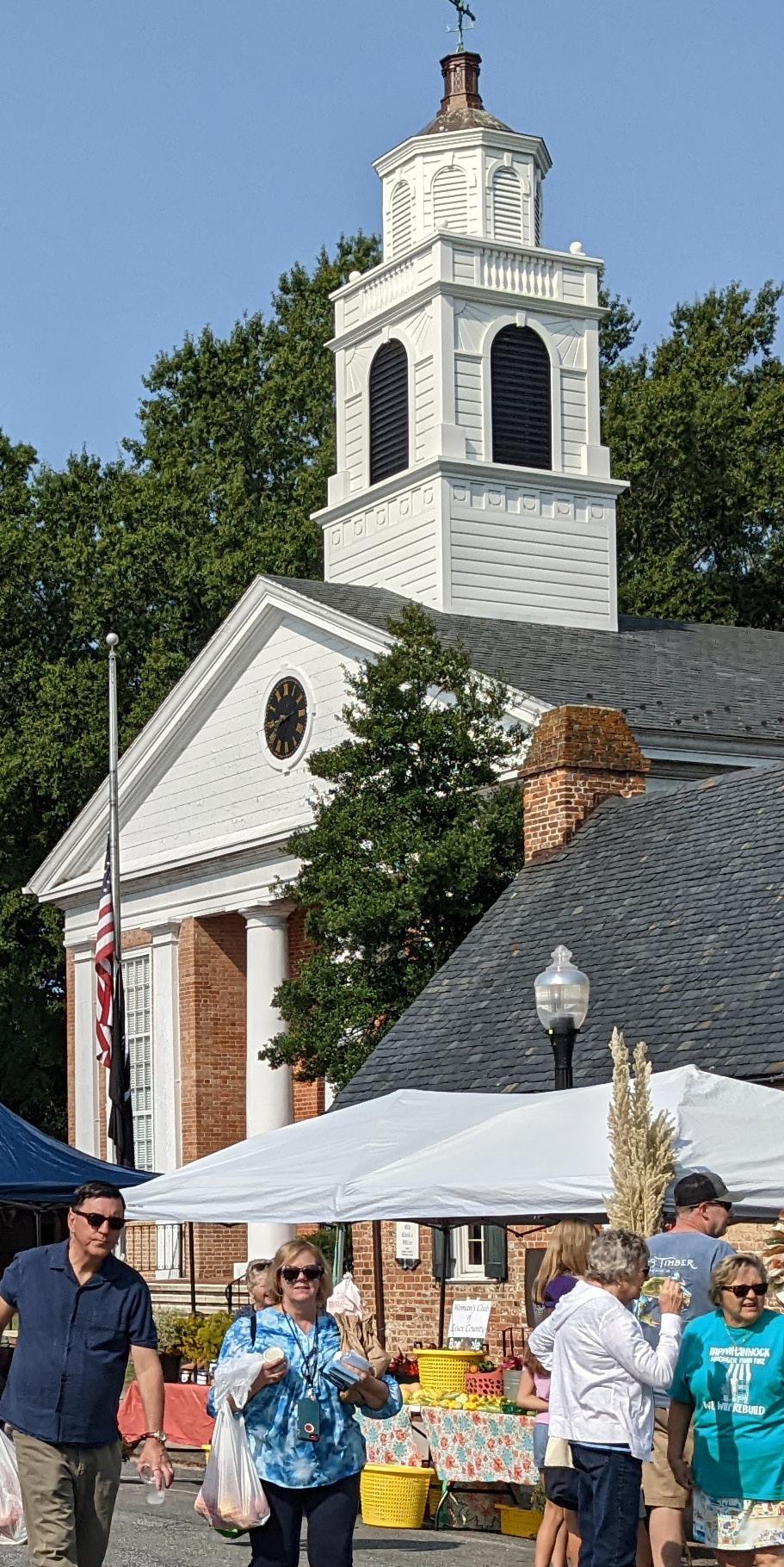
Come on down!
Discover why this special place has been the beating heart of the region for hundreds of years.
With great events and activities for the whole family, our Town is the perfect place for a visit.
The historic district features 14 contributing buildings spanning all periods of American history. Guides are available for print online or at the Essex Museum or Inn.
Visit the Essex County Museum to learn about the area’s complex and interesting story.
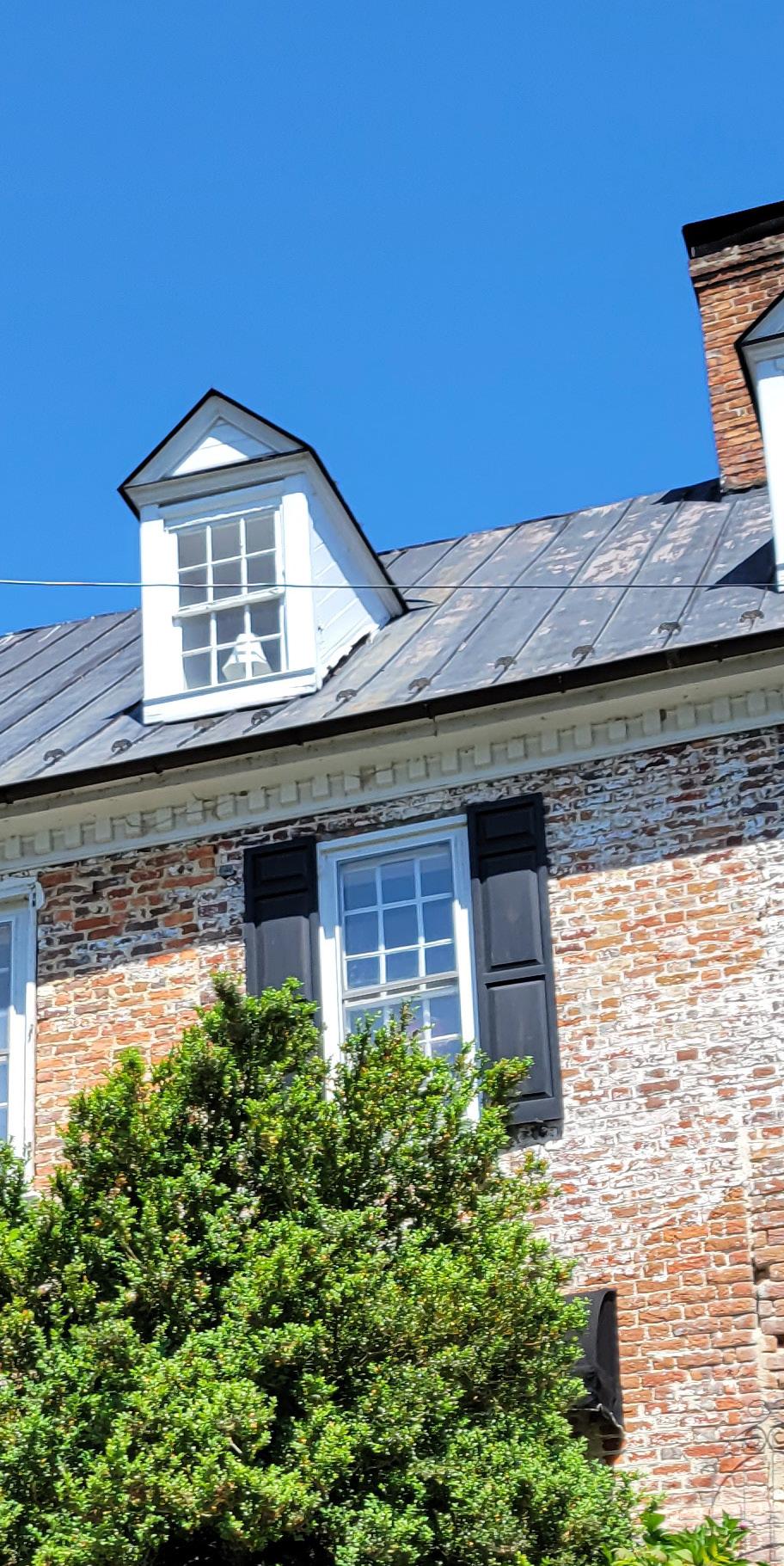
The Rappahannock River, wetlands, forests, and fields all await your exploration. Fishing, birdwatching, kayaking, or hiking, are all just a few examples of the many activities you can enjoy in Tappahannock’s stunning natural environment.
In order to ensure that people will wear or purchase t-shirts, they should be made of high quality materials and available in standard sizes. Consider spending time researching highly recommended suppliers.
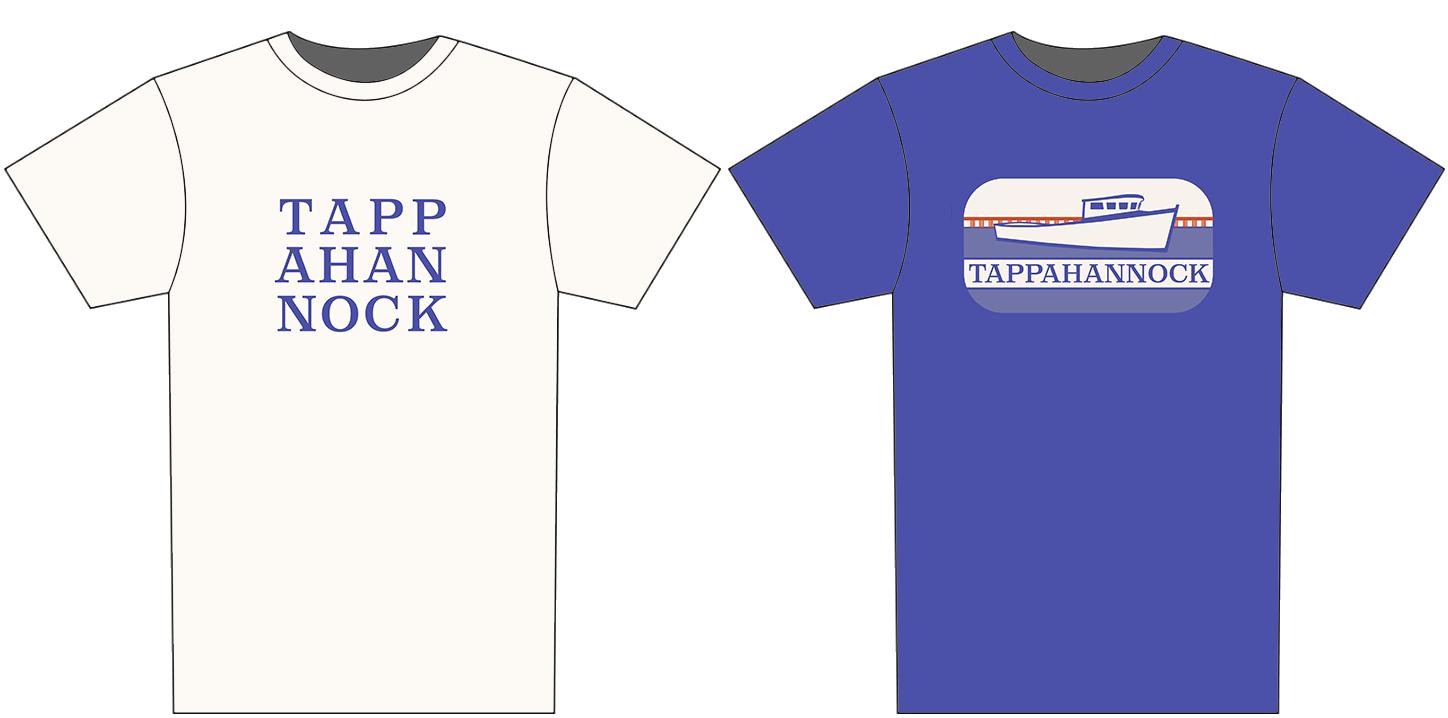
Other of examples of merchandise include water bottles, keychains, or boating flags. Many communities or businesses are becoming increasingly creative to differentiate themselves with trinkets. Ideas not depicted include coffee mugs, pint glasses, or baseball hats.
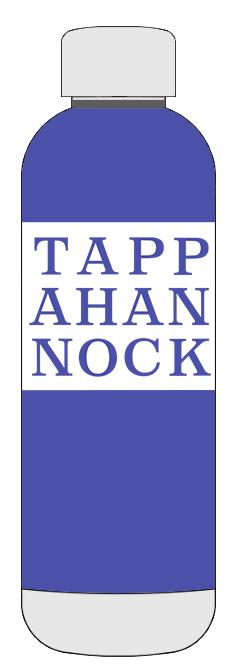
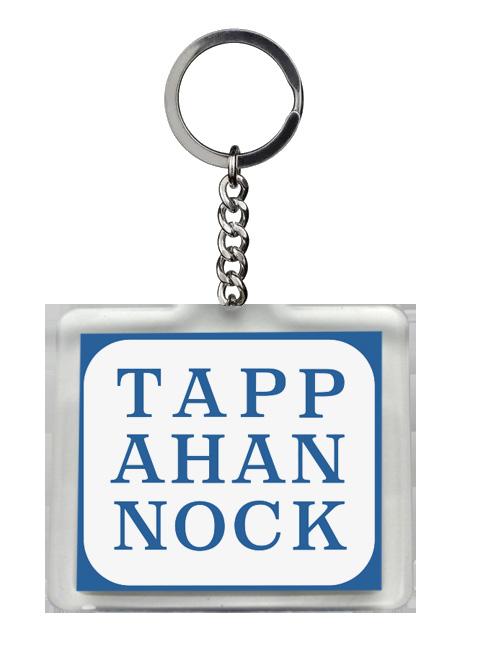
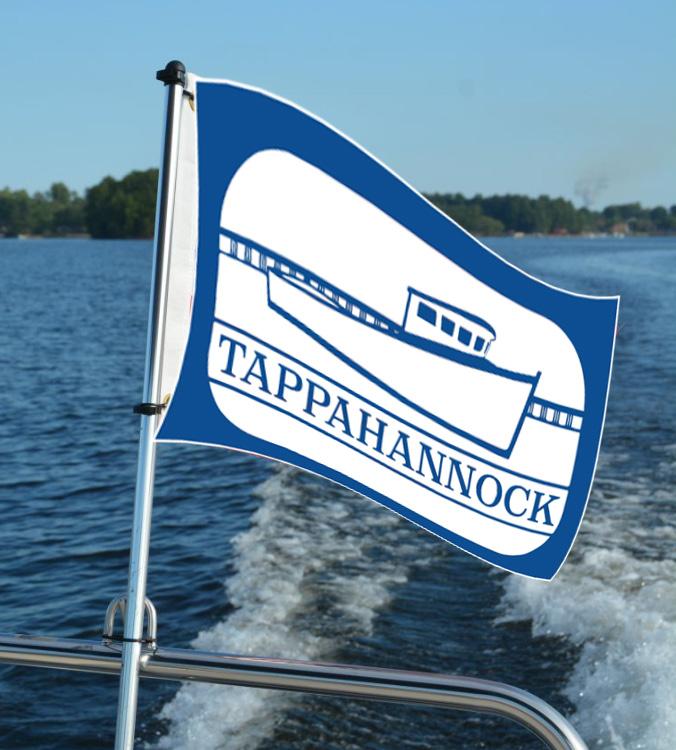
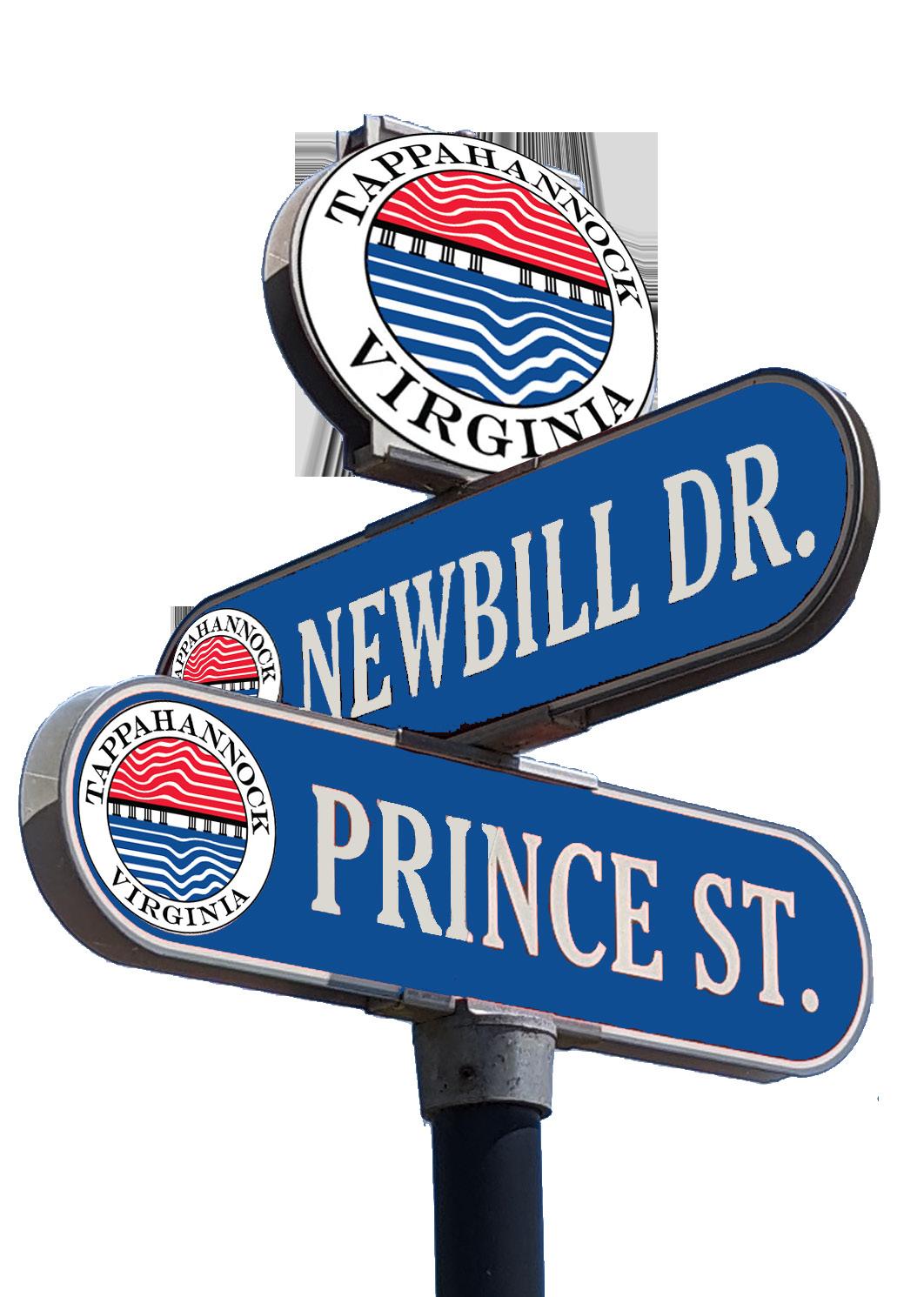
Vehicular Wayfinding Sign Plan
Vehicle-oriented wayfinding signs must be approved by the Virginia Department of Transportation (VDOT) if located within the state maintained right-of-way. However, VDOT is also granted authority through the State Code regarding Outdoor Advertising in Sight of Public Highways. Therefore, it is best to collaborate with VDOT on the implementation of a coordinated Wayfinding Signage Plan with their approval. This is generally a multi-step process that involves public engagement of stakeholders, securing funding, the creation of preliminary concepts and review by VDOT, and eventual fabrication and construction.
However, this is a worthwhile undertaking for the Town, as key locations such as the western approach across the Downing Bridge on Queen Street, and the northern approach along Church Lane, would be ideal locations for monumental signage identifying the community.
The creation of a Wayfinding Signage Plan requires the identification of a sign family hierarchy, listing of appropriate locations, and details regarding the sign locations.
Typical signs approved throughout Virginia have simplicity in branding, colors, and shapes with simple or traditionally ornamented posts.
Similar to the discussion on the Town’s logo and colors, Tappahannock should utilize these same colors in their wayfinding sign scheme with similar imagery related to the Town’s relationship with the water.
These are examples of a typical sign family that would be part of a Wayfinding Sign Plan for VDOT review. The Town should decide between using the Primary Logo, or the Deadrise and Square logos.
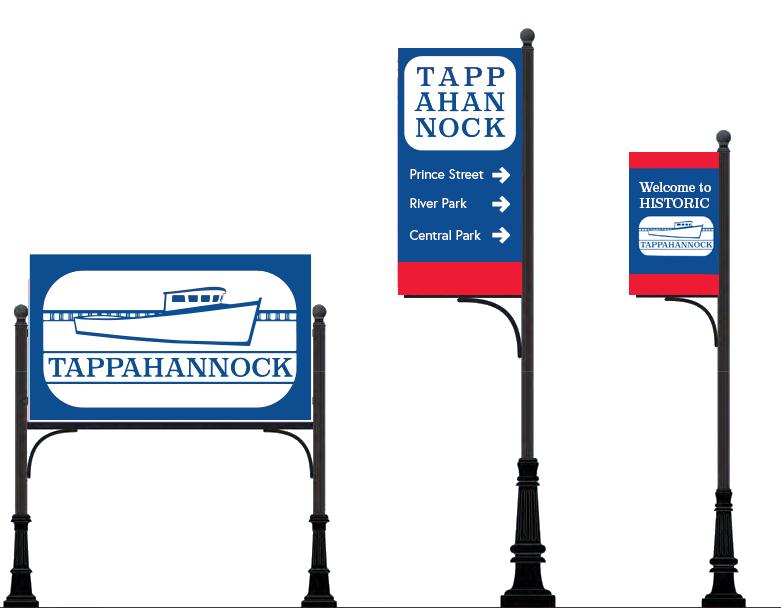
Pedestrian-scale wayfinding signs additionally could be implemented on the grounds of public facilities and parks, intended to help circulate visitors and inform them about other amenities or interesting sites in the area. Contact information for the government or local police can also be provided.
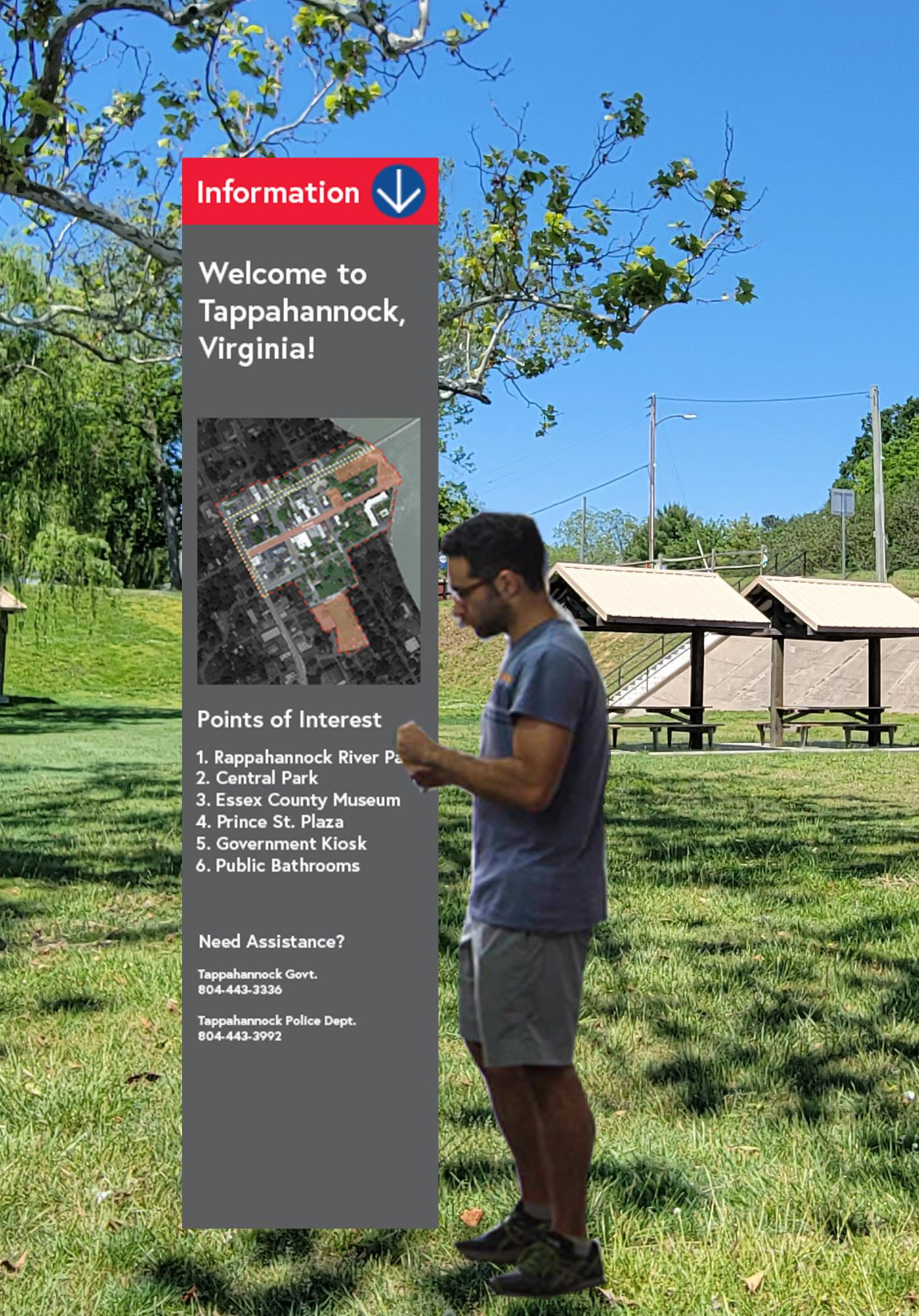
The Town has thus far successfully partnered with Tappahannock Main Street to effectively engage the community, as a result the downtown area enjoys many successful and well attended events. The Farmers’ Market, 3rd Thursdays, Winter Fest, and others showcase the hard work and the community’s support and enjoyment for events that offer a variety of different activities. These are also events that do a relatively good job at attracting all different age groups to the downtown area. However, as they are coordinated with the Main Street Organization, they tend to be very “downtown-centric.” Although that is a key part of this revitalization plan, it is also important for the Town to engage and invite the “Off-Main” businesses as well to have a presence at events. The Town should continue to be a “cheerleader” for its residents, acting with transparency, interest, and agility when building its brand and participating in new trends. Building trust through support, events, and new infrastructure will also attract visitors. The public relations strategy should continue to embody trust, openness, professionalism, and excitement for the Town’s future.
Similar to the efforts through Tappahannock’s Main Street, responsibility for attracting tourism to the Town can be delegated to either a nonprofit entity, an in-house government agency, or an economic development authority. However the Town wishes to facilitate this work, it is more important to continue developing the core reasons to visit Tappahannock. Once revitalization is further along, an organization tasked with tourism advertising can tap further into state, regional, and national resources to coordinate all media, print, photography, or film necessary to showcase the Town in the best light. The entity will generally be only as successful as the resources given to them. Lower budget entities can accomplish certain tasks to boost the Town’s profile, but larger campaigns require sustained support to fully build out all of the potential tourism advertising, programming, merchandise, or partnerships that, once in place, could have a great rate of return for the community.
Eight communities along the mouth of the Rappahannock where it meets the Chesapeake Bay have combined tourism efforts with support from the Virginia Tourism Corporation to brand themselves as “Virginia’s River Realm.” Marketing the experiences, oysters, boating, history, shopping, restaurants, and other great amenities of the area collectively on an aesthetically pleasing website that features events, a blog, and other stories of interest. The website also allows users to “Plan Their Stay” with profiles of participating towns. There are also high resolution professional photographs, films, and other media that have been created to entice visitors. As Tappahannock shares the region’s relationship to the water, the Town should begin to engage with Virginia’s River Realm to explore the possibility of being added. This would improve the Town’s ability to leverage tourism dollars as well as connect visitors with other places to go in the area.
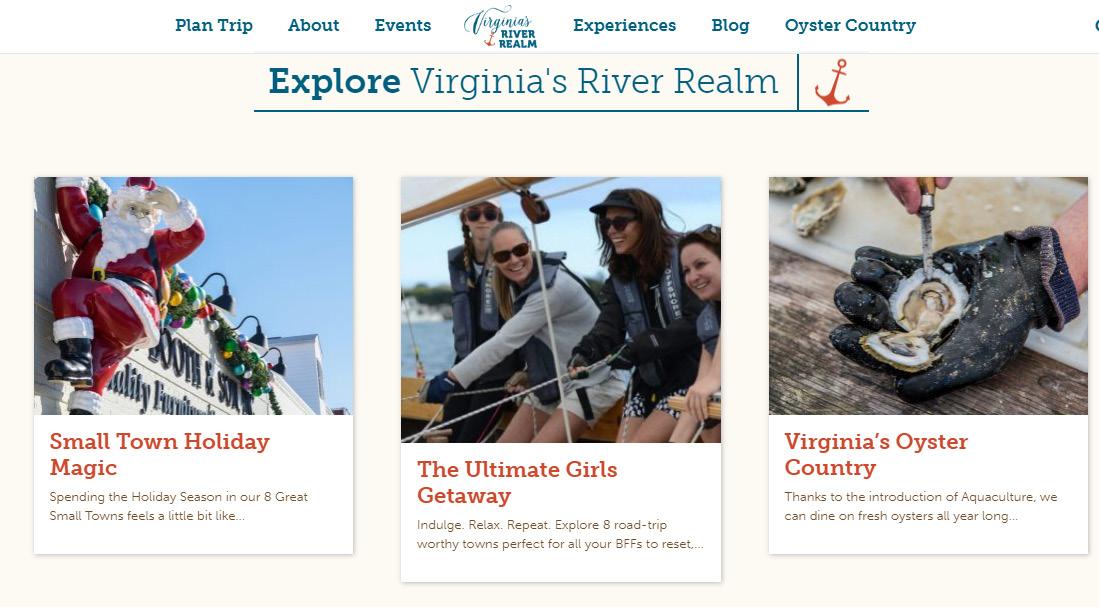
One way to engage demographic groups that may be more difficult to reach or have otherwise been left out of decisions in the past, is to find and appoint “ambassadors.” For instance, Tappahannock’s “Youth Ambassadors” can give faster insight into the latest trends, needs, ideas and help get the word out about the Town’s initiatives.
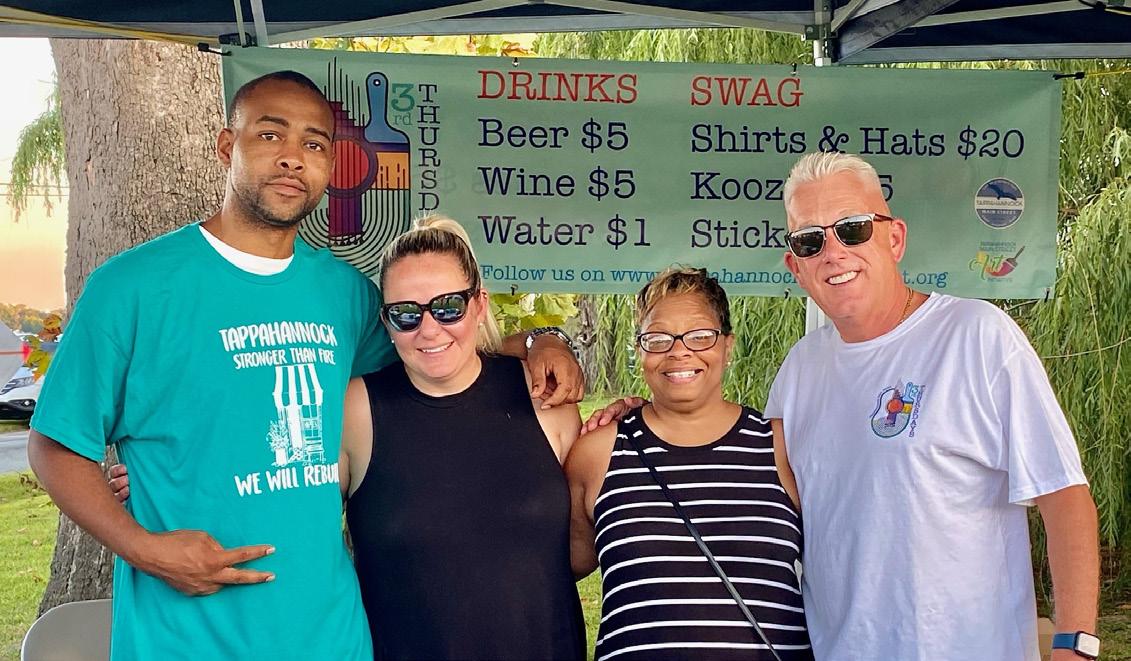
The Town maintains a “running list” calendar that utilizes large font across the government website. It is easily found by simply scrolling down on the website’s landing page. This is convenient and easily accessed, however, one improvement could be to shift the calendar to a more traditional grid to allow the community to see events across the month. The calendar can be embedded into the website, filling the space of the current list.
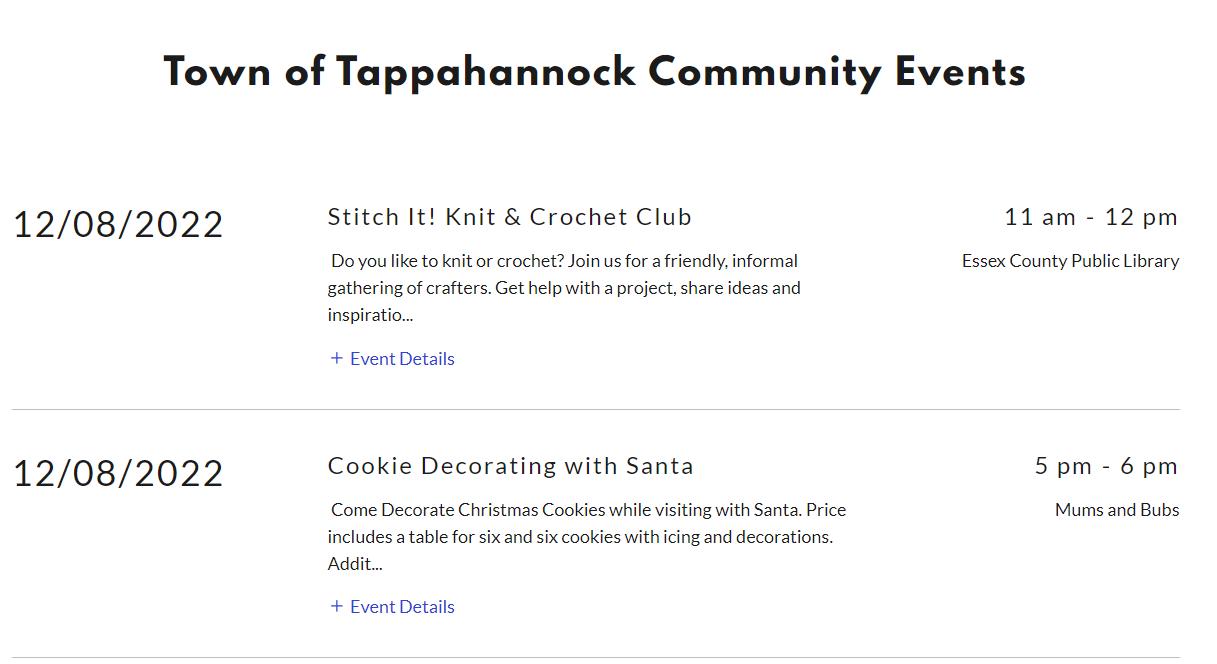
Tappahannock’s existing social media channels include: Tappahannock Main Street’s Instagram, Town of Tappahannock’s Official YouTube Channel, Town of Tappahannock’s Facebook Page, Tappahannock-Essex, Volunteer Fire Department’s Facebook Page, Tappahannock Police Department’s Facebook & Twitter Accounts.
Participating in social media, utilizing ad campaigns, and being visible online are important for quickly spreading information in the community. However, the social media landscape is always quickly changing. New applications such as “TikTok,” or features such as “Instagram Reels” are allowing short-form video content to be viewed rapidly and spread virally. Utilizing Tappahannock’s “Ambassadors” to create content, within general guidelines, can help raise the Town’s profile online. It is often surprising what generates clicks and interest in today’s world, but utilizing Town social media channels to showcase “The Best View in Town,” “Great Restaurants to Try,” “Tappahannock History,” or other topics could all be great places to start. The Town could also record “podcast” episodes of storytelling and upload them to Soundcloud or Spotify.
Currently, privately run and moderated Facebook groups such as “What’s going on in Tappahannock?” with around 10,800 members keep the community up to date on local events.
The following are ideas for events that the Town can utilize for new events to attract people to the Downtown area. The Town has many great existing events, and it should continue to program fun activities for the community.
“Ciclovía”
The name for this event comes from the Spanish term for a “cycleway,” also known as “open streets” the event consists of designating a time for certain streets to become shut down to automobiles for pedestrians. In the context of Tappahannock, temporarily shutting down Prince Street every Saturday morning or another designated time specifically for bicycles, pedestrians, runners, or rollerskaters, and allows for safe community recreation. It may also begin to allow the community to imagine that their streets can be used in other ways besides parking and driving.
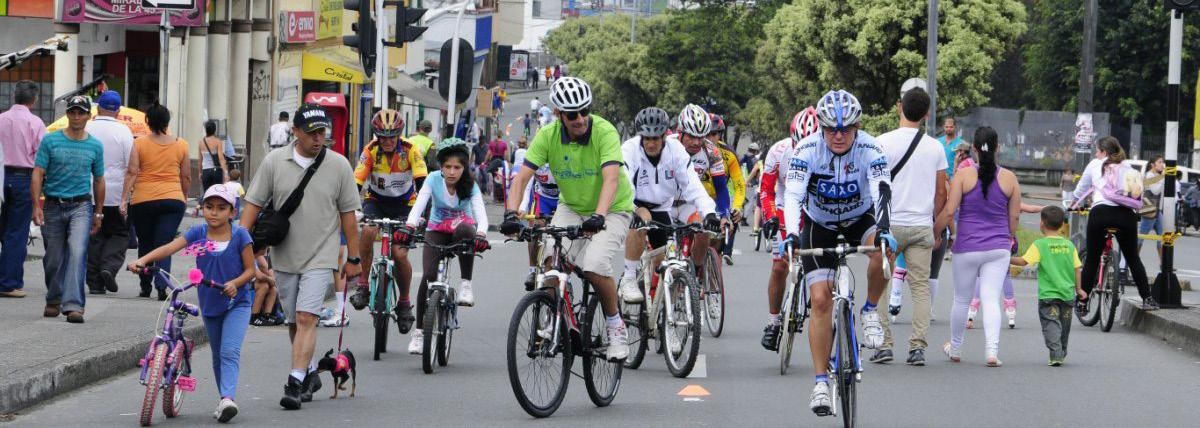
Volunteers in the Tappahannock community have recently started creating wreathes which they hung from doors around the Town during the holiday season. Scheduling a specific event or similar and sponsoring a contest for the most creative or interesting wreathes could bring the community out during winter time. Material for the wreathes could be sourced from maintaining the Town’s landscaping or as part of clean-up efforts.
“What would you do?” This question can be posed to youth in the local school system as well as a small budget set aside to potentially make some part of their project reality. This can promote civic engagement and awareness, familiarizing Tappahannock’s youngest citizens with how their Town is managed and sustained.
Similar to asking the Town’s youth about their priorities, a budget could be set aside for asking the public what amenities they would like to see implemented in public spaces. “Participatory budgeting” is a recent movement towards allowing the public to decide directly how public funds are spent to build awareness and engagement. This also helps ensure that funds are spent equitably and effectively, rather than trying to guess at what amenities will be appreciated.
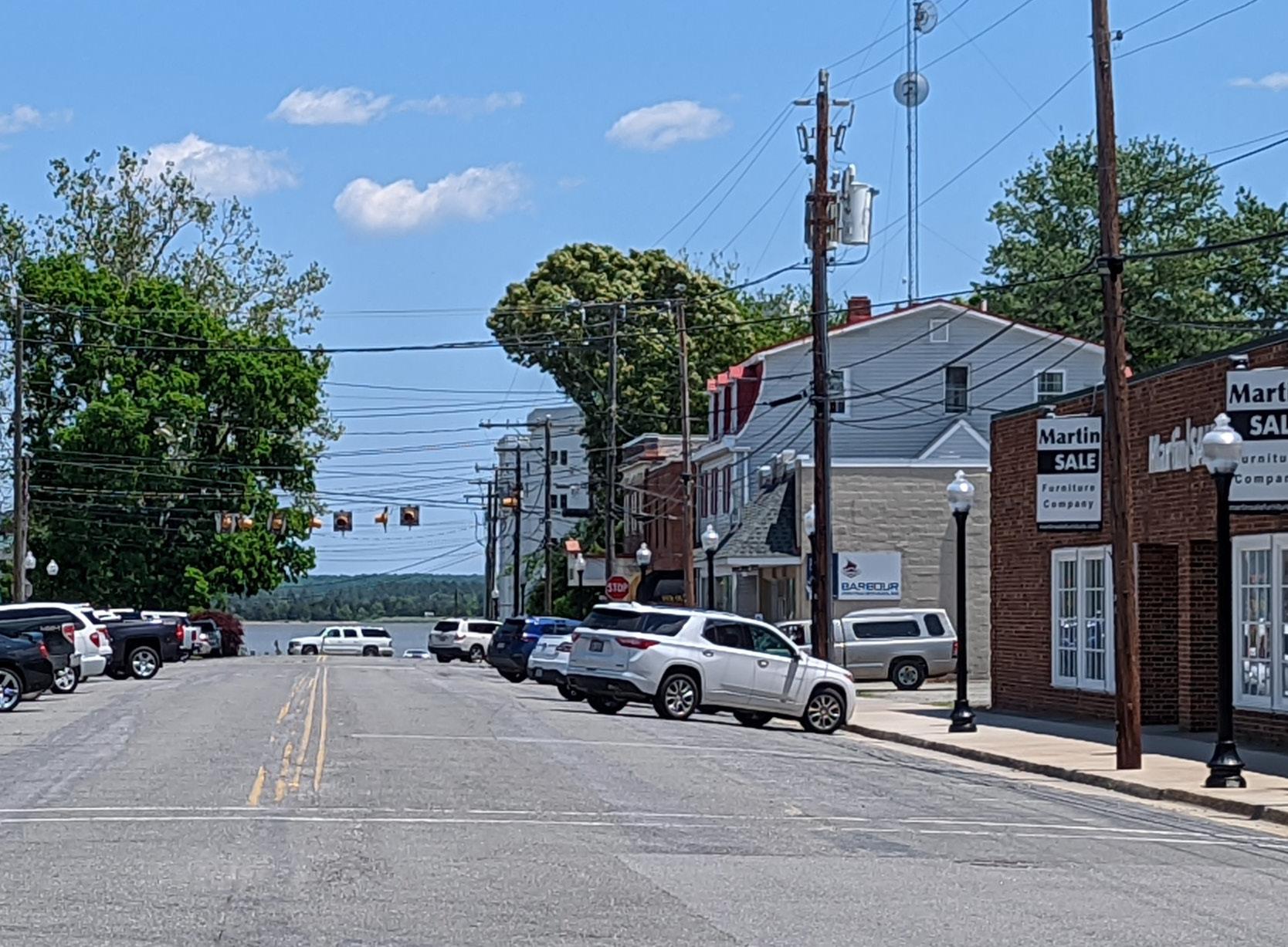
Originating in Helsinki, Finland by the orgnization Yhteismaa (Common Ground), and now copied throughout the world, this event proposes “setting a table for 1,000.” Running the length of Prince Street, or down by the Waterfront, moveable tables may be set up in a line inviting participants from the community to share a meal together. It could coincide with a holiday or an entirely new event to create a festive atmosphere. Participants could bring their own food, drinks, or utensils to utilize to dine with friends or strangers. Parterning with Virginia ABC, local restaurants, or food trucks, could expand the event’s offerings and the creation of the “long table” could be the canvas by which social ties in the community are created.
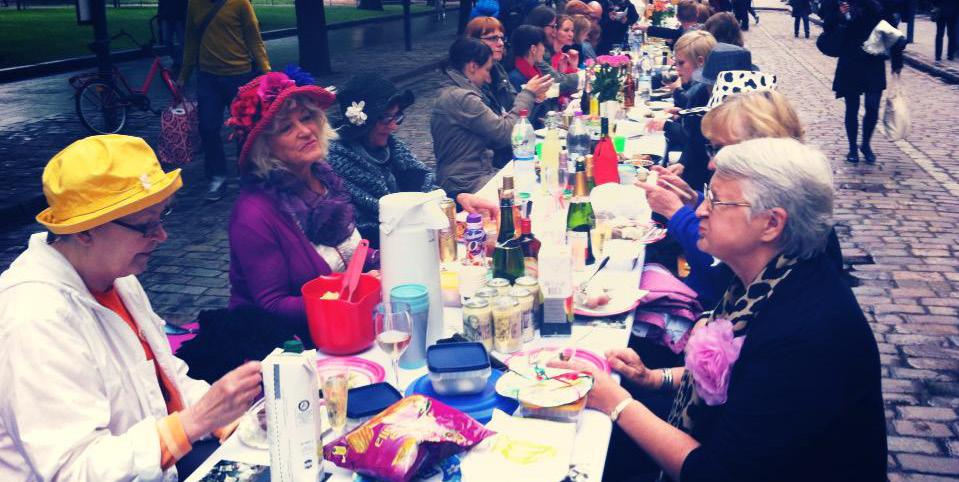
With so many places to start, the task of implementing Tappahannock’s Downtown Revitalization Plan may seem daunting. The following prioritization tables are intended to assist the community by recommending steps to take first over steps that will take much longer and more resources to complete.
1. Install planters of varying sizes with native flowers and trees located to protect newly implemented seating areas or street activities.
2. Paint asphalt with murals or other colors generally consistent through the whole street, if permitted by the Virginia Department of Transportation.
3. Install standing frames to exhibit local art and public information utilizing official Tappahannock Government and Tappahannock Main Street branding.
4. Install grouped outdoor street furniture in several locations, including bench seating, movable tables, and umbrellas, preferably in a uniform color.
5. Activate the street with temporary vendors and activities.
a. Permit food trucks and other vendors along Prince Street.
b. Install games and activities such as hopscotch, street checkers or chess, cornhole, bocce courts, etc.
6. Create a volunteer corps to assist in painting, construction, and ongoing maintenance of Prince Street and the Waterfront Park.
7. Create a new mixed-use zone permissive of increased density which encourages high-quality architectural detailing.
a. Many small storefronts along the 200 block of Prince Street accommodate local businesses and create downtown activity.
b. Quality architecture draws attention from people passing through Town to the downtown area. Taller buildings also can act as a barrier to noise pollution.
c. Interior courtyards semi-accessible to the public will provide additional space for businesses or residential amenities.
d. Increase density for commercial, service, and residential uses through expansion vertically and infill construction.
8. Install public restroom facilities along Prince Street.
1. Widen Prince Street sidewalks to include bioswales/tree plantings, outdoor seating areas, and bollards.
2. Study the implementation of a public plaza, blocked with retractable/moveable bollards, in front of Prince Street’s 200 block.
3. Upgrade streetlights to create interesting or interactive installations.
4. Re-paint all crosswalks along Prince Street and implement curb “bump outs” at all intersections to provide for pedestrian safety.
5. Replace less durable material planters or seating elements with more permanent materials.
6. Implement public art such as murals and sculpture along Prince Street.
1. Build a new ”adventure” playground structure at the park. Integrate educational elements about the local environment with playscapes.
2. Install varied, colorful, and creative seating elements such as moveable cafe chairs, wooden reclining seats or benches, or public hammocks.
3. Construct an amphitheater seating area and platform with amenities such as a public Bluetooth speaker.
4. Implement “living shoreline” protections for the water’s edge.
5. Seek the abandonment of the end of Prince Street and Newbill Drive right-of-way by the Virginia Department of Transportation for the implementation of a complete park design
6. Invite Food Trucks to occupy the parking spaces at the end of Prince Street.
7. Implement creatively designed lighting installations.
1. Construct a small boardwalk with seating stair elements at the water’s edge.
2. Construct a pier structure and kayak launch at the end of Prince Street.
3. Install 2-3 retrofitted shipping containers at the end of Prince Street or at the rear of the Waterfront Park to offer cuisine not available in Town or as an extension of an existing local business.
4. Replace asphalt at the end of Prince Street to include more landscaping, “living shoreline” elements, and pedestrian friendly pavers.
5. Construct public restroom facilities at the Waterfront area.
1. Install public art or Downtown gateway at the intersection of Queen and Water Street and/or Prince and Church Street.
2. Ensure there are safe and comfortable accommodations for bicycles and pedestrians should the Virginia Department of Transportation implement a redesign of Queen Street and Church Lane.
a. Parcels along these streets feature narrow or no existing sidewalks.
b. Mid-block crosswalks exist but do not have curb extensions or additional lighting to allow pedestrians to cross with priority.
c. The intersection of Queen and Church has incomplete crosswalks which need to permit crossing from all four sides.
3. Façade improvements:
a. Replace windows in poor condition.
b. Repaint buildings with color for visual appeal and install accessories such as canopies or outdoor seating areas.
c. Fill vacant commercial units.
4. Replace signage which is auto oriented in scale; consolidate or made pedestrian scale.
1. Ensure that Virginia Department of Transportation improvements to the Downtown area and along Queen St. and Church Ln. greatly improve safety and comfort for pedestrians and bicyclists.
2. Assess the Zoning regulations and Development Standards of the area to encourage mixed use redevelopment of vacant and underutilized parcels.
3. Reform minimum parking standards to allow new development to mimic the traditional form of buildings along Prince Street.
4. Increase density for commercial, service, and residential uses through expansion vertically and infill construction.
1. Establish the Town’s “Style Guide” with a clear brand hierarchy of formal logos, colors, and fonts. Utilize this style guide across all local government functions.
2. Establish a clear messaging strategy utilizing the positioning statement found in the Branding Plan, or draft another.
3. Design Promotional Materials of “officially licensed” merchandise for the Town, such as flags, shirts, or others. This could be done collaborating with local businesses or by holding a contest for local designers.
4. Design an official flyer or handout for the Town utilizing high quality photographs and clear information for the intended audience.
5. Invest or seek grant funding in developing a Vehicular Wayfinding Sign Plan for the Town, in collaboration with the Virginia Department of Transportation process for approval.
6. Invest or seek grant funding for developing a Pedestrian Wayfinding Sign Plan for the Town.
1. Establish a paid role, commitee, or responsible office for handling the Town’s tourism efforts.
2. Seek to join and be identified along with other river communities in “Virginia’s River Realm.” Utilize any assistance with toursim branding available through Virginia Tourism Corporation.
3. Establish a volunteer corps of “Tappahannock Ambassadors” to assist as an advisory committee and potential staff to help advertise and organize events.
4. Update the Town’s website from a list of event dates to a full embedded and branded calendar showing all events for the entire month.
5. Establish or expand the Town’s social media presence, follow the newly established messaging strategy and style guide.
6. Plan and implement new events, such as those mentioned in this plan. Utilize the “Tappahannock Ambassador” corps to produce the events.
Environmental Review Record
Preliminary Engineering Report
An environmental review is an evaluation of a project and its potential environmental impacts as well as reviewing to ensure that the proposed projects comply with all applicable environmental laws and authorities. All projects that receive funding through the United States Department of Housing and Urban Development must include an Environmental Review Record in order to be eligible for further funding being awarded. Due to the length of the review and format of the content, the Environmental Review Record has been included in this plan as part of the appendix. For ease of downloading, the document has been uploaded to the Town of Tappahannock’s website without the Environmental Review Record. If you would like a copy of the full document with the Environmental Review Record, please visit the Tappahannock Town Hall to request one.
The Preliminary Engineering Report is a foundational study of this plan’s potential projects that estimates the feasibility and cost. While this is an initial review before detailed design and engineering work is conducted for implementation, it is required for any potential project to receive State and Federal funding. This report is expected to be completed by the end of April 2023. Once received, a full copy will be available at the Tappahannock Town Hall.