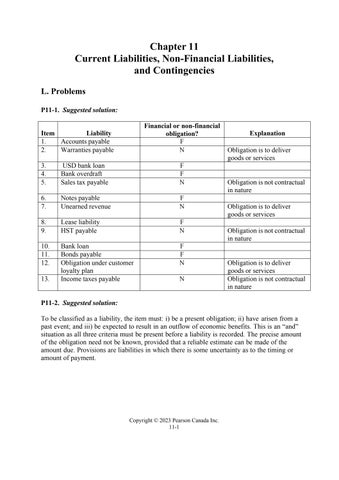
Chapter 11 Current Liabilities, Non-Financial Liabilities, and Contingencies L. Problems P11-1. Suggested solution: Financial or non-financial obligation? F N
Item Liability 1. Accounts payable 2. Warranties payable 3. 4. 5.
USD bank loan Bank overdraft Sales tax payable
F F N
6. 7.
Notes payable Unearned revenue
F N
8. 9.
Lease liability HST payable
F N
10. 11. 12.
Bank loan Bonds payable Obligation under customer loyalty plan Income taxes payable
F F N
13.
N
Explanation Obligation is to deliver goods or services
Obligation is not contractual in nature Obligation is to deliver goods or services Obligation is not contractual in nature
Obligation is to deliver goods or services Obligation is not contractual in nature
P11-2. Suggested solution: To be classified as a liability, the item must: i) be a present obligation; ii) have arisen from a past event; and iii) be expected to result in an outflow of economic benefits. This is an “and” situation as all three criteria must be present before a liability is recorded. The precise amount of the obligation need not be known, provided that a reliable estimate can be made of the amount due. Provisions are liabilities in which there is some uncertainty as to the timing or amount of payment.
Copyright © 2023 Pearson Canada Inc. 11-1
ISM for Lo/Fisher, Intermediate Accounting, Vol. 2, Fifth Edition
Trade accounts payable meet the criteria of a liability as set out below: * Present obligation: The debtor is presently contractually obliged to pay for goods or services received. * Past event: The trade payable arose from a good or service the debtor previously received or consumed. * Outflow of economic benefits: Trade payables are typically settled in cash—an outflow of economic benefits. P11-3. Suggested solution: a. Provisions are liabilities in which there is some uncertainty as to the timing or amount of payment. b. Financial liabilities are contracts to deliver cash or other financial assets to another party. They differ from non-financial liabilities as the latter category is typically settled through the provision of goods or services. c. A non-exhaustive list of financial liabilities includes accounts payable; bank loans; notes payable; bonds payable; and lease liabilities. A non-exhaustive list of non-financial obligations includes warranties payable; unearned revenue; and income taxes payable. P11-4. Suggested solution: a. The three broad categories of liabilities are: 1. Financial liabilities held for trading 2. Other financial liabilities 3. Non-financial liabilities b. * Held-for-trading liabilities are initially recognized at fair value. * Other financial liabilities are initially reported at fair value minus the transaction costs directly resulting from incurring the obligation. * The initial measurement of non-financial liabilities depends on their nature. For instance, warranties are recorded at management’s best estimate of the downstream cost of meeting the entity’s contractual obligations, while prepaid magazine subscription revenue is valued at the consideration initially received. c. * Held-for-trading liabilities are subsequently recognized at fair value. * Other financial liabilities are subsequently measured at amortized cost using the effective rate method. * Non-financial liabilities are subsequently measured at the initial obligation less the amount earned to date or satisfied to date through performance. For example, a publisher that received $750 in advance for a three-year subscription and has delivered the magazine for one year would report an obligation of $500 ($750 – $250).
Copyright © 2023 Pearson Canada Inc. 11-2
Chapter 11: Current Liabilities, Non-Financial Liabilities, and Contingencies
P11-5. Suggested solution: Item Liability
Current or noncurrent liability, or potentially both? C B
1. 2.
Accounts payable Warranties payable
3.
Deposits
B
4. 5. 6.
Bank overdraft Sales tax payable Bank loan maturing in five years was in default during the year; before year-end, the lender grants a grace period that extends 12 months after the balance sheet date Five-year term loan, amortized payments are payable annually
C C N
8.
Unearned revenue
B
9.
Lease liability
B
10. 11. 12.
HST payable 90-day bank loan Bond payable that matures in two years
C C N
7.
B
Explanation
The obligation that is expected to be settled within one year of the balance sheet date is current, the balance noncurrent The classification of the deposit as current or non-current depends upon the expected settlement date. If less than one year after the balance sheet date, the obligation is classified as current
The obligation is reported as a noncurrent liability because the grace period was granted before the balance sheet date and extends twelve months after yearend The principal portion of the payments due within one year of the balance sheet date are classified as current, the balance as non-current The classification of the obligation as current or non-current depends upon when revenue is the expected to be recognized. If less than one year after the balance sheet date, the obligation is classified as current The principal portion of the payments due within one year of the balance sheet date are classified as current, the balance as non-current
The obligation is reported as non-current as the maturity date is two years after the balance sheet date
Copyright © 2023 Pearson Canada Inc. 11-3
ISM for Lo/Fisher, Intermediate Accounting, Vol. 2, Fifth Edition
13.
Obligation under customer loyalty plan
C
14. 15.
Income taxes payable Bank loan that matures in five years that is currently in default Three-year bank loan that matures six months after the balance sheet date
C C
16.
Classified as current as the entity does not have the right at the end of the reporting period to defer settlement of the liability for at least twelve months after the reporting period.
C
P11-6. Suggested solution: a. Jan. 6
Jan. 12
Jan. 15
Jan. 31
b. Jan. 6
Jan. 12
Jan. 31
Feb. 2
Gross method – discount taken Dr. Inventory Cr. Accounts payable Dr. Inventory Cr. Accounts payable Dr. Accounts payable Cr. Cash ($300,000 × (100% - 1%)) Cr. Inventory Dr. Accounts payable Cr. Cash Net method – discount not taken Dr. Inventory Cr. Accounts payable ($300,000 × (100% - 1%))
300,000 300,000 2,000 2,000 300,000 297,000 3,000 2,000 2,000
297,000 297,000
Dr. Inventory Cr. Accounts payable
2,000
Dr. Accounts payable Cr. Cash
2,000
Dr. Accounts payable Dr. Purchase discounts lost Cr. Cash
Copyright © 2023 Pearson Canada Inc. 11-4
2,000
2,000 297,000 3,000 300,000
Chapter 11: Current Liabilities, Non-Financial Liabilities, and Contingencies
P11-7. Suggested solution: Summary journal entries 1.
2.
3.
4.
5.
6.
Dr. Inventory Dr. HST recoverable ($10,000 × 15%) Cr. Accounts payable ($10,000 + $1,500)
10,000 1,500
Dr. Equipment ($20,000 + $500) Dr. HST recoverable ($20,500 × 15%) Cr. Accounts payable ($20,500 + $3,075)
20,500 3,075
Dr. Cash [$15,000 × (1 + 15%)] Cr. Sales Cr. HST payable ($15,000 × 15%) Dr. Cost of goods sold ($15,000 x 50%) Cr. Inventory
17,250
Dr. Accounts receivable [$20,000 × (1 + 15%)] Cr. Sales Cr. HST payable ($20,000 × 15%) Dr. Cost of goods sold ($20,000 x 50%) Cr. Inventory
23,000
Dr. Accounts payable Cr. Cash
23,575
Dr. HST payable ($12,000 + $2,250 + $3,000) Cr. HST recoverable ($8,000 + $1,500 + $3,075) Cr. Cash ($17,250 – $12,575)
17,250
11,500
23,575
15,000 2,250 7,500 7,500
20,000 3,000 10,000 10,000
23,575
Copyright © 2023 Pearson Canada Inc. 11-5
12,575 4,675
ISM for Lo/Fisher, Intermediate Accounting, Vol. 2, Fifth Edition
P11-8. Suggested solution: Summary journal entries 1.
2.
3.
4.
5.
6.
Dr. Inventory Dr. HST recoverable ($12,000 × 15%) Cr. Accounts payable ($12,000 + $1,800)
12,000 1,800
Dr. Equipment ($15,000 + $1,000) Dr. HST recoverable ($16,000 × 15%) Cr. Accounts payable ($16,000 + $2,400)
16,000 2,400
Dr. Cash [$11,000 × (1 + 15%)] Cr. Sales Cr. HST payable ($11,000 × 15%) Dr. Cost of goods sold ($11,000 x 80%) Cr. Inventory
12,650
Dr. Accounts receivable [$20,000 × (1 + 15%)] Cr. Sales Cr. HST payable ($20,000 × 15%) Dr. Cost of goods sold ($20,000 x 80%) Cr. Inventory
23,000
Dr. Accounts payable Cr. Cash
13,800
Dr. HST payable ($22,000 + $1,650 + $3,000) Cr. HST recoverable ($20,000 + $1,800 + $2,400) Cr. Cash ($26,650 – $24,200)
26,650
13,800
18,400
11,000 1,650 8,800 8,800 20,000 3,000 16,000 16,000
13,800
Copyright © 2023 Pearson Canada Inc. 11-6
24,200 2,450
Chapter 11: Current Liabilities, Non-Financial Liabilities, and Contingencies
P11-9. Suggested solution: Summary journal entries 1.
2.
3.
4.
Dr. Inventory Dr. GST recoverable ($40,000 × 5%) Cr. Accounts payable [$40,000 × (1 + 5%)] The purchase of inventory for resale is PST exempt.
40,000 2,000
Dr. Cash [$30,000 × (1 + 5% + 7%)] Cr. Sales Cr. GST payable ($30,000 × 5%) Cr. PST payable ($30,000 × 7%) Dr. Cost of goods sold ($30,000 × 2/3) Cr. Inventory
33,600
Dr. Accounts receivable [$60,000 × (1 + 5% + 7%)] Cr. Sales Cr. GST payable ($60,000 × 5%) Cr. PST payable ($60,000 × 7%) Dr. Cost of goods sold ($60,000 × 2/3) Cr. Inventory
67,200
Dr. GST payable ($20,000 + $1,500 + $3,000) Dr. PST payable ($22,000 + $2,100 + $4,200) Cr. GST recoverable ($21,000 + $2,000) Cr. Cash ($24,500 + $28,300 – $23,000)
24,500 28,300
42,000
30,000 1,500 2,100 20,000 20,000
60,000 3,000 4,200 40,000 40,000
23,000 29,800
P11-10. Suggested solution: Summary journal entries 1.
2.
3.
Dr. Inventory Dr. GST recoverable ($30,000 × 5%) Cr. Accounts payable [$30,000 × (1 + 5%)] The purchase of inventory for resale is PST exempt.
30,000 1,500
Dr. Cash [$20,000 × (1 + 5% + 6%)] Cr. Sales Cr. GST payable ($20,000 × 5%) Cr. PST payable ($20,000 × 6%) Dr. Cost of goods sold ($20,000 × 75%) Cr. Inventory
22,200
Dr. Accounts receivable [$50,000 × (1 + 5% + 6%)]
55,500
Copyright © 2023 Pearson Canada Inc. 11-7
31,500
20,000 1,000 1,200 15,000 15,000
ISM for Lo/Fisher, Intermediate Accounting, Vol. 2, Fifth Edition
Cr. Sales Cr. GST payable ($50,000 × 5%) Cr. PST payable ($50,000 × 6%) Dr. Cost of goods sold ($50,000 × 75%) Cr. Inventory 4.
Dr. GST payable ($18,000 + $1,000 + $2,500) Dr. PST payable ($14,000 + $1,200 + $3,000) Cr. GST recoverable ($15,000 + $1,500) Cr. Cash ($21,500 + $18,200 – $16,500)
50,000 2,500 3,000 37,500 37,500 21,500 18,200 16,500 23,200
P11-11. Suggested solution: Oct. 31, 2024
Dr. Retained earnings
30,000
Cr. Dividends payable on preferred shares (10,000 sh × $1.00/sh × 2) + (5,000 sh × $2.00/sh) The preferred shares B are non-cumulative in nature and as such are not entitled to dividends for 2023 as they were not declared. Nov. 30, 2024
Dr. Retained earnings
30,000
50,000
Cr. Dividends payable on common shares (100,000 sh × $0.50 sh) Dec. 1, 2024
Dr. Dividends payable on preferred shares
50,000
30,000
Cr. Cash Jan. 2, 2025
30,000
Dr. Dividends payable on common shares Cr. Cash
50,000 50,000
P11-12. Suggested solution: Oct. 31, 2025
Nov. 30, 2025
Dr. Retained earnings Cr. Dividends payable on preferred shares (50,000 sh × $2.00/sh) + (25,000 sh × $1.00/sh × 3) The preferred shares A are non-cumulative in nature and as such are not entitled to dividends for 2023 or 2024 as they were not declared.
175,000
Dr. Retained earnings Cr. Common stock dividends distributable
300,000
Copyright © 2023 Pearson Canada Inc. 11-8
175,000
300,000
Chapter 11: Current Liabilities, Non-Financial Liabilities, and Contingencies
(200,000 sh × 10%/sh × $15.00) Dec. 1, 2025
Jan. 2, 2026
Dr. Dividends payable on preferred shares Cr. Cash
175,000
Dr. Common stock dividends distributable Cr. Common shares
300,000
175,000
300,000
P11-13. Suggested solution: Jan. 31
Feb. 15
Feb. 28
Mar. 15
Mar. 31
Apr. 15
Dr. Franchise fee expense Cr. Royalty fee payable ($50,000 × 5%)
2,500
Dr. Sales and marketing expense Cr. Royalty fee payable ($50,000 × 2.5%)
1,250
Dr. Royalty fee payable Cr. Cash ($2,500 + $1,250)
3,750
Dr. Franchise fee expense Cr. Royalty fee payable ($40,000 × 5%)
2,000
Dr. Sales and marketing expense Cr. Royalty fee payable ($40,000 × 2.5%)
1,000
Dr. Royalty fee payable Cr. Cash ($2,000 + $1,000)
3,000
Dr. Franchise fee expense Cr. Royalty fee payable ($60,000 × 5%)
3,000
Dr. Sales and marketing expense Cr. Royalty fee payable ($60,000 × 2.5%)
1,500
Dr. Royalty fee payable Cr. Cash ($3,000 + $1,500)
4,500
Copyright © 2023 Pearson Canada Inc. 11-9
2,500
1,250
3,750
2,000
1,000
3,000
3,000
1,500
4,500
ISM for Lo/Fisher, Intermediate Accounting, Vol. 2, Fifth Edition
P11-14. Suggested solution: a.
Jan. 1, 2023
Dec. 31, 2023
Dec. 31, 2023
Dec. 31, 2023
b.
Jan. 15, 2024
Dr. Franchise agreement Cr. Cash
30,000
Dr. Amortization expense - franchise Cr. Franchise agreement ($30,000/10 years)
3,000
Dr. Royalty fee expense Cr. Royalty fee payable ($850,000 × 7%)
59,500
Dr. Sales and marketing expense Cr. Royalty fee payable ($850,000 × 2%)
17,000
Dr. Royalty fee payable Cr. Cash ($59,500 + $17,000)
76,500
30,000
3,000
59,500
17,000
76,500
P11-15. Suggested solution: a. Summary journal entries 2023 Dr. Cash (6 × $2,000) Cr. Deferred revenue
12,000
2023 Dr. Cash (2 × $3,000) Dr. Deferred revenue (2 × $2,000) Cr. Revenue (2 × $5,000) Dr. Cost of goods sold (2 × $2,300) Cr. Cash
6,000 4,000
2024 Dr. Cash (4 × $3,000) Dr. Deferred revenue (4 × $2,000) Cr. Revenue (4 × $5,000) Dr. Cost of goods sold (4 × $2,300) Cr. Cash
12,000 8,000
12,000
10,000 4,600 4,600
20,000 9,200 9,200
b. The balance in the deferred revenue account as at December 31, 2023 was $8,000 ($12,000 – $4,000 or $2,000 × 4)
Copyright © 2023 Pearson Canada Inc. 11-10
Chapter 11: Current Liabilities, Non-Financial Liabilities, and Contingencies
P11-16. Suggested solution: 1. Dr. Warranty expense Cr. Provision for warranty obligations 2,500 × ($5 + $7) = $30,000
30,000
Dr. Provision for warranty obligations Cr. Wage expense
6,000
30,000
2. 6,000
3. The total provision for warranty obligations that will be reported at year-end is $24,000 ($30,000 – $6,000). Of this amount, $6,500 will be reported as a current obligation [(2,500 × $5) – $6,000 = $6,500] and the $17,500 balance as a non-current liability (2,500 × $7 = $17,500) or ($24,000 – $6,500 = $17,500). 4. Companies offer warranties that their products will be free from defects for a specified period to facilitate the sale of their merchandise. P11-17. Suggested solution: The obligation is initially valued at the spot exchange rate evident on the transaction date and revalued at period end using the period ending spot rate. May 1, 2023
Dr. Cash (US$140,000 × C$1.02 / US$1.00) Cr. Bank loan
142,800
Dec. 31, 2023
Dr. Foreign exchange loss (US$140,000 × (C$1.04 – C$1.02) / US$1.00) Cr. Bank loan
2,800
142,800
2,800
P11-18. Suggested solution: The obligation is initially valued at the spot exchange rate evident on the transaction date and revalued at period end and payment date using the applicable spot rate. Dec. 15, 2023
Dec. 31, 2023
Jan. 3, 2024
Dr. Supplies expense (US$5,000 × C$1.04 / US$1.00) Cr. Trade account payable
5,200 5,200
Dr. Trade account payable Cr. Foreign exchange gain (US$5,000 × (C$1.04 – C$1.01) / US$1.00)
150
Dr. Foreign exchange loss Cr. Trade account payable
100
Copyright © 2023 Pearson Canada Inc. 11-11
150
100