HSS CONNECTIONS HUB™
Now with 150+ typical details and calculators for easier, fabrication-friendly HSS connections.

atlastube.com/hub-more
Now with 150+ typical details and calculators for easier, fabrication-friendly HSS connections.
atlastube.com/hub-more
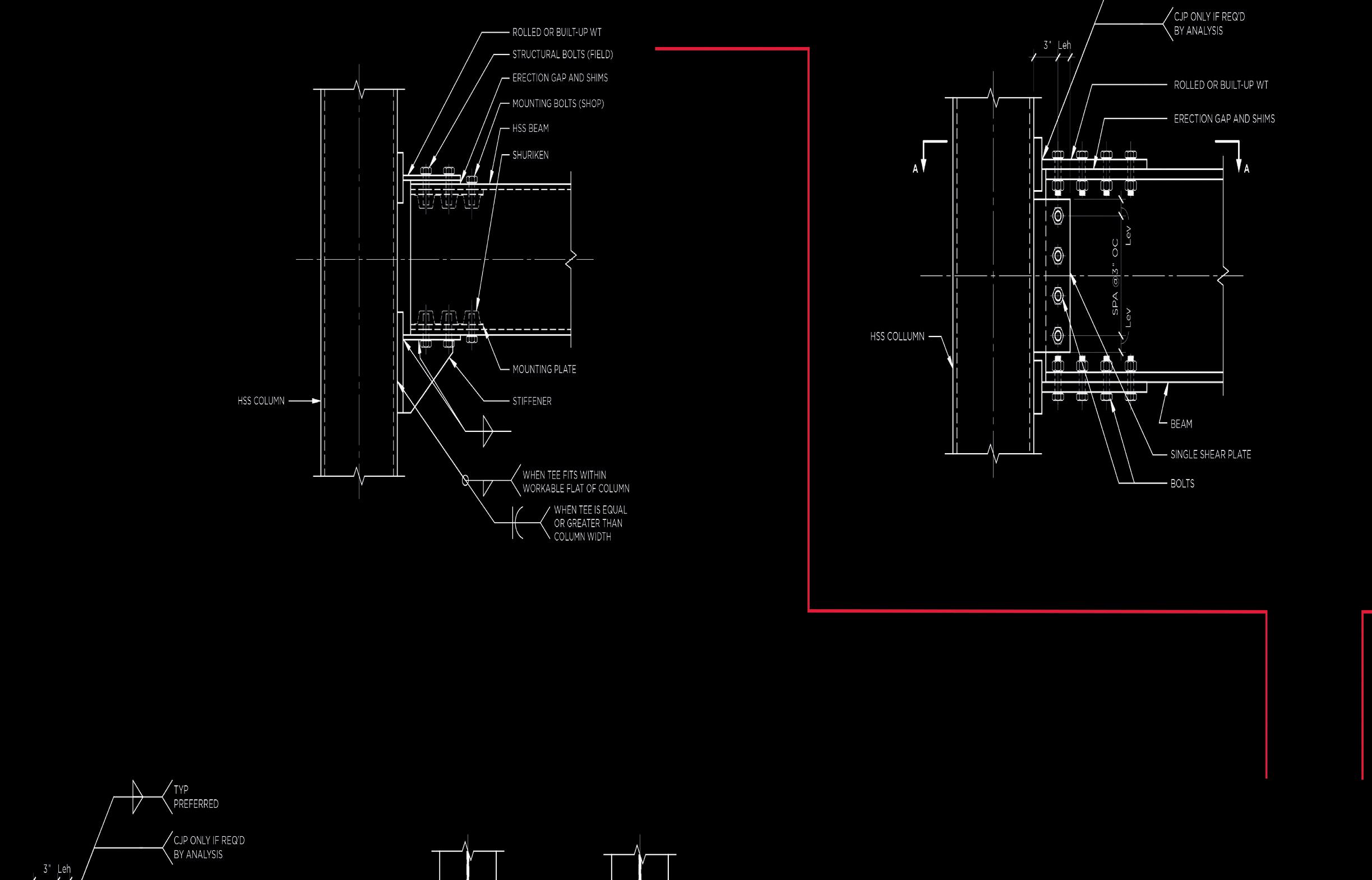
Atlas Tube’s HSS Connections Hub™ continues to evolve with dozens of recent updates and over 150 connections for AISC and CISC standards.
Welcome to a world of efficient HSS connection design.
No more developing and maintaining custom spreadsheets. Teams can streamline process and enhance collaboration directly on the HSS Connections Hub. Engineers quickly create HSS connection calculations, and fabricators get connection designs that meet requirements without all the back-and-forth revisions.
• Shear capacity in HSS to HSS splice connections
o Apply and check shear loads on splice connections for enhanced safety
• Seismic OMF and R=3 checks
o Automatic SDC determination based on project address and site soil conditions, checks for Ordinary Moment Frames and more
• Additional truss types
o KT - Overlapped circular
o KT - Gapped circular
o KT - Gapped rectangular
o Bolted truss connection (matched)
o Bolted truss connection (stepped)
• Auto-determined truss
o Automatically determine the truss connection type based on geometry and applied loads and calculate capacity based on this type
• Optimized end plate connection
o Enhanced calculations to optimize end plates for concrete-filled HSS columns
• Reversible loading option
o Toggle allowing reversible loading on bracing templates
• Bulk import from Excel and upload
o Import your connection requirements using Excel, and the HSS Connections Hub will pre-populate the details
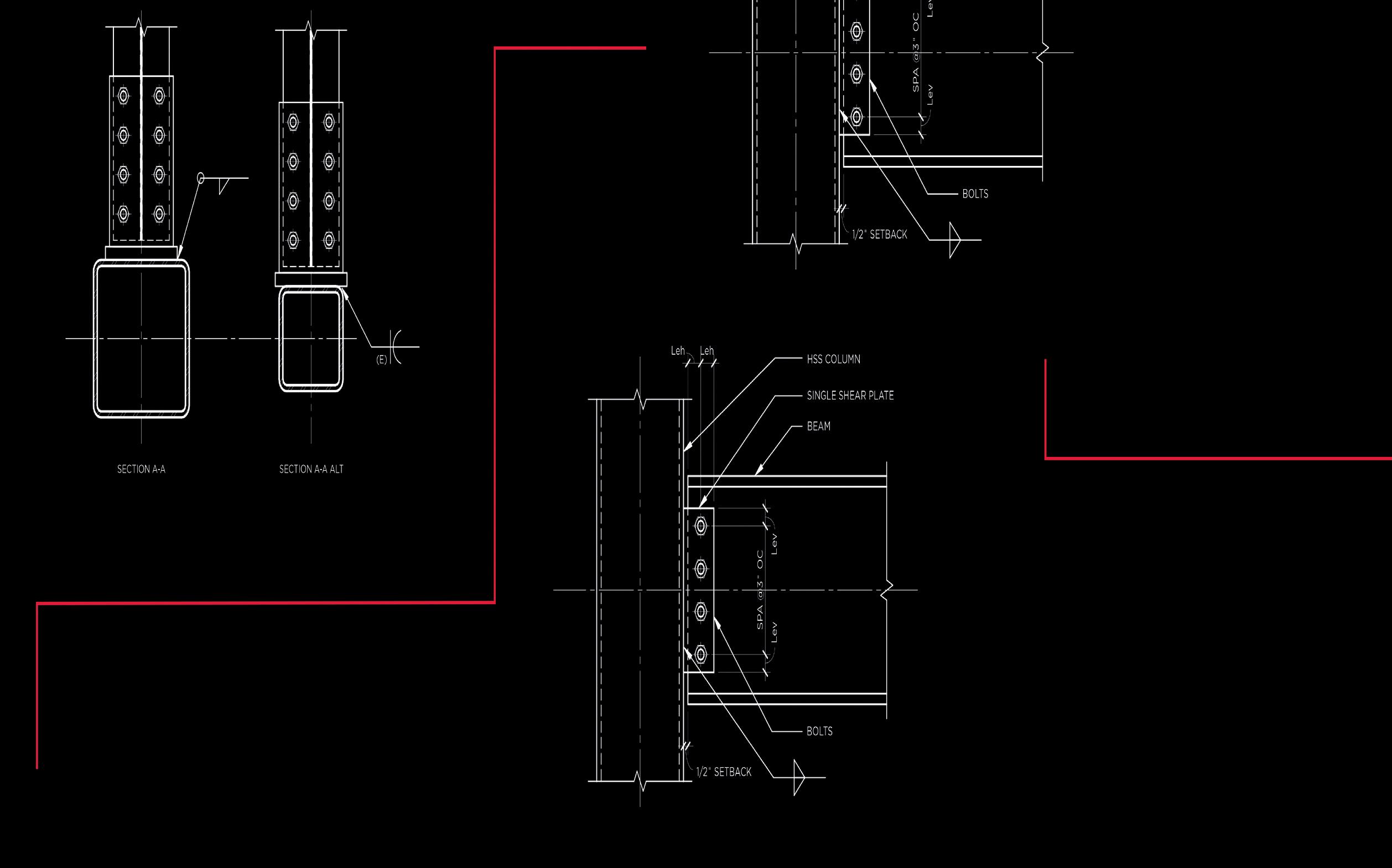
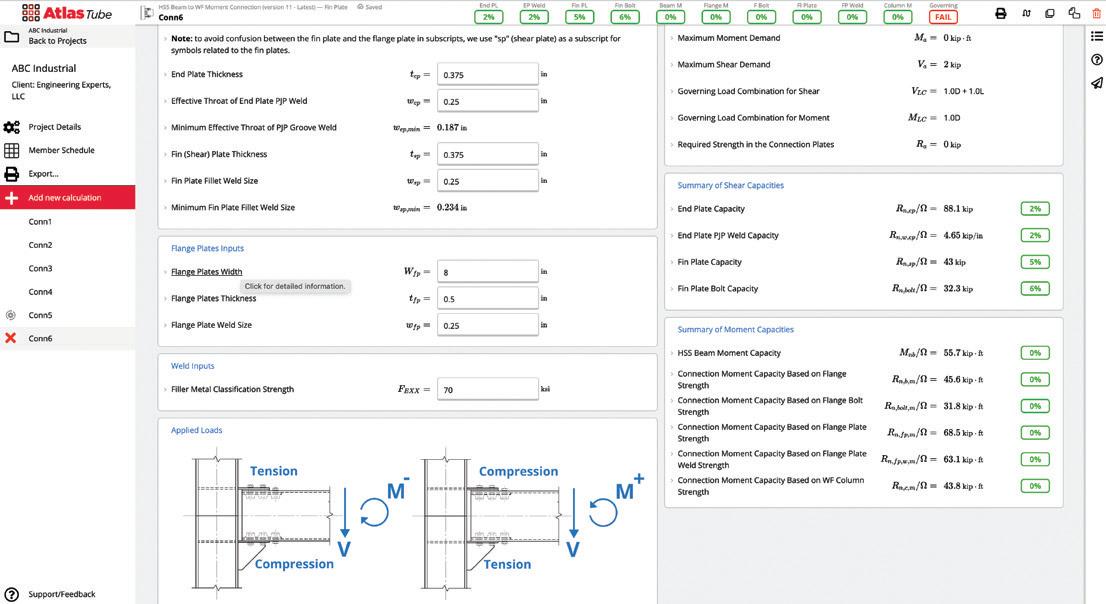
• More diagram views
o Top-down views for more clarity and a sneak peek of 3D views
• Axial loads in shear connections
o Apply axial loads to shear connections
• Composite column design (available late May 2026)
o New calculators for concrete-filled HSS columns, including axial, bending, shear and deflection checks.
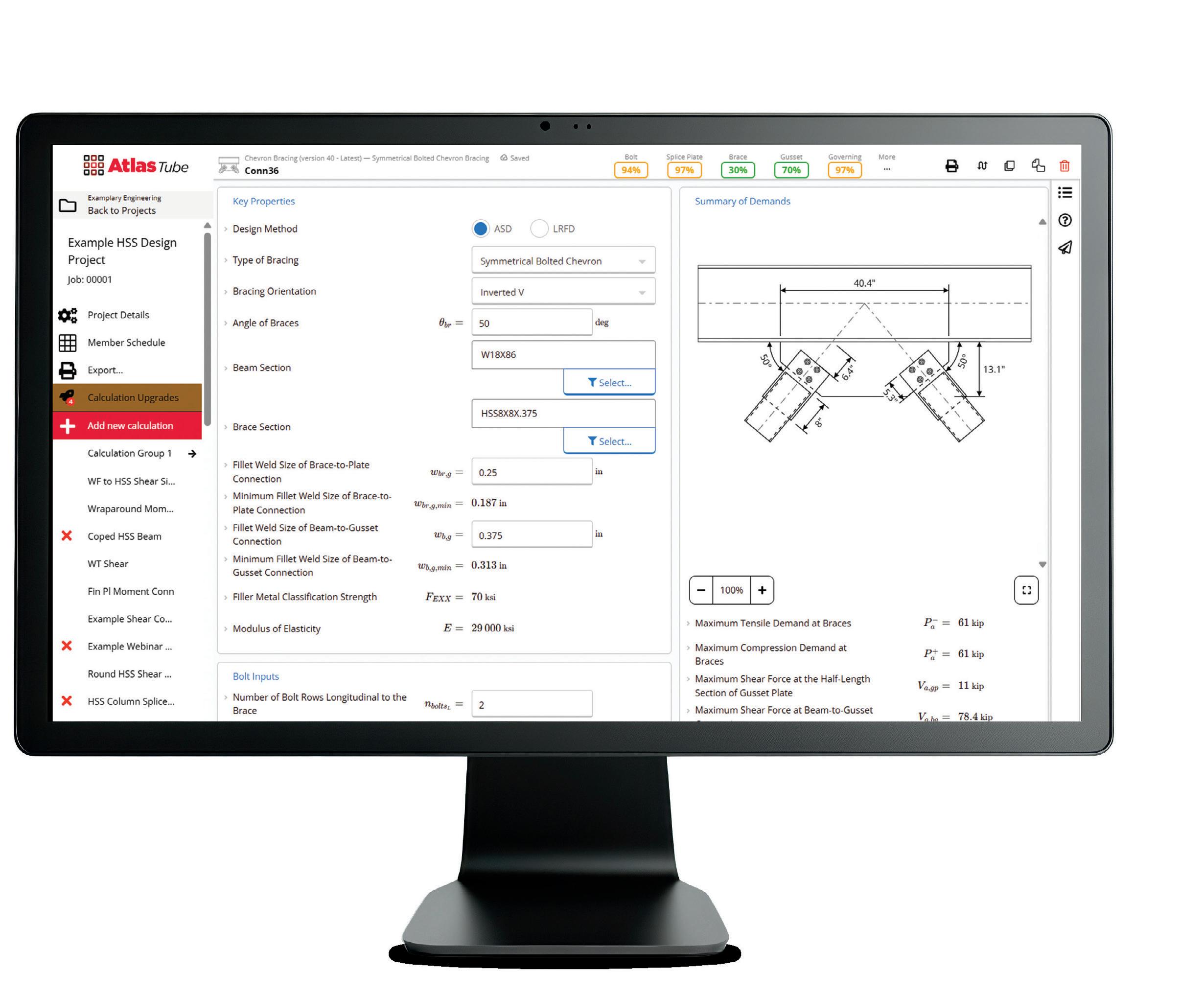
• Access a growing library of HSS connection calculators and fabrication-friendly typical HSS details.
• Hub calculators automate and confirm connection designs in real-time.
Eliminate field-welding with bolt-and-go ease. More Sizes. More connections.
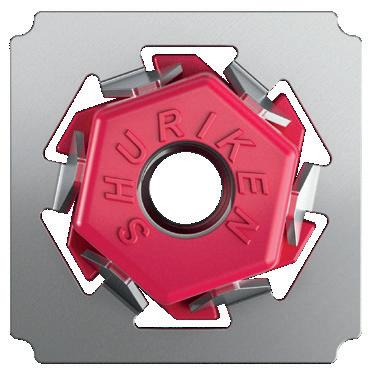
All Shuriken-enabled calculations are identified in the HSS Connections Hub. Look for the Shuriken
• Clear and concise results indicate whether the designed connection is efficient and meets specified requirements.
• Full transparency: Review and verify your calculations against specific code references with a simple click.
• Download or share detailed reports and connection drawings, including dimensions, bolt sizes and other relevant information for easy communication with fabricators.
• Request support from Atlas Tube’s engineering experts on your project.
Sign up today and start using the HSS Connections Hub. connectionshub.atlastube.com HSS Connections


Chair John A. Dal Pino, S.E. Claremont Engineers Inc., Oakland, CA chair@STRUCTUREmag.org
Kevin Adamson, PE Structural Focus, Gardena, CA
Marshall Carman, PE, SE Schaefer, Cincinnati, Ohio
Erin Conaway, PE AISC, Littleton, CO
Sarah Evans, PE
Walter P Moore, Houston, TX
Steven Judd
Interstate Brick, West Jordan, Utah, and H.C. Muddox, Sacramento, California
Linda M. Kaplan, PE Pennoni, Pittsburgh, PA
Jessica Mandrick, PE, SE, LEED AP Gilsanz Murray Steficek, LLP, New York, NY
Brian W. Miller Cast Connex Corporation, Davis, CA
Evans Mountzouris, PE Retired, Milford, CT
Kenneth Ogorzalek, PE, SE KPFF Consulting Engineers, San Francisco, CA (WI)
John “Buddy” Showalter, PE International Code Council, Washington, DC
Eytan Solomon, PE, LEED AP Silman, New York, NY
Executive Editor Alfred Spada aspada@ncsea.com
Managing Editor Shannon Wetzel swetzel@structuremag.org
Senior Director for Business Development & Marketing
Monica Shripka Tel: 773-974-6561 monica.shripka@STRUCTUREmag.org
Sales Manager
Audrey Schmook Tel: 312-649-4600 Ext. 213 aschmook@ncsea.com
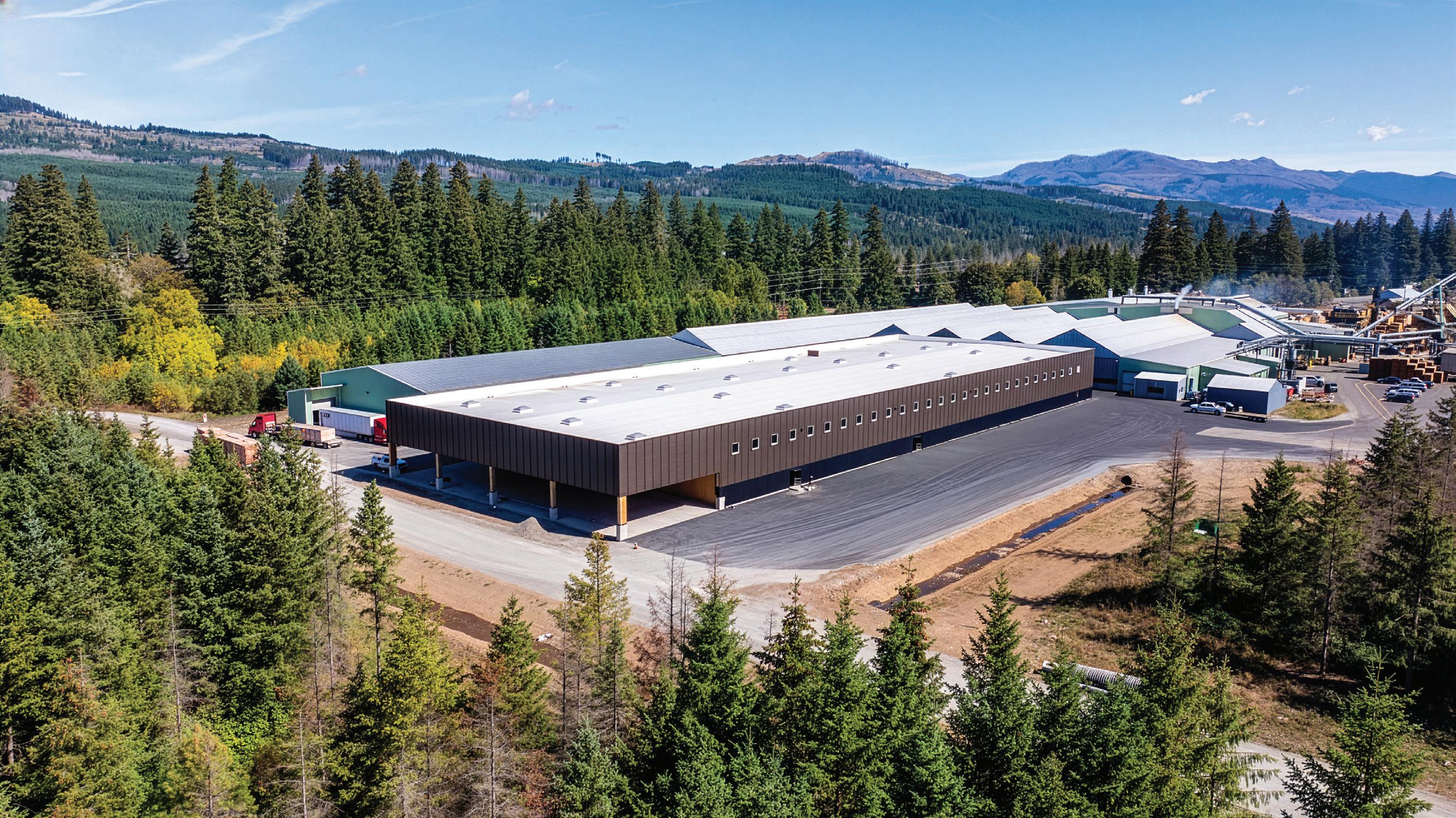
An outside-the-box design demonstrates that mass timber, in this case mass plywood, provides an aesthetically pleasing, cost effective, carbon sequestering, and thermally efficient alternative for warehouses and other big box buildings.
By Michael Hopper, PE, Rachel Marek, PE, and William Dawson, PE
How timber, steel, and concrete built a world-class engineering institute and advanced Princeton University’s campus sustainability goals.

SKELETON BEHIND THE SPIRIT: THE HOUSE THAT STITZEL BUILT
By Benjamin Wagner, PE, SE
Maintaining the structural integrity of historic American barrel-aging warehouses requires care, creativity, knowledge, and experience.
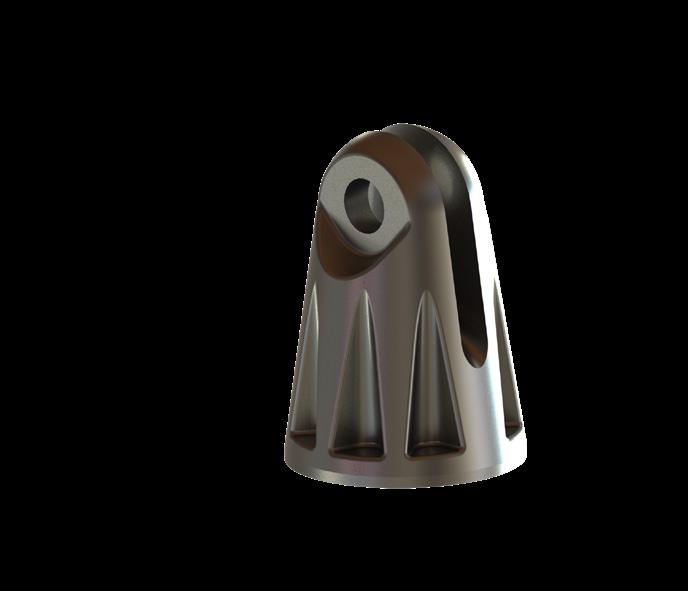
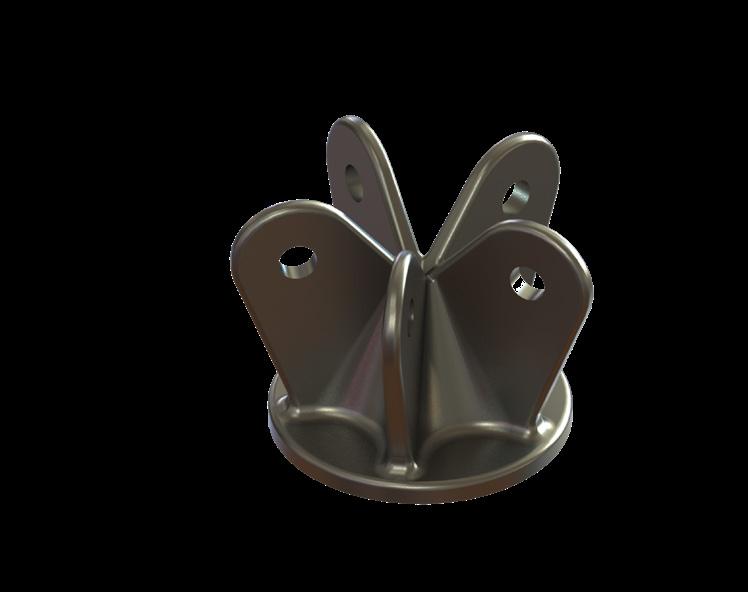
CAST CONNEX ® custom steel castings realize projects previously unachievable by conventional fabrication methods.
Innovative steel castings reduce construction time and costs, and provide enhanced connection strength, ductility, and fatigue resistance.
Freeform castings allow for flexible building and bridge geometry, enabling architects and engineers to realize their design ambitions.
Custom Cast Solutions simplify complex and repetitive connections and are ideal for architecturally exposed applications.

Architect: Kasian Architecture
Structural Engineer: Bush, Bohlman & Partners
Steel Fabricator & Erector: Whitemud Ironworks Limited
General Contractor: PCL Construction
Timber Supplier: FraserWood Industries
Lindsey Hoffman
Dan Sloat, SE and Chris Neisius,
Andrés Reyes García
Greg Greenlee,
Rakesh Pathak, Ph.D,

Bruce Maison, SE and John A. Dal Pino, SE



By Lindsey Hoffman
Today’s employees are managing stress from more than one direction. In addition to deadlines, client demands, and the pressures of professional life, many are also balancing personal responsibilities such as family, finances, and health concerns. For principals and firm leaders, this matters because employees do not leave personal stress at the door when they come to work, just as work stress often follows them home. When stress in either area goes unmanaged, it can affect focus, performance, relationships, and overall well-being. That is why every firm should have a clear and intentional stress management plan in place to increase employee morale, job satisfaction and decrease roll over. A certain amount of stress is normal. In some cases, it is actually helpful. It can push people to prepare more strategically, meet deadlines, and stay focused. But when stress becomes constant or overwhelming, it stops being helpful. Instead of helping people perform at their best, it can start to get in the way of their work.
Leaders may first notice stress in small ways. Employees may have trouble concentrating, remembering details, or taking in new information. Small problems can start to feel bigger than they really are. Employees may become more impatient, less flexible, or more reactive. Planning may suffer, and people who were once proactive may begin to simply respond to problems as they come. In some cases, employees may mentally check out and become less engaged in their work. For principals and leaders, these changes matter because they affect the entire firm. When stress spreads across teams, communication can break down, collaboration becomes harder, and productivity suffers across the company. Over time, unmanaged stress can lead to burnout, turnover, and costly project mistakes.
Stress management is especially important today because many employees are trying to manage both work pressures and home responsibilities at the same time. When someone is carrying stress in both areas, the effects can build very quickly. A demanding project at work can feel even more overwhelming when paired with family or personal concerns. At
the same time, ongoing work stress can make it harder for someone to be present and effective at home. Without support and practical tools, employees can end up in a cycle where stress in one part of life makes the other part harder to manage.
Another factor leaders are seeing today is how stress can show up differently across generations in the workplace. Some employees may be more likely to push through stress quietly and handle it on their own, while others may be more comfortable discussing stress openly or asking for help. These differences can sometimes lead to misunderstandings about work styles, expectations, or communication. Managing stress helps create a shared understanding by giving each employee a consistent way to identify their own stressors and build healthier habits, regardless of their generation.

what causes their stress, recognize early warning signs, and identify healthy habits that can help reduce it. Their leaders then review the plan with the employee and check in regularly to offer support and keep the conversation about building better habits going. For principals and leaders, using a consistent tool like the CASE Tool 2-10 can also make check-ins more practical, more focused, and easier to sustain over time. This allows employees to take ownership of their stress while giving their leaders a clear way to support them. It is also important to recognize that not all stressors are within an employee’s control. Deadlines, workloads, and client demands are often part of the job. A stress management plan instead focuses on the internal habits employees can improve, such as organization, prioritization, avoiding procrastination, and asking for help, education, and how they respond to challenges.
Managing stress helps create a shared understanding by giving each employee a consistent way to identify their own stressors and build healthier habits, regardless of their generation.
One helpful starting point is the CASE Tool 2-10 Stress Management. This tool allows each employee to identify personal stressors, reflect on habits that may be adding to stress, and develop a plan to improve them. The goal is not to eliminate all stress; many daily pressures are simply part of life. Instead, the tool helps employees focus on the habits they can control so that internal stress and unhealthy work patterns do not spill over into the team or organization. When supervisors review these plans and check in regularly, it creates accountability, encourages healthier habits, and supports a stronger work environment.
A stress management plan gives the firm a clear and consistent way to address stress across the organization. Each employee fills out their own plan so they can think about
For leaders, the benefits of addressing stress early are significant. Firms that support healthier work habits often see stronger engagement, better communication, and improved employee retention. Teams that manage stress well are often better at planning, collaborating, and staying productive during busy times.
A stress management plan does not need to be complicated to make a difference. It can begin with leadership awareness, training leaders to recognize early signs of stress, encouraging better prioritization, and promoting healthier habits across employees and teams. Most importantly, it should give employees a practical tool to reflect on their own habits and identify what may be contributing to their stress. ■
Lindsey Hoffman serves as Chief Administrative Officer of Stubbs Engineering, where she leads operations across Human Resources, Accounting, Marketing, and Business Development with a focus on strategic growth, operational excellence, and organizational effectiveness.
Visible Code References
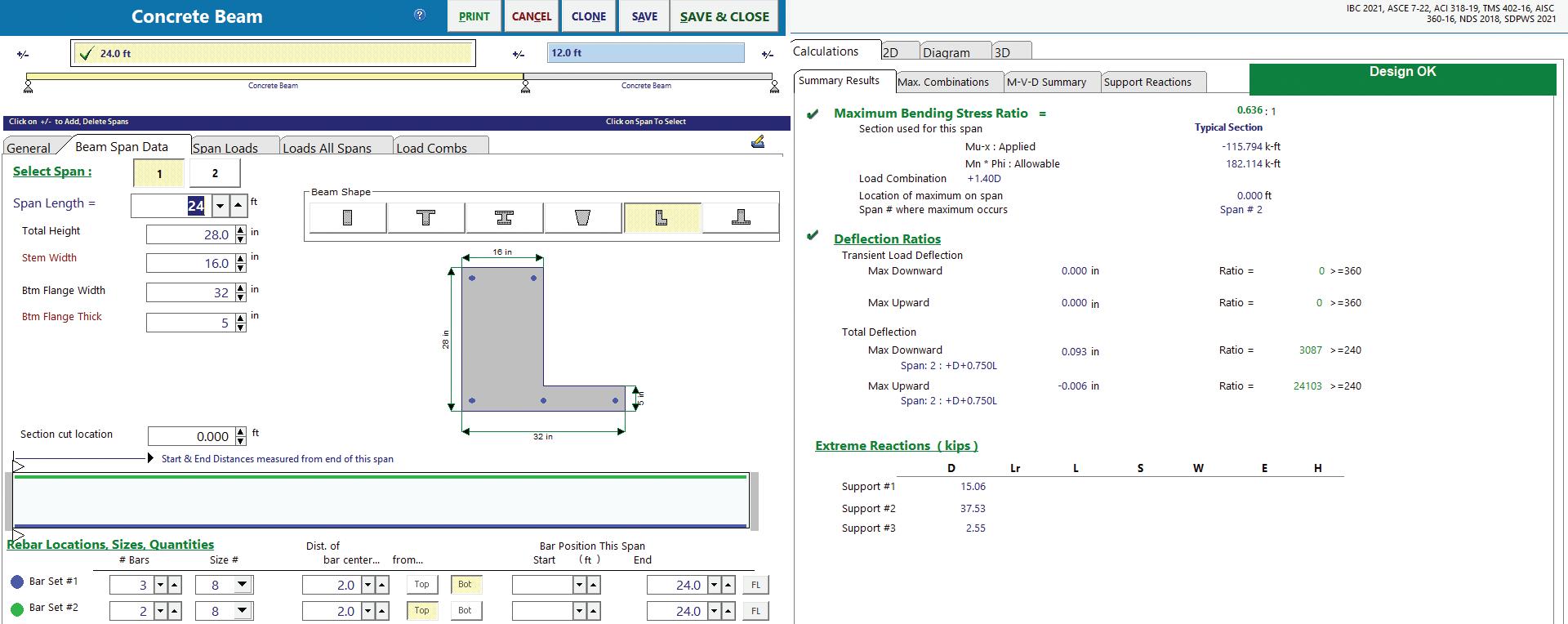
Responsive Graphics
Clear Inputs
Detailed Outputs

Alternate procedures may be called for when the vertical elements of a lateral force resisting system are not continuous to the highest diaphragm.
By Dan Sloat, SE and Chris Neisius, PE
The Equivalent Lateral Force (ELF) procedure is the most prevalent method practicing engineers use to analyze flexible diaphragm buildings for seismic forces. Inherent in the ELF formulation is an important assumption: all the vertical elements of the lateral-force-resisting system are continuous to the highest diaphragm in the structure. Many common structures violate this assumption, such as low-rise buildings with stepped roofs, and engineers risk substantially underestimating lateral forces in some elements when using the ELF procedure.
The ELF procedure approximates the dynamic behavior of multistory buildings by applying an assumed vertical distribution of seismic force up the height of the structure. Using this distribution, proportionally larger forces are applied at the highest floors and smaller forces at the lower floors (ASCE 7-22 Minimum Design Loads and Associated Criteria for Buildings and Other Structures Equations 12.8-12 and 12.8-13). This is generally conservative for vertical elements of the lateral force resisting system, referred to herein as vertical elements, as it maximizes the shear and overturning in the vertical elements at each level. This distribution may underestimate diaphragm forces at lower levels, which is addressed by factors provided in ASCE 7-22 Section 12.10.1.
The ELF procedure is most reliable when applied to buildings with floors that are stacked vertically with relatively consistent footprints. Its use on these types of structures has been studied extensively, and engineers generally regard the resulting force distribution as sufficiently conservative for design.
This conservatism is undermined in buildings with substantially different floor footprints at some levels. A simple case is presented in the first row of Figure 1: a warehouse building with two bays of differing height and flexible diaphragms. If this building is analyzed as a two-story structure using ELF, the following process occurs:
1. Seismic weight at each story is calculated.
2. Seismic force coefficients are determined using ELF. Proportionally more of the seismic force is applied to the upper diaphragm compared to the lower diaphragm.
3. Force is distributed to the supporting vertical elements based on tributary diaphragm area using the flexible diaphragm assumption. The exterior wall supporting the lower diaphragm (Wall C in Figure 1), is subjected to force only from the lower diaphragm. Per the ELF, this story has a smaller seismic force coefficient and is subjected to less force than if the building’s two diaphragms were at the same elevation. Unlike in a structure with two vertically stacked floors, the seismic force that was distributed to the upper story has no pathway to return
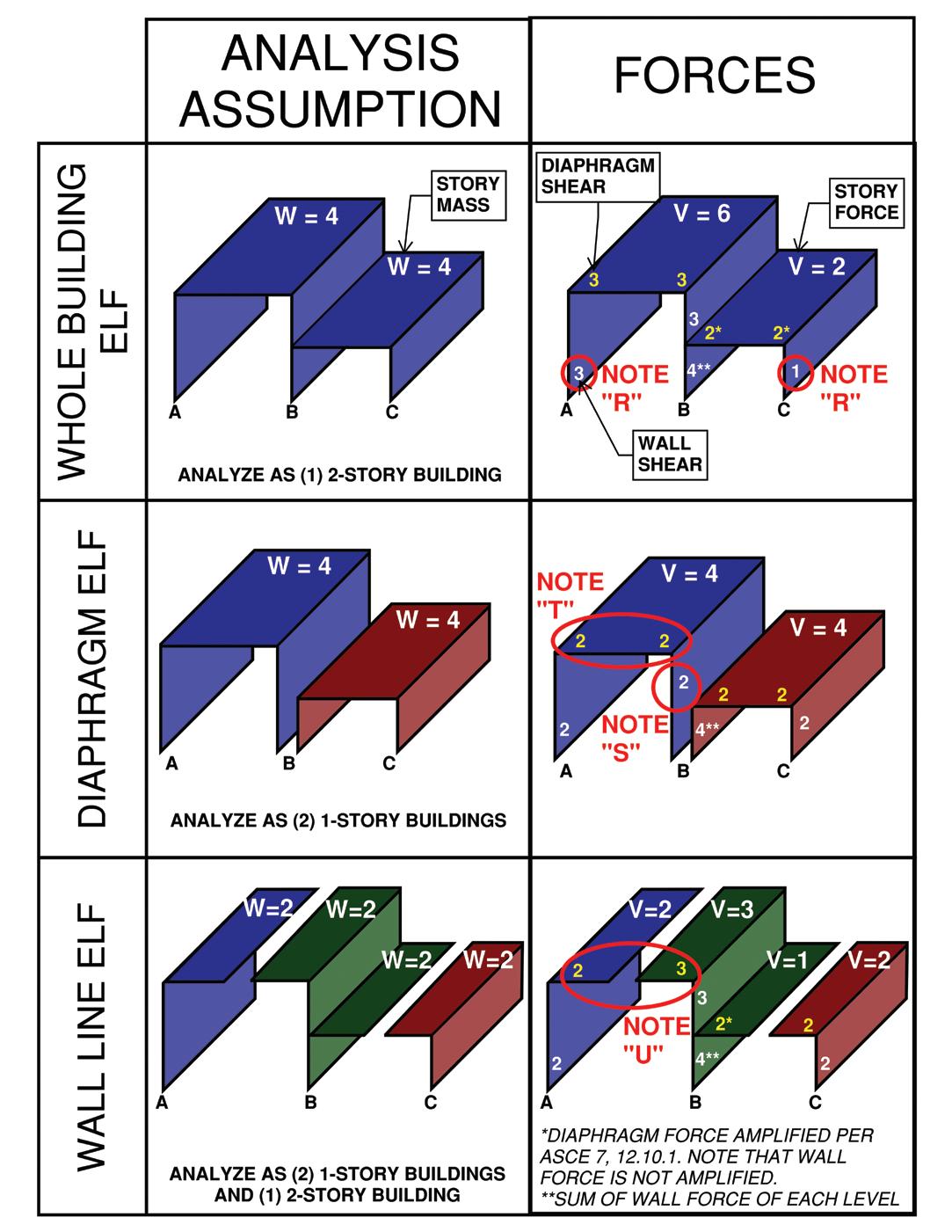
1. A few sample cases of different ELF procedures, including diaphragm ELF and wall line ELF, are illustrated.
to Wall C. Herein lies the potential unconservatism. The ELF formulation assumes that the vertical elements serve to sufficiently interconnect floor levels to create dynamic interaction between them under seismic loads. When using flexible diaphragms, the engineer assumes a lack of dynamic interaction between adjacent wall lines under seismic loads, as evidenced by the distribution of load based on tributary diaphragm area rather than relative stiffness of the vertical elements. For seismic mass from portions of diaphragms near Wall C to interact dynamically with the upper diaphragm, it must propagate across the lower diaphragm to Wall B, apparently violating the flexible diaphragm assumption.
Given the potential shortcomings of the traditional ELF, or Whole Building ELF, it is prudent to explore potential refinements. Two alternative procedures, each using the traditional ELF applied to subsections of the structure individually, are Diaphragm ELF and Wall Line ELF. Neither of these procedures is currently included in ASCE 7. The first column of Figure 1 illustrates the core assumptions for each procedure.
Diaphragm ELF: Each diaphragm is analyzed as an individual singlestory “building” with its surrounding shear walls. Vertical elements that connect to multiple diaphragms are included in both “buildings,” with their design forces taken as the sum of the demands contributed by each diaphragm they attach to. This procedure expands on the idea that the dynamic response of many flexible diaphragm buildings may be dominated by diaphragm deformations rather than vertical element deformations. As such, the procedure neglects the potential dynamic interaction between separate diaphragms.
Wall Line ELF: Each wall line and its tributary diaphragm sections are analyzed as an individual “building.” Forces are distributed vertically to the diaphragm segments using ELF force coefficients. This procedure expands on the core assumptions of flexible diaphragms outlined in ASCE 7—seismic mass distributes to vertical elements based on tributary area, rather than relative stiffness and there is negligible dynamic interaction between separate lines of vertical elements. Notably, this procedure yields the same results as the Whole Building ELF when applied to regular structures with flexible diaphragms.
Figure 1 illustrates wall and diaphragm in-plane forces for a sample split-level diaphragm building. The building has three wall lines supporting two diaphragms. Wall B is connected to both the high and low diaphragms. The diaphragms each weigh 2 units (nondimensional). Wall mass is ignored for simplicity in this example. All analyzed structures are assumed to be subjected to the same spectral acceleration, where the total base shear V=8. The upper diaphragm is 3 units above grade, and the lower diaphragm is 1 unit above grade. K is assumed to be 1.0 in ASCE 7 Equation 12.8-13, so 75% of the base shear is applied at the upper diaphragm and 25% at the lower diaphragm for the whole-building ELF and Wall B of the wall line ELF. Note that the diaphragm forces presented in Figure 1 are amplified per ASCE 7 Section 12.10.1, where applicable—denoted with an asterisk in the figure.
Several notable similarities and differences are present among procedures:
1. The Whole Building ELF assigns the seismic force unequally to Walls A and C, with wall A receiving three times the seismic load of wall C. The Diaphragm ELF and Wall Line ELF assign the load equally to Walls A and C. See note “R” in Figure 1.
2. The Diaphragm ELF estimates less seismic force in the upper diaphragm and in the upper half of Wall B relative to the other analysis procedures. See notes “S”
and “T” in Figure 1.
3. The Wall Line ELF estimates that the seismic force in the upper diaphragm is asymmetric, with larger shear forces near Wall B than Wall A. See note “U” in Figure 1.
4. All three procedures provide the same estimate for the force in the low diaphragm and the lower level of Wall B.
A 3D linear dynamic analysis conducted in ETABS compared the results of the presented ELF procedures. This model was representative of a school gymnasium with surrounding support facilities. A 25-foot central gymnasium space is bordered by three adjoining spaces with low roofs—a 14-foot cafeteria to the north, a 11-foot locker room to the west, and a 11-foot storage area to the south. For simplicity, all diaphragms were assumed to have the same unit weight, the design spectral acceleration was assumed to be equal for all building periods, and walls and diaphragms were light frame wood construction. These simplifications minimize the number of variables to be interpreted in the model results.
The modeled structural elements were limited to wood diaphragms and wood shear walls and modeled as linear elastic thin shells. The shear stiffnesses of diaphragms and shear walls were individually calibrated to match the values provided by AWC Special Design Provisions for Wind and Seismic, 2015 Edition, Equations 4.3-1 and 4.2-1.
Figure 2 shows a representation of the 3D model in both plan and elevation. Note that the wall labels in Elevation X-X of Figure 2 correspond to the theoretical building presented in Figure 1. Wall A is the exterior wall supporting the high diaphragm. Wall B supports both the upper and lower diaphragms. Wall C is the exterior wall supporting the lower diaphragm.
The analysis model presented the following modal characteristics: 1. Primary structural vibration modes were dominated by individual diaphragm deformation, with minimal mass participation from other diaphragms.
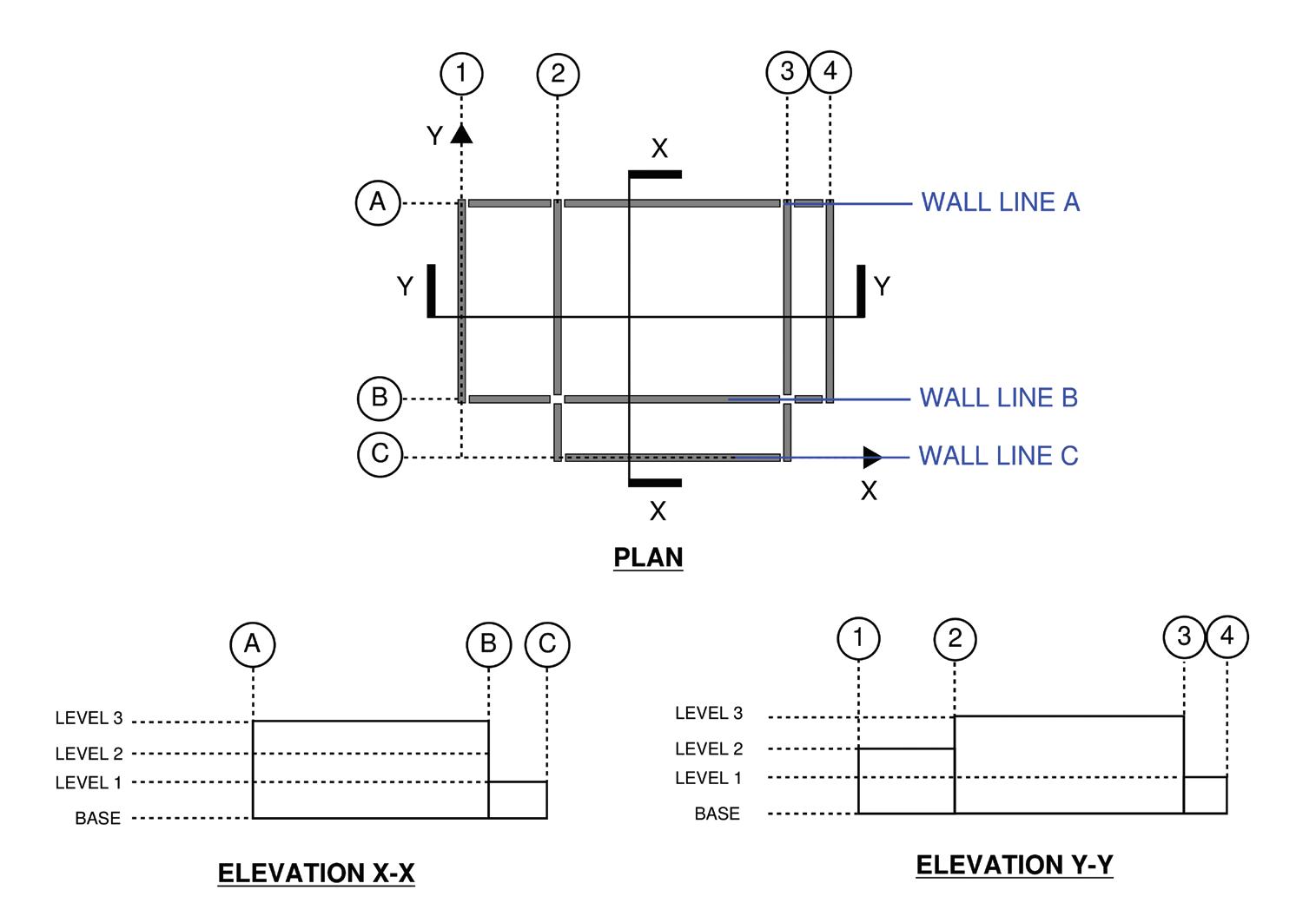
Fig. 2. In this representation of a ETABS Building Model in both plan and elevation, the wall labels in Elevation X-X correspond to the theoretical building in Fig. 1.
2. Structural vibration modes with substantial in-plane wall mass participation included virtually no mass participation from other wall lines.
These results support the flexible diaphragm assumption and demonstrate that the structure is behaving differently from a multi-story structure with stacked diaphragms.
Figure 3 shows the shear in the X-direction walls for each of the three ELF assumptions as a fraction of the corresponding 3D model wall shear. The authors noted the following observations when comparing the relative predictions of the ELF procedures to those of the 3D model. Although not shown in the figure, similar observations were made for the Y-direction walls.
1. The Whole Building ELF drastically underestimates the shear in Wall A, while the Diaphragm and Wall Line ELF procedures provide a more accurate estimate. This is the central concern with the Whole Building ELF presented in this article, and the dynamic analysis supports that concern.
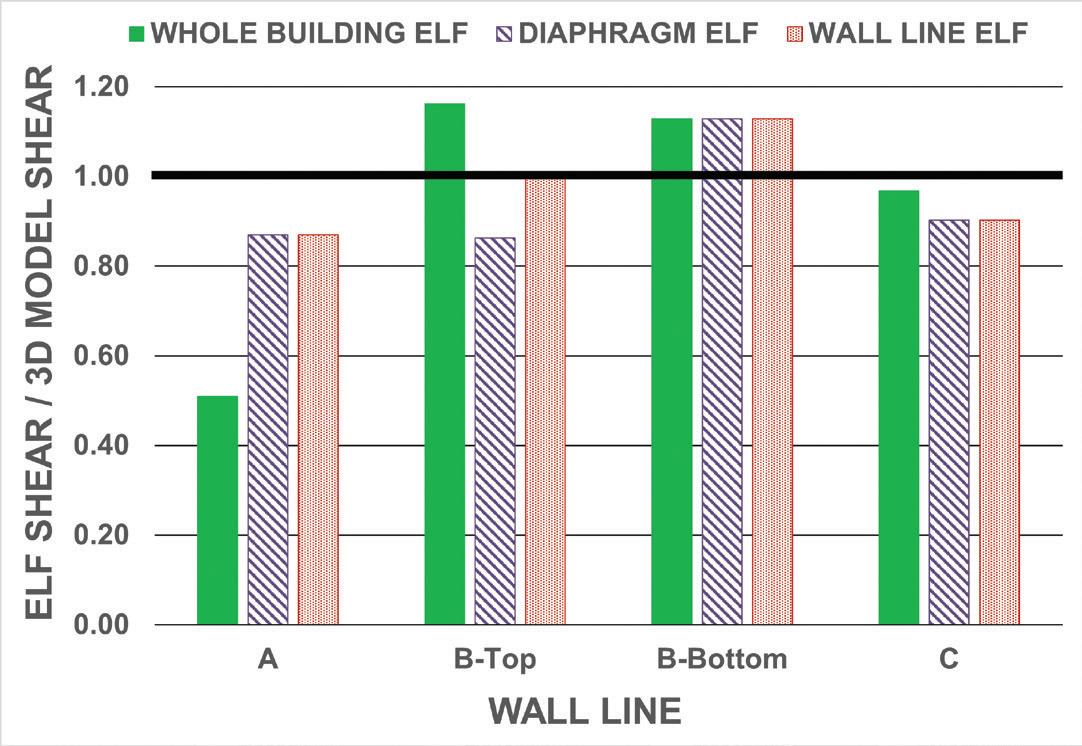
2. The Diaphragm ELF underestimates the shear in the upper portion of Wall B, but it otherwise provides results consistent with Wall Line ELF.
3. Though not visually represented in this article, the shear stresses in the upper diaphragm are slightly asymmetric in the model, with larger forces near the shared wall. This behavior was also identified by the Wall Line ELF as previously noted in Figure 1. The dynamic analysis itself is not without shortcomings. Any linear elastic model of a seismic system is necessarily approximate. The data presented herein is provided as an additional argument in support of the theories presented in the earlier sections of this article, rather than a definitive statement on the accuracy of the ELF procedures.
In practice, the following Wall Line ELF procedure requires minimal additional computation relative to the Whole Building ELF:
1. Determine seismic mass of walls and diaphragms (same as Whole Building ELF).
2. Assign seismic mass from diaphragms to wall lines using the flexible diaphragm assumption (same as Whole Building ELF).
3. Perform an ELF for each wall line, ignoring the rest of the building. Lump mass at each diaphragm supported by that wall line. Note that each wall line has its own natural period. Also, diaphragms may have different shear demands at each wall line even if the diaphragm is symmetric. This is consistent with observations from the modeling study.
4. Design diaphragms and walls for the forces determined from the Wall Line ELF (same as a Whole Building ELF).
Engineers should consider the use of the Wall Line ELF in place of the traditional Whole Building ELF in low-rise buildings with flexible diaphragms that have mezzanines, multiple roof heights, or Vertical Elements that do not extend to the highest roof level of the structure. For atypical structures, the Wall-Line ELF captures behaviors that the full-building ELF misses. The Wall Line ELF is logically consistent with the flexible diaphragm assumption, providing more rational results for atypical diaphragm layouts. The Wall Line ELF has also shown itself to be the most consistent with 3D dynamic analysis. Engineers must use judgement when analyzing irregular structures for seismic loading, taking care to assess where the selected analysis method may misrepresent the structural behavior. The Wall-Line ELF is one tool to aid engineers in achieving this goal.
Dan Sloat, SE, is an Associate with Degenkolb Engineers in Seattle, WA. He also serves in the AISC national committee for Seismic Design.
Chris Neisius, PE, is a Design Engineer with Degenkolb Engineers in Seattle, WA
• Cutting-Edge Equipment: New 48” technologically advanced glulam press and lay-up system.
• Versatile Production: Widths produced range from 2-7/16” to 10-1/2”, while depths range from 3-1/2” to 35-3/4”.
• Expanded Size Options: Finished Glulam Sizes up to 10 ½” x 35 ¾” x 60’.
• Diverse Applications: Available in various appearance classifications and strength grades for Commercial, Industrial, and Residential applications.
• Superior Quality: Manufactured with superior strength southern yellow pine MSR Lumber.
• Sustainability: Sustainable Forestry Initiative (SFI®) is certified for environmentally conscious projects.


Reuse of screws is already occurring in the field. The critical question is not whether reuse happens, but whether it can be made measurably safe.
By Andrés Reyes García
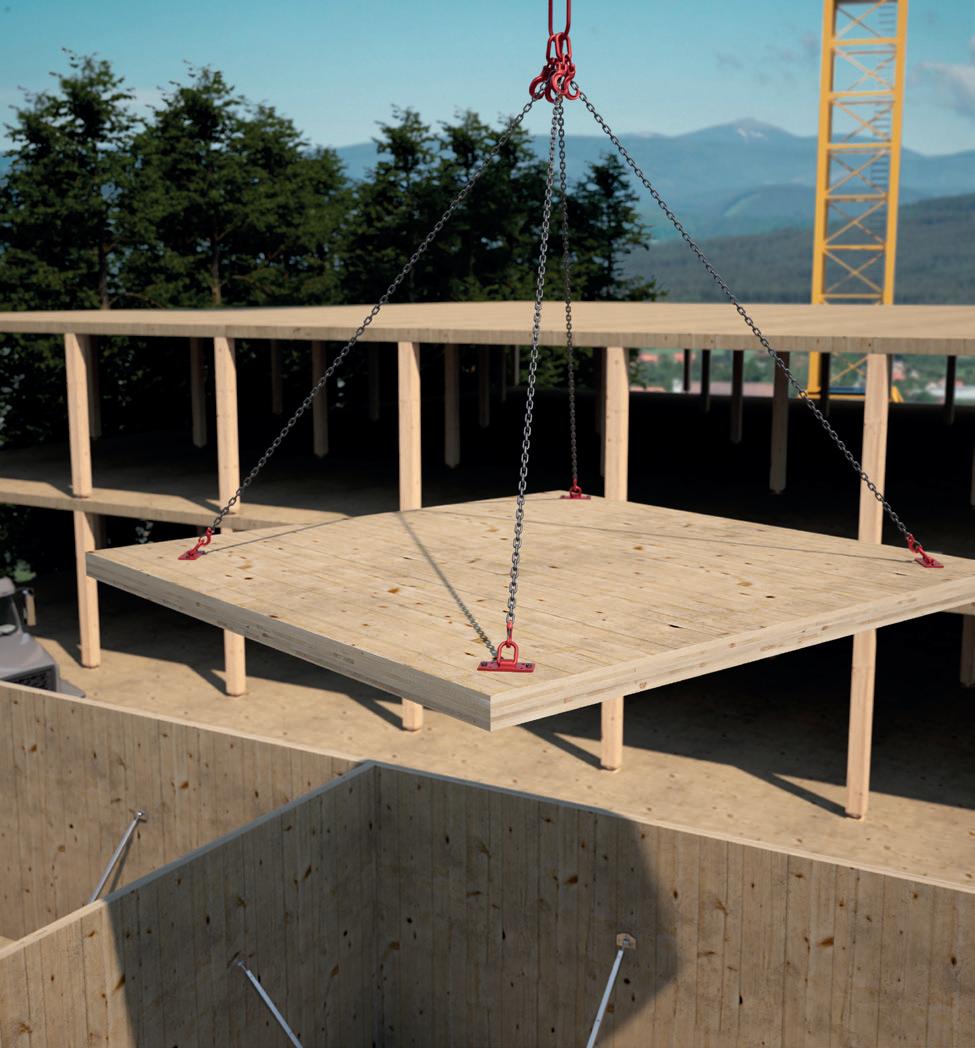
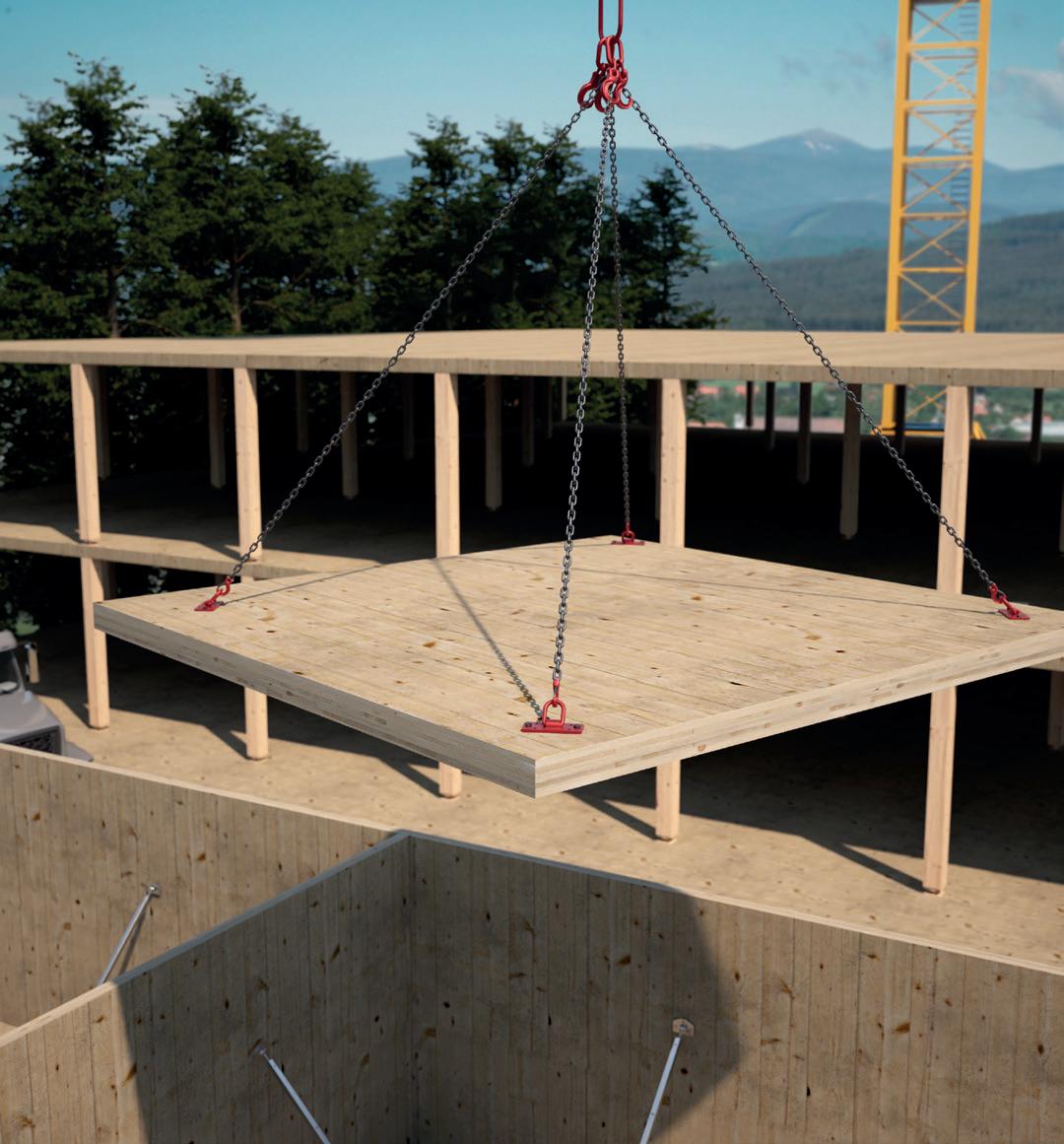
Lifting in mass-timber construction is a high-consequence operation: a single connection failure can lead to a dropped load, with potential for severe injuries, fatalities, and major property damage. Industry safety rules therefore treat suspended loads as a critical hazard and require exclusion zones and rigorous controls. In this context, any proposal to reuse removable fasteners in lifting must be grounded in demonstrable mechanical performance and conservative screening rules.
Despite that need, the sector routinely reuses screws used to install temporary lifting devices. This practice persists even though, as a general state of the art, wood screws are not sold with a “reuse” designation for lifting; technical documentation commonly prescribes single use. The implication is not that reuse is always unsafe, but that end-users are currently assuming the risk without an objective method to screen used screws and without clear alignment between manufacturers’ assumptions, standards, and field practice.
A second driver is sustainability. Single-use assumptions for removable fasteners can inflate both material demand and the embodied carbon attributed to lifting operations. If reuse is already happening, a verified reuse pathway becomes relevant not only for safety, but also for life-cycle assessment (LCA) calculations that seek to represent real practices.
damage modes control the outcome. In parallel, a dedicated (Life Cycle Assessment (LCA) study on cross-laminated timber (CLT) lifting operations was carried out in collaboration with Politecnico di Milano (Polytechnic University of Milan) to quantify the environmental implications of reuse scenarios for lifting screws.
A dedicated research program was therefore set up to (1) characterize the mechanical behavior of used screws in lifting applications and (2) translate test outcomes into a practical, objective reuse protocol. The experimental work combined campaigns at the University of Maine and the University of Bologna with additional testing at Rothoblaas (an International company that designs, manufactures and distributes high-tech solutions for timber construction) laboratory facilities, with the explicit aim of checking whether resistance degradation occurs after simulated reuse and whether specific
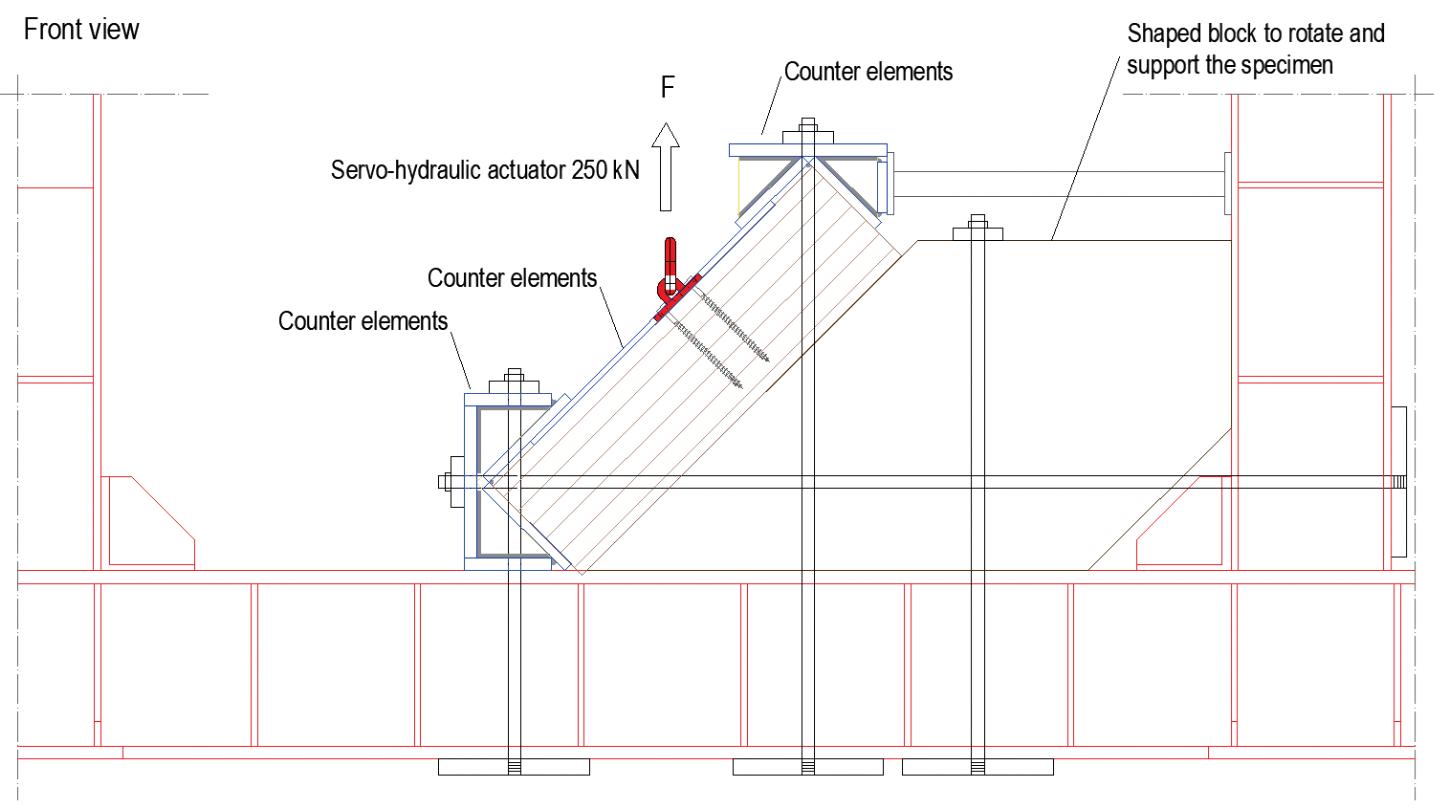
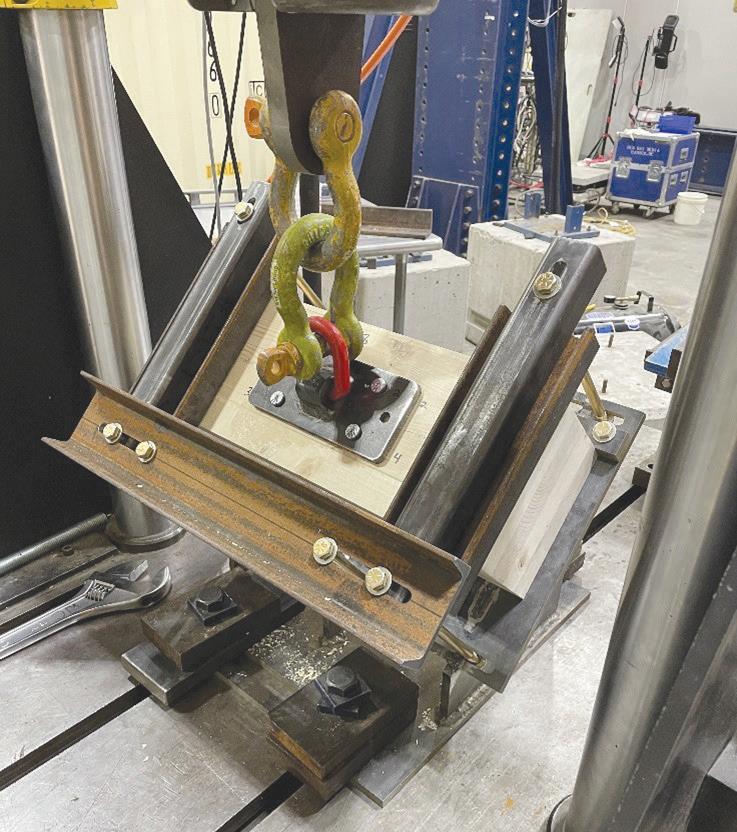
The test campaign was structured in three phases: 1) single - screw analysis carried out to assess geometric and mechanical parameters under simulated reuse - cycle conditions; 2) system level analysis of the lifting hook configuration comparing new and used screws to evaluate global behavior, ultimate resistance, and failure modes under representative loading; and 3) system analysis with controlled deformation or damage introduced to the screw/system to understand sensitivity to realistic (but extreme) misuse conditions. System-level tests were performed on the lifting-hook assembly under pure tension, pure shear, and combined tension–shear loading; combined loading was applied using a dedicated jig set to 45 degrees, as shown in Figures 2 and 4.
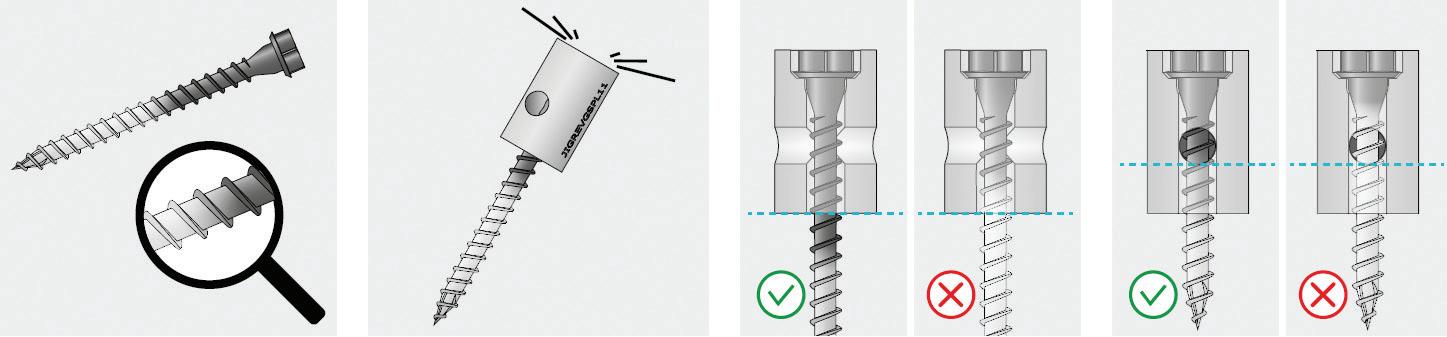
The experimental matrix was designed around the factors most likely to influence the performance of screws in lifting applications. It therefore included reference tests, reuse-cycle simulations, and system tests in which “representative damage mechanisms” (RDM) were intentionally induced (Fig. 3).
The underlying premise of the RDMs is the hypothesis that the primary concern is not reuse per se (Phases 1 and 2), but reuse combined with plastic deformation or damage introduced by installation errors and/or overload events, which can alter resistance and failure mode (Phase 3).
The experimental campaign included both a short-screw series and a long-screw series (lengths: L = 80 mm (3 1/8 inches) and L = 180 (7 1/8 inches), respectively) both with diameter 10 mm (0.40 inches), to capture sensitivity to embedment and withdrawal contribution. Three RDMs were investigated based on their potential to reduce the capacity of the lifting system:
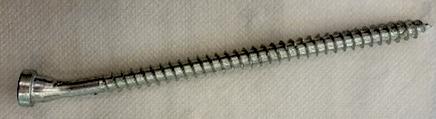
• Bending (MECH 1, plastic deformation outside the screw axis, as shown in Figure 1): a sign of misalignment during installation or of an overload event; it concentrates strain, can create plastic hinges, and may promote microcrack formation.
• Torsion (MECH 2, plastic deformation within the screw axis and damage to the timber counterthread), typically caused by over-torque during installation or removal: once the screw is blocked by the plate and can no longer advance, continued rotation under torque causes the screw to keep turning without progressing. This can induce torsional yielding in the screw and damage the timber counterthread. Both effects can reduce residual tensile and withdrawal capacity and may not be evident after removal.
• Thread damage (MECH 3): it directly affects withdrawal resistance and is a proxy for abrasive damage during installation, use, removal, or handling.
At the system level, the study then evaluates how reuse and these damage mechanisms correlate with mechanical performance under pure tension, pure shear, and combined tension–shear loading.

Across the system tests, reuse cycles alone had limited influence on ultimate resistance when compared with reference assemblies. The largest variability tended to appear in pure shear —especially when simulated cycles were applied at load levels high enough to occasionally approach or exceed plastic limits in the connector or plate—yet results remained above the system’s declared maximum operational load capacity. This supports a key distinction: reuse itself is not the dominant risk driver; rather, plastic deformation and damage to the screw and/or the timber substrate are.
Results were analyzed at CIRI-University of Bologna to quantify the effect of each damage mechanism on load-carrying capacity. As shown in Figure 5, the damage effect was first expressed as the percentage difference between the mean capacity of the reference tests (FRef) and the mean capacity of the damaged configuration (FDam), and summarized in a matrix using discrete ranges mapped to a color scale.
A second matrix (Fig. 6) compares the mean force at the end of the linear branch of the load–displacement curve (FElastic) with the declared maximum operational load capacity (RWLL/WLL) used for lifting practice (Machinery Directive 2006/42/EC, which lays down health and safety requirements for machinery in the European Union market). This comparison supports the safety interpretation because FElastic > RWLL indicates elastic-range operation under correct working conditions also under a deformation mechanism.
The damage-mechanism campaign helped distinguish which misuse scenarios actually control performance—and which are secondary:
• Bending/plastic hinge beneath the head (MECH 1). This was the least penalizing mechanism overall, with negligible or no reductions in tension and combined tension–shear, and only small reductions in pure shear. This is consistent with the Maine observations and with the mechanics of the system: bending primarily affects shear-governed response where resistance is influenced by bending/plasticization of the connector and local prying effects, rather than by withdrawal capacity.
• Over-torque/torsional damage (MECH 2). This was critical mainly for short screws, where excessive torque can damage the timber fibers/counterthread and reduce resistance. For longer screws, the influence on ultimate resistance was generally limited;
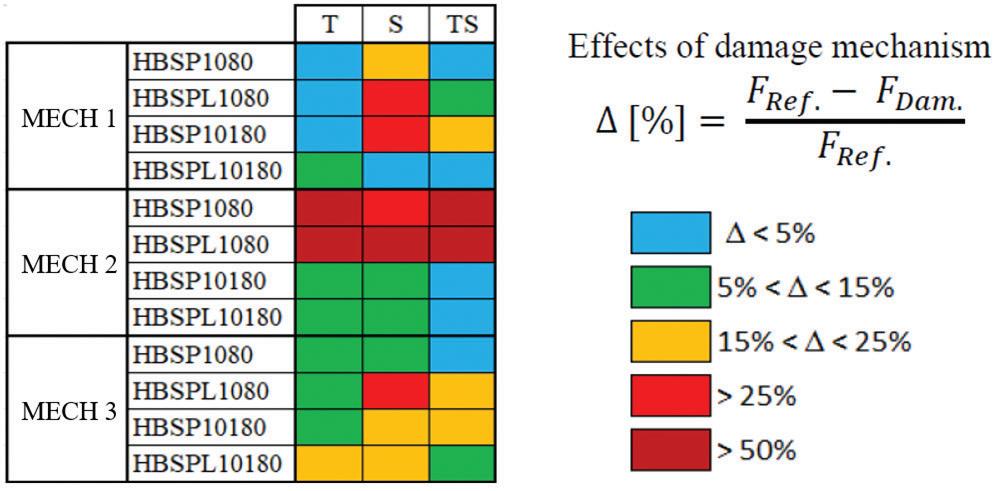
(FRef) and mean damaged capacity (FDam) for each configuration (color-coded ranges).
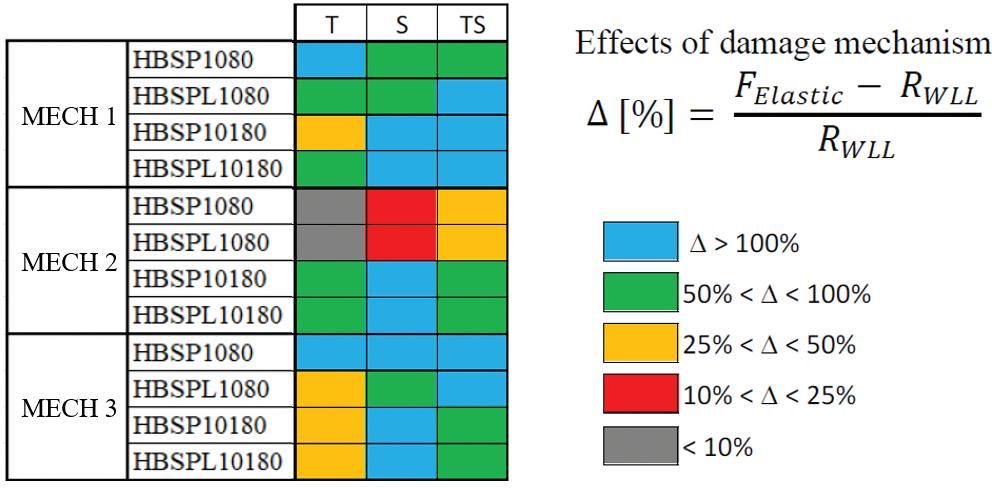
however, the torsional state and the pretension introduced by over-torque can still modify the way the connection fails, shifting the governing failure mode even if peak strength is not markedly reduced.
• Thread damage (MECH 3). This was the most influential mechanism across the broadest range of screw lengths and load cases. By reducing withdrawal resistance, it affects performance whenever axial engagement contributes to capacity—clearly in tension, but also in shear through the rope effect, where withdrawal/axial components can substantially increase lateral resistance. A final step in the analysis was to plot the tension–shear interaction domains for each damage mechanism. Figure 7 summarizes the normalized interaction domains for the tested configurations and relates the experimental envelope to both the maximum operational domain (RWLL/WLL) and the certificationlevel limit domain (4×RWLL). This comparison helps distinguish cases that remain within the elastic-range operating region from intentionally severe misuse cases that approach limit conditions.
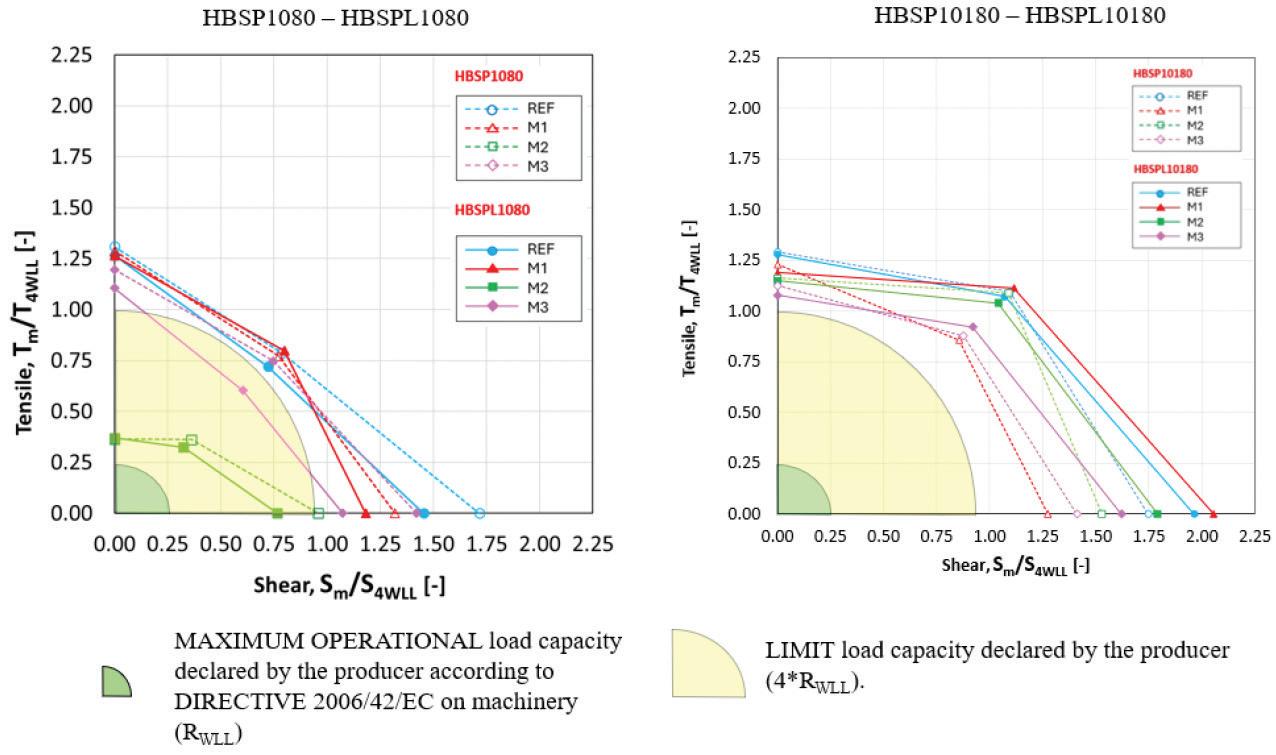
Most importantly, two safety-relevant observations emerge when results are interpreted against the operational and limit conditions used in lifting practice. First, for all damaged configurations the mean force at the end of the linear branch of the load–displacement curve (elastic limit) exceeded the maximum operational load capacity declared for the lifting system (RWLL, i.e., the rated Working Load Limit used as the maximum allowable service load). This indicates that when the lifting operation respects the RWLL, the connector works in
the linear elastic range and is not expected to accumulate use-induced damage; therefore, correct installation becomes the governing prerequisite for any verified reuse pathway. Second, the tension–shear interaction domains lay outside the declared operational domain and were also outside the 4×RWLL limit condition that reflects the safety factor typically applied for certification under the Machinery Directive (Directive 2006/42/EC), except in a small subset of intentionally severe cases (notably over-torque for short screws and a combined case involving thread damage). Reaching this threshold is an important milestone: it places the experimental evidence within the same certification-level safety framework used to qualify lifting equipment, providing a clear and internationally recognized benchmark for interpreting reuse conditions.
The mechanical results alone are not a permission to reuse; they are inputs to a conservative decision framework. The practical challenge is that the most consequential damage mechanisms are not always obvious to a jobsite crew and can accumulate across repeated installation/ removal. A reuse protocol therefore must be simple, objective, and biased toward discard when uncertainty exists.
The protocol developed from this project follows three principles:
1. Visual screening: reject any screw showing corrosion, cracked/ flaking coating, obvious bending, head damage, or thread damage.
2. Straightness check: a go/no -go gauge (“reuse jig”) verifies that the screw remains within the acceptance tolerance for bending. The screw must seat flush against the stop condition, as shown in Figure 8—if not, discard.
3. Thread-wear check: a control gauge verifies the thread profile. If the thread passes through the specified opening (indicating wear or damage), discard.
In addition to pass/fail screening, reuse is governed by a bounded reuse count, implemented through an objective coating-wear indicator checked against an acceptance region, as described in the next section. Only if all checks are satisfied can the screw be reused. The protocol is paired with process controls—controlled installation/removal torque, dry and segregated storage for used screws, and immediate discard after any abnormal event (suspected overload, impact, or loss of control of the suspended load). Finally, a bounded reuse count or traceability method further reduces uncertainty about cumulative damage.
Even when “reuse alone” is not strongly correlated with strength loss, a bounded reuse count reduces uncertainty about cumulative damage and procedural drift. A practical way to implement this control is
to use coating wear as a traceability indicator by confirming whether the wear line/area falls within an acceptable region.
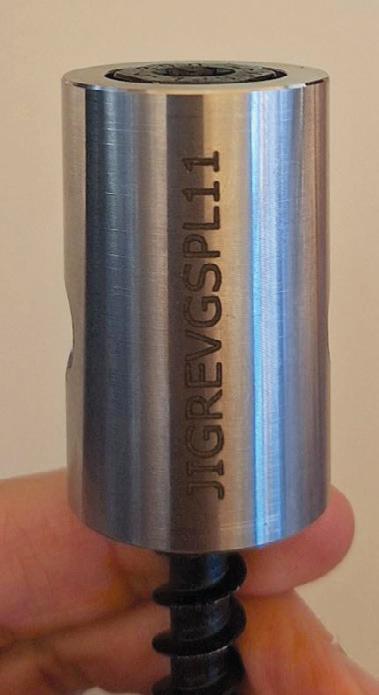
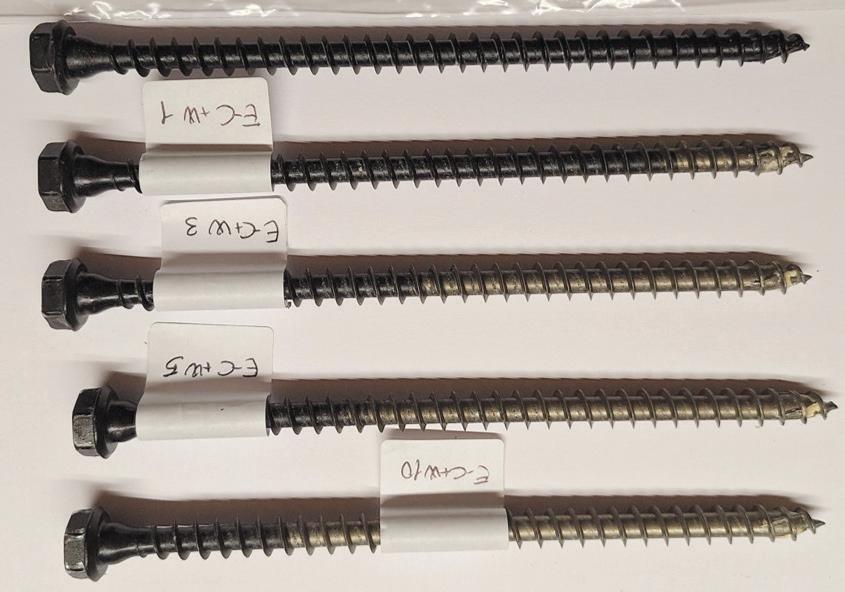
For example, VGS PLATE screws (the reusable lifting screw from Rothoblaas) use a coating system composed of a chrome-passivated electroplated zinc layer, a black e-coating topcoat, and an additional wax layer. Beyond corrosion protection and reduced insertion friction (and easy identification as lifting screws), these outer layers exhibit a progressive wear-off after repeated insertion/ removal, as Figure 9 shows. When linked to predefined acceptance criteria, this provides an objective visible threshold to control maximum reuse count. As displayed in Figure 10, in practice, after the screw passes the straightness check, it is inserted fully into the reuse jig and the wear indicator is checked against the acceptance region; if the threshold is exceeded, the screw is discarded.
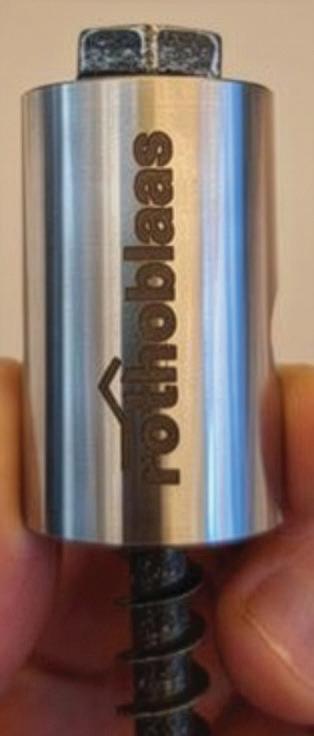
8. A jig with a pan head hex screw for lifting was used to evaluate the screw’s straightness or lack of plastic deformations along its longitudinal axis. The head must be completely flushed, otherwise the screw must be discarded.
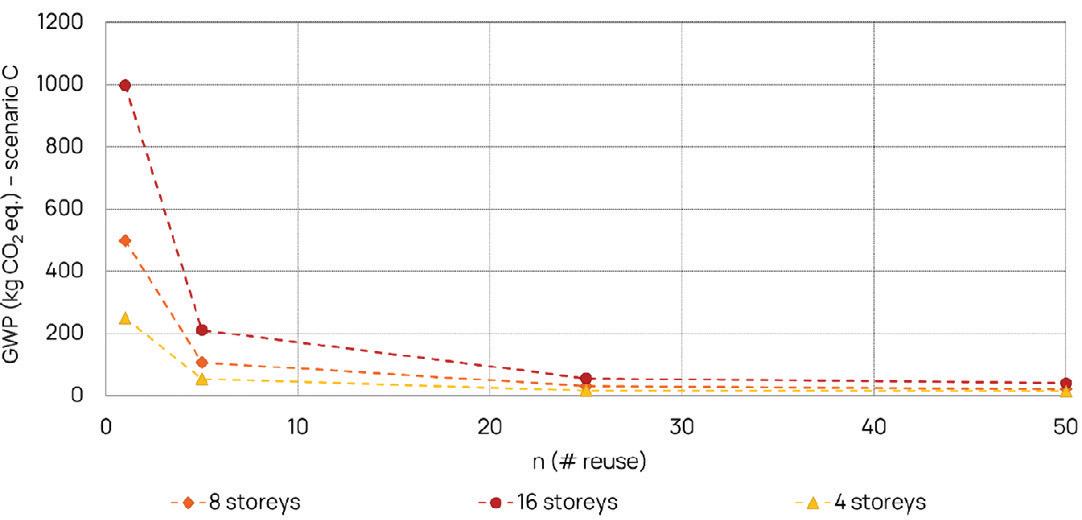
The sustainability benefit of reuse is straightforward: distributing the production impacts of the screw across multiple lifting operations reduces the impact per use. An LCA performed by Politecnico di Milano confirms that the global warming potential per use decreases with increasing reuse count, tending toward an asymptote as the number of uses grows (Fig. 11). The highest marginal benefit is realized in the first few reuses; additional reuse still helps, but with diminishing returns.
In this case, impacts are allocated per use by distributing the production stage across multiple cycles and by accounting for deconstruction/ removal and end-of-life assumptions (including mixed scenarios intended to represent realistic waste management).
A verified reuse protocol therefore has value beyond safety: it provides the documentation needed to justify a multi-use assumption in LCA models, procurement decisions, and potentially in future product declarations.
For lifting connectors installed in timber elements, reuse of screws is already occurring in the field. The critical question is not whether reuse happens, but whether it can be made measurably safe. The test evidence indicates that, when installation and use are controlled so that screws operate within the elastic range, a limited number of reuses does not compromise system strength. At the same time, installation errors and overload-related damage mechanisms can markedly reduce resistance and induce premature failure—especially over-torque on short screws,

which primarily damages the timber support (fibers/counterthread) rather than the connector itself, and damage modes that reduce withdrawal capacity.
A practical reuse protocol, supported by objective screening tools and conservative rules, is therefore the essential bridge between mechanical evidence and safe practice. In parallel, the existence of a verified reuse pathway enables more realistic LCA assumptions for lifting operations and supports future work toward product and application guidance that recognizes reuse in a controlled manner. ■
Andrés Reyes is Product Line Manager at Rothoblaas. He also serves as an industrial expert at CEN/TC 124/WG 4, the European standards working group on fasteners and connectors for timber structures, contributing to the development of European standards for the timber sector. Reyes regularly presents technical topics related to timber connections and fastening systems at seminars and international conferences.










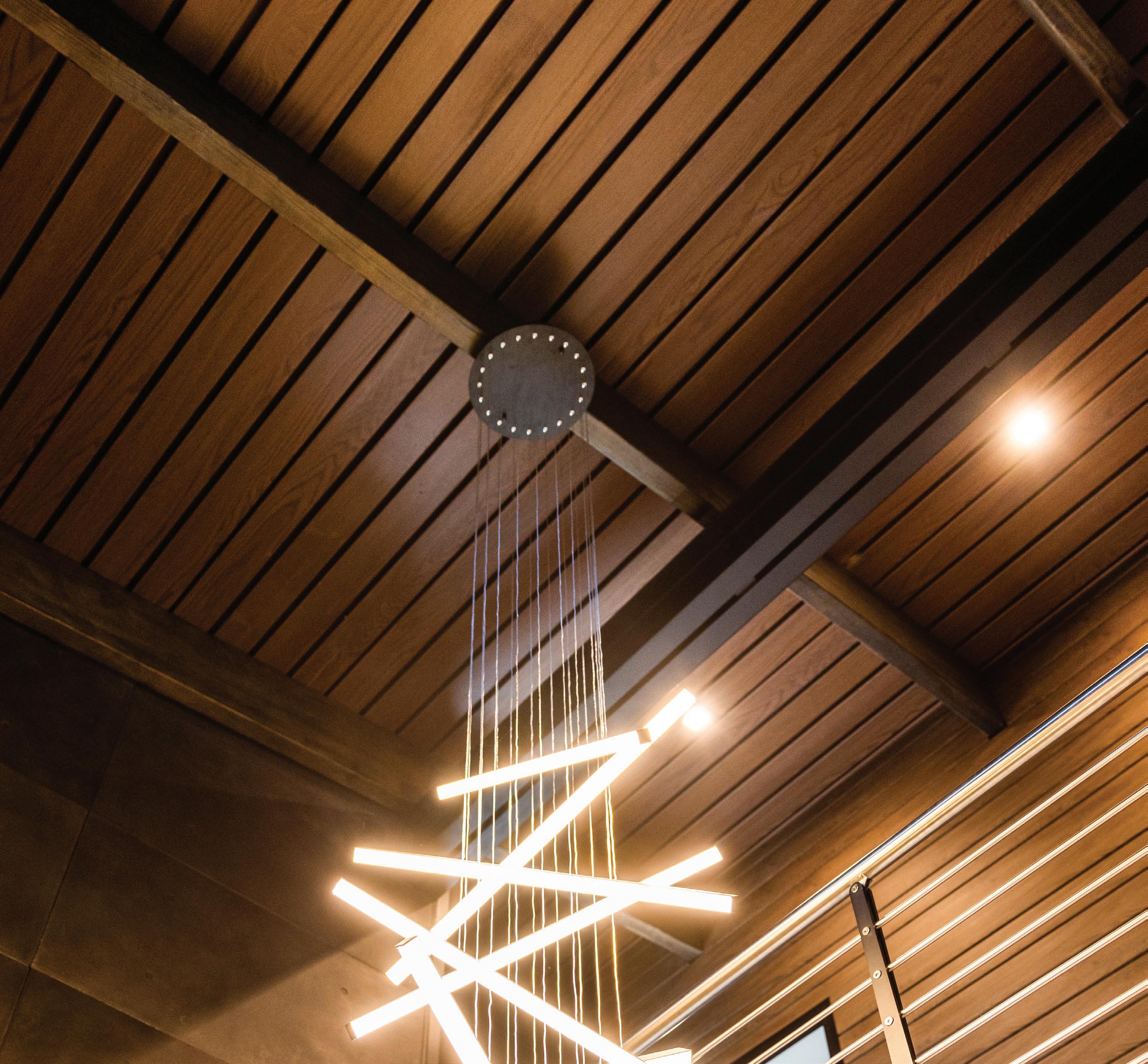
Ideal for interior and exterior applications, IMPRESSIONS® is a revolutionary structural steel roof deck available in six hyper-realistic wood-grain finishes. Our dovetail profiles create a linear-plank aesthetic, with acoustical options for NRC ratings up to 1.00. FM approved, ICC-ES certified and manufactured with up to 85% recycled steel, exceeding LEED minimums.


A recently updated guide helps structural engineers navigate the design process and roles and responsibilities when it comes to premanufactured metal plate connected wood trusses.
By Greg Greenlee, PE
Structural building components, including metal plate connected wood trusses, can provide efficient, cost-effective, and quality solutions for residential and light frame commercial projects. But to capitalize on this, it is important that they are specified, coordinated, and installed correctly. The structural engineer of record (EOR) plays a critical role in this process. Specifically, the EOR needs to understand what should be included in the construction documents and what their role and responsibilities are in the process.
Metal plate connected wood trusses are typically part of a delegated design process where the EOR shifts responsibility for select portions of the design to specialized designers. These specialized designers produce detailed calculations and drawings to meet the performance criteria provided in the construction documents. While this can improve quality and efficiency, it may introduce risk if responsibilities and design criteria are not clearly defined. Ambiguous performance criteria, mismatched interfaces, poor review, and coordination gaps between the delegated portion and the base design can lead to construction or performance issues.
To properly avoid these potential pitfalls, the roles and responsibilities of the registered design professional in responsible charge (EOR or building designer), truss designer, and component manufacturer (truss manufacturer) need to be understood. Both the International Building Code (IBC) and the referenced standard American National Standards Institute’s/Truss Plate Institute’s National Design Standard for Metal Plate Connected Wood Truss Construction (ANSI/TPI 1) provides guidance for this:
• The building designer is the individual responsible for the design of the building structural system. This individual may also be referred to as the EOR.
• The truss manufacturer is responsible for reviewing the construction documents so that they can provide design parameters to the truss designer. A truss technician often communicates these parameters to the truss designer electronically using proprietary software. The truss technician is typically not a registered design professional.
• The truss designer is the delegated design professional responsible for the design of the individual truss members and preparation of the truss design drawings using the design requirements provided by the truss manufacturer. The truss designer is usually not an employee of the truss manufacturer.
In context of these responsibilities, the delegated design process for
metal plate connected wood trusses becomes clearer. Below is a graphical representation of the process. Within this process, it is critical to understand that the truss designer’s responsibility is limited to the design of the individual truss members. Further, the truss designer is not responsible for and does not design floor or roof systems.
The building designer prepares the construction documents.
The contractor provides the construction documents to the truss manufacturer.
The truss manufacturer reviews the construction documents and provides the design criteria and requirements to the truss designer.
The truss designer designs the individual trusses and prepares the truss design drawings.
The truss manufacturer prepares the truss submittal package and sends it to the contractor for review and distribution.
The contractor reviews the truss submittal package and then forwards it to the building designer.
The building designer reviews the truss submittal package to ensure compatibility with the building design.
The construction drawings shall provide information to sufficiently develop the design of the trusses including:
• Truss orientations and locations.
• Information to determine all truss profiles.
• Truss support locations and bearing conditions.
• Location, direction, and magnitude of all dead, live, and lateral loads applicable to each truss.
• Anchorage designs and connections to the structure.
• Serviceability criteria.
• Truss camber requirements.
• Differential deflection criteria.
• Conditions expected to result in:
o Wood moisture content exceeding 19 percent.
o Sustained temperatures exceeding 100 degrees F.
o Corrosion potential.
To properly incorporate metal plate connected wood trusses into the building design, critical information should be included in the project specifications, general notes, plan sheets, and/or details. The minimum information to be included is provided in ANSI/TPI 1, Section 2.3.2.4, Required Information in the Construction Documents, which is summarized in the sidebar above, “Summary of ANSI/TPI Section 2.3.2.4.”
Clear communication of complete design load information is important. To accurately determine snow loads, multiple parameters need to be provided. For example, in addition to providing the ground snow load, the EOR should also provide the Risk Category, Thermal Factor, Roof R-Factor, and Winter Wind Parameter so the truss designer can properly determine the roof snow loads.
The three-part specification section 06 17 53 is reserved for shop fabricated wood trusses and provides the engineer a means to direct how the trusses are designed, fabricated, and installed. Document submittal expectations, manufacturing quality requirements, as well as any special inspection requirements may also be included. The specification provides a means to direct how trusses are permanently restrained and braced. This is discussed in more depth later in the article.
The Structural Building Components Association (SBCA) provides a specification template for the three-part specification section 06 17 53 in the SBCA Knowledge Center (kcenter.sbcacomponents.com) available for download. The template includes notes to the user to help incorporate them into the construction documents and with other specification sections. The template also includes updated resource references and represents the current state of practice for the industry.
Similar to the project specifications, structural notes can be used to communicate performance, material, and/or bracing requirements. A series of structural notes specific to metal plate connected wood trusses are also available in the SBCA Knowledge Center for download.
The plan sheets can be utilized to define the truss zones subject to
the truss delegated design and indicate any special layout requirements, load paths, bearing conditions, and diaphragm requirements. The plan sheets may also provide a means to clearly identify varying serviceability requirements based on material finishes or the structural layout.
The interface and connection between the individual trusses done as part of the delegated design and the building structure is best shown in the details. Details provide an opportunity to clearly define any special design or truss configuration requirements and will help ensure the delegated truss design integrates seamlessly.
Details can be used to show bearing connections, drag struts, blocking, and diaphragm to truss interfaces. Example details are available for download from the SBCA Knowledge Center (kcenter. sbcacomponents.com) and represent the industry’s preferred connection methods and configurations. The available library includes typical details for both floor and roof trusses.
The assignment and development of permanent bracing plans for metal plate connected wood trusses is a critical aspect of incorporating wood trusses into the building design. Wood trusses must be braced in two and potentially three fundamental planes to perform as intended. These three planes include the top chord, the bottom chord, and the truss web plane. Both the IBC and ANSI/TPI 1 establish responsibilities and requirements for the permanent bracing design that vary by the plane to be braced and the configuration of the structure. It is also important to emphasize that when lateral restraint is required, diagonal bracing must also be provided.
Commonly, the top chord plane of trusses is restrained and braced by sheathing, which is part of the roof or floor diaphragm. Because the diaphragm is part of the structural lateral system, it is designed by the building designer. Where there is no diaphragm or rigid sheathing to brace the top chord, the IBC requires a permanent restraint and bracing plan design prepared by a registered design professional.
The bottom chord plane of trusses is often braced by a rigid sheathing or gypsum board. When a rigid bracing plane is not provided, such as when the floor or roof trusses are exposed, lateral restraint and diagonal bracing must be provided. Minimum lateral restraint spacing will be provided on the truss design drawings. Similar to the top chord, the IBC requires a permanent restraint and bracing plan design be prepared by a registered design professional when no diaphragm or rigid sheathing is present.
To prevent lateral buckling under compression loads, truss web members may require lateral restraint. The truss design drawing will graphically note where lateral restraint is required. The building code does not specify who is responsible for determining the lateral restraint and bracing for the web member plane. Instead, it states that where lateral restraint is required it should be accomplished using one of three methods. These include:
1. Lateral restraint and diagonal bracing installed using standard industry details.
2. Individual truss web member reinforcement.
3. A project specific restraint and bracing plan prepared by a registered design professional. Most commonly, either standard industry details or member reinforcement is used when the web member requires lateral restraint. The installer generally determines this, but the lack of specific assignment in the building code can create some confusion. For standard industry details, member reinforcement, or a project specific design, the project engineer (EOR) is the best entity to specify which method should be used or to indicate in either the structural notes or project specifications that the restraint and bracing method should be determined by
the installer. This will help reduce jobsite confusion by specifically assigning the task and clarifying responsibilities.
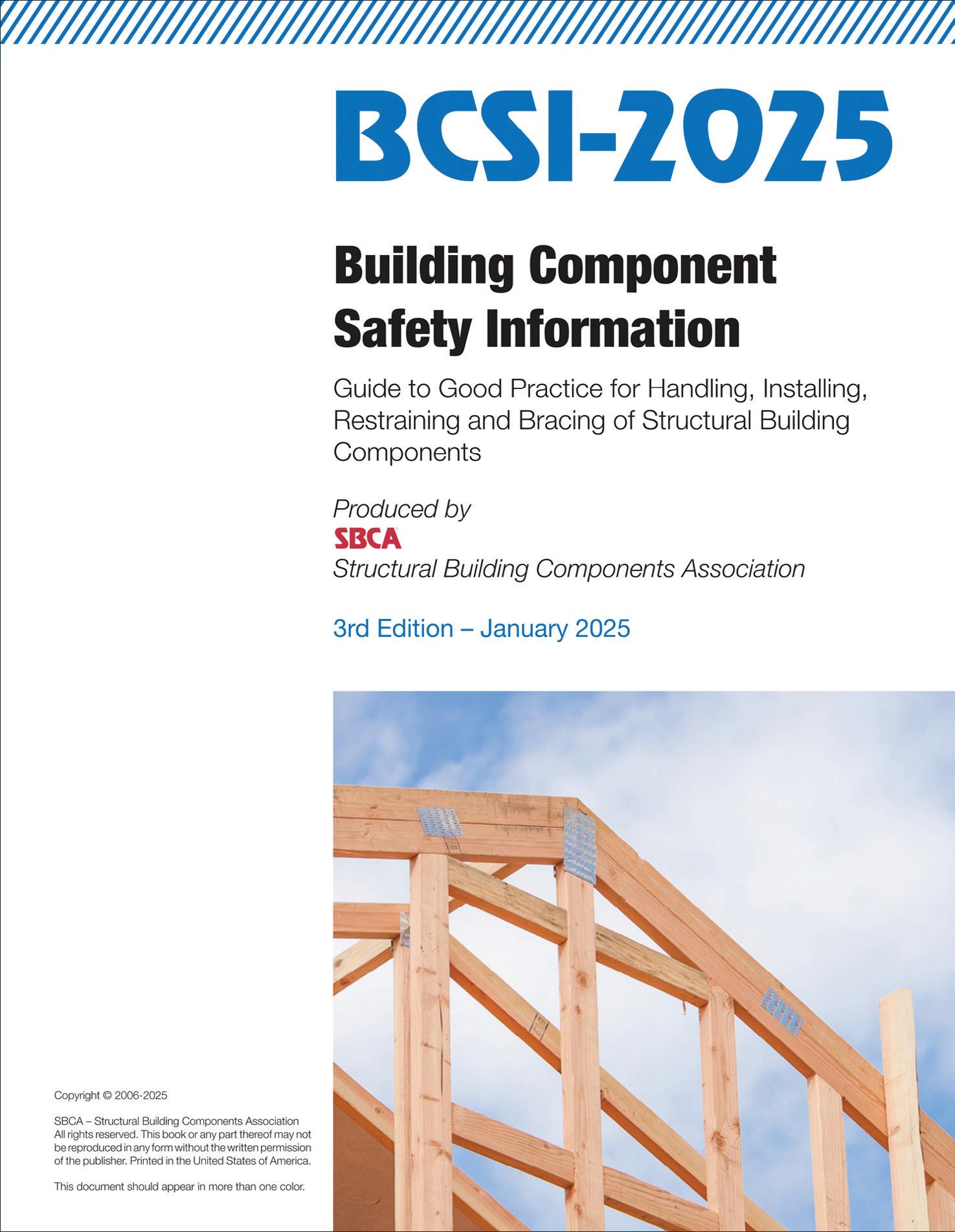
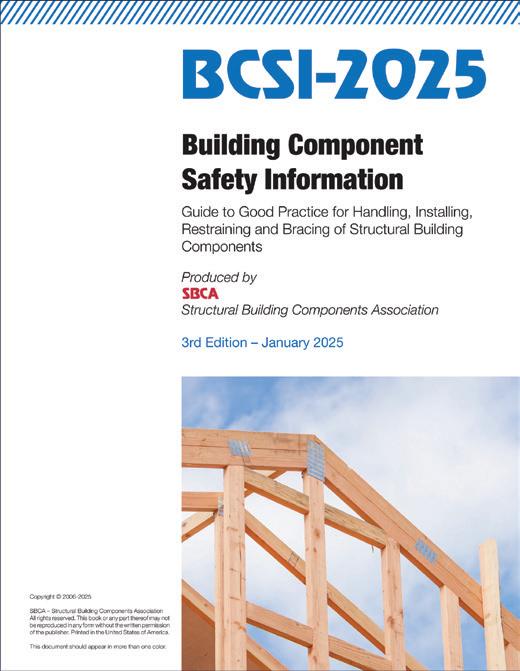
SBCA’s Building Component Safety Information Guide to Good Practice for Handling, Installing, Restraining and Bracing of Structural Building Components (BCSI -2025) is the structural building component industry’s guide for jobsite safety and prescriptive restraint and bracing of metal plate connected wood trusses. It was recently overhauled to be a more comprehensive and user-friendly guide. It includes guidance for both temporary and permanent lateral restraint and diagonal bracing for different truss configurations and spacings, with explicit references to building codes, standards, and OSHA regulations. It also includes content on the component design and approval processes, code requirements, and jobsite planning.
Previously, the three methods of accomplishing lateral restraint for truss web members in the IBC were highlighted. One of these solutions is to provide standard industry details in accordance with ANSI/TPI 1 Section 2.3.3.1.1, Standard Industry Details, or the figures provided in Section 2303.4.1.2, Permanent Individual Truss Member Restraint (PITMR) and Permanent Individual Truss Member Diagonal Bracing (PITMDB) of the IBC. The figures referenced in the IBC are based on the figures and information provided in BCSI-2025. Section 2.3.3.1.1
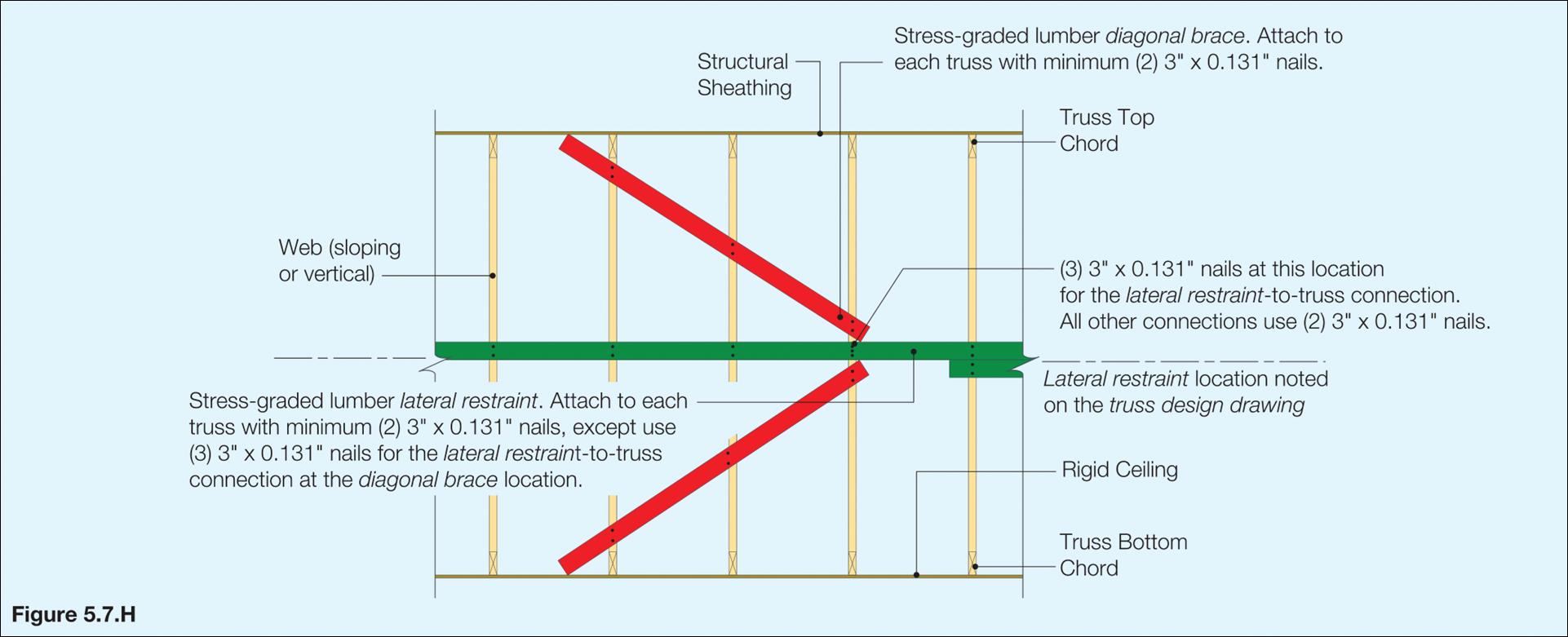
of ANSI/TPI 1 that specifies the documents BCSI-B3, Summary Sheet – Permanent Restraint/Bracing of Chords & Web Members, and BCSIB7, Summary Sheet – Guide For Handling, Installing & Bracing of 3x2 & 4x2 Parallel Chord Trusses, should be referenced for the standard industry details. The BCSI-B3 and BCSI-B7 documents are excerpts from BCSI-2025 that are intended to be included in jobsite packages delivered with the trusses to the jobsite for the installer.
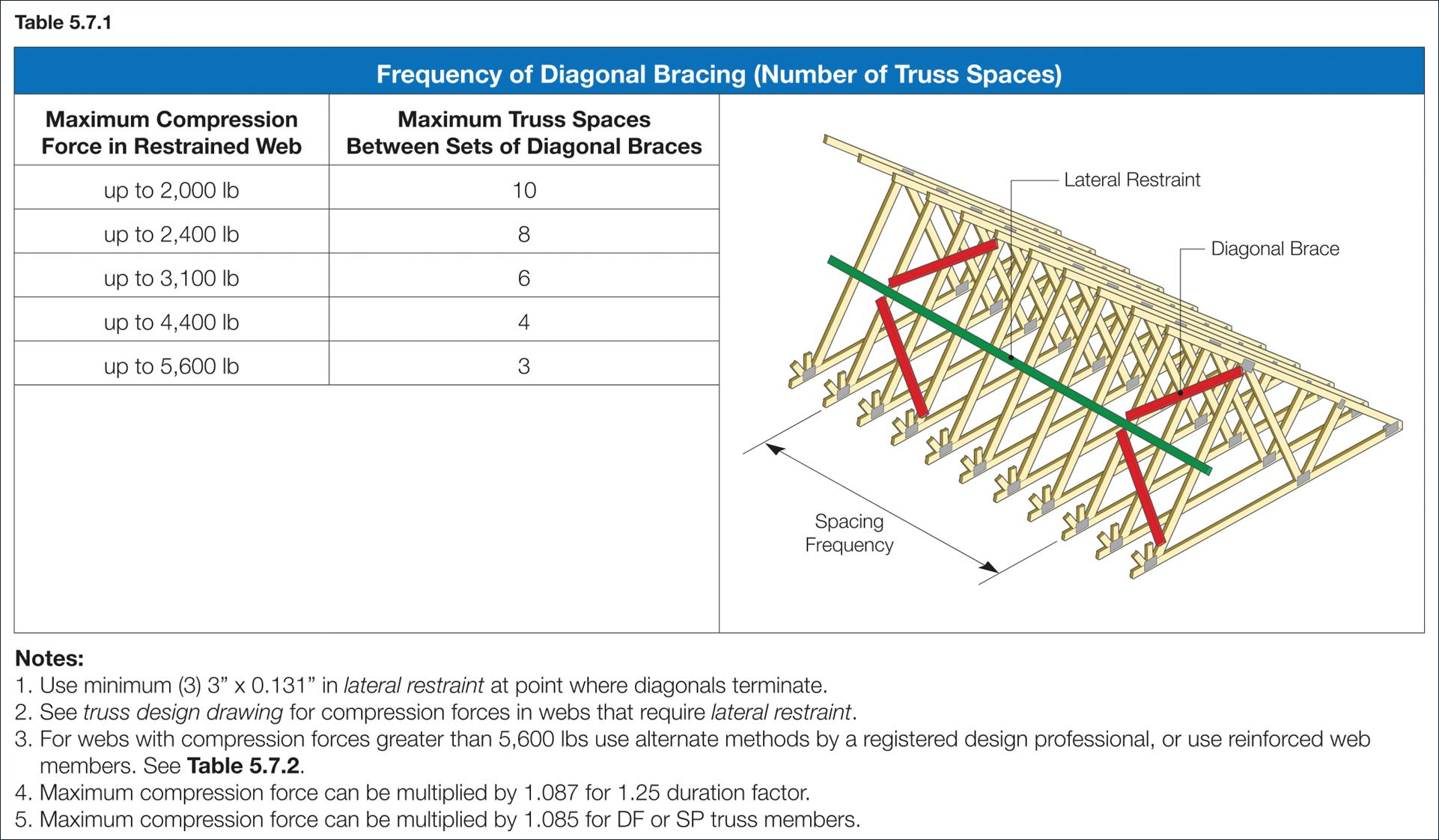
Figures 1 and Figure 2 are excerpts from BCSI-2025 showing standard industry details for web member restraint and bracing. These prescriptive solutions provide member sizes, spacing, and connections for the required lateral restraint and diagonal bracing.
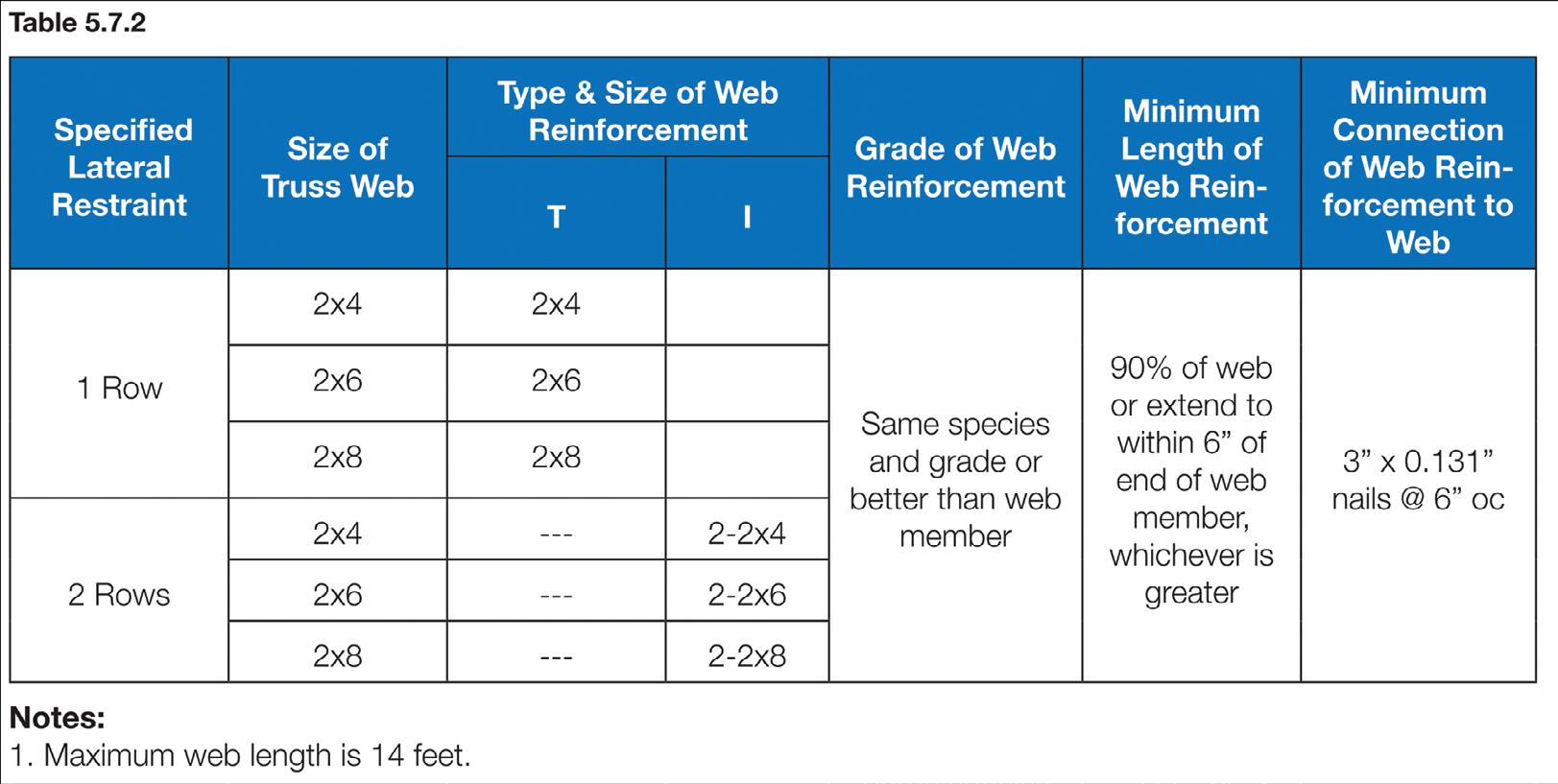
The solutions in BCSI’s guide may be referenced as standard industry details when there is no diaphragm or rigid sheathing providing lateral restraint for the top or bottom chord, or for web member bracing. However, sometimes replacing lateral restraint and diagonal bracing with web member reinforcement may be a better option. Prescriptive reinforcing solutions are provided in the IBC Figures 2303.4.1.2(2) and 2303.4.1.2(4), which are also derived from the recommendations in BCSI-2025 shown in Figure 3.
Alternatively, when a project-specific restraint and bracing plan is determined to be the best option, the design and layout of these plans may be developed using the prescriptive solutions provided in
BCSI-2025, or it may be developed using the design provisions in TPI’s document DSB-2022, National Design Standard for Bracing Metal Plate Connected Wood Trusses. When requested, the preparation of a project specific restraint and bracing plan may be done by the truss designer or a specialty engineer. Either way, unless it is specifically specified in the contract documents, it is usually not included as part of a truss submittal package.
As the party responsible for the building design, the building designer has a full understanding of how the structure is intended to perform. They must understand that the trusses have been designed as single, two-dimensional elements, and need to determine that the trusses will perform as intended as part of a three-dimensional structure. It is vital the EOR thoroughly reviews the truss submittal package to ensure it conforms to their design intent as part of the floor and/or roof system. Additionally, while it is not explicitly assigned to them, it is important for the building designer to understand how any required permanent restraint and bracing is being provided which may be accomplished by assigning responsibility in the contract documents. Following these recommendations will help the building designer successfully incorporate structural components into their design. ■ Greg Greenlee, PE, serves as the Technical Director for SBCA. He has extensive experience in building design, construction engineering, product development, and product design. Additionally, he is an active participant in the model building code development process and serves on multiple standards development committees.

How timber, steel, and concrete built a worldclass engineering institute and advanced Princeton University’s campus sustainability goals.
By Michael Hopper, PE, Rachel Marek, PE, and William Dawson, PE
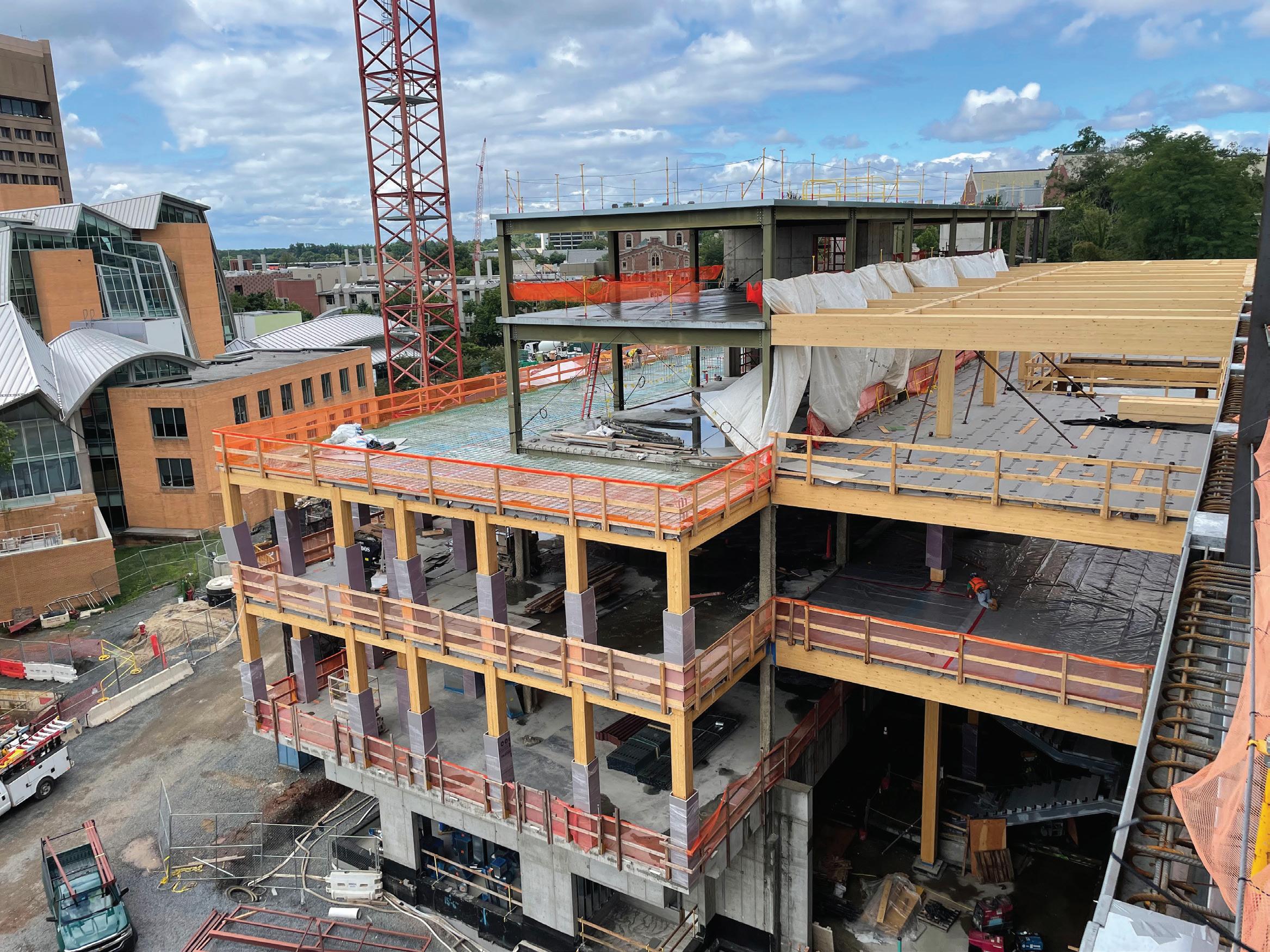
Built on a 17-acre site in Princeton, New Jersey, the Briger Hall, Commons, and School of Engineering and Applied Sciences (SEAS) buildings at Princeton University have created a new “neighborhood” devoted to environmental studies and engineering. The series of connected buildings, totaling 666,000 square feet, contains state-of-the-art facilities and collaborative spaces to promote and enable breakthrough research (Fig. 1). The site features new academic and research laboratories, classrooms, offices, community spaces, and a library.
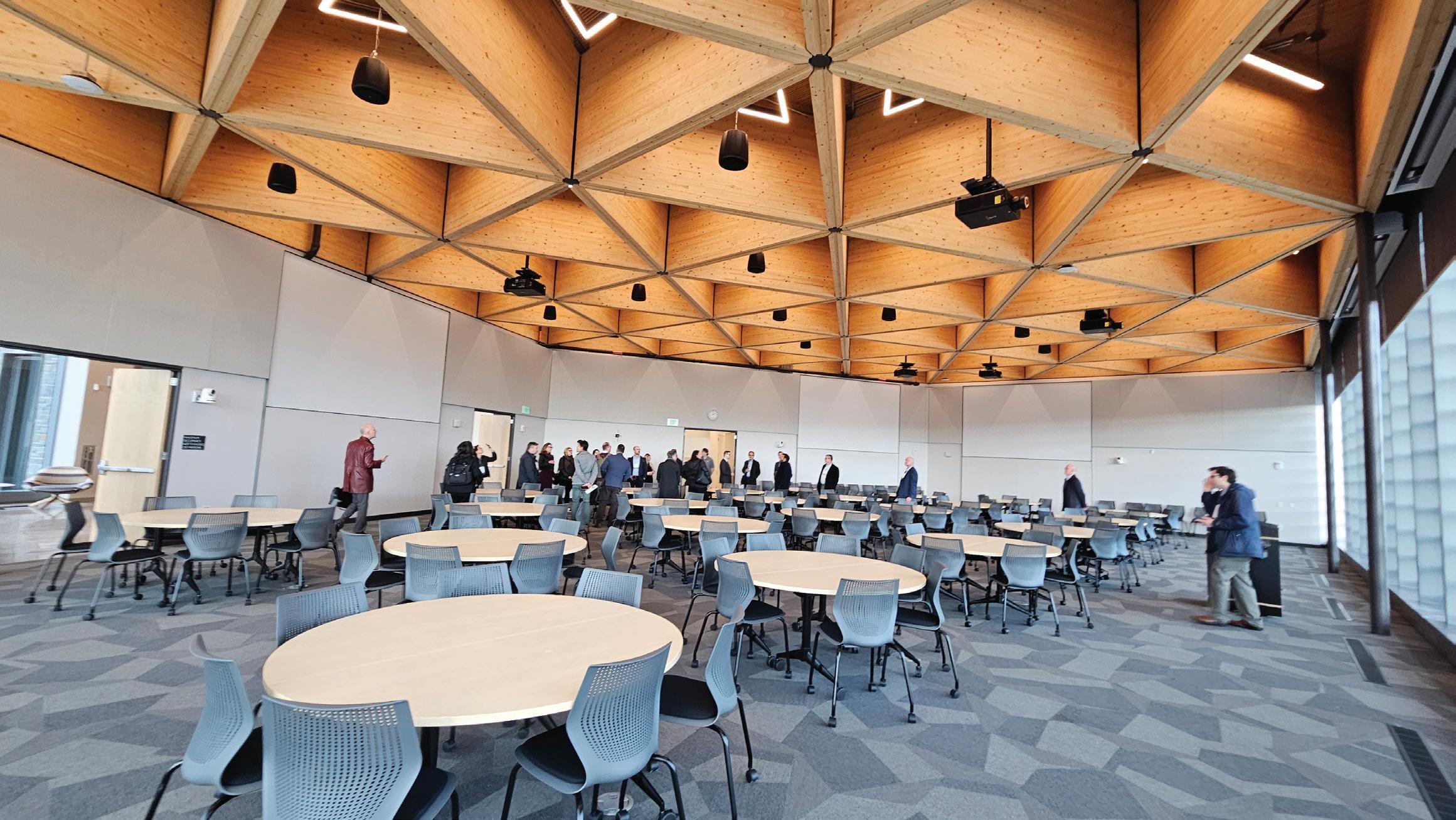
The architecture was shaped by a desire for the buildings to blend seamlessly into the current campus environment while furthering the University’s sustainability goals, both of which informed the choice of a hybrid structural system. Offices and common spaces, including multi-story atria, use exposed mass timber. Laboratories, which have strict vibration criteria, are framed in structural steel. A major design feature of the Commons Building is “the diagrid,” which is a novel timber-steel composite system (Fig. 2) that spans in two directions up to 85 feet and supports heavy green roof loading. At the base of each building, reinforced and post-tensioned concrete are used to support heavy landscaping and transfer columns above.
Princeton University has several sustainable campus design initiatives, which include goals of evaluating building systems and materials for their carbon impact and visually expressing sustainable building features. These specific goals influenced the project team to maximize the use of mass timber construction because it is less carbon intensive than concrete or steel construction and is exposed to direct view, which embodies the important environmental research taking place in the building. The use of mass timber was avoided in the areas with heavy landscaping and labs with strict vibration criteria. Instead, mass timber was utilized in offices and common areas, such as in the atria and student hubs, where it was structurally viable. In these areas, a steel structure and a timber structure were developed to evaluate cost impacts, and a parametric Life Cycle Analysis was performed to understand relative carbon impacts, which ultimately justified the timber’s cost premium. Accordingly, the project received supplemental funding for the timber from the Sustainability Advocacy Committee, a special program at Princeton University that assists projects with implementing strategies towards meeting sustainability goals.
Glulam beams and columns support the offices, corridors, and multi-story atria. Given the desire for quiet work and study spaces, the team studied using cross-laminated timber (CLT) floor panels with acoustic treatment on floors and walls, versus acoustic dowellaminated timber (ADLT) floor panels with integrated acoustic insulation in the soffit. Ultimately, the ADLT worked best for the project, and proved to be more economical.
A European supplier that could meet the demands of a large project with a tight schedule, and who the timber contractor was familiar with, provided the sourcing, production, and fabrication of glulam members. Glulam members are European spruce grades (GL24, GL28, and GL32), and range in size from 9.5 inches x 14.2 inches to 15 inches x 31.5 inches. Glulam beams have a maximum span of about 33 feet in the atria areas and are used to support a hanging multi-story steel stair below (Fig. 3).
The ADLT was sourced in North America (northwest United States and western Canada).
The ADLT panels typically span 17.5 feet in the offices, and up to 21 feet in the atria areas. All timber members in the office areas were designed for a two-hour fire rating provided by a charring layer in accordance with NDS Chapter 16. Elsewhere, the timber was designed for a one-hour fire rating.
The timber structure is laterally supported
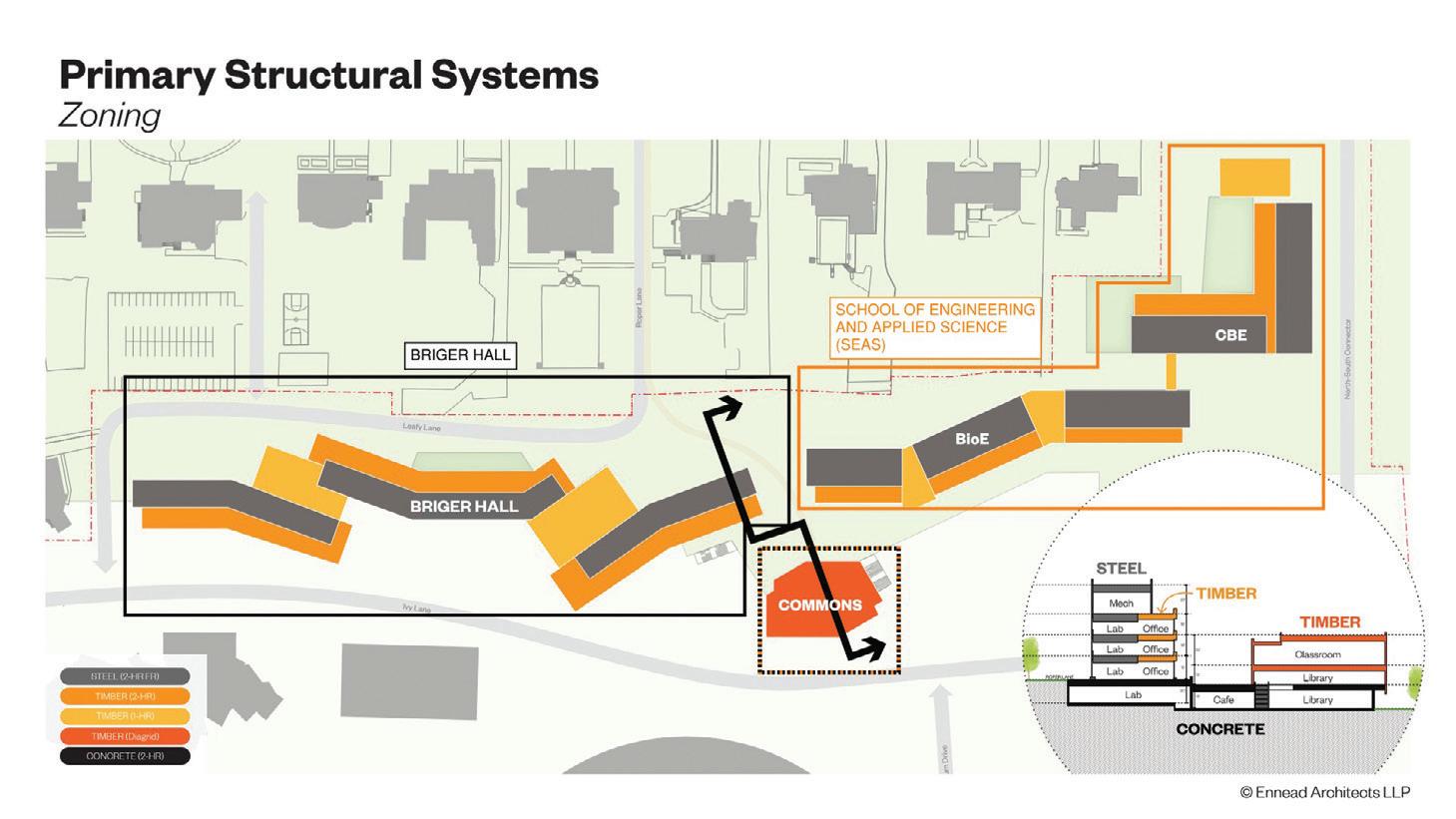
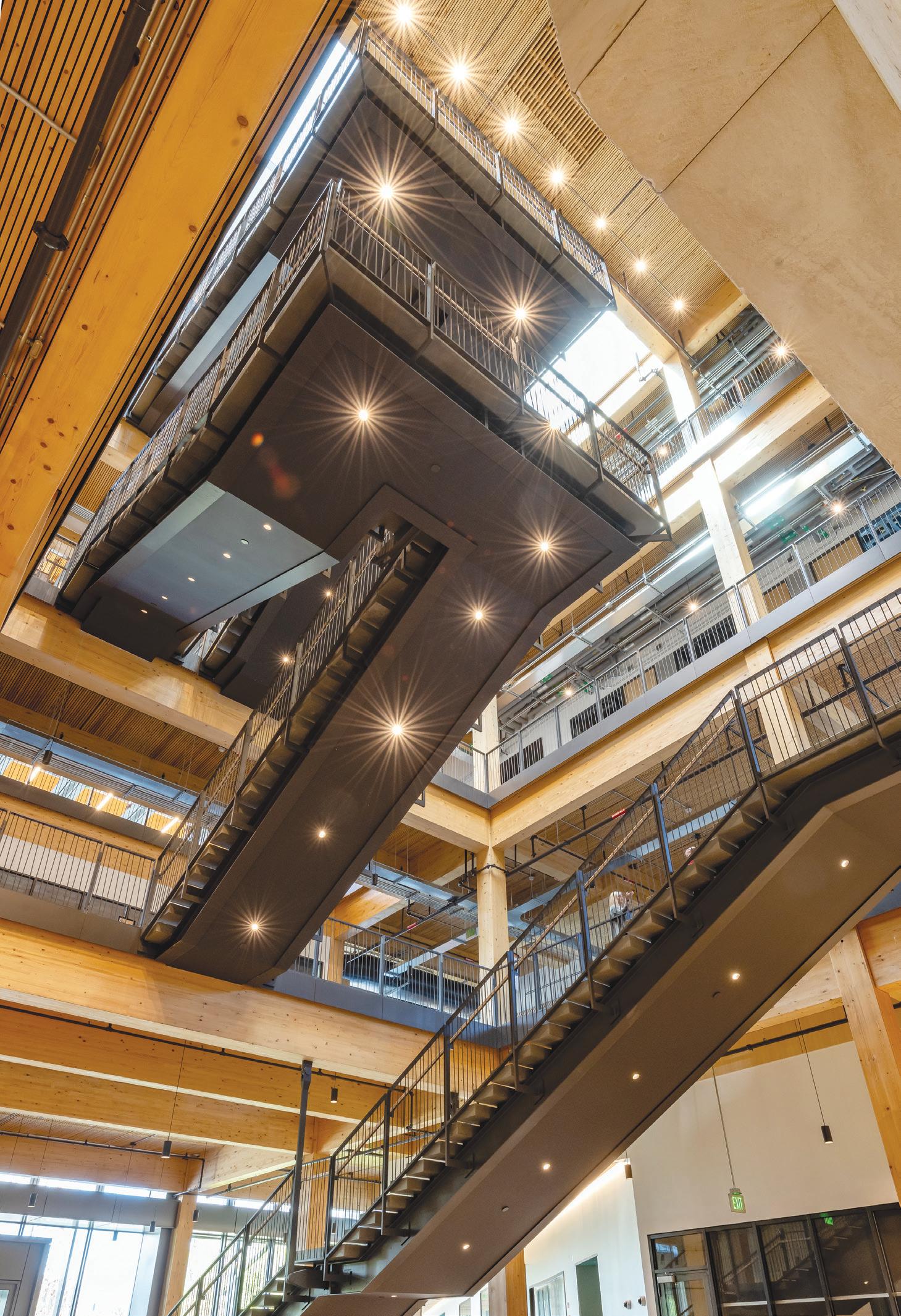
by the steel labs, which, along with the concrete slab on metal deck, spans as a diaphragm to concrete shear walls at the east and west ends of the laboratory areas. Rebar for the timber topping slabs, which also are designed as diaphragms and serve as the finished floor, are designed for the transfer of lateral forces from the timber-framed zones into the steel-framed zones.
For the laboratories, the design team presented various floor framing options that would meet the desired Class A Velocity Vibration Criteria of 2,000 mips. Ultimately, the team designed an innovative steel floor system constructed with back-to-back channels filled with concrete. The framing spans over 30 feet—with only 22.5 inches of structural depth—allowing for maximum floor-to-ceiling heights in the labs and no horizontal penetrations through the beams, greatly simplifying the complex coordination commonly required in the design of lab buildings. Paired channel members were prefabricated in the shop, erected as a single piece on site, and connected to the edges of the column flanges. Beams are spaced on the lab modules and align with the lab tables, allowing the lab service pipes to pass vertically between the channels, as needed (Fig. 4).
The Commons Building is at the intersection of multiple pedestrian walkways and functions as a central gathering place for students that
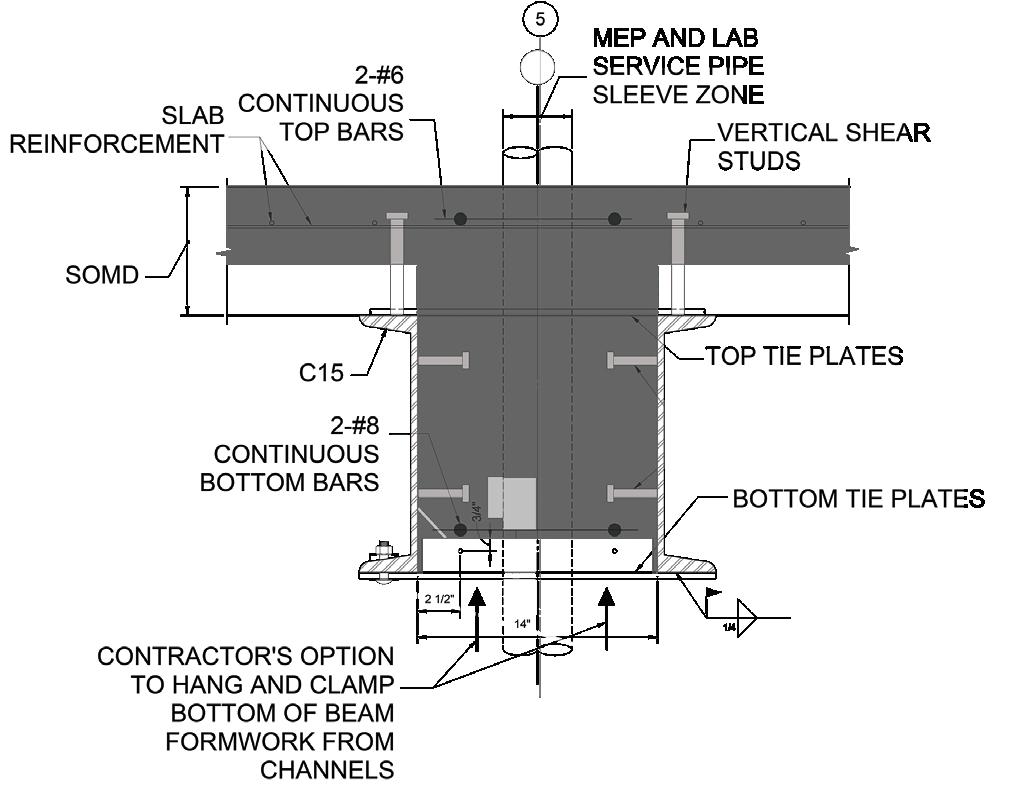
Fig. 4. Beams are spaced on the lab modules and aligned with the lab tables so the lab service pipes pass vertically between the channels.
is organized on a diagonal grid system. Like other public areas of the project, timber was desired for the Commons Building. Length-towidth ratios of the multi-use spaces and lobby are about 1-to-1, and therefore a true two-way spanning structure was desired for efficiency. However, two-way spanning floor systems in timber are difficult to achieve.
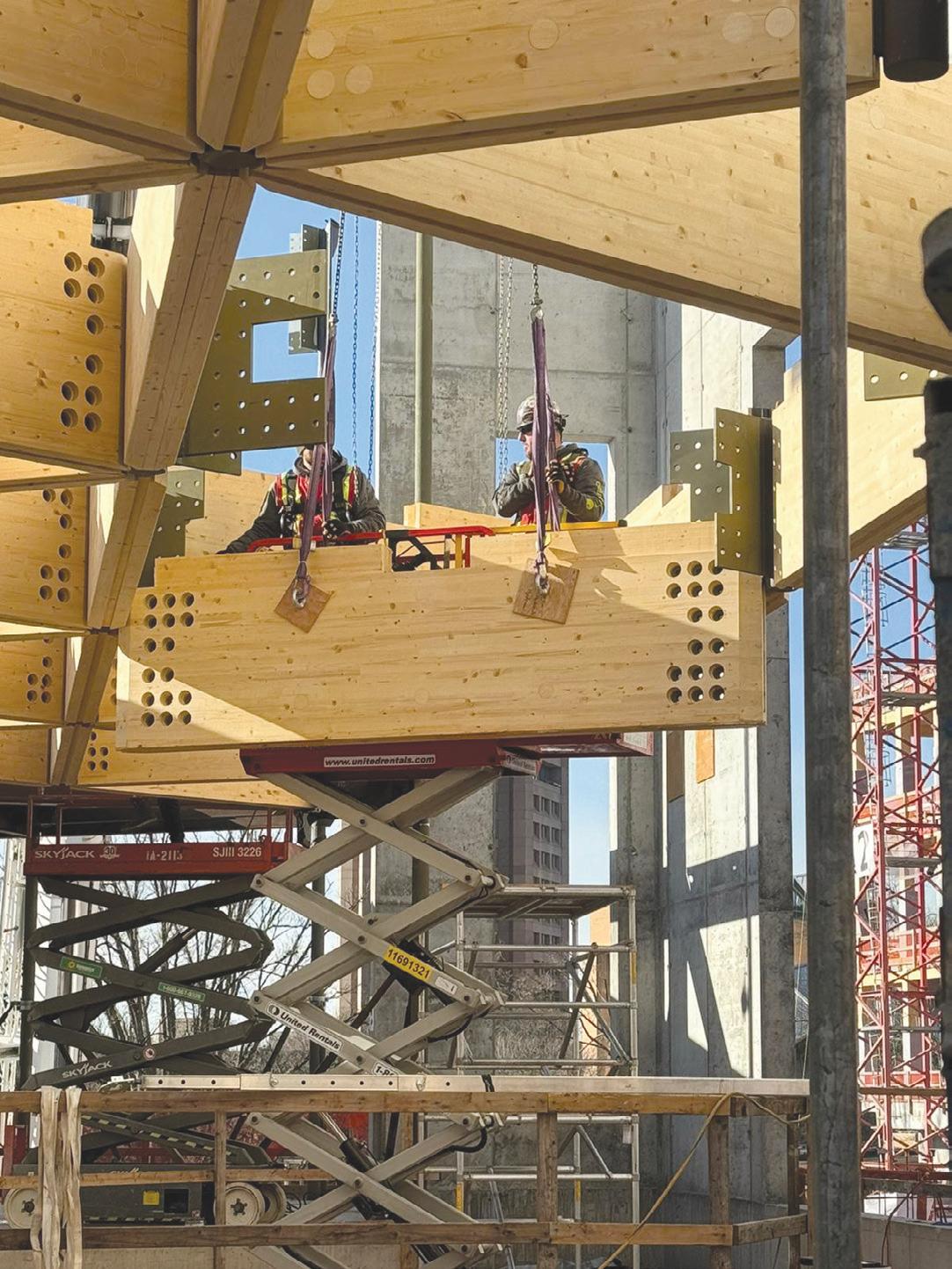
A novel composite steel-timber structure was devised, dubbed simply as “the diagrid,” to achieve the two-way span. Paired glulam beams, reinforced with steel plates, connect to steel nodes constructed with pipe or solid rounds. The steel plates are located along the top and
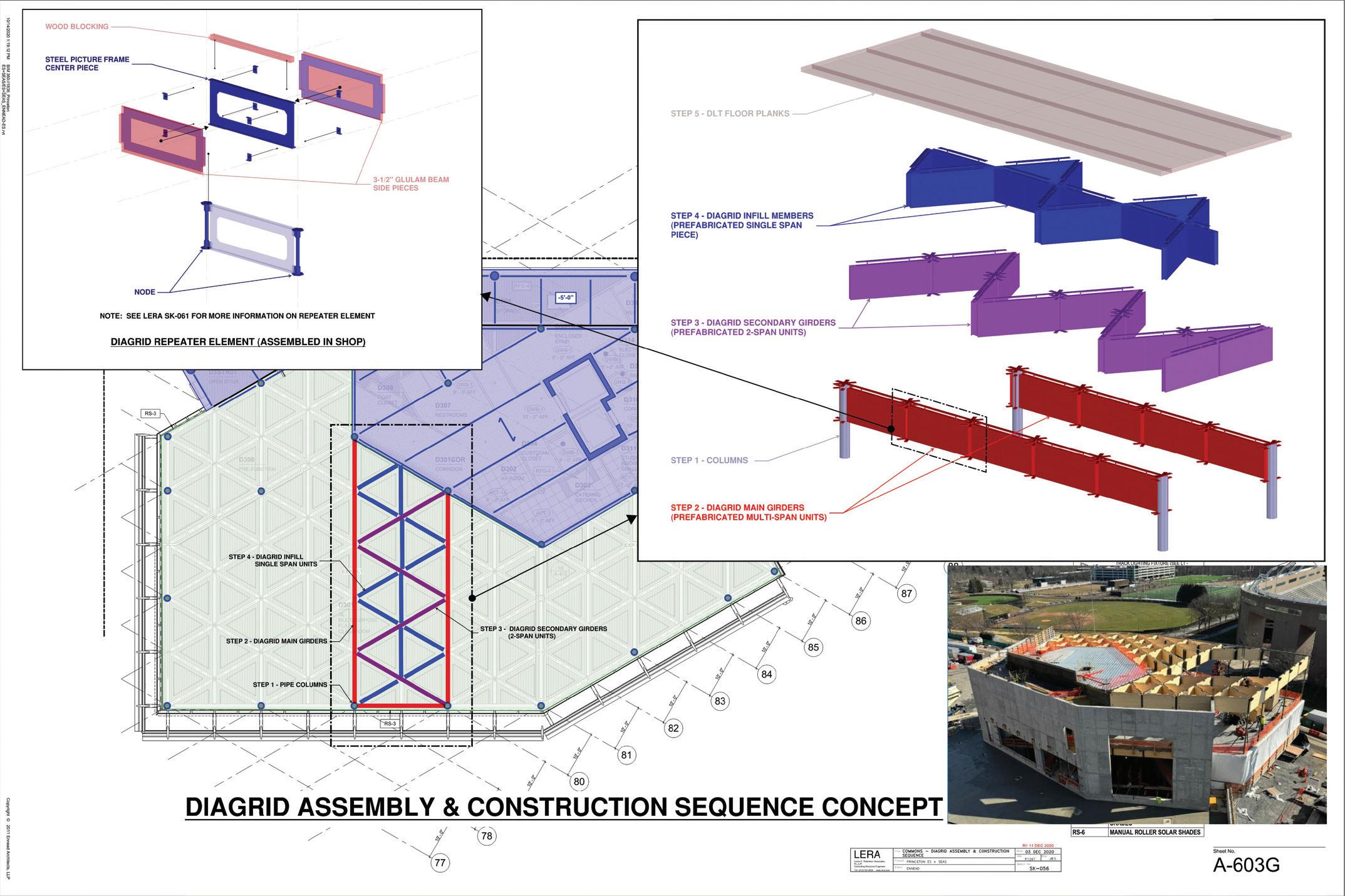
bottom of the glulam beams and are also used at the member ends to ensure an elegant steel-to-steel moment connection at the nodes, minimizing the number of fasteners needed (Figs. 5-6). The timber geometry was held constant, whereas the steel and fasteners were optimized for the varying structural demands, thereby maintaining visual continuity while achieving structural efficiency. At the lobby to the engineering library, the diagrid is 30 inches deep and spans approximately 45 feet overhead. At the roof, the diagrid is 60 inches deep and spans approximately 85 feet over the multi-purpose room to 5-5/8 inches-diameter solid steel columns at the perimeter, which visually blend into the verticals of the facade system (Fig. 7). Fire protection of the diagrid steel plates is provided by the charring layer of the mass timber, and the steel nodes and columns are fire-protected by intumescent paint.
The paired glulam beams directly support the ADLT floor planks, resist local bending moments between nodes, and resist vertical shear forces to deliver loads to the steel plates. The steel plates resist cumulative tensile and compressive chord forces and resist global bending moments and shear forces at the nodes. The glulam is also sized to laterally brace the steel plates. Together, the glulam and steel act compositely to achieve the spans and two-way behavior required. Due to the highly expressive structure, careful coordination with the building services was needed to achieve the design intent. A 6-inch service zone was created at the top of the diagrid, directly below the floor plank, to allow for piping and conduit coordination (Fig. 2). Roof drains were limited to the core areas to eliminate the need for exposed piping in the timber areas. This created a unique long distance roof sloping profile that was achieved with a two-layer topping slab sandwiched between varying thicknesses of insulation to reduce the weight of the build-up. The HVAC design removed ducts from the timber zones, instead pushing air through the concrete floor and walls. Duct penetrations through the diagrid around the perimeter were carefully coordinated to be in structurally advantageous locations.
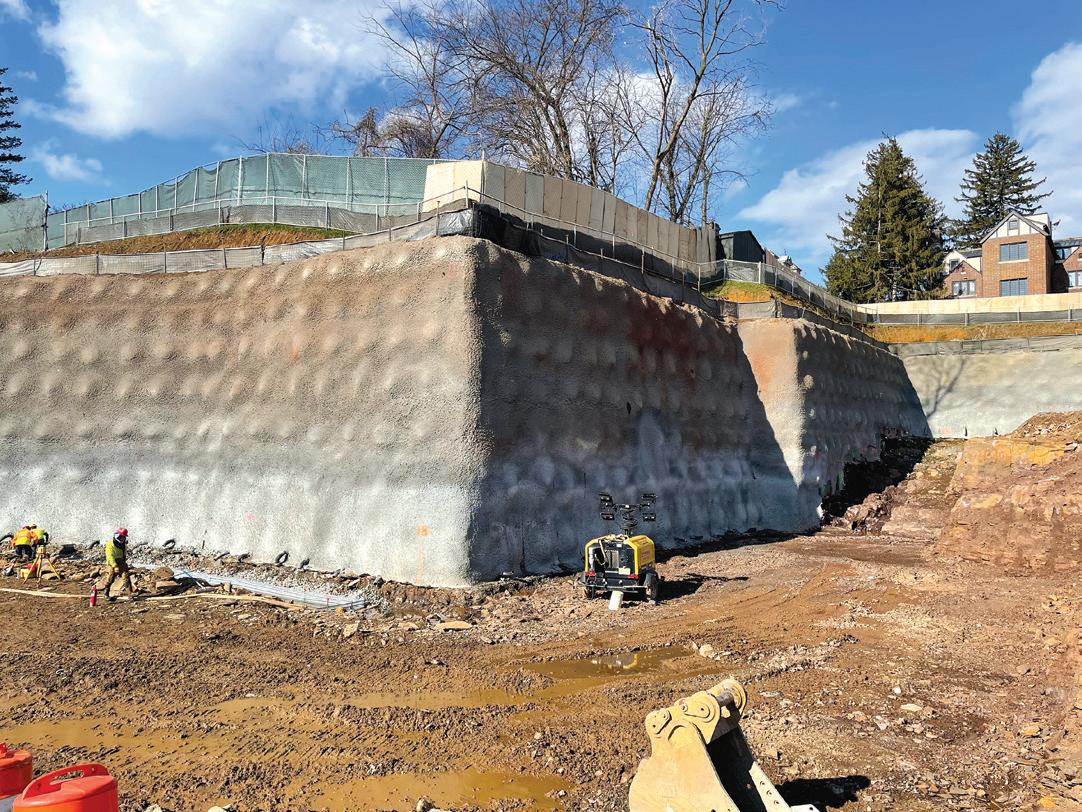
To integrate the project into the surrounding campus and landscape, the design takes advantage of the site topography to limit the height of the buildings, where there is a roughly 20-foot grade change from north to south. To excavate for the basements and the ground floor, which have a below grade depth of up to 50 feet, a 3/8-mile-long support-of-excavation (SOE) wall was needed. After studying the impacts from various SOE systems, a soil nail and rock anchor wall was chosen, and was carefully integrated into the design, ensuring that the University Eating Club properties located to the north remained unaffected (Fig. 8).
To avoid the need for the narrow buildings to resist large, unbalanced lateral soil pressures from the hillside, which would impact the spatial planning of each building, the SOE wall was designed and detailed to be permanent with a Double Corrosion Protection system. Soil nails, rock anchors, their bearing plates, and hardware are protected with an epoxy coating and are encased in grout. In addition, groundwater flows down the campus hillside into Lake Carnegie, with historical streams indicated on Princeton University maps dating as far back as 1746. Briger Hall and SEAS interrupt a large portion of the hillside, so keeping water out of the buildings was paramount. Water collects behind the SOE wall and drains beneath the building structures to the south. The SOE wall was offset from the new buildings to enable the installation of traditional waterproofing on the face of the foundation walls, which was a priority for the owner.
Aero Aggregate backfill was used to fill the void between the walls and to minimize the lateral forces delivered to the building structure.
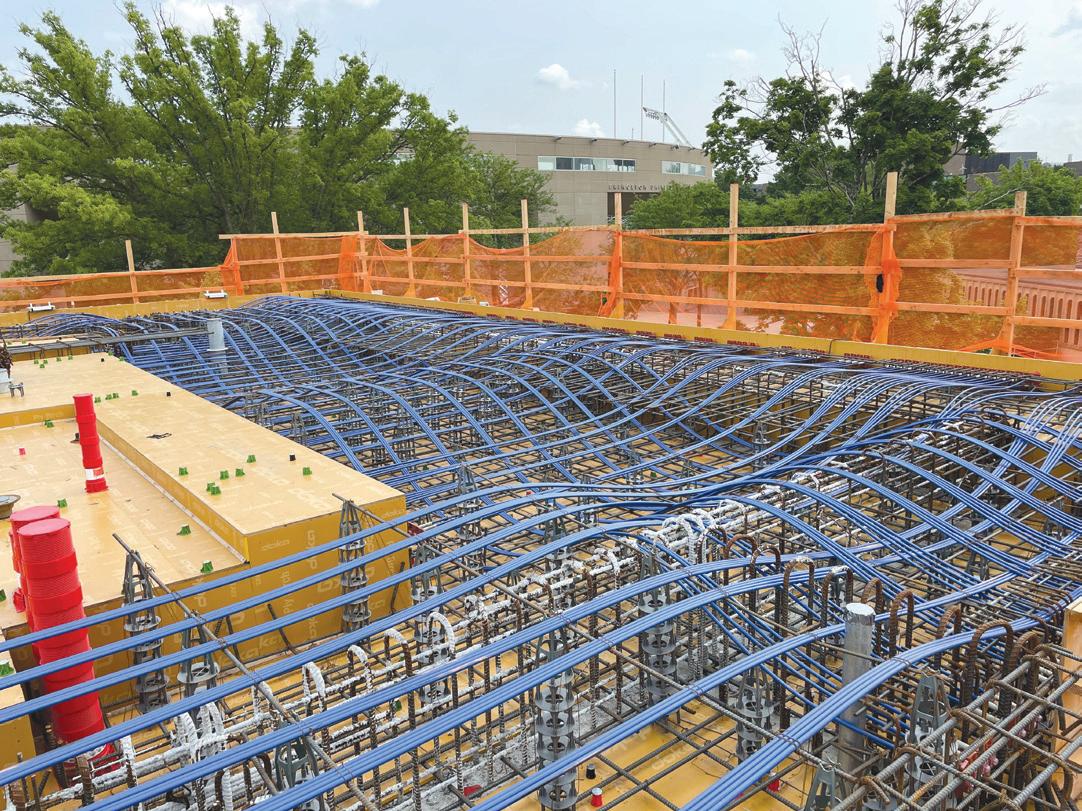
The below grade floor, ground floor, and second floor are built with reinforced concrete. The second floor supports heavy loads from the campus landscape and public plazas and acts as a column transfer platform between the labs or offices above to the open concourse below. Transfer beams and slabs, typically 36 inches deep, utilize post-tensioning in critical areas to minimize concrete volume, cracking, and long-term deflections that would adversely impact the floors supported above (Fig. 9).
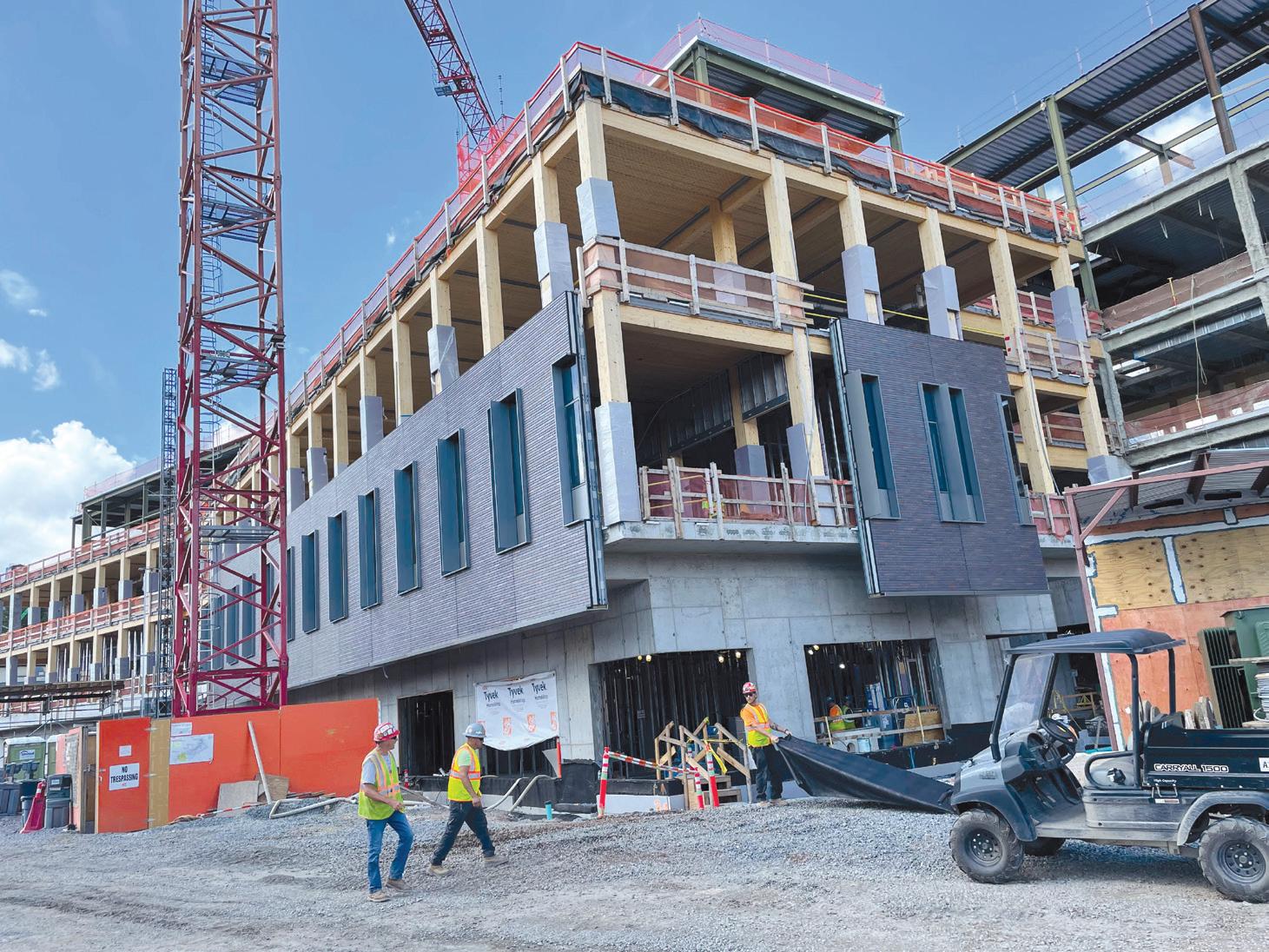
To blend in with the existing campus fabric, the project’s facade design incorporates brick and field stone. Reinforced concrete walls, which also support the floors, are used as backup support for thick hand-cut field stone at the base of the Briger Hall and SEAS, as well as at the northern face and base of the Commons building. The office areas, meanwhile, are clad in brick. To minimize the weight of the brick supported by the mass timber structure and adhere to the project schedule, a ¾-inch thin set brick facade was panelized with windows and insulation and was assembled offsite on a secondary structural frame (Fig. 10). Glazing in the atria areas enhances transparency, and the labs feature a unitized curtain wall system with metal panels and windows.
Connection details at the intersections of dissimilar materials are an important consideration for a hybrid structure. For Briger Hall, Commons, and SEAS, three intersections were
considered: steel to concrete, timber to concrete, and timber to steel (Fig. 11). Adjustability was built into the details considering construction tolerance between the three different materials and construction trades, thermal expansion and contraction, and the volume change of the timber due to fluctuations in relative humidity. Embed connections to concrete were designed to allow up to +/- 3 inches of connection tolerance. Timber to concrete or steel was often detailed for the timber to land on a wide ledge to accommodate the tolerance, and to transfer load through bearing. Slotted connections were used in the composite steel-timber diagrid structure in both the node connections and the plate reinforcement. Detailing these intersections was a collaborative effort between the design and contracting teams.
The Briger Hall, Commons, and SEAS complex demonstrates a shift in structural engineering practice: as traditional design criteria must be adapted to modern sustainability goals, hybrid structural systems are becoming more necessary. The selection of the materials was not only about using each material where it performs best, but also where the material best aligned with the goals of the University. The project's hybrid approach to the structural design provides a model other designers can look to for effective ways to achieve their own project sustainability goals. ■
Owner: Trustees of Princeton University
Architect of Record: Ennead Architects, New York, NY
Structural Engineer of Record: LERA Consulting Structural Engineers, New York, NY
General Contractor: The Whiting-Turner Contracting Company, Morristown, NJ
Timber Contractor, ADLT Supplier, and Diagrid Contractor: StructureCraft, Abbotsford, British Columbia, Canada
Glulam Supplier: Hasslacher Norica Timber, Sachsenburg, Austria
Sustainability Consultant: Atelier 10, New York, NY
Steel Contractors: Canatal Steel USA, Roanoke, VA (Briger Hall and Commons) Berlin Steel, Kensington, CT (SEAS)Concrete
Contractors: Macedos Construction, Flemington, NJ (Briger Hall, Commons) State Line Construction, Newark, NJ (SEAS)
Michael Hopper is an Associate Partner with LERA in New York, NY. He serves on PTI’s DC-20 Building Design Committee and teaches in the Civil and Environmental Engineering Department at Princeton University.
Rachel Marek is an Associate with LERA in New York, NY. She is an undergraduate alumna of Princeton University.
William Dawson is an Associate with LERA in New York, NY, and is an adjunct professor in the Department of Civil, Environmental and Ocean Engineering at Stevens Institute of Technology .
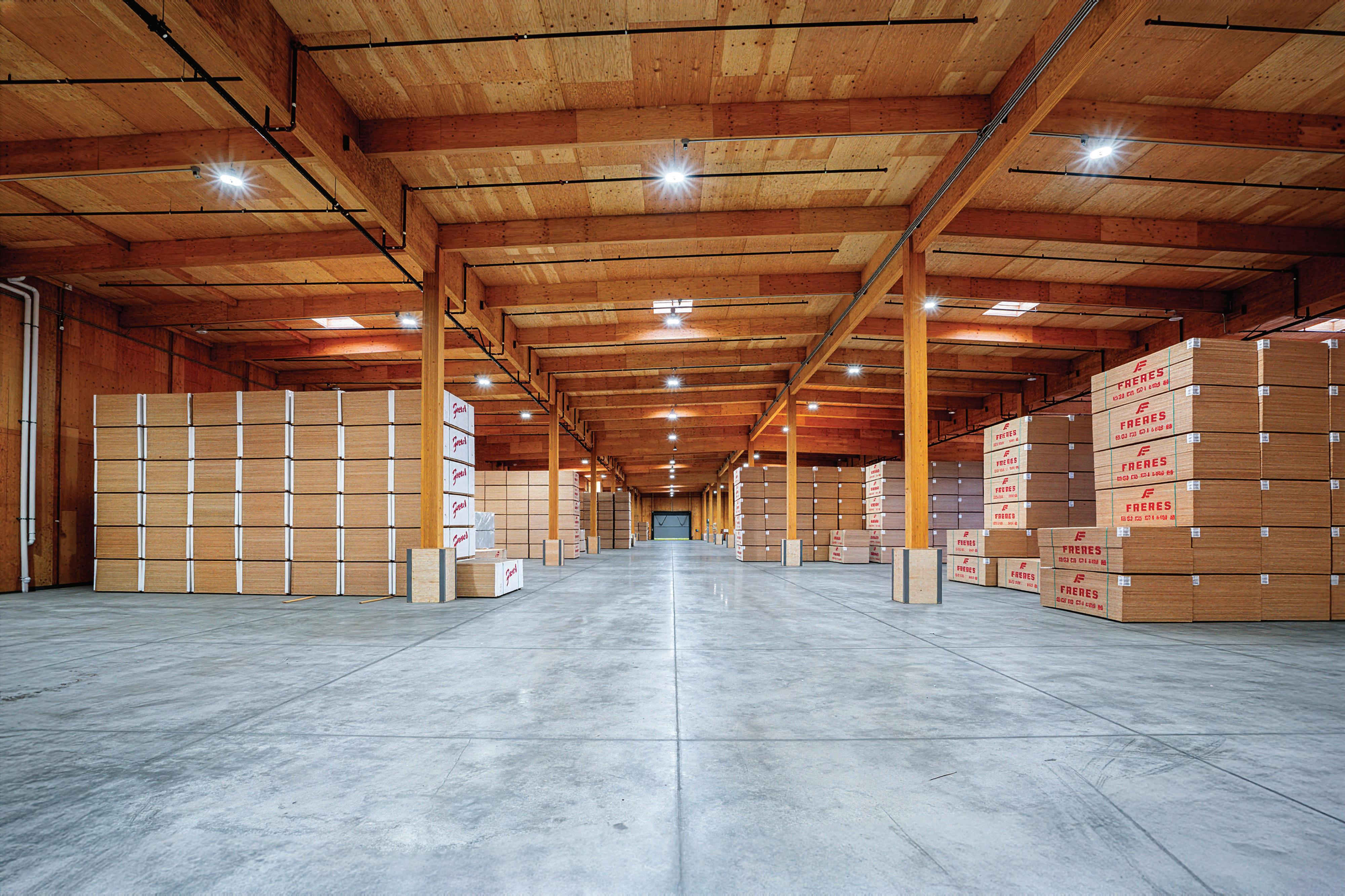
An outside-the-box design demonstrates that mass timber, in this case mass plywood, provides an aesthetically pleasing, cost effective, carbon sequestering, and thermally efficient alternative for warehouses and other big box buildings.
By John Bradford, PE, SE
Mass timber has become increasingly popular over the last decade for office and multi-story residential buildings. Looking forward, one of the largest potential markets for mass timber is for warehouses and similar big box type facilities.
Construction of warehouses and other big box type structures has evolved over the decades. Currently, the primary methods are site cast or precast tilt-up concrete construction and Metal Building System (MBS) construction. Alternatively, the
advantages of mass timber, which are substantial, can be incorporated into these structures. It is anticipated that this new system, or derivatives thereof, will become a common construction system selected for these facilities.
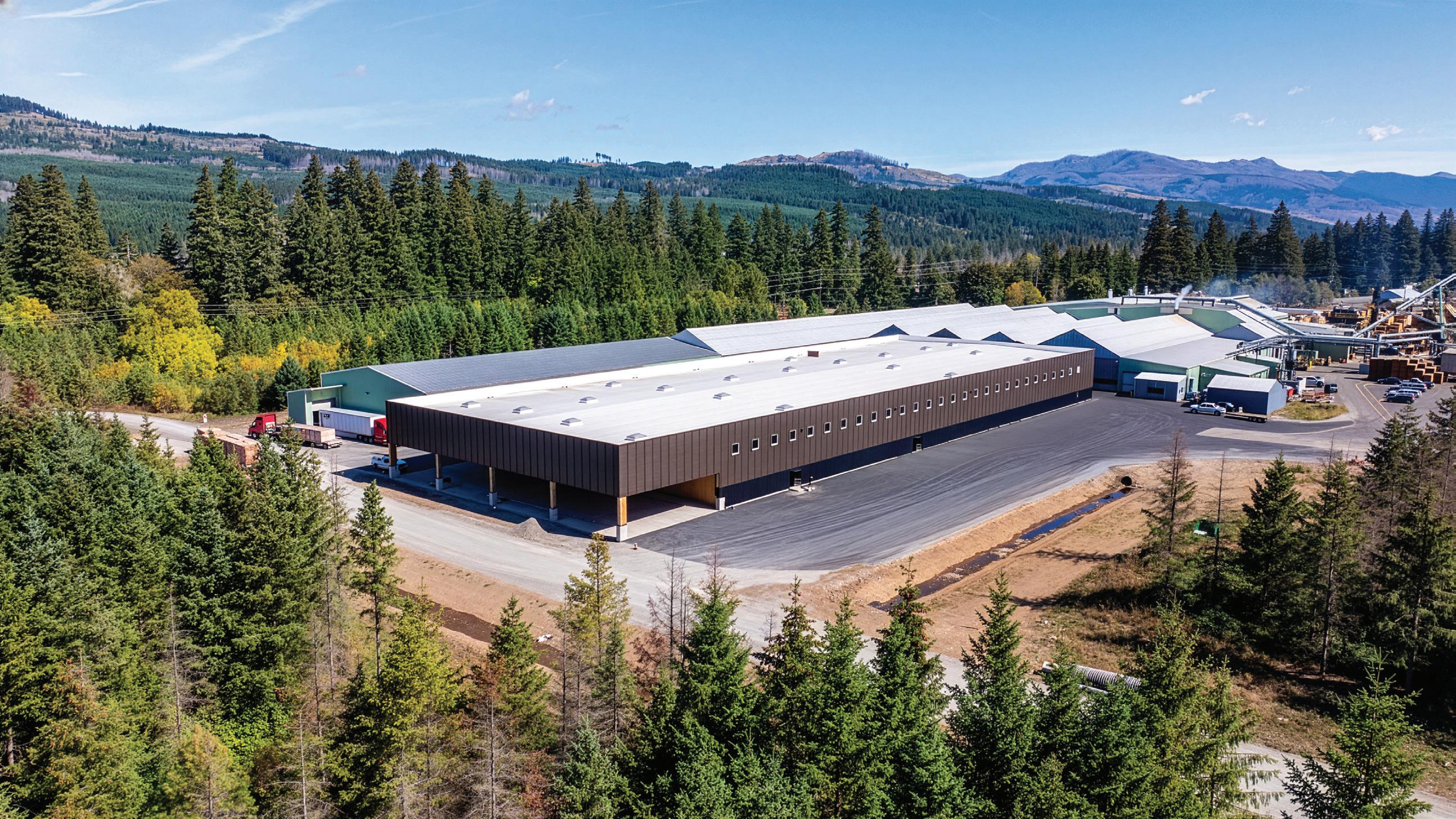
Freres Engineered Wood, a producer of mass plywood, enlisted Crow Engineering, a multi-discipline engineering firm in Beaverton, Oregon, to design a warehouse for its Mill City, Oregon, plant. Crow focuses on industrial, commercial, and warehouse projects and has been advancing the use of mass timber, and specifically mass plywood,
for industrial and warehouse applications.
The general contractor for the project was CD Redding of Salem, Oregon. The mass timber was erected by Prime Contracting LLC, a timber structure erection company from Cornelius, Oregon.
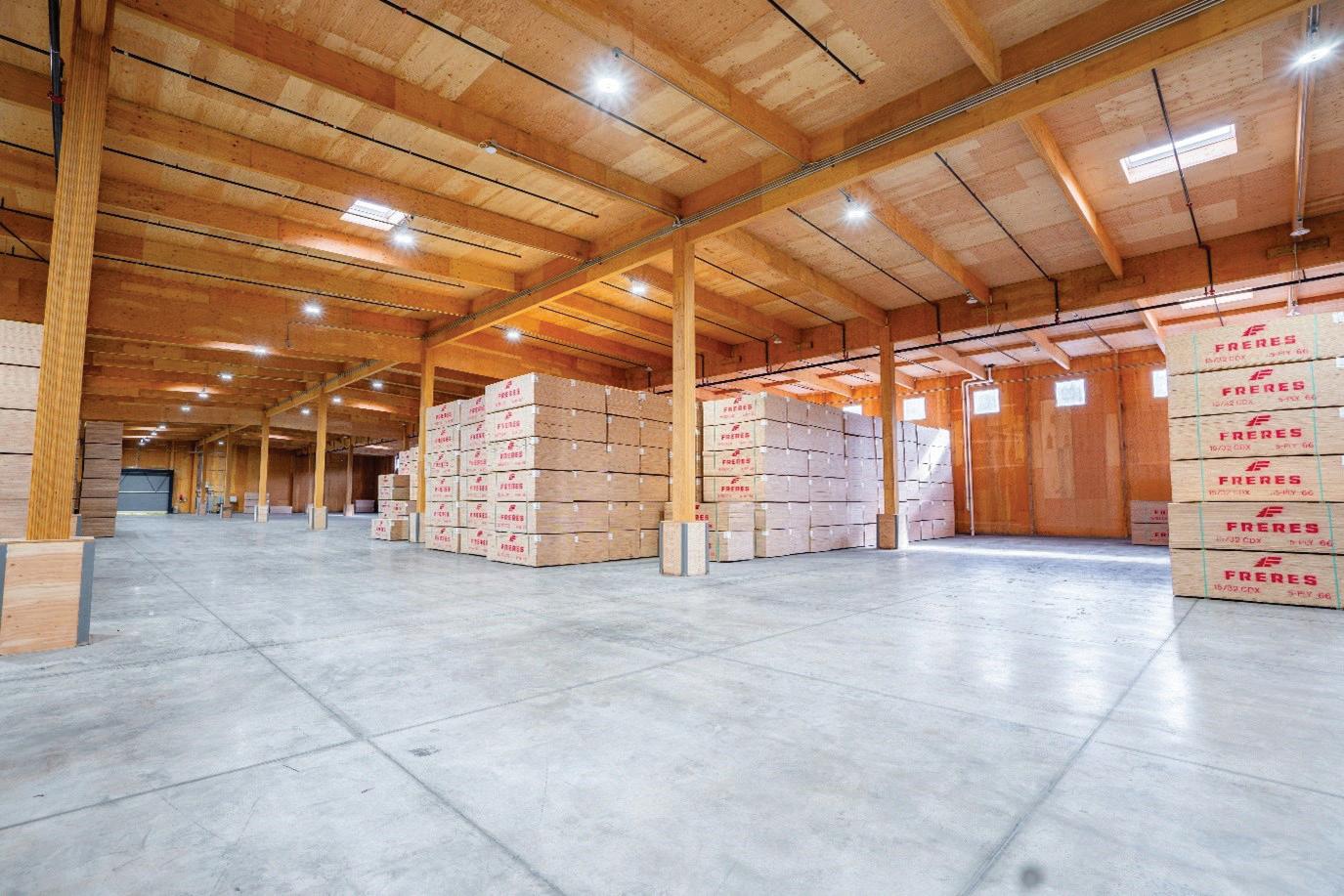
Since this project was for Freres, it was logical to maximize the use of mass plywood. As such, the building was constructed using mass plywood panels (MPP) for walls and roof deck and mass ply lam (MPL) beams and columns for framing. This proved to be a very effective and desirable way to construct a warehouse—combining speed of
construction, carbon sequestering, renewable resources, the use of small cranes, and a small construction crew—resulting in a cost effective and aesthetically pleasing facility. According to a study done by Freres, replacing concrete and steel construction with mass plywood eliminated approximately 429 metric tons of greenhouse gas emissions, representing a total potential carbon benefit of 1,539 metric tons in the construction of their plywood storage warehouse.
The foundation system for the Freres project is comprised a simple 8-inch concrete slab floor with thickened edges to support the walls and thickened sections at the interior columns. Site cast tilt-up requires sufficient cure time for the slab before beginning the process of laying out and forming wall panels, setting rebar, pouring the wall panels, and then waiting for the panels to cure before bringing in a large crane to set the wall panels. Then, once the concrete wall panels are set into place, they need to be backfilled, and the slab extended to the wall panel. Using thickened slab edges eliminated the extra step of pouring stem walls or having to do a pour back strip after setting concrete wall panels.
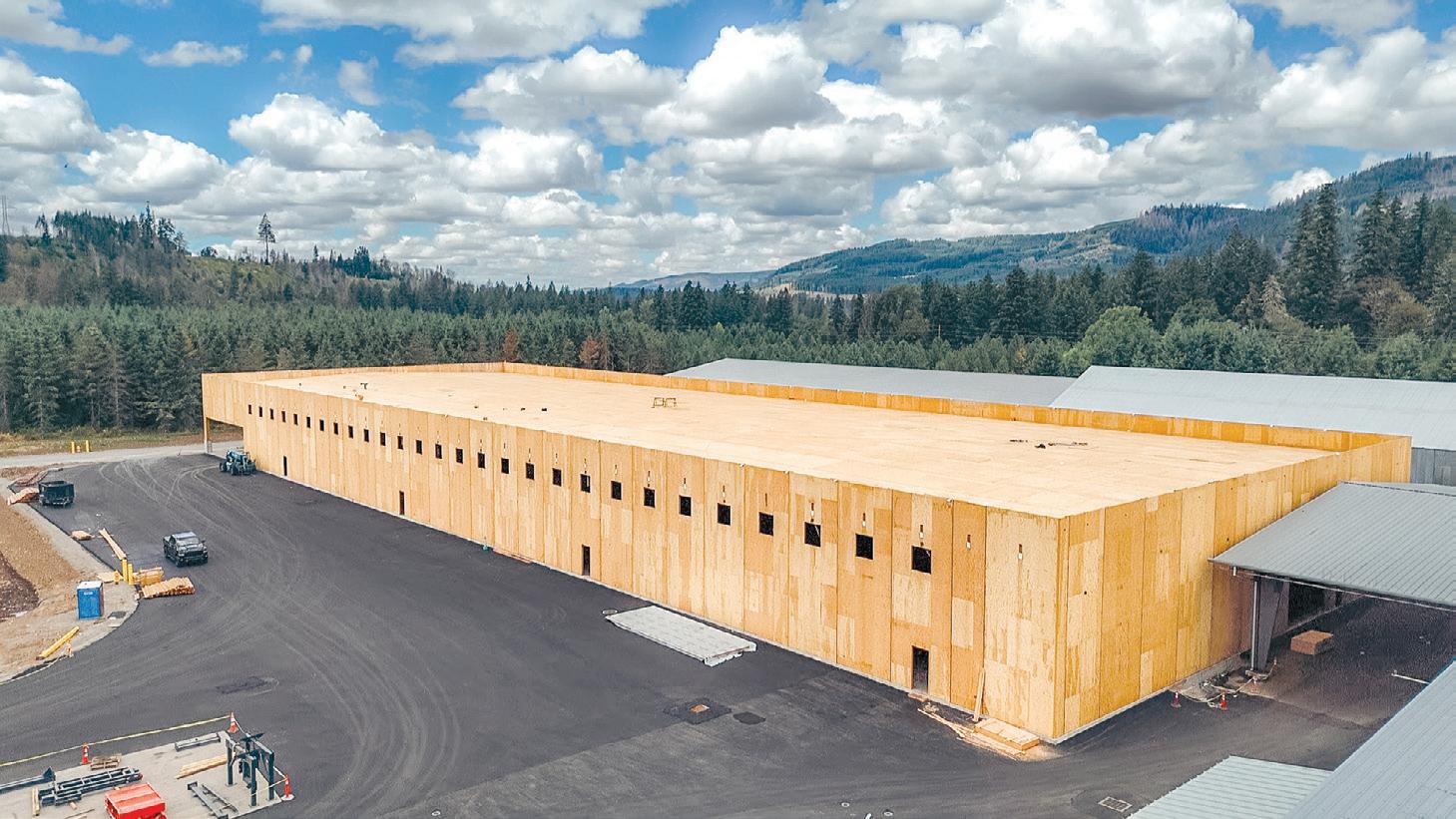
The wall system selected for the Freres warehouse utilizes MPP in a similar fashion to tilt-up concrete construction. Since MPP panels are plant-manufactured and precision CNC fabricated, the wall panels can be erected as soon as they arrive on site. In fact, on the Freres project, erection of wall panels started before the entire foundation slab was completed, only a few days after placing the slab, shaving months off an equivalent site cast tilt-up concrete building schedule. Solid load bearing tilt-up style MPP walls have no sub-framing and therefore have no dust shelves or exposed insulation to create housekeeping problems for the facility.
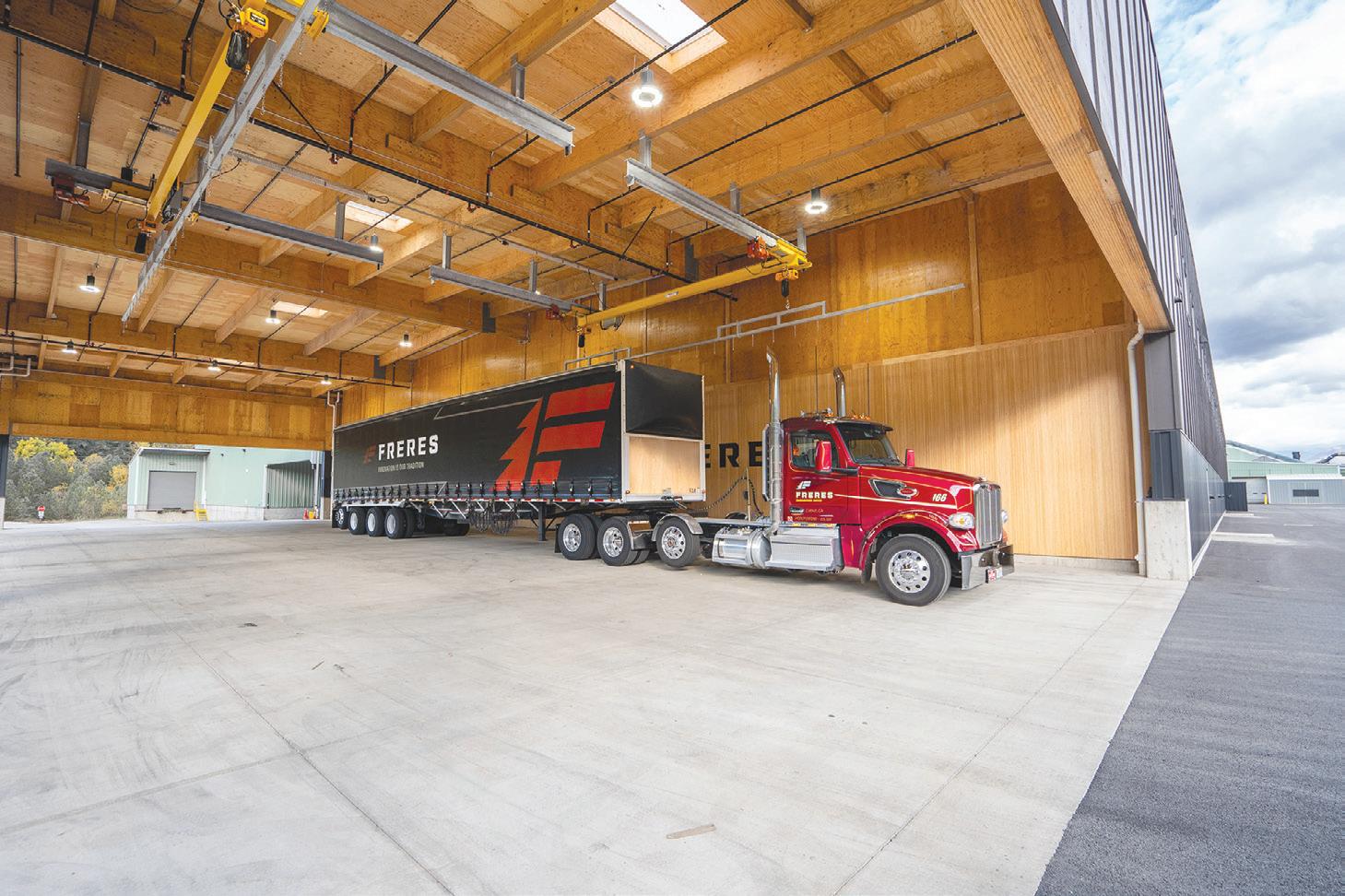
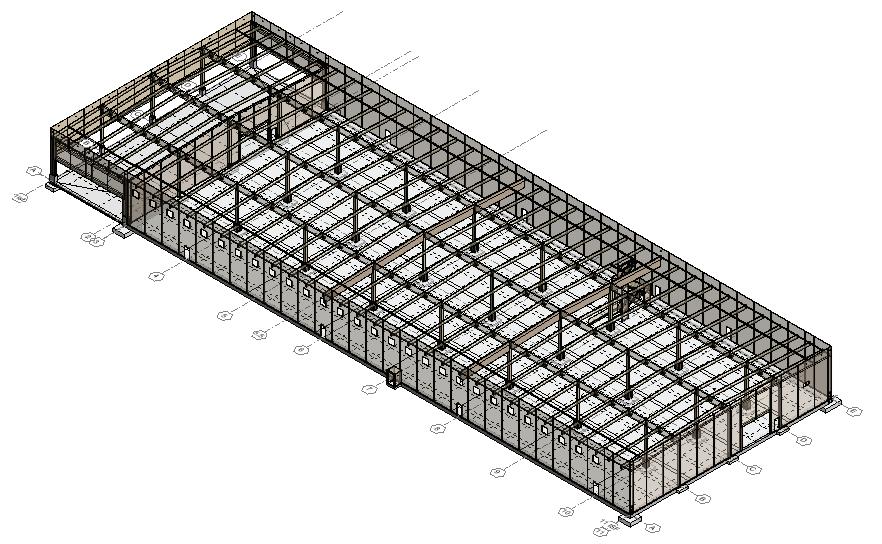
The column and purlin spacing and the depth of the girders and purlins were optimized to fully utilize 48-inch-wide MPL billets, with essentially no waste. Purlins are at 12-foot on center, matching the wall panel width, creating a very uniform system, resulting in most of the wall panels being identical. Pockets were routed in the panels by the CNC machine for the purlins to sit in, eliminating all beam hangers at the perimeter wall. The 4-inch-thick wall panels, with an h/t ratio of 80, were designed using a P-Delta procedure developed in-house. Several options were evaluated for supporting the purlins from the girders. Rather than steel hangers, the idea of screwing a ledger onto the sides of the girders was considered. This eliminated the steel hangers
but required many screws to support the loads from the purlins. A further iteration was ultimately implemented. Rather than a continuous face mounted ledger, shallow pockets were routed in the sides of the girders and short ledger blocks were set to bear on the edges of the routed pocket. This was a tradeoff of CNC routing cost against savings on the length of the ledger and greatly reducing the number of screws required. It also automatically indexed the position of the ledgers, eliminating the need for field locating hangers or ledgers. This solution is possible with MPL girders due to the cross-laminations, whereas it would not be acceptable with glulam, due to potential cross grain tension failure.
Two-inch thick mass plywood panels, 12
feet wide by 48 feet long, placed on MPL purlins at 12 feet on center, were used for the roof deck. This results in the deck being a four-span continuous member. The multiple span condition reduces deflections considerably as compared to simple span conditions, thus allowing a 2-inch panel to be used rather than what would otherwise require a 3-inch panel.
This facility, located on the western flank of the Cascade mountains, is in a moderately high seismic zone. Anchorage of concrete wall panels to a roof diaphragm in high seismic zones has long been problematic. Building codes require very large anchorage force levels for this attachment. This force is a function of the weight of the wall, so heavy concrete walls create large anchorage forces.
Total cost of construction, including site preparation, was only $118 per square foot, based on the commercial value of MPP. According to CD Redding Construction, this lands between the cost of a basic MBS and a tilt-up concrete building of similar dimensions.
A mass timber wall on the other hand will weigh approximately 20% of what a concrete wall will weigh, resulting in much smaller anchorage forces.
The lateral force-resisting system utilized for this project uses spline connected MPP shear walls and roof diaphragm. The ASCE 7-22 Minimum Design Loads and Associated Criteria for Buildings and Other Structures has some provisions for designing CLT shear walls, however it is very limited in scope. The MPP tilt-up style of construction doesn’t really fall within those limited parameters, so the lateral force system was designed as an “alternate method” per the building code. The State of Oregon Building Division has approved and published the Statewide Alternate Method No. 15-01 “Cross-laminated timber Seismic force-resisting systems” for this purpose. The method requires a very conservative response modification factor to be used in the seismic analysis. Although it is an approved method specific to the State of Oregon, other jurisdictions have accepted the method on a case-by-case basis. The method has ductility requirements that give options regarding which elements of the system must be designed to be ductile. It requires shear fasteners for those ductile elements to be controlled by type IIIs or IV yield modes per the National Design Specification for Wood Construction. Since this is an unheated building there were no requirements for thermal insulation. Even though no insulation was added to the wall panels, the natural mass and insulation
value of the MPP results in the building staying comfortable throughout the year.
The building is classified as Type V-B construction. It should be noted, however, that other than the perimeter bearing walls, the framing complies with Type IV Heavy Timber construction with the inherent fire resistive characteristics thereof.
Any rainscreen/siding material can be used with this system. For this project, 1-inch by 4-foot wide MPP lamella were used as siding, creating an attractive board and batten style appearance.
The project proved to be cost effective. Total cost of construction, including site preparation, was only $118 per square foot, based on the commercial value of MPP. According to CD Redding Construction, this lands between the cost of a basic MBS and a tilt-up concrete building of similar dimensions.
Mass plywood is a cross-laminated veneer panel and is classified as cross laminated timber (CLT). MPP is a code approved product in both the United States and in Canada complying with the APA PRG-320 Standard for Performance Rated CrossLaminated Timber. Product design values and requirements for multiple grades of MPP and MPL can be found in Freres’ APA Product Reports PR-L325 and PR-L325(C). MPP panels, manufactured in 8 feet, 10 feet and 12 feet nominal widths, are available in 1-inch increments from 2 to 12 inches thick. The 1-inch increments provide design flexibility when choosing a panel thickness to meet the requirements of the project. The cross laminations of mass plywood and other CLT products provide dimensional stability
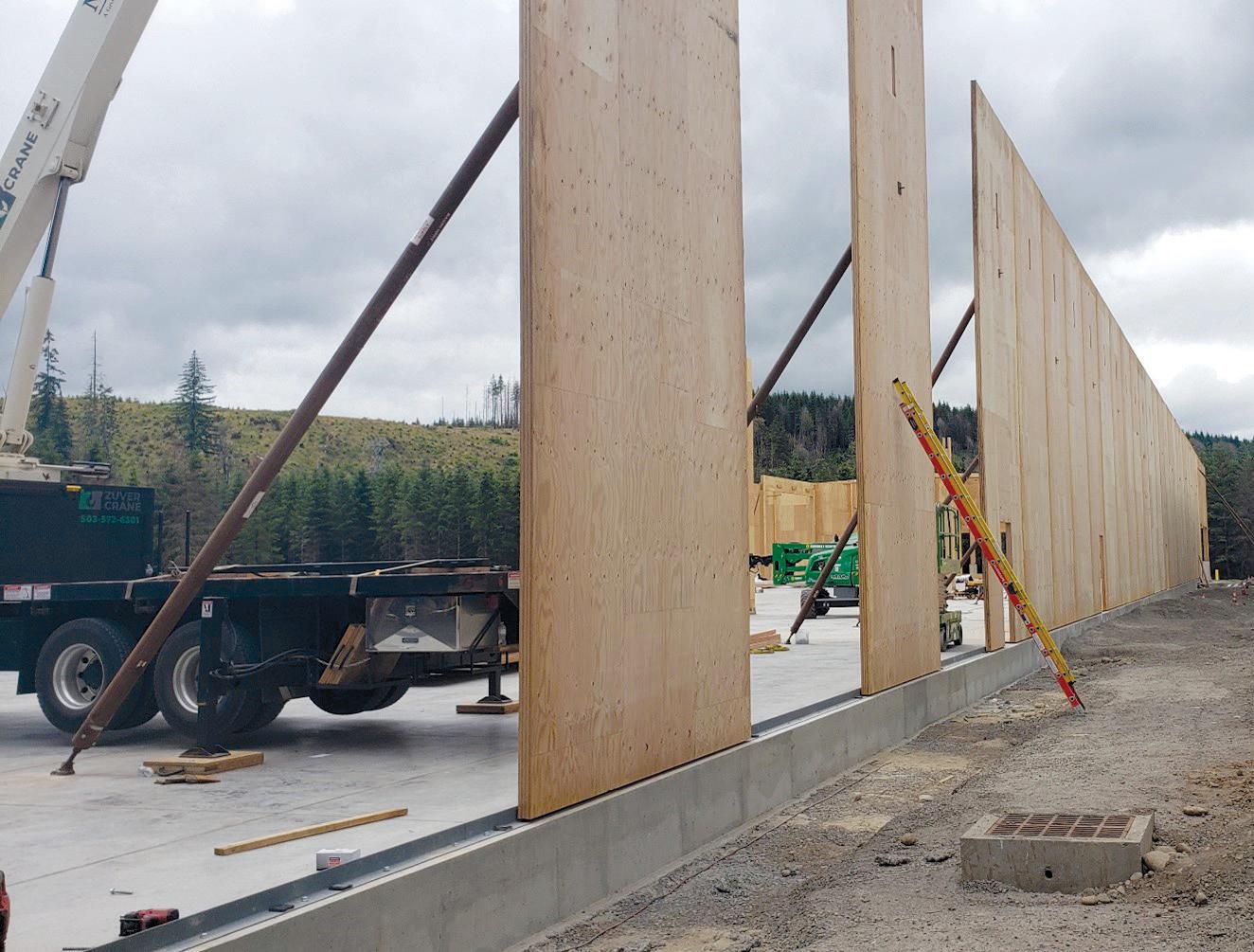
and cross grain tension strength which is not found in traditional timber products. MPP and MPL are produced at a moisture content of 8%. This is a distinct advantage for dimensional stability in that 8 percent is the typical equilibrium moisture content of wood in a seasoned building.
When designing tall walls of any material, it is generally not practical to meet the code limitation on the height to thickness ratio (h/t) of compression elements. Historically, concrete and masonry walls were designed with pilasters to stiffen the walls to conform with these code-imposed thickness ratios. In the 1970s, a P-Delta analysis method was devised to allow masonry walls to be designed as “slender walls” exceeding the h/t limitations of the codes. After a significant testing program, the method was adopted by the engineering community and codified. It was then extended to concrete tilt-up construction. Standard construction practice now routinely uses slender concrete and masonry walls without stiffening pilasters. Mass plywood can be utilized in a very similar way. MPP is manufactured under controlled conditions which results in very consistent and predictable properties. A P-Delta analysis is highly dependent on the material modulus of elasticity. This can
vary significantly in concrete and masonry materials; however, the manufacturers quality control testing has shown that the most consistent property of MPP is the modulus of elasticity. Deflection is therefore very predictable, so a P-Delta analysis can be considered very reliable.
The deflection considered in the P-Delta analysis should include all potential sources of deflection, as well as the orthotropic nature of the panels. In addition to applied loading, initial straightness, as well as moisture “bowing” should be considered. The author uses Emin rather than E for the P-Delta analysis, which is very conservative. Even such, the panel thickness is normally controlled by service load deflections, not strength.
Historically, the walls of unheated or semi-conditioned tilt-up concrete buildings were left uninsulated, relying on the thermal mass effect of the concrete alone to moderate temperature swings in the building. However, current energy codes require some level of wall insulation in addition to the mass for both semi-conditioned and fully conditioned facilities. This is typically accomplished by pinning fiberglass batt insulation on the inside face of the walls. MBS buildings are typically insulated with
fiberglass batt insulation systems, placed on the outside face of the girts and purlins, but exposed to the interior with an exposed vinyl face. The steel building provides no thermal mass or insulation of its own, so higher insulation levels are required over tilt-up concrete buildings.
Calculations, provided by Freres Wood, have shown that mass plywood can qualify as a “mass wall” per the ANSI/ASHRAE 90.1 energy code if the panel is 4 inches thick or greater. In addition to the mass provided, the panels have a thermal resistance “R value” of 1.25 per inch. Depending on the climate zone, this can result in no added insulation needed to comply with ANSI/ASHRAE 90.1 for semi-conditioned spaces and significantly reduced insulation requirements for fully conditioned spaces. What insulation is used is typically applied to the exterior of the panels, leaving the MPP exposed to the interior. Using solid “tilt-up” style MPP leaves a flat interior surface with no protruding girts and columns.
Research for spline connected CLT/Mass Plywood shear walls would be helpful to establish code prescribed seismic coefficients for nailed spline connected panels and other types of shear wall systems. It is the author’s expectation that research will show that less conservative R-values than required by the Oregon Statewide Alternate method will result.
The Freres warehouse demonstrates that mass timber, and specifically mass plywood, represents a serious alternative for warehouse and other big box structures. The use of a renewable resource such as mass plywood has proven to be very cost effective, thermally effective and environmentally friendly. ■
John Bradford, PE, SE, senior structural engineer with Crow Engineering, has 50 years of experience designing heavy (mass) timber structures. Bradford is the SER for the project and developed the methodology used for the MPP slender wall analysis.
provided by
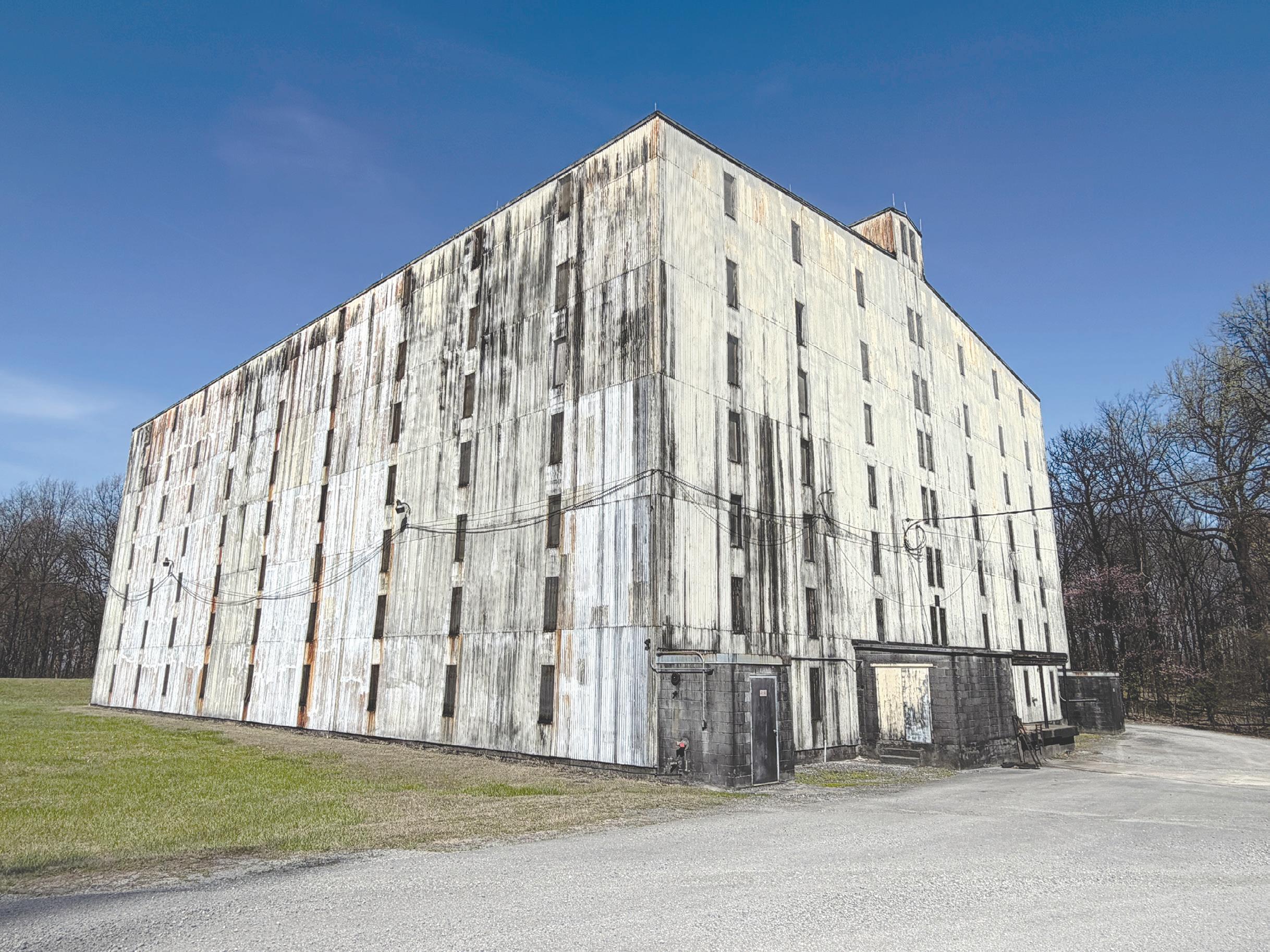
Maintaining the structural integrity of historic American barrel-aging warehouses requires care, creativity, knowledge, and experience.
By Benjamin Wagner, PE, SE
Whether you’ve been swept up in the bourbon and whiskey renaissance of the past decade, watched friends or colleagues immerse themselves in it, or intentionally kept your distance, the tasting ritual is recognizable: a pour slightly heavier than intended (a fact no one will admit) settles into a Glencairn glass, catching the light as it rolls along the curved sides, amber and honeyed, cradled between finger and thumb. A slow turn of the wrist sets the liquid in motion, a swirl to study the legs. A pause. Then a measured breath through the nose, eyes half- to fully closed, allowing the aromas to speak before the inevitable first sip. Another follows, this one for the Kentucky Chew.
Each gesture is deliberate, performed with care, as if the ritual itself might draw the very best from the glass; to make it count. For the Certified Bourbon Steward or the amateur who learned the practice from someone else, the process is central; tradition can matter as much as the final expression.
For a small subset of structural engineers, however, that aroma signals something entirely different. It does not stop at charred oak or caramelized sugars. Instead, it pulls them back to a place most enthusiasts never see, or only glimpse on a guided tour: the iconic wood rickhouse. Not the idealized image printed on a label, but the lived-in structure. Weathered framing, uneven floors that announce each step, and daylight and cool drafts filtering through siding that has expanded and contracted for decades. Faint streaks of baudoinia compniacensis (whiskey fungus) cling to surfaces, a quiet testament to evaporation and the presence of the angel’s share. In these moments, the scent in the glass becomes inseparable from the structure.
For the structural engineer, the experience begins outside
camaraderie contrasts with the quiet intensity of the structure itself. Their warmth and generational knowledge set the tone: lighthearted and engaging, yet grounded in the understanding that you are there because they have a concern regarding this house. Like an adult caring for an aging parent or grandparent, they tend to the house and its neighboring siblings as if they were their own, guided by a responsibility not only to preserve its life and extend its service, but to honor the legacy and traditions carried forward through generations.
There is always a brief rush of confident yet nervous adrenaline in knowing that no matter how many rickhouses you have entered, each one is unique. Decades of loading, unloading, “modifications,” and environmental forces have left their maker’s mark. Some variations reveal themselves immediately; others remain hidden behind rows of barrels. The structural engineer’s task is simple in concept but rarely in execution: understand how this house has responded over the years and determine what, if any, rehabilitation is needed.
As the front-of-house door opens, the structural engineer steps inside and begins to see the rickhouse in ways most visitors never will. The angel’s share still hangs dense in the air, sweet and unmistakable, though slowly dissipating as fresh air flows in. The focus quickly shifts from aroma to structure. Posts, rails, and braces now command attention; the hidden skeleton that bears the weight of tens of thousands of 500-pound barrels, absorbs seasonal change, and guides the airflow that drives maturation. For the engineer, the rickhouse is as much about vertical and lateral load paths as it is about scent and history. Understanding these systems is key to appreciating how these storied structures endure while supporting both spirit and tradition.
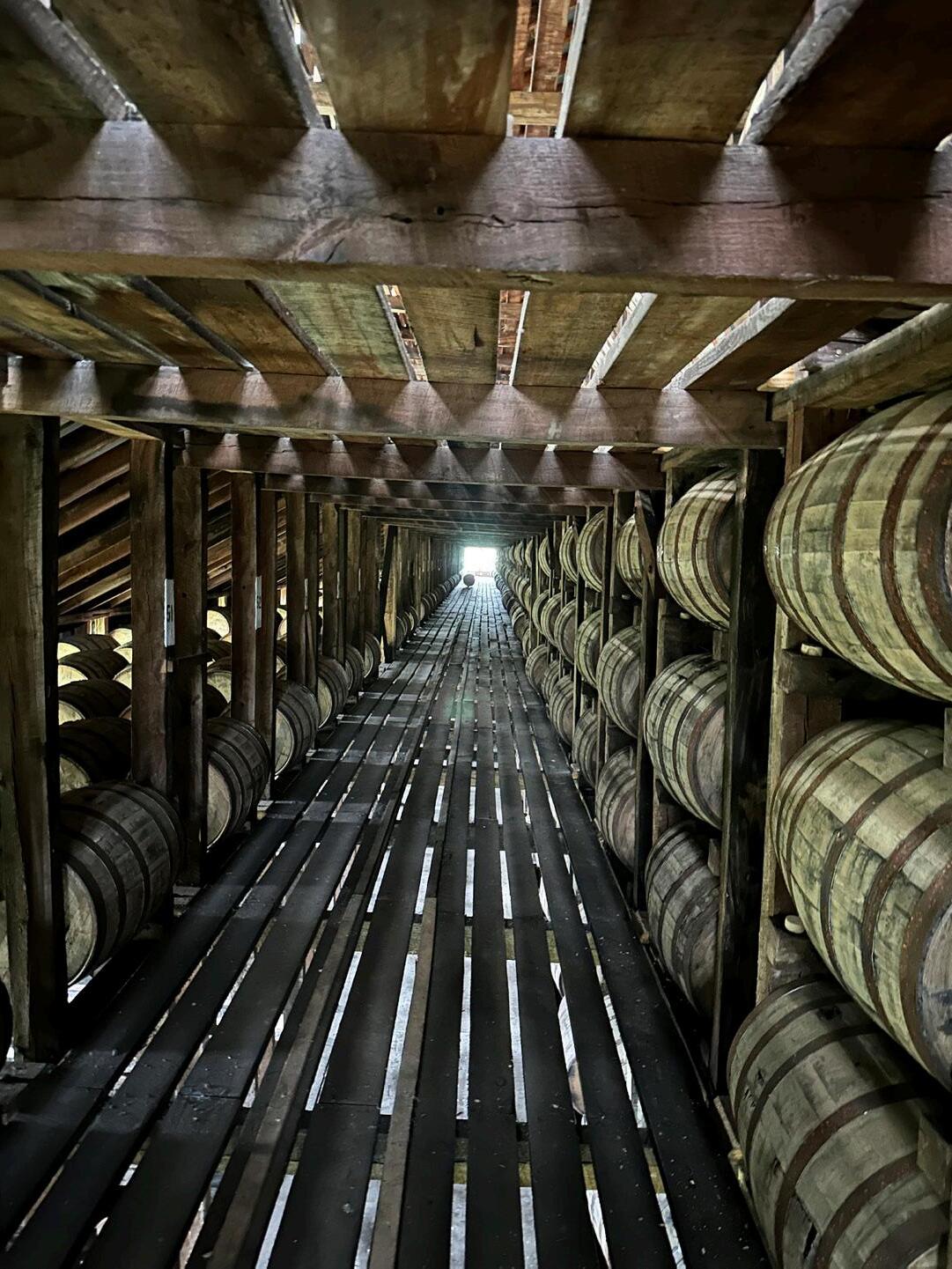

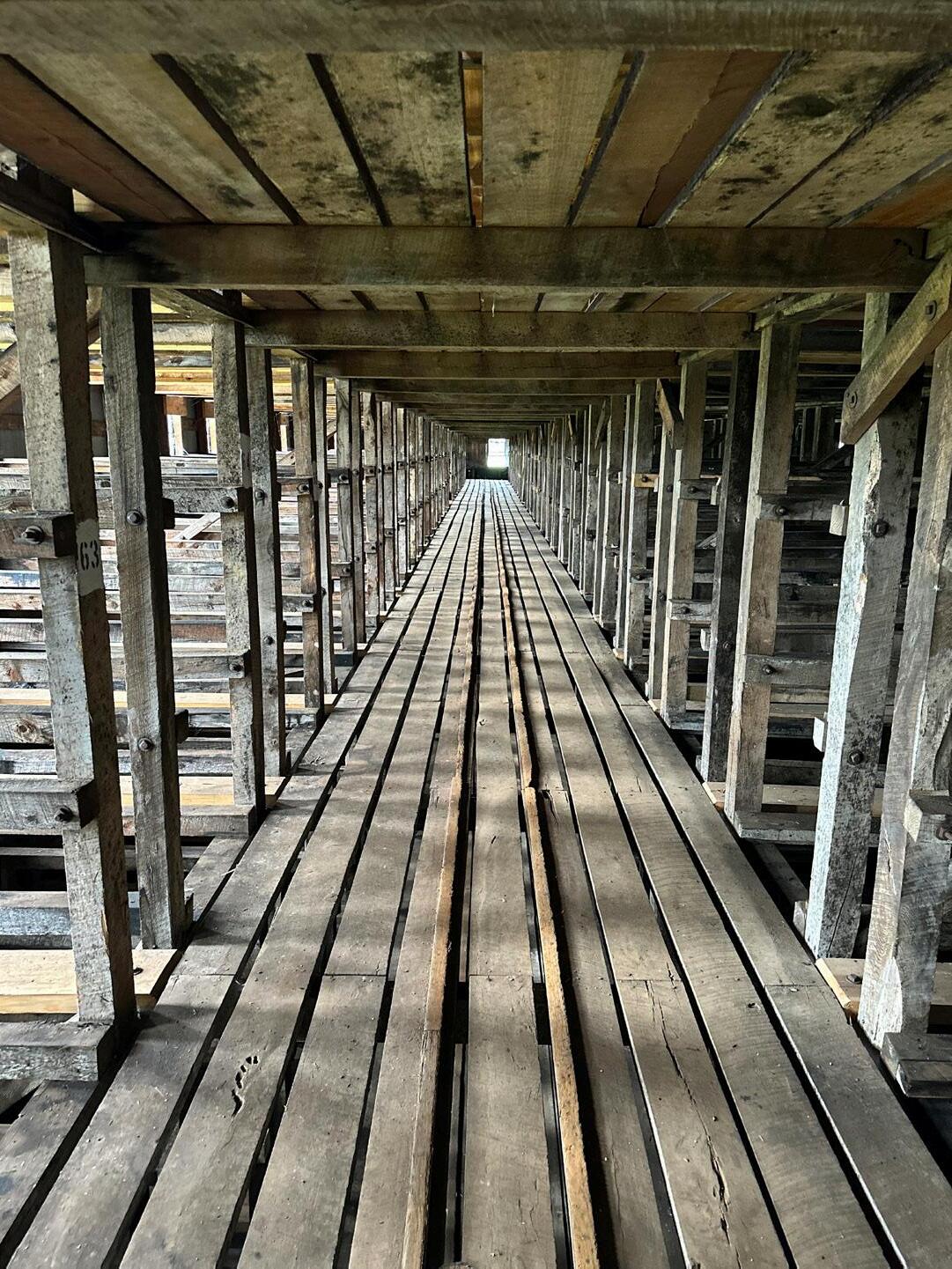
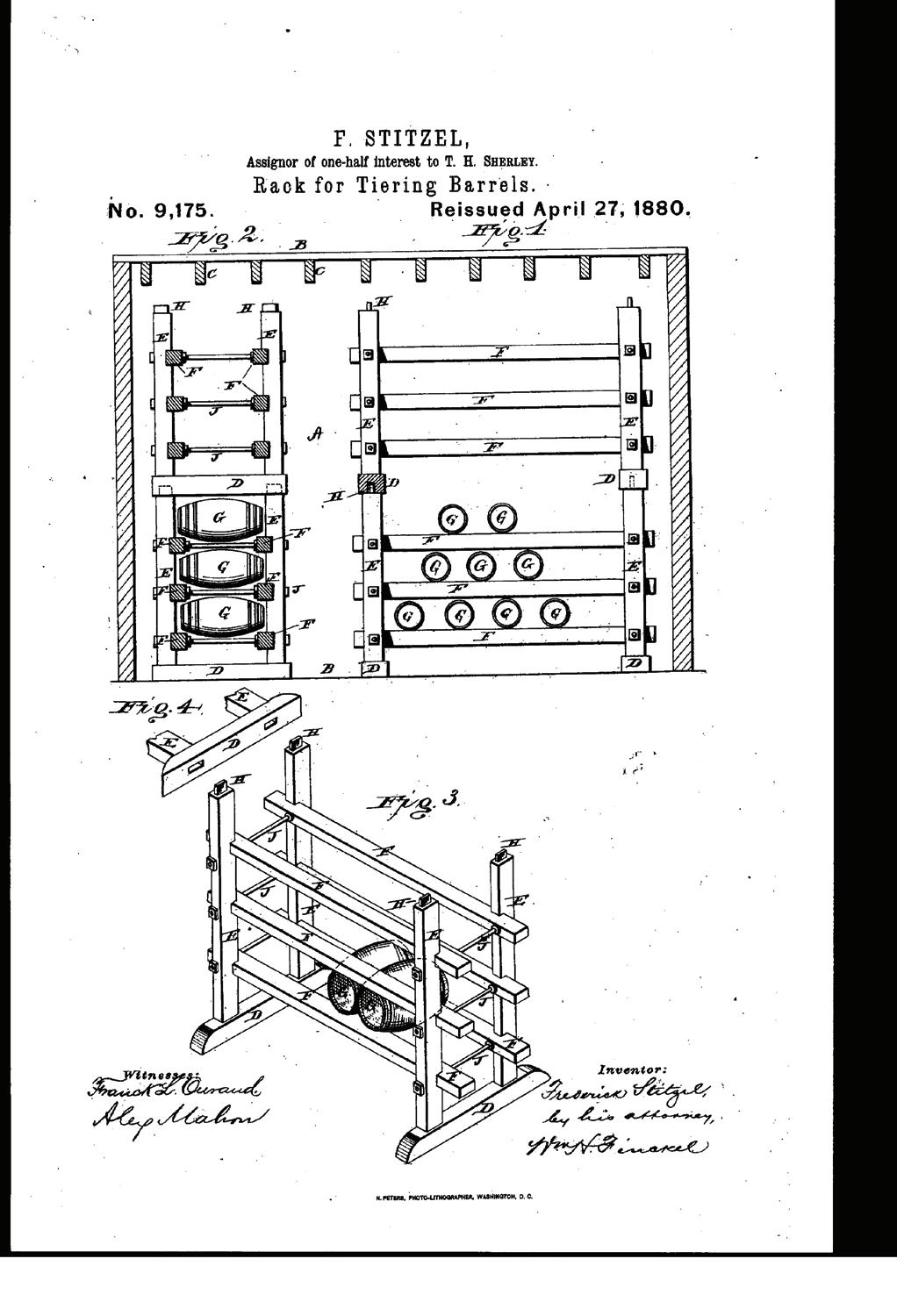
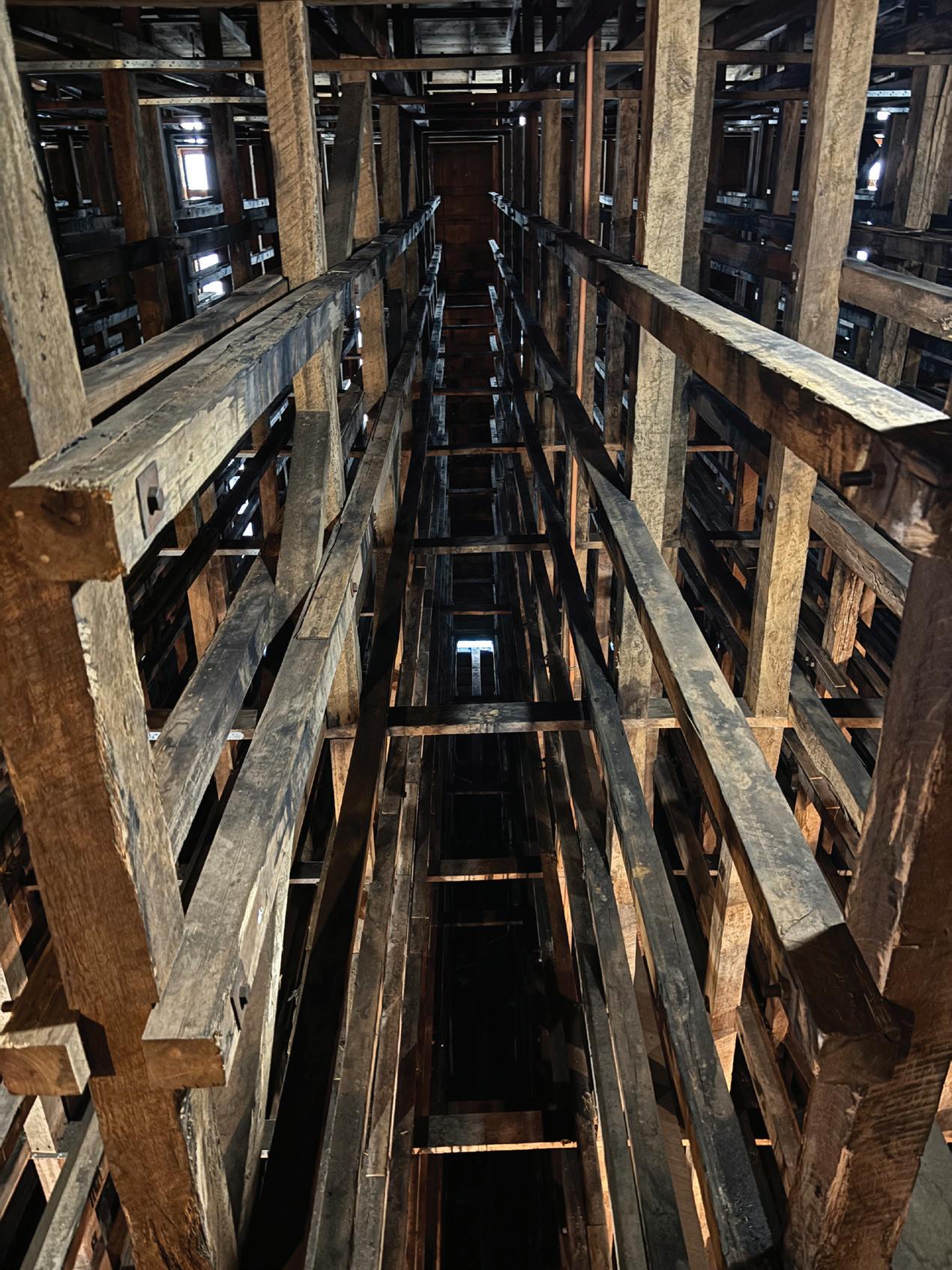

For centuries, American distillers aged bourbon and whiskey in warehouses ranging from barns to ornate brick buildings. Before formal racking, barrels were stacked on floors or simple shelves, leaning against walls or one another. Storage relied on natural airflow and seasonal temperature swings which was inefficient; barrels could become overstressed or damaged.
A turning point came in 1879, when Louisville distiller and inventor Frederick Stitzel patented the “Rack for Tiering Barrels.” His system supported barrels on their sides without stressing the staves and promoted airflow around each one. Each rack carried barrels independently, allowing denser, safer storage and easier handling. While the patent never used the word “rick,” the system is believed to have inspired the term “rickhouse,” now synonymous with American barrel-aging warehouses.
The familiar Kentucky rickhouse emerged: four- to ninestory wood framed structures clad in corrugated metal, exposed to the elements. Upper floors endure hotter summer temperatures, accelerating maturation, while lower
floors remain cooler for slower aging. Middle floors offer a balance. Airflow is critical to both maturation and structural preservation, and geographic hills and low-lying sites further influence aging and flavor.
Traditional rack-supported rickhouses did not fit standard building codes. Kentucky gradually developed industryspecific provisions that ultimately culminated in Section 430 of their 2018 Kentucky Building Code for Barreled Spirit Storage Buildings, which allows approved materials outside typical construction type limitation, sets area and height limits, and requires fire separation and spill containment. Section 430.2.2 exempts these rarely occupied structures from IBC/ASCE 7 seismic provisions, recognizing that full seismic design would dramatically alter materials, systems, and cost. Exemption does not remove responsibility: Section 430.2.1 requires the design to carry a licensed Kentucky engineer’s seal, ensuring gravity, wind, load path continuity, connections, and overall stability are addressed.
Today, rickhouses may include fire suppression, mechanized lifts, and engineered racks, yet barrels remain stacked vertically, breathing with the seasons, and supported by
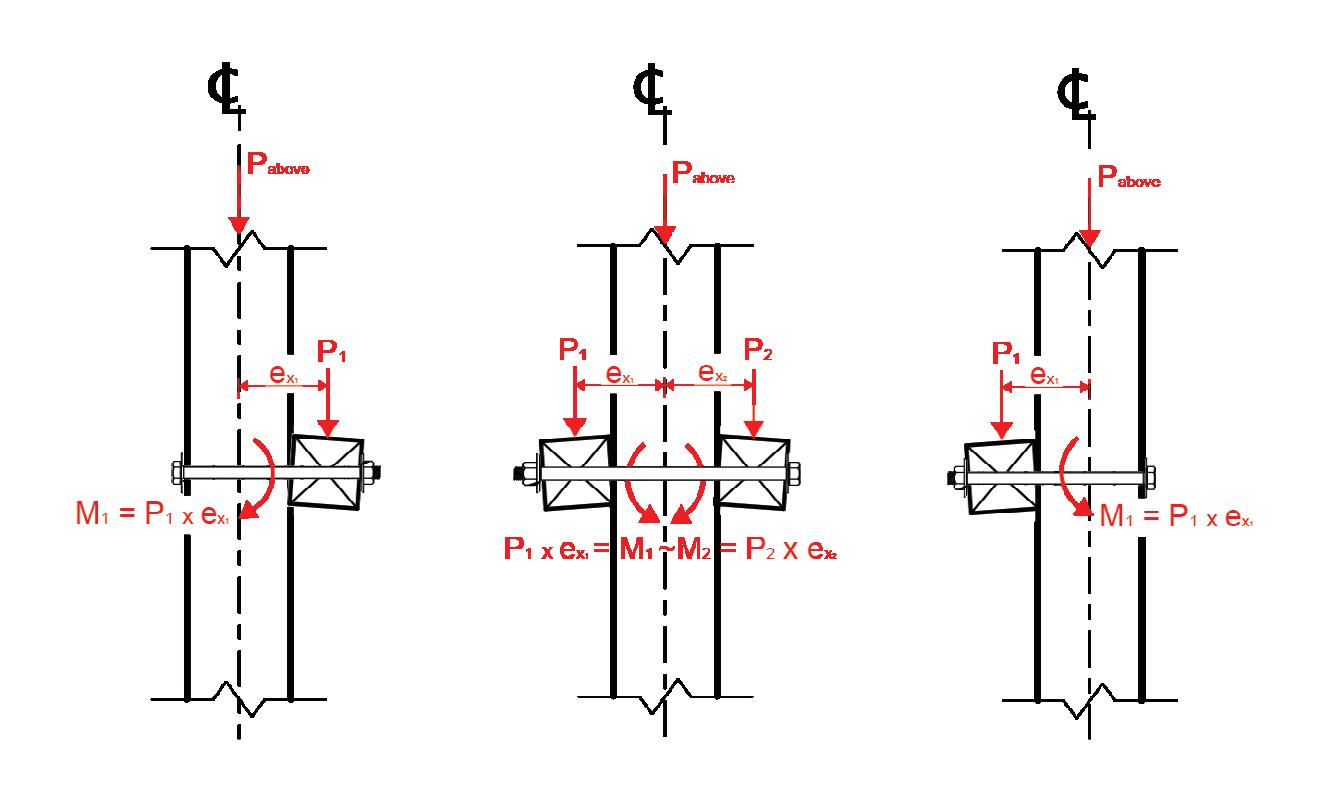
Moments induced by barrel rail loading are shown for the outer (left and right) and middle/double rick (center) posts.
Shown is the general terms and positions for a typical rickhouse quadrant layout.
wood. From Stitzel’s original patent to modern high-capacity campuses, the rickhouse continues to shape the spirit through airflow, wood framing, and the judgment of those who design and maintain them.
Rickhouses, though slightly varied in layout, are built from the same fundamental gravity-bearing unit: Stitzel’s rick, or rack. As shown in Stitzel’s 1879 patent, the rick is a rectangular frame supported by corner posts. Typical dimensions are roughly 3feet, 6 inches wide (3 feet clear), 6 feet, 9 inches to 9 feet deep, and 7feet, 4 inches tall, accommodating standard 53-gallon barrels (35–36 inches tall, 21–22-inch head diameter, 26–28-inch bilge) while allowing airflow between the 400–550-pound barrels.
Ricks may be configured as single or double units, with two or three posts across the aisle width. Dunnage rails span horizontally between posts to support barrels, notched or let into the posts at third points of the rick height. In double ricks, the center post carries rails on both sides. Rails are eased or canted to match barrel bilges and secured with through-bolts at each post intersection.
Although the rails transfer loads to the posts, the load is slightly eccentric. Middle posts in double ricks generally handle the load well, but outer posts are more sensitive. Removing barrels from the bottom of a full house can create significant structural consequences if not carefully managed, since the center post supports roughly twice the load of an outer post.
The overall house widens as the initial rick is extended lengthwise by adding posts and continuing the barrel dunnage rails, forming a continuous aisle of rick bays. The structure then grows longitudinally as parallel rick aisles are added. Each single or double rick is separated by catwalks,
sometimes as narrow as 15 inches, providing workers access for loading and unloading while maintaining operational clearance and airflow between aisles.
As the structure expands in width and length, a recognizable and repetitive overall plan emerges. Typically, rickhouses are organized into two primary sections containing 34 to 68 parallel rick aisles running perpendicular to the house’s longitudinal length, separated by a main central walkway approximately 8 feet wide. This central aisle bisects the house, delineating the left-of-house (LOH) from the right-of-house (ROH). Additional narrower walkways may run interior of the exterior LOH and ROH walls to provide supplemental barrel access. Near the main entrance an 8-foot offset from the first rick aisles is commonly provided to accommodate temporary storage, stairs, and modern escalator lifts.
Near the center of the house, a rick aisle on each side of the center walkway is often omitted to provide a series of longitudinal X-braces, one at each rick post. This aisle bisects the house transversely, delineating the front-of-house (FOH) from the back-of-house (BOH). These braces form the spine of the structure, resisting lateral motion and keeping the structure aligned under longitudinal loading. In larger rickhouses, additional X-braced bays at quarter points enhance overall longitudinal strength and stiffness.
Before building upward, 2x top plates are installed transversely across the tops of the rick aisle posts, aligned with each X-brace. These plates function like ribs or multi-level outrigger arms, connecting posts across aisles and distributing forces from the outer edges of the body back to the spine. Nailed and spliced atop the posts at varying intervals, these single- or double-ply plates stretch and contract like ligaments, helping the structure breathe and dampen movement. They also act as drag struts and collectors, linking all rick posts and exterior walls to the spine while providing a transition between levels.
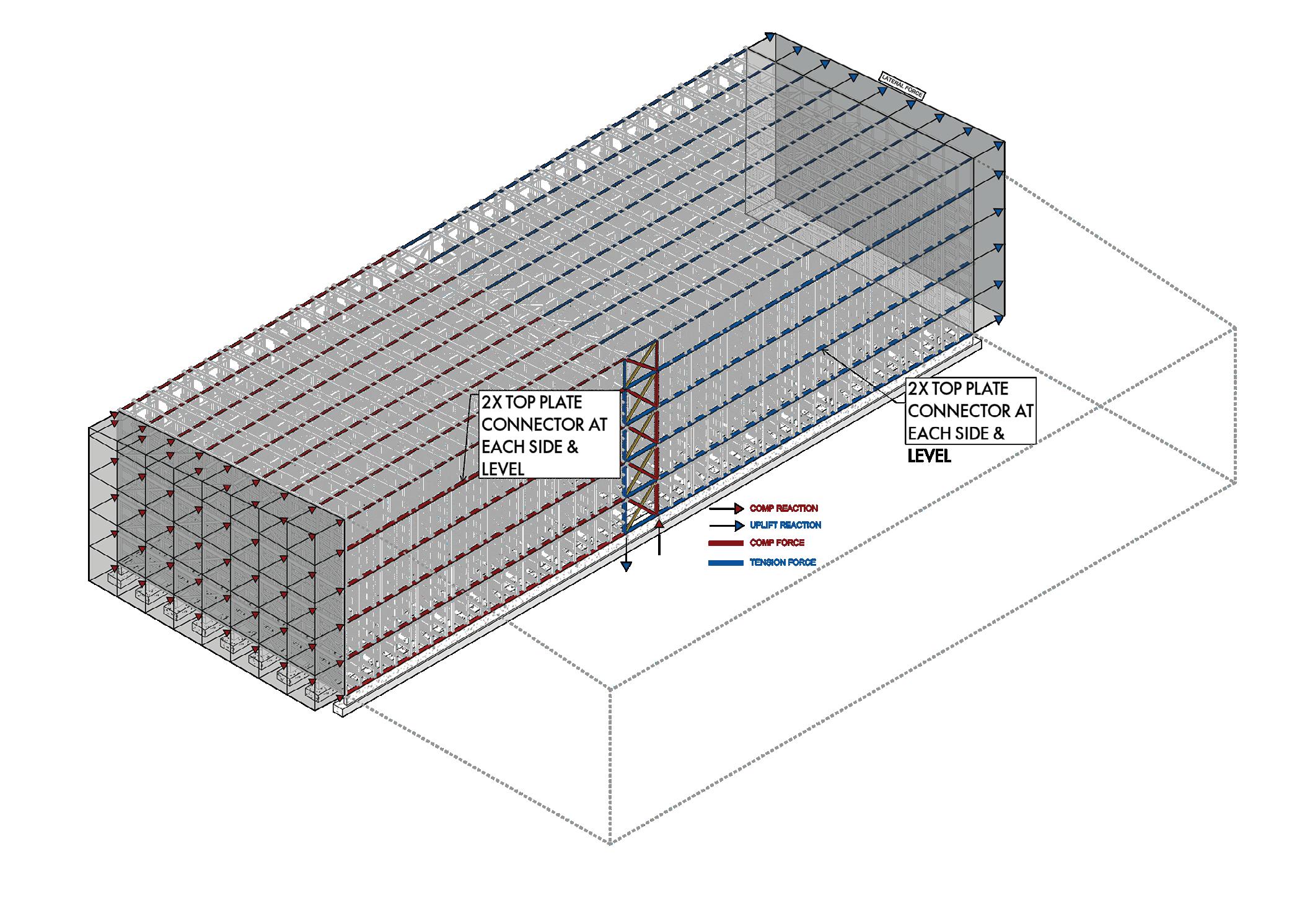
FOUNDATION CONTAINMENT SYSTEM
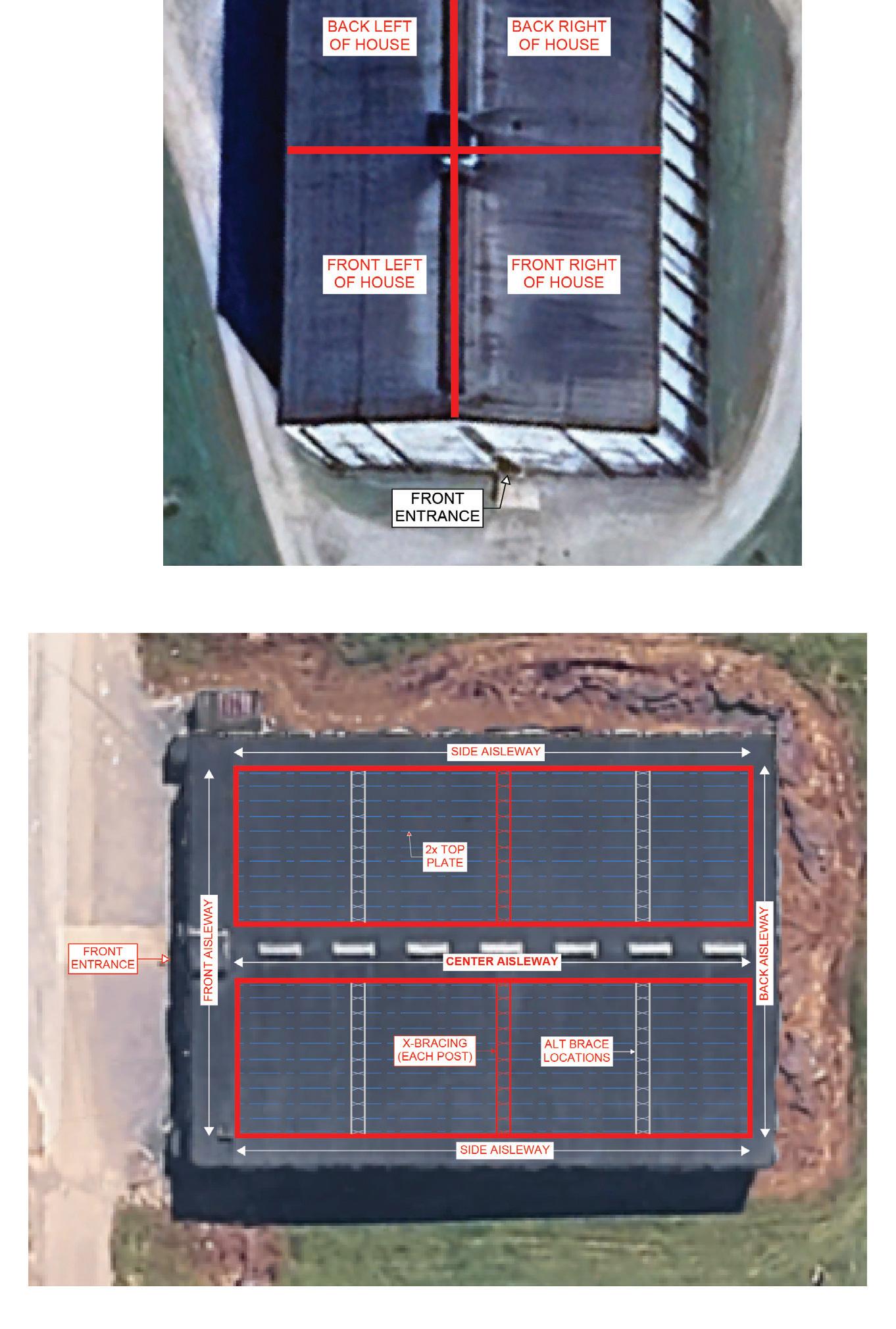
Sway bracing is installed perpendicular to the X-braces on each side of the center aisle. These braces act as transverse spines, increasing stiffness across the quadrants. Typically comprised of a single 4x or larger member, these braces connect to posts and intersecting barrel rails using toenails and through-bolts, interlocking rick components across and between levels.
Barrel rails function as the rickhouse’s skeletal ligaments, binding the frame and coordinating load transfer between posts, braces, and tiers. While typically not a primary lateral load path, they provide secondary continuity and restraint within the system. Their rigid through-bolt connections act as tendons, tightening the system and locking the framing for added stability and load sharing.
The center aisle itself is not reliably rigid but provides
2X TOP PLATE DRAG STRUT BETWEEN COMPRESSION BRACES AT EACH LEVEL
2X TOP PLATE CONNECTOR AT
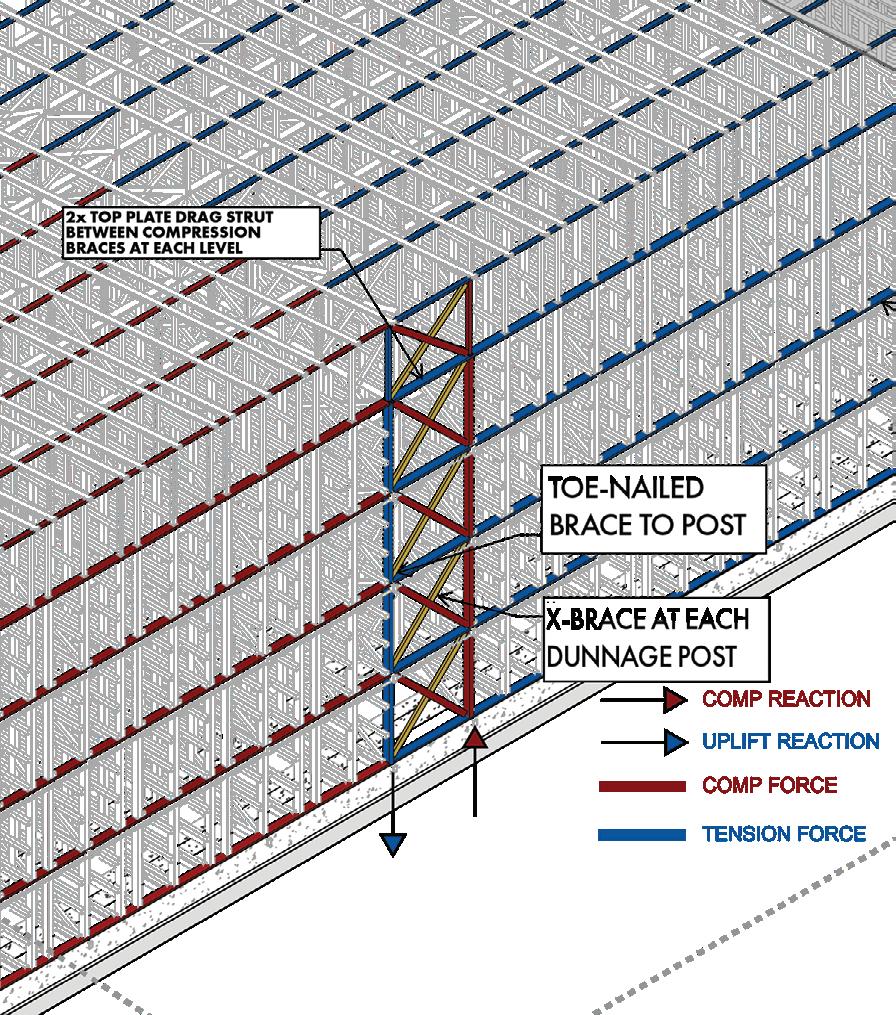
This zoomed-in detail shows the compression-only X-brace lateral load path with 2x top plate tension drag strut.
a limited connection between the individual transverse systems for continuity.
Typically installed at every other rick bay, sway braces are configured as either stacked “A” frames spanning from aisle to exterior wall or two bay wide X-braces. Horizontal 2x braces may be added at floor levels as diaphragms, but most systems rely solely on the 2x top plates.
With the spines, ribs, arms, ligaments, and tendons in place, the structure is ready to grow vertically. Seat-supported beams span the center walkway at aligned posts, and flat 2x decking forms the walking surfaces. The process repeats tier by tier to the roof, where column heights step down toward the exterior walls to promote drainage and interior airflow. Roof and side walls are furred with 2x members and clad with lightweight corrugated metal panels. This outer shell shelters the interior while allowing the structure to breathe, supporting barrel maturation through ventilation and seasonal change.
Posts and braces transfer concentrated loads from the interior dunnage system and the exterior environment
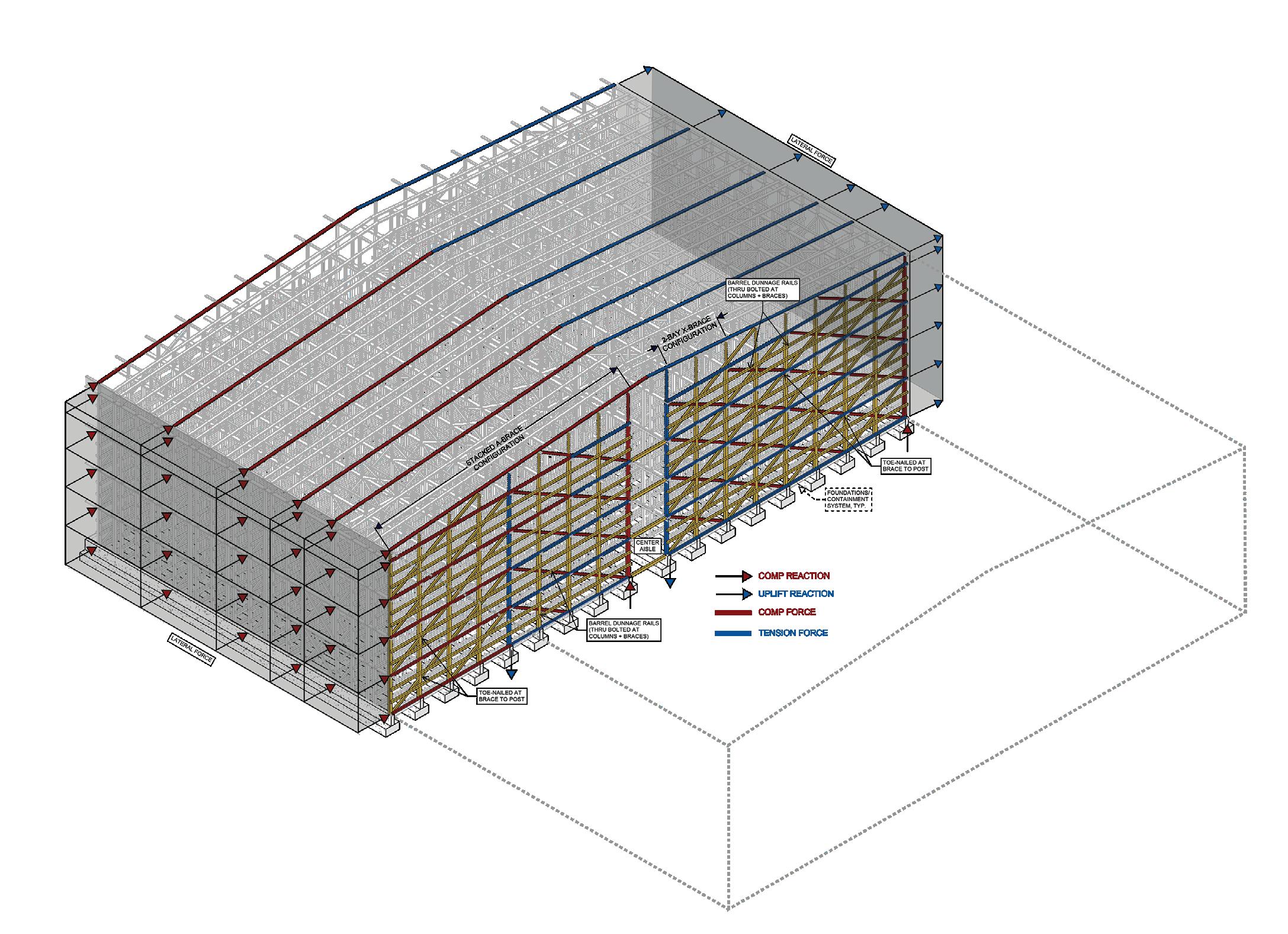
TOE-NAILED AT BRACE TO POST
FOUNDATION CONTAINMENT SYSTEM
The transverse lateral load system path is shown ("A" vs. "X") with compression-only braces.
TOE-NAILED AT BRACE TO POST
to wood sill plates bearing on concrete kneewalls supported by continuous strip footings that run from FOH to BOH. X-bracing typically terminates at the top of the kneewalls, while sway bracing often continues to the tops of the foundations, though not in all cases.
The kneewalls serve several purposes: elevating posts above grade to reduce soil and moisture exposure, promoting airflow beneath the structure and creating channels that manage incidental water or other moisture intrusion. In the event of catastrophic failure or fire, the kneewalls and perimeter foundation walls help contain and direct flammable alcohol toward designated relief zones.
The slab or finished grade between kneewalls is graded to facilitate positive drainage. Liquids are conveyed through outlets or drainpipes to a primary retention pond, a secondary pond, or other approved discharge points in accordance with local code.
This foundation system supports the weight of the house above, transfers forces from posts and braces to the soil below, and regulates the movement of fluids through the crawlspace. By combining structural support with moisture and emergency drainage management, it preserves the integrity of the structure while safely managing potentially hazardous conditions.
Due to the limited tension and shear capacity of typical nailed connections, rickhouse bracing is assumed to behave primarily as compression-only members within
the lateral system, a behavior that may feel unintuitive for a profession more accustomed to tension-only or tensioncompression braced systems. Under longitudinal lateral loads, one diagonal of an X-brace engages in compression while the opposing diagonal remains largely inactive. The active brace bears at its ends, transferring load into the posts and 2x top plates. With limited tension capacity in the opposing brace connection, the system relies on the 2x top plates to drag lateral load across the bay to engage the opposing compression diagonal brace below.
When lateral loading reverses, the previously compressed brace unloads and the opposing diagonal must engage. Engagement may be delayed by construction tolerances such as small gaps at brace ends, gaps in the 2x plates, and fastener slip. These conditions must be overcome before compression bearing develops, creating initial drift before the system stiffens. Over repeated cycles, this ratcheting behavior can lead to incremental displacement and gradual lean.
The angel’s share further accelerates this behavior. Ethanol evaporation produces humid, chemically aggressive conditions that promote fastener corrosion and connection deterioration. Seasonal swelling and shrinkage of wood loosens nails and reduces connection stiffness, while insects and fungal decay can reduce the cross-sectional capacity of braces, posts, and sill plates, lowering stiffness and increasing response time of the lateral load path. Barrels also shift slightly during loading, unloading, and wind-induced sway. The motion is subtle yet perceptible, like a heartbeat passing through the frame, reminding that the structure and its contents respond together to internal and external forces. This cyclic movement can further
Each fall, more than 1,200 structural engineers from across the country gather for the most important four days in the profession. World-class programming. Real connections. And this year — San Francisco.

1,000+ Structural Engineers in One Place
Up to 13 PDHs Technical Sessions from Leading Experts
90+ Exhibitors

encourage connection slip and cumulative displacement. Since 2x top plates are spliced over posts without full continuity, joints can widen under high lateral loads, opening gaps between their ends. Similar separations occur at the ends of X-braces, particularly at brace ends that have previously undergone load reversal. These gaps act like a stretched ligament, reducing joint effectiveness. As gaps grow, compression load paths between story-level diagonals are interrupted, and additional lateral movement is required before bearing is restored, further reducing the already temporarily limited stiffness and increasing the likelihood of progressive lean.
Localized separations can evolve into frame-level distortions and accumulate into perceptible global lean. Over the decades, posts may lean as the frame adjusts to the loads above. Once displacement occurs, gravity from stacked barrels can lock the structure into the displaced geometry. If separation at a 2x top plate widens sufficiently without intervention, partial unseating from its bearing support may occur, potentially initiating localized instability.
Determining “excessive lean” in historic rickhouses is challenging. Unlike modern engineered structures with defined drift limits, many were built without serviceability criteria. Minor out-of-plumb conditions may remain stable for decades, but concern arises when lean is accompanied by gap formation at brace joints, crushed bearing at posts, top plate separations, or progressive displacement. Lean becomes unacceptable when it alters gravity load paths, reduces brace engagement, obstructs barrel movement, or increases the risk of member unseating. Monitoring displacement trends over time is often more reliable than a single measurement; full-height plumb bobs are commonly used to track global lean.
Transverse sway bracing exhibits similar limitations. While through-bolted barrel rail connections improve load sharing and redundancy, toe-nailed braces at post interfaces have limited tension capacity. Field observations of houses with side lean frequently reveal gaps at these toe-nailed connections, indicating incomplete brace engagement during load reversal.
Repairs focus on restoring structural continuity, eliminating gaps, and introducing reliable tension capacity where needed to return the house as closely as possible to its original design intent. Much like treating a chronic condition, each intervention is performed deliberately, with the goal of leaving the structure incrementally stronger and more stable over time. Typical interventions include reinforcing or sistering leaning posts, installing steel straps or tie rods to provide positive tension resistance, tightening or through-bolting brace connections, adding supplemental bracing, full member replacement, and replacing deteriorated sill plates or kneewall components. At sloped or overstressed posts, additional posts, blocking, or localized shoring may be required to reestablish plumb alignment and proper bearing.
Correcting gaps at top plates and restoring effective brace end bearing stabilizes leaning frames, allowing braces to
engage more immediately under load reversal and improving quadrant-wide stiffness. In many cases, reinforcement can be staged to minimize operational disruption, letting barrels remain in place for much of the work. If barrels are left in place, fixes must be executed without creating sparks. In more severe cases, however, the lean may require the house to be emptied and carefully racked back toward plumb before reinforcement is installed. Even then, wood often retains a memory of its previous deformation and may gradually trend back toward its former position. When properly designed and executed, these repairs restore system reliability while preserving the airflow characteristics essential to barrel maturation.
For most bourbon and whiskey enthusiasts, the rickhouse is a backdrop: a setting for tastings, tours, and labels. For those who study these structures, however, the experience begins with structure as much as spirit. The house shapes the environment in which barrels mature, bearing immense weight while guiding airflow and seasonal changes that drive aging and the angel’s share. Each sway brace, X-brace, top plate, and post forms a coordinated system, balancing vertical and lateral forces while quietly supporting tens of thousands of barrels above. Every engineer who studies or repairs one leaves their quiet mark on the structure, even if few ever notice.
Walking through a rickhouse, floors creak underfoot, posts lean slightly but deliberately, and the scent of aging spirit mingles with the warmth of decades-old wood. The barrels themselves are never completely still. They shift with loading, unloading, and wind-induced sway. The structure moves with its contents, shaped by human ingenuity and the steady passage of time.

Many distilleries recognize that their rickhouses have long exceeded their intended service life. Maintaining them is much like caring for a vintage car: every joint, post, and brace demands attention, and small misalignments can compound if ignored. Preserving them protects both tradition and the decades-old wood that will support future barrel generations.
The story of bourbon and whiskey is inseparable from the story of the rickhouse. The spirit matures within its walls, but the structure governs the conditions that shape it. To fully appreciate the spirit in the glass, one must also appreciate the skeleton that supports it. In a rickhouse, craftsmanship is found not only in the barrel or the distillate, but in the home that holds them, quietly and subtly rocking the flavor of their history.
Perhaps a quiet nod to Mr. Stitzel is in order … ■
Three 75-foot curved timber beams distinguish one of the newest exhibits at Seattle’s Woodland Park Zoo.
By Shawn Roberge, PE, SE, DBIA; Keva Rollins, PE; Kristen Gaer
When stakeholders at the Woodland Park Zoo in Seattle envisioned its new forest exhibit, Forest Trailhead, they imagined sweeping curves of exposed timber, providing a warm, welcoming gesture to visitors entering the space that builds on the zoo’s global conservation work.
Forest Trailhead, which is opening this year, will be the home of red pandas, Matschie’s tree kangaroos, and kea parrots. The large pavilion offers glimpses of forest wildlife from every layer.
Setting the warm tone of the two-story, 27,500 square foot pavilion is an architectural form carried by three massive 75-foot-long curved mass plywood laminated (MPL) beams, provided by Freres Engineered Wood. Their size and presence promised to make them the signature element of the roof, but also the project’s greatest challenge.
How do you transport and install a beam that long, that curved, and that visible?
Seattle-based structural engineering firm Lund Opsahl approached the challenge with a clear mandate from the design team: the structural solution had to work as hard aesthetically as it did mechanically.
Each beam was divided into three pieces, a 35-foot center section and two smaller end sections, the maximum length that could be shipped, handled, and assembled onsite. Splice locations were carefully selected at points of lowest bending moment to minimize demand while remaining coordinated with architectural geometry.
The team explored several concealed options:
1. Concealed kerf plate with thru bolts—resolved vertical and moment demands but required many bolts, increasing labor and leaving visible plugs if countersunk (Fig. 1)
2. Kerf plate with split rings—larger capacity split rings reduced bolt quantity; plates and bolts remained concealed, with bolt heads countersunk (Fig. 2).
3. Custom split ring connection—eliminated bolts for load transfer, reducing fasteners and simplifying labor and installation on the construction side. (Fig. 3).
Ultimately, the custom split ring connection was selected.

Structural Engineer: Lund Opsahl
Architect/Photo Credit: LMN
Contractor: Sellen Construction
MPL Provider: Freres Engineered Wood
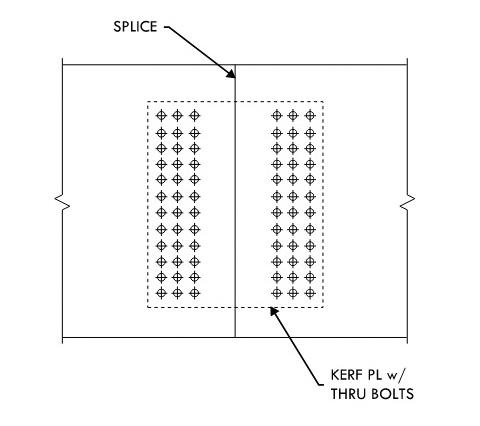
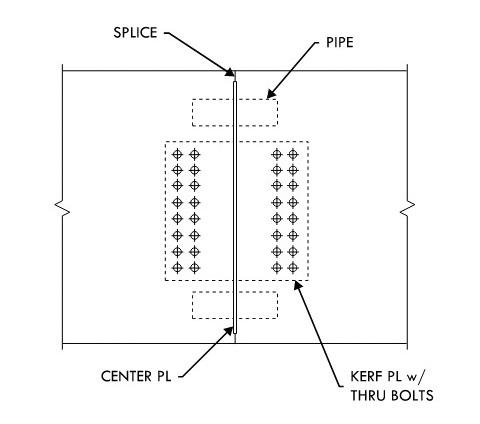
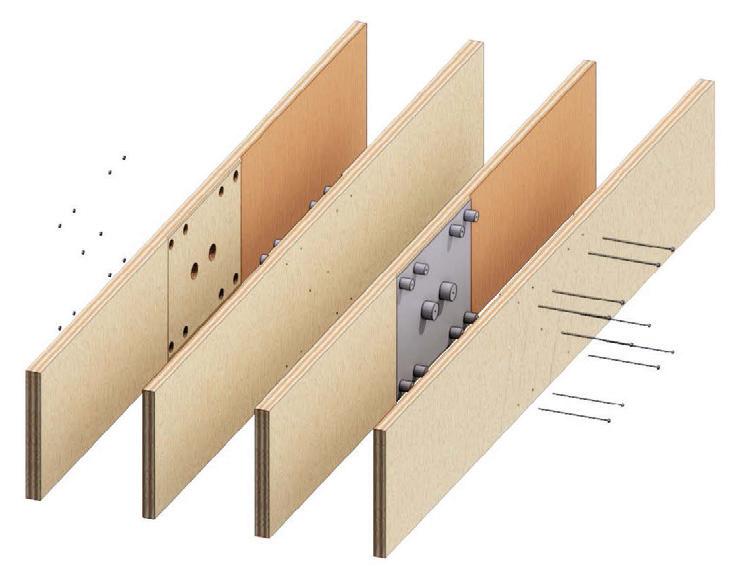
The custom split ring connectors consist of steel plates welded to sections of steel pipe, with bolts running through the center of each pipe. Unlike traditional split rings (2.5 inches or 4 inches per NDS Table K1), these were larger, custom-fabricated steel pipe connectors designed specifically for the project’s loading conditions.
While bolts run through the center of each connector, their primary function is to join the laminated beam layers and maintain continuity across the splice. Load transfer occurs primarily through bearing of the steel pipe connectors rather than bolt shear. No split rings were installed in end grain. The beams are very narrow and deep so trying to embed the pipe in the beam was not practical.
As the design progressed, the beams evolved into a 2-ply 9-3/16 inch x 45 inch MPL configuration. Each lamination was vertically cut, creating four layers at the splice. The pieces were assembled on the ground into their full 75-foot spans before being lifted into place by crane, minimizing work at height.
Because MPL is composed of laminated veneer layers, material properties vary by direction:
• Specific gravity parallel to grain: 0.42.
• Specific gravity perpendicular to grain: 0.63.
The connection was designed with this directional behavior in mind. Two larger central pipe connectors were designed to carry the primary vertical gravity loads and are loaded perpendicular to the wood grain. In addition, eight smaller connectors located near the top and bottom of the beam were designed to resist eccentricity forces and are loaded at an angle to the grain:
Connector detailing exceeded minimum NDS requirements:
• Pipe spacing: 12 inches on center.
• Minimum edge distance: 4.5 inches.
A geometry factor was required due to edge and end distance considerations. A group action factor was evaluated and calculated to be approximately 1.0.
The splice connection does not include lag screws. However, the mass plywood panels for the roof connect to the MPL beams using ASSY diaphragm screws.
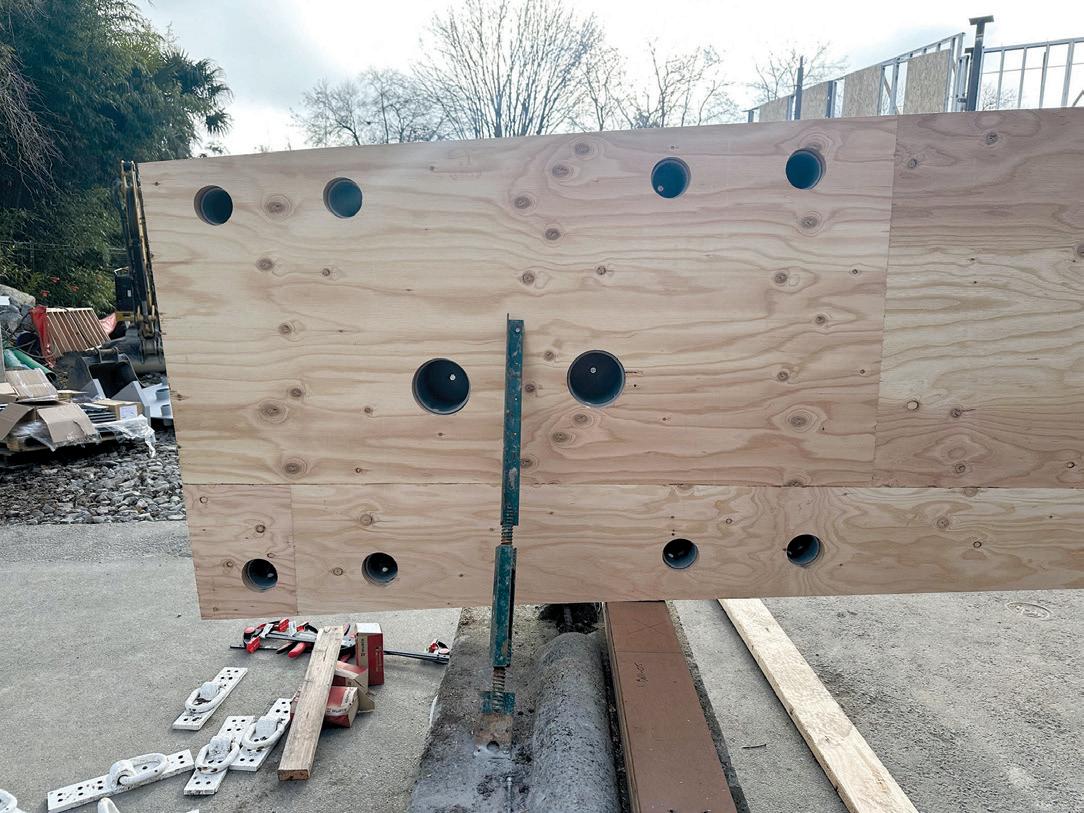
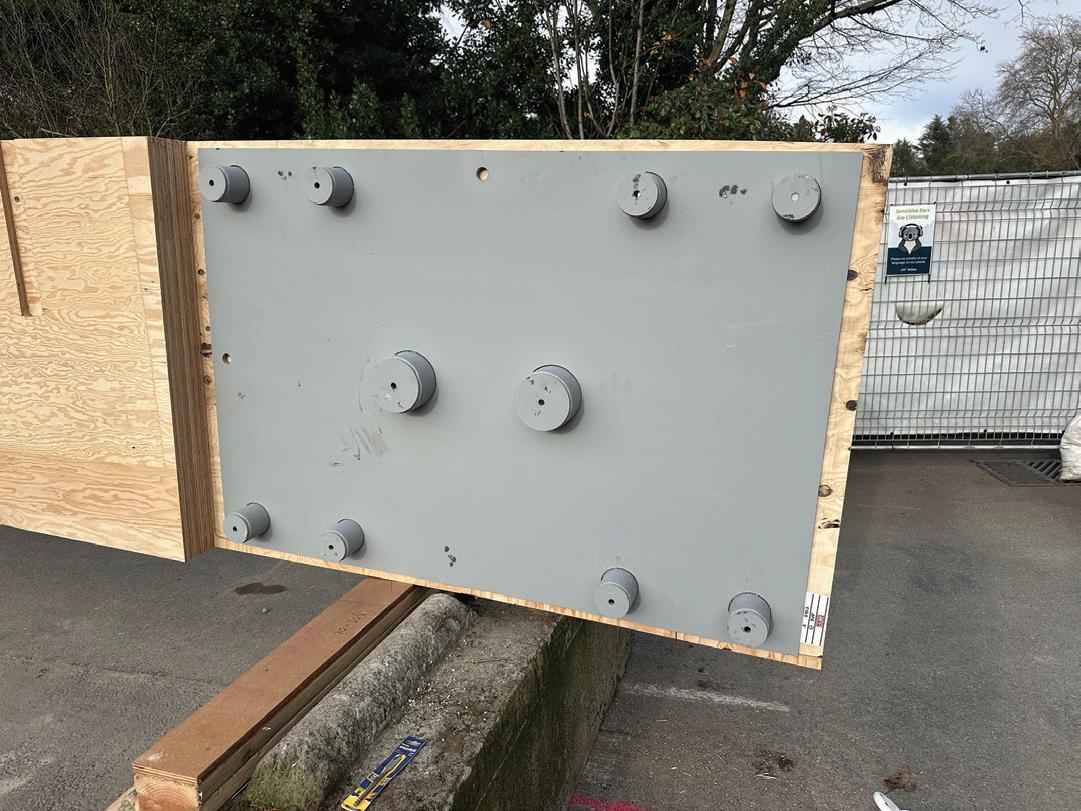
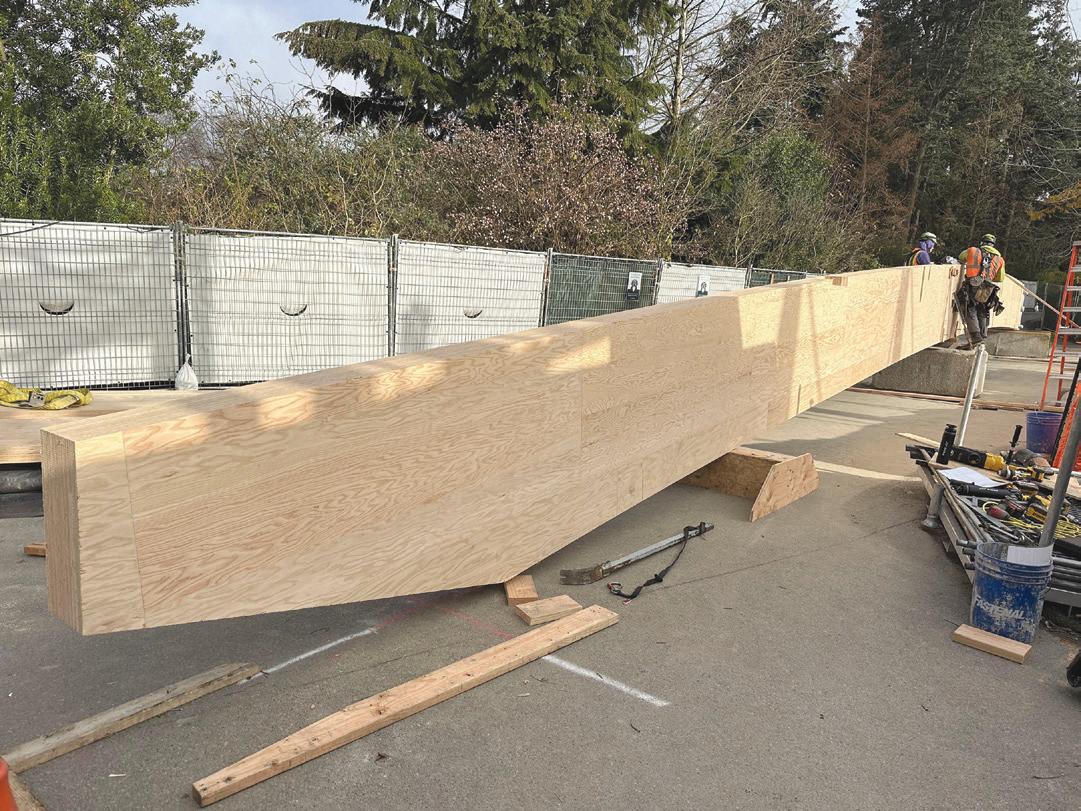
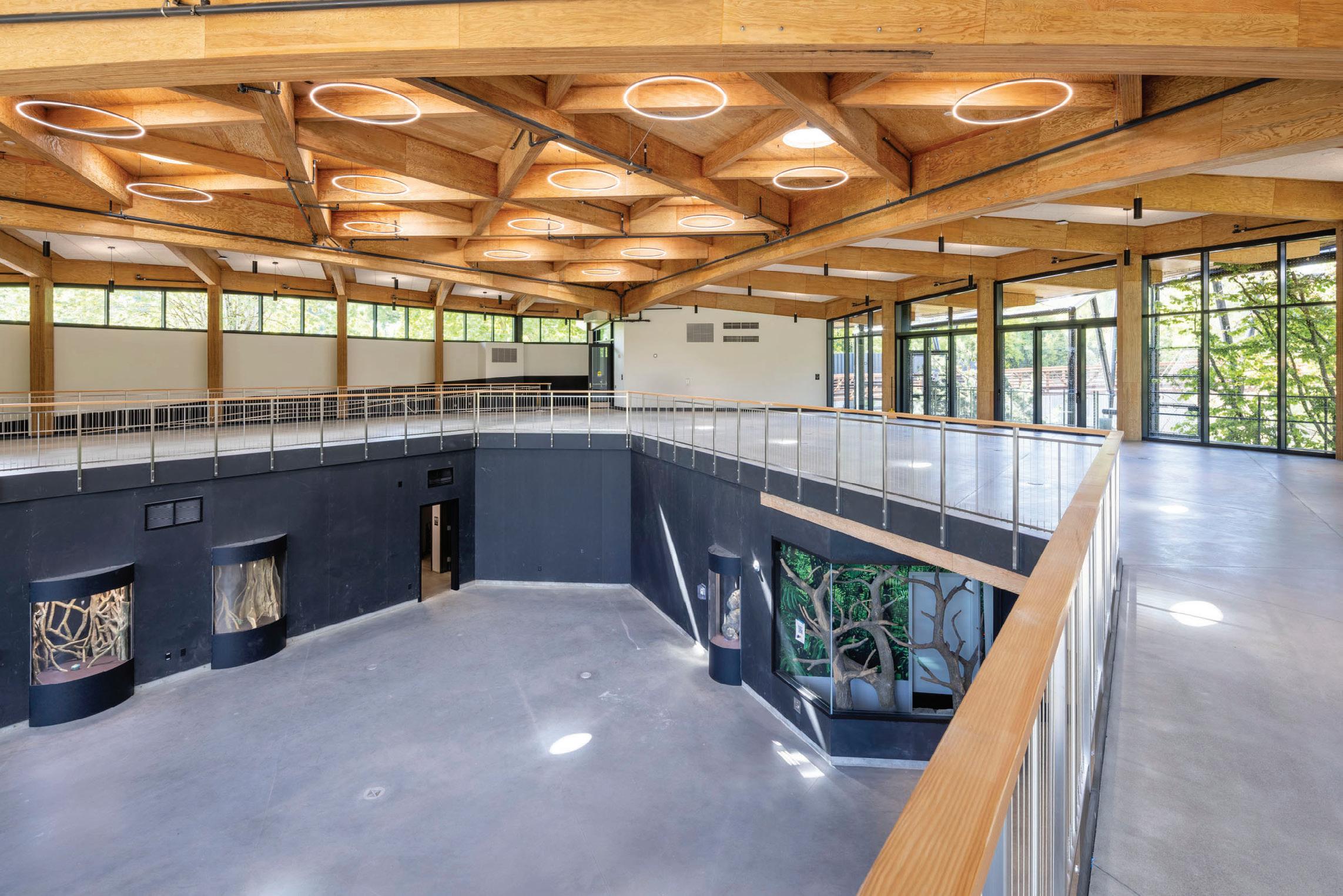
The final beam design was not a decision made in isolation. From early design conversations, Lund Opsahl worked alongside the architect, LMN, and contractor, Sellen Construction, to refine concepts, evaluate labor needs, and coordinate constructability. Ultimately, the team landed on beams assembled at grade and lifted as complete spans into place. The manufacturer of the beams also had some of the cuts made with a CNC machine before they came out on site. This efficient installation reduced time at height and minimized site disruption.
The splice was only one of many concealed details across the project. The Forest Trailhead framing incorporates:
• Manufactured concealed Knapp beam hangers.
• Concealed Simpson wood beam-to-column connectors.
• Custom MPL-to-wood and MPL-to-steel column connections.
• Welded steel plates with screws up to 19 inches long.
One notable detail occurs at the MPL column-to-Level 2 floor interface. A steel plate fastened to the underside of the column is welded to a smaller plate below, which connects to a baseplate anchored to the Level 2 mass plywood panel deck with screws. This connection is largely concealed by the concrete topping slab and required careful sequencing to execute properly in the field.
• Three 75-foot-long curved MPL beams, fabricated in sections.
• Custom steel pipe split ring splice connectors.
• Concealed plates with minimal exposed fasteners.
• Splice locations selected at low bending moment regions.
• Directionally engineered MPL connection design.
• Concealed mass timber framing throughout.
• Value-engineered mass plywood panel Level 2 floor system.
Originally, Level 2 was designed as precast hollow core slabs spanning between steel beams. Through collaboration between LMN, Sellen Construction and Lund Opsahl, the team pursued an alternative mass timber solution.
The final system utilized a mass plywood panel floor with a concrete topping slab supported by MPL beams, supplied by the same manufacturer as the roof framing.
The change:
• Reduced the number of trades onsite.
• Lowered overall structural weight.
• Improved sustainability.
• Simplified coordination.
• Provided greater long-term flexibility compared to hollow core construction.
Connections to mass plywood panels are significantly easier to modify in the future, increasing adaptability of the space over time.
The Forest Trailhead roof is more than a shelter; it is a gateway to exploration. The concealed splices allow the beams to sweep uninterrupted across space, their curves leading visitors’ eyes into the forest beyond. By concealing the complexity of the connection, the architecture can take center stage. The joint becomes a silent partner, unseen, but essential, supporting form, light, and material rather than competing with them.
For Woodland Park Zoo, this project demonstrates how technical problem-solving can elevate design intent. For Lund Opsahl, it reflects the craft that lives at the intersection of structural precision and architectural vision.
The Forest Trailhead stands as a testament to collaboration, innovation, and the quiet beauty of a well-executed detail, one designed to endure for decades to come. ■
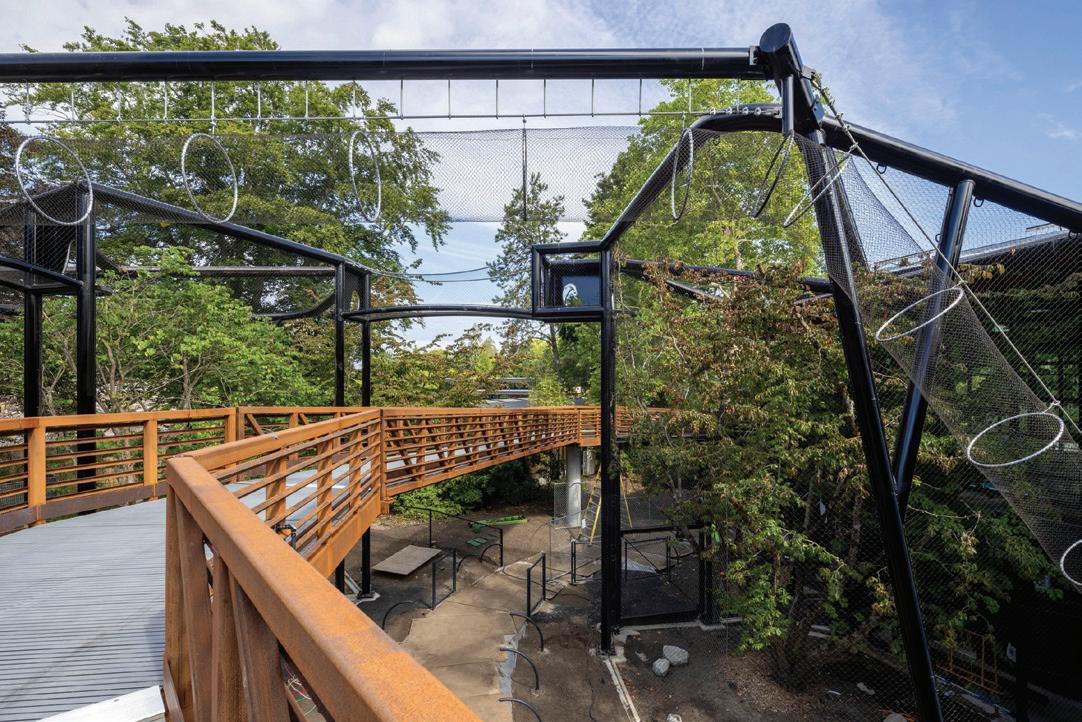
Shawn Roberge, PE, SE, DBIA, brings a collaborative, team-focused approach to every project and is a recognized expert in mass timber and sustainable design. As a Principal at Lund Opsahl, he also plays a key leadership role in company operations and human resources, helping guide the firm’s continued growth.
Keva Rollins, PE, earned her undergraduate degree from Cal Poly San Luis Obispo in 2017 before completing her Master’s in Structural Engineering in 2018. Prior to joining Lund Opsahl, she worked on multifamily residential, education, and parking garage projects and enjoys the challenge of developing efficient solutions to complex structural problems.
Kristen Gaer leads marketing and business development efforts at Lund Opsahl, combining clear storytelling with strategic outreach to help connect the firm’s technical expertise with new opportunities.
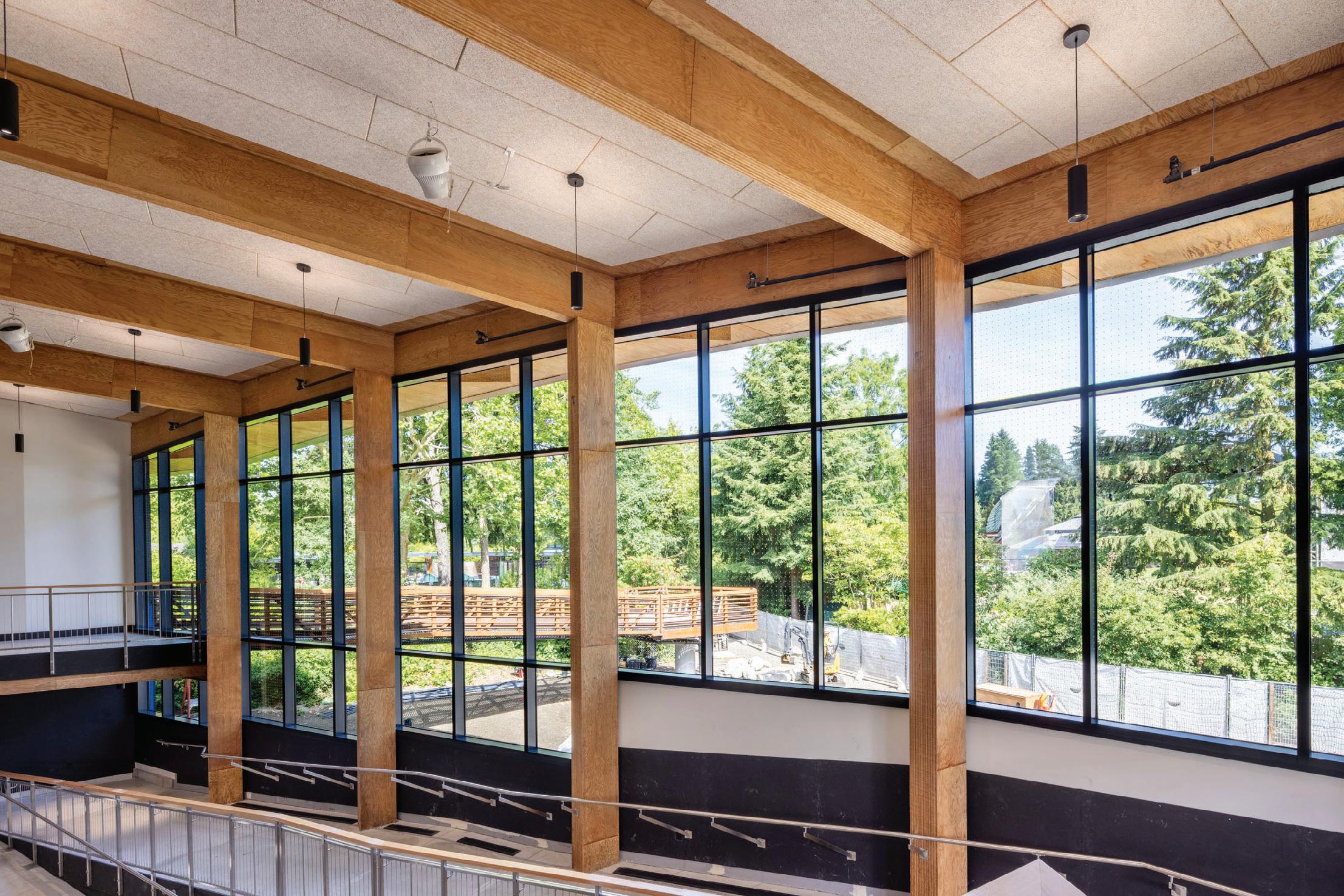
What documentation do you have? QA/QC is operational evidence you met the professional standard of care.
By Mark Blankenship
The email from the plaintiff’s attorney arrived on a Tuesday morning. Your firm was being sued for $3.2 million in cost overruns on a project you completed two years ago. The client claimed you failed to coordinate disciplines, missed critical design conflicts, and provided inadequate construction oversight.
Your first call was to your professional liability carrier. Their first question wasn’t about the technical merits of the claim. It was: “What documentation do you have?” The answer to that question would determine everything.
Here’s what most engineering firms misunderstand about quality assurance and quality control: QA/QC isn’t about catching typos on drawings. It’s not a checklist you complete before submitting it to the building department. And it’s certainly not something you can bolt onto a project when the schedule gets tight.
QA/QC is the operational evidence that you met the professional standard of care.
contracts (or at least try to). Then they assume the hard work is done. What they miss: the contract promises a standard of care, but QA/ QC is how you prove you delivered it.
Think about it this way. Your contract says you’ll provide services consistent with professional standards. That’s good language—it’s a negligence standard, not a warranty. But three years later, when you’re sitting in a deposition being asked why you didn’t catch a coordination conflict between mechanical and structural, your answer can’t be “we’re pretty good at what we do.”
You need contemporaneous documentation showing:
• What you were asked to design.
• What information you had available.
• What assumptions you documented.
• What reviews you conducted.
• What you communicated to the client.
The contract promises a standard of care, but QA/QC is how you prove you delivered it.
When a claim arrives (statistics suggest one in four firms will receive one this year) your technical competence won’t be judged by how brilliant your solution was. It will be judged by whether you can prove you followed a reasonable process to arrive at that solution. The elegance of your structural system means nothing if you can’t demonstrate that you considered alternatives, documented your assumptions, and communicated limitations to your client.
The firms that survive claims aren’t necessarily the ones that make fewer mistakes. They’re the ones that can prove they acted reasonably when mistakes happened.
A defensible risk management program rests on four cornerstones: identifying risks, allocating them by contract, implementing QA/QC procedures, and providing disciplined construction administration. Most firms do the first two reasonably well. They spot the geotechnical hazards, the aggressive schedule, the novel materials. They negotiate
• What happened during construction. QA/QC provides that documentation. Construction administration creates the record of how your design performed when it met reality. Together, they connect what you promised in the contract to what actually happened in the field.
Without them, you’re asking a jury to trust you about events from years ago. With them, you’re showing them exactly what you knew, when you knew it, and what you did about it.
The bases of design narrative may be the most undervalued document in engineering.
Here’s why it matters: Three years from now, when someone questions why you selected a particular foundation system, you won’t remember the site visit where the geotechnical engineer mentioned the bedrock conditions. You won’t remember the client meeting where they rejected the more expensive alternative. You won’t remember the building official’s interpretation that drove your design approach.
But if you documented it contemporaneously, you don’t need to remember.
The bases of design should capture:
• What data you had (and critically, what data you didn’t have).
• What codes and standards applied.
• What alternatives you considered.
• Why you selected the approach you chose.
• What assumptions required validation during construction.
This isn’t academic paperwork. When a dispute arises, the basis of design demonstrates that your decisions were reasoned, informed, and consistent with professional standards at the time they were made.
Notice that qualifier: at the time they were made.
You’re not judged by information that emerged later. You’re not held to standards that didn’t exist when you performed the work. But you need contemporary documentation to establish what you knew and when you knew it.
The firms that skip this step usually explain that they’re too busy, the schedule is too tight, or the client won’t pay for it. Then they spend $50,000 in legal fees reconstructing their decision-making process from memory and fragmentary email threads.
Let’s talk about a common scenario: Your design is technically correct. It satisfies code requirements. It meets the performance criteria. But it requires construction methods that add 30% to the project cost, and now you’re facing a claim for economic damages.
This is where constructability review saves you.
The purpose isn’t just making sure the building can be physically assembled. It’s ensuring that:
• The work can be done using standard methods and typical means.
• The documents support competitive bidding.
• The completed facility can be maintained efficiently.
Notice what this accomplishes from a risk standpoint: When you bring experienced construction personnel into the design process early and document their input, you create evidence that you considered how the design would be built.
If disputes arise about cost or schedule impacts, you’re not defending a design created in isolation from construction realities. You’re showing that you actively sought input from people who understand means and methods.
The most effective constructability reviews involve:
• Small, expert groups rather than large committee meetings.
• On-site sessions that reveal physical constraints.
• Focused agendas and checklists.
• Written documentation of recommendations and decisions.
This last point—written documentation—is critical. An informal hallway conversation with a contractor might improve your design, but it provides zero protection in litigation. A documented constructability session with meeting minutes creates a contemporaneous record of your process.
Change orders are inevitable on complex projects. But their causes are usually preventable, and many of those causes trace directly to QA/ QC failures.
The most common drivers include:
• Specification errors from cut-and-paste drafting.
• Conflicts between drawings and specifications.
• Coordination failures between disciplines.
When you bring experienced construction personnel into the design process early and document their input, you create evidence that you considered how the design would be built.
• Incomplete design information.
• Vague references (“see specs” without specificity).
Professional liability claims consistently cite these coordination and documentation gaps as leading contributors to disputes.
Here’s the pattern: During design, everyone is busy. Schedules are compressed. The team assumes coordination issues will get resolved somehow. Then bidding happens, contractors price the ambiguities conservatively, and the owner receives bids significantly over budget.
Now there’s a problem. And the owner’s attorney starts reviewing your contract to determine whether you met your standard of care. The defense against this scenario isn’t heroic last-minute coordination efforts. It’s systematic QA/QC throughout the design process:
Clear order of precedence language in specifications prevents disputes about which document controls when conflicts occur. Standard language typically runs: permits, special provisions, plans, standards, reference specifications.
Discipline coordination protocols ensure that structural, mechanical, electrical, and civil designs are reviewed together—not just within each discipline.
Specification review catches outdated requirements, conflicting provisions, and missing critical terms before bidding.
These aren’t optional refinements for projects with generous budgets. They’re essential practices for every project, because the alternative is becoming a defendant.
Here’s a statistic that should fundamentally change how you approach every project: Industry surveys consistently show that unmet client expectations—not technical errors—drive the majority of claims against design professionals.
Read that again. The problem usually isn’t that you made a calculation mistake. It’s that the client expected something you never promised to deliver.
This happens because engineers focus on technical scope while ignoring expectation management. The contract says you’re providing “structural design services.” You interpret that to mean calculations and drawings sufficient to obtain a building permit. The client interprets it to mean a building that costs exactly what they budgeted and has zero change orders during construction. When reality doesn’t match their expectations, they don’t blame their expectations. They blame you.
The solution requires deliberate communication and thorough documentation:
At project initiation:
• Elicit and document what the client expects.
• Flag anything unrealistic immediately.
• Clarify scope boundaries and limitations.
• Establish decision-making processes in writing. Throughout the project:
• Document key meetings and decisions.
• Issue meeting minutes promptly.
• Use templates for consistency.
• Include “aging statements” (corrections must be received within X days).
For any innovative or high-risk elements:
• Provide written advisories about limited experience.
• Explain what you’ve reviewed and what you can’t warrant.
Obtain client acknowledgment of risks and alternatives. This last point deserves emphasis because it’s where the doctrine of informed consent becomes your protection.
Let’s say your client wants to achieve LEED Platinum certification using a novel “green” building product you’ve never specified before. You research it, review the technical literature, and believe it will work if it performs as the manufacturer represents.
If you simply specify it without documentation, you’ve created a warranty claim waiting to happen. When the product underperforms two years later, the client could sue you for the costs of replacement and lost certification benefits.
But here’s the alternative approach:
You provide a written advisory stating:
• You have limited prior experience with this product.
• You’ve reviewed available technical information.
• You believe it will help achieve the sustainability goals if it performs as represented.
• You do not warrant its performance.
• Alternative products were discussed.
• The client accepts the risks associated with this selection.
When the client acknowledges this in writing, you’ve accomplished something critical: you’ve realigned responsibility toward the manufacturer and installer if the product fails, while keeping yourself within the professional standard of care rather than as a product guarantor. This is the difference between being sued for breach of warranty (which your professional liability policy excludes) versus being sued for negligence in product selection (which your policy covers—and which you can defend by showing your reasonable process).
Many firms view construction phase services as added liability exposure. They minimize site visits, process submittals quickly without thorough review, and treat RFI responses as distractions from more important work. This is exactly backwards.
Construction administration, when properly scoped and documented, reduces risk rather than increasing it. Claims retrospectives consistently show that disputes arise when:
• The engineer’s construction role is poorly defined.
• Site observations aren’t documented.
• RFI responses aren’t tracked.
• Nonconforming work isn’t recorded.
• Changes aren’t memorialized.
The solution isn’t avoiding construction services. It’s ensuring your contract clearly defines your role and then documenting everything. Your contract should state:
• You provide periodic observation, not continuous inspection.
• You’re not responsible for means, methods, or site safety.
• You review submittals for general conformance, not fabrication details.
• You respond to RFIs based on design intent. This language protects you from responsibility you can’t control. Then your documentation proves you fulfilled the responsibilities you did assume.
Critical documentation includes:
• Site visit reports with photographs.
• Submittal logs and review comments.
• RFI logs with questions and responses.
• Records of nonconforming work.
• Correspondence about changes and clarifications.
Here’s what many engineers miss: email is discoverable evidence with the same legal weight as formal letters. The casual comment you typed in thirty seconds while standing in line for coffee becomes Exhibit C in the plaintiff’s case.
Every email should stick to facts and professional judgments. Avoid:
• Speculation about who’s to blame.
• Editorial comments about other parties.
• Opinions outside your expertise.
• Anything you wouldn’t want read aloud in court.
The standard should be: if this email were projected on a screen in front of a jury, would it help or hurt my case?
Anyone can sue you. That’s the uncomfortable reality of professional practice. A client who’s disappointed, a contractor who lost money, an owner facing cost overruns—any of them can file a complaint alleging you were negligent.
But here’s what thorough QA/QC and disciplined documentation accomplish: they make it significantly harder for a claimant to prevail. When you can produce:
• Contemporary documentation of project objectives and constraints.
• Bases of design showing your decision-making process.
• Records of constructability reviews and coordination sessions.
• Evidence of client communications and informed consent.
• Construction phase records of observations and responses.
Professional liability claims consistently cite coordination and documentation gaps as leading contributors to disputes.
You’re not asking the trier of fact to trust your memory or accept your characterization of events. You’re showing them exactly what happened, when it happened, and how you responded.
This is why documentation is often called your most effective defense. Not because it prevents claims—nothing prevents claims—but because it transforms the litigation dynamic.
Instead of “he said, she said” arguments about what was discussed in meetings years ago, you’re presenting contemporaneous records created before anyone knew there would be a dispute. Those records don’t have a motive to lie. They weren’t created to support litigation. They’re simply the professional record of what occurred.
In a climate of compressed schedules, rising workloads, and increasing claim frequency, treating QA/QC and documentation as optional refinements is professional malpractice waiting to happen. The firms that thrive—the ones that take on challenging projects, maintain client relationships through difficult situations, and emerge from disputes with their reputations intact—are the ones that elevated QA/QC from afterthought to core business process.
This isn’t about bureaucracy or paperwork for its own sake. It’s about recognizing a fundamental truth: when contracts reflect realistic standards of care, when decisions and warnings are memorialized, and when construction services are clearly defined and consistently documented, you’re positioned to prove you acted reasonably. Even on projects where conditions change. Even when
Phone: 800-424-2252
Email: info@enercalc.com
Web: enercalc.com
Product: ENERCALC SEL
Description: Deadlines getting to you? Whether working with wood beams, trusses, columns, ledgers or shear walls, ENERCALC SEL saves hours of design time weekly. Built-in databases for sawn lumber and engineered wood products (VersaLam, Glu-Lam etc) put section properties and allowable stresses at your fingertips. Budgetfriendly all-inclusive subscriptions make it easy.
RISA Tech
Phone: 949-951-5815
Email: info@risa.com
Web: risa.com
Product: RISAFloor
Description: RISAFloor and RISA-3D form the premiere software package for wood design. Create 3D models of your entire structure and get complete design of wood walls, flexible wood diaphragms, dimensional lumber, glulams, parallams, LVL’s and joists. Custom databases for species, design of strap and hold-downs as well as panel nailing offer total flexibility.
budgets tighten. Even when design assumptions must evolve. Because the professional standard of care doesn’t require perfection. It requires that you act as a reasonable professional would under the same circumstances.
QA/QC and documentation are how you prove you met that standard. The question isn’t whether you can afford the time and effort to implement rigorous QA/QC procedures.
The question is whether you can afford not to. ■
The information contained herein is not intended to constitute legal or other professional advice and should not be relied upon in lieu of consultation with your own legal advisors. In the event you would like more information regarding your insurance coverage, please do not hesitate to reach out to us. In North America, WTW offers insurance products through licensed entities, including Willis Towers Watson Northeast, Inc. (in the United States) and Willis Canada Inc. (in Canada).
Mark Blankenship is Director of Risk Management for WTW A&E. WTW A&E is the Center of Excellence for WTW that is exclusively dedicated to providing insurance and risk management solutions to architects and engineers in North America. More information on WTW A&E can be found at www.wtwae.com.
ASDIP Structural Software
Phone: 407-284-9202
Email: support@asdipsoft.com
Web: www.asdipsoft.com
Product: ASDIP Wood
Description: Advanced software for the design of wood members, such as biaxial columns, continuous beams, wood shear walls, out-ofplane bearing walls and wood diaphragms. Design your wood members in minutes with ASDIP Wood.
Not listed?
Monthly 2026 Resource Guide forms are available on our website. www.structuremag.org
Find more resource listings in the 2025-2026 Structural Engineering Resource Guide on our website, www.structuremag.org

The latest NCSEA Compensation & Benefits Report is live, offering a full year of access to critical insights on salaries, bonuses, and benefit trends across the structural engineering profession. Purchase the report now and be in the know.
A few key insights include:
+4.4% 78% 15%
Average year-overyear salary growth Firms offering flexible work scheduless Firms providing childcare subsidies
TURN DATA INTO DECISIONS:
Benchmark salaries across roles, experience levels, and firm types. Explore trends in benefits and total compensation. Evaluate how your firm — or your own compensation — compares. Know your number. Know your market.
Scan the QR code to purchase the report.
The next meaningful advancements in structural analysis will come not from new solvers, but from cloudnative, integrated workflow architectures that embed automation, traceability, and collaboration as first-class capabilities.
By Rakesh Pathak, Ph.D, PE
Cloud and browser-based structural modeling and analysis tools are emerging components of modern engineering workflows. They offer practical advantages, including reduced dependence on local hardware, improved accessibility across teams, and expanded potential for automation, scripting, and parametric studies. But current offerings have some limitations, as well, such as fragmented workflows, limited version control, data ownership concerns, and challenges integrating analysis with design, BIM, and reporting processes.
The author conducted a limited 2025–2026 survey of practicing engineers across structural and related disciplines in his professional network. While structural analysis software itself has advanced significantly with reliable solvers and mature modeling capabilities now widely available, the survey indicates that the primary challenges lie in the workflows surrounding them. Cost emerged as the most frequently cited concern, followed by limited automation support, data transfer between the tools, and collaboration across disciplines. While cost is the most immediate and visible concern, many of these issues reflect deeper challenges in how engineering tools are structured and connected. These observations suggest that both economic and workflow considerations are likely to play a role in shaping the next generation of tools rather than limitations in analytical capability itself.
The survey of 24 practicing engineers suggests that while desktop analysis tools remain dominant, persistent workflow challenges continue to shape everyday practice (Fig. 1). Although the survey is not statistically representative, the consistency of responses highlights recurring fundamental issues in how modeling and analysis tools are used and integrated.
Nearly all respondents rely on locally installed analysis software (Fig. 2). Cost emerged as the dominant concern, while infrastructure constraints, limited scalability, fragmented data across tools, manual BIM-to-analysis transfers, limited automation support, and difficulties collaboration across distributed teams also emerged as recurring concerns, reinforcing the role of tooling architecture—rather solver accuracy or capability—as a source of friction (Figs. 3-4).
The prevailing modeling and analysis process is still largely built around disconnected, file-based systems rather than integrated
data-driven workflow environment. Engineers typically create a model file, run analysis, export results, and then transfer data into downstream design, drafting, or reporting tools. Survey responses confirm how often this movement occurs—most respondents transfer data between systems weekly or daily (Fig. 5). While not universally severe, the majority describe the process as at least somewhat painful, with a smaller but notable fraction reporting it as very painful (Fig. 6).
This fragmentation has influenced how engineers adapt their workflows, particularly within the group represented in this survey. Many respondents report compensating by relying on spreadsheets, custom scripts, and manual coordination to bridge gaps between otherwise isolated tools. These work-arounds reflect considerable ingenuity, but they also introduce additional handoffs, duplicated logic, and opportunities for error.
One of the strongest signals from the survey is the prevalence of scripting and custom automation. A significant portion of respondents reported frequent use of scripting for model generation, parametric studies, batch analysis, and post-processing, often relying on Python and custom automation to bridge gaps between tools (Figs. 7-9). This pattern suggests engineers are not waiting for automation features to be delivered by vendors; they are building automation themselves. However, today’s automation typically operates around analysis software rather than within a cohesive system. Scripts extract data from files, manipulate it externally, and re-import results—a workflow that works, but increases complexity and fragility as projects scale. Collaboration patterns further reinforce this picture. Hybrid and distributed teams are now common, yet collaboration during modeling and analysis often relies on screen sharing, shared drives, and email-based file exchange (Fig. 10).
Respondents frequently cited data ownership, security, cost, performance, reliability, and model migration effort as barriers to adoption of cloud-based tools (Figs. 11-12). The survey responses suggest that hesitation toward cloud-based tools is not driven by technical
limitations alone, but by concerns around data control, long term accessibility, and subscription-based pricing models—indicating that adoption is closely tied to trust in data ownership and governance than resistance to cloud technology itself. These concerns reflect practical requirements for engineering practice, where models must remain accessible, auditable, and under clear ownership over the full lifecycle of a project.
The survey does not indicate widespread adoption of browser-based structural analysis tools. Desktop systems remain the norm. However, the underlying workflow signals are clear: frequent data transfers, heavy reliance on scripting, fragmented toolchains, distributed collaboration, and early experimentation with AI. These are not symptoms of inadequate solvers or where the analysis is performed. They point instead to architectural limitations in how data is structured, and managed across modeling, analysis, and downstream processes which are often through file-based handoffs and loosely connected systems.
Survey responses indicate cautious but growing use of generative AI tools within engineering workflows. Many respondents report using LLMs to assist with scripting, debugging, and early-stage exploration
The next evolution in structural engineering software may be defined less by advances in solvers and more by integration. Modeling, analysis, design checks, and reporting increasingly need to function as connected services rather than isolated applications.
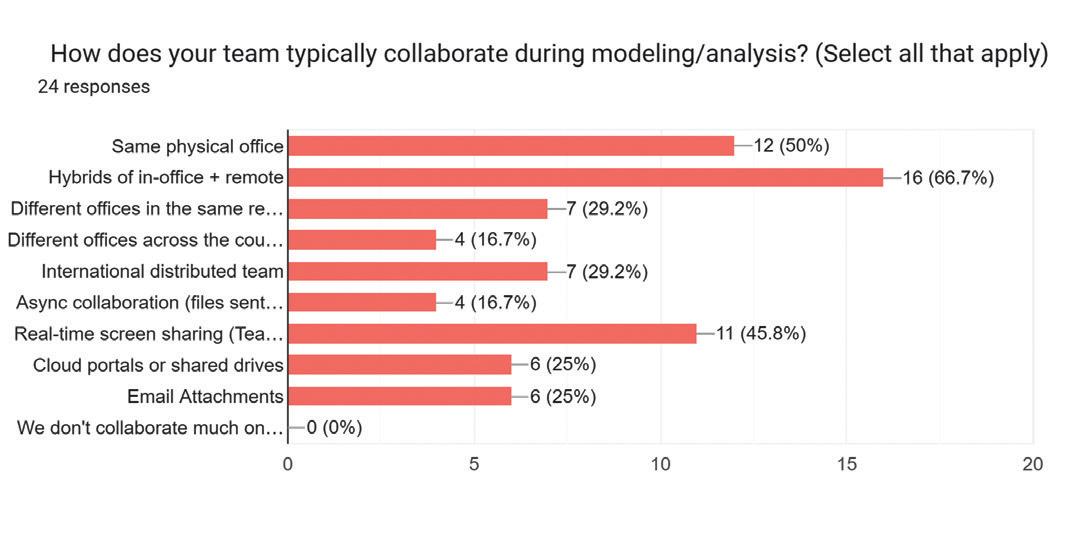
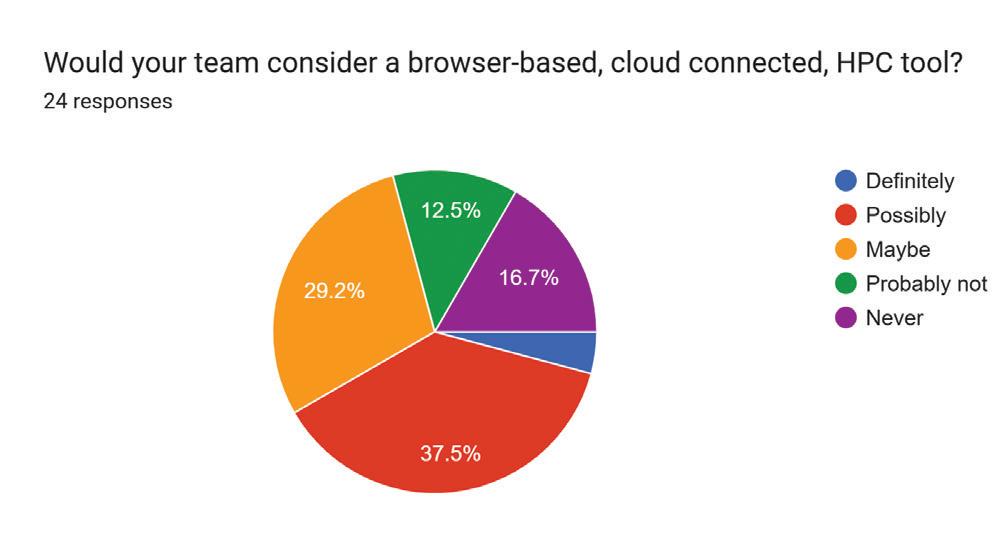
of design alternatives (Fig. 13-14). At the same time, skepticism remains strong, particularly regarding black-box behavior, lack of domain-specific training data, and the risk of treating analysis components as opaque systems.
In practice, AI is used primarily as a productivity aid rather than as a decision-making engine. Interest in fully autonomous modeling or analysis is limited, with respondents emphasizing the importance of traceability, and verifiability. These patterns suggest that meaningful adoption of AI in structural engineering will depend less on conversational capability and more on infrastructure that supports deterministic behavior, clear data provenance, and integration into validated workflows.
Structural engineering software has reached a high level of maturity. The next evolution in structural engineering software may therefore be defined less by advances in solvers and more by integration. Modeling, analysis, design checks, and reporting increasingly need to function as connected services rather than isolated applications. Cloud-native systems can make this technically feasible by keeping models in a central location, enabling built-in automation, maintaining version history, and elastic compute scaling for complex studies. These capabilities directly address several of the workflow challenges identified in the survey, including frequent data transfer, reliance on external scripting, and limited collaboration across distributed teams. The challenge is not technical feasibility but implementing these capabilities while preserving professional requirements such as transparency of analysis, reproducibility of results, clear data ownership, and appropriate governance of engineering data.
A cloud-native approach also introduces the possibility of analysis functioning as a service rather than as a file-bound executable. Models, solvers, and design checks could operate as modular components within a connected ecosystem, orchestrated by structured workflows rather than ad hoc file transfers. While similar architectures can exist on local or internal networks, cloud-based systems can make them easier to implement at scale, particularly for distributed teams.
For distributed teams, centralized model states could support version tracking, structured change histories, role-based access control, and automated model comparison. These capabilities strengthen accountability by making assumptions, revisions, and validation explicit. In a profession grounded in life-safety responsibility, traceability is not a convenience, it is a safeguard.
AI-assisted workflows further reinforce the need for sound infrastructure. Effective and responsible use of AI depends on structured data, reproducible environments, and consistent model states. Fragmented, file-based workflows make systematic validation difficult and obscure provenance. By contrast, platforms that centralize model data and maintain revision histories provide a stronger foundation for transparent automation. If AI is to mature responsibly in structural engineering, it must be built on systems designed for auditability rather than opacity.
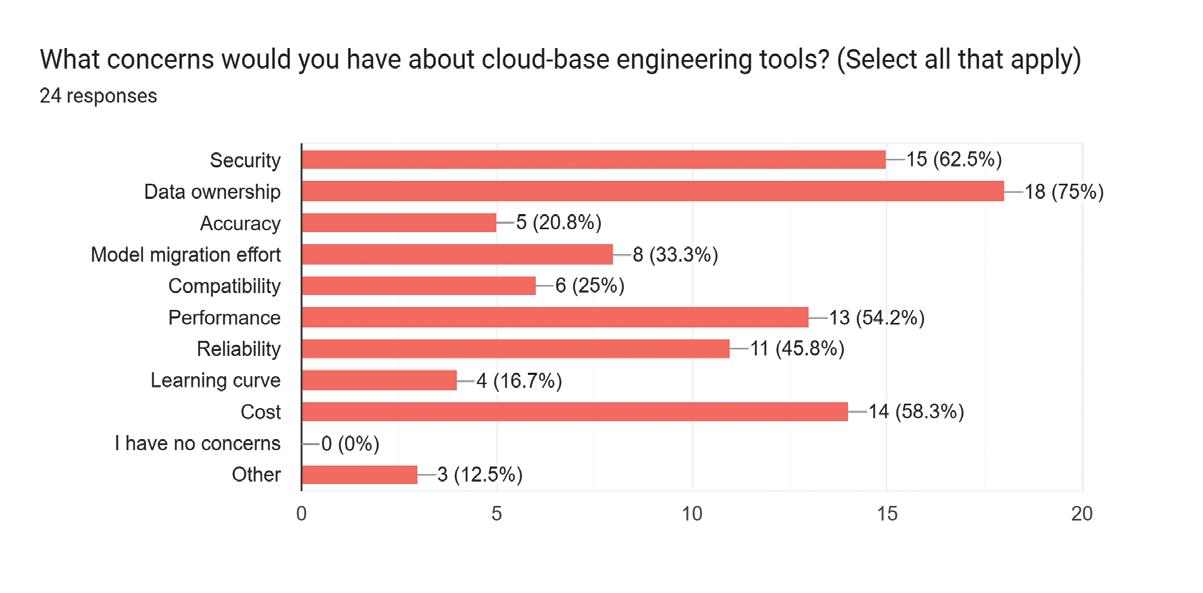
At the same time, cloud adoption cannot be driven by novelty alone. Any new platform must meet or exceed the standards of traditional desktop systems in accuracy, determinism, reliability, and governance. Historically, major shifts in engineering practice have occurred when infrastructure lagged behind how engineers work. The transition from hand calculations to finite element analysis was gradual and heavily validated. A similar trajectory is likely for the transition from file-centric analysis to cloud-connected ecosystems.
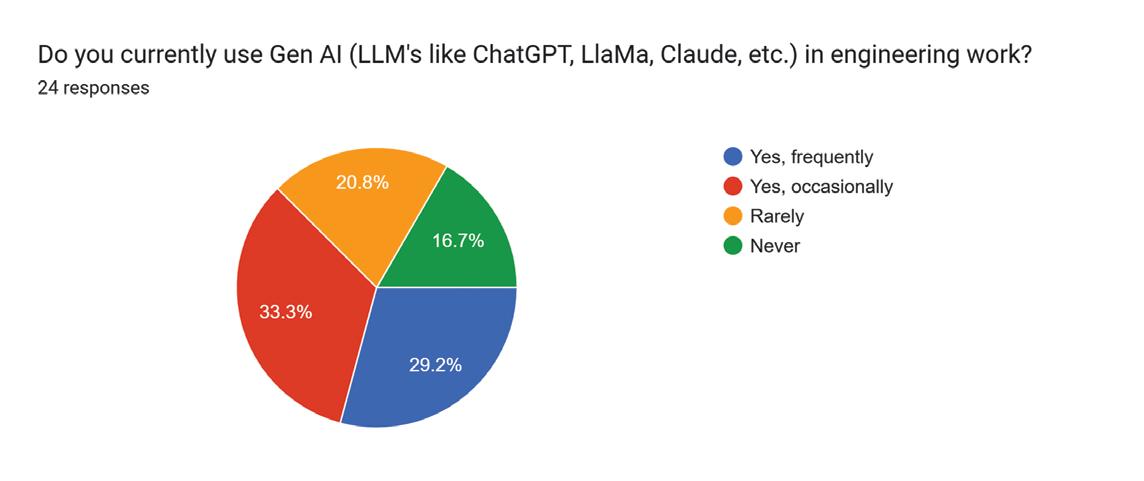
The most promising path forward is neither blind enthusiasm nor rigid resistance. It is measured experimentation: pilot projects, parallel validation against established tools, transparent solver benchmarking, and clear documentation of assumptions and limitations. Innovation in structural engineering has always required both ambition and caution, and that balance remains essential.
Responses from this limited sample provide examples of how some engineers are adapting through scripting, custom workflows, and incremental integration. Cloud-native infrastructure may represent a logical next step, not because it is fashionable, but because it aligns with pressures engineers are already navigating. The analytical foundations are already strong; the opportunity now lies in connecting them more intelligently. The survey does not suggest that cloud-based tools are a complete solution, but it does highlight those current challenges—both economic and workflow-related—that are closely tied to how engineering data is managed, shared, and controlled.
A broader shift is occurring within the building design technology landscape, with platforms increasingly structured around centralized data models, multi-user real time collaboration and service-oriented architectures rather than file based workflows. As these systems mature, an important question arises: how does structural analysis integrate into this new ecosystem?
Historically, BIM and structural analysis have been loosely coupled. Models are exported. Geometry is simplified. Analytical models are recreated. Results are manually reconciled. The process works—but
it is inherently transactional and is driven by file-based handoffs. If building models become centrally managed, and continuously versioned, structural analysis may increasingly be expected to operate as a connected service rather than a separate application requiring repeated model reconstruction. Cloud-based platforms can facilitate this by supporting centralized data access, coordinated updates, and real-time collaboration, although the underlying benefit stems from the data architecture rather than the hosting environment alone.
In such an environment, analytical models could be derived dynamically from centralized building data; structural checks could run automatically as geometry evolves; design iterations could trigger validation workflows in real time; and assumptions could be logged and tracked alongside design changes, improving traceability and coordination. In this context, a cloud-based solver enables structural engineering to remain deeply integrated in next-generation modeling platforms—rather than positioned downstream of them.
The evolution of building modeling may ultimately influence how analysis tools are architected. The opportunity is not to dissolve structural engineering into BIM platforms, but to ensure that structural rigor remains central as digital workflows advance.
The opportunity is not to dissolve structural engineering into BIM platforms, but to ensure that structural rigor remains central as digital workflows advance.
For practicing structural engineers, these developments point toward a gradual but meaningful shift in how analytical work is organized and supported, rather than a wholesale change in tools or methods. Increasing use of automation, cloud-connected workflows, and AI-assisted capabilities is likely to place greater emphasis on data structure, model traceability, and integration across modeling, analysis, and documentation. In this context, AI is best understood as an augmentation layer— supporting validation, error detection, and iteration—while core engineering judgment and responsibility remain unchanged. Early engagement through pilot projects and parallel validation can allow firms to explore these capabilities without disrupting established practice. Ultimately, the opportunity for practitioners lies not in adopting new technology for its own sake, but in shaping emerging infrastructure so that it reinforces rigor, transparency, and accountability as engineering workflows evolve.■
Rakesh Pathak, Ph.D, PE, is a Senior Software Engineer at Higharc, an AI-native platform powering the full design-to-construction lifecycle of homebuilding.
The Mid-Atlantic Association of Museums (MAAM) awarded two Building Museums Symposium Buildy Awards this March to the Folger Shakespeare Library (Washington, D.C.) and the Jackson Hole History Museum (Jackson, Wyoming). These projects were selected from a competitive national pool and represent a wide range of museum types, scales, and approaches, reflecting excellence in museum planning, design, and inno vation. The Buildy Award is MAAM’s highest recognition for completed museum building projects, honoring institutions that demonstrate exemplary leadership in planning, design, and con struction—and achieve transformational organizational impact after project completion.
The Folger Shakespeare Library was selected for its exemplary integration of historic preservation, architectural innovation, and public access. The renovation repositions a world-class research library as an open, welcoming cultural destination, introducing a new public “front door,” dramatically improved accessibility, expanded exhibition and public spaces, and advanced preserva tion infrastructure.
The Folger Shakespeare Library project team included KieranTimberlake (architect), OLIN Studio (landscape archi tect), Studio Joseph (exhibit design), Pentagram (graphic design and wayfinding), MTFA (historic preservation), Silman (now TYLin) (structural engineering), Altieri (MEP/FP), Tillotson Design Associates (lighting design), Gilbane Building Company (construction manager), and Becker & Frondorf (owner’s representative).
According to TYLin, the structural engineering firm designed
Use the performance-based principles outlined in this standard to evaluate and retrofit buildings to withstand earthquakes.
Formats: Digital subscription on AMPLIFY, Print, e-Book
Join us for this Webinar series in May!
ASCE/SEI 41-23 Series
• May 12: Seismic Hazard and Analysis Provisions
• May 13: ASCE/SEI 41-23 Tier 1 and 2 Updates
• May 14: Concrete Walls
• May 19: Reinforced and Unreinforced Masonry
• May 20: Foundations
a post-tensioned slab system for the roof of the structure; this extra-strong concrete construction precludes the need for support columns, allowing for an open, flexible interior below. TYLin also developed a transfer girder that supports both the existing wall above the removed foundation and the new gallery roof structure.


The Jackson Hole History Museum earned a Buildy Award for its community-driven approach to museum expansion and interpretation. Emerging from a grassroots effort to “Save the Block” for public use, the project reimagines the museum as a civic and cultural hub that centers local history, Indigenous partnerships, and shared public space. The new campus integrates preserved historic cabins, contemporary galleries, outdoor gathering areas, and a highly visible mural by an Indigenous artist.
The Jackson Hole History Museum project team included HGA (lead architect), Prospect Studio (local architect), Gallagher & Associates (exhibit design), ACM (contractor), Berning Project Management (owner’s representative) and extensive collaboration with the Eastern Shoshone and Shoshone-Bannock Tribes. ■
Pennoni, an employee-owned multidisciplinary engineering firm headquartered in Philadelphia, announced a planned leadership transition as David Pennoni, PE, chief operating officer, moves into a new role as senior vice president. Succeeding him as COO will be Brian Diehl, PE, who is currently regional vice president for Pennoni’s Southeast region.
Throughout his career, David Pennoni has played a pivotal role in strengthening Pennoni’s operational framework, expanding into new markets and reinforcing the firm’s commitment to technical excellence and client service.
Brian Diehl brings extensive leadership and technical experience to the COO role. As regional vice president for the Southeast, he has overseen strategic growth initiatives and multidisciplinary operations while expanding Pennoni’s presence throughout Florida and the broader Southeast.
This leadership transition reflects Pennoni’s long-term strategic planning and commitment to sustained growth, operational excellence, and innovation across our footprint.
McMahon, a full-service, professional engineering, architectural and consulting firm, announced the hiring of Rhonda DeLeeuw, Brianna Marit and Kelly Valentino in its Neenah, Wisconsin headquarters.
DeLeeuw joins the McMahon team as an administrative assistant in the plan room. With a degree in interior design from Fox Valley Technical College, she brings experience from a variety of industries and a strong focus on delivering exceptional customer service.
Marit, as marketing lead, will oversee all marketing efforts at McMahon. A graduate of Lakeshore Technical College with a degree in business administration with an emphasis in marketing, Marit brings more than 13 years of experience in the green energy manufacturing sector where she held roles in business development, new product development and marketing.
Valentino joins McMahon as a public management specialist. An experienced municipal park and recreation professional with more than 30 years of expertise, she held the Certified Park and Recreation Professional Certification throughout her career. She is currently serving as the president of the Wisconsin Park and Recreation Association Foundation board of directors. Valentino holds a degree in recreation administration from the University of Wisconsin – La Crosse.
Global consulting firm DeSimone Consulting Engineering has merged with Constructive Engineering Design (CED), a Kansasbased firm providing expert services in steel procurement, structural engineering, structural connection design, and detailing. The merger includes CED’s Steel Frame Alliance division, which offers design-supply steel fabrication services tailored to steel and concrete structures.
The American Institute of Steel Construction is recognizing 20 long-standing volunteers for their service with the new AISC Fellows program, which celebrates those who have made enduring contributions—hundreds of hours over many years—to the steel design industry and to AISC as committee members.
The first class of AISC Fellows includes the following individuals:
• William F. Baker, SE, PE - Consultant Partner, Skidmore, Owings & Merrill LLP
• John M. Barsom, PhD - President, Barsom Consulting Ltd.
• Roger L. Brockenbrough, PE - President, R. L. Brockenbrough & Associates, Inc
• Michael D. Engelhardt, PE, PhD - Professor of Civil Engineering, University of Texas at Austin
• Marshall T. Ferrell - President/CEO, Ferrell Engineering, Inc.
• James M. Fisher, PE, PhD - Emeritus Vice President, CSD Structural Engineers
• John W. Fisher, PhD - Professor Emeritus, Lehigh University
• Karl Frank, PE, PhD - Professor Emeritus, University of Texas at Austin
• Theodore V. Galambos, PhD - Emeritus Professor of Structural Engineering, University of Minnesota Twin Cities
• Louis F. Geschwindner, PE, PhD - Dept. of Architectural Engineering, Pennsylvania State University
• Lawrence G. Griffis, PE - Senior Consultant, Walter P Moore
• Mike Grubb, PE - Executive Director, M.A. Grubb & Assoc., LLC
• Lawrence A. Kloiber, PE - Consultant, LeJeune Steel
• John Kulicki, PE, PhD - Chairman Emeritus and Senior Technical Advisor, Modjeski and Masters, Inc.
• R Shankar Nair, SE, PE, PhD - Senior Vice President, EXP US Services Inc.
• Robert E. Shaw, Jr., PE - President, Steel Structures Technology Center, Inc.
• William A. Thornton, PE, PhD - Corporate Consultant, Cives Engineering Corporation
• Gary Violette, PE - Consultant
• Ed Wasserman, PE - Senior Technical Advisor, National Bridge Practice, Modjeski & Masters
• Michael A. West, PE, RA - President, Michael A West Engineering
Many individuals in the inaugural class of Fellows are Emeritus Committee Members, having transitioned from voting members to advisory ones. Volunteers who become AISC Fellows enjoy the significant benefit of lifetime individual membership.
The Board of Directors of AISC selected these individuals as Fellows for their impact on the industry, their recognition within their field and by peers, and their history of leadership and special accomplishments.
AISC will honor the inaugural class of Fellows at the 2026 NASCC: The Steel Conference.
Nominations for the 2027 class of AISC Fellows will open in June. ■

Online Program: Managing Small Projects Successfully June 9 & 11, 2026
Live Online | 8 PDHs
ACEC will offer Managing Small Projects Successfully: How to Prevent Small Projects from Becoming Big Problems as a live online program in June 2026.
The course is designed for project managers and firm principals and focuses on management and risk considerations specific to smaller projects. While small projects often represent a significant portion of firm revenue, they can present disproportionate risk and administrative challenges if not managed carefully.
Risk in Design-Build and Collaborative Delivery
June 3, 2026 | 1:00-2:30 p.m. ET
Online Education | 1.5 PDHs Available

CASE will present a 75-minute online program examining risk considerations in the design-build delivery model, which continues to influence project relationships, responsibilities, and risk allocation in engineering services.
The session will address key risk factors in design-build environments, including common breakdowns in coordination, characteristics of successful projects, and considerations for evaluating project opportunities.
Additional topics covered will include how responsibility and risk shift under design-build delivery, strategies for improving coordination among project stakeholders, and approaches to contract development that support balanced risk allocation. The program will provide practical guidance to help firms assess project fit, strengthen decision-making processes, and reduce exposure throughout the project lifecycle.
The program is structured as four two-hour sessions delivered over two days, for a total of eight hours of instruction. Topics include:
• Planning and budgeting for small projects
• Contract considerations and risk control
• Scope management and schedule tracking
• Managing multiple concurrent small projects
• Project performance evaluation and financial tracking
Up to 8 PDHs are available.
The program is delivered in partnership with PSMJ Resources and is open to ACEC members and nonmembers.
Registration and additional details are available through ACEC’s online education page, www.acec.org/education-events/education. ■
The program will be led by Jerry Cavaluzzi of Kennedy/Jenks Consultants, Inc., who oversees enterprise risk management and advises on procurement and contract strategy for complex infrastructure programs. He will be joined by Karen Erger of Lockton, who will provide insight into how client selection, contracts, and delivery structures impact firm exposure. Additional perspectives will be provided by P.J. Bourdaniotis, a structural engineer specializing in collaborative delivery of water infrastructure projects, and Brad Florentin, Director of Collaborative Delivery at Kennedy Jenks.
The session is intended for structural engineering firm principals, project managers, risk and operations leaders, and firms pursuing or engaged in design-build projects.
Registration and additional details are available through ACEC’s online education page. ■
The CASE Toolkit Committee has released two new resources for structural engineering firms. The publications expand the CASE library of practice and business management tools available through the ACEC bookstore.
ACEC recently launched a new online storefront and education platform designed to improve access to the organization’s training, events, and professional development resources. The updated system introduces a redesigned interface and enhanced functionality intended to streamline how users browse, register for, and access educational content.

The platform includes a mobile-responsive design and simplified navigation, allowing users to access courses and materials
across devices. It also features a more efficient registration and checkout process, expanded browsing across different learning formats, and integrated tools such as calendar functionality for upcoming live sessions.
Users can access previously purchased or enrolled content through their ACEC account, where education materials are organized in a centralized location. The platform also supports firm-wide participation by enabling easier enrollment for multiple users within an organization.
The launch represents an update to ACEC’s delivery of education and training resources, with additional enhancements expected as the platform continues to evolve. ■
Growth in the architecture and engineering (A/E) industry slowed in late 2025, reflecting broader economic conditions. According to U.S. Census Bureau data from the fourth quarter Quarterly Services Survey, industry revenue remained essentially flat year-over-year at approximately $124.4 billion, with quarterly growth of 0.2 percent. Total annual revenue reached $495 billion, representing a 4.0 percent increase over 2024.
The slowdown aligns with wider economic trends, including reduced U.S. GDP growth and a decline in overall construction spending. GDP growth for the fourth quarter was revised to 0.7 percent, while
total construction spending decreased by 1.4 percent over the year, indicating softer demand across multiple sectors.
Despite slower revenue growth, A/E industry employment continued to expand. Employment reached approximately 1.75 million in early 2026, a 2.0 percent increase year-over-year, outpacing overall nonfarm employment growth.
These indicators suggest that while growth has moderated, the A/E industry continues to show stability relative to broader economic conditions.
Arecent ACEC analysis outlines five key trends shaping the health care and science and technology market, highlighting changes in both care delivery and the facilities that support it. The sector, valued at approximately $70 billion, continues to evolve as new technologies and economic pressures influence investment and development patterns.
The report identifies increased investment in artificial intelligence as a major driver of change, with growing adoption across life sciences and health systems. It also notes ongoing financial challenges facing rural hospitals, contributing to elevated closure risk and prompting federal investment in health care infrastructure.
Additional trends include a market correction in life science laboratory space following rapid pandemic-era expansion, supply chain pressures linked to tariff uncertainty, and continued demand for medical office buildings driven by outpatient care trends and an aging population. Together, these factors reflect shifting conditions across the health care market, with implications for facility design, infrastructure investment, and long-term planning. ■

The release of the White House’s proposed FY2027 budget marks the start of the federal appropriations process and outlines the administration’s priorities for infrastructure, energy, and related programs. While the proposal is not expected to pass as written, it provides an early indication of policy direction and funding emphasis.
The proposal calls for a significant increase in defense spending alongside reductions to non-defense accounts. For engineering firms, the budget highlights increased investment in defense-related construction, including funding for maritime infrastructure, port improvements, and expanded work for the Naval Facilities Engineering Systems Command (NAVFAC), which oversees projects such as piers, maintenance facilities, and other structural assets. In transportation, overall funding levels remain relatively stable, but the proposal reflects a shift in focus. The administration emphasizes system preservation, structural integrity, and freight movement,
while eliminating several discretionary grant programs introduced in recent years. Funding for rail and transit programs is reduced, indicating a reprioritization toward core infrastructure and economic throughput.
The budget also proposes substantial reductions to environmental programs, including significant cuts to the Environmental Protection Agency and water infrastructure funding programs. At the same time, energy investments are directed toward grid infrastructure, nuclear security, and emerging technologies such as artificial intelligence and quantum systems, with less emphasis on research-focused and clean energy initiatives.
As Congress begins the appropriations process, the proposal serves as a framework for upcoming negotiations and highlights areas of focus that may influence infrastructure funding and project opportunities in the year ahead. ■
ASCE welcomed Peter J. O’Neil, FASAE, CAE, as its new chief executive officer on March 30. A seasoned association executive with global experience and a strong record of organizational transformation, O’Neil brings
a member focused, future ready perspective as ASCE advances its mission and prepares to enter its 175th year. His leadership will support continued collaboration across the Society’s institutes, including SEI.
Recordings from SEI’s 2026 North American Structural Engineering Sustainability Symposium are now available for free on the SEI YouTube channel (https://www.youtube. com/c/structuralengineeringinstituteofasce), providing open access to discussions on policy, communication, economics, and practical design tools related to structural sustainability. The channel also features technical content addressing recent flood design updates in ASCE 7 and ASCE 24, including expansion of regulated flood hazard areas to the 500 year floodplain and provisions intended to promote more consistent flood risk treatment nationwide.
SEI and the Institution of Structural Engineers (IStructE) invite abstracts for Sustainable Structures of the Future: Innovation and Impact, a hybrid global symposium showcasing the innovations, technologies, and international best practice reshaping structural engineering, to be held November 5 in London. Topic areas include materials innovation, digital innovation, embodied carbon, and the circular economy. Selected contributors will be invited to participate through presentations, panel discussions, or Q&A sessions, with in person participation expected in London. Abstract submissions are due May 15: https:// www.istructe.org/events/hq/2026/ssfc/.
Registration is now open for the 2026 SEI Embodied Carbon Boot Camp, an in person program supported by the SEI Futures Fund, focused on practical strategies for measuring and reducing embodied carbon in structural engineering projects. The program will take place June 11–12 at the University of Cincinnati and will include application of the SEI Prestandard for Assessing the Embodied Carbon of Structural Systems for Buildings, supporting engineers seeking to integrate embodied carbon considerations into everyday design decision making. go.asce.org/SEIevents.

The SEI Optimal Structural Design (OSD) Committee invites practicing engineers and researchers to participate in a brief survey on the current use of optimization methods in civil and structural engineering projects. Survey results will inform a forthcoming state of the art review and help guide future committee activities and guidance development.

SEI is a participating organization supporting the 12th International Conference on Short and Medium Span Bridges, an international forum for sharing knowledge, advancing practice, and fostering collaboration in bridge engineering. The 2026 conference will be held August 4-7 in Vancouver, Canada, and will focus on “Shaping the Future of Bridge Engineering: Low Carbon, Resilience, and Automation.” For more information, visit https://www.smsb2026.ca.
With support from the SEI Futures Fund, SEI Houston partnered with the ASCE Houston Section in April to host Explore Structural Engineering: Fields, Insights, and Networking, a free program introducing students to the breadth of structural engineering practice. The event featured professionals working in the design of bridges, buildings, retaining structures, and water-related structures, as well as construction engineering and inspection. Students from universities across the region gained insight into career development pathways, free ASCE and SEI student membership, and early career engagement opportunities.
Anew ASCE/SEI 41 webinar series launches in May to support implementation of ASCE/SEI 41 23 for the seismic evaluation and retrofit of existing buildings. Developed and presented by members of the ASCE 41 Committee, the series focuses on recent updates to the standard and their practical application in engineering practice, providing guidance for engineers working with assessment and retrofit of existing buildings. Additional information on ASCE/SEI 41 resources and upcoming webinars is available at https://www.asce.org/asce41.
New errata addressing additional corrections and clarifications to ASCE/SEI 7 22 have been posted in the ASCE Library, supplementing previously issued errata. Practicing engineers are encouraged to review the newly posted updates to ensure continued alignment with the most current provisions when applying the standard in design and analysis.
Errata available for free download at: ascelibrary.org/ doi/10.1061/9780784415788.err.
May 6-8 Seismic Evaluation and Retrofit of Existing Buildings 9 .m.-5 p.m. ET
ASCE/SEI 41-23 Webinar Series
May 12 Session 1: Seismic Hazard and Analysis Provisions 3-4 p.m. ET
May 13 Session 2: Tier 1 and Tier 2 3-4 p.m. ET
May 14 Session 3: Concrete Walls 3-4 p.m. ET
May 19 Session 4: Reinforced and Unreinforced Masonry 3-4 p.m. ET
May 20 Session 5: Foundations 3-4 p.m. ET
May 28 Performance Based Structural Fire Design and ASCE 7 Appendix E 1-2:30 p.m. ET
TheNational Council of Structural Engineers Associations is pleased to announce its 2026-2027 Board of Directors, who will lead the organization’s efforts to advance the structural engineering profession. Each term begins April 1 and concludes March 31 of the following year.
Brian Petruzzi, PE, of Meta and Structural Engineers Association of Metropolitan Washington, serves as the new President of the NCSEA Board, bringing a diversity of experience to the position.
Ken O’Dell, SE, of MHP, Inc. Structural Engineers and the Structural Engineers Association of Southern California will transition into the role of Vice President, while Michelle Ryland, S.E., RA, of Klein & Hoffman, Inc. and Structural Engineers Association of Illinois, will begin her first year as Secretary.
Cervente D. Sudduth, PE, ENV SP, of DuBois Consultants, Inc. and the Structural Engineers Association of Kansas & Missouri, will continue to serve as Treasurer, and Andrew Lovenstein, PE, SI, of J. S. Held LLC and Florida Structural Engineers Association, will serve as Senior Director.
A special thank-you goes to Jami Lorenz, PE, of Haselden Construction and the Structural Engineers Association of Montana, for her dedicated service as President of the Board. As she transitions into the role of NCSEA Past President, her leadership and commitment have helped shape and support the direction of the organization.
We also extend our sincere appreciation to Christopher Cerino, PE,


of STV, Inc. and Structural Engineers Association of New York, as he concludes his service on the Board. His thoughtful guidance and steady leadership have advanced the profession and strengthened NCSEA’s core values.
The 2026-2027 Board also welcomes two new Directors to its ranks: Kelsey Parolini, PE, SE, of Buehler and Structural Engineers Association of California/Structural Engineers Association of California, and J. Benjamin Alper, PE, SE, of Severud Associates Consulting Engineers and Structural Engineers Association of New York. They join current Directors Andrea Reynolds, PE, SE of SmithGroup and Structural Engineers Association of Michigan, and Chad Mitchell, PE, of SmithGroup and Structural Engineers Association of Colorado.
The new Board is poised to continue NCSEA’s mission. NCSEA remains committed to fostering innovation, collaboration, and professional development across the structural engineering community.
“Our volunteer leaders bring a deep understanding of the profession and a strong commitment to advancing NCSEA’s mission,” said Al Spada, NCSEA CEO and Executive Director. “This year’s Board reflects a thoughtful balance of experience, fresh perspective, and leadership, and we are grateful to our outgoing members whose contributions have helped position NCSEA for continued success.”








N CSEA has officially launched the NCSEA Innovation Council, a new member-driven initiative dedicated to helping structural engineers explore and apply emerging technologies in practice.
The Innovation Council brings together structural engineers to learn, experiment, and shape how tools like artificial intelligence, automation, and data analytics are applied in structural engineering. The Council focuses not just on software, but on the broader evolution of practice, including education, collaboration, and
The Young Members Group of the Structural Engineers Association of New York recently partnered with AISC to host an engaging steel fabrication lecture and interactive workshop. The program focused on col laboration across architects, engineers, and fabricators, with discussions on the fabrication process, Architecturally Exposed Structural Steel (AESS), and related industry topics.
Attendees also had the opportunity to gain hands on experience using mobile arc welding machines provided by AISC, making the event both educational and interactive.
With nearly 70 attendees and strong participation throughout, the event highlighted the value of collaboration between like-minded organizations in an increasingly diverse structural engineering industry. Building on that momentum, the SEAoNY YMG connected AISC New England with the SEAConn and SEAMass chapters (Connecticut and Massachusetts) to help extend the conversation and engagement in the region.
new professional models.
To mark the launch, NCSEA recently hosted its first-ever Friday Forum, an informal, online discussion group that gives members a place to exchange ideas, raise questions, and explore what AI means for their work.
Membership in the Innovation Council is open to members of a Structural Engineers Association (SEA). Those interested in joining the Innovation Council can learn more and sign up at www.ncsea.com/ foundation/innovation/innovation-council.

May 26 Structural Assessments of In-Situ Wood Members: Best Practices for Determining Allowable Design Stresses in Existing Structures CE Credits: 1.0
May
June 18
June 30
CE Credits: 1.25
July 9 Social Impact—Glass City Metropark
CE Credits: 1.0
Designed to support both firms and individuals, the Compensation & Benefits Study offered by NCSEA allows users to benchmark salaries, bonuses, and PTO; compare results based on demographics; and visualize workplace trends that inform business growth and career decisions.
By STRUCTURE Staff
NCSEA’s Compensation and Benefits Study is a comprehensive look at compensation, bonuses, PTO, and benefits available to structural engineers today. The data in the study comes from direct participation of structural engineering firms and individuals, and the information is reported through interactive benchmarking tools that can be filtered by various firm categories and individual demographics. Results from the 2025 survey are available now.
Survey questions cover a wide array of factors that measure workforce competitiveness. They look at employee demographics such as company role, certifications, and professional association involvement, and orga nization type, such as company size, reach, and range of work. Along with compensation and benefits questions, the survey dives into how work flexibility, access to resources, and utilization of skills and experi ence can affect an employee’s happiness and engagement with their firm. Participants in the 2025 survey were fairly evenly distributed among entry, project engineer, senior engineer, and principal levels, with the median annual base salary reported as $110,000.
Current Position Level
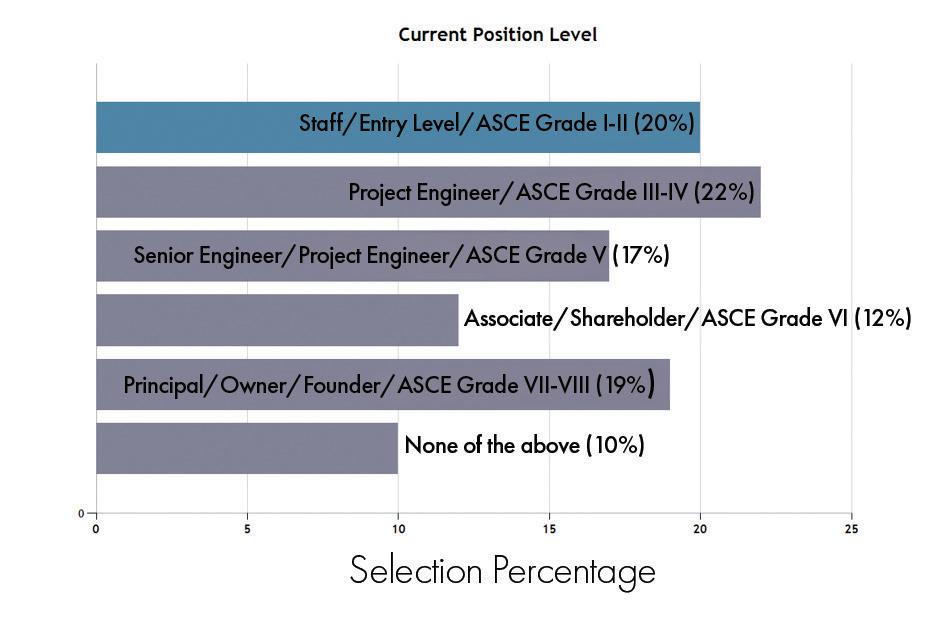
Survey participants and non-participants can now access the 2025 results. Responses are anonymous and confidential. Data collected is not linked to individuals or firms. Subscribers receive full access to results from both the 2024 and 2025 studies, allowing firms to compare trends and benchmark their practices against peers across the industry. ■
Most of the survey respondents were a Grade I-V engineer for their firm. The Compensation and Benefits Study is an interactive tool that allows users to dive deeper into the data—filtering questions like base salary by gender, position grade, and/or location to provide more accurate comparisons.
Annual Base Salary Monthly Healthcare Premium Paid by Employee
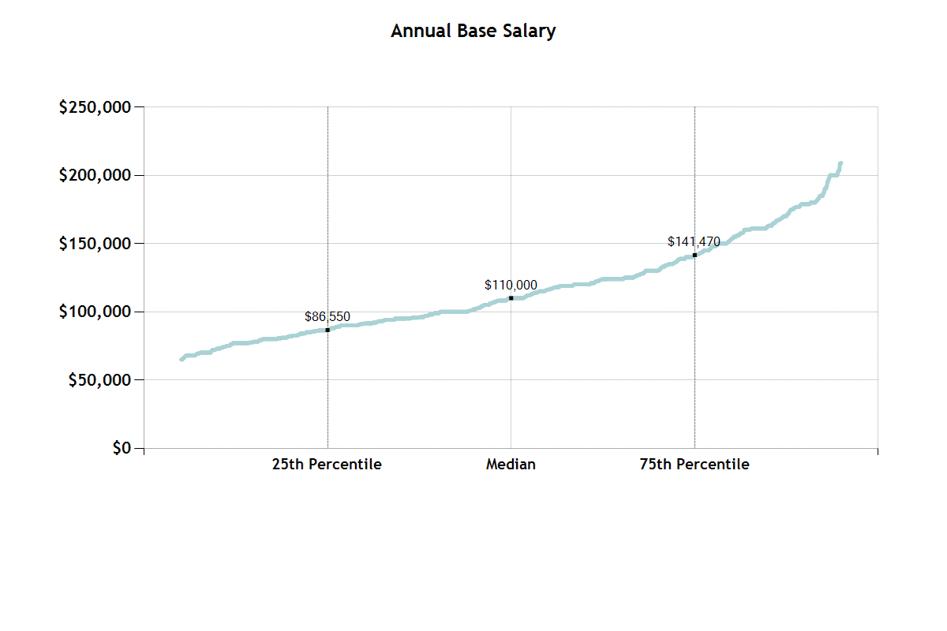
According to results from the 2025 Compensation and Benefits Study, the median salary of a structural engineer was $110,000. This is up from $101,332 in 2024.
Scan the QR code to learn more about the NCSEA Compensation and Benefits Study, including how to access the results and participate in the next phase of data collection.


According to results from the 2025 Compensation and Benefits Study, individuals are spending a median $103 a month on their health insurance provided through their employer. Most companies in the survey (89%) provided a PPO health insurance plan.
Building codes evolve not only through technical necessity, but also through how people reason, make compromises, and respond to incentives in group settings.
By Bruce Maison, SE and John A. Dal Pino, SE
“Have We Stagnated?” (STRUCTURE, December 2025), highlights a familiar trend: regulatory volume has grown dramatically. The engineering provisions of the 1967 Uniform Building Code filled roughly 280 pages, whereas today’s IBC ecosystem— including referenced standards such as ASCE 7, ACI 318, and the NDS—exceeds 2,000 pages. This raises a fundamental question: does an expanded code necessarily translate into better engineering and improved public safety?
Many engineers doubt it. Each new edition seems to introduce addi tional layers of provisions, exceptions, and cross‑references. Entire webinar programs now exist simply to help practitioners navigate increas ingly complex changes to the building codes and standards.
A common justification for code changes is that modern buildings are more sophisticated, and therefore the codes governing them must expand accordingly. Fair enough. But structural drawings for buildings designed many decades ago often shows careful design and detailing and a knowledge of engineering fundamentals that rivals, or in some cases exceeds, what our profession does today using advanced analyti cal tools based on years of research (current powerful computer programs as opposed hand calculations using obsolete slide rules). So, this narrative is incomplete. Technical demands alone cannot explain the growth in regula tory volume—especially when most structures designed today are not fundamentally different from those of decades past.
Yet complexity persists. These authors identified several human‑driven reasons:
• Academic incentives: novelty and mathematical sophistication are rewarded.
• Consulting incentives: complex models appear more impressive to clients.

• Cognitive bias: people equate complexity with expertise.
• Justification pressure: complex models can be used to defend preferred decisions.
The key insight is that complexity grows not because it improves outcomes, but because people are incentivized to behave in ways that favor it. Parallels exist in our building codes.
Complex systems often grow through small, individually rational adjustments that collectively degrade overall effectiveness
over time.
Structural engineers who serve on building code and standards committees know the dedication and public‑spiritedness of their col leagues, particularly those who have preceded them and may have personally encouraged them to get involved in support of the profession. These committees invest enormous amounts of volunteer time with the shared goal of improving the practice and better protecting public safety.
A more convincing explanation lies in the human factors that shape how groups of indi viduals work and how building codes are written, maintained, and applied. Behavioral economics deals with how people respond to incen tives, make tradeoffs, and rely on mental shortcuts. To illustrate this, we begin with a field far removed from structural engineering—business forecasting—and then draw parallels to building codes.
Time‑series forecasting models are widely used in business and can be evaluated against real‑world outcomes. In their study “Simple versus Complex Forecasting: The Evidence” (Journal of Business Research, 2015), Green and Armstrong compared 97 forecasting methods. Their conclusion was striking in that complex models rarely outperform simpler ones and often perform worse.
Yet individuals operate within a human‑systems environment that has a momentum of its own that sweeps those involved along like a strong river current. Swimming against the current is often a losing proposition. As a result, building codes evolve not only through perceived technical necessity or as a result of unprecedented storms and earthquakes, but also through the way people reason, make compromises, and respond to incentives in group settings.
Based on our own experience with committee work, the following human factors often drive building code expansion.
• Risk Aversion and Fear of Omission. In engineering, the conse quences of omission—real or perceived—are often far more feared than the costs of over‑specification. This asymmetry encourages the addition of provisions “just to be safe.” These layers accumu late over time. We are all guilty of this in one way or another, particularly in the writing of general notes and specifications for our design work. We all add language but rarely delete it. If we started from scratch, a lot could be deleted.
• Patch‑Based Changes. Committees tend to favor incremental fixes over holistic revision. Imagine the reaction a newer member would get for suggesting a fresh alternative to the existing provi sions—better to keep quiet! When a problematic issue arises, the natural response is to add language that serves as a patch closely following the status quo. Deletions and rewrites are less common, which is understandable given the limited resources of volunteer committees and the time such holistic revisions would take, not to mention the need to meet code cycles and deadlines. As the forecasting study showed, com plex systems often grow through small, individually rational adjustments that collectively degrade overall effectiveness over time.
• Legacy Provisions and Institutional Memory Loss. Once a provision enters the building code, it can become dif ficult to remove for several reasons. Committee membership changes, insti tutional memory fades, and the original basis for older provisions can be lost. Code credibility is maintained by following the status quo as much as possible. However, without periodic critical review, outdated requirements persist.
Technical correctness is necessary but not sufficient. Each proposed code change should be evaluated for its impact on user comprehen sion by addressing the following questions. Does it meaningfully improve public safety relative to the additional costs (engineering and/or construction cost)? Does it increase the engineering work by merely attempting to enhance so‑called code “accuracy”? Does it increase the number of steps required and the overall time required to apply the provision while also introducing the possibility of errors in implementation through unjustified complexity? Does it force the user to navigate multiple documents to answer a single question? Do structural engi neers welcome the change as an improvement long needed? If the benefits do not clearly outweigh the added burden, the proposal should not advance.
Our industry leaders can elevate usability as a measure of engineering excellence. Committees should be recognized for streamlining provisions and improving navigability.
• Battles Won and Lost. Building code changes are often driven by groups advocating for new provisions—requirements or allow ances that favor particular new design checks, products, or systems. Once a proposal is introduced, positions harden, debate unfolds, and a final decision is eventually reached. The practitioner, who played a minor or negligible part in the process, then adapts to the new equilibrium. But the process doesn’t end there. Each new provision may create incentives for additional proposals in response, while the constituency that supported the original change remains firmly in place. Over time, these accumulated battles produce a predictable code expansion.
• Incentives That Reward Complex Expansion. Complexity is often mistaken for rigor. Researchers gain prestige when their sophisticated work enters building codes and is cited in commen tary. Practitioners can also benefit by becoming “experts” simply because they can navigate intricate provisions. Some firms can gain competitive advantage from complexity that raises barriers to entry and justifies higher fees. As in forecasting, complexity persists not because it improves outcomes, but because it aligns with the incentives of those who produce it.
Meaningful reform requires addressing the human environment in which building codes are produced. We offer three principles as a practical starting point for an improved path forward.
Most code cycles assume additions, whereas deletions are secondary, or non existent. This mindset guarantees expansion as noted above. Committees can counter this by beginning each cycle with a review of provisions suitable for consolidation or removal. Establishing dele tion targets can create the discipline needed to keep codes concise and focused on technical necessity and public safety.
Our industry leaders can elevate usabil ity as a measure of engineering excellence. Committees should be recognized for streamlining provisions and improving navigability. Incentives can be tied to quantifiable indicators such as reductions in word count and decreases in navigational com plexity per McLean and Huston (2018) in “Navigational Complexity within Building Codes: Quantification and Affirmation,” (ASCE Journal of Professional Issues in Engineering Education and Practice). When usability becomes an explicit and rewarded outcome, commit tee behavior will shift in that direction.
Our profession has long accepted, reluctantly for many, building code expansion as an inevitable by product of technical progress. However, human factors often contribute to code volume, such as risk aversion, incremental patching, legacy accumulation, and incentives that reward expansion over clarity.
Recognizing this phenomenon opens the door to meaningful reform. It asks our profession to value clarity as highly as safety, treat usability as a form of engineering rigor, and acknowledge that a code that few practitioners can fully navigate cannot achieve its purpose.
The opportunity for change is significant: to reverse decades of code expansion and build a regulatory framework that is both technically robust and genuinely usable.■
Bruce Maison, SE, is a Structural Engineer in El Cerrito, California and a longtime member of the ASCE/SEI Standards Committee responsible for the ASCE 41 Standard, Seismic Evaluation and Retrofit of Existing Buildings. E-mail: maison@netscape.com
John A. Dal Pino, SE, is a Principal with Claremont Engineers Inc., Oakland, California and the Chair of the STRUCTURE Editorial Board. E-mail: jdalpino@ claremontengineers.com
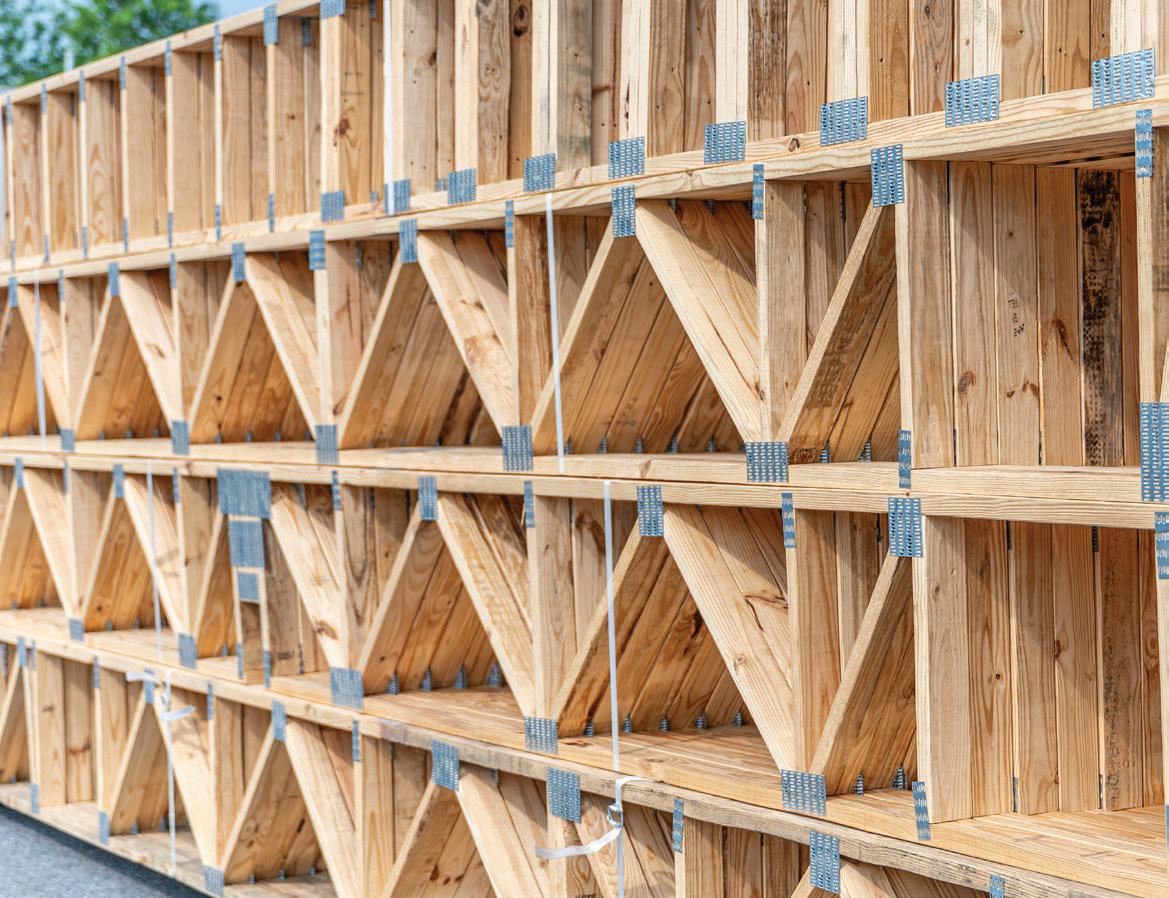
SBCA Technical Director, Greg Greenlee, P.E., presents a valuable and informational webinar with NCSEA covering Successfully Incorporating Structural Components into Your Metal Plate Connected Wood Truss Projects.
Structural building components, including metal plate connected wood trusses, offer efficient, cost-effective solutions, but only when the design process is clearly defined.
Using guidance from IBC, ANSI/TPI 1, and BCSI, you’ll walk away with practical approaches to reduce ambiguity and improve coordination.



Greg Greenlee, P.E., is SBCA’s Technical Director and a registered professional engineer with over 30 years of experience in structural design, manufacturing, code development, and component engineering. His background spans both design firms and manufacturing environments, bringing a practical, realworld perspective to structural component integration.
• Define design criteria in construction documents
• Coordinate with truss designers and manufacturers
• Review submittals for system compatibility
Access the FREE webinar today: https://qrco.de/2604SBCATrussWebinar
Want more education like this? Become a Professional Member of SBCA today! Visit: www.sbcacomponents.com/sbca-professional-membership