




































































































$3 suggested contribution goes directly to your vendor









































$3 suggested contribution goes directly to your vendor
e celebrate the work and accomplishments of our vendors through events, social media, and partnerships. We also build relationships with our wide range of donors to fund programs and create opportunities for our vendors to prosper.
832
In 2025, donors supported our mission
BY
Abel Putu, Abraham Aly, Archie Thomas, Aida Peery, Akindele Akerejah, Alia Huag, Amia Walker, Andre Brinson, Andre Baltimore, Andrew Anderson, Angie Whitehurst, Angela Morris, Anthony Carney, Apollos Robinson, Beverly Sutton, Brian Holsten, Brianna Butler, Cameé Lee, Carlos Carolina, Carlton Johnson, Charles Armstrong, Chris Boone, Chris Cole, Chon
Gotti, Conrad Cheek, Craig Thompson, Cynthia Herrion, Daniel Ball, Darrel Stone, Darlesha Joyner, David Snyder, Debora Brantley, Degnon Dovonou, Dominique Anthony, Don Gardner, Drake Brensul, El-O-Him, Elizabeth Bowes, Elynora Houston, Eric Glover, Eric Thompson-Bey, Evelyn Nnam, Faith Winkler, Flegette Rippy, Frederic John, Frederick Walker, Gerald Anderson, Gloria Prinz, Gracias Garcias,
Greta Christian, Henry Johnson, Invisible Prophet, Ivory Wilson, Jacqueline Gale, Jacqueline Turner, James Davis, James Hughes, James Lyles III, Jay B. Williams, Jeanette Richardson, Jeff Taylor, Jeffery McNeil, Jeffrey Carter, Jemel Fleming, Jenkins Dalton, Jennifer McLaughlin, Jewel Lewis, John Littlejohn, Josie Brown, Julienne Kengnie, Kenneth Middleton, Kannon Brown, Kendarius Tucker,
Kym Parker, L.Q. Peterson, Lawrence Autry, Leo Hughes Jr, Levester Green, Lillie Thomas II, Marc Grier, Marcus McCall, Mars, Maurice Carter, Melody Byrd, Melveon Harp, Milan Stevenson, Nikila Smith, Patricia Donaldson, Patty Smith, Paul Martin, Phillip Black, Qaadir El-Amin, Queenie Featherstone, Rachelle Ellison, Randall Smith, Rashawn Bowser, Reginald Black, Denny,
Reneece Brinkley, Ricardo Meriedy, Richard Mooney, Rita Sauls, Robert Vaughn, Robert Warren, Rochelle Walker, Ron Dudley, Ronnell Wilson, S. Smith, Sasha Williams, Saul Presa, Shawn Fenwick, Sheila White, Shuhratjon Ahmadjonov, Stephen Lennon, Starchild BLK, Susan Wilshasen, Sybil Taylor, Tasha Savoy, Tim Holt, Tonya Williams, Tony Morris, Vincent Watts, Warning Label, Warren Stevens, Wayne Hall,


Williams, Wendy Brown, William Hargrove, William Shuford, Willie Futrelle, William Young, Zero

BOARD OF DIRECTORS
Ashley McMaster, Blake Androff, Clare Krupin, Chris Curry, Cole Ingraham, David Grant, Jonquilyn Hill, Matt Perra, Michael Vaughan Cherubin, Nana-Sentuo Bonsu, Stanley Keeve
AUBREY BUTTERFIELD Editorial Intern
he D.C. Housing Authority (DCHA) Board of Comissioners passed a new administrative plan, which governs most federal and local housing voucher administration, on March 11 for the first time in three years. The plan, the first official, non-emergency plan since the soon-departing DCHA Director Keith Pettigrew joined the team, includes major updates like using random selection for who comes off the waitlist for housing, prioritizing people experiencing homelessness for federal vouchers, and simplifying the requirements for housing voucher applications.
TDCHA up, until this point, had been using an administrative plan dating back to April 12, 2023. The plan has been going through emergency updates since its implementation.
In addition to policy changes, the new plan aims to correct procedural issues and reflect changes to the U.S. Department of Housing and Urban Development (HUD) regulations. The goal of increasing transparency was of utmost concern in the new plan, according to DCHA’s Senior Vice President and General Counsel Amy Glassman.
“We want to be consistent and transparent in terms of our policies, and we want to offer stability and transparency to our participants, to our landlords, to the public,” Glassman said at the March 11 DCHA Board of Commissioners meeting.
One key change in the new plan is an update to the Housing Choice Voucher (HCV) program preferences to better support D.C.’s unhoused population. Residents on the waiting list for a federal voucher will be prioritized if they are receiving services through D.C.’s Continuum of Care, which offers shelter alongside other social supports for people experiencing or at risk of homelessness, or are currently being housed by the Emergency Housing Voucher (EHV) program. The EHV program, which houses hundreds of D.C. residents, is anticipated to run out of federal money sometime this year.
Currently, the voucher program functions with one large waitlist, which has about 17,000 waiting residents, according to agency oversight responses. Most residents have waited between 11 and 15 years to be selected for an HCV.
The waiting list, which has been closed since 2013, will also be updated to add a random selection process for those without preferences, meaning residents will not be prioritized based on when they entered the list or how long they have been waiting. The agency may also create project-based waitlists under the new plan, allowing tenants to to choose to be added to specific property waitlists.
CHIEF EXECUTIVE
OFFICER
Brian Carome
DIRECTOR OF PROGRAMS
Darick Brown
DIRECTOR OF VENDOR
EMPLOYMENT
Thomas Ratliff
EMPLOYMENT SPECIALIST
Esmat Amin
VENDOR PROGRAM
ASSOCIATES
Aida Peery, Chon Gotti, Nikila Smith
VENDOR PROGRAM
VOLUNTEERS
Ann Herzog, Aiden
Eisenschenk, Beverly Brown, Roberta Haber, Stephen Lennon
EDITOR-IN-CHIEF
Annemarie Cuccia
DEPUTY EDITOR
Donte Kirby
EDITORIAL INTERNS
Additionally, DCHA is working to simplify the voucher process, including doubling the time frame in which supporting documents will be accepted, making in-person eligibility interviews optional, and allowing no income households to limit the number of times they have to confirm their income.
The original draft of the 2026 administrative plan received over 300 public comments, which DCHA tried to address in the refinement process. The agency said it took many of these comments into consideration, though not all of the public’s comments were included in the final draft.
“I think advocates were doing what advocates are supposed to do,” Commissioner Christopher Murphy said in the March 11 meeting. “In many cases, they asked us to sort of push the boundaries and things, and I think where it felt reasonable to do that, it seemed like that was honored.”
DCHA released the first draft of the plan for public comment last August. The agency then proposed a revised plan in November and held a virtual public hearing for feedback. The plan then entered a required comment period by HUD before the DCHA Board of Commissioners’ vote on March 11.
The plan was passed days before the Chicago Housing Authority Board voted to appoint Pettigrew to take over the agency. Pettigrew, who has served as director of DCHA since November 2023, was midway through his three-year recovery plan, which included updating the administrative plan and resolving outstanding concerns from the 2022 HUD audit. The recovery plan detailed goals to improve staff training and customer service, as well as the utilization of low-income housing units. While utilization has skyrocketed, according to a recent DCHA oversight hearing, customer service complaints persist.
With Pettigrew’s departure announced, the fate of these outstanding goals is unclear. The agency will soon appoint an interim director and explore long and short-term leadership plans, according to DCHA Board of Commissioners Chairman Raymond Skinner.
“Although we were disappointed to learn of Director Pettigrew’s departure, the Board and the talented management team that we have built remain steadfast in our mission to provide quality, affordable housing to low-income District families,” Skinner wrote in a statement. “Our work continues, full speed ahead.”
The plan will enter the D.C. Register and its final public comment period. DCHA encourages the public to continue being involved in the refinement of the regulations.
“We do hear you, we understand your concerns, and we are working with the team to do level-best to address them, even though there may continue to be issues,” DCHA Commissioner Theresa Silla said at the meeting.
□ SNAP benefits are changing. Be sure you’ve talked to Esmat and Darick about your SNAP benefits.
□ The yoga workshop is really fun and relaxing! And it happens every Thursday from 11:30 a.m. - 1:00 p.m. No need to bring anything but yourself.
□ Find a list of vendor announcements and other useful information just for you at streetsensemedia. org/vendor-info.

Charles Armstrong March 26
ARTIST/VENDOR
Read this democratically elected code of conduct, by vendors, for vendors!
1. I will support Street Sense Media’s mission statement and in so doing will work to support the Street Sense Media community and uphold its values of honesty, respect, support, and opportunity.
2. I will treat all others, including customers, staff, volunteers, and fellow vendors, respectfully at all times. I will refrain from threatening others, pressuring customers into making donations, or engaging in behavior that condones racism, sexism, classism, or other prejudices.
3. I understand that I am not an employee of Street Sense Media but an independent contractor.
4. While distributing the Street Sense newspaper, I will not ask for more than $3 per issue or solicit donations by any other means.
5. I will only purchase the newspaper from Street Sense Media staff and volunteers and will not distribute newspapers to other vendors.
Aubrey Butterfield, Elizabeth Short, Grace Copps, Katie Doran, Kordell Martin, Natalie Note
WEB INTERN
Zachi Elias
GRAPHIC DESIGN INTERNS
Arisha Shumael, Kevin Akakpo
SOCIAL MEDIA INTERN
Harmony Jones
ARTISTS-INRESIDENCE
Alexandra Silverthorne (Photography), Bonnie Naradzay (Poetry), David Serota (Illustration), Willie Schatz (Writing),
Molly Pauker (Watercolor), Debbie Menke (Watercolor), JM Ascienzo (Yoga)
EDITORIAL VOLUNTEERS
Anne Eigeman, Dan Goff, David Fucillo, Eli Ukpokwu, Kyrah Simon, Nina Elkadi, Nora Scully
6. I will not distribute copies of “Street Sense” on metro trains and buses or on private property.
7. I will abide by the Street Sense Media Vendor Territory Policy at all times and will resolve any related disputes with other vendors in a professional manner.
8. I will not sell additional goods or products while distributing “Street Sense.”
9. I will not distribute “Street Sense” under the influence of drugs or alcohol.
10. I understand that my badge and vest are property of Street Sense Media and will not deface them. I will present my badge when purchasing “Street Sense” and will always display my badge when distributing “Street Sense.”
GRACE COPPS Editorial Intern
C. recently opened a new resource for youth experiencing homelessness, but some in the homeless services system say it’s not all good news.
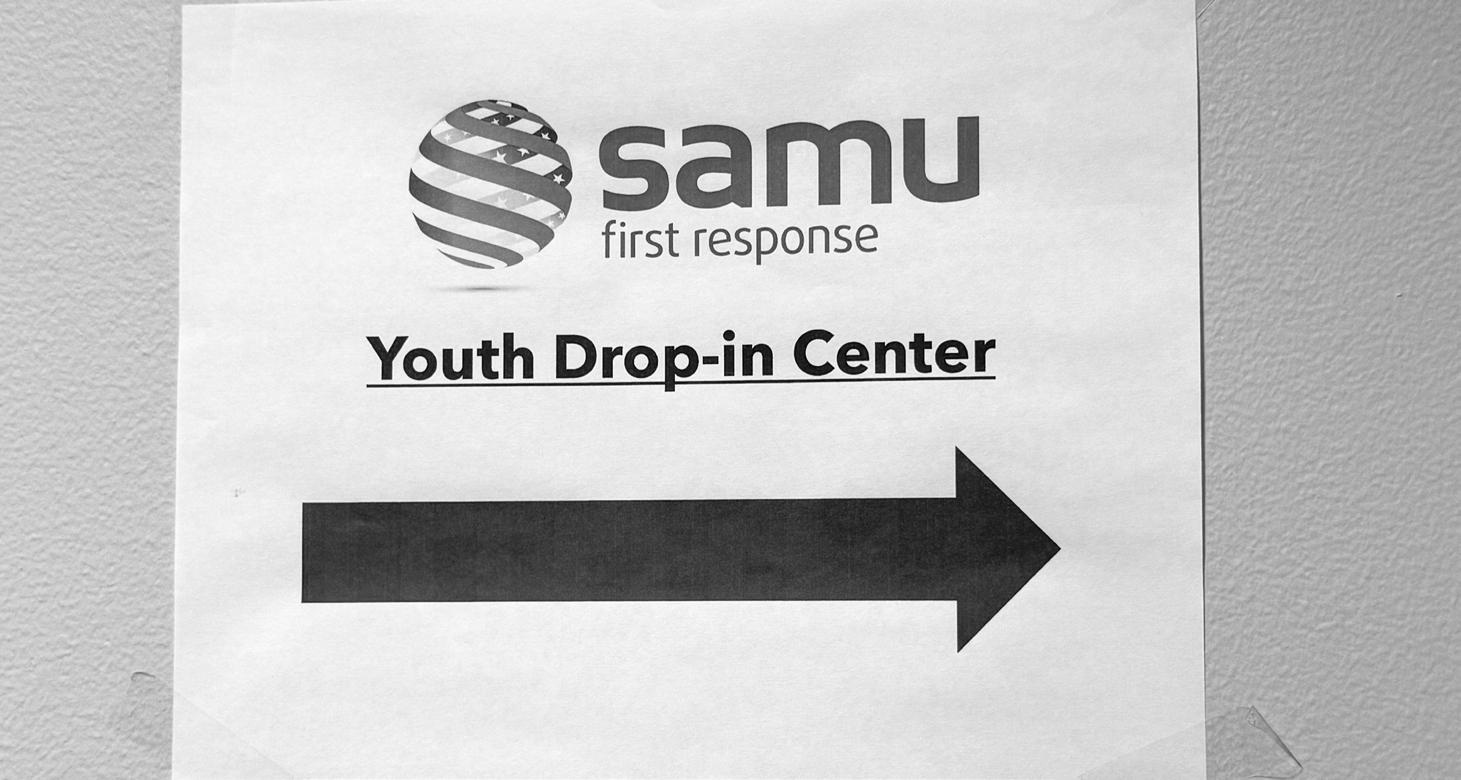
In February, SAMU First Response, an international humanitarian aid organization based in D.C., opened a drop-in center in Capitol Hill aimed at youth ages 18 to 24 who are experiencing homelessness or are at risk of homelessness. The center, which will provide a safe space for youth during the day and access to resources, is partially supported by D.C. city funding — funding another day center says it sorely needs.
D.C. has historically supported three main youth drop-in centers — Zoe’s Doors in Brentwood, the Latin American Youth Center in Columbia Heights, and Sasha Bruce Youthwork in Capitol Hill. This year, while the city added SAMU to the mix, Sasha Bruce lost its contract, putting the drop-in center’s operations at risk.
“Do not let our drop-in center close,” Deborah Shore, the founder and executive director of Sasha Bruce, said at a recent oversight hearing. “We saw 793 youth last year. There are more than enough young people who need supports, and Sasha Bruce provides a foundation for youth that has proven itself and that is worthy of your devotion.”
Drop-in centers both offer people experiencing homelessness a respite during the day, when shelters may be closed, and help connect people to other services, like housing or benefits. SAMU’s new drop-in center, at 650 Pennsylvania Ave. SE, offers meals, showers, laundry, case management, housing resources, educational and employment programs, and mental health support, according to the organization’s and the D.C. Department of Human Services (DHS) Instagram pages.
Street Sense was not able to tour the new center’s space, which is located on the second-floor of a mixed-use building mostly containing medical offices. The center is open from 9:00 a.m.. until 7:00 p.m. on Mondays, Tuesdays, Thursdays, Fridays, and the third Saturday and Sunday of each month. On Wednesdays, the center is open by appointment. SAMU did not respond to a request for comment on the center’s first month of operations.
SAMU is headquartered in D.C. and works around the country and globe, helping vulnerable populations through crises. Though the organization has not worked on D.C. youth homelessness before, it helped lead the city’s response to the buses of migrants that began arriving from Southern states in 2022, and, according to its webpage, operated respite centers in D.C. and Montgomery County. Many migrants who arrived in D.C. from 2022 to 2024 were ineligible for homeless services, but faced some of the same challenges as people experiencing homelessness. In a December Instagram post announcing the new center, SAMU wrote it “aims to expand access to year-round, youth-friendly spaces where young people facing housing crises can access specialized resources and supportive services to move toward stability and well-being.”
At a Feb. 26 D.C. Council oversight hearing for DHS, which oversees the city’s homeless shelters and day centers, people associated with Sasha Bruce Youthwork, a nonprofit dedicated to serving unhoused youth in D.C., raised concerns about the loss of city funding for its drop-in center. Shore, who has worked as the founder and executive director of Sasha Bruce Youthwork for more than 50 years, expressed her disappointment in DHS’s decision to award the contract that previously supported Sasha Bruce’s drop-in center on Barracks Row to another provider. Shore said she disagreed “deeply” with the decision and took “issue with the decision-making process.” According to her, DHS did not clearly explain its reasoning for not renewing its contract with Sasha Bruce to run the drop-in center, which has been operating for 12 years. In an email to Street Sense, a spokesperson from DHS wrote grants are issued on a “competitive basis” to encourage “innovation” and give “the opportunity for agencies to fund entities with the best ideas to address their goals.” DHS recently conducted the first “competitive grant process” since the 2018 fiscal year, according to the spokesperson, and assessed applications on “the merit of their proposals based on the requirements outlined in the Request for Application.” From this process, three drop-in centers were selected to receive grants: Latin American Youth Center, DC Doors, and SAMU. Youth who testified at the hearing in support of Sasha Bruce’s drop-in center emphasized how they felt Sasha Bruce’s staff and resources helped them when no one else would. Devin Williams, a Sasha Bruce client, said that it is “easy to be forgotten” and feel like “just a number in the system” at larger centers, with it taking “months” to receive services and case workers who “may not even remember your name.” “But not at Sasha Bruce,” William emphasized, calling Sasha Bruce “more than a program, it’s family.”
“They talk to you like real people. Like mentors. Like somebody who actually wants to see you win,” Devon Young, another Sasha Bruce client, said of its staff. “They keep me motivated to stay on the right path.”
Young, and the several other youth who testified, urged the city to make sure the drop-in center that had been so crucial to them could remain open.
“Sasha Bruce helped me remember that I am not my mistakes,” Young said. “Without it…I don’t know where I’d be.”
Even without the city’s funding, Sasha Bruce’s drop-in center, at 741 8th St. SE, is still operational. But Shore said youth looking to go to a day center have been told the center, known as “The Bruce” was closed, and instead directed to the new center. “We learned because youth came pouring in the first days of the new center’s opening to ask why we closed,” Shore said.
At other times, Shore said, DHS officials told gatherings of youth the drop-in center was closed, and operators of the Child and Family Services Agency’s Warmline were told to no longer refer people to Sasha Bruce, confusing long-time users of the center. “This puts into their already troubled world even more mistrust of those in charge,” Shore said.
Currently, DHS lists Sasha Bruce on its website as one of four youth drop-in centers. It’s open Monday, Tuesday, Thursday and Friday from 8 a.m. to 6 p.m., and Wednesdays from 8 a.m. to 12 p.m., and by appointment in the afternoon.
During the second part of the oversight hearing, held March 6, Ward 3 Councilmember and Committee on Human Services Chair Matthew Frumin said he was troubled by the testimony from Sasha Bruce staff and youth, and wanted to work with DHS to make sure the organization still had a role in the homeless services system, even though it was too late to change the decision made about the contract.
In response, DHS Director Rachel Pierre said, “Sasha Bruce remains a very strong partner to us in this work” and “our relationship with Sasha has not ended.”
Frumin said he would look into advocating to give one-time city funding to Sasha Bruce to help keep the drop-in center open this year, but he was not sure if the council would be able to find the money in a tough budget year.
The uncertainty surrounding youth drop-in centers comes as advocates demand more support for youth experiencing homelessness. In her testimony, Shore also urged the council to stop, as it has in the past, DHS’s proposals to not increase funding for programming aimed at unhoused youth. According to the 2025 Point-in-Time Count, the most recent available, nearly 500 people between the ages of 18 and 24 were experiencing homelessness in the city on one night. Pierre said about 250 youth had exited homelessness in fiscal year 2025, with about half exiting to permanent housing. Though there was a discrepancy between DHS’s exit numbers and the council’s, Pierre said for DHS, the numbers are “increasing” and “improving.”
Regarding the future of DHS’s strategy to help young people experiencing homelessness, Pierre said DHS was looking into increasing the number of youth shelter beds by 70 (there are currently 500 beds in the system), but wanted to make sure the beds are in demand. The DHS spokesperson wrote the agency is “planning a new grant solicitation to increase its youth shelter capacity.” According to Pierre, the city is also looking more into “specific” youth-homelessness strategies that will fit into Homeward D.C. 3.0, the new plan to end homelessness, rather than a stand-alone plan for youth.
“We serve youth with severe trauma histories,” Flo White, a case manager for Sasha Bruce, said in her public witness testimony at the DHS oversight hearing in February. “When a young person with high levels of trauma finally finds a place they trust — that is when the real work begins.”
KORDELL MARTIN Editorial Intern
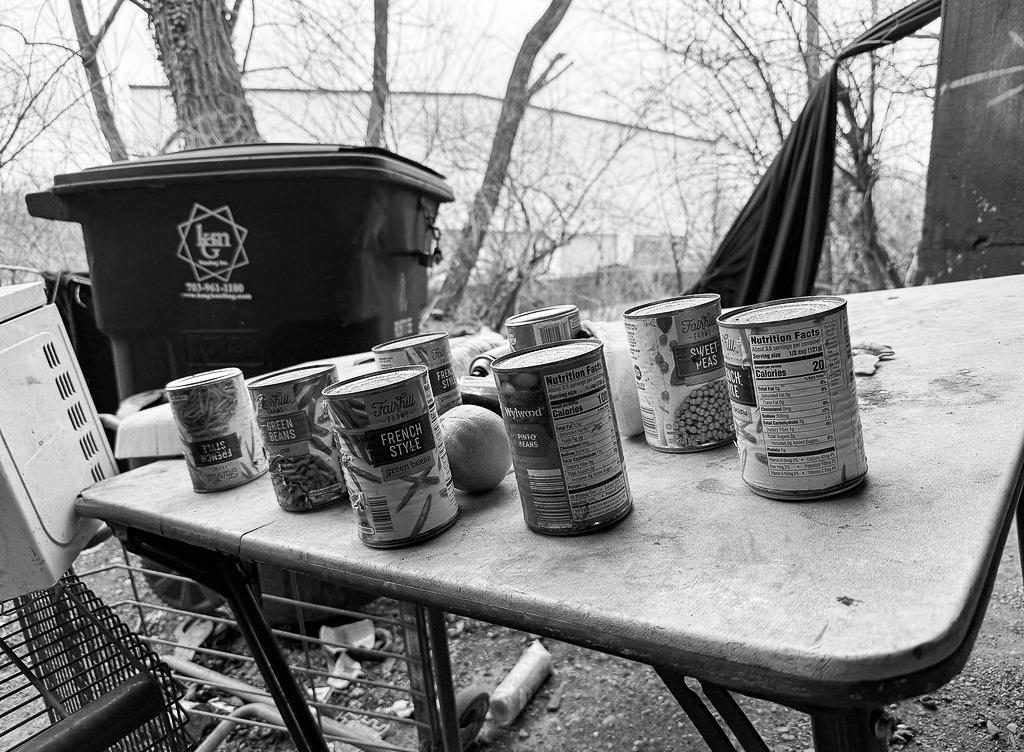
Limited access to healthy food is a recurring issue for people experiencing homelessness in D.C., advocates and people living outside say.
People living outside or in the District’s encampments often have limited control of what their next meal will be, relying on daily meal programs or donations that may lack nutritional value. Regularly consuming unhealthy food or not getting necessary nutrients may cause or worsen chronic health conditions like heart disease, diabetes, and hypertension, according to a study from the American Journal of Medicine.
Recognizing the potential for insufficient access to healthy food to cause or exacerbate chronic health issues, D.C. nonprofit and aid organizations such as Martha’s Table, Food Not Bombs, and Street Health DC are working to ensure people have access to nutritious food wherever they lay their heads.
People experiencing visible homelessness may get food from homeless outreach organizations, volunteer groups, or just people passing by. Though some donors provide calorically dense foods, like ultra-processed snacks and fast-food meals, to encampments to alleviate hunger, encampment residents say those foods, which sometimes contain high quantities of sugar and salt, can harm their health. When people bring unsolicited food to encampments, leaving it without checking with residents, it can also attract pests and create a mess residents then have to clean up, encampment residents have told Street Sense.
Dr. Tobie Smith, the founder and executive director for Street Health DC, told Street Sense the public often forgets nutrition is also a problem when confronting hunger among homeless populations.
Street Health DC provides medical support to people experiencing homelessness, primarily those in outdoor encampments. The organization partners with community outreach groups like Pathways to Housing and District Bridges to connect individuals with physicians.
Smith said people experiencing homelessness are often limited to consuming what’s available. They don’t have the opportunity to follow diets that incorporate the recommended high fiber vegetables and lean meats to manage chronic health conditions like heart disease, high blood pressure, and dental diseases.
These factors, among others like minimal access to affordable health care in the District, can lead the life expectancy of those experiencing homelessness to fall 20 years below the average, according to Smith.
Though many organizations that help feed people experiencing homelessness aim to provide healthy food options, limited budgets and reliance on donations can contribute to deteriorating health among those in encampments, according to Smith.
“We know that a lot of the food that’s distributed is based on what’s available and what has a lot of shelf stability, so it’s not always fresh produce,” Smith said.
In response to limited options, some local organizations focus on providing vegetable-rich options or giving people seeking food more choices.
Martha’s Table, for instance, hosts two free daily markets at 2375 Elvans Rd., SE and 1474 Columbia Rd., NW. The markets, which run from 11 a.m. to 4 p.m., allow individuals to pick up to $30 worth of free groceries like eggs, vegetables, and fruit.
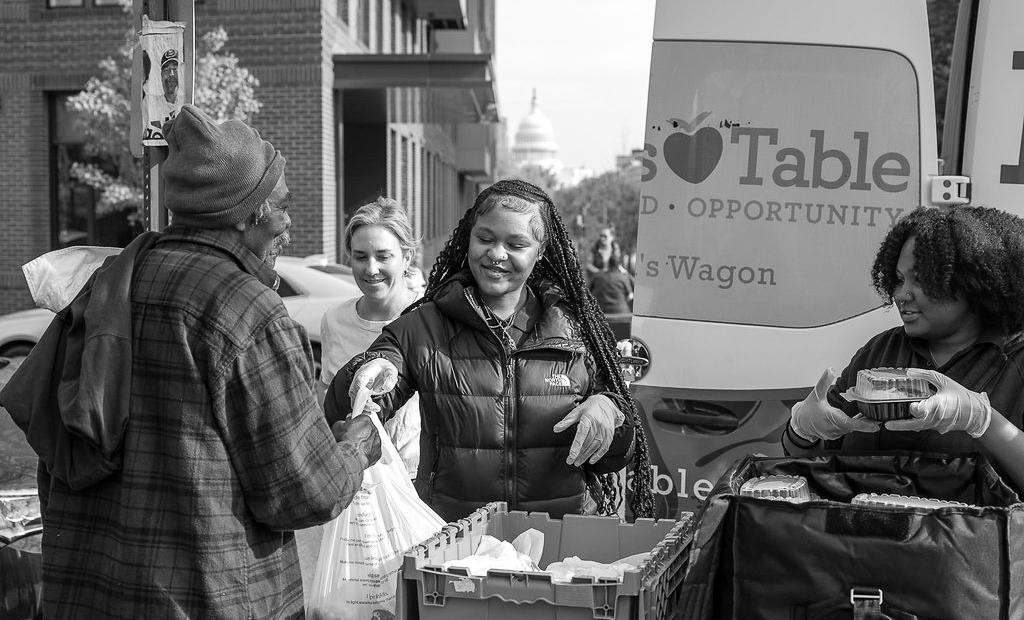
Mallory Mpare-Quarles, deputy chief of health and wellness for Martha’s Table, said individuals can choose what food ends up in their bags. “Allowing people to have control of what they eat builds trust, enabling them to come back and continue consuming nutritious ingredients,” she said.
Because encampments do not have proper storage for food, healthy foods received at markets can deteriorate outdoors. To supplement this, Martha’s Table’s McKenna’s Wagon provides hot meals to individuals outdoors. The service provides meals to those who don’t have the space or equipment to cook.
Many menu items are chosen on by the guests who receive them, often with consideration of dietary restrictions. Sandwiches and healthy snacks with later expiration dates are packed along with hot meals to delay hunger.
“We prioritize these additional items because they have a longer shelf life, ensuring that the people we serve, many of whom lack consistent access to a kitchen or regular meals, have something available to eat later, beyond the hot meal,” Mpare-Quarles said.
Other groups like Food Not Bombs focus on providing hot meals with a concentration on dietary preferences. The organization was founded in 1980 to provide communities nationwide with vegan and vegetarian meals. The organization’s D.C. chapter provides weekly free meals on Saturdays at 2:30 p.m. in McPherson Square.
Keith McHenry, co-founder of Food Not Bombs, emphasized the importance of healthy food options for those experiencing homelessness.
“If you’re living on the street or low-income, you’re buying food at 7-11, and the convenience store, and it’s not healthy,” McHenry said. The ability to eat meals based on dietary restrictions is also important for those living in encampments. If people experiencing homelessness became vegans when they were housed, they still need vegan options, he said.
The health-focused group serves vegan meals sourced from recovered, salvaged, and donated produce. To reduce food waste and food inaccessibility, Food Not Bombs also gives surplus food to soup kitchens and shelters.
For people looking to help, Smith encourages the public to prioritize fresh vegetables and foods low in salt when donating to shelters and kitchens, as well as asking programs and people what food they need, and making sure that food stays fresh.
“D.C. has rats, there’s heat. Unless it’s a bottle of water and a packaged food, that is a definite no-no,” Smith said. “No one should be eating food that they have no idea how long it’s been sitting outside.”
According to McHenry, providing low-barrier access to healthy options is vital to improving the physical and emotional health of people experiencing homelessness.
“It’s really important to have healthy, nutritious food,” McHenry said. “It really perks people up.”
KATIE DORAN Editoral Intern
When Ashley moved into her first apartment last month, she was overjoyed. After years in the foster care system and months of couch surfing, Ashley, 23, could not wait to have her own place.
“I was jumping the first day I moved in, literally, I was screaming and jumping. I almost cried tears of joy,” she said.
Ashley, who asked not to use her real name to protect her privacy, entered foster care at 15. She aged out of the system when she was in college and living in campus housing. After she graduated, she looked for an apartment she could rent with the money she’s saved from working since she was 14, but found her options were unsanitary, in neighborhoods hard to access by transit, and too expensive, she said.
Without a stable place to stay, Ashley couch surfed while she waited and hoped for her application for a housing voucher to be approved. When it was, she felt like her life had changed.
“I would literally be homeless if the system was not there,” she said.
The federal government funds the kind of housing voucher Ashley has, called a Family Unification Program (FUP) voucher, to prevent homelessness among former foster youth, who can be especially at risk of instability without the family support to get an education, find a job, or pay rent. The vouchers are available to young people who have left or will soon leave foster care and who are experiencing or at risk of homelessness, as well as to some families involved in the child welfare system.
Just a few years ago, D.C. had more than 80 unused FUP vouchers, even as young people around the District left foster care for unstable housing or homelessness. Advocates pushed for D.C. to better inform foster care youth about their options and to encourage more people to apply for FUP vouchers.
In 2023, a new policy requiring D.C. to consider all foster youth for a FUP voucher went into effect. Since then, the number of people receiving vouchers has increased significantly. Now, for the first time, D.C. has matched all of its FUP vouchers with a household, and can request more from the federal government. While the process can still be slow or challenging for young people to navigate, the changes have enabled more foster youth to settle into stable housing.
“When they acquire the voucher, and they successfully lease up here, they are able to go out, get jobs, volunteer, coach Little League,” Ruth Anne White, executive director of the National Center for Housing and Child Welfare, said. “It’s really beautiful to watch what unfolds when these young people aren’t struggling day after day to know where they’re going to lay their head at night.”
Former foster youth are disproportionately likely to experience homelessness. Around the country, between 25% and 50% of people who leave foster care experience homelessness within four years. In D.C., about 10% of adults experiencing homelessness were formerly in foster care, according to an analysis of the 2025 Point-In-Time Count, an annual census of people experiencing homelessness.
In D.C., young people “age out” of foster care at 21. Before that, the Child and Family Services Agency (CFSA) aims for most foster youth to achieve permanency — reunification with their family or adoption — but about 30 to 50 people still age out of the system each year.
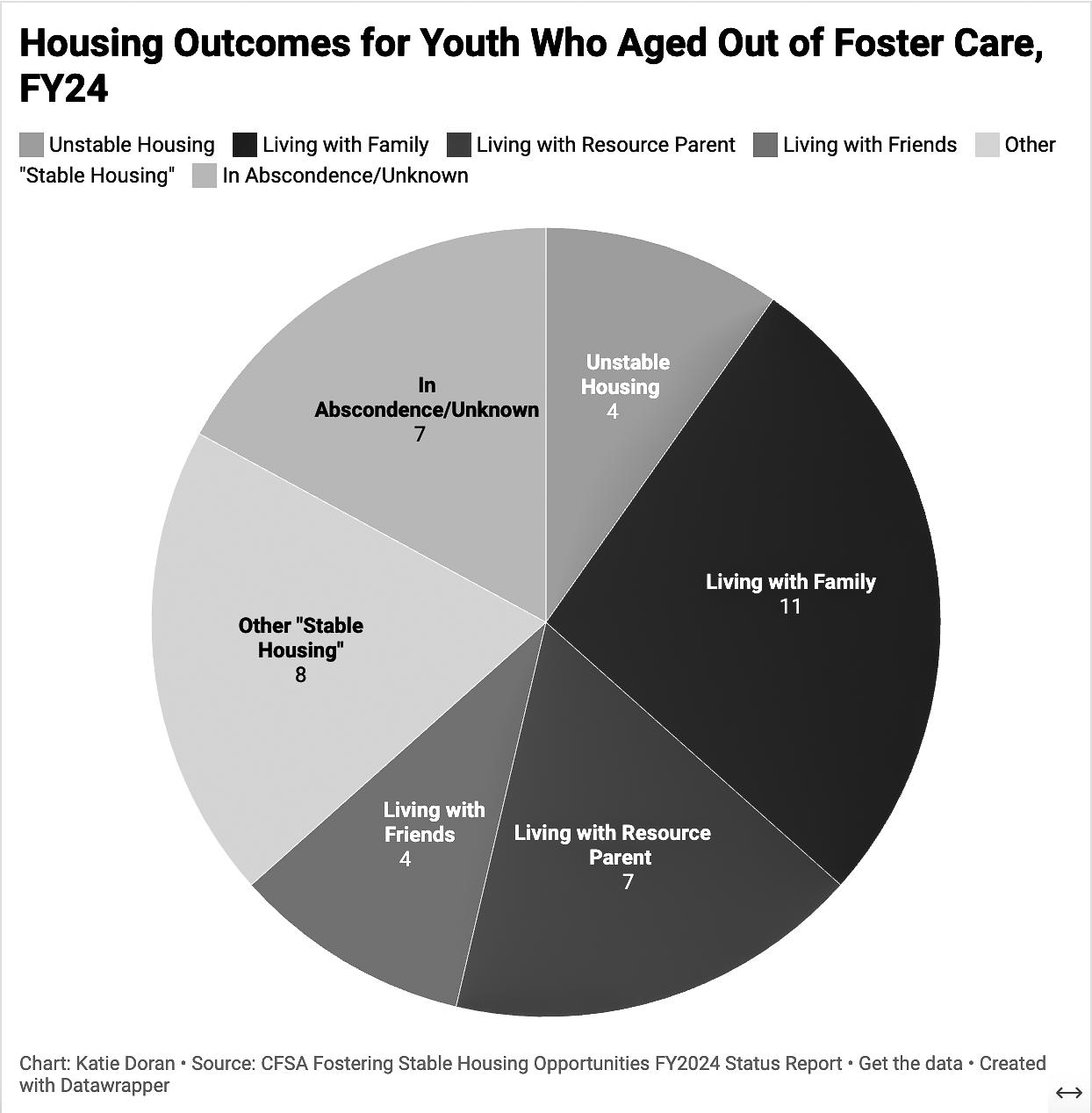
In fiscal year 2024, 41 young people aged out of foster care in D.C., according to CFSA’s annual status report. CFSA tracked housing outcomes for 34 of them, while seven were “in abscondence,” meaning the agency didn’t know where they were. Of the 34 CFSA tracked, 30 youth moved into arrangements that CFSA identified as “stable housing,” including living with family or friends.
But living with family or friends may not be a safe or stable housing arrangement, White said. For example, an older youth or someone who is aging out might go back to live with the same family the child welfare system originally deemed unsuitable to care for them.
“They’ll take someone who should not be living with her mother, and they send her back to her mother,” White said. “She wasn’t good enough yesterday, but now all of a sudden, she’s good enough?”
Living with family or friends also doesn’t mean a youth’s name is on the lease, meaning disagreements could disrupt the housing situation or force them to leave.
In fiscal year 2024, only three youth who aged out of care exited to independent living. While CFSA has not yet posted its annual report for fiscal year 2025, advocates hope that as more youth are connected to vouchers, helping them get their own apartments, this number will increase.
Two groups are eligible for FUP vouchers: young adults up to age 24 who have aged out or are soon aging out of foster care, and parents for whom a lack of adequate housing is a factor preventing them from keeping or reunifying with their children. There’s no time limit on FUP vouchers allocated to families, but for former foster care youth, the vouchers are limited to three years, or up to five with an extension. Youth with FUP vouchers are responsible for paying 30% of their income to rent, while the vouchers typically cover the remaining cost of housing.
Since 2018, D.C. has had 421 FUP vouchers, provided by the U.S. Department of Housing and Urban Development (HUD). From 2018 to the start of 2023, at least 75 of those vouchers were always available: i.e, almost 20% of D.C.’s FUP total voucher allocation went unused each year. Advocates and foster youth reported at the time many young people were never informed of the voucher program, or were denied, with some aging out of foster care into homelessness.
In response, in 2023, D.C. implemented the Preserving Our Kids’ Equity Through Trusts (POKETT) Amendment Act. The POKETT Act directed CFSA to create a housing plan with each young person leaving foster care and to consider each of them for a FUP voucher.
Now, teens in foster care learn about FUP vouchers during their Youth Transition Planning meetings, which start when a young person is 16 and take place at least every six months, according to CFSA’s written answers to oversight questions in January. CFSA also offers housing information sessions where youth and their support teams can learn about FUP and other resources.
Advocates for foster youth say the POKETT Act has improved awareness about FUP vouchers among young people, social workers, and CFSA staff.
“Social workers and support workers are aware of this product now for housing. Most people now understand it.” Najiba Hlemi, executive director of D.C. Foster and Adoptive Parent Advocacy Center, said.
Since the POKETT Act went into effect, FUP voucher utilization has increased significantly. Now, D.C. has connected all of its FUP vouchers to a youth or family.
According to D.C. Housing Authority (DCHA) spokesperson Alison Burdo, of the 421 vouchers, 370 are currently supporting youth and families in housing, as of March. The remaining 51 have been matched with individuals or households whose applications are under review or who are still looking for an apartment — processes that can take the better part of a year.
the Children’s Law Center, wrote in testimony for the January CFSA oversight hearing. “Most frequently, our clients aged out while their FUP applications were pending or waiting to lease up after they had been approved for a voucher.”
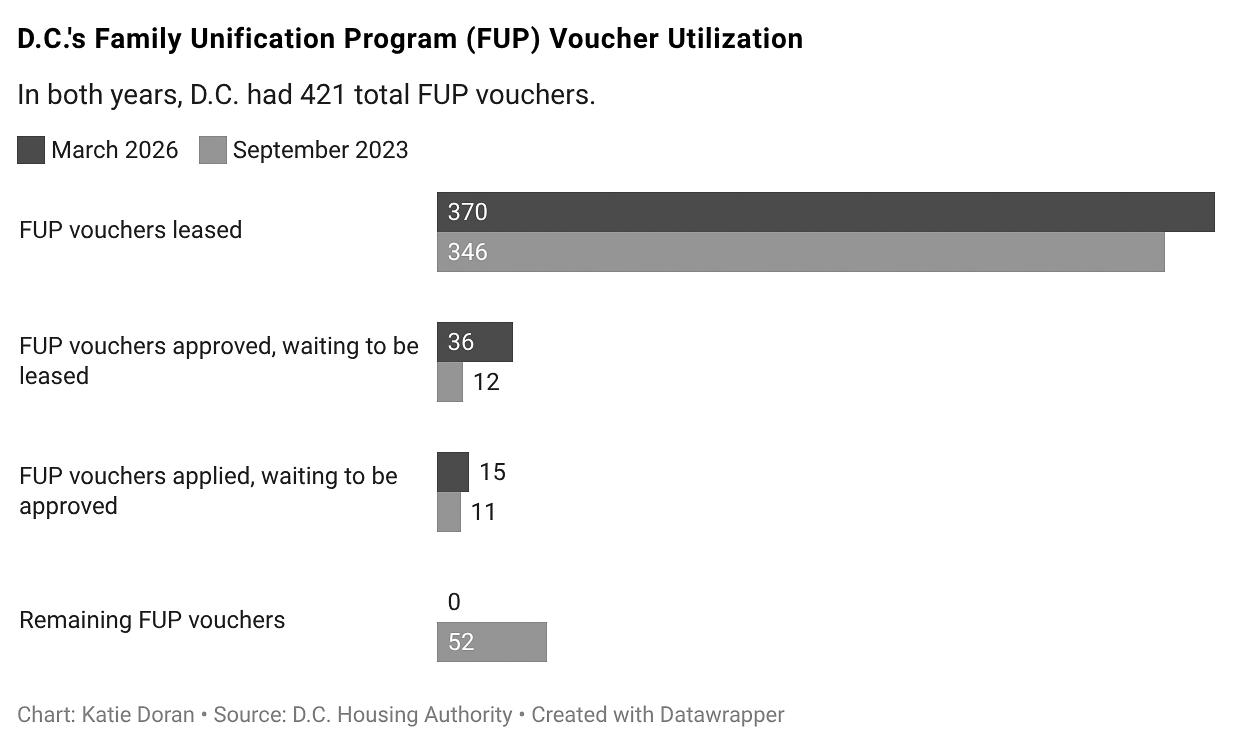
In fiscal year 2025, 31 youth aging out of care in D.C. were connected to FUP vouchers, according to CFSA’s oversight answers, compared to 11 young people who got housing through FUP in 2024.
Ameena, who asked not to use her real name to protect her privacy, entered foster care at 13. Last month, at 20, she moved into her FUP-subsidized apartment. She told Street Sense moving into her own place felt “amazing.”
“For foster youth, we look at the FUP voucher like, ‘we’ve made it,’” Ameena said. “Living alone, you just kind of feel free.”
While advocates celebrated improvements to the FUP process in the last few years, they also said many young people still face obstacles while trying to access housing through the vouchers.
After a young person collects all of their information and fills out a complicated application packet with their support team, their application goes to DCHA. According to DCHA answers to oversight questions in February, the average time between DCHA receiving a completed FUP application and the applicant leasing an apartment is 254 days. More than eight months.
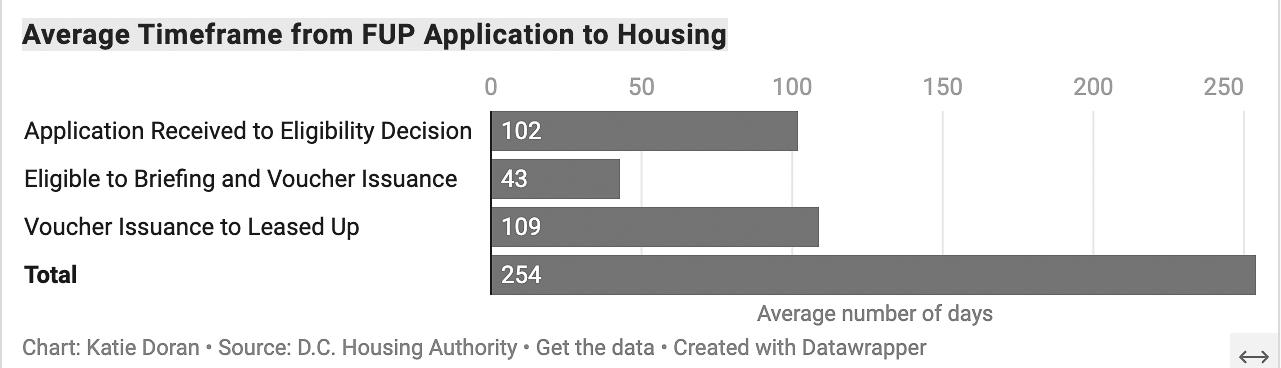
It takes an average of 102 days for DCHA to reach an eligibility decision after an application is submitted, 42 to 43 days for a youth to be issued a voucher after being deemed eligible, and 109 days after a voucher is issued for a youth to sign a lease.
The lengthy process means some young people may age out of foster care while still waiting to get into their FUP housing.
“Although our clients were able to apply for FUP vouchers, most of them did not obtain housing through FUP before they aged out of care,” Tami Weerasingha-Cote, policy director for
When someone ages out while still waiting for their FUP application to be processed or looking for an apartment with which to use their voucher on, they may face homelessness or unstable housing arrangements in the interim.
While Ashley had already aged out by the time she applied for a FUP voucher, the months-long process left her with a gap in housing. Ashley graduated from college in May 2025, the same month she applied for a voucher. While she waited for DCHA to process her application, Ashley couch surfed and lived with mentors.
She said it took three months for her to hear anything from DCHA after applying, and eight months before she got her voucher and could start applying for apartments.
“The process for getting my FUP was very difficult because I had to do a lot of reaching out back and forth with DCHA, and they were very unresponsive,” she said. “It was a lot of me going back and forth with different people, and while doing that, I was also being told different things from different people.”
For Ameena, too, a lack of clear communication from DCHA and CFSA was a challenge in getting housing through FUP.
“I think the communication piece is really what makes it a long process,” Ameena said. “Sometimes you send in paperwork, and it might be wrong, and they’re not telling you it’s wrong, or they’re not letting you know.”
While D.C. has used its allocation of FUP vouchers, this doesn’t necessarily pose a barrier to current and former foster youth looking to apply now: the federal government also funds a second voucher program for youth aging out of care, called Fostering Youth to Independence (FYI) vouchers.
FYI vouchers have the same eligibility requirements as FUP for foster youth. Public housing authorities, partnered with a child welfare agency, can apply for up to 50 FYI vouchers a year on a non-competitive, as-needed basis. For D.C., this means DCHA should be able to access FYI vouchers in increments as small as one at a time, whenever CFSA determines there are youth who need them.
In an email to Street Sense Media, Burdo, the DCHA spokesperson, wrote that CFSA has requested DCHA apply for FYI vouchers this fiscal year, and the two agencies are “currently preparing the application.”
D.C. has never applied for FYI vouchers before. However, in fiscal years 2023 and 2025, D.C. applied for additional FUP funding, which it did not receive either time, according to Burdo. But with the higher utilization rate, advocates hope this application for FYI will be more successful.
“They have to demonstrate that they’ve used up all the other [vouchers], whatever they had in hand. That was a problem before, because they had not used them all up,” Hlemi said. “Now they’re able to say, ‘Okay, we don’t have any left.’ It shouldn’t be that difficult of a process to go into their portal and pull down some more, because there’s legislation specifically for it — states are doing it all over the place.”
White, whose organization, the National Center for Housing and Child Welfare, worked with current and former foster youth to create the FYI program, said it’s good news that D.C. plans to apply for FYI vouchers.
“They’re not ‘out’ of vouchers — it’s like they’ve successfully leased up their inventory, and now they’re going to request vouchers on demand. That’s a good thing,” she said. “Because the housing authority is moving forward and CFSA is abiding by the D.C. law, we should eliminate homelessness for youth aging out of foster care. That is something that we should all be celebrating.”
Ashley and Ameena each moved into their apartments in February. They both said the process, while imperfect, has left them with housing they feel safe and happy in.
“No one tells you how amazing it is to be living on your own,” Ashley said. “I love it.”
ALAENA HUNT
Volunteer Freelance Reporter
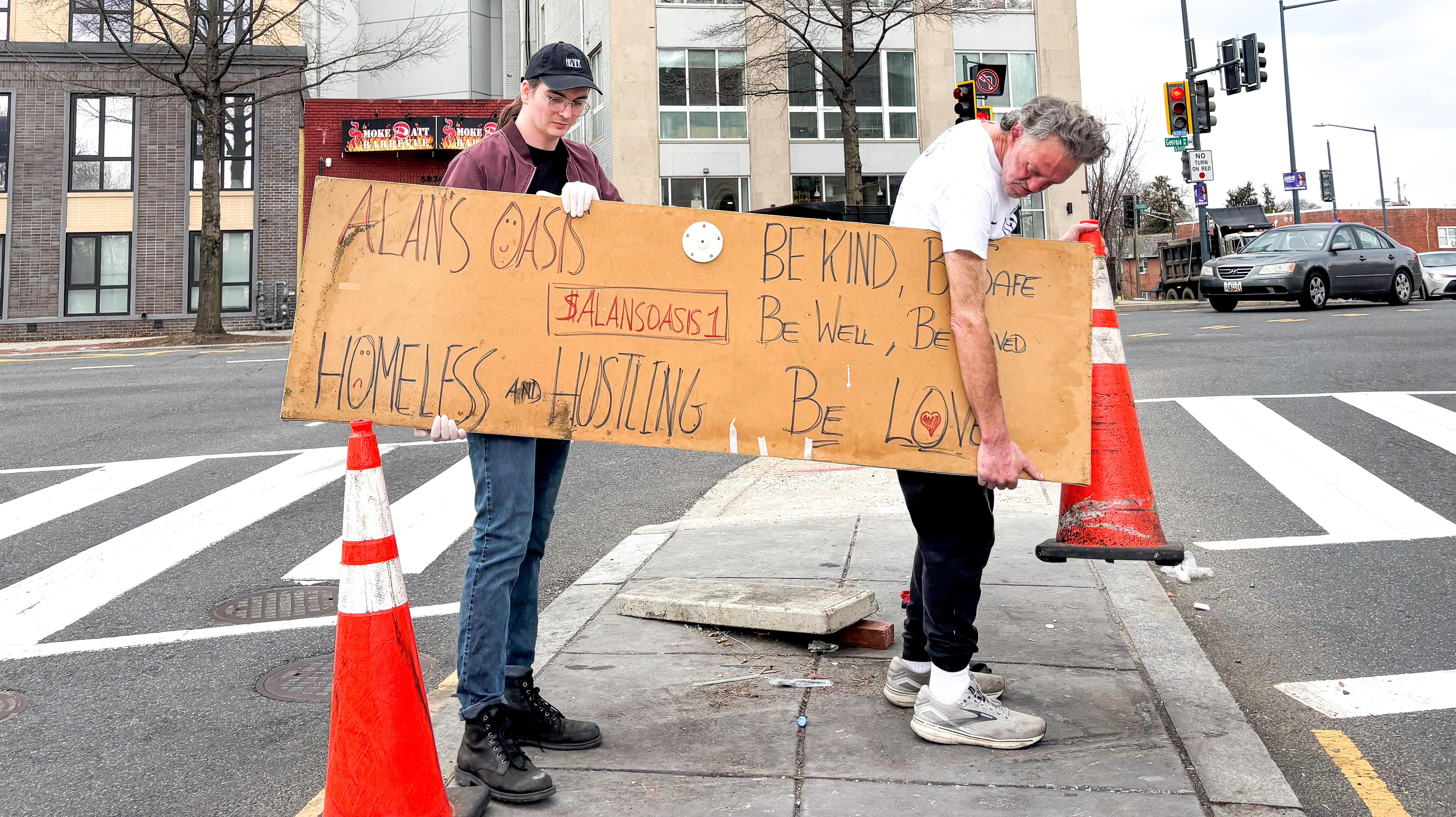
On March 11, Alan stood at his usual post on a median on Missouri Avenue, surrounded by the chaotic rhythm of the busy intersection. He handed water bottles to drivers, receiving — but never asking for — a few crumpled dollars in return. But it was not a usual day, as the city-owned trucks rolling into the nearby gas station parking lot reminded him. He had to move.
Alan is the founder of Alan’s Oasis, a “hydration supplementation station location” that operates at the Brightwood intersection. For 12 hours a day, Alan “passive-aggressively panhandles,” as he calls it, pacing up and down the intersection, stopping to tell a repeat customer a joke or inform someone their headlight is out. Once or twice an hour, he’ll receive $20. Every now and then, he gives out a miracle bottle — $100 in exchange for one bottle of water. His business model, giving away water to people driving by instead of selling it, has made him a local celebrity. Alan’s “a fixture” in the neighborhood, A’Lexa Hawkins, one resident, said. Reddit threads about Alan’s Oasis describe him as a “kind man” and a “great guy.” One post calls his oasis “one of my favorite sites in D.C.”
Since this winter, the endeavor has also helped Alan keep a roof over his head, renting a room in a crowded house nearby. Though Alan no longer lives on the street, the city still classifies his
makeshift water station as an encampment, which the Office of the Deputy Mayor for Health and Human Services (DMHHS) defines as the accumulation of personal belongings on public property.
On March 11, DMHHS conducted an encampment closure at Alan’s intersection, forcing him to clear his set-up for what Alan says was the first time in almost four years. According to DMHHS, Alan has previously complied with requests to move his wares, but Alan doesn’t recall any full closures. Three times in 2022 and once in 2023, the city cleared the area where Alan’s Oasis sits, but Alan said workers only touched tents in the area, never his signs and coolers on the median. Although Alan quickly returned after the recent closure, the future of his oasis is uncertain.
Alan originally thought the city was going to clear his oasis in September. On Sept. 5, Alan found a notice posted on the sign welcoming people to his intersection, which suggested the area would be cleared on Sept. 24. For the next three weeks, he fought to get the clearing canceled. Every hand that stretched from a rolled-down window was met with a plea to call the city to complain, post on Reddit, or attend his self-planned protest the day of what he called his “eviction.”
On that day, though, the city never came. A DMHHS spokesperson later told Street Sense there had been a misunderstanding, and the closure was not targeting Alan’s hydration station, but a tent nearby. When Alan discovered the tent had been abandoned, he threw it away. The city canceled the closure.
According to the spokesperson, the notice was posted on Alan’s belongings for awareness, in case the person who lived in the tent also owned the things on the median.
But Alan said he was never told the closure was just for the tent. He spent three weeks thinking about the clearing. He was relieved DMHHS didn’t show up, but also sad no one showed up to the protest he had tried to organize.
In the months since, Alan run the oasis and struggled to find housing. In the fall, he was living in a tent on a gas station’s property — the owner let him live there because he acted as a security guard at night — but he said he had to leave when the company found out. He moved to two other places in Brightwood and was kicked off both.
“I really have nowhere to go,” he said in December. Eventually, he was able to save enough to move in with his friend. During one of D.C.’s most severe cold spells in recent history, he was able to sleep in a bed and have access to a kitchen. Although Alan has somewhere to live, he has to pay rent. If his revenue from the oasis dips even slightly, he would have to move out, he said.
This spring, reduced revenue became a real threat. On Feb. 23, Alan found a notice posted on a pole near his hydration station, informing him of a cleanup on March 11. “Any property not stored or removed from within 200 feet of this notice by the scheduled clear time is subject to removal and immediate disposal,” it read. Again, there was an abandoned tent in the
area, so Alan hoped once he disposed of it, the city would cancel the closure. In another attempt to stop the clearing, he shrank his oasis to just a sign and his cooler.
“Why are they clearing me now? I’m smaller than I was last time,” Alan said. Alan’s Oasis has fluctuated in size over the years. At its largest, it had signs speckling the road, a large chalkboard propped up against a shopping cart, and two coolers.
“All day I’m trying to f------ figure out how I’m gonna get through this, because I ain’t got nobody to help me,” Alan said after the sign was posted.
But on the morning of March 11, the trucks rolled in, and the city’s encampment team appeared. The team told Alan’s case manager he was a safety hazard — he had to move.
“The safety of all residents and drivers who traverse this intersection daily is our highest priority. No resident is allowed to hoard bulk items on this [District Department of Transportation] space due to the extreme safety hazard that it presents to the traffic patterns of Georgia and Missouri Ave NW,” a spokesperson from DMHHS wrote in an email.
The city often references safety concerns when deciding to close an encampment, including when people are set up close to a road and at risk of being hit by vehicles. But Alan finds this argument frustrating, because he considers himself a guardian over the intersection. His oasis is on Missouri Avenue, right before it swoops through Georgia Avenue in a confusing curve. Rows of traffic lights often leave drivers unsure about when they can go. Alan said he stops traffic when police cars or ambulances drive by, and he yells at drivers who get confused by the intersection and drive into oncoming traffic.
“I’m actually a safety benefit for them,” he said.
On the day of the closure, Alan took off his usual attire — a shirt that reads “Alan” on the front and “homeless and hustling” on the back. He wrote “safety hazard” in big lettering across the front of a new shirt and put it on.
A couple of minutes before 10 a.m., when the closure would begin, the intersection was bustling with members of DMHHS and outreach workers. Alan decided to move his things off the median, so he would not risk losing his signs. A friend helped him carry them to the side of the road.
Police officers showed up to observe. They spoke with Alan like one would speak to a friend, joking around and asking how he was doing. Alan said officers have told him they appreciate his help in taking care of the intersection. The Fourth District did not respond to a request for comment on its relationship with Alan.
Hawkins, a concerned neighbor who came to make sure Alan was okay, told Street Sense if Alan had to close his oasis, “I would feel like we really failed.”
“He didn’t fail,” she said. “As a community, as a city, we didn’t support people who were industrious and positive and doing something good for the community. And when he needed us most, we weren’t there,” she said, referring to neighbors not showing up to support Alan.
After the closure, the city told him he had to keep the space clear. According to a DMHHS spokesperson, “Continued compliance by this resident will avoid the need for further Protocol enforcement actions on this space as it has been deemed unsuitable for the housing or hoarding of personal items.”
Even though Alan currently has a roof over his head, he needs the intersection. Since the closure, he has returned to his oasis, but has been hesitant to put up too many signs. Business has been down as a result. Now that the city has cleared him once and told him he needs to keep the space clear, he worries about the future.
As Alan walks up and down the median for hours, his thoughts are sometimes consumed by how little money he’s making. Other times, he thinks about “the fact that this whole life is meaningless.”
For now, he tries to find meaning in his oasis. One of his signs reads, “be safe, be kind, be well, be loved, be LOVE.” He added the last one, “be love,” because you can’t make yourself “be loved,” but you can “be love,” he said. That’s what he tries to do.
Read Street Sense’s profile of Alan at tinyurl.com/alansoasis.
KATIE DORAN, KORDELL MARTIN, AND GRACE COPPS Editorial Interns
In addition to Alan’s Oasis (featured on page 8), D.C. closed 14 encampments since early February. These encampment closures included five immediate dispositions, meaning the Deputy Mayor for Health and Human Services (DMHHS) closed the encampment with little or no notice due to what it identified as an imminent health or safety risk. In a standard, scheduled encampment clearing, residents typically get seven days’ notice before the closure.
While many encampment closures scheduled for February were rescheduled due to snow and freezing temperatures, the city closed six encampments that month. These included three immediate dispositions in Foggy Bottom, Navy Yard, and Ivy City, and three scheduled closures, in Adams Morgan, and at Seward Square in Capitol Hill.
When workers came to clear away the tent and piles of belongings at a corner off of Seward Square on Feb. 19, the encampment resident had already left. Left behind, however, were concerned neighbors.
During the clearing, a woman approached a group of outreach workers to ask about the encampment resident’s well-being. She said she hadn’t seen him in a while, and others in the neighborhood were worried he had “frozen to death” in his tent as a result of the recent snow and persistent cold temperatures. The man had been in the area for a few months, she said: originally in the park, until the police had moved him to the sidewalk. Then, he moved to the sidewalk across the street in front of a row of townhouses. According to the woman, people in the neighborhood called the shelter hotline and their councilmember, but the man did not want to leave his belongings. The last time she saw him was a few weeks before the clearing as he stood outside of Trader Joe’s.
Walking by, another person remarked, “They threw all his shit away. Damn! That man had nowhere else to live.”
On Feb. 25, the city closed an encampment in Adams Morgan, displacing one resident. Then, on March 5, the city cleared an encampment outside Martin Luther King Jr. Library through an immediate disposition. The site was originally scheduled to be cleared on March 24, but the scheduled clearing was canceled after the immediate disposition. Typically, at least a dozen people sleep outside the library each night, and the site has been subject to repeated closures over the last year, though people regularly return the next night.
Five days later, on March 10, the city closed an encampment outside the Downtown Day Services Center, which is in the New York Avenue Presbyterian Church.
Church staff told Street Sense they warned those living in the area about the clearing and encouraged them to move their belongings ahead of time. While staff estimated between 10 and 20 people sleep outside the building each night, on the morning of the closure, there were only a few people and piles of belongings outside.
“The church is really, really good about helping us out with stuff like that,” one person, who asked to remain unnamed to protect his privacy, said. “They take really good care of us.”
The person, who has been living outside the church and day center for almost two years, stored his belongings inside, with plans to set up outside the building again later the same day, after the clearing. He said encampment closures, which happen somewhat regularly at this spot, are an inconvenience, but don’t change his plans to continue living in the area.
“This isn’t the first time that they’ve done this,” he said. “So we put our stuff inside, and then we bring it back outside. Yeah, it’s kind of a hassle, but it’s not that big of a deal.”
By 10 a.m., when the clearing began, only one person’s items were still outside: a shopping cart and a suitcase covered in a tarp. After a heated conversation with outreach workers, government officials, and police officers, the person agreed to have outreach workers move his items across the street, where they wouldn’t be tossed out during the clearing. Street Sense did not see the city’s encampment team throw out anyone’s belongings during this closure.
On March 17, the city closed an encampment on Kingman Island in the Anacostia, where one resident was impacted.
Two days later, on March 19, the District cleared encampments on Whitehurst Hill and a District Department of Transportation (DDOT) lot near Foggy Bottom on March 19. The encampments sat across from one another, separated by a busy roadway, on the corner of K Street and 27th Street NW.
Multiple people who lived in the DDOT lot vacated the area before the District’s encampment team arrived. According to the DMHHS website, the lot was cleared to maintain safety for DDOT operations and public use. Though former inhabitants of the encampment left before Street Sense arrived, outreach workers said residents took most of their belongings, leaving behind large items like chairs, heavy blankets, and a mattress to be disposed of by DMHHS.
Only one person lived in the encampment on Whitehurst Hill across from the DDOT lot, according to outreach workers on site. The individual wasn’t there, but all of his belongings were left at the location. The DMHHS clearing crew used two garbage trucks to dispose of the man’s belongings, including a tent, clothes, blankets, bottles, shoes, and a chair. Outreach workers collected multiple trash bags, one duffel bag, and a suitcase stuffed with the man’s clothing to take to an outreach organization he frequently visits, in hopes of returning them to him.
Toward the end of March, D.C also closed encampments near L’ Enfant Plaza and near the Cleveland Park Metro, though Street Sense was not able to attend either closure.
On March 24, the city closed an encampment downtown, on K Street. After DMHHS workers warned the encampment resident the city would remove their tent if they didn’t take it down, the person worked with outreach workers to move their things a few blocks away. They set their tent on a tarp and carried it, still set up, to their new location. The city cleared the same K Street encampment the month before as well, on Feb. 10.
ELIZABETH SHORT Editorial Intern
When Lilly Evans, 77, entered into an “equity share agreement” in 2018, she didn’t know she was signing away most of her home’s value.
In 2012, Evans, a lifelong resident of D.C., purchased her white singlestory home in the Burrville neighborhood. By 2018, she was struggling to keep up with expenses and had accumulated thousands of dollars in debt.
“When Unison offered me money to catch up on my bills, I thought it was a no brainer,” Evans wrote in a statement to Street Sense. “I had no idea that in exchange they would take 70% of the equity in my home.”
Companies like Unison, which offered to help pay off Evans’s debts, often work with elderly homeowners who live in gentrifying areas and have limited wealth outside their home. This makes D.C. a “hotspot,” according to Bryony Coiner, a staff attorney at the Legal Council for the Elderly (LCE). Older adults are the fastest-growing demographic of those experiencing homelessness, with rising costs and fixed incomes from pensions and Social Security putting many at risk of losing their homes.
These companies offer homeowners an upfront payment in exchange for a portion of their home’s equity, the amount they would receive if they sold their home. Often, the value of equity the company receives is significantly greater than the payment to the homeowner.
Unison calls its financial product an “equity sharing agreement.” Other companies in the growing industry refer to similar models as “shared appreciation agreements,” “home equity sharing contracts,” or “equity investment options.” The four biggest companies in the industry are Unison, Point, Hometap, and Unlock.
The National Consumer Law Center (NCLC) is leading a national advocacy effort on the issue of home equity investments, which it argues are “high-cost, high-risk mortgage loans” marketed as opportunities for homeowners “to tap their home equity without taking a loan.”
“Their structure creates unpredictable balloon payments, encourages equity-stripping, and exposes homeowners to foreclosure without the protections that apply to traditional mortgages,” according to a brief issued by the NCLC in November.
In February, LCE and the AARP Foundation filed a lawsuit against Unison and its affiliates with Evans as plaintiff, arguing Unison is operating as an unlicensed mortgage lender in D.C. while failing to comply with local and federal laws regulating mortgages. The same month, the National Association of Consumer Advocates, represented by lawyers from AARP, filed a similar lawsuit against Unison, also arguing that Unison’s marketing is misleading about its product, which the lawsuit claims is in fact a high-cost mortgage.
In 2018, Unison agreed to pay Evans almost $57,000, according to the lawsuit. In return, Unison purchased 70% equity in Evans’s home, which had a total value of $227,500 at the time. According to the lawsuit, the company advertised its product was not a loan, involved no debt, and carried no interest.
LCE argues this transaction is essentially a reverse mortgage. Under a reverse mortgage, homeowners 62 or older can take out a loan in exchange for giving a company partial equity in their home. Because of the especially high risk associated with reverse mortgages, states, including D.C., have protections in place for consumers. For example, D.C. requires homeowners to attend a counseling session before taking out the mortgage.
According to the lawsuit, entering the transaction with Unison brought a high level of risk, which Evans was not fully aware of. For instance, Coiner said that when Evans fell behind on another loan, she was unable to refinance — as would be typical for a mortgage — due to the equity sharing agreement. Now, she faces foreclosure.
“She really has no option, because if she sells the home, Unison takes all the equity,” said Coiner. “And so unless she can catch up on her mortgage all at once in cash, which is not an option for her, she sort of has no other way of saving her home with this Unison product on the property.”
Similar cases exist around the country. A Washington state court ruled in 2025 that Unison’s home equity investments amount to reverse mortgages under state law.
Unison did not respond to Street Sense’s request for comment in time for publication. In 2024, Unison argued in court its product was not a reverse mortgage, since there is no obligation for homeowners to repay the company.
Evans’s story fits in with a broader issue of wealth inequality. In D.C., where the median home value is $700,000, the value in somebody’s home might surpass their everyday means. LCE’s lawsuit argues that companies like Unison target these “house-rich, cash-poor” homeowners.
The result of these practices is “even more rapid gentrification, because the people who are perpetrating scams are operating off of the desperation of a low-income person facing foreclosure. They’re really investors in that,” said Coiner. “They’re trying to buy cheap properties to sell for more money to richer people.”
Pressures to sell or refinance a home are compounded by the rising cost of living, especially for older people relying on fixed incomes and Social Security. Some retirees are returning to work, or “unretiring,” due to financial pressures. A study conducted by the National Council on Aging found 80% of Americans over 60 could not withstand a serious financial shock like the death of a partner, divorce, or serious illness and the need for long-term care.
Over a third of homeowners in the United States over 75 years old are cost burdened, meaning they pay more than 30% of their income on housing. Unaffordability further exacerbates existing inequalities. For example, 46% of older Black homeowners and 47% of older Latino homeowners are cost burdened, while 38% of white peers are cost burdened.
“For most people who own homes, in general, the home is the biggest asset they have or ever will have,” Coiner said. “It’s also a way to ensure that generations after the homeowners have access to some sort of asset to build financial freedom.” This is especially true for older homeowners of color. Home equity accounts for over 80% of the net worth of Black and Latino homeowners, compared to 47% for white homeowners.
But homeownership does not ensure this wealth stays within families and communities. Losing home equity through reverse mortgages or scams can strip families of this generational wealth.
“I’ve been seeing a pattern of us losing our homes in our communities, and those people that built our communities are no longer to age in the same communities that they built,” Cornelle Smith, founder of Elevation Legacy Counseling, which works to inform older homeowners before they make decisions about their homes, said at the organization’s kick-off event on Feb. 28.
Coiner said the impact of Unison’s product is similar to the impact of “foreclosure rescue scams.” In these cases, somebody might offer to be an investor to help a homeowner catch up on mortgage payments, in exchange for partial home ownership. “Once you add someone to your deed, you can’t remove them without their consent, and then they basically force a sale, and then the person no longer has the home,” Coiner said.
Repair scammers, meanwhile, will find houses in need of renovation and offer free repairs in return for being added to the deed. Sometimes, they will encourage somebody to sign paperwork without realizing they’re signing away part of the house. “We buy houses” companies offer to purchase homes quickly, often for far less than they are actually worth, Coiner said.
Predatory practices depend on “tight deadlines and desperation,” Coiner said. “Anyone could be a victim of these scams, but I think that the people who perpetrate them intentionally look for older people in gentrifying neighborhoods, because those are the people who… may struggle with the financial upkeep, but the house is extremely valuable, so there’s a big pot of gold.” Scams can also prey on renters. One will send letters advertising a fraudulent “Emergency Rental Assistance Program,” and obtain personal and financial information from renters. Another is fraudulent eviction notices, tricking people into paying scammers under the threat of eviction. Scams are always evolving. As an attorney, Coiner will usually only see a scam once it’s been around for a while, often years after it began. As a result, there is little public information or warnings about these scams, forcing individuals to rely on their own judgment.
However, it’s not impossible to avoid scams. “It’s important to take your time before you make any rash decision,” Coiner said. In contrast to the rushed deadlines that scammers often provide, many “legitimate products” will give people time to discuss with a family member or a financial advisor, she said. AARP’s Fraud Watch Network also provides guidance on how to avoid scams, actions to take for people targeted by scams, and support to families.
In her time practicing law in D.C., Coiner said she has seen predatory practices and scams be “extremely devastating” for her clients. Owning a home can ensure safety, community, and building generational wealth, but losing it puts these in jeopardy. “It’s shame, displacement from your community, “said Coiner. “It really devastates their whole life.”
KYLE MACHICADO
ate last year, the Department of Housing and Urban Development (HUD) announced deep cuts to long-term housing programs and new requirements for renewing existing programs that put 170,000 formerly unhoused people at risk of losing housing. While a federal judge has temporarily blocked these cuts until the issue makes its way through the courts, if they are implemented, D.C. is expected to lose over $22 million in federal funding, putting nearly 1,500 people at risk of losing housing, according to an estimate from the National Alliance to End Homelessness. This comes at a time when low-income and unhoused D.C. residents are already struggling with inflation, benefit cuts, and unprecedented weather emergencies, such as January’s winter storm, which is thought to have played a role in the deaths of four homeless people.
LDescribed as an attempt to restore accountability and promote self-sufficiency, HUD’s abrupt change follows a July 2025 executive order and proposed anti-homeless legislation making its way through Congress, aiming to effectively criminalize homelessness and calling for the involuntary movement and institutionalization of unhoused people.
These measures are tapping into a growing bipartisan movement to criminalize homelessness and undermine Housing First policies that prioritize providing permanent housing, and which have proven effective at reducing homelessness.
While it’s true not enough is being done about the homelessness crisis in the District, the criminalization and involuntary institutionalization of unhoused people is both unethical and ineffective. To solve this crisis, first, we need to acknowledge its complexity.
Homelessness does not just stem from substance abuse and mental health problems; for many, homelessness can be an unavoidable consequence of violence or environmental or economic disaster. As a result, D.C. does not just have a homelessness problem; it has a displaced population problem. Consider the nearly a dozen families in Southeast D.C. who were displaced from their homes last month by flooding after a water pipe burst due to frigid temperatures, or the people whose homes were damaged or destroyed by severe storms in D.C. and its surrounding counties in recent years.
According to the Internal Displacement Monitoring Centre (IDMC), a Norwegian research group focused on measuring internal displacements, the United States accounts for nearly a quarter of disaster-related displacements worldwide. In fact, in many other countries, and as defined by the United Nations, many people who we consider homeless would instead be classified as internally displaced persons.
Internal displacement within the U.S. is a growing national crisis. Last year, over 11 million people in the nation faced internal displacement due to disaster, according to a report by the IDMC, a staggering increase over the 202,000 displacements in 2023. This pattern is likely to continue as ongoing climate change leads to more extreme weather events such as heat waves, floods, and droughts. In D.C., extreme weather and other environmental factors can often lead to housing instability. Given D.C.’s lack of affordable housing, people and families displaced by disaster can easily end up homeless.
Unfortunately, President Donald Trump has called for the dismantling of the Federal Emergency Management Agency (FEMA), and the administration has cut $4 billion in disaster response funding, leaving displaced people without adequate support. Combined with other attacks on essential social services which are driving up costs for low-income residents, such as dismantling the U.S. public health system, cutting housing subsidies, eliminating the 2021 COVID-era eviction moratorium, cutting nearly $1.1 trillion in Medicaid and other health care funding, and removing Supplemental Nutrition Assistance Program eligibility for a projected 2.4 million people nationally,
he has been a leader since she represented Ward 4 and during her three terms as our mayor. She helped the homeless by investing in the Housing Production Trust Fund. She stood up to President Donald Trump by leaving the Black Lives Matter slogan on 16th Street until he forced her to remove it. She was a trailblazer for women’s rights by being in the 2017 Women’s March. She appointed me, a Black woman, to the D.C. Interagency Council on Homelessness, where I helped with outreach to the community and encouraged homeless-government interaction. I will truly miss her! I wish her the best in raising her daughter and whatever life she lives after being mayor.
more people than ever in the District are at risk of displacement and potential homelessness.
Jorge Benitez Perez is an organizer providing tenant services in D.C. In his work with community members, Benitez Perez has seen many hardworking people struggle to keep a roof over their heads.
“In the District of Columbia, we are seeing a plight to keep people housed. Much of the District’s economy is built from working class people. From federal workers who have been laid off to restaurant workers that have lost their jobs due to a declining economy or threats from federal agencies targeting workers. The issues just don’t seem to stop piling on top of working-class people,” he said.
A once-in-a-generation rent crisis is one of these issues, with the latest data from UK economics publication Economics Observatory suggesting a hidden eviction crisis is driving people from their homes. Further, a housing shortage combined with the corporate acquisition of existing real estate means housing in the District is less affordable than ever. This struggle is magnified for low-income individuals, vulnerable populations, and people of color still grappling with the impacts of historic and contemporary discriminatory policies on housing and employment. Gender also plays a role, as one in four unhoused women nationally were driven from their homes by domestic violence.
As a public health researcher and former case manager, I have seen firsthand how quickly people can be displaced, whether they are a family whose house was flooded overnight, or the 17-year-old mother kicked out of her house by an abusive partner at 2 a.m. with her 3-month-old in her arms.
A punitive approach to addressing homelessness ignores how systemic inequities shape the loss of reliable housing and create the conditions in which temporary displacement can turn into longterm homelessness. Indeed, the criminalization and involuntary institutionalization of homeless and displaced populations will increase the odds of people remaining unhoused.
Approaches in which unhoused people are provided supportive housing and income assistance have been shown to be both more effective at getting people off the streets and into stable housing and more cost-effective, saving the government money on health care, mental health services, shelter costs, and criminal justice costs better spent on social services and disaster preparedness. D.C. officials can learn from the successful approaches of other countries. For instance, efforts in Ukraine help people avoid prolonged displacement through a combination of cash and material assistance, investments in sites for safely housing displaced populations, and subsidized repairs of damaged homes. In Canada, displaced people are provided support ranging from cash assistance to free extensions of immigration status.
There has been some progress, such as the D.C. Council’s recent vote to approve the Extreme Heat Eviction Protection Act of 2025, which pauses evictions when the temperature is 95 degrees or greater by 8 a.m., mirroring protections against eviction in below-freezing temperatures. However, some advocates believe other changes are having a negative impact in the face of growing issues. As noted by Benitez Perez, “a city known for having the best tenant protections nationally and being one of the most welcoming cities in our nation is now moving backwards with the passing of the RENTAL Act and the rolling back of sanctuary city protections.”
To avoid disaster, we need to act. We must support policies that prioritize permanent housing and address the true root causes of homelessness and displacement, including climate change and environmental disaster. We need to advocate for programs that support displaced and unhoused community members throughout the city. Finally, we must also treat our unhoused neighbors with the empathy and compassion we would hope to receive if we found ourselves among the displaced.
Kyle Machicado is a Presidential Scholar and PhD student at George Mason University where his research focuses on the impact of climate change on the health of vulnerable communities. He holds a B.A. in human biology from Stanford University and a Master of Public Health in epidemiology from George Mason.

TASHA SAVOY Artist/Vendor
Do you know how many people have their own meaning and their own understanding of Black history? Do you know how many people live Black history? Which category are you in?
To even be part of such a movement is honorable. Black history will always be a part of our roots, our ancestors, slaves, and our people of America. Black history has drawn people to be humble, prideful, and loyal to such rights we the people did not have at many points in time. We were denied and stripped of our constitutional rights to make the world more livable, more loyal, and more trustworthy.
A movement that tore apart many families to bring together many families. We fight for what is right and for what we’ve lost. We fight for our children, torn from us so their movement won’t be in vain.
To fight for us who fought for them to protect our Black History we honor each and every day, not just for one month.
But every month is Black History Month. Believe and understand it is more than just a movement; it is history in the making every day.
B — Believe
L — Love
A — Action
C — Caring
K — Kindness
H — Humble
I — Insight
S — Study
T — Time
O — Original
R — Reality




JAMES DAVIS Artist/Vendor
Old age jettisons away from me today
I have things to do! So, stay away!
So you’d like to know my schedule, let me start:


On Monday, I need to know what’s wrong with my heart
On Tuesday, please listen to what I said
I need to pick up my hearing aid to ease my dread
I have an appointment to pick up my walker
My 90-year-old aunt is taking me; please don’t stalk her!
On Thursday, I go for my yearly check-up
Old age, without me being rude, shut the heck up!
So old age, I wish you’d just leave me alone
While I’m trying to learn how to use my new iPhone
On Saturday, you don’t need to be my private dancer
I’m watching my grandkids, so I’m serious as cancer
On Sunday, I warn you and watch you fail
So instead of Google, I’m sending you snail mail
And the next time, old age, when I have something today
Put on your bifocals, pick up your walker, read my letter, and stay the hell away!!
EVELYN NNAM Artist/Vendor
The grave could not keep Him
Death could not win
He rose on the third day New life could begin
They nailed Him to a cross They locked Him in a tomb
Y — Younger generation
This is something you might want to think about when you say or read about Black history.
The quiet girl, who learned to roar
STARCHILD BLK
Artist/Vendor
I was raised on “hush,”
But my spirit don’t whisper




When the world pushes me small
I rise up bigger
Ain’t no lesson loud enough
To cage my throat —
My voice been waiting
On me to claim it
And now it’s all I ever hold
They thought it was finished But God still had room
Three days in the darkness
Then God broke it through
The stone was rolled away He made everything new
He walked out in glory
He walked out in might
No darkness could stop Him
He is the true light
The angels were watching
The soldiers fell down
The king of all heaven
Took back His own crown
The grave clothes were folded
The tomb was empty there
Jesus had risen
Nothing can compare
He took away your fears He broke off your chains
He rose from the grave
To free you from pain


Your broken heart — He fixes Your heavy load — He carries Your darkest night — He brightens Your every need — He answers Your past — He forgives it Your shame — He wipes clean Your pain — He turns around Your soul — He redeems
When life gets too heavy When hope feels too small Remember the empty tomb God sees it all
You are loved by Jesus Who died in your place You are held by the Father By His loving grace
The same power that moved That stone from the door Lives right inside you; You need nothing more
He is risen! He is risen indeed! Because He is living, we are finally freed! This story is the greatest that ever was told Jesus our Savior has risen from the grave!
He conquered the darkness, so let the bells ring Let every voice shout it, let every heart sing! He is risen forever — and He rose for you! He is risen! He is risen indeed! Death has been beaten, and we have been freed!
JEANETTE RICHARDSON Artist/Vendor
the ones in blue swear to protect those they can neither choose nor select
honor their badge and uphold their creed regardless of color, origin, race, or breed
answer the calls, most wouldn’t dare proving again and again they really care
without fear, fight the criminal minds losing track of the day and the time
courage and faith, strive for perfection steering lost souls in the right direction
JENKINS DALTON Artist/Vendor
I am a business entrepreneur, and I read Street Sense! I don’t know when I am going to be in the next issue. Can there be a daily newspaper of Street Sense? I get Street Sense for only $3, but everyone asks me where to get their Street Sense issue for $5! Why don’t you become a vendor today and enjoy the good news?

FREDERIC JOHN Artist/Vendor
Kilmer said (before he left us),
“There is none so lovely as a tree!”
Or something similar, as we would see.
But trees just sway, silent to the wind.
Whereas the white dove sails overhead, Soaring above the living and the dead.
In times of war (and sometimes peace)
The snowy sweet bird bears a furled word;
No foe can o’erthrow
The sacred mission of trust —
Truth is king:
Lies are rust.
So the silver airwaves flow
Deep gospel and sparkling jazz forgo
Any dissension, hatred, and rot
Sometimes, the radio is all we got!
ANGIE WHITEHURST
Artist/Vendor




The secret gracefully flows as a timeless river of peace and calm, Never surfacing to free the never-parsed words
Known to one holding the orb tightly stowed, Interred forever until otherwise told
Better kept within oneself
A place of refuge, nary a one knows about The private secret place where truth unfolds, and care survives
The whitewater rafting of nerves, a faster beat, a too-fast pace with no sleep
The aroma stirs the mind to beautiful visions
The universes, evolutions, creations, and existences In meditative time… oh so neat!
The flow revolves around the crystals, The solar core of wisdom’s reflective sun, setting light Cool streams of quiet quell the silence to discovery close by The glare, the glaze, the pulse peacefully coming through the arbor, Heavy with an ancient incense, gently pulling the senses ahead
The invisible door becomes a visible sea blue, And slowly opens to a floor of small stones alive
The pebbles of kindness, serenity, sincerity, happiness, and joy Surge the welcome permeating the surroundings
The secret place is here
It is the love within the soul’s warmly cherished place To know and not to share a choice
To slip a cue cloaked in pantomime might be nice If there are no consequences at a dear price For certain, love of you is real
The secret place is the soul of my heart, where life can be felt without a thought To whom and what is loved will not be told For that is a big secret yet to unfold
LILLIE THOMAS II Artist/Vendor




One morning, I was scrolling through my Instagram, and I read a story about a man and his younger brother visiting a restaurant. The man and his younger brother looked rough; they had no money, and they had been travelling for a while. They sat down at a restaurant to rest when the owner came out to greet them. He asked if they would be having anything that evening. They said they didn’t have any money to pay for the food. The owner said, “No problem, eat as much chili as you can. Don’t worry about the bill.” The two ate as much chili as they could and went on their way.
A long time later, the older of the two brothers returned to the restaurant. He didn’t look much better than when he first visited, but he sat down and made his order. When he finished, he went to pay the bill and left the restaurant. The owner of the restaurant noticed how much the man paid for his meal and ran after him, stopping him on the street. He said, “You overpaid. I need to give you your money back.” The man said, “No, you don’t have to. You see, you may not remember me, but some time ago, you treated my brother and me to a meal at no cost. This is to say thank you for the meal.” The owner replied, “You’re welcome.” The man continued, “Also, I heard your restaurant was in trouble, it would soon shut down, and one of your relatives is fatally ill. I would like to help.”
“How can you help?” asked the owner. The man went on to make revolutionary suggestions to the owner that would ensure short and long-term success. The owner’s initial kindness to the poor stranger later resulted in the salvation of his restaurant.
On my second week as a vendor for Street Sense Media, I was selling the paper on my favorite corner and wasn’t getting any hits. I offered, “Would you like to support Street Sense Media?” And a man shook his head, walked by, and said, “No.” I shifted my attention elsewhere. But a few moments later, he came back, pulled out $2, and asked, “For the homeless, right?” I said, “Yep.” He gave me the cash and hesitated a little. I took the money.
After a few more dollars, a thin woman carrying a toddler walked up to me and looked at the paper. She said, “I don’t have $3. I’m homeless.” I went on to show her the contents of the current issue. She took the paper, flipped through it, and showed me what she needed, what she was interested in. She said she knew someone who contributed to the paper and that it costs at least $3. She said she’d be back with the money.
Unfortunately, I was running out of time and wouldn’t be there for another 10 minutes, but I gave her my name and let her cross the road. As she was crossing the road, I realized I had gotten at least a couple of twenties in the last two weeks, well over $3 for the paper. Some people I’ve met see great value in the paper, love the paper, and love the work we are doing. I realized I could gift paper to the woman, especially since the man who donated earlier gave me his $2 and his trust to make a difference in the homeless population.
The traffic light hadn’t changed yet. I still had time to catch her, I thought. I gathered my things and ran after her to the metro station, but she was gone.
I didn’t expect an insane business model to come from her in the future if I had caught her and given the paper to her, for free. However, I think, even if the gentleman never knew his $2 made a direct difference in someone else’s life, I would know. His $2 didn’t cover the cost of the paper for her, but others’ contributions have.
Continue to support Street Sense Media, an award-winning paper working to end homelessness.
The U.S. government shutdown in November is a prophetic sign, not just a political event. It signals a spiritual and monetary reset. A disruption, not necessarily the cause of impending economic turmoil. The shutdown is a precursor to a larger, global economic crisis affecting both the U.S. and other nations.
Economic reset and stages: A monetary reset will involve the appearance of chaos, clashing ideologies, dismantling of existing financial systems, and heightened conflict, including potential wars and cyberattacks. The U.S. dollar’s dominance will diminish, digital currencies will arise, and significant changes, including new faces on U.S. currency, will precede a deeper transformation.
International implications and areas of focus: Conflicts over monetary systems, oil, and technology will intensify the rise of alliances in the East, which will impact global power dynamics.
Spiritual and reaction guidance: Believers are urged to reject the love of money and instead seek God’s kingdom first by trusting in divine provision. The church is called to humility, self-examination, and repentance, thereby resisting hypocrisy and pride. God will fund kingdom assignments, providing supernatural provision to those faithfully aligned with His purposes.
Psalm 61 says God is our refuge and strength, a very present help in trouble. The believer does not need to live in fear when worldly systems shake. Your paycheck may pause, but God’s provision never does. His promises are not bound by congressional decisions. As Matthew 6:26 says, He feeds the sparrows and clothes the lilies. How much more will he care for his children?
WILLIAM
Artist/Vendor

This year, I want to stay at peace and away from negativity. I’m focusing on employment and on my kids. I’m taking all the necessary steps to obtain employment, which means dealing with the slim chances of getting jobs in D.C. But that is not going to stop my determination. I will keep focusing until I get my foot in the door. Sometimes that gets hard because other things always happen at once.
At this point, I’m trying to keep my blood pressure down, so I have to move at my own pace. I’m doing things day-by-day to get myself in a positive place that will help me succeed — first for myself, then for those who really want to see me do that.
Through all the ups and downs, I’m always a strong, standup person. So, it’s always time to stand up and to man up.
MARC GRIER Artist/Vendor




The one who I love the most is my wife. Because she is always caring, always sharing, about me. She even goes out of her way to help me out. Even though we live apart right now, the plan is to get back together. I know God has created this person for me. There’s no other person I can find or think of who loves me as much as I love them. Much love, Camille.
Across
1. “Maybe; check back with me” (2 wds.)(3,3)
7. Sunburn soother
11. Map abbr. that cannot have reference to a landlocked feature
14. Lao-tse follower
15. Dark 2003 holiday-themed comedy with Billy Bob Thornton and Bernie Mac as naughty and not nice (2 wds.) (3,5) (DATA BANS anagram)
17. Word before blade, hitter or sides
18. Less flexible and more prone to breaking with a crisp snap
19. Positive replies at sea
20. A couple of ladies who are prominent in Annapolis, Maryland (3 wds) (4,3,4)
22. ___ Paese cheese
23. Word after peach, pecan or pizza
24. Traveler’s lodging
25. Historic period
26. Prefix with terrorism or tourism
27. Whether the chicken preceded the egg, or vice versa, e.g.
31. Sushi staple
33. What a manhole cover often covers
34. A gent and a couple of ladies who are prominent in St. Petersburg, Florida (4 wds.) (4,3,3,3)
40. Gave something one’s best effort, say
41. What a “suicide squeeze” is designed to produce (2 wds.) (1,3)
43. Something Notorious RBG did in 253 of the U.S. Supreme Ct. opinions in which she was involved from 1993 to 2020
46. Go (for)
49. Japanese vegetable found in Matsudo?
50. Old name for Tokyo
51. Alpine river (AREA anagram)
52. Abbr./init. used for American army troops during WWII
53. A couple of gents who are prominent in Louisville, Kentucky
58. A.A.A. recommendation (abbr.)
59. Free of dirt, grass stains or mud, say (DELUSION anagram)
60. Ankle mishap often treated with ice and an Ace bandage
62. Moves from a videotaped to an in-person, direct-to-audience format (2 wds.) (4,4) (EVIL EGOS anagram)
63. Connections (3-3)
64. SeaTac posting (abbr./init.)
65. Nicholas II was the last one
66. Antsy (2 wds.) (2,4)
Down
1. “You’re on!” (3 wds.) (3,1,3) (BASTE IT anagram)
2. Secure legal counsel, in police/prosecutor lingo (2 wds.) (6,2)
3. Daily Planet gal reporter who worked with Clark Kent (4,4)
4. Take a load off
5. It may precede “room” or “key,” or follow “fire” or “prison”
6. Kind of cuisine, humor or pride
7. President Mahmoud ____ of the Palestinian Authority
8. Croft of the “Tomb Raider” film franchise
9. Norse war god
10. Cornerstone abbr.
11. Embedded, as tiles (DIAL-IN anagram)
12. Caterer’s heater fuel, often
13. Vocal cords locale
16. You can bank on it (abbr./init.)
21. Prefix meaning new
27. Podded plant
28. Barley bristle
29. Like roses and lobsters
30. Song for a diva
32. Professionals needed to 2-down (abbr.)
33. Groundskeeper’s supply
35. Before, before
36. Possible shark alert
37. Court do-over
38. Frenetic activity that may result in seizures? (2 wds.) (4,4)
39. IRS function that can often prove extremely stressful for affected taxpayers
42. What truly stupid ideas make (2 wds.) (2,5)
43. Avalanche or flood
44. Common response to “That’s what you always say!” (3 wds.) (1,2,3)
45. Tipsy²
46. Tree that’s a symbol of strength
47. Magician’s word that may be anagrammed to make 4 other English Language words
48. Spare target, sometimes
51. Venomous snake that sounds like a math whiz
54. Apple’s mobile platform
55. Delta deposit
56. Boxers Muhammad and Laila, for two 57. Gulf of Finland feeder (VANE anagram)
61. Celebrity chef, author, blogger and Food Network star Drummond
This crossword puzzle is the original work of Patrick “Mac”McIntyre. It is provided to us courtesy of Real Change News, a street paper based in Seattle, Washington. Learn more about Real Change News and the International Network of Street Papers at realchangenews.org and insp.ngo.

Academy of Hope Public Charter School
202-269-6623 // 2315 18th Pl. NE
202-373-0246 // 421 Alabama Ave. SE aohdc.org
Bread for the City 1525 7th St., NW // 202-265-2400 1700 Marion Barry Ave., SE // 202-561-8587 breadforthecity.org
Calvary Women’s Services // 202-678-2341 1217 Marion Barry Ave., SE calvaryservices.org
Catholic Charities // 202-772-4300 catholiccharitiesdc.org/gethelp
Central Union Mission // 202-745-7118 65 Massachusetts Ave., NW missiondc.org
Charlie’s Place // 202-929-0100 1830 Connecticut Ave., NW charliesplacedc.org
Christ House // 202-328-1100 1717 Columbia Rd., NW christhouse.org
Church of the Pilgrims // 202-387-6612 2201 P St., NW (1-1:30 on Sundays only) churchofthepilgrims.org/outreach
Community Family Life Services 202-347-0511 // 4860 Fort Totten Dr, NE cflsdc.org
Community of Hope // 202-232-7356 4 Atlantic St., NW communityofhopedc.org
Covenant House Washington 202-610-9600 // 2001 Mississippi Ave., SE covenanthousedc.org
D.C. Coalition for the Homeless 202-347-8870 // 1234 Massachusetts Ave., NW dccfh.org
Father McKenna Center // 202-842-1112 19 North Capitol St., NW fathermckennacenter.org
Food and Friends // 202-269-2277
(home delivery for those suffering from HIV, cancer, etc) 219 Riggs Rd., NE foodandfriends.org
Foundry Methodist Church // 202-332-4010 1500 16th St., NW foundryumc.org/idministry
Identification services
Friendship Place // 202-364-1419 4713 Wisconsin Ave., NW friendshipplace.org
Georgetown Ministry Center // 202-338-8301 1041 Wisconsin Ave., NW georgetownministrycenter.org
Jobs Have Priority // 202-544-9096 1526 Pennslyvania Ave., SE jobshavepriority.org
Loaves & Fishes // 202-232-0900 1525 Newton St., NW loavesandfishesdc.org
Martha’s Table // 202-328-6608 marthastable.org 2375 Elvans Rd, SE
2204 Martin Luther King Ave. SE
Miriam’s Kitchen // 202-452-8926 2401 Virginia Ave., NW miriamskitchen.org
My Sister’s Place // 202-529-5991 (24-hr hotline) mysistersplacedc.org
N Street Village // 202-939-2076 1333 N St., NW nstreetvillage.org
New York Avenue Shelter // 202-832-2359 1355-57 New York Ave., NE
Patricia Handy Place for Women 202-733-5378 // 810 5th St., NW
Samaritan Ministry 202-722-2280 // 1516 Hamilton St., NW 202-889-7702 // 1345 U St., SE samaritanministry.org
Sasha Bruce Youthwork // 202-675-9340 741 8th St., SE sashabruce.org
So Others Might Eat (SOME) // 202-797-8806 71 O St., NW some.org
St. Luke’s Mission Center // 202-363-4900 3655 Calvert St., NW stlukesmissioncenter.org
Thrive DC // 202-737-9311 1525 Newton St., NW thrivedc.org
Unity Health Care unityhealthcare.org - Healthcare for the Homeless Health Center: 202-508-0500 - Community Health Centers: 202-469-4699
1500 Galen Street SE, 1251-B Saratoga Ave NE, 1660 Columbia Road NW, 4414 Benning Road NE, 3924 Minnesota Avenue NE, 765 Kenilworth Terrace NE, 850 Delaware Ave., SW, 3240 Stanton Road SE, 3020 14th Street NW, 425 2nd Street NW, 4713 Wisconsin Avenue NW, 2100 New York Avenue NE, 1333 N Street NW, 1355 New York Avenue NE, 1151 Bladensburg Rd., NE, 4515 Edson Pl., NE
Washington Legal Clinic for the Homeless 1200 U St., NW // 202-328-5500 legalclinic.org
The Welcome Table // 202-347-2635 1317 G St., NW. epiphanydc.org/thewelcometable
Whitman-Walker Health 1525 14th St., NW // 202-745-7000 1201 Sycamore Dr., SE whitman-walker.org
Woodley House // 202-830-3508 2711 Connecticut Ave., NW
Store Support Associate
The Home Depot // Washington, D.C.
Full-Time (Onsite)
Provide customer assistance, support store operations, help with order fulfillment, and maintain a clean and organized environment. Training provided.
Requirements: N/A
Apply: shorturl.at/ITbbM
Package Handler
FedEx // Washington, D.C.
Part-Time (Onsite)
Move and sort packages, load/unload shipments, and support warehouse operations in a fast-paced environment. Training provided.
Requirements: Ability to lift up to 50 lbs
Apply: shorturl.at/SJ06J
Security Officer (Entry-Level)
Allied Universal // Washington, D.C.
Full-Time / Part-Time (Onsite)
Provide security services by monitoring premises, conducting patrols, and assisting visitors while maintaining a safe environment. Training provided.
Requirements: Must be at least 18 years old; background check required
Apply: shorturl.at/cbPGt
@StreetSenseMedia.org Housing/Shelter Vivienda/alojamiento Case Management Coordinación de Servicios
Samaritan Inns // 202-667-8831 2523 14th St., NW samaritaninns.org
For further information and listings, visit our online service guide at StreetSenseMedia.org/service-guide

CRAIG THOMPSON
Artist/Vendor
God, family, country, lore
Is it to find a crazy whore?
Grab the bull by the horns, he said
As the world is getting fed
Arena sport, arena time
Margarita with the lime
Not too many, you might crash
Finding you deserve the lash
Are we all just bees or ants
As we do the society dance?
Packed freeways, helicopter view
Please know that I love you too
Wishing you longevity
And the rights that you are free
Health, happiness, wealth, and bliss
Every night, a luscious kiss
Adventure after adventure be
All your wishes be with thee
May every moment be loads of fun
Nevertheless, thy will be done





JAMES LYLES III Artist/Vendor
The true meaning of Easter is the death and resurrection of Jesus Christ. Easter means Jesus Christ died for my sins and for the sins of the whole world. In the Bible, he wants us to repent of our sins and to walk in the newness of life, the way of salvation.
John 3:15-18 says whoever believes in him may have eternal life: “For God so loved the world that he gave his only Son, that whoever believes in him should not perish but have eternal life. For God did not send his Son into the world to condemn the world, but in order that the world might be saved through him. Whoever believes in him is not condemned, but whoever does not believe is condemned already because he has not believed in the only Son of God.”
That is the true meaning of Easter and worth sharing with your family and friends when you go out to restaurants or have family and friends over for fellowship.
Now the hope of salvation is in Romans 14:6: “The one who observes the day observes it in honor of the Lord. He eats in honor of the Lord, since he gives thanks to God, while the one who abstains abstains in honor of the Lord and gives thanks to God.”





St. Patrick’s Day is a day people celebrate. A day people wear green outfits, ride the subway train downtown to celebrate, and have a picnic. A day people are buying at festivals and eating green vegetables, dancing, and going on rides, or going to a restaurant or club to enjoy an outing. I hope the weather in March is warm, so I can ride or drive by the city watching the parade and people wearing green outfits and going to church on St. Patrick’s Day, which brings love to everyone. Spring weather is coming soon.
The flowers will be blooming, and the trees and grass will be turning green. People will be taking their dogs to the park, riding bikes, sitting at the benches at the parks, watching the festivals, skating, and having fun. We had four to eight inches of snow in February. And the kids had fun riding the sleigh and playing in the snow. Finally, the roads are clear so people can drive and ride safely to work and school. Football season is over until September, but basketball is fun to watch on TV. Remember this year, make our president and mayor keep their promise to turn this world around. Hope the rest of the year there will be no more government shutdowns. Let the American people be free.
The worst weather is over and better weather will come. I have loved ones who have birthdays this month. They are turning 22 and 23. I will be sending cards and balloons to bring joy on their day. Enjoy the beautiful weather in March.

Romans 10:9-10 says, “If you confess with your mouth that Jesus is Lord and believe in your heart that God raised in him from the dead, you will be saved.”

