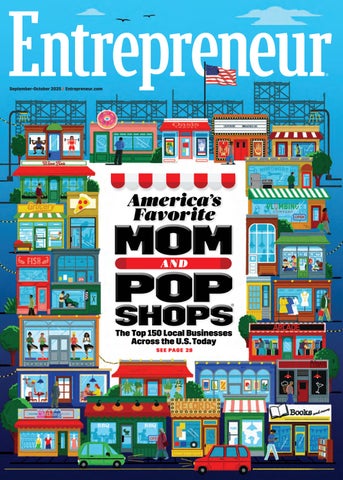
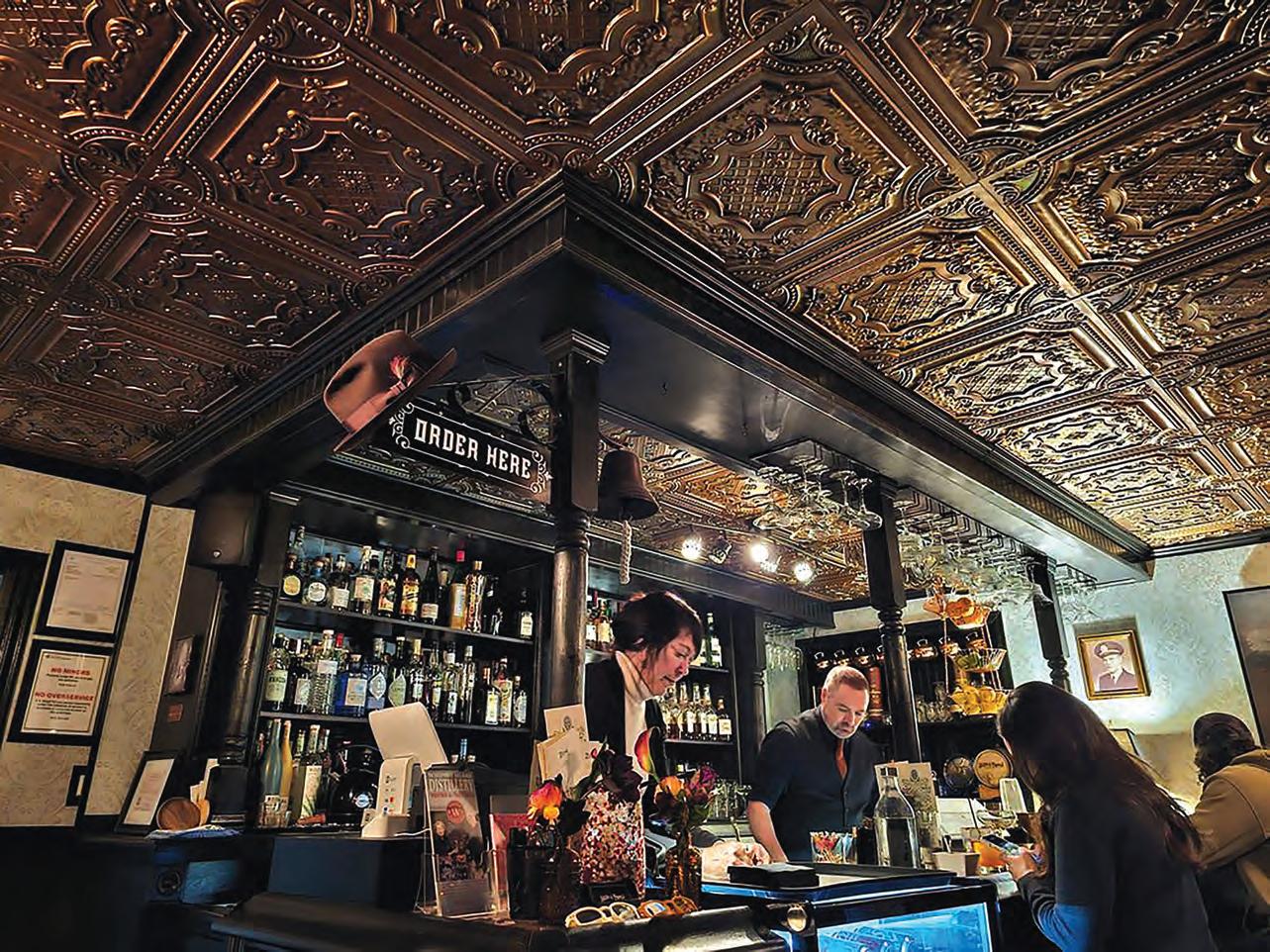
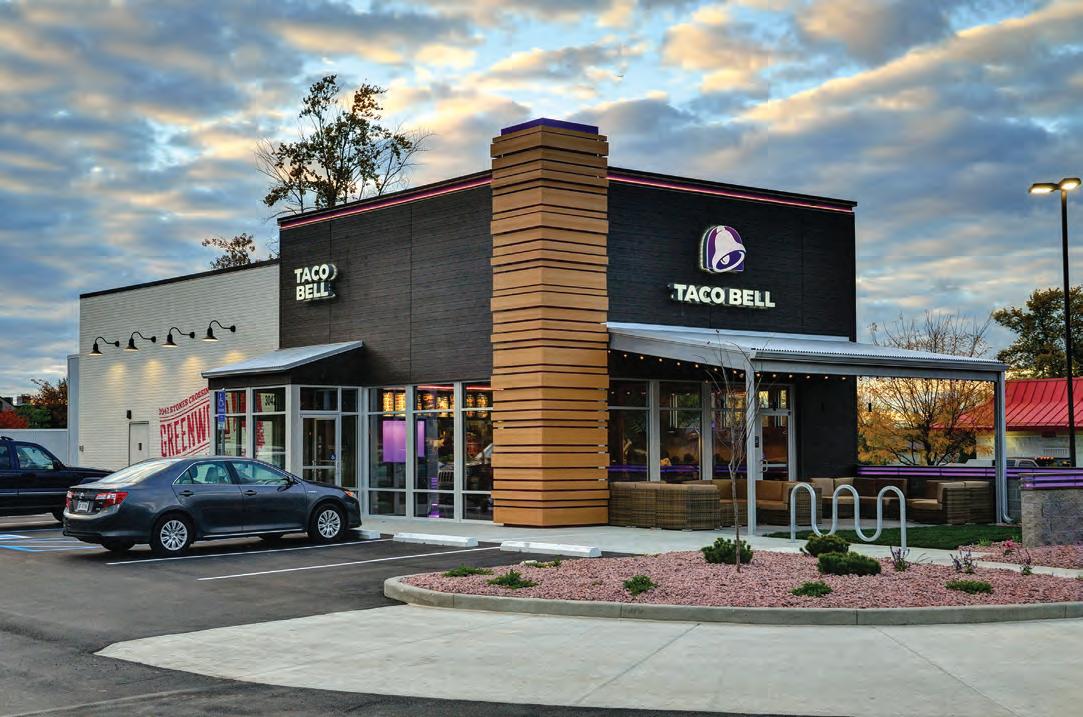
Skein & Tipple, a yarn store and cocktail bar in Clinton, Washington, where drinks sometimes come with tiny, ugly sweaters (really). P.36
EDITOR’S NOTE
10 How to Defuse Difficult Conversations
Just use these 10 magic words. by JASON FEIFER How by JASON FEIFER
September-October 2025
BUSINESS UNUSUAL
12 When the Billionaire Met the NFL Star...
A playbook for success, from billionaire Mark Cuban and NFL star Micah Parsons. by JASON
FEIFER
16 A True Mindset Shift
Six entrepreneurs share what they once thought was important, and what they’ve learned since.
18 Where the Best Ideas Come From
I ran a global advertising firm. Here’s how we came up with winning concepts. by
ANDREW ROBERTSON
22 Don’t Stop Writing!
There’s much to gain by writing things yourself—and much to lose when you outsource it to AI. by
ELIZABETH WARDLE
24 This Stuff Is Awesome
Earbuds to help you sleep, the best new digital art frame, and more gear you can’t live without. by
MARIO ARMSTRONG
26 This Predicts Success
We studied 7,000 entrepreneurs. Here’s what the most successful ones had in common. by MARKUS OVER AND SPENCER GREENBERG
FRANCHISE
53 The Top Suppliers in Franchising
Who’s the biggest help of them all? Our survey says... by
TRACY STAPP HEROLD
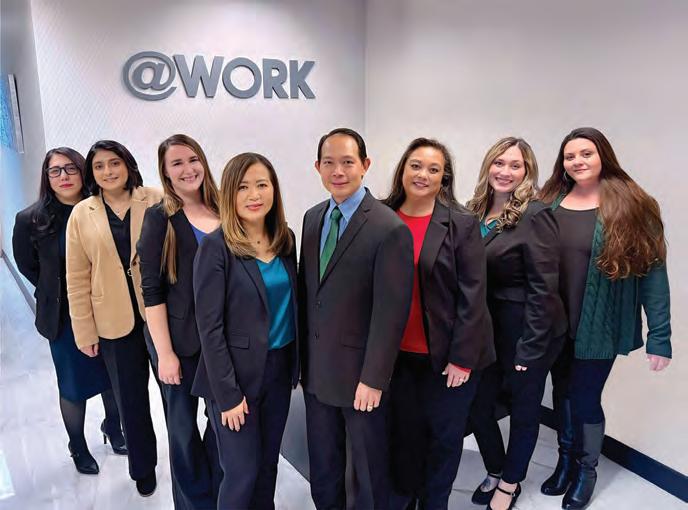
100 A $12 Million Staffing Franchise
How this franchisee built a powerhouse AtWork business. by
CARL STOFFERS
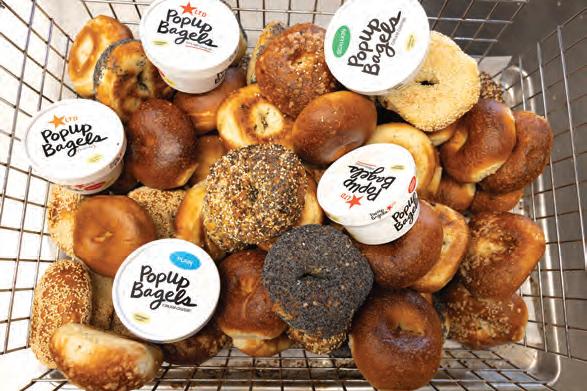
102 Bagels, Built to Sell PopUp Bagels has engineered a simple, high-volume, highprofit business.
by CARL STOFFERS
104 What It Really Costs
How to understand all the fees in franchising, and find the best deal for you.
by MARK SIEBERT
106 What It Takes to Sell the Most
We studied the top performers at multiple franchises. Here’s what they all do well.
by KIM KAVIN
115 The Top Global Brands in Franchising
Want to own a location outside the U.S.? Start with this list. by
TRACY STAPP HEROLD
CLOSER
128 What Inspires Me
I used to be a solo operator. This baton taught me how to rely on others.
by KK HART
→ PITCH OUR INVESTORS TO BE ON ENTREPRENEUR ELEVATOR PITCH
We welcome founders who have scalable products or services that are ready for investment, and who have a specific plan for how that investment can help them grow. APPLY TO BE ON THE NEXT SEASON: ENTM.AG/EEPAPPLY
→ A BETTER BAGEL BIZ The food industry is hard. So PopUp Bagels built a shop to make it easy P.102
How This Real Estate Company Streamlined Purchasing, Optimized Costs, and Enhanced Spending Visibility
With 1,500 team members across 260 sites, ease and efficiency were top priorities.
About a year ago, Mallory Hoffmeyer faced a situation that many growing businesses can relate with: a lack of control, visibility, or insight into procurement spending across a sprawling organization.
Hoffmeyer serves as Senior Director of Procurement at RangeWater Real Estate, a fully integrated real estate firm founded in 2006. The company specializes in multi-family and build-to-rent properties, providing development, property management, acquisition, and investment management services. RangeWater operates throughout the Sunbelt and Mountain West regions in the US, with physical offices in Atlanta and Dallas and employing roughly 1,500 team members across 260 sites.
With each site requiring a regular supply of items on hand, “RangeWater’s properties require constant restocking of office supplies, event and marketing items, and janitorial materials,” says Hoffmeyer. “Property managers were making purchases through individual Amazon Business accounts, resulting in nearly $80,000 in operational spending over 12 months.”
Consolidating procurement across a growing number of sites Keeping tabs on all this purchasing became increasingly difficult. So, Hoffmeyer and RangeWater’s corporate accounting team set out to find a solution. Last June, Hoffmeyer began working with RangeWater’s account executive at Amazon Business to implement the Amazon Business Associated Accounts Program (AAP).
The AAP program provided RangeWater with a consolidated view of procurement activities across its sites, along with aggregated reporting to track spending by category and item. “We were excited by the prospect of stopping the use of personal accounts for business purposes, gaining purchase visibility at a corporate level, and allowing sites to be invoiced for Amazon orders,” Hoffmeyer explains.
“Such a sizable transition required close attention to detail and Amazon Business offered RangeWater exceptional support,” Hoffmeyer says. “They explained the process clearly and provided lots of visual aids for sharing with our teams. They were always available to escalate invoicing approvals and got on the phone with site managers personally to troubleshoot specific account issues. We completed the onboarding in roughly 90 days which was right on schedule for what we would consider a successful roll out.”
Benefits that continue to improve
The expanded smart business buying relationship between RangeWater and Amazon Business has delivered significant improvements in procurement efficiency in the following ways:
Enhanced visibility: RangeWater gained a clear view of spending patterns across its communities, enabling data-driven procurement decisions through the use of Amazon Business Analytics. Once onboarding was complete, Hoffmeyer says RangeWater’s primary use of AAP’s reporting has been to track and reduce delinquency among its various sites. “Having the visibility on which sites need extra help keeping their payables up to date is a huge benefit,” she says. “It has reduced workload on our corporate accounting team and allowed us to centralize invoice processing as needed.”
Cost optimization: Access to business-only pricing and bulk ordering has helped to deliver competitive and consistent pricing on a wide range of products, while discounts on Business Prime memberships further reduced costs. “We are early in the program to estimate overall savings on orders, but it is fair to say that we are seeing significant cost savings already in prime subscriptions due to the 50% off rate that was made available through the Associated Accounts Program.” Hoffmeyer says.
Streamlined purchasing: As an AAP member, each RangeWater property gains access to a dedicated line of credit and customizable invoicing terms. This streamlined approach eliminates the need for credit card transactions, enhancing convenience while reducing administrative burdens.
Looking to the future, RangeWater’s Amazon Business account executive along with their category adoption manager, plan to hold strategic roundtables with the 10 top-spending RangeWater sites to gather feedback and drive even greater adoption across the entire portfolio while supporting specific RangeWater procurement initiatives.
“[AAP] is great for overseeing and simplifying the orders of a diverse portfolio of sites,” Hoffmeyer says. “We are excited to continue to build the relationship.”
To learn more about how Amazon Business can help you streamline purchasing and optimized costs, visit business.amazon.com
EDITOR IN CHIEF Jason Feifer
CREATIVE DIRECTOR Paul Scirecalabrisotto
DEPUTY EDITOR Frances Dodds
EDITORIAL
MANAGING EDITOR Monica Im
SPECIAL PROJECTS EDITOR Tracy Stapp Herold
COPY CHIEF Jessica Levy
RESEARCH Andre Carter, Eric White
SPECIAL PROJECTS COORDINATOR Jordan Hall
CONTRIBUTING EDITOR Liz Brody
CONTRIBUTING WRITERS Mario Armstrong, Leah Daniels, Spencer Greenberg, KK Hart, Kim Kavin, Markus Over, Andrew Robertson, Mark Siebert, Sal Vaglica, Elizabeth Wardle
ENTREPRENEUR.COM
EXECUTIVE EDITOR Brittany Robins
DEPUTY DIGITAL EDITOR Melissa Malamut
SENIOR DIGITAL CONTENT DIRECTOR Jessica Thomas
ENTREPRENEUR STUDIO DIRECTOR Brad Gage
VIDEO PRODUCER Jeremy Belanger
SENIOR BUSINESS EDITOR Carl Stoffers
EDITOR, CONTRIBUTOR NETWORK Maria Bailey
SUBSCRIPTIONS EDITOR Mark Klekas
SENIOR FEATURES WRITER Amanda Breen
NEWS REPORTER Sherin Shibu
ASSOCIATE EDITORS, CONTRIBUTOR NETWORK
Chelsea Brown, Kara McIntyre, Micah Zimmerman
RESEARCH INTERNS Alisha Bajaj, Ava Brooks, Natasha Libombo
PRODUCT TEAM
VP, DATA & OPERATIONS Michael Frazier
AD OPERATIONS COORDINATOR Daniel Belyaks
CHIEF TECHNOLOGY OFFICER Jake Hudson
VP, OPERATIONS Shannon Humphries
PROJECT MANAGERS June Munoz, Julianne Page
SENIOR ENGINEERS Jace Poirier-Pinto, Abel Trotter
ENGINEERS Angel Cool Gongora, Michael Flach
FRONT-END ENGINEERS Lorena Brito, John Himmelman
QUALITY ASSURANCE TECHNICIAN Jesse Lopez
ART DIRECTOR Christian Zamorano
SENIOR DESIGNER Jayla Buie
GRAPHIC DESIGNER Andrew Chang
DIGITAL MEDIA DESIGNER Monica Dipres
DIGITAL PHOTO EDITOR Karis Doerner
BUSINESS
CEO Ryan Shea
PRESIDENT Bill Shaw
CHIEF OPERATING OFFICER Michael Le Du
ASSOCIATE PUBLISHER/MARKETING Lucy Gekchyan
VP, SPECIAL PROJECTS Dan Bova
PRODUCTION COORDINATOR Mackenzie Truman VP, NATIVE CONTENT Jason Fell
SENIOR INTEGRATED MARKETING MANAGER Wendy Narez
INTEGRATED MARKETING ASSOCIATE Ashleigh Dennis
MARKETING
SVP, INNOVATION Deepa Shah
PRODUCT MARKETING MANAGER Arnab Mitra
MARKETING COORDINATOR Chris Desrosiers
SENIOR MARKETING MANAGER Hilary Kelley
ASSOCIATE DIRECTOR, DIGITAL CAMPAIGNS Jillian Swisher
DIGITAL ACCOUNT MANAGER Michelle Gaudy
BUSINESS DEVELOPMENT
VP, BUSINESS DEVELOPMENT Charles Muselli
GM, CONTENT SYNDICATION Matt Goldstein
MANAGER BUSINESS DEVELOPMENT Michelle Buzga
ENTREPRENEUR BOOKS
VP, ENTREPRENEUR BOOKS Sean Strain
SOCIAL MEDIA
DIRECTOR OFAUDIENCE DEVELOPMENT & MONETIZATION Anthony Del Conte
SOCIAL MEDIA & VIDEO COORDINATOR Noa Ran-Ressler
CUSTOMER SERVICE entrepreneur.com/customerservice
SUBSCRIPTIONS subscribe@entrepreneur.com
REPRINTS
PARS International Corp. (212) 221-9595, EntrepreneurReprints.com
ADVERTISING AND EDITORIAL Entrepreneur Media LLC 1651 East Fourth Street, Suite 125, Santa Ana, CA 92701 (949) 261-2325, fax: (949) 752-1180
ENTREPRENEUR.COM
Printed in the USA GST File #r129677027
ENTREPRENEUR MEDIA NATIONAL ADVERTISING SALES OFFICES
SVP, NATIONAL SALES Brian Speranzini
SENIOR ACCOUNT DIRECTOR Taryn Guillermo
ACCOUNT DIRECTOR Krissy Cirello
LOS ANGELES
VP, WEST COAST ADVERTISING Mike Lindsay
CHICAGO
MIDWEST DIRECTOR, STRATEGIC PARTNERSHIPS Steven Newman
DETROIT
MIDWEST DIRECTOR OF SALES Dave Woodruff
NATIONAL ADVERTISING DIRECTOR Hilary Kelley
FRANCHISE AND BUSINESS OPPORTUNITIES
VP, FRANCHISE SALES Brent Davis
PRODUCTS AND SERVICES ADVERTISING
Direct Action Media, Tom Emerson (800) 938-4660
ADVERTISING PRODUCTION MANAGER Mona Rifkin
EXECUTIVE STAFF
CFO Chris Damore
DIRECTOR OF FINANCE Tim Miller
FINANCE SUPPORT Jennifer Herbert
CORPORATE COUNSEL Ronald L. Young
ASSOCIATE COUNSEL Brittany Ortiz
LEGAL ASSISTANT Cheyenne Young
Vol. 53, No. 5. Entrepreneur (ISSN 0163-3341) is published bimonthly by Entrepreneur Media LLC, 1651 East Fourth Street, Suite 125, Santa Ana, CA 92701. Periodical postage paid at Irvine, CA, and at additional mailing offices. POSTMASTER: Send address changes to Entrepreneur, P.O. Box 6136, Harlan, IA, 51593-1636. One-year subscription rates in U.S.: $19.97; in Canada: $39.97; all other countries: $49.97; payable in U.S. funds only. For customer service go to entrepreneur.com/customerservice or mail subscription orders and changes to Entrepreneur, Subscription Department, P.O. Box 6136, Harlan, IA, 51593-1636. For change of address, please give both old and new addresses and include most recent mailing label. Entrepreneur considers its sources reliable and verifies as much data as possible, although reporting inaccuracies can occur; consequently, readers using this information do so at their own risk. Each business opportunity and/or investment inherently contains certain risks, and it is suggested that the prospective investors consult their attorneys and/or financial professionals. Entrepreneur is sold with the understanding that the
will be treated as unconditionally assigned for publication,copyright purposes and use in any publication or brochure,and are subject to Entrepreneur’s unrestricted right to edit and comment.
ENTREPRENEUR.COM / September-October 2025
Hard Talks, Made Easier
Business (and life) is full of difficult conversations. Here’s the best way I’ve found to have them.
WE THINK DEEP, but we often talk shallow.
If you’ve ever argued with a partner, you understand this. You might fight about who should clean the sink, but it’s not really about the sink—it’s about something deeper, like feeling unappreciated. But because big things are hard to talk about, we often express ourselves through little things.
The same thing happens at work. A coworker might snap at you. A client might complain about something small and meaningless. Your job is to figure out what they’re really saying—because that’s the only way to really solve the issue.
Recently, I came across 10 magic words that do exactly this. It might be the most clarifying sentence you’ll ever speak.
Whenever someone acts strange or upset, just say this: “It seems like you’ve got a reason for saying that.”
I picked up that phrase from negotiation expert Chris Voss, the former FBI hostage negotiator and author of Never Split the Difference. Just imagine using it: Your spouse yells at you about cleaning the sink. You reply: “It seems like you’ve got a reason for saying that.”
A client demands something unreasonable. You reply: “It seems like you’ve got a reason for saying that.”
A coworker says something mean. You reply: “It
seems like you’ve got a reason for saying that.”
“It’s disarming,” Voss explains. “The more you encourage the other side to talk, the more likely it is that you’ll get to the moment of collaboration quicker.”
That’s because once you know “the reason they’re saying that,” you can engage with that deeper truth—which is much clearer and easier to understand than whatever proxy they had fixated on.
After hearing Voss explain this, I realized that I’ve used a version of it many times. It always works. For example, here’s a recent time I used it while on the job at Entrepreneur I often join sales meetings with our large clients. My role is to talk about the Entrepreneur brand, our audience, and how we serve them.
the part of our audience that matters to you?”
Recently, we met with one such client. Our head of sales opened the meeting like he usually does, with some statistics about our audience. It’s boilerplate stuff. Nobody ever questions it.
But on that day, someone did. A woman on the client’s team asked him to clarify a statistic, then asked three or four follow-up questions. It was confusing. What was she so fixated on?
Eventually, I jumped in. I turned to the client and said: “You’re asking about this audi-
Yes, she confirmed—that is what she was really asking about. Once we established that, we could have a more meaningful conversation.
In this case, I used a version of Voss’ approach, but added my hypothesis on top of it. I often like doing that, because it shows that I’m thinking about someone else’s needs and truly trying to understand them.
Either way, the critical element here is simple: It’s about understanding people. Because misunderstandings just beget more misunderstandings.
People can be frustrating! They tend to say only a fraction of what they’re thinking.
But please remember: People aren’t random. People are reasoned. That’s not to say everyone always has a good reason. But people always have a reason—and you can’t connect with someone until you understand what theirs is.
So dig for it. Never hesitate to seek clarity. People may not always be understandable, after all, but they all want to be understood.
Jason Feifer jfeifer@entrepreneur.com
@heyfeifer subscribe: entm.ag/subscribe
Jason
Scan the QR code to schedule a free demo.
‘There’s No Days Off’
What does it take to compete at the highest level? Billionaire Mark Cuban and NFL star Micah Parsons have the answers. by JASON FEIFER
What drives people to greatness, whether on the field or as a founder? NFL edge rusher Micah Parsons has a two-word answer: “nonstop hustle.”
In his first four seasons in the league, Parsons has been a standout player for the Dallas Cowboys. We recently asked him which entrepreneur he’d most want to sit down with, and he named a fellow Dallasonian—billionaire tech investor Mark Cuban, who once owned the Dallas Mavericks and became famous through his role on Shark Tank.
CUBAN: My dad did upholstery on cars. He’d bring me to work and be like, “I want you to know what it feels like to work this job, so you never want to work this job again.” I’d always been entrepreneurial, but that’s motivating.
PARSONS: Mine was more seeing my mom. I used to see her wake up at 2:30 in the morning, go deliver newspapers. And every Christmas break, she was like, “Hey, I need you out here with me. It’s the busiest time of year.” I’m up at 3 a.m., bagging the papers.
We connected them as part of The Playbook, a series Entrepreneur cocreated with Sports Illustrated, where we pair entrepreneurial athletes with great business leaders. Our goal: Find out what it takes to succeed in two of the world’s most competitive fields of play— business and sports.
We succeed in two of the world’s most competitive fields of play— business and
In this conversation, Cuban and Parsons talk about what motivates them, what keeps them focused, and the quotes that inspire them.
MICAH PARSONS: How did you get into technology?
MARK CUBAN: I got fired, basically. I was working at a store called Your Business Software. The more I got into it, the more I realized I could learn this technology stuff faster than most people. All of a sudden, I’m going out on sales calls. One day, my boss wanted me to come into the store. I’m like, “Look, I’ve got to go close a sales deal.” And he said, “No. You’ve got to come into the
store.” I decided to close the deal. I bring him a $15,000 commission check—I figure he’s going to be happy. He fired my ass right there and then.
I decided to start my own thing. I called it MicroSolutions. I was 24, and I didn’t take a vacation for the next seven years. To me, it was like a sport. I made sure that I learned it as well as, if not better than, anybody else. We built that company up to 80 employees, $30some million in sales. Profitable. And I sold it to H&R Block.
PARSONS: So you did seven years of nonstop grinding.
CUBAN: There was nothing more terrifying than not getting it done and doing it right. We never had to lay anybody off the whole seven-plus years. And I was broke. I lived in a three-bedroom apartment, and I had five roommates, and I had to sleep on the floor.
PARSONS: And there was no going back home.
CUBAN: There’s no days off, right? I always say there’s some 12-year-old or some 80-year-old trying to kick your ass in your business—always You might think you’ve got it made, but it doesn’t matter how much money you have. Technology is changing. The world is changing. AI is brand new to just about everybody. So I’ve got to spend hours and hours and hours a day learning this shit. Because what happens if I don’t know it? Whoever does will kick my ass. And I ain’t letting nobody kick my ass.
Business is the ultimate competitive sport. The work you put in on your profession and your craft and your body, I’ve got to put in the same work.
What are you working on?
PARSONS: I’m building myself for when I’m done with this game. You just never know— tomorrow you could blow your knee out and be completely done. I wanted to start my own podcast. Bleacher Report was like, “Do one season. We’ll see how you do.” It
was one of the hardest years of my life. It was taking so much time. And then off that, people were like, “We should do a production company.”
I also started doing a series of Lions Den kids camps built off me, the Lion. I’m building my brand.
CUBAN: There’s two types of entrepreneurs. There’s the income statement entrepreneur, like me—someone who has to start from the beginning and build from scratch. Then there’s the balance sheet entrepreneur, like you. You do the work, but you’re building your brand, and in exchange, you’re getting equity in different companies. And you keep on extending your brand into other areas where you can keep on growing your balance sheet. You bring who you are to a business, and that skyrockets it. But if it doesn’t work, you go on to the next one. That’s the best position to ever be in.
PARSONS: I still wake up at 6 a.m., and I see my mom in her office typing. I’m like, “How are you up before me?” So now when I’m making my water bottles for the day, I’m like, “Oh, I beat her today.” I can’t wait to get to that point where I’m like, “Alright, Mom, you don’t have to beat me anymore.” I tell people my greatest flaw right now is I don’t have balance.
CUBAN: You don’t need worklife balance. You need to just enjoy your life and go to where your heart takes you, where your brain takes you— to where you go, “I love this.” You’ve got this moment in time. You reach a level of success, and you realize: If you want to be the best, you work till exhaustion, right? It’s not
THE MINUTE SOMEONE EVER SAYS TO YOU, ‘IT’S ALL GOING TO WORK OUT,’ JUST BECAUSE THEY DON’T WANT TO WORK, WALK AWAY. YOU’VE GOT TO MAKE IT WORK. THE ONE THING IN LIFE YOU CAN CONTROL IS YOUR EFFORTS.”
like, Well, I’ll work till exhaustion when I’m 40. Father Time is undefeated. It ain’t going to work for you then.
It’s the same way with business for what you’re doing. The athletes that I see that have made the biggest mistakes are the ones that just thought, Hey, I’m making this money. I’ll play and then I’ll figure it out later. Those are the guys that get lost.
PARSONS: My homeboy is like that. He’s like, “It’s all going to work out.”
CUBAN: The minute someone ever says to you, “It’s all going
to work out,” just because they don’t want to work, walk away. You’ve got to make it work. You hear it in sports all the time: The one thing in life you can control is your efforts. Bobby Knight, who was an old basketball coach from Indiana University, said, “Everybody’s got the will to win, but only those with the will to prepare do win.” I heard that when I was 18, and that stuck with me forever.
PARSONS: I’m the same way with Denzel Washington’s line, “Without commitment, you’ll never start. And with-
out consistency, you’ll never finish.” That’s on repeat in my head.
CUBAN: I’ve got another one from Dirk Nowitzki: “How you do anything is how you do everything.” They’re silly clichés, but they’re true. Everybody I know that’s successful has this voice in their head where the minute things start to slow down or they’re not doing what they think they need to do, one of those sayings clicks in. “How you do anything is how you do everything.” That’s the voice in my head all the time.
My Biggest Change as a Leader
Mindset shifts are hard, but they can be the key to success. We asked six business leaders how they began to look at things differently.
→ Resilience
“At my last venture-backed company, I had a ‘growth at all costs’ mindset—often making decisions that looked great for top-line growth but didn’t build a rock-solid foundation. Looking back on our less-than-stellar exit, I see all the ways we could have built a more resilient company. So when we started Frank Darling, we knew we wanted to bootstrap it, make fiscally responsible decisions, and build a strong culture and organic foundation. The irony? We’ve grown faster than my last company ever did.”
—KEGAN FISHER, cofounder and CEO, Frank Darling
Having answers → Sharing problems
“A key turning point came when I realized that as a founder, I didn’t have to have all the answers. I began to view our investors not just as financial backers, but as strategic partners. I started sharing our toughest challenges with them, and they often brought fresh ideas and even actionable solutions I hadn’t considered. Then I decided to share financials openly with the entire team. When the team is empowered with information, they often come up with innovative solutions.”
—KAT DEY, cofounder and president, Ettitude
Comparing → Focusing
“I realized that constantly comparing my small brand to better-funded competitors was draining my energy and overshadowing our actual strengths. I began focusing on things we could genuinely excel at. Instead of spreading ourselves thin trying to match every big campaign or trend, we focused on doing a handful of things exceptionally and in our own
—CHELSEA RIGGS, CEO and founding member, Amika
Hunkering down → Persisting
“Early on in my journey, every little setback would derail me. This often made me a hermit instead of a leader, discouraged my team, and limited all of our productivity. After a few years, I realized things were never as great or as bad as they seemed in the moment. A peer founder told me to take the 90-day trailing average of my sentiment as a more reliable snapshot of the business. So I learned to execute excellently on what I can control, let go of what I can’t, and trust the process from there.”
—BRAD SAVAGE, founder and CEO, Gardencup
Snap judgments → Open listening
“I’m a type-A personality and very driven. I come to conclusions quickly and tend to jump to the end of a conversation even quicker. I have learned to slow down and listen more with an open mind to whomever I’m speaking with. Here was a major breakthrough: I needed to understand that the person I’m speaking with may have just gone through something very difficult, and that’s what caused them to behave differently than their norm. Once I understand a situation, I now place myself in their shoes before determining next steps.”
—HENRY PENIX, CEO and executive chairman, Soaak Technologies
6/ Insisting on perfection → Imperfect action
“Early on, I had a tendency to hold off on launching new products until everything felt absolutely perfect. But as we grew, I realized that waiting too long meant missing opportunities. Now I view product releases as iterative—getting them to market faster, gathering feedback, and continuously improving. This allowed us to expand our product lines more rapidly and stay ahead of trends—especially in our press-on-nail category. I was able to move faster, respond to customers’ needs in real time, and ultimately strengthen the brand’s position in a competitive market.”
—ANN MCFERRAN, founder, Glamnetic
—KAT DEY,
—BRAD action
TWO PENINSULAS. UNLIMITED POSSIBILITIES.
MICHIGAN
PURE OPPORTUNITY®
Welcome to the land of limitless opportunity. Where breathtaking natural beauty stretches as far as the eye can see, and high-tech industries power fresh ideas and pristine possibilities. Ready to seize your opportunity? Visit MICHIGANBUSINESS.ORG. and discover why Michigan is the ideal state to live, work, and prosper. MACKINAC
The origins of an incredible campaign
Where the Best
Marketing Ideas Come From
My agency, BBDO Worldwide, has transformed Snickers and tons of other brands. We did it by producing lots of bad ideas first. by ANDREW ROBERTSON
Where do good ideas come from?
After serving as CEO of the advertising agency BBDO Worldwide for 20 years, working closely with some of the largest brands in the world, I’ve come to an
answer: Good ideas come from a willingness to have bad ideas—many, many bad ideas. If you want the creative process to work, you must accept that it is messy. Instead of inching your way, step by step, from data to solution in a logical progression, it’s best
to generate a chaotic array of possibilities and test them out on the problem until something clicks. Jump to conclusions without worrying about how you’ll cross the intervening gap. I know that sounds abstract. So here’s a specific example: Snickers
filling snack bar when you were hungry. Little about it has changed since then. But a few years into the turn of the 21st century, that enduring truth had started to become humdrum, and Snickers had fallen to No. 7 in the chocolate category.
The challenge became: How do you make something new and fresh out of the same old thing? A line like “Hungry? Eat a Snickers” just isn’t going to cut it.
So here’s what we did. David Lubars, who was BBDO’s chief creative officer at the time, gave the assignment to five teams of people, who got busy writing all kinds
PHOTOGRAPH BY LEIGH KELLY
Global Recognition. Proven Results.
• Affordable entry point with quick build-out time
• Affordable entry point with build-out time
• High-earning centers with potential 7-figure annual revenue
• Industry-leading 30%+ average profit margins
• Recession-resistant business model
• Comprehensive training and ongoing support
Marketing
of (bad) Super Bowl scripts. Then David reviewed them all—and buried deep inside one of their scripts, barely calling attention to itself at all, was the line “You’re not you when you’re hungry.”
David recognized how powerful that idea could be. It was, he said, “so flexible and stretchy that it could go anywhere in the world it needed to go.” And that’s what happened. But to find an idea this powerful, he first needed to generate that huge volume of bad ideas—making it possible for David to identify a kernel of greatness, see its implications, share his insight with his colleagues, and get the support it needed.
How to reproduce this process
This may sound simple, but it is not, and it rarely happens organically. Instead, it requires something that I call “the creative shift”—a deliberate and strategic choice to design the conditions that will unleash creativity when an organization needs it most.
Here’s how to be deliberate and strategic about producing bad ideas, so you can find a good one.
First, remember this: Most people don’t understand the creative process. Instead, they often tend to say things like, “A good idea can come from anyone,” or, “There are no bad ideas.” But those concepts squelch creativity, rather than unleash it— because they put pressure on everyone to perform. After all, who cares if there are “no bad ideas” if everyone can conceivably come up with a great one?
That’s why, to be truly creative in a group, you must flip these ideas around. You must tell your team:
IF YOU WANT THE CREATIVE PROCESS TO WORK, YOU MUST ACCEPT THAT IT IS MESSY. INSTEAD OF INCHING YOUR WAY, STEP BY STEP, FROM DATA TO SOLUTION IN A LOGICAL PROGRESSION, IT’S BEST TO GENERATE A CHAOTIC ARRAY OF POSSIBILITIES.
1/ Bad ideas can come from everyone.
2/ I want as many bad ideas as possible in a short period of time.
Why? Let’s start with human nature. People are afraid of making a mistake, so when they’re challenged to come up with lots of ideas, they often shut down. They feel like they’re on a high wire, with no room to deviate. They start to wonder: What if I’m wrong? What if I look foolish in front of my boss and colleagues? Will I be blamed if the idea doesn’t work?
But when you specifically invite people to come up with bad ideas, and to do it in a short period of time, they start thinking in more open-minded and
imaginative ways—because they’re no longer constrained by the need to be right or good or brilliant.
The fastest path to success
Maybe this process sounds inefficient. Why generate and consider lots of bad ideas when you can instead focus your efforts on the right one?
Here’s why: Most of the time, we’ve found that 9 out of 10 ideas are simply not good.
So instead of trying to generate good ideas (which is inefficient and unrealistic), your initial goal is to simply generate a lot of ideas. Idea volume is a good thing, because the best ideas often begin as unrealized parts of otherwise bad ideas.
Remember the Snickers exam-
ple: The winning idea was buried in an otherwise humdrum script. David was the one who stumbled upon it, and then caught it. As a leader, it’s important to completely change the way your people look at the ideageneration process and create a space where they’re encouraged to have lots of bad ideas. If you must reward people for anything at this stage, reward them for having the most bad ideas. From there, you’ll unleash creativity. And you’ll find the idea that matters.
The More You Know: 3 Reasons Growing SMBs Are Upgrading to Windows 11 Pro
Support for Windows 10 is ending soon. Now is the time to discover all that Windows 11 Pro can do.
A the standard as the most
A decade ago, Microsoft released Windows 10. It set the standard as the most robust and capable operating system available.
A lot has changed since then. On October 14, 2025, Microsoft will end support for Windows 10. Devices still running it will no longer receive standard Windows security updates, increasing risk for businesses.
A For to Windows 11
For IT leaders, that means employee devices need to be upgraded to Windows 11 Pro. Some older PCs may be eligible for the software upgrade, while others won’t meet the minimum hardware requirements for Windows 11, so new devices will be required. For business owners, Windows 11 Pro PCs with Intel vPro® deliver major upgrades to security and efficiency— essential for maintaining a competitive edge and operational integrity as your business grows.
Here are the top three reasons why small- and medium-size businesses (SMBs) are upgrading to Windows 11 Pro.
1. Enhanced, always-on security
Using outdated PCs without ongoing security updates leaves your business vulnerable. Windows 11 Pro PCs offer up-to-date protection with default hardware security, built-in antivirus and anti-malware, and advanced safeguards against phishing and malware. The result is a reported 62% drop in security incidents1—a significant reduction.
Windows 11 Pro also includes enhanced privacy settings and granular IT controls. Safeguards like biometric sign-in with Windows Hello for Business and Intel’s proactive Threat Detection Technology help spot attacks earlier. The operating system enables businesses to easily enforce security policies across PCs, apps, and AI with features like Microsoft Intune Endpoint Privilege Management2 and unique Intel silicon security features.
owners, Windows 11 Pro PCs with Intel leaves and anti-malware, —a and Windows Hello for Detection enables PCs, Management
This adds up to a more time
This adds up to a 70% reduction in attack surface compared to 4-year-old devices with Intel vPro®3. With protections built-in and always on, IT teams spend less time reacting and more time driving business forward.
2. Improved performance and productivity
Process shouldn’t slow progress. Employees need the right tools— and that’s where Windows 11 Pro PCs with Intel vPro® come in. With improved performance, responsiveness, and all-day battery life⁴, these devices boost productivity—delivering 50% faster workflows and collaboration on average⁵. AI-powered tools in Windows 11 Pro accelerate daily tasks. Features like intelligent recommendations in File Explorer and intuitive Windows search help employees find what
they need faster. Microsoft Copilot enables web search, document
they need faster. Microsoft Copilot enables web search, document summarization, and content creation—all with enterprise data protection through Microsoft Entra ID.⁶
Copilot+ PCs deliver the fastest Windows performance and unlock advanced AI experiences⁷, such as auto-framing for video calls and live translation from over 40 languages into English and 25+ into simplified Chinese⁸. Developers can also create custom AI solutions to optimize efficiency using Windows AI Foundry and Microsoft Copilot Studio⁹.
Teams work faster and smarter: 70% of Copilot users surveyed said they were more productive, and 68% reported improved work quality. Additionally, 89% of employers expect improved job satisfaction and employee retention with Copilot+ PCs10
3. Hardware and software are 100% business ready If you have valid Windows 10 Pro licenses and your devices meet minimum hardware specs, upgrading to Windows 11 Pro is free and straightforward. If you’re buying new devices, Windows 11 Pro PCs are built for fast, cost-effective deployment. Windows Autopilot11 lets IT quickly set up new devices or repurpose compatible ones, while Microsoft Intune streamlines app and device management with security in mind.
Powered by Intel® Core™ Ultra processors and the Intel vPro® platform, these PCs deliver scalable performance so your team can focus on growth.
advanced AI experiences⁷, such as auto-framing for video calls custom AI new devices, Windows 11 Intel vPro® these PCs team can focus on growth.
Support for Windows 10 ends October 14, 2025. Upgrade to Windows 11 Pro to keep your team on secure, powerful, and highly capable devices and apps.
1 Microsoft commissioned Windows 11 Survey Report. Techaisle, September 2024. Windows 11 results are in comparison with Windows 10 devices.
1 Microsoft commissioned Windows 11 Windows 11 results are in comparison with Windows 10 devices.
2 Microsoft Intune and Entra ID sold
2 Microsoft Intune and Entra ID required; sold separately.
3 Based on IOActive’s “Intel vPro® 13th Gen Attack Surface Study” published March 2023 (commissioned by Intel), which evaluates Intel vPro® devices powered by 13th Gen Intel Core processors against four-year-old Intel-based PCs on Windows OS. Details at www.intel.com/ performance-vpro. Results may vary.
3 Based on IOActive’s “Intel vPro® 13th Gen Attack Surface March 2023 (commissioned by Intel), which evaluates Intel vPro® devices by 13th Gen Intel Core PCs on Windows OS. Details at www.intel.com/ vary.
4 life varies and with
4 Battery life varies significantly by device and with settings, usage and other factors.
5 Results in comparison to Windows 10 PCs. Improve your day-to-day experience with Windows 11 Pro laptops, Principled Technologies, April 2023. Report commissioned by Microsoft.
5 Results to Windows 10 your 11 Pro 2023.
6 Microsoft 365 license.
6 Requires eligible Microsoft 365 license.
7 Copilot+ PC experiences vary by device and region and may require updates continuing to roll out through 2025; timing varies. See Copilot+ PCs FAQ (aka.ms/copilotpluspcspro).
7 vary and varies. See
8 Live Captions translates video and audio subtitles into English from 40+ languages and from 27 languages into Chinese (Simplified). See Copilot+ PC FAQ ((aka.ms/copilotpluspcspro).
8 subtitles from 27 languages into Chinese (Simplified). PC FAQ
9 Requires Microsoft 365 along with tenant and per user licensing.
10 What can Copilot’s earliest users teach us about generative AI at work?, Microsoft Work Trend Index Special Report , November 2023.
9 user 10 users AI at work?, Microsoft Work Trend November 2023.
11 Microsoft Intune and
11 Microsoft Intune and Microsoft Entra ID required; sold separately.
Don’t Let AI DoYour Writing for You
There’s much to gain by writing things yourself—and much to lose when you outsource it. Here’s why entrepreneurs need to be writers. by
ELIZABETH WARDLE
Every single step of an entrepreneurial journey happens through some form of writing—from early pitches to later marketing campaigns, from contracts to plans. The academic phrase for this is: “Writing mediates your activities.” In other words, writing helps you get things done.
But many people have a vexed relationship with writing. They remember their high school teacher’s red pen, the five-paragraph essay, and their anxiety over high-stakes writing tests. They remember memorizing rules that they then didn’t get quite right, and hear voices in their heads telling them they are better at math, or asking why they didn’t learn to write properly in their English classes. For these people, writing is something they would prefer to avoid.
For anxious writers, a tool like ChatGPT might feel like a godsend. After all, why wouldn’t you want to get those writing tasks out of the way without the struggle? If a new tool can do the work for you, why not take advantage? If AI can give you 10 new marketing slogans or draft a contract in 10 seconds, why not let it? You can skip the replay of your high school English teacher’s voice in your head, stop worrying about comma splices, and just let the technology take over.
There’s no doubt that AI will be—already is—part of our writing lives going forward. But we lose something when we blindly embrace new writing tools, skip the composing process entirely, and run away from our bad experiences with writing.
The first thing we lose by relying too much on AI is one of the major functions of writing: human connection. Do you remember the ad Google ran during the Olympics (“Dear Sydney”) suggesting kids should use AI to write a letter explaining their admiration for Olympians? Sports writer Shehan Jeyarajah wrote: “Their pitch is really, ‘Hey, we can feel and express emotions so your daughter doesn’t have to.’” And there was a strong public outcry against the ad. What surfaced in that moment was that writing connects people—and this connection is not something we want to outsource to a computer. If we don’t want AI to replace human emotions and relationships, then we need to think carefully about when and why we rely on AI tools.
When you face a writing task large or small, ask yourself two questions: Who am I writing to? What connects with those audiences and feels meaningful to them?
Sometimes, what connects us is imperfection. Consider the letter your child might write to their Olympic hero. The misspellings and the awkward language are actually what make the writing meaningful. These illustrate that a breathing and evolving human being is behind the words, and the words are heartfelt. The polished and perfect sentences that AI produces are not what humans would write to another person with whom they have or want to have a connection. And telling AI to “revise to sound
more like an 8-year-old” is just faking human connection.
In addition to human connection, another important function of writing is learning. Writing is not about producing a product—or at least, it is not just about producing a product. What happens when you sit down to write a letter to an old friend, a marketing campaign, or a white paper? Do you put your perfectly preformed thoughts down on the page exactly as they are in your mind? Probably not. Instead, the act of trying to turn ideas into written text is an act of learning. As you force yourself to write sentences and sketch out thoughts, you find that your ideas change. Unclear thoughts become clearer, and one idea leads to another. The act of engaging in writing is an act of thinking and learning.
When we rely on AI tools to simply create a written product for us, we are not writing. We are producing a final product that
reminded of variables you had not yet considered and needed to hammer out? As you wrote an email to a friend about your latest venture, did you gain a new perspective on your work?
You lose something when you skip the part of writing that is drafting, thinking, and learning. If you just instruct an AI tool to write the pitch for you or to email your friend an update, you miss the opportunity to learn new things that will make your business better. You sell yourself short.
If you are an anxious writer, you might find that your past feelings and experiences get in the way of writing to learn. This is very common. I teach writing at Miami University, and I invite you to try a few of the methods I share with my students.
First, identify and talk back to the voices in your head that criticize your writing. Your rule-obsessed AP English teacher is not welcome here. Actively
learn, not to write a product for someone else’s consumption.
Third, if you really struggle to get words on a page because you are afraid of making mistakes, change your tools and environment: Use pen and paper and “freewrite” without stopping; turn your monitor off and just type as quickly as you can; storyboard your ideas; talk into your phone’s Notes app and then use that as a first draft.
We write because we need to get things done; writing mediates all the activities we care about. Writing is mediating our activities because—and when—it enables meaningful relationships and communication between human beings. Those activities exist in the first place because we imagined them as we used writing to think, learn, and create. We innovate new ideas and paths forward when we engage in the act of thinking through writing. As you navigate the changing world of AI-powered writing
WHEN WE RELY ON AI TOOLS TO CREATE A WRITTEN PRODUCT, WE ARE NOT WRITING. WE ARE PRODUCING A FINAL PRODUCT THAT MAY OR MAY NOT HAVE MEANING FOR OTHER HUMANS— AND WE SKIP THE PROCESS OF THINKING AND LEARNING.
may or may not have meaning for other humans—and we are skipping the process of thinking and learning.
Make a quick list of the kinds of writing you need to do in order to make your business successful. What happens when you go through the process of writing these texts? For example, as you wrote and practiced your first pitch to a potential partner or funder, did you learn as you drafted? Did one idea lead you to a new one? As you wrote a contract for a new partner, were you
replace her with a voice that encourages you to keep going and make meaning with words.
Second, remind yourself that writing for learning is a private sandbox where you can get anything on the page, and no one but you will see it. Your spelling errors and sentence fragments don’t matter; you are simply writing to see what you discover. If the idea of writing full paragraphs and formal prose increases your heart rate, then write in bullets, fragments, or even dialogue. The goal is to
tools, don’t skip the opportunity to slow down and engage in the composing processes that will help you imagine new ideas, perspectives, and connections.
Elizabeth Wardle is University Distinguished Professor, Roger and Joyce Howe Distinguished Professor of Written Communication, and Director of the Howe Center for Writing Excellence at Miami University of Ohio. Her latest book is Writing Rediscovered: Nine Concepts to Transform Your Relationship With Writing
Your 5 New Favorite Things
With Emmy Award-winning tech expert Mario Armstrong’s top finds, your 9-to-5 will have more joys and fewer frustrations—and your downtime will benefit too.
1/ Earbuds for an easy night.
If you need white noise to fall asleep or are a light sleeper, the Soundcore Sleep A30 earbuds [$229; soundcore .com] can help—on the road or at home with a partner. With memory foam tips and a secure silicone fin, these tiny buds stay put, and once the case detects snoring, the active noise-canceling masks its pitch, keeping you asleep. Prefer white noise? Soundcore’s app lets you customize a relaxing soundtrack, and the earbuds last nine hours on a full charge—enough to get through a whole night.
on the eyes.
2/ Art that’s easy on the eyes. With this digital art frame, you can refresh your office decor with a swipe of the app. The 4.4-pound InkPoster Affresco 13.3” [$700; inkposter.com] stands apart because of what it lacks (glare!) and what it provides (authenticity!). Its 1,200-by-1,600-resolution E Ink Spectra 6 display runs on a built-in rechargeable battery that lasts about a year per charge. Access thousands of faithfully recreated ink-onpaper designs with a matte, glare-free finish and swap them out using the app—no subscription required.
InkPoster
3/ A dock that declutters.
The Gitryin Desktop Charging Station 12-in-1 [$173; gitryin.com] is built for home and travel, offering eight surge-protected AC outlets for desktop devices like computers and lamps. Inside, four of those outlets are designed to work with Gitryin’s 40watt chargers, with USB-C or Lightning cables that retract to keep your desk tidy. Pull those chargers out for on-the-go use, where the extra USB-C input can power a phone, watch, or earbuds.
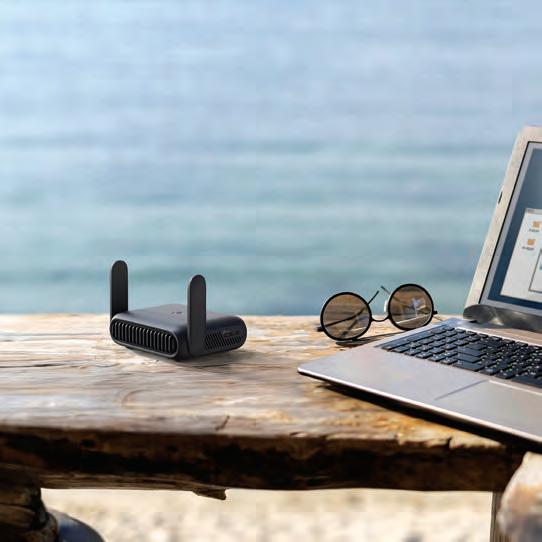
4/ Wi-Fi for wanderers. Working on the road? The TPLink BE3600 Wi-Fi 7 Travel Router [$140; tp-link.com] is about the size of a deck of cards and helps you connect from anywhere. When you’re on a public Wi-Fi, use it to bypass log-in pages. It supports roughly 35 different VPN providers to enhance your online security. The router doesn’t have a battery, so you’ll need to supply 5 volts using almost any charger. In situations where hotels or cruise ships limit your number of connected devices, TP-Link lets you share a single connection with multiple devices.
5/ The transformer of travel bags.
While big bags get all the attention, savvy travelers know a good day-bag can make a trip, whether as a personal item tote for seat 16A or a sack for essentials around town. For shorter trips where a carry-on fits the bill, the bulk storage in the Cotopaxi Allpa 50L Adventure Travel Pack [$300; cotopaxi.com] has room for your packing cubes, kicks, and a 16-inch laptop. The 8-liter sling bag that zips on top makes getting to your destination— and exploring it once you arrive—easier.
TEN YEARS, 500 UNITS, ZERO PRIVATE EQUITY
How Mark W. Davis and Frank Torre Transformed PuroClean
In 2015, when Mark W. Davis and Frank Torre acquired the PuroClean franchise network, their vision was clear: to build PuroClean into a movement, making it a World-Class Brand that could serve more communities across North America with compassion, technical training, and Relentless Customer Service.
A decade later, that vision has become reality. They saw a chance to grow the PuroClean brand, bringing essential restoration services to more home and business owners, while offering a meaningful business opportunity to aspiring entrepreneurs.
Under their leadership, PuroClean has expanded from 222 units to more than 500 locations in the U.S. and Canada, stretching from Hawaii to Puerto Rico, San Diego to Vancouver, Miami to St. John’s, Newfoundland. From the beginning, Davis
and Torre doubled down on investing in training, systems, infrastructure, and most importantly, people—a stark contrast from the industry trend of turning to private equity for rapid expansion.
That people-first approach meant investing directly in Franchise Owner development, offering a three-week New Franchise Training program, ongoing education through courses on the PuroClean Online Academy, and advanced certifications in commercial restoration.
By equipping PuroClean Franchise Owners with both technical knowledge and business leadership expertise, PuroClean built a network ready to deliver excellence at any scale. Today, three of the top five national insurance carriers and dozens of third-party administrators list PuroClean as a preferred provider, proof that the model of Relentless
Customer Service continues to work.
Davis and Torre’s strategic reinvestments have kept the company nimble, aligned with its Franchise Owners, and focused on long-term stability rather than shortterm returns.
For aspiring entrepreneurs, this is an opportunity to join a brand that combines industry-leading restoration and business operations training with strong revenue potential and the chance to build a lasting legacy.
PuroClean Franchise Owners come from every walk of life—they’re men and women, husbands and wives, fathers and daughters, veterans seeking their next mission, and immigrants pursuing the American Dream. What unites them is a drive to serve, answering every call with excellence and compassion, which defines The PuroClean Way.
Whether restoring single-family homes or tackling the remediation of large commercial properties, PuroClean teams are trained, certified, and equipped to respond in their local markets.
500 units is a milestone, not a finish line. With the brand excelling in service quality, response times, and customer satisfaction, they are not slowing down. From water and mold mitigation to fire, smoke, and soot restoration and biohazard cleanup services, more communities
have a demand for essential property restoration services, and more people are seeking the independence and fulfillment of business ownership. Under the continued leadership of Davis and Torre, PuroClean is prepared to deliver. Ten years, 500 units, zero private equity, and a clear runway for continued growth ahead. PuroClean is on the Move!
GROW WITH PUROCLEAN
PuroClean is expanding to high-demand markets to offer essential water, fire, mold, and biohazard services to residential and commercial properties across North America.
For information about how you can earn nearly $1M in average unit volume*, visit PuroCleanFranchise.com
What Makes a Successful Entrepreneur?
We studied 7,000 entrepreneurs, comparing their attitudes to their business results. The insights were surprising. by MARKUS OVER AND SPENCER GREENBERG
What’s more important for a startup’s success: marketing or execution? Your answer may predict how successful you’ll be.
Our organization, called ClearerThinking.org, surveyed 7,000 entrepreneurs on their personality traits and attitudes toward business. Then, we compared that data with their actual business success. We wanted to know: What really makes for a successful entrepreneur? And can it be predicted?
Some of what we found was expected. For example, successful entrepreneurs were more likely to be better educated, more comfortable with risk, better at managing stress, proactive, enthusiastic, open to critical feedback, and extroverted.
But we also found some unexpected nuance. Here, we break down three surprises.
1/ Marketing vs. product
Let’s return to our opening question: What’s more important—marketing or execution?
There’s a tension here. Some founders mainly focus on product, hoping that growth will take care of itself. This can work out well, but it can also be naive—because if you can’t attract users, it doesn’t matter how great your product is. Other founders over-index on marketing, which can generate hype for a product that’s not worthy of attention.
So we asked the 7,000
entrepreneurs in our study what they think is most crucial to a new product’s success: marketing, the idea itself, or execution. Those who favored marketing generally had weaker track records than their peers. Those who favored execution fared best.
2/ Honesty vs. deceptiveness
Entrepreneurs love to say you should “fake it till you make it.”
So is honesty overrated?
Our data found that it isn’t: The top-performing entrepreneurs tend to view themselves as consistently truthful. Does that mean you should be blunt without considering the impact of what you say?
No. More successful entrepreneurs also tended to agree with statements like, “I know how to make something sound good, even if it’s not,” and, “I can usually talk my way out of anything.” Meanwhile, less successful entrepreneurs tended to describe their actions as, “I tell it like it is, I don’t sugar-coat things.”
These findings suggest that honesty is an asset, but that it is best paired with tact and narrative skill.
3/ Fame vs. impact
Finally, we also asked people what mattered to them most when starting a company—fame, fun, impact, or money?
The results: Those who prioritized impact outperformed the rest, suggesting that positive motivations lead to positive outcomes.
e asked entrepreneurs these questions, then looked at how successful their businesses have been. Here are their answers, correlated to their business success.
WHAT creates success? There are patterns, but no clear lines. Successful founders aren’t solely builders or smooth talkers. They tend to blend ambition with openness to feedback, truthfulness with strategic framing, and impact with insight. And while no single trait guaran-
tees success, combining a genuine mission with adaptability and strong social instincts may give founders a real edge. Data can’t predict outcomes with a high degree of certainty, but these patterns should get you thinking: Do your traits align with the patterns of success?
Every neighborhood has them—the shops where you’re greeted by name, where the shelves hold stories, and where the owners pour their lives into what they do. These businesses are more than just places to buy things. They’re anchors of community life.
Each year, we go looking for the best of them. These aren’t just the buzziest or trendiest, but the ones that win hearts day after day.
Here was our methodology:
Entrepreneur partnered on this list with the data company RS11, whose business intelligence platform transforms big data into actionable insights to help small and midsize businesses optimize operations, enhance marketing, and drive growth.
We start with strict criteria: only independently owned U.S. businesses, no more than four locations, and confirmed open as of May 15, 2025. From there, RS11 evaluated public business records, consumer reviews, foot traffic analytics, and AI-derived financial and ownership insights. Rankings were adjusted by region and industry type to ensure balanced representation, and then divided into 10 of the most common local business categories.
You’ll only see a business here once. If they made it in past years, they step aside for new contenders. This year’s honorees are proof that even in a world of chains and instant shipping, small businesses can still inspire deep devotion.
Our hope is simple: that you visit them, learn from them, and remember what’s possible when passion meets entrepreneurship.
ARTS & ENTERTAINMENT
The Arcade Wichita Kansas thearcadewichita.com
The Art Cellar Banner Elk North Carolina artcellargallery.com/
Art on the Town Wisconsin
Beaver Dam Wisconsin artonthetownwi.com
Billsville West Walla Walla Washington billsvillewest.com
Mucci’s Italian Saint Paul Minnesota muccisitalian.com
Nixta Taqueria
Olea Mediterranean Kitchen
Stacked Burger Bar
The White Horse Tavern
Repair shops SHOPPING
Austin Texas nixtataqueria.com
Swansboro North Carolina oleamediterranean.com
Skein & Tipple Clinton Washington skeinandtipple.com
St. Louis Missouri stackedstl.com
Newport Rhode Island whitehorsenewport.com
Gardner’s Used Books, Inc.
LARK Toys
Leo Hamel Fine Jewelers
The Midwest Girl
Mile High Comics
Moda20
Powell’s Books at Cedar Hills Crossing
Rabbit Hash General Store
The Record Exchange
Rustler Hat Co.
Sound FX Automotive
Studio I Do Bridals
Suhag Jewelers
The Sundance Company
A Village of Flowers
Tulsa Oklahoma gardnersbooks.com
Kellogg Minnesota larktoys.com
San Diego California leohamel.com
Dubuque Iowa shopthemidwestgirl.com
Denver Colorado milehighcomics.com
Anaheim California moda-2000.com
Beaverton Oregon powells.com
Rabbit Hash Kentucky rabbithash.com
Boise Idaho therecordexchange.com
Nashville Tennessee rustlerhatco.com
Lewes Delaware sound-fx.net
Virginia Beach Virginia studioido.com
Iselin New Jersey suhagjewelers.com
Newport Rhode Island thesundancecompany.com
Nashville Tennessee avillageofflowers.net
ECONOMIC
DEALING WITH ECONOMIC UNCERTAINTY
Many small businesses are feeling the impact of tariffs and other policy changes. Here’s how they’re managing.
by LIZ BRODY
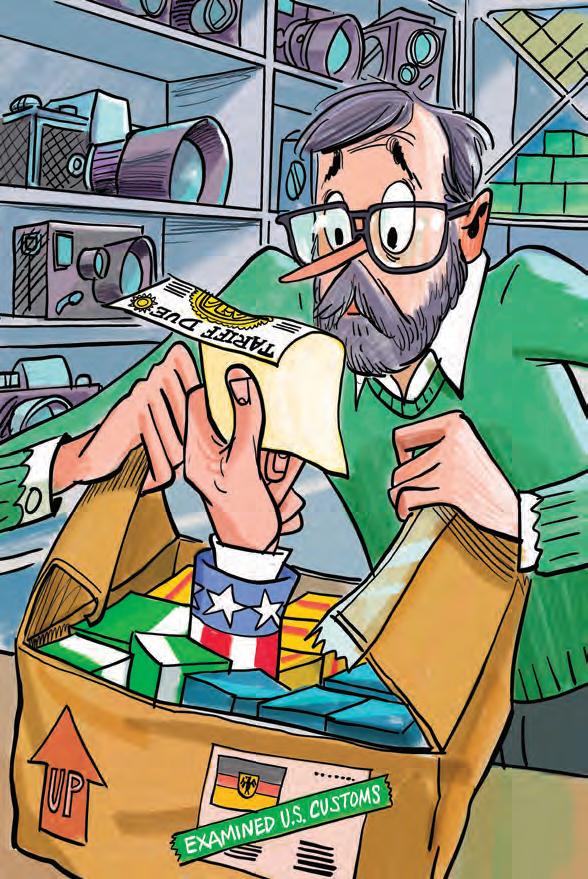
The insanity first hit Jake Shivery this year, after he ordered a supply of camera film from China. He’s the owner of Blue Moon Camera and Machine, a shop for classic photography equipment in Portland, Oregon, so it started with a pretty standard order. “The film arrived, and we started selling it,” says Shivery. “And then, two weeks later, we got hit with a tariff bill that put us underwater.”
As trade policy keeps shifting, he finds himself wondering: Do I buy this product now and load up? Or, with the tariff uncertainty, should I wait? The volatility ties up his cash and inventory until the bill comes. On top of that, he says his latest order from the German camera company Minox came with a surprise tariff of 16%—and he’s stuck in a 10-year contract with them.
There are a lot of people like Shivery these days. In a June survey by the Small Business & Entrepreneurship Council, 73% of owners said they were concerned about tariffs, and 53% reported that tariffs already had negative effects on their operations. Inflation also remained a top concern.
Holly Wade, executive director of research at the National Federation of Independent Business, has seen this kind of anxiety ripping through mom-and-pop shops across the country. In the organization’s monthly surveys of small businesses, the “uncertainty index” has been going through the roof over the last year—hitting the highest score since the index’s inception in 1974.
“Owners don’t feel confident in the environment they’re operating in and aren’t sure how to adjust their businesses or move forward,” Wade says. “Some are uncertain because of the trade negotiations, others because of immigration reform
policies or shifts in consumer spending. Some are caught in long-term contracts. And all of that can lead to hesitancy in investing in their business.”
To stay afloat, business owners often have to raise prices. “And unlike larger companies, they directly feel the heat from their customers,” Wade says. “It gets really precarious as far as trying to manage expectations.”
Nan DeStafney knows this well. She owns Blues Angel Music with her husband in Pensacola, Florida, and many of the guitars and brass instruments they sell are made overseas. “When tariffs have gone up, unfortunately those costs often have to be passed on to the customers—or we have to absorb them, which shrinks our already tight margins,” she says. “We’ve also felt the broader impact of rising costs.”
To keep costs down, DeStafney has started using fewer suppliers, trying to place larger orders in advance and leaning into their repair offerings (which don’t require importing anything). “In uncertain times, many people would rather maintain what they already own than replace it,” she says. “So we’re making a strategic long-term investment in our service department, not only as a revenue stream, but as a way to keep customers loyal.”
If you’re struggling with similar issues, Wade’s advice is to crowdsource. “Talk to your accountant and tax professional, somebody at your bank, and other business owners,” she says. “Hopefully, some of this will be off the table by the end of the year.”
As for Shivery, so far he’s been able to weather the tariffs, “but we’re in for turbulence,” he says. He keeps steady by focusing on the community his store has built. When they put on their annual show of photos from their customers, he says, “I walk in there and just take a deep breath and see what we did.”
To get your business where you want it to go, you ride the line between numbers and people. You balance what’s right for the business and what’s best for everyone who depends on it, solving for today’s challenges and creating future opportunities. Wherever your there is, CLA brings balance to get you there. Start at CLAconnect.com/balance.
OUR BEST-EVER PROMOTION
Want to draw new customers to your business? Take inspiration from these shops on our list, who share their greatest attention-getting ideas.
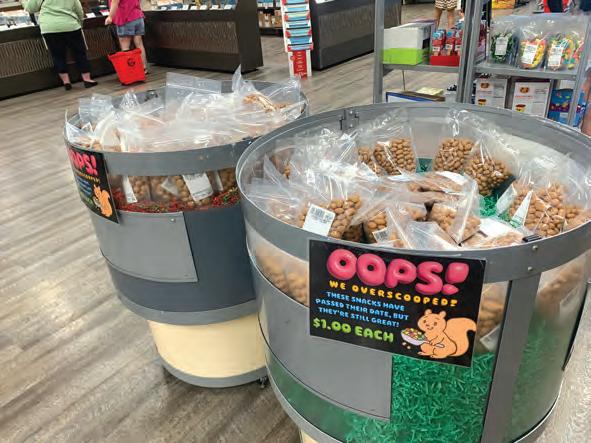
1/ The “dollar bin” for candy
“We sell candy and nuts, and started a popular ‘dollar bin’ promotion. It began when we found a big stash of Christmas goodies in May—and, well, May isn’t exactly peppermint season. So our marketing manager, Adam Walsh, proposed that we put it out for a dollar. It was a hit. Now we pull out the bin whenever we have product we want to move quickly. Everything is clearly labeled if it’s near the best-by date or a little broken—kind of like a scratch-anddent sale, but for candy.”
—Steve and Michelle Jahn, owners of Nifty Nut House in Wichita, KS
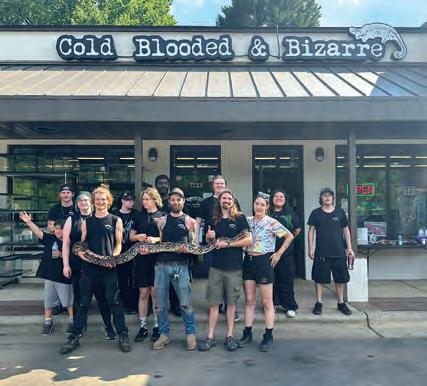
2/ A birthday party for the store
“We’re a reptile store. Our grand opening in 2019 was such an amazing promotion—so we decided to throw an annual party to celebrate our shop’s birthday. Free food is provided by local restaurants, and a keg comes from our friends at a local brewery. Throughout the day, we’ve had circus and sideshow performances, including a man who ate light bulbs and one of the world’s only female sword-swallowers. (We really wanted fire-breathing, but the fire marshal said no.) We frequently have big shop discounts, plus animals and activities for kids. It’s always a hit with our customers!”
and
—Michael and Shay Edelen and Patrick Kamberos, owners of Cold Blooded & Bizarre, Charlotte, NC
3/ Kids performance nights
“We’re a toy store. We’ve done seven ‘Happy Friday’ performances, where we invite little ones and their families to come listen to stories, sing songs, dance, and have a musical march down the hallways of our store to a free carousel ride. When we started this promotion, we held it in our bookstore with just a few kids—but it’s grown so big that we had to move the bookshelves to accommodate everyone, and then add on to our store so we could have a stage and room to gather. It is a treasured way to connect to families in our community.”
—Miranda and Scott Gray-Burlingame, and Ron and Kathy Gray, owners of Lark
Miranda and Scott and Ron and Kathy owners of
—Steve and Michelle owners of Nut House in Wichita, KS
Michael
Edelen and Patrick Kamberos, owners of Cold Blooded & NC
on
4/ Getting personal on social media
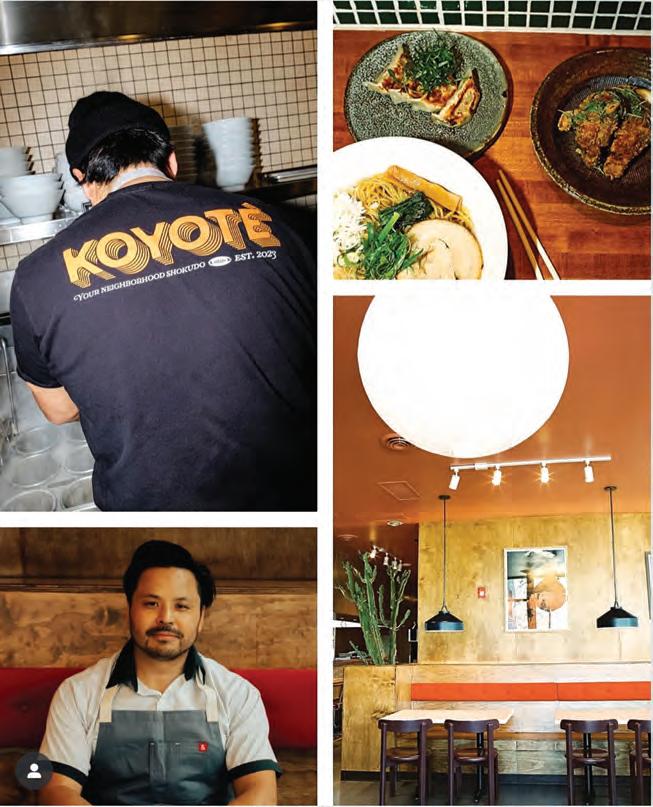
“I wanted to open up a ramen shop where even Japanese people would think, ‘Oh, this reminds me of home.’ So we serve the more delicate shoyu, the main ramen there. But people here were like, ‘This is not ramen.’ They’re used to an anime ramen shop with tonkotsu ramen. So I made an Instagram post to explain that I am Japanese, and it’s the real deal. I didn’t mean it as a promotion; I was just trying to educate. But the post got a lot of encouragement! This year, we opened a second restaurant called Junah, which is Italian/Japanese fusion.”
5/ A photo contest with prizes
6/ A rare, adorable, annual cocktail
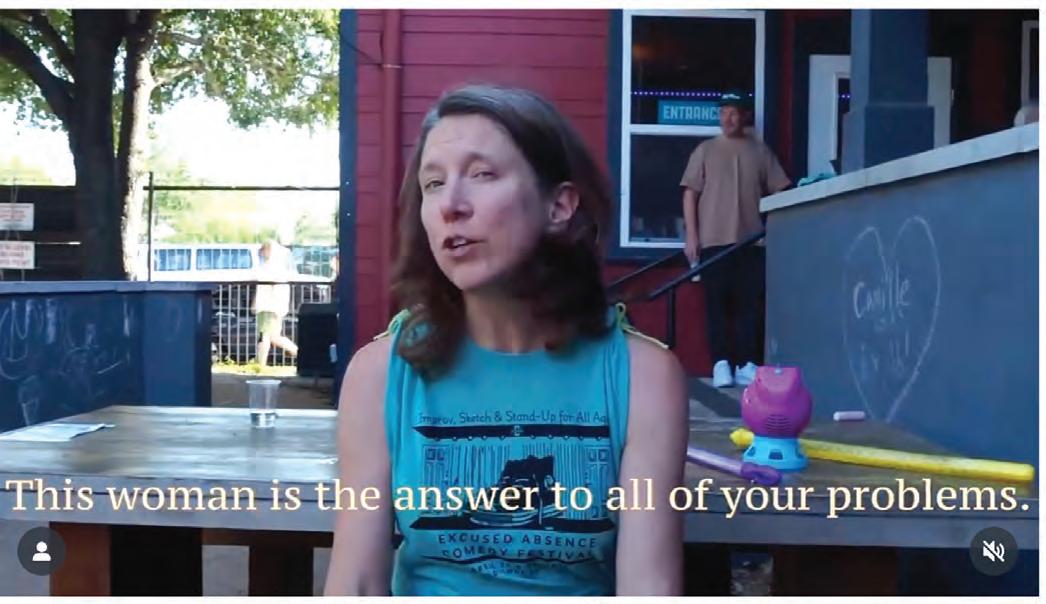
“We run a yarn store combined with a cocktail bar. For the holidays, we created a drink called the ‘Ugly Sweater’—it’s a gin-based cocktail with muddled cranberries and ginger, and each glass comes wearing a tiny sweater that Marsha knits herself. It’s like Christmas in a glass. And if you order one, you get to keep the sweater and glass. But the hitch is that Marsha only knits a certain number of the sweaters—we’ll do 100 this year. When they’re gone, they’re gone. So we have people that come back for ’em every year. They want the next one to create a collection.”
—Hiro Tagai, chef and co-owner (with Felipe Oliveira) of Koyoté in Salt Lake City, UT
Hiro chef and co-owner of in Salt Lake UT
“We ran a contest last summer where we had people submit photos of themselves enjoying something from our homemade ice cream shops. We offered prizes, and the top photos won by having people vote online. This promotion increased our followers because people were encouraging others to vote for them. It also fostered community spirit—something we work hard to cultivate. It garnered great images of our customers and product. And it opened the door. People still share pictures of themselves, their kids, or their pets eating our ice cream. That was awesome publicity for the price of a few prizes.”
—Tracy and Chad Klopfenstein, owners of Chief Ice Cream, Goshen and Granger, IN
—Matt and Marsha Owen, owners of Skein & Tipple, Clinton, WA
Matt and Marsha owners of Skein & WA
Going Global, Still Hustling: How This Founder Keeps the Startup Mindset
Celebrating its 25th year, Electronic Payments is taking its mission of helping small businesses international.
For Michael Nardy, the last 25 years have been a blur. In the best of ways.
Back in 2000, Nardy was a 19-year-old English major in Boston who happened to have a knack for computers. His interest in technology eventually evolved into a zeal for payments. “The payments industry back in the late 1990s and early 2000s was changing rapidly,” Nardy recalls. “I just fell into something that I enjoyed and was really passionate about.”
Even at such a young age, Nardy had a vision of helping small- and medium-size businesses (SMBs) grow by creating exceptional payment technologies. From his dorm room, a company called Electronic Payments, Inc. (EPI) was born. Fast forward to today and EPI has grown into a fintech powerhouse with 1,500 national sales partners and 60,000 merchants, processing over $25 billion in annual volume.
As a young college student, Nardy never imagined that he’d still be running that budding tech startup decades later. Now 45
EPI Milestones Over 25 Years
2000 - Founded in Nardy’s college dorm room
2005 - Hires first employees: Matthew Findlan (now COO) and Megan Best (now VP of Business Operations)
years old, Nardy remains firmly at the helm, overseeing EPI’s growth and innovation. “I can’t believe it’s been 25 years,” he says with a laugh.
After all these years, Nardy says he hasn’t lost his startup mindset. “I’m not the typical top-down management CEO barking orders,” he explains. “If I need to get in the weeds on something, because I’ve been in the weeds a lot through the years, I’ll jump right in.
“To me, that’s a startup mentality,” he continues. “I don’t know if that ever goes away, at least as long as I’m here.”
At EPI, Nardy says that type of mindset is contagious. “We have departments with their respective managers and supervisors of course, but everything is linear,” he says. “It’s a very cooperative, all-hands-on-deck workplace. And that’s certainly reminiscent of a startup culture.”
2006 - Headquarters established in Calverton, NY
Scan to learn more about Electronic Payments and the innovative solutions it offers.
2007 - Launched eGiftSolutions®, a gift card and loyalty platform
Next Step: Going Global
Last year, EPI launched its wholly owned processor: Cygma®. Built internally, Cygma is a frontend authorization network and backend clearing platform that offers merchants, sales partners, and financial institutions better rates, same-day funding, expanded support, and more. Nardy says Cygma now handles more than $3 billion in annual volume, with substantial accretive volume added every month.
The next step in EPI’s path forward is expanding internationally. “We partner with software technology companies and point of sale systems all around the U.S., Canada, the U.S. Virgin Islands, and Puerto Rico,” Nardy says. “But what happens, for example, when our partners have a client in Spain? You have to be able to expand beyond these borders.”
EPI recently completed the acquisition of Handpoint, an embedded payments platform designed for in-person payments, offering secure, scalable solutions with seamless integration and support for multiple currencies, languages, and regional compliance requirements.
Nardy says the acquisition effectively expands EPI’s business into the UK and Europe, and down to South Africa— with the intention of adding more countries in the coming months and years.
“Handpoint integrates with software vendors and point of sale companies and includes everything from embedded payments in, say, a vending machine to handheld POS devices that a server brings to your table at a restaurant,” he says. “This adds 18,000 connected devices and $2 billion in volume to our portfolio. … It’s a fairly big deal to get done.”
Always Innovating
Even with its sights set on global opportunities, EPI is constantly experimenting and building new products in-house. The company’s latest is called TableTurn®, a POS and order management platform designed specifically for restaurants.
“We wanted to build an Android-based point of sale that is specific to hospitality, namely sit-down restaurants and
quick-service restaurants,” Nardy explains. TableTurn offers an array of restaurant-specific features such as online ordering; mobile solutions for curbside pickup, delivery, and pay-at-the-table; check splitting; support for cash discounting; and more.
“Restaurants are complicated businesses,” Nardy says. “Their products are highly perishable. Their menus change with the seasons. They serve loyal customers, but they often have high staff turnover rates. The right POS system can help make or break the business. With TableTurn, we built something with a ton of features that is also incredibly simple to use.”
TableTurn has launched in a handful of restaurants so far, but Nardy envisions a future where restaurants all over the world will leverage its smart, efficient tools. “We’re excited and see it expanding pretty quickly over the next few years,” he says.
1. Preserve your capital.
Innovation requires resources—namely talent and technology. “Capital is the money you’ll use to build things and grow,” Nardy says.
2. Trust your intuition.
As the founder and leader, you know your business better than anyone else. “You can get all the advice in the world but, ultimately, you’re the one who has to make a decision,” Nardy explains. “Trusting your own decision-making abilities is going to give confidence to anyone else who is watching you or working with you.”
3. Go to market!
Innovation is constantly iterating. “Don’t wait for perfection because you’ll never put something out there,” Nardy says.
2013 - Released the ProCharge® mobile app, allowing businesses to turn their mobile device into a handheld POS
2015 - Acquired Exatouch®, an affordable, versatile POS for SMBs
2024 - Launched Cygma®, a next-generation payment processor
2025 - Acquires Handpoint, expands ISV strategy and toolset internationally
Michael Nardy’s 3 Tips for Harnessing Innovation
WHEN THE STRESS GETS TOO MUCH
Having a small business can take a toll on your mental health. Here’s how mom-and-pop owners manage it all.
by LIZ BRODY
If you own a small business, you’ll probably relate to Tracy Klopfenstein.
“The first two years were the worst,” says Klopfenstein, who bought a homemade ice cream shop in Goshen, Indiana, called The Chief with her husband, Chad. “We worked all the time, and I suffered burnout. My mind would spiral at night, and I’d worry about everything. I had what I would call an absence of hope.”
Without a large staff to absorb the bumps in the road, mom-andpop owners often feel like they’re riding on the rims. This past June, the WSJ/Vistage Small Business Index showed that nearly 1 in 4 CEOs frequently felt burned out or emotionally exhausted over the past three months. In a separate survey by Startup Snapshot, 72% of founders reported that the grind affected their mental health.
Burnout is business as usual for entrepreneurs, according to clinical psychologist Chandler Chang, whose mental health platform, Therapy Lab, offers short-term treatment based on approaches like cognitive behavioral therapy. “Your concentration starts to be affected, your ability to focus. And there’s something called depersonalization, where you feel like you’re not even yourself; you’ve become a work machine.”
If you’re feeling that way, she says, it’s a sign that you need to take a break—the very thing that seems impossible to do. But at some point, breaks become necessary—for you and your business.
Chang suggests checking in with yourself every hour on whether you can keep going. “You start to learn when you really do need a break,” she says. Just getting exercise or an extra hour of sleep can really help. To counter the downward spirals of anxiety, she encourages a mindset of curiosity. Rather than thinking, I’m going to bomb, try shifting to: I wonder how this will go, what will this look like? “When you’re building a business,
you’re doing it without a map,” she stresses. “So you can’t expect yourself to get it right every time.”
Klopfenstein found it helpful to take an antidepressant. “A low dose made a world of difference,” she says. “This was not about being mentally strong enough. This is a chemical thing. I needed a boost.” Chang, who did the same herself when she felt burned out, says it can be quite helpful when being down is not just a passing feeling.
Business owners also often struggle from isolation—feeling like it’s all on them and no one else gets it. “I think I still have PTSD from the pandemic,” says Jamie Erickson, founder of the hospitality brand Poppy’s in Brooklyn, New York. She’d been catering big, fancy events with 600 people, which all came to a crashing halt. “I had a 9-month-old and another child, and Poppy’s is the sole breadwinner for the family. We went from a multimillion-dollar business to zero.”
Chang is a big believer in the power of small behavior changes. Just going to get a coffee and striking up a conversation with a stranger can be surprisingly helpful. Yes, you might feel like nobody understands your plight— but once a month or so, try saying to a friend: “This might not make any sense to you. But can I explain what I went through today?”
Consider making changes to your business, too. Erickson ended up pivoting Poppy’s to a neighborhood cafe and market plus a small event space while catering more intimate events. She also got connected with a group of female entrepreneurs that she stays in touch with on WhatsApp. And at the ice cream shop, Tracy and Chad hired managers before expanding with a second location and doing catering with a food truck. Today, they make time for exercise—she runs and he plays pickleball—and even occasionally get away. “I’m in a much, much better spot,” she says.
Salesforce works for small business.
Small business isn’t a small undertaking. If you’re tired of running on spreadsheets and sticky notes, hunches and fumes, get growing fast with the only customer platform you’ll ever need, no matter how big you get.
OUR MOST VIRAL SOCIAL MOMENT
We all post dutifully, but what really gets people talking? A few businesses from our list share what made them pop.
1/ Authentic lo-fi vibes
Posted by Excused Absence Comedy (Austin, TX)
“My company teaches improv and sketch classes, runs camps, and does live comedy shows. Once, we had a professional filmmaker make a video about the company. It’s great, and people like it—but here’s the thing: There’s another video that an ex-student did, and it’s gotten more response than anything I’ve ever posted! She’s a sophomore in college, and it’s so personal and adorable. I think it’s because she knows me, and her video reflects the reality of the program.”
—Kristin Henn, owner
2/ Relatable family history
Posted by The Midwest Girl (Dubuque, IA)
3/ Tapping the cultural conversation
Posted by Gardner’s Used Books, Inc. (Tulsa, OK)
“We’re sisters who own a Midwest-themed apparel company, and have always been into storytelling about why we do what we do. Anytime we post a throwback picture of our parents, we get insane comments and traction. They were homecoming king and queen at Southwestern High School in Wisconsin in 1973. So every fall we share this photo of our dad crowning our mom on the football field. People see that and they’re like, ‘Oh, wow,’ because so many Midwest girls have similar stories. And when I think about what sets us apart, it’s that we’re relatable, and that’s why people want to buy from us.”
—Marissa Hoffmann and Marah Odgers, owners
“We run a used bookstore. In 2021, we did our first Banned Books Week, where we found whatever banned books we could and put them out. We always try to stay neutral in whatever we do publicly, but we love all books—and they started banning things we used to read, like To Kill a Mockingbird. When we posted about our second one in 2022 on Facebook, there was quite a bit of debate in the comments—like, The Great Gatsby? Why is that one banned? But every year we do it, the posts get a lot of interaction. People are appreciative that we’re standing up to it.”
—Socorro Gardner, owner, and her daughter Monica Gardner, director
4/ The chef’s inspiring backstory
Posted by Charles Pan-Fried Chicken (Harlem, NY)
“I run three soul food restaurants in New York City with Chef Charles Gabriel. In this video, I tell how Charles went from picking cotton in Charlotte to selling chicken on a table in Harlem to his own brick-and-mortar—and, after we got together, expanded to three locations. I’m trying to create that warm, safe feeling, like when you come home and your family is sitting at the table eating—you walk in and it’s, ‘Hey baby, how you doing? You hungry?’ I didn’t have that as a child, and I guess people didn’t have that either. I feel like it’s a go-getter, ’cause everybody wants the same thing. We all want love.”
—Chef Quie Slobert, COO and co-owner with Chef Charles Gabriel
5/ Educational SEO content
Posted by Times Ticking (Layton, UT)
“We repair watches and clocks, and our YouTube channel does pretty well. But one of our videos has over a million views. The title is the hook: ‘The #1 Most Harmful Mistake People Make With A Citizen Eco-Drive Watch.’ So if you own one, you’d want to know. Our video titles are SEO-optimized; we make content about repairing watches, a blog on the history of the brand, and videos and podcasts on the same topic. All that at once gives us the domain authority that Google’s looking for—and because of that, they push out our name.”
—Jared
—Jared Foster, co-owner with his wife, Annette Foster
6/ Riding the cultural wave
Posted by Rustler Hat Co. (Nashville, TN)
“I own a custom hat shop in Nashville. Whenever there are major events in the city, we try to create social media that’ll grab visitors’ attention. For example, when country star Morgan Wallen was playing a local concert, one of our teammates had an idea of doing our own version of the ‘Morgan Wallen walkout.’ If you don’t know it, Morgan starts every concert by walking out to the stage with someone famous from the city he’s in. It’s a thing. So we did our version with our staff on TikTok. It had over a million views. And for a small business in Nashville, we had the most epic weekend with a four- to five-hour wait list the entire time. It blew us out of the water!”
—Alex Samuels, owner
WHEN TO CALL A LAWYER
Innocent little oversights can turn into big legal messes.
are the top problems that mom-and-pop owners face.
by LIZ BRODY
When Martin Howard started selling costumes, he thought the business was straightforward: Hang costumes on racks for people to buy.
Then the lawyers got involved.
As it turns out, many manufacturers make knockoff costumes— and if Howard accidentally stocks something like an unauthorized Donkey Kong outfit, he could get in trouble. So Howard, owner of American Costumes in Las Vegas, learned a big lesson: “One must acquaint himself with what property belongs to whom,” he says.
This is why, to put it lightly, every business needs a good lawyer—even a simple mom-and-pop shop. Here, we outline four of the biggest legal pitfalls that local businesses face, according to attorney Larry Donahue, founder of Law 4 Small Business:
PROBLEM #1/ Mysterious merchandise
Howard’s problem isn’t limited to costumes. A small business needs to be extra careful when sourcing goods that involve any intellectual property. “Many manufacturers, especially those outside the U.S., don’t understand—or care about—copyright issues,” says Donahue. So you can’t assume the product you purchase has the right license. Before you work with a new vendor, ask them to see a copy of their actual license showing that you have the right to sell the product. “Just because a vendor has a ‘license to use’ doesn’t mean it’s a license for you to use,” Donahue says.
PROBLEM #2
/ Ownership of ideas
Let’s say that you hire someone to make an app, logo, costume, content, or piece of software. You need to know who actually owns that creation—because (warning!) it might not be you.
“I see this all the time,” says Donahue.
Here’s the rule: Whoever comes up with a product owns the copyright to it, except in two cases. The first is when they are a W-2 employee, in which case the company owns the copyright (assuming the work was produced as part of someone’s job). The second is that, if they are not a W-2 employee, they signed a contract that specifically grants ownership of the product to the business paying for it, usually with “work made for hire” and assignment clauses.
PROBLEM #3/ Frayed partnerships
Partnership disputes are common and take all forms. Maybe a cofounder wants to exit the company, but also wants their cut of the profits. Or they were involved in a scandal that’s damaging the brand, but refuse to leave. “Most of those fights are really expensive,” says Donahue.
All of this can be avoided by having a lawyer (or a service like LegalZoom) draw up a thorough partnership agreement, which can include plans for all sorts of contingencies, like what to do in instances of bad behavior or how to calculate value if a partner leaves.
PROBLEM #4/ Improper employee classification
Let’s say you’ve hired a freelancer, and they work for you a lot. You pay them as a 1099 independent contractor, but they might meet the qualifications of a full-time W-2 employee—and if you’re not accounting for that, then you’re not paying withholding, which the IRS takes very seriously. A local attorney can find ways to make sure you’re compliant. “Keeping you out of trouble,” says Donahue, “is much cheaper than getting you out of trouble.”
3 Creative Ways Small Businesses are Using Their Logos to Build Brands
Color. Typography. Design. These are all essential elements of a company’s logo. It takes a special combination of these things to create an image that not only represents a brand or idea, but is relevant, timeless, and evokes emotion and response.
And let’s face it: Time-strapped entrepreneurs don’t often have the skills or bandwidth to create a logo using complicated design software, or the funds to hire a professional designer.
That’s where VistaPrint comes in. With an array of logo design tools and support options, VistaPrint helps businesses of all sizes create impactful logos that quickly communicate their brand and resonate with customers.
Take it from these three small businesses that worked with VistaPrint to create custom logos as well as a wide array of marketing materials that help their brands stand out.
Founder: Distinee Gayle
Company: Fully Bloomed, which creates immersive self-care experiences for individuals and corporate groups.
Creative idea: Create a new logo specifically for the company’s flagship event, Fully Bloomed Fest.
Founder: Kelly Fowble
Company: The Thrifty Handmade, a store she founded selling various wares from fiber art to secondhand clothing.
Creative idea: Leveraging her new logo for a hybrid execution: A price tag that doubles as a business card.
In doing so, Gayle set out to give the event its own brand and identity. The new logo was used on branded event essentials like brochures, totes, pizza boxes, affirmation napkins, and acrylic signage. “Creating a custom logo for the festival ... allowed Fully Bloomed Fest to stand on its own while still staying connected to the Fully Bloomed brand,” she says. “Attendees loved how every detail felt intentional and cohesive.”
Customers always take price tags home. Now, they get to take a business card home, too. Fowble used VistaPrint’s custom hang tags and chose a rounded square design with a premium matte finish. The tags also include a QR code that directs customers to The Thrifty Handmade’s Instagram account.
Founders: Bernard & Jassmire Agyakwa
Company: Bomu, a creative studio that offers branding and content creation as well as event planning, floral design, and home decor services.
Creative idea: Using branded swag to onboard and outfit new team members.
With a freshly designed logo thanks to help from VistaPrint, the Agyakwas created a new-hire welcome box. Inside, team members receive branded shirts, custom Bomu-shaped stickers, keychains and more. “These boxes allow us to fully immerse new team members in the Bomu experience, making their welcome both intentional and memorable,” Jassmire Agyakwa says.
AUTOMATE YOUR CUSTOMER SERVICE
Want to drive more business with less work—but still keep it personal? We asked a digital marketing expert who specializes in hyperlocal businesses for his top recommendations.
by LIZ BRODY
In the past, customer service looked like this: If you were a big company, you could afford enterprise-grade technologies. And if you were a mom-and-pop shop, you were left to chitchat at the register.
Now, things are different. Customer personalization tools are widespread and affordable. A bakery on the south side of Pittsburgh, for example, used one to send shoppers messages like: “Hey Jim, It’s your birthday! Come have a pastry on us.” A beauty salon automatically emailed a product offer
FOR DO-IT-ALL HELP…
based on the service a client just had. A fitness studio lured back members with motivational quotes and customized reengagement offers.
“Customer personalization is tailoring your website, marketing, messaging, or offers to an individual user based on their behavior, preferences, demographic information, and past interactions,” says digital marketing consultant Chris Essey, who specializes in helping hyperlocal businesses.
He often equips his clients with the best tools for them. Here, he recommends his top four for small business owners.
“If I was to recommend just one out-of-the-box solution for any small business, it would be HubSpot,” says Essey. It’s easy to use and does just about everything you need: You can create different landing page content depending on the individual user, send personalized emails, write customized social posts, and capture customer data. “They also have a really good support staff.”
FOR BETTER EMAIL MARKETING…
When it comes to masters of the customer inbox, it doesn’t get better than Mailchimp, says Essey. It’s simple to use for sophisticated tasks like targeted emails based on a customer’s demographics, behavior, and purchase history, as well as drip campaigns—where, depending how the customer interacts with the first email, it will send a different follow-up message. “If email is the only thing you need done, Mailchimp’s the way to go,” says Essey.
FOR GROWING DIRECT-TO-CONSUMER…
Klaviyo goes deeper into email personalization for e-commerce than HubSpot and Mailchimp, and integrates closely with platforms like Shopify and BigCommerce. For example, Klaviyo can automatically send out abandoned cart reminders with product recommendations and, after a purchase, create email flows that ask for product reviews or offer discounts on related items.
FOR GENERATING LEADS…
To grow a subscriber list or convert website scrollers to buyers, OptinMonster allows you to create pop-ups, slide-ins, and other opt-in forms tailored to individual visitors that can collect email addresses and display the right offer to the right person. “It’s also a great opportunity for mom-and-pops to customize messages to bring users into the brick-and-mortar store,” says Essey.
But he also offers a word of caution: Although these tools are great, they should not fully replace a personal touch. “If a coffee shop sent me a handwritten card saying, ‘Hey we’re so happy you came in,’ I would be like, ‘I’m never getting coffee anywhere else.’”
Precision Cancer Care Without Borders: United Theranostics Brings Life-Saving Treatment Home
Through a bold 50-state expansion plan, United Theranostics is eliminating travel barriers for cancer patients and fueling local economies with high-skill medical jobs.
Every year, thousands of cancer patients forgo life-extending therapies because they live too far from treatment centers. United Theranostics is on a mission to change that, permanently.
United Theranostics is fundamentally reshaping personalized cancer care through a decentralized model. This innovative approach aims to eliminate the arduous travel often associated with life-saving therapies, instead delivering advanced precision oncology directly into local communities. This strategy is driven by the understanding that convenient access to care can significantly improve treatment adherence and patient well-being, especially for complex therapies. By mitigating logistical burdens, patients can dedicate their energy to recovery, transforming the oftendaunting medical journey into a more manageable path.
“Our business model is built on the conviction that decentralized access to cutting-edge theranostics will revolutionize cancer care ensuring every patient receives precision treatment close to home, transforming both outcomes and lives.”
- Robert Cherney, CEO
At the core of this transformation is the integration of cuttingedge diagnostic imaging with targeted therapies. A notable example is the groundbreaking Pluvicto, an FDA-approved radioligand therapy for metastatic castration-resistant prostate cancer (mCRPC). For men battling mCRPC, Pluvicto represents a significant advancement, and United Theranostics’ mission is to make such innovative treatments accessible to every patient, regardless of their geographic location. This commitment extends beyond advanced medicine, aiming to empower patients with precise, effective treatment while restoring the comfort and support of their home environment, thereby establishing a strategic healthcare model that prioritizes both clinical excellence and human dignity.
United Theranostics is implementing an ambitious plan to establish clinics across all 50 states within the next seven years, a strategic move designed to ensure advanced, life-extending cancer treatments are available in local communities.
This decentralized model not only expands access to FDAapproved radiotherapeutics but also accelerates the adoption of upcoming agents like Ac-225 PSMA and FAP-targeted therapies. The establishment of these facilities is expected to create highskill jobs in radiopharmaceuticatl production and molecular imaging within local economies, while also fostering educational development through STEM programs and CME events for healthcare professionals.
This decentralized approach offers significant advantages for business-minded patients and healthcare organizations:
•Accessibility: By bringing state-of-the-art theranostics facilities directly to local communities, United Theranostics provides unparalleled convenience for patients, reducing travel and logistical challenges during treatment.
•Economic Impact: The establishment of these facilities creates high-skill jobs in radiopharmaceutical production and molecular imaging within local economies.
•Educational Development: United Theranostics supports STEM education programs in local schools and offers CME events and training for referring oncologists and technologists, fostering a knowledgeable workforce and advancing regional medical capabilities.
•Collaborative Care: The company emphasizes streamlined referral pathways and co-treatment plans with existing medical, radiation, and surgical oncologists, ensuring continuity of care. This collaborative model aims to enhance precision in patient care without adding complexity.
“For men facing prostate cancer, we are fundamentally reshaping how radiological care is delivered by seamlessly integrating advanced diagnostics with targeted therapies like Pluvicto, bringing personalized hope and life-extending treatment directly into their communities,”
- Dr. Munir Ghesani MD, Chief Medical Officer.
I SOLD MY SMALL BUSINESS. NOW WHAT?
Building a local business is hard. But saying goodbye isn’t easy either. Here’s what I learned—and what every small business owner should know.
by LEAH DANIELS
→ THE HAPPY EX-OWNER Leah Daniels, back when she owned and ran Hill’s Kitchen.
After I graduated from college, I ran a bookstore on Capitol Hill in Washington, D.C., and that is where I learned to love community-based retail. Running a local shop is special. It has heart. It is a place of continuity and communion. People know you, and you are not just a random person behind the cash register. The shop is you. You are always around, and you are as focused on building relationships in the community as you are on selling products. I loved it.
After running the bookstore for three years, I decided I wanted to get out of the book business. I still wanted to stay in local retail, however. To figure out my next move, I asked myself, “What do I love to do?” And the answer was: I love to cook. Then I asked myself, “What do I have to leave the neighborhood to buy?” And the answer was: cooking supplies. That was the beginning of Hill’s Kitchen. In the spring of 2006, I went to my first trade show. Soon after, my family and I bought and renovated a building—also in Capitol Hill— and I opened my doors in the spring of 2008.
Part of the fun of a local store is the ever-changing inventory and, as the person running the store, adjusting to what the customer is hunting for. From the beginning, we were a full kitchen store—but we had hardly any dish towels, only two brands of knives, and we did not sell any cocktail napkins. As I experimented with products, played with the displays, and talked to customers, the store evolved. By the end, I was selling hundreds of styles of towels, and people were coming in to buy 20 packages of cocktail napkins at a time. I loved the trial and error.
Hill’s Kitchen was a success. It made enough money for me to live in the neighborhood, and I was able to provide a service that the community wanted and needed. But it was hard. Employees were a challenge, for instance. I had wonderful people whom I trusted completely, but the store was never their priority. They’d stay for six months, or maybe a year, but they never really wanted much responsibility and would end up leaving. In time, I came to rely less and less on having employees, instead doing everything myself. And honestly, if you are a small business owner and you don’t have to pay somebody for a couple hours, that’s great. But it also meant that I was there every single day. The store was open six days a week—except for November and December, when it was open
had more flexibility in their lives. The work-from-home culture really did a number on me. All of a sudden, people were choosing the 5 p.m. dinner reservation, and I could never go. I was watching everybody else be able to say, “I am going to go work from the mountains for a month.” All I could think was, Great, I’ll just be at the store working every day, all day long.
seven days a week. And the day the store was closed was still a busy workday, just without customers. Meeting friends for dinner was hard. So was finding time for doctor’s appointments. I never took vacations. I was always in the store.
I started to burn out around 2019. I loved Hill’s Kitchen; it was going great, and I had a purpose in my days. But it was a set of golden handcuffs. I told myself that I’d leave the store once I figured out what I was going to do next. But I could never figure out what I was going to do next. I was always in the store.
When COVID hit, running the store got much harder. Like so many businesses, I had to completely reinvent how we operated over and over again, because the rules kept changing. It was brutal. Worse, my peers suddenly
By the spring of 2024, I was fried. As an experiment to see how I felt about the store, I decided to close three days a week. I called it “summer hours.” I went away, and did things, and saw people, and spent time at home doing nothing. It really shined a light on what I had been missing all this time. I realized quickly that I needed to change my life. It was incredibly hard to admit that. I still choke up thinking about it. For 17 years, the store was who I am. It was my whole identity. And although I loved it, and I loved the community that it gave me, I was doing everything for other people. It brought me joy, but at the expense of myself. I wanted more than the store, and I had to step away.
I had three options. One was to find a manager to run the store. There was a case to be made for that. But for me, the joy of a small business is interacting with people. I knew that I was not going to be able to let somebody run the business halfway. I’d still be in there all the time. The other options were more definitive: I could close it or sell it. In the end, I decided to sell.
I reached out to local business brokers, and we ended up working with someone who specialized in selling restaurants. We put both the building and the business up for sale together, and the broker started reaching out to prospective buyers. I was picky. I wanted to find someone who actually wanted to run
the business—someone who was excited about the same things that I was excited about: the store being part of the community, interacting with the customers, and utilizing the space. In the end, we sold to a group of former restaurant workers who loved the cooking world but didn’t love restaurant hours. We agreed to a deal this past January, and it took until June to close. Part of the deal was that I would stick around for a couple of weeks to help them get things up and running. They opened in July. And as much as I am eager and willing to offer advice, they rightfully are figuring it out on their own and do not need to listen to me. Someone likened my role to being a mother-in-law: Say something once, and then shut up.
Honestly, that has been freeing— because it is no longer my store. They are making Hill’s Kitchen what they want to make of it, and they are going to sell what they want to sell. It’s not Leah’s-Hill’sKitchen-without-Leah. It is a different thing, and that is wonderful. I am thrilled that the business can live beyond me. But it is also a little strange that it can live beyond me. These days, I am incredibly busy trying to figure out what you do in a day. What do other people do? I honestly don’t know. Since college, I’ve never had a weekend off. People tell me about this thing called “brunch,” so I’m looking into brunch. I sit in coffee shops a lot. I went to a museum in the middle of the day last week. But simple decisions are paralyzing. I wore a uniform for 17 years, and now I have to choose what clothes to wear every morning. Here I am in my mid-40s, and I feel like I am doing what people did in their 20s. But I have no doubt that selling was the right move. I feel so lucky that we found these wonderful people to continue the store. And they are excited about it. They want to do it, and I feel great about that. But how do I feel emotionally? I am absolutely beyond terrified. But that is the future, not the past.
→ BUYERS MARKET
HOW TO BUY A LOCAL BUSINESS
Want in on the mom-and-pop-shop life? It’s easier (and more profitable) than you might think.
by JASON FEIFER
Want to buy a local business? Watch out—it might lead you to buying even more small businesses.
“I call these ‘gateway-drug businesses,’” says Codie Sanchez. That’s because local businesses are often relatively straightforward to buy and come with existing customers and cash flow. Their owners may be retiring and don’t want a long negotiation. So once you do it the first time, you might see the opportunity to do it again. “You’ll realize that process of buying that laundromat is so damn close to buying an accounting firm, a law firm, a property management firm,” she says—hence the gateway drug idea.
firm,”
Sanchez has a large portfolio of mom-andpop shops, and now also teaches others how to buy and operate them through her company and online community Contrarian Thinking, as well as her bestselling book Main Street Millionaire. Here, she explains why mom-and-pop shops are such great (and often overlooked) assets—and how to get started.
(and
Codie Sanchez teaching people how to buy and thrive on Main Street.
You say that local businesses are often safer bets than startups. Why?
A lot of people were told that in order to start a business, you have to have some bright idea and do a startup. That’s really hard, and has a terrible success rate. And I don’t really like risk. When I look at startups, I think, Hey, the average startup fails for two reasons. Many fail because of product-market fit. You have an idea, all your friends say “Awesome!” and then they don’t buy it. And then second is you just run out of cash. So I’m like, “Wait. I could decrease my risk by buying a local business that already has product-market fit? People have been paying for it for a while, and it has cash flow because it’s profitable?” Well, if I have those two things, then I have a higher likelihood of success than a startup. If I get to gamble, I want to gamble like that.
You say it can also be a pathway to larger business ownership.
The first business that you buy doesn’t have to be the last business. In fact, it should not. Once you have your first small business, you understand how to run a P&L, understand how to hire people, understand systems and processes. Startups are the same—but we get to move faster because we buy a business profitably, as opposed to building it and hoping to hit profitability.
How large of a financial opportunity is this?
We’re talking about microbusinesses, which is sub-$10 million in revenue. Typically, you don’t have a lot of competition for them.
Our biggest laundromat did $3 million a year in revenue. The normal is like $300K to $500K, and you can make, like, a 15% to 30% margin. So they’re not huge businesses, but they are enough to make six figures.
I think there’s a lot of people in the U.S. who want to make a couple hundred thousand dollars a year. For that type of person, you can have a little series of laundromats, or maybe even one car wash that makes you a couple hundred thousand dollars a year, and you can live a really lovely life. Now, if you’re a crazy psychopathic masochist, maybe like me, then you also have the option of building up something really big.
How does somebody find a small business to buy?
Start with your immediate circle: vendors you work with, your friends, your family, your father’s and mother’s friends, your friends’ fathers and mothers. Also, we bought an internet company called BizScout, where you can be like, “I wanna own an accounting firm in Chattanooga. Which ones are available?”
Let’s say I have identified a business. How do I know it’s worth buying?
I have two methodologies I love.
The first is: Buy a boring business—you can explain it to your grandmother, there’s no intellectual property—in a recessionresistant asset class. That would be like plumbing, HVAC, landscaping—nothing sexy, hasn’t raised prices in quite a while. Then put technology on top of it.
The second methodology is to buy businesses that are stale. I prefer businesses that are over six years old, that have outdated competition. There’s probably not a lot of marketing being done. You see opportunity all around. And again, we really want a business that is not sexy. We want a business that is simple, easy to understand.
What about assessing its finances?
We want to know that we’re buying a business, not a job. That means it has employees, a mana-
gerial level, systems and processes in place. And then, finally, we need to have some skillset that matches the business.
So that’s really just three things. You’d say, “I want to look at your profit and loss statement. Ideally, I’d like your tax return. And then I probably want to dig into some sort of data realm—see who your customers are, where your invoices and receipts are, and look at your contracts.” We don’t buy hopes and dreams; we buy profits and realities.
What would you say to a small business owner who wants out, and is thinking about just shutting down the business?
Do not just shut your business down, please, for the love of all that’s holy. And let me tell you why: because every business has some assets. Just
allow yourself to believe that even though you’re so ready to be done with this thing faster than an ex-husband, somebody else wants that bad boy. Your business is somebody else’s Prince Charming. Your job right now is simply this: It is to decrease the risk somebody else faces when they take over your business. And the way you do that is by increasing the profitability and increasing the transparency. Transparently show how you make money, transparently show that you have some reasonable belief that you might continue to make money, and increase the amount of money that you make, or at least stabilize the amount of money that you make. You have a sellable asset, and you’re crazy to just shut it down.
THE TOP
FRANCHISE SUPPLIERS OF 2025
Need an accountant, bank, lawyer, marketer, or other forms of support? Here are the suppliers that franchisors trust the most.
by TRACY STAPP HEROLD
If you think the franchise industry consists only of franchisors and franchisees, you’re missing an important third group of contributors—the suppliers. Also known as vendors or service providers, whatever you call them, these companies are just as vital to the industry’s success. They help franchisors and franchisees with everything from the legal services, financing, and real estate services they need to get started to the technology, marketing, and consulting services they need to operate day to day and keep growing into the future.
To help franchisors and franchisees discover some of the best companies to work with, we’ve put together our annual ranking of the top franchise suppliers—an ever-expanding list that this year recognizes 181 service providers across 13 categories.
Who decides who makes it on the list? Franchisors themselves! We surveyed more than 1,100 franchise brands, from emerging franchisors to companies that have been in the business for decades, to get their opinions on the suppliers they and their franchisees have worked with. They rated their satisfaction with each supplier on the quality, cost, and value of their products and services. Then each supplier was scored based on the survey results, and the top-scoring companies were ranked within their respective categories.
This list offers a great starting point for franchisors and franchisees looking for reputable suppliers to work with, but it should not be taken as an endorsement of any particular company. Always make sure you do your own homework to find the supplier that will best fit the needs of your business. You can learn more about these and other suppliers in our online directory at entrepreneur.com/franchise/ directory/suppliers-directory. LIST STARTS ON PAGE 56
Meet you there.
Where a bigger vision meets bigger capital.
Phil Bevis is the owner of Arundel, a beloved Seattle bookstore that’s been part of the community for 41 years. Now also an art gallery and indie publisher, Arundel is a local legend. When it came time to grow, a Square Loan helped Phil expand the publishing arm— opening a new chapter for a bookstore that’s always been about more than books.¹
¹All loans are issued by Square Financial Services, Inc. Actual fee depends upon payment card processing history, loan amount and other eligibility factors. A minimum payment of 1/18th of the initial loan balance is required every 60 days and full loan repayment is required within 18 months. Loan eligibility is not guaranteed. All loans are subject to credit approval. By doing so, we are at least calling out key minimum information about the product, such as around repayments, offer eligibility, and approvals.
Grow, sell, and run smarter with Square.
Top Suppliers
ACCOUNTING
FRANCHISORS ARE REQUIRED TO supply audited financial statements annually as part of their Franchise Disclosure Documents, so a good accounting firm is essential. You’ll find all the “Big Four” firms on our list, but smaller firms with franchise expertise are just as popular with franchisors.
Kezos & Dunlavy
“Working with Kezos & Dunlavy was a pleasure. They were precise, organized, and unflinchingly calm, even when we weren’t. At every critical juncture, they were ahead of us, not behind us. We’ll absolutely be using them again. They made one of the most painful annual obligations—the franchisor audit—feel almost civilized.”
–MARK VAN WYE, CEO, Zoom Room
BANKING
THIS YEAR, WE’VE SPLIT our previous Banking/Financing category into two separate categories. In this category, we recognize more traditional banks, which remain essential for both franchisors and franchisees not just for loans, but also for deposits, checking, payment processing, and other financial services.
1 Chase for Business
2
3
Chase for Business
“In an industry dominated by large, impersonal institutions, Chase for Business makes it feel personal, like working with a local team that’s genuinely invested in our success.Their support has been instrumental in helping us scale from a single studio into a national franchise brand.They understand the unique challenges of franchising and offer solutions that actually move the needle.”
—COURTNEY YEAGER, founder and CEO, The Tox
FINANCING
MOST FRANCHISEES WILL NEED ACCESS to financing to start or expand their business, and banks aren’t the only source available. These financing solution providers advise and assist franchisees on a variety of options, including Small Business Administration (SBA) loans, 401(k) rollovers, unsecured loans, and more.
“What sets FranFund apart is not just their ability to secure financing, but the education and personalized support they provide through the process. They take the time to walk each candidate through all available options—both within FranFund and with external partners—to ensure they’re making the best financial decision. They genuinely care about helping people succeed.”
—DAVID DENKER, president and chief growth officer, Cookie Plug
FRANCHISE BROKER/ REFERRAL NETWORKS
FRANCHISE BROKERS, also known as franchise consultants, coaches, or advisors, help match prospective franchisees with the best brands for their business and lifestyle goals. Their services are typically free to the franchisee, with payment made instead by the franchisors whose systems they help to grow.
“IFPG consistently sends us top-quality leads. We look forward to many years of working with them and would certainly recommend them to any emerging brand looking to grow.”
—BRIAN BRINEGAR, director of franchise operations, Best Option Restoration
FRANCHISE CONSULTING/ DEVELOPMENT
EXPANDING YOUR BUSINESS through franchising can be a daunting undertaking, but also a rewarding one. Here to assist are a number of franchise consulting and development companies that help businesses begin the franchising journey and help those already established to improve their operations.
“Franchising seemed overwhelming, until iFranchise Group made the process feel not only manageable, but exciting. What stood out most was the consistent communication and the way they genuinely cared about our success. We never felt like just another client. They didn’t just help us build a franchise model—they helped us build confidence in the process.”
—ILANA RACHELE KENNEDY, founder and CEO, B12 Rx & More
FRANCHISE CONSULTING/DEVELOPMENT
FRANCHISE EVENTS
FRANCHISE EVENTS OFFER the chance for franchisors, franchisees, and those curious about franchising to gather, network, and share best practices. There are events all across the country, including general industry events, trade shows, events for specific groups such as emerging franchisors or multi-unit franchisees, and more.
IFA Convention
“Attending the IFA Convention is like plugging into the power source of the franchise world.The energy, collaboration, and insight we gain from peers, partners, and thought leaders is unmatched. It’s not just an event—it’s where strategies are sparked, relationships are built, and the future of franchising takes shape.”
—LARISA WALEGA, chief growth officer, Ziebart
6
UPCOMING EVENTS 2025
IFA ADVOCACY SUMMIT
Sept. 15-17, 2025 | Washington, DC
FRANCHISE LEADERSHIP AND DEVELOPMENT CONFERENCE
October 7-9, 2025 | Atlanta, GA
2026
IFA ANNUAL CONVENTION
February 23-26, 2026 | Las Vegas, NV
MULTI-UNIT FRANCHISING CONFERENCE
March 24-27, 2026 | Las Vegas, NV
INTERNATIONAL FRANCHISE SHOW - LONDON
April 17-18, 2026 | London, England
LEGAL SYMPOSIUM
May 17-19, 2026 | Washington, DC
EMERGING FRANCHISOR CONFERENCE
November 10-12, 2025 | Nashville, TN
IBA/IFA JOINT CONFERENCE
May 19-20, 2026 | Washington, DC
FRANCHISE CUSTOMER EXPERIENCE CONFERENCE
June 2-4, 2026 | Atlanta, GA
THE IFA WORLD FRANCHISE SHOW
Sept. 25-26, 2026 | Ft. Lauderdale, FL Partnership event with Fortem International
FRANCHISE EVENTS
Top Suppliers
LEGAL SERVICES
THIS IS ONE OF THE LARGEST and most competitive categories on our list, as there are multiple law firms that specialize in franchise-related matters. That’s great news for both franchisors and franchisees, since an attorney who understands the unique rules and regulations of the industry is indispensable.
Internicola Law Firm
“Working with Internicola has been a game changer for our franchise growth. Their team doesn’t just provide legal documents—they help you think strategically about how to protect your brand while scaling it. They understand the mindset of modern franchisors, are incredibly responsive, and make what can be an overwhelming process feel clear and empowering.”
—FINN LOFTUS, cofounder and president, Goodness Bowls
MARKETING AGENCIES
that we have split up this year—into Marketing Agencies and
Services. The Agencies category includes full-service firms that help
execution. They didn’t just deliver campaigns—they delivered results. From compelling messaging about our franchise opportunity to targeted digital strategies, every initiative was aligned with our growth objectives. They’re proactive, responsive, and genuinely invested in our success.”
—MELISSA DAVIS, vice president of franchising, Express Employment Professionals
2
3
MARKETING AGENCIES
Service descriptions come from respective
MARKETING PRODUCTS/SERVICES
THE COMPANIES IN OUR SECOND new marketing category offer a variety of tools, products, and services to aid franchisors and franchisees in their marketing efforts, including marketing platforms, social media tools, video production services, reputation management solutions, and more.
1 SOCi
Centralized digital marketing platform for multi-location brands
2 WebPunch
Customer and employee experience platform
3 Eulerity
AI-driven omni-channel marketing
4 FranchiseFilming
Promotional video production services, training videos, marketing
5 Consumer Fusion
Reputation management solution specializing in removing fake reviews
6 Netsertive Digital marketing technology for multi-location businesses
7 Rallio SaaS platform combining social media technology, artificial intelligence, and employee advocacy
8 Qiigo Digital marketing for multi-location brands
9 Emma by Marigold Relationship marketing solution
Top Suppliers
MERCHANT SERVICES
PAYMENT PROCESSING AND RELATED SERVICES are essential to the smooth operation of every modern business, and franchisors often prefer—or even require—their franchisees to use the same trusted vendor for these services. These are the providers that franchisors who voted in our survey trust and recommend the most.
1 Toast
Cloud-based restaurant point-of-sale and management system
2 Square
4 Intuit Quickbooks
3 Stripe
Toast
“With Toast, ‘easy’ is an understatement. Franchisees and their teams love how intuitive the ordering screens are, making every transaction smooth and training new staff remarkably simple. Plus, with outstanding back-end customer service always there, you’re set for genuinely effortless business operations in-store.”
—SUSAN TAYLOR, president and CEO, Juice It Up!
6
PUBLIC RELATIONS
PUBLIC RELATIONS FIRMS MUST understand the unique needs of franchisors in order to successfully serve them. The best firms need to provide support on at least two fronts: Building awareness of products and services and driving lead generation. These are our survey-takers’ favorite PR champions in another highly competitive category.
Fishman PR
“Fishman PR has been an incredible partner in elevating our brand over the past several years. From securing top-tier franchise development placements, including a proud moment in Forbes for our founder, to driving consistent local buzz through media coverage, TV segments, and influencer features, their team has helped us tell our story in all the right places.”
—BRITTANY GRAFF, co-CEO, Painting with a Twist
PUBLIC RELATIONS
Top Suppliers
REAL ESTATE
FOR FRANCHISE BUSINESSES that require retail, office, or warehouse space, finding the right location—at the right price—can make a huge difference to their success. Franchisors work with and recommend these companies to their franchisees to help them find the perfect place to plant their flag.
Morrow Hill
“Morrow Hill consistently delivers—because they not only grasp our real estate criteria, but proactively anticipate our franchisees’ needs. Their expertise, responsiveness, and deep franchising experience make them invaluable. We recommend them to any franchisor serious about strategic expansion.”
—JOSH PATRICK, senior vice president of franchise development, KidStrong
Top Suppliers
TECHNOLOGY
THERE ARE TECHNOLOGY SOLUTIONS to help franchisees and franchisors run their businesses more efficiently in almost every area, including hiring, customer service, scheduling, business management, analytics, sales, and more. These are the tools franchisors find most useful.
1
2
3
4
HubSpot
“We implemented HubSpot as our primary CRM and CMS four years ago, and we couldn’t be more pleased with the results. The intuitive interface allows our team to easily track franchise leads through every stage of the franchise sales funnel, the automation features have saved us countless hours, and the customization options have enabled us to tailor the platform to our unique franchise process.”
—DUSTIN THOMPSON, director of development and marketing, Jack in the Box and Del Taco
She Owns a $12 Million Staffing Franchise
After watching her mother run businesses in Indonesia, Josephine Suryono knew she’d one day do the same—just on a different continent. by CARL STOFFERS
Josephine Suryono moved far away from home, but never escaped the lesson she grew up with. As a child in her native Indonesia, she watched her mother manage multiple automotive dealerships—and it inspired this lesson: “Deep down, I always knew I wanted to build something of my own,” she says.
At 18, Suryono came to America for an education. She earned a degree in industrial engineering from Oregon State University and an MBA from University of California, Davis, then spent nearly a decade working at HewlettPackard. But the entrepreneurial drive stayed with her. So in 2007, she left the corporate world and bought her first franchise (an indoor children’s entertainment center). In 2017, she opened her first AtWork Group, a staffing and recruiting franchise, followed by a second location in 2023. Here’s how she’s generating millions of dollars from those businesses.
What drew you to AtWork Group?
AtWork was the perfect fit, because it offers a scalable business model with less capital risk and it aligned with my goals for growth. Also, staffing is one of the few industries where you can directly impact someone’s life, whether it’s helping them land their first job or take a big step forward in their career. It’s very rewarding to be a part of that. So AtWork is a great blend of a smart business opportunity and meaningful work.
Your locations generated nearly $10 million in 2024, and you’re projected to hit $12 million this year. What’s driving this growth?
We’ve landed a couple of large clients where we manage their
whole facility and we recruit for them exclusively. So this year, it’s just been a matter of execution to reach that projected 20% growth.
What is your strategy for building and keeping strong client relationships?
that apply. You need the right résumé. You have to be willing to apply for 50 to 100 jobs and attend multiple interviews.
From day one, we’ve been very intentional about building deep relationships—not just recruiting but taking the time to understand client business models, pain points, and goals. We’re a strategic partner, and 70% to 75% of our new business every year comes from referrals.
What’s one piece of advice you consistently give job-seekers?
The job market is getting tougher, so you have to put effort in. For every job out there right now, there are hundreds of candidates
What is your biggest challenge today, and how do you address it?
Staffing is very competitive. Every client that we work with also works with other agencies. If they don’t hire from us, we don’t get paid. So we have to address it by delivering the best candidate, but also very fast. That’s tough.
If you could go back to 2017 and give yourself one piece of advice, what would it be? I didn’t know the type of team or employee I needed,
so I made a lot of mistakes hiring the wrong people at first. So the advice would be to hire the right people for me—someone who’s driven, who takes full ownership of the work, holds themselves accountable, collaborates well, and leads.
What does success look like now compared to when you started with AtWork?
We were the first AtWork franchisee in the Greater Sacramento area, so it was about making money and establishing the brand. Now, success is about scaling the business and building a team so that I can become a semi-absentee owner someday.
→ ATWORK AT WORK
Josephine Suryono (front, left) with her team.
These Bagels Are Built to Sell
The food game isn’t easy. PopUp Bagels is winning it with creative marketing, maximum efficiency, and a very focused franchisee plan. by CARL STOFFERS Franchisor
The restaurant business is a grind. Build-out, food, and staffing costs are high. Sales across many sectors are flat.
What’s the solution? It might look like PopUp Bagels. “It’s a completely different model,” says Tory Bartlett, who joined the brand as CEO in September 2024. “We’re doing one thing and doing it really well.”
PopUp Bagels is all about efficiency. It only sells hot bagels in packs of three or more, with rotating weekly spreads instead of a cluttered menu. It takes walk-ins and preorders only, with no frills—there are no milkshakes, no soda fountains, not even an ice machine in the store. All this keeps costs low and operations simple.
And the profits? Those are on the rise.
How these bagels popped
Adam Goldberg founded PopUp Bagels in 2020 in Westport, Connecticut, originally as a backyard bagel pop-up for friends and neighbors during the pandemic. He hadn’t planned to launch a business, but the response was immediate— and overwhelming.
He saw an opportunity to grow as a franchise. The private equity firm Stripes came in as a majority investor, then sought a CEO with restaurant experience. Bartlett fit the bill, having been the chief brand officer at Moe’s Southwest Grill and Schlotzsky’s.
Bartlett quickly saw what
made the concept so compelling: small-footprint shops (typically 1,100 square feet), minimal equipment, low labor requirements—not to mention massive demand. Some high-volume units generate more than $4 million annually with just 12 employees on the books.
“Our shops don’t even have seats,” Bartlett says. “They’re grab-and-go. And most locations are open from early morning to early- or mid-afternoon. That makes it incredibly attractive for talent—our chefs can be home in time to pick up their kids from school.”
Moving fast and fresh
The brand’s core philosophy, Bartlett says, is all about stewardship over sprawl. While some franchise systems chase volume by selling off large numbers of single-unit deals, PopUp took the opposite approach, giving large territories to a small, carefully selected group of operators.
“I’ve turned down wellcapitalized people because they weren’t the right fit,” Bartlett says. “We’re looking for experienced franchisees who know their local market, have infrastructure in place, and want to be hands-on.”
As a result, PopUp Bagels grew fast: It has already signed 300 units across 10 states, with fewer than 15 franchisees behind the entire expansion.
Shops are designed for speed, energy and Instagram-worthy experiences, with “bagel bouncers” controlling the line and
music pumping in the background. Every bagel is sold hot and fresh, and the secret sauce—literally—is in the weekly new schmear.
“We’ve had 500 people lined up at 5 a.m. for PopUp openings,” Bartlett says. “That’s not normal bagel behavior.”
What’s coming next
Franchisees see the energy firsthand. Earlier this year, PopUp Bagels did an event with former NFL player Rob Gronkowski—and within minutes of posting about it on social media, the bagels sold out. “It just shows you how strong the brand is, even in markets where we haven’t opened yet,” says Kal Gullapalli, CEO of MPZ Holdings, which is about to open its first PopUp location in Tampa and owns the PopUp franchising rights for Central to Northern Florida.
Gullapalli, who plans to even-
tually open 30 PopUp locations across the state, is already a multi-unit operator in the Marco’s Pizza and Dave’s Hot Chicken systems—something that made him a perfect candidate for PopUp ownership. “We’re wildly bullish on the prospects of this category,” he says. “Along with Dave’s, this is going to be our fastest-growing portfolio, with a lot of capital being allocated to it.”
PopUp Bagels is already operating in New York, Boston, and Connecticut, with new stores opening soon in Florida, San Diego’s La Jolla neighborhood, L.A.’s Brentwood neighborhood, and other major markets. And while the growth is strong, Bartlett is careful not to let speed compromise quality.
“We’re not trying to be the next bagel chain,” he says. “We’re trying to be the best version of ourselves, one hot bagel at a time.”
How to Decode Franchise Fees
You’ll see a lot of numbers while shopping for franchises. Here’s what everything means, and why it matters. by MARK SIEBERT, CEO, iFranchise Group
When you’re shopping for a franchise, you’ll inevitably wonder: What does it really cost to open and operate this business?
It’s a reasonable question. Franchises are complex financial systems. But know this: Your goal isn’t to just pick the cheapest option. It’s to find the franchise that you believe will drive the most business and profits. So as you look at the numbers, consider the total value they represent.
The numbers are all found in the brand’s Franchise Disclosure Document (FDD). Here’s what to consider.
The franchise fee
This is the number that everyone looks at first—the upfront, initial fee to open the franchise. It might seem high, but remember: Most franchisors don’t make a lot of profit on franchise fees.
This fee helps cover the costs associated with marketing the franchise, franchise sales, and legal documentation, as well as training franchisees and providing them with initial support until they’re up and operating. So while the fee is important to know (and might seem like a lot!), it doesn’t tell the full story.
Royalty fees
Royalty fees should be much more important than franchise fees in your decision-making process. This is the percentage of earnings that you’ll pay the franchisor on an ongoing basis.
Be careful when comparing brands’ royalty fees: You’d probably be happy to pay a higher fee to a highly profitable
brand, rather than being with a low-performing brand that has a low royalty fee.
All other fees
In addition to the initial fee (found in Item 5), Item 6 in the FDD provides a table documenting all other fees that you’ll need to pay the franchisor. If, for example, the franchisor collects a 5% royalty fee and a 1% technology fee, you would pay a total of 6%. Go through this section closely to determine your exact commitments and requirements.
Also, be sure you understand how these fees are calculated. While most franchisors charge royalty fees based on gross sales, some charge based on gross profit (revenues minus the cost of goods sold). Additionally, some franchisors may have different definitions of gross sales— for example, excluding taxes or gift card revenues.
The one set of fees you may want to view differently in your analysis consists of advertising
fees, referral fees, or national accounts charges. Unlike most other fees, these are geared toward driving revenue to your business. (For example, the advertising fee helps fund the franchise’s national advertising campaigns.) So ideally, this money comes back to you.
Item 8
Don’t miss Item 8 of the FDD, in which the franchisor must disclose any restrictions on where you can source products or services. Franchisors looking to control quality will often specify approved suppliers—and that ultimately affects your costs, fees, and bottom line. It can seem costly, but high quality standards are generally in the best interests of the network.
On occasion, the franchisor may be one of several suppliers, or even the sole designated supplier of certain products
and services. In many systems, the profit a franchisor makes on product sales may allow it to reduce the fees it charges in other areas, such as royalties. If the franchisee is acting as a captive channel of distribution for the franchisor, make a note of it here. Later in your diligence process, you can ask franchisees you interview whether the franchisor’s pricing is reasonable. Is there one simple calculation for all this? Unfortunately, no. But once you have a clear understanding of the fees, you can start to game out how profitable a franchise will be for you—and that total value should drive your decision.
This essay was excerpted from Mark Siebert’s The Franchisee Handbook: Everything You Need to Know About Buying a Franchise. Buy it at entrepreneur.com/bookstore
WITH HOT PLATES, HOTTER PROFITS
WHAT TOP WHAT PERFORMERS HAVE IN COMMON
Every franchise has a top-performing franchisee who drives the most business. These people tend to share two key qualities: a willingness to do the dirty work, and a purpose far bigger than profit. by
KIM KAVIN
Erin Elgin, Colleen O’Ferrall-Jones, R.L. Hunnicutt II, and Claudia Martinez
Azzara live in entirely different parts of the country. They own franchises in wholly different industries. They come from completely different backgrounds, and they spend their days doing totally different things.
Yet they are all among the top performers and sales earners in their franchise brands, in part because they all possess two core traits. First, they have a work ethic that compels them to do anything and everything that needs to be done—including the grunt work that others may avoid. Then, they combine that industriousness with a real belief in what they do. Some call it “leading with heart.” Others describe it as living a life of service rooted in faith. For all of them, their deep sense of purpose is based on building close relationships with their team and their clients.
This mix of work ethic and purpose has led these top performers to care about other human beings and to try to do not just the profitable thing, but also the best thing for everyone. Nobody, and no task, is beneath any of them.
Each of these people is in a different phase of their franchise experience, and they’re learning different lessons. But they all serve as role models for how living out certain fundamental values can help every franchisee rise to the top.
Want to become a leading franchisee yourself? On the following pages, we look at four archetypes of top performers: The Listener, The Coach, The Person of Service, and The Happy Customer. Which are you?
TOP PERFORMER TYPE #1/
The Listener
Listen closely to your customer, and build what they want.
Erin Elgin never imagined, during her days as a CPA, that her path to prosperity would begin with a job as a janitor.
But that was the only role her husband, U.S. Army veteran Patrick Elgin, was willing to offer her when she decided it was time for a change. He had opened two Sola Salons in Minnesota’s Twin Cities, providing independent suites for beauty professionals. Erin didn’t know anything about the beauty industry, but with the couple’s new daughter to care for at home, she needed something other than 100-hour workweeks. And Patrick, looking at two additional locations, needed a new employee.
“I would go every day to vacuum and clean the bathrooms,” Erin says. “My whole family thought I was crazy.”
The funny little thing that Erin learned, though, is that beauty professionals will chitchat with the gal who is vacuuming—and once they started talking about their needs, plans, and dreams, Erin could figure out all kinds of ways to make them happy, keep them renting the spaces, and grow everybody’s businesses.
Today, the Elgins own 14 Sola Salons and are preparing to open the brand’s biggest-ever location later this year, with 101 studios compared to the average 45. The space will have a fitness center with showers, so clients don’t have to leave for a daily workout; a beauty supply store, so they don’t have to shop for products elsewhere; a podcast and content creation studio where they can promote
their services; a yoga studio; an outdoor picnic area; an event space for classes; and a minimart with snacks—everything a beauty professional could possibly want.
With the Elgins, getting to know the clients isn’t a gimmick; it’s heartfelt in a way that people can feel. “They’ve been really leaning in on taking a genuine interest in their salon pros and nurturing their needs and responding when there are maintenance issues at the site,” says John Pantera, vice president of franchise development at Radiance Holdings, the parent company of Sola Salons. “You can’t teach people to care. If you care and you take pride in your salon suites and get to know your salon pros, they will stay and continue to run great businesses.”
It’s important, though, to balance how much you care about the people around you with putting everyone in positions in which they— and the business—can actually succeed, explains Erin. “Our first mistake was hiring friends. Just don’t do it,” she says. “And then we would try to force people to fit in a role they weren’t a fit for, or we would change a role for a person because they weren’t the right fit. That was a mistake. When you’re creating roles for your organization, it’s serving the company’s needs and your needs as an owner. If a person isn’t the right fit, that’s OK. Wait for the person who is the right fit.”
Today, the Elgins have 660 professionals working out of their 14 sites, plus 11 employees on their support
staff. “That’s a lot of people that are counting on them,” Pantera says, “but I think when you build it without having anything handed to you, and you’re not scared to get your hands dirty, the people around you see that you’re in the trenches with them.”
TOP PERFORMER TYPE #2/
The Coach
Learn people’s goals, then help them achieve them.
Colleen O’Ferrall-Jones was working in real estate while raising three kids. As her 40th birthday approached, she decided it was time for something new. She pivoted to chase her dream of working in fitness—with her middle-aged body and all.
“At the time, I didn’t look like a personal trainer looks,” O’Ferrall-Jones says. “I even had a friend say, ‘Don’t you have to look like a personal trainer to be one?’ It stung, but she said it with love, and it became a fire lit under me.”
O’Ferrall-Jones started her own personal-training business, then took a class at Orangetheory Fitness, which was looking for coaches. Soon enough, she became a franchisee, eager to tap into Orangetheory’s existing branding and other franchise services. Nine years later, after becoming a coach, she owns two locations in California and Hawaii, and was just named an International Franchise Association “Franchisee of the Year.”
But even as she began leading franchises, O’Ferrall-Jones never stopped coaching, and she believes that’s what sets her apart. “I’m in that room every day working our brand
and delivering the experience and the customer service that we set out to deliver,” she says. “That’s a choice for me. There’s a lot of franchisees that are just running their businesses— and they do great things. But I think that if you are not highly engaged in your business, there’s only so far you can go. You’ll be relying on the metrics to perform for you. I prefer to be in the business, seeing, feeling, and hearing in the day-to-day.”
All that effort helps keep the repeat business coming, says Lauren Cody, brand president of Orangetheory. “With Colleen herself still coaching, she’s able to engage the coaches in her organization in a unique and powerful way, and her members too,” Cody says. “Both of her studios are in the top 10% of member uti-
Hawaii, they want a more personal touch. My marketing has to be different.” Some things, though, work no matter where an Orangetheory studio is— like being a perfectionist about cleaning and greeting returning clients by name when they walk through the door.
Knowing exactly who is walking in the door can be crucial to how they feel walking out. “When a member comes to Orangetheory, they may have specific goals. Maybe they saw the doctor and they’re scared, or maybe they’re just trying to feel better. Or perhaps they’re preparing for an event, a wedding, whatever it could be,” Cody says. “Understanding their motivations is something that is part of the job for good coaches. And it comes naturally to Colleen. It’s a deeper empathy of understanding what they’re
had spent 16 years in corporate America until, at age 44, he was laid off with a severance package from his director job at R.J. Reynolds Tobacco Company.
“I took that money and said, ‘I don’t ever want to feel like this again,’” he recalls. When a franchise consultant called him to discuss options that might work, he looked at numerous franchises before choosing the paint industry. “Everything has a top coat on it, from houses to metal to gutters. It’s so many things.” Hunnicutt saw an opportunity he could pursue, and so he began dipping brushes into paint cans.
Being on the jobsites, he says, taught him about a whole lot more than how to be a better painter. It showed him how to better relate to his employees and clients.
“As the leader of the organization, everyone you bring in
OUR FIRST MISTAKE WAS HIRING FRIENDS. JUST DON’T DO IT. AND THEN WE WOULD TRY TO FORCE PEOPLE TO FIT IN A ROLE THEY WEREN’T A FIT FOR, OR WE WOULD CHANGE A ROLE FOR A PERSON BECAUSE THEY WEREN’T THE RIGHT FIT.”
lization, meaning how many times members come a week to work out with us. That is a very large determinant of how long a member will stay with us.”
O’Ferrall-Jones says she’s still learning how certain approaches work better in some markets than others. “I have one studio on the mainland [continental United States], and one in Hawaii, and they require different lenses for management and experience,” she says. “On the mainland, they want everything fast. In
trying to achieve and helping them get there in a way that works for them.”
TOP PERFORMER TYPE #3/
The Person of Service
Inspire others by working alongside them.
Asimilar force helped carve the path that R.L. Hunnicutt II took to success in Oklahoma City with Lime Painting, whose clients include residential and commercial properties. Hunnicutt had an MBA and
to work with you, they need to see that you care as much as they do,” Hunnicutt says. “You have to put your laptop down and get your hands dirty. It’s going to help you hire better people. It’s going to help you understand the consumer. It’s going to help you understand the market so you don’t outprice yourself. You have to get in and get involved.”
Hunnicutt recently received Lime Painting’s Rainmaker Award for generating the most companywide sales. He credits this success largely to leading with his heart and his faith.
He remembers an important moment from 2021. “I joined the Oklahoma City Black Chamber of Commerce here in the city, and they awarded me ‘New Business of the Year’ for my sales in my first year,” he says. “I invited my pastor and my wife as my guests, and then my pastor invited me to the church to stand in front of the congregation to tell them about my award and my business. Well, one of the people at the church had a project he wanted to bring me onto, and then they gave me several multimillion-dollar contracts because of my relationships at church and me being a minority business enterprise.”
The buildings from those contracts are filled with apartments—sometimes as many as 700—and a lot of them are affordable housing units.
“I love that lane. It’s where you meet the people in our society that other people have forgotten,” he says. “A lot of them are immigrants. Or they have kids, but their mental health is maybe impacting their ability to earn income, or maybe they fell on some bad times. I love going into those areas. You get a chance to beautify the area that they’re in. And everybody deserves something nice. They deserve a freshly painted wall, a new door, new appliances. We are able to get right in front of these people.”
Lime Painting CEO Nick Lopez says Hunnicutt’s mission is about “making a difference, not just about what he has to offer. People have taken notice and gained the interest and trust to follow.”
Today, Hunnicutt is considering expanding his painting business by adding a construction element—and he’s working on the blessing and curse that comes with being hands-on. Yes,
it’s helping his business grow, but with four kids, he’s also trying to find some balance by letting others take on some of the burden. “You can feel like you don’t trust people—that nothing can be done unless you do it,” he says. “I have to practice what I preach a little better.”
TOP PERFORMER TRAIT #4/
The Happy Customer
Transform from customer to business owner.
Claudia Martinez Azzara left her native Venezuela at age 16, after winning an academic scholarship. She ended up working at an international bank in Milan, Italy. The bank sent her for associate training to New York City, where she met her future husband. Eventually, she immigrated to
products online. After having kids, she discovered the paintyour-own-pottery business Color Me Mine as a customer. She loved the way she and her daughter felt as they worked together, simply painting pottery. She decided to become a franchisee and opened her first store on Manhattan’s Upper West Side in 2019. In calendar year 2024, she was Color Me Mine’s top-grossing franchisee.
“I love the purpose of it,” she says. “I really, really love seeing my customers happy. The brand has a soul. Most of the time, it’s about getting away from life and doing something meaningful, either by yourself or with somebody you love. What I saw with my daughter, it was really important. I was a young mom. What really mattered was my conversations with her. The bonding.”
That is the real value she is
tle. “I think people have one or the other, but not always both,” Johnson says. “She really cares about her team and has an incredible work ethic. That ability to outwork other people is the big differentiating factor. If you have that, you can win.” And, Johnson adds, “She never asks somebody to do something that she hasn’t done or wouldn’t do. She works hand-in-hand in that store with her team. She’s not full time there, but you have to have that respect.”
Though there’s one more key trait, Johnson says: Martinez Azzara still participates in every possible opportunity to improve. “I know how easy it is to get in that mode that [you think] you’ve learned everything you need to learn—why do you need to go to the next meeting?” Johnson explains. “When a top performer is showing up for
YOU HAVE TO PUT YOUR LAPTOP DOWN AND GET YOUR HANDS DIRTY. IT’S GOING TO HELP YOU HIRE BETTER PEOPLE. IT’S GOING TO HELP YOU UNDERSTAND THE CONSUMER. IT’S GOING TO HELP YOU UNDERSTAND THE MARKET.”
the United States and continued to work in finance.
After 9/11, though, she lost her passion for the industry.
“I was staying by the [Twin] Towers, so we saw it all,” she says. “I had to take my shoes off and run on the highway. I had to leave my belongings at the hotel, go and get a new passport. Those are important moments, and you make important decisions.” One of those big decisions was that it was time to quit the bank. She ignored all the advice that her bosses offered and instead started selling beauty
bringing to the world, Martinez Azzara says—not the ceramics, but the relationship-building that happens when parents and kids paint together. They actually put down their electronic devices and talk to one another while doing something creative.
“The joy is possible. The happiness is possible,” she says. “We have a lot of fathers coming too. It’s really hard for men to connect with kids outside of sports. This is something else.”
Color Me Mine CEO Teresa Johnson describes Martinez Azzara as possessing the rare combination of heart and hus-
training, they don’t think they know it all.”
Martinez Azzara is also looking to expand. It’s another big life decision, which can be scary. But she has been using a trick for creating confidence. “Moving through your due diligence and knowing your values and seeing if you find a good match, that will help with the fear,” she says. “I start every sentence with, ‘I would like…’ That’s how you find a good match.”
Kim Kavin is a regular contributor to Entrepreneur
KIM PERELL
9X Founder, Bestselling Author and Angel Investor
Build Your Authority. Reach New Audiences as
a Published Author.
Ghostwritten manuscript with full promotion plan Entrepreneur Leadership Network profile News release on Entrepreneur.com Article contributor opportunity on Entrepreneur.com* Amazon Best Seller campaign*
Dedicated publishing, promotion, and distribution teams
*Some offerings are exclusive to premium package tiers.
Visit Books.Entrepreneur.com and request a consultation to discover how you can amplify your Authority as an Entrepreneur Books author.
Entrepreneur Books is the premier publishing program for leaders who want to strengthen their personal brand and grow their influence. Writing a book unlocks the single greatest accelerator for building your Authority, becoming your #1 marketing tool. With our ghostwriting matching process and personalized promotion plans, you can strengthen your thought leadership while trusting our robust process. and request a consultation to discover you can your as an News release on Article Amazon Best Seller and
The Top Global Franchises
Looking to expand beyond the U.S.?
This list features the top 200 franchise brands growing across the world.
by TRACY STAPP HEROLD
Want to buy a franchise outside the United States?
You’re in luck, because franchising is increasingly a global affair. Consider this statistic: Every year, we rank the top 500 franchises in our Franchise 500 list—and this year, nearly 45% of those brands’ locations were outside the U.S.!
That’s not to say global expansion is easy. It comes with plenty of challenges—from adapting products, services, and marketing to various locales and cultures, to dealing with different laws and regulations, to overcoming language barriers. But more and more franchisors see value in it, which is why we recognize the strongest global brands in this annual ranking.
To compile this list, we begin with our Franchise 500 ranking formula, which assesses and scores franchise opportunities based
on more than 150 data points in the areas of costs and fees, size and growth, franchisee support, brand strength, and financial strength and stability. We adjust this formula to give extra weight to system size and growth outside of the U.S., and the resulting top-scoring companies become our 200 top global franchises.
This list can offer a great place to start your search if you’re interested in buying a franchise outside of the U.S., or if you just want to get in business with a globally minded brand. But it is not intended as a recommendation of any particular company. You should always do your own thorough research before investing in any franchise opportunity, to find out if it’s right for you and your corner of the world. So make sure you read the company’s legal documents, consult with an attorney and an accountant, and talk to current and former franchisees.
147 Pak Mail Packing, shipping, crating, freight, mailboxes, business
→ JAMBA
$82.2K-$2M
160
$1.2M-$1.9M
UNITS (Franchised / Co.-Owned) 671/69
161
Rita’s Italian Ice & Frozen Custard
Italian ice and frozen custard
STARTUP COST
$315.2K-$905.5K
TOTAL UNITS (Franchised / Co.-Owned) 585/6
162
Sir Speedy Print Signs Marketing Printing, signs, marketing services
STARTUP COST
$251.7K-$299.2K TOTAL UNITS
(Franchised / Co.-Owned) 125/0
163
Tru by Hilton
Midscale hotels
STARTUP COST
$12.8M-$18.6M TOTAL UNITS
(Franchised / Co.-Owned) 267/0
164
Fairfield by Marriott Hotels
STARTUP COST
$12M-$33.8M
TOTAL UNITS (Franchised / Co.-Owned) 1,285/59
165
Ziebart
Vehicle appearance and protection services
STARTUP COST
$450.1K-$924K TOTAL UNITS
(Franchised / Co.-Owned) 339/11
166
Heaven’s Best Carpet & Upholstery
Carpet, upholstery, tile, and wood floor cleaning
STARTUP COST
$55.96K-$110.1K
TOTAL UNITS (Franchised / Co.-Owned) 435/0
173
$224.9K-$10.5M TOTAL UNITS (Franchised / Co.-Owned) 556/0 168
$45.1K-$82.5K TOTAL UNITS (Franchised / Co.-Owned) 703/0
171
$63.9M-$142M TOTAL UNITS (Franchised / Co.-Owned) 41/0
$31.3K-$129.7K
(Franchised / Co.-Owned) 1,037/41
$49.5K-$150K
$72.1K-$253.9K
The Top 200 Global Franchises
$40.9K-$777.3K
$81.1K-$109.4K
Metwally CPA PLLC is a modern CPA firm serving franchisors and businesses in USA.
The firm specializes in small to mid-size franchisors’ attestation services (audit, review, and compilation).
We believe in adding value and helping our fellow franchisors with their audit needs while maintaining our independence and professional standards. We understand that as a franchisor, your time is valuable, and managing financial operations can be complex and time-consuming. Our experienced team is here to alleviate this burden, providing you with seamless, efficient solutions. We implemented a seamless cloud-based workflow to improve efficiency and ease of doing business for today’s
busy franchisors. We rely heavily on technology to perform our day-to-day operations and to find ways to cut cost and improve services provided to our franchisors. The firm has been serving franchisors since 2020. We have been ranked on the top 10 Franchise Supplier in Accounting by Entrepreneur magazine for the past years. Our focus on customer service and the client experience makes us unique in our industry We are Certified Public Accountants for the modern world – more than just number-crunchers, we are advisers and year-round consultants. We believe in continues improvement, responsiveness, and quality.
185
ComForCare
Nonmedical home care
STARTUP COST
$72.98K-$163.9K
TOTAL UNITS
(Franchised / Co.-Owned) 281/0
186
Hardee’s Burgers
STARTUP COST
$1.4M-$2.6M
TOTAL UNITS (Franchised / Co.-Owned) 1,835/202
187
Bonchon Korean Fried Chicken
Korean fried chicken
STARTUP COST
$1M-$1.3M
TOTAL UNITS
(Franchised / Co.-Owned) 479/3
188 Interim HealthCare
Medical and nonmedical home care, medical staffing
STARTUP COST
$127.5K-$201.5K
TOTAL UNITS
(Franchised / Co.-Owned) 600/4
189 Signarama
Sign products and services
STARTUP COST
$120.2K-$339.97K
TOTAL UNITS (Franchised / Co.-Owned) 669/0
190 National Property Inspections
Home and commercial property inspections
STARTUP COST
$41K-$54.95K
TOTAL UNITS (Franchised / Co.-Owned) 217/0
191
FirstLight Home Care
Nonmedical home care
STARTUP COST
$125.7K-$199.7K
TOTAL UNITS
(Franchised / Co.-Owned) 231/0
192
Snap Fitness
24-hour fitness centers
STARTUP COST
$430.8K-$1.1M
TOTAL UNITS
(Franchised / Co.-Owned) 969/25
193
Dryer Vent Wizard Dryer vent cleaning, replacement, installation, and maintenance
STARTUP COST
$82.9K-$159.4K
TOTAL UNITS
(Franchised / Co.-Owned) 192/0
194
Five Star Bath Solutions
Bathroom remodeling
STARTUP COST
$162K-$293.5K
TOTAL UNITS
(Franchised / Co.-Owned) 322/3
195
Swensen’s Ice cream parlors and restaurants
STARTUP COST
$222.99K-$993.1K
TOTAL UNITS (Franchised / Co.-Owned) 412/0
196
Yogen Fruz Frozen yogurt, soft-serve ice cream
STARTUP COST
$285.1K-$754.7K
TOTAL UNITS (Franchised / Co.-Owned) 516/1
197
ERA Real Estate Real estate STARTUP COST
$33.4K-$447.1K
TOTAL UNITS (Franchised / Co.-Owned) 2,395/0
198 Chatime
Tea and coffee
STARTUP COST
$208.6K-$493.9K
TOTAL UNITS (Franchised / Co.-Owned) 1,309/28
199
Ramada by Wyndham Hotels
STARTUP COST
$235.3K-$23.1M
TOTAL UNITS
(Franchised / Co.-Owned) 850/0
200 Motel 6 Economy lodging
STARTUP COST
$195.3K-$8.2M
TOTAL UNITS (Franchised / Co.-Owned) 1,228/1
Sharpen Your Personal Brand and Amplify Your Message to Millions
Partner Authorities to market presence, and drive measurable Our curated entrepreneurs content creation, distribution, and to help you connect with a wider audience
Personalized content strategy and donefor-you writing and editing support
Monthly article distribution on Entrepreneur. com and a spotlight article in print magazine
Personalized content and support com and a
Robust
Robust framework for your personal brand foundation and supporting social media strategy
Dedicated team for full book publishing and podcast creation to help you build trust
Dedicated team for full creation to
*Some services are included with the most selective program tier
Visit Authorities.Entrepreneur.com and request a
Partner with Entrepreneur Authorities to increase visibility, strengthen market presence, and drive measurable growth. Our curated program for top entrepreneurs leverages high-impact content creation, strategic distribution, and brand-building opportunities to help you connect with a wider audience and position your business for long-term success. and request a
One of these opportunities could mark the turning point to owning a business of your own, realizing your personal dreams and securing true financial independence. So go ahead, make your first move by considerw ing all that they have to offer in this Opportunity Spotlight. Then make your first call.
Passing Is a Power Move
by KK Hart, president and CEO, Hart Marketing & Communications
Iwas never interested in team sports, but I I was confident in my speed and agility, and that made me a star on my high school team. This was always part of my personality: I am an way. But one day at a track meet, I was competing in the 4-by-100-meter relay, which requires runners to pass a baton between each other three times. We were winning— until I fumbled the pass. The baton fell to the ground. We lost. I was devastated, so my coach pulled me aside. He handed me the baton. “This,” he said, “isn’t just about speed. It’s about precision, trust, and knowing exactly when to give and when to take. Sometimes, the most powerful move isn’t running faster, but passing smarter.”
Those words rebalanced me. I came to realize: My individual strength means nothing if I cannot run in sync with others.
I always kept this in mind as I grew up. I applied it to my marriage, to our decision to adopt children, and to my business strategy. After working in corporate for a while, I began working with entrepreneurs—sometimes as a coach/mentor, sometimes as a strategist to businesses I invest in, and sometimes by acquiring and running companies myself.
In many entrepreneurs, I’ve seen an echo of my past self. These are individually oriented people. They believe that hard work—and doing everything themselves—is a kind of badge of honor. So I’ve learned to approach them the way my track coach does, and to tell them: Passing the baton isn’t a sign of weakness; it’s a strategic skill.
For example, I once worked with a founder who struggled to scale his sales operation. He had an incredible product, but lacked the infrastructure for rapid expansion. So I proposed a partnership: He would “pass the baton” of growth strategy and execution to my agency, but maintain everything his team was already great at. He agreed. My team implemented new pricing and positioning, and developed a targeted outreach program. They maintained control of development. Within half a year, they saw a 120% increase in quarterly revenue.
I know how hard it is to let go. That’s why I still have that baton from high school—the same one my coach handed to me on the day we lost that race. I keep it in my office as a reminder: My greatest successes come from knowing when my energy, insight, and hands-on involvement are needed, and when they are not. It’s a lesson I now love passing to others.
WHAT INSPIRES YOU?
Tell us about a story, person, object, or something else that pushes you forward, and we may include it in a future issue. And we may make you photograph it, too. Email INSPIRE@ENTREPRENEUR.COM
→ LETTING GO
A high school baton is a reminder of when to hand off work to someone else.