

A new term of Council has begun, and we are excited to begin working together on the next steps forward for Stony Plain. Our first milestone as a new Council is the approval of the 2026-2028 Corporate Plan This Corporate Plan is about building on the momentum of a growing community and ensure we are addressing the needs of our residents and businesses As we move into 2026, Council will be taking time to listen and consider the need to evolve strategic priorities to guide us towards our long-term community vision.
Throughout this Corporate Plan you will learn more about how we are putting our priorities into action. We will be offering new amenities to enhance our community’s quality of life, collaborating with partners to drive economic growth, and continuing to provide a safe, healthy, and welcoming place for people to call home. Council takes great pride in the role of our Town administration and our partnerships with key stakeholders, neighbouring municipalities, and other orders of government to deliver on our priorities With the resources outlined in the Corporate Plan, commitments will be advanced with the following key initiatives providing improvement and impact throughout the community:
Community Recreation Facility Construction & Operation Establishment
Cemetery Operation Establishment
Corporate Systems Strategy Continued Implementation
Community Volunteer Leadership Development Implementation
Arterial Road Network Construction – Highway 16A & 28 Street Intersection
Public Works Facility Redevelopment Construction
Core Service Enhancements
Council will monitor the progress and outcomes of these and the other efforts as a result of the Corporate Plan. We will continue to seek solutions and evolve in a manner that will generate further benefit for our community. Our residents and businesses are encouraged to contribute to ensure we are positive and effective in our approach to community building. On behalf of Council, thank you and I look forward to continuing to strengthen our vibrant and prosperous Stony Plain together.

William Choy, Mayor
On behalf of Administration for the Town of Stony Plain, I am proud to provide the 2026-2028 Corporate Plan. The Plan reflects the alignment and execution of resources in support the Town of Stony Plain’s Strategy Plan and long-term community vision. The following themes are highlighted throughout and will continue to be important as we move through the upcoming year.
The Corporate Plan provides the structure and outline for implementing Council’s Strategic Plan, attaching timelines and expenditure forecasts to service levels and strategic projects and goals. The Corporate Plan remains a rolling plan, adaptive in its nature to shifts in any current environment while remaining true to high level goals of Council and the community. Preparing this Corporate Plan began with the understanding that it would serve as a bridge from one Council term to another, this required a close examination of sequencing and projects. Effort was made to ensure it reflected previous direction while allowing space to adapt to community and Council direction from strategic planning taking place in Q1 of 2026.
The development of this Corporate Plan allowed for further focus within the capital planning process. Building on strengthened asset management processes and enhanced project management focus, a clearer ability to forecast asset requirements and project execution has created a refined capital plan. A capital plan created with confidence in needs and further trust in execution has allowed for a clearer understanding of required future revenues. This ability to align planning with execution ensures that the fiscal modelling of revenue requirements can stabilize and become more predictable.
The completion of construction and the shift to operations of the recreation facility will take place in 2026 and as such operational requirements are contained within the Corporate Plan. Further, the Plan has been created with staffing requirements for what is considered as the predicted uses for the facility. Importantly, in 2027/28 and beyond the true nature of the usage will become clearer and required adaptions will surface. The Town will learn how and when and what the community will truly desire to utilize this facility for, we will need to ensure our structures and services are responsive to community needs and perspectives.
Finally, this Plan represents stakeholder input from across the organization and community, development of business plans and initiatives, and analysis of potential outcomes and impacts. I am excited for how this Plan and our collective effort will benefit Stony Plain now and into the future

Thomas Goulden, Chief Administrative Officer
The Corporate Plan reflects operating and capital initiatives that support and achieve the Town of Stony Plain's Strategic Plan. As we implement our corporate priorities, we purposefully and successfully move the Town towards our goals. These goals are outlined in the commitment statements and key actions within the Strategic Plan. The following pages provide details of new initiatives and service changes that were reviewed and prioritized by the Senior Leadership Team (SLT) in developing the Corporate Plan. New initiatives reflect ongoing enhancements and improvements that are necessary for the effective continuation and delivery of our services. Service changes are a result of changes in demand, service level expectations, or staffing levels required to deliver the defined services.
The corporate planning process aligns the activities of the Town with the strategic goals of the community. The following timeline (Table 1) sets out the dates for preparation, consideration, and approval of the 2026-2028 Corporate Plan.
January Council Retreat – Strategic Planning session guiding the Corporate Plan.
March Strategic Plan – Adoption of the 2025-2028 Strategic Plan Corporate Planning – Senior Leadership Team (SLT) and Managers identify and define corporate initiatives.
April – June Department Business Planning – Departments work on developing detailed operating budgets, business cases or operating and capital initiatives, and service changes. Department business plans are reviewed to validate dependencies and scheduling, overall budget requirements, demands, and capacity.
Ranking and Prioritization – SLT completes a detailed review and prioritizes operating and capital initiatives as well as proposed service changes. This enables SLT to prioritize funding, analyze capacity and align submissions with Council strategic direction.
July – August Financial and Capacity Analysis – Administration calculates and compiles financial summaries of the funding strategies for the operating budget, new initiatives, and service changes prioritized by SLT in June. Administration analyzes the capacity of the organization to deliver core services, new initiatives, and service changes.
September Finalize Recommended Corporate Plan – Using the financial and capacity analysis, the SLT reviews and finalizes changes to budgets and priorities SLT reviews and finalizes the funding strategies for the Recommended Corporate Plan.
October 28 Distribution of Recommended Corporate Plan – The Recommended Corporate Plan is distributed to the public. This provides both members of Council and the public an opportunity to become familiar with the Recommended Corporate Plan.
November 17, 18 & 19 Public Corporate Plan Meetings – The Recommended Corporate Plan is presented to Council for deliberation and direction. At this time, it may be further amended.
December 8 Corporate Plan Approval – The Corporate Plan is presented to Council for approval
December Public Communication of the Corporate Plan – The Corporate Plan is reviewed with Administration and communicated to the public.
Departments develop, refine, and submit operating initiatives, service changes and capital initiatives for the Corporate Plan process. SLT then reviews and ranks them This is done using a set of prioritization criteria that were developed by SLT in response to Council’s Strategic Plan 2025-2028. Each of the criteria is weighted differently, as detailed below:
1. Strategy (40%)
• It is something that is important to Council
• It is an important element found in the themes and commitments of the Strategic Plan
• It is consistent with the Town’s mission, vision and core values
• It positively impacts as much of the community as possible
2. Service Impact (30%)
• It is critical to sustaining existing services and service levels
• It is essential to providing a new service or service level
• It is urgently needed by the people using this service
• It impacts a wide range of community members
3. Implementation (20%)
• It positively impacts the efficiency of service
• It positively impacts the effectiveness of service
• It positively affects the success of other initiatives/service changes
• It has a high probability of success
4. Risk Factors (10%)
• It maintains or enhances employee safety
• It reduces liability exposure
• It meets a regulatory requirement
• It enhances organizational and community integrity
New initiatives are placed into the following categories:
Corporate initiatives are projects that have been identified within the current Strategic Plan as a priority They also have a direct impact on developing, enhancing, or delivering services to the community. The primary impact of these projects will be on the community as a whole. These projects are designed to maintain or improve the quality of life and competitiveness of the Town
Capital initiatives are projects that create or acquire a distinct, new asset that is amortized over time (the initial cost is spread over the useful life of the asset). Both acquiring new and replacing existing assets may require design activities (e.g. facilities, complex equipment, vehicles, new roads, parks or utilities related to growth). The project will often have a measurable operating impact in future years. This impact is reflected in the project cost. Capital initiatives may be defined as Corporate if they are identified within the Strategic Plan.
Department initiatives do not appear in the Strategic Plan. They are designed to support the needs of a particular department. They help optimize operations, improve the delivery of services, or establish the capabilities necessary for them to continue to effectively perform their role. The focus of a departmental project may impact the wider community or may be more focused on internal administrative improvements. The key distinction is that it primarily supports the needs of a particular department.
Service changes are changes in service demands, service level expectations, or staffing levels required to deliver services. New user fees are also considered service changes. Service changes reflect the impact of the changes on the operating budget and on the service effort.
Staffing for core services is expressed as full-time equivalents (FTEs). There are four major categories of staffing: permanent full-time, permanent part-time, temporary part-time (less than 1 year), and casual. Council approves all permanent positions. Permanent positions are referred to as FTEs and have regularly scheduled hours, whether full-time or part-time. Temporary part-time positions are created outside of the established permanent work force as required by the Town. Casual positions are recorded as required in each department or section and are approved as part of the Corporate Plan. Casual positions fill in for permanent or temporary positions due to the absence of the staff member or are used for periodic assignments on an as-needed basis, be it full-time or part-time. Term positions (employment for a fixed-term project) are created outside of the established permanent work force as required by the Town and have a predetermined start and end date.
This section outlines the initiatives developed from the Strategic Plan 2025-2028 They are organized according to the themes within the Strategic Plan.
We embrace and foster partnerships and relationships that support community values, collaborative leadership, and sustainable growth.
We Commit To:
Pursuing partnerships and advocating with regional entities, municipalities, and other orders of government to provide infrastructure, programs, and services for a growing urban municipality.
• Ensure Stony Plain's interests are represented on local and regional committees, and boards, and visible in plans
• Strengthen the unique partnerships required to advance the redevelopment of Old Town South (Table 2)
• Explore opportunities to further improve services for residents and businesses through Edmonton Metropolitan and Tri-Municipal regional collaboration
• Strengthen our relationships with other orders of government advocating for the needs of Stony Plain and our region's success
• Strengthen relationships with local and regional First Nations, Inuit, and Métis peoples
TABLE 2
Initiative Old Town South Redevelopment
Category
Corporate Capital
Department Planning & Infrastructure
Schedule 2027-2028
Cost
$2,250,000
Funding Source Reserve, Utility Rates, Grant & Debenture
Executive Summary
The Town is committed to supporting and enhancing the redevelopment of Old Town South, to ensure there is a strong and vibrant hub for social, cultural, recreational, institutional, residential, and commercial activities. This work integrates actions of the Old Town Community Plan and is intended to define suitable land use concepts and enable site design for the area, while establishing a clear implementation plan.
• 2027 Eastside of Old Town South Detailed Planning $100,000;
• 2027 Town Square and Community Centre Detailed Planning $100,000;
• 2027-2028 Southeast Stormwater Management Facility Design and Construction $1,650,000;
• 2028 51 Street Connection and 55 and 56 Avenue Extensions Design $300,000; and
• 2028 Old Town North Detailed Planning $100,000.
We Commit To:
Cultivating a strong organizational structure and the processes that deliver effective and efficient services.
Key Actions:
• Enhance our organizational excellence and resiliency through improved service efficiency and effectiveness
• Enhance our workforce by providing adequate resources and infrastructure to support productivity and employee well-being (Table 3)
• Embrace a priority and performance measurement culture and link our strategic vision and decision-making processes with our financial realities
Initiative Corporate Systems Strategy
Category Corporate Service Change
Department Corporate Services
Schedule 2026
Cost $38,000
Funding Source Tax Base
Executive Summary
The Corporate Systems Strategy will continue to be implemented with software applications to ensure efficient administrative services that support financial, information, and data management. The next phase of this initiative proposes to implement a formal electronic meeting management program to enhance transparency, modernize meeting preparation, and improve efficiency across the organization
We Commit To:
Engaging with our residents and stakeholders to ensure integrated decision-making and collaborative leadership.
Key Actions:
• Conduct meaningful and relevant engagement with the public to support our future vision, strategies, and delivery of services
• Provide open dialogue with residents and businesses during community events and other direct means of communication
We promote economic opportunities through proactive actions that support our current business community and attract new business to Stony Plain.
We Commit To:
Strengthening our vibrant business community
Key Actions:
• Advocate to the Government of Alberta to be a partner in development opportunities adjacent to Highways 16A, 779, and 628
• Create opportunities for a more prosperous climate and job creation with guidance from the Economic Development Strategy & Action Plan
• Enhance our downtown and tourism offering through destination marketing, events, and program collaboration with the business community and regional partners
• Improve the digital infrastructure gaps to meet our growing community needs
• Contribute to and explore partnerships to strengthen the role of Edmonton Global to benefit our region, attract investment, and generate new business
• Foster further development of the North Business Park and highway commercial areas through advancing recommendations in the Highway Development Strategy (Table 4)
TABLE 4
Initiative Arterial Road Network
Category Corporate Capital
Department Planning & Infrastructure
Schedule 2026
Cost
$2,400,000
Funding Source Developer funded from Offsite Levy
Executive Summary
The 2020 Transportation Master Plan guides the monitoring and investment to ensure a robust road network throughout the community. The Plan includes upgrades to traffic signals, intersection capacity, and corridor improvements to meet vehicle traffic demands. A sequence of road network upgrades to accommodate growth has been recommend in the Plan. This initiative will provide significant updates to the area north of Highway 16A. A budget allocation of $2.4 million will support the construction of a new intersection at 28 Street and Highway 16A. Funding support for the project has been requested from the Government of Alberta and will be drawn from offsite levy funds collected from the developer to assist in financing critical infrastructure required to support the area’s commercial growth.
We focus on short and long-term capital planning supported by best practices for asset management to maintain, improve, and develop the infrastructure and amenities that support a high quality of life.
We Commit To:
Managing community and corporate infrastructure and assets to ensure continued delivery of services for a growing population.
Key Actions:
• Continue to plan, design, and build the redevelopment and growth of Old Town South
• Strengthen community connectivity through diverse modes of transportation planning and infrastructure
• Monitor, maintain, and invest in municipal facilities to ensure effective service delivery and accessibility to meet the community needs (Table 5) (Table 6) (Table 7)
TABLE 5
Initiative Public Works Facility
Category
Corporate Capital
Business Unit Planning & Infrastructure
Schedule 2026-2027
Cost $3,045,000
Funding Source Grant and Debenture funded by Tax Base
Executive Summary
A facility redevelopment needs assessment and project plan was presented to Council in 2020. The detailed design and phasing plan were completed and presented to Council in early 2023. With approval for the first phase, a new administrative building was constructed in 2025. This next phase of redevelopment will renovate the former administrative building to provide offices, a woodworking bay, expanded storage, a tool room, and a wash bay. Future phases will include the construction of an equipment storage garage in 2029 and the renovation of the existing annex building in 2030, as outlined in the long-term capital plan.
Initiative Community Recreation Facility
Category Corporate Service Change
Business Unit Community & Protective Services
Schedule 2026-2027
Cost $378,000
Funding Source Tax Base and Revenue
Executive Summary
In 2024 Council approved the construction for a new recreation facility to be located along 57 Avenue and Brickyard Drive, adjacent to Westview School. The third phase of the tax base impact to service the construction debenture will be applied in 2026. The 280,000 square foot facility will include a six-sheet curling rink, and a dry sport facility that includes a walking track, turf field, two multi-purpose courts, four pickleball courts, and community space. Construction of the facility is scheduled to be complete in Q4 2026. Following this, the facility will transition to an operational budget to begin service delivery. This initiative outlines the net operational budget is projected to be $245,000 for 2026 and $133,000 for a full operational year in 2027. Operations include 5.5 FTE in new staffing positions
Table 7
Initiative Cemetery
Category Corporate Service Change
Business Unit Planning & Infrastructure and Corporate Services
Schedule 2026
Cost
$42,000
Funding Source Tax Base and Revenue
Executive Summary
The Town’s first cemetery will be located on Rosenthal Road (Range Road 12), just north of the railway. The cemetery will feature a scattering garden, cremation plots, full burial plots, columbarium garden, a veteran’s area, and a green burial section. The construction of the cemetery was approved by Council in 2024 and will be complete by the end of 2025, with operations to begin in 2026. This initiative will provide the necessary operational budget to support service delivery. This net operational budget has been projected a full operational year.
Developing facilities and amenities to meet the needs of our current and future residents and stakeholders.
• Advance the planning of the next phases of the recreation facility
• Enhance outdoor spaces to support community health and wellness
We develop and deliver events, amenities, and value-add services that create a safe, culturally rich, diverse, and self-sufficient community.
We Commit To:
Developing cultural aspects of our community.
Key Actions:
• Celebrate our community and residents through promotion of local art, culture, and history
• Design, place, conserve, and promote public art guided by the Public Art Strategy
We Commit To:
Enhancing the safety and protection of our community.
Key Actions:
• Advocate to CN Rail to ensure rail lines are safe, including enhancements to pedestrian and vehicle crossings
• Provide safe pedestrian corridors throughout the community
• Ensure public safety service levels are responsive to emerging areas of concern and meet the needs of the community
• Guide emergency preparedness to ensure safe and timely action in the event of a community emergency
• Deliver programs and support in collaboration with partners to prevent and reduce poverty
We Commit To:
Fostering a sense of community belonging and inclusion.
Key Actions:
• Enhance civic engagement opportunities through volunteerism, neighbourhood development, and leadership opportunities (Table 8)
• Consider opportunities guided by the Together We Shine initiative and to support diversity and immigration, focusing on the positive advantages associated with an inclusive community
• Continue to encourage innovative and diverse housing options that will support a wide range of residential needs
• Involve youth and future generations, as valued members of our community TABLE 8
Initiative Community Volunteer Leadership Development
Category Corporate & Service Change
Business Unit Community & Social Development
Schedule 2026
Cost $33,000
Funding Source Tax Base and Tax Levy Stabilization Reserve
Executive Summary
The Inspired to Lead program, evolving from the 2019–2020 Community Champions initiative and based on the Mayor’s Task Force recommendations, aims to develop volunteer leaders to boost engagement and strengthen Stony Plain’s community. Designed in 2025 for 2026 implementation, this inclusive, cohort-based program will train residents over three months through blended learning, monthly modules, learning days, and community action projects. It equips participants with leadership skills and tools to address community needs while tackling volunteer recruitment challenges. Annually evaluated for adaptability, Inspired to Lead will sustain volunteerism and civic connections
We take practical, balanced, sustainable actions to protect the environment for our residents today and in the future.
Focusing on environmental sustainability by protecting and managing our environmental impact to meet current needs without compromising the ability of future generations to meet their needs.
• Pursue opportunities for regional waste, organics, and recycling facilities
• Leverage funding opportunities and support from provincial and regional partners
• Consider initiatives that that are guided by the Environmental Master Plan and Urban Agricultural Plan
• Build community support for environmental initiatives through effective communication and education
Department Business Plans reflect the activities of departments within the Town. These activities help to fulfill the Town’s Strategic Plan and move the Town forward with effective operational services. The operational services are guided by service delivery expectations within the Town and include department operating and capital initiatives as well as service changes for 2026, 2027, and 2028.
There are five departments: Office of the Chief Administrative Officer (OCAO), Corporate Services (CS), Community & Protective Services (CAPS), Planning & Infrastructure (P&I) and Community & Social Development (CSD).
Each Department Business Plan includes the following components: mandate; organizational chart; full-time equivalent (FTE) staffing summary; service changes; department initiatives; and an operational summary.
The mandate for each department reflects the purpose, key functions, and services they carry out on behalf of the Town. During the business planning process each department reviews plans and services, identifying and recommending priority projects and service changes for implementation.
The organizational charts represent the internal reporting structure of each department or business unit. These correlate to the FTE staffing summaries. The charts are not intended to reflect the level of authority and accountability of each position, nor do they reflect the level of working relationship with third party agencies in the delivery of services.
Positions for 2026-2028 are reflected in the organizational charts in shaded boxes and include the position name, along with the year that they will be added.
The staffing size for each department is expressed as Full-Time Equivalents (FTE). The following is a staffing summary for each department of proposed FTE staff positions for 2026-2028 TABLE 9
Administration recommendations regarding additional full-time equivalent positions are directly related to the new development the Town has experienced in recent years, the emphasis on infrastructure improvements, the consideration of new facilities and the efforts to maintain service levels.
The following table is a summary of the total FTEs, including positions for 2025 – 2028.
10
Department business plans include summaries of the departmental operating and capital initiatives, service changes, and staffing changes for 2026 and those planned for 2027 and 2028.
Department fiscal plans include an operating budget as well as revenue and expenses associated with the delivery of services, new initiatives, and service changes proposed in this Corporate Plan. The operating budget reflects the finances used to deliver core services at current service levels and with current delivery methods. The following items are included in the operating budget:
• Growth related increases in materials and supplies
• Growth related increases in repairs and maintenance
• Inflation costs
• Cost of living adjustments
• Performance based merit adjustments
• Collective agreement adjustments
The Office of the Chief Administrative Officer functions include the following:
Executive support to Mayor and Council
Strategic Services
Economic Development
Culture & Tourism Development
Corporate Communications
The OCAO is the area of Administration which guides the strategic goals, partnerships, primary interaction with Mayor and Council, promotes economic growth and development, communicates with residents, and enhances culture and tourism throughout Stony Plain.
• Strategic Plan update
• Council integration
• Advocacy Plan update
• Old Town South redevelopment
• Communications Master Plan implementation
• Arts, Culture & Heritage Action Plan implementation
• Art in Public Places Strategy implementation
• Tourism Master Plan implementation
• Signage & Banner Strategy implementation
• Highway Development Strategy implementation
• Economic Development Strategy & Action Plan implementation
All variances greater than $50,000 are explained below:
All variances greater than $50,000 are explained below:










Corporate Services encompasses the following functions:
Financial Services
Legislative Services
Human Resource Services
Technology Services
Corporate Services provide excellence in internal and external customer service. The department provides foundational support to the organization in delivering the strategic priorities. Municipal best practices and support are delivered with a focus on legislative compliance, integrity, risk mitigation and financial responsibility. Excellent service is made possible through collaboration, innovation and future capacity building.
• Corporate Systems Strategy implementation:
o Electronic meeting management program
o Enterprise resource program phase 2
• Cemetery service implementation
• Contractor and agreement review
• Fiscal Policies review
All variances greater than $50,000 are explained below:
1 - Tax revenue projected growth
2 - Completion of ERP Phase II
3 - 1.0 FTE Senior Financial Analyst (Table 14); Software Licencing; Professional Services offset by reserves
4 - Election expenses one time in 2025; Electronic Meeting Management (Table 3)
5 - Safety events in 2026 offset by reserves











Initiative Senior Financial Analyst
Source Tax Base
Executive Summary
This additional senior financial analyst role will strengthen organizational capacity and further position the municipality for community growth. This position will conduct complex financial analysis, forecasts, and reports to leverage strategic decision making. The senior financial analyst will assess financial performance, evaluate investment opportunities, develop budgeting and forecasting models, analyze market trends, and provide insights to senior management to optimize financial strategies and achieve organizational goals.
Initiative Procurement & Assurance Coordinator
Category Staffing
Schedule 2028
Cost $104,000
Funding Source Tax Base
Executive Summary
This role is essential to maintaining and strengthening department service levels, ensuring compliance with legislative requirements, and improving training and service delivery. As the organization expands, the complexity of procurement processes, insurance needs and risk management increases, necessitating an additional resource to mitigate risks, address corporate insurance needs, facilitate purchasing requirements and optimize procurement strategies.
Community & Protective Services includes the following operational areas:
Programs & Services
Fire Services
Enforcement Services
RCMP Municipal Services
Golf Course
The Community & Protective Services Department is dedicated to enhancing the quality of life for residents through responsive, safe, and efficient programs and services. Operating across five primary business units, the department ensures comprehensive support for the community. The department manages special events, transit operations, emergency preparedness, fire and rescue services, municipal enforcement, and recreation facility programming. Through careful planning, resource management, and dedication to excellence in civil service, the department continues to position itself to meet the evolving needs of the community.
• Community Recreation Facility construction
• Community Recreation Facility operations establishment
• Transit service reliability improvements
• Fire Service operational review
Community & Protective Services
All variances greater than $50,000 are explained below:
1 - Golf revenue growth; Recreation Facility Revenue (Table 6)
2 - Shikaoi Twinning Revenue one time
3 - Accessible Transit Service (Table 19)
4 - RCMP budget true up to actual trends
5 - Tri-Leisure one time capital; annual contribution
6 - Shikaoi delegation 2025 one time removed; Accessible Transportation (Table 19); Library Common Costs
7 - Recreation facility operations (Table 6)
8 - Seasonal staffing offset by revenues
























TABLE 16
*The Town of Stony Plain and the City of Spruce Grove have an agreed upon service level of 1 Municipal Employee to 2.5 RCMP members. As either municipality adds RCMP members, Municipal Employees must be added to maintain this ratio.
Initiative Self-Contained Breathing Apparatus (SCBAs) Decontamination Washer
Category Capital
Schedule 2026
Cost $50,000
Funding Source Tax Base and Grant
Executive Summary
TABLE 17
This piece of equipment will wash critical personal protective gear, reducing exposure risks and impacts to firefighters Adding this equipment to the department will ensure equipment is effectively cleaned and placed back in service more expediently. It will effectively and efficiently remove carcinogens from the SCBA and other gear, improving the life of the units and providing a higher level of protection for firefighters.
TABLE 18
Initiative Fire Lieutenant
Category Staffing
Schedule 2027
Cost $120,000
Funding Source Tax Base
Executive Summary
The addition of a Lieutenant position will expand full-time service response coverage hours. This position will reduce response requirements for the Chief and Deputy Chief positions, allowing for more strategic operational focus. Call volumes will continue to increase with community growth; the addition of this position will maintain a continuity of service demands.
Initiative Accessible Transportation Service (ATS) Service Improvement
Category Service Change
Schedule 2027
Cost $268,000
Funding Source Tax Base, Cost Share with City of Spruce Grove, Reserves
Executive Summary
The current demand for service exceeds the existing fleet and driver resources, on average, the service is unable to meet 25 booking requests a month. To continue providing the established service levels and meet the increasing client demand, adding an additional vehicle to the fleet and an additional 1 FTE driver is required. These additions will ensure current services levels are maintained and increased service demand can be accommodated.
Initiative Firefighter 2.0 FTE
Category Staffing
Schedule 2028
Cost $203,000
Funding Source Tax Base
Executive Summary
The addition of these 2 positions will expand full-time response service to 7 days a week. These positions will reduce the reliance on casual response staff and will increase the ability for the department to provide inspection services 7 days a week. Call volumes will continue to increase with community growth, and this will maintain a continuity of service demands.
Planning & Infrastructure encompasses the four functional areas:
Planning & Development
Engineering
Infrastructure Operations
Parks & Leisure Services
To meet the needs of our community, the Planning & Infrastructure Department:
• Provides effective and efficient customer service
• Plans, builds, and maintains infrastructure
• Guides and fosters community development
• Old Town South Redevelopment implementation
• Public Works Facility phase 2 construction
• Cemetery service implementation
• Municipal Development Plan update
• Housing Accelerator Fund initiatives
• Major Road rehabilitation
• Active Transportation sidewalk and trail extension
• Water meter replacement and leak detection program
• Transportation safety and crosswalk improvement
• Horticulture service improvements
• Water Master Plan & Municipal Development Standards update
• Offsite Levy Bylaw review and update
All variances greater than $50,000 are explained below:
1 - Utility fee revenue increases based on commission increases and utility rate models; Cemetery Revenue
2 - Permit revenues and subdivision fees
3 - Developer Offsite Levy Revenue offsetting debentures
4 - Housing Accelerator Fund year 2 revenues
5 - Public Works Facility Phase II Debenture interest (Table 5); Developer Offsite Levy Debenture interest
6 - Meter replacement program (Table 25); Utilities Admin Assistant (Table 29); Utility Technician (Table 30); Regional sewage charge
7 - Cemetery Operations (Table 7); Horticulture service level increases (Table 22)
8 - Housing Accelerator year 2 expenses
9 - Recreation facility debenture interest (Table 6)








General



















Initiative Horticulture Service Improvement
Category Service Change
Schedule 2026-2027
Cost $166,000
Funding Source Tax Base
Executive Summary
The Town completed a review of its tree program and noted an increase in developer contributed park and storm pond assets. In response, a proactive planned program outlines an increase in funding and resources to address the service needs in a more efficient manner. Service level improvements will include storm pond naturalization, shrub bed removal, tree pruning rotation, tree removal program, and increased seasonal staff. Service resources will be implemented in the following sequence:
• 2026 Contracted services and seasonal staff $83,000
• 2027 Contracted services and seasonal staff $83,000
Initiative Utility Master Plans Update
Category Service Change
Schedule 2026-2028
Cost $205,000
Funding Source Utility Rate Stabilization and Roads Reserve
Executive Summary
Utility Master Plans are recommended for update between five to seven years to provide guidance for critical infrastructure investment. The Plans provide strategies to grow and improve the water, sanitary and stormwater utility network to service the needs of the community. The Plans have implications on major capital, water delivery, growth/expansion of utilities, and offsite levy calculations. Plan updates will occur in the following sequence:
• 2026 Water Master Plan & Municipal Development Standards
• 2027 Stormwater Master Plan
• 2028 Transportation Master Plan
Initiative Major Road Rehabilitation
2026-2028
Cost
$3,649,000
Funding Source Grant
Executive Summary
The Major Road Rehabilitation program is intended to address larger asset management road projects that are of strategic and operational importance. Condition assessments and observations have identified major roads for rehabilitation in the next 10 years. Detailed design will be completed in the year prior to construction to determine the recommended construction techniques. Additional considerations including active transportation, utilities, alignment with new developments, and operational improvements will also be considered at the design stage.
• 2026 Surface improvement 43 Street $1,599,000
• 2027 Partial reconstruction Highridge Way $1,920,000
• 2028 Design Oatway Drive $130,000
Initiative Water Meter Replacement Project Category Capital
2026-2028
Cost $900,000
Funding Source Utility Rate
Executive Summary
This initiative will replace all water metres with new metres that are equipped with advanced leak detection technology and other technologies to provide improved utility service delivery. The total cost of the new meters is estimated at $3 million over 10 years. This initiative was initiated in 2024 with a plan, design, and procurement. There are an estimated 6,500 dwelling units and businesses that will be replaced. The metres will also become the standard installation for new homes.
• 2026 Replacement implementation $300,000
• 2027 Replacement implementation $300,000
• 2028 Replacement implementation $300,000
Initiative Transportation Safety & Crosswalk Improvement
Category Capital
Schedule 2026-2028
Cost $835,000
Funding Source Grant
Executive Summary
This initiative will focus on the Transportation Safety Strategy section outlined in the Transportation Master Plan, as well as other transportation safety related concerns which the Town reviews and assesses on an annual basis. This initiative will mitigate risks and improve the safe movement of people and vehicles throughout the community. Mitigation strategies include upgrading pedestrian crossings and implementing various traffic calming strategies. This initiative will include the following priorities:
• 2026 Crosswalk Safety Improvements $320,000
o Oatway Drive near Brown Street (Permanent)
o Oatway Drive near Umbach Road (Permanent)
o Oatway Drive & Brightbank Avenue (Temporary)
o Graybriar Drive near Graywood Cove (Temporary)
o Graybriar Drive near Grayridge Bay (Temporary)
• 2027 Curb Extensions and School Site Safety Upgrades $280,000
o High Park School Safety Improvements (Permanent)
o Graybriar Drive near Graywood Cove (Permanent)
o Graybriar Drive near Grayridge Bay (Permanent)
• 2028 Safety & Crosswalk improvements to be confirmed $235,000
Initiative Municipal Development Plan Update
Category Department
Schedule 2026-2027
Cost $50,000
Funding Source Reserve
Executive Summary update
Uniquely Stony Plain Municipal Development Plan (MDP) was last updated in 2024 to accommodate specific policy direction from the Edmonton Metropolitan Region Board (EMRB). This initiative will result in a comprehensive updated MDP to efficiently and appropriately direct community growth and development in Stony Plain. As the overarching document that guides community development in the Stony Plain, the MDP will continue to enable future land development from a current and consistent perspective. The MDP update will be implemented in the following sequence:
• 2026 Foundational work and engagement, includes municipal plans, strategies and studies review; and community and Council engagement
• 2027 Plan refinement, includes reflecting upon the Plan’s vision, themes, policies and structure to ensure the Plan aligns with the community’s vision for Stony Plain
Initiative Active Transportation Strategy Implementation Category Capital
Schedule 2026-2027
Cost $833,000
Funding Source Grant
Executive Summary
The Town is committed to improving its active transportation infrastructure to further connect community destinations, and promote public health and safety, environmental sustainability, and social cohesion. The 2020 Active Transportation Strategy outlined gaps and established priorities. Administration developed a multi-year plan to address sidewalk and trail connectivity gaps, with particular focus on commercial areas, high traffic corridors, and areas where transit is introduced. The projects for this phase include the design and construction of:
• 2026 North and south sides of 44th Avenue from 50th Street to 48th Street $213,000
• 2027 49th Avenue from Highway 779 to 50th Street $385,000
• 2028 49th Avenue from Golf Course Road to existing trail $235,000 TABLE 29
Initiative Utilities Administrative Assistant 0.5 FTE
Category Staffing
Schedule 2026
Cost
$51,000
Funding Source Utility Rate
Executive Summary
As the community and service growth continues there is a need for additional administrative personnel to support the utilities business unit. This role will include processing invoices, complete regulatory and non-regulatory requirements for the utilities, and cataloguing data and information. TABLE 30
Initiative Utility Technician 2.0 FTE
Category Staffing
Schedule 2026 & 2028
Cost $210,000
Funding Source Utility Rate
Executive Summary
As the community and service growth continues there is a need for additional personnel to support the utilities business unit. These roles will support services in response to the need for utility locates and maintenance programs. The addition of 1.0 FTE in 2026 and 1.0 FTE in 2028 will each cost $105,000.
Initiative Utility Water Loss Leak Detection
Category Service Change
Schedule 2026
Cost
$50,000
Funding Source Utility Rate
Executive Summary
This program, with an annual investment, will proactively identify any areas of the water utility asset that are leaking and guide repairs to reduce the amount of water loss from the system. This ongoing investigation of the utility system will strengthen the integrity and efficiency of this critical infrastructure.
Initiative Roads Heavy Equipment Operator
Category Staffing
Schedule 2027
Cost
$103,000
Funding Source Tax Base
Executive Summary
This proposed staffing addition will enhance the capacity of the infrastructure operations and maintenance programs, addressing the challenges posed by community growth and ensuring the sustainability of road infrastructure assets.
Initiative Roads Service Improvement
Category Service Change
Schedule 2027
Cost
$43,000
Funding Source Tax Base
Executive Summary
Additional seasonal staff positions will enhance the capacity of the infrastructure operations and maintenance programs, addressing the challenges posed by community growth and ensuring the sustainability of road infrastructure assets. To expand maintenance programs and support services during peak periods 1 winter seasonal and 2 summer seasonal positions will be added to the business unit.
Initiative Gravel Road Service Improvement
Category
Service Change
Schedule 2028
Cost
$350,000
Funding Source Tax Base
Executive Summary
This initiative will enhance to the four main gravel roads in Town. This will improve the road condition and impact to residents. The program will address gaps in service and provide regular, consistent maintenance to the gravel roads. The following funding allocations will support a more comprehensive maintenance program:
• Ongoing maintenance program
$50,000
o This funding will ensure that gravel road shoulders are properly maintained by pulling them back into the road and removing organic materials.
• Service lift program $300,000
o This allocation will provide a service lift of gravel for approximately 3.0 kilometers of gravel roads, enhancing their durability and performance.
Initiative Storm Flood Mitigation Implementation
Category Capital
Schedule 2028
Cost
$1,821,000
Funding Source Debenture funded by Utility Rate
Executive Summary
The 2020 Flood Mitigation Report identified several upgrades to improve the Town’s stormwater management levels of service. This initiative will action recommendations to adjust sections of Whispering Waters Creek to better manage water flow during major storms and reduce the risk of flooding. TABLE 36
Initiative Central Trunk Sanitary Sewer Upgrade
Schedule 2028
Cost
$579,000
Funding Source Developer Levy and Utility Rate
Executive Summary
The 2019 Utility Master Plan identified that the central trunk sanitary sewer is operating over capacity during major rainfall events. It was recommended to install a concrete super storage pipe between 52 Avenue and 49 Avenue beside the current sewer line. In 2021, a condition and groundwater assessment were completed to provide information to enable the detailed design to be prepared. This project will be designed in 2028 in preparation for construction
Community & Social Development provides the following key services:
Poverty Reduction
Healthy Relationships
Mental Wellness
Inclusion
Youth Engagement
Volunteerism and Civic Engagement
The Community and Social Development team acts as a catalyst and partner on community priorities, uses evidence-based decision making, seeks creative opportunities to build relationships, and commits to fostering increased collective impact. The Department focuses on preventing social issues through themes related to belonging, well-being, engagement, and collaboration.
• Continue developing framework for stronger relationships with local Indigenous Peoples and municipal recommendations related to Truth and Reconciliation Calls to Action
• Poverty Reduction Strategy and Action Plan implementation
• Establish framework for affordable housing and non-market housing approaches
• Creating Hope (mental wellness) service plan implementation, including recommendations from the Roots of Hope Roundtable
• Explore sustainable options for the Community Helpers program
• Together We Shine Inclusion Master Plan implementation
• Enabling Aging in Place action plans
• Continue working with regional partners on a coordinated community approach to healthy relationships
• Engaging Youth Strategy implementation
• Social Enterprise Report assessment and planning
• Volunteer and Civic Engagement Master Plan implementation
• Launch Community Volunteer Leadership Program
Community & Social Development
All variances greater than $50,000 are explained below:
1 - Reduction in funding from partner municipalty

Community Development Officer, Inclusion

General Manager of Community & Social Development

Community Development Officer, Mental Wellness

Community Development Officer, Poverty & Healthy Relationships
Community Development Officer, Volunteer Program Coordinator 2028

Community Development Officer, Youth Engagement


Youth Development Coordinator

Program Assistant (0.6) Increase 0.4 in 2026
Executive Summary
The position is a key frontline role, often serving as the first point of contact for residents with general inquiries. Increasing it to full-time will ensure consistent daily coverage and improve response times, allowing the department to deliver a higher level of service to the public.
Executive Summary
This position will streamline Community and Social Development efforts to deliver impactful public awareness, education, and outreach initiatives that strengthen community connections and foster a sense of belonging through events and gatherings. This role will manage the intricacies of event execution, ensuring inclusive, successful, and accessible events that align with department goals. The Program Coordinator will also guide the event planning team, foster regional collaboration, and serve as a key liaison between the municipality and community stakeholders, ultimately enhancing community engagement and supporting the municipality’s broader objectives.
The fiscal plan outlines the financial resources necessary to implement the Strategic Plan, Corporate Plan, and Department Business Plans. It encompasses projected revenues, operating expenditures, and tangible capital investments required to sustain core services and support new initiatives.
The primary objective of the financial discussion and analysis is to present a clear and comprehensive overview of the financial framework supporting the Corporate Plan. This information is intended to enhance transparency, strengthen public understanding of the Town’s financial position and operations, and demonstrate accountability in the management of public resources.
The Corporate Plan is structured as a three-year outlook, offering a forward-looking lens on the financial impacts of both current operations and future initiatives. This multi-year perspective supports prudent fiscal planning enabling the Town to plan for service delivery, infrastructure renewal and emerging needs, and ensures the effective allocation of resources. It also outlines the anticipated annual tax and utility rate adjustments, with a continued emphasis on the strategic use of grants and other available funding sources. As assumptions, priorities and information available evolve, particularly in the second and third years of the plan, updates will be incorporated prior to those years being brought forward for consideration.
The tax increase proposed for the 2026 Corporate Plan is 1.72% + 3.02% Community Recreation Facility totaling 4.74% comprised of:
2.89 % Overall net operational expense and revenue projections (3.00)% Growth due to new assessment
4.85 % 2026 proposed initiatives
2.31 % Capital
2.00 % Community Recreation Facility Debenture Servicing
0.31 % Public Works Facility Phase II Debenture Year 1 (Table 5) 1.44 % Staffing
0.59 % Senior Financial Analyst 1.0 FTE (Table 14)
0.70 % Community Recreation Facility 5.5 FTE (Table 6) 0.15 % Program Assistant increase 0.4 FTE (Table 38)
0.84 % Service Change
0.32 % Recreation Facility Operations (Table 6)
0.18 % Cemetery Operations (Table 7)
0.34 % Horticulture Level of Service Improvement Year 3 (Table 22)
0.26 % Projects
0.16 % Electronic Meeting Management Software (Table 3)
0.10 % Community Volunteer Leadership Development (Table 8)
4.74% Total
The tax increase proposed for 2027 is 4.42% + 3.55% Community Recreation Facility totaling 7.97% comprised of:
2.89 % Overall net operational expense and revenue projections
2.00 % Tax Levy Stabilization Reserve transfer removal due to low reserves (3.00)% Growth due to new assessment
6.08 % 2027 proposed initiatives
3.31 % Capital
3.00 % Community Recreation Facility Debenture Servicing
0.31 % Public Works Facility Phase II Debenture Year 2 (Table 5)
1.48 % Staffing
0.50 % Fire Lieutenant 1.0 FTE (Table 18)
0.43 % Roads Operator 1.0 FTE (Table 32)
0.42 % Corporate Communications Specialist 1.0 FTE (Table 12)
0.13 % RCMP - Municipal Employee/Detachment Clerk 1.0 FTE
1.29 % Service Change
0.55 % Community Recreation Facility Operations annualized (Table 6)
0.34 % Horticulture Level of Service Improvement Year 4 (Table 22)
0.18 % Roads Service Improvement (Table 33)
0.22 % Accessible Transportation (ATS) Service Improvement (Table 19)
7.97 % Total
The tax increase proposed for 2028 is 1.75% comprised of:
1.88 % Overall net operational expense and revenue projections (3.00)% Growth due to new assessment
2.87 % 2028 proposed initiatives
1.41 % Staffing
0.43 % Procurement & Assurance Coordinator 1.0 FTE (Table 15)
0.43 % Firefighter 2.0 FTE (Table 20)
0.42 % Program Coordinator 1.0 FTE (Table 39)
0.13 % RCMP - Municipal Employee/Detachment Clerk 1.0 FTE
1.46 % Service Change
1.46 % Gravel Road Service Improvement (Table 34)
1.75 % Total
The Town finances are managed with a long-term view focusing on affordability, a sound financial position and planning. Key measures include accumulated surplus - restricted (reserves), tangible capital assets and debt; these measures indicate the Town’s ability to finance activities and provide future service levels.
Town of Stony Plain Unconsolidated Statement of Operations
The accumulated surplus consists of three segments: unrestricted, restricted operating and capital reserves and the equity in tangible capital assets. The greatest portion of accumulated surplus is equity in tangible capital assets (TCA). Reserves for operating and capital are funded
with annual transfers from the general tax base, with the exception of the utility reserves, the policing and public safety reserve, and the safety reserve.
The restricted surplus is made up of municipal reserves and utility reserves. The reserves are used in accordance with Accumulated Surplus - Restricted (Reserves) financial policy (C-FS055).
The capital initiatives proposed use a combination of capital reserves, offsite levies, debentures and grants for funding. Below is a summary of the projected reserve balances for the next three years.
$14,000,000
$12,000,000
$10,000,000
$8,000,000
$6,000,000
$4,000,000
$2,000,000
$-
Projected Reserve Balances Operating Reserves Capital Reserves
In 2026 transfers to reserves are $4,721,749 and transfers from reserves are $6,871,028 for a net transfer from reserves of $2,149,279. Refer to Note 6 of the fiscal plan for a detailed breakdown of the reserve balances.
Debt is used to accelerate capital projects that are deemed necessary for the well-being of the community, giving consideration to the associated servicing costs (interest and principal repayments). The Town historically has maintained debt levels that allow for a healthy degree of flexibility in providing financing for capital projects, however, the proposed capital initiatives presented in this three-year Corporate Plan moves the Town close to the provincial debt limit and over the internal debt limit temporarily due to the Recreation Facility debentures totalling $31.4 million. This indicates that the Town will have reduced financial flexibility if unknown projects arise without the re-prioritization of projects in the current plan. Growth realized, grants awarded, and project tenders are factors that will contribute or support debt needs into the future.
The Town's Debt Management policy (C-FS-045) sets debt limit and servicing at 80% of the provincial limit as defined in the Municipal Government Act (MGA) 251-253, Debt Limit Regulation 255/2000. New debt is considered when funding from grants and other sources cannot be secured. The provincial debt limit is calculated at 1.5 times total revenue and debt service limit is calculated at 0.25 times total revenue. Based on the proposed debt funding in the Corporate Plan, the Town is expected to exceed it’s internal debt limit; and to remain above that limit until 2032. Capital initiatives were staged in the 10-year Capital Plan for the Town to achieve compliance with the external debt limit in 2026. Projects will be revisited within the next cycle of the corporate plan based on growth, grants and project costs. Debt limit extension may also be pursued with the province if necessary however not anticipated.
Eight of the initiatives or capital replacements within the three-year Corporate Plan have identified debentures as a source of financing totalling $33 million in new debt. The debenture for the Southeast Stormwater Management Facility (Table 2) and Storm Flood Mitigation Implementation 1 (Table 35) totalling $3.3 million are both serviced by utility rates and do not have a tax impact. Four of the planned debentures within the three-year plan totalling $11.2 million are for Offsite Levy front ending, where the Town utilizes its funds to construct assets on behalf of developers. These funds are collected over up to 25 years as parcels of land are developed based on rates approved in the Offsite Levy Bylaw (2648/D&P/21), however there is no guarantee of future collection. Water Main Network Upgrade of $3.7M project was approved in 2025 however debenture draw will occur in 2026.
Phase Two of the new Public Works Building (Table 5) & Community Recreation Facility Debenture 2 (Table 6) are initiatives identified as requiring a debenture as the source of funding. The $18.5 million in new debt will be serviced by the tax base. The Community Recreation Facility project was approved in 2025 however the second debenture draw is shown as it will occur in 2026.
The annual debt servicing payments required are shown in the chart below. The timing of the debentures drawn depends on the financial need for the capital projects or replacements & the progress of the project. If the need is within the first part of the year, the servicing on the debt is estimated to be based on a full year of debenture servicing. Otherwise, the debentures are generally planned to be drawn midway through the year, resulting in only one half of debenture repayment in the year it is drawn.
Administration continues to monitor and explore grants and other methods of funding for capital projects prioritized by Council to reduce the debenture borrowing required.
The rate of borrowing ranges from at 2.297% to 4.950% for 20-year debentures; all debentures were calculated using a 20-year repayment term consistent with policy direction.
Projected Total Long Term Debt Payments
10,000,000
Anticipated Incremental Servicing per year1,000,000 2,000,000 3,000,000 4,000,000 5,000,000 6,000,000 7,000,000 8,000,000 9,000,000
Current Debt Payments
The total debt repayment in 2026 is $3,321,140 in principal and $3,009,949 in interest for a total of $6,331,089.
The debt limit graph below shows the projected amount of debt against the internal and MGA debt limits.
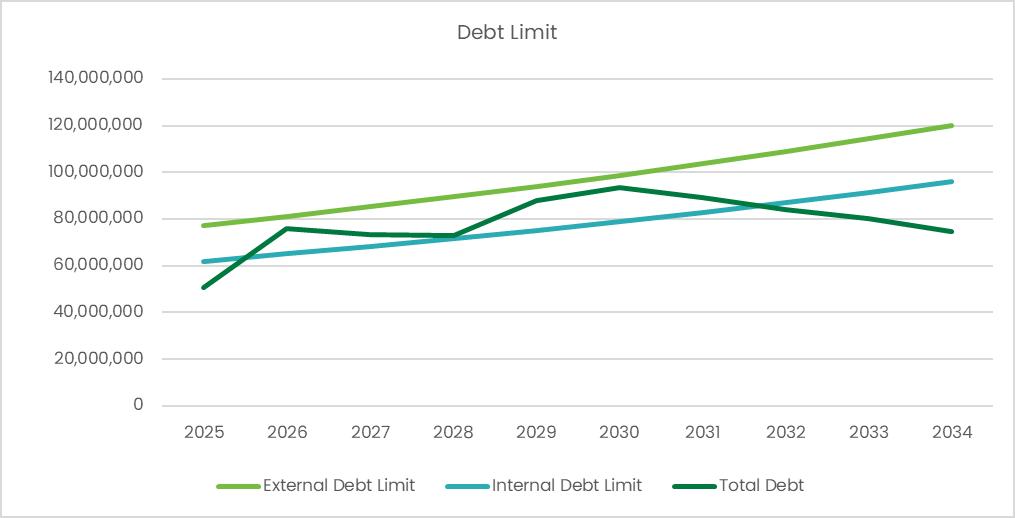
The financial forecasts of debt are provided to demonstrate the continual work on financing strategies and effective long-term planning and to illustrate the impact of debenture borrowing. For more detailed information on long term debt and debt limits refer to Notes 4 and 7 to the fiscal plan within this document.
Tax revenue is raised to pay all recurring expenses and transfer to reserves; this preserves the structural balance of the budget. One-time expenses are generally funded from reserves to avoid increasing the tax revenue for one year and having it rebound the next year. Reserves and grants are used to fund initiatives that are presented in the Corporate Plan. Staffing positions are funded from the tax base as they are a recurring expense.
Revenue and taxation are planned in accordance with the Revenue & Taxation policy (C-FS066).
The 2026 Corporate Plan projects $57 million in revenue primarily from taxes, user fees and franchise fees. The taxes shown are net of the requisitions for Education and the Meridian Housing Foundation.
Net taxes available for municipal purposes
Sales & user charges
The proposed property tax increase helps fund the increasing cost of ongoing service delivery, maintenance, debenture repayments and new initiatives and services that are not utility or developer related. In 2026, the increases were mainly attributable to prior approved and newly proposed initiatives offset by growth.
The Town also collects taxes on behalf of the Provincial Government for Education and Meridian Housing Foundation for local housing for seniors. These requisition amounts are not known at this time and are not included in municipal tax therefore are not highlighted within this document.
Property taxes are calculated in two steps. The Town Assessor first prepares an assessment of each property and calculates the Town’s total assessment. Assessment notices are sent out to property owners in the first quarter of the year.
Second, in May, the Town sets tax rates for classes of properties, such as residential and nonresidential property, based on the total assessment and revenue requirements. In 2026, a 1% tax increase is equivalent to approximately $240,000.
Assessment totals fluctuate from changes in the economy that affect market values, as well as real growth referred to as new assessment. These factors contribute to increases or decreases to our mill rate required to meet the required tax requisition. Preliminary forecasts
predict the market value having additional inflation over the previous year, however for purposes of this document, 2026 forecasted assessment values have been held flat to the previous assessment year and a 3.00% of estimated new assessment growth has been added. This demonstrates the proposed tax impact to an existing property with no change in assessment value.
The following chart shows the Town’s taxable assessment values from 2017 to a projected value in 2026.
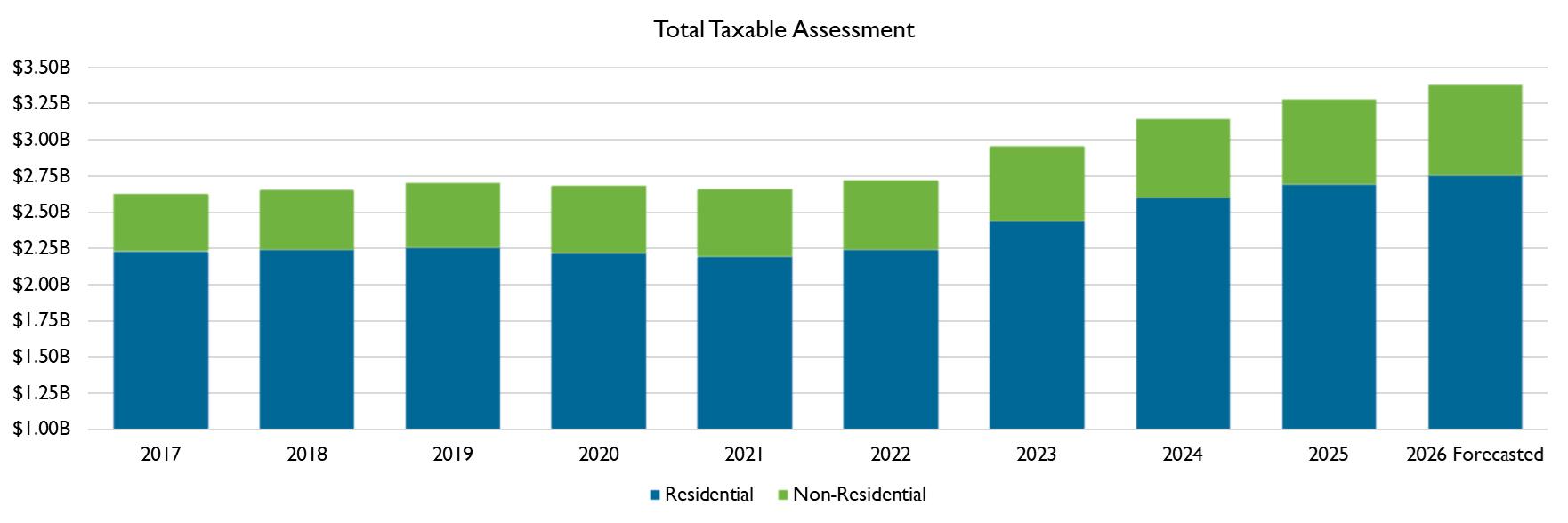
The 2026 assessment is to reflect market values as of July 1st and will include construction progress to the end of year December 31st. Assessment values are then subject to appeal by property owners.
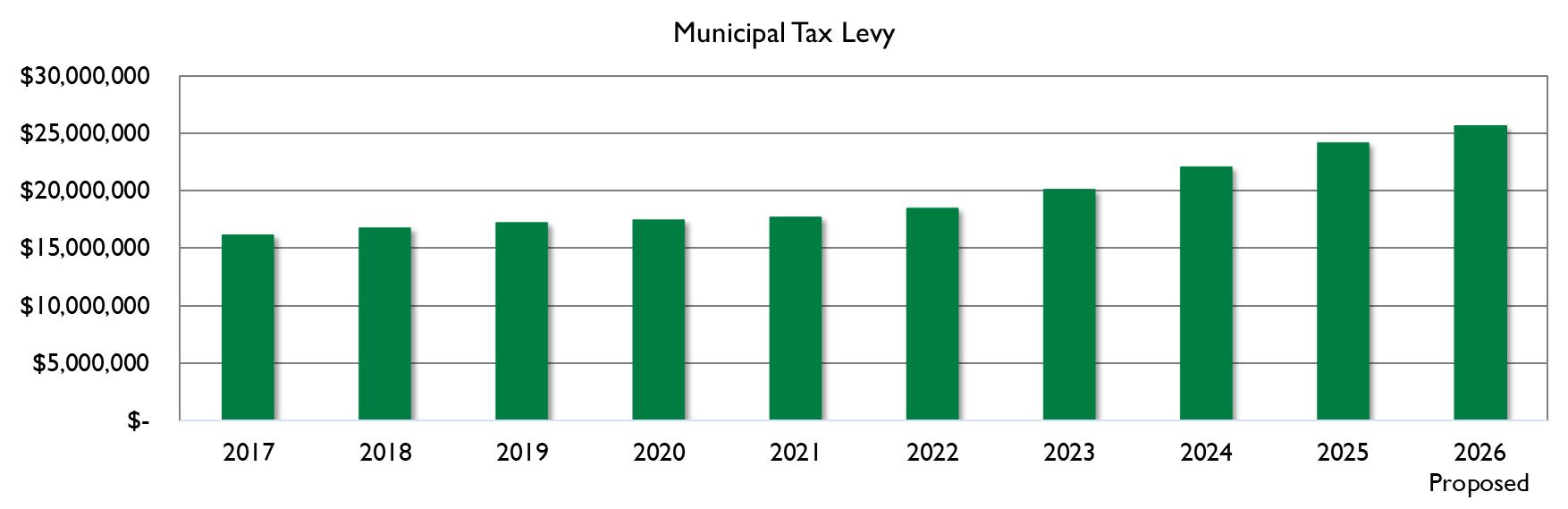
The Municipal Tax Levy provides 43.7% of the revenue required to operate the Town. The Municipal Tax Levy has grown from $16.1 million in 2017 to a projected requirement of $25 million as proposed in 2026. Likewise, the Town’s total taxable assessment has increased from $2.6 billion in 2017 to a projected value of $3.38 billion in 2025.
The proposed municipal tax required for 2026 is $26,022,132. This includes $1,136,709 in revenue resulting from a proposed 4.74% increase in taxes to fund current operations and proposed initiatives; as well as 2026 estimated supplementary tax revenue. The following chart demonstrates how the municipal tax levy has increased from 2017 to 2026.
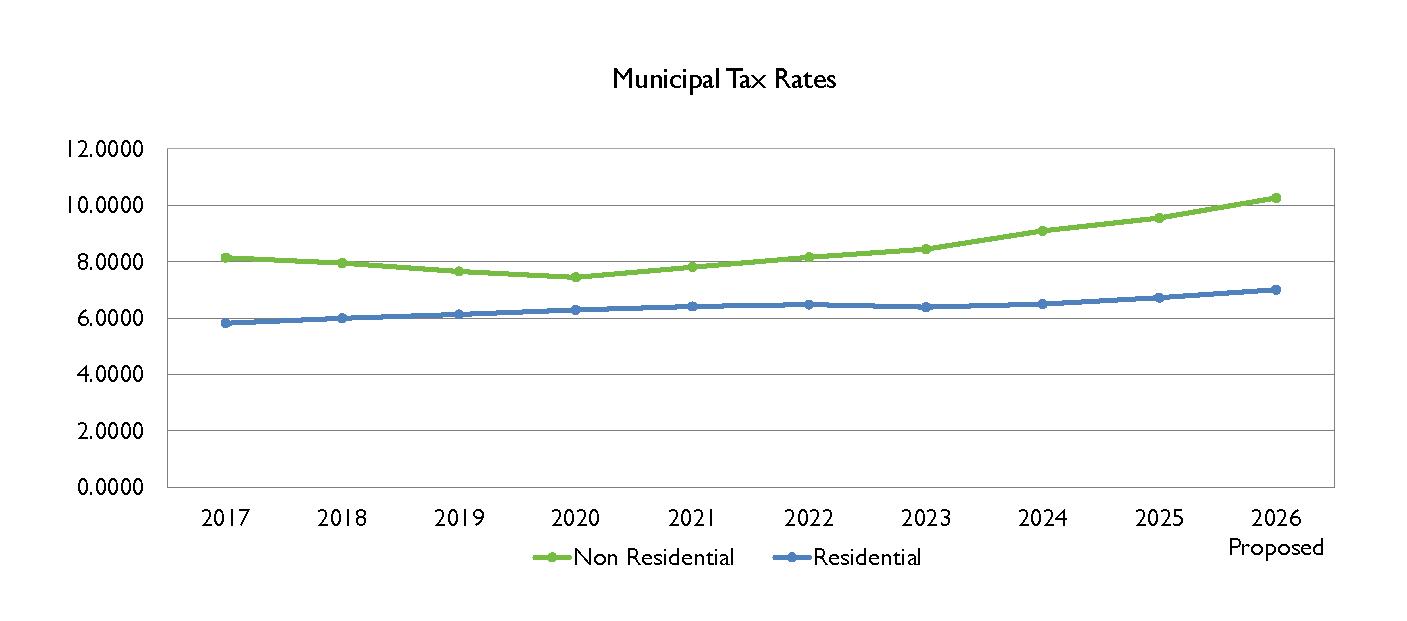
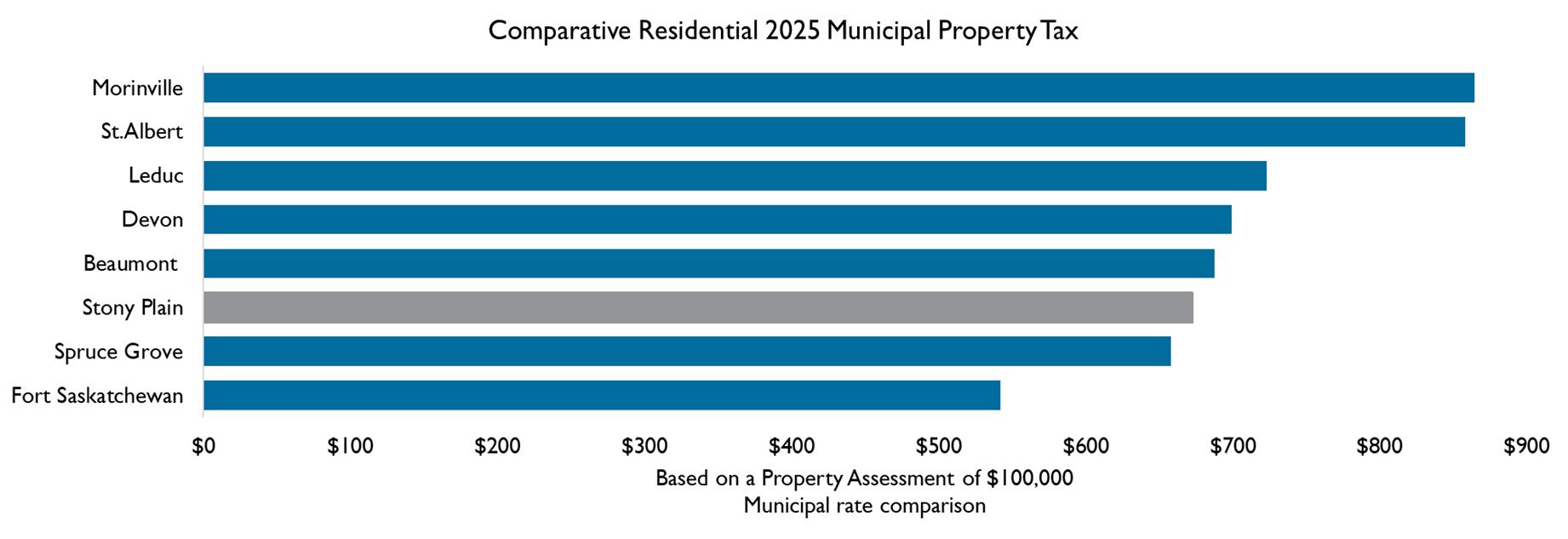
The proposed increase to the municipal property taxes of 4.74% is approximately a $2.25 per month or $27.05 annual increase for every $100,000 of residential assessment value. For a residential property in Stony Plain assessed at $400,000 this would equate to $9.02 per month or $108.20 annually.
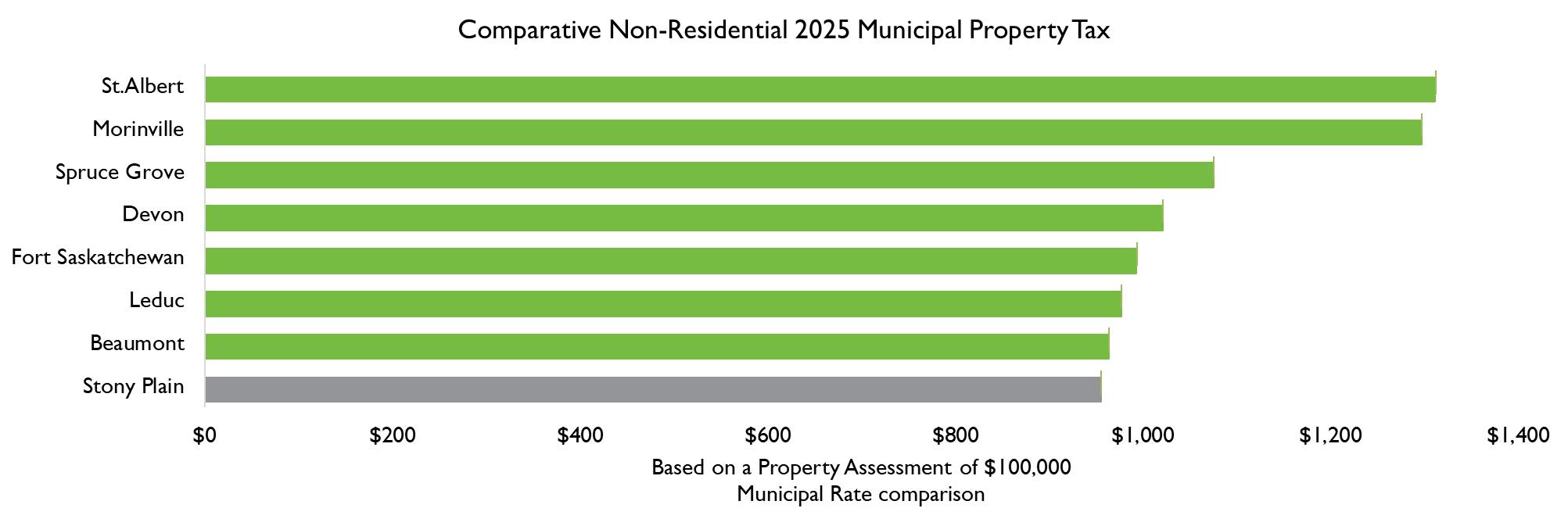
Stony Plain is in the middle range of the residential tax rate throughout urban municipalities within the capital region. In 2025 Council approved the Revenue and Taxation financial policy, which establishes how the annual tax rate split is determined. The policy sets the split at the “prior years average tax split less .05” of the seven comparative municipalities. In 2025, this average was 1.51:1. Accordingly a rate split of 1.46:1 will be applied in 2026, meaning nonresidential property owners will pay $1.46 for every $1.00 paid by residential property owners, based on assessed property values.
User fees are reviewed each year and adjusted for the market and demand for services. The User Fees and Charges Bylaw reflect the revenues included in the Corporate Plan.
The cost of both operating and infrastructure for the water, wastewater, stormwater and solid waste systems is recovered through utility charges to the users of each system. Utility costs are not subsidized by property taxes. Separate rates are charged for water, wastewater, stormwater and waste management customers.
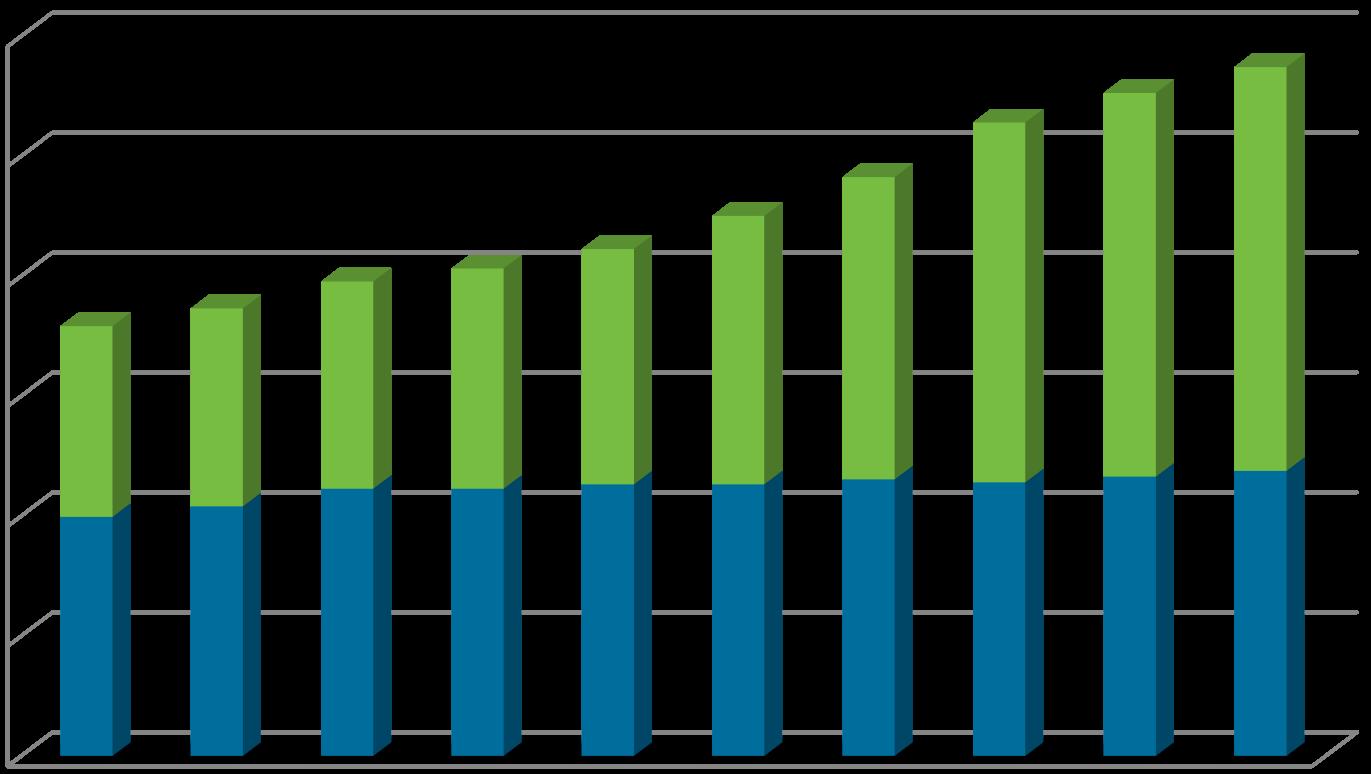
Water and wastewater rate models are fully variable based on usage. The graph below shows the monthly fees for the years 2019-2028 (2026-2028 proposed) based on 12 cubic metres of consumption which is the Town’s average utility user’s monthly consumption. This rate model
has allowed the utility to fully recover the expenses required to operate the utility and ensure there is adequate funds available for replacement of infrastructure.
Wastewater Commodity Fee
Water Commodity Fee
Utility revenue increases with the rise in rates and with growth in the number of customers or consumption. Overall utility revenue can be impacted by factors including change in water consumption habits, installation of low consumption appliances and fixtures, and environmental impacts.
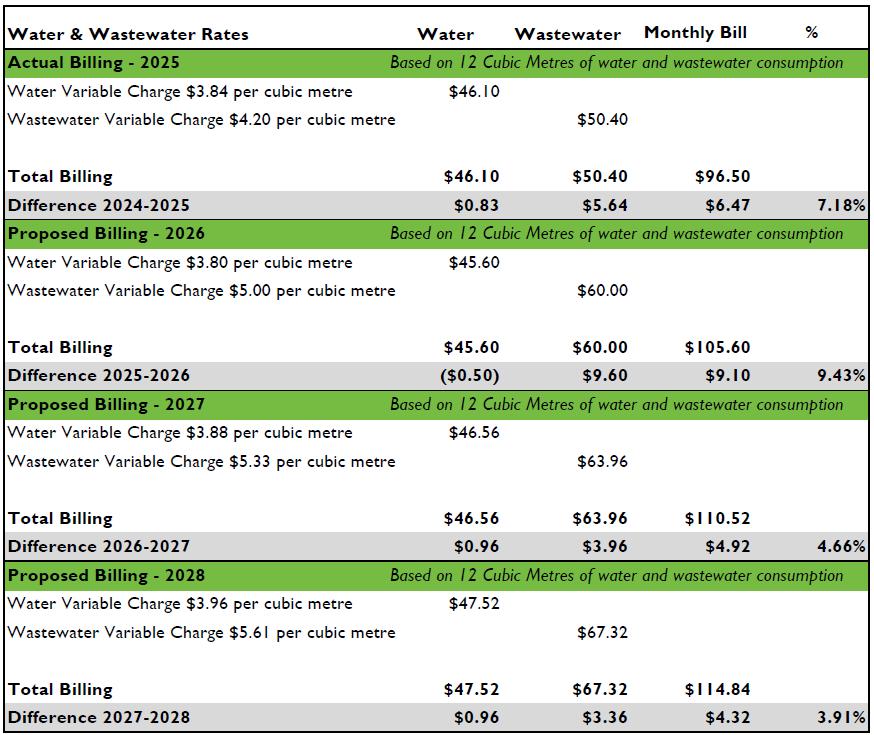
The decrease to the water rate in 2026 is ($0.04) or (1.09%) per cubic metre. This is directly correlated to a decrease in the water purchasing rate from the water commission.
The increase to the wastewater rate in 2026 is $0.80 or 19.5% per cubic metre. In 2026, the rate increase is driven by an increase in commodity costs contributing to $0.75 or 94% of the increase. The treatment of wastewater is provided to the Town through a regional wastewater utility commission. Future projected rate increases stem from growing infrastructure replacement requirements outlined in the capital plan and funding of these through debenture servicing or directly through the rate as reserves become depleted.
The Stormwater Rate Model encompasses the costs related to stormwater assets and operations and ensures there are funds for future stormwater infrastructure replacement. The stormwater rate is expected to increase by $0.25 or 1% monthly for single family residential homes in 2026.
Projected rate increase in the following year is the result of increased annual capital asset replacement as the Town addresses the infrastructure gap on flood mitigation, drainage, storm ponds and dewatering assets.
The solid waste fees for residential garbage services, senior lodging, and for apartment units are expected to increase in 2026 through 2028. The proposed monthly rates for 2026 are: residential $19.06, senior lodging $9.06 and apartments $14.14. The solid waste fee provides the funding for organics, recycling, garbage collection and the recycling centre. Savings from renegotiated contracts with waste, organic & recycling collection providers as well as the implementation of the Extended Producer Responsibility Policy of Alberta has led to the overall decrease in rates applied in spring 2025 which has updated the new baseline fee. As a point of reference waste fees approved in the 2025 corporate plan were: residential $30.69, senor complexes $11.28, and apartments $18.26.
The chart below displays the annual impact of the increase in taxes and utility user fees.
Waste management fees in the above chart for 2025 are reflective of six months at $30.69 and six months at lowered $17.57.
Electricity franchise fees are charged by the Town to Fortis Alberta for the exclusive right to provide electric utility services within the Town as well as access to the Town’s lands to construct, maintain and operate related assets. The Town collects a 20% franchise fee from Fortis Alberta. The maximum rate cap for electricity franchise fee is 20%.
Natural gas franchise fees are collected by the Town from Atco Gas and West Parkland Gas Co-op for the exclusive right to provide natural gas service within the Town as well as access to the Town’s lands to construct, maintain and operate related assets. The Town charges Atco Gas & West Parkland Gas a 35% franchise fee. The maximum rate cap for gas is 35%.
Fortis Alberta, Atco Gas, and West Parkland Gas Co-op pass along the cost of these franchise fees to their consumer as a separate charge on their bills. Revenue projections for 2026 are provided by these utility distributors and are estimates based on their budgeted revenue for their delivery charge. Refer to Note 5 in the notes to the fiscal plan within this document for further detail.
Government transfers, otherwise referred to as grants, make up a large portion of financing for capital projects. Partnerships with the provincial and federal governments and neighbouring communities help provide funding for projects such as new roads, facilities, parks and sports fields.
The government transfers at this time are budgeted conservatively; projections are based on released amounts from the Federal and provincial sources, where available. These will be monitored and updated once the impacts become known.
Local government/agencies grants are comprised of funding from Parkland County for the arena, fire services, and community and social development. Other contributions include amounts for the school resource officer and joint use sites.
Other government grants include:
• Housing Accelerator Fund $707,294
• Canada Day Grant $4,000; and
• Government of Alberta Family and Community Support Services (FCSS) Grant $400,605.
The Local Government Fiscal Framework capital grant (previously Municipal Sustainability Initiative) has been included in all three years of the 2026-2028 Corporate Plan in the amount of $2,464,500. The allocation format of the framework is determined by a formula based on population, tangible capital assets, amortization of tangible capital assets, and kilometres of road. Future year distributions are announced in the fall. Administration has estimated the allocations for 2027 and 2028 at the 2026 amount.
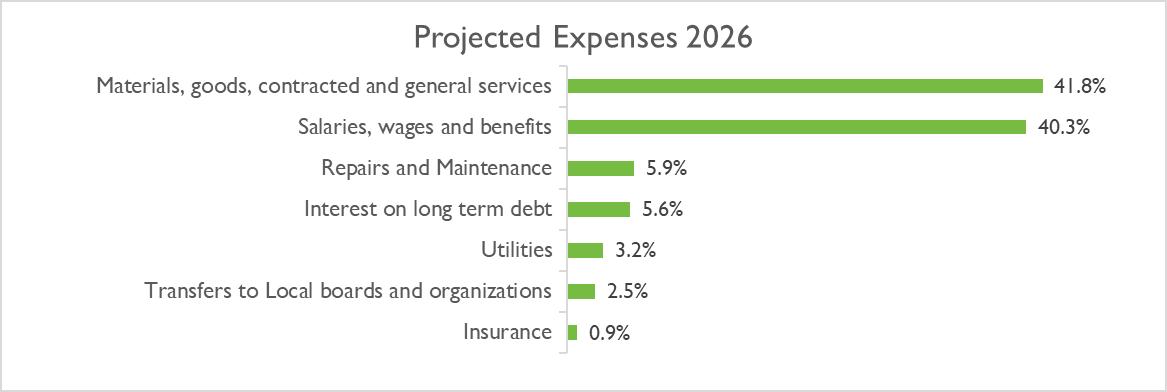
The 2026 Corporate Plan includes $52.2 million in expenses, of this total $21.7 million (41.8%) is for materials, goods, contracted and general services, and $21 million (40.3%) on salaries, wages and benefits. A detailed Segmented Information table is included in Note 9 to the fiscal plan.
The proposed plan includes human resource costs of $21 million, which is 40.5% of overall expenses. The human resource cost includes all permanent positions, casual, seasonal staff and Council.
The Town’s staffing complement consists of full-time and part-time positions equal to 162.8 full-time equivalents (FTEs) in the 2026 Corporate Plan. In addition to Town staff, municipal services are also delivered by third party agencies including the RCMP.
Since the opening of the joint RCMP detachment with the City of Spruce Grove all RCMP municipal employees and expenses related to these employees are shared. In the contract between the City of Spruce Grove and the Town, 64% of the salaries, benefits and incidentals for the Municipal Employees and 50% of the Criminal Analyst are recoverable from the City of Spruce Grove. The net salaries are shown in Protective Services expenses. The Town and City of Spruce Grove have an agreed upon service level of 1 Municipal Employee to 2.5 RCMP members. As either municipality adds RCMP members, Municipal Employees must be added to maintain this ratio. In order to maintain this ratio based on the Spruce Grove planned addition of RCMP, the Corporate Plan includes an increase in Municipal Employees of 1 FTE in 2027 and 2028.
Corporate & Long-Term Planning policy (C-FS-056) states that cost of living increases for non-union staff will be considered in the initial draft of the Corporate Plan based on the Consumer Price Index (CPI) and the labour market for Alberta. A compensation review was performed in 2025 that compared salaries of Town employees against that of comparable municipalities. As a result this plan incorporates recommended salary adjustments made from the results of that review.
The 2026 Corporate Plan includes the following items related to employee compensation:
• 2.0% compensation increase non union
• 3.0% compensation increase union as per collective bargaining agreement
• Merit (step) increases
• Compensation Review Recommended adjustments
• 1.7% compensation increase to Council per Council Compensation Policy (C-CO-065).
2026 proposes the increase of:
• 1.0 FTE Senior Financial Analyst (Table 14);
• 5.5 FTE Community Recreation Facility (Table 6);
• 0.5 FTE Utilities Administrative Assistant (Table 29);
• 0.4 FTE Program Assistant increase (Table 38); and
• 1.0 FTE Utilities Technician (Table 30).
2027 proposes the increase of:
• 1.0 FTE Roads Operator (Table 32);
• 1.0 FTE Fire Lieutenant (Table 18);
• 1.0 FTE Corporate Communications Specialist; (Table 12);
• 1.0 FTE ATS Driver; (Table 19); and
• 1.0 FTE RCMP – Municipal Employee/Detachment Clerk.
2028 proposes the increase of:
• 1.0 FTE Procurement & Assurance Coordinator (Table 15);
• 2.0 FTE Firefighter (Table 20);
• 1.0 FTE Utilities Technician (Table 30);
• 1.0 FTE Program Coordinator - Events (Table 39); and
• 1.0 FTE RCMP – Municipal Employee/Detachment Clerk.
Amortization is a non-cash expense that estimates the annual cost of tangible capital assets (TCA) utilization each year. TCA include roads, water, wastewater and stormwater infrastructure, equipment, facilities, fleet and land improvements. The cost of the tangible capital assets, other than land, is amortized on a straight-line basis over the estimated useful life of the assets. The amortization cost for 2026 is estimated to be $9,017,672 and continues to increase as the Town continues to grow its asset base.
The Town provides financial contributions to various organizations to support aspects of community development and service delivery. These contributions are realized in operating and/or capital funding. agreements are developed in conjunction with the organization and aligned with strategic direction of the Town.
The largest amounts are for the TransAlta Tri Leisure Centre and the Stony Plain Public Library. The Tri Leisure Centre increase shown in the chart was approved by Council in September 2025 in the amount of $332,653 and is funded by reserves. Parkland Search and Rescue, and Parkland Turning Points are funded through the Policing and Public Safety Reserve (1.68% in 2026). Annual inflationary increases are included where applicable.
Increases for 2026 have been included for the TransAlta Tri Leisure Centre ($121,108), Stony Plain Library ($112,900), Community Pantry Society ($25,000 2026 only), Heritage Agricultural Society
(Red Brick Common) ($20,000 2026 only), Parkland Disk Golf ($10,000), Pioneer Museum ($9,500), and Parkland Search and Rescue ($2,000).
The Town of Stony Plain owns and maintains an increasing amount of infrastructure, parks, facilities, fleet, and equipment as the Town continues to grow including:
• 120 kilometres of water mains;
• 109 kilometres of sewer mains;
• 84.5 kilometres of storm drainage mains;
• 208 kilometres of roads;
• 102 kilometres of sidewalks; and
• 52 kilometres of trails.
The Town owns and maintains over 15 buildings in addition to gazebos, outdoor rinks, tennis courts, parks, playgrounds, sports fields, reservoirs, and lift stations.
The Corporate Plan includes capital initiatives and replacement of existing tangible capital assets related to machinery, equipment and vehicles, facility components and land improvements. In 2026 the rehabilitation and replacement of water, wastewater, storm, roads,
sidewalks, and trails are included as part of an ongoing replacement plan. Replacements of existing tangible capital assets and new initiatives are funded through government transfers (grants), reserves, debentures, offsite levy revenue, tax base and utility rates.
Infrastructure constructed by developers is recognized as a contributed asset in the year the Town takes responsibility for the asset. The Town accepts responsibility for the assets at the time of the Final Acceptance Certificate completion. Contributed asset projections are included in the chart below based on estimates provided in the development agreements.
Contributed assets add necessary infrastructure to the Town from new development but also increase the maintenance and replacement costs required by the Town. As part of asset management, the current state of this infrastructure and the planned replacement will be further considered to ensure it is appropriately planned for in the Long-Term Capital Plan.
The subsequent chart shows a summary of the new capital initiatives, vehicles, equipment, contributed assets and infrastructure replacements that are capital in nature.
$80,000,000
$70,000,000
$60,000,000
$50,000,000
$40,000,000
$30,000,000
$20,000,000
$10,000,000
The capital initiatives proposed in the Corporate Plan and replacement of existing fleet, machinery and equipment, lifecycle upgrades, and contributed assets is $33,919,319 for 2026; a further breakdown of this can be found in the following Long Term Capital Plan.
At the end of 2024 the Town’s Equity in Tangible Capital Assets (TCA) was in excess of $270 million and with the current capital asks, is projected to be in excess of $347 million by the end of 2028. Equity in TCA is defined as Net Book Value of TCA less outstanding capital debt.
The Long-Term Capital Plan is presented through the following four tables. Assets are separated by Municipal or Utility function as the Utilities program is self sustaining and does not impact the tax base. Additionally, capital projects are split between replacement and growth. The replacement chart represents the replacement of current Town assets which have reached the end of their useful life. Growth capital includes any new assets acquired or an upgrade to an existing asset which significantly increases the service level of the replaced asset.
Funding sources for the above replacement capital plan is the applicable reserve with the exception of the Transportation replacement which includes $6.7M in grant funding.
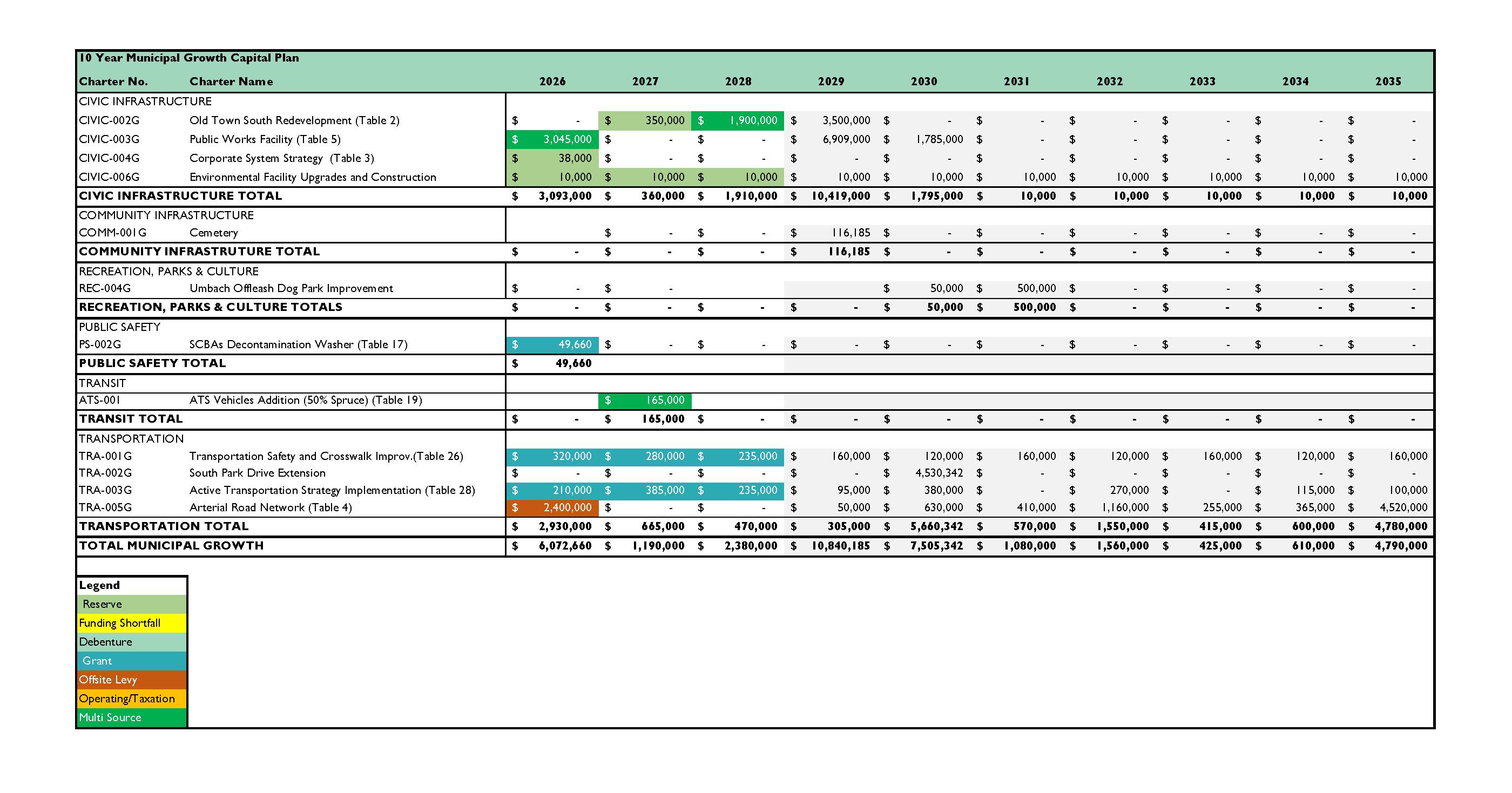
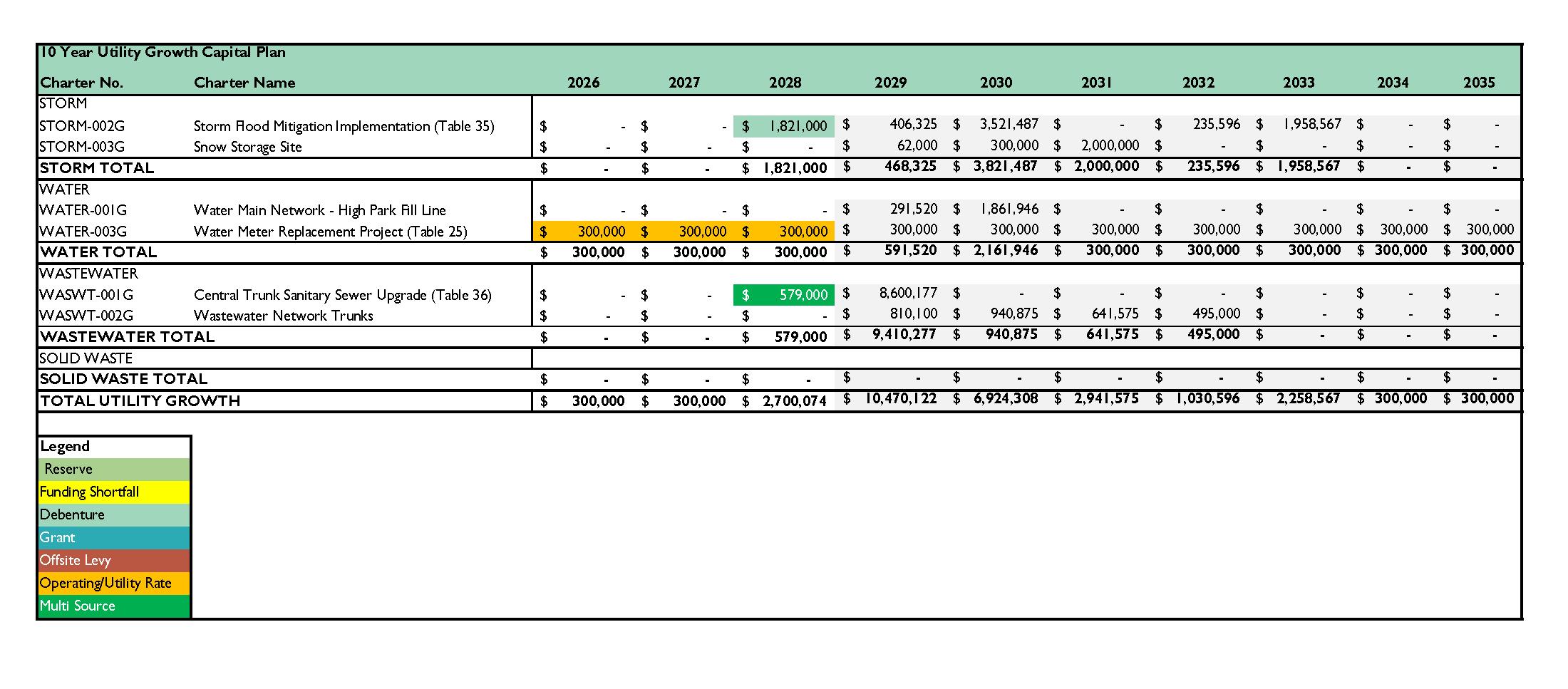
The ten-year Long Term Capital Plan shows a current projection of $166 million in capital requirements. Projects past the first three years of the plan are identified at a high level based on municipal need without consideration of designating funding sources. As these projects are prioritized and move closer to the three-year Corporate Plan, the costs are refined, and funding methods are proposed for Council’s consideration.
The Town continues to work to improve its Long-Term Capital Plan to effectively manage the delivery of municipal services. The plan sets out future goals and resources that are required to support future infrastructure as well as replacement of current. Department plans and asset management determine when a capital project is brought forward. As the Town works to advance its asset management planning, the longer-term lifecycle capital replacement costs and timing continues to be better understood.
Capital projects required to maintain current service levels relating to existing infrastructure, facilities and equipment are given funding priority. If a project does not meet these criteria, it would then be submitted as an initiative. This categorization ensures adequate funding is made available for maintaining existing infrastructure with remaining available funding allocated to growth projects. The capital initiatives are then prioritized according to the Corporate Plan process.
Capital is funded in several different ways.
• Capital initiatives are funded through grants, reserves, debt and partnership contributions from neighbouring communities. The Town utilizes grants as the primary source of funding, although not all projects are eligible for grant funding and may not meet the requirements.
• Transportation (roads, sidewalks, and trails) are funded through grants and minimally through reserves. New projects may be funded through grants, debt, or offsite levies (if criteria are met). The Town will need to monitor the grants provided from the Provincial and Federal governments and work towards making these programs more sustainable by funding regular reserve contributions from the tax base.
• Machinery, equipment, and vehicles are funded through reserves and grants. The annual contributions to these reserves are from the tax base.
• Facilities lifecycle reserves have annual transfers from the tax base that provide funding for upgrades; grants and debt are considered to supplement the funding of major replacement and improvements. Understanding the conditions of the facility and planning lifecycle work through asset management will continue to improve the Town’s ability to understand current lifecycle reserve levels into the future.
• Water, Wastewater and Stormwater Utility have reserve funding for future replacement of infrastructure. These reserves experience contributions annually through the user fees charged to ratepayers. The preference is to only utilize available grants specific to utilities rather than general municipal grants. Debentures incurred for infrastructure related to these utilities are funded through the rates. The strategy is to maintain a self-funding approach, in which the net revenue that is collected through its utility rates is placed in a reserve to fund future Utility capital projects. With these approaches, a 10-year plan is developed for future planning so that both non-recurring and ongoing projects have adequate financial resources and future fluctuations to the capital budget and corresponding utility rates are mitigated.
The Stormwater utility was started in 2019. As the rate model is still maturing, not all capital requirements are able to be funded by the rate at the current time. The infrastructure gaps have been staged well beyond the ten-year capital plan which will allow the storm utility to service planned debentures with more reasonable rates to the ratepayer.
Included in the Stormwater utility is funding for initiatives that address the longer-term infrastructure gaps. The timing of the initiatives has been staggered to phase in the increase in annual funding requirements and to minimize rate shock to residents of the town versus the needs of the system. The Flood Mitigation Strategy was developed in 2020. Projects in the amount of $1.8M (Table 35) have been slated in 2028.
Ensuring lifecycle maintenance of existing infrastructure, facilities, parks, fleet, and equipment remains a priority, however it has been challenging to keep reserve contributions increasing with inflation to ensure adequate reserves are in place. The adoption of the Accumulated Surplus - Restricted (Reserves) Policy C-FS-055 in 2021 was an important first step in addressing these issues. The policy provides guidance on optimal reserve balances to ensure that adequate funding is available for replacing current assets when they reach the end of their useful life. Review of policy work is planned in 2026 to better understand gaps
The Town is currently monitoring and prioritizing projects due to a funding shortfall over the next 10 years. Funding shortfalls result in projects (replacement and new) being postponed to future years. This increases risk and costs to the Town as there may be more down time where assets are not in use due to increased repairs and maintenance funding restraints as well as time required.
Assumptions for growth in the Corporate Plan are based on the current economic opinion. If actual economic activity differs from what is expected, many of the key revenues and expense projections may be significantly affected.
Estimates of the 2026 opening balance of accumulated surplus are based on the 2025 budget. Actual results could differ from those estimates.
Revenue with a greater than normal risk of varying by more than $50,000 is listed below. The list of unpredictable revenue makes up a large part of total revenue, but only a portion of this revenue is at risk of varying from the Corporate Plan:
• Government transfers - Some government transfers are subject to changes in the provincial and federal policies.
• Revenue from growth in new assessment - Estimates of additional tax revenue generated from growth in new properties relies on the unpredictable rate of development.
• Building permits - Revenue from developer contributions is directly dependent on timing of construction and is unpredictable.
• Franchise fees – Revenue varies with consumption, weather, and commodity prices.
• Golf Course - Revenue from the Golf Course largely depends on the weather and the disposable income of the patrons.
• Traffic fines - Revenue from traffic fines depends on the number and type of infractions and court decisions
• Utility charges - Utility revenue depends on customer consumption, growth and weather.
• Interest revenue - Interest earned on bank balances and investments varies based on global markets and cashflow and investment balances.
• Land sales - Revenue from land sales is dependent on market rates and timing of sales.
• Revenue from Transit operations – Revenue is dependent on the amount of ridership and the level of service provided.
• Facility Rental Revenue – Revenue at facilities is driven by the market demand.
The annual Corporate Plan is the Town’s key control over its operations directing program delivery and authorizing planned expenses and acquisition of tangible capital assets.
The unconsolidated financial statements are prepared on the same basis as the annual financial statements – in accordance with Generally Accepted Accounting Principles established by the Canadian Public Sector Accounting Standards (PSAS) and in conformance with the Municipal Government Act of the Province of Alberta. The Corporate Plan is presented in an effort to move towards the same format as the financial statements and is prepared in accordance with the accounting policies adopted by Council. Actual financial results achieved for the years ended December 31, 2026-2028 will vary from the projections presented in the 2026-2028 Corporate Plan.
The unconsolidated fiscal plan reflects the revenues, expenses and acquisition of tangible capital assets of the Town of Stony Plain. The activities related to the TransAlta Tri Leisure Centre, and the Stony Plain Library are not included in the Corporate Plan.
The following assumptions were used in preparing the Corporate Plan. Actual results could differ from these estimates. Unless otherwise noted, the Corporate Plan assumes that the Town will deliver the same services and service levels as provided in 2025. Funds from external parties and earnings are restricted by agreement or legislation and are accounted for as deferred revenue until used for the purpose specified.
Government transfers are recognized as revenue in the period in which the events giving rise to the transfer occurred, providing the transfer is authorized, and any eligibility criteria have been met by the municipality, and reasonable estimates of the amounts can be made.
Economic growth in Canada has been overshadowed by the unpredictability of U.S. trade policy and tariff pressures, and the outlook for the Canadian economy remains uncertain. Throughout 2025, economic activity has slowed, but the economy has shown some resilience, with inflation holding around 2%, according to the Bank of Canada’s
July 2025 Monetary Policy Report 1. Inflation is expected to remain near 2% into early 2026.
*Canada CPI is calculated from July 2024 to July 2025
ii. Population
The Town of Stony Plain’s population has grown by 20% from 2015 to 2024 4. The total population is projected to see a 1.7% annual growth rate, increasing to a population of 21,297 by 2031 and 25,056 by 2041 5 .
Permit values are anticipated to exceed 2025 levels. The Town successfully secured the Housing Accelerator Fund grant, and the resulting programs and system changes are projected to increase housing construction over the next two years, contributing to future property tax revenue.
Tangible capital assets are recorded at cost, which includes all amounts that are directly attributable to acquisition, construction, development or betterment of the asset.
Tangible capital assets received as contributions are recorded at fair value at the date of receipt and are recorded as revenue.
1 https://www.bankofcanada.ca/publications/mpr/mpr-2025-07-30/
2 https://www.bankofcanada.ca/rates/price-indexes/cpi/
3 https://www.edmonton.ca/sites/default/files/public-files/Q2-2025EconomicUpdate.pdf?cb=1754453447
4 https://open.alberta.ca/opendata/alberta-population-estimates-data-tables
5 https://www.stonyplain.com/en/town-hall/resources/Documents/StonyPlainForecast2022V5_Final_2022-1212.pdf
The Town's financial policies are reviewed every four years. The pertinent sections of the Corporate Plan document reference key measures set out in the financial policies. The financial policies set out Council's direction for the Corporate Plan, investments, accumulated surplus, debt, approaches to tax revenue, one-time revenue and unpredictable revenue. Existing approved financial policies are summarized below:
a. Accounting & Financial Reporting C-FS-028
Purpose: to outline the Town of Stony Plain’s policy regarding how the organization account for financial resources and accountability for the communication of financial information. This policy will be used to establish standards that promote the reliability of the financial information provided by the entity and provide guidance to accounting and audit processes.
b. Accumulated
Purpose: to outline the Town of Stony Plain’s policy establishing standards and guidelines for the management of existing reserves and the establishment of new reserves, to outline the purpose of each reserve and parameters regarding the use of reserves.
c. Asset Management Policy C-FS-041
Purpose: To set the guidelines for implementation of Asset Management for the Town of Stony Plain.
d. Cash Management & Investments C-FS-046
Purpose: To outline the Town of Stony Plain’s policy regarding the safekeeping of cash and the investment of the Town’s financial assets.
e. Corporate & Long-Term Planning C-FS-056
Purpose: to outline the Town of Stony Plain’s policy regarding corporate planning and long-term financial planning. This policy is utilized to establish context and hierarchy for planning documents within the organization and set parameters for the corporate planning and the long-term financial planning processes.
f. Debt Management C-FS-045
Purpose: To outline the Town of Stony Plain’s policy regarding the use of debt for financing Town projects and initiatives and sets an internal limit of 80% of the provincial limits. This policy will be used to strategically manage borrowing capacity for future capital assets, maintain flexibility of current operating funds and limit the impact that debt charges will have on future tax and utility rates.
Purpose: To outline the Town of Stony Plain’s policy regarding the procurement of goods and services, in compliance with legislative requirements. This policy will be used to direct the purchasing process and facilitate appropriate control of expenditures for the Town.
Purpose: To establish the Town of Stony Plain’s policy regarding revenue generation. The Town shall follow the principles established within this policy for annual preparation of budgeting and rate setting for user fees and property taxation within the Town.
Purpose: To establish policy for the taxation of vacant residential and vacant nonresidential lands which remain undeveloped for seven years at 1.25 times the tax rate.
Effective date January 1, 2023.
a. The Local Government Fiscal Framework has been announced and the new program which will provide funds for municipal infrastructure beginning in 2024 and is tied via formula to the Province of Alberta’s revenue.
The Canada Community Building Fund is a multi-year grant program that provides funding annually but allow the funding to be applied to projects over five years. Funding to be used in future years is recorded as deferred revenue. As required by the grant programs, interest earned by the Town is allocated to the deferred balance until
the funds are expended.
b. The Canada Community Building Fund provides an allocation based on each municipality’s official population as recorded by Alberta Municipal Affairs. This grant program is based on a non-matching basis strictly for capital infrastructure.
c. Developer Levy (Offsite Levy)
Offsite Levies Balance
Offsite levy rates are paid by developers and are set under the Offsite Levy Bylaw (2648/D&P/21). Offsite levy categories that are shown in a negative or deficit balance represent amounts front-ended by the Town and are expected to be collected through future offsite levies. The decision to pay for infrastructure in advance of collecting the related levies contains the inherent risk that the expected future levies may not be collected which would require the project to be funded by the tax base. Administration believes there is a low risk at this time of not collecting expected future levies to repay front-ended projects and will continue to monitor expected and actual levies collected. Front ended balances do impact debt limit if borrowing occurs as detailed in the debt section of the report.
Offsite levy categories that are shown as a positive balance represent levies collected in advance of building the related infrastructure, which can be applied to future projects within the offsite levy model. Offsite levy balances in a positive position are recorded as deferred revenue on the Town's financial statements.
Proposed Principal and Interest Payments as of December 31
The previous charts include initiatives proposed in the Corporate Plan. This includes both proposed debt and debt not yet accessed, information is based on best estimates for those projects. Debentures are repayable to the Province of Alberta and Schedule 1 Canadian Financial Institutions bearing interest rates ranging from 2.297% to 4.950% per annum and
mature in years 2031-2045. Debt servicing levels are limited by the province and by the Town’s Debt Management policy (C-FS-045) and remains within the limits.
Outside of the external debentures noted above, there are internal borrowings the Town has utilized to fund key projects. These are not included within the Town’s external debt limit and are provided below for information.
Disclosure of the utility franchise agreement and projected annual revenues as required by Alberta Regulation 313/2000 is as follows:
While the Accumulated Surplus – Restricted (Reserve) policy (C-FS-055) states reserves will be repaid with interest (generally over a period of five (5) years or less), a repayment plan to the Legacy reserve for the three lots purchased in 2018 has been included in the Corporate Plan of $38,936 to be repaid by 2030 (reduced with sale proceeds of Forest Green Sale). The Land (School) Reserve (within capital) was paid off completely in 2025 from sale proceeds of the Forest Green Sale).
Section 276(2) of the Municipal Government Act requires that debt and debt limits as defined by the Alberta Regulation 255/2000 for the Town be disclosed as follows:
The Town entered into an agreement in April 2025 for the collection and hauling of garbage, compost which expires in September 2027. The estimated cost of those services is approximately $453,260 for 2026. The Town also entered into an agreement in May 2025 for the collection of recyclable materials which expires in April 2030. The estimated cost of these services for 2026 is approximately $1,158,355.
In 2025, the Town executed its contract for safety codes services for three years at an estimated cost of $100,000 per year.
It is anticipated that the Town will be entering into a cemetery operation contract in 2026, and the estimated cost for 2026 is $100,000.
The Town contracts the RCMP to provide Policing services to the community. The estimated cost for 19 RCMP members for 2026 is $3,713,296.
Segmented information has been identified based upon lines of service provided by the Town. Town services are provided by departments and their activities are reported by functional area
in the fiscal plan. Certain lines of service that have been separately disclosed in the segmented information, along with the services they provide, are as follows
a. General Government
General Government is comprised of Council, the Office of the CAO, and Corporate Services. Corporate Services is comprised of Financial Services, Legislative Services, Human Resource Services, and Information Technology Services. Council makes decisions regarding service delivery and service levels on behalf of the municipality in order to balance the needs and wants of the Town residents in a financially responsible manner.
b. Protective Services
Protective Services is comprised of RCMP, Fire Services, Emergency Management and Municipal Enforcement Services. The RCMP division for Stony Plain includes Federal, Provincial and Municipal employees that serve Stony Plain and the surrounding area; it is an integrated force with Spruce Grove. Fire Services is responsible to provide fire suppression services; fire prevention programs; training and education related to prevention; detection or extinguishments of fires: and motor vehicle incident response. Emergency Management prepares and develops emergency response planning to help maintain a safe community. The Municipal Enforcement Services provide bylaw enforcement that ranges from public service to animal control as well as provincial statute enforcement with authorities granted by the Solicitor General of Alberta.
c. Transportation
Transportation is comprised of Common Services and the Public Works areas. They are responsible for the maintenance of the roadway and storm systems. The ATS service is displayed under this section in the segmented information, along with Stony Plain Transit.
d. Recreation and Culture
Recreation and Culture is comprised of Parks, Recreation, Culture and Cultural Facilities. Parks, Recreation and Culture provide recreational and cultural services and activities which promote the well-being of citizens. These areas are responsible for the parks, playgrounds, facilities and green spaces of the Town. This area also acts a liaison between community groups and the TransAlta Tri-Leisure Centre.
Utilities are comprised of, water, wastewater, storm, waste management collection and recycling. The Town is responsible for environmental programs such as organic carts, biweekly garbage pick-up and promoting recycling and other related initiatives.
Development is comprised of Planning & Infrastructure and Engineering. These areas are responsible for the planning and development of the Town's infrastructure system and work with developers in planning the growth of the Town in a sustainable manner. Engineering is responsible for major capital infrastructure projects. Economic Development works with the businesses in the Town to encourage economic sustainability.
Community & Social Development provides prevention-focused services under the Family and Community Support Services Program through a shared funding model between the Province of Alberta and the Town of Stony Plain. This area also provides services related to volunteerism and civic engagement, building resilience, and develops community collaborations to support community belonging and social well-being.
Segmented information does not include the following:
• Transfers to and from reserves (included in accumulated surplus)
• Interdepartmental transfers
• Debt Principal repayments (part of long-term debt on the balance sheet)
• Bond amortization is netted against interest