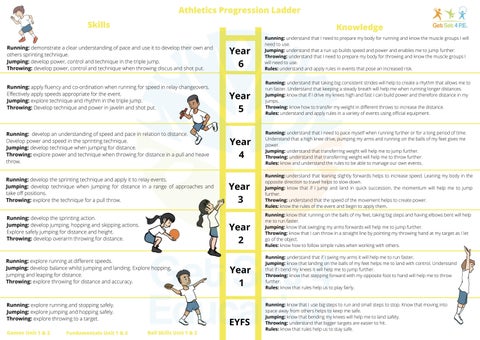
Athletics Progression Ladder Skills
Knowledge
Running: demonstrate a clear understanding of pace and use it to develop their own and others sprinting technique. Jumping: develop power, control and technique in the triple jump. Throwing: develop power, control and technique when throwing discus and shot put. Running: apply fluency and co-ordination when running for speed in relay changeovers. Effectively apply speeds appropriate for the event. Jumping: explore technique and rhythm in the triple jump. Throwing: Develop technique and power in javelin and shot put.
Running: develop an understanding of speed and pace in relation to distance. Develop power and speed in the sprinting technique. Jumping: develop technique when jumping for distance. Throwing: explore power and technique when throwing for distance in a pull and heave throw. Running: develop the sprinting technique and apply it to relay events. Jumping: develop technique when jumping for distance in a range of approaches and take off positions. Throwing: explore the technique for a pull throw. Running: develop the sprinting action. Jumping: develop jumping, hopping and skipping actions. Explore safely jumping for distance and height. Throwing: develop overarm throwing for distance.
Running: explore running at different speeds. Jumping: develop balance whilst jumping and landing. Explore hopping, jumping and leaping for distance. Throwing: explore throwing for distance and accuracy.
Running: explore running and stopping safely. Jumping: explore jumping and hopping safely. Throwing: explore throwing to a target. Games Unit 1 & 2
Fundamentals Unit 1 & 2
Year 6
Running: understand that I need to prepare my body for running and know the muscle groups I will need to use. Jumping: understand that a run up builds speed and power and enables me to jump further. Throwing: understand that I need to prepare my body for throwing and know the muscle groups I will need to use. Rules: understand and apply rules in events that pose an increased risk.
Year 5
Running: understand that taking big consistent strides will help to create a rhythm that allows me to run faster. Understand that keeping a steady breath will help me when running longer distances. Jumping: know that if I drive my knees high and fast I can build power and therefore distance in my jumps. Throwing: know how to transfer my weight in different throws to increase the distance. Rules: understand and apply rules in a variety of events using official equipment.
Year 4
Running: understand that I need to pace myself when running further or for a long period of time. Understand that a high knee drive, pumping my arms and running on the balls of my feet gives me power. Jumping: understand that transferring weight will help me to jump further. Throwing: understand that transferring weight will help me to throw further. Rules: know and understand the rules to be able to manage our own events.
Year 3
Running: understand that leaning slightly forwards helps to increase speed. Leaning my body in the opposite direction to travel helps to slow down. Jumping: know that if I jump and land in quick succession, the momentum will help me to jump further. Throwing: understand that the speed of the movement helps to create power. Rules: know the rules of the event and begin to apply them.
Year 2
Running: know that running on the balls of my feet, taking big steps and having elbows bent will help me to run faster. Jumping: know that swinging my arms forwards will help me to jump further. Throwing: know that I can throw in a straight line by pointing my throwing hand at my target as I let go of the object. Rules: know how to follow simple rules when working with others.
Year 1
Running: understand that if I swing my arms it will help me to run faster. Jumping: know that landing on the balls of my feet helps me to land with control. Understand that if I bend my knees it will help me to jump further. Throwing: know that stepping forward with my opposite foot to hand will help me to throw further. Rules: know that rules help us to play fairly.
EYFS Ball Skills Unit 1 & 2
Running: know that I use big steps to run and small steps to stop. Know that moving into space away from others helps to keep me safe. Jumping: know that bending my knees will help me to land safely. Throwing: understand that bigger targets are easier to hit. Rules: know that rules help us to stay safe.
Ball Skills Progression Ladder Skills Sending: show good technique when sending a ball with increasing control, accuracy and consistency under pressure. Catching: demonstrate increasing consistency of catching under pressure in a variety of game situations. Tracking: demonstrate a wider range of techniques when tracking a ball under pressure Dribbling: dribble consistently using a range of techniques with increasing control under pressure.
Year 6
Knowledge
Sending: understand and make quick decisions about when, how and who to pass to. Catching: know how to catch a ball for different situations, considering trajectory, speed, height and size of the ball. Tracking: know how to track a ball for different situations, considering trajectory, speed, height and size of the ball. Dribbling: choose the appropriate skill for the situation under pressure e.g. a V dribble in basketball to keep the ball away from a defender.
Year 5
Sending: know that controlling a ball before sending it will allow me to send it accurately. Catching: understand when to use different types of catching. Tracking: know that tracking a ball will help me to collect/stop/receive it quickly and successfully. Dribbling: know that dribbling in different directions will help me to lose a defender in game situations.
Year 4
Sending: know that I can use a variety of ways to send the ball and it may depend on the situation e.g. distance, speed, if there is a defender. Catching: know to adjust my hands to the height of the ball. Tracking: know that tracking a ball is an important skill used in games activities and be able to give examples of this. Dribbling: know that dribbling with soft hands/touches will help me to keep control.
Sending: send a ball with accuracy and increasing consistency to a target. Catching: catch a range of objects with increasing consistency. Tracking: track a ball not sent directly. Dribbling: dribble a ball with hands and feet with control.
Year 3
Sending: know that pointing my hand/foot/stick to my target on release will help me to send a ball accurately. Catching: know to move my feet to the ball. Tracking: know that using a ready position will help me to react to the ball. Dribbling: know that dribbling is an attacking skill used in games which helps us to move towards a goal or away from defenders.
Sending: roll, throw and kick a ball to hit a target. Catching: develop catching a range of objects with two hands. Catch with and without a bounce. Tracking: consistently track and collect a ball being sent directly. Dribbling: explore dribbling with hands and feet with increasing control on the move.
Year 2
Sending: know that stepping with opposite foot to throwing arm will help me to balance. Catching: know to use wide fingers and pull the ball in to my chest to help to securely catch. Tracking: know that it is easier to move towards a ball to track it than chase it. Dribbling: know to keep my head up when dribbling to see space/opponents.
Year 1
Sending: know to face my body towards my target when rolling and throwing underarm to help me to balance. Catching: know to watch the ball as it comes towards me. Tracking: know to move my feet to get in the line with the ball. Dribbling: know that moving with a ball is called dribbling.
EYFS
Sending: know to look at the target when sending a ball. Catching: know to have hands out ready to catch. Tracking: know to watch the ball as it comes towards me and scoop it with two hands. Dribbling: know that keeping the ball close will help with control.
Sending: demonstrate clear technique when sending a ball under pressure. Catching: demonstrate good technique under pressure. Tracking: demonstrate a range of techniques when tracking and collecting a ball. Dribbling: dribble with some control under pressure.
All Y5 & 6 Games Units Sending: accurately use a range of techniques to send a ball to a target. Catching: catch different sized objects with increasing consistency with one and two hands. Tracking: consistently track a ball sent directly and indirectly. Dribbling: dribble a ball with increasing control and co-ordination.
Sending: roll and throw with some accuracy towards a target. Catching: begin to catch with two hands. Catch after a bounce. Tracking: track a ball being sent directly. Dribbling: explore dribbling with hands and feet. Sending: explore sending an object with hands and feet. Catching: explore catching to self and with a partner. Tracking: explore stopping a ball with hands and feet. Dribbling: explore dropping and catching with two hands and moving a ball with feet.
Dance Progression Ladder Skills Actions: show controlled movements which express emotion and feeling. Dynamics: explore, improvise and combine dynamics to express ideas fluently and effectively on my own, with a partner or in a small group. Space and relationships: use a variety of compositional principles when creating my own dances. Performance: demonstrate a clear understanding of timing in relation to the music and other dancers throughout my performance.
Actions: choreograph dances by using, adapting and developing actions and steps from different dance styles. Dynamics: confidently use dynamics to express different dance styles. Space: confidently use direction and patterning to express different dance styles. Relationships: confidently use formations, canon and unison to express a dance idea. Performance: perform dances expressively, using a range of performance skills, showing accuracy and fluency. Actions: respond imaginatively to a range of stimuli related to character and narrative. Dynamics: change dynamics confidently within a performance to express changes in character. Space: confidently use changes in level, direction and pathway. Relationships: use action and reaction to represent an idea. Performance: perform complex dances that communicate narrative and character well, performing clearly and fluently. Actions: create actions in response to a stimulus individually and in groups. Dynamics: use dynamics effectively to express an idea. Space: use direction to transition between formations. Relationships: develop an understanding of formations. Performance: perform short, self-choreographed phrases showing an awareness of timing.
Year 6
Actions: understand that actions can be improved with consideration to extension, shape and recognition of intent. Dynamics: understand that selecting a variety of dynamics in my performance can help to take the audience on a journey through my dance idea. Space and relationships: know that combining space and relationships with a prop can help me to express my dance idea. Performance: understand how a leader can ensure our dance group performs together. Strategy: know that if I keep in character throughout, it will help me to express an atmosphere or mood that can be interpreted by the audience.
Year 5
Actions: understand that different dance styles utilise selected actions to develop sequences in a specific style. Dynamics: understand that different dance styles utilise selected dynamics to express mood. Space: understand that space relates to where my body moves both on the floor and in the air. Relationships: understand that different dance styles utilise selected relationships to express mood. Performance: understand what makes a performance effective and know how to apply these principles to my own and others’ work. Strategy: know that if I use dance principles it will help me to express an atmosphere or mood.
Year 4 Year 3
Actions: accurately remember, repeat and link actions to express an idea. Dynamics: develop an understanding of dynamics. Space: develop the use of pathways and travelling actions to include levels. Relationships: explore working with a partner using unison, matching and mirroring. Performance: develop the use of facial expressions in my performance.
Year 2
Actions: copy, remember and repeat actions to represent a theme. Create my own actions in relation to a theme. Dynamics: explore varying speeds to represent an idea. Space: explore pathways within my performance. Relationships: begin to explore actions and pathways with a partner. Performance: perform on my own and with others to an audience.
Year 1
Actions: explore how my body moves. Copy basic body actions and rhythms. Dynamics: explore actions in response to music and an idea. Space: begin to explore pathways and the space around me and in relation to others. Performance: perform short phrases of movement in front of others.
Knowledge
EYFS
Actions: understand that some actions are better suited to a certain character, mood or idea than others. Dynamics: understand that some dynamics are better suited to a certain character, mood or idea than others. Space: understand that space can be used to express a certain character, mood or idea. Relationships: understand that some relationships are better suited to a certain character, mood or idea than others. Performance: know that being aware of other performers in my group will help us to move in time. Strategy: know that I can select from a range of dance techniques to translate my idea.
Actions: understand that sharing ideas with others enables my group to work collaboratively and try ideas before deciding on the best actions for our dance. Dynamics: understand that all actions can be performed differently to help to show effect. Space: understand that I can use space to help my dance to flow. Relationships: understand that 'formation' means the same in dance as in other activities such as football, rugby and gymnastics. Performance: understand that I can use timing techniques such as canon and unison to create effect. Strategy: know that if I show sensitivity to the music, my performance will look more complete. Actions: know that sequencing actions in a particular order will help me to tell the story of my dance. Dynamics: understand that I can change the way I perform actions to show an idea. Space: know that I can use different directions, pathways and levels in my dance. Relationships: know that using counts of 8 will help me to stay in time with my partner and the music. Performance: know that using facial expressions helps to show the mood of my dance. Strategy: know that if I practice my dance my performance will improve. Actions: understand that actions can be sequenced to create a dance. Dynamics: understand that I can create fast and slow actions to show an idea. Space: understand that there are different directions and pathways within space. Relationships: understand that when dancing with a partner it is important to be aware of each other and keep in time. Performance: know that standing still at the start and at the end of the dance lets the audience know when I have started and when I have finished. Strategy: know that if I use exaggerated actions it helps the audience to see them clearly.
Actions: understand that I can move my body in different ways to create interesting actions. Dynamics: understand that I can change my action to show an idea. Space: know that if I move into space it will help to keep me and others safe. Performance: know that when watching others I sit quietly and clap at the end. Strategy: know that if I use lots of space, it helps to make my dance look interesting.
Fitness Progression Ladder
Skills
Agility: change direction with a fluent action and transition smoothly between varying speeds. Balance: show fluency and control when travelling, landing, stopping and changing direction. Co-ordination: co-ordinate a range of body parts with a fluent action at a speed appropriate to the challenge. Speed: adapt running technique to meet the needs of the distance. Strength: complete body weight exercises for increased repetitions with control and fluency. Stamina: use my breath to increase my ability to move for sustained periods of time.
Agility: demonstrate improved body posture and speed when changing direction. Balance: change my body position to maintain a controlled centre of gravity. Co-ordination: demonstrate increased speed when co-ordinating my body. Speed: apply the best pace for a set distance or time. Strength: demonstrate increased technique in body weight exercises. Stamina: use a steady pace to be able to move for sustained periods of time.
Agility: show balance when changing direction at speed. Balance: show control whilst completing activities which challenge balance. Co-ordination: explore increased speed when co-ordinating my body. Speed: demonstrate improved sprinting technique. Strength: develop building strength in different muscle groups. Stamina: demonstrate using my breath to maintain my work rate.
Agility: show balance when changing direction. Balance: explore more complex activities which challenge balance. Co-ordination: co-ordinate my body with increased consistency in a variety of activities. Speed: explore sprinting technique. Strength: explore building strength in different muscle groups. Stamina: explore using my breath to increase my ability to work for longer periods of time.
Agility: demonstrate improved technique when changing direction on the move. Balance: demonstrate increased balance whilst travelling along and over equipment. Co-ordination: perform actions with increased control when co-ordinating my body with and without equipment. Speed: demonstrate running at different speeds. Strength: demonstrate increased control in body weight exercises. Stamina: show an ability to work for longer periods of time.
Agility: change direction whilst running. Balance: explore balancing in more challenging activities with some success. Co-ordination: explore co-ordination when using equipment. Speed: explore running at different speeds. Strength: explore exercises using my own body weight. Stamina: explore moving for longer periods of time and identify how it makes me feel. Agility: explore changing direction safely. Balance: explore balancing whilst stationary and on the move. Co-ordination: explore moving different body parts together. Speed: explore moving and stopping with control. Strength: explore taking weight on different body parts. Stamina: explore moving for extended periods of time.
Fundamentals Unit 1 & 2 Gymnastics Unit 1 & 2
Year 6 Year 5
Knowledge
Agility: understand that agility requires speed, strength, good balance and co-ordination. Balance: know where and when to apply force to maintain control and balance. Co-ordination: understand that co-ordination also requires good balance and know how to achieve this. Speed: know that speed can be improved by training and know which speed to select for the distance. Strength: understand that I can build up my strength by practicing in my own time. Stamina: know which exercises can develop stamina and understand that it can be improved by training over time.
Agility: understand that to change direction I push off my outside foot and turn my hips. Balance: understand that dynamic balances are harder than static balances as my centre of gravity changes. Co-ordination: understand that people will have varying levels of co-ordination and that I can get better with practice. Speed: understand that taking big consistent strides will help to create a rhythm that allows me to run faster. Strength: know the muscles I am using by name. Stamina: understand that keeping a steady breath will help me to move for longer periods of time.
Year 4
Agility: know that keeping my elbows bent when changing direction will help me to stay balanced. Balance: understand that I need to squeeze different muscles to help me to stay balanced in different activities. Co-ordination: understand that if I begin in a ready position I can react quicker. Speed: understand that a high knee drive, pumping my arms and running on the balls of my feet gives me power. Strength: understand that strength comes from different muscles and know how I can improve my strength. Stamina: understand that I need to pace myself when running further or for a long period of time.
Year 3
Agility: understand how agility helps us with everyday tasks. Balance: understand how balance helps us with everyday tasks. Co-ordination: understand how co-ordination helps us with everyday tasks. Speed: understand that leaning slightly forwards helps to increase speed. Leaning my body in the opposite direction to travel helps to slow down. Strength: know that when completing strength activities they need to be performed slowly and with control to help me to stay safe. Stamina: understand how stamina helps us in other life activities.
Year 2
Agility: know using small quick steps helps me to change direction. Balance: understand that I can squeeze my muscles to help me to balance. Co-ordination: understand that some skills require me to move body parts at different times such as skipping. Speed: know that I take shorter steps to jog and bigger steps to run. Strength: know that strength helps us with everyday tasks such as carrying our school bag. Stamina: know that I need to run slower if running for a long period of time.
Year 1
Agility: understand that bending my knees will help me to change direction. Balance: know that looking ahead will help me to balance. Co-ordination: know that using the opposite arm to leg at the same time helps me to perform skills such as running and throwing. Speed: understand that if I swing my arms it will help me to run faster. Strength: understand that exercise helps me to become stronger. Stamina: understand that when I move for a long time it can make me feel hot and I breathe faster.
EYFS
Agility: know that moving into space away from others helps to keep me safe. Balance: know that I can hold my arms out to help me to balance. Co-ordination: know that moving my arms and legs at the same time helps me to walk, run and jump. Speed: know that I use big steps to run and small steps to stop. Strength: understand that I can hold my weight on different parts of my body. Stamina: understand that moving for a long time can make me feel tired.
Fundamentals Progression Ladder Skills Running: change direction with a fluent action. Transition smoothly between varying speeds. Balancing: show fluency and control when travelling, landing, stopping and changing direction. Jumping and hopping: demonstrate good technique when jumping and hopping for distance and height. Fluently link jumps together. Skipping: consistently show a range of skills when skipping in a rope.
Running: demonstrate improved body posture and balance when changing direction. Accelerate and decelerate appropriately for the situation. Balancing: consistently demonstrate good balance when performing other fundamental skills. Jumping and hopping: demonstrate good technique and co-ordination when linking jumps. Skipping: show a range of skills when skipping in a rope.
Running: change direction quickly under pressure. Demonstrate when and how to accelerate and decelerate. Balancing: demonstrate good balance and control when performing other fundamental skills. Jumping and hopping: link hopping and jumping actions with other fundamental skills. Skipping: consistently skip in a rope. Running: change direction. Show an increase and decrease in speed. Balancing: demonstrate balance when performing other fundamental skills. Jumping and hopping: link jumping and hopping actions. Skipping: jump and turn a skipping rope.
Running: demonstrate balance when changing direction. Clearly show different speeds when running. Balancing: demonstrate balance when performing movements. Jumping: demonstrate jumping for distance, height and in different directions. Hopping: demonstrate hopping for distance, height and in different directions. Skipping: explore single and double bounce when jumping in a rope.
Running: explore changing direction and dodging. Discover how the body moves at different speeds. Balancing: move with some control and balance. Explore stability and landing safely. Jumping: demonstrate control in take off and landing when jumping. Hopping: begin to explore hopping in different directions. Skipping: show co-ordination when turning a rope. Use rhythm to jump continuously in a French rope.
Running: explore running and stopping. Explore changing direction safely. Balancing: explore balancing whilst stationary and on the move. Jumping: begin to explore take off and landing safely. Hopping: explore hopping on both feet. Skipping: explore skipping as a travelling action.
Knowledge
Year 6 Year 5
Running: know that running develops stamina and speed and both can be improved by training over time. Balancing: know that balance underpins many skills in PE and everyday life and this feels different in different situations. Jumping and hopping: understand when to jump for height or jump for distance in different activities and what to do to achieve this. Skipping: understand that skipping helps to develop co-ordination, stamina and balance.
Running: understand that to change direction, I push off my outside foot and turn my hips. Balancing: understand that balance is a skill used in many different activities and everyday life. Jumping and hopping: understand that there are different techniques for different situations. Skipping: understand that people will have varying levels of skipping ability and that I can get All Y5 and Y6 activities better with practice.
Year 4
Running: understand that a change of direction and speed can help to get past or away from an opponent. Balancing: understand that I need to squeeze different muscles to help me to stay balanced in different activities. Jumping and hopping: know that swinging my non-hopping foot helps to create momentum. Skipping: understand that keeping my chest up helps me to stay balanced.
Year 3
Running: understand that leaning slightly forwards helps to increase speed (acceleration). Leaning my body in the opposite direction to travel helps to slow down (deceleration). Balancing: understand how balance helps us with everyday tasks. Jumping and hopping: know that if I jump and land in quick succession, momentum will help me to jump further. Skipping: understand that I should turn the rope from my wrists with wide hands to create a gap to step through.
Year 2
Running: know that putting weight into the front of my feet helps me to stop in a balanced position. Know that running on the balls of my feet, taking big steps and having elbows bent will help me to run faster. Balancing: understand that squeezing my muscles helps me to balance. Jumping: know that swinging my arms forwards will help me to jump further. Hopping: know that if I look straight ahead it will stop me falling over when I land. Skipping: know that I should swing opposite arm to leg to help me balance when skipping without a rope.
Year 1
EYFS
Running: understand that bending my knees will help me to change direction. Understand that if I swing my arms it will help me to run faster. Balancing: know that looking ahead will help me to balance. Know that landing on my feet helps me to balance. Jumping: know that landing on the balls of my feet helps me to land with control. Hopping: know that I should hop with a soft bent knee. Skipping: know that I should use the opposite arm to leg when I skip. Know that jumping on the balls of my feet helps me to keep a consistent rhythm.
Running: know that I use big steps to run and small steps to stop. Know that moving into space away from others helps to keep me safe. Balancing: know that I can hold my arms out to help me to balance. Jumping: know that bending my knees will help me to land safely. Hopping: understand that i use one foot to hop. Skipping: know that if I hop then step that will help me to skip.
Gymnastics Progression Ladder Knowledge
Skills Shapes: combine and perform gymnastic shapes more fluently and effectively. Inverted movements: develop control in progressions of a cartwheel and a headstand. Balances: explore counter balance and counter tension. Rolls: develop fluency and consistency in the straddle, forward and backward roll. Jumps: combine and perform a range of gymnastic jumps more fluently and effectively.
Shapes: perform shapes consistently and fluently linked with other gymnastic actions. Inverted movements: explore progressions of a cartwheel. Balances: explore symmetrical and asymmetrical balances. Rolls: develop control in the straight, barrel, forward, straddle and backward roll. Jumps: select a range of jumps to include in sequence work.
Shapes: develop the range of shapes I use in my sequences. Inverted movements: develop strength in bridge and shoulder stand. Balances: develop control and fluency in individual and partner balances. Rolls: develop the straight, barrel, forward and straddle roll and perform them with increased control. Jumps: develop control in performing and landing rotation jumps. Shapes: explore matching and contrasting shapes. Balances: explore point and patch balances and transition smoothly into and out of them. Rolls: develop the straight, barrel, and forward roll. Jumps: develop stepping into shape jumps with control. Shapes: explore using shapes in different gymnastic balances. Balances: remember, repeat and link combinations of gymnastic balances. Rolls: explore barrel, straight and forward roll and put into sequence work. Jumps: explore shape jumps and take off combinations. Shapes: explore basic shapes straight, tuck, straddle, pike. Balances: perform balances making my body tense, stretched and curled. Rolls: explore barrel, straight and forward roll progressions. Jumps: explore shape jumps including jumping off low apparatus. Shapes: show contrast with my body including wide/narrow, straight/curved. Balances: explore shapes in stillness using different parts of my body. Rolls: explore rocking and rolling. Jumps: explore jumping safely.
Year 6
Year 5 Year 4
Shapes: know which shapes to use for each skill. Inverted movements: understand that spreading my weight across a base of support will help me to balance. Balances: know where and when to apply force to maintain control and balance. Rolls: understand that I can use momentum to help me to roll and know where that momentum from. Jumps: understand that taking off from two feet will give me more height and therefore more time in the air. Strategy: know that if I use changes in formation it will help to make my sequence look interesting.
Shapes: understand that shapes underpin all other skills. Inverted movements: understand that sometimes I need to move slowly to gain control and other times I need to move quickly to build momentum. Balances: understand how to use contrasting balances to make my sequences look interesting. Rolls: understand that I need to work within my own capabilities and this may be different to others. Jumps: understand that I can use jumps to link actions and changing the shape of these will make my sequence look interesting. Strategy: know that if I use different pathways it will help to make my sequence look interesting. Shapes: understand how shapes can be used to improve my sequence. Inverted movements: know that inverted movements are actions in which my hips go above my head. Balances: know how to keep myself and others safe when performing partner balances. Rolls: understand that I can keep the shape of my roll using body tension. Jumps: know that I can control my landing by landing toes first, looking forwards and bending my knees. Strategy: know that if I use different directions it will help to make my sequence look interesting.
Year 3
Shapes: understand how to use body tension to make my shapes look better. Balances: understand that I can make my balances look interesting by using different levels. Rolls: understand the safety considerations when performing more difficult rolls. Jumps: understand that I can change the take off and shape of my jumps to make them look interesting. Strategy: know that if I use different levels it will help to make my sequence look interesting.
Year 2
Shapes: know that some shapes link well together. Balances: understand that squeezing my muscles helps me to balance. Rolls: understand that there are different teaching points for different rolls. Jumps: understand that looking forward will help me to land with control. Strategy: know that if I use shapes that link well together it will help my sequence to flow.
Year 1
Shapes: understand that I can improve my shapes by extending parts of my body. Balances: know that balances should be held for 5 seconds. Rolls: know that I can use different shapes to roll. Jumps: know that landing on the balls of my feet helps me to land with control. Strategy: know that if I use a starting and finishing position, people will know when my sequence has begun and when it has ended.
EYFS
Shapes: understand that I can make different shapes with my body. Balances: know that I should be still when holding a balance. Rolls: know that I can change my body shape to help me to roll. Jumps: know that bending my knees will help me to land safely. Strategy: know that if I hold a shape and count to five people will see it clearly.
Invasion Games Progression Ladder
Skills
(invasion, handball, netball, basketball, football, tag rugby and hockey)
Sending & receiving : s&r consistently using a range of techniques with increasing control under pressure. Dribbling: dribble consistently using a range of techniques with increasing control under pressure. Space: move to the correct space when transitioning from attack to defence or defence to attack and create and use space for self and others. Attacking: confidently change direction to lose an opponent Defending: use a variety of defending skills (tracking, interception, jockeying) in game situations. Sending & receiving: develop control when s&r under pressure. Dribbling: dribble with some control under pressure. Space: explore moving to create space for themselves and others in their team. Attacking: use a variety of techniques to lose an opponent e.g. change of direction or speed. Defending: develop tracking and marking with increased success. Explore intercepting a ball using one and two hands.
Sending & receiving: develop passing techniques appropriate to the game with increasing success. Catch a ball using one and two hands and receive a ball with feet/object with increasing success. Dribbling: link dribbling the ball with other actions and change direction whilst dribbling with some control. Space: develop moving into space to help my team. Attacking: change direction to lose an opponent with some success. Defending: develop defending one on one and begin to intercept.
Knowledge
Year 6 Year 5 Year 4
Sending & receiving : explore s&r abiding by the rules of the game. Dribbling: explore dribbling the ball abiding by the rules of the game under some pressure. Space: develop using space as a team. Attacking: develop movement skills to lose a defender. Explore shooting actions in a range of invasion games. Defending: develop tracking opponents to limit their scoring opportunities.
Year 3
Sending & receiving: developing s&r with increased control. Dribbling: explore dribbling with hands and feet with increasing control on the move. Space: explore moving into space away from others. Attacking: developing moving into space away from defenders. Defending: explore staying close to other players to try and stop them getting the ball.
Year 2
Sending & receiving: explore s&r with hands and feet to a partner. Dribbling: explore dribbling with hands and feet. Space: recognise good space when playing games. Attacking: explore changing direction to move away from a partner. Defending: explore tracking and moving to stay with a partner. Sending & receiving : explore s&r with hands and feet using a variety of equipment. Dribbling: explore dropping and catching with two hands and moving a ball with their feet. Space: recognise their own space. Attacking & defending: explore changing direction and tagging games.
Ball Skills Unit 1 & 2
Games Unit 1 & 2
Sending & receiving: understand and make quick decisions about when, how and who to pass to. Dribbling: choose the appropriate skill for the situation under pressure e.g. a V dribble in basketball to keep the ball away from a defender. Space: understand that transitioning quickly between attack and defence will help my team to maintain or gain possession. Tactics: know how to create and apply a tactic for a specific situation or outcome. Rules: understand, apply and use rules consistently in a variety of invasion games whilst playing and officiating.
Sending & receiving: know that not having a defender between myself and a ball carrier enables me to s&r with better control. Dribbling: know that dribbling in different directions will help to lose a defender. Space: know that by moving to space even if not receiving the ball will create space for a teammate. Tactics: understand the need for tactics and identify when to use them in different situations. Rules: understand and apply rules in a variety of invasion games whilst playing and officiating. Sending & receiving: know that cushioning a ball will help me to control it when receiving it. Dribbling: know that protecting the ball as I dribble will help me to maintain possession. Space: know that moving into space will help my team keep possession and score goals. Attacking: recognise when to pass and when to shoot. Defending: know when to mark and when to attempt to win the ball. Tactics: know that applying attacking tactics will help to maintain possession and score goals. Know that applying defending tactics will help to deny space, gain possession and stop goals. Rules: know and understand the rules to be able to manage our own game.
Sending & receiving: know that pointing my hand/foot/stick to my target on release will help me to send a ball accurately. Dribbling: know that dribbling is an attacking skill which helps us to move towards a goal or away from defenders. Space: know that by spreading out as a team we move the defenders away from each other. Attacking and defending: know my role as an attacker and defender. Tactics: know that using simple tactics will help my team to achieve an outcome e.g. we will each mark a player to help us to gain possession. Rules: know the rules of the game and begin to apply them. Sending & receiving: know to control the ball before sending it. Dribbling: know that keeping my head up will help me to know where defenders are. Space: know that moving into space away from defenders helps me to pass and receive a ball. Attacking: know that when my team is in possession of the ball, I am an attacker and we can score. Defending: know that when my team is not in possession of the ball, I am a defender and we need to try to get the ball. Know that standing between the ball and the attacker will help me to stop them from getting the ball. Tactics: understand and apply simple tactics for attack and defence. Rules: know how to score points and follow simple rules.
Year 1
Sending & receiving: know to look at my partner before sending the ball. Dribbling: know that moving with a ball is called dribbling. Space: understand that being in a good space helps us to pass the ball. Attacking: know that being able to move away from a partner helps my team to pass me the ball. Defending: know that staying with a partner makes it more difficult for them to receive the ball. Tactics: know that tactics can help us when playing games. Rules: know that rules help us to play fairly.
EYFS
Sending & receiving: know to look at the target when sending a ball and watch the ball to receive it. Dribbling: know that keeping the ball close will help with control. Space: know that being in a space gives me room to play. Attacking & defending: know that there are different roles in games. Tactics: make simple decisions in response to a task. Rules: know that rules help us to stay safe.
Net and Wall Games Progression Ladder Skills
(net and wall, tennis, volleyball and badminton)
Shots: demonstrate increased success and technique in a variety of shots. Serving: serve accurately and consistently. Rallying: successfully apply a variety of shots to keep a continuous rally. Footwork: demonstrate a variety of footwork patterns relevant to the game I am playing.
Shots: develop the range of shots used in a variety of games. Serving: develop the range of serving techniques appropriate to the game. Rallying: use a variety of shots to keep a continuous rally. Footwork: demonstrate effective footwork patterns to move around the court.
Shots: demonstrate technique when using shots playing co-operatively and beginning to execute this competitively. Rallying: develop rallying using both forehand and backhand with increased technique. Footwork: begin to use appropriate footwork patterns to move around the court.
Shots: explore returning a ball using shots such as the forehand and backhand. Rallying: explore rallying using a forehand. Footwork: consistently use and return to the ready position in between shots.
Hitting: develop hitting a dropped ball over a net. Feeding: accurately underarm throw over a net to a partner. Rallying: explore underarm rallying with a partner catching after one bounce. Footwork: consistently use the ready position to move towards a ball.
Hitting: explore hitting a dropped ball with a racket. Feeding: throw a ball over a net to land into the court area. Rallying: explore sending a ball with hands and a racket. Footwork: use the ready position to move towards a ball. Hitting: explore hitting a ball with hands and pushing with a racket. Feeding and rallying: explore sending and tracking a ball with a partner. Footwork: explore changing direction, running and stopping.
Ball Skills Unit 1 & 2
Games Unit 1 & 2
Year 6
Year 5
Knowledge
Shots: understand the appropriate skill for the situation under pressure e.g.choosing to play the ball short over the net if I have just moved my opponent to the back of the court. Serving: begin to apply tactics when serving e.g. aiming to serve short on the first point and then long on the second point. Rallying: understand how to play different shots depending on if a rally is co-operative or competitive. Footwork: know that using the appropriate footwork will help me to react to a ball quickly and give me time to prepare to play a shot. Tactics: understand when to apply some tactics for attacking and/or defending. Rules: understand, apply and use rules consistently in a variety of net and wall games whilst playing and officiating. Shots: know which skill to choose for the situation e.g. a volley if the ball is close to the net. Serving: know that serving is how to start a game or rally and use the rules applied to the activity for serving. Rallying: know that playing the appropriate shot will help to keep the rally going. Know that control is more important than power to keep a rally going. Footwork: know that using small, quick steps will allow me to adjust my stance to play a shot. Tactics: understand the need for tactics and identify when to use them in different situations. Rules: understand and apply rules in a variety of net and wall games whilst playing and officiating.
Year 4
Shots: understand when to play a forehand and a backhand and why. Rallying: know that moving my feet to the ball will help me to hit in a more balanced position therefore increasing the accuracy of my shot. Footwork: know that getting my feet in the right position will help me to balance before playing a shot. Tactics: know that applying attacking tactics will help me to score points and create space. Know that applying defending tactics will help me to deny space, return a ball and limit points. Rules: know and understand the rules to be able to manage our own game.
Year 3
Shots: know that pointing the racket face/my hand where I want the ball to go and turning my body will help me to hit accurately. Rallying: know that hitting towards my partner will help them to return the ball easier and keep the rally going. Footwork: know that moving to the middle of my court will enable me to cover the most space. Tactics: know that using simple tactics will help to achieve an outcome e.g. if we spread out, we can cover more space. Rules: know the rules of the game and begin to apply them.
Year 2
Hitting: know to watch the ball as it comes towards me to help me to prepare to hit it. Feeding: know to place enough power on a ball to let it bounce once but not too much so that my partner can't return it. Rallying: know that sending the ball towards my partner will help me to keep a rally going. Footwork: know that using a ready position helps me to react quickly and return/catch a ball. Tactics: understand that applying simple tactics makes it difficult for my opponent. Rules: know how to score points and follow simple rules.
Year 1
Hitting: know to use the centre of the racket for control. Feeding: know to use an underarm throw to feed to a partner. Rallying: know that throwing/hitting to my partner with not too much power will help them to return the ball. Footwork: know that using a ready position will help me to move in any direction. Tactics: know that tactics can help us to be successful when playing games. Rules: know that rules help us to play fairly.
EYFS
Hitting: know to point my hand/object at my target when hitting a ball. Feeding and rallying: know to look at the target when sending a ball and watch the ball to receive it. Footwork: know to use big steps to run and small steps to stop. Tactics: make simple decisions in response to a task. Rules: know that rules help us to stay safe.
Skills
OAA Progression Ladder
Problem solving: pool ideas within a group, selecting and applying the best method to solve a problem. Navigational skills: orientate a map efficiently to navigate around a course with multiple points. Communication: inclusively communicate with others, share job roles and lead when necessary. Problem solving: explore tactical planning within a team to overcome increasingly challenging tasks. Navigational skills: develop navigational skills and map reading in increasingly challenging tasks. Communication: explore a variety of communication methods with increasing success. Problem solving: plan independently and in small groups, implementing a strategy with increased success. Navigational skills: identify key symbols on a map and follow a route. Communication: confidently communicate ideas and listen to others. Problem solving: discuss how to follow trails and solve problems. Work with others to select appropriate equipment for the task. Navigational skills: identify where I am on a simple map. Use and begin to create simple maps and diagrams and follow a trail. Communication: follow and give instructions and accept other peoples' ideas.
Year 6 Year 5
Year 4 Year 3
Problem solving: begin to plan and apply strategies to overcome a challenge. Navigational skills: follow and create a simple diagram/map. Communication: work co-operatively with a partner and a small group.
Year 2
Problem solving: suggest ideas in response to a task. Navigational skills: follow a path and lead others. Communication: communicate simple instructions and listen to others.
Year 1
Problem solving: explore activities where I have to make my own decisions. Navigational skills: explore moving in space and following a path. Communication: develop confidence in expressing myself. Intro to PE Unit 1 & 2
Games Unit 1 & 2
EYFS
Knowledge
Problem solving: understand that being able to solve problems is an important life skill. Navigational skills: understand why having good navigational skills are important. Communication: know that good communication skills are key to solving problems and working effectively as a team. Reflection: with increasing accuracy, reflect on when and how I am successful at solving challenges and alter my methods in order to improve. Rules: understand the rules and think creatively to solve the challenge whilst abiding by the rules.
Problem solving: recognise that there may be more than one way to solve a challenge and that trial and error may help to guide me to the best solution. Navigational skills: use a key to identify objects and locations. Communication: know to be descriptive but concise when giving instructions e.g. 'two steps to the left'. Reflection: reflect on when I am successful at solving challenges and alter my methods in order to improve. Rules: know that abiding by rules will enable my classmates to complete the course e.g. not moving controls. Problem solving: know that discussing the advantages and disadvantages of ideas will help to guide us to a conclusion about which idea to use. Navigational skills: understand how to use a key and use the cardinal points on a map to orientate it. Communication: understand that there are different types of communication and that I can communicate without talking. Reflection: with increased accuracy, critically reflect on when and why I am successful at solving challenges. Rules: understand the importance of working with integrity.
Problem solving: know that trying ideas before deciding on a solution will help us to come up with the best idea. Navigational skills: know to hold the map so that the items on the map match up to the items that have been placed out. Communication: know to take turns when giving ideas and not to interrupt each other. Reflection: reflect on when and why I am successful at solving challenges. Rules: know that using the rules honestly will help to keep myself and others safe.
Problem solving: know that listening to each other's ideas might give us an idea we hadn't thought of. Navigational skills: understand that the map tells us what to do. Communication: know to use encouraging words when speaking to a partner or group to help them to trust me. Reflection: verbalise when I am successful and areas that I could improve. Rules: know how to follow and apply simple rules. Problem solving: know that working collaboratively with others will help to solve challenges. Navigational skills: know that deciding which way to go before starting will help me. Communication: know that using short instructions will help my partner e.g. start/stop. Reflection: identify when I am successful and make basic observations about how to improve. Rules: know that rules help us to play fairly.
Problem solving: make simple decisions in response to a task. Navigational skills: know that moving into space away from others will help me to stay safe. Know to leave a gap when following a path will help me to stay safe. Communication: know that talking with a partner will help me to solve challenges e.g. 'let's go to the green hoop next'. Reflection: begin to identify when I am successful. Rules: know that rules help us to stay safe.
Striking and Fielding Progression Ladder Skills
(striking and fielding, cricket and rounders)
Striking: strike a bowled ball with increasing accuracy and consistency. Fielding: use a wider range of fielding skills with increasing control under pressure. Throwing: consistently demonstrate good technique in throwing skills under pressure. Catching: consistently demonstrate good technique in catching skills under pressure. Striking: explore defensive and driving hitting techniques and directional batting. Fielding: develop over and underarm bowling technique. Develop long and short barrier and two handed pick up. Throwing: demonstrate good technique when using a variety of throws under pressure. Catching: explore catching skills (close/deep and wicket keeping) and apply these with some consistency in game situations. Striking: develop batting technique with a range of equipment. Fielding: develop bowling with some consistency, abiding by the rules of the game.
Throwing: use overarm and underarm throwing with increased consistency in game situations. Catching: begin to catch with one and two hands with some consistency in game situations.
Striking: begin to strike a bowled ball after a bounce with different equipment. Fielding: explore bowling to a target and fielding skills to include a two-handed pick up. Throwing: use overarm and underarm throwing in game situations. Catching: catch with some consistency in game situations.
Striking: develop striking a ball with their hand and equipment with some consistency. Fielding: develop tracking a ball and decision making with the ball. Throwing: develop co-ordination and technique when throwing over and underarm. Catching: catch with two hands with some co-ordination and technique.
Striking: explore striking a ball with their hand and equipment. Fielding: develop tracking and retrieving a ball. Throwing: explore technique when throwing over and underarm. Catching: develop co-ordination and technique when catching. Striking: explore sending a ball to a partner. Fielding: explore tracking and stopping a rolling ball. Throwing and catching: explore rolling, throwing and catching using a variety of equipment. Games Unit 1 & 2 Ball Skills Unit 1 & 2
Year 6 Year 5 Year 4 Year 3 Year 2
Knowledge
Striking: understand that the momentum and power for striking a ball comes from legs as well as arms. Fielding: know which fielding action to apply for the situation. Throwing and catching: consistently make good decisions on who to throw to and when to throw in order to get batters out. Know that accuracy, speed and consistency of throwing and catching will help to limit a batter's score. Tactics: understand and apply some tactics in the game as a batter, bowler and fielder. Rules: understand, apply and use rules consistently in a variety of striking and fielding games whilst playing and officiating.
Striking: understand that stance is important to allow me to be balanced as I hit. Fielding: know that backing up a fielder as a ball is being thrown will help to increase the chances of fielding successfully. Throwing: understand where to throw the ball in relation to where a batter is. Catching: understand when to use a close catch technique or deep catch technique. Tactics: understand the need for tactics and identify when to use them in different situations. Rules: understand and apply rules in a variety of striking and fielding games whilst playing and officiating. Striking: know that using the centre of the bat will provide the most control and accuracy. Fielding: know that it easier to field a ball that is coming towards me rather than away so set up accordingly. Throwing: understand that being balanced before throwing will help to improve the accuracy of the throw. Catching: know to track the ball as it is thrown to help to improve the consistency of catching. Tactics: know that applying attacking tactics will help to score points and avoid getting out. Know that applying defending tactics will help to deny space, get opponents out and limit points. Rules: know and understand the rules to be able to manage our own game. Striking: know that striking to space away from fielders will help me to score. Fielding: know to look at where a batter is before deciding what to do. Know to communicate with teammates before throwing them a ball. Throwing: know that overarm throwing is used for long distances and underarm throwing for shorter distances. Catching: know to move my feet to the ball. Tactics: know that using simple tactics will help my team to achieve an outcome e.g. we will spread out to deny space. Rules: know the rules of the game and begin to apply them. Striking: understand the role of a batter. Know that striking quickly will increase the power. Fielding: understand that there are different roles within a fielding team. Know to move towards the ball to collect it to limit a batter's points. Throwing: know that stepping with opposite foot to throwing arm will help me to balance. Catching: know to use wide fingers and pull the ball in to my chest to help me to securely catch. Tactics: understand and apply simple tactics for attack (batting) and defence (fielding). Rules: know how to score points and follow simple rules.
Year 1
Striking: understand that the harder I strike, the further the ball will travel. Fielding: know that throwing the ball back is quicker than running with it. Throwing: know which type of throw to use to throw over longer distances. Catching: know to watch the ball as it comes towards me. Tactics: know that tactics can help us when playing games. Rules: know that rules help us to play fairly.
EYFS
Striking: know to point my hand at my target when striking a ball. Fielding: know to scoop a ball with two hands. Throwing and catching: know to point my hand at my target when throwing. Know to have hands out ready to catch. Tactics: make simple decisions in response to a task. Rules: know that rules help us to stay safe.
Swimming Progression Ladder Knowledge
Skills Strokes: identify my personal best in a range of strokes. Successfully select and apply my fastest stroke over a distance of 25m. Breathing: demonstrate a smooth and consistent breathing technique in a range of strokes over a distance of 25m. Water safety: perform a variety of survival techniques.
Year 6
Strokes: demonstrate increased technique in a range of stokes, swimming over a distance of 25m. Breathing: explore underwater breaststroke breathing technique over a distance of 25m. Water safety: explore safety techniques to include the H.E.L.P and huddle positions.
Year 5
Strokes: develop technique for specific strokes to include head above water breaststroke, backstroke and front crawl. Breathing: demonstrate improved breathing technique in front crawl. Water safety: are comfortable with some personal survival techniques to include survival strokes such as sculling and treading water. Strokes: explore technique for specific strokes to include head above water breaststroke, backstroke and front crawl. Breathing: begin to explore front crawl breathing technique. Water safety: explore techniques for personal survival to include survival strokes such as sculling and treading water. Strokes: begin to use arms and legs together, more effectively across the water unaided. Breathing: begin to explore breathing in sync with my kicking action. Water safety: demonstrate an awareness of water safety and float on my front and on my back. Strokes: can swim over a 10m distance with a buoyancy aid. Breathing: can submerge confidently in the water. Water safety: become aware of water safety and explore floating on my front and back.
Strokes: understand that making my body streamlined helps me to glide through the water. Breathing: understand that the more I practice my breathing in the water, the more my heart and lungs can work effectively and aid my muscles with the ability to utilise oxygen when swimming. Water safety: know which survival technique to use for the situation. Rules: understand that different environments have different rules to keep us safe around water. Strokes: understand that pulling harder through the water will enable me to travel the distance in fewer strokes and travel faster. Breathing: know that breathing every three strokes helps to balance my stroke and allows me to practise breathing on both sides. Water safety: know that a group of people can huddle together to conserve body heat, support each other and provide a larger target for rescuers. Rules: understand rules in and around water.
Year 4
Strokes: understand that keeping my legs together for crawl helps me to stay straight in the water. Breathing: know that breathing out with a slow consistent breath enables me to swim for longer before needing another breath. Water safety: know what to do if I fall in the water. Rules: understand the water safety rules.
Year 3
Strokes: know that lifting my hips will help me to stay afloat whilst swimming. Breathing: know that turning my head to the side to breathe will allow me to swim with good technique. Water safety: know that treading water enables me to keep upright and in the same space. Rules: know that the water should be clear of swimmers before entering.
Year 2
Strokes: understand that moving my arms quickly will help me to pass through the water. Breathing: know that when I swim, I inhale through my mouth when my face is above water and exhale through my mouth or nose when my face is underwater. Water safety: understand that floating uses less energy than swimming. Rules: know how to safely enter and exit the pool.
Year 1
Strokes: understand that using cupped hands will help me to swim as the water cannot escape between my fingers. Breathing: know that I need to take a big breath before submerging. Water safety: understand that floating can help me to stay safe. Rules: know that walking on poolside helps to keep me safe.
Target Games Progression Ladder (target games, golf and dodgeball)
Skills
Throwing: throw with increasing control under pressure. Catching (dodgeball): catch with increasing control under pressure. Striking: use a variety of striking techniques with control and under pressure. Throwing: demonstrate clear technique and accuracy when throwing at a target. Catching (dodgeball): demonstrate good technique and consistency in catching skills. Striking: develop a wider range of striking techniques and begin to use them under pressure.
Throwing: throw with increasing accuracy at a target. Catching (dodgeball): catch with increasing consistency. Striking: strike a ball with increasing consistency.
Knowledge
Year 6
Throwing: know who to throw at and when to throw in order to get opponents out. Catching (dodgeball): know that I need to make quick decisions on if to catch or if to dodge the ball. Striking: know which skill to select for the situation. Tactics: know how to create and apply a tactic for a specific situation or outcome. Rules: understand, apply and use rules consistently in a variety of target games whilst playing and officiating.
Year 5
Throwing: know to aim low to make it difficult for an opponent to catch. Catching (dodgeball): know to stay towards the back of the court area to give me more time to catch. Striking: know that aligning my body and equipment before striking will help me to be balanced. Tactics: understand the need for tactics and identify when to use them in different situations. Rules: understand and apply rules in a variety of target games whilst playing and officiating.
Year 4
Throwing: know that one handed throws are used for speed and accuracy. Know that keeping my elbow high and stepping with my opposite foot will help to increase the power. Catching (dodgeball): know that moving my feet to a ball and pulling it in to my chest will help me to catch more consistently. Striking: know that using a smooth action will help to increase accuracy. Tactics: know that applying attacking tactics will help me to score points and get opponents out. Know that applying defending tactics will help me to stay in the game. Rules: know and understand the rules to be able to manage our own game.
Year 3
Throwing: know to throw slightly ahead of a moving target. Catching (dodgeball): know that beginning in a ready position will help me to react to the ball. Striking: know that using a bigger swing will give me more power. Tactics: know that using simple tactics will help my team to achieve an outcome e.g. spread out so that we are harder to aim for. Rules: know the rules of the game and begin to apply them.
Throwing overarm: develop co-ordination and technique when throwing overarm towards a target. Throwing underarm: develop co-ordination and technique when throwing underarm towards a target. Striking: develop striking a ball with equipment with some consistency.
Year 2
Throwing: know that stepping with opposite foot to throwing arm will help you to balance. Know that moving my arm quicker will give me more power. Striking: know to finish with my object/hand/foot pointing at my target. Tactics: understand and apply simple tactics. Rules: know how to score points and follow simple rules.
Throwing overarm: explore technique when throwing overarm towards a target. Throwing underarm: explore technique when throwing underarm towards a target.
Year 1
Throwing: explore throwing at a moving target. Catching (dodgeball): begin to catch whilst on the move. Striking: begin to strike a ball with accuracy and balance.
Throwing: explore throwing using a variety of equipment. Catching: explore catching using a variety of equipment. Fundamentals Unit 1 & 2
Games Unit 1 & 2
Ball Skills Unit 1 & 2
EYFS
Throwing: know which type of throw to use for distance and accuracy. Know that my body position will affect the accuracy of my throw. Tactics: know that tactics can help us when playing games. Rules: know that rules help us to play fairly. Throwing: know to point my hand at my target when throwing. Catching: know to have hands out ready to catch. Tactics: make simple decisions in response to a task. Rules: know that rules help us to stay safe.
Skills
Yoga Progression Ladder
Balance: link combinations of poses for balance with increased control in transition. Flexibility: confidently transition from one pose to another showing extension connected to breath. Strength: explore poses that challenge my strength and work to maintain increased control and strength when in and transitioning between poses. Mindfulness: explore methods to control how I feel with some success. Balance: use my breath to maintain balance within an individual and partner pose. Flexibility: develop flexibility by connecting movement with breath. Strength: demonstrate increased control and strength when in and transitioning between poses. Mindfulness: explore methods I can use to control how I feel. Balance: explore using my breath to maintain balance within a pose. Flexibility: demonstrate increased extension in poses. Strength: demonstrate increased control and strength when in a pose. Mindfulness: engage with mindfulness activities with increased focus.
Balance: demonstrate increased control when in poses. Flexibility: explore poses and movement in relation to my breath. Strength: explore arm balances with some control. Mindfulness: develop my ability to stay still and keep my focus.
Balance: remember, copy, and repeat sequences of linked poses. Flexibility: show increased awareness of extension in poses. Strength: demonstrate increased control in performing poses. Mindfulness: explore controlling my focus and sense of calm.
Balance: perform balances and poses making my body tense, stretched and curled. Flexibility: explore poses and movements that challenge my flexibility. Strength: explore strength whilst transitioning from one pose to another. Mindfulness: recognise my own feelings in response to a task or activity. Balance: explore shapes in stillness using different parts of my body. Flexibility: explore shapes and actions to stretch my body. Strength: explore taking weight on different body parts. Mindfulness: explore my own feelings in response to an activity or task.
Fundamentals Unit 1 & 2
Gymnastics Unit 1 & 2
Year 6
Knowledge
Balance: know where and when to apply force to maintain control and balance. Flexibility: know which of my muscles require more practice to increase my flexibility. Strength: understand that I can build up my strength by practicing in my own time. Mindfulness: identify times in my everyday life when mindfulness activities would be helpful for my wellbeing.
Year 5
Balance: understand that I need to apply force to maintain balance in a partner pose. Flexibility: understand that I can improve my flexibility when moving with my breath. Strength: know the muscles I am using by name. Mindfulness: understand that there are different techniques I can use to control how I feel.
Year 4
Balance: understand that if I move with my breath it will help me to balance. Flexibility: understand which body parts I am trying to extend in different poses. Strength: understand that people have different levels of strength. Mindfulness: understand that mindfulness is a personal journey.
Year 3
Balance: understand that if I use the whole of the body part in contact with the floor, it will help me to balance. Flexibility: know that if I move as I breathe out I can stretch a little bit further. Strength: understand that I need to use different muscles for different poses. Mindfulness: know that I can use my breath to focus.
Year 2 Year 1
EYFS
Balance: understand that I can squeeze my muscles to help me to balance. Flexibility: know that flexibility helps us to stretch our muscles and increase the movement in our joints. Strength: know that strength helps us with everyday tasks such as carrying our school bag. Mindfulness: understand that I can use yoga to make me feel calm.
Balance: know that if I focus on something still it will help me to balance. Flexibility: know that yoga helps to improve flexibility which we need in everyday tasks. Strength: know that I can use my strength to move slowly and with control. Mindfulness: understand that yoga can make me feel happy. Balance: know that it is easier to balance using more parts of my body than fewer parts. Flexibility: know that I can make my body longer by reaching out with my arms and legs. Strength: understand that I can hold my weight on different parts of my body. Mindfulness: understand how movement makes me feel.