Park Perspective St. Louis Park in brief No me to read the en re Park Perspec ve? Here’s what you need to know if someone asks you what’s new in St. Louis Park! • New year, new u lity rates — Page 2
More choices, more voices
Ranked-choice voting to be used for 2019 election
• Preserving affordable rental housing — Page 3
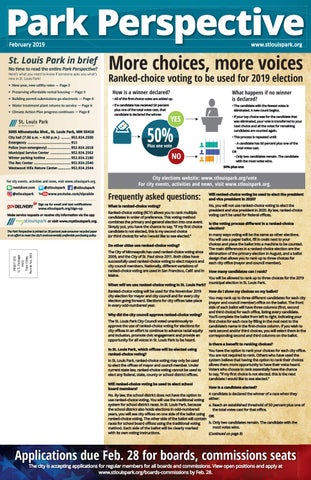
How is a winner declared?
• Building permit submissions go electronic — Page 4
• All of the first-choice votes are added up.
• Water treatment plant returns to service — Page 6
• If a candidate has received 50 percent plus one of the total votes cast, that
• Climate Ac on Plan progress con nues — Page 8
5005 Minnetonka Blvd., St. Louis Park, MN 55416 City hall (7:30 a.m. – 4:30 p.m.) ......... 952.924.2500 Emergency ......................................... 911 Police (non-emergency) ...................... 952.924.2618 Municipal Service Center ................... 952.924.2562 Winter parking hotline ....................... 952.924.2180 The Rec Center ................................... 952.924.2540 Westwood Hills Nature Center .............. 952.924.2544 For city events, activities and news, visit www.stlouispark.org.
nextdoor.com @stlouispark
@stlouispark
@stlouispark
www.youtube.com/slpcable Sign up for email and text notifications:
www.stlouispark.org/sign-up Make service requests or receive city informa on via the app
or visit www.mystlouispark.org. The Park Perspec ve is printed on 30 percent post-consumer recycled paper in an effort to meet the city’s environmentally preferable purchasing policy.
candidate is declared the winner.
• The candidate with the fewest votes is eliminated. A new count begins.
YES
• If your top choice was for the candidate that was eliminated, your vote is transferred to your
50%
next choice and all the votes for remaining candidates are counted again. • This process is repeated until: - A candidate has 50 percent plus one of the
Plus one vote
OR
NO
total votes cast.
- Only two candidates remain. The candidate with the most votes wins. 50% plus one
City elections website: www.stlouispark.org/vote For city events, activities and news, visit www.stlouispark.org.
Frequently asked questions:
Will ranked-choice voting be used to elect the president and vice president in 2020?
What is ranked-choice voting?
No, you will not use ranked-choice voting to elect the president and vice president in 2020. By law, ranked-choice voting can’t be used for federal offices.
Ranked-choice voting (RCV) allows you to rank multiple candidates in order of preference. This voting method combines the primary and general election into one event. Simply put, you have the chance to say, “If my first choice candidate is not elected, this is my second choice (or third choice) for who I would like to see elected.” Do other cities use ranked-choice voting?
PRSRT STD U.S. Postage PAID Twin Cities Permit No. 603
What happens if no winner is declared?
The City of Minneapolis has used ranked-choice voting since 2009, and the City of St. Paul since 2011. Both cities have successfully used ranked-choice voting to elect mayors and city council members. Nationally, different variations of ranked-choice voting are used in San Francisco, Calif. and in Maine. When will we use ranked-choice voting in St. Louis Park? Ranked-choice voting will be used for the November 2019 city election for mayor and city council and for every city election going forward. Elections for city offices take place in every odd-numbered year. Why did the city council approve ranked-choice voting? The St. Louis Park City Council voted unanimously to approve the use of ranked-choice voting for elections for city offices in an effort to continue to advance racial equity and inclusion, promote civic engagement and provide an opportunity for all voices in St. Louis Park to be heard. In St. Louis Park, which offices will be elected using ranked-choice voting? In St. Louis Park, ranked-choice voting may only be used to elect the offices of mayor and council member. Under current state law, ranked-choice voting cannot be used to elect any federal, state, county or school district offices. Will ranked-choice voting be used to elect school board members? No. By law, the school district does not have the option to use ranked-choice voting. You will use the traditional voting system for school district races. In St. Louis Park, because the school district also holds elections in odd-numbered years, you will see city offices on one side of the ballot using ranked-choice voting. The other side of the ballot will contain races for school board offices using the traditional voting method. Each side of the ballot will be clearly marked with its own voting instructions.
Is the voting process different in a ranked-choice election? In many ways voting will be the same as other elections. You will use a paper ballot, fill in ovals next to your choices and place the ballot into a machine to be counted. The main differences in a ranked-choice election are the elimination of the primary election in August, and a ballot design that allows you to rank up to three choices for each city office (mayor and council member). How many candidates can I rank? You will be allowed to rank up to three choices for the 2019 municipal election in St. Louis Park. How do I show my choices on my ballot? You may rank up to three different candidates for each city (mayor and council member) office on the ballot. The front side of each ballot will have three columns (first, second and third choice) for each office, listing every candidate. You’ll complete the ballot from left to right, indicating your first choice for each race by filling in the oval next to the candidate’s name in the first-choice column. If you wish to rank second and/or third choices, you will select them in the corresponding second and third columns on the ballot. Is there a benefit to ranking choices? You have the option to rank your choices for each city office. You are not required to rank. Others who have used the system believe that having the option to rank their choices allows them more opportunity to have their voice heard. Voters who choose to rank essentially have the chance to say, “If my first choice is not elected, this is the next candidate I would like to see elected.” How is a candidate elected? A candidate is declared the winner of a race when they either: a. Reach an established threshold of 50 percent plus one of the total votes cast for that office. OR b. Only two candidates remain. The candidate with the most votes wins. (Continued Continued on page 8 8)
Applications due Feb. 28 for boards, commissions seats The city is accepting applications for regular members for all boards and commissions. View open positions and apply at www.stlouispark.org/boards-commissions by Feb. 28.
City council okays 2019 budget, tax levy At its final meeting of 2018, the St. Louis Park City Council approved a final property tax levy increase of 4.35 percent over 2018, marking the third straight year the final levy increase has decreased from the previous year. This final approved levy was the conclusion of several months of budget discussions between city council and staff. Contributing to the increased levy are ongoing replacement and maintenance of infrastructure, including city roads, parks, buildings, technology and debt service, as well as the costs for continuing to provide quality service to residents. The increase will also support the city’s Vision 3.0 and comprehensive plan goals and the city council strategic priorities in the areas of environment, race equity and inclusion, ranked-choice voting (for mayor and city council elections) and housing initiatives. Visit www.stlouispark.org/city-budget for details.
City has award-winning financial report For the 35th year in a row, the City of St. Louis Park’s comprehensive annual financial report has been honored with a Certificate of Achievement for Excellence in Financial Reporting from the Government Finance Officers Association. The award recognizes reports for clearly communicating their financial story so that residents are more likely to read the report. Visit www.stlouispark.org/financial-reports to see the city’s most recent comprehensive annual financial report.
New year, new utility rates The City of St. Louis Park periodically conducts a utility rate study to make sure that our rates are properly structured and generate enough revenue to operate and maintain the city’s water and sewer services. The most recent rate study was completed in 2018. The city council adopted the study’s recommended rate changes for 2019. The new 2019 utility rates will: • Keep essential indoor water use as affordable as possible.
Understanding property taxes Why do we have property taxes? Property taxes are the primary funding source for local services provided by cities, counties, school districts and other special districts. Unlike sales or income taxes which can vary, the property tax is an exact levy to fund budgets – no more, no less. Property taxes work in three steps. Step 1 – Determining assessed value and classification The city’s assessing office determines the estimated market value (EMV) and classification (use) of your property on Jan. 2 each year. The EMV is determined after reviewing market activity (comparable sales, rents, costs). The EMV may be reduced by programs such as the homestead market value exclusion and disabled veteran exclusion which “exclude” part of the value from taxation. This reduced value is known as the taxable market value (TMV). The TMV is converted into tax capacity by the classification rates set by the Minnesota legislature. Note: If there are no exclusions, the EMV and TMV may be the same. How am I notified? The valuation and classification notices are mailed in March. When you receive the notice, read it carefully. If you believe your property valuation and classification are accurate, no further action is needed. If you have questions about either, contact the St. Louis Park Assessing Division at 952.924.2535. Most questions can be answered in an informal discussion. If you disagree with the valuation or classification, follow the appeal process steps listed on the notice. Don’t delay in calling – this is the time to appeal or question your valuation and classification. Valuations cannot be appealed after proposed property taxes are sent. Taxes may not be appealed.
• Promote water conservation.
Step 2 – Establishing a budget
• Pay for important system upgrades such as annually repairing 1.96 miles of water lines and 2.75 miles of sanitary sewer.
Every year, local governments establish a budget for the following year after determining planned revenue and expenses. The property tax levy is set in September and is determined by subtracting all non-property tax revenue from the total proposed budget. The preliminary levy for each of the taxing jurisdictions (county, city, schools, Metropolitan Council, watershed, etc.) is totaled and spread among all taxable properties according to their individual tax capacity.
One key change is that residential water rate tiers are smaller, and rates have been adjusted for each tier. The changes to the tiers are listed below:
2018
Residential water rates
2019
Quan ty*
Rate
Quan ty*
Rate
Tier 1
0 – 40 units
$1.89
0 – 13 units
$1.89
Tier 2
41 – 80 units
$2.34
14 – 20 units
$2.30
Tier 3
more than 81 units
$3.51
more than 21 units
$2.75
How am I notified? The Truth-in-Taxation notice is the second notice you will receive. Sent in November, it shows the proposed tax amount for the following year for each taxing jurisdiction (county, city, schools, Metropolitan Council, watershed, etc.). The notice also includes the meeting dates where you can provide input on the budgets and proposed levies. Budgets are finalized in December after these meetings.
*One unit = 750 gallons
Step 3 – Calculating property taxes
In changing the usage tiers, the city looked at historical consumption patterns and matched the tiers with the seasonal usage so that most residents will pay more for outdoor water use than indoor water use. This promotes water conservation for lawn irrigation.
Your property taxes are calculated using the prior year’s value and classification relative to the budgets levied. The property tax is your share of the costs to provide the services approved by elected officials.
Commercial and industrial customers will have larger tiers than residential customers. Finally, multifamily customers will receive a flat water rate in 2019 in order to comply with a state law pertaining to multifamily properties. The sanitary sewer consumption rate has changed from $3.44 to $3.61 per unit of water used for 2019. The sewer rate is calculated based on winter water consumption for residential and multifamily users and actual use for all other users. The quarterly sanitary sewer service charge, a fixed fee to off set the cost of making sanitary sewer service available to users, changed from $17.61 to $18.49 for 2019. The quarterly storm drainage rate, which pays for flood control projects and stormwater drainage, changed from $23.14 to $23.83 for 2019. The 2019 solid waste rates reflect increased costs to provide service. Solid waste rates include all city collection services. A base amount is paid by customers to provide collection of recycling, organics and yard waste. The remaining cost is determined by, and increases with, the garbage service level. This supports waste reduction by charging residents based on how much they throw away. Two new every-other-week garbage service levels have been added as options for residents who generate small amounts of garbage. Visit www.stlouispark.org/utility-billing to view the 2019 utility rates. Questions? Call utility billing at 952.924.2111.
2
February 2019
How am I notified? The final notice you receive is your property tax statement which tells you how much property tax you owe for the year. It provides an itemized list of all local property taxes, including city, county, school district, etc. It also includes any special assessments on your property. Property tax statements are mailed by March 31. When are property taxes due? Most property taxes are due May 15 and Oct. 15 in equal installments. Potential property tax refunds Property owners and renters are urged to annually review their eligibility for property tax refunds. The Minnesota Department of Revenue’s website (www.revenue.state.mn.us) offers information about refunds and property taxes. For information about refunds, enter “property tax refunds” in the website’s search bar. For more information on property taxes in general, enter “property tax fact sheets” in the search bar. You can also contact the St. Louis Park Assessing Division at 952.924.2535 for additional information.
Photo by @ToddMyraPhotography
Preserving affordable rental housing The city is introducing two new programs to preserve affordable rental housing in St. Louis Park: 1.
Owners of naturally occurring affordable housing (NOAH) properties may use a state provision called 4d, also known as Low Income Rental Classification (LIRC), to reduce property taxes on rent-restricted housing units.
2.
The multifamily rental rehab program provides moderate rehabilitation assistance to eligible property owners of occupied NOAH properties.
For more information contact Michele Schnitker, housing supervisor and deputy community development director, at mschnitker@stlouispark.org or 952.924.2571.
City offers multiple programs for homeowners, homebuyers The city offers several programs for existing homeowners to rehab or maintain their property, as well as a new affordable homeownership assistance program.
Home remodeling tour is May 5 Mark your calendar for the St. Louis Park Home Remodeling Tour Sunday, May 5, noon – 4 p.m. Tour homes that have been recently improved, including whole home remodels, additions, finished basements and energy efficient and green features. Visit www.stlouispark.org for more information.
Is your property at risk of flooding?
The Center for Energy and Environment (CEE) administers the following three programs in St. Louis Park. • Low-interest rate home improvement loans, including a three percent interest rate for households earning less than $95,000 and four percent rate for households between $95,001 and $141,000. Maximum loan amount is $35,000. • The income limit has increased for the Move Up in the Park loan, which provides eligible homeowners with a deferred loan for home additions or expansions. • A new affordable homeownership assistance program provides down payment and closing cost assistance loans to help first-time homebuyers purchase a home in St. Louis Park. Maximum loan amount is $15,000. Employees of St. Louis Park businesses are eligible for an additional $5,000 loan. Contact CEE at 612.335.5884 for information.
Emergency home repair grants available to low-income homeowners Low-income homeowners may be eligible for a grant to help with emergency repairs such as furnace replacement, roof repair, or plumbing or electrical issues. This program is administered by the Sustainable Resource Center; call 612.813.5524 for more information.
Gap financing available for businesses The St. Louis Park Revolving Loan Fund (RLF) provides gap financing along with commercial lending to local businesses. If business owners can't meet all financing needs through conventional sources like banks and other financial institutions, the RLF can help. RLF financing can fill the gap between traditional private financing, owner equity and total project cost. For-profit new and existing businesses located in St. Louis Park can apply for RLF financing. Women, minority and veteran-owned businesses are encouraged to apply. Preference will be given to projects that retain existing jobs and/or create new jobs. Contact Mike Mulrooney, CMDC Business Financing, at 763.784.3337. On Dec. 6, 2018, the economic development authority closed on its first RLF loan with Practical Systems, a heating, cooling and air-conditioning company that will bring 60 new jobs to St. Louis Park.
Wondering what the flood risk is for your property? The City of St. Louis Park will give you the following information at your request: • If your property is in or out of the Special Flood Hazard Area (SFHA) as shown on the current Flood Insurance Rate Map (FIRM) for the city; in or out of the floodway; or in or near an area where the problems are not shown on the FIRM. • Additional flood insurance data for a property, such as the FIRM zone and the base flood elevation or depth, if shown on the FIRM, and if a property is in or near an area of historical flooding and/or natural functions floodplain. To request information, provide your street address and, if available, the subdivision, lot and block number. City staff will do the rest. For more information, call the community development department at 952.924.2575 or stop by city hall, 5005 Minnetonka Blvd., 8 a.m. to 4:30 p.m., Monday – Friday. Visit www.stlouispark.org/floodplain for more information on flood hazards, risks and building responsibly.
www.stlouispark.org
3
Submit permit requests online with ePermits
As of Jan. 1, 2019, the main way to submit most residential and commercial permits is online through ePermits. Building plans should be submitted through ProjectDox. If you can’t submit your application online, inspections department staff at city hall can help.
2019-20 city and school calendar photo contest Be part of the 2019-20 city-school calendar by submitting photos reflecting the theme “My favorite place in St. Louis Park.” Selected photos from the contest will be featured in each of the calendar months. A People’s Choice winner will also be selected through online voting. Anyone who lives, works or attends school in St. Louis Park is invited to submit photos.
A computer is also available at the inspections counter at city hall to submit your plans online. Online submissions significantly reduce the amount of paper used during the approval process, which helps meet a city initiative to reduce paper use. Some inspections also may be scheduled electronically. This gives homeowners and contractors the chance to schedule an inspection any time of the day, not just during city hall office hours. It also allows the same inspector to follow a project through to completion. Questions? Call the inspections department at 952.924.2588.
Submit entries at www.stlouispark.org/arts through May 30, 2019.
Cedar Lake Road improvements The city will be improving Cedar Lake Road between Kentucky Avenue and Quentin Avenue from April through November of 2019. The project will include: • New pavement • Installation of a bicycle facility • Construction of new sidewalk along the south side of Cedar Lake Road • Construction of new sidewalk along the west side of Zarthan Avenue from Cedar Lake Road to 16th Street • Improved pedestrian crossings • Traffic signal improvements at Park Place Boulevard and Cedar Lake Road • Installation of a roundabout at the intersection of Cedar Lake Road and Zarthan Avenue • New watermain installation between Kentucky Avenue and Zarthan Avenue • Rehabilitation of the railroad crossing • New street lights with LED fixtures Visit www.stlouispark.org/cedar-lake-road to learn more and to sign up for project updates
Be a Hydrant Hero Volunteer to become a Hydrant Hero! The St. Louis Park Fire Department asks homeowners and businesses with fire hydrants on or near their property to shovel the snow around the fire hydrant after each snowfall and to keep the hydrant clear of overgrown plants during the summer. Visit www.hydranthero.org to adopt a hydrant. Choose a hydrant, click on the “Adopt me” link and fill out the registration form – you can even give your hydrant a name! Questions? Call 952.924.2171.
2 44 February 2019
or text SLPMN CEDAR to 468311.
Bike to Work Day is May 17 May’s National Bike Month is just around the corner. National Bike Month offers a chance to showcase the benefits of bicycling and to encourage more people to try it, including on Bike to Work Day Friday, May 17. Visit www.stlouispark.org for updates on Bike to Work Day activities.
What is right of way? Every road and alley in St. Louis Park is located on land dedicated for a public purpose, referred to as right of way. The right of way is intended for public roads, alleys, bikeways, sidewalks, trails, streetlights and utilities. While the width of the right of way can vary, the general rule of thumb is that the road right of way is 60 feet wide – about 30 feet on either side of the center of the road. Most residential streets in St. Louis Park are 28 feet wide. The right of way extends 16 feet behind the curb towards homes, an area usually called the boulevard. In most cases, it’s the adjacent property owner’s responsibility to maintain the boulevard. However, if the boulevard is needed for a public purpose like street widening, sidewalks, utility construction, signs or streetlights, the city may use the land. Alley right of way is 14 feet wide; paved alley is 10 feet wide. If you plan to install landscaping, retaining walls, sprinklers, pet containment systems, fencing or other private improvements in front of your house or along the alley it’s a good idea to hire a surveyor to determine where your property ends and the right of way begins. Work done within the right of way requires a permit from the engineering department. For more information call the engineering department at 952.924.2656.
Connect the Park
celebrates five years Pictured (left to right): Maria Carrillo-Perez, Greg Hunt, Deb Heiser, Kevin Locke, Council Member Anne Mavity, former Council Member Sue Sanger, Mayor Jake Spano, Council Member Rachel Harris, Council Member Tim Brausen, Meg McMonigal, Sean Walther, Ben Manibog, Karen Barton.
Southwest LRT project moves ahead A groundbreaking ceremony for the Southwest Light Rail Transit (SWLRT) was held Nov. 30 at the future SWLRT Rail Support Facility in Hopkins. More than 100 people attended, including staff and elected officials from St. Louis Park (pictured above). Construction of the SWLRT starts this winter, with passenger service expected to start in 2023. Visit www.swlrt.org to sign up for updates and to learn more about SWLRT. Keep an eye out for information on the construction schedule, proposed road closures and posted detours as construction begins. A first sign of construction will be the closing of the Cedar Lake Regional Trail in early 2019 through late 2020, which is necessary for the contractor to safely and efficiently work within the corridor. Once the trail re-opens, the city will have improved trail crossings that separate trail users from the motor vehicles at Wooddale Avenue and Beltline Boulevard. The trail will travel under Wooddale Avenue in an underpass and over Beltline Boulevard on a bridge.
Order a rain barrel
The Recycling Association of Minnesota (RAM) has partnered with the city to provide rain barrels to residents at a discounted price throughout this spring. St. Louis Park residents pay $79 for a rain barrel, a 50 percent discount. Online ordering starts at www.recycleminnesota.org March 1. Pick up your pre-ordered rain barrels Saturday, May 4, 8 a.m. – noon or Monday, May 6, 5 – 7 p.m. at the City of St. Louis Park Municipal Service Center, 7305 Oxford St. If you can’t pick up rain barrels on these dates, RAM is holding several other sales throughout the spring which may have more convenient pick up dates for you. Visit www.recycleminnesota.org or call RAM at 651.641.4589 for more information.
The end of 2018 marks the halfway point of Connect the Park, the city’s 10-year Capital Improvement Plan to add more bikeways, sidewalks and trails throughout the community. Work leading up to this plan began in 2007 as part of the Vision St. Louis Park strategic plan. To date, the city and its partners have installed almost 13 miles of on-street bikeways, more than eight miles of sidewalks and more than two miles of trails in St. Louis Park. Some of the projects include: • Bike lanes and sidewalks along Texas Avenue from Wayzata Boulevard to Lake Street south of Highway 7 • Bike lanes on Minnetonka Boulevard from Highway 169 to Highway 100, in partnership with Hennepin County • Sidewalks or bikeways on Ford Road in Minnetonka, France Avenue in Edina and Texas Avenue in Hopkins in partnership with neighboring cities • Installation of the first green bike lane striping across a Minnesota Department of Transportation (MnDOT) road at Texas Avenue over Highway 7, in partnership with MnDOT An additional 22.5 miles of bikeways, seven miles of sidewalks and 1.4 miles of trails are planned in the next four years of Connect the Park. This includes connecting the future Southwest Light Rail Transit (SWLRT) stations to the rest of the city with sidewalks and bikeways and conducting a study to find a pedestrian and bike crossing parallel with Highway 100 over the Burlington Northern Santa Fe railroad tracks near the West End. To mark the halfway point, you’ll find new website pages for walking and biking resources in St. Louis Park, available later this spring. Visit www.stlouispark.org/connect-the-park to learn more about Connect the Park.
www.stlouispark.org
3 5
Streets staff learn to salt smart in the city Streets maintenance staff recently attended a Smart Salting Certification class sponsored by the Minnesota Pollution Control Agency (MPCA). Class topics included understanding how salts affects the environment and different methods to reduce the use of winter chemicals. Some of these methods include calibrating equipment, which St. Louis Park has done for the last 10 years; using different chemicals at specific temperatures to be more efficient; and using liquid with salt effectively to reduce the amount of salt applied to the road.
Water treatment plant #4 returns to service; manganese test results explained Enjoy this new feature in each issue of the Park Perspective — an update on the latest news about your drinking water in St. Louis Park, and what the city is doing to ensure a continued supply of safe, high-quality drinking water for residents. In the upcoming May Park Perspective Perspective,, look for the annual drinking water report which will show results of drinking water monitoring from Jan. 1 – Dec. 31, 2018.
Water Treatment Plant #4 returns to service; tours offered
Earlier this year, Water Treatment Plant #4 (WTP4) returned to service providing water to St. Louis Park residents. Located at 4701 41st St. W., the plant was taken out of service at the end of 2016 after testing showed that while some volatile organic compounds (VOCs) were being reduced by an implemented short-term treatment solution, others were still increasing. The city worked with the Minnesota Pollution Control Agency (MPCA) and the Minnesota Department of Health (MDH) to design and implement upgrades to treat all identified contaminants, regardless of their source, down to published advisory levels. The upgrades included adding two air stripper units to treat the VOCs found in the water at this plant as well as many other upgrades, primarily to the interior. A photo of the interior is shown above. If you’re interested in learning more about WTP4 and how the city produces water, plan to attend a tour Tuesday, April 16, between noon – 1:30 p.m. or 5:30 – 7 p.m. This is a rare opportunity to see inside a water treatment plant. Registration is required; visit www.stlouispark.org/water-sewer for information on how to sign up. Tours last about 30 minutes.
Testing for manganese In addition to routine testing for regulated contaminants, the MDH tests drinking water for unregulated contaminants, such as manganese, as part of a nationwide effort to collect data on contaminants that may be present in drinking water. Manganese occurs naturally in rocks and soil across Minnesota and is commonly found in Minnesota ground and surface water. People need some manganese to stay healthy; however, recent studies have shown that infants under age one may develop learning and behavior problems if they drink water that has too much manganese in it. The MDH recommends a health-based guidance value of 100 parts per billion for infants under age one. Samples taken by the MDH at Water Treatment Plant #8 (WTP8) in 2018 showed manganese levels at 109 and 115 parts per billion, higher than the health-based guidance value for formula-fed infants and infants that drink tap water. WTP8 is located at 9701 W. 16th St. When notified of the results, the city took immediate measures to reduce manganese levels. Multiple subsequent samplings by the city at WTP8 have shown current levels of manganese between 80 and 82 parts per billion, well below the MDH’s health-based guidance value. Additional adjustments are planned in 2019 to further lower manganese levels in the city’s drinking water. If you have questions about the city’s drinking water system and the testing it conducts, contact Jay Hall, utilities superintendent, at jhall@stlouispark.org or 952.924.2557. For health questions about manganese, contact Sarah Fossen-Johnson, MDH health risk assessment unit, at 651.201.4080.
62
February 2019
Keep sidewalks shoveled Removing snow and ice from sidewalks is a combination of courtesy and caring toward all those who need to use the public walkways. Clearing the sidewalk after each snow event will not only create a safer surface for the public to walk on but help eliminate future issues. It’s also required by city ordinance.* St. Louis Park contains more than 116 miles of community and neighborhood sidewalks, with public works staff maintaining community sidewalks. Residents and property owners are asked to remove snow from neighborhood sidewalks. If you aren’t sure if the sidewalk by your property is a community or a neighborhood sidewalk, visit www.slpsnow.org and click on the “sidewalk and trail snow removal map” to find your sidewalk segment. Thank you for helping maintain safe and walkable sidewalks! *Note: Public works staff highly encourages sidewalk snow and ice removal to the extent reasonable and practical, but ice alone will not result in a citation as long as the snow has been removed. Similarly, although removing snow from the full width of the sidewalk is encouraged, residents need to only clear a minimum width of three feet to avoid a citation. Visit www.slpsnow.org for more information.
Don’t push snow into the street or alley City ordinance does not allow homeowners or contractors to deposit any snow or ice, plowed or removed from private property, onto or across a public street, sidewalk, or alley (including right of way). These piles of snow create a problem for traffic and future snow removal efforts. Any snow removed from a driveway must remain on the property. If you employ a contractor to remove snow, let them know about the ordinance and ask that they comply with this requirement. If the city sees an ordinance violation, you’ll receive a letter with educational information about city ordinances. If the practice continues, you can be fined $100 per each event in the form of an administrative citation.
New for 2019: Yard waste can’t go in organics carts Participants in the city’s curbside organics program are reminded that yard waste is no longer allowed in the organics cart. Organics are now collected separately from yard waste and delivered to a different facility, allowing the city to reduce processing costs for composting food scraps and yard waste. What happens if yard waste is accidentally placed in my organics cart? The city’s hauler, Waste Management, will leave behind a reminder on the organics cart that yard waste is not allowed. The cart will be emptied when yard waste is removed. How should yard waste be set out during yard waste collection season? Visit www.stlouispark.org/yard-waste for guidelines and for the date yard waste collection season begins in the spring. How can I request a smaller organics cart or sign up for organics collection as a new customer? Visit www.stlouispark.org/organics to submit a request online or call utility billing at 952.924.2111. Switch to a smaller size cart or sign up for the organics program at no additional cost.
Not much garbage? Consider fewer collections
If you don’t generate much garbage, optional everyother-week garbage collection might be for you. This service level is only available to residents who have 30- or 20-gallon service levels and who participate in the curbside organics program or manage food scraps through backyard composting. Residents who sign up for this service will have their garbage collected every other week on the same week as their recycling. Waste Management will attach an orange sticker to the front of garbage carts at households that sign up for this service. The orange sticker identifies the cart as one that receives service every other week. Do not remove this sticker. Increase or decrease the size of your garbage cart or change your garbage service level from weekly to every other week by calling utility billing at 952.924.2111. Changes can also be made online at www.stlouispark.org/garbage-recycling by filling out the garbage cart selection form.
Winter cleanup event Sunday, March 3, 2 – 4:30 p.m. Louisiana Oaks Park south parking lot, 3500 Louisiana Ave. S.
The following items will be accepted free of charge at this “mini” cleanup event: • Paper for shredding: Bring only confidential items that require shredding (financial, tax, medical, insurance documents, etc.). No magazines or newspapers. Limit five grocery bags per person. Paper that is already shredded will also be accepted.
Gardener’s swap Monday, May 6, 5 – 7 p.m.
St. Louis Park Municipal Service Center, 7305 Oxford St. This event is a great opportunity to clear out unused gardening tools and take home new treasures. Invite friends and neighbors; this event is free and open to everyone. What to bring: • Garden and yard tools (shovels, trowels, rakes, pitchforks, hoses, etc.) • Pots and planters (wood, terracotta, decorative plastic; NO black plastic pots or multipacks) • Gardening and plant books • Garden art and décor • Bird houses and feeders • Plants (perennials and annuals; please label) • Seeds Do not bring: • Chemicals of any kind (fertilizers, pesticides, etc.) • Broken items For items that are very large or heavy, call ahead to ensure they will be accepted. Note: The city is also hosting the rain barrel and tree sale pickup at the site during the same hours; follow the signs for the gardener’s swap. Contact Emily Barker at 952.924.2187 or ebarker@stlouispark.org with questions.
• Holiday lights and electrical cords: Strands of holiday lights and electrical cords such as charging cords or extension cords will be accepted. No bags or packaging (do not wrap lights around cardboard). Lights that are part of decorations will not be accepted unless first removed from rigid items. • Batteries: Household only, including alkaline, button, lithium ion (often found in laptops) and other rechargeable batteries. No vehicle batteries (auto or marine) or lead acid batteries. Tape the terminals of batteries or seal in a clear plastic bag.
Annual tree sale starts March 4 The city is offering trees at discount prices for the annual tree sale! Beginning March 4, visit www.treetrust.org to order and pay for your trees. Trees are $35 each with a maximum of three trees per property. Tree pickup will be Saturday, May 4, 9 a.m. – noon or Monday, May 6, 5 – 7 p.m. at the Municipal Service Center, 7305 Oxford St.
No electronics, light bulbs or other items not listed. The cleanup will be outside. If the weather is severe, the event may be postponed.
Questions? Email recycling@stlouispark.org
or call 952.924.2562.
Community garden plots assigned in March The city manages more than 100 community garden plots in five sites around the city. Garden plots can be rented for $35 per season. Plots are assigned in March on a first-come, first-serve basis. There has been a waiting list for participants in past years. Visit www.stlouispark.org for the community garden plot application and more information.
www.stlouispark.org
7 3
City of St. Louis Park
N A T U R E
(Con nued from page 1)
More choices, more voices Ranked-choice voting to be used for 2019 municipal election How are votes counted? 1. After the polls have closed on election night, all first-choice votes are counted and reported to the public, similar to what happens in all other elections. 2. If a candidate reaches the threshold (50 percent plus one of total votes cast for that office) with first-choice votes, they will be declared the winner of that race. No more counting is needed. 3. If no candidate reaches the threshold with first-choice votes and more than two candidates are running for that office, the ranked-choice voting process kicks in and round-by-round counting will begin the day following the election.
C E N T E R
Westwood Hills Nature Center building project starts soon
The first step in the Westwood Hills Nature Center construction project took place in December, with removal of trees from the site of the new interpretive center building. Many new trees will be planted around the interpretive center and throughout the park as part of the project. Building construction starts this spring. The current nature center building will remain open during construction with programs continuing to operate out of the building. For project updates, text SLPMN WHNC to 468311 or visit www.stlouispark.org/whnc/new-interpretive-center to sign up and learn more. Questions? Contact Jason West, recreation superintendent, at jwest@stlouispark.org or 952.924.2554.
Body-worn cameras tested, ordered In December, the St. Louis Park Police Department finished its testing of body-worn camera equipment from two vendors. Each vendor’s equipment was field tested for several weeks by a team of the same police officers before selecting the final vendor. After the equipment arrives, including new squad car dash cameras and body-worn cameras, it will be installed and configured. Before using the equipment, police officers will receive comprehensive training on its appropriate use and on the body-worn camera policy. Spring 2019 is still the expected date for all St. Louis Park police officers to be using body-worn cameras.
4. The next round of counting begins by eliminating all candidates with no mathematical possibility of winning. Votes for the eliminated candidates are transferred to the next ranked candidate (second or third choice) on those ballots. Votes are then recounted.
Visit www.stlouispark.org/body-worn-cameras to review the policy and for more information.
5. If no candidate reaches the threshold, the process is repeated until either:
Climate Action Plan progress continues
a. One candidate reaches the established threshold of 50 percent plus one of the total votes cast for that office and is declared the winner. b. Only two candidates remain. The candidate receiving the most votes is declared the winner. If I rank three choices, do three votes get counted? No. Each voter only gets one vote counted. If a winner can be declared after all first-choice votes are counted, the second and third choice votes are never counted. If a candidate is eliminated, all votes for that candidate are transferred to the next highest candidate chosen on those ballots. What will be done to ensure my vote is secure and accurately counted? As in all other elections, city staff work with county and state officials to ensure accurate and secure counting procedures. The city is subject to all election laws related to equipment testing, tabulation and post-election review. The city’s rules governing the administration of elections have built-in measures to verify that the ranked-choice system correctly counts each vote. The city will also produce results with detailed round-by-round election abstracts, which will be available to the public and reviewed by the city council prior to canvassing election results. Additionally, accuracy testing of city voting equipment and the tabulation process are open to the public. Does a vote count if I: • Only rank one choice? - Yes. You are not required to rank your choices and can choose to vote for only one candidate. You are allowed to rank up to three choices per office. • Rank the same candidate for each choice? - Yes. However, votes will count one time for that candidate. Ranking the same candidate for all three choices will not increase their chance of winning. It’s generally considered the same as leaving two of the choices blank. • Rank multiple candidates as my first choice? - No. This is called an overvote, and the first-choice vote will not be counted. If this happens, you can discard your ballot and receive a new ballot to correct the error. • Skip a ranking or leave one of the choices blank? - Yes. All valid votes cast on a ballot will be counted. Skipping a ranking or choosing not to vote for a particular office on the ballot is called an undervote. You are allowed to rank up to three choices for each city office and may vote for each office that appears on your ballot. Similar to what happens now, you can choose to vote for as many or as few of the offices on the ballot as you choose. Will the ballot counter tell me if I make an error on my ballot? The ballot counter will alert you if you overvote in a race or submit a completely blank ballot. You may choose if you would like to cast your ballot as marked or discard your ballot and receive a new one to fix any mistakes. The ballot counter will not alert you if you skip rankings or vote for the same candidate at multiple rankings. Where can I find other voting resources? Visit www.stlouispark.org/vote for details on voter registration, absentee voting, running for office and other elections services. Visit the Minnesota Secretary of State website at www.sos.state.mn.us for general voting information. Questions? Visit www.stlouispark.org/vote or email elections@stlouispark.org. For updates visit www.stlouispark.org/sign-up or text SLPMN VOTE to 468311.
Work continues on the Climate Action Plan, adopted a year ago by the St. Louis Park City Council. The plan’s goal is to achieve carbon neutrality – a net zero carbon footprint – in St. Louis Park by 2040.
Solar Power Hour results offered
In October, the city partnered with the Midwest Renewable Energy Association (MREA) to host a Solar Power Hour event, which was supported and voted for by the environment and sustainability commission. This free education session provided information to residents on how photovoltaic (PV) systems (solar panels) work, what to expect from a site assessment, potential costs and return on investment, qualified installers in the area and available financial incentives including bulk buy pricing. Four St. Louis Park property owners committed to installing solar panels through this bulk buy program. Once installed, these systems will result in 19.5 kW of solar production. Due to the success of the first Solar Twin Cities group buy program, the city hopes to offer another session in 2019. Visit www.midwestrenew.org or www.growsolar.org/solar-twin-cities to learn more.
SolSmart In December the city was awarded SolSmart bronze designation, a national designation program designed to recognize communities that have taken key steps to address local barriers to solar energy and foster the growth of mature local solar markets. The program offers a national team of experts providing no-cost technical assistance to help local governments become “open for solar businesses.” In recognition of their achievements, communities receive designations of SolSmart gold, silver or bronze. In order to achieve bronze designation, the city revised its solar permit process and added information that supports solar permitting on the permit webpage, based on recommendations from technical advisors through the SolSmart program. The SolSmart program launched in 2016 and is led by the International City/County Management Association and The Solar Foundation, along with a team of partners with expertise in solar energy and local governments.
Climate Mayors
St. Louis Park Mayor Jake Spano and the city are now members of Climate Mayors, also known as the Mayors National Climate Action Agenda, a national network of U.S. mayors collaborating on climate. As a Climate Mayors member, it’s required that cities are pursuing actions to achieve an emissions reduction target through: • Developing a community greenhouse gas (GHG) inventory • Setting near- and long-term targets to reduce emissions • Developing a Climate Action Plan aligned with the city’s targets St. Louis Park completed the first three actions and looks forward to assisting with other efforts, legislatively and otherwise, through organized letters of support or statements.
Solar suitability map available
The city collaborated with Great Plains Institute to create a solar suitability assessment map for St. Louis Park. It helps building owners better understand renewable solar resource potential for their building and provides an estimate of the potential for solar photovoltaic energy (PV) systems based on information about buildings in St. Louis Park. Building owners can click on any building to see information on the size and output of a solar energy system based on an analysis of shading, roof pitch and size. Visit www.stlouispark.org/climate-action-plan to view the map.
Learn about the State of the Community April 30
Join Mayor Jake Spano for a recap of 2018 in St. Louis Park, and a look ahead to what’s next at the State of the Community event Tuesday, April 30. A time and location are still being determined. Details will be available at www.stlouispark.org before the event.