

St. LouiS AmericAn
‘A crisis center in the middle of a crisis’
A year after the tornado, Annie Malone Children and Family Services Center’s mission stands firm
By Kenya Vaughn St. Louis American
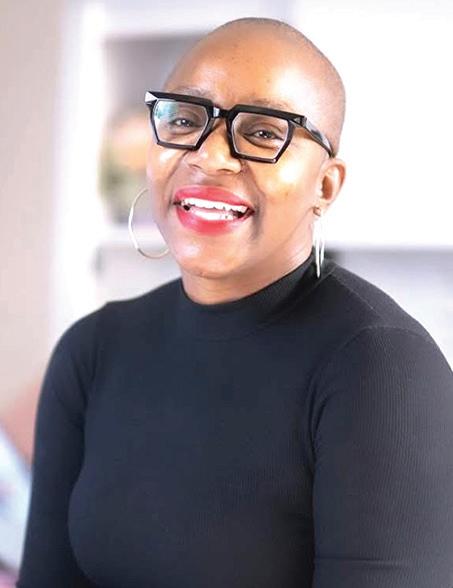
One year after a tornado tore through North and West St. Louis, Annie Malone Children and Family Services Center is still standing in the gap. For CEO Keisha Lee, the work of the past year has felt like both a calling and a confirmation.
“I don’t have to do this, I get to do this,” Lee said. “This past year has been a heavy lift.”
She remembers the moment the storm hit on May 16, 2025. It was a Friday afternoon, and she was at Annie Malone’s location in The Ville handling last-minute logistics for the Annual Annie Malone May Day Parade scheduled for May 18. As the winds intensified, the
they posted a video to social media.
“I knew the building was not sturdy,” Lee said. “I just hoped that somebody would see the video and come get us.” They emerged uninjured and NorTh CouNTy
the data center tax abatement proposal.
Ferguson votes NO
Public opposition helps sink data center plan
By Sylvester Brown Jr. St. Louis American
A divided Ferguson City Council vote this week to block tax breaks for a proposed $1.8 billion data center highlighted divisions over incentives, environmental concerns and whether the project would benefit Ferguson residents.
After more than an hour of testimony Monday night, the council split 3-3, with one abstention, halting the plan led by SSL Investments to redevelop the former Emerson Electric headquarters site.
The proposal would have turned the more than 200-acre site into a mixed-use hub for technology, energy innovation and research anchored by a data center. Supporters said it offered a chance to redevelop a major industrial site, while critics questioned the tax incentives, environmental impact and potential cost to local schools.
Critics said the incentive package, valued


Critics warned the FergusonFlorissant School District could lose $71 million over 15 years, while the Jennings School District could lose $6.2 million in the first six years. The city of Ferguson was projected to lose $5.2 million in the early phases of development.
at up to $1.5 billion, heavily favored the developer. Under the plan, the developer would pay no personal property taxes for 15 years but would instead provide payments in lieu of taxes starting at 25% of standard prop-
See Data Center, A14
A shared calling
Mother
and
daughter pursue nursing careers side by side
By Ashley Winters St. Louis American
Between lectures, clinicals and latenight study sessions, Tynai Burrow and her mother, Tywana, often find themselves quizzing each other — sometimes even competing over who scores higher. It’s a rhythm built on support, a little rivalry and years of shared experience. But their journey didn’t start in the classroom. It started in hospital rooms, advocating for a loved one.
As Mother’s Day approaches, their story is about more than academic ambition. It’s about resilience, second chances and the power of family.
Now, the two sit side by side at Barnes-Jewish College Goldfarb School of Nursing, pursuing the same Bachelor of Science in Nursing degree and often paired together in class. What began as a simple conversation about school became a shared commitment to a calling shaped by years of caregiving, sacrifice and personal growth. As Mother’s Day approaches, their story is about more than academic ambi-
See Nursing, A14
Keisha Lee, CEO of Annie Malone Children and Family Services Center, reflects on the challenges of rebuilding while continuing to serve families after the tornado devastated the organization’s historic campus.
Photo courtesy of Keisha Lee
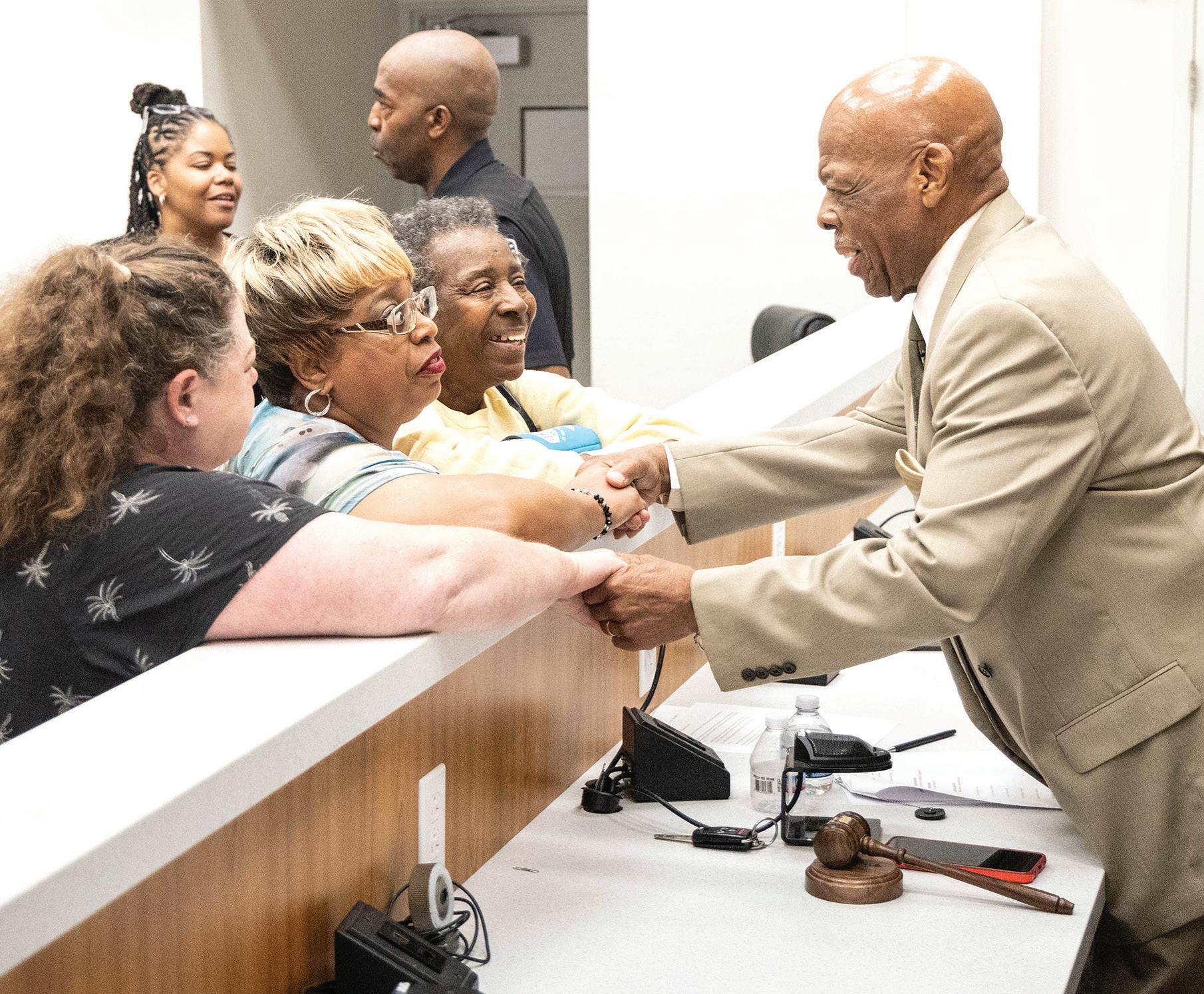
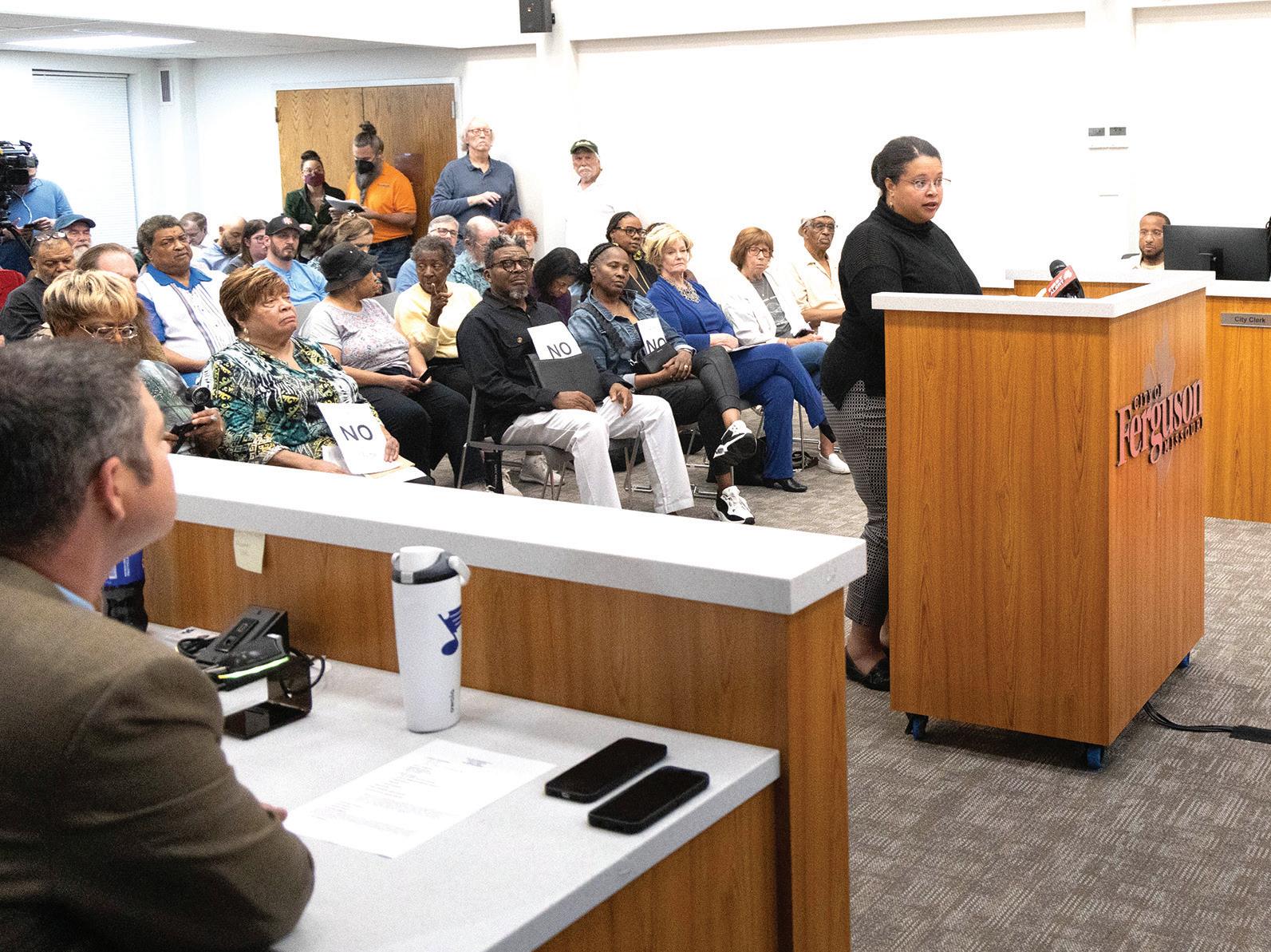
Ann Jacho, Mechelle Engelhardt and Val Shorpise thank Ferguson Mayor Adrian Shropshire after the city’s vote on
Photo by Lawrence Bryant / St. Louis American
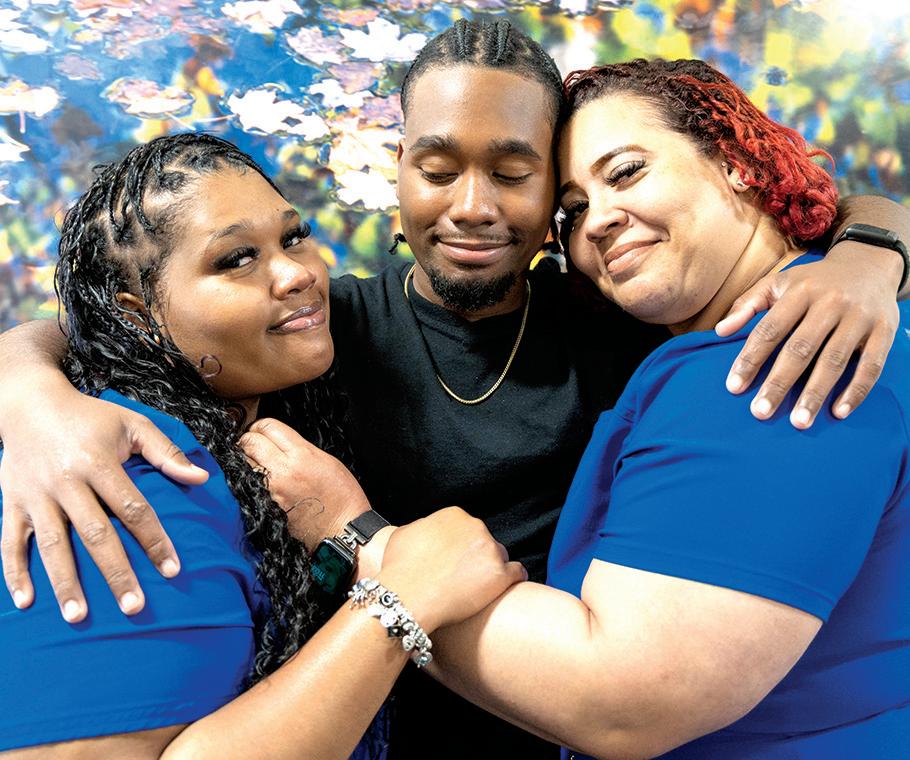
Tynai Burrow, Mark and Tywana Burrow share a moment of pride and togetherness as Tynai and Tywana pursue nursing degrees at Barnes-Jewish College Goldfarb School of Nursing.
Photo by Lawrence Bryant / St. Louis American
windows of the 1922 mansion blew out. She and her staff rushed to the basement. In the darkness,
Guest
Commentary
Facing our Black mental health crisis
Stories of angry, despondent men violently killing their wives, girlfriends and children are occurring in our community at an alarming rate. And far too often, we’re left asking why.
By Marc Morial
Dr. Cerina Fairfax. Vice Mayor Nancy Metayer Bowen. Shayla Elkins, 5; Kayla Pugh, 6; Layla Pugh, 7; Markaydon Pugh, 10; Sariahh Snow, 11; Khedarrion Snow, 6; Braylon Snow, 5; and Jayla Elkins, who was just 3 years old. Each of these women and all eight of these children died in the past month at the hands of men who were supposed to protect and provide for them.
Unfortunately, these murders aren’t happening in a vacuum. Stories of angry, despondent men violently killing their wives, girlfriends and children are occurring in our community at an alarming rate. And far too often, we’re left asking why. In the mass shooting in Shreveport, the nation’s deadliest since 2024, the family of the shooter, Shamar Elkins, stated he was struggling with his mental health amid a divorce before killing his family.
Former Virginia Lt. Gov. Justin Fairfax was also said to have been experiencing isolation and depressive episodes before killing his wife and himself days after being requested to appear at a divorce hearing. And after murdering his wife, Nancy, Stephen Bowen told his uncle that he “couldn’t take it anymore.”
home, and in the workplace.
While there’s no direct correlation between these tragedies and toxic internet culture, the risks of isolation and the inability or refusal to engage with mental health supports are evident. But for many men of color, accessing mental healthcare isn’t easy.
There are financial barriers that keep Black men out of care. Stigmas associated with therapy, like being labeled “crazy” or “weak,” encourage men to compartmentalize and use self-soothing tactics like drinking or substances that raise the risk of violent outbursts. And with only 4% of mental health professionals being Black, finding professionals that men can connect with is also a challenge.
The disturbing pattern in each of these cases is a group of men not just struggling with mental health, but a general lack of value for the lives of their loved ones. Taken together, these cases reveal something larger than individual tragedy; they reveal a crisis hiding in plain sight.
Researchers have documented the rise of a male loneliness epidemic that was sweeping the country, and its effects on emotional stability, ability to connect with others, and even how men perceive reality. Researchers also found that in the absence of meaningful relationships, men who spent more time online often found themselves targeted by algorithms that promote toxic podcasters and influencers who spout negative tropes and stereotypes about women. This world, called the “red pill,” encourages men to dehumanize and assert power over women socially, at
The combination of feeling like finding help is impossible, compartmentalizing that leads to isolation, and predatory algorithms that spew hatred towards women has created a perfect storm for violence and selfharm. According to the National Library of Medicine, suicide has become the third leading cause of death among Black people, and for younger men, most vulnerable to alienating internet culture, rates of mental health decline are rising. Tackling this crisis that is tearing our families, and community apart will take acknowledging the structural issues that are breaking down the mental health of Black men while holding men accountable for their actions.
Making mental health the center of these stories risks minimizing the decisions that these men made to take the lives of their loved ones. And imposing accountability without investing in preventative measures to ensure that these acts of violence don’t happen again is also shortsighted.
This means calling it what it is: a structural decline in the value of human lives. And these cases, in our community, are examples of the devaluing of Black lives. If you or a loved one needs support with anxiety, depression, or thoughts of self-harm or harm against others, call or text 988 for help today.
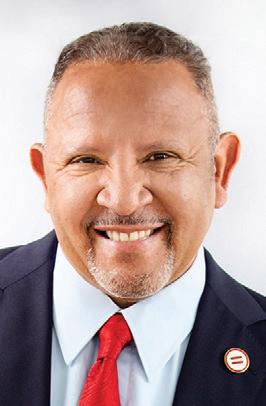
Marc Morial is president and CEO of the National Urban League.

SCOTUS Voting Rights ruling
‘About as bad as it gets’
In a 6-3 decision, the court’s conservative supermajority dismantled Section 2 of the Voting Rights Act, the last remaining powerful provision of the 1965 civil rights law that prevents racial discrimination in voting.
By Joseph Williams
When the Supreme Court handed down a landmark decision last week that all but invalidates the Voting Rights Act, legal and voting-rights analysts called it a knockout blow to a powerful tool against racial discrimination at the ballot box.
Political analysts predicted it would dismantle Black political power for a generation — or longer.
Damon Hewitt, president and executive director of the Lawyers’ Committee for Civil Rights Under Law, was more succinct: “It’s evil genius, man.”
“This is a really slick opinion” that technically leaves the Voting Rights Act in place but dismantles the enforcement mechanism and prevents an easy legislative fix, he says. “It ends up being a rewriting of the VRA” that “usurps” Congress power to write laws.
“We’re left with rights on paper but very few remedies, in fact,” Hewitt says. “This is about as bad as it gets.”
In a 6-3 decision, the court’s conservative supermajority dismantled Section 2 of the Voting Rights Act, the last remaining powerful provision of the 1965 civil rights law that prevents racial discrimination in voting. Section 2, which requires states to seek federal permission before changing voting laws, has been a bulwark against the marginalization of minority voters in redistricting.
represented in Congress for decades — represents “a departure from the constitutional rule that applies in almost every other context.”
The court’s three liberals, however, decried the decision and accused the conservative majority of “eviscerating” voting rights for millions of Americans. Their dissent, written by Justice Elena Kagan, warned that this ruling, combined with other actions, could lead to a resegregation of American society, effectively locking out minority voters.
“The Voting Rights Act is — or, now more accurately, was — ‘one of the most consequential, efficacious, and amply justified exercises of federal legislative power in our Nation’s history,’” she wrote.
The court’s decision is a major upheaval in U.S. civil rights law and gives lawmakers permission to draw districting plans that weaken the influence of Black and other minority voters.
Former President Barack Obama was blunt, calling the decision “just one more example of how a majority of the current Court seems intent on abandoning its vital role in ensuring equal participation in our democracy and protecting the rights of minority groups against majority overreach.”
Obama, however, saw a silver lining:
At issue was a Louisiana congressional map that was specifically redrawn to create two majority-Black districts. Opponents of the plan sued, alleging the map was an unconstitutional racial gerrymander under the Fourteenth Amendment.
Writing for the conservative majority, Justice Samuel Alito said taking race into consideration in creating Louisiana’s two new congressional seats — even though the state’s Black voters had been under-
“The good news is that such setbacks can be overcome” at the ballot box, he wrote. “But that will only happen if citizens across the country who cherish our democratic ideals continue to mobilize and vote in record numbers.”
The bottom line, Hewett says, is “Black people in this country have never enjoyed full representation of power. This decision makes it much less likely that we ever will.”
Joseph Williams, a veteran journalist, political analyst and essayist, is head of Content for Word in Black.
Commentary
Black representation is at dire risk
With a record five Black senators, African Americans hold only about 5% of seats — less than half of what proportional representation would require.
By Dedrick Asante-Muhammad
In 1965, the United States took a decisive step toward democracy with the passage of the Voting Rights Act. At the time, Black political representation was not just limited — it was nearly nonexistent. African Americans made up more than 10% of the population but held less than 2% of seats in Congress and none in the United States Senate.
The Voting Rights Act changed that trajectory. By dismantling formal barriers to voting, it opened the door for Black political participation — and over time, representation. That progress was neither immediate nor inevitable, but it was real.
The gains since 1965 are significant. Black representation in the House has grown from fewer than 10 members to more than 60 today, reaching roughly 14% — finally approaching parity with the Black share of the U.S. population. But it took nearly 60 years to reach this point, underscoring a critical truth: representation requires sustained protection and intentional policy.



Even now, the progress is incomplete. In the Senate, Black representation remains far below population share. With a record five Black senators, African Americans hold only about 5% of seats — less than half of what proportional representation would require. Structural realities of the Senate aside, the result is clear: Black political voice remains constrained at the highest levels of government.
And today, even these gains are under threat.
Recent Supreme Court decisions have weakened key provisions of the Voting Rights Act, reducing federal oversight
and making it more difficult to challenge discriminatory voting practices. At the same time, partisan gerrymandering is embraced by both parties while regulation designed to ensure Black representation is being dismantled, and this could prove dangerous to those gains. The result is a system increasingly driven by political advantage rather than fair representation. Gerrymandering is often discussed as a partisan tactic, but it has broader structural consequences. When districts are drawn to maximize political control, they can dilute the voting power of communities of color — even without explicitly referencing race. For Black communities, whose political gains have often depended on fair districting, the erosion of these protections is particularly consequential.
This is not simply about who wins elections. It is about how policy is shaped and whose interests are represented in decisions that affect economic opportunity, education, healthcare, and wealth. Representation alone does not guarantee equity — but without it, inequity is almost certain.
Nearly 60 years after the Voting Rights Act, Black Americans have come closer than ever to achieving representation in Congress that reflects their share of the population. But progress at this level is not self-sustaining. Without strong protections and continued commitment, it can be reversed.
The work of building a representative democracy is ongoing. And in this moment, it is clear that the work must continue.
Dedrick Asante-Muhammad is president of the Joint Center for Political and Economic Studies.
Guest Columnist Dedrick AsanteMuhammad
Columnist Marc Morial
Guest Columnist Joseph Williams
““I would love to be able to fill in the gaps for him. I’ve got the experience
— I can tell you that I know everything about the 13th District.”
Marcye Scott on entering the race to fill her late father David Scott’s congressional seat in Georgia
Urban League reflects on tornado response, plans next phase
By Kenya Vaughn St. Louis American
The applause inside the St. Louis Marriott Grand last Thursday reflected a community still processing the impact of the May 16 tornado that tore through north St. Louis nearly a year ago.
At the Urban League of Metropolitan St. Louis’ 108th annual dinner, speakers and videos focused on recovery — what was lost, what has been rebuilt and what remains ahead.
For thousands of families, the storm’s path was more than physical. It cut through routines, stability and the illusion that tomorrow would look like today.
“You start your morning off normal and happy … and afterwards, you come home to a disaster,” said Angela Meeks, recalling the day in a video shown during the program.
to know that my family would not be on the street.”
The storm also affected the Urban League itself.
“At our business center on Natural Bridge, one of the HVAC systems fell on top of our staff member’s car,” said Urban League President and CEO Michael P. McMillan. “Had she been in it, she would have died.”
Despite that, the organization expanded its response.
The Urban League will start a $10 million Rebuilding St. Louis Fund to repair homes and support recovery in North St. Louis, CEO Michael P. McMillan said.
Unable to reach her block, she parked two streets away and walked through what felt like a movie set — neighbors stunned, homes split open, futures suddenly uncertain.
“If you don’t have a roof, you don’t have a home,” she said. “And the Urban League got us back to where we had a roof over our head.”
Roosevelt Price described a similar moment of uncertainty.
“May 16 changed my life,” he said. “The help that you guys gave us was such a big relief …
The Urban League reported supporting more than 30,000 people through weekly relief drives and investing more than $3 million to assist more than 40,000 residents affected by the storm. It placed 750 families in hotels and distributed more than one million pounds of food over 15 weeks.
“Even in the face of challenges … we did not pause our mission,” McMillan said. “When the work was hardest, we expanded it.”
The organization now serves about 225,000 people annually through programs that include workforce development, housing support and early childhood education.
Looking ahead, McMillan said the next phase includes a Rebuilding St. Louis Fund with a goal of raising $10 million to repair homes and support recovery in North St. Louis.
A weekend of service is planned for May 15–17, including a large-scale distribution of food and toiletries for about

5,000 residents.
Donations announced during the event included $100,000 from United Way of Greater St. Louis and $1 million from the Centene Foundation.
“We believe deeply in the work you’ve done here,” said Centene Foundation President Keith Williamson.
The evening also included recognition of civic leaders Steve Smith, executive chairman and co-founder of The Lawrence Group, and Michael Holmes, chairman of The St. Louis American Foundation board.
“St. Louis can be a great city,” Holmes said. “But we will never truly be great until every-
one has an opportunity to live a good life.”
Nearly a year after the tornado, speakers said recovery is ongoing.
“In two weeks and two days, we will commemorate one year,” McMillan said. “Not just to remember, but to rebuild.”



Exercising, playing with the kids, walking the dog—don’t lose your little moments of joy. From common back problems to complex spine injuries, our team is ready to restore your mobility. We offer: • Latest in minimally invasive surgical options • Comprehensive team of spine specialists • Comfortable, safe hospital setting • Multiple convenient locations
Photo by Lawrence Bryant | St. Louis American
Honoree Michael Holmes stands with Michael P. McMillan and the Urban League of Metropolitan St. Louis annual dinner co chairs during the event on April 30, 2026.
Court orders rewrite of Missouri map ballot summary
A Missouri appeals court ordered changes to the ballot summary for a potential referendum on the state’s new congressional map, finding the original language misleading.
The revised wording must more clearly explain the measure to voters.
Opponents say the Republican-backed map could eliminate one of Missouri’s two
County to pay Black officers nearly $600,000 in bias cases
St. Louis County has agreed to pay nearly $600,000 to resolve two separate racial discrimination cases involving Black officers, the St. Louis Post-Dispatch reported.
Lt. James Morgan is expected to receive $320,000 in a pending settlement, while former Officer Shanette Hall finalized a $250,000 agreement in April.
Both cases had been set for trial this month and are among several recent claims alleging discrimination or retaliation within the county police department.
Southern Illinois abortion clinics resume mail access to pills
Southern Illinois abortion clinics can again provide abortion medication through telehealth and mail delivery after the U.S. Supreme Court temporarily halted a lower court ruling restricting access to mifepristone.
The order restores, for now, rules allowing patients to receive the medication remotely while litigation continues.
Clinic operators said the ruling returns operations to the “status quo” after uncertainty created by a federal appeals court decision last week.
Free Loop Trolley rides resume through October
The Loop Trolley has resumed seasonal service, offering free rides through Oct. 25 along a 2.2-mile route linking the Delmar Loop and Forest Park.
The vintage-style trolley operates Thursdays through Sundays from 11 a.m. to 7 p.m., with 10 stops between the University City Library and the Missouri History Museum. Riders do not need tickets or res-
Democratic congressional districts — both represented by Black members of Congress — allowing voters to weigh in on whether to overturn it.
The targeted district, the 1st Congressional District, is represented by Rep. Emanuel Cleaver.
ervations, with boarding available on a firstcome, first-served basis.
Bi-State Development, which has managed the line since 2022, will continue operating the trolley through 2028. Officials say service hours will be extended during some major events in Forest Park and the Delmar Loop district.
Governor-appointed panel to oversee high school sports appeals
Missouri lawmakers have approved legislation creating a governor-appointed commission to oversee certain appeals involving the Missouri State High School Activities Association.
The panel would review issues including student transfer eligibility and disputes involving contests or procedures.
Supporters said the measure adds accountability to the organization that governs high school athletics and activities statewide, while critics warned it could inject politics into decisions traditionally handled by the association.
The bill now heads to Gov. Mike Kehoe.
East St. Louis district expands career training facilities
East St. Louis School District 189 has broken ground on a $17.2 million expansion of career and technical education facilities at East St. Louis Senior High School.
District officials said the project is backed primarily by a $17 million state grant secured with support from Illinois Sen. Chris Belt. The expansion will add classrooms, labs and workshop space for programs including welding, automotive technology, construction trades and audiovisual production.
District leaders said the project is designed to better align student training with regional workforce needs.
Commentary
Faith without all the noise
By Julianne Malveaux
I was raised Catholic.
Not casually Catholic. My mother went to Mass every day. Faith was not something she talked about; it was something she did. In our aqua-blue kitchen, she had the lyrics in white paint: “Holy Mary, dressed in blue, teach me how to pray.” She prayed without ceasing, and her prayers were deep and strong. I went to a Jesuit college, Boston College, where faith was woven into the intellectual life — questions of justice, responsibility and what it means to live a life of purpose. It wasn’t always comfortable, but it was always present.
When I hear people arguing about the pope as if religion were a political sport, I find myself out of step with the conversation, because that’s not the faith I knew.
The noise is everywhere. Commentary about Pope Francis — what he said, what he meant, who agrees, who doesn’t — fills panels and social media feeds, turning belief into a series of takes. It is loud and, for the most part, unhelpful.
We have developed a habit of treating religious figures like political ones, as if they occupy the same space. They don’t. Political leaders govern behavior, while religious leaders, at their best, try to speak to conscience. Church attendance in the United States has been declining for years, and fewer people claim formal affiliation. Yet nearly nine in 10 Americans say they believe in God or some higher power. Many are no longer sitting in pews, but belief persists. We measure what is easiest to count — attendance, affiliation, participation — but not what is harder to see: practice, discipline, belief.
My own relationship with
Catholicism has been more complicated. I don’t come to this conversation as a defender of the Catholic Church; I come as someone shaped by it, challenged by it, angered by it and still, in some ways, holding onto it. As soon as I learned about the Church’s historical role in sanctioning enslavement, I was repulsed — and I made my opinion known, quite vocally: skipping Mass, arguing with priests and sometimes embarrassing my mother. Sexual abuse in the Church repulses me. The betrayal of trust, and the lengths taken to conceal it, stand in painful contradiction to the values the institution professes. The codified inferior role of women has never sat easily with me either. When I hear that we are created in the image and likeness of God, I find myself looking for a stained-glass window with a pecan-colored woman with gray dreadlocks. I haven’t seen one yet. It is also worth noticing the signals we choose to see. Pope Francis has chosen to live in modest quarters rather than the traditional papal apartments, a small but visible gesture in an institution known for grandeur. In a world accustomed to power on display, that kind of restraint stands out not because it is dramatic, but because it is not.
My grandmother used to say that some people come to God with their hands out and their mouths open. It was her way of reminding us that faith is not only about asking, but about recognizing, giving thanks and showing up with something other than need.
We don’t talk much about that kind of faith anymore. It doesn’t fit neatly into our arguments or produce a headline, but it may be closer to what faith is.
Julianne Malveaux is a Washington, D.C.-based economist and author.

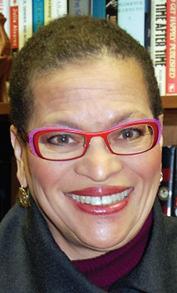
Julianne Malveaux

SEIU addresses the crowd during a May Day rally at Aloe Plaza, as workers and supporters gather to advocate for labor rights in St. Louis.
‘We deserve more’
May Day rally links jobs,
development,
By Sylvester Brown Jr.
St. Louis American
A relaxed, almost picnic-like atmosphere — cool weather, free food and the steady rhythm of improvised drums — set the scene at last week’s May Day rally in downtown St. Louis.
But the issues drawing hundreds of people to Aloe Plaza were anything but light, spanning labor rights, rising costs, North City investment, data center development and national political tensions. Free food circulated
neighborhood investment
The issues drawing hundreds of people to Aloe Plaza were anything but light, spanning labor rights, rising costs, North City investment, data center development and national political tensions.
through the crowd. Young people with upturned red buckets roped around their necks drummed in unison. A little girl sat upon an adult’s shoulders holding a sign that read, “We want pizza, not ICE!”
Another sign declared, “Immigrant’s rights are Worker’s rights,” while others warned President Donald Trump to “Keep your hands off our unions.” Dozens wore red T-shirts emblazoned with the words,
“Power to the People” or “Workers not Billionaires.”
The Friday event, part of an annual global observance of International Workers’ Day, blended traditional labor demands with local concerns.
“I’m here in support of the working class. We’re being mistreated, mishandled,” said a woman who identified herself as “a good, strong health care worker” named Wanda. “We need better wages. Prices at the store and at gas stations are sky-high. They’re cutting food stamps and other
See May day, A6
SLPS board re-elects CollinsAdams amid financial strain
St. Louis American
Dr. Karen Collins-Adams has been elected to serve a second term as president of the St. Louis Public Schools Board of Education.
Also elected to leadership roles by fellow board members are Brian Marston, vice president, and AJ Foster, secretary.
In addition to its newly elected officers, the board includes Donna Jones, Emily Hubbard, Tracy Hykes and Dr. Robert S. Harvey.
The board recently hired Dr. Myra Berry as superintendent after she served in an interim role since last fall. The district also is managing the aftermath of a devastating tornado last May, declining enrollment and school closing decisions — all of which present ongoing financial and operational challenges.
Collins-Adams said the board “enters this next chap-
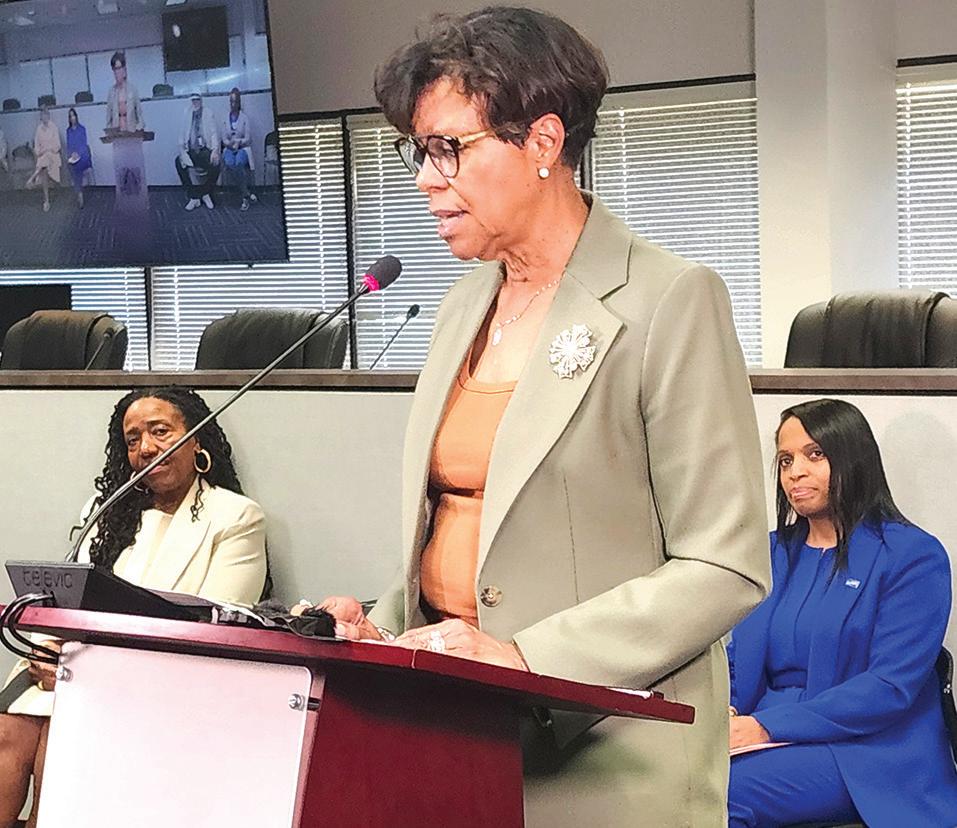
ity.”
“The work ahead requires not only strong governance, but also deep engagement with the community we serve,” Collins-Adams said. “We are committed to providing quality schools, a solid budget, clean audits and a return to full accreditation.”
According to the board, it is “equally focused on preparing SLPS for a future shaped by evolving enrollment patterns, shifting community needs and the imperative to deliver high-quality educational experiences for every student.”
Board leadership also “will emphasize the importance of working collaboratively to address issues that have affected the district over time — while also acknowledging that some of these matters remain active concerns today.”
Christopher Hicks named board chair
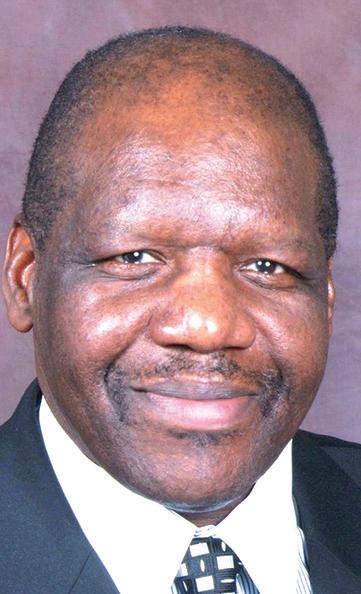
Christopher Hicks
Christopher Hicks, an environmental health and safety consultant and former adjunct professor at the University of Central Missouri, has been named chair of the St. Louis County Health and Hospital Advisory Board. He earned a Master of Science from the University of Central Missouri and a Bachelor of Science from Indiana State University, and is a graduate of the Leadership St. Louis program. Hicks is also a past recipient of the President’s Award from the American Society of Safety Professionals and the Safety Professional of the Year Award from the St. Louis chapter of the organization.
SLU Black Law honors Judge Hardin-Tammons
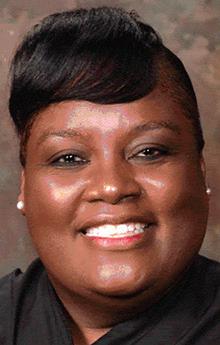
Renee HardinTammons
The Black Law Students Association chapter at Saint Louis University School of Law has awarded the Honorable Theodore McMillian Award to Judge Renee Hardin-Tammons, an appellate judge on the Missouri Court of Appeals, Eastern District. The award is “an expression of gratitude for her service and dedication to the St. Louis legal community, law students and for integrity on the bench,” the association said in a release.
Jones newest member of Enterprise Platinum Club
Melissa Jones, vice president and senior business banker at Enterprise Bank & Trust, has been recognized as a member of the company’s Platinum Club.
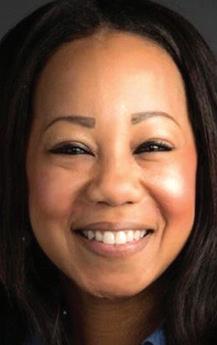
The honor is reserved for top producers who demonstrate exceptional performance, client dedication and meaningful impact within their department, according to the company.
She is a 1994 graduate of Ladue Horton Watkins High, a graduate of the Consortium for Leadership Development at Harvard Business School, and a member of Delta Sigma Theta Sorority Inc. and The Links Inc.
Jonathan Goines new GM of Angad Arts Hotel

Jonathan Goines
Jonathan Goines has been promoted to general manager of the Angad Arts Hotel in Grand Center. Goines has more than 15 years of leadership experience in the hospitality industry, and his team blends art, culture and hospitality at the hotel. His previous roles include director of operations at the DraftKings Casino Queen Hotel and executive housekeeper at the Hyatt Regency St. Louis at The Arch. Goines’ responsibilities include customer service management, payroll administration and income statement reviews to achieve organizational goals.
Please submit your People on the Move item (including photo) to areid@stlamerican.com
Photo by Lawrence Bryant / St. Louis American
Ramada Watkins of
Melissa Jones
Karen Collins-Adams speaks at an October press conference announcing Dr. Myra Berry as interim superintendent of St. Louis Public Schools. Collins-Adams was recently re-elected as board president.
Photo by Alvin reid / St. Louis American
Business Briefs
St. Louis proposes stricter rules for data centers
St. Louis city officials have proposed tougher zoning rules for future data centers, including a requirement that every project receive case-bycase approval instead of being automatically allowed in certain industrial areas.
Under the proposal released Tuesday, all data centers would be treated as “conditional uses,” meaning developers would need city approval before construction could move forward. Supporters say the process gives officials and residents a chance to review issues such as noise, energy use, water consumption, traffic and neighborhood impact before projects are approved.
May Day
Continued from A5
programs. How do they expect us to live?”
Speakers urged city officials to invest less in large-scale projects and more in neighborhoods, particularly in North St. Louis, where last year’s May 16 tornado destroyed homes and displaced residents.
Several participants also questioned the expansion of data centers, arguing such projects would do little to benefit nearby communities.
National politics were never far from the conversation. Signs and chants referenced immigration enforcement, the economy under the Trump
St. Louis advances $1,000 bonuses for city employees
St. Louis officials have taken an initial step toward approving one-time $1,000 bonuses for most city employees as leaders continue grappling with staffing shortages and retention challenges across municipal departments.
The Board of Aldermen’s Budget and Public Employees Committee advanced the proposal last week. Supporters said the payments would recognize workers who continued providing city services despite vacancies and increasing workloads. Elected officials would not qualify for the bonuses.
The proposal still requires approval from the full Board of Aldermen before going to Mayor Cara Spencer for consideration.
administration and U.S. involvement abroad.
Prominent progressive social media commentator Hasan Piker criticized both Republicans and Democrats, drawing loud reactions from the crowd.
“Republicans are monsters ... who traffic in hatred,” Piker said. “But we’re no longer going to vote for do-nothing Democrats either.”
A man who identified himself as Trenton from Illinois, said he attended simply because he is a worker.
“We deserve more from our country, from our representatives,” he said. “We have control, and we need to show that. So, I’m here to support our fellow workers.”

Rendering courtesy of Bi-State
Development
A rendering shows the proposed bus rapid transit line along Jefferson Avenue, part of Metro Transit’s planned north-south corridor designed to provide faster service through dedicated bus lanes and limited stops.
Metro seeks public input on bus rapid transit routes
Metro Transit is advancing two final route options for a proposed bus rapid transit line connecting north and south St. Louis, with planners seeking public feedback this week through open houses and a virtual meeting.
According to the St. Louis Business Journal, the proposed line would run along Jefferson Avenue and North Florissant Road and is designed to provide faster, more reliable service through dedicated bus lanes and limited stops.
The St. Louis Post-Dispatch reported the two remaining route options would extend farther east downtown than the previously abandoned MetroLink Green Line proposal.
Metro officials will host open house sessions from 5 to 7 p.m. Tuesday at Rung for Women and from 5 to 7 p.m. Wednesday at the Polish Heritage Center. A virtual meeting is scheduled for 7 p.m. Thursday.
Staff members will answer questions and gather public input, but no formal presentation is planned.

International Workers’ Day has its roots in the late 19th-century fight for an eight-hour workday. Groups including the Missouri Workers

Center, Action St. Louis, ArchCity Defenders and the St. Louis chapter of the Democratic Socialists of America joined student groups and abortion-rights organizations in bringing people together.
Terry Coats with Action St. Louis held a placard reading “Hands Off STL,” which she said referred to concerns about a state-appointed police board and efforts to increase police salaries at taxpayers’ expense.
“It’s May Day and we’re not doing anything today in support of capitalism,” Coats said. “No shopping — and hopefully the kids took off from school and came down here to get a little political education about what’s going on in our country.”
Armond Walker with the Party for Socialism and Liberation said he attended as both a citizen and a worker, hoping to create space for people to express their frustration.
He said the people “who are actually doing all the work” — those who “make sure the buses run, that people get fed, that the schools are open, that
fellow demonstrators holding a “WashU stands up for science” sign during a May Day protest on May 1, at Washington
the Amazon packages get delivered” — deserve better pay.
“They can’t afford health care, they can’t afford their groceries or their rent,” Walker said.
“I’m seeing more and more people getting involved in this kind of gathering,” he said. “And it gives me hope.”
Sylvester Brown Jr. is the Deaconess Foundation Community Advocacy Fellow.
As the drumbeats and chants grew louder, Walker turned to scan the crowd, pointing to both its size and the range of concerns represented.
Photos by Lawrence Bryant / St. Louis American
Jordan Davis stands with
University.
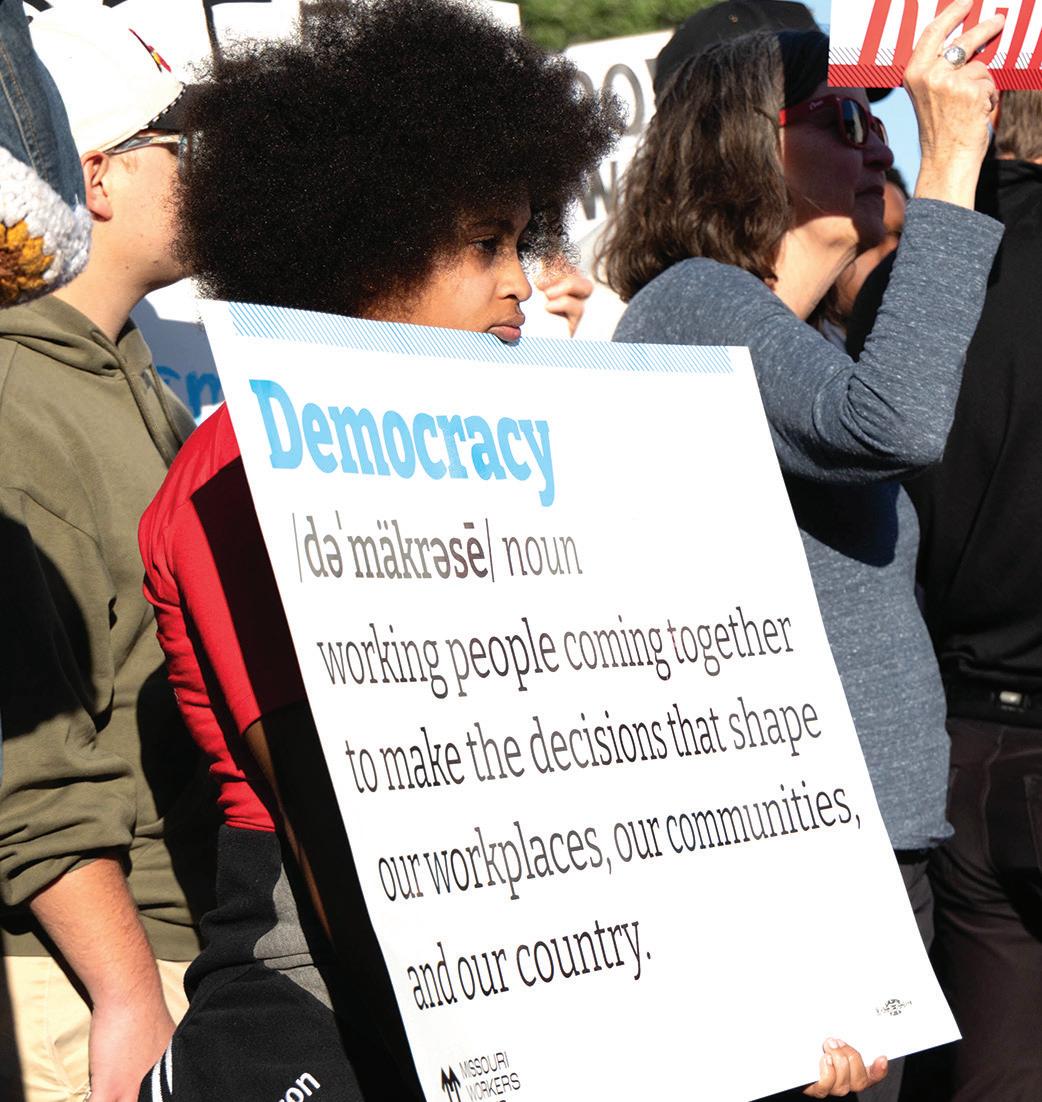
Josyland Rucker holds a sign highlighting the meaning of democracy during a May Day rally at Aloe Plaza, as workers and supporters gather in St. Louis to advocate for labor rights.
HealthMattersHealthMattersHealthMatters
‘Taking Care of You’
Aging alone
Isolation carries hidden risks for older adults
New
census
analysis
labels
St. Louis the nation’s “loneliest city.”
By Nia Hightower For The
Ann Allen described aher life as full. She grew up with her childhood friends, married, had children and, in her senior years, continued to live in her hometown where her sisters also live. But at 75, the St. Louis native found herself living alone like a growing number of older residents in the region. Allen died this spring — alone in her senior living apartment — weeks after speaking to The St. Louis American. While The American has no information linking Allen’s solitude to her death, her story underscores the risks facing a growing number of older adults.
In a recent analysis of newly compiled U.S. Census data by The New York Times, St. Louis emerged as the “loneliest city,” driven by a dramatic rise in single-person households. Nearly half of all households in St. Louis, 48%, are occupied by just one person, the highest share among U.S. cities with at least 50,000 households. Living alone does not necessarily mean someone is lonely, but it can increase the risk of social isolation, especially among older adults.
behind the numbers lies a deeper and more complex story about connection, community and health, especially among older adults.
Nearly 20% of St. Louis County’s population is over 65, according to the U.S. Census.
“When someone retires, their social network naturally narrows,” said Michele Prevedel, coordinator of Visit-a-Bit, a program that connects volunteers with older adults living alone across the St. Louis region. “If they stop driving, that narrows it even more. A lot of people stay in their homes, and over time, that isolation grows.”
And that isolation can lead to loneliness.
“Loneliness starts as an emotion, but it can domino into the physical,” Prevedel said. “It doesn’t just affect how people feel. It can impact heart health, brain function, sleep and even immunity.”
The World Health Organization has linked loneliness to an estimated 871,000 deaths annually. That’s more than 100 deaths every hour.
Allen said she filled her days with reading and watching television, cooking and baking, and she was excited about sharing her recipe for the chicken cordon bleu she had made a few days earlier. She also sought ways to stay connected, even as her social circle shrank.
Nearly half of all households in St. Louis are occupied by just one person, the highest share among U.S. cities with at least 50,000 households.
Between her food prep and housekeeping routine, she admitted that aging had presented some challenges. Her husband, a Vietnam veteran, died in 2004. Her children, now adults, live in California and Colorado. Time normally spent with her sisters became limited because of mobility issues. And two of her closest childhood friends moved to Kansas City and Dallas within the past several years.
A long search for answers ends in cancer diagnosis
By Jennifer Porter Gore Word in Black
By the time Shannon Lee-Sin finally learned what was wrong with her, she had seen 20 doctors and spent 12 years searching for answers.
She first noticed signs of trouble while still in high school. The daily stomachaches, Lee-Sin said, were often accompanied by blood in her stool — “the water was actually red, like KoolAid.”

As a 17-yearold, Lee-Sin and her mother did what many families would do.
“I went to my pediatrician,” she said. “I was a junior in high school, and I told him that I was having a stomachache every day and that sometimes at night the stomachache could be really bad.”
At the time, few recognized that younger people were increasingly being diagnosed with colorectal cancer.
“He was obviously loved and respected,” she said. “Plus, it was 1999 and [this] wasn’t even a blip on the radar yet, in terms of early onset, so nobody thought they’d be seeing a polyp at that point. He never did any diagnostic test on me.” She was treated for an ulcer, but her symptoms worsened over the next five years. At the time, few recognized that younger people were increasingly being diagnosed with colorectal cancer, a disease that has since been shown to disproportionately affect Black Americans and younger adults.
By the time actor Chadwick
Boseman died in 2020 at age 43, colorectal cancer had become widely recognized as one that disproportionately affects Black Americans and younger adults.
For Shannon, things came to a head after her 29th birthday.
“At that point, I would have diarrhea for two weeks, and then I’d be constipated for two weeks,” she said. “So, definitely not normal.”
While living in Jamaica, she was diagnosed with ovarian cysts and sent home without further testing.
Hospitalizations continued until she returned to Miami, where her mother found her unconscious and took her to the hospital, vowing not
See Cancer, A12
Declining marriage rates, more affordable housing costs and a growing population of seniors aging alone have all contributed to the solo-living trend in the metro area. But
In 2022, she lost both her legs as a result of a rare condition, antiphospholipid syndrome, an autoimmune disorder that can cause blood clots, and had been getting

Photo by Lawrence Bryant / St. Louis American
St. Louis American
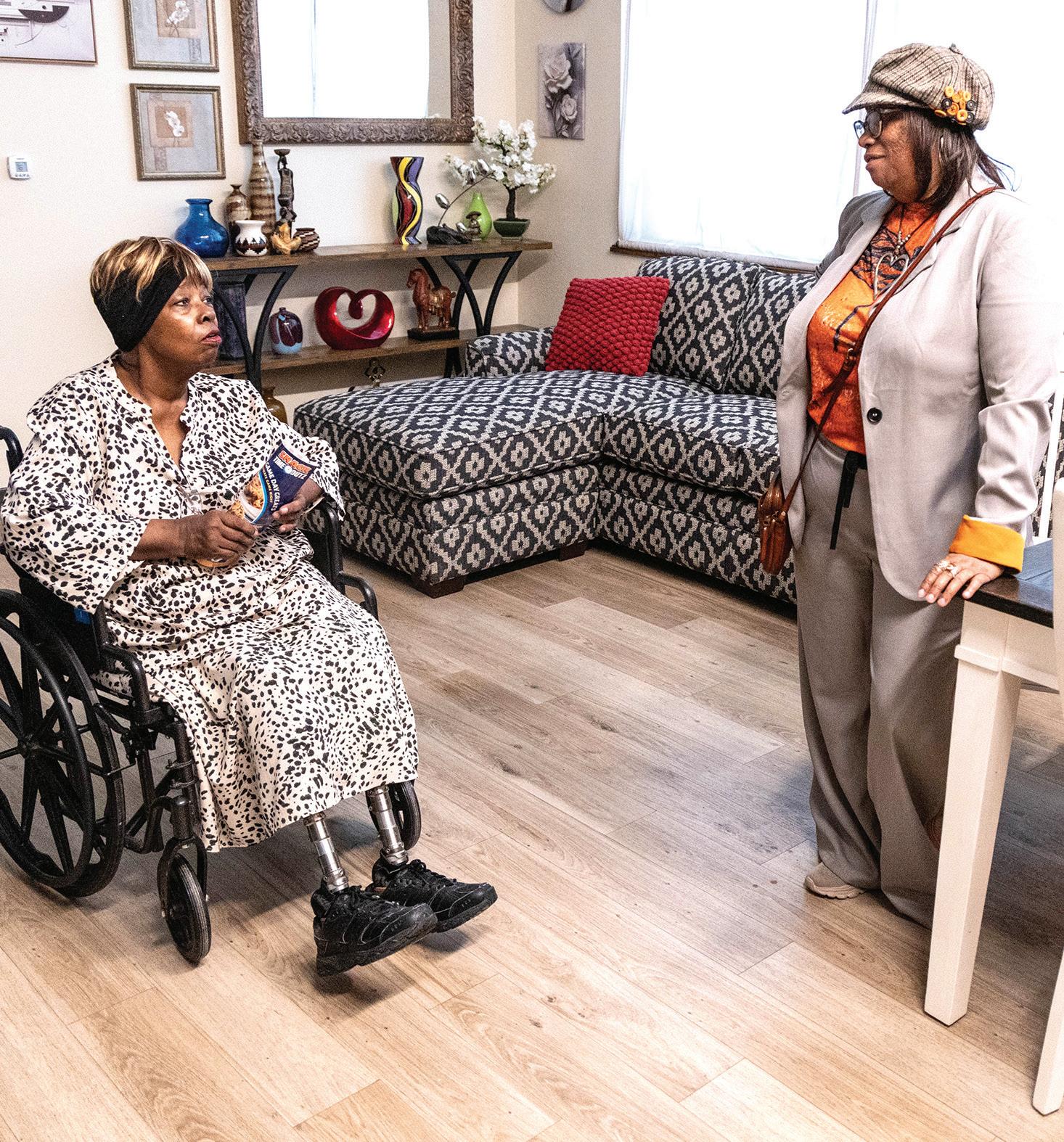
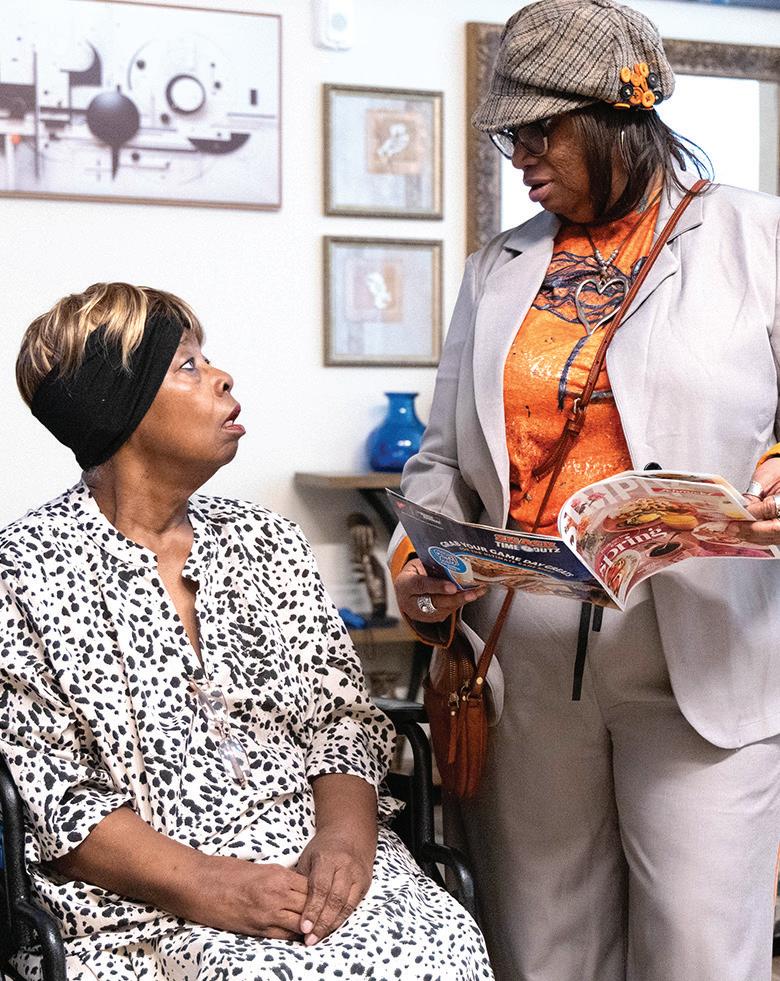
Ann Allen visits with Vist-a-Bit volunteer Darla King at her home as the program works to bring companionship and care to older adults facing loneliness.




Pooh Shiesty’s father, Big30 plead not guilty in Gucci Mane kidnapping case
Two key defendants in the federal kidnapping case involving rapper Gucci Mane have entered not guilty pleas as their attorneys push back against the government’s allegations.
Pooh Shiesty’s father, Lontrell Williams Sr., and Memphis rapper Big30 are contesting the charges tied to the alleged January 2026 ambush at a Dallas recording studio. They are among nine defendants accused of orchestrating an armed kidnapping and robbery that targeted Gucci Mane and two other victims.
According to Action News 5, the group includes Pooh Shiesty, Williams Sr., Big30, Kedarius Waters, Terrance Rodgers, Damarian Gipson, Demarcus Glover, Kordae Johnson and Darrion McDaniel. Prosecutors allege Pooh Shiesty forced Gucci Mane to sign a con tract release at gunpoint, while Big30 allegedly blocked the exits. Rolex watches, jewelry, Louis Vuitton bags and cash were said to have been taken during the attack.
Williams Sr. initially posted a $250,000 bond, but a judge issued a stay as prosecutors fight to keep him detained until trial.
With the notguilty pleas entered, both sides appear headed toward a lengthy legal battle. Each defendant faces up to life in prison if convicted.
Attorneys for both sides told the court this week that the matter has been resolved through private mediation. Terms of the agreement were not disclosed.
‘Love & Hip Hop’ franchise ending after 15 years; farewell special coming this fall
The longrunning era of VH1 reality dominance is coming to a close. Paramount announced that “Love & Hip Hop,” the franchise that helped define modern reality TV since its 2011 New York debut, is officially shutting down. To mark the end of its 15 year run, the network will air a six part retrospective, “Love & Hip Hop: The Final Chapter,” later this fall.
According to the network, the special will revisit the franchise’s breakout stars, headline making moments and cultural impact, with new interviews from cast members across all four cities — New York, Atlanta, Hollywood and Miami — along with producers, executives, journalists and cultural critics. Executive producer Lashan Browning called the farewell a tribute to the talent, crews and fans who fueled the show’s rise.
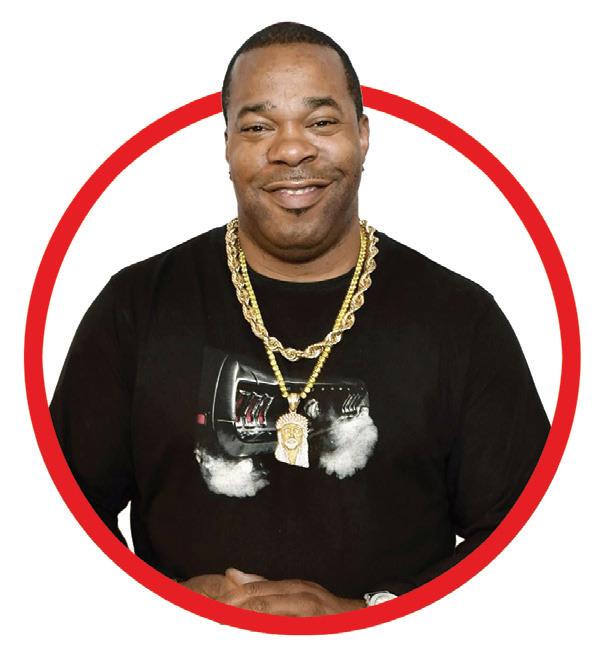
Busta Rhymes quietly settles assault and defamation case with former assistant Busta Rhymes has reached a private settlement with former assistant Dashiel Gables, ending a legal battle that included assault allegations and a defamation countersuit, according to Rolling Stone
Gables accused the Grammy nominated rapper of punching him outside Rhymes’ Brooklyn apartment in 2023 after a dispute involving a delayed meal and a phone call Gables took from his young daughter.
CBS News New York reported that Rhymes, born Trevor George Smith Jr., was arrested and issued a desk appearance ticket for third degree assault, though the criminal case has since been sealed.
Gables later filed a federal civil suit alleging assault, battery and workplace abuse, claiming the incident left him blacklisted in the industry. Rhymes denied the allegations and countersued for defamation, arguing the claims damaged his reputation and cost him business.
While the main franchise wraps, spinoffs “Love & Hip Hop: Atlanta” and “Love & Hip Hop: Miami” will continue their current seasons on MTV and BET.
Fans check influencer for calling Dionne Warwick the “Bword”
Influencer and stylist Nicky Campbell is catching heat after referring to Dionne Warwick as the b-word expletive while critiquing her look from the Billboard Women in Music ceremony. Campbell, known for his blunt red carpet commentary, opened his April 29 recap by questioning Warwick’s choice to wear slippers — but it was the disrespectful phrasing toward the 85 year old icon that set fans off.
Instagram users quickly pushed back, with comments like “Not the B word when referring to an elder… not feeling that,” while TikTok users called the remark “TOO comfortable” and “Dionne Warwick slander. NEVER.”
Campbell posted a followup video on May 4, walking back his words. “I put my foot in my mouth,” he said, adding that Warwick is “mother” and a legend he respects. “I wasn’t even trying to be rude,” Campbell said on Instagram. “I’m just really gay and annoying and always like, you know, ‘Hey [b-word expletive],’” he added. “Here’s what we will do. I will learn to watch my mouth, especially around icons.”
Sources: Action News 5, CBS News New York, Instagram.com, People.com, Rollingstone.com, Tiktok.com


















Busta Rhymes
HealthMattersHealthMattersHealthMatters
Care of You’
Alone
Continued from A7
“I was totally independent, and then everything changed,” said Allen, referring to life as a double amputee. “I have outlived my friends –– my childhood friends, my high school friends. I only have two left.”
“When your social group and your family group are the same age as you, and they die off or they move away, you’ve lost community,” she said.
Allen and her friends and family usually spoke by phone, and she had occasional visits from her sister, who would bring fresh produce. But Allen longed for that physical connection she had grown accustomed to. So, she took action and signed up for a local program that gave her opportunities to socialize.
Visit-a-Bit offers meaningful connections for older adults through volunteer support, weekly tele-bingo games and peerto-peer connections.
Allen’s death is bringing attention to issues surrounding aging and living
Cancer
Continued from A7 around using a wheelchair since.
to leave until her daughter was tested — “even if they have to arrest me.”
Doctors again diagnosed a cyst, but she was also severely anemic and in sepsis. That’s when Dr. Eric Valladares performed exploratory surgery — a
alone. The Centers for Disease Control and Prevention draws a critical distinction between social isolation and loneliness. Social isolation refers to the absence of relationships or regular contact with others, while loneliness is the emotional experience of feeling disconnected. Both carry serious risks.
CDC research shows prolonged isolation is linked to higher risks of heart disease, stroke, depression and dementia –– all contributors or related to cardiovascular disease, the No. 1 killer of Black Americans.
Prevedel said programs like Visit-a-Bit, which is operated through SSM Health Visiting Nurses Association, are helping to bridge the gap between healthcare and community support.
“We pair people based on hobbies, interests and social needs. So, the connection is genuine, and we’re seeing meaningful connections that truly improve quality of life,” she said. “It’s about reaching people who are homebound who may not have technology, transportation or a support system.”
Darla King participated in the Visit-a-Bit program
decision that saved her life.
“I woke up a week later hearing that I had stage 3C adenocarcinoma of my colon,” she said. “And so, my first thought was, ‘Okay, God — this is going to be one heck of a fight, and at least now I know what I’m fighting.’”
After surgery, Lee-Sin began chemotherapy and joined a cancer support
as Allen’s volunteer connection and built a friendship with her over the past four years.
“It’s a joy to go see her,” King said in an earlier interview. “We’re kindred spirits. We just have that respect for each other that makes everything
community, where she was the only colorectal cancer survivor and the youngest.
“My doctors made me feel like I was their rare case, and there was nobody else like me,” she said.
That changed in 2013.
“When I walked in, I saw a room that 80% of them were young people like me,” she said. “This was in 2013. I realized

around can have on older adults.
“When I’m with Ms. Ann, it’s like time stands still. We just talk and talk,” she said.
“Sometimes I bring lunch. I always bring her flowers.”
King, who has adult children and now lives alone, said the connection shows not only the impact she had on Allen, but also how much she gained from the experience.
“She has enlightened my life the same way I have enlightened hers,” she said. “She’s the sunshine that you didn’t know you needed.”
Allen said before her passing that her quality of life would not be the same without King.
The relationship made her wish she had built a broader, more layered community –– friendships across generations that could have sustained her through her latter stage of life.
easy.”
King, a correspondence specialist for U.S. Bank, relocated to the St. Louis region 19 years ago from California to take care of her ailing father, who is in his late 80s. She understands the impact that having family and friends
that I wasn’t rare — and I wasn’t alone.”
Now 44, Lee-Sin uses her experience to help others. In 2023, she launched the podcast “Blue Couch Chat,” creating a space for patients and survivors to talk openly about the disease and its impact.
“Blue has always been my favorite color and it’s also the color of a
“Reassess your friendship base,” she said. “If I had thought about it, I would have had tiers of friends. People younger than me, people older than me. People I could still tap into.”
Both women agreed that those kinds of rela-
colorectal cancer ribbon,” she said.
Her goal is to ensure patients know they are not alone and understand the importance of screening and early detection.
“Don’t make yourself go through what I went through,” Lee-Sin said. “If the doctor is not listening to you and you know something is wrong … find another doctor.”
tionships take work.
“The seeds that you plant, you will see the flowers grow. If you plant no seeds, you have no harvest,” King said. “I choose to give of myself in a way that makes someone else’s life better because someone did that for me.”
Over the years, King’s weekly visits turned into monthly visits as life became busier, but the two continued to cook and dine together.
Her April visit got pushed back due to a business trip to Kentucky. When King returned, she learned Allen had died.
“She was such a vibrant woman who was looking forward to doing so much. We just talked about how she wanted to go horseback riding,” King said tearfully recalling one of her last conversations with her friend. Allen knew it was going to take some work, but she wanted to explore further physical therapy to get her prosthetics adjusted to jump back into the saddle for equestrian classes offered to people with limited physical capabilities. Allen, who would have turned 76 in October, said it was “seldom” that she felt lonely, “but there are times I feel alone.”
“The colonoscopy is the only way to actually prevent this,” she said. “I saw over 20-something doctors … but I didn’t stop until I got an answer, and that’s what saved my life.”
“I didn’t stop until I got a doctor who listened, and that is really important,” Lee-Sin said. “We have to know how to advocate for ourselves.”

Photo by Lawrence Bryant / St. Louis American Ann Allen speaks with Vist A Bit volunteer Darla King during a home visit focused on companionship, support and reducing loneliness among older adults.

Continued from A1
walked themselves to safety. But the trauma lingered.
Two days later, instead of leading the parade of floats lined up along Market Street, Lee was at the Page Boulevard campus handing out food purchased for the event to neighbors who suddenly had nothing.
“Watching this makes me so emotional,” she said.
The tornado caused $1.6 billion in damage across the region, including to the Annie Malone campus. The historic mansion was already struggling with outdated boilers, old piping, lead, asbestos and strict historic-preservation requirements. Months later, the second floor collapsed onto the first.
“It would take $50 million to bring this building back up to standards, and that was before the tornado came,” board president and 13th Ward Alderwoman Pam Boyd told St. Louis Public Radio.
Data Center
Continued from A1
erty taxes for the first 12 years, gradually increasing to 80% by the final year.
Critics warned that the Ferguson-Florissant School District could lose $71 million over 15 years, while the Jennings School District could lose $6.2 million in the first six years. The city of Ferguson was projected to lose $5.2 million in the early phases of development.
The decision followed weeks of debate about transparency, tax abatements, environmental impact, water usage and power demands. While some council members acknowledged the project’s potential for economic development, others cited too many uncertainties.
“I know that we need development,” Councilwoman Naquitta Noah said. “I know that we need financial resources. Our city does need help but there are so many unknowns and uncertainties that I cannot support this!”
Dissent was evident even before testimony began. About 30 people lined up outside Ferguson City Hall after they were unable to enter the overcrowded meeting. Some said the meeting should have been held at a larger venue, as previous meetings had been.
“There was a whole line of people here before the meeting even started,” said Kourtney Huddleston, a 33-year resident. “Starting
Nursing
Continued from A1 tion. It’s about resilience, second chances and the power of family.
For Tynai, enrolling in nursing school felt like the natural next step. As a certified surgical technologist at Barnes-Jewish Hospital, she describes herself as “the right hand of the surgeon,” preparing operating rooms and ensuring procedures run smoothly. She previously worked as a traveling surgical tech across the country but returned home to help care for her brother.
Advancing her education, she said, is about expanding her role in patient care.
When she mentioned nursing school, it sparked something unexpected in her mother.
“It was a friendly fire that she put under my feet,” Tywana said.
A $50 million capital campaign is underway. A recent $1 million allocation from the St. Louis Development Corp. is a start, but the need remains enormous.
Still, the mission continues.
“We are a crisis center in the middle of a crisis,” Lee said.
The tornado’s path cut through the stretch of Page Boulevard where Annie Malone, Better Family Life and the Bayer YMCA sit side by side.
“You have three beautiful institutions right next door to each other,” said Better Family Life’s Jihad Khayyam. “It only makes sense.”
Better Family Life set up a command center with the Academy-Sherman Park Neighborhood Association the next day, while Annie Malone and the Bayer YMCA distributed food and supplies originally intended for parade-goers.
Khayyam, who lives in the neighborhood, went home, changed out of his suit, grabbed his electric saw and started clearing debris — house by house.
“It exposed the dis-

investment disaster that has been going on for decades,” he said. “One year later, our people are still in turmoil. The money hasn’t flowed to the community.”
Nearly 100 years earlier, when a tornado devastated St. Louis in 1927, Malone — one of the most successful Black businesswomen in the nation — ordered Poro College to open its doors.
“Even though Annie Malone was not even in the city of St. Louis, by telegram she said, ‘Open
up the doors of the Poro College and be of assistance to as many people as you can,’” Linda Nance, founding president of Annie Malone Historical Society, told The National Trust for Historic Preservation.
For weeks, the building sheltered, clothed and fed up to 5,000 people.
“I didn’t find out about what she did back then until afterwards,” Lee said.
“I still get goosebumps thinking about that. It lets me know that I am on purpose with the work that we
are doing.” Lee had already decided to cancel the parade because of funding shortages. When last-minute donors stepped in, she reversed course — only for the tornado to hit two days before the event.
“I felt like I was letting the city down by not having the parade,” she said. “But with all the people who stepped up and supported us, I learned that I wasn’t alone.”
The parade will not return this year. Instead, Annie Malone will host the Annie Malone May Day Community Festival & Talent Showcase at 1 p.m. on May 17 — the day after the tornado anniversary — on Market Street near Soldiers Memorial Military Museum.
Families impacted by the storm will receive appliances and furniture, including washers, dryers, beds and refrigerators.\n\n“I have to save these babies all year round, and the parade is only one single day,” Lee said.
“We’re able to give away things people still need — appliances,
off by disenfranchising people who came here to speak on such an important topic is extremely upsetting. They should be heard.”
Inside City Hall, residents expressed concerns about the developer’s environmental plans, water usage and power demands.
“My concerns are about the cost of utilities. The utilities this company will be using are going to raise our costs. I’m a senior citizen and I’m already hav-
From the classroom perspective, the bond between Tynai and Tywana has stood out to faculty. Yasir Eltahir, an associate professor at the nursing school, said teaching the pair has been both unusual and inspiring.
“They worked seamlessly together with a natural sense of teamwork and mutual respect,” Eltahir said. “They supported each other without relying on one another in a way that compromised independence. Instead, they complemented each other.”
The mother-daughter duo is entering the nursing field at a moment when hospitals are still trying to recover from years of short staffing. During the height of the COVID-19 pandemic, many positions went unfilled. At one point, nearly 1 in 6 hospital jobs across Missouri sat vacant, according to the Missouri Hospital Association, leaving nurses stretched thin and overworked.
ing problems with that,” Mary Baker said. “I’m also concerned about the grid, the noise level from their cooling systems, increased traffic. … The streets here are terrible. Why are they coming in here with all this grand stuff and we can’t even get a pothole fixed here in Ferguson.”
Ferguson resident
Henry Iwenofu, CEO of Missouri American Energy Inc. USA in Nigeria, said the council had a “heavy burden” before sharply
Conditions have improved, but the need remains. Fewer positions are going unfilled, yet demand is still high as experienced nurses approach retirement and others consider leaving the profession because of stress and burnout.
For Tywana, the moment felt less like a warning and more like a call. Nursing was never a new idea for her — it was an unfinished one. Despite earning a bachelor’s degree in business, two master’s degrees and working as a certified phlebotomist and real estate agent, she said something always felt incomplete.
“I have all of these titles, but I never felt completed,” she said. “Everything kept reverting back to nursing.”
That feeling was shaped during years at St. Louis Children’s Hospital, where her son Mark — Tynai’s brother — was treated for sickle cell disease. The
criticizing the proposal.
“Unfortunately, what is going on are some pressure tactics to get you to sign a contract that has nothing for us,” Iwenofu said. “Even if I accept that the health issues I’ve complained about don’t exist, it’s not required in that contract to use local labor and that’s just one of the pressures you’re under.”
Iwenofu also cited concerns about city responsibility if the project failed, water consumption, school
hospital became her “unofficial second home.”
“When he would have his spells, I would tell them, ‘That’s OK, I can do this,’” Tywana said. “I’m a mother first. If he was going through a crisis, I stopped everything.”
Watching the attentiveness and compassion of nurses and doctors left a lasting impression.
“They saved his life,” she said. “And they told me, ‘We need nurses like you.’”
Now that her son is healthy, she said the timing finally feels right.
“Now that I know he can live a healthy life, it’s my time,” she said.
She hopes to return to pediatric care — this time as a nurse — bringing with her the perspective of a parent who has been on the other side.
“I’ll be able to advocate for them and help them understand exactly what is going on,” she said. “The first face patients see is the
couches, beds,” she said. Founded in 1888, Annie Malone Children and Family Services Center is one of the oldest Black-led social service agencies in the country.
The organization operates a 24-hour crisis center, provides parenting advocacy and court-ordered classes, and runs programs aimed at stabilizing families facing financial hardship.
For generations, the center has served families navigating trauma, poverty and instability, particularly in The Ville and surrounding neighborhoods.
The past year has brought building collapses, funding cuts, community trauma and Lee’s own exhaustion.
Khayyam sees the connection between Lee and Malone clearly.
“She is standing on Annie Malone’s legacy,” he said. “Real recognizes real.”
“It’s been disheartening to see funding being cut,” Lee said. “People aren’t giving like they used to, and we need their gifts for support. But my heart is in it and my passion is in it.”
said, before warning council members: “I don’t know how you’re gonna vote tonight but I do know how they’re going to vote in your recall elections; and that will be to remove you.”
According to the St. Louis PostDispatch, Mayor Adrian Shropshire, who voted against the incentives, said the city would pursue other redevelopment options and opposed including a data center at the site.
The Post-Dispatch also reported that developer Jim Onder said the project would not be competitive without tax incentives. City officials are exploring alternative uses for the property, including mixed-use or housing development, according to the newspaper. Neither city council members nor representatives from SSL Investments publicly outlined a strategy to restart or renegotiate the plan. For residents like Iwenofu and Huddleston, the rejection was welcome news.
revenue and the burden on residents.
“You need to reexamine this project. … It just doesn’t pass the smell test,” he said.
Christopher Sudlick said he and three friends canvassed neighborhoods over the weekend. After knocking on “thousands of doors” in 18 hours, he said he found only “two residents” who supported the plan.
“That’s awful. Nobody here wants this,” Sudlick
nurse, so I want to give them a positive experience.”
For Tynai, those same hospital experiences also shaped her path. Balancing full-time work with school hasn’t been easy, but she said having her mother alongside her makes a difference.
“I’m very protective of her,” she said. “But I love that we’re doing this together.”
Eltahir said the pair’s experiences have influenced not only their own work, but also the classroom around them.
“Their story brings realworld depth to classroom discussions and clinical reflections, grounding theoretical knowledge in lived human experience,” he said. “Students like them help shape a more compassionate, reflective and patient-centered future nursing workforce.”
Their shared journey hasn’t been without challenges. For Tywana,
“If they were offering something that would have made our community more viable and help it move forward, I would support you,” Iwenofu said. “But if you’re coming to build something that’s going to give us cancer or asthma … keep your money!”
Sylvester Brown Jr. is the Deaconess Foundation Community Advocacy Fellow.
returning to school after decades meant adjusting to a completely different learning environment.
“Back then we had encyclopedias, and now everything is tech,” she said. Still, the two say their bond makes the experience manageable. They study together, keep each other accountable and help each other stay on track.
“She’s my extra set of eyes,” Tynai said. For their family, the moment carries deeper meaning — a sense of completion after years of putting others first.
Her son, now healthy, calls it a new chapter.
“I’m happy for them. It’s a new chapter in our lives,” he said. “They are a real inspiration.” Through it all, one thing has remained constant: their connection.
“The togetherness is great,” Tynai said. “She’s my person. I’m her person.”
Maria Chappelle Nadal addresses the Ferguson City Council and residents before the vote on the proposed data center tax abatement.
Photo by Lawrence Bryant / St. Louis American
An open doorway reveals interior damage from the May 16, 2025 tornado at the historic Annie Malone Children and Family Services Center.
Photo by Lawrence Bryant / St. Louis American


Living It
“Starting over is like releasing it so the memory is not as bad as it was. Starting again means that you’re letting go of the past.” - Veteran actress Marla Gibbs
Love on full display
David and Tamela Mann bring comedy, conversation and music to Stifel Theatre
By Zaria Mac St. Louis American
From the Tyler Perry movie sets to the Stifel Theatre, David and Tamela Mann continue to entertain and inspire. Their “Love & Relationship Tour, which stopped in St. Louis on Friday night, reached both comedy fans and music lovers.
The couple delivered love, humor and conversation through a blend of R&B, gospel and an open discussion titled “Fireside Chats.” The talk featured Laterras Whitfield, creator of the “Dear Future Wifey” podcast, and his wife, Ashley Whitfield. Fans heard a candid conversation about navigating financial pitfalls, loving with intention and blending families.
“It takes a very special person to have a blended family,” David Mann said.
“Because when you’re blending a family, no one should ever be able to see where the blend starts and stops.” He spoke from experience: two children from a previous relationship as well as raising Tamela’s niece, and two children together.
They shared stories and lessons while seated in a roundtable setting behind a glowing fireplace, with the St. Louis skyline illuminated behind them. They also spoke about how faith shaped their family.
“We will have a list that we tell God, and then if you allow God to use you, He’ll have a list that He’ll give you,” Ashley Whitfield said. “And when you say yes to dating someone, you have to say yes to all of them and kids are all of

Stokes takes center stage as the opening act for David and Tamela Mann’s “Love and Relationship Tour.”
them.”
Laterras Whitfield reflected on adopting his nephew and recalled a moment before their marriage when Ashley spoke with the child and he told her, “I love you.”
“Ashley originally said she didn’t want to date a man with kids,” he said. “But God was using her so powerfully in that

SLSO closes its 146th season with a finale rooted in community and collaboration
By Zaria Mac St. Louis American
The countdown is on for a finale that carries special meaning for the St. Louis orchestral community. The St. Louis Symphony Orchestra is preparing to close its 146th season with a program entrenched in community, legacy and sound — each element resonating differently in this new era for the institution. Scheduled for May 8–10, the closing
weekend marks the orchestra’s first full season finale inside the newly opened Jack C. Taylor Music Center. Under music director Stéphane Denève, the program brings together the orchestra, the St. Louis Symphony Chorus and the IN UNISON Chorus — a rare moment when all three musical voices share the same stage. For longtime patrons, the weekend also celebrates what the new space has already made possible:
moment. She was being the mother he needed, and he recognized that.”
The audience also enjoyed a brief comedy set, where David Mann transformed into Mr. Brown, his infamous Tyler Perry character. He joked about the differences

Jazz St. Louis brunch to honor matriarchs in the room — and in memory
By Kenya Vaughn St. Louis American
When Anita Michelle Jackson tilts her head back, closes her eyes and opens her mouth to sing, something shifts in the room. Her tone and phrasing sit in a sweet space where Dianne Reeves meets Al Jarreau. It’s the kind of sound that makes people stop midconversation and lean in.
That makes her a natural fit to headline the Mother’s Day brunch at Jazz St. Louis’ Harold and Dorothy Steward Center for Jazz on Sunday, May 10.
“This is my first time doing the Mother’s Day brunch,” said Jackson, who is a familiar face on the Jazz St. Louis stage. “I’m excited about it. I’m new to it too.”
Doors open at 11:30 a.m. for a buffetstyle brunch built around a chef inspired menu, with Jackson’s performance beginning at 12:30 p.m.
“It will be me and my trio, my gents,” Jackson said. Joining her for the hourlong set will be Phil Graves on keys, Demarius Hicks on drums and Jordan

Brewer on bass. Jackson said the performance will be a straightahead jazz set.
“Her Mother’s Day performance will provide the soundtrack for a celebration filled with great music, exceptional food and time together with family,” Jazz St. Louis said in a statement. “She will create a joyful afternoon honoring the extraordinary women in our lives.” Jackson can count herself among those extraordinary women. The St. Louis native has built a reputation for a
Photo by Taylor Marrie/St. Louis American
Anita Jackson and her trio will headline the Jazz St. Louis Mother’s Day Brunch on Sunday May 10.
Photo by Taylor Marrie/St. Louis American
Scheduled for May 8–10, the closing weekend marks the orchestra’s first full season finale inside the newly opened Jack C. Taylor Music Center.
Photos by Lawrence Bryant/St. Louis American
Above: David and Tamela Mann share the stage at the Stifel Theatre on Friday, May 1, as their ‘Love & Relationship Tour’ brought music, comedy and real talk to St. Louis.
Right: La’Kea
St. Louis American Calendar
STL Sites & Sounds
CONCERTS
Sun., May 10, 7 p.m. The Queens: 4 Legends, 1 Stage with Chaka Khan, Patti LaBelle, Gladys Knight & Stephanie Mills Enterprise Center, 1401 Clark Ave, St Louis, MO 63103. For more information, visit www.enterprisecenter.com.
Wed., May 13, 7 p.m. doors, Ari Lennox Vacancy Tour, The Factory at The District, 17105 North Outer 40 Road Chesterfield, MO 63005. For more information, visit www. thefactorystl.com.
Sun., May 23, doors 7 p.m. Tech N9ne with special guest King Iso, The Factory, 17105 North Outer 40 Rd, Chesterfield, MO 63005. For more information, visit www.thefactorystl.com.
SPECIAL EVENTS
Sun., May 10, 11:30 a.m., Jazz St. Louis Mother’s Day Brunch with Anita Jackson, 3536 Washington Avenue. For more information, visit jazzstl.org.
Sun., May 10, 5:30 p.m., The 30th Annual Denise Thimes & Friends Mother’s Day Concert, Sheldon Concert Hall, 3648 Washington Blvd. For tickets, visit www.thesheldon.org.
Tues., May 12, 6:30 p.m., Missouri History Museum presents Author Talk –“Josephine Baker’s Secret War” by Hanna Diamond, Lee
Auditorium, Missouri History Museum. For more information, visit www.mohistory.org.
Wed., May 13, 7:30 p.m., Jazz St. Louis presents Miles in May, Whitaker Jazz Speaks,1980s-1990s – Late Career, Reinvention & Legacy, Miles Davis: A Life in Motion –Reinvention and the Final Years, Jazz St. Louis, 3536 Washington Avenue. For more information, visit www.jazzstl.org.
Through May 17, 10 a.m. Pick-Your-Own Strawberry’s, Eckert’s Belleville Farm, 951 S Green Mount Rd, Belleville, IL 62220. Purchase tickets at Eckerts.com.
COMEDY
Sun., May 10, 6 p.m. & 8:30 p.m. Special Event: Damon Darling, Helium Comedy Club, 1151 St. Louis Galleria St, St. Louis, MO 63117. For more information, visit https://st-louis. heliumcomedy.com.
Sun., May 17, 7 p.m. Darius Bradford presented by Townsendx3.live, City Winery, 3730 Foundry Way, St. Louis MO 63110. For more information, visit www.citywinery.com
Fri., May 22, 9 p.m. Missed Connections, The Improv Shop, 3960 Chouteau Ave, St. Louis, MO 63110. For more information, visit https://theimprovshop.com.
ST. LOUIS MUSIC
SPOTLIGHT
May 7 – May 28, 6 p.m. Twilight Thursdays, Missouri History Museum. For more information, visit www.mohistory.org.
Sat., May 9, 7:30 p.m. Aida
Ade, City Winery St. Louis, 3730 Foundry Way, St. Louis 63110. For more information, visit https://tickets.citywinery. com.
Wed., May 13, 7:30 p.m. An Evening of Mary J. Blige with Dee Dee Franklin and The Black & White Ban, Blue Strawberry, 364 N. Boyle Ave,
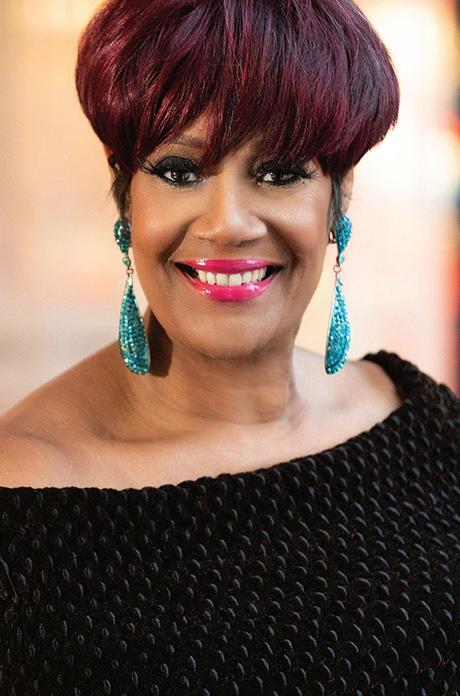
Guests can celebrate Mother’s Day with a St. Louis diva at the Sheldon Concert Hall for the 30th Annual Denise Thimes & Friends Mother’s Day Concert. See SPECIAL EVENTS for more information.
Photo courtesy of denisethimes.com
St. Louis, MO 63108. For more information, visit https://bluestrawberrystl.com.
Fri., May 22, 7:30 p.m.
Murphy Lee and Kyjuan of the St. Lunatics Live Presented by TownsendX3.Live & Vivid, City Winery, 3730 Foundry Way, St. Louis, MO 63110. For more information, visit wwww. citywinery.com.
THEATRE
Sat., May 9, 3 p.m., JPEK Creative Works presents “Respect My Shoes: If These Shoes Could Talk,” a compel-
ling and emotionally charged stage play starring acclaimed performer and storyteller Drea Kelly, .Zack, 3224 Locust St. For tickets or more information, visit www.metrotix.com.
Fri., May 15 – Sat. May 16, COCA presents Team M, a mew musical by Dr. Phillip Woodmore, COCA, 6880 Washington Ave., St. Louis MO 63130. For more information, visit www.cocastl.org.
Through May 17, The Fabulous Fox welcomes Monty Python’s Spamalot, The Fabulous Fox. For more information, visit www.fabulousfox. com.
May 19 – May 24, The Fabulous Fox welcomes MJ The Musical, The Fabulous Fox. For more information, visit www.fabulousfox.com.
May 20 – June 7, The Black Rep presents Fat Ham, Washington University’s Edison Theatre. For more information, visit www.theblackrep.org.
ART
Through May 23, 10 a.m. Clearly Human VI, St. Louis Artist’ Guild, 12 N Jackson, Clayton, MO 63105. For more information, visit www.stlouisartistsguild.org/.
Through Jun. 28, Martine Syms: Soliloquy, St. Louis Art Museum, 1 Fine Arts Drive, Forest Park, St. Louis, MO 63110. For more information, visit www.slam.org.


reflected her testimony.
between young love and old love — based on how closely couples sit next to each other — drawing steady laughter.
He also offered tips on getting a woman’s attention, demonstrating by lying back as the stage washed in deep red. Only his silhouette was visible when “Turn Off the Lights” by Teddy Pendergrass began to play. In full Mr. Brown fashion, he poured water down his chest and then spit water into the air, sending the theater into laughter and cheers.
But while the laughs were loud and the conversations heartfelt, the music was the night’s anchor. The show opened with La’Kea Stokes, a multi-Grammy Awardwinning background vocalist, performing “Who Am I” and “Good” from her EP Diary of a Church Girl. She delivered classic gospel runs over modern R&B production that
After her set, David and Tamela Mann returned to the stage with their love on full display. The first stop was the “Love Lounge,” where they opened with “Us Against the World,” singing to each other with a kind of shared battle cry. David wore a light-wash denim pants-and-jacket set with beige accents, while Tamela matched him in light blue denim layered with shimmering gold. They followed with “You,” a slow-groove love song that invited the audience to settle into the moment. They sang to each other at the edge of the stage as strobes washed over the crowd. The groove continued with “Good Love,” a contemporary track with lyrics that feel like a blueprint for a healthy marriage. After the “Fireside Chat” — centered on love, faith and gratitude — it was time for gospel. The St. Louis skyline faded into images of Tamela’s album covers as she took the stage solo, with David watching from the wings. She opened with “You Deserve My Praise,” the
tinues that tradition with intention.
stage glowing in sunny yellow. The lights shifted to lime for “Working for Me,” filling the theater with rejoicing. The lighting softened to sky blue as she sang her verse from Kirk Franklin’s “Now Behold the Lamb.” She invited fans to stand and sing along, and they did, especially when she moved into her Grammynominated, Billboardtopping hit “Take Me to the King.” Tamela closed the night with a gospel medley including “Change Me,” “I Know I’ve Been Changed,” and a spontaneous arrangement built around familiar gospel phrases like “praise Him” and “I’m on the winning side.” The songs flowed together like a prayer and a praise break. By then, fans were on their feet dancing, praising and giving thanks.
At the end of the praise break, David joined his wife onstage and draped a towel around her shoulders like James Brown, drawing one last laugh before the couple exited hand in hand.
Continued from B1
voice that carries power, warmth and emotional clarity — shaped by gospel, jazz and classic soul. She has become one of the city’s most recognizable vocalists, known for performances that blend musical sophistication with honest storytelling. She grew up singing in church and performing in school productions before heading to New York City to study at the American Musical and Dramatic Academy. She spent 12 years there, performing nationally and internationally in theater productions, concerts and workshops. Those years also opened the door to work as a background vocalist for some of the biggest names in music.
Her voice can be heard on Bette Midler’s Grammy winning “From a Distance,” Patti Austin’s “I Can Move This Mountain,” and Mariah Carey’s “Anytime You Need a Friend.” She toured with Chico DeBarge and performed alongside artists like Joe and Erykah Badu. She also recorded on Cissy Houston’s Grammywinning gospel albums Face to Face and He Leadeth Me. Those experiences shaped her into an artist unafraid to bring her full self to the stage.
It was motherhood that brought her back home.
“I love New York so much. It feels like my home in a sense,” Jackson said. “But I wanted Christian to experience a childhood like my childhood. I grew up with grass and neighbors. In New York it’s a totally different
type of existence. I wanted her to have a backyard and family close by. And we gave her that.”
Her return became a gift to the St. Louis cultural scene. She quickly became a fixture in both the jazz and theater communities. She has starred in productions with The Black Rep, including Gospel at Colonus, Ain’t Misbehavin’ Crowns Caroline, or Change and Blues in the Night, earning multiple award nominations. Last year, she won a St. Louis Theater Circle Award for Outstanding Performer, Female or
“You may not have your mom, but there are women around who can support you. And there are women you can support. We can still be a community.
- Anita Jackson
NonBinary for her portrayal of Lena Younger in Raisin Her music career has continued to grow as well. Two years ago, she released her debut solo album, Life Is Beautiful, a project that highlights her range and her ability to move seamlessly between genres. She performed selections from the album at last year’s Music at the Intersection, where she has been a featured artist since the festival launched six years ago.
For Jackson, the Mother’s Day performance will be a chance to honor the women who shaped
her. “It’s bittersweet for me, because I lost my mom during the pandemic,” Jackson said. “She would have been the first person in the door.”
She lost her mother and all of her mother’s sisters within weeks of each other from COVID19.
“They were all staunch supporters of me,” Jackson said. “They would have been the first people there. And my mother would have been bringing about 30 people herself. That’s how she was.”
Performing for others who will be celebrating their mothers brings comfort.
“That’s the sweet part,” Jackson said. “I get to do what I love to do on a day when I would honor her. She’s not here in the flesh, but she’s with me. I feel her.”
“They’re with us,” Jackson said. “They may not be here in the physical, but they are still with us. That’s what I can’t wait to impart — that they’re still with you.” Jackson said that carrying their memory forward is part of why she encourages people to lean on the women still around them.
“You may not have your mom, but there are women around who can support you,” Jackson said. “And there are women you can support. We can still be a community. And we can uplift this community together. That’s really my main thing.”
The Jazz St. Louis Mother’s Day Brunch starring Anita Jackson will take place at 11:30 a.m. at the Harold and Dorothy Steward Center for Jazz, 3536 Washington Avenue. For more information, visit www.jazzstl.org.
a renewed closeness between performers and audience, and a sense that the orchestra is building toward something larger than a single season. Instead of a traditional finale built solely on familiar classics, the program leans into collaboration and storytelling. The evening opens with “Virelai,” a work by St. Louis native and composerinresidence Kevin Puts — a nod to the city’s creative spirit from the first note and a reminder that the institution’s future is tied to the artists who call this place home.
The emotional heart of the night is “Family,” a 12 minute work by Nathalie Joachim, performed with the IN UNISON Chorus. Joachim’s Haitian American background, Juilliard training and Princeton scholarship shape a piece grounded in lived experience and shared memory. Her writing often blends classical form with cultural storytelling, and “Family” con-
“‘Family’ was written for our chorus, and the lyrics came from conversations she had with our members,” said Kevin McBeth, director of IN UNISON. “It makes the chorus cocreators. Their stories are in the music.”
“This is a first for us,” he added. “We’ve premiered new works before, but never one created from our chorus’s own experiences.”
Commissioned in 2020, the piece took shape during the pandemic, when themes of family and community surfaced repeatedly in early conversations. Joachim wove those reflections into the text, pairing them with her signature, ethereal percussion writing.
“Her approach to percussion is heavenly,” McBeth said. “She imagines sounds echoing through the hall and enveloping the audience.”
He noted that Joachim doesn’t shy away from complexity. “Even with love and admiration, families go through difficult moments. She leans into that.”
“Family” is followed by “Beautiful City,” conducted by McBeth, tying the program’s themes into a spiritual reflection on unity and belonging — a quiet reminder of what connects people inside and outside the concert hall. In many ways, the pairing mirrors the season itself: moments of challenge, moments of joy and a collective movement toward something hopeful.
The second half shifts toward grandeur. The Symphony Chorus joins the orchestra for Maurice Ravel’s Daphnis and Chloé, a sweeping 55minute masterpiece that closes the evening on a monumental scale.
“For Daphnis and Chloé, the Symphony Chorus sings no lyrics,” McBeth said. “They become part of the orchestra — singing ‘ooh’ and ‘ahh’ to create dramatic moments.”
All four works come together as the SLSO concludes a meaningful year in its new home — a season that feels less like an ending and more like a beginning.
Tickets are available at slso.org.


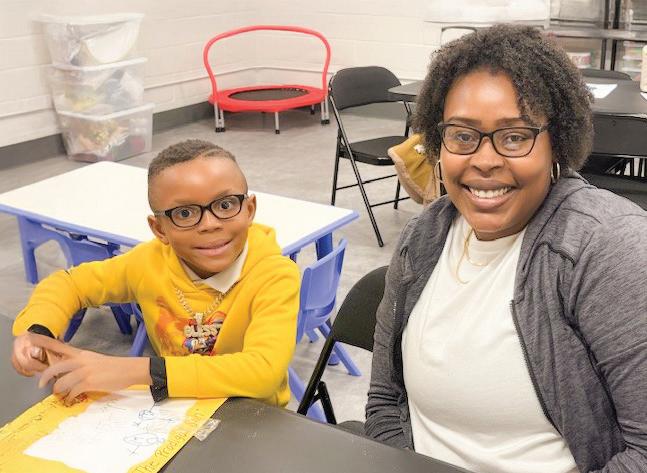

Lawrence Bryant | St. Louis American
David and Tamela Mann sit center stage during The Love and Relationship Tour on May 1, 2026 at Stifel Theatre, creating an intimate “Love Lounge” moment with music and conversation.

You go girl! Y’all know me well enough to know that while nearly all of the time I hit up a spot hoping for the best, every now again I slide through expecting some mess. What? Y’all love it. Anyway, I was ready to read Tisha Campbell for blood, bone gristle and marrow for whatever she was gonna do on stage at Helium last week and try to call it comedy. I had it written in my head before I even hit the Galleria parking lot. The first line was supposed to read: “Gina, girl, you tried it. Now go ahead and leave the jokey jokes to Martin.” Miss Tisha sat me down, and turned me around. I caught a for real ki at her show Saturday night! No shade, but the gag is I enjoyed her set as much as the last time I saw Martin Lawrence do comedy. I know y’all don’t believe me, but what reason do I have to lie? I can’t speak for the rest of the weekend, but anybody who was up in Helium Saturday night can cosign that we caught a cackle up in there! Now I can’t endorse her choice of ensemble –which was a cross between Moulin Rouge and Dead Presidents. I was like, “girl are you here to rob us or seduce?” I mean, who pairs a corset with a skull cap? Her wayward wardrobe should not distract y’all from the point that I had a cute time. Her telling us she was on the spectrum was not on my Bingo card for what to expect from her show, but I’m proud of her for doing it. The Q&A portion was super cute. But what gave me life was how she decided to close the show, which was not on my bingo card either.
When I tell y’all she was giving full choreography on that bitesized stage with her “Be Alone Tonight!” I did a chest pop and kick ball change just thinking about it!”

An ice cold Derby party. Don’t let my title fool you, the weather was fine when the folks filed up in the Muny dressed like they were ready to be extras in a Black movie wedding reception scene. They were there to partake in a Kentucky Derby party all the way in STL presented by the brothers of Alpha Phi Alpha…you know…”Ice, Ice, too cold too cold…Ice, Ice, the black and gold!” Anyway, a time was had. I hope no one took offense to my sweatpants and matching fascinator. I decided I was gonna walk a piece of the park after the party. Mind your business, from the neck up I was right on theme. Chalana Ferguson showed my fascinator all the way up with her little turquoise ditty. Yulonda Brown has been repping for the SG Rhos with just about every outfit since she crossed. And I wasn’t at all bothered by her latest blue and yellow offering. Who was the woman in the black and white polka dot gloves? I need to ask her where she got them from. They were busy, but not tacky! The gentlemen were looking colorful and distinguished too. I wasn’t expecting Ced from Barcode to rock a lemon yellow blazer, but I was satisfied by it. Speaking of busy and blazers, I have to shout out Dr. Jason Vasser-Elong for his “doing the most in the best
way” blazer. He It was custom made featuring articles that had been written about him. I was over the moon when I saw that he gave the St. Louis American features some play!
Way back Wednesdays coming to the Moonrise. By the time you are reading this, the first one is already in the books. But I wanted to give a shout out to the new Way Back Wednesdays set that kicked off yesterday on the rooftop of the Moonrise Hotel’s Twilight Room with Dr. BJ the DJ and DJ STEWdotNET from 100.3
The Beat. I’m certain that the happy hour drink specials, throwback vibes and music will be quite the feature. They had me at “no cover.” It kicks off at 5 p.m. and goes until 10 p.m. Don’t just meet me there, beat me there.
Rakim rocked the house. Hip hop icon Rakim played two
sold-out shows Sunday night –and I’m so glad he didn’t tell us to “throw your hands in the air, and wave ‘em like you just don’t care.” If he had, somebody would have gone home with a missing tooth, a black eye or a big bruise from getting popped in the chest or the shoulder. Did anybody else see that server almost catch a throat chop by the zealous fan in the red shirt who was rapping with his hands along with Rakim from his seat. Rakim still moved the crowd, but barely because it was so tight up in there. I mean, it was packed packed. Rakim delivered in the way that only a rap god could. And we rapped along to doggone near every word. He had no backing tracks or a bunch of hype men running into each other on stage. Rakim did the old school proud. I would have needed an oxygen tank if I had to go through two whole shows rhyming like that at my age. And while we are talking about
age, I’m gonna need Rakim to go ahead and get started with it. But for real, can somebody get a message to him to quit gatekeeping and come up off that skin care routine? I was already feeling a type of way from last week’s comedy show when TK Kirkland announced that he was 65 and barely had a sip of a wrinkle on his face. I estimate Rakim to be somewhere around 86, and his face looks like he is still thinking of a masterplan! I’m saying this out of jealousy, not hate.
The return of Twilight Thursdays. Oh and If you don’t know, the latest installment of Twilight Thursdays kicks of tonight (as in Thursday) at The Missouri History Museum. For those of you still going through it after seeing “Michael” and mourning for him all over again, you can soothe yourself by checking out JAM doing a tribute to Michael Jackson and Bruno Mars. The show starts at 6 p.m.

1. Kimaiya and Justis at Counterpublic’s Coyote Time launch party recently at Garage
2. Brianna and Andre enjoy the vibe at Counterpublic’s Coyote Time launch party recently at Garage
3. Brakah and Chief Solomon attended the Valley of the Flowers Festival Sunday afternoon in Florissant
4. Kentrell and Camryn took in the Valley of the Flowers Festival tradition Sunday in Florissant
Photos by Lawrence Bryant and Taylor Marrie/St. Louis American
“But
I am so proud, and it was my favorite year of my basketball career.”
— Jaylen Brown, on the best statistical season of his career

InSIdE SportS
With Earl Austin Jr.
Hensgens dazzles at area meet
Grace Murphy wins 1600- and 3200-meter runs
The Phil Brusca–Connie Strobach Invitational is one of the top late-season track and field meets in the St. Louis area.
Junior Bailey Hensgens of Incarnate Word Academy was one of the top individual performers at last weekend’s meet. She has already won multiple individual state championships in her career, but she has taken it to another level this year.
Hensgens won the long jump and triple jump events last Saturday at Ladue. She won the long jump with an effort of 18 feet, 11 inches and the triple jump with a mark of 38 feet, 6 inches. Hensgens did not compete in the high jump Saturday, but she has already established herself as one of the nation’s best in the event.
Prep had the top two finishers in the 400-meter dash. Mekenzie Rogers won in 57.58 seconds and Kauryn Durrah finished second in 57.82. Uyoyoghene Omunu of Parkway North won the 100 in 12.48 seconds, while Blake Borders won the 800 in 2:12.0. Sydney Lanton of John Burroughs won the 300-meter low hurdles in 46.57. On the boys side, SLUH had an excellent showing in the distance events.
The Jr. Bills opened the day by winning the 4x800-meter relay in 7:59.87. Nicholas Ahlheim won the 800 in 1:54.88. Warnicke Beatty won the 1,600-meter run in 4:17.5, while Hendrix Fyvie also turned in a strong performance in the event.
Earlier this season, Hensgens made history by clearing 6 feet in the high jump, becoming the first girl in Missouri to accomplish the feat. She also cleared 5 feet, 11 1/2 inches at the Nike Indoor Nationals in March.
Grace Murphy of Nerinx Hall had an excellent meet Saturday, winning the 1,600- and 3,200meter runs. She posted winning times of 5:01.5 in the 1,600 and 10:54.7 in the 3,200. She also ran a leg on the first-place 4x800-meter relay.
Host Ladue put together a pair of strong efforts in winning the girls 4x200and 4x400-meter relays. The Rams won the 4x200 in 1:38.23 and the 4x400 in 3:48.39.
Cardinal Ritter College
Pattonville had a good day in the sprints with Gary Williams Jr. winning the 200-meter dash in 21.73 seconds and Jackson Powell winning the 400 in 48.93. The Pirates also finished second in the 4x100-meter relay in 42.5.
Football standout Manny Ellis of Cardinal Ritter finished first in the 100 in 10.79. Three different winners emerged in the sprint relays: Ritenour won the 4x100 in 42.25, Cardinal Ritter won the 4x200 in 1:29.3 and CBC won the 4x400 in 3:19.74.
Small-school district meets set for this weekend
The road to the state track and field championships for small schools begins this weekend with

Ritenour’s La’vel Nelson crosses the finish line in the 4x100-meter relay, helping the Huskies win the event in 42.25 seconds during the Phil Brusca Connie Strobach Invitational at Ladue.
district competition around the St. Louis area. Most area schools will compete in Class 2 and 3 district meets Saturday. Lutheran North will host the Class 3, District 2 and Class 2, District 2 meets. The Class 3, District 3 meet will be held at Owensville, while the Class 3, District 1 meet will be held at Cape Girardeau Notre Dame.
The Class 3, District 2 meet at Lutheran North is loaded with talented teams and athletes, including Lutheran North, Cardinal Ritter, Lift for Life and St. Mary’s High School.
The top four finishers in each event at districts will advance to next weekend’s sectional meets, which will be held at Dexter, Centralia and South Callaway.
SportS EyE
With Alvin A. Reid
Terron Garrett commits to Valparaiso
Former Vashon High standout Terron Garrett has committed to Valparaiso.
A 6-foot-6 guard, Garrett helped lead Vashon to the Class 4 state championship in 2026. He spent the first part of his prep career at CBC, where he led the Cadets in scoring for two seasons.
Garrett played this past season at Mineral Area College in Park Hills, Missouri. He led the Cardinals to a berth in the National Junior College Athletic Association Region 16 championship and the national tournament. Garrett scored a game-high 21 points in the Cardinals’ victory over Three Rivers in the Region 16 championship game.
MLB Black player numbers making minimal gains
I find it difficult to celebrate the statistics I’m about to share with you. But Major League Baseball seems ready to throw a party.
According to MLB’s breakdown, 6.8% of players on Opening Day rosters were Black. That’s less than two players per team on average, and it includes players on the injured list. On Opening Day 2024, 6% of MLB’s players were Black. That inched up to 6.2% in 2025. MLB seems giddy because it marks the first back-to-back increase in African American player participation in the last two decades.
stop Masyn Winn are in the starting lineup. Is it coincidence that teams from midsize markets in the Midwest have the highest number of Black players?
Alvin A. Reid
In addition, the modest 0.6 percentage-point increase is the largest since a 0.7 percentage-point increase between 2017 and 2018. The St. Louis Cardinals remain an MLB rarity with three Black players on the 26-man roster. On most days, center fielder Victor Scott II, right fielder Jordan Walker and short-
The Minnesota Twins had six Black players on their roster, including two Black starting pitchers — Taj Bradley and Simeon Woods-Richardson. That truly is rare. The Cincinnati Reds had five Black players on the roster, including pitcher Hunter Greene, who is on the injured list. The Cardinals, Reds and Twins accounted for 18.6% of all MLB Black players on Opening Day.
Bob Nightengale of USA Today called it “alarming” that five teams opened the season without a Black player on the roster. That is twice the number from last year. According to his report, the Chicago Cubs, San Francisco Giants, Boston Red Sox, San Diego Padres and Pittsburgh Pirates did not have a single African American

Jordan Walker. In addition, 17 more Black players were on MLB 40-man rosters but not on Opening Day active lists.
I wrote in April about the Chicago Black Baseball Media and Classic game featuring HBCU teams at Wrigley Field. There is a growing effort to reintroduce baseball to several generations of young Black athletes and prospective fans who have seemingly been ignored for decades.
player on the roster. No help is coming internally for the Padres because the franchise does not have a Black player on its 40-man roster.
Jackie Robinson first played for the Brooklyn Dodgers on April 15, 1947. Obviously, he was his team’s — and MLB’s — only Black player. Fast forward to March 26, 2026. Like the 1947 Dodgers, the Los Angeles Dodgers had just one
Black player on Opening Day. MLB has launched several programs designed to attract Black youths back to baseball. They include the MLB Youth Academy, Breakthrough Series, DREAM Series, Nike RBI, the Hank Aaron Invitational and others. Of the 64 Black players on Opening Day rosters, 20 participated in one or more of those programs, including the Cardinals’
According to MLB, 64 Black players were on Opening Day rosters. Blake Perkins of the Milwaukee Brewers has been called up to the majors and was on the active roster this week when his team visited the Cardinals.
Of the 64 Black players on MLB rosters, 35 are 27 or younger and 22 are 25 or younger. Just eight are older than 32. While incremental increases are better than declines, MLB is still far behind its inclusion heyday in the mid-1970s, when more than 25% of players were Black.
I’m 65, and I’m among a dwindling number of Black fans who follow MLB intensely. It’s because I grew up watching Black stars and future Hall of Famers. The Cardinals are not the only team looking to fill seats as the season heads toward summer. Black fans want to see Black players. Build it, and they will come.
The Reid Roundup Max Venable, one of two Black MLB managers, has the Chicago White Sox among the surprises of 2026. The White Sox won eight of 11 games last week and were just one game out of first place in the American League Central…The other Black manager, Dave Roberts of the Dodgers, saw the Cardinals take two of three games from his team… Jordan Walker raised his batting average to .307, with six RBIs, six hits, a home run and two stolen bases in the Dodgers series. As of Monday, he had 10 home runs, 27 RBIs, and should be a National League All-Star.
Pitcher Taj Bradley is one of six Black players on the Minnesota Twins, the team with the most African American players in MLB.
Photo by Lawrence Bryant / St. Louis American
Earl Austin Jr.
Photo courtesy of twinsdaily.com

No to the proposed police budget
By Jamala Rogers
I heard all of it — every word. I felt every emotion. I stayed until the end, until the mayor officially adjourned the city’s 4-hour Board of Estimate and Apportionment meeting.
I thought I was in the queue to testify, but halfway through the meeting, I found out my submission was late. I could’ve left at that point, but it was too compelling. Nearly 100 citizens showed up to express their outrage about the controversial police budget being rammed down taxpayers’ throats.
I choked up during Dr. Punch’s emotional testimony. I didn’t hold back a wry smile when I heard Tracy “Spirit” Stanton’s spoken-word version of her testimony. Many who testified are on the frontlines of addressing the trauma, desperation and suffering of St. Louis residents.
The lone voice supporting the controversial police budget was David Rodriguez, an EMS employee. He reminded us that first responders like himself provide the critical link between our “living room and the emergency room.”
He claims to have worked 90 hours every week last year. This is humanly impossible. Douglas Eatherton, an administrative assistant, made $231,000. At least a dozen employees made more than the police chief, whose pay grade is $175,000.
Where is all this overtime going?
North St. Louis residents constantly complain about the lack of response when they call for police assistance. It’s doubtful the overtime went toward closing the city’s 1,000 unsolved homicides.
Due to deficiencies within the SLMPD, some affluent neighborhoods are hiring private security firms. Sometimes, St. Louis police officers are hired for secondary employment.
Some residents and sources have raised concerns about possible double-dipping — receiving payment from a private firm while also being on the department clock.
A thorough and independent investigation must be conducted into overtime payments and secondary employment.

Bearing witness after the storm
By Lyah B. LeFlore-Ituen, Missouri Historical Society
May arrives with a memory in its bones.
For many of us in St. Louis, this month does not simply open into spring—it pulls us back. Back to May 16. Back to the sky that shifted, the wind that roared, and the unsettling quiet that followed. The anniversary of last year’s tornado sits with us. Not always loudly, but persistently—in our bodies, in our neighborhoods, in the spaces where something once stood and now does not.
And yet, if we are honest, this is not unfamiliar ground.
As Black people, we have always known what it means to live in the aftermath—of storms both natural and manmade. We know how to stand in the wreckage and still imagine a future. We know how to rebuild not only homes, but spirit. Not only structures, but meaning.
nities.” And in that truth, there is responsibility.
That responsibility has been carried forward by individuals like Pamela Westbrooks-Hodge, a direct descendant of Celia who is president of the Celia Newsom Legacy Foundation and a leading voice in preserving her legacy. As Westbrooks-Hodge has shared in reflection, “This story is not just about what was done to Celia—it is about her humanity, her resistance, and our responsibility to make sure she is remembered fully and truthfully.” Her work reminds us that remembrance is not passive; it is an act of restoration.
Opponents of the hostile, undemocratic state takeover of the St. Louis Metropolitan Police Department have highlighted the police budget as another gangsta tactic used to get its way. They have used national studies to affirm that the SLMPD is undeserving of a performance raise. Research shows that we have one of the most brutal police departments in the country. St. Louis is one of the most over-policed cities in the nation. This is about more than money; it’s about the unbridled power to control.
Two recent incidents added to the growing calls for local control of the St. Louis Metropolitan Police Department.
Police overtime exploded from $5.5 million in 2012 to $25 million in 2025. At the top of the list of highest-paid police personnel was Sgt. Frank Russo.
The vicious attack on nonviolent protesters at Mayor Cara Spencer’s State of the City event gave a snapshot of the department’s brutality. The attack on protesters was also an attack on freedom of assembly and free speech. Critics of the takeover fear even more repressive tactics in the future.
Under state control, citizens can now expect to be confronted by an emboldened police force on the streets of St. Louis. It appears there will be no accountability or consequences from a pro-police Board of Police Commissioners. The economic crisis caused by an unhinged war criminal in the White House is predicted to turn our lives upside down. Critics fear an expanded police structure could further erode accountability.
The people have spoken. No more money for an overfunded police department in a city that is decreasing in population but increasing in collective rage.



BECOME DEBT FREE IN AS LITTLE AS 24-48 MONTHS
If you owe more than $10,000 in credit card or other unsecured debt, see how National Debt Relief can help resolve your debt for a fraction of what you owe.
ONE AFFORDABLE MONTHLY PAYMENT PROGRAM
We work with you to set up a monthly payment that fits within your budget.
NO UPFRONT FEES
You won’t pay a penny until your debt is resolved.
RESOLVE YOUR DEBT IN 24–48 MONTHS
Recently I had the honor of standing inside the Missouri History Museum to introduce a program centered on the life and legacy of Celia Newsom. Her story is one that refuses to sit quietly in the past. Enslaved in Missouri’s Little Dixie slave belt, repeatedly abused, and denied autonomy over her own body, Celia resisted. For that, she was tried, convicted, and executed.
More than a century later, through the work of descendants, advocates, and historians, the state of Missouri issued a posthumous pardon. But a pardon does not erase injustice. It names it. It forces us to confront what was always there.
As Cicely Hunter, African American History Initiative (AAHI) Public Historian, reflects, “Celia’s story brings together childhood, motherhood, and resistance under the brutal institution of slavery. She was a young girl navigating the trauma of enslavement and repeated abuse while also bearing the weight of motherhood. Yet even within these constraints, Celia resisted and was punished by death for it.”
We are called not just to remember Celia, but to understand what her life reveals. “Celia’s story challenges us to look directly at the darker truths of enslavement,” Hunter writes, “not as distant history, but as lived experience that shaped real lives, families, and commu-
Celia Day, then, is not just about one woman. It is a moment of public reflection—an honoring of the countless others whose names we may never know, but whose lives were shaped by the same violence and injustice. It is a call to remember and to tell the truth about Missouri’s history as a slaveholding border state with a statewide system of enslavement, where freedom was contested and oppression was embedded in law, economy, and daily life.
And that is where May meets us now.
Between memory and declaration.
Between what tried to break us and what continues to build us. The tornado disrupted lives. It displaced families. It altered landscapes. But it also revealed something deeply familiar: our capacity to show up for one another. In its aftermath, we saw neighbors become first responders, churches become sanctuaries, and community rise where systems fell short. That is legacy.
That is inheritance.
That is what connects us to Celia—not only her suffering, but her resistance. Not only her story, but the fact that it did not end with her.
CMYK-7-37-95-0
CMYK-36-80-93-51
CMYK
CMYK-
So this May, we hold both truths. The weight and the will. The grief and the Because resilience is not the absence of fear—it is the decision to move forward May is not just a reminder of what we have endured. It is a declaration of who we have always been. We rise.

We’ll resolve your debt as quickly as possible so you can finally start living the life you want.





CMYK-7-37-95-0














Columnist Jamala Rogers

Questions or
Contact Cathy Sewell csewell@stlamerican.com or 618-910-9551
FAMILY SPOTLIGHT



Students at The American’s Summer Science Academy work in teams to discover the many different computer programming languages.
Teachers, if
SCIENCE CORNER

A hurricane forms over tropical and subtropical ocean water. Warm water and cool, moist air combine to create strong winds that can gust up to 200 miles per hour! These winds create waves that bring the storm on shore. Hurricanes are very destructive. They can flip cars, sink boats, uproot trees, and demolish houses.
SCIENCE CORNER
What Are Stars ?

Are Fungi ?
Hurricanes can last a few hours or several days. Most hurricanes occur during the fall months. How can you stay

SCIENCE STARS
In addition to powerful winds, hurricanes bring a lot of rain. (Taiwan received 114 inches of rain in three days during a hurricane.) These rains can cause landslides and flash floods.
Fungi are organisms made of filaments (called hyphe) that are stacked together. Unlike plants, fungi do not have chlorophyll, so they cannot make their own food. Some fungi are parasites, which mean they live off of other organisms. Some fungi feed off of dead and decaying matter. Fungi are everywhere in the environment, including the soil, lakes, river and seas, air, and on plants and animals. Fungi (plural of fungus) help organic matter to decay and release carbon and oxygen into the environment. Unlike plants, fungi do not have
In this experiment, you’ll create a replica of a hurricane and identify how the forces work together to create a hurricane.
Did you know that stars are actually large balls of gas that give off light? Stars vary in their size, color, and brightness. A star can be red, orange, yellow, white, or blue. The surface temperature, which is determined by age and mass, impacts the color of the star. Stars go through many stages in their lifetime. Some of the names for these stages are Nebula, Red Giant, Supernova, White Dwarf, Neutron Star and even Black Holes. A constellation is a group of stars that makes an imaginary shape in the
SCIENCE INVESTIGATION
SCIENCE INVESTIGATION
2 Soda Bottles 3 Paper Clips
• 3 Peanuts • ¼ C. Sand • Funnel
Did
• Water • Duct Tape
In this experiment, you will learn how mold grows best. Mold is an important fungus that has several uses, including breaking down dead organic material. Some purified molds are actually used as an antibiotic to treat illnesses.
Procedure:
Materials Needed:
Materials Needed:
• 3 slices of bread • Water • 3 Ziploc bags
q Fill one bottle with the paperclips, peanuts and sand. These represent the debris and help make the movement of water easier to see.
• 10x10 square centimeter grid • Ruler
Foil • Medium-sized Box
Process:
• Glass Bowl • Flashlight • Sc issors
Procedure:
w Place the funnel in the mouth of the bottle and pour water into the bottle until it is 3/4 full, then remove the funnel.
q Wet one slice of bread enough to make it moist and place it in a bag. Seal the bag very tightly.
q Fill the glass bowl 2/3 full with water and set it aside.
e Turn the second empty bottle upside down and hold it over the first bottle so that the mouths of the bottle are aligned. The bottles will look like an hourglass.
w Place the two other slices of dry bread in two separate bags and seal them, as well.
r Tape the seam, pressing the duct tape firmly to
sky, kind of like “connect the dots.” They are usually named after mythological characters, people, animals and objects. The stars shine both day and night. However, during the day, the brightest star (the Sun) makes the sky so bright that the other stars appear dim. At night, when the sky is dark, the other stars can be seen. You can see about 3,000 stars with your naked eye, but you can see billions of stars with powerful telescopes.
leaves, stems, or roots. Fungi use spores to reproduce. One common type of fungus is the mushrooms you find on your pizza. Mold, yeasts, and mildew are also types of fungus.
Fun Fact: The prefix “astro” means “star” in the Greek language.
For More Information, Go to: https://kids.kiddle.co/Fungus
Learning Standards: I can read nonfiction text to gain background information about fungi.
For More Information, Visit: https://spacepl ace.nasa.gov/
Learning Standard: I can read nonfiction text to find main idea and supporting details.
create a watertight seal. Continue taping 1 to 2 inches above and below the seam.
Growing Mold!
t Hold the bottles by the middle and lift the jugs.
Twinkle Twinkle Little Star!
y Quickly, turn the bottles over so that the water-filled bottle is on top. Set the bottles on the table again.
r Pl ace the stars on top of the cardboard.
u Observe the water as it drains into the bottle below. The water competes with the air from the empty bottle. Both substances push to pass through the neck.
t Pl ace the glass bowl on top of the cardboard and turn off the lights.
y Shine the flashlight on the bowl.

w Cut a piece of cardboard from the box. Make sure it is big enough to fit underneath the bowl.
e Place the bag with the wet slice of bread and one of the bags with a dry slice of bread in a dark place, such as a closed cabinet or closet.
e Cut small pieces of aluminum foil and shape them into little stars.
r Place the third bag with a dry slice

MATH CONNECTION
i Turn the bottles over again. This time, shake the bottles in a circular motion. Be sure to keep the bottles vertical.
u Tap the bowl and see what happens to the st ars when the water moves.

t For five days, measure the square centimeters of mold on each piece of bread through the bag. Use a grid, if possible, or a ruler. If mold covers more than half a square centimeter, it is counted as one full centimeter. If it is less, it is counted as 0 centimeters. This will give you the area of mold on each slice of bread y At the end of a week (5 days of measuring) or longer, use your final results to say what percentage of the bread was covered in mold. Make a table or graph to display the information.
The water will form a vortex as it drains into the next bottle. The water will flow along the outside of the neck, while air moves quickly up through the center of the vortex. The water will drain
How did water and air create a hurricane? I can follow sequential directions to complete an experiment. I can make observations and draw conclusions.
Analyze: When do the foil stars appear to twinkle? Why? When you shine light on aluminum while water is moving, the light travels through the air and makes the aluminum stars twinkle. When the star light moves through Earth’s atmosphere at night, the air it passes through makes the star light appear to twinkle.
Discussion Questions: How much mold was on the bread? Which location had the most mold? Which had the least? What conclusions can you draw about the conditions in which mold grows? How can food manufacturers and restaurant owners use this information to help them?
Learning Standards: I can follow directions to complete a procedure. I can analyze and compare results.
Math Storms!
Learning Standards: I can follow sequential directions to complete an experiment. I can display my results, make observations, and draw conclusions.
Can
You Run?
Analyzing
Scientists often use tables and graphs to display the results of their research. Looking at these displays, you can draw conclusions.
As we approach spring weather (and increased rain), create a bar graph that displays the amount of rain that falls for several consecutive days or weeks. (Day 1: 1.5 inches, Day 2: 0 inches, Day 3: 1.5 inches, etc.)
and City C has a

a Bar Graph
r Sean runs 143.23 meters in 40 seconds. Robert runs 97.92 meters in the same time. How much further did Sean run than Robert?
$115,264 in damage, City B reported $236,096 and City C reported $436,869 in damages. What was the total cost of damages rounded to the nearest thousand? ______ If the state and federal government promised $500,000 in aid, how much would the local people have to raise by themselves? ______
Discussion Questions: Which day had the most measured rainfall? Which day(s) had the least? Looking at the bar graph, what might you conclude about rain patterns in March/April? What other observations can you make?
Learning Standards: I can use a bar graph to display information. I can use the information to make deductions and inferences.
of 3,972. How many people were evacuated in all? b After citizens returned to their houses after the evacuation, reports of damage were totaled. City A reported

This special Newspaper In Education initiative is made possible, and delivered to classrooms through the St. Louis American Foundation and its NIE Corporate Partners:
t Tara runs 8 laps around the track. If she ran a total of 944 yards, what is the perimeter of the track?
Learning Standards: I can add, subtract, multiply, and divide to solve a problem.



Learning Standards: I can add, subtract, multiply, and divide to solve a problem.
If



SCIENCE STARS

AFRICAN-AMERICAN MYCOLOGIST AND EDUCATOR: Jeanette Jones
African American Meterologist William “Bill” Parker
Reaching for the Stars: Astrophysicist Jedidah Isler
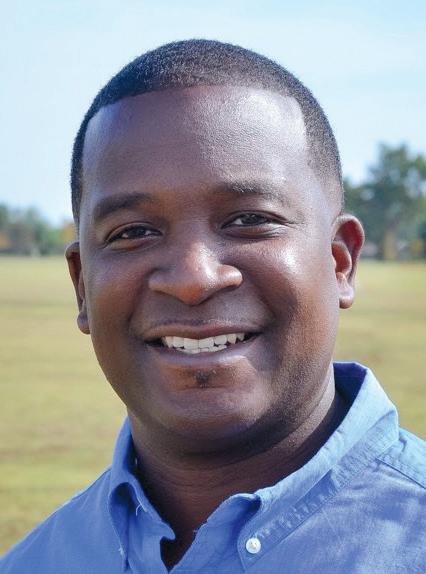

William (Bill) Parker grew up in New Orleans. He graduated from JFK High School, which focused on math, science, and engineering. Parker was interested in hurricanes at a young age, but he became interested in the weather after a high school statistics class. In this class, he learned how to predict the chance of rain. Parker wanted to attend a historically black college/ university (HBCU), so he chose Jackson State University to study meteorology. He graduated with his bachelor’s degree, in 1994.
Jeanette Jones was born on September 19, 1950, in Fort Valley, Georgia. Jones graduated from Fort Valley State University in 1972 with a bachelor’s degree in biology education. In 1973, Jones received her master’s degree in botany and mycology (a branch of biology that studies fungi) from The Ohio State University. In 1976, she received her doctorate (Ph.D.) degree.
Have you ever looked up at the night sky and wondered what’s out there? For Jedidah Isler, that question turned into a powerful career.
Dr. Isler is a young African American astrophysicist who studies some of the most mysterious objects in space, black holes. Astrophysics is the science of understanding how the universe works, including stars, planets, galaxies, and even things we cannot see. Dr. Isler focuses on blazars, which are super bright areas powered by giant black holes at the center of galaxies. Growing up, Dr. Isler didn’t always see people who looked like her in science. But that didn’t stop her. She loved learning, stayed curious, and worked hard in school. She earned her Ph.D. in astrophysics from Yale University, becoming the first African American woman to do so at that school.
She also studied at the University of Nevada, the University of California Medical School, the National Center for Disease Control-Atlanta, and the Massachusetts Institute of Technology. After graduation, Alabama A&M University hired Jones as an assistant biology professor. In 1986, she served as an adjunct professor in the College of Pharmacy and Pharmaceutical Services at Florida Agricultural and Mechanical University and worked on a project with NASA. In 1991, Jones served as the first female vice president of research and development at Alabama A&M University. She also served as President of Alabama A&M University’s Faculty Senate from 2001 to 2006. In 1992, she was appointed to the U.S. Army Science Board by the U.S. Secretary of the Army, Togo West. Since 2004 Jones has been the director of the Center for Biomedical, Behavioral, and Environment Research at Alabama A&M University. She also worked as a consultant with federal agencies to help them develop training programs to attract women and minorities to STEM education and careers.
Dr. Isler’s work helps scientists better understand how black holes behave and how energy moves through space. Even though black holes are invisible, scientists can study the light and energy around them. This helps us learn more about the universe and how it changes over time.
But Dr. Isler does more than just research. She is also passionate about helping other young people, especially students of color, see themselves in science. She created a program called “Vanguard: Con versations with Women of Color in STEM,” where students can learn from scientists who share their experiences and challenges.
In 1975, Jones was listed in the World’s Women’s Who’s Who and she was named an Outstanding Young Woman of America in 1978. Beta Beta Beta National Biological Honor Society awarded her the distinguished service award. Jones also received the Significant Service Award from the NASA Space Life Sciences Training Program and the Extramural Associate Research Development Award from the National Institute of Health. In 1990 and 2006, she was named Woman of the Year at Alabama A&M University and was given the Outstanding Leadership Award by the Faculty Senate. The U.S. Army presented Jones the Commander’s Award for Outstanding Civilian Service as a member of the Army Science Board.
In 1993, he began to gain experience in the field when he worked as a student meteorologist. One year later, he was a meteorologist intern at Shreveport. In 1998, Parker became a general forecaster, and ten years later, a lead forecaster. In 2012, he became a warning coordination meteorologist (WCM). There are only 122 people with this title in the United States, and Parker was the only African American. Parker is currently the meteorologist-in-charge (MIC) at the National Weather Service, leading a team of 26 weather professionals. Parker is also very active as a volunteer in his community. He is a member of the Shreveport-Bossier Mayors’ Prayer Breakfast Executive Committee, La Cima Bilingual Leadership Academy, Bossier Chamber of Commerce Education Committee, Volunteers for Youth Justice, and a coach for Bossier Parks and Recreation. Parker is also an associate minister at Elizabeth Baptist Church in Benton, where he has been serving the congregation since 1997.
Dr. Isler believes that science belongs to everyone. She encourages students to ask questions, stay curious, and never give up on their dreams, even if they don’t see many people like themselves in that field yet.


Discussion Questions: Dr. Jones received many awards and honors. How would you describe her achievements and her contributions to science? Dr. Jones is studying how fungi might be used as agents of war. What purpose do you think fungi serve in modern warfare? Are fungi beneficial or harmful?
So the next time you look up at the stars, remember: someone like you could be studying them one day.
ELA Discussion Questions:
What does Dr. Jedidah Isler study, and why is her work important to understanding the universe?
Learning Standards: I can read a biography to learn about an African American who has made contributions in science, math, technology, or engineering.
How did Dr. Isler’s experiences growing up influence her efforts to support other students interested in science?
What is Chavonda’s role at the USDA?
Parker believes in serving as a role model to the youth and to recruiting African Americans in the STEM field. Personally, he has hired three African-American meteorologists. In addition, he has recruited minorities for summer intern positions. Parker has also mentored an Airline High School student for his senior project. Parker’s advice to students interested in meteorology is to take as many math and science classes as possible. Learn about summer opportunities in your community. If you are interested in meteorology, visit National Weather Service offices and serve as a volunteer or intern, and find leaders in your community to serve as your personal role models.
Learning Standards:
MAP CORNER

a person who has made contributions to the fields of science, technology,
Use the newspaper to complete these activities:
MAP CORNER

Activity One —
Enjoy these activities that help you get to know your St. Louis American newspaper.
Use the newspaper to complete the following activities: Types of News: Use the front section of the newspaper to evaluate the types of news stories presented: local, national, and international. Sort the articles into the three categories and create a bar graph that displays the amount of coverage each type of news story received.
Create an Ad: Create a newspaper employment ad for jobs that existed during specific periods in America’s past (1800s, 1950s, etc.). Identify the skills needed, educational requirements, salary range, and benefits that reflect the appropriate time period.

Activities — Who works where? a picture of a building in the newspaper and tell what kind of jobs people who work in that building could have.



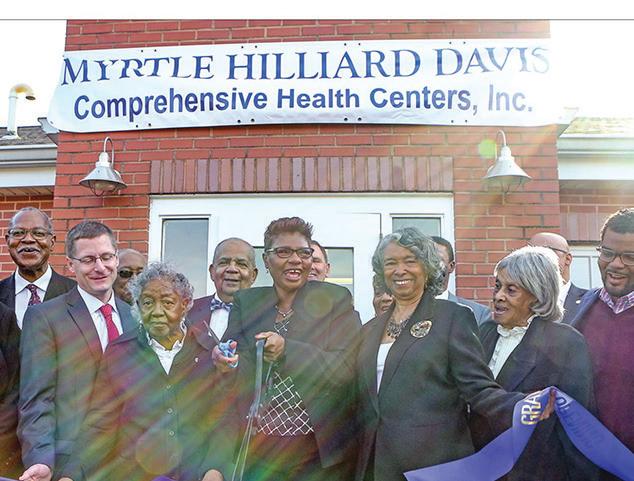

Mystery Story: Cut out several pictures from the newspaper without reading the caption. Place the pictures in a bag, and without looking, pick your mystery picture from the bag. That’s your stimulus for writing. Construct a graphic organizer to identify the 5Ws (who, what, when, where, and why) of your story by looking at your picture. Then, continue the writing process.
Activity Two — Cooperation or Conflict?
With your classmates, use the newspaper to find a stor y about cooperation or conflict between two countries. Draw conclusions about the regional differences or similarities (religion, resources, language, or political beliefs) that might lead to cooperation or conflict.
Problem and Solution: Over a period of weeks, clip articles from newspapers that deal with problems and issues facing your local or county government. Discuss the reasons for these problems and how the government hopes to solve them.
Learning Standards:
Learning Standards: I can use the newspaper to locate information. I can categorize and summarize that information.
I can wr ite for a specific purpose and audience. I can identify cooperation and conflict and the causes of each.
Learning Standards: I can use the newspaper to locate information. I can discuss problems and solutions. I can identify types of jobs. I can make text-to-world connections.




Students Aariyah Thompson and Savannah Fisher, in Ms. Stovall’s firstgrade class at Gateway MST Elementary School, are learning how to construct a series circuit.
Photo by Ms. Stovall
Photo by Nikki Binion
MentalHealth
A W A R E N E S S
Sponsored Content
Helping navigate landscape of mental health care
CSF created new tool that connects families with the right supports
Provided by St. Louis County
Children’s Service Fund
The St. Louis region has an extraordinary network of mental and behavioral health resources for children, youth, and families. But for many caregivers, teachers, and even seasoned professionals, figuring out where to start can feel overwhelming. With so many programs and providers, families often find themselves asking the same question: Where do we begin?
CSF has invested more than $550 million in mental and behavioral health services for kids and their families in St. Louis County.
That’s why the St. Louis County Children’s Service Fund (CSF) created the FindAService Tool—an easy, welcoming resource designed to help families navigate the landscape of mental health care and connect with the right supports at the right time.
CSF is the largest children’s service fund in Missouri. Since its creation in 2008 through a voter-approved quartercent sales tax, CSF has invested more than $550 million in mental and behavioral health services for kids and their families in St. Louis County. Through partnerships with 100+ community organizations, CSF supports programs ranging from respite care and counseling to transitional housing and specialized services.
Available at stlcsf.org/findaservice/, the Find-A-Service Tool features an interactive map showing CSFfunded providers across St. Louis County and the metro region. Red dots indicate com-
See CSF, B11

BLACK MEN CONFRONT GROWING LONELINESS
For Black men, loneliness is often compounded by cultural expectations and systemic barriers.
By Laura Onyeneho Houston Defender
James Pierre X remembers the moment his father apologized for crying. The lesson was immediate and unspoken. Men do not show emotion. Men endure.
“A man doesn’t cry,” his father told him.
He was reinforcing a belief that shaped how he navigated manhood. X learned to build what he calls “dams,” blocking emotional rivers before they surfaced. Years later, he said he realized the mask he was wearing had become too heavy. So he burned it.
His story reflects what health experts now identify as a growing male loneliness epidemic, a pattern of emotional isolation and social disconnection that is quietly affecting men across the country.
In 2023, U.S. Surgeon General Vivek Murthy issued a national advisory declaring loneliness and social isolation a public health crisis. The report found that chronic loneliness increases the risk of heart disease, stroke, depression, and premature death. Researchers concluded the health impact can rival smoking up to 15
Treating mental health can lower maternal mortality mate
New American Heart Association guidelines link mental health to cardiovascular issues that can lead to pregnancy complications — including death.
Linking cardiovascular and mental health to childbirth, the American Heart Association is recommending that doctors include psychological screening for new and expectant mothers to help reduce the nation’s disturbingly high maternal mortality rate.
The guidelines, which the AHA issued Tuesday, also call for adding a behavioral health specialist to
a patient’s overall maternal care team. Paying attention to a patient’s mental health, they say, can help with everything from preeclampsia — a common, potentially deadly childbirth complication — to postpartum depression. While maternal, cardiovascular and psychological health don’t seem to align, the AHA believes the connection is the key
to lowering the risk of adverse pregnancy outcomes, including miscarriage or death. Data shows Black women are far more likely to die during childbirth as white women.
Guidance for clinicians
“It’s critical that we redefine maternal cardioSee Maternal, B12

HBCUs boost student mental health and resilience
A new report
finds that Black students at predominantly Black schools have better wellbeing overall.
By Jennifer Porter Gore Word in Black
Despite consistently making do with fewer resources and far smaller endowments than their white peers, a new study finds students at historically Black colleges and universities have better overall mental health and show significantly stronger resilience compared to their peers nationwide.
The study, conducted jointly by the United Negro College Fund’s Institute for Capacity Building, the Healthy Minds Network and The Steve Fund, finds that, 45% of HBCU students report “flourishing” mental health compared to 36% in national samples of all colleges and 38% among Black students at predominantly white institutions.
“This research confirms what we’ve long understood about the unique power of HBCUs to
Continued from B10
munitybased services; blue dots show schoolbased providers. Families and professionals can search by service type, school district, individual school, or provider name—or simply explore by scrolling through neighborhoods.
nurture not just academic achievement, but holistic well-being among HBCU students,” says Michael Lomax, UNCF president and CEO.
“Even with fewer resources than our peers, these institutions create environments where students are affirmed and celebrated, fostering remarkable mental resilience despite significant socio-economic challenges,” Lomax said.
The Healthy Minds Network researches issues affecting adolescent and young adult mental health. It conducts the Healthy Minds Study, which surveys post-secondary students about their mental health.
The Steve Fund is a nonprofit organization focused on transforming educational, organizational, and workplace environments to support the mental health and emotional well-being of young people of color.
“The function of CSF is to provide funding and support for our incredible partners, but our mission goes deeper,” said Emily Koenig, Executive Director of CSF. “We want to make sure the right kid finds the right service at the right time. Beyond funding, one of the most important ways we can do that is by helping connect families to the services

Researchers examined mental health indicators among 2,504 students across 16 HBCUs and two predominantly Black
available to them.”
Tips for getting the most out of the FindAService Tool
To make the search experience even smoother, here are a few simple ways to navigate the tool:
• Browse through CSF’s funded services via the “select a service” drop-
institutions during the 2022-2023 and 2023-2024 academic years. They found that nearly 80% of HBCU students be-
down.
• Try the school search. Parents, caregivers, and educators often find it helpful to filter by school or district to see which providers are already connected to their child’s educational environment.
• Take a moment to explore. Browsing the map by neighborhood can help
lieve their institutions prioritize mental well-being, compared to 73% of Black students at PWIs. And 8 in 10 HBCU students report having a strong sense of belonging within their campus community, versus 73% nationally and 72% for Black students at PWIs.
HBCU students also exhibit rates of anxiety, substance use disorders and eating disorders that are significantly lower than the national average, according to the report. Moreover, 74% of HBCU students were significantly less likely to keep negative feelings to themselves when feeling sad, the report found, compared to 86% of Black students at PWIs.
Among Black adults, rates of depression increased from 9% in 20132016 to 21% in 2023 and rates of anxiety increased from 6% in 2018 to 27% in 2023. For the overall population depression rates
you discover services you may not have considered.
• Click on provider dots. Each dot opens a snapshot of the organization and its offerings, making it easy to compare options.
among women increased from 10% to 23%, while rates among men similarly increased from 5.5% to 22% during the same timeframe.
The U.S. has been grappling with a mental health crisis in recent years, with rising rates of anxiety, depression, and suicide since the COVID pandemic. Nearly one in five adults experience a mental illness issue each year, according to a 2023 report from the National Institute of Mental Health.
Suicide remains a leading cause of death among individuals aged 10–24, according to the Centers for Disease Control and Prevention. The 2023 Youth Risk Behavior Survey of teens and young adults found that 42% of high school students experienced persistent sadness or hopelessness, and nearly 1 in 5 seriously considered attempting suicide.
• Mix and match filters. Combining two search options—like service type and school district—can quickly narrow results. Finding mental and behavioral health care shouldn’t be stressful. CSF’s Find-A-Service Tool helps families take the first step towards care. “Navigating the mental health system doesn’t have to be as hard as it often feels,” Koenig said. “The FindAService Tool helps make it easier for families to get connected.”

Researchers found that nearly 80% of HBCU students believe their institutions prioritize mental well-being, compared to 73% of Black students at PWIs.
Getty Images
Lonliness
Continued from B10
cigarettes a day.
But what exactly is the loneliness epidemic?
The male loneliness epidemic is a growing, serious public health crisis characterized by a sharp rise in men reporting a lack of close friendships, emotional support, and meaningful social connections.
Licensed therapist Katherine Barner explains that loneliness is not simply being alone. It is the distress that comes from feeling unseen, emotionally unsupported, or discon-
nected from meaningful relationships. “Many of the Black men I work with are surrounded by people,” Barner said. “They have families, jobs, and responsibilities. But internally, they feel like no one really knows them.”
Barner said social isolation refers to having few relationships or limited contact with others. Loneliness, however, is emotional. A person can be married, employed, and active in church, yet still feel deeply disconnected.
Cultural conditioning plays a significant role for Black men.
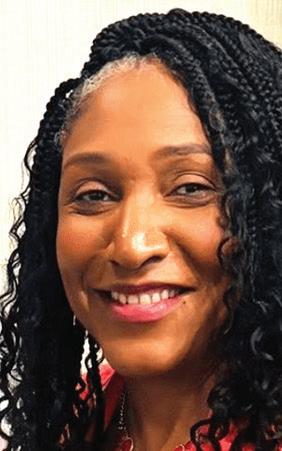
“Black boys are often socialized to suppress vulnerability very early,” Barner said. “They are praised for being tough and corrected for being tender. Over time, that suppression becomes automatic.”
Kwesi Dreams is a Houston-based community leader who creates safe spaces for Black men and boys to explore identity, masculinity, and emotional health. Through poetry gatherings,
discussion circles, and one-on-one mentorship, he works to dismantle what he calls inherited emotional silence.
“We’re taught what not to be before we’re ever taught what to be,” Dreams said. “To be a man is separate from being human.”
He describes the phenomenon as emotional castration beginning in boyhood. Boys learn quickly that softness is punished. Isolation becomes framed as elevation, the lone provider, the stoic protector.
He experienced it

firsthand after graduating from college and losing the daily brotherhood he had built on campus. That was the first time he experienced the loneliness epidemic. It felt like graduation, then real life, with no transition whatsoever. He described struggling to adjust to the distance from close friends and the abrupt shift into adulthood.
“We gotta be real with ourselves to say, I am hurting, I am in pain,” he said. “I believe that my brothers can help me to get through
this pain.”
According to the Centers for Disease Control and Prevention, suicide rates among Black males have risen significantly over the past decade, with notable increases among Black boys and young adults. While overall suicide rates remain higher among white men, experts note that Black men are less likely to access mental health treatment.
Barner said stigma is one of the biggest barriers. “There is still a perception that therapy is weakness,” she said. “For Black men especially, admitting emotional pain can feel like risking respect.”
vascular health to include psychological health because there is robust evidence on the association of psychological health with cardiovascular outcomes,” said Dr. Garima Sharma, director of preventive cardiology and women’s cardiovascular health at Inova Schar Heart and Vascular in Fairfax, Virginia. Sharma chaired the AHA writing group that produced the statement, which appears in a Go Red for Women® spotlight issue of the Journal of the American Heart Association.
Along with the recommendation, he says, it’s important to provide “guidance to clinicians on how to integrate psychological health screening into the perinatal period and focus on providing a holistic approach with the mind and heart interconnection.”
As with the overall U.S. population, car-
diovascular issues, like heart disease, stroke, and high blood pressure, are the leading cause of maternal deaths. The maternal mortality rate in the United States is two to three times higher than estimates from other high-income countries, and has increased since the COVID-19 pandemic.
The rate for Black women is even worse, at 2.6 times higher than white women.
Just over half of all women of childbearing age report having a history of mental health issues. Roughly 4 in 10 women in marginalized groups experience anxiety or depression during and after pregnancy.
Research shows that depression and anxiety are among the leading causes of maternal mortality in the U.S., associated with pregnancy complications and poor, long-term cardiovascular health.
Cognitive behavioral therapy and interventions, such as antidepressants and other medications, can be used to improve
long-term maternal health outcomes.
“Pregnancy is an important time of life from a health perspective,” says Sharma. “However, it is not known how many health care professionals understand the connection between the mind and heart and routinely screen and optimize psychological health during the perinatal period.”
“Screening for psychological health before, during, and after pregnancy should be used alongside screening for high blood pressure, Type 2 diabetes, and other modifiable risk factors for cardiovascular disease,” he says.
Social factors such as a person’s living conditions, traumatic events, and combating daily stress affect mental health, which may show up as negative health behaviors, ranging from having a poor diet or not sleeping or exercising regularly to smoking tobacco and drinking alcohol or using prescription or illegal drugs.


Research shows that depression and anxiety are among the leading causes of maternal mortality in the U.S., associated with pregnancy complications and poor, long-term cardiovascular health.

Maternal
Continued from B10
Katherine Barner
Kwesi Dreams
Envato photo


NOTICE REGARDING TREATMENT COURT COMMISSIONER VACANCY TO ALL ATTORNEYS RESIDING IN ST. LOUIS COUNTY, MISSOURI
The Circuit Court of St. Louis County, Missouri, announces that it is soliciting candidates for the position of Treatment Court Commissioner of the Circuit Court of St. Louis County.
A majority of the Circuit and Associate Circuit Judges will make the appointment for a term of (4) years, at an annual salary of an associate circuit judge, payable by the State of Missouri, pursuant to RSMo §478.003.
Missouri law requires the Treatment Court Commissioner(s) to possess the same qualifications as an associate circuit judge, including those set forth in the Missouri Constitution, Article V, Section 21, to wit, they must be qualified voters of the state, residents of St. Louis County, Missouri, at least twenty-five years old, licensed to practice law in Missouri; and possess all other qualifications as required by law. (See RSMo Chapter 478).
Questionnaires and Candidate Instructions may be obtained by sending a resume and cover letter to St. Louis County Circuit Court, ATTN: Human Resources, 105 S. Central Avenue, Clayton, Missouri, 63105, or via email to SLCCourtJobs@courts.mo.gov
Completed questionnaires must be submitted in writing to St. Louis County Circuit Court, ATTN: Human Resources, 105 S. Central Avenue, Clayton, Missouri 63105, or via email to SLCCourtJobs@ courts.mo.gov on or before May 18, 2026
The appointment is scheduled to take place upon a vote of the majority of the Circuit and Associate Judges en banc on or about June 10, 2026. EOE. Please contact the Human Resources Department at 615-4471 (voice) or RelayMo 711 or 800-735-2966 if you need any accommodations in the application process, or if you would like this posting in an alternative form.
REQUEST FOR BIDS
Hankins Construction Co. is requesting bids from MBE/WBE/SDVE/DBE Subcontractors and Suppliers for our proposal on the Saint Louis Public Schools Central Visual Performing Arts / Collegiate School of Medicine and Bioscience North Vestibule Entrance Project. A diversity goal of 25% MBE and 5% WBE has been established for this project. To access the bid documents, or if you have any questions, please email/call Nicole at Office@HankinsMidwest.com / 314-426-7030. Please submit bids to Bids@HankinsMidwest.com by 3:00 PM on 5/7/2026. Hankins Construction Co. is an Equal Opportunity Employer.

PROFESSIONAL PARK MASTER
The City of Velda City Mo. seeks professional Park Master Planning Services. Please contact Velda City for more details by 4pm May 8th, 2026.
QUALITY ENGINEER
Purem Novi, Inc. seeks a Quality Engineer in St. Louis, MO. Qualified candidates must have a Bach deg or foreign equiv. + 2 years exp. Email resumes to Kaylie. bradley@purem.com
MISSOURI HISTORICAL SOCIETY
CURRENT
JOB OPENINGS!
The Missouri Historical Society is actively hiring for the following positions: Exhibitions FabricatorPart Time Director of Exhibitions- Full Time Housekeeper- Full Time
Please visit: https://www. paycomonline.net/v4/ats/ web.php/portal/ E998F425DE7F6E 8DDE1C5D212F5D 1D9D/career-page for position details and to apply.
An Equal Opportunity Employer Services Provided On A Non-Discriminatory
CIVIC ENGAGEMENT MANAGER
Great Rivers Greenway is hiring a Civic Engagement Manager Go to greatriversgreenway. org/careers/ for information and apply.
SEALED BIDS
Bids for Replace Domestic & Heating Loop, Infrastructure, Charleston, MO. Project No. C2516-01 will be received by FMDC, State of MO, UNTIL 1:30 PM, June 4, 2026. Project information available at: http://oa.mo. gov/facilities
SEALED BIDS
Bids for Repair to Historic Structure at J. Huston Tavern, Arrow Rock State Historic Site, Project No. X2501-01, will be received by FMDC, State of MO, UNTIL 1:30 PM, June 2, 2026. Project information available at: http://oa.mo. gov/facilities
SEALED BIDS
Bids for Improvements to HVAC/ Chiller, Troop C Service Center, Park Hills Project No. R2515-01 will be received by FMDC, State of MO, UNTIL 1:30 PM, May 14, 2026. Project information available at: http://oa.mo. gov/facilities
SEALED BIDS
Bids for Remodel Space for Print Shop Utilization at Scruggs Station Warehouse in Jefferson City, Project No. O2544-01, will be received by FMDC, State of MO, UNTIL 1:30 PM, June 9, 2026. Project information available at: http://oa.mo. gov/facilities
SEALED BIDS
OA-FMDC, State of MO will have a REBID project X241001 for New Sites/Cabins & Site Repairs/ Renovs, State Park, Lagrange, MO. Project No. X2410-01 that will be open for public bid in the month of May. When released, bid documents will be available at: http://oa.mo. gov/facilities
REQUEST FOR BIDS
Hankins Construction Co. is requesting that subcontractors who employ qualified Section 3 employee(s) submit bids in accordance with Section 3 requirements for the Saint Louis Housing Authority/ Al Chappelle Community Center Roof & HVAC Replacement. To access the bid documents, or if you have any questions, please email/call Nicole at Office@HankinsMidwest. com /314-426-7030. Please submit bids to Bids@ HankinsMidwest.com by 3:00 PM on 5/22/2026. Hankins Construction Co. is an Equal Opportunity Employer.
SEALED BIDS
Bids for Replace Concrete Driveway at Higginsville Veterans Cemetery, Project No. U2603-01, will be received by FMDC, State of MO, UNTIL 1:30 PM, June 4, 2026. Project information available at: http://oa.mo. gov/facilities
SEALED BIDS
Bids for Rebid Campground Loop 5 –Eelectrical Improvements, Project No. X2204-04 will be received by FMDC, State of MO, UNTIL 1:30 PM, 5/28/26. Project information available at: http:// oa.mo.gov/ facilities

PUBLIC NOTICE
Notice is hereby given that the Metropolitan St. Louis Sewer District Requests for Quotes, Bids and Proposals are posted online for public download. Please navigate to www.msdprojectclear.org
> Doing Business With Us > View Bid Opportunities
Metropolitan St. Louis Sewer District is an Equal Opportunity Employer.
NOTICE TO CONTRACTORS
Sealed bids for the ARSCRS2 Improvement Program, Package 3 project, St. Louis County Project No. AR/CR-1941 will be received electronically thru the County’s Vendor Self Service portal at https:// stlouiscountymovendors. munisselfservice.com/ Vendors/default.aspx, until 2:00 PM on June 3, 2026
Plans and specifications will be available on May 4, 2026 from the St. Louis County Web Site (www.stlouiscountymo. gov) or by contacting
Cross Rhodes Print & Technologies, 2731 South Jefferson Avenue, St. Louis, MO 63118 (314) 678-0087.
DIRECTOR OF PROCUREMENT
ST. LOUIS COUNTY
NOTICE TO CONTRACTORS
Sealed bids for the Hanley Road – Laclede Station Road Resurfacing, St. Louis County Project No. AR- 1819, Federal Project No. ST-5613(610) will be received electronically thru the County’s Vendor Self Service portal at: https:// stlouiscountymovendors. munisselfservice.com/ Vendors/default.aspx until 2:00 p.m. on June 3, 2026
Plans and specifications will be available on May 4, 2026 from the St. Louis County Web Site (www.stlouiscountymo. gov) or by contacting Cross Rhodes Print & Technologies, 2731 South Jefferson Avenue, St. Louis, MO 63118 (314) 678-0087.
DIRECTOR OF PROCUREMENT
ST. LOUIS COUNTY
REQUEST FOR PROPOSALS
The Hazelwood School District is seeking bid proposals to install galvanized chain link fencing with bottom wire at Jamestown Elementary, Twillman Elementary, Keeven Elementary, & Hazelwood East High School.
Interested parties should submit their bid proposal through Bidnet via the district’s website at https://www. hazelwoodschools.org/ Page/2238 on or before Tuesday, May 26, 2026 not later than 10:00 a.m
SEALED BIDS
Bids for HVAC System Upgrades, Missouri State Highway Patrol, Troop C, Weldon Spring, Missouri, Project No. R2415-01 will be received by FMDC, State of MO, UNTIL 1:30 PM, May 14, 2026. Project information available at: http://oa.mo. gov/facilities

YOUTH & FAMILY CENTER INTERIOR RENOVATIONS
Overview
The Youth & Family Center is seeking bid proposals for interior renovations at 818 Cass Ave. St. Louis, MO 63106. This project involves select interior Demolition, renovations to HVAC, ACT Ceilings, interior painting, Gym floor refinishing and replacing light fixtures.
See Bid Documents on: theyfc.org
Important Dates • Mandatory Onsite Walkthrough: May 07, 2026. 9 AM CST
• Proposals Due: May 21, 2026 2 PM CST
• Award Announcement: May 28, 2026
Submission Instructions
Sealed Bids are to be submitted at 818 Cass Ave. at 2p. Thursday May 21, 2026.
Contact Information
• Contact Person: Michael McClain
• Email: mmcclain@kwamebuildinggroup.com
• Company: Kwame Building Group
SEALED BIDS
SEALED BIDS
Bids for Replace Roof & Renovate Basement and Access, Support Services Building, Project No. R2508-01 will be received by FMDC, State of MO, UNTIL 1:30 PM, 5/12/26. Project information available at: http:// oa.mo.gov/ facilities
Bids for Renovations to Rebid Interior/ Exterior & Install Emergency Generator, Multiple Assets, Project No. R2502-01will be received by FMDC, State of MO, UNTIL 1:30 PM, May 19, 2026. Project information available at: http://oa.mo. gov/facilities
REQUEST FOR PROPOSALS
39 North AgTech Innovation District invites qualified vendors to submit proposals for furnishing services related to an upcoming office expansion project. We are seeking experienced partners capable of providing high-quality furniture solutions, delivery, and installation services.
A complete copy of the Request for Proposals (RFP) is available at: https://39north stl.org/wp-content/ uploads/2026/05/RFPFURNISHINGS-1.pdf
To be considered, proposals must be received no later than 3:00 PM CT on Thursday, June 11, 2026
PUBLISHER’S NOTICE:
Advertised herein is subject to the Federal Fair Housing Act, which makes it illegal to advertise any preference, imitation, or discrimination because of race, color, religion, sex, handicap, familial\status, or national origin, or intention to make any such preference, limitation, or discrimination.“We will not knowingly accept any advertising for real estate which is in violation of the law. All persons are hereby informed that all dwellings advertised are available on an equal opportunity basis.”


By Rev. Dorothy S. Boulware
Word In Black
A compliment to Robin Fay
Massie is certain to elicit her response of, “It’s God, or it’s the Lord.” She’s careful, as good Christians say, to give God all the praise and glory for her life. It’s more than an affectation; it’s her entire life.
And what a life it is. She’s a full-time school nurse in Atlanta by day, a neonatal intensive care unit nurse by night and a freelance classical violaist.
As such, Massie’s life sits at the intersection of faith, caregiving, and artistry, where her work as a school nurse and professional violist becomes a single ministry rooted in service. From Baltimore to Atlanta, her journey shows how devotion to God shapes not only her calling but the way she heals, performs, and moves through the world.
Her calling: Healing through music and medicine
orchestras, but for string players like Massie, representation for Black string players — violin, viola, cello, and bass — is often even lower.
There has been growth, albeit slowly: the percentage of Black classical musicians increased from 1.8% in 2014 to 2.4% in 2023.
‘From the Very Beginning’ Massie’s musical journey began in Baltimore when her parents managed to get her a second-hand piano she had long coveted.

”It was just sitting in someone’s house, not being played,” she says. “It wasn’t financially easy for them, but they got it for me. And I loved playing it from the very beginning.”
Later, Massie’s musical interests migrated to the violin — her second musical love. But it was not to be:
Few Black Classical Musicians
A freelance musician, “I perform with organizations like the Atlanta Opera and Atlanta Symphony,” she says. “I’ve also worked with groups like the Philadelphia Orchestra and National Symphony. I also do chamber music and work through the musicians’ union, which has been incredibly helpful for opportunities and support.”
The field, however, can be challenging for Black classical musicians.
A 2023 study found that Black people represented 2.4% of musicians in surveyed American
“My teacher, my mentor, said the notes I played leaned more toward the lower instrument,” the much larger viola,” she says.
That was her next musical challenge, and that’s where she remains.
Though Massie isn’t officially connected to any orchestra, some critics have become enamored of her playing. They include Michael Caruso, a Philadelphia-area journalist who reviewed one of Massie’s performances.
“Especially noteworthy was the strength of Massie’s playing,” he wrote. [Her] strongly projected and beautifully modulated brawny tone made certain that her voice would be heard.”

Massie’s relationship with the Lord was nurtured from the beginning by her parents and has grown to be the central part of her life. Each day begins with a consultation with the Lord and orders for the day.
”Then I say, ‘O.K., let’s go to the gym,” Massie says.
Massie is divorced, but she began her transition to nursing by providing care for her then-husband.
”I knew I had to take care of him regardless of his resistance at the time. I was at peace with it even if he wasn’t,” she says. Her next assignment was caring for her mother, who was having trouble managing diabetes.
The healing touch, Massie says, merges with her faith.
“I just want everyone I care for to know they’ve been


touched by the Lord.” Word in Black: Tell me about your work as a nurse.
Robin Fay Massie: I believe that music and nursing, for me, are one spectrum of care, really doing God’s work. It’s ‘heart’ ministry. I knew from a young age that I wanted to help people, even before I fully understood what that meant.
It wasn’t until 2016, during a very difficult time in my life, that I stepped into nursing. My then-husband was struggling with health issues and addiction, and he became my first patient in a sense. I remember saying, ‘God, I don’t know what I’m doing, but I’m going to take the next best step.’ And I did.
WIB: How did music become a profession for you?
Massie: I started piano at four years old. My parents saw that I wasn’t just playing—I was con-
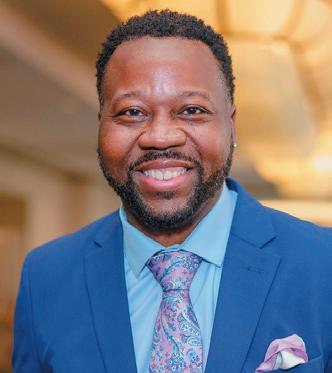
Let me tell you the truth about the season I’m in: I am building a business I’ve never built before, while also trying to run it. I’m creating a course, shaping an ecosystem, testing ideas, refining content, stitching systems together — and none of it is neat. None of it is linear. None of it comes with a playbook.
I’m learning as I go. I’m trying. I’m failing forward. And I’m pulling on every resource I can — including AI. But let me say something clearly: AI is not the business. AI plugs into the business.
People like to say, “Anybody can use these tools now.” And they’re right — access has been democratized. But everybody can hold the hammer; not everybody knows how to build a house. AI is the hammer. My gift is my perspective. That’s what makes the tool powerful.
What AI does for me is accelerate what’s already inside me. It helps me organize my thinking, test my logic, challenge my assumptions, and refine my frameworks. But the wisdom? The life experience? The story? The leadership instinct? That comes from me. Here’s how I’ve been using it: I start messy. I brain-dump. I talk. I scribble.
I give AI raw pieces of my thinking and ask simple questions:
• “What’s the main idea here?”
• “Is this clear or incomplete?”
• “What’s missing?”
I don’t ask it to write for me. I ask it to sharpen me. But the real work — the leadership work — is deeper than the tool. It’s the system behind the tool. Because when you’re building something new, you feel the waste: creating things twice, losing track of notes, chasing outdated files, forgetting the structure you used last time. And you realize it’s not about intelligence — it’s about systemization.
necting with it—so they sacrificed to get me lessons. At eight, I fell in love with the violin, and at fourteen, a mentor introduced me to the viola. The moment I played it, I knew that was it.
WIB: Now, I know you were taking care of your mom. How’s that going?
Massie: That has been a profound part of my journey. I moved to Atlanta to care for my mom when I saw her health declining. She’s diabetic, and things weren’t well-controlled. I left Baltimore without a job, without a plan—just trusting God. I call that my ‘wilderness season.’ But he provided every step of the way.
Today, my mom is doing so much better. She had surgery and is now standing upright for the first time in years. My brother is also doing well, and I’m able to help care for him, too. It’s clear to me now that God prepared me through nursing for this very purpose.
WIB: How does your faith sustain you as well as propel you in life?
Massie: I want to leave this world better than I found it. I believe pain connects us, but joy heals us—and true joy comes through Jesus Christ. I want anyone who encounters me to feel like they’ve been touched by him. I start my day intentionally with the Lord because that prepares me to meet others. For me, everything—music, nursing, life—is about the heart. I have to examine myself before I can pour into anyone else. And I strive to show up with joy, because that’s what draws people to him.
That’s when I started tagging things differently, setting up step-by-step workflows, and asking myself: “Could someone else follow this if I wasn’t in the room?”
Because leaders don’t just build products. Leaders build systems. Systems that outlast the season. Systems that protect the mission. Systems that reduce friction, confusion, and burnout — for the person building and the people following.
That’s why I’m investing in a CRM and designing a sales pipeline right now. Not because I love software. But because I refuse to build a business where opportunity depends on my memory, my inbox, or one person’s charisma. A spreadsheet is fine to start. But at some point, hustle becomes a liability. I know the season I’m in: heavy investment, light visible return. A lot of work. Not a lot of applause.
But here’s what anchors me: I’m buying back future time with present discomfort. I’m creating orientation documents for myself. I’m structuring workflows. I’m building containers for chaos.
AI is helping me think faster, yes. But the leader in me has to decide what to do with that speed. Because here’s the truth every builder eventually learns: AI won’t build your business for you. But in the hands of someone with vision, it will make you dangerous. Dangerous in the best way — clearer, faster, more strategic, more disciplined, more prepared.
The tool is not the talent. The system is not the story. You are the engine. The technology is simply the accelerator. And if you can stay in the messy middle long enough — the trial, the questions, the late nights, the constant refining — you don’t just build a product. You build a process. A repeatable, transferable way of working. A leadership system that can scale, sustain, and serve people well. That’s the real breakthrough.
Reflection Questions:
Are you using AI to accelerate what’s in you? What’s one system you could put in place to turn today’s chaos into something that scales tomorrow? For more, visit OrvinKimbrough.com or MidwestBankCentre.com.
Personal Caregiving Journey
As a nurse and professional violist, Massie embodies a rare blend of artistry and service, using both as tools of healing while navigating the challenges of being a Black musician in classical spaces.
Photo courtesy of Robin Faye Massie