
St. LouiS AmericAn
12 – 18, 2026


Serving, empowering and advocating for equity in St. Louis since 1928
Women on the front lines
Often unseen, social workers help keep Missouri families together
By Ashley Winters St. Louis American
Social workers, the majority of them women, rarely see the public moments of the families they help. More often, their work happens quietly with parents trying to hold their families together.
“Our social workers and case managers do not step in once and then disappear,” said Latizia Williams, assistant director of the parenting program at Lutheran Family and Children’s Services of
Missouri. “They sit at kitchen tables, develop supportive relationships through challenges like court appearances, financial hardships and educating parents about parenting techniques to enhance parent-child interactions. They keep showing up until families find stability.”
Across Missouri, that kind of work adds up quickly. Social workers with the St. Louis-based nonprofit interacted with children and families more
See Women, A13


Teach For America resumes
By Leah Gullet For The St. Louis American
Dr. Nikole Shurn did not begin her career intending to become an educator. She earned a master’s degree in communications from Webster University and planned a career in that field.
A series of personal changes redirected her path, and in 2014 Shurn joined Teach for America, which recruits “high-potential” leaders from diverse academic backgrounds for two-year teaching commitments in under-resourced schools following intensive summer training.
Shurn said the program opened a path into education that eventually led her into leadership. She now serves as principal of the Lieberman Learning Center in University City.
“I do give credit to Teach for America for even providing that
Mercy selects Tricia McGusty
Veteran executive to lead St. Louis hospital network
By Sylvester Brown Jr. St. Louis American
Leading Mercy’s largest hospital and overseeing millions of dollars in expansion projects will be the first major tasks facing Tricia McGusty as the new president of Mercy St. Louis Communities.
Mercy has named the veteran hospital executive to the role after a nationwide search, placing her in charge of Mercy Hospital St. Louis in Creve Coeur and a network of regional outpatient clinics, surgery centers and related healthcare facilities serving eastern Missouri.
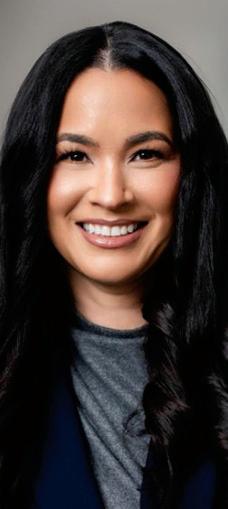
“Her proven ability to guide complex health systems, paired with her deep passion for our mission and the people we serve, makes her an outstanding choice for this role,” said David Argueta, Mercy senior vice president and president of community operations. In the position, McGusty will oversee hospital operations while helping guide Mercy’s long-term planning and development across its St. Louis facilities.
Her responsibilities will include major capital projects already underway in the region, including renovations at Mercy Hospital St. Louis and a $75 million expansion at Mercy South. Mercy officials said details of another large campus renovation have not yet been announced.
One of her first priorities will be overseeing a large campus renovation at Mercy Hospital St. Louis.
McGusty brings more than 25 years of experience in health care, including leadership roles at large hospital systems. She most recently served as chief operating officer at HCA Houston Healthcare Northwest and also served as interim chief

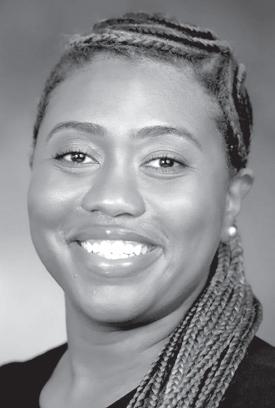
Latizia Williams, left, and Cyrini Daniels, social workers at Lutheran Family and Children’s Services of Missouri, support families and children in St. louis through counseling, resources and advocacy.
Photo by Lawrence Bryant / St. Louis American
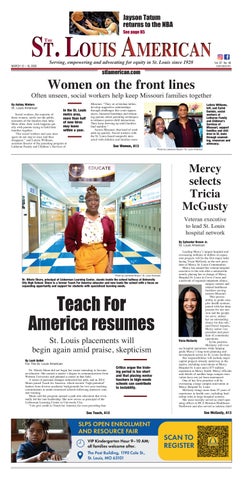
Dr. Nikole Shurn, principal of Lieberman Learning Center, stands inside the school hallway at University City High School. Shurn is a former Teach For America educator and now leads the school with a focus on expanding opportunity and support for students with specialized learning needs.
Photo by Lawrence Bryant / St. Louis American
Tricia McGusty
Editorial/CommEntary
Guest Editorial Missouri must protect HBCUs’ vital roles
By Stacy Gee Hollins
Mill Creek Valley was a once-thriving Black community dismantled in the name of urban renewal. Its destruction wasn’t caused by a lack of talent, entrepreneurship or leadership. It was caused by decisions about whose futures mattered. That lesson remains urgent today, far beyond St. Louis.
Before demolition began in 1959, Mill Creek Valley was home to more than 20,000 residents. Spanning roughly 54 blocks, the neighborhood supported 800+ businesses, 40 churches, and 5,600 housing units. Doctors, educators, tradespeople, restaurateurs, and entrepreneurs built wealth, stability, and community there. Within a few years, nearly all of it was erased; a public policy issue, not market failure.
That history matters because Missouri still grapples with the consequences of disinvestment and disenfranchisement in Black communities, particularly when economic opportunity and entrepreneurship are spotlighted. Entrepreneurship is often framed as a risk. For many under-resourced and underrepresented communities, it is also a necessity, one of the most viable pathways to economic mobility. Small businesses are the backbone of Missouri’s economy. More than 99% of businesses in the state are small businesses, and they employ nearly half of Missouri’s private-sector workforce. Yet access to entrepreneurship as a career pathway remains deeply disproportionate.
underinvested areas, entrepreneurship must be part of the solution. And that requires investing in institutions designed to meet people where they are.
Historically Black colleges and universities have long played that role. HBCUs educate a substantial share of Black professionals, entrepreneurs and civic leaders nationwide, despite representing a small fraction of higher education institutions.
Missouri has only two HBCUs: HarrisStowe State University and Lincoln University in Jefferson City.
That makes their role even more vital.
At Harris-Stowe, the Anheuser-Busch School of Business established its Center of Innovation & Entrepreneurship to address unmet needs in the St. Louis region and beyond by providing education, consulting and support to small businesses and startups, particularly those led by underrepresented and underserved scholars and community founders.
Our vision is to create a dynamic environment that promotes innovation, entrepreneurship and community engagement while expanding economic opportunity.
Nationally, Black founders receive a fraction of the capital their counterparts do. According to Crunchbase, only about 4% of investment funding went to Blackowned businesses in 2024. This is not because of a lack of ideas, work ethic, ambition or merit. It is the result of systemic barriers: limited access to capital, networks, mentorship, technical assistance and markets.
Over the years, Black entrepreneurship has increased in St. Louis, but compared with other large cities, St. Louis ranks near the bottom.
In his recent State of the State address, Gov. Mike Kehoe called for building a “foundation for growth” in Missouri. This ambition will only be realized if economic opportunity reaches the communities and entrepreneurs historically excluded from it.
On Monday, state Rep. Dirk Deaton proposed reallocating $250 million among Missouri’s four-year universities. HarrisStowe State University would have its core funding cut by almost 40%. If Missouri is serious about strengthening its economy, especially in historically
The location of that work is not incidental. The Center of Innovation & Entrepreneurship sits in the historic footprint of Mill Creek Valley itself. Entrepreneurship initiatives at Harris-Stowe help cultivate highly skilled individuals, advance applied research and deliver practical programming for aspiring and existing entrepreneurs. This work recognizes that talent is evenly distributed, even when opportunity is not, and that rebuilding requires sustained investment, not symbolic gestures.
Missouri’s Black population comprises roughly 12% of the state, with higher concentrations in metropolitan areas like St. Louis and Kansas City. Supporting Black entrepreneurship is a statewide economic imperative. When Black-owned businesses thrive, they create jobs, stabilize neighborhoods and contribute to local financial infrastructure. Everyone is a beneficiary.
In addition to honoring what was stripped from communities like Mill Creek Valley, we should also ask whether we are willing to rebuild with intention.
Missouri has a choice: we can limit our acknowledgement of Black excellence, or we can intentionally invest in the futures that were deliberately sidelined.
This strengthens Black entrepreneurship, HBCUs and communities that contribute to a stronger Missouri economy.
Stacy Gee Hollins serves as associate provost and dean of the Anheuser-Busch School of Business at Harris-Stowe State University.

By Ben Jealous
My father, who is white, has said for years: “When many white Americans hear the phrase ‘white privilege,’ they respond by listing all the ways their lives have been hard.”
But if you talk about “white advantage,” the conversation changes. Advantage is measurable. It doesn’t erase suffering. It simply acknowledges that race still tilts the system.
After I wrote a column about this, readers reached out asking me to elaborate. To understand why, we must go back to the beginning of the American story.
Early in colonial America, poor Europeans and enslaved Africans sometimes recognized that they shared a common predicament. They ran away together. They rebelled together. For a brief moment in our history, working people across color lines sometimes saw each other as allies rather than enemies.
That possibility deeply unsettled the people who held power. So over time, colonial elites built a system designed to prevent that unity. Europeans were given small advantages — permission to carry weapons, positions in militias, small measures of authority over enslaved Africans. At the same time, racial contempt was deliberately cultivated between the groups.
traditionally white-sounding names received far more callbacks than those with Black-sounding names, even when their qualifications were the same.
Suffering and advantage can exist at the same time.
My father understood something many activists forget: language can open conversations, or it can shut them down.
For decades he worked with thousands of men — mostly white — helping them confront trauma and take responsibility for their actions. He saw how quickly people shut down when they feel their suffering is being dismissed.
That’s the predicament. The reality of racial advantage is undeniable. But the language we use to describe it sometimes pushes away the very people who need to be part of the solution.
Rev. Jesse Jackson understood this better than anyone. His Rainbow Coalition was built on a simple insight: racism has long been the oldest political wedge in America. Divide working people by race and those in power stay secure. But if working people across racial lines ever truly unite, the coalition would be powerful enough to transform the country.
Racism itself became a tool of political control. The wedge worked. In many ways, it still does.
White communities across America are hurting. Factories have closed. Life expectancy for many working class Americans has fallen. Addiction and suicide have devastated entire towns.
Acknowledging white advantage doesn’t deny any of that.
It simply says this: if two people walk into the same job interview with the same résumé, race still affects the outcome. If two families try to build wealth across generations, race still shapes the odds. Social scientists have measured this for years. In a well-known study, Princeton sociologist Devah Pager sent identical résumés to employers. Applicants with
Who
By Julienne Louis-Anderson
When I walked into work on March 2, the conversation around the watercooler was that the we - The United States and Israel - had bombed Iran. As a Black woman, I knew I spoke for thousands of Black people when I asked, “Who is ‘we’?”
For Black people in this country, “we” has never been automatic. It has always been conditional.
There’s a term for that — what W.E.B. Du Bois called “double consciousness.” It describes the psychological conflict Black Americans experience while living and navigating in a society that undervalues them. The struggle between how we are perceived and how we perceive ourselves produces a kind of dual identity.
So when I asked, “Who is ‘we’?” it was because I’m used to the two-faced way America claims and uses Black people while simultaneously belittling and berating us. It shows up in moments like these:
The Three-Fifths Compromise written into our founding documents.



The opposite of racism isn’t just tolerance. It’s solidarity. Our history shows both possibilities. At times we were divided by race so completely that we could barely see our shared interests. At other moments — Reconstruction, the labor movement, the civil rights era — we have glimpsed what multiracial democracy can look like. That history should give us hope. Because if racism was built to divide us, it can also be dismantled.
Rev. Jesse Jackson spent a lifetime trying to show us what comes next. When working people finally refuse the wedge — when we stand together from union halls to houses of worship, from big cities to small towns — the coalition that emerges will be stronger than the politics that have kept us apart for generations.
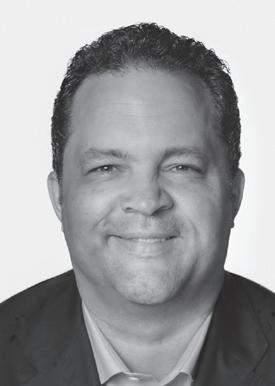
Ben Jealous is a professor of practice at the University of Pennsylvania and former president and CEO of the NAACP.
history?
paying for school and working themselves out of poverty may now be pulled into a war that 93% of Black people openly oppose. This pattern didn’t begin with my peers. Like the majority of Americans, my grandfather’s generation and his father’s generation served in every major war: World War I, World War II, Korea and the Gulf Wars. They fought next to members of every race. At war, they were part of the “we” of America. After each deployment, Black veterans expected the brotherhood — the “we” they became part of overseas — to extend to a “we” when they returned home. They quickly realized that was not the case. Instead, veterans like my grandfather returned to segregation, redlining, lynching threats and renewed racial hostility. While the G.I. Bill built white middle-class wealth for veterans, many Black veterans were systematically denied equal access to housing loans, education benefits and economic opportunity.
The erasure of the Tuskegee Airmen and the Six Triple Eight from school curricula covering World War II.
Dr. Martin Luther King Jr.’s observation that Sunday church service remains the most segregated hour in America.
Beyoncé winning Best Country Album, only to be structurally excluded the following year.
Black Americans remain essential to the nation’s prosperity but peripheral to its protection.
To be clear, Black Americans are not ambivalent about war, service or sacrifice. Even though Black people make up only 13.7% of the population, we comprise 21.4% of all military branches. My loved ones who enlisted with the promise of
The plain truth is this: Black Americans are extended the identity of “we” when sacrifice is required — in war, in labor, in culture. But we are seen as disposable and excluded when benefits, payment and respect are at stake.
The current White House administration, many Black Americans believe, continues that pattern — from policies tied to mass incarceration to the erasure of Black history and layoffs that disproportionately affect Black women. It’s no wonder many are choosing to opt out of the “we” now. We are tired of the game. So when a president who many Black Americans believe despises them declares military action and the headlines read “we,” I ask again: “Who is ‘we’?” Julienne Louis-Anderson is a former
and Public Voices Fellow of the
Columnist
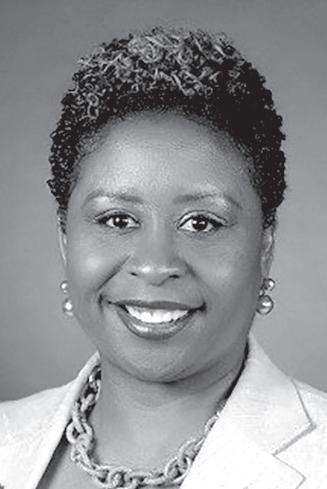
Stacy Gee Hollins
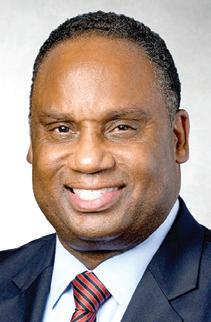
“Some people see a political figure, and I just know him as a person that never gave up on me.”
- U.S. Rep. Jonathan Jackson on the passing of his father his father, Rev. Jesse Jackson
314 Day
3 digits that say STL pride
American Staff
A sea of Cardinals red, Blues blue and STL pride filled the steps of the Gateway Arch as scores of St. Louisans gathered for the annual 314 Day photoshoot — one of the most recognizable traditions beneath the city’s most recognizable landmark.
The shoot helps kick off the celebrations leading to March 14, when the city turns its primary area code into a full-blown civic celebration.
Each year, organizers invite residents to bring their favorite St. Louis staples, throw on their team gear and pack the Arch grounds for a massive community photo celebrating the spirit of the region.
What began in 2006 as a grassroots idea has grown into a week of events highlighting St. Louis culture, music, food and entrepreneurship. Restaurants roll out $3.14 specials, concerts and block parties pop up across the region and locals everywhere take the opportunity to rep their hometown.
But Sunday’s photoshoot at the Arch remains one of the clearest snapshots of the holiday.
For a moment, the steps beneath the Arch become a sea of STL pride — a reminder that in St. Louis, 314 isn’t just an area code. It’s an identity.
More coverage of 314 Day, B1


Safety Street
Keeping kids safe
St. Louis Children’s Hospital believes in “doing what’s right for kids” and that includes not only keeping them healthy but also keeping them safe.
The Safety Street program does just that—teaching kids preventive safety measures before accidents even happen.
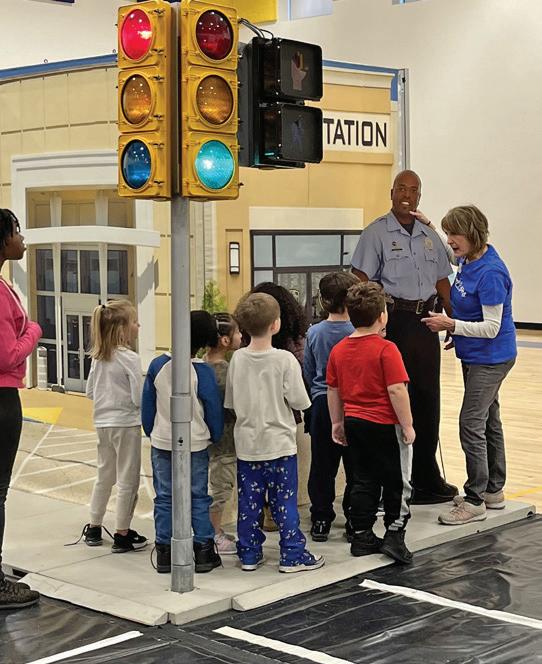
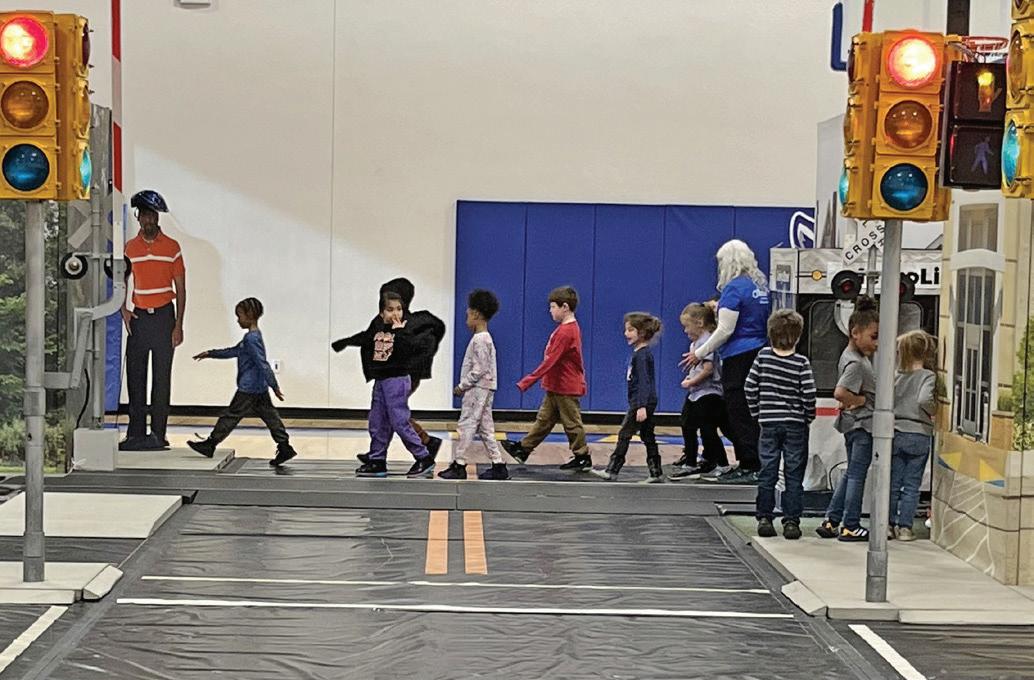
Safety Street is an interactive program that incorporates life-size cityscape panels and working traffic lights to help children learn important safety lessons.
Our trained professionals teach children:
• How to safely cross streets and railroad crossings
The importance of bicycle helmet safety
How to react if they encounter a stranger
How to find a police officer if they need help
Safety Street visited several schools in 2025, including Blades Elementary School in Oakville, Brennan Woods Elementary School in High Ridge, and Walker Elementary School in Florissant. Each visit is an opportunity to teach street safety to hundreds of children and offer preventive skills to keep them out of danger.
For more information about Safety Street visiting your school, scan the QR code.

Photos by Taylor Marrie/St. Louis American
WashU reports $9.8 billion economic impact in region
Washington University in St. Louis contributed $9.8 billion to the regional economy in fiscal year 2025, according to the university.
WashU said it directly generated $4.1 billion in economic activity, including $2.6 billion in employee salaries, $334 million spent on local goods and services and $196 million on construction projects.
Students spent an additional $217 million at businesses across the St. Louis region, the university reported.
WashU also brought more than $1 billion in
Word In Black wins NAACP Image Award for journalism
Word In Black, a national collaborative of Black-owned media outlets that includes The St. Louis American, has won the 2026 NAACP Image Award for Outstanding Literary Work –Journalism.
The award recognized “On Borrowed Time,” a reporting series on organ donation and transplantation written by journalist Anissa Durham.
The honor is significant because this year marked the first time the NAACP Image Awards included a journalism category.
Word In Black’s series was nominated alongside reporting from major national outlets including CNN and The New York Times according to the organization.
Liz Courquet-Lesaulnier, managing director of Word In Black, said the project examined issues surrounding organ donation and transplantation in Black communities.
“Anissa’s extraordinary reporting made it exceptional,” Courquet-Lesaulnier said.
Word In Black is a partnership of Blackowned news organizations across the United States focused on reporting on issues affecting Black communities.
Bush, Bell file for rematch in 1st District Democratic primary
Former U.S. Rep. Cori Bush and U.S. Rep. Wesley Bell have filed to run for Missouri’s 1st Congressional District seat, setting up a rematch in the Democratic primary after Bell defeated Bush in 2024.
Bell, a Democrat from St. Louis County, unseated Bush by about 5.5 percentage points in one of the most expensive congressional primaries in U.S. history. Outside groups, including organizations supportive of Israel, spent mil-
external research funding to the area, supporting research in medicine, technology and public health.
With 23,434 employees, WashU is the second-largest employer in the St. Louis region.
University officials said each dollar the university spends locally generates an additional $1.25 in regional economic activity, reflecting WashU’s role as a major employer, research institution and driver of business activity in the St. Louis area.
lions of dollars in the race.
Bush said voters are increasingly frustrated with outside spending in political campaigns.
“The tide has already turned, and people are saying no,” Bush said. “They want to be the ones to pick their representatives.”
Bell rejected the idea that outside spending will affect the race.
“Voters in our district are worried about the cost of living,” Bell said. “They’re worried about health care costs.”
Two other Democrats — Carl Harris of St. Peters and Alissa Murphy of Clayton — have also filed for the Democratic primary.
EmpowerHER Tea Party uplifts St. Louis students
High school students from across St. Louis gathered recently at the Phyllis Wheatley Heritage Center for the second annual EmpowerHER Tea Party, an event designed to encourage leadership and mentorship among young women.
The program was founded and hosted by Conchita Hughes, a teacher at KIPP High School.
Students shared artwork, poetry and music and participated in discussions with community leaders.
Speakers included Jaime Mowers, Dr. Kendra Holmes, Ebi Nicole, Lena Chapman and Dr. Marty K. Casey, founder of the UnGun Institute.
Participants also received video messages from U.S. Rep. Maxine Waters and actress Jennifer Lewis encouraging them to pursue leadership and community engagement.
The event, held between Black History Month and Women’s History Month, focuses on mentorship, leadership development and celebrating the achievements and potential of young women in the St. Louis community.

Commentary
When will the war madness end?
By E. Faye Williams
Defense Secretary Pete Hegseth is probably the best person Trump could find to carry out his wishes to be known as something he is not. His boss has taken every opportunity to be known as the “Peace President” while bragging about a brutal war he started with Israel against Iran that is negatively impacting not only America, but also so many of our true friends in the Middle East. I’ve traveled to nearly all the nations there and have friends in the ones negatively impacted by this war. You might have noticed that most Americans do not approve of it. We see over 200 children known to have been killed. We see men and women who had nothing to do with nuclear weapons killed by the hundreds. We see beautiful structures destroyed where people had nothing to do with nuclear weapons.
enforcement experience. Most of us, regardless of the job, are expected to demonstrate education or experience for such a high-level role.
So the question is: What does Mullin bring to this job?
As a member of Congress, he wasn’t even asked to vote on this war, so is Mullin even informed about how it impacts our homeland?
Neither Trump nor Hegseth seem to have plans for when this war will end or how. Trump has said the end must come without concessions. With so many nations involved or affected, how do they expect it to happen?
With this war going on, I guess this is a way for most Americans to forget about Epstein and not notice that in the first week of the conflict, gasoline prices increased by 11% and are expected to rise to at least $4 per gallon soon, if they’re not already there in some places.
Look at the smirk we see on Hegseth as he says, “If you think this is something, just wait.”
That’s easy for him to say to the families of those who have already died, while his family never considered going to war to protect the country that has given them every advantage in life.
The “wannabe king” wants Sen. Markwayne Mullin to improve on what former Secretary Kristi Noem did with the Department of Homeland Security, though he doesn’t look promising. Mullin is one of Trump’s staunch supporters. It doesn’t matter to Trump or his supporters that Sen. Mullin has no law
Stocks are down. Over 92,000 Americans have lost jobs in the last month. There has been no job growth in the past 12 months. People are not getting raises. Others are not finding jobs. Meanwhile, we’re told this war is costing Americans $1 billion per day. I didn’t mention the millions of Americans in the war zone who have no way to get out. They had no way to know how their lives would be impacted while visiting or working on behalf of their country. How do they leave the area? They are told to evacuate when the question is “How?”
We need to be asking Trump and Hegseth when will this madness end.
E. Faye Williams is president of The Dick Gregory Society.

E. Faye Williams

Women and wealth: Tips for navigating your financial journey
J.P. Morgan Wealth Management
We are in the midst of a seismic shift in wealth. This phenomenon, often referred to as the “Great Wealth Transfer,” describes the unprecedented movement of assets from the Baby Boomer generation to their heirs — an estimated $105 trillion by 2048. And women are poised to inherit most of this.
J.P. Morgan Wealth Management’s 2025 Investor Study found that women are not only set to receive sig-
nificant wealth — they’re actively working to build it on their own. Ninety-three percent of women surveyed who are expecting an inheritance aren’t relying on it to reach their goals. Here are a few tips for women to consider in their wealth-building journey.
Create a financial roadmap
A detailed, well-thoughtout plan is important. J.P. Morgan’s study found that 90% of those surveyed with a plan feel confident about
reaching their financial goals, compared to 49% without one.
Your plan should reflect your unique goals, priorities and circumstances. Consider your investment horizon and risk tolerance, and remember to revisit your plan regularly as life evolves.
Are you saving up for goals like buying a house, sending your kids off to college or retiring early? Where do you want to be in the next five, ten or twenty years? Everyone’s financial situation is unique, so it’s
important to think about these questions and build a plan that is unique to your life. Women tend to live longer than men on average. Many take career breaks or care for family members, which can influence long-term planning. It’s important to adjust your strategy with these factors in mind.
Where to start with investing
Don’t let misconceptions hold you back. Starting to invest doesn’t require a large
See JPMorgan, A6
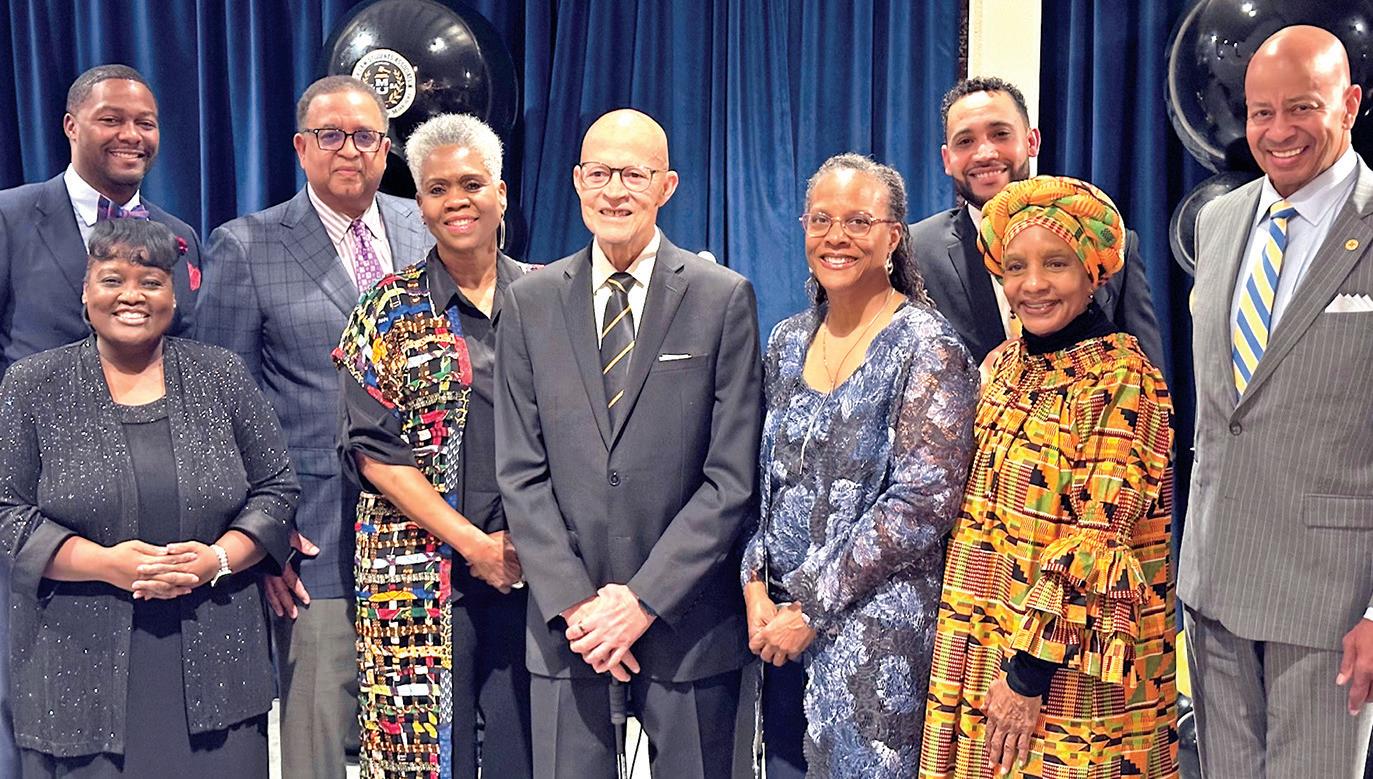
Michael Middleton, center, was honored last weekend at the University of Missouri Black Law Students Association’s 40th annual Lloyd L. Gaines Scholarship Banquet with its Legacy Award. He is surrounded by some of the law school graduates he taught over his long tenure as the first Black law professor at Mizzou.
They are, from left, Arsenio Mims of Dowd Bennett LLP; Judge Renee Hardin-Timmons, keynote speaker and judge on the Missouri Court of Appeals; Ron Norwood of Lewis Rice; Kim Norwood, law professor at Washington University School of Law; Middleton; Tracy Berry, great-
On The Move
Rashida Thomas joins Per Scholas St. Louis

Rashida Thomas has been hired as the new professional development manager at Per Scholas St. Louis. Thomas, who earned a master’s degree from Webster University and an MBA from Lindenwood University, has nearly 20 years of leadership experience with CVS Health and GM Financial. Per Scholas St. Louis provides no-cost, artificial intelligence-enabled information technology training to learners throughout the St. Louis metro area and eastern Missouri.
COCA hires Jay Staten as director of dance

Jay Staten
Jay Staten has joined COCA (Center of Creative Arts) as its new artistic director of dance. Staten comes to St. Louis with more than two decades of professional experience from New York City, including his work as assistant choreographer for the Broadwaybound Dreamgirls. A native of Washington, D.C., and a graduate of Marymount Manhattan College, his performance credits include appearing as a soloist in After Midnight on Broadway, Fire Shut Up in My Bones at the Metropolitan Opera and Lyric Opera of Chicago.
Dr. Kent of SLU on ‘Leading the Change’ panel Dr. Saida Kent
Dr. Saida Kent, a Saint Louis University assistant professor of internal medicine, is a featured panelist March 17, 2026, during the Women’s History Month discussion “Not Fine Yet: A Journey to Whole Health, Justice, and Belonging.” Joining Kent are Lina Toledo-Franco, M.D., director of the hospice and palliative medicine fellowship; Farzana Hoque, M.D., associate professor of internal medicine; and Rev. Nicole Armstrong, campus minister for South Campus.
The event will be held from noon to 1 p.m. in Pitlyk Auditorium in the Learning Resource Center, 3545 Vista Ave., on the SLU campus.
Nnanna, Wang address Engineering Expo George Nnanna
George Nnanna, founding director of the University of Missouri–St. Louis School of Engineering, and Professor Xin Wang discussed the new school’s programs and initiatives during the recent “SciFest: Engineering Expo” at the Saint Louis Science Center. During a presentation on the Science Center’s Energy Stage, Nnanna and Wang, program coordinator for electrical engineering, demonstrated engineering concepts including thermodynamics and robotics, the latter involving a four-legged robot that Wang controlled with a handheld device.
Please submit your People on the Move item (including photo) to areid@stlamerican.com
Rashida Thomas
Photo by Vithun Khamsong / Getty
An estimated $105 trillion is expected to pass from Baby Boomers to their heirs by 2048, with women poised to inherit much of the wealth.
Photo by Fred Sweets / St. Louis American
RAC target of state performance audit
By Sylvester Brown Jr.
St. Louis American
Missouri State Auditor
Scott Fitzpatrick has launched a performance audit of the Regional Arts Commission of St. Louis following a whistleblower complaint alleging possible misuse of funds.
Fitzpatrick said his office began the review after conducting a preliminary investigation and examining records provided by the organization.
“We have verified the veracity of the whistleblower complaint and have seen with our own eyes at this point records that give us enough concern that we want to proceed with an audit,” Fitzpatrick said during a press conference.
The review is a performance audit, which examines how an organization operates — including
JPMorgan
Continued from A5 sum, and beginning early can be beneficial. The earlier you start, the more time your money has to potentially grow over the years. Understand your overall financial situation, set clear goals and develop a long-term plan.
It’s also important to make sure you’re covered for unexpected expenses that come up before you start to invest. Build up a cash emergency fund, typically enough to cover three to six months of expenses, and pay down any high-interest debt.
compliance with laws, efficiency and effectiveness — rather than a traditional financial audit of accounting records.
According to the auditor’s office, potential issues identified during the initial investigation include whether RAC exceeded a state law limiting administrative expenses to 15% of annual revenue, issued employee bonuses that may be prohibited under the Missouri Constitution and failed to properly follow up on some grant awards.
Fitzpatrick said the review is not related to the commission’s selection of specific grant recipients.
RAC President and CEO Vanessa Cooksey said the organization plans to cooperate with the audit.
“We welcome the opportunity to provide documentation and context regarding our financial
Taking charge of your finances
The good news is that women are taking charge of their finances.
J.P. Morgan’s research found that 75% of women respondents make financial decisions with their partner or take the lead themselves. For those who have a spouse or partner, it’s important for each person in the relationship to play an active role in the process.
Building wealth can be empowering for many women. The same survey found that 73% of women respondents said money gives them “security,” while 64% of Gen Z and

practices and grantmaking processes,” Cooksey said in a statement released by the organization.
The nonprofit added that it already undergoes an annual financial audit conducted by an independent firm selected
Millennial women associated it with “freedom.”
The power of having a team
Some people find it helpful to work with a financial advisor, so you don’t have to tackle things alone. An advisor can help you craft a plan tailored to your needs and keep you on track throughout your lifelong financial journey. If you expect to receive an inheritance, you should also consult with estate planning and tax professionals.
No matter where you are on your wealth-building path, education is key. It’s so important to be an

by the offices of the St. Louis mayor and St. Louis County executive. RAC said those findings are shared publicly and with leaders in city, county and state government.
“We are confident the findings from the state will
informed investor, and there are plenty of resources out there to help. You can find a library of free educational resources at chase.com/theknow.
As the landscape of wealth continues to evolve, women have a unique opportunity to shape their financial futures and those of generations to come. By staying informed and planning ahead, women have the tools to help them confidently navigate the Great Wealth Transfer and set themselves up for financial freedom.
The views, opinions, estimates and strategies expressed herein constitute the author’s judgment based on current market
mirror the success we have come to expect at the local level,” the statement said.
Founded in 1985, RAC is the region’s largest public funder of arts and culture, distributing grants to nonprofit organizations and individual artists in St. Louis city and county. The organization receives a portion of the hotel-motel tax collected in both jurisdictions.
The tax generated about $7.5 million for the commission in 2024, according to reporting by the St. Louis Post-Dispatch.
The state auditor’s office began requesting documents from RAC in December as part of its preliminary review before announcing the performance audit last week, according to the St. Louis Business Journal.
The Post-Dispatch reported Tuesday that RAC held an emergency
conditions and are subject to change without notice, and may differ from those expressed by other areas of J.P. Morgan. This information in no way constitutes J.P. Morgan Research and should not be treated as such. You should carefully consider your needs and objectives before making any decisions. For additional guidance on how this information should be applied to your situation, you should consult your advisor.
JPMorgan Chase & Co., its affiliates, and employees do not provide tax, legal or accounting advice. You should consult your own tax, legal and accounting advisors before
virtual board meeting that did not initially provide public access information, raising possible concerns about compliance with Missouri’s Sunshine Law. A lawyer for the commission told the newspaper the organization believed it had complied with state meeting notice requirements. RAC distributes millions of dollars annually to arts organizations and programs throughout the St. Louis region. The auditor’s final report could be released late this year or early next year.
The St. Louis American’s “Living It” content is produced in partnership with the Regional Arts Commission.
Sylvester Brown Jr. is the Deaconess Foundation Community Advocacy Fellow.
engaging in any financial transaction.
Investing involves market risk, including possible loss of principal, and there is no guarantee that investment objectives will be achieved. Past performance is not a guarantee of future results.
Diversification and asset allocation does not ensure a profit or protect against loss.
J.P. Morgan Wealth Management is a business of JPMorgan Chase & Co., which offers investment products and services through J.P. Morgan Securities LLC (JPMS), a registered broker-dealer and investment adviser, member FINRA and SIPC.

Regional Arts Commission President and CEO Vanessa Cooksey speaks during the Music at the Intersection festival in September.
Photo by Taylor Marrie / St. Louis American
HealthMattersHealthMattersHealthMatters
Care of You’

It is important for Black Americans to get routine checkups for heart disease.
Heart stopper!
Black cardiologists warn heart disease disparities persist
By Stacy M. Brown Washington Informer
lack cardiologists and patients are urging greater attention to heart health disparities that continue to affect Black Americans at disproportionately high rates, even as overall cardiovascular death rates decline nationwide.
Last month’s American Heart Month brought renewed discussion of the issue, but physicians say the need for awareness and action extends far beyond February.
Dr. Anthony Fletcher, the 20th president of the Association of Black Cardiologists and an interventional cardiologist at CHI St. Vincent Cardiology and Medicine Clinic in
“Despite the improvements, there is still a gap in deaths among people of African American descent in this country.”
– Dr. Anthony Fletcher
Little Rock, Arkansas, said persistent gaps in care and outcomes remain embedded in the health care system.
“Every month should be Heart Month,
See Heart disease, A8
For Your HealtH
We can cut the risk of colorectal cancer
By Dr. Graham A. Colditz
Recent headlines have pushed colorectal cancer back to the top of news feeds with the unfortunate passing of actor James Van Der Beek. Like Chadwick Boseman, who died of the disease in 2020, Van Der Beek was diagnosed at a relatively young age — part of a troubling trend. Colorectal cancer is the third most common cancer in men and women in the U.S., and around 20% of cases are now found in those under age 55. While the exact reasons for this shift are currently unclear, we do know that some important steps can help lower the risk of colorectal cancer. And most provide benefits whatever our age — younger, older or in between.
Getting regular screening tests for colon cancer is the single best way to protect yourself from the disease.
Here’s what you can do:
Get screened. Getting regular screening tests for colon cancer is the single best way to protect yourself from the disease. Screenings can catch cancer early, when it’s most treatable, and they can help prevent the disease by finding growths that could turn into cancer. Most people begin getting tested at age 45. Those with a family history of colon cancer or other important risk factors may begin younger and get tested more often.
Colonoscopy and stool tests, like stool DNA or the fecal immunochemical test (FIT), are commonly recommended. Each screening test is different, so talk to a health care professional
See Colditz, A8
(UN)Affordable Care Act
The politics behind America’s new health insurance shock
By Stacy M. Brown Black Press USA
As millions of Americans open health insurance bills that have doubled or tripled since the start of the year, the current crisis is not the result of a technical glitch or an economic accident. It is the calculated consequence of a long political campaign that treated health care not as a human necessity, but as a battleground for grievance and partisan spite. At the center of this reckoning is the Affordable Care Act (ACA). After years of record-high enrollment, the law became unaffordable for more than 20 million people on Jan. 1, when enhanced premium tax credit subsidies officially expired. Because Congress failed to extend these credits during the bitter legislative standoffs of late 2025, average marketplace premiums have surged by 114%.
In states like West Virginia, some households have reported costs increas-
At the center of this reckoning is the Affordable Care Act (ACA). After years of record-high enrollment, the law became unaffordable for more than 20 million people...
ing tenfold, forcing older residents and middle-income families to drop coverage entirely.
Yet the danger unfolding now cannot be understood without confronting a deeper truth. Opposition to the law has never been solely about fiscal policy or government reach. It has remained anchored in race, resentment and the enduring shadow See Insurance, A8

Congress
Photo by Shkraba Studio / Pexels
Courtesy photo
Dr. Graham A. Colditz
Continued from A7
of Barack Obama.
Data from West Virginia continues to lay this reality bare. In long-standing polling trends, when residents are asked their opinion of the Affordable Care Act, approval often clears 70%. When the same policy is called Obamacare, support collapses to 30%. The benefits — doctor visits, prescriptions and life-saving surgeries — do not
Heart disease
Continued from A7 and every month should be Black History Month,” Fletcher told The Washington Informer. “This is an opportunity to focus, to pause for a moment, and to think about the significance of both.” Fletcher was installed as president of the Association of Black Cardiologists during the organization’s spring 2024 membership meeting in Atlanta. Founded in 1974, the group has a global membership exceeding 2,000 health professionals and advocates committed to improving cardiovascular outcomes in minority communities.
While advances in cardiovascular care have helped reduce death rates over time, Fletcher said recent trends remain troubling. He pointed to an upswing in cardiovascular deaths that many clinicians associate with rising diabetes and obesity rates.
“Despite the improvements, there is still a gap in deaths among people of African American descent in this country,” Fletcher said. “The numbers are coming down, but Black people still die at higher percentages compared to our white counterparts.”
Hypertension remains one of the most pressing threats. Fletcher, who has treated patients across central Arkansas for more than three decades, said high blood pressure often develops earlier in Black Americans, sometimes beginning in the late teens, and tends to be more severe.
“It puts us at higher risk for congestive heart failure, kidney failure, and stroke,” he said. “Heart failure overall is rampant in the African American community.”
A graduate of Xavier University and the University of Cincinnati College of Medicine in Ohio, Fletcher also highlighted transthyretin amyloid cardiomyopathy, known as ATTR-CM, a genetic condition that disproportionately affects Black Americans and is frequently overlooked.
“It gets missed, even by doctors,” Fletcher said. “But ATTR is just one
Colditz
Continued from A7 about which one may be a good fit for you. The best test is the one you get.
change. Only the name does.
This pattern is no outlier. National research consistently shows that many Americans respond to the law based on its association with the nation’s first Black president. A major peer-reviewed study published in BMC Health Services Research found that states with higher levels of measured racial resentment were significantly less likely to fully implement ACA marketplaces, even when their own citizens stood to gain the most.
HealthMattersHealthMattersHealthMatters
The study concluded that hostility was frequently rooted in the perception that the law primarily benefited groups deemed undeserving of public support. That hostility was never subtle. From the moment the law was signed, it faced more than 50 repeal attempts. President Donald Trump made dismantling Obamacare a centerpiece of his political identity, and since his return to the spotlight, his allies have successfully pushed to reduce navigator funding
and increase paperwork hurdles, making it harder for the remaining 23 million enrollees to maintain their plans as costs skyrocket.
The political paralysis reached a breaking point late last year, fueling a 43-day government shutdown — the longest in U.S. history. While the House of Representatives finally passed a threeyear subsidy extension in January, the legislation remains stalled in a deadlocked Senate.
Both Democratic and Republican alternatives
failed to reach the 60-vote threshold in December, leaving families to face the financial fallout alone. Public opinion stands in stark contrast to this inaction. Gallup recently found that approval of the ACA remains at a near-record high of 57%, driven by independents and even some lower-income Republicans who now rely on the system. Separate polling shows that roughly two-thirds of Americans believe the federal government should ensure health care coverage for all.

Transthyretin amyloid cardiomyopathy, known as ATTR-CM, a genetic condition that disproportionately affects Black Americans is frequently overlooked and could account for the disproportionate amount of deaths among Blacks.
of many cardiovascular illnesses that disproportionately affect African Americans.”
Paying attention to symptoms, accessing care
Black Americans who have experienced delayed diagnoses and limited access to specialty care say paying close attention to symptoms can make a life-saving difference.
“By the time I realized the shortness of breath
wasn’t just stress, I had already been to urgent care twice and left feeling brushed off,” said Audrey Wright, 38. “Chest pain is not the only warning sign. Fatigue, jaw pain, nausea, swelling in the legs, and getting winded doing ordinary things can be the heart waving a red flag.”
Maurice Boyd, 52, said geography nearly cost him his life.
“I live in what they call a cardiology desert,” Boyd said. “I learned I couldn’t afford to be passive. I
walked into that office with receipts, not vibes. Heart care has to be treated like a plan, not a wish.”
Jeannette Coleman, 67, said family history should never end the conversation.
“My father died young, so I thought I was ready for this, but you’re never ready,” Coleman said. “Do not normalize high blood pressure, and do not accept ‘It runs in your family’ as the end of the conversation. Family history is information, not a
sentence.”
Beyond individual risk factors, Fletcher said geography plays a decisive role in who receives timely care. He described what clinicians call cardiology deserts — areas with limited or no access to cardiologists.
“There are at least three million African Americans who live in areas where they have access to no cardiologists whatsoever,” Fletcher said. “Another 16 million live in places where access is limited.”
Still, the name Obama remains radioactive in certain quarters, triggering a quiet cruelty. The same voters who approve of the law’s protections recoil at its namesake. The same lawmakers who warn of rising costs are the ones who allowed those costs to explode rather than defend a program they fear is politically tainted. As 2026 unfolds, the cost of that fear is being measured in canceled appointments and empty medicine cabinets.
To address those barriers, the Association of Black Cardiologists launched its Cardiovascular Desert Initiative about five months ago, with support from Amgen. The pilot program focuses on Georgia, Mississippi, Louisiana, and Arkansas, with host cities including Atlanta, Jackson, New Orleans, and Little Rock. The initiative takes a two-pronged approach. One arm focuses on communities, beginning with LDL-C cholesterol screenings and education about modifiable risk factors. The other focuses on providers, offering education on national guidelines, consultation access, and direct relationships with cardiologists.
Fletcher said the effort is designed to create faster pathways to specialty care.
“We want providers to be able to pick up the phone and call a cardiologist when a patient is not responding to treatment,” he said.
‘We still have a gap’ Fletcher said progress is visible, pointing to a growing number of Black cardiologists and increased participation of Black Americans in clinical trials. Still, he said more work remains.
“We still have a gap,” Fletcher said. “We just need to work harder, enhance the workforce, and improve educational opportunities for early detection and early treatment.” He said the work ahead must remain consistent and focused.
“The first step is awareness,” Fletcher said. “We have risk factors that can be modified — hypertension, cholesterol, weight, activity levels, smoking. People need screening programs, early physicals, and to know their numbers: blood pressure, weight, sugar, cholesterol.” He added that treatment must follow evidence-based goals.
“Too many people are seen by providers but are not treated to goal,” Fletcher said. “Access matters. Education matters. Funding matters, so people can be screened and have access to the medications they need.”
Maintain a healthy weight. Being overweight increases the risk of at least 13 cancers, including colorectal cancer. If you’ve put on extra weight, a good first goal is to try to stop gaining weight — which has health benefits by itself. Then, for a bigger health boost, slowly try to lose some pounds. Being physically active, limiting sugary drinks and getting enough sleep are steps that can help.
Don’t smoke. The best thing you can do for your health is not smoke. Smoking causes colorectal cancer and many other serious diseases. If you don’t smoke, stay smokefree. If you smoke, quit. It has huge benefits that start shortly after your last cigarette. Call 1-800-QUIT-NOW or visit smokefree.gov for help. Talking to a doctor can double your chances of success.
Be physically active. Physical activity has wide-ranging health and wellness benefits, including lowering the risk of colorectal cancer. Try to get around 30 minutes or more of moderate activity each day. But any amount is better than none. Grab a friend and choose activities you enjoy — whatever gets you moving.
Limit alcohol — zero is best. Drinking even small amounts of alcohol can raise the risk of colon cancer. And with alcohol’s other risks, not drinking is the overall healthiest choice. Fizzy water is a
healthy option, and there is a growing selection of alcohol-free beer and wine.
Eat a healthy diet filled with fruits, vegetables and whole grains. A diet rich in whole grains and fiber — and limited in red and processed meats — helps lower the risk of colorectal cancer. Try to get around two to four servings of wholegrain foods every day, like 100% whole-wheat bread and whole-grain cereal and pasta. Make other high-fiber foods a regular part of your menu as well, like fruits, vegetables, nuts and beans. And try to eat fewer
than three servings a week of foods like bacon, sausage, steak and hamburger. The less, the better. Also, if you ever have any possible symptoms of colorectal cancer, be sure to see a doctor. These can include blood in the stool, stomach pain, a change in bowel habits, unplanned weight loss or ongoing fatigue. Don’t put it off because you think you might be too young for the disease. Get it checked out whatever your age. The earlier a cancer is found, the better it can be treated. Cancer is caused by a combination of factors. Some we can’t control, and some we may be able to change. Up to 75% of colorectal cancers could be avoided with screening and healthy behaviors. Small healthy changes add up — and over time they can make a real difference in our risk. And that’s a positive message even as news stories remind us how serious the disease is. It’s your health. Take control.
Dr. Graham A. Colditz, an internationally recognized leader in cancer prevention, leads prevention research at Siteman Cancer Center at BarnesJewish Hospital and WashU Medicine.
Photo by Anna Shvets / Pexels

Woman arrested after shots fired at Rihanna and A$AP Rocky’s L.A. home
A Florida woman is behind bars after police say she opened fire outside the Los Angeles home of Rihanna and A$AP Rocky while the couple and their three children were inside.
According to NBC Los Angeles, The LAPD reported that 35‑year‑old Ivanna Ortiz drove up to the Beverly Crest property Sunday afternoon and fired between seven and nine rounds from what investigators described as an AR‑15‑style rifle. At least four bullets struck the home.
Rihanna, Rocky and the children were home at the time, but no injuries were reported.
Ortiz — the only person in the vehicle — was later taken into custody. Details about the arrest location weren’t immediately released, but NBC Los Angeles said that she is being held on a $10 million bond on suspicion of attempted murder.
50 Cent hints at ‘Surviving T.I. & Tiny’ doc as feud escalates
50 Cent is turning up the heat on his long‑running feud with T.I. — and this time, he’s threat ening to take it to the documentary world.
After executive producing Netflix’s explosive docuseries on Diddy, the G‑Unit mogul appeared to confirm reports that he’s now develop ing “Surviving T.I. & Tiny.” In a since‑deleted Instagram post on March 5, 50 shared a screenshot of the headline and added his own jab in the caption.
tracks.
But 50 has made it clear he’s not stepping into the booth. Alongside a fake “Stupid‑[expletive] [exple tive] Award” certificate he posted on Instagram, he wrote: “Goes to old rappers still trying to battle rap… I don’t need me to rap; YOU need me to rap.”
Tyler Perry moves to shut down $77M harassment suit
Tyler Perry is done entertaining what he calls a “baseless” and “outlandish” $77 million sexual‑ha rassment lawsuit filed against him last year by model and actor Mario Rodriguez. According to new court filings obtained by TMZ, Perry is asking a judge to dismiss the case outright — and he’s not mincing words. The documents claim Rodriguez repeatedly leaned on Perry for money after landing what Perry describes as “a very minor role in a single film,” turning the filmmaker into his personal ATM for car repairs, rent, medical bills and other expenses.

“Remember how quiet I got before the Diddy doc… I hope this doesn’t mess up your promo tour,” he wrote, referencing T.I.’s upcoming final album “Kill the King.” “They’re gonna ask about your 20 sexual assault cases. You might want to talk to a cri sis PR person.”
T.I. has not responded.
The post is the latest flare‑up in a feud that’s been simmering for years and boiling over in recent weeks. After T.I. once again challenged 50 to a Verzuz battle, 50 fired back by calling him “King Rat” and telling him to keep his name out of his mouth — prompting Tip to unleash a string of diss
Perry alleges that once he stopped footing those bills, Rodriguez retaliated by inventing a story about a nonconsensual relationship — a narrative Perry says has “no basis in fact or law.” The filmmaker wants the lawsuit tossed and for Rodriguez to walk away with noth
Teddy Riley apologizes to Keith Sweat after unpaid‑credits claim
Recording artist and music pro ducer Teddy Riley is walking back comments he made in a recent inter view claiming he was never paid for the hit records he produced on Keith Sweat’s multi‑platinum debut, “Make It Last Forever.”
During an appearance on the “We in Miami” podcast, he alleged he only received a flat fee of $1,500 with no royalties.
Riley took to Instagram to clarify his remarks and publicly apologize to Sweat.
“Keith Sweat is my brother. We’re family,” Riley wrote. “My words were taken out of context, and I never want there to be confusion about where my heart stands.”
Riley said his comments were aimed at the label — not Sweat — and the long‑standing issue of artists and producers being shortchanged by the industry.
“The conversation was about business… not about tearing each other down,” he continued. “Two artists can acknowledge being shortchanged and still have love and respect for one another.”





















Teddy Riley
Questions or comments? Contact Cathy
csewell@stlamerican.com or 618-910-9551
FAMILY SPOTLIGHT

SPOTLIGHT

CLASSROOM SPOTLIGHT

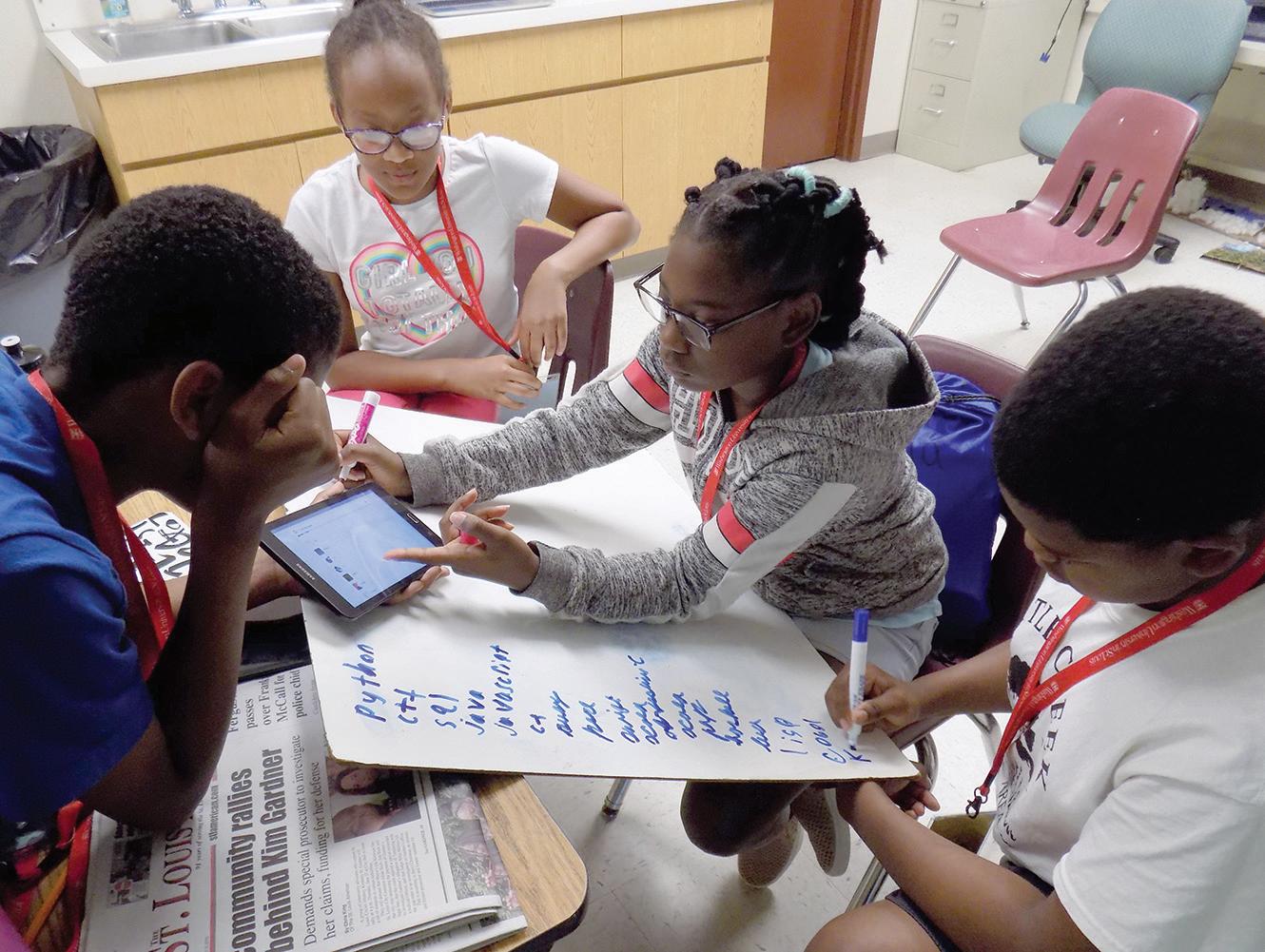
Students at The American’s Summer Science Academy work in teams to discover the many different computer programming languages.
SCIENCE CORNER



SCIENCE CORNER
A hurricane forms over tropical and subtropical ocean water. Warm water and cool, moist air combine to create strong winds that can gust up to 200 miles per hour! These winds create waves that bring the storm on shore. Hurricanes are very destructive. They can flip cars, sink boats, uproot trees, and demolish houses.
SCIENCE CORNER
Click, click, click! This may be a familiar sound as you sit at the computer using your mouse to navigate, but did you ever wonder how a mouse works? A computer mouse consists of several parts that work together to translate motions from your hands into data the computer understands.

Ball: Sometimes, a mouse will have a ball that rolls when moved over a surface.
In addition to powerful winds, hurricanes bring a lot of rain. (Taiwan received 114 inches of rain in three days during a hurricane.) These rains can cause landslides and flash floods.
Rollers: Usually a mouse has two rollers, one to detect motion on the X axis, and one to detect motion on the Y axis.
SCIENCE
Shafts: Each roller connects to a shaft.

Fungi are organisms made of filaments (called hyphe) that are stacked together. Unlike plants, fungi do not have chlorophyll, so they cannot make their own food. Some fungi are parasites, which mean they live off of other organisms. Some fungi feed off of dead and decaying matter. Fungi are everywhere in the environment, including the soil, lakes, river and seas, air, and on plants and animals. Fungi (plural of fungus) help organic matter to decay and release carbon and oxygen into the environment. Unlike plants, fungi do not have
In this experiment, you’ll create a replica of a hurricane and identify how the forces work together to create a hurricane.
Disks: the shafts connect to a disk with holes in it. These disks will spin when the rollers roll.
SCIENCE INVESTIGATION
Are Fungi ?
Hurricanes can last a few hours or several days. Most hurricanes occur during the fall months. How can you stay safe? Have an evacuation plan and an emergency kit prepared. Meteorologists can track these storms and keep you informed. For more hurricane facts, visit: http://www.sciencekids.co.nz/ sciencefacts/weather/hurricane.html.
SCIENCE STARS

SCIENCE STARS
AFRICAN-AMERICAN
African American Meterologist William “Bill” Parker
MYCOLOGIST AND EDUCATOR: Jeanette Jones
Dr. Rae Wynn‑Grant: Wildlife Scientist and Environmental Explorer
William (Bill) Parker grew up in New Orleans. He graduated from JFK High School, which focused on math, science, and engineering. Parker was interested in hurricanes at a young age, but he became interested in the weather after a high school statistics class. In this class, he learned how to predict the chance of rain. Parker wanted to attend a historically black college/ university (HBCU), so he chose Jackson State University to study meteorology. He graduated with his bachelor’s degree, in 1994.
Jeanette Jones was born on September 19, 1950, in Fort Valley, Georgia. Jones graduated from Fort Valley State University in 1972 with a bachelor’s degree in biology education. In 1973, Jones received her master’s degree in botany and mycology (a branch of biology that studies fungi) from The Ohio State University. In 1976, she received her doctorate (Ph.D.) degree.

Dr. Rae Wynn-Grant is a scientist who studies wild animals and how humans and nature live together. She grew up loving animals and watching nature shows, which inspired her to become a wildlife ecologist a scientist who studies animals and the places they live. She wants to understand how animals like bears and lions survive in the wild and how humans can help protect them.
Processor: This will read the pulses, changing them into digital signals for the computer.
In this experiment, you will learn how mold grows best. Mold is an important fungus that has several uses, including breaking down dead organic material. Some purified molds are actually used as an antibiotic to treat illnesses.
SCIENCE INVESTIGATION
Procedure:
Materials Needed:
In this experiment, you will determine if an optical mouse can perform on a black surface.
Materials Needed:
q Fill one bottle with the paperclips, peanuts and sand. These represent the debris and help make the movement of water easier to see.
• 3 slices of bread • Water • 3 Ziploc bags • 10x10 square centimeter grid • Ruler Process:
w Place the funnel in the mouth of the bottle and pour water into the bottle until it is 3/4 full, then remove the funnel.
q Wet one slice of bread enough to make it moist and place it in a bag. Seal the bag very tightly.
Optical Mouse • Computer • Black Surface (such as a black desk or black mousepad) • Traditional Mousepad (one that is not black)
• Notebook • Pencil
Procedure:
e Turn the second empty bottle upside down and hold it over the first bottle so that the mouths of the bottle are aligned. The bottles will look like an hourglass.
w Place the two other slices of dry bread in two separate bags and seal them, as well.
e Place the bag with the wet slice of bread and one of the bags with a dry slice of bread in a dark place,
r Tape the seam, pressing the duct tape firmly to
r

leaves, stems, or roots. Fungi use spores to reproduce. One common type of fungus is the mushrooms you find on your pizza. Mold, yeasts, and mildew are also types of fungus.
Learning Standards: I can read nonfiction text for main idea and supporting details.
For More Information, Go to: https://kids.kiddle.co/Fungus
Learning Standards: I can read nonfiction text to gain background information about fungi.
Infared LED sensors: These sensors are found on either side of each disk, and the LED light beam is broken by the holes to create a pulse that the sensor detects. This pulse is able to control the speed and distance the mouse is able to move. For more information, visit: http://www.ehow.com/video_4950925_acomputer-mouse-work.html
Learning Standards: I can read nonfiction text to locate main idea and supporting details.
create a watertight seal. Continue taping 1 to 2 inches above and below the seam.
Growing Mold!
t Hold the bottles by the middle and lift the jugs.
She also studied at the University of Nevada, the University of California Medical School, the National Center for Disease Control-Atlanta, and the Massachusetts Institute of Technology. After graduation, Alabama A&M University hired Jones as an assistant biology professor. In 1986, she served as an adjunct professor in the College of Pharmacy and Pharmaceutical Services at Florida Agricultural and Mechanical University and worked on a project with NASA. In 1991, Jones served as the first female vice president of research and development at Alabama A&M University. She also served as President of Alabama A&M University’s Faculty Senate from 2001 to 2006. In 1992, she was appointed to the U.S. Army Science Board by the U.S. Secretary of the Army, Togo West. Since 2004 Jones has been the director of the Center for Biomedical, Behavioral, and Environment Research at Alabama A&M University. She also worked as a consultant with federal agencies to help them develop training programs to attract women and minorities to STEM education and careers.
Dr. Wynn-Grant went to Emory University for her bachelor’s degree in environmental studies, then earned a master’s degree at Yale University, and finally a PhD in Ecology and Evolution at Columbia University. She also trained as a postdoctoral fellow at the American Museum of Natural History, learning how human actions like roads, cities, and farms can affect wildlife. Even though her studies were challenging, she worked hard and followed her passion for animals and nature. Today, Dr. Wynn-Grant studies large animals such as black bears, mountain lions, and lions in Africa. She uses cameras, GPS collars, and field research camps to learn how these animals move, where they live, and how people’s activities can change their habitats. For example, she studies how black bears travel around roads and ranches in Montana, and how this affects their safety and how they take care of their babies. Her research helps scientists and communities understand how to keep wild animals and people safe.
y Quickly, turn the bottles over so that the water-filled bottle is on top. Set the bottles on the table again.
u Observe the water as it drains into the bottle below. The water competes with the air from the empty bottle. Both substances push to pass through the neck.
t For five days, measure the square centimeters of mold on each piece of bread through the bag. Use a grid, if possible, or a ruler. If mold covers more than half a square centimeter, it is counted as one full centimeter. If it is less, it is counted as 0 centimeters. This will give you the area of mold on each slice of bread
w Move the optical mouse around to see how the mouse moves. Is it easy to navigate and move in the direction you want it to?
In 1993, he began to gain experience in the field when he worked as a student meteorologist. One year later, he was a meteorologist intern at Shreveport. In 1998, Parker became a general forecaster, and ten years later, a lead forecaster. In 2012, he became a warning coordination meteorologist (WCM). There are only 122 people with this title in the United States, and Parker was the only African American. Parker is currently the meteorologist-in-charge (MIC) at the National Weather Service, leading a team of 26 weather professionals. Parker is also very active as a volunteer in his community. He is a member of the Shreveport-Bossier Mayors’ Prayer Breakfast Executive Committee, La Cima Bilingual Leadership Academy, Bossier Chamber of Commerce Education Committee, Volunteers for Youth Justice, and a coach for Bossier Parks and Recreation. Parker is also an associate minister at Elizabeth Baptist Church in Benton, where he has been serving the congregation since 1997.

i Turn the bottles over again. This time, shake the bottles in a circular motion. Be sure to keep the bottles vertical.
e Next , use the optical mouse on a black surface. Try to repeat the same movements you did in step one.
y At the end of a week (5 days of measuring) or longer, use your final results to say what percentage of the bread was covered in mold. Make a table or graph to display the information.
o The water will form a vortex as it drains into the next bottle. The water will flow along the outside of the neck, while air moves quickly up through the center of the vortex. The water will drain much faster.
Analyze: How did water and air create a hurricane?
q Use the traditional mousepad first. Using a word processing program, find the mouse’s icon on your screen.
In 1975, Jones was listed in the World’s Women’s Who’s Who and she was named an Outstanding Young Woman of America in 1978. Beta Beta Beta National Biological Honor Society awarded her the distinguished service award. Jones also received the Significant Service Award from the NASA Space Life Sciences Training Program and the Extramural Associate Research Development Award from the National Institute of Health. In 1990 and 2006, she was named Woman of the Year at Alabama A&M University and was given the Outstanding Leadership Award by the Faculty Senate. The U.S. Army presented Jones the Commander’s Award for Outstanding Civilian Service as a member of the Army Science Board.
Dr. Wynn-Grant also teaches kids and the public about wildlife and the environment. She believes everyone should have a chance to explore nature and become a scientist. She shares her experiences on TV, podcasts, and in her writings so children can see that scientists can look like them too. She shows that caring about animals and learning about nature can lead to discoveries that help the Earth. Her story teaches us some important lessons: if you love animals or nature, ask questions, explore the outdoors, and keep learning. By studying wildlife and protecting habitats, Dr. Wynn-Grant shows that one person’s curiosity and hard work can make a big difference for animals, people, and the planet.
ELA Questions:
Observations: Does the mouse move more easily, the same, or with more difficulty on the black surface? Write your observations in your notebook.
Discussion Questions: Dr. Jones received many awards and honors. How would you describe her achievements and her contributions to science? Dr. Jones is studying how fungi might be used as agents of war. What purpose do you think fungi serve in modern warfare? Are fungi beneficial or harmful?
What kind of animals does Dr. Rae Wynn-Grant study, and how do humans affect them?
How quickly can you “compute” these math problems? Have a partner time you to
long it takes.
z A hurricane has moved 456 miles in 6 hours. How many miles per hour is the hurricane traveling? ______ If it continues to travel at that speed, how far will it travel in 10 hours? ______
MATH CONNECTION
x Hurricane Frederick is traveling at 86 miles per hour. If the hurricane is 129 miles from the coast, how many hours will it take until the hurricane reaches the coast? ______
Learning Standards: I can follow sequential directions to complete an experiment. I can make observations and draw conclusions.
Discussion Questions: How much mold was on the bread? Which location had the most mold? Which had the least? What conclusions can you draw about the conditions in which mold grows? How can food manufacturers and restaurant owners use this information to help them?
Learning Standards: I can follow sequential directions to complete a task. I can make predictions and record my observations.
Math Storms!
Learning Standards: I can follow sequential directions to complete an experiment. I can display my results, make observations, and draw conclusions.
Learning Standards: I can add, subtract,
X has grown to have wind speeds of 48 miles per hour. How much faster will the winds have to become for Tropical Storm X to become Hurricane X? ______
Analyzing a Bar Graph
Scientists often use tables and graphs to display the results of their research. Looking at these displays, you can draw conclusions.
As we approach spring weather (and increased rain), create a bar graph that displays the amount of rain that falls for several consecutive days or weeks. (Day 1: 1.5 inches, Day 2: 0 inches, Day 3: 1.5 inches, etc.)
v Upon landfall of a Category 4 hurricane, local officials ordered an evacuation. City A has a population of 9,613, City B has a population of 5,013 and City C has a population of 3,972. How many people were evacuated in all?

c A tropical storm takes on a hurricane status when the winds reach 74 miles per hour. After three days, Tropical Storm
and
Learning Standards: I can read a biography to learn about an African American who has made contributions in science, math, technology, or engineering.
How does Dr. Wynn-Grant encourage kids and communities to learn about wildlife, and why is that important?
Parker believes in serving as a role model to the youth and to recruiting African Americans in the STEM field. Personally, he has hired three African-American meteorologists. In addition, he has recruited minorities for summer intern positions. Parker has also mentored an Airline High School student for his senior project. Parker’s advice to students interested in meteorology is to take as many math and science classes as possible. Learn about summer opportunities in your community. If you are interested in meteorology, visit National Weather Service offices and serve as a volunteer or intern, and find leaders in your community to serve as your personal role models.
Learning Standards:
MAP CORNER

a person who has made contributions to the fields of science, technology,
$115,264 in damage, City B reported $236,096 and City C reported $436,869 in damages. What was the total cost of damages rounded to the nearest thousand? ______ If the state and federal government promised $500,000 in aid, how much would the local people have to raise by themselves? ______
Discussion Questions: Which day had the most measured rainfall? Which day(s) had the least? Looking at the bar graph, what might you conclude about rain patterns in March/April? What other observations can you make?
Learning Standards: I can use a bar graph to display information. I can use the information to make deductions and inferences.
b After citizens returned to their houses after the evacuation, reports of damage were totaled. City A reported


This special Newspaper In Education initiative is made possible, and delivered to classrooms through the St. Louis American Foundation and its NIE Corporate Partners:
There are over 10,000 species of mold, with 1,000 of those species found in the United States.



Learning Standards: I can add, subtract, multiply, and divide to solve a problem.


Use the newspaper to complete the following activities: Types of News:
MAP CORNER

Use the newspaper to complete these activities:
Enjoy these activities that help you get to know your St. Louis American newspaper.
Use the front section of the newspaper to evaluate the types of news stories presented: local, national, and international. Sort the articles into the three categories and create a bar graph that displays the amount of coverage each type of news story received.




Activities — Who works where? a picture of a building in the newspaper and tell what kind of jobs people who work in that building could have.
Activity One: Scan the newspaper for basic science-related terms (explore, analysis, discovery, theory, experiment) and write definitions for these words based on their usage in the newspaper. Compare your definitions with the definitions in the dictionary.

Activity Two: Compute the time difference between your city and various cities featured in the main news section of the newspaper.
Mystery Story: Cut out several pictures from the newspaper without reading the caption. Place the pictures in a bag, and without looking, pick your mystery picture from the bag. That’s your stimulus for writing. Construct a graphic organizer to identify the 5Ws (who, what, when, where, and why) of your story by looking at your picture. Then, continue the writing process.
Learning Standards: I can locate information in nonfiction text. I can use context clues for definitions. I can add, subtract, multiply, and divide to solve problems.
Problem and Solution: Over a period of weeks, clip articles from newspapers that deal with problems and issues facing your local or county government. Discuss the reasons for these problems and how the government hopes to solve them.
Learning Standards: I can use the newspaper to locate information. I can categorize and summarize that information.
Learning Standards: I can use the newspaper to locate information. I can discuss problems and solutions. I can identify types of jobs. I can make text-to-world connections.




Penicilllin
commonly grows on fruit
Students Aariyah Thompson and Savannah Fisher, in Ms. Stovall’s firstgrade class at Gateway MST Elementary School, are learning how to construct a series circuit.
Photo by Ms. Stovall
How A Computer Mouse Works !
Photo by Ms. Stovall
Teach
Continued from A1 pathway,” she said. “Without it, I would not be sitting here.”
Stories like Shurn’s are often cited by supporters as evidence that Teach for America — commonly known as TFA — can bring new talent into education and even develop future school leaders.
But the program’s planned return to St. Louis classrooms after a fouryear pause also revives long-running debate about its model, particularly the use of alternatively certified teachers and the program’s two-year service commitment.
A debated pathway into teaching
Teach for America participants are not required to have formal training in education. They complete several weeks of accelerated training and then earn teaching certification while working in the classroom.
Supporters say the model helps address teacher shortages and attracts talented graduates who might otherwise never consider teaching.
Critics argue the training period is too short and that placing novice teachers in high-needs schools can contribute to instability.
Byron Clemmings of the American Federation of Teachers-St. Louis said the organization’s earlier presence in the region left unresolved questions.
“They walked away from St. Louis Public
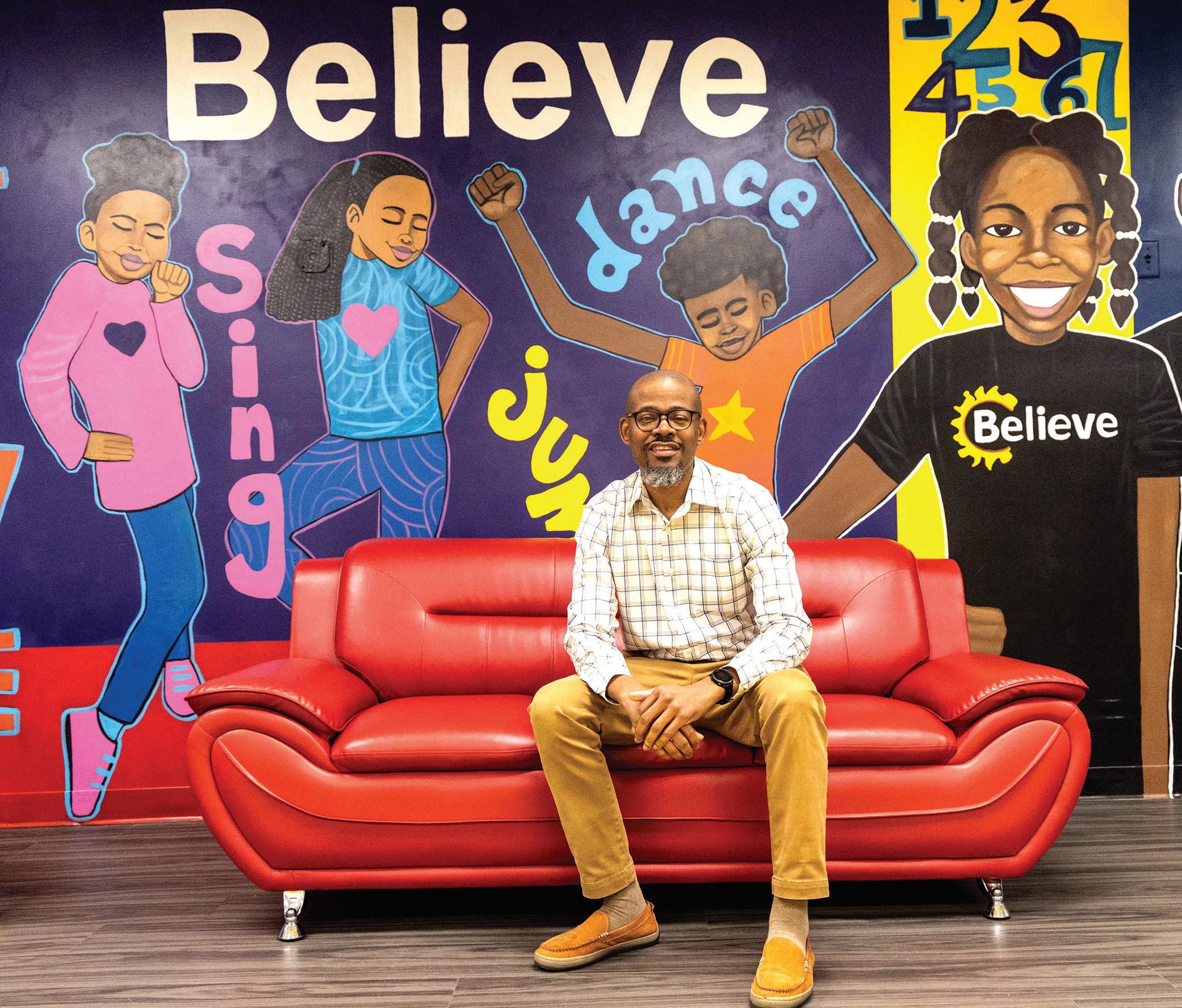
Schools, and we haven’t seen local research demonstrating measurable longterm success of Teach for America in St. Louis,”
Clemmings said. He also noted that St. Louis Public Schools previously paid about $5,000 per corps member to par-

ticipate in the program.
Those criticisms mirror national debates about TFA’s approach. Some education advocates question whether five to seven weeks of summer preparation adequately prepares teachers for challenging classrooms. Others point to retention concerns tied to the two-year commitment.
Modest restart amid teacher shortages
TFA leaders say the organization’s return is partly a response to ongoing teacher shortages. Missouri Executive Director Julie Gronquist said the organization shifted its focus to tutoring and leadership programs during the pandemic.
“We never left St. Louis,” Gronquist said. “But the funnel into the teaching profession was one of those things that faced a lot of challenges.”
Dan Huebner, head of region for TFA-St. Louis, said the initial group of corps members will be intentionally small — about a dozen teachers beginning in the 2026-27 school year.
Placements are expected to focus on elementary classrooms as well as middle and high school English language arts, math and science — subjects that have experienced persistent vacancies.
Dr. Jim Triplett, prin-
cipal of Jackson Park Elementary School and a 2012 TFA corps member, said school systems facing staffing shortages must consider multiple recruitment strategies.
“With the shortages we’re seeing today, districts have to consider multiple pathways into the profession,” he said. “Having someone with a college degree committed to teaching for two years can help fill gaps where classrooms might otherwise go unstaffed.”
Alumni point to leadership pipeline
Supporters also argue that TFA’s long-term impact extends beyond the classroom through its alumni network.
Program leaders estimate roughly 600 alumni now live and work across the St. Louis region, including teachers, principals, nonprofit leaders and elected officials.
Triplett, who entered the program after completing traditional education degrees, said the organization provided coaching and leadership development that complemented his academic preparation.
“Teach for America provided additional coaching on top of my education and experience,” Triplett said. “That professional development
helped prepare me for leadership roles later on.”
Program leaders defend preparation
TFA officials acknowledge that the program represents a nontraditional route into teaching but say corps members receive extensive support.
Huebner said participants receive intensive training before entering classrooms and ongoing coaching during their service.
“We understand the questions around preparation and stability,” he said. “Our corps members are supported through training and continuous development.”
Shurn said the experience required significant on-the-job learning but believes the preparation was sufficient.
“It is very untraditional,” she said. “But I felt well prepared. There was a lot of learning on the job, and they continued to support us even after the twoyear commitment.”
Founded in 1989 by Wendy Kopp, Teach for America began placing teachers in classrooms in 1990 and launched in St. Louis in 2002. The organization merged its St. Louis and Kansas City operations into a statewide entity, Teach for America Missouri, last year.

Dr. Jim Triplett, principal of Jackson Park Elementary School and a 2012 Teach For America corps member, said school systems facing staffing shortages must consider multiple recruitment strategies.
Photo by Lawrence Bryant / St. Louis American
St. Louis American staff
Dr. Yemi AkandeBartsch, president and CEO of FOCUS St. Louis, was honored as an “Exceptional Neighbor” by Enterprise during halftime of the St. Louis City SC match against the Seattle Sounders at Energizer Park in downtown St. Louis on Saturday, March 7.
The Enterprise Exceptional Neighbor program, a partnership between Enterprise Mobility and St. Louis City SC, recognizes
McGusty
executive officer there during a leadership transition.
Akande-Bartsch recognized at St. Louis City SC game
St. Louisans whose leadership and service strengthen the region. One honoree is recognized during each regular-season home match.
Akande-Bartsch was recognized for her leadership of FOCUS St. Louis, a civic leadership organization that develops and connects leaders committed to strengthening the St. Louis region.
Developing leaders has long been central to the organization’s mission, and sustaining the FOCUS leadership experience remains one of its top priorities.
operating officer from 2019 to 2026 and interim CEO from 2024 to 2026.

Dr. Yemi Akande-Bartsch, president and CEO of FOCUS St. Louis, is interviewed by St. Louis City SC correspondent Kristen Carver during halftime of the March 7 match against the Seattle Sounders.
During her roughly eight years with HCA Healthcare, one of the nation’s largest hospital systems, she held several leadership roles at the Northwest Houston facility, including vice president of business development from 2017 to 2019, chief
Women
Continued from A1
Continued from A1 than 65,000 times last year, providing counseling, home visits, managing foster care cases, pregnancy support, adoption services and court advocacy.
The services reached more than 4,600 households statewide in 2025, according to agency data released during National Social Work Month and Women’s History Month.
For Williams, the impact of that work is often seen in small but meaningful transformations.
“As a social worker, I help families regain control through parenting education, financial support, guidance on court processes and active listening,” she said. “Seeing them move from hopelessness to empowerment reminds me why this work matters.”
According to the organization, the more than 65,000 interactions with families included services delivered in homes, offices and courtrooms across Missouri. Social workers may conduct counseling sessions, check in with foster families, support expectant mothers considering adoption or help parents navigate the court system as they work toward reunification with their children.
Cyrini Daniels, a supervisor in the agency’s
While there, the hospital earned designation as a Level II trauma center, meaning it can provide advanced care for severely injured patients with trauma specialists available around the clock. The hospital was also recognized as an Advanced Comprehensive Stroke Center by The Joint Commission.
In 2024, the facility was named by U.S. News
parenting and adoption program, said the public often misunderstands what social workers actually do.
“A common misconception is that social workers only respond to crises or remove children from homes,” Daniels said. “In truth, we spend significant time supporting, advocating for and empowering families, helping them access resources and make informed decisions. Our focus is on strengthening families and communities, not just reacting to emergencies.”
The work comes with significant pressures.
In the most recent Children’s Division Case Management Staff Annual Survey released last year, common themes among departing staff included high caseloads and “secondary traumatic stress,” the emotional strain that can come from repeated exposure to others’ trauma.
Statewide vacancy rates for caseworkers have historically hovered between 15% and 25%, according to the Missouri Department of Social Services, with some regions experiencing far higher turnover. In the Kansas City area, turnover among caseworkers has reached as high as 90% in previous years.
In the St. Louis metro area, annual turnover among entry-level caseworkers has often exceeded 50% to 60%, meaning more than half of new hires may leave within a
& World Report as a high-performing hospital and later received Healthgrades’ designation as one of America’s 250 Best Hospitals for 2026.
Mercy Hospital St. Louis is the largest hospital in the Mercy health system and a major medical center in the region. The hospital has about 715 staffed beds and anchors Mercy’s network of outpatient clinics, surgery centers and specialty facilities across the St. Louis area.
year.
The profession also remains overwhelmingly female. Based on 20242026 data from the Bureau of Labor Statistics and the National Association of Social Workers, women make up more than 80% of the social work workforce.
Daniels said the job is both demanding and unpredictable.
“No two days are the same,” she said. “Some days involve providing emotional support during difficult moments, while others focus on connecting families with resources or advocating on their behalf.”
Her decision to pursue social work grew from personal experiences early in life, when her own family needed help and support.
“Seeing how much guidance and compassion can change someone’s path made it clear that this was the work I was called to do,” she said.
Williams said her commitment to helping others began long before her professional career, growing out of family experiences helping people in need. Those early lessons eventually led her to become a foster parent and later pursue social work.
Still, the work can be emotionally demanding. Daniels said one of the most difficult lessons she has learned is accepting that not every situation can be fixed.
“Social workers care

Dr. David Meiners, who has served as president of Mercy St. Louis Communities since 2020, participated in the search process that led to McGusty’s hiring. He said her experience leading large hospital operations and building relationships with physicians and caregivers stood out during the selection process.
“During the interview process it became immediately clear that her goals and objec-
deeply, and it’s natural to want every situation to end well,” Daniels said. “Over time, I’ve learned our role is to provide support, guidance and advocacy while respecting people’s choices.”
Agency data shows that about 94% of clients served last year made mea-
tives aligned perfectly with Mercy’s mission,” Meiners told The American.
Mercy officials said Meiners will remain with the organization during the transition before moving into an executive advisor role.
McGusty said her leadership approach focuses on strengthening hospital operations while supporting physicians, nurses and staff responsible for patient care.
“Strong hospitals are built on disciplined execution and an unwavering commitment to the communities they serve,” McGusty said.
surable progress toward improving family safety, stability or emotional well-being. Both women said those outcomes often grow from long-term relationships built with families facing difficult circumstances.
As communities such as St. Louis continue to grap-
Mercy officials said McGusty will assume the role as the health system continues planning additional upgrades and service expansions across the St. Louis region.
Sylvester Brown Jr. is the Deaconess Foundation Community Advocacy Fellow.
ple with housing insecurity, economic instability and limited mental health resources, Daniels said the need for social workers remains significant.
“Knowing my support helped someone feel heard or empowered makes this work meaningful,” she said.

Photo by Jeff Curry / St. Louis City SC

The pathology of hurting children
By Jamala Rogers
Understanding the depravity of the Epstein pedophiles and their protectors is key to understanding what we have running this country. Trump and his MAGA minions have gone from corrupt clowns to racist warmongers, and everything in between. The country needs to find its moral bearings because the depravity of these sociopaths affects us all. When you can hurt children without thought or remorse, you are capable of anything.
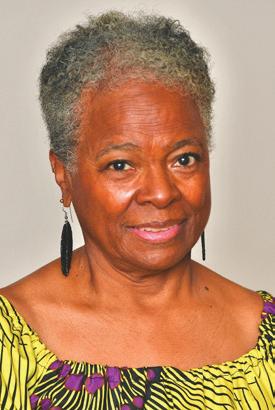
Trump and his close ally, Israeli Prime Minister Benjamin Netanyahu, recently took aggressive action against Iran, claiming it posed a significant threat to national security. Critics of the strikes have raised concerns about civilian casualties and the broader consequences of escalating conflict in the region.
The verified Epstein files exposed horrific crimes against girls. It’s easy for people to forget the actual ages of the survivors at the time of the heinous crimes. The survivors understand this and often have photos of themselves at the ages when they were trafficked and assaulted when they gather publicly to demand justice.
The files reveal that some of the girls were as young as nine years old.
Epstein-related records because the public wants to know who may have been accomplices to the crimes over the last thirty years and to hold them accountable. We’ve seen people be fired, resign or lose titles as a result. Yet many believe criminal accountability has been limited.
NPR was one of the media outlets investigating the Epstein files and reported that some pages appeared to be missing.
NPR’s investigation found dozens of pages that were cataloged by the Justice Department but had not been included in the public database of Epstein-related records. Some of those documents included FBI interview summaries involving a woman who accused Donald Trump of sexually abusing her when she was a minor. The allegation has not been corroborated and Trump has denied wrongdoing.
Authoritarian movements often fail to see others as human or citizens deserving of rights. Their abuse of power can dehumanize society and normalize conditions such as homelessness, hunger, mass incarceration and state violence. Nazism and Zionism provide vivid examples of how quickly inhumanity can be normalized on a mass scale.
Although many details of the crimes remain unclear, common sense suggests the victims endured lasting physical and emotional harm.
The deviant duo of Epstein and Maxwell recruited and groomed large numbers of girls who were drugged, sexually assaulted and abused — their young bodies treated as a playground for wealthy elites. Although many details of the crimes remain unclear, common sense suggests the victims endured lasting physical and emotional harm.
Many entities are combing through

For those who prefer to avoid politics altogether, the actions of this administration make it clear that those who believe in freedom cannot remain disengaged. The president and his allies are not simply political figures to laugh at — they are dangerous.
Jamala Rogers is an opinion writer and one of the founding members of the Organization for Black Struggle, based in St. Louis.
Film explores history, closure of St. Louis Workhouse
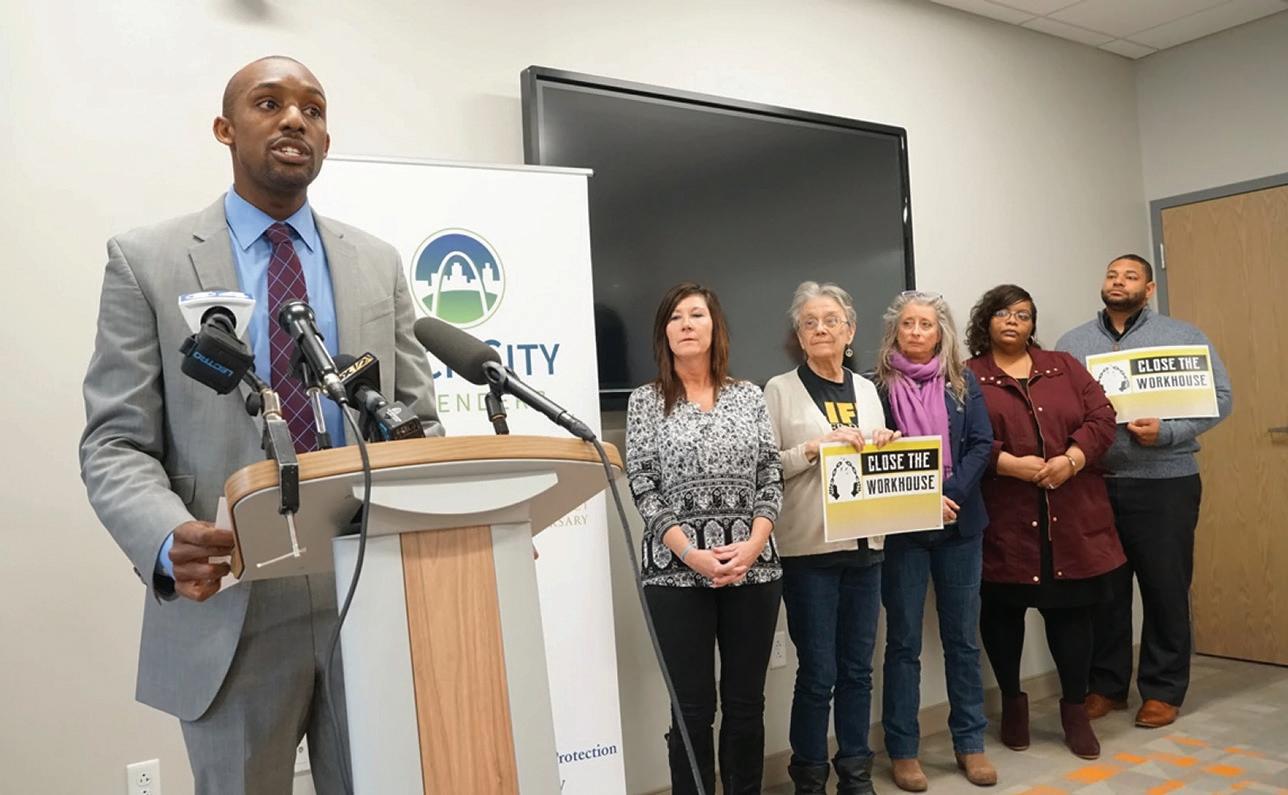
St. Louis American staff
A year has passed since the demolition of the infamous St. Louis Workhouse, and on March 18, 2026, ArchCity Defenders will premiere a documentary examining the Medium Security Institution.
“Hell on Hall Street” will offer “a firsttime, exclusive deep dive into the origins of the Workhouse, the deplorable conditions and practices while it was open, its impacts on the community and St. Louis at large, and the broader effort to finally close and demolish it,” according to a release.
The documentary will be presented by Action St. Louis, ArchCity Defenders and the Close the Workhouse campaign, and the premiere will be sponsored by Ben & Jerry’s and hosted by the St. Louis Public Library.
The documentary features never-before-seen perspectives from people who

were incarcerated in the Workhouse and an insider look at the movement to get it demolished. The premiere will be free and open to the public and the media.
Following the premiere of “Hell on Hall Street,” ArchCity Defenders executive director Blake Strode will facilitate a panel conversation with individuals featured in the film.
On March 18, 2025 — the day demolition began — Strode said, “I think it’s a really powerful testament to what people can do when they come together and raise their voices and demand change.”
“We could do much better by serving people, by giving people the kind of support and care that they need.”
A question-and-answer session with the audience on the campaign to close the Workhouse and what comes next will include Strode, other ArchCity Defenders employees and survivors of the Workhouse.



Columnist Jamala Rogers
Photo by Rachel Lippmann / St. Louis Public Radio
Blake Strode, ArchCity Defenders executive director, said the demolition of “the Workhouse,” which began March 18, 2025, was the result of “what people can do when they come together.” The documentary “Hell on Hall Street” will be screened for the first time March 18 at the St. Louis Public Library’s downtown branch.
Living It
314 Day at 20

A tradition of pride, community and STL spirit
By Zaria Mac St. Louis American
The city’s signature holiday—314 Day—has already begun pulsing through St. Louis, kicking off a week that now stretches far beyond its original one-day concept. What started in 2006 as a simple idea has grown into a full slate of community gatherings and cultural activations that spotlight the artists, entrepreneurs and everyday residents who shape the city’s identity. As the milestone 20th year approaches, St. Louis is once again leaning into the energy that has made 314 Day a defining moment on the local calendar.
Festivities opened Sunday morning, March 8, with a prayer march—an anchor
A crowd pleasing R&B
Benét’s mastery and London’s vintage swagger anchor a night of soul
By Kenya Vaughn St. Louis American
event for founders Terrell “Young Dip” Evans and Tatum Polk.
“This city is rooted in religion,” Polk said. “We know things aren’t perfect, and we know some people need hope, so the march is a really inspiring moment for us and keeps us grounded.”

For Evans, the march reflects the unity that has carried 314 Day from an idea to a movement. That sense of pride is central to why the founders believe 314 Day resonates so deeply.
“We don’t want to be a flyover city,” Polk said. “In the middle of the map, you have this melting pot of people, culture and art. We want to let the whole world know who we are and what we have to offer.”
This year’s lineup reflects that spirit.
See 314 Day, B3

October London (above), J. Brown and Eric
Evening with October London,’ creating a well‑balanced
of urban adult contempo rary sound at Stifel Theatre on March 7.
“What I am learning is that the most important questions you can ask yourself are ‘What do I want?’ and ‘Who do I want to become?’” - Actress Lupita Nyong’o on Emphasizing self-determination over societal expectations
Stepping into peace
next weekend host ed by the Grand
Adrienne Danrich’s
‘Music as the Message’ returns as a restorative
collaboration
By Zaria Mac St. Louis American
Months after last spring’s tornado, St. Louis is still learning how to steady itself again. A new gathering hopes to help — offering residents a chance to pause, breathe and reconnect through art and music.
From March 20–22, the Grand Center Arts District will host “Stepping Into Peace,” a three-day retreat that blends music, mindfulness and community connection. It marks the newest evolution of Music as the Message, the annual concert series created by Emmy Award–winning vocalist Adrienne Danrich, now presented in collaboration with the Contemporary Art Museum St. Louis (CAM).
What began as a performance series in 2020 has grown into an immersive experience shaped by the emotional aftershocks of the May 16 tornado.
Danrich said the expansion felt necessary.
Guest artists from across the country will join Danrich to lead intimate sessions throughout the retreat.
In his first headlining theater tour, October London showed exactly why so many have crowned him the modern torchbearer for classic R&B and soul when he stepped onto the Stifel Theatre stage Saturday night. London has carved out a lane as a true throwback — the kind of crooner who leans into the aesthetic with tailored suits, a slow-burning cigar and a glass of cognac in hand. But none of it reads as gimmick. His 2023 album “The Rebirth of Marvin” made that clear, leaning into the vocal comparisons to Marvin Gaye while cementing London as the most unlikely — yet most intriguing — member of the Death Row Records family. His rise has been a steady and intentional climb that suggests longevity rather than hype. And unlike the typical “An Evening
With…” format, London didn’t come alone. He brought emerging soul singer J. Brown and R&B veteran Eric Benét. The lineup offered a full spectrum of where
October London’s rise has been a steady and intentional climb that suggests longevity rather than hype.
the genre has been and where it’s headed.
J. Brown opened the night with “Vibe,” a mid-tempo groove that connected surprisingly well with an audience
largely unfamiliar with the Detroit native. He kept the momentum with “Moon” and “Sunrise Sunset” before slowing things down with “Just Chill,” his contemporary spin on Guy’s “Let’s Chill.”
But it was his cover of New Edition’s “Can You Stand the Rain” that sealed his set and gave him the audience’s nod of approval.
Between sets, MC Lightfoot kept the energy high with crowd-pleasing comedy before Eric Benét took the stage. Dressed in a sharp blue suede suit, the St. Louis favorite appeared in an unusual setup. There was no live band, just a lone background vocalist and instrumental tracks — no vocals, of course — to accompany them.
“After the tornado, I asked myself how someone finds peace after tragedy,” she said.
“Because this is my hometown, I want to bring an event that gives people tools to find their own individual path to peace in the midst of chaos.”
The retreat opens with demonstrations and interactive art tours at CAM on March 20–21. The schedule includes both free and ticketed sessions, all leading to a free hybrid concert at The Sheldon Concert Hall on Sunday, March 22, at 4 p.m., presented with Opera Theatre of Saint Louis and led by Danrich.
Michelle Dezember, CAM’s Director of Learning and Engagement, said the retreat aims to give people a place to slow down and reconnect.
“‘Stepping Into Peace’ is meant to create a very restorative and communal space,” she said. “A space that art and music can provide in times when we need to remember the power of community and the power of art to heal ourselves.”
Guest artists from across the country will join Danrich to lead intimate sessions throughout the retreat. “Adrienne is bringing professionals to St. Louis who will facilitate an immersive experience,” Dezember said. “Those guest artists are also leading free public performances.”
The musical offerings reflect the breadth of Danrich’s vision — opera, contemporary gospel, R&B and soul — all woven together to underscore
Courtesy photo
St. Louis native Adrienne Danrich has partnered with CAM for a collabora tive expansion of her ‘Music as the Message’ program
Center Arts District.
Photo by Taylor Marrie/St. Louis American
314 Day founders Terrell “Young Dip” Evans and Tatum Polk (below) are gearing up for the celebration’s 20th year. Ahead of the milestone, STL influencers and creatives gath ered under the Gateway Arch on Sunday for the annual photo shoot.
Photos by Michael Thomas/For The St. Louis American
Benét brought their own flavor to ‘An
mix
314 DAY ACTIVITIES
Sat., Mar. 14, doors open at 7 p.m. 314 Day 20th Anniversary Celebration featuring Lil Webbie, Big Boogie, Murphy Lee and many more, The Pageant, 6161 Delmar Blvd, St. Louis, MO 63112. For more information, visit www.thepageant.com.
Sat., Mar. 14, 12 p.m. We All We Got: 314 Day Brunch produced by T.Moore Media, The Pennywell Hotel, 400 Olive St, St. Louis, MO 63102. For tickets visit https://posh. vip/e/314-day-brunch.
Sat., Mar. 14, 10 p.m. STL House Party produced by The Kickback Club, Treasures, 4517 Olive St, St. Louis, MO 63108. For tickets, visit https://posh. vip/e/the-house-party-12.
Sat., Mar. 14, all day, 314 Day Scavenger Hunt, City Museum, 750 North 16th St, St. Louis, MO 63103. For more information, visit https://citymuseum.org.
CONCERTS
Thurs., Mar. 19, 7:30 p.m., Final Draft: Slow Dance Tour, City Winery St. Louis, 3730 Foundry Way, St. Louis, MO 63110. For more information, visit https://tickets. citywinery.com.
Fri., Mar. 20, 8 p.m. The 18th Annual Gateway Blues Festival, Chaifetz Arena, 1 South Compton Avenue St. Louis, MO 63103. For more information, visit www.chaifetzarena.com.
Fri., Mar. 27, 8 p.m. The New
St. Louis American Calendar
STL Sites & Sounds
Edition Way Tour featuring New Edition, Boyz II Men and Toni Braxton, Enterprise Center, 1401 Clark Ave, St. Louis, MO 63103. For more information, visit www.enterprisecenter.com.
Thur. Apr. 16, Boys 4 Life Tour featuring B2K & Bow Wow, Chaifetz Arena, 1 South Compton Avenue St. Louis, MO 63103. For more information, visit www.chaifetzarena.com.
SPECIAL EVENTS
Fri., Mar. 13 - 17, 6:30 p.m. Animals Aglow, Saint Louis Zoo, 1 Government Dr, St. Louis, MO 63110. For more information, visit https://stlzoo. org.
Thur., Apr. 7- 8, 7:30 p.m, Live at The Pulitzer, Pulitzer Arts Foundation, 3716 Washington Blvd, St. Louis, MO 63108. For more information, visit https://slso.org.
April 10-11, Dance St. Louis presents Ailey II, The Touhill Perorming Arts Center, One University Place, St. Louis MO 63121. For more information, visit www.dancestlouis.org.
COMEDY
Fri., Mar. 13- 15, Special Event Tacarra Williams, Helium Comedy Club, 1151 St Louis Galleria St, St Louis MO 63117. For more information, visit https://st-louis. heliumcomedy.com.
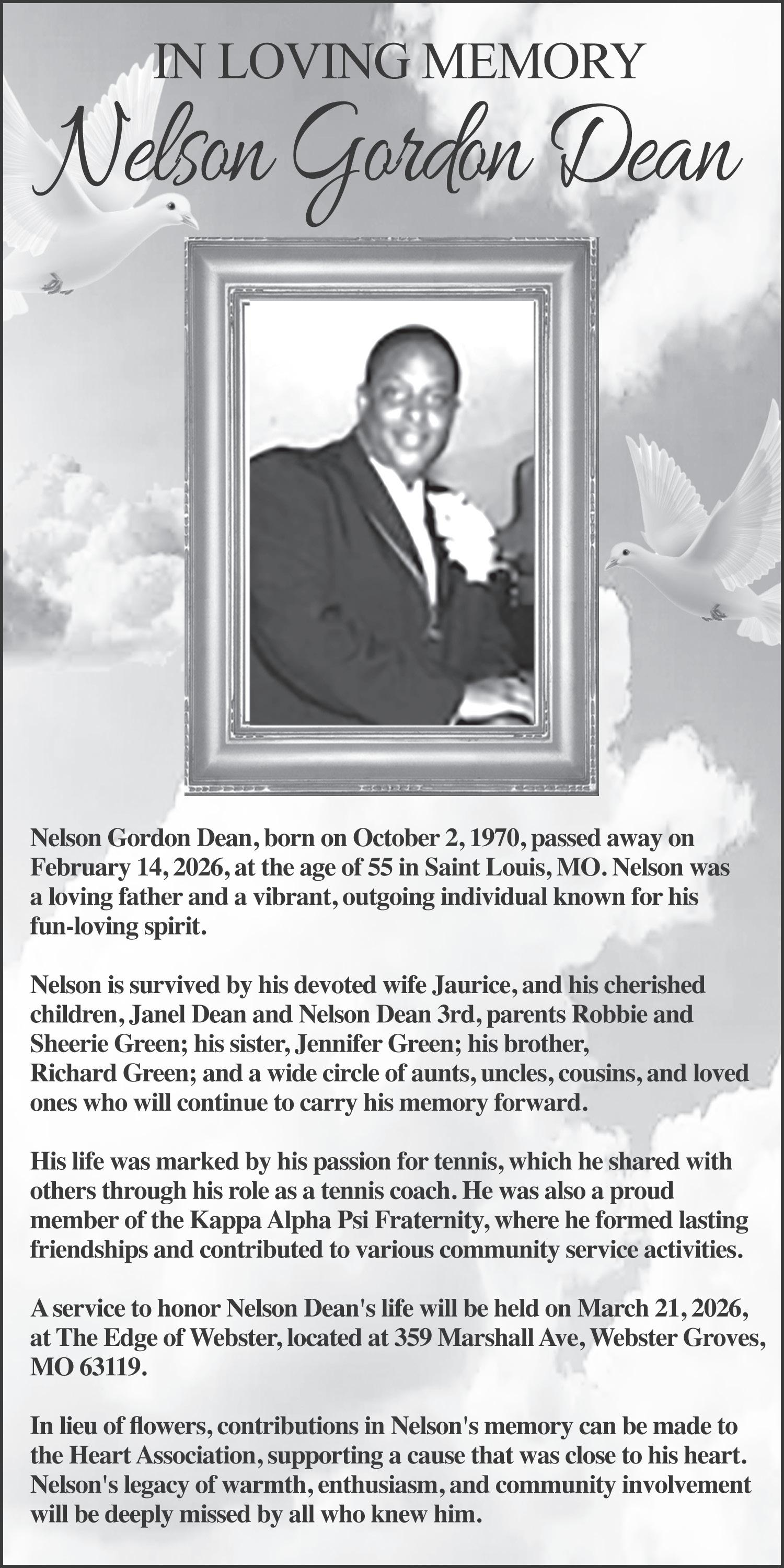
Sat., Mar. 14, 7:30 p.m., 314 Day Comedy Show with John Grimes feat. Tahir Moore and Chelcye Perry, City Winery St. Louis, 3730 Foundry Way, St. Louis, MO 63110. For more information, visit https://tickets. citywinery.com.
Thur. Mar. 19, 7:30 p.m. Special Event: Sapphira Cristal One Slue Over the Cuckoo’s Nest, Helium Comedy Club, 1151 St Louis Galleria St, St Louis MO 63117. For more information, visit https://st-louis. heliumcomedy.com.
Fri., Mar. 27, doors 7 p.m. Sherri Shepherd in the Make It Make Sense Tour, The Pageant, 6161 Delmar Blvd, St. Louis, MO 63112. For more information, visit www.thepageant.com.
Fri., Mar. 27, 7:30 p.m., St. Louis’ own Gary “G-Thang” Johnson, City Winery St. Louis, 3730 Foundry Way, St. Louis, MO 63110. For more information, visit https://tickets. citywinery.com.
Fri., Apr. 24, 8 p.m. We Them Ones Comedy Tour starring Mike Epps, Karlous Miller, DC Young Fly and many more, Chaifetz Arena, 1 S Compton Ave, St. Louis, MO 63103. For more information, visit https:// www.chaifetzarena.com.
ST. LOUIS MUSIC SPOTLIGHT
Fri., Mar. 13, doors 7 p.m. Jordan Ward Presents: THE APARTMENT TOUR with Nali, Delmar Hall 6133 Delmar Blvd. St. Louis, MO 63112. For more information https://www. thepageant.com.
Wed., Mar. 18, 7:30 p.m. Morgan Taylor: “Okay, Maybe”, City Winery St. Louis, 3730 Foundry Way, St. Louis, MO 63110. For more information, visit https://tickets. citywinery.com.
Fri., Mar. 20 - 21, 7:30 p.m. Anita Jackson: Jazz in Protest, Steward Center 3536 Washington Ave, St. Louis, MO 63103. For more information, visit https://my.jazzstl.org.
THEATRE
Through March 29, The Black Rep presents Pearl Cleage’s Flyin’ West, Ross Family Theatre, Kirkwood Performing Arts Center, 210 East Monroe Ave, Kirkwood, MO 63122. For more information, visit www. theblackrep.org.
Through Mar. 25, Promenade the Musical, The Marcelle Theatre, 3310 Samuel Shepard Dr. St. Louis, MO 63103. For more information, visit https:// kranzbergartsfoundation.org.
Fri., Mar. 27 – Sun., Mar. 29, Metro Theater Company presents Life Doesn’t Frighten Me by Paige Hernandez, Based on the poem, Life Doesn’t Frighten Me from the book And Still I Rise by Maya Angelou, The Sun Theatre, 3625 Grandel Square. For more information visit metroplays.org.
Sun., Apr. 12, 5 p.m.
Je’Caryous Johnson Presents: Set It Off Live!, Stifel Theatre, 1400 Market St, St. Louis, MO 63103. For more information, visit www.stifeltheatre.com.

St. Louis’ own Gary “G-Thang” Johnson is bringing his signature brand of funny back home for a special show at City Winery. See COMEDY for more details.
the retreat’s central mes-
sage. Sunday’s concert will include “Let There Be Peace on Earth and Let It Begin With Me,” performed by Danrich and Opera Theatre of Saint Louis.
“It begins with one individual finding their peace and then extending it out into the world,” Danrich said. “I believe no one outside of me can bring me peace. I have to be responsible for my own personal peace, and then I can extend it out into the world.”
Soul
Leave it to Eric Benét to make the audience forget anything was missing. His falsetto alone is a full production.
He opened with “Love Don’t Love Me,” a mid-tempo staple he often uses to set the tone. Between songs, he shared behind-the-scenes stories — including the fan-favorite tale of how “Chocolate Legs” came to be, and how his attempt to turn the “Spend My Life” studio session into a romantic setup with Tamia was hilariously derailed by Grant Hill’s unexpected arrival.
Two selections from his duet album “The Co-Star” — “So Distracted,” originally featuring Chante Moore, and “Must Be Love,” featuring India.Arie — gave his background singer Cherry a chance to shine.
Benét then delivered a pristine, mint-condition performance of “Sometimes I Cry,” reminding the room why his falsetto remains in a league of its own. He closed with “Georgie Porgie,” sharing the spotlight once again as Cherry put her own spin on Faith Evans’ original part.
As usual, he left the stage to a standing ovation.
Benét’s impact was so strong that October London felt compelled to acknowledge it as soon as he walked out.
“Give it up for my big brother in the game, Eric Benét,” London said. “It’s no autotune, and our mics
For Danrich, peace is an active pursuit.
“Stepping is an action, and people think peace is going to fall off a tree,” she said. “Peace is something we have to actively look for. For myself, I turn to music. Music is my medicine, and that’s why I started Music as the Message in the first place.”
The retreat will incorporate meditation, movement and painting — practices Danrich uses in her own life.
“The activities we’ll be doing are things I personally do,” she said. “Things I do to maintain my own personal peace.”
While some sessions require tickets, Danrich
and CAM have ensured accessibility remains central.
“Tickets help pay for the artists to come from out of town, but we do have scholarships available,” Dezember said. Instructions are available on CAM’s website.
“I did not feel comfortable charging and then not offering at least some tickets for free,” Danrich added. “I want this healing opportunity to be open to all.”
More information on the retreat sessions and concert is available at https://camstl.org/ or https://adriennedanrich. com/.

are on up in here.” London proved it immediately. He strolled onstage — cigar still in hand — and eased into “Touch on Me” with the confidence of someone who knows exactly what he brings to the table. His pristine vocals, backed by a full band, paid homage to the best of 1970s R&B, including the man he’s most often compared to: Marvin Gaye.
London’s music is classic in structure and delivery but contemporary in lyricism. That blend has earned him the respect of R&B purists while giving millennials a stake in their representation of the genre— which is often dominated by club anthems and dance hits from artists like Usher and Chris Brown.
His laid-back vibe evokes the Saturday morning cleaning playlists of
Polk added that the date itself became a unifying force.
There are skate parties, fashion shows, dining experiences, dance events, a block party at Grand and Olive from 2:30 to 5 p.m., and a throwback concert at The Pageant featuring Lil Webbie, Big Boogie, Murphy Lee and more.
The date became official in 2022, but its roots stretch back two decades. Evans remembers the spark clearly.
“That first year, we wanted to see what it looked like to get as many artists under the same roof on the same stage because it wasn’t happening that much,” he said.
At the time, Evans was a radio host helping to define the St. Louis sound, while Polk was promoting and marketing Nelly and the Pimp Juice brand. Their combined vision— and their love for the city—laid the foundation for what 314 Day would become.
“314 Day was created by two people passionate about the crib,” Evans said. “We had the opportunity to jump into the industry, learn, help different artists, and thought we needed something for us.”
“What’s unique about this is no matter where you are in the world, it’s March 14,” he said. “A lot of people move away, so this is a time to come home or a talking point to tell people about the city they grew up in.” And people have carried it with them. Observances have popped up as far south as Texas and as far west as Colorado.
“It is energy—St. Louis spirit in its purest form,” said vocalist Meadow McNeary, also known as MGM. “You see our creativity and art, and that’s what 314 Day is.” Polk sees it as both a snapshot and a reminder.
“It gives people who aren’t familiar with our culture a quick glimpse,” he said. “And it gives people who are familiar a nostalgic reminder of the great things St. Louis has to offer.”
Evans believes the impact extends beyond the week’s events.
“The blueprint we have here in St. Louis started it all,” he said. “Now it can move around and help communities. It’s helping the unhoused, the youth— everything the 314 Day Foundation serves.”
The foundation was
their parents — Luther Vandross, Gaye, Frankie Beverly and Maze, Anita Baker. “Mulholland Drive” stood out as one of the night’s highlights, but his tribute to D’Angelo with “Untitled (How Does It Feel)” was the moment that drew the loudest reactions. London leaned into the falsetto with ease, delivering it with the kind of confidence that feels earned as opposed to assumed.
He kept the crowd engaged throughout his nearly hour-long set — though not quite as captivated as they were with Benét. In all fairness, Benét has 35 years of stage mastery behind him. London is still building his legend— but with his closing number “She Keeps Calling,” London demonstrated that he is an artist who knows he’s on his way.
created to uplift the community through safety initiatives, educational opportunities and college scholarships.
“The foundation is the backbone of the day,” Evans said. “It was made to be a catalyst—to go into communities and create a platform for the city. St. Louis gets repped wherever people go, but this was also to inspire other cities to pick up the blueprint and activate it in their own way.”
What began as a concept has become a reflection of St. Louis energy— proud, creative and deeply connected.
“For me, 314 Day is a day where we all come out together,” said media specialist Bombay Boeski, “and celebrate unification toward creating a community for us, people that’s from St. Louis.”
Polk sees that unity as the heart of it all.
“The day is rooted in pride and unity,” he said. “There’s nothing more important than having some civic pride—understanding the history of your city and how powerful our city is.”
For a full list of 314 Day 2026 programming, visit: thestl.com/314day/

Rivers of Women: The stories that carry our history forward
By Lyah Beth LeFlore-Ituen
The arrival of Women’s History Month is never just a date on the calendar. March is the birth month of my late mother. Through her poetry, storytelling, and work with women, she helped them discover their voice and purpose despite hardship. She left a historic mark on St. Louis, reminding us that history is not only studied—it is lived, shared, and sacred.
She encouraged women of all backgrounds to uplift one another. But to Black women specifically, she stressed the importance of connecting to past sheroes, because the enduring journey of Black women before us is a testament to strength, courage, resilience, and resourcefulness. We know how to make a way out of no way.
I connect her philosophy to Mill Creek: Black Metropolis at the Missouri History Museum. I’m lucky to have a VIP pass to spend quiet time in the exhibit hall. On a recent Monday, when the Museum was closed, I strolled through the gallery, drawn immediately to the women on the walls. Their faces hold stories; their names hold history. These are some of the Black women who shaped one of the most vibrant communities this city has ever known.
ters, later moving it to her kitchen in Carr Square Village, where she ran a home shop for many years. Beauty shops were, and remain, sanctuaries of conversation, mentorship, and laughter—nurturing confidence, creativity, and shaping the city. Be it kitchens, storefronts, or salons, Black women built economic independence and redefined possibility.
Mill Creek was more than a neighborhood. It was a cultural ecosystem—one of the most vibrant Black communities in the nation—nurturing families, businesses, and dreams before highways and redevelopment erased much of it from the landscape. Consider Margaret Bush Wilson, civil rights attorney and the first woman to chair the national board of the NAACP. Adjacent is Arsania M. Williams, who helped establish the Phyllis Wheatley YWCA. Their leadership helped nurture generations.
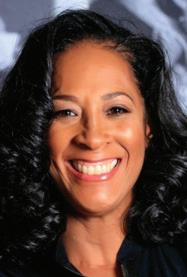
Standing in the Mill Creek exhibit, surrounded by these stories, I am reminded of something my mother used to say. In the words of Shirley Bradley Price LeFlore, history moves through “rivers and rivers and rivers of women.” Some become famous; others remain known only to their families and communities. Together, they create the currents that shape cities and carry history forward.
Standing before the massive image of City Hospital nurses in uniform, I am transported to my wide-eyed little girl self. I remember seeing my late aunt Barbara Meyers in head-to-toe white. She became one of the first Black head nurses at the old DePaul Hospital, inspired by nurses at City Hospital who were breaking early barriers beyond segregation and Jim Crow.
Growing up, my mother told stories of her grandmother who “came up” to the big city from Fredericktown, Missouri, after raising children and becoming a widow. My great-grandmother Mildred, affectionately called MeMe, settled in Mill Creek Valley. She was regal, a noted orator in the AME Church, and eventually a member at St. Paul. Annie Turnbo Malone, founder of Poro College, was also a congregant at one time. Malone trained generations of Black women in hair care, entrepreneurship, and independence.
My grandmother Z. Annetta Bradley, affectionately called Dolly, was inspired by institutions built by women like Malone. In the 1940s she owned the Three Sisters Beauty Shop with her sis-
Just before leaving, I pause at a photograph of Myrtle Mitchell, a single mother of six in Mill Creek who was told that no housing project could accommodate her family. Yet she made a way out of no way. She is an unsung shero—a quiet force of survival, resilience, and determination.
Today, it is my honor to lead the African American History Initiative (AAHI) team at the Missouri Historical Society. Our intergenerational team of Black women includes Julia Clark, programming specialist; Cicely Hunter, public historian; and Gwen Moore, a legendary historian and curator of the Mill Creek exhibit. Black women making, informing, and changing history. I also proudly celebrate all women working at the Museum, as well as at the Library & Research Center and Soldiers Memorial—from every background—committed to MHS’s mission and work.
This Women’s History Month, I will share many more names—and I invite you to say their names. Speak their names. Keep their work alive. Because history is not only studied—it is lived, shared, and carried forward.

Continued from B1
Columnist
Lyah B. LeFlore-Ituen
Photos by Michael Thomas/For The St. Louis American
Eric Benét then delivered a pristine, mint-condition performance of “Sometimes I Cry,” reminding the room why his falsetto remains in a league of its own.

Get to choosin’! I’m writing this again for the folks who skimmed over it – or missed it altogether – last week. You now have the opportunity to nominate your favorite STL staples (that goes for people, businesses and organizations) so that they can be in the running for the inaugural St. Louis American Reader’s Choice Awards. Y’all only have a couple of weeks left to nominate your folks. Don’t be mad when we get to the voting period and all of your faves are out in the cold and won’t have a chance to make history as part of the inaugural group of winners. You only have until the end of the month. You can find out all you need to know about the process right here: www.stlamerican.com/readerschoice/
314 Day pre-gamin’. I’m so geeked about all the 314 Day festivities coming up this weekend that I don’t know what to do! And I’ve been simmering for about a week thanks to a special mixer at the Missouri History Museum last Thursday. Before I started mixing and mingling, I made a pivot straight to the concessions area. I was ready to betray my 314 Day detox. But then I ended up standing in line behind my girl Briante, yes, the future Mrs. Laurence Maroney. Y’all, why did I accidently start singing “bodyoddy-oddy-oddy-oddy” out loud? The Lord knew what was best by opting out of giving me a shape worth talking about. I would be insufferable. And still will if I ever get delivert from this Twix and Doritos spirit that has had me in a chokehold since 1987. Y’all think Kim Burrell was cutting up in that little catsuit? Bishop Michael Jones would get no peace. Because
of me, his inbox and mailbox would be full of notes from concerned church members about how my crop top choir robe and matching itty-bitty biker shorts are “not of the Kingdom!” But back to my History Museum 314 Day preview moment. I ran in to Briante and her boo, my beloved Laurence Maroney, Jami Ballentine, Amy Burger, Jasmine Osby, Tyler Small, Aja Williams and a whole gang of other fave folks that I’m forgetting – but don’t love any less. When I tell you I got hyped thinking about all the 314 Day shenanigans I plan to get into…I know there has been plenty of chatter about who is doing what and even disputes about who actually started 314. My two cents is this: YOUNG DIP and TATUM created magic and we get to celebrate the 20-year legacy THEY created. My take on 314 Day 2026 is that it will be like New Year’s Eve. Everybody is having something. Go to whatever aligns with your vibe.

An October night in March. Saturday night I made my way to the Stifel Theatre to check out an Evening with October London featuring J. Brown and Eric Benét. I know what you’re thinking right now. “On what planet does Eric Benét open for October London?” I thought the same thing ahead of time, but I can’t say that I was mad how it played out. When host MC Lightfoot came out talking about they had delays and technical difficulties, I had a flashback to the trauma of being held hostage at the Valentine’s Extend Play Double Album Mixtape at Chaifetz a few weeks ago. But this wasn’t that. If he


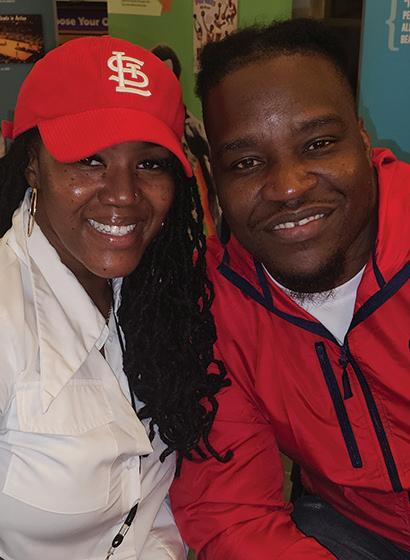
hadn’t said anything, I never would have known. Detroit R&B playa J. Brown kicked things off. I had never heard of him before Saturday, but I wasn’t mad at his set – especially his “Can You Stand The Rain” cover. Uncle Eric came out on stage and I was like “Wayment (yes, wayment), why isn’t his band mounting up on their instruments?” It was just him and a singer named Cherry in a full-length freakum dress. I was all ready to be furious! I hadn’t seen him sing to tracks since the 1900s! But leave it to Eric Benét to Eric Benét. He dug into is dog whistle range bag – and was so charming that I forgot he was even singing to the tracks. You know you’re throwin’ down if somebody toss $100 bill on stage and you still have all your clothes on! I was ready to run up and push Cherry out the way for Faith Evans part on “Georgie Porgie,” so I get five dollars flung my way. The instruments were for October London’s band – and his set didn’t disappoint. Now I would be lying if

I said Eric Benét didn’t upstage him. However, had just about anybody else been ahead of him – especially singing to tracks –October would have been best in show for sure. He has the range. And he proved it with his “Untitled” D’Angelo tribute.
Gala preseason. I’m used to our gala season kicking off in September and carrying on until the end of the year. But a couple of my favorite institutions/organizations gave me the cutest sneak preview of gala season 2026. I didn’t have space to shout them out last week, but I said I wouldn’t let another Partyline pass without heaping the highest praise on Cardinal Ritter for their gala Saturday before last at Union Station. Tamiko Armstead girl… Am I gonna have to hire Teyana Taylor’s style team for Education Salute 2026 to match the slayage you served? I was gagged. Head-to-toe red – fur vest layered over a sheer blouse with a leather belt and sequin pants – sounds like “a whole
lotta notta” when I say it. But if you saw it, you know that it was doing the most in the best possible way. And when I say head-to-toe, I mean it. She hit us with the burgundy rinse – and I’m so glad she did. But let me not make light of the moment. Tamiko Armstead is the Cardinal Ritter’s president. And while she played no games with the lewk, the children were top priority. Thanks to support by THEEE Michael McMillan of The Urban League, $800,000 was raised for scholarships. That’s more than three-quarters of a million to give our babies a competitive learning environment that primes them for excellence. And while I’m on the subject of Black excellence, let me hop into how Mr. Reuben Shelton turned the Sheldon into a baby Kappa conclave with the Kappa Kasino Night Gala. Now because of Eric Benet and October London, I scooted over there from the Stifel just in time to see the Nupes walking to their cars, but even seeing that had Jidenna’s “Classic Man” playing in my head.

1. Khalia and Morgan mingling with other movers and shakers at the 314 Day mixer on Thursday at the Missouri History Museum
2. Glen Buford, Richard “Just Rich” Washington and Richard Mansfield aka Anansi at the 314-day shoot Sunday afternoon at The Gateway Arch Photo by Taylor Marrie
3. Rece and Drea Kelly came to check out J. Brown, Eric Benét and October London Saturday night at Stifel Theatre
4. Briante and St. Louis’ own former NFL star Laurence Maroney came to represent for their city Thursday night at the Missouri History Museum
“I have answers to the test … but I gotta see the questions first.”

— Shai Gilgeous-Alexander, star guard for the Oklahoma City Thunder, on reading the defense before deciding how to score will make the Celtics even more of a threat in the East.
Sports
InSIdE SportS
With Earl Austin Jr.
Chaminade alum Tatum returns, boosts Celtics’ title hopes
Jayson Tatum’s reputation as a perennial All-Star and one of the best players in the National Basketball Association is well documented.
The former Chaminade College Prep star has now become one of the league’s most courageous and inspirational stories. Tatum made his return to the Boston Celtics lineup less than 10 months after suffering a ruptured Achilles tendon during the NBA playoffs against the New York Knicks at Madison Square Garden.
I have to admit I was excited and equally a little scared when I sat down to watch his season debut last Friday night against the Dallas Mavericks at TD Garden. My fears were put to rest when he went out and scored 15 points, grabbed 12 rebounds and dished out seven assists in 27 minutes. The reaction from the crowd was unbelievable. The crowd pop when he hit his first sidestep 3-pointer from the corner was next-level loud.
Class 3 Final Four Weekend in Columbia
There will be three teams from St. Louis participating in this week’s Missouri State High School Activities Association Class 3 Final Four at the University of Missouri.
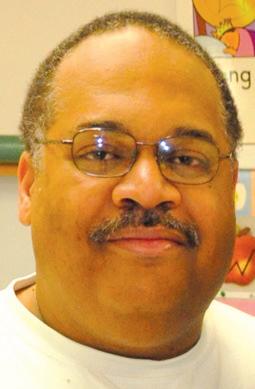
The boys’ teams from Principia and Miller Career Academy and the girls from Principia will be in action in search of state championships at Mizzou Arena.
Principia will take on Mt. View Liberty in the second semifinal game on Friday at 4 p.m. Miller Career Academy will take on North Platte in the first semifinal at 2 p.m. on Friday. The winners will meet for the state championship on Saturday at 6 p.m.
Just two nights later, Tatum scored 20 points in the Celtics’ victory in Cleveland in his first road game of the season. He scored 12 points in the first quarter and later hit a big 3-pointer in the fourth quarter to help seal the victory. The Celtics entered the week with a 43-21 record, which is second best in the Eastern Conference behind the Detroit Pistons. As Tatum continues to round into form, his presence
Principia’s boys are seeking a second consecutive Class 3 state championship. The Panthers are heavy favorites to bring home the title after enjoying a big season against a national schedule. The Panthers defeated Monroe City 77-18 in the sectionals and Dixon 106-56 in the quarterfinals.
Principia is led by 6-foot-4 guard Quentin Coleman, who is averaging more than 20 points per game. The All-State guard recently made news by opening up his recruitment after previously signing with Wake Forest.

The Panthers also feature 6-foot-9 junior Sekou Cisse, 6-foot-3 junior Gassim Toure, 6-foot-3 junior Wyatt Slay, 6-foot8 senior Ronald Henry, 6-foot-3 junior Kingston Money and 6-foot senior Jaedyn Jones. Miller Career Academy advanced to the Final Four after an exciting 96-90 victory over Woodland in the state quarterfinals last Saturday. The Phoenix have plenty of speed and quickness and love to play fast. They are led by 6-foot-1 senior guard C.J. Nelson, who is one of the leading scorers in the
area. He is joined by his younger brothers Calvin and Camren Nelson along with senior guard Michael Dickerson.
Principia’s girls are making their third consecutive trip to the Final Four. They have finished as state runners-up the past two seasons.
The winners of the Principia-Skyline and St. Vincent-Lone Jack semifinal games will play for the state championship on Thursday at 6 p.m.
The Panthers won two exciting postseason games to reach the Final Four. They defeated Highland in
SportS EyE
With Alvin A. Reid
the sectionals and Centralia in the quarterfinals in an overtime thriller.
Principia has been led by 6-foot-2 junior forward Dasia Scott, who is averaging 21 points and eight rebounds per game. Sophomore point guard Loganne Love averages 13 points, six rebounds and four assists per game.
Martin and Fletcher lead High Point to NCAA Tournament
Former St. Louis prep basketball standouts Rob Martin and Cam’Ron Fletcher were front and
center in leading High Point to the championship of the Big South Tournament and a berth in the NCAA Tournament. They combined to score 41 points in High Point’s 91-76 victory over Winthrop. High Point will take a 30-4 record into the NCAA Tournament. Martin, a former CBC standout, scored a gamehigh 24 points while also handing out 17 assists. Fletcher, a former Vashon High standout, scored 17 points and grabbed 19 rebounds, tying a Big South Tournament record.
Blacks have power to protect NIL earning rights
Bucky Brooks of the NFL Network recently released his second 2026 NFL mock draft. Of the 32 players he forecasts being selected in the first round, 28 of them are Black.
In February 2025, the NCAA released a report highlighting African American participation in various sports at all levels of competition. According to the report on Division I athletics:
• 40% of football participants are Black, totaling 32,184 student-athletes. This is the highest number across all sports and was a 26% increase.
In 2025, the U.S. Census Bureau listed the Black population of the United States at 14.4%.
I share those numbers to make this point: There is growing alarm over Name, Image and Likeness (NIL) payments to athletes and the transfer portal frenzy. Yes, things are getting absurd, but it is important to remember what, in part, is fueling the ferocity.
• 44% of men’s basketball players are Black, with a total of 8,393 student-athletes.
• 28% of women’s basketball players are Black — the highest percentage of any women’s sport — with 4,682 student-athletes.
• 20% of indoor and outdoor track and field participants in both men’s and women’s events are Black. It is the top sport by number for Black women, at over 6,000.
Black athletes and their families are reaping much of the benefit. This is disconcerting to many coaches, administrators, fans — and the president of the United States. The phony-baloney White House “Saving College Sports” conference held last Friday to address NIL and transfer policies brought a conglomerate of people to Washington, D.C. The gaggle included respected coach Nick Saban, Republican Speaker of the House Mike Johnson, Republican Florida Gov. Ron DeSantis, and no student-athlete representa-

tives. This colossal waste of time was nothing more than a photo opportunity and platform for the president to make yet another preposterous announcement.
“I will have an executive order within one week …which will solve every conceivable problem in this room. If this doesn’t work, college sports will be destroyed. Women’s sports will be destroyed,”
said President Trump. Groups representing college players and pro athletes are vehemently opposed to any effort that would restrict the rights that college players have under the current NIL structure.
The concern isn’t only financial. The growing angst is because student-athletes and their representatives suddenly have as much power as coaches and administrators.
Most of those people are white men. Relative to the U.S. population, a disproportionate share of those being paid are Black.
It’s not all about math and the sanctity of college athletics. This is a debate about power. Suddenly, Black athletes have too much of it.
Trump said he is sure “we’re going to be sued,” for his executive order.
A legal battle will ensue, but Black players have the power to protect their earning power. They could boycott a game if they don’t like the Trump plan.
Heck, if Black athletes refused to practice for a week in their respective sports the wheels of college athletics would halt.
Black men and women in collegiate sports could also do the unthinkable: forego the Power Four conferences and play at HBCUs. Yes, individual donors would have to match what they would make in NIL payments at larger schools, but the money is out there in Black America.
Is the will?
Right now, the ball is in Trump’s hands. But Black
players are winning the games, and they have the power to win this contest.
The Reid Roundup
In two games after returning from an Achilles rupture suffered last year in the playoffs, Jayson Tatum averaged 17.5 points, 7.5 rebounds and 4.5 assists for the Boston Celtics. It’s simply amazing…The Kansas City Chiefs will sign Super Bowl MVP free-agent running back Kenneth Walker to a deal this week….St. Louis native Jeremiyah Love will likely be drafted before the Chiefs’ No. 9 pick in the NFL Draft on April 23. BUT, if he’s there, Kansas City will still take him. You heard it here first…BetMGM set the over/under on St. Louis Cardinals wins in 2026 at 69.5. Take the over. The team won’t be that bad… The only teams predicted to win fewer games are the Chicago White Sox (67.5), Washington Nationals (65.5), and Colorado Rockies (54.5). White Sox manager Will Venable’s team will easily top that mark.
Boston Celtics forward Jayson Tatum (0) drives to the basket beside Cleveland Cavaliers center Evan Mobley in the second half of an NBA basketball game in Cleveland, Sunday, Mar. 8, 2026.
Alvin A. Reid
St. Louisan Jeremiyah Love, who starred at the NFL Combine in Indianapolis, is projected as a top-10 pick in the NFL Draft. The NIL rights he held at Notre Dame must be protected by collegiate Black players for future players.
Photo by Kirby Lee-Imagn Images
Courtesy of the AP
Earl Austin Jr.


Washington University in St. Louis offers rewarding opportunities in various fields at all levels, with positions in engineering, nursing and health care, research, administration, technology, security and more.
Now Hiring: MFM OB/GYN Ultrasound Sonographers!
The WashU Department of OB/GYN is seeking friendly and reliable sonographers to join our Maternal–Fetal Medicine team.
What You’ll Love:
• Mon–Fri | 7:45am–4:15pm
• No nights, weekends, or call
• Scan high risk patients & work with MFM specialists
• Supportive, team oriented environment
Pay & Benefits:
• $35.99–$55.79/hr (based on OB/GYN/MFM experience)
• Up to 22 vacation days, 10 holidays, and sick time
• Comprehensive medical, wellness programs, mental health support
• 403(b) with 7%+ university contribution
• 4 weeks caregiver leave
• Tuition assistance for you & dependents
Whether you’re a dedicated sonographer or a new grad looking to grow in a supportive, high impact environment — we’d love to meet you!
For the full job description and to apply, visit jobs.washu.edu, JR92023.
We seek people from diverse backgrounds to join us in a supportive environment that encourages boldness, inclusion, and creativity.
EEO/AA/VET/Disability Employer
CITY OF BELLEFONTAINE NEIGHBORS
JOB POSTINGS –RECREATION AND PARKS DEPARTMENT POSITIONS
The City of Bellefontaine Neighbors is seeking to hire for the following positions:
Full Time Maintenance Worker I – The duties entail maintains grassy areas, which includes grass cutting; trash collection; maintains, trims and removes trees and plants; repairs irrigation systems and equipment; maintains and repairs systems in parks; maintains playgrounds, athletic fields, community center, and other park facilities to ensure safe and well-maintained parks. Duties also entail climbs trees or uses bucket truck to access trees; utilizes chain saws, pruners, and clippers to trim trees. Maintain and clean recreation center meeting rooms, fitness area, and bathrooms. Cleans, scrapes, spackles and paints restroom, shelters and community center.
Part Time Lifeguard - The duties entail being responsible for enforcing rules and regulations governing the conduct of pool patrons; follow the American Red Cross Training, CPR/AED, first aid and established emergency action plan procedures developed by the department in the event of an emergency; Attendance of mandatory monthly in-service training (2 hrs. per month off peak /4 hrs. per month peak). Maintenance and cleaning of the pool, pool deck, concessions, locker rooms, showers, rest rooms, and other areas as directed by the pool managers. This position reports directly to the Aquatic Supervisor and Head Lifeguard.
Part time Front Desk Clerk - The duties entail being responsible for the daily operations at the front desk, specifically selling memberships, program registration, checking in members and guests, answering the telephone, and issuing equipment. Front Desk duties also include cleaning, vacuuming, dusting and general cleanliness of the internal and external areas of the front desk and lobby.
For more details regarding the job positions and duties, visit our website: www.cityofbn.com.


River City Construction, LLC is the Construction Manager at Risk for the Missouri S&T Bioplex project. This project consists of approximately 105,000 sf of new building, site work and landscaping, and will be connected to the existing Bertelsmeyer Hall via a connector bridge. The building will consist of a vivarium, laboratory space, offices, and classrooms. The Bioplex will be the final piece to complete Missouri S&T’s master planned arrival court.
Missouri S&T / River City Construction, LLC as the Construction Manager, is accepting bids for the Work Category noted below on April 2nd, 2026, at 1:30PM. All bids shall be uploaded to the University of Missouri online bidding platform, or hand delivered in person to Missouri University of Science and Technology, Design and Construction Management, General Services Building, 1701 Spruce Dr., Rolla, MO 65409.
• 33.4 – Site Geothermal
Bid documents can be obtained by visiting our website at: https://www.rccllc.com/ smart-bid/. The link to the project will be located under the link: River City – Peoria River City Construction, LLC is an Equal Opportunity Employer.
REQUEST FOR PARTNERSHIPS
MBG is seeking partners for the revitalization of the Leo Hardin Sr Building located at 4500 Washington Blvd—a project worthy of our involvement because of who it serves and what it restores. We are looking for partners who understand legacy and stewardship. We offer a chance to honor a veteran, a pastor, a father, and a son who refuses to let that story fade. If this resonates, we would like to build this together—not as bidders, not as vendors, but as people committed to work that matters.
This opportunity to serve our community includes 31 apartments and a community room for veterans. Additionally, we will recreate the Citizens for Community Improvement offices to serve as a hub for the community this project is committed to serving.
Pre-bid walkthrough: Christ Temple First Church, 532 N Taylor Ave, St. Louis, MO 63108, on Wednesday, April 15, 2026, at 9:00 a.m. The church is located directly across the street from the project site.
If you are interested in partnering with MBG on this project, please attend the pre-bid walkthrough and request the project information package. DBE, MBE, WBE, and veteran-owned partners are highly encouraged to participate. To confirm your interest and receive project information, contact Michael Harris at mharris@mbg built.com or 314-614-7247. Please confirm your interest by April 29, 2026, at 3:00 p.m.
AUDITING SERVICES
The Missouri Lottery is accepting bids for the purpose of establishing a contract for Auditing Services. The bid document with the specifications can be obtained by going to https://www.molottery.com/bidopportunities or by contacting Melissa Blankenship at melissa.blankenship@ molottery.com or 573-751-4050.


REQUEST FOR BIDS FOR
THE DECONSTRUCTION & DEMOLITION SERVICES AT 6306 W. FLORISSANT AVENUE
ISSUED: MARCH 10, 2026
RESPONSES DUE: APRIL 6, 2026
The Land Reutilization Authority of the City of St. Louis (“LRA”) invites sealed bids for deconstruction and demolition services at 6306 W. Florissant Avenue, St. Louis, Missouri.
A qualified firm to perform selective deconstruction, salvage, and preservation of identified architectural elements, followed by full demolition services.
Responses will be received at 1520 Market Street Suite 2000 St. Louis, Missouri 63103 (Attention: LCRA) and STL City Permits, city website, SLDC website until 3:00 p.m. on April 6, 2026.
The services to be provided through this RFB will be funded by The Coronavirus State and Local Fiscal Recovery Fund allocated to the City of St. Louis by the United States Department of the Treasury and passed through the City’s Community Development Administration to LCRA.
The full invitation and all other documents may be downloaded at: STLPermits.com and https://www.stlouis-mo.gov/government/ procurement.
SEEKING SEALED BIDS
City of Pine Lawn Seeking
Sealed Bids for Demolition and Land Clearance at 2525 Kienlen. Bid Opening is 6 pm Thursday, March 26 @ Pine Lawn City Hall (6250 Steve Marre Ave.) Public is invited. Direct questions to 314-261-5500 (press 1)
REQUEST
FOR SUBCONTRATORS
Hankins Construction Co. is requesting that subcontractors who employ qualified Section 3 employee submit bids in accordance with Section 3 requirements for the Saint Louis Housing Authority/Kingsbury Terrace Apartments Roof Replacement Project. To access the bid documents, or if you have any questions, please email/call Nicole at Office@HankinsMidwest. com /314-426-7030. Please submit bids to Bids@ HankinsMidwest.com by 3:00 PM on 3/24/2026. Hankins Construction Co. is an Equal Opportunity Employer.
REQUEST FOR PROPOSALS
Hazelwood School District is seeking bid proposals for asphalt replacement at The Learning Center, Coldwater, West High, Northwest Middle, Opportunity Center, East High School.
Interested parties should submit their bid proposal through Vendor Registry via the district’s website at https:// www.hazelwood schools.org/Page/2238 on or before Tuesday, April 7, 2026 not later than 10:00 a.m.
REQUEST FOR SUBCONTRATORS
Hankins Construction Co. is requesting that subcontractors who employ qualified Section 3 employee submit bids in accordance with Section 3 requirements for the St. Louis Housing Authority – California Gardens South Building Unit Repairs & PTAC Replacement Project. To access the bid documents, or if you have any questions, please email/call Nicole at Office@HankinsMidwest. com /314-426-7030. Please submit bids to Bids@ HankinsMidwest.com by 3:00 PM on 3/23/2026 Hankins Construction Co. is an Equal Opportunity Employer.
REQUEST
FOR PROPOSALS DEVELOPMENT OF A PARTNERSHIP FOR REGIONAL ALIGNMENT
East-West Gateway is seeking submittals from consultants to facilitate the development of a Partnership for Regional Alignment. Submittals are due no later than 1:00 p.m. on April 14, 2026. Submittal details and specifications can be obtained at www.ewgateway.org
SEALED BIDS
Bids for Building Envelope Repairs at Missouri State Highway Patrol Troop D Crime Lab, Project No. R2516-01, will be received by FMDC, State of MO, UNTIL 1:30 PM, April 7, 2026. Project information available at: http://oa.mo. gov/facilities
NOTICE TO SMALL (SBE), DISADVANTAGED (DBE), MINORITY (MBE), & WOMEN’S (WBE), SERVICE DISABLED VETERAN OWNED (SDVOB) & VETERAN OWNED (VOB) BUSINESSES ADVERTISEMENT
RIVER CITY CONSTRUCTION, L.L.C., 1509 N. MAIN ST., BENTON, ILLINOIS 62812, (618) 435-2612 (PHONE) (618) 435-2457 (FAX) IS SEEKING QUALIFIED SMALL, DISADVATANGED, MINORITY, & WOMEN’S BUSINESSES FOR THESOUTHEAST MISSOURI STATE UNIVERSITY STADIUM PHASE II FOR THE SUBCONTRACTING OPPORTUNITIES IN THE FOLLOWING AREAS: CONCRETE, MASONRY, METALS, WOOD PLASTICS AND COMPOSITES, THERMAL AND MOISTURE PROTECTION, OPENINGS, FINISHES, SPECIALTIES, FURNISHINGS, CONVEYING EQUIPMENT, SEISMIC CONTROLS, FIRE SUPPRESSION, PLUMBING, HVAC, ELECTRICAL, COMMUNICATIONS, ELECTRONIC SAFETY AND SECURITY, EARTHWORK, EXTERIOR IMPROVEMENTS, AND UTILITIES. ALL INTERESTED AND QUALIFIED SMALL, DISADVANTAGED, MINORITY AND WOMEN’S BUSINESSES SHOULD CONTACT, IN WRITING, (CERTIFIED LETTER, RETURN RECEIPT REQUESTED) TIM PEC, TO DISCUSS THE SUBCONTRACTING OPPORTUNITIES. ALL NEGOTIATIONS MUST BE COMPLETED PRIOR TO THE BID OPENING BID DATE OF 3/26/2026 @ 2:30PM (CST). PROPOSALS WILL BE EVALUATED IN ORDER ON THE BASIS
SECTION 00020 INVITATION TO BID
Sealed bids for development of the A Red Circle/ North County NEXUS Center to renovate Phase I of the existing building development at 9300 Lewis & Clark Blvd, St. Louis, MO 63137 will be received at the offices of A Red Circle, 9312 Lewis & Clark Blvd, St. Louis, MO 63137 at 2:00 p.m., Wednesday I April 2026 Immediately thereafter the bids will be publicly opened and read aloud. Late bids will not be accepted and will be returned to the sender, unopened.
Missouri Division of Labor Standards, Wage and Hour Section, Annual Wage Order No. 32 (St. Louis County), will be subject to objections 30 days from the date of issue. Not less than the prevailing hourly rates of wages as found by the Department of Labor and Industrial Relations of the State of Missouri, or determined by court on appeal, shall be paid to all workmen performing work under this contract. Bidders must provide a sworn affidavit and supporting documentation that affirms participation in a federal work authorization program as well as an affidavit that the bidder does not knowingly employ any person who is an unauthorized alien who will be working on the project.
The scope of includes interior wall reconfiguration and new finishes, terrazzo restoration, ceilings, kitchen equipment, HVAC, lighting, doors and door controls and exterior wall finish restoration.
Bidders shall examine each site to confirm existing conditions & quantities prior to submitting bids. A site Walk-through of the existing building is scheduled for Wednesday 18 March 2026 starting at 10:00 AM.
Digital copies of Drawings, Project Manual and Specifications may be obtained after Wednesday 11 March 2026 from the office of the Architect, KOUBA + KNOOP Associates, Inc., 1844 Craig Road, St. Louis, Mo. 63146 by requesting a copy by phone (314-434-9393), or at: info@KoubaKnoop.com
Project information may be viewed at:
• MOKAN at: planroom@mokanccac.org
• Missouri ISQFT content@constructconnect.com
• ConstructConnect shamauel.israel@constructconnect.com or Kamryn.Hall@constructconnect.com
• CMD Group: Robert.canetta@cmdgroup.com
• EPlanBidding.Com: eplan@eplanbidding.com
• Dodge : darlene.baker-mann@construction.com www.construction.com/projectcenter
Each sealed bid shall be submitted in duplicate and include a cashier’s check or certified check, or an acceptable bidder’s bond, payable to the Owner in an amount not less than 5% of the base bid, as a guarantee that if awarded the contract the bidder will enter into a contract and execute such bonds as required.
The Owner reserves the right to reject any or all bids and to waive any technicalities therein.
A Red Circle is a nonprofit organization, established number Section 501(c)(3) of the Internal Revenue Code for the purpose of promoting racial equity in the northern region of St. Louis County (“North County”). A Red Circle is dedicated to racial equity and community development by building and supporting healthy food businesses and opportunities for entrepreneurs.
COTE BRILLIANTE
PRESBYTERIAN CHURCH
A new Season A new Location. The Same Loving Church Family. In the wake of the devastating May 16th tornado that destroyed our church building.
COTE BRILLIANTE
PRESBYTERIAN CHURCH has continued to stand strong in Faith, Hope, and community. We are grateful to share that we have relocated and are now worshiping at: First Presbyterian Church of Ferguson 401 Darst Rd Ferguson, MO 63135

PUBLIC NOTICE
Notice is hereby given that the Metropolitan St. Louis Sewer District Requests for Quotes, Bids and Proposals are posted online for public download. Please navigate to www.msdprojectclear.org > Doing Business With Us > View Bid Opportunities
Metropolitan St. Louis Sewer District is an Equal Opportunity

Rev. Dr. Sammie Earl Jones
A life of faith, service and redemption remembered
By Kenya Vaughn St. Louis American
By the time the celebration of life for Rev. Dr. Sammie Earl Jones began, every pew, every aisle and every corner of the church he pastored for 43 years held someone who had come to say thank you. Thank you for the sermons. Thank you for the counsel. Thank you for the leadership. Thank you for the love. And as the choir lifted its voices and the congregation settled into the familiar cadence of a homegoing, one sentiment rose above the rest: This is exactly how he would have wanted it.
Psalm 113:7-8, calling it the “unofficial autobiography” of Sammie Jones.
“You all have preached his legacy. But I am going to preach about how he had help,” Rev. Shaun Ellison Jones said. “His best help came from above. He could not have done it if God had not helped him.”
Rev. Jones died Feb. 9 at the age of 76. The celebration of life was held Feb. 28. His son, Rev. Shaun Ellison Jones — now senior pastor of Centennial Star of Bethlehem Church in Westchester County, New York — stood in the same pulpit where his father preached thousands of sermons. He spoke of the dust and the ash heap in
He reminded the congregation that his father’s journey was one of redemption — of a young man who dropped out of high school, earned his GED and made mistakes that could have written him off.
“Despite how the world will keep you at your lowest moments, or the world won’t let you forget your mistakes, we serve a God who is able to look past those choices when the world tries to demonize you,” he said. “I have a father who went from being underestimated to influencing policymakers. The same way that God was able to help Sam Jones, he is able to help you.” Dr. Latonia Collins Smith,
Religion
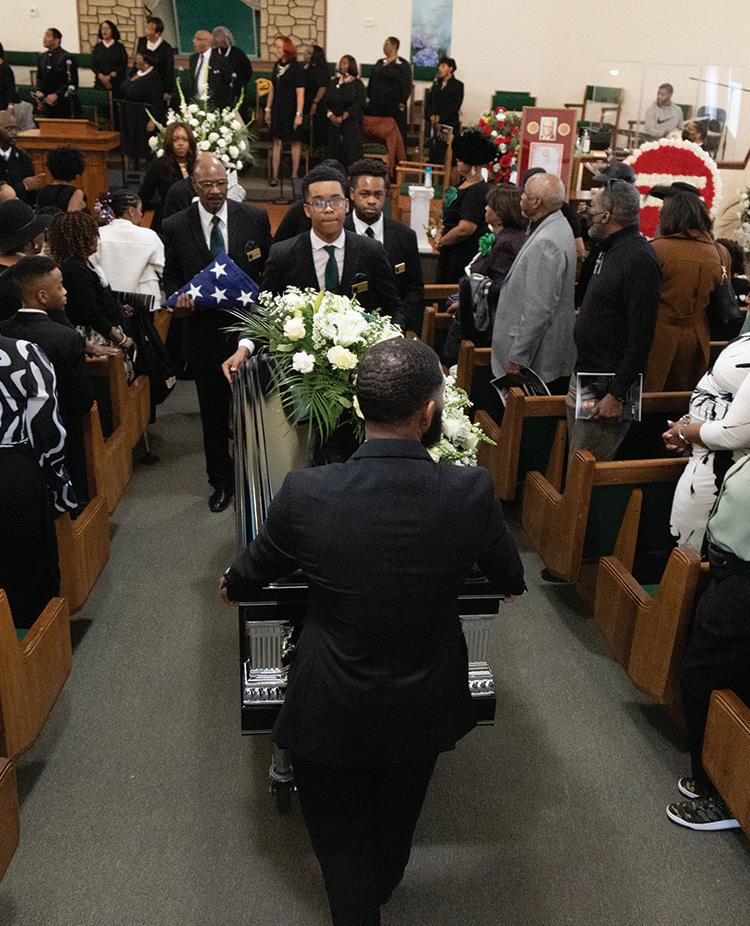
president of Harris-Stowe State University and chair of Missouri’s Dr. Martin Luther King Jr. State Celebration Commission, called Jones a “community anchor.”
“He was more than a revered spiritual guide,” she said. “He was a beacon of hope.”
Rev. Duane Burch, president of the St. Louis Metropolitan Clergy Coalition, reflected on his relationship with Jones.
“That’s priceless,” he said. “I thank God for Dr. Sammie E. Jones.”
From Olivet Missionary Baptist Church — where Jones
first accepted his call under Dr. R.T. Davis — Deacon Allen Blueitt Jr. remembered a young preacher eager to serve.
“He was excited that God had chosen him to preach.”
Brother Eugene Stubblefield of Mt. Zion offered a poetic reflection.
“He did not wear greatness as a crown — polished and square,” he said. “He wore it the way morning wears light.”
Rev. Sandra Dew-Gainey of Lily of the Valley Missionary Baptist Church said Jones’ legacy lives in the young people he helped guide.
We love polished leaders. Polished stories. Polished résumés. We’re drawn to leaders who look unbothered, unbroken, untouched by the grit of life.
But that’s not where real leadership comes from.
Duane Foster, Pianist Alla Voskoboynikova , and North Park UMC Choir
“There are young men walking around right now who would have been primed for the prison pipeline had it not been for Rev. Sammie Earl Jones,” she said. “His legacy is in the hearts and minds of the hundreds of young people he sent out of here to the glory of God.”
Then came the testimony of Rev. Don Sanford of St. James Baptist Church in Alton, Illinois. After losing his son in a car accident, Sanford said he had given up on life. His wife urged him to talk to “a man,” and that man turned out to be Jones.
Their first meeting wasn’t in a church — it was at The Pasta House.
“He put his fork down and said, ‘You’ve given up on yourself, but God hasn’t given up on you.’”
That moment, Sanford said, saved his life.
Weeks later, when Sanford tried to leave Mt. Zion after being asked to remove his hat, Jones stopped him.
“Come back in here,” he said. “You have to hear my son preach.” Sanford stayed. And he joined the church.
“There are some who preach the word, and there are some who live the word,” he said.
“Pastor Jones was both.”
His granddaughter, Taylor Jones, spoke with quiet strength.
“He turned words into hope,” she said. “He turned sermons into strength. He turned faith into something you could feel.”
In a video presentation, Jones’ own voice filled the sanctuary.
“You think you’ve been through something, … keep living,” he said. “When God takes you through, He lets you see who He is.”
Taylor Jones reminded the congregation that her grandfather’s impact would never be confined to a building or a pulpit.
“It lives in every life he encouraged, every life he saved, and every family he covered.”
A scar is the testimony that you are stronger than what tried to destroy you.
This is why scarred leaders often carry a different kind of presence.
They’re not rattled easily. They’re not intoxicated by the spotlight.
They’re not impressed with themselves.
They see people more clearly — because they’ve lived through their own darkness.
Real leadership is born out of scars.
A scar means you survived something that tried to break you.
A scar means you wrestled with your humanity and didn’t lose your hope.
A scar means God carried you through a season that could have taken you out.
And make no mistake — scars change how you lead.
Leaders with scars don’t confuse authority with worth.
They don’t weaponize power. They don’t rush to judgment. They don’t hide behind titles. They lead with humility because life taught them humility.
A scar is the evidence that pain didn’t win.
A scar is the reminder that healing is possible.
Leading with scars isn’t about showcasing your wounds. It’s about allowing God to use what He healed in you as wisdom for somebody else. It’s about embracing the truth that your credibility comes not from perfection, but from resilience.
And here’s the part nobody tells you: Your scars are often the very places where God releases your authority.
People follow scarred leaders not because they’re special, but because they’re real. And real leadership is what the world is starving for.
Reflection Question: Which scar in your life is God trying to use as a source of strength and authority in your leadership?
For more, visit OrvinKimbrough.com or MidwestBankCentre.com.
Rev. Dr. Sammie Jones
The Scars That Strengthen Your Leadership
The Next MOVE
Dr Sheila Bouie-Sledge,
Photo by Lawrence Bryant / St. Louis American
Rev. Dr. Sammie E. Jones, longtime pastor emeritus of Mt. Zion Missionary Baptist Church, was honored with a standing-room-only homegoing service.