

St. LouiS AmericAn
NAACP pushes for tougher data center accountability


Calling for greater transparency and enforceable investments in neighborhoods
By Sylvester Brown Jr. St. Louis American
As St. Louis weighs the promises and risks of a $3 billion data center project in Midtown, the St. Louis branch of the NAACP
is urging city leaders to ensure Black communities do not bear the costs of the region’s artificial-intelligence boom without sharing in its benefits. The civil rights organization recently released
a Community Benefit Framework calling for stronger protections, greater transparency and enforceable investments in neighborhoods that could be affected by the rapid expansion of data centers
and AI infrastructure.
The report arrives amid one of the most contentious development debates in recent city history: the proposed Armory Innovation District. The project would transform
Where history meets hope
the historic Armory building into office and innovation space while constructing a large data center on the adjacent former Macy’s-Famous-Barr warehouse property.
The debate has exposed
Visitors find legacy and inspiration at Obama Presidental Center
By Lauren Marisol Preston and Kenya Vaughn St. Louis American
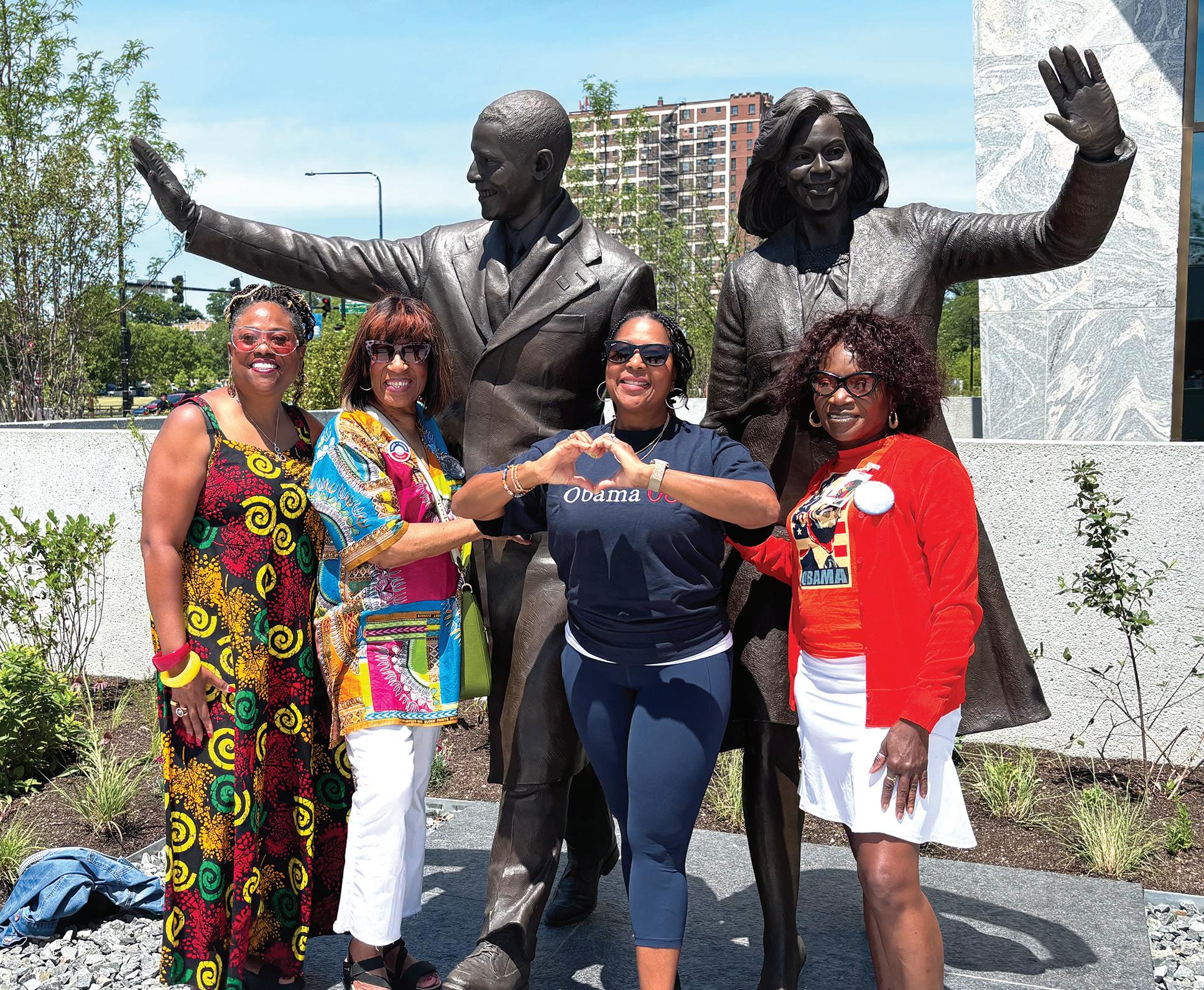
Dr. Pamela Washington stepped onto the grounds of the Barack Obama Presidential Center on opening weekend and felt the presence of the people who came before her.
Her parents, who have since passed away, were early supporters of then-Sen. Barack Obama — canvassing St. Louis neighborhoods and staffing phone banks to help elect the nation’s first Black president. Her uncles were Freedom Riders of the 1960s. They were part of a generation that marched, organized and prayed for a future they could only imagine.
See Obama Center, A10
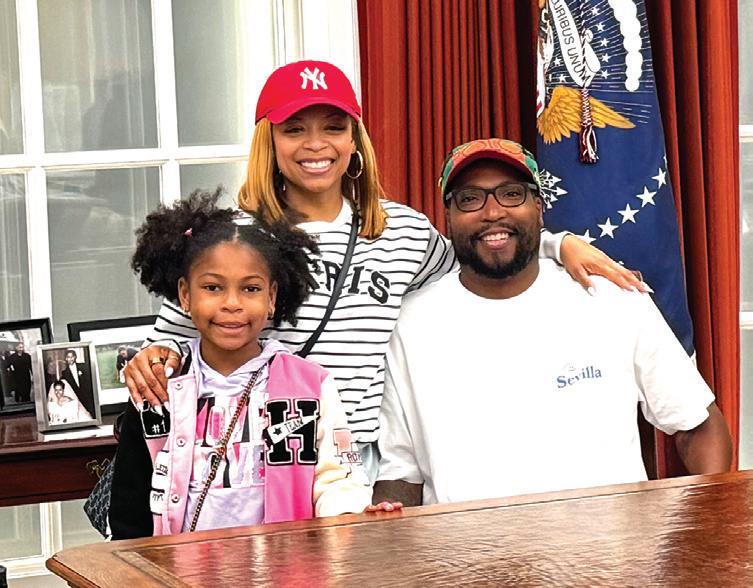
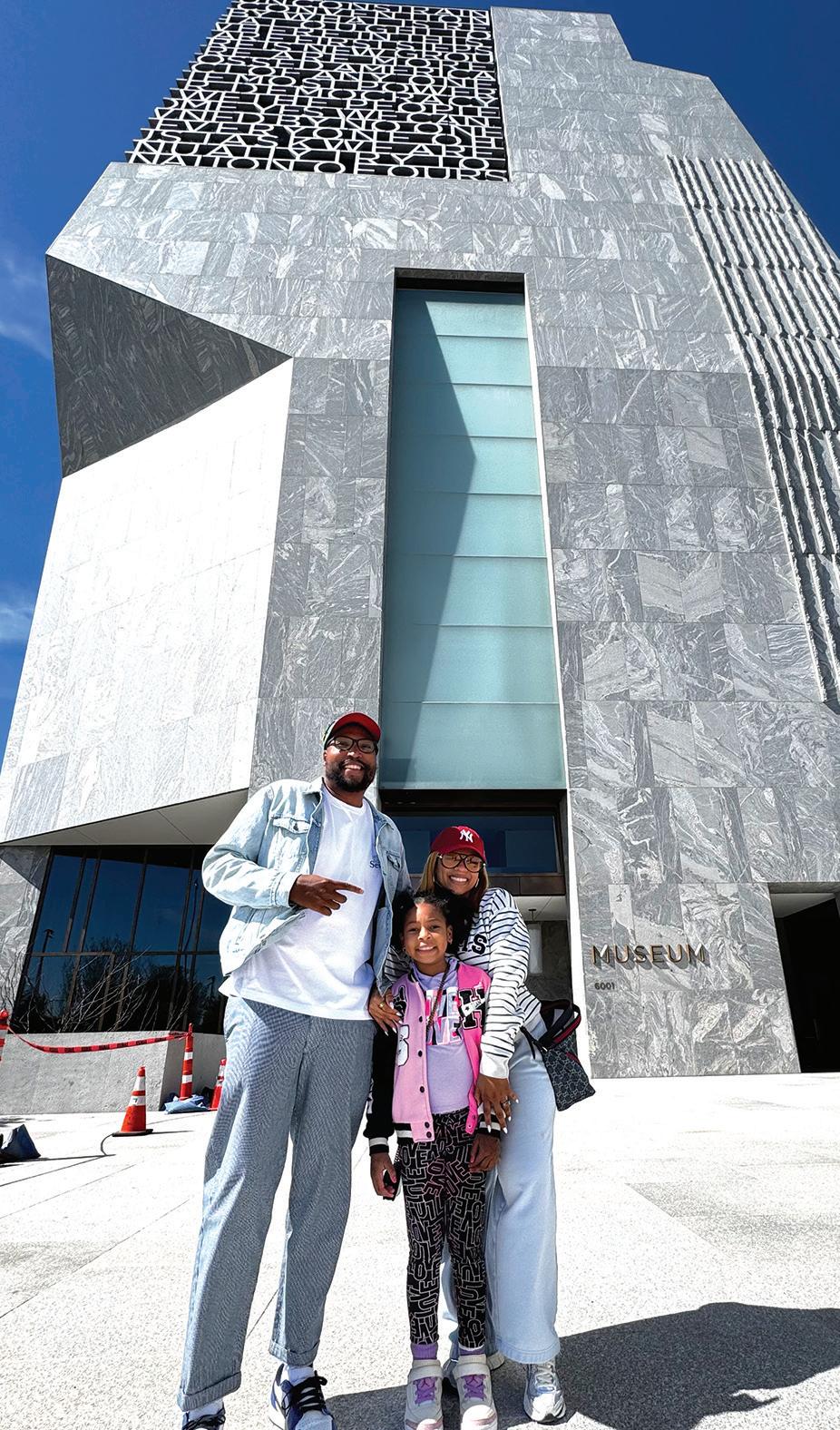
Teagan and husband, Michael, pose behind the Resolute Desk inside the fullscale replica of the Oval Office at the Obama Presidential Center.

sharply different visions of what data centers mean for St. Louis. Supporters view them as engines of economic growth capable of generating jobs, tax
See Data Center, A10
Justice in his blood
Attorney Kenny Powell III draws inspiration from generations of perseverance and service
By Sylvester Brown Jr. St. Louis American
The most important item in Kenneth “Kenny” Powell III’s Clayton office isn’t a legal brief, a settlement agreement or a framed award.
That photo, with its genesis in injustice, Powell said, “helps keep me grounded.
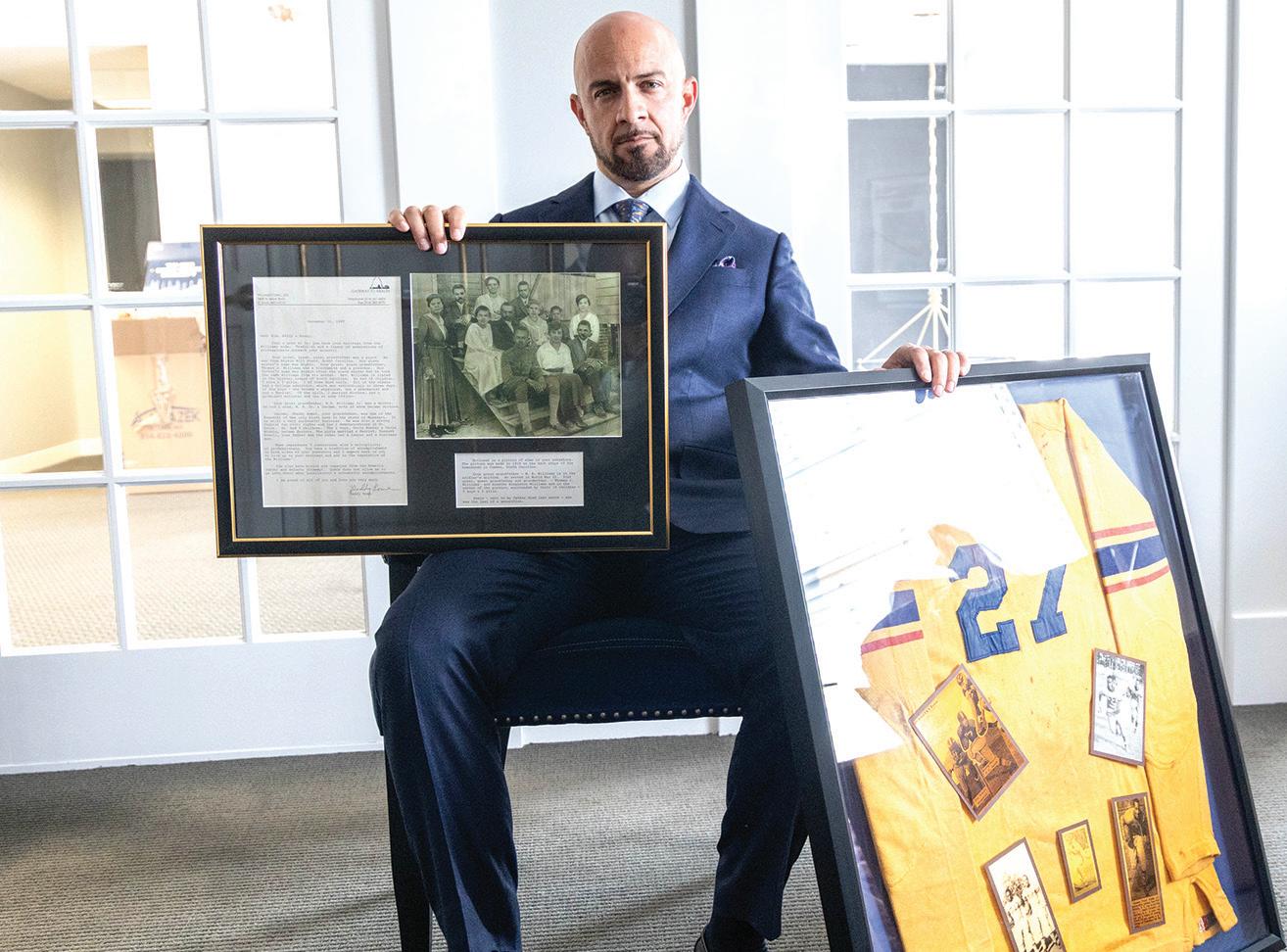
It’s a photograph. The photo features Powell’s great-great-greatgrandfather, an enslaved man from South Carolina, and his 10 children. The generations that followed included a blacksmith and preacher, a World War I veteran and Jerome Williams Sr., a St. Louis physician and civil rights leader. Two of Williams’ sons, Jerome and William, and his cousins also became physicians.
That photo, with its genesis in injustice, Powell said, “helps keep me grounded … helps me remember where I came from and the sacrifices of my ancestors that led me to the opportunities I have today. It’s in my
Powell, A10
Erika Walker, Margaret Dyer, Dr. Pamela Washington and Sandra Blackshear pose in front of a statue of former President Barack Obama and former First Lady Michelle Obama during opening weekend at the Obama Presidential Center in Chicago.
Photo courtesy of Dr. Pamela Washington
Shatesha Holder, center, her daughter,
The SERA Rodeo returned to Chaifetz Arena on Saturday afternoon, drawing a crowd ready for an afternoon of competition, culture and community. Page B1
Black cowboy culture hits Chaifetz Arena
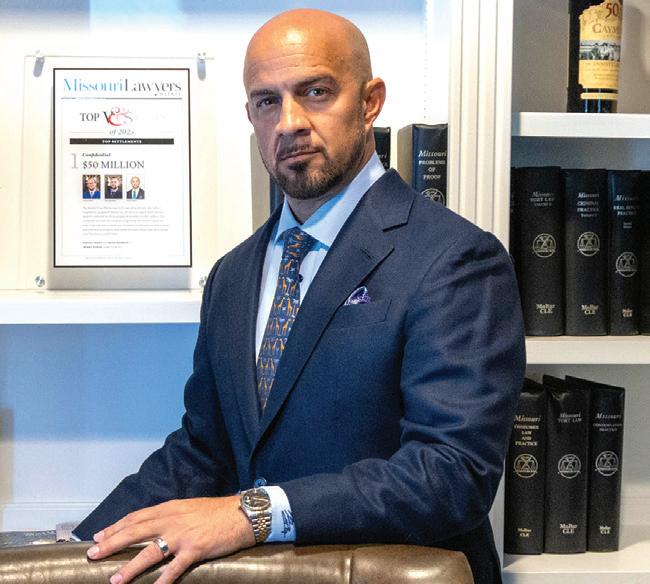
Kenneth Powell III, founder of the Powell Law Firm, inside his Clayton office.
Photo by Lawrence Bryant / St. Louis American
Photo courtesy of Shatesha Holder
Editorial / CommEntary
Commentary
Delay nearly created a dire health care crisis
Two Black elected officials placed health care for nearly 1,300 people — most of them Black — at risk while exposing St. Louis County taxpayers to potentially significant financial liability.
Rita Heard Days chairs the St. Louis County Council, and Shalonda Webb chairs its Budget Committee. They occupy the leadership positions necessary to move forward an appropriations bill, introduced in April, that provides approximately $2.9 million to maintain contracted health care services in the St. Louis County Jail and Juvenile Detention Center.
The council ultimately reached the right decision Wednesday by approving this funding. But it should never have taken this long.
For months, Days and Webb were told repeatedly by Department of Public Health officials that funding for contracted health care professionals would expire June 30. Yet the council failed to approve the funding at its June 16 meeting and again on Tuesday, allowing the deadline to draw dangerously close before finally acting.
Days herself acknowledged that the money existed. The dispute was never whether funds were available. The dispute was whether the council would authorize their use before health care services were disrupted.
County officials warned that without funding, medical staffing at the jail and juvenile detention center would be cut dramatically. Medication distribution, routine clinic visits, chronic disease management and treatment for substance-use disorders all stood to be affected. Detainees who normally could be treated inside the facilities instead would have required transportation to emergency departments at much greater cost.
The consequences were no longer hypothetical.
The already overworked Corrections Medicine staff was forced to prepare a crisis management plan. County officials notified hospitals and police departments that they might have to absorb the consequences, while the St. Louis Area Police Chiefs Association warned that inadequate jail medical staffing could divert officers from patrol duties.
Webb argued that the council had received only partial information regarding spending audits and fund transfers and that additional questions had to be answered before the funding could be approved.
That explanation did not justify the delay.
The bill had been pending since April. Public health officials repeatedly
explained the consequences of inaction. Hospitals, police departments and police chiefs had all been warned.
At some point, scrutiny becomes obstruction.
It is difficult to know what motivated Days and Webb to place these detained individuals and the medical professionals who care for them, led by Dr. Kanika Cunningham, director of the Department of Public Health, in this dangerous and costly position.
Even if Days and Webb have no empathy for people who have been accused of crimes, the United States Constitution requires St. Louis County to provide health care to people in its custody.
Had funding lapsed, the county would have had little choice but to send detainees to emergency departments at significantly greater cost and expose taxpayers to costly civil-rights litigation.
If medical staff had become unavailable, incarcerated people would have been much more likely to suffer serious harm without proper care and maybe to die.
Dr. Kanika Cunningham publicly warned that someone could be harmed or die if adequate medical staffing was not maintained.
Many of those affected are people who have been accused of crimes but remained presumed innocent while awaiting the resolution of their cases.
Councilwoman Lisa Clancy described the situation accurately when she called the council’s failure to act “a dereliction of our duties.”
The county came dangerously close to incurring costs far greater than the approximately $2.9 million needed to maintain health care staffing in the jail and juvenile detention center.
Good government is measured not only by the decisions it makes, but by when it makes them. St. Louis County’s elected leaders allowed an avoidable crisis to develop, forced public servants to prepare for a health care emergency that never should have existed, and left detainees, medical professionals, law enforcement officers and taxpayers wondering whether common sense would prevail.
The council ultimately did the right thing. But the weeks of unnecessary delay served no one. They wasted public resources and brought the county to the brink of a health care crisis that was entirely avoidable.
The next time county leaders are warned that lives, constitutional rights and taxpayer dollars are at stake, they should act before a crisis becomes imminent — not after.

Frederick Douglass saw America as composite
By Larry Smith
In a matter of days, we will learn the Supreme Court’s decision regarding whether to uphold the Fourteenth Amendment’s Citizenship Clause. That clause, which was ratified with the rest of the amendment in 1868, states: “All persons born or naturalized in the United States, and subject to the jurisdiction thereof, are citizens of the United States and of the State wherein they reside.”
For 158 years, courts have found that this clause codifies “birthright citizenship.”
Still, President Trump issued Executive Order 14160 on the first day of his second term — an order that was designed to scuttle that right. Immediately, civil rights organizations, immigrant rights groups and attorneys general of various states issued legal challenges. The president fully expected the issue to ultimately be decided by the Supreme Court — which has given him virtually unprecedented victories since he returned to office.
only apply to U.S.-born Black people, as opposed to children of immigrants.
It may surprise some that abolitionist, statesman and publisher Frederick Douglass — who was born into slavery — believed that the 14th Amendment should apply to children of immigrants. Beginning in 1869 — one year after the amendment was ratified — Douglass began delivering a speech titled “Our Composite Nationality.” In the speech, he gives a full-throated defense of immigration, with a particular focus on Chinese nationals who were entering the U.S. to address our insatiable need for underpaid laborers. Douglass’ stance is especially poignant given that the social status and even physical safety of Black Americans was very tenuous. Douglass, who was ever prescient, discussed America’s then-current, as well as future, diversity.
Douglass, who was ever prescient, discussed America’s then-current, as well as future, diversity.
All three branches of our government have interpreted the Citizenship Clause as guaranteeing a broad conferral of U.S. citizenship. For example, in 1898 the Supreme Court ruled in United States v. Wong Kim Ark that the 14th Amendment grants citizenship to nearly everyone who is born in the United States. Crucially, this includes children of parents who are not U.S. citizens. There are a few exceptions (e.g., it does not apply to U.S.-born children of foreign ambassadors).
For context, in 1857 SCOTUS decided in Dred Scott v. Sandford that Black people — whether enslaved or free — were not American citizens. The Citizenship Clause has always been seen as overturning that ruling. However, Trump seeks to deny citizenship to any U.S.-born baby whose mother is in the country “unlawfully” or “lawful[ly] but temporar[ily]” and whose father is “not a United States citizen or lawful permanent resident.”
Today, millions of Mr. Trump’s voters argue that, given its historical context, the 14th Amendment should
“We are a country of all extremes, ends, and opposites — the most conspicuous example of composite nationality in the world. Our people defy all the ethnological and logical classifications. In races, we range all the way from black to white, with intermediate shades which, as in the apocalyptic vision, no man can name or number. In regard to creeds and faiths, the condition is no better and no worse. Differences both as to race and to religion are evidently more likely to increase than to diminish,” Douglass told audiences.
Notably, this speech comes 17 years after Douglass first delivered his most famous speech, “What to the Slave Is the Fourth of July?” In that unmatched oration, he exposed the abject hypocrisy of white Americans celebrating freedom while concurrently enslaving more than three million Black Americans.
By contrast, “Our Composite Nationality” sought to help white Americans understand the advantages of forging a cohesive nation from a society divided by race, ethnicity and origin. Some 157 years later, that is still the dilemma, the choice and the opportunity for America.
Larry Smith is a columnist for the Indianapolis Recorder, which originally published this commentary.
Commentary
What Juneteenth asks of us now
By Margot Brown
This Juneteenth felt different. It called for a deeper kind of reflection. I found myself thinking not only about history, but about the moment we are in now.
At a time when we are witnessing the steady erasure of centuries of Black history and the dismantling of voting rights, I am reminded that freedom has never been guaranteed. Freedom, like climate justice, depends on sustained vigilance, care and collective action.
I find myself paying closer attention to how the changing climate is shaping our daily lives, and asking who gets to live safely, who has access to resources and whose communities are allowed to thrive. I have come to the quick conclusion that climate justice is not separate from the fight for Black freedom; it is part of it.
They are inheriting a world shaped by extreme heat, poor air quality, flooding and displacement, but they are not accepting those conditions as fixed. The young people I meet are clear about what they are up against — and what they are not willing to accept. They are organizing, naming environmental harm and pushing for a world where clean air, clean water and safe communities are rights.
Uplifting youth leadership requires those of us who are established in this work to make room for the people coming behind us. Our role is not to hold on to power, but to support their ideas and trust in their ability to lead in ways that meet this moment.
Margot
As I sit with that reality, I have returned to the words of Dr. Angela Davis, who spoke last month at the Black Equity Collective’s Equity & Justice Symposium. “We must always be prepared for unexpected changes,” she said. Hearing her say that — in a room with more than 500 Black leaders and activists — made the moment feel even more real. Our freedom to vote, and our ability to breathe clean air and drink safe water, depend on how we respond to today’s changes.
First, we must be consistent and intentional in how we invest in young peo-



The symposium centered on “The Arc of Black Permanency,” a vision for sustaining Black leadership, institutions and community across generations. Its focus was ensuring that Black communities endure and thrive, even as the ground beneath us continues to shift.
So how do we respond to constant shifts?
First, we must be consistent and intentional in how we invest in young people.
Just as critical as clearing the way for future leaders is showing up for each other in the present.
Juneteenth is rooted in collective survival, in the ways newly freed Black communities built systems of care when none existed for them. Far too often, the people facing the greatest harm receive the least support from the systems they should be able to rely on. Staying rooted and in community with one another is what allows us to endure. This is what Black Permanency looks like in practice.
Lastly, we need to constantly ask ourselves a simple question: What do I have the capacity to do? Every day we must be honest with ourselves about what we can commit to. And we must maintain the discipline to follow through.
Juneteenth demands remembrance and decision. Our freedom rests not only in what was won, but in what we choose to protect and extend — including the right to clean air, safe water and a life lived with dignity.
Margot Brown is vice president for equity and justice for the Environmental Defense Fund
Columnist
Brown
Columnist
Larry Smith
“If AI data centers are not good for a zoo, then it’s not good for an HBCU.”
— Tennessee state Rep. Justin Jones
Survey finds widespread dissatisfaction with tornado recovery
By Ashley Winters St. Louis American
More than a year after a major tornado ripped through St. Louis, many residents say the city still looks — and feels — like the storm happened yesterday.
For 10th Ward Committeewoman
Yolanda “Yogi” Yancie, the memories remain vivid.
“The sky looked like something I have never seen before,” Yancie recalled of May 16, 2025. What began as a sunny afternoon quickly turned into devastation as the tornado tore through North St. Louis neighborhoods, leaving damaged homes, uprooted trees and shattered lives in its wake.
“Life as we knew it changed for the worse,” she said.
Yancie’s experience mirrors frustrations revealed in a Washington University iHeard STL survey conducted around the tornado’s first anniversary among 176 St. Louis city and county adults. The survey found widespread dissatisfaction with recovery efforts a year after the storm damaged more than 5,000 homes and buildings. Residents gave local leaders an average satisfaction score of 3.6 out of 10 and federal leaders an even lower 2.9 out of 10. More than 8 in 10
respondents said recovery has taken longer than they expected.
According to the Missouri Department of Commerce and Insurance, roughly 73% of homeowners in some of the hardest-hit North St. Louis neighborhoods were uninsured before the storm, leaving many families dependent on aid, nonprofits and savings to rebuild. City officials have also said full-scale repairs for some tornado-damaged homes may not begin until 2027.
The frustrations reflected in the survey have also surfaced publicly. During anniversary events in May, residents and advocates rallied for additional recovery resources and investment in North St. Louis.
One year later, Yancie said she remains “boots on the ground,” helping residents navigate the recovery process. But many of the neighbors she knew before the storm are still gone.
“I miss my neighbors,” she said. “Many are displaced and haven’t
returned to their homes.”
Yancie believes too many people continue to struggle behind closed doors.
“Many have not received the services they deserve,” she said. “Unfortunately, many are suffering in silence.”
The strongest theme in residents’ survey comments was a belief that more support is needed. Thirty-six percent of responses referenced the need for additional resources, financial assistance, mental health
services or stronger leadership. Nearly 30% said people are still struggling to recover a year later, while 23% described the response as inadequate or shameful.
While the iHeard STL survey was not designed to measure mental health outcomes, researchers say prolonged disaster recovery can affect residents’ well-being.
Dr. Sandro Galea, dean of the School of Public Health at Washington University in St. Louis, said previous studies have found links between delayed recovery efforts and worsening mental health among disaster survivors.
“At least some studies find an association,” Galea said, pointing to research that found inadequate disaster recovery was associated with higher levels of PTSD and depressive symptoms.
The survey also revealed differences in satisfaction levels by race.
African American respondents gave local leaders an average satisfaction score of 3.04, compared with 4.01 among White respondents. Satisfaction with federal leaders was similarly low among both groups.
Galea said the survey was intended to capture how residents were feeling one year after the tornado and ensure those concerns were heard.
“The poll seems to have struck a chord for many people,” Galea said. “Satisfaction with local and national leaders was quite low, and people wrote a lot about why they felt that way.” For Yancie, recovery is about more than repairing roofs and replacing windows. She worries about preserving the fabric of neighborhoods that have existed for generations.
Her family has roots in Fountain Park stretching back decades, and she has watched outside investors attempt to buy damaged properties during the recovery process.
“We are holding strong onto our properties,” Yancie said. “We’re making sure that the community that we have, we deserve that right to choose where we want to live.”
Despite her advocacy, Yancie admits the recovery effort has come at a personal cost.
“I’ve been fussed at because I am behind the curve for myself,” she said. “I’ve been so focused on helping everyone around me.” Still, she said she has no plans to slow down until residents feel secure again.
“I’m okay with putting myself last,” Yancie said, “as long as my community gets back to feeling safe, secure and thriving.”

Photo by Lawrence Bryant / St. Louis American
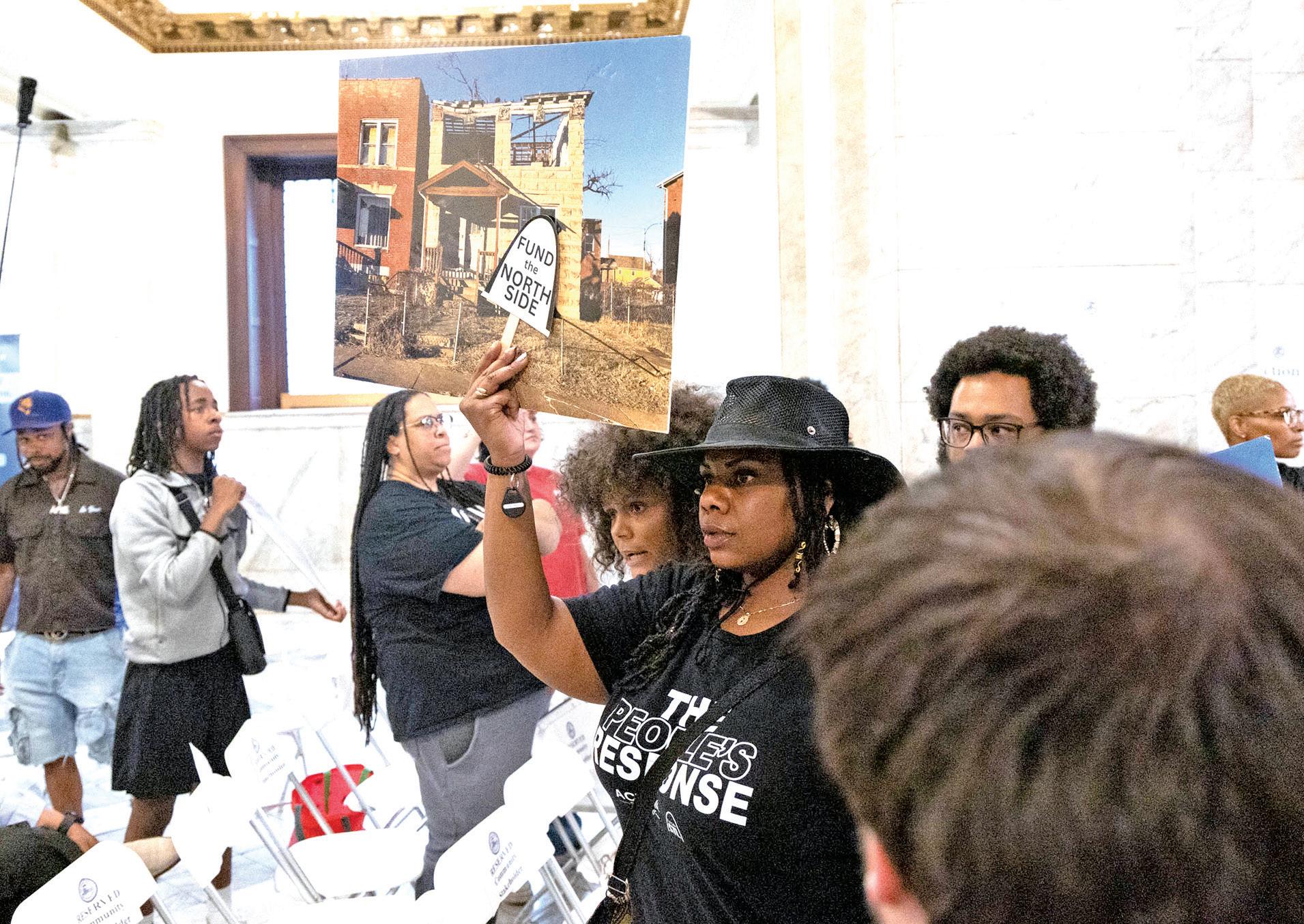
Melanie Randels holds a “Fund the North Side” sign during a protest at Mayor Cara Spencer’s speech on the one-year anniversary of the devastating tornado. A survey found many residents remain dissatisfied with recovery efforts and believe more support is needed in North St. Louis.
Police urge residents not to confront people setting off fireworks
As fireworks complaints increase ahead of the Fourth of July, St. Louis police are urging residents to call 911 rather than confront people illegally discharging fireworks.
The warning follows a June 14 shooting in the 900 block of Rutger Street. Police said a man was shot after confronting a group that had been setting off fireworks in his neighborhood. His injuries were not considered life-threatening.
Mitch McCoy, public affairs and information director for the St. Louis Metropolitan Police Department, said residents should report fireworks activity and provide details about the location, people involved and whether weapons are visible.
Police plan to increase enforcement efforts around the holiday and said people caught illegally discharging fireworks could receive a summons.
Missouri Supreme Court blocks $2.5 million award
The Missouri Supreme Court has ruled that the city of St. Louis is not required to pay a $2.5 million judgment awarded to Michael Holmes, who spent five years in prison after a 2003 drug arrest later tied to police misconduct.
In a unanimous decision issued
County
Tuesday, the court found the city is protected by sovereign immunity. Holmes won the judgment in 2016 after a federal jury concluded former officers Shell Sharp and Bobby Lee Garrett falsely claimed they found him with drugs during a raid.
Port Authority accepting grant applications
The St. Louis County Port Authority is accepting applications for its 2026 Community Investment Fund grant program, which supports economic and community development projects led by nonprofit organizations.
Eligible applicants must have 501(c)(3) status and be located in St. Louis County
or primarily serve county residents or businesses. Grants of up to $300,000 are available for programmatic and construction-related projects.
Applications are due Aug. 11. Grant recipients are expected to be announced in early 2027.
Pilgrim church to dedicate restored gymnasium
Pilgrim Congregational Church UCC will dedicate its restored gymnasium on Friday, recognizing two men who helped shape a youth basketball program that influenced more than 1,000 St. Louis-area young people.
The gym, which sustained significant damage during the 2025 tornado, has been
renovated and will be named in honor of William Dewitt Coby Sr., a coach, mentor and league leader. The dedication will also recognize the Rev. Rudy Raber, who launched the West End Youth Basketball League in 1969. The dedication is scheduled for 2 p.m. at the church.
Fowler named to Lambert CEO search committee
June Fowler, retired vice president of corporate and public communications at BJC HealthCare, has been appointed to the St. Louis Airport Authority search committee overseeing the recruitment of the next CEO of St. Louis Lambert International Airport.
Current CEO Rhonda HammNiebruegge is scheduled to retire in August. Mayor Cara Spencer will select the airport’s next chief executive from candidates identified through the national search process.
My father’s formula for leadership
By Michelle D. Tucker
With Father’s Day just behind us, I’ve found myself reflecting on the lessons my dad taught me — lessons that have shaped not only who I am as a person, but also how I lead.
Growing up, my father had a reputation for being a math whiz. Numbers seemed to come naturally to him, and he believed they should come naturally to his children too. Much to my frustration, he rarely let an evening pass without challenging my siblings and me with math problems and complex scenarios.
After a long day at school, all I wanted to do was play outside or relax. Instead, I would often find myself sitting at the kitchen table solving equations or answering questions that sounded more like word puzzles than homework assignments.
“If a boat leaves the port at this speed and a train leaves at the same time traveling another route, which arrives first?”
At the time, I viewed those exercises as unnecessary obstacles standing between me and a carefree evening. What I didn’t realize was that my father wasn’t just teaching math. He was teaching me how to think.
“What seemed like math lessons were actually life lessons. My father was preparing us for a world where challenges are inevitable and solutions are rarely obvious.”
Commentary works the same way. Effective leaders don’t wait for problems to appear before they begin thinking about solutions. They gather information, anticipate obstacles, evaluate possibilities and prepare for multiple outcomes. Preparation creates confidence, and confidence creates stability during uncertain times. Second, logical reasoning is a leadership superpower. The problems my father presented weren’t always about finding the right answer. They were about understanding the process. He wanted us to break challenges into smaller pieces, analyze the facts and think critically before making decisions. As a leader, I draw upon that lesson regularly. Complex situations often require us to make decisions with incomplete information. The ability to think methodically, weigh options and remain objective is invaluable. Looking back, I am grateful for those evenings that once felt so inconvenient. What seemed like math lessons were actually life lessons. My father was preparing us for a world where challenges are inevitable and solutions are rarely obvious. As we move beyond Father’s Day, I encourage you to reflect on the lessons someone invested in you long before you fully appreciated them. Often, the wisdom we resisted the most becomes the wisdom we rely on the most.
Years later, I understand that those kitchen table lessons provided the foundation for two leadership principles I rely on every day: preparation and logical reasoning.
First, preparation matters. My father taught us that success rarely comes from luck. It comes from being ready. The more we practiced solving problems, the more confident we became when facing new challenges. Leadership
For me, though I lost my father over a decade ago, every leadership challenge I encounter still feels a bit like one of his equations. The answer may not be immediately clear, but with preparation, critical thinking and persistence, a solution can always be found.
Michelle D. Tucker is president and CEO of United Way of Greater St. Louis.

Michelle Tucker
From teen DJ to teen mentor

students
Aereon Robinson is teaching peers entrepreneurship through music
By Sylvester Brown Jr.
St. Louis American
For 17-year-old Aereon Robinson, music translates into entrepreneurship.
That’s the lesson he’s teaching young people through Future of Music, the youth-led nonprofit he founded to introduce students to DJing, music production and entrepreneurship.
Future of Music is dedicated to helping young people explore opportunities in music, technology and business. Robinson, who
goes by the name “DJ Oreo,” said the goal is to show them how creative interests can become business ventures and, eventually, careers.
“I felt like it was the perfect age to introduce kids to the DJ business.”
“Music is the face of it, but entrepreneurship is what we want them to pursue,” Robinson said. He chose to work with youth ages 10 to 18 for a reason.
– Aereon Robinson
“I felt like it was the perfect age to introduce kids to the DJ business,” Robinson said. “Because math is involved, 10 is the sweet spot. That’s when I started. The reason I capped it at 18 is because — with me being 17 — a lot of older kids might not accept knowledge from someone my age.”
Robinson led a session Monday for students participating in Beyond Housing’s Children’s Defense Fund Freedom School, a summer program designed to keep young people academically engaged.
Caleb Jones, 12, and Noah Stephenson, 11, said they enjoyed learning how to “produce music, do beats, learn to scratch” and record music on a computer.
Eleven-year-old Harmony Hughes, who wants to pursue
See Robinson, A6
Your home is an investment
Sponsored by JPMorganChase
For most Americans, owning a home has long been considered a cornerstone to building and preserving generational wealth. A home purchase often symbolizes more than just securing a place to live – homeownership can help anchor families, support long-term financial stability and fuel local economic growth.
If you currently own a home or if homeownership is one of your financial goals, it’s important to understand how your home can be a foundational pillar in helping you build and maintain generational wealth. A home can be an asset that appreciates over time as you build equity which can serve as a financial
See Home, A6

Major appointed Marian Middle principal
Middle School has named Quanisha
as principal of the Catholic all-girls school. Major previously served as director of staff and scholar culture at Momentum Academy and has also worked as a school principal. Under her leadership, Momentum Academy Fox Park was recognized among the top five St. Louis schools for student growth in the 2024 PRiME Center at Saint Louis University Growth Report. Major holds two master’s degrees in education from the University of Missouri-St. Louis.
Cenya Grimes appointed to scholarship board
Cenya (Nya) Grimes has been appointed to the board of directors of The Scholarship Foundation of St. Louis. Grimes serves as Ameren’s manager of corporate philanthropy and community impact. She joined the utility in 2011 as a corporate recruiter.

Cenya ‘Nya’ Grimes
Before joining Ameren, Grimes worked as a corporate recruiter for NextGen and Aerotek. She holds a bachelor’s degree in business administration and management from Southern Illinois University Edwardsville.
Sandra Moore honored by Novogradac Sandra Moore
Sandra M. Moore, managing director and chief impact officer at Advantage Capital, received the Robert E. Ibanez Award for Outstanding Achievement in Community Development as part of the 2026 Novogradac Journal of Tax Credits Awards. Moore holds a law degree from Washington University School of Law in St. Louis and a bachelor’s degree in urban studies from the university’s College of Arts and Sciences.
Novogradac is a national professional services organization that provides accounting, valuation and consulting services.
Cassandra Williams receives leadership award
Cassandra Williams
Cassandra Williams, deputy director at the St. Louis Agency on Training and Employment, received the inaugural Stacey Fowler Leadership & Heart Award during the 2026 Midwest Urban Strategies Summer Convening. Williams was recognized for more than 25 years of service in workforce development, training and compliance management. The award honors the legacy of Stacey Fowler, a workforce development leader and founding Midwest Urban Strategies board member.
Promotion, board appointment, new hire, award... please submit your People on the Move item (including photo) to areid@stlamerican.com
Marian
Major
Quanisha Major
Photo courtesy of JPMorganChase & Co
Photo by Lawrence Bryant / St. Louis American
Caleb Jones, 12, works on a DJ controller as Aereon Robinson, 17, also known as DJ Oreo, teaches
about DJing, music production and entrepreneurship during a Future of Music learning session at Beyond Housing’s Children’s Defense Freedom School.
A Q&A with Greg Smith
a career in music, said Robinson helped make her feel like she can pursue her musical ambitions. Likewise, Maya Johnson, 12, said DJ Oreo showed them all how to do things they’ve “never done before.”
Robinson’s father, Leon Robinson, said he is proud of what his son has accomplished.
“Ah, man, he’s a oneof-a-kind kid,” Robinson said. “He makes me want to cry every day.”
Turning his passion into a nonprofit was entirely his son’s idea, he added.
“He reads all kinds of books and has all kinds of ideas, so that was all his doing.”
Although Robinson launched Future of Music last year, he has been building his own business since childhood.
His father produced music as a hobby, and his uncle, Tyrone Sloan, worked as a DJ. Robinson said his interest in DJing began when his uncle dropped off a bag of unused audio equipment at the family’s home.
“As a curious 10-yearold, I went through the bag and saw a bunch of cords and stuff and a little controller,” Robinson said.
“So I plugged it into my computer and downloaded some music software, and it all started from there.”
That discovery eventually led to his first public performance. Robinson said his father paid an event organizer at a local children’s pop-up shop $25 to give his son an opportunity to DJ.
“It was a great experience,” Robinson recalled. “I met several clients who book me to this day. For me, it was a realization
that this is easy and I could probably do it for the rest of my career.”
Robinson said he has since DJed hundreds of events, including nonprofit programs, parties, concerts and events at St. Louis City Hall. Performing under the name DJ Oreo, he now works events throughout the region.
Ariana Martineau, Robinson’s former history teacher at Principia, said she saw the same determination in the classroom that now drives his entrepreneurial efforts.
“History was not even close to one of his favorite subjects, … but he just tried and tried so hard to be good in my class,” Martineau said. “That’s a testament to who he is. He just doesn’t let any limits or boundaries affect him. If he wants to achieve something, he’s going to do it.”
As his business grew, Robinson said he became increasingly interested in the entrepreneurial lessons behind it.
“I did it really by networking and getting my name out there,” he said.
“My dad urged me at every event to promote my Instagram and give out business cards.”
That experience helped shape Future of Music.
The organization is building toward a free 12-week program that will teach DJing, music production and entrepreneurship. Robinson said the nonprofit currently provides mentoring and smaller programs while expanding its reach.
“There weren’t that many youth entrepreneurs, especially in the music or DJ industry,” Robinson said. “I feel like St. Louis doesn’t have enough youth voices or youth advocacy. Being somebody who can advocate for better things means a lot to me.”
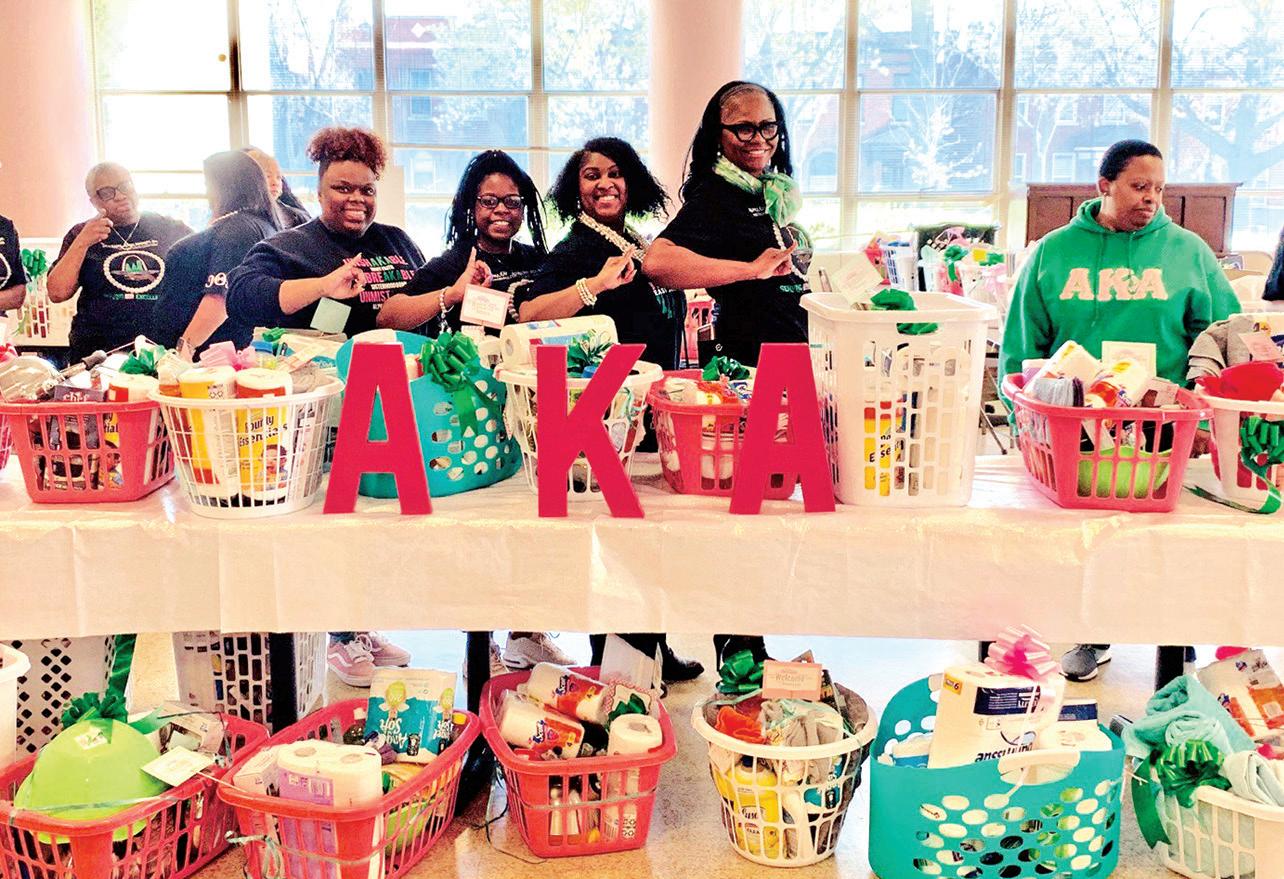
Celebrating through service
Members of the East St. Louis-based Delta Delta Omega Chapter of Alpha Kappa Alpha Sorority Inc. delivered 80 laundry baskets filled with household items to Metro East shelters and social service agencies. The “80 Baskets of Blessings” project marked the chapter’s 80th anniversary and benefited organizations serving individuals and families experiencing homelessness and other hardships.
Robinson has recruited several young volunteers to help operate the nonprofit. Gabrial Walker, 18, serves as program coach.
Qwentin Blassingame, 16, is managing director, and Jerimiah Jones, 16, serves as communications intern and assists with the DJ program.
The group has developed partnerships with organizations including Beyond Housing and The Opportunity Trust.
Robinson said Future of Music will soon launch a free DJ program with a local Children’s Defense Fund Freedom School and is working with the St. Louis Office of Violence Prevention.

“I’ll talk about the struggles I’ve been through to start Future of Music and we’ll work to inspire them to think outside the box to go get what they want in life without letting others dictate what they should do,” he said.
One of Robinson’s earliest clients was Barbara Davis, program manager for the city of St. Louis Office of Financial Empowerment. Since he was 12, Davis has hired him to DJ youth events connected to the office’s College Kids program and other initiatives.
Davis said Robinson’s impact extends beyond music.
“He articulates very
Home
Continued from A5 resource for you and your family for decades to come.
Greg Smith, a Community Home Lending Manager at Chase in St. Louis shares more about the connection between homeownership and building generational wealth, and how you can make sure your home becomes, or remains, your most important financial asset.
Q: How does a home create generational wealth?
A: There are several perks to homeownership, many of which contribute to building wealth. Owning your home may be cheaper than renting in the long term if you have a mortgage with competitive rates; however, it’s important to keep in mind other home expenses, like insurance and taxes, when considering costs. Plus, since you own the home, that means you can build and tap into your equity for future expenses or profit when your home is sold.
Another way to think of homeownership as it relates to your financial picture is that it can influence your overall net worth. When you make monthly payments, you’re slowly owning more of your home and it can become an asset. On the other hand, if you rent, your monthly housing costs are just an expense for a place to live and you don’t own any of it when you leave. Put simply, owning a home may help you grow your money over time.
Q: Explain home equity and how building equity works.
A: The technical definition of home equity is the difference between
well when he speaks to our youth,” Davis said.
“Aereon inspires them with his message of, ‘If I can do it, you can do it, too.’ He’s done amazing work with us.”
Robinson, a senior at Principia School, said he sees Future of Music as only the beginning.
“I have multiple passions for many things,” he said. “I know it sounds big, but since my name is Aereon, I see myself owning my own airline. I love aviation, but that’s not my real passion.
When asked whether he has taken on too much at such an early age, Robinson answered honestly.
“Kinda, but not really. I believe I have great balance. I plan my schedule for specific things, like school or weekend events,” he said.
“Sometimes I do miss things, but it’s no big deal because I feel like what I’m doing for my community is more important.”
“So, I see myself in education in some way, shape or form. Since I see discrepancies in public education, I see myself as an education advocate, also.”
the fair market value of your home and how much you still owe on your mortgage. Essentially, think of it as the part of your home’s value that you truly own. It’s made up of the amount you’ve already paid off, plus any increase in your home’s value. So, if you’re home’s value goes up, so does your equity and vice versa. Equity grows as you pay down your mortgage and, as I mentioned earlier, the market value of your home increases.
Q: How can this be beneficial financially?
A: There are a few ways. You can borrow against your home equity by taking out a loan, using your property as collateral to secure the loan. There are a variety of ways you can do this such as through a home equity loan, home equity line of credit (HELOC) or a cash-out refinance. You may use these funds to cover other expenses, like high-interest credit card debt, make home improvements, invest in another home or in an emergency. Home equity loans also tend to have more favorable terms than credit cards or other personal loans, potentially saving you money in the long run.
Q: What if you sell your home?
A: The more equity you have, the more you can profit from selling your home if you do so in the future. For example, if you’ve paid off your entire mortgage before you sell, you may get to keep all potential profits. If you haven’t paid off your mortgage, any profits will pay off what you owe and you’ll keep the remaining funds-- the more home equity you have, the greater your profit could be.
Sylvester Brown Jr. is the Deaconess Foundation Community Advocacy Fellow.
Q: What other benefits come from owning your home?
A. Homeownership offers the potential opportunity for tax deductions. The interest you pay on your mortgage, insurance premiums, property taxes and even improvements to your energy efficiency may provide an opportunity for tax deductions. You can consult with your tax advisor if you’re looking to understand how buying a home may impact your taxes.
There’s no place like home
Homeownership has long been a powerful tool for building generational wealth in communities across the U.S. and can help you secure a solid financial future for yourself and your family. Your home is more than just the place where you rest your head—it can be your greatest financial asset.
For informational/ educational purposes only: Views and strategies described in this article are not intended as specific advice/recommendation for any business. Information has been obtained from sources believed to be reliable, but JPMorgan Chase & Co. or its affiliates and/or subsidiaries do not warrant its accuracy. The material is not intended to provide legal, tax, or financial advice or to indicate the availability or suitability of any JPMorgan Chase Bank, N.A. product or service. You should carefully consider your needs and objectives before making any decisions and consult the appropriate professional(s). Outlooks and past performance are not guarantees of future results. JPMorgan Chase & Co. and its affiliates are not responsible for, and do not provide or endorse third party products, services, or other content.
Photo courtesy of Delta Delta Omega Chapter
HealthMattersHealthMattersHealthMatters

A free community symposium on Saturday will provide information on lung cancer screening, treatment and support services. Organizers say attendees will be able to learn whether they qualify for lung cancer screening.
Lung cancer screening
Community event to address the leading cause of cancer in the United States
St. Louis American staff
A free community symposium this weekend will focus on lung cancer screening, treatment options and barriers that can prevent people from seeking care.
The event, “Lung Cancer Screening to Treatment 2.0,” is scheduled for Saturday from 11 a.m. to 1:30 p.m. at the International Institute of St. Louis, 3401 Arsenal St.
The symposium is being organized by The HEAL Collaborative in partnership with Five Star Center Inc. and Southside Wellness Center.
Black Americans are more likely to die from the disease than other racial and ethnic groups, despite having lower smoking rates than white Americans.
Organizers said the program will include information on screening eligibility, treatment options, biomarker
and genetic testing, patient navigation services and support resources. Attendees will be able to learn whether they qualify for lung cancer screening through on-site assessments and participate in discussions about stigma, fear and quality-of-life issues faced by patients and families. Attendees will also hear from medical professionals affiliated with Washington University School of Medicine, Siteman Cancer Center and the Department of Veterans Affairs. Lung cancer remains the leading
Getting help before it is too late
AI offers health advice, but experts warn of risks
By Jennifer Porter Gore Word In Black
For millions of Americans struggling to afford health care, a new source of medical advice is only a few keystrokes away.
Some users appear to be turning to AI because they can’t afford a doctor’s visit.
As use of AI tools such as ChatGPT, Claude and Google Gemini becomes more widespread, national surveys suggest that uninsured people — particularly Black Americans and young adults — are among the groups most likely to use them for physical health information and mental health guidance. Some users appear to be turning to AI because they can’t afford a doctor’s visit, can’t schedule an appointment or lack a regular health care provider. While instant, free advice is hard to resist, researchers and patient advocates warn that AI can produce inaccurate, misleading or potentially dangerous recommendations.
The stakes may be even higher for Black patients. Researchers have found that chatbots can reproduce racial biases, generalizations and stereotypes. Using one for medical advice, experts say, could recreate some of the same problems Black Americans have long faced within the health care system.
Higher use among the young, uninsured
A new study published in JAMA Pediatrics earlier this month illustrates the trend. It found that Black youth are around five times more likely than white youth to seek mental health advice from a chatbot at least once a month.
The finding appears to reflect a broader pattern. Black and Hispanic adults are also more likely to use AI for mental health information than white adults and people with health insurance, according to KFF Health Tracking Poll results published in March.
Masculinity and the mental health gap
Deaths among Black men from suicide, overdoses and alcohol abuse continue to rise
By Jennifer Porter Gore Word In Black
Black men are dying from a mental health crisis that too often goes unseen. As deaths from suicide, overdoses and alcohol abuse rise among Black Americans, experts warn that cultural expectations around masculinity, mistrust of mental health systems and a shortage of Black providers are preventing many men from getting help before it is too late. In the waning days of the pandemic, the U.S. saw deaths from suicide, alcohol use and drug overdoses — often called
Suicide was the second-leading cause of death among people ages 10 to 34 and the fourth-leading cause of death among those ages 35 to 44.
“deaths of despair” — among Black Americans surpass those among whites for the first time. Between 2013 and 2022, the rates of these deaths tripled among Black Americans.
The painful numbers
Data from the Centers for Disease Control and Prevention show that nearly twice as many people died by suicide in 2023 as were killed by homicide. Suicide was the second-leading cause of death among people ages 10 to 34 and the fourth-leading cause of death among those ages 35 to 44. That same year, the suicide rate among males was nearly four times higher than among females, with Black men also four times more likely to die by suicide than Black women. Among younger Black men, the trajectory is espe-

Experts warn that pressure to appear strong, combined with barriers to mental health care, is preventing many Black men from getting help before it is too late.
Envato photo
Envato photo
cially troubling. University of Georgia researchers last year found that childhood exposure to
trauma, poverty and racism leads many young Black men
Rapper Mystikal, who earned multiple Grammy nominations in the early 2000s, was sentenced Tuesday to 20 years in prison for sexually assaulting a woman at his Louisiana home in 2022.
Mystikal — whose legal name is Michael Lawrence Tyler — pleaded guilty in March to third-degree rape. The plea agreement capped his sentence at 20 years, five years below the maximum penalty. Prosecutors had originally charged him with first-degree rape, which carries a


Danny Simmons, founder of Rush Arts, dies at 72
mandatory life sentence.
Days before sentencing, Tyler asked the court to withdraw his plea, saying he “did not have sufficient opportunity to fully consider the consequences,” according to Baton Rouge ABC affiliate WBRZ.
In an interview with TMZ, Tyler’s son, Million Tyler, said the case has been emotional for their family.
“I hope you get the help you really need,” he said in a message to his father. “I really hope you do.”
Kevin
Kevin Hart is suing his former assistant for $50,000 after she appeared on blogger Tasha K’s platform and discussed details of his private life.
Miesha Shakes, who worked for Hart from 2017 to 2020, appeared on Tasha K’s podcast and shared information covered under a confidentiality agreement she signed.
Hart’s legal team is now seeking the $50,000 penalty outlined in that NDA, according to TMZ.
TMZ also reports that associates of Tasha K allegedly attempted to extort Hart for $250,000 before the interview aired. Hart says someone claiming to be connected to Tasha K called him demanding the money to keep the segment from being released. When he refused, he reported the alleged extortion attempt to police and issued cease-and-desist letters.

Danny Simmons, the artist, author and founder of Rush Arts, has died at 72. The cause of death was not announced.
Simmons was the older brother of Def Jam Recordings co-founder Russell Simmons and Rev. Joseph “Run” Simmons of Run-DMC. His death was announced last Monday by Russell Simmons on Instagram.
After earning a social work degree from NYU and being employed by the New York Bureau of Child Support through the 1980s, Danny Simmons later became a central figure in contemporary Black art. He created HBO’s Def Poetry Jam, which was adapted into a Tony Award-winning Broadway production. He also wrote the 2003 novel Three Days as the Crow Flies, published by Simon & Schuster.
Russell Simmons called him “the true artist in the family,” noting that his work shaped their creative outlook.
“Though he has transitioned from this world, his legacy of kindness, generosity, and artistic brilliance will forever shine brightly in our hearts,” Russell Simmons said in his post.
Faizon Love faces contempt charges in child support case
Actor and comedian Faizon Love is facing two contempt of court charges in a child support case involving his ex, Tiffany Lee, who alleges he owes about $250,000 in unpaid support.
During recent proceedings, Love described significant financial strain. He reportedly told the court he earns about $10,000 a year in royalties from Elf, drives a 1999 vehicle, and has at times lived out of it.
The case follows Love’s arrest in California earlier this month. He reportedly spent 16 days in custody before being transported to Florida in connection with the contempt orders.
His attorney said Love “was picked up in Riverside County, California and transported some days later to Hillsborough County on orders of contempt from the Honorable Judge Mark Kiser.” Love was released from custody on Monday, June 22, as the case continues. Additional hearings are expected as both sides address the child support dispute.
Hot Sheet Sources:
Allhiphop.com, Instagram, The Source, TMZ.com, WBRZ.com

Mystikal
Faizon Love
Kevin Hart
Continued from A7
The findings come amid growing concerns about mental health in Black communities, including suicide rates that have risen over the past two decades.
Kamal Grewal, a health technology entrepreneur, worries that AI therapists can give young people in crisis the illusion of support even when the technology may do more harm than good. Several major AI companies, including OpenAI and Google, are facing lawsuits alleging their chatbots contributed to or encouraged user suicides.
“Consumer AI tools are optimized to keep users engaged: they validate, they agree, they make you feel heard,” said Grewal, creator of Therapy Companion, an AI tool designed to help therapists with administrative and non-patient services.
“That’s great for retention
Lung cancer
Continued from A7 cause of cancer deaths in the United States. Black Americans are more likely to die from the disease than other racial and ethnic groups, despite having lower smoking rates than white Americans, according to the American Lung Association and other health organizations.
The symposium is intended to address misconceptions about who is at risk for lung cancer. While smoking is associated with most lung cancer cases, organizers noted that other factors,
Deaths
Continued from A7
and 2020, the suicide rate among Black youth ages 10 to 17 nearly tripled, rising faster than that of any other racial or ethnic group. Suicide is now the second-leading cause of death among people ages 20 to 24. For Black men in the same age group, however, the suicide rate surpassed that of their white peers in 2024 — a troubling historical first.
Playing tough can be fatal
Traditional definitions of masculinity — stoic, self-reliant and emotionally controlled — have been found to increase the likelihood that men of all ages will avoid seeking professional help. Researchers say those men often fear being judged as weak, a perception that raises stress and contributes to untreated depression and anxiety.
In 2023, just 17% of
metrics, but dangerous for someone in a mental health crisis, where what you need isn’t validation but a trained clinician who can challenge your thinking and hold you accountable.”
It’s no surprise that AI use is higher among younger people and is gaining traction among adults.
Roughly one-third of adults responding to a nationwide poll said they used AI chatbots last year to get health information. Of those who used AI for health information, about one-third were looking for advice about physical health matters and just over 15% searched for mental health advice.
Most respondents said they were looking for immediate advice. But there are indications that problems affording or finding health care also played a role for some respondents, especially younger adults.
The RAND study published in JAMA estimates that roughly 8.2 million young people nationwide
including radon exposure, air pollution, asbestos and genetics, can also increase risk. Many people diagnosed with lung cancer have never smoked.
According to The HEAL Collaborative, 87 people attended a previous St. Louis symposium and seven participants were identified as eligible for lung cancer screening. Organizers said the results highlighted the role community outreach can play in connecting residents with preventive care and medical resources. Admission is free, and lunch will be provided. Registration is required at healcollaborative.org.
American men saw a mental health professional, roughly half the rate of women. Among men who said they were depressed, only one in four received counseling or therapy during the previous year.
Black adults, however, were 36% less likely to have received mental health treatment during the previous year, even though they experienced similar or higher rates of anxiety and depression than whites.
In a newly released report, the JED Foundation, a nonprofit dedicated to protecting emotional health and preventing suicide among teens and young adults, found that boys are socialized from an early age to internalize their emotions rather than express them.
The report, titled “The Emotional Lives of Boys and Young Men,” found that when distress surfaces, it often looks very different from the depression and inactivity commonly seen in girls and young women.
Instead, according to the report, boys and young
HealthMattersHealthMattersHealthMatters

reported using artificial intelligence for mental health advice this year, an increase of 40% compared with last year.
The study sampled 1,009 youth, including 95 Black respondents. The authors noted the sample size for that analysis was small and said the issue requires further investigation.
Among youth who sought mental health advice from AI chatbots, 42.8% did so at least once a month and 91.7% said the advice ranged from “somewhat” to “very”
helpful. More than twothirds of adolescents said they had not told anyone they used AI chatbots for mental health support.
Chatbots used included ChatGPT, Gemini, Character.AI and Meta AI. Young people tended to consult them when they felt angry, nervous, sad or stressed.
Bias hidden in the code
A 2024 study published in Nature found that when large language models were given prompts writ-
ten in African American English, they produced stereotypes as negative as — or worse than — those recorded from humans during the Jim Crow era, without users’ race being mentioned.
The AI systems assigned speakers of African American English to lower-prestige jobs, convicted them more often in hypothetical criminal cases and more frequently recommended the death penalty when that punishment was an option.
Sharese King, assistant professor of linguistics at the University of Chicago, said the findings did not make her optimistic.
“If we continue to ignore the field of AI as a space where racism can emerge, then we’ll continue to perpetuate the stereotypes and the harms against African Americans,” she said.
The implications for teen mental health could be significant because many Black youth communicate in some form of African American English. If a chatbot they trust for

men are more likely to disguise their distress by withdrawing, displaying anger or aggression, or engaging in risky behaviors such as reckless driving, substance abuse, compulsive gambling or unsafe sexual activity.
At the same time, online environments such as video games and social media can be a double-edged sword, according to the report.
“Digital environments can amplify both harmful and supportive pathways, with opportunities for humor, distraction and connection,” the report states. But they can also provide “exposure to harmful content, cyberbullying, and gambling and sports betting.”
Black provider shortage
While research indicates that having a caregiver of the same race and gender can be beneficial, Black practitioners remain a small minority across the mental health profession. Only 4% of psychologists

are Black. Just 2% of psychiatrists are Black, and only 11% of licensed professional counselors are Black.
Research has also shown that peer-support groups can be effective in communities that face limited access to mental health professionals as well as mistrust of clinical settings.
Organizations such as JED have launched partnerships with frater-
nal organizations in an effort to reverse these trends. Last month, JED announced a partnership with Alpha Phi Alpha Fraternity Inc. as part of its Greek-letter organization initiatives.
“The JED Foundation recognizes that fraternities and sororities are powerful communities for connection, leadership and identity development,”
Dr. ShirDonna Lawrence, senior manager of JED
advice about depression, anxiety or a personal crisis is unknowingly responding differently because of how they speak, the help being offered may itself be biased.
Among Black youth, use of AI for mental health support appears to vary by gender.
Black teenage girls are more likely to use chatbots to address anxiety, depression and relationship stress. Researchers say Black teenage boys are generally less likely to disclose emotional struggles, but when they do turn to a chatbot, they may already be experiencing acute distress.
Grewal said the growing reliance on AI for mental health support among Black Americans is troubling.
“Black adults are already turning to these tools at nearly double the rate of white adults, which means the people most underserved by the mental health system are also the most exposed to AI that isn’t built to help them,” he said.
Lung cancer remains the leading cause of cancer deaths in the United States. A free community symposium on Saturday will focus on screening, treatment options and resources available to patients and families.
Greek-letter organizations, said in a statement. “This makes them essential partners in advancing student mental health and well-being on and off campus.”
The partnership is intended to be mutually beneficial.
“It strengthens Alpha’s enduring mission and advances JED’s work in culturally responsive, community-centered mental health promotion,” Lawrence said.

Envato photo
Studies suggest Black Americans are more likely than white Americans to use AI tools for health and mental health information.
Envato photo
Continued from A1
blood.”
“Justice” is the word Powell returns to repeatedly when discussing his work as founder of the Powell Law Firm, a Clayton-based personal injury practice.
“I take my job very seriously,” Powell said. “My job is not a joke. I stand between people and these huge corporations … and I deliver justice.”
Powell grew up in a family where civil rights leadership instilled a desire to advocate for others, he said. His father, Dr. Kenneth Powell II, a longtime St. Louis dentist, was active in the civil rights movement and, as a member of the Morehouse College Glee Club, sang at the funeral of the Rev. Dr. Martin Luther King Jr. Family friends included prominent Black attorneys and civil rights leaders such as Wayman Smith, Frankie Muse Freeman, Margaret Bush Wilson and Charles R. Oldham.
Powell and his twin older sisters grew up in St. Louis County. His mother, Carol Dianne Powell, retired after thirty years of teaching English and African studies at Ladue (Horton Watkins) High School. He later captained the men’s tennis team at the University of Kansas.
“Tennis is an individual
sport. If I lose, it’s on me. If I win, that’s on me, too. I can’t pass the buck,” he said. “But no one’s going to out-work me. It’s a mindset of being relentless.”
Following graduation from college, Powell attended Saint Louis University School of Law on a Dean’s Scholarship. He later became a licensed sports agent representing professional baseball players before his legal career took a different turn.
The turning point came after his father was injured in a crash involving an 18-wheeler. At the time, Powell was practicing employment law and began searching for a Black-owned firm focused on catastrophic injury and trucking cases.
He couldn’t find one.
Instead, he partnered with family friend Johnny Simon of Simon Law, who introduced him to the complexities of trucking litigation.
“I learned from the best,” Powell recalled.
Simon said the admiration is mutual.
“Kenny is a terrific lawyer and an even better person,” Simon said. “He cares about his clients and it has been a great pleasure to work with him to help hold wrongdoers accountable.”
After working several cases with Simon, Powell launched his own firm in 2017 from a small shared office in Clayton. Today, the firm handles
personal injury, wrongful-death and trucking cases in Missouri and Illinois.
Powell was part of a legal team, including attorney Ben Crump, that represented victims and survivors following the 2021 collapse of an Amazon warehouse in Edwardsville, Illinois, where six workers died after a tornado struck the facility.
More recently, he was part of a legal team that secured a $50 million wrongful-death settlement in a case involving the
death of a young man whose family alleged a medical equipment provider failed to replace critical respiratory equipment after it malfunctioned.
One of Powell’s former clients, Ryan, who asked to be identified only by his first name because of the sensitive nature of his legal matter, recalled a case that required “legal expertise in multiple fields.”
“I was having a hard time getting a law firm that would listen to me because of the complex nature of the case,” Ryan
said. “Kenneth Powell was the only attorney in St. Louis who was able to understand my entire legal situation and took the time to help me.”
When asked what being a lawyer means to him, Powell paused and exhaled deeply before answering.
“It’s a license to fight for justice,” he said. “It affords me the opportunity to go into a court of law and fight for justice with dignity. A lot of times the dignity part is left out.”
That commitment extends beyond the courtroom. Powell has
partnered with organizations including the Urban League of Metropolitan St. Louis, United Way, the Salvation Army, the Jewish Community Relations Council and the Ecumenical Leadership Council.
“Kenny Powell has a strong commitment to the community,” said Michael P. McMillan, president and CEO of the Urban League of Metropolitan St. Louis. “He has worked with the Urban League and other organizations during COVID, tornado relief efforts and is engaged with us as we reopen our Cultural Center.”
Powell said he wants to create opportunities for young people.
“We’re creating a generational business where young Black and Brown students can see themselves accomplishing great things,” he said. “A firm that understands where they come from.”
The photograph in his office serves as a daily reminder of that mission.
“Although times are challenging, it reminds me every day that we’ve overcome much worse,” Powell said.
“It reminds me that I have an obligation to leave this world better than the way I found it.
“That’s why that picture’s on my wall.
“So I can see it, feel it.”
Sylvester Brown Jr. is the Deaconess Foundation Community Advocacy Fellow.
“A lot of joy, smiles, peace, a lot of happiness.”
Obama Center
Continued from A1
“I know my mom and dad would be ecstatic to be here,” she said. “But the blessing is that I’m able to be here for all the people who cannot, regardless of if they’re living or not living.”
Washington, president of the St. Louis chapter of Jack and Jill of America, Inc., made the trip to Chicago with her longtime best friend and fellow St. Louis native Erica Walker. As they moved through the exhibits together, Washington found herself thinking about the sacrifices that shaped her family and the history that made the moment possible.
The Obama Presidential Center opened June 19, Juneteenth, on a 19-acre campus on Chicago’s South Side near where Obama began his career as a community organizer. The center includes a museum, public spaces, community programming and exhibits tracing the nation’s ongoing struggle to expand democracy and opportunity.
“It’s breathtaking,”
Data Center
Continued from A1
revenue and investment. Critics worry about electricity demand, water consumption, environmental impacts and whether nearby neighborhoods will receive meaningful longterm benefits.
The NAACP argues that Black communities should not be asked to choose between economic development and environmental protection.
“That is a false choice,” the report states. “The better framework is rightsbased development: if data centers want access to St. Louis land, utilities, and public legitimacy, they must protect health, respect community participation, and create enforceable public value.”
National NAACP
President and CEO
Washington said. “It’s beautiful. It’s exuberant. It gave me hope.”
Walker felt the energy, too.
“A lot of joy, smiles, peace, a lot of happiness,” she said. “People were full again.”
The experience began before they reached the upper floors. Exhibits on women’s suffrage and voting rights stopped both women in their tracks.
From there, the center takes visitors on a deeper journey. A three-story audio-visual wall weaves together American history and the voices of figures such as James Baldwin and Obama. The opening exhibit, “We the People: Toward a More Perfect Union,” traces the country’s journey through slavery, Jim Crow and the Civil Rights Movement.
For Washington, hearing even a fragment of Baldwin’s voice rising from that wall was enough to stop her completely.
“It starts with ‘We the People’ and goes through the Civil Rights period, Jim Crow,” she said. “That part was really emotional for me.”
Outside, a plaque honoring voting-rights
Derrick Johnson said communities should not be left to absorb the costs of technological growth without protections.
“Communities should not be forced to absorb the environmental and economic costs of technological growth without safeguards or consent, and innovation must not come at the expense of clean air, clean water, or affordable utilities,” Johnson said.
The St. Louis report argues that those concerns are especially important in Black neighborhoods that have historically experienced disproportionate environmental burdens while receiving fewer long-term benefits from major projects.
“For St. Louis, this principle is especially important for African American communities that have historically borne disproportionate environmental burdens while
activist Fannie Lou Hamer stopped her again. Hamer was beaten repeatedly for trying to vote and refused to be silenced. Washington left with something sharpened inside her: a renewed commitment to voter engagement and grassroots action.
“Each of us have some level of influence and power,” she said. “We need to use it for the good.”
For Valeriano Blackburn, an East St. Louis native now living in Chicago, the center represents more than a presidency. A father of three and youth advocate, he sees it as a reminder of the generations whose sacrifices made Obama’s rise possible.
“You’re standing on the shoulders of giants when you walk through that facility,” he said. “It’s not just Obama. It’s everyone who came before him as well.”
The center also has a St. Louis connection. Daria Smith, a St. Louis native and former St. Louis American Foundation scholarship recipient, spent nearly five years helping develop
receiving too little of the long-term wealth, ownership, and infrastructure value produced by major development projects,” the report states.
According to project documents, developers are seeking no local tax abatements or incentives and project the development will generate hundreds of millions of dollars in new tax revenue over its first decade. The proposal also includes commitments to create more than 1,000 union construction jobs and hundreds of permanent positions.
The project is also subject to a legally binding Community Benefits Agreement requiring environmental reporting, water-efficiency measures and other safeguards. Project documents also commit approximately $15.75 million to a city-directed community benefits fund supporting digital-ac-
exhibitions before the center opened.
“It finally kind of hit me,” Smith said. “That I’ve been a part of something that’s really going to make an impact in the community.”
Smith said growing up with access to cultural institutions such as the Saint Louis Art Museum, the Missouri History Museum and the Saint Louis Zoo shaped her understanding of what museums and public spaces could be. She said that experience influenced her work helping create a center designed to be accessible and welcoming beyond its museum walls.
Before she left, Washington walked the grounds one last time. She thought about her father, who loved long walks, and her mother, who believed in showing up. The center, she said, felt like proof that their showing up for the Obama campaign nearly 20 years ago mattered.
“You have to know where you come from,” she said, “to have an appreciation for where you are and where you’re going. The Center helps bridge that gap.”
cess initiatives, infrastructure improvements and environmental-justice programs.
The project’s approval followed months of public hearings and neighborhood opposition focused on energy use, water consumption and whether the promised economic benefits justified the scale of the development.
Alderwomen Alisha Sonnier and Anne Schweitzer recently sought to prohibit mega-scale data centers citywide.
“We’re talking about an unregulated industry that has grown in a way that I don’t think we would have wanted it to, based on the intensity of use and the drain on our resources,” Schweitzer said during Planning Commission discussions.
Commissioners ultimately rejected the proposed ban and instead advanced regulations
allowing data centers under strict conditions.
The organization argues that communities should have access to independent expertise when evaluating major projects and should receive detailed information about energy demand, water consumption and environmental impacts before approvals are granted. It also advocates for oversight structures that would monitor compliance with community-benefit commitments.
“Applied to St. Louis, this means the central question is not whether AI will exist, but whether the Black communities of St. Louis will simply absorb externalities for a digital economy owned elsewhere or instead become protected, compensated, trained, connected, and included participants in that economy,” the report states.
The proposal urges the city to require eco-
nomic-impact reporting, support apprenticeship and pre-apprenticeship programs, expand digital-access initiatives and invest in broadband access, technology training and business development in Black communities.
The report concludes with a warning that St. Louis should not allow technological growth to repeat patterns that have left some neighborhoods carrying the costs of development while receiving few of its rewards.
“St. Louis therefore should adopt a clear rule: ‘No data center without community protection, no community protection without enforceable terms, and no use of Black neighborhoods as sacrifice zones for someone else’s digital economy.’”
Sylvester Brown Jr. is the Deaconess Foundation Community Advocacy Fellow.
Kenneth Powell III, founder of the Powell Law Firm, holds framed pieces of his family history inside his Clayton office, including a photo of his ancestors and a jersey honoring his family’s legacy. Powell said the images remind him of the sacrifices that shaped his mission to fight for justice.
Photo by Lawrence Bryant / St. Louis American
Shatesha Holder, right, her daughter, Teagan and husband, Michael, pose in front of the Obama Presidential Center.
Photo courtesy of Shatesha Holder

It
Black cowboy culture hits Chaifetz

Crowds turn out in western wear as riders showcase skill, tradition and community
The SERA Rodeo returned to Chaifetz Arena on Saturday afternoon, drawing a crowd ready for an afternoon of competition, culture and community. Riders from across the country arrived with the horses they’ve trained for years, all competing for cash prizes, belt buckles and bragging rights for the 7th Annual
Fans from St. Louis and Illinois showed up in denim skirts, shorts and over alls, paired with boots and cattlemancrease hats. Those who came without western gear found vendors outside selling hats, buckles and other accesso ries.
Inside, Dr. BJ the DJ and DJ Stew.Net of 100.3
The Beat welcomed guests. Stew.Net, celebrating his birthday, moved the crowd from Nelly’s “Shake Ya Tailfeather” to country favorites like “Boots on the Ground” as people settled into their seats.
On the arena floor, horses, steers and calves shifted in place as the crowd waited for the show to begin. At the announcer’s request, attendees rose for the Black National Anthem. A cowgirl carrying the African American flag circled the arena, followed by the national anthem and a second rider carrying the American flag in honor of veterans. The opening ceremo ny closed with “America the Beautiful,” played with a
See Rodeo, B3


By Kenya Vaughn St. Louis American
House of Soul owner Nichol Stevenson has never been interested in the spotlight. After more than two decades in the entertainment industry as a manager, event producer — and now a club owner — she still moves like someone who prefers to work behind the scenes rather than stand at center stage.
Most of the thousands who filled Washington
Avenue between 12th and 14th streets wouldn’t recognize her in a lineup. Yet they were there because of her — gathered for the House of Soul’s 7th Annual Juneteenth Block Party. Stevenson’s venue anchors the celebration, and the block party itself is her creation.
“I wanted us to have a place to celebrate us,” Stevenson said. “Something that was for us, but also something that was by us.”
What began on the intimate patio of her establishment at 1204 Washington Avenue now stretches nearly three city blocks.

Stevenson was barely visible in the crowd, but she could be seen moving quickly from one end of the footprint to the other, making sure everything ran smoothly. Around 5 p.m., she paused and looked around. Her mirrored aviator sunglasses hid her eyes, but her lips trembled as she took in the moment. It passed quickly. She went right back to work — ensuring that the thousands who had come through were celebrating Black culture on a day the nation sets aside to honor Black liberation.
“If you love being Black, clap your hands,” rapper and activist Tef Poe said as he accepted his Community Leadership Award during the program honoring this year’s recipients. Poe dedicated his award to Black educators.
“I wouldn’t be here without the teachers at Pine Lawn Elementary, which is now Barack Obama Elementary,” he said. “The power of Black teachers can change this whole planet — that’s what we need more of. If you are intrepid about teaching
See Block Party, B3
Gerdine Young Artist alum steadies the center of OTSL’s ‘Romeo and Juliet’
By Kenya Vaughn St. Louis American
When Opera Theatre of Saint Louis needed someone to step into one of the most electric roles in its season — and do it with almost no notice — they turned to Gerdine Young Artist alum and baritone Benjamin Taylor. He had planned to be in Seattle learning how to barbecue and “make the perfect croissants.” Then the call came from his agent. “They said, ‘Hey, you gotta go to St. Louis. Are you able to do it?’” he recalled. “I’m like, yes, absolute-
Photo by Taylor Marrie / St. Louis American
Photo by Taylor Marrie / St. Louis American
Mercutio (Benjamin Taylor) teases his friend Romeo (Leonardo Sánchez, left) in the Opera Theatre of Saint Louis presentation of ‘Romeo and Juliet.’
Photo by Eric Woolsey / Courtesy of Opera Theatre of Saint Louis
St. Louis American Calendar

CONCERTS
Sun., July 5, 7 p.m., City Winery St. Louis welcomes Glenn Jones, City Winery, 3730 Foundry Way, St. Louis, MO. For more information, visit www.citywinery.com
Fri., July 10, 7 p.m.
doors, St. Lunatics 25th Anniversary Show, The Pageant, 6161 Delmar Blvd, St. Louis, MO 63112. For more information, visit www.thepageant.com
Thur., July 16, 7:30 p.m. MATI presents Jon Baptiste Live: A Fantastical Musical Journey, The Fox Theatre, 527 N Grand Blvd, St. Louis, MO 63106. For more information, visit www.fabulousfox.com
Fri., July 17-July 19, Music At The Intersection (MATI) 2026, various times and locations within the Grand Center Arts District. For more information, visit matistl.org.
Tue., Jul. 21, 7 p.m. The R&B Tour starring Usher and Chris Brown, The Dome at America’s Center. For more information, visit www.livenation.com.
Fri., July 24, 7 p.m. doors, Buddy Guy 90 with Carlise Guy & The Nu Blu Band, The Factory, 17105 N Outer 40 Rd, Chesterfield, MO 63005. For more information, visit www.
SPECIAL EVENTS
Fri., June 26, doors 7 p.m. Strawberry Bounce, The Golden Record, 2720 Cherokee St. St. Louis, MO 63118. For more information, visit https:// thegoldenrecord.com
Sat., July 27, 1 p.m. Black Wall Street 314 Festival, Historic Wellston Loop, 6111 Dr Martin Luther King Dr, St. Louis, MO 63133. For more information, visit www. blackwallstreet314.com
Sat., June 27 – Sun., June 28, PrideFest STL 2026, headliners include En Vogue, Icona Pop and Alise King. Downtown St. Louis, 1315 Chestnut St., For more information, visit www.pridestl.org
Sat., June 27, 6 p.m. doors, Common Threads: Fashion Show Finale, The Golden Record, 2720 Cherokee St. St. Louis, MO 63118. For more information, visit https:// thegoldenrecord.live
July 3 – July 4, Celebrate St. Louis presents Celebrate 250: America’s Biggest Birthday Party featuring Ludacris, Stephen Marley and more www. celebratesaintlouis.org COMEDY
Fri., June 26th, 7:30 p.m. Tee Sanders, City Winery, 3730 Foundry Way, St. Louis, MO. For more information, visit https://citywinery.com
Fri., June 26 - 28, 7 p.m. Special Event: Earthquake, Helium

Comedy Club, 1151 St Louis Galleria St, St Louis MO 63117. For more information, visit https:// st-louis.heliumcomedy. com
Fri., July 3 - 5,
Special Event: TK Kirkland, Helium
Comedy Club, 1151 St Louis Galleria St, St Louis MO 63117. Various showtimes. For more information, visit https://st-louis.heliumcomedy.com
ST. LOUIS MUSIC SPOTLIGHT
Thurs., June 25, 7:30 p.m., Wellston’s own A.J. McQueen, City Winery, 3730 Foundry Way, St.

En Vogue, the multiplatinum R&B trio known for hits like ‘Hold On’ and ‘Free Your Mind,’ is among the headliners for PrideFest 2026. See SPECIAL EVENTS for details.
information, opera-stl.org
Through Jul. 2, 8:15 p.m. Shrek The Musical, The Muny, 1 Theatre Dr, St. Louis, MO 63112. For more information, visit muny.org
ART
Through June 28, Martine Syms: Soliloquy, St. Louis Art Museum, 1 Fine Arts Drive, Forest Park, St. Louis, MO 63110. For more information, visit www.slam.org
Through June 2026, The Future Is Female, 21c Hotel and Museum Hotel St. Louis, 1528 Locust St, St. Louis, MO 63103. For more information, visit https://21cmuseumhotels.com
Louis, MO. For more information, visit www. citywinery.com
Sat., June 27, 12 noon, The Sunday Soundtrack with Michael Lampkin: A Gospel Brunch Experience powered by Industrie Global, City Winery, 3730 Foundry Way, St. Louis, MO. For more information, visit www.citywinery.com
Sat., June 27, 8 p.m. doors, Raashad the Dude & Friends, The Dark Room, 3610 Grandel Sq, St. Louis, MO 63103. For more information, visit https://kranzbergartsfoundation.org
Wed., July 8, 7:30
p.m., Soundcheck with Thomas Paden & Family, City Winery, 3730 Foundry Way, St. Louis, MO. For more information, visit www. citywinery.com
THEATRE
Through June 27, 8 p.m. We Will Rock You, The Marelle, 3310 Samuel Shepard Dr, St. Louis, MO 63103. For more information, visit www. newlinetheatre.com
Through Jun. 27, 7:30 p.m. Opera Theatre of Saint Louis presents Romeo and Juliet, Loretto-Hilton Center, 130 Edgar Rd, St. Louis, MO 63119. For more
Through Aug. 9, Teaser by Ayana Evans, Contemporary Art Museum, 3750 Washington Blvd, St. Louis, MO 63108. For more information, visit https://camstl.org
July 11, 10 a.m., CAM annual Summer Family Day. This free, drop-in event celebrates creativity, connection, and community, Contemporary Art Museum St. Louis 3750 Washington Boulevard St. Louis, MO 63108. For more information, visit www.camstl.org
Sat., Jul. 25, 8 p.m. Art, Mimosa and Pancakes, The Hawthorn, 2231 Washington Ave, St. Louis MO 63103. For more information, visit https://ampexhibit.com/

Scenes from the SERA Rodeo
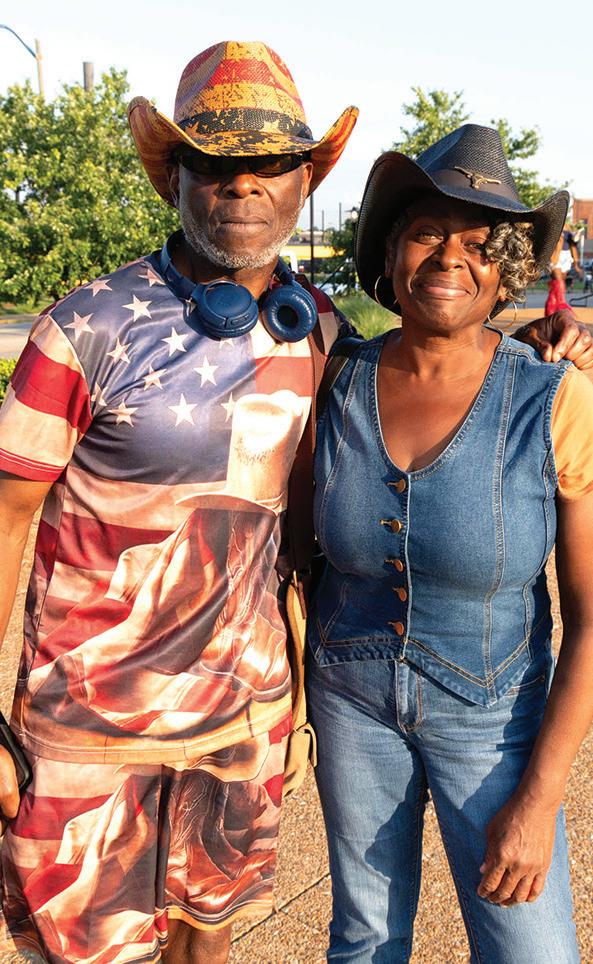



Rodeo
Continued from B1
Moments later, cowboys and cowgirls filled the arena on horseback. Their expressions stayed focused as the crowd cheered. Just as quickly, they cleared the floor and the competition began.
Events included ranch bronc riding, bull riding and steer wrestling for the cowboys; steer undecorating for the cowgirls; breakaway roping for juniors; and the crowdfavorite barrel racing. Each event tested a different skill set — strength and balance in bronc and bull
Block Party
Continued from B1
the kids, don’t be. Jump in that water, because we need you.”
Fellow honoree Dr. Kendall Ware echoed the sentiment. He noted that he never had a Black teacher — aside from his parents — and said he was committed to being the change.
“I strive to inspire everyone I can and the world as a whole,” Ware said. “Not just white and Black, but especially Black.” Ware and Poe were honored alongside Angela Brown, Dr. BJ the DJ, Dr. Valencia Martin-Hawkins, LaTonya AnNoor, Donielle Elizabeth and a posthumous recognition for Tai Davis.
Elizabeth used her
riding, speed and precision in steer undecorating and tiedown roping. The rules were strict. In bronc riding, competitors start with 100 points and lose points for issues with balance or control. Horses are judged too; if one doesn’t buck enough, the ride can be stopped and repeated. In steer undecorating, breaking the rope before the steer enters the arena adds 10 seconds to a rider’s time. In tiedown roping, catching a calf by the leg instead of the head also brings a penalty. Those penalties frustrated fans during the cowgirls’ steer undecorating. Michaela Mitchell’s 1.15-second run would
remarks to remind the crowd how far the celebration has come.
“Seven years ago, we started on the inside of House of Soul,” she said. “We grew to the patio, and then we grew to this little patch right here. Now, seven years later, we have taken over 12th Street, 13th Block and 14th Block. Continue to support it.”
The event offers plenty of reasons to show up. It carries the energy of a family cookout, with vendors selling food, clothing and accessories. The block party atmosphere builds toward a fashion show curated by Black Creatives in the Lou founder Yolanda “Yoro” Newson — one of the event’s biggest draws.
Bold colors and Black pride moved down the runway. Designers Jordan Daye of Krazed Krystals,
have set a new record, but a penalty added 10 seconds. Erica Singleton posted a 1.04-second run, but penalties kept her from the record as well.
Barrel racing brought out riders of all ages, including juniors as young as thirteen. Horses and riders moved tightly around the barrels, each chasing the fastest time of the day.
The event underscored the generational nature of rodeo — young competitors riding alongside seasoned veterans, all showing the same discipline and passion.
Throughout the afternoon, the SERA Rodeo offered a look into a cowboy culture that is both
Lillian Tiner of LAHA Clothing, Amie Hibbler of Monique Arnelle, Kacey Harvey of KYO_C and Shamaica Chanel all delivered. Crowds parted down the center of Washington Avenue as models walked between them. Cheers rose for familiar faces as they ripped the runway — especially the children representing the LAHA family.
Just moments earlier, the same stretch of street had been filled with people dancing, jumping Double Dutch and enjoying the afternoon.
Media personality Jade Harrell filmed content with her videographer, then kicked off her zebra-print wedge heels and joined the “Flex” line dance.
“I just love us,” Harrell said. “I truly do.”

competitive and deeply family oriented. While riders pushed for titles and prizes, the atmosphere remained supportive and focused on community. For many in the crowd, the event was also a chance to see a part of Black history and heritage that often goes overlooked. Through horsemanship, athleticism and tradition, the SERA Rodeo highlighted a legacy that continues to thrive.
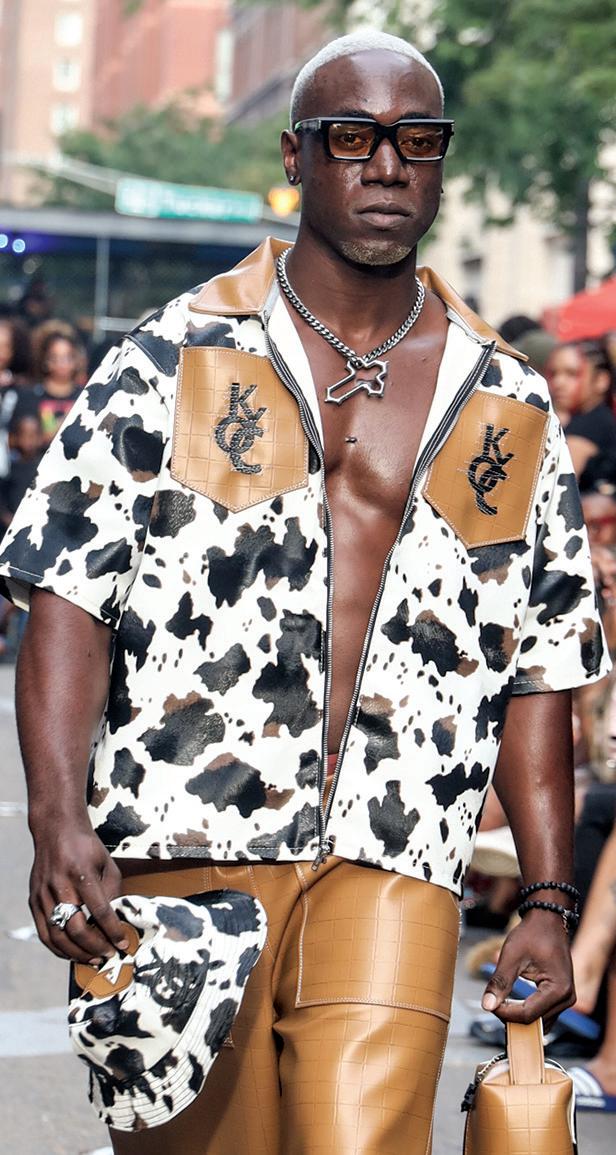

Photos by Taylor Marrie / St. Louis American
Photo by Taylor Marrie / St. Louis American
Photo by Taylor Marrie / St. Louis American
Photo by Taylor Marrie / St. Louis American
Photo by Taylor Marrie / St. Louis American
Photo by Lawrence Bryant / St. Louis American
Crowds parted down the center of Washington Avenue as models walked between them. Cheers rose for familiar faces as they ripped the runway — especially the children representing the LAHA family.

Photos by Lawrence Bryant / St. Louis American
A jolly Juneteenth time. When I tell y’all that I’m still wore out from celebrating our freedom last Friday! I wish I could show y’all this IV drip. Just kidding, but not really. I know for a fact that I’m not the only one who turned all the way up in the name of Juneteenth. How do I know? Because I spent the whole day bouncing back and forth between Dellwood and Downtown, and the turn up at both spots was on fleek. Excuse the elderly slang. There were also 50-11 other events going on. I’m so sorry that I didn’t get a chance to attend. Brandy Clay, girl, I know your golf-themed birthday was a hole in one Lance Thurman, I’m sure that gallery experience was something else. I wish I could have been at both. I’m sad that I also had to miss the second hardest working man in 90s R&B. Sisqo has the top spot because of his acrobat antics – both with his voice and his body – but Stokely (of Mint Condition fame) is an easy second by the way he plays all the instruments and puts on a show. Stoke was at The Pageant with Kool Moe Dee on Juneteenth thanks to the Gogel Law Firm.
Double booked and a Double Dutch ditch. But let me go ahead and get to what I was able to pop in on. My Juneteenth started in Dellwood with their glorious parade. The marchers were so poised as they made their way down West Florissant that you wouldn’t have known it was 9000 degrees outside from watching the footage. Shout out to Dellwood Mayor Reggie Jones for giving the North County folks a can’t miss annual cultural event. After the parade, I mingled a little bit before I booked it down 70 to the House of Soul Juneteenth Block Party. I’m so glad that the Tucker exit didn’t get unalived by the sinkhole. I got down there without the need for a reroute. The vibe was vibing! The best way to describe it is if the daytime convention center festivities of Essence Festival – with the mingling and the vendors – were outside and in the heart of downtown St. Louis. I got my whole entire life from the Double Dutch moment. Why did I get so caught up in the nostalgia of it that I decided I was gonna gag the girls with a jump session? I had skills back in the day, including a signature spin. Too bad I got so winded with the pre-jump motion that I stepped back from the ropes with my arms still moving like I was about to hop in. How did I not even jump, but had to go cool off? After I got my second wind and third bottle of water, I was back in action – as a spectator. I watched some of my favorite folks get honored for their commitment to community. Then I literally got to see STL style at its finest thanks to the fashion show produced by Black Creatives in the Lou. It was everything! They were on their final catwalk strut when I pulled a “Dukes of Hazard” back up 70 to see the concert portion of the Dellwood Juneteenth celebration. I hope Young Joc is not offended by me saying that the bars were cool, but I need him to drop the skincare routine in a remix…ASAP. Don’t get me wrong, I still did the “It’s Going Down” dance. But the whole time I was thinking, “Is it collagen, retinol or niacinamides? He couldn’t have had Botox or fillers…but if he did, sign me up!”
Cowboy Chaifetz. The SERA Black Rodeo was back in effect at the Chaifetz for Juneteenth weekend on Saturday. I thoroughly enjoyed the looks! But let me say that a few of y’all’s aunties were out here looking like naughty cowgirls. I really hope the one who had that bandana tied around her thigh listened to her body and loosened that thing up when her leg fell asleep. I’m sure that thing was cutting off all kinds of circulation. Okay, enough of me being lousy. The folks were GIVING in their giddy up gear! And I had so much fun watching the rodeo. I wouldn’t be me if I didn’t point out that one or two of those cows, bulls, steers…animals…whatever…had a bit of Ozempic face


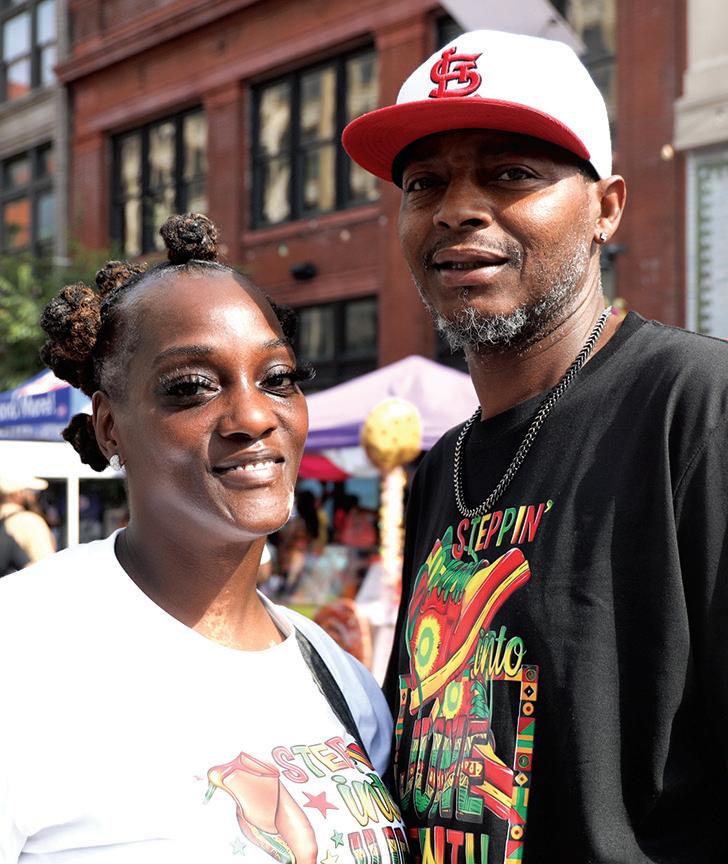
doing
he

going on. My only other note for the folks when they bring the rodeo back is to write it in the contract that the DJ must play “Boots on the Ground” all the way through.
Farewell BJ The DJ. Since I’m talking about DJs, was I the only one shook to my core when I got word that BJ The DJ was let go from iHeart? Y’all, he has been on the radio my whole entire life. I’m sad about it, but I feel like I need to let him know that his next chapter will be his best chapter. I also want to thank him for his decades of pumping up the culture and supporting the community!
Taylor
Continued from B1
ly — let’s go back to St. Louis.”
“Romeo and Juliet” is part of Opera Theatre’s 2026 season and continues through June 27 at the Loretto-Hilton Center.
Taylor was a GYA — a member of OTSL’s prestigious young artist program — from 2015 to 2017. Coming back to step into Mercutio felt like a fullcircle moment. “This is a special place for me,” he said. “It’s really nice to come back and see what’s changed… the quality of artists hasn’t changed at all.”
Taylor’s history with OTSL runs deeper than résumé lines. As a young Black baritone navigating a field that has long struggled with representation, he remembers what it meant to be in a space where he didn’t have to shrink or explain himself. “There’s so much talent that goes to waste because of lack of opportunities, lack of support,” he said. He still thinks about a classmate at Morgan State who “at 18 sounded like Renée Fleming” but never got the chance to build a career. For him, OTSL’s willingness to cast boldly — and to create a space where artists of color are not exceptions but essential contributors — is part of what makes the company feel like home. “Being able to show that we are part of it is great,” he said. “And I’m glad OTSL is swinging the pendulum in another way.”
Taking over Mercutio isn’t a simple plug-andplay assignment. It’s a role that demands swagger, wit, agility, and emotional precision — and Taylor had a week to build it.
He laughed remembering his first encounter with Romeo and Juliet as a highschool “metalhead
skateboarder” who had no interest in Shakespeare. But revisiting the text as an adult — and as an artist — unlocked something. “I love this character,” he said. “Mercutio and I are very similar… I like to think I’m witty and adaptable. He can switch up to whatever’s needed on a dime, and he’s loyal to his friends.”
The opera gives Mercutio less text than the play, but Taylor found room to build him out through physicality and presence. “I’m given a lot of chances to flesh out the character by the actions of being on stage,” he said, crediting director Keturah Stickann for helping him sharpen choices that “didn’t feel strong” at first. Agility — emotional and practical — sits at the heart of his Mercutio.
Taylor’s ability to pivot quickly came from childhood. He grew up in a military family, moving constantly. “I can just adapt. I can just go,” he said. “Growing up as a military kid really showed me that… you learn to appreciate the times and the experiences you have while you’re having them.”
Opera wasn’t the plan for Taylor. In fact, he had auditioned for a metal band and planned to tour the East Coast. His mother, Carla Fisher, had other ideas.
She heard him sing a required solo in choir and made a decision. “The next day she said, ‘You’re going to Italy for six weeks. You’re doing this opera program,’” he said. He resisted — loudly — but went. And during his first opera, Taylor was so enthralled that he gripped the armrest so hard he tore it. “I called my mom from an internet café and said, ‘I gotta figure out how to sing opera.’” Two weeks later, he was accepted into Morgan State University.
From there came Boston University, the Opera Institute, and a career that has taken him to major stages — including a Metropolitan Opera debut where he played a villain so convincingly that the audience booed him at curtain call. “I was so excited about it,” he said. “I was egging them on.” Taylor’s voice is rich, dark, and flexible — a combination he’s still learning to shape. “It’s so versatile… it can do a little bit of everything,” he said. “Finding out what works for me and what works for the audience has been a journey.”
But his goal is simple: “I just want people to feel something when I’m singing.”
Stepping into a production midstream requires trust on both sides. Taylor believes his history with OTSL made the decision easier. “They know how I work,” he said. “Being here before, they knew that the adjustment period was already done. We could start at a higher foundation.” He also credits the company for its commitment to Black artists. “Being able to show that we are part of it is great,” he said. “And eventually, the goal within the art form is a true meritocracy — the best singers for the gig.”
For Taylor, the goal is catharsis for OTSL’s “Romeo and Juliet.” “The world’s kind of crazy right now,” he said. “I want them to have some joy, cry a little bit, and have some sort of release.”
Opera Theatre of Saint Louis’ presentation of “Romeo and Juliet” continues through June 27 at the Loretto-Hilton Center, 130 Edgar Road in Webster Groves (on the campus of Webster University). For showtimes and a full schedule of their 2026 season, visit operastl.org.
Visual artist Donovan was
what
does best at the House of Soul Juneteenth Block Party Friday afternoon
Jarvis and Tilwania Hardimon were among the thousands who celebrated with the House of Soul at their annual Juneteenth Block Party Friday afternoon
A few of the faces working behind the scenes of the Dellwood Juneteenth Festival were all smiles Friday afternoon as they rode down West Florissant
“The baby could arrive before the end of the tournament. I would like to be there. No father would want to miss that.”
— Jeremy Doku, on the possibility of leaving Belgium’s World Cup team to be with his wife for the birth of their first child

SportS EyE
With Alvin A. Reid
St. Louis lands MVC women’s basketball championship
When I sat with Missouri Valley Conference Commissioner Jeff Jackson in November 2025, his staff was busy preparing for a series of team and individual championship weekends and the men’s and women’s basketball seasons.
The annual “Arch Madness” men’s basketball tournament was among our topics, and Jackson made sure to mention the enthusiasm and support that the women’s tournament celebrates each year.
The women’s tournament, its 40th edition, was held March 12-15, at Xtream Arena in Coralville, Iowa. Coralville is north of Iowa City, Iowa, and it’s 75 miles west of the Mississippi River.
lege basketball,” Jackson said in a release announcing the move. The tournament draws rave reviews from national media members and reaches a significant national television audience.
“We are proud to expand that experience by welcoming our women’s basketball championship to St. Louis and bringing all Valley basketball together under the Arch Madness banner.”
Women’s opening round games will be held Wednesday, March 3, 2027, and the men’s tournament opens Thursday, March 4. Both days will include four games.
I had to look that up because I had never heard of the town or the venue.
That is changing for the better in 2027 for the MVC and the St. Louis region.
On Monday, the MVC announced that its women’s basketball tournament is moving to St. Louis and will be held in conjunction with the men’s Arch Madness during the same week, March 3-7, at Enterprise Center.
In addition, the MVC announced that it will feature a new 10-team tournament format for both men’s and women’s basketball.
“Arch Madness is one of the great brands in col-
On Friday, March 5, two women’s and two men’s games will be played. The Saturday lineup will include the women’s and men’s semifinals.
The championship games of both tournaments will be played Sunday, March 7.
The No. 1 and No. 2 seeds will advance directly to the semifinal round, “providing meaningful reward for regular-season achievement while preserving the excitement and intensity that have long defined MVC championship basketball,” according to Jackson.
The MVC is creating a new, wider opportunity to shine a brighter light on its women’s tournament and St. Louis will reap the reward.
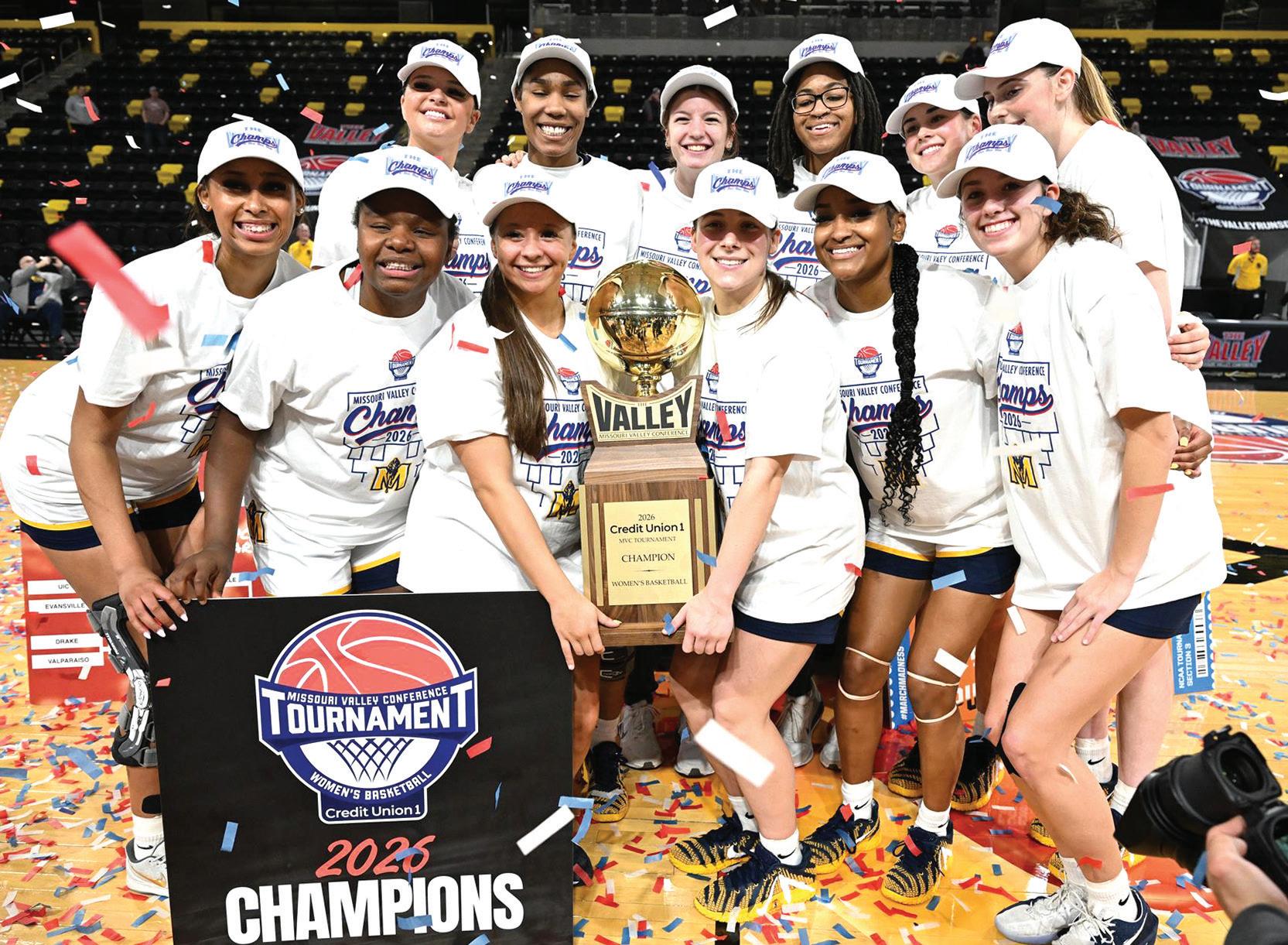
“It is about creating a larger stage for our student-athletes, delivering greater value for our fans and partners, and continuing to invest in the future of Missouri Valley Conference basketball,” said Jackson.
“We believe this decision creates a unique opportunity to celebrate both championships together while preserving everything that has made Arch Madness special for more than 35 years.”
While fewer teams will earn spots in the Arch Madness Tournament because of the new format,
the addition of the women’s tournament will bring excited new fan bases to St. Louis for almost a full week of basketball.
Downtown St. Louis, which bustles each year during the men’s tournament, is among the biggest winners of the MVC’s decision.
The St. Louis Sports Commission deserves praise for landing economy-bolstering events, including the 2028 Summer Olympic men’s and women’s marathon trials and Olympic groupstage soccer matches.
These events and
InSIdE SportS
With Earl Austin Jr.
the annual MVC men’s basketball tournament demonstrate to the nation — and, importantly, to us — that the city can truly shine.
The Reid Roundup You could say that Alex Freeman had the game-winning goal in the USA’s 2-0 World Cup win over Australia on June 19 in Seattle. His header was the second goal, but the first came when an Australian defender scored on his own team. Freeman is a son of former Green Bay
The Murray State Racers celebrate their Missouri Valley Conference women’s basketball tournament championship March 15, 2026, at Xtream Arena in Coralville, Iowa. The tournament moves to St. Louis in 2027.
Packers standout receiver Antonio Freeman Popularity is winning out over production in 2026 MLB All-Star balloting. St. Louis Cardinals outfielder Jordan Walker is sixth in outfield voting. Only Michael Harris (fourth) of the Atlanta Braves is statistically better. Andy Pages of the L.A. Dodgers is first, followed by Ronald Acuña Jr. of the Braves (injured), Brandon Marsh of the Philadelphia Phillies, Harris and Teoscar Hernández of the Dodgers (injured).
Local girls excel at Midwest Showcase
The Midwest Showcase concluded its two-week run last weekend in Columbia as the girls took center stage.
Nearly 100 top girls’ high school basketball programs from a six-state region competed in front of hundreds of college coaches in what has become one of the top June live-period events in the country. The event featured schools from Missouri, Kansas, Iowa, Arkansas, Nebraska and Oklahoma. The St. Louis area was represented by some of its best programs, led by national powerhouse Incarnate Word Academy, which has won nine consecutive state championships. The Red Knights will feature many new players after losing five graduating seniors to NCAA Division I schools, but they will be formidable once again. They will be led by 6-foot-3 junior Bridget Fitzgerald, who is one of the top prospects in the country.
welcomes back talented senior twins Amaya and Cara Manuel, who both missed the 2025-26 season due to injuries. Both were back in action and playing very well. Principia returns a strong nucleus of players, led by 6-foot-2 senior forward Dasia Scott.
Many of these top girls’ programs will have a new head coach on the sidelines as well. Lift for Life is now led by Don Boyce, formerly the head coach at Cardinal Ritter. Tony Condra, who previously served as Ritter’s head coach, will take Boyce’s place at the school. Ursuline Academy tabbed Tyler Ituen as its next head coach. Ituen was the head coach at John Burroughs. Petra Jackson, a Hall of Fame player who also coached the St. Louis Surge women’s professional basketball team, is taking over the John Burroughs program.
Bailey Hensgens wins gold medal at USATF U20 Championships
Missouri Class 5 state champion Lift for Life and Class 3 state champion Principia were also in Columbia. Lift for Life

gold medal in the high jump at last weekend’s USATF U20 Outdoor Championships in Eugene, Oregon.
Congratulations to Incarnate Word Academy girls’ track star Bailey Hensgens on winning the
The rising senior cleared 6 feet to win the event and earn a spot on the USA Team that will compete in the World U20 Championships, which will also be held in Eugene from Aug. 5-9.
Hensgens is coming off a tremendous junior season at Incarnate Word, where
Lift for Life
senior guard Amaya Manuel was among the top St. Louis players at last weekend’s Midwest Showcase in Columbia. Manuel returned to competition after missing last season with an ACL injury.
featured teams at this weekend’s Edwardsville Live basketball event, held at Edwardsville High School in Metro East Illinois.
The two teams are scheduled to meet Friday evening at 6 p.m. Although it is not a regular-season game, there is great anticipation for this summer showdown, especially after both teams dominated during their appearances at the Midwest Showdown in Columbia two weeks ago. Both teams finished 4-0, winning each game by double digits.
Westminster, Lift for Life, McCluer North, Belleville East, Belleville West, Collinsville, O’Fallon and Mascoutah.
Jordan Goodwin inks new contract with Phoenix Suns
Former Belleville Althoff and Saint Louis University basketball star
she won three individual state titles at the Missouri Class 4 Championships in Jefferson City. She won the high jump, long jump and triple jump. She also set a state record by winning the high jump.
Principia vs. Vashon will highlight this weekend’s Edwardsville Live event
St. Louis area boys basketball powers Principia and Vashon will be the
College coaches will be front and center for this game because both teams are loaded with Division I prospects. Principia features 6-foot-11 senior Tyran Frazier, 6-foot-9 senior Sekou Cisse, 6-foot9 sophomore Majok Ater, 6-foot-3 senior Gassim Toure and 6-foot-3 senior Kingston Money. Vashon will be led by 6-foot-2 senior Jimmy McKinney III, 6-foot-6 senior Leon Powell Jr. and 6-foot-8 senior Jaylan Mitchell.
Several other schools from both the Missouri and Illinois sides of the river will compete in Edwardsville. They include Webster Groves, Vianney, MICDS, CBC,
Jordan Goodwin is expected to sign a new threeyear, $19 million contract to remain with the Phoenix Suns. ESPN NBA insider Shams Charania reported the news. The 6-foot-3 Goodwin has been grinding it out in the NBA with multiple franchises for the past five years, but he seems to have found a home in Phoenix after a very productive 2026 season. Goodwin entered the season with a non-guaranteed contract, but he not only made the roster during training camp but also became a starter for a team that made a surprise run to the NBA playoffs. Goodwin averaged 8.7 points, 4.9 rebounds and 2.2 assists while recording 109 steals, which ranked ninth in the league. He has also become a fan favorite in Phoenix with his high energy and nonstop hustle.
Alvin A. Reid
Photo courtesy of the Missouri Valley Conference
Earl Austin Jr.
Photo Earl Austin Jr.t / St. Louis American
Remembering freedom, celebrating community
Thousands gather in Dellwood for annual Juneteenth festival
By Na’Porsha Williams St. Louis American
Thousands of St. Louisans celebrated Juneteenth across the region, but few events matched the size and energy of the sixth annual Juneteenth STL Parade and Festival, which filled blocks of West Florissant Avenue in Dellwood on June 19.
Marching bands, dance teams, civic organizations and local businesses moved through the parade route as crowds lined the streets. Families unfolded lawn chairs, children chased bubbles and foam, and festival-goers cheered performers and parade participants throughout the day.
The event, presented by Bridge the Gap 314 and the city of Dellwood, drew residents from across the region.
“It’s really blossoming into one of the main attractions of Juneteenth in the St. Louis region,” Dellwood Mayor Reggie Jones said. “It’s turned into a big deal for not just St. Louis.”
“I come every year, and this is the biggest one I’ve seen,” said Serena Muhammad, a Dellwood resident.
Several attendees compared the festival’s scale to the historic Annie Malone May Day Parade.
This year marked the first time nationally known artists headlined the festival. Billboard-charting artist Young Joc and blues

singer Pokey Bear topped a performance lineup that also included Slow Spread Love, Asiaa Marie and the Chaz45 Band.
“It was beautiful. Everybody came out,” said Devonte Miller of Florissant. “My daughter performed in the parade. Good times, good vibes. I’m glad we had it.”
After the parade, attendees shopped with vendors selling jewelry, eyewear, footwear and apparel. Children enjoyed a foam party, giant inflatables and a mobile petting zoo while adults gathered around food vendors and
music stages.
One attraction featured an expanded museum collection highlighting the history of St. Louis public high schools and notable alumni.
“It’s really interactive,” said Twyla Lee, founder of Bridge the Gap 314. “A day of community where people can come out with their lawn chairs and listen to great music, the kids can run around and play.”
For many attendees, however, Juneteenth was about more than entertainment.
“I know what Juneteenth really means.
It’s not just another holiday,” said Dellwood resident Laverene Mahoney, who recalled working in cotton fields alongside her six siblings when she was 5 years old.
“I know about the plantations, all of that. So the fact that we’re able to celebrate it in such a great way in the city of Dellwood, I’m grateful for that. I’m grateful for all the effort that’s put into it.”
Like many returning attendees, Mahoney said she looks forward to the celebration every year.
“Oh, when I tell you it’s off the chain, it’s off
After the parade children enjoyed a foam party while other attendees shopped with vendors selling jewelry, eyewear, footwear and apparel.
the chain,” she said.
Jones said interest in the event has continued to grow since Juneteenth became a federal holiday in 2021.
“Since it became a national holiday, we’ve increased the effect, the attention to it, and even added more activities not just entertainment-wise, but educational-wise too,” Jones said.
The festival traces its origins to the COVID-19 pandemic. Lee said she organized the first event in 2020 while working as a classroom teacher during a period of remote learning.
“I was a classroom teacher at that time, and it was online learning, and the kids weren’t logging on. And I was getting bored,” Lee said. “I was like, ‘What are we going to do?’”
She envisioned a safe outdoor gathering where families could connect, receive vaccinations and support efforts to return students to in-person learning. The event continued after those goals were met, eventually becoming an annual partnership with Dellwood.
“One of the things I appreciate most about this event is that it brings the community together,” said Gwendolyn Artist, Dellwood’s 3rd Ward alderwoman. “I love to see everybody out here enjoying themselves — the children, the parents, the older folks. All of us. And we love what’s going on.”
For Artist, the celebration serves as both a commemoration and a reminder of the work that remains.
“A lot of things that we know now, we did not know,” Artist said. “And since we do know a little bit better, we’re doing better.”
A fireworks show closed the evening, celebrating Black culture, history and community while reflecting on the continuing pursuit of freedom.
“And I’m glad, finally, we are free-ish,” Artist said.

Photo by Lawrence Bryant / St. Louios American

PUBLIC NOTICE
CODE ENFORCEMENT
The Village of Hanley Hills is seeking requests for proposals for code enforcement services from qualified professionals to enforce the city code throughout the Village. Please submit all proposals to the attention of Gregory Robinson at 7713 Utica Drive, St. Louis, MO 63133.
FAMILY COURT COMMISSIONER VACANCY
The 22nd Judicial Circuit, City of St. Louis, is soliciting candidates for Family Court Commissioner. Application packet and instructions available at www.stlcitycircuit court.com Materials must be returned to stlca.resumes@courts. mo.gov, before 5:00 p.m. July 15, 2026. EOE.
PROF.
SYS.
Prof. Info. Sys. St. Louis Univ. PhD Info Sys., Syst. Eng. or closely related. Record collegiate-level teaching on-campus & remote. Full descr.& apply slu.wd5.mywork dayjobs.com/Careers
JOB OPENING: CHURCH ADMINISTRATOR
First Unitarian Church of St. Louis, is looking for a Church Administrator. The role calls for strong communication, fiscal management, and facilities coordination. The right candidate will support the liberal, welcoming values of the congregation. Learn more about us and see the full job description at https://www.firstuustlouis. org
INVITATION TO BID
The Core Collective at Saint Vincent invites qualified contractors to submit bids for ADA Accessibility Upgrades at its historic 100,000-square-foot main building and adjacent outdoor restroom facilities. This project will transform underutilized space into fully inclusive, multi-use community assets and support neighborhood economic and community development. The scope of work includes, but is not limited to:
• Renovation of lower-level indoor restroom facilities and outdoor restroom facilities to meet current Americans with Disabilities Act (ADA) standards;
• Installation of two chair lifts to provide accessible mobility between the gymnasium, main floor, and lower-level recreation and training spaces;
• Replacement of multiple non-compliant interior and exterior doors with ADA-compliant models, including push-handle hardware;
• Associated electrical upgrades necessary to support accessibility improvements and equipment installation.
Contractors may submit bids for the entire project or for individual portions of the work. Sealed bids must be received by July 10, 2026, and may be submitted by email or mail to:
The Core Collective Attn: Karen Cummings, Chief Operating Officer 7401 Florissant Road St. Louis, MO 63121 Email: kcummings@theccstl.org
Contractors are encouraged to visit the site prior to submitting bids. Building walkthroughs will be available on Wednesdays and Thursdays from 9:00 a.m. to 2:00 p.m. Advance notice is required. For questions regarding the project or to schedule a site visit, please contact Karen Cummings, Chief Operating Officer, or Elonzo Brock, Director of Maintenance, at 314-261-6011.
The Core Collective reserves the right to reject any or all bids and to waive any informalities in the bidding process.
Minority-owned, women-owned, veteran-owned, and disadvantaged business enterprises are encouraged to submit bids.
PUBLISHER’S NOTICE:
Advertised herein is subject to the Federal Fair Housing Act, which makes it illegal to advertise any preference, imitation, or discrimination because of race, color, religion, sex, handicap, familial\status, or national origin, or intention to make any such preference, limitation, or discrimination.“We will not knowingly accept any advertising for real estate which is in violation of the law. All persons are hereby informed that all dwellings advertised are available on an equal opportunity basis.”
Call Angelita Houston at 314-289-5430 or email ahouston@stlamerican.com to place your ads today!
SEALED BIDS
Bids for New Outdoor Pavilion, Missouri Veterans Home, St. James, MO, Project No. U261001 will be received by FMDC, State of MO, UNTIL 1:30 PM, July 30, 2026. Project information available at: http://oa.mo. gov/facilities
SEALED BIDS
OA-FMDC, State of MO will have the following MO National Guard projects that will be open for public bid through September 2026,
We Publish every Thursday Newspaper and Online reaching over 150,000 People per Week
REQUEST FOR PROPOSALS
The International Institute of St. Louis is seeking bid proposals for Programmatic and Networking Services as part of the STL Career Pathways Program.
Interested parties should submit at https://www.iistl.org/ workforce-solutions/ on or before Friday, July 31st no later than 5pm.


Notice is hereby given that the Metropolitan St. Louis Sewer District Requests for Quotes, Bids and Proposals are posted online for public download. Please navigate to www.msdprojectclear.org > Doing Business With Us > View Bid Opportunities
Metropolitan St. Louis Sewer District is an Equal Opportunity Employer.
REQUEST FOR QUALIFICATIONS
Great Rivers Greenway is requesting qualifications for Asset Management and Work Orders Go to www. greatriversgreen way. org/vendors for details and submit by July 24, 2026.
REQUEST FOR BIDS GENERAL CONTRACTING
SERVICES at 5101 Virginia Avenue St. Louis, MO 63111
Issued: June 23, 2026
Responses Due: July 14, 2026
The Land Reutilization Authority of the City of St. Louis (“LRA”) is seeking sealed proposals from General Contractors for work at 5101 Virginia Avenue, St. Louis, Missouri 63111. Work includes roof repairs, select interior demolition and debris removal, and board up/weatherproofing.
Responses will be received at 1520 Market Street, Suite 2000, St. Louis, Missouri 63103 (Attention: LRA BID) and STL City Permits until 1:00 p.m. on July 14, 2026.
The services to be provided through this RFB will be funded by The Coronavirus State and Local Fiscal Recovery Fund allocated to the City of St. Louis by the United States Department of the Treasury and passed through the City’s Community Development Administration to LCRA.
The full invitation and all other documents may be downloaded at: https://www. stlcitypermits.com and https://www.stlou is-mo.gov/government/procurement
The Saint Louis Zoo seeks bids from qualified vendors.
Bid documents are available as of 6/24/26 on the Saint Louis Zoo website: stlzoo.org/ vendor.
SEALED BIDS
Bids for Troop C CDL Supersite Upgrade HVAC & Control System, Project No. R2513-01 will be received by FMDC, State of MO, UNTIL 1:30 PM, July 30, 2026. Project information available at: http://oa.mo. gov/facilities
SEALED BIDS
Bids for Jefferson City Readiness Center Building 1, Repairs to Interior/ Exterior, 801 Armory Drive, Jefferson City MO, 65109, Project No. T2505-01 will be received by FMDC, State of MO, UNTIL 1:30 PM, July 28, 2026. Project information available at: http://oa.mo. gov/facilities
SEALED BIDS
Bids for New Columbarium Plaza and Pre-Placed Crypts, Project No. U241901 will be received by FMDC,State of MO, UNTIL 1:30 PM, July 21, 2026. Project information available at: http://oa.mo. gov/facilities
SEALED BIDS
Bids for Accessibility Improvements, Multiple Group Camp Assets, Crowder State Park, Trenton, MO, Project No. X2534-01will be received by FMDC, State of MO, UNTIL 1:30 PM, July 23, 2026. Project information available at: http://oa.mo. gov/facilities

When women can preach but not pastor
Southern Baptist Convention vote highlights a longstanding divide
By Rev. Dorothy S. Boulware Word In Black
The Southern Baptist Convention’s vote to strengthen enforcement of its prohibition on women pastors landed like a thunderclap in some corners of American Christianity.
In much of Black America’s church community, however, it exposed a contradiction that has existed for generations: women are often trusted to do the work of ministry, but not always granted the authority that comes with it.
Now, as the nation’s largest, most influential Protestant denomination moves to formally enforce gender restrictions on who can preach and pastor, Black clergy and church leaders are confronting the much larger question of who gets to answer God’s call — and who gets to decide if it’s legitimate.
At its annual meeting in Orlando, Florida, earlier this month, the SBC voted overwhelmingly to advance a constitutional amendment that would bar member churches from affirming women as pastors. The measure now requires a second two-thirds vote next year to become binding.
Codifying enforcement
If adopted, it moves the denomination from stating a doctrinal position to formally enforcing it through denominational membership standards. More than 3,875 Black congregations belong to the SBC, accounting for just 7% of the SBC’s total
membership. Albert Mohler, president of The Southern Baptist Theological Seminary and a central voice behind the amendment, declared that “(t) here’s a great line that divides liberal and biblical evangelicalism, and you can see it on this very issue.”

doctrinal standards.
‘This is about who gets hired’
On her Facebook page, Bishop Corletta Vaughn, senior pastor and presiding prelate of Holy Ghost Full Gospel Church in Detroit, slammed the vote. She sees it as a way to marginalize and exclude women from power within the SBC and other Protestant institutions.
“This is about future leadership and succession,” Vaughn wrote on Facebook. “And don’t be fooled. The SBC is simply more overt than many Black churches that operate covertly … This is about who gets hired as presidents, deans, and professors of Divinity, Seminary, and Religious Institutes. No woman. No daughter. No sister can NOT feel the wind of this violent storm.”
Supporters argue that the amendment simply tightens enforcement of what the denomination already teaches — that the pastoral office is limited to men — and resolves ambiguity between belief and practice. But opponents say the SBC already has the power to remove churches that violate its
In the Black church, women’s preaching has long existed in tension with institutional recognition—sometimes officially affirmed, sometimes informally tolerated, and sometimes resisted, even when congregations themselves have embraced women’s spiritual authority.
Standing in solidarity
The SBC vote draws a bright institutional
line, even as many Black churches have historically lived with overlapping categories — exhorter, evangelist, missionary, preacher, pastor — that do not always fit neatly into Western ecclesial hierarchies.
In a statement after the vote, Baptist Women in Ministry said it stands in solidarity “with the women in ministry who have been harmed by this vote” and condemned the “hateful rhetoric and propaganda” leading up to it. “Women in ministry deserve affirmation, respect, and the opportunity to follow God’s call,” the group said.
The amendment will return for a second vote next year. If it passes, it will reshape how the SBC defines pastoral authority across thousands of congregations, turning a long-running internal debate into a formal boundary line.
For the wider American church, the significance is less procedural than interpretive. It raises again a question that different traditions answer differently: whether the pulpit is primarily an office granted by institutions, or a calling recognized wherever it emerges — and who gets to decide when those two are allowed to mean the same thing.
Envato photo
The Southern Baptist Convention’s proposed constitutional amendment would formalize restrictions on women serving as pastors. For many Black church leaders, the vote highlights longstanding questions about women’s roles in ministry and church leadership.