
St. LouiS AmericAn
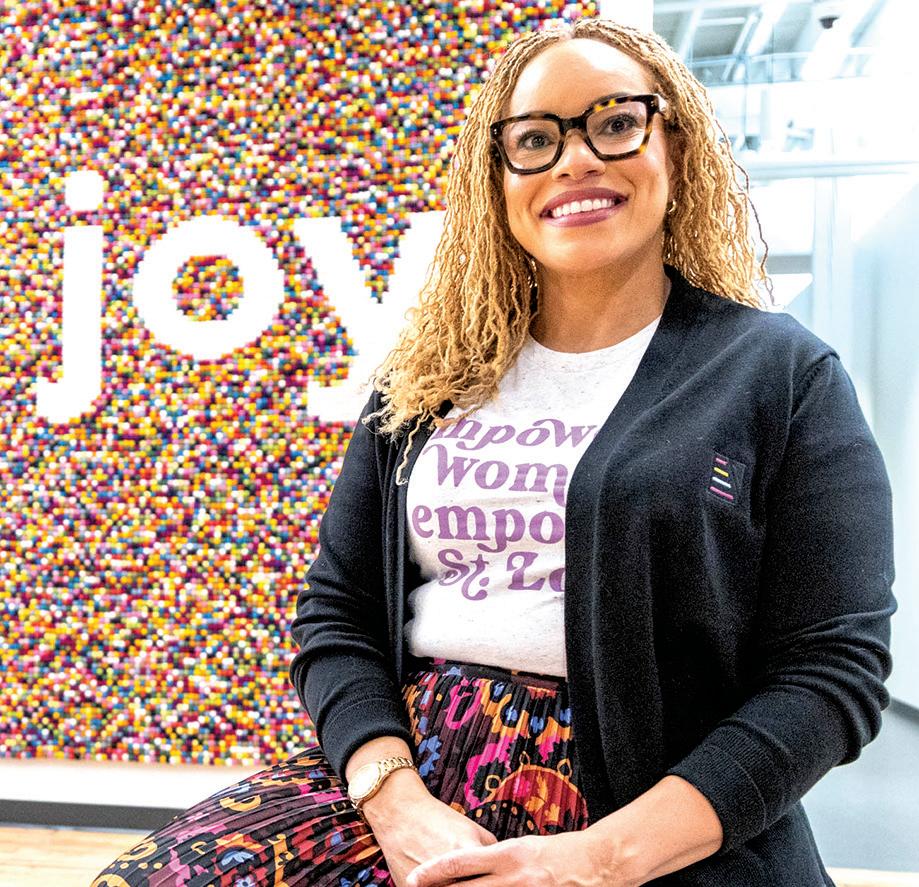
Helping move women forward
Leslie Gill named 2026 Nonprofit Executive of the Year
By Sylvester Brown Jr.
St. Louis American
The 1996 film “Jerry Maguire,” about a high-powered sports agent navigating the business of professional athletics, motivated a young Leslie Gill to believe she would one day have a career in sports management.
like, ‘I can be the first female Jerry Maguire.’”

“I always sort of had this vision that I would be a sports agent,” Gill said. “I was really interested in sports growing up, so, from a little girl, I watched the Jerry Maguires of the world and was
Instead, Gill’s career shifted into public service through both nonprofit and for-profit organizations, that included deep involvement in social welfare work, including serving as CEO of Annie Malone Children’s & Family Services, a longtime St. Louis nonprofit that supports children and families affected by abuse and neglect.
Today, Gill serves as president and CEO of Rung for Women, a St. Louis nonprofit she
Dr. Alvitta Ottley
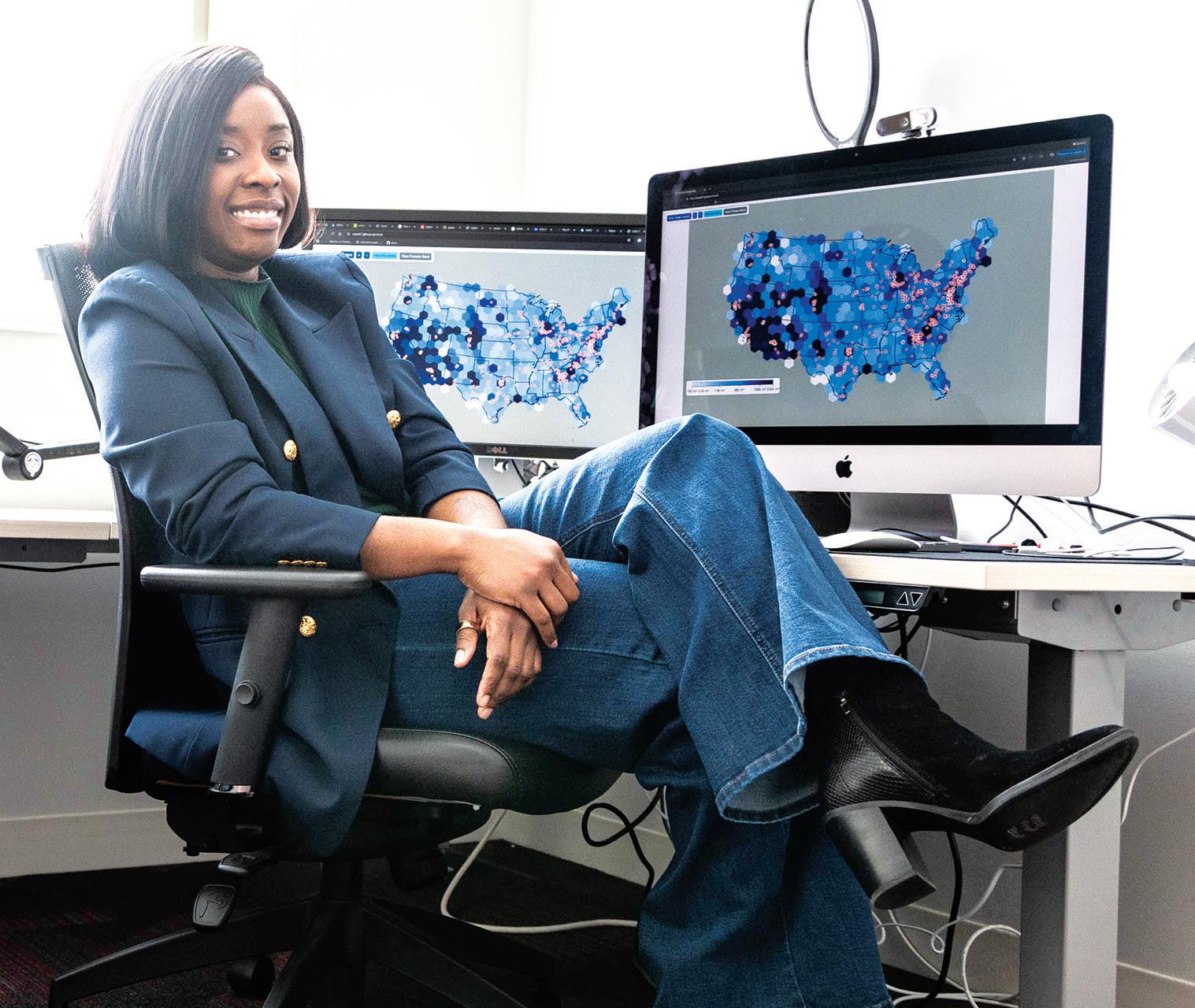
Changing how the world understands data

As artificial intelligence reshapes how information is produced and consumed, computer scientist Dr. Alvitta Ottley asks a more fundamental question — how do people actually think with data?
A leading voice in data visualization and human-centered computing, Ottley focuses on how people interpret information, navigate uncertainty and make decisions at a moment when the AI industry is still defining the best uses of its tools. Her research centers on designing visual systems that strengthen human judgment rather than replace it, using machine learning, or AI, not as an answer engine but as a tool to help people ask better questions of their data and
Her research centers on designing visual systems that strengthen human judgment rather than replace it.



Leslie Gill serves as president and CEO of Rung for Women, a St. Louis nonprofit she helped transform.
By Melanie Eversley For The St. Louis
Leaders of the St. Louis Science Center broke their silence this week on why they paused a beloved STEM program that supported young people from underserved communities, a decision that left families, students and former staff searching for answers.
Science Center President and CEO Ray Vandiver addressed the pause in a lengthy statement sent to the St. Louis American. He said the Youth Exploring Science program — known as YES — was suspended in mid-December because leaders saw three problems they could not ignore: unstable long-term funding, limited systems for tracking student outcomes after
By Sylvester Brown Jr. St. Louis American
As St. Louis prepares to welcome Olympic soccer for the first time in more than a century, some local Black leaders and business owners say the international spotlight could create new opportunities — particularly for Black-owned vendors already operating at Energizer Park. Olympic competition will return to St. Louis in 2028, with soccer matches scheduled at Energizer Park during the LA28 Olympic and Paralympic Games. Event organizers announced that the stadium — home of St. Louis City SC — will host preliminary and knockout-round
Photo by Lawrence Bryant / St. Louis American
American
By Nia Hightower For The St. Louis American
A leading voice in data visualization and human-centered computing, Dr. Alvitta Ottley focuses on how people interpret information, navigate uncertainty and make decisions at a moment when the AI industry is still defining the best uses of its tools.
Photo by Lawrence Bryant / St. Louis American
Guest Editorial
The quiet erasure of America’s civil rights memory
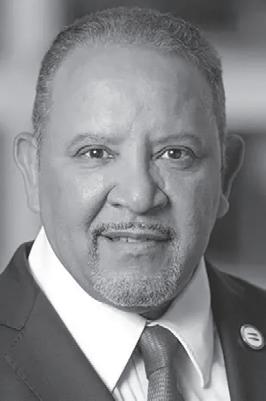
By Marc Morial
“History had me glued to my seat. It felt like Sojourner Truth was pushing down on one shoulder and Harriet Tubman was pushing down on the other.”
— Claudette Colvin
When Claudette Colvin died this month, too many Americans learned her name for the first time in an obituary.
That alone is an indictment.
At 15 years old, nine months before Rosa Parks, Colvin refused to give up her seat on a Montgomery bus. She was arrested, handcuffed, and taken to jail for insisting she had the same right to sit in public as anyone else. And when the movement took its case to federal court, Colvin was one of the young women who put their lives on the line as plaintiffs in Browder v. Gayle, the case that ended bus segregation.
But history has a cruel habit. It elevates the version of a story that is easiest to package, easiest to teach, easiest to celebrate, while pushing the rest into the margins.
of buildings and streets. These are not side issues. They are the infrastructure of memory. They teach people what a society values and whose struggles count as part of the national inheritance.
That is why Colvin’s passing lands as more than a sad headline. It is a warning.
Because while we mourn one civil rights icon whose contributions were too often minimized, we are also watching something more deliberate unfold: the active removal of public memory meant to tell the full American story. In Philadelphia, the National Park Service removed slavery-related exhibits at the President’s House site, an installation that honored the nine enslaved people George Washington held there and confronted the contradiction at the nation’s founding.
This is what erasure looks like in real time. Not only forgetting the past, but stripping away the tools that help the public remember it.
The actions in Philadelphia were tied to a wider federal directive that framed certain historical narratives as divisive or anti-American.
But narrative control is not only about what gets taken down. It is also about what gets rewritten.
Inside the White House itself, official language about the nation’s first Black president has been altered. Descriptive plaques accompanying President Barack Obama’s portrait were revised to reflect a more politicized assessment of his presidency. At the same time, information about prior administrations has quietly disappeared or been rewritten on WhiteHouse.gov, reshaping how recent history is presented to the public. These are not neutral edits. They are reminders that even the most official spaces of national memory are vulnerable to manipulation.
This is why public commemoration matters. Holidays. Museums. Historic markers. School curricula. The naming
For children in particular, learning an honest history is not about shame or division. It is about belonging. When young people can see themselves in the American story, including its struggles and progress, they are more likely to feel pride in their country and a sense of responsibility for its future. Shielding them from the truth does not protect them. It leaves them unanchored, more vulnerable to fear, misinformation, and the repetition of past injustices. A nation that wants cohesion must first be willing to tell its children the truth. When that infrastructure is dismantled, the losses compound. Icons vanish. Truth becomes optional, treated as ideology rather than a baseline for citizenship. Progress gets rewritten, as if it happened effortlessly, without conflict, courage, or sacrifice.
Claudette Colvin’s life shows how easily even the bravest contributions can be sidelined. Today’s removals show how quickly sidelining can become a strategy.
There is another truth worth naming. The public is not asking for this erasure.
Research on public opinion shows that Americans remain broadly aligned with the values that powered the civil rights movement. Urban League research on public support for diversity, equity, and inclusion shows strong majorities continue to support equal opportunity and inclusive approaches that strengthen communities and expand access.
That matters because it means the fight to preserve honest history and honor civil rights icons is not fringe. It is mainstream. It is unifying. And it is deeply American.
If we do not want Colvin’s story, and countless others, to vanish, commemoration must be treated as action, not sentiment. That means protecting public history from political purges, expanding whose stories are told, investing in museums and archives that preserve living memory, and naming the pattern when history is stripped away under the guise of unity.
We do not build a stronger country by hiding its scars. We make it by telling the truth about how we got here and who paid the price.
Claudette Colvin is gone, but her courage remains. The question is whether we will preserve the places, texts, and teachings that allow the next generation to meet her where she stood, certain of her dignity and unafraid to claim it.
Because when we allow civil rights icons to be erased, we do not just lose history — we lose the roadmap.
Marc Morial is the president and CEO of the National Urban League.

Commentary Cancel a speech, not the Missouri Constitution
By Michael A. Wolff
The Jefferson City drama last week was the cancellation of the Missouri chief justice’s annual “state of the judiciary” speech to a joint session of the legislature, a cancellation in response to a unanimous Missouri Supreme Court decision that enforced the Missouri Constitution’s rule that a bill must have only one subject.
The objection from some legislators — who kept the legislature from holding its joint session — was not that the unanimous court was wrong on the law, but that the court had the audacity to enforce the constitution and strike down a law that violated it.
The Missouri Constitution’s single-subject requirement does not exist in the U.S. Constitution, which puts no limits on how many unrelated subjects can be jammed into one bill, beautiful or not. Missouri legislators often are tempted to mimic their federal counterparts by passing omnibus bills that gather support by using a bill as a “Christmas tree” on which to hang various legislative ornaments to attract the votes needed to pass.
guish the views of those who spend time in the Capitol from those who live their lives outside the greater Jefferson City area. The voters agreed. They said no.
The nonpartisan court plan gives the governor the power to name three nonlawyers to the appellate judicial commission and gives members of the Missouri Bar in the three courts of appeals districts the authority to select one lawyer from each district.
The chief justice — the judge who serves a two-year term in rotation — is the seventh member of the commission. When a vacancy occurs on an appeals court or the Supreme Court, the commission evaluates nominees and sends three names to the governor, who must choose from the list. If the governor does not act, the commission makes the appointment.
That can mean a legislator must decide whether to vote for a bill whose provisions the legislator disagrees with in order to get a provision he or she wants.
The Missouri Constitution, since 1875, has included the requirement, which today is expressed simply: “No bill shall contain more than one subject which shall be clearly expressed in its title.” Other provisions enforce this basic rule.
I have noticed over decades of observing the politics of judicial selection that legislators who pitch fits about the nonpartisan court plan — added by voters in 1940 to the Missouri Constitution — do not seem to represent the views of a majority of Missourians.
In 2012, the legislature proposed a ballot measure to give the governor the majority of appointments to the appellate judicial commission and to allow the governor to appoint lawyers as well as nonlawyers to the commission.
It was a bad idea, the result of people in Jefferson City not being able to distin-
A judge must face a retention vote after serving for one year, and at the end of each term — 12 years for a Supreme Court judge — and must retire at age 70. Since its adoption in 1940, Missourians have voted for measures strengthening the plan. By contrast, voters rejected a 1942 proposal referred by the General Assembly to end the plan and return to electing all judges. That lesson was reflected in the Constitutional Convention of 1944, which included the nonpartisan court plan in the state’s current Constitution adopted in 1945.
The most sensible reaction to the Supreme Court’s decision enforcing the single-subject rule is the suggestion by some legislators that they should obey the constitution when doing their work.
Another suggestion: If legislators want to pass big bills, beautiful or not, they could ask voters to change the constitution to make Missouri’s process more like Congress. Good luck with that.
Michael A. Wolff is a retired judge and chief justice of the Supreme Court of Missouri, and a professor emeritus and dean emeritus of the St. Louis University School of Law. This commentary was originally published by the Missouri Independent.
Honest report cards can rebuild trust in education
By Keith Williamson
Recent polls show that only about one in four Americans think K-12 education is headed in the right direction, and just 16% say the system is on the right track. Families still tend to trust their own child’s school more than “the system,” but when state reports say most schools are “meeting expectations” while children struggle with basic reading and math, that trust is tested.
Transparency is one way to start rebuilding it. Clear, simple school report cards are not about blaming schools or teachers. They are about giving families and communities straightforward information so they can stand alongside educators and push for the support students need.
Other states show what’s possible when transparency and community engagement go hand in hand. A decade ago, Mississippi ranked near the bottom in reading. Then state leaders adopted a clear A-F school accountability system tied to whether students were on grade level and whether the most vulnerable students were catching up.
Keith Williamson is president of the Centene Charitable Foundation and board chair of The Opportunity Trust. Commentary
Together, those actions signal growing recognition that families deserve clearer, more honest information about school performance.
St. Louis should embrace this change. In a city where progress has not been shared equally and where Black children too often attend schools with the fewest resources and the lowest scores, honest report cards can be a tool for justice. When families can clearly see how their school is performing, they can ask sharper questions, advocate for proven reading instruction and press for changes before another generation falls behind. Churches, neighborhood groups and employers can use the same information to target tutoring, mentorship and investment where it will make the most difference.
Guest Columnist Keith Williamson
Over time, Mississippi’s fourth graders made the largest gains in the nation and now meet or exceed the national average in reading and math. That progress happened by putting honest data in front of families, educators and policymakers and acting on it year after year.
That shift is already underway in Missouri. In December, the State Board of Education voted to direct the Department of Elementary and Secondary Education to begin creating new school report cards; the governor reinforced that priority through an executive order; and the Missouri legislature recently heard an accompanying bill, modeled after Mississippi, in its education committee.
Many of us are proud graduates of local public schools that helped shape who we are. That pride is real, and it should sit alongside a clear, honest picture of how our children are doing. Supporting school report cards does not mean turning against schools we love. It means caring enough to ask for clarity and improvement. Transparency is not punishment — it is a promise that we will not look away when children are being underserved.
School report cards are not the finish line, but they are an important first step toward rebuilding trust and giving parents and communities the tools they need to help schools deliver the futures our children deserve. As James Baldwin once said, “Not everything that is faced can be changed, but nothing can be changed until it is faced.”
Columnist Marc Morial
Guest Columnist
Michael A. Wolff
- Chicago Mayor Brandon Johnson
SLU to offer free undergraduate tuition for eligible students
By Ashley Winters
St. Louis American
Starting in fall 2026, Saint Louis University will offer full undergraduate tuition coverage to eligible low-income students, a move aimed at addressing growing concerns about college affordability and shifting enrollment patterns at private universities.
Under the new SLU Tuition Promise, first-time freshmen from families with an adjusted gross income of $60,000 or less — and limited assets — will be able to attend the university without paying undergraduate tuition. Tuition will be covered through a combination of federal and state grants and institutional gift aid.
The initiative comes as colleges nationwide face increased price sensitivity among prospective students and their families, often earlier in the college search process. SLU officials say the program is designed to remove financial uncertainty before students ever apply, signaling that cost alone should not eliminate the university from consideration.
“Across the country and here at SLU, students and families are becoming more price sensitive, even earlier in the college search process,” said Jean Marie Cox, the university’s interim vice president for enrollment management. “A tuition promise takes this further. It tells students and families upfront that tuition will not be an obstacle to earning a Jesuit education at SLU, even
before they apply or complete a FAFSA.”
Unlike traditional financial aid packages that combine multiple awards and estimates, promise-style programs emphasize clarity and predictability, university officials said. Research in higher education shows such programs are often easier for families to understand, particularly those navigating the college process for the first time.
“Promise programs are simple and transparent,” said Alex DeLonis, assistant vice president of student financial services.
“They reduce the confusion that can come with layered financial aid awards that may feel uncertain or complex to families.”
University leaders said the tuition promise is expected to reach academically prepared students who might otherwise dismiss a private university as unaffordable.
“For families with limited financial resources, a clear tuition promise can change whether SLU is even considered in the first place,” Cox said.
To ensure eligible families understand the program, SLU plans to expand outreach through high school guidance counselors and direct conversations with students and parents. Admissions and financial aid offices will also coordinate messaging to emphasize a single, consistent message.
“If you qualify and meet the deadline, your tuition will be covered,” DeLonis said.
“Removing costs is the first step.
Removing confusion ensures families can take full advantage
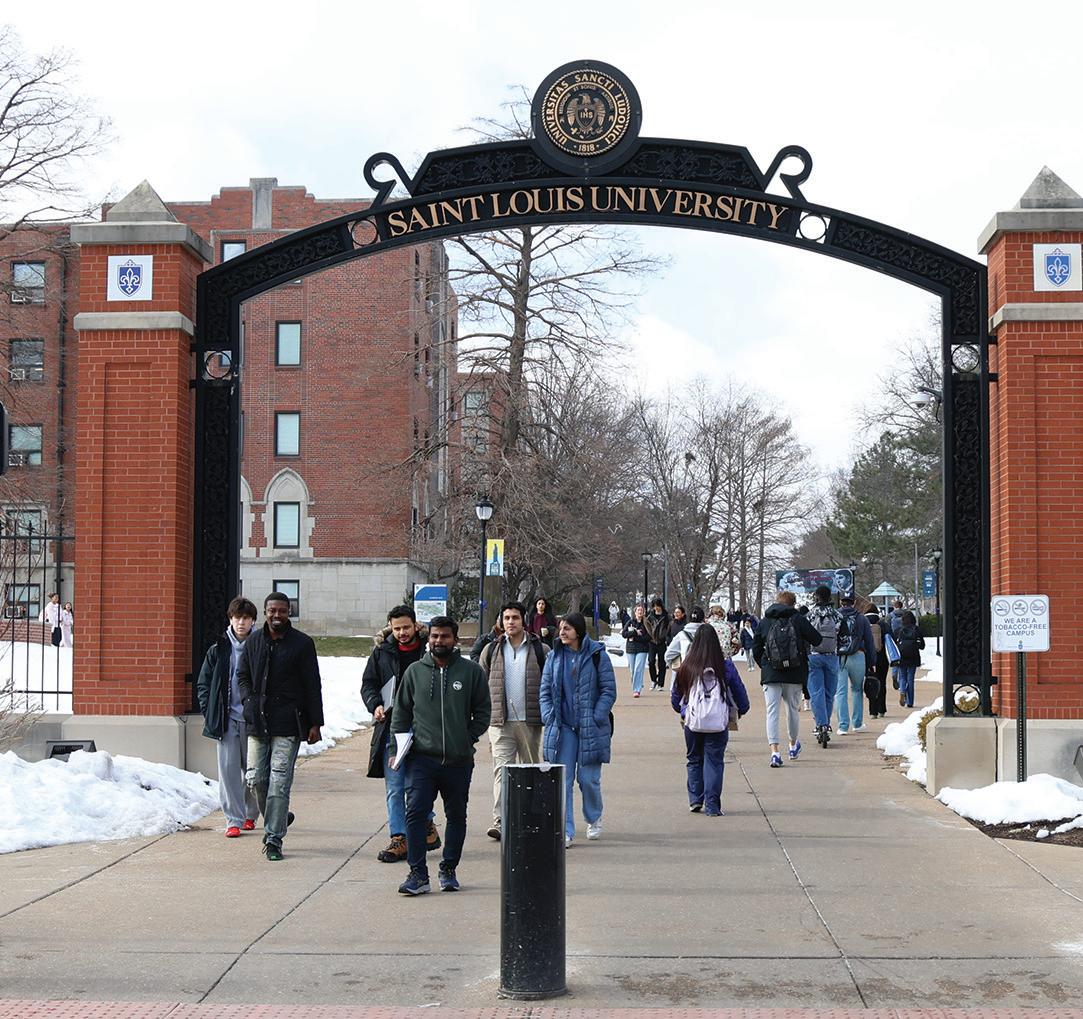
Under the new SLU Tuition Promise, first-time freshmen from families with an adjusted gross income of $60,000 or less — and limited assets — will be able to attend the university without paying undergraduate tuition. Tuition will be covered through a combination of federal and state grants and institutional gift aid.
of the Tuition Promise.”
The program will be renewable for up to 10 consecutive semesters, provided students continue to meet income and financial aid requirements and remain in good academic standing. Participants will also be required to live on campus, a condition the university says supports student retention and
Primary Care for the Whole Family


BJC primary care providers are your well-being partners, o ering compassionate care for your whole family—all in one place.
With convenient locations throughout the area, virtual care options, and specialist referrals, we provide exceptional care that helps you navigate your health journey and live the life you love.
academic success. While there is no formal cap on the number of students who may qualify, SLU will guarantee funding for eligible students who submit their enrollment deposit by May 1, the national college decision deadline. According to Cox, that deadline allows the university to model participation levels well in advance of the
academic year.
Cox said the program was designed with long-term sustainability in mind, with eligibility guidelines and annual financial aid reviews intended to keep the initiative financially predictable. Once awarded, the tuition promise will be renewed for students who continue to meet program requirements.
University officials say success will be measured by more than enrollment numbers alone.
SLU plans to track graduation rates, student debt levels and post-graduation outcomes for participants.
“Enrollment is just the start,” Cox said. “We’ll look at how students do while they’re here and after they graduate.”
While the program does not cover room, board or books, DeLonis said eliminating tuition is expected to significantly reduce the amount of student loan debt participants carry after graduation.
“This program reduces the need for loans so students can focus on completing their degrees and starting their next steps after graduation with greater financial freedom,” he said.
The tuition promise builds on other recent financial aid investments at SLU, including nearly $3 million in new scholarships for local students pursuing undergraduate degrees in education, social work and criminal justice. University officials have also said they expect all incoming first-year students enrolling this fall to receive some form of financial assistance.

Photo by Lawrence Bryant / St. Louis American
Commentary

Sheldon All-Star Chorus shines at music educators conference
For the first time in 60 years, a St. Louis group performed during the annual Missouri Music Educators Association Conference, with the Sheldon All-Star Chorus earning the honor.
Under the direction of Artistic Director Maria A. Ellis, the chorus performed during the 2026 conference Jan. 29-31 at Tan-Tar-A Resort at the Lake of the Ozarks.
The ensemble is made up of high school students from North St. Louis County, St. Louis and surrounding-area schools who were recommended by their school choral directors and selected through an audition process.
“The All-Stars have been working
hard on their program since first semester, meeting only once a week for three hours at The Sheldon, but the work put in by our students outside of that short time is what blessed us with a performance that conveyed power and triumph that cannot be replicated,” Ellis said on the chorus’ Facebook page.
The Sheldon launched the AllStar Chorus in 2018 to provide vocal instruction, mentoring and performance opportunities for talented student singers throughout the academic year.
The tuition-free program offers leadership development, community engagement and weekly rehearsals, with dinner and transportation provided.
Black America must have a global view
By Julianne Malveaux
Black America is often told that foreign policy is distant — something for diplomats, generals and elites in places most of us will never see. We are told to focus on schools, housing, policing and wages, as if global power has nothing to do with any of that.
That separation is a lie.
Decisions made in elite global spaces — whether at the World Economic Forum in Davos, in NATO councils or in negotiations over strategic territories like Greenland — shape budgets, priorities and power at home. They determine what gets funded, what gets militarized and what gets neglected. And when resources are scarce — or declared to be — Black communities feel it first.
This is not new.
Black leaders have long understood that racial justice at home cannot be separated from global arrangements of power.
expendable. When melting ice makes Greenland newly valuable — not as a home to people, but as a site of minerals, shipping lanes and military advantage — we are watching climate crisis turn into geopolitical opportunity for the powerful. Extraction wears a green suit now, but it is still extraction.
Black Americans are told this is none of our concern. That is precisely why it should be.
W.E.B. Du Bois argued more than a century ago that the “color line” was global, not merely American — that Western wealth was built on colonial extraction and racialized labor across Africa, Asia and the Caribbean. Ida B. Wells took the fight against lynching overseas, exposing U.S. racial terror to international audiences and embarrassing a nation that claimed moral leadership abroad while tolerating barbarism at home.
And Martin Luther King Jr., in his 1967 speech Beyond Vietnam, made the connection explicit: a nation that spends more on war than on social uplift is approaching spiritual death. King was condemned for saying it. History has proven him right. Today, the language has changed, but the structure remains. Global elites gather at Davos to discuss growth, security, climate and “risk.” But those conversations are not neutral. They are about who controls resources, who bears costs and whose lives are treated as
Foreign policy determines whether trillions go to weapons systems or to housing. It determines whether climate change is treated as a human emergency or a strategic opening. It determines whether debt relief is extended to poor nations — or whether austerity is imposed, hollowing out social systems that mirror our own disinvestment here at home. When banks, defense contractors and multinational corporations dominate global forums, their priorities do not stay abroad. They come home in the form of budget cuts, privatization and “fiscal realism” imposed on Black communities.
Black internationalism has always been dangerous to power because it refuses this separation.
Paul Robeson understood this deeply. He insisted that Black freedom in the United States was inseparable from the liberation of oppressed people worldwide. For that belief, the U.S. government revoked his passport, destroyed his career and branded him a threat.
Davos is not where democracy happens. It is where consensus among the powerful is rehearsed and normalized. Black America ignores these spaces at our peril — not because we are invited, but because we are affected. Global decisions about trade, climate finance, militarization and extraction shape the economic conditions we are told to endure quietly. We cannot afford that quiet.
Julianne Malveaux is an author, economist, syndicated columnist and former college president.

The Sheldon All-Star Chorus performed during the Missouri Music Educators Association Conference on Jan. 29-31 at the Lake of the Ozarks, marking the first time a St. Louis group has performed at the event in 60 years.
Photo courtesy of Sheldon All-Star Chorus
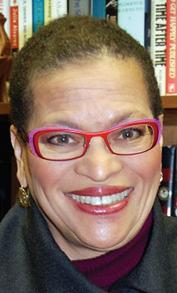
Julianne Malveaux

Black-owned businesses shut down to protest ICE operations
By Damenica Ellis Minnesota SpokesmanRecorder
Black-owned businesses across Minnesota participated in a general strike to protest U.S. Immigration and Customs Enforcement operations, with owners saying closing their doors was an act of economic resistance and community solidarity.
Hundreds of businesses statewide recently joined the strike, urging residents not to shop, work or attend school in protest of ICE activity in the state. Several Blackowned and Black-led businesses stood in solidarity by shutting down for the day.
“We cannot continue to act like any of this is normal,” said Nicole Nfonoyim-
Hara, owner and founder of Griot Arts, a bookstore, art gallery and community space in Rochester, in southern Minnesota.

“We cannot do business as usual. Being able to have a collective call and show our collective power in the face of state-sanctioned violence is one of the most powerful things we can do right now.”
Nfonoyim-Hara said participating in the shutdown was a way to use economic power as a form of protest.
“Every business has some
power,” she said.
“And everyone has the ability to not contribute to the economy.”
As a Black business
owner, Nfonoyim-Hara said she sees herself as part of a lineage of spaces rooted in solidarity and community, making participation in the strike an easy decision. The shutdown, she said, also created a moment for reflection and truth-telling.
“This is a moment of reckoning,” Nfonoyim-Hara said. “Systems want us par-
ticipating and not thinking about the violence that’s happening or the ways our communities are living in fear.”
Rise & Remember, an organization formed after the killing of George Floyd to preserve stories of resistance to racial injustice and create spaces for grief and healing, also participated in the shutdown.
The group helps steward George Floyd Square, the commemorative area where Floyd was killed, and offers guided visits and pilgrimages to the site. Those services were paused during the strike.
Rise & Remember Executive Director Jeanelle Austin said the decision was made to stand in solidarity
Black workers fall further behind in Trump’s second term
By Joseph Williams Word in Black
When President Donald Trump took office for a second time last year, experts warned that Black Americans could face economic hardship, pointing to Project 2025 proposals calling for deep government spending cuts and Trump’s long-standing opposition to initiatives aimed at increasing Black employment.
Now, on the first anniversary of Trump’s second term, a Washington think tank reports that the president’s policies have pushed Black communities into what it describes as an economic downturn.
A new report from the Joint Center for Political and Economic Studies finds that Black unemployment has reached recession-level territory, with joblessness among young Black people more than four times the national average. The report says the Black federal workforce has
been sharply reduced, the social safety net weakened further, and racial inequality likely to worsen.
‘Chaos’ as the new reality
“One of Dr. King’s last books was ‘Where Do We Go From Here: Chaos or Community,’” according to the report. Titled “State of the Dream 2026: From Regression to Signs of a Black Recession,” it adds that nearly 60 years after his assassination, “chaos feels like the word that captures today’s reality.”
Dedrick AsanteMuhammad, president of the Joint Center, said he was surprised by how quickly Trump’s second term affected Black Americans.
“I did not expect such an immediate negative impact to African Americans in one year,” Asante-Muhammad said.
He pointed to what he described as “radical policy

PEOPLE On The Move

AnNoor honored for Walmart tornado response LaTonya AnNoor
LaTonya AnNoor, leader of Walmart’s Community Relations and Social Impact team in the St. Louis region, has been recognized by the company and several community organizations for her role in the retailer’s tornado response. A graduate of Beaumont High School and Lincoln University, AnNoor received a Missouri House of Representatives resolution for coordinating first-responder support, along with the Key to the Community from Diamond Divas and the city of St. Louis. She also received Community Impact honors from 100 Black Men, the Heart in Action Award, the Servant Heart Award and the Game Changer Award for Community Impact.
Operations Food Search hires Kevin Windham
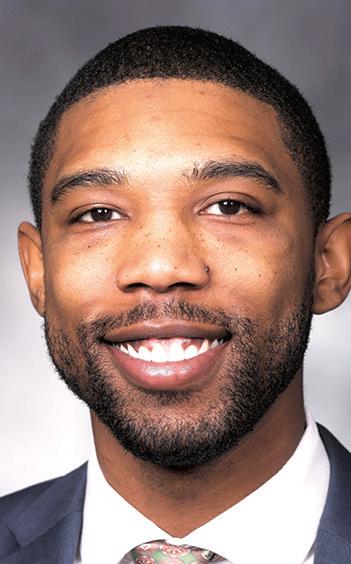
Kevin Windham
Operation Food Search has named Kevin Windham its new government relations manager. Windham previously served as a Missouri state representative for the 74th District and brings experience in government affairs, community engagement and public policy to the role. He will monitor and respond to federal, state and local legislation affecting food access and poverty issues, contribute to organizational policy strategy and analyze legislative data. Windham most recently served as assistant director for community engagement at Washington University in St. Louis.
Knott named Lift for Life Gym executive director
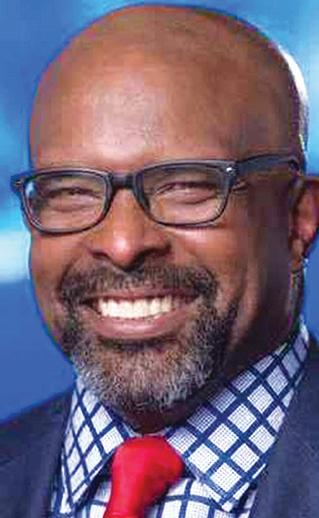
Rene Knott, a three-time Emmy Award-winning broadcast journalist, has been named executive director of Lift for Life Gym. “I want to impact change in our city by helping our kids see the possibilities and the opportunities to better their lives,” Knott said. Knott spent 21 years at KSDK-TV, where he became a familiar presence covering sports and later serving as a morning news anchor. Lift for Life Gym serves nearly 400 children who live in and around the McKinley neighborhood in North St. Louis, one of the city’s most economically challenged areas.
Henry named to Lincoln U. position

Lincoln University of Missouri has appointed Dr. Tikiy`a Henry as assistant dean for student engagement. Henry brings more than a decade of leadership experience in higher education, with a focus on student engagement, retention and holistic student success. Most recently, she served as interim director of first-generation student success and associate director of programs and traditions at Florida Atlantic University.
Promotion, board appointment, new hire, award...please submit your People on the Move item (including photo) to areid@stlamerican.com
Photo by Liza Summer / Pexels
A new report finds President Donald Trump’s policies have pushed Black communities into an economic downturn.
Photo courtesy of Griot Arts
Rene Knott
Griot Arts, a bookstore, art gallery and community space in Minnesota closed on Jan. 23 to protest ICE in the state.
Dr.
Dr. Tikiy’a Henry
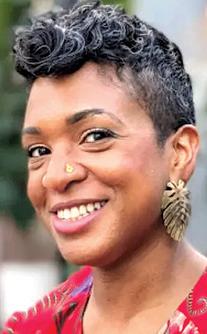
Jeanelle Austin Nicole Nfonoyim-Hara
Saint Louis Science Center earns three ‘Best’ nominations
By Sylvester Brown Jr.
St. Louis American
Editors and a panel of experts from USA Today have nominated the Saint Louis Science Center once again for its annual 10Best Readers’ Choice Awards.
The Science Center is nominated in three categories: Best Free Museum, Best Planetarium and Best Science Museum. The institution has placed among the top
ICE
Continued from A5 with immigrant communities and U.S. citizens affected by ICE operations.
five in recent years, including in 2025, when it finished No. 1 for Best Planetarium, No. 2 for Best Free Museum and No. 5 for Best Science Museum. It was also named Best Free Museum by Newsweek last year.
According to USA Today, a panel of experts worked with 10Best editors to select nominees based on their range of activities for residents and visitors.
The Science Center traces its roots to the James S. McDonnell Planetarium, which opened in 1963 in Forest Park.
The facility was named for James S. McDonnell, chairman of the McDonnell Aircraft Corp., who pledged $400,000 to
intentional.
The Science Center is nominated in three categories: Best Free Museum, Best Planetarium and Best Science Museum.
help fund the project. When announcing his donation, McDonnell said the long-term significance of the planetarium in St. Louis was that “space, science and exploration are here to stay.”
In describing the museum, 10Best editors wrote
that visitors can “examine full-scale replicas of a Mars rover, observe sea creatures in the Pacific Coral Reef Aquarium, and watch live STEM demonstrations.”
After a 1985 merger between the planetarium and the Museum of Science and Natural History, the facility became known as the Saint Louis Science Center.
Other institutions nominated in the Best Science
Museum category include the Michigan Science Center, Carnegie Science Center and The Wild Center in Tupper Lake, New York.
Final winners will be determined by public vote. Voting in the 10Best Readers’ Choice Awards is open through 11 a.m. Feb. 9.
Sylvester Brown Jr. is the Deaconess Foundation Community Advocacy Fellow.
“This is a civil rights issue. It’s a humanitarian issue,” Austin said. “Our organization was birthed out of a justice movement, so justice is at the core of what we do.”
shifts” during Trump’s second term — including the Department of Government Efficiency, or DOGE, an Elon Muskled initiative that sharply reduced the federal workforce — as a major factor in widening economic gaps between Black households and their white counterparts.
“During the first year of Trump’s first term, Black unemployment
Austin said the organization’s pilgrimages, which have taken place for nearly four years, provide visitors with space to reflect on their role in advancing justice. Pausing that work, she said, was
declined by almost a percentage point,” AsanteMuhammad said. “In the first year of Trump’s second term, Black unemployment increased over a percentage point to 7.5%.”
Prepared with several nonprofit partners, the report links the White House’s domestic policy agenda to rising economic strain for Black workers and families.
When Trump took office last January, the Black unemployment rate stood at about 6%, compared with
“Some would say this is the time to open your doors,” Austin said. “But more importantly, this is the time to stand up and march side by side with our brothers and sisters.”
Rather than hosting official programming, Austin said she planned to protest alongside clergy
the national rate of 4%, according to the report.
By December 2025, Black unemployment had climbed to 7.5%.
The figures for Black youths were even more severe, reaching about 18% by the end of last year — more than triple the national average.
“If Black people had the same prime-age employment rate in 2025 that they had in 2024, then there would have been about 260,000 more primeage Black people working,” the report states. “Of this number, about 200,000

members, mentors, youth and community members from across the state and country.
Despite frigid temperatures, Austin said showing up physically matters.
“We have to demonstrate. We have to peacefully protest and enact our right to be heard,”
would have been primeage Black women.”
The DOGE initiative likely contributed significantly to those losses, the report said.
“The elimination of 271,000 federal jobs has likely had a severe impact on Black workers, who are disproportionately represented in the federal workforce, as reflected in the sharp rise in Black unemployment in 2025,” the report said.
The report also warns that tax provisions in Trump’s so-called One Big Beautiful Bill Act will
she said. “Otherwise, we’re not going to see change.”
Nfonoyim-Hara said she also planned to support the strike by connecting people to resources, contacting members of Congress and attending rallies in the Rochester area.
Organizations, includ-
further weaken the social safety net by shrinking federal revenue and shifting wealth toward higher-income households.
It adds that Trump’s regulatory agenda has left Black communities more vulnerable to predatory lending, that his job policies may deepen workplace inequality, and that his housing policies fail to narrow the racial homeownership gap.
While the outlook is grim, the report stresses that “regression is not destiny.”
“But neither is prog-
ing ICE Out of MN, are calling for ICE to leave the state, legal accountability for the ICE agent who killed Renee Good, an investigation into alleged constitutional violations, an end to federal funding increases for the agency and for companies to sever economic partnerships with ICE.
ress automatic,” it states, adding that meaningful change “requires more than optimism.”
Overcoming the setbacks will take “the organized power, evidence-based strategy, and moral clarity that have driven every successful movement for racial justice in American history,” the report said.
“The dream Dr. King articulated remains both measurable and achievable. Whether we reach it depends on the choices we make in response to what this report reveals.”

HealthMattersHealthMattersHealthMatters

Heart disease’s heavy toll in STL
Deaths remain highest among city’s Black residents
By Nia Hightower For The St. Louis American
ardiovascular disease remains the leading cause of death among Black Americans, and agencies across the St. Louis region are working to equip residents with the knowledge and resources needed to reduce its toll.
“I think about how we can empower people and improve the conditions in our Black communities when it comes to economic and systemic factors that contribute to cardiovascular disease,” said Dr. Kanika Cunningham, director of the St. Louis County Department of Public Health. The health department, the American
By Jennifer Porter Gore Word in Black

A fresh look at healthy goals
By Dr. Graham A. Colditz
It feels like a great time to mix things up. So, after several years interviewing leaders in health and medicine to get their insight for this column, I thought it seemed only fair to turn the tables and have a colleague interview me.
The result was a great discussion that touched on issues big and small — and that may provide a peek behind the curtain of medical research and how I incorporate health recommendations into my own life.

Much of your work focuses on helping people improve their health and prevent diseases like cancer. What drew you to this?
When I was a medical student and we’d visit cancer patients, it seemed like lung cancer was everywhere, and no one really talked about tackling smoking as a way to prevent it. People were talking about how to prevent heart disease and high blood pressure, but not cancer. It looked like there was real potential to go after cancer prevention in a creative and impactful way.
If someone asked you for the top three behaviors they should follow to lower cancer risk, what would you recommend?
Heart failure deaths among Black residents occur at nearly 1.5 times the rate of white residents. Hospitalizations for heart failure are more than three times higher.
Heart Association’s Missouri affiliate, Hope in the Ville and the Doula Lab are among community partners working to educate residents about prevention and treatment.
See HEART DISEASE, page A8
The top one is: Don’t smoke. Or, if you smoke, quit. Next would be to avoid weight gain. That may be surprising to hear, but extra weight increases the risk of many different cancers. Regular physical activity helps with controlling weight, as does my third top behavior: eating a healthy diet. Try to focus on fruits, vegetables and whole grains — and limit fast and processed foods.
What’s something you do that’s pretty simple but can have a large payoff for health?
One easy thing has been building short walks into my daily life. A reg-
See COLDITZ, A8
Syphilis infections among pregnant women triple
Data released last week by the Centers for Disease Control and Prevention shows a troubling trend: a sharp rise in the number of pregnant women diagnosed with syphilis, a sexually transmitted infection that, if left untreated, can cause serious harm to infants, including blindness. While experts say the increase is tied in part to delayed prenatal care or none at all, maternal syphilis is not affecting all populations equally.
According to the CDC’s National Center for Health Statistics, the national rate of maternal syphilis more than tripled between 2016 and 2022. Early estimates show the numbers jumped another 28% in 2024. Rates among Black mothers increased 30%, while infections among white women rose 23%. The largest increase occurred among
The national rate of maternal syphilis more than tripled between 2016 and 2022. Early estimates show the numbers jumped another 28% in 2024.
American Indian and Alaska Native mothers, whose infection rate jumped 52%. Researchers say a combination of improved testing and a true rise in infections across racial and ethnic groups is driving the surge. How we got here
Maternal syphilis happens when several systems intended to protect pregnant See SYPHILIS, A8

Photo by Tim McNeese
Courtesy photo
According to the CDC, syphilis in pregnant Black women increased 30% between 2022 and 2024, while infections among pregnant white women rose 23%.
The Doula Lab, in partnership with the American Heart Association in Missouri and Aetna Better Health, convened a group of more than 45 men to talk about mental health matters and high blood pressure at Vision Point Grooming & Styles in Bellville, Illinois.
Dr. Graham A. Colditz
HealthMattersHealthMattersHealthMatters
Heart disease
Continued from A7
A leading killer
“When we think of cardiovascular disease, we’re talking about the diseases that impact the heart and blood vessels,” Cunningham said. “It can be someone who has congestive heart failure, someone with a history of heart attack.”
Cardiovascular disease includes heart disease and stroke and is often driven by plaque buildup in artery walls. High blood pressure, high cholesterol, diabetes, poor diet and physical inactivity remain major risk factors.
Local disparities
Heart disease remains the leading cause of death in St. Louis County, with an average of 2,403 deaths per year from 2019 to 2023, according to public health records.

Deaths from heart disease and stroke declined slightly last year but still outpace all other causes nationwide, according to the American Heart Association. Even with that decline, Black Americans are 54% more likely to die from cardiovascular disease than white Americans, according to a 2023 Tulane University study.
Social risk factors
“There used to be more focus on unhealthy eating, not exercising, but that Tulane study and medical conversations I have been a part of show factors that take the ownership off the individual,” Cunningham said. “We have to look at economic disparities.”
She noted that daily exercise can be difficult for people who live in unsafe neighborhoods or lack walkable streets and that chronic stress tied to poverty increases cardiovascular risk.
The Tulane study pointed to a range of social conditions linked to higher cardiovascular risk, including unemployment, low family income, food insecurity, limited education, lack of regular health care or private insurance, housing instability and social isolation.
Syphilis
Continued from A7
Black residents are 1.67 times as likely as white residents to die from heart attacks. Hospitalizations are also higher, with 17 heart attack admissions per 10,000 Black residents compared with 10.7 among white residents. Heart failure deaths among Black residents occur at nearly 1.5 times the rate of white residents. Hospitalizations for heart failure are more than three times higher.
Prevention efforts
The county health department offers six-week workshops focused on managing chronic conditions, building healthier habits and improving communication with health care providers.
“It’s a great opportunity to learn how to communicate with your health provider,” Cunningham said. “We’ve seen some great results, and I think the workshops encourage and empower participants.”
The American Heart Association also partners with community organizations to increase awareness and improve access to basic health tools.
Its Libraries with Heart initiative provides free blood pressure kits through several local library systems.
“Libraries are an access point for a lot of great resources for community services, and we thought why not a blood pressure cuff,” said Rachelle Bartnick, senior community impact director for the AHA Missouri affiliate.
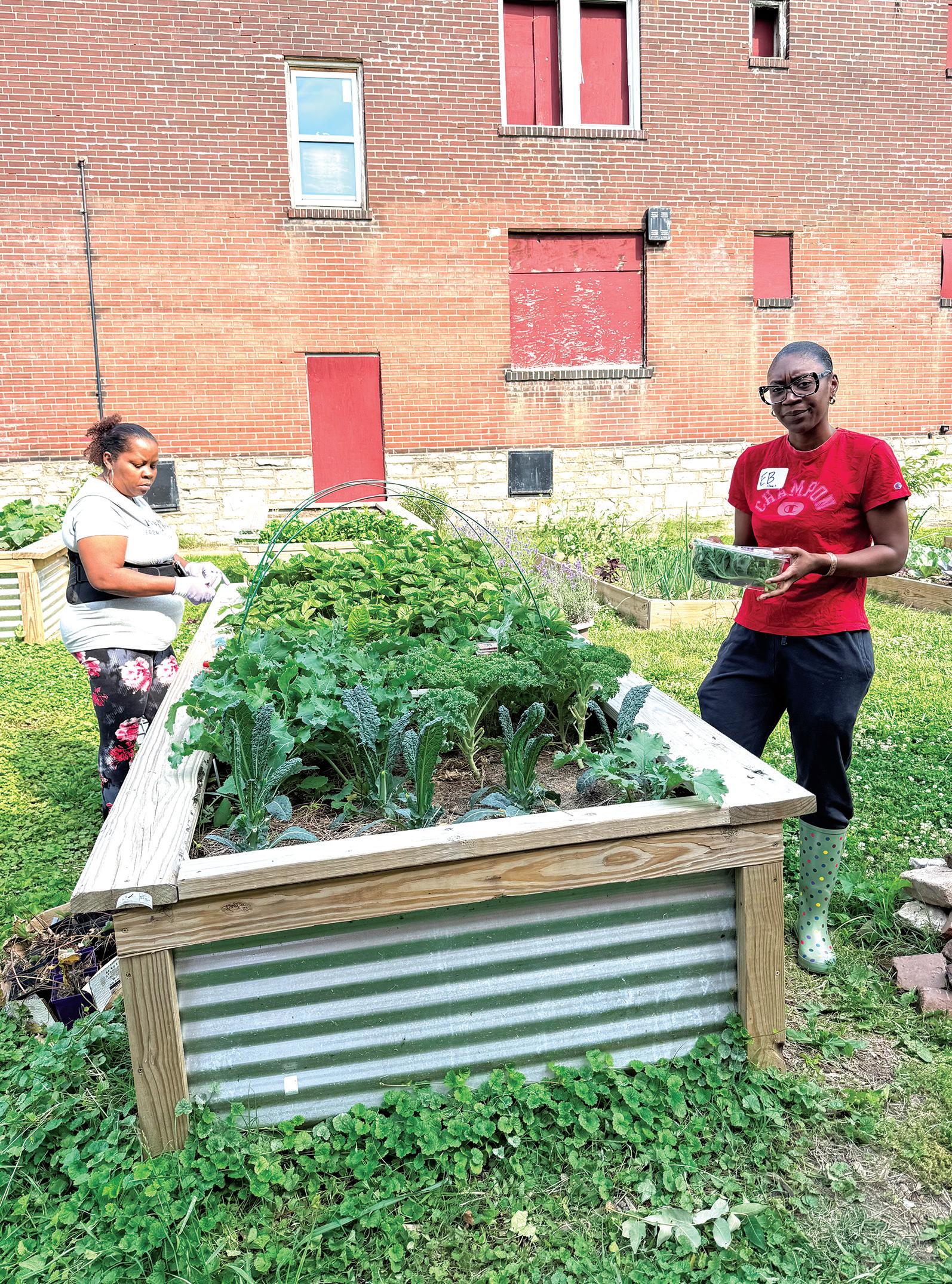
Hope in the Ville has worked with the AHA to increase access to fresh produce through a food pantry and urban gardens in North St. Louis and nearby neighborhoods.
Maternal syphilis occurs when systems designed to protect pregnant women break down, experts say. In addition to limited access to quality prenatal care, women are vulnerable if they miss follow-up visits after a diagnosis or face social and economic barriers that disrupt care.
“Being in collaboration with these established entities further builds trust,” Bartnick said.
Maternal risks
education, screenings and wellness support.
tion’s operations manager.
She highlighted the dangers of preeclampsia, a blood pressure disorder that can develop during pregnancy or after birth.
Black women face the greatest risk. In 2023, their maternal death rate was three to four times that of white women, with the rate rising again in 2024.
While syphilis has not been directly linked to maternal deaths, the infection poses serious dangers for infants.
The Doula Lab addresses cardiovascular disease as a leading cause of maternal mortality through women break down, experts say. Besides an absence of quality prenatal care, women are susceptible to the infection during pregnancy if they miss follow-up visits after a diagnosis as well as social vulnerability that affects every aspect of maternal healthcare.
“Delayed access to prenatal care was also associated with maternal syphilis, as more than one-third of the women [with infections] did not have a perinatal visit in the first trimester,” Dr. Robert L. Cook told JAMA Network Open in an article published last month.
Colditz
Continued from A7
ular 15- to 20-minute walk to work or school or a nearby store can have amazing health benefits.
I’m not perfect with it, but I’ve tried to make it a routine to walk instead of drive when it’s safe and pretty easy to do. I like to get longer walks in when I can, but it’s great to have this basic amount of activity built into my day.
“Delayed access to prenatal care was also associated with maternal syphilis, as more than onethird of the women [with infections] did not have a perinatal visit in the first trimester,” Dr. Robert L. Cook told JAMA Network Open in an article published last month. The United States already has the highest maternal mortality rate among developed nations.
Most of us can improve the way we eat. Do you have something you’ve been trying to work on recently?
One thing I started doing was switching to alcohol-free, or NA, beer. I’m Australian, and we’re known for liking beer. And the NAs are really good now — with a lot of options in stores and at bars and restaurants. So, I was like, “Let’s give it a go and switch.” It also felt important to do because we’ve tried to bring more attention to the message
Congenital syphilis — when the disease is passed from mother to fetus — has surged nearly sevenfold between 2015 and 2024. Nearly 4,000 cases were reported in 2024 alone, the highest number in a single year since 1994 according to the CDC.
A plan that fell short
Speaking with JAMA, Cook noted that the medical and public health com-
that zero alcohol is the best choice when it comes to cancer risk and overall health.
Health recommendations can change over time, whether it’s what to eat or drink or when we should get screening tests. Why this is? This can feel frustrating, for sure. But we can also see such changes and say, “It’s really good news. We know a lot more now than we used to.” Looking at breast cancer screening, mammogram
“We all know the statistics for Black women. No matter your income or health insurance, you are 3 to 4 times more likely to pass away giving birth,” said Marvella YingClayburne, a certified doula and the organiza-
munities had put syphilis in its crosshairs, hoping to eradicate the infection. As part of that effort, many states required pregnant women to be screened early, testing them again during their third trimester and during labor and delivery.
But many states don’t require syphilis tests for pregnant women.
“Twenty years ago, the U.S. public health system confidently presented a plan to eliminate syphilis,” he said. But the plan, Cook said, has “not gone as intended, and pregnant women and their offspring are now bearing the brunt.”
Cook noted that other research found “syphilis rates among pregnant women in Mississippi
technology today is much better than what we used to have. The richness of the image is better. And we have more studies that have gone on for longer periods of time. So, we have more evidence on the positive impact of mammograms on women’s health. With this, we can revisit and refine recommendations for when women should start screening and how often they should have it. This also applies to many other health recommendations. They can be refined over
“I don’t think people know that it can happen within the first year after birth,” Ying-Clayburne said. “So a lot of women are dying because of pre-eclampsia because they’re not being seen by their doctors.” The Doula Lab also hosts programs focused on men’s health, including blood pressure monitoring and discussions around mental well-being.
“increased nearly 10-fold between 2018 and 2023.” Meanwhile, the overall infection rate and the rate for men have both decreased over the same time period.
In the early 2020s, most states began prescribing the antibiotic doxycycline to men who had an increased risk for the disease but hadn’t been infected, which may have protected them from it. But the drug is unsafe for pregnant women and isn’t recommended for women in general.
Meanwhile, the U.S. last year had a shortage of the only injectable antibiotic approved for treating syphilis in pregnant women.
Researchers say the rate of infection among
time as we learn more.
Wrapping things up, do you have any specific health goals for the year?
I’d like to lose a few more pounds and get back into the normal weight range. As a nation, the weight issue stands out. It’s a driver of so many chronic conditions — not just cancer, diabetes and heart disease, but also mobility and memory problems. And we haven’t done a great job with policies and approaches that make it easier for people
pregnant women is rising because of barriers to prenatal care, economic insecurity, limited health insurance coverage, and systemic inequities that contribute to delayed or missed treatment. There’s also some concern that recent staffing and budget cuts at the CDC will limit the ability to track the epidemic’s spread and to hire the public health workers needed to reverse this trend.
Syphilis during pregnancy is treatable with antibiotics, which can prevent transmitting it to the fetus. Infected infants can face a host of adverse outcomes including brain and nerve disorders, low birthweight, preterm birth and fetal or neonatal death.
to be physically active and choose healthier foods. That’s a bigger goal for policymakers and health professionals like me. But on a more personal level, I’ll try to keep up with the steps that can help me get to a healthier weight in 2026.
Dr. Graham A. Colditz, an internationally recognized leader in cancer prevention, leads prevention research at Siteman Cancer Center at BarnesJewish Hospital and WashU Medicine.
Dr. Kanika Cunningham
Volunteers for Hope in the Ville work in the Danny Coverson Community Garden to promote nutritious eating habits that combat cardiovascular disease for residents in the North St. Louis neighborhood.
Photo courtesy of Hope in the Ville

K.Dot is the Grammys’ new hip‑hop king
On Sunday, February 1, rapper Kendrick Lamar made history at the 66th Annual Grammy Awards. Lamar won Record of the Year, Best Rap Album, Best Rap Song and Best Melodic Rap Performance — a sweep that officially pushed him past Jay-Z for the most Grammy wins by a hip‑hop artist. Jay‑Z has earned 25 Grammys over his career. The Compton lyricist now holds 27 wins and 66 nominations. During his acceptance speech, Lamar took a moment to honor the artist whose music helped shape his and St. Louis‑born hit “Luther.” The track heavily samples Luther Vandross and Cheryl Lynn’s slow‑jam classic “If This World Were Mine.”
“He’s one of my favorite artists of all time,” Lamar said during his Record of the Year speech. “They granted us the privilege to do our version of the song. When we got that clearance, I promise you, we damn near all dropped a tear, because we know how much he and Cheryl Lynn poured into that record.”
Michael ‘5000 Watts’ passes at 52
Houston hip‑hop pioneer passed away on Friday, January 30. The legendary DJ, producer and founder of Swishahouse Records was 52.
entrepreneur and cultural architect who opened doors for countless artists and DJs.
Swishahouse became a launching pad for major stars including Slim Thug, Paul Wall, Chamillionaire and Mike Jones, among many oth ers.
Shaunie benches ‘Basketball Wives’
Shaunie Henderson took to Instagram to announce that “Basketball Wives” will not be return ing to television.
“Thank you to BET, VH1, Shed Media and to everyone who supported this chapter from the very beginning,” Henderson wrote. “What started as a vision became a platform that amplified voices and opened doors.”

His family confirmed the news in a statement shared on social media. They said Watts died after suffering a sudden cardiac event tied to a fatal heart‑rhythm condition, describing him as a pillar of the Houston music scene whose influence stretched far beyond the booth.
Shortly after the announcement, longtime col laborator and Swishahouse co‑founder OG Ron C released a heartfelt tribute honoring Watts’ legacy. Ron C called him a visionary who helped shape Southern hip‑hop and turned Houston’s underground mixtape culture into a global movement. He praised Watts not only as an innovator, but as a mentor,
She described closing the chapter on “Basketball Wives” as “not so much an end ing, but a transition.”
“Since its launch in 2010, this fran chise has been the defining part of my professional journey,” Henderson said. “I’m stepping into a new sea son with exciting projects ahead that align with where I am personally and professionally. I am thankful to the women who trusted me with their stories. This is what growth and moving forward looks like. More to come.”
Ray J gives health update after saying his days were numbered
Singer and actor Ray J has shared a new health update after recently claiming he has only months to live.
“2027 is definitely a wrap for me,” the R&B sing er said during a January 2026 Instagram Live, later reposted on X (formerly Twitter). The video surfaced after TMZ reported he had been hospitalized in Las Vegas with heart issues and pneumonia.
“I want to thank everybody for praying for me,” he said in the clip shared Jan. 25. “I was in a hospi tal. My heart’s only beating like 25%… My health is not okay, so I thank everybody for supporting and praying for me.”
Although he claimed in the livestream that doctors told him he had months to live, Ray J later walked that back. In a follow‑up Instagram video, he said “everything will be all right” as long as he stays “on the right path.”















Shaunie Henderson
Soccer
Continued from A1
matches in both the men’s and women’s Olympic soccer tournaments as part of a nationwide slate of venues beyond Los Angeles.
For some Black-owned businesses already connected to the stadium, the Olympic matches could increase their income growth even further.
Rachel Burns, founder and owner of Bold Spoon Creamery, distributes her ice cream through grocery stores such as Schnucks and Straub’s and serves customers at Energizer Park as well.
“As a Black woman-owned business that has been a part of the fabric of Energizer Park since
Ottley
Continued from A1
reduce workload.
“I’ve done work related to medical risk communication — how you help communicate to someone given a positive test that doesn’t necessarily mean that they have cancer,” said Ottley, an associate professor of computer science and engineering at Washington University.
“I also collaborated with people in the U.S. Department of Defense as they considered how to visualize large data sets and how they might integrate AI and machine learning into that process to help people sift through large amounts of data.”
Before joining Washington University’s faculty in 2016, Ottley earned her doctorate in computer science and engineering at Tufts University in Medford,
its inaugural season, Bold Spoon is honored to be part of this event as well,” Burns said. “Of course, the business impact extends far beyond any single business.”
Burns said major sporting events drive traffic to downtown businesses and give the city an opportunity to “intentionally direct global tourism toward the diverse corridor of entrepreneurs in the region.”
“The influx of international visitors provides a unique opportunity to circulate the ‘Olympic Dollar’ locally and build a lasting legacy,” she said.
“The visibility gained during these matches will create a ‘halo effect’ for small businesses that remain in the community long after the final whistle.”
Community leaders also
Massachusetts, where she also received her master’s degree. After completing her master’s, she worked as a research intern at IBM Research and Clemson University’s HumanCentered Computing Lab in South Carolina.
Ottley is among a small number of Black women in the computer science field, which account for about 3% of degree earners and the tech workforce and less than 1% of those holding Ph.D.s, according to the National Center for Women and Information Technology.
Growing up in the Caribbean island nation of St. Kitts and Nevis, Ottley said a career in science, technology, engineering and mathematics, or STEM, was not something she initially envisioned.
“I was the kind of student who was good at a lot of things, so there wasn’t one area that emerged for me,” Ottley said. “By the time I finished high school,

say Black vendors could benefit from the increased activity surrounding the Olympic matches.
Adolphus Pruitt, president of the NAACP St. Louis City Branch, said while broader economic
I wasn’t sure what I wanted to do.”
It was not until she began her studies at the State University of New York at Plattsburgh that she narrowed her interests to mathematics, accounting and computer science.
“I wanted to do everything,” Ottley said as she explored each discipline.
Computer science ultimately won out, and she decided to minor in mathematics.
Ottley said diverse perspectives are essential to innovation in STEM, a view shared by her peers.
Jordan Crouser, professor of computing and founding director of the Interdisciplinary Program in Computing at Kenyon College in Gambier, Ohio, studies how people interact with data and emerging technologies and has collaborated with Ottley on more than a dozen scholarly papers.
“Alvitta has been this really central intellectual

advantages remain difficult to predict, Black-owned vendors are likely to see opportunities connected to major stadium events.
Officials from Energizer Park have said the venue is dedicated to
driver, thinking about how we combine these really squishy questions about human nature along with methodological rigor to push that work toward deeper impact,” Crouser said. “(Her) work not only has shaped my own scholarly trajectory, but really shaped how our field is thinking more broadly.”
Crouser said Ottley, who also serves on faculty in Washington University’s psychological and brain sciences department, examines how human diversity shapes the way people approach problems.
“When I think about Alvitta’s more recent work, she’s providing deep, rich, nuanced conceptual framing that is a shift from how we’ve done business in the past 30 years of human-centered design,” he said. “She’s modeling a way of doing computer science that doesn’t treat human values, interpretation and
featuring diverse local businesses, promoting St. Louis-based vendors through its #STLMade initiative.
Chef Gerard Craft, who oversees food programming at the stadium, has said the goal is to reflect both soccer culture and St. Louis culture.
The 2028 Olympics are scheduled to run from July 14 through July 30, though soccer matches typically begin before opening ceremonies because of the tournament format.
Specific match dates and team assignments are expected to be announced ahead of the first major ticket release next year.
The games place St. Louis back in Olympic history again. The city last hosted the Games in 1904, the first Summer Olympics held in the United States.
agency as afterthoughts but brings them forward as first-class concerns.”
Ottley has expanded her research through international collaborations and conferences.
In December, she organized a workshop in Germany that brought together psychologists and computer scientists to explore ideas at the intersection of the two fields. Her work has also taken her to Ghana.
Ottley and faculty at the University of Education, Winneba in Ghana, received a prestigious NASA grant through the Gordon Research Conferences to study data visualization literacy among early-career educators teaching K-12.
The research surveys teachers in Ghana and the United States to better understand cultural perspectives on data education and develop strategies to improve data literacy worldwide.
City leaders say the return of Olympic events reflects the region’s long-standing soccer culture and its growing reputation as a host for major sporting competitions.
Mayor Cara Spencer said the games will highlight the city on a global stage.
“Sports brings us together and every four years, we pause and celebrate,” Spencer said, adding, “In 2028 our city will have a lot to celebrate.”
For St. Louis, the return of Olympic soccer marks a historic moment — and for local entrepreneurs already connected to the stadium, a chance to reach a global audience.
Sylvester Brown Jr. is the Deaconess Foundation Community Advocacy Fellow.
“Beyond that, we want to work on building our curriculum and giving teachers training so that they have the knowledge to go into the classroom and teach,” Ottley said. Despite numerous grants and awards, Ottley said her greatest accomplishment is the impact she has on students.
“I am proud of the fact that I’m able to contribute to other people’s success,” she said.
Lemara Williams, a second-year doctoral student in computer science at Washington University, works under Ottley and is studying the structure of data visualization style guides and what makes them effective.
“She’s very dedicated to her craft,” Williams said. “When I talk to her about work, she inspires me to want to be a better researcher and to reach her level of work ethic and dedication.”

Energizer Park, home of St. Louis City SC, will host 2028 Olympic preliminary and knockout-round soccer matches.
Photo by Lawrence Bryant / St. Louis American
helped transform into a career accelerator that partners with employers, community colleges and workforce trainers to prepare women for higher-paying careers while providing financial coaching and long-term economic mobility support. Since launching programs in 2021, Rung has assisted more than 600 women, focusing on high-demand fields such as manufacturing, technology and geospatial careers.
It is that work — along with years of community leadership — that has led the St. Louis American Foundation to honor Gill as its Nonprofit Executive of the Year. Gill and three other awardees will be recognized during the 24th annual Salute to Excellence in Business Luncheon on Thursday, Feb. 19, at The RitzCarlton, St. Louis. Terry Harris, CEO of the Legacy Center STL
Science center
Continued from A1 participation and community feedback calling for stronger curriculum and sustained engagement.
The program had served about 90 students, most of whom received the stipends that many families said they depended on.
The pause also halted the program’s annual Community STEM Showcase traditionally held around Martin Luther King Jr.’s birthday.
“The St. Louis Science Center’s mission to
in Normandy, said Gill’s impact was felt immediately.
“The most succinct thing I can say is that Leslie is right for St. Louis,” Harris said. “She’s extremely talented, she’s worked all over the country in nonprofits. She’s also very intentional and unapologetic about the mission in front of her.
“I’ve been in rooms with her with the governor, mayor and other (prominent) individuals, and she’s very unapologetic about the fact that she wants to see women in the St. Louis region make more money than they’re currently making. That’s Rung’s mission.”
Gill’s path into public service began immediately after her senior year of college, when she accepted a job with Tiffany & Co.’s management training program and planned to move to New York.
Before starting that position, she spent the summer in Washington, D.C., where she became involved in the mayoral campaign of Anthony Williams, whose wife is a
ignite and sustain lifelong science learning is unchanged,” Vandiver said, adding that leadership plans to redesign YES over the next eight to 12 months, with student recruitment expected to resume in early 2027.
YES cost roughly $1 million a year, according to a source close to the program — a relatively small amount compared to the rest of the Science Center budget. Vandiver argued the issue was sustainability — a funding structure that could carry the program into the future.
“The structure did not provide the stability
St. Louis native.
“I thought I would just go, hang out with friends, and have a good time,” Gill recalled.
Before Williams won the election, he offered her a position in city government, launching what became a decadelong career in public service.
“It’s the capital city of the world and it was an amazing experience,” Gill said. “I got to meet tons of world leaders, and it really helped me look at the world from a different perspective.”
began seeing first-hand generational cycles of trauma and poverty.

“We were starting to see three generations of kids coming — from their mothers and their grandmothers — who had come to Annie Malone because of abuse and neglect,” Gill said. “I can remember thinking, ‘This is criminal … there has to be a better way.’”
That experience eventually led Gill back to St. Louis and into nonprofit leadership roles with the Girl Scouts and College Summit, now known as PeerForward, before she became CEO of Annie Malone in 2016. There, she said, she
required to plan confidently for the future or to grow the program in ways that matched its aspirations and impact,” he said.
He also said the Science Center lacked consistent data showing how well the program created long-term STEM pathways.
“We could not clearly demonstrate how effectively the program was creating pathways into the STEM ecosystem,” Vandiver said.
The statement was shared earlier this week, several weeks after the program was suspended and six full- and part-time employees were let go, a move that drew frustration
That realization shaped her vision for building broader systems of opportunity — a goal that took form when she met Ali Hogan, founder of the nonprofit resale shop Rung.
“She was like, ‘Women need more than clothes … and you’re going to figure out what that means,’” Gill said.
Under Gill’s leadership, Rung for Women evolved
from some community leaders and residents, including those who characterized the transition as abrupt.
St. Louis City NAACP President Adolphus Pruitt II said the pause would have lasting consequences.
“You cannot claim a commitment to diversity, equity, and inclusion while dismantling a STEM program that has lifted up Black students for decades — especially when those doors are held open by taxpayer money,” he said.
Rachel Grant, a St. Louis social worker, criticized how employees were treated.
“There is no excuse for
into a career accelerator designed to move women toward financial stability and higher wages.
“There are so many women who are one missed car payment, one car breakdown or one medical bill away from being homeless,” Gill said. “That’s the reality, unfortunately and we are trying to change those trends and we’re seeing it happen.”
Community partners have taken notice.
“Leslie has created something for these women where they can excel, where they can find purpose, and where they know they’re valued as a woman,” said Angie Stewart-Brown of Southwestern Illinois College, which partners with Rung on workforce training. “I think that’s important.”
Briston Ashe, one of Rung’s earliest participants, said the program transformed her life.
“Just being in a community of positive people who were cheering me on; that meant so much to me,” Ashe said. “It helped me level-up in my
not giving notice, offering no severance, and having them escorted out of the building like criminals,” she said. “They know that the people who take these jobs could make more money elsewhere but that they choose these jobs because they believe in their work.”
Vandiver said the dismissals followed Science Center human resources procedures and that former employees would be welcome to apply when the redesigned program launches.
He said the decision followed an 18-month review by an independent consultant and a diversity,
professional life, which also went into my personal life…it was just an all-around positive experience.”
“When I think of Leslie, the term ‘a woman’s woman’ comes to mind,” Ashe added. “She’s a motivator who loves being of service to her community, and in particular, helping women excel in their lives and reach higher levels.”
Gill said being honored by the St. Louis American Foundation was especially meaningful.
“This is such an honor for me, having grown up in St. Louis, stopping to get the newspaper every Thursday. … Way back when I was in high school, I would read the American cover-to-cover.
“The American is deeply embedded in my DNA, but I never imagined being honored in this way. I’m excited, I’m a little nervous, but I’m extremely happy to be recognized.”
Sylvester Brown Jr. is the Deaconess Foundation Community Advocacy Fellow.
equity, and inclusion advisory committee.
Mark Wrighton, chairman of the Science Center’s Board of Commissioners, said the governing body supports the leadership’s decision to pause and redesign the program.
“The Commission has the confidence that the right steps have been taken to make positive changes that will be rewarding,” Wrighton said.
Zoo Museum District executive director Matthew Pollock said the redesign offers a chance to strengthen the program while remaining responsive to community needs.

Leslie Gill


Living It
Girl on fire
“I’m not good at talking about myself, but I express it through the music. Every time I tell you this: hip hop is gonna always be right here. We gonna be in these suits.
- Kendrick Lamar during his Grammy Award acceptance speech

Keys’
Kitchen’ makes its St. Louis premiere at The Fabulous Fox
By Zaria Mac St. Louis American
The 17‑time Grammy Award–winning singer‑songwriter and pianist Alicia Keys brings a slice of her life to the stage with the Broadway musical “Hell’s Kitchen,” inspired by her New York upbringing.
The Tony Award–winning show made its St. Louis premiere this week at The Fabulous Fox as part of its national tour.
To most, Hell’s Kitchen calls to mind the Gordon Ramsay reality show. But in New York, it’s a vibrant, diverse neighborhood on Manhattan’s West Side. Keys uses this musical to reintroduce the name as she’s always known it: a place where artists of every discipline collide.
With
With playwright Kristoffer Diaz, Keys blends her platinum hits — from “Unthinkable (I’m Ready)” to her Jay‑Z collaboration “Empire State of Mind” — with her lived experience in Hell’s
Black Creatives in the Lou lights up Neiman



Kitchen to craft a coming‑of‑age story that explores both triumph and the harsh realities of navigating life in her neigh borhood and beyond.
With her music as the backbone, Keys weaves a story that drops audiences right into 1990s Hell’s Kitchen. Ali is intro duced on her way to school. She described the music she would hear in the elevator on the way down—clas sical here, salsa there — a soundtrack to the neighborhood’s cultural mix. Baggy pants, athletic tops, and towering metal scaffolding further cements the audience in the era.
Songs like “Girl on Fire” pulls view
ers deeper into that world, transforming the stage into a live‑action music video. Dancers climb and flip across the scaf folding, their breakdance‑driven move ment capturing the neighborhood’s pulse. A rap break channels early‑’90s Queen Latifah energy, celebrating self‑love and women’s empowerment.
The audience becomes enchanted with “Hell’s Kitchen” early on, thanks in part to Camille A. Brown’s high‑energy cho reography. And while the story centers on Ali, portrayed by Maya Drake, her mother Jersey drives the action. Kennedy Caughell commands the stage as Jersey, particularly in “Teenage Love Affair” and “Fallin’,” where she gives Keys’ R&B
Honoring Africa through
Sold out Jazz at Lincoln Center Orchestra show was a masterclass in musicianship and performance
By Kenya Vaughn The St. Louis American

By Kenya Vaughn The St. Louis American
Neiman Marcus welcomed Yolanda
“Yoro” Newson and Black Creatives in the Lou back on Saturday, January 31, transforming the Frontenac luxury retailer into a runway of Black artistry to kick off Black History Month. The celebration amplified creativity and excellence — while honoring the memory of a creative
force whose legacy continues to shape St. Louis.
From the moment guests stepped inside, the spirit of Tyler “Tai” Davis was unmistakable. The BLCK BIRD string ensemble — which Davis co‑founded — greeted attendees with lush arrangements that blended classical instruments with contemporary soul. Their rendition of
Watching Wynton Marsalis per form with the Jazz at Lincoln Center Orchestra at their sold‑out Sheldon Concert Hall show felt like opening the first page of Rick Warren’s The Purpose Driven Life. From the down beat, Marsalis made it clear: “It’s not about you.” The world‑renowned trumpeter, com poser, educator and global ambassador of jazz spent most of the night tucked in the back row of the bandstand. He let co–musical directors Chris Lewis and Alexa Tarantino guide the audience, rarely speaking and blending into the ensemble in a black suit, powder‑blue shirt and striped tie. If he weren’t Wynton Marsalis, he could have passed for any other talented sideman — which was exactly the point. It was JALC’s first St. Louis appear ance since Marsalis announced he would step down as artistic director of the institution he helped build into the
world’s leading steward of jazz. He didn’t mention the transition, offering only a wry, “I used to be the youngest member. Now I’m the oldest.” St. Louis has long been a second home for Marsalis and the orchestra.
“For more than 40 years, The Sheldon has been Wynton Marsalis and the Jazz at Lincoln Center Orchestra’s ‘home away from home,’” said Executive Director Peter Palermo.
Photos by Taylor McIntosh/St. Louis American
Black Creatives in the Lou returned to Neiman Marcus on Saturday, January 31st with a special exhibition, runway show and a tribute to the late Tyler “Tai” Davis.
Photo by Jon Gitchoff / Courtesy of The Sheldon Concert Hall
Wynton Marsalis and his Jazz at Lincoln Center Orchestra blew the roof off of The Sheldon Concert Hall for their soldout show on Friday, January 30.
Photo by Marc J Franklin / Courtesy of The Fabulous Fox
Maya Drake as Ali in the North American Tour of Alicia Keys “Hell’s Kitchen.”
her music as the backbone, Alicia Keys weaves a story that drops audiences right into 1990s Hell’s Kitchen.
BLACK HISTORY
MONTH ACTIVITIES
Fri., Feb. 6, 7 p.m. (6 p.m.
doors), St. Louis County Library’s Black History Celebration Presents the 2026 Frankie Freeman Inspirational Lecture. This year’s lecture will feature Vivian Gibson, author of The Last Children of Mill Creek in conversation with Gwen Moore, Curator of the Missouri History Museum Exhibition, “Mill Creek: Black Metropolis.” Presented in partnership with the Missouri Historical Society and Ameren. Clark Family Branch, St. Louis County Library, 1640 S. Lindbergh. For more information, visit www.slcl.org.
Sat., Feb. 7, 2:30 p.m., Opening reception for ZUKA Artist Guild presents “Unsung Black Heroes,” the evening will feature a poetry reading with St. Louis Poet Laureate Pacia Elaine Anderson and Cheeraz Gormon. 14th Street Artists Community Gallery, 2701 N. 14th Street.
Feb. 20-21, 7:30 p.m., Jazz St. Louis presents The MLK Suite, an original work by Victor Goines. The work will be performed by a jazz big band for the first time and feature Wycliffe Gordon, Ferring Jazz Bistro, Jazz St. Louis, 3536 Washington Avenue. For more information, visit jazzstl.org.
CONCERTS
Fri., Feb. 6 – Sat., Feb. 7, St. Louis Symphony Orchestra presents Prokofiev and Childs: Anthems of Resilience, Powell Hall, 718 N Grand Blvd, St. Louis, MO 63103. For more information, www.slso.org.
STL Sites & Sounds
Sat., Feb. 7, doors 7 p.m. Black Violin, The Factory, 17105 N Outer 40 Rd. Chesterfield, MO 63005. For more information, visit www.thefactorystl.com.
Sun., Feb, 15, 7 p.m. The Queens! 4 Legends 1 Stage featuring Chaka Khan, Patti LaBelle, Gladys Knight & Stephanie Mills, Enterprise Center, 1401 Clark Ave, St Louis, Missouri 63103. For more information, visit www. enterprisecenter.com.
Sat., Feb. 15, 7 p.m. Eternal: A Tribute to Tina Turner, Powell Symphony Hall, 718 N. Grand Blvd, St. Louis, MO 63103. For more information, visit www.slso.org.
Sat., Feb. 21, 7:30 p.m.
Playadors: An Evening of Jazz & Soul, Kirkwood Performing Arts Center, 210 E Monroe Ave, Kirkwood, MO 63122. For more information, visit www.thekpac.org.
Sun., Feb. 22, doors 6 p.m. Boys 4 Life Tour featuring B2K & Bow Wow, 1 S Compton Ave, St. Louis, MO 63103. For more information, visit www.chaifetzarena.com.
SPECIAL EVENTS
Fri., Feb. 6, 7 p.m. 4th Annual Bob Marley’s Birthday Bash, Atomic Garage, 4140 Manchester Ave, St. Louis, MO 63110. Purchase tickets at www. ticketweb.com.
Thurs. Feb. 5 6 p.m. Orchid Nights, Missouri Botanical Garden, 4344 Shaw Blvd, St. Louis, MO 63110. For more information www.missouribotanicalgarden.org.

Through Feb. 8, Disney On Ice Presents: Mickey’s Search Party, Enterprise Center, 1401 Clark Ave, St. Louis, MO 63103. For more information, visit www.enterprisecenter.com.
Fri., Feb. 27, 7:30 p.m. Dancing with the Stars LIVE, Stifel Theatre, 1400 Market St, St. Louis, MO 63103. For more information, visit www.stifeltheatre.com.
COMEDY
Fri., Feb. 13, 6 p.m. Leslie Jones: Live!, City Winery St.



Louis, 3730 Foundry Way, St. Louis, MO 63110. Purchase ticket at https://tickets.citywinery. com.
Wed., Feb. 18, 7:30 p.m. Special Event: Gigi LeFlair, Helium Comedy Club, 1151 St. Louis Galleria St, St. Louis, MO 63117. For more information, visit https://st-louis.heliumcomedy.com/shows/353148.
Fri., Feb. 20, 8 p.m. Legends of Laughter featuring Sommore, Earthquake, Lavell Crawford, and Arnez J, Stifel Theatre, 1400 Market St. St. Louis, MO 63103. For more information visit www.stifeltheatre.com.
THEATRE
Through Feb. 8, 7:30 p.m.
Myth of the Ostrich, The Marcelle, 3310 Samuel Shepard Dr, St. Louis, MO 63103. For more information, visit https:// kranzbergartsfoundation.org/.
Through Feb. 8, The Fabulous Fox presents Hell’s Kitchen, The Fabulous Fox. For more information, visit www.thefabulousfox.com.
Through March 1, The Black Rep presents The Black Feminist Guide to the Human Body, Hotchner Studio Theatre, Washington University. For more information, visit www.theblackrep.org.
Through March 1, The Repertory Theatre of St. Louis presents Primary Trust, Loretto-Hilton Center, 130 Edgar Rd, Webster Groves, MO 63119. For more information, visit www.repstl.org.
ART
Through Mar. 3, Blessed by the Ancestors, an art exhibition by Brock Seals, City Museum, 750 N 16th St. St. Louis, MO 63103. For more information, visit https://citymuseum.org.
Through February 8, 2026, Teresa Baker: Somewhere Between Earth and Sky, Contemporary Art Museum, 3750 Washington Blvd, St. Louis, MO 63108. For more information visit, https://camstl.org.

Next weekend, the queens of soul — Chaka Khan, Patti LaBelle, Gladys Knight and Stephanie Mills — take over Enterprise Center for a one‑night‑only, once‑in‑a‑life time performance. See CONCERTS for details.
Kanye West’s “All of the Lights” set the tone for a day that placed Black fashion squarely in the spotlight.
Eight designers unveiled new clothing and footwear collections on the eve of Black History Month, though the exhibition will remain on display through out February. The annual presentation drew influ encers, fashion lovers and supporters from across the region.
“We’re here to celebrate all of the incredible talent we have here in St. Louis,” Newson told the crowd.
“Being in this space sur rounded by creativity, community and excellence means so much to me.” She thanked the designers, the audience and Neiman Marcus “for trusting the vision to bring this to life.”
The mini‑fashion show — where each designer showcased one signature look — drew a larg er‑than‑expected crowd. Even with added seating, the upstairs space was standing‑room‑only. And the designs rose to the occasion, holding their own against the racks of Carolina Herrera that framed the runway.
“If you know me, you know I love texture,” said Afton Johnson, whose model floated down the runway in a blush‑colored gown crafted from faux leather and faux ostrich feathers.
Kasey Harvey of KYO‑C used his look to deliver a message. His model wore an ecru leath er ensemble inspired by concrete — a metaphor for resilience.
“Sometimes you get cracks in your concrete,” Harvey said. “But in life, it’s all about how you fill those cracks and contin ue to build your empire. Always remember to stay true to your foundation, and to remain as solid as possible.”
Two designs drew audi ble reactions. DeShawn of I Am… Custom Clothing sent out a white diamond‑quilted tuxedo jacket paired with pinstripe trousers and a flash of red at the feet. “Stunning!” someone shouted as the model hit the runway. Shamica Chanel followed with a black leather gown featuring a dramatic cutout spelling “Black” in bold white balloon letters.
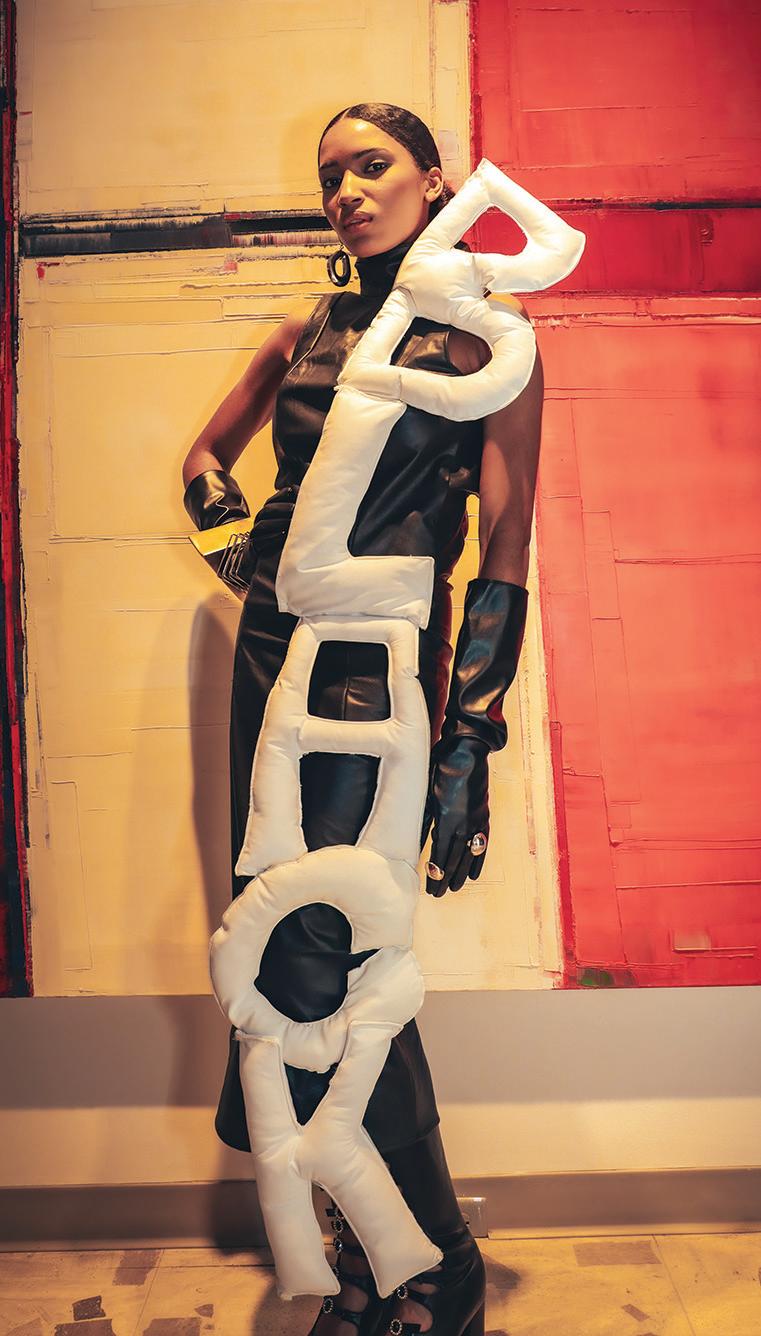

JAZZ
Continued from B1
“We’re proud to have played a part in his incred ible legacy — bringing America’s homegrown art form to music lovers throughout the region.”
Marsalis’ ties to St. Louis run even deeper through JALC alum and lifelong friend Victor Goines, now president and CEO of Jazz St. Louis.
After the show, Newson offered words of affirma tion to the creatives in the room.
“Creatives, take a moment and look around,” she said. “Every person here is carrying something powerful inside of them — an idea and a vision that came from purpose.” She reminded them that creativity is not just about what they make, but how they see the world. “It is about choosing imag ination over imitation. Choosing expression over fear. Your creativity is not random — it is your calling.”
Then came the message that hit deepest: “Create from a place of wholeness. Live in peace and not piec es. Protect your joy. You don’t have to break your self to build something beautiful.”
The evening closed with a tribute to Tai Davis, whose family received proclamations from Congressman Wesley Bell and St. Louis Mayor Cara Spencer.
“Our community has lost a truly extraordinary
individual whose creative passion and commitment had an impact on the world,” said Dr. LaRhonda Wilson, speaking on Bell’s behalf. “Tyler’s journey as a chef, author, entrepre neur and cultural vision ary was nothing short of inspiring.”
Wilson said that Davis showed people what was possible through his many gifts.
“Tyler’s life was a sym phony of creativity and passion,” Wilson said.
Alderwoman Shameem Clark Hubbard, repre senting Mayor Spencer, announced that February 1, 2026 is officially Tyler Davis Day in the City of St. Louis. She read from the proclamation, honoring Davis.
“Where as Tai Davis, affectionately known as the Black Willy Wonka, and his legacy will live on as a chef and artist who fused art, food and culture into immersive experi ences,” Clark Hubbard said. “[Experiences] that reshaped St. Louis and left an indelible mark.”

Continued from B1
hits a Broadway‑ready twist.
While the plot of “Hell’s Kitchen” centers on Ali, portrayed by Maya Drake (right), her mother Jersey, portrayed by Kennedy Caughell, drives the action.
The orchestra settled into The Sheldon like it was their own living room. The program leaned heavily on Duke Ellington and intentionally cen tered Africa — fitting for a concert held just two days before Black History Month. It felt like an extension of last year’s “Mother Africa” season.
One exception to the Ellington focus was South African pianist and composer Nduduzo Makhathini’s piece whose title translates to “Conscious.” The work blended jazz harmony with the quartal voicings, blues inflections and spiritual overtones that define South Africa’s choral tradition. Its harmonic movement and modal improvisation honored the country’s deep musical lineage.
Then came the gift: a rare full performance of Ellington’s Togo Brava Suite.
“This suite was writ ten in gratitude to the nation of Togo,” Lewis explained, noting that the country issued commem orative stamps honoring Bach, Debussy, Beethoven
— and Ellington. “Duke responded by writing a four‑part suite.”
Togo Brava stands apart in Ellington’s cata log. Rather than a single extended theme, he uses additive form, stacking contrasting textures, rhyth mic feels and tonal colors like scenes in a film. It’s orchestration as storytell ing.
Among the highlights was “Amore,” a sultry, piano‑driven movement that let Dan Nimmer show off the left‑hand inde pendence and touch that make him one of the finest pianists of his generation. Flute and muted trumpets added shimmer to the har monic palette.
In “Naturally,” Sherman Irby’s alto saxophone solo — full of bebop language, rhythmic dis placement and sheer fire — brought the crowd to its feet. His whole body rocked as he navigated the horn with the kind of technical command and soul that can’t be taught. The band snapped back into Ellington’s signature swing, brass punching through the final chorus with authority.
“We’re going from Togo to Liberia,” Lewis said as they shifted into a movement from Ellington’s Liberia Suite, written in 1947 for the country’s centennial.
Trombonist Christopher Crenshaw took center stage.
“For those unaware of the history of the ‘ya‑ya’ trombone, Chris is going to break it down in these 133 measures,” Lewis joked.
Paul Nedzela’s baritone saxophone opened with a deep, velvet groove before Crenshaw’s trombone provided a blues‑drenched response. Marsalis fol lowed with a trumpet solo full of piercing staccato attacks — a call‑and‑re sponse of timbre and atti tude. The horns collided in a triumphant finale. Lewis then shared a story about seeing JALC as a teenager and being mesmerized by a reed player juggling a bass clarinet, clarinet and soprano sax — all with mastery. That musician was Victor Goines, who joined the band onstage for a reimagined “A Train” steeped in New Orleans blues. Slowed to a crawl, the arrangement revealed new harmonic angles of the Ellington‑Strayhorn classic. Goines played with the emotional clarity of an Abbey Lincoln vocal — every note intentional, every phrase a sermon. The night closed with “Cottontail” from the Blanton‑Webster era. Tenor saxophonist Abdias Armenteros delivered a marathon solo — full of breath control, harmonic daring and rhythmic agili ty. At times his horn mim icked a trumpet’s bite; at others, it danced through complex riffs with impos sible ease.
“Tell your friends that people are still out here swinging in these United States,” Marsalis said as he sent the crowd home.
For more information about upcoming shows at The Sheldon Concert Hall, visit www.thesheldon.org.
Certain numbers with in the production also reveal her complicated relationship with Davis, Ali’s father. Desmond Sean Ellington plays the charming ladies’ man so convincingly that one can feel both the spark of their romance and the sting when he lets her down. The audience watches
him win Jersey over — and the damage his fleet ing love leaves behind. Cheers erupted when Jersey unleashed “Pawn It All,” cutting Davis down to size in the middle of a pivotal piano audition. Another standout is Black Rep veteran Roz White as Miss Liza Jane, radiating warmth with every note. Through her lessons with Ali, the audi ence learns the history of the keys and the legacy of pianists like Hazel Scott. Hell’s Kitchen then carries its audience through Keys’
The St. Louis leg of the national tour of Hell’s Kitchen continues through February 8 at The Fabulous Fox. For showtimes, tickets and additional information, visit fabulousfox.com or metrotix.com. Play
discography while thread ing in themes of hope and self‑discovery. Keys’ own career hints at where the story is headed, but the musical still leaves view ers wondering how Ali will build on the legacy of her mentor

Photo By Taylor Marrie/St. Louis American
Designer Shamica Chanel grabbed the audience’s attention with a black leather gown featuring a dramatic cutout spelling “Black” in bold white balloon letters.
Photo by Jon Gitchoff / Courtesy of The Sheldon Concert Hall
The Jazz at Lincoln Center Orchestra program leaned heavily on Duke Ellington and intentionally centered Africa — fitting for a concert held just two days before Black History Month.
Photo by Marc J Franklin / Courtesy of The Fabulous Fox

The Great Gateway AKA turnup. When I tell you that we are only five weeks into the new year and the AKAs are already a shoe-in for my best of 2026! The Central and Mid-West regions tag teamed their Founder’s Day celebration in the STL last weekend and their Welcome to the Gateway City set was litty, lit lit!!! Y’all, the biggest ballroom that the Marriott Grand had to offer had AKAS from the windows to the wall. Okay, so there were no windows, but please appreciate my Lil Jon reference to set the scene for how crunk it was up in there. I almost froze to death walking from my car to the hotel. But I instantly melted from the body heat that all those strolls were generating. Everybody up in there nailed their Fitbit step goals for the week in one night. And that goes for the Alphas too! By the time they got to “Wipe Me Down,” I know some of them had to go wipe off. When I tell you, those AKAs of a certain age were giving their younger sorors a run for their money…Understand it was not a game to them. Did anyone see the amped up silver-haired soror who looked like she could be the taller little sister of Ruby Dee And yes, I know Ms. Ruby Dee was a Delta. But this isn’t about Ruby Dee the Delta, this is about Reba Dee (not her real name) the AKA. Y’all! She looked like somebody’s school district’s Deputy Superintendent. But her tun-up game was unmatched. When the “Swag Surf” hit, I was like, “y’all can go on ahead and tell this hypeman/DJ to just
stick to the music. Reba Dee was so lit, I don’t even have the words to express how hard in the paint she went. After she fired them up, the Swag surf went so hard that I almost got knocked over! Oh, and shout out to the lovely senior soror who hit the Bankhead Bounce so hard with her blinged out 08 jersey on that it looked like she spun herself into a pink and green disco ball. The turn up was legendary from start to finish. But the gag is that I heard that these same ladies were sitting pretty in pink for the Founder’s Day luncheon on Saturday, looking like they called it a night right after the credits rolled on “Wheel of Fortune.”
The style of Black History. Y’all, Yoro and some of the best style stars of St. Louis put their whole foot into the Black Creatives in the Lou opening reception Saturday evening at Neiman Marcus. The people watching alone made it worth it, but it was so much more! Brock Seals was giving me a high fashion Professor Griff and loved every second of it! And let me show some love to the look Brandin Vaughn was serving up. He’s transitioned from cowboy to frontiersman with that Davy Crockett coon hat! I got my whole life. Please understand if Beyoncé pops out in the rock era she’s been threatening us with on Instagram looking like Daniel Boone, know that Brandin had a hand in it. But let’s get back to BCL. I ran into my sister from another mister Afton Johnson. Her Young Addy Co was one of the featured lines that was part of the



mini fashion show. Listen, I’m not promoting that she turns to a life of crime, but if she did, she could hide in plain sight. Or she could be one of those masters of disguise spies. I’ve known Afton the better part of 20 years. I looked her in her whole face and had a whole conversation without recognizing her. It wasn’t until she presented that glorious soft salmon colored leather and feather mini-dress gown. Girl, can you make that in a 1X for me in time for Salute? That’s a real question. I got my life from all of the looks. That white tux jacket ate down to the gristle. And speaking of leaving not a single crumb, can we please take a moment to bow down to Brian Cain? When I tell you that he is a guaranteed gag! Folks should hire him just to show up in one of his looks. He was a guest, but if he had walked down the

runway in that black double breasted coat with the black and white print ensemble and the “Little Red Corvette” gloves like he was part of the show, I would have been none the wiser. But my faves were all up and through there. Leslie Christian, Lance Omar, Dr. Tracy Reed and LaRhonda Wilson to name a few. And I know he might not want to be mentioned because he is no longer in the world, Larry Rodgers is still one of faves – and so is his lovely family. I really loved how Yoro encouraged the creatives – and paid tribute to the creative force that was Tai Davis. The exhibition will be at Neiman Marcus for the rest of the month. Be sure to check it out.
Cajunitis. My “new year, new me” diet is officially off the rails thanks to the Cajun cookoff
that went down at the AnheuserBusch Biergarten Saturday afternoon. And y’all already know that I usually can at least make it until Valentine’s Day. The way I cut up, I’m gonna need to do two-a-days to get into the gown I’m begging Afton to make for me. But it was worth it y’all. Kym Benning, girl… you laid me out with that catfish etouffee! Congrats on the third place, but it belonged in the top spot! I was ready to crash on somebody’s twin-sized bed before the competition was even close to being over after the way I devoured my plate! I’m so glad that they didn’t have a New Orleans second line. I would have had to tap my feet and bop to the music while waving my parasol (New Orleans umbrella) from the comfort of my motorized cart. For real, I thought I was gonna have to valet and get a wheelchair assist at Neiman Marcus. But I made it through!






















“I spent a million dollars in about 45 minutes.”
– Shaquille O’Neal reveals he blew his first NBA paycheck on his parents
sports eye
With Alvin A. Reid
There’s nothing trivial about Black stars in Super Bowls
With Super Bowl
Sunday almost here, let’s play a 10-question round of African American Super Bowl trivia before the Seattle Seahawks and New England Patriots square off in Santa Clara, California.
Who was the first Black player to score a Super Bowl touchdown?
Kansas City Chiefs tight end Curtis McClinton caught a 7-yard touchdown pass from quarterback Len Dawson in the second quarter of Super Bowl I in Los Angeles. It tied the score 7-7, but the Green Bay Packers won 35-10.
the opening kickoff (Super Bowl XLI).
Who was the first Black head coach to win the Super Bowl?
Tony Dungy led the Indianapolis Colts to a 29-17 victory over the Chicago Bears in Super Bowl XLI on Feb. 4, 2007, in Miami. Lovie Smith was Bears head coach, which guaranteed a Black head coach would become part of Super Bowl history.
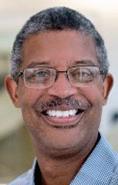
Who was the first defensive player to score a Super Bowl touchdown?
Green Bay Packers cornerback Herb Adderley intercepted a Daryle Lamonica pass and returned it 60 yards for a touchdown in Super Bowl II in Miami. Green Bay beat the Oakland Raiders 33-14.
Who was the first player to return a Super Bowl kickoff for a touchdown?
Fulton Walker of the Miami Dolphins returned a kickoff 98 yards against the Washington Redskins in Super Bowl XVII in Pasadena, California. The Redskins prevailed 27-17. There have been 10 Super Bowl kickoff returns for touchdowns in history; Devin Hester of the Chicago Bears is the only player to record one on
Who was the first Black player to be named Super Bowl Most Valuable Player?
Franco Harris rushed for 158 yards and scored a touchdown in the Pittsburgh Steelers’ 16-6 win over the Minnesota Vikings in Super Bowl IX in New Orleans to earn the MVP award.
Who was the first Black quarterback to start in a Super Bowl?
Doug Williams of the Washington Redskins was the first Black quarterback to both start and win a Super Bowl. The Redskins fell behind the Denver Broncos 10-0 in Super Bowl XXII in San Diego, and Williams suffered an apparent serious knee injury in the first quarter. He threw four touchdown passes in the second quarter, and the Redskins won 42-10.
What record did St. Louis Rams receiver Torry Holt reach in the Super Bowl?

Torry Holt set a Super Bowl rookie reception yards record with 107 yards on seven catches. His nine-yard TD reception from Kurt Warner gave the Rams a 16-0 lead over the Tennessee Titans, and St. Louis prevailed 23-16 in Super Bowl XXXIV in Atlanta on Jan. 30, 2000.
Who made the game-saving defensive play “The Tackle,” which preserved the Rams’ win in the 2000 Super Bowl?
Linebacker Mike Jones stopped Titans’ receiver Kevin Dyson at the one-
yard line on the final play of Super Bowl XXXIV on Jan. 30, 2000. Following the 2000 season, the Rams cut Jones and several veterans in salary-cap moves.
Who scored New England’s first touchdown when the Patriots upset the heavily favored St. Louis Rams in 2002?
Ty Law returned an interception 47 yards for a touchdown in the Patriots’ 20-17 win in Super Bowl XXXVI on Feb. 3, 2002, in New Orleans.
What player has scored the most points in Super Bowl history?
InsIde sports
With Earl Austin Jr.
which included a Super Bowl record.
San Francisco 49ers
Hall of Fame receiver Jerry Rice scored 48 points in the four Super Bowls in which he participated.
The Reid Roundup
African American official Shawn Smith will serve as head referee for Super Bowl LX on Sunday in Santa Clara, California…While the first Super Bowl was played following the 1966 NFL and NFL seasons, a Black man did not serve as head referee for a Super Bowl until Mike Carey worked Super Bowl XLII in
Glendale, Arizona, on Feb. 3, 2008…Dallas Cowboys great Emmitt Smith has the most rushing touchdowns in Super Bowl history with five…Patrick Mahomes’ nine Super Bowl touchdown passes rank him third behind Tom Brady (21) and Joe Montana (10)…Of 10 open coaching slots when the NFL season ended, eight had been filled as of Tuesday. No Black coaches have been hired. Vance Joseph, Denver Broncos defensive coordinator, could still land either the Arizona or Las Vegas positions. Don’t hold your breath.
Vashon primed to win sixth straight 4A title
The Vashon Wolverines have been one of the state’s most enduring dynasties in boys’ high school basketball. The Wolverines have won five consecutive Missouri Class 4 championships and are currently ranked No. 1 in the Missouri Basketball Coaches Association Class 4 state poll.
Smet in a matchup of perennial St. Louis area powers.
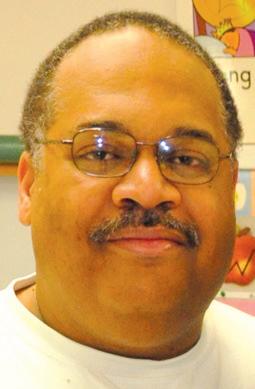
When Hall of Fame coach Tony Irons moved on to become head coach at Mineral Area College, the program was placed in capable hands under former Vashon star Jimmy McKinney. In his first season, McKinney guided the Wolverines on a dominant run to the state championship last season, winning the state semifinal and championship games by a combined 96-point margin.
Vashon is 12-3 this season while playing another challenging schedule. The Wolverines have faced teams from Illinois, Georgia, Texas, Oklahoma and Arkansas. Last Thursday, Vashon earned a 74-57 victory over De
Vashon’s offensive leader is 6-foot-2 junior guard Jimmy McKinney III, the son of head coach Jimmy McKinney. One of the state’s smoothest perimeter shooters, he is averaging 16 points a game while shooting 49% from the field and 44% from 3-point range. He scored a careerhigh 31 points in the victory over De Smet, including 25 points in the first half. He made five 3-pointers. Senior guard Kain McCaskill is one of the most explosive athletes in the state. The 6-foot-3 McCaskill averages 14.1 points, 5.9 rebounds, 3.2 assists and nearly two steals a game. He also electrifies the crowd with his dunking exploits. He will be playing college basketball at SIU Edwardsville next season.
Vashon’s third top offensive player is 6-foot6 junior Leon Powell Jr., who is also a legacy player. He is the son of former Vashon standout

Leon Powell. He is a versatile athlete who is averaging 11 points and five rebounds a game while shooting 50% from the field.
Providing size inside is 6-foot-8 senior forward Christian Potts, a strong rebounder and shot blocker. He averages five points and three rebounds a game. He had his best game of the season in the
victory over De Smet with 15 points, seven rebounds and eight blocks.
Junior Khalil Crain and sophomore Braiden Alford are a pair of guards who are capable offensive players. Alford, a 6-foot-2 guard, averages 7.2 points a game, while Crain, also 6-foot2, averages 6.2.
All-State guard Jimmy McKinney Ill is averaging 17 points a game for the Vashon Wolverines, who are ranked No. 1 in the state’s Class 4 poll.
Maplewood’s Abraham Nayou commits to UMSL
Standout guard Abraham Nayou of Maplewood has committed to the University of Missouri-St. Louis.
A four-year starter, the 6-foot-2 Nayou recently scored his 2,000th career point. He is averaging 28.4 points a game,
currently second in the St. Louis area. He is also averaging seven rebounds, four assists and three steals a game while shooting nearly 40% from 3-point range. He has scored at least 30 points eight times this season, including a season-high 45 points in a Dec. 11 victory over McKinley.
Top games this week
Boys CBC at De Smet, Friday, 6:30 p.m. Vianney at Chaminade, Friday, 6:30 p.m. Clayton at MICDS, Friday, 7 p.m. O’Fallon (Illinois) Shootout (Saturday) Cardinal Ritter vs. O’Fallon, 3:30 p.m. Decatur MacArthur vs. Webster Groves, 5 p.m. Vashon vs. Alton, 6:30 p.m. Bartlett (Tennessee) vs. Bolingbrook (Illinois), 8 p.m.
Girls
Tipton at Lutheran St. Charles, Friday, 7 p.m.
St. Louis Rams receiver Torry Holt had a sensational rookie season in 1999,
Alvin A. Reid
Photo by Earl Austin Jr. / St. Louis American
Photocourtesy of
Earl Austin Jr.
at no charge.

CLASSROOM SPOTLIGHT
CLASSROOM SPOTLIGHT


and
Students at The American’s Summer Science Academy work in teams to discover the many different computer programming languages.
Students Neveah Ficklin, Zriyah Murphy and Jada Randle, in Ms. Cheryl M. Christian’s 9th grade class at Jennings Senior High School, work together to determine the density of water.
Photo by Cheryl Christian
Teachers, if you are using the
NIE program and would like to nominate your class for a Classroom Spotlight, please email: csewell@stlamerican. com
SCIENCE CORNER

A hurricane forms over tropical and subtropical ocean water. Warm water and cool, moist air combine to create strong winds that can gust up to 200 miles per hour! These winds create waves that bring the storm on shore. Hurricanes are very destructive. They can flip cars, sink boats, uproot trees, and demolish houses.
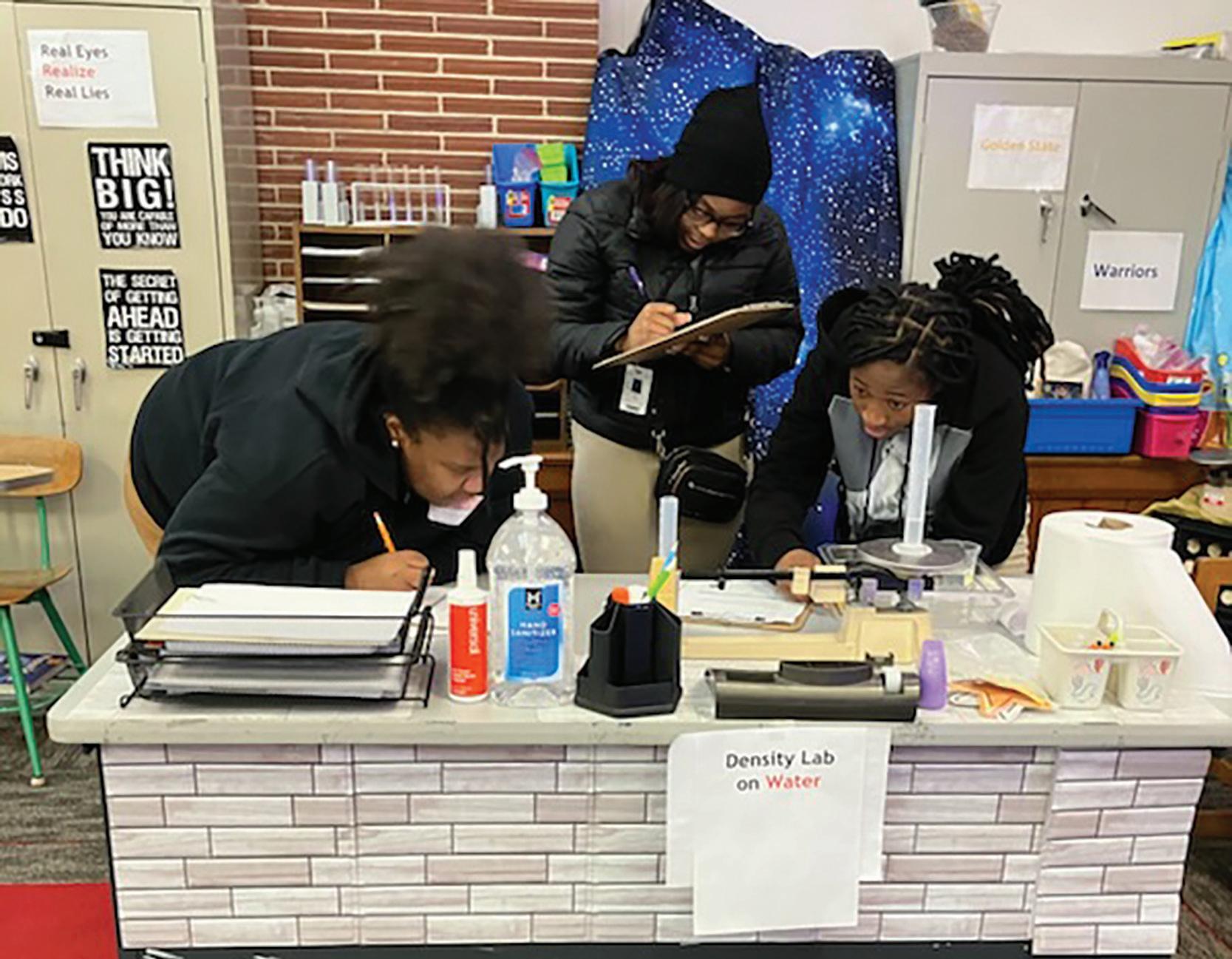

FAMILY SPOTLIGHT SCIENCE STARS

SCIENCE CORNER
SCIENCE CORNER

What Is Geology
?
Are Fungi ?
SCIENCE STARS


African American Meterologist William “Bill” Parker
William Padilla-Brown
AFRICAN-AMERICAN MYCOLOGIST AND EDUCATOR: Jeanette Jones
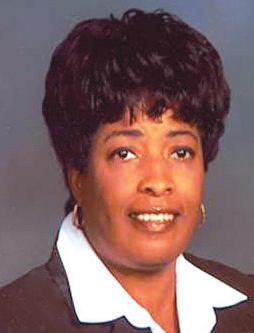
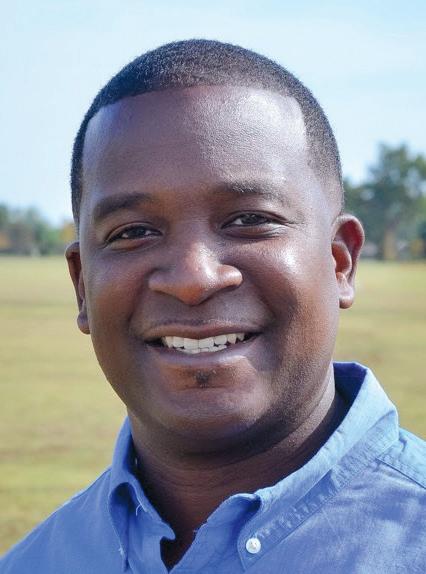

William (Bill) Parker grew up in New Orleans. He graduated from JFK High School, which focused on math, science, and engineering. Parker was interested in hurricanes at a young age, but he became interested in the weather after a high school statistics class. In this class, he learned how to predict the chance of rain. Parker wanted to attend a historically black college/ university (HBCU), so he chose Jackson State University to study meteorology. He graduated with his bachelor’s degree, in 1994.

Geology is the study of the earth, its rocks and minerals. Geologists are scientists who study the matter that makes up the earth. They also study the earth’s history and the processes that have formed it. It has been said that geologists tell the story of the earth. Geologists study earthquakes, rock formations, oil exploration, groundwater, volcanoes and soil erosion. Geologists may work in the research lab or in the field. They use a variety of chemistry, biology, physics, and other sciences.
In addition to powerful winds, hurricanes bring a lot of rain. (Taiwan received 114 inches of rain in three days during a hurricane.) These rains can cause landslides and flash floods.
INVESTIGATION
In this experiment, you’ll create a replica of a hurricane and identify how the forces work together to create a hurricane.
Fungi are organisms made of filaments (called hyphe) that are stacked together. Unlike plants, fungi do not have chlorophyll, so they cannot make their own food. Some fungi are parasites, which mean they live off of other organisms. Some fungi feed off of dead and decaying matter. Fungi are everywhere in the environment, including the soil, lakes, river and seas, air, and on plants and animals. Fungi (plural of fungus) help organic matter to decay and release carbon and oxygen into the environment. Unlike plants, fungi do not have
Farmers depend on accurate soil sampling, land erosion monitoring and water drainage information provided by geologists. Fishermen also seek the help
SCIENCE INVESTIGATION
SCIENCE EXPERIMENT

In this experiment, you will learn how mold grows best. Mold is an important fungus that has several uses, including breaking down dead organic material. Some purified molds are actually used as an antibiotic to treat illnesses.
Procedure:
Materials Needed:
It’s your turn to be a geologist. In this experiment, you will learn about the weathering of rocks.
Materials Needed:
q Fill one bottle with the paperclips, peanuts and sand. These represent the debris and help make the movement of water easier to see.
• 3 slices of bread • Water • 3 Ziploc bags • 10x10 square centimeter grid • Ruler Process:
• Plastic Wrap • Clay • Water • Notebook • Camera Process:
w Place the funnel in the mouth of the bottle and pour water into the bottle until it is 3/4 full, then remove the funnel.
q Wet one slice of bread enough to make it moist and place it in a bag. Seal the bag very tightly.
q Moisten the clay with a little bit of water.
e Turn the second empty bottle upside down and hold it over the first bottle so that the mouths of the bottle are aligned. The bottles will look like an hourglass.
w Place the two other slices of dry bread in two separate bags and seal them, as well.

Hurricanes can last a few hours or several days. Most hurricanes occur during the fall months. How can you stay safe? Have an evacuation plan and an emergency kit prepared. Meteorologists can track these storms and keep you informed. For more hurricane facts, visit: http://www.sciencekids.co.nz/ sciencefacts/weather/hurricane.html.
leaves, stems, or roots. Fungi use spores to reproduce. One common type of fungus is the mushrooms you find on your pizza. Mold, yeasts, and mildew are also types of fungus.
of geologists who can explain silting, underwater seismic events, and other factors that may impact the waters. Geologists are usually logical thinkers, good problem solvers and enjoy working outdoors.
For More Information, Go to: https://kids.kiddle.co/Fungus
Learning Standards: I can read nonfiction text to gain background information about fungi.
Discussion Questions: Would you be interested in a career in geology? Why or why not?
Learning Standards: I can read nonfiction text for main idea and supporting details.
For More Information, Go to: www.kidsgeo.com/geology-for-kids
create a watertight seal. Continue taping 1 to 2 inches above and below the seam.
Growing Mold!
Learning Standards: I can read nonfiction text to learn about careers in science.
t Hold the bottles by the middle and lift the jugs.
Weathering a rock!


r Tape the seam, pressing the duct tape firmly to
e Place the bag with the wet slice of bread and one of the bags with a dry slice of bread in a dark place, such as a closed cabinet or closet.
y Quickly, turn the bottles over so that the water-filled bottle is on top. Set the bottles on the table again.

w Divide the clay into two equal pieces, and roll it into a ball or use it to form a square.
e Use the plastic wrap to carefully wrap each piece of clay.
r Place the third bag with a dry slice

z A hurricane has moved 456 miles in 6 hours. How many miles per hour is the hurricane traveling? ______ If it continues to travel at that speed, how far will it travel in 10 hours? ______
Questions or comments? Contact Cathy Sewell csewell@stlamerican.com or 618-910-9551 DID YOU

r Place one piece of clay into the freezer and leave the other piece on a counter. The clay will stay in the freezer overnight.
t After the clay has sat overnight, take the clay out of the
MATH CONNECTION
MATH CONNECTION
t For five days, measure the square centimeters of mold on each piece of bread through the bag. Use a grid, if possible, or a ruler. If mold covers more than half a square centimeter, it is counted as one full centimeter. If it is less, it is counted as 0 centimeters. This will give you the area of mold on each slice of bread

freezer unwrap both pieces.
Observe the water as it drains into the bottle below. The water competes with the air from the empty bottle. Both substances
Jeanette Jones was born on September 19, 1950, in Fort Valley, Georgia. Jones graduated from Fort Valley State University in 1972 with a bachelor’s degree in biology education. In 1973, Jones received her master’s degree in botany and mycology (a branch of biology that studies fungi) from The Ohio State University. In 1976, she received her doctorate (Ph.D.) degree. She also studied at the University of Nevada, the University of California Medical School, the National Center for Disease Control-Atlanta, and the Massachusetts Institute of Technology. After graduation, Alabama A&M University hired Jones as an assistant biology professor. In 1986, she served as an adjunct professor in the College of Pharmacy and Pharmaceutical Services at Florida Agricultural and Mechanical University and worked on a project with NASA. In 1991, Jones served as the first female vice president of research and development at Alabama A&M University. She also served as President of Alabama A&M University’s Faculty Senate from 2001 to 2006. In 1992, she was appointed to the U.S. Army Science Board by the U.S. Secretary of the Army, Togo West. Since 2004 Jones has been the director of the Center for Biomedical, Behavioral, and Environment Research at Alabama A&M University. She also worked as a consultant with federal agencies to help them develop training programs to attract women and minorities to STEM education and careers.
William Padilla-Brown is a scientist who studies mushrooms and teaches people how to grow them. He grew up moving a lot because his mom worked for the U.S. Department of Agriculture and his dad worked for the Army, so he lived in places like Mexico City, London, and Taipei. When he was about sixteen years old, he made the brave choice to leave high school and teach himself about nature and science. William started to focus on mushrooms at age eighteen. He began by growing mushrooms using everyday materials like coffee grounds and wood chips—things that others might throw away. Soon he founded a company called MycoSymbiotics in Central Pennsylvania, where he grows, researches, and teaches about mushrooms, fungi, algae, and sustainable living. One of his big achievements is writing the first English-language guide to cultivating the mushroom called Cordyceps militaris, a fungus that is hard to grow and has many interesting uses.
In 1993, he began to gain experience in the field when he worked as a student meteorologist. One year later, he was a meteorologist intern at Shreveport. In 1998, Parker became a general forecaster, and ten years later, a lead forecaster. In 2012, he became a warning coordination meteorologist (WCM). There are only 122 people with this title in the United States, and Parker was the only African American. Parker is currently the meteorologist-in-charge (MIC) at the National Weather Service, leading a team of 26 weather professionals. Parker is also very active as a volunteer in his community. He is a member of the Shreveport-Bossier Mayors’ Prayer Breakfast Executive Committee, La Cima Bilingual Leadership Academy, Bossier Chamber of Commerce Education Committee, Volunteers for Youth Justice, and a coach for Bossier Parks and Recreation. Parker is also an associate minister at Elizabeth Baptist Church in Benton, where he has been serving the congregation since 1997.


Practicing math facts is fun when you use rocks or pebbles. Try these three activities.
x Hurricane Frederick is traveling at 86 miles per hour. If the hurricane is 129 miles from the coast, how many hours will it take until the hurricane reaches the coast? ______
c A tropical storm takes on a hurricane status when the winds reach 74 miles per hour. After three days, Tropical Storm
At the end of a week (5 days of measuring) or longer, use your final results to say what percentage of the bread was covered in mold. Make a table or graph to display the information.
Turn the bottles over again. This time, shake the bottles in a circular motion. Be sure to keep the bottles vertical.
The water will form a vortex as it drains into the next bottle. The water will flow along the outside of the neck, while air moves quickly up through the center of the vortex. The water will drain
Analyze: How did water and air create a hurricane?
y Make observations. How is the surface of the clay? Do you notice any cracks? Take a picture of both pieces of clay and write your observations in your notebook.
In 1975, Jones was listed in the World’s Women’s Who’s Who and she was named an Outstanding Young Woman of America in 1978. Beta Beta Beta National Biological Honor Society awarded her the distinguished service award. Jones also received the Significant Service Award from the NASA Space Life Sciences Training Program and the Extramural Associate Research Development Award from the National Institute of Health. In 1990 and 2006, she was named Woman of the Year at Alabama A&M University and was given the Outstanding Leadership Award by the Faculty Senate. The U.S. Army presented Jones the Commander’s Award for Outstanding Civilian Service as a member of the Army Science Board.
But William’s work is not just about growing mushrooms he wants everyone to believe they can do science. Even without a college degree in the field, he taught himself molecular biology, worked with DNA sequencing in his home lab, and now teaches kids and adults alike. He also leads classes and workshops across the United States on foraging (finding wild mushrooms), cultivation, and how to use nature more wisely. William believes strongly that science belongs to everyone, not just people who go to big universities. He invites students to get curious, ask questions, and explore the world around them. His story shows that even if you face challenges like leaving high school early you can still achieve big goals if you are determined, creative, and willing to learn. Young readers can be inspired by his message: nature is all around us, and you can study it, take care of it, and share what you discover with others.
ELA Questions:
Discussion Questions: Dr. Jones received many awards and honors. How would you describe her achievements and her contributions to science? Dr. Jones is studying how fungi might be used as agents of war. What purpose do you think fungi serve in modern warfare? Are fungi beneficial or harmful?
Learning Standards: I can follow sequential directions to complete an experiment. I can make observations and draw conclusions.
Discussion Questions: How much mold was on the bread? Which location had the most mold? Which had the least? What conclusions can you draw about the conditions in which mold grows? How can food manufacturers and restaurant owners use this information to help them?
Learning Standards: I can follow sequential directions to complete an experiment.
u Place the clay in the freezer and repeat the process for several days. Which piece of clay looks more weathered, the piece that has been frozen or the piece that has been on the counter? What observation can you make about temperature and rocks? How do the cracks change over time?
Math Storms!
I can display my results, make observations, and draw conclusions.
X has grown to have wind speeds of 48 miles per hour. How much faster will the winds have to become for Tropical Storm X to become Hurricane X? ______
How did William Padilla-Brown’s early life and choices show his determination to learn and explore science?
Learning Standards: I can read a biography to learn about an African American who has made contributions in science, math, technology, or engineering.
Parker believes in serving as a role model to the youth and to recruiting African Americans in the STEM field. Personally, he has hired three African-American meteorologists. In addition, he has recruited minorities for summer intern positions. Parker has also mentored an Airline High School student for his senior project. Parker’s advice to students interested in meteorology is to take as many math and science classes as possible. Learn about summer opportunities in your community. If you are interested in meteorology, visit National Weather Service offices and serve as a volunteer or intern, and find leaders in your community to serve as your personal role models.
What message does William want to share with kids and young people about science and nature?
Learning Standards:

a person who has made contributions to the fields of science, technology,
Rock On with math games
Analyzing a Bar Graph
Scientists often use tables and graphs to display the results of their research. Looking at these displays, you can draw conclusions.
an added challenge, you can use 20 squares.
v Upon landfall of a Category 4 hurricane, local officials ordered an evacuation. City A has a population of 9,613, City B has a population of 5,013 and City C has a population of 3,972. How many people were evacuated in all?
q Sorting: Use rocks and pebbles of different shapes, sizes, and colors. Sort them in categories such as small, medium, and large. Sort them by surface: rough or smooth. Sort them by color. Have students decide a rule for sorting their rocks and have the other students guess what rule they used to sort the rocks.
As we approach spring weather (and increased rain), create a bar graph that displays the amount of rain that falls for several consecutive days or weeks. (Day 1: 1.5 inches, Day 2: 0 inches, Day 3: 1.5 inches, etc.)
w Calculate It: Use chalk to draw 10 squares on the sidewalk or black top. Label the squares 1-10. Each student will throw two pebbles into a square. The student will then add, subtract, multiply or divide those two numbers. For
KNOW?

DID YOU KNOW?

This special Newspaper In Education initiative is made possible, and delivered to classrooms through the St. Louis American Foundation and its NIE Corporate Partners:
Discussion Questions: Which day had the most measured rainfall? Which day(s) had the least? Looking at the bar graph, what might you conclude about rain patterns in March/April? What other observations can you make?
$115,264 in damage, City B reported $236,096 and City C reported $436,869 in damages. What was the total cost of damages rounded to the nearest thousand? ______ If the state and federal government promised $500,000 in aid, how much would the local people have to raise by themselves? ______
Use the newspaper to complete the following activities: Types of News:
MAP CORNER

Enjoy these activities that help you get to know your St. Louis American newspaper.
Learning Standards: I can use a bar graph to display information. I can use the information to make deductions and inferences.
b After citizens returned to their houses after the evacuation, reports of damage were totaled. City A reported
There are over 10,000 species of mold, with 1,000 of those species found in the United States.
up.”

e Rock Review: Use a marker to label 20 pebbles with the numbers 1-20. Place them in a sealed bag. Students will take turns drawing two pebbles to practice addition, subtraction, multiplication, or division skills. For example, if a student draws a 2 and a 6. They can state 2+6=8, 6-2=4, 6x2=12, 6/2=3.


Learning Standards: I can add, subtract, multiply, and divide to solve a problem.

Learning Standards: I can add, subtract, multiply, and divide to solve a problem.
Use the newspaper to complete the following activities: Save the Earth: Think about ways human activity affects our environment. Locate pictures of people solving environmental problems in your community. Cut and paste the pictures in a mural titled, “We Can Save the Earth.”
Use the front section of the newspaper to evaluate the types of news stories presented: local, national, and international. Sort the articles into the three categories and create a bar graph that displays the amount of coverage each type of news story received.
Activities — Who works where? a picture of a building in the newspaper and tell what kind of jobs people who work in that building could have.







Future Artifacts: Artifacts help us learn about our history. Locate a picture of something in the newspaper that could someday be used as an artifact. Paste the picture on a piece of paper and write about what the future scientists could learn from the artifact.
Mystery Story: Cut out several pictures from the newspaper without reading the caption. Place the pictures in a bag, and without looking, pick your mystery picture from the bag. That’s your stimulus for writing. Construct a graphic organizer to identify the 5Ws (who, what, when, where, and why) of your story by looking at your picture. Then, continue the writing process.
Problem and Solution: Over a period of weeks, clip articles from newspapers that deal with problems and issues facing your local or county government. Discuss the reasons for these problems and how the government hopes to solve them.
Learning Standards: I can use the newspaper to locate information. I can categorize and summarize that information.
Learning Standards: I can use the newspaper to locate information. I can create a bar graph and make observations.
Learning Standards: I can use the newspaper to locate information. I can discuss problems and solutions. I can identify types of jobs. I can make text-to-world connections.




Students Aariyah Thompson
Savannah Fisher, in Ms. Stovall’s firstgrade class at Gateway MST Elementary School, are learning how to construct a series circuit.
Photo by Ms. Stovall
Black History Month2026
Mill Creek’s children speak
Vivian Gibson and Gwen Moore bring a lost neighborhood back into the light
By Kenya Vaughn The St. Louis American
Mill Creek Valley may have been bull dozed off the map in 1959, but its people are now telling the truth about what was lost.
That truth will take center stage on Friday, February 6, when the St. Louis County Library hosts author Vivian Gibson and Missouri History Museum curator Gwen Moore for the 2026 Frankie Freeman Inspirational Lecture—its annual Black History Month keynote honoring the legendary civil rights attorney. The event, presented in partnership with the Missouri Historical Society and Ameren, will be held at the Clark Family Branch at 7 p.m.
For Gibson and Moore, the evening goes beyond a conversation. It is a reminder that Mill Creek Valley was not the “slum” city leaders claimed it to be, but—as Moore has said in earlier inter views—“a Black metropolis that thrived in spite of everything designed to contain it.” Before the wrecking balls arrived, Mill Creek Valley stretched across 450 acres from 20th Street to Saint Louis University. Nearly 20,000 Black residents lived there—families, business owners, teachers, preachers, musicians, and every day people who built a self‑sustaining community in the face of segregation. It was a cultural engine. A civic hub. A place where Black newspapers, doctors’ offices, churches, schools, and social clubs stood shoulder to shoulder. Ragtime was born there. Josephine Baker spent her childhood there. And as Moore has often emphasized, “Mill Creek was the Harlem
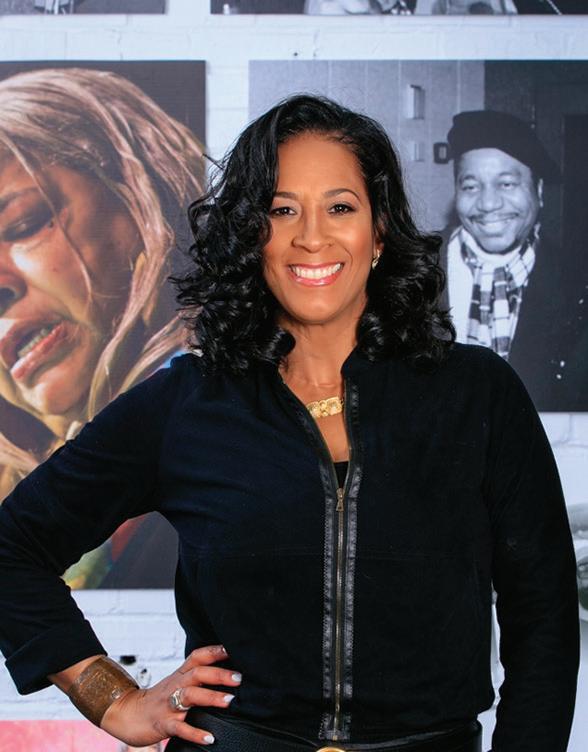
of the Midwest—vibrant, brilliant, and ours.”
But in 1959, the city declared the neighborhood “blighted” and razed it to make way for a highway and redevel opment that never fully materialized. Families were scattered. Businesses dis appeared. And a thriving Black communi ty was wiped from the landscape. Vivian Gibson was one of those chil dren. Her bestselling memoir, The Last Children of Mill Creek, chronicles her family’s life in the neighborhood during the 1950s. Critics have called it “a love letter,” but Gibson has always been clear
Latriece Watkins rises from intern to Sam’s Club CEO
By Sylvia Perry Jacksonville Free Press
Just in time for Black History Month, longtime Walmart executive Latriece Watkins became president and CEO of Sam’s Club on Feb. 1, the company announced.
Watkins, a 28 year company veteran, most recently served as executive vice president and chief merchandising officer for Walmart U.S., a role in which she helped shape assortment strategy and merchandising operations.
In a LinkedIn post after the announce ment, Watkins wrote: “Opportunity lives
here.” She added, “I’m honored to lead the next chapter by protecting and ampli fying our culture … and winning omni channel retail together.”
Watkins will succeed Chris Nicholas, who is moving from Sam’s Club to become president and CEO of Walmart International as part of a set of leadership changes, according to Walmart.
Watkins joined Walmart in 1997 as an intern and has held leadership roles span ning Sam’s Club, Walmart U.S. merchan dising, people and U.S. store operations, the company said.
Her promotion also comes amid per sistent gaps in corporate leadership. In
about what she set out to do.
“I wanted people to know that Mill Creek was not broken,” Gibson previ ously told The American. “It was broken apart.”
Her book captures the texture of daily life—shopkeepers who knew every child by name, church ladies who kept the block in order, teachers who demanded excellence, and neighbors who looked out for one another. It is a portrait of a community that thrived not because con ditions were easy, but because its people

the Fortune 500, women make up a small share of CEOs, and Black women make up an even smaller share. As of 2024, only two Fortune 500 companies were led
A lifetime through the lens
Aldermen honor retired St. Louis American photographer Wiley Price
By Kenya Vaughn St. Louis
the St. Louis Board of Aldermen with Resolution 220, which recognizes his commitment and service to the region through his work as staff photographer for The St. Louis American. He retired from the newspaper on Dec. 31.
By Kenya Vaughn
American The Missouri Historical Society has tapped a familiar and highly esteemed voice in St. Louis’ cultural landscape to lead its African American History Initiatives, appointing Lyah LeFlore‑Ituen as director. She steps into the role with a vision shaped by both national experi ence and deep St. Louis roots, placing a nationally recognized creative force at the
MHS, B9
by Black women, Fortune reported. Watkins earned a bachelor’s degree from Spelman College and a law degree from the University of Arkansas School of Law.
Her appointment arrives as some large companies, including Walmart, have faced public debate and pressure over how they describe and structure diversity efforts. In late 2024, Walmart announced it would phase out or change several DEI related initiatives and language, news outlets reported.
Analysts and business coverage have described Watkins as stepping into the top job at Sam’s Club as the chain competes with rivals such as Costco.
Photo by Suzy Gorman / Courtesy of Lyah LeFlore‑Ituen
Lyah LeFlore‑Ituen has been appoint ed director of the Missouri Historical Society’s African American History Initiatives.
Photo by Taylor Marrie/St. Louis American
Amiri, Alexandria, Maddie, and Jerome Ellis at the Mill Creek Exhibit at the Missouri History Museum on 11/15/25.
Latriece Watkins, who began her career as a Walmart intern, has been named president and CEO of Sam’s Club, effective Feb. 1.
Photo courtesy of Latriece Watkins / LinkedIn
Photo
Mill Creek
Continued from B8
insisted on dignity.
Gwen Moore has spent years making sure the city remembers what it tried to forget. As curator of urban landscape and community identity for the Missouri Historical Society, she led the creation of the museum’s landmark exhi bition, “Mill Creek: Black Metropolis,” on display through July 2026.
The exhibit uses photo graphs, oral histories, rare film footage, and archival materials to reconstruct
MHS
Continued from B8
helm of one of the region’s most vital platforms for preserving and elevating Black history.
“African American history is not a footnote to St. Louis — it is part of our foundation, its rhythm, and its living memory,” LeFlore‑Ituen said. “I come to this work as a native St. Louisan, a sto ryteller, and the daughter of cultural pioneers who taught me that history is something you live, protect and pass on.”
LeFlore‑Ituen — a New York Times bestselling author, award‑winning producer, NAACP Image Award winner and lifelong storyteller — brings more than 30 years of experi ence shaping narratives at the intersection of media, culture and community. She sees the role as an opportunity to pour back into the city that helped shape her voice as a lit erary artist and cultural force.
Over the years, she has often spoken about the creative power of St. Louis and the responsibility she feels to amplify it. “St. Louis has always been a
the neighborhood block by block. Visitors walk through the world that urban renewal destroyed— and meet the people who lived it.
Moore has said that curating the exhibit was both professional and per sonal. “Mill Creek wasn’t just a place,” Moore said. “It was a community that held people together. And when it was torn down, something in St. Louis was torn down with it.”
This year’s Frankie Freeman Lecture will also honor four commu nity leaders—Ohun Ashe, Michael P. McMillan, Kayla Reed, and Michelle
city of giants — poets, musicians, visionaries — and I’ve always felt called to make sure the world knows that,” she said during a conversation with this reporter about her work with emerging art ists. “This city raised me creatively. Everything I do is rooted in honoring that.”
She has also been clear about why she continues to invest her time and talent in her hometown.
“People underestimate the brilliance that lives in this city,” LeFlore‑Ituen said. “But I’ve seen it up close my whole life. St. Louis is overflowing with storytell ers — they just need plat forms that see them, value them and amplify them.”
As director, LeFlore‑Ituen will guide the vision and execution of initiatives that expand scholarship, deepen com munity trust and ensure that Black history remains central to understanding the American story. She will serve as the pri mary spokesperson for AAHI and report directly to Missouri Historical Society President and CEO Dr. Jody Sowell. “Lyah is an extraordi nary cultural leader whose career reflects the power of storytelling to educate, connect and inspire,”
D. Tucker—with the Frankie Freeman Inspirational Award for their service following the May 2025 tornado. Their recognition underscores the throughline between Mill Creek’s story and the present: Black St. Louisans have always rebuilt, always organized, always cared for one another.
The evening will be a dialogue between two women who have dedicat ed their lives to document ing Black St. Louis—one through memory, the other through archives.
“We were the last chil dren of Mill Creek—but we were not the last to
Sowell said. “Her back ground in media, author ship and community‑root ed work will add tremen dous depth to an already talented team.”
At the core of her approach is a focus on long‑term impact and sus tainability. LeFlore‑Ituen said her priorities include strengthening the African American History Initiative endowment, investing in leader ship and community partnerships, aligning internal work across the institution and amplifying AAHI’s public voice. She will also help guide efforts to collect artifacts, record and preserve oral histo ries, and connect past and present so Black history is not only remembered, but recognized as essential. Her commitment to this work is deeply personal. LeFlore‑Ituen’s family roots in Missouri date back to the 1700s. Her mater nal great‑great‑grand mother was enslaved in Fredericktown, Missouri, while her great‑great‑grandfather
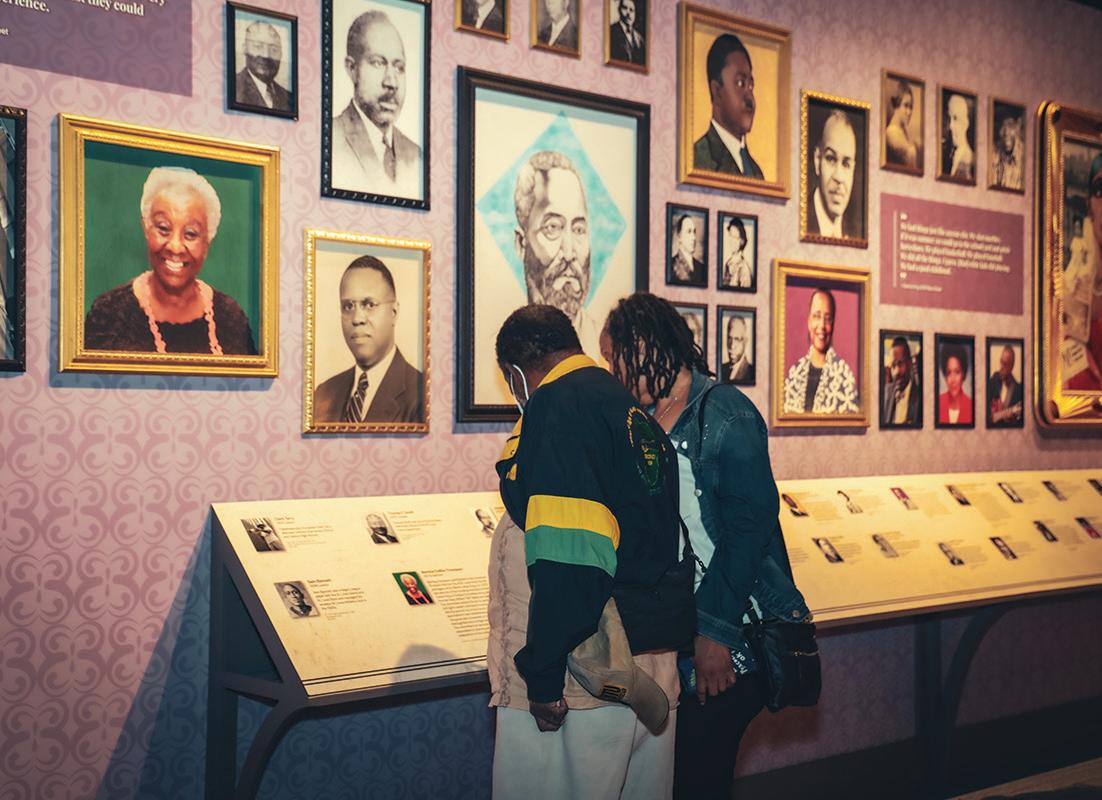
“This city raised me creatively. Everything I do is rooted in honoring that.”
Lyah LeFlore‑Ituen
was a free man. Together, they built a life in southern Missouri — a foundation that continues to inform her work today. She is currently doc umenting that lineage in a book written with her mother, a process she describes as “piecing together a living quilt.” She sees that same work reflected in the mission of the African American History Initiative: collecting artifacts, pre serving sto ries and con necting past and present so Black history remains central to understanding the American story. Her résumé spans senior roles at Nickelodeon, Uptown Entertainment and Haymon Entertainment, where she collaborated with industry giants such as the late Andre Harrell, Dick Wolf, Alan Haymon and Emmy‑winning direc tor Anthony Hemingway. Her work includes proj ects like “New York Undercover,” “8 Days a Week” and “Unsolved: The Murders of Tupac and The Notorious B.I.G.”
In 2025, she produced and hosted “Poetry in Motion: STL Poets Take the Mic,” a Kranzberg Arts Foundation–supported documentary that aired on PBS — a project that showcased her ability to elevate local voices into national cultural conver sations. Reflecting on the city’s creative depth, LeFlore Ituen said, “When you give St. Louis artists a platform, they don’t just shine — they explode. My job has always been to make sure the spotlight finds them.” Her literary work is equally expansive. She is the author or co‑author of nine books, including Wildflowers, Last Night a DJ Saved My Life, and Tell the Truth & Shame the Devil, written with Lezley McSpadden — a memoir that honors the life and legacy of her late son Michael Brown. Her forth coming memoir, I Collect My Eyes…, co‑written with her late mother — St. Louis Poet Laureate Emeritus Shirley Bradley LeFlore — continues her family’s intergenerational commitment to art and memory. Beyond her creative work, LeFlore‑Ituen is a respected civic leader. She co‑found
ed the Shirley Bradley LeFlore Foundation and serves on the board of Counterpublic, a nationally recognized public art orga nization. She is a gradu ate of Stephens College and a member of Alpha Kappa Alpha Sorority, Incorporated. In her new role, LeFlore‑Ituen will over see AAHI staff, guide cross‑divisional collab orations, help establish a community advisory board and steward the African American History Endowment. The program supports the preservation of Black history across the region, the development of future museum profes sionals and the creation of inclusive exhibits and programs.
“Across more than three decades in entertainment, media, literature and cul tural advocacy, I’ve seen how community‑rooted stories shape power, belonging and possibility,” she said. “As Director of the African American History Initiatives, I am honored to steward this work alongside our community partners — expanding how stories are preserved and carried forward so history contin ues to shape our collective future.”

love it,” Gibson said. The St. Louis County Library’s Black History
Month Keynote Address will take place at 7 p.m. (6 p.m. doors) on Friday, February 6 at The Clark
Family Branch, 1640 S. Lindbergh. For more information, visit www. slcl.org.
“Mill Creek: Black Metropolis,” will be on display through July 2026.
Photo by Taylor Marrie/ St. Louis American
Continued from B8
ist,” Price said. “I didn’t do a very good job taking pictures because of this scenery — I was so enam ored by this room. And to stand here and shoot while people were taking care of city business… I remem ber feeling like I was com ing into the big time by walking into this room.”
The people in the room taking care of city business expressed how enamored they were with him. The resolution’s primary spon sor, 7th Ward Alderwoman Alisha Sonnier, intro duced it before her col leagues alongside Board of Aldermen President Megan Ellyia Green.
Sonnier shared how she first encountered Price — while he was photograph ing a protest.
“I learned to find com fort in your face being behind that camera,” Sonnier said. “Because I knew regardless of what happened, the truth would be told. And that is incred ibly important for our entire city, but especially for Black people and for racial relations.”
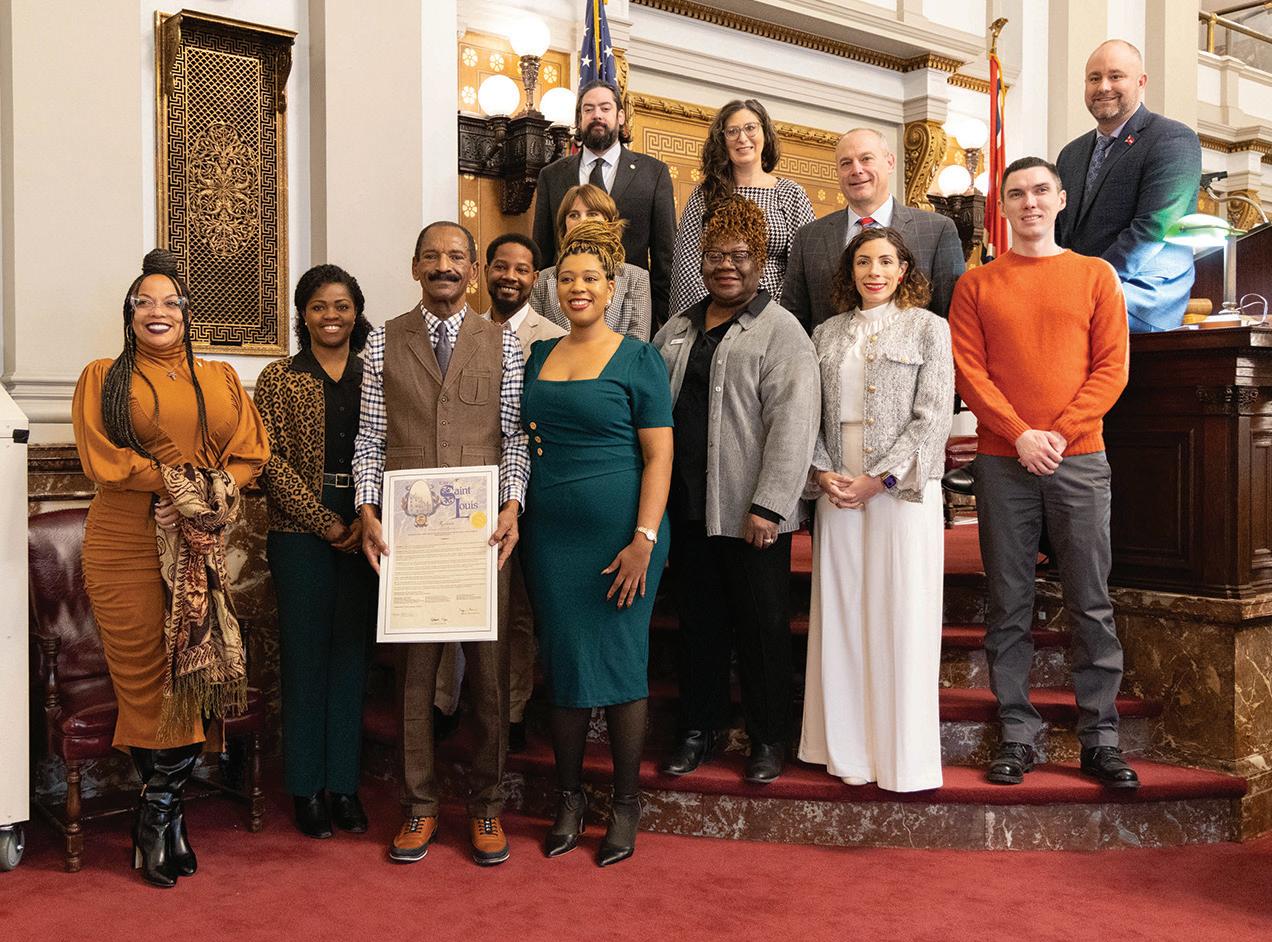
The St. Louis Board of Aldermen presented veteran photojournalist Wiley Price with Resolution 220, which honored his service to St. Louis through his 40-plus years as staff photographer for The
January
the history of our city,” Velazquez said. “You’ve been there for the big events and the small ones, and you’ve captured them and helped tell the story like nobody else could. You’ve also been able to tell stories that, without you, the city would not have heard.” He was even likened to a first responder by 10th Ward Alderwoman Shameem Clark Hubbard.
Price grew emotion al as the resolution was read before the Board of Aldermen.
through photojournalism,”
Resolution 220 stated.
“Whereas Wiley Price dedicated more than 45 years of his professional life to documenting the people, neighborhoods, history and civic life of the City of St. Louis
One line in particu lar — also sponsored by 2nd Ward Alderman
Thomas Oldenburg, 9th
Ward Alderman Michael Browning, 14th Ward Alderman Rasheen

Aldridge Jr., and 11th
Ward Alderwoman Laura Keys — moved him to tears. It described him as:
“One of the most con sistent individual chron iclers of Black life in the City of St. Louis.”
The resolution also rec ognizes Price for capturing “everyday life as well as historic moments including elections, protests, faith gatherings, cultural cele brations, natural disasters, public health crises and movements for justice.”
It notes that Price cre ated a visual record of the region that reflected Black citizens “with dignity and humanity.”
Keys joked that every one in the room should have worn T‑shirts that said “Shot by Wiley Price.”
“This is the best person to be shot by,” Keys said. “Thank you so much for all of the work you’ve done here in our city — all of the recording of life here in St. Louis that you
have preserved for us and for future generations.”
The resolution high lighted Price’s mem bership in the Missouri Photojournalism Hall of Fame — and that his image featuring future President Barack Obama is part of the perma nent collection at the Smithsonian’s National Museum of African American History and Culture.
“They say photos can tell a thousand words, and you have taken some of the best photos of our region,” Aldridge said. “You have captured so much history. And in some of those photos, you cap tured my good side. You are a legend and an icon in this city.”
Alderwoman Daniela Velazquez of the 6th Ward said Price’s work — like journalism itself — has been essential to the demo cratic health of the city.
“You’ve had an incred ibly important role in
“I just appreciate the intention you put into the work that you do,” Hubbard said. “People think photojournalists just take pictures and send them, but you can see the thought you put into what you capture. Your gift is immeasurable.”
It was an exchange of admiration as Price accept ed Resolution 220 and delivered brief remarks.
“I’ve always respected the work that has gone on here,” Price said. “And I’ve so respected my com munity.”
The highlight of his tenure, he said, was having the opportunity to be of service to his city — and to the publication that allowed him to apply his gifts for the greatest possi ble good of his people.
“Throughout my career, I wanted so badly to make sure that the African American community looked like we were trying to do our business,” Price said. “And I’ve always been proud to say I’m with The St. Louis American.”
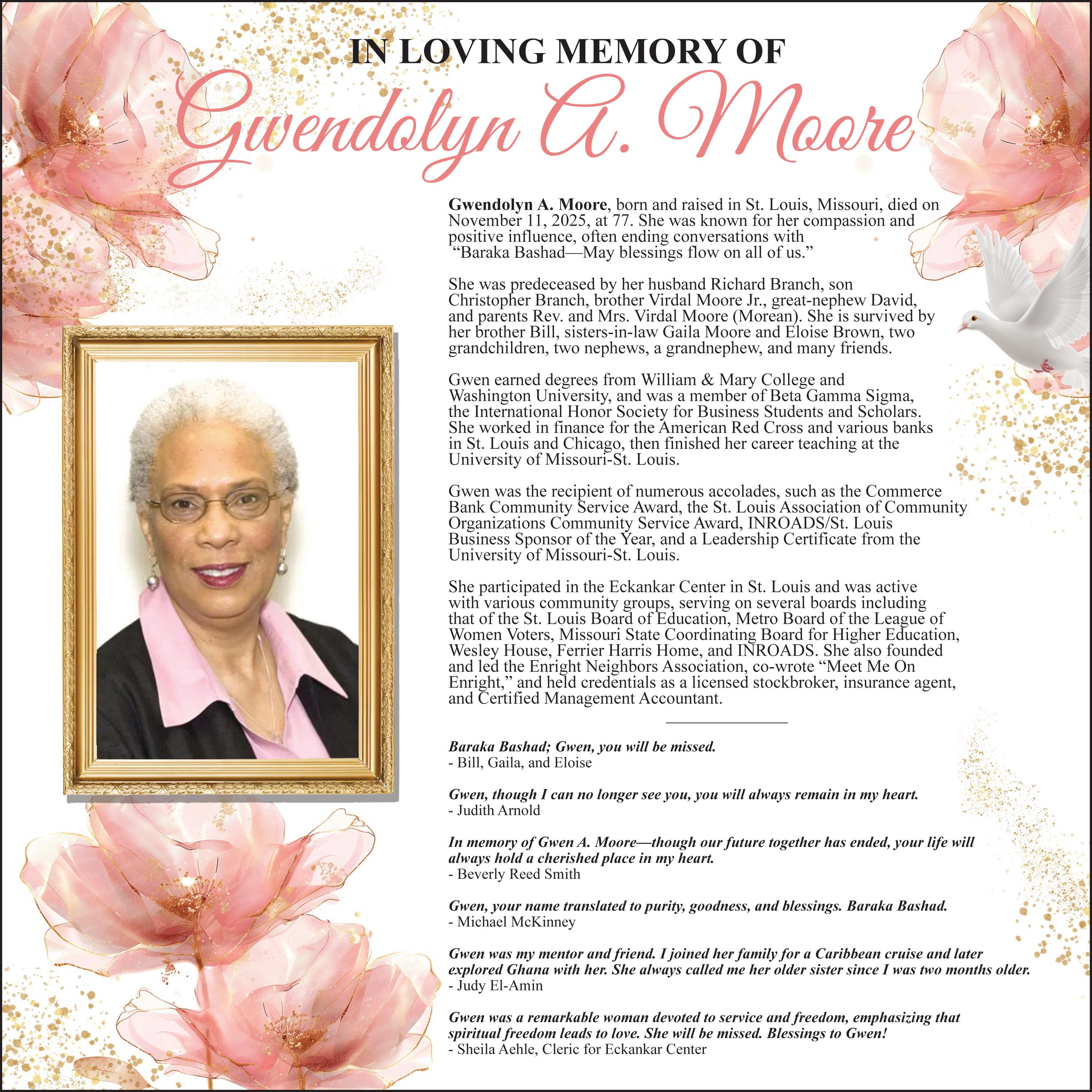
St. Louis American on Friday,
23, 2026 at City Hall.
Photo by Lawrence Bryant | St. Louis American

CITY OF BELLERIVE ACRES MISSOURI NOTICE OF PUBLIC HEARING
The City of Bellerive Acres will hold a public hearing to discuss the estimated allocation of $60,000 in Community Development Block Grant funds which will become available after January 1, 2026. The public hearing will be held at 6:00 p.m. on Thursday, February 19, 2026 at Normandy City Hall located at 7700 Natural Bridge Road, St. Louis, MO 63121.
If you would like information regarding the above policies or if you believe you have been unlawfully discriminated against, contact the following municipal official or employee who has been designated to coordinate compliance with the equal employment opportunity requirements referenced above. Additionally, if you are unable to attend the public hearing, you may provide written comments regarding the Community Development Block Grant Program to the following municipal official:
Deletra Hudson, City Clerk 3915 Roland Avenue; Pasadena Hill, MO 63121 phone: (314) 305-6731 email: clerk@belleriveacresmo.gov
If you are a person with a disability or have special needs in order to participate in this public hearing, please contact Deletra Hudson, City Clerk no later than Thursday, February 12, 2026 at 2:00 p.m.
For More Information Call:
1-800-735-2466 RELAY MISSOURI VOICE
1-800-735-2966 RELAY MISSOURI TDD Equal Opportunity Employer
SEALED BIDS
Bids for Replace Auxvasse Creek Bridge, Hwy 94 and Auxvasse Creek intersection, Callaway County, MO. Project No. X2408-02 will be received by FMDC, State of MO, UNTIL 1:30 PM, 2/26/2026. Project information available at: http:// oa.mo.gov/ facilities
SEALED BIDS
Bids for Paved Trail Repair Phase 2, Project No. X2117-02 will be received by FMDC, State of MO, UNTIL 1:30 PM, 2/26/26. Project information available at: http://oa.mo.gov/ facilities. This is an equal opportunity bidding event and MBE/WBE firms are encouraged to respond. Federal funds are being used in the project, and all relevant federal, state and local requirements apply.
REQUEST FOR PROPOSALS
The School District of University City is seeking sealed bids for the Multipurpose Athletic Field Stadium. Bids are due by 2 PM on February 26, 2026. A pre-bid walkthrough will be held at 10:00 AM on February 12, 2026, at University City High School, located at 7401 Balson Ave, University City, MO 63130. For more information and the complete bid package, please contact Likitha Kaki at lkaki@ kwamebuildinggroup.com.
SEALED BIDS
Bids for Marshall Readiness CenterRenovate Interior & Exterior, Project No.T2423-01 will be received by FMDC, State of MO, UNTIL 1:30 PM, March 5, 2026. Project information available at: http://oa.mo. gov/facilities
SEALED BIDS
Bids for Replace HVAC Units for 10 Group Homes, Project No. M2511-01 will be received by FMDC, State of MO, UNTIL 1:30 PM, 3/5/26 Project information available at: http:// oa.mo.gov/ facilities
INVITATION TO BID
The Twenty-Second Judicial Circuit is currently soliciting proposal for Clyde S. Cahill Courts Plaster Repairs under the direction of the Circuit Court in the Clyde S. Cahill Courts Building, 10 N. Tucker Blvd., St. Louis, Missouri 63101;
The Request for Proposal is available on the Court’s website http://www.stlcitycir cuitcourt.com, click on General Information, then Request for Proposals.
Proposals must be received no later than 10 a.m. on March 10, 2026.
REQUEST FOR BIDS
The School District of University City is seeking bids for Roofing Replacement. There will be 3 bid packages that include: Brittany Woods Middle School, Julia Goldstein Early Childhood, and McNair Administration. The deadline for bids is 1:00 p.m. on February 24th. The mandatory pre-bid walkthrough is scheduled for 10:00 a.m. on February 9th at Brittany Woods Middle School. This will be a prevailing wage project. For more information and to request bid documents, please email Drew Bade at drew@ graycoconsulting.com
REQUEST
FOR BIDS
QUALIFIED ENVIRONMENTAL PROFESSIONAL (QEP)
Tabernacle Community Development Corporation is seeking bids from qualified firms or individuals to serve as a Qualified Environmental Professional (QEP). The selected QEP will provide technical, quality assurance, planning, reporting, and programmatic support for the full four-year period of performance. To request bid documents, please email vrobinson@tabdev.org.
SEALED BIDS
Request for Qualifications ( R F Q ) f o r Design/Build Services for OA Fleet Garage, Project No. O2548-01 will be received by FMDC, State of MO, February 2026. I n f o r m a t i o n available at http:/ /oa.mo. gov/facilities
SEALED BIDS
Bids for Modify Campground Loop 1, Project No. X25170 1 , L o n g Branch State Park, Macon, Missouri, will be received by FMDC, State of MO, UNTIL 1:30 PM, March 10, 2026. Project i n f o r m a
o n available at: http:/ /oa.mo. gov/facilities
REQUEST FOR PROPOSALS
Alberici Constructors, Kwame Building Group and the Saint Louis Zoo seek bids from qualified firms to submit proposals for a project at the Saint Louis Zoo WildCare Park. The project consists of constructing 10 Glamping cabins. To request bid documents, please send an E-mail to stlzoobids@alberici.com
ADVERTISEMENT FOR BIDS
Sealed proposals for Food Service Management will be received at Epworth Children & Family Services, Inc., 110 N. Elm Ave. St. Louis, Mo. 63119 until 9:00 am on Saturday, March 1st, 2026 and then publicly opened.
To receive copies of January 22, 2026, RFP or for more information contact Kimberly Mims at (314) 324-5966.
PUBLIC NOTICE
Notice is hereby given that the Metropolitan St. Louis Sewer District Requests for Quotes, Bids and Proposals are posted online for public download. Please navigate to www.msdprojectclear.org > Doing Business With Us > View Bid Opportunities
Metropolitan St. Louis Sewer District is an Equal Opportunity Employer.
REQUEST FOR PROPOSALS FAMILY SUB-CONTRACTED SERVICES
The St. Louis City Family Court is seeking proposals from service providers to address behaviors that have resulted in referrals to the Family Court. Proposals should be submitted no later than 4:00 p.m. on March 6, 2026. Interested service providers may obtain the Proposal Specifications by accessing www.stlcitycir cuitcourt.com and selecting Courts & Services, Court Administration, then Requests For Proposals.
Service: Airport Business Services
Pre-Proposal Meeting Date: February 17, 2026 at 9:30 a.m. Local Time Meeting will be held via Zoom. See RFP for details.
Question Due Date: On or before February 18, 2026
Proposal Due Date: March 5, 2026 at 2:00 p.m. Local Time
Point of Contact: Delia Cummings –dfcummings@flystl.com
Proposal documents may be obtained at St. Louis Lambert International Airport, Airport Properties Division, Monday through Friday between 8:00 a.m. and 4:30 p.m., or by calling (314) 426-8174. This RFP may also be obtained by visiting our website at https://www.flystl.com/business/ contract-opportunities/ Robert Salarano Airport Properties Division Manager
SEALED BIDS
Bids for Campground Shower House Replacements, Montauk State Park, Salem, MO, Project No. X2530-01 will be received by FMDC, State of MO, UNTIL 1:30 PM, 3/12/26. Project information available at: http://oa.mo. gov/facilities The State of Missouri, OA-FMDC, hereby notifies all bidders that it will affirmatively ensure that in any contract entered into pursuant to this advertisement, businesses owned and controlled by socially and economically disadvantaged individuals will be afforded full opportunity to submit bids in response to this invitation and will not be discriminated against on the grounds of race, color, religion, creed, sex, age, ancestry or national origin in consideration for an award. Federal Land and Water Conservation Funds are being used in this project, and all relevant federal, state and local requirements apply.
REQUEST FOR PROPOSALS
The St. Louis Economic Development Partnership requests proposals for exterior painting services at the West County Business Incubator, located at 743 Spirit 40 Park Drive, Chesterfield, Missouri 63005. Interested parties are encouraged to observe the facility. A copy of the RFP is available at https:// stlpart nership.com/rfprfq/. To be considered, proposals must be received no later than 3 PM CT on February 27, 2026.
REQUEST FOR PROPOSALS
The Land Clearance for Redevelopment Authority of the County of St. Louis (the “LCRA”) requests proposals from qualified contractors to inspect the current HVAC system and implement a recommended approach for replacement or repair of the same for the Early Explorers Child Development Academy located at 1232 Robert L. Powell Pl, St. Louis, MO 63133. A copy of the full RFP is available at https://stlpartnership.com/ rfp-rfq/. Proposals should be received no later than 3:00 PM CST on Friday, February 27, 2026. St. Louis Economic Development Partnership Equal Opportunity Employer

Church disruptions are justified
The arrest of Don Lemon ignores a long tradition of religious disruption used to challenge power and hypocrisy
By Graylan Scott Hagler Word in Black
Don Lemon, a high-profile
media personality, was arrested on orders from U.S. Attorney Pam Bondi, who accused him of violating the federal civil rights of worshippers. Lemon, an independent journalist, followed protesters into a church on Jan. 18 to cover the event.
The Trump administration, known for its vindictiveness and with little tolerance for outspoken critics, particularly Lemon, who has publicly condemned its policies and racism, appeared intent on making an example of him. We have repeatedly witnessed how political actors in the White House do not hesitate to wield power in punitive and targeted ways.
Religion

profile in their own right. Many other protesters and independent journalists were present in the church but were not arrested.
Federal Officials and the Framing of “Desecration”
Bondi wrote on X, “At my direction, early this morning federal agents arrested Don Lemon, in connection with the coordinated attack on Cities Church in St. Paul, Minnesota.”

One of the church’s pastors, David Easterwood, heads the local ICE field office. Given the high tensions following the killings of Renée Good and Alex Pretti, combined with unrestrained hostility and the overwhelming presence of DHS and other so-called law enforcement agencies, protesters deliberately chose this church.
Also arrested were Trahern Jeen Crews, co-founder of Black Lives Matter in Minnesota; Jamael Lydell Lundy; and Georgia Fort — each with a public
Department of Justice Assistant Attorney General Harmeet Dhillon posted on X that the investigation into Lemon and others centered on their “desecration of a house of worship
and interference with Christian worshippers.” She added, “A house of worship is not a public forum for your protest! It is a space protected from exactly such acts by federal criminal and civil laws!”
The Southern Baptist Response
The church is affiliated with the Southern Baptist Convention, a conservative religious movement with a documented history of racism, including support for slavery, opposition to women in ministry, and homophobia.
Outrage quickly followed the disruption of a worship service. Southern Baptist leadership recoiled.
“I believe we must be resolute in two areas: encouraging our churches to provide compassionate pastoral care to these (mi-

grant) families and standing firm for the sanctity of our houses of worship,” said Trey Turner. Kevin Ezell, president of the convention’s North American Mission Board, added, “No cause — political or otherwise — justifies the desecration of a sacred space or the intimidation and trauma inflicted on families gathered peacefully in the house of God.” He later stated, “What occurred was not protest; it was lawless harassment.”
Church Disruptions Are Not New
In 1969, civil rights leader James Forman disrupted services at Riverside Church in New York City to demand $500 million in reparations from white churches. The action, known as the Black Manifesto, forced religious institutions to confront their complicity in slavery and helped spur later anti-poverty and racial justice
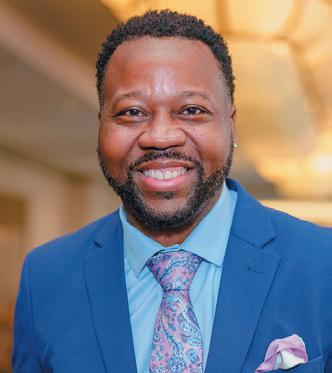
T. KIMBROUGH Chairman and CEO, Midwest BankCentre Author, Twice Over a Man, More Than a Conqueror, and Ward and the State
Leadership invites pressure. Leadership exposes patterns. Leadership reveals what you default to when the moment gets tight.
And if you’ve led long enough, you already know this: the gap between reaction and response is where maturity lives.
Pause. Breathe. Choose.
Three words that look simple on paper but feel nearly impossible in the moment.
Because when adrenaline spikes, your body isn’t trying to promote you — it’s trying to protect you.
Your nervous system starts firing old stories: Someone challenges you? You feel disrespected. Someone pushes back? You feel dismissed. Someone questions your decision? You feel threatened.
And without awareness, you’ll react from the wound instead of the wisdom.
This is why the pause matters. The pause interrupts the emotional autopilot. The breath signals to your brain, “We’re safe. We’re not in danger.” And the choice becomes the moment you reclaim agency — not just as a leader, but as a person.
initiatives.
In December 1989, members of AIDS Coalition to Unleash Power (ACT UP) organized “Stop the Church,” disrupting Mass led by Cardinal John O’Connor at St. Patrick’s Cathedral in New York. One hundred eleven protesters were arrested. The demonstration protested O’Connor’s opposition to safesex education and condom distribution during the AIDS crisis.
During the Free South Africa Movement, churches were disrupted nationwide to pressure denominations to divest from apartheid South Africa. More recently, worship services have been confronted over the genocide in Gaza.
Church disruptions surface urgency. They challenge public policy positions and expose contradictions between stated theology and lived practice.
Churches are not exempt from political or theological critique once they enter public debate. Institutional churches — and pastors serving full time or through tent ministries — must be held accountable.
What happened on Jan. 18 in St. Paul was neither unreasonable nor inappropriate. The pastor opened himself to disruption by embodying a contradiction: serving ICE while claiming to offer sanctuary and compassion to immigrants.
Rather than expressing outrage, church leaders should ask why protesters felt compelled to act — and what that anger reveals about the gap between their theology and their practice.
Reverend Graylan Scott Hagler is the senior advisor for the Fellowship of Reconciliation–USA, director and chief visionary of Faith Strategies LLC, and pastor emeritus of Plymouth Congregational United Church of Christ in Washington, D.C.
This discipline changes everything, because it does three powerful things:
1. It separates the trigger from the truth.
Not every emotional spike is a signal. Sometimes it’s residue — a remnant from a story that no longer defines you.
2. It gives you back your authority. Reaction is survival. Choice is leadership. When you choose rather than react, you lead from identity instead of insecurity.
3. It protects your relationships. Most leadership damage comes from moments that lasted seconds but carried consequences for years.
Leaders who practice pause–breathe–choose become leaders people trust — not because they’re perfect, but because they’re predictable in the right ways.
Their teams know they won’t explode. They won’t withdraw. They won’t weaponize their authority. They will lead from the quiet center — not the storm.
If you want to accelerate your rise, master this discipline. Because in leadership, the win is rarely found in the reaction. The win is found in the response.
Reflection Question: Where in your leadership do you need to create more space between the trigger and the choice?
Photo courtesy of instagram.com
Don Lemon, a high-profile media personality, was arrested on orders from U.S. Attorney Pam Bondi.
Pause. Breathe. Choose: The Leader’s Discipline That Changes Everything
The Next MOVE
ORVIN