

Editor's Note
Ellie Wain
Although I am heartbroken to end the tradition of writing the debate every edition (my deepest apologies, Sam), I am thrilled to serve as editorin-chief for this academic year. Bella and Freddie did an impeccable job at transforming the magazine last year, so there are undoubtedly substantial shoes to fill. The pressure is on; however, Will, Sarah, Anna, and I are delighted to present the 31st edition of The Eagle.
There’s no denying that the world politically is becoming more and more disconcerting and, quite frankly, alarming. In a single week, we witnessed the assassination of Charlie Kirk, the collapse of Nepal’s government, the resignation of France’s third prime minister in a single year after just 26 days in office (giving Liz Truss a run for her money), and a substantial Russian assault on Ukraine involving over 600 drones and dozens of cruise missiles. Thus, it was no surprise that one of the themes that emerged this edition was ‘Radical Horizons’, which focuses on the intensifying polarisation in politics, as more people become disengaged with central parties. Countless articles cover this idea in great depth; however, most notably, Will Reed provides a psychological examination of the use of nostalgia in populist regimes, which is presented with an exceptionally lucid writing style. I encourage everyone to read it as it has become increasingly relevant in today's political climate. Furthermore, Aoife Barnes writes a heartfelt piece on global women’s rights, which can be found in the sector of Radical Horizons. She shines a light on progress made, but also the harsh realities in foreign countries, which westerners often shy away from acknowledging.
The articles submitted coalesce into three distinct angles: Radical Horizons, The State of Things, and finally, Cultural Lens. A new
feature introduced this year is a regular column titled ‘Sociologically Speaking…’, written by sociology student, Bea Moore. It will provide thorough termly explorations of anthropological concepts, launched in tandem with the exciting introduction of Sociology A-level at St John’s.
Quite possibly my favourite addition to this term's magazine is from young entrepreneur, James Ross, a member of the lower sixth. When I heard he had made his own camera from scratch and was creating his own films, I knew I had to ask him to contribute. I am utterly convinced that James will be the next Bill Gates, and maybe in twenty years, there will be an article in The Eagle written about his most recent success. It’s uplifting to see pupils in the school pushing boundaries through creativity and innovation, and I think it’s paramount to recognise this, particularly when young people succumb to the cheerful conviction that the world is politically doomed. I try to challenge that view when possible, though the contents of this edition seem determined to prove me wrong.
Yes - the political landscape seems to be increasingly dire. However, it's crucial to acknowledge the positives in recent politics, which these articles perhaps don’t cover. In the last two months, Japan appointed Sanae Takaichi as their first female prime minister, and Maria Corina Machado won the Nobel Peace Prize for promoting democratic rights in Venezuela. Moreover, peace between Palestine and Israel seems increasingly more tangible. These milestones, often underappreciated, offer a glimpse of a world where collective action can create meaningful change. They also act as a gentle reminder, as you read through this magazine, that whilst corruption spreads and polarisation is catalysed, there is substantial potential for positive transformation.
The articles submitted this term have made my job less daunting and one hundred times easier. The subjects picked by the writers have been exceedingly relevant and evidently passionate. There is a range of lighthearted debate to serious political dissection, meaning there is something for everyone, which is the sole aim I had going into this term. And unsurprisingly, the editing team has done a superlative job, leaving me with little to alter.
However, the biggest gratitude of all goes to Will Logan, who managed to design to a formidably high standard with admittedly too short a deadline. Without Will, there is no Eagle, and so I owe all my thanks to you, Will. I honestly don’t know how to work Excel, so you amaze me with your immense digital talent. Beyond that, your patience, attention to detail and shared passion for this project have been instrumental in bringing this magazine to life.
So, on a final note, I hope you enjoy reading The Eagle as much as we have enjoyed making it. Politics belongs to all of us, so whether you’re the most sagacious politics A-level student or a year seven student with little prior political knowledge, I hope you can feel inspired to stay informed or (hopefully) even get involved next term. Happy reading!
-Ellie Wain, Editor-In-Chief
Designing the Winter 2025 edition was one lengthy task, as always the Eagle seems to grow both in size and ambition every term. With 21 articles and 64 pages it was no easy feat. However, with the guidance from designer alumni Freddie and the support of Ellie, Sarah and Anna it became much less daunting. The articles came in fast, with big ideas and written to an exceptional standard so I have to start by giving my thanks to all of you who wrote for this issue! Seriously, without you there is no Eagle.
My job was to supplement these articles aesthetically whilst making sure the design wasn't too overwhelming, something definitely down to trial and error. The countless drafts in my Adobe folder is really a testament to that. With all of the turbulence filling our political landscape I wanted to keep the design more sleek and sharp, keeping it easy to follow. Naturally, I leaned into a more modern style, focusing on bold reds, greens, and blues for our 3 sections of Radical Horizons, The State of Things and Cultural Lens.
Probably the most enjoyable article to edit had to be James Ross’ article “My journey into film making”, an incredible article which honestly just had me in awe of James’ sheer talent. So check that one out! I also have to give credit to Sam and Natalie’s debate on the threat of China and the US on the UK, a very timely topic. This was really quite challenging to design, but nevertheless ended up being one of my favourite parts of the magazine. The conversational style really helped me out for this one. Finally, Ethan Kellett's photos were most definitely another favourite, not only to design but even just to look at because they are truly incredible, so props to Ethan for that.
I was quite sad I couldn’t write for this issue, but I was so set on the design it was too late to write one! Our current political state lends itself to some great writing opportunities, as seen by the wide, wide range of articles we have gotten for this issue. With the

A
Note From the Graphic Designer Will Logan
rise of political violence, the tensions between the rise of Zack Polanski and the increase of popularity of Reform UK, I can’t help to think we are following the US, and the political window is shifting farther away from the center. Watching British politics shift this quickly with a new scandal in the Labour party every day is strange. On one hand, you can see people becoming more energised, and invested into politics. But on the other, you can feel the extremism pulling harder than ever. Our space for calm, moderated debate seems to be shrinking, replaced by outrage and personality politics, if I hear one more time about Your Party having yet another leadership argument or see Donald Trump insult another female reporter then I might just combust. But at least we have Jeremy Corbyn’s drag pantomime to look forward to!
If anything, this issue shows how much there is to unpack. Every article touches on a different corner of the chaos in Radical Horizons and The State of Things especially, but, thankfully, we have a breath of fresh
air in the form of Cultural Lens.
I really couldn’t write this without giving immense credit to my boss, the dedicated Editor in Chief Ellie. So thank you Ellie, you have really kept me pushing throughout this project, this magazine would not have worked at all without you. You have made the long, boring tasks seem actually less daunting and I couldn’t be more grateful to be doing this with you! Although being in 2 of your classes, doing rotary debate with you, and now this, admittedly I have probably seen you more than my own mother.
But all of that time lends itself to this incredible issue, and I think I speak for the whole editorial team here, but we couldn’t be more proud of it. From the breathtaking articles to the design, it really is a spectacular issue.
So, please enjoy reading this Winter 2025 issue of the Eagle, and take in the design as well, as the amount of time it took is actually obscene.
-Will Logan, Graphic Designer
8. Why Populist Leaders Love Nostalgia by Will Reed
11. The Political Relevance of Dystopian Fiction by Tia Allen
14. DEBATE: ‘China poses a bigger threat to UK interests than the USA’ by Natalie Johns and Sam Tredwell
18. The Disconserting Parallels Between Orwell’s 1984 and Technology in 2025 by Felix Samuels
20. Reimagining Governance in the Age of AI by Darcey Bellamy
22. How The Media’s Evolution Made Reputations More Volatile by Avaneesh Gunjal
24. The Rise of Reform by Oliver Paget
26. Is History Repeating Itself? The Global Assault on Women by Aoife Barnes
28. Photography of “Unite The Kingdom” protest by Ethan Kellett
The State of Things
34. The Plausibility of Cornish Independance; Baner Peran by Gregor Logan
36. Can the Labour Party Recover? By Aiden Moore
39. Is Isolationalism Still a Part of American Foreign Policy? By Millie Beacham
42. Examining the Bible’s Role in Masculinity Norms by Issie Appadoo
44. If the South had Won the Civil War by Gwen Buckley
46. Why the Voting Age Should Remain at 18 by Aoife Barnes
48. Sociologically Speaking... Moral Responsibility in the Case of Billy Milligan by Bea Moore
Cultural Lens
52. My Journey Into Filmmaking by James Ross
54.Artaud, Beckket, Wittgenstein, and the limits of language by Charlotte Clee
56. South Park and the Fight for Free Speech in America by Lucas Dean
58. The Danger of Canonising by Jewel Roussot
60. The Evolution of Feminism through Literature: Jane Eyre to Wander Woman by Rose McVeigh
62.FILM REVIEW: Ridley Scott’s ‘Napoleon’ by Freddie Von Kaltenborn
RADICAL HORIZONS THE STATE OF THINGS CULTURAL LENS
Editor: Ellie Wain
Designer: Will Logan

“A radical is a man with both feet planted firmly - in the
‘‘ RADICAL

Now more than ever, global politics is entering a new level of extremity. Tensions remain high in the U.S. with a government shutdown, and this tension extends to foreign policy, where Trump desperately debates the peace deal in Gaza. But this trend stretches far beyond American soil – there is an evident rise in populism, which Will Reed explores in relation to nostalgia, arguing that nostalgia asks the public to suspend doubt and believe that disorder can be erased by returning to how things used to be. This was recently most obvious in Trump’s re-election slogan, ‘Make America Great Again’, tying neatly into Natalie and Sam’s intense conversational debate on whether China or the U.S. poses a bigger threat to UK interests. Sam highlights the ongoing counterintelligence prompted by China, as well as their influence over UK supply chains, which provides them with significant leverage. However, in Natalie’s debut argument, she highlights the idea that the Trump administration offers a far bigger threat due to its unpredictability and unprecedented military forces. Will has also included some photography from Upper Sixth student Ethan Kellett, focusing on the Tommy Robinson march in September. The action captured in the photographs provides an insight into the actions of those most

disappointed with our current government, whilst also raising the question: Is radical action needed to make a change? On the literary side of things, Felix Samuels also covers the threat of technological manipulation in relation to Orwell’s dystopian novel. Tia Allen further explores the relevance of dystopia in today’s political climate, dissecting Atwood’s infamous ‘The Handmaid’s Tale’ and the messages regarding reproductive rights, which seem ever so relevant. Darcey Bellamy poses how AI can fit in the future government, stressing how AI isn’t something to be feared, but rather a tool to embrace in order to reorganise and improve governance. Something to be feared, however, is the media’s catalysis of negative reputations, which Avaneesh Gunjal conveys in a nuanced contribution to this chapter. Complementing this, Oliver Paget examines the meteoric rise of Reform, situating it within the broader populist wave that thrives on public dissatisfaction and the longing for simpler times. Finally, Aoife Barnes closes this chapter by exploring the global assault on women’s rights – a sobering reminder that extremism is a force that affects many women’s lives, and that this foreign concept is not a hypothetical, but, rather, a lived reality.
Why Populist Leaders Love Nostalgia
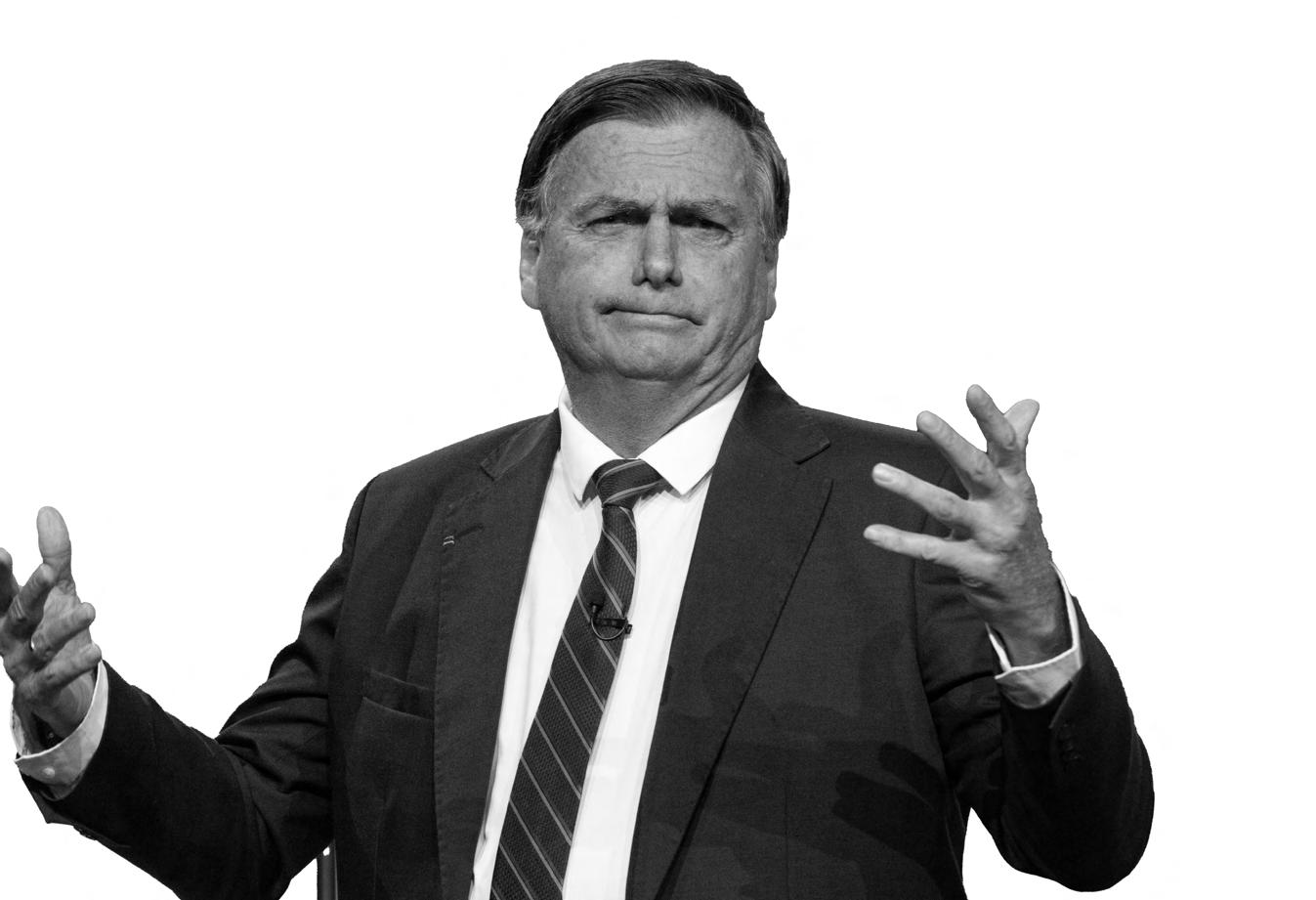
Nostalgia has long been a potent instrument in the populist playbook, offering voters the comforting fabrication of a past that was simpler, more prosperous, or more orderly than the present. The invocation of tradition, memory, and “simpler times” has been one of the most enduring devices in their arsenal of demagoguery. From Latin America to Europe and Asia, nostalgia functions not only as sentiment but also political strategy; it promises citizens a
posed heyday under the military dictatorship from 1964 to 1985. Of course, no one living in the times of the military dictatorship would call it a “golden age”, but that’s not how nostalgia works. He fervently glorified this time as an age of order and patriotic discipline, carefully omitting the censorship, torture, and political repression that defined that era. By appealing to voters disillu sioned with corruption and insta bility, Bolsonaro offered a fable of militarised, national strength reclaimed, lacking any realistic
suspend doubt, to believe that today’s disorder can be erased by simply returning to “how things used to be.” As it happens, populists always contend only they have the power to restore justice - in Bolsonaro’s case, this was how he asserted his authority: “Only God will take me out of Brasilia,”
requires overlooking repression.
Across the Atlantic, Donald Trump’s “Make America Great Again” campaign tapped into a similarly constructed idyll in the United States, vaguely framed as the post-war period from the 1950s to the 1980s. Trump deceitfully glorified these decades as an era of cultural dominance, industrial might, and “traditional” family values, portraying globalisation, immigration, and liberal elites as corrosive forces undermining “American greatness”. Notably, he cribbed both the slogan and the nostalgic framing from Ronald Reagan’s 1980 campaign, recycling it into a repetitive, emotionally charged mantra. By hammering his
slogan into public consciousness, he presented himself as the sole saviour capable of restoring the US to its “former glory”, a promise heavy on misogynistic chest thumping and macho bravado, but light on concrete solutions.
Around 35-40% of his 2016 voters had been adults during this period - yet the majority were not, revealing how much of the nostalgia was inherited or imagined, rather than lived. For Trump, nostalgia functioned as both a rallying cry and a smokescreen: it channelled

frustration with globalistion and inequality into a simplistic emotional appeal, while shielding him from the need to propose coherent or substantive policy. This demonstrates how nostalgia can compress multiple grievances into a single, repeatable slogan - mobilising millions without demanding policy specifics.
In the United Kingdom, Boris Johnson’s Brexit campaign drew heavily on a retrospective vision of British sovereignty and independence. His infamous claim that leaving the European Union would free up £350 million a week for the NHS was never about precise accounting (the UK’s actual net contribution to the EU budget in 2016 was approximately £156 million per week), but about evoking a vision of national renewal. Johnson cast Brexit as a chance to revive Britain’s global standing and invest in cherished institutions, tapping into a narrative of self-determination that resonated deeply with voters. This appeal found fertile ground in a wider public mood: in a 2018 Sky Data poll, 63% of Britons said life was worse now than when they were growing up, a finding researchers warned was “imperilling liberal democracy.” Nostalgia worked for Johnson because it wrapped a messy, divisive issue in the language of humour, patriotism,
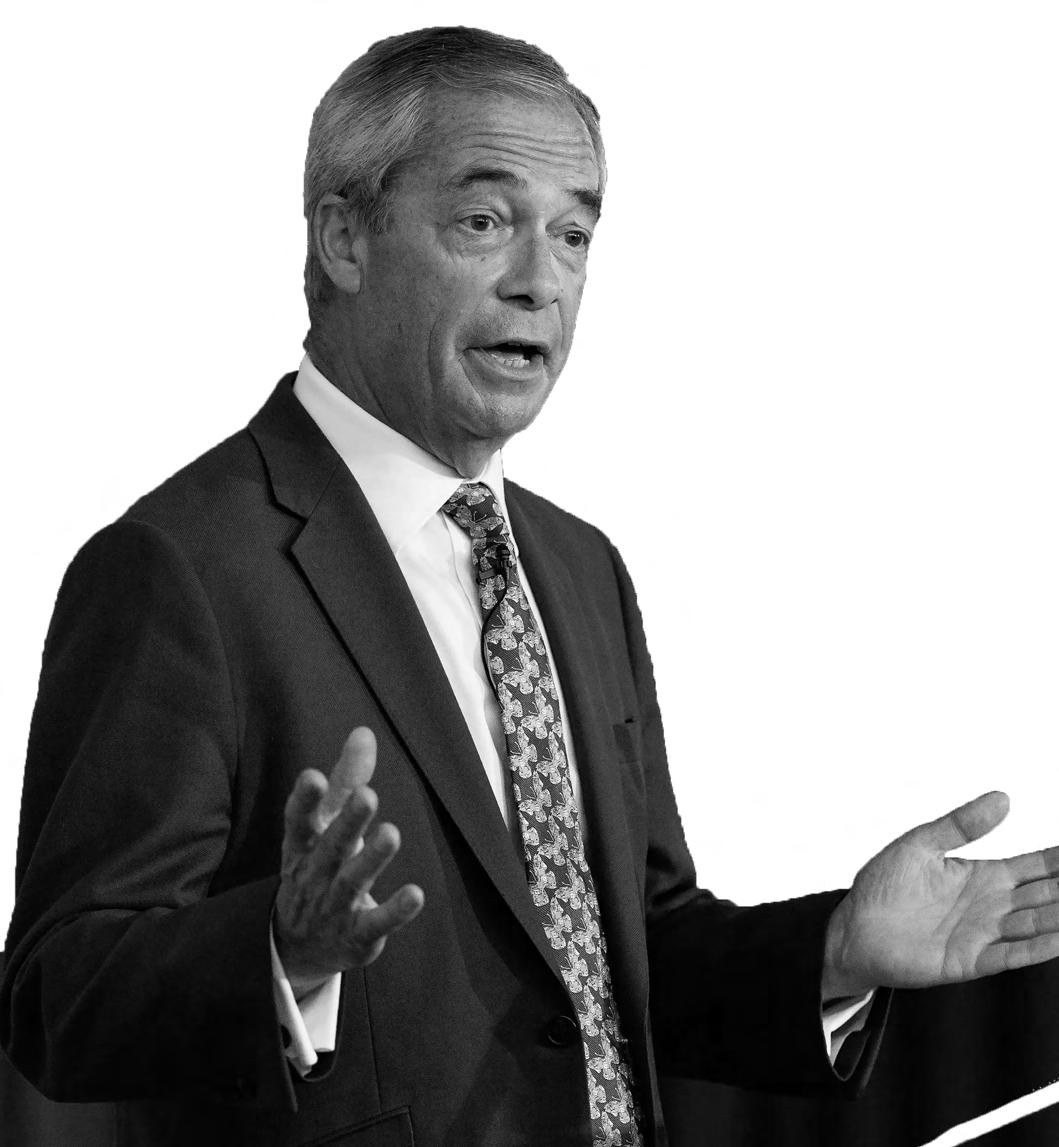
agined greatness whilst constantly misleading the public with false claims about immigration and the EU. His rhetoric combines nostalgic appeals with hypocrisy, presenting himself as and historical destiny. It reassured voters that leaving the EU was not a gamble, but a “restoration” of Britain’s supposed rightful place on the global stage. This shows nostalgia’s
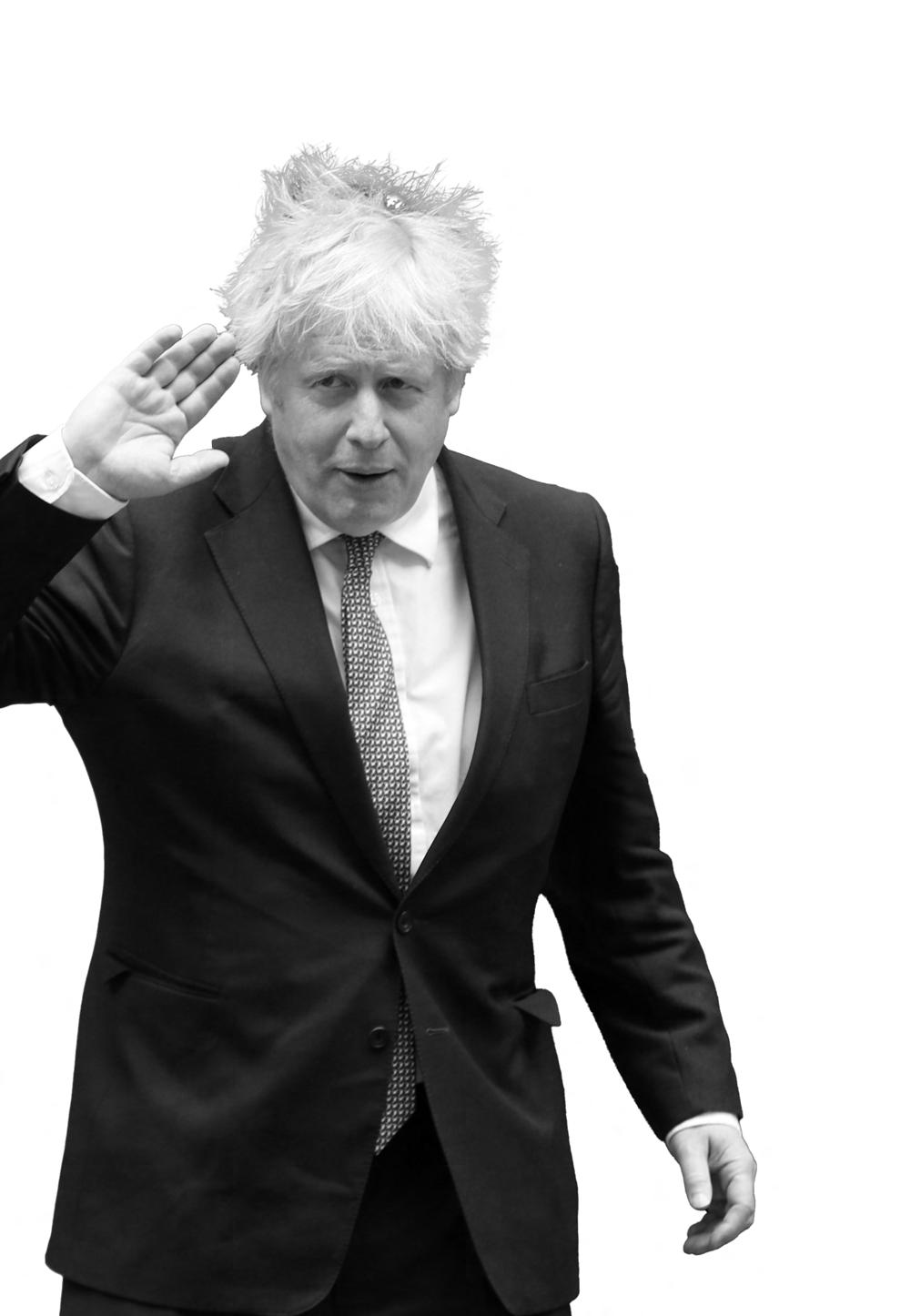
They perform the past, selecting fragments that flatter the present agenda while discarding those that do not. Whether through Bolsonaro’s military romanticism, Trump’s post-war idyll, Johnson’s comforting Brexit fable, or Farage’s weaponised grievance, the underlying mechanism is the same: to promise redemption by jkbjkjbway of a past that never was. The answer to why populists love nostalgia lies in its utility: it gives them legitimacy without emotion, policy, without evidence, and a unifying myth that demands little proof but offers immense political power – yet the danger lies precisely in this allure.
The more that people are persuaded that the past holds the answers, the less willing they are to fully understand the demands of the present or the uncertainty of the future. Populist nostalgia seduces with clarity and comfort, but it risks chaining societies to illusions. The past may be a fiction, but its political consequences are brutally real - fuelling division, distorting democracies, and leaving citizens chasing ghosts instead of genuine solutions.
-Will Reed, L5
HOW DOES
DYSTOPIAN LITERATURE REFLECT THE CURRENT POLITICAL CLIMATE?
Dystopian literature has always been political, captivating readers with its disturbing yet thought-provoking portrayal of the future, but is this imagined future warning us of the present? A dystopia is an imagined society marked by suffering, injustice and the abuse of power. The genre thrives on anxious apprehension: the fear that the systems we rely on might one day turn on us. In a world where many people are feeling increasingly worried about the state of politics, losing faith in democracy and governments, dystopian fiction feels less like a form of escapism and more like a warning of what is to come, a mirror reflecting the darker possibilities of
modern-day society.
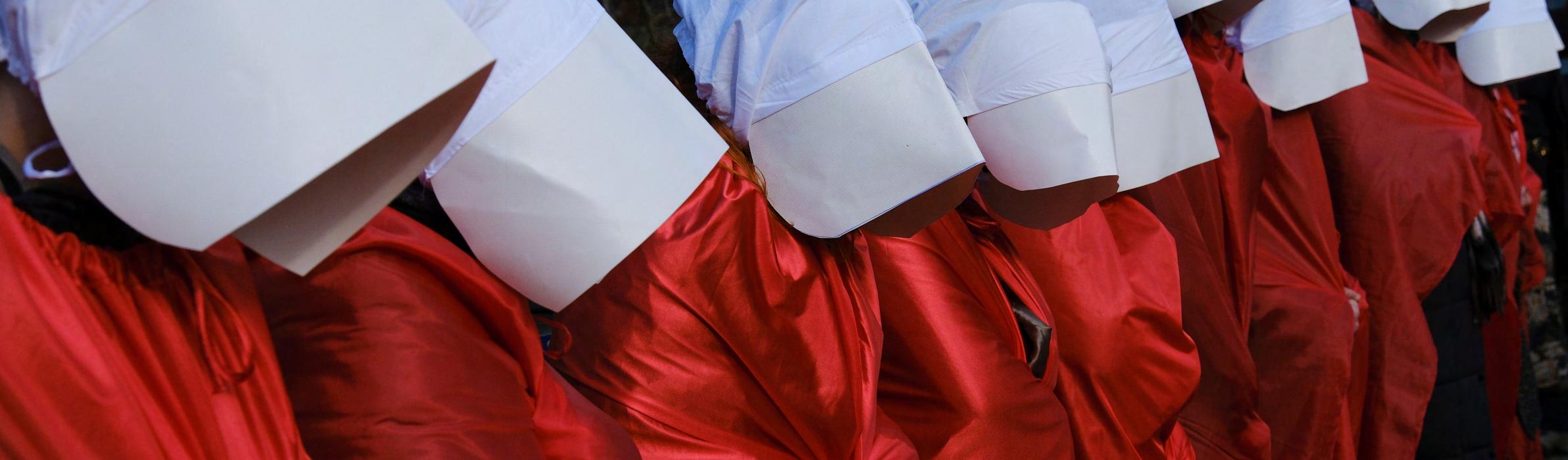
The Handmaid’s Tale, written by Margaret Atwood and published in 1985, remains one of the most iconic and politically charged dystopian novels ever written. Set in the totalitarian regime of Gilead, the novel explores themes of mass state control, gender oppression and institutionalised violence, captivating readers with its chilling and disconcerting portrayal of a society where women are given no bodily autonomy and reduced to their reproductive functions. Atwood’s vision continues to resonate today amid ongoing debates over women’s rights and reproductive freedom, both of which have come under attack in American politics
following the Supreme Court’s decision to overturn Roe v. Wade in 2022. When Atwood wrote The Handmaid’s Tale, the Roe decision of 1973 guaranteed women the constitutional right to abortion, symbolising autonomy and freedom. Its reversal and the introduction of restrictive abortion laws in many US states feel eerily reminiscent of Gilead’s ideology and signify the regression of women’s rights in many societies. This becomes even more unsettling when viewed alongside historical precedents like Buck v. Bell (1927), which held that the state could sterilise ‘unfit’ individuals without their consent. Though such eugenic practices have been condemned and repealed, the case has never been formally over-
turned. Together, Buck v. Bell and the fall of Roe v. Wade exposes a troubling belief that women’s reproductive autonomy is conditional, and that the state may still claim ownership of the body under certain moral or political justifications.
Globally, this struggle extends far beyond the United States, with around 753 million women of reproductive age living under restrictive abortion laws. Atwood herself is a strong advocate for women’s rights and has remarked on this ongoing reality, writing: ‘No one is forcing women to have abortions. No one should force them to undergo childbirth. Enforce childbirth if you wish, but at least call that enforcing by what it is. It is slavery: the claim to own and control another’s body, and to profit by that claim.’ Her words echo the brutal imagery within the novel, where those who perform abortions are publicly executed in ‘Salvagings’,
their bodies hung on ‘The Wall’ as a warning to others.
Atwood’s recognition of the change in modern-day society is not dissimilar to public opinion. A 2025 survey of 1,500 adults found that 59% believe women’s rights have not progressed as expected, citing Donald Trump’s presidency, rising levels of violence against women, and a surge in misogynistic online rhetoric as cause for concern about the direction of society. Those involved in The Handmaid’s Tale’s television adaptation also recognise the unsettling parallels between fiction and reality. ‘Women in our country have fewer rights now than when we started production in 2016,’ showrunner Eric Tuchman said in a statement that underscores how fragile gender equality remains, and the way women’s rights are gradually being eroded through legal means. Atwood’s dystopia continues to serve as both a reflection of the past and a warning of the future, reminding
us how easily freedoms can be dismantled when we are complacent in the face of dangerous political rhetoric.
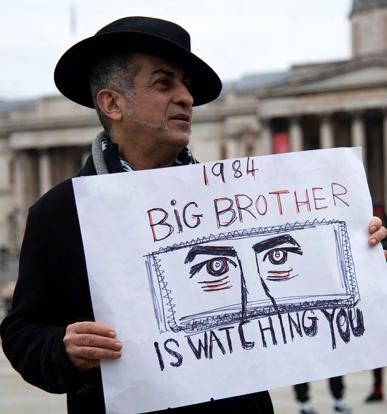
Additionally, George Orwell’s 1984 outlines modern-day concerns about surveillance and censorship. With the ominous slogan ‘Big Brother is watching you,’ Orwell envisioned a regime that weaponizes fear and omnipresent observation to control both public behaviour and private thought. The novel’s warning remains powerful today not because of its political specificity, but because of its universality. Orwell believed that any political ideology is susceptible to tyranny when power becomes too concentrated. Although the Trump administration cannot be equated with the totalitarian state of 1984, its repeated violations of the Constitution and disregard for basic human rights expose the fragility of the American political system, as institutional checks and balances are disre -
garded and undermined. This erosion of democratic accountability is not limited to the United States. Around the world, governments continue to expand their capacity for surveillance under the guise of security and efficiency. The UK’s proposed Digital ID system, for instance, would link citizens’ personal information and online activity to a single state-issued identity, raising concerns about privacy, data misuse, and the potential for state overreach. Such measures, though framed as administrative progress, echo Orwell’s vision of a society where observation becomes a means of control. Moreover, in authoritarian states like North Korea, Orwell’s concept of ‘thoughtcrime’ is not only a metaphor but a grim reality. Citizens risk imprisonment or execution not only for their actions, but for their beliefs; a chilling reminder that tyranny thrives when individuals are stripped of both freedom and truth. 1984 is no longer confined to fiction as a dystopian fantasy. In-
stead, a world without freedom is a potential future that we are actively choosing or refusing every day through our actions, awareness, and willingness to speak up.
The Handmaid’s Tale and 1984 are both seminal works of dystopian fiction that expose the unsettling potential of the future. Despite being written 36 years apart, both novels share striking similarities in their warnings about power, which, if left unchecked, can easily lead to corruption and control. In an era
defined by political polarisation, Atwood and Orwell compel us to recognise the fragility of our freedoms and the urgency of defending them. Their works remind us that the divide between democracy and dystopia is far narrower than we might wish to believe. Yet, Atwood still maintains faith that ‘within every dystopia there’s a little utopia,’ and even in the darkest visions of the future, hope endures, found in small acts of resistance, compassion, and courage.
-Tia Allen, L6
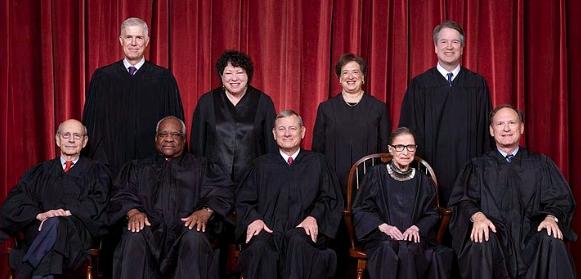
-The Supreme Court
DEBATE: ‘CHINA POSES A BIGGER THREAT TO UK INTERESTS THAN THE USA’
The Motion that I and the opposing house must contend with is whether the US or China is a greater threat to UK interests. I’m surprised to learn that not everyone, Natalie, holds the view that China, with its litany of civil rights abuses and consistent cyber-attacks, is the clear villain in this debate. The former MI5 Director-General, Sir Ken McCallum, described China as “the most game-changing strategic threat”. From large- scale industrial espionage to cyber infiltration of government. With all these breaches of our security being so apparent, it is not speculation, but a matter of ongoing counterintelligence prompted by Chinese aggression. It's not just about our infrastructure when it comes to national security; we must also consider broader society. British citizens of Chinese descent have been monitored and intimidated on British soil. If scare tactics on British citizens aren’t enough to compel you, Natalie, then I am unsure of what will.
Sam Tredwell, L6 (Proposing) & Natalie Johns, L6 (Opposing)
NATALIE

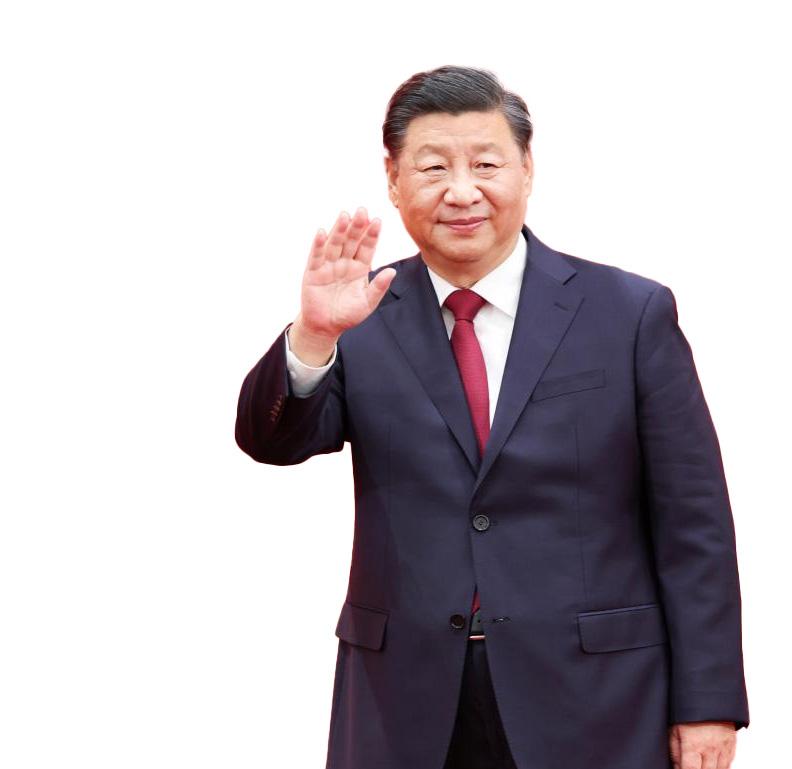
Contrary to the house motion, I confidently argue that the US poses a greater threat to the UK than China; positioning China as the ‘villain’ is a lazy stereotype that doesn’t reflect the realities and nuances of current geopolitical relations. The ‘special relationship’ between the US and UK is becoming increasingly toxic. The significant dependency the UK has on the US amplifies the impact of American shifts in trade, military and social customs, echoing throughout and reshaping British society, hence posing a greater risk. However, China, with whom the UK shares little cultural commonality, has a smaller channel of influence and its own international ambitions.
ECONOMICS
I’m sure that Sam is aware of the tariffs Trump announced on April 2nd, 2025, impacting more than 90 countries worldwide. These tariffs provide just one example of the way the US is attempting to assert economic dominance through coercive means. According to the UK Government Department for Business and Trade, the United States was the UK’s largest trading partner in both goods and services by the end of Q1 in 2025, totalling over $60 billion worth of products. Lack of predictability from the Trump Administration leads to global uncertainty, making it difficult for businesses to forecast future markets. Global stock markets dramatically crashed following the first round of US tariffs. Who is to say that Trump won’t get defensive and place more extreme tariffs on countries? The interdependence between the US and UK economies means that any regression in the US economy will inevitably affect the UK; our markets, trade and currency all feel the impact.
While I do agree, Natalie, that recent US tariffs have shaken markets, momentary volatility is not a ‘threat’, especially when from a democratic ally, and is far less of a threat than the systematic, statecontrolled influence from China. The US market shocks coincide with political cycles of 4-8 years. The state manipulation by China has led to the nation’s dominance over supply chains. All you have to do is pick up some everyday items and see that most things have the label “made in China”. It's not just consumer goods production China has a chokehold over. From lithium to semiconductors, China's domination presents a huge strategic vulnerability for the UK economy. Over 90% of global rare earth processing is controlled by China, materials that thrive are essential for the British business and security from defence to green energy infrastructure. China commands our supply chains, invests heavily in UK infrastructure and uses economic leverage when engaging in diplomacy. That’s not a short-term tariff or market fluctuation; it is sustained dependency. In the long term, it is Beijing, not Washington, that holds economic leverage over the UK.
NATALIE
MILITARY
Natalie - The toxicity in the UK and US relationship is further enhanced by the US’s repositioning in their role in international peace and security. ‘Pax Americana’ is defined as a state of relative international peace regarded as overseen by the US. Their selective engagement in the world order, however, suggests a retreat to prioritisation of self-interests rather than the interests of their allies. A Professor of International Security at KCL, Andrew Dorman, expressed how ‘Donald Trump has shattered the basic tenets of British defence policy of the last 80 years.’ The American hesitation to fully engage with the principles of the UN is resulting in a new form of relationship between the US and the UK. We now need to fill a moral and financial vacuum left by the US, leaving us in a vulnerable position. Historic reliance on US military defence set an expectation of intervention and support, one which Donald Trump has now placed conditions upon. The UK can no longer rely on the US to provide a consistent source of military security; as a direct result of this, we are now more exposed than ever.
What Natalie seems to keep forgetting is that Trump will only be in power for another three years until his time in office is up and will be replaced by the democratic process, unlike with China, where the threat posed has been constant and sustained for decades. China poses a persistent and growing threat to the UK’s national security on multiple fronts. British intelligence agencies have repeatedly warned that Chinese statebacked hackers target critical national infrastructure, from power grids and telecommunications to government databases, in attempts to steal sensitive information or disrupt essential services. MI5 has described China’s espionage activity as operating at an “epic scale,” with covert influence campaigns even reaching Parliament. Chinese firms, controlled by the CCP, have sought control over strategic assets, such as nuclear power projects and 5G networks, prompting the UK to remove Huawei over security fears. China’s expanding navy and partnerships with authoritarian states threaten global shipping routes vital to the UK’s trade and energy supplies. Unlike the US,
While it is undoubtedly true that the US has influenced British society through a shared media and culture, when looking at a holistic overview the interests of these two nations largely align: democracy, free speech and transparency. China represents a unique social threat rooted in authoritarianism, censorship and control over information. The enormous platform TikTok, owned by the Chinese company ByteDance has systematically harvested the data of British citizens. This mass of unique insight into the behavioural indoors of millions of citizens is a terrifying tool China may use to inflict damage on the UK. China’s use of state-backed media and propaganda networks aims to normalise censorship and undermine trust in democratic institutions that make up the very fabric of Britain. The Chinese record on human rights, including mass surveillance and horrific repression of Uyghur Muslims, sharply diverges from British social values. Yet the growing global presence of China risks subtly reshaping norms around privacy and freedom. The US may admittedly exert cultural dominance on the UK, but China exerts a deepening control which poses a far greater threat to the UK’s social fabric and democratic identity.
SAM
whose disagreements with Britain are political and reversible, China’s ambitions are structural, ideological, and directly hostile to our long-term security and sovereignty.
NATALIE
This ‘cultural dominance’ that Sam has decided the US exerts on the UK, runs deeper than a shared idea of how society should be run. It is creeping into our political system, most notably with the rise of ‘Trumpism’ and the far right. The anti-immigrant marches led by Tommy Robinson on September 13th highlight the growing issues of Christian nationalism and weaponisation of patriotism, mirroring the social conservatism prominent within the US. Elon Musk, the entrepreneur turned political opportunist, is reportedly paying Robinson’s legal fees, exemplifying the overt support that Trump’s government is providing for farright groups within the UK. Sam also mentioned the similarities between the media and culture of the US and UK; with the increase in censorship and centralised control of media in the US, it is these similarities we should be afraid of. I’m not declaring that media platforms in the UK will eventually be censored by the government. I’m warning that we need to be wary of the political appointment to positions of cultural influence, as these manifest themselves in subtle shifts in editorial content which form the political undertone of the media that the British population consume. Historically, Britain has followed America’s lead. Whether it’s the progressive politics of the 60s and 70s or the economic policies in the 80s and 90s, we are seeing the same trend in the regressive rightwing rhetoric. The explicit support of right-wing populism in the UK and the covert adoption of America’s conservative policies clearly illustrate the imposing, immediate threat that the US pose on social behaviour within the UK.
CONCLUSION
To conclude, it's not China pulling the strings of British trade policy, military alliances and societal shifts - it's America. This debate has made clear what should be blindingly obvious to everyone (except Sam) that the US poses a greater threat to UK interests than China. While America’s influence may ebb and flow with its electoral cycle, China’s threat is systemic; from espionage to economic control that will outlast any election cycle. For the UK, the real danger is found not in an ally’s volatility, but in an adversary’s permanence.
The disconserting parallels between Orwell’s 1984 and technology in 2025
Whencontrolled the people.
George Orwell first published his magnum opus, ‘1984’, he created a dystopian world where all citizens lived under the eagle eye of Big Brother in a communist, totalitarian society. The people of Oceania were constantly watched by telescreens, hidden microphones, and members of the thought police, destroying their privacy and ability to form rogue thoughts. 75 years later, our screens have evolved to become more efficient, with far more capabilities than even Orwell imagined. We now invite these devices into our homes to listen to our conversations, monitor our behav -
iours, and perform tasks we are too idle to complete ourselves.
Devices such as Amazon’s Alexa, Apple’s HomePod, or even the Ring doorbell all complete these functions. However, the question is, does something more sinister, more political, lie behind these devices? Our modern technology has turned Orwell’s nightmarish dystopia into reality, a world where surveillance and power lie behind convenience.
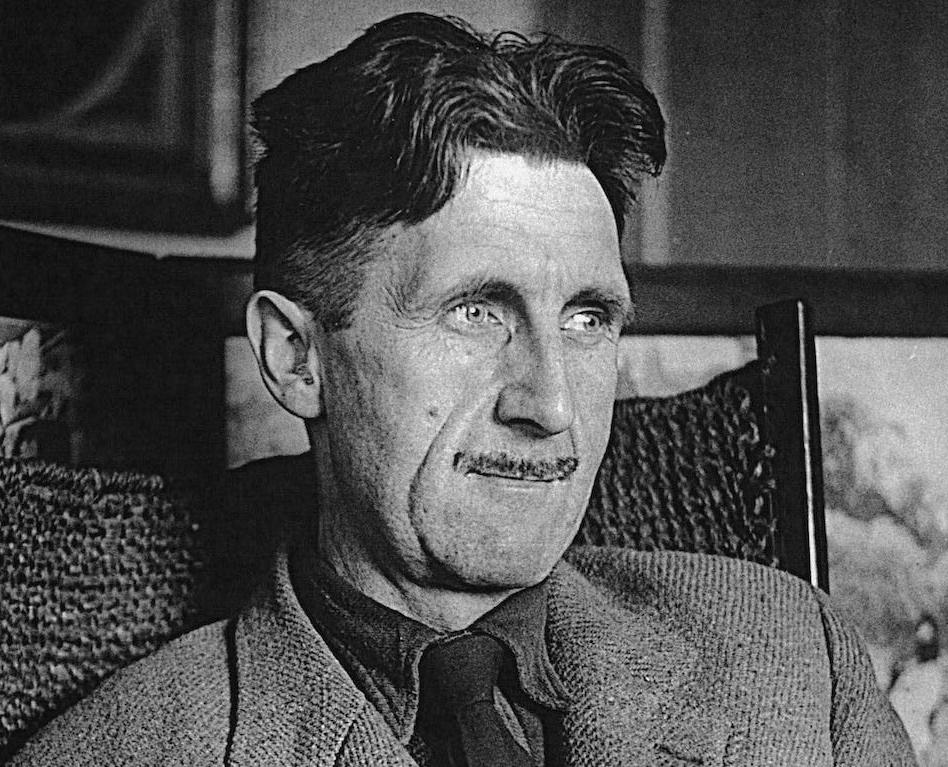
Today, surveillance in modern life is not about security cameras or espionage agencies; it is rooted in everyday life. The devices constantly listen for commands and prompts, but they also re -
cord, store, and share the private data they collect. The information collected from millions of homes worldwide can be accessed by governments through court orders and legal requests. The fact that this sensitive data - often gathered without explicit consent - can be obtained by authorities should concern anyone who owns these devices. It reflects the very warnings presented in 1984, where constant surveillance through telescreens symbolizes the loss of privacy and individual freedom.
An example of this would be in a case in Portland, Oregon in 2018. A family discovered their Amazon Echo had recorded a private conversation without their consent and sent it to one of their contacts. This incident demonstrates that technology that is always listening can easily capture and leak the private speech of users. No government should have the power to listen into private conversations of the citizens who democratically elect them through these devices, because in doing so, they undermine and destroy the foundations of trust and freedom which democracy depends on. With surveillance beginning to replace full transparency in our societies, governments stop being accountable to the people and in place of this, assert control over them, in the same way as ‘The Party’ in 1984
Beyond just the politics of the government controlling and monitoring us through our devices, large technology companies also use the data they collect without government regulation to monitor our habits and influence our behaviour. For example, Facebook’s Cambridge Analytica scandal in March 2018,
75 years after Orwell warned about Big Brother, his prophecy warning of the dangers of surveillance on citizens feels eerily accurate. Surveillance is no longer shoved down our throats and forced upon us, but rather welcomed into our homes 8
strained by force, but by invisible architecture from corporations that seek to benefit themselves.
both have the power to listen in on our lives, control our habits, and shape our political views, just as ‘The Party’ was able to do in Orwell’s nightmarish dystopia. Overall, the danger of this surveillance lies not just in being watched but in forgetting we are being watched. If our societies continue to submit our privacy for the convenience of Alexa being able to play our favorite songs, or write our shopping lists, our democracy is at risk, not from Big Brothers stern gaze, rather from the harmless devices we welcome into our

4
-Felix Samuels, L6
AI Reimagining Governance in the Age of AI
We have reached an inflexion point in the AI revolution; this revolution is arguably the most important development in our history, as the impact of AI will be profound and permeate all aspects of our society. Perhaps the best analogy of its magnitude is to imagine the combustion engine, electricity and the internet all being invented on the same day.
Some people feel that AI may be a bubble, similar to the Dotcom boom, but the truth could not be further from this; yes of course, there will be casualties and a lot of wasted money in the pursuit of optimising the use of AI, but AI will transform the world. Think of it like this: people have discovered fire, they know it can keep them warm, and they know that it can burn and be dangerous, but they have yet to understand the impact it will have on the world.
The question is, can AI play a pivotal role in making the Government more efficient? Government efficiency is defined as the ability of public institutions to deliver better outcomes and services for citizens using fewer resources, while maintaining fairness, accountability and trust. Businesses and public bodies across the globe, in developed economies, are waking up to the fact that AI is a must-have, not a nice-to-have; the threat to business and countries will become the disadvantage of not adopting AI solutions, but what about the Government?
In summary, the inflexion point that we have reached means that non-adoption of AI becomes more of a threat than a lost opportunity; perhaps and sadly, the most pressing case for adoption will be in the defence space, as
sovereign capability in this area is critical.
AI will be at its most powerful in solving complex problems. The Government sits on vast quantities of data; the National Health Service and the Ministry of Defence are good examples of large industries that have huge inefficiencies. AI as a service, is based on identifying use cases that need to be addressed, as an example simple tasks such as the management of patient records for the NHS, which requires enormous employment to manage them could be far more effectively handled via Agentic Agents; data is used to train models to create outcomes and agentic agents are used to manage process, replacing people and rapidly reducing cost and increasing efficiency. Another example of a huge efficiency saving is the challenges and costs associated with treating illnesses such as diabetes, which costs the NHS billions of pounds a year.
Every aspect of Government is ripe for the application of AI to create efficiency, to improve outcomes and ultimately to improve people’s lives and importantly to eradicate waste. Organisations such as the Civil Service are also ripe for a major change through the application of AI Imagine halving the Civil Service headcount by a quarter of a million people and employing these people in growth industries.
The NHS Budget alone of £200bn could be used far more effectively and impact the lives of millions of people for the better.
One very important factor when considering the application of AI to improve Government efficiency is the use of regulation to ensure the correct outcomes and to guard
against the worry some of us have about the AI ‘fear factor’. AI should also focus on creating better outcomes for people. Yes, jobs will be lost to AI, but AI will create jobs in new industries and ensure that, as a country, we are more productive, increasing our GDP per capita.
Another important aspect of the use of AI across Government is data security. Data is the most valuable commodity of our time, and it must be protected. International laws around data protection will mean that countries will require sovereign capability and ensure critical data does not end up in the wrong hands. It is unlikely that this data will be located in the cloud; it is more likely that the data will reside in physical sovereign locations.
There has been much talk about Large Language Models, but we are now going to see the rapid rise of Small Language Models, trained for specific Enterprise use and to optimise individual business needs. This will be the case in the public sector, where there is a requirement to protect data and have on-premises solutions. However, all intergovernmental decisions must be explainable and free from bias; therefore, the potential use of AI within decision-making would further require human supervision to ensure trust between its work and the citizens’ sense of safety.
AI will transform Government Services beyond recognition. This will not necessarily result in a loss of jobs, but it will require people to retrain in certain cases. The services will be vastly improved, and so will be the lives of those people who rely on these services.
-Darcey Bellamy, L6
How the Media’s Evolution Made Reputations
More Volatile
Our world has evolved technologically, and advancements in our digital architecture have provided an infinite expanse of digital communication where expression is a free right. Yet, underneath this golden haven, a shadow forms, where users could corrupt and twist the images of many political figures from across the globe and manipulate minds through propaganda. The Internet provided generations the opportunity to intertwine the reputation of these figures. These shifts in reputation can differ in significance, echoing the words of
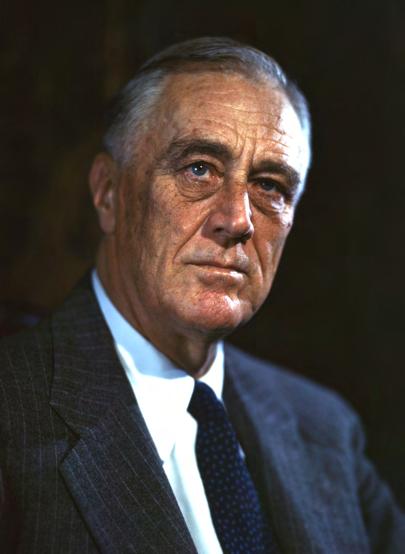
one Warren Buffet who has stated how
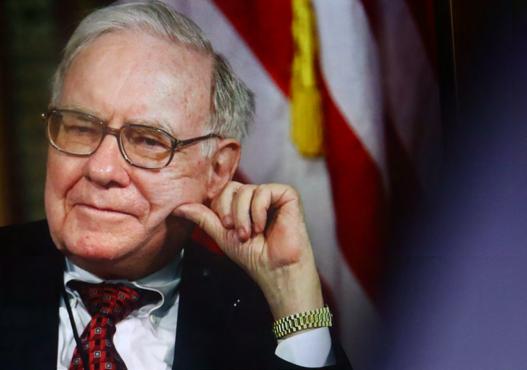
“it takes 20 years to build a reputation and 5 minutes to ruin it…”, highly symbolic of today’s electronic society. Despite the existence of social media giving people the opportunity to springboard off of negative representations to shape their political mind, it still gave many opportunities for famous figures to be glorified for their contributions to their nations.
For example, Franklin D. Roosevelt promoted himself to the American public, selling himself as his own best asset through radio ‘fireside chats’, where he explained to the public his new plans, negotiations and legislation in a way that made American families feel like they were with the president in the same room. As well as the song “Happy Days are Here” which alluded to America thriving and transforming, made newspapers and broadcasts eager to present him in a positive light.
And from outside of America, the Argentinean Juan Perón and his second wife Eva had politics and rhetoric that they made widespread, meant to symbolise social justice for workers and the poor, gaining significant respect. A lot
ing and had to be carried at all times. His image appeared everywhere, from statues to small shrines in private homes.
of the media presented them as powerful figures of justice, their morality reaching a high to ensure a society where workers are seen as humans and not machines. When Eva died, her popularity rose to an almost mythical status; her early cancer diagnosis only further cemented her as a cultural symbol in Argentinian politics. There were also examples where this glorification was forced, done to change the views of a country at large, especially for infamous political leaders.
For instance, the Nazi regime cultivated a myth of Hitler as a glorious figure who would restore Germany’s honour after World War. Propaganda films, rallies, and posters were used to create an image of a fearless, infallible leader, his face appearing on posters and banners everywhere. During the Cultural Revolution, Mao’s personality cult dominated every aspect of Chinese life. The ‘Little Red Book’ of his quotes was mandatory read-
Yet there were several instances in which the media appeared to be influenced by the poison of deception to transform political figures into monsters or husks of what were once their proud selves, all as a result of how such were presented. Some subtly, without too much damage being done, others corroding the images beyond repair. Perhaps the most famous example in the modern day is a piece of media that shaped the minds on politicians based on characterisation; the hit show South Park, a highly mature animated show whose most popular (and controversial) episodes involved poking
our environment, this episode clearly ridiculed his over-liking for it and prioritising it over the greater good of the American public, leading to many of the fans seeing him as nothing more than an “attention-seeker”, undermining his serious attitude as a politician and his achievements, for his efforts.
A common example of this political attack is in the Sonic the Hedgehog video game series, where the speedy blue hedgehog consistently stops the evil Dr Eggman from taking over Green Hills, Sonic’s home. It had been confirmed by the Sonic team that both hero and villain were meant to be based off of certain US presidents, Sonic alluding to Bill Clinton due to the president’s “get it done” attitude being to find practical solu
appeared more to be a playful joke rather than a serious representation, which is why it was a more subtle example of a negative portrayal of a political figure, as well as a comparison to another.
While the media’s use of glorifying or corroding the reputations of political leaders has evolved, introducing good and bad into both, it concludes that realistically, the media is what we make it to be. Yet this right also seems to be the cause for these representations to affect the reputations of many. The right to have an opinion is absolute, yet attempting to force it onto others is exactly how destructive divides like these separate us from respect and disrespect for these figures. It poses the question: who is to blame for

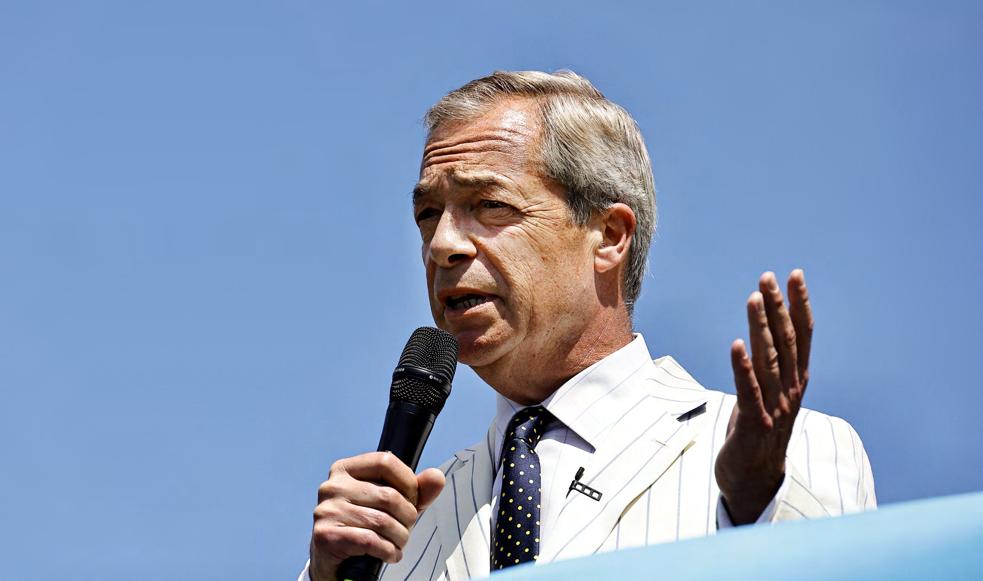
THE RISE OF REFORM AND THE NORMALISATION OF CASUAL RACISM
Some may believe that Nigel Farage solely spews discriminatory opinions about immigrants to his supporters. However, is his entire agenda more damaging than we might think? This article argues that Reform Uk’s rhetoric has not only normalised casual racism but has reshaped political discourse in troubling ways.
The Reform Party was founded in 2018 by Nigel Farage and Catherine Blaiklock. Since its creation in 2018, over 200,000 people have joined as members. This is a dramatic turn from 40,000 in June 2024. Farage seems to have been the catalyst for this rapid
increase, as after joining the party, the membership saw a sharp rise from 40,000 in June to 65,000 in early July. Rapid growth continued through the rest of 2024, reaching 150,000 by December.
Many critics argue that their suggested policies are regressive, both socially and ideologically. While supporters of the party argue that Reform simply advocates stricter border control and national sovereignty, their infamous policies on immigration have been widely criticised as racially charged. Their drastic plan for mass deportation would involve deporting anyone coming into the UK in small boats. Utilising mass deportation, not only for the immigrants on the English Channel, but additionally for the ‘north of 650,000 adults’ that Reform chair, Zia Yusuf, claimed already live illegally in the UK. The criticism of these proposed policies arise from a host of reasons, such as the need to disapply
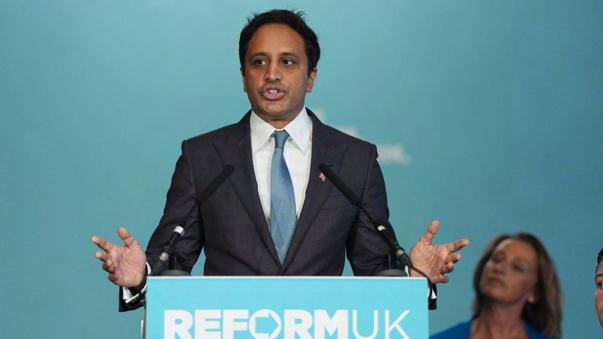
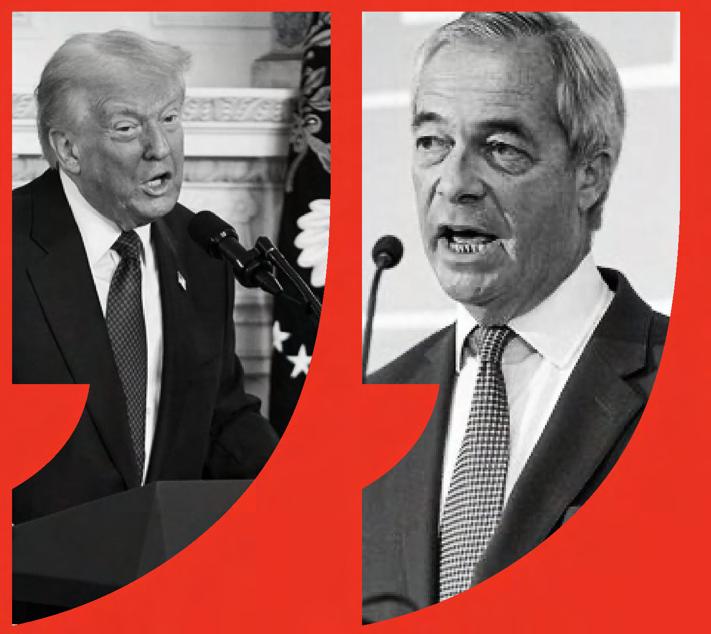
“Under a Reform government, welfare will be for UK citizens only. It will not be for foreign-born nationals. We are not the world’s food bank. It is not for us to provide welfare for people coming in from all over the world,” -Nigel Farage
the Refugee Convention (which prevents signatory countries, such as the UK, from returning refugees to countries where they face serious threats), stripping the rights of asylum seekers by sending them back to the danger they escaped.
Critics argue that Reform’s proposals would erode human rights protections by leaving the European Convention on Human Rights, which has been central to UK human rights law and has been
used to halt deportation attempts on migrants who are regarded as being in the country illegally. Farage’s proposals, critics say, could reduce rights for migrants and asylum seekers to justify their removal from the country, as he has implied when he said, “Under a Reform government, welfare will be for UK citizens only. It will not be for foreign-born nationals. We are not the world’s food bank. It is not for us to provide welfare for people coming in from all over the world,” explicitly stating that migrants should be excluded from access to welfare, tying human rights to citizenship.
Reform’s rhetoric risks promoting xenophobia and racial division, rather than integrating migrant populations. This occurs when Farage uses language that caters towards a certain demographic of the UK who are receptive to anti-immigration rhetoric. Reform UK leaders – especially Farage –use highly dehumanising speech when referring to migrants, utilising phrases such as ‘breaking into our country’ and ‘we’re being overrun’ to cast migrants as threats and criminals. Farage’s claims that migrants pose a cultural and security risk’ strengthen the racist undertones of his immigration policies, as he fuels fear and stereotypes based purely on racial suspicion, as well as promotes a one-culture Britain.
Frequent blame is placed on migrants for many of today’s economic and social issues, an idea strengthened by Reform’s often factually misleading claims. The party often says that migrants take housing, NHS appointments and other amenities from British citizens as well as increase crime, whilst living on the taxpayer’s expense, fostering public hatred towards migrants. Whilst these claims are exaggerated and unsupported by evidence, they are repeated constantly in Reform messaging and propaganda on social media. For example, Nigel Farage has previously stated that “Immigration is good for the rich because it’s cheaper nannies and cheaper chauffeurs and cheaper gardeners but it’s bad news for ordinary Britons… It has left the white working class effectively as an underclass, and I think that is a disaster for our society.”
Essentially, Farage frames immigration as a concept that solely benefits the wealthy but harms the ‘working class, whilst identifying racial aspects (‘white working class’), furthering the racial divide between migrants and Reform supporters and presenting immigration as an economic loss and sign of cultural decline – signifying that there is a ‘superior’ culture in the UK and discredits the opportunity that immigrants bring.
In a recent survey by YouGov this October, the majority of Britons are said to believe that the Reform
party, its policies and voters are generally racist. Evidently, 47% of all Britons think that the party itself is racist, with 36% disagreeing and 17% selecting that they don’t know. Similar results follow with the country’s opinion on whether their policies and voters are racist. However, Conservative and Reform voters (unsurprisingly) disagree, with 24% of Conservative voters saying that Reform is racist and 60% disagreeing, in support of the party. Similarly, 90% of Reform voters naturally believe that their party isn’t racist. From these statistics, it is a discernible belief that the right, such as the Tories, align more with such ideologies, compared to the left, as evidenced by Labour voters’ results of 73% thinking that Reform is racist.
Overall, Reform’s agenda is socially corrosive to UK culture, through the racial divide it creates with their hardline stance on immigration, echoing the rise of far-right extremism we are seeing across the Atlantic. Normalisation of divisive rhetoric risks desensitising the public to racism in mainstream politics.
-Oliver Paget, L5
In England,1903, women fought for suffrage and won the right to vote; over a century later, women and young girls in America and Afghanistan are watching their futures being ripped away from them. Across the globe, women are being stripped of liberty, verdict, expression and recognition, perpetrated by the very societies they built. The deeply rooted misogyny of the past clouds our present and robs young women of their futures, prompting me to examine whether events from the past and the present are not only preventing us from stepping into the future but also propelling us back in time. Therefore, as 2025 draws to a close, only one question remains: Are we moving backwards in history?
Emmeline Pankhurst and her daughters, Christabel, Sylvia and Adela, were militant cam-
paigners for women’s suffrage in the UK. They got their kickstart in 1903, with the formation of the ‘Women and Social Politics Union’ (WSPU), using their staple slogan “deeds not words”. This was a crucial factor in the suffragette movement. Preceding the motion, women were denied nearly all legal and political rights: unable to vote, own property independently, manage their earnings, or seek divorce, they were expected to remain unseen and unheard, protected only minimally by the law. The domestic expectation placed upon them was to be wives and mothers, with little to no access to higher education and professional occupations, reflecting the rigidity of gender roles in the
early 1900s. A change was anxiously needed. Yet even after the struggles faced by women of that era, we continue to witness similar devastation worldwide, in countries such as Afghanistan, the United States, Iraq, and Saudi Arabia. This historical repetition emphasises the decreasing respect had for women in the modern world and proves that patriarchal extremes still exist.
Is History Repeating Itself? The
A clear example of women’s rights being stolen is the suppression of women and girls in Afghanistan. After the Taliban seized power again in August 2021 – following the withdrawal of international forces – the terrorist organisation began implementing numerous inhumane and unrighteous rules designed to force women into conformity. The list is extensive: they have been forbidden from receiving any form of education, banned from speaking in a public space and song or book titles containing the word ‘women’ have been censored, as if the depiction of women in any medium is considered a slur. This not only erases women from power, but also from language, and it is truly eye-opening for a Western perspective to see. The fact that we as a nation are on standby in the midst of women being completely alienated from their human rights is utterly appalling and constitutes a moral issue that needs to be addressed.
A BBC reporter went
to Kabul in September 2024 and interviewed a woman named Shabana regarding the political climate there; Shabana explained how she has had to slowly watch her rights, liberty and happiness being snatched away from her. From being forbidden to complete high school to pursuing her dream of earning a business degree, her life was abruptly disrupted by the Taliban’s reign of terror. For women whose freedoms have already been crushed by relentless tyrannical decrees, another blow is dealt. ‘If we can’t speak, why even live? We’re like dead bodies moving around,’ Shabana laments—a heartbreaking reflection from a woman who had no control over where she was born and is now forced to endure a constrained and despondent life. This sustained torture by the women of Afghanistan is just one circumstance out of many, leaving behind only the echoes of stolen voices and tearing away the very essence of their humanity.
Another instance that raises the question ‘are we moving backwards in history?’ is the pressing horrors the women of America are currently enduring. After Mr Donald Trump was elected president of the United States for his second term in office in 2024, he and the Supreme Court overturned Roe vs Wade – a case that was brought by Norma McCorvey (“Jane Roe”), who challenged Texas abortion laws. The right to abortion was
a vital element of women’s reproductive and bodily autonomy for nearly 50 years. Since August 2024, 17 states have outlawed nearly all abortions, banning the procedure at six weeks of pregnancy or earlier. Having the restrictions on abortion at six weeks or even earlier caused extreme upsets and controversy, as until 16-17 weeks a foetus is neither viable nor able to live outside of the host (the mother). This caused an incline in advocacy for women and raised issues surrounding the unfairness of the disability of the option of abortion from pregnancy, regardless of choice or situation, even if the foetus cannot yet be considered as a viable human being. Until viability, the question remains: whose rights come first – the unborn, or the living?
As
a young girl who is fortunate enough to have been born where I was,
I cannot even begin to fathom how or why people can sit back and watch as the opportunities and happiness drain from others’ lives, law after law, policy after policy. Presidents, prime ministers and leaders of countries, communities and unions should all have one thing in common: the idea that a country’s morality, for the sake of the people, should always take precedent over money, power and status. A leader, such as Trump, should not make a law that not only insults the women of the United States but also robs them of their right to choose. True leadership means protecting freedoms, not erasing them, and by silencing women’s voices, the future itself is being silenced altogether.
-Aoife Barnes, L5

14:19 - Protestors first start clashing with police
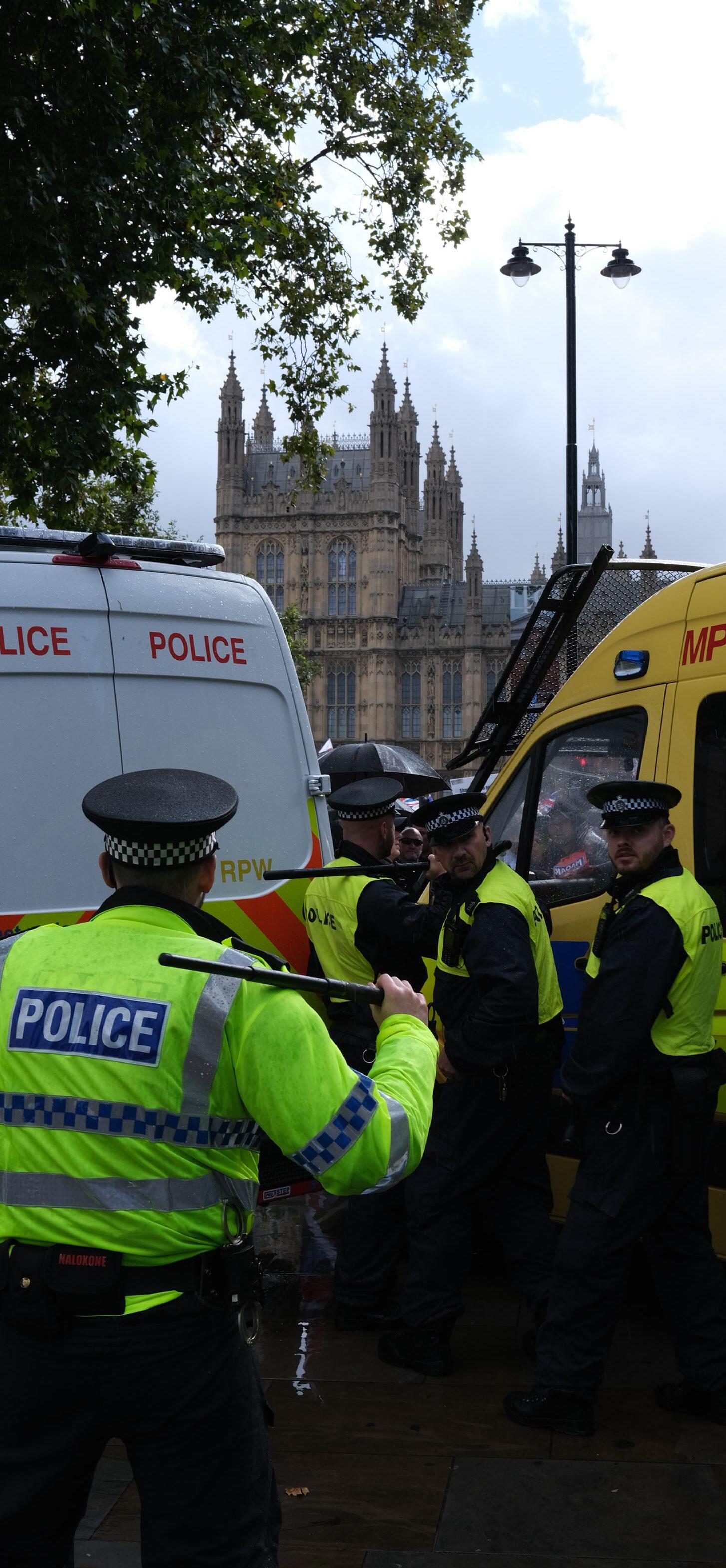
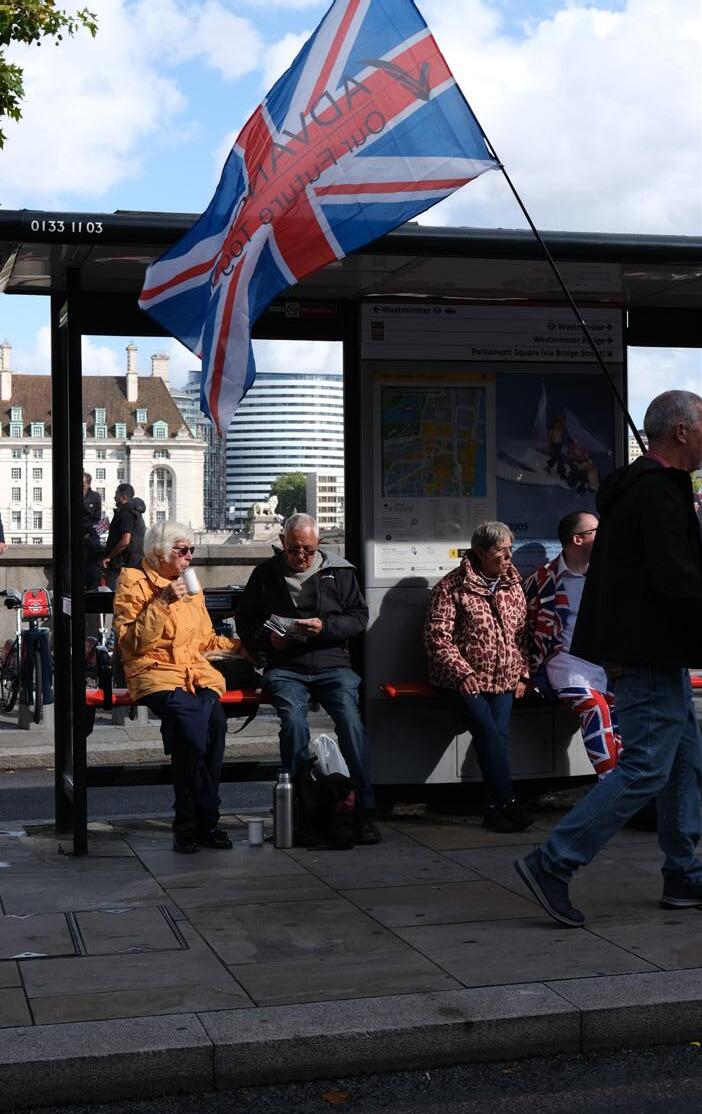
Photography of the "Unite The Kingdom" Protest
-Ethan Kellett, U6
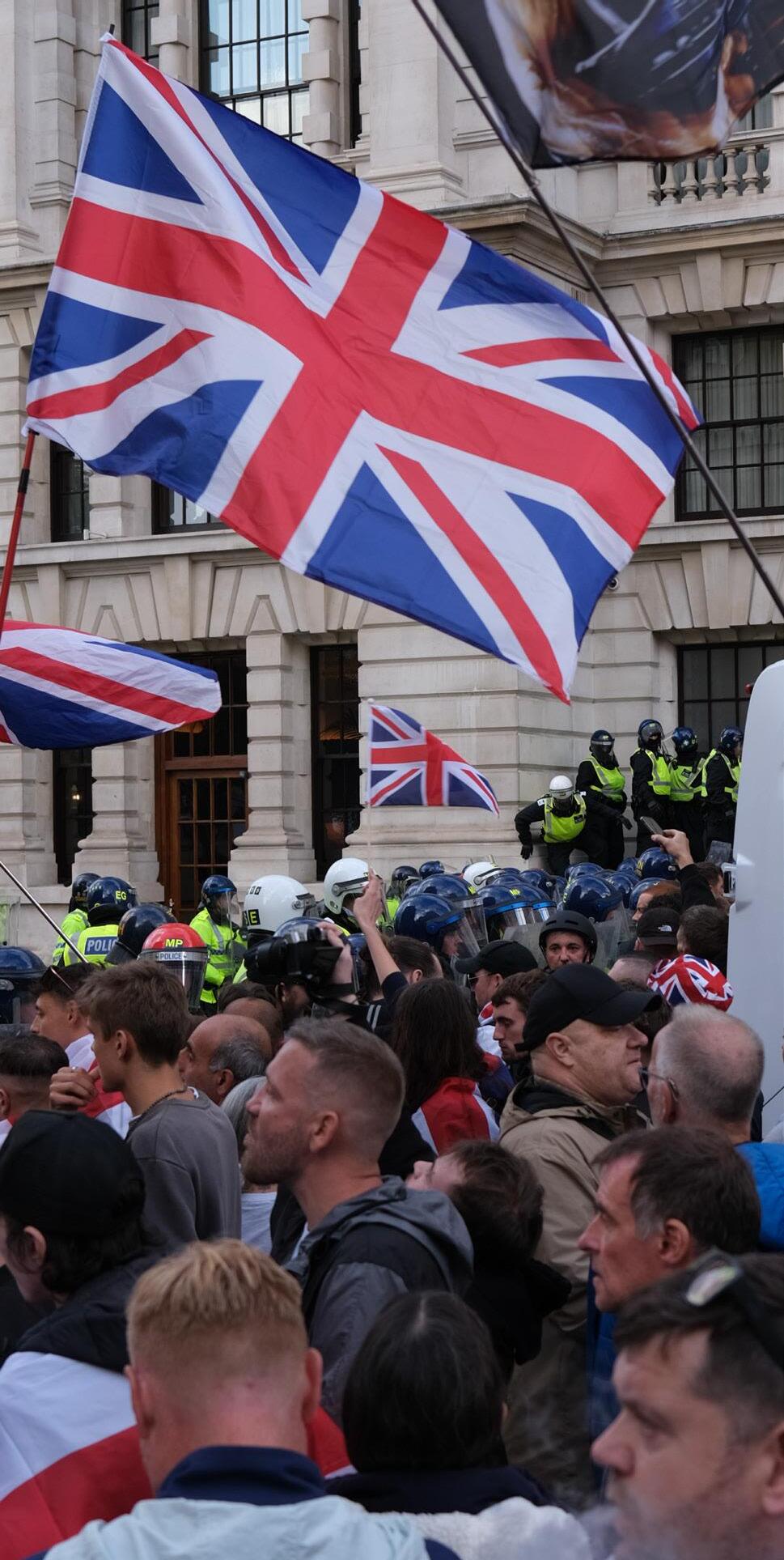
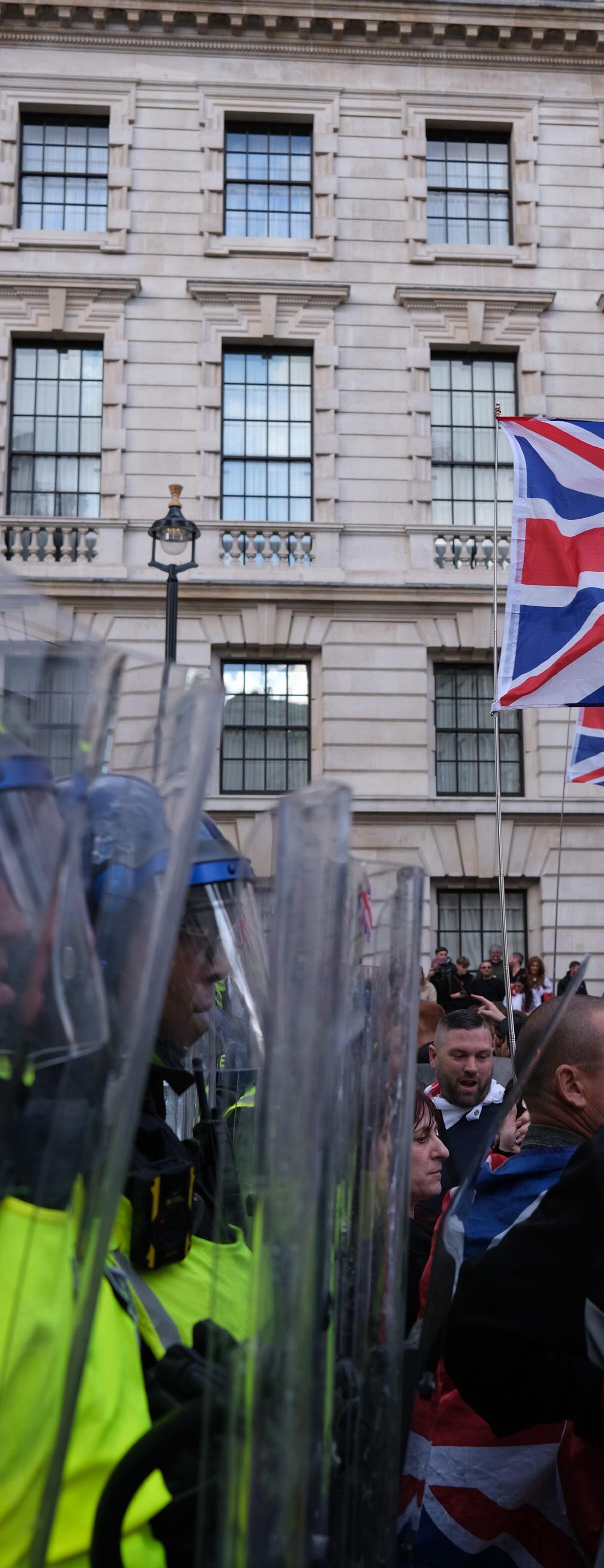
Stephen Yaxley Lennon, known by his alias Tommy Robinson, had organised a so called ‘free speech festival’, attracting more than 100,000 people in the centre of London. The march had set off from Waterloo that morning and proceeded towards Whitehall, where Lennon was due to speak. Over 1,000 police officers had been deployed to contain the march by the time I arrived at around 11:30, at which point much of the crowd had become restless, not able to get within view of the stage. Fuelled by larger and cocaine, marchers began to break through police lines and rush down Victoria Embankment. 13/09/25.
14:24 - Police cordon on Victoria Embankment breaks down entirely.
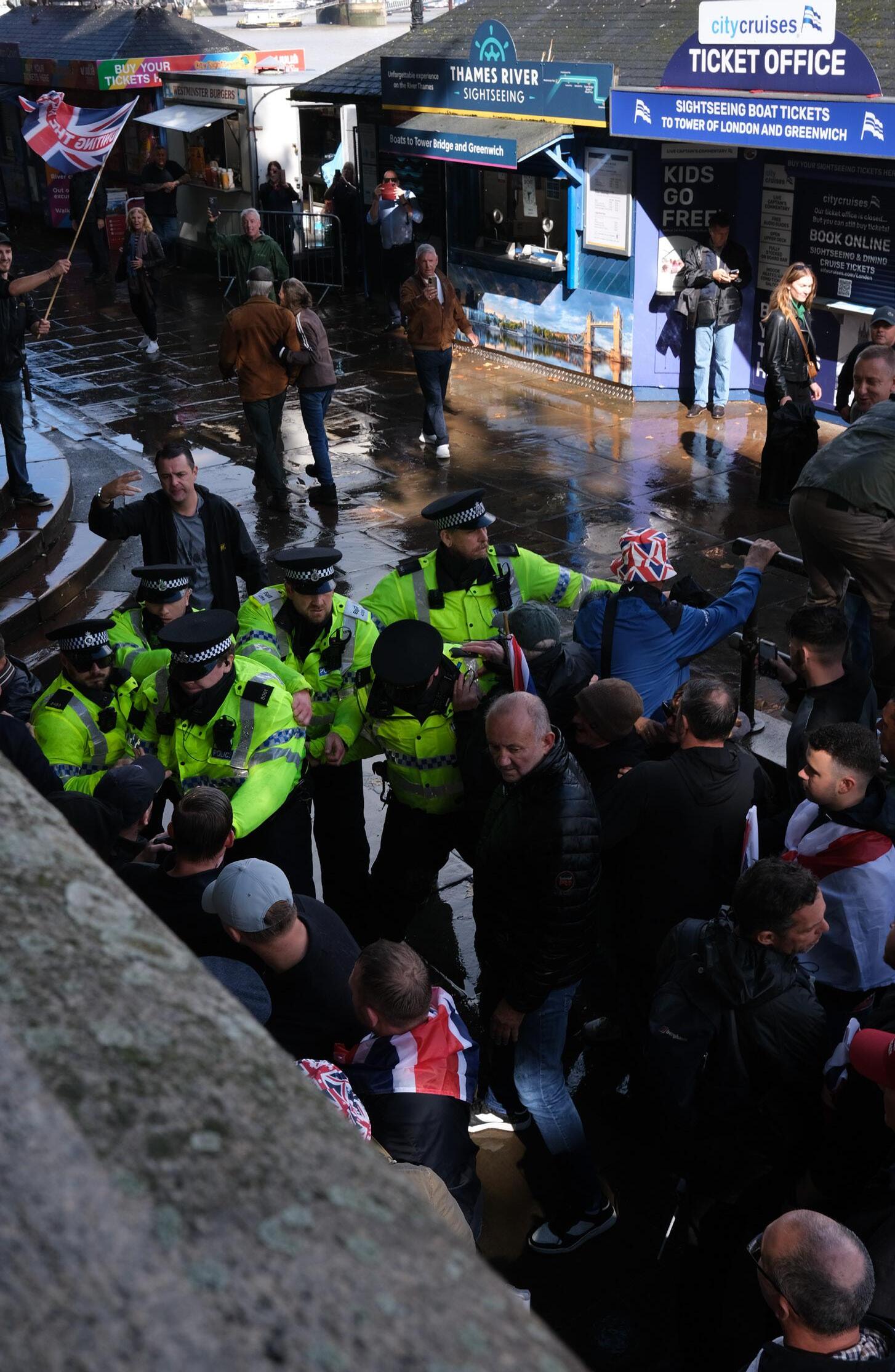
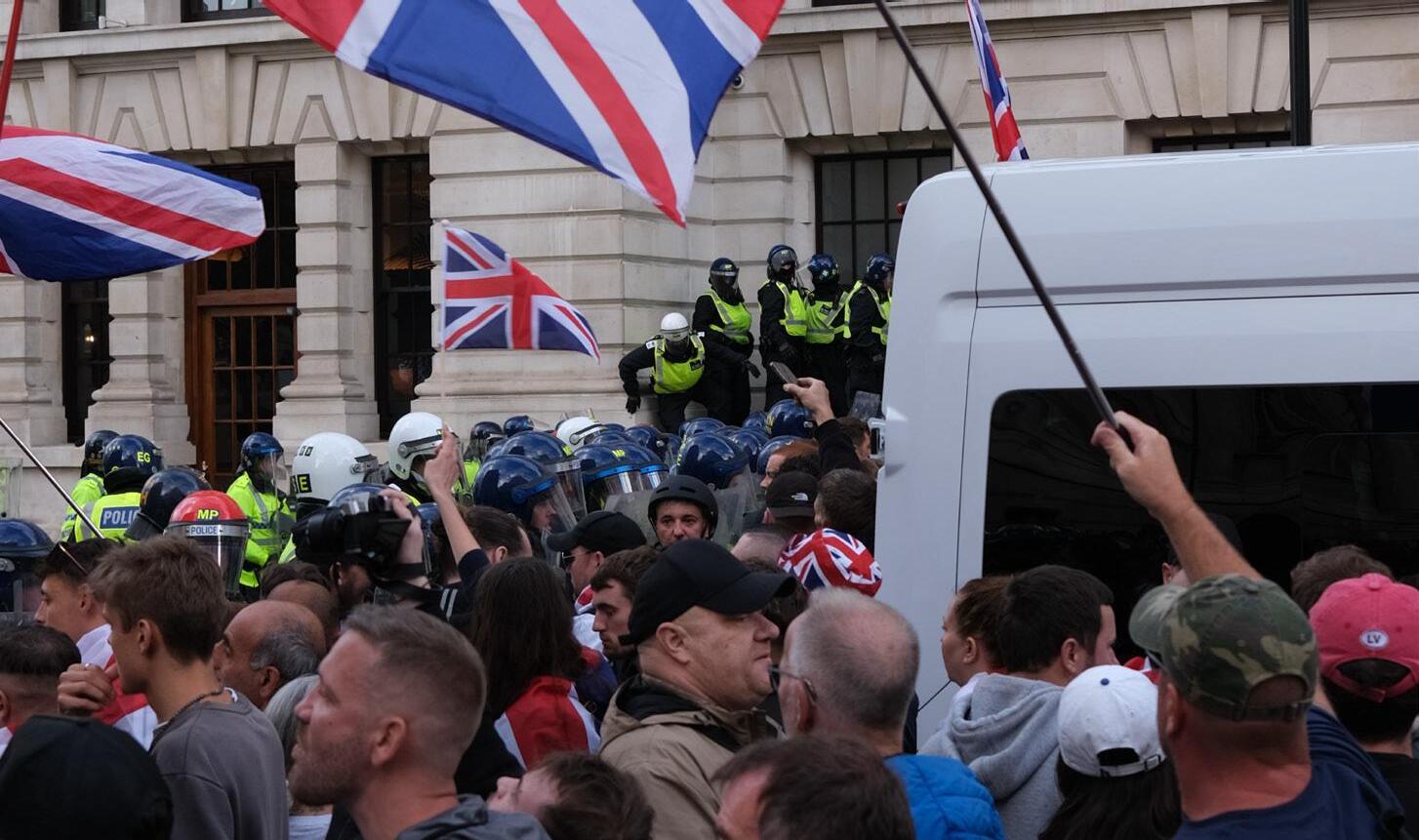
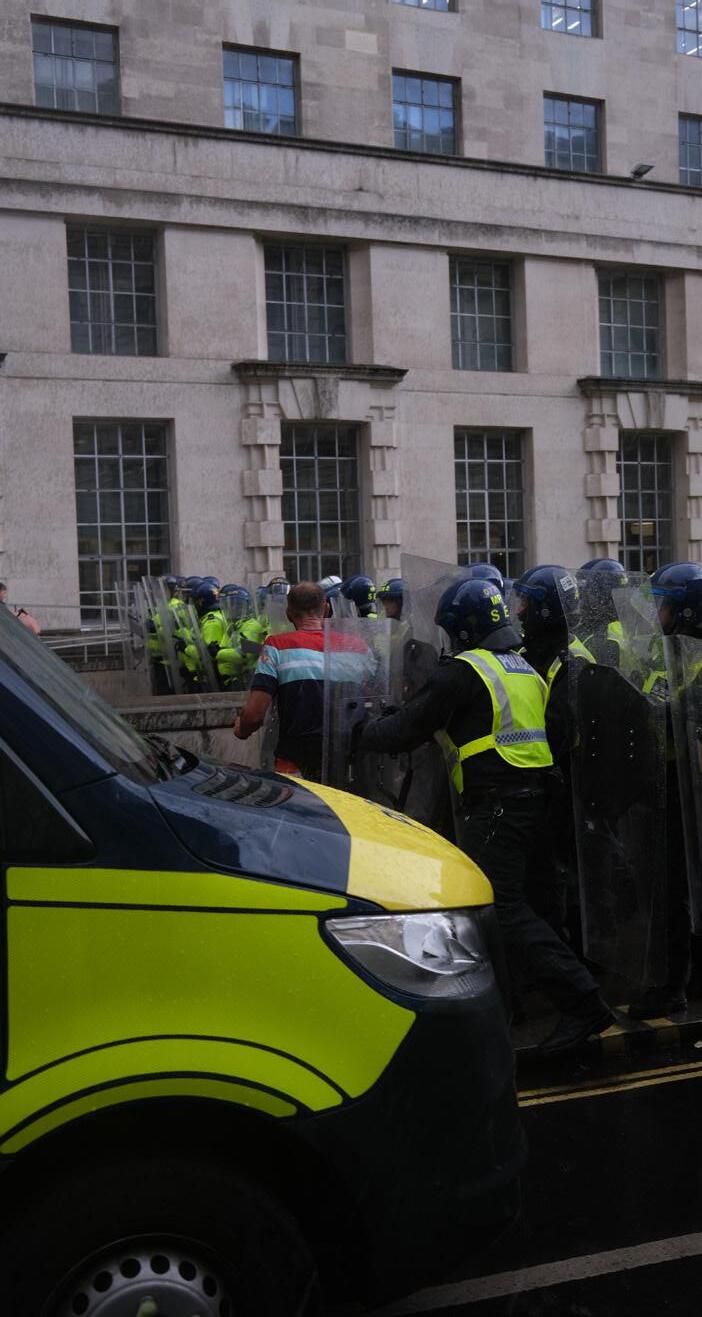
15:53 - Protestors break through another police cordon outside MoD, stopped by riot police.

16:05 - Later found out he assaulted a photographer months earlier. Near miss.

15:59 - Riot police begin to advance to try and move people away from the MoD.
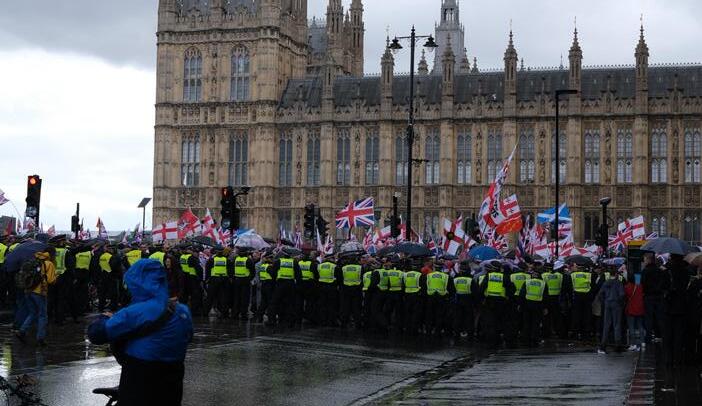
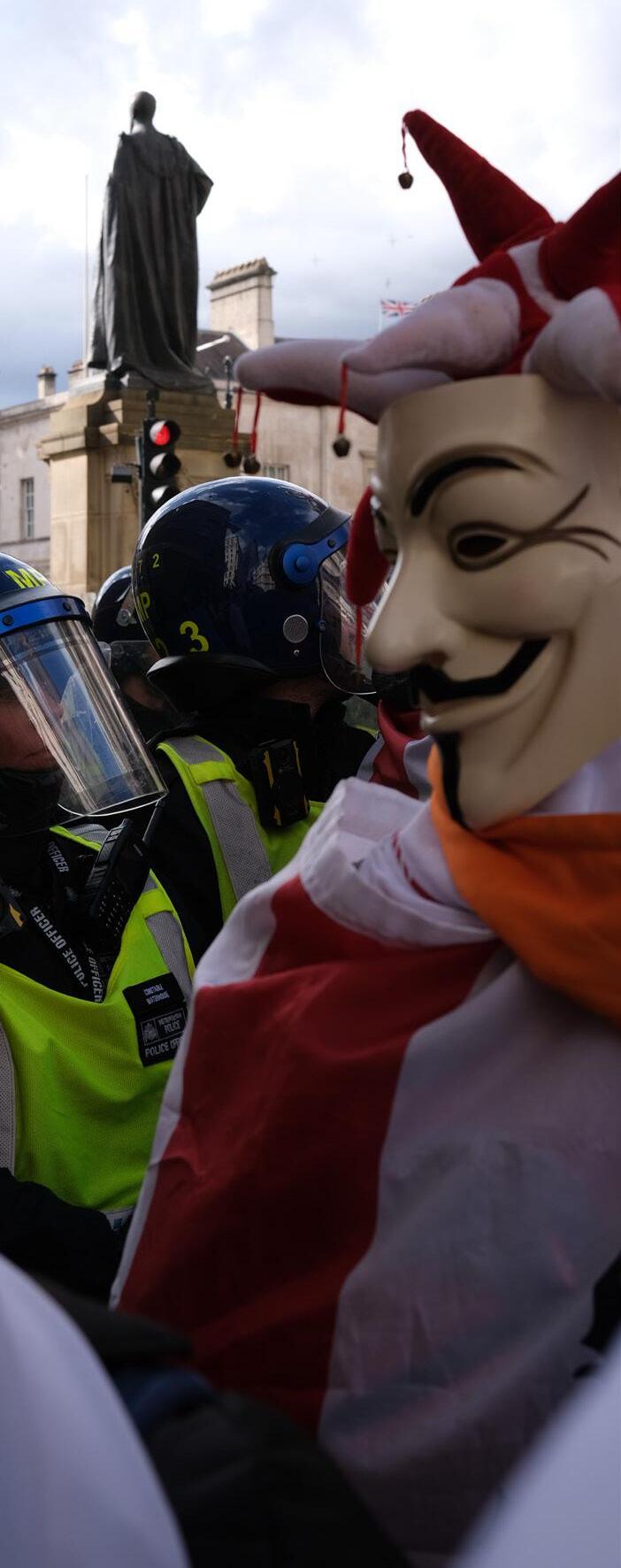
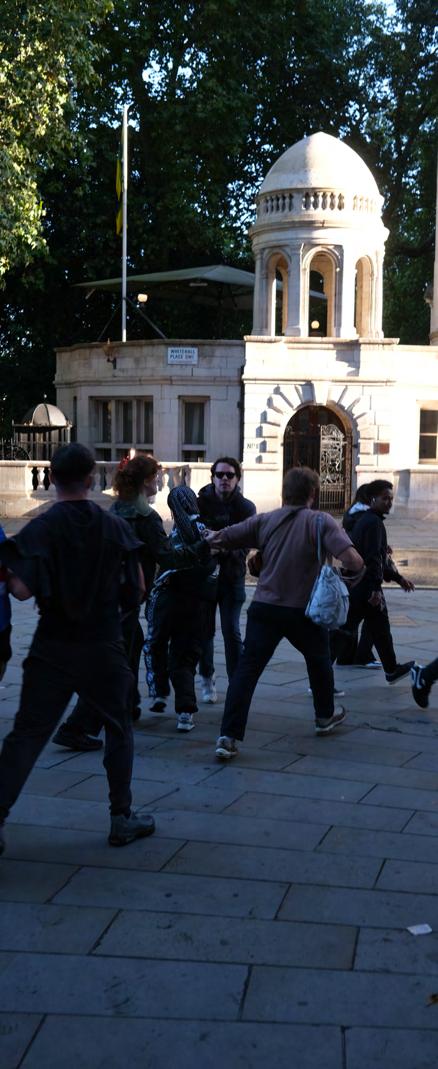
17:44
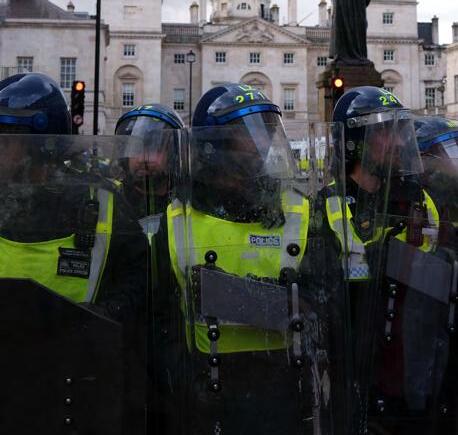
- Screams of 'Kill her' aimed at the girl in the keffiyeh.
THE STATE OF THINGS




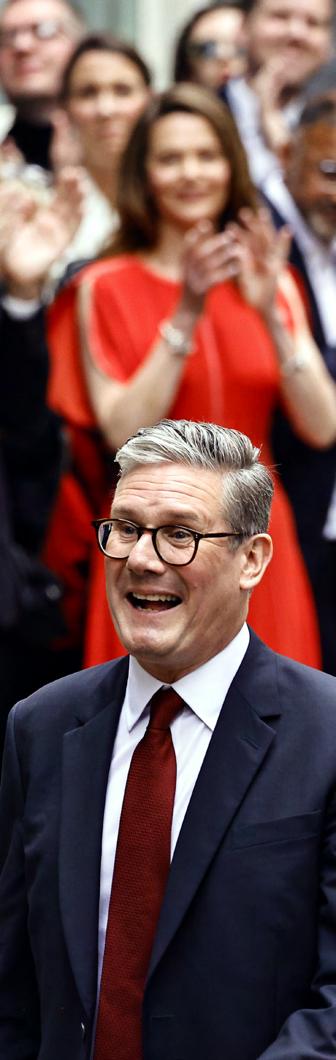
This penultimate chapter, ‘The State of Things,’ is jampacked with high-quality political dissection, hypothetical discussions, and sharp reflections on the forces shaping our uncertain global future. To start this section off with a bang, Gregor Logan explores the idea of Cornish independence due to Cornwall’s unique cultural identity, which other counties fail to develop. Although Cornwall seems far away, Aiden Moore brings the discussion back to the current government in power: Labour. As Starmer reaches his most negative net popularity rating of -51, Moore raises the possible methods of redemption for the government. Focusing across the Atlantic, Millie raises the question of whether isolationism is still part of American foreign policy. What was once a core foundation of foreign affairs seems increasingly distorted by American politicians, and Millie covers this debate with fantastic research and refined angles. Our youngest writer, Issie Appadoo, delves into the Bible’s narratives to explore how gender and masculinity are constructed, questioning traditional interpretations. Similarly, Gwen Buckley questions the possibility of what the world would look like now if the South had won the Civil War in 1865. In Aoife’s second article, she states her case for why the voting age should remain at 18, highlighting the facts of youth’s immaturity and the influence of social media on young voters, which remains a danger to democracy. And finally, Bea debuts her regular column ‘Sociologically speaking..’ with her first article revolving around Billy Milligan, who inspired the 2016 film ‘Split’. Her article terminates this chapter with questions regarding how societal norms shape our understanding of sanity under the justice system. It also begs the question: Does our legal system need to be reevaluated?
THE BIBLE'S ROLE IN
NORMS IF THE SOUTH HAD WON THE CIVIL WAR WHY THE VOTING AGE SHOULD REMAIN AT 18 SOCIOLOGICALLY SPEAKING; BILLY MILLIGAN
Gregor Logan
Aiden Moore
Millie Beacham
Issie Appadoo
Gwen Buckley Aoife Barnes Bea Moore
THE PLAUSIBILI-
TY OF CORNISH
INDEPENDENCE;
BANER PERAN
Separatism in the United Kingdom has become a common feature of the political landscape for centu ries. From Irish reunification, to the continuous push for Welsh inde pendence, to the contentious topic of Scottish independence, the UK has seen separatism tear apart views across the isles and now, in recent times, more than ever before in modern history, these movements have gained significant traction. While other separatist and nation alist movements in the UK have gained significant traction and media coverage in recent years, one that has not obtained enough media attention recently is tucked away in the south-west corner of England - Cornwall.
ed by the region stems from farming and tourism. Although the majority of the other counties find themselves as another piece of the puzzle that makes up England, many people in Cornwall see the county differently, as its own nation with a particularly unique identity.
the English as ‘imperialist overlords’ and pushes that Celtic nations must be freed from English rule. They strongly contend that better jobs must be created for the Cornish people, as current investment in jobs in the region is limited. The party has had little success in gain-
servative Government in 2023, led by Rishi Sunak. Here, the government set itself a mission that, by 2030, every part of the country that wants a devolution deal will have a devolution deal. The document sets out the terms of a proposed agreement for a
these were scrapped. While these steps do indicate movement towards further autonomy for Cornwall, there is little evidence suggesting exploration into nationalism and independence.
It is also evident that while many
my, independence is not currently on the table, and even the idea of Cornwall gaining much further autonomy has been shut down by a large portion of the population. Although this is not to say that the national identity in Cornwall does not hold strong, Saint Peran’s flag is

Cornwall, for many, is just another county of the 48 in England. Often seen as a relatively empty part of the country where the good provid


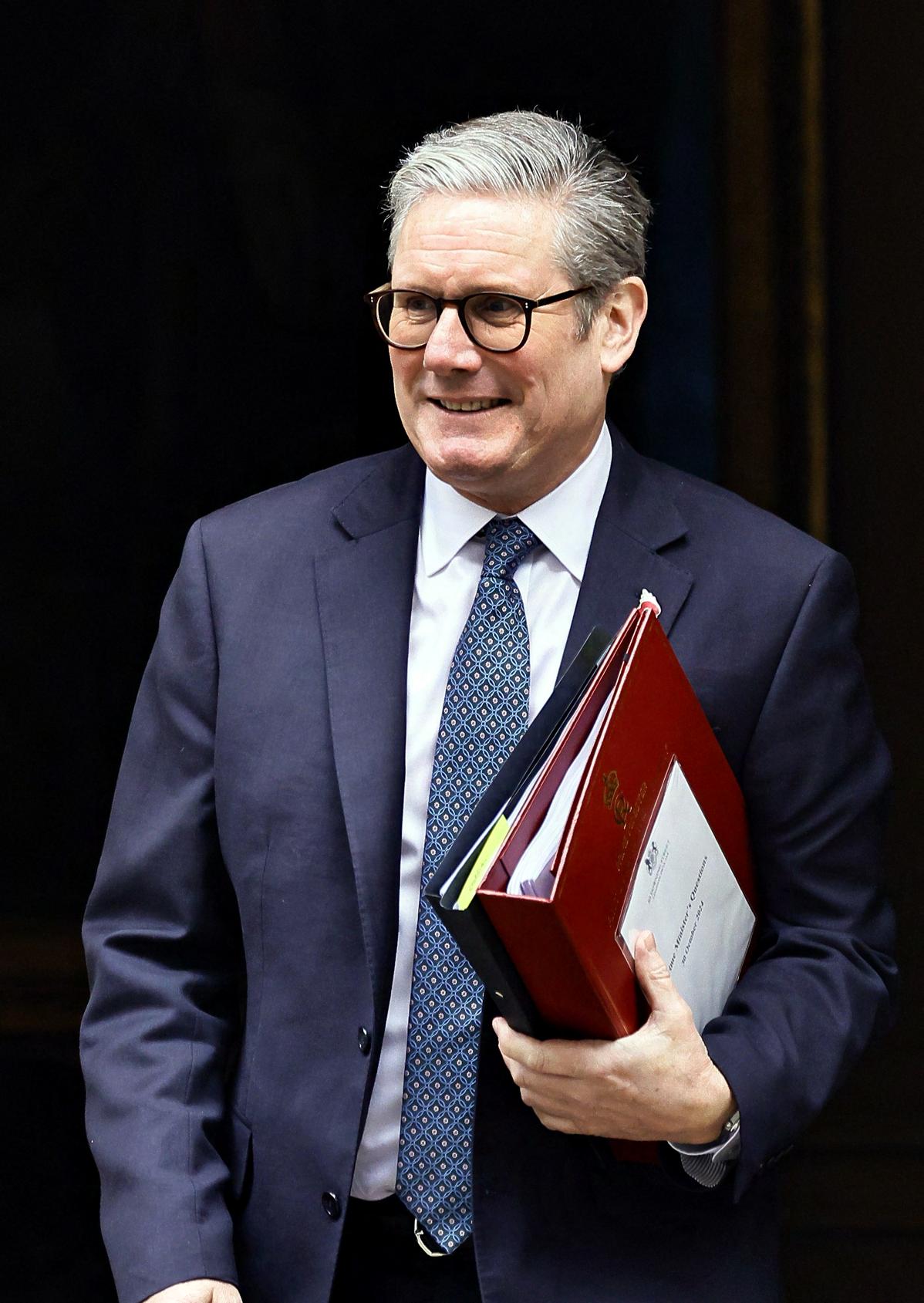
Can the Labour Party Recover? A
t the start of the Starmer tenure, the people of Great Britain were promised economic stability, cuts in NHS waiting times, 1.5million new homes, a reduction in taxes and an increase in infrastructure. It is safe to say none of these promises has prevailed. What was branded an era of ‘change’ now feels like continuity wrapped in new packaging. As the initial Labour optimism has now faded, the question arises: how can Labour recover the trust and hope it once inspired?
When Keir Starmer led Labour to victory, his message was clear: stability after years of Conservative turbulence. However, this has become the government’s greatest weakness. By prioritising caution over conviction, Labour has struggled to project a sense of direction. Policy on housing, health and taxation has been watered down heavily or significantly delayed, and the country feels stuck in the same cycle of frustration with the government. To recover, Labour must balance responsibility with reform.
The economic situation remains the most visible area of disappointment. Labour vowed ease the cost of living crisis through what Starmer called ‘securonomics’- strategy built on sound public finances and investments in productivity. In reality, growth has barely shifted, consumer confidence remains extremely fragile, and many households feel no better off than under previous
governments. Whilst Rachel Reeves’ insistence on fiscal restraint has reassured markets, it has alienated ordinary voters who see little tangible benefit to this. Labour should prioritise growth sectors such as renewable energy, digital infrastructure and advanced manufacturing, offering incentives to firms that create long-term job opportunities. Tax reforms could be targeted towards wealth inequality while
fair pay and improved working conditions. The public no longer wants platitudes about ‘backing the NHS’; they want to see queues shorten and services improve. Labour’s recovery in healthcare must come through reform, not rhetoric. This means investing in workforce retention, digitising hospital systems to reduce bureaucracy, and integrating health and social care. The government could also empower local NHS trusts to make community-based decisions rather than relying on the current topdown management.
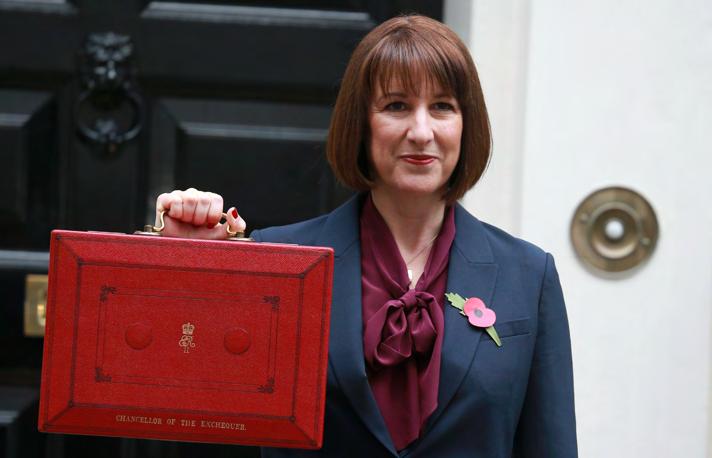
encouraging further enterprise. By combining both this fairness with clear ambition, Labour can replace its perception of caution with one of constructive confidence.
The NHS is another major area in which hope has curdled into disappointment. The promise to slash the waiting lists through 40,000 more weekly appointments was boldand underfunded. Staff shortages and persistent inefficiencies have left many targets unmet. Morale across the health service has still remained low, with junior doctors and nurses continuing strikes for
Housing has proven to be another stumbling block for the government. The manifesto commitment to build 1.5 million homes was met with enthusiasm from a generation locked out of ownership. Yet, planning reforms have stalled amid local opposition and bureaucratic delays. The lack of bold leadership in the housing front has made Labour appear timid. Labour could reform planning laws to prioritise affordable and social housing, unlocking ‘grey belt’ land for development, and incentivising councils and developers to build at scale.
By tackling and delivering tangible improvements in housing availability and affordability, Labour could re-establish itself as a party for opportunity and fairness in the current political climate.
Perhaps Labour’s most glaring political miscalculation lies in its communications. Having built its brand on competence, the government now appears technocratic and uninspired. The public wanted reassurance, but they also wanted imagination and the sense that change could mean something better. Instead, the Starmer government has become associated with managerialism and drift, and without a strong narrative, even modest achievements risk going unnoticed. Labour must create a purpose that connects its policies to the people, not just spreadsheets.
Political success is not solely dependent on governing well; it’s about making sure the people feel the government is on their side. If Labour focuses on visible, people-first projects, it can begin to rebuild the faith of the people. Reforms to policing, education and transport that demonstrate efficiency and fairness would help to reconnect Westminster politics with the everyday experience of the people. Labour’s recovery will depend on its ability to prove that competence can coexist with compassion.
So ultimately, Starmer’s problem is not his competence, but rather his conviction. Voters can forgive slower progress if they sense a genuine purpose within government. What they do not forgive is drift and detachment from the people. If Labour wishes to recover, it must reconnect with its founding mission: to represent the working
people, challenge inequality, and offer hope for a fairer, more prosperous country. This means being bold on housing, honest about NHS reform, and ambitious on growth.
Otherwise, ‘change’ will go down not as the dawn of a new era, but as one of British politics’ greatest missed opportunities- a promise that collapsed under the weight of its own caution.
-Aiden
Moore, U6
Is Isolationism Still Part of American Foreign Policy?
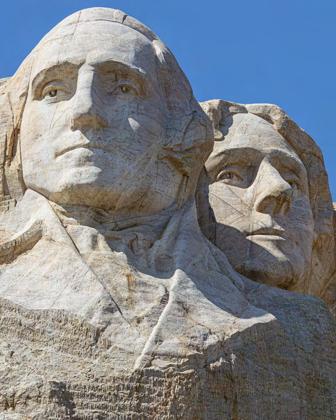
In his 1796 farewell address, President George Washington advocated for non-involvement in both European wars and politics. This document is likely the reason for the current precedent that encourages American isolationist policies and the advocacy for minimal intervention in foreign politics, which we are seeing today.
Leading up to the Second World War, the USA had multiple policies leaning towards non-entanglement with international affairs, due to both post-First World War sentiments and the impacts of the Great Depression. With 116,708 American soldiers killed in the First World War, there was a significant impact on US citizens who believed that involvement in another war would lead to a similar or higher number of casualties. Despite continued global economic expansion, isolationists campaigned for complete non-involvement in European and Asian conflicts. Drawing from First World War experience, Americans concluded that the few interests protected by their involvement were not enough to cover the death toll of their citizens. In summary, the majority felt that non-involvement would keep American soldiers safe and decrease monetary reliance on foreign economies.
licans said they would stimulate business sales, increase wages and demand of domestic crops, whilst conveniently ignoring that it was a way for the federal government to make more money by taxing foreign imports.
by improper influence of governments, and War Is a Racket, which discussed how business interests commercially benefit from warfare, making them lean more towards views of neutrality. Not wanting to be tricked by industries or banks into making such mistakes again, many became advocates of staying away from foreign wars or investing heavily in other countries.
"Politics can be a force for good. We will show that,"
- Keir Starmer
Tariffs have been a policy enacted by the American government for a long time, although generally imposed by Republicans rather than Democrats. The Emergency Tariff of 1921, after the civil war and the Smoot–Hawley Tariff Act of 1930, were implemented to improve the United States’ economic position, but ultimately made it worse. To promote these early tariffs, Repub-
In the modern day, there are many echoes of past US policies and tendencies. Trump’s ‘reciprocal’ tariffs were initially said to be in response to a trade deficit, yet he later claimed they were due to a trade war (which he started) and then they were, apparently, to try and bring jobs and manufacturing back to the US from China. While his actual reason for implementation of the tariffs remains ambiguous, the isolationist tactic is one rooted in US history and a protectionist response when the US feels that they are facing a threat. Drawing another comparison to the past, the withdrawal from multiple international bodies such as the World Health Organization (WHO), the UN Human Rights Council (UNHRC), the UN Relief and Works Agency (UNRWA), and most recently, the UN Educational, Scientific and Cultural Organization (UNESCO), can be compared to when Congress rejected joining the League of Nations in 1919. This strengthens the view that the US is moving towards being an isolated nation as it continues to part from other nations’ attempts to strengthen connections.
The American public in the 1930s was suspicious of wartime profiteering, influenced by books such as Merchants of Death, claiming an international arms industry was involved in a conspiracy to control the fates of multiple nations
The Great Depression pushed 1930s America even further into its post-war isolationism. The government ignored the majority of foreign military incidents, issuing a statement of disapproval at most, but otherwise not intervening – such as in the Japanese seizure of northeast China in 1931. This lack of involvement may have exacerbated the rise of fascist regimes in Germany, Italy, and Japan. The people were desperate for help after the ruin brought by World War I and the global depression, thus they were easily manipulated by an opportunist promising help. With no help forthcoming in their economic struggle or interference to stop the rise of these regimes, the countries fell easily into fascism, damaging the rest of the world as a result. In contrast, when communism is involved, the US has often engaged in a
propaganda war or military campaign to crush the possible change in economic structure before it can even get off the ground.
The US continues to maintain significant involvement in foreign countries when the possible rise of communism or socialism is involved. Significant resources have been used to try and curb the growth or implementation of either system, instead preferring capitalism. The US policy of containment (an attempt to stop the domino effect spread of communism) led to such acts as the invasion of Vietnam, the Korean War, and the implementation of the Truman Doctrine and Marshall Plan. Themes have evolved over time which show that the US will get involved when certain regimes they don’t like are in control, such as the 1953 coup d’état in Iran, in which the CIA (with the help of Britain’s MI6) overthrew Prime Minister Mohammad Mosaddegh. This came partially due to the nationalisation of oil by Mossadegh and his refusal to concede to western oil demands, with the US wishing to protect their
US used the Mineral Leasing Act of 1920 to help protect their own oil and mineral productions, stopping foreign nations from benefitting from their profitable land. This act was an isolationist move by the US, hypocritical as it was in the same venture where they often invade or leech off of other countries for the same commodity.
Throughout American history, the ideology of isolationism has been spread through the US by protectionist views, a disconnection to other countries facing struggles and the idea that Americans should be put first, only letting the government intervene if American lives are at stake. However, isolationism often seems to apply more strongly when American interests are not being threatened, such as oil reserves or the spread of communism.
Today, Trump’s tariffs could be a hint of possible strife soon to come in the Republican party, in the same way that when the post-Civil War tariffs ended in the 1910s, they ripped the Republican party apart.

A US 'NO FOREIGN ENTANGLEMENTS anti-war sign prior to the US joining WWII
right-wing activists and members of government.
They push for a strong ‘America(ns) First’ policy, related strongly to the idea of illegal aliens that Trump is pushing now. Overall, the rise in these views is concerning and may lead to wider consequences, such as the lack of aid to Ukraine which could lead to Russia’s victory and the spread of an authoritarian regime, mirroring the rise of fascism in Germany or Japan.
-Millie Beacham, L6


Examining the Bible's Role in Masculinity Norms
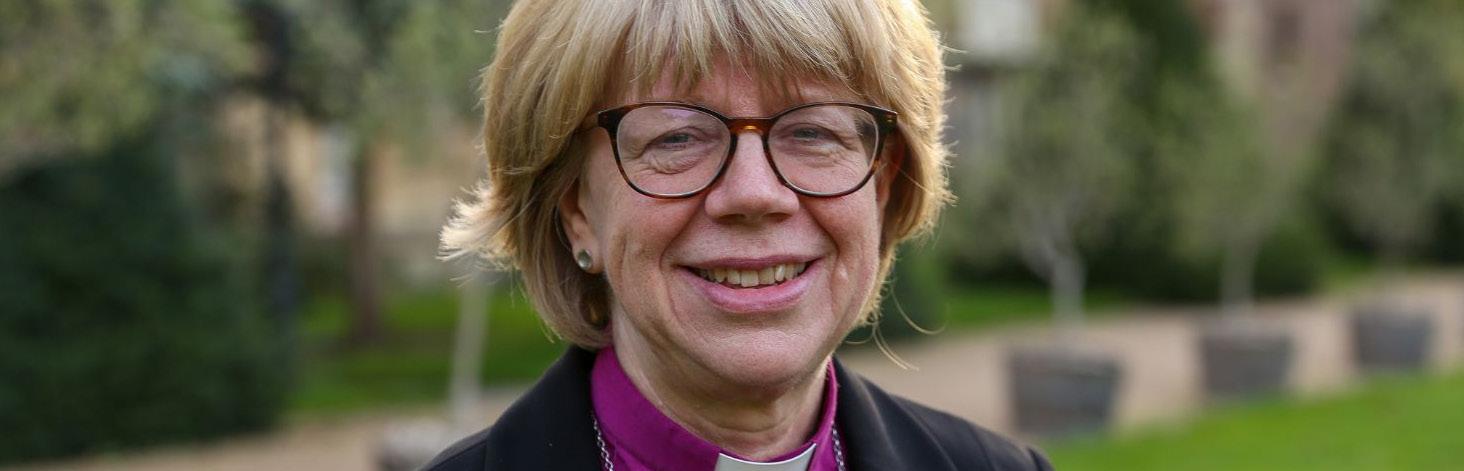
The question as to whether the bible fosters toxic masculinity is a hotly debated topic within some parts of the church, especially given the recent appointment of the first female archbishop of Canterbury: Dame Sarah Mullallay. In this article, I will briefly survey parts of scripture which could be seen to promote a culture of toxic masculinity, and then look at how this plays into the response to Bishop Sarah’s appointment.
Toxic masculinity is defined by the Cambridge English Dictionary as “ideas about the way that men should behave that are seen as harmful”, for example, where aspects of ‘maleness’ promote sexism. This can lead to men taking an authoritarian view, which subjugates women. Throughout
the years, debates have raged as to whether the bible reinforces masculine ideals that can be seen as toxic, such as dominance and control of women.
One part of scripture states: “A woman should learn in quietness and full submission. I do not permit a woman to teach or to assume authority over a man; she must be quiet. For Adam was formed first, then Eve.
And Adam was not the one deceived; it was the woman who was deceived and became a sinner” – Timothy 2:11-14 (NIV)
A second passage is:
“Wives, submit yourselves to your own husbands as you do to the Lord.
For the husband is the head of
the wife as Christ is the head of the church, his body of which he is the saviour.
Now as the church submits to Christ, so also wives should submit to their husbands in everything.” – Ephesians 5:2224
These passages are contested because they can be seen to create hierarchical models in male-female relationships, reinforcing a stereotype of male dominance and female submission.
But why is this a problem? Because if we are to say that the bible does foster toxic masculinity, it suggests that the bible supports or teaches ideas which we now believe to be harmful to society, placing them outside of
societal views and norms. And if these views are indeed seen as toxic, then that creates the issue for Christians who believe this to be God’s word: is this a problem with us as a society or with the ‘holy’ scriptures?
Although the Church of England has come to a decision allowing women to be priests (1994) and bishops (2014), the topic still creates divisions within the church as to whether they should. This was highlighted by the recent appointment of a woman to the most senior role in the Church of England being dismissed by certain groups, for example the Most Reverend Dr Laurent Mdanda, the Archbishop of Rwanda and the chairman of the conservative Anglican group,
GAFCON, said in a statement “the majority of the Anglican Communion still believes that the Bible requires a male-only episcopacy.”
So on the surface, it looks like the bible is still being weaponised by some to promote a culture of toxic masculinity. But are we really saying that almost 85% of Anglicans worldwide, including women, are sexist? This must suggest that there are other ways to interpret the above passages, and it is unfair to subject the bible to a one-sided approach. There may be other reasons as to why GAFCON and potentially other groups among the Anglican Church reject the recent appointment of the Archbishop of Canterbury that aren’t toxic.
Overall, one could say that the bible does present toxic masculinity ideals by the scriptures above and potentially others, in which toxic masculine traits such as dominance and control can be inferred. However, I think that it is unfair to ignore the majority of the Anglican Church’s view, which includes both men and women who must have interpreted the scriptures above in a different way, which has allowed them to come to this conclusion.
-Issie Appadoo, 4F
If the South Had Won the Civil War
to how it does now. The southern states would have used black slave labour for a longer period of time, hindering the progress of BLM and other racial protests in 2025.
farmers and improve agriculture. None of this would be possible if the South had won the Civil War. Without the Gettysburg Address, the USA wouldn’t have developed the strong sense of democracy it came to embody.
Picture it - April 9th, 1865 You’re fighting for your life on the front line, but not only are you fighting for your life, you’re also fighting for your independence. A sliver of white cloth, a man named General Robert E. Lee, and just like that, it’s over. The war has come to a close, and the American army in North ern Virginia has surrendered to the Union general Ulysses S. Grant. But what if it hadn’t happened this way? What if General Robert Lee hadn’t given up?
3.2 million was the slave popula tion in the American South before the Civil War. Millions of slaves between 1619 and 1865 were tor tured and abused during this time period. Abraham Lincoln ended this; he created and introduced the Emancipation Proclamation in 1863, which declared enslaved people free in Confederate states. Had the South won the Civil War, Abraham Lincoln would likely have been assassinated. This means he would never have been able to introduce the Emancipation Proc lamation in 1863, and the world would look profoundly different
The assassination of Abraham Lincoln would also have been impactful worldwide; if slavery had persisted in such a powerful country, it might have slowed global movements to end slavery and racial discrimination. Without the abolition of slavery as the first step, big changes in civil rights and women’s movements might have never been possible, and we would be living in a much less developed and arbitrary society than we currently are.
Abraham Lincoln accomplished many other remarkable and consequen- tial achievements, in addition to abolishing slavery. He delivered the Gettysburg address, which redefined the purpose of war; he modernised the economy by establishing a national banking system, and established the U.S Department of Agriculture to support
Without the establishment of the national banking system, money would be almost impossible to understand since we would have many different forms of it, banks would be far less safe, and the US economy might have turned into ruins. Lastly, without the establishment of the Department of Agriculture to support farmers, food would be scarce and maybe even cause a famine, and farmers would have fewer rights and protections.
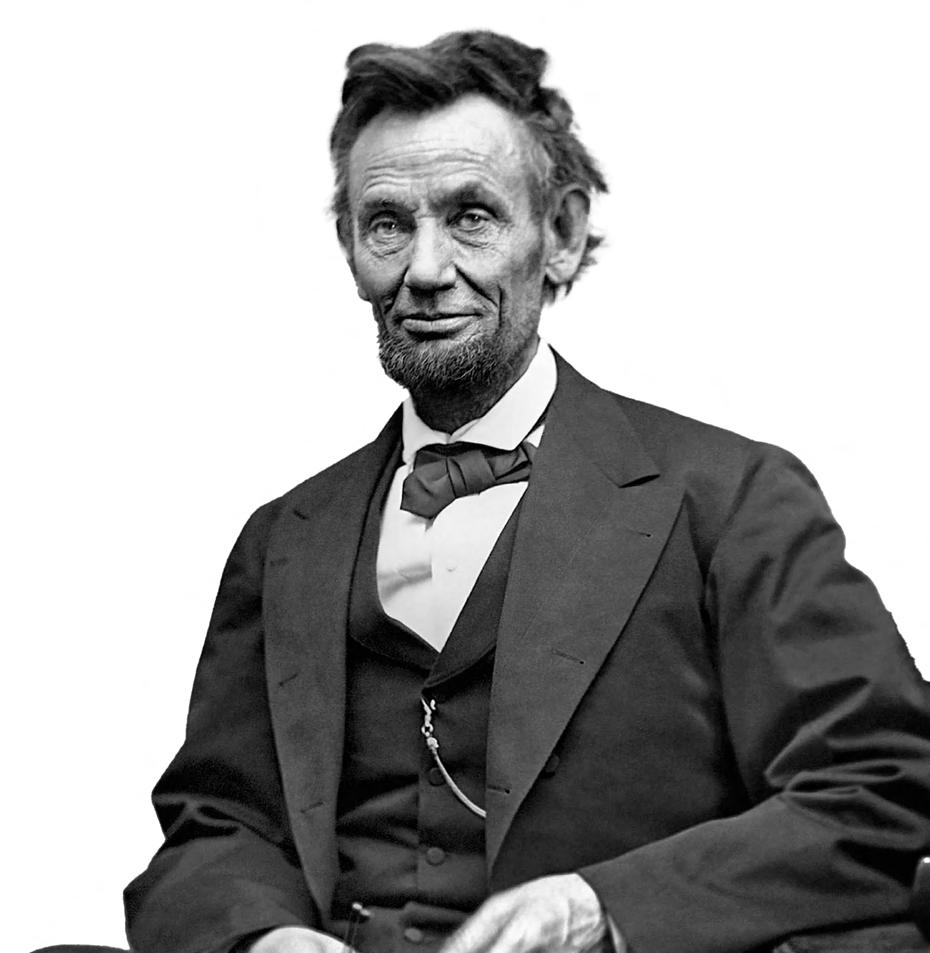
Small, mobile groups would employ hit-and-run tactics, attacking infrastructure, resulting in beautiful historical landmarks being torn down in the crossfire. Meanwhile, the overwhelming debt of the US would double. However, the worst part is yet to come: the long-lasting effects. The mass loss of life, the collapse of essential services such as hospitals, police, food and clean water, the economy crashing, the US dollar would lose global trust, and markets would soon collapse. And once the smoke clears, you have the result. One of the most powerful, economically wealthy countries in the world is left in ruins. Neighbourhood communities would be permanently fractured; the trauma and violence from the war would be too much. The time it would take to rebuild the nation would be extreme; they would have to rebuild what took the country decades to create, in an attempt to “restore order”. This is the stark reality of what would have happened if the South had won the Civil War.
Additionally, the federal government was also able to introduce tariffs, currency and trade policies enabling a large internal market.
This overwhelming list of just some of the amazing achievements the US was able to achieve due to its united government goes to show the importance of the North winning the Civil War. The Civil War
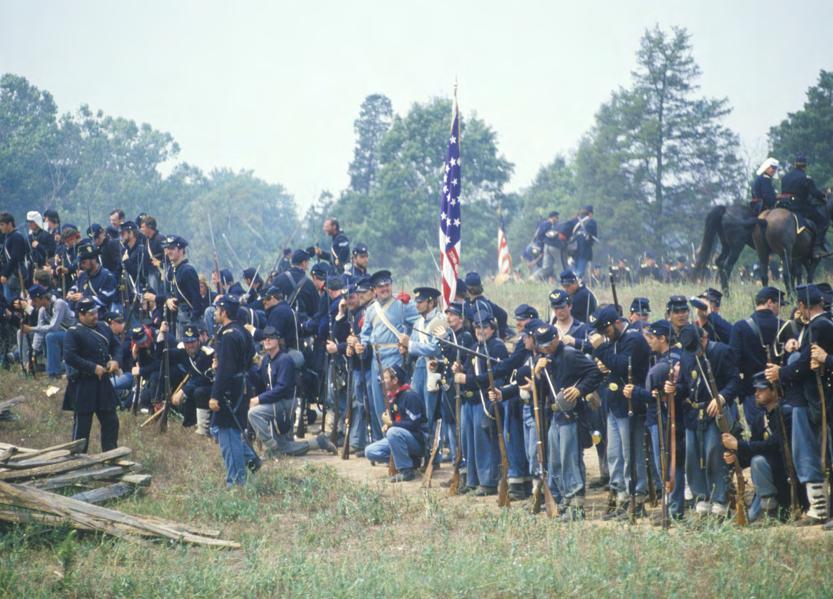
Lastly, the changes in culture, government, and technology would be extreme. Foundational expressions such as “out of many, one”, “united we stand, divided we fall” or “one nation, under god, indivisible” would never have existed. America’s strong federal government, the expansion of civil rights and the creation of a national identity were all stemmed from the nation’s unification. Following the North’s win, the U.S became a global industrial power, building railroads and manufacturing plants.
There were also many technological advances due to the North’s win in the Civil War. The telegraph system expanded, leading to faster communication across the country. The U.S developed advanced military technologies that would also be influential in world wars. Innovations like the mechanical reaper and improved ploughs increased farm productivity. Education also improved due to the outcome of the Civil War; a national focus on public education led to widespread literacy and schooling. Furthermore, the new united U.S. attracted immigrants, who contributed to the economic growth and cultural diversity pivotal to the foundations of the us economy.
was not just an event; it was a pivotal moment in US history which has allowed the US to become the nation it is today. The truth is that all this is speculative, and experts have no firm idea what would have happened had the North lost. Nevertheless, the picture of America would have been vastly different to the nation in place today.
- Gwen Buckley, L6

contend that we should not lower the voting age to 16 soon and keep the policy as it stands, that only people of 18 years of age and above have the legal right to vote. This is due to many factors: firstly, 16-year-olds are still considered children. Whether that is a reality many 16-year-olds care to face, that neither lessens nor changes the fact that by law until 18 years of age any person on this planet is considered a child. Meaning that while possessing a certain level of maturity, voting affects more than just yourself with a single ballot.
It affects the people of the nation, the hands and voices that control our government and have the control over the policies, laws and issues concerning every life in the United Kingdom. Secondly, the only legal right 16-year-olds possess is the ability to give consent. While incredibly important nonetheless, 16-year-olds neither can drink nor drive, therefore, should not be allowed to vote. To give an example, earlier in the year, in the United States of America, the presidential election was held. The candidates are Donald Trump and Kamala Harris. After Mr Donald Trump was declared president of America by a very close election. It was shown in polls, interviews and thorough research that if 16-year-olds were given the ability to vote, a very large majority would have voted for Donald Trump. While being an opinion held by many, that opinion was merely backed up with resources found on social media. Which, as most of us may agree, is not the most reliable source of information. It was created by people for Donald Trump and sheds a brighter light on him as a candidate. This should be enough to show that, additionally, 16-year-olds are more susceptible to being influenced by social media. Meaning judgments may be swayed or clouded toward a certain politician or party. So, if a 16-year-old cannot get behind the wheel of an automated vehicle, they also cannot be legally allowed to be under the influence of alcohol. Why should we give them a choice that not only affects themselves but also others around them?
However, many may disagree as 16-year-olds, regardless of age or maturity, are part of our nation; therefore, why should we disallow them from having a say in the country they live in? As eventually this shall be their generation, their lives and their decisions. All of which shall come in good time, but something that will never hinder is their citizenship in the United
Kingdom. So why should we disallow their ability to vote? Is it out of fear? Due to age? Lack of maturity? Or is it since we worry that giving the political choice to 16-year-olds is daft and reckless? However, regardless of all these factors and opinions, 16-year-olds are old enough to decide for themselves who they would like to make political decisions for their home. Secondly, there is no hard evidence that proves that 16-year-olds do not have the same ability as any other person with the right to vote to make a well-educated, political decision. Another point is that, at the age of 16, many people around the UK tend to get a job. Therefore, you are obligated to pay tax if you exceed the tax-free income limit. So, if a 16-year-old is mature enough to both under a place of employment and dependent on income, pay a substantial amount in tax, then why should they be excluded from voting? Are we withhold ing their decision to vote out of opinion, or is it due to small-minded politicians fearing their likeness among a younger audience? Should we honestly disallow 16-year-olds the right to vote due to age or the le gal rights they possess? Or should we place an adequate amount of trust in the young children that will soon grow up to become doctors, MPs and lawyers? All jobs are fuelled solely by trust and judgement.
WHY THE VOTING AGE SHOULD ,
To conclude, I believe that we should keep the policy as it stands. Scientists even show that a person’s frontal lobe in the human brain is considered underdeveloped at 16 years of age. Meaning rational and smart thinking is less ened due to age and brain function. By waiting 2 years, not only will laws and restrictions be lifted, but an adequate and just decision can be made. More so than the decision made at 16. This is due to many things but mainly being able to integrate with many different stories, backgrounds, experiences and people. Al lowing views to grow, differ and change as time goes on. Disallowing the motion that ’16-year-olds should be given the voting right’ does neither undermine their maturity nor single them out due to age, in my opinion. Meaning waiting 730 days until the next election rolls around. Ensuring a proper and well thought through decision on the politician and party leading their coun try with their hearts, voices and ideas.
Moral Responsibility in the Case of BILLY MILLIGAN
Billy Milligan was diagnosed with Dissociative Identity Disorder (DID) in 1977, subsequently becoming the first person in the US to be acquitted of crimes due to this disorder. His disorder developed as a response to severe
childhood abuse from his stepfather, causing his personality to fracture into multiple identities with distinct memories, traits, and cognitive abilities, forcing his personality to ‘go to sleep,’ to avoid further trauma. Whilst the court ruled that he was not
as ‘the campus rapist’ in Ohio State University and arrested in the late 1970s on account of rape and armed robbery, Milligan’s defence claimed he suffered from DID, then known as multiple personality disorder. The psychiatric testimony that Milligan’s split mind had each identity developing separately and taking control at separate times made it extremely difficult for prosecutors to assign consistent intent or awareness. While the court accepted the diagnosis and placed Milligan in a psychiatric institution instead of prison, many members of the public expressed anger and disbelief.

crimes could be sent to a hospital instead of a prison clashed with
strates what the sociologist Emile Durkheim described as the ‘collective conscience,’ the shared moral values that hold society together. When someone like Milligan breaks these norms, the public’s desire for punishment serves to reinstate them. In this case, the legal ruling of a rare psychological disorder conflicted with the public’s ideology of retribution, exposing a cultural discomfort with the idea that illness can replace guilt. If Milligan was not fully responsible, then the line between sanity and insanity, good and evil, becomes blurred. Many members of the public preferred the simplicity of punishment to the ambiguity of treatment.
tionality. Sociologically, however, his case reveals that justice is not only a matter of law, but also of social consensus. When the public perceives a verdict as unjust, even if it follows medical evidence, it can weaken their trust in institutions. Yet, to imprison Milligan would’ve ignored the root cause of his behaviour, a mind shattered by trauma. A psychiatric institution, while controversial, offered the chance for treatment and containment. It represented a more compassionate and socially responsible alternative, one that balanced public safety with an understanding of psychological suffering.
The question of whether Billy Milligan should’ve been imprisoned remains ethically and morally complex.
Legally, his dissociative identity undermined the idea of a unified, rational self, capable of inten-

Billy Milligan’s story forces society to confront what it honestly believes about guilt, punishment, and the nature of the self. His fractured mind, shaped by years of abuse, challenges the assumption that everyone who commits a crime does so with a single, unified intent. The public outrage surrounding his acquittal shows how deeply ingrained the desire for retribution remains, even in the face of scientific evidence.
Ultimately, Milligan’s case stands as a mirror for our collective fears of madness, moral uncertainty, and the limits of empathy. It reminds us that justice cannot exist without understanding, and that sometimes, the greatest violence is not the one committed by an individual, but the one society inflicts when it refuses to see the human complexity behind wrongdoing.
-Bea Moore, L6
In a world where ideas and identities collide, The Cultural Lens begins by examining how films, literature, and popular media reflect politics. St John's very own filmmaker, James Ross, writes a distinctive piece on what sparked his interest in filmmaking, his future aspirations, as well as his methods of brilliant madness. Maintaining the topic of television, Lucas Dean examines South Park's political satire, highlighting how the latest season critiques the Trump administration while reminding audiences that even animated shows can take a bold stance on free speech. Jewel Roussot challenges the potential danger of canonising cultural texts as many voices are neglected, thus fostering elitism. Charlotte Clee further investigates literature through Artaud, Beckett and Wittgenstein's writing. She contributes a fascinating, well-
researched dive into the boundaries of language as she reflects on her time at Wittgenstein’s resting place in Cambridge. Rose McVeigh builds on this idea of literature shaping identity as she explores the development of feminism through iconic figures. And ultimately, Freddie Von Kaltenborn reviews Ridley Scott’s Napoleon, delivering a critique of a film that ultimately falls short of expectation, yet does so with an intellectual rigor emblematic of this entire edition. As you read through this last article, I hope you can agree that the writers in this edition have done an unimpeachable job.
52 - My Journey into Film Making by James Ross
54 - Artaud, Beckett, Wittgenstein and the Limits of Language by Charlotte Clee
56 - South Park and the Fight for Free Speech in America by Lucas Dean
58 - The Evolution of Feminism Through Literature: Jane Eyre to Wonder Woman by Rose McVeigh
60 - The Danger of Canonising by Jewell Roussot
62 - FILM REVIEW: Ridley Scott’s ‘Napoleon’ by Freddie Von Kaltenborn






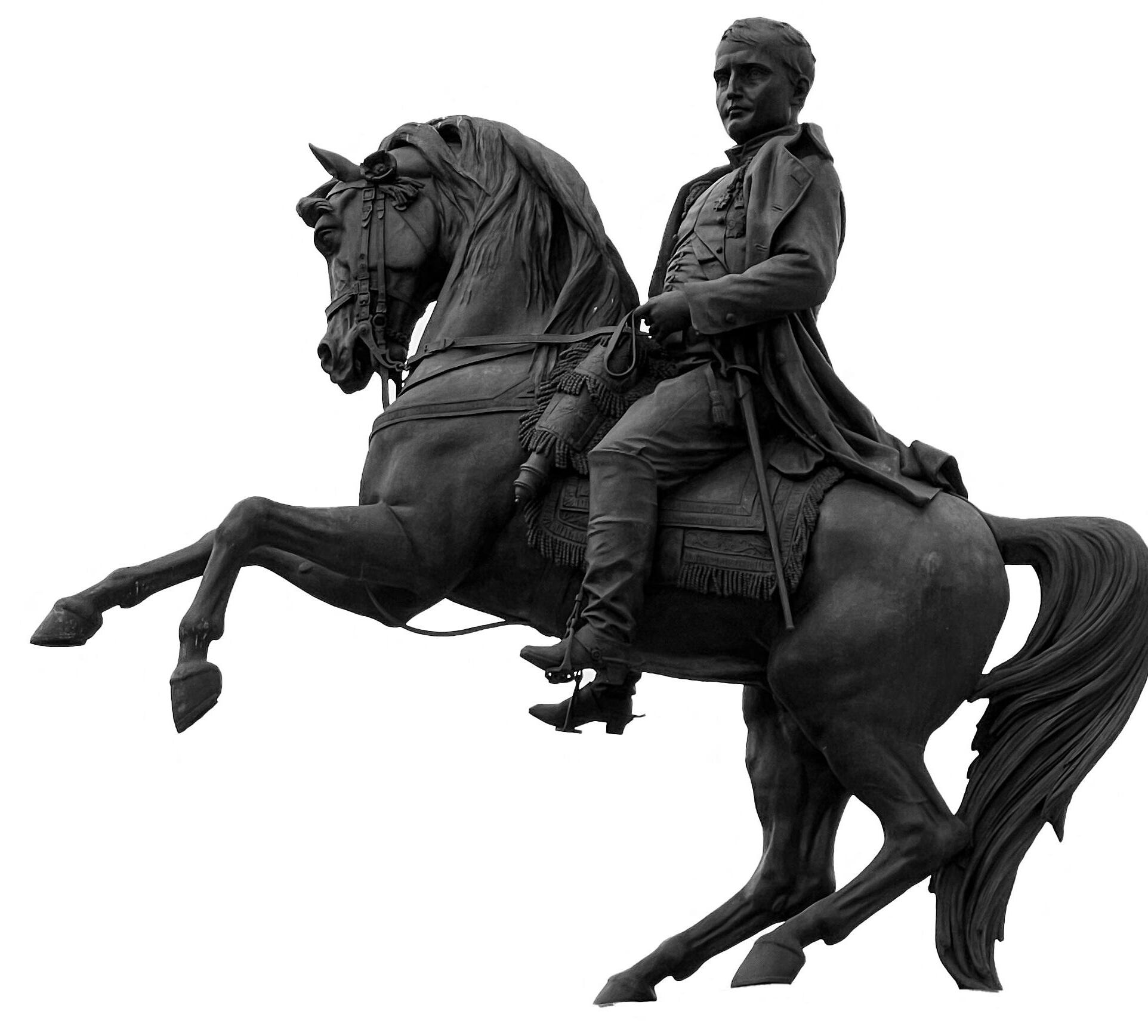
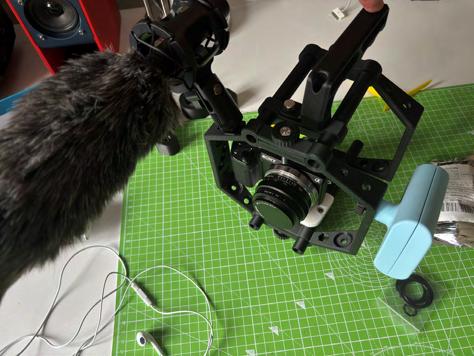
create something of my own. I could have taken the safe route, earning minimum wage stacking shelves at M&S. This never felt like me. I drew up a list of grand (and slightly delusional)
make a film? And so, it began.
Before I dive into my smooth, pothole-free journey of filmmaking (sorry for spoilers: not so smooth), here’s a wee snippet into the monumental iceberg of cinema. Film began as a window to the world, evolved with sound and colour, and now fits in our pockets, digitised and redefined. The words between the frames have changed, too. Once epic stances on war, ultimately intimate, contemporary realisations of “particular” people in power. Two of my personal

which included: reviving the iPod, thoroughly convinced I was the next

embodiment of Steve Jobs (modest I know), starting a microgreen empire or producing a fully 3D animated film using virtual actors. Naturally, my overly ambitious and egotistical self chose the most mind-boggling option. Why not
building a small cannabis empire. The entire film would take place within a basement, and the boss, Tony, causes enough immense discontent to spark a rebellion within the group. But, halfway through my script, the government had other plans. Certain music on Spotify was suddenly banned for under-18year-olds without ID verification. Consider me outraged. I stormed around the neighbourhood with my dog, blasting my last Spotify jams, and even punched
With the new project well underway, my urge to do something practical took over. For this latest endeavour, I opted for a more grounded approach: one man and his overpriced camera. Except the camera wasn’t actually expensive- it was a £49 Sony NEX 5R from 15 years ago,

favourites
are Meet Joe Black, starring Brad Pitt and Anthony Hopkins, a delicate romance with a phenomenal ending that rivals Shakespeare, and Reservoir Dogs, Quentin Tarantino’s under-90-minute masterpiece of dialogue and setting. For those who shamefully don’t know Tarantino (one of the greatest directors of our time, if not all time), finish this magazine and go watch his films, you uncultured soul. I mention this pair of cult classics because they profoundly influenced my own cinematic and dialogue choices while planning my film. How does one begin the tremendously daunting task of creating a film? That was my first thought, as I’m sure it would be for anyone else. In the meantime, I decided to build a dual speaker for creating sound effects during shoots and, of course, for jamming to tunes. Not the simplest task: it involved countless redesigns, and the speaker I ended up using for months to this day even developed a crack in the middle… purely for artistic flair. I proceeded to construct a treatment for my crime-centred coming-of-age drama. The story revolved around Scott, a timid teenager working with a group
second rational decision of the summer. I bought an iPod to fix my music problem and put my beloved Below The Fold on hold. This sparked a new idea: a film exploring the repercussions of restricting music and freedom for the younger generation. How’s that for a contemporary central theme?

like a Luke Skywalker improv. And in that moment, I felt genuinely proud. If nothing else came from this Summer, I had made something actually useful
during GCSEs to dis tract myself from said GCSEs. Would shelling out for decent equipment make up for my outdated gear, or was it just sheer stubbornness that had me spending hours building a camera rig? You can guess what I chose. Sure, I could sum up the camera rig build as fun but ridiculously challenging, however, that wouldn’t exactly win me any literary awards. I excitedly mounted the camera, added a comically bulky matte box and hand grips for mobility, and attached a menacing shotgun mic to intimidate the bravest of actors.


Maths, Physics and Chemistry (a mor bid choice, don’t worry, I’m self-aware by now), production naturally slowed. All great things must end, and I find myself gloomily staring at my camera rig, idle across my room, gathering dust and quietly hoping for a future project.
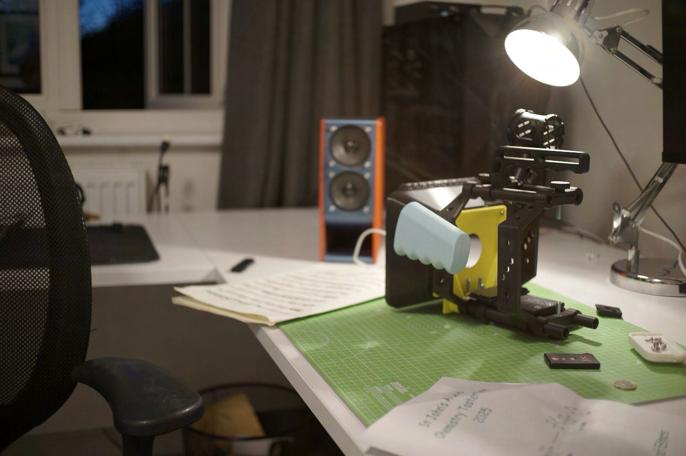
intermediate cinematographer with his brand-new toy, I did what anyone with such gear and immense passion with sunsets from La La Land- a bedazzling, life-changing musical- would do. I filmed myself gazing at the sunset

I want to thank the Eagle magazine team for the opportunity to share my passion for film. I’m also keen to hear about any new films you’ve seen; I’d be happy to discuss them- just don’t challenge my top films I mentioned earlier (only joking!) My final message is simple: creativity is essential within a sometimes dire world. Sharing ideas through films or creating your own can open windows into new perspectives.


So watch, create, and celebrate the magic of cinema.


-James Ross, L6
Artaud, Beckett, Wittgenstein, and the limits of language
Writing on Samuel Beckett, William H. Gass noted that “I have only known one other man who bore the brunt and brilliance of his art in his person… and that was Ludwig Wittgenstein, the only other saint in my modest religion.” I first read these words on the way to Wittgenstein’s resting place in the Ascension Parish Burial Ground in Cambridge, having been inspired by a trip to Montparnasse a few days prior, where we had visited the resting places of Gainsbourg, Demy and most importantly, Beckett.
These few days were probably the closest I’ve ever come to a Kempe-esque experience. Talk of a religion with
Beckett and Wittgenstein as the two saints immediately resonated with me. If a Heaven does exist, it has a stage which is constantly staging Sontag’s production of Waiting for Godot, with Wittgenstein providing a constant stream of analysis in my ear.
Stanley Cavell, one of the most eminent ‘disciples’ of Wittgenstein in the 21st century, wrote many works emphasising the importance of television and film in relation to ordinary language philosophy. Responding to Lyotard’s notion of the postmodern sublime, Cavell proposed that the arts are a medium which one can utilise to communicate what cannot be said with ordinary language. The arts allow one to express emotional experiences while being understood by an audience. Often, it turns the personal into the public, allowing for connection through linguistic presentation.
Ordinary Language Philosophy (OLP) is a branch of linguistic philosophy

championed primarily by Ludwig Wittgenstein in Philosophical Investigations (1954), with a continuation of the tradition being largely maintained at Oxford through figures such as Austin and Ryle. It developed largely as a response to Ideal Language Philosophy, which asserted that philosophical methods could be used to develop an ‘ideal’ language. It was wished to discover a ‘depth grammar’ which would allow for a logical and universal structure to be used in linguistics.
In Tractatus (1921), Wittgenstein wrote, intending to uncover this ‘depth grammar’, taking it to such an extreme that, in proposition 6.53, he argued that the only correct method in philosophy would be to say nothing except what can be said, thereby isolating anything which is not a proposition of natural science. To followers of ILP, philosophy is an activity of clarification. It calls for problems to be formulated “not in the object language, but in the meta-language,” (Carnap). However, the OLP tradition found this notion of a ‘meta-language’ vague and often misleading.
Wittgenstein rejects the ILP notion of fixed meanings, rather arguing that the development of meaning is dependent on situational factors. It is not right to assume that just because something means one thing in one context, it means the same in a universal context. To help explain this point, Wittgenstein proposes the idea of ‘family resemblance’, listing words which have a broad range of preceding nouns, which we still maintain to be games. Listing “board-games, card-games, ball-games, Olympic games”, he argues we may aim to create an artificial point of commonality, but this is not a productive use of philosophy or time. Rather, we can “see a complicated network of similarities overlapping and criss-crossing”, which he refers to as ‘family resemblances’.
When considering the distinction between early and late Wittgenstein, the dramaturgic techniques of Antonin Artaud come to the forefront of my mind.
Countering the early Wittgensteinian notion of the limits of one’s language being the limit of one’s world, Artaud’s theatrical methods propose an avant-garde alternative. The Theatre de La Cruaute was devised by Artaud as a means of liberating the human subconscious with the aim of revealing the true nature of oneself. Theatre should allow for “the magical means of art and speech to be exercised organically and altogether”, whilst debasing the limits of language and allowing for an “extension beyond words” – as outlined by Artaud in The Theatre of Cruelty (First Manifesto). He wished to break down the barrier between audience and performer and did so by creating heavy focus on screams and loud noises, hoping for the audience to experience theatre “with their souls and their nerves.”
The only play which Artaud himself wrote that attempted to give life to this concept was The Cenci - a radical rewriting of Shelley and Stendhal. Staged in Paris in 1935, The Cenci saw Araud take the lead role Count Cenci, which he performed with the desire of reaching “the last degree of violence.” It was harshly received and closed after seventeen performances. Susan Sontag, in her essay Approaching Artaud, recognised that Cenci was “not a very good play,” but allowed him to exert “influence through his ideas about the theatre, a constituent part of the authority of these ideas being precisely his inability to put them into practice.”
No one better symbolises the coming together of Artaud’s Theatre of Cruelty and Wittgenstein’s philosophy than Samuel Beckett. In agreement with Wittgenstein, Beckett realised the arts had privileged access to the “beyonds of vision”, allowing for the inexpressible to be expressed. Both agreed with Derrida’s argument; that no sign could by itself determine a meaning and neither would any subsequent sign. This means that no interpretation could ensure cohesion between sign and referent. However, both Wittgenstein and Beckett disagree with the complete
form of the deconstructive deduction, arguing that while “interpretations by themselves do not determine meaning”, the context in which a sign is found allows it to compose a ‘form of life’, leading to “what has to be accepted, the given” (Philosophical Investigations). To “execute” an interpretation, as Beckett explains in Watt (1953), a strict set of rules must be followed.
Philosophical Investigations and Waiting for Godot, both published in the same year, explore the concept of language games and their interactions with ‘forms of life’. In The Blue and Brown Books, Wittgenstein presents the concept of ‘waiting’ as an example of ‘family resemblances’, questioning “when someone promises from one day to the next ‘I’ll visit tomorrow’, is he saying the same thing every day or every day something different?” This is reflected by the way Godot sends word every day telling Vladimar and Estragon to wait for him. Beckett makes the distinction that there is no single common feature which relate to all the states of waiting, though there may
Romanian essayist E.M Cioran, who Sontag noted as the natural heir to Wittgenstein in her introductory essay to The Temptation to Exist (1968), summarised the shared unreachable nature beautifully in his Anathemas and Admirations:
“In both [Wittgenstein and Beckett], the same distance from beings and things, the same inflexibility, the same temptation to silence, to the final repudiation of the word, the same will to collide with frontiers never foreseen. In other ages, they would have been lured by the Desert. We know now that Wittgenstein at a certain point actually envisioned entering a monastery. As for Beckett, how easy to imagine him, some centuries back, in a naked cell, undisturbed by the least decoration, not even a crucifix. Do I digress? Just remember that remote, enigmatic, ‘inhuman’ gaze of his in certain photographs.”

appear to be so.
There is a shared sense of mysticism between Beckett and Wittgenstein.
-Charlotte Clee, U6
SOUTH PARK
AND THE FIGHT FOR FREE SPEECH IN AMERICA
South-Park is one of the most iconic animated shows of all time and has been broadcasting for over two decades. The show follows four friends, Cartman, Stan, Kyle and Kenny, who live in a small village in the Colorado mountains. The show has not backed down from controversy; creators Trey Parker and Matt Stone have brutally mocked various celebrities and political figures, including Hillary Clinton, Selena Gomez and Kanye West. Parker and Stone have also had no fears when it comes to mocking, including a Christmas episode that references Jesus being targeted by terrorists, and another that depicts the Prophet Muhammad and Jewish Kyle subject to antisemitic insults from Cartman.
Southpark recently received a $1.5 billion contract from Paramount in which at least 8 episodes will be aired each year. Paramount is the parent company of the American media channel ABC, which has been under constant pressure from the Trump administration and regularly subjected to lawfare as Trump attempts to crack down on freedoms for leftleaning American media that have often been critical of him in the past.
One notable example of this is the cancellation of the Stephen Colbert show, which is widely believed as a result of pressure from Trump, as the show had often been critical of him. Throughout his second term, especially, Trump has shown an immense amount of insecurity when it comes to being criticised from the media, the Associated Press have even been banned from the white house press office after they refused to call the Gulf of Mexico the ‘Gulf of America’.
While this may not seem to correlate with an animated
American TV show, South Park's most recent episodes have placed it at the centre of American politics. The first episode was openly critical of Trump as the village of SouthPark went on a rampage to try find the president as they were unhappy with their standards of living, although after the animated version of Trump depicted in South-Park threatened to sue the entire town, the people of South-Park backed down. Within the episode, Colbert is directly mentioned by cartoon Jesus Christ, who descends from heaven to the people of South-Park to warn them about the imminent

While South-Park is not only critical of Trump's policies, it also depicts him in a highly degrading way that is comically on point for South Park's usual portrayal of celebrities. Throughout the new season, the show portrays a fictionalised version of Donald Trump in a satirical relationship with the character Satan. The storyline takes an unexpected turn when Satan becomes pregnant, leading to a conflict over abortion. As well as being highly degrading, this is also a criticism of Trump holding anti-abortion stances while having had relationships and children with multiple different women in his life, creating immense comical irony.
This may not seem extremely relevant or political, although it
very much is. The independence of the media in America has been under constant attack with a huge increase in state censorship in the second Trump presidency. While many companies have bowed down to Trump, Paramount and South Park have stood firm. SouthPark has become the most vocal anti-Trump show in America, and the new show has reached such a level of popularity that key republican figures such as JD Vance have claimed to find the episodes funny and ‘just a joke’, although some members of the Trump administration have taken the new season extremely personally.
Overall, South-Park has been a shining light and example to other media channels in the US of what the media in any democratic country should look like, and we can only hope it encourages other channels to follow in its lead.
-Lucas Dean, U6


I hope we can all agree that Wonder Woman was, and still is, a legend. But it’s not just Wonder Woman that changed the game; she’s just one of the hundreds of icons defying the social norm. Being a feminist is a far more general term than you may think. It is not only the belief that men and women are equal, but also the fight for simple things – like women being allowed to wear trousers and go to school.
Feminist literature is essentially an extension of freedom of expression in response to the patriarchal world that dominated from the late 19th century through the 20th century. Literature has changed the world – for better and for worse. It serves many purposes, but it always strikes deep. Makes a point. In 2019, a study on ‘The Evolution of Feminism in English Literature’ was proposed by Dr. Alka Tripathi, an Associate Professor at Govt. Girls' College Chomu Rajasthan. With a focus on how feminist ideologies have influenced and shaped the literary landscape of today, it traces back predominantly maleled societies.
She speaks on a multitude of literary works, including Charlotte Brontë’s Jane Eyre, specifically how it “tells the story of Jane Eyre, a determined and independent woman who defies societal conventions and seeks personal fulfilment”, as well as The Handmaid's Tale by Margaret Atwood and a society where women are subjugated and dehumanised. It gives voice to topics regarding the oppression of women, reproductive rights, and female defiance.
While novels and books like these are important, the true impact lies within children. Powerful, smart, and opinionated female characters targeted for the younger generation are so vital to this movement because it result in the youth growing up with strong role models. A perfect example, and personal favourite, is She-ra.
In She-ra, the lack of a male counterpart ensures the challenges overcome are a sole result of her strength as a woman. So many movies or shows with women as the main characters portray them as dependent. A vast majority of Disney movies rely on the strong, dashing man swooping in to save the helpless princess. But not She-ra. She is her own person – her own soldier, and although it may have started out as a girl in a skimpy outfit fighting crime, there is no doubt it has progressed into something so much more.
In an article by Aileen Lalor regarding the refreshing perspective of She-ra, she states that it’s something “little kids can relate with” – the idea that they can be something other than fragile; that they can be warriors instead of princesses.
Circling back to my favourite example: Wonder Woman. Not only a founding member of the Justice League but one of the most powerful members of said League, she is greatly respected by her male peers, which was uncommon for the time at which the comics were written. When she made her debut in 1941, she served as a patriotic symbol
of freedom, democracy, and justice during World War II, proving a woman could conquer evil through strength just like her male counterparts. Her creation was also a response to the suffragette movement, showcasing female empowerment and a shift in traditional gender roles, improving gender equality in a male-dominated society.
However, the fight for gender equality still exists today. The Bechdel test was invented in 1985 by Alison Bechdel and Liz Wallace to highlight gender inequality in the media. To pass the test, a piece of work (ie. Film, book, comic) must have two women having a conversation about something other than a man. The test had a 57.1% pass rate – an astonishingly low number compared to the 42.9% of movies that failed. If considered in reverse, the number of films that would pass the test would be much higher.
Overall, feminist works have made a huge difference in the way we, as women, are able to live and function today through the expression of ourselves. Furthermore, feminism isn’t the only issue that has been addressed through literature, but other challenges, like racism and homophobia. Words are powerful and make a difference to people around the world. Let's use it to our full advantage.
-Rose McVeigh, L5
The Evolution of Feminism Through Literature: Jane Eyre to Wonder Woman

THE DANGER OF CANONISING
Canonising is an act we are all guilty of. It is the choosing of what to grant importance to. It is the subtle discrimination and distinguishing we perform over generations and generations to present to future generations history, literature, people we view as valuable, significant, worthy. The rhyme and reason in this is something peculiar and suspiciously without real sequence. How as a society, do we decide what is worthy of being passed down and what exact
In this act of canonising, do we neglect stories that should be told, history that should be acknowledged and people with voices that should be heard?
I have found it to be true that in every word canonised there is some inkling of truth; truth that breaks barriers and brings down the walls of its consumers. Truth that is not simply true for one person but true for the masses. Truth in action, word and deed.
Classic literature has been canon
something of a literary canon, works we deem established, significant and even brilliant. Within the realm of this consecrated literature, there is a common theme. An obnoxious truth that relates to humanity in either history or psychology. This truth is expressed in both physical experiences and experiences we all enjoy and despise in the domains of our minds. It is often writers who subtly expose the atrocities of their surroundings that we deem brilliant. It is those who speak without saying a word. Those who show the danger in our world and what it could become.
Harper Lee wrote of the prejudice of the American South at a time when its fire burned with flames fuelled by freedom’s weaponised. Her narrative took the perspective of a child to present to the world the thoughts they had begun to think but were too afraid to express, thoughts that had become clouded by adult animosity. These thoughts needed innocence personified to help them realise the harshness in their hatred, the evil in their enmity. When released, the book was a great success. However, success itself brings only trends, fads that come and go with the changing of times, the shifting of the social tide. Many have read Lee’s brilliance and found in it themselves. In To Kill a Mockingbird, Lee provided us an opportunity to climb into someone else’s skin and walk around in it. The past that has been so viciously attacked in
In Steinbeck, too, we find this obnoxious truth. He writes of immigrant workers, expressing the help they bring in the face of the hostility they are met with. Humanising, necessitating the people we ostracise, showing us the truth we may fear to be true. The kind of truth we see in the works of Sylvia Plath concerning the subtleties that abide and abound in our very minds.

Following a character on the tipping point, experiencing thoughts we all think, we see ourselves. We see truth. It is simply human nature to gravitate towards pictures of ourselves. Our thoughts expressed in ways, in words, we can’t write. So, we read and pass them down and hold them up as symbols of something inside us. Something hard to pinpoint. Something that resonates, reality we wish we could express. The truth that is truth beyond what we believe; breaks down our walls and attempts to remake in us a more real ideal, a world we go to only in dreams, a world that is so far from current reality.
There is a danger, in this canonising act, of subconscious or conscious neglect. Choice is never a solitary act. It is often, if not always, accompanied with the rejection of something else. The very fact it is a choice suggests that there is room for decision. Room for, necessity in, favouritism. Prejudice in selection. The history we know is history that has been chosen History is not simply the study of
events past but rather the study of events past that have become history by the recognition of their significance by historians. It is not a list of facts, but rather a list of carefully selected facts, which are interpreted and connected to broader patterns to produce a dialogue between the past and the present. History is how societies make sense of themselves. History, like many seemingly harmless things, held in the hands of hateful people can be abused and twisted to motivate political agendas, justify prejudice and back up harmful ideologies. It is the process of selecting, questioning and giving meaning to facts canonised. In this act, wrongs are made right; too often, rights are made wrong or ignored and neglected because of who wrote them, where they were from. We read and watch, and hear of people from the past. We take this ‘history’ and we turn it into politics, aim ing
somehow to avoid the repeat of past failures. Canon in hand, full of sound and fury, we hope it will signify something, something of a change, something of a better world. The problem is, we will never know what snippets of history we are missing. Slivers of stories from people left out. People, someone at some point deemed unworthy of canonising.
Canonising has brought us brilliance without fail. Identifying in the human spirit things we all share. Things that someone somewhere decided we would need for our future. However, there is a danger in this canonising act. There is a danger that we leave behind pieces needed for our blueprint, people walking in the shadows with their words turning cold and grey, pictures of our world that we need today.
- Jewel Roussot, L6

In Ridley Scott’s sweeping historical epic, Napoleon, released in the autumn of 2023, he attempts to cover the life and origins of Napoleon Bonaparte, from his humble beginnings as a young, promising artillery officer to his eventual defeat and fall from grace at the Battle of Waterloo and exile to St Helena. However, whilst Napoleon does do some things right, the film leaves much to be desired, and for someone like me, who has high expectations for a director of Ridley Scott’s calibre, backed by such a talented cast, I exited the cinema disappointed and had the same feeling after rewatching the movie recently.
Nevertheless, before we discuss the bad, let us first appreciate everything the film does right. It is undeniable that the film is a masterpiece from a technological standpoint; it’s a very well put together production, and the sets, uniforms, cinematography and battle scenes are exceptional and do a brilliant job of capturing the time period that Napoleon lived through as well as the gruesome nature of a battle in the early 18th century. I especially enjoyed the Battle of Austerlitz segment around the mid to early point of the film, where a masterful Napoleon oversees the destruction of the Austro-Hungarian Army by breaking the ice under them on a frozen lake, and, whilst maybe not historically accurate, it’s an impressive watch on the big screen and certainly lived up to expectations.
However, we must now look at what
the film fails to accomplish, and sadly, it all comes back to one main issue: the writing and the script. Over the two-and-a-half-hour run time of this film, it attempts to cram in over 3 decades of Napoleon's military and political career, involving hundreds of characters and spanning an entire continent. This would be a challenge for a multi-season TV show to do justice, let alone a single feature film. This is an issue which plagues the entire film, and lots of the other issues with the movie ultimately stem back to this. It means that the narrative is spread thin and events are oversimplified, often to the point that you don’t even know what is going on at that point in the film. The film is more of a whistlestop tour of Napoleon's life and battles, such as Waterloo, Borodino and Austerlitz, which were defining moments in his life, and are often cut down to the point of absurdity. Battles, which at the time involved hundreds of thousands of men and spanned days, can be cut down to a 30-second segment, which doesn’t do it justice.
These issues are also not at all helped by the incessant and dull romance between Napoleon and Josephine, which attempts to make itself the emotional heart of the movie and takes up precious screen time. The scenes where these two are together lack emotional clarity, and whilst Vanessa Kirby delivers a decent performance as Josephine, I can’t help but feel that it is simply a case of a top-tier actor elevating a weak script. The same, sadly, cannot also be said for Joaquin Phoenix, whom I had immensely high hopes
for, especially with his Best Actor win at the 2020 Oscars firmly in recent memory. He appears lost in his performance as Napoleon, and the character certainly reflects that. Napoleon can often go from stoic and composed to screaming like a petulant child in the next scene. However, Phoenix isn’t entirely to blame for this. Part of the reason his portrayal of the character can seem so disjointed at times is almost certainly because the scenes on screen are often taking place years apart, making his performance another victim of the poor writing and editing which has butchered this potential classic.
In conclusion, Ridley Scott’s Napoleon (2023) is much like its namesake in that it is undone by its own lofty ambitions. The bloated script and lack of proper editing weigh the film down of what it is trying to accomplish and heavily impact the star-studded cast, leaving a sense of disappointment and lack of fulfilment in the audience with the feeling that it could have, and indeed should have, been far better.
-Freddie Von Kaltenborn, L6
FILM REVIEW: Ridley Scott's 'Napoleon'
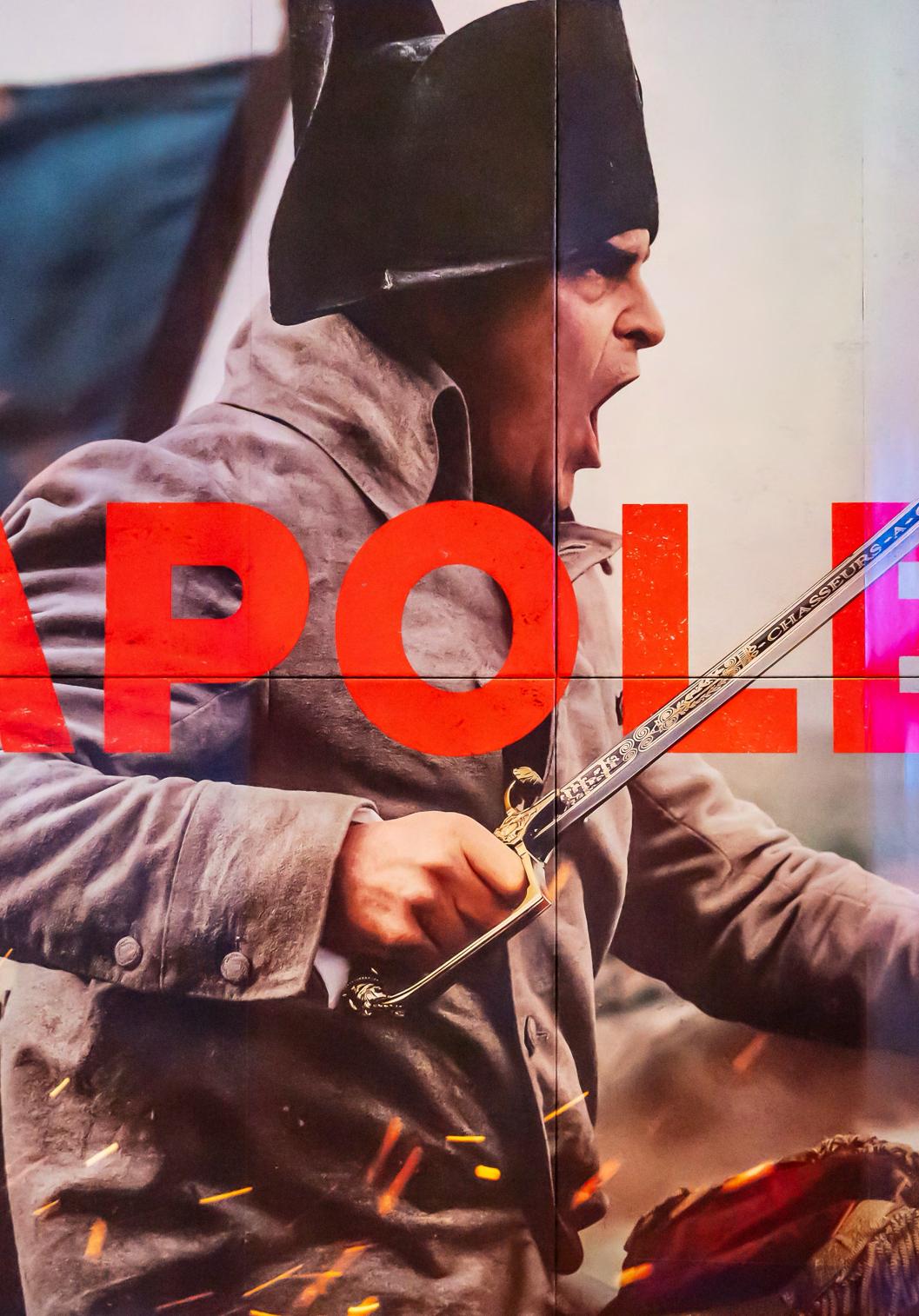
EDITOR IN CHIEF: Ellie Wain
GRAPHIC DESIGN: Will Logan
DEPUTY EDITORS: Anna Cuckow
Sarah Winklehner
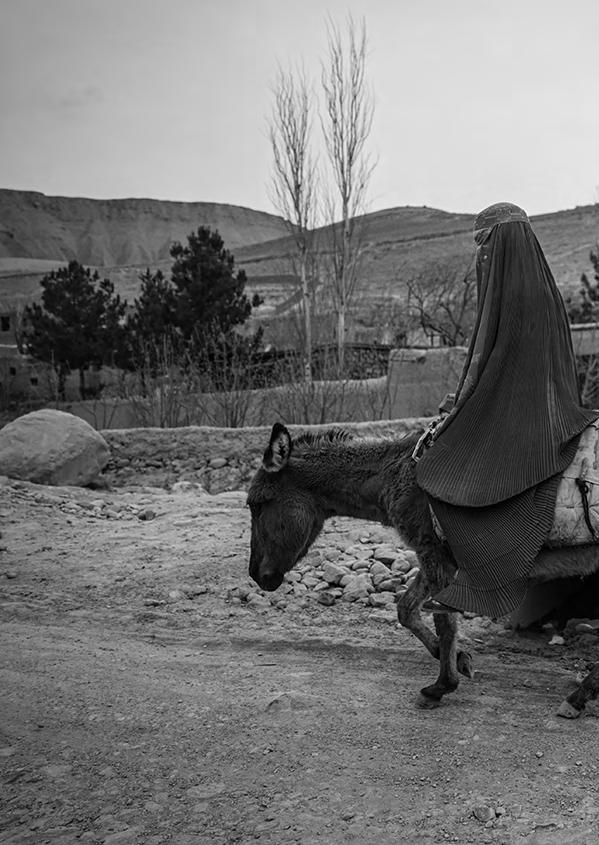
St John’s School