



Affairs
David Graham ’92 Vice-President, Advancement
For generations, StFX alumni have been known across Canada—and around the world—as one of the strongest, most loyal, and most engaged alumni communities anywhere. That spirit of connection is truly part of what makes StFX so special. Today, we are excited to share the beginning of a new chapter in how we honour, celebrate, and strengthen that bond. You are holding the very first edition of the xaverian, our newly redesigned alumni magazine. Its name is a deliberate nod to our past: the xaverian was once the title of the university’s cherished yearbook, a publication that captured student life, friendships, and tradition for decades. Reviving this name felt like the perfect way to honour our history while reimagining it for today’s StFX community.
Published annually each December/ January, the xaverian brings a fresh, modern look to our flagship print publication, with a renewed focus on storytelling, photography, and design. But this magazine is more than a makeover—it is the cornerstone of a new, strategic approach to alumni communications that we have spent the last 15 months building together
In 2024–25, the Alumni Affairs partnered with an external agency to better understand what our graduates value most when it comes to staying connected with StFX and with each other. More than 1,200 alumni from every generation responded to our survey, including some who participated in in-depth one-on-one interviews. You shared what inspires you, what you want to hear more about, and how you want StFX to show up in your lives long after graduation day.
Your feedback was clear: alumni want timely updates, engaging stories, meaningful ways to reconnect, and communications that reflect the pride and momentum of today’s StFX. We heard you—and this new publication is the first visible result of that work. the xaverian will now be supported by three digital editions each year— xaverian digital — which will deliver news, features, and alumni stories directly to your inbox. These digital issues will allow us to share more frequent updates, highlight achievements across our community, introduce you to remarkable fellow alumni, and keep you informed about what’s happening on campus and beyond. You’ll also see more alumni-focused content across the university’s social media channels, helping you stay connected to events, milestones, and each other throughout the year.
And this is only the beginning. In the months ahead, you will notice additional improvements as we continue to expand our outreach, sharpen our storytelling, and create even more opportunities for alumni engagement worldwide. Our commitment is simple: to ensure every Xaverian feels informed, included, and proud of the community we continue to build together.
Thank you for your feedback, your trust, and your unwavering StFX spirit. We are thrilled to begin this new era with you—and we’re just getting started.
Welcome to the xaverian. And welcome home.
Kirsten Gallant ’19 is working to make impact in health policy

President’s Message Connected by tradition. Driven by discovery.
Our People. Our Place. From the #1 reputation in Canada to an AAU Distinguished Teaching Award recipient, StFX has had much to celebrate.
Research in Action StFX faculty and staff are addressing some of today’s most pressing concerns.
Thought Leadership Between rupture and renewal: Education in a time of interregnum.
A Conversation with StFX’s Newest Honorary Degree Recipient
Leading editorial cartoonist Bruce MacKinnon reflects on his career and craft.
Golden Grads
Celebrating their 50th, Homecoming 2025 was a special year for the Class of 1975.
One to Watch
Kirsten Gallant ’19: From StFX to Harvard.
Shipping up to Boston
Laurenne Mercier ’16: How a StFX sociology grad broke the ice with the NHL.
Powering Opportunity
Chris Burns ’09: Establishing a global battery technology company.
Athletics
Meet the ‘scrum sisters’ and the X-Women cross country silver medalists.
Memory Lane
A look back at iconic StFX residences, Cameron and MacKinnon halls.
Alumni in the Community StFX alumni have been leading the way through service; gathering for NeXT Level events.
Leadership in Action Kathleen Sheridan ’15 fuels the StFX spirit.
Homecoming 2025
October’s annual alumni get-together proved there really is no place like home.
Inspired by Greatness
On the Class of 1985’s 40th Homecoming, guest author Larry MacEachern ’85 reflects on lasting bonds and the legacy of classmates Katie Fleming ’85 and Dave Bernatchez ’85.
Celebrating 100 Years
The Rankin School of Nursing celebrates its centenary in 2026!
News Exchange
Of news and note in the StFX community.
Managing Editors
Shanna Hopkins ’01 shopkins@stfx.ca
Kyler Bell kbell@stfx.ca
Assistant Editor
Shelley Cameron-McCarron sacamero@stfx.ca
Writer
Shelley Cameron-McCarron
Contributors
Marion Alex ’78
Eileen Alma
Brad Chandler
Katie Edwards
Dr. Andy Hakin
Larry MacEachern ’85
Sophie MacDonald’ 24
Design & Production
Jayme Walters / Neil McCulloch
News Exchange Editor Lianne Campbell lcampbel@stfx.ca
Advertising Enquiries
Lianne Campell T: (902) 867-2186 lcampbel@stfx.ca
thexaverian is published by St. Francis Xavier University Alumni Affairs and Communications annually for alumni and friends of the university. Views expressed are those of the individual contributors or sources quoted. Contents, copyright © ’25 by St. Francis Xavier University. the xaverian
St. Francis Xavier University PO Box 5000 Antigonish, NS B2G 2W alumni@stfx.ca | T: (902) 867-2186
Personal Information: St. Francis Xavier University gathers and maintains records of personal information for the purposes of admission, registration, provision of educational services, ongoing contact with students and alumni, and soliciting support for these and other University activities. The collection, use and disclosure of personal information by the university is governed by the Nova Scotia Freedom of Information and Protection of Privacy Act, S.N.S. ’93, c.5. Information provided to the university from time to time will be maintained in the university’s records. The personal information provided may be used by university personnel and disclosed to third parties as required or permitted by applicable legislation or in accordance with the purposes for which it is collected. If you wish to have your contact information removed for the purposes of any mailings to alumni from St. Francis Xavier University, the Alumni Association or our Affinity Partners, please send us a note using the contact information on this page.
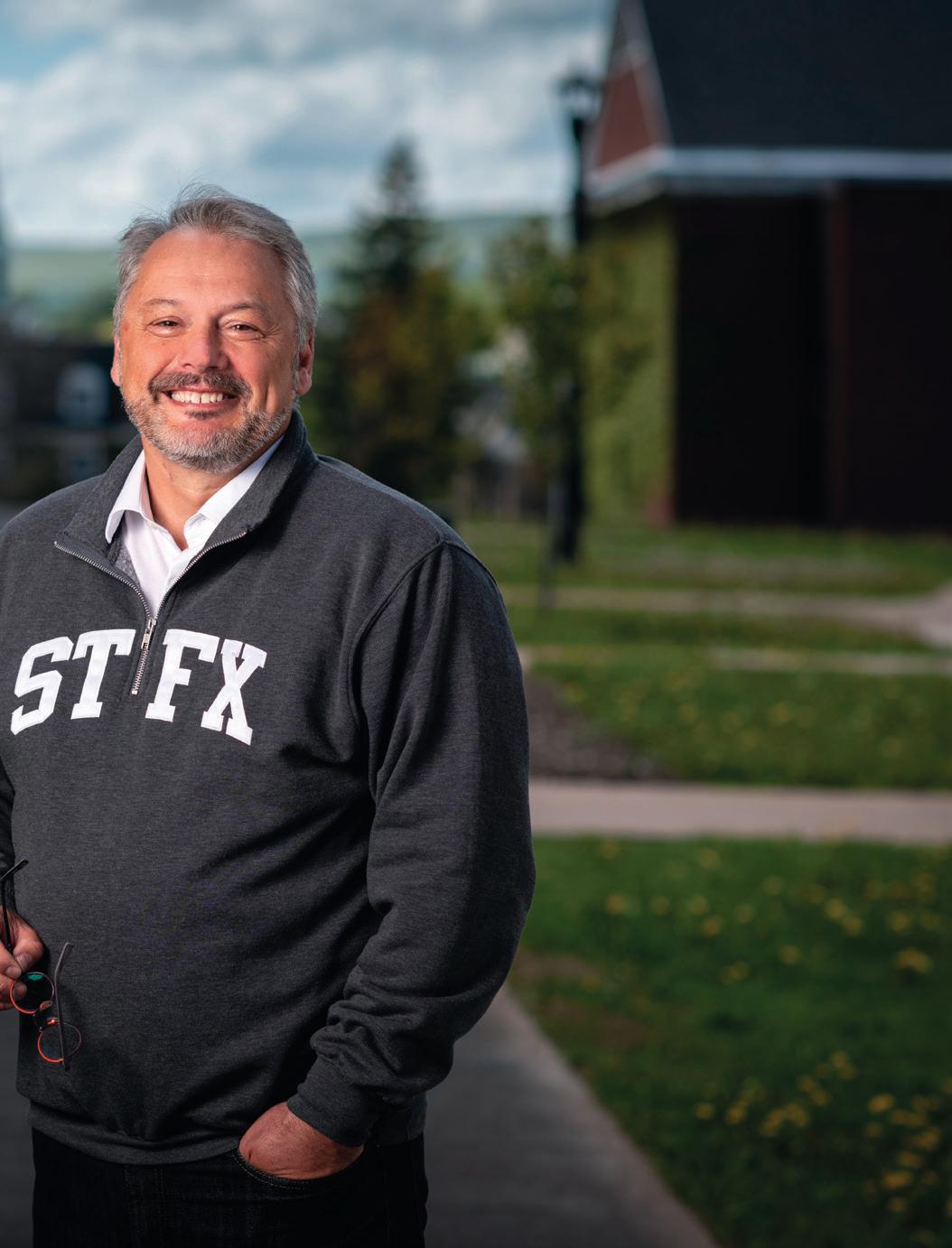
Dr. Andy Hakin, President & Vice-Chancellor
First, let me begin by offering congratulations to our Alumni Affairs & Communications teams on the successful redesign of the xaverian.
This revitalized publication represents far more than a fresh look. It reaffirms the importance of staying connected as a community. The stories we share reflect on our history, celebrate the achievements of our graduates, and strengthen the lifelong bonds that define what it means to be a Xaverian. These connections ensure that our values and traditions remain strong.
This edition’s feature highlights the research that happens on our campus. Research is the engine of our academic mission. Through their pursuit of new ideas and fresh perspectives, our faculty bring emerging knowledge directly into the classroom, offering students not only what is known, but what is being discovered in real time. This commitment to inquiry enriches learning and deepens our understanding.
Our students benefit from the opportunity to participate directly in faculty research. As an undergraduate chemistry student, I experienced firsthand the transformative power of inquiry; the value of questioning what we think we know, of embracing challenge, and of learning alongside those who inspire us.
StFX offers today’s students these same opportunities. Few institutions provide undergraduates with such meaningful access to research, and this remains one of the defining strengths of our university.
As we honour our past—including reflections on Cameron and MacKinnon Halls and the upcoming 100th anniversary of Nursing at StFX—our university continues to evolve, driven by the dedication of staff and faculty who make a profound difference in the lives of our students and in the broader community we serve.
As Xaverians, let us celebrate what we accomplish together while advancing the values that define us. We do not stand still. Through thoughtful, intentional progress, we are building the university we are meant to be, staying true to the enduring spirit of “whatsoever things are true.”
Hail and Health.
According to the 2026 Maclean’s University Rankings released on Oct. 14
Overall, StFX also finished fourth in the country. StFX President Dr. Andy Hakin says the ranking is an outcome directly related to StFX’s exceptional educational experience. “It’s wonderful for our university to be recognized for what we do. StFX’s reputation is built on the foundation of what university is meant to be— faculty who are exceptional teachers and who perform outstanding research, students living in a vibrant community with the opportunity to work alongside faculty and develop real-world skills, and staff who care and play an active role in the success of students. It’s a recipe that leads to outstanding leaders, both here on campus and within our communities. And I would be remiss if I didn’t mention that it’s our graduates who continue to represent StFX well, impressing upon their respective communities the knowledge and values learned during their time at StFX.”


Maclean’s, in partnership with Angus Reid Group, collected views on quality and innovation from employers and hiring managers from across the country as well as hundreds of university faculty and senior administrators, to determine this ranking. StFX also had the largest improvement among all universities within the primarily undergraduate category, rising six spots to fourth overall in Canada. This ranking is based on scores compiled from five key categories: students, faculty, resources, student support and reputation. StFX is also a member of the Maple League of Universities, which took home three of the top four spots in the overall rankings categories. •••
“It’s wonderful for our university to be recognized for what we do.”
Dr. Andy Hakin President & Vice-Chancellor
#1 Reputation in Canada
Learning from a Nobel Prize Laureate
In the North, with the North, for the North
StFX grad Currie Dixon ’08 elected Yukon premier
Black Excellence in Science Day
Dr. Mary Oxner ’87 named AAU Distinguished Teaching Award recipient
StFX Shakespeare expert explores Hamnet
Dr. James A. Robinson opens the inaugural Right Honourable Brian Mulroney Speaker Series
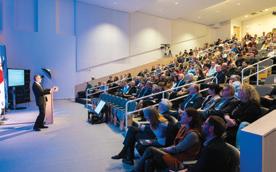
Learning from one of the world’s brightest minds was a high point Oct. 28, 2025, as 2024 Nobel Prize Laureate in Economics Dr. James A. Robinson delivered the inaugural Right Honourable Brian Mulroney Speaker Series address, highlighting how inclusive institutions foster prosperity in society. Mr. Robinson, a globally renowned economist, political scientist, and co-author of the influential

book Why Nations Fail, spoke before a packed crowd in the Barrick Auditorium in the Brian Mulroney Institute of Government. StFX Chancellor, Dr. Mila Mulroney ’04, along with sons Ben and Nicholas Mulroney, attended. The speaker series, hosted by the
Mulroney Institute of Government, with generous support from Barrick Mining Corporation in recognition of Mr. Mulroney’s long-standing role as
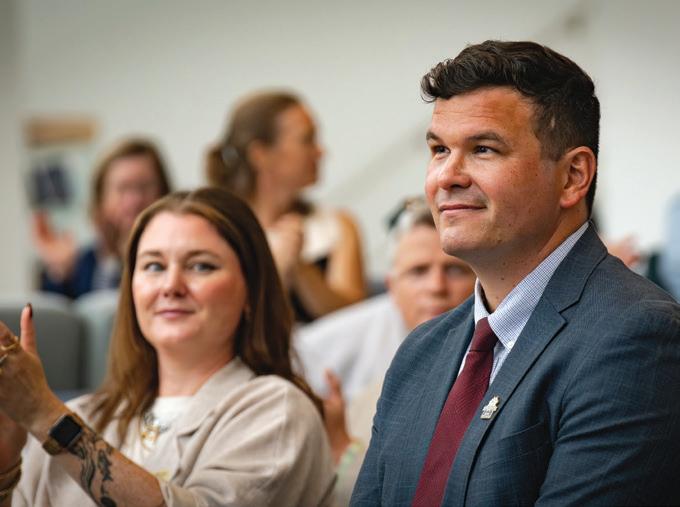
Chairman of Barrick’s International Advisory Board, builds on StFX’s legacy of exploring the most pressing issues policymakers face at all levels of government. John Thornton, Chairman of the Board of Barrick Mining Corporation, spoke about the late Mr. Mulroney during the afternoon event, describing Canada’s 18th Prime Minister and StFX alumnus as a person who understood that to do big things, one had to think boldly. “It’s in that spirit, we’re bringing to the Mulroney Institute people, who like Brian, think independently and think big. James Robinson is just such a thinker. It’s fitting he joins us as the first speaker in the series.” •••
Dr. Peter Kikkert awarded over $1.3 million to lead project for improvements to Arctic ground search and rescue
The diversity and vastness of Canada’s landscapes offer a unique challenge when it comes to search and rescue (SAR) operations, and regular improvements are key to saving people when they are in distress. In August 2025, Anthony Housefather, Parliamentary Secretary to the Minister of Emergency Management and Community Resilience, announced over $1.3 million in funding to StFX for a Our People. Our Place.
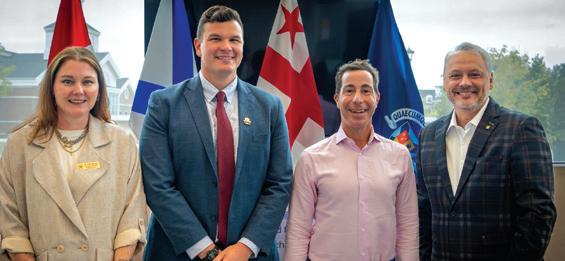
three-year project, Closing the Gaps: Addressing Critical Challenges in Arctic Ground Search and Rescue. Public Safety Canada will fund the initiative through the Search and Rescue New Initiatives Fund, which annually provides funding for projects that will improve Canada’s search and rescue system. Dr. Peter Kikkert, StFX Public Policy and Governance professor

Yukon’s newest premier is a StFX graduate. Currie Dixon ’08, who holds a degree in political science and history from StFX, was elected premier in November 2025. “The physical distance between the Yukon and Antigonish is huge, but in so many ways the people and culture of StFX were a perfect fit for someone like me coming from the North,” says Premier Dixon. “StFX is the perfect combination of both small town and small university atmosphere with academic excel lence and quality educational experience. I built relationships and friendships at StFX that I still carry today, and that have guided, supported, and helped shape my current career,” he says.
and Research Fellow at the Mulroney Institute of Government, leads the project. “Arctic SAR volunteers face harsh conditions, a changing environment, and vast search areas, often with limited assistance. This project builds on years of collaboration among researchers, Inuit responders and government partners, and will improve Arctic SAR by strengthening
“As for advice, I would remind current students that the friendships and connections they are building now will shape not just their careers or professional lives, but the course of their personal lives as well. Enjoy every minute of it.”
“I built relationships and friendships at StFX that I still carry today, and that have guided, supported, and helped shape my current
its governance, testing technology, and co-developing new capabilities, planning, and training tools rooted in Inuit Knowledge,” Dr. Kikkert said in an impassioned address during the announcement. StFX, along with researchers from Dalhousie and Memorial will work with government and community search and rescue responders from Nunavut and the Nunavik region to improve ground search and rescue prevention, preparedness and response by addressing some of the core challenges identified through previous research. The funding will allow the partners to co-develop solutions and continue this work, to have in-person meetings and co-develop planning rooted in Inuit Knowledge, and work on solutions that will help save lives “in the North, with the North, for the North.” •••

From learning why biofouling is a big deal to the power of numbers, nearly 80 African Nova Scotian high school students participated in a day of hands-on STEM-related activities as StFX hosted Black Excellence in Science Day Oct. 15, 2025. Importantly, the students had a chance to envision themselves as scientists and at university. Students arrived on campus from three provincial centres of education, Cape Breton Victoria Regional; Chignecto Central; and the Strait Regional Centre. “When I think about this day, I think of all the amazing students exposed to campus, and who see them as brilliant. I think of all the futures that are in play,” says Sasha Hayward-Isaac ’17 ’21, Coordinator of

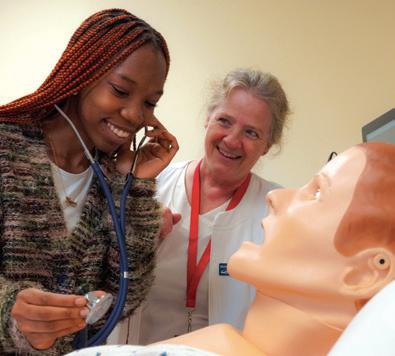
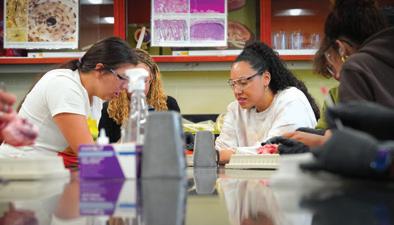
African Canadian Education Services with the Chignecto Central Centre for Education. Ms. Hayward-Isaac, who completed both her B.Ed. and M.Ed. at StFX, says it is important for the students, especially rural students, to see people who look like them at university and to feel welcome in this space. The day’s organizer, StFX faculty Dr. Wendy Mackey ’13 ’21. said the event is designed to introduce African Nova Scotia students to the university as well as its science-based programs and to let the students know this is a place they belong. •••
When Dr. Mary Oxner began her teaching career in 2000 as an accounting faculty member in StFX’s Gerald Schwartz School of Business, she asked her father, a retired math teacher, for classroom advice. His response was simple but powerful: “You’re teaching people.”
That guidance has shaped her approach ever since. She’s kept the
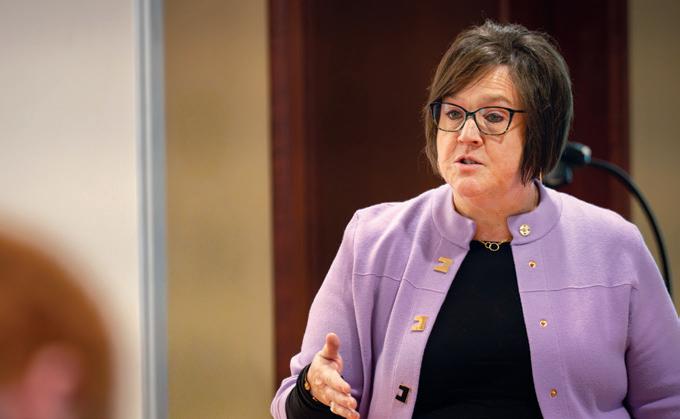
individual at the forefront as she’s taught countless students over 25 years.
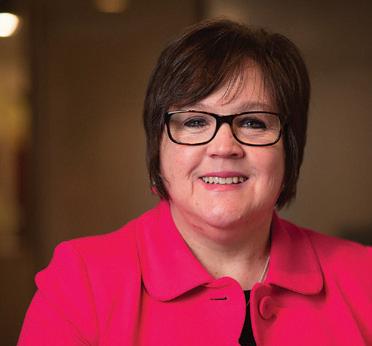
Now, Dr. Oxner, the Chair of StFX’s Department of Accounting and Finance, has been recognized for her exceptional commitment to teaching with the 2025 Association of Atlantic Universities (AAU) Distinguished Teaching Award.
“I’m thinking about the students and focused on what they may need,” she says. That might be delivering content with humour, sharing a word of encouragement after class, or making extra time for someone who’s struggling.
Her late father’s words helped her shift perspective from solely fixating on content and sharing expertise to thinking also about how and who she’s teaching. It’s important to her to create an inclusive, engaging learning environment where every student feels valued, supported and challenged to reach their potential.
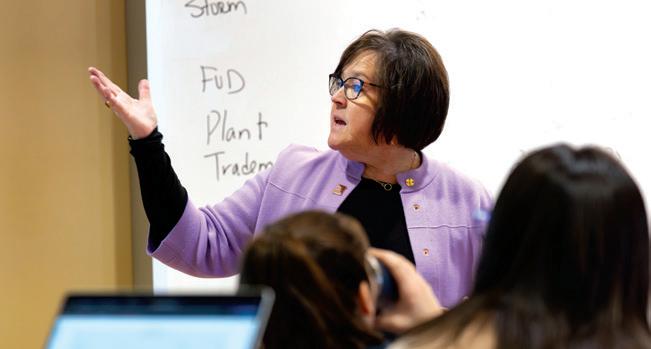
Experiential learning is also at the heart of Dr. Oxner’s approach
Her students regularly engage in hands-on projects that bring accounting principles to life, from analyzing real-world corporate governance cases to calculating the “cost of an egg” on a local farm. She has guided students in designing and delivering financial literacy workshops for vulnerable populations, supervised research projects that address community needs such as financial literacy for resettling refu-
Dr. Mary Oxner at a Glance
• 25 years teaching accounting at StFX
• Current Chair, Department of Accounting and Finance
• Service Learning has long been part of her teaching. She’s guided students in delivering financial literacy workshops for vulnerable populations to calculating the “cost of an egg.”
• Has led students to the New York Stock Exchange.
• Integrates research on Indigenous businesswomen in Atlantic Canada into her coursework.
gees and integrated service learning placements into her courses. She’s led students to the New York Stock Exchange and coached numerous accounting case competitions.
“Very early on, I heard about Service Learning here at StFX. I was really interested in that. It was a different way for students to learn and it included the community.”
It’s work to go beyond the classroom, she admits—be it planning field trips or arranging guest speakers—but it’s “well worth the effort” seeing the impact on students and the community. Recognizing that business case studies lean into the experiences of white men, Dr. Oxner is dedicated to bringing more minority voices into the conversation (including her own research on Indigenous women business leaders in Atlantic Canada) so that students see success from various perspectives and learn about other people in the world.
A 1987 StFX math and business graduate, Dr. Oxner initially planned to become a math teacher, but seeing a landscape with limited teaching opportunities, she pivoted and pursued a career in accounting. After a decade in the field, her dream of teaching called. She earned a PhD and began a career as a university professor.
“I love the spark people have when they’re learning something new. That spark lights something in me too.”
Dr. Oxner says she’s grateful for and enjoyed her years as a professional accountant, an experience which continues to offer her opportunity to contribute through regional to national board work. This work in
turn informs her teaching.
Her students, who bring new energy and ideas, and her colleagues, caring, innovative and inspiring people, continue to be her biggest motivation.
“I love the spark people have when they’re learning something new. That spark lights something in me too.”
In her award nomination, students describe Dr. Oxner as a mentor, someone who believes in them before they do. She deflects this praise. “I don’t think of myself as a role model. I do what I think is the best for the students and their learning and hopefully it works well for their learning.” Their undergraduate years are foundational, and her goal is to make that foundation solid.
Dr. Oxner says she’s honoured by the AAU Distinguished Teaching Award. “This is the career I chose. I’m delighted to teach at StFX, where some of the best students in Canada walk through our doors.” •••
Teaching Tip: “Have fun. You’re still doing the work, but the students will respond, they’ll engage, and they’ll have fun.”

William Shakespeare is back in the news thanks to a new Oscar-tipped movie, Hamnet, and StFX English professor and Shakespearean expert Dr. Laura Estill appeared on CBC Radio’s Day 6 on November 29th to share her insights.
A producer from Day 6, the weekly news magazine show hosted by Brett Bambury that offers a surprising take on topical issues, reached out to Dr. Estill, who also holds a Tier 2 Canada Research Chair in Digital Humanities, for her expertise on Shakespeare and the new adaptation.

Dr. Estill was interviewed about , the film, directed by Chloé Zhao and based on Maggie O’Farrell’s award-winning novel of the same name, that explores the life of William Shakespeare. Zhao and O’Farrell cowrote the screenplay.
“Shakespeare married Anne Hathaway, called Agnes in this version, when she was pregnant with their first daughter, Susanna,” Dr. Estill explains. “A couple of years later, they had two twins, Hamnet and Judith. Hamnet died when he was 11 years old, which is the action at the heart of
Dr. Estill says she enjoyed sharing her perspective on both the novel and
“Shakespeare continues to be relevant today, with new adaptations, translations, and scholarship. The story revisits what we know about Shake-
StFX Shakespeare expert explores the story behind Hamnet
speare’s biography and weaves a story of love and grief into the gaps in the evidence,” she notes.
“O’Farrell’s lyrical novel suggests that Shakespeare’s play Hamlet reflects a father’s grief for his son; the climax of the book is when Agnes goes to London and sees her husband performing as the ghost of Hamlet’s father. The novel ends with the ghost’s words that haunt Hamlet: ‘Remember me.’”
“Shakespeare continues to be relevant today.”
Dr. Estill says it was a pleasure to discuss O’Farrell’s novel, which “suggests that we should be both remembering and reimagining Agnes Shakespeare (Anne Hathaway).”
A leading scholar in Shakespeare studies, Dr. Estill has recently published articles and chapters about Shakespeare pedagogy and the history of Shakespearean bibliography. In January, a short monograph she co-wrote with Heidi Craig, Kris L. May, and Dorothy Todd will appear in the Cambridge Elements “Shakespeare and Text” series, titled Collaboration, Technologies, and the History of Shakespearean Bibliography •••
Our People. Our Place.



by Shelley Cameron-McCarron

Rankin
Dr.


StFX faculty, often guided by curiosity and purpose, are tackling issues that shape our world.





Step onto the St. Francis Xavier University campus and you feel it—the pulse of possibility. Students move between classes, all activity and energy, the palpable feeling of futures taking root.
Step inside one of the buildings, wander down a hallway, talk to those working inside, and you may notice something else too. Something equally energizing, but not always as evident.
In offices and labs across campus, faculty and students are asking questions, seeking solutions to some of society’s pressing issues. Nursing faculty are reimagining how health care can be more efficient. Education professors are looking for ways to help students realize their math potential.
From all corners of campus, faculty like StFX biology professor Dr. Russell Wyeth are wanting to make a difference in the world around them. He’s talking with local lobster fishers. Together with his students, he wants to help the industry move towards more sustainable and cost-effective bait by building understanding of lobster responses to bait by using laboratory experiments and underwater field video surveys.
Psychology professor Dr. Erin Mazerolle aims to expand access to brain imaging technologies for rural communities. She’s adapting a new tool, a Functional Near Infrared Spec-
troscopy (fNIRS), that’s portable, relatively low cost, and much easier to use than traditional imaging methods. Because of these advantages, it has strong potential to be used in clinical settings to assess conditions such as concussion, dementia and cognitive impairment, migraine, and stroke. It also has potential to be taken into people’s homes, giving them access to the resources they need and helping reduce waiting times for diagnostic imaging such as MRI.
Meanwhile, Bachelor of Arts and Science in Health professor Dr. Arlinda Ruco is leading research to boost colon cancer screening rates, saving lives through early detection. A leader in cancer screening and prevention, Dr. Ruco has received over $6.4 million in research funding to study ways to help more Nova Scotians participate in preventive screening.
Together, these stories help highlight the heart of research at StFX.
It’s work that happens at time without spotlight, but its impact extends into everyday life.
“StFX researchers are looking for solutions for real world problems that benefit society as a whole,” says Dr. Erin Morton, Associate Vice-Pres-
ident Research, Graduate & Professional Studies at StFX.
Faculty and staff, fueled often by curiosity and a desire to address issues in society, are actively working towards solutions.
Many are also training the next generation.
“Undergraduate students are given the unique opportunity to become involved in primary research early in their academic journey,” says Dr. Morton, who points to one of StFX’s hallmarks—faculty involving students, some as early as their first year, in meaningful research. StFX students often have opportunities to take part in hands-on research that can shape their careers, and their world views, and impact the world around them. “Graduate students at the master’s and PhD levels in Celtic studies, education, and in the Faculty of Science also contribute significantly to growing our campus research ecosystem,” she says. It’s that pulse of possibility.
Here, we introduce you to some of the people and projects at StFX that are strengthening research excellence.
“I’m hoping to help strengthen Canada’s and Nova Scotia’s positions. One of the objectives is to see Canada became a leader in green technology and energy transition. My goal is to help with that.”
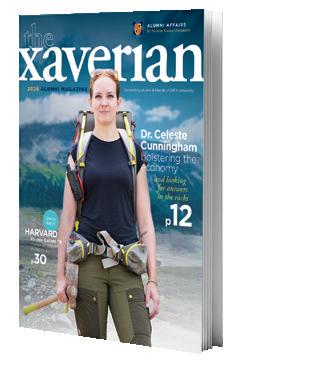
Dr. Celeste Cunningham, StFX Earth and Environmental Sciences

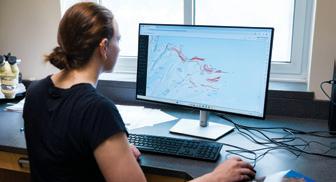

and looking for answers in the rocks
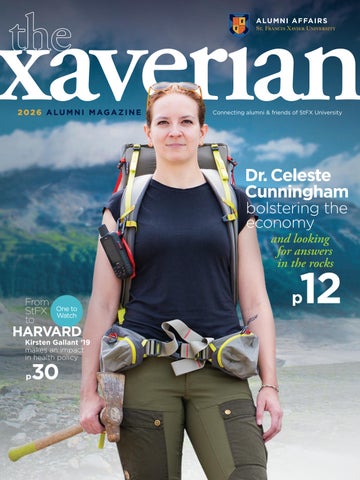
Ever since she was a child who stuffed rocks in her pockets, Dr. Celeste Cunningham has been fascinated with geology. Now, a StFX Earth and Environmental Sciences professor, she’s applying passion and expertise to help Nova Scotia—and Canada—transition to clean energy.
As a sedimentary geologist, Dr. Cunningham leads research focused on finding critical minerals—essential components for renewable energy, food production, healthcare, and more. “We need critical minerals for these environmentally friendly technologies, but we don’t want to damage the environment in the process. That’s why my focus is on looking at old seabeds and mine waste. It’s an environmentally friendly way to get these minerals.”
Both the Canadian and Nova Scotia governments have identified critical minerals as a priority area. Many of these elements are concentrated by sedimentary rock-forming processes.

“We need them, and they can be difficult to get. They’re limited in their global distribution,” says Dr. Cunningham. Developing a regional supply would bolster the provincial economy and protect from global supply chain disruptions.
“I’m hoping to help strengthen Canada’s and Nova Scotia’s positions. One of the objectives is to see Canada became a leader

in green technology and energy transition. My goal is to help with that.”
Dr. Cunningham’s most recent research involves a preliminary study investigating coal-bearing rocks around Nova Scotia with an intent to study pre-existing mine waste in former coal mines to determine the concentration of minerals. “Could we repurpose that waste in a more environmentally friendly way?” she wonders.
The second area taps into a burgeoning interest in seabed mining, often difficult, expensive, and potentially environmentally disruptive. Fortunately, Nova Scotia has ancient seabeds exposed on land and she’s looking to see if we can access them and whether they have critical mineral deposits.
Her work has been funded three times by the provincial Department of Natural Resources and Renewables, as well as by a Canada Foundation for Innovation (CFI) grant with matching funds from Research Nova Scotia. So far, she’s mentored six undergraduate students in the research.
“I love being outside, in nature, seeing all these incredible locations, and being around the cliffs and beaches and completely involved in and immersed in the geology. And you have a problem to solve. I always feel like a detective, with these clues,” says Dr. Cunningham. “The clues are in the rocks. It’s our job to go and read them. I love that aspect.” •••
Putting the joy
Researchers inspiring new approaches to learning
In an overstretched health care system, nurses often lack timely access to critical patient information.
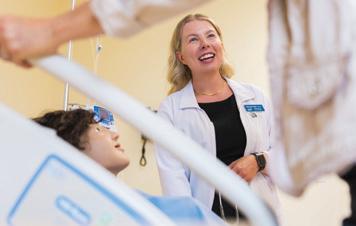
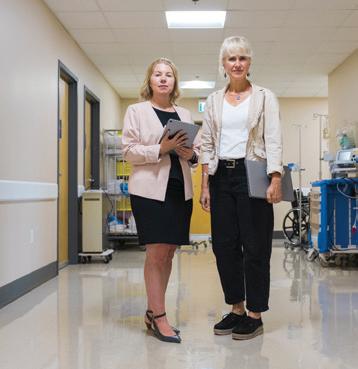
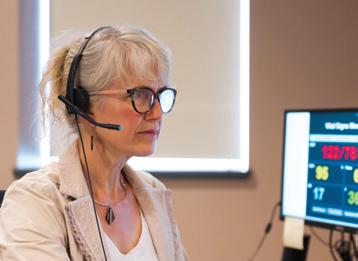
To address this, StFX Rankin School of Nursing professors Dr. Patti Hansen-Ketchum and Meagan Ryan are leading an interdisciplinary team to develop a first-of-its-kind software platform aimed at improving communication and care coordination.
“It is an RN digital-led technology that would be new to Nova Scotia and to Canada,” says Dr. Hansen-Ketchum.
The platform would centralize patient data to support real-time communication and collaborative care planning, replacing current and often uncoordinated methods like faxes, phone calls, and hallway conversations.
Dr. Hansen-Ketchum says she’s excited by how this RN-led work could
improve health care efficiencies. “It is helping you get the data quicker, in real time.”
“We know the health system is under a lot of strain currently, and there are gaps in communication and collaboration of the team. This project is helping develop digital technologies that will help bridge the gap,” says Prof. Ryan. “These are real world issues that are experienced in every hospital.”
Backed by a team of faculty from engineering, human kinetics, and computer science, and with support from student research assistant Aidan Murdock, the team has tested the platform in StFX’s Nursing Simulation Lab. They are now piloting it in partnership with a local long-term care facility to gather real-world feedback.
“It is helping you get the data quicker, in real time.”
Dr. Patti Hansen-Ketchum, StFX Rankin School of Nursing
StFX education professors Dr. Marc Husband and Dr. Evan Throop-Robinson are working to shift how students and teachers experience mathematics. With backgrounds as classroom teachers, they’re tackling the growing concern over math proficiency in Canada, especially in light of declining PISA scores.
Their goal? Help students, especially in elementary school, see themselves as capable math thinkers and reduce the anxiety often associated with the subject.
“We have a whole bunch of people who don’t see themselves as math people,” says Dr. Husband. Dr. Throop-Robinson agrees, often hearing the sentiment: “Math is for people who can do it, not me.”
This is part of the problem, they say. A key part of their research focuses on Number Talks—short, regular discussions about mental math strategies. These help students visualize numbers, build flexible thinking, and shift focus from simply getting the right answer to understanding how they got there.
Rather than promoting a one-sizefits-all approach, the professors encourage student-led strategies and public discussions of mathematical ideas. “Math is creative and fascinating,” says Dr. Husband. “It’s about ideas, not just rules.”
Their classroom-based research shows promising results. Teachers report growing confidence, both in themselves and their students, as
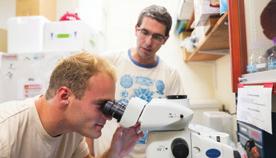
StFX biology professor Dr. Russell Wyeth is leading research to help the Nova Scotia lobster industry transition to more sustainable bait sources and to reduce the environmental impact of biofouling through low-toxicity antifouling products. His work also includes studying the neurobiology of slugs and snails. All his work is tied to understanding how animal senses influence behaviour.

This understanding may have major benefits.
Lobsters navigate using odours and water flow, and fisherman exploit this by baiting their traps to attract them. However, little is known about optimal bait types and the odours in plumes that attract lobster. Dr. Wyeth’s goal is to build understanding of lobster responses to bait by using laboratory
math becomes more accessible and joyful. This work also informs teacher education at StFX and in the Certificate in Elementary Mathematics Education program.
Ultimately, the researchers hope to reshape perceptions and open doors. “Math shouldn’t be a gatekeeper,” says Dr. Throop-Robinson. “Everyone should see themselves in it.” •••
experiments and underwater field video surveys. They’re interested too

in larger scale lobster movement patterns relative to bait odour plumes generated by lobster traps and analyzing chemical constituents of bait for their attractiveness.
A primary driver behind this research to is help lobster fisherman improve bait’s cost-effectiveness.
Fisheries and Oceans Canada has closed the commercial mackerel fishery due to declining stock and the use of herring is limited too. The price is also rising.
“The economics and science are saying the same thing: you maybe shouldn’t be relying on these traditional baits,” he says. “If my science can help with that, that would be great.”
Invest Nova Scotia and the Atlan-
tic Fisheries Fund have been major funders of this work in the past, along with local harvest organizations. While the work is currently paused, Dr. Wyeth says there are active conversations ongoing looking for the right opportunities.
Meanwhile, his lab is studying the population and behaviours of juvenile lobsters. Working in a marine protected zone, they’re working to establish important baseline data.
On the biofouling front, the Wyeth Lab is one of the few exploring ultraviolet light as a non-toxic antifouling solution.
Of note, the lab recently published research on what they believe to be the first hard (durable) fouling release coating, developed with longstanding collaborator, GIT Coatings. The coating makes it harder for organisms to stick, rather than killing what is sticking.
Each summer, Dr. Wyeth employs about 10-15 students and introducing them to science is a huge motivator. “It’s fantastic to watch their progression.”
“Math shouldn’t be a gatekeeper.”
Dr. Evan Throop-Robinson, Faculty of Education

it’s all about science into impact
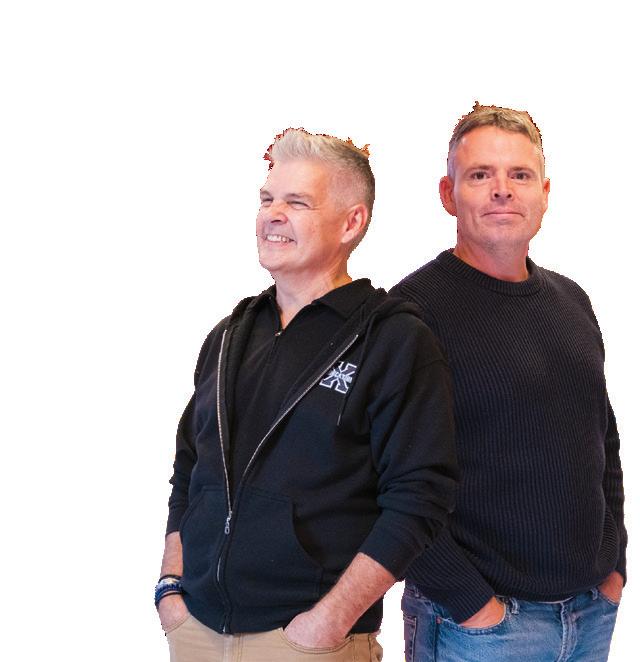
One of the world’s largest teams dedicated to methane measurement is housed in a busy lab on the StFX campus. At its forefront is Dr. Dave Risk, an Earth and Environmental Sciences professor and Research Chair in Climate Science and Policy at StFX’s Brian Mulroney Institute on Government.
“I see science as a tool to solve problems in society. I like the impact,” says Dr. Risk who has spent two decades developing better ways to measure and manage greenhouse gas emissions, particularly methane. Dr. Risk leads the FluxLab, a group of about 25 researchers, including undergraduate students to postdocs, often asked by waste companies, oil and gas operators, government, industry, and agencies to help develop tools, run field tests, and improve emissions tracking. More than twothirds of their work is international. One of their most high-profile projects is the Simulation Facility for Landfill Emission Experiments (SIMFLEX)—a

“I see science as a tool to solve problems in society. I like the impact.”
pioneering 30-acre controlled emissions research facility in southern Ontario that Dr. Risk’s lab operates on behalf of a nonprofit called the Environmental Research and Education Foundation, representing the major North American waste companies. It is the only site of its kind in the world where measurement companies can test their methane detection technologies under realistic conditions. It looks and acts like a real site, with complex wind patterns.
Testing is important. When people understand their emissions, they become more accountable, he says, and often see dramatic improvements. “I really like being in these conversations,” says Dr. Risk who sees it as an extension of his work to help regulators make better decisions through access to better data.
During the past year alone, the FluxLab delivered projects on three continents and collaborated with space, air, and ground-based sensor companies in eight countries. It has conducted measurement campaigns across the country to help Canada report emissions more accurately. While the work has taken them across the country, and the globe, their research is also rooted in issues at home in Nova Scotia, including conversations around significant methane sources in the province; and the province potentially positioning itself as a leader in
hydrogen. Dr. Risk, who’s involved in an International Energy Agency panel making recommendations on how to manage hydrogen, is in conversation with the people behind the proposed wind farm project for the province. Since founding FluxLab in 2006, Dr. Risk has become an in-demand expert, earning accolades from early recognition in his career from the Royal Society of Canada and is regularly sought out internationally as a speaker, giving invited talks as far away as Australia. Additionally, several companies have spun out of his lab, and alumni have gone on to roles in government, tech startups, and climate initiatives.

Dr. Risk says the FluxLab’s work is all about impact, in trying to reduce the carbon intensity of energy production, to make better energy choices, and have cleaner air. •••
Calling all Calgary alumni! Come meet Dr. Dave Risk ’02, who will be a featured speaker at the upcoming NeXT Level event in Calgary in April. All alumni are welcome to attend. For more, please contact the Alumni Affairs: alumni@stfx.ca or 902.867.2186.

Dr. Marcia English is leading an ambitious project to develop two new plant-based food products that could benefit school and hospital settings. Dr. English, professor and chair of the StFX Human Nutrition Department and Canada Research Chair in Protein and Flavour Chemistry, has partnered with a Nova Scotia food producer to develop a plant-based high protein pasta sauce for use with school food programs and to expand the company’s frozen mashed potato product, sold to the Nova Scotia Health Authority, to give consumers another option with a high protein content.
“This is a really exciting initiative,” says Dr. English, who’s received $15,000 in Tier I Productivity and Innovation Voucher Program (PIVP) funding for the research. PIVP is offered through Invest Nova Scotia and helps small and medium-sized companies access post-secondary expertise to improve productivity, develop a new product or service, and grow their business.
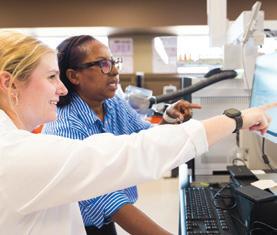
The goal is for Dr. English and her team of two students to develop these products working with the company. Their mission is to upcycle and market otherwise wasted produce, such as apple fibre, into useable products.
Dr. English says the project has a lot of exciting aspects. For one, it invests in local food processors.
Developing a new plant-based pasta sauce could also have a huge impact on school food programs. Currently in Canada, school food programs aren’t consistent across the country, she says. Developing a nutritious product in Nova Scotia, with the possibility to expand further afield, would have a huge impact in improving the quality of the food in the school program. Plus, it would reduce food waste and help eliminate the use of more processed foods.
Dr. English is also hopeful the work may increase awareness of healthy food choices from an early age.
“It’s exciting because we are a small university in rural Nova Scotia and we get to contribute to work that can impact students and consumers across the province and across Canada.”
Dr. English will be working in StFX’s Sensory Lab to develop an appealing texture and taste profile, an important part of the research that will feature participant feedback. Not only is it important to develop a nutritious product, it must taste good too. “Ultimately, with the consumer, the buck stops there,” she says with a laugh. “If they like it, we’re good to go.”
The research will be challenging and invigorating, drawing on fundamental sciences applied to food systems, says Dr. English, a StFX faculty member since 2014. Dr. English is also president of the Canadian Institute of Food Sciences Technology, the governing body for food science and technology in Canada. •••
“We get to contribute to work that can impact students and consumers across the province and across Canada.”
Dr. Marcia English
Professor & Chair of the StFX Human Nutrition Department and Canada Research Chair in Protein & Flavour Chemistry
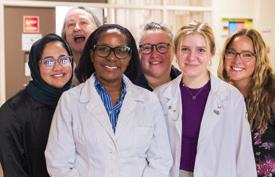
“Bullying is a significant threat to the well-being of Nova Scotian youth,” says StFX psychology professor Dr. Laura Lambe, who is a registered clinical psychologist and expert in youth relationships and mental health, bullying prevention, and bystander intervention.
“The Auditor General’s Report on School Violence indicates a 60 per cent increase in school violence in Nova Scotia over the last seven years, with a 196-285 per cent increase in racist and discriminatory behaviors. It is
“Bullying is a significant threat to the well-being of Nova Scotian youth.”
Dr. Laura Lambe Department of Psychology
likely that many of these behaviors overlap and reflect identity-based bullying, in which students are targeted based on their gender identity, sexual orientation, ethnicity, religion, weight, and/or disability. Students from equity-deserving groups are especially affected by identity-based bullying; however, the well-being of entire school communities is negatively impacted by school violence,” says Dr. Lambe, the principal investigator of the IVY Lab: Interrupting Victimization in Youth.
Dr. Lambe has received $99,937 in award funding from the Nova Scotia Office of Addictions and Mental
Health, through the new Investigator in Addictions & Mental Health grants, delivered by Research NS for her research on “Understanding the mental health impacts of witnessing identity-based bullying.”
Her research aims to better understand the impact of witnessing identity-based bullying on student mental health through both quantitative and qualitative research. She will also explore whether bystander intervention buffers the negative impacts of identity-based bullying on student mental health.
Dr. Lambe’s research is designed in collaboration with a Youth Advisory Committee, who will give input on each phase of the project to ensure it aligns with adolescents’ experiences.
Funds from Research NS will be used to hire research staff and students to conduct the research, and to collect data from adolescents recruited from the Antigonish community.
Data gathered from this research is critical for designing safe and effective bullying prevention efforts, especially those that aim to reduce bullying through bystander intervention, she says.
Results from this research can be used to design prevention programs that recognize the layered and cumulative impact of both direct and vicarious victimization. Dr. Lambe says findings are especially relevant in Nova Scotia, where the Mass Casualty Commission has recommended the promotion of bystander intervention among all age groups as a tool to end the epidemic of interpersonal violence in the province. •••

with Eileen Alma Executive Director, Coady Institute
We are working in a world of “polycrises”—overlapping shocks at global and local levels that amplify one another and unsettle our assumptions. Ruptures of all kinds are visible: some hopeful and regenerative, others harmful and corrosive. Youth are both the barometer and the engine of this moment. They navigate a public sphere crowded by proliferating ideologies and identity claims that can deepen division or forge unexpected solidarity.
At the same time, powerful forces push against equity, justice, humanity, and morality. Too often, narrowly defined, interest based economies and a return to nationalistic paradigms entrench “us versus them,” while the pendulum on human rights and gender equality never seems to rest—struggling against a deliberately crafted discourse that seeks to perpetuate imbalances of power. Insecurity is becoming normalized for too many communities, where staying alive replaces the space to thrive. The callousness with which various leaders treat people and the Earth’s gifts begs the ques-
tion: are we not better than this? Must power and ego be the organizing principles of our future? Amid it all, we must keep asking, what does a full and abundant life for all look like—and how do we prepare for it?
At Coady Institute, the possibility of the world moving in multiple directions demands adaptive learning that meets the daily urgencies of societies. We have been here before. While we have evolved, our foundation beginning with the Antigonish Movement offers vital lessons of how a small place rose to meet the critical challenges of its time, shared its knowledge, and helped others do the same.
Today’s work requires critical conversation about what development is, the practices it privileges, and the ideologies it reproduces. We must draw on community-driven knowledge that genuinely contributes to democratic processes—knowledge that is accountable to people, not just to institutions.
Artificial intelligence is both a disruptive force and a connector, widening access while accelerating the spread of contradictory worldviews. Meanwhile, disillusionment with international institutions grows and funding ecosystems are stretched thin. What is left of “foreign aid” still moves from poor people in rich countries to rich people in poor countries. We need reliable information for an informed public; if we speak only to ourselves, we leave room for youth to be courted by right wing populism. As Italian philosopher Antonio Gramsci would have described it, we live in an interregnum: the old order is fading, the new has not yet formed, and uncertainty coexists with immense possibility.
Community engagement gives me hope. Communities remind us that government cannot do everything; civil society’s role is irreplaceable, and change begins at home. Education matters and endures. Technical capacity is important but even more critical are people’s determination, resilience, time management, adaptation,and local knowledge. Indigenous peoples are taking rightful places across political, social, and economic spaces, offering
“Today’s work requires critical conversation about what development is.”
models of leadership that show how it should be done. Activists demanding accountability continue to show their bravery and welcome inter-generational collaboration. Coady Institute may have had a small hand on the learning journey, but their agency and determination lead the way. And there is the everyday generosity of people: big and small acts, and kind words that sustain our collective courage and create joy.
Our task, then, is to co-create educational offerings and provide choice with integrity: to orient toward abundance for all and stand with communities. Collectively, we will keep learning and move decisively from contention and competition to construction and collaboration, from interregnum to renewal.


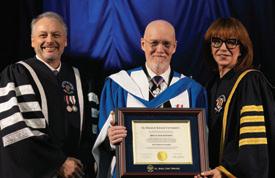
Bruce MacKinnon stands among Canada’s most influential editorial cartoonists, known for his keen insight and razor-sharp wit. Over his 40-year career with the Halifax Chronicle-Herald, his work has earned international recognition, a long list of national and global honours, and appointment to the Order of Canada. On Dec. 6, 2025, StFX celebrated the Antigonish, NS native by conferring upon him a Doctor of Laws honoris causa at Fall Convocation. We caught up with the celebrated cartoonist to reflect on his craft, his career, and the power of a well-drawn line.

You grew up in Antigonish and attended St. Francis Xavier University. What does it mean to you to receive and honorary degree? It’s pretty overwhelming, honestly. Looking back on that time, which seems so long ago now but so important in terms of being the foundational years of my life, is a very emotional experience. Growing up in Antigonish with my father, Neil MacKinnon, teaching history at X, the university was such an integral part of our lives as a family. I grew up playing hockey at StFX Memorial Arena, pickup football with my high school friends on Memorial Field and I became a rabid basketball fan watching Coach K’s (Steve Konchalski) extraordinary run with his great varsity teams. Being exposed to the music and concerts at Immaculata Hall and having access to all the cultural, athletic, and academic facilities that the university was able to share with the town was a privilege, the level of which I really didn’t even understand at the time. Just driving through the town over Fall Convocation weekend, with our host, friend and former StFX Advancement director of development, Iain Boyd ’75 along with his wife Margaret, brought back a rush of memories and so many stories, weaving

those connections back together after all these years. The significance of it all really hit home.
What sparked your interest in editorial cartooning? I just loved to draw. I guess I had some innate ability and was bold enough to go after some opportunities to use that ability on the encouragement of some friends and family. I got a job doing a weekly cartoon for the local paper The Casket when I was in Grade 9. That’s where I learned to meet deadlines. While my buddies were out playing street hockey, I had to be inside working on a cartoon for Thursday’s paper. You learn that it’s not just fun, it’s work, and some sacrifices must be made if you’re going to get better and go anywhere with it. I was lucky in a lot of ways. Being paid to draw cartoons as a young teenager was not a common thing and it had its ups and downs. Back then I certainly didn’t have myself convinced that I would be lucky enough to spend my life drawing cartoons for a living, but I knew I loved doing it. And with that early experience, the possibility was always in the back of my mind.
Was there a moment or mentor at StFX? My greatest mentor at X was my father though that had little to do with art or cartooning. I did take a painting course during my one fulltime year at StFX, but there was no fine art degree program, so I had to
move on to other universities to pursue my art-related goals. X has a more well-rounded and better equipped art department now than it did back then, and I was fortunate to have been taken on a tour of the department during Fall Convocation weekend and to meet some of the instructors and students who were working on their final projects for the semester. I saw some inspiring work and was impressed by their expanded facilities. As far as my career plans were concerned back in the early ’80s, after a year in the liberal arts program trying to decide what direction I wanted to go, I was accepted into the jazz program at X and the fine arts program at Mount Allison. In the end, I decided my jazz chops weren’t likely to take me as far as my art.
Could you talk about where you draw inspiration or approach a news story? It’s a very intangible thing. There’s no formula, that I know of anyway. I start out every day in the same way, in the early morning reading the paper and scanning other news sources for what might be the most high profile stories, or what is on most people’s minds. At a certain point I try to narrow it down to one or two stories and think of visual metaphors that might allow me to express my opinion with humour, impact, poignancy or, on a good day, all of the above. How I arrive at that end is different pretty much every day.
Sometimes I have to use devices like wordplays etc. but most of the time I try to boil things down to the visual essence of a concept whenever I can. If it’s a big news story, often my own emotional response can be the inspiration for the cartoon.
What do you most like about the job? Drawing faces, specifically caricatures, has always been my favourite part. I can get lost in it. It’s always a challenge to get the essence of someone’s likeness and try to exaggerate it in such a way that works best for the humour and visual impact of the cartoon. I find that rewarding. That said, just being able to draw for a living and express my opinion in ways that can influence the opinions of others, and even effect change, is extremely fulfilling.
What are your three most iconic cartoons? Do you have a favorite? It’s really hard to pick one or even a few. Cartoons go over big for different reasons and some of my favourites didn’t necessarily make the big waves, or will be as remembered as, say, the war memorial cartoon (the one done in the wake of the shooting death of Corporal Nathan Cirillo

at the National War Monument in Ottawa). That one had as much impact as any cartoon I can ever remember doing. It went around the world and affected so many people that the response in terms of email and social media lasted for years afterwards.
I’ve had many cartoons go viral in the last decade
or more and those are often the cartoons that are remembered most by people. But I’ve also been working since well before social media and the internet, and I can remember Mulroney cartoons from the early ’90s that won national awards and are among my favourites for humour and impact. There are also cartoons that just made me laugh like an idiot, and others that I really liked because the drawing came out well, but everyone has different tastes and may like a cartoon for different reasons.
What career milestones stand out?
Lasting 40 years in the profession without having been fired, sued, or physically assaulted represents a fairly
significant milestone to me. I also never thought a job drawing cartoons for a living would lead to things like having my work on a national stamp or being recognized by my hometown university with an honorary degree. There have been a lot of unexpected and very humbling milestones. Frankly, every morning I wake up these days is a pretty notable milestone.
You’ve been described as fearless in your cartooning. Is that essential for the role? It helps to be angry and obnoxious. Seriously, it’s a fine line because you may think you can say anything, but your editor and publisher have the final word on whether your cartoon gets published, so to a
degree you have to temper what you produce with the knowledge that if you go too far, no one may ever see the cartoon. I find myself pushing the line until the final arbiters decide I’ve gone too far, and then I have to pull back, at least enough to get published but still say what I want to say. Until I own my own newspaper, that’s just the way it is.
Is it harder or easier to create editorial cartoons in today’s political climate? I think it’s a bit more difficult just because the level of absurdity in politics right now, especially south of the border, is so extreme it’s sometimes hard to outdo it. Our job as editorial cartoonists was always to make

the powerful look ridiculous. What do you do when they already look so ridiculous it defies description? Sometimes it’s hard to compete with that or even remind yourself what baseline normal is. Still, there are very few dull news days lately, so that much is good.
What advice would you give to today’s students?
I’m such a dinosaur, such a complete anachronism in today’s cartooning world, that I’m probably not qualified to advise the young cartoonists of this millennium how to find success. I’ve worked for one newspaper all my career, but it doesn’t seem like that’s where the political cartooning jobs are necessarily going to be in the future. More and more cartoonists today are turning to crowdfunding-type platforms like Substack to sell their own work or at least supplement their income. Maybe newspapers will
regroup and establish themselves as successful online multimedia publications while just moving away from print, but it’s always hard to know how things are going to evolve. I know that cartooning and satire have many outlets online but, unfortunately, the kids of today could tell me a lot more about that than I can tell them.
What’s something surprising about yourself? I play music professionally and hockey unprofessionally. I’ve always moonlighted as a musician, throughout my cartooning career, playing bars and events in various bands and sometimes solo. For the last 20 years or so I have had the incredible good fortune of being able to play as a duo with my son every Saturday afternoon at a downtown Halifax pub. We have a ball, and I just always feel like I’ve won the lottery. Not many dads get paid to play music with their son. On the other hand, nobody’s paying me to play hockey. Like, ever. •••
Widely regarded as one of the most outstanding honorary degree addresses, Dr. Bruce MacKinnon’s acceptance speech can be viewed at stfx.ca/DrBruceMacKinnon






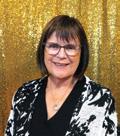

























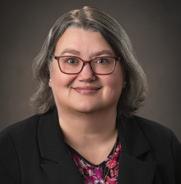
When Kirsten Gallant ’19 started as an undergraduate student at St. Francis Xavier University, she never dreamed she’d one day be pursuing a fully funded PhD at Harvard University. Yet, looking back, she can see how every step—from her early research opportunities on campus to her work in health economics. work that kept opening questions she wanted to explore—paved the way.
Today, Ms. Gallant, an Antigonish, NS native, is studying in Harvard’s Health Policy PhD program. It’s one of the only programs that provides comprehensive training in decision science, her concentration, a field that blends economics, health outcomes, and patient values to guide more informed healthcare choices.
“Not a lot of people know what decision science is,” she explains. “I think of it as a roadmap for physicians and policymakers for making informed decisions when they’re facing uncertainty and limited resources.” It doesn’t just ask: does a treatment work? It asks: Is it worth it? Is it meaningful?
“Decision science,” she explains, “provides a framework for breaking down very complex problems into clear, structured analysis.” What draws her to the work
is how it integrates clinical outcomes, economic considerations, and patient values. “It pushes the conversation past the question of whether a treatment is effective, toward understanding its value, determining who stands to benefit, assessing its meaningfulness to patients, and ensuring these decisions are made fairly. These are the questions that I find most compelling.”
Says Ms. Gallant, “I want to do research that is genuinely useful, work that helps policymakers and regulators make better health decisions and ultimately leads to improved outcomes.”
Ms. Gallant says her interest in health policy really started at StFX.
Her thesis supervisor, math professor Dr. Ryan Lukeman ’03, provided her first chance to do applied health research, He had approached her about a project, building a simulation
model for opioid harm reduction in Toronto, that was outside his usual field. But he thought it would interest her. They modeled thousands of people over time to figure out which interventions would prevent the most overdoses. Ms. Gallant even travelled to Toronto to speak with frontline workers. The research was published in the Harm Reduction Journal and “was really my first exposure to what decision science looks like.”
The experience taught her much about quantitative skills but also to better understand how to ask the right questions and generate evidence useful for policy.
“That was a turning point for me,” she recalls.
“I realized how much I enjoyed using quantitative tools to answer real questions about access and care delivery…I felt generally invested in a way I hadn’t before.”
Many concepts and skills she learned at StFX continue to shape
“I want to do research that is genuinely useful, work that helps policymakers and regulators make better health decisions and ultimately leads to improved outcomes.”
her work in health policy, says Ms. Gallant, who studied economics and math, graduating both with first class honours and first in her class. She’s always seen her work in health policy as a meaningful application of her education, rather than a departure from it.
After graduating from StFX, Ms. Gallant deferred master’s study and spent two years working at the Bank of Canada in Ottawa, an opportunity sparked by an engaging economics course. “Dr. Greg Tkacz made central banking sound fascinating. And StFX has always had strong connections to the Bank so there were alumni I could reach out to who all spoke highly of the experience.”
During those two years, she learned a lot about policy and large-scale analysis. Still, something kept drawing her back to health.
In 2021, she began an MSc in International Health Policy (Health Economics) at the London School of Economics and Political Science, a leading institution in this field, graduating top of her class and earning the Brian Abel-Smith Prize for best overall performance.
From there, she worked for three years with Analysis Group, a global economic consulting firm in London, in its healthcare practice. She worked on health economics and outcomes research projects, modeling disease burden, evaluating cost-effectiveness of cancer treatments, and conducting surveys to better understand the patient journey and preferences in treatment. She got to see how evidence
shapes what drugs get covered and how care gets delivered. “It was fascinating work,” Ms. Gallant says.
Working alongside many PhD-educated colleagues who approached problems with deep expertise motivated her to take the next step—doctoral study. “It really inspired me to gain that same level of depth.”
Ms. Gallant arrived at Harvard this past August for a five-year PhD program that’s interdisciplinary in nature, bringing together economics, epidemiology, mathematics, and behavioral since.
It took a little adjusting back to student life, but her experience so far has been incredible. The work is challenging, but she’s getting to do meaningful research while building new skills and ways of thinking.
“Somedays when I walk through campus, I am still in disbelief that I get to learn from world-class researchers doing work that genuinely shapes policy.”
Down the road, Ms. Gallant says she would love to teach.
She grew up watching both her mother (StFX nursing professor Dr. Donna Halperin ’93) and her grandfather (the late Dr. Charlie Gallant ’61) teach at StFX. Seeing the impact they had on their students and how rewarding they found the work left a lasting impression. She also wants to pay it forward, the guidance she’s received from mentors and advisors.
“Both my parents work in healthcare, so I grew up seeing how meaningful it is to work in a field that directly affects people’s lives. I saw the academic side through my mom, the practical side through my dad (Dr. Steve Gallant ’85), and health policy felt like a natural way to bring those together. It lets me do research that informs how we deliver care.”
Ms. Gallant credits her success with mentorship and opportunities she found at StFX. Among them, she worked as a teaching assistant, and conducted research all four years of
her undergraduate degree, which later resulted in two first authored publications.
“When I was first applying for jobs and graduate school, I thought coming from a small school on the east coast that nobody knew was going to be a limitation, but I quickly realized it was a competitive advantage.
“At bigger schools, I would have been just another student, but at StFX, I got to conduct research and teach as an undergrad – which is pretty rare and really allowed me to build my confidence as a researcher.”
StFX faculty truly invested in her, she says, and when she got to the London School of Economics, she realized she was more prepared than people from bigger, more prestigious schools. “StFX’s size was never the obstacle. It was the whole point.”
StFX remains close to her heart. She grew up in the community, met her husband in an economics class on campus, and keeps in touch with her professors. No matter where she’s lived, she says she’s always felt connected to StFX.
Driven, determined, and curious, Ms. Gallant says her path hasn’t been linear—but it’s been rewarding. “Whatever I’m doing, I give it 100 per cent. If you do that, the opportunities will find you.” •••
Reflecting on her journey—from StFX to Ottawa, from London to Harvard— Kirsten Gallant shares four pieces of advice for today’s students:
1. Choose possibility over fear. Don’t make decisions based on fear, but on hope and possibility. It’s easy to think ‘why would it be me,’ but reframing that to ‘why not me?’ will open many doors.
2. Follow what energizes you. “Pay attention to what excites you,’ she says. Your interests will evolve. Hers did. And that’s okay. It’s never too late to take a different direction.
3. Find good mentors. She often chose opportunities based on who she’d be learning from. This always worked out in her favour.
4. Trust the process. Things may not work out right away, and you may not like something immediately, but trust you’ll land on your feet.


As a born and raised Calgarian, hockey was something Laurenne Mercier ’16 knew well. She laced up her skates for 13 years of minor hockey in Okotoks, AB, but never imagined the game would lead to a career, especially not one with the Boston Bruins, one of the NHL’s most storied franchises.
Ms. Mercier’s journey began with a cross-Canada move to Antigonish, NS, to pursue a sociology degree. By her third year, a conversation with a friend about hockey culture on campus would set her on an unexpected path.
“We started talking about the way hockey is idolized in Canada and the reasons behind that,” she recalls. “The more we talked, the more I realized there was likely research and literature around the topic, and it was something I wanted to further explore.”
With the support of her professor, Dr. Lynda Harling Stalker, she developed her honours thesis, “Look Out for Him, He’s a Hockey Player”, which earned the Canadian Sociological Association Award and opened her eyes to the “behind-the-scenes” side of sports.

After graduating, she knew the best path to enter the sports industry was via an internship. This led her to Durham College’s Sports Business Management program, which offered one. Within her first week, she had secured an internship with the Nashville Predators in their community relations department and kickstarted her career in sports.
That year, the Predators made it to the Stanley Cup final, giving her two extra months of experience. “I shadowed as many departments as possible and got to know as many people as I could.” One area that stood out was Team Services, where she was mentored by department director and fellow Canadian, Brandon Walker. “I knew that doing a role like Brandon’s was my ultimate goal.”
From Nashville, she joined the Edmonton Oilers in their Hockey Programming department before returning to Calgary to be closer to family. There, she founded her own
company, Treadstone Sports Agency, helping athletes build authentic personal brands with a philanthropic approach. While she loved the work, she missed being on the team side of sports.
Networking remained central to her journey. Based in the NHL city of Calgary, she jumped at every opportunity to connect with personnel from incoming teams. A chance meeting with Boston Bruins’ Team Services employee Ali Mitchell turned into a lasting friendship and Ms. Mercier’s ticket to Boston.
When Ms. Mitchell’s position opened in 2022, Ms. Mercier seized the chance for an interview. “I went through a rigorous interview process, received an offer, and a month later was shipping up to Boston.”
As one of only a few women in her role across the NHL, Ms. Mercier says she is conscious of the barriers that still exist for women in sport. From facility designs that overlook women’s needs to stereotypes that question a young woman’s intentions in player-facing roles, she notes challenges remain.
At the same time, she has seen progress. “More and more, we’re seeing women in management and executive positions, most recently a coaching position,” she observes.
“I feel like the conversation has shifted to a more equal playing field for women in sports.”
Among her peers and cohort of Team Operations staff across the league, she has never felt a lack of equality or respect.
Ms. Mercier says her work is demanding yet rewarding. A special moment came last season when then-captain, Brad Marchand, took time to express his gratitude for her work. “To him, it was a small compliment, but to me, it was extremely rewarding and went a long way.”
Looking back, Ms. Mercier emphasizes the importance of relationship for allowing her to learn the value of genuine connection.
Her main piece of advice to students? Always be networking, but more importantly, be networking genuinely. “It isn’t about the end game or how someone can get you to your next goal. It is about a community of people helping others and to be your authentic, genuine self throughout the process.”

Alumni Profiles


Before leading a billion-dollar company revolutionizing battery technology, Dr. Chris Burns ’09 was a StFX physics student with a knack for seeing what others missed.
In 2013, while still a graduate student, he co-founded a company called NOVONIX after seeing huge potential in the research of accelerating long-lasting, high-performing batteries. The company grew exponentially (at its peak it was valued at $3 billion) to become a leading battery technology business revolutionizing the global lithium-ion battery industry.
Significantly, Dr. Burns led NOVONIX in establishing something that hadn’t existed before—a North American synthetic graphite battery supply chain.
“We’ve built, over the past seven years, the leading battery material company that is homegrown here in North America,” says Dr. Burns, the former CEO who stepped back in 2025 to become strategic advisor to the board.
It’s a story with an interesting genesis.
Dr. Burns grew up outside Boston, the son of two engineers. After starting out in engineering physics at Lehigh University in Pennsylvania, he transferred to StFX, where his now wife Katie Smith ’09 was a student, to complete his final two years in the Physics Department.
At StFX, he found a breadth of experience in both experimental and theoretical physics, while the size of the university al-
lowed for an environment where students had access to their professors and a community of their peers and graduate students.
Especially pivotal in his journey were high caliber StFX faculty researchers, who were working with some of the world’s biggest, most interesting projects in the physics space.
“The professors have international ties. That’s what opens the doors for the students,” Dr. Burns says.
“It makes all the difference. They have an open door policy. They’re accessible. They care about the students, and they are able to be invested in the students and give attention to their projects.”
His years at StFX also coincided with an exciting time in physics with the advent of the Large Hadron Collider in Switzerland, the most powerful particle accelerator ever built, and work that would lead to the discovery of the Higgs boson particle.
Following graduation, Dr. Burns spent time in fundamental physics before opting to take a more applied, industry-impactful route. He began a master’s degree at Dalhousie Univer-
sity under the supervision of Dr. Jeff Dahn, a top global researcher in fuel cells and batteries.
“Batteries were getting good enough to power electric cars,” Dr. Burns recalled. “We wanted to see if we made changes to the chemistry, how long it would take us to know if it was a good change or bad change.”
To determine if the changes were prolonging or shortening battery life, they developed testing equipment to measure how quickly the batteries degraded. Answers were coming in as little as three weeks with the new technology, a far cry from traditional testing methods, which could take six to 12 months or more.
When they started sharing these advances, the power of Dr. Dahn’s reputation made the industry listen. Not only did they listen, but the industry also started coming to ask where they could get this equipment.
“Enough big names asked that question that in 2013 we started NOVONIX (the name is a play on the words Nova Scotia and electronics) to commercialize and sell testing equipment to improve the pace of research and development.”
Customers included heavy hitters such as GM, Robert Bosch and ATL (later CATL), the world’s biggest battery company.
“We had customers before we even built the product. We started selling all over the world, to tier one labs, to let them use this technique we developed.”
While working with NOVONIX, Dr. Burns took another opportunity. Dr. Dahn had established a partnership with Telsa, which wanted to set up a lab in Halifax. In 2015, Dr. Burns joined Tesla as a senior research engineer.
At Tesla, he again saw opportunities. In fact, he saw both a problem and an opportunity in that China made about 98 per cent of battery grade graphite, a necessary material in batteries. Relying on these markets presented a potential risk. Dr. Burns spent two years in the battery graphite landscape looking into whether they could localize production, to power the North American market. In 2017, he left Tesla, to help advance synthetic graphic production in North America.
At the same time, Graphite Corp, an Australian business looking to mine graphite, acquired NOVONIX. They kept the name, invested in more research and development in Halifax, and started a U.S. branch of the company to produce synthetic graphite. Dr. Burns ran the Canadian side of the business until 2020 when he took
over as CEO of the entire operation, which employs about 200 people.
Since then, they’ve attracted and signed contracts with tier 1 companies like Panasonic, Stellantis and PowerCo; have been awarded an estimated $1 billion in U.S. government funding; and raised about $350 million in equity. The first plant in Tennessee is expected to start production around the end of this year.
As the company enters this latest stage, now with a different set of challenges, Dr. Burns decided to step back as CEO so the company could look for someone with the right experience as it begins the journey to become a large-scale supplier of high capacity long-life synthetic graphite.
“I never would have guessed 13 years ago that this would have happened.”
While he still actively supports NOVONIX as strategic advisor, he won’t be involved fulltime, and he is looking forward to new challenges.
Being able to adapt and understand opportunities in front of you is an exciting prospect, he muses.
“I had opportunity to start at Tesla and it opened those doors. We identified a problem in the graphite and
started looking into the battery supply chain and energy independence, and it was all about seizing the opportunity in front of you.
“I never would have guessed 13 years ago that this would have happened.”
His advice for others? Explore the space you’re in, take risks, and see what you can accomplish.
“These things can stem from small core founding principles.”
At NOVONIX, Dr. Burns says he always knew they had a great opportunity to work in a global market. Their customers were household names from day one.
Later, he could see the battery supply chain was going to be a global issue with graphite controlled mainly by China. “If you’re in the right place, at the right time, you can take advantage of being there and really deliver something important,” he says.
Dr. Burns says if you can find opportunity in the earlier stages of these market cycles, before something becomes popular, it opens a foothold to big opportunities.
It can be difficult to look beyond the day-to-day, he says, to step back and to see where the industry is going to be in the next five years. But if you can get out of the weeds and see the impact of the research, it can make all the difference. •••



It was history in the making on November 8, 2025, when the StFX X-Women cross-country team captured the U SPORTS silver medal—the team’s highest-ever finish in program history. Taking place in Sherbrooke, Quebec, seven X-Women runners crossed the finish line with a combined score that placed them second amongst 32 competing universities. While the result only added to the already established X-Women program reputation, team captain Caden Lee said the culture of this year’s team is what lifted them above their counterparts both on and off the track. “What sets us apart (was) our
ability to fight for each other, to love the grind, and to enjoy the process,” she said. “In August, our team made a commitment to fostering the best team culture this program has ever seen, promising to be friends before teammates and to support each other as whole people before athletes.”
Led by StFX cross-country alumni and three-time Olympian Eric Gillis ’04 ’06 as well as former second team All-Canadian runner Gina MacInnis ’09, Ms. Lee said StFX cross-country is the “hidden gem” amongst all U SPORTS cross-country programs.
“(This is) a program catered to longterm development and prioritizing the enjoyment of our sport. U SPORTS Cross Country has gotten so competitive, being fit is no longer good enough to secure a medal.” The StFX X-Women have captured the last five AUS women’s cross-country championships, while adding a U SPORTS bronze medal and silver medal in the process. On the men’s side, the X-Men finished 10th at this year’s U SPORTS championship, their highest finish on the national stage in nearly a decade.
“Yes, our locker room is full of talent, but the main reason for our recent breakthrough is our genuine love for each other,” Ms. Lee said. •••


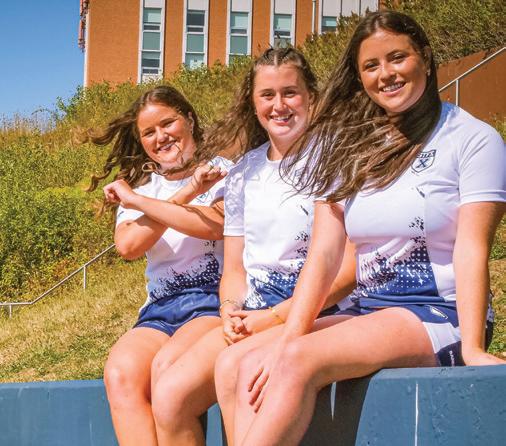

“Stepping onto the field together, playing side by side, with our parents in the stands, and wearing the same colours and crests they once wore has truly been a full-circle moment for all of us.”
Macy McDonell
On October 22, 2025, the StFX X-Women rugby team captured their 24th AUS championship, defeating the Acadia Axewomen 33-31 at StFX Stadium. Amongst the X-Women to don the coveted white championship hats were Ainsley, Kendra and Macy McDonell—three sisters who competed together on the pitch for the first time in their careers.
The McDonell sisters of Ottawa, ON had the rare opportunity to represent the blue and white at the same time this season. Education student Kendra ’24, who has been a key figure in the X-Women’s success over the last four seasons, was joined by her younger sister Macy two seasons ago, before the trifecta was complete when baby sister Ainsley made her way to StFX this past fall.
While the sisters wasted no time making their mark on StFX athletics, their success feels like a destiny set in motion from the moment they first stepped onto a rugby pitch. Kendra, Macy and Ainsley’s mom Michelle played X-Women club rugby from
1991-1994 while their dad Ian played for the X-Men club rugby team from 1989-1994.
“This season has been extremely special for me, my sisters, and our parents,” said Macy. “Growing up, our parents brought us to StFX many times, and when it came time to choose a university, there was never any pressure. However, the StFX campus and culture always felt like home to us, and we couldn’t imagine being anywhere else. Stepping onto the field together, playing side by side, with our parents in the stands, and wearing the same colours and crests they once wore has truly been a full-circle moment for all of us.” •••
By 1945, with the addition of World War II veterans, more than 500 students were clamouring for space in residence. StFX brought in New England architect Jens Larson, who’d also designed Morrison Hall, to create a 200-person residence out of local sandstone, in the Georgian Colonial styl—
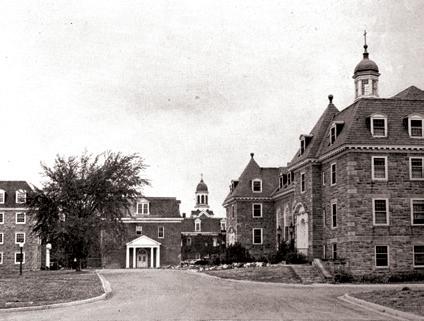
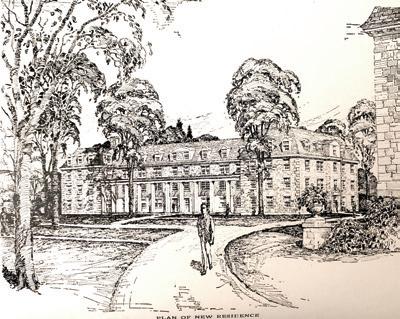
It was divided into four houses: Tompkins, Thompson, MacDonald, and MacPherson, named for leaders of the university in the first decades of the 20th Century.
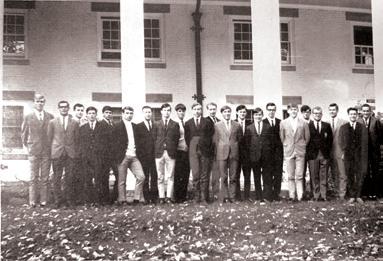
The university’s 500 students in 1945 rose to more than 900 in 1949, necessitating the construction of MacKinnon Hall, built across the street from Cameron Hall and its architectural twin. Instead of the four houses comprising Cameron Hall, though, MacKinnon had three (Chisholm, Gillis, and MacNeil), leaving the wing facing east for administrative offices. While Cameron Hall paid homage to administrators who’d pushed StFX into the 20th Century, the men for whom MacKinnon Hall’s houses were named represent StFX’s earlier history.

In the 1950s, residents of MacPherson were known for cribbage tournaments and candle-light snacks, and noted “for their easygoing dispositions and their social activites.”
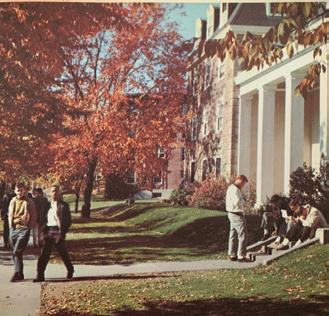
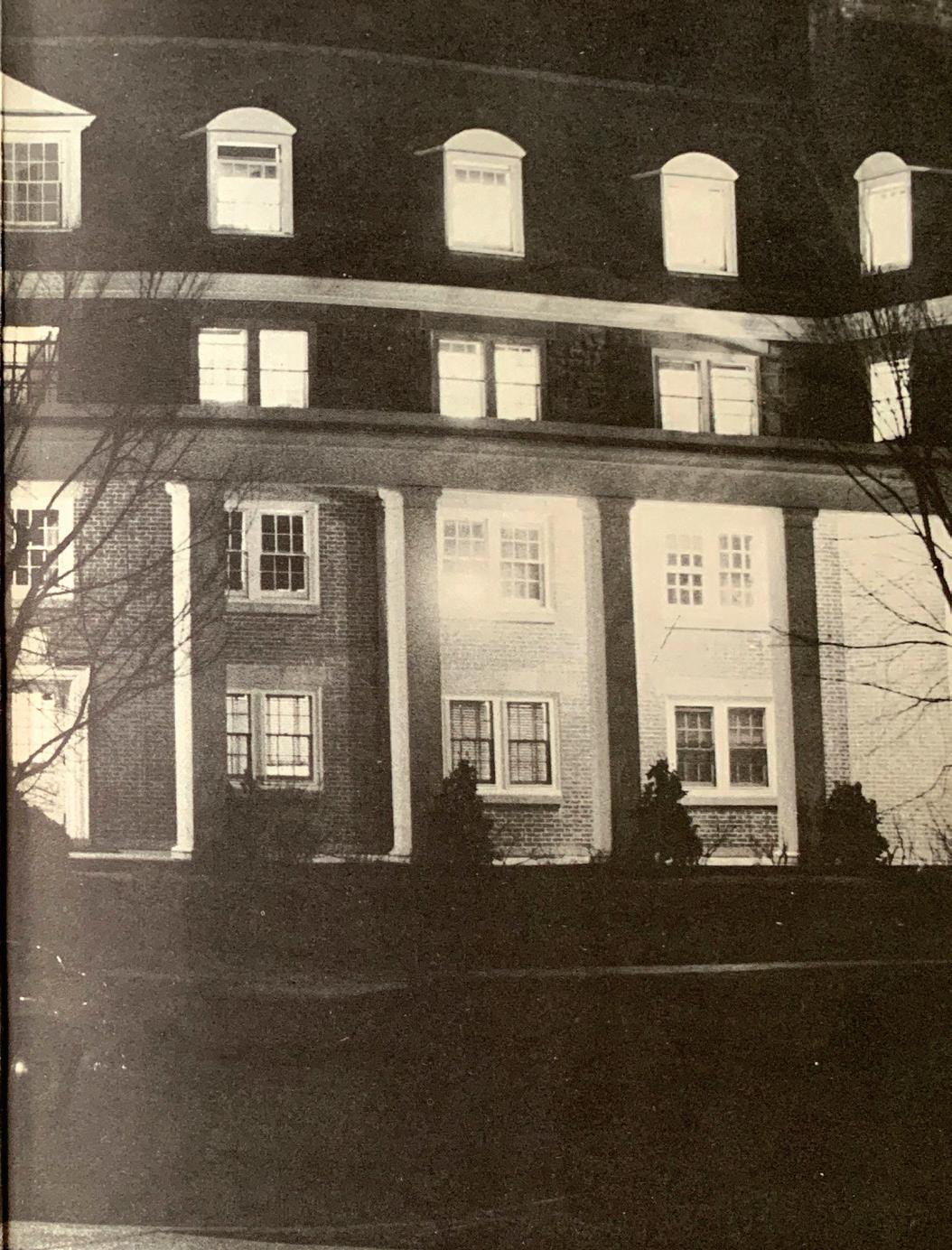
MacDonald House was called the “fortress of Celtic lore,” complete with ghost stories and a resident bagpiper. The Camera Club darkroom and RCAF headquarters were in its basement.
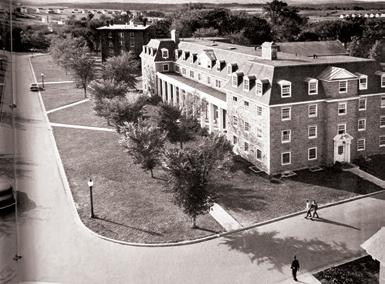
The 1965 yearbook notes that the men of Chisholm House had “the most offbeat hobbies:” they were apparently avid readers of the James Bond novels and kept a South American plant they named Harold.
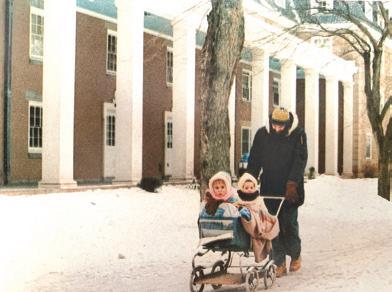
Meanwhile, the men of neighbouring Gillis were “so fond of academic endeavor that they always manage[d] to save some for tomorrow.” Before MacNeil earned a different reputation, its proximity to the Chapel made the boys’ five daily prayer visits quite convenient.
Thompson was known for “its share of bull sessions, water battles, and pillow fights,” all while maintaining a “favourable standing with the girls of MSB” in the 1960s. “Temperaments” in Thompson varied “from witty comedians to diligent scholars.”
Students in Tompkins had an ability to contrive “ingenious electrical hookups,” presumably to cook late-night snacks. The offices of the Xaverian Weekly were located for many years
in the basement of Tompkins, and the clicking of typewriters was the soundtrack to the students’ lives.
In later years, Tompkins and Thompson merged to form TNT, a women’s residence proudly represented by a stuffed Tiger named Tom and fiercely engaged in a rivalry with the women of Chillis (which formed from the merger of Chisholm and Gillis Houses and also became women-only).
“On my first day in TNT, we were visited by a large group of women who’d walked across the street from the Chapel, where they were attending the wedding of a classmate. They’d all lived in TNT during their StFX years, and spent half an hour teaching us cheers and chatting about the old days. It was a pretty great introduction to TNT.”
Maddy Horne ’19
December 3rd. The Feast Day of St. Francis Xavier and the cherished celebration of X-Ring.
In Antigonish, the ceremony takes place and hundreds of excited students celebrate accomplishment and the long-awaited milestone. Across the globe, our alumni chapters gather to celebrate and reminisce. Whether their X-Ring was one year ago or several decades, this day brings the StFX community together in gratitude, connection, and pride. This year, the Calgary StFX Alumni Chapter honoured the day in a way that truly embodied the Xaverian spirit: by giving back.
Their chosen celebration was a volunteer shift with The Magic of Christmas, a Calgary charity that has brought hope and joy to local families

since 1983. Powered by more than 6,000 volunteer Santas and elves, the organization transforms Calgary Transit buses into “reindeer” each Christmas Eve and delivers gifts, food
captured everything December 3rd stands for: community, generosity, and the commitment to lifting others up. Inspired by Calgary’s success, alumni everywhere are encouraged to consider adding a service component to future December 3rd celebrations, whether through a local charity, a food bank shift, a community fundraiser, or any initiative that spreads kindness.
As the Calgary Chapter proved, celebrating StFX isn’t just about gathering. It’s about making a difference.


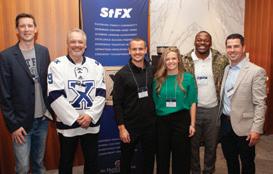
the scenes in sport
StFX President Dr. Andy Hakin poses for a photo after the NeXT Level panel discussion in Toronto, ON in October 2025. The event was hosted at EY by Shane Dunn ’01 and the panel featured alumni who currently work “Behind the Scenes in Sport.”
Pictured, left-to-right, are Gregor Chisholm ’05, baseball columnist, Toronto Star; Trevor Bartoli ’16, assistant strength and conditioning coach, performance coordinator, Toronto Maple Leafs; Dr. Beth McCharles ’01, mental performance coach; Henoc Muamba ’12, CFL Analyst, TSN; and Matt Skube ’09, anchor, TSN Sportscentre.
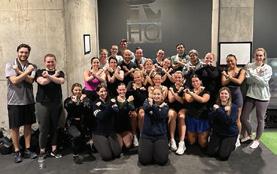
alongside fellow Xaverians. A portion of every ticket sold will support the StFX Alumni Halifax Student Bursary. Each year, this bursary provides much-needed financial assistance to students from HRM who are attending StFX—making your night at the game a great way to give back. Come for the lacrosse, stay for the StFX spirit, and help support local students!


Halifax area alumni recently gathered for a high-energy Box N Burn workout led by the coaching team at R Studios. The all-level class combined boxing and strength circuits. After the workout, attendees cooled down with bubbly beverages and connected during a live Q&A with Connie McInnes ’10, founder of R Studios, who shared insights from her entrepreneurial journey and inspired the group with her passion for wellness and community. The event delivered movement, motivation, and meaningful alumni connection.
motivation and meaningful connection Upcoming event.
The St. Francis Xavier University Alumni Association is dedicated to cultivating an engaged and vibrant alumni community. To support this goal, we invite members of our alumni network with diverse skills, backgrounds, and geographic locations to apply to join the Alumni Council, which governs the Alumni Association. We are also committed to building a council that is equitable, diverse, inclusive, and accessible. If you are interested, please scan the QR code to express your interest.
On Saturday, Jan 31st, the Halifax Alumni Chapter is hosting a fun night out at a Halifax Thunderbirds lacrosse game. Wear your blue and white and cheer on the home team
When Kathleen Sheridan ’15 arrived on the StFX campus as a first year student from Ottawa, she didn’t know anyone. She still vividly remembers the sense of community she found, right down to business professor Dr. Neil Maltby helping her find her classroom that first week—a small gesture that made her feel welcome. “I remember thinking, ‘this is the fit.’”
Just a few years later, that feeling of community and wanting to give back inspired her to become the youngest president of the StFX Alumni Association, taking on the role at age 28.
Ms. Sheridan’s connection to StFX began long before she arrived in Antigonish. Her grandfather, Jim Dineen ’66, had always thought the university would be a perfect match for her, seeing how active she was in high school.
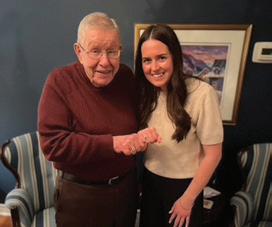
She remembers him coming over one night with the latest edition of the AlumniNews, its cover showcasing the new Schwartz School of Business. He knew she was interested in studying business. “My mom jokes he should have been on the recruitment payroll.” Wanting an adventure of her own, she followed his path east.
At StFX, she earned a Bachelor of Business Administration in management with a minor in political sci-
ence and quickly immersed herself in campus life. As president of the Women in Business Society for two years, she helped start a panel event in the faculty lounge which has since evolved into the largest undergraduate women-in-business conference in Atlantic Canada. She also served as a student representative on the Board of Governors, competed in the JDC Central Case Competition, and volunteered with Best Buddies and Habitat for Humanity.
“Being at StFX, there are so many opportunities to get involved both in and out of the classroom,” she says. “Professors genuinely care about your success, and friends encourage you too to participate.”
After graduation, Ms. Sheridan returned to Ottawa and quickly became active in alumni life. In 2018, she was invited to co-lead the Ottawa alumni chapter, one of the largest chapters outside the Maritimes. She helped expand the programming to appeal to this wide audience. Soon after, she joined the StFX Alumni Council and later served as vice-president and then president of the Alumni Association.
“I believe in the power and influence of our alumni network,” she says.
StFX is known as Canada’s most engaged alumni community, but that’s something we all have to work to maintain, she says. Alumni play a vital role in keeping that spirit strong.
For Ms. Sheridan, staying connected and volunteering is all part of her desire to see StFX continue to flourish. It is also about supporting the next generation. In a complex world, StFX students graduate not only with a degree but with Xaverian values of getting involved, giving back, and contributing to their communities.
Today, she continues to serve on the Alumni Council as past president and represents alumni on the StFX Board of Governors, all while working in Cabinet and Parliamentary Affairs at the Department of Justice Canada.
As a StFX student she also worked as an Annual Giving caller. That job emphasized two things to her. It showed her it’s important to give back, even in small amounts. She has donated every year since graduation. It also highlighted the alumni community. On the phone with people she’d never met, she recalls how alumni
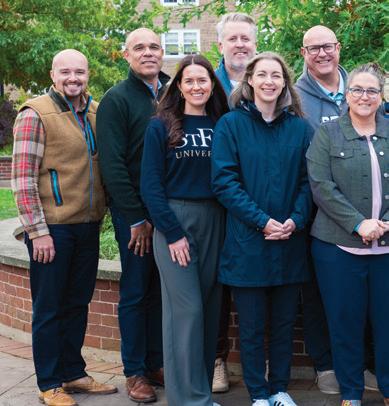
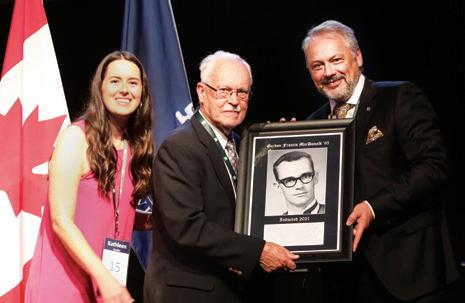
“Being at StFX, there are so many opportunities to get involved both in and out of the classroom. Professors genuinely care about your success, and friends encourage you too to participate.”
genuinely wanted to know about her and her studies and seemed to be rooting for her success. “It really showed me the caring alumni community. That was my first true introduction to the broader alumni group.”
Ms. Sheridan hopes more alumni will discover that same sense of connection. “There are so many ways to get involved: encouraging someone to apply to StFX, offering to mentor a new graduate, attending a chapter event,” she says. “We all have a part to play in helping StFX thrive into the future.” •••
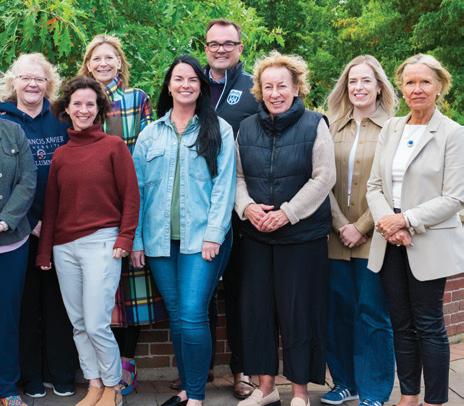
A strong future doesn’t happen on its own. It’s built by the people who believe in this university. People like you.
As alumni and friends, we carry the legacy of StFX: the lessons learned, the friendships made, the challenges, and the opportunities. Those experiences continue to grow through the impact we make today.
Now, we’re asking you to help. We’re asking you to become involved.
Your time can lift a student—by becoming a mentor, a volunteer, or a voice of experience.
Your talent can open new paths—by sharing your expertise and your StFX story with prospective students.
Your treasure can transform tomorrow—by supporting the programs, scholarships, and opportunities that help our students thrive.
Large or small, personal or financial, every contribution strengthens StFX and supports the university that helped shape us and invests in opportunities that will shape others.
Our future is brighter when we build it together.
To learn more about getting involved and volunteering, please contact alumni@stfx.ca
StFX Day of Giving is March 24, 2026. See more here stfx.ca/2026dayofgiving


With over 700 StFX alumni and friends on campus October 3-5 for Homecoming 2025, one message rang true...

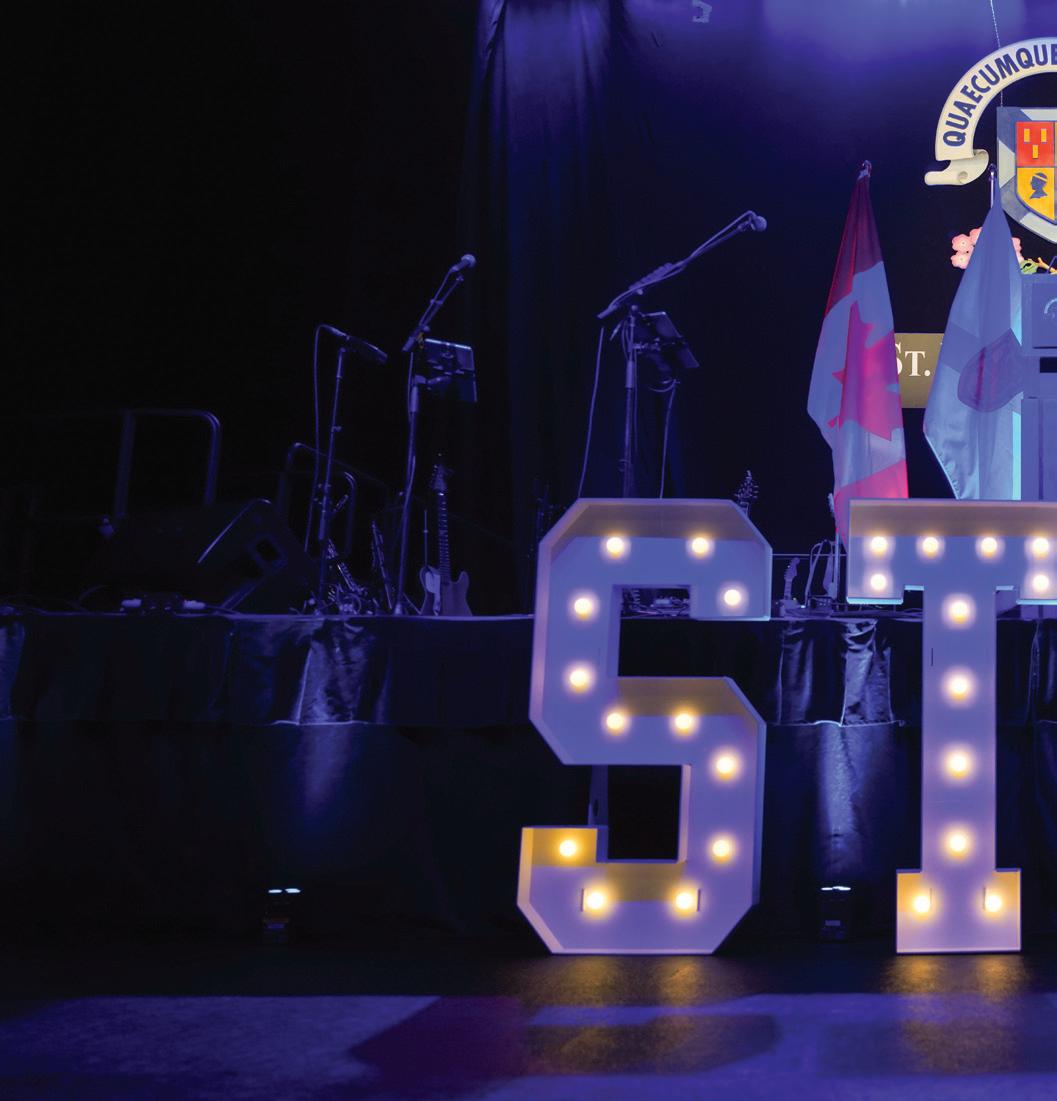

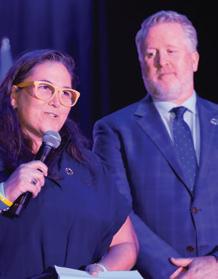
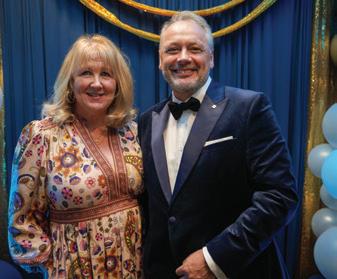
Congratulations to this year’s inductees.
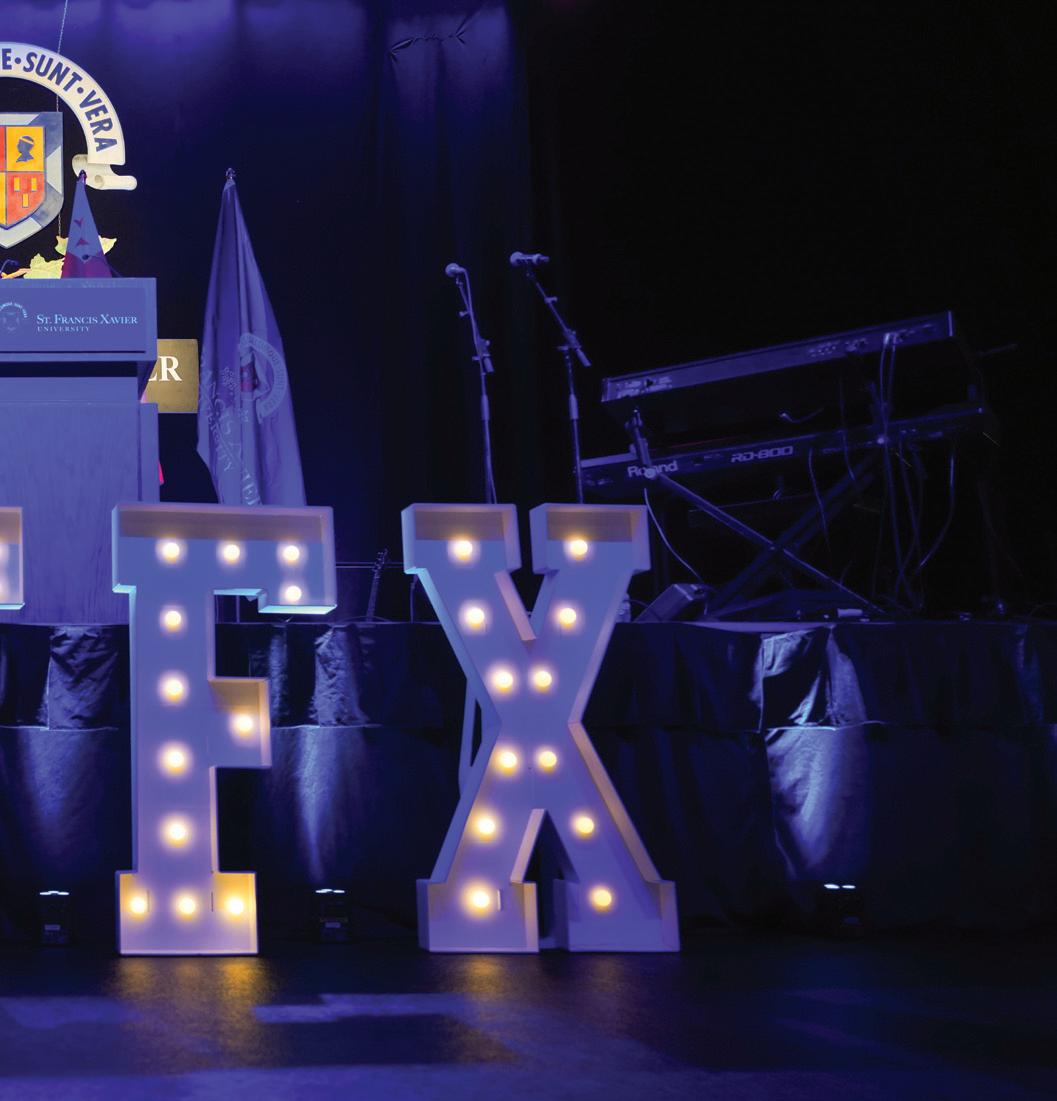
“Our
campus was filled with laughter, hugs, stories, and countless moments that reminded us all why StFX is so special.”
Shanna
Hopkins,
Director, Alumni Affairs
Among memorable moments, the Class of 1975, this year’s Golden Grads, reunited—and together gave back, presenting $100,000 from their class fund for StFX’s Tramble Centre for Accessible Learning. The Hall of Honour and Alumni Awards of Excellence ceremony also brought inspiration.
Hall of Honour
Adele Upton ’53
Iain Boyd ’75
Kevin Robertson ’66
Distinguished Alumnus/Alumna: The late Katherine Fleming ’85
Young Alumnus/Alumna: Emily Lorra Hines ’14
Xaverian Spirit: Dr. Margo Watt ’93
Pride of StFX: Rachael Harrison ’14 ’18
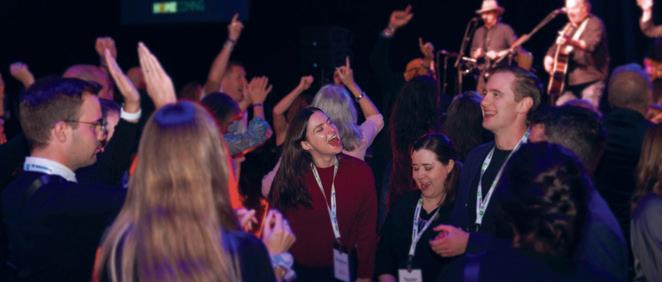

Editor’s note:
The untimely loss of classmates Katie Fleming and Dave Bernatchez deepened that bond and inspired classmates—joined by friends from neighbouring years—to establish two funds in their honour. Each has raised an extraordinary $1 million, ensuring their legacies endure. In October 2025, the class returned to campus for its 40th Homecoming and to celebrate Katie Fleming being posthumously honoured with StFX’s Distinguished Alumna Award. In this reflection, Class President Larry MacEachern ’85 shares how Katie and Dave continue to inspire lasting contributions and the impact individuals can have on a community.
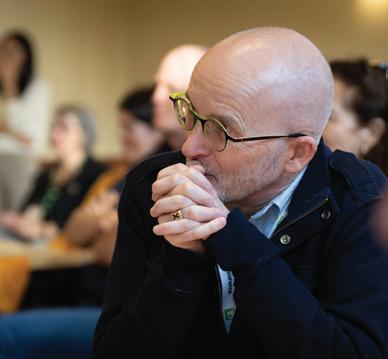
Both Dave and Katie shared many of the same qualities and experiences as their classmates, but they were different in ways that may not have been so clear during our time at X. We were simply friends. But as has become clear over the years, they were different. Both came to X from outside Nova Scotia and were perhaps more intentional about choosing StFX because they aligned with the values of the university. Both had greater maturity and sense of purpose, which was evident in their involvement in sports, activities, and student life. They were more likely the people to speak up when something wasn’t right, whether it related to social justice or simply ensuring an overserved classmate made it home safely. Dave and Katie were the classmates you learned from, not from an academic perspective, but from a
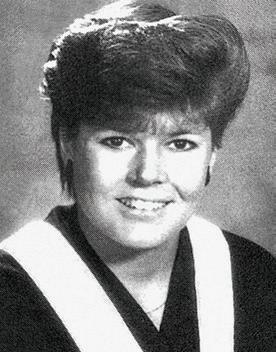
is my membership in the Class of ’85. It’s the source of my friendships and it influenced the values that I have lived since my time at StFX. The stars aligned in September of 1981 when we all came together as a group of students. Members of our class were leaders at StFX and have continued to be leaders in their chosen careers in many sectors, in their community, as part of their family and among their friend groups. I’d like to single out two particularly special individuals that had a significant impact on the Class of ’85:
‘how to be’ perspective. The quality of conversation was different. While they had lots of fun, they never lost sight of their bigger vision. Through their actions, they lived the values of StFX, particularly those of community, equity, dignity, truth, respect and teamwork. Together, they received the award for outstanding female and male student in their senior year.
When Katie came to StFX, she was already committed to human rights and was particularly passionate about overcoming child poverty in Africa. She graduated from StFX as
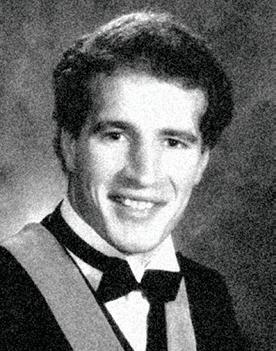
a Rhodes Scholar and then worked in international development in Eastern and Southern Africa with UNICEF. She gave the commencement address at StFX convocation in 1989 and eloquently captured the contrast between the hopefulness and prosperity, at the time, in the western world with the despair being experienced in developing countries. She carried this passion to address inequities through her life, which ended too early in May 1999 when she was living in Tanzania. Katie’s passing inspired her fellow students to create an international development award in her honour to ensure that her work and her legacy would continue.
For 25 years, this award has enabled women leaders from Africa to study at the Coady Institute. It is expanding this year into a program that will be delivered to a greater number of women leaders.
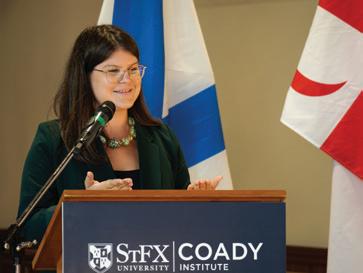
Dave was a good friend of Katie’s and was one of the leaders who initiated the Katie Fleming International Development Award in her memory. This was true to Dave’s character. He was a leader among his peers and friends in high school, at X and in the years after. He was sincere, wise, caring and funny. He was the glue that kept his friend group connected. His closest friends were his StFX friends. His leadership was evident on the rugby pitch as an elite player. He was the valedictorian for the Class of 1985, and its life officer president. He was deeply connected to StFX and served as a leader on the Alumni Association, the university’s Board of Governors and through his involvement with scholarships that would make it possible to attend post-secondary school. In 2014, Dave was inducted into the Hall of Honour, which recognizes mem-
bers of the StFX community that have best carried on the tradition of helping others. When Dave passed in 2021, his friends came together to create a bursary that would honour Dave’s passions of rugby, StFX and community leadership. In the past four years, five amazing students have been supported in their studies at StFX through the Dave Bernatchez Memorial Bursary.
This past Homecoming, the Class of ’85 took an opportunity to celebrate the impact achieved in memory of these two special friends and incredible leaders. It was an emotional experience. The sadness of losing these friends is still felt. And there is also happiness in knowing that people who share the qualities and values of Dave and Katie will be supported in their journey for generations to come.
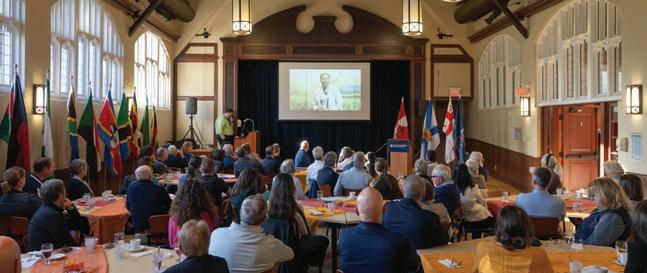
more information, or to start your own class fund, or to donate to the Class of 1985’s Katie Fleming International Development Award or the Dave Bernatchez Memorial Bursary, please reach out to:
Tuesday, March 24, 2026
StFX Day of Giving directly supports students: Tuition Food + Housing Security Textbooks + Educational Supplies
Thank you for making a StFX education accessible!
Scan here or visit stfx.ca/2026DayofGiving if you’d like to make an early gift

As the Rankin School of Nursing celebrates its centenary in 2026, Marion Alex, a 1978 nursing graduate who served on the School of Nursing faculty from 1988 to 2024, reflects on its 100-year legacy.
In the 1920s, there were no cancer chemotherapies, no dialysis machines, no defibrillators, cardiac pacemakers or ventilators. There were few automobiles, and electricity was available to a limited number of households. Certainly, no computers.
But the 1920s also saw the discovery of penicillin, of insulin, and the first vaccines for pertussis and tuberculosis.
French Canadian nursing sisters like Marguerite d’Youville had established nursing orders like the Grey Nuns, who trekked westward bringing public health and hospital care to Quebec and western Canada. In England, Queen Victoria had already established the Victoria Order of Nursing. These were emerging social changes including the right for women to vote.
But Nova Scotia in the 1920s and 1930s were times of harsh economic conditions, including those that led to high rates of maternal and child mortality and high rates of infectious and chronic disease. The determinants of health and illness were clear even then to those who provided care to the sick, to the very young, and the elderly.
Here in Antigonish, as Father Moses Coady and Father Jimmy Tompkins were establishing the Antigonish Movement, the Sisters of Saint Martha, who had already founded St. Martha Hospital in 1906, and the Sisters of St. Martha School of Nursing, took another step, establishing the StFX School of Nursing in 1926. The need for nursing education based on an ethic of
compassionate care and grounded in science and knowledge was entirely clear to them. That same call to ac tion remains today.
From 1926 to 1966, the StFX Nurs ing program involved a five year pro gram that included three years to complete the diploma program at St. Martha’s School of Nursing, and two years of arts, science, and courses that would prepare nurses for a spe cialty such as education or public health. The first nurse to graduate from this program did so in 1933.

Renamed the Elizabeth and Thom as Rankin School of Nursing in 2016 in honour of Elizabeth and Thomas Rankin, the school today is a bustling

Since 1966, the StFX School of Nursing has involved an integrated four year program for qualified high school graduates. Courses were of fered at StFX with practice at St. Martha’s Hospital and in community health nursing. Nursing courses were supported by courses in philosophy/ ethics, chemistry, biology, psychology and education.
Student enrollment and graduation rates have mushroomed since then. For example, in the 1970s, at the most, 20 students graduated annually. By the 2000s, this number ballooned to over 100 annually.

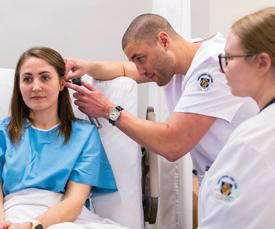
hub of teaching, learning and schol arship, and professional nursing in volving hundreds of nursing students. Practica are based on partnerships across Canada and beyond. Its roots date back a century to the pioneering work of the Sisters of Saint Martha.

On the eve of its 100th anniversary, the StFX Rankin School of Nursing has big plans to honour the past, celebrate the present, and inspire the future of nursing. And all nursing alumni are invited to attend a weekend of celebration July 24-26, 2026.

Since 2000, the program also ex panded to include accelerated pro grams for students who enter with completed prerequisite courses such as in science, ethics, and statistics, some of whom have completed degrees in other fields; and a part-time program, much by distance, for Licensed Practi cal Nurses who wish to also complete a university nursing program.

As we celebrate the 100th anniver sary of the Rankin School of Nursing at St. Francis Xavier University, let us remember our strong partner ship with the Sisters of Saint Martha and all those who helped make the StFX School of Nursing an excellent and sought after place of higher ed ucation that has proudly grown over
For updates and full event details,
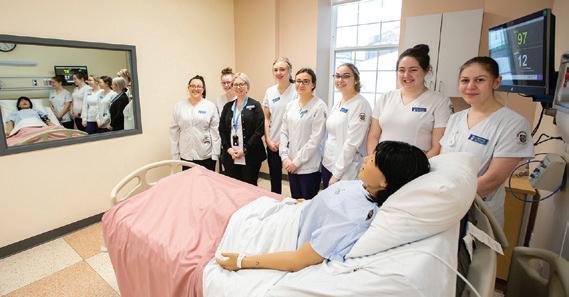

Tours of the Rankin School of Nursing A Gala Evening Event An Alumni Mass
Opportunities to reconnect including at a BBQ and a tea


Nursing alumni are also invited to share their stories and photographs in advance of the centenary celebrations. Share your stories and photos from your time at StFX Nursing—the moments that shaped your journey, inspired your career, or simply made you smile. Your stories will help celebrate 100 years of nursing excellence.
Please submit stories to: nursinganniversary@stfx.ca




SAVE THE DATE Homecoming 2026 will take place Oct. 2-4, with all classes ending in 1 and 6 celebrating reunions. All communication from the StFX Alumni Affairs Office will be done via email, so please ensure your email address is up to date. To update your information, please visit: stfx.ca/update-your-contact-information or email alumni@stfx.ca
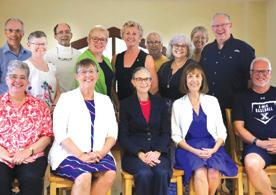
Over 40 years of being friends and making music together, graduates and choir members from the 1970 and 1980s gathered on campus in July 2025 for a choir reunion. The group will be planning another reunion at Homecoming 2027. Pictured are, back row, LR, James Cormier, Rose Cormier, Richard Sanders, Verna Mac Donald, Joan McNeil Delehanty, Peter McLaughlin, Cynthia Gatto, Anne McLaughlin and Father Conrad Edwards Front row: Simone Abbass, Heather Carson, Katherine Carrigan, Yvonne LeFort and Scott MacGillivray

Lynn Martin ’81 and her brother Wayne MacDonald ’81 proudly show off their X-Rings on a recent cruise to Greece with their respective partners. Retirement looks great! Lynn and Wayne both originally hail from Troy, Cape Breton.
Save the Date for our 35th class reunion, October 1-3, 2027. To keep updated, join the class Facebook page – StFX Class of ’92.
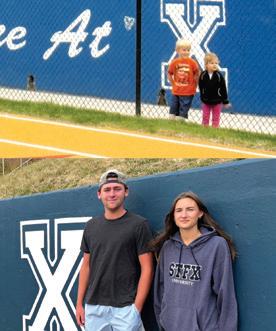
Heidi MacDonald Sayle ’96, daughter of Toni Rovers ’75 ’86, shares the generational influence of the X spirit with photos of her children, Camden Sayle ’27 and Zara Sayle ’29 The first picture was taken about 2010, and the second 2025, on Zara’s move in day.
Shane MacLeod ’98, the head of the science department at Dartmouth High School, was awarded a 2025 Prime Minister Award for Teaching Excellence in STEM—Certificate of Achievement.


OCT 3- 5, 2025
SAVE THE DATE
For your 25th Class Reunion, October 2-4, 2026. To keep updated, join the class Facebook page – St.F.X. Alumni of 2001.
Brad MacNeil ’02 ’03 was awarded the Distinguished Contributions in the Science of Psychology Award by the Arizona Psychological Association at their annual conference in Flagstaff, AZ. This award honours those who disseminate their scholarship through undergraduate and graduate teaching, mentor their students to value intellectual curiosity, scientific methodology, and critical reasoning. The Distinguished Contribution to the Science of Psychology award recognizes Arizona psychologists who conduct research that improves the lives of others. Dr. MacNeil is a licensed psychologist and an associate professor in the APA Accredited Doctoral Program in Clinical Psychology at Midwestern University, Glendale AZ. He lives in Peoria, Arizona with his wife (Laura), daughters (Breton and Oakley), and dog (Clover).

Edwin MacKenzie Carlson was born to Lee Kelly ’06 ’22 and Colin Carlson on February 16, 2025 at the IWK in Halifax. Edwin is the
CLASS OF 1992
Save the Date for our 35th Class Reunion, October 1-3, 2027. To keep updated, join us on the class Facebook page – StFX Class of ’92.
CLASS OF 2001
Save the Date for our 25th Class Reunion, October 2-4, 2026. To keep updated, join us on the class Facebook page – StFX Alumni of ’01.

Introducing James Gerard Aleong, future member of the Class of 2046. James is the son of Briana Campbell ’17 and Gerard Aleong, and the grandson of Roger ’89 and Joanne ’88 Campbell

Homecoming created an opportunity to have a reunion of Chillis Chicks from the Class of 2015. Pictured, l-r, standing, are Gwen Whitters, Molly Norris, Bria Roberts, Erika Kinach, Kate MacDonald, and Kathleen Sheridan

HAVING A GOURD TIME
Kelsey O’Brien ’10, Leslie Slaunwhite’10, and Chris Stothart ’11 show off their X-Rings.


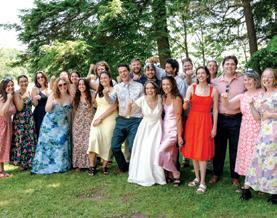
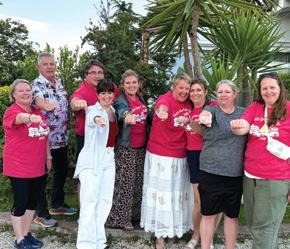
A number of alumni were chaperones for the Northumberland Regional High School’s trip to Italy. This photo was taken in Rome on April 26, 2025, the day of Pope Francis’ funeral. Pictured, L-R, are: Sheri (MacDonald) Burns ’05, Fraser Green ’83 ’84 ’04, Bernie Murphy ’94, Alice Chaisson ’20, Brooke (Dwyer) Miller ’16, Chanda (Elliott) MacDonald ’00, Mandy (Fitt) Little ’06 ’12, Jenny Ferguson ’05, and Sarah (Grant) Meyer ’08’ ’10
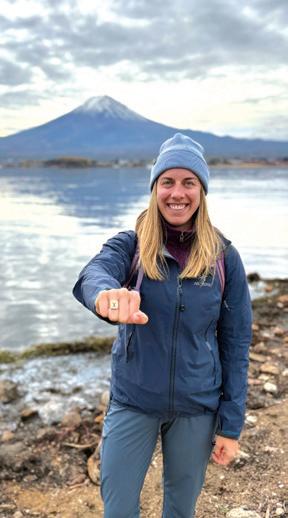
for an
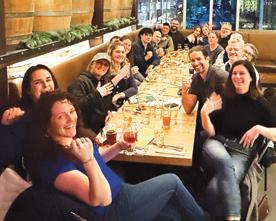
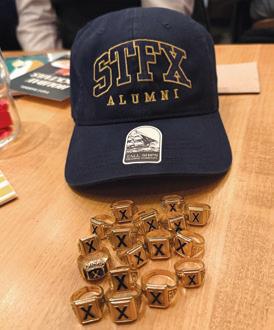
The Vancouver alumni chapter gathered December 3rd to celebrate the Feast Day of St. Francis. The chapter had about 20 people in attendance with one alumna wearing both her ring from 1974 and dad’s ring from 1938.

The StFX northern California alumni chapter say they are a tight-knit group who always enjoy reminiscing about their time at StFX. Pictured at this year’s December 3rd event are alumni who span six generations! From L-R, Greg Boudreau ’87, Margaret MacDonald ’76, Susan Ammon ’82, CJ (Jamieson) Healy ’98, Adele Martel ’22, and Seth Rutner ’12

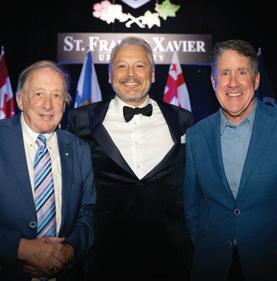
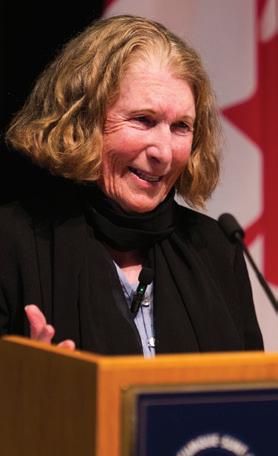
Dr. Margo Watt ’93 seen acknowledging the audience at the Alumni Recognition Awards during Homecoming 2025 as she is presented with the Xaverian Spirit Award. This award is presented to a StFX faculty, staff or other campus-based employees. It is meant for the unsung heroes who exemplify the Xaverian Spirit and who’s support, encouragement, guidance or attitude leave a lasting impression on alumni long after graduation. For more information on how you can nominate someone, please contact alumni@stfx.ca
Archibald D. Boyd ’49
Dr. Donald Arseneau ’50
Dr. William Clair ’51
Donald Cameron Azar ’52
Cornelius Brennen ’53
Joan Kane ’53
Mary MacNeil (Brown) ’53
Bérard (Buzz) Bennett ’54
David McWilliam ’55
John Angus “Jack” MacNeil ’56
Allister MacLellan ’57
Frances Gallant (MacDonald) ’57
Maureen Fahey (Doyle) ’58
David Gouthro ’60
Donald Harriman ’60
Donald E. MacDonald ’62
Dr. J. Hayes MacNeil ’62
Dennis Walsh ’62
Michael William ’62
George Pelletier ’63
Paul McFarland ’65
Robert McVeigh ’65
William Hearn ’68
Ann MacSween (Timmons) ’68
Anne Marie Dwyer (MacNeil) ’69
Alexander Fraser ’69, ’79, ’93
John W. McGrath ’70
Johanna Nearing ’70
Alice Campbell (MacLean) ’71, ’72
Joe A. MacDonald ’72
Catherine (Kay) Doucet ’74
Timothy Lynam ’74
Rita White (Campbell) ’77
Linda MacIntyre ’78
Joseph Marchand ’86
Eva Smith (Munroe) ’87
Lois Thompson (Adamson) ’87
Dr. Doris Gillis (Gould) ’94, Retired Faculty
Patricia Crossman ’99
Leonard “Lonnie” Murphy ’03
Jacob Johnson ’17
Sr. Isabel MacLellan, CND
Vicki MacLean, Retired Faculty
Jimmy MacGillivray, Retired Staff
Beryl Phee, Retired Staff

2 – 4, 2026