The Steel Interstate System A 21st Century Railroad Network for the United States* *Testimony for the Panel on 21st Century Freight Transportation, Committee on Transportation and Infrastructure, U.S. House of Representatives, By A. L. Lotts, Director, RAIL Solution1, 11125 Hatteras Drive, Knoxville, TN 37934 Executive Summary The Steel Interstate System (SIS) is proposed as a modernized, privately-owned American core freight rail network. The SIS would employ currently available rail technology to allow the U.S to build capacity more than sufficient to fulfill future national freight requirements, operate more efficiently and reliably, utilize 100% domestically generated motive power, and achieve point to point speeds from 60 to 115 mph for various classes of freight and passenger trains. As envisioned the national SIS would involve about 40,000 miles of high capacity, multi-line track built on present rights-of-way that parallel the existing highway interstate, as well as selective use of new track lines. Total cost, to be principally borne by the private sector is estimated to be $500-1,000 billion. Higher efficiency and capacity of the national SIS can be accomplished by using the following technologies: -
-
1
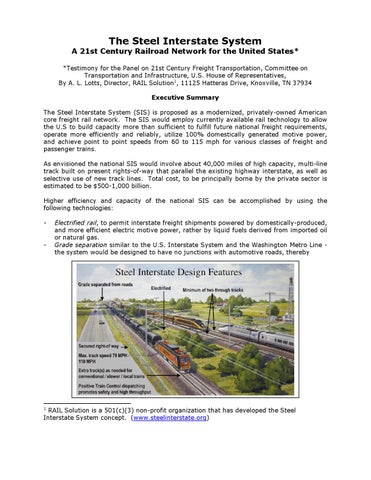
Electrified rail, to permit interstate freight shipments powered by domestically-produced, and more efficient electric motive power, rather by liquid fuels derived from imported oil or natural gas. Grade separation similar to the U.S. Interstate System and the Washington Metro Line the system would be designed to have no junctions with automotive roads, thereby
RAIL Solution is a 501(c)(3) non-profit organization that has developed the Steel Interstate System concept. (www.steelinterstate.org)
allowing higher speeds and improved energy efficiency. - Improved rail alignment and other modern engineering features. - Regional intermodal terminals at periodic intervals to increase access of smaller truck and shorter distance operators to the benefits of the system. Benefits would be a 50% reduction in the liquid fuels consumed by the SIS compared to transportation of the same freight volume by trucks, representing a 6% decline in total national oil consumption, with proportional reduction of pollution and green house gases. Fatalities for the 40,000 miles will decrease by 30% because of grade separation and reduction of truck traffic volume. The cost to American taxpayers and businesses will be as much as 60% less by providing increased rail capacity rather than increased highway capacity for trucks. Other benefits would include improved national defense security, energy security, and balance of payments, as well as increased productivity A specific proposal for a demonstration project of an SIS system, called the Valley Corridor project, would modernize an under-utilized rail line between Memphis, TN and Harrisburg, PA, built in the 1800s. This Steel Interstate prototype would yield significant social and economic benefits by reducing freight truck traffic along the route (e.g., Huntsville, Chattanooga, Knoxville, Bristol, Roanoke and Hagerstown) and by offering the option of passenger rail for the first time since 1968 to most of the region. Trucks per day carried by the Valley Corridor SIS demonstration would increase from 4000 in 2023 to more than 8000 in 2035.
Valley Steel Interstate System Prototype Demonstration