




CREDITS:
PHOTO
LAVANYA PALIWAL
CREDITS: LAVANYA PALIWAL
PHOTO
CREDITS:
CREDITS: LAVANYA PALIWAL
EXECUTIVE EDITOR
Katrina Michalak
EDITOR-IN-CHIEF
Leah Mesquita
MANAGING EDITORS
Abigail Wilt
Natalia Jarrett
DESIGN EDITORS
Lavanya Paliwal
Paulina Soto
ENGAGEMENT EDITOR
Wendy Maddox
WRITERS
Jude Banihani
Sophia Braccio
Lexi Janusee
Bella Keenan
Aleisha Paulick
Aleah Steinle
Keyanee Walls
Lucia Zettler
ILLUSTRATOR
Kormac Moore
PHOTOGRAPHER
Madison Koehler
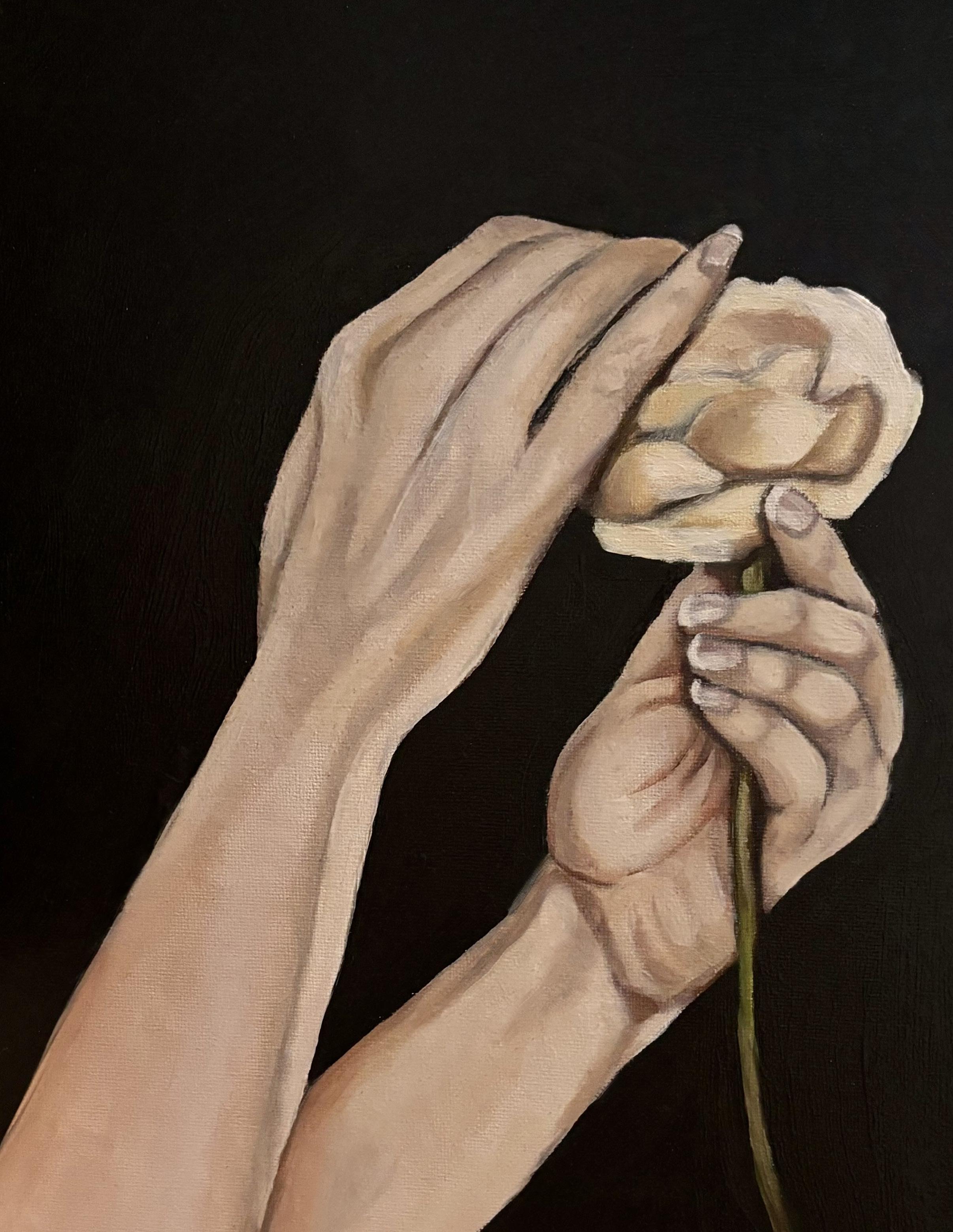
COVER BY: Natalia
Jarrett
Editor’s letter
The theme for this issue emerged from a conversation among the editors about Lorde’s fourth studio album, “Virgin,” and its underlying connotations. Socially, we have constructed the word to hold significance, but only through our own persistence does it hold meaning at all.
Likewise, purity is simultaneously censored and peddled in our social circles, influencing how we categorize experiences through power, morality and judgment — both inside and outside ourselves. This issue is meant to redefine the otherwise divisive noun, one that causes us to see the world through “perfect” and “imperfect” lenses. Where does your purity lie?
Some writers chose to define purity more clearly, reporting on topics like the value of sex education, the sexualization of clothes and the current culture surrounding intimacy. Others looked inward, exploring racial “purity,” physical beauty and relationships with religion. One reporter delved into on-campus morality, while two others touched on gender discrimination and intersectionality’s role in traditional culture. Finally, our feature story examines the art of figure drawing and its evolution.
By Abigail Wilt
Photo by Natalia Jarrett
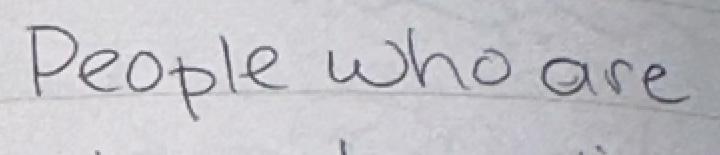
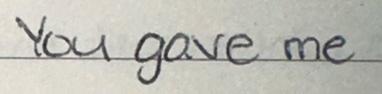
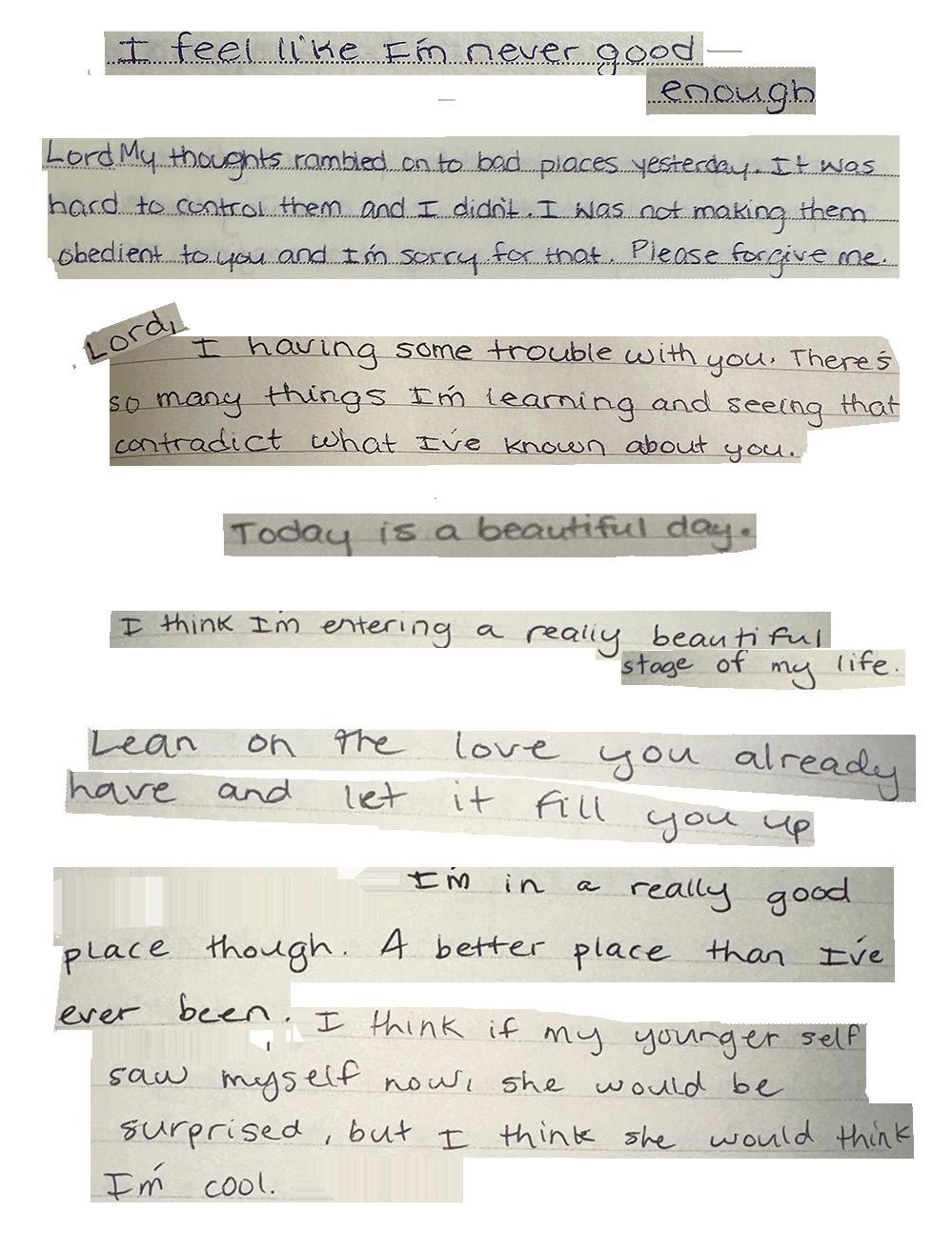
This is a collection of excerpts from extensive journals I’ve kept starting from when I was 6 years old. The excerpts detail my thoughts and feelings following a timeline where I was indoctrinated into a cult-like sect of Christianity, and then went through a deconstruction process. The last excerpt is from a journal I currently keep.















Tales of friendship, faith and figuring out girlhood
By Sophia Braccio
Illustrations by Kormac Moore
Photos by Sophia Braccio
The Girl Scouts and a group of local Satanists walk into a room… with a 6-foot-tall vagina sculpture.
Every scouting alumni I talk to has a slew of different stories to tell, and many, like mine, sound like the start of a stand-up set. We all worked toward the same badges, but the true spirit of scouts, for me, was in the unplanned — the mishaps, the surprises, the moments that made us question things.
I attribute much of my worldview, my independence, my successes, and yes, my relationship to my faith, to Troop 700, and to the not-soflawless world of Girl Scouts.
Not your mother’s Girl Scouts
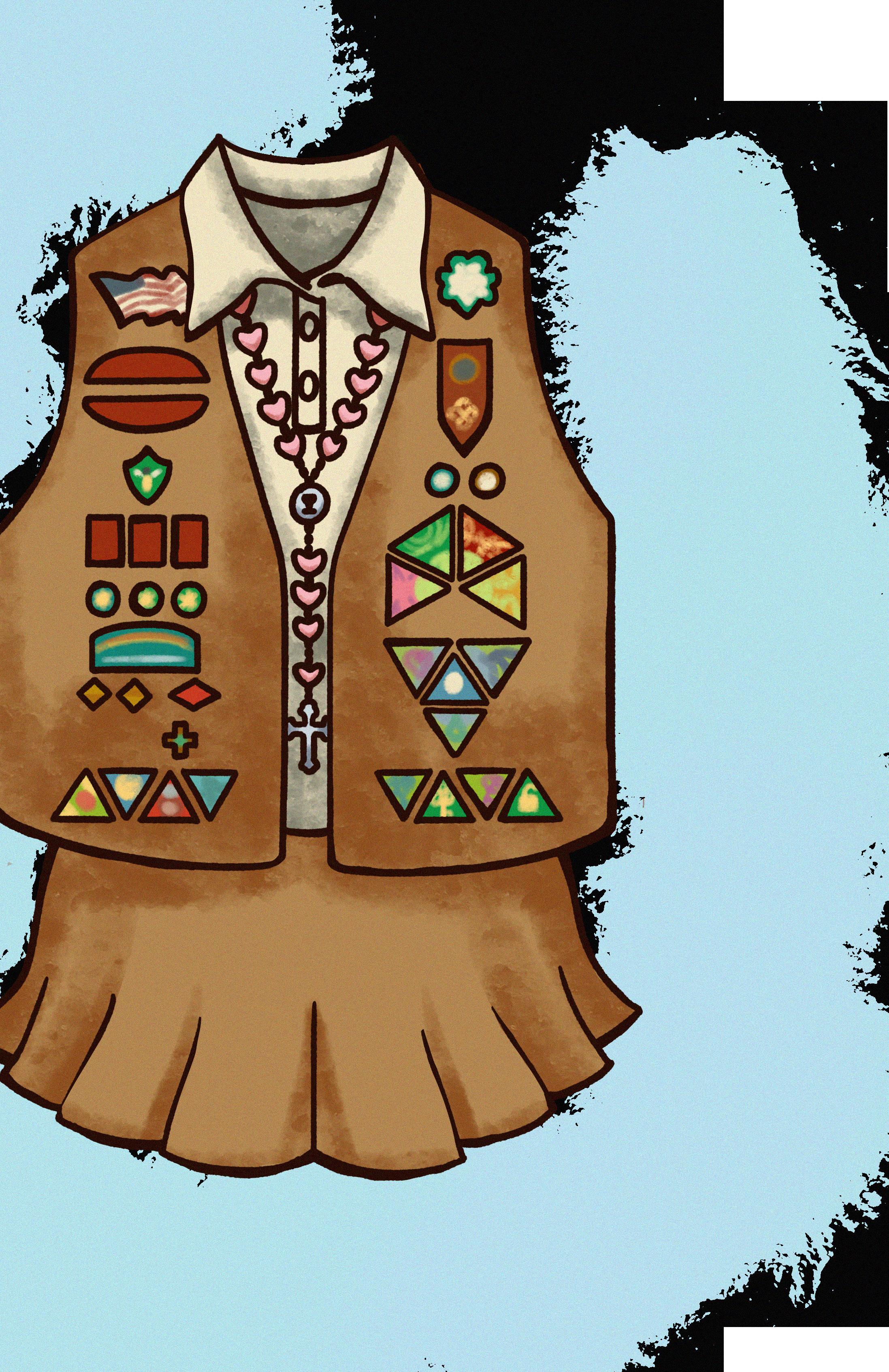
As scouts, we learned how to dress a wound, how to pitch a two-man tent and how to make just about every craft under the sun. We learned how to build a fire too, but that one never really stuck for me.
Much of what we did was traditional scouting, but as I moved up the ranks, Girl Scouts became less about empowering girls with skills, and more about empowering them through their thoughts.
I remember sitting in a middle school classroom, in my plaid school uniform with my matching red Chuck Taylors, as a mom led us through a worksheet about the stereotypes women face and how we could defy them.
What would really defy stereotypes is if we got out of this classroom and did something exciting, I thought to myself.
Going into the 2000s, there was a broad restructuring of the Girl Scout program. The curriculum emphasized “Journeys” for older scouts, which became prerequisites for the highest achievements, earning you the coolest medals
— the Bronze, Silver and Gold awards.
Though skill-based badges still range in topic from first aid to financial literacy, real progress toward the highest achievements is indicated today through completing a curriculum and project that emphasizes leadership, cultural awareness and community service.
To the credit of the women leading my troop, we often traveled, camped and took little adventures around Phoenix. On more than one occasion, we camped through rainstorms. We were a tough bunch, and only ever abandoned a trip once when the stomach flu swept through our campground.
The outings that never went as planned made me independent, adaptable and forged a few of the friendships that I’ll carry with me for a lifetime. And despite my resentment, mainly rooted in boredom, those conversations and fluffy worksheets made me think about how the world views girls, and the expectations placed upon us.
When we hit high school, our troop was grow ing apart. We all went to different schools with new interests and limited time. We decided that in our last “Journey” together, we would focus on helping other girls.
Our mission was to destigmatize menstrual cycles to raise awareness about period poverty. We were also awkward high school freshmen who wanted very little to do with talking about our bodies.
I spent hours crafting a flyer that made tampons and pads palatable enough to share on our Instagram feeds and send to the ladies at church. The color scheme I settled on was purple, because pink was cliché and red would’ve been too gross.






After collecting boxes of pads and tampons from friends, family and classmates, we brought them to an event hosted by a local organization to make them into period kits for middle schools.
When we got to the event, it hit me that we were probably the ones who needed to let go of some stigma. The venue was a corporate event space decorated for an allout period party, complete with pastries drizzled in shimmery red raspberry blood.
The most remarkable decoration, however, was the previously-mentioned vagina sculpture, constructed out of PVC pipe, foam and satin, adorned with a tiny pink disco ball at the top.
The organization partnered with all sorts of community members outside of the Girl Scouts: mothers and daughters volunteering together, college students, etc.
We did not know the Satanic Temple was one of them. And it was a shock.
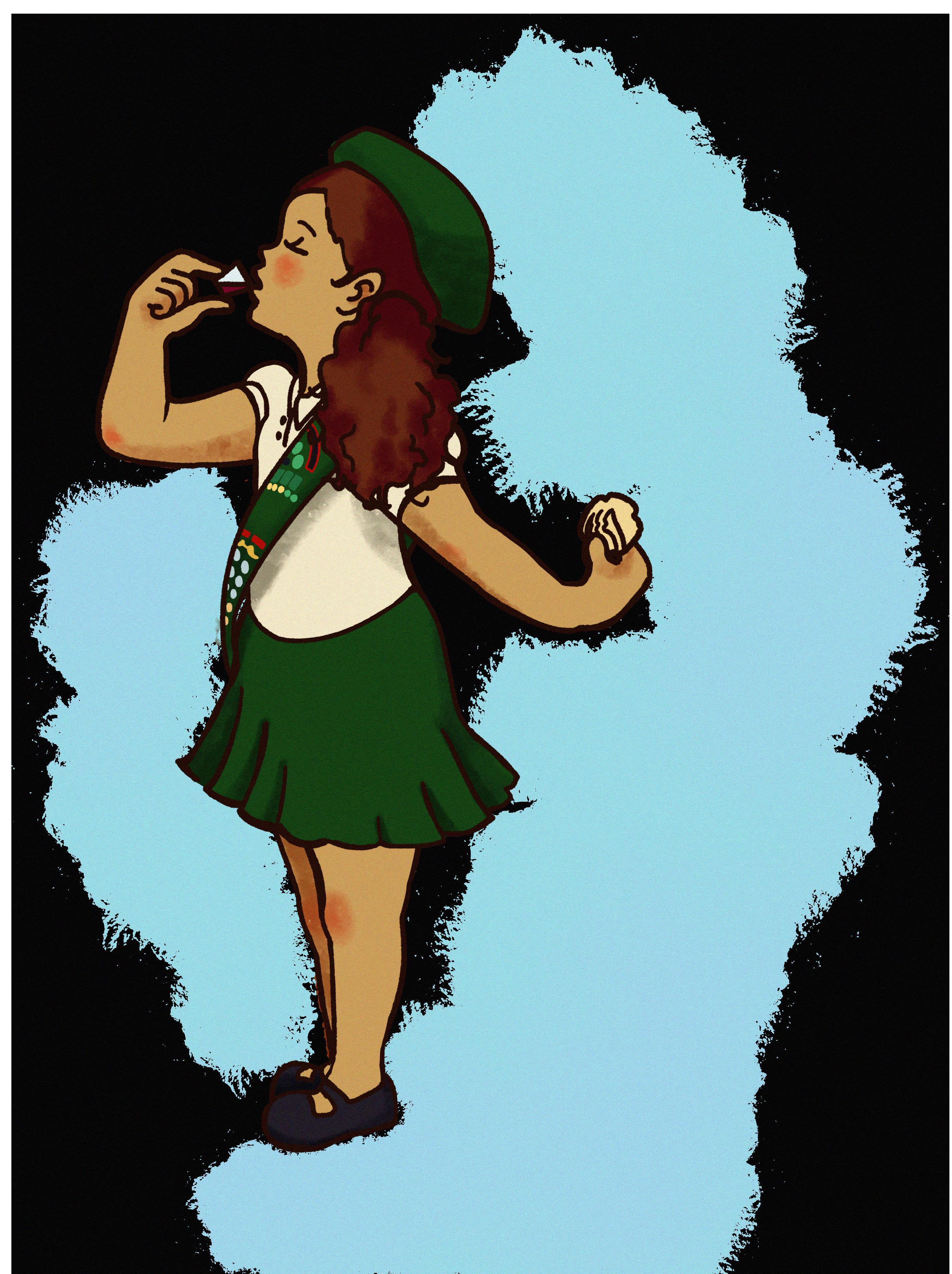
For my troop, scouting and religion were intertwined. We wore our sashes to mass on Scout Sunday. We attended Catholic scouting retreats where they performed campfire skits based on the New Testament. I even attended special meetings about religion to earn an award for living my faith as a scout.
But for some time, there was still a lingering tension between the Church and the state of scouting, fueled by culture wars and online rumors. One time, a church member shared that they would be boycotting our cookies because the sales supported Planned Parenthood and abortions.
Girl Scouts has denied these claims and others that they engage in political issues. But more importantly to me, fighting a culture war was not in the Girl Scout Promise.
“On my honor, I will try: To serve God and my country, To help people at all times, And to live by the Girl Scout Law.”
As a troop, we were charitable and service-oriented. Those at the center of my
scouting experience — my mom and my troop leader — were, and continue to be, among the most faithful, generous women I know. And as for the girls in my troop, I always felt that I could have open conversations with them because they were loyal, accepting friends.
That was the Girl Scout way. It stung me that not everyone saw that. But during my time as a Girl Scout, I learned that who I was and what I valued were not things other people dictated.
So there we were, living out the Girl Scout way with the help of Satanic Temple members, a group of people who would never agree with us on many matters, but who, in that moment, were working to make the same change we wanted to in our community.
Recently, a friend challenged me with this question: If I have a daughter someday, will I put her in Girl Scouts? Here’s my answer:
Over 100 years ago, Juliette Gordon Low founded Girl Scouts. Toward the end of my scouting journey in high school, I questioned whether the need for such an organization persists in a world where women can vote, lead nations, be entrepreneurs, be breadwinners, and choose who they love and how they live. I felt this conflict as our moms and leaders tried to usher a troop of Gen Z girls through a mandatory curriculum about becoming a #girlboss who #defiesstereotypes.
But now I see just how necessary and formative Girl Scouts was, not because of the badges or worksheets, but because of each misadventure. Today, more than ever, girls need a space offline and away from the noise of faraway adults telling them who they should be, to explore just what it means to be a girl and wrestle with every issue that identity entails.
I don’t know what scouting will look like in the years to come, but I do know that if I ever have a daughter, I hope she can have a community to navigate a big, messy girlhood with.

A reflection of growing up mixed in certain communities “
By Aleah Steinle Photos by Abigail Wilt
You don’t look like you’re from around here.”
In Bullhead City, Arizona, “around here” means more than your zipcode. With nearly 74% of the population being white, I learned early on that where you’re from doesn’t always align with where people think you belong.
If your skin falls just a shade past pale and your features hint at a lineage from somewhere else, people say you’re “exotic.” I think it’s generally meant as a compliment, but something about the source makes it feel like ignorance dressed in admiration.
I live in this “brown area” where the things people say aren’t mean, but they’re not exactly nice either. It’s more like they’re pointing something out that they don’t have the words for — and they think calling it a compliment makes it OK.
As a kid, I craved validation. So compliments, no matter how they came off, were welcomed with open arms. But once I finally held them, they felt hollow — because they weren’t really about me.
“Geez, Aleah. You’re so dark.”
It’s interesting how exotic just means tan enough to fascinate them, but not enough to make them uncomfortable.
I can respond to this in several ways:
“Thank you!”
“Thank you.”
“Thank you?”
I make sure to smile, though. After all, it was a compliment.
Comments eventually turned into curiosities. Suddenly, my skin wasn’t just
something people noticed — it was something they needed me to explain.
“What are you anyway?”
I’ve heard this more times than I can count — sometimes met with a smile, sometimes with a squint, like they’re trying to place my face to a country on a map. I guess my racial ambiguity is everyone’s favorite icebreaker.
One time, I jokingly responded, “Why? Because I’m brown?”
Big mistake. Suddenly, I was the problem — too sensitive, too serious, too much.
“Oh my God, really? Why does it have to turn into something like that?”
It’s weird how fast a person’s curiosity can turn into guilt — mine, not theirs. I soon learned that when people asked me to explain myself, I wasn’t supposed to question why.
Smile.
Answer.
After all, it was a compliment.
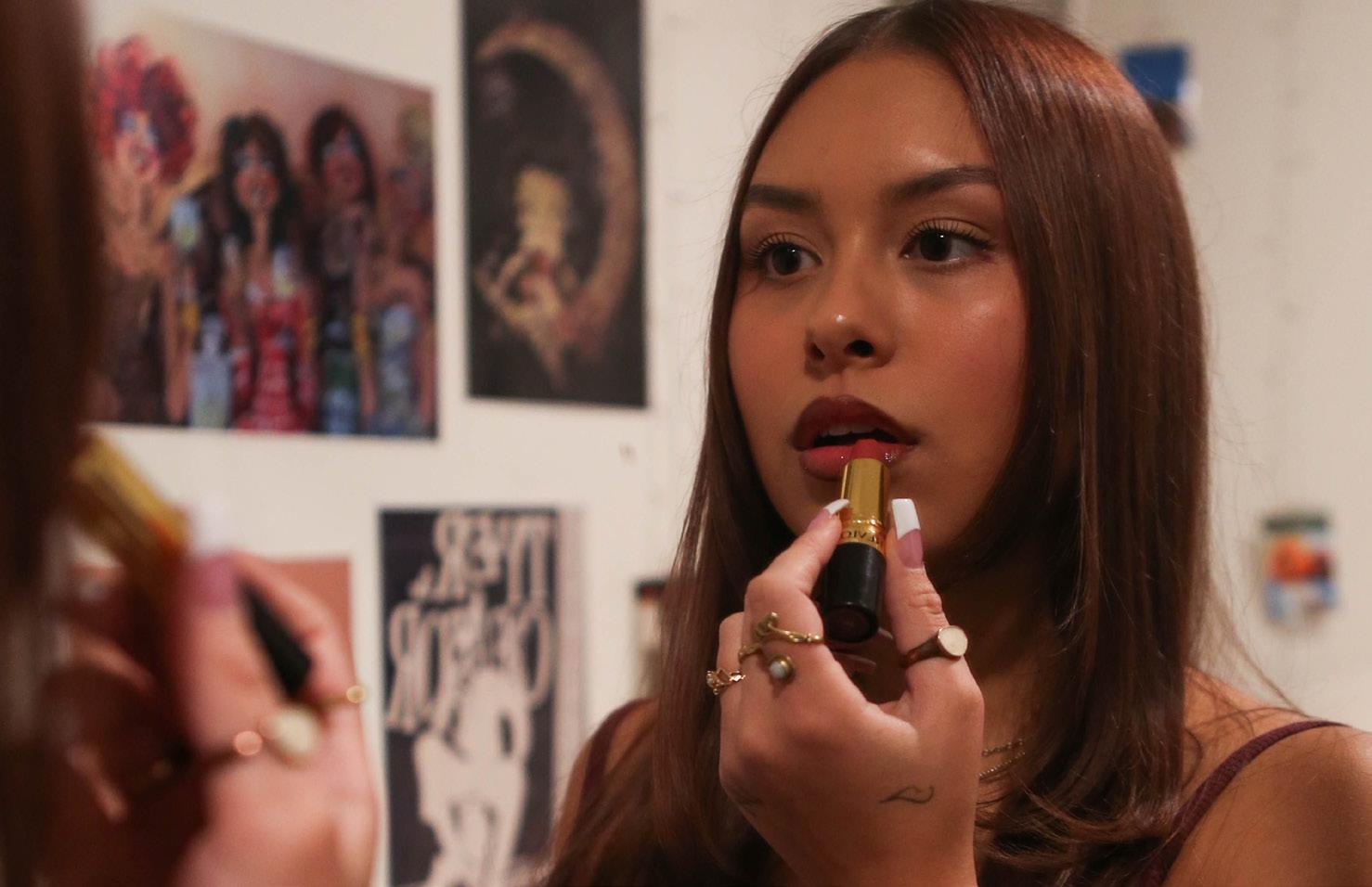
I’ve always been admired for my lip shape. And honestly, fair — they’re great lips. But it’s funny how something so small can hold so much meaning depending on who’s noticing, and why.
“You have big Black girl lips.”
Genuinely, how do I respond to that? It’s not like there’s a polite way to say: “That compliment is built on something you’ve never had to think about.”
It made me think about how people define beauty depending on where they come from — it only seems to count if
it feels palatable, pure enough.
The issue runs much deeper than my own experience. The moment someone sees a feature that isn’t white, they feel the need to name it, claim it or fit it into the only context they recognize.
I tilt my head, unsure of how to react. “Beautiful,” they said — though their tone didn’t agree.
Smile.
Answer. Nod.
After all, it was a compliment.
By summer, I became everyone’s tanning benchmark — the local gold standard for just the right amount of brown. Somehow, I’d been volunteered as judge, jury and shade chart.
“Look, I’m tanner than you.”
Like it was some kind of victory — a trophy for out-browning me. I get it, there’s something satisfying about achieving that crispy orange glow for those of a certain color, or lack thereof. But I find it fascinating how melanin becomes the most coveted accessory of the season — and everyone wants it until it comes with an ethnicity.
My first instinct was to say, “Congrats?” but instead I went with the safer option: “Oh, yeah!”
By then, I’d already learned not to ask questions out loud. Just —
Smile.
Answer.
Nod.

After all, it was a compliment.
Of course, the commentary didn’t stop at my skin tone. I had to go and bring around a brown, Mexican — exotic, if you will — boyfriend. Their curiosity just found a new subject, and suddenly, we were both being admired like collector’s items.
Family gatherings were like a pageant for our future kids.
“You and Gabe will have beautiful brown babies.”
Not “you’ll have cute kids” — brown kids. Always that word, as if color was the main attraction. What’s supposed to be praise feels like they’re admiring the idea, or the product of us more than the people we actually are.
The thing about comments like this is they sound harmless if you don’t sit with them for too long. But when you do, you start to realize how easily admiration and fetishization blur together.
Therefore, I chose not to. Instead, I’d —
Smile.
Answer.
Nod.
After all, it was a compliment.
Sometimes I’d catch myself feeling guilty for letting these moments inflate my ego. And, weirdly enough, I started looking forward to them. I pushed aside that uneasy feeling I carried as a kid and told myself it felt good to stand out, like an animal on display at the zoo.
Only I had the big lips. Only I had the brown skin. Only I had the exotic boyfriend.
Why did it feed me? Why did I start to like it?
Somewhere along the line, I realized that these were mostly the only compliments I’d ever get. People didn’t want me, they wanted parts of me.
Not my laugh. Not my drive. Not my heart.
Sure, it propped my ego — temporarily. But it always ended in the same way: never truly feeling seen.
Every August, their favorite line came back around .
“You’re Black.”
I always wanted to ask — based on what, exactly? Too much time at the pool? Apparently, a summer tan is enough to rewrite my ethnicity. The ignorance almost feels impressive.
By the time I was 13, I was used to those kinds of comments and barely thought twice about them. The same shade and lips I always had somehow still managed to shock people. How these remarks never died out, I’ll never know. But if the comments stuck around, so did my response. And so I would —
Smile.
Answer.
Nod.
After all, it was a compliment.
I’d cracked the code — a programmed response that never slipped up. I had the formula ready in my back pocket whenever I showed up around certain groups. I could rattle off 20 more comments, and they’d all end the same. By now, I’m sure you’ve got it down too.
I was so good…
So good, that when 13-year-old me was told I have “dick sucking lips,” no —
I didn’t frown.
I didn’t question.
I didn’t refuse.
Because after all, being sexualized was just a compliment.
It felt like the next phase of the same story. Their fascination just learned a new language, one that expected me to feel grateful — as if attention were the same thing as acceptance. What was once called exotic had simply become sexual. Either way, I was still the exhibit.
I’m 20 now, and looking back, I see how hard I tried to grow into the words people threw at me. But it was impossible; the comments matured long before I did.
When those comments find their way back to me now, my reaction’s about the same — just for different reasons. I’m not sparing anyone’s comfort anymore; I’m just trying to minimize my time with ignorance. I am who I am, no matter how anyone else chooses to see me.





By Bella Keenan Illustrations by Paulina Soto

You walk into your first day of sixth-grade health class. The teacher introduces herself and explains that the first chapter of the class will cover sex education. Laughter and embarrassed sighs run through the room. Some students could write a book on everything their parents taught them about sex. For others, this topic is unfamiliar and intimidating.
After all, sex is what makes the world go around — and despite major strides toward progress, the topic is still stigmatized and looked down upon by many.
If sex is so common and people have evolved alongside it, why is it still so underdiscussed?
Just by flipping through the Netflix catalog or scrolling through social media, you are bombarded by the entertainment media’s use of sex to make money.
From Pamela Anderson in “Baywatch” to Robin Thicke’s controversial “Blurred Lines” music video featuring nude models from 2013. Spanning various decades, women are repeatedly hypersexualized in the public eye. Additionally, popular movies like “Magic Mike,” which accumulated $167 million worldwide as well as Calvin Klein ads — Bad Bunny’s Spring 2025 campaign drew in 6 million views on YouTube — sexualize men, too.
Steve McKoy is the director of operations of Devils in the Bedroom — a student-run organization that provides sex education and sexual wellness
resources for the ASU community. The club values condoms, consent and communication, according to its website.
He said that the sexualization of characters is very common in movies, especially horror films.
“When you take a character and you strip them out of their agency in order for them to be sexually appealing towards the audience … that’s a big problem,” McKoy said.
“In ‘Nightmare on Elm Street’ and the original ‘Halloween,’ we see that the women have sex and then are immediately killed. It sends the message that the way to survive in a horror movie is to be pure.”
But the media’s impact on our sexual lives is not limited to overt sexualization; it also impacts how we choose to explore our own sexual identities.
Jessica Boyles is a clinical assistant professor and has a Ph.D. in counseling psychology with a specialization in sex education. She affirmed that men may feel fear in sexual discussions because of patriarchal views.
“Women can experience exploration, whether it be kissing other women or having some type of interaction, and it [can] just be looked at as experimentation,” Boyles said. “Men are not allowed that same exploration because they are labeled almost immediately as gay.”
Religion also plays a role in the double standards between men’s and women’s sexual exploration, in addition to the lack of open discussions about sex.
An underdiscussed element of sex is pleasure. Women are not expected to feel pleasure during sex compared to men, Boyles said.
Discussing pleasure can be very intimate for most women, and the lack of dialogue around it can also lead to internal shaming and a lack of sexual satisfaction.
Seventy-six percent of couples facing sexual health issues do not feel comfortable talking to their partner about it, according to the American Sexual Health Association.
Even with the person someone feels most intimate with, people — especially young people — are fearful of speaking up due to judgment. Alongside DITB, ASU also offers on-campus STI testing, as well as free condoms and dental dams in every health center.
“We go over all topics surrounding health, pleasure, consent, and things that people need to know to engage in sex safely,” McKoy said. “We also provide resources like Plan B, pregnancy tests and condoms through a peer-to-peer distribution source where people can go and order anything they need from us and have it delivered to them.”
DITB meets weekly and their resources are free of charge for students. Every meeting has a theme where students can learn more about a specific sexual topic.
“We’re really focusing on trying to



stop the stigma around sex in general,” McKoy said.
Sex is often deemed sacred across a multitude of religions, including Christianity and Islam. Many Christians refer to the Bible for guidelines about their sexual practices. In 1 Corinthians 7:2, the Bible states: “Each man should have sexual relations with his own wife, and each woman with her own husband.”
When translated to English, the Quran states, “And come not near to the unlawful sexual intercourse. Verily, it is a Fahishah [i.e. anything that transgresses its limits (a great sin)], and an evil way (that leads one to Hell unless Allah forgives him).”
Both religious texts have specific rules outlining that sex is reserved for a married man and woman, which may cause followers to feel guilt when thinking about or having sex in a way that doesn’t align with those ideas.
One Reddit user in the r/Christianity community said, “I spent whole years of my youth plagued by shame that invasive Christians put on me when it was 100% unnecessary and inappropriate. I was a virgin, sitting in the shower sobbing over shit that didn’t even matter instead of enjoying my life. Please don’t be me. If I could do it over, I would find a therapist specializing in sexual or religious trauma, or maybe with a background in it.”
It perpetuates a cycle that people struggle to break due to a history of negative past experiences. Psychologists have coined this as “intergenerational shaming.” Boyles said that speaking up and discussing sex is one way to break this cycle.
“If one time we talk about sex, or
we bring up something that’s taboo, and we get told not to bring it up, we internalize that, and we do not ask again,” Boyles said.
What if “the talk” with your parents wasn’t so awkward, or what if you didn’t cringe in your sixth-grade sexed class? The only way to destigmatize sex is through open discussion.
Lack of education can lead many to experiment with intimacy prematurely, which can be attributed to several external factors, including “the consumption of alcohol and other psychoactive substances, family structure, peer influence, exposure to pornographic movies, the level of education and the beliefs and values regarding sexuality,” according to a study from 2018.
Boyles said young people feel more confident to talk about sex when a family member or friend already openly discusses it, adding that open discussion in intimate family settings allows for breathing room.
“We know that a lot of the modern porn industry focuses on some not great stuff,” McKoy said. “It perpetuates some very regressive, and potentially misogynistic parts of our culture, and it does introduce a lot of people to that.”
A lack of open discussion may lead to adolescents seeking alternatives, like porn, for sex education. Since it was created for entertainment purposes, many porn sites lack realistic sex education and are often unethically produced, which can create a false narrative of what sex should be.
“We have a lot of people who think certain things should be happening in sexual interactions due to porn, but
instead of communicating that, they just do it,” Boyles said. “Then we see things like sexual violence, coercion or assaults because it’s not educating.”
Without the proper resources, safety can become a concern. Sexually transmitted infections and adolescent pregnancies are some results of the lack of sex education.
McKoy emphasized that DITB works to combat a common narrative about STIs: “If you have sex, you’re going to get an STI and you’re going to die.”
Instead, the club reassures people that “STIs are normal and it’s important to get tested to prevent their spread. But if you get one, it is not the end of the world. You are not dirty,” McKoy said.
Proper sex education starts with transparency. “If no one has the education to understand sex at a very grand level, we can’t say that we would expect parents or people within the home to have more education,” Boyles said.
According to Boyles, many middle and high schools take an abstinence-based approach instead of a safety-based approach, if even an approach at all. Although there needs to be progress in youth sex education, Boyles has hope for the future.
“I hope to see policy changes toward more of a comprehensive sex education, and I think that we should absolutely teach abstinence in the way that you should not be talked into it, and you should not be coerced out of it,” Boyles said.
In an ideal world, people will no longer look away or cringe when they hear about sex. I desire open discussions that will lead to the destigmatization of sex. Without conversing, there will be no room for growth.

CREDITS: LAVANYA PALIWAL

CREDITS:
CREDITS: MADISON KOEHLER
How women of color have co-opted the ‘trad wife’ label
By Keyanee Walls
Illustrations by Paulina Soto
She is a full-time homemaker. With the ability to bake a fresh loaf of sourdough from scratch, a baby in arm, she effortlessly balances the abundance of duties that come with raising her many children, keeping the house in order and tending to the needs of her bread-winning husband.
She is the picture of femininity:

young, God-fearing, conservative in both thought and dress — and is incredibly proud of her European heritage.
This is the “traditional” wife, an identity that has recently reemerged in online popular culture. Social media platforms are flooded with content and imagery of these women, and as you scroll through media under this
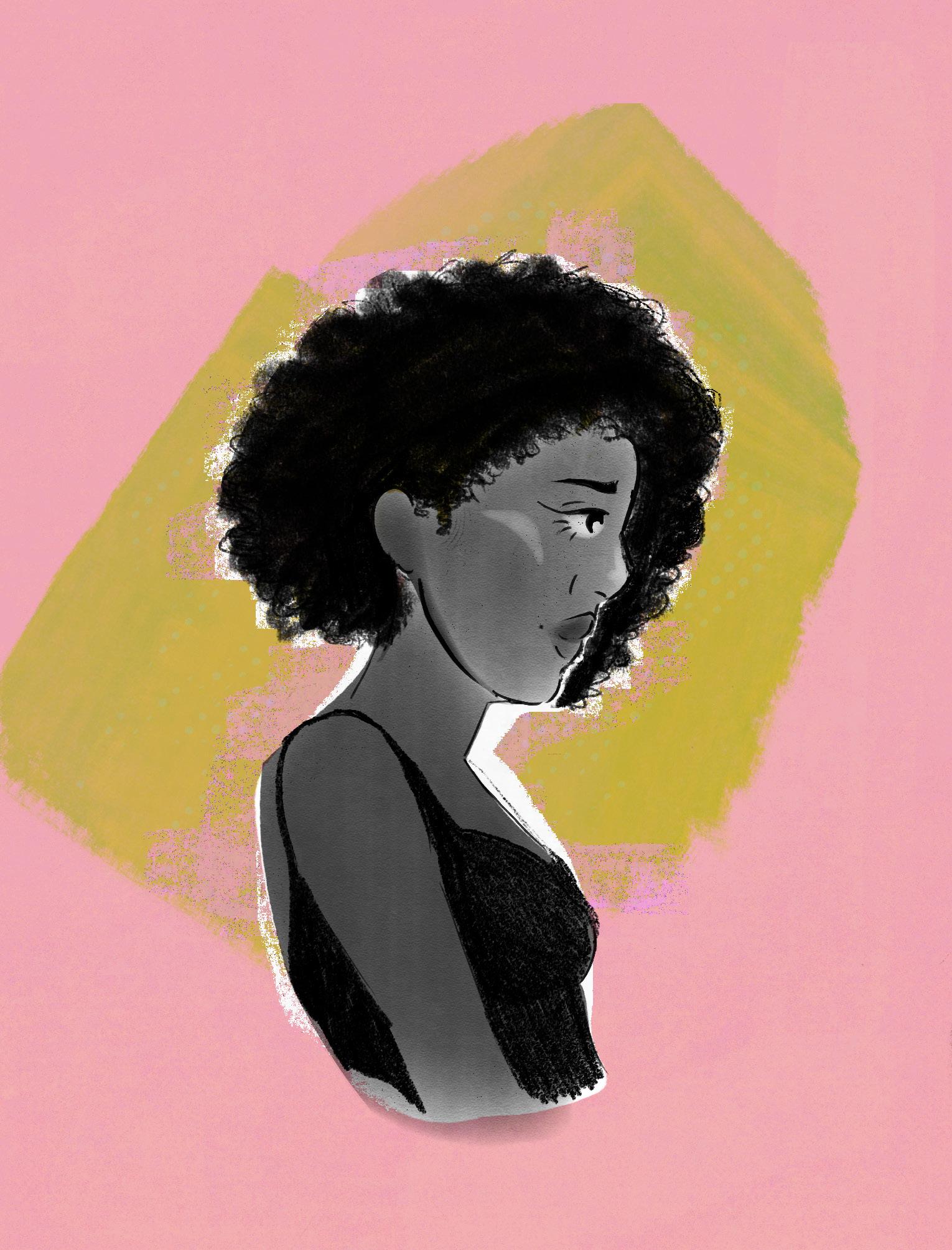
tag, you might notice some defining features.
In terms of setting, these women are, of course, in the house. They may be cooking or cleaning something and they are most likely surrounded by children. If you look closer, you’ll find they are almost always wearing a tea-length dress, sometimes an apron over top. Their hair is blonde and they wear minimal makeup, if any at all. The most consistent similarity of this bunch, however, is an overwhelmingly white demographic.
Traditional culture or “trad” culture refers to the ongoing popular movement surrounding women who embrace traditional gender roles. Online, trad influencers have taken to social media platforms to promote their lifestyles through delicately curated displays of what it takes to manage a home: caring for children, cleaning and cooking.
Autumn Gulley, a sophomore studying biomedical engineering, expressed her thoughts on the reemergence of this content. “It’s just kind of strange to see it resurfacing again [and how] these women [are] falling back into these stereotypical roles.”
This trend pulls from mid-20thcentury nostalgia and conservative idealism, highlighting traditional family values. While having made a significant impact on platforms like TikTok in recent years, earlier origins of the trend can be traced back to lifestyle content on YouTube in the
mid-to-late 2010s.
“Wife With a Purpose,” or Ayla Stewart, is a blogger and YouTuber who began promoting tradwife content in 2017. Stewart began her blog in an attempt to “support the revolution of radical traditionalism,” producing posts urging readers to follow this lifestyle. Stewart quickly began promoting white-nationalist rhetoric on her platform, with one example being her commencement of the “White Baby Challenge.”
In 2017, Stewart posted to X stating, “As a mother of 6, I challenge families to have as many white babies as I have contributed. We can win the Utah racial war and protect its unique LDS European Heritage.”
This challenge was created as a remedy to the white nationalist “great replacement” conspiracy theory, which suggests the deliberate “replacement” and “repression” of white populations by minority groups.
Stewart’s attempt to mobilize her followers in this way further highlights the dangerous rhetoric that lies within this trend and how easily this culture can be weaponized.
One of the current influencers at the forefront of online tradwife culture is Hannah Neeleman, known online as “Ballerina Farm.” Neeleman is a social media figure who produces content that centers around her life raising eight children and selling products from her family’s farm.
In the beginning of her influencing career, Neeleman posted content about becoming a farmer and the adjustments that came with it. Over time, she began sharing more pieces of her personal life and clued viewers into the inner workings of her home and family.
Audiences grew intrigued with the visuals of Neeleman’s life as a
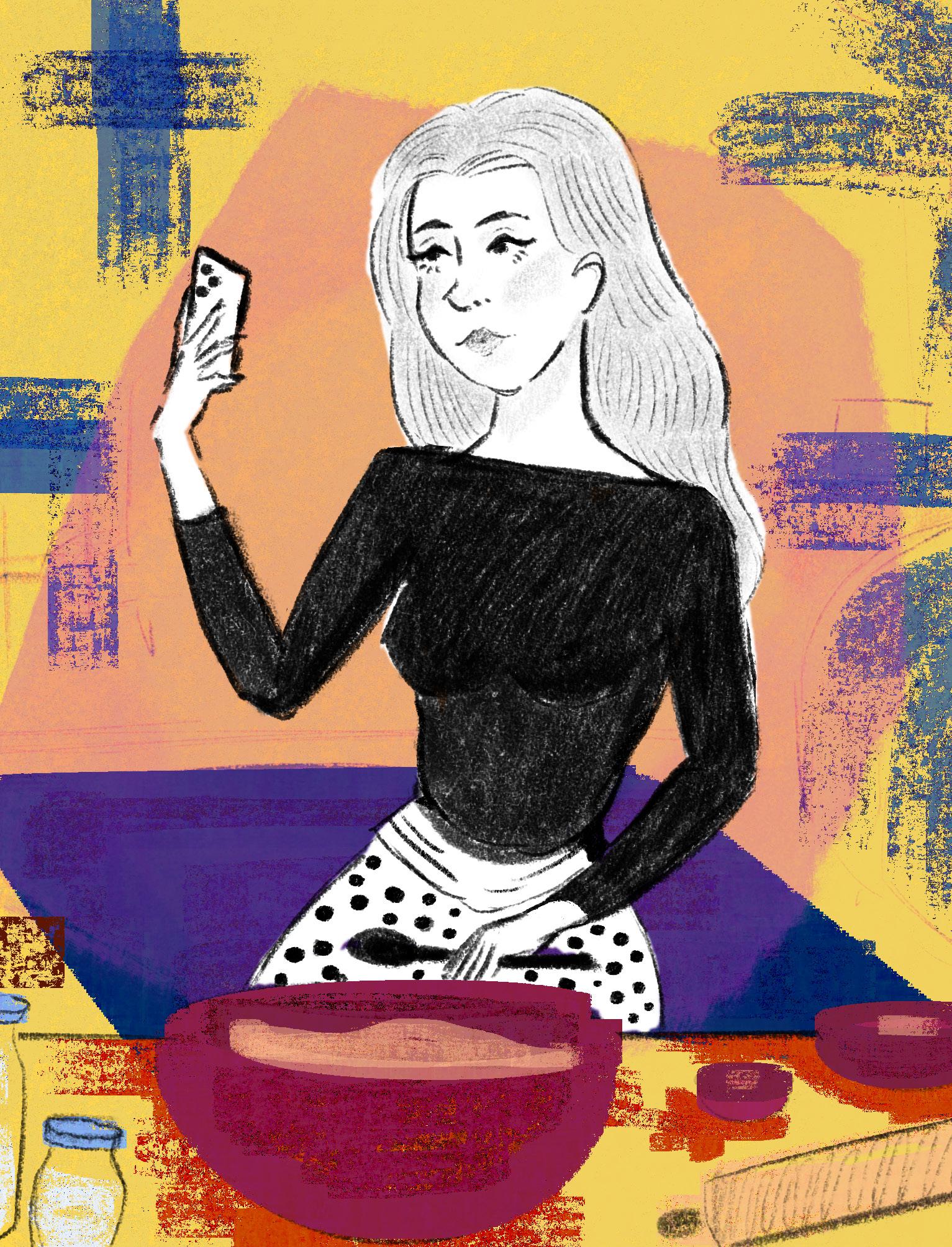
homesteader. Her most popular videos on TikTok depict her preparing various meals from scratch while her children chatter in the background. Neeleman herself doesn’t speak to her audience in most of the clips; instead, they are treated as a brief window into her everyday life. Currently, her TikTok page has 10.6 million followers.
Behind Neeleman in most videos is an opulent green cast-iron stove that, at one point, was cause for discourse among people online. This 1991 AGA stove, which retails today in similar models for almost $40,000, was a major point of dispute. Viewers began to question the attainability of the

lifestyle being marketed in Neeleman’s content.
Audiences have since discovered that her husband, Daniel Neeleman, comes from an extremely wealthy family as his father is the founder of JetBlue and several other airlines. This launched a discussion surrounding Neeleman’s lack of transparency in how her family is able to support their “traditional” lifestyle while she makes content for her large audience.
Atia Muzaluba, a freshman studying finance, commented on the feasibility of being a tradwife, saying that it is not possible for many “since a lot of women are working or they just don’t have the
the finances to sustain that lifestyle.”
Influencer and model Nara Smith has faced similar scrutiny in regards to her own content, which has also become associated with trad culture.
You might’ve seen Smith’s viral TikTok videos or even parodies online, where she creates intricate dishes from scratch while dressed in extravagant outfits, speaking in a breathy whisper. Smith began creating this content around late 2023 and quickly gained virality for the unique nature of her videos.
“While my toddlers were playing in the backyard, they asked me for a

Capri-Sun. Since I had all the fruit at home to make some, I told them to give me a minute while I got started,” Smith said in a TikTok from 2024.
While most of her content consists of cooking videos, Smith also shares details from her home and family life, raising four children as a young mother and the dynamics of her marriage with fellow model Lucky Blue.
Smith has been at the center of a few controversies in recent years, having to do with her family’s affiliation with The Church of Jesus Christ of
Latter-day Saints, her promotion of traditional culture and allegations of content plagiarism.
Last year, Smith was accused by South African creator Onezwa Mbola of copying and profiting off her content, which centered around cooking from scratch and the intricate processes behind it.
These allegations launched a conversation about the implications of colorism in Smith’s rise to popularity. Many viewers asserted that Smith’s position as a light-skinned, mixed-race woman coupled with the traditional rhetoric behind her videos, aided in
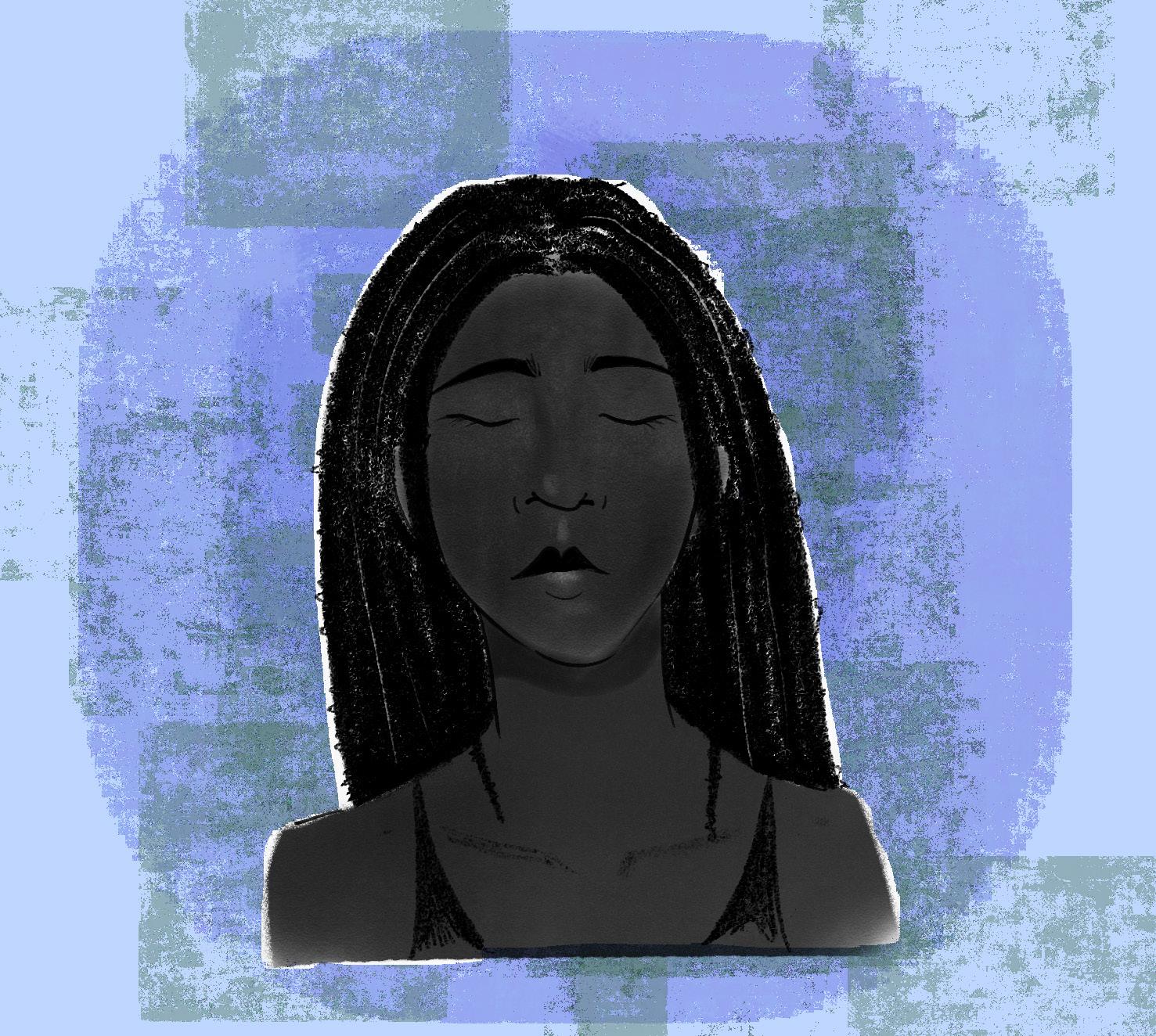

making her content more palatable for white audiences.
“Soft life” trends originated from Nigerian influencers post-pandemic. These creators took to social media, sharing the necessity of centering rest and mental health during stressinducing times.
Initially, the soft life movement acted as a form of respite for Black women seeking to detach from pressures associated with hustle culture and “strong Black woman” stereotypes.
Much of the content under #Softlife consists of TikToks urging viewers to embrace minimalism, self-care routines and more practices that strive to reflect a low-effort and relaxationcentered lifestyle. An unintended result of this trend, however, was a growing desire in audiences to maintain a perceived idea of femininity that is often unafforded to women of color.
“I want to appear more feminine,” a TikTok user commented under a video captioned “I love being a soft, feminine, black woman.”
While the soft life trend aimed to push back against harmful tropes used toward Black women, it eventually opened the door for damaging ideas surrounding femininity within the community — centering passiveness, ‘delicacy’ and other traditionally conservative ideas.
Addressing the dissonance
There are quite a few parallels between soft life and trad wife
trends, namely in their approaches to feminine ideals and glamorization of domestic labor. As these two movements began intersecting in terms of visual aesthetics, the contrast in their ideological roots became glaring.
Trad culture was born from reminiscence to a period when women were discouraged from entering the workforce and encouraged to be homemakers first. This, however, was not the case for women of color.
Throughout American history, women of color have always had to work. In the mid-20th century, this labor was mostly secluded to domestic service, aiding in the homemaking efforts of white upper-middle class “housewives.”
The current resurgence of this identity promotes a culture that women of color have historically never been involved with — so is the “tradwife” label only truly applicable to white women, or is it possible for these spaces to be reclaimed? And if so, should they be?
In an article for Grown Magazine, writer Kamaria Jade stated, “We’re being told that the way to be valued is to be smaller, quieter, more traditional, more conservative. To shrink ourselves into a version of femininity that was never designed with us in mind and has historically been used to oppress us.”
Jade’s statement highlights the ideological incongruencies in how women of color have interacted with traditional culture through trends like “soft life,” illustrating the
involvement of Eurocentric beauty standards in what is considered “feminine,” according to this trend.
“Social media and what we see [on it] is a reflection of our society, and the trend of [trad wives] reflects more stereotypical roles of women in kitchens. And I feel it’s kind of a step backwards,” Kaitlyn Daniels, a sophomore studying biological sciences, said.
A general concern around the growing popularity of traditional ideas, is the impact it could have on feminism and gender equality today, especially as younger generations on platforms like TikTok, consume this content.
According to Katie Economopoulos, a freshman studying aerospace engineering, trad culture could have potential “detrimental effects” on the progression of modern feminism, as it idealizes a lifestyle that once represented the oppression of women.
Lola Del Pizzo, a freshman studying political science, shared similar thoughts: “When we see people dressed up in the sort of outfits that they’re wearing, and the sort of voices that they’re using and the way that they’re editing, it feels like it’s romanticizing something that [does] not necessarily [need] to be romanticized.”
Many of the dangers of trad culture arise in the promotion of a potentially harmful lifestyle, without full transparency on the realities of what it takes to maintain it. And for women of color, this risk lies further in entering a space that, at its core, advocates for their oppression.


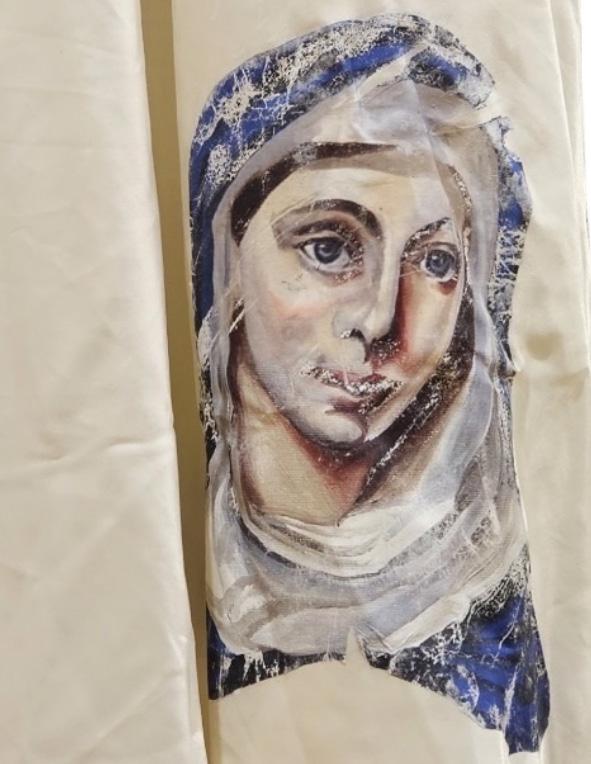
The art of figure drawing
By Lucia Zettler
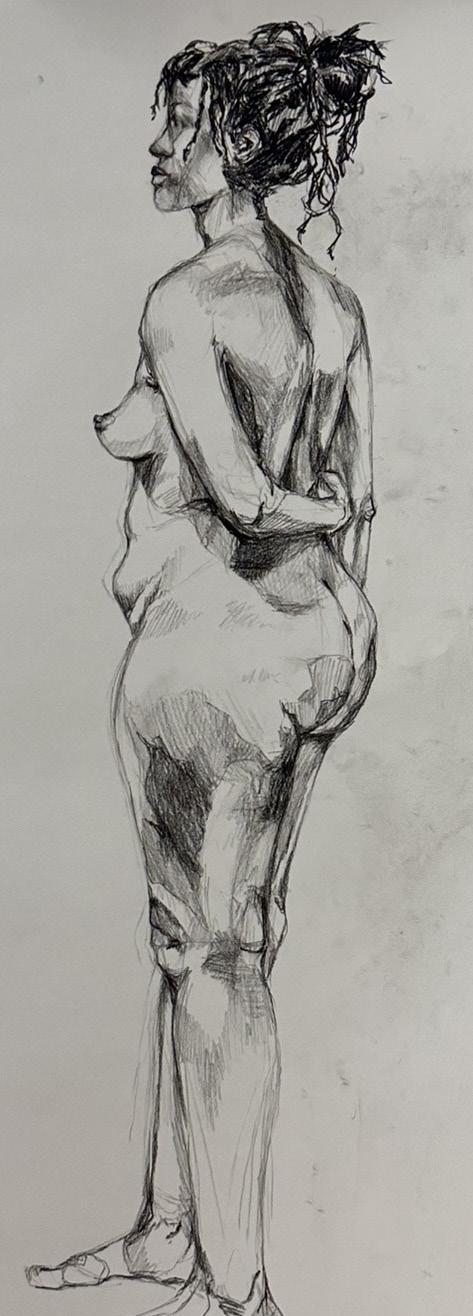
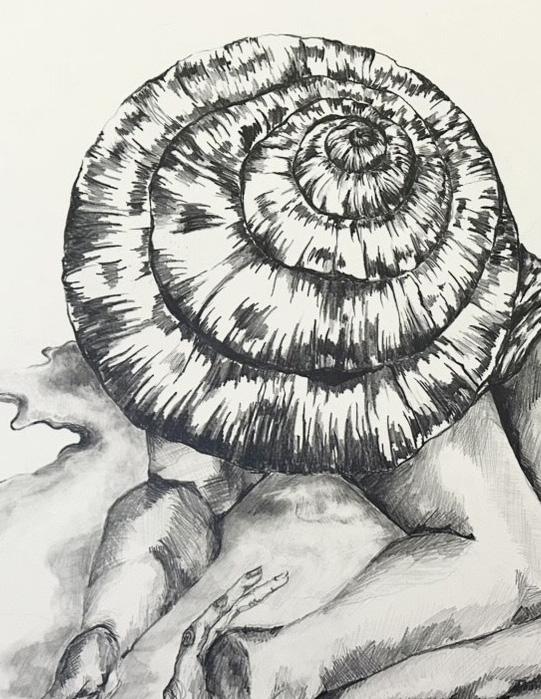
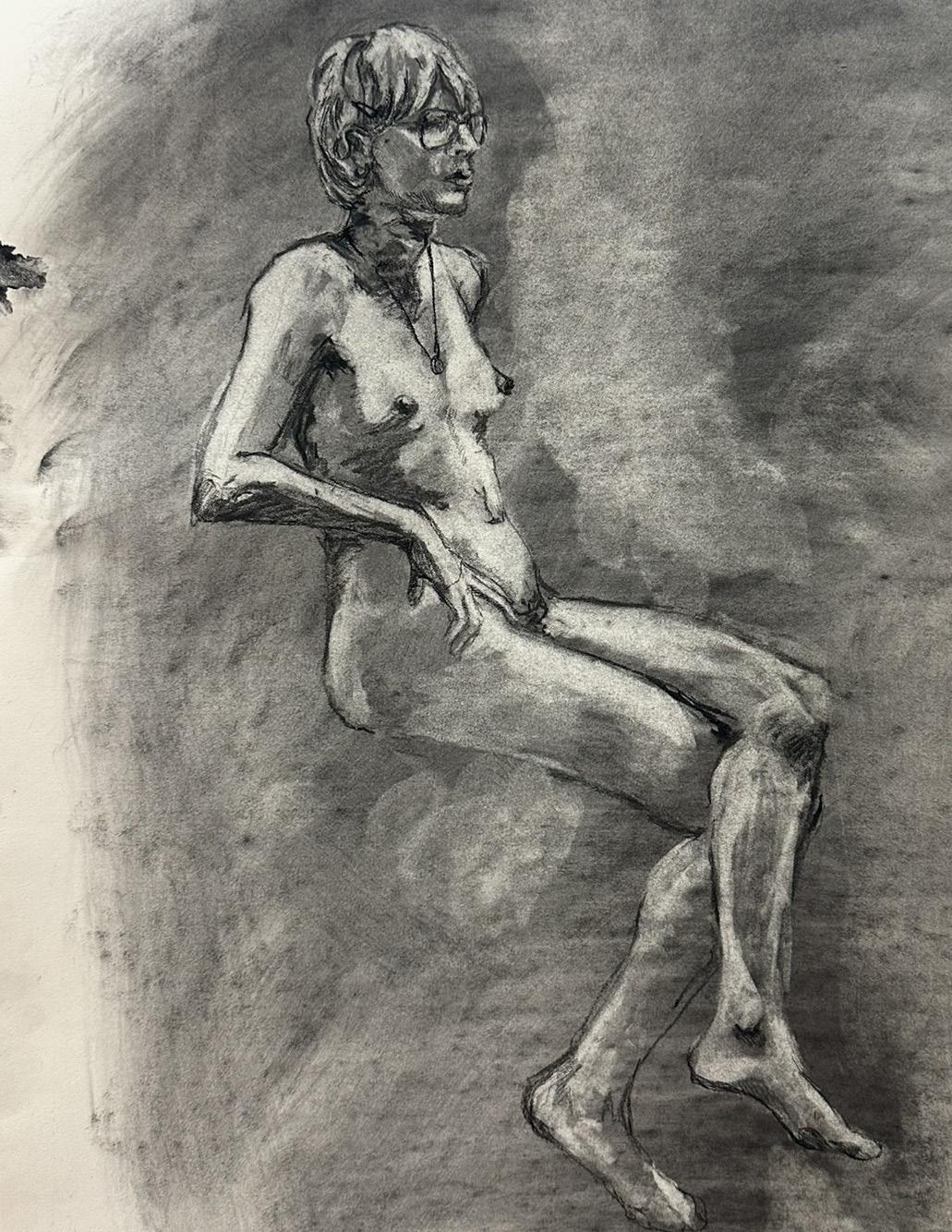
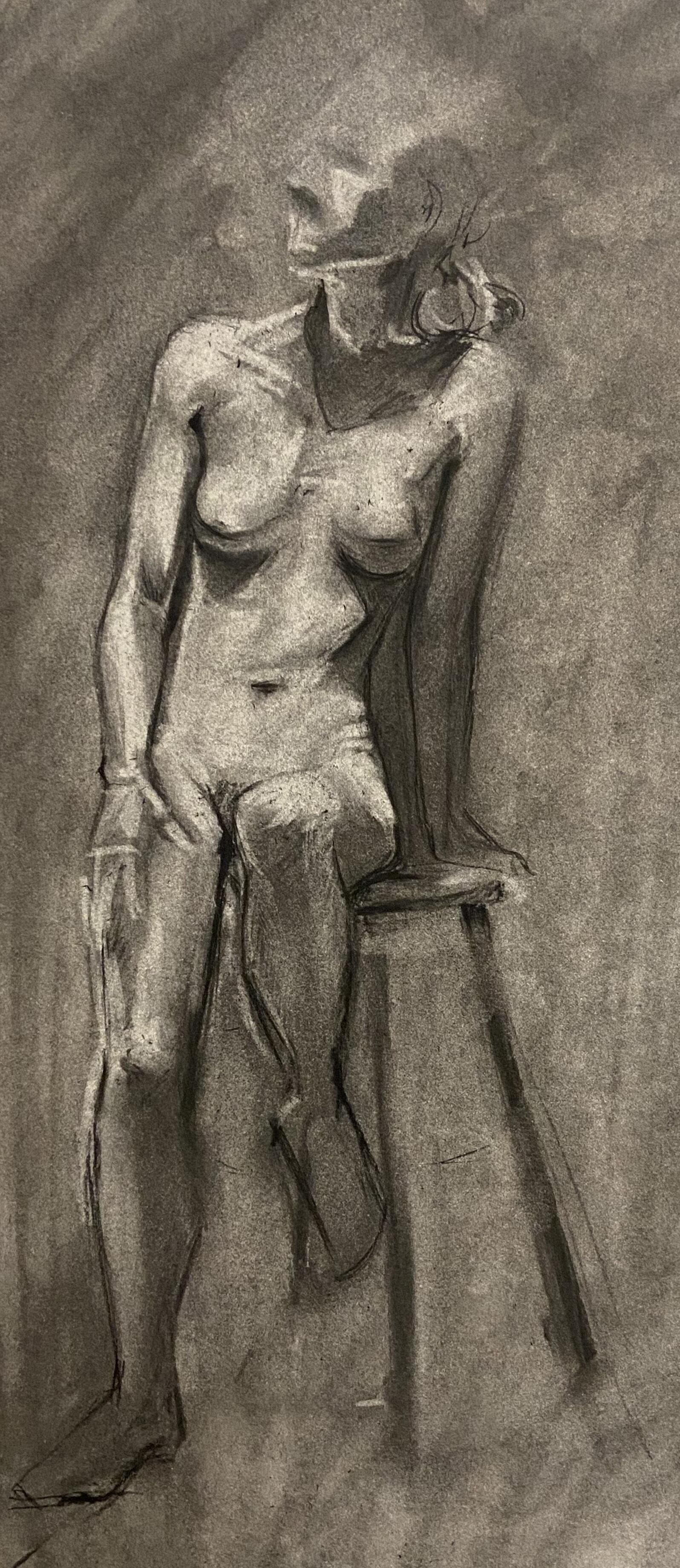
The room is quiet and still. The lights dim, casting shadows that dance among the easels. A model steps into the center, letting his robe fall away. Dean Reynolds, a professor at the School of Art, adjusts the stage lights, bathing the model’s body in a soft glow. The model poses completely exposed, redefining himself not just as a person without clothing but as a subject for students to capture.
The light scratches of charcoal on paper fill the room as the sketching begins. The process of figure drawing is slow and painstaking. Each line is careful and deliberate, but as the students continue to draw, the man and his form come alive on the page.
This class offers solace in a world where students are bombarded with information on social media and are increasingly reliant on artificial intelligence rather
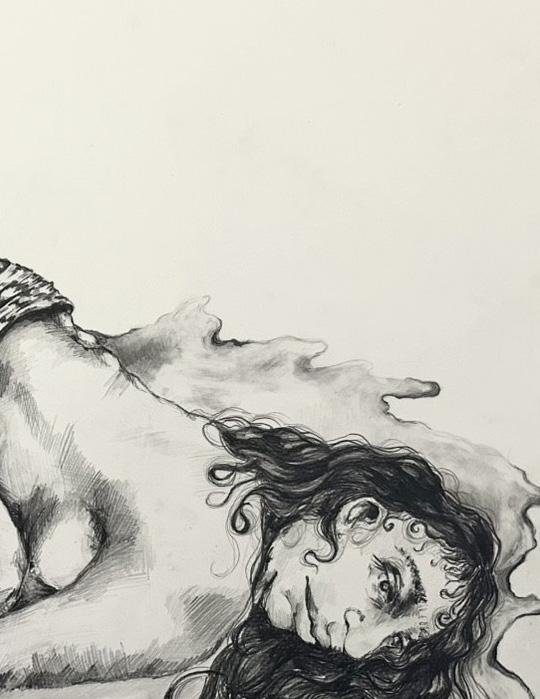
than their own skills and creativity.
“AI can produce anything instantly, but that doesn’t make it good or real,” Reynolds said.
Technology has altered the way we see and process information, and a lot of that change comes from convenience. Convenience has a cost, pulling us away from the patience and dedication that makes art pure, according to Reynolds.
Figure drawing is like manual labor. You have to engage with what’s in front of you patiently, and you can’t swipe past it or filter it. Reynolds said it’s impossible to replicate figure drawing with AI because purity is in the act — the slowness, the imperfection, the physical engagement with reality.
To these students, figure drawing is more than just art; it’s an exercise in concentration the modern world often lacks.
The first known drawing of a man — The Shaft of the Dead Man — can be traced back to about 15,000 BCE to Lascaux cave in France during the last Ice Age.
It wasn’t until the Renaissance that the art form truly blossomed, with Leonardo Da Vinci utilizing figure drawing to depict the universal nature of man, capturing stark and violent scenes. In these pieces, he sought to understand what made people tick. He used a systematic approach and strove to perfect human proportions. Because of this, other artists started to find beauty in capturing the raw human form and its symmetry.
Later, the Baroque and Rococo periods moved away from the perfectionism of the Renaissance and began using figure drawing to portray intense human emotions. The nude form was utilized as a vessel, allowing artists to create expressive pieces that resonated deeply with viewers. These pieces illuminated the intensity of the human experience.
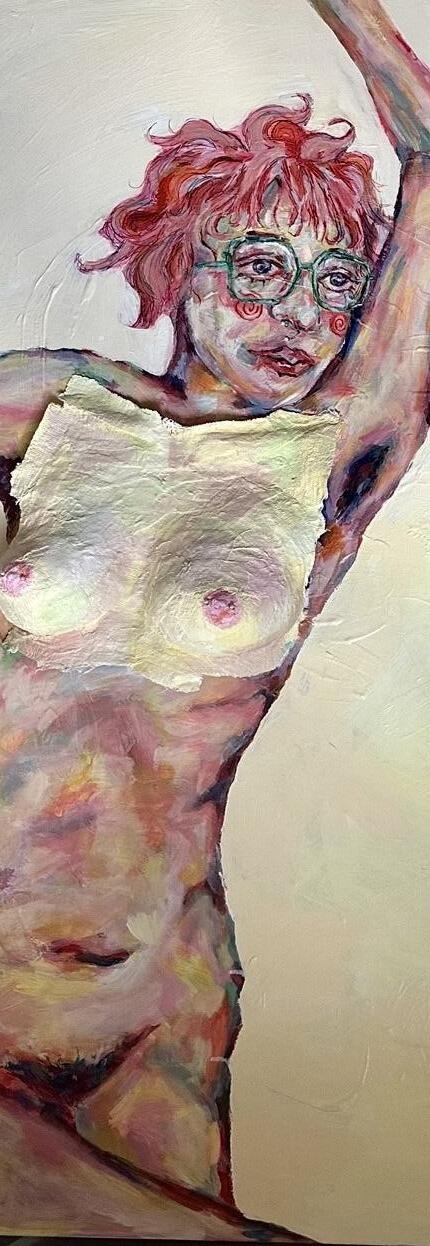
Romanticism and realism began to emerge, with pieces containing themes of passion, emotion and social commentary. Realism used nudity to convey heavier themes, featuring stark images of poverty and social injustice. Nudity allowed artists to convey difficult situations in their most authentic form, highlighting the struggles of the era.
Today, figure drawing ties artists back to centuries of tradition, allowing them to explore the human body in countless ways.
“When students draw for the first time, they often just trace outlines. It’s flat, stiff, wooden. But when they start to see and know — when they understand structure, volume, anatomy — their drawings come to life. It’s not just about realism; it’s about awareness,” Reynolds said.
Reynolds encourages students to approach figure drawing like a puzzle. He describes the process as going from “looking to seeing to knowing,” and explained how looking at a figure doesn’t necessarily mean you have an understanding of it. To truly understand a figure, an artist must develop a relationship with the subject to notice the underlying structure and rhythm of their body.
Mariana Dean Lopez, a senior studying animation, compares this process to how she comprehends information while reading.
“It’s like when you’re reading a paragraph and not really getting anything out of it. That’s ‘looking.’ ‘Seeing’ is when it starts to make sense. And ‘knowing’ is like, ‘Okay, I understand the narrative now,’” she said.
This awareness, Reynolds believes, is where perfection lies. To capture a person in their most accurate form requires a high level of patience and dedication. Students scratch their charcoal on the page for the entire class, dragging lines, erasing over and over. With each stroke and careful correction, the figure gradually comes alive. Through repetition and focus, they demonstrate a level of artistic purity, marked by consistency and uninterrupted concentration.
For students, finding this focus means slowing things down. Students can use this process to build an understanding of figure drawing, improving their work day by day. Keiran Lund, a junior studying painting and drawing, has seen his work improve over
“You start with a surface-level understanding — just the outline — and then move toward really understanding the forms underneath, the structure and shapes that make it up. That’s where ‘knowing’ comes in: when your practice aligns with real understanding,” Lund said.
He plans to apply the concepts he has learned from figure drawing to his narrative artwork in the future.
“By practicing figure studies, you learn to break down the body into simple shapes and forms,” Lund said. “That helps you later when creating your own poses without needing constant photo references.”
Angel Marques De Mesquita, a sophomore studying game design, finds this process meditative.
“With figure drawing, I feel much more connected,” Marques De Mesquita said. “There’s something about capturing emotion and anatomy that really resonates with me.”
She said she tends to get unmotivated easily, so this art form helps her focus on “learning muscles” — on patience and progress rather than perfection. Marques de Mesquita feels the practice of figure drawing applies “mostly to art, but I think I can apply it to other things, like starting slow, being patient and not getting frustrated too quickly.”
“It’s about time and effort,” Reynolds said, “You can’t fake it — you have to struggle, fail and try again. Purity isn’t getting it right; it’s the process of failing and continuing anyway. You work, you sweat, you erase and you keep going.”
Unlike AI, figure drawing demands intention. Each stroke is deliberate and placed on the canvas with purpose. Nothing is generated instantly or by chance and each mark is defined by observation and understanding. This is what sets it apart.
“Students begin to see how much of their lives are about distraction — about easy consumption,” Reynolds said. “Here, they slow down. They start to value what’s enriching rather than what’s instant. Purity becomes about depth — about eating a good meal instead of junk food.”
The difference between a “good meal” and
“junk food” is the reward. The refined and instant nature of AI is empty, offering little sustenance in the long run. For Marques De Mesquita, the meditative rhythm of figure drawing, from the friction of charcoal to the smudge of fingertips, feels more fulfilling.
“It’s rewarding when you finally get it right. You learn to enjoy the process, not just the result.”
An artist’s muse
Mia Aronsohn, a sophomore who models for the class, views her role very matter-of-factly.
“I am just an object in the room, a statue, a muse, just like if you were to set up any other still life — apples, or whatever it is you want to draw. It’s not me as myself,” she said.
Reynolds describes this concept as naked versus nude. To him, naked implies power and control while nude implies equality and respect.
“The model is essentially a part of the process. They pose in ways that are comfortable for them. There’s a mutual understanding — an equal exchange,” Reynolds said.
Sitting in the classroom, this respect is clear. As soon as the model drops their robe, pencils rise and each individual’s eyes trace over the model. These eyes feel different to Aronsohn.
“Oftentimes as women, you can feel eyes on you, and those eyes feel almost like darts, like they feel like they’re digging in you,” Aronsohn said. “But when I’m standing there, I don’t feel eyes as if they’re digging in me, I feel eyes as if they’re passing over me and studying me, and it’s almost a dance.”
In the figure drawing environment, mutual respect is what makes the act safe. In the classroom, it is essential that students view the model in a professional way in order to maintain the integrity of the class.
“There is a sort of agreement that you come to, that this is a professional environment. This isn’t a sexual environment, this isn’t a romantic environment, this is simply a job for the both of us and that’s all it has to be,” Aronsohn said.
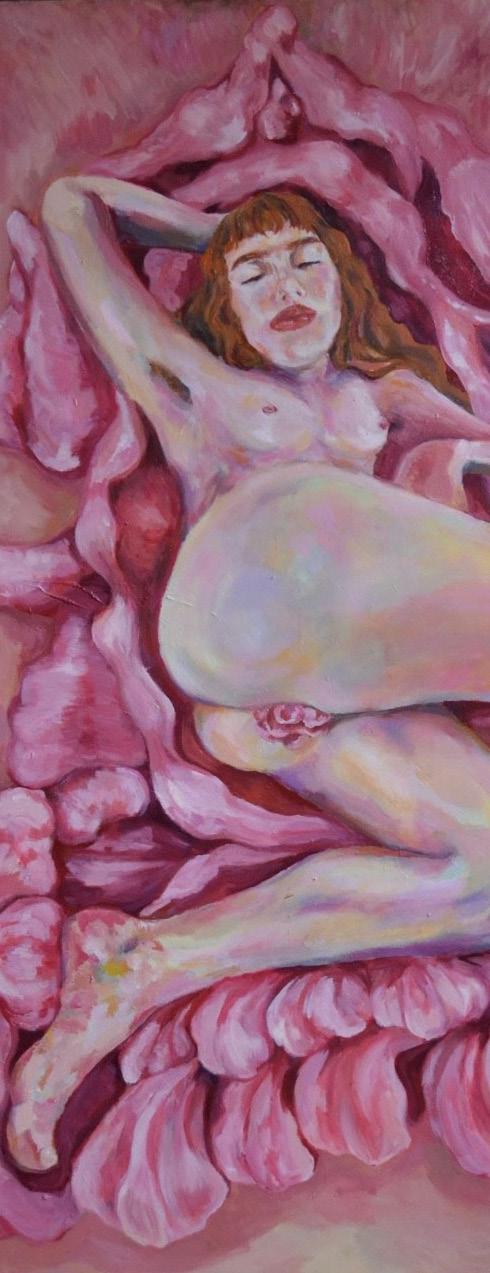
Figure drawing allows for a different type of art to emerge — one that is rooted in viewing things in their original form without judgment or preconceptions. This raw simplicity is what makes figure drawing special.
To Aronsohn, nudity and figure drawing are essential to our society.
“Nudity has been a key aspect of art since the dawn of time. I don’t think that is going to change. It would be a detriment to the world if that did change, because our bodies are the one thing that connects us all,” Aronsohn said.







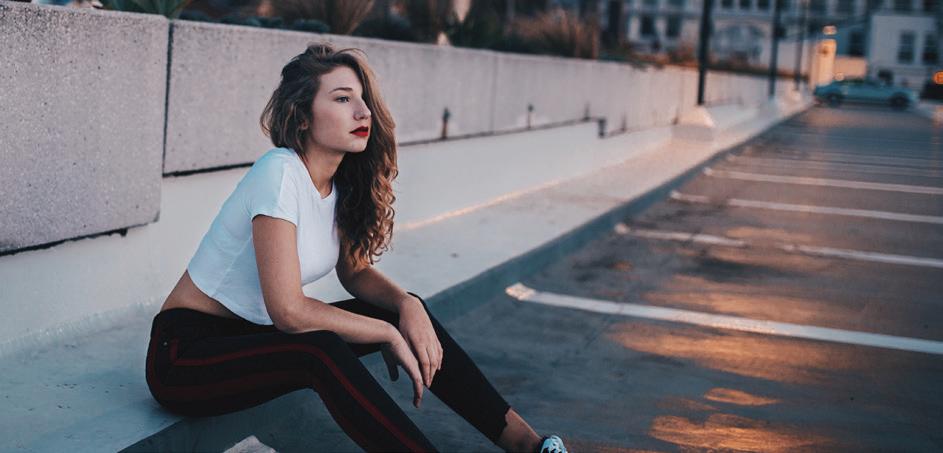




The rise and cyclical nature of purity culture
By Natalia Jarrett
Photos by Maxine Hernandez
When Charli XCX released her critically acclaimed album “brat” last year, the record became more than a collection of songs — it was a lifestyle for a whole summer.
The singer went on to accept The Wall Street Journal’s 2024 Music Innovator Award and gave a speech at the podium before dancing to her own song with The Dare during the event’s afterparty.
“I wrote an album about myself and about my friends and about partying and about all of my problems,” she said during her speech. “I wasn’t really sure if anyone would connect with it, but luckily for me, the pendulum of culture swung in favor of messiness, personality and the niche.”
She described her elation that the music industry was in a place where it “embraces female artists for their authenticity and their individualism. For being unapologetically themselves, for being imperfect and above all for being chaotic.”
But a year and a half later, the pendulum swung back.
Mini skirts are turning into floor-length petticoats, friends from high school are marrying their military boyfriends at 20 years old, the popular ASU party scene is dead and “trad” is in.
The accolades Charli XCX received turned sour, with people claiming that being ‘brat’ was an excuse to be rude and messy — disgusting even. How can a piece of art meant to embrace the freedom of being a slightly flawed hedonist turn into something worthy of being burned at the stake for?
In the 1960s and ‘70s, the sexual revolution set modern culture ablaze. The rigid social norms from previous generations began to loosen and society went in a more progressive direction.
Eric Swank, a clinical professor specializing in social and cultural analysis at ASU’s West Valley campus, said this kind of generational movement among young people in society is called a collective, or public challenge.
“First, the ‘60s was more anti-war activism and civil rights activism, and then in the ‘70s is when there started to be more mobilization among feminist movements,” Swank said. “ And then a little bit later than that, queer movements became more public and mobilizing in the late ‘70s, and then going into the early ‘80s.”
Casual drug use, advancing equality between men and women, ‘the pill’ and a distaste for authority ran rampant throughout subcultures and minority spaces, eventually seeping into public knowledge.
“Mainstream stuff generally has control over [the public] and manages sexualities and gender,” Swank said. “But at the same time, there’s always competing trends and contesting at the individual level, even if it’s not public, their brain is trying to change it.”
The liberation college-aged people cultivated for themselves was a direct reaction to the strictness of previous decades. Young people felt free to do what they wanted in a way that was unique to their genera-
tion — until it became a disruption.
Older generations became concerned about the youth’s promiscuity and lack of inhibitions, raising red flags about premarital sex, falling into harmful cults and participating in unruly behavior that could lead to other issues down the line. And due to a widespread misunderstanding about the AIDS epidemic, gay men, drug users and Black people, specifically, were ostracized from society, despite heterosexual men and women also contracting and spreading the disease.
According to the National AIDS Memorial, “The same systemic racism that devalues communities of color permeates institutions– healthcare, housing, work, family – that we need to take care of ourselves and one another. The coupling of racism and AIDS stigma has been lethal. So too has been the rising cases of hate crimes and acts of discrimination and racism against Black, Asian and the Trans communities.”
This fear triggered a rise in more conservative beliefs. Purity rings, abstinence and a strong resistance to anything “controversial” became the push that thrust young people into menial office jobs.
By the ‘90s, the term “purity culture” was coined, based on puritanical religious beliefs from 16th-century England. It was characterized by American Christian communities through the popular book “True Love Waits,” which encouraged women and men to show less skin and stop engaging in devious sexual behaviors. It also pushed religious spaces to prohibit smoking and drinking alcohol.
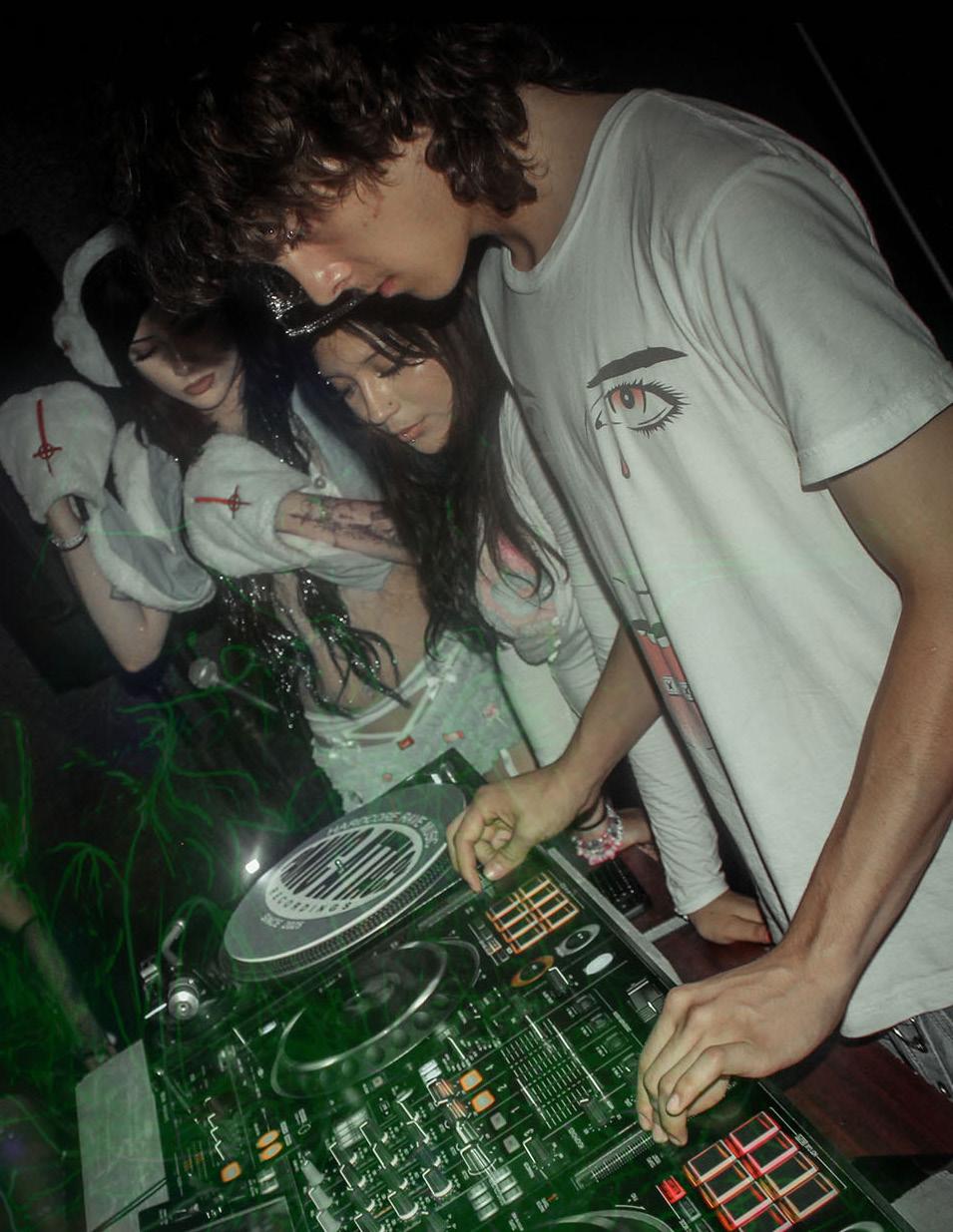
According to Swank, the uptick in shame toward supposed deviant behaviors and a turn toward conservatism happen in cycles, especially at times of political unrest, and vice versa.
“There’s a debate in literature that says social movements respond to what’s called political opportunity structures, or changing political environments,” Swank said. “The argument is that social movements have to grow when elites and the powerful have some cracks and break, so at least progressive ones grow when [the] president and senators argue, when corporations don’t fund certain types of politics and when religious institutions break from conventionality.”
After the late aughts, a time characterized by loud, abrasive pop music, glitter and eyeliner smeared with sweat and alcohol, young people didn’t see another generation-defining resurgence of party culture until “brat summer.” It was a season that embraced being loud, wearing less and drinking more. It was also a fleeting moment — suddenly Kamala Harris wasn’t ‘brat’ anymore, and America was about to enter a new conservative administration, which was voted in by a landslide. Faced with a looming war, a new presidency and rising prices, tension rose between American citizens.
At the height of this strain, Robert Eggers’ “Nosferatu” — starring Lily Rose Depp and Bill Skarsgard — was released. In the weeks leading up to its Christmas Day opening, it received critical acclaim and headlines that predicted the film would have a large impact on popular culture.
Throughout history, films released during times of nationwide turmoil have become champions for the era, such as “The Wizard of Oz,” which was made during the end of the Great Depression. “Nosferatu” came out alongside other films like “Wicked” and “A Complete Unknown” — all three garnered attention from huge audiences and reflected themes of transformation to viewers.
But despite the positive reviews for “Nosferatu,” the internet had an array of thoughts about the movie’s contents.
“Nechrophilia porn. Disgusting. Ruined Christmas for me. If I could give it no stars I would,” one Letterboxd user wrote about the film, with a half-star rating to accompany it.
Eggers’ movie is a remake of the 1979 film “Nosferatu the Vampyre,” which is a remake of the original film from 1922. The story itself was taken from Bram Stoker’s novel “Dracula.” The plot and details of the film have been referenced in the media countless times, despite shock that the 2024 film had three key themes — sex, death and shame.
When I saw the movie at the AMC Centerpoint in Tempe, in a theater filled with college students, moments of silence were filled with laughter or suppressed chuckles. The general consensus on social media was that “Nosferatu” was “too freaky.”
Within the last couple of years, posts shared by Gen Z users on X and TikTok reflect sentiments that sex scenes in movies and TV shows have become unwarranted.
One post on X reads, “sex scenes are truly not needed in film and if you’re a good videographer you know how to imply it w/o an actual sex scene.” Another stated, “if we abolish all sex scenes maybe we don’t need intimacy coordinators.”
According to a study from the University of California, Los Angeles, 51.5% of adolescents said that instead of wanting scenes depicting sex or intimacy of any kind, they would rather see the development of platonic relationships on screen.
This trend in beliefs has formed directly alongside similar thoughts regarding going out and experiencing nightlife. According to young people on social media, just as sex scenes and controversial content in movies are “too much,” so is partying.
Several posts on X state, “partying is for the emotionally unwell, very low
vibrational,” and “Stay away from doing low vibrational activities E.g going to the club, partying, drinking alcohol, doing drugs. A lot of people don’t have your best intentions in mind. All they do is waste their lives away & they don’t care if they take you down with them.”
The term ‘low vibrational’ has no clear origin, aside from its popularity in spiritual spaces. It has transitioned into new internet slang, with many people using it to describe behaviors they deem as “toxic” or negative. One Reddit user even associated being “low vibrational” with being a bad person, and on the flipside, “high vibrational = non-toxic shit, positive energy, good people.”
Gen Z’s strong aversion to sex, intimacy and discomfort in film, as well as being anti-drinking, parties and nightlife, has resulted in what seems like the second coming of the ‘90s era purity culture.
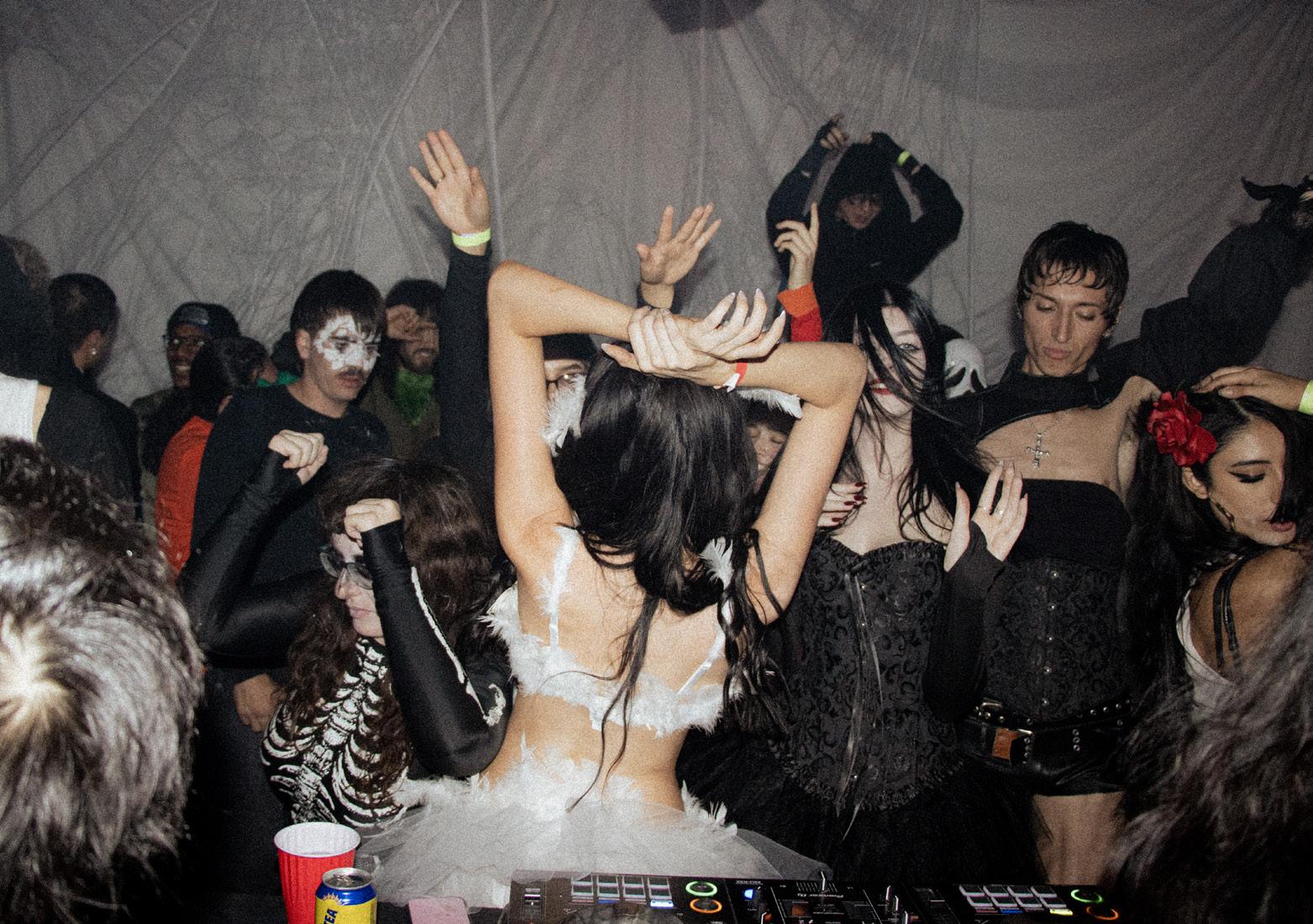
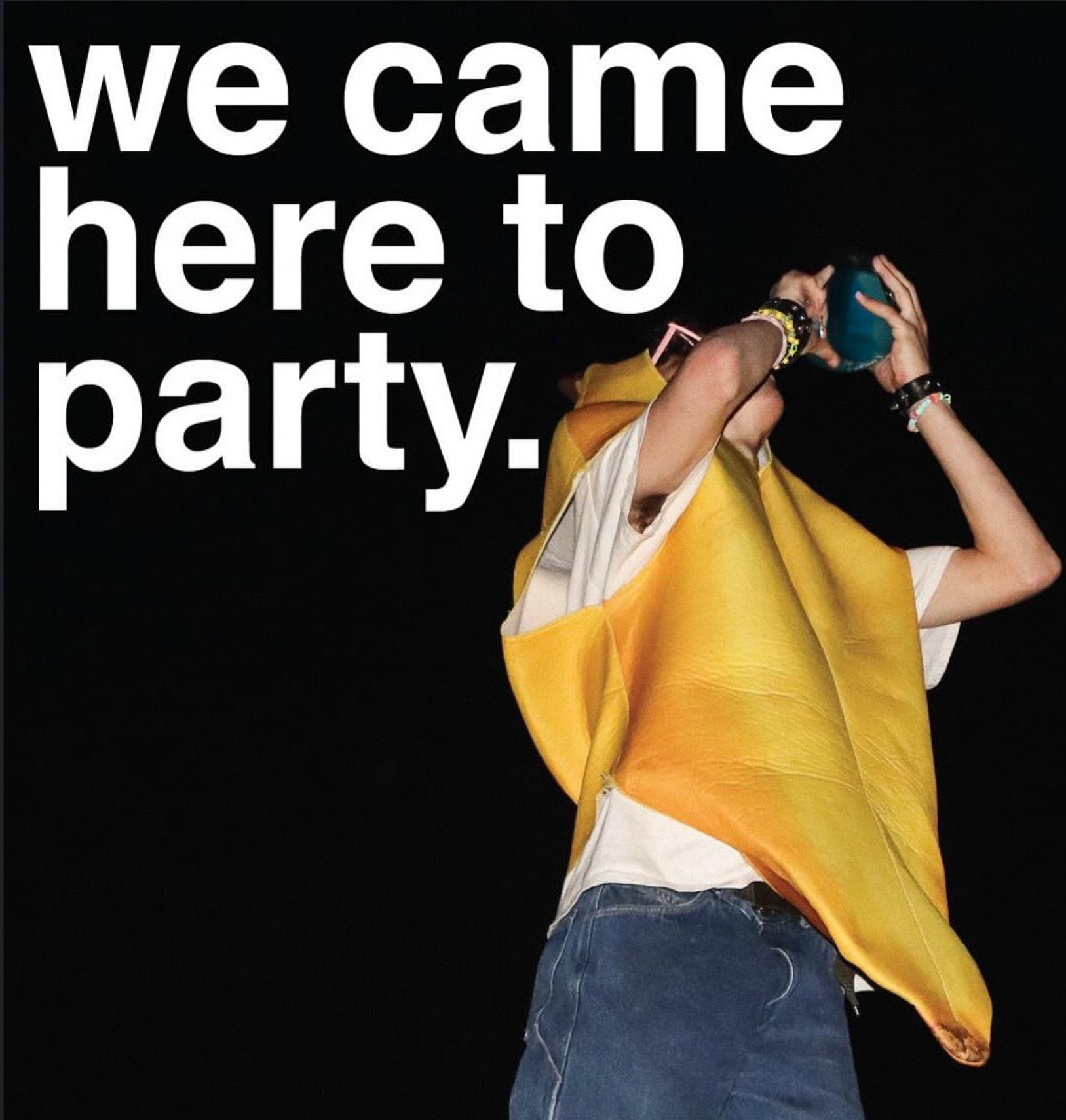
“People have become too wound up,” Maxine Hernandez, a junior studying photography, said. She specializes in documenting underground party culture. Her most recent project is titled “The Carefree — Work. Money. Death,” which is a mini-series about house parties and Halloween.
“I think we are living in a really politicized time, but it’s mixing with people not knowing how to connect with other people in that way,” she said.
Hernandez said people aren’t having fun “like they used to.” She has noticed that at concerts and events, there’s a reluctance among people to break down their walls and become more open-minded. Because of this, she said the underground party scene has become a way to do that for college students.
The parties Hernandez attends and documents are often filled with young people from all types of backgrounds. If it’s a house party, there’s usually a list of invited guests, who are allowed to bring whoever they want — it creates an environment of familiarity while allowing attendees to meet new people.
At the “underground parties” I’ve been
to, it’s as if the UCLA statistics and complaint tweets don’t even exist. A walk through the party’s front door, past the living room and into the backyard has left me with five new friends and 10 different conversations. I’ve watched relationships’ life cycles begin and end within a night, and I’ve seen people compete with each other at arm wrestling, cup pong and Wii Sports tennis. DJs leave their stands to go dance, letting guests queue their own music. People are sitting on couches outside and discussing the ethics of artificial intelligence, while a foot away, their friends are making out. There are no rules, just fun.
“Being part of an underground anything, we all notice a shift in culture, and we’re trying to preserve the essence and the sanctity of partying,” Hernandez said. “I believe that parting is like a form of art in a way because you have the music, you have dance, it’s all these different forms of human expression [that] come together.”
According to Hernandez, underground cultures should never “bend a knee” to mainstream cultures, but due to the state of the political divide and the lack of connection among people, she believes everyone should experience a real, authentic party at least once in their lives.
“Partying is a way of [having] cheap thrills,” Hernandez said. “You don’t need to go to a really expensive, lavish party with a bunch of influencers. You could just have a better experience with your friends at a house party with good music, good dancing and unadulterated fun.”
The way Hernandez sees it, “unadulterated fun” is what Gen Z needs in order to be released from the shackles of believing sex and partying are inherently bad.
Due to the second wave of purity culture’s influence on college students, Hernandez said it would be a “perfect utopia” to be rid of “societal norms and misogyny.” According to her, “If that goes away, we can actually have fun and … connect with people on an intimate level. But that’s asking for the sky not to be blue.”
CREDITS: MADISON KOEHLER
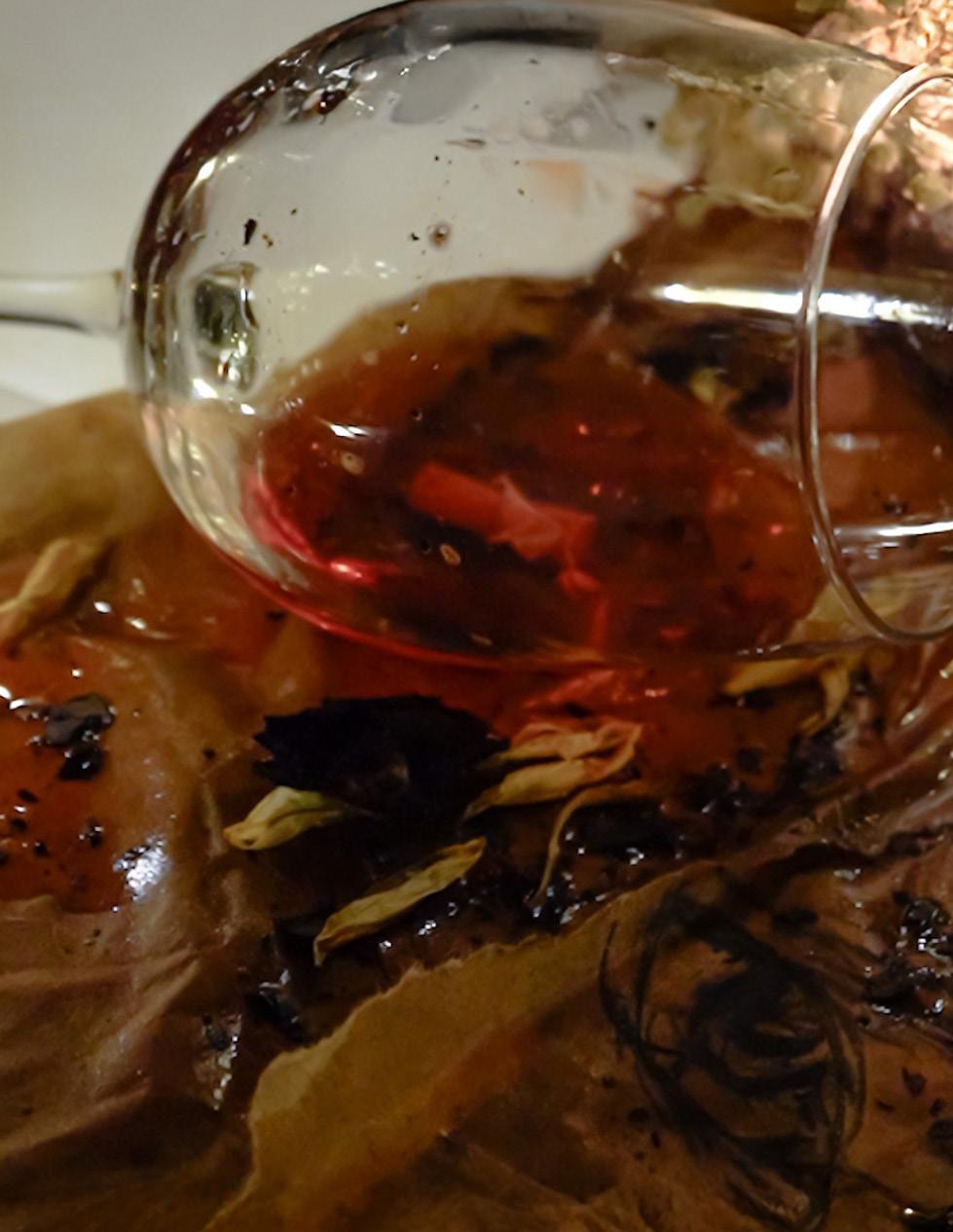
CREDITS: LAVANYA PALIWAL

An exploration of women’s clothes and their sexualization
By Aleisha Paulick
Photos by Lavanya Paliwal
Ilearned at a young age that my body type was different.
It isn’t difficult when the rest of your friends wear crop tops and tank tops, and you were the odd one out, hiding as much as you could under baggy clothes.
Although I had friends who accepted me for who I was and never made me feel uncomfortable, that never truly made my insecurities disappear. While they exposed their skin with dainty, “itty bitty” tops, I could only stare at them, wishing I were them as I hid my stomach, legs and just about every inch of my body.
Throughout grade school, I played sports. I competitively swam for eight years and played water polo for three. I even trained post-seasons and during school breaks. My family and I would hike, swim and bike. And yet, I still looked like the unfit friend.
I also dreaded shopping. While I was excited in the moment, it quickly faded into exhaustion and irritation because I could never find the right clothes that fit me. Even if I ended up finding something, I always had difficulty when trying it on as I had a larger chest and legs, but a smaller waist — meaning clothes would either fit my waist or my legs, but not both.
In addition, I actively avoided clothes that revealed too much skin or enhanced certain features. Though my insecurities were the main reason for my discomfort, the societal pressure to cover up to prevent unwanted attention was another.
That said, the societal pressure to hide my body not only affects me, but other women as well. In situations involving sexual harassment and assault, the justification is often “What was she wear-
ing?” or “If she wasn’t wearing that, it wouldn’t have happened”.
Jocelynn Barraza Rodríguez, a junior studying criminology, recalled several occasions in high school where she was harassed and “catcalled” by older men. She said in some of those instances, her skin was fully covered since she was part of a military program.
“It’s [her uniform] some long pants and they’re not even jeans, [they’re] like actual business wearing pants, a button-up that we had to wear as tight as we could because it would wrinkle,” Barraza Rodríguez said. “Even then, I’m covered head to toe and I would wear a sweater on top of it.”
Barraza Rodríguez said because of these instances, she felt uncomfortable walking home from school. To feel at ease, she’d walk through neighborhoods instead of the streets or walk in the company of friends.
However, she added that regardless of what she wore, harassment still occurred, mainly due to her body type.
“It’s kind of absurd,” Barraza Rodríguez said. “Whether you’re wearing tight clothing or wearing loose clothing or you’re wearing nothing or you’re wearing something, you’re going to be [cat] called for it.”
Emily Pavan Carranza, a junior studying emergency management and homeland security, remembered a time when a customer at her job complained that her clothing was inappropriate, despite it never being an issue before. She described the situation as both uncomfortable and frustrating.
“I’ve always had more of a voluptuous
figure, I have a bit more to cover,” Pavan Carranza said. “If I had been a petite white woman wearing these clothes, this wouldn’t have been an issue.”
Pavan Carranza understood that in particular environments like a workplace, there is a required level of professionalism. She also said it was unfair that she specifically received this complaint due to her body type.
“There’s other people at work that wear certain things and they don’t get called out for it but God forbid I did it,” Pavan Carranza said.
A universal body type does not exist, meaning that clothes will never truly fit one person the same. Pavan Carranza said due to her body type, she avoids wearing or buying clothes that are short or uncomfortable to prevent unwanted attention.
“I would wear whatever I wanted, anything I wanted if there weren’t those external factors of what could happen to me,” Pavan Carranza said.
She added that the constant awareness of potential unwanted interactions is upsetting because women are forced to consider whether something as simple as clothing could compromise their safety. However, even if acknowledged, it doesn’t reduce the possibility of a situation occurring.
“You could be wearing sweats, look crazy and whatever, and unfortunately things will still happen,” Pavan Carranza said. “That’s just the sad reality of being a woman.”
There is a traveling gallery installation known as “What Were You Wearing,” that displays sexual assault survivors’ stories and the clothing they wore during their assaults. Many of the
pieces showcased either a minor, someone who wore a school or work uniform and/or people who were fully covered. The installation was intended to show that clothing has no correlation to instances of assault.
In addition, there are also videos on TikTok under #WhatWereYouWearing where women explain their sexual assaults through the lens of the clothing they had on. One woman presented an oversized t-shirt and the athletic shorts she wore when she was assaulted.
Although men’s comments and actions are the main reason Pavan Carranza feels uncomfortable wearing certain clothing, she also said women have encouraged this sexualization, as it was a woman who complained to her boss regarding her clothes.
“Having another woman shut that down, it feels kind of like betrayal,” Pavan Carranza said.
Despite the backlash, she said it’s a result of how different generations of women were raised to think and believe.
“You have to realize how much liberty we had as women in each generation,” Pavan Carranza said. “That generation [older ones] didn’t really have that voice to really be out there and express themselves through clothing, through makeup, through their personalities.”
Elizabeth Cady Stanton was the first major voice for women, bringing their issues to light during the Women’s Rights Movement in 1848. Stanton, along with her three friends, expressed discontentment about their situations as women, despite the American efforts to be freed from oppression during the revolution. At that time, women were still dependent on men, facing d discrimination in education, the workforce and most prominently, did not have civic obligations.
It wasn’t until the early 20th century that women began to gain their independence. During World War I, women were encouraged to take on jobs to support the men at war. Later, the ratification of the 19th Amendment occurred, granting women the power to vote in 1920.
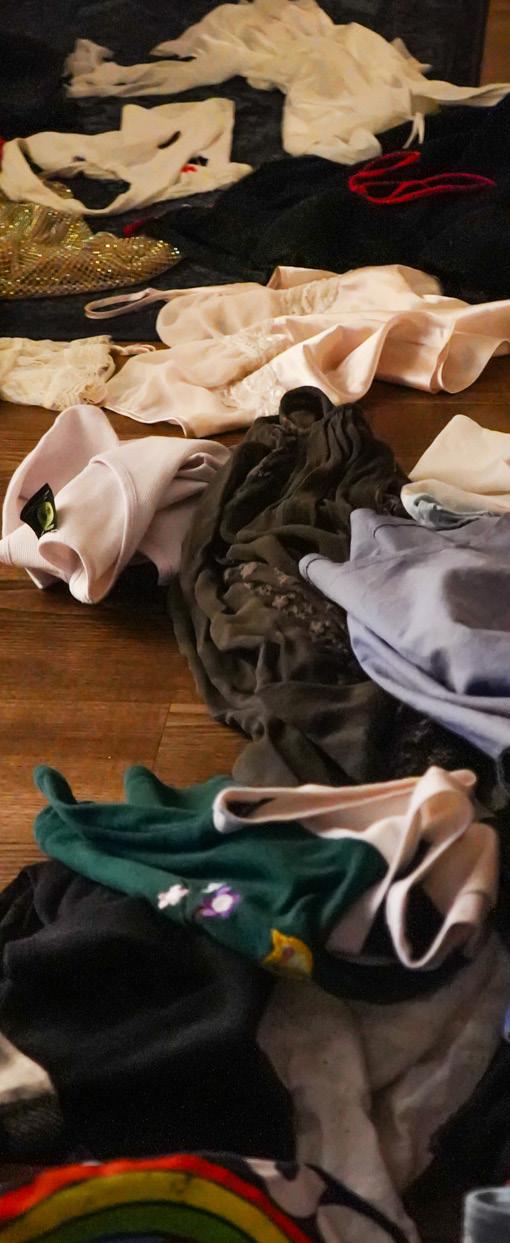
Amid these events, women’s fashion evolved from the Gibson Girls’ long skirts and tight corsets to the Flappers’ loose, shorter dresses that revealed more of a woman’s neckline and legs. These women also wore bold makeup and hairstyles. Along with their distinct style, Flappers also symbolized rebellion from the societal boundaries of that time. They engaged in what was considered “unlady-like” activities such as drinking and smoking. However, these bold choices did not exist without criticism.
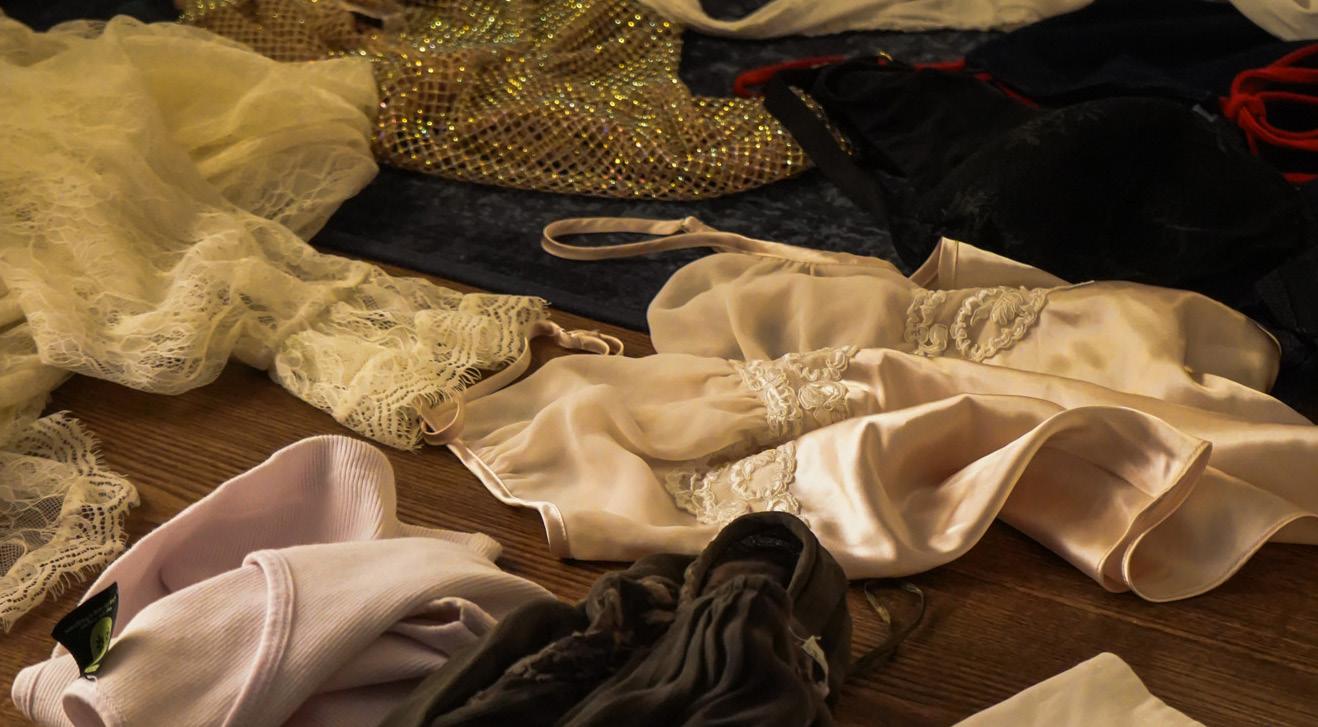
Although women today have more freedom compared to this polarizing time, the cycle of criticism continues. This occurs in several ways, including in the beginning stages of childhood. Barraza Rodríguez said she was raised to cover up and maintain other forms of modesty like wearing extra garments under clothing.
“You have to dress this way because you never know who’s going to be around, ” Barraza Rodríguez said. “It was always ‘Close your legs, don’t wear shorts, only wear shorts to sleep.’”
Despite continuing to live by these rules to feel secure, Barraza Rodríguez questioned the need to tailor her clothing to feel comfortable.
“Why is there a need to wear shorts?” she asked. “Who’s going to be looking up my skirt? Why should somebody find the need to look up my skirt that I need to be wearing (shorts) or be self-conscious about?”
In 1992, an 18-year-old Italian girl was sexually assaulted by her 45-year-old
driving instructor during her first driving lesson. The instructor was arrested and sentenced to jail, however later appealed the case, saying their interaction was consensual. The Italian Supreme Court released the perpetrator, claiming that due to the tight jeans the victim was wearing, she had to have helped him remove them, which constituted it as consensual. This became known throughout Italy as the “jeans alibi.”
As a result, women who worked for the Italian Parliament protested against the Supreme Court by wearing jeans. This reached international media and also inspired similar protests in California. This case is most known for the creation of Denim Day in 1999. This initially started as a campaign by Peace Over Violence Executive Director Patricia Giggans, but is now recognized on the last Wednesday in April during Sexual Assault Awareness Month.
Furthermore, this criticism of women’s clothing seems to be encouraged with videos made by Dallin H. Oaks, the president of the Church of Jesus Christ of Latter-day Saints, where he stated that if women dress immodestly, they “are magnifying this problem
by becoming pornography” to men.
Although external factors like the video affect women’s clothing, Alanna Rothell, a senior studying English linguistics, said it can also be traced back to internalized misogyny.
“I hate walking out, seeing a girl and thinking ‘Oh, wow that is really revealing,’” Rothell said. “I then immediately check myself and I think ‘First of all, why is it any of my business? Second of all, why would there be anything negative about that?’”
Rothell described dressing as a woman is exhausting because whether you choose to dress modestly or immodestly, dressing yourself impacts how you are perceived. She added that if a woman dresses modestly, she will be respected, but if she chooses to reveal more skin, she’ll be sexualized.
“It literally doesn’t matter which one I wear because if I’m dressed modestly and respectably or if I’m just revealing, I’m going to be desired, I’m going to be stared at and also going to be disrespected,” Rothell said.
An exploration of the judgments Muslim women face within their communities

By Jude Banihani Illustrations by Lavanya Paliwal
n Muslim communities across the West, the concept of the “haram police” has become a phenomenon. They are considered to be the men or older aunties in your local Muslim community who nitpick younger Muslim women. For example, if you don’t wear a hijab, you will be shamed for this choice. But if you do wear a hijab, they will tell you that you aren’t wearing it properly. If you aren’t fasting for Ramadan, they will ask questions and make sure you feel guilty to the fullest extent.
A key element of these individuals is that they don’t often practice Islam perfectly themselves. For example, a 22-year-old named Mohammad from your local mosque, known on TikTok as “Moe money,” likes to comment on women and their hijabs, telling them to dress more modestly. However, despite his “holier than thou” claims, he actually works at a nightclub and has a girlfriend. And his mom, a strict auntie in the community, knows about his activities — but she turns a blind eye.
Similar to other Abrahamic religions, like Christianity and Judaism, Islam has fundamental rules that followers are meant to abide by. However, Islam does emphasize an element of free will and intention. Judgment is not encouraged — or even allowed — in the Quran, yet it is common in the Muslim community.
While Islam is often associated with the Middle East, some Muslim majority countries include Indonesia, Malaysia, certain republics of Russia and Albania. Every Muslim community has its own take on different rules, architecture within mosques, styles of hijab and ways of prayer.
The problem starts when diverse Muslim communities congregate in non-Muslim countries. For example, the Muslim community in Arizona is a diverse one, composed of Sunnis and Shias, Lebanese and Saudis, Iranians and Bosnians. Members of the community have different cultural backgrounds, and therefore, different takes on Islam.
Judgment and policing of women is not unique to a specific Muslim community; it’s a worldwide issue. Muslim women, particularly hijabi women, face judgment and discrimination from society at all angles.
While we are no longer experiencing discrimination at post 9/11 levels, many people still hold hostile beliefs toward Muslim women. Many non-Muslims believe hijabi women are “oppressed” and forced to wear the hijab; however, this is a misconception. Hijabi women often choose to wear the hijab, citing religious duties and an intention of modesty.
Dalia Almanaseer is a student at Glen dale Community College and plans to pursue an architecture degree at ASU next fall. Almanaseer started wear ing a hijab when she was 18 years old, feeling it represented a new chapter in her life, one marked by maturity and growth.
“I couldn’t say I had one reason. My story was different. I never planned to wear it [a hijab] until I’m 30. But one night, I just woke up and wore it. I feel like it’s just guidance from God for me … and I’m glad that I did,” she said.
Almanaseer describes her life changing in many ways after wearing a hijab. Her friend group from high school drifted away and many of her acquaintances unfollowed her on social media.
While she felt unsure at the beginning of her new journey, she was positively surprised to find that many people were respectful toward her religion.
“I had some insecurities in the beginning. I felt like
maybe people will look at me differently,” Almanaseer said. “But, after a little while, I’ve seen more people who are non-Muslim be more respectful. I felt welcomed in many places. I can say most of the people that I talked to in high school I don’t talk to anymore, but now I have a different social life and circle.”
‘Haram police’
Almanaseer described her experience with community members who judged her for wearing the hijab while being a curvier woman.
“For me, a lot of people comment on it like, ‘Oh, why are you wearing that? You’re showing too much body shape,’” Almanaseer said. She described the comments directed at her for wearing tight clothing while wearing the hijab were not directed toward skinnier women who also wore the hijab.
“I can be wearing whatever, and they should not even care about that. But, in the Islamic hijabi community, they judge, they talk about it, they would even make up rumors,” Almanaseer said.

She also described judgment toward women wearing a particular style of hijab. Rather than the traditional head scarf, Almanaseer would sometimes wear a turban. “And they’d be like,
‘Well, she’s not a hijabi, period,’” she said.
This policing of hijabi women can lead many to struggle with their identity and even resort to removing their hijab completely. “I’ve seen multiple girls who would face the ‘haram police,’ and they take it [the hijab] off. They’d be like, ‘Well, I’d rather not be seen as a hijabi woman and get this much
judgment, than wearing it,’” Almanaseer said.
She also felt like the community’s policing of women was unfair and discouraging, especially when many
were not practicing parts of the religion themselves. “We’re just sinners judging other sinners,” Almanaseer said. “This type of pushiness and being so mean about it, it’s not going to help anything.”
Almanaseer said she felt that a lot of the judgment in American Islamic spaces stems from being a minority group. She described people in her
home country, Jordan, as being more accepting of differences within the religion and ways of practicing. In Jordan, a Muslim majority country, it is not uncommon to see women wearing the hijab in public. In the United States, it is more of a rarity. Almanaseer said this difference leads many Muslim Americans to judge their own community members.
“We have more knowledge back home than here, and a lot of things get lost in translation,” she said.
Over a year into her journey of wearing the hijab, Almanaseer reflected on her growth and changing perspective on Islam.

“I struggled with it in the beginning,” Almanaseer said. “I was like, ‘I’m losing myself, I’m a much different person right now.’ But I think it’s part of my identity now. It helps me be more mature,” Almanaseer said. “In my opinion, I have the responsibility of carrying Islam with me. People look at me and think, ‘Well, she’s Muslim, look at her, how she behaves.’”
Malia Sekandari is a junior studying business law at the W.P. Carey School of Business. She is an Afghan American and a member of the Muslim community. Growing up in Arizona, Sekandari attended public school while regularly going to an Islamic Sunday school.
“[Growing up] I had mostly Muslim friends. My family’s very, very religious as well. So I mean, I was always in that [the Muslim] community,” Sekandari said.
Sekandari described her Muslim community as a diverse one. “My teachers were mostly Arab, but the students that I knew were mostly Pakistani,” she said.
At 10, she started making her own religious decisions when it came to fasting and praying. “They [the decisions] were heavily influenced by family, but I was making those decisions for myself,” Sekandari said.
When Sekandari entered her university years, she felt like her personal religious decisions reached a new level, saying her choices were no longer guided by expectations, but by personal callings instead.
“It wasn’t really until college I discovered that I want to do these things for myself, not necessarily based on familial obligations,” Sekandari said. “I was like, ‘I want to pray not just because my mom is telling me to pray, but because I actually see the benefits of it, and want to do it.’”
Before college, Sekandari experienced racism for being Afghan, both within and outside of the Muslim community.
“I don’t wear the hijab, but when I went to Sunday school, I would. It would not really be worn properly. I would maybe show a little bit of my hair or my neck would be showing or something small,” Sekandari said.
“I would get nitpicked on, and they [the students] would fully expose me in front of the class and be like ‘Your hair is showing,’ or ‘Your neck is showing,’ or something like that,” Sekandari said.
Sekandari said she believes judgment within the Muslim community holds back progression in religion and steers young women away. “Things like that are really hindering the Muslim community because we keep on projecting this ‘I’m better than you, I’m gonna tell
you what to do’ type of mindset,” she said.
Fota Sall is a PhD candidate researching maternal health outcomes in Black women. While pursuing her PhD, Sall is also conducting a research project surveying Muslim Americans on ideas of purity.
Sall grew up in a West-African Muslim family in Virginia. “I wasn’t raised around a lot of other Muslims, other than [those] in my family and then a few people in town, but it wasn’t a lot,” she said.
When Sall relocated to Arizona in pursuit of her studies, she noticed a large Muslim population in the area and wanted to research local attitudes and opinions.
“A lot of the questions touch on purity, thoughts on purity, thoughts on virginity, and what knowledge people actually have of sexual reproductive health,” Sall said. “I do feel like when I’m talking to my family, or just people out in the community, a lot of people have opinions or thoughts on these topics that aren’t always biologically accurate.”
A lack of knowledge around sexual and reproductive health is not uncommon in America, especially among minority communities. “It can be harmful to all of us, but especially women and young women,” Sall said.
Sall said many misunderstandings stem from learning incorrect knowledge back home and teaching it to the younger generations. However, many
young Muslims are open to learning more and educating themselves on health-related topics.
“I’ll do my research, and we’ll talk about it. They’ll be like, ‘Oh, OK, that’s something new that we didn’t know,’” Sall said.
Sall described her way of practicing Islam as “going by the book,” saying that her way is not lesser than any other way of practicing the religion.
As a non-hijabi woman, Sall described wearing the hijab as a “difficult area.”
“People who aren’t Muslim, it’s going to make them inherently uncomfortable to see you covering up. Then you have the Muslims judging you for not doing it exactly perfectly,” Sall said. “Also, if you cover up too much, then a lot of people, Muslims, and non-Muslims alike, will think you’re being too radical.”
This judgment particularly impacts young women. Sall said young girls who are trying to learn more about Islam may feel overwhelmed by judgment, including online think pieces about “what you should be doing as a young Muslim girl, or what you should be wearing,” she said. These comments may make young girls feel excluded from religion.
“We, just Muslims, can be aggressively judgmental about what we’re doing or what women are wearing or if someone’s drinking or doing this or doing that,” Sall said. “None of us here are perfect. I’m sure other communities do it a lot, but this is the community I know and I know that we can be extremely judgmental to a detriment.”

My journey with acne, scars and imperfections
By Lexi Janusee
Photos by Madison Koehler
I’ve always had acne. Bright, angry red pimples thatBright, angry red pimples that dot my face, shoulders and back, emerging at the most inconvenient times. They first appeared when I was 14 and have stuck ever since.
I used to stand in front of the mirror, picking at my face until it was bloody and raw. I reached for every serum and medication on the shelves, but nothing ever worked.
When I got to high school, acne seemed life or death. In the eyes of judgmental prepubescent teenagers, having pimples was social suicide.
Freshman year, I started wearing a jacket over every outfit — even in Arizona’s triple-digit summers — because I was so embarrassed by my skin’s texture. At the mall, I passed on sleeveless tops, no matter how
much I wished I could wear them. I even refused to change in the locker room with the rest of my dance classmates because I just wanted to hide my acne.
Being a dancer was especially difficult because you’re expected to carry yourself with confidence on stage, even if you’d rather shrink. I once had to wear a sleeveless, backless costume that put my acne on display in front of an audience. I cried every day leading up to the performance, riddled with anxiety about being examined on stage.

I felt naked. Every time I stepped out of the house with my acne out, I could almost hear my peers’ perceptions and their judgments. My fellow dancers looked like models in their costumes, while I was zit-covered and awkward. It made me feel like there was something inherently wrong with me because my skin wasn’t glass.

It became nothing short of an obsession with self-loathing.
Sophomore year, I begged my mom to take me to a dermatologist, though their prescriptions never ended up working. Sitting in the sterile room, I let the technician inspect my acne. I waited, feeling uncomfortable and embarrassed, wanting to disappear. “Do you wash your face regularly?” she asked, her tone not quite condescendingly, but not necessarily kindly either. Of course I washed my face. I washed my face three times a day. I exfoliated. I moisturized. I did everything right, so why was I still breaking out?
“There are a lot of people that think if you don’t wash your face, you’ll get acne,” Colin Mailman, a freshman studying mechanical engineering, said. “That might be true for some people, but bacteria on your face is only one factor of acne.”
Mailman’s experience is similar to mine, trying various skincare routines with no success. He said people view acne as something that needs to be “treated,” even though the treatments we try don’t always work.
“It can be hormones, just your skin type, the materials that you wear or you sleep in, like your pillowcase,” he said.
The source of acne is different for everyone, and how it affects people is truly a gamble; some people are blessed with naturally clear skin, and some people are more sensitive. Unfortunately, there’s no one secret to getting rid of it.
The American Academy of Dermatology Association reported that common habits for those with acne — like wearing makeup or squeezing breakouts — can have an opposite effect, only worsening the symptoms. They also found that obsessive face-washing can actually irritate the skin more, as well as constantly trying new treatments. If only someone had told me that earlier.
“It is definitely treated as a threat to
human happiness, instead of just what it is,” Mailman said.
When I felt insecure, my mom would tell me my acne was normal, like it is for all teenagers during puberty, saying that I would grow out of it.
Key word: teenagers.
When you’re raised to believe your acne will go away with age, it’s paradoxical when you finally become an adult and realize it still isn’t budging. With my adolescent years behind me, I’ve become even more aware of the fact that I’m not the perfectly put-together college girl I thought I would be by now.
The beauty of authenticity
The only thing that has helped me overcome my acne anxiety is seeing other people with theirs on display. Which may sound harsh, but when I see others’ acne, I don’t judge or look down on them. I admire how their skin, even with its blemishes, looks so normal, because that’s all I ever wanted.
“They’re proud enough to not cover it up and just be their confident self around people … That is very beautiful,” Hershey Gopinath, a freshman studying medical studies, said. She also found beauty in others’ acne at a young age.
“When I was around 11, I saw it on all my cousins, and I was like, ‘Acne is cool. I want acne,’” she said.
Maybe positivity is the antidote, because the more I look around me, the more I find beauty in imperfection. If I think it looks good on other people, why can’t my acne look good too? It’s a constant battle for me, but as I’ve grown up, I’ve realized that, first of all, nobody really cares about your pimples in college, and second of all, if they do, they’re weird.
The only person who really cares is you, which is why I’ve had to learn how to love my acne, because I’m the one who’s stuck with it.
It’s a roadmap of where I’ve been in life and a collage of my adolescence, which I’m lucky enough to carry on my skin, reminding me I’m not an insecure little girl anymore. It’s a sign of my growth; something I once covered up, but I now let be. There is beauty in allowing people to see your flaws.
“I’ve never seen anyone with dark circles as bad as mine before,” Gopinath said. “I feel like this is what makes my face look like my face.”
I feel like I’m losing the progress I made when I look around campus and see people with clear skin. Every now and then, my acne stands out in photos and I get uncomfortable. The urge to hide it comes creeping back in moments of insecurity.
“As humans, we’re very hard on ourselves, but not on others,” Gopinath said. “That sort of standard that we set ourselves to plays a very crucial factor.”
The very ideals we preach about others are almost impossible to keep up in practice. Gopinath said people tend to hold themselves to a high — or even impossible — standard, while being unconditionally accepting toward others.
I blame social media for the internal pressure living inside all of us.
It’s easy to exclaim that “acne is beautiful!” and “I’m not insecure anymore!” until you have the option to smooth out your skin with a filter. Which feels great, until you turn Snapchat off and look in the mirror, only to be met with reality and disappointment.
When you’re a young person bombarded by perfectly airbrushed “baddies” on social media, you’re going to look at yourself and wonder what went wrong. That’s the loophole I fell into at the ripe age of 15; It’s almost irreparably damaging to your psyche. I still feel the repercussions all these years later, despite trying to remove myself from

attachments to beauty standards.
“Other people should know that just because you don’t look like somebody online, it doesn’t mean that you aren’t beautiful and that you aren’t your own unique person,” Braeden Culling, a freshman studying architecture, said.
We sat on the floor of his dorm together, creating an intimate space where we felt free to talk about the harsh realities of being at an “influencer school.” Culling explained that ASU’s open secret is that everyone is constantly competing with each other, even if nobody wants to admit it.
“I know a lot of my friends, especially when we’re out walking around campus, we will see someone who we find attractive, and for a split second, we kind of want to be them. On the surface, they have it all,” he said.
A desirable body type, blonde hair, and, of course, glistening skin are just some of the beauty standards Culling sees most predominantly at ASU. Influencer culture pressures us to post ourselves at our best and hide ourselves at our worst — even though a person’s “best” is often manufactured.
“It just becomes a festival in which we beat down on ourselves and we refuse to see the beauty that we have and the different cultures that we bring to the University,” Culling said.
The truth is, everyone has something wrong with their skin. Yes, I see your eye bags, your acne scars
and your discoloration. But I don’t think there’s anything wrong with that. No amount of foundation or filters can change the fact that we’re all human.
“I feel like people, even just individual content creators, owe to society their imperfections,” Mailman said. “It’s so dangerous to have children with developing minds be on social media and then witness everything that they’re not right now and are supposed to grow into.”
We’re primed from a young age to expect beauty to come with age. But here I am as an adult, and I’m far from perfect. I still break out every month, as embarrassing as it is to admit. Even if nobody wants to talk about these imperfections, they’re not going away… at least not for me.
In my 20s, I might still have acne. Because of my genetics, that’s just how I am. I’m stuck with this skin.
I don’t love my acne all the time, but I know that it tells the story of who I am. Every scar, every pimple and every wrinkle holds the essence of me, all wrapped up in a body that’s uniquely mine.
Letting others see my acne was pivotal in developing my self-confidence, a way of finally letting the world see me for who I am. On a good day, I don’t even look twice at the new pimple on my face — OK, so maybe I’m not jumping up and down about it, but that’s something at least.
To be human is to be imperfect. We should all remember that more often.