TRUSTEE RACES, FUNDING THREATS AND STUDENT LEADERSHIP SHIFTS SHAPE THE UNIVERSITY’S DIRECTION
CONTACT THE STATE NEWS
The State News is published by the students of Michigan State University every other Tuesday during the academic year. News is updated seven days a week at statenews.com. State News Inc. is a private, nonprofit corporation. Its current 990 tax form is available for review upon request at 435 E. Grand River Ave. during business hours.
One copy of this newspaper is available free of charge to any member of the MSU community. Additional copies available at The State News office for a fee.
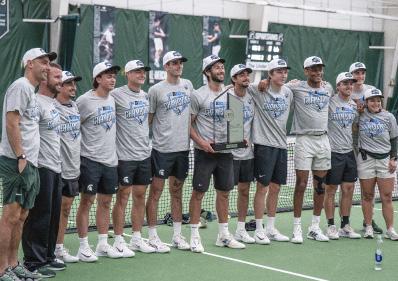
Michigan State men’s tennis players accept the Big Ten Conference Title Trophy at the MSU Tennis Center in Lansing, Mich. on Sunday, April 19, 2026. Photo by Cassie Comer.
Trustees Scott, Tebay Zemke net Democratic nomination for MSU board
By Ria Gupta
rgupta@statenews.com
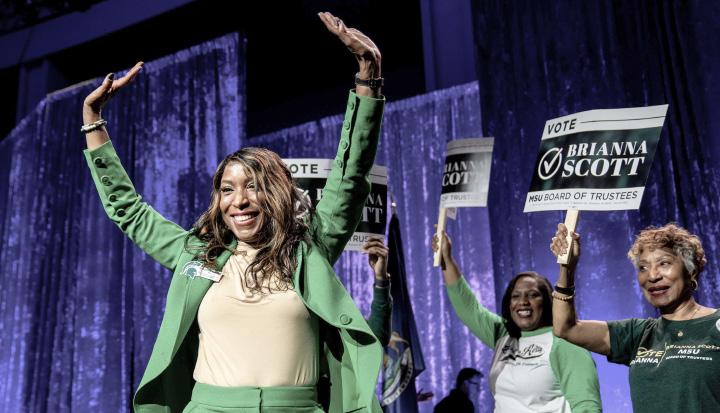
Michigan State University trustees Brianna Scott and Kelly Tebay Zemke will once again be the Democratic candidates for the university’s board of trustees, fending off a challenge by state Sen. Sylvia Santana, D-Detroit, to earn the state party’s nomination Sunday in Detroit.
“I will continue to work to make sure that Michigan State remains affordable for our in-state students,” Scott said in her victory speech at 9:30 p.m. “I promise you, I will continue to do what has always been in the best interests of Michigan State University.”
The board of trustees is composed of eight
members who serve for staggered eight-year terms, with two seats up for grabs in November.
Scott and Tebay Zemke, the longest-serving trustees on the board, both took offce in January 2019. As members of the university’s governing body, they have overseen prolonged periods of strife at MSU and episodes of infghting on the board, including the aftermath of the Larry Nassar scandal and the years-long saga that ensued after Scott’s 2023 bombshell accusation that the then-board chair was engaging in widespread misconduct.
Scott is currently serving a one-year term as chair of the board, following Tebay Zemke’s stint as chair the previous year. The two are the “most tenured” at MSU and aim to “maintain the
stability” with their reelection bids, Scott said.
7,252 delegates flled the Huntington Place over the two-day Michigan Democratic Party convention to nominate candidates for a variety of statewide-elected posts including secretary of state, attorney general and trustees for MSU and the University of Michigan.
The endorsement of Tebay Zemke and Scott was initially delayed after the three candidates failed to gain enough signatures to earn the nomination.
Tebay Zemke and Scott championed past initiatives meant to improve the university’s response to sexual assault survivors in the wake of the Nassar scandal and the maintenance of programs dedicated to inclusion.
They also touted their role in approving a December 2021 resolution that altered the collective bargaining process for university employees, which has resulted in the formation of three unions in fve years, including the Union Tenure System Faculty in September.
“We’re looking to expand that,” Tebay Zemke said. “I want it to be 100% of our faculty and staff to be unionized.”
Santana had emphasized improving safety on MSU’s campus and nipping the student-housing problem in the bud. She also criticized the board’s decision to increase housing and dining rates by 5% for the 2026-27 academic year.
Santana’s interest in the board was evident before she announced her candidacy. In 2024, she defended then-chair Rema Vassar after the board voted to censure her in response to an outside investigation that corroborated many of Scott’s allegations against her.
Tebay Zemke told The State News that MSU is in a “much better place” than when she and Scott were frst elected to the board in 2018, but said there is still work to be done.
“We want to be a part of that,” Tebay Zemke said. “We want to stick with our president. We want to support (MSU President) Kevin (Guskiewicz), we want to support our students and our faculty and staff. We’e not done yet. We have unfnished business.”
Tebay Zemke and Scott will face Republicans Julie Maday and state Sen. Roger Victory, R-Georgetown Township, in the November general election.
ASMSU OFFICE OF THE PRESIDENT SWORN IN
By Reiel Ghiglia rghiglia@statenews.com
The near-complete composition of undergraduate student government president Maddie Hanes’ executive offce was determined Thursday evening during a meeting of the Associated Students of Michigan State University. The vice presidents of academic affairs, governmental affairs, internal administration and student allocation were elected Wednesday and Thursday, and sworn in the latter day. The two remaining positions within the Offce of the President, the chief of staff and chief diversity, equity and inclusion offcer, will be hired over the summer.
Vice President of Academic Affairs-elect and political theory and constitutional democracy sophomore Genevieve Lucas will be responsible for advocating for the academic needs of the undergraduate student body and working with the university administration to achieve those needs.
In an interview Thursday evening, Lucas said she’d prioritize improving student engagement and establishing greater trust between students
and the administration.
“Engagement is a huge part of this because you have to fll approximately 60 academic governance seats,” Lucas said. “Making sure that all organizations on campus feel they have the opportunity to establish themselves in these seats and have access to them is really important.”
Vice President of Governmental Affairs-elect and international relations sophomore Abe Jaafar will serve as the student government liaison with local, state and federal offcials.
“Especially since we’re coming up on midterms soon, it’s going to be a very contentious time on campus,” Jaafar said. “It’s my office’s responsibility to not only ease those tensions, but also get more people involved with voter engagement and get them educated on voter engagement.”
Jaafar said he would administer voter registration drives on campus by utilizing ASMSU resources. Providing students the opportunity to engage in the realm of public policy and establishing a connection with administrators and officials are additional objectives of his, he said.
Students, Jaafar said, want to make a change
on campus and may not know where to start and it is the “top priority” of the Governmental Affairs offce to ensure students have a route to advocacy.
Vice President of Internal Administrationelect and international relations sophomore Molly Ginther will be responsible for serving as the primary delegate of the student body to the university administration and external partners.
“In my role as AVPIA, I’ve seen how strong internal operations directly shape our ability to represent and serve students across campus,” Ginther said. “It’s important that the person in this position actively works to keep an environment where all voices are welcomed, valued and heard. I want to be that person for you.”
Ginther said she plans to implement a smoother onboarding process for representatives in the government’s general assembly. Representatives can join at almost any point in the academic year, Ginther continued, leading to things getting “lost in translation” and the body becoming ineffcient.
Vice President for Student Allocations-elect and advertising management junior Mason Taylor will be tasked with overseeing the allocation of ASMSU funds — expected to be over $1.1 million
— to support the government’s programs and student organizations.
Taylor said the current Student Allocations Board, which is charged with dispersing funds and reviewing applications for funding, has frustrated ASMSU representatives and student organizations alike.
Taylor wants to ensure that “every penny” of the funds are used in the best interest of students, he said.
The frst step to combatting those frustrations and creating a smoother function of the SAB is to edit the board’s code, Taylor said. He later added that he wants to establish smoother communications between student groups, the board and the general assembly to allow students to feel comfortable expressing discontents about the board that could be improved upon.
“We have a very intensive code, and it was written pre-COVID, it worked out well for (the previous representatives) but a lot of that code doesn’t hold up today,” Taylor said. “I want to make it as clear as possible that SAB is a system where we are meant to spend that money in the best interest of students.”
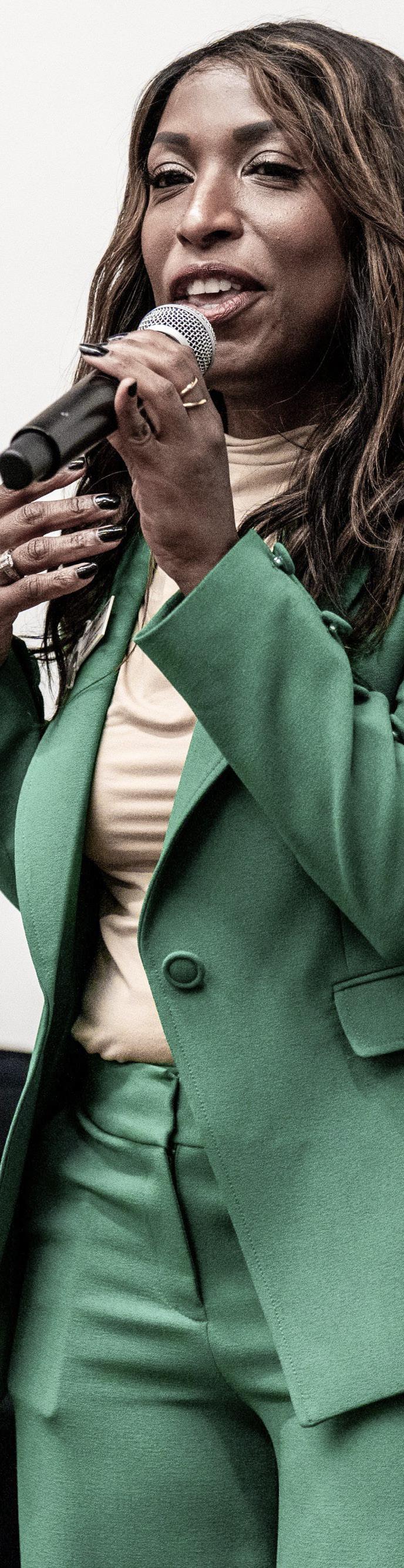
Michigan State University Trustee Brianna Scott celebrates after being endorsed at the Michigan Democratic State Convention at Huntington Place in Detroit on Sunday, April 19, 2026. Photo by Ari Saperstein.
FACULTY COMMITTEE ‘CAUGHT IN THE MIDDLE’ OF NEGOTIATIONS BETWEEN UTSF AND MSU
By Anish Topiwala atopiwala@statenews.com
A Michigan State University academic governance body is caught in the middle of contract negotiations between a recently recognized faculty union and the university.
The University Committee on Faculty Affairs, which writes an annual memo recommending faculty merit raises to the administration, has been advised by the general counsel to pause its bylaw-mandated work pending contract negotiations between the Union of TenureSystem Faculty and the university.
The dispute between the three parties began last September, shortly after MSU officially recognized UTSF. In response, the university paused UCFA proceedings, including work on faculty raise memos that were scheduled to be sent at the end of the academic year. Last month, UTSF claimed that this action by the university, among others, violated labor laws on contract negotiations.
They alleged that MSU violated the “status quo”: the existing terms and conditions of employment at the time a union is offcially recognized. On the other hand, MSU is claiming that UCFA proceedings, like the drafting of the annual faculty merit raise memo, serving as an advisory document to the administration, also constitute status quo violations. In the eyes of the general counsel, that memo acts as a form of direct dealing.
The UCFA brought these grievances to yesterday’s Faculty Senate meeting, where the raise memo was introduced and approved, but with a minor tweak. The memo will be sent to UTSF and the administration, with the expectation being that MSU will choose to ignore the recommendations presented.
UCFA Chair John McElroy said the committee has spent the past academic year working to define its role as an academic governing body amid claims that its work conficts with negotiations between UTSF and MSU. As a result, McElroy said, UCFA has been “caught in the middle” of the dispute between the two parties.
Faculty Senate Chair John Aerni-Flessner said the issue began with a memo sent by the president and provost in September. The memo asserted that maintaining the status quo meant UCFA could not carry out certain mandated duties, including the raise memo, an interpretation UTSF disputed.
Faculty Senate vice chair Jack Lipton, who discussed this matter with the Board of Trustees last week, said getting Brian Quinn, the university general counsel, to defne “status quo” has been a challenge.
There are differing perspectives as to what constitutes status quo, Lipton said, explaining
that the confict stems from the tension between ensuring no changes to the status quo are enacted and avoiding any form of direct dealing on employment matters.
“That’s really the rub,” he said.
“The point of status quo, particularly dynamic status quo, which is one interpretation of what status quo should be, is that you are not supposed to change things that are happening all the time... You’re not supposed to prevent them from occurring.”
Jack Lipton Faculty Senate vice chair
The faculty’s raise memo, drafted by UCFA and approved by the Faculty Senate to be then sent to the administration as an advisory document, has been deemed a form of direct dealing by Quinn, Lipton added. He stressed that this has been confusing for everyone involved, since UCFA does not deal directly with the university on issues of salary benefts or working conditions. This memo, and UCFA business as a whole,
does not violate status quo due to the fact that this business occurs on an annual basis and is not a newly created process, Lipton said. As such, the memo should still be sent forward.
“The point of status quo, particularly dynamic status quo, which is one interpretation of what status quo should be, is that you are not supposed to change things that are happening all the time,” Lipton said. “You’re not supposed to prevent them from occurring.”
Looking at data from recommended raises by UCFA and what was actually granted by MSU, Lipton said it’s clear the memo is typically ignored every year. To academic governance, it is more of a “moral document,” he said. “And I think it should be moved forward, even though Brian Quinn is very frm that: ‘send it to the Faculty Senate, but don’t send it to the administration’.”
Due to the unique circumstances present in the drafting of this year’s memo, other faculty senators found issues within the language that excluded important faculty groups. Human Medicine Senator Kelly Hodges said there are a large number of faculty not represented by either UTSF or UNTF, like fxed-term faculty, health programs faculty and academic specialists, which are not explicitly mentioned in the memo.
“There are a number of places in this memo where either those groups are rendered invisible by the fact that they were not mentioned in either the prose or in the statistics, or in which words used to describe those groups in this memo are in confict with our bylaws,” Hodges said.
She pointed towards language in the memo that implied that academic specialists, like
advisors, are not faculty members.
Aerni-Flessner acknowledged the exclusionary language in the memo brought up by Hodges, noting that it did not undergo full review due to concerns from general counsel regarding the status quo. He then entertained a motion to amend the document to better refect and include all faculty perspectives.
Hodges introduced an amendment to strike the term “tenure-system” from the recommendation section of the document to ensure that other faculty groups were not excluded from the memo. Other proposed amendments, such as adding statistics on academic specialists, could not be introduced due to time constraints, as the meeting marked the fnal opportunity for the memo’s approval.
With the addition of the singular amendment, the memo was approved by the senate. To circumnavigate any claims of direct dealing, Aerni-Flessner said the memo will be sent to both UTSF and MSU administration “as recommendations of a body caught in the middle whose bylaws say they need to do this, but who has received conficting advice from both sides.”
Speculating on how the memo will be received by administration, Aerni-Flessner said the memo, which is typically ignored, will be “ignored more than usual.”
“Usually it is read,” he said. “My guess is that it would not be read. That is just my interpretation of the conversation that happened at the board meeting last week with the general counsel and others.”
Michigan State University sign in East Lansing, Mich., on Oct. 29, 2025. Photo by Rachel Lewis.
Students swarm new campus gym as IM West faces final week
By Katherine Baligian kbaligian@statenews.com
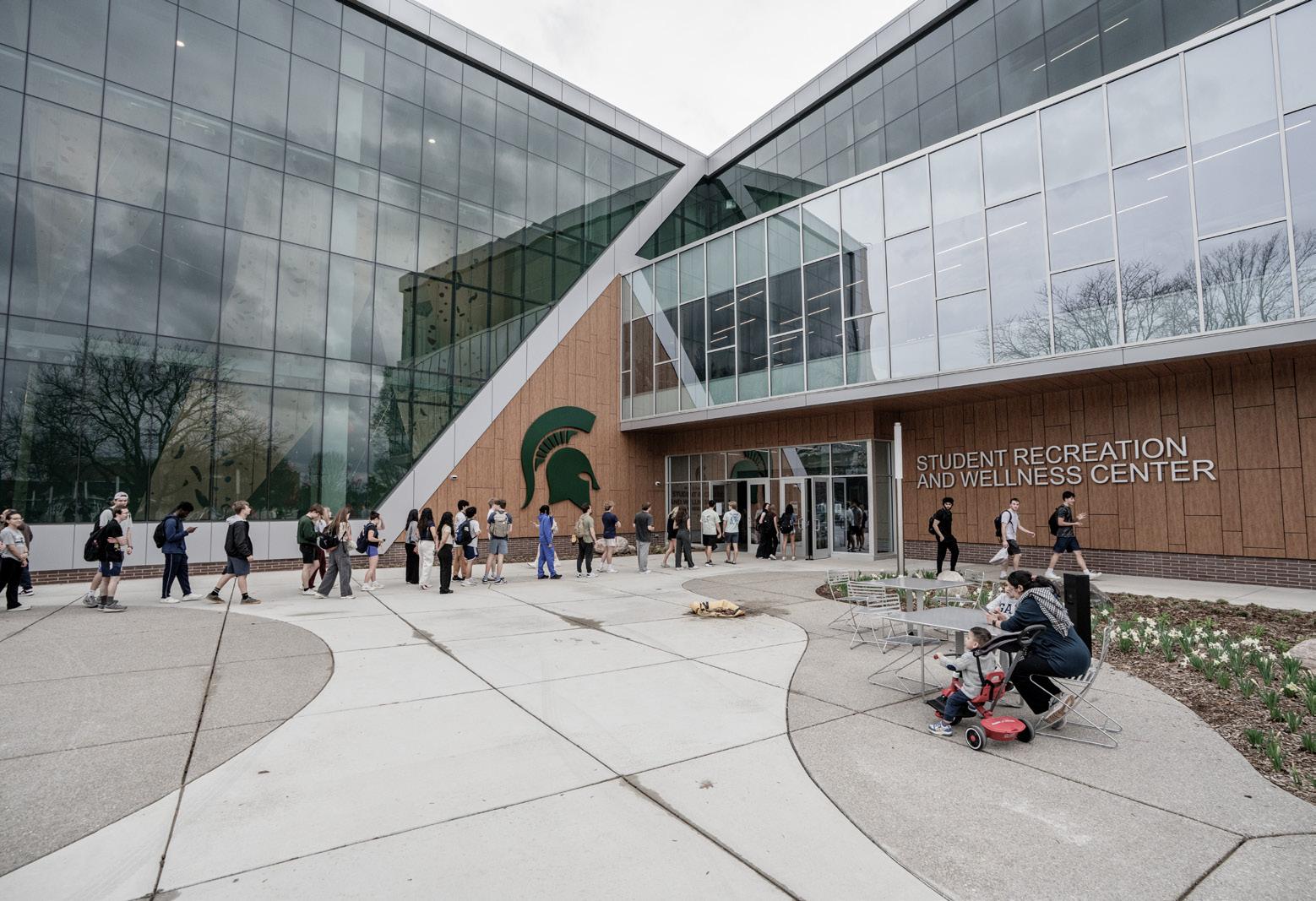
Michigan State University students swarmed the new Student Recreation and Wellness Center as the ftness center opened its doors for the frst time Wednesday evening.
Students milled about the three-story facility, playing pick-up games of basketball and trying out until-now untouched free weights underneath the building’s expansive sunroof.
“I think MSU really outdid themselves with this entire facility,” said urban and regional planning freshman Torion Saulsberry. “I mean, these basketball courts are nice. The golf sim, the dodgeball sim, the ping-pong tables laid out and the turf feld downstairs — and the architecture. Everything is just done really well.”
The center, which cost $200 million and fve years to construct, offers triple the workout space compared to IM West, a 50-meter pool and an elevated track within eyeshot to the Breslin Center and Munn Ice Arena. It includes two sports arenas for basketball, volleyball and badminton, along with six multipurpose ftness spaces, including an indoor-outdoor yoga studio and a combat sports room.
Neuroscience pre-med sophomore Rena Henderson was stretching across an expansive open turf area in the facility when she said she appreciated the spaciousness that was lacking in IM West, which is set to be demolished next spring.
“I feel like, with this open area and more open
areas around the gym, it gives me that freedom to kind of have that space without being too close to someone,” Henderson said The new facility was built on the southwestern corner of campus on Cherry Lane Park, making it exceptionally convenient for students in South Neighborhood. Journalism sophomore Kendall Sokal, one such student living nearby and one of the frst people to try out the equipment Wednesday, said that’s a major beneft of the center. She added that she sees herself returning to the building on
FEDERAL JUDGE TOSSES
By Julia Roeder
jroder@statenews.com
A federal judge dismissed Brenda Tracy’s lawsuit against the Michigan State University Board of Trustees and two of its members Tuesday. Tracy, the rape survivor and advocate who was sexually harassed by former football coach Mel Tucker, had claimed that the board at large and trustees Rema Vassar and Dennis Denno had improperly handled her complaint of sexual misconduct and were among those responsible for leaking her identity to the media during MSU’s confdential inquiry into the complaint. Tracy said this mishandling caused her a loss of future professional opportunities and inficted damage to her career.
In the dismissal, U.S. District Judge Paul L. Maloney noted that Tracy’s attorney failed to counter MSU’s immunity defense, which shields public university officials from being liable unless a case meets strict standards, even if her allegations establish that “she was subjected to sexual misconduct and that her information in the course of that investigation was mishandled.”
be slightly less busy.
“I think it’s just muscle memory and I think I have so many memories working out here with friends and in general,” said computer science graduate student Ananya Hiddineni. “Also, it’s in a place that is in the middle of the campus.”
Several students working out at IM West said they believed they could avoid crowds by going to the older gym, while others said they just wanted to stick to their habits.
“I thought that it would be less busy during this time and I normally come here at this time anyways,” said civil engineering junior Juliet Brody.
Another reason for sticking to IM West? Its central location makes it an easy spot to hit between classes or walking from several neighborhoods.
a regular basis.
“I think that it’s bigger, it includes more people, and more people have the opportunity to work out, rather than having to sit and wait for equipment,” said Sokal.
Half a mile down West Shaw Lane and up Chestnut Road, however, regular gym-goers at IM West appeared disinterested in all the buzz surrounding their gym’s replacement. The long-awaited opening of the new facility in fact temporarily caused the infamously crowded free weight section of IM West to
BRENDA TRACY’S SUIT AGAINST MSU BOARD
“We’re going to be in a house next year, so I don’t really want to go across campus to a gym,” said civil engineering sophomore Brady Johnston said of the new facility.
Despite the new fitness center boasting pristine equipment, unblemished turf and the world’s largest ping-pong paddle, there are still some students who will grieve the demise of IM West. The gym will close on April 25, though the pool will remain open until while the new facility’s pool is fnished.
“I’ve got a lot of memories here, so it will be kind of sad to see it go,” said psychology and statistics sophomore Matthew Herbst.
AND TWO TRUSTEES
Tracy “fails to connect the dots from her factual allegations to the necessary elements of her legal claims,” the decision stated.
MSU Spokesperson Amber McCann declined to comment on the dismissal, saying that the university does not comment on litigation. Tracy’s attorney, Karen Truszkowski, did not immediately respond to a request for comment Wednesday afternoon.
Vassar and Denno also did not respond to a text message and voicemail requesting comment
Wednesday afternoon.
The case, fled in June 2025, was one of several lawsuits related to the saga between Tracy, Tucker and MSU, which became public after a September 2023 USA Today report revealed that Tucker was the subject of a sexual harassment investigation surrounding his masturbating on a phone call with Tracy without her consent in April 2022.
In January, an Ingham County judge threw out a separate lawsuit fled by Tracy against Tucker,
which had alleged that Tucker attempted to ruin her reputation by claiming that she was extorting Tucker and MSU for money, and claiming that their relationship had been consensual. Truszkowski said at the time that she would likely appeal the ruling.
And in March, Tracy fled a lawsuit alleging that United Wholesale Mortgage CEO Mat Ishbia used his infuence at MSU to keep tabs on the university’s confdential investigation into her sexual harassment complaint against Tucker.
Michigan State University students wait in line outside to enter the newly opened Student Recreation and Wellness Center during its open house in East Lansing, Mich., on April 15, 2026. Photo by Cooper Schwartz.
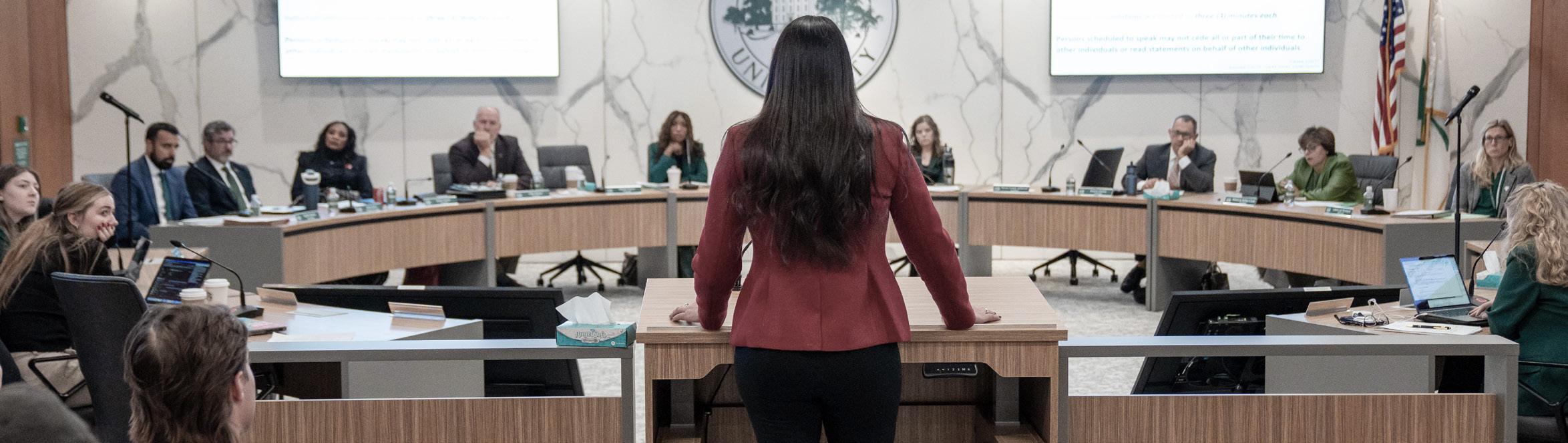
Brenda Tracy speaks to the MSU Board of Trustees at Hannah Administration Building in East Lansing, Mich., on Friday, Oct. 31, 2025. Photo by Gavin Hutchings.
COLUMN: RELIGIOUS RHETORIC IS BACKFIRING ON THE TRUMP ADMINISTRATION
By Isabella Cucchetti icucchetti@statenews.com
In a perhaps unsurprising development, Trump’s newest enemy is the Pope. The president went off on a tirade criticizing the leader of the Catholic Church, who has been increasingly critical of Trump in recent weeks.
On Palm Sunday, the American-born pontiff censured the violence in the Middle East, as well as any rationalization of this violence, in the name of Christianity. Pope Leo XIV’s later upbraiding of President Trump for the attacks on Iran is one of the frst times he has addressed Trump by name.
It’s unusual for a pope, especially one known to be as mild-mannered as Leo, to call out world leaders so directly. However, Trump’s use of Christianity to rationalize violence in Iran presents a unique dilemma: The Trump administration’s use of religious crusade rhetoric to justify war in Iran is a directed effort to maintain the support of religious voters. However, in reality, this rhetoric is accomplishing the opposite effect and is actually driving away some religious groups.
This spat with the pope is not an isolated event. It’s indicative of the Trump administration’s gradual fall from grace in the eyes of religious voters. While it’s fairly typical for second-term presidents to see their popularity fade, there is a notable difference in these groups that make up a bulk of Trump’s support base. A PRRI poll shows an across-the-board decline in favorability among Christian voters between September 2025 and February 2026. Some groups, like white nonevangelical Protestants and Hispanic Protestants, saw a much steeper decline compared to that of all Americans.
This waning support over past months could be attributed to a number of factors, like economic strain or the release of thousands of documents related to Jefferey Epstein that seem to implicate the president. Trump’s posting of an AI-generated image that seemingly depicts him as Jesus also drew signifcant backlash from many religious fgures. But perhaps the most salient reason Trump has lost favor with Christian voters has to do with his handling of foreign policy in the Middle East.
Recent U.S. attacks on Iran have predictably worsened public opinion of the administration. Wars tend to be unpopular nowadays, if not for morally upright reasons, then for the infated gas prices that follow. The adoption of religious justifcation for involvement in Iran is an attempt by the Trump administration to regain support from Christian constituents.
This strategy has been most visible via U.S. Defense Secretary Pete Hegseth, who consistently describes the United States’ attacks on Iran as divinely licensed. In religious services he regularly holds at the Pentagon, Hegseth has expressed confdence that God is in favor of the US military and even prayed for “overwhelming violence of action against those who deserve no mercy.” This holy war-reminiscent language is not surprising coming from Hegseth, who famously has the words “Deus Vult” tattooed on his bicep, a phrase which is associated with the crusades and translates to “God wills it.”
Trump himself has also employed similar rhetoric, though not as frequently, explicitly saying that God supports the war in an April 6 press conference. He referred to the recovery of a missing US airman in Iran as an “Easter miracle” on Easter Sunday, after Hegseth compared the airman’s experience of hideout and rescue to
the death and resurrection of Christ in the Bible. These crusade-esque arguments have also made their way into the military, with commanders reportedly using “extremist Christian rhetoric about biblical ‘end times’” to vindicate action in Iran to troops. A month ago, the Military Religious Freedom Foundation watchdog group claimed to have received more than 200 complaints from service members.
By painting US involvement in the Middle East as a battle of good and evil, these leaders justify brutal military action against Iran as righteous, God-sanctioned, and destined for victory.
This infux of holy-war language to justify military action in Iran is a strategic attempt to win popular support for the war from one of Trump’s largest support demographics, white evangelical protestants. This includes many who favor Zionist ideology and support Israel, with groups like Christians United for Israel. They therefore often take on opposition to Iran, with Iran being considered an existential threat to Zionists and an enemy to Israel.
Maintaining white evangelical support is crucial for the Trump administration, especially considering that Trump has lost so much support among that base. A Pew Research report from February 2025 to January 2026 found confdence in Trump’s ethics in offce dropped the most for white evangelical protestants, by 15 percentage points. This group also saw the second-biggest decrease in support for Trump’s plans and policies in this time period. With these drastically dipping numbers, it’s easy to see how this might have encouraged the Trump administration to adopt this religious, good-versus-evil rhetoric to justify aggressive military action in Iran and keep evangelicals on board.
In terms of white evangelical protestants, the crusade language is succeeding at maintaining support. However, the use of Christian rhetoric to justify a violent war is proving to be massively unpopular among other sects. The most evident is among Catholics, as seen by the Pope’s rare explicit criticism.
Beyond the Catholic tradition, Churches for Middle East Peace, a coalition of more than 30 Christian denominations, put out a statement denouncing the administration’s actions in Iran. This document refutes any claim that Christianity can be used to justify the violence enacted and threatened to be enacted. Many others, including prominent protestant leaders and conservative political fgures, have condemned the administration’s holy war rhetoric.
The crusade rhetoric that is allowing Trump to maintain the evangelical Christians is the same that is driving other religious groups away, perhaps for good reason. Past presidents have employed religious language during times of confict, but nowhere near to the extent that the Trump administration has. This leveraging of beliefs held personally by so many is rightfully an object of concern.
It’s one thing to justify a war for economic or even moral reasons. But it’s another entirely to frame it as divinely sanctioned and preordained to succeed. Americans of all faiths need to be wary of the rhetoric used by their leaders, careful to discern the representation versus weaponization of their beliefs.
Isabella Cucchetti is a sophomore studying Political Theory and Constitutional Democracy and is a columnist at The State News. The views in this article are her own and independent of The State News.
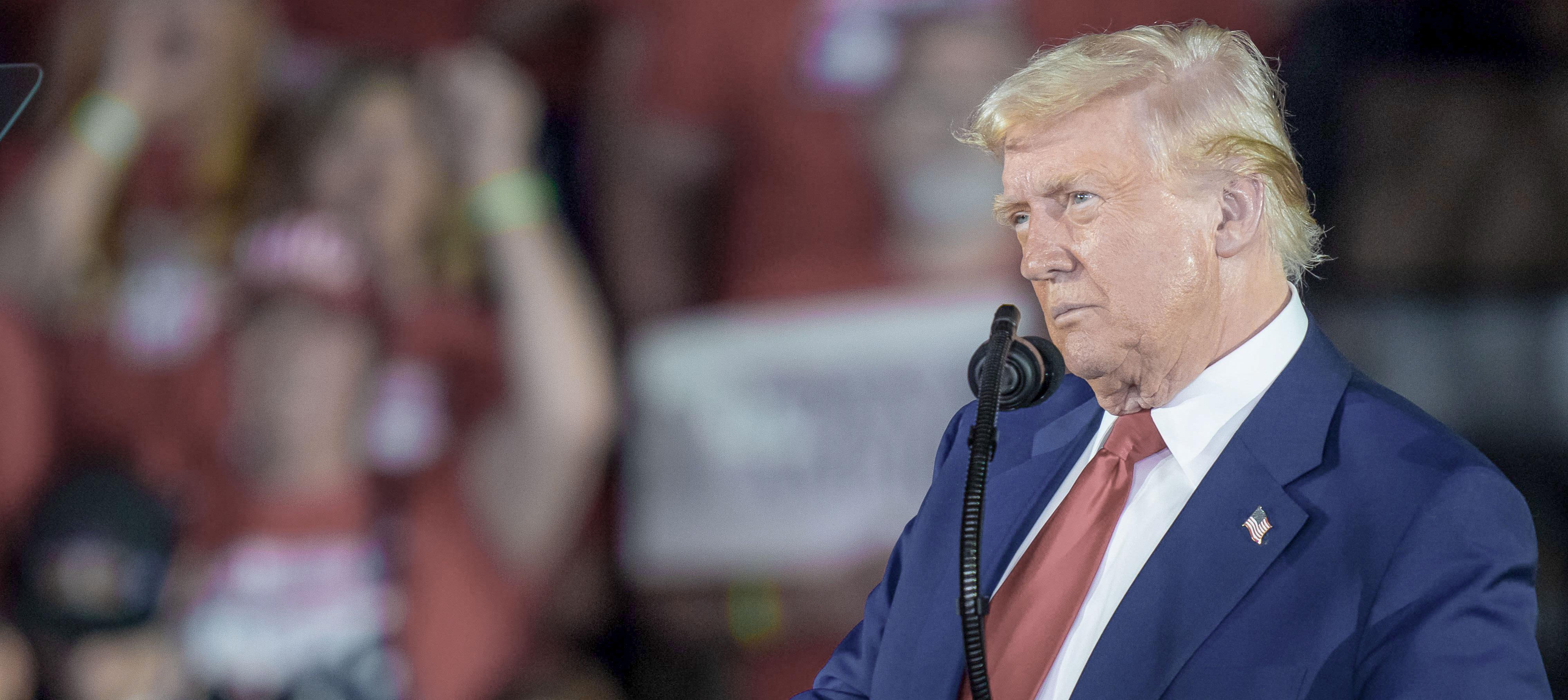
President Donald Trump marks his first 100 days in office with a rally at Macomb Community College in Warren, Mich., on April 29, 2025. State News File Photo.
HOUSE REPUBLICANS PROPOSE 62% SLASH TO MSU STATE FUNDING
By Anish Topiwala atopiwala@statenews.com
State House Republicans are looking to slash 62% of state funding for Michigan State University.
During a press conference Thursday announcing the House’s proposed state budget for the upcoming fscal year, House Speaker Matt Hall, R-Richland Township, said MSU has been “losing their way, losing focus of their core mission.” The proposal seeks to reduce state appropriations to the university by $208.8 million compared to the current fscal year, in which MSU received $333.7 million.
The proposal follows several episodes over the past year in which state Republicans have scrutinized the university. In October, they argued that a College of Education course taught material that was discriminatory towards white students. That controversy subsequently spawned a public records request submitted by a conservative student group in March seeking to uncover evidence of ideological mandates within the college. That effort has been supported by a second-term state lawmaker who promises to bring its fndings to the capitol come budget negotiation season.
On Thursday, Hall focused his energy toward Rx Kids, a prenatal and infant cash subscription program administered by MSU. Hall referred to
the program as a “complete scam which is giving welfare to illegal aliens.”
Hall added that “a lot of people” spend the money provided by Rx Kids on drugs and alcohol. He said there are already state programs that provide needy families with fnancial support, and which have eligibility requirements and stipulations as to what the disbursed funds can be used for.
While those programs “guarantee the tax dollars we are investing and helping people in need go to approved uses that will help mothers,” Hall claimed, Rx Kids provides money which they can spend on “whatever they want.”
In October, the state committed $270 million to the MSU-administered program.
University Spokesperson Amber McCann said the university strictly administers the program, and that MSU is required to spend all the money the state gives it to run the Rx Kids program.
“Michigan State University does not have discretion over spending that money,” she said. “The state appropriated the money specifcally for our Rx Kids, and we have to take that money and administer the program.”
McCann also noted that Hall voted in support of last year’s state allocation for Rx Kids in the Fiscal Year 2026 budget.
McCann wrote in an email later that the cuts broadly are “a direct hit to the thousands of
students and families that choose MSU as their path and value the resources and opportunity afforded by a public university.”
“Reducing investment in institutions that deliver this scale of impact undermines the success of our students and risks Michigan’s longterm economic strength,” she wrote.
McCann urged House lawmakers to reconsider the proposed budget and adopt one which “refects both equity and impact across the state’s higher education system.”
Typically, these proposed budgets do not refect the fnal state allocations. Last year, House Republicans initially proposed a 72.6% cut to MSU funding, which would have left only $89.4 million in state funding. The eventual state allocation for the university saw a 2% increase in funding from the previous year.
Gov. Gretchen Whitmer’s budget recommendation, released in February, calls for a 1% increase to MSU’s funding, totaling $337.1 million.
State Rep. Josh Schriver, R-Oxford, has been entangled in the student group Young Americans for Freedom’s probe of the College of Education. Schriver, who attended MSU, didn’t say whether concerns raise by the group were a factor into the House budget proposal, though he said that he has discussed this issue with all of his colleagues and that “they’re well aware of it.”
Schriver added that he is disappointed by the lack of change from MSU since last year’s budget. “I really want to fund them more, but I’m just not seeing the results that I need to see in order to put my weight behind that,” he said.
The proposed budget has been approved by the Michigan House Appropriations Subcommittee on Higher Education and Community Colleges. The bill will now move to be considered in the full House Appropriations Committee.
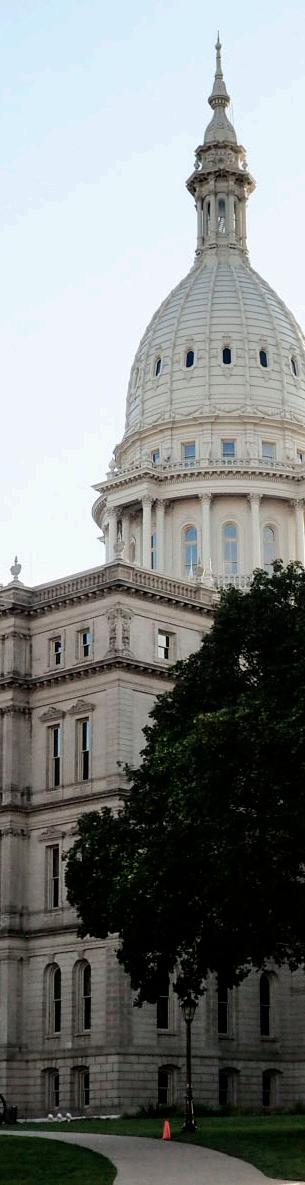
Michigan State Capitol building pictured at night in Lansing, Mich., on Saturday, Sept. 20, 2025. Photo by Ari Saperstein.