


![]()


75+ CAREERS: Salary info • Educational pathways • Skills needed to succeed • How to specialize and advance • And much more!
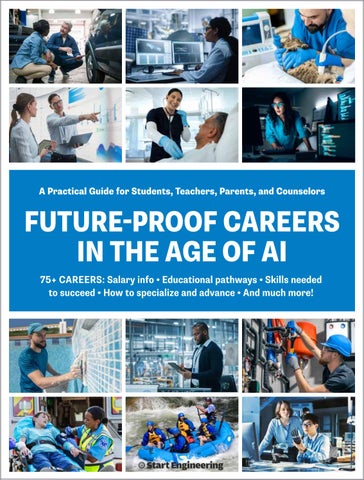


Artificial intelligence is reshaping the world of work at a breathtaking pace. Machines have already taken on jobs like data entry, customer service, and even some basic coding — tasks that can be broken into clear, repeatable steps. But AI hasn’t ended work; it’s changing it. From medicine to manufacturing, it’s streamlining tasks, uncovering patterns, and expanding what’s possible. These changes bring challenges, but they also open extraordinary opportunities for students to build the skills technology can’t replace.
This guide highlights careers that not only endure in the age of AI, but also benefit from it. Across fields like healthcare, skilled trades, teaching, technology, and creative work, people will always be needed for judgment, empathy, adaptability, and human connection. At the same time, AI can be a powerful tool — helping nurses monitor patients, engineers test designs, or teachers personalize lessons. Rather than replacing these roles, AI will strengthen them.
At Start Engineering, our mission is to inspire and inform students about the “careers of the future,” including artificial intelligence, biotechnology, data science, cybersecurity, and engineering. With AI now influencing nearly every profession — and creating real worries about what that means for the next generation — we wanted to reassure students that many careers remain AI-resistant. These careers not only offer security but also the chance to thrive by using the uniquely human skills that technology cannot replace. That’s why we created this guide.
For more than 10 years, we’ve been producing award-winning career guides that help students explore opportunities in STEM and beyond. Our books and resources, used by students from K–12 as well as their teachers and parents, open doors to fields that welcome a wide range of skills, interests, and backgrounds.
Our goal in these pages is to give you clear, practical insights into these careers: what they involve, the skills you’ll need, education and training paths, and what you can earn. Whether you see yourself solving problems in a lab, leading a classroom, designing new technology, or protecting your community, you’ll find encouragement and guidance here.
The future of work will be different — but for those who prepare, it can be brighter than ever.
Robert Black CEO Start Engineering bblack@start-engineering.com
But careers that depend on human skill, creativity, and judgment will thrive.
Not all careers are built to last in the age of artificial intelligence. Jobs that can be broken down into step-by-step instructions are the easiest for AI and automation to replace. These include roles made up of repetitive, predictable tasks — where machines can often work faster, cheaper, and without breaks.
Where AI excels — and can replace humans:
• Processing large amounts of information (data entry, payroll, coding).
• Following fixed scripts or workflows (telemarketing, customer service chats).
• Handling high-volume, low-variation tasks (scheduling, barcode scanning, payment processing).
• Running nonstop, 24/7 (call centers, toll booths, online support).
Jobs already being automated:
• Data entry clerks – AI can sort and input data in seconds.
• Toll booth operators – Automated payment and license plate readers do the work.
• Telemarketers – AI chatbots can make calls around the clock.
• Cashiers – Self-checkout and mobile pay reduce staffing needs.
• Customer service reps – Chatbots answer common questions instantly.
• HR coordinators – AI posts jobs, screens applications, and tracks records.
• Coders – AI now writes a significant share of code at major firms.
• Paralegal researchers – AI can scan case law and draft legal docs.
• Basic accountants – Payroll, invoicing, and tax prep are automated.
• Marketing assistants – AI generates posts, emails, and blogs.
• Financial consultants (basic services) – Robo-advisors and AI planning tools automate investment guidance and portfolio management.
• Medical billing analysts – Automated coding and AI-driven claims systems reduce the need for manual review.
• Drivers – Self-driving tech threatens delivery and taxi roles.
• Translators – Machine translation continues to advance.
The good news is that many careers are safe from automation. These jobs rely on skills AI can’t match — physical ability, empathy, original thought, and human judgment. They take place in unstructured or unpredictable environments where adaptability matters most. AI-resistant careers often require:
• Hands-on work that can’t be done from behind a screen.
• Creativity and innovation beyond what algorithms can copy.
• Ethical judgment in complex or gray areas.
• Empathy and communication that build trust and connection.
• Adaptability in unpredictable, real-world settings.
Each section highlights how these careers work, why they’re AI-resistant, and how you can prepare for them. Sources for the data include the U.S. Bureau of Labor Statistics (BLS) and additional industry reports. Turn the page to discover what careers are in each category.
When you're done, check out the Student Workbook at the end of this guide. It’s designed to help you explore your interests, compare options, and choose the educational path that fits your goals.
Skilled Trades & Technical Services, pages 6-32
Hands-on experts who build, fix, and install, including electricians, plumbers, welders, HVAC technicians, and mechanics. EXAMPLES: Auto Mechanic, Carpenter, Plumber.
Engineering & Engineering Technology, pages 33-68
Innovators who design, test, and improve systems in aerospace, civil, electrical, mechanical, and more. EXAMPLES: Biomedical Engineer, Civil Engineer, Environmental ET.
Science & Applied Science, pages 69-94
Researchers and technicians who turn discovery into real-world solutions in biology, chemistry, physics, the environment, and health. EXAMPLES: Biotech Technician, Chemist.
Technology & Data Careers, pages 95-109
Specialists who protect networks, analyze data, and develop AI and digital tools responsibly. EXAMPLES: Cyber Analyst, Data Scientist, Network Engineer.
Human Connection Careers, pages 110-134
Professionals who rely on empathy, judgment, and trust, such as nurses, doctors, teachers, and therapists. EXAMPLES: EMT, Social Worker, Physician Assistant, Veterinarian.
Public Safety, Legal & Leadership, pages 135-145
Leaders who safeguard communities, uphold justice, and make critical decisions in roles like police, firefighters, lawyers, judges, and executives. EXAMPLES: Elected official, Executive.
Creative Careers, pages 146-151
Storytellers and makers who imagine, design, and create art and media that only humans can bring to life. EXAMPLES: Actor, Author, Musician, Podcaster.
Experience & Wellness Careers, pages 152-161
Professionals who design experiences and services that support joy, health, and personal growth. EXAMPLES INCLUDE: Adventure Guide, Caterer, Yoga Instructor.
pages 162-167


f you like working with your hands, solving problems in real time, and seeing the results of your work right in front of you, skilled trades could be your calling. From fixing a broken furnace in the middle of winter to building a custom staircase, these careers are about doing, not just planning. Every day is different — each job site brings its own set of challenges, and your problem-solving skills, creativity, and adaptability make all the difference. These features make trade work AI-resistant. You bring technical knowledge and real-world experience to hands-on tasks in challenging environments that change with every job.
• Mechanics working on all kinds of vehicles
• Electricians, plumbers, and carpenters
• Technicians, installers, and repairers of systems
Once you pick out a trade to pursue, you can explore ways to get started. Some trades require apprenticeships, others involve further education after high school, and some might call for a mix of hands-on and classroom learning.
Skilled Trades & Technical Services continued
• Paid, on-the-job training combined with formal instruction.
• Learn from experienced professionals on the job while you study the theory and practice of the field.
• Usually 3-5 years leading to a license or certification of your ability to work independently.
• Widely available in skilled trades, through unions, employers, industry associations, and websites like Apprenticeship.gov.
Trade schools and training programs
• Offered at community colleges or trade schools.
• Focused on specific skills and knowledge associated with fields of interest.
• Six months to two years in length, leading to a certificate or associate degree that confirms technical competence.
• Information at online directories like the Association for Career and Technical Education’s school finder, state workforce development websites, and career counseling services.
Salaries start at $35,000 to $45,000 with the potential to earn over $100,000. To advance and earn more, you can pursue specialized training and certifications that qualify you for higher pay. Median pay for advanced trade work can run from $70,000 to $100,000+. Pay varies by region, typically higher in urban areas and lower in rural areas.
Typical tuition is $5,000–$15,000 total for most programs. Many schools offer financial aid, grants, or employer-sponsored tuition reimbursement. Apprenticeships often have no tuition cost — because you’re earning a paycheck while you learn.
Skilled tradespeople use AI-powered tools like smart diagnostics, predictive maintenance software, and augmented-reality guides to spot problems faster and work more efficiently — but the actual repair and installation still require human hands.
Skilled trades offer solid pay, steady demand, and the satisfaction of creating, fixing, and building in the real world. If you like variety, practical problem-solving, and work that matters every day, this could be your path. Take a look at the following pages for the most in-demand trade and technical service careers and see what interests you!


Hands-on experts who keep planes safe, reliable, and ready to fly.
STARTING SALARY: About $50,000–$55,000 WITH EXPERIENCE: Around $75,000–$95,000+
THE CAREER: Aircraft mechanics, often called Airframe and Powerplant (A&P) mechanics, inspect, repair, and maintain planes to the highest safety standards. A day’s work may involve troubleshooting issues on the spot, repairing engines, replacing worn parts, or conducting detailed inspections before a flight.
WHY IT'S AI-RESISTANT: Aircraft mechanics are responsible for passenger and crew safety, which demands hands-on expertise, accountability, and judgment in unpredictable conditions. While AI tools can assist with predictive maintenance and diagnostics, only licensed mechanics can verify, repair, and sign off on the work.
SPECIALIZATIONS INCLUDE:
• Airframe Systems – Working on structures, hydraulics, landing gear, and environmental systems.
• Powerplant Systems – Repairing and maintaining piston and turbine engines, fuel systems, and performance.
• Avionics – Handling aircraft electronics such as navigation, communication, and flight control.
• Inspection & Safety – Performing FAA-mandated checks, safety audits, and preventive maintenance.
• Composite Materials – Working with modern lightweight materials used in today’s aircraft.
Aircraft Mechanic continued
WHERE THEY WORK: Airports, airline maintenance facilities, private hangars, manufacturers, the military, or aviation safety agencies.
SKILLS TO SUCCEED:
• Strong mechanical aptitude and problem-solving skills.
• Precision and attention to detail — safety depends on it.
• Ability to read and follow technical manuals and diagrams.
• Comfort working at heights, in tight spaces, and around loud machinery.
• Responsibility and professionalism to ensure every repair meets safety standards.
EDUCATIONAL PATHWAYS:
• FAA-Approved Training Programs: Offered at community colleges or technical schools; typically 18–24 months.
• Military Training: Many mechanics train through service branches, gaining experience on military aircraft.
• On-the-Job Training: Some positions allow apprenticeships under licensed mechanics.
BOTTOM LINE: Aircraft mechanics use technical skill and judgment to keep flights safe. For students interested in mechanics with high stakes and strong pay, it’s a reliable, future-proof career.


Pros who keep cars, trucks, and electric vehicles running safely and smoothly.
STARTING SALARY: About $40,000–$45,000 WITH EXPERIENCE: $60,000–$75,000+; EV specialists may earn more
THE CAREER: Auto mechanics diagnose, repair, and maintain vehicles of all kinds — from sedans and SUVs to heavy-duty trucks. A typical day may involve running diagnostics, changing brakes or tires, repairing engines, or troubleshooting electrical systems. With electric vehicles (EVs) on the rise, many mechanics are also training to handle high-voltage batteries and advanced electronics.
WHY IT'S AI-RESISTANT: Vehicles break down in unpredictable ways and require hands-on expertise to fix. While AI diagnostic tools and smart sensors can help identify issues faster, human mechanics are needed to interpret results, complete repairs, and ensure cars are safe for the road.
SPECIALIZATIONS INCLUDE:
• General Automotive Repair – Engines, brakes, transmissions, and routine maintenance.
• Diesel Mechanics – Repairing heavy-duty engines for trucks, buses, and construction equipment.
• Electric Vehicle (EV) Technology – Servicing batteries, motors, and high-voltage systems.
• Performance & Customization – Tuning engines, installing performance parts, or customizing vehicles.
• Collision Repair – Fixing body damage, frames, and paint after accidents.
WHERE THEY WORK: Repair shops, dealerships, fleet centers, specialty garages, or EV service facilities.
Auto Mechanic / EV Technician continued
• Strong mechanical aptitude and diagnostic skills.
• Comfort with both hand tools and advanced computer-based diagnostic systems.
• Attention to safety, especially when working with high-voltage EV systems.
• Problem-solving and adaptability — no two repairs are ever the same.
• Customer service skills to explain repairs and build trust.
EDUCATIONAL PATHWAYS:
• Automotive Technology Programs: Offered at high schools, trade schools, and community colleges.
• Manufacturer-Specific Training: Brands like Toyota, Ford, Tesla, and GM offer specialized EV and hybrid programs.
• Apprenticeships: Hands-on training alongside experienced mechanics.
BOTTOM LINE: Auto mechanics and EV technicians keep transportation moving. With strong pay, rising EV demand, and work that blends hands-on skill with new tech, this career is both reliable and future-proof.
Builders and craftspeople who shape wood into homes, furniture, and structures that last.
STARTING SALARY: About $40,000–$45,000 WITH EXPERIENCE: $60,000–$70,000+; specialists and contractors may earn more.
THE CAREER: Carpenters create, repair, and install wooden structures and fixtures in homes, businesses, and construction sites. A day’s work might include reading blueprints, measuring and marking wood, cutting materials to size, assembling frameworks, or installing cabinets, doors, and molding. Projects range from house framing in all weather to crafting fine cabinetry in a workshop.
WHY IT'S AI-RESISTANT: Carpenters rely on precision, creativity, and adaptability to shape wood in real-world conditions. While AI-powered tools can help with design or measurement, the cutting, joining, and finishing require human skill, problem-solving, and craftsmanship.
SPECIALIZATIONS INCLUDE:
• Finish Carpentry – Detailed work like trim, molding, and cabinetry.
• Framing – Building the basic skeleton of homes and buildings.
• Restoration – Repairing and preserving historic wood structures.
• Green Building – Using sustainable materials and methods.
WHERE THEY WORK: Construction sites, workshops, homes, and businesses; often for contractors or as self-employed craftspeople.
SKILLS TO SUCCEED:
• Precision and attention to detail.
• Strong math and measurement skills.


• Ability to read and interpret blueprints.
• Comfort using hand tools, power tools, and measuring devices.
• Physical stamina for lifting, bending, and working in different positions.
EDUCATIONAL PATHWAYS:
• Apprenticeships: 3–5 years of paid on-the-job training combined with classroom instruction.
• Trade Schools / Community Colleges: Carpentry programs lead to certificates or associate degrees.
BOTTOM LINE: Carpenters blend creativity with hands-on skill to build and repair everyday structures. For students who like problem-solving and visible results, it offers solid pay, steady demand, and rewarding work. Carpenter continued Category 1 -

Hands-on builders who turn blueprints into real structures and keep projects moving.
STARTING SALARY: About $37,000–$42,000 WITH EXPERIENCE: $55,000–$65,000+; skilled specialists and foremen may earn more.
THE CAREER: Construction workers do the physical work of building, repairing, and maintaining structures. A day’s work might include preparing job sites, operating tools and machinery, pouring concrete, erecting scaffolding, or assisting skilled trades like electricians and plumbers. Some specialize in tasks such as masonry, demolition, or heavy equipment operation, while others take on general labor across different projects.
WHY IT'S AI-RESISTANT: Construction happens in unpredictable environments that require flexibility, problem-solving, and teamwork. AI-powered tools and robotics can help with planning or repetitive tasks, but human workers are needed to adapt on site, coordinate with others, and ensure safety standards are met.
SPECIALIZATIONS INCLUDE:
• General Laborer – Assists with site prep, cleanup, and basic construction tasks.
• Concrete Worker – Focuses on pouring, leveling, and finishing concrete.
• Demolition Worker – Safely removes old structures before new builds.
• Heavy Equipment Operator – Runs machines like bulldozers, cranes, and excavators.
• Skilled Construction Crew – Works closely with carpenters, masons, and other trades.
Construction Worker continued
WHERE THEY WORK: Residential, commercial, and public works projects; employed by contractors or unions.
SKILLS TO SUCCEED:
• Physical strength and stamina.
• Comfort with hand tools, power tools, and construction equipment.
• Ability to follow safety procedures and work in teams.
• Willingness to adapt to changing tasks and conditions.
EDUCATIONAL PATHWAYS:
• On-the-Job Training: Most construction workers learn by starting as laborers and gaining experience.
• Trade Schools / Community Colleges: Offer construction technology programs (6 months–2 years).
• Apprenticeships: Paid training combining classroom instruction and hands-on learning.
BOTTOM LINE: Construction workers are the backbone of every project. With steady demand and chances to specialize or advance, this career offers stability, growth, and pride in building the world around us.

Pros who keep the lights on and technology running safely and reliably.
STARTING SALARY: About $45,000–$50,000 WITH EXPERIENCE: $65,000–$90,000+
THE CAREER: Electricians install, maintain, and repair electrical systems in homes, offices, factories, and public spaces. A typical day might involve reading blueprints, running wiring through walls or underground, installing outlets and lighting fixtures, troubleshooting power outages, or repairing faulty circuits. Electricians also test systems with specialized tools to ensure safety and compliance with building codes.
WHY IT'S AI-RESISTANT: Electrical work requires practical judgment, adaptability, and strict safety awareness in unpredictable real-world settings. While AI can help with diagnostics or smart-grid monitoring, only electricians can physically install, repair, and certify that systems are safe to use.
SPECIALIZATIONS INCLUDE:
• Residential Wiring – Focus on homes and small buildings.
• Commercial & Industrial Systems – Power systems for larger, more complex structures.
• Renewable Energy – Installing and maintaining solar or wind systems.
• Low-Voltage Systems – Specializing in alarms, communications, and data wiring.
Electrician continued
WHERE THEY WORK: Electricians work in construction, maintenance, and repair, employed by contractors, utility companies, factories, and service firms. Many are self-employed, running their own businesses.
SKILLS TO SUCCEED:
• Strong problem-solving and troubleshooting skills.
• Math and blueprint-reading ability for measurements and planning.
• Attention to detail and a strict focus on safety.
• Physical fitness for climbing ladders, working in tight spaces, and handling equipment.
EDUCATIONAL PATHWAYS:
• Apprenticeships: The most common route — 3–5 years of paid, on-the-job training combined with classroom instruction.
• Trade Schools / Community Colleges: Electrical technology programs (1–2 years) that may lead to apprenticeships or direct employment.
BOTTOM LINE: Electricians combine technical knowledge, safety skills, and problem-solving to power the modern world. With strong demand, high wages, and opportunities to specialize, this is an essential future-proof trade.
One of the best-paying jobs in the skilled trades.

Specialists who keep elevators, escalators, and lifts moving safely and smoothly.
STARTING SALARY: About $55,000–$60,000 WITH EXPERIENCE: $85,000–$100,000+
THE CAREER: Elevator installers and repairers assemble, maintain, and fix elevators, escalators, moving walkways, and lifts. A typical day may involve reading blueprints, running cables, connecting motors, testing safety systems, or troubleshooting sudden breakdowns. It’s precision work that demands focus, since public safety depends on every detail.
WHY IT'S AI-RESISTANT: Elevators operate in complex, unpredictable environments where hands-on adjustments, safety checks, and problem-solving are essential. AI can help monitor performance or predict failures, but only trained mechanics can climb into the shafts, make repairs, and certify that systems are safe.
SPECIALIZATIONS INCLUDE:
• Installation – Setting up new elevators, escalators, or lifts according to engineering plans.
• Maintenance – Conducting routine checks to ensure smooth, reliable operation.
• Repairs – Fixing breakdowns, replacing parts, and troubleshooting electrical or mechanical systems.
• Modernization – Updating older elevators with new technology, controls, or energy-efficient systems.
WHERE THEY WORK: Office buildings, hospitals, malls, and transit systems, usually through specialized service firms.
• Strong mechanical and electrical aptitude; attention to safety and precision in every step.
• Problem-solving skills for troubleshooting malfunctions.
• Physical stamina and comfort working at heights and in confined spaces.
• Ability to read blueprints and follow technical manuals.
• Apprenticeships: The primary route — 4–5 years of paid, on-the-job training combined with classroom instruction.
• Trade Schools / Community Colleges: Some offer programs in electrical or mechanical technology that can prepare you for apprenticeships.
BOTTOM LINE: Elevator installers and repairers blend mechanical and safety expertise in a high-paying trade. With strong wages, steady demand, and work that matters, it’s a solid, future-proof career.

Experts who keep buildings comfortable with reliable heating, cooling, and ventilation.
STARTING SALARY: About $40,000–$45,000 WITH EXPERIENCE: $60,000–$75,000+
THE CAREER: HVAC (Heating, Ventilation, and Air Conditioning) technicians install, maintain, and repair the systems that control temperature and air quality in homes, businesses, and factories. A day’s work may include installing new furnaces or AC units, checking refrigerant levels, repairing electrical components, or upgrading ventilation systems.
WHY IT'S AI-RESISTANT: Heating and cooling systems break down in unpredictable ways and require hands-on expertise to repair. AI-powered diagnostic tools can help spot problems or optimize performance, but technicians are needed to handle installation, fix components, and ensure systems meet safety and environmental standards.
SPECIALIZATIONS INCLUDE:
• Installation – Setting up new heating, cooling, or ventilation systems.
• Maintenance & Repair – Performing routine checks and fixing broken equipment.
• Refrigeration – Working with walk-in coolers, freezers, and other commercial systems.
• Green Energy Systems – Installing solar thermal, geothermal, or energy-efficient HVAC systems.
• Air Quality Control – Specializing in ventilation, filtration, and humidity regulation.
HVAC Technician continued
WHERE THEY WORK: Homes, offices, hospitals, factories, and schools for service companies or building contractors.
SKILLS TO SUCCEED:
• Mechanical aptitude and troubleshooting skills.
• Attention to detail and commitment to safety standards.
• Physical stamina for lifting heavy equipment and working in tight spaces.
• Customer service skills to explain issues and repairs clearly.
EDUCATIONAL PATHWAYS:
• Trade Schools / Community Colleges: HVAC programs leading to certificates or associate degrees.
• Apprenticeships: 3–5 years of paid, hands-on training with classroom instruction.
BOTTOM LINE: HVAC technicians blend mechanical skill with problem-solving to keep buildings livable year-round. With strong demand, opportunities to specialize, and good pay, this trade offers steady, future-proof work.

Operators who power construction with bulldozers, cranes, and excavators.
STARTING SALARY: About $40,000–$45,000 WITH EXPERIENCE: $60,000–$70,000+
THE CAREER: Heavy equipment operators run the big machines that move earth, lift steel, and shape roads, bridges, and buildings. A day might involve digging trenches with excavators, grading land with bulldozers, or operating cranes on construction sites. Safety and precision are critical, since these machines handle tons of material.
WHY IT'S AI-RESISTANT: While GPS and AI can assist with guidance, real-world job sites are unpredictable. Human operators make on-the-spot decisions to keep projects safe and on schedule.
SPECIALIZATIONS INCLUDE:
• Excavator Operator – Digging trenches, foundations, and tunnels.
• Crane Operator – Lifting and placing heavy materials.
• Bulldozer/Grader Operator – Shaping land and preparing sites.
• Road Construction Equipment – Operating pavers, rollers, or asphalt spreaders.
WHERE THEY WORK: Construction companies, road crews, mining sites, and large-scale building projects.
Heavy Machine Operator continued Category 1 -
SKILLS TO SUCCEED:
• Strong spatial awareness and precision.
• Mechanical knowledge for equipment upkeep.
• Safety-first mindset.
• Physical stamina and focus during long shifts.
EDUCATIONAL PATHWAYS:
• Trade Schools: Certificate programs for specific equipment.
• Apprenticeships: Paid training combining on-the-job experience and classroom learning.
BOTTOM LINE: Heavy equipment operators keep construction moving. For students who like working outdoors with powerful machines, it’s a steady trade with good pay.


Builders who create strong structures and detailed finishes with stone, brick, and tile.
STARTING SALARY: About $38,000–$42,000 WITH EXPERIENCE: $55,000–$65,000+
THE CAREER: Masons and tile setters build with materials like brick, stone, concrete, and tile. They might lay brick walls, set stone walkways, or install bathroom tiles with precision. The work requires physical strength, attention to detail, and an eye for design when finishing surfaces.ms.
WHY IT'S AI-RESISTANT: AI can suggest designs, but installing heavy bricks or setting delicate tiles requires hands-on skill and adaptability to unique job sites.
SPECIALIZATIONS INCLUDE:
• Bricklaying – Building walls, chimneys, and structures.
• Stone Masonry – Working with natural stone for walls and walkways.
• Tile Setting – Installing ceramic, glass, or stone tile for floors and walls.
• Concrete Finishing – Pouring and smoothing foundations, sidewalks, and decorative surfaces.
WHERE THEY WORK: Residential and commercial construction, renovation projects, landscaping, and restoration.
SKILLS TO SUCCEED:
• Physical strength and stamina.
• Precision measuring and layout skills.
Mason / Tile Setter continued Category 1 -
• Creativity and design sense for finishes.
• Knowledge of materials and mixing techniques.
EDUCATIONAL PATHWAYS:
• Apprenticeships: 3–4 years of hands-on and classroom training.
• Trade Schools: Masonry and tiling programs leading to certificates.
BOTTOM LINE: Masons and tile setters combine strength and craftsmanship to build lasting structures. For students who enjoy creative, hands-on work, it’s a career with steady demand.

Experts who keep water flowing and systems safe in homes and businesses.
STARTING SALARY: About $47,000–$54,000 WITH EXPERIENCE: $63,000–$76,000+
THE CAREER: Plumbers install and repair the pipes that bring clean water in and carry waste out. A typical day might involve fixing a leaky faucet, installing bathroom fixtures, or designing complex piping systems for commercial buildings. They also ensure compliance with health and safety codes.
WHY IT'S AI-RESISTANT: Plumbing systems break down in unpredictable ways and require human expertise. AI can assist with diagnostics, but repairs, installations, and safety checks demand hands-on problem-solving.
SPECIALIZATIONS INCLUDE:
• Residential Plumbing – Installing and repairing home systems.
• Commercial Plumbing – Large-scale projects in offices, schools, or factories.
• Pipefitting/Steamfitting – Working with high-pressure industrial pipes.
• Green Plumbing – Installing water-saving and sustainable systems.
WHERE THEY WORK: Homes, businesses, factories, construction sites, and government buildings.
Plumber continued
SKILLS TO SUCCEED:
• Problem-solving and troubleshooting skills.
• Knowledge of safety codes and regulations.
• Physical stamina for lifting, bending, and working in tight spaces.
• Customer service for explaining repair.
EDUCATIONAL PATHWAYS:
• Apprenticeships: 4–5 years, combining paid work and classroom training.
• Trade Schools / Community Colleges: Plumbing programs leading to certificates or associate degrees.
BOTTOM LINE: Plumbers keep vital systems running in every building. With high demand and good pay, plumbing offers a reliable, future-proof career.

Metalworkers who fuse, cut, and shape the materials that build our world.
STARTING SALARY: About $40,000–$45,000 WITH EXPERIENCE: Around $60,000–$70,000
THE CAREER: Welders use heat and tools to join or cut metal parts, building everything from cars and ships to pipelines and skyscrapers. A typical day might involve reading blueprints, measuring metal, and using welding equipment in workshops or on construction sites..
WHY IT'S AI-RESISTANT: AI-driven robots can weld in factories, but welders are needed for custom projects, repairs, and environments where flexibility and judgment are key
SPECIALIZATIONS INCLUDE:
• Structural Welding – Building bridges, buildings, and ships.
• Pipe Welding – Joining pipes in power plants or refineries.
• Fabrication – Creating custom metal parts in shops.
• Underwater Welding – Repairing ships and offshore structures.
WHERE THEY WORK: Construction, shipyards, oil and gas, manufacturing, automotive, and aerospace.
Welder continued
SKILLS TO SUCCEED:
• Precision and attention to detail.
• Mechanical and mathematical skills.
• Knowledge of safety procedures.
• Physical stamina and steady hands.
EDUCATIONAL PATHWAYS:
• Trade Schools / Community Colleges: Welding certificate or associate degree.
• Apprenticeships: Paid training on job sites.
BOTTOM LINE: Welders combine technical skill with creativity to shape metal into strong, lasting structures. It’s a career with broad opportunities and steady demand.

Renewable energy specialists who keep turbines spinning to power the future.
STARTING SALARY: About $45,000–$50,000 WITH EXPERIENCE: $65,000–$75,000+
THE CAREER: Wind turbine technicians install, maintain, and repair the giant turbines that generate clean energy. A day might involve climbing towers, testing electrical systems, replacing parts, and monitoring performance to keep turbines efficient and safe. While the number of new projects can fluctuate with market and policy shifts, the long-term push for renewable energy keeps demand for skilled technicians strong.
WHY IT'S AI-RESISTANT: Turbines operate in harsh, changing conditions. While AI helps predict maintenance needs, technicians must climb, troubleshoot, and repair systems hands-on.
SPECIALIZATIONS INCLUDE:
• Installation – Setting up new turbines and systems.
• Maintenance & Repair – Keeping turbines efficient and safe.
• Electrical Systems – Focusing on wiring, circuits, and generators.
• Blade Repair – Fixing or replacing massive rotor blades.
Wind Turbine Technician continued
WHERE THEY WORK: Wind farms, renewable energy companies, utility providers, and manufacturers.
SKILLS TO SUCCEED:
• Comfort with heights and outdoor work.
• Mechanical and electrical skills.
• Problem-solving ability in challenging conditions.
• Commitment to safety protocols.
EDUCATIONAL PATHWAYS:
• Trade Schools / Community Colleges: Wind energy programs (1–2 years, certificate or associate degree).
• Apprenticeships: Paid training with energy companies.
BOTTOM LINE: Wind turbine technicians play a vital role in the shift toward clean energy. While the pace of new projects can rise or fall depending on economic and policy factors, the long-term demand for renewable energy makes this a career with strong future potential.
More skilled trades & technical services careers to explore
• Asphalt / Paving Worker – Builds and repairs roads, driveways, and parking lots.
• Boilermaker – Builds and repairs boilers, tanks, and large metal vessels.
• Bricklayer – Builds and repairs walls, chimneys, and other structures with brick, stone, or concrete.
• Chimney Sweep – Cleans and inspects chimneys to keep homes safe from fire and carbon monoxide.
• Drywall Installer / Finisher – Puts up walls and ceilings, smoothing surfaces for painting or finishing.
• Flooring Installer – Lays carpet, tile, wood, or laminate flooring.
• Glazier – Cuts, installs, and replaces glass in windows, skylights, and storefronts.
• Insulation Installer – Adds insulation to buildings to improve energy efficiency.
• Ironworker – Assembles structural steel for buildings, bridges, and towers.
• Locksmith – Installs, repairs, and rekeys locks, often in urgent or unpredictable situations.
• Painter – Applies interior, exterior, and specialty finishes for homes, businesses, and industrial sites.
• Pest Control Technician – Identifies and treats infestations using specialized equipment and knowledge.
• Pipefitter – Works on high-pressure piping systems in factories, ships, and power plants.
• Plasterer – Applies plaster or decorative finishes to walls and ceilings.
• Roofer – Installs, repairs, and maintains roofs in all weather conditions.
• Scaffolder – Erects and dismantles scaffolding for construction and maintenance projects.
• Sheet Metal Worker – Fabricates and installs thin metal parts for roofs, ducts, and siding.
• Stucco Mason – Applies durable stucco finishes to exterior walls and surfaces.
• Upholsterer – Repairs and restores furniture with fabric, padding, and springs.


Designing, building, and solving for the future.
f you like tackling tough problems, coming up with creative solutions, and seeing your ideas take shape in the real world, engineering could be your path. From bridges and highways to airplanes, robotics, and renewable energy, these careers combine brainpower with practical problem-solving. Every project is different, and your ability to innovate, troubleshoot, and work with others makes the difference. Exactly these features make them AI-resistant. No algorithm can replace human judgment in balancing safety, cost, performance, and community needs.
You can find reliable career opportunities in almost any field of engineering and engineering technology. In established, traditional fields like civil, chemical, electrical, and mechanical engineering, many different kinds of employers offer jobs to large numbers of professionals. In other areas, AI and forces of technological innovation are driving growth, even if the overall numbers of jobs might not compare to the traditional fields. High-growth fields include biomedical, industrial, and environmental engineering.
Both engineers and engineering technologists (ETs) work to design, test, and improve systems, structures, and products — but they bring different approaches.
• Engineers focus on theory, design, and innovation. They create models, run simulations, and
Engineering & Engineering Technology continued
develop new solutions to technical challenges before anything is built. Their work is about imagining what’s possible and designing systems that push boundaries. See pages 35-51.
• Engineering technologists focus on the practical application of designs. They install and operate equipment, run tests, troubleshoot problems, and make sure systems actually work in the real world. See pages 52-68.
• Bachelor’s Degrees in Engineering – Usually four years at a university. The standard for most engineering and science roles, with the strongest earning potential.
• Engineering Technology (ET) or Associate Degrees – Two-year programs at community or technical colleges. Affordable, practical, and designed to get you into the workforce quickly. Many graduates go straight to work, while others transfer into a four-year engineering technology or engineering program for more specialized or supervisory roles.
• Engineering programs: $10,000–$40,000+ per year at universities, depending on location and school.
• ET and Associate degree programs: As little as $3,000–$5,000 per year at in-state community colleges.
• Many students cut costs by starting at a community college, earning scholarships, or working in paid co-ops and internships.
Starting salaries often fall between $50,000 and $60,000, with mid-career pay ranging from $70,000 to $100,000+. Senior engineers, licensed professionals, and those in specialized fields can earn well over $120,000
Engineers and ETs use AI to run simulations, analyze massive data sets, and model scenarios that would take humans much longer to calculate. AI speeds up design and testing, while humans provide the creativity and judgment to choose the right solutions.
Engineering and ET careers combine creativity, technical skill, and practical problem-solving to design the systems our world relies on. Keep reading to learn more about AI-resistant career pathways in traditional fields of engineering and engineering technology as well as what you can find in areas where growth and change are creating new opportunities.
If you're interested in learning more about engineering, check out our Engineering Career Guide at https://start-engineering.com/engineering-career-guide.

Designers and innovators who push the limits of flight and space exploration.
STARTING SALARY: About $70,000–$77,000 WITH EXPERIENCE: Around $120,000–$125,000+
THE CAREER: Aerospace engineers design and test aircraft, spacecraft, drones, and satellites. A day’s work may include developing computer models, designing prototypes, running wind-tunnel or flight tests, or leading teams on complex projects. Their work shapes the future of transportation, defense, and exploration.


WHY IT'S AI-RESISTANT: Flight and space systems must meet strict safety, performance, and regulatory standards. AI can help with simulations and data analysis, but engineers are needed to innovate, make trade-offs, and ensure designs work in the real world.
SPECIALIZATIONS INCLUDE:
• Aeronautical Engineering – Focus on aircraft that fly within Earth’s atmosphere (planes, helicopters, drones).
• Astronautical Engineering – Focus on spacecraft, satellites, rockets, and systems that operate in outer space.
• Propulsion Systems – Engines and power systems that make flight possible, from jet turbines to rocket engines.


Aerospace Engineer continued
WHERE THEY WORK: Aerospace manufacturers, airlines, defense contractors, government agencies (NASA, FAA, DoD), and private space companies.
SKILLS TO SUCCEED:
• Strong math, physics, and computer skills.
• Creativity to innovate new designs.
• Proficiency with CAD, simulation, and data-analysis tools.
• Communication and teamwork skills for working with scientists, technicians, and pilots.
EDUCATIONAL PATHWAY: Bachelor’s Degree in Aerospace Engineering.
BOTTOM LINE: Aerospace engineers design the machines that make flight and space exploration possible. For students excited by innovation and big challenges, it’s a career with high demand, strong pay, and limitless horizons.

Creators of medical technology that improves health and saves lives.
STARTING SALARY: $65,000–$70,000 WITH EXPERIENCE: Around $95,000–$105,000+
THE CAREER: Biomedical engineers design and improve medical devices, equipment, and systems that doctors, nurses, and patients depend on. A day’s work may include creating prosthetic limbs, testing imaging machines, developing artificial organs, or collaborating with physicians to design better hospital equipment. Their work blends engineering with biology and medicine.
WHY IT'S AI-RESISTANT: Healthcare needs human-driven solutions that balance safety, ethics, and patient care. AI can help analyze data or assist in design, but engineers are required to ensure devices are safe, reliable, and tailored to human needs.
CAREER SPECIALIZATIONS INCLUDE:
• Medical Devices – Designing prosthetics, implants, and surgical instruments.
• Imaging & Diagnostics – Improving technologies like MRI, ultrasound, or X-rays.
• Biomechanics – Studying movement and creating supports like braces or joint replacements.
• Tissue & Genetic Engineering – Working on artificial organs, cell therapies, or regenerative medicine.
Bomedical Engineer continued
WHERE THEY WORK: Hospitals, medical device companies, biotech firms, research labs, universities, and government health agencies.
SKILLS TO SUCCEED:
• Strong background in biology, chemistry, and engineering principles.
• Creativity and problem-solving for patient-centered designs.
• Comfort with CAD, modeling, and lab testing tools.
• Communication skills for working with doctors, nurses, and patients.
EDUCATIONAL PATHWAY: Bachelor’s Degree in Biomedical Engineering or Bioengineering.
BOTTOM LINE: Biomedical engineers merge engineering with medicine to design life-saving innovations. For students who want a fast-growing career that makes a difference in people’s lives, this field offers both meaning and opportunity.

Designers and builders of the infrastructure that supports daily life.
STARTING SALARY: About $65,000–$70,000 WITH EXPERIENCE: Around $105,000–$115,000+
THE CAREER: Civil engineers plan, design, and oversee the construction of roads, bridges, buildings, dams, and water systems. A day’s work may include creating blueprints, running computer simulations, visiting construction sites, or coordinating with contractors to ensure a project is built safely and on budget.
WHY IT'S AI-RESISTANT: Every project involves unique terrain, communities, and safety requirements. AI can assist with modeling and data, but engineers are needed to make judgment calls, solve unexpected problems, and balance costs, safety, and sustainability in the real world.
CAREER SPECIALIZATIONS INCLUDE:
• Structural Engineering – Designing safe and durable buildings, bridges, and towers.
• Transportation Engineering – Planning roads, railways, airports, and transit systems.
• Geotechnical Engineering – Working with soil, rock, and foundations for construction.
• Water Resources Engineering – Designing systems for clean water, dams, levees, and flood control.
WHERE THEY WORK: Engineering firms, construction companies, city and state governments, federal agencies, and consulting practices.
Civil Engineer continued
SKILLS TO SUCCEED:
• Strong math and physics skills.
• Creativity in designing practical, safe structures.
• Knowledge of CAD, modeling, and survey tools.
• Communication and leadership to coordinate with teams and communities.
EDUCATIONAL PATHWAY: Bachelor’s Degree in Civil Engineering.
BOTTOM LINE: Civil engineers shape the built world we live in. For students who want to design lasting structures and see their work in the real world every day, this career offers stability, impact, and pride.

Designers of the hardware and systems that power the digital age.
STARTING SALARY: About $72,000–$78,000 WITH EXPERIENCE: Around $115,000–$125,000+
THE CAREER: Computer engineers design and develop computer hardware, chips, and integrated systems that connect with software. A day’s work may include creating new processors, designing circuit boards, running simulations, or working on devices ranging from smartphones to medical equipment to spacecraft. Their work shapes the core technology behind modern life.
WHY IT'S AI-RESISTANT: AI can write code or simulate circuits, but humans are needed to design new architectures, integrate systems, and ensure safety and efficiency. Computer engineers balance theory with creativity to make hardware that works in the real world.
CAREER SPECIALIZATIONS INCLUDE:
• Hardware Design – Creating processors, memory systems, and circuit boards.
• Embedded Systems – Designing computer systems inside cars, robots, or smart devices.
• Computer Architecture – Building faster, more efficient systems at the chip level.
• Robotics Systems – Developing computer “brains” for autonomous machines.
Computer Engineer continued
WHERE THEY WORK: Tech companies, chip manufacturers, robotics firms, aerospace companies, defense contractors, and research institutions.
SKILLS TO SUCCEED:
• Strong math, physics, and programming background.
• Knowledge of circuits, microprocessors, and operating systems.
• Creativity to design efficient and reliable systems.
• Collaboration with software engineers, technologists, and hardware teams.
EDUCATIONAL PATHWAY: Bachelor’s Degree in Computer or Electrical Engineering.
BOTTOM LINE: Computer engineers design the systems and devices at the heart of the digital world. For students eager to innovate with hardware and technology, it’s a high-paying, expanding field with steady demand.
Computer science careers focus on software, programming, and data systems. While routine coding tasks are increasingly automated by AI, computer science is far from obsolete. Careers in cybersecurity, AI ethics, systems architecture, and advanced software design remain in high demand — because they require human oversight, judgment, and responsibility. If you’re drawn to computer science, aim for specialized areas that combine technical skill with human judgment rather than routine coding jobs that AI tools may take over.

Innovators who design the systems that power our homes, cities, and technology.
STARTING SALARY: About $70,000–$75,000 WITH EXPERIENCE: Around $110,000–$120,000+
THE CAREER: Electrical engineers design, develop, and improve systems that generate, transmit, and use electricity. A day’s work may include designing circuits, creating renewable energy systems, improving communications technology, or testing power distribution networks. Their projects range from microchips in smartphones to massive power grids that keep cities running.
WHY IT'S AI-RESISTANT: Electricity must be delivered safely and reliably in unpredictable real-world conditions. AI can assist with modeling, but human engineers are needed to design systems, make tradeoffs, and ensure compliance with safety standards.
CAREER SPECIALIZATIONS INCLUDE:
• Hardware Design – Creating processors, memory systems, and circuit boards.
• Embedded Systems – Designing computer systems inside cars, robots, or smart devices.
• Computer Architecture – Building faster, more efficient systems at the chip level.
• Robotics Systems – Developing computer “brains” for autonomous machines.
Category 2 - ENGINEERING
Electrical Engineer continued
WHERE THEY WORK: Tech companies, chip manufacturers, robotics firms, aerospace companies, defense contractors, and research institutions.
SKILLS TO SUCCEED:
• Strong math, physics, and programming background.
• Creativity to design efficient and reliable systems.
• Collaboration with software engineers, technologists, and hardware teams.
EDUCATIONAL PATHWAY: Bachelor’s Degree in Computer or Electrical Engineering.
BOTTOM LINE: Electrical engineers design the systems and devices at the heart of the digital world. For students who want to innovate with hardware and technology, it’s a high-paying career with steady demand.

Protectors of the planet who design solutions for cleaner air, water, and land.
STARTING SALARY: About $63,000–$68,000 WITH EXPERIENCE: $95,000–$105,000+
THE CAREER: Environmental engineers use science and engineering to solve problems like pollution, waste management, and access to clean water. A day’s work may include designing water treatment systems, developing strategies to reduce emissions, improving recycling processes, or advising on sustainable building projects. Their work helps communities stay healthy while protecting natural resources.
WHY IT'S AI-RESISTANT: Environmental challenges depend on local conditions, human behavior, and regulatory requirements. AI can model pollution data or forecast risks, but engineers must design practical solutions, ensure compliance, and make decisions that balance safety, cost, and sustainability.
CAREER SPECIALIZATIONS INCLUDE:
• Water & Wastewater Management – Designing treatment plants and clean water systems.
• Air Quality Engineering – Developing methods to reduce emissions and improve health.
• Waste Management & Recycling – Creating efficient ways to reduce, reuse, and recycle.
• Sustainable Design – Advising on eco-friendly buildings, energy systems, and land use.
• Climate & Environmental Protection – Working on projects that mitigate climate change impacts.
Environmental Engineer continued
WHERE THEY WORK: Government agencies (EPA, state environmental offices), consulting firms, engineering companies, non-profits, research labs, and industries like energy, construction, and manufacturing.
SKILLS TO SUCCEED:
• Strong foundation in chemistry, biology, and environmental science.
• Analytical skills for assessing risks and designing systems.
• Collaboration with scientists, policymakers, and communities.
EDUCATIONAL PATHWAY: Bachelor’s Degree in Environmental Engineering.
BOTTOM LINE: Environmental engineers use science and problem-solving to protect people and the planet. For students passionate about sustainability, it’s a purposeful career in a sector with rapid growth.
Efficiency experts who make systems, businesses, and processes run better.
STARTING SALARY: About $65,000–
$70,000 WITH EXPERIENCE: Around $100,000–$110,000+
THE CAREER: Industrial engineers design and improve systems that bring together people, machines, materials, and information. A day’s work might include analyzing workflow in a factory, streamlining hospital operations, improving supply chains, or reducing waste in a business process. Their goal is to save time, cut costs, and make systems safer and more effective.
WHY IT'S AI-RESISTANT: Efficiency challenges depend on people, workplaces, and constantly changing conditions. AI can crunch numbers, but engineers must redesign processes, solve unexpected problems, and make judgment calls that balance efficiency with human needs.
SPECIALIZATIONS INCLUDE:


• Manufacturing Systems – Optimizing production lines and factory operations.
• Supply Chain & Logistics – Improving how goods move from suppliers to customers.
• Healthcare Systems – Designing smoother hospital and patient-care processes.
• Human Factors & Ergonomics –Making workplaces safer and more efficient for people.

Industrial Engineer continued
• Quality Engineering – Reducing errors and ensuring high standards across industries.
WHERE THEY WORK: Manufacturing companies, hospitals, logistics firms, consulting agencies, tech companies, and government organizations.
SKILLS TO SUCCEED:
• Strong math and data-analysis skills.
• Problem-solving and creativity for process improvement.
• Knowledge of modeling software and optimization tools.
• Communication and teamwork across technical and non-technical teams.
EDUCATIONAL PATHWAY: Bachelor’s Degree in Industrial Engineering.
BOTTOM LINE: Industrial engineers improve the systems behind everything from hospitals to factories. For students who like making things work better, it’s a fast-rising career with strong pay and broad opportunities.

Problem-solvers who design the machines and devices that power daily life.
STARTING SALARY: About $68,000–$73,000 WITH EXPERIENCE: Around $110,000–$120,000+
THE CAREER: Mechanical engineers design, build, and test machines and systems ranging from engines and robots to HVAC systems and prosthetics. A day’s work may include creating 3D models, running simulations, prototyping parts, or working with manufacturers to bring designs to life. Their field is broad, touching nearly every industry.
WHY IT'S AI-RESISTANT: Machines must work in unpredictable real-world environments. AI can help with calculations, but engineers are needed to innovate, adapt, and ensure safety and performance.
SPECIALIZATIONS INCLUDE:
• Robotics & Automation – Designing intelligent machines and systems.
• Thermal Systems – Working with heating, cooling, and energy transfer.
• Manufacturing Engineering – Improving factory equipment and processes.
• Automotive & Aerospace – Designing vehicles, aircraft, and propulsion systems.
• Biomedical Devices – Creating prosthetics, surgical tools, and assistive devices.
WHERE THEY WORK: Manufacturing companies, automotive and aerospace firms, energy companies, research labs, and consulting firms.
Mechanical Engineer continued
SKILLS TO SUCCEED:
• Strong math, physics, and design skills.
• Proficiency with CAD and simulation tools.
• Creativity to design solutions across industries.
• Collaboration with teams of engineers, technicians, and manufacturers.
EDUCATIONAL PATHWAY: Bachelor’s Degree in Mechanical Engineering.
BOTTOM LINE: Mechanical engineers design the machines that make modern life possible. For students who enjoy problem-solving and creating new technology, it’s a versatile career with strong demand and pay.
• Agricultural Engineer – Design tools and systems that make farming more efficient, sustainable, and productive.
• Architectural Engineer – Focus on the engineering side of building design: structures, lighting, HVAC, and safety systems.
• Chemical Engineer – Turn chemistry into practical solutions for fuels, food, medicines, and everyday products.
• Geological Engineer – Study soil and rock to design safe building foundations, tunnels, mines, and resource projects.
• Manufacturing Engineer – Improve how products are made by designing better processes, equipment, and automation systems.
• Marine / Ocean Engineer – Design ships, submarines, and offshore structures like wind farms and oil platforms.
• Materials Engineer – Develop and improve metals, plastics, ceramics, and composites that everything else is built from.
• Mining Engineer – Design safe and efficient methods to extract minerals, metals, and fuels from the earth.
• Nuclear Engineer – Work on nuclear power plants, reactors, and radiation technologies for medicine and energy.
• Petroleum Engineer – Create technologies to extract, refine, and manage oil and gas safely and efficiently.
• Systems Engineer – Coordinate complex projects like satellites or transportation networks to make sure all parts work together.
• Textile Engineer – Develop fabrics and fibers for clothing, medicine, and advanced industrial uses.

Problem-solvers who keep medical equipment safe, reliable, and ready.
STARTING SALARY: About $47,000–$52,000 WITH EXPERIENCE: Around $70,000–$80,000+
THE CAREER: Biomedical ETs install, test, and maintain the medical devices used in hospitals and clinics. A day’s work may include calibrating imaging machines, troubleshooting patient monitors, repairing ventilators, or training staff on new equipment. Their work ensures doctors and nurses can rely on the tools that save lives.
WHY IT'S AI-RESISTANT: Healthcare equipment operates in unpredictable, high-stakes environments. AI can help with diagnostics or predictive maintenance, but human technologists are essential for hands-on repairs, safety checks, and adapting to urgent clinical needs.
CAREER SPECIALIZATIONS INCLUDE:
• Imaging Systems – Maintaining X-rays, MRIs, and ultrasound machines.
• Patient Monitoring Equipment – Ensuring vital sign monitors and infusion pumps work properly.
• Surgical & Lab Technology – Supporting operating room devices and diagnostic lab tools.
• Training & Support – Teaching medical staff how to use new equipment safely.
Biomedical ET continued
WHERE THEY WORK: Hospitals, clinics, research labs, equipment manufacturers, and government health agencies.
SKILLS TO SUCCEED:
• Strong mechanical and electrical aptitude.
• Problem-solving and attention to detail.
• Communication skills to work with healthcare staff.
EDUCATIONAL PATHWAY: Associate or Bachelor’s Degree in Biomedical Engineering Technology.
BOTTOM LINE: Biomedical engineering technologists combine technical skill with healthcare impact. For students who like mechanics and medicine, it’s a career that's growing quickly with strong pay, purpose, and demand.

Lab technicians who turn lab discoveries into real-world processes and products.
STARTING SALARY: About $46,000–$50,000 WITH EXPERIENCE: Around $70,000–$80,000+
THE CAREER: Chemical ETs help design, operate, and troubleshoot processes that turn raw materials into useful products — from fuels and plastics to medicines and food additives. A day’s work may include running lab tests, monitoring production equipment, analyzing samples, or ensuring systems meet safety and environmental standards.
WHY IT'S AI-RESISTANT: Chemical processes are complex and sensitive to real-world variables like temperature, pressure, and impurities. AI can help optimize production, but skilled technologists are needed to run equipment, make adjustments, and keep operations safe and efficient.
CAREER SPECIALIZATIONS INCLUDE:
• Process Technology – Running and troubleshooting industrial chemical processes.
• Quality Control – Testing products to meet safety and performance standards.
• Environmental Monitoring – Tracking emissions, waste, and water use.
• Bioprocessing – Working with biotech and pharmaceutical production systems.
WHERE THEY WORK: Chemical plants, pharmaceutical companies, food and beverage processors, oil and gas firms, and government labs.
SKILLS TO SUCCEED:
• Strong mechanical and electrical aptitude.
• Problem-solving and attention to detail.
• Communication skills to work with healthcare staff.
EDUCATIONAL PATHWAYS: Associate or Bachelor’s Degree in Chemical Engineering Technology.
BOTTOM LINE: Chemical engineering technologists turn chemistry into useful products. For students who like science and problem-solving, it’s a stable career with wide opportunities.
Builders who turn engineering plans into roads, bridges, and infrastructure.
STARTING SALARY: About $47,000–$52,000 WITH EXPERIENCE: Around $70,000–$80,000+
THE CAREER: Civil ETs support engineers by applying designs in the field and lab. They help with surveying land, testing construction materials, monitoring building sites, and inspecting roads or bridges. A day’s work may include preparing maps, using CAD software, running soil or concrete tests, or ensuring projects meet codes and safety standards.
WHY IT'S AI-RESISTANT: Construction sites and public works projects face changing conditions — weather, terrain, and unexpected challenges. AI can help with modeling and planning, but technologists are needed to collect real data, adapt designs, and verify that projects are safe and built to last.

SPECIALIZATIONS INCLUDE:
• Surveying & Drafting – Measuring land and preparing site layouts.
• Construction Materials Testing – Ensuring concrete, asphalt, and steel meet standards.
• Infrastructure Inspection –Checking roads, bridges, and water systems for safety and durability.
• Project Support – Coordinating between engineers, contractors, and crews.


Civil ET continued
WHERE THEY WORK: Engineering firms, construction companies, government agencies, and testing labs.
SKILLS TO SUCCEED:
• Math, drafting, and surveying skills.
• Familiarity with CAD and GIS software.
• Ability to collect and analyze field data.
• Communication and teamwork on construction sites.
EDUCATIONAL PATHWAY: Associate or Bachelor’s Degree in Civil Engineering Technology.
BOTTOM LINE: Civil engineering technologists turn plans into lasting infrastructure. For students interested in construction, design, and public service, this career offers stability, impact, and strong job opportunities.

Specialists who keep computer hardware and systems running smoothly.
STARTING SALARY: About $48,000–$52,000 WITH EXPERIENCE: Around $70,000–$80,000+
THE CAREER: Computer engineering technologists build, test, and maintain computer hardware and embedded systems. A day’s work might include assembling or upgrading hardware, running diagnostics, troubleshooting problems, or supporting engineers in developing new devices like smart appliances, medical equipment, or robotics systems.
WHY IT'S AI-RESISTANT: While AI can help design circuits or analyze performance, it can’t install, repair, or adapt physical systems on the spot. Human technologists are needed to solve hardware issues and make sure devices work in unpredictable conditions.
SPECIALIZATIONS INCLUDE:
• Hardware Testing & Repair – Ensuring processors, memory, and devices perform correctly.
• Embedded Systems – Working on the computer “brains” inside cars, robots, or appliances.
• Networked Devices (IoT) – Supporting smart systems that connect devices across homes and industries.
• Systems Integration – Making sure new hardware and software work together smoothly.
WHERE THEY WORK: Electronics manufacturers, IT departments, robotics firms, healthcare technology companies, government labs, and repair or service providers.
SKILLS TO SUCCEED:
• Knowledge of circuits, processors, and operating systems.
• Problem-solving and diagnostic ability.
• Comfort with hardware, test equipment, and troubleshooting tools.
• Communication skills to work with engineers and end users.
EDUCATIONAL PATHWAY: Associate or Bachelor’s Degree in Computer Engineering Technology.
BOTTOM LINE: Computer engineering technologists keep digital systems running. For tech-savvy students, it’s a fast-growing, practical career with strong demand.

Skilled technicians who keep our electrical systems running.
STARTING SALARY: About $48,000–$52,000 WITH EXPERIENCE: Around $72,000–$82,000+
THE CAREER: Electrical ETs help design, install, and maintain the electrical systems that power our world. A day’s work may include wiring control panels, testing circuits, troubleshooting equipment, or helping implement renewable energy systems. They often bridge the gap between engineers’ designs and real-world application.
WHY IT'S AI-RESISTANT: Electricity doesn’t behave the same way in every setting, and systems often face unpredictable challenges. AI can model electrical flow or predict failures, but only technologists can make hands-on fixes, ensure safety, and adapt systems on site.
SPECIALIZATIONS INCLUDE:
• Power Systems – Supporting the generation and distribution of electricity.
• Control Systems – Working with automation and robotics in factories.
• Electronics – Maintaining smaller-scale devices and components.
• Renewable Energy – Installing and troubleshooting solar or wind systems.
WHERE THEY WORK: Utilities, construction firms, manufacturing plants, renewable energy companies, and government agencies.
SKILLS TO SUCCEED:
• Strong knowledge of circuits and electrical equipment, and strict attention to safety.
• Problem-solving and troubleshooting ability.
• Comfort with diagnostic tools, wiring, and schematics.
EDUCATIONAL PATHWAY: Associate or Bachelor’s Degree in Electrical Engineering Technology.
BOTTOM LINE: Electrical engineering technologists make sure power flows safely and reliably. For students who enjoy problem-solving and working with technology, it’s a career with strong demand, growth, and opportunities.

Technicians who safeguard air, water, and land through safe, sustainable systems.
STARTING SALARY: About $45,000–$50,000 WITH EXPERIENCE: Around $68,000–$78,000+
THE CAREER: Environmental ETs apply engineering designs in the field and lab to monitor and improve environmental quality. A day’s work may include testing water samples, operating pollution-control equipment, inspecting waste treatment systems, or collecting field data for engineers.
WHY IT'S AI-RESISTANT: Environmental work happens in changing conditions — streams, factories, and cities — where human observation and judgment are essential. AI can track data trends, but people are needed to collect samples, make repairs, and ensure compliance with real-world regulations.
CAREER SPECIALIZATIONS INCLUDE:
• Water & Wastewater Systems – Monitoring and maintaining treatment facilities.
• Air Quality Testing – Measuring emissions and enforcing clean-air standards.
• Waste Management – Supporting recycling and safe disposal systems.
• Environmental Sampling & Fieldwork – Collecting and analyzing soil, water, and air samples.
Environmental ET continued
WHERE THEY WORK: Utilities, environmental consulting firms, government agencies, labs, and manufacturing plants.
SKILLS TO SUCCEED:
• Knowledge of environmental science and regulations.
• Ability to use lab and field-testing equipment.
• Problem-solving in diverse conditions.
• Communication and teamwork with engineers, regulators, and communities.
EDUCATIONAL PATHWAY: Associate or Bachelor’s Degree in Environmental Technology.
BOTTOM LINE: Environmental engineering technologists play a key role in protecting natural resources and public health. For students passionate about science and sustainability, it’s a fast-growing, meaningful career.

Efficiency experts who help factories and businesses run smarter and smoother.
STARTING SALARY: About $47,000–$52,000 WITH EXPERIENCE: Around $70,000–$80,000+
THE CAREER: Industrial ETs support engineers by improving processes in manufacturing, logistics, and service industries. A day’s work may include analyzing workflow, testing equipment, collecting production data, or setting up quality-control systems. Their goal is to reduce waste, cut costs, and keep operations running efficiently.
WHY IT'S AI-RESISTANT: Every workplace has unique people, machines, and conditions. AI can suggest optimizations, but human technologists are needed to implement changes, solve problems on site, and balance efficiency with safety and practicality.
SPECIALIZATIONS INCLUDE:
• Process Improvement – Streamlining operations on the factory floor.
• Quality Control – Inspecting products and ensuring standards are met.
• Logistics & Supply Chain – Coordinating the movement of materials and products.
• Safety & Ergonomics – Designing safer, more comfortable work environments.
Industrial ET continued
WHERE THEY WORK: Factories, warehouses, logistics firms, consulting companies, healthcare systems, and government agencies.
SKILLS TO SUCCEED:
• Problem-solving and analytical skills.
• Comfort with data collection and basic statistics.
• Knowledge of manufacturing processes and safety standards.
• Communication skills to work with teams and managers.
EDUCATIONAL PATHWAY: Associate or Bachelor’s Degree in Industrial Engineering Technology.
BOTTOM LINE: Industrial engineering technologists make workplaces more efficient, safe, and productive. For students who enjoy solving problems and improving systems, it’s a practical career with strong growth and steady demand.

Specialists who keep machines, engines, and systems working in the real world.
STARTING SALARY: About $48,000–$53,000 WITH EXPERIENCE: Around $72,000–$82,000+
THE CAREER: Mechanical ETs apply engineering designs to machines and systems. A day’s work may include testing prototypes, maintaining engines, troubleshooting mechanical failures, or running performance checks on manufacturing equipment.
WHY IT'S AI-RESISTANT: Machines don’t always behave like the simulations. AI can help predict performance, but technologists are needed to make adjustments, solve breakdowns, and ensure safe, efficient operation.
SPECIALIZATIONS INCLUDE:
• Manufacturing Systems – Overseeing equipment in production lines.
• Automotive & Aerospace – Maintaining engines, turbines, and related systems.
• Robotics & Automation – Supporting mechanical aspects of robotic systems.
• Energy Systems – Working with HVAC, power generation, or renewable energy.
Mechanical ET continued
WHERE THEY WORK: Factories, research labs, automotive and aerospace companies, utilities, and consulting firms.
SKILLS TO SUCCEED:
• Mechanical aptitude and problem-solving skills.
• Ability to read blueprints and use diagnostic tools.
• Comfort with CAD and simulation software.
• Teamwork with engineers, machinists, and operators.
EDUCATIONAL PATHWAY: Associate or Bachelor’s Degree in Mechanical Engineering Technology.
BOTTOM LINE: Mechanical engineering technologists keep machines and systems running. For students who like hands-on problem-solving with real-world impact, it’s a solid career with strong pay and opportunities to specialize.
• Aerospace Engineering Technologist – Ensure aircraft and spacecraft systems stay safe, efficient, and flight-ready.
• Agricultural Engineering Technologist – Keep farms productive with reliable, sustainable technology.
• Architectural Engineering Technologist – Support the design of buildings by managing structural, lighting, and safety systems.
• Geological Engineering Technologist – Analyze soil and rock to guide safe construction, mining, and tunneling.
• Manufacturing Engineering Technologist – Maintain and improve factory equipment and automated production systems.
• Marine / Ocean Engineering Technologist – Assist in designing and maintaining ships, submarines, and offshore structures.
• Materials Engineering Technologist – Test and improve the materials used in everyday products and advanced technologies.
• Mining Engineering Technologist – Support safe, efficient methods for extracting minerals and fuels.
• Nuclear Engineering Technologist – Help operate nuclear plants and ensure radiation safety.
• Petroleum Engineering Technologist – Monitor and maintain systems in oil and gas extraction.


Exploring, discovering, and solving real-world problems.
f you’re curious about how the world works and want to use science to make a difference, a career in science might be your path. From biotechnology that develops new medicines, to environmental science that tackles pollution, to food science that improves the safety and nutrition of what we eat, these careers apply research to everyday life. Exactly these features make them AI-resistant: while AI can crunch numbers or simulate results, only humans can ask the right questions, design experiments, and apply discoveries in real-world contexts.
Both scientists and technicians contribute to discovery and innovation, but they bring different strengths.
• Scientists and Applied Scientists focus on research and theory. They design experiments, interpret data, and create new knowledge or products. Their work pushes the boundaries of medicine, energy, food, the environment, and human behavior. See pages 71-87.
• Science Technicians focus on practical application. They run experiments, maintain equipment, record results, and provide essential support in labs and fieldwork. See pages 88-94.
Science & Applied Science continued
Educational pathways
• Scientists: Usually earn a bachelor’s degree (4 years) in Biology, Chemistry, Food Science, Environmental Science, or Biotechnology. Many advance into graduate study for specialized or research-focused roles.
• Science Technicians: Usually earn associate degrees or certificates (2 years) in Biotechnology, Food Science, Chemistry, or Environmental Science. These programs are affordable and designed to lead quickly into lab or field jobs.
• Bachelor’s degrees in science: $10,000–$40,000+ per year at universities, depending on location and school.
• Technician programs: $3,000–$5,000 per year at in-state community or technical colleges.
• Scientists: Starting salaries around $55,000–$65,000, with experienced professionals earning $90,000–$120,000+ in advanced roles.
• Science Technicians: Starting salaries around $40,000–$50,000, with mid-career pay reaching $60,000–$70,000+
Scientists and technicians use AI to process massive datasets, analyze genetic information, or model climate change impacts. But human creativity, problem-solving, and ethical judgment are essential for framing questions, designing experiments, and applying results to real challenges.
Science and science technician careers combine curiosity, discovery, and practical problem-solving to improve lives. Whether you enter the workforce quickly as a technician or pursue advanced research as a scientist, these fields offer strong demand, meaningful work, and lasting impact in an AI-driven world.
Exploring life, from cells and genetics to plants and animals.
STARTING SALARY: About $50,000–$55,000 WITH EXPERIENCE: $80,000–$100,000+
THE CAREER: Biologists study living things at every level, from DNA to ecosystems. They investigate how organisms grow, interact, and adapt, applying discoveries to medicine, agriculture, and conservation.
WHY IT'S AI-RESISTANT: AI can analyze genetic data, but only people can design experiments, and apply findings to real-world challenges like fighting disease or protecting biodiversity.

SPECIALIZATIONS INCLUDE:
• Microbiology – Studying bacteria, viruses, fungi, and microbes.
• Genetics / Molecular Biology –Researching DNA, genes, and heredity.
• Botany – Plants and their role in ecosystems and agriculture.
• Zoology – Animals, from insects to mammals, in the wild or captivity.
• Ecology – How living things interact with each other and the environment.
WHERE THEY WORK: Universities, biotech companies, labs, conservation organizations, agriculture, and government agencies.
SKILLS TO SUCCEED:
• Strong observation and analytical thinking.


Biologist continued
• Knowledge of lab techniques and safety.
• Curiosity and patience for long research projects.
• Ability to work with data and statistics.
EDUCATIONAL PATHWAY: Bachelor’s Degree in Biology or Life Sciences.
BOTTOM LINE: Biological sciences offer wide-ranging career paths, steady demand, and the chance to make discoveries that improve health, agriculture, and the environment. CATEGORY 3:

Innovators using biology and tech to improve health, food, and sustainability.
STARTING SALARY: About $65,000–$70,000 WITH EXPERIENCE: Around $110,000–$120,000+
THE CAREER: Biotechnology scientists apply biology and chemistry to create solutions that improve lives. They might develop new medicines and vaccines, design drought-resistant crops, create biofuels, or engineer lab-grown meat. Their work blends research and real-world application, driving discoveries from the lab to products people use every day.
WHY IT'S AI-RESISTANT: AI can process genetic data or suggest experiments, but humans design the research, ensure safety, and guide discoveries into ethical, practical solutions.
SPECIALIZATIONS INCLUDE:
• Medical Biotechnology – Developing drugs, vaccines, and diagnostic tools.
• Agricultural Biotechnology – Creating stronger crops and sustainable farming solutions.
• Industrial Biotechnology – Designing biofuels, bioplastics, and eco-friendly materials.
• Environmental Biotechnology – Using microbes and bio-processes to clean up pollution.
Biotechnology Scientist continued
WHERE THEY WORK: Pharmaceutical companies, biotech startups, agricultural firms, hospitals, universities, and government research labs.
SKILLS TO SUCCEED:
• Strong background in biology, chemistry, and lab techniques.
• Analytical and problem-solving skills to interpret complex data.
• Creativity to design new solutions.
• Teamwork with scientists, engineers, and industry partners.
EDUCATIONAL PATHWAY: Bachelor’s Degree in Biotechnology, Biology, or Biochemistry.
BOTTOM LINE: Biotechnology scientists turn biology into breakthroughs that improve health, food, and sustainability. For students who want a career that combines discovery with impact, biotech offers growth, pay, and purpose.

If you're interested in learning more about biotechnology, check out our career guide, Join the Biotech Revolution, at https://start-engineering.com/biotechnology-career-guide.
CATEGORY

Investigating matter to develop medicines, materials, and products.
STARTING SALARY: About $50,000–$60,000 WITH EXPERIENCE: $90,000–$110,000+
THE CAREER: Chemists study substances and how they interact, creating solutions that touch daily life — from new medicines and fuels to sustainable plastics and food additives.
WHY IT'S AI-RESISTANT: AI can model reactions, but chemists bring creativity and critical thinking to design safe, effective products and test them in real-world conditions.
SPECIALIZATIONS INCLUDE:
• Organic Chemistry – Focus on carbon-based molecules like drugs and plastics.
• Inorganic Chemistry – Materials such as metals, ceramics, and minerals.
• Analytical Chemistry – Identifying and measuring substances for safety and quality.
• Biochemistry – Where biology and chemistry meet (proteins, enzymes, medicines).
• Physical Chemistry – Studying energy, reaction rates, and properties of matter.
WHERE THEY WORK: Pharmaceuticals, manufacturing, energy, food science, cosmetics, government labs, and universities.
CATEGORY
Chemist continued
SKILLS TO SUCCEED:
• Precision and attention to detail.
• Strong foundation in math and science.
• Skill with lab equipment and chemical safety.
• Problem-solving and critical thinking.
EDUCATIONAL PATHWAY: Bachelor’s Degree in Chemistry or Chemical Science.
BOTTOM LINE: Chemistry careers combine curiosity with practical problem-solving, offering strong pay and opportunities to create products that improve everyday life.

Problem-solvers who study and protect the environment for healthier communities.
STARTING SALARY: About $50,000–$55,000 WITH EXPERIENCE: Around $85,000–$95,000+
THE CAREER: Environmental scientists research and develop solutions to environmental challenges like climate change, pollution, and resource use. A day’s work may involve analyzing data, conducting field studies, advising on policy, or designing strategies for cleaner air and water. Their work directly impacts public health and sustainability.
WHY IT'S AI-RESISTANT: While AI can process large datasets, human scientists must interpret findings, make recommendations, and balance scientific, social, and political needs.
CAREER SPECIALIZATIONS INCLUDE:
• Ecology & Conservation – Protecting ecosystems and biodiversity.
• Climate Science – Studying weather patterns and climate change impacts.
• Environmental Health – Researching links between environment and human health.
• Sustainability & Policy – Designing and advocating greener practices.
• Environmental Chemistry – Studying how chemicals affect soil, water, and air. CATEGORY 3: SCIENCE &
Environmental Scientist continued
WHERE THEY WORK: Government agencies (EPA, state agencies), consulting firms, nonprofits, universities, and industries like energy, construction, and agriculture.
SKILLS TO SUCCEED:
• Strong background in biology, chemistry, and environmental science.
• Analytical and problem-solving skills.
• Communication for working with policymakers, communities, and industry.
• Ability to work in labs, offices, and outdoor environments.
EDUCATIONAL PATHWAYS: Bachelor’s Degree in Environmental Science.
BOTTOM LINE: Environmental scientists tackle big challenges like climate change and pollution. For students passionate about science and sustainability, it’s a career with purpose, growth, and impact.
Innovators who improve the safety, flavor, and nutrition of the food we eat.
STARTING SALARY: About $55,000–$60,000 WITH EXPERIENCE: Around $90,000–$100,000+
THE CAREER: Food scientists research and develop new ways to make food healthier, safer, and more sustainable. A day’s work may include creating new recipes, studying how to extend shelf life, testing ingredients for nutrition, or developing eco-friendly packaging. Their work touches everything from grocery store staples to future foods like plantbased meat or lab-grown proteins.

WHY IT'S AI-RESISTANT: AI can help analyze data or predict consumer trends, but human scientists design experiments, balance taste and safety, and make judgment calls about what people will actually eat.
SPECIALIZATIONS INCLUDE:
• Product Development – Designing new foods, flavors, and healthier options.
• Food Safety & Quality – Preventing contamination and meeting strict standards.
• Nutrition Science – Researching how foods support health and wellness.
• Food Chemistry – Studying the structure and behavior of food components.
• Sustainable Food Systems –Creating eco-friendly packaging and production methods.


CATEGORY 3: SCIENCE & APPLIED SCIENCE
Food Scientist continued
WHERE THEY WORK: Food companies, research labs, universities, government agencies, agricultural organizations, and nonprofits focused on nutrition and hunger.
SKILLS TO SUCCEED:
• Strong background in chemistry, biology, and nutrition.
• Analytical and problem-solving skills for testing and product design.
• Creativity to develop new foods people will enjoy.
• Communication skills to share findings with teams, businesses, and consumers.
EDUCATIONAL PATHWAYS: Bachelor’s Degree in Food Science, Chemistry, Nutrition, or Biology.
BOTTOM LINE: Food scientists combine science, creativity, and problem-solving to improve what we eat and how it’s made. For students who care about health, safety, or sustainability, it’s a rewarding career with global impact.

Advancing knowledge of diseases, treatments, and human health.
STARTING SALARY: About $55,000–$65,000 WITH EXPERIENCE: $95,000–$120,000+
THE CAREER: Medical and health scientists research diseases, test treatments, and develop ways to improve public health. Their discoveries drive breakthroughs in vaccines, cancer therapies, and diagnostic tools.
WHY IT'S AI-RESISTANT: AI can scan medical data, but only people design studies, evaluate risks, and ensure research follows ethical standards.
CAREER SPECIALIZATIONS INCLUDE:
• Immunology – Studying the immune system and vaccines.
• Epidemiology – Tracking and analyzing disease patterns.
• Pharmacology – How drugs work in the body.
• Genomics / Biomedical Research – Exploring genetics and cellular health.
• Public Health Science – Promoting health and preventing illness in communities.
Medical & Health Scientist continued
WHERE THEY WORK: Hospitals, pharmaceutical companies, government health agencies, and universities.
SKILLS TO SUCCEED:
• Knowledge of biology, medicine, and lab techniques.
• Attention to accuracy and safety.
• Critical thinking and ethical judgment.
• Teamwork and communication.
EDUCATIONAL PATHWAY: Bachelor’s Degree in Biology, Health Science, or other pre-med areas; graduate or medical degrees for advanced research.
BOTTOM LINE: Medical and health science careers offer strong demand, high pay, and the chance to improve lives through discovery.

Studying energy, motion, and the universe to fuel innovation.
STARTING SALARY: About $55,000–$65,000 WITH EXPERIENCE: $100,000–$120,000+
THE CAREER: Physicists explore the laws of the universe — from atoms to galaxies. Their discoveries fuel technologies like lasers, renewable energy, quantum computing, and space exploration.
WHY IT'S AI-RESISTANT: AI helps run simulations, but physics depends on human imagination and problem-solving to uncover new questions and design experiments no machine could invent.
SPECIALIZATIONS INCLUDE:
• Astrophysics – Space, stars, black holes, and the universe.
• Nuclear / Particle Physics – Atoms, particles, and quantum science.
• Condensed Matter Physics – Materials like semiconductors and superconductors.
• Medical Physics – Imaging and radiation in healthcare.
• Applied Physics – Innovations like lasers, energy systems, and electronics.
CATEGORY 3:
Physicist continued
WHERE THEY WORK: Research labs, universities, aerospace, energy companies, and government agencies.
SKILLS TO SUCCEED:
• Advanced math and analytical reasoning.
• Strong grasp of scientific principles and modeling.
• Creativity to design experiments and test ideas.
• Technical skills for simulations and data analysis.
EDUCATIONAL PATHWAYS: Bachelor’s Degree in Physics or Applied Physics; graduate study often required for advanced research.
BOTTOM LINE: Physics careers blend curiosity with innovation, leading to high pay and discoveries that drive new technologies.


Examining human behavior, cultures, and societies.
STARTING SALARY: About $45,000–$50,000 WITH EXPERIENCE: $70,000–$90,000+
THE CAREER: Social scientists study people — how they think, act, and interact. They explore culture, politics, psychology, and economics to understand problems and improve communities.
WHY IT'S AI-RESISTANT: AI can process survey data, but only people can interpret complex human behavior, design meaningful studies, and apply insights in ethical, people-centered ways.
CAREER SPECIALIZATIONS INCLUDE:
• Psychology – Human thought, behavior, and emotions.
• Sociology – Social structures and communities.
• Anthropology – Cultures, human origins, and societies.
• Economics – Production, consumption, and decision-making.
• Political Science – Government systems and policies.
CATEGORY 3: SCIENCE &
Social Scientist continued
WHERE THEY WORK: Universities, think tanks, nonprofits, government, schools, and businesses.
SKILLS TO SUCCEED:
• Strong research and analytical skills.
• Ability to design and interpret studies.
• Clear writing and communication.
• Critical thinking and ethical judgment.
EDUCATIONAL PATHWAYS: Bachelor’s Degree in Psychology, Sociology, Economics, Anthropology, or Political Science.
BOTTOM LINE: Social science careers help people understand society and shape change, offering wide opportunities for impact in many fields.
• Animal Scientist – Research livestock, genetics, and nutrition to improve food production.
• Forensic Scientist – Analyze evidence from crime scenes to support investigations.
• Geneticist – Explore DNA and heredity to understand health, evolution, and disease.
• Geoscientist – Study rocks, minerals, and Earth processes to find resources or prevent hazards.
• Hydrologist – Research water systems to improve flood control, water supply, and conservation.
• Materials Scientist – Investigate and create new materials for technology, medicine, and manufacturing.
• Meteorologist / Atmospheric Scientist – Forecast weather and study climate trends.
• Plant Scientist / Agronomist – Develop crops that are more resilient, nutritious, and sustainable.
• Soil Scientist – Study soils to support farming, construction, and environmental health.
• Toxicologist – Study how chemicals affect people, animals, and the environment.

Support specialists who keep biotech labs and experiments running smoothly.
STARTING SALARY: About $45,000–$50,000 WITH EXPERIENCE: Around $65,000–$75,000+
THE CAREER: Biotechnology technicians assist scientists and engineers by preparing samples, running lab equipment, collecting data, and helping with experiments that lead to breakthroughs in medicine, agriculture, and environmental science. Their work makes research possible and ensures labs operate safely and efficiently.
WHY IT'S AI-RESISTANT: AI can process lab data, but it can’t handle delicate lab work, prepare samples, or troubleshoot experiments in real time. Human technicians bring the precision and adaptability that lab environments demand.
SPECIALIZATIONS INCLUDE:
• Medical & Pharmaceutical Labs – Supporting drug discovery, vaccines, and diagnostics.
• Agricultural Biotech – Assisting with research on crops, soil, and sustainable farming.
• Environmental Biotech – Working on cleanup, biofuels, or pollution control.
• Quality Control – Testing products to meet safety and regulatory standards.
Biotechnology Technician continued
WHERE THEY WORK: Pharmaceutical companies, biotech startups, hospitals, agricultural firms, research universities, and government labs.
SKILLS TO SUCCEED:
• Careful attention to detail and lab safety; ability to follow precise instructions and protocols.
• Familiarity with lab equipment, sterilization, and sample handling.
• Data entry and organization skills.
EDUCATIONAL PATHWAY: Associate Degree in Biotechnology.
BOTTOM LINE: Biotechnology technicians turn scientific ideas into real-world solutions. For students eager to start working in science quickly, it’s a career with purpose, stability, and growth.

If you're interested in learning more about biotechnology, check out our career guide, Join the Biotech Revolution, at https://start-engineering.com/biotechnology-career-guide.

Field and lab specialists who collect and test data to protect the planet.
STARTING SALARY: About $40,000–$45,000 WITH EXPERIENCE: Around $55,000–$65,000+
THE CAREER: Environmental science technicians support scientists by collecting samples, running lab tests, and monitoring air, water, or soil quality. They may test drinking water, track pollution, or check compliance with environmental laws. Their hands-on work provides the data that drives decisions on health and sustainability.
WHY IT'S AI-RESISTANT: AI can analyze environmental data, but technicians are needed to collect samples, operate equipment, and respond to field conditions that computers can’t predict.
CAREER SPECIALIZATIONS INCLUDE:
• Water Quality Testing – Ensuring safe drinking water and monitoring pollution.
• Air Quality Monitoring – Tracking emissions and environmental health risks.
• Soil & Agriculture Support – Testing soil for safe and sustainable farming.
• Compliance Testing – Checking that industries meet environmental regulations.
Environmental Science Technician continued
WHERE THEY WORK: Government agencies, testing labs, environmental consulting firms, agricultural companies, and nonprofit organizations.
SKILLS TO SUCCEED:
• Careful attention to detail and accuracy.
• Comfort with lab and field equipment.
• Understanding of chemistry, biology, and environmental science.
• Ability to work outdoors in varied conditions.
EDUCATIONAL PATHWAY: Associate Degree in Environmental Science.
BOTTOM LINE: Environmental science technicians provide the data that drives environmental protection. For students eager to work outdoors and in labs, it’s a hands-on science career with steady demand.

Lab specialists who make sure our food is safe, nutritious, and high-quality.
STARTING SALARY: About $38,000–$42,000 WITH EXPERIENCE: Around $55,000–$65,000+
THE CAREER: Food science technicians support food scientists by running lab tests, inspecting production processes, and checking products for safety and quality. They might test for bacteria, measure nutrients, or monitor packaging. Their work helps ensure the food we eat is safe, consistent, and meets health standards.
WHY IT'S AI-RESISTANT: AI can analyze test results, but technicians are needed to prepare samples, operate lab equipment, and respond to unexpected findings. Food safety requires human oversight and quick decisions in real-world conditions.
SPECIALIZATIONS INCLUDE:
• Quality Assurance Testing – Checking food products for safety, consistency, and compliance.
• Nutrition Testing – Measuring nutrients and calories in foods and supplements.
• Product Development Support – Assisting with experiments to create new flavors or healthier options.
• Food Safety Compliance – Monitoring production to meet FDA and USDA standards.
Food Science Technician continued
WHERE THEY WORK: Food manufacturing companies, quality-control labs, government agencies, research institutions, and agricultural organizations.
SKILLS TO SUCCEED:
• Attention to detail and accuracy in lab work.
• Knowledge of chemistry, biology, and food science basics.
• Ability to follow strict safety and sanitation protocols.
• Teamwork with food scientists, engineers, and production staff.
EDUCATIONAL PATHWAY: Associate Degree in Food Science, Biology, or Chemistry.
BOTTOM LINE: Food science technicians ensure the safety and quality of what ends up on our plates. For students interested in science and food, it’s a practical career with steady demand and real impact.
• Agricultural & Soil Technician – Test soil, crops, and livestock health to improve farming and sustainability.
• Chemical Technician – Assist chemists with lab experiments, product testing, and quality control in manufacturing or research.
• Forensic Science Technician – Collect and analyze evidence from crime scenes to help solve cases.
• Geological / Hydrology Technician – Collect and test rock, soil, or water samples to support mining, construction, or environmental monitoring.
• Medical / Clinical Laboratory Technician – Run lab tests on blood, tissues, and other samples to support doctors in diagnosing patients.
• Pharmacy Technician (though more healthcare-related, still fits applied science) – Assist pharmacists in preparing and dispensing medications safely.
• Wildlife / Conservation Technician – Track animal populations, collect ecological data, and help manage conservation projects.


Careers that protect, connect, and shape the digital world.
f you like solving puzzles, thinking on your feet, and using technology to make a real difference, tech and data careers could be for you. From protecting sensitive information to powering AI systems, these jobs form the backbone of our digital world. Every day brings new challenges — defending against cyberattacks, keeping networks running, or turning raw data into insights that drive smart decisions. Exactly these features keep tech and data roles essential even as technology advances. They demand human judgment, creativity, and adaptability in ways AI can’t replace.
• Cybersecurity analysts who protect people and businesses from hackers.
• Data scientists who find patterns that shape decisions in health, sports, and technology.
• Technology specialists who build websites and develop online games.
• Technology support professionals who solve tech problems in the workplace.
• Network engineers who design and maintain the systems that keep information flowing.
• AI and machine learning engineers who build the algorithms behind smart technology.
CATEGORY 4: INTRODUCTION
Technology & Data Careers continued
There’s no single path into this fast-moving field. Students can start with:
• Associate Degrees – Two years at a community or technical college, often in IT, Networking, or Cybersecurity.
• Bachelor’s Degrees – Four-year programs in Data Science, Computer Science, or AI/ML.
• Bootcamps & Certificates – Short-term, skills-focused programs in Coding, Data, or Security. A quicker entry, though often with lower starting salaries.
• Graduate Degrees – Needed for highly specialized or research-heavy roles in AI, Cryptography, or Advanced Data Science.
• Apprenticeships, co-ops, and internships – Offer hands-on experience while offsetting costs.
Starting salaries are strong, typically in the $60,000–$70,000 range. With experience, many roles pay between $90,000 and $120,000+. Specialists in AI, data science, and advanced cybersecurity can top $130,000, especially in high-demand industries.
• Community college and associate programs: $3,000–$5,000 per year in-state.
• Four-year degrees: $10,000–$40,000+ per year, depending on the school.
• Bootcamps and certificate programs: $3,000–$20,000, depending on intensity and focus.
• Graduate programs: higher cost but targeted to research and advanced practice.
These professionals build, train, and monitor AI systems, applying them to cybersecurity defense, data analysis, and network optimization. AI becomes a tool they wield — helping detect threats, find patterns, and design smarter systems.
Technology and data careers put you at the center of the world’s most dynamic field. With demand outpacing supply, they offer excellent pay, strong job security, and the chance to shape the future — in ways no AI can replace.

A high-demand career defending people, businesses, and nations from cyber attacks.
STARTING SALARY: About $55,000–$65,000 WITH EXPERIENCE: $95,000–$120,000+
THE CAREER: Cybersecurity professionals protect computer systems, networks, and data from hackers, malware, and scams. They monitor for suspicious activity, test defenses, patch vulnerabilities, and respond to breaches. Some specialize in preventing attacks, others in investigating them, and others in building stronger systems.
WHY IT'S AI-RESISTANT: Cyberattacks evolve constantly, requiring human judgment, creativity, and ethical decision-making. AI helps with intrusion detection, malware analysis, and routine monitoring, but humans set strategies, investigate incidents, and make the final call.
SPECIALIZATIONS INCLUDE:
• Network Security – Protecting data as it travels across networks.
• Incident Response – Investigating and containing breaches or ransomware.
• Cloud Security – Safeguarding online services like AWS or Google Drive.
• Penetration Testing (Ethical Hacking) – Simulating attacks to find weaknesses.
• Cyber Forensics – Gathering evidence after a cybercrime.
• Application Security – Building software that resists exploitation.
• Critical Infrastructure Security – Protecting power grids, water, and transportation.
WHERE THEY WORK: Nearly every industry needs cybersecurity — healthcare, banking, retail, entertainment, state and federal government, and even agriculture. Jobs exist in corporations, consulting firms, startups, and federal agencies.
SKILLS TO SUCCEED:
• Problem-solving and analytical skills.
• Curiosity to investigate unusual patterns.
• Comfort with coding, networks, and security tools.
• Communication skills to explain threats clearly.
• Ability to think like both a defender and a hacker.
EDUCATIONAL PATHWAYS: There’s no single route into cybersecurity — some people start with short training programs, others with degrees, and many combine both.
• Associate or bachelor’s degree in Cybersecurity, IT, or Computer Science.
• Bootcamps & Trade Schools: Short, intensive programs for entry-level skills.
• Certifications:
• CompTIA Security+ (entry-level)
• Certified Ethical Hacker (CEH)
• CISSP (advanced), GIAC (specialized areas)
BOTTOM LINE: Cybersecurity careers combine technical skill and quick thinking to protect the systems our world depends on. For students who like puzzles, challenges, and high-impact work, this field offers strong pay, security, and growth.

If you're interested in learning more about cybersecurity, check out our Cybersecurity Career Guide at https://start-engineering.com/cybersecurity-career-guide.

Pros who turn big data into insights that shape technology, business, and society.
STARTING SALARY: About $60,000–$70,000 WITH EXPERIENCE: $100,000–$130,000+
THE CAREER: Data scientists collect, analyze, and interpret large sets of information to help organizations make smarter decisions. They prepare raw data, build models, and create visualizations that reveal patterns and predict outcomes. Their work powers improvements in healthcare, sports, entertainment, finance, government, national security, and beyond.
WHY IT'S AI-RESISTANT: AI can process numbers, automate models, spot trends, and improve predictions, but people decide which questions to ask, how to interpret results, and how to apply them ethically. Human judgment, creativity, and context are essential to turning data into real solutions.
SPECIALIZATIONS INCLUDE:
• Machine Learning – Designing algorithms that learn and predict.
• Data Visualization – Creating charts and dashboards that make patterns clear.
• Natural Language Processing (NLP) – Teaching computers to understand human language.
• Big Data Systems – Managing massive datasets beyond normal computing.
• Business Analytics – Applying data to solve practical business problems.
Data Science continued
WHERE THEY WORK: Tech companies, hospitals, sports teams, banks, government agencies, entertainment platforms, and nonprofits — anywhere decisions depend on data.
SKILLS TO SUCCEED:
• Strong foundations in math and statistics.
• Programming skills (Python, R, SQL).
• Critical thinking and curiosity to explore patterns.
• Problem-solving and creativity.
• Communication skills to explain insights clearly.
EDUCATIONAL PATHWAYS: Associate or bachelor’s degree in data science, computer science, or statistics.
BOTTOM LINE: Data science blends math, coding, and curiosity to fuel innovation across industries. For students who enjoy problem-solving and uncovering patterns, it offers excellent pay, demand, and impact.

If you're interested in learning more about data science, check out our career guide at https://start-engineering.com/datascience-career-guide.

Experts who work at the intersection of technology, business, and creativity.
STARTING SALARY: About $50,000–$60,000 WITH EXPERIENCE: $80,000–$100,000+
THE CAREER: Technology specialists apply deep technical skills in areas like web development, game design, digital project management, privacy, or IT risk. They go beyond general IT work by focusing on a specific domain where technology meets law, business, or creativity.
WHY IT'S AI-RESISTANT: Technology specialization careers require creativity, ethical decision-making, and judgment — qualities AI cannot replace. While AI can assist with coding or risk detection, specialists design solutions, adapt them to real-world needs, and ensure technology is safe, fair, and user-focused.
SPECIALIZATIONS INCLUDE:
• Web Developer – Designing and building websites.
• Game Developer – Creating interactive games and apps.
• Digital Project Coordinator – Organizing and tracking complex tech projects.
• AI Ethics Specialist – Guiding responsible use of artificial intelligence.
• IT Risk or Compliance Analyst – Ensuring systems meet legal and safety standards.
• Privacy Specialist – Protecting personal data.
Technology Specialization continued
WHERE THEY WORK: Tech companies, game studios, consulting firms, banks, healthcare providers, schools, and government agencies. Freelance and creative studio work is also common.
SKILLS TO SUCCEED:
• Technical expertise in chosen specialty.
• Problem-solving and adaptability.
• Communication skills for explaining technical issues clearly.
• Ability to keep up with rapidly changing tools and rules.
EDUCATIONAL PATHWAY: Associate or bachelor’s degree in IT, Computer Science, Game Design, or a related field.
BOTTOM LINE: Technology specialists focus their expertise where tech meets real-world needs. For students who want to combine technical skills with creativity or ethics, this path offers versatility, pay, and impact.

The go-to pros who keep computers, networks, and digital systems running.
STARTING SALARY: About $50,000–$60,000 WITH EXPERIENCE: $75,000–$100,000+
THE CAREER: Technology support professionals help people solve tech problems, set up devices, and keep systems reliable. They may troubleshoot hardware and software, manage networks, or train others to use digital tools.
WHY IT'S AI-RESISTANT: AI chatbots can answer simple questions, but real users often face unique problems. Human support staff combine patience, communication, and judgment to fix issues and reassure people in real time.
SPECIALIZATIONS INCLUDE:
• IT Support Specialist – Fixing everyday issues with computers, printers, and networks.
• Network Support Technician – Setting up and maintaining Wi-Fi and servers.
• Technology Trainer – Teaching people to use new apps and systems.
• Digital Learning Specialist – Supporting online classrooms and e-learning tools.
• App Support Specialist – Helping users troubleshoot and adapt software.
Technology Specialization continued
WHERE THEY WORK: Technology support jobs exist anywhere computers and networks are used — which is just about everywhere: schools, hospitals, businesses, nonprofits, and government agencies. Large organizations have dedicated IT departments, while many support professionals work for consulting firms that serve multiple clients.
SKILLS TO SUCCEED:
• Problem-solving and troubleshooting ability.
• Technical knowledge of hardware, software, and networks.
• Patience and communication skills to help users with confidence.
• Adaptability to learn new systems quickly.
EDUCATIONAL PATHWAY: Associate or bachelor’s degree in IT, Computer Science, Computer Networking, or related fields. Four-year programs open up more opportunities for advancement and specialization.
BOTTOM LINE: Technology support careers combine technical know-how with human communication. For students who like solving problems and helping others, it’s a stable, in-demand path.

Specialists who design and maintain the systems that keep the world connected.
STARTING SALARY: About $55,000–$65,000 WITH EXPERIENCE: $95,000–$115,000+
THE CAREER: Network engineers design and manage the systems that let computers, phones, and devices connect to each other — from office Wi-Fi to the internet itself. They set up and configure equipment, keep data moving quickly and safely, and fix problems when networks go down. Some focus on security, others on cloud systems, and others on making networks faster and more reliable.
WHY IT'S AI-RESISTANT: AI can help monitor traffic and spot problems, but only people can design networks, secure them, and modify them when things go wrong. Human judgment is needed to keep systems safe, reliable, and ready for real-world use.
SPECIALIZATIONS INCLUDE:
• Network Design & Architecture – Planning and building data systems.
• Cloud Networking – Integrating platforms like AWS, Azure, or Google Cloud.
• Network Security – Protecting data as it travels across systems.
• Wireless & Mobile Systems – Expanding Wi-Fi, 5G, and mobile connectivity.
• Systems Integration – Connecting different networks and technologies smoothly.
Network Engineering continued
WHERE THEY WORK: Large tech firms, telecom companies, financial institutions, hospitals, schools, government agencies, and any business that relies on digital connectivity.
SKILLS TO SUCCEED:
• Deep knowledge of networking protocols and hardware.
• Problem-solving for outages and complex configurations.
• Security awareness to guard against threats.
• Communication and teamwork for cross-department projects.
EDUCATIONAL PATHWAY: Associate or bachelor’s degree in Network Engineering, Computer Science, or IT.
BOTTOM LINE: Network engineers keep data flowing and systems connected. For students who like solving puzzles, working with technology, and building reliable systems, it’s a high-demand career with strong pay and growth.

Builders who design smart systems that can learn, adapt, and solve problems.
STARTING SALARY: About $70,000–$80,000 WITH EXPERIENCE: $120,000–$140,000+
THE CAREER: AI and machine learning (ML) engineers create computer systems that can “learn” from data and improve over time. They design algorithms, train models, and build applications that power things like voice assistants, recommendation engines, self-driving cars, and medical image analysis. A day might include writing code, testing models, and working with teams to apply AI to real-world challenges.
WHY IT'S AI-RESISTANT: Even though AI builds the tools, people are needed to design, train, and guide them responsibly. Human engineers decide what problems AI should solve, how to train systems fairly, and how to keep them safe, ethical, and reliable.
SPECIALIZATIONS INCLUDE:
• Natural Language Processing (NLP) – Teaching computers to understand human language.
• Computer Vision – Training systems to “see” and analyze images or video.
• Reinforcement Learning – Creating algorithms that learn by trial and error.
• Robotics AI – Designing smart robots that can adapt to new environments.
• AI Ethics & Fairness – Ensuring AI systems avoid bias and harmful outcomes.
AI & Machine Learning Engineering continued
WHERE THEY WORK: Tech companies, startups, research labs, universities, hospitals, finance firms, automotive companies, and government agencies.
SKILLS TO SUCCEED:
• Strong math and statistics foundation.
• Creativity and problem-solving.
• Ethical awareness in designing AI responsibly.
EDUCATIONAL PATHWAY: Bachelor’s degree in Computer Science, AI, or Data Science; many pursue master’s degrees or Ph.D.’s for advanced roles.
BOTTOM LINE: AI and machine learning engineers are at the cutting edge of technology, creating systems that transform industries. For students excited by coding, math, and solving big problems, this field offers high pay, strong growth, and a chance to shape the future.

If you're interested in learning more about AI careers, check out AI & Your Career at https://start-engineering.com/ai-and-your-career.
• Blockchain Developer – Builds secure digital ledgers for finance, supply chains, or identity management.
• Cloud Engineer – Designs and manages cloud-based infrastructure (AWS, Azure, Google Cloud).
• Cyber Forensic Analyst – Investigates digital crimes and gathers evidence for law enforcement.
• Database Administrator (DBA) – Organizes and secures large sets of information for businesses and institutions.
• DevOps Specialist – Bridges software development and IT operations to streamline updates and reliability.
• Systems Administrator – Keeps servers, networks, and systems running smoothly behind the scenes.
• UX/UI Designer – Focuses on making digital tools and apps user-friendly and accessible.


Where listening, empathy, and trust make all the difference.
If you’re drawn to helping people, guiding others, or supporting communities, these careers could be your path. They rely on skills no AI can replicate — empathy, judgment, adaptability, and human connection. From caring for patients to teaching students or supporting families, your ability to listen, respond, and build trust makes all the difference.
• Healthcare professionals, like nurses, doctors, EMTs, and therapists.
• Teachers and educators, including special education specialists.
• Social workers and counselors
There are many ways to begin, depending on your interests:
• Healthcare & Allied Health Degrees – Nursing, therapy, or medical programs at colleges and universities. Many include clinical rotations or internships.
Human Connection Careers continued
• Education Degrees – Bachelor’s programs for teachers; specialized certifications for special education or ESL.
• Social Work & Counseling Degrees – Bachelor’s or master’s programs, often with supervised practice.
What you can earn Salaries vary widely:
• Nurses: Starting around $55,000, with experienced RNs earning $80,000–$100,000+
• Doctors: Starting around $120,000, with specialized doctors earning $250,000+
• Teachers: Start at about $40,000–$50,000, with experienced educators earning $70,000–$80,000.
• Social Workers: Starting around $45,000, with mid-career pay of $65,000–$75,000.
• Physical and Occupational (PT/OT) Therapists: Often start around $60,000–$65,000, rising to $90,000–$100,000+ with experience.
Cost of training
• Healthcare programs can range from $10,000 per year for nursing to $40,000+ per year for medical school.
• Education and social work degrees are typically $10,000–$30,000 per year depending on school.
• PT/OT Therapy programs usually require graduate study after a bachelor’s degree.
• Financial aid, scholarships, and loan-forgiveness programs (especially for teaching and nursing) are widely available.
How they might use AI
Nurses, teachers, and social workers may use AI-powered scheduling systems, diagnostic aids, or learning platforms to save time and gain insights. But the trust, empathy, and personal connection remain entirely human.
These careers put people first. They’re built on trust, empathy, and communication — qualities no machine can replace. If you want to make a difference every day in someone’s life, a human-centered career could be your calling.

Care and compassion at the heart of healthcare.
STARTING SALARY: About $58,000 WITH EXPERIENCE: $90,000+; advanced practice nurses often exceed $120,000.
THE CAREER: Nurses provide hands-on care, comfort, and support to patients in hospitals, clinics, schools, and community settings. They monitor vital signs, administer medications, assist with procedures, and teach patients and families how to manage their health. A nurse’s day might include checking on patients, coordinating with doctors, updating medical records, and offering reassurance during stressful times. These careers remain AI-resistant because they depend on empathy, judgment, and human connection — qualities no machine can replicate.
SPECIALIZATIONS INCLUDE:
• Pediatrics – Caring for children and adolescents.
• Emergency / Trauma Nursing – Working in ERs and urgent-care settings.
• Oncology Nursing – Supporting cancer patients through treatment.
• Advanced Practice Registered Nurse (APRN) Roles:
• Nurse Practitioner (NP) – Provides primary and specialty care, including diagnosing and prescribing.
Nursing continued
• Clinical Nurse Specialist (CNS) – Advanced expertise in a specialty area; often combines patient care, research, and leadership.
• Certified Nurse Midwife (CNM) – Focused on pregnancy, childbirth, postpartum, and women’s health.
• Certified Registered Nurse Anesthetist (CRNA) – Specializes in anesthesia and surgical care.
WHERE THEY WORK: Nurses work in hospitals, doctors’ offices, long-term care facilities, schools, community health centers, and even in patients’ homes. Advanced practice nurses often serve as primary care providers in clinics or run their own practices in collaboration with doctors.
SKILLS TO SUCCEED:
• Empathy, patience, and strong communication skills.
• Ability to stay calm under pressure and make quick decisions.
• Knowledge of medical procedures, medications, and patient care.
• Physical stamina for long shifts, often on your feet.
EDUCATIONAL PATHWAYS:
• Registered Nurse (RN): Associate degree in nursing (2 years) or Bachelor of Science in Nursing (BSN, 4 years).
• Licensed Practical Nurse (LPN): 1–2 year program with a more limited scope of practice.
• Clinical Rotations: Required for hands-on training in all nursing programs.
• Licensing: Passing the NCLEX exam is required in all states.
• Graduate Study: Advanced degrees (MSN, DNP) prepare nurses for APRN roles.
HOW THEY USE AI: Nurses use AI-powered tools for tasks like monitoring patient vital signs, scheduling, and accessing decision-support systems that flag potential risks. But human judgment, compassion, and the ability to comfort and reassure patients keep this career uniquely people-driven.
BOTTOM LINE: Nursing offers steady demand, strong pay, and the chance to make a real difference every day. For students who want a career built on care, trust, and human connection, nursing is both rewarding and future-proof.


Leaders in medicine who blend science, skill, and compassion in patient care.
STARTING SALARY: About $120,000–$150,000 (residency/fellowship years may be lower) WITH EXPERIENCE: $200,000–$250,000+, depending on specialty.
THE CAREER: Doctors diagnose, treat, and help prevent diseases and injuries. They perform exams, order and interpret tests, prescribe medications, and in many cases, perform surgeries. These careers remain AI-resistant because they require advanced judgment, problem-solving, and the ability to integrate science with empathy in one-on-one patient relationships.
WHY IT’S AI-RESISTANT: AI can help doctors by analyzing scans, suggesting treatments, or spotting patterns in data, but it can’t replace the human side of medicine. Doctors use judgment, empathy, and communication to understand patients, explain options, and make tough decisions. Every case is unique, and the trust built between doctor and patient is something no machine can copy.
SPECIALIZATIONS INCLUDE:
• Family Medicine / Primary Care – General wellness and ongoing patient relationships.
• Surgery – Performing operations across many specialties.
• Internal Medicine – Complex adult diseases.
Doctors continued
• Pediatrics – Care for children and adolescents.
• Psychiatry – Treating mental health conditions.
• OB/GYN – Women’s health, pregnancy, and childbirth.
• Dermatology – Diagnosing and treating skin, hair, and nail conditions.
• Emergency Medicine – Fast-paced care for urgent and life-threatening conditions.
• Anesthesiology – Pain management and anesthesia during surgery.
• Radiology – Using medical imaging (X-rays, MRI, CT scans) to diagnose and guide treatment.
• Pathology – Studying tissues, blood, and labs to identify disease.
• Orthopedics – Treating bones, joints, and musculoskeletal injuries.
• Cardiology, Neurology, Oncology, and more – Advanced specialties focused on specific body systems or diseases.
WHERE THEY WORK: Physicians work in hospitals, clinics, private practices, research facilities, and universities. Many also work in leadership, public health, non-profits, and global medicine.
SKILLS TO SUCCEED:
• Deep scientific and medical knowledge.
• Analytical and problem-solving skills.
• Compassion and strong communication to build trust.
• Ability to manage stress and make critical decisions quickly.
EDUCATIONAL PATHWAYS:
• Bachelor’s degree: Usually in Science.
• Medical school: 4 years (MD or DO program).
• Residency: 3–7 years of specialized, hands-on training.
• Fellowships: Optional for advanced subspecialties.
BOTTOM LINE: Becoming a doctor takes many years of study and training, but it comes with strong earning potential and the chance to make a meaningful difference in people’s lives every day.

Medical partners who diagnose, treat, and expand access to quality care.
STARTING SALARY: About $95,000 WITH EXPERIENCE: $125,000+
THE CAREER: Physician assistants (PAs) are licensed medical professionals who diagnose illnesses, order and interpret tests, develop treatment plans, and often prescribe medications. They work under a doctor’s supervision but have a high level of independence in daily care.
WHY IT'S AI-RESISTANT: It requires clinical judgment, adaptability, and the ability to build trust with patients. PAs may use AI to review medical images, flag risks in patient records, or suggest treatment options.
PHYSICIAN ASSISTANT CAREER SPECIALIZATIONS INCLUDE:
• Primary Care – Family medicine, internal medicine, pediatrics.
• Emergency Medicine – Fast-paced diagnosis and treatment in ERs.
• Surgical Subspecialties – Assisting in operations and managing post-surgical care.
• Orthopedics – Treating injuries and disorders of bones and joints.
• Dermatology – Managing skin conditions and performing minor procedures.
WHERE THEY WORK: PAs work in hospitals, outpatient clinics, urgent care centers, and specialty practices. In many communities, especially rural areas, PAs provide essential front-line care.
Physician Assistant continued
SKILLS TO SUCCEED:
• Strong medical knowledge and diagnostic skills.
• Empathy and communication to connect with patients.
• Ability to make quick, evidence-based decisions.
• Teamwork skills for collaborating with doctors, nurses, and other healthcare staff.
EDUCATIONAL PATHWAYS:
• Bachelor’s degree: Typically in a science field.
• PA Master’s program: 2–3 years, including classroom study and clinical rotations.
• Licensing: Must pass the PANCE (Physician Assistant National Certifying Exam).
BOTTOM LINE: PAs play a critical role in today’s healthcare system, offering high pay, steady demand, and the opportunity to provide direct, meaningful patient care.

Providers of urgent, on-site medical care to all who need it.
STARTING SALARY: About $35,000–$40,000 WITH EXPERIENCE: $50,000–$60,000+
THE CAREER: Emergency Medical Technicians (EMT) respond to 911 calls, stabilize patients, and transport them safely to hospitals. They assess injuries, provide CPR, control bleeding, administer oxygen, and support patients through trauma or sudden illness. These careers remain AI-resistant because emergencies demand rapid, hands-on human care and decision-making in unpredictable conditions.
WHY IT'S AI-RESISTANT: Emergencies are unpredictable and require quick, hands-on care that no machine can deliver. AI can assist dispatchers or provide data from monitoring tools, but EMTs make rapid decisions, calm patients, and give life-saving treatment on the spot. Their judgment and human presence are irreplaceable.
• Basic EMT (EMT-B): Provides fundamental emergency care and transport.
• Advanced EMT (AEMT): Offers more advanced procedures, like IV therapy and certain medications.
• Paramedic: The highest EMT level, capable of advanced airway management, cardiac monitoring, and more.
Emergency Medical Technician continued
WHERE THEY WORK: EMTs work for ambulance services, fire departments, hospitals, and rescue squads. They are critical members of emergency response teams in urban, suburban, and rural areas.
SKILLS TO SUCCEED:
• Calmness under pressure.
• Quick decision-making in emergencies.
• Strong teamwork and communication skills.
• Physical stamina to lift, move, and assist patients.
EDUCATIONAL PATHWAYS:
• EMT-Basic training: 1 semester (about 120–150 hours).
• Advanced EMT and Paramedic programs: 1–2 years of additional training.
BOTTOM LINE: EMTs provide critical, fast-paced services that save lives daily. While pay is lower than many other healthcare roles, the personal impact and path to higher-level paramedic or nursing careers make it a rewarding choice.

Helping people manage emotions, behaviors, and life challenges.
STARTING SALARY: About $45,000–$50,000 WITH EXPERIENCE: $70,000–$90,000+
THE CAREER: Therapists provide mental health support, helping people cope with stress, anxiety, depression, trauma, and everyday challenges. They listen, guide conversations, and teach strategies for healthier thinking and behavior. A typical day may include individual or group counseling sessions, developing treatment plans, and coordinating with doctors, teachers, or families.
WHY IT'S AI-RESISTANT: Apps and chatbots may offer tips, but therapy depends on empathy, trust, and human connection. Therapists build relationships, read body language and tone, and adapt care to each person’s unique story — all things AI cannot replicate.
SPECIALIZATIONS INCLUDE:
• Marriage and Family Therapy – Helping couples and families improve relationships.
• School Counseling / Child Therapy – Supporting students’ emotional and academic well-being.
• Substance Abuse Counseling – Assisting people recovering from addiction.
• Clinical Mental Health Counseling – Treating a wide range of emotional and psychological issues.
Therapist continued
WHERE THEY WORK: Private practices, schools, hospitals, rehabilitation centers, community health clinics, and employee assistance programs.
SKILLS TO SUCCEED:
• Strong listening and communication skills, empathy and patience.
• Ability to stay calm in stressful conversations.
• Knowledge of psychology and human behavior.
EDUCATIONAL PATHWAY: Bachelor’s in Psychology, Social Work, or Counseling (foundation); master’s degree is typically required for licensure.
BOTTOM LINE: Therapists provide care that blends science with compassion. For students who want to make a difference in people’s lives, this career offers purpose, growth, and lasting impact.
Healers who help people recover, rebuild skills, and regain independence.
STARTING SALARY: About $60,000–
$70,000 WITH EXPERIENCE:
$90,000–$110,000+
THE CAREER: Physical Therapists (PTs) and Occupational Therapists (OTs) help patients regain strength, mobility, and everyday skills after injuries, illnesses, or disabilities. PTs focus on movement, balance, and pain reduction, often designing exercise plans to restore physical function. OTs help people adapt to daily activities — from dressing and eating to using tools or technology — so they can live as independently as possible.
WHY IT'S AI-RESISTANT: AI can suggest exercise routines or track progress, but recovery depends on human observation, encouragement, and adjustment in real time. PTs and OTs motivate patients, customize care, and respond to unique needs — skills no machine can replace.


SPECIALIZATIONS INCLUDE:
• Sports Rehabilitation – Helping athletes recover from injuries.
• Pediatrics – Supporting children with developmental disabilities.
• Geriatrics – Assisting older adults with mobility, balance, and independence.

Physical & Occupational Therapists continued
• Neurological Rehabilitation – Working with patients after strokes, brain injuries, or neurological conditions.
• Hand Therapy (OT) – Helping patients regain fine motor skills and strength in the hands and arms.
WHERE THEY WORK: Hospitals, rehabilitation centers, nursing homes, outpatient clinics, schools, and private practices. Some also work in patients’ homes.
SKILLS TO SUCCEED:
• Empathy and patience to encourage progress.
• Problem-solving and adaptability in creating treatment plans.
• Strong communication skills to guide and motivate patients.
• Physical stamina and knowledge of anatomy and movement.
EDUCATIONAL PATHWAYS:
• Physical Therapist (PT): Doctor of Physical Therapy (DPT), typically 3 years after a bachelor’s degree.
• Occupational Therapist (OT): Master’s degree in Occupational Therapy (about 2–3 years after a bachelor’s).
BOTTOM LINE: PTs and OTs combine medical knowledge with human connection to help people rebuild their lives. For students drawn to science, health, and making a tangible difference every day, these careers are rewarding, well-paid, and future-proof.

Guides who inspire, challenge, and prepare the next generation.
STARTING SALARY: About $45,000–$50,000 WITH EXPERIENCE: $65,000–$75,000+
THE CAREER: Teachers and educators help students learn, grow, and prepare for the future. They design lessons, explain ideas clearly, and adjust to different learning styles. Beyond academics, they encourage, guide, and support students through challenges.
WHY IT'S AI-RESISTANT: While AI can generate lesson plans or assist with grading, only teachers bring empathy, encouragement, and adaptability to the classroom. They motivate learners, build trust, and create environments where students feel understood and inspired.
SPECIALIZATIONS INCLUDE:
• Elementary Education – Building foundations in reading, writing, math, and social skills.
• Secondary Education – Teaching specific subjects like math, science, English, or history at the middle or high school level.
• Special Education – Supporting students with disabilities or learning challenges.
Teacher/Educator continued
• ESL (English as a Second Language) – Helping non-native speakers learn English and succeed in school.
• Adult & Continuing Education – Teaching career, technical, or literacy skills to adults.
• Education Leadership – Teachers who pursue advanced degrees in administration may become principals, deans, or superintendents, leading schools and shaping education policy.
WHERE THEY WORK: Teachers work in public and private schools, community colleges, universities, and adult education programs. Some also work in nonprofits, tutoring centers, or corporate training settings. Administrators oversee schools or districts, while higher ed leaders manage colleges and universities.
SKILLS TO SUCCEED:
• Strong communication and patience.
• Creativity in explaining concepts and keeping students engaged.
• Classroom management and adaptability.
• Empathy and cultural awareness to connect with diverse learners.
• Leadership and organizational skills (for those who move into administration).
EDUCATIONAL PATHWAYS:
• Bachelor’s Degree: Typically in Education or the subject you want to teach (4 years).
• Teacher Preparation & Student Teaching: Required hands-on training in classrooms.
• Graduate Study: A master’s in education is common for advancement, while degrees in educational leadership or administration are required for principals, superintendents, and higher ed leaders.
BOTTOM LINE: Teaching offers steady demand, strong personal rewards, and the chance to shape lives every day. For those who advance into administration, opportunities expand to leading schools, districts, or even universities — multiplying the impact on students and communities.

Advocates who support, protect, and guide people through life’s challenges.
STARTING SALARY: About $40,000–$45,000 WITH EXPERIENCE: $60,000–$75,000+
THE CAREER: Social workers help individuals, families, and communities cope with difficulties such as poverty, abuse, illness, or addiction. They connect people to resources, provide counseling, and advocate for policies that improve well-being. These careers remain AI-resistant because they depend on empathy, trust, and human understanding in sensitive, real-world situations.
WHY IT'S AI-RESISTANT: Social work depends on empathy, trust, and navigating complex human situations. AI may help track data or connect clients with resources, but only people can build relationships, advocate for families, and make judgment calls in sensitive, real-world circumstances.
SPECIALIZATIONS INCLUDE:
• Child and Family Social Work – Supporting children’s safety and family stability.
• School Social Work – Helping students with social, emotional, and behavioral challenges.
• Healthcare Social Work – Guiding patients and families through medical diagnoses and treatments.
• Mental Health and Substance Abuse – Providing therapy, support, and recovery resources.
• Community Social Work – Working on broader issues like housing, equity, and public policy.
Social Worker continued
WHERE THEY WORK: Social workers are employed by schools, hospitals, government agencies, nonprofits, counseling centers, and community organizations. Some work in private practice, especially in clinical roles.
SKILLS TO SUCCEED:
• Empathy, patience, and resilience; strong listening and communication skills.
• Cultural competence and adaptability.
• Problem-solving and advocacy skills to navigate systems and support clients.
EDUCATIONAL PATHWAY:
• Bachelor of Social Work (BSW): Prepares for entry-level positions.
• Master of Social Work (MSW): Required for clinical practice and many specialized roles.
BOTTOM LINE: Social work offers meaningful, people-centered careers that make a direct impact on individuals and communities. For students drawn to helping others, it provides steady demand, opportunities to specialize, and work that matters deeply.

Guides who listen, support, and help people navigate life’s challenges.
STARTING SALARY: About $40,000–$45,000 WITH EXPERIENCE: $60,000–$75,000+
THE CAREER: Counselors provide guidance, therapy, and support to individuals, families, or groups facing personal, social, academic, or emotional challenges. They help people set goals, develop coping strategies, and improve their mental well-being. These careers remain AI-resistant because they depend on trust, empathy, and the ability to understand human experiences that can’t be reduced to data.
WHY IT'S AI-RESISTANT: Apps might give advice, but counselors provide personalized support rooted in empathy and trust. They listen deeply, read between the lines, and adapt guidance to each individual’s needs — qualities no machine can truly replicate.
SPECIALIZATIONS INCLUDE:
• School Counselor – Helps students with academic planning, career choices, and personal challenges.
• Mental Health Counselor – Provides therapy for issues like anxiety, depression, and trauma.
• Substance Abuse Counselor – Supports individuals in recovery from addiction.
• Marriage & Family Counselor – Works with couples and families to strengthen relationships.
Counselor continued
WHERE THEY WORK: Counselors work in schools, hospitals, private practices, community health centers, nonprofits, and rehabilitation facilities. Some are employed by businesses to support employee well-being.
SKILLS TO SUCCEED:
• Empathy and active listening; strong communication and problem-solving skills.
• Patience and resilience.
• Ability to build trust and maintain confidentiality.
EDUCATIONAL PATHWAY:
• Bachelor’s degree: Often in Psychology, Education, or a related field.
• Master’s degree in counseling: Required for most counseling roles (2–3 years).
BOTTOM LINE: Counseling offers meaningful, people-centered careers where the reward is helping others grow, heal, and succeed. For students drawn to listening and guiding, it’s a future-proof profession built on human connection.
Medical professionals who protect the health of animals and the people who care for them.
STARTING SALARY: $65,000–$75,000 WITH EXPERIENCE: $100,000–$130,000+
THE CAREER: Veterinarians diagnose illnesses, perform surgeries, give vaccinations, and provide preventive care for animals of all kinds — from household pets to farm animals and even wildlife. They advise owners on nutrition, behavior, and health, and may specialize in areas like surgery, dentistry, or exotic species.
WHY IT'S AI-RESISTANT: AI can help analyze X-rays or track herd health data, but vets bring judgment, compassion, and adaptability to each unique case. Animals can’t explain their symptoms, so veterinarians must rely on observation, problem-solving, and communication with owners to make the right call.
SPECIALIZATIONS INCLUDE:

• Small Animal Medicine – Caring for pets like cats and dogs.
• Large Animal / Food Animal Medicine – Working with livestock such as cattle, pigs, or horses.
• Exotics / Zoo Medicine – Treating reptiles, birds, or wild animals.
• Veterinary Surgery or Dentistry –Advanced care in specialized areas.
• Public Health / Research – Monitoring animal diseases that impact people or developing new treatments.
WHERE THEY WORK: Private clinics, animal hospitals, farms, zoos, shelters, government agencies, and research institutions.


Veterinarian continued
SKILLS TO SUCCEED:
• Strong scientific knowledge, especially in biology and anatomy.
• Problem-solving skills to diagnose when symptoms aren’t obvious.
• Communication skills with both pet owners and farmers.
• Empathy and resilience in caring for sick or injured animals.
EDUCATIONAL PATHWAY: Doctor of Veterinary Medicine (DVM) degree, usually a 4-year program after a bachelor’s degree.
BOTTOM LINE: Veterinarians combine science, problem-solving, and care to protect animal health and public safety. For students passionate about animals, it’s a career with strong demand, good pay, and daily impact.

Skilled assistants who support veterinarians and care directly for animals.
STARTING SALARY: About $35,000–$40,000 WITH EXPERIENCE: $50,000–$60,000+
THE CAREER: Vet techs work alongside veterinarians to provide medical care for animals. They help with exams, run lab tests, take X-rays, give medications, monitor anesthesia, and comfort pets and their owners. In many ways, they are the veterinary world’s equivalent of nurses.
WHY IT'S AI-RESISTANT: While AI can analyze test results or suggest treatments, animals need handson care. Vet techs rely on observation, empathy, and adaptability to respond to each animal’s unique needs and communicate with owners.
CAREER SPECIALIZATIONS INCLUDE:
• Emergency & Critical Care – Assisting in urgent cases and trauma.
• Anesthesia & Surgery – Monitoring patients during operations.
• Dental Care – Cleaning and caring for animal teeth.
• Laboratory Animal Care – Supporting research and lab studies.
• Zoo & Exotic Animal Care – Assisting with birds, reptiles, and wildlife.
Veterinary Technician continued
WHERE THEY WORK: Animal clinics, veterinary hospitals, zoos, farms, shelters, and research facilities.
SKILLS TO SUCCEED:
• Compassion and patience for animals and owners.
• Strong observation and problem-solving skills.
• Ability to handle stress in emergency situations.
• Knowledge of animal anatomy, medications, and lab procedures.
EDUCATIONAL PATHWAY: Associate Degree in Veterinary Technology.
BOTTOM LINE: Veterinary technicians combine science and compassion to improve animal health every day. For students who love animals and want a quicker entry into the field than becoming a veterinarian, this is a rewarding, AI-proof career.
• Art or Music Therapist – Uses creative expression to improve emotional well-being.
• Audiologist – Diagnoses and treats hearing and balance disorders, often working closely with patients across ages.
• Chaplains / Spiritual Care Providers – Offer emotional and spiritual support in hospitals, the military, or community settings.
• Child Life Specialist – Helps children cope with hospitalization, illness, or trauma through play and support.
• Genetic Counselor – Guides families through genetic testing and inherited health risks with sensitivity.
• Recreational Therapist – Uses activities like art, music, or sports to support physical and emotional healing.
• Speech-Language Pathologist – Helps people overcome speech or swallowing disorders.


Careers built on trust, judgment, and responsibility.
f you’re drawn to protecting people, upholding fairness, or leading organizations and communities, these careers could be your path. They depend on skills AI cannot replicate — judgment, accountability, integrity, and the ability to inspire trust. From firefighters answering an emergency call, to judges making rulings, to executives guiding entire organizations, your decisions and leadership shape lives and futures.
Examples of Public Safety, Legal & Leadership careers
• Legal professionals: Lawyers and judges.
• Public safety forces: Police officers, firefighters, and military service members.
• Elected officials: Local, state, and national government leaders.
• Executives: Corporate and non-profit leaders.
Pathways into these careers
There’s no single route — training and education vary depending on the role:
• Public Safety Forces – Training academies for police and firefighters, or military service. Some
leadership roles require associate or bachelor’s degrees.
• Law & Justice – Bachelor’s degree, law degree (J.D.), and passing the bar exam. Judges typically have years of legal practice first.
• Elected Officials – Most hold bachelor’s or advanced degrees in political science, law, or public administration, combined with experience in community leadership.
• Executives – Typically begin with a bachelor’s degree in business or related fields, with many pursuing MBAs or MPAs. Advancement comes through progressively responsible leadership experience.
Pay varies widely across these careers:
• Police officers and firefighters: Starting around $55,000–$65,000, with experienced professionals earning $85,000–$100,000+.
• Military: Base pay varies by role and rank, with strong benefits and advancement potential.
• Lawyers: Starting around $100,000–$125,000, with experienced lawyers earning $150,000+
• Judges: Salaries vary but are generally $120,000–$200,000+
• Elected officials: From about $45,000 for local positions to $150,000+ at state and federal levels.
• Executives: From $80,000 in non-profits to $150,000+ in the private sector, with top roles earning much more.
• Public safety academies: Low tuition, often subsidized by government or employers.
• Law school: $20,000–$60,000 per year, after a bachelor’s degree.
• Degrees for executives and elected officials: $10,000–$40,000 per year, depending on school and program.
• Military training: No tuition cost; service members are paid while training and may earn GI Bill benefits for future education.
AI can assist with data analysis, predictive modeling, or operational efficiency — from crime pattern software to legal research databases to financial forecasting. But the responsibility, ethical judgment, and trust these careers demand remain entirely human.
These careers put leadership and accountability front and center. They are demanding but deeply meaningful, offering the chance to protect, serve, and guide communities and organizations. If you want to make a lasting impact and take responsibility for people’s lives and futures, this career category could be your calling.

Guardians of justice who uphold fairness, rights, and the rule of law.
STARTING SALARY: About $100,000–$125,000 WITH EXPERIENCE: $150,000+
THE CAREER: Lawyers represent clients in legal matters, from writing contracts and negotiating deals to defending people in court. Judges oversee trials, interpret laws, and make rulings that affect lives and communities. A typical day might include researching laws, preparing legal documents, meeting with clients, questioning witnesses, or presiding over trials.
WHY IT'S AI-RESISTANT: Law and justice depend on fairness, ethics, and trust — qualities no machine can provide. AI can review documents or search legal precedents, but only human lawyers and judges can weigh context, interpret motives, and make decisions that balance rules with real-world consequences. While AI will reshape the profession by automating routine, time-consuming tasks and increasing efficiency, it won’t replace the need for skilled lawyers. In fact, as efficiency grows, demand may rise for professionals who bring strategy, judgment, and advocacy to clients.
SPECIALIZATIONS INCLUDE:
• Criminal law
• Corporate/business law
Lawyers and Judges continued
• Family law
• Environmental law
• Intellectual property law
• Judgeships in civil, criminal, or appellate courts
WHERE THEY WORK: Courts, private law firms, corporations, government agencies, and non-profits.
SKILLS TO SUCCEED:
• Strong reading, writing, and speaking skills.
• Critical thinking and problem-solving.
• Clear and persuasive argumentation.
• Ethical judgment and fairness.
• Patience and attention to detail.
EXAMPLES OF CAREERS IN THE AREA
• Public defender
• Prosecutor
• Corporate lawyer
• Family court judge
• Appellate court judge
EDUCATIONAL PATHWAYS
• Lawyer: Bachelor’s degree, law degree (J.D.), and passing the bar exam.
• Judge: Typically begins as an experienced lawyer, then appointed or elected.
BOTTOM LINE: Lawyers and judges protect rights, resolve conflicts, and uphold justice. The path is demanding — with years of study and high expectations — but offers personal, professional, and financial rewards for those committed to fairness and integrity.
Category 6 - PUBLIC SAFETY, LEGAL, AND LEADERSHIP
Police, Firefighters, Military: Protecting lives, property, and communities.
STARTING SALARY: About $55,000–
$65,000 WITH EXPERIENCE:
$85,000–$100,000+
THE CAREER: Public safety professionals step in when danger strikes. Police officers enforce laws, investigate crimes, and respond to emergencies. Firefighters put out fires, rescue people, and promote prevention. Military service members defend the nation, provide disaster relief, and support peacekeeping missions. A typical day might include patrols, training exercises, emergency calls, or coordinated teamwork during critical incidents.
WHY IT'S AI-RESISTANT: Emergencies demand courage, judgment, and trust — things machines cannot provide. While AI can guide dispatch, analyze patterns, or operate drones, human officers, firefighters, and soldiers make split-second decisions, lead in crises, and build relationships with communities.


SPECIALIZATIONS INCLUDE:
• Police: Detective, K-9 officer, cybercrime investigator.
• Firefighters: Hazardous materials specialist, fire inspector, rescue technician.
• Military: Pilot, medic, intelligence analyst, engineer, cyber operations specialist.

Public Safety Forces continued
WHERE THEY WORK: Local, state, and federal agencies, fire departments, and military branches. Roles range from city neighborhoods to national defense and overseas missions.
SKILLS TO SUCCEED:
• Physical fitness and stamina.
• Decision-making under pressure.
• Teamwork and clear communication.
• Integrity, courage, and adaptability.
EDUCATIONAL PATHWAYS
• Police and fire academies: Entry after a high school diploma or equivalent.
• Military: Boot camp plus specialized training; officers typically need bachelor’s degrees.
• Higher-level leadership roles may require associate or bachelor’s degrees in Criminal Justice, Emergency Management, or related fields.
BOTTOM LINE: Public safety careers are demanding but deeply meaningful. They offer stability, respect, and the chance to serve communities directly. For students drawn to teamwork, responsibility, and helping others, this path delivers both challenge and purpose.

Leaders chosen to represent people, make laws, and guide communities.
STARTING SALARY: From about $45,000 for local offices to $150,000+ for state and federal roles. WITH EXPERIENCE: Pay remains tied to office level; prestige and influence grow with experience.
THE CAREER: Elected officials represent people in government at local, state, or national levels. They create laws, develop policies, manage budgets, and respond to constituents’ needs. A typical day might include meeting with community members, attending legislative sessions, negotiating with colleagues, drafting proposals, or giving speeches to explain policies and decisions.
WHY IT'S AI-RESISTANT: Leadership, accountability, and trust cannot be handed to machines. While AI can analyze data or forecast policy outcomes, only humans can weigh competing interests, make ethical decisions, and respond to the complex dynamics of communities.
SPECIALIZATIONS INCLUDE:
• Local government: City council member, mayor, school board member.
• State government: State legislator, governor.
• National government: Member of Congress, senator, president.
• Policy focus: Education, healthcare, defense, transportation, environment.
Elected Officials continued
WHERE THEY WORK: Local, state, and federal agencies composed of representatives put into office by popular vote.
SKILLS TO SUCCEED:
• Leadership and decision-making.
• Public speaking and persuasion.
• Listening and representing constituents’ needs.
• Negotiation and compromise.
• Integrity, ethics, and accountability.
EDUCATIONAL PATHWAYS: Most officials hold at least a bachelor’s degree in Political Science, Law, Public Administration, or Business. Advanced degrees like a law degree (JD) or a master’s in Public Administration (MPA) can help for higher office. Experience in community leadership, advocacy, or local government is usually a key step before seeking election.
BOTTOM LINE: Elected officials carry significant responsibility for representing people and shaping communities. While AI can support research and analysis, leadership, trust, and accountability remain uniquely human. Success in these roles requires strong communication, decision-making, and the ability to inspire and work with others.

Visionary leaders guiding organizations and teams.
STARTING SALARY: About $80,000+ in non-profits; $150,000+ in the private sector WITH EXPERIENCE: $150,000 to much more, depending on organization and industry
THE CAREER: Executives lead organizations by setting strategy, making high-level decisions, and guiding teams to achieve goals. Corporate executives focus on profitability, growth, and operations, while non-profit executives concentrate on advancing a mission, fundraising, and serving communities. A typical day may include meeting with staff, reviewing budgets, developing strategy, negotiating partnerships, and representing the organization to the public or stakeholders.
WHY IT'S AI-RESISTANT: Leadership requires vision, judgment, and accountability that AI cannot provide. While AI can help analyze data, model financial or operational outcomes, or monitor performance, only human leaders can inspire teams, make ethical decisions, and take responsibility for complex, highstakes outcomes.
SPECIALIZATIONS INCLUDE:
• Corporate: CEO, CFO, COO, department head.
• Non-profit: Executive director, program director, development/fundraising officer.
• Social enterprises and mission-driven startups.
Category 6 - PUBLIC SAFETY, LEADERSHIP, AND TRUST
Executives (Corporate and Non-Profit) continued
• Industry- or cause-specific leadership (healthcare, education, environment, tech, etc.).
WHERE THEY WORK: Corporations, non-profits, start-ups, government contractors, and mission-driven organizations across industries.
SKILLS TO SUCCEED:
• Strategic thinking and problem-solving.
• Leadership and team management.
• Financial literacy and budgeting.
• Communication and persuasion.
• Adaptability, resilience, and ethical judgment.
EXAMPLES OF CAREERS IN THE AREA
• City council member
• Mayor
• State legislator
• Governor
• Member of Congress
• School board member
EDUCATIONAL PATHWAYS: Executives typically hold bachelor’s degrees in Business, Economics, or related fields. Many pursue advanced degrees like an MBA (business) or MPA (public administration). Leadership experience gained through progressively responsible roles is essential.
BOTTOM LINE: Executive careers are high-responsibility positions that offer the chance to shape organizations and impact communities. They require vision, strong decision-making, and the ability to inspire and lead others. AI can support the work, but leadership and accountability remain human responsibilities.
Public Safety & Emergency Response
• Paramedics – Provide advanced emergency medical care beyond EMTs.
• Correctional Officers – Oversee prisons and rehabilitation programs.
• Emergency Management Directors – Coordinate disaster preparedness and response.
• Search and Rescue Specialists – Trained for wilderness, disaster, or water rescues.
• Transportation Safety Inspectors – Ensure planes, trains, and other systems meet safety standards.
Legal & Justice System
• Prosecutors / District Attorneys – Represent the state in criminal cases.
• Magistrates – Handle preliminary hearings and smaller civil/criminal cases.
• Mediators / Arbitrators – Resolve disputes outside the courtroom.
• Probation / Parole Officers – Support people reentering society after serving sentences.
Government & Civic Leadership
• Diplomats / Foreign Service Officers – Represent the U.S. abroad and manage international relations.
• Civil Servants (policy analysts, agency leaders, program managers) – Shape and implement public policy.
• Public Administrators – Run departments or agencies at the local, state, or federal level.
• Community Organizers / Advocates – Lead grassroots initiatives for social change.
Organizational Leadership & Oversight
• Union Leaders / Labor Representatives – Protect worker rights and negotiate contracts.
• Board Members / Trustees – Provide governance and oversight for non-profits, schools, or companies.
• Ethics & Compliance Officers – Ensure organizations follow laws, regulations, and ethical standards.
• Chief Diversity & Inclusion Officers – Promote fairness and representation in workplaces.


Careers that bring imagination, culture, and beauty into everyday life.
ome careers are valuable not because they build machines or heal bodies, but because they enrich life with meaning and creativity. These paths grow out of personal talents, passions, and values, and they make the human experience fuller and more memorable. Creative careers resist automation because what they deliver isn’t just a product — it’s the imagination, cultural meaning, and human presence behind it. AI can generate images or designs, but it can’t replace the spark of originality, storytelling, or craftsmanship that makes these careers uniquely human.
• Arts and creative expression - Bringing stories, emotions, and ideas to life through performance, visuals, or digital media.
• Craft, design, and artisanal work - Making one-of-a-kind objects that deliver beauty, utility, and cultural meaning.
Creative Careers continued
Many students discover these careers by following a spark of interest — painting, acting, jewelry making — and turning it into a profession. Pathways are flexible and diverse:
• Education - Specialized schools, community colleges, or degree programs ($5,000–$20,000/year)
• Apprenticeships and training - Learning directly from experienced practitioners ($2,000–$10,000)
• Self-taught and entrepreneurial routes - Building skills through practice, online resources, and personal projects.
• Volunteering and internships - Exploring opportunities through community theater, museums, and nonprofits.
Earnings in these careers vary widely, often depending on reputation, experience, and entrepreneurial drive. Starting salaries tend to be modest, in the range of $25,000–$40,000 per year. With persistence, skill, and a strong client base or reputation, incomes can rise to $60,000–$100,000+, especially for those who build sustainable businesses or leadership roles. While financial security can take time to achieve, many practitioners find the rewards of creativity, purpose, and independence outweigh the uncertainty.
AI can act as a tool — helping artists brainstorm or draft designs — but it can’t capture the intuition, emotion, and cultural resonance that make creative work meaningful.
For students drawn to imagination and craftsmanship, creative careers offer purpose and independence. The work may be competitive, but the rewards of expression, originality, and impact are uniquely human.
Where talent meets purpose to inspire, connect, and create beauty.
THE CAREER: This category includes careers where imagination and originality take center stage. Artists, performers, and media creators bring ideas, emotions, and stories to life in ways that machines cannot replicate. Whether it’s writing, music, theater, visual art, or digital media, these fields are about connecting with audiences and sparking shared experiences. While AI can generate images or music, it lacks the lived experiences, cultural context, and authenticity that humans bring. That’s why these roles remain AI-resistant: they are about meaning as much as about output.

STARTING SALARY: Often very modest, sometimes under $25,000/ year.
WITH EXPERIENCE: $50,000–$100,000+; top-tier individuals can earn significantly more depending on audience reach, recognition, or commissions.
• Author (creative, non-fiction, journalist) – Use imagination and research to describe stories and facts and ideas in language that shapes human identity, feeling, and experience.


Arts and Creative Expression continued
• Fine artist (sculptor, painter, visual artist) – Create original works for galleries, collectors, or commissions.
• Performing artist (actor, musician, director, choreographer, comedian) – Bring stories and performances to audiences on stage, screen, or venues.
• Digital media creator / manager – Design digital art, videos, or online content for entertainment or education.
• Curator, exhibition designer – Organize and present artistic works in museums or galleries.
• Podcaster, YouTuber, influencer, livestreamer – Create and share content with niche or global audiences.
• Esports commentator / coach – Guide players and entertain fans in competitive gaming.
WHERE THEY WORK: These careers thrive in a variety of settings, from theaters, studios, and concert halls to museums, galleries, and production companies. Increasingly, creative professionals also work online, building platforms on social media and streaming services to connect directly with audiences worldwide.
SKILLS TO SUCCEED:
• Creativity and originality.
• Communication and performance skills.
• Storytelling ability.
• Discipline and persistence.
• Networking and self-promotion.
PATHWAYS
• Education - Arts programs in high school, college, or conservatories.
• Community opportunities - Local theater, bands, art shows, or open mic nights.
• Self-started - Posting videos, music, or art online; building a following through digital platforms.
• Mentorship/apprenticeship - Learning from established artists, performers, or creators.
HOW THEY USE AI: AI can help creators brainstorm new concepts, manage online promotion, or edit video and sound. For instance, a musician might use AI to suggest chord progressions, while still crafting the lyrics and emotional delivery themselves. The art itself, however — the emotional impact of a live performance or the cultural resonance of a painting — remains firmly human.
THE BOTTOM LINE: Careers in the arts and creative expression are unpredictable but rewarding. Students drawn to storytelling, performance, or visual creativity may find satisfaction here, whether through traditional outlets or newer digital platforms. AI can assist with the technical side, but true artistry relies on human imagination, connection, and authenticity.
Making everyday objects extraordinary through skill and creativity. Category
THE CAREER: This category covers careers where people create beautiful, useful, and memorable things by hand or through design. These jobs often involve working with physical materials — wood, clay, fabric, metal, food — or with personal style and appearance. Machines can mass-produce objects, but they can’t replicate the artistry, cultural meaning, and personal connection behind handcrafted or customized work. That is why these careers remain AI-resistant: their value lies in uniqueness, care, and human touch.
STARTING SALARY: Around $25,000–$35,000/year, often at minimum wage when working for businesses or as early-stage independents. WITH EXPERIENCE: Successful practitioners can earn $60,000–$100,000+, especially those who build strong brands, reputations, or loyal customer bases.


CAREER OPTIONS
• Furniture-maker, potter, glassblower – Create functional and decorative objects.
• Jeweler, watchmaker, decorative arts – Produce detailed, unique, heirloom-quality pieces.
• Fashion/costume designer, stylist – Design clothing,

Category 7 - CREATIVE CAREERS
Craft, Design, and Artisanal Work continued
accessories, or character looks.
• Hairstylist, makeup artist, tattoo artist – Provide personalized style and self-expression.
• Food & drink artisan (baker, cheesemaker, brewer, chocolatier) – Craft high-quality specialty foods.
WHERE THEY WORK: Artisans and designers may work in small studios, workshops, salons, and kitchens, selling goods in galleries, markets, or online. Others work in fashion houses, theaters, or production companies. Increasingly, many balance hands-on work with online platforms, which allow them to showcase and sell creations to a global audience.
SKILLS TO SUCCEED
• Creativity and design sense.
• Patience and craftsmanship.
• Customer service and communication.
• Business skills for marketing and sales.
• Adaptability to trends while staying authentic.
• Education - Vocational schools, apprenticeships, or community college programs.
• Self-taught - Many start as hobbyists before selling online.
• Apprenticeships / mentorships - Traditional training from skilled professionals.
• Entrepreneurship - Small businesses built on personal brands.
HOW THEY USE AI: Artisans may use AI for design inspiration, digital pattern-making, or marketing tasks like writing product descriptions. For example, a jeweler might generate design sketches with AI before handcrafting the final piece, or a baker might use AI to predict flavor trends. But the creative execution and craftsmanship remain uniquely human.
THE BOTTOM LINE: These careers offer independence, creativity, and personal satisfaction, though income may fluctuate. For high school students who enjoy creative hobbies like cooking, sewing, or woodworking, this path offers an accessible starting point.


Helping people connect, grow, and thrive.
Some careers are valuable not because they build machines, heal bodies, or protect society, but because they enrich life with meaning, connection, and beauty. These careers often grow out of personal talents, passions, and values, and they can make the human experience fuller and more memorable. They resist automation because what they deliver is not just a product or service; it is the human presence, imagination, and care behind it.
• Experience and lifestyle design - Shaping how people gather, travel, and live in ways that create joy and connection.
• Personal and wellness services - Guiding individuals toward health, growth, and balance in their everyday lives.
• Community, social, and environmental impact - Building stronger communities and protecting the world we share.
continued
• Heritage and preservation - Keeping traditions, languages, and cultural treasures alive for future generations.
Students often discover these careers by following a spark of interest, like a hobby or a cause they care about. Pathways are flexible and diverse:
• Education - Specialized schools, community colleges, or degree programs ($5,000–$20,000/year).
• Apprenticeships and training - Learning directly from experienced practitioners ($2,000–$10,000)
• Self-taught and entrepreneurial routes - Building skills through practice, online resources, and personal projects.
• Volunteering and internships - Exploring opportunities through museums, nonprofits, or community groups.
For many, the journey begins in high school — a love of travel, coaching younger kids, or organizing events — and grows into a life’s work.
Earnings in these careers vary widely, often depending on reputation, experience, and entrepreneurial drive. Starting salaries tend to be modest, in the range of $25,000–$40,000 per year. With persistence, skill, and a strong client base or reputation, incomes can rise to $60,000–$100,000+, especially for those who build sustainable businesses or leadership roles. While financial security can take time to achieve, many practitioners find the rewards of creativity, purpose, and independence outweigh the uncertainty.
AI can act as a tool, guiding event planners with scheduling, or assisting conservationists with data analysis. But it cannot replicate the essence of these careers: the intuition, cultural meaning, emotional resonance, and lived experience that humans bring. These careers are “AI-resistant” because they are not about efficiency; they are about connection, creativity, and purpose
All four categories offer opportunities, though growth prospects differ:
• Strong growth: Personal and wellness services (driven by rising interest in health and balance) and Experience and lifestyle design (growing demand for unique, meaningful experiences).
• Steady opportunities: Community, social, and environmental impact and Craft, design, and artisanal work, especially as sustainability and authenticity remain valued.
• Competitive but rewarding: Arts and creative expression and Heritage and preservation, where opportunities depend on recognition, reputation, or institutional support.
For high school students, the message is clear: If you feel a calling to preserve, guide, or uplift, there is a pathway into work that matters. The future will always need human vision, heart, and imagination.
Designing experiences that bring joy, connection, and meaning.
THE CAREER: This category includes careers focused on designing memorable and meaningful experiences for people. Whether it’s an outdoor adventure, a wedding, a trip abroad, or simply a beautifully organized living space, these roles emphasize planning, creativity, and personal touch. They are AI-resistant because experiences are lived in real time, shaped by human interaction, and tailored to individual desires in ways no machine can fully anticipate.
STARTING SALARY: $30,000–$40,000/year in entry-level event planning or hospitality roles. WITH EXPERIENCE: $60,000–$90,000+, with luxury event or travel designers commanding much higher fees.
CAREER OPTIONS
• Adventure or city guide – Lead groups through outdoor experiences or cultural tours.


• Travel experience designer/group leader – Create tailored itineraries and unique trips.
• Wedding planner, event planner, caterer – Coordinate and manage major life celebrations.
• Boutique hotel or restaurant operator – Provide intimate, unique hospitality.
• Culinary or themed tour provider –Design food- or culture-based experiences.

• Interior/landscape designer, home organizer – Create welcoming, functional living environments.
WHERE THEY WORK: These professionals often operate in hospitality, tourism, and event industries. They may work for hotels, resorts, and event venues, or independently as consultants and planners. Many also combine online marketing with on-the-ground service delivery, especially when reaching clients for custom travel or lifestyle services.
• Organization and planning.
• Creativity and attention to detail.
• Communication and people skills.
• Flexibility under pressure.
• Customer service.
• Education - Hospitality, Tourism, or Event Management programs.
• Self-started - Volunteering to plan events at school, church, or community groups.
• Entrepreneurship - Starting a business as a planner, designer, or organizer.
• Apprenticeships / mentorships - Learning from established professionals.
HOW THEY USE AI: AI can assist with logistics — such as optimizing travel routes or automating guest communications — but the experience itself depends on human judgment and care. A wedding planner might use AI to track seating charts, but the personal conversations with a couple about their vision remain entirely human.
THE BOTTOM LINE: These careers let people design meaningful moments for others, which is both rewarding and entrepreneurial. High school students who enjoy organizing events, planning trips, or helping friends with style and design might find this path engaging. AI can help with logistics, but creating experiences that feel special and personal requires human creativity and empathy.
Supporting mind, body, and spirit through personal connection.
THE CAREER: These careers focus on supporting individuals one-on-one to improve health, well-being, and quality of life. From coaching and fitness to alternative wellness and spiritual guidance, the emphasis is on personal growth and human connection. They remain AI-resistant because success depends on trust, empathy, and lived experience — qualities machines cannot provide.
STARTING SALARY: $25,000–$35,000/year, especially for new coaches or instructors. WITH EXPERIENCE: $60,000–$100,000+, with premium wellness coaches and consultants charging much higher rates.
CAREER OPTIONS
• Life, career, or parenting coach – Guide clients toward goals and balance.
• Yoga, meditation, martial arts instructor – Teach physical and mental practices for health.


• Pet health and wellness provider – Support animal care outside of veterinary medicine.
• Doula or end-of-life consultant –Provide guidance during major life transitions.
• Alternative wellness providers (herbalist, traditional healing) –Offer non-medical health support.

Personal and Wellness Services continued
• Spiritual leader, pastoral counselor – Support people in faith or meaning-making.
WHERE THEY WORK: These professionals often work in studios, clinics, or community centers, but many are independent consultants meeting clients in private offices or online. Increasingly, personal wellness services blend in-person and digital approaches, giving clients flexibility and extending practitioners’ reach.
• Empathy and listening.
• Clear communication and coaching skills.
• Patience and emotional intelligence.
• Professional boundaries and ethics.
• Business skills for client development.
• Education - Certification programs in coaching, wellness, or instruction.
• Apprenticeships - Training under experienced practitioners.
• Self-study - Starting from personal practice and expanding into teaching or consulting.
• Community involvement - Volunteering or informal mentoring roles.
HOW THEY USE AI: AI tools can help track client progress, schedule appointments, or generate wellness content. For example, a yoga teacher might use AI to suggest sequences based on a student’s fitness level. But the trust, encouragement, and personal connection at the heart of these careers remain uniquely human.
THE BOTTOM LINE: For students drawn to helping others and personal growth, wellness careers offer satisfying opportunities. They are highly personal and can start small, such as leading a school club or teaching a fitness class. AI may support administration, but the care and connection that drive success in these roles are deeply human.

Shaping change through advocacy, sustainability, and connection.
THE CAREER: This category focuses on careers that strengthen communities and protect the environment. These roles include organizing, advocacy, and advising organizations on equity, accessibility, and sustainability. They are AI-resistant because they rely on cultural knowledge, human relationships, and values-driven decision-making that technology cannot replace.
STARTING SALARY: $30,000–$40,000/year in entry-level nonprofit or advocacy roles. WITH EXPERIENCE: $60,000–$90,000+, with senior advisors earning more.
CAREER OPTIONS
• Community organizer – Mobilize people around shared goals.
• Conservationist / environmental restorer – Protect natural resources.
• Sustainability consultant – Advise organizations on eco-friendly practices.
• Accessibility consultant – Help improve spaces and products for people with disabilities.
• Indigenous culture or language preservationist – Keep traditions and heritage alive.
Community, Social, and Environmental Impact continued
WHERE THEY WORK: These professionals often work in nonprofit organizations, advocacy groups, schools, or government agencies. Consultants may work independently, advising businesses or institutions. Much of the work happens directly with communities, balancing strategy with on-the-ground relationship-building.
SKILLS TO SUCCEED
• Communication and persuasion.
• Collaboration and leadership.
• Cultural awareness and sensitivity.
• Organizational and project management skills.
• Commitment to social or environmental goals.
PATHWAYS
• Education - Degrees in Social Work, Environmental Studies, or Public Policy.
• Community involvement - Volunteering, activism, and local leadership roles.
• Internships - With nonprofits, advocacy organizations, or agencies.
• Mentorship - Learning from experienced organizers or advocates.
HOW THEY USE AI: AI can analyze data on community needs or environmental impact, helping inform strategies. For example, conservationists might use AI to track endangered species populations. But the organizing, advocacy, and persuasion that drive real change require human effort and trust.
THE BOTTOM LINE: These careers give people a chance to make a tangible difference in society and the environment. For students passionate about fairness, justice, or nature, they offer pathways to meaningful work. AI may assist with data analysis, but the leadership and human connection at the core of these roles make them durable and impactful.
Protecting history, culture, and traditions for future generations.
THE CAREER: Heritage and preservation careers focus on keeping cultural traditions, stories, and artifacts alive. They may involve restoring physical objects, recording oral histories, or studying and sharing cultural practices. These roles resist AI replacement because they depend on human memory, sensitivity, and respect for meaning that technology cannot fully capture.
STARTING SALARY: $30,000–$40,000/year in entry-level archival or museum roles. WITH EXPERIENCE: $60,000–$90,000+, with leadership positions earning more.
CAREER OPTIONS
• Archivist, oral historian, folklorist, ethnomusicologist – Preserve stories, music, and traditions.
• Restoration specialist (art, buildings, instruments) – Repair and conserve valuable objects.
• Cultural preservation worker –Maintain and revitalize traditions, languages, and heritage practices.
WHERE THEY WORK: These professionals often work in museums, libraries, universities, or cultural institutions. Some work directly in communities, partnering with local groups to document and preserve traditions. Restoration specialists may work in workshops or travel to sites where preservation is needed.


Heritage and Preservation continued
• Attention to detail.
• Patience and methodical work.
• Research and documentation skills.
• Cultural sensitivity and respect.
• Technical skill in conservation or preservation.
PATHWAYS
• Education – Programs in History, Anthropology, Museum Studies, or Conservation.
• Internships – With museums, archives, or cultural organizations.
• Community involvement – Assisting local heritage groups or oral history projects.
• Apprenticeships – Learning restoration techniques from experts.
HOW THEY USE AI: AI can assist by digitizing collections, transcribing oral histories, or analyzing damaged artifacts. For example, AI might help restore a faded manuscript by filling in missing text. However, the decisions about what to preserve, how to interpret it, and how to share it with communities require human expertise and care.
THE BOTTOM LINE: Heritage and preservation careers offer the satisfaction of protecting culture and memory for future generations. For students who enjoy history, tradition, or hands-on restoration work, these paths provide meaningful opportunities. AI can support documentation, but the values and choices behind preservation will always depend on people.
AI is here to stay. It will reshape industries, automate some tasks, and create new ways of working. That’s inevitable. But what’s also true is that the future will always need people — for judgment, creativity, empathy, and skills no machine can match. The challenge, and the opportunity, is to build a career that makes you unreplaceable.
1. Stay adaptable. Technology will keep evolving, and so will career paths. Being open to change — and willing to explore new opportunities — makes you more resilient and future-ready.
2. Build your durable skills. Communication, collaboration, problem-solving, and empathy are skills AI can’t replicate. They’re also transferable, so they’ll support you across different fields and career shifts.
3. Keep learning. Careers don’t stand still. By staying curious and up to date on new tools, ideas, and trends, you’ll stay one step ahead and make yourself more valuable.
4. Shape your personal brand. Show the world who you are and what you can do. Whether it’s through a portfolio, LinkedIn, or personal projects, a strong, authentic identity helps you stand out and attract opportunities.
BOTTOM LINE: Your career will be shaped by how you adapt, connect, and grow. If you invest in the skills only humans bring, you’ll be ready for whatever the future holds.
NOW, GO TO THE NEXT PAGE TO START THE STUDENT WORKBOOK!
Find the career that works with your interests and strenghts.
You’ve just explored dozens of careers that AI can’t replace. Now it’s time to think about your future. This workbook will help you:
• Reflect on careers that interest you most.
• Compare education pathways.
• Match your skills and strengths to possible jobs.
• Consider what kind of education you can afford and plan accordingly.
You can use the questions here in the eBook — just grab a notebook or a Google Doc to record your answers.
Want to complete the workbook digitally? Download the free interactive PDF version here: https://start-engineering.com/future-proof-careers. That way, you can type directly into the workbook, save your progress, or print it out to share with a teacher, counselor, or parent.
Why did they stand out? (Check all that apply)
n Salary
n Education fits me
n Personal interest
n Job security
n Lifestyle / work environment
n Feels meaningful
n Other: ________________________________________________
What are three things you’re good at?
Now match them to skills from the guide. Check all that apply:
n Problem-solving
n Empathy
n Creativity
n Hands-on ability
n Teamwork
n Communication
n Technical know-how
n Adaptability
n Leadership
Where do you picture yourself working? Check your top choices:
n With people every day
n With tools, machines, or technology
n Mostly alone/independent work
n Indoors
n Outdoors
n A mix of both
Which careers from the book fit your choices?
Check the pathway that sounds right for you:
n Certificate / Apprenticeship / Trade School
n 2-Year Associate Degree
n 4-Year Bachelor’s Degree
n Advanced Degree / Professional School Which careers from the book fit your choices?
Which matters more to you? Circle your answers.
• Higher salary OR Work-life balance
• Stability OR Excitement/Variety
• Helping people directly OR Working behind the scenes
Fill out this chart with the careers that interest you the most!
7 - MY ACTION PLAN
1. Set Short-Term Goals (Next 1–2 Years)
These are steps you can take right away, like joining a club, speaking to a career counselor, or shadowing a professional. What will you do in the next year to get closer to your career goals?
2. Set Long-Term Goals (3–5+ Years)
These are bigger milestones, like finishing a degree, getting a certification, getting an apprenticeship, or landing your first job in the field.
3. Find Support
Who can help you succeed? Teachers, counselors, family members, mentors, or friends can all play a role. Write down at least two people or organizations that can support you along the way.
4. Take Action
Pick one step from your short-term goals and commit to doing it this month. Small steps add up! Write it here:


