


![]()


75+ CAREERS: Salary info • Educational pathways • Skills needed to succeed • How to specialize and advance • And much more!
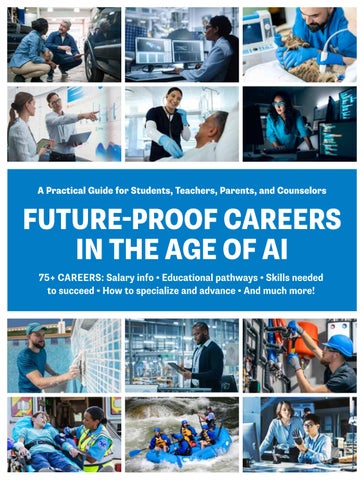


Artificial intelligence is reshaping the world of work at a breathtaking pace. Machines have already taken on jobs like data entry, customer service, and even some basic coding — tasks that can be broken into clear, repeatable steps. But AI hasn’t ended work; it’s changing it. From medicine to manufacturing, it’s streamlining tasks, uncovering patterns, and expanding what’s possible. These changes bring challenges, but they also open extraordinary opportunities for students to build the skills technology can’t replace.
This guide highlights careers that not only endure in the age of AI, but also benefit from it. Across fields like healthcare, skilled trades, teaching, technology, and creative work, people will always be needed for judgment, empathy, adaptability, and human connection. At the same time, AI can be a powerful tool — helping nurses monitor patients, engineers test designs, or teachers personalize lessons. Rather than replacing these roles, AI will strengthen them.
At Start Engineering, our mission is to inspire and inform students about the “careers of the future,” including artificial intelligence, biotechnology, data science, cybersecurity, and engineering. With AI now influencing nearly every profession — and creating real worries about what that means for the next generation — we wanted to reassure students that many careers remain AI-resistant. These careers not only offer security but also the chance to thrive by using the uniquely human skills that technology cannot replace. That’s why we created this guide.
For more than 10 years, we’ve been producing award-winning career guides that help students explore opportunities in STEM and beyond. Our books and resources, used by students from K–12 as well as their teachers and parents, open doors to fields that welcome a wide range of skills, interests, and backgrounds.
Our goal in these pages is to give you clear, practical insights into these careers: what they involve, the skills you’ll need, education and training paths, and what you can earn. Whether you see yourself solving problems in a lab, leading a classroom, designing new technology, or protecting your community, you’ll find encouragement and guidance here.
The future of work will be different — but for those who prepare, it can be brighter than ever.
Robert Black CEO Start Engineering bblack@start-engineering.com
Skilled Trades & Technical Services, pages 6-32
Hands-on experts who build, fix, and install, including electricians, plumbers, welders, HVAC technicians, and mechanics. EXAMPLES: Auto Mechanic, Carpenter, Plumber.
Engineering & Engineering Technology, pages 33-68
Innovators who design, test, and improve systems in aerospace, civil, electrical, mechanical, and more. EXAMPLES: Biomedical Engineer, Civil Engineer, Environmental ET.
Science & Applied Science, pages 69-94
Researchers and technicians who turn discovery into real-world solutions in biology, chemistry, physics, the environment, and health. EXAMPLES: Biotech Technician, Chemist.
Technology & Data Careers, pages 95-109
Specialists who protect networks, analyze data, and develop AI and digital tools responsibly. EXAMPLES: Cyber Analyst, Data Scientist, Network Engineer.
Human Connection Careers, pages 110-134
Professionals who rely on empathy, judgment, and trust, such as nurses, doctors, teachers, and therapists. EXAMPLES: EMT, Social Worker, Physician Assistant, Veterinarian.
Public Safety, Legal & Leadership, pages 135-145
Leaders who safeguard communities, uphold justice, and make critical decisions in roles like police, firefighters, lawyers, judges, and executives. EXAMPLES: Elected official, Executive.
Creative Careers, pages 146-151
Storytellers and makers who imagine, design, and create art and media that only humans can bring to life. EXAMPLES: Actor, Author, Musician, Podcaster.
Experience & Wellness Careers, pages 152-161
Professionals who design experiences and services that support joy, health, and personal growth. EXAMPLES INCLUDE: Adventure Guide, Caterer, Yoga Instructor.
& Student Workbook, pages 162-167


If you like working with your hands, solving problems in real time, and seeing the results of your work right in front of you, skilled trades could be your calling. From fixing a broken furnace in the middle of winter to building a custom staircase, these careers are about doing, not just planning. Every day is different — each job site brings its own set of challenges, and your problem-solving skills, creativity, and adaptability make all the difference. These features make trade work AI-resistant. You bring technical knowledge and real-world experience to hands-on tasks in challenging environments that change with every job.
• Mechanics working on all kinds of vehicles
• Electricians, plumbers, and carpenters
• Technicians, installers, and repairers of systems
Once you pick out a trade to pursue, you can explore ways to get started. Some trades require apprenticeships, others involve further education after high school, and some might call for a mix of hands-on and classroom learning.
Skilled Trades & Technical Services continued
• Paid, on-the-job training combined with formal instruction.
• Learn from experienced professionals on the job while you study the theory and practice of the field.
• Usually 3-5 years leading to a license or certification of your ability to work independently.
• Widely available in skilled trades, through unions, employers, industry associations, and websites like Apprenticeship.gov.
• Offered at community colleges or trade schools.
• Focused on specific skills and knowledge associated with fields of interest.
• Six months to two years in length, leading to a certificate or associate degree that confirms technical competence.
• Information at online directories like the Association for Career and Technical Education’s school finder, state workforce development websites, and career counseling services.
Salaries start at $35,000 to $45,000 with the potential to earn over $100,000. To advance and earn more, you can pursue specialized training and certifications that qualify you for higher pay. Median pay for advanced trade work can run from $70,000 to $100,000+. Pay varies by region, typically higher in urban areas and lower in rural areas.
Typical tuition is $5,000–$15,000 total for most programs. Many schools offer financial aid, grants, or employer-sponsored tuition reimbursement. Apprenticeships often have no tuition cost — because you’re earning a paycheck while you learn.
Skilled tradespeople use AI-powered tools like smart diagnostics, predictive maintenance software, and augmented-reality guides to spot problems faster and work more efficiently — but the actual repair and installation still require human hands.
Skilled trades offer solid pay, steady demand, and the satisfaction of creating, fixing, and building in the real world. If you like variety, practical problem-solving, and work that matters every day, this could be your path. Take a look at the following pages for the most in-demand trade and technical service careers and see what interests you!

Experts who keep water flowing and systems safe in homes and businesses.
STARTING SALARY: About $47,000–$54,000 WITH EXPERIENCE: $63,000–$76,000+
THE CAREER: Plumbers install and repair the pipes that bring clean water in and carry waste out. A typical day might involve fixing a leaky faucet, installing bathroom fixtures, or designing complex piping systems for commercial buildings. They also ensure compliance with health and safety codes.
WHY IT'S AI-RESISTANT: Plumbing systems break down in unpredictable ways and require human expertise. AI can assist with diagnostics, but repairs, installations, and safety checks demand hands-on problem-solving.
SPECIALIZATIONS INCLUDE:
• Residential Plumbing – Installing and repairing home systems.
• Commercial Plumbing – Large-scale projects in offices, schools, or factories.
• Pipefitting/Steamfitting – Working with high-pressure industrial pipes.
• Green Plumbing – Installing water-saving and sustainable systems.
WHERE THEY WORK: Homes, businesses, factories, construction sites, and government buildings.
Plumber continued
SKILLS TO SUCCEED:
• Problem-solving and troubleshooting skills.
• Knowledge of safety codes and regulations.
• Physical stamina for lifting, bending, and working in tight spaces.
• Customer service for explaining repair.
EDUCATIONAL PATHWAYS:
• Apprenticeships: 4–5 years, combining paid work and classroom training.
• Trade Schools / Community Colleges: Plumbing programs leading to certificates or associate degrees.
BOTTOM LINE: Plumbers keep vital systems running in every building. With high demand and good pay, plumbing offers a reliable, future-proof career.
Exploring life, from cells and genetics to plants and animals.
STARTING SALARY: About $50,000–$55,000 WITH EXPERIENCE: $80,000–$100,000+
THE CAREER: Biologists study living things at every level, from DNA to ecosystems. They investigate how organisms grow, interact, and adapt, applying discoveries to medicine, agriculture, and conservation.
WHY IT'S AI-RESISTANT: AI can analyze genetic data, but only people can design experiments, and apply findings to real-world challenges like fighting disease or protecting biodiversity.
SPECIALIZATIONS INCLUDE:
• Microbiology – Studying bacteria, viruses, fungi, and microbes.
• Genetics / Molecular Biology –Researching DNA, genes, and heredity.
• Botany – Plants and their role in ecosystems and agriculture.
• Zoology – Animals, from insects to mammals, in the wild or captivity.
• Ecology – How living things interact with each other and the environment.
WHERE THEY WORK: Universities, biotech companies, labs, conservation organizations, agriculture, and government agencies.
SKILLS TO SUCCEED:
• Strong observation and analytical thinking.


Biologist continued
• Knowledge of lab techniques and safety.
• Curiosity and patience for long research projects.
• Ability to work with data and statistics.
EDUCATIONAL PATHWAY: Bachelor’s Degree in Biology or Life Sciences.
BOTTOM LINE: Biological sciences offer wide-ranging career paths, steady demand, and the chance to make discoveries that improve health, agriculture, and the environment.


Where listening, empathy, and trust make all the difference.
If you’re drawn to helping people, guiding others, or supporting communities, these careers could be your path. They rely on skills no AI can replicate — empathy, judgment, adaptability, and human connection. From caring for patients to teaching students or supporting families, your ability to listen, respond, and build trust makes all the difference.
• Healthcare professionals, like nurses, doctors, EMTs, and therapists.
• Teachers and educators, including special education specialists.
• Social workers and counselors
There are many ways to begin, depending on your interests:
• Healthcare & Allied Health Degrees – Nursing, therapy, or medical programs at colleges and universities. Many include clinical rotations or internships.
Human Connection Careers continued
• Education Degrees – Bachelor’s programs for teachers; specialized certifications for special education or ESL.
• Social Work & Counseling Degrees – Bachelor’s or master’s programs, often with supervised practice.
What you can earn Salaries vary widely:
• Nurses: Starting around $55,000, with experienced RNs earning $80,000–$100,000+
• Doctors: Starting around $120,000, with specialized doctors earning $250,000+
• Teachers: Start at about $40,000–$50,000, with experienced educators earning $70,000–$80,000.
• Social Workers: Starting around $45,000, with mid-career pay of $65,000–$75,000.
• Physical and Occupational (PT/OT) Therapists: Often start around $60,000–$65,000, rising to $90,000–$100,000+ with experience.
Cost of training
• Healthcare programs can range from $10,000 per year for nursing to $40,000+ per year for medical school.
• Education and social work degrees are typically $10,000–$30,000 per year depending on school.
• PT/OT Therapy programs usually require graduate study after a bachelor’s degree.
• Financial aid, scholarships, and loan-forgiveness programs (especially for teaching and nursing) are widely available.
How they might use AI
Nurses, teachers, and social workers may use AI-powered scheduling systems, diagnostic aids, or learning platforms to save time and gain insights. But the trust, empathy, and personal connection remain entirely human.
These careers put people first. They’re built on trust, empathy, and communication — qualities no machine can replace. If you want to make a difference every day in someone’s life, a human-centered career could be your calling.
Healers who help people recover, rebuild skills, and regain independence.
STARTING SALARY: About $60,000–
$70,000 WITH EXPERIENCE:
$90,000–$110,000+
THE CAREER: Physical Therapists (PTs) and Occupational Therapists (OTs) help patients regain strength, mobility, and everyday skills after injuries, illnesses, or disabilities. PTs focus on movement, balance, and pain reduction, often designing exercise plans to restore physical function. OTs help people adapt to daily activities — from dressing and eating to using tools or technology — so they can live as independently as possible.
WHY IT'S AI-RESISTANT: AI can suggest exercise routines or track progress, but recovery depends on human observation, encouragement, and adjustment in real time. PTs and OTs motivate patients, customize care, and respond to unique needs — skills no machine can replace.
SPECIALIZATIONS INCLUDE:
• Sports Rehabilitation – Helping athletes recover from injuries.
• Pediatrics – Supporting children with developmental disabilities.
• Geriatrics – Assisting older adults with mobility, balance, and independence.


continued
• Neurological Rehabilitation – Working with patients after strokes, brain injuries, or neurological conditions.
• Hand Therapy (OT) – Helping patients regain fine motor skills and strength in the hands and arms.
WHERE THEY WORK: Hospitals, rehabilitation centers, nursing homes, outpatient clinics, schools, and private practices. Some also work in patients’ homes.
SKILLS TO SUCCEED:
• Empathy and patience to encourage progress.
• Problem-solving and adaptability in creating treatment plans.
• Strong communication skills to guide and motivate patients.
• Physical stamina and knowledge of anatomy and movement.
EDUCATIONAL PATHWAYS:
• Physical Therapist (PT): Doctor of Physical Therapy (DPT), typically 3 years after a bachelor’s degree.
• Occupational Therapist (OT): Master’s degree in Occupational Therapy (about 2–3 years after a bachelor’s).
BOTTOM LINE: PTs and OTs combine medical knowledge with human connection to help people rebuild their lives. For students drawn to science, health, and making a tangible difference every day, these careers are rewarding, well-paid, and future-proof.