5/4/2017
VoIP services in question Ahram Weekly Thursday,04 May, 2017 Current issue (Index.aspx) | Issue 1342, (27 April 3 May 2017) Previous issue (http://weekly.ahram.org.eg/Home/2238.aspx)
(http://www.facebook.com/pages/AlAhramWeekly/444452792278401) (https://twitter.com/AlAhramWeekly)
(../../Index.aspx)
ECONOMY (http://weekly.ahram.org.eg/Portal/18/ECONOMY/2239/0.aspx)
VoIP services in question Users of free voice and video Internet applications voiced complaints this week about Egypt’s VoIP services, reports Doaa Farid
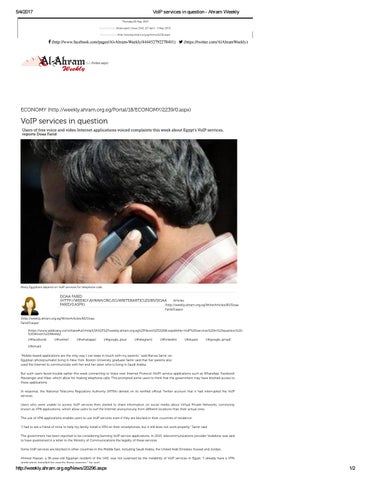
Many Egyptians depend on VoIP services for telephone calls
DOAA FARID Articles (HTTP://WEEKLY.AHRAM.ORG.EG/WRITERARTICLES/85/DOAA FARID/0.ASPX) (http://weekly.ahram.org.eg/WriterArticles/85/Doaa Farid/0.aspx) (http://weekly.ahram.org.eg/WriterArticles/85/Doaa Farid/0.aspx) (https://www.addtoany.com/share#url=http%3A%2F%2Fweekly.ahram.org.eg%2FNews%2F20296.aspx&title=VoIP%20services%20in%20question%20 %20Ahram%20Weekly) (/#facebook)
(/#twitter)
(/#whatsapp)
(/#google_plus)
(/#telegram)
(/#linkedin)
(/#skype)
(/#google_gmail)
(/#email) “Mobilebased applications are the only way I can keep in touch with my parents,” said Marwa Samir, an Egyptian photojournalist living in New York. Boston University graduate Samir said that her parents also used the Internet to communicate with her and her sister who is living in Saudi Arabia. But such users faced trouble earlier this week connecting to Voice over Internet Protocol (VoIP) service applications such as WhatsApp, Facebook Messenger and Viber, which allow for making telephone calls. This prompted some users to think that the government may have blocked access to these applications. In response, the National Telecoms Regulatory Authority (NTRA) denied on its verified official Twitter account that it had interrupted the VoIP services. Users who were unable to access VoIP services then started to share information on social media about Virtual Private Networks, commonly known as VPN applications, which allow users to surf the Internet anonymously from different locations than their actual ones. The use of VPN applications enables users to use VoIP services even if they are blocked in their countries of residence. “I had to ask a friend of mine to help my family install a VPN on their smartphones, but it still does not work properly,” Samir said. The government has been reported to be considering banning VoIP service applications. In 2015, telecommunications provider Vodafone was said to have questioned in a letter to the Ministry of Communications the legality of these services. Some VoIP services are blocked in other countries in the Middle East, including Saudi Arabia, the United Arab Emirates, Kuwait and Jordan. Ahmed Hassan, a 36yearold Egyptian resident of the UAE, was not surprised by the instability of VoIP services in Egypt. “I already have a VPN application installed for exactly these reasons,” he said.
http://weekly.ahram.org.eg/News/20296.aspx
1/2
5/4/2017
VoIP services in question Ahram Weekly
application installed for exactly these reasons,” he said. Hassan had told his family about the VPN application “because this way we can have long voice calls, in contrast to international phone calls that are usually short because of the high price per minute at both ends,” he said. VoIP services resumed working for some users a few days after they were interrupted, leading some experts to claim that mobile service companies had been behind the unconfirmed blocks as they are a main victim of the services. Shady Ayman, a communications engineer at one of Egypt’s three mobile service providers, said that the telecommunications companies cannot block access to any service without the approval of the NTRA. “We cannot say the companies lose money due to the heavy usage of VoIP services, but they do lose potential revenues that could have been collected,” Ayman explained, referring to revenues that could be collected from regular local and international phone calls. Former director of the NTRA Amr Badawi commented that the losses of the service providers are large as a result of the applications, “but we cannot give a definite figure as nothing official has been said,” he said. Internet services in Egypt have long been criticised for being lowspeed and poor efficiency compared to those in neighbouring countries. An initiative called the Internet Revolution was launched in early 2014 with over one million likes on Facebook, and it has been acting as an Internet watchdog since then. Threatening to escalate its action if the government decides to block VoIP services, a spokesperson from the initiative said the disruption could prefigure a largescale block. In December, the developers of signalfree communications application Open Whisper Systems said that access to the application was blocked in Egypt. This application can provide endtoend encryption chat tools, including for texts, photographs and videos, which cannot be penetrated by Internet service providers. General secretary of the Scientific Society for Telecommunication Engineers (SSTE), an industry group, Mohamed Abu Krish, said that telecommunications companies in Egypt did not provide services that met international standards. “The misdistribution of services is putting a heavy load on the infrastructure and resulting in slower Internet connections. This might have been the reason behind the problems with the VoIP service in Egypt,” Abu Krish said. The Ministry of Communication and Information Technology has not issued an official statement. “The ministry should try to think more about how it will cope with technological innovation instead of banning it, because users will always find creative ways to overcome its blocks,” Samir commented.
The writer is a freelance journalist.
SEARCH KEYWORDS DOAA FARID OPEN WHISPER SYSTEMS SCIENTIFIC SOCIE (HTTP://WEEKLY.AHRAM.ORG.EG/UI/FRONT/SEARCH.ASPX?TEXT=DOAA FARID OPEN WHISPER SYSTEMS SCIENTIFIC SOCIE)
(https://www.addtoany.com/share#url=http%3A%2F%2Fweekly.ahram.org.eg%2FNews%2F20296.aspx&title=VoIP%20services%20in%20question%20 %20Ahram%20Weekly) (/#facebook) (/#twitter) (/#whatsapp) (/#google_plus) (/#telegram) (/#linkedin) (/#skype) (/#google_gmail) (/#email)
ADD COMMENT Email
Name
Comment's Title
Comment
Send
MOST READ
Sinai Liberation Day
(http://weekly.ahram.org.eg/News/20310.aspx)
(http://weekly.ahram.org.eg/News/20310.aspx) Papal visit
(http://weekly.ahram.org.eg/News/20315.aspx)
http://weekly.ahram.org.eg/News/20296.aspx
2/2