OECD Home
Directorate for Education and Skills
Education Policy Outlook Finland: Finland
Education Policy Outlook Finland: Finland
..................................................Select your country................................................
Finland’s educational context Students: Finland remains among the top performers in PISA 2012, with decreasing performance in mathematics, reading and science across PISA cycles. Students’ socio economic background has low impact on Finnish educational performance. Finland has nine years of basic education (comprehensive school) with focus on equity and on preventing low achievement, and offers flexibility at upper secondary level between general and vocational education and training options that both lead to tertiary education. Education is currently compulsory from ages 7 to 16 and will be extended to age 6 to 17 in 2015. Attainment rates in upper secondary and tertiary education are higher than the OECD average, with one of the highest enrolment rates in upper secondary vocational education and training (VET) in OECD countries. School dropout is lower in Finland than in other EU countries, and is higher among people with an immigrant background. Adults (1665 yearolds) in Finland scored among the top skilled across participating countries in the Survey of Adult Skills, with younger adults (1624 yearolds) scoring higher than all adults in Finland and young adults in other countries. In the context of the economic crisis, unemployment remains below OECD average. Institutions: Schools in Finland have average autonomy over the use of curriculum and assessment compared to other OECD countries and a belowaverage level of autonomy over resource allocation. Teachers are trusted professionals required to have a master’s degree that includes research and practicebased studies. In primary and secondary education, their salaries are slightly above the OECD average, and their teaching time is below average. A much higher proportion of teachers in Finland than the TALIS average consider that the teaching profession is valued in society and would choose to work as teachers if they could decide again. Finnish society and its education system place great importance on their schools and daycare facilities and trust the proficiency of their school leaders, teachers and educational staff, with no national standardised tests or highstakes evaluations. System: Governance of the education system is shared between central and local authorities. The Finnish Government defines and sets educational priorities, while municipalities (local authorities) maintain and support schools and daycare centres and also have significant responsibility for organising education, funding and curriculum and for hiring personnel. A national Education and Research Development Plan outlines education policy priorities every four years, and guides the government when preparing and implementing education policies. Social and political agreement on the value of education has provided stability on the structure and key features of the education system. Decisions in schools are made by either the local government or the school, depending on how decision making is organised in the municipality. Finland’s expenditure on educational institutions as a percentage of GDP (for all education levels combined) is above the OECD average, with one of the highest shares of public funding among OECD countries.
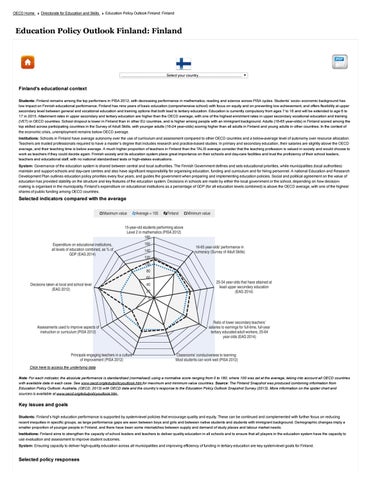
Selected indicators compared with the average
Click here to access the underlying data Note: For each indicator, the absolute performance is standardised (normalised) using a normative score ranging from 0 to 180, where 100 was set at the average, taking into account all OECD countries with available data in each case. See www.oecd.org/edu/policyoutlook.htm for maximum and minimum value countries. Source: The Finland Snapshot was produced combining information from Education Policy Outlook: Australia, (OECD, 2013) with OECD data and the country’s response to the Education Policy Outlook Snapshot Survey (2013). More information on the spider chart and sources is available at www.oecd.org/edu/policyoutlook.htm .
Key issues and goals Students: Finland’s high education performance is supported by systemlevel policies that encourage quality and equity. These can be continued and complemented with further focus on reducing recent inequities in specific groups, as large performance gaps are seen between boys and girls and between native students and students with immigrant background. Demographic changes imply a smaller proportion of younger people in Finland, and there have been some mismatches between supply and demand of study places and labour market needs. Institutions: Finland aims to strengthen the capacity of school leaders and teachers to deliver quality education in all schools and to ensure that all players in the education system have the capacity to use evaluation and assessment to improve student outcomes. System: Ensuring capacity to deliver highquality education across all municipalities and improving efficiency of funding in tertiary education are key systemlevel goals for Finland.
Selected policy responses
A shift in perspective is the transference of early childhood education and care services from the Ministry of Social Affairs and Health to the Ministry of Education and Culture (2013). Education and Research 20112016: A development plan aims to increase participation of students with immigrant background in preparatory education to improve their opportunity to participate in upper secondary education. A curriculum reform is being developed from preprimary through upper secondary education, to be implemented from 2016. The reform aims to adapt the curriculum to the new needs for skills and competences, strengthen the interdisciplinary approach and provide educators with digital resources. Efforts are being made to ensure postbasic qualification completion and employment for youth, including the introduction of the Youth Guarantee (2013). The Ministry of Education appointed an Advisory Board for Professional Development of Education Personnel (2008) to examine and improve professional development and the changing needs of teachers. The Osaava Programme (201016), a national fixedterm programme for continuing professional development (CPD), aims to ensure systematic CPD of staff in schools. The programme supports education providers to systematically and continually develop the skills and knowledge of their staff according to locally identified needs. Participants in Osaava and other governmentfunded CPD increased from 30 000 in 2009 to almost 70 000 in 2013. Quality Criteria for Basic Education (2009), were developed to provide clear criteria, raise quality and facilitate evaluation. Starting in 2014, evaluation activities will be merged into the Finnish Education Evaluation Centre. Since 2013, a general reform of the Finnish municipality structure has been prepared to secure highquality and equitable education services and consolidate local self government. In 2013, a structural policy programme was introduced to optimise expenditure, which will have implications, among others, on the provision of local governments’ obligations and services, such as secondary education.
Spotlight: Nurturing excellence in teachers One of the factors adduced to explain Finnish success in education is the quality of its teachers. A reform at the end of the 1970s strengthened teacher education and made it highly selective. Teacher education moved from teachers’ colleges into universities, and primary school teachers were required to have a master’s degree. At present, teacher education is provided by nine universities, of which eight have teacher training schools. According to selected evidence, only about 10% of candidates who apply to primary teacher studies are accepted. Applicants for teacher education must have passed the Finnish matriculation examination (or a foreign equivalent) or completed a threeyear vocational education programme. The student selection process for primary teacher education involves two stages: 1. an examination to assess applicants’ academic learning skills; and 2. a combination of written questions and aptitude tests to assess applicants’ skills, motivation and commitment. Primary school teachers major in education, and they may specialise in teaching one or several subjects in their minor subject studies. Upper grade teachers major in specific subjects and do their pedagogical studies over a fiveyear programme or as a separate module after graduation. With strong theoretical and practical content, teacher education is researchbased, with emphasis on developing pedagogical knowledge. Teachers are trained to adapt their teaching to different learning needs and styles of students. There is also emphasis on teaching practicum which includes a minor portion of basic teaching skill practice in front of peers in student groups, and a more significant portion of required teaching practice at teachertraining schools run by the university or at affiliated schools. In addition, other teacher groups, such as preprimary teachers and vocational teachers, are required to have a tertiary education degree.
Please cite this publication as: OECD (2015), Education Policy Outlook 2015: Making Reforms Happen, OECD Publishing. http://dx.doi.org/10.1787/9789264225442en Back to the country profiles page
Permanent URL: www.oecd.org/edu/policyoutlook.htm OECD work on education: www.oecd.org/education