5/8/2017
Education in Finland Wikipedia
Education in Finland From Wikipedia, the free encyclopedia
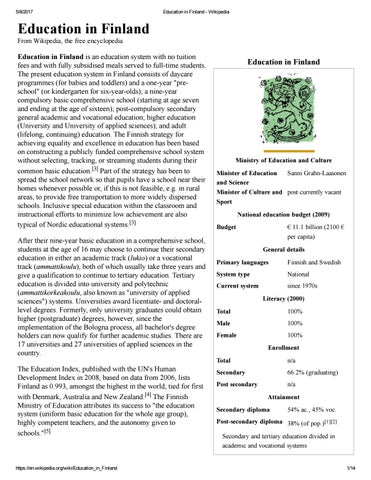
Education in Finland is an education system with no tuition fees and with fully subsidised meals served to fulltime students. The present education system in Finland consists of daycare programmes (for babies and toddlers) and a oneyear "pre school" (or kindergarten for sixyearolds); a nineyear compulsory basic comprehensive school (starting at age seven and ending at the age of sixteen); postcompulsory secondary general academic and vocational education; higher education (University and University of applied sciences); and adult (lifelong, continuing) education. The Finnish strategy for achieving equality and excellence in education has been based on constructing a publicly funded comprehensive school system without selecting, tracking, or streaming students during their common basic education.[3] Part of the strategy has been to spread the school network so that pupils have a school near their homes whenever possible or, if this is not feasible, e.g. in rural areas, to provide free transportation to more widely dispersed schools. Inclusive special education within the classroom and instructional efforts to minimize low achievement are also typical of Nordic educational systems.[3] After their nineyear basic education in a comprehensive school, students at the age of 16 may choose to continue their secondary education in either an academic track (lukio) or a vocational track (ammattikoulu), both of which usually take three years and give a qualification to continue to tertiary education. Tertiary education is divided into university and polytechnic (ammattikorkeakoulu, also known as "university of applied sciences") systems. Universities award licentiate and doctoral level degrees. Formerly, only university graduates could obtain higher (postgraduate) degrees, however, since the implementation of the Bologna process, all bachelor's degree holders can now qualify for further academic studies. There are 17 universities and 27 universities of applied sciences in the country. The Education Index, published with the UN's Human Development Index in 2008, based on data from 2006, lists Finland as 0.993, amongst the highest in the world, tied for first with Denmark, Australia and New Zealand.[4] The Finnish Ministry of Education attributes its success to "the education system (uniform basic education for the whole age group), highly competent teachers, and the autonomy given to schools."[5]
https://en.wikipedia.org/wiki/Education_in_Finland
Education in Finland
Ministry of Education and Culture Minister of Education Sanni GrahnLaasonen and Science Minister of Culture and post currently vacant Sport National education budget (2009) Budget
€ 11.1 billion (2100 € per capita) General details
Primary languages
Finnish and Swedish
System type
National
Current system
since 1970s Literacy (2000)
Total
100%
Male
100%
Female
100% Enrollment
Total
n/a
Secondary
66.2% (graduating)
Post secondary
n/a Attainment
Secondary diploma
54% ac., 45% voc.
Postsecondary diploma 38% (of pop.)[1][2] Secondary and tertiary education divided in academic and vocational systems
1/14
5/8/2017
Education in Finland Wikipedia
Finland has consistently ranked high in the PISA study, which compares national educational systems internationally, although in the recent years Finland has been displaced from the very top. In the 2012 study, Finland ranked sixth in reading, twelfth in mathematics and fifth in science, while back in the 2003 study Finland was first in both science and reading and second in mathematics.[6] Finland's tertiary Education has moreover been ranked first by the World Economic Forum.[7] While celebrated for its overall success, Finland's gender gap on the 2012 PISA reading examinations was identified in a 2015 Brookings Institution report (http://www.brookings.edu/research/reports/2015/03/24genderga ploveless) as the largest among participating nations. The performance of 15yearold boys on that reading examination was not significantly different from OECD averages and 0.66 standard deviations behind that of girls the same age.
Contents 1 2 3 4
History Early childhood education Basic comprehensive education Upper secondary education 4.1 Advanced curricula in the upper academic school 5 Teachers 6 Tertiary education 7 Adult education 8 Duties 9 Future prospects 9.1 Higher education system restructuring 10 Media 11 Languages 12 See also 13 References 14 External links
History Literacy is a key part of Lutheranism, the state and majority religion of Finland, as Christians are supposed to be able to read the Bible in their native language. Bishop Mikael Agricola studied under Martin Luther and translated the New Testament to Finnish in 1548. Literacy reached over 50% in the late 18th century and 8090% in the mid 19th century. Wherein there were no schools in the municipality, reading was taught in traveling schools (kiertokoulu). Confirmation, a rite of transition to adulthood, is only permissible to the literate, and enables e.g. entrance into marriage. Official statistics are available since 1880, when literacy was 97.6%.[8] The early system under the Swedish rule was in Swedish and consisted of a basic "pedagogio" for teaching reading and writing, a trivial school teaching grammar, Latin, Greek, rhetoric and dialectics, a gymnasium preparing for university, and the university. In the 19th century, the system evolved into what was later known as kansakoulu ("people's school") and oppikoulu ("learning school"), including gymnasium (lukio), followed by university. In mid19th century, Finnish became an official language, and gradually replaced Swedish as the schooling language. In 1898, everyone was given the right to attend kansakoulu. Attendance reached 50% in 1911 and became mandatory in 1921; municipalities were obliged to provide the schooling.[9] Free school lunches became mandatory in 1948. Oppikoulu, entered at the age of 10, was still optional and entrance was competitive. Since it was the only way to university education and entrance was heavily affected by the status and choices of parents, it severely limited the https://en.wikipedia.org/wiki/Education_in_Finland
2/14
5/8/2017
Education in Finland Wikipedia
opportunities of the lesswell off. Workingclass people would often complete only the kansakoulu and enter the workforce. This system was phased out in 19721977, in favor of the modern system where grades 19 are mandatory. After the age of 15, the system bifurcates into academic (lukio) and vocational tracks (ammattikoulu) both at the secondary and tertiary levels. Recently, it became formally possible to enter tertiary education with a vocational degree, although this is practically difficult as the vocational study plan does not prepare the student for the university entrance exams.
Early childhood education In Finland, high quality daycare and nurserykindergarten are considered critical for developing the cooperation and communication skills necessary to prepare young children for lifelong education, as well as formal learning of reading and mathematics. This preparatory period lasts until the age of 7. Finnish early childhood education emphasizes respect for each child’s individuality and chance for each child to develop as a unique person. Finnish early educators also guide children in the development of social and interactive skills, encourage them to pay attention to other people’s needs and interests, to care about others, and to have a positive attitude toward other people, other cultures, and different environments. The purpose of gradually providing opportunities for increased independence is to enable all children to take care of themselves as “becoming adults, to be capable of making responsible decisions, to participate productively in society as an active citizen, and to take care of other people who will need his [or her] help.” [10] To foster a culture of reading, parents of newborn babies are given three books one for each parent, and a baby book for the child as part of the "maternity package".[11] According to Finnish child development specialist Eeva Hujala, "Early education is the first and most critical stage of lifelong learning. Neurological research has shown that 90% of brain growth occurs during the first five years of life, and 85% of the nerve paths develop before starting school (NB: at the age of seven in Finland)."[12] "Care" in this context is synonymous with upbringing and is seen as a cooperative endeavor between parents and society to prepare children physically (eating properly, keeping clean) and mentally (communication, social awareness, empathy, and selfreflection) before beginning more formal learning at age seven. The idea is that before seven they learn best through play, so by the time they finally get to school they are keen to start learning. Finland has had access to free universal daycare for children aged eight months to five years in place since 1990, and a year of "preschool/kindergarten" at age six, since 1996. "Daycare" includes both fullday childcare centers and municipal playgrounds with adult supervision where parents can accompany the child. Municipalities also pay mothers who wish to do so to remain at home and provide "home daycare" for the first three years. In some cases this includes occasional visits from a careworker to see that the environment is appropriate.[13] The ratio of adults to children in local municipal childcare centers (either private but subsidized by local municipalities or paid for by municipalities with the help of grants from the central government) is, for children three years old and under: three adults (one teacher and two nurses) for every 12 pupils (or onetofour); and, for children age three to six: three adults (one teacher and two nurses) for every 20 children (or circa onetoseven). Payment, where applicable, is scaled to family income and ranges from free to about 200 euros a month maximum.[14] According to Pepa Ódena in these centers, "You are not taught, you learn. The children learn through playing. This philosophy is put into practice in all the schools we visited, in what the teachers say, and in all that one sees."[15] Early childhood education is not mandatory in Finland, but is used by almost everyone. “We see it as the right of the child to have daycare and preschool,” explained Eeva Penttilä, of Helsinki’s Education Department. “It’s not a place where you dump your child when you’re working. It’s a place for your child to play and learn and make https://en.wikipedia.org/wiki/Education_in_Finland
3/14
5/8/2017
Education in Finland Wikipedia
friends. Good parents put their children in daycare. It’s not related to socioeconomic class”.[16] The focus for kindergarten students is to “learn how to learn”, Ms. Penttilä said. Instead of formal instruction in reading and math there are lessons on nature, animals, and the “circle of life” and a focus on materials based learning.[16]
Basic comprehensive education Education in Finland Academic degrees doctor licentiate master bachelor
Vocational degrees
Typical ages
employment master (new) bachelor
+23 +34
The compulsory educational system in Finland consists of a nine year comprehensive school from 1st to 9th grade, from the ages of 7 to 16 (Finnish peruskoulu, Swedish grundskola, "basic school"), in which attendance is mandatory. (Homeschooling is allowed, but rare). There are no "gifted" programs, and the more advanced children are expected to help those who are slower to catch on.
In most countries, the term "comprehensive school" is used to refer to comprehensive schools attended after primary school, and vocational upper secondary up to 12th and 13th grade in some countries, but in Finland this school 1718 school (voluntary) English term is confusingly used to include primary school, i.e. it (voluntary) 1617 is used to refer to all of the grades 1 to 9 (and not higher grades). 1516 One can of course also describe the Finnish grades 1 to 6 in 1415 English as being comprehensive schools, but this is unnecessary and confusing because primary schools have always been 1314 comprehensive in almost all countries, including Finland. In 1213 addition, it is best to not try to translate the Finnish term comprehensive school (compulsory) 1112 peruskoulu with a single term in English. In order to avoid confusion in English, it is best to describe the Finnish compulsory 1011 education system as consisting of 6year primary schools, called 910 alakoulu or alaaste in Finnish, followed by comprehensive 3 89 year middle schools, called yläkoulu or yläaste in Finnish. 78 Although this division of the peruskoulu into two parts was officially discontinued, it is still very much alive — the preschool 67 distinction is made in everyday speech, the teachers' training and classification and teaching, and even in most school buildings. In addition, the use of two different terms for grades 16 and 79 is easier to understand for people from most other countries, most of which do not have a single term for primary and middle schools. On the contrary, middle schools and high schools are usually included in the term secondary education in English, which is why the use of this term in English is often confusing for Finns. (The Finnish direct translation toisen asteen koulutus/oppilaitos only refers to schools after 9th grade, i.e. high schools, vocational schools, etc.) 1819
Schools up to the university level are almost exclusively funded and administered by the municipalities of Finland (local government). There are few private schools. The founding of a new private comprehensive school requires a decision by the Council of State. When founded, private schools are given a state grant comparable to that given to a municipal school of the same size. However, even in private schools, the use of tuition fees is strictly prohibited, and selective admission is prohibited, as well: private schools must admit all its pupils on the same basis as the corresponding municipal school. In addition, private schools are required to give their students all the education and social benefits that are offered to the students of municipal schools. Because of this, existing private schools are mostly faithbased or Steiner schools, which are comprehensive by definition.
https://en.wikipedia.org/wiki/Education_in_Finland
4/14
5/8/2017
Education in Finland Wikipedia
Teachers, who are fully unionized, follow state curriculum guidelines but are accorded a great deal of autonomy as to methods of instruction and are even allowed to choose their own textbooks.[17] Classes are small, seldom more than twenty pupils.[18] From the outset pupils are expected to learn two languages in addition to the language of the school (usually Finnish or Swedish), and students in grades one through nine spend from four to eleven periods each week taking classes in art, music, cooking, carpentry, metalwork, and textiles.[19] Small classes, insisted upon by the teachers' union, appear to be associated with student achievement, especially in science.[20] Inside the school, the atmosphere is relaxed and informal, and the buildings are so clean that students often wear socks and no shoes. Outdoor activities are stressed, even in the coldest weather; and homework is minimal to leave room for extracurricular activities.[21] In addition to taking music in school, for example, many students attend the numerous statesubsidized specialized music schools after class[22] where for a small fee they learn to play an instrument as a hobby and study basic solfège and music theory using methods originated in Hungary by Kodály and further developed by the Hungarianborn Finn Csaba Szilvay and others.[23] Reading for pleasure is actively encouraged (Finland publishes more children's books than any other country). Television stations show foreign programs in the original languages with subtitles, so that in Finland children even read while watching TV.[24][25] During the first years of comprehensive school, grading may be limited to verbal assessments rather than formal grades. The start of numerical grading is decided locally. Most commonly, pupils are issued a report card twice a year: at the ends of the autumn and spring terms. There are no highstakes tests. Grades are awarded on a scale from 4 to 10. In individual exams, but not on school year report or basic education certificate, it is also possible to divide the scale further with '½', which represents a half grade, and '+' and '–', which represent onefourth a grade better or worse. For example, the order is "9 < 9+ < 9½ < 10– < 10". The grade '10+' can also be awarded for a perfect performance with extra effort by the student. If a comprehensive school pupil receives a grade of 4 for a particular subject at the end of the spring term, they must show that they have improved in the subject by sitting a separate examination at the end of summer term. If the pupil receives multiple failing grades, they may have to repeat the entire year, though it is considered far preferable to provide a struggling student with extra help and tutoring. In the rare case where a student needs to repeat, the decision is made by the teachers and the headmaster after interviewing the pupil and the parents. Comprehensive school students enjoy a number of social entitlements, such as school health care and a free lunch every day, which covers about a third of the daily nutritional need.[26] In addition, pupils are entitled to receive free books and materials and free school trips (or even housing) in the event that they have a long or arduous trip to school.
Upper secondary education Upper secondary education begins at 16 or 17 and lasts three to four years (roughly corresponding to the last two years of American high school plus what in the USA would be a twoyear Community or Junior College). It is not compulsory. Finnish upper secondary students may choose whether to undergo occupational training to develop vocational competence and/or to prepare them for a polytechnic institute or to enter an academic upper school focusing on preparation for university studies and postgraduate professional degrees in fields such as law, medicine, science, education, and the humanities. Admissions to academic upper schools are based on GPA, and in some cases academic tests and interviews. For example, during the year 2007, 51% of the age group were enrolled in the academic upper school.[27]
https://en.wikipedia.org/wiki/Education_in_Finland
5/14
5/8/2017
Education in Finland Wikipedia
The system, however, is not rigid and vocational school graduates may formally qualify for a university of applied sciences or, in some cases, university education; conversely, academic secondary school graduates may enroll in vocational education programs.[28] It is also possible to attend both vocational and academic secondary schools at the same time. Tuition is free, and vocational and academic students are entitled to school health care and a free lunch. However, they must buy their own books and materials. Upon graduation, vocational school graduates receive a vocational school certificate. Academic upper secondary school graduates receive both secondary school certification and undergo a nationally graded matriculation examination (Finnish: Ylioppilastutkinto). This was originally the entrance examination to the University of Helsinki, and its high prestige survives to this day. Students in special programs may receive a vocational school certificate and take the matriculation examination (kaksoistutkinto) or all of the three certifications (kolmoistutkinto). Approximately 83% of the upper academic school students, or 42% of the age group, complete the matriculation examination.[29] Polytechnic institutes require school certification for admission, whereas the matriculation examination is more important in university admissions. However, some tertiary education programs have their own admission examinations, and many use a mixture of both.
Advanced curricula in the upper academic school In relation to mathematics, the second national language and foreign languages, a student can choose to study a curriculum from different levels of difficulty. Students choose their relevant levels at the beginning of school, when selecting appropriate courses, and at the end of school, when registering for the matriculation exam in order to receive the relevant exam paper. These two choices are not directly linked, but students generally keep the level the same for the matriculation exam. One common exception to this rule of thumb occurs when a student has barely completed a higher level course and is unsure of their performance in the matriculation exam. In those cases, a student may elect to take an easier exam. In mathematics, the advanced level is in practice a prerequisite for the more competitive university science programs, such as those of the universities of technology, other university mathematical science programs, and medicine.[30] In mathematics, 20% of the matriculation examinees take the advanced level.[31] The nationwide matriculation exam together with entirely percentilebased grading provides an easy way to objectively classify each student based on their mathematical ability, regardless of the year when the exam was taken. For example, assuming that the best mathematical students are selected first to the upper academic school and then to the advanced mathematics curriculum, the students achieving laudatur would comprise the mathematically best 0.4% of the age group, comparable to 800 SAT mathematics section.[32] The percentile equality does not, however, mean that the absolute level of a laudatur student in the advanced mathematics in Finland is equal to that of an 800 SAT student in the USA, due to differences in the mean quality of the population.
Teachers Both primary and secondary teachers must have a master's degree to qualify. Teaching is a respected profession and entrance to university programs is highly competitive. A prospective teacher must have very good grades and must combat fierce opposition in order to become a teacher.[33] Only about 10% of applicants to certain programs are successful. The respect accorded to the profession and salaries higher than the OECD average lead to higher performance levels and larger numbers applying for the positions, and this is reflected in the quality of teachers in Finland.
Tertiary education https://en.wikipedia.org/wiki/Education_in_Finland
6/14
5/8/2017
Education in Finland Wikipedia
There are two sectors in the tertiary education: traditional universities (yliopisto, universitet) and universities of applied sciences (ammattikorkeakoulu, yrkeshögskola, or AMK/YH for short). Admissions are based on the high school final GPA, the high school final exam (the abitur), and the university entrance examinations. The selection process is fully transparent, meritbased, and objective; there are no application essays, no human factor in selection, no underrepresented minority support (except for preset quotas for Swedish speakers), and no weight on extracurricular activities. Moreover, the entrance examinations are rarely long multiplechoice University of Jyväskylä Ylistönrinne exams, and instead consist of a smaller number of longer and more campus complicated questions that are supposed to test more than memorization and quick mechanical problem solving. Therefore, the selection process is very different from many other countries. The focus for universities is research, and they give theoretical education. In many programs graduating with a master's degree is expected, with no separate admissions process between Bachelor and master's degrees. The universities of applied sciences focus more on responding to the needs of the world of work and they engage in industry development projects. The nature of research is more practical and theories are applied to advanced problem solving. For example, physicians are university graduates, whereas registered nurses and engineers graduate from universities of applied sciences. (However, universities also award degrees in Nursing Science and Engineering.) The vocational schools and universities of applied sciences are governed by municipalities, or, in special cases, by private entities. (As an exception to the rule, Police College is governed by the Ministry of the Interior.) All Finnish universities, on the other hand, were owned by the state until 2010, after which they have been separated from the state into foundations or corporations under public law. A bachelor's degree takes about three–four years. Depending on the programme, this may be the point of graduation, but it is usually only an intermediate step towards the master's degree. A bachelor's degree in a university of applied sciences (a polytechnic degree), on the other hand, takes about 3.5–4.5 years. Polytechnic degrees are generally accepted as lower university degrees.[34] Graduates from universities and universities of applied sciences are able to continue their studies by applying to master's degree programmes in universities or universities of applied sciences. After bachelor's degree graduates have completed three years' work experience in their field, they are qualified to apply for master's degree programmes in universities of applied sciences which are work and researchoriented. Lower university degree graduates are also qualified to apply, but with additional studies. The master's degree programme in universities of applied sciences takes two years and can be undertaken in conjunction with regular work. After the master's degree, the remaining degrees (Licentiate and Doctor) are available only in universities. All master's degrees qualify their recipients for graduate studies at doctoral level. The equivalence discussed above is only relevant when applying for public sector jobs. No tuition fees are collected. However, since the 1990s there have been plans at government level to introduce tuition fees to students from outside the European Union/EEA. The students' organisations have opposed those plans. In universities, membership in the students' union is compulsory. Students' unions in universities of applied sciences are similarly recognized in the legislation, but membership is voluntary and does not include special university student health care (which is organised and partly financed by the students' unions). Finnish students are entitled to a student benefit, which may be revoked if there is a persistent lack of progress in the studies. Some universities provide professional degrees. They have additional requirements in addition to merely completing the studies, such as demonstrations of competence in practice. An example of such a degree is Lääketieteen lisensiaatti, medicine licentiat, Licentiate of Medicine. A Bachelor of Medicine (lääketieteen kandidaatti, medicine kandidat) is allowed to conduct clinical work under the supervision of senior medical staff. https://en.wikipedia.org/wiki/Education_in_Finland
7/14
5/8/2017
Education in Finland Wikipedia
The Licentiate of Medicine is not equivalent to licentiate's degree in other fields, but to a master's degree. For this reason, no Licentiate's thesis is required unlike in other fields. The equivalent of a Medical Doctor in the U.S. sense is therefore not called "doctor", but licentiate. The research doctorate, which is equivalent to a PhD in Medicine, is called "Doctor of Medicine" (lääketieteen tohtori, medicine doktorsexamen). After the master's degree, there are two further postgraduate degrees — an intermediate postgraduate degree, called Licentiate, and the doctoral (Doctorate) degree. A Licenciate programme has the same amount of theoretical education as a Doctor, but its dissertation work has fewer requirements. On the other hand, the requirements for a doctoral dissertation are a little bit higher than in other countries. The most typical Finnish doctoral degree is Doctor of Philosophy (filosofian tohtori, filosofie doktorsexamen). However, universities of technology award the title Doctor of Science (Technology), tekniikan tohtori, teknologie doktorsexamen and there are several branchspecific titles, e.g., in medicine lääketieteen tohtori, medicine doktorsexamen, in art taiteen tohtori, and in social sciences valtiotieteen tohtori, politices doktorsexamen.
Adult education Completing secondary school on a vocational programme with full classes on a threeyear curriculum provides a formal qualification for further studies. However, it may prove necessary to obtain postsecondary education before being admitted to a university, as the entrance examinations require a relatively high level of knowledge. Postsecondary education is provided by municipal schools or independent 'adult education centres', which can give either vocational education or teaching at comprehensive or upper secondary school levels. It is possible to obtain the matriculation diploma, or to better the comprehensive school grades, in these programmes. A new trade can also be learned by an adult at an adult education centre (aikuiskoulutuskeskus, vuxenutbildningscenter), for example, if structural change of the economy has made the old trade redundant. In universities, the "Open University" (Finnish: Avoin yliopisto, Swedish: öppet universitet) programme enables people without student status to enroll in individual university courses. There are no requirements, but there is a modest tuition fee (e.g., 60 euros per course). Universities of applied sciences have their own similar programme (Finnish: Avoin ammattikorkeakoulu, Swedish: öppen högskola). While "Open University" students cannot pursue studies towards a degree, they may, after passing a sufficient number of separately determined courses with a sufficiently high grade point average, be eligible for transfer into an undergraduate degree program. Alternatively, a few institutions offer foreign qualifications, such as the private Helsinki School of Business, which offers the UKaccredited Higher National Diploma, enabling graduates to earn an undergraduate degree after completing a topup year abroad. A third branch of adult education is formed by the socalled vapaa sivistystyö, the "Free Education". This is formed by the partially statefunded, independent educational institutes offering diverse courses varying in length and academic level. The purpose of the "Free Education" is not to provide professional or degreeoriented education but to "support the multifaceted development of personality, the ability to act in the community and to pursue the fulfilment of democracy, equality and diversity in the society."[35] Historically, the "Free education" stems from the late 19th century efforts to educate the general populace with little previous academic experience. The "Free Education" is offered by[36] 206 kansalaisopisto or työväenopisto (Citizens' or Workers' Institutes) 88 kansanopisto (People's Institutes) 14 Sports' training centres (Finnish: liikunnan koulutuskeskus) 20 Summer universities (Finnish: kesäyliopisto) 11 Study Centres (Finnish: opintokeskus) https://en.wikipedia.org/wiki/Education_in_Finland
8/14
5/8/2017
Education in Finland Wikipedia
The most common type of "Free Education" is a kansalaisopisto, sometimes called työväenopisto for historical reasons. These are mostly eveningtype municipal institutions offering language, handicraft and humanities courses. The academic level varies strongly, and many courses do not require any requisite knowledge. The kansanopistos, on the other hand, are boardingschools, often maintained by associations with either a strong ideological or religious mission. Also here, the academic level varies strongly. In all these institutions, the courses carry a modest tuition. The Sports' training centers are institutions for the professional or semiprofessional sportsmen's training, while Summer universities and study centers are auxiliary bodies for the organization of Free Education.
Duties The Minister of Education has the responsibility of electronically preserving and distributing public domain works. Finland has millions of public domain works (books, pictures, music and films) and views access to them as a basic human right of access to science and culture.[37][38]
Future prospects The ongoing Bologna Process blurs the distinction between vocational and academic qualifications. In some fields, new postgraduate degrees have been introduced. Cooperation between the different systems is rising and some integration will occur (although not without a substantial amount of pressure). This results from not only the Bologna Process but also the goal of Finnish politicians — to educate the vast majority of Finns to a higher degree (ca. 60–70% of each annual cohort enter higher education).[39] In recent years, a cut in the number of new student places has often been called for by the economic sphere, as well as trade and student unions, because of an ongoing trend of rising academic unemployment, which is interpreted as a result of the steep increase in student places in higher education in the 1990s. In particular, some degrees in universities of applied sciences (AMK/YH) have suffered inflation. In a reflection of this current belief, the Ministry of Education has recently decreed a nationwide cut of 10% in new student places in universities of applied sciences to be applied starting from 2007 and 2008. It is still largely undecided whether (and when) some of those cuts could be redistributed to areas in need of a more highly educated work force. In 2001 and 2002, university graduates had a 3.7% unemployment rate, and university of applied sciences graduates had 8%, which is on a par with the general unemployment rate (see the OECD report). In 2015, under prime minister Juha Sipilä's cabinet, the government decided to cut down on university funding by approximately €500 million.[40] An increase in vocational school student places might be preferred, as a shortage of basic workforce such as plumbers and construction workers is widely acknowledged in Finland. It should also be noted that retiring age groups are bigger than the ones entering higher education in Finland at present and for quite some time into the foreseeable future. If the current number of student places were kept unchanged to the year 2020, for example, Eastern Finland would have enough student places for 103% of the estimated size of the age group 1921.
Higher education system restructuring Due to globalization and increasing competition for diminishing younger age groups, systemwide restructuring has been called for by the Ministry of Education. Since 2006 all institutions of higher education have been sharing methods of cooperation. The total number of institutions is expected to drop significantly within 10–15 years. The process within universities began with merger of the University of Kuopio and the University of Joensuu into the University of Eastern Finland in 2010.[41] In Helsinki, three local universities, namely Helsinki University of Technology, Helsinki School of Economics and University of Art and Design Helsinki, merged to a new Aalto https://en.wikipedia.org/wiki/Education_in_Finland
9/14
5/8/2017
Education in Finland Wikipedia
University on August 1, 2009. Also several universities of applied sciences have announced mergers (such as Haaga and Helia, which merged into HaagaHelia in 2007). New methods of cooperation such as consortia and federations have been introduced within universities (e.g., University of Turku and Turku School of Economics Consortium[42]). Partnerships between traditional universities and universities of applied sciences are also developing (e.g., the University of Kuopio and Savonia University of Applied Sciences formed the Northern Savonia Higher Education Consortium[43]). In general, such systemwide change closely follows the pattern established in Central Europe and the United States and Spain and Hungary.
Media In 2011, documentary filmmaker, Bob Compton, and Harvard researcher, Dr. Tony Wagner, researched the Finnish school system and its excellence. The result of their research is the film, "The Finland Phenomenon: Inside the World’s Most Surprising School System".[44] Schools in Finland grant pupils 25 holiday days in the autumn. Some families in the Helsinki area take schoolchildren on holidays when the trips abroad are cheaper. Trips during the school year are frowned upon by the Trade Union of Education in Finland (OAJ). This accumulated also discussion in local newspaper.[45]
Languages One of the competitive advantages in Finland has been ability in foreign language. All students learn at least two foreign languages, mainly English and obligatory Swedish, up to high school. A citizens' initiative to remove obligatory Swedish from education in favour of other languages was accepted for parliamentary vote in 2014 but failed to pass.
See also European Credit Transfer and Accumulation System Finnish National Agency for Education List of polytechnics in Finland List of schools in Finland List of universities in Finland Programme for International Student Assessment (PISA) University Admissions Finland
References 1. The Most Educated Countries in the World (https://finance.yahoo.com/news/themosteducatedcountriesintheworld.ht ml;_ylt=AlaWy8IcyeBaviKi7_.WJyhE6odG;_ylu=X3oDMTJrY2d2NGZyBG1pdANDeFMgRmluYW5jaWFsbHkgRml0I EFydGljbGUgQXJ0aWNsZSBCb2R5IFByb2QEcG9zAzMEc2VjA01lZGlhQXJ0aWNsZUJvZHlBc3NlbWJseQ;_ylg= X3oDMTNjdGVoaXJqBGludGwDdXMEbGFuZwNlbi11cwRwc3RhaWQDY2IyOTRhMGEtYmY2OS0zYTdlLThlYTUt ZWFlNTU3YWI1ZTc3BHBzdGNhdANleGNsdXNpdmVzfGZpbmFuY2lhbGx5Zml0BHB0A3N0b3J5cGFnZQ;_ylv= 3?page=1) 2. And the World’s Most Educated Country Is… (http://newsfeed.time.com/2012/09/27/andtheworldsmosteducatedcoun tryis/)
https://en.wikipedia.org/wiki/Education_in_Finland
10/14
5/8/2017
Education in Finland Wikipedia
3. "Ari Antikainen & Anne Luukkainen of the Department of Sociology, University of Joensuu, Finland, "Twenty five Years of Educational Reform Initiatives in Finland". (https://docs.google.com/viewer?`a=v&q=cache:NW7wrxDQqykJ:c c.joensuu.fi/~anti/publ/uudet/twenty_five_years.pdf+Finland+comprehensive+education&hl=en&gl=us&pid=bl&srcid=A DGEEShyRLWPX81y0udhExBjjNgZNoOrvE2rXQOvNKqTZ4z7e0ZO1VpGmK9NqH9B9XR0yqZG_0wrZeyKNeicmA eMPlQSF1cRW4dIjXpBovJkFAkHk7KpCRmj4Q3wKBR5qCXeKaci&sig=AHIEtbQ9VORHIoF3tYEMneV7C7InX W3Ysw&pli=1) 4. "Human development indices" (PDF). Human Development Reports. 20081218. Archived from the original (PDF) on 20081219. Retrieved 20100216. 5. "Background for Finnish PISA success". Retrieved 20120807. 6. Hallamaa, Teemu (3 December 2013). "Pisatulokset julki: Suomi pudonnut matematiikassa 10 sijaa yhdeksässä vuodessa". YLE Uutiset (in Finnish). Retrieved 7 April 2014. 7. Global Economic forum. The Global Competitiveness Report 20132014 (PDF). Global Competitiveness Report. Retrieved 9 May 2014. 8. http://www2.kirjastot.fi/kysy/arkistohaku/kysymys/?ID=c9dbc24ef1f54d6f9d69670fc65a73ff 9. Valtasaari (toim.): Kansakoulu 1866−1966, s. 133. 10. Anneli Niikko, "Finnish Daycare: Caring, Education and Instruction", in Nordic Childhoods and Early Education: Philosophy, Research, Policy and Practice in Denmark, Finland, Iceland, Norway, and Sweden, Series: International Perspectives on Educational Policy, Research (Information Age Publishing Inc., 2006), 141 11. According to Eeva Penttilä, Director of International Relations for the Finland Education Department (City of Helsinki), "When a child is born in Finland, every mother gets a box (maternity package) from the Mother Care Center which consists of the first bed the baby has...[and]... three books. There is a book for the mother, a book for the father, and a book for the baby. Of course the baby book has...mainly those faces that babies easily can see. This indicates to the parents that for this new member of the family, you have to read. Reading to the baby is so important. I was amazed when I read somewhere that when you consider our population, we produce more children's books than any other country does. One thing you can’t do here is to buy good education for your child. Everything is free including universities. Every child is a self made person in this kind of a system because whatever your background is, you can make it but if you don’t make it, whatever your father is, you will drop down because we do not have this elite. The school meals are also free... Education isn’t even free in China. If I count the taxation from my salary, it goes somewhere about 60 percent. I am a happy taxpayer because my grandchildren get everything they need for free.” Eeva Penttilä, quoted in Leo R. Sandy, "Education in Finland", New Hampshire Journal of Learning Vol 10 (April 2007) (http://oz.plymouth.edu/~lsa ndy/education%20in%20Finland.html) 12. Hujala continues, "Early education has also been shown to be economically and socially beneficial. The long term benefit of early education exceeds the economic costs. In addition, children’s participation in early childhood education is a significant promoter of social equality (Kajonoja, 2005; Woodhead, 2004). The effectiveness of early childhood education on both on children’s social and cognitive development has been demonstrated. For instance, the results of the PISA of 2003 demonstrated the longterm effects of early childhood education on school achievement, including the fact that children who had participated in early childhood education performed significantly better in mathematics in secondary school. French research, on the other hand, has demonstrated a connection between participation in early childhood education and experiences of success in the lower school (El PanEuropean Structure Policy on ECE [2006]). The connection between early childhood education and school success was highly significant among children from disadvantaged backgrounds. Thus, early childhood education is a significant source for enhancing social equality. Longitudinal studies have demonstrated that the effectiveness of early childhood education lies in its ability to promote children’s communication and cooperation skills. See Eeva Hujala, “The Development of Early Childhood as an Academic Discipline in Finland”, Nordic Early Childhood Education Research, Vol. 1, no. 1 (2008). 13. Burridge, Tom (20100407). "Tom Burrage, "Why Do Finland's Schools Get the Best Results?" ''BBC News''". BBC News. Retrieved 20120627. 14. "Pepa Ódena, "Finland Early Childhood education" ". Xtec.es. Archived from the original on 20050214. Retrieved 20120627. 15. Ódena, "Finland Early Childhood Education", cit. 16. Maria Jiménez, “Early Education’s Top Model: Finland”, The Toronto Globe and Mail (http://www.theglobeandmail.com/ life/earlyeducationstopmodelfinland/article4212334/) 17. "In contrast to the United States: "almost every teacher and principal in Finland belongs to the same union. The union works closely with the Ministry of Education to improve the quality of education, and it negotiates for better salaries, benefits, and working conditions for educators." See Diane Ravitch, "How and How Not to Improve Our Schools", New York Review of Books (March 22, 2012). (http://www.nybooks.com/articles/archives/2012/mar/22/howandhownotimpr oveschools/) In the United States, the Taft Hartley Act, enacted in 1947 over President Truman's veto by a conservative congress, prohibits supervisors from engaging in union activities. https://en.wikipedia.org/wiki/Education_in_Finland
11/14
5/8/2017
Education in Finland Wikipedia
18. " ''The Hechinger Report'', "What We Can Learn From Finland: A Q&A with Dr. Pasi Sahlberg" (December 9, 2010)". Hechingerreport.org. 20101209. Retrieved 20120627. 19. "These classes provide natural venues for learning math and science, nurture critical cooperative skills, and implicitly cultivate respect for people who make their living working with their hands," Samuel E. Abrams, "The Children Must Play: What the United States can learn from Finland about Education Reform", The New Republic (January 28, 2011) (htt p://www.tnr.com/article/politics/82329/educationreformFinlandUS?page=0,1). 20. "In grades seven through nine, for instance, classes in science—the subject in which Finnish students have done especially well on PISA—are capped at 16 so students may do labs each lesson," Samuel E. Abrams, "The Children Must Play" (2011), cit. 21. Asked about the many hours Asian students spend in school, Dr. Pasi Sahlberg, of Finland's Education Department told Justin Snider of the Hechinger Report (December 9, 2010 (http://hechingerreport.org/content/whatcanwelearnfromfinl andaqawithdrpasisahlberg_4851/) : "There’s no evidence globally that doing more of the same [instructionally] will improve results. An equally relevant argument would be, let’s try to do less. Increasing time comes from the old industrial mindset. The important thing is ensuring school is a place where students can discover who they are and what they can do. It’s not about the amount of teaching and learning." 22. Graeme Smith, Head of Croydon Music and Arts, "Lessons in Education and Music from Finland" (http://www.thefms.or g/wpcontent/uploads/2010/03/lessonsinmusicandeducationfromfinland.pdf). 23. The Kodály method was adopted enthusiastically in the 1950s. "Nowadays, the Kodály method is not the predominant method anymore, because music teachers have become more familiar with other methods and philosophies as well. But the Kodály philosophy still affects the point of view that many Finnish music educators have. Kodály's basic principles were as follows: Music is a prime necessity of life. Only music of the highest quality is good enough for children. Music education must begin nine months before the birth of the child. Music instruction must be a part of general education for everyone. The ear, the eye, the hand, and the heart must all be trained together. Different methods do not, however, exclude each other. They have different approaches to teaching music, and they emphasize different things: for example, Kodály emphasizes singing and purity of tone, Orff playing instruments, Suzuki listening, and Dalcroze learning by moving. Therefore, all of them have something to give, and they can be used together (Säätelä)". Soili Hietaniemi, "Early Childhood Music Education in Finland," 2005. (http://www.uta.fi/FAST/FIN/EDU/sh early.html) In addition to these afterschool programs, these institutes also offer music playschools for babies and toddlers from the age of three months and up, which are quite popular with musicloving Finnish parents. In Finnish music education, as in academics, the stress is fostering in pupils above all a love and enjoyment of the subject matter. 24. In Finland, “Reading to children, telling them folk tales, and going to the library are all high status activities,” Leo R. Sandy, "Education in Finland" (2007), cit. 25. Alvarez, Lizette (April 9, 2004). "Suutarila Journal; Educators Flocking to Finland, Land of Literate Children". The New York Times. Retrieved April 26, 2016. 26. "Nutrition in Finland". Ktl.fi. Archived from the original on 20120226. Retrieved 20120627. 27. Minedu.fi (http://www.minedu.fi/export/sites/default/OPM/Koulutus/ammatillinen_koulutus/hallinto_ohjaus_ja_rahoitus/l iitteet/PM__1250_opiskelijapaikan_lisxminen_01012010.pdf) 28. UNESCOUNEVOC (20131118). "Vocational Education in Finland". Retrieved 9 May 2014. 29. Oph.fi (http://www.oph.fi/download/119433_Koulutuksen_maaralliset_indikaattorit_2009.pdf) 30. "The Finnish Matriculation Examination – Ylioppilastutkinto". Ylioppilastutkinto.fi. 20090828. Archived from the original on 20090225. Retrieved 20120214. 31. Ylioppilastutkinto.fi (http://www.ylioppilastutkinto.fi/Tilastoja/tilastojulkaisu2009/Ylioppilastutkinto_2009.pdf) 32. "Percent of high school dropouts (status dropouts) among persons 16 to 24 years old, by sex and race/ethnicity: 1960 2003". Nces.ed.gov. Retrieved 20120214. 33. Emma Alberici (20120229). "Highly educated teachers the key to success – ABC News (Australian Broadcasting Corporation)". Abc.net.au. Retrieved 20120929. 34. Educations.com (http://www.educations.com/studyguides/europe/studyinfinland) 35. Vapaa sivistystyö (http://www.kunnat.net/k_peruslistasivu.asp?path=1;29;351;69940). Kunnat.net. 20070504. Retrieved 20090718.(Finnish) 36. Vapaan sivistystyön kehittämisohjelma 20092012 (http://www.minedu.fi/OPM/Julkaisut/2009/Vapaan_sivistystyon_kehitt amisohjelma.html) Opetusministeriö. 2009310. Retrieved 2010816. (Finnish) 37. http://dl.psnc.pl/2010/07/30/europeanlibrariesandgooglecooperateindigitization/ 38. http://www.communiaassociation.org/2015/12/05/publicdomainontrialinmannheimsreissengelhornmuseumvs wikimediaetal/ https://en.wikipedia.org/wiki/Education_in_Finland
12/14
5/8/2017
Education in Finland Wikipedia
39. " "Higher Education in Finland". The International Education Site". Intstudy.com. Archived from the original on 201205 13. Retrieved 20120627. 40. [1] (http://www.6d.fi/6d/index.php/society/948afinnishlament). 6d.fi. 20160130. Retrieved 20160721 41. "University of Eastern Finland". Uef.fi. Retrieved 20120627. 42. Turusta tieteen huippukeskittymä. University of Turku. (http://www.utu.fi/media/ajankohtaista/konsortio.html) (Finnish) 43. PohjoisSavon korkeakoulukonsortio (Northern Savonia Higher Education Consortium). (http://www.pskkk.fi) (Finnish) 44. "The Finland Phenomenon: Inside the World’s Most Surprising School System" (http://blogs.forbes.com/erikkain/2011/0 5/02/thefinlandphenomenoninsidetheworldsmostsurprisingschoolsystem/), Forbes, May. 2 2011 45. Teachers concerned over termtime holidays (http://yle.fi/uutiset/teachers_concerned_over_termtime_holidays/6879539) 2013
External links Finnish educational authorities Finnish Ministry of Education (http://www.minedu.fi/OPM/?lang=e n) Admissions.fi (http://www.admissions.fi) Finnish school system (http://www.edu.fi/english/SubPage.asp?path=500,4699)
Wikimedia Commons has media related to Education in Finland.
International organizations OECD report on education in Finland (http://www.oecd.org/dataoecd/14/15/36039008.pdf) OECD Education Policy Outlook: Finland (http://www.oecd.org/edu/highlightsfinland.htm) Information on education in Finland, OECD (http://gpseducation.oecd.org/CountryProfile?primaryCountry= FIN) Contains indicators and information about Finland and how it compares to other OECD and non OECD countries Diagram of Finnish education system, OECD (http://gpseducation.oecd.org/Content/MapOfEducationSyste m/FIN/FIN_1997_EN.pdf) Using 1997 ISCED classification of programmes and typical ages. Also in country language (http://gpseducation.oecd.org/Content/MapOfEducationSystem/FIN/FIN_1997_LL.pdf) Vocational Education in Finland, UNESCOUNEVOC (http://www.unevoc.unesco.org/worldtvetdatabase1.p hp?ct=FIN) PISA 2006 and the Finnish school system (http://www.pisa2006.helsinki.fi/) World Economic Forum report (http://www.weforum.org/pdf/Global_Competitiveness_Reports/Reports/gcr_ 2006/finland.pdf) News FINNBAY – "Golden Days Where Finland’s Education A Success Is Over" (http://www.finnbay.com/golden dayswhereacceptanceoffinlandssuccessineducationisover/) Public School Insights interview with Reijo Laukkanen, a 34year veteran of Finland's National Board of Education (http://www.publicschoolinsights.org/node/2121) Posted September 29, 2008 The Wall Street Journal – "What Makes Finnish Kids So Smart?", Feb. 29, 2008 (https://www.wsj.com/articl e/SB120425355065601997.html) BBC News – "Why do Finland's schools get the best results?" (http://news.bbc.co.uk/1/hi/programmes/world _news_america/8601207.stm) The Huffington Post – My Crush on Finland: A Country That Values Its Teachers (http://www.huffingtonpos t.com/lesleychilcott/mycrushonfinland_b_751148.html?view=print) by Lesley Chilcott – Producer of the film Waiting for "Superman" Géza Szilvay, "Thirty Years of Colorstrings". The Story of an Early Childhood Musical Education Method in PostWorldWar II Finland. (http://www.ihmo.fi/strings/sivutenglanniksi/CSarticles01.htm) Abrams, Samuel E. "The Children Must Play: What We Can Learn From Educational Reform in Finland", The New Republic, January, 2011. (http://www.tnr.com/article/politics/82329/educationreformFinlandUS? https://en.wikipedia.org/wiki/Education_in_Finland
13/14
5/8/2017
Education in Finland Wikipedia
page=0,1) Others Findicator educational structure of population (http://findikaattori.fi/en/9) Webdossier on Education in Finland (http://www.educationworldwide.de/EducationinFinland7023_e.htm l), provided by the German Education Server Retrieved from "https://en.wikipedia.org/w/index.php?title=Education_in_Finland&oldid=778842215" Categories: Education in Finland This page was last edited on 5 May 2017, at 14:32. Text is available under the Creative Commons AttributionShareAlike License; additional terms may apply. By using this site, you agree to the Terms of Use and Privacy Policy. Wikipedia® is a registered trademark of the Wikimedia Foundation, Inc., a nonprofit organization.
https://en.wikipedia.org/wiki/Education_in_Finland
14/14