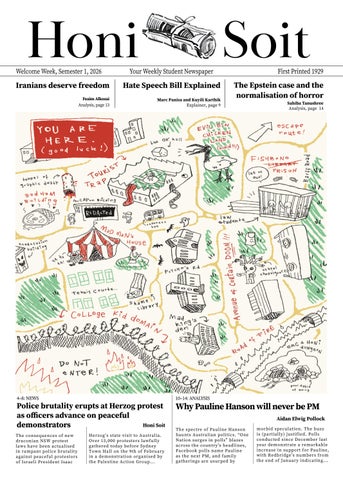
Iranians deserve freedom Hate Speech Bill Explained
Police brutality erupts at Herzog protest as officers advance on peaceful demonstrators
The consequences of new draconian NSW protest laws have been actualised in rampant police brutality against peaceful protestors of Israeli President Isaac
Herzog’s state visit to Australia. Over 15,000 protesters lawfully gathered today before Sydney Town Hall on the 9th of February in a demonstration organised by the Palestine Action Group...
The spectre of Pauline Hanson haunts Australian politics. “One Nation surges in polls” blazes across the country’s headlines, Facebook polls name Pauline as the next PM, and family gatherings are usurped by
morbid speculation. The buzz is (partially) justified. Polls conducted since December last year demonstrate a remarkable increase in support for Pauline, with Redbridge’s numbers from the end of January indicating...
ANALYSIS
Aidan Elwig Pollock
Feaim Alkozai Analysis, page 13
Marc Paniza and Kuyili Karthik Explainer, page 9
Sahiba Tanushree Analysis, page 14
Honi Soit
EDITORS
Madison Burland
Anastasia
James Fitzgerald Sice
Kuyili Karthik
Ramla
Kiah Nanavati
Marc Paniza
Firdevs Sinik
Sebastien Tuzilovic
Acknowledgment of Country
Honi Soit publishes on stolen Gadigal land. Sovereignty was never ceded.
The University of Sydney is a colonial institution that upholds Western knowledge as superior to First Nations knowledge systems. We reject this hierarchy.
As student journalists, we recognise that mainstream media has been complicit in silencing and misrepresenting Indigenous voices since invasion.
In This Edition:
Feaim
Anastasia
Zoe
Kuyili
Audhora
Alastair
Aidan
Vieve Carnsew
Sophie
Chelsea
James
We commit to centring First Nations perspectives in our reporting, to challenging the colonial structures embedded in journalism, and to amplifying the voices of those resisting ongoing dispossession. We pay our respects to Elders past and present, and to all First Nations students and contributors.
Always was, and always will be Aboriginal land.
Another uni year, for the new students welcome, the uncs welcome back.
We write this with our one brain cell, fused together from hours of sleep deprivation and rot, at 2:30am. Kuyili just made popcorn and yes, Marc has Uber One. Everyone is delirious, speaking in brainrot. Staz just asked “are pages 6-7 done?” If we didn’t love this paper, we’d be home and already in bed.
This is our first edition after winning the editorialship in one of the first contested elections in a while. We didn’t expect to be here, but we are, and we’re taking that seriously.
Student journalism matters in ways that mainstream media often fails to address. When police violence erupted at the Herzog rally, mainstream media barely scratched the surface. It proved why student
media needs to exist outside the constraints of mainstream outlets. When protesters get beaten for protesting, news coverage shouldn’t sanitise it or frame outcries against oppression as threats and disruption. Journalism should tell the truth. That’s where Honi comes in. We exist to fill the gaps that establishment media leaves gaping.
Mainstream coverage tends to flatten student issues into convenient narratives or ignore them entirely. In this edition, we’re covering what matters to students. On page 10, Aidan explains why Pauline Hanson’s polling surge doesn’t mean she has clinched prime ministership on page 10, using actual demographic analysis instead of scaremongering. In page 7, Kuyili breaks down Palantir’s presence in Australia and why that should concern you. Sahiba writes on page 14 about how constant exposure to horror, like the buzz
Letters to the Editor
Hi Honi ,
We have been none too pleased at your recent coverage of police brutality at the Herzog protest, or of the fantastic Writers’ Week cancellation (which was a win and not a loss for the culture, please correct that). Stop talking about
Honiscopes
Islamophobia. Stop talking about Palestine. Just, like, stop talking. Can we send you articles for you to publish? We have already installed Pegasus in your phones so don’t worry, we were there for handover. Can you tell [redacted] that Mossad did not find his Mossad joke funny?
Aries: You are like the Quad, mysterious & trad. Many get lost in you. Try making yourself more accessible.
Taurus: You’re giving Susan Wakil Health Building. Werk. Hit those macros and do some sets to failure.
Gemini: Okay icon. Don’t let popularity corrupt you. You’re messy, dirty, and you give people breakdowns.
Cancer: You’re weirdly affordable and accessible but people still find excuses to avoid you. Maybe you’re the problem?
Leo: You are kind of falling apart, much like the Wentworth Building. Idk what you can do at this point honestly. Get yourself checked for mould poisoning.
around the Epstein files, desensitises us and prevents real action. On page 8, Marc reported on the first SRC meeting of 2026.
Reviews are on page 18— stoke your appetite for on-campus food options, prepare to face the Slovenian stare final boss, and whinge about Triple J. Turn to page 23 for the crossword, which was a lot harder to make than we expected.
Honi Soit has always provided a space for students to question what’s happening around them. If you don’t see your perspective represented here, write for us this year. We need more voices, not fewer.
Welcome to 2026.
Hi there, Who is this?
Sincerely, Honi
SURG DJS 18th Feb 6pm-10pm Dragonfly, Pip-pi @ Abercrombie Courtyard SUDS WELCOME PARTY 18th Feb 6pm-late @ Bar Freda’s HONI LAUNCH PARTY 19th Feb 6PM-LATE Five DJ’s + bar tab! @ Bar Freda’s
20th Feb 7PM
Ends in Tragedy, Scram, No Scope & more @ The Chippo Hotel
Virgo: Brutalist on the outside, stunning on the inside, but that cafe is EXPENSIVE. Stop overcharging people for basic interactions. Your labor has value but stop you’re pricing people out
Libra: Law Library, shh. Don’t talk as much this week. You might just learn something.
Scorpio: You ask too much of the people you live with, and sometimes you scam people. Not cool. Stop.
Sagittarius: It’s business time. Spare a thought for the ethics of what you’re doing, not just your profit margin.
Capricorn: Freakishly long and people only use you for runway walks instead of your actual purpose. Accept that you’re just hot, not deep. Somtimes thats enough.
Aquarius: Possibly haunted, defintely exhausting. You’re making people work way too hard to access you. Chill. Not everything needs to be a spiritual journey.
Pisces: Nobody can find the rooms, including you. You’re architecturally incoherent. Get a map of your own life before helping others navigate theirs.
HEADLINERS FOR HER 21st Feb 7PM Xiao Xiao, Allerdyce, Charli Lucas, Justina. @ Oxford Art Factory SHAM FEST 21st-22nd Feb 5PM Memory Motel, Retail Therapy,
Police brutality erupts at Herzog protest as officers advance on peaceful demonstrators
CW: This article contains descriptions of police brutality and state violence.
The consequences of new draconian NSW protest laws have been actualised in rampant police brutality against peaceful protestors of Israeli President Isaac Herzog’s state visit to Australia.
Over 15,000 protesters lawfully gathered today before Sydney Town Hall on the 9th of February in a demonstration organised by the Palestine Action Group (PAG). Prior to the official event start, thick police lines formed, helicopters could be heard overhead, and drone pilots could be seen dotted across rooftops. The NSW Government deployed 3,000 police officers for this protest.
The opening speeches by members of a broad coalition of anti-Zionist groups emphasised the devastation of Palestine and Gaza, and spoke to the Australian government’s complicity in the genocide of the Palestinian people.
Activist Lizzie Jarrett of the Blak Caucus spoke first, linking the protest against Herzog to First Nations experiences in Australia. “We know what colonisation is. We know what occupation is. Our struggles are connected,” she said. She drew parallels between Indigenous dispossession and the situation in Palestine, framing the gathering as part of a longer history of resistance. She added,
“We refuse to stay silent when governments call their violence security and call our resistance terrorism.”
Jarrett’s words were followed by Dunghutti man and campaigner for recognition of Indigenous deaths in custody, Paul Silva, who connected the struggle of the Palestinian people to the experiences of Indigenous Australians.
Police Brutality on Peaceful Protestors
While chants continued and music played in the square, police moved to restrict crowd movement. Officers blocked attempts to march onto George Street under public order powers linked to the event. Protesters were kettled, with police not allowing anyone to leave.
Honi reporters witnessed a man carrying his nearly unconscious wife, asking an officer if they could leave as she was suffering heatstroke. The officer told him they were not allowed to leave.
Journalist Antony Loewenstein addressed claims that demonstrations are disruptive, stating that police “say protests like this are a threat.” He continued,
“We are a threat, to injustice, to inequality, to a system that allows this suffering to continue.”
He also emphasised the movement’s stance on discrimination, stating, “We stand against all forms of racism, against antisemitism and Islamophobia, and for a world where people can live in peace.”
Throughout the speeches, the focus remained on calls for justice, civilian protection, and the role of public protest, with repeated reminders to stay united and look after one another in the crowd.
Honi Soit reports.
Simultaneously to speeches, the Palestine Action Group lost its eleventh hour challenge to the expansion of police presence at the protest in the NSW Supreme Court.
The outcome of this decision led to public debate in the midst of the protest between organiser of the conference Josh Lees, and Police Superintendent Paul Dustan while speeches from the organisers continued. These discussions between police and organisers resulted in a lack of clarity from NSW Police over dispersal order. Dunstan advised Lees to encourage the protestors to “disperse anywhere”.
Organisers attempted to explain to Dunstan that dispersal was impossible with the police blockade of many potential exits, and raised concerns over potential crowd crushes. Protestors began chanting “let us march” to the front lines.
As protesters could not disperse, a line of police began forcing protesters back, using pepper spray, physical violence, and intimidation. Police moved notably quickly without giving verbal notice of a move on order.
A significant mounted unit aided in the violent enforcement, behind a line of officers, three men deep in sections. Officers were seen pulling protesters out of the crowd, throwing some to the ground and beating them. Arrests and detainments were both made. Among the arrested
was Lizzie Jarrett, Blak Caucus organiser.
Police were spotted on the steps of Town Hall holding a long-range acoustic device, commonly known as LRAD, a specialised speaker sometimes used in crowd control. LRADs are classed as a sound weapon. They can amplify sound up to 160dB, and can cause permanent hearing damage.
Honi reporters Sebastien Tuzilovic and Iris Brown were pushed behind police lines, and captured footage of violent altercations incited
by police. Honi Soit reporters were pepper sprayed, shoved, and gripped by police multiple times throughout the entire protest.
Police converged on the protesters at all angles, forcing a bulk of them into a contained area at the Town Hall light rail stop. This was the area where pepper sprayed and injured individuals were seeking treatment.
Police pushed this part of the crowd down George Street, with persistent and casual violence against protesters
in order to achieve this.
Protesters were continually violently shoved, screamed at, and some were punched by police. They descended on the crowd, moving quickly until all protesters at the rear of the line were pushed back, arrested, or detained.
The police then began charging at and shoving protesters. Officers began chasing specific individuals, often charging and tackling them in order to bring them to the ground. Police flanked the protesters, and despite Superintendent Dustan’s dispersal order, they blocked viable exit streets, and continued shepherding protesters into smaller areas.
Police continued to push the main body of the protest down the entirety of George Street. Passersby and shoppers unaffiliated with the protest were also charged at by police.
An Honi reporter sustained a head injury as police shoved her to the ground. Another Honi reporter witnessed multiple police officers “beating someone to a pulp”. Honi has received reports that police broke a man’s arm while arresting him, and another woman reported four fractured vertebrae due to police violence.
Eyewitnesses and footage captured mounted police charging crowds and riot squads advancing repeatedly, pushing people back from main roads and into side streets, shops, and doorways.
Numerous reports and videos circulated of police punching and violently arresting demonstrators, even those injured or complying with officers, including bystanders and Muslim people kneeling in prayer.
Amid the turmoil, Josh Lees of the Palestine Action Group spoke directly to what participants saw as the root cause of the day’s escalation: not just political disagreement, but the response by authorities. He stated that
“For over two years our government has continued to arm and fund the Israeli regime, headed by Herzog, which has slaughtered over 71,000 people. Today, Chris Minns took his support for genocide to another level by unleashing a brutal police riot against peaceful protesters.”
Many protesters were cornered while trying to disperse, boxed in by police, and subjected to horses, pepper spray, punches, and arrests. “Protesters who were fleeing were run down by charging police” said a witness.
Lees called for the release of those detained, for charges to be dropped, and for an independent investigation into what he described as violent and dangerous conduct by police throughout the protest. Police continued to push protesters back as far as Central Station, following groups of people across the city streets as they dispersed. Incidents of police brutality were clear and common, with protesters being shoved against walls, hit, and pepper sprayed while running or walking away from police.
Despite the violent actions of police during the protest, demonstrators cheered, applauded and jeered at the police when Central Station was reached.
Solidarity was general within the crowds of the protesters, and demonstrators began chanting back at the police “quit your jobs”.
Cries of “Fascists aren’t welcome here”, and “Pigs” were also heard. Protesters aided one another throughout, supplying water, bandages, and other first aid equipment, washing pepper spray from eyes and helping one another up when thrown to the ground.
These scenes of police brutality contrasted sharply with earlier chants and speeches celebrating collective expression, solidarity, and justice.
If you are or know someone who experienced police brutality at this protest, email your name, contact number, an account of the incident, any videos/photos, and information regarding injuries to this email address: testimonies100@yahoo.com. This email has been set up for legal observers and/or civil liberties groups who are looking at escalating the matter with the LECC and other avenues.
If you are or know someone arrested or charged at this protest, Adam Houda is offering pro-bono (free) legal representation. He can be contacted by email, adam@ lawyerscorp.com.au, or by phone at 0414559558.
Australia–US biometric data sharing and expanded social media vetting raise concerns for students
Australia is reportedly preparing to give United States authorities extended access to Australians’ biometric and identity-document data under deepening border-security cooperation, according to the reporting by, Crikey earlier this month, later picked up by industry publication, Biometric Update.
The proposal is said to sit within an expanded version of existing information-sharing frameworks between Canberra and Washington that could potentially allow U.S. agencies, including the Department of Homeland Security and U.S. Immigration and Customs Enforcement (ICE), to query Australian government databases containing facial images, fingerprints, passport details and other core identity records.
While Australia already participates in international data-sharing arrangements for law enforcement and border management, the new measures (will or may) involve more direct or streamlined access than traditional caseby-case mutual legal assistance processes.
This has raised concern among privacy advocates and legal experts, who argue that if disclosed, biometric data, unlike passwords or ID numbers, would be irreversibly shared, making questions of oversight, limits on use, and data retention especially significant.
Critics also point to transparency issues, noting that no detailed public treaty text or parliamentary debate has yet set out the scope, safeguards, or redress mechanisms for Australians whose data may be accessed.
The United States is also moving to significantly expand digital vetting requirements for visitors from visa-waiver countries, including Australia. This would broaden entry screening beyond passports and travel history into long-term digital and personal data.
Under proposed changes to the Electronic System for Travel Authorization (ESTA), applicants would be required to provide their last five years of social media identifiers as a mandatory part of their application.
The proposal also calls for the submission of additional “high-value data fields,” including phone numbers used over the past five years, email addresses from the previous decade, certain family-member details such as parents’ full names, spouse or partner’s name, children’s names or in some cases, dates of birth or nationality and biometric identifiers.
These measures form part of a wider tightening of U.S. entry rules over the past year. In June 2025, student visa applicants were instructed to make social media profiles publicly viewable for review by U.S. officials, with the same requirement also set to apply to H-1B skilled worker visa applicants.
Government responses so far have emphasised long-standing security cooperation with the United States and the need to manage crossborder threats, but have not publicly clarified the exact architecture of the proposed access.
Supporters of this closer integration argue that shared data helps identify serious criminals, prevent identity fraud and streamline travel. However, opponents of these measures counter that expanding foreign access to national identity systems risks eroding privacy protections and national control over sensitive personal information, particularly if standards for use differ between countries.
What does this mean for the future of students? In this scenario, the issue is less abstract, including the jeopardising of academic and professional futures due to political expression.
University communities are highly active, politically engaged, and digitally transparent. any students already believe their online presence is hyper-scrutinised.
The prospect of U.S. authorities being able to link biometric identifiers to broader identity records is a cause for anxiety among politically active students that participate and organise protests or engage in outspoken commentary online. There is no public evidence that lawful political expression would by itself trigger enforcement consequences such as refusal of entry or visa, but the perception of expanded surveillance may prompt some students to rethink what they post or publicly attach their names to.
International students are among those watching these developments most closely with growing unease. Those who may later seek U.S. visas, exchange programs, or employment already navigate strict screening processes, interviews and background checks that can feel opaque and high-stakes.
Greater interoperability between databases adds a new layer of risk such as information provided for enrolment, identification, or routine border processing in
Australia could be surfaced elsewhere in ways students do not fully understand. Student journalists and editors may also feel pressure. Studentbased news outlets often serve as testing grounds for investigative reporting and sharp political commentary; the knowledge that bylines, photos and archived articles sit in searchable digital form alongside formal identity records may weigh on young reporters deciding how hard to push a story.
More broadly, the development/proposed changes/something else highlights how a policy framed in the language of security can ripple into lecture theatres, newsrooms and student unions, reshaping how a generation learns to navigate public surveillance and restrictions.
This passage touches on how Australia balances security cooperation with civil liberties and sovereignty in the digital age. Biometric systems are becoming central to everyday identification, from passports to digital services.
Decisions about who can access those systems, under what rules, and with what transparency, will shape public policy and most importantly— trust. As calls grow for clearer safeguards and parliamentary scrutiny, the debate is likely to extend well beyond technical data-sharing into fundamental questions about privacy, free expression, and Australia’s role in an increasingly networked security landscape.
Kiah Nanavati reports.
Australia’s Future Fund, a sovereign wealth fund managed independently of the government, owns more than $100 million in shares in the controversial US-based technology company Palantir. When questioned, the Fund’s chief corporate affairs officer could not commit to divesting Palantir shares, saying that the Fund’s board did not make the choice of Palantir stock selection.
The Future Fund aims to strengthen the Australian Government’s long-term financial position by managing money on its behalf as “the country’s single-largest financial asset”, meeting the cost of unfunded public sector superannuation liabilities to reduce pressure on the federal budget.
Due to strong investment returns in 2025, the Fund’s total assets have now reached $335.3 billion. This includes 498,339 shares of Palantir Technologies Inc which are valued at $103,649,987 according to their June 30, 2025, report. The amount of shares sunk into Palantir substantially outweighs its stake in Australian companies such as AGL, Seek, and NEXTDC.
Speaking of the Fund’s strong investment return of 12.4% in 2025, Chief Executive Officer Raphael Arndt said: “Our positioning around the big themes driving markets, such as the rapid adoption of AI, persistent inflation and volatile geopolitics, helped deliver a strong return while managing risk.” The Fund’s monetary stake in Palantir has ballooned by nearly 100 times since February 2023, when its Palantir shares were worth around $1.6 million.
The Future Fund is not the only Australian entity that has made a big bet on Palantir. In 2024, Coles signed a three-year deal with the company, planning to use their tools to cut costs and “optimise its workforce”, using Palantir’s surveillance and data-gathering technology to analyse “over 10 billion rows of data, comprising each store, team member, shift and allocation across all intervals in a day, every day”. Further, the Australian Department of Defence signed a $7.15 million contract with Palantir to use its Foundry platform for data integration and analytics.
Palantir’s surveillance technology is now permitted to access Australian data, having
recently received high-level Australian government security clearance, but at the risk of creating a “vendor lock-in”. According to Luke Munn, UQ Research Fellow in Digital Cultures & Societies, Palantir’s highly specialised tools could make clients increasingly dependent on the company to make sense of their data.
In 2024, amidst growing concerns about Palantir’s involvement with the Israeli Defence Force, Norwegian investor Storebrand divested its holdings from the data firm. One of the Nordic region’s largest investors, Storebrand, made a statement that it “excluded Palantir Technologies Inc. from our investments due (to) its sales of products and services to Israel for use in occupied Palestinian territories”.
Will Hetherton, chief corporate affairs officer of the Future Fund, defended their investment in Palantir in response to questioning by Greens Senator Barbara Pocock during a Senate estimates hearing on the 10th of February. Hetherton maintained that Palantir’s “human rights record” had not been taken into account before investments were made, and could not confirm that the Fund will divest from Palantir.
The Fund’s large stake in Palantir is controversial due to the tech giant’s support of the genocide in Gaza. Recently, the Australian government’s welcoming of Israel’s president Isaac Herzog drew thousands to Sydney’s Town Hall on the 9th in protest.
Starting in 2023, Palantir has been assisting the Israeli Defence Force (IDF) in “war-related missions”, saying in posts on X and LinkedIn: “We stand with Israel… Our work in the region has never been more vital”.
According to a UN report by Special Rapporteur Francesca Albanese, Palantir have “profited from… genocide”. Their software provides predictive policing technology for automated decisionmaking on the battlefield, and their AI-assisted systems are used to identify potential bombing targets. Palantir CEO Alex Karp, who has admitted that their product is used to “kill people”, says his public support for Israel has caused a number of employees to quit.
Australia’s $100 million investment in Palantir, technology giant and partner of US and Israeli defence forces
Greens Senator David Shoebridge called Palantir a “global surveillance empire”, criticising the Future Fund for “pouring money into Donald Trump’s favourite surveillance tech giant” instead of “investing in renewable energy and healthcare innovation”. Shoebridge called it “a deep and fundamental breach of public trust”.
Pocock has called for a stronger government mandate to prevent the use of public funds to support “illegal wars” and human rights violations.
Hetherton told the Senate committee that the Future Fund’s Palantir shares are held through two investment managers that make stock selections; the Fund is accordingly not involved in selecting individual stocks.
The Future Fund has a responsible investment policy released in June 2025, excluding investment in “companies involved in cluster munitions, anti-personnel mines, selected nuclear weapons, chemical weapons, biological weapons, and primary tobacco production”. None of these criteria apply to Palantir.
Additionally, the investors can also choose to exclude investments in cases of “particularly severe or sustained misconduct”, a provision they used to divest around $200 million in Russian investments following Ukraine’s invasion in 2022. In the past, the Fund has divested from other controversial holdings, including Chinese companies with links to the People’s Liberation Army and human rights abuses.
Pocock asked Hetherton whether the Fund could commit to divesting and establishing clearer “ethical investment standards” which could exclude companies like Palantir that profit from “surveillance, from weapons, and from human suffering”.
Kuyili Karthik reports.
“Many Australians are horrified by what they see in America… being imposed on immigrants in the US,” said Pocock, talking about Palantir’s crucial role in the operations of US Immigration and Customs Enforcement (ICE), enabling anti-immigration efforts of its major partner, the Trump administration of the United States of America. In the wake of ICE officers shooting and killing Alex Pretti and Renée Good in Minneapolis, Palantir’s culpability grows: they have a $30 million contract with ICE for ImmigrationOS, a platform that gives “near real-time visibility” of people self-deporting.
The Future Fund has also invested $175.4 million in Reliance Industries, an Indian conglomerate owned by Asia’s richest man. One of the biggest buyers of Russian crude oil, Reliance, has profited billions of dollars from refining and exporting this sanctioned oil, sparking recent calls for the Future Fund to offload these shares.
What students need to know about the hate speech bill
Marc Paniza and Kuyili Karthik explain.
Parliament passed the Combatting Antisemitism, Hate and Extremism Bill 2026 (‘the Bill’) which created a new regime for banning organisations as “prohibited hate groups” and new grounds for visa cancellation.
In an ABC interview, Attorney-General Michelle Rowland confirmed that groups accusing Israel of genocide could be banned if Jewish Australians feel intimidated by them — if certain criteria are met.
What the law says
Part 4 of Schedule 1 allows the Minister for the Australian Federal Police (AFP Minister), who is currently the Minister of Home Affairs, to recommend that organisations be listed as prohibited hate groups if they have “engaged in” or “advocated” hate crimes relating to race, colour,national or ethnic origin, or serious damage to property. Crucially, the organisation’s listing must be “reasonably necessary to prevent social, economic, psychological, and physical harm”.
Merely advocating for damage to property counts as a “hate crime” under sections 80.2BC and 80.2BD if the person is “reckless” as to whether a targeted group member would fear harassment.
The new regime broadened the definition of a hate group in two ways. The old criterion required that banning the group was reasonably necessary to protect the Australian community, at large, from the harm described above. The current regime can now ban a group to protect “part of the Australian community”. Secondly, the group can be culpable merely for its continued presence — the commission or conviction of any other violent offences is not necessary.
Criminal penalties
Once an organisation is listed, any members or those who provide support to the organisation are liable for any of the 6 offences created by Part 4. Jail terms range from 10 to 15 years: directing the group (15 years), membership (10 years), recruiting (10 years), funding (15 years), training (10 years), and providing support (10 years).
The law is retrospective — organisations can be banned based on past conduct that was legal when it occurred.
Who decides and what oversight exists?
First, the Director-General of Security of Australian Security Intelligence Organisation (ASIO) recommends an organisation’s listing. The AttorneyGeneral must agree, and the AFP Minister must further recommend the listing so that the Governor-General makes the final regulations designating the organisation as a prohibited hate group. Parliamentary oversight includes the ability to disallow listings and review by the Parliamentary Joint Committee on Intelligence and Security. Judicial review is available.
However, as Senator Faruqi noted in her speech, barrister Greg Barns SC described the regime as dispensing with procedural fairness — the right of the parties involved to dispute allegations prior to their listing — and called it “the sort of stuff you get in authoritarian countries”.
The “reasonable person” test
What constitutes conduct that would cause “a reasonable targeted person to fear harassment, intimidation or violence”?
Rowland explained that Hizb ut-Tahrir — an Islam-rooted group that “condemns Israel and Jews but has stopped short of promoting acts of violence”— could be captured because “the threshold has been changed so that if there is that fear, and if there is a reasonable person test...then that would come within the scope of these provisions.” The same goes for the neoNazi aligned National Socialist Network, the other target of the new legislative regime that also previously fell short of the criminal standard.
When pressed on whether saying “Israel is engaged in genocide” or “Israel shouldn’t exist” could lead to banning if Jewish Australians feel intimidated, Rowland confirmed this was possible. However, Rowland pointed towards the condition of ‘other factors’ being satisfied, leaving uncertain what conduct can be caught.
Racial vilification provision dropped
The bill originally included Part 5 : an offence criminalising “publicly promoting or inciting hatred” on racial grounds (maximum penalty: 5 years). This was dropped after neither the Coalition nor the Greens supported it, raising concerns about the erosion of free speech.
Foreign Minister Penny Wong expressed frustration that “those opposite have walked away from a key ask of the special envoy”.
Not all of Special Envoy Jillian Segal’s recommendations to combat antisemitism were implemented, with some criticised as punitive infringements of free speech and institutional autonomy. These include government withdrawal of funding and the imposition of penalties on universities, cultural institutions, and media organisations that do not comply with the antisemitism recommendations in the plan.
Migration provisions and parliamentary opposition
Schedule 2 amends the Migration Act 1958 to create grounds for visa cancellation based on “hate-motivated conduct”.
People who have been refused visas face permanent exclusion from Australia.
In her opposition speech, Senator Mehreen Faruqi argued that the “laws were designed to protect some and not others.” She noted that, of all faith groups consulted, “only the Australian National Imams Council was not shown the bill,” and cited several organisations’ concerns:
• The NSW Council for Civil Liberties warned the laws would “irreparably damage our democratic and legal system”.
• The Human Rights Law Centre said the bill “casts migrants and refugees as a presumptive threat to national security”.
• The Jewish Council of Australia stated “the fight against antisemitism is not served by rushed legislation”.
• The Islamic Council of Victoria warned of “exacerbating existing patterns of overpolicing… of Muslim communities”.
Faruqi also noted: “The vile murderers who perpetrated the [Bondi] attack had no connection to Palestine, were not Palestinian, and had no link that we know of to the pro-Palestine movement”.
The Attorney General’s confirmation that groups criticising Israel could be banned if their speech causes Jewish Australians to feel intimidated has direct implications for student activism.
What this means for campus organising Activities that could potentially trigger the new framework include:
• BDS campaigns: Organising boycott, divestment, or sanctions campaigns targeting Israel or Israeli institutions. The Bill criminalises advocacy of property damage—and BDS inherently advocates economic pressure.
• Characterising Gaza as genocide: If 58 per cent of Australians believe Israel has committed genocide in
Gaza (per October 2025 polling), and organisations publicly advocate this position, they could be banned if this causes intimidation.
• Challenging Israel’s right to exist: Organisations arguing Israel should not be constituted as an exclusively Jewish state — a position held by many Palestinians, some Israeli citizens, and Jewish anti-Zionist groups — could face prohibition.
• Campus protests and actions: Student protests or demonstrations that proIsrael groups characterise as creating an intimidating environment could be used as evidence for banning.
• Invited speakers and events: Hosting speakers critical of Israel, holding Israel Apartheid Week events, or organising panels on Palestinian rights could be deemed advocacy that causes fear or intimidation.
Since hate group listing can be retrospective, student groups’ previous
campaigns, social media posts, or protests could be grounds for prohibition.
Being a member of a listed group carries up to 10 years’ imprisonment. For student organisations with fluid membership — where people attend meetings or events without formally joining — it’s unclear at what point participation becomes criminal “membership”.
Even without formal prohibition, the law creates incentives for universities to preemptively shut down Palestine solidarity groups, cancel events, or prohibit certain speakers to avoid potential legal complications.
Critical perspectives
Dr. Simon Bronitt, criminal law professor at USYD and expert in violent extremism, told Honi Soit that Australia has seen a staggering reform in a very short period of time across federal, state, and territory levels, developing a complex “patchwork” of hate crime and extremism laws. The question is: does Australia’s recently
updated patchwork actually support effective counter-terrorism and counterviolent extremism?
Dr Bronitt draws attention to the need for a coherent national approach to CT and CVE – an issue absent from recent public debate about the Bill: “We’re left with a messy mix of differently worded offences and penalties across jurisdictions”.
The need for coherence is exacerbated by the urgency with which the Bill was pushed to Parliament, which had only a week to consider the Bill before deciding. The timeline for submissions and discussion of the 144-page draft bill was criticised as rushed and inadequate, allowing only a matter of days “for public consultation and national coordination – a reality that rarely produces the most carefully drafted or effective laws,” says Dr. Bronitt, who has led research projects on terrorism law reform post-9/11. “Political urgency often comes at the expense of technical quality,” warns Dr. Bronitt.
98 th SRC holds first council meeting for 2026
The 98th Students’ Representative Council held its first regular meeting on Wednesday the 4th of February, passing all ten motions on its agenda after a nearly three-hour session, marked by factional tensions and two walkouts.
After initially falling short of quorum, the meeting opened at around 6:30 pm, with the following factions present: Grassroots, Penta, Socialist Alternative (SAlt), Solidarity, Queer Agenda, NLS, and Unity. NSWLS was absent, with one of their councillors Angus Fisher, having resigned his position to Zayed Tabish. President Grace Street opened proceedings, and councillors elected Shovan Bhattarai (SAlt) as Deputy Chairperson.
Jasmine Al-Rawi (SAlt) was elected unopposed to the Executive Committee, and Lucas Pierce (SAlt) as Environment Officer. The two Mature Age Students’ Officer positions were declared vacant after no nominations were received.
The appointment of Firdevs Sinik as Honi Soit editor proved to be a bit of a contentious procedural item of the night. The motion, moved by Honi editor Marc Paniza, sought to fill a vacancy left by two editors who resigned before the current team were formally appointed on
1 December 2025. Despite all current editors signing in support, the vote initially failed because abstentions — including those from SAlt councillors— outnumbered the votes in favour. On a subsequent vote, the motion passed, with 17 votes in favour and 4 abstentions.
Reports and Welcome Week preparations
Street’s President’s report covered the SRC’s response to the Bondi mass shooting on 14 December, and its submission on the University’s new Sexual Harm and Gender-Based Violence Prevention policy. The 2026 SSAF allocation has been confirmed, though the SRC missed out on several funding bids, it plans to reapply for.
General Secretaries Ava Cavalerie and Vince Tafea reported that Welcome Week preparations are nearing completion, with the Orientation Handbook sent to print and artwork commissioned from First Nations artists.
Motions
The council endorsed the 2026 Mardi Gras Street Rally, scheduled for the 15th of February, in Newtown. Jesper Duffy, who moved the motion, called it “the only tactic to fight anti-discrimination laws in New South Wales right now.”
A motion on First Nations deaths in custody noted that 2025 recorded the highest number in four decades.
Jaehyun Kim (Grassroots) argued, “simply reforming the current system is not going to offer a solution.” The Solidarity faction left the meeting shortly after this motion passed.
Three motions addressed Palestine and the crackdown on pro-Palestine organising. The council condemned the invitation of Israeli President Isaac Herzog — cited by the International Court of Justice for incitement to genocide — and endorsed protests planned for 9 February. A second motion called for a National Student Strike for Palestine on 11 March, demanding that universities cut ties with weapons companies complicit in the genocide in Gaza. A third opposed the NSW government’s new hate speech legislation and royal commission, which the council identified as attacks on the right to protest and organise against the genocide.
On housing, one councillor shared that friends had been evicted with one week’s notice, calling on the SRC to “create a platform to support these students.” The council voted to demand that the University urgently reopen International House, which has sat empty for nearly six years, despite Sydney’s rental crisis.
A motion condemning the Iranian regime’s massacre of protesters prompted a brief exchange on “campism.” Disabilities Officer Remy Lebreton “unequivocally” rejected the campist position.
The anti-ICE solidarity motion drew the most speakers. Julius Wittfoth (SAlt) described the Minneapolis protests as “one of the most inspiring things that’s happened this year.” The Unity faction left the meeting during this debate.
A final motion on One Nation’s polling surge to 26 per cent saw the SRC endorse the Campaign Against Racism and Fascism Sydney. All remaining motions passed, and the council concluded for the evening.
What is the SRC?
For students new to campus, the SRC is the representative body for undergraduates at the University of Sydney, funded by a portion of Student Services and Amenities Fee (SSAF). In 2025, the SRC received $3.1 million from the SSAF. The council consists of 43 elected representatives — roughly one for every 1,000 undergraduates — and meets on the first Wednesday of each month. Meetings are open to all students. Any student can present a motion for debate, and passed motions can compel the SRC to take action and advocate on student issues.
Marc Paniza reports.
Court VS Country: Why Pauline Hanson will never be our Prime Minister
Aidan Elwig Pollock, please explain?
The spectre of Pauline Hanson haunts Australian politics. “One Nation surges in polls” blazes across the country’s headlines, Facebook polls name Pauline as the next PM, and family gatherings are usurped by morbid speculation.
The buzz is (partially) justified. Polls conducted since December last year demonstrate a remarkable increase in support for Pauline, with Redbridge’s numbers from the end of January indicating a primary vote share of 26% for the previously fringe(ish) right-wing party. Incredibly, Hanson’s favourability rating rocketed upwards by 16 points, from -19 to -3. It’s notable that this figure is significantly higher than Sussan Ley’s, which currently sits at -32.
Ley’s damning favourability rating is symptomatic of another phenomenon that has unfolded since 2022, picking up speed in 2025: the collapse of the Liberal Party’s electoral prospects. The combined primary vote of the Liberals and Nationals, according to the same polling, sits at only 19%.
Does this really mean that One Nation will replace the wobbling Liberal-National Coalition as Australia’s major right-wing parliamentary force? If this isn’t the case, can One Nation form a new coalition with the Liberal party to make this happen? Could Pauline Hanson become Prime Minister?
Whig Supremacy
The short answer is no. To understand why, let’s take a quick trip in a time-machine to 17th century England, before the advent of modern political parties. The polarities of Left and Right would not emerge until the French Revolution, though factional rifts have long existed between ‘Court’, the forces of the crown, based in London, and ‘Country’, the forces oppositional to the crown, rooted in parliamentary representation of rural and regional landed gentry.
The upheaval of the 17th century, following a civil war, a regicide, the complete collapse of the revolutionary government, and the Glorious Revolution of 1688, would confirm the primacy of parliament over crown by the early 18th century. Still, the Court vs Country dynamic did not disappear.
Under the “Robinocracy” of the 1720s–40s — Robert Walpole’s domination of British politics — Walpole’s Court faction would come to represent the ascendant urban, mercantile, London-based upper-class. The Country faction, initially led by Henry St John, first Viscount Bolingbroke, represented again a disaffected landed gentry of rural Britain.
Democracy Manifest
Obviously, Australian democracy is almost unrecognisably different to its nascent British form in the 18th century. We have universal suffrage, compulsory voting, a left-right division, and an even clearer domination of the crown by the legislature, among other things. But the Court vs Country binary remains a relevant framework.
In Australia, the Court seat comprises of the state capital cities: urban, economically diverse, and educated. The Country seat occupies rural and regional Australia with its agrarian and minerals-based economy.
Since the 1940s (outside Queensland, which is a special case) Liberal and Labor contest the Court electorate, while Country is largely left to the National Party in fact, previously called the Country Party. The only way the Liberal party has ever formed government is through a tenuous alliance of Court and Country through the Coalition.
One Nation is also undeniably a ‘Country’ party. According to pollster-and-national-treasure Antony Green, One Nation can reasonably contest
25 seats based on previous electoral results. Of these, Green wrote, two thirds are outside the capital cities, and if One Nation maintains its 25% primary vote at the next election “it will be sweeping up seats all across rural and regional Australia.”
In the United States, the Country electorate swept the MAGA Republican monstrosity into power. In the UK, the Country electorate (complicated by disaffection in the Court with Keir Starmer’s Labour) threatens to deliver a landslide to Farages’ Reform.
Why Hanson can’t delivery a victory
Could a similar Country surge deliver Pauline Hanson to prime ministership in Australia? No. In conversations I have about politics, people often raise compulsory voting and our preferential system as Australia’s safeguards against something like MAGA. Whilst these are important factors, the crucial difference between us and the U.S. boils down to how our demographics slot into the Court-Country divide.
Australia, despite our international image as a dustbitten agrarian dirtbowl, is almost uniquely centralised — especially among comparable democracies. 17.3 million Australians lived in a capital city as of the last census: 68%. Aside from the outskirts of these cities, this divide represents an overwhelming demographic dominance of the Court electorate in Australia. This is different to both the USA and the UK, which are more decentralised by orders of magnitude.
The Liberal party’s recent decimation is largely (but not exclusively) the result of Country interests dominating decision-making, alienating the Court base of the Liberal party, which has turned to Teal Independents. Regardless of what the Nationals may think, the demographic centralisation of Australia means that a Country-based party cannot form government alone. Additionally, the dominance of reactionary Country interests destroys any chance of a Country-Court coalition forming government by alienating Court voters.
This is why One Nation will — in their current configuration — never form government, either alone or in Coalition with the Liberal Party. In winning support from traditional National and Liberal voters in Country seats, they alienate the traditional Court voters of the Liberal party.
This doesn’t mean that we shouldn’t be concerned about the racism and xenophobia that Hanson’s party espouses. But next time you see a headline posturing Hanson as the next Prime Minister of the country, or arguing that One Nation could ever form government: think twice.
Fight or flight: The hidden cost of studying in Australia
Fatima Nadeem analyses the true cost of relaxed student visa rules.
With world-class universities and high-quality lifestyle, Australia has been one of the top destinations for international students seeking education and job opportunities. As of October 2025, Australia had about one million people on subclass 500 student visas. Among other restrictions, this visa currently allows 48 hours of work per fortnight.
However, this is set to change. A new proposal submitted by the Coalition would increase the work hour cap for student - visa holders during study terms by 12 hours per fortnight — from 48 to 60 hours — starting on 1 July 2026. The rationale is that this increase in the work-hour cap reflects rising living costs. The Australian Bureau of Statistics (ABS) showed that living costs rose from 2.3 per cent to 4.2 per cent in the year to December 2025.
To maintain the same standard of living, students are expected to work more. In return, increased working hours would reduce the economic stress and financial burden on students and benefit local companies that rely on student labour.
However, this increase of working hours is not as charitable
Instead, it places the burden of rising living costs on students who are already exploited by a money-grabbing system. With no access to Medicare and Centrelink, international students are expected to support themselves including
paying upfront university fees, rent, and groceries, facing the effects of rising living costs more immediately than most Australian citizens.
They are expected to pay taxes while receiving no benefit from the welfare system, the quality of an exploitative system.
In a conversation with a firstyear international student at University of Sydney (USyd), she said in 2025, when her rent unexpectedly increased, she had to live on instant noodles and water for a few weeks because she couldn’t afford anything else until she found another part-time job. International students working up to 60 hours a week would be expected to pay higher taxes added to the government’s revenue more than the students themselves.
In other words, this increase in the working hour cap would help replicate and reproduce the shameful inequalities at the heart of modern slavery in Australia and would further set up to exploit the people on student visas.
According to the 2020 report on international students by the Australian Government, about 36 per cent of students rely on paid work for their main income, and for students from low-income countries, that figure was
They are often forced to come to class unprepared, request extensions for assignments, and cram before finals. Their results suffer significantly, especially when they find themselves working two or three jobs.
What was observed is that students tend to deprioritise their academic work because they are so focused on trying to survive in the Australian economy.
Increasing working hours would not solve this issue, but would backfire on academic
International students are here to study first, and work is supposed to supplement living costs, however, the reality is the opposite. International students who come to Australia in search of a better future often find themselves caught in a relentless cycle of survival.
Working 60 hours per fortnight would mean even less time for their education. Even if they manage to attend all the classes and maintain their grades, they would be forced to compromise on sleep, exercise, and social interactions. It would put an enormous amount of stress and anxiety on the students.
The solution to current financial stress due to rising living costs is not as simple as changing these visa rules.
Holders of the subclass 500 student visa are real individuals who have left their homes and families to invest in an Australian education and should
The role of ominous, ambiguous language in tightening NSW anti-protest laws
Since 2025, the world has seen significant uproar with 72 countries reporting significant protests, according to the Carnegie Endowment for International Peace.
The majority of these demonstrations clamor against social and political issues: government corruption, discrimination of minorities, economic inequalities, among others.
Australia, particularly New South Wales (NSW), is among that 72. However, after the Bondi beach attack, the Chris Minns government pushed forth the Terrorism and Other Legislation Amendment Bill 2025.
This has tightened the state’s anti-protest laws and enabled police brutality of demonstrators, as seen in the protests on the 9th of February during Israeli President Isaac Herzog’s visit to Australia.
These developments, which occurred within less than three months, exhibit two considerable scenarios.
First, is the unchecked granting of power to the police. Second, is the use of dangerous claims to justify suppressing peaceful demonstrations.
Ambiguity enables aggression
Beyond hasty implementation of protest restrictions, certain
provisions in these legislations appear concerning or ambiguous. These gaps have a role in the recent harassment against protestors, but especially in the perception against demonstrations in general.
Under the bill, the police commissioner was granted the power to ban protests in designated areas through the public assembly restriction declaration (PARD), under amendments to the Terrorism (Police Powers) Act 2002. Permitting police to use personal judgement in assuming a protest will “cause fear of harassment, intimidation or violence, or a risk to community safety” can lead to them enforcing PARDS based on misinterpretations or biased perceptions of motives.
Under the same umbrella, particularly the Summary Offences Act 1988 provisions, police are also given the ability to issue move-on directions or dispersal of crowds, though this being in place under “certain types” of conduct also constitutes vagueness and personal suspicion.
Looking elsewhere, in the Terrorism (Police Powers) Act 2022, there is no clear criterion for a protest to be declared terror-related to begin with when peaceful assemblies aim and uphold to not cause “physical damages or injury.”
Recalling the recent protestor
attacks, there were also no public notice or orders given to initiate the police brutality, clearly showing a violent response to a peaceful protest.
Amidst all of this, housing protest regulation changes within counter-terrorism legislation, observing how two legislations are explicitly titled with “terrorism,” implicitly associates demonstrations with violence.
Safety amidst injustice?
NSW Police Commissioner Mal Lanyon, in an interview with ABC News, showed concern over “a significant risk to community safety” as his rationale to extend the PARD before Herzog’s visit. The context of this claim stemmed from what he mentioned was a “significant animosity,” perceiving that dangerous assemblies will rise during the visit.
After what actually happened, or even alternately, this claim needs to be reconsidered. While critics have argued that his stance amounts to shielding the Israeli government from accountability by “trying to silence opposition,” Lanyon’s perception generally frames protests as vehicles for hostility, rather than calls for justice.
On the other hand, Minns even previously lamented to The Guardian how Sydney in particular was housing weekly
by
protests, which can obstruct the “right to enjoy the city … free from trying to navigate a protest every weekend.”While there is the aspiration to bring about social harmony and safety, this is a difficult— may it be impossible—feat as injustice itself continues to exist for many groups, such as Palestinians and Jewish people alike.
If anything, these harmful projections against protests, in the middle of democratic land, become testimonies as to why they still exist. To say that political assemblies are annoyances, and laced with malice, tramples down on their essence: enduring and supporting in the midst of struggle.
Authorities, and whoever else may be affected, are simply not ready to confront these harsh realities and obligations that it is easier to twist narratives and say less to get those over with. The acknowledgement of freedom of speech is insufficient as long as personal discretion counters calls for accountability. The same goes for lobbying public safety when discrimination continues to violate communities.
Threats to democracy and dignity will continue to be collectively responded to by the masses: and until the political powers sincerely pay attention to them, their calls will never cease.
Meijie Ureta reports.
Art
Chelsea Genares
Iranians deserve freedom. But
is Trump going to be the one to give it to them?
Feaim Alkozai doubts.
As the world celebrated a new year, Iran was plunged into a state of deep civil unrest. What began as a demonstration by Tehranian shopkeepers escalated into a nationwide call for new governance. The extensive campaign surpassed the 2022 major “Women, Life, Freedom” protests which were triggered by the unlawful death of Masha Amini.
Ayatollah Ali Khamenei’s theocratic regime is infamous for its impunity. Its mismanagement of essential services has worsened living conditions, which see 3040% of Iranians living below the poverty line. Ranked 176 out of 180 countries in the World Press Freedom Index, Iran’s media censorship reflects the tight control the government has over its citizens. The Gasht-e Ershad, or morality police, ensures Iranians follow strict Sharia law regulations — despite a 2023 GAMAAN study indicating that the population is increasingly secular. The protests allowed for Iranians to finally voice their discontent as thousands took to the streets.
In the midst of this upheaval, one country positionied itself as a potential saviour - the United States. In a now notorious tweet, Donald Trump urged “Iranian patriots” to “KEEP PROTESTING” and record the names of their “killers and abusers”, promising that “help” would be on its way. Many Iranians this as a sign to continue their protest efforts, the President refusing diplomatic talks with Iran during the crisis. Along with images of Trump and the US flag, signs declaring the need for the return of the Israeli-aligned Reza Pahlavi, the son of the last Iranian Shah, would be seen in protests globally. Mirroring Trump’s bold attitude, Pahlavi claimed in a Washington conference that “The Islamic Republic will fall — not if, but when”. Despite these resolute proclamations, Iranians saw little more than bloodshed result from their efforts.
While official Iranian records place the number of protestors killed at around 3000, the UN estimates that more than 20,000 protestors could have been killed, with many more injured. Reports of mass graves and bodies being transported in ice cream and meat trucks further suggest a systemic effort by the government to conceal the true number of fatalities.
Despite the Iranian President’s declaration on the 11 of February that the government is “ashamed” of the violence used, his remarks that they are “not seeking confrontation with the people” reflects containment efforts rather than remorse. After all, repressive governments survive exclusively through forced loyalty. Fear, ingrained by the regime’s torture of
journalists and insurgents, ensures order is maintained. Thus, when speaking out means death, citizens accept even the most stifling of conditions. In fact, some are transformed into affiliates of the regime, made to enforce what they believe are the only conditions available. The occurrence of such a widespread protest is therefore a direct challenge to the system, a challenge that only incurred a vicious response.
Now, many Iranians feel betrayed by the U.S. Tense diplomatic discussions between the countries recommenced, with America demanding that Iran hand over all its enriched uranium, limit the range of their ballistic missiles (which currently are able to reach Israel), and stop its funding of militia groups such as Hamas. Trump has even gone so far as to mobilise a “beautiful armada” into the Middle East, as to pressure Iran into accepting the U.S.’s requests. How Iran will respond remains unknown; however, it is evident that Iranians’ freedoms are not a focal point in the deliberations.
Instead, the U.S. remains focused on only two overlapping goals: protecting Israel and ensuring the threat of nuclear power is expunged. On Febuary 11th, Israeli’s Prime Minister, Benjamin Netanyahu, visited the White House, which resulted in the agreement to “continue” negotiations with Iran. As Trump’s close ally, Israel has reperatedly pushed for Tehran’s influence in the Middle east to be lessened, insisting negotiations “must include limiting ballistic missiles and ending support for the Iranian axis”. As such, Trump’s rallying of Iranian protests proves disingenuous, the desire for Khameni’s overthrow benefiting U.S. allies more than Iranian freedoms.
Theoretically, subverting Iran’s oppressive regime expands Iranian’s rights. However, such socioeconomic instability would almost certainly create a power vacuum that milita groups could easily exploit If the images of Iraq and Syria after their political insurrections are any indication, Iran could possibly grapple with heightened brutality. The view of a rising natural democracy is ficticios given internal divisions and power dynamics in the region. The line between Iranian victims and maintainers of the State are also quite thin, further lessening the likelihood of social cohesion in a postdictatorship society.
Additionally, the positioning of Pahlavi as a saviour is likely an optimistic fallacy. His alliance to both Israel and America could feasibly turn Iran into a country exploited for its strategic position in the Middle East. It was only last year when Netanyahu subscribed to his “vision” of a “Greater Israel” which includes major parts of Jordan, Iraq and Syria, Iran’s neighbours.
Iranian discontent towards Pahlavi had already emerged after his decision to support Israel’s strikes on Iran in the Twelve-Day War, which had waged in June last year. At least 900 Iranians were killed as a result of these attacks. Iran would thus likely see its strategic territory and resources exploited for foreign interests, trading one form of governmental control and oppression for another.
One only needs to look to the 2003 Iraqi invasion to see the repercussions of allowing Western-aligned intervention. Direct parallels can be seen between American justifications for entering Iraq and Trump’s present case for attacking Iran. President Bush noted that his goals for Operation Iraqi Freedom were to “disarm Iraq, to free its people and to defend the world from grave danger”. After the meeting with Netanyahu, Trump took to Truth Social to threaten Iran with another Operation “Midnight Hammer”, a reference to the June 2025 attacks on Iranian nuclear sites, stating he hopes “this time they will be more reasonable and responsible” when considering U.S. demands. Trump’s threats are frighteningly similar to Bush’s threats against Iraq’s former dictator, Saddam Hussein.
The outcomes of Bush’s intervention are notably disastrous. Hundreds of thousands of locals died. Many were subjected to illegal war crimes. The country itself was forced to contend with shifting control of its oil to American companies while also dealing with the rise of ISIS and Al Qaeda. Already vulnerable, Iraqi society was further strained by these factors. U.S. attempts at stabilising the country failed, with the newly instated Iraqi government serving to divide rather than unite locals. These effects are still felt today.
Comparable scenes can be found more recently in Trump’s ousting of Venezuelan dictator Nicolás Maduro. While many in the Venezuelan diaspora applauded Trump’s removal, others were concerned about the country’s future - and rightfully so, given that Venezuela has the world’s largest proven oil reserves. Trump has been explicit about America’s advantageous position after invading the country, stating, “The people of the United States are going to be big beneficiaries,” at the White House last month. Since the capture of Maduro, Trump has forced the country to begin “turning over” as many as 50 million barrels for sale by the United States while encouraging American companies to drill in the country. Despite stating that some oil would be returned to Venezuela, the exact figures were not provided.
With the world anxiously awaiting the results of renewed diplomacy between the U.S. and Iran, we must not forget the crux of the issue: the freedom of Iranians. While Western intervention and the overthrow of the Khamenei’s bloody regime may seem promising, the potential exploitation and erasure of Iran’s sovereignty risks situating Iran in another dangerous and subjugating position. To force a group of people to tolerate the removal of one source of oppression for another is inhumane and should not be looked upon as a viable path to disarming Iran’s dictatorship.
The Epstein case and the normalisation of horror
Sahiba Tanushree reports.
The human appetite for the obscene and the macabre is nothing new. History is filled with countless pages of man’s fascination with violence, scandal, and moral transgression. What is new is the scale, speed, and intimacy with which such material is consumed. Graphic evidence, leaked documents, and speculative theories travel instantly across social platforms, stripped of context and saturated with repetitive commentary.
When a friend asks, “Did you see the new Epstein findings?”, do you feel a grim pull toward your phone? Perhaps not excitement in the conventional sense, but despite knowing exactly the kind of horror you will face, you still have a restless urge to look, scroll, and examine every slide, to fully apprehend the horrors contained in new findings. These photos and videos have been carrying the same bleakness since the files first came out. Heartbroken and appalled, you consume new updates and even more gruesome pieces of evidence methodically as months go by, almost dutifully, long after the initial element of surprise has passed. At some point, your brain starts registering them lightly, progressively desensitising you.
The world as we know it today is defined by radical visibility. Records of abuse and violence — once unimaginable in their scale — now surface daily, often without any deliberate search. To stay in the loop is to accept regular exposure to brutal extremes the mind was not designed to process daily. It is to carry an unspoken obligation to witness these atrocities until that exposure erodes your capacity to feel with the same degree of intensity. Eventually, second-hand descriptions no longer suffice. Only more intense and descriptive content can reproduce the same visceral response that once arose at the mere thought of such acts, drawing you into a bout of apathy. Prolonged cycles of shock have a way of delaying meaningful action. This dynamic is not unique to the Epstein case; similar patterns of desensitisation in coverage of the Palestinian genocide as well.
When those at the apex abuse their power, what structure remains capable of enforcing accountability?
As of today, the Epstein case remains highly visible and intensely reacted to, yet largely untouched by meaningful consequence. Political figures like Donald Trump continue to hold office despite extensive public reporting linking them to the Epstein network. Other powerful figures repeatedly associated with the case still maintain a veneer of normalcy — attending premieres, hosting parties, and moving through elite spaces largely unrepudiated. It is this uncompromising gap between the actors and the audience that defines this moment. That lack of consequence dehumanizes the suffering to a disturbing degree. It begins to resemble something closer to folklore than history: widely known, endlessly discussed, and fundamentally untouched.
It’s easy to give in to speculation when something no longer feels humane or relatable; however, it’s also critical that we ask ourselves what that speculation really does. When theories about satanic rituals, antisemitic ideologies, secret societies, or hidden architectures of power start circulating, what changes as a result? Who is pressured? Who loses status, money, or access? Or does the story simply become more dramatic, more shareable, more consuming?
Notice how quickly attention shifts from material power to symbolism. Instead of asking what institutions failed, or what forms of pressure could be applied, the focus drifts toward decoding signs, tracing imagined networks, and chasing the next update. It is worth reminding oneself of the severity of the matter at hand before allowing it to be reduced to legend or repurposed as justification for hatred toward an entire religious identity. This displacement of blame often offers a false sense of participation to those sharing reels, indulging in sensational conspiracy narratives, or leaving antisemitic commentary on social media, when in reality, it only fractures solidarity and leaves those responsible untouched.
In that context, however, public awareness still managed to translate into sustained forms of mobilisation due to a very important difference. In the case of Palestine, the possibility of justice—however distant or incomplete—still felt imaginable to many, and that sense of attainability helped generate hope, momentum, and a belief that collective pressure might actually yield tangible outcomes. There were institutions to pressure, demands that could be articulated and actions that could accumulate into something consequential.
The Epstein case doesn’t quite offer such a horizon. The magnitude of the crimes in this case, combined with the extraordinary wealth and power of those involved, produces the opposite effect. Here, accountability seems systemically out of reach before it even begins. When figures who preside over political, economic, and cultural life are implicated, what would it actually mean to remove them from power? How much of that decision lies within public reach?
There is a human cost to this cycle that is rarely acknowledged. When attention is redirected into spectacle rather than accountability, survivors and their families are left to absorb the fallout, forced to watch their trauma circulate as content. Ethical reporting, then, is also a matter of compassion—of recognizing that what appears to the broader public as muchneeded awareness often registers as lived, immediate, and deeply familiar trauma to those directly affected. For them, this is not myth, abstraction, or spectacle. If not for anything else, this alone demands that there be ways to communicate new findings without turning real suffering into a sensational spectacle for public consumption.
Without boycotts, without sustained institutional pressure, without the withdrawal of legitimacy from those who enable impunity, the cycle of misdirected attention and desensitisation continues. The point is not to disengage, but to recognize how easily outrage slips into consumption. The appetite that draws one toward the obscene and the macabre is endlessly fed, yet nothing in the arrangement of power is disturbed. The question, then, is not whether one is paying attention, but what one is willing to do about it.
In-Person, On-Table Exam: a Panacea for Digital Amnesia
On the tables in my psychoanalysis tutorial room in the Grands Moulins building at Université Paris Cité, the girl to my left is scrolling on Vinted, a second-hand online clothing hub, and the guy to my right is shopping for guns. Okay. But no matter how short these students’ attention spans are, no matter how little they choose to engage with the professor’s lecturing, none of them will have the aid of AI, let alone search engines, when it comes to their graded contrôles.
All the arts courses at my exchange university had a no-take-home final assessment policy. Sit-down paper finals remain a tradition in French schooling and higher education, but they are also a concerted effort to combat AI. My teachers all opened the semester with long rants bemoaning the uses of generative AI. My philosophy professor, who taught a course on Morality and Atheism, frequently referred to ChatGPT as the ‘Diable’ (Devil). At the final exam, he wrote ‘AI = Mort’ (AI = Death) on the chalkboard.
I did 46 hours worth of sit-down paper examinations last semester in Paris, and I loved (almost) every minute of it.
Upon leaving each exam whenever they were done, students reached instinctively for a filter, OCB paper, and Camel tobacco to roll as they bounded down the stairs, usually making a quick stop at the selfservice coffee machine.
Gathering in circles outside, smoking and watching January snow falling unexpectedly thickly in the courtyard, we threw snowballs at each other in celebration. My comrades and I would
then queue for the 3-euro cafeteria meal, a small reward. These exams were the first time I truly felt I was having the university experience.
This is not to say my two-and-a-half years of study at the University of Sydney lacked the academic stakes and camaraderie that are heightened by the in-person, on-paper exam. In my philosophy and especially law courses, it’s an enshrined institution. My STEM friends won’t understand why I see this assessment modality as a novelty. However, there’s just not enough of them in my literature and arts courses.
I might be an outlier, but it gives me peace to be somewhat locked in a room, sort-of against my will. With all my reading and cramming pocketed into obscure corners in my brain, I feel my memory scurrying back. I feel the crawling of my little grey cells at work. I feel a neural impulse searing, electric, and unprecedented, through my brain. I flex muscles that I forget exist in day-today life, where I use Google Maps to get somewhere a five-minute walk away.
A blank page stares me squarely in the face. I alchemise thought into written word and give myself a god complex.
In the absence of my usual crutches — 50 tabs open, a book splayed at my thumbs, music pounding a bit too hard in my earphones — I feel very alone with myself in the exam room, given an imperative to lock in, distraction-free, and run quite amok. The scene is primitive, but increasingly rare in modern academia. We live in an era when digital tools dispossess us of our individuality and autonomy.
Sparrow et al. have studied the ‘Google effect’, also called digital amnesia, in which we project search engines as transactive memory stores which substitute for our own. Sparrow’s study found that people were less likely to recall facts that they believed would be accessible online.
Today, we labour under the delusion that everything is accessible online, with the limits of our knowledge becoming defined by what the internet has collected in its databases and what generative AI models are trained on.
Gen-Z TikToks frequently bemoan an inability to write essays without ChatGPT. One user blew up for saying: “im sorry why do english teachers think we can casually write a 5 paragraph essay under an hour.”
Another TikTok portrayed the “average teenager experience in the 2010s writing an essay w/ no ChatGPT” as a Lynchean, absurdist, nightmarish ordeal, asking, in the caption, “How did they do it?!?”
Here’s my case for more in-person exams at the University of Sydney: I fear we will lose our most precious faculties, memory and literacy, if they are rendered redundant.
I love long, probingly researched, and scrupulously edited essays as much as the next person, but there is an irreplaceable quality to the spontaneous genius provoked by a blank sheet of paper, a time constraint, and one mind in sacrosanct dialogue with itself.
Graduate Programs see no value in full-time HDR and postgraduate students
Completing a postgraduate degree is meant to be an attraction for better employment. So why aren’t we being employed?
2025 was a record year for graduates having difficulty finding employment. Graduate programs, often offered by corporations, are an excellent way to secure full-time employment. These programs typically run for one to two years and offer generous salaries and benefits. The only non-negotiable is fulltime commitment.
I entered my journalism degree at the University of Wollongong as a 22-yearold mature-aged student. I already had experience across several sectors; I was eager and ambitious, and I took a noexcuses approach to my studies. I set a goal that I was not going to drink at the pub until I completed my weekly study targets. Unlike my younger peers who used the campus environment to party, I was not there to socialise. It wasn’t until late 2023 that I decided to pursue further study to become a researcher. In 2025, after being accepted into my master’s degree in publishing at the University of
Sydney, I started searching for graduate roles. I chose the University of Sydney due to its high employment outcomes. The amount of industry ready graduates from this university comes at a higher rate than it was during my time at the University of Wollongong.
I applied for roles across various industries in both the public and private sectors. Media, consulting, diplomacy, national security, and marketing. In every knock-back email, the response was the same: “We do not cater our annual graduate program for full-time postgraduate students.”
I did not sit in a corner and give up on the journalism industry; I was proactive and decided to go into freelance work. This resulted in the birth of my Substack, the Canberra Narrative. But when postgraduate students are denied entry to graduate programs, we are not just losing out on the opportunity for industry experience; companies that run graduate programs are missing the chance to collaborate with highly skilled graduates.
If a student within my cohort at UOW completed the Sydney Morning Herald Graduate Program and was ambitious and hardworking, as the journalism industry demands, they would be promoted regularly. By the time I complete my PhD, and if I go back into reporting, this fellow student from the class of 2025 could be my managing editor. Having a postgraduate degree was meant to be a boost in my career progression. When postgraduate students are not given the opportunity to take part in a graduate program, it results in lagging behind their former peers who have a higher career progression rate.
I started the Canberra Narrative as a platform for journalism students to break into political opinion journalism. I want to prove that you do not need to be a geriatric editor of thirty years for readers to respect your printed opinion. If I had the option not to freelance, I would certainly work in a newsroom, although due to the requirements of full-time postgraduate study, that wasn’t an option.
Read the full article online.
Kuyili Karthik scribbles
Isaiah Gabriel Vidler graduates
Why are Sydney’s bookstores vanishing?
Sebastien Tuzilovic examines
Sydney is not a literary city. It is the Australian city of business, the city of leisure, the place for the grand serpent of commerce to lounge lethargic on beaches after the daytime swindle is done. How many authors can you recall from here? Few. It is not the antipodean Paris, not filled with Fitzgeralds, Faulkners and Steins, and it is not Melbourne, littered with a profusion of talent, propped up with the scaffolding of programmes and grants that support the endeavours of the aspirant aesthete. This neglect is made terribly physical in Sydney. Go now to Circular Quay, and thence, by bayside, walk with head bowed deferentially down to the metal plaques that ring the shore, tramped upon by tourists.
These plaques, dubbed the Writers Walk, encompass the zenith of recognition our writers receive from this city. It has not been updated in thirty years. A.D. Hope, dead now some 26 years, still appears alive on his plaque. “Phallic Alec” would be celebrating his 119th Birthday soon were this the case. What idle hope of success does the bookseller have in such a place of such neglect of literary culture? Very little, if Sydney’s record is to be examined. Or, is it not just literary neglect that causes these shops to shut their doors?
Let us see what remains of the old Sydney Bookstores. Gone now is Goulds at the north end of Newtown, once so proud of its disarray, where Old Man Gould, firebrand that he was, would leap to debate the finer points of Trotskyist rhetoric when unsuspecting undergrads debated it in his presence. The Bookstore Darlinghurst is closing down. We have not seen Basement Books shining like a lantern at the end of the Central Station Tunnel for many years, and Last Books did not last long. Newtown’s Berkelouws, with its sturdy wooden shelves and cheap
paperbacks, metamorphosed into the sort of Newtown cafe where taking out a mortgage before ordering is not unadvisable.
USyd’s very own Co-op bookshops’ corporate board scandalously ousted student management, and then nosedived the shop after massive financial mismanagement.
Jura Books, the anarchist bookstore once on King Street, was shuffled off to a dusty Parramatta Road location due to raised rent, and now stands next to the corpse of a former Money-Lent. If asked, Jura’s clerk will wax lyrical on their theories that the buildings’ flood problems were caused by ASIO.
Some bookshops are memorialised only in the stamps on used books that now bounce between the remaining second hand stores, and bookmarks pressed immaculate in the pages of unread purchases. Grahame’s Books and Angus and Robertson are regulars in this category.
Why does this happen? Is Sydney not suited for books? Indeed, is this a city of the illiterate, the businessminded,
modern world, a place of serenity, where concerns of profit do not scowl at you between the shelves. Yet, unfortunately, bookstores are businesses,and they are faced with a mode of financial competition which necessitates the same brutality about their dealings as any other successful store in order for their survival.
Why do you think you receive such little cash or credit for the books you bring in? Why was Better Read than Dead so vicious with its staff that attempted to unionise over poor pay? Why have bookstores been at the forefront of union disputes recently? Second-hand bookstores have been known to engage in a kind of elaborate grave robbing through purchasing deceased estate books at extremely low rates to mark them up at margins of 500-600% —figures unheard of in conventional industries. Think of the riots if your local grocer bought second hand vegetables from the estate of your dearly departed neighbour, and then sold them back to you at five times the acquired price.
Remember now that Amazon, that great metaphorical leviathan of modern Capitalism began as a humble bookstore.
Successful bookstores are
massively underpaying their staff through loopholes in the award system — indeed, workers at Harry Hartog and Berkelouw Books went on strike late last year over this very problem.
Sydney’s problems are not limited only to a simple disregard for its literary icons. The issue is systemic, and the system necessitates that bookstores undertake these kinds of actions in order to survive.
An unsuccessful bookstore is a business run badly, a business where the magnificent and terrible opportunities afforded to Capital have not been capitalised on.
Literary Sydney is always beholden to the incessant inventions of the Market, and ideas of literature’s purity and its distance from Capital’s reach are always false.
The image of literature or art as a sanctuary from the outside world is founded only in illusion. Sydney bookstores are closed down in droves because they are unprofitable, and the ones that profit do so through the same means as all modern businesses.
Art by Zoe Chung
An Archaeo-logical Dig for the not-so-gig summer
Audhora Khalid reports
The discourse surrounding part-time, casual, or even full-time jobs amongst our peers seems to oscillate between bitter survival mode, exhaustion, and a desire for immediate economic and political reform. Everyone has a theory, but one remains popular: that boomers had it easy and then pulled the ladder up. So I went digging through the Honi Soit archives to find out whether today’s job market is uniquely deranged, or whether every generation discovers that the job market is a state-corporate cage filled with leeches.
1970s: Early Signs of Decay
The 1970s were when the job market began what could be called the “silent squeeze”.. Honi reports unemployment over 6.1 per cent, with an average of 23 applicants per vacancy and job waits stretching from three weeks to nineteen. Graduate unemployment nearly doubled between 1974 and 1977, from 5.8 per cent to 11.8 per cent. The promise that education would protect you was already cracking.
But the more revealing story is how the state learned to construct student poverty quietly, through thresholds and paperwork. In 1977–78, $168.7 million was allocated to the Tertiary Education Assistance Scheme (TEAS), yet only $148.2 million was spent. Only 8 per cent of students received the maximum TEAS allowance of $45.15 per week, roughly $269.31 in 2025 terms. Unemployment benefits were frozen at $36 (under 18s) and $51.45 (singles), and indexation was abolished. And for migrants (as it is today), the job market was brutal and conditional: a Fijian student, whose father had passed, started working full-time while studying to make ends meet, describes immigration pressure to discontinue his degree, “like talking to the brick wall”.
1980s: Structural Humiliation
TEAS had dropped 25 per cent in value since 1977 because it wasn’t indexed to inflation. One student’s allowance fell from $15 a week to $8 in just two years ($81.20 to $43.30 in
2025 terms) because the state quietly refused to index the parental income threshold. They couldn’t afford 60 cents for transport fares some days, missed meals, missed lectures looking for jobs, and eventually “fell apart completely… depressed and incapable of communicating.” By 1988, a poverty survey found students were averaging 11 hours a week in part-time/ casual work, while over half were just barely coping. This is the decade when “work experience” truly becomes a euphemism for controlled collapse.
And the jobs themselves?
A barmaid (read: female bartender, truly a word of its age) describes long hours with no breaks, fluctuating pay, no payslip, and sexual harassment. A student in a coffee shop was paid $3 an hour, six nights a week, studying until 2 am and waking at 7 am. Meanwhile, racist politics within the campus and beyond framed migrants and Asian students as job thieves — “Asians are stealing your jobs” — as graffiti escalated from “Asians Go Home” to “Kill Asian Filth”. By 1989, the Liberal economic plan proposed a $1200 upfront fee and replacing the dole with a job search allowance worth less than half, and if you couldn’t afford it, you could always take out a commercial loan at commercial interest rates.
1990s: “Go Get A Job”
By the early 1990s, the student job market was openly farcical. Students were funnelled into the same casual circuit: promotions, fast food, market research, service stations, all while “the outrageous cost of living” and Austudy’s personal income limit forced people into underpaid cash-in-hand work. The system required them to become the kind of citizen Centrelink pamphlets warn you about.
The 90s also perfected a particular kind of national gaslighting: you’re poor because you’re lazy, not because the numbers don’t add up. Austudy’s income threshold before reduction sat at “about $80 per week — how many employers are willing to take students on for that amount
oftime??”, while students were trying to live off $120 a week in a housing market that pushed them into “cockroach-infested hovels”. In NSW alone, there were 174,500 empty houses, while Australia had over 50,000 young homeless people and a seven-year waiting list for public housing. If you wanted proof that the job market isn’t just economic but architectural, there it is.
And the racism fuelled by the 80s hate boom doesn’t sit politely outside the labour market; it became part of its explanatory machinery. In 1995, during Aboriginal and Torres Strait Islander Week, Honi asked students about “the most pressing problems faced by Aboriginal people today,” and Duncan replied: “[Redacted]* [are] trying to reclaim my Dad’s land so I find it hard to be sympathetic… [they] don’t even try to get jobs”. A portion of his quote is entirely blacked out in the archives. It’s an almost perfect specimen of 90s ideology that carries on to this day: reframing land rights as personal inconvenience and structural exclusion as moral failure.
Meanwhile, an overseas student’s diary captures the other side of the racialised economy: being asked to find $15,000 “in a few days”, losing Medicare and travel concessions, then workingat a restaurant for $3 per night. The writer doesn’t dress it
up: “People here do not like Asians… they treat me like shit.” By 1995, one in four women would still be paying off HECS in their sixties, thanks to the economic opportunities generously taken from women. And when students protested this demolition, Keating’s response was: “go get a job”. A banger of a line so foolish it reads as satire.
If the archives prove anything, it’s that every decade tightens the screw: through underfunding dressed up as efficiency, poverty disguised as personal responsibility, education reframed from public good into private debt and finally, by telling people that if they can’t survive, it’s because they didn’t try hard enough. And when the maths stops working, the system always offers the same solution: scapegoats. Migrants. Overseas students. Aboriginal people reclaiming land. Anyone, as long as the anger doesn’t travel upward.
So yes, today’s job market is uniquely deranged. It is the final form of a decades-long project set to create a labour market where desperation is an incentive, precarity is the norm, and the right to live is something you’re expected to earn weekly.
*The original text used an outdated colonial plural term for Aboriginal people that is not acceptable.
The Taste of Poverty
Alastair Panzarino
USyd consistently ranks among the worst Universities in Australia for food satisfaction. So when I heard that an outlet here had seen an increase of more than 1000 per cent in visits, I resolved to pay a visit and see what was causing the excitement.
In fact, this place is so in demand that you’re required to secure a reservation in advance. Even then, when bookings open up they’re all regularly taken within five minutes of going live. This is a Michelin-starred restaurant level of exclusivity. After anxiously refreshing the website every ten seconds, I finally managed to land a much-coveted spot.
Welcome to FoodHub, the neoliberal University’s bandaid-and-lollipop answer to the septicemic infection of student poverty.
The explosion of food insecurity produced by Australian capitalism now forces at least 1 in 7 students to regularly skip meals. FoodHub offers a selection of five strictly rationed items, much of it tinned staples. It is a charity food bank in the middle of a Go8 campus, and it is desperately overwhelmed with demand.
It’s a demoralising spread: tinned spaghetti, tinned beans, tinned corn, some bread, and some mayonnaise. It makes for a dire review. A slurry of starchy, carb-dense, nutritionally dubious slop. None of it goes well together, and makes for a very sad sandwich. Yet for many students caught between the pressures of high rent, low wages, and the pressure of study, feeding from this dejected trough is the only option.
Not fortunate enough to reserve a table at FoodHub? Not to worry, Sydney University management has halfheartedly cobbled together a fairly embarrassing page of ‘food hacks’ to help ‘save money and eat well’. Instead of ‘free tertiary education’, this compilation of ultimate food hacks includes trying “‘imperfect’ produce”.
‘Imperfect’ produce? What, a box of traumatised zucchinis, or baked beans that struggle with emotional intimacy? Should I try assuring my slightly shit vegetables that “they’re enough”? I’m making dinner, not running a support group for produce with low self-esteem.
Alternatively, USyd encourages you to ‘substitute’.
For example, “if you’re out of lemon or lime juice, you could use vinegar as a substitute.”
Aside from eating ersatz rations like the Germans are flying overhead, the only other suggestion USyd provides is to substitute sour cream for “cream with vinegar instead”. Why are they pushing all this vinegar? Are they planning to pickle and store me over winter?
Given I’m unable to digest unhelpful and condescending advice, I’m forced to give FoodHub a 1.5/5 as it’s better than starving.
MELANIA (2026) Review: This Bribe Sucks
Anastasia Dale
Allow me to tell you the story of how I found myself in the theatre for MELANIA (2026). I’d originally bought tickets to the latest 28 Days Later venture, the title something to do with bones, the plot something to do with gristle. I sat down with a large popcorn and big soft drink, ensuring that no matter the quality of the film, I’d come out having experienced something truly amazing.
As I poured my Maltesers into my popcorn in the semidarkness of a just-beginning movie, I thought to myself: this zombie film is beginning with some very daring political commentary.
A friend, after seeing “The Bone Doctrine” or whatever it’s called, told me it was so bad, so gory, so disgusting, that he had to walk out twice. What I saw that evening at Palace Cinemas was something far worse.
I’m not going to go as far as to say MELANIA is as cold, unjust, and fascistic as the woman herself and the administration she serves as First Lady. But it comes close.
The documentary (though it’s more a “reality film” in the tradition of reality TV) captures 20 scripted days in Melania’s life, for which Amazon has paid Melania $28 million as producer, over half the total budget.
We don’t see her speak to her son or any friends, and the film makes it clear that she and her husband don’t see each other much. They fly in from separate places for a state funeral, she asks him if he speaks to their son.
The film exists mostly as a bribe from Amazon, costing millions more than the average documentary, and it was directed by a man found in the Epstein files.
MELANIA is clutching at that movie where Natalie Portman played Jackie Kennedy, the similarly titled Jackie The film is desperately attempting to invoke connotations of tradition, “wifeliness”, “America”. It does remind one of Jackie, if Toni Collette had for some reason reprised her Hereditary role to play a sickening parody of the First Lady.
Most documentaries include research, information, and some form of journalism. This documentary focuses on clothes, decorations, party planning, and what the subject of the documentary has to say about these things. She has very bad taste, and the documentary has terrible aesthetic sensibilities.
It seems a solitary life, a life tied to a man many women would rather die before marrying, a shared life that she may have begun as a victim. But, do we feel empathy for the Eva Brauns and Rachele Guidis of history? At what stage does complicity become the only thing a woman will be remembered for, the only significant act of her life?
Many like to point to Melania’s lack of affection for her husband as an embarrassment, evidence she clearly does not stand by him or his policy. But if not for affection, then, Melania takes her role in the administration for another reason.
A man can be greedy, immoral, racist, exploitative, and power-hungry. So too can his wife.
MELANIA is a simpering, cowardly document of new fascist propaganda. The film, like the woman, asks no questions, but answers a few.
Art by Stella C Weston Davis
Did you vote in the 2025 Triple J Hottest 100? Neither did we.
But, by chance, we attended one quarter of a Triple J Hottest 100 party. The word party here means a handful of housemates smoking on a couch with a Bluetooth speaker, groaning in annoyance whenever the Triple J announcers spoke. For many, this was the first time they were listening to Triple J, their first Hottest 100 party. The celebration was spearheaded by a Millennial housemate who seemed the least bothered by the affected nonchalance of the presenters.
There has been a proliferation of thinkpieces about the overwhelming dominance of foreign music (mostly from the US) on the Hottest 100 list. These thinkpieces often flourish when it’s a woman on the top of the list — a particular furore was reached when Billie Eilish won with ‘Bad Guy’ in 2019, despite Kendrick Lamar and Macklemore reaching #1 in 2017 and 2012 respectively.
What these thinkpieces tend to stoke is a latent sexism present in most Australians. Something along the lines of “Attractive young women have things handed to them!”, and that if you personally don’t enjoy Billie Eilish or Chappell Roan’s music (or, more likely, public image) then the list must have been rigged or must indicate something deeply ‘wrong’ with ‘society’. The truth behind the Hottest 100 is something far less simplistic.
The most recent Hottest 100 had only 27 Australian songs, the lowest number since 1994.
There is no deficiency of good Australian music. So why are our musicians increasingly taking a backseat in the Hottest 100? If the main concern about banning foreign artists from the Hottest 100 is a lack of engagement, then why
can’t Triple J push Australian music more? The reality is that Triple J currently does not have any major influence over the listening habits of Gen Z and young people. In an era dominated by streaming giants like Spotify, broadcasters like Triple J are no longer tastemakers.
This begs the question: is it the Hottest 100 that is fucked? Or is it the state of the music scene in Australia in general?
A quasi-chicken-and-the-egg conundrum. Spotify pays artists fractions of a cent per stream, and recent changes mean tracks under a 1,000 plays earn nothing at all, hitting smaller artists hardest.
At the same time, Spotify CEO Daniel Ek has invested hundreds of millions into AI-driven defence tech through his firm Prima Materia, backing companies developing military systems — prompting many musicians like King Gizzard & the Lizard Wizard to pull their music in protest.
If the profits built on artists’ work are flowing into weapons tech while musicians scrape by, maybe rethinking the Hottest 100 also means rethinking the platform economy it depends on.
If the government can ban social media for people under the age of 16 then regulating streaming giants shouldn’t be too much of an ask.
Local content quotas on platforms, better resourcing for public broadcasters, and stronger support for community radio could rebalance discovery of Australian artists instead of leaving them lost in opaque global algorithms. At the same time, the quiet resurgence of
WHAT IS TO BE DONE?
vinyl, cassettes and other physical media suggests listeners are craving something more tangible and locally rooted.
Look, we are not suggesting that Australia’s place in the US cultural hegemony is a situation Triple J is equipped to remedy, and nor is the waning status of radio a battle they can fight alone. But what is to be done?
Triple J receives funding from the Australian government as the ABC’s “youth broadcaster”. Its financial status and institutional security make it well placed to bring something new to the Australian music scene, and its mission statement mandates this.
Playing live is increasingly the only way artists can make money. Perhaps it is time to come to terms with the fact that radio is not what it was in 1989. Radio play is a depreciating cultural currency, and online streams can’t buy anything more than breadcrumbs.
Live music, however, will always have an audience. Triple J could give so much more to Australian “youth” culture and the artists they wish to uplift by turning the Hottest 100 into a festival à la Big Day Out (something we never experienced, but yearn for nonetheless). Triple J should give people an experience they will talk about for generations and not impotently stand by as people host half-assed backyard listening sessions.
Give music lovers an event that takes place in their city, rather than more words on a screen. Vale Hottest 100.
Anastasia Dale and James Fitzgerald Sice
Choose Your Character
Eco bro 2.0
Went to Blackwattle Bay OR IGS
Found at Kelly’s on Fridays
Bisexual with a hot girlfriend
SAlt loyalist
Ambiguous age
7th year arts student
Great moral compass, cult-ish sensibilities
r/usyd warrior
Pushy in class, quiet around campus
Has really strong feelings about international students AND/OR the vulgarity of Honi Soit AND/OR the beers on tap at Manning
Med-cel
King Street Crawler
Has been in a lime bike related incident
Is a DJ OR in a band OR writes for Honi AND/ OR Pulp AND/OR Booker Magazine
Known to indulge in a $16 jugs of Reschs at Coopers Hotel
Society exec
Eco bro 1.0
Went to a GPS school
Found at Coogee Pav on Sundays
Lives at Drew’s or Paul’s
Hooked up with a fellow comrade at the National Socialist Conferenc
Buys singles from the tobacconist
Preferred browser is Firefox
Complains about getting placement in the pediatric ward
Enjoys long walks on the beach and the r-slur
Lives far from campus but comes in everyday
Slack notifications
Should be studying part-time, studies fulltime
Chronically exhausted but also full of energy
Saturn In SciTech: Your Campus Horoscope
Zoe Gelagin reads your future.
The astrological chart is only one of the many ways the universe speaks. While some people track retrogrades, I prefer a more reliable divination tool: where you get your coffee between classes. Your choice of cafe reveals your work ethic, your social circle, your romantic prospects — and, most importantly, how likely you are to spend Week 13 crying in Fisher.
Fisher Cafe
Ralph’s on the Boardwalk
This is an inoffensive choice for those with classes south of City Road. You didn’t choose Ralph’s; Ralph’s chose you. Not that you mind. It’s practical, reliable, frugal — much like you! If you’re not currently an engineering student, you should probably switch degrees.
Romance: likely, but only with someone who owns a North Face puffer.
Avoid: signing up to Sydney
Uni Sport
A favourite of first years and overworked postgrads alike, Fisher Cafe represents the true spirit of the University: grit, determination, and a willingness to settle for mediocre coffee. If this is your establishment of choice, expect a semester spent on level 5 of Fisher Library, either because you’re too busy to walk to Sci-Tech or because you haven’t quite figured out where the Law Library is yet.
Fate: a LinkedIn post about “collaborative innovation”.
Taste Baguette
Romance: a hallway crush that you see every Wednesday between lectures
Avoid: a ChatGPT Plus subscription Fate: a Distinction you’ll pretend to be disappointed with Courtyard Cafe
You’re quite the loyalist, always suggesting Courtyard to friends when they ask where you want to meet. Unfortunately for you, a skylight and nice outdoor seating aren’t the only requirements for a good cafe. Courtyard may be beautiful, but it’s still a glorified cafeteria, with the cafeteria food to show it.
Romance: best left alone while you recover from your last six situationships
Avoid: trusting the daily special. Fate: buying tickets to every show that SUDS puts on
Falls
Drinks at The Rose
Mid-sem trip to Japan
Thinks they’re more relevant to
culture than they actually are
Sounds Cafe
By tucking itself behind a museum, Sounds has become a favourite of those who would unironically describe themselves as “niche”. You bring Bananagrams to your coffee dates and think you’re the only person who knows about Sappho’s Bookstore. You are not.
Romance: you will lock eyes with someone reading The Bell Jar. Neither of you will speak. You will think about them for six months.
Avoid: starting a podcast.
Fate: One extremely wellcurated Instagram dump captioned “semester blur”.
Taste sits just inside the Law building off Eastern Avenue, serving bánh mì for takeaway. This makes it ideal for the on-the-go commerce/law student. You’re the kind of person who got professional headshots done in your first year so you’d have a good LinkedIn profile picture.
Romance: fruitful, but only within your consulting club Avoid: passive-aggressive group assignment messages beginning with “Hey guys!! Just checking in :)”. Fate: a clerkship offer from both HSFK and Allens
Eastern Avenue Food Trucks
Loyalty to the food trucks is like going to a random concert just because you really like Qudos Bank Arena. There’s nothing wrong with treating yourself to a bánh mììwhen you’re really craving Vietnamese, but to choose them as your favourite indicates a certain level of forced spontaneity.
Romance: would be easier if you stopped deleting and redownloading hinge
Avoid: checking your bank balance after lunch
Fate: becoming a Sounds Cafe person once you find out where it is
Carslaw Kitchen
Settling into the convivial space behind Eastern Avenue Auditorium, one can find a wealth of chatty students enjoying reasonably priced (and slightly dry) falafel wraps. It’s a surprise, then, to discover how many of you are bio students who’ve just spent 2 hours in a mildly traumatising wet lab. Your ability to demolish chicken strips and coleslaw immediately after dissecting a frog is nothing short of amazing.
Romance: you’ll meet an arts student, but you won’t be able to overcome your irreconcilable differences
Avoid: reading lab feedback immediately
Fate: your timetable improves slightly. You will only be on campus four days a week instead of five.
Manning
While Manning might have the atmosphere of a dingy food court in an even dingier shopping centre, it has a surprisingly good range of food options. Manning frequenters are realists. They don’t care that the endless parties mean the carpet has been vomited on thousands of times; all they see is a Sushi Izu and a dream.
Romance: There’s no point even predicting this, seeing as you’ve been in a committed relationship since high school
Avoid: buying tickets to Screamfest
Fate: never venturing further than the graffiti tunnel
“BNOC”
somewhere on the labor spectrum
USYD
Jessica Louise Smith observes
The SRC’s Casework Service
What is Contract Cheating?
Did you know that the SRC has a free and confidential casework service?
Caseworkers are professional and independent of the University. They can advise you on most things that affect you as a student. For example, applying for DC grades, appealing a grade, writing a show good cause letter, applying for special consideration, understanding what supporting documents to provide the University (e.g., DC, special consideration, show good cause), responding to allegations of breaching
academic integrity or student misconduct, getting your bond back, getting repairs at your rental property, and applying for a Centrelink payment.
Have a look at the leaflets on the website (https://srcusyd. net.au/src-help/caseworkerhelp) or to get information for your specific situation, submit a contact form. A caseworker will respond to your enquiry as soon as they can.
This service is provided through your SSAF.
Be aware that there are “agents” that advertise the same service on wechat, little red book, and similar websites. These “agents” do not understand the nuances of dealing with the University, and in some instances, will give you information that is incorrect.
So, if you need help with any issue, contact an SRC caseworker. We are happy to help.
Ask Abe
SRC Caseworker Help Q&A
Welcome to Uni
Dear Abe,
I am a bit shy and didn’t want to ask anyone, but could you please tell me what the best thing I can do at welcome week to make sure I get my degree.
Thanks, Welcome Nerves
Dear Welcome Nerves,
There are lots of things you can do to set yourself up to succeed. Attend all the welcome sessions to get information about the services available to you. Join some SRC collectives and some USU clubs to get to know
some people and get involved in some important and fun events. Introduce yourself to each of your tutors at the end of your first class, so they are easier to contact when you need any help. You can do this by email if that is easier. Don’t forget to ask for help. SRC caseworkers are professionals who offer a free and confidential service to all undergraduate students, and they’re happy to help you.
Thanks, Abe.
For more information on the SRC Casework Services see: srcusyd.net.au/src-help/caseworker-help
For more online information on Academic Honesty & Integrity including links and resources, scan the QR code
USyd dates and deadlines. Collect a free copy from the SRC Welcome Week stall or the SRC Office, Tues–Thurs, 9–5pm, located Level 1, Wentworth Building, City Road (downstairs) Or download a print-at-home version: bit.ly/SRCwallplanner Available FREE while stocks last!
Across:
1. To generously spread on a bagel (7)
5. Snapchat (7)
9. Public broadcaster (3)
10 Prolific postmodern Irish playwright (7)
11. Nut based sweet spread (7)
12. French savoury spread (5)
14. Second last prolific British boy band album (9)
17. Lord of the flies (9)
19. Coffee for wimps (5)
21. Parasite of global media (7)
24. Radio but on your phone (7)
26. Maker of modern China (3)
27. Greek god of agriculture (7)
28. 1920’s party girl (7)
Down:
1. Impaled (7)
2. To wreak ____ (5)
3. New York financier (7)
4. Sunday yummy sheep (9)
5. Epic cooked ham (5)
6. Titan of Russian literature (7)
7. American pulitzer prize winning playwright (5)
8. The emerald Isle (7)
13. ____ mamma (3)
15. New parents do this to houses (9)
16. Hideous villain in Tolkien (3)
17. To blast incessantly (7)
18. Netanyahu, for example (7)
19. Vogue (7)
20. Pacifist movement (7)
22. Synonym of kingdom (5)
23. Donut lover, epic poet (5)
25. Ancient fabulist, nice soap (5)
Comic by Vieve Carnsew
Quiz
1. Which song got #1 on the Triple J Hottest 100?
2. Who was Clavicular framemogged by?
3. Who wrote Bumface?
4. Who is the USyd NTEU branch president?
5. True or false: Chris Minns went to “college” in “the States”.
6. Which of the following universities is not part of the Group of Eight (Go8)?
Adelaide University, The University of Western Australia, The University of Queensland, Monash University, University of Technology Sydney.
7. How many seats does One Nation have in the House of Representatives?
Answers: 1. ‘Man I Need’ by Olivia Dean, 2. ASU frat leader, 3. Morris Gleitzman, 4. Peter Chen, 5. True, 6. University of Technology Sydney, 7. One.
1. Clasp; 2. Hegelian; 3. Humean; 4. I love you; 5. Tim Maudlin; 6. Timothee Chalamet; 7. dualism; 8. kantl; 9. igloo; 10. Ru Paul’s drag raca Cross-
Article: “CHANNEL TEN BASHES STUDENTS..with aid of abbott!”
ANGUS TAYLOR: “I’M NOT THE STEPLEADER, I’M THE LEADER WHO STEPPED UP!”
New rebrand efforts for the Liberal party are going swimmingly, with the artist formerly known as the Coalition deciding to go full-on “Daddy’s home and he’s taking his belt off”.
Anonymous MPs are hailing Taylor as the Liberals’ new “stepdad” who is “a bit dumb” but definitely nicer than their real Dad.
Liberal strategists point to the fact that they “respect” Taylor, as opposed to Sussan Ley who occupied “more of a mother role” within the party. As one Liberal Senator stated, “Nobody respects their mother.”
Older party members were seen giving Taylor a picture book titled “My Blended Family and Me”. If this book is at Taylor’s reading level, the Nationals and Liberals may emerge stronger than ever!
Angus Taylor MP Facebook accounts across the country have been quick to congratulate Angus Taylor MP on the “Fantastic” “great move[s]”.
PROTESTERS THROW THEMSELVES IN FRONT OF POLICE SHADOWBOXING SESSION
“Me and the boys were simply preparing for our first inaugural Sydney’s Best Karate Cop when all of an [expletive] sudden all these [expletive] protesters in scarves start throwing themselves in front of our punches... it was weird!” Said Sargeant Balboa, known to his mates as ‘Rocky the Cocky’.
“We’ve got a motto on the force mate, Sting like a bullet, float like a bullet. And unfortunately some unemployed freaks who I [expletive] hate so [expletive] much were at the wrong place at the wrong time, and some of them got stung.” Junior Constable Michael Tyson stated before crushing his can of Coke in his hand.
“Boxing is actually a peaceful sport. If any of the protesters boxed back they would know that. We’re respectful, bitch.” Commented Superintendent Jacob Paul or, as he’s known on the force, ‘White Lightning’.
HERZOG TAKEN TO WRONG ICC
“Oh my God you guys, we are so embarrassed right now”, said the Australian Government in a statement yesterday evening. “We totally meant to do a classic bait-and-switch with the guy, but there was a mix-up and that’s completely on us.” The International Criminal Court said “smh” in a press release.
ad paid for etc. by Steve Bannon
I AM FUCKING CRAZY BUT I AM FREE
Disclaimer Clive Palmer is not in the Epstein files he’s just great mates with people who are & it’s not his fault he let an implicated amoral American freak run his barbillion dollar failed disinformation campaign
The Federal and NSW Governments allegedly were working together on “what could have been the greatest covert justice operation in Australian history” right under Chris Minns’ nose. An eleventh-hour communications mistake led to the wrong Google Maps pin being dropped by an AFP intern, and the rest was history.
“We were actually beating up protesters for the greater good, you know, as a coverup and stuff” NSW Police spokesperson said, however both Federal and NSW Governments say they “don’t know her”.
“The ICC was beautiful” smiled Herzog, “they tell me next we’re going to something called the Geneva Convention, which I’ve never heard of.”
We know.
Libel Slander
2026 Honi Soit Writing Competition
• Sydney Uni students are invited to enter written pieces on the 2026 theme ‘Crisis/Catharsis’