Week 6, Semester 1, 2026
Week 6, Semester 1, 2026
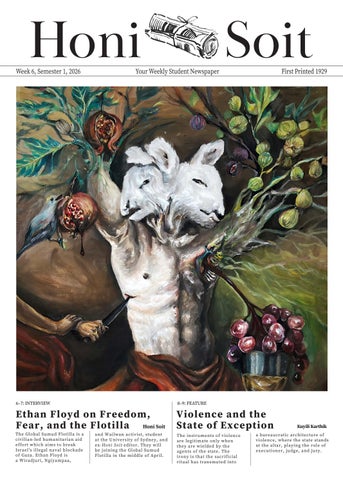
The Global Sumud Flotilla is a civilian-led humanitarian aid effort which aims to break Israel’s illegal naval blockade of Gaza. Ethan Floyd is a Wiradjuri, Ngiyampaa, and Wailwan activist, student at the University of Sydney, and ex- Honi Soit editor. They will be joining the Global Sumud Flotilla in the middle of April.
The instruments of violence are legitimate only when they are wielded by the agents of the state. The irony is that the sacrificial ritual has transmuted into a bureaucratic architecture of violence, where the state stands at the altar, playing the role of executioner, judge, and jury.
EDITOR-IN-CHIEF
Kuyili Karthik
EDITORS
Madison
Anastasia
James
Kuyili Karthik
Ramla
Kiah
Marc
Firdevs
Sebastien Tuzilovic
Ivy
Ananya
Belle
Sachin
Rosanna
Ting
Sebastien
Indigo
Sophie
James
Marc
Kiah
Wendy
Zoe
Suhani
Honi Soit publishes on stolen Gadigal land. Sovereignty was never ceded. The University of Sydney is a colonial institution that upholds Western knowledge as superior to First Nations knowledge systems. We reject this hierarchy.
As student journalists, we recognise that mainstream media has been complicit in silencing and misrepresenting Indigenous voices since invasion.
We commit to centring First Nations perspectives in our reporting, to challenging the colonial structures embedded in journalism, and to amplifying the voices of those resisting ongoing dispossession. We pay our respects to Elders past and present, and to all First Nations students and contributors.
Always was, and always will be Aboriginal land.

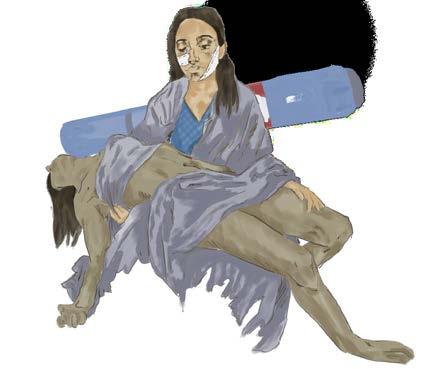


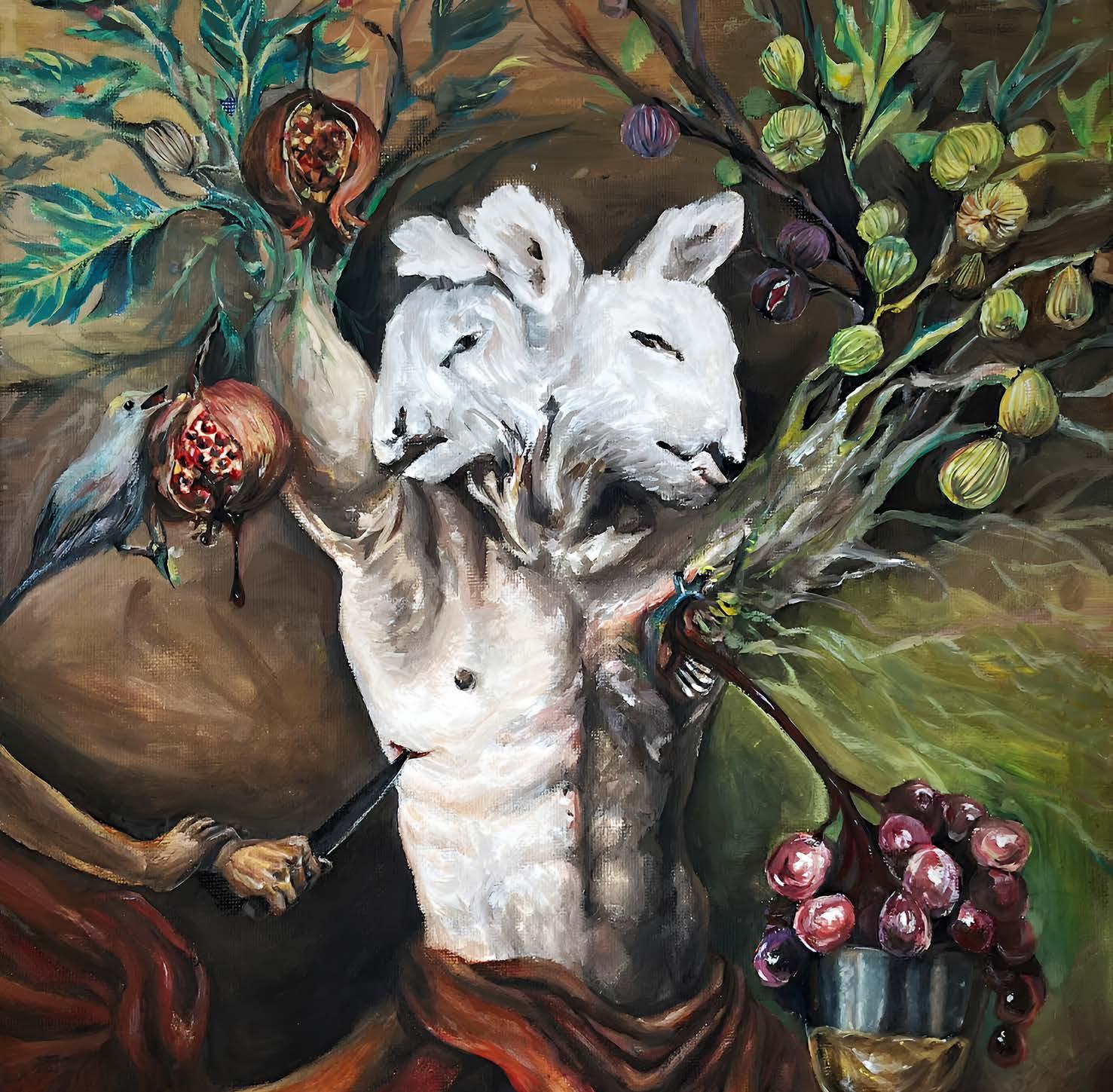
The cover is lovingly painted by Amber Wang, who spent an allnighter bringing her vision to life for this edition on the theme of sacrifice. Thank you Amber.
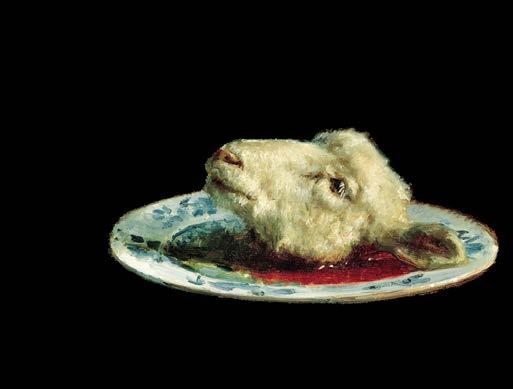
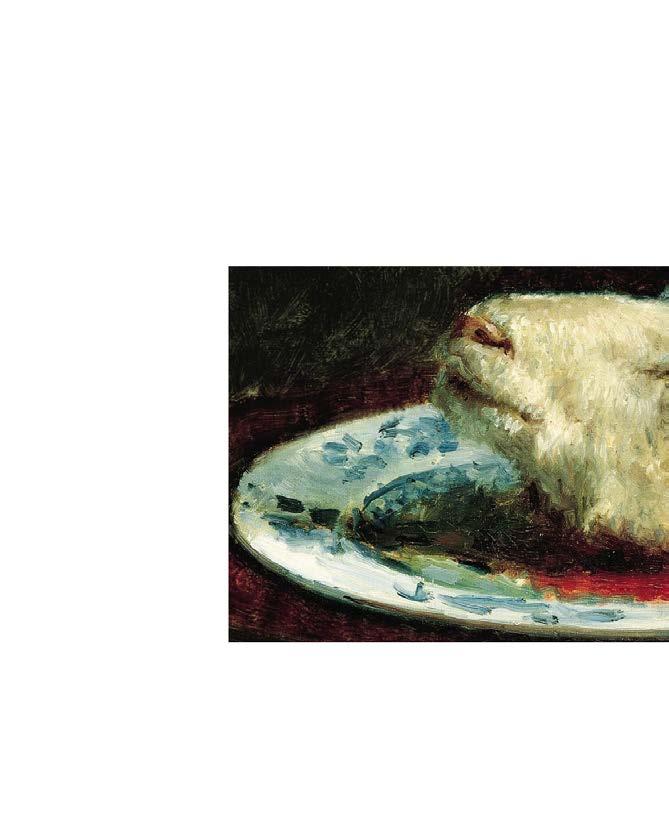
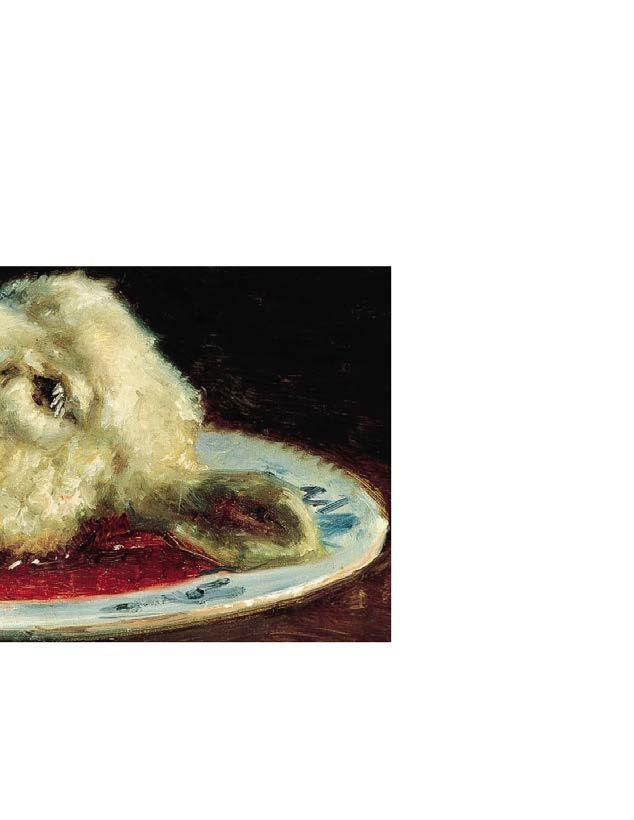
The two-headed lamb is a rare phenomenon. In many cultures, the birth of a two-headed animal is seen as the portent of calamity. This is because of sameness, of identical-ness between individuals breeding the potency for violence, according to René Girard in his book ‘Violence and the Sacred’. Flick to my feature to see what his complex analysis of ritual sacrifice means for our current scenario as protesters in NSW.

Girard’s book prompted me to think about how religion and
sacrifice has transmuted today. We think we are beyond religion and the institution of ritual sacrifice, but our pretences of progress seem to falter entirely. We think religion is an intolerance to uncertainty. But religion is really, even with all its dogma and scripture and moral commandments, a mystification.
Our bent towards rationality gives us false confidence. We don’t confer and humbly surrender our decision-making to supra-earthly powers of divine law, assuming responsibility for the creation of normative legal and political structures. However, this lack of humility makes us think we know more than we really do.
Maybe, we’re always the ones intolerant of uncertainty, reticent to admit unknowing.
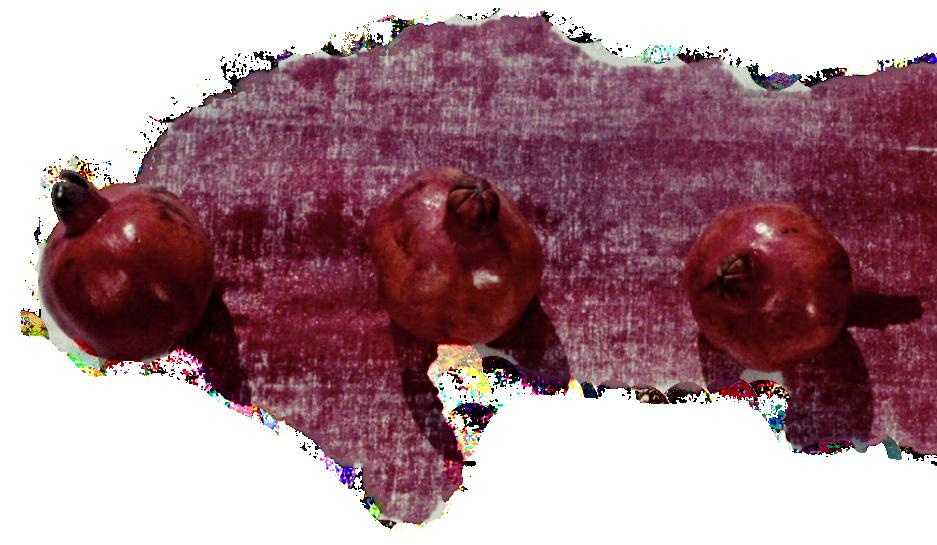
Amber Wang’s art includes motifs of bleeding, swollen, and ripe fruit which recalls wounding and the stigmata of the flesh. Recalling Caravaggio's painting of Abraham at the cusp of sacrificing Isaac, there is a hand wielding a blade to the flesh of the man-lamb. The art asks us to consider what flesh is bleeding out at what altars.
- Kuyili Karthik
M.F. says: Comment section discourse.
S says : Honi Soit.
B.I. says: Introduction to Property and Commercial Law (compiled by Scott Grattan and Sheelagh McCracken), Thomson Reuters, 2nd ed, 2017. ISBN: 9780455239217.
K.S says: I've been loving Substack! It's like really different from every other social media. I read diary entries written by 20-somethings who all


occupy pretty much the same homogenously privileged place in society and have self-proclaimed intellectual proclivities.
One radical essay that redifined my world view was one titled: "burnout is bad". I guess I just never guessed that capitalism could make me suffer.
A.N. says: Feminist Ryan Gosling: Feminist Theory (as Imagined) from Your Favorite Sensitive Movie Dude. When he said "Hey girl. Riots
Aries: Lighten up. You've had a rough week and can't blame it on a retrograde. Preserve your whimsy.
Taurus: Poser, as usual. Your shoes have never seen rougher terrain than the floors of the Ivy. Your Arcteryx has only seen cig ash.
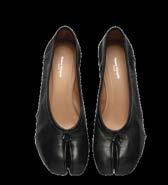
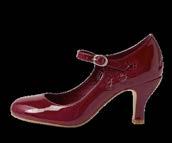
Gemini: Evil, but popular. Two-faced like the pronged toe-space of this ballet flat.


Cancer: You thrive in competitive environments, but your disposition is delicate as a flower petal. Do not bruise. Life is gliding.
Leo: Quentin Tarantino on coke, monologuing. I'll give you more credit than that, you're never boring.
not diets," that really tickled my pickle.
P.P says: I have an app that does 300-word AI summaries of classics. My favourite book/summary is War and Peace by ChatGPT. Did you know it was originally supposed to be called 'War, What is it Good For?'
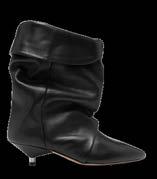
Virgo: Practical low heel, Isabel Marant engineered perfection. A bit of slouch, because you deserve a rest. A pointed heel for your acumen (sharp).
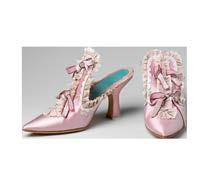


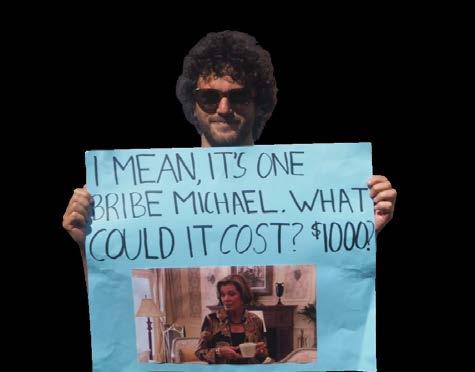
Libra: You think you're a reincarnation of Marie Antoinette. Carrie Bradshaw is probably a more realistic approximation.
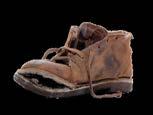
Scorpio: You wear these every day. They look rusty but they're sturdy. Everybody's talking at me, I can't hear a word they're saying... see Seinfeld Jon Voight episode
Sagittarius: You're preppy and elegant, deserving of a kitten heel and a dainty buckle.
Capricorn: Corporate shill but you went to art school and did a political economy minor. Ambiguous, like your consulting job desc.
Aquarius: You thrifted these and they fell apart the next day.

Pisces: "nothing's wrong with me!" No one is nearly as spontaneous and adventurous as you.
(UK), RL Grime (USA), A.M.C. feat. Phantom (UK), Crankdat (USA), Taiki Nulight (UK), ALLEYCVT (USA), Anaïs (UK) 6pm Sunday 5 April @ Hordern Pavilion

Two University of Sydney academics have had their posts removed from the university’s internal staff platform, Viva Engage (formerly Yammer), after raising concerns about the federal government’s proposed compulsory antisemitism training for university staff.
Nick Riemer, a senior lecturer in linguistics, and David Brophy, a senior lecturer in history, both had their posts removed by an anonymous moderator within minutes of publication earlier this week. The posts were made in the days following the university’s All Staff Town Hall, at which an anonymously submitted question about the proposed training received more than 100 upvotes, making it the most popular staff question on the day. The question asked why staff were required to complete a mandatory module on antisemitism, rather than a broader module on racism.
The training in question is part of a broader federal government plan spearheaded by Australia’s Special Envoy to Combat Antisemitism, Jillian Segal. The plan, published in July 2025, involves universities being assessed against an antisemitism “report card” with antisemitism training identified as a key area. The report card’s published standards specify that university training must provide staff with “an understanding of Jewish peoplehood, their attachment to Israel and identity beyond faith.” Riemer, who examined the plan in a February 16 article for Michael West Media, has argued this amounts to “compulsory training in the ideology of Zionism.”
Speaking to Honi Soit, Riemer said he made his first post after the Vice Chancellor’s response at the Town Hall indicated the university intended to proceed with the training. The post, titled “Compulsory antisemitism training coming to campus?”, linked to his Michael West Media article and included commentary questioning whether the training would be used to stigmatise pro-Palestinian views.
Riemer expressed his concern with the potential misuse of training that may be applied
in a way to stigmatise support for Palestine, stating “the overwhelming likelihood, given the politics of this, is that the training will be used to stigmatise supporters of Palestine.”
The post was removed within ten minutes. Riemer said he was not notified of the removal and only became aware of it when a colleague told him. He was told the post had been taken down under Section 7, Clause 5(g) of the Viva Engage Terms of Use, which covers “conduct that could be reasonably perceived as inflammatory or having the potential to incite others, including other users.”
Riemer then made a second post — a single sentence linking to “the top-rated question at yesterday’s Town Hall.” That post was also
Engage’s stated purposes.
“That was the entirety of my post: a simple notice of a topic of interest, with a link to thoughts penned elsewhere,” Brophy wrote. “I thought that would ensure that it could not possibly be censored. What grounds could there be?”
The post was subsequently removed. Brophy told Honi he received the same clause citations as Riemer.
“I completely reject the claim that my initial post, or the article I linked to, was inflammatory or inciting,” Brophy said. “The university is obliged by its own Charter of Freedom of Speech and Academic Freedom not to restrict my freedoms on the basis that my speech offends someone.

content, he had also acted contrary to Clause 11(5), which prohibits users from referencing deleted content in subsequent posts.
The moderator warned that his conduct “may be considered further by the delegate moderator and workplace relations,” and that “your continued access to the platform is contingent on your compliance with the terms of use.”
Brophy’s experience was similar. He posted a link to an article he had written in January for Overland literary journal, examining the federal government’s proposed antisemitism training. That post was taken down. In a follow-up post titled “Censored,” Brophy invoked the platform’s own terms of use in his defence, noting that Clause 4(2)(d) lists “discussing matters of University policy or matters relevant to the higher education community generally” as one of Viva
Marc Paniza reports.
“In Section 11(5), the university is stipulating that there can be no discussion of anything that is censored — i.e. that the censorship regime cannot be discussed,” he said. Brophy further criticised the rule, comparing it to ‘crude authoritarianism’, and said it could make it more difficult for people to understand when content had been removed and on what basis.
Riemer said the moderator’s identity remains unknown. “There’s no one who’s actually accountable for these decisions,” he said. “I’ve previously asked them who they are, and they’ve refused to say,” Riemer said the university’s moderation decisions appeared inconsistent with its Charter of Freedom of Speech and Academic Freedom and raised concerns that perspectives supporting Palestine may be restricted on the platform.
A University of Sydney spokesperson said the moderation team “apply the terms consistently, irrespective of any political view expressed,” and that posts are assessed by a moderation panel when flagged or reported.
removal of my post
both the Charter
Brophy’s reading of the charter is supported by the document itself. It explicitly states that the university’s duty to foster staff wellbeing “does not extend to a duty to protect any person from feeling offended or shocked or insulted by the lawful speech of another.”
Principle 5(4) further provides that “a person’s lawful speech on the University’s land or in connection with a University activity shall not constitute misconduct nor attract any penalty or other adverse action by reference only to its content.”
The spokesperson said the university considers “the wording of the particular post, the content of any linked content, any comments on the post, and concerns raised through the reporting function.” In linked articles, the spokesperson said there is no blanket ban on publishing links, but that the content of linked articles, including opinion pieces, is subject to the terms of use.
The removals are the latest in a series of free speech disputes at the university involving Brophy. Last year, the university ordered him to remove a Palestinian flag that had hung in his office window since late 2023, prompting a wave of student solidarity actions across campus. Riemer has since lodged a formal complaint with the university, alleging violation of his intellectual freedom and bullying.

Australian Broadcasting Corporation ( ABC ) staff members have begun a national 24-hour strike over disagreements in enterprise bargaining offers with management.
The public broadcaster’s management failed to offer a rise to staff commensurate with inflationary pressures. The Media Entertainment Arts Alliance (MEAA), and the Community and Public Service Union (CPSU), who represent the striking staff at the ABC , have raised concerns over both the casualisation of the workforce and of worker replacement by artificial intelligence.
Honi Soit was onsite when staff began their walkout at 11am. Staff walked out from the back door of the ABC building in Ultimo, Sydney. Similar walkouts were staged nationally. Many ABC flagship programs will not be shown over the duration of the strike, with 7.30, AM, PM and Radio National all to be paused over the next 24 hours. Affected programs will be replaced by programming from the
national broadcaster of the United Kingdom, the British Broadcasting Corporation ( BBC ).
Staff had been offered a pay rise of 10 per cent over three years, and a 3.5 per cent bump in the first year, with a 3.25 per cent rise in the following two years. The MEAA voiced concerns that the raise would not meet the interest rate of 3.8 per cent and therefore would represent a decrease of the real wages for ABC staff. Price and inflation pressures have also been exacerbated following the fuel crisis as a result of the unlawful and continued American attacks on Iran.
60 per cent of staff voted against the raise proposed by ABC management, and a majority of staff voted to take industrial action against management over the rise.
In the Sydney CBD ABC , other unionists gathered with banners to celebrate the walkout, and a barbecue gave out “strike sausages” to hungry journalists.
MEAA Chief Executive Erin Madeley told Honi that the “objective of the strike is
‘No Exchange with
to make sure management understands how serious the issues are that need to be resolved. We don’t want to be here. It’s been nine months of trying to get through to them about what the issues are, and you know, this is what we’re trying to achieve.”
Industrial action at ABC is also significant in light of the enterprise bargaining period between the National Tertiary Education Union (NTEU) and USyd management which began in March this year. As previous managing director of the ABC from 2006 to 2016, USyd Vice Chancellor Mark Scott will have a hand in USyd NTEU bargaining.
When asked about USyd’s enterprise bargaining period, Madeley said that “our solidarity is always with workers who are struggling to get respect and value in their workplace, and obviously with the importance of tertiary education in our society, we absolutely support any worker looking to get some reasonable basic improvements.”
In a statement sent to Honi , ABC
James Fitzgerald Sice and Sebastien Tuzilovic report.
managing director Hugh Marks stated that “there is a lot of noise. Much of it is inaccurate. Some of it is misinformation. My commitment to staff at the ABC is that my communications will always be accurate and honest.”
Marks also discussed the pay rate proposal: “ With the $1000 bonus, this offer is equivalent to a 4.4% increase in the first year based on the average ABC Enterprise Agreement (EA) employee salary of $112,000. This offer is currently above inflation. Future increases are also above the Reserve Bank’s inflation target. To suggest staff are going backwards with the current offer is not accurate.”
USyd’s study abroad fair
Students gathered at the University of Sydney Quad Lawns on Thursday, March 26th to protest the university’s Study Abroad Fair as they called on the university’s management to cut all exchange ties with Israeli universities.
The rally calling for ‘No Exchange with Apartheid’ coincided with the fair held on Eastern Avenue, where students were encouraged to apply for exchange programs with partner institutions overseas. The protest was held to argue that exchange partnerships with institutions such as the Technion-Israel Institute of Technology, the Hebrew University of Jerusalem, and Tel Aviv University “help to normalise apartheid and genocide,” and tie the university to those structures through academic collaboration.
The protest was chaired by student activist Angus
Dermody, who opened the rally. Speaking of the Israeli Institute of Technology, he said: “We send students to Technion, who developed the remotecontrolled D9 bulldozers used to destroy Palestinian homes in the West Bank… and we send students to Tel Aviv University. These universities are directly involved in the crimes that we have all seen Israel commit in Gaza, in the West Bank.”
Dermody told the crowd that “we have no business sending students on exchange there, or receiving students from those universities.” He maintained that these partnerships form “part of an attempt to normalise apartheid and genocide.” He also claimed the university was currently hosting Israeli exchange students, stating: “As Israel continues to escalate its attacks, USyd is hosting students from the universities which have enabled that.”
He criticised the university’s leadership, including ViceChancellor Mark Scott, for maintaining these ties despite constant student opposition. Referencing previous campaigns, Dermody said, “Two years ago, management had shamefully invited Tel Aviv University to have a stall on campus”, adding that “it was a student sit-in that forced them off campus.” He also pointed to the campaign that led to the University cutting ties with Bezalel Academy, saying that “it was a student campaign that led to USyd cutting ties.”
“We need to keep up that fight until every single one of the ties between USyd and Israel is cut”, he said.
A statement from SRC President Grace Street, that was read in her absence, expressed support for the protest and called for continued pressure on the university to end its partnerships.
Kiah Nanavati reports.
Student activist Serena Chen told the crowd that the issue of institutional passivity regarding the genocide was immediate and deeply embedded within the university’s structures. “This is not a distant issue, and it’s not a new issue”, she said. “We have Palestinian faculty and we have Palestinian students, our research is going towards the machinery that kills Palestinians.”
“This is not something happening far away, it is connected to what we do here,” she said.
Chen then framed the protest as a collective assertion of student power. “This is our university”, she continued. “We are the students, and we get to decide where our money goes and what our names are tied to.”
Read full article online.
Content warning: Discussions of war crimes, sexual violence, and torture.
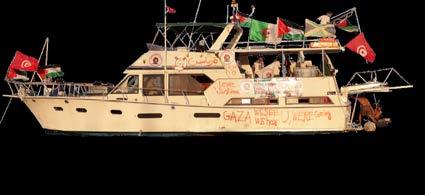
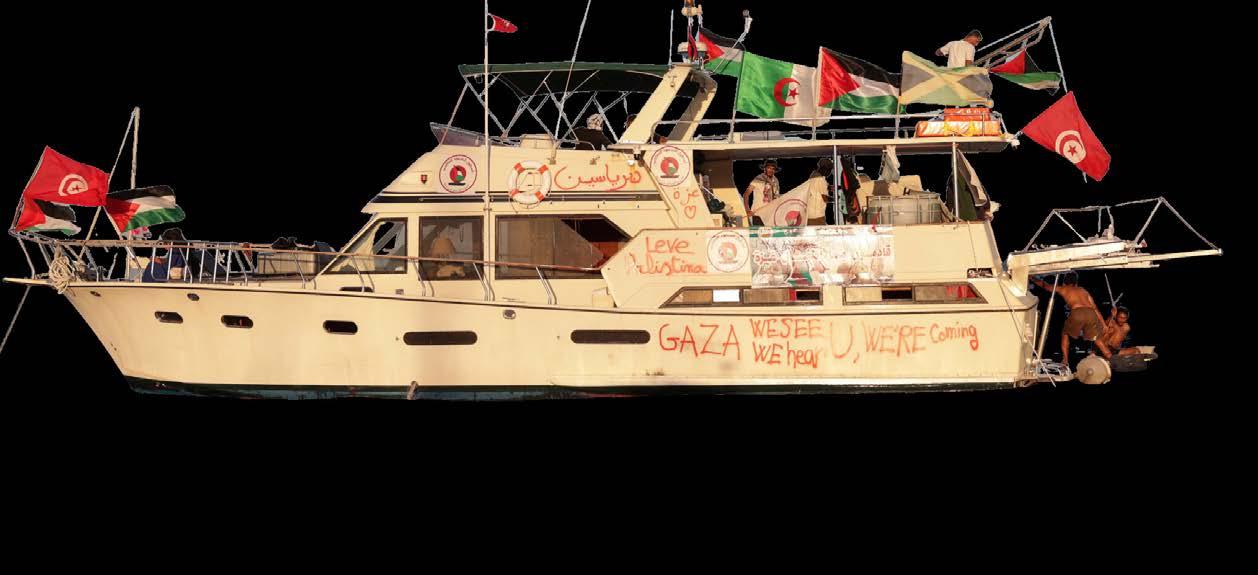
The Global Sumud Flotilla is a civilianled humanitarian aid effort which aims to break Israel’s illegal naval blockade of Gaza. The flotilla has five main goals: breaking Israel’s naval illegal blockage, delivering urgent aid to the people of Gaza, support reconstruction efforts of homes, schools, hospitals, and civil institutions, mobilising civil society to challenge complicit governments and institutions, and catalysing global people-powered action to aid where governments and institutions have failed.
Ethan Floyd is a Wiradjuri, Ngiyampaa, and Wailwan activist, student at the University of Sydney, and ex- Honi Soit editor. They will be joining the Global Sumud Flotilla in the middle of April. Floyd sat down with Honi to discuss the flotilla, shortly after the Students for Palestine flotilla fundraiser on the 27th of March.
Honi
Soit : How did the fundraiser for the flotilla go?
Ethan Floyd: It was huge. It was a really humbling experience. I’ve cried too much over the past 24 hours. We raised something like $2,500 as well, with the $600 subtracted, because the Uni blocked SRC funding for the event.
situation isn’t getting any better, it’s only getting worse, you feel a stronger pull to put your body on the line. The flotilla has a huge legacy, and it’s important to use the platform that you have.
There’s two main goals to the flotilla. One is to deliver aid to Gaza and to breach the blockade. But the other, and the more likely outcome of the flotilla, is to draw people’s eyes back to Gaza. The situation is getting worse, but all the headlines about the war in Iran and rising petrol prices are serving as a huge distraction from the genocide that’s ongoing in Gaza. The media is saying the war in Iran and petrol prices are affecting everyday Aussies more so than the genocide in Gaza. I’m not sure why the mainstream media cares more about petrol prices than dying children, but that’s
HS: Why did USyd management block that?
EF: There was some correspondence about SSAF fees going towards a contingent to bring students to the Herzog protest, Wollongong and WSU students getting a bus for that, as well. So management basically says, under certain sections, they claim that the expenditure is going towards a student who’s doing something in an individual capacity.
With the Freedom Rides, 60 years later, USyd is now making a scholarship about them, co-opting them after the fact, while also continuing to actively repress that same kind of activism. It’s nothing new, it’s nothing unusual, it’s not even particularly outrageous. It’s just what the university does, business as usual. We should fight it, but we’ve also got to organise around it.
HS: Why did you decide to join the flotilla?
EF: The easiest explanation is that for the past few years I’ve been doing things like speaking at rallies, organising in the student movement, we did the encampment, and high profile nonviolent direct action. But there comes a point where speaking out doesn’t feel like enough. When you continue to do sort of activism in your home country, and the
EF: The last flotilla was in September of ‘25 and like most people, I was watching what was going on. When the flotilla activists were detained and they were stuck in Israeli prison, there were two or three big marches and rallies in Sydney calling on the Department of Foreign Affairs and Trade [DFAT], and calling on Penny Wong to advocate for their release. We marched past the DFAT offices. I knew about the flotilla effort through that, and had known of historic flotillas, but hadn’t really formally engaged yet. I didn’t know the people and wasn’t involved in the coalitions.
When the Australian flotilla activists were released, it was in the second wave. It was Juliet [Lamont], Abu Bakr, Surya [McEwan] and Hamish [Paterson] from the MUA. They all were released in one go. They came along to a protest in October, one of the Palestine Action Group protests in Hyde Park. I was opening the speeches for that protest, and they were speaking. After that protest, I reached out to Juliet, and Surya reached out to me. I was reaching out to Juliet to say, hey, that was a fucking amazing speech. So I offered myself, asking how I could help from land. And then Surya was reaching out to me to say, actually, do you want to come on the next boat? So we decided, yeah, actually, it’s probably a better idea to go on a boat.
There is an application process, but beforehand you’re informally vetted by the activists involved. In the application they ask you for a skills matrix, and what you can do. Are you mechanically handy? Have you sailed before? Can you do any number of these things that are going to be useful in a flotilla, on a boat, and then they place you in a role. I’m a crew member. I spent a lot of my late teens doing mechanic work. So I’ll be doing patch repairs, refuelling, and helping the boat run. There’s spots delegated for participants who are sort of ‘the big faces’ to bring as much publicity as possible. For this delegation, from Australia we have Clementine Ford, the author, and Zack Schofield from Rising Tide.
HS: Knowing the treatment of past flotilla participants, how do you feel? Are you afraid?
You can’t not be. It’s not gotten this bad since, but in 2010 there were about nine flotilla participants who were murdered by Israeli soldiers. They were members of a Turkish delegation. So people have died on these flotillas. As recently as the last one, six months ago, people were beaten and subjected to physical violence and sexual violence. People had their passports destroyed. There’s a myriad of stories. The Israelis use torture techniques on the activists in detention. They use auditory torture. Noise nuisance, a loud speaker in your cell that blares someone speaking in Hebrew at a volume so loud it’s burst people’s eardrums.
When activists fell asleep, the Israeli guards would come in with dogs and just wake them up and then leave and not do anything, just to keep them awake. It’s torture, that’s what they’re authorised to do. The distinct impression that flotilla activists got the last time is that none of the Israeli guards have the authorisation to kill any flotilla activists. That’s not to say that they wouldn’t. There’s plenty of things the IDF does without direct authorisation.
If we’re intercepted at sea, we get taken on a boat to the Israeli port of Ashdod. From there, we are kept in a warehouse, put in stress positions. Last time, there were activists who had their hands zip tied behind their backs. They were told to kneel with their forehead to the concrete.
Read the full interview online. Honi Soit interviews.
Marc Paniza isn’t harmonious.

On March 21 this year, hundreds of people marched against racism through Sydney to the Opera House, marking the International Day for the Elimination of Racial Discrimination, a date established by the United Nations in 1966 commemorate the Sharpeville massacre, when South African police opened fire on unarmed anti-apartheid protesters and killed 69 people. In Australia, the day has a different name. In 1999, the Howard government rebranded it as “Harmony Day”, shifting the focus from confronting racial discrimination to celebrating ‘multicultural togetherness’ and ‘tolerance’. The march was, among other things, a refusal to accept the renaming and the consequent reframing.
The
renaming does more than misrepresent the reality of racism in Australia. It determines which conversations are and
aren’t allowed to happen. When the day is called “Harmony Day”, anyone who raises the ongoing reality of racial
discrimination is no longer participating in the national project, but disrupting it.
The original purpose of naming racial discrimination and committing to eliminating it is replaced by a framework that prescribes wearing orange, sharing food, and feeling good about how well everyone gets along.
The renaming does not just soften the message but reverses it entirely, turning a day of confrontation into a day of comfort. The Overton
window concept helps explain how this works. The Overton window describes the range of ideas and positions considered acceptable in mainstream public conversation at any given time, and it is not fixed. It can be shifted, and one of the most effective ways to shift it is to change the language people use to talk about an issue.
When the Howard government renamed the International Day for the Elimination of Racial Discrimination, it moved the Overton window on racism in Australia, so that talking about systemic racism went from being the explicit purpose of the day to being outside the boundaries of polite national conversation.
The new framing made “harmony” the centre of the discussion, which meant that anyone insisting on talking about discrimination was now positioned as extreme, divisive, or ungrateful, even though they were simply using the language the rest of the world still uses.
The “fair go” operates through the same mechanism. It is probably the most enduring phrase in Australian political language, and politicians on both sides have used it for decades to signal that they understand what the country is supposed to be about. It comes up in election campaigns, budget speeches, party platforms, and leadership contests with a regularity that suggests it is less a description of policy than a compulsory performance of national identity. The fair go says that this is a place where effort is rewarded, where everyone gets a reasonable chance, and that this is what makes Australia distinct.
The problem is not just that the fair go is inaccurate, though it clearly is for many people. Median rents in Sydney have risen sharply in recent years, homeownership is increasingly out of reach for younger Australians, and real wages have not kept pace with the cost of living. The deeper problem is what the phrase does to the Overton window. If the fair go is accepted as the baseline description of Australia, then the range of acceptable political positions narrows considerably.

Arguing that the system is structurally unfair, that housing is a policy failure rather than a personal one, or that wealth in this country is distributed along racial and class lines, all of this gets pushed to the margins. The phrase does not just fail to describe reality. It actively sets the boundaries of what counts as a reasonable thing to say about the country, and anything outside those boundaries gets treated as radical, disruptive, or ‘unaustralian’.
Harmony
Day and the fair go are two concepts that depend on each other. The fair go can only be credible if the country is understood as fundamentally harmonious, a place where people of all backgrounds get along and where the playing field is more or less level.
If you acknowledge the kind of systemic racism that the International Day for the Elimination of Racial Discrimination was designed to address, the fair go starts to collapse, because you cannot claim that everyone gets an equal chance in a society that is structurally organised against certain groups of people, that settlers and First Nations people can be equal on stolen land. This renaming of IDERD to Harmony Day is necessary to perpetuate a broader national story.
Donald Horne understood something about this when he wrote The Lucky Country in 1964. The phrase was meant as a criticism of a nation coasting on its natural resources rather than seriously thinking about its future, run by people who lacked curiosity and relied on other countries’ ideas. But the phrase was immediately stripped of its critical intent and turned into an empty, laudatory slogan, used for everything from tourism
campaigns to Australia Day speeches. What happened to Horne’s phrase is exactly what happened to the International Day for the Elimination of Racial Discrimination. Language meant to challenge Australia was absorbed and repurposed into selfcongratulation. The Overton window moved, and a critique became a celebration.
Maintaining these comfortable phrases requires something from the people they exclude. First Nations communities, migrants who do not experience the country as harmonious, renters and workers who have never experienced a fair go: all of these groups are asked to either accept the language and stay quiet about their experience, or challenge it and be treated as the problem. The hundreds who marched on March 21 chose the second option, thereby making visible what Harmony Day is designed to hide.
The cost of keeping these national phrases intact is borne daily by the people who live outside them, who are expected to feel a sense of belonging in a country whose own language has already decided they do not have a grievance worth hearing.
The question is whether we are willing to keep accepting phrases that were built to narrow the range of acceptable conversation rather than expand it. The fair go, Harmony Day, the lucky country: each one asks us to feel something warm about Australia and to stop there. What the March 21 protest demonstrated is that some people have decided to stop accepting the terms they have been given and to insist on the ones that were taken away.
Kuyili Karthik is sceptical.
René Girard claims, in his book Violence and the Sacred, that humanity has an appetite for violence. This violent impulse that Girard describes is visible in every interaction of the individual and the other. It’s catalysed and mediated by our encounters of ourselves and the world.
Girard argues that paradoxically, the only way to rid society and oneself of violence is to engage in it — as Frantz Fanon puts it, “violence is a cleansing force.”
To ensure that the latent and insatiable violent impulse does not consume and destroy everything, there must be a ‘stopper’— a substitute that halts and satiates violence. This stopper is the sacrificial victim, an innocent and blameless gratuitous substitute who is slaughtered in the rite of sacrifice. Without this stopper, violence would go unquenched. Without this stopper, who can satiate not just the violent appetite of the individual, but the collective, violence would spark a mimetic effect of unbridled, multiplying killings in a contagion. This, Girard says, is why ritual sacrifice was ‘necessary’.
Today we have abandoned the institution of ritual sacrifice. Altars of so-called ‘civilised’ societies are seemingly unbloodied. There is no unrest in the streets, the state says, due to policing measures and crackdowns on marginalised communities, no unrest — apart from the violence stirred by the presence and voices of protesters. The instruments of violence — guns, hands, L-RAD speakers, batons used to club the defenceless, surveillance and interrogation, coercion and encroachment on freedoms — are legitimate, and welcomed only when they are wielded by the agents of the state. The irony is that the sacrificial ritual has transmuted into a bureaucratic architecture of violence, where the state stands at the altar, playing the role of executioner, judge, and jury. The punishment of Gazans and Iranians, of protesters everywhere, is the neoliberal sacrificial act that functions as an exorcism of violence. The election of victims is specifically those who will not be defended by the global elite, and will not be avenged because the complete annihilation of kin in cases of genocide. This election of victims (the poor, the Global South, the othered) is made exclusively by the elite.
We are living in an age of human sacrifice.

The state does not simply sacrifice. They elect the victim deliberately. They do this by explicitly claiming the victim’s annihilation is necessary and that their annihilation was necessitated by their own evil actions, making them morally blameworthy. Blame is a blanket thrown over victims that condemns them to the status of a sacrificial target.
The modern rhetoric of terrorism functions as this blanketing. Gayatri Chakravorty Spivak spoke after 9/11 on the creation of the terrorist identity: beginning with the creation of an Other, an enemy, a foe. As the German philosopher, jurist, and later Nazi Party member Carl Schmitt said, the sovereign is the one who decides “the specific political distinction…between friend and enemy”. Habermas writes that this distinction is an essentially public one. We clamp down the borders of nations as well as the boundaries of our Selves. The terrorist is an ‘abstract enemy’, we do not dare imagine what the Other is with any specificities that would humanise the terrorist and strip the state of its justification for annihilation.
Definitions of terror as sociopolitical movements of organised violence and the emotional affect of fear blend together spectacularly in the lego-political arena. Think of the way the reasonable apprehension of fear operates as criteria for hate-group blacklisting in recently updated hate speech legislation. Think of responses to pro-Palestine protests, where allegations of antisemitism are weaponised and smeared against the movement. Protesters are branded as terror agents that cause fear in onlookers, with some apprehending fear because of their religious identity. Special envoy Jillian Segal’s comments following the Bondi terror attack are evidence of the creation of a narrative and fiction of the domestic terrorist as pro-Palestine protesters. The causal agent connecting pro-Palestine protests and the Bondi terror attacks was, according to Segal, the building up of ‘fear’. For Segal, fear is the glue connecting protests to the worst mass casualty in Australian history. As we know, however, terror exists only in its apprehension. Fear prompts the swift passing of legislation capable of banning, indiscriminately, rallies and protests for up to three months during periods marked with a ‘terrorism designation’.
The existence of terror aside, Spivak warns against the weaponisation of fear, which can be manipulated through socialisation and ideology to justify a broader war against anything objectionable to the sovereign’s project — slap terrorism on just about anything, and you can annihilate it. Create a fiction of the existence of potential WMDs, and you can flatten the land.
Spivak calls the war on terror “part
of an alibi every imperialism has given itself, a civilising mission carried to the extreme, as it always must be.”
The creation of such a menace to the state
Spivak claims we ignore the emotional angle of terrorism. When we consider terrorism as both sociopolitical and psychological, we cannot ignore “the most malign ingredient of racism”, the psychological aspect. We cannot let the emotional apprehension of fear simply slide “imperceptibly” into the abstract notion that there is a social movement with the name ‘terrorism’. We justify characterisations of terrorism with a circularity — we fear the enemy, the enemy is who we fear, and fear is accordingly grounds enough to warrant punishment.
ideologies. For example, the LTTE, the Liberation Tigers of the Tamil Eelam, are proscribed as terrorists by the Sri Lankan state. The militant group fought for Tamil self-determination in Sri Lanka, notably during the Civil War, when atrocities were perpetrated against the Tamil people in efforts described as ethnic cleansing and genocide by many. Sri Lanka’s Prevention of Terrorism Act (PTA) enables continuing persecution of Tamil people — mere membership of the LTTE is an offence, and suspects have been detained long-term, interrogated, tortured, and arbitrarily arrested based on their Tamil identity for years. During the 61st UN Human Rights Council Session, renewed calls were made to repeal the PTA, which has remained largely ineffective.
The rhetoric adopted by NSW Premier Chris Minns and the NSW police force positions protest as a threat to ‘social cohesion’. The othering of protesters positions their identity as terrorists, enemies, and foes, especially in the eyes of the general public. The agents or employees of an exceedingly militarised police state, trained on the dogma of warmongering, will accordingly jump at the chance to neutralise these threats to the state.
What
is engendered here is a ‘state of exception,’ which is a temporary state of government, declared by the sovereign, that suspends the constitutional rights of its people.
This sinister normalisation of the state of exception is what we are witnessing in real time: counter-terrorism efforts, justified as ‘exceptional’ and urgent, remain permanent encroachments.
the exception as it pertains to a Christian God finds its counterpart in Schmitt’s sovereign: the sovereign, like God, decides on the exception, the suspension of the norm. Kierkegaard uses the example of divine suspension of the ethical norm against murder when God commands Abraham to sacrifice his son, Isaac.
On this definition of the exception as a transgression of legal norms, an exception could be revolutionary and radical acts of protest that defy the torpor of oppression, legally enshrining civil rights that eventually become homogenised into the smoothened fabric of legality— transgression becomes normal in the cycle. The exception could also, more sinisterly, be the sovereign’s revocation of constitutional rights, an encroachment which also gets flattened into legal normality. The state of exception is not necessarily temporary.
The state of exception, establishing itself indelibly in the architecture of government, is what Giorgio Agamben argues in his book titled The State of Exception. He traces the concept of the state of exception to its historical dawnings as an état de siège, declared when an enemy is threatening the physical integrity of the people and the territorial integrity of the state. This exceptional time necessitates the sovereign to take immediate and extreme action. Sound familiar? Maybe Chris Minns was LARPing as this sovereign guy when he pushed those quite abnormally strict anti-protest laws on the justification that they were urgent. Maybe, as Agamben argues, Chris Minns actually is this sovereign guy— the sovereign and the state of exception have just mutated into bureaucratic normalcy. The state of exception used to be exceptional and intimately connected to the Empire’s ideal of border integrity. Now it is a normalised mechanism of government.
Simon Bronitt and Susan Donkin write in a paper analysing Australian responses to 9/11 that scholars have observed in Australia a “hybridisation of techniques of power” and “the blurring of police and military powers, and crime and war”. When crimes gain the characteristic of being foreign threats, the war-like state of exception breeds, suspending legal order. Bronitt and Donkin write that “although counter-terrorism powers are often presented as being temporary and conditional in nature, there is little evidence that powers are rescinded.” Sunset clauses and reviews of legislation are presented as safeguards against normalisation of emergency powers, but “have not led to major reversals”. This points to a concerning trend of normalisation of emergency powers in Australia.
The broad nature of ‘membership’ to a terrorist group raises issues for NSW’s recent legislation proscribing hate groups. The state of exception permits that the offence of terrorism can transcend normal judicial order, limiting provisions that ensure procedural fairness.
The normalisation of the state of exception in NSW has deepened with Public Assembly Restriction Declaration (PARD) restrictions on protests. Following the Bondi terror attack in 2025, NSW passed ‘extraordinary’ laws allowing for a PARD to be declared during periods of time branded with a terrorism designation. The PARD is currently subject to a constitutional challenge for infringing the right to political expression. The PARD is issued if “community safety” is at risk, or if public assemblies would “be likely to cause a reasonable person [...] to fear for the person’s safety.” Supreme Court Justice Hume said that the definition is relaxed from “causing harm” to “causing a person to fear harm.” Hume pointed out at a hearing that the PARD need not necessarily be in response to “a risk arising from the terrorist incident”, meaning that the restriction can apply fo reasons other than counter-terrorism.
Hume SC characterised peaceful assembly as the “oldest and most orthodox form of expression in a representative democracy”, emphasising that post-1978 Mardi Gras march protest protections were a recognition that banning protest only criminalises unregulated forms of protest that are accordingly met with police brutality.
NSW finds itself sharpening into draconian measures that echo modern totalitarianism, defined by Agamben as “the establishment, by means of the state of exception, of a legal civil war that allows for the physical elimination not only of political adversaries but of entire categories of citizens who for some reason cannot be integrated into the political system.” The NSW state of exception maligns its own citizens by labelling protesters as terrorists, suspending norms and constitutional order. The connection between the state of exception and martial law and siege express clearly: there is a war against not only terror but political protest in NSW.
We believe that stringent counterterrorism measures will purge our society of violent ills. However, counterterrorism measures, engendering a state of exception, sacrifice constitutional rights. NSW risks electing protesters as ‘sacrificial’ Others to scapegoat and blame for unrest, paradoxically exercising brutality as witnessed at the protest against Isaac Herzog on the 9th of February. Where does violence actually fall? Why, and for whom, are we suspending ethical norms? The exception cannot go uninterrogated.
Sophie Grant is concerned.
The emaciated frames and hollowed faces of celebrities walking the red carpets of the 2026 award season have been etched into my mind. It seems that the media’s faux endorsement of the bodypositivity movement has lost to the Ozempic wave breaking in Hollywood. Thin is in (but let’s be honest, it was never out).
Of course, this is nothing new. In the Western world, thinness has long been lauded as the beauty standard. Desirability is imbued with forces of power. In the 19th century, colonialists equated fatness to racist ideas of the “uncivilised” and lauded the athletic physique of Ancient Greece. Thinness became synonymous with virtue and Christian discipline. Being thin provides definitive social capital whilst isolating those who fall outside the white supremacist, able-bodied, and bourgeois confines of beauty.
‘Body fascism’ describes the political discourses embedded in physical ideals and the technological remedies offered. Shifting sociopolitical dynamics can be traced through trends of the body. In 2026, our approach to our physicality has become dystopian–pharmacological, optimised, and insistently promoted on social media.
The body, like many commodities in late-stage capitalism, follows a trend cycle that continues to intensify and accelerate. The ‘slim-thick’ aesthetics of the late 2010s were accompanied by the co-optation of African-American culture. Since then, the Western world has descended further into fascism, the Kardashians have white boyfriends again, and the familiar beauty standards of extreme thinness resurface.
Oscillating bodily trends are inherently inaccessible. The average person does not have a spare $10,000 AUD (minimum) to get a BBL, or the additional thousands to remove the fat deposits five years later and begin a weightloss drug subscription. We are left to deal with the consequences of cultural standards while red carpet goers are exalted. Having one’s skin taut around one’s collar bones now becomes a gaudy display of the
resources available to actively construct a celebrity physique. It is no coincidence that these standards are unattainableinsecurity remains a reliable (and profitable) constant, while the ideal is ever-changing.
Self-loathing is a money-making affair, after all. A month-long supply of Ozempic costs $1,000 US without health insurance. While Australia’s healthcare system reduces the cost to $200 AUD, it remains a luxurious addition in the current economic crisis. Pharmacological solutions to people’s insecurities have been highly advertised. In Australia, Novo Nordisk (the producer of weight-loss drug Wegovy) has bypassed the strict rules against advertising prescription medicine. The ads, published on social media, show a dispirited middle-aged man, shirtless after a swim, drinking a green juice. Layered across his body is a vague call to action: “Tried everything to lose weight? Talk to your doctor today.” There’s only a thin veil covering what that conversation should be about. Novo Nordisk has a significant interest in increasing sales of its drugs, especially since it halted insulin pen production to accommodate the mass production of weight-loss medication. Turns out chronic illness isn’t as profitable as perpetual societal shaming.
The rise of body fascism is a wholehearted push for us to abandon our corporeality and strive for perfection.
And it spans across the genders — body optimisation for all!
Online streamer Clavicular (real name Braden Peters) is the ‘looksmaxxing’ movement’s messiah. He began taking anabolic steroids at 14 and marketed bone-smashing to align one’s facial structure with a standard measurement eerily reminiscent of eugenics. Clavicular preaches to his audience of mostly teenage boys the importance of mogging (for those who aren’t chronically online, to mog someone is to physically outshine them). Clavicular does it all, seemingly, for the love of the mogging game, though I suspect his streams’ $100,000 monthly revenue helps.
Young girls have their own body-optimisation influencers who come together in the online community #SkinnyTok. The content is dehumanising and often lifted straight from 2010’s thinspo Tumblr. One of SkinnyTok’s repeated slogans is “You aren’t a dog, why do you need a treat?”, blatantly equating normal eating habits to an animalistic lack of control. One user provided some ‘skinny motivation’, by suggesting her viewers should “pretend that your life was being filmed today. Every bite, every decision broadcasted to the world… Are you going to let them see you devour that cupcake?”
While the absurdity of this rhetoric does induce a strong feeling to bang one’s head against a wall, it is also profoundly concerning. Social media algorithms know how to tap into insecurities, pushing content that stirs strong emotions. Any form of engagement (even just rewatching the video out of disbelief) will push more of the same. For someone on the precipice of an eating disorder, #SkinnyTok could be the final nudge.
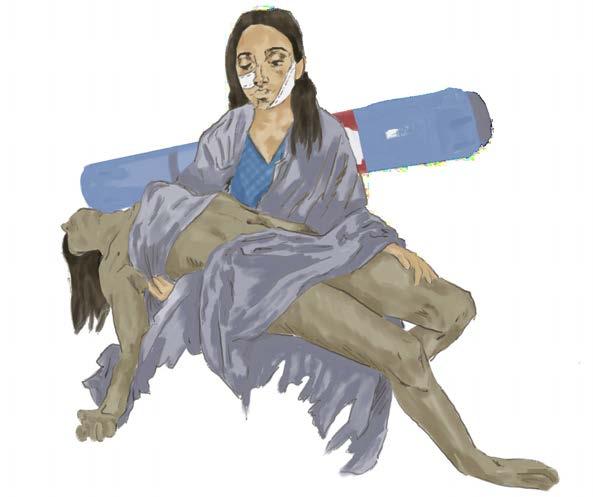
Artist: Zoe Chung
An amorphous authority figure is always watching as you eat, work out, or even just move around the world. Online rhetoric promoting disordered eating and body dysmorphia relies on Foucault’s idea of the internalised panopticon—there is always someone assessing whether you are being framemogged or watching while you eat the cupcake. We become
what Foucault would describe as ‘docile bodies’, disciplined and practised; easy to control and always willing to buy.
On an individual level, it consumes so much mental energy to starve yourself or obsessively count your macros or constantly feel nauseous from weight loss medication. It also fundamentally detracts from your experience as a human, from the joys of being embodied. The brutal asceticism advocated by these media figures will not benefit you. Your world grows greyer and crueller as Big Pharma rises on the ASX.
Ultimately, this techno-fascist conception of desirability reflects and fuels our cavernous culture. If the body is a site of socio-cultural discourse, the current trend in physical optimisation reveals the absolute preoccupation the 21st century has with facades. Our world is one of various smokescreens: populist politics, rationalising algorithms, online gambling and mind-numbing short-form content.
The human body is the final frontier. It is the vessel we experience the world in, feel emotions in and die
has
been
in. And it
reduced
to
yet another spectacle of the 2020s.
As a collective, it is a despondent cultural sacrifice to be so preoccupied with the self. The San Francisco tech bros will continue to run away from their mortality. Celebrities will continue to glorify their hyper-thinness. And, situations of gravity will continue to fade when matched against the West’s pervasive narcissism.
What is left is a callous vanity, epitomised by the bonesmashing Clavicular. When a viewer probed on live stream if he supports Palestine, Clavicular asked a question that is damningly illustrative of the absurd cognitive dissonance of our time: “Is Palestine going to help me mog?”
“Language… makes lies sound truthful and murder respectable.”
Australia’s mainstream media continues to uphold a status quo that enables state-sanctioned violence. They can report on shootings, bombings and violence, but drawing a link between those things and the systems that allow, or oftentimes perpetrate them, is not acceptable. We are told that we bask in the glory of democracy, and a perk we enjoy is free press, but is this the truth?
Since the 28th of February, Australia’s media outlets have ensured we care more about rising fuel costs than about the 150 Iranian schoolgirls killed by an American missile, or the fact that one in five people in Lebanon are displaced due to Israeli bombardment. This is clear in an ABC headline on the 1st of March: ‘More than 100 children dead in strike on Iranian girls’ school’. The use of ‘dead’ instead of killed absolves responsibility and marks human life as disposable. On the 28th of February, one of the ABC’s preliminary reports on the attacks on Iran used a comment from Israeli Defence Minister Israel Katz justifying the attack, creating a narrative that victimises Israel despite them committing an act of aggression against a sovereign nation, a clear violation of international law.
The news outlets most Aussies get their daily fix from have been near silent on the stark illegality of the US-Israeli strikes on Iran, preferring to stick to the IDF propaganda line that they were “preemptive” despite clear violations of the UN Charter. For mainstream media to deliberately evade the illegality of this action creates the false pretence of justification amongst
those who believe the news they are receiving is the truth.
An extraordinarily warped opinion article from the Australian Financial Review attempts to argue that Israel’s and the US’ attacks were legal, bringing in the UN principle of Responsibility to Protect (R2P), creating a smokescreen which obscures the necessary pillars that lead to military action being authorised under that principle. Despite this article being opinion and therefore being granted more generous leeway than traditional reporting, it does not simply focus on opinion but abandons fact altogether, framing the conflict in a dangerously misleading light.
Mainstream media relies on readers to unquestioningly absorb the information it provides, no questions asked. The ABC’s editorial policies state that it is committed to fundamental democratic principles, including the rule of law. The bias evident in their reporting on illegal strikes underscores the need to return to their commitment to telling the whole story. Other news outlets fail in this regard, too, with Nine choosing to report more on the plight of rich Australian expats in Dubai than the humanitarian consequences of the war on the people of Iran and Lebanon. The Sydney Morning Herald, reporting on the strike that caused the death of 150 schoolgirls, described it as “a military error” that “cast a shadow on the US military operation in Iran”.
To these media outlets, the deaths of children are simply a cast shadow.
This wording absolves responsibility for acts of statesanctioned violence and leaves
Indigo Grey reads between the lines.
the truth unreported. Media bias creates the belief that the deaths of innocents are simply an unavoidable tragedy for the greater good. This is where numbness sets in: when we fail to view the stripping of innocent lives from the face of the earth as a visceral crime, when we fail to be outraged by the thinly veiled reasoning given by despotic warmongers. The headlines create a warped narrative designed to leave readers ignorant while making them feel informed.
The US peddling lies about a quest for freedom and democracy in order to hide the true motivation behind their military action is tried and tested, with the “imminent nuclear threat” myth echoing the “weapons of mass destruction” story to justify invading Iraq in 2003. Australia’s mainstream media has latched onto this new half-hearted attempt at justification, just as they did in 2003.
Whilst regime change is essential
to liberate Iran from an oppressive theocracy, the wolf in sheep’s clothing that is the US-Israeli assault will not pave the path to peace.
The job of the media is to remain impartial to the propaganda fed from the Western war machine, a job currently not fulfilled by our mainstream media’s coverage.
The news fails to report the voices of Iranians concerned that the violence will not lead to democracy, or give any airtime to the widelyheld perspectives as to the
ulterior motives of the US and Israel. Furthermore, historical context is ignored: the long history of US-led foreign coups, namely the 1953 overthrow of democratically elected Iranian Prime Minister Mohammed Mossadegh and installation of the brutal pro-US and British Shah, who gave them extensive access to Iran’s plentiful oil resources. Little coverage is also given to Israeli Prime Minister Benjamin Netanyahu’s long history of claims dating back to 1992 that Iran is weeks or months away from developing nuclear weapons, which is the justification now used by Israel to steamroll Iran. If Netanyahu is to be believed, Iran has been weeks away from developing nuclear weapons for 34 years.
Mainstream media’s clear bias towards Zionist and military industrial complex interests has placed it firmly on the side of the oppressor.
The result is that the Australian people are desensitised to violence against brown people, particularly Muslims. Children and innocents become the scapegoats of a conflict that claims to liberate them, as people sit comfortably far away and absorb the news without confronting the actions of their governments, enabling brutality. A press that propagates the lies the state tells to manufacture consent for its illegal invasions and massacres is a press that has blood on its hands. Sitting at home, swallowing lies, and not taking a stand against statesanctioned massacre is itself a form of violence. Knowledge is power. Words are powerful. We must take the power back.
Kiah Nanavati medicates
There is a quiet, almost invisible burden that millions of women carry every month. It could be classified as the mere inconvenience of a period, or simply the pain accompanying it, but in truth, the burden encompasses a more the layered reality of navigating menstrual products, treatments, and medical advice that often feel underresearched, underfunded, and more importantly, unsafe.
Menstruation is a biological experience faced by an estimated 1.8 billion people each month,and they rely on a range of products such as tampons, pads, and menstrual cups, period underwear to prevent and manage leaks during periods. Despite this scale, menstrual health remains under-discussed as well as under-researched in both public health policy and scientific research.
Recent findings have added a new dimension to these concerns.
In one of the first studies to directly measure toxic metals in tampons, researchers have identified trace levels of arsenic, lead, and other metals. While the concentrations vary and do not mean there is immediate harm, it’s still unsettling to think that these kinds of substances could be present in something so necessary that it is meant to be used internally.
The vaginal canal is highly absorbent, meaning the severity of exposure consequences differs significantly from those associated with ingestion or skin contact. But the rules and research haven’t really kept up with this yet, and moreover, what’s concerning is that we still don’t know much about what long-term exposure might entail for women’s health with cumulative exposure over years of use.
Pads, that are often marketed as safer or more ‘natural’ alternatives, are not exempt from scrutiny. Investigations have pointed to the presence of Volatile Organic Compounds (VCOs), Phthalates, and synthetic fragrances. Some of these chemicals are known or suspected endocrine disruptors which are substances that can interfere with hormonal systems. Others could contribute to irritation or allergic reactions, particularly with prolonged use. However, unlike pharmaceuticals, menstrual products don’t always go through the same level of strict testing or clear ingredient disclosure, which means that consumers are often left without the full picture.
The issue here is not necessarily that all menstrual products are inherently dangerous, it is more that the scientific understanding of their prolonged safety is limited.
Women are unknowingly participating in an uncontrolled, decades-long exposure study without clear data, research or informed consent.
This pattern of limited research becomes even clearer with endometriosis, which affects about one in nine women and people assigned female at birth.
Despite its prevalence, endometriosis remains notoriously under-diagnosed. The approximate time to diagnosis is estimated to be between seven to ten years. During this period, many patients experience having their symptoms dismissed, normalised, or misattributed to stress or other conditions. This delay is dire for those who go through this painful condition and it also reflects a broader gap in medical education and awareness.
What is particularly alarming is the distribution of research
focus.
There are studies examining the psychological and relational impact of endometriosis on male partners, but somehow there remains a lack of definitive research into longstanding treatments that actually work for those living with the disease. Medical recommendations often point toward surgical interventions, such as laparoscopic excision, which may provide temporary relief, but the core question still remains debated: how often does the condition return?
Another widely known suggestion is hormonal therapy that may suppress symptoms but do not address the underlying drastic implementations, the most popular being birth control.
Hormonal birth control is often used to help manage symptoms. It can reduce pain, bleeding, and for many people, it makes a big difference. But it is by no means considered a perfect solution. Some studies point to it being a group 1 carcinogen which can increase the risk of certain cancers, like breast and cervical cancer.
The decision to use hormonal contraception becomes a balancing act between symptom relief and longterm risk, one that is often sadly navigated without full medical guidance or access to alternative therapies. For those who cannot tolerate hormonal birth control, the options to treat endometriosis become even more limited.
There is also the pain, the most immediate, and for many, the most overwhelming, aspect of menstruation and endometriosis.
Dysmenorrhea (painful periods) affects a significant proportion of people going through a period, but for those with conditions like endometriosis, the pain can be debilitating.
Several people who go through this condition are faced with burdens in their daily life that seep into their university or work life that is imperative for cultivating a brighter future. Worst of all, it takes a tremendous toll on mental health. Many experience severe mood fluctuations, heightened anxiety, and depressive symptoms that are linked to hormonal shifts. Conditions such as Premenstrual
Syndrome (PMS) and the more severe Premenstrual Dysphoric Disorder (PMDD) can intensify emotional distress, making everyday tasks or even functioning at a basic level, even more challenging.
The most common pain treatments are painkillers and ibuprofen, which helps by reducing inflammation and easing cramps, but come at a price: higher doses can cause stomach issues, bleeding, or affect kidney health. It doesn’t just end there, the paracetamol you take when you’re experiencing a headache deteriorates your liver health.
This exchange between relief and harm has become so normal that it barely raises an eyebrow anymore.
When these options are insufficient for women who struggle with extreme-levels of pain, stronger medications are most often prescribed, those being opioids or opiates. These drugs dull and subdue the pain by acting on the brain’s dopamine levels, but those using it sustained use can lead to dependence, withdrawal, and health risks.
So where does this leave us?
This affects more than just individual health, it also reflects bigger issues around research, funding, and whose experiences are taken seriously without being disregarded. Women have long been underrepresented in clinical trials, and conditions that affect them are overlooked and that in turn leaves major gaps in what we know and how we can go about treating them.
We need more investment in women’s health, better treatments for conditions like endometriosis, safer and more transparent menstrual products, and improved ways to manage pain. Stronger regulations and clearer information would also make a real difference.
We aren’t asking for a perfect solution, but simply ones that are properly studied, honestly explained, and genuinely built with their health in mind.
Community events are constantly being undermined and killed by commercialisation and integration within councils and corporate structures, and organisers must choose to sacrifice either community spirit or council funding for events to continue.
I went to the Ramadan night markets in Lakemba for the first time in 2022. Four years later, the markets are completely unrecognisable to me.
When I exited the station in 2022, turning onto Haldon Street, I almost couldn’t believe my eyes. The road was hidden by the mass of the crowd. Side streets were scenes of chaos and anarchy; cars double parked, parked on the sidewalk, or roaming anxiously for a miracle spot.
Smoke poured from the stalls, which danced along Haldon street’s footpaths in a wonky line. And the food? Shawarma roll for less than fifteen dollars, authentic kanafeh, warm sahlab, and my personal favorite: creamy Booza (Syrian-style ice cream).I fell in love with Lakemba and the Ramadan markets.
Why? The genuine, communal roots of it. The markets began in the early 2000s to celebrate and observe Ramadan, the ninth month of the Islamic calendar (Hijri) for which observant Muslims fast from dawn to sunset in order to increase taqwa, or closeness to God.
It began as a simple street BBQ, where Muslims would come to eat before and after their prayers. It grew steadily each passing Ramadan. With the growth, the council became steadily more involved, yet for a few years it remained in the hands of those who created it, with a vibrant atmosphere of community and connection that was still present in 2022.
It was certainly not the level of organisation, ‘safety’, or ‘neatness’ of the event that immersed me and many others. If anything, the market’s free and unrestricted approach earned it the charming character that draws thousands
of people to the area. But this is all changing.
Initially, the CanterburyBankstown council intervened with a limited scope, closing Haldon street and surrounding roads and offering traffic control and rubbish collection, under the justification that it was facilitating a smoother experience for stall owners and consumers. In 2014, they required stalls to license themselves with the council to ensure health and safety requirements, but maintained a distance.
Since 2017 however, the markets have been controlled exclusively by the council, in what can only described as a slow but sure hijacking of a once grassroots, community event.
Last
year the council decided to rebrand the markets from ‘Ramadan Nights, Lakemba’ to ‘Lakemba
Nights’, signalling a clear desire to move away from the origins and craft a space that is more appealing to non-Muslim visitors.
Following community criticism over this decision, Ramadan was added back to the name. Despite reversing the decision to remove the word Ramadan from the name of the event, only 30% of total visitors are Muslim. The point here is not that only Muslims or local residents should be able to enjoy the markets.
The markets are no longer a reflection of the community that holds them.
In a further encroachment, the council redesigned the stalls to be in the middle of the road, not on the footpaths
they traditionally inhabited, and increased the cost to host a stall, pushing local small businesses and stalls out.
The council has effectively ripped up the roots of the Ramadan markets.
Similar to the gentrification of suburbs, the council has commercialised the event to make it more palatable to nonresidents and non-Muslims. In a great irony, this astroturfing has reduced the meaning and feel of the markets, dwindling the ethos of what attracted people initially.
One must also consider this erasure in lieu with the collective trauma of the Muslim and Arab communities in Australia in recent, with a rise in anti-Islam and antiimmigrant sentiments in media and politics.
There have even been reports of racist behaviour at the night markets, mocking stall-holder’s accents and hurling abuse at locals. It begs the question: who are the markets for, now that they have lost their roots?
The Lakemba night markets are not the only victim of co-option by council and corporate. The first Mardi-Gras of 1978 was a gay solidarity march and celebration that was attacked by police in scenes of brutality and hate.
Now the annual parade is run by a company that allows the very police force that attacked the 78ers to march in ‘pride’. Indeed, the organisers faced backlash in 2011 for removing the words ‘Gay and Lesbian’ from the festival’s title, a controversy not dissimilar from Canterbury-Bankstown council’s bid to strip Ramadan from the night markets.
Mardi Gras was reorganised into a corporate structure following its previous bankruptcy under a grassroots organisation structure in 2002. The corporatisation of Mardi Gras has left behind those who the movement was made to protect in favour of profit and public appeal. Infamously
Iris Brown critiques
this year, Pride in Protest, an activist collective dedicated to championing queer rights was expelled from the parade because of their perceived unfavourable political opinions, whilst the Liberal Party and NSW Police were provided a safe spot despite their history of anti-LGBTQI+ politics.
It’s little wonder when Mardi Gras officially partners with the NSW government to ensure the event goes ahead; the parade then must be reduced and resized to be politically digestible to the public.
It has morphed to become a feel good event rather than a demonstration for equality and pointing out social and political discrimination. The Board voted down motions from Pride and Protest in January, calling for anti-trans discrimination and trans rights to be centre in this year’s parade.
It begs the question as to why there is a Board and CEO? And how can Mardi Gras effectively challenge the political and social status quo concerning LGBTQIA+ through such bureaucratic structures? The answers seem to be that it can’t.
Grassroots movements and events need to maintain independence from big corporations and all forms of government, which slowly but surely rip out their roots until the plant is dead.
Belle Padjan wants to be a rockstar.
The pop genre has been built upon the concept of the female spectacle: an exaggeration of the female form, bolstered by a distinct persona, heightened theatrics, and a semblance of talent. The music industry and pop audiences elevate white, thin, and conventionally attractive women who demonstrate a willingness to become a commodified pop spectacle. The nuances of womanhood must be sacrificed to perform this linear, identifiable, and commercial form of ‘woman’, to ensure acceptance and consumption by a wide audience.
This cultural conditioning channels women into pop music, a genre that disproportionately rewards them, reinforcing the notion that pop is their only acceptable domain. For male pop stars, these requirements do not exist, as their music and personality alone do the heavy lifting. Women must constantly reinvent themselves every album cycle to prove that they have the right to stand in the spotlight. If an artist chooses to refuse the system, they face ostracism and obscurity. Yet, even then, success is not guaranteed.
Pop stardom is a lose-lose scenario;
women
must
concede to industry requirements, give
up what makes them unique, and become the spectacle just to vie for success.
From scathing critiques of their music to intrusions into private lives, the discourse that pop music prompts is always womencentric, and therefore, the image of pop becomes feminised. This overexposure to the public centres the “pop star” spectacle — often online — while the music they make remains statistically underrepresented. Dazed magazine described 2024 as “the year of the pop femininomenon” due to femaleled cultural moments dominating the media landscape. Yet, women only made up only 40% of songs on Billboard’s end of year “100 Best Performing Singles” chart, and only 32% of all Grammy nominees. The pop star’s image is widely disseminated, while the music is not. Consider Erving Goffman’s concept of frame analysis: Pop is associated with femininity due to the overexposure of the female spectacle, tethering women indefinitely to their outward facade. Pop music does not solely consist of women; it’s sold to us that way. The sacrifice of the self in pop music isn’t a choice.
In comparison, consider the male spectacle, the “Rock Star” is an egotistical figure, imbued with a sense of superiority and influence, expected to be chaotic, disruptive, and volatile. Take Mick Jagger, Axl Rose, and Liam and Noel Gallahager, men who from the 1970s to the 1990s perform a spectacle to mass acclaim. Pop stardom does not allow any of that for women, rather, it tightens the reins on what femininity is and looks like. This prompts cultural repetition from rising stars, intentionally and strategically following
a past success story to secure a positive cultural positioning. Take Addison Rae’s quick transition from TikTok star to Pop ingénue, all due to her unashamed cultural referencing. Visually and sonically, Rae weaves her influences inescapably into her art, carving out a new identity for herself by identifying with previous pop icons. Notably embodying Britney Spears’ look and performance in the High Fashion video and donning The Fame era Lady Gaga sunglasses and a platinum-blonde wig in Fame Is a Gun , Rae leaves no confusion about what success she is trying to emulate. Rae’s success with this spectacle play speaks not only to the cultural stagnation of the 2020s, but to the craving for familiarity of consumers. The referencing that catapulted Rae’s image only a year ago is now an issue for her image. Rae’s recent stage outfits have promoted backlash online for heavily resembling what Britney Spears wore on her 2004 “The Onyx Hotel” tour. What she was once considered a witty interpolation is now seen as a tribute, or a rip-off. Rae’s sacrifice to the spectacle has now become so transparent that the audience feels what was once authentic referencing is a bastardisation of a cultural legacy. If Addison changes her current image, she risks alienating and losing her initial audience; if she doesn’t, she faces ostracism and obscurity.
authenticity is overpowered by spectacle, and Larsson has been rewarded for changing herself into what the people want. The question is then, like for Rae, what happens when this schtick dies? Where is the pop star left when the spectacle loses its sparkle?
Alternatively, take the recent reappearance of Zara Larsson in the conversation of pop stardom. For an artist with an incredible vocal range and dance ability, she spent almost 10 years in obscurity, not achieving the distinct, singular identity of her contemporaries. It was only when she absorbed the image and identity crafted for her by the virality of her verse in Clean Bandit’s Symphony , via online memes, that she re-entered popular consciousness. Prior to the summery, Lisa Frank-esque aestheticised “Symphony Dolphin” meme that flooded social media, there was no Zara Larsson: the image or brand, so nothing to profit off of. The last impression the wide pop audience had of her was from the radio dominance her songs Lush Life , Never Forget You , and It Ain’t My Fault had in 2017.
Despite her clear talent, Larsson was unable to achieve success due to her lack of spectacle and distinctive sound. Now, having absorbed an iteration of herself crafted by the people and selling it back to them, an image that has obvious cultural cachet, Larsson has an audience interested in her spectacle. Without this unprecedented virality, the progression of Larsson’s career would’ve continued to be on the outskirts of popular consciousness. There is something to be said about completely absorbing an identity crafted for you by your spectators, as without doing this, the possibility of Larsson’s fifth album, Midnight Sun , existing is slim. Yet, is this authentic? Is this identity and image true to Zara Larsson, the person? The way in which pop audiences have responded to Larsson’s new identity proves that
Chappell Roan might be the clearest example we have of a star quickly falling in and out of public favour. Roan, known for her unorthodox and rapid rise to superstardom, has faced backlash for several things in her young career. Most recently, during an incident with paparazzi in Paris, Roan was mocked online for filming the photographers back, rather than just permitting their harassment. In an odd, misogynistic post to “X”, 80s New-Wave singer Boy George chimed in to call for Roan to “cheer up”, and that “boundaries are boring”. This is the expectation for pop stars, like a toy or a circus act; if enough interest and money have been vested in their career by the industry or by the audience, they must always perform for them happily. It is clear that public patience for Roan’s resistance to traditional celebrity is wearing thin, being evidence that audiences only tolerate so much deviation from the regimented Pop frame, and will easily retract their support. The spectacle loses its effect each time she bites the hand that feeds, refusing to conform to the hegemonic idea of pop-stardom. Jokes have already circulated online that she is next to be committed to the Khia Asylum.
Roan’s predicament proves once again that talent is just not enough. Performance has been fed to us time and time again as a right, as what we get in return for investing in an artist. From pandering on social media to keeping up the facade when accosted in public, the upkeep of this image can never die, or else audience interest and record label investment dies too. Take Halsey’s shift from indie-pop to alternative: she went from being a chart staple to having her creative endeavours restricted by her record label in only a few years. Yet this is a double-edged sword: if you spend too long as a success, you’ll be asked to step back and share your success with newcomers, as Taylor Swift has been.
Women prevail in pop more than in any other genre by design, while women in rock, metal, and rap struggle for relevance and legitimacy amongst their male counterparts and face tokenism. We must recognise that we’ve been pacified by the female spectacle and that the “pop star” is a destructive model. Women are forced to sacrifice their sense of self, their health, privacy, and well-being for regimented and impossible expectations of femininity — all of which does not guarantee them success or lasting relevance. In these volatile times, where everyday women face increased prejudice and an unstable future of healthcare, if we stop considering music as a product and treating female artists as disposable circus acts, the better off we all will be. You are not owed anything from women for your patronage of their art.
Ananya Thirumalai is complicating lunch
I keep seeing headlines warning that generative AI is draining the planet’s water, each one framed as another sign that technological progress is quietly accelerating environmental collapse. The concern is not baseless: data centres do consume significant resources, but I find myself wondering why this particular cost feels so urgent when others barely register as controversial.
Agriculture accounts for roughly seventy percent of global freshwater withdrawals, with a large share directed toward livestock rather than crops grown for direct human consumption. Around four billion people already experience severe water scarcity each year, a crisis shaped far more by global food systems than by chatbots. I am less concerned with defending generative AI than with what happens when our ethical discomfort is directed toward technologies we can easily distance ourselves from.
Is it simpler to criticise consumption habits that aren’t as socially protected and societally ingrained? Does it feel easier to critique AI because it does not ask anything personal of us?When conversations about environmental responsibility shift toward AI, it is often suggested that technological consumption is uniquely excessive, as though environmental harm begins the moment something feels innovative.
Yet dietary choices remain one of the most significant drivers of individual water use.
Producing one kilogram of beef requires approximately 15,000 litres of water, and livestock occupies around 77 percent of global agricultural land, while providing only 18 percent of global calories.
I find myself noticing how easily critique is directed toward technologies framed as optional, while consumption practices tied to tradition are treated as fixed rather than open to change. Even in left-leaning spaces that emphasise structural injustice, conversations about veganism are often quietly deferred, as though challenging dietary norms risks disrupting a fragile consensus about what kinds of change are considered reasonable.
One argument I encounter frequently is the appeal to Indigenous tradition as a justification for continued meat consumption, as though subsistence hunting and industrial livestock production exist within the same moral and material conditions. This comparison obscures the difference between relational food practices grounded in reciprocity with land, and highly extractive supply chains structured by profit and scale. Industrial cattle ranching remains the largest driver of deforestation in the
Amazon, contributing to biodiversity loss and land dispossession that disproportionately affect Indigenous communities whose livelihoods depend on stable ecosystems.
The IPCC report has also identified agricultural expansion for livestock feed and grazing as a significant driver of landuse change that threatens Indigenous land security. Indigenous food sovereignty frameworks emphasise responsibility and continuity of ecological relationships, not the large-scale commodification of animals for global markets. When Indigenous practices are invoked to defend industrial meat consumption, the comparison begins to feel less like solidarity, but more like a convenient way to avoid confronting the scale of harm embedded in contemporary food systems.
Any conversation about veganism within South Asia has to contend with the fact that food has never been only about nutrition, but also about hierarchy.
Upper-caste vegetarianism has historically functioned as a marker of purity that reinforces social exclusion, with dietary rules used to construct moral distinctions that position Dalit communities as impure, while relying on their labour in leather work, sanitation, and animal processing.
Dalit scholars have long criticised forms of vegetarian advocacy that ignore how caste privilege shapes the ability to treat food as an ethical choice rather than an economic necessity. At the same time, emerging Dalit vegan perspectives draw attention to the ways industrial meat production continues to rely on dangerous, stigmatised labour that is disproportionately performed by socially marginalised workers in poorly regulated environments.
For me, this makes it impossible to treat veganism as a simple moral identity.
A politics of food that ignores caste and labour risks reproducing the same hierarchies it claims to challenge, even when it frames itself as progressive.I do not believe individual boycotts alone can dismantle industrial food systems, particularly when those systems employ millions of workers whose livelihoods are shaped far more by economic constraint than by personal preference. The global meat industry provides employment for hundreds of millions of people across sectors like: farming, processing, transport, and retail, often in regions where alternative forms of
stable employment are limited. Framing ethical consumption as a purely individual responsibility allows governments and corporations to avoid confronting the policy decisions that make animal products artificially cheap and widely accessible.
A transition toward more sustainable food systems must include policy reform, investment in alternative protein industries, and protections for workers whose economic security is currently tied to livestock production. Otherwise, dietary change risks becoming an aesthetic of ethics.
Generative AI produces significant social harms that deserve serious scrutiny, including the reproduction of racial and gender bias embedded in training data, the exploitation of low paid data annotation workers, the erosion of creative labour protections, the spread of misinformation, and the increasing concentration of power in a small number of technology corporations.
These concerns are real, and they are part of a broader conversation about how new technologies can intensify existing inequalities rather than disrupt them.
At the same time, the scale of resource use associated with livestock agriculture remains vast, even as it is treated as socially neutral rather than environmentally urgent. Confronting meat consumption is uncomfortable because it requires changes that are personal as well as political; yet discomfort alone cannot determine the boundaries of ethical responsibility. If this line of reasoning feels confronting, are you uncomfortable with the argument, or with what the argument might require you to change?
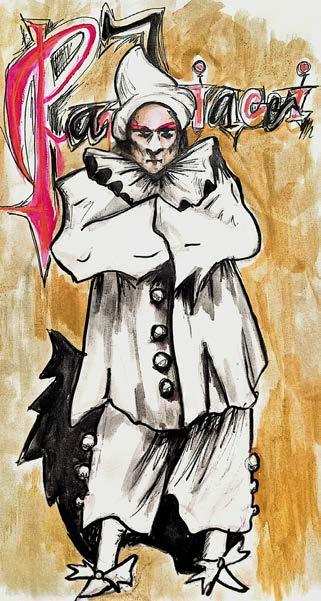
On March 12, the official White House Instagram and YouTube accounts posted a 30-second clip captioned “STRIKE.” Angry, AI-animated bowling pins labelled ‘Iranian regime officials’ with assault rifles hold up a sign reading “WE WON’T STOP MAKING NUCLEAR WEAPONS!”.
Seconds after they’re blasted by an animated fighter jet, the reel cuts to real strike footage of the US on Iran, all to the ripping chords of Free Bird’s guitar solo.
Offensive bowling animations, Grand Theft Auto, SpongeBob, Lego and Nintendo Wii were just a few soldiers of the meme legion deployed by both the US and Iran in this highly digitised conflict. Seeing this for the first time, I had to laugh, because if I didn’t, I would cry. Amazement and disbelief dampened my critical thinking and my grievous outrage. To this new
propaganda machine, I am a victim.
In many ways, though, making jokes is the oldest coping mechanism in the book. Employing humour and entertainment to normalise violations has been by design since the archetypal medieval jester. Historically, jesters were used by rulers as psychological weapons of distraction and as a barometer of public sentiment, helping them decide the best course of conduct based on how willing the public was to laugh away half-veiled truths.
Memes were originally a form of anarchic knowledge-sharing and collective meaningmaking by grassroots communities, but they have been co-opted into government kits as tools for mainstream political advertising. For our generation, memes have never been just entertainment. They’re central to how we form beliefs about the world, which makes them inherently political. In the US, Dark Brandon, Pizzagate, and Pepe the Frog as a transnational far-right symbols. In Australia, Albo thirst traps, ALP Italian brainrot, Liberal diss tracks. For many students, this type of content is the only political messaging they encounter across entire campaigns.
Create the anxiety, then offer the joke as relief. A public trained to seek comfort in humour can always be managed. The sad clown paradox is the name for the phenomenon of using humour to mask
Dominic Perrottet and wife Helen are expecting their 8th baby
Former Liberal premier Dominic, best known for his iconic clear glasses and apologetic Nazi uniform ‘fancy dress’, celebrates the announcement of his eighth baby along with his wife Helen.
Although Perrottet has dutifully made great contributions to our Catholic population, Liberals aren’t in the clear yet. Far from it. Following the same script we’ve heard since their landslide defeat, the Liberal Party might fumble votes once again, this time to the Americans.
Rumour has it that the Perrottet’s latest baby boy might be born American after the former premier took up a role as vice president of BHP in Washington DC. This question of allegiance to American fossil fuels comes right as Prime Minister Anthony Albanese and Senator Penny Wong announce their support for US strikes on Iranian nuclear weapons facilities and its subsequent disruption on the world fuel economy.
In a statement Albanese told journalists at midday Saturday, that his government has “done what we have been asked to do,” when addressing Trump’s accusation that Australia has failed to give support in the US-Israel conflict with Iran. Albanese’ response to the conflict will undoubtedly cause him a plunge in polling popularity,
snowballing with his unpopular handling of the Bondi terror attacks.
Although this may be the best headstart the Liberals have seen since their implosive Dutton-defeat, newly appointed Liberal Leader Angus Taylor, faces the onslaught of One Nation’s emboldened nationalists [link to Antony’s Green’s analysis]. It’s no wonder Perrottet jumped ship when he did.
The big question is, will Perrottet be able to remember his new son’s name in a line-up? It’s been a hot minute since Perrottet hit headlines after he was asked to name all seven of his kids in the 2023 pre-election debate against Labor’s Chris Minns.
In hindsight we should’ve seen the election results coming, particularly after the former Liberal earnt a quip from one of their biggest supporters, Sky News. Their host Paul Murray mentioned that he doesn’t know if NSW Premier Dominic Perrottet naming all seven of his children is an ‘achievement’. This can be found particularly true as Perrottet has had rigorous training in the name-remembering department being the third child in a family of thirteen kids.
Ting Jen Kuo isn’t laughing anymore.
something unbearable. But we pay dearly to that reflex when it becomes the dominant mode through which we consume politics. When packaged as entertainment, our role shifts from citizen to consumer –consumers don’t organise or protest, they react, share, scroll and move on.
In the age of AI slop, bot factories and gamified governance, we are more aware of this shift than ever. What’s scariest to me is that seeking ease and peace of mind in a laugh at current affairs is no longer accidental. It signals a willing sacrifice of our discernment and our empathy for a bit of relief and a bit of normalising moral decay. The easy response is to say it’s not that deep, that humour is just how we cope. But that framing is exactly what makes the strategy work. We risk mistaking our need to detach for resilience when, in reality, it may just be a reluctance to confront the fact that our governments are killing people and turning it into content.
The jester’s license has always come at a price: the permission to be taken seriously, surrendered in exchange for the laugh. Next time you share a political meme or laugh at a roast, linger a while before you scroll and look at a post in the eye. Ask yourself what you found funny, and what you let slide because of it. The court is counting on you not to notice the difference.
Rosanna Chim is optimistic.

But then again it’s rare to meet any man able to remember their kid’s birthday so maybe we should all lay off good ol’ Dom.
Let’s hope for the Liberals’ sake that the latest Perrottet opts for dual citizenship.
The boy cackled as he was placed in the bath tub. His pink skin against the white plastic looked animalistic. She twisted his soft rolls with her gaunt hands.
“Good boy.” She poured water on his scalp.
The tub sat on the kitchen counter next to the sink. It was all lino renovated eighteen months ago, before the baby. On the corner of the shelves little bits had started to peel off.
The splashes of the little boy echoed through the empty house. She pushed her son down into the water and felt the weakness of his flesh. He stopped laughing and looked up at her. She let go and his body rose back to the surface.
“This water is cold,” she murmured.
She picked up the boy by the ankle dangling him above the tub. He was silent, looking up at her, crown slightly dipped in the water. She put him back down. He clapped his hands in the water. She walked over to the stove and put on the kettle. She was reminded of a memory she had forgotten a long time ago. Two girls putting tea bags straight into the kettle. It made her sad.
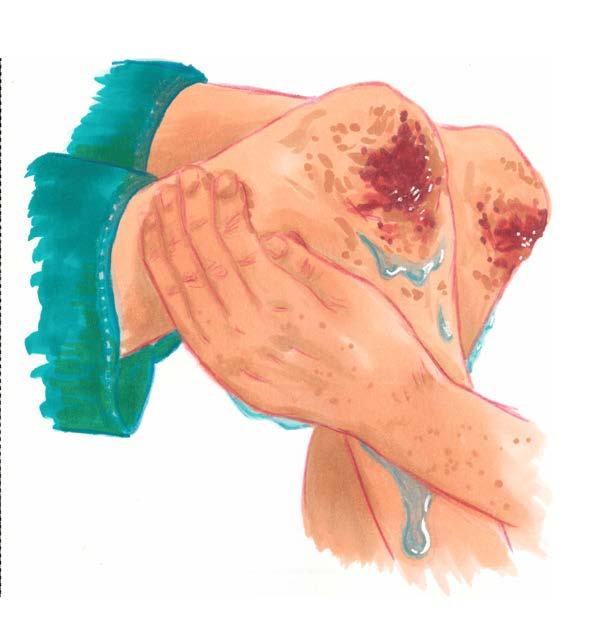
She ran through the field feeling the tops of the grass with her fingers and her knees. The pollen makes her knees red. Her mother will be upset. She keeps running up to the old wooden veranda, the sun beats down on her. She leaves the tall grass behind for the dirt. She passes the old dog as she walks up the veranda steps and shuts the fly screen door behind her. Her mother stands in the kitchen, watching the kettle boil.
“Wipe your feet.”
“Yes mum.”
“Have you been in the horse field?” Her mother smacks a tea towel on the polished lino counter top and looks down at her daughter. The girl looks at her feet. “I told you, don’t go around there.”
“I know mum.” The girl plays with her thin dry hair curling around her ear. Her mother pulls a mug and it bangs on the counter.
“I told you don’t go there. The horses are dangerous.”
“They like me.”
The girl stands there still in the doorway. She notices her brother sitting in the baby bath next to the sink. He is hidden in the mapled shadow of a cotton blind. He was propped leaning against the back of the bath, still as a stone.
“They will kick your fucking teeth in, you know that. They don’t know you. They don’t like you.”
The girl stood there looking at her dusty sneakers.
Her mother continued. “Look at your knees, for Christ’s sake clean yourself before you father comes home.”
“Yes mum.”
She scuttles off down the corridor kicking up dust from the carpet. From the bathroom she hears the boiled water being poured into the pot on the stove. The banging metal continues as she scrubs her knees, imagining her brother sitting in the pot slowly boiling to match the redness of her skin.
Words by Sachin Stevens
Bell Shakespeare is a prestigious theatre company. There is a kind of routine expected from Bell Shakespeare, the actors stand with their backs straight, they wear prim and mostly proper clothes, and the lines come out clear and projected well, an effect expected of Shakespeare from a Catholic school English teacher. Bell Shakespeare is a prestigious theatre company. The comedy there has that affected edge of a well-rehearsed stand-up routine, the gibes and gambols rich and modest, followed by the glittering, immaculate laughter of politicians, merchant bankers and the eminent consultants in our time. The play is trimmed of its excesses because Bell Shakespeare is a prestigious theatre company. The political commentary is balanced and palatably inoffensive, suitable for the first-row audience. Bell Shakespeare is a prestigious theatre company. They serve free Champagne after the show is over, and you walk out and see the Salesforce tower shining in the sky. Bell Shakespeare is a prestigious theatre company, and we must demand more.
I watched Julius Caesar , and it is difficult to mistake that. They said most of the lines, they acted out the play, and it was fine. Caesar died, Brutus died, Cassius died, and Mark Antony will die. Memento mori. The Republic fell. Blood was smeared on the robes, and democracy will no longer manifest in the halls of Rome. The work’s brilliance was from the Shakespeare script itself and a few standout deliveries. Everything else was in its right place and largely unnoticeable.
Shakespeare is often known for the complexity of his character depiction, and Caesar is a play replete with it, embodied in the austere yet conniving Brutus and the magnanimous and cruel Caesar. Bell Shakespeare chose a different direction, one that paved over this complexity in favour of a simplistic depiction of the characters. We hurtle through the first few acts, missing moments that, while not crucial, do add much-needed characterisation to some of the more marginal characters and a heavy pathos to the inevitability of Caesar’s death. This lack of nuance
was also reflected in the actors, who often play almost pasteboard renditions of their characters. Brigid Zengeni’s Brutus was stoically one-note, largely and unfortunately unremarkable, and even in moments of extreme tragedy or triumph not quite reaching the register of despair embraced by Brutus when Philippi is lost. Septimus Caton’s Caesar is tall and booming and oafish, and he plays a perfectly acceptable tyrant. Most of the other conspirators are really indistinguishable but for appearance.
of the taught bindings that hold peace together not even shown in its entirety, cut after the first stab by a poorly placed interval as the audience stands up and shuffles out to buy Champagne and take pictures of the harbour. They return to the standard bloody affair of senators in blood-dimmed gowns with bloody hands as a gasping and bloody Caesar dies. It is almost inconceivable that in this production of Julius Caesar , we do not see the majority of the act for which his name echoes through history.
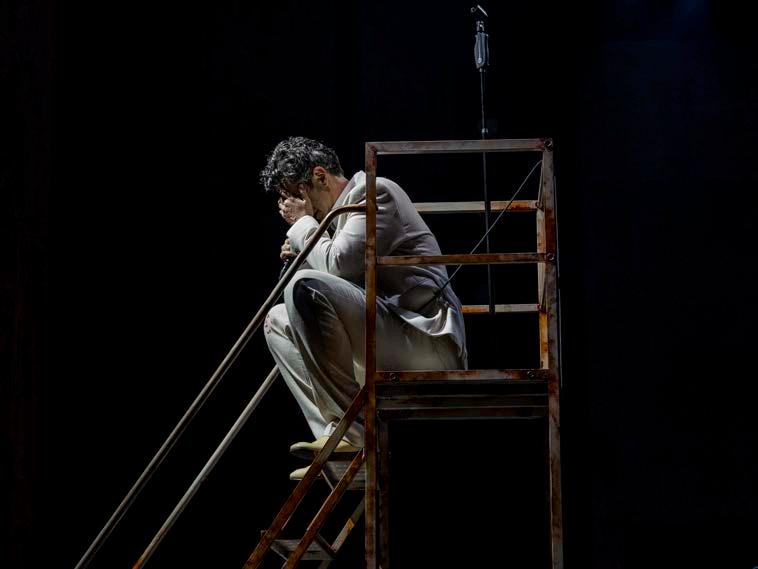
Two remarkable performances, well worth watching, were delivered by Leon Ford’s Cassius and Mark Leonard Winter’s Mark Antony. Both displayed a full range of their characters’ mania and insecurities. Winter’s rendition of the funeral oration was almost horrifying in the degeneration of Antony’s composure.
Caesar is a dangerous play, one that always points back to a basic violence, the demarcation of the end of an age and then a brutal reckoning with the new. It is a play that, like the dagger, a symbol so central to its being, might be used in varied ways, to critique or uphold regimes and systems and individuals, but it is not a play that should have the effect of other simple divertissements of an afternoon. Even that grim butchery so central to its being for which there would be no play, the act of Caesar’s death, is brushed under the curtain, the final metaphorical cutting
Sebastien Tuzilovic reviews
Shakespeare.
The show’s politics suffer also from confusion, neither quite committing to a condemnation or celebration of the conspirators, though also not showing their activity in a neutral light. Indeed, their deaths lack pathos because we do not know what to think of them. That this is true in spite of the lack of character depth is a remarkable achievement. One would think that by removing complexity, the characters might become villainous tropes or heroes, but instead, they become bland, and without that complexity, they are not often fickle, reactive or contradictory enough to inspire much of anything in the audience. All was played safe to a degree that neutered the scathing political criticism which the show is primed for, in the right hands.
We do not see the full bloody fervour of Philippi either. Instead, the battle is demonstrated in an abstract manner, and, as if an insult to the capacity of the actors at relaying plot and the audience in understanding it, subtitles come up displayed in large and bold letters “DEATH OF CASSIUS” and “DEATH OF BRUTUS”
This is confusing and lacks conviction. It is this attitude that runs through the entire production. Instead of costuming the cast in contemporary or archaic attire throughout, Caesar wears a toga over his suit in the senate and some characters wear gowns reminiscent of the era of the Republic. Just enough script is cut from the production to neither lend clarity nor dispel confusion; the battles are vague and the abstraction also confused, employed, I suspect, for little else than to avoid reckoning with the difficulties of staging large scale warfare in
For these complaints, it is impossible to make Julius Caesar a boring show. If I were to listen to it in the weary tones of Year Eight students being commanded by their teacher to read aloud, I would still be entertained. The story is the stuff of legend, and the language is complex, sharp and direct, with observations and arguments that cut through the muddled conventional political-speak Australians are so used to. But Bell Shakespeare’s Caesar was such a shame.
This is an unchallenging production, fit really for the bureaucrats and the bankers of the front row. And unchallenged, I must be disappointed. We deserve a position. It is not merely enough to expect the inherencies of a work to flourish while cloaking it in convention, for this construance is one that obscures, not enhances, such innate qualities. Australia deserves better from the only national theatre company in the country. We deserve at least a challenge to someone, to something, a production which proudly and wholeheartedly espouses at least some gesture towards any specific viewpoint, a production that believes in anything. When will we demand art in key with its time?
Bette and Joan is a play by Anton Burge which debuted in 2011 in the United Kingdom and focuses on the infamous rivalry between film stars Joan Crawford (Lucia Mastrantone) and Bette Davis (Jeanette Cronin) on the set of Whatever Happened to Baby Jane? (1962). When I heard it would be premiering in Sydney in 2026, I had one question: Why? It is difficult to understand the motivation to stage a fifteen-year old work about a dated gossipfuelled feud between American actresses here and now.
I expect it is partly because of the same reason why the feud attracted so much attention at the time. The same reason we devour MAFS and Mean Girls . We love to see women fight. To “get the claws out”, as Bette commands Joan, to subvert expectations of demure femininity and be truly vicious towards each other. This is also, however, steeped in patriarchal attitudes towards women as competitors rather than allies.
director Liesel Badorrek were more interested in doing this, I could understand the relevance of Bette and Joan to our modern zeitgeist, in which rivalry between powerful women still grips the headlines on occasion (‘Girl So Confusing’ and ‘Actually Romantic’, anyone?).
Unfortunately, however, this production does not seem to want to explore the complexity
more than it is. While emotive and effective at times, this choice loses its power the more it is used and takes away from the performances happening onstage.
Needless to say, our leading ladies have their work cut out for them. They do their best. Mastrantone is compelling and the stronger of the two. She is highly believable as the
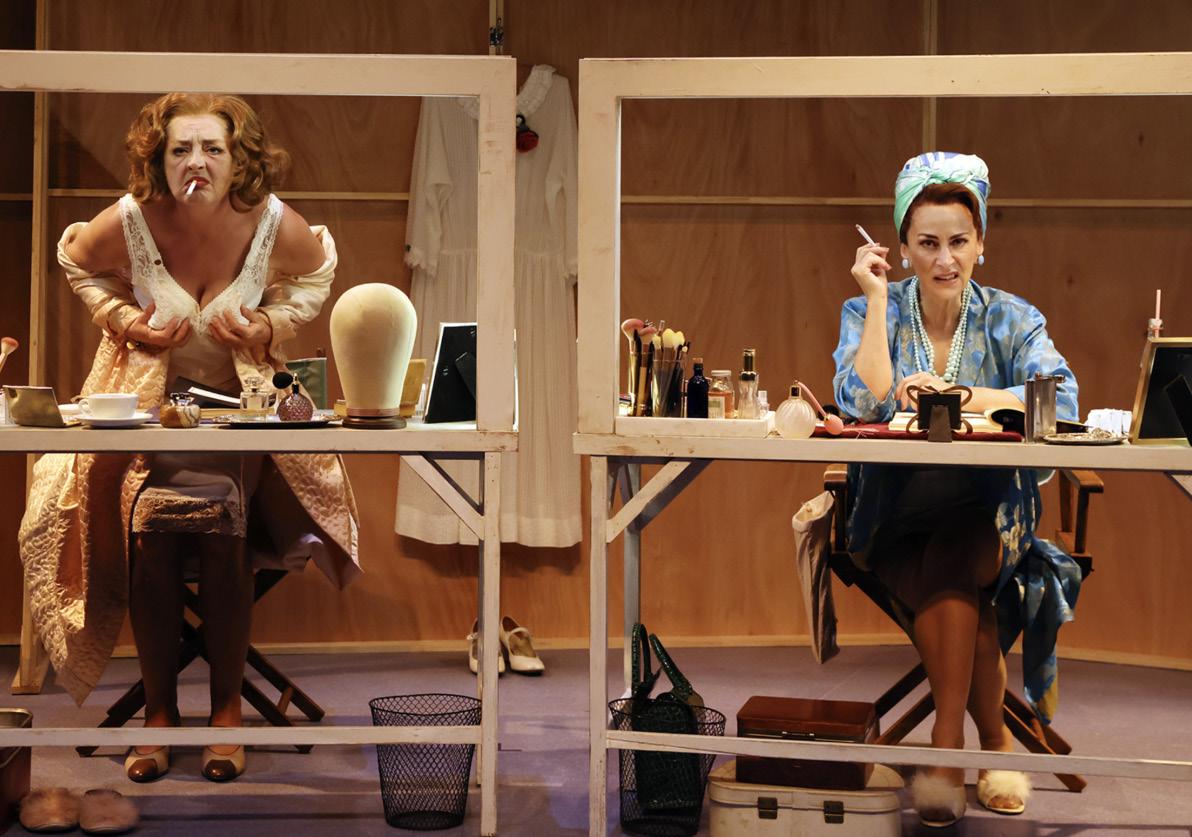
In this production, we step into the adjacent dressing rooms of the two actresses at Warner Bros Studios. Held in close quarters, they simmer and clash together over the course of a day of filming the iconic 1962 film, during the making of which Crawford allegedly tied weights to herself when Davis was required to lift her, and Davis retaliated by kicking her so hard in a particular scene that she required stitches. Dressed in their undergarments and half-finished screen makeup, we see them as vulnerable, grappling with aging, with the insecurities of fading careers twisting their already antagonistic relationship even more.
The protagonists are two supremely successful women who resent each other’s success. There could be much to unpack here. The story of Davis and Crawford’s feud presents opportunities to interrogate the culture that encouraged these women to feel they had to tear each other down. If writer Burge and
of insecurity and jealousy between women. It is more determined to rely on the tired gag of these two characters constantly telling the audience what a bitch the other is, mocking and slut-shaming each other.
By this point you, the reader, are probably rolling your eyes at me, misguided woke crusader and hater of fun. Not everything has to be political! I hear you say. Can’t things sometimes just be camp? To which I reply, yes! But this production also fails to lean into the campy ridiculousness which made the film Whatever Happened to Baby Jane? a cult classic in the first place.
The script makes puzzling attempts at psychological depth, especially in the choppy second act, that largely hinge on the characters’ relationships with their fathers. The (over) use of cinematic black and white projections of the actresses’ faces delivering monologues gives the show a saccharine seriousness, as though it is trying to become
primped and tightly wound Joan, constantly wiping down every available surface, compulsively spraying perfume and anxiously flitting about the stage. She shows herself to have excellent comedic timing and does well to portray a perfectionist determined to distance herself from the abrasive Joan by appearing a proper ‘lady’.
Cronin has the mammoth task of playing one of the most magnetic women to ever grace the silver screen. Bette Davis is legendary precisely because her hypnotic charisma and titanic personality made her so unlike anyone else in Hollywood. Cronin is amusingly abrasive, but for all her cackling and swearing she cannot convey the incredible presence of the real woman. It does not help that neither of the performers seem especially comfortable in an American accent, which was distracting at times.
That being said, Cronin gives us the only real moment of magic in the play when Bette
Ivy Downes reviews
describes the awe of making pictures. The lights are dim, and a close-up of her face, looking intelligently into the camera, is projected in black and white above the stage. She tells us of the thrill of playing “The wicked girls… the bitches, the real women”, of filming the classic scene in The Letter (1940) in which she stalks a man through the night, shooting him repeatedly in the back, “BANG, BANG BANG”. I could see the smiles of the audience in the darkness. Cronin had them enraptured.
Another fun moment occurs in the second act when their arguing evolves into something more like bonding over failed marriages and smarmy directors. Again, however, this flash of excitement is tantalisingly brief. The leads are not really given enough time to interact, so the electric moments of tension where they do come together are few and far between.
It is implied that there may be more similarities between these women than they realise. There is a lovely parallel between Joan’s poignant comment that while her mother is still alive she’s “still the most important person in the world” to someone, and Joan’s wistful “I so want to be liked.” I would have preferred to see more of this reflection on the moments of resonance between their two lives.
There is so much potential to examine their relationship in a more insightful way. There are so many thoughts about femininity, friendship, motherhood and stardom swirling which I feel could have been pursued in a more daring way.I would have loved to see Badorrek get the claws out and sink them into these ideas.
Why this production? Why here and now? Despite flashes of something more brilliant, it remains simplistic and stale, leaving these questions unanswered.
I wish a happy Easter and Pesach next week to all those who celebrate, and I also hope for a restful mid-semester break for all students! March has been a busy month for myself and the SRC, but we have some good outcomes to show for it.
Our 2026 influenza vaccination program was launched last week and already over 50% of spots have been filled! We are thrilled to see that students are taking steps to look after their health and their community, and that the SRC’s new vaccination scheme is popular. Students have already expressed great appreciation for the vaccinations being free, open to international students, and accessible acrossthree USyd campuses. Check out our Instagram posts for more information and the sign-up link!
This past weekend, the SRC took part in various community and activist events necessary to respond to current problems of our world and to fight for young people’s lives to be better. This included the letter-writing event and fundraiser for a student going on the next Global Sumud Flotilla, Trans Day of Visibility,the Palm Sunday Rally for refugees and against war, and Yom Al-Ard (Palestinian Land Day). I was pleased to have chaired
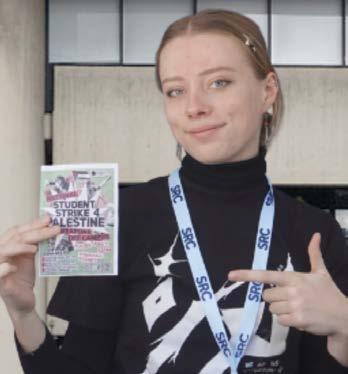
the Palm Sunday rally where I was able to talk to the experiences of young people in a broken world, and to specific issues like the recent graduate visa fee hike which leaves international students treated even more like cash-cows and a burden.
There are lots of things coming up after the break – make sure to stay up to date with Honi and our new SRC newsletter, which you can sign up to via our website.
In solidarity, Grace
Jesper Duffy (QuAC), Wendy Thompson (QuAC)
The Queer Action Collective (QuAC) has been busy and is growing, with lots of new members at our meetings and workshops. It’s been great to see new faces and work with everyone so far!
QuAC organised a student contingent to Trans Day of Visibility this past Sunday. There was support for attendees to change their legal gender markers and a rally demanding equality without exceptions. With rising transphobia across the world, making sure trans rights demands are visible and on the table is more important than ever. Keep in touch with us to help support upcoming anti-discrimination reforms that will make queer people across NSW safer.
QuAC members also built for and participated in the USYD contingent to the Nationwide Student Strike for Palestine as university management and local government continues to crack down on activism for Palestine.
There was no report submitted.
The queer edition of Honi Soit is underway, with lots of great articles and art being developed and our contributors and editors hard at work. Queer Honi will come out in week 8, and we’ll have a launch party with the edition, food, and good times on Wednesday, April 22nd at 6pm in the Queerspace!
We have been upskilling new members, and running workshops on how to write, design, and film social media posts. We have plans for more skills workshops coming, so keep an eye out for that.
If you’ve got ideas about important queer causes or want to get involved with QuAC, come to our fortnightly meetings! They’re every other Thursday at 4pm in the Queerspace and on Zoom, and more details are on our Instagram @usydqueer
Jasmine Al-Rawi (SAlt)
On March 25, ABC workers went on national strike to ask for greater pay and job security from their management. This was the first strike in 20 years and comes after the union voted in favour of protected industrian action to a large degree. ABC staff walked off from work and engaged in a 24 hour strike. We extend our solidarity to them and encourage all fellow workers to join in on solidarity efforts!
March 30th is Palestinian Land Day. We are rallying at Town Hall to commemorate decades since the 1976 protest, where thousands of Palestinians took general strike and shut Israeli economy down in protest of the annexation and dispossession
of Palestinian land. Six Palestinians were murdered by Israel on that day. We must keep showing up and reaffirm our commitment to the Palestinian struggle — although by the time of reading this report the rally would have past, we call for everyone to attend protest and stay active, rejecting apathy.
Our fellow students and staff at UTS have also engaged in strike action. Workers are under threat due to management. We encourage all students to show their solidarity and support staff striking!
In solidarity Dana and Jasmine
Maxine McGrath
(Grassroots)
Avin Dabiri (Independent)
Hi folks! This has been a busy time for activists on Gadigal land, whether due to Israeli Apartheid Week, or preparing for USyd student Ethan Floyd to embark on the Global Sumud Flotilla. On top of this, WoCo hosted a protest against ‘Day of the Unborn Child’, an annual mass at St Mary’s Cathedral. The turnout of the protest was on the smaller side, but had the enthusiasm to make up for it. Our predominant goal for this protest was to act as visible and vocal opposition to a mass which is accepted as the status quo, and this was something we believe we achieved.
violence. This can be seen with the USU responding to a rise of drink spiking by planning to introduce USU themed drink covers, rather than prevention. WoCo is working towards an outreach campaign to support individuals who have experienced sexual violence, so we invite you to message our Instagram @usydwoco if you or anyone you know has had any experiences and we can assist with accessing appropriate support services.
After the upcoming mid semester break, make sure to stay tuned as we announce the events for the upcoming Reclaim and Resist week. Shortly




What is special consideration?
If you (or someone you are the primary carer for) experience short-term illness (physical or mental), injury or misadventure, that is beyond your control, that affects your assessment, you may be eligible for special consideration. If your illness was pre-existing, you will need to show an exacerbation of the illness.
If the University approves an application for special consideration they will give some flexibility in meeting assessment requirements, such as an extension or a further examination. They cannot give you extra marks. If you are still unwell, or experience another illness, injury, or misadventure, for a supplementary exam, you should apply again for special consideration providing new documentation. Where the faculty is unable to provide an additional supplementary assessment, you will be given a Not Examinable (NE) grade. This does not count as a fail, but you are liable for HECS/ fees. If you have documentation to show that your condition was worsening, you may be able to apply for a Discontinue Not to Count as Fail (DC) grade.
Applying for special consideration
You must apply within three working days of the assessment deadline. If you apply late, you will need to have a documented, compelling reason as to why you were unable to apply on time. Late applications are not often accepted. Go to the Uni’s Special Consideration portal. Provide the appropriate supporting documentation, as outlined in the
portal. Medical documentation
(e.g., Professional Practitioner’s Certificates from a doctor, psychologist, or psychiatrist) must be from the day of or before the day of the assessment. You will need to have seen your doctor in person or through telehealth. Online medical certificate will not be accepted. Ensure, also, that the dates of your documentation include the dates of your assessment. Appropriate misadventure documentation varies according to the situation. Where possible, get a PPC to show how you were affected by the misadventure. While it is possible to use a student or statutory declaration, it is generally not considered sufficient without other evidence or supporting documentation.
Rejected applications
You can appeal a rejected special consideration application, within 15 working days. In your appeal, address each of the problems that the Uni mentions. It may be helpful to get additional documentation. Seek advice from an SRC Caseworker.
False documentation
If you are caught using false documentation you will not be granted special consideration, and you will be given a student misconduct allegation that can lead to your suspension or exclusion from the university. Some students have also found that the person they bought it from has tried to blackmail them into paying more and more money over time. The SRC strongly advises against the use of false documentation.
SRC Caseworker Help Q&A
English Language Resources
Abe,
My English is not good. I feel nervous to speak in English in class and sometimes it is hard for me to understand what the teacher is saying. What can I do?
XW
Dear XW,
The easiest way to improve your English language skills is to speak English as much as possible. Ask your friends to speak English to you so that you have a

safe environment to practice listening and speaking English. After a while it will get easier to understand what is said in class and hopefully, you’ll get the confidence to speak in your tutorials. Keep checking in with your lecturer or tutor if you are not sure about what was said in class. The SRC has a list of English Language Resources that you might find helpful. If you use AI to help you translate what you write, make sure you talk to your lecturer about what you are allowed to do, so that you do not breach academic integrity rules. Abe.
For more information and links to “English Language Resources” Scan the QR

If you need help from a SRC Caseworker start an enquiry on our Caseworker Contact Form: bit.ly/contact-a-caseworker


Do you need help with Centrelink?
The SRC has qualified caseworkers who can assist Sydney Uni undergraduates with Centrelink questions and issues, including: your income, parents’ income, qualifying as independent, relationships, over-payments and more.
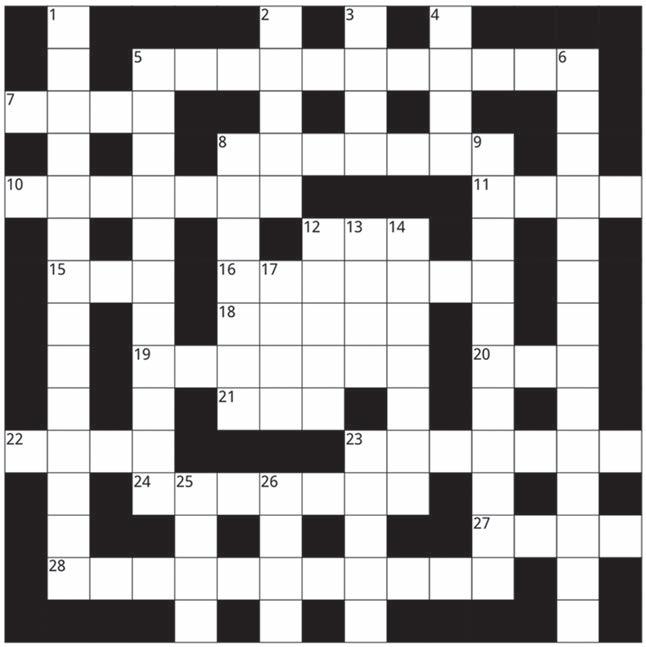
5. Social justice campaign for Indigenous Australians (5,3,3)
7. Reverberation, Narcissus’ nymph (4)
8. Language stone (7)
10. Sirens and Satan (7)
11. Insect drawn to light and nice clothes (4)
12. Email action abbrev. (3)
15. Egyptian boy king (3)
16. Glasses, sunnies, goggles (7)
18. _____ the hat (5)
19. To take back (7)
20. Swindle (3)
21. The whole shebang, everything (3)
22. Verdi opera (4)
23. Financial term from the French for “slice”
24. Wild, bonkers, out of control. Manga by Miura (7)
27. Persian city, setting of Aeschylus play (4)
28. Reliance on reason (11)

Blasphemous! The Thirty-Years-War is pretty doable for the 2026 editorial team, however. From 1999, Tuesday 3 August.
1. Coleridge character that stoppeth one in three (7, 7)
2. Old New York fur tycoon family (5)
3. Eye sore (4)
4. Time just before Easter (4)
5. School room with lots of computers (8,3)
6. Food creation process for plants (14)
8. Daphne du Maurier novel (7)
9. Honi Soit hates it when you use these (11)
12. ___ position (5)
13. Defining event of the 20th Century, abbrev. (1,1,2)
14. Something is rotten in this state (7)
17. Southern pronoun (4)
23. To warble (5)
25. Fourth largest Great Lake (4)
26. Trig function (4)
1. Where are the 2026 World Figure Skating Championships taking place?
2. Who is the Hindu god of dance that has a statue outside CERN's physics labs in Geneva?
3. Who famously said "God does not play dice?"
4. Which British Royal Navy leader, blinded in one eye, is the reason for the expression 'to turn a blind eye'?
5. In what decade was the Aboriginal flag designed?
6. What was the 2026 Best Picture Oscar winner?
Last week’s crossword answers
6. Algiers, 7. Intifada, 8.
22. Sacer, 24. Ire, 25. Mehr.
Before the debate had even started, a debater from the ALP Club announced to the room: “Honi is here.” A few heads turned towards the back, although nobody was sure what to do with this information. Honi included.
The debate concerned the importance of unions. Each side brought an adjudicator. At the end, each adjudicator declared their own party the winner. Good debate.
The ALP adjudicator called Honi out by name, asking if we were in the room. We were. The Liberals, spotting an opportunity, immediately used this moment to plug their in-house publication, to which Honi wishes all the best in its ongoing mission to exist and gain relevancy.
After it wrapped up, both clubs attempted to recruit Honi into taking a group photo. Honi almost obliged, then remembered where the exit was.
One attendee asked if Honi was in Young Libs. “Oh hell nah,” said Honi
Both clubs then went to the Flodge together for drinks. The importance of unions remains disputed.
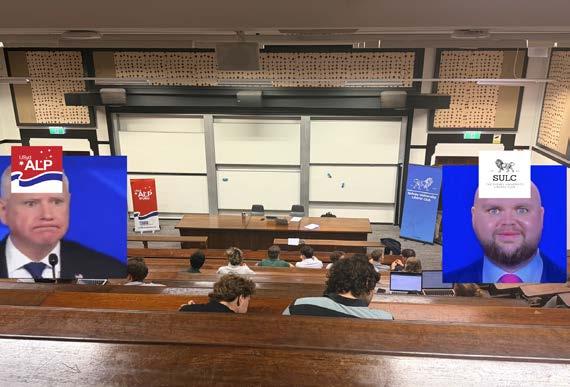
MY POSITIONALITY STATEMENT.
As a straight white man, I believe I am the best individual to discuss the issues that women in Fourth World face during times of armed conflict in the Middle (between Britain and the Orient) East.
My voice is constantly silenced in classes, when I should be the one speaking about postcolonial critical perspectives. As for a literature review, I'm really well versed. Who needs lived experience of race issues when you have scholarship? When I read Frantz Fanon's 'Black Skin, White Masks', I really related to the white mask part. Everyone sees my white exterior, but they don't know how Globally South I feel on the inside.
When I read Gayatri Spivak's journal article 'Can the Subaltern Speak?' I cried, because I am a subaltern and I really can't speak! I mean, these bitches in my class keep yammering over me when I try to educate them about feminism. Women are great and all, but really overrepresented when it comes to talking about feminism.
I am the second coming for an increasingly disenfranchised identity in academia. Yeah. Let me cook on this thesis rq.

A plane flew over Tel Aviv, oblivious to the current fuel crisis. Sources inform us that it’s Chris Minn’s private sky-writing jet. Previous appearances the jet has made include the time Albanese borrowed it to welcome Isaac Herzog with the letters: "A + I 4EVER".
The jet scrawled the letters ‘HBD’ at an agonisingly slow pace. The jet careened abysmally while trying to scrawl a '77' next to the HBD, but it ended up looking like the Hebrew lettter pronounced as 'vav'. Onlookers were confused.
The jet started scrawling, as per Chris Minns' request, "WITH WARM WISHES OF BETTER DAYS AHEAD." The onlookers dispersed almost as quickly as the letters did, bored out of their wits.
"I'm going to go to the bomb shelter underneath the McDonald's in case this random jet tries something," an onlooker said.
By the time the plane started drawing a love heart, the rest of the letters had disappeared. Unclear now of the jet's intentions, Israel's defence system gunned the plane down before it could begin tracing the heart's second bendy half.

500db SONIC BOOM IN PSYCHOLOGY CLASSROOM
A seashell pink and sage green 1L Frank Green waterbottle was placed on a wood table in room Q224 in the Quadrangle Building. Belinda Waterson claims she ‘put it down lightly’, but her classmates’ hearing reduced by 70% on average, with many reporting tinnitus symptoms. Dr. Roberta de Hyedrait, Professor of Psychology, was not wearing her hearing aid at the time and was oblivious to the sonic impact, but felt a soft seismic ripple under her feet.
1st