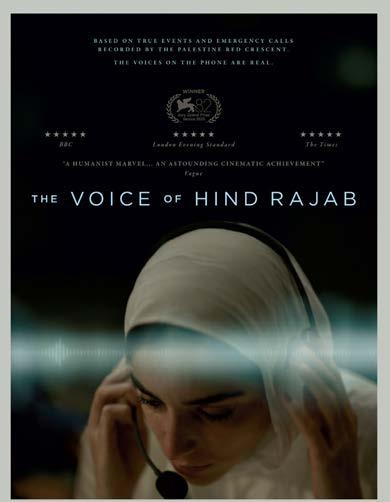
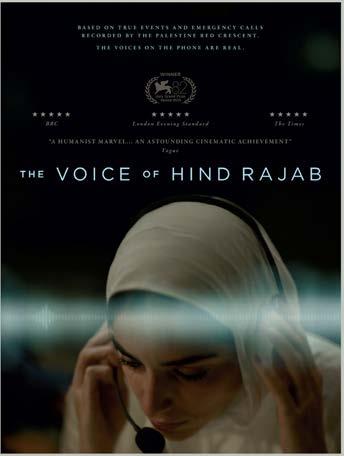
For over two years the world has watched, live-streamed on social media, as Israel commits genocide against the Palestinian people. During this period, over 20,000 Palestinian children have been murdered by Israeli forces. The Voice of Hind Rajab is a docudrama, directed by Tunisian filmmaker Kaouther Ben Hania, based on the story of just one of these children, 5-year-old Hind Rajab...
With their considerable reach and platform, they can be a resource – most often statesanctioned and aligned – for people who are not particularly politically engaged and who have no knowledge of where to turn. Celebrities can appear to give ‘permission’ for people to speak. “If they can speak and risk their careers,” we say, “then I can too.”
18–19: REVIEWS
14–17: OPINION
Calista Burrowes
Max McDermott Analysis, page 8
Marc Paniza Feature, page 6-7
Daena Madon Perspective, page 13
EDITOR-IN-CHIEF
Marc
EDITORS
Madison
Anastasia
James
Kuyili
Ramla
Kiah
Marc
Firdevs Sinik
Sebastien Tuzilovic
WRITERS
Feaim
Calista
Anastasia
Siena
Bibi
Daena
Max
James
Ellie
Audhora
Marc
Sebastien Tuzilovic
Meijie Ureta
ARTISTS
Suhani
Josephine
Acknowledgment of Country
Honi Soit publishes on stolen Gadigal land. Sovereignty was never ceded.
The University of Sydney is a colonial institution that upholds Western knowledge as superior to First Nations knowledge systems. We reject this hierarchy.
As student journalists, we recognise that mainstream media has been complicit in silencing and misrepresenting Indigenous voices since invasion.
In
This Edition:
We commit to centring First Nations perspectives in our reporting, to challenging the colonial structures embedded in journalism, and to amplifying the voices of those resisting ongoing dispossession. We pay our respects to Elders past and present, and to all First Nations students and contributors.
Always was, and always will be Aboriginal land.
Editorial
That’s Rupert Murdoch on our cover, dressed as Christ the Good Shepherd, and a lamb with two heads. Before anyone writes in: I grew up Catholic, and I understand why this image might unsettle people.
But this isn’t mockery. Religious iconography has always been about power — who has it, who grants it, who people look to for truth — and Murdoch’s been doing that for decades, just without the robes. His outlets don’t just report the news; they set the terms of the conversation, shaping what Australians read, what we fear, and what we think we know. In religious art, deformity has always been a symbol of corruption — something unnatural hiding beneath the sacred. The two-headed lamb is working in that tradition. Oscar Lawrence understood the assignment, and the result is a cover that asks whether what we’re worshipping deserves
the devotion. It’s a fair question, given how many Australians get their understanding of the world from Murdoch’s papers and channels.
This edition’s theme is God, Gold, Glory: the old phrase for the forces that drove colonisation. We wanted to trace where that power sits now — in boardrooms, algorithms, institutions, and the stories we tell about who matters.
Two weeks ago, protesters gathered against Isaac Herzog’s visit to Australia and were met with police batons and pepper spray. Mainstream media coverage was sparse and sanitised, but Honi was there, and we published what we saw. That’s why student journalism matters — not because we’re better, but because we’re not beholden to the same pressures. When protesters get beaten, we don’t frame it as “clashes.” We call it what it is.
Art by Suhani Panchal
Those same questions run through this edition. Marc’s feature looks at the rental application system and the algorithm that decides who gets a home before a landlord even sees your name. Max writes about buy now, pay later and the debt it quietly builds under student life. Daena asks what it means to inherit a faith that might not make room for your future.
James reviews The Voice of Hind Rajab
I hope you find something worth reading.
- Marc Paniza
Vox Pops: What Students Are Saying About
A.P. says: “It was the physical equivalent of having to scroll through a website that’s 90 per cent ad space.”
A says: “It was amazing to be a part of so many people’s first time walking in a crowd. I’m glad USyd has set up this event
Honiscopes
welcoming people to these experiences.”
V.T. says: “I just think it’s crazy how the USU is strengthening its partnership with BDS target Coke. Last year it was a small handout stall, this year they’ve got a big-ass DJ stall and a van and everything. It’s crazy.”
Anon says: “The $100 budget was unrealistic for cultural societies, and under Welcome Week stall rules the only way we’re allowed to showcase our culture or motivate students to join is through lollies, which isn’t exactly cultural.”
FABULOUS CONTRAPTIONS
26th Feb 7pm
w/ Godswounds, Basil’s Kite, Shanghai @ Moshpit Bar
QWENTO
26th Feb 6pm
w/ Sunlark, Boyfriend Material, The World is Not Round @ Lazy Thinking
POPCHOPS: MARDI GRAS
27th Feb 9pm w/ Beks, Simon and Andy [DJ] plus drag performances @ Metro Social
Aries: You’re an espresso. Intense, quick, and gone before anyone can process what happened. Slow down.
Taurus: Flat white energy. Consistent and reliable, but deeply boring. Try being interesting for once.
Gemini: You’re a frappe. Too sweet, too complicated, nobody knows what you’re made of. Pick a lane.
Cancer: Hot chocolate vibes. Everyone’s comfort person but you’re not even coffee. Stop trying to fit in.
Leo: You’re a mocha. Can’t handle actual coffee so you hide it in chocolate. You need everything to be palatable and sweet. Grow up.
Virgo: Long black. Sophisticated and minimalist or just pretentious and bitter? Nobody’s impressed.
GAYMAS EVE 27th Feb 10pm w/ Aunty Jonny B2B Lorna Clarkson, Fox Pflueger, Gogo Bumhole & more @ Pleasure Club
Libra: Latte. Basic, inoffensive, terrified of having an opinion. The people-pleasing is exhausting for everyone.
Scorpio: Iced latte. Effortlessly cool, don’t care what season it is. You may or may not be performing for anyone. Keep going.
Sagittarius: Chai latte. Warm, spiced, genuinely compelling. People underestimate you but you’re the best in the room.
Capricorn: Cappuccino. Obsessed with ratios and rules. The rigidity is killing your vibe. Loosen up.
BIRDCAGE XXL 28th Feb 9pm w/ Blusher, Cat & Calmell, Citrus [DJ], Dionysus [DJ], Diva Cups [DJ], Girl Whatever & more @ Metro Theatre ROCK AGAINST RACISM 1st March 2pm w/ Allis Well, Bea Pierce, Bernadette Smith, SunStalkersss & more @ Moshpit Bar more info at sydneymusic.net
Aquarius: Matcha. If you’re the real deal, you’re genuinely living your values and people respect that. If you’re performative, everyone can tell. You know which one you are.
Pisces: Tea at a coffee shop. Confused, out of place, wondering why you’re here. Figure it out.
WoCo rallies to abolish the colleges
On Friday 20th February at midday, the USyd Womens’ Collective (WoCo) rallied to abolish the campus residential colleges. WoCo has been campaigning for college abolition since the release of the Red Zone Report, an investigation into sexual violence in university colleges, in 2018.
The campaign gained widespread traction in 2024 after the Report was ripped up by elected Liberal student councillors during an SRC meeting. That same year, six St Paul’s College students were expelled and 21 were suspended after “serious humiliation” of another male student.
The rally took place at the beginning of Eastern Avenue and coincided with the final day of Welcome Week, so festivities, foot traffic, and stalls continued as the speakers demanded justice and accountability from the university.
Music from the USyd Sport stall could be heard throughout the speeches, sometimes adding oddly appropriate theme music, other times serving as a reminder of the stark contrast between the university’s public image and the truth of the colleges.
SRC Womens’ Officer Maxine McGrath chaired the rally, leading the crowd in chants of “Uni silence perpetuates violence”. McGrath emphasised that struggles for justice were interconnected, and that sexual violence is used as a tool of oppression in many different contexts, including the university colleges.
First to speak was SRC President Grace Street, who stated: “We are here raising our voices outside the building university management is in because this is Welcome Week… the part of the semester where students are facing the most intense crises of sexual violence and unsafe, unaffordable housing. Gender-based violence, sexual violence, and the housing crisis are issues that affect
students very intimately, particularly during this time, and we don’t hear much from the university”.
“These issues are epitomised and furthered by the USyd residential colleges… they foster cultures of elitism and sexual violence. That’s why we’re protesting today: to bring attention to these ongoing, systemic issues which for years, if not decades, we’ve been calling against but we don’t get anything back”.
Street went on to demand the university provide affordable housing instead of the colleges, saying “we know the university has the money, they have consecutive years of turning millions in profit, they invest in weapons and gambling companies, but they won’t support students in these crises… the colleges represent the worst of the corporate university — harbouring elitism and perpetrators of sexual violence, only answering to money and prestige.”
Vieve Carnsew, member of Students Against War and
Anastasia Dale reports.
Solidarity, was next to speak: “[In 2024] members of the USyd Conservative Club tore up the Red Zone Report handed to them at the RepSelect meeting of the SRC Council. The Red Zone Report exposed the prevalence of sexual violence in Australian university colleges. Its 200 pages provide horrific examples”.
“While vile misogynists like the members of the Liberal Party continue to run their stall and spew their racist, sexist agenda with no trouble from security, Solidarity’s stall had posters taken down by security citing they could be considered bullying and harassment.
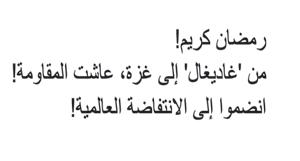
“The posters stated ‘intifada is not hate speech, intifada means uprising’ and ‘globalise the intifada’. How is it that stating what an Arabic word means is considered bullying by the university, and yet ripping up the Red Zone Report and laughing about the experiences of sexual assault survivors, is considered okay?” Read the full coverage online.
70 per cent of USyd staff at high or very high psychosocial
70 per cent of University of Sydney staff are working in conditions rated at high (33 per cent) or very high (37 per cent) risk of psychosocial harm, according to data from the most recent Australian University Census on Staff Wellbeing. The census flagged widespread burnout and emotional exhaustion as major issues in the higher education sector.
Released on 12th February 2026, the data is drawn from a comprehensive report by the Psychosocial Safety Climate Global Observatory, which surveyed nearly 11,500 personnel from 42 Australian universities between 2020 to 2024. Using the Psychosocial Safety Climate (PSC) metric, the initiative measures how effectively senior management prioritises employee mental health over productivity, providing an evidence base for reforming risk management practices across the higher education sector.
The report states that PSC is “a leading predictor of future working conditions, job strain, worker mental health, burnout,
risk, report finds
and productivity. Research shows that PSC is the ‘cause of the causes’ of work stress. When PSC is low, workers are more likely to face high job demands, bullying, low control, poor support, and organisational injustice.”
It found that psychosocial wellbeing of university employees has been declining year after year, with 69 per cent of respondents feeling that university senior management does not care about their wellbeing, and 80 per cent agreeing that constant cuts and policy changes are a significant factor in this decline. High rates of unpaid overtime are reported among respondents, alongside the finding that 1 in 4 university staff plan to leave their employer within the next 12 months.
Only academic deans and senior professional managers are reported at lower PSC risk levels, “suggesting a disconnect between leadership experience and frontline reality.”
The report states: “Results indicate a sector-wide public
health concern requiring urgent, coordinated action. Australian universities are at a crossroads. The evidence is clear: staff are working in environments that place their psychological health at significant risk.
“Without urgent action, the sector’s ability to deliver high-quality education, worldclass research, and positive student experiences will be compromised.”
These findings will likely influence negotiations between USyd management and the National Tertiary Education Union (NTEU) next month when enterprise bargaining begins.
Peter Chen, the NTEU USyd Branch President, told Honi: “Here at USYD the staff have been subject to a lot of change in management processes over recent years.
Often management don’t allow them to bed down before beginning a new change.”
“The research evidence is clear, change in management reduces
James Fitzgerald Sice reports.
job satisfaction and creates stress — given everything the sector has been through since COVID, staff need a break.”
In a statement, Chen said the “University of Sydney’s management has a chance to avoid driving our workplace to the bottom of the league table by taking the threat of forced redundancies off the table. This comes at a time of surging enrolments, ballooning class sizes, and a massive surplus.
“The University is currently in a process of developing the Professional Services Review, which many fear is likely to be the type of wide-ranging, deep staffing and service cuts seen at universities like Wollongong, Western Sydney, Newcastle, Macquarie, and UTS.
“These universities are the worst performers in a terrible sector. We run the risk of joining them,” Dr Chen stated.
Read the full article online.
Racism Widespread in Australian Universities, National Study Finds
Racism is deeply embedded across Australian universities, affecting students and staff from a broad range of cultural, religious and ethnic backgrounds, according to a major national study released by the Australian Human Rights Commission.
The report, titled Respect at Uni: Study into antisemitism, Islamophobia, racism and the experience of First Nations people, is based on the Racism@ Uni Study, commissioned by the Australian Government in May 2024. More than 76,000 students and staff from 42 universities across the country participated, making it the largest examination of racism in the Australian university sector to date.
The findings show that 70 per cent of survey respondents reported experiencing indirect racism — defined as hearing or seeing racist behaviour directed at their community. A further 15 per cent reported experiencing direct interpersonal racism at university, while 19 per cent of those who did not experience direct or indirect racism themselves reported witnessing it.
The study identified particularly high rates of racism among students and staff from First
Nations, African, Asian, Jewish, Māori, Middle Eastern, Muslim, Palestinian and Pasifika backgrounds, as well as among international students. Jewish (religious) and Palestinian respondents reported experiences of racism at rates exceeding 90 per cent. First Nations, Chinese, Jewish (secular), Middle Eastern and Northeast Asian respondents all reported rates above 80 per cent.
An Aboriginal individual reported that racism was perpetrated by both staff and students. They stated in the survey “I have had a lecturer make a ‘petrol sniffing’ comment about Aboriginal people... I have had students tell me I am getting it easy as I receive an Indigenous scholarship.”
Another student stated that they “had a professor in the first year who thought I bought my assignment or made AI do it because she could not believe an Indian could write that good in the first year of nursing.”
The data indicate the issue is not confined to individual institutions. Racism was found to occur at similar rates across all Australian universities, which the report characterises as evidence of a systemic problem.
The report also examined how
Marc Paniza and Sebastien Tuzilovic report.
universities handle complaints. Only 6 per cent of people who experienced direct racism made a formal complaint to their university, with many citing fear of consequences as a deterrent. Among staff and students who engaged with the complaints process, 60 to 80 per cent reported dissatisfaction with the outcome. The findings point to low levels of trust in university complaints systems across the sector.
In response to these findings, the report makes 47 recommendations directed at the federal government and universities. The recommendations are structured around five outcomes: establishing a national anti-racism framework for universities; creating inclusive and safe university environments; building accountable complaints systems; developing inclusive curriculum and teaching practices; and improving diversity in leadership and the broader workforce.
The report calls for a coordinated, sector-wide approach aligned with the Australian Human Rights Commission’s National AntiRacism Framework, rather than individual or ad hoc responses by institutions.
The Racism@Uni Study drew on multiple research methods, including focus groups, a literature review, a policy audit and a national online survey that gathered direct accounts from staff and students with experience of racism.
The report is not unique or a new insight into the operations of Australian universities. Many similar reports have been published and the observations are widespread and well known.
The Australian Human Rights Commission has now published the full report, which is available for download on its website. The federal government has yet to formally respond to the 47 recommendations contained in the findings.
Alleged attack on trans woman by police raises strong concerns of police violence and personal security
Transgender woman Elly has alleged that five federal police officers forcibly broke into a locked disabled bathroom that she was using on the 4th December 2025 at Sydney Airport.
She stated that the police entered the locked bathroom with force while she was naked from the waist down and performing a dilation, a time intensive post-operative process that follows gender affirming surgery.
Elly was returning from Bangkok after surgery. She filmed the police undertaking the alleged assault, and stated to OutInPerth that “I started filming because I was scared that the police would hurt me, just like they have in the past. I wanted some accountability and thought
filming could decrease their chances of being violent.”
The video displays Elly crying out with her back to the door attempting to stop the entry while police force their way into the bathroom. The incident raises questions around the privacy of trans individuals, and the response of police to marginalised communities.
Damien Nguyen and Luna Choo, board directors of the Sydney Gay and Lesbian Mardi Gras, have expressed great discomfort with the inclusion of the Police in the parade for 2026 following the incident. Choo stated that she “shudders with dread thinking how many police officers continue to attack trans people and women, and how many are planning to march in Mardi Gras.”
USyd SRC Queer Officers stated in a comment to Honi that “Elly was perceived as a threat at the border because of growing racism and transphobia globally. Elly’s own word was ignored, and she was violently pushed into a wall by officers, not only violating her privacy and humiliating her while she was undergoing necessary genderaffirming care, but possibly injuring her like we see police regularly do to members of all marginalised communities.”
Similar concerns around police targeting marginalised communities have been raised in the wake of the police riot at the Herzog protest last Monday, where officers were filmed violently disrupting Muslim men praying, despite permission given to them by police.
Sebastien Tuzilovic
reports.
The Queer Officers connected the incident to the policing of border security: “The terror the AFP are allowed to continually inflict on trans people crossing into so-called ‘Australia’ illustrates one of many reasons why measures over the past several years to increase ‘border security,’ such as increased surveillance and police funding, are fundamentally bigoted and dangerous and must be removed.”
If you need serious or urgent advice, you can contact:
- If a USyd student, SRC Caseworkers and free counselling - twenty10.org.au: 02 8594 9555 - lifeline.org.au: 13 11 14 - headspace.org.au
Your Rental Application Is the Problem Nobody’s Fixing Fast Enough
Marc
Last year, I sharehoused in Sydney without being on the lease. The arrangement started as a sublet. When the lease came up for renewal, my friend and I tried to put our names on it. We filled out the forms, submitted the application, and waited. A month passed with no response, then two months. We kept following up, and the real estate agent kept telling us it was coming. We stayed and paid rent, though we weren’t sure exactly what our arrangement was. There was no lease or formal agreement, and we lived that way for almost a year before I moved to another sublet.
The problem wasn’t my data being mishandled, or an algorithm filtering me out. It was that I wasn’t even recognised as a candidate in the process. The system didn’t reject me. It couldn’t, because it didn’t even see me — and there was no one to complain to.
This semester, thousands of the University of Sydney (Usyd) students are going through rental application processes that are more formalised than mine was, but no less opaque, submitting their personal information through digital platforms that sort and rank them using criteria they can’t see, operated by companies that are not required by law to disclose how they use that data.
There is a bill before the NSW parliament, introduced last June, that attempts to regulate this process.
It tries to control what data gets collected, but it still does not address how the platforms use that data once they have it, and this is the crucial part that actually determines whether or not you’re housed.
When Gracie, a USyd student, and her two friends tried to find a rental this year, they created accounts on 2Apply, Snug, and TenantApp. Each asked for different information and required references to be submitted through its own unique system, rendering the letter Gracie had already obtained from her boss useless.Instead, her referee had to complete three separate forms. Two housemates had never rented before, but were still asked for five or more previous addresses. Gracie was asked by one of the companies for a reference to verify a casual job she’d held at 16, from an employer she couldn’t contact. They applied for three or four places and toured dozens more that were leased before they could even finish their applications.
“Honestly, we were all going in blind,” Gracie said. “I’m a very Type-A person and really tried to get all my documents and information in order, but it just seemed like everyone was telling us something different.”
What Gracie was navigating was a system based on automated filtering. Dr Sophia Maalsen, an associate professor at the University of Sydney who researches housing justice and digital technologies, has examined how these platforms collect and process tenant data. According to
Maalsen, one application form contained around 50 data fields, going well beyond income and identification to demand household composition, pets, smoking status, and whether the applicant is a single parent. Once submitted, many platforms first filter for completeness — if all fields aren’t filled in, the application may never be seen.
From there, applications are sorted by income-to-rent ratio. The agent receives a shortlist of around 10 candidates, which they present to the landlord. If you don’t make the shortlist, you’ll never know. “It’s very easy for a property manager to come back and just say, ‘Oh look, we had a better applicant,’” Maalsen said. “They won’t specify why you were passed over.”
For students juggling casual contracts and Centrelink, this compounds the problem. More income sources mean more documentation, which results in more friction in a system whose first threshold rewards those who find the process easiest.
When asked what agents advised for students, Maalsen said they recommended turning up to inspections and talking to the agent directly, because being remembered can matter more than what’s in the application. The best advice for navigating a digital screening system is to bypass it entirely.
Paniza on the algorithm behind your lease
There is also a tenancy database, separate from the platforms, that tracks disputes between tenants and landlords. Agents told Maalsen’s team that consulting the database was standard, and some said applicants in the database were automatically not considered. Tenants are supposed to be notified and can dispute entries, but Maalsen noted the system reports damage regardless of its cause — a tenant can end up listed for damage resulting from the landlord’s poor maintenance. This stain has followed a renter for 2 years.
For international students, these barriers are worsened by the absence of Australian rental history, local references, and familiarity with the system. Maalsen’s research found that they are pushed toward expensive, purpose-built providers, or toward informal arrangements in which they are not always aware of their rights.
An international student who spoke to Honi Soit described that exact trajectory: searching from overseas as early as March, finding everything full, they ended up in purpose-built student accommodation at $699 per fortnight, and eventually had to pay approximately $4,000 in termination charges to leave when a university-run room finally became available after six months on a waitlist.
“Many residents are newly arrived international students who may not be familiar with Australian tenancy laws or fluent in English,” The student said. Before finding that provider, they had tried Flatmates.com.au, owned by REA Group, but stopped after encountering listings by “a middle-aged man looking for a young single woman” and “a professor highlighting that he is single.” Maalsen’s research on share housing platforms found this was not unusual — her team observed users “really performing a certain identity online just to even get an interview.”
None of this flies under the radar of regulators. The rental sector has been identified by the Australian Office of the Information Commissioner (OAIC) as an area with poor data health practices.
In response, the NSW Government has introduced the Residential Tenancies Amendment (Protection of Personal Information) Bill 2010. According to NSW Rental Commissioner Trina Jones, 187,000 pieces of identification information are collected from NSW renters every week, and “renters shouldn’t have to trade away their privacy just to find a place to live.”
The bill would introduce a standard application form, establish rules on what
can be collected, and extend privacy requirements to smaller agents and landlords.
That last provision addresses something Maalsen described as one of her most unexpected findings. The federal Privacy Act 1988 applies only to businesses with annual revenue exceeding $3 million. Most small agencies and proptech companies fall below that threshold, which means the platforms handling your payslips, identification documents, and Centrelink statements are often not legally required to comply with the Privacy Act at all.
operates in mortgage broking, property data analytics, and lending technology.
At a Proptech Australia panel in late January, industry leaders discussed the sector’s direction for 2026. Sev Thomassian, Domain’s Chief Strategy and Corporate Development Officer, was direct about what mattered competitively: “Data ownership is incredibly important. We have a wealth of proprietary property data, and that gives us the enviable position when it comes to leveraging that data to build superior user experiences.”
“A lot of these companies don’t actually have to comply because they’re too small,” Maalsen said. “That’s one of our recommendations, making sure the legislation is actually catching up, because this could have some really serious implications.”
Maalsen also raised concerns about data sharing in social housing, where tenants disclose medical conditions and a history of domestic violence to demonstrate eligibility — information that, in the context of interagency data sharing, is resemblant of Robodebt.
The bill addresses real problems, but it still doesn’t address what happens to collected data. The automated screening, the algorithmic sorting, and the shortlisting that determines which ten applicants out of hundreds an agent actually sees — none of that falls within its scope. A renter filtered out by a platform’s algorithm has no way to learn it happened or to dispute it.
Maalsen noted that Australian housing is not specifically covered by international frameworks such as the EU’s General Data Protection Regulation 2018 (GDPR) and Artifical Intelligence (AI) Act 2024. “Broadly, we need to start thinking about housing being covered in AI acts and privacy,” she said.
While the regulatory framework focuses on the front end, the industry building these platforms is already racing ahead on the back end. REA Group Ltd (ASX: REA) operates realestate.com.au and Flatmates.com.au, but also owns Mortgage Choice, PropTrack, and Realtair, alongside strategic investments in mortgage technology, digital lending, and a twenty per cent stake in realtor.com in the United States. The company that collects rental application data from Sydney tenants also
The panel spent 40minutes discussing proprietary data, hyperpersonalised consumer experiences, and agentic AI. Renters, tenant data, rental application platforms, and the legislation currently before parliament were not mentioned once.
Josh Callaghan, co-founder of digital twin provider Little Hinges, described the industry’s incentive structure during the same panel: “The customers are not the decision makers, they’re not the ones that pay.
All of the incentives and the mechanisms for payment are actually lined up into gatekeepers, not into the consumer.” In the rental market, those gatekeepers are agents and landlords. Renters provide the data. They are not the customer.
When asked who ultimately holds power over renters in this system, Maalsen did not hesitate: “The landlord. Regardless.” Tenants have “very little agency or power and little choice. If you don’t use one of these forms, you won’t get a rental. When asked why the regulatory response has been slow, she offered a structural explanation:
“Renters are still considered second-class citizens in Australia, when most of your politicians are landlords with multiple investment properties.”
The bill before parliament would regulate how much data is collected. It would not regulate what an algorithm does with that data once it has it. At the proptech industry’s most recent panel, leaders spent 40 minutes discussing how to leverage property data for competitive advantage.
Nobody in any of these conversations was asked what it is like to be on the other end of the form.
Buy Now, Pay Later
Max McDermott on the real price of BNPL
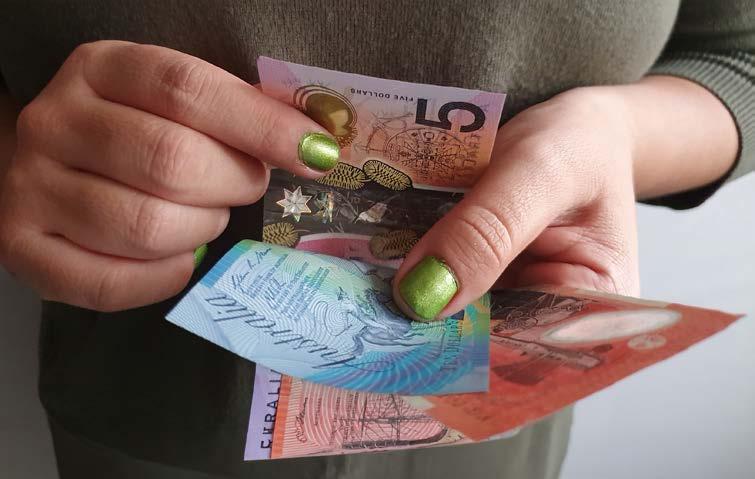
A birthday card worth $6.99, an $8.00 bookmark, and a postcard worth $1.50. These are among the many items I’ve seen customers use Afterpay for while working as a cashier at Dymocks. It’s confronting to watch individuals make such rash financial decisions and it forces me to ask whether they know the true costs.
If you were to order a burrito from DoorDash using the buy now, pay later (BNPL) feature, you technically wouldn’t own the food digesting in your stomach.
As a student—who is frequently skint— I can understand this financing method’s appeal. It can alleviate short-term financial pressures, making your purchases feel more affordable and manageable. The data reflect this: approximately 64% of Generation Z used a buy now, pay later service in 2023.
However, BNPL services come with a range of drawbacks that aren’t immediately evident. This matters because young Australians are increasingly ill-equipped to utilise these services—with financial literacy scores for 15–24-year-olds dropping from 3.4 to 2.9 between 2016 and 2023, according to the HILDA survey. So it’s worth understanding what actually happens when you tap that Afterpay card.
deductions imply ease and simplicity, removing the need for you to even make a transaction—until you have multiple BNPL plans running at once and they begin to add up.
This means that BNPL loans function as instalment loans. An instalment is a scheduled partial payment toward a larger debt, allowing you to spread costs over time. You may be familiar with other forms of instalment loans, like mortgages, car loans, and student loans.
Unlike these other forms of instalment loans, BNPL services often advertise themselves as being ‘interest-free’ or ‘0% interest’. This means that the balance consumers owe doesn’t increase periodically, which is one of the major attractions of services like Afterpay and Klarna. However, these service providers still need to generate a profit, which they achieve through charging a variety of different fees. Afterpay charges a $10 late fee the minute you miss a payment, plus another $7 if you’re still behind a week later. They also charge a one off establishment fee of up to $99 to establish an Afterpay plus account, along with monthly fees of $9.99 for subscribers. Other services may charge payment processing fees. Many BNPL providers
is a number ranging from 0-1,000 that is assigned to all Australians. Possessing a higher credit score indicates to lenders, like banks, that you’re more reliable, making it easier to secure loans and better interest rates and vice-versa for a lower credit score. This means that the late payments you have to make to BNPL service providers today can harm your future financial opportunities.
When you’re 30 and applying for a home loan, a credit score marred by missed Afterpay payments in your early twenties could mean tens of thousands more in interest—or getting rejected outright.
don’t clearly specify which fees you’ll be paying, meaning they can add up and drain your savings without you realising.
There are three parties involved in any BNPL purchase: the consumer, the business, and the lender. Imagine you’ve just irretrievably damaged your sneakers while wearing them clubbing. It’s time to get some new shoes, so you head to the closest Nike store with an Afterpay card saved to your phone’s digital wallet. You settle on a pair of shoes that cost $300 and bring them to the counter, where the cashier pressures you to join the membership program before letting you tap and pay. Nike (the business) receives $300 from Afterpay (the lender). Meanwhile, you (the consumer) get to leave the store and pay off the shoes over the upcoming weeks. Typically, it’s four payments over four weeks, meaning Afterpay will automatically deduct $75 from your savings account each week for a month. These automatic
Now that we understand how BNPL services work, it’s time to move on to the risks that accompany them. Among these, the most basic is their ability to encourage impulse purchases and overspending. BNPL deceptively makes expensive items seem more affordable. This is reflected in PayPal’s report that offering BNPL results in a 91% higher average order value for retailers.
Because you
can also have multiple BNPL plans running concurrently, you can quickly end up buried in debt.
If you end up in a scenario like that and begin to miss the scheduled repayments, you’ll have to pay late fees. As of July 2023, 7% of Australians were paying late fees to a BNPL service provider. This can impact your credit score—which
Another important thing to remember is that BNPL doesn’t provide the same perks and protections that credit cards do. While credit cards come with their own downsides, they can reward you with points or miles for spending, which can be redeemed to save you money in the future. Additionally, credit cards make it easier to return a purchase and get a refund, which isn’t always the case if you use BNPL. You might have to contact the lender directly, and there’s no guaranteed refund.
Ultimately, that $1.50 postcard at my register won’t ruin anyone’s finances. But the habits it creates, splitting even the smallest items into instalment loans, can. There are two important rules to keep in mind if you use a BNPL service. First, ask yourself whether the purchase is necessary. Second, do your best to understand how your BNPL service provider functions and the fees they may charge.
The Best Racists I Met Were Smart
Audhora Khalid is tired
The comforting narrative that racism is just a product of ignorance or low intelligence creates a simple binary: you’re either an ignorant bigot or you’re fine. It makes racism into an individual moral failing of ‘bad people’ rather than something embedded in everyday practices that many ‘good,’ intelligent people participate in or benefit from. Acknowledging this means to grapple with racism as something more pervasive and harder to root out than just a matter of correcting misinformation. It is unsettling and it is accurate.
In 2022, I went to one of my first house parties in Australia. The host’s roommate was a medical student. He turned to me and guessed I was Indian. I replied, “No, I’m from Bangladesh.” He smiled, “Ah! Yeah I could tell. I can tell by the nose which country brown people are from.” I noted our ethnic diversities. He replied, “Well I could tell you were actually Bangladeshi, you’ve got that look, like jungle people!... Isn’t Bangladesh basically just forest? Like little people swinging to get to their houses?” He laughed and moved on after a quick “Oh my God, no, I’m just kidding.”
He wasn’t white. He wasn’t stupid. He was a medical student. He was queer. “Just kidding” is the escape hatch.A stupid racist doesn’t know to add that to disguise racism as comedy. A smart one knows to deploy it exactly when the conversation can move on before I can object. If I do, I can’t take a joke, I’m ruining the party.
It’s hard to name why many things said by well-meaning, well-educated white people feel off. I’m being othered, but it’s done so well that I feel problematic for noticing it. Microaggressions are delivered with such cheeriness that I’d rather keep the peace because it could be worse. Like when talking to a white queer person about race turns into a discussion of their queer identity. Discussing intersectionality with my white counterparts, even marginalised ones, feels, ironically, like erasure.
My white coworkers get asked, “What was your name again?” I get “How do I pronounce your name again?” I anglicise the pronunciation of my name to “Adoreah”. I challenge any native English speaker to tell me that it is hard to say the word ‘adore’ with an ‘ah’ at the end. I have grown accustomed to saying my name slowly and clearly, because people seem to think I have a ‘difficult’ name.
No matter how much I bastardise my identity, it is not enough.
A friend of mine who is widely considered intelligent asked me “if it would be okay” to play ‘Mundian To
Bach Ke’ by Panjabi MC. He knows I am Bangladeshi. He said, “I just didn’t want to offend you, just in case.” In case Punjabi and Bengali are interchangeable? In case I’m the ambassador for all brown people? His intelligence is supposed to make him considerate. It just makes him more sophisticated at othering me.
I call them smart racists not because racism is their true ideology, but because they believe themselves so far beyond racism that they do not know when, where, or how they’ve fucked up, believing that their lack of malintent absolves them.
Their intelligence allows them to perform respect while othering me, feigning ‘humble curiosity’while revealing their assumptions. Because it looks like the opposite of racism, I can’t object to their “respect.”
Smart kids go to rallies and believe in the right things. These same kids didn’t sit at the same table as me until they heard my American accent. They complain about Chinese students not speaking English well, disregarding that international student fees subsidise their cheaper domestic tuition. The rhetoric of ‘communication barriers’ and ‘academic integrity, is weaponised to direct anger at Chinese students for “buying their way in”, not at the administration exploiting them or the structures benefiting domestic students.
These kids mete out racism in small comments, glances, body language, and microaggressions— I’m just fucking crazy if I see it. These same kids will graduate and become hiring managers with “concerns about communication skills”, build teams where “culture fit” produces homogeneous results. “I don’t want to work with Chinese people” becomes “I’m worried about team dynamics.” “Brown people make me uncomfortable” is expressed as “something felt off about their culture fit.” This is how intelligent people perpetuate racism, by building structures that produce
racist outcomes while keeping their hands clean.
If you’re reading this as a smart, progressive person with
white privilege you must examine yourself.
But I feel I have to find the right words, overt and concrete examples to makeyou understand. The medical student isn’t a simple villain. He is a person of colour. He’s queer. He presumably experiences racism and homophobia. And he’s racist. His awareness of his own oppression doesn’t exempt him. Why should your self-perceived progressiveness as a white person exempt you?
Awareness doesn’t save you. Intelligence doesn’t exempt you. “Understanding” the system doesn’t mean you operate beyond it. If you sit with this without getting defensive or thinking “great, another article is telling me I’m racist,” you will see you know exactly what these small things are. There is no point in trying to pinpoint what makes you or anyone an exception. Why feel uncomfortable with a reality that builds our comfort from its ugliest parts?
Intelligent racism doesn’t have clean endings because none of this had a clear start. It doesn’t have examples that stick in ways you can point to definitively. It operates in the space between what happened and what I can prove. Between my reality and your plausible deniability.
The burden is on me to find the perfect words, the irrefutable proof, while you get to say “I didn’t mean it that way.” And the system works so well in your favour that even I doubt myself.
That’s what makes smart racists the best. I’m exhausted.
And I still don’t know how to make you believe me.
Silent Nation, Violent Nation
This Invasion Day, Liam Alexander Hall allegedly threw a homemade bomb made of nails, chemicals and ball bearings into a crowd of 2,500 people in Perth. The device was designed to detonate, which failed only because of a faulty fuse.
The inclination to throw a bomb into a crowd rallying for Indigenous justice exposes a deep, calculated hatred. This act should’ve caused national outrage, yet it was largely swept under the carpet. A nation that should be shaken remains largely inert.
In the days following the attack, the police claimed they were treating it as a “hostile act”. Commissioner Blanch fronted the media saying “to be an act of terrorism it requires one of three things, either political motivation, a religious motivation, or some type of ideology and advancing that cause”. It wasn’t until Hall was named as the alleged perpetrator that Blanch said that prosecutors would allege it “was a nationalist and racially motivated, attack … targeting members of the Aboriginal community, First Nations people”.
Invasion Day is one of the few moments where the legitimacy of the Australian state is publicly contested. Is there anything more political than throwing an explosive device at a rally on one of the most divisive days of our calendar? One must have a most deliberate, targeted malice.
Let it be abundantly clear: this was a deliberate act of terror against the First Nations people of this country.
It wasn’t radio silence from mainstream media, but hesitation to label and condemn with urgency. Hesitation to tell the truth. The language remained largely diplomatic and emotionless.
Whilst the Australian Broadcasting Corporation quoted a few First Nations voices in the days following the attack, the silence rang hollow in Indigenous communities. As even noted by Kerrynne Liddle, Shadow Minister for Indigenous Australians, “it sends a message that Aboriginal and Torres Strait Islander people do not matter”.
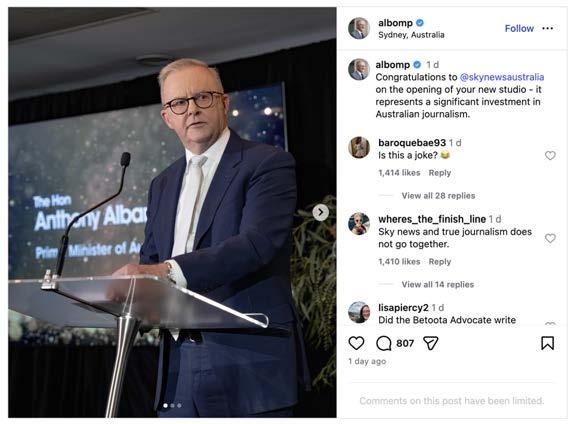
The Betoota Advocate used their satire to broach the subject with the appropriate tone: “Failed Perth Bomb Attack To Be Recast As Mental Health Conversation
We All Need To Have” or “‘If It Looks Like A Terrorist Attack, Walks Like A Terrorist Attack, But Talks Like A One Nation Senator, Then It Isn’t A Terrorist Attack’, Says Australian Media”.
A society dependent on satire to articulate violence against Indigenous people is a society whose boot remains on their neck.
So often Australians dance around First Nations justice, casting hesitation as semantic caution. Yet we carve wounds deeper in already bleeding people.
Such caution reveals how colonial power protects itself discursively by refusing to recognise violence against Indigenous political expression as political violence. The hesitation to call this terrorism is not neutral. It captures
whose political expression is taken seriously and whose is treated as incidental.
In the little mainstream media coverage granted to this incident, Hall’s name was concealed until last Tuesday, on the grounds of his “vulnerable mental health condition”. This went against the regular court protocol of naming people who are facing court.
Yet it was only once he was formally named and his alleged nationalist and racist motivation that coverage intensified. The story, which should be centered on First Nations people, gained weight through the perpetrator.
Elaquare Spencer explores the quiet machinery of colonial power.
Colonial power prevails not only through land theft and disproportionate incarceration, it operates discursively. It has long portrayed Indigenous resistance as disorder. The truth, and all it says about Australian society, is reframed as a security problem; what should provoke reckoning is managed as a policing success. The label ‘possible terror attack’ does not expose violence — it neutralises it.
This year’s protests centred particularly against the unjust treatment of Indigenous people in custody. An indictment of state violence. Yet, in infuriating irony, when a white man lobbed an explosive at the crowd, police response was measured, procedural and calm. The suppression of Hall’s name insulated his alleged actions from immediate political framing.
Meanwhile, the broader conversation focused on invasion, sovereignty, and colonial violence is pivoted immediately toward social cohesion and public order. Within hours, the rally became mere scenery for a story of containment and stability. As always, the rally’s political message is eclipsed by the familiar narrative of Indigenous protest as disturbance, rather than a legitimate challenge of colonialism.
A country built through colonisation is one that cannot outgrow it without centring First Nations justice and sovereignty.
Herein lays the very mechanism that keeps the colony breathing; the continued suppression of Indigenous people. Whilst none of this is new, nothing makes it more harrowingly clear than the pervasive hesitancy to call this what it was: a terror attack.
As postcolonial scholar Gayatri Chakravorty Spivak once said, “the subaltern cannot speak” — and when it is attacked, we speak over it.
Epstein’s reach in Australia
Sebastien Tuzilovic investigates (reads) emails.
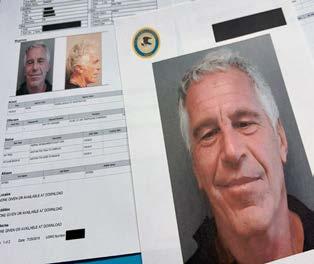
A search of “Australia” on the Department of Justice’s ‘Epstein Library’ returns a focused case study of Epstein’s influence, and the types of activities upon which the pedophile’s reputation, livelihood, and network were built. Amongst banal orders of pots from Sydney manufacturers, flight details, and tips on vacation spots to his friends, the files show that Epstein was intimately informed on and actively attempting to influence Australian diplomatic relations, business, and politics. His network included discussions on Australian TelCos, mining companies, and University executive decisions. The emails demonstrate Epstein’s potential influence in the Australian mining business and show that his advice potentially contributed to the 2014 Labor leadership spill. For brevity, this investigation does not address his connection to Australia. This can only be found comprehensively by searching yourself.
Bannon and Palmer
A text exchange between Steven Bannon, former white house chief strategist of Donald Trump and Jeffrey Epstein shows Bannon claiming that Clive Palmer’s infamous $60 million “anti-China and climate change ads” was Bannon’s idea. Palmer claimed in 2019 that these ads were the reason for Labor’s shock loss in the general election.
Palmer has denied Bannon’s influence on his 2019 campaign, stating in a press conference that he believes his name was used by Bannon to increase Bannon’s own influence at the time. Palmer stated that he met with Bannon once, under the misconception that the influential conservative was a donor to his party.
Epstein’s relationship with Australian Mining
Epstein was informed by disgraced former UK Labour politician Lord Peter Mandelson about strategic advice Mandelson had given to the Australian mining sector. This occurred in 2010 during the Australian mining industry’s fight against Prime Minister Kevin Rudd’s mining tax bill, the failure of which ultimately led to Rudd’s ousting.
The document shows Mandelson advising a redacted recipient of his email that they “need to build the broadest possible coalition” in order to defeat Rudd’s tax. Mandelson emphasises that continued
pressure is needed, and that the mining companies must be sensitive to avoid media coverage which would show them influencing the Australian government. He stated in the email, “You do not want to turn it into an issue of ‘who governs Australia’... the voters and their elected representatives or the mining companies.”
Katherine Keating, the daughter of former Australian Prime Minister Paul Keating, appears to have discussed Australian mining magnate Andrew Forrest with Epstein in Epstein’s emails. Epstein stated he was told that Forrest was “great” by a “friend of his” at JP Morgan.
Katherine Keating’s relationship with Epstein has come under much scrutiny by the Australian press. Keating appeared to have attended parties with Epstein and former Prince Andrew Mountbatten. Emails released by the Department of Justice demonstrate that Keating’s relationship with Epstein also included damage control for Andrew Mountbatten during an interview with Vanity Fair writer Edward Klein.
Attempted meetings with Kevin Rudd
Former Australian Prime Minister Kevin Rudd appears several times in the files, with Epstein apparently attempting to arrange a meeting between himself and Rudd. Rudd’s office denies that Rudd ever met or interacted with Epstein in any capacity. Emails between thirdparty sources and Epstein demonstrate continued attempts by Epstein to meet with Rudd, including at Epstein’s New York house.
Rudd was invited to a business meeting at the Epstein house, and Epstein was notified by venture capitalist Joi Ito that Rudd “might stop by”. Epstein seemed certain in Rudd’s appearance at the event, and emailed other redacted addresses, stating “...now Kevin Rudd is also coming”. Rudd’s office denied that Rudd attended the event to the ABC. They stated that “they were unsuccessful in arranging the introduction”.
Other such attempted meetings appear in the files. One email from Epstein to Larry Summers states, “in NY Sunday at house, Ehud, Hardeep Puri, former head of counter teroorism u.n < Keying Rudd Woody, joi ito. If you have any interest.” The names appear to correspond to former Israeli PM Ehud Barak, Indian Minister of Oil and Natural Gas Hardeep Singh Puri, director Woody Allen and Joi Ito, mentioned earlier. There is no proof or indication that Rudd ever met with Epstein.
Influence in Australian Business
Epstein received a number of emails detailing business deals with Australian TelCos. A discussion of a meeting between a friend of Jeffrey Epstein and David Thodey, is included in the files. Thodey, then Telstra’s chief executive, met Greg Wyler, an influential Silicon Valley tech pioneer, in 2014 to discuss an unknown business proposal. Wyler emailed details of this meeting to Epstein, stating that Thodey showed “serious interest”
in Wyler’s proposal. Thodey became Chancellor of USyd in 2024. Honi Soit is not suggesting that Thodey was personally, financially, or professionally connected to Epstein in any capacity.
Lawrence Krauss
It has been revealed in emails that popular theoretical physicist Lawrence Krauss sought personal, PR and legal advice from Jeffrey Epstein over an investigation made into a sexual assault allegation against him at Australian National University (ANU).
The investigations found an eyewitness account that Krauss had groped a woman’s breast at a Melbourne Zoo event in 2016, to be not substantive enough in order to dismiss Krauss. The complaint was dismissed. The event was later reported in a 2018 Buzzfeed article. The released emails reveal Buzzfeed’s query to Krauss over a number of sexual assault allegations and the results of a Buzzfeed investigation into Krauss’ interpersonal relationships with his students. ANU reopened investigations into the event following the article. Krauss’ correspondence with ANU academics can be found in the files, forwarded to Epstein.
Krauss looked to Epstein, a man he described as a friend, for advice on the matter. He stated to a lawyer he contacted for advice on the Buzzfeed article, “I have been advised… by a friend, who is also somewhat infamous. His name is Jeffrey Epstein… Jeffrey’s not only friends with most of the famous people from finance, to business, to Hollywood, who have either been brought down during #MeToo”.
Krauss continued to explore options with Epstein and contacted an apparent Australian journalist who advised suing Buzzfeed for defamation. This never happened, and Epstein strongly advised against it, instead urging Krauss to appeal the case. He appeared to grow frustrated with Krauss and stated, “I will not review any more of these silly letters… LAWRENCE, get some sleep. This is awful, silly, and misleading. false. Trite.”
Epstein died less than a year after this email, and Krauss was dismissed from ANU and had his projects shut down.
Hundreds of other files
This is certainly not the full scope of Epstein’s embroilment with Australian politics, finance and academia. The DOJ release is indescribably massive and still incomplete. The Department has released only just over half of all available files on Epstein. Not substantively included in this discussion are reports against Epstein by Australian women to the FBI, allegations of conspiracy by Epstein against Australians, and the documents of an Australian woman, which seem to constitute a blackmail list.
It is unknown whether these are substantive accusations, and the full breadth of Epstein’s criminal activities, given his embeddedness in international politics, is impossible to discern. Australia is no different to any country, and Epstein’s influence can still be felt here.
Sugar in Milk
My earliest encounter with faith and negotiations of the theological kind involved sliced plums.
Every night, my father, a priest of the Zoroastrian faith, what many would politely describe as a “dying” religion, would teach my brother and I prayers in the ancient and no longer spoken Avestan language. In a most reverent tone, I would stumble through repeating after him, not knowing the gravity of the words I spoke, words carried orally across centuries — instead eyeing the sliced plums sitting by the bedside table — an enticing offer to complete my religious duties. Now, bonus prayers are routinely bartered in exchange for the occasional modern miracle, such as a parking spot on campus, and dejectedly retracted when the deal isn’t honoured. Sacrilegious, perhaps, but faith is rarely practiced in a ubiquitous form.
Yet I am beginning to comprehend that inheriting a religion and having permission to continue its practice are not always the same thing.
My bedtime stories weren’t merely fairy tales; they were epics of Persian poetry, my father’s voice illustrating the Shahnameh by Ferdowsi in technicolour.
Scenes of birds with fiery plumage, landscapes of tumbling emeralds and strong warriors with fierce furrowed brows, visible through my squinted eyes, dancing on my ceiling.
Much more importantly, the luminous, intelligent, and powerful women I was clearly descended from emerged in my mind. It was only later that I realised the homeland I inherited through stories of mythic proportions was as much imagination as geography.
The Iran conveyed in poetry is not always the Iran its religious minorities experience, and for many
in the Zoroastrian diaspora, our homeland survives first as a story.
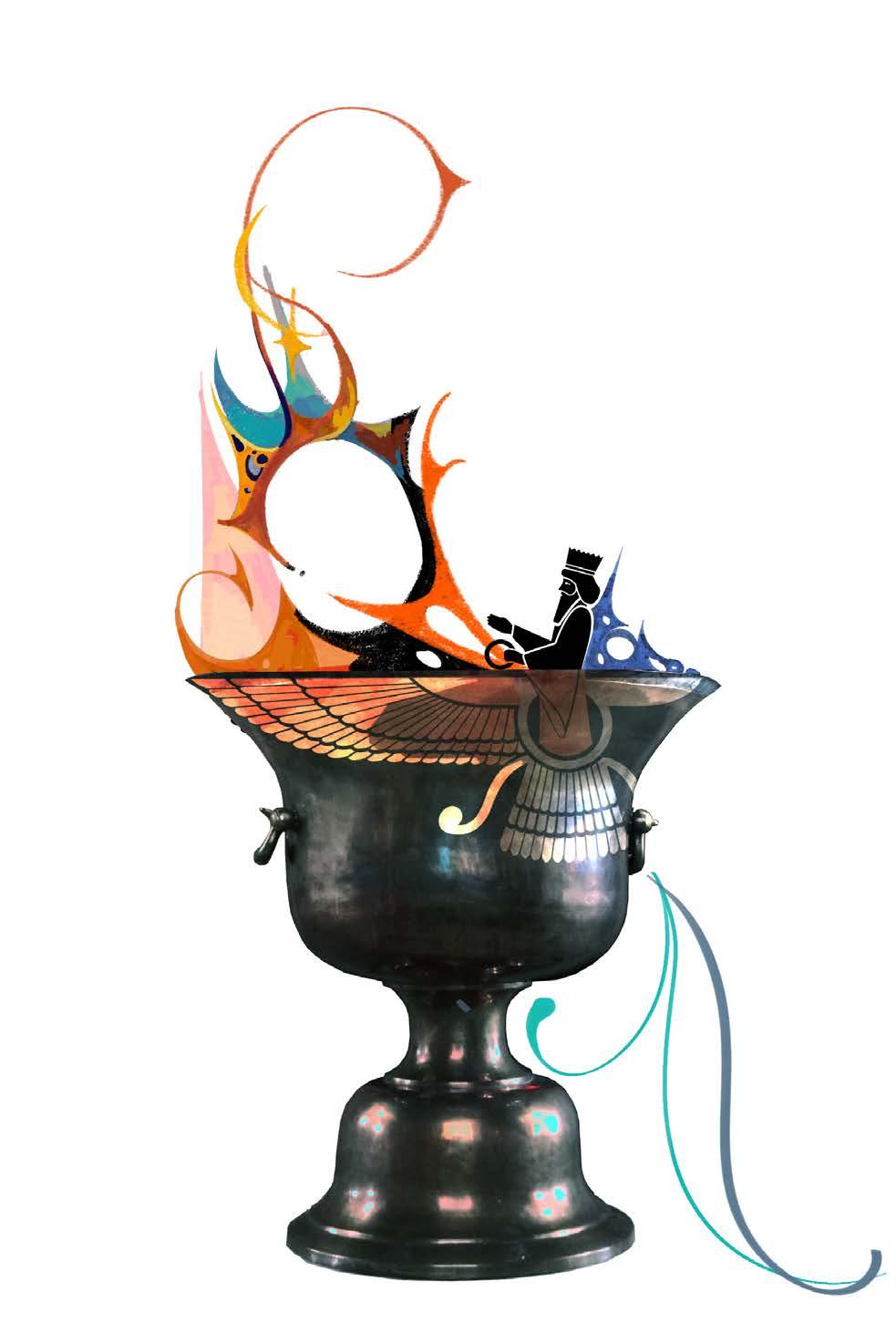
My ancestors crossed borders, emigrating from Iran to India in boats, carrying with them their faith and a fire that, to this day, still burns. When they arrived in India, they promised, in a famous story, that they would dissolve like sugar in milk, sweetening without spilling over, a promise of assimilation yet cultural preservation. However, preservation is a fine balance, as though trying not to spill, we as a community have slowly shrunk the glass. For a minuscule community, survival has always depended on boundaries, and boundaries, by definition, exclude. But when the glass shrinks, it’s the women who feel the edges first.
Within the Parsi community — the Zoroastrian diaspora in India — religious lineage has followed the father, a boundary enforced in courts in the name of protection of continuity. But this tradition has left many women to quietly wonder what inheritance truly means and why the child they carry may not have the right to follow their God. There is a strange equation to religious inheritance. Someone less devout may secure their children’s legitimacy through marriage, while mine could be entirely dependent on the person I love.
For many young female Parsis in the diaspora, the question isn’t whether we belong but whether belonging will be allowed to extend beyond us.
I fear that my future children will be shunned, that sacred spaces might deny my presence, that I will not be permitted to witness the final rites of those I love.
My prayers live in my mind; I observe the daily rituals, and yet the legitimacy of my future children may not hinge on devotion and adherence to the religion but on gender alone.
But the experience of the community is never simply confined to doctrine or dogma. It unfolds in the ritual lighting of the devo my nanna undertakes every morning, in the dedication of aunties labouring over a Navroz meal as though everyone will starve if the dhansak isn’t cooked to perfection, and in the incessant chatter during Sunday school classes. It’s found in our familiar and somewhat comically recognisable Parsi noses, and surnames that reveal the histories of our predecessors, it’s being known
It’s within our shared memories and practices, and that’s what makes the tension so painful, because the community that shaped my identity is the same that may one day
Loving tradition is one thing, but trusting that it has space for your future is another. Belonging is not about being born into the community but about being recognised by it. It’s about knowing whether the spaces that once welcomed you as a child will remain open in adulthood or if they will quietly close the door depending on
I feel caught between a mythical homeland and a future of uncertainty, between love and pride for my culture and mistrust of whether it has room for my future.
These days, I pray without the promise of cut fruit, and often without the attainment of a parking spot, because my commitment to religion is a part of who I am. I was raised within this faith so that it could endure another generation, regardless of the marginalisation it has faced. It would be an ironic tragedy if the ancient flame flickered out, not because it was forgotten and unkempt, but because it was smothered by the very hands trying to protect it.
As a woman in the diaspora, living in a Western country, this tension is not a hypothetical but rather a poignant reality.
Daena Madon questions her faith.
Artist: Josephine Thwaites
The Politics of Voice
Bibi O’Loghlin listens to the sound of her own voice.
I cannot remember a time when the sound of my own voice has been anything but a source of embarrassment. Despite my voice being fairly low for a woman, I perceive it as whiny and childish. My habit of uptalking — allowing the pitch of my voice to rise at the end of statements — undermines the surety of the things I say. I overuse the word “literally” until it jumbles in my mouth, coming out as a confused ‘lirrully.’ But my biggest sin is the way my voice consistently flirts with raspiness, leaving my speech pattern dominated by vocal fry.
The Voice Foundation suggests that vocal fry is experienced by up to two-thirds of young women, with men exhibiting it at a rate four times less frequent. Vocal fry involves speech becoming low and vibratory. If, like me, you ever made fun of ‘Valley Girl voice’ as a child by imitating it, you were making fun of vocal fry. If you’ve ever done a Kim Kardashian impression, you have mimicked vocal fry. Studies and surveys have shown that you are more likely to find someone who speaks with vocal fry annoying, untrustworthy, incompetent, and less hireable. If you’re a woman, it’s also very likely you speak with it.
As vocal fry has become more common with ever-increasing cultural Americanisation, so too has backlash against it. Vocal fry is widely considered infantile, unprofessional and a sign of vapidity.The problem thatemerges is a chicken and egg one — which came first, our hatred of women or our hatred of their voices? Do we hate vocal fry because we associate it with women, or do we hate female voices because of vocal fry?
answer: maybe they don’t. It has been argued that perhaps men speak with similar levels of vocal fry to women, but it’s a flaw we notice selectively, overanalysing women in search of imperfection. Another posited theory is that as women have entered the workforce, they have adjusted their vocal patterns to mimic male ones in hope of commanding a similar level of respect.
Lowering our voices into an unnatural range keeps us safe from being defined as squeaky-voiced bimbos, with the unfortunate side effect of causing that dreaded crackling sound. That sound is the flaw in an otherwise perfect plan, a mark of our inauthenticity as man-imitators. Regardless of which of these theories is true, one thing is clear: misogyny sits at the root of vocal fry as a hated phenomenon.
It has been suggested to me that perhaps the low tone and vocal fry in my speech may result from subconsciously lowering my natural pitch, since my natural tone is higher and more feminine than I am comfortable with. If that were the case, who could blame me? Don’t we all want to be taken as seriously as men are?
If that means vocally separating ourselves from the feminine, it seems a small price to pay. Despite what choices we make vocally, whether subconsciously or deliberately, vocal fry is a reminder that we — as women — aren’t welcome in traditionally male spaces, or valued in positions of authority. Power is exerted vocally, and what little power women do hold is distorted by the listening ear into a grating whine.
After all, if it’s just a matter of the human brain naturally disliking the sound of vocal fry, maybe misogyny has nothing to do with it. Maybe I don’t hate the sound of my own voice because it’s a feminine voice, but because it is genuinely irritating. In 2015, the podcast This American Life released an episode that discussed the frequent complaints they receive about the vocal fry of their young female reporters. You could argue that those listeners aren’t misogynistic if it weren’t for the fact that male host Ira Glass pointed out his own vocal fry, which is not a subject of concern to those who write in.
Then there’s the question of why. Why do women develop this speech pattern at such high rates in comparison to men? The
Capitalism’s Cage: Are We Willing Prisoners?
Feaim Alkozai rattles the cage.
The modern cage of capitalism is a contradiction. We can frolic in it, rail at it, and then comfortably lie down in it. Though we may perceive small cracks in its armoured structure, we remain faithful to its protection, choosing the false sense of security that our passive silence awards us. We attribute a distorted freedom to the barbed fences of the capitalist prison cell — its gaps suggest an opportunity for escape that we never truly pursue, but appreciate nonetheless. We can still see freedom without ever having to risk actually grasping it. It deludes us into thinking we chose to inhabit the cage.
Though capitalism does provide real opportunity for individuals, even in those in the most dire circumstances, to improve their lifestyle, its manipulation by elites has offset the potential advantages offered for everyday people.
Billionaires run the world. People whose names you haven’t even heard of are able to shape our lives drastically. The wealthiest 0.001 percent, representing less than sixty thousand people, hold three times more wealth than the bottom half of the world’s population.
Dostoyevsky once wrote: “The best way to keep a prisoner from escaping is to make sure he never knows he’s in prison.” I disagree. We are aware of our capitalistic puppetry. The release of the Epstein files in late January this year revealed what we all knew deep down: the apathy of elites. Politicians, world leaders, religious figures, academic scholars and celebrities we revered were implicated in sex crimes perpetrated against the most vulnerable in society. No matter how much they attempted to seem relatable on talk shows or generous by donating a speck of their wealth to charities, these actions could never make us really forget the extreme power these individuals hold over us. Being aware of the corruption persistent in the world is not difficult when it’s astoundingly apparent.
Instead, the best way of keeping a prisoner from escaping, if such an outcome is even possible, is to propagate the idea that we, the billions of working-class people who keep the world running, are powerless.
This internalised view is what is difficult to conquer. It is a surrendering, a forced acceptance of present circumstances. We are cognisant of our mistreatment and yet are hesitant to demand more. If we were only to transform our anger into action, the system would cease to stand.
However, to say we are surely going to dismantle elitist hierarchies is too optimistic. Though to claim we are never able to confront inequality seems too pessimistic. Some of us are persistent, able to hold onto our humanity, recognising that no amount of propaganda will justify the avoidable suffering of billions at the hands of greedy governments and corporations. Yet these precious few revolutionaries remain unable to oust those who sit on cast-iron thrones and watch us jesters going about our daily lives. The elites are untouchable.
The system is broken perfectly and deliberately. It is designed to hold everyone accountable regardless of wealth or connections but collapses as soon as the victims are deemed too insignificant and the perpetrators too valuable. The Epstein files, though containing over 3.5 million pages of evidence, leave us more questions than answers.
With such extensive material documenting sex crimes against children and women, as well as the years of brave survivor testimonials on record, more severe repercussions against those connected should’ve been meted out already. But so far, the most notable investigation has been into Andrew Mountbatten-Windsor,
previously known as Prince Andrew, who was arrested by UK police on February 19th in connection with his affiliation to Epstein. He was released the same day.
Reflecting on the arrest, US Congressman Thomas Massie pushed for such action to be taken nationally, demanding “justice in the United States.” He also took to social media to share a speech he made on the House Floor last year, where he measured the success of the release as dependent on whether “there are men – rich men – in handcuffs being perp-walked to the jail”, claiming that “until then, this is still a cover-up.” Despite the appearance of legalities taking place, the consequences of such heinous behaviour have hitherto been insubstantial. Recently, US Attorney-General Pam Bondi was the subject of intense questioning in a congressional hearing regarding the justice department’s lack of investigation and arrests related to the Epstein files. The handling of files were also scrutinised for redacting and protecting potential perpetrators while exposing sensitive information like names, addresses, and compromising photographs of victims. The notion of the law being the final, impartial force that keeps our society afloat thus falls apart.
In fact, the law’s partiality has been recognised even by US President Donald Trump’s Attorney General, Todd Blanche. Earlier this year he confirmed that “the number of responsive pages is significantly smaller than the number of pages initially collected.” While attempting to justify the withholding of roughly “50 per cent of the Epstein files” by claiming the Department of Justice had “erred on the side of over-collecting”, Blanche’s obvious connection to Trump compromises his reliability. Last year Trump filed a lawsuit against The Wall Street Journal for publishing a birthday card in the shape of a nude woman that he had sent to Epstein.
The struggle against political corruption is a worldwide one. Just last week, protests in Australia sparked after Prime Minister Albert Albanese invited Israel’s President, Isaac Herzog, to “offer sympathy and solidarity to people who are mourning” following the tragic Bondi Beach shooting. Herzog was found by a UN commission to have incited genocide against Palestinians, a ruling which he called “a blood libel” — a form of antisemitism used to justify the slaughter of Jews in the Middle Ages. While antisemitism is a very real and dangerous phenomenon, the Jewish Council of Australia (JCA) stresses that “genuine concerns are being manipulated by the right wing pro-Israel lobby to silence criticism of Israel’s genocide in Gaza.” The JCA vehemently opposed Herzog’s visit, labelling it “completely inappropriate and offensive.”
Those who attended the protests reported brutal conditions. One participant I interviewed, who’d been attending “protests for almost 10 years”, described this particular experience as “absolute hell.” They report being immediately kettled by police amidst the crowded conditions shortly before being pepper sprayed; “Pepper spray is itself unbearable and unlike any kind of pain and discomfort I have experienced before. I could not breathe and felt as an asthmatic that I was going to die. Many of the people I saw arrested had just been pepper sprayed and couldn’t see anything and probably were unable to breathe.”
We choose when to allow the metal cage to shut us in for the night, or when to cut through the barbed wire. The Executive and Judicial hands of our society – the police, the judges, the politicians – are able to decide between accepting the banality of evil or dismissing such a sordid excuse for corruption. The observers, those who watch, take note, yet remain silent, have every chance to use their voice for good.
What we are powerless against is our own egos, the way in which humanity has ranked itself from least to most important. Powerless to the way propaganda has allowed us to idolise some while dehumanising others. This is what stalls our action.
I am not so naive as to believe a worldwide paradigm shift against elitism is occurring. Too many of us are comfortable in the status quo for such a drastic change. However, what I do believe is that enough of us can demand more than the small rations of freedom our captors allow us to consume.
Will the real radicals please stand up?
Calista Burrowes is tired of celebrities.
In 1985, Neil Postman stated in Amusing Ourselves to Death that “Americans no longer talk to each other. They entertain each other. They do not exchange ideas, they exchange images. They do not argue with propositions; they argue with good looks, celebrities and commercials.” Our political opinions are less influenced by nuanced intellectual debate but more dependent on “bread and circuses.” We believe that establishment-media’s entertainment and distractions will liberate us. We have been led to believe that celebrities are our freedom fighters, that these jesters at the top rungs of society will save our world.
If celebrities are anything in the realm of activism, they are a directive.
With their considerable reach and platform, they can be a resource – most often state-sanctioned and aligned – for people who are not particularly politically engaged and who have no knowledge of where to turn. Celebrities can appear to give ‘permission’ for people to speak. “If they can speak and risk their careers,” we say, “then I can too.” But are they risking much at all? While there are rare exceptions to the risk of career losses, such as Melissa Barrera who was fired from the production of Scream 7, and Pink Floyd singer Roger Waters possibly facing prosecution for their pro-Palestinian activism, celebrities actually risk very little, as much of their activism remains within the safe confines of ever-so slightly leftof-centre politics. When Jimmy Kimmel’s show was abruptly taken off air for remarks made about rightwing extremist Charlie Kirk, the Hollywood establishment came to his defence immediately: “Our voices should never be silenced by those in power – because if it happens to one of us, it happens to all of us.” However, when journalists in Gaza were slaughtered en masse, there was not only silence, but punishment for speaking out, with Nine threatening restrictions on journalists who signed the November 2023 letter for the protection of the media. Celebrity politics will only extend as far as said famous person is willing to risk their economic and social capital.
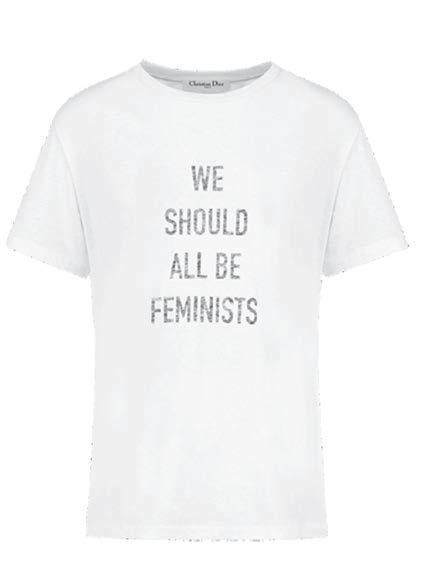
a celebrity is a member of a system that, as aforementioned, is mostly (but not always) an at-best centrist political world, it is a death sentence to challenge this order. As such, a political statement that seems slightly out of step can feel radical, like Dior’s “We Should All Be Feminists” T-shirt, which makes a mild feminist statement that band-aids a history of worker and supply chain exploitation that primarily targets women.
Whether intended or not, celebrities act as a form of ‘controlled opposition’ for the mainstream. Controlled opposition refers to the idea that our ruling political class will allow a spectre of opposition to power so long as it remains within the accepted political and social code, and encourages people to do the same.
platformed to the same degree as actors and singers. Programs like The Dick Cavett Show frequently platformed thinkers from the 1960s to the 80s such as James Baldwin, Gore Vidal, and Toni Morrison, whose interviews reached and catalysed political change in many viewers through broadcasts which live on in social media, disseminated through minute-long clips. So what happened? Writers and thinkers are still hosted on talk shows but their influence as culture-shifters is waning. Our worsening attention spans, weakened by quick hits of dopamine on social media; the underfunding and disregard for critical humanities education and podcasts that access audiences through decontextualised ragebait overtaking traditional media forms have all contributed to this delince in nuance and good-faith debate.
As Margaret Atwood writes: “A rat in a maze is free to go anywhere, so long as it stays inside the maze.”
What is social and economic capital?
What do celebrities stand to gain or lose?
Pierre Bourdieu gave us an understanding of capital as an individual’s collection of assets, networks, and resources, creating a web of wealth and clout. Losing trust amongst peers and groups, changes in social attitudes, or simply becoming ‘irrelevant’ can erode one’s capital. When
When Green Day performed at the Super Bowl, many before and after celebrated it as a so-called middle finger to Trump, who the band had previously been critical of. However, their performance was nothing but a controlled display of politics. Surrounded by advertisements for gambling and ICE recruitment, playing for an owner like Robert Kraft who has made significant donations to Trump’s inaugurations and pro-Israel and Zionist organisations, Green Day’s so-called statement becomes cheapened, with the band parading themselves around for the subjects criticised in ‘American Idiot’. The same applies to celebrities turned right-wing grifters like Nicki Minaj, who claim to be voices of ‘rebellion’ against mainstream liberalism but are simply following where the money goes at any given time. To the content consumer’s unattentive eye, this all appears like a major “fuck you” to the system despite it being at the behest and approval of that very system of capital and subjugation. There was a time in which thinkers were
Celebrities are out of touch no matter how relatable they
present themselves as.
They have an abundance of the most precious commodities that we don’t have: time and money. To be preached to by those who do not have the same 24 hours as we do is simply not appealing or helpful.
This is not to discount the value of knowing how the world operates, far it. Instead of looking upwards to cultural idols to source our understanding of the world and how to combat and dismantle its afflictions, we must look vertically. Who are our allies in the fight? How can we invite people into the fold of resistance? What must be done to enable tangible change and progress? These questions have been asked for centuries, however, as we become more isolated from ourselves, our communities, and increasingly dependent on manufactured images and representations of “power” and “glory” for connection, we must make a conscious turn towards the people surrounding us, before they claim to “have always been against” oppression.
Chasing prestige, leaving students behind? A critique of global university rankings
Meijie Ureta evaluates the
metrics.
Academic institutions around the world spend much of their budgets building prestige, particularly by climbing university rankings. From Quacquarelli Symonds (QS) to Times Higher Education (THE), these rankings claim to motivate institutions to improve quality education, from strengthening learning infrastructure to increasing research publications.
Yet this “quality” does not necessarily translate to student life or reflect what students actually need. Many students continue to grapple with economic inequalities, harassment on campus, and administrative mandates that restrict students.
What truly defines quality education? While administrations are easy targets for blame, an underlying system makes university rankings yield a contrasting reality in which educational priorities are distorted.
The rubric is as follows:
University rankings, particularly in the context of top global rankings, each have their own methodologies and measurements.
QS, for one, assigns research 50% of the overall score. Here, academic experts are surveyed on an institution’s area of expertise and overall excellence, and citations per faculty are counted to measure research volume.
Employability follows at 20%, with the QS Employer Survey sent to global academics and employers to assess how an institution prepares its students for employment, partners with industry, and fosters graduate success. The remaining 30% are allocated unevenly across learning experience, globalisation, and sustainability to measure the faculty-student ratio (FSR), interpret diversity, and review environmental and governance projects on campuses.
THE has five core pillars of evaluation, and two of them include research that collectively weigh half the overall. In the same light as QS, research quality sits highest at 30%, and research environment comes right next at 29%. Under these, citation volume is heavily measured, while other areas such as income, productivity, and influence are also reviewed.
Teaching, on the other hand, accounts for 29.5%. Compared to QS, THE secondly focuses on the learning environment, including teaching reputation, FSR, income, and doctorate ratios. The 11.5% left is given tO international outlook and industry. For data collection, surveys are also used; THE’s Academic Reputation Survey invites experienced scholars to nominate institutions in a voting system.
In the overview, both rankings heavily prioritise research in their criteria, while also considering learning experiences and internationalisation. It appears dynamic: focusing on contributing to the body of knowledge, fostering cultural diversity, and disseminating information evenly from professors to students.
These are commendable considerations to build quality education. However, reality often differs from what is captured inevaluation metrics.
Especially from a student’s perspective, institutional resources could be redirected towards holistic student support.
Shifting both expectations and realities
Much of university life comes through the daily experiences and rights: safety on campus, avenues for wellbeing support, and opportunities for diverse talents to thrive. Yet students face the opposite—discrimination, inaccessibility, and censorship.
Quality education, not to mention, comes at a hefty price. For those with scholarships, other university living expenses can remain burdensome. Despite the large investment and even the yearly tuition increases, the return is not as tangible. And while entering a particular university is mostly the student’s choice, they, along with the administration, are also caught in a system where prestige clouds priorities.
I witnessed these dilemmas firsthand as a student at De La Salle University, a top university in the Philippines according to QS and THE. While I am grateful to attend a prestigious school with few complaints, there are still gaps that need to be filled. Funds and focus on infrastructure could also be distributed to fulfil student needs, such as additional financial aid, relevant career guidance, and diverse, available professors.
At the University of Sydney, realities are also contrasting.
Even as USyd generates even more profit as a higher-ranking, more populous institution, USyd students continue to struggle to attain affordable housing, face on-campus intimidation, and exercise their right to assemble and protest.
The whole concept of prestige, especially through ranking systems or any other external evaluation, should be reconsidered. Education should go beyond purely collecting achievements and publishing research, and should also share in cultivating cultures of genuine service and the protection of rights if the end goal is to make a better society anyway.
At the end of the day, quality education is a right. Students should not have to compromise their finances, safety, or dignity to learn and complete their studies. There is nothing wrong with aiming for excellence; it just has to be redefined to reflect what is truly representative.
“Where did you go to school?”...Why do you care?
Siena Fagan questions
All of my friends know the story of my worst date ever.
There were a lot of things that went wrong, but where I should’ve picked up and left (instead of staying regrettably long) was when we hit the topic of education.
First of all was his line of inquiry into my ATAR, something I had not been asked about in two and a half years. Despite my laughing it off, he pressed on, spitting out numbers and asking me “Higher? Lower?”
Twenty-year-old Siena gave in, hoping to move on.
Then came his disappointment as he discovered I had outranked him. Then, he asked the dreaded question which has bugged me since I moved to Sydney three years ago.
“Where did you go to school?”
It’s Sydney’s most asked question. It pervades conversation and connection, from our lecture theatres to corporate offices, hinge dates, and anything in between.
Sometimes, school names are whispered in shame and other times boasted in pride.
But I have a follow-up question: why does anyone care?
Indulge me in my self-insertion to this debate… but I truly could not care less what school any of my peers went to.
I grew up in another state and moved to Sydney for university. My friends often laugh when I confuse Knox and Scots, which have a notable 52-spot difference in their 2025 rankings.
In Sydney, education is a form of currency. Our perceived value increases relative to the renown of the building in which you learnt your times tables.
But that currency only exists within its own bubble — where people will recognise the standing of your alma mater.
While access to resources is its own kettle of fish (and I’ll get to that), name-based prestige
carries value because we give it to them.
Full disclosure, I went to a prestigious school in Brisbane and am absolutely the beneficiary of that, but none of my Sydney University classmates would know it by name. I also would have no clue what its ranking was, or even what the top ranking school in my city was.
While I hate being asked what school I went to, it’s impossible to ignore that education is currency and power beyond just what you glean from the classroom. If I told you I went to James Ruse, you might make different assumptions than if I went to Castle Hill High, PLC, or a local state school.
High-powered education institutions can grant students access to seemingly unlimited, and oftentimes unnecessary, resources.
May I pose another followup? Why does Scots College need a $60 million baronial castle? Particularly when there are schools in regional New South Wales which struggle to provide basic technology to their students?
According to a Save Our Schools research paper, Australia’s educational resources gap ranks sixth worst among The Organisation for Economic Co-operation and Development (OECD) countries. More than a fifth of students in low SES schools lack access to digital resources in comparison to two per-cent in high SES schools.
The report states that “over 90% of disadvantaged schools are public schools,” and cites the School Resource Standards (SRS) as a key factor.
The Australian Government’s Department of Education describes SRS as “an estimate of how much total public funding a school needs to meet its students’ educational needs”. According to Save Our School’s research, public schools in 2024 were funded to 87.6% of their SRS, while private schools were funded to 104.9%.
Alumni networks are powerhouses in their own right, funding or supporting huge projects for schools that their members may have attended several decades ago.
An example that springs to mind is the alumni of Newington College actively advocating against a change to co-education due to concerns about ‘culture shifts’. A court case from Newington’s ‘old boys’ was carried all the way to the Supreme Court in a bid to stop female students from enrolling by arguing a 19thcentury interpretation of the word ‘youth’.
Consider, beyond just money, the value that those networks can have! Imagine the notso-invisible string between yourself and an alumni job interviewer, or having a reference from your future boss’ high school English teacher.
My mum, an alumna of a rural Queensland state high school, always told me that my school fees weren’t only worth it
because of my grades, but also because I’d hit the ground running in a way that she couldn’t have dreamed of.
It’s a gift that I will never fully grasp the worth of, and one that I will forever be grateful for.
My mum is an exception as someone who grew up in a town with one set of traffic lights but can afford to send her daughters to big-city private schools or interstate for university.
The value and power gifted by your high school often entrenches the social divisions that run deep through Sydney’s veins.
The fact of the matter is this, most of you reading this article will also be the beneficiaries of educational prestige.
I will benefit from having images of USyd’s sandstone flicker behind a recruiter’s eyes as they read my resume. So will you.
What matters is what you do with it. So recognise that privilege, and use it to let others stand on your shoulders as you find your own footing.
One Child’s Story: The Voice of Hind Rajab (2026) and Panel Discussion
On 10th February 2026, a preview screening of the Oscarnominated docudrama The Voice of Hind Rajab was held at Dendy Cinemas in Newtown. The screening was followed by a panel discussion moderated by investigative journalist Jess Hill. The panellists included: Dr Mohammed Mustafa (Dr Mo), a Palestinian-Australian emergency physician with first-hand experience responding to medical crises affecting children in Gaza; Michael Mohammed Ahmad, Australian novelist, teacher and founder of the Sweatshop Literacy Movement; and Nour Haydar, Australian journalist and co - host of The Guardian ’s Full Story podcast. The darkened cinema was unusually quiet before the film began. The air was thick with anticipation and dread. We knew how the film was going to end. The day before the screening, Sydney police brutalised demonstrators at Town Hall for protesting the Israeli President Isaac Herzog’s visit to Australia.
Moderator Jess Hill welcomed the crowd and apologised for running late, explaining that traffic from Herzog’s security entourage had delayed her. After a brief introduction, the film began.
Screening:
The Voice of Hind Rajab
For over two years the world has watched, live-streamed on social media, as Israel commits genocide against the Palestinian people. During this period, over 20,000 Palestinian children have been murdered by Israeli forces. The Voice of Hind Rajab is a docudrama, directed by Tunisian filmmaker Kaouther Ben Hania, based on the story of just one of these children, 5-year-old Hind Rajab, who was killed by Israeli forces in early 2024.
Hind Rajab was left alone in a bullet-riddled car in the Tel al-Hawa neighbourhood of Gaza City after the Israeli army killed six of her relatives as they attempted to flee. Trapped for hours, she called the Palestine Red Crescent Society (PRCS) for help. An ambulance arrived at the scene at approximately 6 pm, many hours after the initial call. Her body was recovered weeks later alongside those
of her relatives and the two paramedics, Yusuf al-Zeino and Ahmed al-Madhoun, who tried to save her. Hind’s story is one of many war crimes Israel has committed in their genocide against the Palestinian people.
Hind has since become a martyr for the Palestinian struggle for liberation, a movement that has spread internationally, including to the University of Sydney, which held an encampment on the quad lawns, a Student General Meeting to condemn the genocide, and dozens of protests on campus. In April 2024, students at Columbia University occupied Hamilton Hall and renamed it “Hind’s Hall”. In May 2024, American rapper Macklemore released the popular proPalestine protest song “Hind’s Hall”.
One cannot help but compare The Voice of Hind Rajab to The Diary of Anne Frank, both in content and impact.
Both document the impact of ethnic cleansing and state violence on innocent children. However, unlike Anne Frank, Hind had no diary to document her experiences; instead, she had only audio recordings of her phone calls with PRCS volunteers.
The film focuses on the volunteers who responded to Hind’s call. Omar Alqam and Rana Hassan Faqih take Hind’s distress call and comfort her; Nisreen Jeries Qawas counsels the team, and Mahdi M. Aljamal, the supervisor, is forced to navigate bureaucratic and safety constraints as they attempt to dispatch help.
The film uses a mix of scripted storytelling and the actual audio recordings of Hind’s phone calls to recreate the last moments of Hind’s life as the PRCS staff desperately work against time and countless obstacles enforced by the Israeli state to try and save her. The rescue centre workers, stationed in Ramallah, just an eight-minute drive from Hind’s location, have a single, urgent task: to secure clearance and coordinate a safe route for the paramedics’ ambulance to reach Hind.
Despite their best efforts, they fail. Every step is slowed by Israeli checkpoints, arbitrary bureaucratic restrictions, and the constant threat of violence, turning an urgent ambulance call into a tense struggle against a system that works to eradicate the Palestinian people.
Halfway through the film, Hania’s masterful directing had the audience irrationally believing that if the PRCS workers were fast enough, Hind would survive. A motif of the film is Hind’s love of the ocean. It begins and ends with a dark screen with the sounds of ocean waves crashing on the shore.
The knowledge
of
20,000 murdered Palestinian children presses through every frame, reminding us there are 20,000 stories like Hind’s.
There are some things words cannot express. Unconditional love, bottomless grief, and searing anger, these sorts of feelings permanently change both individuals and societies. Throughout history, people have been making art to explore the complexities of the human condition. The most powerful art evokes the inexpressible to cause discomfort, to disturb normality, and to foster empathy. The Voice of Hind Rajab will surely go down in history as a powerful work of art, contemporaneously made about a genocide still ongoing. If you have a friend or family member who is still, for whatever reason, tentative to attend a Palestine protest or take some form of action, then you must take them to watch this film.
James Fitzgerald Sice
Panel Discussion
Jess Hill (JH): Thank you all so much for being here. What are your reflections on what we’ve just seen?
Nour Haydar (NH): I feel deeply moved, and forgive me if I’m not able to articulate myself as I still process what we just saw. I recall very distinctly hearing that recording, the archive used through the film for the first time in a podcast that was produced by Al Jazeera when the audio was released by the Palestinian Red Crescent. I remember standing on a train with my headphones on, and I was heading into the city, here in Sydney, and I was left feeling an immense sadness, helplessness and rage. I’m sure that that’s the feeling that many of you would be sitting with right now, and that many of the Palestinians who were trying to help Hind experienced.
I think the power of a film like this is that it forces us, for the duration of the entire film, to sit with one child’s story, but then to think that in Gaza, that’s been replicated time and time again. Every one of those children, whilst we might not have their name or know their story or the details of exactly how they were killed, that those stories matter and that it is important that they’re not just reduced to numbers.
JH: Dr Mo, something that really struck me watching the film was the moral injury of Mahdi and how he’s having to participate in a system that is just so unjust that he also has to be an authority figure in a system in which he has no authority. As somebody
who has been in Gaza and has worked in the hospitals, do you have something to reflect on there about what it’s like?
Dr Mo Mustafa (DMM): I’ve been to Gaza twice during this conflict, and I’ve dealt with a lot of children that have been injured. That end scene where the mother was identifying the body, it’s at the Baptist Hospital, and that’s where we put the dead bodies when they arrive… Sometimes people are just in plastic bags because their bodies have been completely melted and disintegrated by the bombs, and I know what that mother is feeling, because I’ve watched so many mothers in that same corner open up those blankets and see their children dead. I know the moral injury that those people are feeling because I felt those same injuries.
I remember once we had a child who was in the hospital. They were having a seizure for one entire hour, and we didn’t have the medicine to stop the seizure, and they said that there’s potentially some medicine at the Children’s Hospital on the other side of the city. We didn’t have any senior doctors or ventilators. Usually, we would put them in a medically induced coma to shut off their brain and take control of their airway, but we didn’t have it. We didn’t have a green light to move from one area to another.
I jumped in the back of an ambulance with two nurses, and we had two sets of oxygen masks on, and I was pumping air into this girl’s lungs, and she was seizing as we were going to the Children’s Hospital. I remember the fear that gripped me because we could hear bombs overhead, and I knew that I hadn’t called anybody to tell them where
I felt what it was like to be a paramedic in Gaza, where at any moment, the ambulance could be blown up, and I’ve got this child, and I’m trying to maintain her airway.
I remember when we got to the Children’s Hospital, I ran in with this child that was seizing, and there were just hundreds of kids waiting to be seen, so many injured, and I’m there pleading with the doctors, saying, we need to intubate her. And the doctors look around the hospital and say, you’re not the only one. This girl was still seizing. It had been two hours of her just seizing. That’s the reality of what the children face in Gaza… This is one story. This is one child.
I remember when we were doing surgery for children, we didn’t have enough anaesthetic. They’re crying as we’re doing the surgery. This is the reality of Gaza, and whoever you are, it traumatises you.
There is no doctor or nurse that has gone to Gaza and come back the same.
NH: As a journalist, I imagine not many of my colleagues would want to admit that sometimes the rigid rules and conventions in journalism shackle us and prevent us from telling stories in a way that is as powerful as what we’ve just witnessed. Film is unshackled from those rules and we’ve seen over the last two years, and indeed well before that, the ways that some of the conventions of Western journalism have prevented us from telling human stories, stories that centre the human experience, that don’t get bogged down in the sort of bureaucratic language or the propaganda of powerful states.
JH: Michael, where are you
Mohammed Ahmad I’m a doctor of literature, and so I can only approach it as a literary exercise. I want to try to contextualise it as a piece of art that you all just watched. You’ve mentioned that you lived in Beirut. We were in Beirut in
July of last year, and I was in a car, and the windshield was shattered. Anyone that’s been to Lebanon knows that that’s quite common. I asked the brother driving the car: “Why did the windshield shatter?” And he said: “Pager”. And I said: “Inside the car?” and he said: ”No, I’d be dead”.
It was outside the car, but it blew up the whole vicinity, all the shops, a lot of people got injured, and his eyes, he told me, were bleeding from the explosion. And I think about the way it was narrated in the Western media. Piers Morgan said it was a brilliant, James Bond-style, targeted, precision attack…
These kinds of narratives that are propagated in the West are uniquely designed to dehumanise Arabs so that you don’t feel any compassion when you see horrific stories of children being massacred. It’s common in media, but it’s also common in film. There’s a very important book by Jack G. Shaheen called Reel Bad Arabs… It looks at the entire history of Hollywood cinema. It lists thousands of films, and you will be shocked at how many images you have been raised on where there are subliminal and overt messaging that are anti-Arab in films that you wouldn’t even realise have anything to do with race, like Back to the Future, which many of us would have watched on repeat when we were children. It’s incredibly important that we engage and invest in films like The Voice of Hind Rajab , because that kind of brainwashing, that kind of manufacturing of your consent from a very young age, is how Israel and the United States get away with this without you feeling any empathy.
JH: Dr Moe, you had to deal with being faced with really terrible choices. Such as: which child can I afford to save? How did you and your colleagues cope?
DMM: You don’t cope. I probably haven’t even processed everything that I’ve seen in Gaza. I remember my first mass casualty event, and I remember there were screams, you could hear them down the hallway, and they told us to get to the recess room. People were coming in, people wrapped their family members up in blankets, and they brought them in, and you don’t know who’s alive and who’s dead. I remember the first blanket that I opened up, and it was a child with half
their head missing, and as I pulled the blanket over the parts of the brain, I remember just freezing in fear…
To see that level of violence inflicted on a child, where the bones are hanging out from the legs, where part of their head is torn apart, where their skin is burned so deep you can see the organs. You’re confronted with this, and I’m thinking to myself, what did this? What kind of violence does this to children? I remember the nurses shaking my shoulder, saying, “We need you. We need you”. I snapped out of it, and I looked around. There were more bodies being brought in.
I think one of the most profound things that happened was a nurse had come in, and there was this child on the floor, and he was really struggling to breathe. This was a student nurse, and she sat down in the middle of the recess room. People were screaming everywhere, family members crowding around, and this nurse came and sat right in the middle of the room. She folded her legs, and she put this child’s head on her lap. She started stroking his head because she knew he was going to die, and she just wanted to comfort him before he died. I remember looking at the corner of my eye. I remember seeing this. I remember thinking to myself, how many times has she done this that she ignores all of the commotion, all of the screaming, all of the other kids, and she knows to sit right there? To me, she seemed like an expert. She was stroking this child’s head until he died. This child was scared. Alone. There were no family members with this child. Just like Hind, no one was around.
Read the full article online.
The Voice of Hind Rajab comes out March 5, 2026.
President Grace Street (Grassroots)
Welcome to, or back to, university!
My name is Grace Street and I am the President of the SRC, your undergraduate student union. This is just a short weekly report, please find others with lots more detail on our SRC website and Instagram!
It has been a pleasure for me to present or to host SRC stalls at so many welcome events, including the Scholarships, International Students, Gadigal Centre, ADP, Engineering, and the Con Welcomes for new students. Make sure to get one of our beautiful new SRC tote bags for this year which were designed by one of our USyd students, Krystal DallingerSimpson, with the inclusion of Gadigal language from Aunty Nadeena Dixon. So far, this year has required a lot of organising and political actions around the undemocratic anti-protest laws
General Secretary
Happy Lunar New Year! Get ready for a prosperous year, as we enter the year of the fire horse. We have been fiercely advocating and fighting for your rights as your 2026 SRC General Secretaries.
You may have seen us at the SRC stall during welcome week, giving out free tote bags, wall calendars and fidget spinners. We strongly advise that you do not miss out on our SRC orientation handbook that delivers the most authentic, no bullshit rundown of studying at USyd. There’s still some left, so head down to the SRC Office and grab one.
We have hired a new senior lawyer to our SRC legal team to strengthen our legal services that deliver high-quality legal advice and representation for all undergraduates. We have also been busy working with the collectives to understand and help organise upcoming campaigns, events and visions for the
Vice Presidents
It’s an honour to serve as your SRC VicePresident for 2026! I hope everyone has had a relaxing break over the past few months, and feels refreshed for the year ahead.
Special welcome to all new students to USyd! I hope orientation hasn’t been too dizzying and with you all the best for your first semester.
Aside from reporting to various committees and working groups, I have been busy coordinating O-Week with other Officebearers across Council. I was delighted to help with the International Student Collective draft their freebies, and
rushed through by NSW Premier Chris Minns. The SRC has supported these actions, including for the third year in a row running a ‘cool-down station’ at the beginning of the Invasion Day march. Two weeks ago we saw the amazing people-powered protest against Israeli President Isaac Herzog, who has been found to have incited genocide, across the continent. Sydney’s protest was itself peaceful and legal, but the kettling and lack of exits from police made it dangerous and led to violence.
As part of our ongoing campaign around sexual and gender-based violence on campus as well as the elitism and sexism of the Residential Colleges, WoCo hosted its annual ‘Abolish the Colleges’ protest on Friday which I was very proud to speak at. Students for Palestine held their first meet & greet and rally for the year, ahead of the next National Student Strike on 11 March 2026.
Make sure to sign up to our new SRC newsletter!
In solidarity, Grace
Ethno-Cultural
Welcome new and returning students to the new semester! It’s time to lock in for the first ethno OB report of the year!
We’ve been working hard over the summer break to prepare for another year of activism and raising political awareness in our student body for anti-racist issues. As USyd students, we have an obligation to engage in anti-racist, left-wing activism as pupils of this educational institution that was built on stolen land, has vested interests in upholding capitalist & colonial systems everywhere, and has always profited from the ethnic cleansing of Indigenous people from Gadigal to Gaza.
Vince Tafea (Grassroots)
Ava Cavalerie (NSWLS)
year. We are organising the SSAF budget for each collective, prioritising outreach, collective action and results.
We have consistently worked to promote the Boycott, Divestment and Sanctions (BDS) campaign across the university. Despite this work, The USU disappointingly expanded its partnership with BDS target Coca-Cola at welcome week. (Vince’s Note: Especially shameful given that many elected representatives ran on pro-BDS platforms. DJs and beach chairs at the quad seem to override considerations of Israeli Apartheid. I spoke to this at the Feb 20 Students for Palestine protest at Town Hall, representing the SRC and its position as an Apartheid Free Zone.)
In Solidarity, Ava & Vince
Bohao Zhang (Penta)
Shovan Bhattarai (SAlt)
hand them out during stalling.
As semester progresses, I look forward to actively participating in more committees and speak up for international students. I also look forward to liaising with FoodHub, in order to ensure better service for students when it comes to meeting the cost of living crisis and improving oncampus turnout.
Until next next week!
- Bohao
ACAR organised a contingent for the Invasion Day rally on January 26 and helped our comrades with the SRC stall. There was a massive turnout, which easily outnumbered the hateful and very pathetic counter-protest organised by the white supremacists. #theynotlikeus
On February 9, ACAR attended the PAG rally at Town Hall where we protested against Israeli president Isaac Herzog’s ‘Australia tour’. The police response to the crowds of peaceful, anti-genocide protesters was utterly abhorrent and violent. The NSW Labor government reared its ugly head with a full display of unadulterated state violence. Cops were kettling crowds of people, aggressively pursuing protestors in hordes, bashing the elderly, and physically assaulting Muslims who
Refugee Rights
Imane Lattab (Grassroots)
Pimala Leo (Grassroots)
were praying in peaceful opposition. Dozens were arrested, and many individuals, including elected officials and teenagers, were physically injured.
Our complicity in the genocide, ethnic cleansing, and forced displacement of Palestinians from their homeland is extensive at our university. Just last week, our union cosplayers at the USU invited multiple companies on the BDS list to promote their products at Welcome Week. Brands present were Coca-Cola, Nestlé, and Cerave. We urge the USU to adopt BDS principles and reform their partnerships policy instead of trying to “maintain commercial viability”.
Anyways, here are some of ACAR’s upcoming projects inshallah: Welcome Dinner (autonomous) (Week 1).
First organising meeting of the semester (autonomous). Ramadan Iftar (Week 3).
Israeli Apartheid Week (Week 5). ACAR Honi (Week 5).
As we continue to organise & mobilise, we urge YOU to get involved with student activism!
We need student unionism now more than ever to bring about not just awareness but real, tangible change. Join the fight!
Pimala Leo (Grassroots), Jiahui Chen (Penta), Tiana Moore (SAlt), Laura Alivio (SAlt)
Hi all! Hope your first week is going well!
We attended the Invasion Day/ Survival Day march on 26 January, which had a brilliant turnout. The rally significantly dwarfed the embarrassingly small turnout for the counter-protest run by white supremacists and neo-Nazis. First Nations people have been and continue to face displacement from their own lands and robbed of a right to freely live on Country as a result of colonisation.
Asylum seekers sent to Nauru are struggling to feed themselves adequately, as they are only given $230 fortnightly. However, they are not allowed to work without risk of persecution. All those who are fleeing a country that is unfairly persecuting them must have the right to asylum. Nauru must provide a livable stipend for all asylum seeks immediately!
We condemn the continuance of violence undertaken by ICE.on Turtle Island (‘the united states of
america’) and the Border Force on this continent. It has emerged that a private prison company that is used by ICE, Management and Training Corporation, is being hired to run detention centres for the ‘australian’ government, highlighting the global links of state violence. We lament the countless murders and kidnappings that have robbed countless people of a right to live or freely cherish the presence of loved ones. Under international human rights law, the ‘usa’ government is required to follow the principle of non-refoulement. We demand that all refugees are guaranteed asylum globally!
Follow our activity at our Instagram page @usyd.refugeerights!
SRC newsletter and email list!
Get Ready... Get Set... It’s
time to plan your semester!
Now is a great time to get organised for the semester ahead. Being prepared will make it easier for you to do well in each of your units.
1. Read your unit outlines Your unit outline should tell you:
• The unit code
• An overview of the unit, the weekly topics, and the learning outcomes
• What classes you are required to attend (usually 80% or more)
• The contact details of the teaching staff
• The census date
• The assessments, what they’re worth, when they are due, late penalties; and
• When you are allowed to use Artificial Intelligence.
2. If you get to choose the topic of an assessment, start to consider what you might be interested in, that way, you can ask for your preference.
3. Create a daily or weekly timetable and semester (assessment) planner. Use the Learning Hub’s Time Management module to help you work out how many hours of study you need for each unit, and when to start working on your assessments. That way you can be sure that you
enough time to complete each assessment.
4. Get an SRC wall planner from the library, student centre, or SRC office (Level 1 Wentworth Building). This has all the important uni dates and has room for you to add your assessment due dates.
5. Check the Learning Hub for any workshops you might find helpful. They also have some online resources and offer oneon-one consultations as well.
6. Think about your study load. Talk to a Faculty Academic Advisor about the units you are doing, what units you have left to finish your degree, whether you’re in the best major for your interests and abilities, and ask about any additional faculty resources you could use.
7. Go to Sydney Student and check that you are enrolled in the correct units. Any mistakes in your enrolment will be your responsibility. You have until the end of week 2 to add a unit, or the census date to drop a unit.
8. If you need help with applying for Special Consideration, appealing a mark, or anything else that affects you as a student, contact an SRC caseworker. We are happy to help!
Tenancy: Receipts & Bonds
What paperwork do I need to get when I’m renting a house? What do I need to keep a
JM (BSci)
For more info on renting, check out the NEW RENTERS KIT, produced by the NSW Tenants Union
Dear JM,
You should keep a copy of your lease/contract; your condition report (as well as any photos you took of things that were dirty or damaged when you moved in); and receipts for all money paid (bond, rent, etc). Email these documents and photos to yourself, so you always have a copy, which is timestamped. When you move out of that home, you will be able to refer to your lease/ contract and condition report with photos, to make sure you get your bond returned.
Thanks, Abe
For more information about SRC Casework Services: srcusyd.net.au/src-help/caseworker-help/
For more online information on Academic Honesty & including links and resources, scan the QR code
Across:
1. Game Chinese uncles dominate
3.Band, cessationof desire
5. American Bogeyman
6. She = Onika
10. God of violence in Ancient Egypt
11. Sole survivor of the White Whale, orphan outcast
13. Pokemon master after 25 years
14. Nasty spell
15. Irish Sea God
16. Poetic Paean
17. Canadian province, Risk region
20. Ottoman governor
22. Ate = Burgers
23. Shield of Athena
24. Music genre for the insufferable
25. Pigs love to turn this off
Down:
1. Cell division
2. Big guy who gets stoned in the Old Testament
3. North of South Africa, South of Angola
4. Unsuccessful 20’s Catholic candidate for Prez
5. Motto of American progressives
7. Star Wars Jamaican Stereotype
8. Visionary windmill hunter
9. Instrument of torture, peasants throw tomatoes at people in it
12. Unaccounted for in war
16. Smallest continent by land area
18. Poet, Fisher King, not Prince Hamlet, nor was meant to be
19. Vibrant red vegetable
21. Bloodborne City
Anagram
Rearrange the letters to find the secret phrase...
STUNTED
Dusting Off the CObwebs
FONDU GRAINED HITS
Quiz
1. How many Australian Prime Ministers studied at USyd?
2. Which brand on the BDS list was present at Welcome Week?
From 1970 Honi Soit parody edition “Sunday Telecrap”.
3. At which university did anti-Vietnam War activists trick the media into thinking they were going to napalm a dog?
4. The amount of Liberal Party women in the lower house of parliament is below what per cent for the first time since 1993?
5. Which company that has faced multiple lawsuits for underpaying young workers was present at Welcome Week?
6. Which controversial Catholic prelature is former NSW Premier Dominic Perottet a member of?
7. Which topics were covered in the 2018 Red Zone Report?
residential colleges
Answers: 1. Eight, 2. Coca Cola, 3. Flinders University, 4. Twenty per cent, 5. Grill’d, 6. Opus Dei, 7. Sexual violence and hazing at Australian university
The Honi party went off, with five DJs and a plentiful harvest from the free drinks vineyard. Reports flew in that hundreds of students had consumed thousands of drinks before the clock had turned nine.
Despite the quantity of drinks served to increasingly inebriated young patrons boisterously Shaking their Cake to the musical stylings of prodigious DJs such as mayazeezee and Vince Tafea (DJ, not to be confused with General Secretary Vince Tafea) your current Honi team, known to their constituents as Burn, is surprised to report that there were no Spills at the function. Hot girlies wearing white sashayed away stain-free, happily Flirting with bartenders under the Flashing lights, and smoking in the rain.
the USyd student community
“THE PM O” SAY STUDENTS
Albo, unsuccessful SRC President candidate of 1983, has been pissing off students. “PM O” stated a senior SRC member. “The PM fucking O” commented an Honi editor.
The PM’s actions that are Ping the student body O include not disowning that mf Minns, Pro-Palestine protester turned genocide enabler, and speaking at a fucking Sky News event. At the Sky News event the PM said it was “so so awesome to see real journalism happening under the ethics watchdog Rupert Murdoch”.
In statements to Honi , Albo stated: “Fuck Honi it was rigged I should of [sic] won in ‘83 and I would of [sic] gotten away with it too if it wasn’t for that year’s meddling Honi . Shame on Honi shitrag.”
Burn thanks everyone for coming and dancing the night away! #BurnNation #HoniAlbumParty
ITALIAN PROTESTERS’ CALLS FOR “NO ICE IN MILANO” LEAD TO HAVOC ON THE SKATING RINK
The US deployed ICE agents during the Milan Winter Olympics, ostensibly to assist with security, operating from a control room. Milan residents turned out in droves on the streets of their city to protest the presence of ICE considering their racist mandate and violent actions.
Milan officials bowed to the calls for “NO ICE IN MILANO”, though they interpreted the protests as being anti-ice, rather than antiICE, leading to orders for Olympics staff to engage in mass melting of all skating rinks, luge tracks, and so on.
This has unfortunately led to more protests calling Milan officials idiots. The only ice-based event not causing furore is curling, because no one watches it.
PM O bro.
WOKE MOB ASKS: “WHY MANNING BAR AND HERMANN’S BAR BUT NO ‘WOMANNING’ BAR?”
USyd Vice-Chancellor Scark Mott, white hair undulating in the wind, defended Hermann’s Bar, claiming it is a subversive reversal of patriarchal male hegemonic possession in heterosexual relationships: “Her-Mann’s Bar is a subtle but politically charged commentary on female domination in relationships. That’s HER mans!”
Questions regarding Manning Bar went unanswered as Mott rolled up his sleeves to reveal a new tattoo of a Sylvia Plath quote, proclaiming he always preferred her work to that of her husband’s. He stated he was able to afford “the new ink” and a “weekender to Naarm” through his generous VC salary which he felt “so blessed” and “so grateful” to have “manifested”. The crowd was stunned, and Mott was able to skulk away to places unknown.
Mott was later seen reading Gender Trouble and thoughtfully sipping a matcha latte.
One Honi editor commented: “I don’t know, he seems like he’s changed... Maybe he deserves that million dollar salary.”