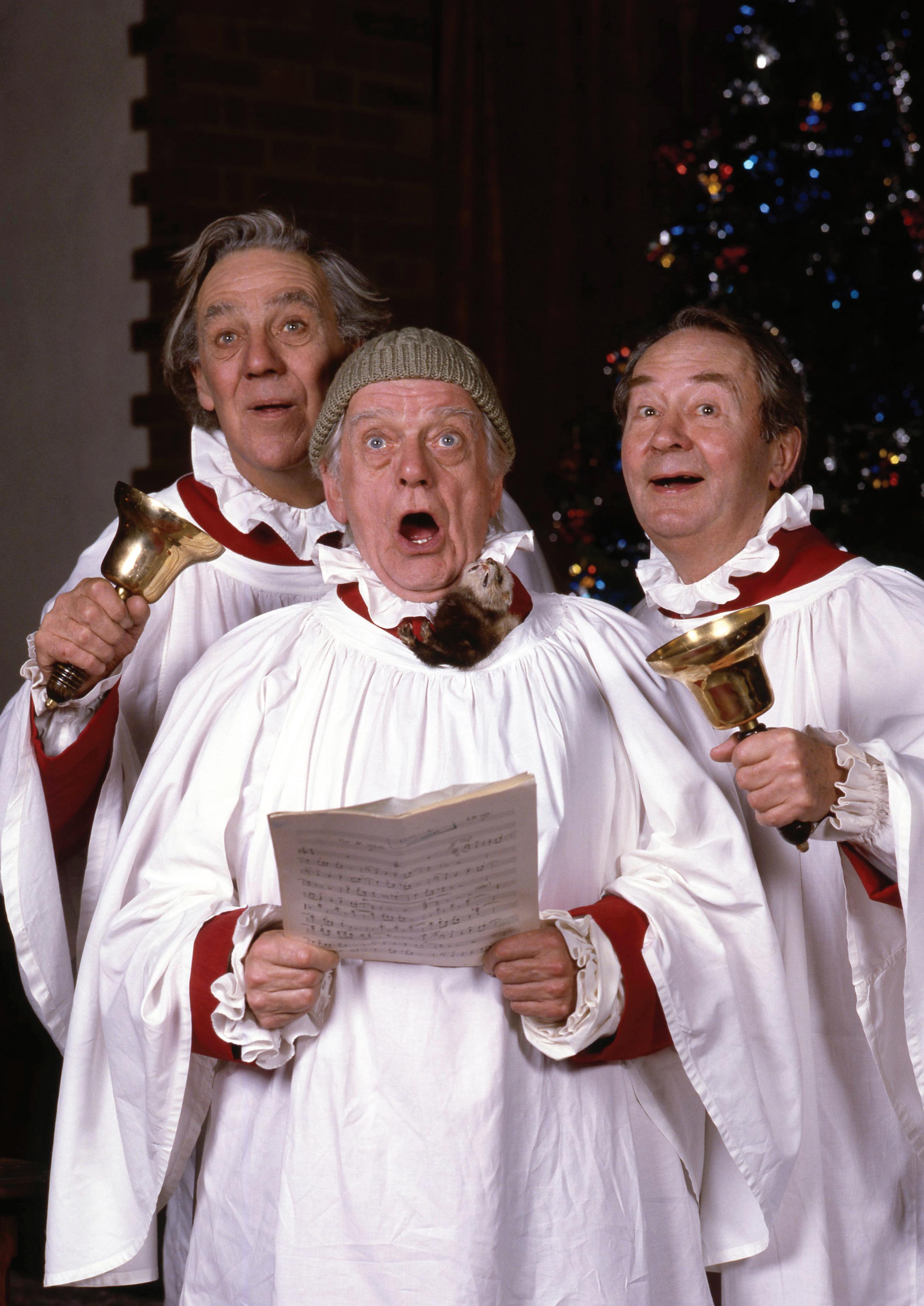
Time to ring the changes?
How pensioners are portrayed in drama
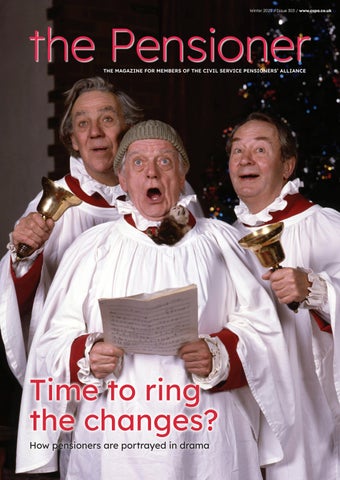
How pensioners are portrayed in drama
The Budget has dealt a blow to pensioners, who will now be paying more tax through to 2031 due the continuation of the freeze in personal tax thresholds.
The thresholds will remain at the 2021 level of £12,570, at which 20% tax becomes payable. If the personal allowance had risen in line with inflation since 2021 it would now be £15,655. The continuation of the freeze means much more of pension increases will be taken each year in tax.
However, Chancellor Rachel Reeves also delivered some better news by confirming that state pensions will rise by 4.8% from April 2026, reflecting the annual increase in average earnings to July, in line with the triple-lock. This means the highest rate of state pension will increase to £12,548 (£241 a week). The basic rate of state pension (pre-April 2016) will rise to £9,615 a year (£185 per week).
The Chancellor also announced that there will be no change to the cash ISA
The highest rate of state pension will increase to £12,548 (£241 a week)
tax-free allowance of £20,000 for the over-65s. For the under-65s, £8,000 of the £20,000 limit must be used in stocks and shares ISAs.
On energy costs, households can expect a fall of about £150 a year in their bills. The Chancellor said the government would end its energy company obligation next March, as well as reducing the amount households pay towards the renewable obligation scheme through their energy bills from 1 April.
Together, the government says these measures will save a typical dual-fuel household of around £150 a year on average from 1 April 2026. The reduction will largely be seen on electricity bills.
Despite the chunks of good news in the Budget, the Institute for Fiscal Studies said that households faced a ‘truly dismal’ increase in their disposable income.
It highlighted analysis of the tax and spending plans by the Office for Budget Responsibility, which forecast that average disposable income would increase by only 0.5% annually over the next five years.
Are you a member of the CSPA who would like to get a bit more involved and meet other members in your vicinity? Then you are just the sort of person we want to hear from!
We are encouraging members who are not in a group to meet up with others relatively nearby with joint group meetings and open-to-all events. Please take a look at our branch reports starting on page 32, especially if you live in or near the Midlands including Oxfordshire, Nottingham and North Staffordshire, Weymouth or Portsmouth. Our regional representatives are eager to involve as many people as possible, so also check out our Contact Us details on page 46 and get in touch.
We are also trying to boost our email contact with members. If you don’t hear from us by email but would like to, please contact us at enquiries@cspa.co.uk.
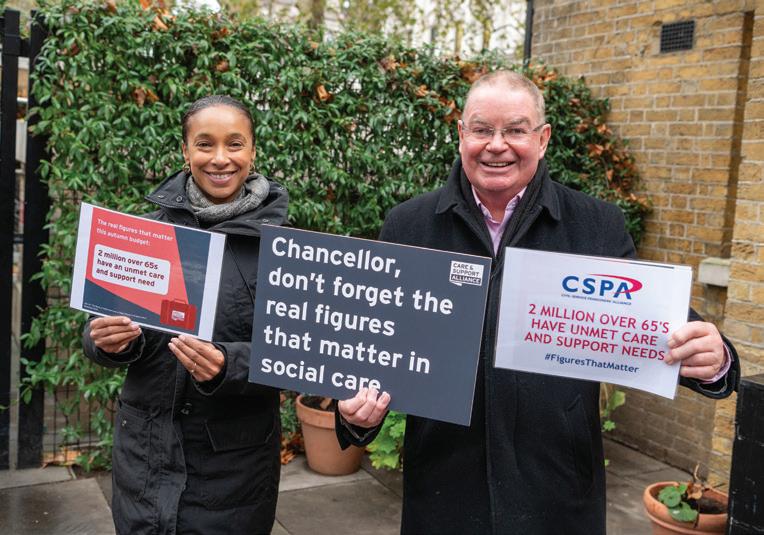
Just before Budget Day campaigners from the Care & Support Alliance (CSA) delivered a symbolic red box to 11 Downing Street. It was filled with stories of older people, disabled people and unpaid carers across the country whose lives are dependent on the care and support services they can access.
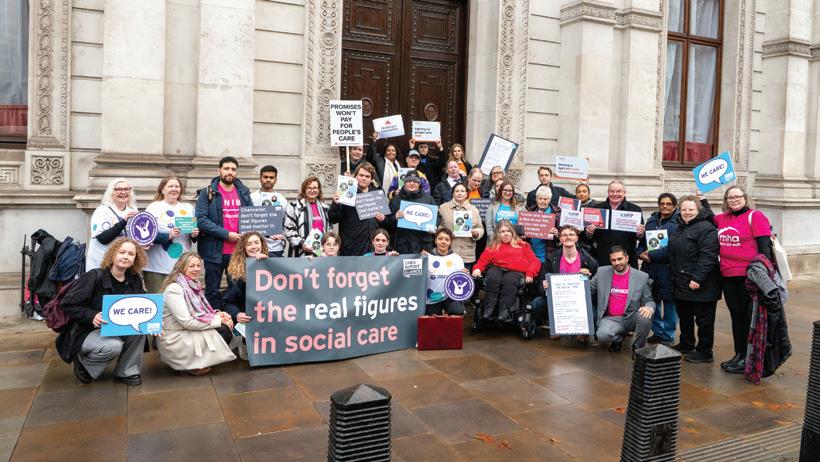
The most important ‘figures’ to consider aren’t in spreadsheets
The CSA represents more than 60 of England’s leading charities lobbying for a properly funded care system. The move, two days before Budget day, aimed to remind the Chancellor that the most important ‘figures’ to consider aren’t numbers in spreadsheets, but the millions of people struggling without the care and support they urgently need. The CSPA lent its support, represented by Deputy General Secretary David Luxton and office manager Nadeene Morris.
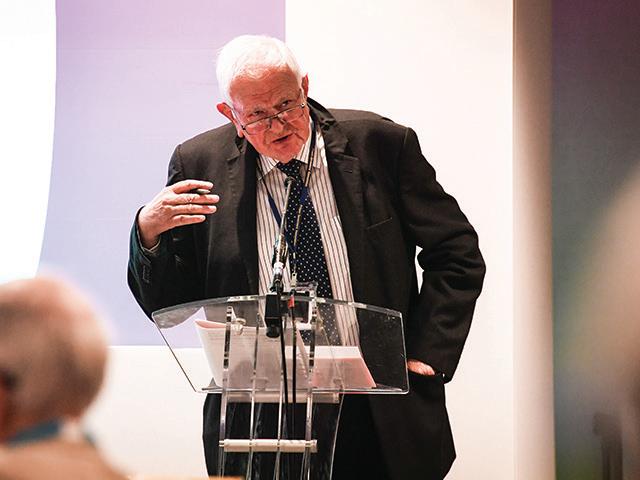
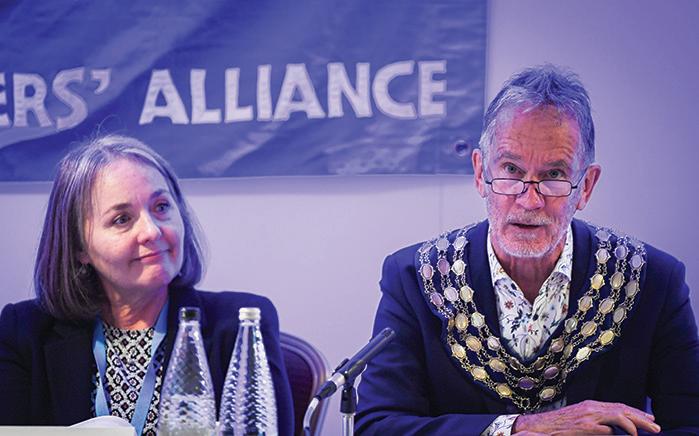
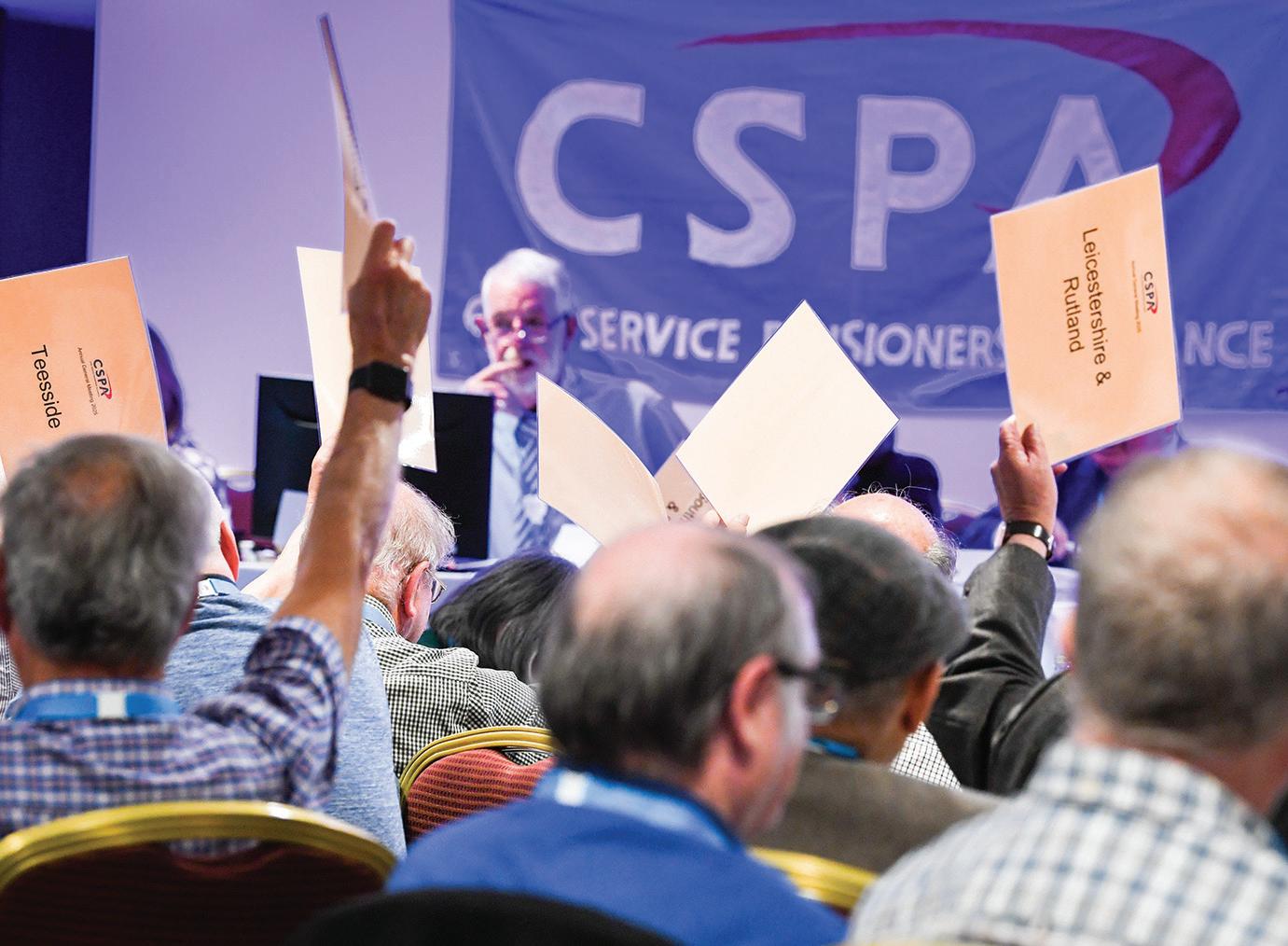
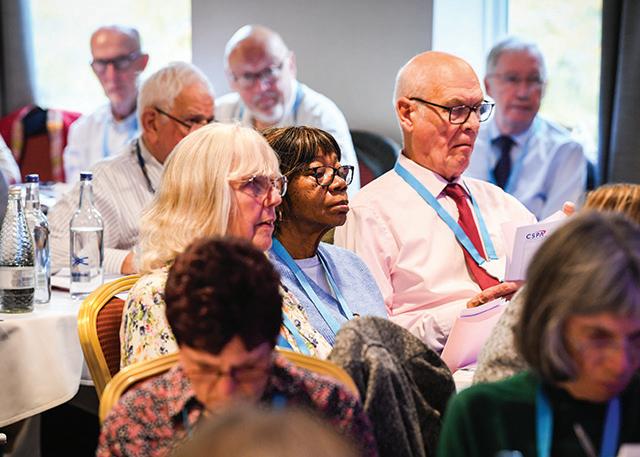
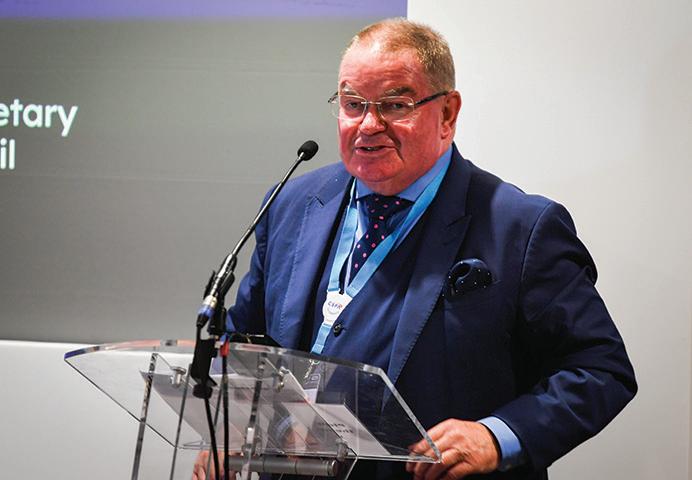
The CSPA committed to redoubling its campaigning efforts for greater financial and social provision for older people in the coming year at its recent annual general meeting (AGM).
Among many motions for action, delegates voted for the CSPA to press government on the lack of implementation of the social care plan outlined by the Dilnot report in 2011 and to raise awareness of health issues such as falls in the year ahead.
Another motion condemned how overpayments of Carer’s Allowance are recovered, directing the Executive Council to mount pressure for it to be changed.
Delegates attending the 71st AGM in Kenilworth in October also called for more campaigning on digital exclusion. And they heard a moving account of the work of the Charity for Civil Servants, which last year helped more than 6,300 civil servants in financial or emotional need or both.
CSPA public affairs consultancy
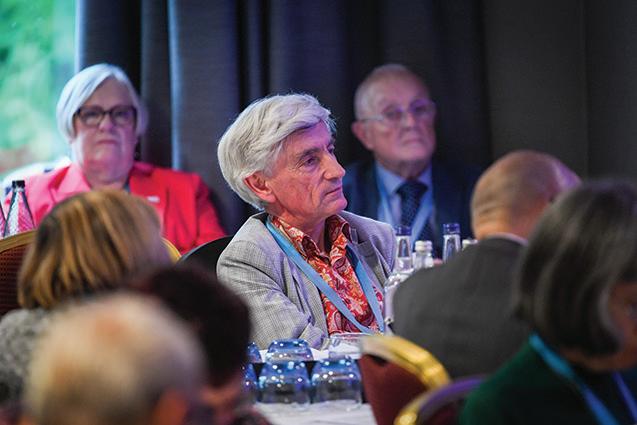
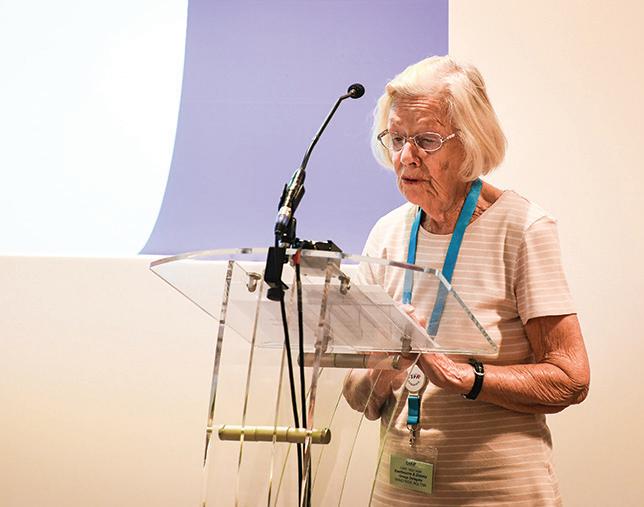
CLOCKWISE FROM TOP LEFT: Harry Brett, North West Regional Representative; Sally Tsoukaris with Mayor of Kenilworth James Kennedy; David Owen, Greater London Regional Representative; Winefride Bolton; (below) DGS David Luxton; and (left) Les Priestley, CSPA Chair
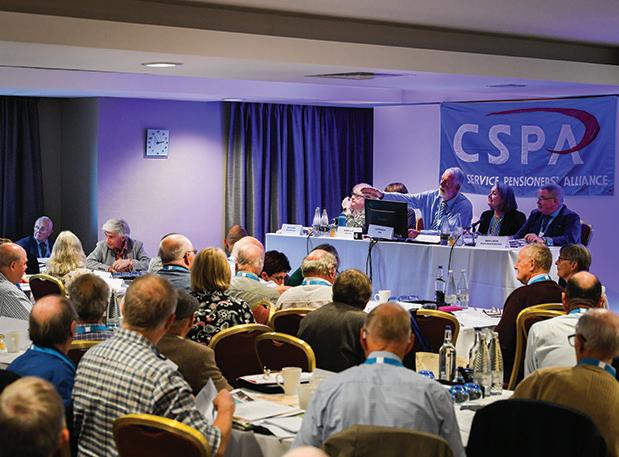
Connect detailed members’ responses to a consultation on moving to allmember ballots for positions on the Executive Council – 76.6% supported the move and 86% said that they would participate in the ballots.
The CSPA will begin a two-year trial next year, during which all members will be able to vote and nominate themselves or others for positions.
You can read a full report of the AGM in the Members section of the CSPA website. For a print copy, please email head office on enquiries@cspa.co.uk or call 0208 688 8418.
The remedy is about resolving age discrimination that occurred when older members in legacy civil service pension schemes such as Classic were ‘protected’ from moving to the new Alpha scheme in 2015-2022. Legal cases from judges and firefighters overturned that ‘protection’ and it was decided to apply the ‘remedy’ to the discrimination across all the public service schemes.
To be fair to older and younger scheme members, those still working and those retired since 2015, the scheme has to offer a choice of retirement benefits between April 2015, when the Alpha scheme came in, and the end of March 2022. This is when the first part of the remedy occurred, when all currently working scheme members were moved into the Alpha scheme.
This second phase is about the treatment of staff already retired or in the process of retiring. It involves giving people the choice of taking their pension for the period they were working between April 2015 and March 2022 in either the old legacy scheme or the Alpha scheme. They are meant to get timely information on how to make their decision.
This will be important for people on ‘transitional or tapered protection’, anyone with mixed service in more than one scheme, and those who have deferred service (they have left work but have not drawn pension).
But those in one scheme for the period (generally classed as fully protected, for example in Classic), who retired on those benefits and chose after receiving the information not to change, can do nothing.
Chris Haswell looks at developments relating to the remedy
The default is to remain in the legacy scheme.
From October 2023, retired members affected – those who retired between April 2015 and March 2022 – started to receive a Remedial Service Statement outlining their options and the impact of choosing to change.
People should take their time looking at both options. The big difference is often the lump sum. Option A legacy scheme usually involves a standard lump sum that could be up to 25% of the value of the pension. Option B is Alpha: although this
Sending out option choices is taking more than two years, not 18 months
is a career average scheme, you can take a lump sum.
Initially there may be a rise in annual pension payments, but this may mean making up more contributions. For some, there may be tax implications. For some, it could be a real improvement. People have 12 months to respond.
However, sending out option choices –a process that was expected to take 18 months – is usually taking more than two years.
Only about half of those eligible have received an option. These delays have caused frustration and distress for our members and we regularly raise the issue with the Cabinet Office. We have also submitted evidence to the National Audit Office and Public Accounts Committee.
The overwhelming majority of people opt for Alpha, but this won’t be the case for everyone. Very few people will get thousands of pounds more. In some cases, the difference will be less than £1.
The majority of returned ‘choices’ have received their backdated payments. These choices can be made online or by post. Online may be quicker as there are specific links in your paperwork.
This refers to decisions people made during the remedy period about opting out of the pension scheme because of Alpha. They will have the chance to prove that the reason for opting out was Alpha and not, say, cost of contributions.
This evidence could be sent via email to HR or the scheme itself. They then get the opportunity to buy back service in their legacy scheme for the remedy period.
From the end of October, no new cases were taken on as the transition to Capita began – Capita had not planned for this work as it was meant to have been completed by March 2025. The strike at MyCSP may also add to delays.
The CSPA is not able to help prioritise cases unless there is a life-limiting situation, but we will continue to engage with the Cabinet Office to ensure that our members receive choices as soon as possible.
• Chris Haswell is the CSPA Pensions and Personal Cases Manager
• Remedy - https://www.civilservicepensionscheme.org.uk/your-pension/2015-remedy/
• Contingent decisions - https://tinyurl.com/5bptbcb9
• CSPA - https://members.cspa.co.uk/?s=remedy
Sue Cook, former presenter of Nationwide, Crimewatch and Breakfast Time, joined the launch of the Later Life Ambitions (LLA) Budget for Later Life at the House of Commons in late October. The CSPA is part of the LLA, along with the National Association of Retired Police Officers and the National Federation of Occupational Pensioners.
At a reception in Parliament, CSPA General Secretary Sally Tsoukaris and Deputy General Secretary David Luxton and Sue spoke to MPs including Kirsty Blackman, who sponsored the event, Johanna Baxter, Sureena Brackenridge, Ann Davies, Fabian Hamilton and Iqbal Mohamed, as well as Baroness Altman, Baroness Bottomley of Nettlestone, Lord Davies of Gower and Lord Taylor.
The LLA Budget aims to ensure no one in later life faces poverty, insecurity or exclusion. It has eight priorities:
• Protect the state pension and maintaining the triple-lock
• Introduce a minimum income guarantee
• Close the gender pension gap
• Improve opportunities for older workers
• End unfair pensions taxation
• Widen access to affordable and accessible public transport
• Ensure safe, secure and adaptable housing
• Create a sustainable, integrated system of health and social care.
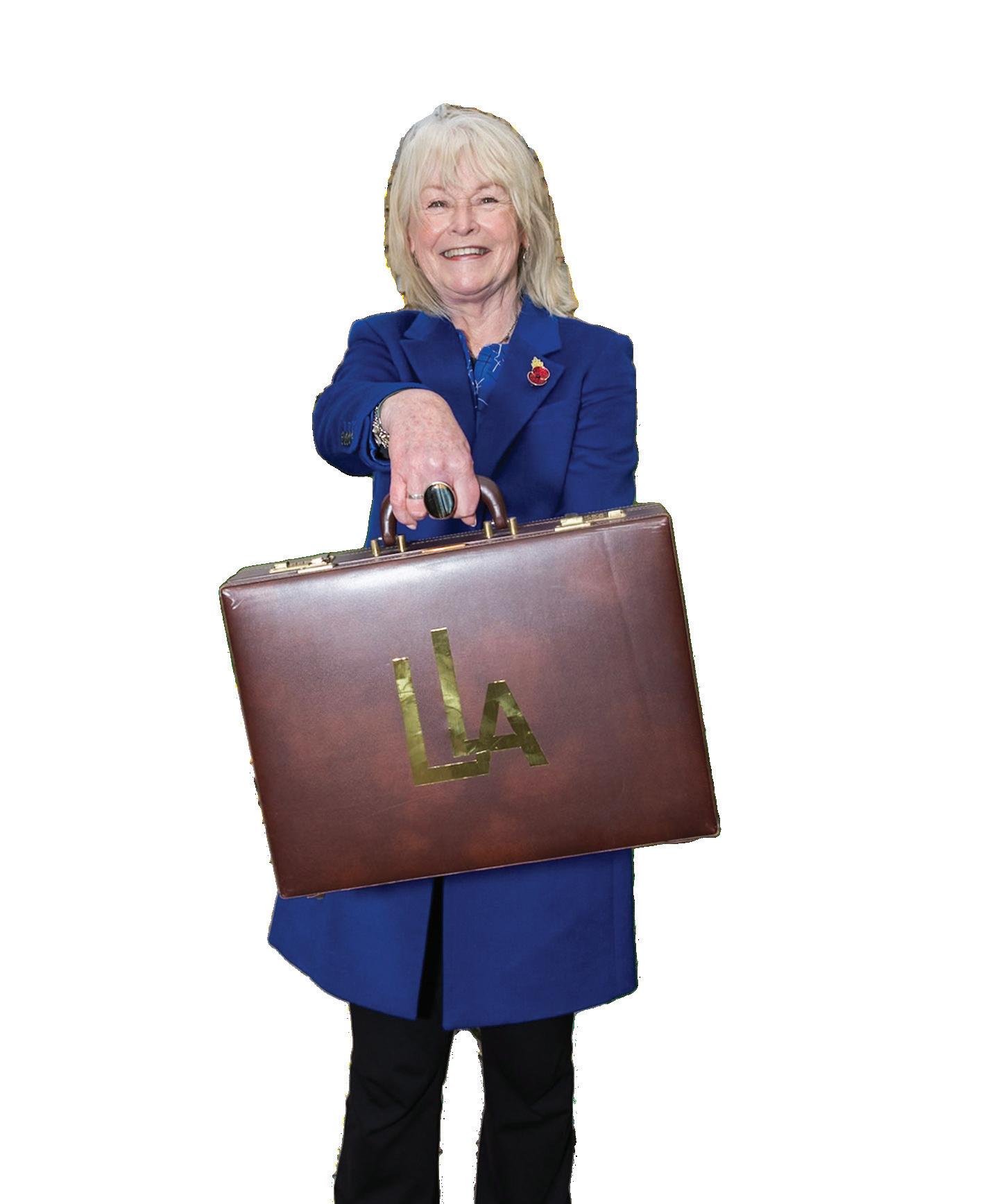
The event was the front-page story of the Daily Express, double-page story inside featuring Sue outside the House of Commons with a Budget-style briefcase. The launch was also picked up by Scotland’s Record, News and LBC.
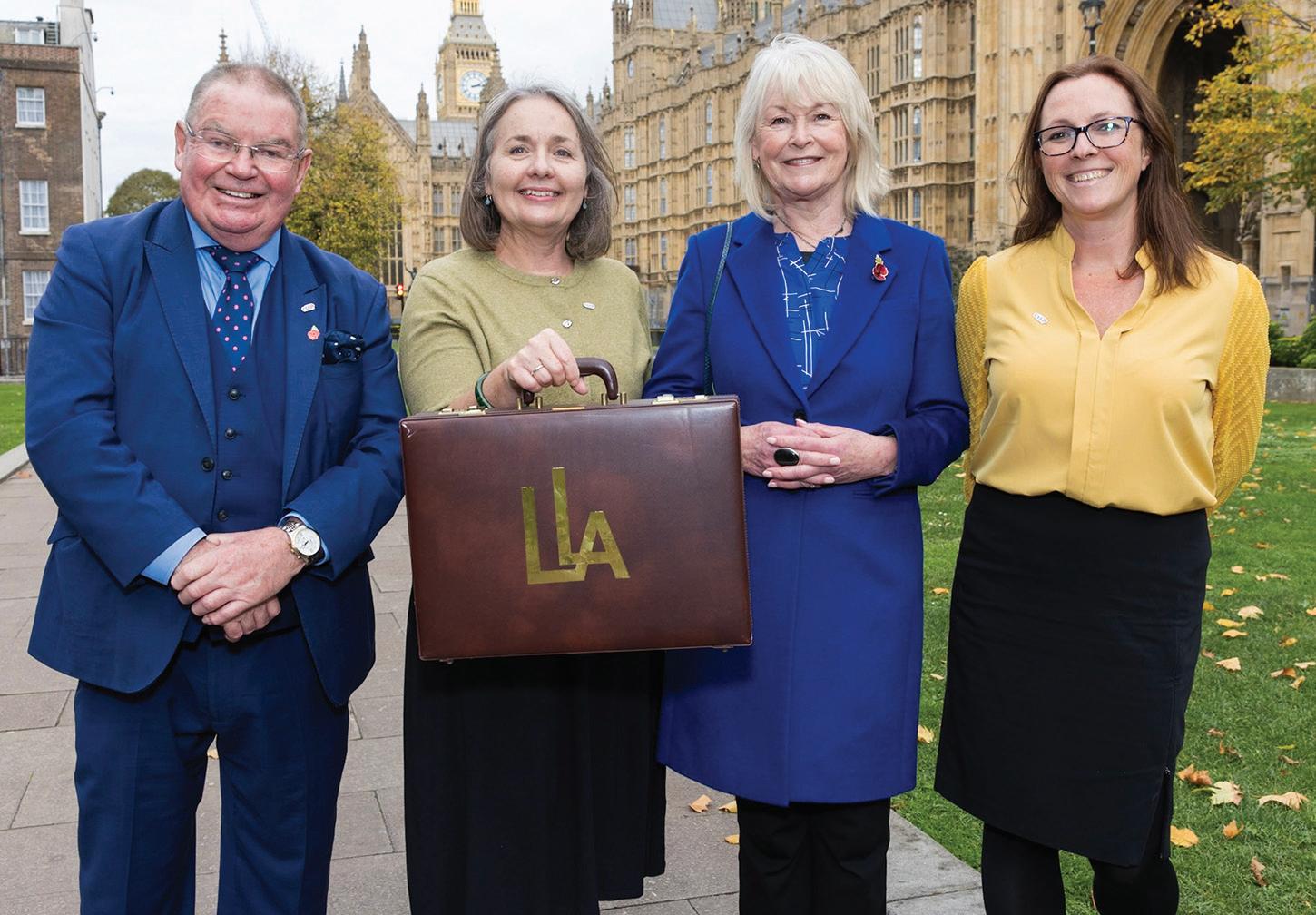
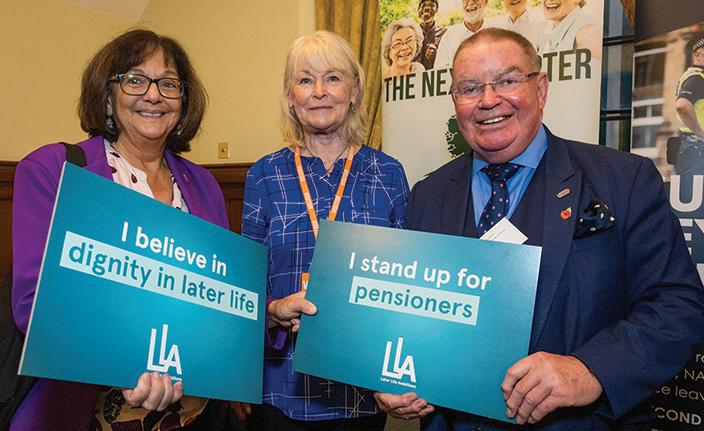
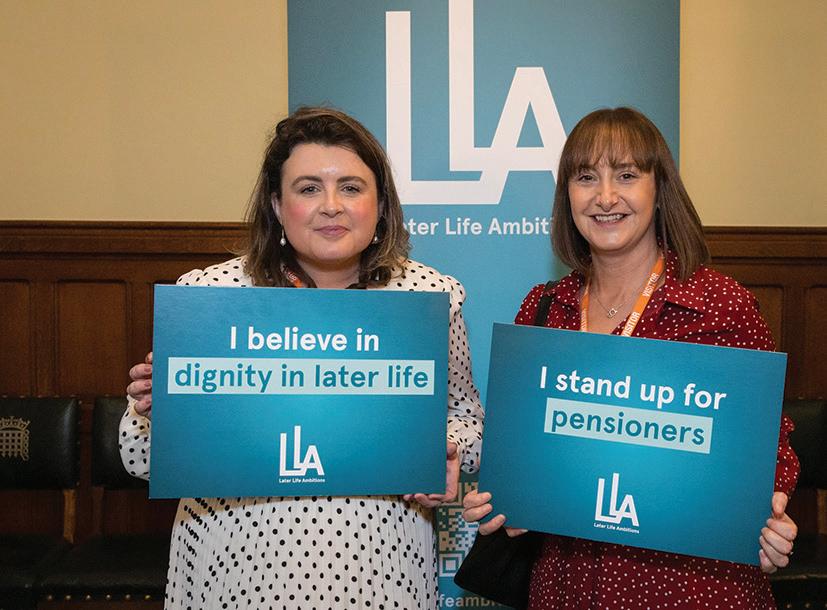
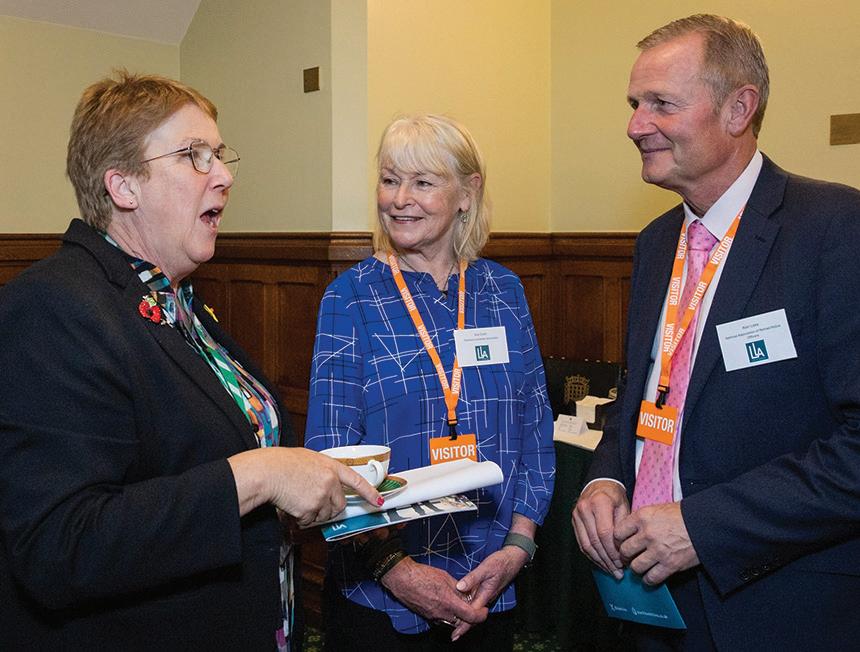
• CLOCKWISE FROM TOP: Sue Cook with David Luxton, Sally Tsoukaris and Verity Morrish; Sue with Ann Davies MP and Alan Lees (NARPO); Adrian Ramsey MP and David; Sally; Morgan Vine and Amy Dodge (Independent Age); with Baroness Altman
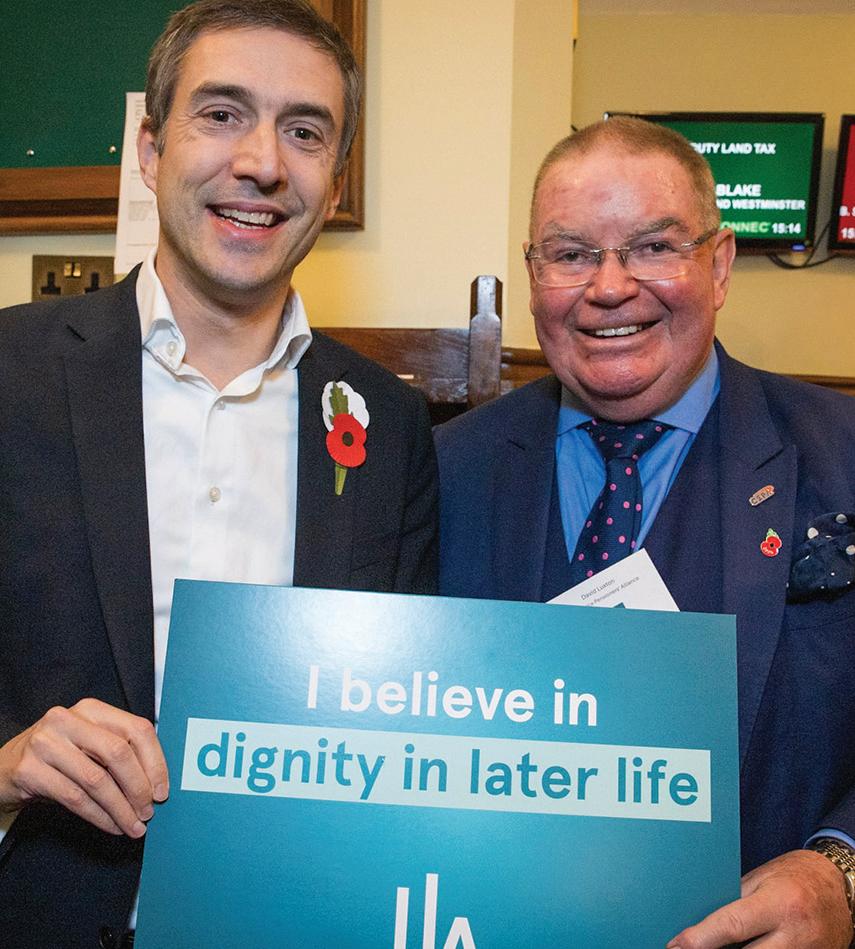
We were proud to launch our Later Life Ambitions (LLA) Budget for Later Life in Parliament on 28 October – a few weeks before the Chancellor’s Autumn Budget Statement. We were encouraged by the cross-party support for it from those who attended the event and our media coverage (see page 7), as well as the Chancellor’s subsequent confirmation that the state pension will rise by 4.8% next April.
We must keep defending the state pension triple-lock, which is crucial in aligning the state pension with the cost of living and average earnings.
The UK spends about 4.7% of GDP on pensioners – the USA spends 6.6%, Germany and France around 10%, and Greece more than 13%.
Commentators calling for the triple-lock to be scrapped as ‘unaffordable’ all too
The CSPA pensions team have been doing all they can to support members
often overlook the fact that we would still need to link the state pension with the true cost of maintaining a basic, decent and healthy life in retirement as for many this is their main or only income source.
We continue to say that the personal income tax allowance should rise with inflation and we are disappointed by the Chancellor’s announcement that the freeze will remain until 2031!
However, due to the frozen tax threshold, there are almost nine million taxpayers aged over 65 today, compared with 4.9 million in 2010/11. This brings those on lower pensions far too close to the minimum income needed to sustain even the most basic lifestyle in retirement. If this is the case today, then there is
concern about the continued impact in three years’ time.
Last year, we joined others urging the government to reinstate universal winter fuel payments. After sustained pressure from campaigners, we welcomed the Chancellor’s decision on 9 June 2025 to allow payments for pensioners earning less than £35,000 this winter.
The CSPA, along with other older people’s organisations including Age UK and the NPC, will be monitoring the impact on the older population through the coming winter months.
This year has seen the CSPA giving evidence to both the National Audit Office and Public Accounts Committee inquiries into the management and administration of civil service pensions.
In the summer, we carried out a snap online survey of members’ experiences of MyCSP’s services, and more than 1,000 people responded. Members’ feedback helped form written evidence submitted to the Public Accounts Committee, and their experiences in contacting the pensions administrator were cited in the PAC’s subsequent report published in October.
Sadly, recent industrial action taken by staff at MyCSP has led to case work delays and worsening caller response times, with only the most urgent of cases being prioritised and the rollout of the 2015 remedy choice packs further delayed.
Our Pensions and Personal Cases Manager, Chris Haswell, and the team at CSPA HQ have done all they can to support CSPA members affected.
We continue to work with our Later Life Ambitions partners NARPO and the NFOP, as well as with the NPC and more than 130 organisations involved in the Carer Poverty Coalition and Care & Support Alliance, to push for meaningful reform in health and social care in response to motions at this year’s AGM.
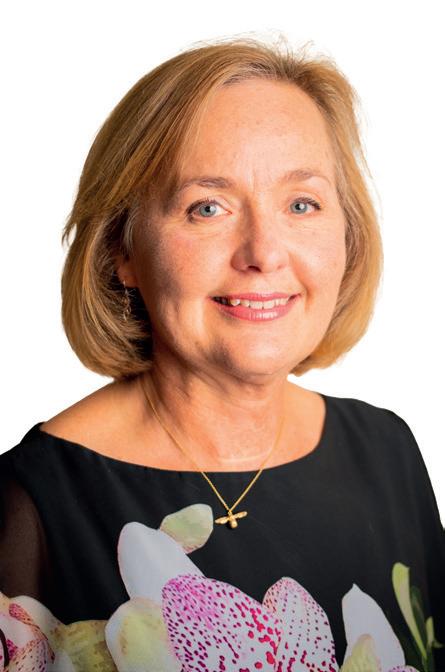
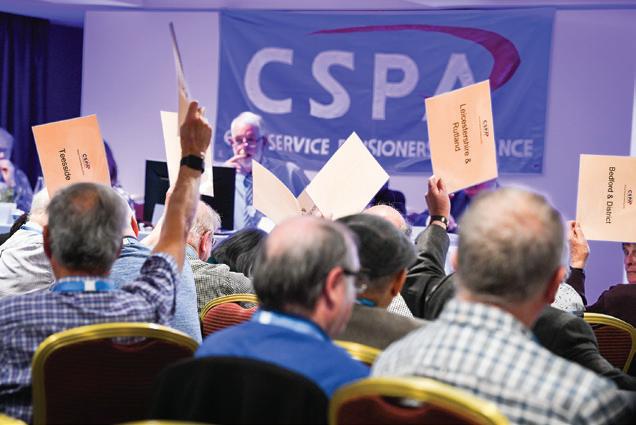
We had a busy AGM on 8-9 October, having received 46 motions for consideration. You can read about these in the AGM report available in the Members area of our website. Or if you would like to receive a copy in the post, please contact CSPA HQ.
Les Priestley did a splendid job in chairing the AGM, ably supported by Vice Chair Roisin Lilley, ensuring that all the AGM business and agenda items – including a few contentious motions – were amicably and efficiently dealt with.
We are appreciative of the continued efforts of all the Executive Council and members of the Standing Orders Committee who were re-elected, as well as Mike Duggan, our Chief Scrutineer, and John Hickey, our Chief Teller, who made sure things went smoothly.
The issues outlined within the motions that were carried will now be added to our campaigns agenda, setting our work plans for the 12 months ahead.
You can read our AGM report in the Members area of our website
In last December’s issue of The Pensioner, we surveyed members’ views on the CSPA’s democracy, asking if you felt able to participate in our decision-making processes and elections. An overwhelming majority (75%) of you told us you would like a say in the election of our national Executive Council (EC) members.
In a subsequent consultation, feedback from groups and branches was more measured, but two-thirds supported the proposed two-year trial of an all-member ballot to elect to posts on the EC. The necessary changes to our rules and constitution were approved at the AGM –so the trial can now begin.
We are therefore giving notice that all CSPA members will be invited to submit nominations for the Chair, Vice Chair and five national members of the EC. Under our current rules and constitution, two of the five EC member posts must be women – and we encourage nominations.
The call for nominations will be published in the Spring issue of The
Pensioner, out in early March 2026. Any member can submit nominations, provided they are seconded by another member.
This has always been the case, but we hope the new all-member ballot in 2026 will increase participation, especially among those based in areas not covered by active groups or branches.
We will also run our usual nomination processes for these and other EC positions via our groups and branches alongside. If you are part of an active CSPA local group in England and Wales or either of our branches in Northern Ireland and Scotland, please get in touch with them if you would like to be involved at a more local level. You can always be sure of a friendly welcome if you decide to attend one of their meetings.
I would ask you all to consider, in the meantime, whether you would like to nominate a CSPA member or, equally, perhaps put yourself forward for one of the positions that are to be within the scope of the all-member ballots.
The CSPA is a member-led, not-forprofit association and as such has no legal status as an entity in its own right. It is owned by members, run by members, for the benefit of members, and the members are free to decide the rules, constitution and priorities within the bounds of the law.
However, there are downsides. The CSPA cannot enter into legally binding contracts; the trustees must do so on members’ behalf, and members all carry unlimited liability for any costs arising if the organisation becomes insolvent or subject to legal claims or penalties that our investments or our insurers cannot cover.
We steward CSPA undertakings and investments carefully and responsibly, and you will see from the 2024 Annual Report that our financial situation is relatively robust. But we live in an increasingly litigious society and cannot know the challenges ahead.
At our AGM, the EC submitted Motion A7 to enable an investigation into the costs, risks and benefits of establishing the CSPA as a company limited by guarantee or charitable incorporated organisation. The motion was carried, so this work, and a consultation involving all members, groups and branches, can commence.
Please look out for an article in the Spring issue of The Pensioner, which will cover all the pros, cons and implications of moving to incorporation in some form, thereby limiting members’ liability.
The magazine will also include a survey to glean your responses, thoughts and queries on these matters, and to ascertain support for the CSPA becoming incorporated.
Many of the other organisations we work with have become incorporated in recent years, and we are learning from their experiences along the way.
Just before the AGM, we were pleased to have Katrina Hicks joining us as our Membership Co-ordinator.
At the end of December, however, Finance and AGM Manager Marion McAuliffe retires after almost 13 years with the CSPA. Pensions and Personal Cases Manager Chris Haswell will also be moving on after Christmas, having supported CSPA members, the EC and fellow officers for more than four years. We salute their tireless work and will miss them greatly.
Deputy General Secretary David Luxton will take partial retirement in the new year and transition to the role of Pensions Manager in January, using his sound knowledge of civil service pensions and working relationships with the Cabinet Office to help members on a part-time basis. We are grateful to David for his work as DGS and pleased to support his partial retirement in a way that benefits CSPA members. We are now looking to recruit a new Deputy General Secretary, and I will keep you updated on our progress.
I hugely appreciate all the team’s continued commitment and hard work on behalf of all CSPA members over the past 12 months.
All that remains is for me to wish you and yours a very merry Christmas and a happy new year, however you choose to celebrate.
Please note that our office will be closing on 4pm on Tuesday 23 December and re-opening on Monday 5 January. Thank you for bearing with us over the festive period – our staff very much appreciate having this time to rest and be with their families.
Do onscreen roles reinforce or undermine popular images of older people, asks Mark Fisher
They’ve been repeating The Sopranos on TV recently – and the 25-yearold series is as good as ever. It still seems like a fresh idea to follow a bunch of New Jersey mafiosi through their domestic lives: school runs, barbecues, visits to the shrink. It is funny to think of a mobster bumping off enemies one day, dealing with anxiety the next.
What also seems fresh is the portrayal of Livia Soprano, mother of crime boss Tony. Played with hard-nosed wit by 71-year-old Nancy Marchand, the part could easily have been written as a clichéd grandparent. Here is a crotchety woman moaning about being moved to a care home and her fellow residents.
All that is true, but also true is the sophisticated game she plays. A master manipulator, Livia knows exactly what her family gets up to and, hiding behind a mask of frailty, ensures they do it the way she wants. She might look ineffectual, but she is an active player who exploits her family’s sympathies. When she fears she will be found out for ordering a hit on her own son, she pretends to have Alzheimer’s.
But how typical is her character? Do we not commonly see a picture-book granny, all smiles and talcum-powdered hair? Or worse, do we fail to see older people at all?
In 2009, film critic Anne Billson said she had seen 320 films that year and of those only four had ‘oldish’ lead characters. She believed older audiences were simply not seeing themselves on screen.
In 2025, she revised her opinion. Writing in the Guardian, Billson said Hollywood
was catching up: “Leading characters of pensionable age are all over the place.” Now, her complaint was different: older people were pigeonholed into three categories: “feisty, frail or fiendish”.
Feisty, frail or fiendish?
I decided to keep track. Over a long weekend of cultural consumption, I made a note of the older characters I saw on stage and screen. Livia in The Sopranos set me off to an encouraging start. Even if she falls into the fiendish camp, she helps give the series its darkly humorous bite.
Next came Jack Thorne’s ITV series The Hack, about the journalists, politicians and police caught up in News International’s phone-hacking scandal. Central to this is Guardian reporter Nick Davies, played by
Is it really so funny to see retired people drinking and swearing?
David Tennant. In a couple of reflective scenes, he is seen in the living room of his father, played by 72-year-old Jonathan Coy. Stiffly pouring tea from a pot, the older man tells his son he is pleased to get a visit in the middle of the day: “These are the good hours… Hips hurt, knees hurt, back hurts till 11am, and then again from 3pm. But 11am til 3pm… Never get old.”
One for the “frail” pile, then, a man all but defined by his infirmity.
Tennant popped up again in The Thursday Murder Club, this time playing
Ian Ventham, the baddie in the film adaptation of Richard Osman’s novel about a group of elderly sleuths. At 54, he was considerably younger than the core cast. Helen Mirren, Celia Imrie, Pierce Brosnan, Ben Kingsley and Jonathan Price had an average age of 78. You could tell Ventham was the baddie because he called the others the “walking dead”.
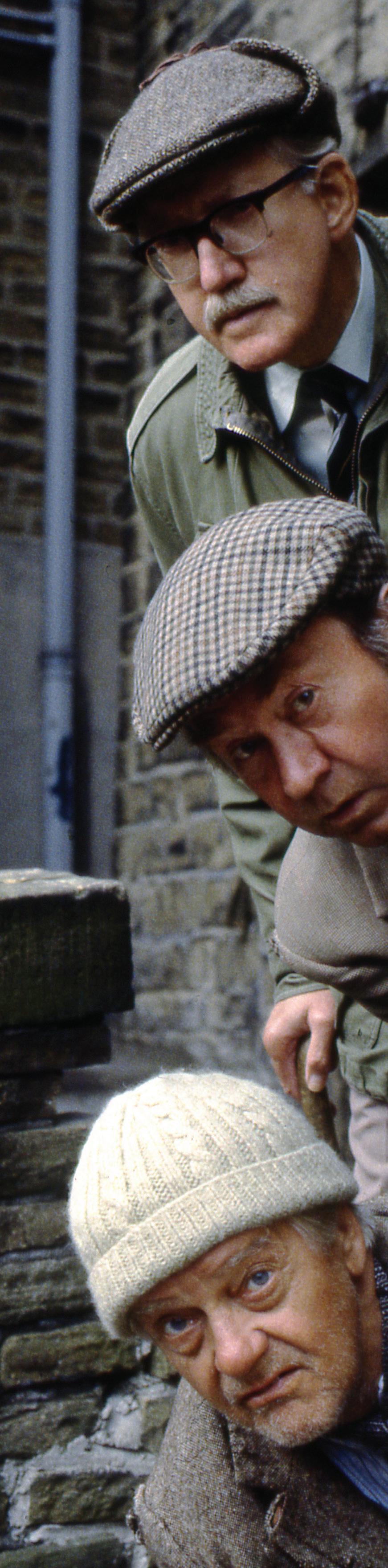
This feels like a step forward. With notable exceptions, such as On Golden Pond and Last of the Summer Wine, it’s rare to see older people leading the story.
In The Thursday Murder Club, the residents of Coopers Chase retirement community solve a murder on their doorstep. They’ve led interesting lives – psychiatrist, union activist, nurse, spy –and now refuse to be limited by their age. “Never use the words ‘bright-eyed feisty old ladies’ in my presence again,” says Helen Mirren’s sharp-minded Elizabeth to Celia Imrie’s excitable Joyce.
Not that the film fully escapes the clichés; it still offers a romanticised image of well-to-do retirement, all purple cardigans, frilly curtains and silvery manes of hair. Many pots of tea and much cake.
Above all, there is an implicit joke that depends on a young person’s perspective: only if you regard old people as cute and sedentary would you laugh when those people show gumption. Is it really so funny to see retired people drinking, swearing and making their way in the world?
Next, I set off to the Tron Theatre in Glasgow, where Ann Louise Ross was playing Tersia in Black Hole Sign, a hospital drama by Uma Nada-Raja. The actor was very funny as a patient alternating between lucidity and delirium, convinced she was heading out to a 1970s disco and mistaking an office chair for a toilet – a forceful woman with a mischievous streak. Yes, she ticked two boxes – frail and feisty – but seemed more than two-dimensional.
I caught up with Ross a couple of weeks later and she agreed it was important for writers to push beyond the easy clichés. “If you’re housebound, the loneliness can be very sad, but people like that still have life in them, still have stories to tell, and it’s not all, ‘Oh, in my day it was better’. They’ve got good, interesting stories,” she said. As for her own career, Ross has no complaints. At 75, she is still finding rewarding parts and, in one recent case,
was even turned down for being too young. “I’m quite happy to do parts as an older woman in a nightie or as an older woman who’s a bit dotty, but I haven’t had a lot of them,” she said.
She cited her role as the shotgun-toting Agnes Moffat in the BBC series Shetland, not least because the fictional Moffat, like Ross, had not long lost a husband.
“It was a bit like art meeting life,” she said of playing a bereaved woman. “She was on a quad bike, she had a rifle, she drove a Land Rover – no make-up, no nothing, no glamour. She was an older woman with a bit of spirit.”
That was also true of her recent role as a retired school teacher in Make It Happen, James Graham’s play about Fred ‘the Shred’ Goodwin and the collapse of the Royal Bank of Scotland.
“She was sharp and able to have a go at Fred the Shred in public,” continued Ross.
“Older people still have life in them, they still have stories to tell”
“I wouldn’t want to describe her as feisty because if I was an older man, I wouldn’t be feisty, I’d be intelligent or bright. It tends to be the women who are described as feisty.”
In raising the question of gender, she highlighted what is perhaps a more widespread issue. If Billson is correct that older people have become better represented, the greater problem could be the kind of stereotyping that can affect actors at any age. Clichés abound, whether it is the phone-addicted teenager, the vegan student or the innocent old lady.
When I spoke to Dolina MacLennan, 87-year-old actor, singer and activist, she added one more category to that list. “The more stereotyped people are Highlanders,” said MacLennan a native Gaelic speaker born on the Isle of Lewis. “We’re always dressed differently. We’re always shabby.
“I had a small part in the film The Queen as a switchboard operator at Balmoral and was dressed like a flump – she would have been very neatly dressed. In another programme, I was dressed in huge big jumpers and waistcoats that, even at my age, I would never put on me.”
So, the next time you see an elderly actor on the screen, ask yourself: “Do they mean me?”



Barrie Clement sings the praises of dogs, cats and other pet companions – and has a few words of warning too
Pets are good for older people –pyschologists are pretty unanimous on this. If you’re feeling down, they can have a positive effect, especially for those of us who live alone. According to the Pet Health Council, just stroking a pet or watching fish swim can help us relax, reducing heart rate and blood pressure. Some argue it lowers the risk of a heart attack by decreasing cholesterol levels.
The case for dogs
Let’s look at dogs first. Clearly, taking them for a walk not only helps to keep us fit, but creates more opportunity to meet other people. Many of us feel safer when we’re walking or sharing our home with a dog and they give us a reason to get out of bed. But, just like people, dogs can vary in temperament.
My late dog, Jones (Battersea dog’s home), was half springer spaniel, half Staffordshire bull terrier (we think) and 100% ornery critter. But his bark was
Counterintuitively, greyhounds are thought to be among the best
considerably worse than his bite. In fact he never bit anyone – or any dog come to that. Friends who came to stay brought two tiny dogs with them and Jones just looked on mournfully as they commandeered his bed. I loved him to bits, but he was of independent disposition and required Olympian quantities of exercise. I certainly wouldn’t have recommended him to an elderly person with mobility problems or someone who requires obsequious devotion.
His predecessor, Harry, a beautiful Golden Retriever, was a different kettle of dog. A breed sometimes recommended for older people, he required daily exercise but less than the hyperactive Jones. Harry was gentle and affectionate, but he was on the large side and because of his shaggy
coat, ponged a bit if you didn’t hose him down regularly. Perhaps the short-haired Labrador might be a better option.
So which breeds are seen as a good match for older people? Counterintuitively, greyhounds are thought to be among the best. Age UK describes them as ‘deeply affectionate’ – a trait which in times past did not stop their owners putting them to sleep when their racing days were over.
These days, strenuous attempts are made to ‘rehome’ them, so it is not hard to acquire one.
Forever Hound Trust, a charity dedicated to that, says: “Many retired greyhounds are wonderful companion animals for older people. They can be calm, gentle and affectionate. They like to go out for a short walk once or twice a day but don’t require a huge amount of exercise.”
Steve Owen, 70-year-old chair of the Southern West Highland White Terrier Club, extols the virtues of ‘Westies’, pointing out that they don’t require a great deal of exercise if they have a garden to play in.
Poodles are also suggested for older people. “Majestic and fun-loving,” according to Age UK, “poodles are perfect for those with a little more energy, though as they come in three sizes – toy, miniature and standard – they can be suitable for any size living space.” The toy option is suggested for those with more severe mobility problems.
As important as knowing which breeds make the best pets, it’s worth knowing which to avoid. People should think very carefully before acquiring animals bred for odd body shapes, known as ‘extreme conformation’. It can negatively affect health and welfare, and present owners

with big veterinary bills. Dachshunds can be excellent companions, for instance, but they have been intensively bred and suffer a range of health problems because of their extremely long backs.

The British Veterinary Association (BVA) says breeds with extreme features, such as brachycephalic (flat-faced) dogs, have grown in popularity but can suffer ‘lifelong misery’ due to breathing difficulties. French bulldogs, recommended for older people by Age UK, are brachycephalic.
Cavalier King Charles Spaniels, also recommended by Age UK, have been banned in Norway since 2022 due to concerns over their health. And US animal rights body People for the Ethical Treatment of Animals has labelled them one of the unhealthiest breeds, suffering from various genetic issues resulting from extensive inbreeding.
“The use of animals with extreme features in advertising and on social media normalises these traits,” reports the BVA’s Voice of the Veterinary Profession survey, which found that 83% of vets were concerned about the inappropriate representation of animals in adverts.
The association says prospective pet owners should speak to their vet for advice on potential health and welfare issues and should use guides such as the Animal Welfare Foundation’s Puppy Contract.
The Peoples’ Dispensary for Sick Animals says that if you are determined to
In general, cats need less care than dogs and are pretty laid back
buy a pedigree dog, it’s best to buy from a Kennel Club assured breeder.
You could take pot luck and enlist the services of a ‘mongrel’. They are by reputation cleverer than their pure-bred cousins, less prone to expensive illnesses, live longer and don’t cost as much to buy. But you never know what you’re going to get in terms of temperament and eventual size.
Also be aware that lots of breeds are described as ‘intelligent’. My dog Harry, lovely though he was, hardly amounted to Mensa material.
Whatever type of dog you choose, they can be quite a tie. To a greater or lesser extent, they have to be fed, watered, exercised, groomed and need company. If you go away, you would require the indulgence of friends, family, neighbours or professional kennels.
And as a general rule, beware the recommendations of enthusiasts for particular breeds or advice provided by artificial intelligence, which soaks up information from such sources.
Much of the above applies to cats too, including the strictures on flat-faced breeds – do the research! Energy levels and characteristics differ, but in general cats need less care than dogs, take their own exercise and are pretty laid back.
Russian Blues, with their grey fur and piercing blue eyes, tend to be ‘quiet but loving’ and are content with their own company. By reputation, the British Shorthair has an ‘easy-going personality’ and is not ‘overly active’, while the Ragdoll, another undemanding cat, is known for being ‘gentle and calm’, though they need to be brushed regularly.
While the Cat Fanciers’ Association extols the virtues of Scottish Folds, vet Sarah Elliott lists them among six breeds to avoid. On the Cats Protection website, she points out that they are bred to have folded ears, which causes abnormal bone and cartilage growth throughout their body and painful arthritis. Cats bred with short legs, such as the Munchkin, Bully and Dwelf, have been bred to display characteristics of dwarfism, which can also lead to arthritis. Flat-faced cats such as Persians suffer similar problems to brachycephalic dogs, while hairless breeds such as Sphynx, Bully and Dwelf suffer difficulties including keeping warm.
Also on Elliott’s no-go list are Bobtail and Manx cats, which have very short tails or no tail at all. This is caused by a severe genetic defect that results in damage to the spine and nerves and painful arthritis at a young age, she says.
If you’re neither a cat nor a dog person, there are other options: hamsters, gerbils or guinea pigs; budgies or parrots; or a tank of fish, which, we are told, can soothe the furrowed brow – though reciprocal affection would be in limited supply.
And there are other human beings, of course. But they can be attention-seeking and a tad unpredictable…
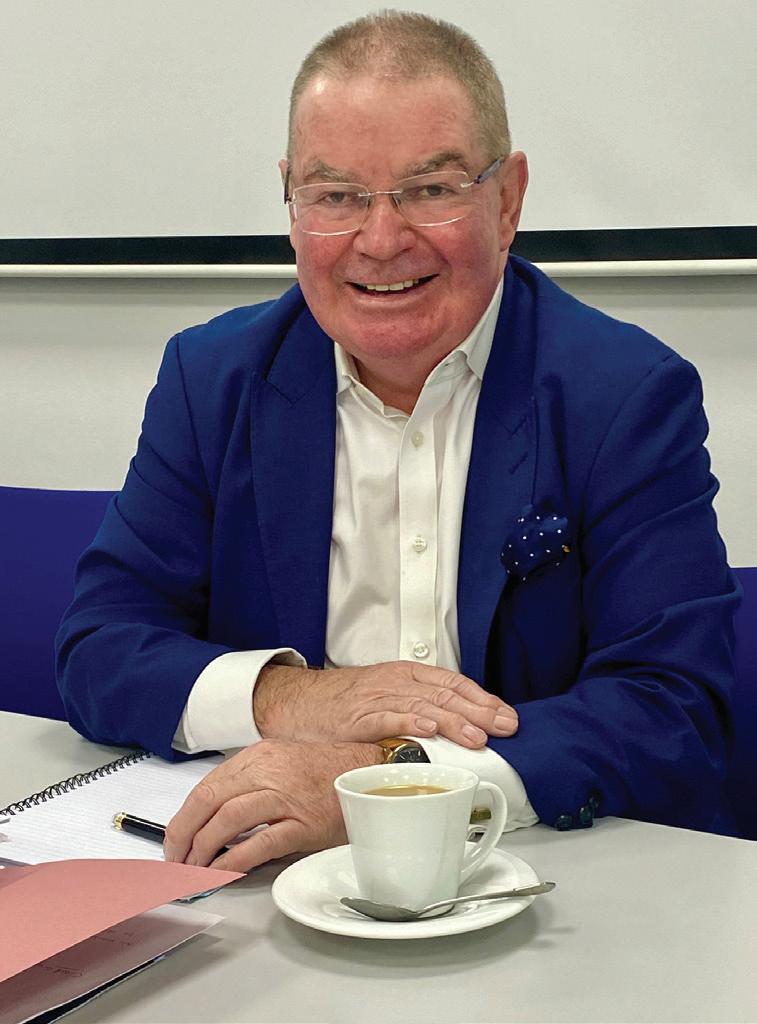
David Luxton welcomes some Christmas cheer – but warns of fiscal fear
Christmas comes but once a year to bring joy to us all – unlike the Chancellor’s Budget Statements, which seem to come increasingly regularly, each raising more tax than the last. But while festive cheer is only here for a few weeks, the continuation of the fiscal freeze just announced will be felt by pensioners for years to come. This Christmas, it’s not just the turkey that’s going to be stuffed.
On 26 November, Rachel Reeves delivered her latest Budget Statement, following her Downing Street warning on 4 November, her Spring Budget in March and her Autumn Budget last November. Each time, the economic news is gloomier. Now, we have further tax rises totalling £26 billion affecting pensions, a continuation of the freeze on tax thresholds to 2031.
Since the start of the freeze in personal tax allowances in April 2021, the number of individuals of state pension age paying income tax has risen by more than two million to 8.72 million. The number paying tax will now rise further, with the increase in pensions from April 2026. This means more civil service pension increases will be taken in tax, with many hitting the higher tax band of 40%.
As the CSPA commented in the Telegraph in October, pensioners have paid their dues through a lifetime of work, taxation and National Insurance payments. Those who have contributed for so long while working should not be penalised again simply for saving responsibly for their retirement.
The good news is civil service pensions will rise by 3.8% from 6 April, reflecting the September Consumer Prices Index increase. This was lower than the forecast 4%, but much better than last year’s 1.7%.
State pensions are to rise by 4.8%, reflecting the increase in average earnings for July due to the triple-lock. This will take the highest rate of state pension to £241 a week, or £12,548 a year, just £22 below the
tax threshold of £12,570. It means almost all of any occupational pension in payment will be taxed at 20%, rising to 40% on any pension income over £50,518 a year.
Most CSPA members, and two-thirds of all pensioners, receive the lower basic state pension (pre-April 2016), which will rise to £185 a week (£9,615 a year), leaving the fiscal headroom of just under £3,000 before tax is payable.
So anyone on an average civil service pension of £10,000 a year, and receiving the basic rate of state pension, will be paying 20% tax on around £7,000 of their civil service pension – a £1,400 tax hit.
Had the personal allowance risen in line with inflation from 2021, the tax threshold would be £15,655, leaving double the fiscal headroom of £6,017 before tax is due on about £4,000 of pension that is over the personal allowance – a tax hit of only £800. That means anyone on the average civil service pension is paying £600 a year (or £50 a month) more tax on their income.
The Chancellor has confirmed the fiscal freeze will continue to 2031, dragging more pensioners into paying tax on their pensions each year by stealth.
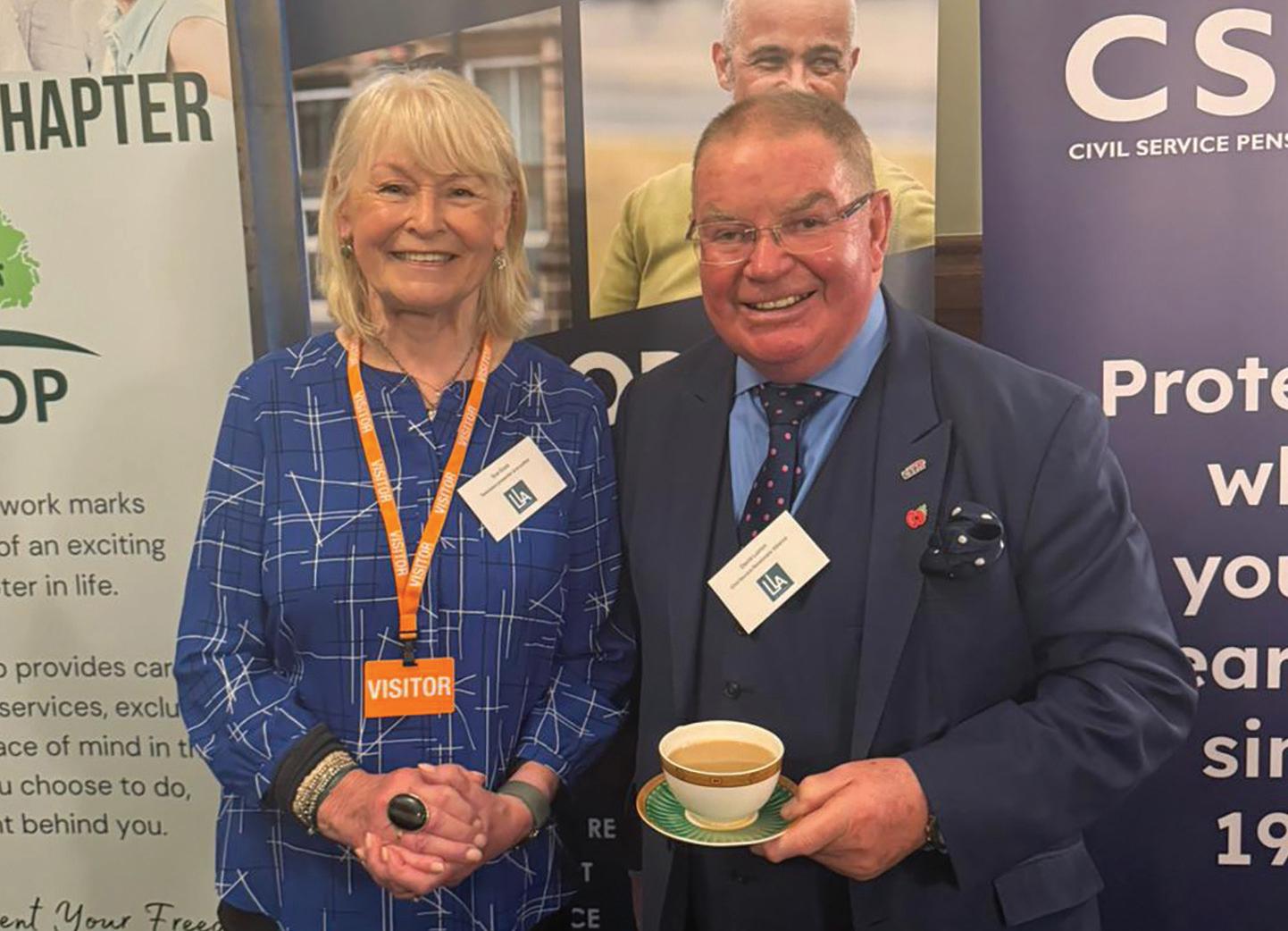
Ending the freeze is a key part of the Budget for Later Life launched in October with our Later Life Ambitions partners and former BBC presenter Sue Cook (pictured below, see also page 7). Our aim was to highlight the positive contribution older people make to the economy and wider society – volunteering, providing unpaid childcare or acting as unpaid carers.
Thrive not survive
The Budget for Later Life also highlights a growing number of older people facing significant financial hardship in retirement, with the basic and new rates of state pension falling well below minimum standards of living in retirement.
According to the Joseph Rowntree Foundation, a single pensioner needs £17,400 a year (pre-tax) to cover essentials and participate in society. The basic rate of state pension is £9,175, which leaves a shortfall of £8,225 to meet that minimum if there is no other pension income.
Even those on the higher rate of new state pension, £11,973 a year, face a considerable income gap if they have no occupational pension.
Pensions UK suggests that by the end of the next decade three million pensioners may not have enough income to cover basic needs. The UK auto-enrolment pension scheme – introduced in 2012, mandating a minimum 5% employee and 3% employer contribution rate – is widely considered insufficient.
It is against that stark background that the government has revived the Pension Commission, led by Baroness Jeannie Drake, to “examine why tomorrow’s pensioners are on track to be poorer than today’s” and make recommendations for change. This is in addition to the third state pension age review, announced at the same time, headed by Dr Suzy Morrissey of the Pensions Policy Institute.
The government estimates four in 10, or nearly 15 million people, do not save enough for retirement and over 45% of working age adults are saving nothing at all into a pension. The Pension Commission will address these issues in a report examining the pension system in 2027.
The CSPA was formed more than 70 years ago to protect the value of civil service pensions and the wider economic interests of pensioners. That aim remains as important as ever – to protect what you’ve earned. And in these festive times, we must remember: pensions are for life not just for Christmas.
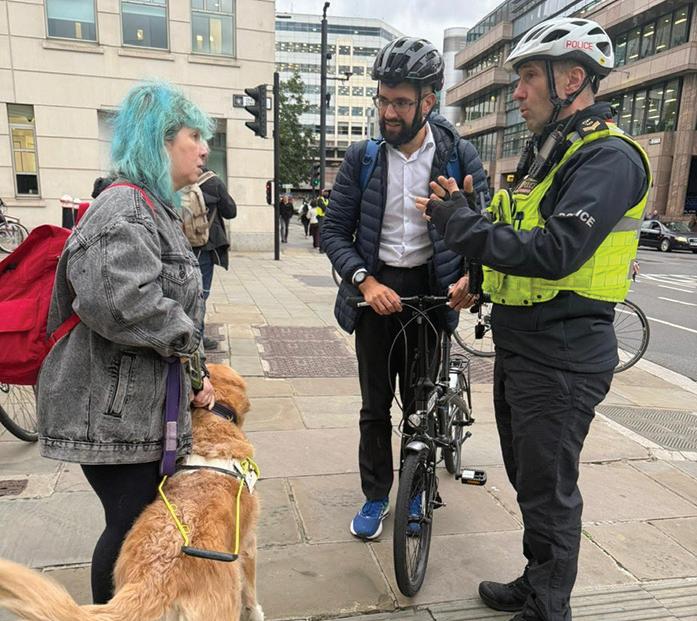
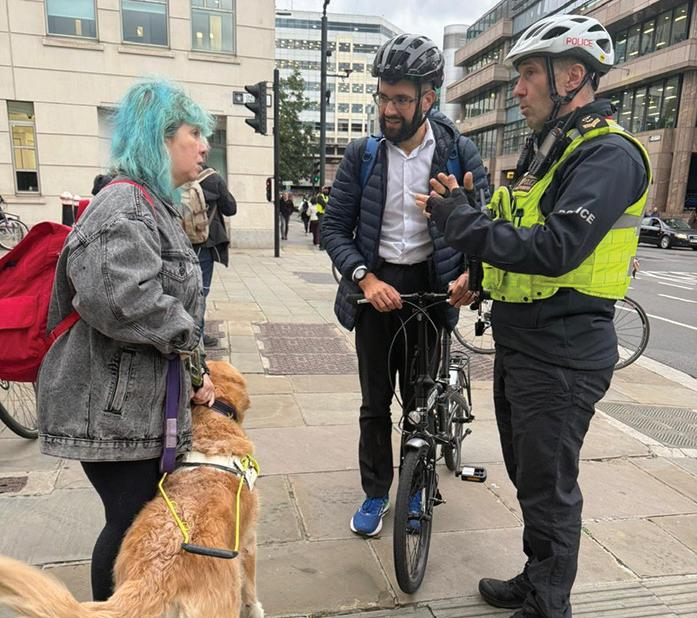
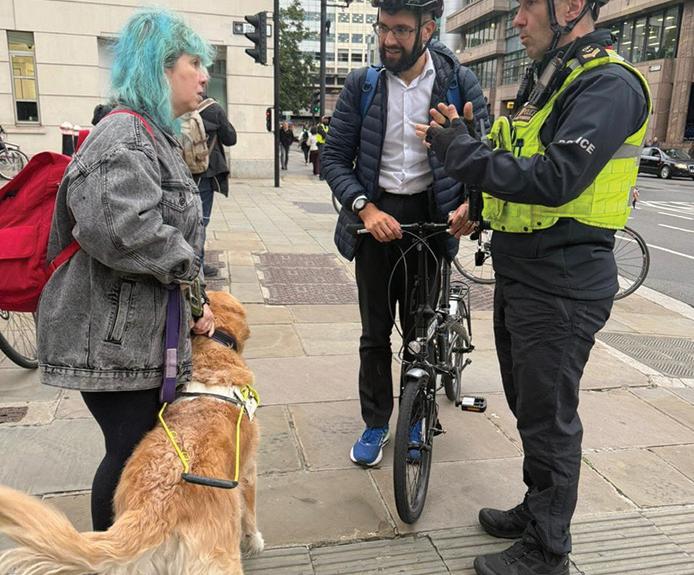
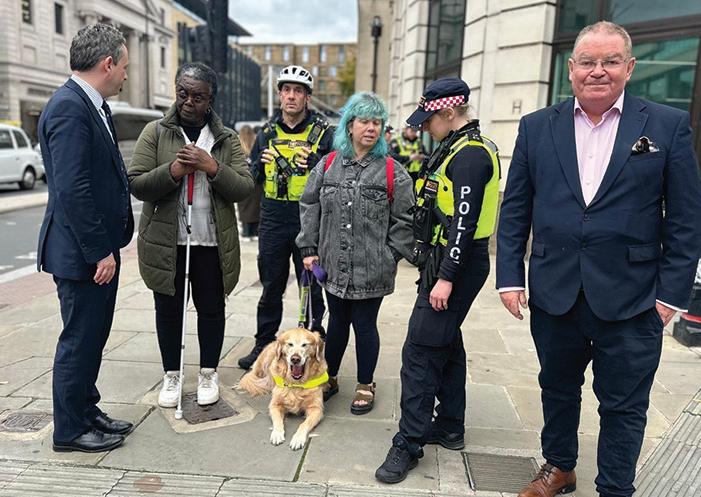
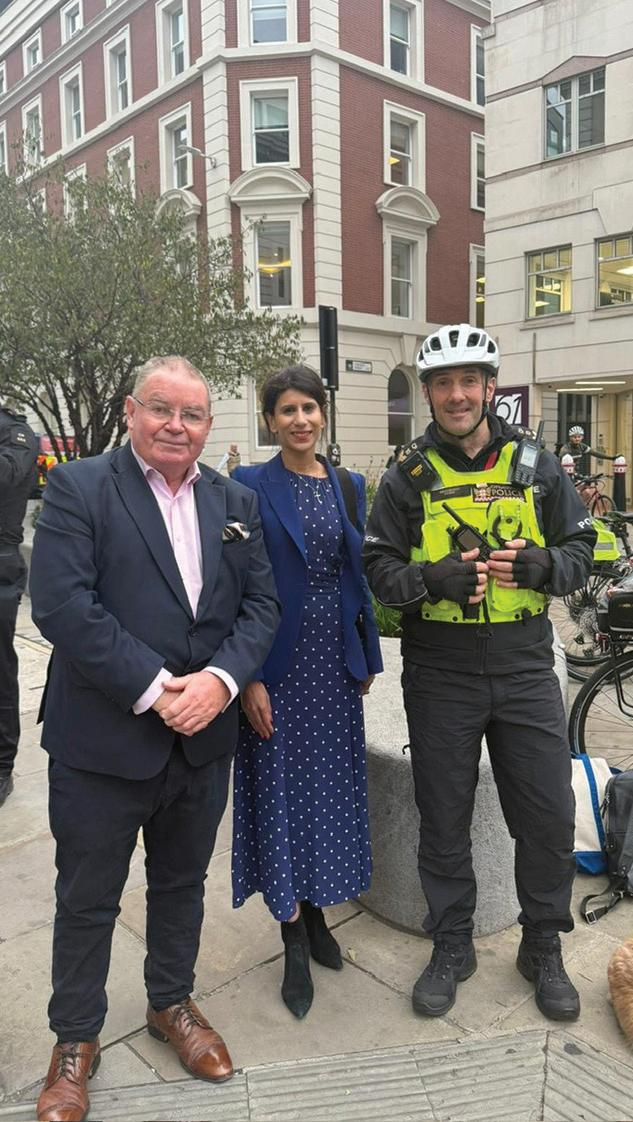
In October I joined the National Federation of the Blind UK to highlight the dangers of illegal e-bikes at pedestrian traffic lights, and accidents at ‘floating’ bus stops intercepted by cycle lanes.
After delivering a petition to 10 Downing Street, we joined the City of London police and councillors on an operation to stop illegal and uninsured e-bikes making life difficult for visually impaired and other pedestrians trying to cross roads. The police sergeant leading the operation also showed us seized illegal bikes that had been adapted to do speeds of more than 45mph.
This will be last column as Deputy General Secretary after five years in the job and six with the CSPA.
I am pleased to be taking on the part-time role of CSPA Pensions Manager from January following Chris Haswell’s departure for a new opportunity with the National Association of Head Teachers. I wish Christine well in her new job and look forward to my new role.
I have thoroughly enjoyed my period as Deputy General Secretary after taking over from Ralph Groves in 2020, just as we entered the second Covid lockdown. I recall working from home via Zoom, trying to keep local groups going, and administering the CSPA while HQ
It has been a privilege to represent the CSPA at meetings with ministers
remained closed. But we kept going for members and began to overhaul and modernise our office systems and communications.
Having responsibility for Organisation and Recruitment has enabled me to work with our groups and Regional Representatives, providing briefings and updates on our campaigning and speaking at AGMs and meetings. It has been a privilege to represent the CSPA at meetings with ministers and MPs, and with our partner organisations.
I look forward to my new role helping members with pension issues and liaising with the Cabinet Office and new pensions administrator Capita.
May I wish you all a happy, peaceful and enjoyable Christmas. May your fiscal fears be forgotten until the new year... Oh, and the Budget in March!
As part of your CSPA membership, you get access to a range of membership benefits, one of which is this magazine. Here is a quick snapshot of the most popular, but to see the full range visit the members’ area of the website members.cspa.co.uk
• Help and support with your pension
Our pensioner case worker can help if members have problems with their civil service or related occupational pensions. How to claim: email enquiries@cspa.co.uk with a brief outline of your query and your membership ID.
• IT/technology help and support
Free help and support on personal computer problems. How to claim: call BC Technologies on 01369 706656 quoting ‘CSPA’.
• Free initial legal advice Consultation for 30 minutes maximum, membership number must be provided. England and Wales: Lyons Davidson Solicitors, 01752 300 584 quoting ‘CSPA’. Northern Ireland: McCartan, Turkington & Breen, 02890 329801. Scotland: Thompsons Solicitors, email advicecentre@thompsons-scotland.co.uk or call 0800 801 299.
• Free initial consultation on wills, trusts and powers of attorney
Solicitor Harvey Howell is offering members a free private consultation by phone or video. View the Harvey Howell video podcast by logging onto the CSPA website. members area. How to claim in England and Wales: email cspa@harveyhowell.co.uk or call 0330 175 9959 quoting ‘CSPA’. In Scotland: Thompsons Solicitors, email advicecentre@thompsons-scotland.co.uk or call 0800 801 299.
• Financial services you can trust Free initial consultation with an expert from Quilter Financial Advisers to find out how you can benefit from financial advice. How to claim: Members can book their free, no-obligation initial consultation by calling 08000 858590, quoting ‘CSPA’, or find out more on our website www.quilter. com/cspa.
• Discounted conveyancing Gordon Brown Law Firm offers discounts in England and Wales. How to claim: call 0191 389 5160 or email sales@gblf.co.uk In Scotland: Thompsons Solicitors, email advicecentre@thompsonsscotland.co.uk or call 0800 801 299.
• Travel insurance scheme for members
Designed specifically for CSPA members, this annual travel insurance plan from the Civil Service insurance Society (CSIS) offers a European or worldwide option for an individual, couple or family. You must be medically fit to travel, a UK resident and a CSPA member (and remain so for the life of the policy) aged between 50 and 79 at the time of joining (thereafter no upper age limit will apply) and comply with the eligibility criteria.
• 10% off home and motor insurance*
CSIS offers a 10% discount to members taking out a home insurance policy over the phone and 10% off car insurance for those in England, Wales and Scotland.
• For full information on all insurance offers from CSIS visit: csis.co.uk/ partners/cspa
• Fred. Olsen We have teamed up with Fred. Olsen Cruise Lines for up to £200pp free on-board spend. How to claim: call 0800 0355 108 quoting ‘CSPA25’. For full info visit fredolsencruises.com/ affinity/cspa
• 5%-10% discount on Wendy Wu tours Wendy Wu tours and cruises cover Asia and the Far East. We have a 5% discount on all trips and up to 10% off Mekong River cruises. How to claim: visit www. wendywutours.co.uk or call 0800 035 5091 quoting CSPA5
• For great deals on shopping discounts, motoring, travel, lifestyle and discounts on the high street, visit our Savings Hub via members.cspa.co.uk/ discounts/
• Have a listen to our podcasts with guest speakers from CSIS and Harvey Howell by visiting cspa.co.uk/listen.
* Only available when calling CSIS for a quotation. Discount only applies when cover is offered with provider Salvation Army General Insurance Corporation.
In October, Microsoft officially ended free support for Windows 10, the operating system that has powered home computers for a decade. This milestone affects millions of households across Britain, where reliable computing remains essential for everything from family correspondence to managing pensions and online banking.
But the transition need not cause alarm, as straightforward pathways exist to maintain security and, where possible, move forward to Windows 11 at no cost.
The discontinuation of Windows 10 means Microsoft will no longer deliver routine security patches, feature enhancements or technical assistance without additional measures.
Computers will continue to function, yet each passing month without updates increases exposure to emerging threats.
Cyber criminals continually probe for weaknesses, and an unpatched system connected to the internet becomes progressively vulnerable – particularly when handling sensitive financial or personal information.
The transition need not cause alarm, as pathways exist to maintain security
The most elegant solution, and free of charge, is to upgrade eligible devices to Windows 11. This modern operating system introduces a cleaner interface, faster performance and built-in safeguards that align with today’s digital landscape.
Determine your eligibility quickly: open the Start menu, type ‘PC Health Check’ and launch the official Microsoft application. A single click on ‘Check now’ reveals whether the machine meets the necessary criteria – a processor from 2018 or later, at least 4GB of memory and an internal security chip known as TPM 2.0. Should the result confirm compatibility, proceed to Settings > Windows update, where the invitation to install Windows 11 will appear. The process preserves all files, photographs and installed programs, typically completing within an hour.
For those whose equipment falls short of these standards – often laptops or desktops purchased before 2018 –Microsoft offers the Extended Security Updates (ESU) programme. This provides critical security patches for one additional year, until 13 October 2026, shielding the computer from newly discovered exploits.



To contact BC Technologies for free advice and support, telephone 0330 800 1010, 9am to 5pm Monday to Friday, or email cspa@bc-group.co.uk at any time.
Please quote ‘CSPA’ when contacting BC Technologies to assist them in dealing with your query.
Enrolment is notably accommodating. The simplest route, entirely free for users in the UK, involves signing in to a Microsoft account (the same credentials used for Hotmail or Outlook) and enabling Windows Backup. Navigate to Settings > Accounts > Windows Backup, toggle ‘Remember my preferences’ and allow the system to store a modest copy of desktop settings and wifi passwords in the cloud.
No files need be uploaded, and the allowance of 5GB free storage proves ample for most households.
Once enrolled, the ESU updates arrive automatically alongside any remaining Windows 10 maintenance. Microsoft has streamlined the process so that, within days of activation, the first patch downloads seamlessly.
Looking ahead, Windows 11 brings tangible benefits tailored to everyday needs: a centred Start menu that reduces clutter, voice typing for composing letters, and Copilot – an intelligent assistant capable of locating misplaced holiday photographs or summarising lengthy pension statements.
Battery life on laptops extends noticeably, and the operating system boots several seconds faster than its predecessor.
To summarise, the end of Windows 10 support amounts to a gentle prompt rather than a crisis. A brief compatibility check today can secure either a smooth transition to Windows 11 or a year of continued protection through ESU.
Why can’t
Ican’t be doing with people who mumble. I mean, it’s not difficult, is it?
If you’ve got something to say, open your mouth and provide ample volume. If not, shut yourself up.
Have you noticed how often people talk to you while they are looking down at their mobile phones? You don’t need to be Einstein to realise that if your eyes are focused downwards, so is your mouth. Have a look in the mirror if you don’t believe me. Not that most younger people need encouragement to look in a mirror. That’s why they walk into you in the street: they’re either staring at their reflection in a shop window or taking selfies.
So when they speak to you, they don’t look in your direction; and besides, their attention is half-hearted. Is the art of conversation is dead? Of course it is. We no longer have conversations. We have monologues in the same room.
That is if you’re lucky. Often they start talking when they’re standing next to you, then wander off. Do they expect you to trot after them, assuming you’re desperate for their gripping account of Strictly or what the cousin of someone you’ve never met said to them last Tuesday?
And their blathering starts in the most inconvenient surrounds. They tend to position themselves next to a blaring radio before they start whispering. Or wait until you’re in the back seat of a car and then talk into the windscreen at the volume of a Trappist monk with laryngitis.
Some people – bigots, ignoramuses, simpletons, dunces – try to claim I can’t hear them because of some fault of my own. Like creeping deafness. I’ve never heard such nonsense.
Many years ago my mother pointed out an interesting fact about the huge grandfather clock that took up most of our hallway. It was so large, and the passageway so narrow, we had to squeeze past it, pushed up against the opposite wall. This made it impossible to see the time and winding it up was a three-person operation. But it did have an impressive chime. The house shook at noon.
Then mother pointed out that it had grown quieter over the years. As the chime-quake rattled hanging mugs in the kitchen, cleaning products fell from bathroom shelves and the goldfish was subjected to waves akin to the Cape of Good Hope, we told her she needed a hearing aid.
How wrong I was! Recently I went back to the house and discovered she had been right all those years ago: that chime really has got quieter.
It also irritates me that watching the television with others has become fraught. I find people mumbling at me, ‘Do you want the sound up that high?’
Well, of course I do, or I wouldn’t crank it up to the 30s. I suppose the telly is getting on now and the volume is wearing out. I can recall when it was perfectly adequate around 20, but those days
People try to claim I can’t hear them because of some fault of my own. Like creeping deafness. I’ve never heard such nonsense
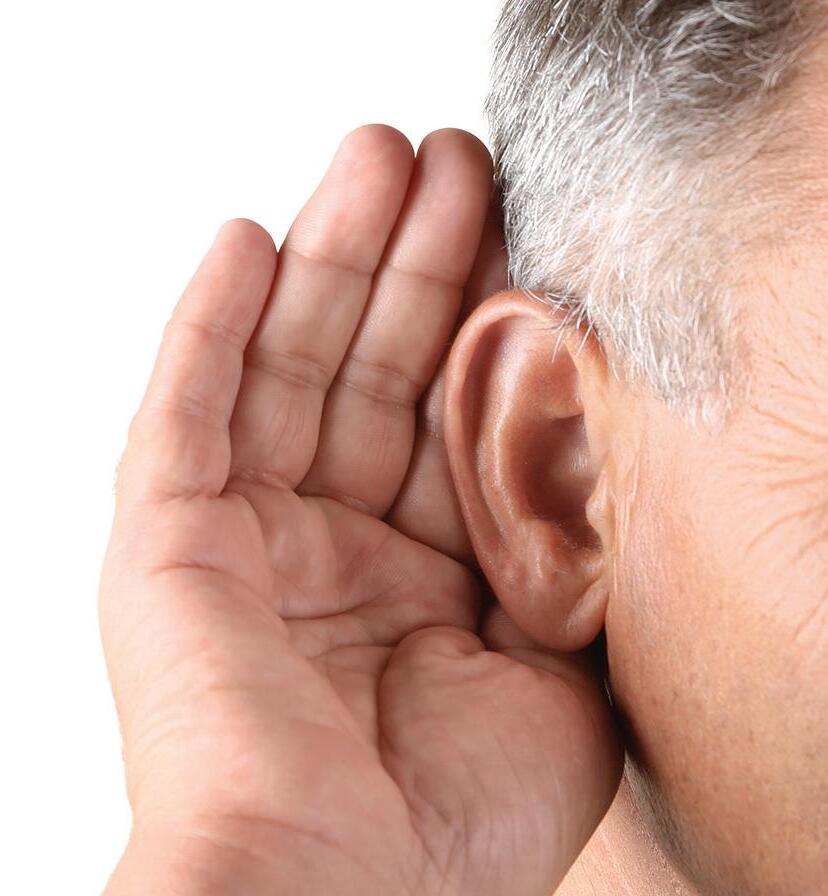
are gone. I suppose I could get a new TV, but it doesn’t seem worthwhile. The only ones who complain are the mumblers, and I’m not going to put myself out for them. I believe the mumbling fraternity is becoming increasingly militant and designing buildings to annoy me. Time was I could go to the pub and have a pleasant conversation with up to half a dozen fellow-topers. Even Frank who sat away from us, near the door, to avoid buying his round, was perfectly audible. Stephen was positively deafening.
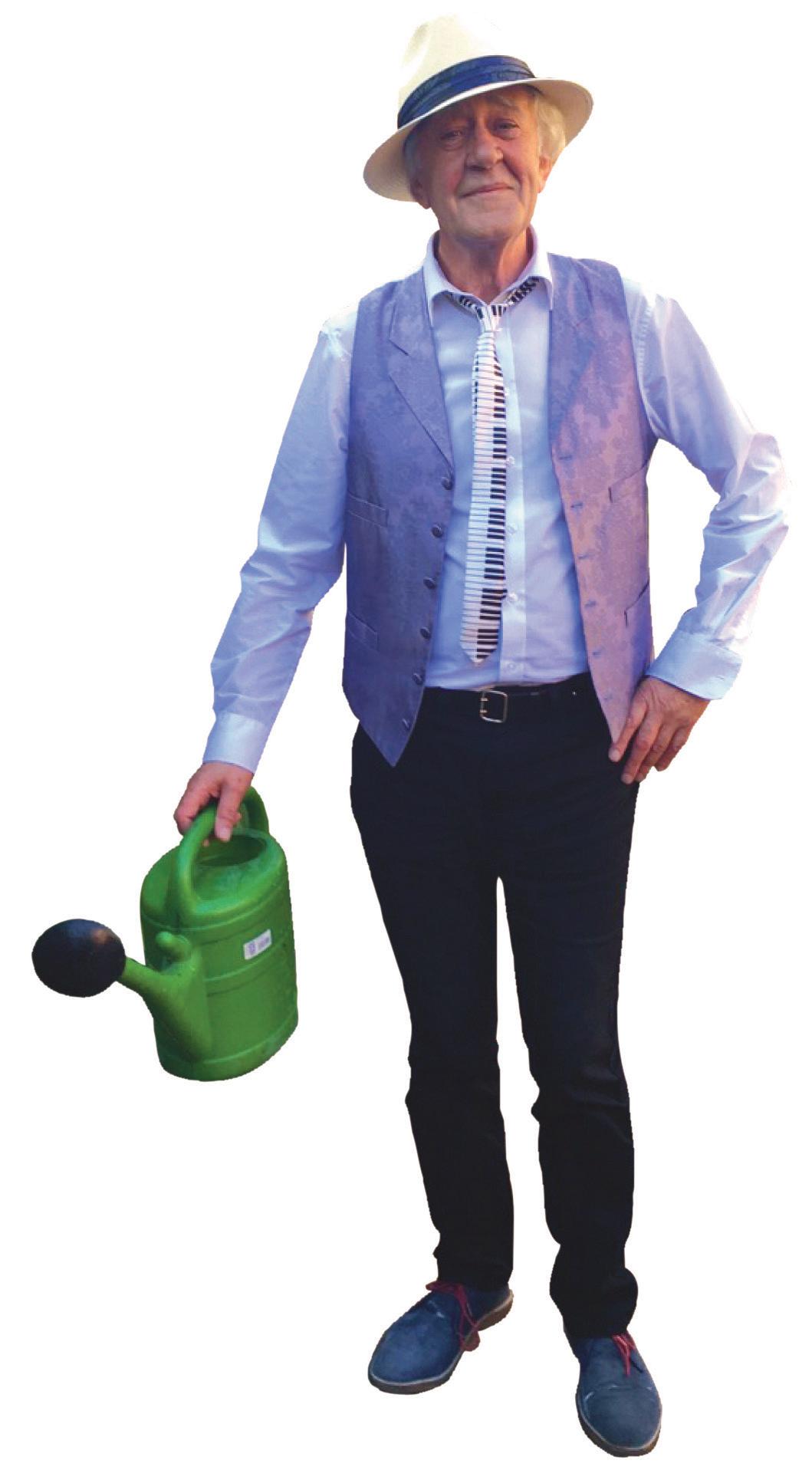
The last time we met up no one said a word. Or if they did, no one heard them. The mumblers have taken away the carpets and installed music machines and coffeemaking devices that sound like the QM2 leaving Southampton. We couldn’t even hear Tommy, and he used to be a scaffolder. Anyway, against my better judgement, I was persuaded to have a hearing test. You can probably guess what happened. “Oh you need a hearing aid.” Tosh. It’s their job to dish them out. If they had a humpback whale in the chair, they’d suggest something to improve its high-frequency hearing.
I went along with it in the end. And once I’d stuck something in my ear everyone brightened up. In fact they have started to be rather pleasant. For one thing, they’ve all stopped mumbling.