
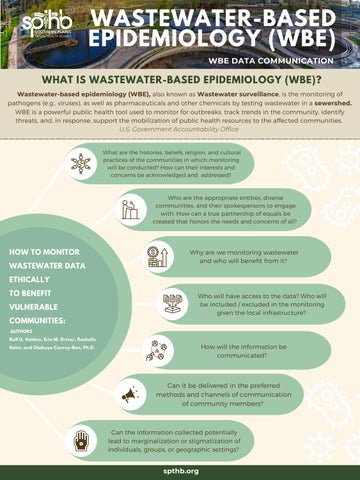
Wastewater-based epidemiology (WBE), also known as Wastewater surveillance, is the monitoring of pathogens (e g , viruses), as well as pharmaceuticals and other chemicals by testing wastewater in a sewershed. WBE is a powerful public health tool used to monitor for outbreaks, track trends in the community, identify threats, and, in response, support the mobilization of public health resources to the affected communities U S Government Accountability Office
What are the histories, beliefs, religion, and cultural practices of the communities in which monitoring will be conducted? How can their interests and concerns be acknowledged and addressed?
Who are the appropriate entities, diverse communities, and their spokespersons to engage with How can a true partnership of equals be created that honors the needs and concerns of all?
HOW TO MONITOR WASTEWATER DATA ETHICALLY TO BENEFIT VULNERABLE
COMMUNITIES:
AUTHORS
Rolf U. Halden, Erin M. Driver, Rochelle Holm, and Otakuye Conroy-Ben, Ph.D.
Why are we monitoring wastewater and who will benefit from it?
Who will have access to the data? Who will be included / excluded in the monitoring given the local infrastructure?
How will the information be communicated?
Can it be delivered in the preferred methods and channels of communication of community members?
Can the information collected potentially lead to marginalization or stigmatization of individuals, groups, or geographic settings?
Some tribal members did not have access to Wi-Fi or internet communications
Some Tribal member mistrust public health due to events that have taken place in the past
Not all Tribal members are not registered and can be scattered geographically
Work progress can be slow within the Tribe
Access to care, discrimination and restrictive policies
Lack of resources and capacity to handle WBE
Quick and direct turnaround of the data to the community in which WBE testing is being conducted
Ongoing trainings and communications with partners and wastewater employees
Consistent and reliable formatting, messaging, and delivery of WBE findings
Easy to read interpretation of the data to be able to use in public health decisions
Obtaining "buy-in" from the community regarding the benefits of WBE
PUBLIC HEALTH ACTIONS AND COMMUNICATIONS FROM WBE DATA INTERPRETATION:
In Oklahoma City, ZIP codes with high levels of SARS-CoV-2 RNA in wastewater relative to the rest of the city were identified The Oklahoma City Public School District then conducted targeted text communication to parents of students in high-load areas to encourage parents to get tested and vaccinated and provided information on where to get tested and vaccinated To complement the communication campaign, area hospitals and the health department deployed targeted vaccination and testing efforts in the area (Haley Reeves, University of Oklahoma, personal communication, 2022)
In central Oklahoma, physicians used the breakdown of the Omicron and Delta variants in the wastewater to decide where to allocate monoclonal antibody therapies (Haley Reeves, University of Oklahoma, personal communication, 2022)
CDC NWSS Data Interpretation: https://www cdc gov/nwss/interpretation html
California Department of Public Health Wastewater Toolkit: https://www cdph ca gov/Programs/CID/DCDC/Pages/COVID-19/Wastewater-Surveillance-Toolkit aspx
NIH WBE Disease Surveillance for Public Health Action: https://www ncbi nlm nih gov/books/NBK591716/
Rockefeller Foundation WBE Document: https://www rockefellerfoundation org/wp-content/uploads/2023/01/Monitoring-Wastewater-Ethicallyto-Benefit-Vulnerable-Communities-Final pdf https://www rockefellerfoundation org/wp-content/uploads/2023/01/Featured-Message-Briefs-Final pdf
CASAWEBCommunicationToolkit: https://casaweborg/wbe-communication-tools/ NACCHOWBEResourcesLibrary:https://wwwnacchoorg/programs/environmentalhealth/hazards/water/wash/wastewater-surveillance-resource-library HoustonNWSSCoEResources:https://wwwhou-wastewater-epiorg/