


How-to Guide for Using the Scenarios




Southeast Alaska faces uncertain times without an existing roadmap to guide the way. In an uncertain future, scenarios help build shared capacity to kaagwa (talk) together about how things could unfold. Thinking about the future together can help people wooch.éen (collaborate) to create the future they want. The intent of the scenarios is to provide a structure and language to help residents of Southeast Alaska have those discussions about the future of the region.
These scenarios do not aim to predict the future or state a desired vision. They aim only to provoke new thinking, make opportunities and threats more visible, and enable richer, more useful conversations about what Alaskans must do.
These four malshg (stories) are relevant, challenging, plausible, and clear. They are intended to support an open and constructive search for answers to core questions of what we must do together to ensure a prosperous future for the lands, communities, and people of this place.
Scenarios play a unique role in strategic planning. Because they are fictional, and because they come in sets of two or more different, plausible stories, they offer the advantage of supporting informed debate without committing anyone to any particular policy position. Although we cannot predict or control the future, scenarios show us that we can work with and influence it.
The content of these scenarios was created by a scenario team a group of Native and non-Native Alaskans, artists, the business community, philanthropy, recreation, education, housing, timber, fishing, conservation, social services, and tourism sectors who, together, explored questions about Southeast Alaska’s future.
Through this process, the Scenario Team produced three scenarios:
Bull Kelp
● Devil’s Club
The starting point for these stories is the current environment. While some things about the future are certain and constant, such as Southeast’s geography, these scenarios explore what is uncertain about the future, considering both factors within the region and external to it.
● In Bull Kelp, the trajectory of the region is shaped by external forces, the ebbs and flows of power, and priorities beyond the control of local communities.
● In Spruce, natural resource development is severely restricted on federal land in the region over time.
● In Blueberries, the influx of climate migrants brings new ideas, cultures, and economic opportunities to the region.
● In Devil’s Club, self-determination for Native communities is centered, and also meets resistance from some non-Native interests.
William Gibson says, “The future is already here, it is just not evenly distributed.” All three of these scenarios are clearly visible in the present, and all three of them (and combinations thereof) are possible in the future.
We cannot predict or control which scenario will occur, and so we need to understand and work through the implications of all three. Guidance on how to work through the implications is the purpose of this User Guide.
To review the scenarios in full, see the Possible Futures for Southeast Alaska document. It is recommended that readers familiarize themselves with the content of the three scenarios before using the tools in this booklet.
As outlined in Image 1 below, the transformative scenario planning process involves five steps. This User Guide is intended to support steps 4 and 5.
Image 1: The five steps of a transformative scenario planning process
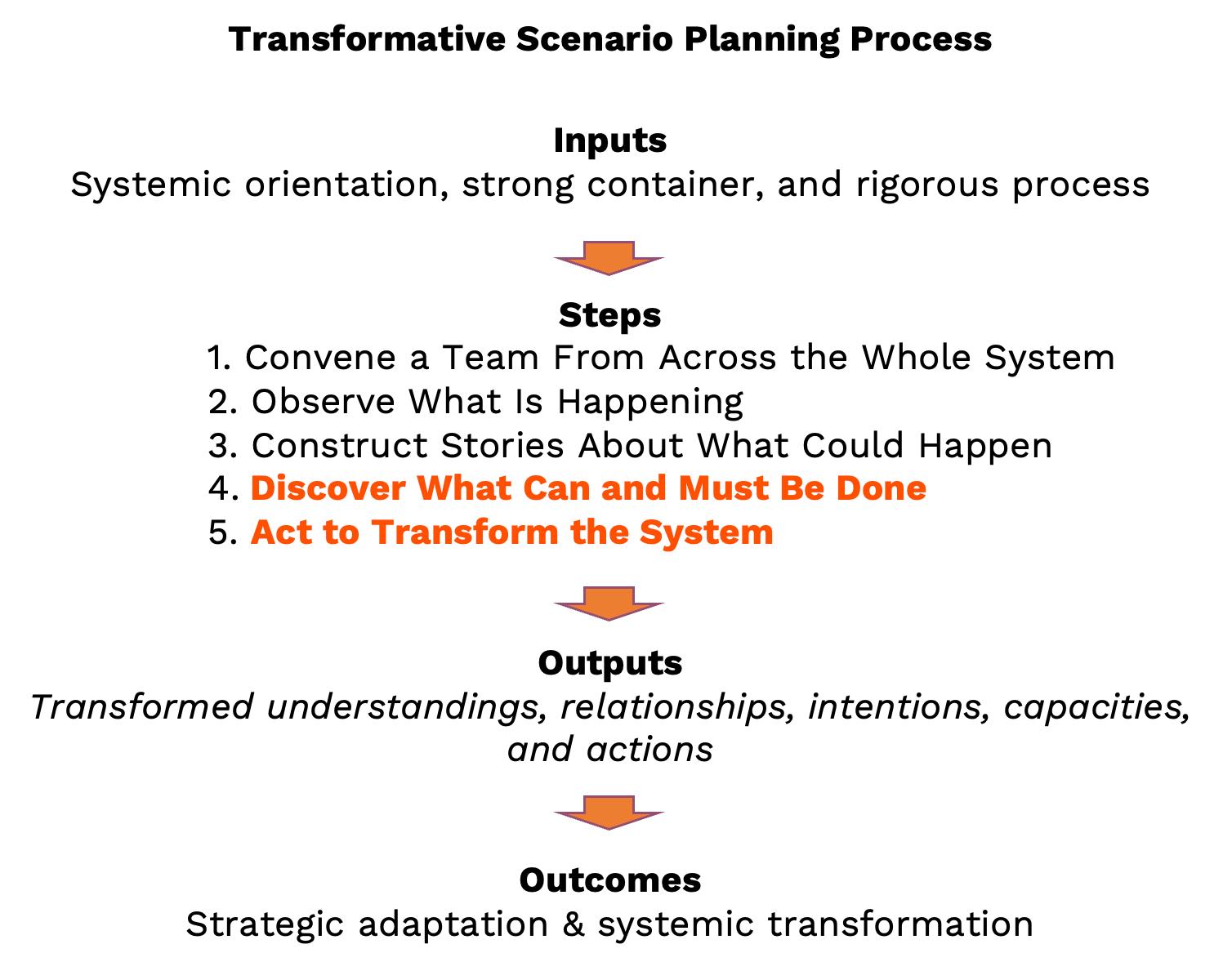
Steps 4 and 5 of the TSP process underline that TSP recognizes that there are two orientations to the future to be considered in discussions of scenario implications.
1. Adaptive Orientation: We cannot, or should not, or need not change our context; we must accept it and adapt to it
2. Transformative Orientation: Our context is or could become unsustainable or unacceptable; we must try to change it.
In other words, in taking an adaptive orientation, the inquiry is:
● Given we want a resilient and prosperous region, if this scenario occurred, what would Southeast Alaska have to do to adapt?
In taking a transformative orientation, the inquiry is:
● Looking at the scenarios as a set, which futures are better for my community? For my organization? What do I need to do to move toward the pathway to the future that is preferred?
As outlined by Adam Kahane, author of Transformative Scenario Planning:
“The transformative scenario planning process enables politicians, civil servants, activists, businesspeople, trade unionists, academics, and leaders of other stakeholder groups to work together to construct a shared understanding of what is happening and what could happen in their system, and then to act on the basis of this understanding.
The focus of transformative scenario planning is the development, dissemination, and use of a set of two, three, or four scenarios (structured narratives or stories) about what is possible. A scenario is a story about what could happen: an internally consistent hypothesis about the future that is relevant, challenging, plausible, and clear.
Scenarios provide a shared framework and language for strategic conversations within and across stakeholder groups about the situation they are part of and what actions they can, must, and will take to address it. Transformative scenario planning thereby offers a way for social systems to get unstuck and to move forward.”
In summary, the scenarios are not
● Stories about what will happen: a forecast or prediction.
● Stories about what should happen: a vision or proposal or plan.
They are stories that describe possible pathways into the future to help us talk and think more deeply about our current reality.
Therefore, the purpose of undertaking Transformative Scenario Planning is to:
● Catalyze open and reflective strategic thinking and conversation about the possible pathways for Southeast Alaska, and about the opportunities, risks,
and choices these futures present to the region, its people, and its communities.
● Stimulate individual and team strategic actions to influence these futures
The success of a scenario or set of scenarios is not evaluated by whether these situations occur in the future, but rather on whether they influence the strategies and choices of today. Sometimes the most significant scenario is, in hindsight, the one we manage to avoid.
In developing and working with the scenarios, we create a common language that allows us to talk about the challenges of the present and the future. Based on this conversation, we can make choices and form strategic alliances that allow us to either adapt or work toward the future reality that we desire.
Therefore, for the scenarios to be useful, it is essential to reflect on and talk about them. Stakeholders are encouraged to engage with each other and key partners/stakeholders to talk about the different scenarios and their implications. This reflection may be individual or in teams, face-to-face or virtual.
The purpose of structured reflection on the scenarios is not to arrive at a consensus about what will happen. It is to engage in discussion to understand the implications of what could happen, using the scenarios to illuminate possible pathways, inform strategies, and discern next steps.
How do I personally reflect on the scenarios and discover my own role in influencing them?
This section provides a set of questions and tools for individual reflection on the scenarios. We encourage you to engage with these questions personally, whether for five minutes or for several hours, to familiarize yourself with the scenarios and deepen your thinking. We invite you to share the results of your reflections, with your colleagues, and even with those you disagree with, through virtual or face-toface interactions.
Questions for individual reflection
Familiarize yourself with the content of the scenarios by reading through them at least twice.
Questions for individual reflection:
● What feelings does each scenario evoke in you? Noticing your emotional response to scenarios is important because it gives us insight into why we might advocate for or against a particular strategy in relation to a given scenario.
● What most stands out for you about each scenario?
● If this scenario happened, what impact would it have on you, your family, your community, and your organization?
● What signs (e.g., newspaper headlines or data on current trends) do you see of these scenarios emerging today?
Thinking about the possible futures for Southeast Alaska in which we could find ourselves:
● What worries you about the future?
● What energizes you about the future?
Journaling is an opportunity to reflect on ourselves, on our context, and on what we are learning. Writing in a journal is a key tool for learning through experience, by noticing, reflecting, and documenting how your ideas evolve. It is simply the practice of immediately writing what comes to mind rather than thinking through the ideas first, and involves writing for yourself rather than for others.
Work in a pair to have a friend or colleague ask you the reflection questions and listen attentively to your responses, provoking you to deepen your thinking as the conversation evolves. Then turn the tables and ask your friend the questions, without expressing your own opinions.
How do I personally reflect on the scenarios and discover my own role in influencing them?
The intention of a team reflection may be to deepen the group’s understanding of what is emerging and/or to brainstorm possible actions.
To reach a deeper level of dialogue, we recommend scheduling sessions that are at least four hours long, to ensure sufficient time to both grasp and internalize the content of the scenarios, and come to new insights about their meaning for the team.
This section offers tools and ideas for hosting such dialogues.
Sample questions for team reflection
All the questions for individual reflection listed above can also be applied to a process of team reflection. By sharing our answers in a group, we often deepen them for ourselves.
In addition, there are other questions that are particularly useful for team dialogue:
● What strikes us as interesting about the scenarios?
● What signs are we seeing related to our work that indicate one or more of these scenarios are realizing themselves?
Circle dialogue (for up to 30 participants)
Invite participants to sit on chairs in a circle, and present a question to the group. Ask each person to share their reflection on the question, moving around the circle or inviting them to speak as they are ready. The ideal is to hear each person’s voice. Encourage participants to listen with attention and speak with intention.
Small-group conversations
Especially if your group is more than 6-8 people, it is useful to break into small groups for parts of the conversation. This helps to ensure that more people have an opportunity to have their voice heard and listen more attentively to others. You may give the small groups a task such as filling in a worksheet [see the samples provided in Appendix Two], generating their top three challenges and top three opportunities, or their top three ideas for transformative actions. At the end, come back into the whole group to share learnings.
We often underestimate the power of walking and talking. Most of our meetings are sitting meetings. By walking together, we can get a change of perspective, generate energy and focus, connect with our impulse toward movement, and deepen our team reflections. It is well known that Steve Jobs, for example, made a habit of using walking meetings, and Aristotle consistently instructed his students while strolling about.
A 20-30 minute walk in pairs to reflect together around a guiding question can make a big difference to the productivity and collaborative capacity of a diverse group.
1. Everyone should find a partner. For example, people could choose a partner who:
a. They don’t yet know well in the group
b. They consider would challenge their thinking
c. Someone they have had a strong reaction to in the group, or whose opinions often contrast with their own
d. Someone they would like to develop a deeper relationship with
2. Go for a walk together outside for 30 minutes.
3. If you do not want to walk, find a quiet space to sit together for 30 minutes. It is important that you sit side by side, looking in the same direction, rather than facing each other. The reason to sit side by side for this particular conversation (or walk side by side) is that our orientation to what we are saying shifts when we are looking toward a common future, rather than “facing off” against each other.
4. During your walk, share the answer to a question. [Choose an openended question that deepens the conversation you are having that day in the agenda. Pick just one question, not two or three.] Example questions include:
a. What is one thing I need to let go of in order for this process to move forward?
b. What “new thinking” do you think is trying to emerge in this group?
c. What am I most afraid of in this process?
d. What am I most excited about in this initiative?
5. At the end of the walk, invite participants to come back together in a circle. Ask them to share “headlines” from the walk, or to share one point that was impactful for them in the discussion they had. Plan 15-30 minutes for this debrief.
“Engaging with the future does not take place in the future; it takes place in the present. Having a future focus changes the way we see the present, so much so that we ‘re-perceive’ that present and its strategic requirements. Learning from the future is exciting and challenging because it changes forever the way we engage with the present.” - Oliver Freeman
Scenarios are a useful tool for developing or rethinking an organization’s strategy and for guiding the development of new policies.
When we work with scenarios, we are looking at the big picture and the long term. The scenarios do not directly provide the answer for what you should do tomorrow. But by reflecting on the implications of each scenario, you can consider what position you want your organization to be in, what forces you need to pay attention to, and where your effort is best spent in the unfolding future of the region. The scenarios also create a strategic clarity that will help you to plan initiatives and actions.
Here are ideas, questions, and tools that can be customized to meet various strategic planning needs.
In most situations, an organization will already have strategies and policies in place, but strategy should always be emergent and alive, because the context is always changing. Author Henry Mintzberg differentiates between deliberate strategies (planned and intended actions) and emergent strategies (actions that develop over time). He argues that successful strategies often involve a mix of both.
Based on this premise as shown in the diagram below, scenarios can help to consciously develop and incorporate the emergent strategy into your realized strategy.
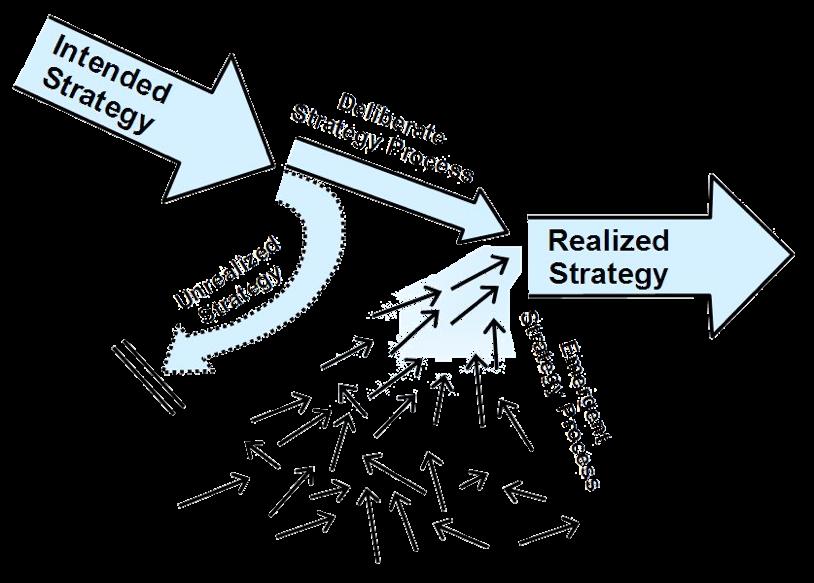
Source: Henry Mintzberg
Author adrienne maree brown understands the notion of emergent strategy as “strategy for building complex patterns and systems of change through relatively small interactions” and as “an adaptive, relational way of being”. She speaks of emergent strategy elements and principles as follows.
Elements
The six elements of Emergent Strategy reference systems and practices in nature that we can use to reframe the way we work and live. Each element is unique and also connects to the other elements. All six elements are a part of an ever expanding understanding of emergence.
Principles
These statements help us stay grounded in the Emergent Strategy elements. The principles are related to each other and they lay inside of each other in a given moment. They show up as catch phrases when we want to center ourselves in a particular practice or element.
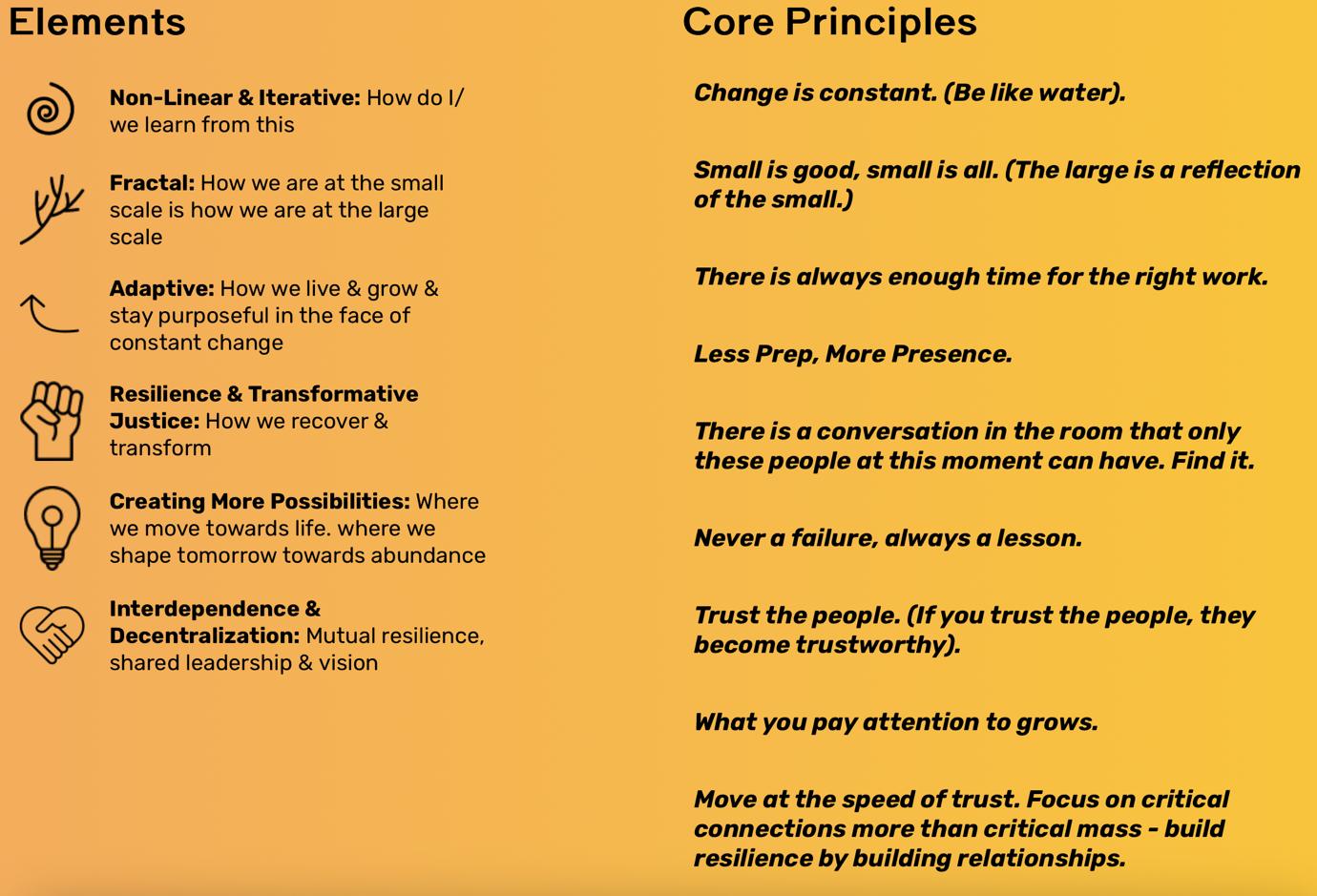
Source: Emergent Strategy Ideation Institute
adrienne maree brown's emergent strategy invites us to create flexible, iterative, and inclusive processes that adapt to change and emphasize interconnectedness, creativity, and resilience. This approach encourages continuous revision and creative thinking, ensuring that strategies remain responsive to new information and resilient to disruptions.
“Holistic understanding brings realistic action.” – The Dalai Lama
Primary goal
● To help actors to act with broader and deeper and more aligned understandings, relationships, and intentions with greater wisdom.
● To better understand the driving forces affecting the world within which your organization operates.
● To identify the challenges and opportunities the scenarios present to the organization
● To develop effective and relevant strategies
● To build participants’ ability to see the big picture and the long term
● What opportunities, risks, and challenges do these scenarios present for Southeast Alaska?
● What forces, indicators, or warning signals in our context do we need to be paying attention to?
● Considering these three scenarios, how do our current strategies hold up?
● What is our desired reality?
● What strategies/policies do we want to pursue?
● What do we need to stop doing, what do we need to start doing, and what do we need to continue doing?
● What do we need to think about and what do we need to do now?
SWOT: Identifying Challenges and Opportunities the Scenarios Present to Southeast Alaska
When we work with scenarios, we are looking at the big picture and the long term. The scenarios do not directly provide the answer for what we should do tomorrow. But by reflecting on the implications of each scenario, we can consider what position we want the region to be in, what forces we need to pay attention to, and where our effort is best spent to achieve our aims.
A SWOT analysis is a commonly used method for evaluating strengths, weaknesses, opportunities, and threats for a particular organization or initiative. Because it provides a framework for looking at both internal and external factors, it is a useful tool to work with in the light of a set of scenarios.
The purpose of the SWOT analysis as it is used here is to contextualize the implications of the scenarios for Southeast Alaska before moving into identifying options in light of the scenarios.
How it works:
Given the impact your organization or community aims to have on the region, consider the following for each scenario:
Given our aim, what opportunities does this scenario present us with?
In light of this scenario, and our aim, what strengths does my community or organization have?
Given our aim, what threats does this scenario present us with?
In light of this scenario, and our aim, what weaknesses does my community or organization have?
Work as a group to write examples of strengths, weaknesses, opportunities, and threats on post-it notes, and place them on one or more flipcharts. The advantage
of using post-it notes rather than writing directly on the flipcharts is flexibility: You can easily change the post-its and move them between quadrants if, for example, something that one person considered a threat can also be rephrased as an opportunity.
The strategy session does not end with a SWOT. The SWOT is a mapping tool to contextualize the implications of the scenarios for your specific organization before moving into defining your strategy in light of the scenarios.
Discovering the Adaptive and Transformative Implications of the Scenarios for Southeast Alaska
As mentioned earlier, TSP recognizes that there are two orientations to the future to be considered in discussions of scenario implications, namely the Adaptive and the Transformative orientation.
Adaptive orientation: In small groups, discuss the following question for each scenario:
● Given our aim to do XYZ, if this scenario occurred, what would we have to do to adapt?
○ Identify top 5 things you would need to do to adapt to each scenario
Transformative orientation: Look at the scenarios as a set and ask:
● Which futures are better for the communities we serve?
● For my organization?
● What is my role, and my organization’s role, in what is happening and could happen?
● What do we need to do to move toward the pathway to the future that is preferred?
Cycle between the two stances, to gradually discover the meaning that the scenarios have for your organization, for your community. In so doing, gradually discovering the intersection of the answers to the two fundamental and complementary questions that underlie all strategic thinking:
1. What is happening in the world that could have an impact on us?
2. What impact do we want to have on the world?
The analogy of a wind tunnel is used here to describe a process where a team brings a current or proposed initiative to the ‘wind tunnel’, a process to rigorously test and ‘future-proof’ the initiative in the ‘fierce wind’ of the implications of the three scenarios.
Discussion guidelines:
1. If each scenario happened, how resilient would your initiative be (high, medium, low)?
a. What adjustments or modifications might be necessary to make the strategy more resilient?
2. What are 1-3 unintended negative consequences of your initiative in each scenario?
3. What assumptions are challenged by the scenario?
4. What are 1-3 key leverage points for your initiative in each scenario?
See Wind-tunneling Worksheet in Appendix 3.
A leverage point is a place where you can strategically take action to address a given situation. It is low leverage if a small amount of force will lead to a small change. It is high leverage if a small amount of force can lead to a large change.
In dealing with complex social problems, high-leverage points are those that address root causes. One way to identify root causes is to continually ask “why?”
● Identify an event that concerns you related to global development in your context.
● Ask “Why did that happen?” then ask of the answer, “Why is that?” and continue to ask “why” until you believe you have reached a root cause.
Having identified root causes of certain situations, think about your sphere of influence. Where do you have the resources and capacity to apply solutions? How can you expand your sphere of influence through partnering?
Next, consider where your organization could invest its energy and resources to achieve the highest impact for the effort invested. Consider, “Where is our power?”
Given that the scenarios outline stories of what could happen, in this activity, participants draw a picture of their preferred future scenario. They should include themselves, their organizations and/or their communities. After drawing the picture, consider:
● What would have to happen for this situation to be true?
● How could these things happen, given the strengths, weaknesses, opportunities, and threats we identified?
Sailing analogy:
• What will happen with the wind = scenarios
• What to do with our sail = options
Based on your overall aim, the SWOT, the adaptive and transformative implications, the leverage points, and the preferred future your team identified, clarify your team’s strategic intent:
● Strategic Intent = A clear and easily understandable statement of the actions the team will take.
● Ask each team member to try phrasing a strategic intent statement. Identify as a group where these statements are similar or different. Seek agreement on a statement that will be useful for guiding your work.
Once you have clarified your higher-level strategic intent, you may want to brainstorm your short-term options and actions. Start the brainstorm session with the question, “What actions can we take in the next year to help us to achieve our strategic intent?” Ask the group to generate ideas for actions on postit notes, and briefly read them out one by one.
Guidelines:
● Don’t dismiss or debate any ideas during the brainstorm.
● Listen to other people’s ideas and see if they spark ideas for you.
● Allow for wild ideas.
● Generate as many ideas as possible.
● Stay focused.
● Be visual – include sketches and diagrams.
With many options on the table, as a group, choose the ones you think deserve further consideration. Consider the potential implications and impacts of the scenarios on the identified options.
Prototyping is a way to build, test, and refine a strategic action before investing considerable resources in it. It’s the process of deploying a series of small-scale experiments to quickly assess the strength of the idea, and then adapting the idea based on what you have learned. Though prototyping, you take an unproven idea and validate it based on feedback, data, and observation.
Steps in prototyping:
1. Build a model of your idea (this may be a drawing or a 3D model using modeling materials or Lego).
2. Invite colleagues or end users to give you feedback.
3. Rebuild the model, taking the feedback into account.
4. Test the initiative at a small scale and closely observe the results.
5. Incorporate lessons learned and either further refine the idea or purge the idea.
Prototyping is a learning process. It’s crucial to keep a record of the information, insights, and feedback gained as the idea being prototyped evolves. Through iteration, the idea can evolve into something worthy of implementing on a large scale. Understanding and embracing failure is an essential characteristic of a prototyping process.
Considering internal implications
“Fear and discomfort are an essential part of strategy making…true strategy is about placing bets and making hard choices.” –Roger L Martin
Your strategy is not only about what actions you want to take in the world outside. It is also about how your organization and the region may need to adapt its own capacity, structure, and ways of operating.
Consider:
● What organization do we need to become by 2050 to respond to these possible futures?
● What capacities do we need to learn and embody to stay alert and make sense of a fast-changing world and not get stuck in business-as-usual?
● What steps could we take today to become such an organization?
Invite your team to create statements related to what the organization could become. Write each statement on a flipchart.
Ask group members to vote with their thumbs on the statements. A “thumbs-up” means “I agree.” A “thumbs-down” means “I disagree.” A horizontal thumb means “I am unsure” or “I have a question.” Ask those with horizontal thumbs to pose their questions, and provide any needed clarification. Then ask those with thumbs-down what they would propose instead. Keep the process going until you have a set of 5-6 high-level statements that most team members agree on and are inspired by.
Then discuss:
● What will help us move forward from here?
● How are we going to drive this process? Who will lead it? If possible, identify a steward for each statement.
● This activity helps design meetings using the IDOART framework.
When to use
● Complete this activity meeting or engagements with partners.
Who should be involved?
● All facilitation team members, or the meeting facilitator running the meeting.
What you’ll need
● A place to meet (either virtual or in person).
Collaboration tools
● Flipchart and sticky notes if in person
● Online whiteboard space if virtual
● The template (below)
Part I: How and Where?
How will you be meeting?
● In person?
● By video?
● By phone?
● A combination of these?
Will you need to slow down for remote participants? What impact will this have on what’s achievable?
Where are you meeting?
If in person:
● What venue will you pick? Does it have natural light / is it well lit?
● Are flipcharts and whiteboards available?
● Does it have a screen / projector?
If virtually
● Which video platform will you be using?
● Will everyone be on computer, or will some be joining by phone?
● Are there bandwidth issues?
● Any other practicalities that need to be addressed in advance.
In preparation for the meeting, ask some of the participants the following questions:
● What is your understanding of the current situation that this meeting is addressing?
● What would make this initiative (meeting/workshop) successful from your perspective?
● What do you hope to have at the end of the initiative (meeting/workshop) that you do not have now?
● What would make the initiative (meeting/workshop) unsuccessful?
● What advice do you have for the team organizing the initiative meeting/workshop)?
Now complete this template based on the answers you have received.
Who is attending?
List the meeting attendees here.
Intention/Purpose
In one sentence state the intention/purpose for the upcoming meeting. This sentence is the “why” of your meeting.
● Our intention/ purpose is strategic direction of our work – not what we will achieve in this workshop or session.
● If this meeting is part of a larger project start by capturing the goal or purpose of the larger project. The intention/ purpose of this meeting should serve that larger goal.
Desired Objectives
State the main objectives (usually 3) you would like to achieve by the end of the session. These should be things you can observe or you could check. Also, by achieving the objectives you would be realizing the intention/purpose. This is the “what”.
● Find an active verb to start each objective.
● For example, “Create alignment on milestones” or “Build a common understanding of the current situation”.
What are the headline descriptions for each point in the meeting? Do not worry about the “how” - the point is with this to establish the arc of the session, not create a detailed plan (that will come later). The arc of the session is the outline for achieving the intention and desired objectives.
● An example would be “share insights and learning from current projects” or “reach decision on priorities for the next phase of work”.
● These headlines are looking to capture the task or outcome that this section of the agenda is focused on.
These are the ground rules that establish the interaction between people and are in service of the intention and desired objectives. These should be observable actions rather than concepts (“be respectful” is open for interpretation where “don’t interrupt” is observable).
● If there is a concept that is important (be honest) think of the observable actions that would demonstrate the concept.
These are the times you will begin, go for lunch, take breaks, and finish. Make sure you are realistic about timings (can people get there when you say you will start? Is the lunch hour long enough?) and once you have established the timings you need to stick to them (so make sure you have given yourself enough time for the headline agenda).
After completing the IDOART, review the whole document. Are there are any adjustments or revisions you would like to make?
When entering into an inquiry or multi stakeholder conversation we operate with three different phases in the process – diverge, emerge and converge. Each of these phases is different, and it is important for a facilitator to know where we are in the process – and what is needed in each phase.
Divergence, emergence, and convergence can be thought of like the cycle of breathing in and out. This “breathing” rhythm is at the heart of Reos Partners’ process design. Every process goes through a few or more of these “breathing” phases.
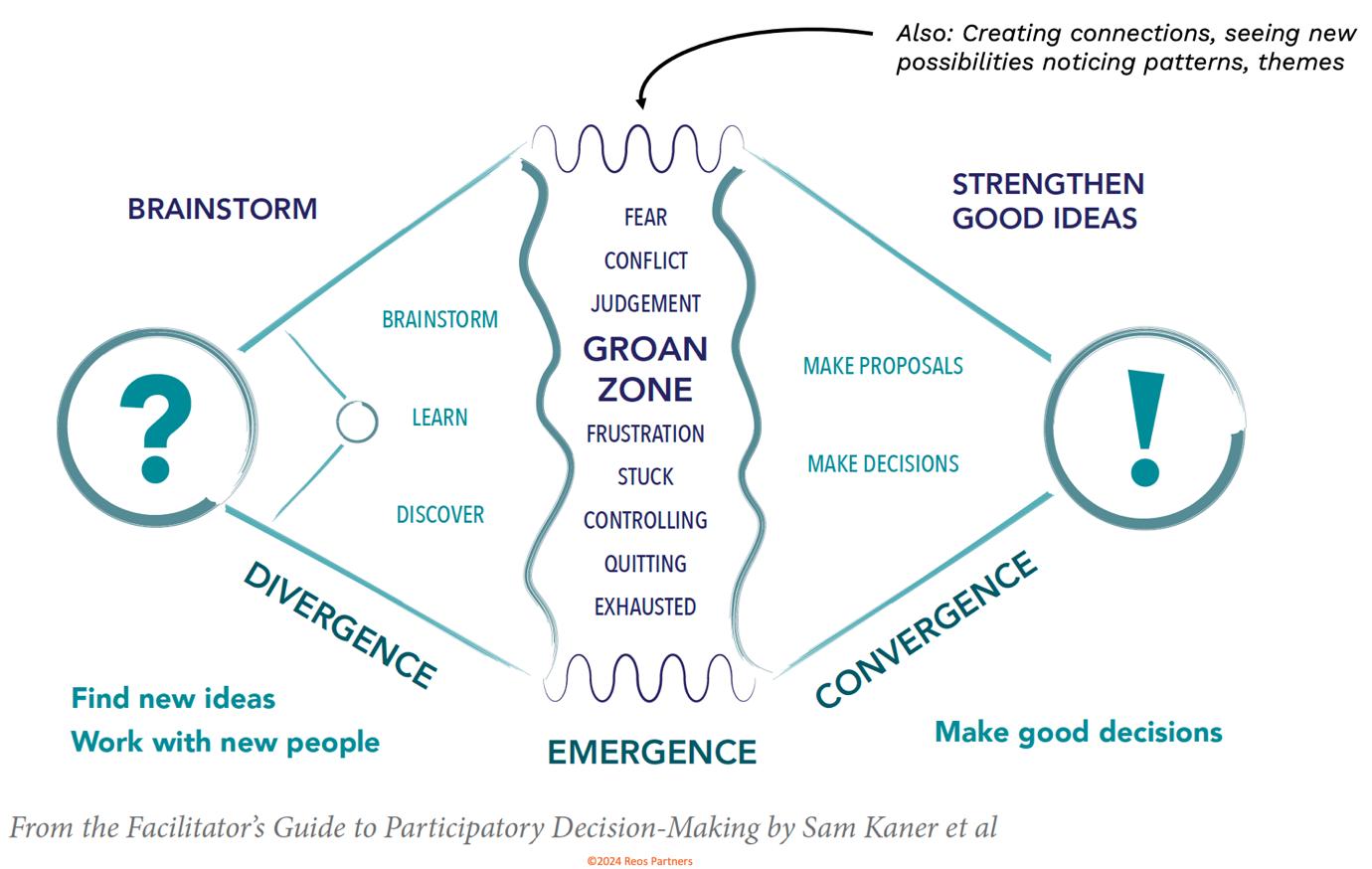
In the diverge phase, there is as yet no clear shared goal. This is a “goal-seeking” phase where a clear shared purpose gives the collective direction.
Another driver in this phase is asking the right questions. If you close the divergent phase too soon, the level of newness or innovation will be less. Ideally a group will stay in inquiry in the divergent phase until a new shared and agreed solution or goal is seen by everyone.
Divergent thinking typically generates alternatives, has free-for-all open discussion, gathers diverse points of view and unpacks the logic of the problem. The divergent phase is non-linear and needs “chaos time”. It is process-oriented and needs prolonged decision time.
The converge phase is goal-oriented and focused, linear, structured and usually subject to time constraints. It is focused on getting results and may require quick decisions. Convergent thinking means evaluating alternatives, summarizing key points, sorting ideas into categories and arriving at general conclusions.
The emerge phase, between diverge and converge, is fondly known as the ‘groan zone’ – It is the phase where different ideas and needs are integrated. It may require us to stretch our own understanding to hold and include other points of view. We call it the groan zone because it may feel messy - an uncomfortable stretch - but it is also the phase where the new solution emerges.
Sample Agenda for an Implications & Strategy Workshop
Outcomes
● Attendees understand the relevance of the scenarios and how they can be used (e.g., learn the language, absorb the scenarios, have an experience of how they can be used).
Objectives
1. Review the purpose of the Transformative Scenario Process
2. Review the three scenarios
3. Develop understanding of how to use scenarios
Agenda outline
Part 1: Approximate time required: 3 hours
1. Brief review of the Scenario Process.
2. Develop understanding of the content of the three scenarios.
Part 2: Approximate time required: 3 hours
3. Experience how the scenarios can be used – wind tunneling potential strategy.
Part 1
Timing Module Lead Instructions Set up
9:00 Intro & Checkin
Check-in: Name, role Looking at all 4 scenarios, these stories of what could happen, what stands out for you most? [30 sec] Review agenda
Timer & bell
9:25 Transformative Scenario Process
9:35 Applying the Scenarios to your Work
9:45 The Scenarios: Building Familiarity & Understanding
Slides
• What is TSP?
• Why TSP for Southeast Alaska?
• TSP process outline
Review slides of three courses of action: 1. Intended Strategy 2. Emergent strategy 3. New competence Q &A
Review the scenarios:
1. Overview of the 4 scenarios [5 min]
‘Soak time’: First way to use scenarios is to get in touch with how they make you feel –emotional responses. Read scenarios; for each one record your response to the following questions: [provide hand-out #1, attached below]
• What worries you about this scenario?
• What energizes you? 7.5 minutes per scenario=30 minutes 12 minutes (3 min /scenario): buzz in pairs with your neighbor to share your reflections.
Set up next exercise: divide into groups meet at tables after the break
Chairs in circle; screen; laptop
10:30 Break
10:45 Discussion: Possible implications of the scenarios
Divide group into teams; at least one team per scenario
1. Given our aim, what opportunities does this scenario present us with? [15 min]
2. Given our aim, what risks/threats does this scenario present us with? [15 min]
Assign roles for small group work:
1. Process guide: ensure everyone participates; pay
Slides
Flipcharts
11:45 Check out
attention to time; don’t get bogged down;
2. A team recorder; the person who will hold the pen and take notes;
3. A ‘provocateur’ roleChallenge the team to approach this with fresh eyes; ‘yellow card’ for ‘thinking the way we always have’.
One key point shared by each team [5 min]
1. One idea I heard today that represented new thinking
2. One question I am leaving today’s work with? [30 sec]
Individual reflection; buzz with neighbour, share in plenary
12:00 Lunch
Part 2
[Part 2 could follow on the same day or as a separate workshop] Timing
13:00 Check in
One thing that is getting clearer to me about the scenarios and my work (30 sec)
Silent journaling, buzz with neighbor, popcorn
13:15 Agenda review
13:20 ‘Wind Tunneling’ Possible Strategies Using Scenarios
Focus on a strategy that is under consideration by the team. [see instructions in User Guide) See worksheet in Appendix 3
Move back to circle
Timer & bell
14:30 Break
14:45 Feedback Clinic
15:15 Next Steps
15:30 Checkout
Split teams into three groups:
• 4 minutes per group to present wind tunnel exercise learnings
• 3 minutes feedback from other groups – use coaching questions format (e.g., have you considered…; the team receiving feedback does not respond, rather notes the feedback for inclusion in the next iteration of their work)
Strategy process; proposed next steps
Individual reflection
Question: How do you imagine the scenarios effecting your work going forward?
16:00 Closing
One
What worries you about this scenario? What energizes you?
Worksheet two
What opportunities does this scenario present us with?
What challenges does this scenario present us with?
What would we do to adapt to this scenario?
What can we do to influence this scenario?
Resilience
1-3 unintended negative consequences
Challenged assumptions
1-3 key leverage points
Philosophies of / and Approaches to Facilitation
Abram, David (1996). The Spell of the Sensuous. New York: Vintage.
Block, P. (2003). The Answer to How is Yes: Acting on What Matters. San Francisco, CA: Berrett-Kohler.
Kahane, A.M. (2012). Power and Love: A Theory and Practice of Social Change. San Francisco, CA: Berrett-Kohler.
Kelly, Tom (2001). The Art of Innovation. New York: Random House.
Hamilton, Craig (2004). “Come Together: The Mystery of Collective Intelligence,” What Is Enlightenment: Issue 25, 57-77.
Hassan, Z. (2014). The Social Labs Revolution: A New Approach to Solving our Most Complex Challenges. San Francisco, CA: Berrett-Kohler.
Isaacs, W. (1999). Dialogue and the Art of Thinking Together: A Pioneering Approach to Communicating in Business and in Life. New York, Currency.
Scharmer, C. O. (2007). Theory-U: Leading from the Future as It Emerges Cambridge, MA: Society for Organizational Learning Press.
Schein, E. H. (1988). Process Consultation: Its role in organizational development. Second Edition. Upper Saddle River, NJ: Prentice Hall.
Schwarz, R. (2002). The Skilled Facilitator: A comprehensive resource for consultants, managers, facilitators, trainers and coaches. San Francisco, CA: Jossey-Bass.
Senge, Peter (1990). The Fifth Discipline: The Art and Practice of the Learning Organization. New York: Doubleday/Currency.
Senge, P., Scharmer, C.O., Jaworski, J. and B. Flowers (2008). Presence: Human Purpose and the Field of the Future. New York, NY: Doubleday.
Weisbord, M. and S. Janoff (2008). Don’t Just Do Something, Stand There: Ten Principles for Leading Meetings that Matter. Grenada North, New Zealand: ReadHowYouWant.
Kahane, Adam (2012): Transformative Scenario Planning: Working Together to Change the Future San Francisco, CA: Berrett-Kohler.
Kahane, Adam (2013): Transformative Scenario Planning: Working Together to Change the Future. Sandford Social Innovation Review.
RSA (2012): How to change the future. Video. YouTube.
Gray, D., Brown, S., Macanufo, J. (2010) Gamestorming: A Playbook for Innovators, Rulebreakers, and Changemakers Sebastopol: O’Reilly Media
Kumar, V. (2012) 101 Design Methods: A Structured Approach for Driving Innovation in Your Organization Paperback. Hoboken: Wiley
Tools for Inquiry with Groups
http://www.designkit.org/ www.liberatingstructures.com
www.thiagi.com
Tools for Debriefing with Groups
www.reviewing.co.uk/index.htm
Library of activities
https://www.sessionlab.com/library
Further Resources
http://plusacumen.org/courses/