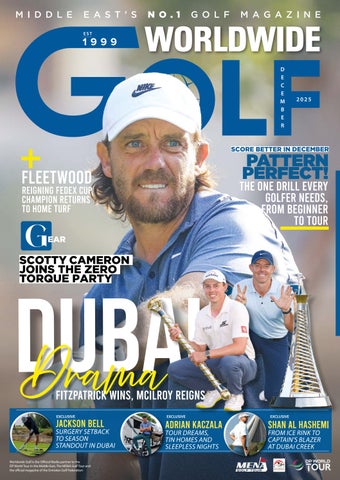
WWG Decmeber Digital

Page 1


DUBAI Drama

OUR LOCATIONS

YAS MALL
UMM SUQEIM STREET, DUBAI
MALL OF THE EMIRATES
EMIRATES HILLS

VOICE OF THE TOUR

HOW 2025 BECAME A DEFINING SEASON

As the dust settled on another Race to Dubai, someone who attended both of our recent Play-Off events posed the question to me whether 2025 was the DP World Tour’s best season to date.

It’s an intriguing question which in some respects is difficult to answer, simply because we’ve had so many memorable years since the Tour was established in 1972.

I have personally worked for the Tour for the past seven seasons, but I have been involved in various capacities since 1999, and I would have to say there is a strong argument in favour of it being the greatest I have witnessed.

We have enjoyed considerable success both on and off the golf course over the past 12 months and the two Play-Off events, consecutive Rolex Series events held here in the Middle East, were the perfect way to bring the curtain down.

Inside the ropes, we were treated to some compelling drama, with both the Abu Dhabi HSBC Championship and the DP World Tour Championship being decided via extra holes –Aaron Rai defeating Tommy Fleetwood in the former, and Matt Fitzpatrick holding off Rory McIlroy in the latter.

Throughout our global schedule in 2025, our members have provided some remarkable entertainment which has truly resonated with our fans.

Our record TV viewership and spectator attendance at our tournaments bear testament to that.

Across the 11 events that comprised our Back 9 and Play-Offs, our average TV viewership increased by 35 per cent on Golf Channel, and 16 per cent on Sky Sports, versus 2024.

More than 500,000 spectators attended these tournaments, and we also registered a significant increase in interest across our platforms, with total video views on our TikTok, YouTube and Instagram accounts up by 34 per cent and engagement across all our social media channels up by 47 per cent.

It was befitting that the finale to our season

featured two members of our victorious European Ryder Cup team, both Major Champions, battling it out in front of packed galleries. The play-off between Matt Fitzpatrick and Rory McIlroy, which followed Rory’s customary box office finish in regulation play, was contested by two top class competitors but it was underpinned by the camaraderie that in so many ways defines our Tour and attracts fans to it.

That camaraderie unquestionably contributed to Team Europe’s incredible victory in the 2025 Ryder Cup at Bethpage, which was one of the stand-out sporting events of the year, or indeed any year.

Win In New York

To win away, in New York, was historic, as indeed was Rory’s victory in the Masters Tournament back in April as he became the first European player to complete the Career Grand Slam.

Rory’s victory in the Amgen Irish Open, his national Open, and the sheer wall of noise that accompanied it, was another iconic moment that will live long in the memory. At Jumeirah Golf Estates, it was also evident how much winning a seventh Race to Dubai title meant to Rory.

He now starts the 2026 season at the Crown Australian Open with Colin Montgomerie’s record of eight firmly in his sights – another piece of history that will only add to Rory’s glittering golfing CV.

Ahead of the DP World Tour Championship, we unveiled the Rory McIlroy Award, a new annual honour that Rory will present to the best performing DP World Tour member across the four Major Championships.

The Award recognises Rory’s legacy and the contribution he has made not only to our Tour, but to the game of golf globally.

Its inception was one of several notable announcements we made to coincide with our season finale.

We welcomed AWS as new addition to our commercial family, becoming an Official Partner,

and confirmed an extension to our UK broadcast agreement with Sky Sports for the DP World Tour and Ryder Cup until the end of 2029.

We also began the week by announcing a long-term extension to our partnership with DP World through to 2035. This is the biggest deal we have done in the history of the European Tour Group and it underlines the strength of the partnership we have with DP World, who have been the title partner of our main Tour since the start of the 2022 season.

Since then, we have worked together to enhance the Tour, taking our global talent around the world to iconic global locations. The DP World India Championship, the penultimate event in our Back 9, was a great example of this.

Introduced for the first time in October at the historic Delhi Golf Club with DP World’s support, we assembled the strongest international field ever to compete in an event in India. That field included 2025 Ryder Cup players Rory McIlroy, Tommy Fleetwood, Viktor Hovland, Shane Lowry and Ben Griffin, with Rory becoming the first reigning Masters Champion to tee it up in the country.

As golf’s global Tour, we played 42 tournaments in 26 different countries in 2025, providing a truly international platform for players representing 41 different nationalities to showcase their skill and talent.

Our role as administrators is to ensure that platform is as strong as it can possibly be for our members. With increased attendance, engagement and viewership, combined with strong commercial partnerships, we did that this year and we have strong momentum going into the new season as we look forward with great anticipation to seeing what 2026 brings, both on and off the course.

PHILLIPS

BRING OUT THE PLAYER IN YOU.Ahigh-launching, players-styledesignthatcombinesshot-makingprecisionwith score-savingforgiveness.Engineeredforthebestplayersin theworld.Customfitandcustombuiltforyou.

DISTANCE & CONTROL

LowerCGforincreased ballspeedandhigher launch.

PLAYER PREFERRED

Sizedandshaped fortrajectory control.

FORGIVENESS WITH FEEL GET FIT. GET OPTIMISED.

Game-improvement forgiveness;softerfeel, pleasingsound.

DECEMBER - 2025

12 PETE COLUMN

The grind separates dreamers from winners. Inside the work ethic, mental battles, and golden windows that define professional golf today.

18 INSIDE THE SEASON FINALE

Back-to-back play-off drama across Abu Dhabi and Dubai delivered highoctane finishes, clutch putts and seasondefining moments, as the DP World Tour crowned its ultimate champions.

18 MATT FITZPATRICK

From winless drought to Ryder Cup hero and Dubai champion, the Englishman’s remarkable turnaround proves the power of marginal gains and persistence.

22 TOMMY FLEETWOOD

Finally Home: The FedEx Cup champion returns to Dubai as World Number Four, Ryder Cup hero, and resident—chasing the one trophy that’s escaped him for 14 years...

32 ROBERT MACINTYRE

Major Ambitions: The Scottish star reflects on his breakthrough season among golf’s elite—and explains why he’s certain a Major championship is within reach.

36 IN THE SWING

The Danish Blueprint: Why Nicolai Hojgaard’s four DP World Tour wins reveal a swing built on power, simplicity, and ruthlessly efficient impact fundamentals.

28 CLAUDE HARMON III

The coach behind eight Major champions explains how gutting his Dubai academy, building athletes before golfers, and demanding Michelin-level excellence creates tour-ready talent.

50 How a former Emirates Golf Club leader earned universal respect by focusing on members’ needs rather than personal glory and ceremonial tradition.

58

Three Surgeries, Three Wins: The Dubai teaching pro who went from the physio table to the winner’s circle, proving recovery and resilience matter more than expectations.

The Feel Paradox: How Scotty Cameron solved low-torque putting’s biggest problem— stability without feedback—by engineering control and touch into centre-shaft designs that actually respond.

46 ADRIAN KACZALA

Camper, Clubs & Cold Nights: The Polish pro who drove to Q School in a rented van, survived barking dogs and zero sleep, then played brilliant golf anyway.

54 DANIEL LOBEL

From Stargazer to Scratch Golfer: The astronomy graduate who moved to Dubai, discovered golf at 31, and mastered the game with the same intensity he once studied the cosmos.

62

SHAMES AL HASHEMI

Ice Hockey Dreams to Captain’s Blazer: The Emirati entrepreneur who traded Mighty Ducks for Major championships, applying golf’s lessons to business while preparing to lead Dubai Creek’s future.

THE OFFICIAL PETE COWEN COLUMN

THE HONEST TRUTH ABOUT MAKING IT — AND STAYING THERE

As the final events of the season play out, I find myself reflecting on what separates those who make it from those who don’t. And more interestingly, what separates those who stay at the top from those who drift back down.

This month, I’ve been watching Aaron Rai closely. He’s a great lad with an unbelievable work ethic. It’s exceptional. His preparation is almost obsessive. He’ll spend six hours on a practice round, measuring every angle, every bounce, every nuance of a golf course. That’s why other players get frustrated with him. He just waves them through and keeps going.

On the range, every session is structured. He doesn’t hit balls without setting everything up properly first. There’s no casual warming up, no aimless swatting. He’s methodical. You can see that discipline reflected in his golf.

People ask me: how did he win Abu Dhabi convincingly, then struggle at Dubai the following week? The answer is simple — golf courses suit different players. Abu Dhabi had 60 to 70 yards of run on the fairways. The players were telling me the fairways were running at 9.5 on the stimpmeter. So Aaron dinks it down the middle, gets 70 or 80 yards of roll, and suddenly he’s competitive.

But at Jumeirah? Trying to carry those bunkers off the tee? He’s miles behind. He hasn’t got the length. That’s not a criticism — it’s reality. Understanding your strengths and knowing which courses reward them is part of being a professional.

The Relentless Ones

Speaking of understanding the journey, Chris Wood

recently won the MENA Golf Tour Q School. He’s never given up. Keeps trying. A bit like James Morrison, who was ready to pack it in on the HotelPlanner Tour before winning an event in his early 40s. Chris is cut from the same cloth.

I think Woody’s dealing with some issues, and it would be great to see him iron those out with a win on the MENA Tour. People forget how lonely this sport can be. You have endless hours to analyse what went wrong, far more than you ever spend celebrating what went right. A win in this game goes a long way. Sometimes a little self-belief can shift everything.

My grandson Fred also teed it up at MENA Golf Tour Q School in Portugal recently, but he struggled to find his rhythm and started getting down on himself. That’s precisely why this level of the game is so important — for young professionals and battle-worn veterans alike. It tests your state of mind, not just your ability to strike a golf ball.

Windows of Greatness

One Englishman I’ve been particularly impressed by this season is Tommy Fleetwood. His defeat to Keegan Bradley at the Traveler’s Championship certainly lit a fire under him. Maybe that was all that was needed, because he’s been running hot ever since.

I was talking to Padraig Harrington about player form recently. Padraig’s studied this topic more than anyone I know, and he has a fascinating theory: players have a four-year golden window where they’re at their absolute peak. Tiger Woods in 2000. Padraig himself in 2007. There’s a certain period when things just light up. Maybe this is Tommy’s time. He’s climbed to

number three in the world, and it feels like everything is clicking.

Don’t misunderstand me. I’m not saying players like Rory McIlroy won’t win more majors. But as Padraig pointed out, players tend to have a purple patch. They don’t dominate for their entire career. There are windows. Recognising when you’re in one — and making the most of it — is crucial.

What It Takes

The truth is, talent alone doesn’t cut it. Being a pure ball-striker doesn’t guarantee success. I’ve seen players who can shape it both ways, flight it at will, hit it miles — and yet cannot score when it matters. Scoring is an art learned only under pressure.

Aaron Rai understands that. Chris Wood understands that. Tommy Fleetwood certainly understands it now. They’ve all spent time in the grind. They know what it takes.

So to every young professional reading this: study your game honestly. Know your strengths. Accept your limitations. Prepare with purpose. And when your window comes — and it will come if you work hard enough — be ready to kick the door wide open.

Because golf doesn’t hand out guarantees. But it does reward the relentless. n

WHERE NERVES MEET THE CREEK

Dubai Creek Golf and Yacht Club is rolling out the welcome mat again for the DP World Tour’s season opener, and if you’re a fan of dramatic finishes and the occasional watery grave for golf balls, you’re in for a treat. The par 71 course spanning 7,009 yards provides an unforgettable journey from the first tee to the 18th green — particularly when titles are on the line and nerves start jangling.

First opened in 1993 with a distinctively sail-shaped clubhouse, the course received a significant makeover when European Golf

Design undertook a major redevelopment alongside Thomas Bjorn in 2004, transforming it into the centrepiece of one of the world’s most prestigious golf resorts. Water is the course’s calling card — and there’s plenty of it. The creek comes into play on four holes, while numerous artificial lakes add challenge throughout. The most thrilling moment?

The floating sixth tee, positioned ten meters out into the creek itself, where players must drive back toward the mainland — a unique test of nerve. But it’s the closing stretch that really turns

up the heat. The 17th, a short par four with water lurking left, and the 18th running alongside the creek create a finish where tournaments are won and lost.

Just ask any player who’s stood over those final approach shots with everything on the line.

Multi-tiered greens and undulating fairways surrounded by date and palm trees complete a layout that rewards smart golf over brute force. Expect January’s field to face a beautiful but demanding test — one that always produces compelling golf.

Aaron Rai proved play-off practice makes perfect at Yas Links, drilling a 10-foot birdie on the first extra hole to beat Tommy Fleetwood— for the second time in a playoff.

The Englishmen lit up the UAE desert with a tournament-record 25-under 263, turning the first playoff event into an absolute shootout.

Here’s the wild part: Rai set a Guinness World Record as a 15-year-old by making 207 consecutive 10-footers. Fifteen years later, that same range paid off when it mattered most. The 30-year-old closed with a 67 that featured four straight birdies from holes 4-7, then survived a brutal moment when his three-footer spun out of the cup at 14. Most guys crumble after that. Not Rai—he made clutch par saves on 15, then

RAI DROPS 10-FOOTER TO BEAT FLEETWOOD AGAIN

stuffed it to eight feet at 16 for birdie to stay alive.

The 17th sealed it. With the pressure cranked to maximum, Rai buried an 18-footer to reach 25-under and force Fleetwood to match him just to stay tied. Which he did, draining a 15-footer for par. Pure theatre.

Fleetwood had every reason to think this was finally his Abu Dhabi moment. The two-time champion (2017, 2018) shot 66 to tie Rai, and took the solo lead with two to play after a birdie on 16. But golf’s a funny game—his playoff birdie attempt came up short on 18, opening the door for Rai to walk through.

Meanwhile, Rory McIlroy put on a Sunday clinic, firing a ridiculous 10-under 62 to leap into a tie for third with Nicolai Hojgaard at 24-under. Both missed joining the playoff by a single shot

when Hojgaard’s 15-foot eagle try on 18 just slid past. McIlroy’s back-nine 29 was the stuff of highlight reels, and more importantly, it padded his Race to Dubai cushion heading into the finale.

The victory catapulted Rai from 55th to 9th in the standings, locking up his spot in the DP World Tour Championship. For a guy who hadn’t won on tour since the 2020 Scottish Open— also a playoff win over Fleetwood—this $1.52 million payday from the $9 million purse was massive.

Marco Penge’s closing 63 got him to T9 but left him 767 points behind McIlroy with one event left. The Race to Dubai math was getting spicy, but Abu Dhabi belonged to Rai, who embraced his father Amrik after sealing the win. Five years between titles? Worth the wait. n

DUBAI DOES IT AGAIN: PLAYOFF GOLD

Dubai delivered the goods once again. The season finale at Jumeirah Golf Estates produced the kind of drama that had you yelling at the TV—a playoff between Matt Fitzpatrick and Rory McIlroy for the trophy, with Rory’s seventh Harry Vardon title already wrapped up. Both finished 72 holes at 18-under 270 on the Earth Course, all 7,706 brutal yards of it.

Fitzpatrick was absolutely dialed in Sunday, posting a bogey-free 66 that included a ridiculous hole-out from nearly 50 feet at the fourth. The numbers don’t lie—his 69.05 scoring average on this track since 2019 is second only to McIlroy’s absurd 68.75. When you’re that comfortable on a Greg Norman beast, you’ve earned it.

Then came the 72nd hole chaos. Rasmus Neergaard-Petersen barely missed an eagle that would’ve crashed the playoff party. But Rory being Rory, he stuffed his approach and rolled in the eagle to send it to extras. Déjà vu from his Irish Open heroics earlier this year.

The playoff? Over almost before it started. McIlroy’s tee shot took a swim on 18, and Fitzpatrick coolly got up-and-down for the win. Third Tour Championship title for Fitzy, putting him alongside McIlroy and Jon Rahm in seriously exclusive company. Not bad for a $3 million payday.

Tommy Fleetwood’s final-round 67 was a thing of beauty, vaulting him into a four-way tie for third at 17-under with Neergaard-Petersen, Laurie Canter, and Ludvig Aberg. They each pocketed

$486,250, and Fleetwood’s 69.13 historical average here shows he’s figured this place out.

The real season-long subplot? Marco Penge’s breakout year. Three wins, tied with McIlroy for most on tour, and he snagged second in the Race to Dubai despite finishing T22 in the finale. The 27-year-old just locked up a PGA Tour card and his first Masters trip. That’s life-changing stuff.

England absolutely owned 2025—Fitzpatrick’s win was the 11th by an Englishman this season among 19 first-time winners. And with 12,000 Race to Dubai points up for grabs (more than any other event), the math stayed spicy until the end.

Both playoff guys also happened to star in Europe’s Bethpage Black Ryder Cup upset—first U.S. victory since 2012. Turns out 2025 was pretty good for European golf. n

TheFROM EARLY-SEASON STRUGGLES TO RYDER CUP GLORY AND A HISTORIC THIRD DP WORLD TOUR CHAMPIONSHIP TITLE, 2025 WILL GO DOWN AS ONE OF MATT FITZPATRICK’S FINEST YEARS

Standing on the 18th green at Jumeirah Golf Estates last Sunday evening, Matt Fitzpatrick had every right to let the emotions flow. His third DP World Tour Championship title –secured in dramatic fashion after a play-off victory over Rory McIlroy – represented far more than another trophy for the cabinet. It was vindication, redemption, and confirmation that the long road back from his early-season struggles had been worth every minute of work.

“It means the world,” Fitzpatrick said, his voice thick with emotion. “I struggled at the start of this year, obviously, and to turn it around in the summer like I did and have a Ryder Cup like I did... the Ryder Cup in particular, I feel like it’s hard to top given everything. But the way that I played today, I feel like I really didn’t hit one bad shot all day. I’m so proud of myself, the effort that everyone puts in behind the scenes. Yeah, what a feeling.”

It was a feeling nearly 11 months in the making – a journey from the depths of a winless drought to the heights of championship glory.

Sitting down for an interview at Yas Links in Abu

Dhabi just days before his Dubai triumph, Fitzpatrick was already in reflective mood about a season that had swung dramatically in his favour.

“It’s been a fantastic year since about May time,” he explained. “I’ve played pretty well since then and managed to turn my season around, which is always nice.”

For a player who has built his career on the philosophy of marginal gains – those famous one percent improvements that compound into excellence – the turnaround required identifying and fixing a fundamental weakness. The diagnosis was clear; the prescription, less so.

“I obviously looked at where my game was and what needed to change and improve,” Fitzpatrick said. “My irons were kind of the poorest part of my game; arguably, they’ve ended the season in the strongest part of my game. That has been the biggest turnaround. Obviously, I knew that something needed to happen in order to achieve that.”

The transformation of his iron play from liability to weapon proved to be the catalyst for everything that followed. By the time summer rolled around, Fitzpatrick was back among the game’s elite performers, his confidence restored and his game firing on all cylinders.

The pinnacle of that resurgence came at Bethpage Black in September, where Fitzpatrick played a starring role in Europe’s Ryder Cup triumph. His two and a half points were crucial to retaining the trophy, and the experience provided memories that will last a lifetime.

“To be able to do that and obviously finish at the Ryder Cup with two and a half points has made it a very special week, as well as getting the win with the team,” he said, the pride evident in his voice. “Everyone on the team has really, I feel like, has come together, and I couldn’t be happier.”

The Ryder Cup success came during what Fitzpatrick describes as a difficult period, making the achievement all the more meaningful. “Obviously in that down period, I had the support of my wife and my friends and family, and to turn it around and be here now is very special.”

After the emotional highs of Bethpage, Fitzpatrick arrived in the Middle East for the season-ending swing with momentum on his side. He’d always enjoyed success at Jumeirah Golf Estates, winning the DP World Tour Championship in both 2016 and 2020, and the course remained a firm favourite.

“I love that golf course; it’s one that I’ve really learned to play well, obviously, over the years,” he said before the tournament. “I’m disappointed to miss the event there last year, but nice to be back this year.”

Playing in the penultimate group on Sunday, Fitzpatrick produced a flawless display of ballstriking, posting a bogey-free 66 to reach 18-under par. As he signed his card, he could only watch the giant screens and wait to see if it would be enough.

It wasn’t – at least not in regulation. McIlroy, playing in the final group and needing eagle at the last to force a play-off, delivered one of the shots of the year: a sensational 15-foot putt that found the heart of the cup and sent the tournament into extra holes.

“Of course you do,” Fitzpatrick admitted when asked if he expected McIlroy’s heroics. “He’s one of the only few where you know you are going to a play-off. You are two clear with one to play and you know you are going to a play-off. In typical Rory fashion he did it again and you never like to see the way it ends, but obviously delighted.”

The play-off lasted just one hole. McIlroy found water with his tee shot on the 18th, then failed to get up and down from a greenside bunker. Fitzpatrick, despite some nerves of his own with his approach, got up and down for par to claim his

“I’ve played pretty well since then and managed to turn my season around, which is always nice.”

second Rolex Series title and become a three-time DP World Tour Championship winner.

His immediate reaction on social media spoke volumes about his character: “Thank you to my wife, family, and team for your support always. And congratulations to Rory McIlroy – always fun to compete with you mate!”

With his first worldwide title since October 2023 secured and his confidence soaring, Fitzpatrick heads into 2026 with ambitious plans. The goals remain as lofty as ever for a player who has already won a US Open and claimed ten DP World Tour titles.

“It’s obviously always trying to win a Major; that’s the first goal on anyone’s goal sheet at the start of the year,” he said. “That’s what we play for, to try and win those and put your name into the history books. That’s the goal; that’ll be the main goal going into next year, as well as just continuing to try and win out on the PGA Tour and on the DP World Tour.”

The transformation of his iron play gives him every reason to believe those goals are achievable. Having identified the weakness, made the changes, and seen the results on golf’s biggest stages,

Fitzpatrick enters the new season as a genuine threat at every tournament he plays.

As Fitzpatrick celebrated his Dubai victory, the MENA Golf Tour – a circuit he competed on early in his professional career – was preparing to reopen for business with Q School in Portugal. For the Sheffield star, the timing served as a reminder of how far he’s come and the importance of the developmental pathway that helped launch his career.

“It’s definitely a big help to give players opportunity,” he said when asked about the development tour’s return. “It’s always a real positive thing, particularly out here in the Middle East. Like you say, it’s a great initiative and has been for a number of years now. Obviously, it was great to be part of that when I first turned pro and came out on to give it a go and experience what it’s like.”

He still remembers those early days testing himself in challenging conditions. “I remember playing in pretty much the middle of summer out in the Middle East, and it was safe to say it wasn’t very cold.”

The revamped tour features guaranteed $100,000

“That’s what we play for, to try and win those and put your name into the history books. That’s the goal; that’ll be the main goal going into next year, as well as just continuing to try and win out on the PGA Tour and on the DP World Tour.”

prize funds at every regular season event – a significant upgrade that Fitzpatrick wholeheartedly endorses. “It’s massive. It really is. It’s massive. It’s a fantastic initiative to be able to do that and support the guys. Hopefully, it’s a good testing ground to where you’re starting; you can win a few times out there, and that bodes well for progressing to the next level and going from there, really.”

As the 2025 season draws to a close, Fitzpatrick can look back with immense satisfaction. From the struggles of the early months to the redemption of the summer, from Ryder Cup glory to a historic third DP World Tour Championship title, it’s been a year that will rank among the finest of his career.

The one percent gains philosophy has proven its worth once again. By identifying his iron play as a weakness and dedicating himself to improvement, Fitzpatrick transformed not just that aspect of his game but his entire season. The results speak for themselves: a Ryder Cup star, a season-ending champion, and a player heading into 2026 with every reason to believe his best golf is still ahead of him.

“I feel like I really didn’t hit one bad shot all day,” he said of his final round in Dubai. “I’m so proud of myself, the effort that everyone puts in behind the scenes.”

Those efforts have paid off in spectacular fashion. Three DP World Tour Championships. A Ryder Cup winner. A US Open champion who’s proving he’s far from done adding to that list. n

CLASSIC AS THE REIGNING FEDEX CUP CHAMPION AFTER THE GREATEST

For years, the question hung there. Brilliant ball-striker, yes. Ryder Cup legend, absolutely. One of Europe’s most consistent performers, no doubt about it. But no PGA Tour win.

Tommy Fleetwood heard it all. Read it all. Knew exactly what people were saying. And to be fair to him, he never made excuses, never got defensive, never pretended it didn’t matter.

“I’m not going to lie and say I don’t mind about winning in America,” he said. “Of course I do.”

At East Lake in August, 164 PGA Tour starts later, he finally got it done. Tour Championship. FedEx Cup. Ten million dollars. And most importantly, that particular monkey firmly off his back.

“I’ve been a PGA Tour winner for a long time,” he said afterwards, with typical Fleetwood understatement. “It’s just always been in my mind.”

When he lines up at Emirates Golf Club in January, it’ll be his 15th straight appearance at the Hero Dubai Desert Classic. He’s played it every year since turning pro. But this one’s different. He’s coming back as FedEx Cup champion. And he’s coming home.

Dubai’s been Fleetwood’s base since 2022. His wife Clare and the three boys – Frankie, Oscar and Murray (“Mo”) – are settled. His Tommy Fleetwood Academy is at Jumeirah Golf Estates. What was just another tour stop has become something else entirely.

“It’s been an incredible year, winning the FedExCup and being part of that special Ryder Cup victory for Europe,” he said when his return to Emirates Golf Club was announced. “I always enjoy starting my season in Dubai and the Hero Dubai Desert Classic has become a tournament that I love. I’m looking forward to teeing it up close to home in front of friends and family once again and trying to get my hands on that famous Dallah Trophy.”

The road to East Lake wasn’t smooth. Thirty topfive finishes on the PGA Tour before he won. Six of them as runner-up. At the Travelers Championship in June, he led walking off the 18th green. Then Keegan Bradley birdied the last. Another near-miss. A month later at the FedEx St. Jude, he had the 54-hole lead. Finished tied-third. “I’m obviously going to be disappointed,” he said after Memphis. “I think there’s a lot of positives to take, as much as I don’t really feel like that right now. You know, we move on.”

That’s the thing about Fleetwood – he just kept coming back. Kept doing the work, putting himself

in the frame to knock on the door again. He never sulked, it’s not part of his DNA.

“I’ve had to be resilient in terms of putting myself back up there, getting myself back in that position, no matter how many times it doesn’t go my way,” he said before the Tour Championship.

At East Lake, the doubts crept in. They always do on Sunday. But this time was different.

“The smallest thoughts creep in,” he admitted. “But I never really felt like it wouldn’t happen. But there’s always doubt there. But I always sort of had belief in myself that you keep knocking on the door, you keep putting yourself up there, you keep playing well, keep learning from all the near misses and keep putting that into action in the next tournament or the next tournament or the next time you get a chance.”

When it dropped, his caddie Ian Finnis said it best: “About f*****g time.”

“Yeah, I’m good. I’m good,” Fleetwood said, trying to process it all. “I think a mix of emotions from – yeah, proud, relieved, happy. There’s a ton of emotions that I’ll probably be feeling. It doesn’t sink

in for a while. Winning doesn’t sink in for a while. But what an amazing day.”

The Atlanta crowd had been unbelievable all week. “Tom-my, Tom-my” echoing round East Lake. For a guy who’d never won there, the support was overwhelming.

“To have that buzz and to have the support here, like just to have people chanting your name coming down the last few holes, for people to be carrying you on their shoulders is a very, very special feeling, and I would never take it for granted,” he said.

Why do American fans love him? Fleetwood reckons it goes back to what his dad always told him.

“Why do people like me so much? I’ve always been very lucky that I make a great connection with people. I try and be – if I could give my kids one piece of advice – there’s tons of advice, but I always tell them to be a good person first, and I’ve always tried to do that. My dad always told me that, even when I was a young, aspiring amateur golfer, professional golfer, he always wanted me to be – he always said person first, golfer second. You’re a good person first. Whatever happens after that, you try

to be a good golfer second. I’ve always tried to be that.”

Three weeks later, Bethpage Black and hostile beer-fuelled New York crowd…with the Ryder Cup on the line.

Alongside Rory McIlroy in the foursomes, ‘Fleetwood Mac’ did what they do best. With Justin Rose in the fourballs, more of the same. By the end of the week, he’d gone 4-1-0 — Europe’s leading points scorer as they pulled off a historic 15-13 victory, their first away win since Medinah.

The Nicklaus-Jacklin Award followed. Not just for the four points, but for how he carried himself all week.

“When you play in a team event like this, you don’t necessarily set out to win individual awards, but to focus on playing the right way and make the right decisions when it matters most,” Fleetwood said. “But to be acknowledged like this, winning an award that is named after such legends as Jack Nicklaus and Tony Jacklin and in some way follow in their footsteps, is very cool. Sportsmanship is important to our game, and the Ryder Cup is the

He just said randomly: You know what you’ve never done? You’ve never won a tournament and then I’ve been able to run onto the 18th green” “

most intense environment we experience, and things can always happen that test you, but Luke Donald has instilled in this team an amazing attitude that we should always play with the right spirit. That has really helped us get over the line and win the Ryder Cup once again.”

His Ryder Cup record now stands at 11-42 – the highest winning percentage among European players with at least 10 matches. And he’s six from six in foursomes. Unbeaten. He rode the wave of momentum all the way to India for the inaugural DP World India Championship where a breathtaking finalround 65 saw him finish two shots clear of Keita Nakajima for his eighth DP World Tour title.

But the golf wasn’t what everyone was talking about. The footage of his eight-year-old son Frankie sprinting onto the 18th green went viral.

“We were at home last week and we were driving the buggy – I think we were playing golf together – and he just said randomly: ‘Do you know what you’ve never done? You’ve never won a tournament and then I’ve been able to run onto the 18th green,’” Fleetwood explained.

When you play in a team event like this, you don’t necessarily set out to win individual awards, but to focus on playing the right way and make the right decisions when it matters most.” “

“I had that written down all week. Could I put myself in a position where I can actually make that moment happen?”

The season rolled into November and the DP World Tour Play-Offs. At Abu Dhabi, he opened with a course record-equalling 62 at Yas Links. Eight birdies, an eagle, no bogeys.

“When you shoot a 62, obviously everything is going to have gone very, very well,” he said. “Just happy to have got off to a great start.”

He stayed in it all week but fell at the final hurdle, losing in a play-off to Aaron Rai. Twenty-five under par for the week – 64, 66, 67, 66 – and it still wasn’t enough.

Abu Dhabi holds a special place in Fleetwood’s narrative. He won there back-to-back in 2017 and 2018. Those victories announced him as one of

Europe’s elite. The 2017 win, in particular, came at a crucial time.

“I look back to 2017 and where my game was halfway through 2016, there’s definitely an epic personal story there where I felt like I had to find my way back,” he said at the time. “I was in a very dark place game-wise in 2016 and it could have gone either way. When I won this event, which was the first of the year in 2017, I always see it as a big milestone in my career.”

That win kicked off the season that saw him crowned Race to Dubai champion. Eight years on, he’s still fighting for the biggest titles. Only now from a home base in Dubai, not just passing through.

Come January, when he walks onto the first tee at Emirates Golf Club, it won’t be just another start

to the season. FedEx Cup champion, World Number Four, back in the city he calls home.

Simon Corkill, Executive Tournament Director said: “Tommy’s return is another exciting addition to what is shaping up to be an exceptional field for 2026. His incredible FedEx Cup triumph and continued excellence on both sides of the Atlantic, combined with his integral role in Europe’s Ryder Cup success, make him one of the game’s most compelling competitors. As a Dubai resident, Tommy has a special connection with our tournament and its fans, and we’re thrilled to welcome him back as he chases his first Dallah Trophy.”

Fleetwood’s been close at the Dubai Desert Classic before – his best finish across his 14 appearance is tied-third but he’s never quite got his hands on that Dallah Trophy. Yet.

The Majors remain the holy grail. He’s been runner-up at the US Open – shot that ridiculous 63 at Shinnecock Hills the Sunday in 2018 – finished top-five at Opens and PGA. One of the best players never to win a Major. But after what happened in 2025, you wouldn’t bet against him changing that narrative soon.

For now, though, he’ll start 2026 the way he wants to – at home, with his family watching, members from his academy in the crowd, going after a trophy that’s somehow eluded him all these years.

Not bad for a lad from Southport who’s spent his entire career being told he’s too nice to win the big ones. Turns out being a good person first, golfer second, works just fine. n

Photography: Alex Leyno

the

TOM NORTON SITS DOWN WITH CLAUDE HARMON III AT THE ELS CLUB TO CHAT ABOUT GROWING THE REGIONAL GAME, THE RETURN OF THE MENA TOUR AND HOW HIS EVEREVOLVING ACADEMY IS PREPARING THE NEXT GENERATION OF PROFESSIONAL GOLFERS.

WWG: Great to see you again Claude, we last spoke a year ago in this very spot. Could you fill us in on what’s changed at the CH3 Academy since then?

Well, the main thing we did was we basically just took the entire inside of the academy and gutted it, and really kind of modernised it. It really hadn’t changed much since I moved here in 2008 and was here until 2011. And really, in that timeframe, the building was the building. Now we’re adding in a new product called Platform Golf, which is going to be an articulating floor to where you’ll be able to not only use a floor that kind of moves and tilts for putting, but it’s also going to be able to do that from a full swing standpoint. So, we’re really excited; that’ll hopefully go in in December. We also took a storeroom back behind our gym and turned that into a recovery room, which is, now a huge part of the athletic side of what we’re doing golf-wise. So that’ll have all the cold plunge, infrared, massage stuff. When I was here last year, this was all under construction, so it’s really exciting for me to come back and see kind of everything that’s kind of finished.

The ownership here at Els has been very, very cooperative with these changes and believes in the vision that we’ve got.

WWG: An integral part of the Academy has been its focus on the Elite Junior Golf Development Program, what does that mean for the young players here trying to turn pro?

I’m incredibly lucky with the 25 year career that I’ve had, you know, with working with tour players; I’ve met a lot of college golf coaches. And so I have a good Rolodex. I feel like it’s my job to leverage the relationships that I have and be able to pick up the phone and say, ‘listen, this kid I have here is really starting to come on. This is the player, this is what we’ve seen and this is how his development has improved.’

We’ve got a wall that goes into our performance lab, which is our gym. And on that wall, every kid that we’ve worked with that’s come out of our junior program that goes to play college golf in America,

the logo of the school is on the wall, their name is underneath it. So that’s, to me, a daily reminder for the kids in the junior program that this is the opportunity that you have. If you work hard, we have the relationships, we know what it takes to play golf at that next level. And I’m proud of the fact that we’ve been able to do that.

WWG: The Academy currently has a direct link with the GEMS School, what does that partnership entail?

One of the things that we wanted to try and do here in Dubai was create an environment similar to what we have in the United States. In America, students always have a strong high school athletic background. Each sport will have a team and most of the people playing college golf in America came out of a high school golf program. So, we wanted to try and create that team environment in Dubai, which is something that is happening in other sports. You would see it in rugby, maybe in football or cricket or things like that, but there wasn’t really a high school kind of equivalent golf program So we partnered

with GEMS, and it’s very much the model that we use in the States, to where they go to school and then they come to the academy a certain amount of times a week. And then we’ve created an elite junior development kind of squad, which is where the better players in our junior program are. And then all the various programs we have in our junior program here at the academy, you can move up. And obviously, the better you play and the more that your game improves, and the more that your skillset and your toolbox improves the higher you go. And then at the top of the pyramid is the elite squad, and GEMS has been great with that. They believe in what we’re doing, not only from the golf side of things, but from the physical side of things.

WWG: Regarding specifically the game’s physical fitness aspects you mention, how important is preparing your students for those demands?

Well, the kids are spending time with us from a golf development standpoint, but then we have two fulltime fitness guys here as well. They get into the gym, and so as part of the curriculum, they’re spending

time every single week working on their golf games. But also, the core principle of what we’re trying to do is help them become athletes first and golfers second. Twenty five or 30 years ago, no one really thought about that; it was just straight to golf swing. It’s much easier for us to work with athletes. Look at a lot of players on Tour, Scottie Scheffler was a multi-sport athlete, Brooks Koepka was a multi-sport athlete, Gary Woodland was a multi-sport athlete; they’re all Major champions.

So we try and talk to the parents and say we want kids in our junior golf program that are multi-sport athletes. Coming from an athletic background, not just a golf background is hugely, hugely important. We say to kids, ‘yeah, your technique is important and we’ll work on that for sure… but for the physical side of things is too’, so the junior golfers that we have are spending as much time with us on the golf course and on the driving range as they are in the gym.

WWG: What do you do to encourage players at academy level, who may be going through a rough patch in their game, to stay the course?

Just every day try and get 1% better. If you’re spending every day trying to be 100% better, you’re probably going to spend every day being 99% worse. Junior golfers historically just work to make their golf swing better. And yeah, having a good golf swing definitely can help you play better golf, but there’s so much more to playing the game of golf, and I think most people don’t really think about the playing golf element; they just think about the practicing golf element. What we’re always trying to do in practice is simulate what they’re going to be feeling on the golf course. A lot of our gamifying practice is having them go and use the driving range like the golf course.

Telling them you’ve got to hit a drive in between these two lamp posts, and if you do that, then you have to hit the green with the 7iron. And then you have to go to a putting green, and you have to get a ball and chip it and get it up and down. And if you don’t do that, there’s a physical consequence; you have to do box jumps or sprints to get their heart rate up, to simulate what’s going to happen to you on the course.

WWG: How important do you think the return of the MENA Golf Tour is to aspiring regional players trying to turn pro?

Everybody wants to play LIV, wants to play DP World Tour, wants to play Asia. But that’s a big jump. So what we always try and talk to our juniors about is that the goal is to play professional golf, full status. Playing the PGA Tour or DP, that’s the top of Mount Everest. And developmental tours like the MENA Golf Tour are the camps along the way. So the MENA Golf Tour is really,

Desert Classic or the Abu Dhabi Championship, right? There are a lot of doors that the MENA Tour can open for young golfers that are trying to get to the next level. So I’m really excited that it’s back.

WWG: With your commitments to teaching all over the world, to some of the game’s best players, how do you ensure the standards are kept at the Academy when you’re away?

I look at and challenge my team to say, listen, this is a three Michelin star restaurant, and every single year we have to do the things as a team to keep getting Michelin stars, to keep being at the top. Michelin star restaurants have amazing kitchens. They’re going to use the best ingredients. They’re going to try and create the most exciting dishes in a way that nobody has. I demand a lot from my team, I demand that they learn, I demand they improve, because that’s what we’re asking our students to do. So for me, it trickles down from if we as instructors in a team aren’t

We had Rayhan Thomas and Josh Hill all won tournaments while they were in our junior academy on the MENA Tour, which then got them into the Desert Classic, which got them into the tournament in Abu Dhabi, right? There are a lot of doors that the MENA Tour can open for young golfers that are trying to get to the next level. So I’m really excited that it’s back.”

really good. If you look at when the MENA Tour started, Bobby Mac played that tour. I have players that played in the US that started on it. It’s another opportunity for players to then say, ‘OK, I’m now going to take my game to the next level. And then I can play on the MENA Tour, learn my game, get better at my craft,’ and then make that jump to maybe the Asian Tour or that jump to DP. So, there’s so many great opportunities, but the developmental tours that are underneath the big main tours.

We had Rayhan Thomas and Josh Hill all won tournaments while they were in our junior academy on the MENA Tour, which then got them into the

willing to do the things that need to be done, it’s disingenuous to ask the students to do that.

I’ve been incredibly lucky to have a very successful 25-year career at the tour level, as a coach to where I’ve worked with three players that have won a combined eight majors total, including all four Majors to Grand Slam. I’ve worked with Dustin Johnson and Brooks Koepka, both who have been number one in the world, so we’re not guessing.

We know what it takes to develop players….we know what it takes to be a great player, If you go to a three Michelin star restaurant, they’re going to show you things you’ve never even seen before. So that’s what we try and do. n

ROBERT MACINTYRE REFLECTS ON A CAREERDEFINING SEASON WHERE HE PROVED HE BELONGS AMONG GOLF’S ELITE – AND WHY HE’S CONVINCED A MAJOR CHAMPIONSHIP IS WITHIN HIS GRASP

ROBERT MACINTYRE

Robert MacIntyre stands outside the clubhouse at Jumeirah Golf Estates and grades his 2024-25 season an eight-and-a-half out of ten. It’s a statement that tells you everything about where the 29-year-old Scotsman is in his career right now.

“I’d walk away happy if I stopped right now,” he says. “I’ve done almost everything I’ve dreamed of as a kid. Won Ryder Cups, home and away. I’ve won my home

Open. I’ve played in every Major. I’ve done well in a lot of events. But I wouldn’t be fully satisfied. If I win a Major championship, then I can walk away from the game and go, that’s a hell of an effort.”

The CV backs him up. Runner-up at the US Open at Oakmont. Another Ryder Cup triumph, this time on hostile soil at Bethpage Black. Victory at St Andrews

in the Alfred Dunhill Links, becoming the first Scot to win the event since 2005. A career-high seventh in the world rankings. A career-best sixth in the Race to Dubai.

Yet that eight-and-a-half rating? There’s still room for improvement. And that’s exactly how he wants it.

“My goal this year was to compete better in the Majors, if not win one,” he says. “The US Open came really close. The Open, I had a chance. I don’t see why not. I always say it – I don’t know how good at the game of golf I can become, but I’m at a level now that I know, at the right time, for the game to turn up at the right time, I can win one of these.”

The US Open at Oakmont in June showed everyone what MacIntyre already knew – he’s ready for the biggest stage. Starting the final round seven shots back, he was the only player in the top six to break par on Sunday, posting a 68 in conditions that chewed up and spat out most of the field.

“That’s the toughest test I’ve ever encountered on a golf course,” he told reporters after the round. “The back nine was just all about fighting. My previous rain delay comebacks haven’t been strong. Today was a day that I said to myself, ‘Why not? Why not it be me today?’”

His one-over-par total set the clubhouse target, and for a while, it looked like it might hold. Then JJ Spaun did something special – two birdies in the final two holes, capped by a 66-foot bomb at the last. MacIntyre’s reaction? “Wow,” he shouted as it dropped. No sulking. Just respect.

“I just want to win Majors now,” he said.

The $2.3 million cheque was the biggest of his

“career. More importantly, it booked his Ryder Cup ticket and confirmed what he already believed – he can win Majors.

“If I can have ten really good years at professional golf from now, it’s 40 Major championships,” he says, doing the maths. “I’d hope to fall across the line at some point.”

The Ryder Cup at Bethpage Black in September was a different beast. After going undefeated in Rome two years earlier, MacIntyre knew what to expect from playing for Europe. What he didn’t quite anticipate was the full force of a New York crowd with bellies full of beer and mouths full of opinions.

The Friday afternoon at the par-three 17th was particularly brutal. Hecklers forced him to step away mid-swing. He found the bunker. He and Viktor Hovland lost the match.

“I mean, you’ve got to expect it out here,” he shrugged afterwards. “It’s what happens when the bar opens at 9:30am and we get round to there. You switch club, you get even more abuse. But look, it’s part of the game, it’s part of this year’s Ryder Cup, I suppose.”

The abuse kept coming all week – “Eat another burger Bobby?”, “Milk bottle”, “Bobby Mac & Cheese”, “When you starting Ozempic?”

But MacIntyre had the last laugh. After Europe’s

I think over my career so far, I’m not shy of overplaying; I’m not shy of playing too many matches, too many games.”
ROBERT MACINTYRE

dramatic 15-13 victory, he posted a highlight reel of his best putts with captions of the insults he’d received along with a kiss emoji.

“Keep them coming..”

He finished the week 1-1-1, halving his Sunday singles with Sam Burns as Europe won their first away match since 2012.

“As far as the Ryder Cup is concerned, that’s where I want to be,” he says. “I want to play every Ryder Cup from now until the day I retire and this is a massive step for that to happen.”

Seven days later came St Andrews. The Old Course. The Alfred Dunhill Links Championship. And perhaps the most emotional win of MacIntyre’s career. Coming off the high of Bethpage, most would’ve crashed. MacIntyre went the other

“I think over my career so far, I’m not shy of overplaying; I’m not shy of playing too many matches, too many games,” he says. “I start to work out my game. Coming from Ryder Cup, you get these highs and you get the lows, but at the end of the day, it’s a game of golf and I know what I’m doing. I know how to play links golf.”

The week was supposed to be chilled – playing with his amateur partner, having a bit of fun. But when Sunday came and he was in contention, the

“At the end of the week, I was in a good position, and then it was about, when it got to a certain stage, it was about winning the golf tournament,” he says. “To be honest, I don’t know how I’d done it, but it was just a matter of playing good golf when it mattered.”

Four-shot victory. First Scotsman to win the event in 20 years. Another moment burned into

the Old Course turf forever.

The season wound down with back-to-back toptens in the DP World Tour Play-Offs. Tied ninth in Abu Dhabi at the HSBC Championship, then 14-under for tied eighth at Jumeirah Golf Estates. He slipped from fourth to sixth in the final Race to Dubai standings –Tommy Fleetwood sneaking past him late on – but sixth was still a career-best finish.

Before teeing it up in the season finale, MacIntyre had talked about why the Earth course suits him.

“It’s a course that I enjoy playing, stacks well to my game,” he said. “You’ve got to drive it well. Tee to green has got to be good. I think that’s what I do well. And then lag putting, it’s difficult to get the ball close to some of these holes when it gets firm and fast, so it’s about lag putting, pace putting. It’s one of my strengths in my game.”

He’d finished tied fourth here in 2021. This time, tied eighth. Consistent. That word keeps coming up.

“Yeah, it’s been decent,” he says of his year, which saw him notch ten top-tens across both Tours and proving again he can handle the pressure on the biggest stages. “I’d say eight and a half out of ten. I would say it’s been fairly consistent.”

Before we wrap up, we discuss the return of the MENA Golf Tour – recently relaunched with fresh investment and a world-class management team.

MacIntyre knows what the development Tour can do. Back in October 2017, fresh from the Walker Cup, he played his first two events as a pro on the MENA Tour. Tied third in Jordan, won in Kuwait. Two months later, Challenge Tour card earned at Q-School.

“The MENA Tour was massively important,” he says. “I went out there to prepare for DP World Tour School. Facilities are always brilliant, the hospitality is great, and the test of golf was superb. I think having golf tours everywhere in the world is massively important.”

The revamped Tour ticks a lot of boxes – guaranteed prize funds, condensed schedule, players paid within 48 hours. But it’s the regional clustering that really

“ At the end of the week, I was in a good position, and then it was about, when it got to a certain stage, it was about winning the golf tournament.”

impresses MacIntyre. “I think it’s a great idea. It’s one of my bugbears at times – sometimes the travel is carnage. But if you can get the events close enough together where the travel’s not too much, especially at that level where the money’s not as big, it’s massive. You know where we’re going; you get comfortable with a place, you then go and play tournaments. It might be the same course, might be a different course. If you can have it in specific areas, knowing that the travel’s not too much, it’s only going to help the players. And for me, it’ll probably get you a better standard of players as well.”

MacIntyre heads into the 2025-26 season knowing he’s among Europe’s best. He can win big events. He can handle the pressure.

But he wants more.

“I just want to win Majors now.”

Forty chances over the next decade…

“I don’t know how good at the game of golf I can become,” he says, “but I’m at a standard within my own game that I know, at the right time, for the game to turn up at the right time, I can win one of these.”

It doesn’t sound like a goal anymore. It sounds like a promise. n

Nicolai Højgaard

Højgaard

his wrists have stayed relatively firm with minimal vertical set. This allows his hands and arms to work slightly deeper than what you may typically see.

2. Great leg pressure holding the ground as he starts the primary movement in the takeaway. Fantastic upper body coil against his lower half as the arms extend back. He allows his right hand to stay on top of the shaft allowing the clubface to match his spine producing a no fuss pattern with no unnecessary sway.

3. As his lead arm reaches parallel to the ground his hips start to open slightly as his right elbow continues to fold. You’ll notice

4. You’ll start to notice the push pull factor with his lower half as his trail leg extends and his lead leg flexes and he continues to make a beautiful upper body coil with minimal wrist set and very good hand and arm depth.

5. Reaching the top of his pattern his lead arm has worked under his shoulder plane his right elbow has moved slightly behind his body and the club reaches a point short

1. Great setup from Nicolai as he adopts an athletic and stable posture . His arms hang beautifully under his body with his right forearm relaxed under his left.

of parallel. All these factors are influences of the minimal vertical wrist set he adopts and fantastic upper body coil against the ground. It really is a powerful position ready to unleash to transition.

6. In transition he uncoils nicely against the ground with his lower and upper half. It’s a relaxed flow as his arms start to move back in front of his body.

7. As he continues to uncoil his trail elbow has moved beautifully back in front of his body and the shaft plane runs perfectly through the middle of the ball around 45 degrees. You notice he’s now down cocked his wrists which

Stephen is an ambassador for Dubai Golf and coaches at their wonderful array of facilities whilst in Dubai. Stephen also spends a proportion of his time developing professionals, amateurs and VIPs Internationally. He has a passion for coach education and sharing knowledge and ideas with his colleagues and students.

once released will generate optimum speed once combined with his excellent rotational power.

8. Pre impact you start to see the vertical power kick in as his hip rotation starts to slow down and he pushes back up from the ground. You’ll notice he maintains excellent posture even at this speed giving his arms lots of room as the shaft starts to match up with his wrists just before impact. Again the separation his hip and shoulder coil is incredible showing now strong and athletic he really is.

9. Fantastic arm extension and start line control at such high speed as he drives through the ball with his trail side

10. Half way through he again maintains excellent posture as the club exits under his shoulder plane similar to now his lead arm worked during the backswing. His hips have stayed back and his shoulder plane is extending towards where the ball once was pre impact.

11. He continues to extend and maintain his left side bend as his arms and hands work up and the natural rotation of the club keeps in.

12. His head starts to rotate as he reaches the finish of his swing as the body starts to down and enjoy the shot.

PASSING DRILL!

PASSING DRILL!

THIS IS A GREAT DRILL FOR ALL LEVEL OF PLAYER. WHETHER YOU’RE A BEGINNER LEARNING TO MAINTAIN A CONSISTENT PATTERN OR A TOUR PLAYER WANTING TO FEEL SUBTLE DIFFERENCES IN BALL FLIGHT YOU’LL ENJOY THIS DRILL.

How it works

Coil your body and load your trail arm to the top whilst letting your lead arm hang in its natural position as shown in picture 1.

WRITTEN BY STEPHEN DEANE

Head International Development Coach for Dubai Golf

Front pass

From here pass the club to your lead hand by letting your arm come down and move in front of your body and shown in picture 2. This is the front pass or frontal plane pass.

What should I feel and observe?

You’ll notice the club has moved in front of the body whilst the weight has moved to your lead leg as the hips and chest have started to unwind or open. The upper and lower body are relatively on top of each other with minimal separation, the trail side of the body is relatively high, and the trail knee is flexed whilst the lead is extended.

3

Why would this pattern be useful?

For a player who gets the club trapped behind or to much from the inside

For a player lacking compression or a downward strike on the ball

For player who struggles with a low point

What should I feel and observe?

contact which is behind / striking the ground prior to the ball

For a player who launches the ball to high and requires lower trajectory control

For a player who’d like to develop a fade pattern

In general the frontal pass maybe more suitable for better players but everyone can benefit from understanding this simple drill.

As your trail arm moves down you’ll now feel the club move behind your body. You’ll sense the weight has moved to the lead leg more in a lateral direction in comparison to the torque/rotation created during the front pass. You’ll notice your hips and chest have stayed closed during the majority of the pass. The trail leg extends earlier and the flex in the lead leg will be maintained for later in the pattern. The upper body will move behind the lower and a separation or sway gap will be created between the two. The trail side will feel lower for longer. Picture 4

Why would this pattern be useful?

Vice versa to the front pass the benefits will be useful in the opposite way but in particular for the player who struggles to come from the inside and would like to draw the ball.

For the player who’d like to launch the ball higher and get some flight and carry. For the player who gets steep and struggles

Back pass

Again we start from the same position at the top but this time we pass the club behind the body. This posterial plane pass will have a different look and feel to the front pass.

with a contact that could be extremely heavy or thin.

In general this back pass pattern maybe more beneficial for the higher handicap or beginner golfer but again beneficial for every level of player to understand the movement pattern and the influence over flight.

Timing

When practicing each pattern allow it to flow by making ten to twenty movements without stopping. After a while you can then move in slow motion and really start to feel and become aware of how your body is loading and firing.

For more information on the passing drill enjoy look out for the accompanying video.

Picture

Available exclusively at

Shakes Up the Low-Torque Game with New OC Putters

The Carlsbad wizard introduces Onset Centre technology to his Phantom and Studio Style families—and it might just change how you think about face rotation

STUDIO STYLE FASTBACK OC

PHANTOM 11R OC

Design Philosophy: Evolution, Not Revolution

The genius of the OC series lies in how Cameron has integrated low-torque performance without abandoning his core design principles. Both models feature the chain-link face milling pattern that’s become synonymous with premium feel in the Cameron lineup. On the Phantom 11R OC, this milling covers the entire face. The Fastback OC employs Cameron’s Studio Carbon Steel insert, also dressed with chainlink milling.

This attention to face technology matters more in a low-torque design than you might think. When you’re minimizing rotation, you’re also changing how the putter head responds at impact. The chain-link pattern helps preserve that soft-yet-responsive feel, providing enough feedback to identify where you’ve caught the ball without the harsh crack of some milled faces.

The shaft positioning deserves special attention here. Set back from the leading edge and perfectly aligned with the front-to-back centre of gravity, it creates a setup that naturally wants to stay square. But Cameron hasn’t gone extreme with the geometry—there’s just one degree of shaft lean, promoting a neutral hand position that should feel immediately familiar to accomplished players.

This minimal lean also delivers clean topline views at address, an often-overlooked benefit. Some centre-shaft designs can create visual confusion when you’re settling over the ball. The OC models maintain the clean, confidenceinspiring looks Cameron putters are known for.

The Models: Mallet Meets Mid-Mallet PHANTOM 11R OC

Built on the proven Phantom 11 platform, the 11R variant brings softer, more rounded edges to the high-MOI mallet design. It’s a tour-inspired shape that splits the difference between aggressive geometry and timeless appeal. The full chain-link milled face delivers that distinctive Cameron sound— neither too loud nor too muted—while the single alignment line extends back to meet the shaft placement, creating a clean visual reference point.

The multi-material construction combines stability with workability, a balance that’s increasingly rare in the mallet category. At 15 grams heavier than standard Cameron models (matched by a custom black shaft with flex properties designed to accommodate the extra mass), the 11R OC has substance without feeling cumbersome. Importantly, it’s available for left-handers, a demographic often ignored in specialty putter releases.

STUDIO STYLE FASTBACK OC

The Fastback OC represents Cameron’s midmallet interpretation of the OC concept. Sharing the footprint of the 2025 Fastback model, it’s a ring-weighted design that maximises perimeter weighting while maintaining a relatively compact profile. The 303 stainless steel and 6061 aircraft aluminium construction provides the structural foundation for the Studio Carbon Steel face insert.

What makes the Fastback compelling is how it bridges traditional blade sensibilities with modern stability demands. The high-contrast alignment makes it easy to aim, while the single sight line keeps things simple at address. It’s a putter that should appeal to players transitioning from smaller heads who want more forgiveness without going full mallet.

Tour Validation: The Elvis Effect

Product launches always come with claims of tour success, but the Elvis Smylie story is worth examining. The 23-year-old Australian switched to the Phantom 11R OC in October 2024 after working with Cameron’s DP World Tour specialist Henry Byrne, seeking additional stability in his stroke.

The results speak volumes: immediate wins in his first two events with the putter in play, including the BMW Australian PGA Championship, which earned him full DP World Tour status. Smylie now sits inside the top 20 in the Race to Dubai standings and is in contention for a PGA Tour card.

His comments about the putter reveal why the OC concept works: “It helps sit your hands in a really nice position.” That’s not marketing speak— it’s a player articulating how setup influences stroke mechanics. The centre shaft positioning creates a consistent reference point that helped him develop a more reliable release pattern.

The Customisation Advantage

One often-ignored aspect of putter fitting is how adjustments affect performance characteristics. Some low-torque designs lose their magic when you tweak loft or lie angles. Cameron’s engineers specifically addressed this, ensuring that OC putters maintain their anti-rotation properties even after customization.

That’s crucial for proper fitting. Available in 33, 34, and 35-inch lengths with 3.5 degrees of loft and a 70-degree lie angle as standard, these putters can be dialed in to your specifications without compromising the core benefits. It’s a level of fitting flexibility that demonstrates sophisticated engineering beneath the premium finish.

Who Should Consider OC?

The OC series isn’t for everyone, and that’s fine. Cameron already offers enough variety to accommodate most preferences. But certain player profiles should absolutely investigate these models: Players struggling with face rotation through impact will find the shaft positioning creates an intuitive square feel. Those who’ve tried centreshaft putters but found them lacking in feedback should experience a meaningful upgrade in sensory connection. Golfers seeking consistency on longer putts—where face control becomes critical—will appreciate how the OC setup simplifies path and face management.

Interestingly, Smylie’s transition from blade to mallet suggests the OC concept might also appeal to traditional players curious about modern stability without completely abandoning their preference for feedback and feel.

The Bottom Line

Scotty Cameron’s OC putters represent thoughtful evolution in the low-torque category. By refusing

to sacrifice feel for stability, Cameron has created options that honor his commitment to touch and feedback while embracing the benefits of modern shaft positioning. The Phantom 11R OC and Studio Style Fastback OC prove you don’t have to choose between connection and consistency—you just need smart engineering and an obsessive attention to detail.

At a time when many manufacturers are chasing the next radical concept, Cameron’s approach feels refreshingly mature: listen to tour feedback, identify the genuine problem, and solve it without creating new ones. The result is a pair of putters that expand rather than complicate his lineup, giving golfers real options within proven families.

Whether these become your gamer depends on your stroke and preferences, but they deserve serious consideration if you’ve been searching for low-torque performance with premium feel. After all, in a game where confidence matters as much as mechanics, finding a putter that feels right while performing consistently might be the ultimate competitive advantage. n

inADRIAN KACZALA’S

RIDICULOUS ROAD TO THE MENAGOLF TOUR

A Polish pro, a rented campervan and a sleepless drive from Marbella to Portugal. This is Adrian Kaczala’s wonderfully unhinged route to the relaunched MENA Golf Tour.

Photography: Alex Gallemore

MORE SPEED MORE CONTROL

There are two kinds of professional golfers in this world. The first glide around in courtesy cars that smell faintly of leather and entitlement, sleep on hotel pillows with thread counts higher than their wedge spin rate and float through airport lounges like endangered species being preserved. And then there’s Adrian Kaczala.

A Polish professional golfer, Marbella-based coach, former pro cyclist and full-time optimist, Adrian decided the most logical route to MENA Golf Tour Q School wasn’t by plane or hire car, but by campervan – rented, Polish plates, driven from Spain to Portugal. If the PGA TOUR is a corporate boardroom, Adrian is the bloke arriving in a mobile shed, smiling like he’s discovered a loophole in life. He turned professional in 2015, then immediately detoured to PGA school. “Good for teaching, not good for playing,” he shrugs. And so he taught. For ten years. Built an academy in Marbella. Straightened the slices of sunburnt tourists. Listened to golfers insist their mechanics were perfect and the ball simply disagreed. Then, after a decade behind the lesson tee, he stepped back onto the battlefield. “Now I have time,” he says. “Time for practising, travelling, enjoying golf.” Most people “find time” by meditating or deleting apps. Adrian rents a camper and drives to Q School. Instagram sells camper life as sunsets and

serenity. Reality, according to Adrian, is cold mornings, colder nights and zero sleep. “First night… terrible. I didn’t sleep even one hour.” The second night? “Better, but still terrible.” He falls asleep to barking dogs, passing cars and forest noises that sound like unsolved crimes. “My friend says I need time with the camper,” he adds, like someone trying to fix a broken relationship. “So I trust him.”

Before golf, he was a professional cyclist, which explains

My friend says I need time with the camper. So I trust him.” “

the comfort with suffering. Cyclists call vertical climbs “warm-ups” and consider pain a lifestyle choice. Adrian still rides once or twice a week and plans to race with his brother next season. “Small goal,” he smiles. “But the biggest love now is golf.”

Troia Golf Course became his first MENA Tour testing ground. He likes it. “It’s narrow. The greens are soft. A lot of grain.” He says “grain” like a crime scene investigator. The views win him immediately. “Amazing views. Amazing place.” The tee boxes need work, he admits, but with a few days of sunshine, “it will be amazing” – a phrase he seems to apply generously to everything except his camper heating.

If he qualifies, he may take the camper down to the Algarve. “Two or three days I decide,” he says, already sounding like a man tempted by hotel radiators. But when Egypt and four events in January are mentioned, there is no negotiation. “No way. Never. No camper to Egypt. Plane. Hotel. Close to the golf course. No traffic.”

Back in Marbella, his students are following the story – not for his scores, but for the survival diary of the campervan. “More questions about the camper than the competition,” he laughs.

Adrian Kaczala might not win Q School. He might not make every cut. He might spend another night wondering if his camper’s heater is a social experiment. But in a sport polished within an inch of its life, full of perfect answers about “process” and “momentum”, Adrian represents something far more important: the madness, honesty and joy of chasing golf simply because you love it. And sometimes, that’s the best story on the Tour. n

NOT YOUR AVERAGE BLAZERWEARING CAPTAIN ANDRADE’S

RIGHT. So there I am standing on the immaculate fairways of Emirates Golf Club—a place so pristine it makes St Andrews look like a municipal pitch and putt—waiting to meet Joseph Andrade. And I’ll be honest, I’m expecting another blazer wearing committee man who’ll discuss handicap adjustments and green keeping protocols at considerable length. What I got instead was something rather more refreshing.

Joseph “Joe” Andrade—former Men’s Club Captain

at Emirates, former Captain at Dubai Creek and widely respected figure in Dubai’s golf community—represents that rarest of breeds in the golf world: a leader who doesn’t spend his tenure polishing his own legacy.

“I didn’t actually seek out the role,” he tells me with genuine modesty. “It was offered to me by the club and I felt deeply honoured.”

Now here’s the thing. Most club captains—and I’ve met a few—treat their year in office like they’ve been elected Pope. There are ceremonial drives, endless speeches and a general sense of self importance. Not Joe.

THE UNSUNG HEROES

“Many of our colleagues have been with the club for 30 or even 35 years,” he says, gesturing toward the clubhouse.

“That says a lot about how special this place is. They’re the backbone of Emirates Golf Club. I wanted this year to be about celebrating them.”

Smart approach. While other captains are commissioning portraits Joe’s been ensuring the people who actually keep the club running get their recognition.

“Legacy isn’t about how many trophies you win,” he continues. “It’s about the difference you make in people’s lives. The impression you leave on our colleagues and members is what truly matters.”

A club captain who views leadership as service rather than status? Refreshing indeed.

TWO CLUBS, ONE HEART

Joe’s journey began at Dubai Creek in the 1990s— back when Dubai was still more desert than skyscraper and a round of golf didn’t require air conditioned buggies and SPF 50. He captained the Creek in 2011 and now he’s completed his tenure at Emirates.

“Both clubs are equally close to my heart,” he says. “I don’t see it as one or the other; it’s all part of Dubai Golf, or as it’s now known, VIYA Golf. These places are like family to me.”

There’s no corporate jargon here, no carefully rehearsed lines about “brand synergy.” Just someone who genuinely appreciates the game, the people and the community.

THE ROUND THAT MATTERS

When I ask about his personal highlights— expecting tales of eagles and course records—he takes a different tack.

“I’ve had some wonderful rounds, but more

than scores or trophies, it’s the company that matters. Playing alongside friends, members and colleagues who share a love for the game—that’s what makes every round memorable.”

While the rest of us obsess over our scorecards Joe’s focused on the social aspect.

There’s something to be said for that perspective.

THE VALUES THAT MATTER

I ask him about the sport’s traditional values— discipline, integrity, respect—and whether they still hold weight.

“Those values are everything,” he says without hesitation. “Discipline keeps you grounded, integrity earns trust and respect creates belonging. I’ve always tried to listen,

to understand first, speak less and make sure everyone feels valued.”

Speak less, listen more. Not a bad philosophy for leadership, golf related or otherwise.

FRIENDSHIP

Joseph Andrade takes a different approach. He represents what club leadership can be: genuine service to the community, recognition of the people who make it all work and an understanding that golf—for all its rules and traditions—is ultimately about bringing people together.

“Golf has given me friendships, purpose and endless joy,” he tells me as we wrap up. “Emirates Golf Club, the Creek and now the wider VIYA Golf family—they’re all part of who I am. It’s a community that’s given me so much and I’m grateful to give something back.”

No fanfare. No ceremony. Just straightforward appreciation and genuine commitment to the community. n

DANIEL LOBEL
Photography: Alex Leyno

DANIEL LOBEL’S DUBAI GOLF JOURNEY from chaser

At 31, Daniel Lobel has lived a life of contrasts. Born in Australia, raised between London and New York, educated in astronomy at a Colorado university, and now calling Dubai home, his journey has been anything but conventional. But perhaps the most surprising twist in his story is how quickly he’s fallen for golf—and excelled at it.

“I’m not that sporty,” Daniel admits with refreshing honesty. “I’ve done some gym stuff and played hockey as a youngster until I broke my leg.” That leg break might have been the best thing that happened to his golf game, though he didn’t know it at the time.

A MODEST BEGINNING

Three years ago, Daniel took his first tentative swings on the Par 3 course at Emirates Golf Club with a few friends. After some basic lessons, he was handed a 28 handicap—a

perfectly respectable starting point for any beginner. What happened next, however, was far from typical.

Today, Daniel plays off 2.6. Yes, you read that correctly. From 28 to 2.6 in three years.

“I’m hugely proud of how I have improved so quickly,” he says, though he’s quick to add: “I have ambitions to get lower—but let’s see how it goes. It is essentially hard work and practice that has got me where I am now.”

That kind of improvement doesn’t happen by accident. Playing three times a week and

recently investing in professional coaching at Golf Kraft in Al Quoz, Daniel has approached golf with the same analytical mindset that once drew him to astronomy. The pros at Golf Kraft custom-fitted him with a new set of clubs, and he’s never looked back.

“I feel as I have got better, I need to have a bit more direction and professional advice to get to the next level,” he explains. “Especially with my putting, which is important to get right as you reduce your handicap. A good putting round can avoid a poor score.”

A GOLFER’S PARADISE

Working for The Brain & Performance Centre has its perks. The company’s corporate membership with Dubai Golf gives Daniel access to three worldclass courses: Emirates Golf Club (conveniently next to his clinic in JLT), Jumeirah Golf Estates, and Dubai Creek Golf & Yacht Club. The company also maintains a partnership with the Tommy Fleetwood Academy at Jumeirah Golf Estates, where they have an office.

But Daniel’s golf obsession doesn’t end at the traditional courses. He’s a regular at Five Iron Golf at The Westin Dubai, Mina Seyahi, where simulator golf meets social scene. “I love to check my numbers and play simulator golf there,” he says enthusiastically. “I like to hang out there with my friends and I really enjoy the vibe—a few drinks with food and music as well as golf simulators and so much more. It was a hidden gem, but now it’s very popular.”

The competitive spirit is alive and well too. Daniel recently won his first-round Fourball Matchplay match at Emirates Golf Club with his partner. Last year they fell in the quarter-finals, but this year they’re determined to go further. He also plays in EGC Medals, the Indian Golf Society,

“I’m hugely proud of how I have improved so quickly,” he says, though he’s quick to add: “I have ambitions to get lower—but let’s see how it goes. It is essentially hard work and practice that has got me where I am now.”

and has his eye on the upcoming Ultimate Golf Challenge.

“It is excellent to get out of the office, network with both existing and potential clients,” Daniel notes. “Golf is the perfect hobby in Dubai to meet new people—it’s fun and I enjoy it, plus it’s an important part of my job.”

THE DINNER HE’LL NEVER LIVE DOWN

Ask Daniel about his most memorable moments in Dubai, and two stories emerge. The first involves a logistical feat that sounds like something from a heist movie: closing Sheikh Zayed Road to crane massive hyperbaric chambers through an open wall into the clinic. “I’m not sure that could be done these days,” he laughs.

The second story is one his parents will “never let him forget.” Shortly after arriving in Dubai—well before taking up golf—Daniel joined his parents for dinner with Tommy Fleetwood and his wife Clare.

“I had no clue who Tommy was,” he confesses. Fast forward to today, and Daniel is “one of Tommy’s biggest fans.” Watching the DP World Ambassador climb to number four in the Official World Golf Ranking and dominate on both the DP World Tour and PGA Tour, including his Ryder Cup heroics, has been thrilling. “He must be one of the most in-form golfers in the world,” Daniel says. “I just hope I did not embarrass myself at that dinner!”

LOOKING AHEAD

Daniel’s ambitions extend beyond the golf course. He’s keen to expand his role at The Brain & Performance Centre during what he calls “exciting times” for the clinic. Real estate in Dubai has also caught his attention as a potential business venture. But his immediate bucket-list item? Playing in a Pro-Am in Dubai or the UAE. Having already competed in his first Pro-Am in Northern Ireland, he’s eager for a home-soil experience. After attending the DP World Tour Championship at Jumeirah Golf Estates as a guest of DP World— watching Matt Fitzpatrick claim the title and Rory McIlroy win the Race to Dubai—Daniel’s appetite for top-level golf has only intensified.

“Playing in a Pro-Am in Dubai is now on my bucket-list,” he says. “That would be a treat! I cannot wait!”

For someone who started golf just three years ago, Daniel Lobel has come remarkably far. From astronomy to fund analysis to healthcare operations, and now to a 2.6 handicap, his trajectory has been nothing short of stellar. In a city that celebrates ambition and rapid progress, Daniel’s golf journey is quintessentially Dubai— proof that with hard work, practice, and the right environment, anything is possible. n

Photography: Alex Leyno
JACKSON BELL
Photography: Alex Leyno

JACKSON

THE COMEBACK, THE CRAFT & THE NEXT LEVEL

Twelve months ago, Jackson Bell was on the physio table wondering if his hands would ever feel normal again. Three surgeries down, and the Dubai-based PGA Teaching Professional wasn’t exactly mapping out a victory parade for the season ahead.

Fast forward to today, and Bell has racked up three wins at the start of the season. Not bad for someone who spent most of last year rehabbing rather than competing.

“I wasn’t expecting anything, honestly,” Bell says. “I’d just come back from three hand operations, so to start the season with three wins was a massive shock. But it gave me huge confidence for the rest of the year.”

That confidence has fuelled one of Bell’s strongest seasons yet. As both a top competitor in the UAE and a respected coach at the Tommy Fleetwood Academy, he’s proof that stubbornness and smart work eventually pay off in golf.

THE DOUBLE LIFE: COMPETITOR AND COACH

For Bell, coaching and competing aren’t separate careers. They’re intertwined in a way that makes each one better.

“I’m big on searching for things to get better in this game,” he explains. “I love to hit balls in between coaching and mess around with different ideas all the time. It helps me transfer those ideas straight to my players.”

Working at Tommy Fleetwood Academy gives Bell access to some of the best practice facilities anywhere in the world. The technology alone sets it apart.

“The technology we have at the academy is a real standout,” Bell says. “We’ve got everything. So if someone needs a specific area looked at, we can dive into it in proper detail.”

Launch monitors, swing analysis software, force plates, biomechanics labs. The tools are world-class. But Bell is the first to admit that technology is only useful when you know what to do with it.

“You can have all the gadgets in the world, but if you don’t understand what you’re looking at, it’s just noise,” he adds.

That understanding comes from years of learning under the right people.

LEARNING FROM THE BEST

Bell’s coaching philosophy carries the fingerprints of two major influences: Peter Cowen and Tommy Fleetwood.

“Pete was my mentor for years,” Bell says. “I had a great relationship with him, and I still use his methods to this day. He’s played a massive part in the coach I am today.”

Cowen, who has worked with major champions and Ryder Cup players, gave Bell a foundation built on simplicity and ball-striking fundamentals. That influence shows up in how Bell approaches every lesson.

Then there’s Tommy Fleetwood, whose academy Bell now calls home.

“Tommy’s been amazing, not just for me, but for the whole academy,” Bell says. “His presence just gives the place a buzz. The way he interacts with everyone, especially the juniors, is special.”

Fleetwood’s influence extends beyond the academy branding. He and Bell practice together regularly, and their

“Tommy’s been amazing, not just for me, but for the whole academy. His presence just gives the place a buzz. The way he interacts with everyone, especially the juniors, is special.”

relationship has become a genuine mentorship.

“We practise and play to gether a lot,” Bell says. “I’m always picking his brains when I can. He even follows my events to see how I’m doing, which is pretty cool.”

It’s rare for a player at Fleetwood’s level to stay that engaged with an academy bearing his name. For Bell, it’s been invaluable.

THE BODY-FIRST APPROACH

As a TPI Certified coach, Bell spends as much time analysing how players move as he does watching their swings. It’s a shift in thinking that separates good coaches from great ones.

“For most amateurs, the big problem is not using the correct muscles,” Bell explains. “Too much arms, not enough body. The big muscles should take charge of the golf swing – the hips, chest, shoulders, rotation.”

He breaks it down simply: “Your body is your engine. Too

many people just sway and lift the club with their arms.”

That biomechanical focus has become even more personal after Bell’s surgeries. Physical preparation isn’t optional anymore. It’s what keeps him playing.

“I’m basically trying to avoid more injuries,” he says with a laugh. “Any more surgeries and I think I’m done.”

Working closely with TFA fitness coach Jamie, Bell now focuses on strength, mobility and injury prevention. The goal isn’t just to play better. It’s to play longer.

“So far so good,” Bell says, quickly knocking on wood.

CHASING TOUR-LEVEL EXPERIENCE

Bell’s recent appearances on the HotelPlanner Tour and Clutch Tour have given him a sobering look at what it takes to compete at the next level.

“Golf is such a fine line,” he says. “These guys are travelling all over the world, playing week in, week out. If you want any chance, you need your absolute A-game.”

The Emirates Golf Federation has been instrumental in creating those opportunities for UAEbased professionals.

“It’s huge for us,” Bell says. “And I can’t wait for the next one.”

The experience has sharpened his competitive edge. Playing against tour-calibre fields every week forces you to raise your standards. There’s no coasting.

“You’re always trying to get better,” Bell says. “I really believe you can keep improving at this game.”

Part of that drive comes from unfinished business.

“I’ve won most of the big titles apart from the PGA Championship,” he says. “So that’s definitely on my radar. The UAE Grand Slam, maybe? Haha.”

Beyond trophies, though, Bell is chasing something more fundamental.

“I want more experience at tour level,” he says. “Getting in there, making cuts – that’s where you really learn.”

COURSE MANAGEMENT OVER POWER

After watching Matt Fitzpatrick grind out another victory at Jumeirah Golf Estates, Bell was asked what advice he’d give amateurs tackling the Earth Course.

“Just putt like him,” he laughs. “Keep putting.”

But behind the humour is a serious point about course management.

“Earth isn’t a course where you just swing driver everywhere. It needs a mixed bag of tee shots. You’ve got to think your way around it.”

It’s a refreshing perspective in an era where bomband-gouge has become the dominant strategy. Bell sees value in the chess match, not just the power game.

“The best players know when to take their medicine,” he says. “They don’t force things. They play the percentages.”

That mindset has served him well in competition and coaching. Golf rewards smart decisions as much as pure talent.

THE MENA GOLF TOUR RENAISSANCE

As the MENA Golf Tour prepares for its relaunch, Bell is

optimistic about what it means for the region.

“It’s going to be massive for player development in the UAE,” he says. “To have that and the Clutch Tour running alongside is a huge opportunity to gain experience.”

The MENA Tour has historically been a crucial stepping stone for players trying to break into European or Asian tours. Its return gives UAE-based professionals like Bell a legitimate pathway to compete regularly at a high level.

“I definitely want to play lots of them and keep learning,” Bell says.

Even with multiple wins this season, he still sees himself as a student of the game. That mindset keeps him hungry.

EQUIPMENT: WHAT STAYS, WHAT GOES

Finally, there’s the eternal golfer’s question: does Bell tinker with his equipment constantly, or does he stick with what works?

He laughs. “I’m usually a ‘what works, don’t change’ guy… within reason.”

His irons and wedges have recently been updated to stay current.

His woods? “Borderline antiques,” he admits. His putter? “That changes most weeks… ahhhh,” he laughs.

The putter answer gets the biggest laugh because every golfer understands the ritual of blaming the flatstick. Some things never change in golf, no matter how good you get.

WHAT’S NEXT

As Dubai continues to position itself as a global golf destination, Jackson Bell represents the modern professional. He’s equal parts competitor, coach and mad scientist, constantly experimenting with ways to improve.

After the toughest comeback of his career, Bell isn’t slowing down. If anything, the surgeries and rehab have made him more determined.

“You realize how quickly it can all go away,” he says. “So when you get another chance, you don’t waste it.”

With the MENA Golf Tour returning, more international events on the horizon, and a growing reputation as one of the region’s top coaches, Bell has plenty to chase in the months ahead.

The hunger is still there. The hands are healing. And the student is far from finished learning.

For Jackson Bell, this might just be the beginning of the next chapter. n

SHAMES AL HASHEMI
Photography: Alex Leyno

The

SHAMES AL HASHEMI ON GOLF, LEGACY AND LEADERSHIP

AS HE PREPARES TO ASSUME THE CAPTAINCY OF DUBAI CREEK GOLF AND YACHT CLUB, THE VICE CAPTAIN REFLECTS ON A LIFE SHAPED BY THE FAIRWAYS—AND THE VALUES LEARNED ALONG THE WAY

In the panelled comfort of Dubai Creek Golf and Yacht Club, Shames Al Hashemi carries himself with the easy confidence of someone equally at home closing business deals as he is reading a tricky green. As Vice Captain of one of the UAE’s most prestigious golfing institutions—and soon-to-be captain come January—Al Hashemi represents a new generation of Emirati golf leadership, one that bridges tradition with vision, passion with pragmatism.

His journey into golf began, as many great golf stories do, with a father’s gentle insistence. When asked which sport he wanted to pursue as a youngster, Al Hashemi’s first choice was ice hockey, inspired by a childhood obsession with The Mighty Ducks. His father had other ideas. The compromise? Golf and rugby—one to cultivate focus and discipline, the other to channel youthful energy. It was a decision that would shape not

just his sporting life, but his entire approach to business and relationships.

“Golf forces you to calm your mind and make deliberate, confident decisions,” Al Hashemi explains, his words carrying the wisdom of someone who has learned to apply the game’s lessons far beyond the eighteenth hole. “It teaches patience, discipline, and when to take calculated risks—all of which translate directly into business.”

FROM FAMILY BUSINESS TO PERSONAL VISION

The parallels between golf and entrepreneurship are not lost on him. After nearly a decade working within the family business, Al Hashemi took what he describes as the most defining moment of his career: founding his own investment company with his brother. The decision to carve an independent path, he says, felt like winning a major championship in his professional life.

“I felt it was time to focus on work that genuinely motivated me—not just following instructions,” he reflects. It was a bold step, but one that embodies the very principles golf had instilled in him since childhood. Just as a golfer must decide when to lay up and when to go for the green, professional life demands knowing when to play conservatively and when to take calculated risks.

Through it all, his father remains his greatest influence—chairman, mentor, and source of endless wisdom. Sharing an office means constant exposure to lessons about conducting oneself with integrity, building meaningful relationships, and staying grounded regardless of success. “He always taught me: never judge a relationship by what you can gain, but by the person’s character,” Al Hashemi says, a principle that has clearly guided both his business dealings and his approach to the clubhouse.

THE GOLF BUG AND THE MODERN GAME

Like many who have fallen under the spell of the sport, Al Hashemi acknowledges that the “golf bug” never truly releases its grip. The challenge of balancing countless hours on the course with professional commitments is real, but modern technology has made it manageable. Whether working from the office or the clubhouse, he’s learned to integrate both worlds seamlessly.

The post-Covid landscape has only reinforced this integration. “With the post-Covid boom, the golf course has become one of the best places to meet people and uncover new business opportunities,” he notes. Golf’s early reopening after lockdowns accelerated global interest in the sport, and the UAE has been perfectly positioned

to capitalise on this momentum. His approach to the game itself has evolved considerably from his competitive youth. Where once the mindset was simply to win, today it’s about enjoyment and camaraderie. He rarely practises—if he’s at the club, he’d rather play than hit balls on the range. “Since I’m not paid to play golf, I don’t put pressure on myself to get better,” he says with characteristic candour. Success now means something simpler and more immediate: beating his friends while enjoying great golf.

NURTURING THE NEXT GENERATION

Yet beneath this relaxed personal approach lies a serious commitment to the sport’s future in the Emirates. Al Hashemi sees this post-Covid surge as a pivotal opportunity to introduce young Emiratis to golf’s unique possibilities. Unlike team sports, golf’s individual nature makes identifying and nurturing talent more straightforward, and a single exceptional player can have major impact on national teams.

“I hope to play a small part in encouraging the next generation to pick up the game and excel,” he says. The UAE’s visionary leadership— both governmental and within the Emirates Golf Federation under H.E. General Abdulla Al Hashmi—has created an environment where such aspirations can flourish. Al Hashemi is genuinely excited about the milestones ahead and committed to supporting that journey.

His advice to young golfers is refreshingly uncomplicated: enjoy what you do. “Whether it’s golf or any other path, if you don’t genuinely enjoy it, you’ll never be able to reach your potential. Don’t take things too seriously—passion and enjoyment will carry you further than pressure ever will.”

LOOKING TO THE CAPTAINCY

As he prepares to assume the captaincy of Dubai Creek Golf and Yacht Club in January, Al Hashemi’s excitement is palpable. The club will host the Dubai Invitational for the second time, supported by Abdullah Al Naboodah, welcoming some of the game’s finest players including defending champion Tommy Fleetwood and reigning DP World Tour champion Rory McIlroy.

“I’m excited to champion the club and its members,” he says. “It’s a privilege to showcase our world-class course and hospitality to the world.” Being Vice Captain—and soon captain—as an Emirati is something he’s incredibly proud of, and his priority is clear: elevate the club, support its members, and contribute to making it the best in the city.

When asked how he’d like to be remembered in the sport, Al Hashemi displays the humility that seems to define him. “There are so many people who have done remarkable things in golf and beyond. I don’t think I’ve done anything yet that warrants being ‘remembered.’ I’m just trying to contribute in my own way and enjoy the journey.”

It’s a modest assessment from someone whose influence—as player, leader, and ambassador for Emirati golf—is already being felt. As he prepares to lead Dubai Creek into its next chapter, Shames Al Hashemi embodies the values his father instilled and the lessons the game has taught: approach life with integrity, build relationships based on character, take calculated risks, and above all, enjoy the journey.

In golf, as in life, that might just be the perfect approach. n

SHAMES AL HASHEMI
Photography: Alex Leyno

15 - 18 JANUARY, 2026

DUBAI CREEK RESORT, DUBAI, UAE

TICKETS ON SALE NOW

Turn static files into dynamic content formats.

Create a flipbook
Issuu converts static files into: digital portfolios, online yearbooks, online catalogs, digital photo albums and more. Sign up and create your flipbook.