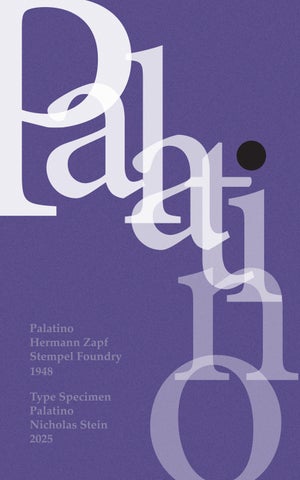
Type Specimen

Page 1


Palatino

Hermann Zapf

Stempel Foundry

1948

Type Specimen

Palatino

Nicholas Stein

2025

Palatino Palatino Palatino Palatino Palatino Palatino

Palatino

Palatino

Palatino

Regular Italic Bold Bold Italic

Palatino is an old-style serif typeface designed by Hermann Zapf, initially released in 1949 by the Stempel foundry and later by other companies, most notably the Mergenthaler Linotype Company. Palatino is optimised for legibility with open counters, balanced, moderate stroke contrast and flared serifs.

Named after the 16th-century Italian master of calligraphy Giambattista Palatino, Palatino is based on the humanist types of the Italian Renaissance, which mirror the letters formed by a broad nib pen reflecting Zapf’s expertise as a calligrapher.[4] Its capital ‘Y’ is in the unusual ‘palm Y’ style, inspired by the Greek letter upsilon, a trait found in some of the earliest versions of the letter such as that of Aldus Manutius.

Palatino itself, has a solid structure, intended to read clearly on poor-quality paper and printing. Zapf’s friend wrote that “the open counters that make Palatino such a legible letter were provided to overcome a then current printing problem in Germany, poor-quality paper.

Palatino is one of several related typefaces by Zapf, which Stempel marketed as an “extended family”.[8] The group includes Palatino, Sistina, Michelangelo, and Aldus; Zapf’s biographer Jerry Kelly describes them as forming “the largest type family based on classic renaissance forms at the time.

Linotype licensed Palatino to Adobe and Apple who incorporated it into the PostScript digital printing technology as a standard font. This guaranteed its importance in digital and desktop publishing and made it (or a variant of it) a preinstalled font on most computers.

As with many popular fonts, knockoff designs and rereleases under different names are common.

The weight of the type was also thickened beyond that of a normal roman in order to adapt to the lithographic and gravure printing processes of that period. Zapf has steadily maintained that he did not create Palatino as a book type but rather as a commercial face.

F

Turn static files into dynamic content formats.

Create a flipbook