42 FEATURE| Workplace 3.0: Redefining Spaces Through Experience
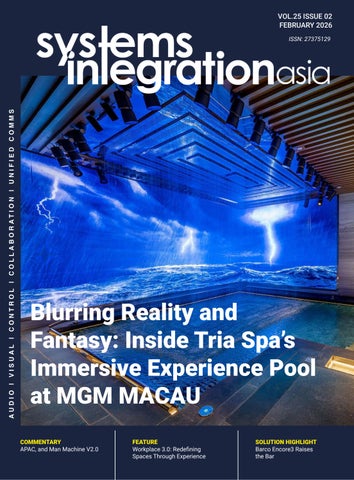
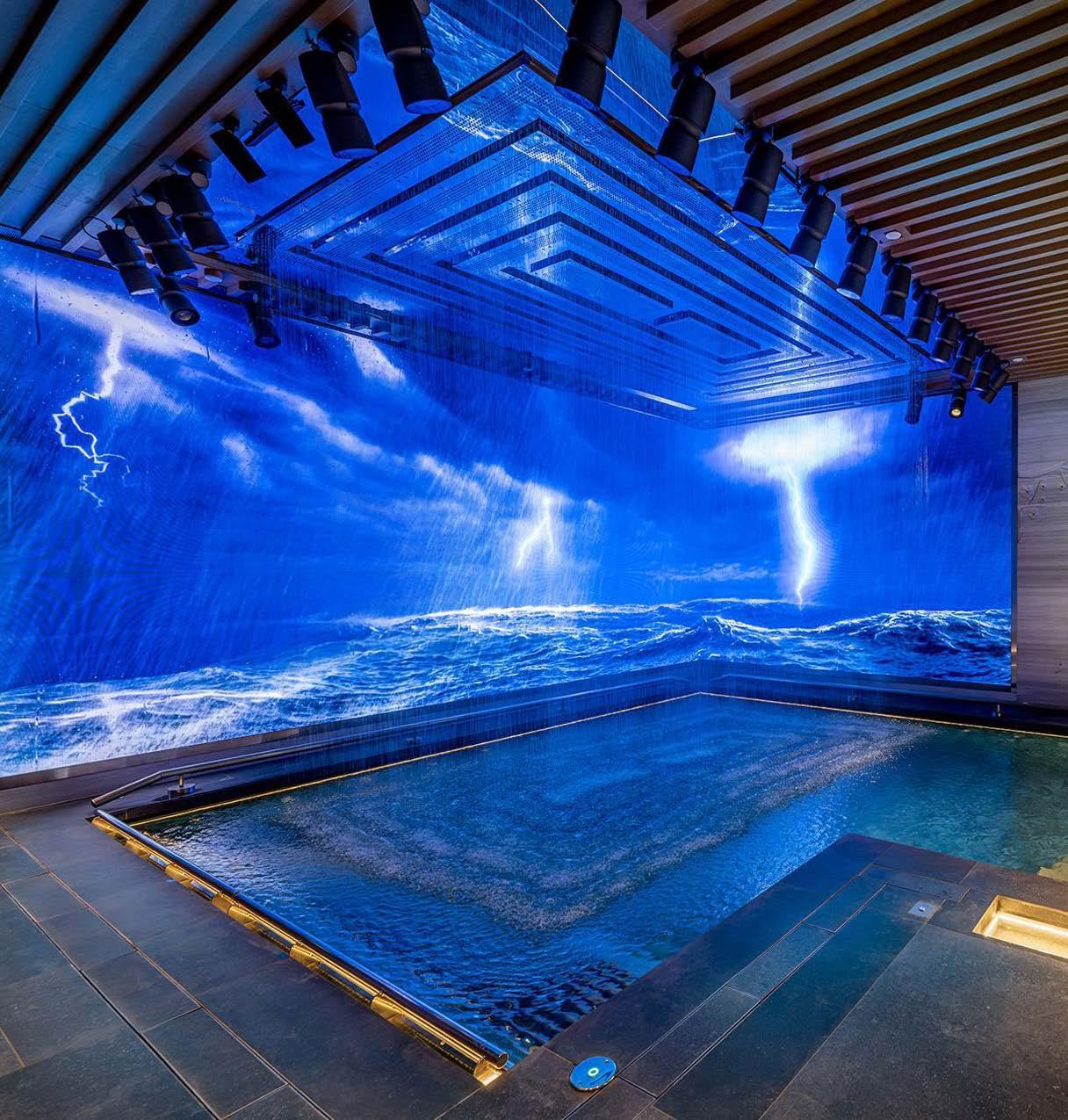
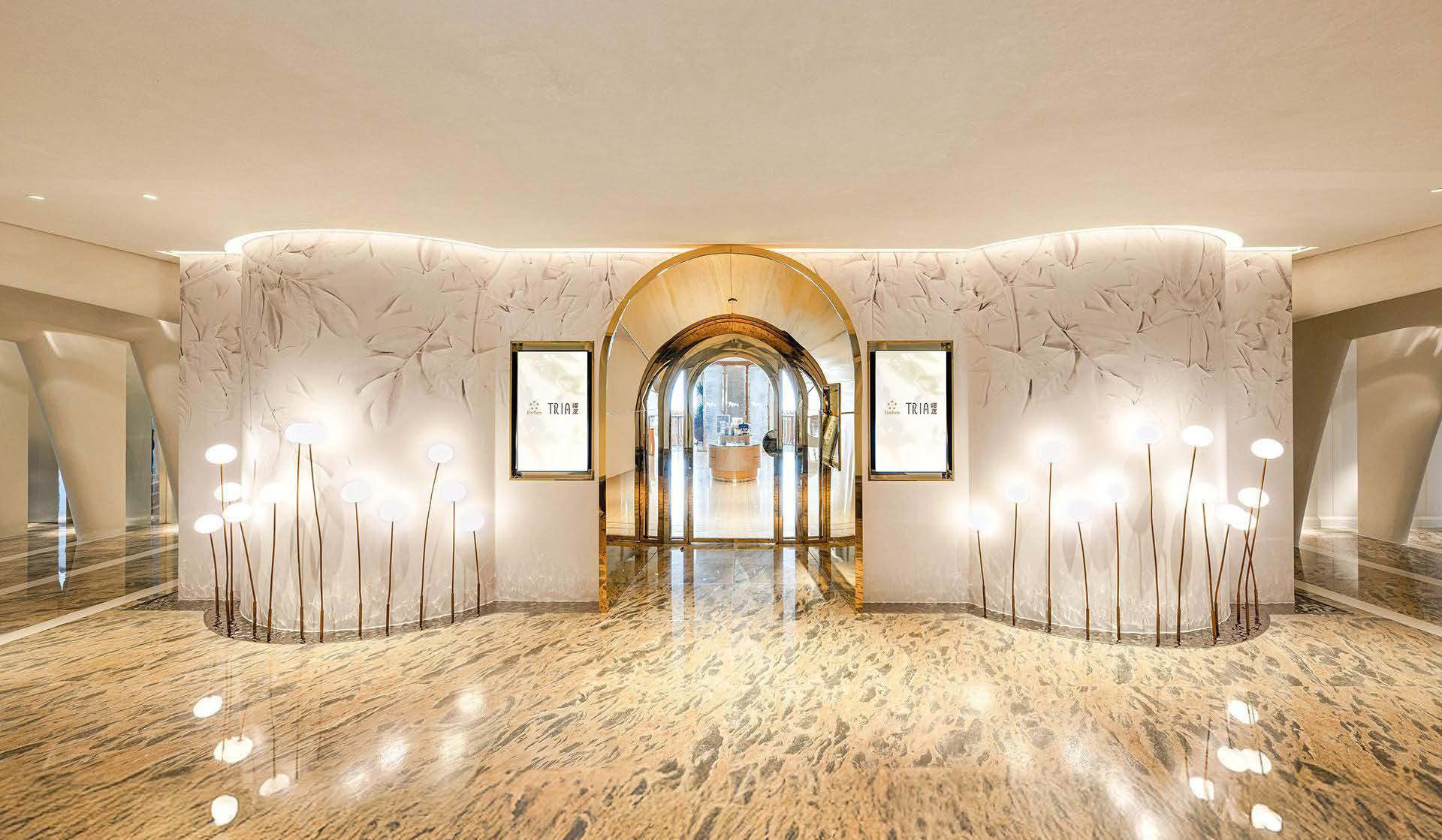
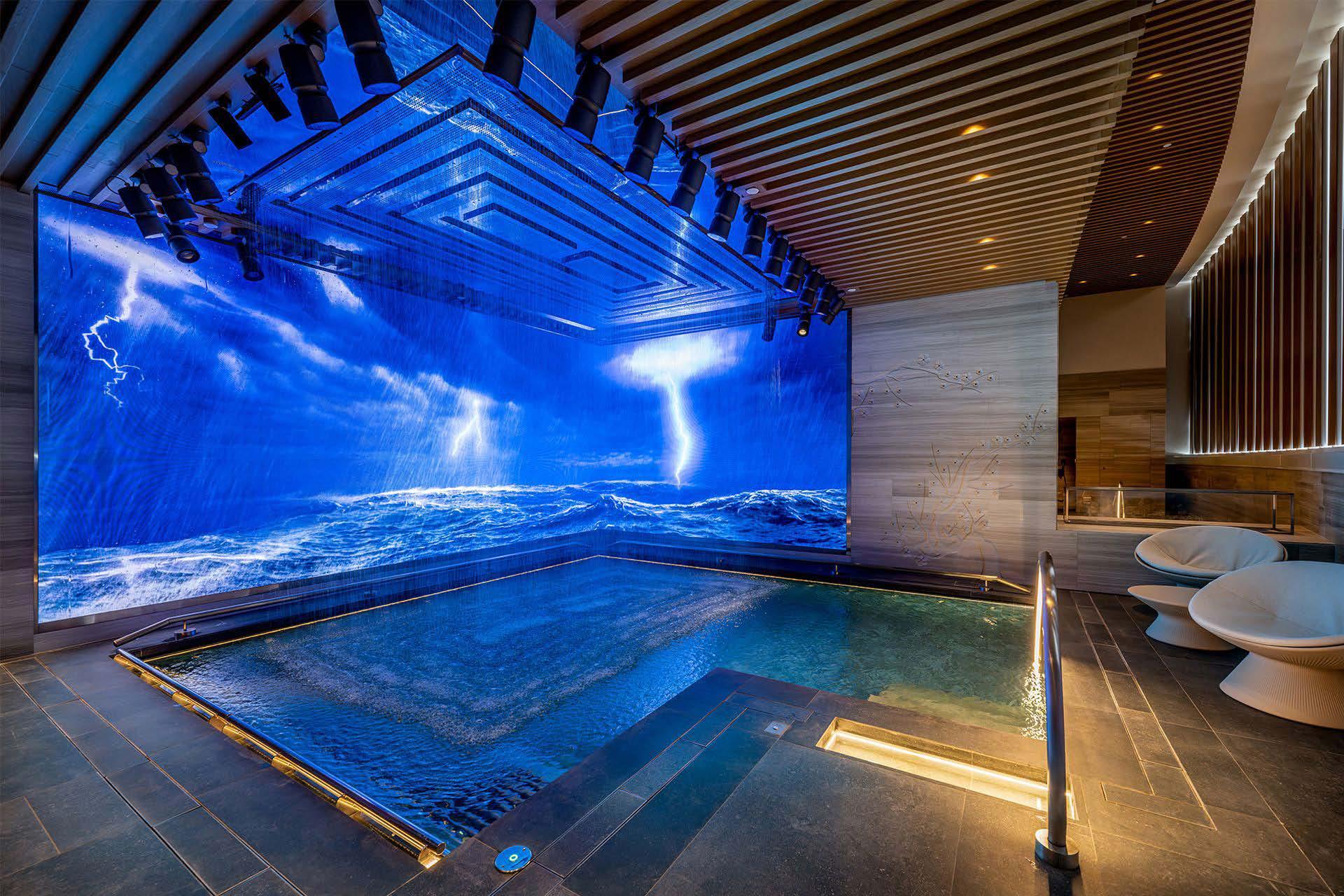
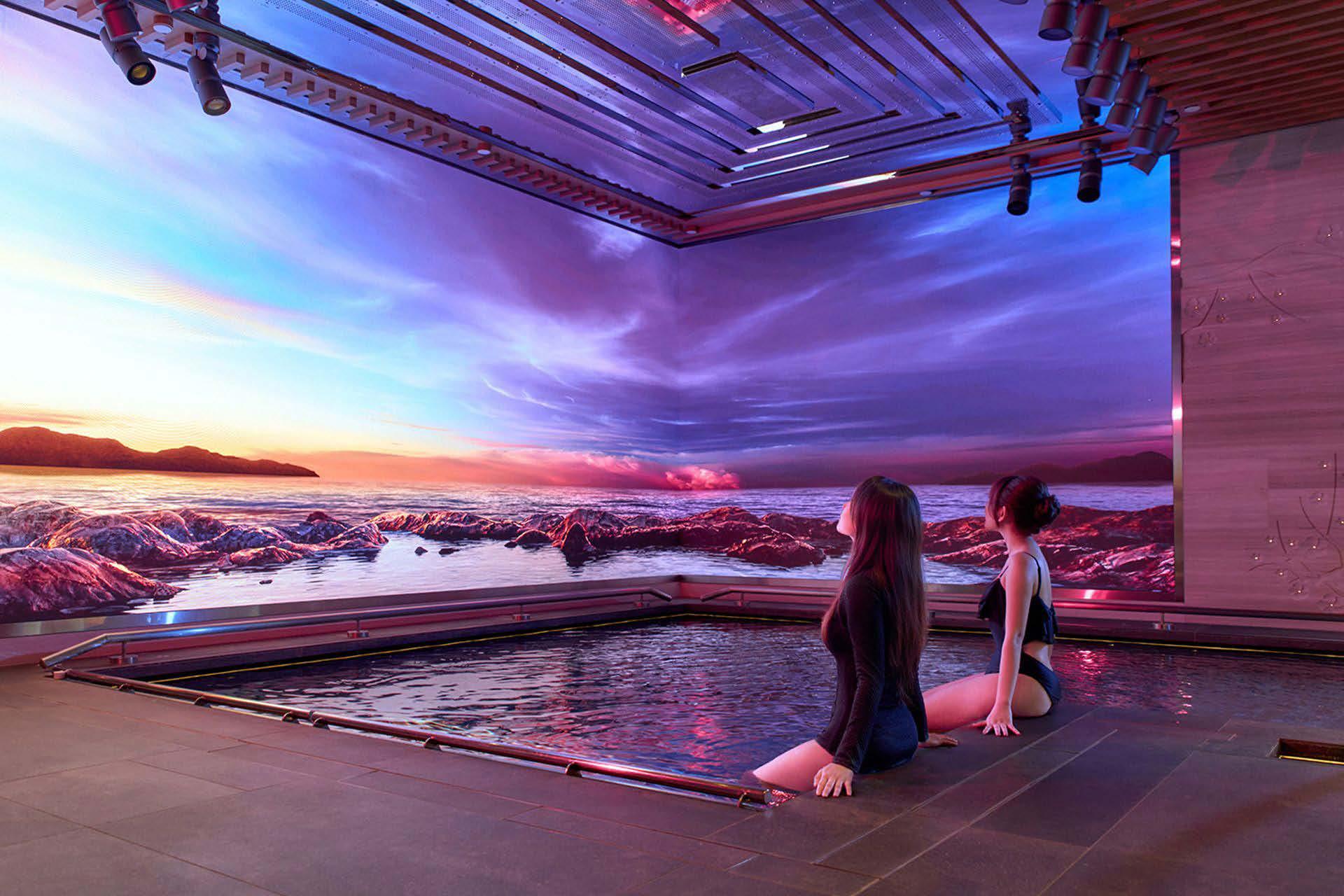
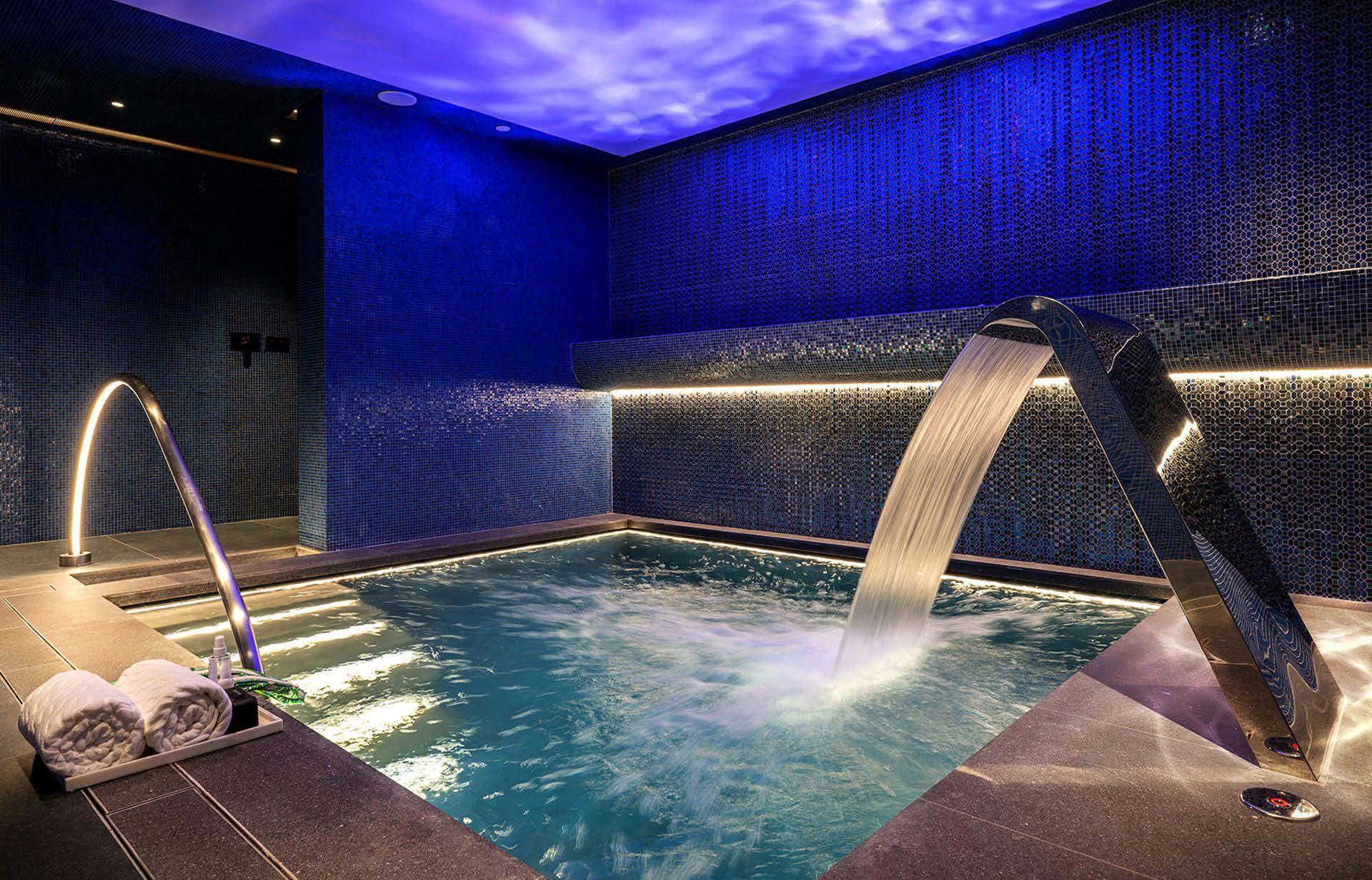
54 MACAU: Blurring Reality and Fantasy: Inside Tria Spa’s Immersive Experience Pool at MGM MACAU
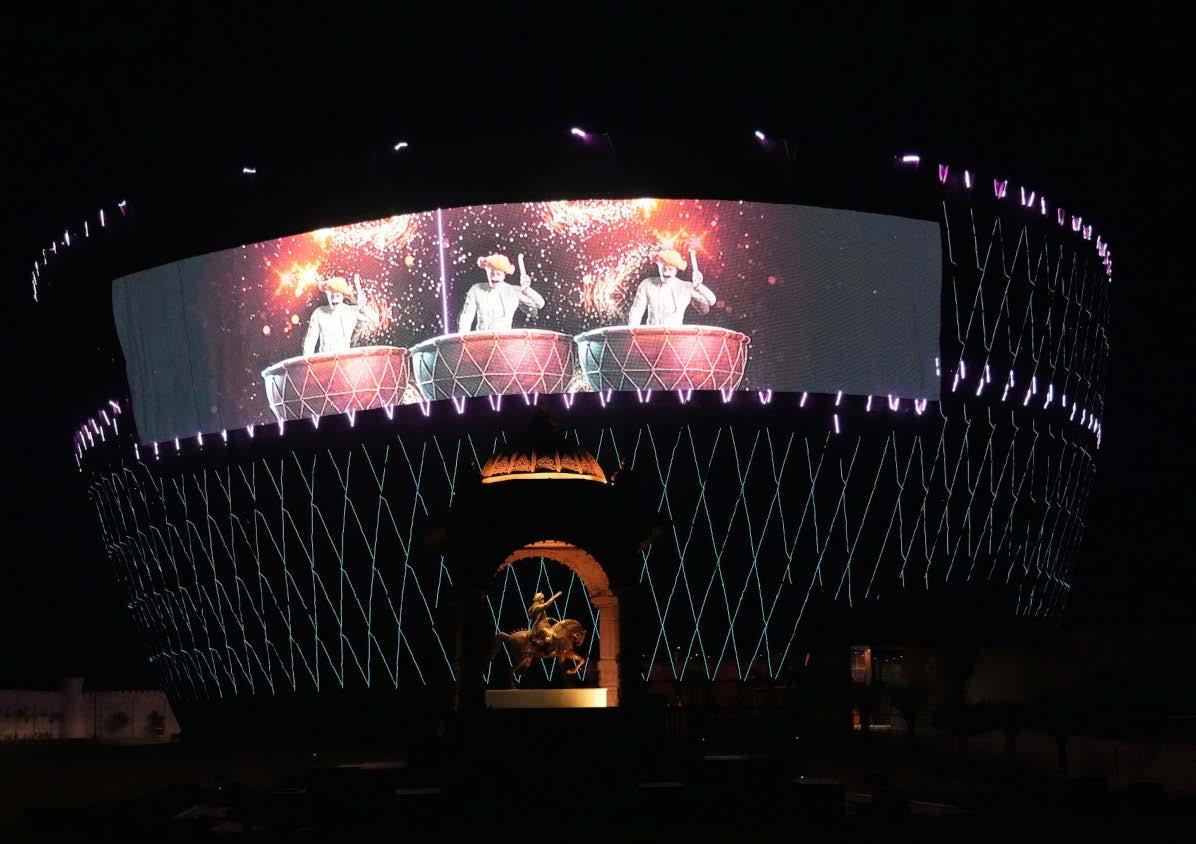
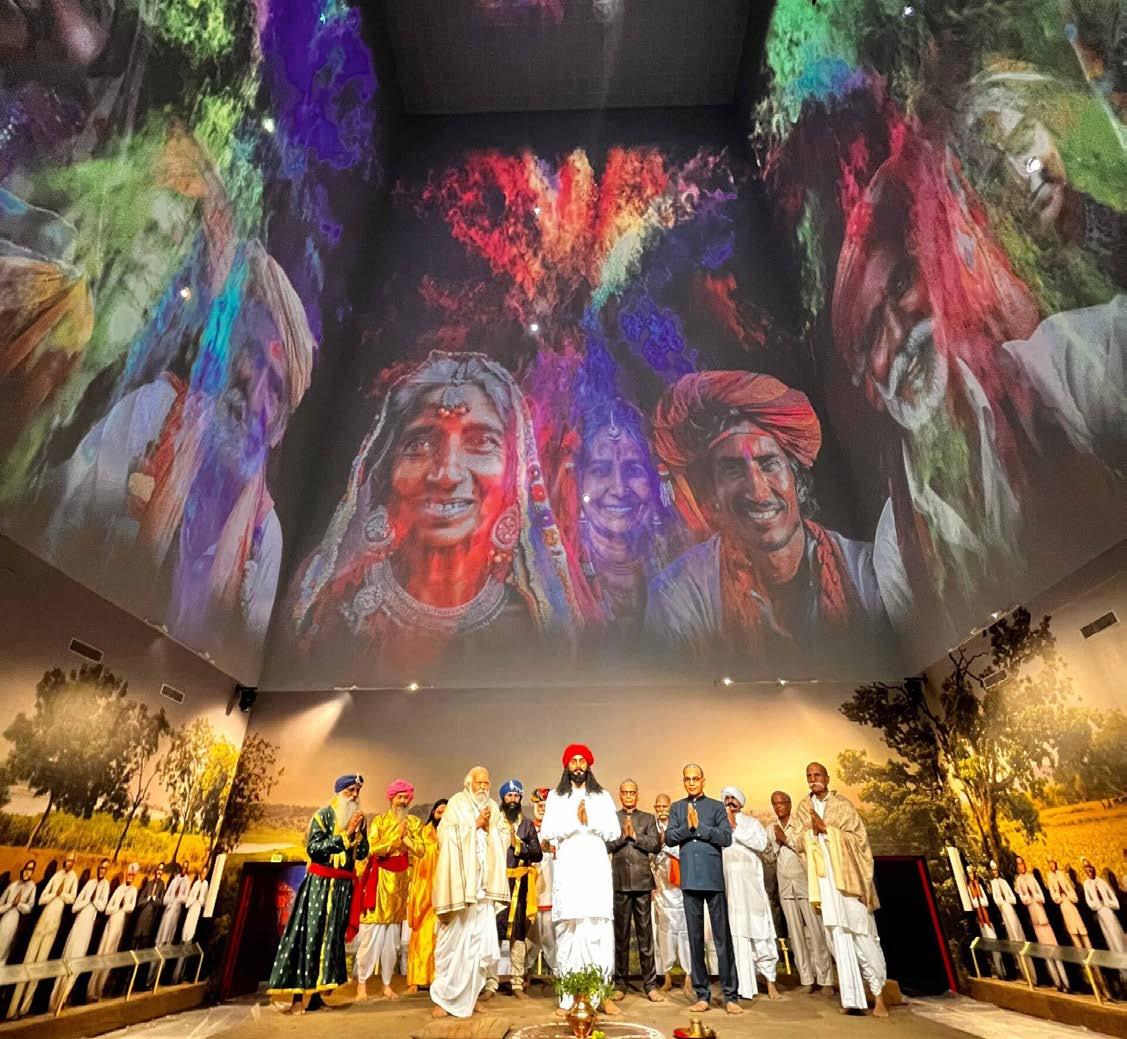
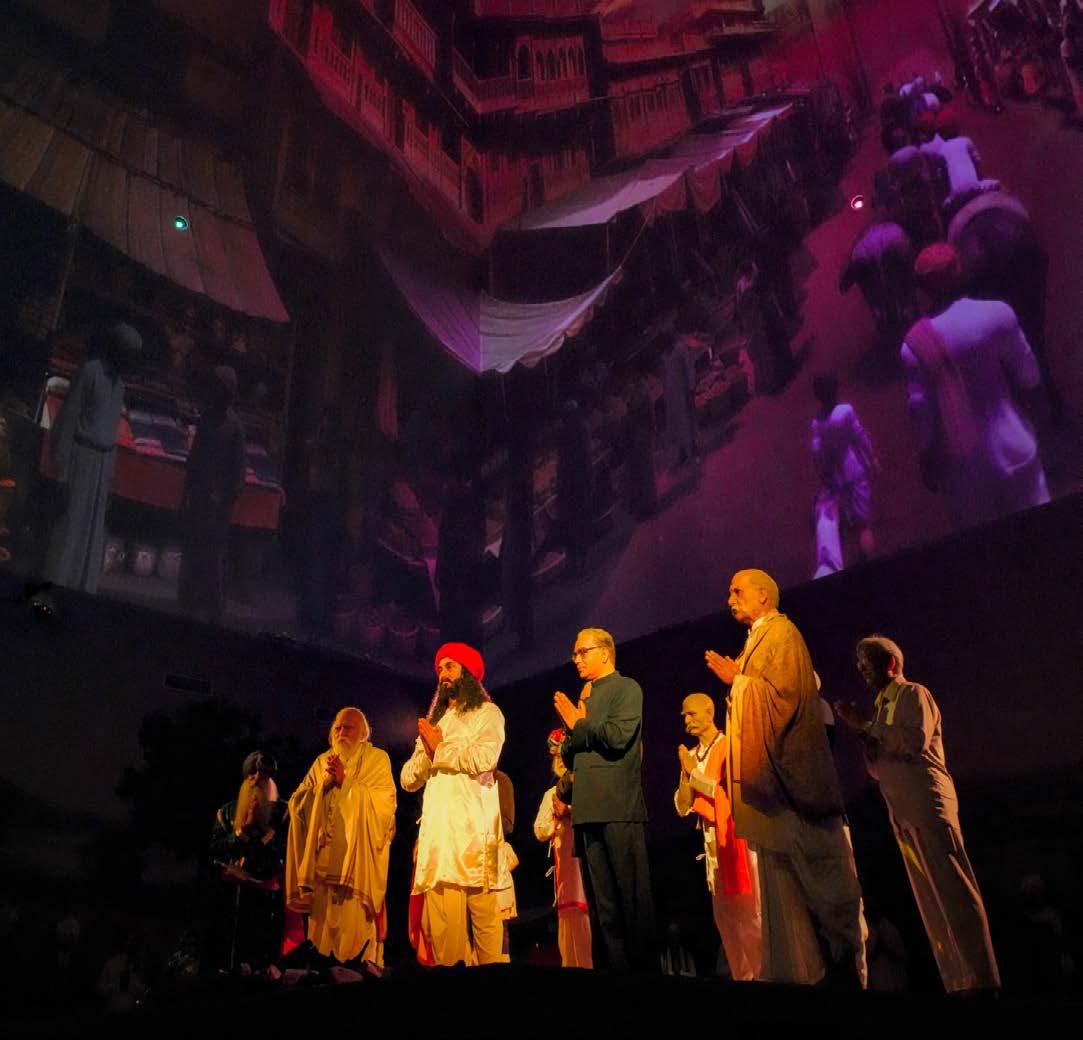
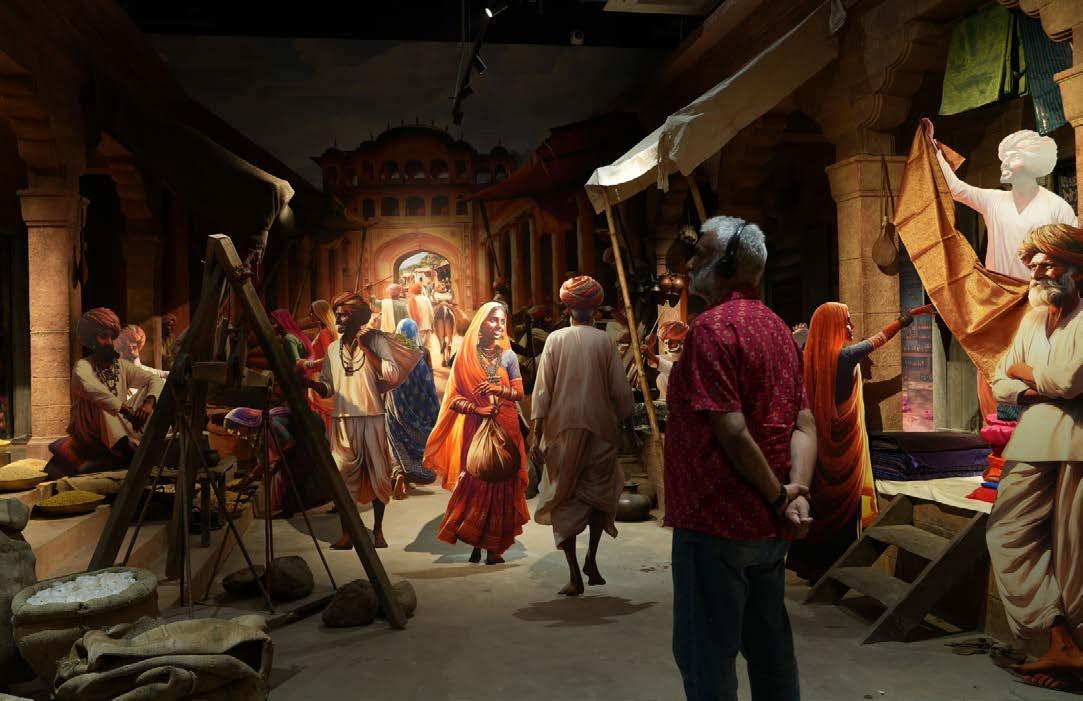
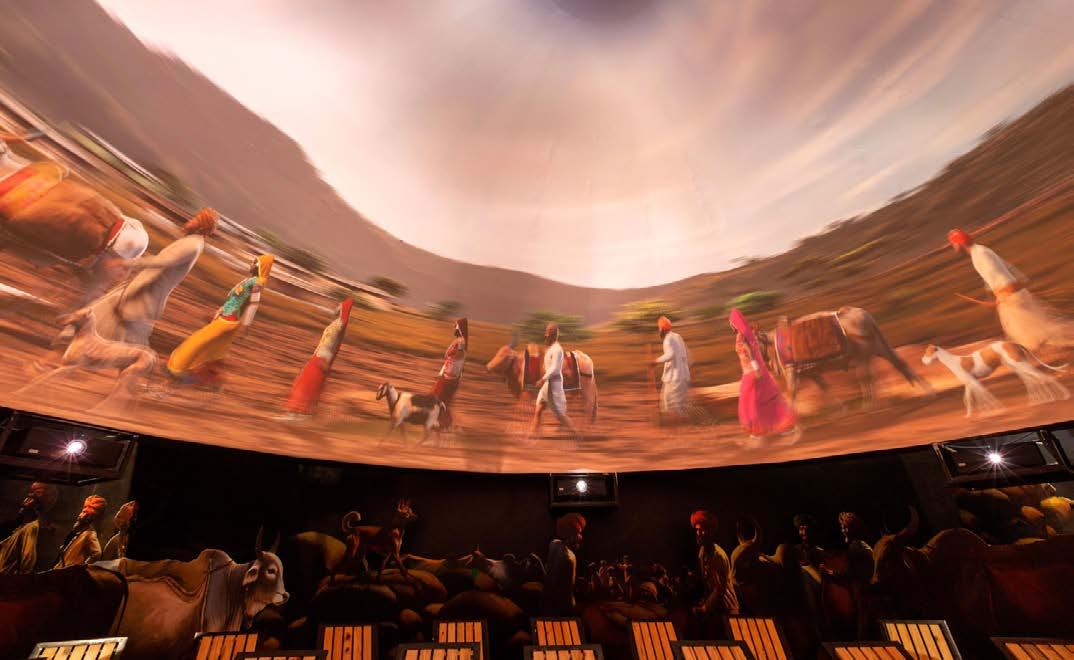
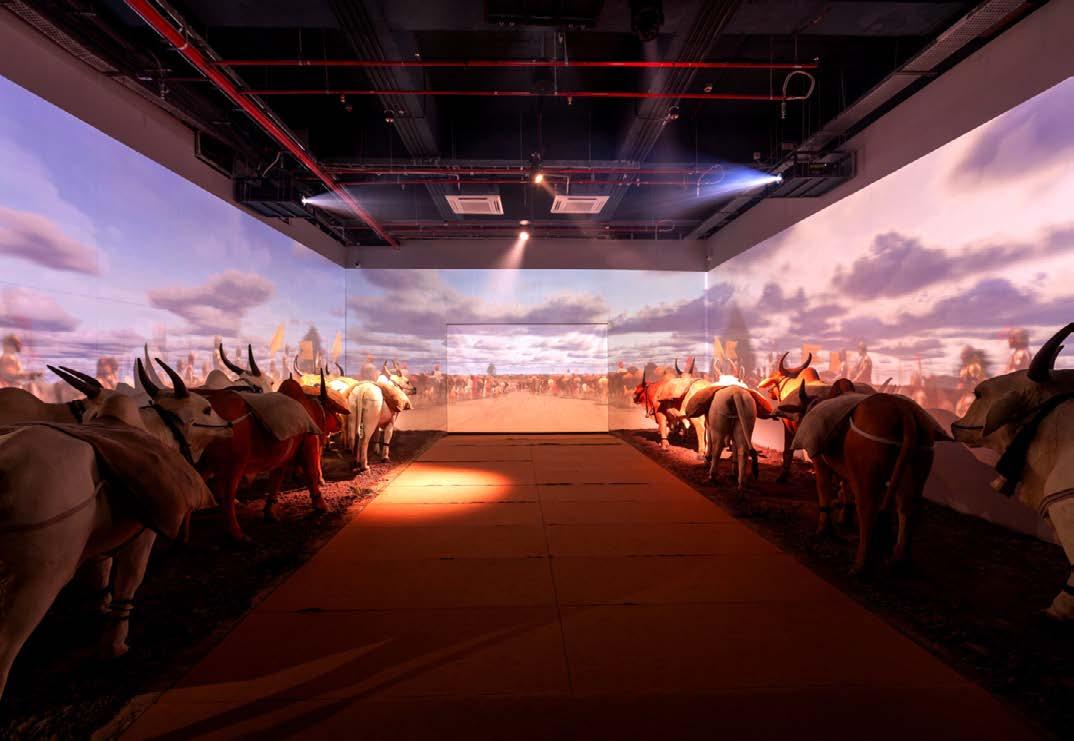
59 INDIA: Banjara Virasat Museum - An AudioVisual Tribute to a Grand Tradition (Part 2)
Barco Encore3 Raises
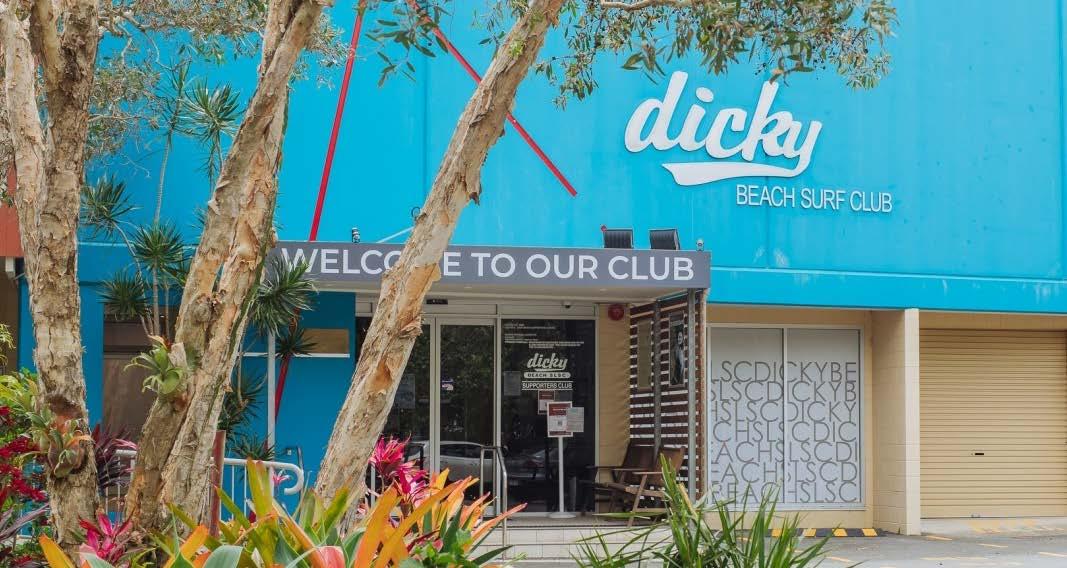
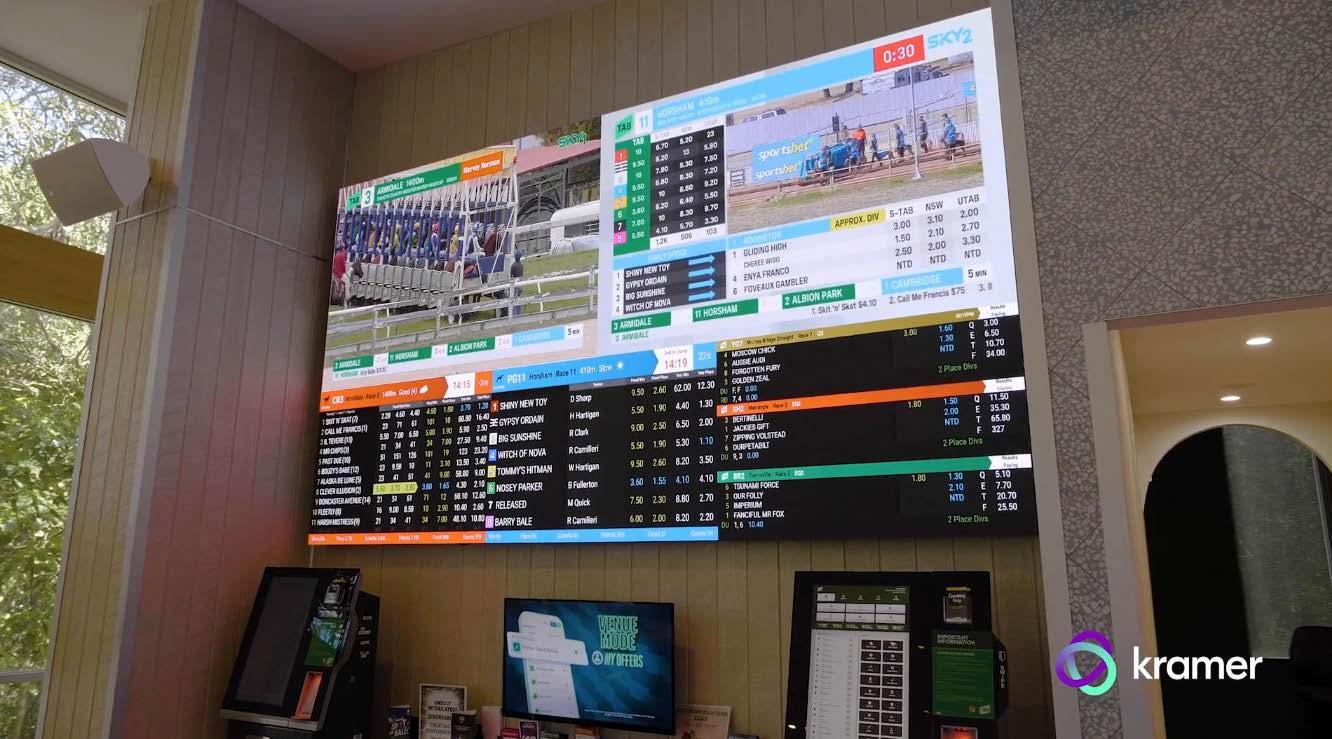
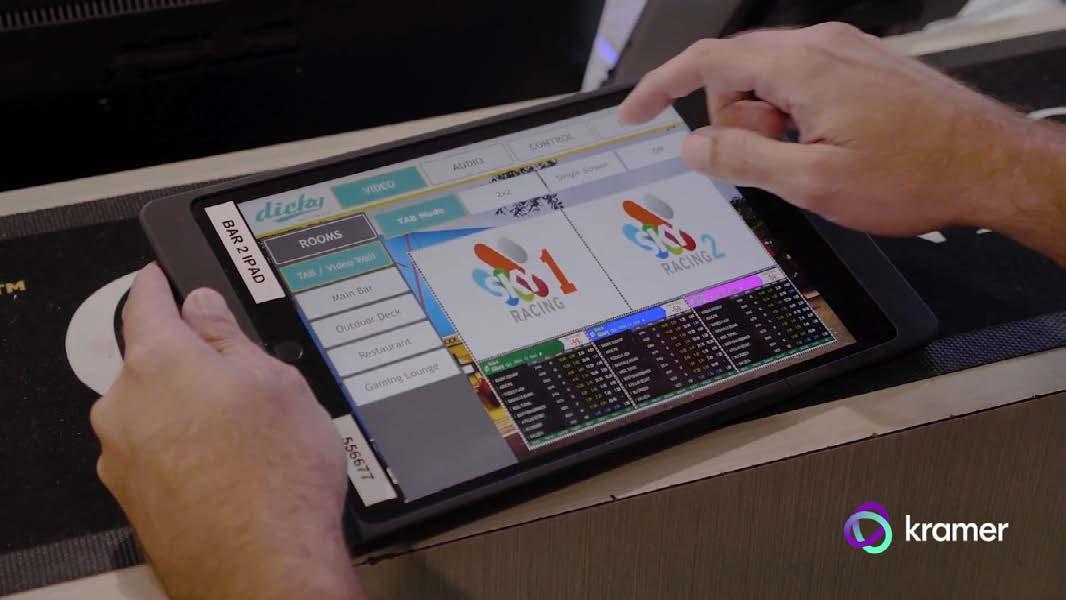
48 AUSTRALIA: Kramer AVoIP Creates a Connected, Multi-Zone Experience for Australian Surf Club
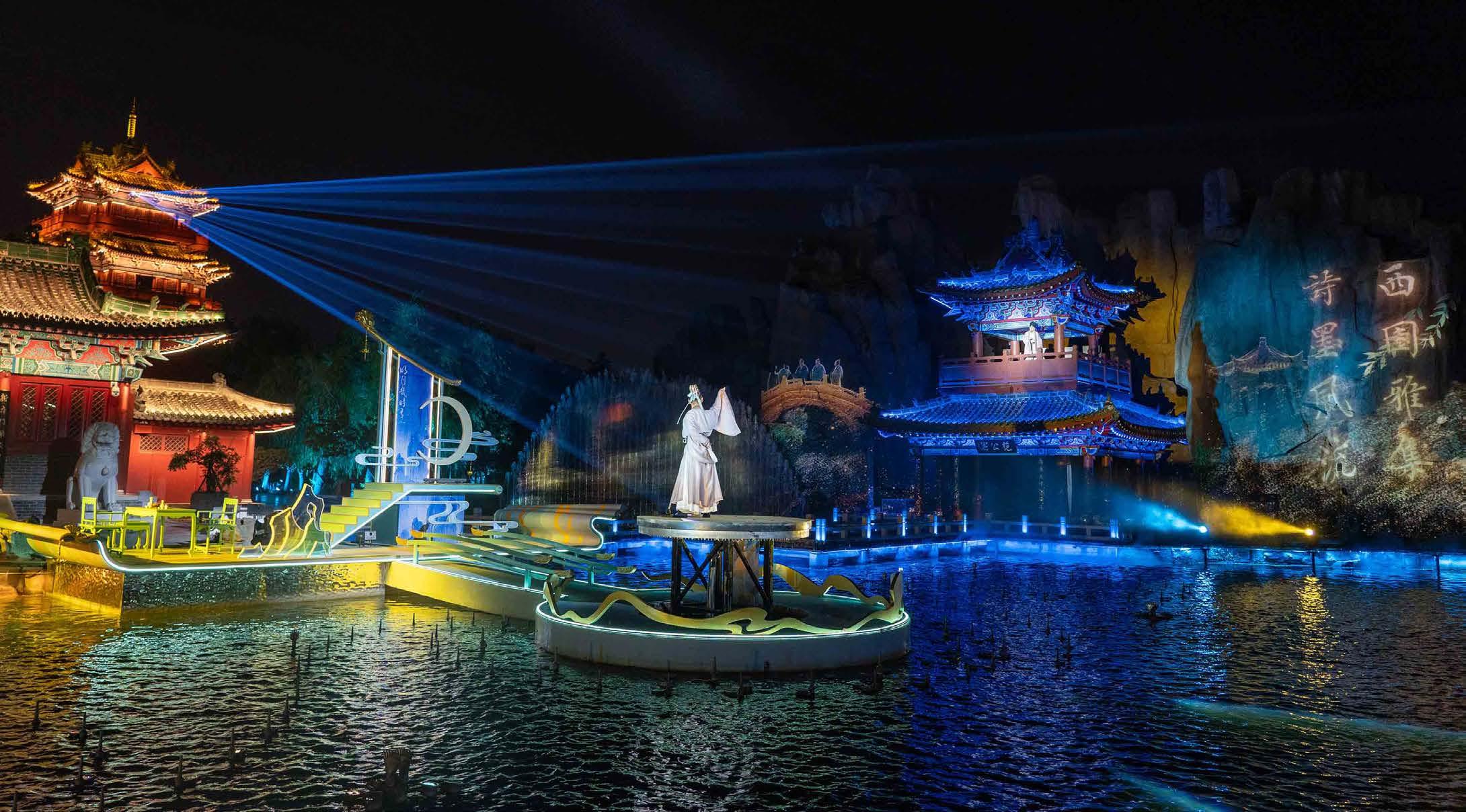
51 CHINA: Christie Laser Projection Brings Kaifeng’s Past to Life After Dark
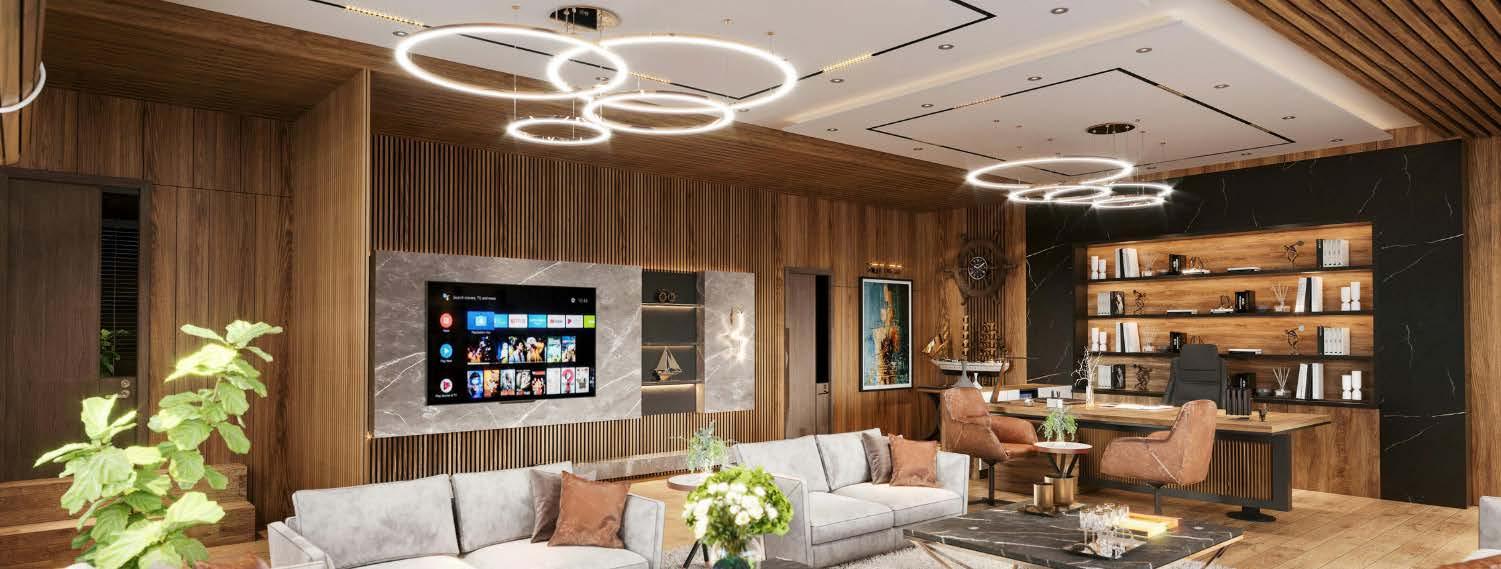
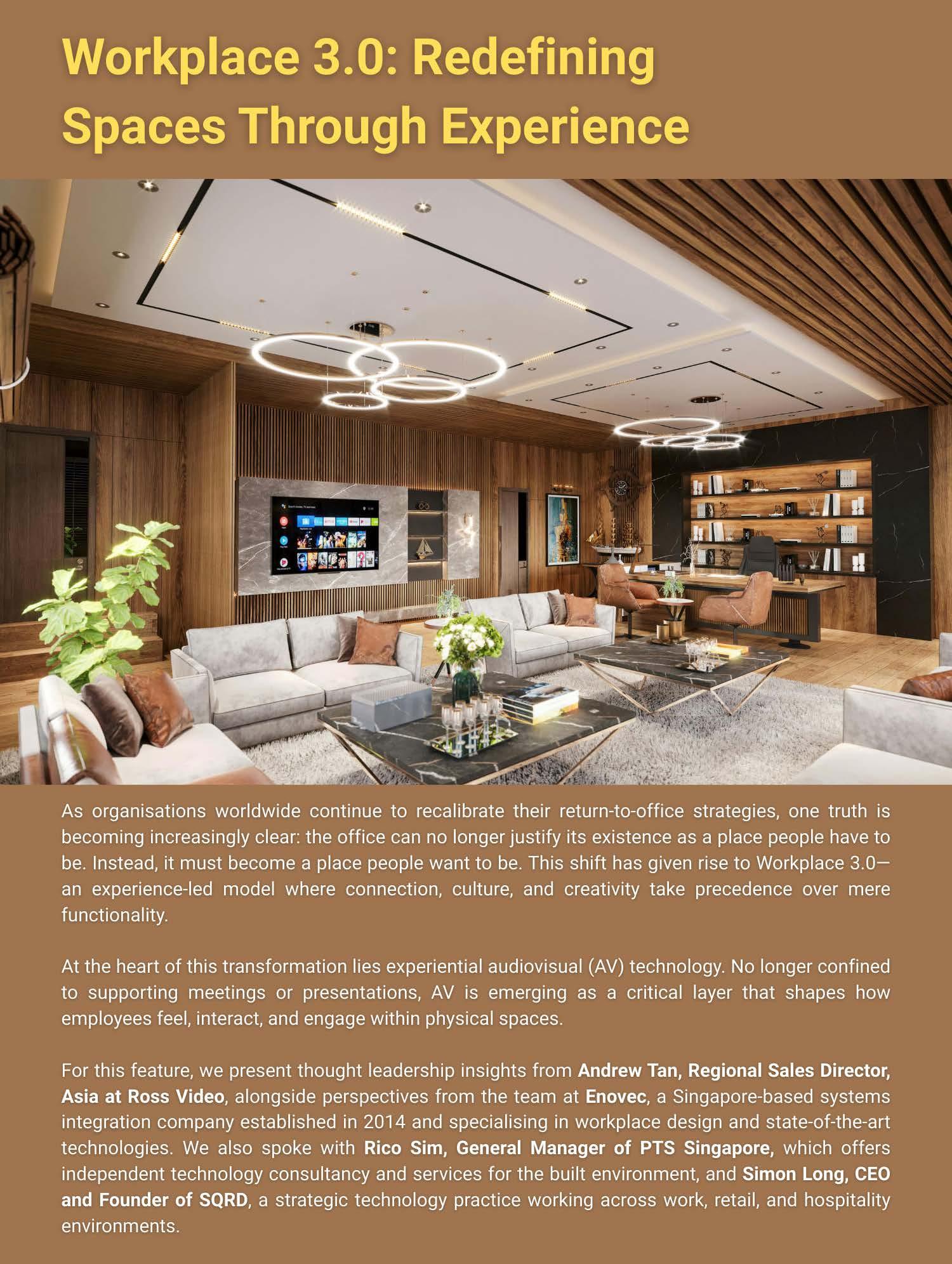
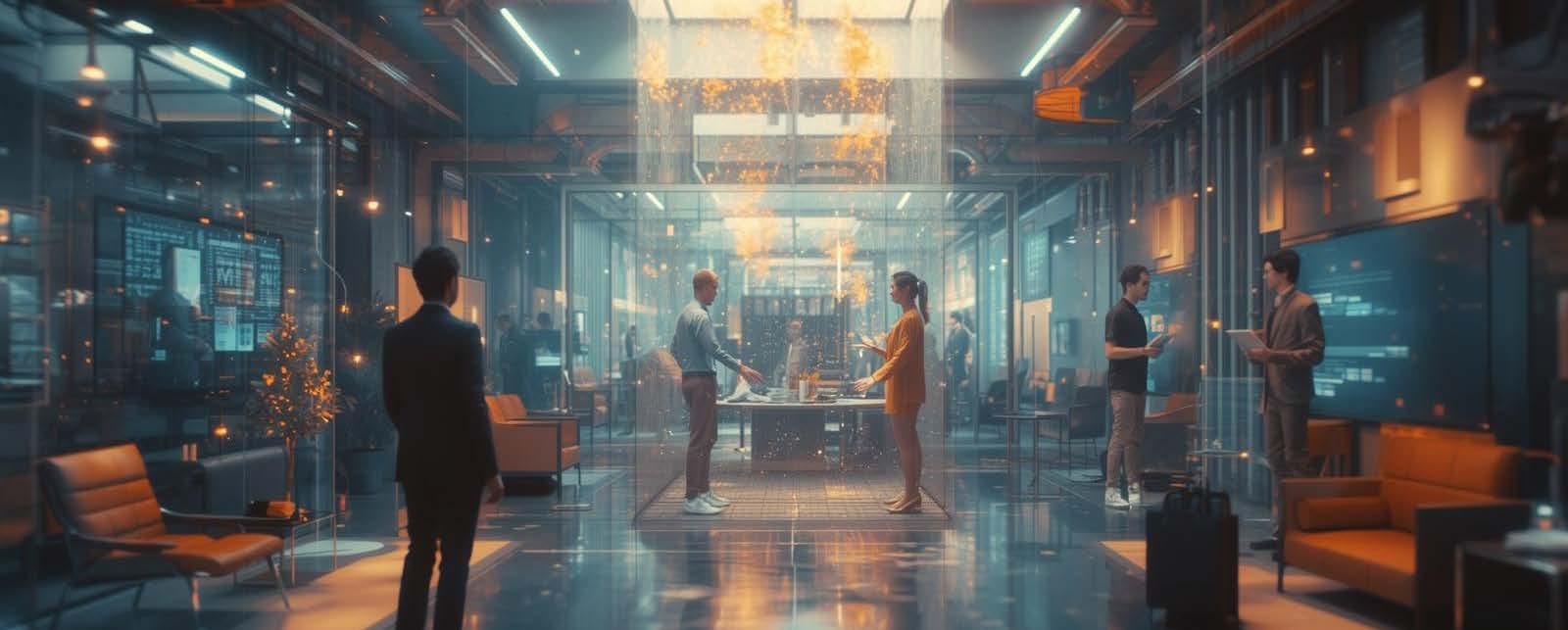
As organisations reassess why people come together physically, experiential audiovisual (AV) technologies are emerging as a powerful catalyst in this shift. At its best, AV is no longer a layer of infrastructure hidden behind walls and ceilings; it is an enabler of shared experiences that give the workplace renewed relevance
Andrew Tan Regional Sales Director, Asia, Ross Video
From the Publisher
Thomas Richard Prakasam Publisher/Editorial Director thomas@spinworkz.com
As organisations worldwide continue to recalibrate their returnto-office strategies, one reality is becoming unmistakably clear: the office can no longer exist simply as a place people are required to be. It must evolve into a destination—one that people actively choose. At the centre of this evolution is experiential audiovisual (AV) technology. In our Workplace 3.0 feature, we bring together thought leadership perspectives from across the ecosystem. Andrew Tan , Regional Sales Director, Asia at Ross Video, shares insights on how experiential AV is redefining workplace relevance. These views are complemented by Enovec , a Singapore-based systems integrator, alongside perspectives from Rico Sim , General Manager of PTS Singapore, and Simon Long , CEO and Founder of SQRD. Extending the conversation beyond the office, we also explore MGM MACAU’s Tria Spa, where immersive technology creates a multi-sensory wellness journey—offering a compelling glimpse into how experience-driven design is reshaping spaces across industries.
Meet The Team
EDITOR, INDIA AND ME
Ram Bhavanashi ram@spinworkz.com
DIRECTOR
INDUSTRY ENGAGEMENT
Andy Tan andytan@spinworkz.com
MEDIA REP
CHINA,HONG KONG, TAIWAN
Judy Wang
Worldwide Focus Media
+86-13810325171
judywang2000@vip.126.com
ADMIN & CIRCULATION
Julie Tan admin@spinworkz.com
DESIGN & LAYOUT
Hazel Gundaya
Tel: (65) 63162716
Disclaimer: Systems Integration Asia is published 12 times a year. All rights reserved. No part of this magazine is to be reproduced, whether mechanicalor electronic without the prior written consent of the publisher. Views expressed in this magazine do not necessarily reflect those of the editor or the publisher. Unsolicited contributions are welcome but the editor reserves the discretion to use them. Whilst every care is taken to ensure the accuracyand honesty in both editorial and advertising content at press time, the publisher will not be liable for any inaccuracies.
Please be informed that products and company names mentioned in this publication may be protected with tradenames, trademarks or registered trademarks of their respective owners. Our non inclusion of such symbols is not an indication of us not recognising the copyright but rather to have a common look across our articles. Misuse of tradenames, trademarks or registered trademarks is strictly prohibited. It is the obligation of our readers to check if company names and products are protected with tradenames, trademarks or registered trademarks.
Express Content Delivery Any Screen, Anywhere
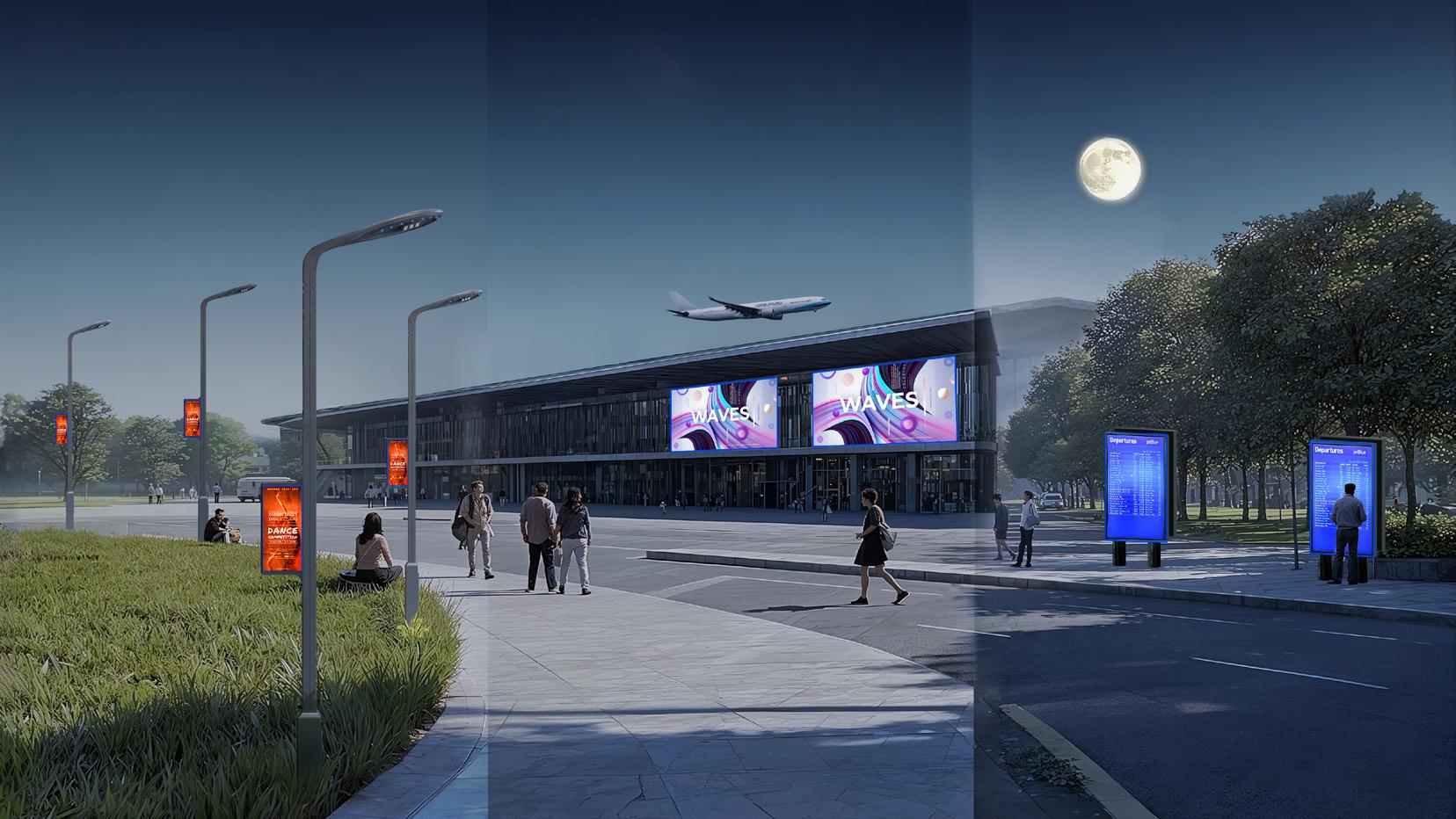
Content Deliver for Both LED and LCD
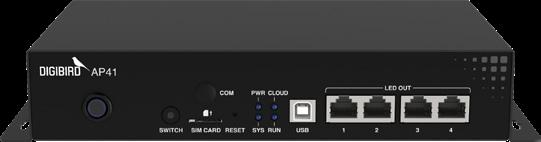
AP series integrates media player and LED sending controller, can deliver content to both LED and LCD displays for versatile applications.
Diverse Media Components
Incorporate various components (images, video, documents, webpages, text) into playlists, significantly enriching your playlist content.
Multiple Play Mode
Supports HDMI direct mirror mode and built-in playback mode. The two play modes can be switched on demand.
Flexible Content Layout
Supports customized screen layout settings, flexible configuration and synchronous playback of multimedia contents of different types and resolution.
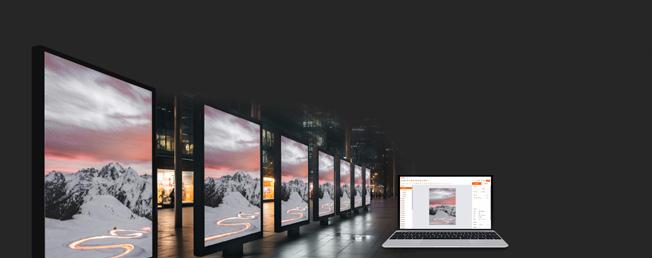
Contents can be published to multiple screens , supporting NTP , GPS timing , and RF synchronization to ensure signal synchronization.
1x1080P/ 2x720P/ 4x480P/4x360P/ AC112
0.65m Pixels
Width 1,920 Height 1,920
1GB+32GB
128GB Support 2K
128GB Support 2K 1x1080P/ 2x720P/ 4x480P / 4x360P/ AP21
0.91m Pixels
Width 1,920 Height 1,920
1GB+32GB
1.3m Pixels
Width 4,096 Height 4,096 1GB+32GB 128GB Support 4K
1x4K/ 2x1080P/ 4x720P/4x480P/ 8x360P/ AP41
2.3m Pixels
Width 4,096 Height 4,096
1GB+32GB
128GB Support 4K
1x4K/2x1080P/ 4x720P/4x480P/ 8x360P/ AP2K
128GB Support 2K 1x1080P/ 2x720P/ 4x480P/ 4x360P/ AP4K
2.07m Pixels
Width 1,920 Height 1,920
1GB+32GB
8.8m Pixels
Width 4,096
Height 4,096
2GB+32GB
128GB Support 4K
2x 4K/ 6x1080P/ 10x 720P/16x 360P/
APAC, and Man Machine V2.0
Variable laws and levels of technology adoption threatens to disrupt regional economies by
Ram Bhavanashi
A recent UNDP report on the immanent divergence permeating through the APAC nations highlighted the discrepancies of technology adoption – centred around AI – threatening to widen the inequalities among the countries in the region. This, even as the region takes a lion’s share of global stakes from the format.
As the industry steps into yet another year of revolutionary technology wave, it is to be seen if the governments in the region heed to the people-first suggestions made by the global body.
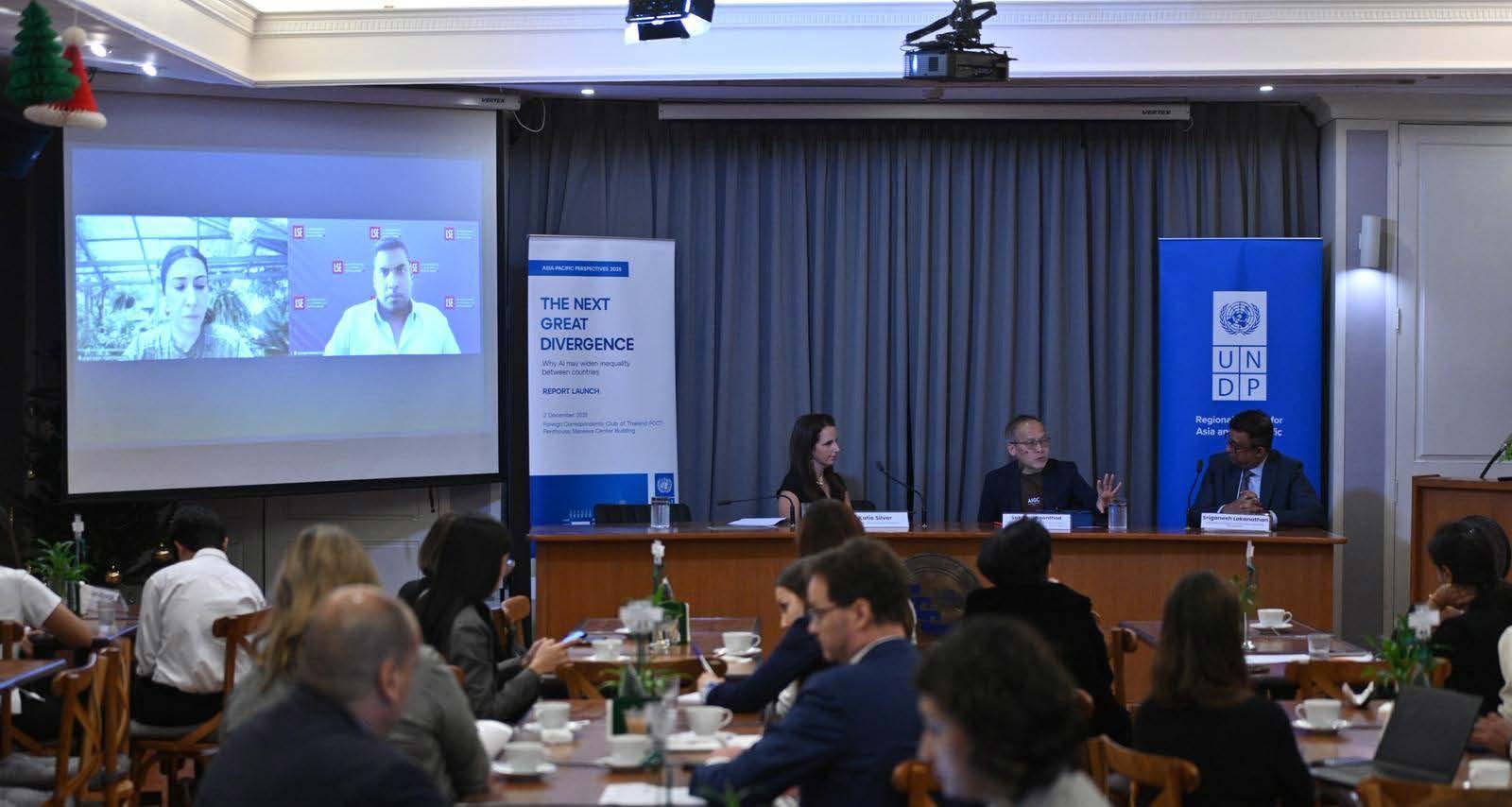
‘The Next Great Divergence: Why AI May Widen Inequality Between Countries’ report was launched at a special programme in early December (2025) in Bangkok.
The Man Machine album by the famed German electronic music band Kraftwerk almost 50 years ago sang a sort of prophetic lines –though ringing in few satirical notes – an increasing relationship between man and machines.
Fifty years down the humanity’s traversing techno-economical progression, it appears the symbolism sung by the German album is unfolding with a very discomforting ramification.
Another take: the Matrix movie trilogy that presented a larger visual of what Man Machine had brought to human reckoning. The underlying message in both is the increasing interaction with intelligent machines threatens to challenge human intelligence that created them.
Yes, the advent of artificial intelligence, (AI) perhaps, set in motion what Matrix has left, and in its own way that has become indispensable today. So much so that the world had already
begun to get divided into two or three different sets of countries:
• Those who have understood the potential of AI and have raced ahead in its adoption
• Those who have been late/slow in understanding, and have begun adopting it now
• Those who have either haven’t woken up to the impending tech tide, or have no means to brace it up
The underlying current here is that understanding/adoption of AI has so rapidly and potentially grown that it stands define and divide nations and their economy.
John Chambers, former CEO of CISCO, once – during his tenure as chief of the internet economy giant – famously said “Internet is no longer a luxury; it is a necessity.” This, even when a good part of the global population didn’t even know about it.
The situation of AI is more or less similar to this.
A recent report by the United Nations Development Programme (UNDP) 2025 Human Development Report: A Matter of Choice, emphatically said:“As AI moves from a niche technology to a cornerstone of people’s lives across multiple domains, its potential to advance human development has to be seized. That depends on more than algorithms; it depends on our choices.”
Its associated report focused on the ramification and implications of AI, particularly in Asia Pacific region sought to decipher the AIimpacted continental technomics.
The report – titled ‘The Next Great Divergence: Why AI May Widen Inequality Between Countries,’ – underscored that while AI offers unprecedented development potential, countries begin the transition from vastly unequal starting points- so much so that a mind-boggling 200-
fold gap between the richest and poorest nations, with strong digital ecosystems in some countries and limited connectivity, skills and infrastructure in others.
These inequalities, already dividing the rich and poor, will shape who will benefit from AI - and who will bear its risks, the study revealed. This, even as the region homes more than half of the world’s overall AI users, and accounts for an enviably large share of 71 per cent of global patents on AI.
This large, dominant stake qualifies APAC as the ultimate testing ground for whether AI will e(r) ase or deepen inequalities, states the report.
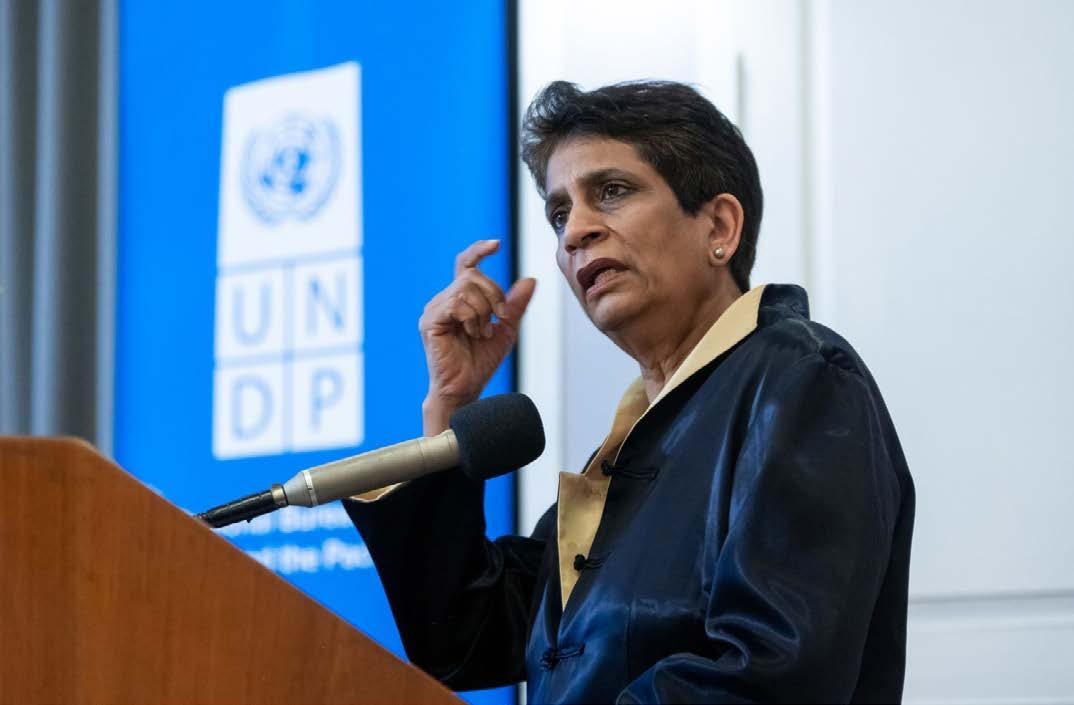
“The AI story is a very different one, and we can’t rely on the same triggers or the same pace of catch-up,” stated Kanni Wignaraja, UNDP’s Regional Director and UN Assistant Secretary General, while launching the report at a special programme in early December (2025) in Bangkok. “Where a country starts in this race matters more than ever, and without action, we will see inequalities widen fast.”
The report is actually part of UNDP’s global initiative on Human Development that surveyed as many as 21 countries covering over 60 per cent of global population that speak as many as 36 languages.
The APAC’s condition has been likened to the Great Divergence of the Industrial Revolution
where rapid mechanization in in part of Western Hemisphere left many other regions far behind. While there are reasons galore for that situation dominated by exploitative and colonial geopolitics, the current situation is put directly proportional to the “mindset” of regional governments and their focus on ‘people first’ rather than ‘technology first’ strategies.
Highlighting stark contrasts within the AsiaPacific region, the report states that economies such as China, Japan, South Korea and Singapore are well positioned to harness AI, with strong infrastructure and investment. By contrast, countries like Afghanistan, Maldives and Myanmar basic amenities like power supply- let alone digital connectivity.
“About a quarter of the Asia-Pacific population still lacks any online access,” the report notes, putting millions at risk of exclusion from digital services, payment systems, education tools and job opportunities.
According to the report, the levels of adoption and adaptation of AI – instant and efficient; measured and steady; slow or utter inability –will impact and reshape three major domains: People, Economy, and Governance.
It also emphatically states that the respective governments must focus on these areas and devise their strategies to catch up the promises that an efficient and futuristic adoption of AI can bring.
Using the IMF’s AI preparedness index as a proxy, Singapore, Japan, the Republic of Korea and China are close to the frontier of innovation and are in a better position to capture benefits. Afghanistan, Papua New Guinea, Maldives and Myanmar, still struggle with skills, supply of investable resources, reliable power and connectivity, so they risk missing early dividends.
Within countries, gains are landing first in urban hubs, large firms, and among highly skilled workers. Rural communities, small businesses, and people in routine roles face more disruption. Consider Malaysia: Kuala Lumpur’s income levels support rapid adoption, while Kelantan’s are closer to the Philippines, illustrating sharp internal gaps.
China, the largest and most potent driver of Asian and global technomics, does have a similar situation. While the country as it is has a controlled administration for many domains that include communications, remote regions in Central, western and southwest China live with low digital infrastructure compared to the country’s political and AI capital Beijing, where over 1000 AI companies exist with high R&D capability, Tianjin-Hebei Region, and Yangtze River Delta that includes including Shanghai, Hangzhou, Suzhou, and Hefei that comprise significant hub for AI applications.
India, pitched to be the fastest growing economy, isn’t dissimilar with the metropolitan cities dominating the AI contours while many potential areas still suffer.
India, the AI Light House
Having said that, the UNDP report does pitch India as the possible AI Lighthouse.
Hailing the far-reaching, futuristic measures initiated by India – particularly in the last few years – the report says India can show the way to the region, and the world, on how AI can be leveraged to improve not just lives but to increase GDP at the macro level.
Having created a comprehensive entityframework called IndiaAI Mission the country is aggressively bracing it up for building focused indigenous models such as:
• Centres of Excellence- Established in Healthcare, Agriculture, and Cities (with
Education next) to drive research and scalable solutions
• IndiaAI Dataset Platform - Provides start-ups and researchers with access to high-quality, anonymized Indian datasets to reduce bias and improve models.
• Indigenous AI Models - Initiatives like BharatGen (multimodal LLM) and Sarvam-1 (Indic LLM) aim at developing sovereign AI capabilities.
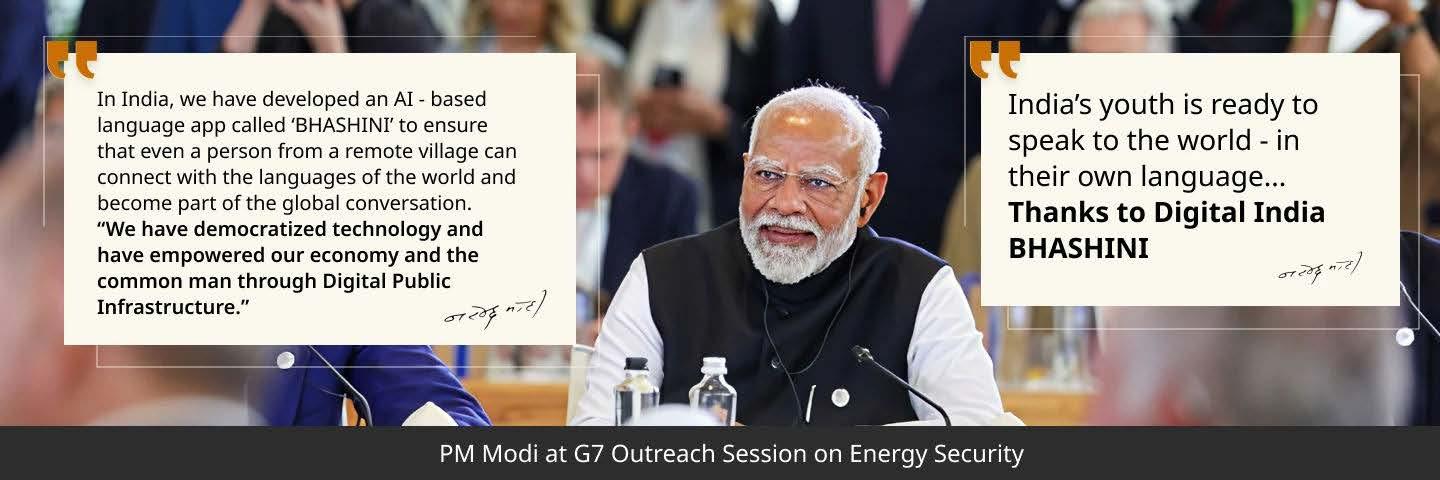
• Bhashini (National Language Translation Mission) - An AI-powered platform for voice/text translation in Indian languages, making digital services accessible.
• Skilling & Talent - National Centres for AI Skilling are preparing a future-ready workforce for the AI economy.
• Application Development - IndiaAI Application Development Initiative supports solutions for sectors like health, agriculture, and governance through hackathons.
The vision is both simple and comprehensive as also future-ready- Democratization of AI, affordable, and accessible for inclusive growth; prioritizing for India-centric challenges in health, education, and sustainability; balancing innovation with accountability, focusing on privacy, deepfakes, and responsible development; and building an ecosystem with
academia, industry, and government for shared growth.
Initiatives such as Aadhaar (unique identification of citizenry) and UPI (unified payment interface), India has already addressed two very potential socio-economic issues, and stood model for many. This is exactly what UNDP India’s Resident Representative Dr. Angela Lusigi had wanted the country doing.
“India’s digital strengths give it a head start in building an AI future that works for everyone; AI is already strengthening public health, improving climate resilience and supporting better services,” Angela observed. “India can lead by ensuring its benefits reach rural communities, women and young people, not only those already connected.”
The caution from the UNDP India exec, however, is clear: “The real test is ensuring these gains reach every community. The choices we make now will determine whether AI narrows gaps or widens them.”
Will AI drive another Great Divergence that leaves most of the world further behind?
“No one can predict with certainty where AI will take us in the future, nor can we fully imagine what it might help create or destroy,” signs off Kanni. “What we can do is try to guide it along paths that will maximize human development
As part of its vision and mission AI, India will host the India–AI Impact Summit 2026 from 16–20 February 2026 at New Delhi. For the first time, the global AI summit series will take place in the Global South. The shift signals a broader move toward a more inclusive global AI dialogue.
The Summit reflects India’s growing role in global AI discussions. It follows the UK AI Safety Summit, AI Seoul Summit, Paris AI Action Summit (which India co-chaired), and the Global AI Summit on Africa.
This demonstrates that the Summit is situated within a broader global discourse and seeks to contribute to harmonised international cooperation on responsible AI development.
Seven ‘Chakras’
The thematic priorities of the Summit, referred to as the seven ‘Chakras’, underline its key objectives. These include Human Capital, Inclusion, Safe and Trusted AI, Resilience, Innovation and Efficiency, Democratizing AI Resources, and AI for Economic Development and Social Good.
These thematic areas encompass issues such as AI safety, data governance, transparency, human-centred development and accountability frameworks. These discussions are aligned to drive the strategic direction of the Summit’s events and deliberations.
The Summit is intended to generate actionable recommendations that contribute to long-term AI governance objectives rather than framing immediate binding regulations.
AI Impact Summit 2026
Even as this article is going into SIA Digital columns, the latest, and ambitious stride in AI from India was made at the World Economic Forum in DAVOS. The Government of Telangana launched what it called AIKAM - an ambitious initiative for developing a global unified AI innovation entity - aimed at driving research, talent pools, and large-scale adoption of “responsible and ethical AI” for all-round socioeconomic development. An evolution of the formerly Telangana AI Innovative Hub (TAIH) that it was, the newly launched AIKAM is branded as India’s first-of-its-kind innovation entity built to translate AI ambition into real world execution at population scale. It seeks to integrate key elements like talent pool development, frontier research, high-performance computing, and startup acceleration into a single ecosystem.
According to media reports, the AIKAM already has signed MoUs with a few international entities to power its way. British education enterprise Pearson intends to set up an AI Academy while the Dubai Multi Commodities Centre (DMCC) intends to set up cross-border startup corridors.
It is to be seen if initiatives like this will truly nurture the responsible and ethical AI and contribute to people-inclusive global AI dialogue.
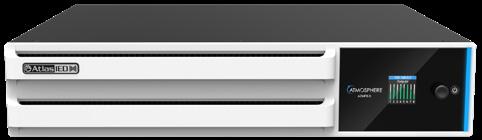
Actual installation using AtlasIED’s Atmosphere platform at The Fig Lobby in Bangkok, Thailand
Ideal Systems Boosts Senior Management Team
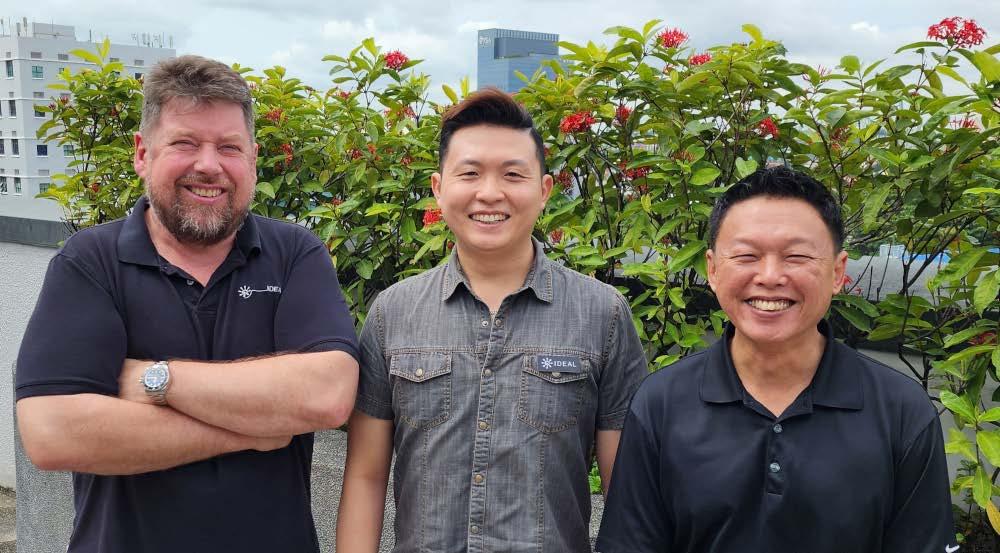
SINGAPORE: Ideal Systems has strengthened its Singapore leadership team with the appointment of two highly respected ProAV industry figures, Mark Goh and Derrick Koh, signalling a clear intent to accelerate its regional growth and technology strategy.
Mark Goh, CTS, joins Ideal Systems as Director of Business Development, bringing more than three decades of experience across the Pro-AV landscape. In his new role, Mark will support Ideal’s continued expansion across South East Asia, drawing on a career that includes senior positions at Sony, Bell & Order, O’Connors, Kramer, and Electronics & Engineering.
Also joining the Singapore management team is Derrick Koh, who has been appointed Director of Next Generation Solutions. With over 26 years in the Pro-AV industry, Derrick will lead Ideal’s product and partnership roadmap for emerging technologies, with a strong focus on Artificial Intelligence and cloud-based integrations. His career spans roles at Highland AV, Meeting. com, ISPL, NETe2 Asia, and Electronics & Engineering.
These appointments reinforce Ideal Systems’ commitment to both regional growth and the development of forward-looking Pro-AV solutions.
Ideal Systems
(L-R) Fintan Mc Kiernan, Ideal Systems Singapore CEO, Derrick Koh, Director of Next Generation Solutions, Mark Goh, Director of Business Development
Barco Appoints Midwich as Projection & Image Processing Distributor
APAC: Barco has strengthened its distribution strategy across Asia-Pacific with the appointment of Midwich Group companies as its official projection and image processing distributor in several key regional markets.
The partnership significantly extends Barco’s footprint across APAC, enabling system integrators and end-users to deliver highimpact, immersive visual environments for applications including themed entertainment, simulation, live events, corporate experience centres and education.
As a specialist trade-only AV distributor, Midwich brings extensive regional expertise in logistics, channel development and integration support. The agreement covers Midwich Australia Pty Ltd for Australia, Midwich Limited for New Zealand, and Midwich Malaysia Trading SDN.BHD for Malaysia and PT Midwich Indonesia Trading for Indonesia, providing Barco with strong, on-the-ground distribution across these markets.
Through Midwich’s established network of integrators, resellers and technology partners, Barco’s projection and image processing portfolio will be more accessible and better supported across the region. Customers in Australia, New Zealand, Malaysia and Indonesia will gain streamlined access to Barco’s latest ProAV solutions, including projectors from the G Series, I Series and QDX Series, alongside image processing platforms such as the widely deployed Encore3.
“Partnering with Midwich marks a significant step for Barco in the APAC region,” said Jasline Tay, Regional Sales Head APAC, Barco Singapore. “Midwich’s deep knowledge of the AV channel, their strong local support network and dedication to the professional AV market make them the ideal partner to help take our visualisation solutions to the next level.”
David McIntyre, APAC Commercial Manager at Midwich Australia, added that the collaboration brings together two highly complementary organisations. “Barco’s technology has a reputation for delivering ‘wow’ moments and high-performance visualisation. Our team is excited to support the integrator community in delivering these solutions with excellence – creating more immersive experiences for customers across the region.”
Claudio Cardile, ANZ Sales Director, echoed the sentiment, noting that the partnership combines Barco’s innovation with Midwich’s channel expertise to help partners transform spaces, engage audiences and deliver memorable visual experiences throughout APAC.
Barco
AtlasIED Strengthens Commercial Audio Leadership with Joey Palkowitch Appointment
GLOBAL: AtlasIED is sharpening its focus on commercial audio growth with the appointment of Joey Palkowitch as Director of Commercial Audio Sales, a move that underscores the company’s continued investment in leadership and market expansion across high-growth verticals.
In his new role, Palkowitch will shape AtlasIED’s commercial audio sales strategy and drive market development across education, industrial, corporate, and hospitality environments. He will work closely with AtlasIED’s internal sales teams, independent manufacturer representatives, and channel partners to deepen relationships, expand market reach, and align sales execution with evolving customer needs.
Palkowitch brings more than a decade of experience growing commercial audio businesses across complex AV ecosystems. Known for building high-performing sales teams and leading strategic partner initiatives, he has held senior roles with leading manufacturers and distributors, working across the integrator, consultant, and end-user channels. His background positions him to translate realworld market insight into scalable go-to-market strategies.
A key focus of Palkowitch's role will be strengthening the feedback loop between the field and AtlasIED's product and engineering teams, thus ensuring that new solutions directly address the practical challenges faced by integrators and consultants in live projects.
“We are proud to welcome Joey to the team,” said Michael Peveler, Vice President, Sales, AtlasIED. “His deep understanding of the commercial AV landscape, combined with a strong customer-first mindset, makes him an ideal fit as we continue to expand our portfolio and strengthen our presence in key markets.”
For Palkowitch, the move represents an opportunity to build on AtlasIED’s long-standing reputation in professional audio.
“I'm honoured to be joining a company with such a strong reputation for quality and customer focus," said Palkowitch, Director of Commercial Audio Sales, AtlasIED. "I'm looking forward to building on that foundation by strengthening relationships with our integrator and distribution partners and helping them grow their businesses with solutions they can trust."
The appointment signals AtlasIED’s ongoing commitment to investing in experienced leadership as it pursues long-term growth and deeper engagement across the global commercial audio market.
AtlasIED
David Labuskes, CEO of AVIXA, Announces Retirement
GLOBAL: David
Labuskes, CEO of AVIXA, has announced his intention to retire at the end of 2026, marking the conclusion of a 14-year tenure that reshaped both the association and the wider audiovisual industry.
Since taking the helm in 2012, Labuskes has been a driving force behind the industry’s shift from a product- and systems-focused sector to one centred on delivering integrated experiences that connect people and transform how organisations communicate. Under his leadership, the AV industry broadened to embrace experiential designers, content creators, IT specialists and end users across an increasingly diverse range of markets.
This evolution culminated in a defining moment for the association in 2017, when InfoComm International was rebranded as AVIXA (the Audiovisual and Integrated Experience Association), reflecting a more expansive and future-focused identity.
“I would have never predicted the level of personal growth and fulfilment that accompanied these many years at the helm of AVIXA," said Labuskes. "The audiovisual industry has been a part of human evolution since the use of signal fires in early civilisation. The association now known as AVIXA was established in 1939, well before most of us were born. The responsibility and privilege inherent within the role I played for a tiny part of that timeline was one that could not have been
fulfilled without the brilliance of the team of executives, industry volunteers, and dedicated AVIXA employees giving everything they have to deliver on our mission every day. I look forward to being in the stands watching the future successes of AVIXA and our industry around the world."
A cornerstone of Labuskes' leadership was positioning AVIXA as a truly global organisation. Today, more than half of the association's revenue, including training, trade shows, and certifications, is generated outside North America. The fastest audience growth is also occurring internationally, underscoring AVIXA's transformation into a global professional community.
Professional certification has remained central to AVIXA’s value proposition during this period. In 2025, the number of CTS (Certified Technology Specialist) holders reached 15,000 worldwide. Building on this momentum, AVIXA introduced the Audiovisual Network Professional (ANP) certification in 2024, bridging the gap between pro AV and IT disciplines. Today, 30% of AVIXA certification holders are based outside North America.
Labuskes also championed diversity and representation across the association. During his tenure, AVIXA established both the Women’s Council and the Diversity Council. The Women’s Council has since become AVIXA’s largest council, with more than 1,100 members, and continues to attract hundreds of attendees to its annual breakfast at InfoComm in North America.
His leadership was further tested during the COVID-19 pandemic, as AVIXA navigated global event cancellations and supported members through unprecedented disruption. During this period, the association accelerated its digital engagement strategy and reimagined its trade shows and conferences to meet the demands of remote and hybrid work environments.
“On behalf of the AVIXA Board of Directors, I would like to express my sincere gratitude to David for everything he has done for AVIXA over the past 13 years,” said Tobias Lang, Chair of the AVIXA Board of Directors and CEO of LANG AG. “His vision and leadership have been instrumental in establishing the audiovisual industry as a globally relevant profession with a strong and positive outlook for the future. David not only helped redefine what our industry stands for, he also built an exceptional leadership team and a culture that is both valuedriven and uniquely collaborative.
“The AVIXA Board has already begun the search for his successor, and we are confident that this exciting, attractive, and demanding role will be filled in a way that reflects the challenges and opportunities of a rapidly changing world. I would also like to encourage all members of our global community to use the upcoming Integrated Systems Europe show and all
international AVIXA events as opportunities to personally thank David Labuskes for his remarkable contributions to the association and to our industry.”
Before joining AVIXA, Labuskes spent nearly 14 years at RTKL Associates, now Arcadis, where he founded the firm's Technology Design practice and helped build one of the world's most respected technology design teams. He later served on the Board of Directors that approved RTKL's merger with Arcadis in 2011, enabling further global growth and diversification.
As AVIXA prepares for its next chapter, Labuskes' legacy remains firmly embedded in the association's global reach, professional standards and experience-driven vision for the audiovisual industry.
AVIXA
Online Instruments Expands Global Delivery Capabilities and Enters U.S. Market
GLOBAL: Online Instruments (India) Private Limited has announced the acquisition of Level 3 Audiovisual, LLC a U.S.-based audiovisual integration and engineering firm recognised for its expertise in enterprise program management and global service delivery.
The acquisition represents a significant step forward in Online Instruments' international growth strategy, establishing a direct operational footprint in the United States and strengthening its ability to support multinational enterprises with scalable, regionally aligned AV solutions.
Establishing a Strong U.S. Presence
By bringing Level 3 Audiovisual into the group, Online Instruments gains immediate access to mature U.S. delivery operations, experienced technical teams, and deep market insight into enterprise AV requirements across North America. This presence complements Online Instruments' established operations across India, the Middle East, and Asia, creating a more balanced and resilient global delivery platform.
The expanded footprint increases engineering capacity, enhances program scalability, and enables consistent execution across regions— critical capabilities for enterprises operating across multiple geographies. With this acquisition, Online Instruments is positioned to deliver standardised yet locally responsive AV solutions that meet the operational demands of global organisations.
"Integrating Level 3 Audiovisual into the Online Instruments organisation strengthens our ability to deliver consistent, high-quality solutions across regions," said Shivanand Mallappa Mahashetti, Managing Director, Online Instruments. "Level 3 Audiovisual's engineering discipline, operational maturity, and understanding of the U.S. enterprise market made it an ideal fit as we expand our global delivery platform and support customers with greater scale and regional alignment."
Shared Philosophy, Complementary Strengths
The acquisition is grounded in a strong alignment between both organisations' values and delivery approaches. Online Instruments and Level 3 Audiovisual share a commitment to engineering-led design, disciplined program management, and rigorous quality standards— principles that underpin successful enterprise AV deployments.
The two companies have previously collaborated on complex international engagements, building a proven working relationship based on trust, transparency, and consistent execution. This foundation made the transition into a unified organisation both seamless and strategic.
By combining Online Instruments' multi-country delivery scale with Level 3 Audiovisual's technical depth and U.S. market expertise, the group strengthens its ability to deliver globally consistent solutions while remaining responsive to regional requirements. The result
is expanded program coverage, increased engineering depth, and enhanced support for enterprise customers operating across borders. Level 3 Audiovisual will continue to operate under its existing brand and leadership team, preserving the delivery model and customer relationships that have driven its success. This continuity ensures a seamless experience for customers while enabling closer alignment with Online Instruments' global standards and frameworks.
"Maintaining our leadership structure and operational approach ensures consistency for our customers as we take this next step," said Jeremy Elsesser, President & CEO of Level 3 Audiovisual. "Becoming part of Online Instruments positions us to grow our U.S. presence, deepen our capabilities, and support customers with a more globally integrated delivery model."
A Platform Built for Global Enterprise
The acquisition advances Online Instruments' long-term vision of a globally coordinated AV integration platform defined by engineering rigour, disciplined execution, and consistent delivery standards. By integrating U.S. and APAC capabilities, the organisation expands both its technical reach and operational scale.
As enterprises increasingly seek standardised AV ecosystems to support distributed and hybrid operations, Online Instruments is wellpositioned to deliver solutions that scale intelligently and perform reliably. With a strengthened global footprint, the company remains focused on engineering excellence and delivering high-impact workplace experiences worldwide.
Instruments
Online
Ampetronic | Listen Technologies Appoints Nvincy to Expand Audio Accessibility Across India
INDIA: Ampetronic | Listen Technologies, a global leader in assistive listening and hearing loop systems, has appointed Nvincy Solutions Pvt. Ltd. as its official distributor in India. The partnership marks a significant step forward in expanding audio accessibility and inclusive communication across one of the world’s fastest-growing markets.
With deep expertise in professional AV and IT solutions, Nvincy will distribute Ampetronic | Listen Technologies’ complete portfolio of assistive listening and communication technologies, enabling integrators and end users throughout India to deliver clearer, more inclusive audio experiences.
Nvincy represents leading global brands and provides professional-grade products, technical expertise, and nationwide support, making it a strong partner for advancing accessibility initiatives across education, corporate, hospitality, transportation, and public venues.
Complete Ecosystem of Assistive Listening Solutions
Ampetronic and Listen Technologies operate as one company, offering one of the industry’s most comprehensive assistive listening portfolios. Their solutions span the full range of technologies, including hearing loop, infrared (IR), radio frequency (RF), DECT, Wi-Fi, and Auracast™ broadcast audio-based systems.
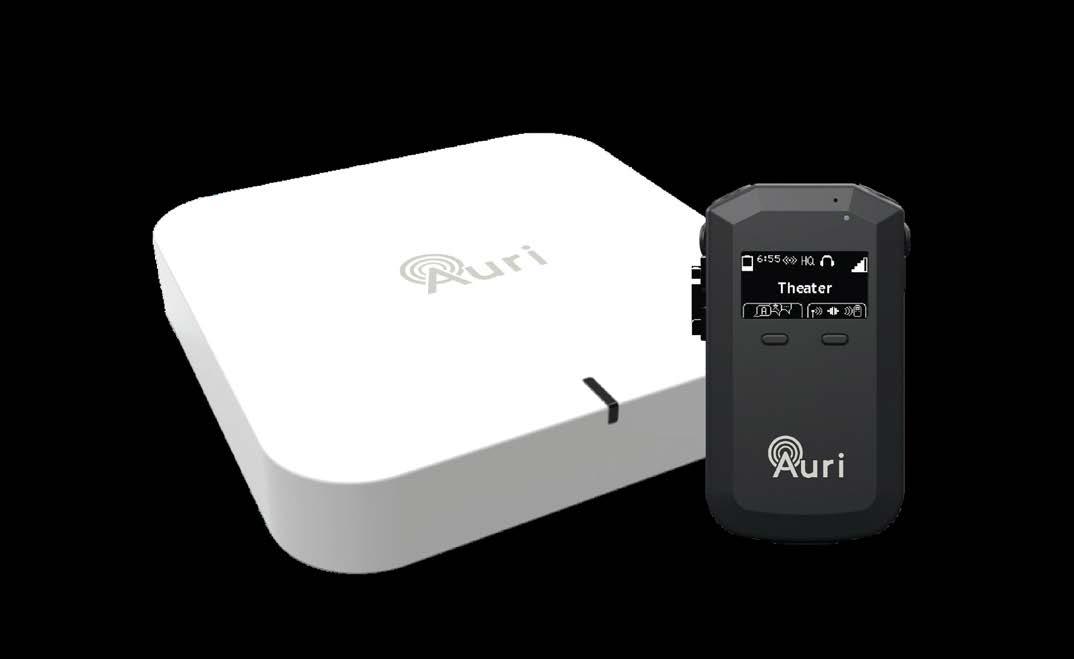
The portfolio includes ListenIR, ListenRF, ListenWIFI, ListenTALK, and Hearing Loop, as well as Auri, the world’s first Auracast broadcast audio-based solution designed specifically for assistive listening. Nvincy will make these solutions available across India, supporting projects of all sizes and complexity.
“Listen Technologies and Ampetronic set global benchmarks in assistive listening and hearing loop systems. Our partnership with them represents an important step toward improving audio accessibility across India," said Saugato Siddhanta, Director, Nvincy Solutions Pvt. Ltd. "With Ampetronic and Listen Technologies, we are enabling integrators and end users to deploy reliable, globally recognised assistive listening systems that support inclusive communication in real-world environments."
Local Expertise, Global Standards
Nvincy brings strong in-market knowledge, technical capability, and channel relationships, supporting consultants, integrators, and end users with dependable service and localised expertise.
“We selected Nvincy as a distribution partner in India because of its reputation for support, strong channel relationships, technical
Comcon Brings in AV Veteran Amit Saxena to Lead Professional AV Growth
INDIA: Comcon Technologies Limited has strengthened its leadership team with the appointment of Amit Saxena as Business Head – Professional AV, effective January 2026.
Amit Saxena joins Comcon with more than 22 years of experience in the AV industry, bringing deep expertise in brand building, partner
expertise, and on-the-ground knowledge. Our partnership will extend access to assistive listening solutions in India. Together, we’re focused on making inclusive audio more achievable across education, workplaces, hospitality, public spaces, and beyond,” said Vineeth Nair, International Business Development Manager, Ampetronic | Listen Technologies.
Listen Technologies
network development, strategic alliances, and business expansion. Widely recognised for his ability to build strong ecosystems and unlock new market opportunities, Saxena has played a pivotal role in growing AV portfolios across multiple application segments.
In his new role, Saxena will be responsible for driving business development and shaping the long-term growth strategy for Comcon’s professional AV portfolio. His focus will include strengthening customer engagement, expanding integrated AV offerings, and accelerating adoption across corporate environments, live events, enterprise deployments, and broadcast applications.
Comcon expects Saxena’s leadership to play a key role in scaling its Pro AV operations while deepening collaboration with customers and OEM partners, reinforcing the company’s position in an increasingly competitive market.
Commenting on his appointment, Amit Saxena said: “Comcon has built a strong reputation for technical excellence and trusted relationships in the AV ecosystem. I look forward to driving the next phase of growth in the Pro AV segment and contributing to the company’s continued success.”
Comcon Technologies Limited
Keenfinity Group Acquires Avonic to Bring Intelligent Video into Audio Conferencing
GLOBAL: As hybrid meetings become the norm rather than the exception, the line between audio and video in professional conferencing is rapidly disappearing. Keenfinity Group’s Audio Business has taken a decisive step in that direction with the acquisition of Avonic a specialist in AI-driven cameras and voice-tracking technologies for the AV conferencing market.
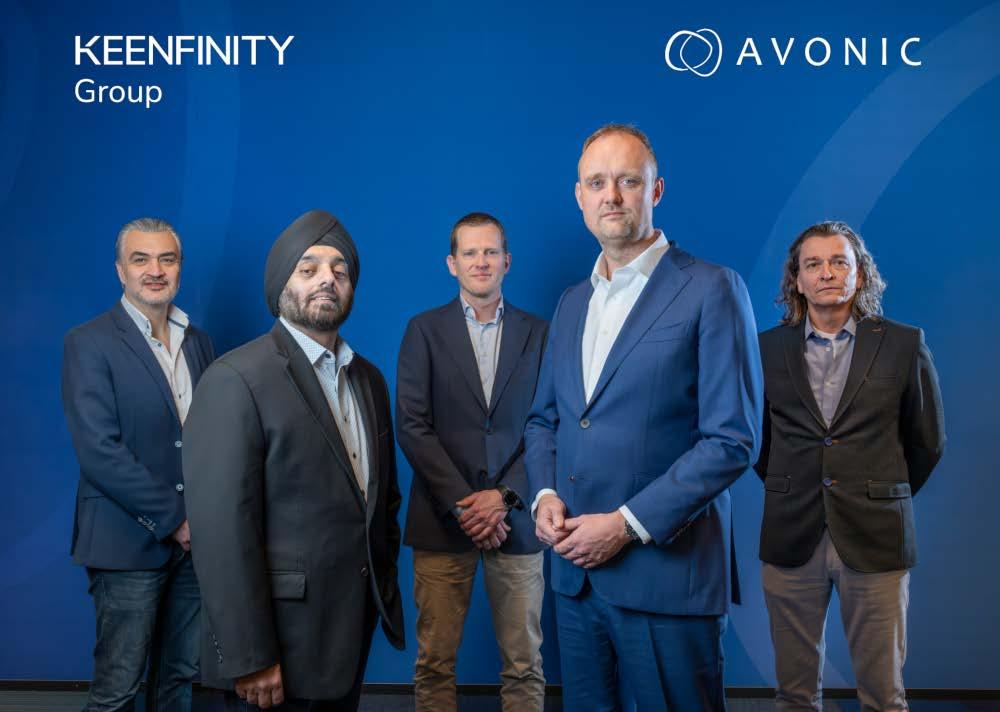
From left to right: Murat Keskinkilinc and Pawandeep Singh (KEENFINITY Group), Martijn van Bodegom (Avonic), as well as Walter Harrewijn (CEO of Avonic) and Lars van den Heuvel (KEENFINITY Group), at the signing ceremony of the acquisition agreement.
The strategic move expands Keenfinity Group’s Audio Conference Solutions with advanced, intelligent video capabilities, giving system integrators and equipment providers access to a fully integrated, one-stop audio-video portfolio designed for today’s most demanding meeting environments.
Both Keenfinity Group and Avonic are trusted names in professional conferencing, supplying technology to mission-critical settings where reliability and clarity are non-negotiable. These include councils, parliaments, international institutions, higher education, corporate boardrooms, and large-scale international events. In such environments, video is no longer a “nice to have.” It provides essential context, particularly in hybrid meetings where participants join both in person and remotely.
By seamlessly combining AI-enabled video with clear, dependable voice communication, Keenfinity Group is delivering a more intuitive and natural conferencing experience that keeps
human connection at the forefront, regardless of location.
“This acquisition helps to expand our leadership position in the conferencing segment. More importantly, it supports our mission of delivering exceptional user experience by enabling our customers total, seamless, and integrated solutions, whatever the vertical,” said David Hunter, CEO of the Audio Business at Keenfinity Group. “With Avonic’s AI-driven video capabilities seamlessly integrated into our conference solutions, we will be creating more engaging and natural experiences, where human connection takes centre stage.”
Bosch-branded conference solutions, now part of Keenfinity Group’s Audio Business, continue to set benchmarks in the global conferencing market. Backed by more than 75 years of expertise, these secure and professional communication systems are widely recognised for their quality, flexibility, and reliability. The addition of Avonic’s high-quality PTZ cameras and AI-powered software further strengthens this portfolio, driving innovation while maintaining the rigorous standards required for professional and governmental applications.
“Our cameras are deployed globally in professional, high-impact meeting environments where decisions truly matter,” concluded Walter Harrewijn, CEO of Avonic. “Moving beyond our long-term technology
RTI Appoints Aquila Data Singapore as Distributor for Commercial Solutions
SINGAPORE: RTI a leading brand of control and automation solutions, has announced the appointment of Aquila Data Singapore as their distributor for commercial solutions in Singapore. Aquila Data Group was founded in 2001 and is based in Jakarta, Indonesia, with offices in Singapore and Malaysia. The company specializes in distribution of Unified Communication (UC) and Audio Visual (AV) devices, providing solutions such as video conferencing, audio-video (AV), and smart technology integration. The highly skilled Aquila team supports technology integrators with value-added services such as system design and support while bringing best-inclass solutions to technology professionals in the region.
“RTI offers a broad range of scalable control solutions ideally suited to the design of smart commercial environments,” reported James Trumper, VP, International Sales at AVPro Global. “I anticipate that the team at Aquila Data Group will increase RTI’s brand visibility in the region while developing key relationships with top commercial integration firms on behalf of the RTI brand.”
“Aquila Data Singapore is pleased to introduce RTI control solutions to its network
partnership, this acquisition allows us to collectively grow our offering, delivering more integrated solutions for new applications, use cases and markets”
Keenfinity Group
of commercial AV integrators in Singapore,” said Ryan Wong, Director of Aquila Data Singapore. “Through a comprehensive suite of services that includes technical support, training, and partner enablement, Aquila Data Singapore equips its partners with the knowledge and capabilities required to deliver seamless and effective integrations within client environments.”
“Partnering with Aquila Data Singapore is a key milestone in our growth strategy,” said Bensen Ong, Sales Director at Generation AV. “Their deep understanding of the market and established distribution network will help us deliver greater value to customers and accelerate our expansion in Singapore.”
Since 1992, RTI has been at the forefront of innovation in control and automation, transforming spaces into intelligent environments that enhance lifestyle and streamline operations. The comprehensive suite of products and award-winning support services empower integrators to craft personalized and intuitive control experiences optimized for every project. For more information, visit rticontrol.com.
For additional information, please contact Aquila Data Singapore: sales.sg@aquila-data.com
Analog Way Appoints Jeff Singer as Chief Marketing Officer
GLOBAL: Analog Way, a global leader in image processing and video playback solutions, is pleased to announce the appointment of Jeff Singer as Chief Marketing Officer (CMO).
In this worldwide role, Jeff Singer will lead Analog Way’s global marketing strategy with a strong focus on go-to-market execution, sales enablement, and ownership of the company’s product roadmap and product definition. Drawing on his extensive experience in technical product marketing and a customer-centric approach, he will also contribute to elevating the user experience across all customer touchpoints, ensuring consistent value throughout the customer journey.
“After three years of strong growth, we are entering a new phase focused on expanding our portfolio, strengthening our solutions, and creating even more value for our customers,” said Eric Delmas, CEO of Analog Way. “Jeff brings the strategic vision and execution capability needed to align innovation, market needs, and go-to-market excellence as we continue to shape the future of our industry.”
Commenting on his appointment, Jeff Singer said: “I’m honoured to join Analog Way and work with an organization known for its strong teams and a highly compelling product portfolio. I look forward to collaborating across the company to align product strategy, market needs, and go-tomarket execution, and to help drive even greater value for customers worldwide.”
With over 30 years of experience in global marketing and product launches, Jeff Singer has led go-to-market and demand generation strategies for technology-driven organizations worldwide. He previously served as Executive Director of Global Product Marketing at Crestron Electronics, where he developed and led the positioning of strategic platforms across global markets.
With this appointment, Analog Way reinforces its commitment to innovation and customercentricity.
Analog Way
Point Source Audio Appoints Anthony Wilkins as Vice President of Sales, EMEA
EMEA: Point Source Audio is growing its international presence further with the appointment of Anthony Wilkins as Vice President of Sales, EMEA. The move highlights Point Source Audio’s strategic brand expansion and the enhanced focus it is placing on market development in the region.
“We are delighted to welcome Anthony to the Point Source Audio family,” stated Point Source Audio CEO, President and Co-founder James Lamb. “His experience and track record in the industry are second to none and we are certain he will help our EMEA team achieve even more success in the future.”
Point Source Audio’s international success is based on a foundation of proprietary intellectual property, engineering-driven product development, and a disciplined approach to global market expansion. The manufacturer’s portfolio of patented wearable microphone solutions serves professional users across a variety of verticals including theatre and broadcast. The innovative solutions are the goto choice for multiple applications with demand driven by their proven reliability, durability, and discreet performance.
The appointment of Wilkins fits perfectly with this strategy. He has spent more than three decades working in the professional audio industry and has deep roots in the broadcast sector. Over this period, he has built strong relationships in the professional audio market through his roles at companies including Sony, Jünger Audio, Focusrite and Calrec.
“I’m delighted to be joining Point Source Audio,” said Wilkins. “We have got some fantastic products and multiple patents. Point Source Audio is an innovative and established player in the microphone market with offerings that make a compelling argument to every type of user. I can see a great opportunity to build on what we have already achieved in this region and look forward to helping the business to grow in the key EMEA territory.”
Point Source Audio
tvONE Appoints Amit Singh as Regional Sales Manager for India and the Middle East
IME: tvONE , a leading video processor, signal distribution technology, and media server developer, is pleased to announce
the expansion of Amit Singh’s role to Regional Sales Manager for India and the Middle East. With more than a decade of experience in the audio-visual industry, Amit brings extensive expertise in AV project design, brand development, and distribution management to the role.
Amit is a seasoned techno-commercial professional with a proven track record in the AV industry. Over the past 10 years, he has successfully managed and developed business relationships, designed comprehensive AV solutions, and driven brand growth and market awareness. His background includes working with original equipment manufacturers Audio-Technica and Wyrestorm, where he gained deep insight into OEM strategy and channel development.
In addition, Amit has held roles with distribution companies Green Sources and Miyakawa, focusing on OEM relationship management, brand positioning, and sales growth across diverse markets.
“We’re excited to see Amit take on this expanded territory,” said Jon Hubery, EU Sales Leader at tvONE. “His extensive experience, strong regional knowledge, and ability to build meaningful partner relationships will be key as we continue to grow our presence across both India and the Middle East.”
In his expanded role, Amit will be responsible for leading sales strategies, strengthening partner relationships, and promoting tvONE’s brands and solutions throughout India and the Middle East. He can be reached at amit.singh@tvone.com
Strategic Pathways Launches Industry’s First Comprehensive Intelligent Workplace Strategic Framework
SINGAPORE: Strategic Pathways has announced the launch of the Intelligent Workplace Strategic Framework™, the industry’s first comprehensive, ecosystem-wide framework designed to help organizations systematically design, assess, and scale high-performance workplaces in an era defined by hybrid work and artificial intelligence.
The framework addresses a growing global challenge: while investment in collaboration technology, office redesign, and AI continues to accelerate, workplace performance outcomes remain inconsistent. Fragmentation across people, workflows, spaces, technology, and
partner ecosystems has become a hidden barrier to productivity, efficiency, collaboration, and innovation.
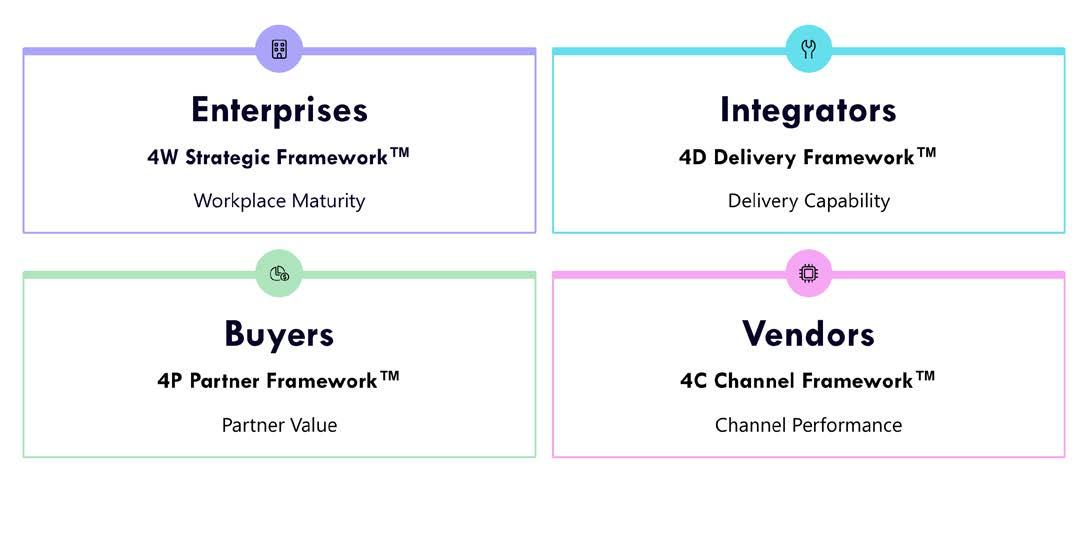
The Intelligent Workplace Strategic Framework introduces a unified operating model that aligns the full workplace ecosystem through four interconnected, role-specific frameworks:
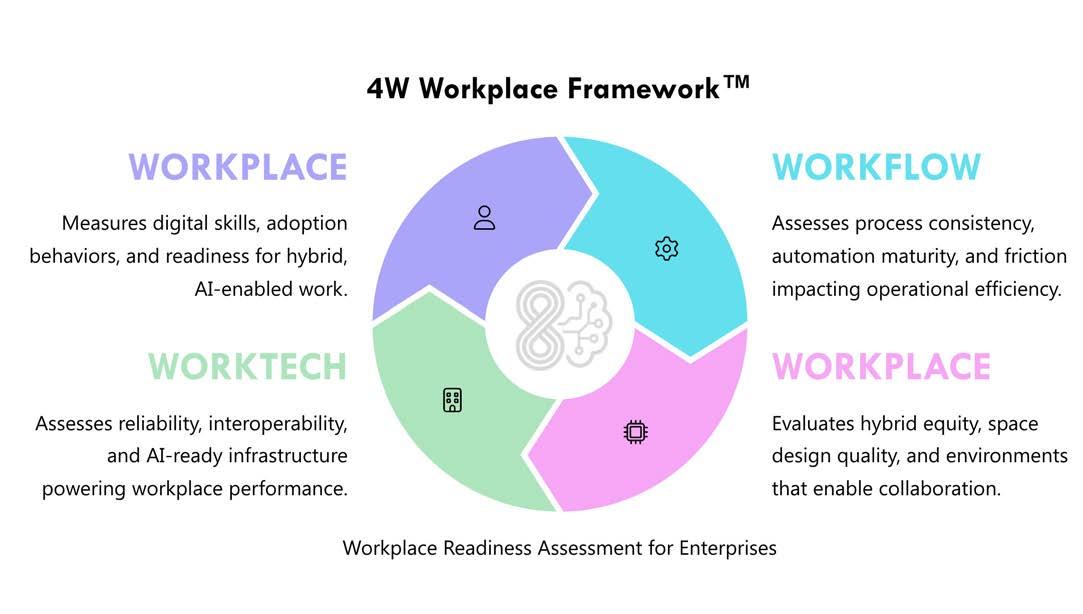
• 4W Workplace Framework for enterprises defining and governing workplace and AI transformation
• 4D Delivery Framework for system integrators delivering Intelligent Workplace solutions at scale
• 4C Channel Framework for vendors optimizing partner ecosystems and go-to-market execution
• 4P Partner Framework for buyers selecting and governing technology partners with confidence
Together, these frameworks establish a common language, shared diagnostic structure, and evidence-based decision model across all stakeholders shaping the modern workplace.
“The workplace has become one of the most strategically important and least coherently designed systems inside organizations,” said Marc Remond, Executive Partner at Strategic Pathways and Creator of the Intelligent Workplace Strategic Framework™.
“Most failures are not caused by technology or hybrid work. They are caused by fragmentation. This framework gives the industry, for the first time, a unified blueprint to align Workforce, Workflows, Workspaces, Worktech, and AI across the entire ecosystem.”
From Fragmentation to Workplace Intelligence
Unlike traditional workplace models that focus on individual tools or projects, the Intelligent Workplace Strategic Framework™ treats the workplace as a living operating system— continuously assessed and optimized through structured diagnostics.
At the core of the framework is an evidencebased Strategic Diagnostic Engine™, enabling organizations to measure maturity, identify systemic misalignment, benchmark performance, and generate prioritized transformation roadmaps across enterprise, delivery, channel, and partner dimensions.
This diagnostic-led approach supports a shift from assumption-driven investment toward data-informed workplace strategy and accountable decision-making.
Designed for the Next Era of Work
The launch comes as enterprises face converging pressures:
• Hybrid work has become permanent
• AI adoption is accelerating faster than organizational readiness
• Technology portfolios continue to expand in complexity
• Delivery quality varies widely across markets
• Buyers demand greater transparency, accountability, and evidence
The Intelligent Workplace Strategic Framework™ is designed to help organizations respond to these pressures by creating systemic alignment across stakeholders—enabling AI to function as an amplifier of human capability rather than a source of additional complexity.
Availability
The Intelligent Workplace Strategic Framework™, supporting whitepapers, and diagnostic tools are now available at: www.IntelligentWorkplace.ai
InfoComm China
20th Anniversary: Celebrating Two Decades as Asia’s Most Influential and Professional Pro-AV Showcase
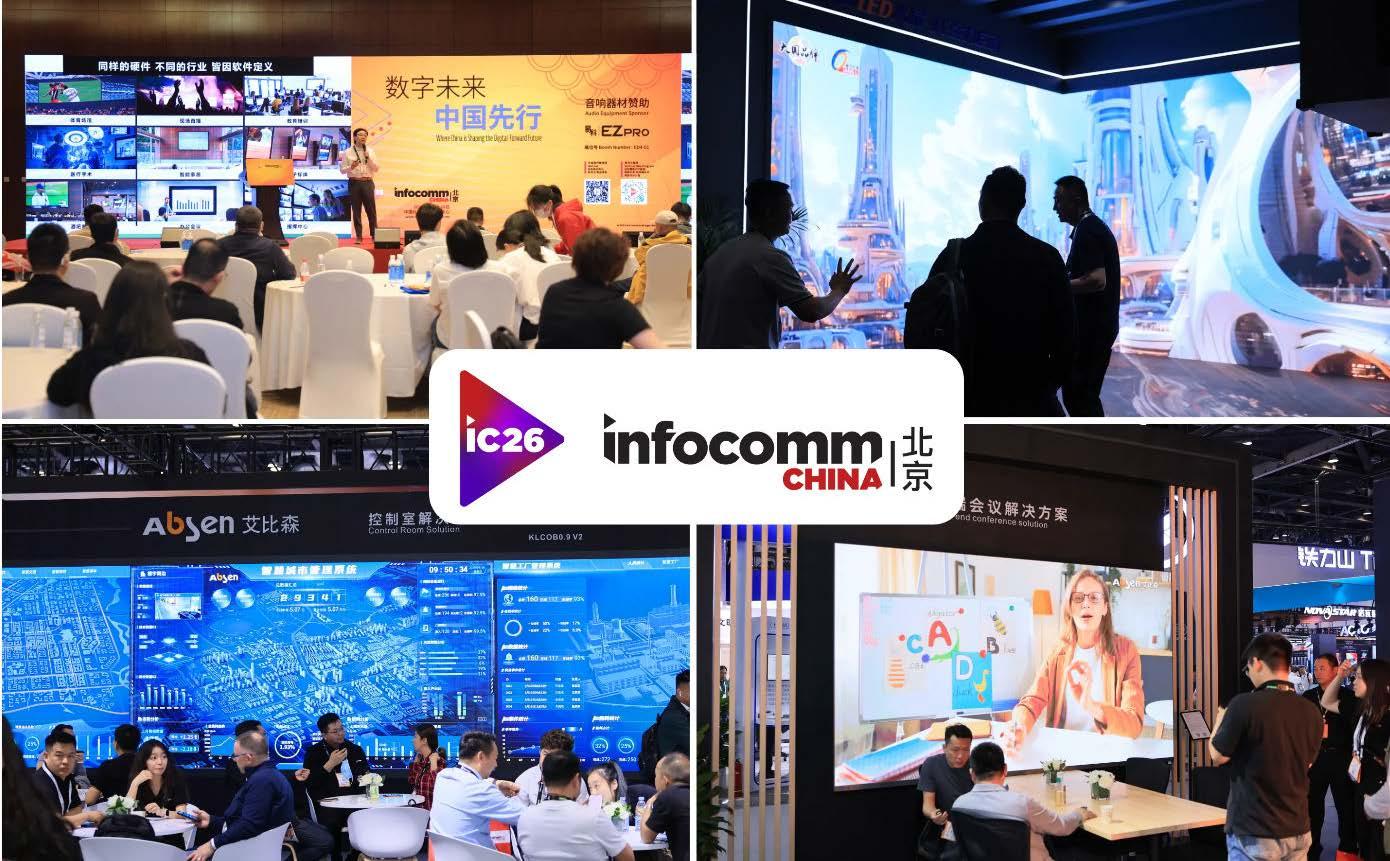
CHINA: For 20 years, Beijing InfoComm China has served as the most professional and influential platform for promoting and expanding China’s global Professional Audio-Visual (ProAV) industry. Through decades of bringing together manufacturers, solution providers, IT system integrators, and end users of Pro-AV, Beijing InfoComm China has become Asia’s premier Hub for Pro-AV excellence. Taking place from 15-17 April 2026, at the China National
Convention Center (CNCC), the show marks the beginning of a landmark era: the 20th year of the InfoComm China brand, followed by the 20th edition of the tradeshow in 2027. From an exhibition floor hosting over 400 companies and welcoming over 26,000 professional visitors, to a world-class conference lineup of Pro-AV industry movers & shakers, to delighting audiences with innovative and immersive themed zones, InfoComm China is where China is shaping the digital forward future.
To commemorate this milestone era, InfoComm China will host a series of events and initiatives throughout the two years honoring the companies, ideas, and people who have help to shape the Pro-AV industry. Leading up to the 2026 event, members of the InfoComm China community can expect even more innovations, interactive programs, and surprises which spotlights the history of Pro-AV, modern-day successes, and future forward showcases launching us into the 2nd half of the 21st century.
A US $98 Billion Market Opportunity
With the APAC Pro-AV market valued at US $123.7 billion and China accounting for nearly 80% of the pie (US $98.4 billion and 4.2% CAGR), InfoComm China provides a critical gateway for global trade and technological exchange.
New International Visitor Initiatives
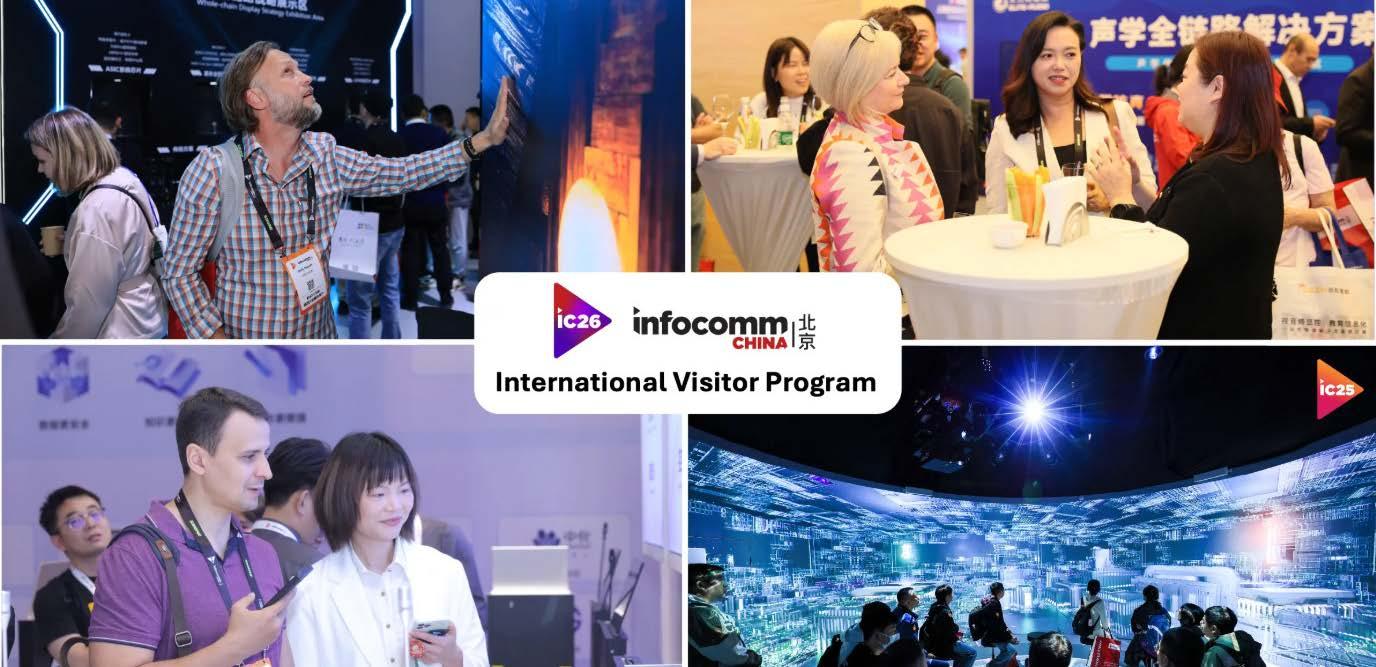
Making a strategic shift toward global integration, InfoComm China for the first time has launched a suite of international visitor initiatives including tools and resources for overseas visiting professionals to navigate their way to China, through the fair, and efficiently network and conduct business deals.
Some of these initiatives for international visitors include the launch of invited guest program with travel hosting privileges, onsite assistance with dedicated lounges and translation services, and a curated selection of “ready-to-export” companies specifically prepared to meet with overseas guests at the show. Beyond business matching, visitors can also experience new and exciting show features from immersive technology, smart collaboration solutions, AI themed areas and networking events with local English-speakingindustry players.
“When you think about cutting edge, nextgeneration, and the future of tech, you think about China,” said Executive Director June Ko. “Where else can you see such large-scale projection mapping against backdrops like the Forbidden City in Beijing? Or three-dimensional, interactive, holographic displays when you walk down a busy street in Shanghai? Or witness the world record for the largest display of entertainment drones such as the feats accomplished in Liuyang and Chongqing? When one thinks of where the future is heading, they can see it now in China. And what’s even better is that these companies and Pro-AV professionals want to share their advancements with the rest of the world at InfoComm China.”
From the future of digital advertising to meeting rooms that extend collaboration beyond boundaries, to smart city solutions that deliver cities of the future, professional Pro-AV visitors can see the largest range and depth of products & solutions servicing every end-user and vertical market implementation involving high-end, fixed installation Pro-AV. For more information on InfoComm China, the international visitor program benefits, and to pre-register your pass to the future visit infocomm-china.com
Barco Encore3 Raises the Bar
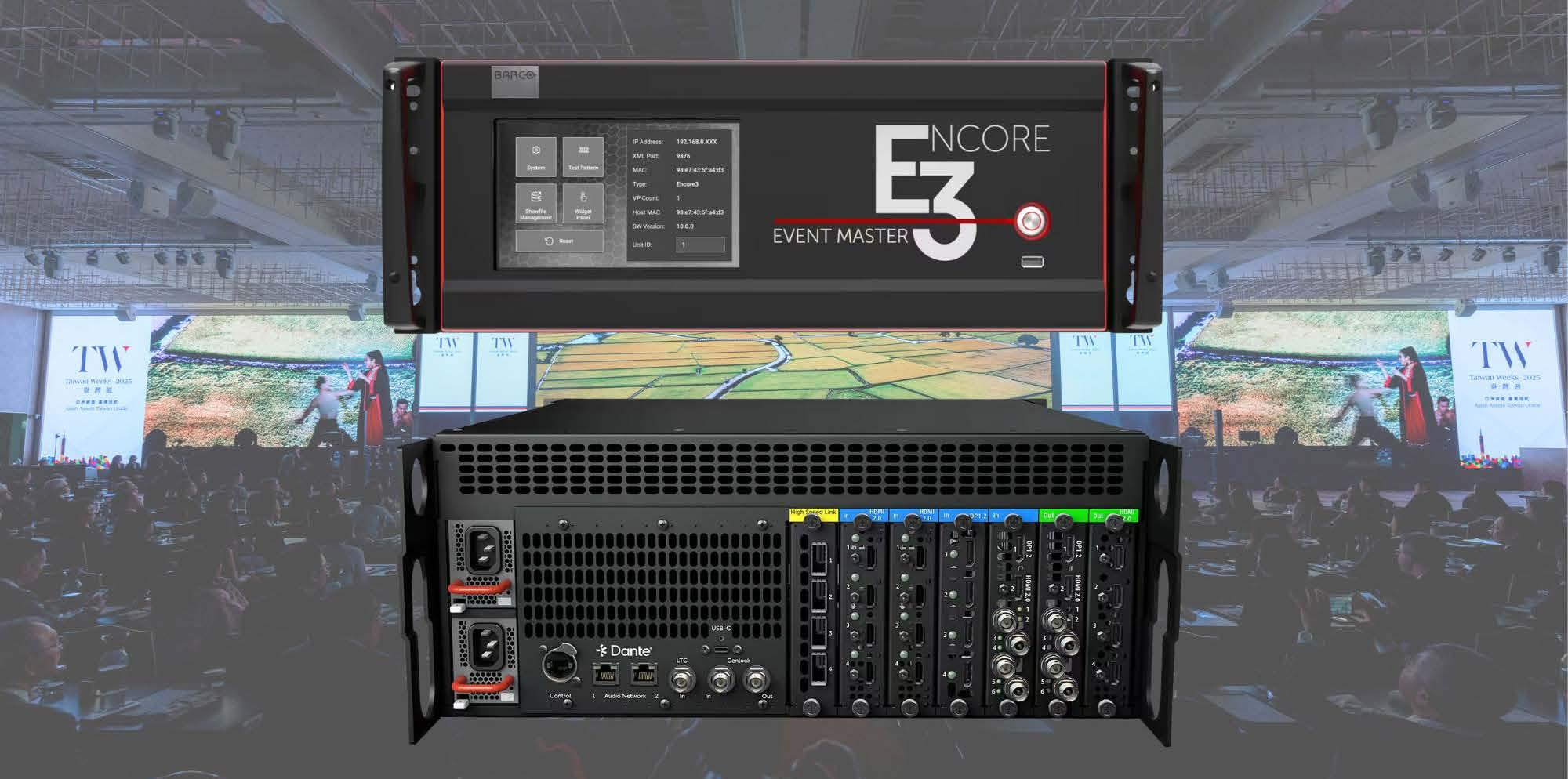
Zhu & Yong deployed the Encore3 successfully at the Taiwan Week 2025 Grand Opening Event.
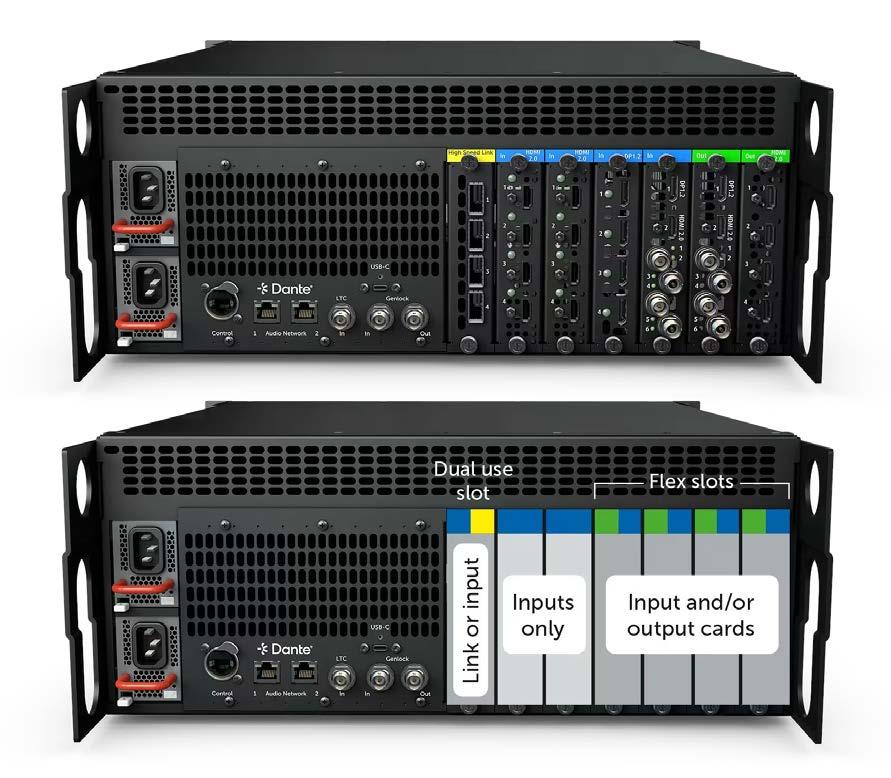
With Encore3, Barco raises the bar once again— introducing its most versatile and future-forward screen management system yet. Engineered to protect your long-term investment, Encore3 features a powerful architecture built around card and controller reusability. The system now pushes performance even further with an expanded I/O count on its Gen2 cards, delivering an impressive 4x4K60p oer I/O card.
Built on a flexible Build-to-Order model, Encore3 lets you craft a system that fits your exact needs. Its extensive range of modular input and output cards, paired with a smart slotbased design, gives you the freedom to scale, customise, and fine-tune your configuration with precision.
In this issue, we sit down with Harry Patel, Product Manager, Encore3 at Barco, to dive deeper into the ideas, innovation, and technology behind Encore3.
What makes Encore3 a strong choice for permanent installations compared to traditional video processing systems?
Encore3 is built on a modular, card-based architecture that ensures long-term adaptability and investment protection. Unlike traditional systems with fixed configurations, Encore3 offers a Build-to-Order model and slot-based design, allowing venues to customize and scale their system precisely to their needs. Its native 4K60 support across every input, output, and layer guarantees exceptional image quality for modern display environments. Additionally, Encore3’s boundless canvas architecture removes limitations on screen layout, enabling creative freedom for immersive designs—ideal for permanent installations where flexibility and future-proofing are critical.
How does Encore3 support 24/7 reliability and stability, which are essential in fixed AV environments?
Reliability is at the core of Encore3’s design. It features redundant power supplies, industrialgrade components, and robust thermal
management to ensure uninterrupted operation. The system architecture supports fail-safe performance, making it suitable for missioncritical environments like control rooms or broadcast studios. These measures, combined with Barco’s decades of engineering expertise, deliver the stability and resilience required for continuous operation in permanent installations.
What integration advantages does Encore3 offer when working with existing AV infrastructures in venues such as auditoriums, control rooms, or houses of worship?
Encore3’s modular input/output cards and multi-format compatibility make integration seamless. It supports a wide range of connector types and video formats, ensuring compatibility with legacy and modern equipment. The system’s web-based widget panel allows simplified control for non-technical users, while its offline simulator enables pre-programming and testing before deployment—reducing disruption during integration. These features make Encore3 an ideal solution for venues with diverse AV ecosystems.
How scalable is Encore3 for future expansion or technology upgrades in permanent setups?
Encore3 is designed for scalability. Its slotbased architecture allows easy addition or replacement of input/output cards to accommodate new signal standards. The system supports system expansion via linking, enabling expansion of input/output capacity as venue requirements grow. Future updates will extend linking capabilities even further, ensuring that installations can evolve without requiring a complete system overhaul—making Encore3 a truly future-ready platform.
In terms of usability, how does Encore3 simplify day-to-day operation for non-technical staff or recurring users?
Encore3 introduces a new user interface based on familiar workflows, reducing training time for experienced operators and easing
adoption for new users. The web-based widget panel empowers non-technical staff to trigger cues and presets without navigating complex software. Additionally, the redesigned front panel allows quick access to test patterns for troubleshooting, and the offline simulator enables pre-programming of shows— streamlining operations and minimizing on-site setup time.
Encore3 also supports external APIs, allowing presets and cues to be recalled from well-known third-party control systems. This integration ensures smooth day-to-day operation for venues that rely on centralized AV control platforms.
How does Encore3 enhance visual impact and audience experience in fixed installations like museums, broadcast studios, or corporate lobbies?
Encore3 delivers uncompromised visual quality through its native 4K architecture, ensuring every input, output, and layer maintains full resolution integrity without scaling artifacts. At the heart of this performance is the Athena scaler, which provides the highest-quality scaling for large displays, guaranteeing pristine image clarity across LED walls, projection mapping, and broadcast-grade environments.
With moves and presets, Encore3 enables smooth transitions between presets, ensuring a polished and professional visual experience. It is a true screens switcher, designed to manage multiple screens seamlessly rather than functioning solely as a window processor— delivering flexibility and precision for complex, multi-screen environments without compromise.
What kind of remote management, monitoring, or service capabilities does Encore3 provide for long-term deployments?
Encore3 is built on an FPGA-based architecture, which offers deterministic behavior and exceptional stability—allowing the system to run for extended periods without requiring reboots or heavy maintenance. While Encore3 does not
currently provide health monitoring through a web browser, its design minimizes the need for frequent intervention.
For monitoring, future updates will include SNMP support, enabling integration with enterprise monitoring systems. Additionally, Encore3 offers an external API for queries and control, giving technical teams flexibility to build custom monitoring and management workflows tailored to their environment.
Can you share examples where Encore3 has already been successfully deployed and what benefits the clients have seen?
One of our clients, Don’t Wonder Productions based in California recently deployed the Barco’s Encore3 image processing platform which delivers a visually stunning and technically flawless experience. The Encore3’s flexibility proved essential in navigating last-minute adjustments and maintaining consistent performance throughout the event. The end client, McLeod Software, was extremely satisfied with the result, praising the seamless
execution and visual impact. Drew Poley from Don’t Wonder Productions said, “The ability to have multiple 4K layers on each output was extremely necessary. We simply couldn’t have pulled this off with two E2s.”
Another one of our key clients, Spark Zhu, the Senior Technical Director from Zhu & Yong, Taiwan comments, “From the old school Screen Pro Plus 1616, Screen Pro II, Encore VP, Encore 3G, E2, to E2-Gen2, Encore 3 is undoubtedly Barco's most powerful screen management system ever. For most users who started using Event Master Toolset around the Pandemic, accustomed to the complete and stable workflow of E2-Gen2 and EM 9.x, there are certainly some complaints about Encore3 and EM 10. However, for us who finally started to get rid of the complex systems of multi-unit Encore VPs in wide screen/stacks and various types of routers combinations with EM OS 0.2.3, the EM 10.0.1 show version, released immediately, already boasts a level of functionality comparable to the E2 after three to four years on the market.”
Barco Encore3 is shipping now.
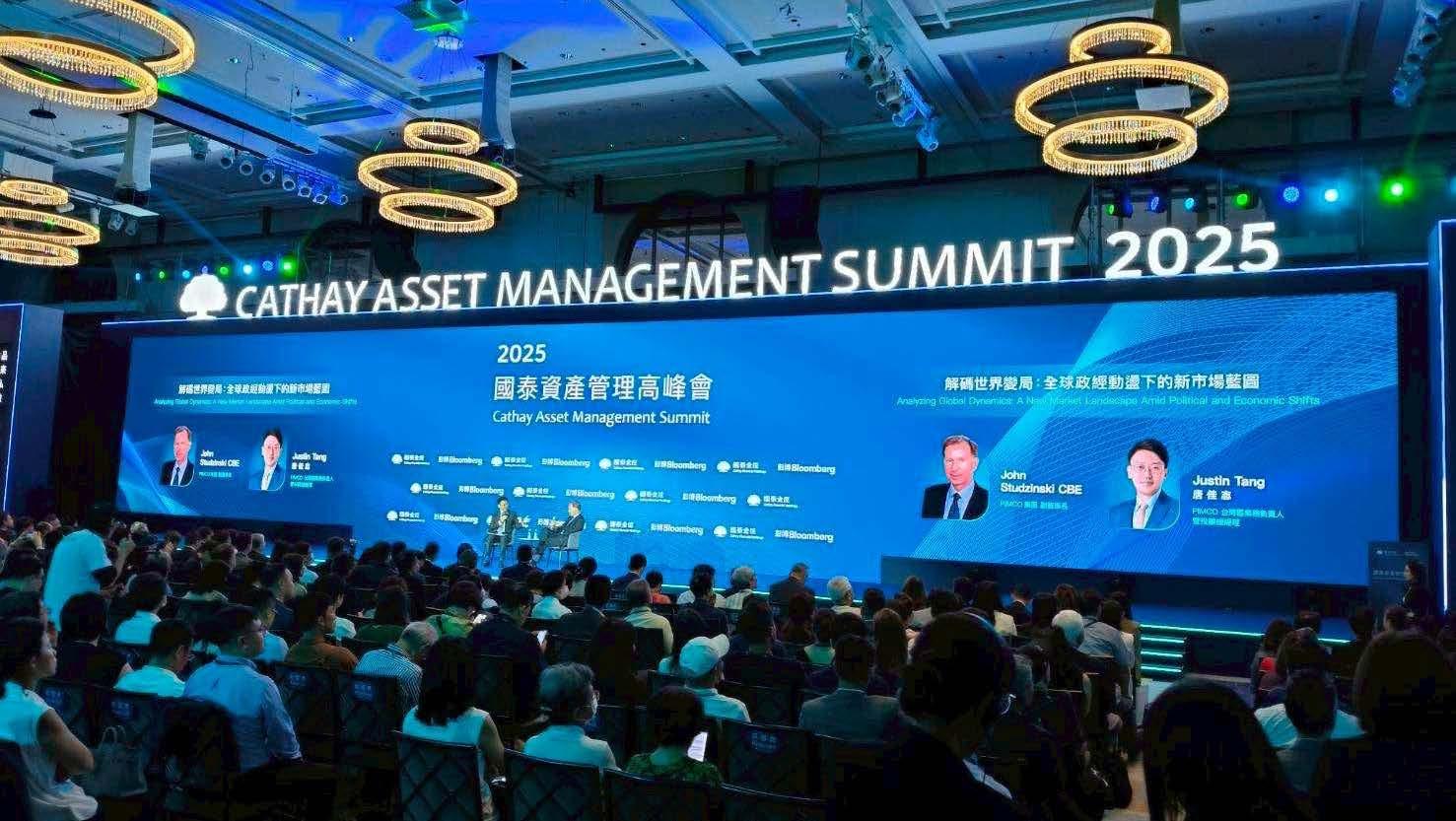
Cathay Asset Management Summit, where Zhu & Yong once again deployed the Encore3.
Nureva Adds Coverage Map and Camera Switching to HDL310 System
Nureva Inc., has announced a new coverage map and automated camera switching capabilities for its HDL310 audio conferencing system designed for large meeting and learning spaces. Powered by Nureva’s patented Microphone Mist technology the HDL310 hdl310 now uses coordinate-based (XY) sound location data and its unique coverage map to show exactly where voices are being picked up in the room. With these new HDL310 capabilities, IT managers and integrators can define camera zones, assign cameras or presets to each zone and monitor real-time microphone pickup — all from the Nureva App. As people move and speak in the room, the XY sound location data automatically triggers the corresponding camera so remote participants always see where the conversation is happening. When the room is reconfigured, users simply select the relevant preconfigured room profile in the Nureva App, and the system applies the correct zone coverage and camera switching settings without any need for manual recalibration.
Traditional camera switching solutions typically require multiple ceiling or table microphones, detailed DSP programming and manual calibration that must be reconfigured whenever room layouts change. The HDL310 system takes a different approach, combining its built-in Microphone Mist technology with the INOGENI CAM230 multi-camera selector to localize sound and automate camera switching. The HDL310 system’s coverage map provides IT managers and integrators with a clear two-dimensional view of microphone pickup points across the room, making it easy to validate coverage, fine-tune camera zones and troubleshoot issues without specialized tools or expertise.
Nureva’s HDL410 system for extra-large rooms already has these same capabilities, which have been widely adopted to simplify multi-camera experiences in classrooms and meeting spaces up to 35’ x 55’ (10.7 x 16.8 m). The HDL310 now brings these benefits to large rooms up to 30’ x 30’ (9.1 x 9.1 m), giving IT teams a consistent workflow for camera automation across the two systems.
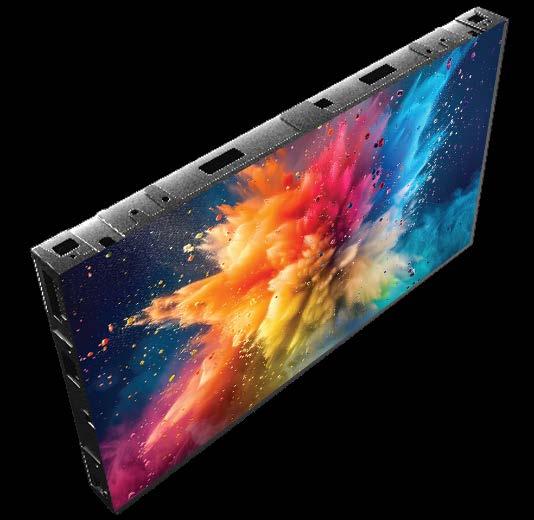
Nanolumens Expands Entry-Level NXT Series
Nanolumens will expand the NXT Series directview LED displays with chip-on-board (COB) technology and additional pixel pitch options. The entry-level NXT Series combines flexible technology options, a broad range of pixel pitches and simple installation to support indoor applications where performance, durability and cost efficiency are equally important.
The modular NXT Series now includes both COB and surface-mount device (SMD) LED models, providing organisations with the flexibility to select the technology best suited to their viewing distance, durability requirements, and installation environment. Expanded pixel pitch options now range from 0.9 mm to 3.75 mm, increasing versatility across various applications, including retail environments, higher education lecture halls, corporate conference rooms and lobbies. COB models offer finer pixel pitches, a slimmer profile, enhanced durability, and a higher contrast ratio, making them ideal for close viewing and high-traffic environments. Meanwhile, the SMD line now includes a wider pixel pitch option for longer viewing distances and increased affordability.
All NXT Series displays are built in a 16:9 cabinet format, making them ideal for content created with popular resolutions like Full HD and 4K. The cable-less design simplifies installation and system integration. The COB models are compatible with mounting solutions from leading mount providers, supporting precise flatness and alignment in video wall configurations. The SMD models remove the need for additional mounting infrastructure, enabling faster, lower-impact installation.
Designed for long-term reliability, NXT Series displays are engineered for indoor use and rated for more than 100,000 hours of operation, with standard brightness up to 800 nits and wide viewing angles. Nanolumens provides a two-year standard warranty that covers the display from the first pixel, supported by the company’s Atlanta headquarters. The NXT Series is designed, assembled, supported and serviced in the United States and is TAA compliant, making it suitable for a wide range of commercial and institutional deployments.
Nanolumens/NXT Series
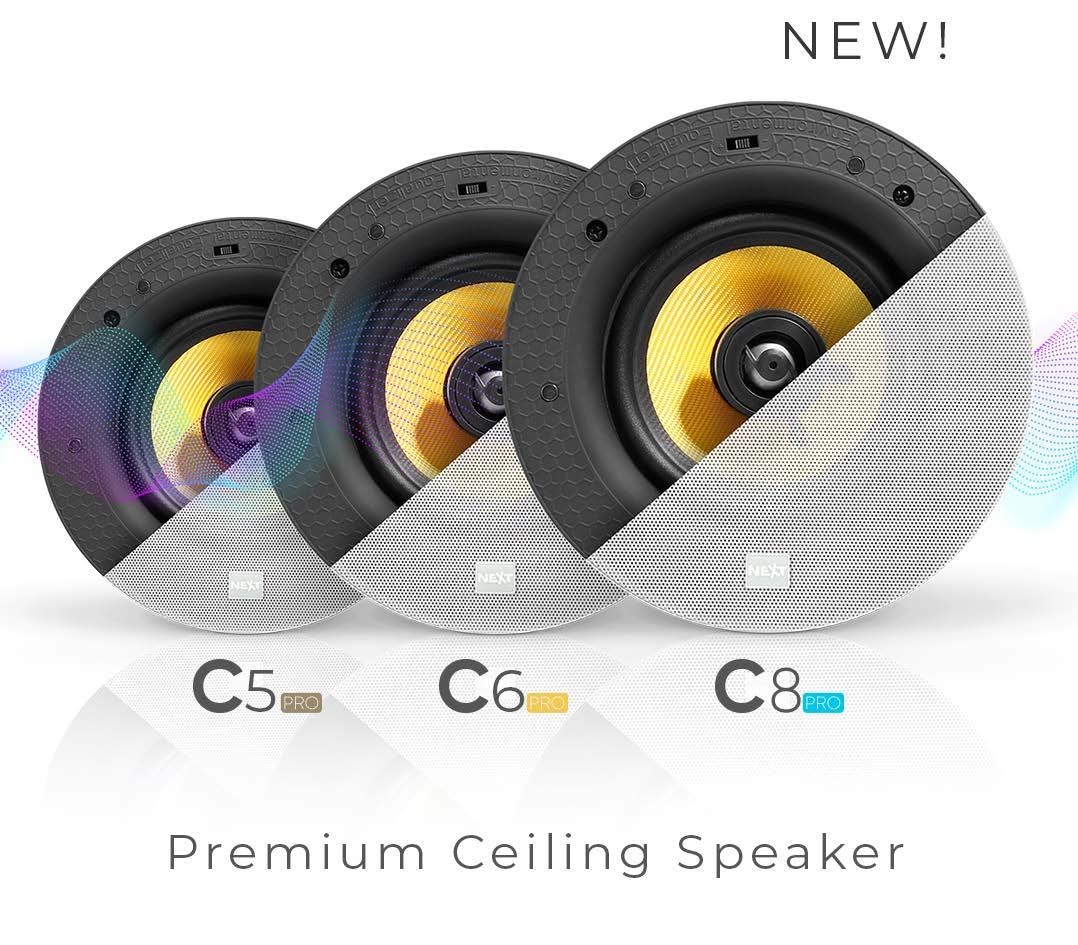
NEXT Audiocom Unveils C8 Pro
Introducing the C8 PRO, the newest and most powerful model in NEXT Audiocom’s successful C PRO ceiling speaker range. Following the strong market adoption of the C5 PRO and C6 PRO, the C8 PRO expands the series with an 8″ solution designed for installations that demand fuller sound, higher output, and greater lowfrequency presence.
The C8 PRO is a high-performance ceiling speaker with a clean, elegant design, engineered for installation in false ceilings, walls, or panels. It delivers a powerful, warm, and richly detailed sound, making it ideal for commercial spaces, hospitality venues, and professional background or foreground music applications where impact and clarity matter.
A low-profile magnetic grill ensures a smooth, frameless appearance and fast installation. The grill can be easily painted to match or contrast with the surrounding surface, preserving
architectural intent. For projects requiring a completely discreet look, the detachable logo allows a fully unobtrusive finish.
The integrated transformer enables operation on both 100V line systems and low-impedance 8Ω installations, allowing seamless adaptation to different system requirements. The adjustable tweeter provides precise control over high-frequency coverage, ensuring sound is directed exactly where it is needed.
To simplify acoustic optimisation, the C8 PRO supports Environment Equaliser adjustment, allowing automatic sound tuning based on the installation area. The HF Driver Protection circuit safeguards the high-frequency driver against unexpected audio peaks, increasing long-term reliability in demanding environments.
Together, the C5 PRO, C6 PRO, and new C8 PRO form a complete ceiling speaker family, offering premium sound performance across three sizes.
With 80W RMS power and 112 dB maximum SPL (program/ peak), the C8 PRO sets a new benchmark for high-output ceiling speakers, combining power, control, and refined design in a single solution.
NEXT Audiocom/C8 Pro
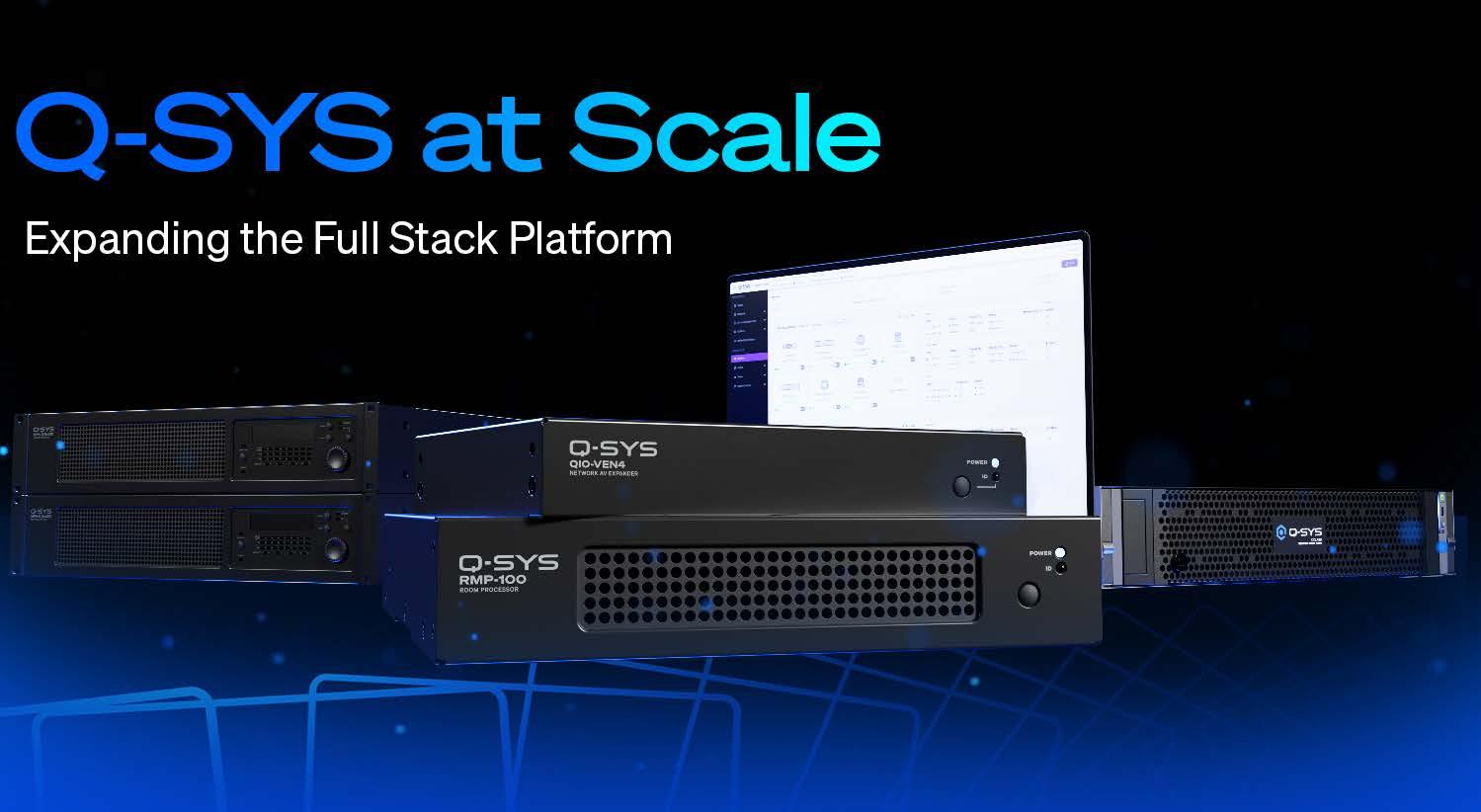
QSC Scales Q-SYS for the Modern Workplace
QSC has unveiled a significant expansion of the Q-SYS™ Full Stack AV Platform, broadening its reach across high-performance workplaces while deepening its capabilities for hospitality and entertainment applications. The latest release introduces new collaboration solutions designed for fast, scalable deployment, alongside native hardware and software innovations built to support complex, largescale AV environments.
The announcement includes the debut of Q-SYS RoomSuite Modular Systems, Q-SYS Connect for Zoom Rooms, MPA-Q Series network amplifiers, the X Class Server Core X50r, and the new Control & UCI Training Milestone Credential—collectively reinforcing QSC’s strategy to unify standardised and custom AV experiences under a single, cloud-managed platform.
Q-SYS RoomSuite Modular Systems. Q-SYS RoomSuite Modular Systems redefine how medium-to-large collaboration spaces are deployed at scale. While traditional Q-SYS Core-based systems continue to support bespoke, high-impact environments through Q-SYS Designer Software™, RoomSuite introduces a streamlined, web-based, no-code workflow optimised for speed, consistency, and repeatability.
Both approaches remain fully unified through centralised cloud management via Q-SYS Reflect®, allowing organisations to standardise collaboration spaces without sacrificing visibility or control.
At the heart of the system is the RMP-100, which combines processing with a built-in network switch for native Q-SYS collaboration
peripherals, advanced AV distribution, and bridging functionality. The system can be expanded with the QIO-VEN4, enabling localised I/O closer to user endpoints for greater deployment flexibility.
Q-SYS Connect for Zoom Rooms Designed for divisible and combinable meeting spaces, Q-SYS Connect addresses one of the most persistent challenges in modern collaboration
environments: consistent, intuitive room control. By dynamically linking all controllers to the active Windows-based compute device, Q-SYS Connect ensures seamless Zoom Rooms control regardless of how spaces are configured.
Using Q-SYS TSC-101-G3 touch controllers and lightweight Windows software, the solution delivers a certified Zoom Rooms controller experience that adapts in real time as rooms are combined or separated.
MPA-Q Series Network Amplifiers. The new MPA-Q Series introduces a mid-power tier to the Q-SYS network amplifier portfolio, extending native Q-SYS integration deeper into distributed audio and performance-driven applications. Targeted at hospitality, retail, corporate, and government environments, the series reinforces QSC’s commercial and entertainment heritage.
The lineup includes four-channel models delivering 250 or 500 watts per channel, and
eight-channel models delivering 125 or 250 watts per channel—providing flexible options for a wide range of installed audio scenarios. X Class Server Core X50r Built for the most demanding AV deployments, the X Class Server Core X50r stands as one of the most powerful AV&C processors available today. Designed for large-scale hospitality and entertainment installations, it combines the Q-SYS Full Stack AV Platform with enterprise-grade server hardware to deliver exceptional DSP performance.
With support for 10Gbps networking, Server Core X50r enables more than double the network audio channel capacity of the Q-SYS Core 5200, making it well-suited for complex, high-density AV systems.
Control & UCI Training Milestone Credential Rounding out the announcement, QSC introduced the Control & UCI Training Milestone Credential, one of the most rigorous recognitions in the Q-SYS training ecosystem. The credential is awarded only upon successful completion of the program’s culminating assessment, “The Big Exam,” available to professionals who have completed the Control & UCI Advanced course with a focus on Lua scripting.
QSC/Q-SYS
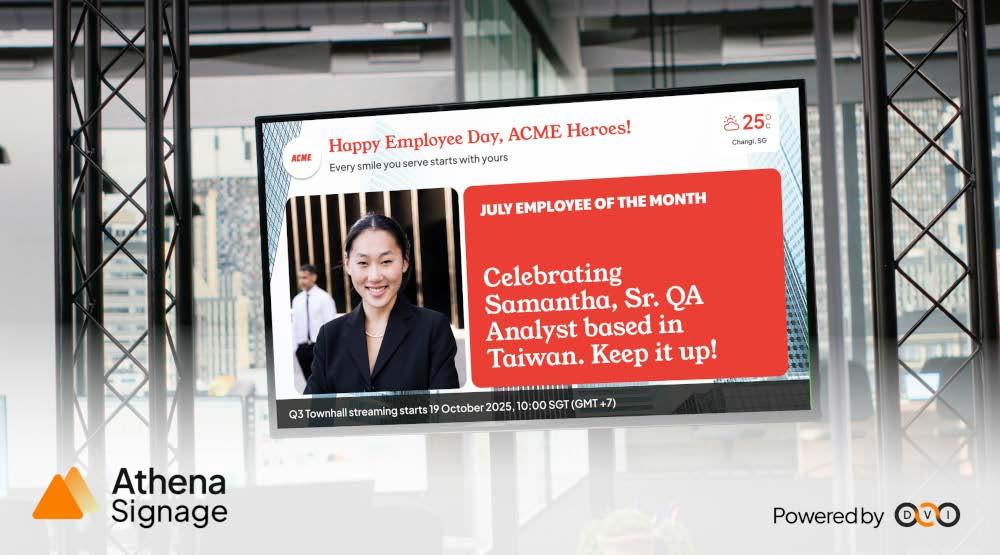
DVI Solutions Introduces Athena Signage: A Centralised Platform for Workplace Communication
DVI Solutions, a leading workplace technology provider in Asia, is proud to announce the launch of Athena Signage, a digital signage platform built to transform workplace communication.
Athena Signage delivers live town halls, channel posts and scheduled updates directly to workplace screens, while supporting instant, organisation-wide broadcasting for urgent messages. Meeting room availability syncs with company calendars to prevent double bookings, and live business dashboards provide real-time operational insights.
The platform also streams RSS news feeds and market data, including stock prices and currency rates, keeping screens continuously updated. Running natively on commercial
smart TVs and Chromium-based browsers, Athena Signage supports seamless deployment across mixed-device environments, turning every screen into a centralised, intelligent communication hub.
Suitable for All Organisations
Athena Signage integrates seamlessly into any workplace, adapting to the unique needs of every industry while ensuring communication remains clear, timely, and reliable.
In corporate offices, it keeps teams informed, enhances collaboration, and delivers a professional experience for visitors. In retail and hospitality, it energises spaces and delivers timely updates on promotions, menus, and events. In branch offices and educational institutions, it streamlines operations, supports
compliance, provides real-time information, and strengthens safety through immediate alerts.
Reliable and Secure
Athena Signage combines role-based permissions and centralised controls to ensure only authorised teams can manage content and simplify oversight. Its architecture scales from a single screen to hundreds, with automated checks that reduce downtime. With real-time
monitoring and remote management, Athena Signage delivers secure and uninterrupted workplace communication.
Athena Signage is available now for businesses of all sizes.
DVI Solutions/Athena Signage
Barco ClickShare Enters Teams Room Era with Certified Wireless Bundles
Barco is taking ClickShare beyond BYOD and firmly into the future of integrated meeting spaces. The company has announced the launch of its first ClickShare Hub wireless room system bundles certified for Microsoft Teams, developed in close collaboration with audio specialist Sennheiser.
Unveiled on January 7, 2026, the new bundles signal a strategic shift for ClickShare, positioning it as a fully fledged room system solution designed for today’s hybrid workplace. Built on the Microsoft Device Ecosystem Platform (MDEP), the certified systems combine Barco’s wireless collaboration expertise with Sennheiser’s TeamConnect Bar solutions to deliver secure, streamlined, and high-performance Teams Rooms.
The portfolio includes ClickShare Hub Core paired with Sennheiser’s TeamConnect Bar S
for small meeting rooms, and ClickShare Hub Pro combined with the TeamConnect Bar M for medium-sized spaces. Together, they offer a modular, future-ready approach that prioritises simplicity without compromising enterprise requirements.
By leveraging MDEP, the ClickShare Hub bundles deliver enterprise-grade security, manageability, and compliance, aligning with the expectations of IT teams while keeping the user experience front and centre. The latest generation ClickShare Button enables instant wireless content sharing for both employees and guests, whether joining a Teams meeting or presenting locally, removing friction from every meeting scenario.
The collaboration underscores a shared vision between Barco, Microsoft, and Sennheiser: to make hybrid meetings more inclusive, reliable, and intuitive. For organisations looking to standardise meeting rooms, the certified bundles offer a clear path forward that combines trusted brands, official Teams Rooms certification, and a design philosophy built around flexibility.
Barco/ClickShare
Bosch Expands PRAESENSA Monitoring for Complex Emergency Sound Systems
Bosch has expanded its PRAESENSA IP-based public address and voice alarm system with the introduction of the PRA-EOB end-of-branch device, designed to support supervised multibranch loudspeaker lines—a key requirement for compliant emergency sound systems.
Fully compliant with EN 54-16, the PRA-EOB was developed to address the realities of retrofit and expansion projects, where loudspeaker lines are often configured in tree or star topologies rather than simple loops. The device is installed at the end of a loudspeaker line, after the final loopedthrough speaker, enabling reliable supervision in more complex cable layouts.
Beyond branch supervision, the PRA-EOB can also be used to monitor individual loudspeakers. This capability is particularly relevant given that multi-branch configurations
are present in approximately 15% of typical PAVA installations, especially in facilities that have evolved.
Greater Flexibility for Retrofit Environments
By allowing each loudspeaker line branch to be supervised individually, the PRA-EOB enhances system integrity and improves fault detection across non-linear cable topologies. This makes it well-suited to buildings where existing infrastructure limits cabling options or where optimising cable lengths is essential.
Supporting multiple supervised branches on a single speaker line can also reduce overall cabling requirements and installation time—an important consideration in retrofit projects where disruption and labour costs must be carefully managed. The device integrates directly into the PRAESENSA system
supervision, with additional support provided through the PRAESENSA Open Interface API for monitoring and third-party integration.
Addressable Pilot Tone Technology
Rather than relying on impedance measurement, the PRA-EOB uses low-energy, addressable smart pilot tone handshake technology over the existing speaker cable. Each device on a branched line can be individually addressed and monitored without the need for signal thresholds or calibration, simplifying commissioning and long-term maintenance.
Operating above 25 kHz, the pilot tone remains inaudible, ensuring suitability for sensitive environments such as hospitals, hotels, and office spaces. The system is also stable across changing ambient temperatures, supporting consistent performance over time.
The PRA-EOB end-of-branch device is available and requires the latest PRAESENSA firmware to be installed on existing amplifiers to ensure full compatibility and functionality.
Bosch/PRA-EOB
The Office is No Longer a Place - It’s an Experience
By Andrew Tan, Regional Sales Director, Asia, Ross Video
The role of the office is undergoing its most significant transformation in decades. No longer defined purely by desks, meeting rooms, and workflows, the modern workplace is being reimagined as a destination—one that fosters connection, creativity, and culture in ways that remote environments cannot replicate.
As organisations reassess why people come together physically, experiential audiovisual (AV) technologies are emerging as a powerful catalyst in this shift. At its best, AV is no longer a layer of infrastructure hidden behind walls and ceilings; it is an enabler of shared experiences that give the workplace renewed relevance.
From Functional Offices to Magnetic Destinations
Today’s employees do not return to the office simply to complete tasks. They come for moments of collaboration, inspiration, and belonging—experiences that feel richer and more human than what can be achieved through a screen at home. Experiential AV plays a central role in shaping these moments.
We are seeing leading organisations, particularly within the technology sector, use large-format digital canvases to transform lobbies into immersive brand experiences.
These are no longer transitional spaces, but environments that communicate purpose, values, and identity from the moment employees and visitors arrive. Executive town halls, too, are evolving beyond traditional presentations into broadcast-style experiences, complete with dynamic visuals and polished production values that energise audiences— both in-room and remote.
In collaboration spaces, inclusive AV design is becoming critical. Adaptive layouts, intuitive interfaces, and equitable audio-visual experiences ensure that remote participants feel just as present as those in the room. When thoughtfully implemented, experiential AV does not draw attention to itself; instead, it elevates the experience of being together, making interactions feel natural, engaging, and meaningful.
Innovation with Intent: Making ROI Human
As experiential AV becomes more prominent, organisations face a common challenge: how to innovate without over-investing in complexity. The most successful deployments begin not with technology, but with intent.
Rather than asking what systems to install, forward-thinking organisations start by defining outcomes. What types of interactions should a space enable? How should people feel after a meeting, a town hall, or a collaborative session? Once these questions are answered, technology decisions become clearer—and far more costeffective.
A growing number of organisations are adopting modular AV strategies. Meeting spaces may begin with simple configurations, yet are designed to scale seamlessly into more sophisticated environments for all-hands events or executive communications. Unified control interfaces now allow employees to manage room settings, content, and displays without training, while template-driven content tools ensure brand consistency without the need for specialised creative teams.
When AV systems are intuitive, reliable, and purpose-built, they fade into the background. This is where true return on investment is realised—not in the hardware itself, but in the quality of human interaction it enables.
The Next Frontier of Workplace AV
Looking ahead, several key shifts are already redefining how AV will shape workplace engagement over the next three to five years.
First is the move toward software-defined, IPcentric workflows. Organisations are moving away from rigid hardware ecosystems in favour of flexible architectures that are easier to scale, update, and adapt as communication needs evolve.
Second is the rise of broadcast-inspired corporate communication. Employees increasingly expect internal communications to match the quality and immediacy of live media. In response, many organisations are building in-house studios or transforming multi-purpose spaces to support polished, high-impact messaging.
Finally, there is a shift toward large-canvas thinking. Instead of treating displays as isolated endpoints, organisations are embracing unified visual environments—spanning walls, signage, and multi-functional spaces—to deliver storytelling that is fluid, immersive, and deeply connected to brand identity.
Together, these approaches aim to create consistency and quality across every touchpoint, whether someone is seated in a boardroom, joining remotely, or walking through a workplace. The future of AV will not be defined by equipment specifications, but by experiences that feel seamless, human, and emotionally resonant.
Enabling Workplace 3.0
Workplace 3.0 demands the same clarity, creativity, and immediacy that audiences now expect from live media. This is where Ross Video brings a distinct perspective—drawing on decades of expertise in broadcast production, real-time graphics, and immersive environments to elevate workplace communication.
Our focus is on empowering people, not overwhelming them with technology. We help organisations transform leadership messages into compelling narratives, hybrid meetings into inclusive experiences, and large-format displays into purposeful communication platforms. Flexibility is central to our approach: enabling organisations to start small, expand over time, and future-proof their spaces as expectations continue to evolve.
We have seen this journey play out across global enterprises—beginning with pilot implementations in regional offices and scaling across industries, from high-tech and finance to government environments. In each case, the workplace evolves into a communication hub: a place where culture is amplified, stories are shared, and people feel inspired to connect.
As the workplace continues to evolve, one thing is clear—technology alone will not define its success. Experiences will. And experiential AV, thoughtfully designed and human-centred, will be at the heart of Workplace 3.0.
Ross Video
From Functional Offices to Magnetic Destinations
Across the board, Enovec, PTS Singapore and SQRD agree that organisations are shifting their focus from attendance to intention. Employees are not returning to the office to complete individual tasks—they can do that anywhere. What draws them back are experiences that remote settings cannot fully replicate: spontaneous collaboration, shared moments, and a sense of belonging.
Enovec observes that this change is reshaping workplace layouts. Large, formal meeting rooms are giving way to a more diverse mix of collaboration spaces—smaller huddle rooms, informal brainstorming areas, solo meeting pods, and adaptable town hall environments. Interactive whiteboards, flexible AV systems, and intuitive collaboration tools support fluid idea-sharing and natural engagement, reinforcing workplace culture rather than interrupting it.
Rico Sim from PTS Singapore’s perspective, shares that experiential AV plays a broader role in shaping the endto-end workplace journey. Beyond meeting rooms, it supports arrival experiences, wayfinding, storytelling, learning, and community-building. When thoughtfully designed, AV removes friction—ensuring everyone is clearly seen, heard, and able to contribute—while transforming everyday work into meaningful shared experiences.
SQRD ‘s Simon Long, frames this shift in cultural terms. Homes and cafés, not rival offices, are now the competition. People don’t invest in great sound systems or visit favourite cafés for efficiency—they do it for the experience. This same thinking, SQRD argues, must now apply to the workplace. AV should move beyond being hidden infrastructure to become a visible enabler of culture, capable of transforming town halls into daily collaboration hubs, immersive wellness environments, or personalised arrival spaces that foster immediate connection.
What Defines a Successful Workplace 3.0?
A truly successful Workplace 3.0 environment, according to Enovec, is one that feels effortless. Employees should instinctively know how a space works—whether it’s joining a meeting with one touch, sharing content seamlessly, or moving between rooms with consistent experiences. When people spend their time collaborating instead of troubleshooting technology, the workplace is fulfilling its role. Achieving this simplicity requires AV to be integrated holistically rather than treated as a standalone layer. PTS Singapore emphasises that AV must be governed like an IT service—
Enovec defines a truly successful Workplace 3.0 environment as one that feels effortless, where employees instinctively understand how a space works. ‘‘
secure, standardised, and remotely monitored— while also being designed in parallel with acoustics, lighting, interior design, and spatial planning. The result is a seamless ecosystem where technology supports people invisibly.
Data also plays a growing role. Insights into space usage and behaviour enable organisations to refine workplace design based on real-world patterns rather than assumptions. When AV, IT, data, and design are aligned, the workplace becomes adaptive, responsive, and genuinely human-centric.
SQRD distils this idea into what it calls the “FEEL” framework: Function, Experience, Engagement, and Longevity. Technology must first serve a clear purpose, then elevate the experience. When employees actively choose certain spaces because they enjoy using them, engagement follows—and data can be used to validate those choices. Longevity, meanwhile, ensures that systems remain supportable and cost-effective over time. If all four elements are present, Workplace 3.0 has truly been achieved.
Balancing Innovation with ROI
While experiential AV opens new possibilities, organisations remain cautious about return on investment. Enovec notes that ROI is only realised when technology is actually used.
Over-engineered systems with low adoption undermine both experience and value.
Instead, organisations should prioritise clarity, consistency, and cognitive ease—investing more heavily in high-impact spaces such as town halls, project rooms, or client experience centres, while keeping everyday collaboration spaces simple and intuitive.
Rico Sim echoes this sentiment, advocating for solving everyday friction first. Clear audio, strong visuals, and intuitive controls often deliver the greatest returns because they affect daily interactions. Innovation, when layered thoughtfully through modular upgrades or pilots, can then be scaled responsibly once value is proven.
From Simon Long’s standpoint, innovation is inherently an investment without guaranteed returns—but the risk of not innovating may be greater. By increasing the functional use of spaces—such as transforming a monthly-used town hall into a daily collaboration or wellness area—organisations can significantly amplify value for relatively modest additional cost. With workplace engagement reportedly at its lowest levels in years, the cost of inaction may be far higher than the cost of experimentation.
PTS Singapore believes AV should be governed like IT and designed holistically, creating an invisible ecosystem that quietly supports people.
A surreal and creative cinematic depiction of a "Workplace 3.0" environment, presented as an effortlessly intuitive space where employees instinctively understand its functionality. The scene is rendered with imaginative details and a dynamic composition, utilizing creative photography techniques and photorealistic elements to convey a sense of seamless integration and advanced design.
The Next Wave of Workplace AV
Looking ahead, all three organisations see experience-led design supported by intelligent technology shaping the next three to five years of workplace evolution. Enovec points to AIdriven systems that adapt audio, visuals, and layouts in real time, alongside advances in hybrid meeting equity such as conversationaware audio, spatial sound, and real-time translation.
PTS Singapore highlights audio-first design as a foundational priority—because without clear sound, even the most advanced visuals fall short. Managed services, workplace intelligence, and sustainability-by-design are also set to become baseline expectations rather than differentiators.
SQRD believes the most transformative changes will come from combining technology
with philosophy. Rather than AI that merely automates, the future lies in AI that genuinely empowers—personalised workplace interactions, intuitive meeting rooms that guide users naturally, and environments that feel responsive and human. These are the experiences that will define the workplace of the future.
Reclaiming the Purpose of the Office
As Workplace 3.0 takes shape, experiential AV is no longer about spectacle or novelty. It is about creating environments where people feel connected, supported, and inspired to be together. When technology fades into the background and experience comes to the fore, the office regains its relevance—not as a requirement, but as a destination.
Enovec PTS Singapore SQRD
SQRD believes that technology in a truly successful Workplace 3.0 must FEEL right—delivering Function, Experience, Engagement, and Longevity.
AUSTRALIA
Kramer AVoIP Creates a Connected, Multi-Zone Experience for Australian Surf Club
Kramer delivers a high-performance, networked AV system at Dicky’s Surf Club, bringing flexibility, reliability, and superior audio visual impact to an iconic coastal venue
Set against Australia’s spectacular Queensland coastline, Dicky Beach Surf Club serves as both a vital community hub and a vibrant social destination for members, locals, and visitors alike. From early-morning patrol briefings to lively weekend functions, the club’s spaces host a constant flow of activity. To enhance these experiences, the venue required a versatile, easy-to-use AV system capable of supporting everything from live sports and community presentations to private events and celebrations.
Recognizing the need for a reliable, scalable, and high-quality networked AV solution, the club turned to Box Security Sound & Vision, with control system programming by Smart Home Programming. Together, they designed and delivered a Kramer AVoIP solution that provides seamless video distribution, zonebased control, and powerful audio performance — all optimized for the club’s dynamic daily operations.
Project Name: Dicky Beach Surf Club
Project Location: Queensland, Australia
Project Segment: Entertainment
Systems Integrator: Box Security Sound & Vision
Control System Programming: Smart Home Programming
AV Highlight: The venue required a versatile, easy-to-use AV system capable of supporting everything from live sports and community presentations to private events and celebrations.
The surf club wanted to transform its AV infrastructure to meet diverse operational needs, including multiple entertainment and presentation zones across bars, dining, and training areas. Distributing content from eight video sources to 18 displays and a large LED wall, the solution required simple, centralized control that staff could manage intuitively, even during busy events.
“The surf club environment is unlike any other,” explained Chev Durrant, Telecommunications Technician at Box Security Sound & Vision “You’re dealing with open spaces, ambient noise, and a wide range of content — from background music and live TV to training sessions and announcements. We needed a system that could switch seamlessly between them while remaining rock solid and easy to use.”
Flexible Content Covered
To deliver that flexibility, the integrator deployed a Kramer AVoIP backbone based on KDS-EN7 encoders and KDS-DEC7 decoders, delivering lossless, low-latency 4K video across the entire
site. A Netgear GSM4248P Managed PoE+ switch forms the core of the network, ensuring smooth communication between devices and guaranteeing reliability even under demanding use.
Each of the eight HDMI sources — including broadcast feeds, media players, and event inputs — is encoded and distributed to 18 displays around the venue. Four additional decoders feed into a Novastar H2 processor, driving a stunning Unilumin 1.5mm LED wall (3m x 1.68m) in the club’s main function area.
Control across all six zones is managed by the Kramer KC-VirtualBrain-1 platform, programmed by Smart Home Programming. This provides intuitive, centralised command of displays, audio levels, source selection, and lighting presets.
Making Waves with Improve Operations
The completed system gives the Surf Club an AV environment that’s dynamic, reliable, and simple to operate, supporting everything from relaxed dining to full-scale community events.
Chev added: “The Surf Club wanted a system that works – and now anyone that works here can pick it up and get the whole system up and running in seconds. With us choosing the Kramer system, any staff member can pick up their work iPad, choose where they want a source to be displayed and select what audio they want. It’s all very user friendly.”
Smart Home Programming credits Kramer’s technology as the foundation of the project’s success. “I’ve been working with Kramer Control for the last ten years,” said David Bowdler, owner of Smart Home Programming. “I find it a great platform that’s very easy to use. Their support is top notch and Kramer Control allows
for remote support and remote programming which we can access from anywhere if required.”
Chris Harding, solutions architect at AVA Distribution, who supplied Kramer technology to the venue, added: “This project shows the benefits of a trusted networked system. With Kramer’s KDS range of encoders and decoders we can grab a selected HDMI source, put it on the network and pull it out anywhere in the venue. The beauty of Kramer AVoIP is that it’s flexible and you can grow it over time. It’s a really easy system to install because it’s a single cable run solution and PoE powered.”
“The transformation has been incredible,” concluded Natalie Bell, General Manager at Dicky Beach Surf Club. “We can show live sport across multiple areas, host corporate presentations, or run member events — all with a few simple touches. The quality and control are outstanding, and it’s made our day-to-day operations for our 65 staff far more efficient.”
KramerAV
CHINA
Christie Laser Projection Brings Kaifeng’s Past to Life After Dark
24-projector installation transforms ancient courthouse and lakeside landscape into an immersive nighttime cultural experience
Stunning projections on the façade of the Heavenly King Hall and gauze screens are major highlights of the performance, depicting legendary Song Dynasty judge Bao Zheng
As night falls over Kaifeng city in Henan, China, the ancient capital of eight dynasties is reawakened by light. Christie 1DLP laser projectors now power Moon Over Kaifeng’s Southern Courtyard, a large-scale nighttime cultural performance that turns the city’s
historic architecture, landscapes and waterways into a living, luminous stage.
Delivered and commissioned by Jianye Display the immersive experience brings together 24 Christie laser projectors from the HS Series,
Project Name: Moon Over Kaifeng
Project Location: Henan Province, China
Project Segment: Entertainment
Systems Designers and Integrators: Jianye Display
AV Highlight: To align laser projection clarity across stone façades, gauze screens, water features and landscape elements
Key AV Brand: Christie Digital
Inspire Series and Captiva range. Projection mapping and live performance are woven into a unified narrative that animates a historic government courthouse and its surrounding lake, creating a signature cultural tourism attraction that supports Kaifeng’s vision of integrated culture, commerce and night-time economy development.
“This project demanded absolute precision at every stage, from structural validation to sub-millimetre calibration,” said Zhiqiang Tan, Project Manager at Jianye Display. “The Christie laser projectors used in the performances provided the brightness, reliability, and image consistency needed to transform complex architectural and natural surfaces into a cohesive, emotionally powerful nighttime experience.”
From concept through to commissioning, Jianye Display’s technical team addressed significant engineering and alignment challenges. Through meticulous calibration, projection focus variance was reduced to within 0.5 millimetres, ensuring crisp, consistent imagery across stone, gauze, water and landscape elements.
Each evening, the performance opens with the beat of drums and a dramatic 3D countdown at the city gate tower. Gauze screens, mountain backdrops, a monumental stone tablet and
the imposing Heavenly King Hall are brought together in a carefully choreographed sequence, culminating in the iconic command of the legendary Song Dynasty judge Bao Zheng, also known as Justice Bao: “Ascend the court!”
At the heart of the production, the façade of the Heavenly King Hall becomes a vast “living mural.” A 31-metre-wide by 17-metre-high projection, powered by six Christie HS Series laser projectors delivering 19,150 lumens each, floods the building with vivid imagery that anchors the show’s historical storytelling.
On either side of the hall, gauze screens measuring 16 metres by 3 metres add depth and movement to the live performances. Rearprojected by 10 Christie Captiva DWU500S ultra short throw laser projectors these layered visuals surround the audience with a sense of scale while maintaining an intimate connection to the performers on stage.
In front of the hall, a towering stone tablet becomes another focal point. Two DWU760-iS laser projectors create a three-sided projection that reveals the Chinese character for “integrity” stroke by stroke, as though carved by light itself. Spanning 3.8 metres wide by 3.5 metres high across all three faces, the sequence delivers one of the production’s most powerful symbolic moments.
The experience continues in the rear garden, where Mingjing Lake provides a mirror-like canvas for projection and performance. Six HS Series laser projectors illuminate a 30-metrehigh mountain backdrop and a 17-metre-wide water screen. Here, visuals unfold like a painted scroll, blending poetry, moonlight and live action to celebrate the works of Song Dynasty poet Su Shi.
Gene Wang, director of ProAV Sales for China, Christie, commented, “‘Moon Over Kaifeng’s Southern Courtyard’ is a powerful example of how projection can bridge heritage and modern storytelling. By combining multiple Christie laser projectors in a single, large-scale deployment, the project showcases how advanced visualisation can elevate cultural tourism and bring history vividly to life.”
Christie Digital Projectors
ALL IMAGES: Images courtesy of Jianye Display
Christie HS Series laser projectors
Christie Captiva DWU500S ultra short throw laser projectors
MACAU SPECIAL ADMINISTRATIVE REGION (SAR)
Blurring Reality and Fantasy: Inside Tria Spa’s Immersive Experience Pool at MGM MACAU
How cutting-edge AV, sensory design, and creative collaboration are redefining luxury wellness through technology
At MGM MACAU’s Tria Spa, wellness is no longer confined to quiet contemplation and traditional treatments. Instead, guests are invited into a transformative, multisensory environment where technology, architecture, and nature converge in a carefully choreographed experience. Central to this vision is the Experience Pool—a groundbreaking installation that merges immersive visuals, spatial audio, lighting, and physical water effects to create a journey that oscillates between serenity and exhilaration.
For systems integrators and hospitality technologists alike, the Experience Pool represents a new benchmark in experiential design—one that demonstrates how advanced AV systems can elevate emotional engagement while maintaining the core principles of wellness and relaxation.
A Vision Beyond the Traditional Spa
The concept behind the Experience Pool was rooted in a desire to redefine what spa and well-being could be. Rather than limiting the
Project Name: Experience Pool at MGM MACAU Tria Spa
Project Location: MGM MACAU, Macau SAR
Project Segment: Hospitality
Technical Team: MGM MACAU
Visual Content: Blue Alchemy Labs and Nature Relaxation
AV Highlight: Transformation of the Experience Pool at the MGM MACAU Tria Spa into a multi-sensory environment that merges immersive visuals, spatial audio, lighting, and physical water effects to create a journey that oscillates between serenity and exhilaration.
Key AV Technologies: Absen AW2.5 LED (with custom manufacturer modifications), K-Array KV102II Vyper speakers & KU331 Rumble subwoofers, K-Array KA28 Kommander amplifiers, Pixera mini-Quad media server, Adder AdderView 4 Pro & ALIF1102 T/R (KVM), QSC Q-Sys Core110f for background music processing
guest journey to passive relaxation, the team envisioned an experience that blends reality with fantasy, allowing guests to feel both soothed and invigorated.
At its heart, the pool is designed as a multi-sensory narrative. The environment demonstrates MGM’s philosophy of combining advanced technology with genuine hospitality— proving that true luxury lies not in excess, but in emotionally engaging, transformative moments that awaken the senses and linger well beyond the visit.
Creative Collaboration: Where Art Meets
Engineering
Delivering such a layered experience required close collaboration between creative and technical partners. The project was developed through close collaboration across the MGM MACAU Teams. In content direction, show programming, and guest experience design were driven by the Resort Technology team, supported by creative partners Blue Alchemy Labs contributed the immersive storm visuals,
while Nature Relaxation’s content added tranquil, restorative scenes to the programming. Technical partners — including Absen for the customized LED displays, K-Array for speakers, Pixera for the media server, Adder for KVM and system management, QSC for processing, and Crestron for operational control interfaces — ensured that all audiovisual, control, and environmental systems performed seamlessly in the spa environment. This collaborative approach ensured that technology, storytelling, and guest wellbeing remained perfectly aligned throughout the project.
This blend of creative storytelling and technical precision allowed for a dynamic content schedule. Storm sequences surge with energy, while nature visuals restore balance, ensuring guests can experience multiple emotional states within a single session.
From Concept to Immersion
The creative process began with a singular question: How will the guest experience this from every angle? With viewers immersed in water and positioned close to the displays,
sightlines and viewing angles became critical design considerations.
High-definition LED screens were engineered to envelop the pool, delivering distortionfree visuals even at close proximity. Artistic vision was matched with meticulous technical execution, ensuring that panoramic scenes remained immersive regardless of where guests were seated or soaking.
Balancing excitement and tranquillity were equally important. Storm sequences were intentionally dramatic, yet always resolved into moments of calm—allowing guests to transition naturally from heightened sensory engagement back into deep relaxation. Extensive on-site testing ensured flawless integration within the spa’s unique environmental conditions.
Choreographing Calm and Intensity
The Experience Pool operates on a carefully designed rhythm. Guests are initially surrounded by serene natural imagery, fostering a sense of escape and calm. Every 30
minutes, a storm sequence can be triggered, transforming the environment as lightning flashes across LED walls, waves crash, and rainfall intensifies.
Crucially, the experience never overwhelms. Each dramatic peak is followed by a gentle return to stillness, with visuals and sound dissolving into a calm sea surface. This intentional choreography ensures the pool caters to a wide range of guest moods and preferences—offering both stimulation and restoration in equal measure.
Sound, Water, and Sensory Depth
Sound design and physical interaction play a central role in bringing the Experience Pool to life. Thunder, rain, and ambient nature soundscapes are delivered through individually controlled, multi-channel audio tracks, precisely synchronized with visuals and lighting cues.
Audio is delivered via K-Array KV102II speakers paired with KU33 I subwoofers, chosen for their full-spectrum performance and IP65-rated
durability in high-humidity environments. The water itself helps absorb sound, minimizing audio spill into other spa zones and preserving the overall tranquility of Tria Spa.
Adding a tactile dimension is the customizable rain shower system, positioned above the pool. As visuals depict rainfall, guests physically feel changes in water intensity—bridging the gap between digital illusion and realworld sensation, and significantly enhancing immersion.
All elements—audio, lighting, visuals, and rainfall—are centrally managed by a Pixera mini-Quad media server, ensuring precise synchronization and reliable delivery of complex sensory sequences.
Overcoming Technical Challenges in a Spa Environment
Producing content for a spa presents unique challenges, particularly when high-impact visuals and sound must coexist with relaxation. Close-range LED viewing required precision
mounting and iterative on-site calibration to maintain seamless, distortion-free imagery.
Audio and visual pacing were equally critical. Pre-authored EQ curves were developed for each audio module, emulating natural acoustic dynamics and preventing over-stimulation during intense moments.
Recognizing the Experience Pool’s appeal as a social media destination, LED manufacturer Absen worked closely with MGM to enhance its AW2.5 LED product for improved filming performance in low-light conditions. Overhead and effect lighting were also carefully designed to support photography and videography without compromising ambiance.
Environmental resilience was another priority. All AV hardware was selected for high ingress protection ratings, supported by protective enclosures and sealing to ensure long-term reliability in a humid, aquatic environment.
Operational simplicity was addressed through an intuitive control interface using Crestron
TPC-770 touch panels, enabling non-technical spa staff to manage complex shows with minimal training.
Integrated Visual and Control Solutions
The Experience Pool’s visuals are delivered via custom-installed LED screens on two sides of the pool, aligned precisely with architectural lines to preserve sightlines and immersion. All systems are orchestrated through centralized control, allowing real-time coordination of visuals, lighting, and water effects.
Guest Impact and Industry Recognition
Guest response has been overwhelmingly positive. The Experience Pool has driven increased spa bookings and quickly become one of Tria Spa’s most shared features on social media. Guests frequently describe the journey as both emotionally and physically restorative— an experience that extends beyond the spa through shared moments of awe online.
More importantly, the immersive content has elevated Tria Spa’s positioning within the luxury hospitality landscape, setting a new benchmark for technology-led wellness experiences and earning recognition for innovation.
Lessons for Hospitality and AV Professionals
For hospitality teams considering immersive guest experiences, the Tria Spa project offers valuable insights. Success depends on deep collaboration between creative and technical partners, an understanding of operational realities, and a commitment to seamless system integration.
Equally important is the willingness to evolve— continuously updating both technology and content, and actively incorporating feedback from guests and operational teams. Ultimately, immersive experiences succeed when technology serves storytelling, emotion, and human connection.
At Tria Spa, MGM MACAU has demonstrated that when imagination and engineering move in harmony, wellness can become something truly extraordinary.
MGM MACAU Crestron
Blue Alchemy Labs K-Array
Nature Relaxation Pixera
Absen
INDIA
Banajara Virasat – Part-II
An Audio-Visual Tribute to a Grand Tradition
The ‘Nagara’ of an ingenious technology play in museum experience
By Ram Bhavanashi
The Banjara Virasat museum is a classic case of one of the most innovative and ingenious exploit of audio-visual technology to weave a myriad variety of immersive experiences. The sheer scaling of technology exploit and the expertise weaved in – in the face of a very challenging timeline – makes it one of the most incredible museums in the country and the region.
In the Part-I of our exclusive feature on the massive install, published in the January 2026 issue of SI Asia, we had discussed some essential features that characterised the install. In this second and concluding part, we present what all had gone into shaping the install what it is today.
The LED Mesh on the Nagara exterior.
The Banjara Virasat museum, in a nutshell, is like a great tribute to a grand tradition that lived through ages; a tradition vibrant, and colourful but without a proper connect; a tradition resilient but with no recorded voice; a tradition that had its own identity but without a cognizable visibility.
The client vision was to create an experience that was emotionally resonant, and a museum in which the Banjara community felt truly seen and represented.
It is, therefore, an assiduous effort to restore dignity and visibility to the Banjara community, presenting their legacy with the respect, depth, and sensitivity it deserved. The museum goes beyond mere display of exhibits; it is rather a living narrative that allows visitors to connect with the community’s journey, traditions, and spirit in a profound and lasting way.
“It succeeds not only in presenting history but in evoking deep emotional responses, creating a meaningful and immersive experience for visitors,” says Amardeep Behl, the Design Habit chief.
Design Habit’s involvement in the project spanned across multiple critical dimensions- indepth cultural and contextual research, holistic experience design, on-ground production, technical execution, and programming of the entire visitor journey. From conceptualization to realization, the AV firm played a central role in shaping the narrative structure and translating it into a seamless, immersive experience— integrating art, storytelling, technology, and space design.
The team also developed detailed operational frameworks to ensure the museum’s long-term sustainability and smooth functioning.
Monumental – as the colossal museum stands like – but it hasn’t come without challenges of its own size. Content, technology procurement, execution, and timeline all had their own set of challenges.
Content development: No ready research and historical narrative. With the Banjaras spread throughout the country, with no single authority on any single topic, content procurement as well as validation was a very critical. That Banjara language has an undercurrent of the language of their respective states, selecting a common dialect was arduous. Common Banjara people had to be convinced to perform as various characters for photography and videography.
There were at least 150 such characters, who had to be coordinated throughout, explains the company project team. Graphic compositions, required from the 8th-20th century, were not readily available. Elements, foliage, fauna, all had to be researched upon. As many as 13 important Banjara personalities, presented as mannequins, and 46 social reformers, from all parts of the country. They had to be approved by as many family members and social groups.
The project team had delved deep into a multitude of memoirs and books by Mediaeval and European travellers, officers, and historians for developing a narrative for the 13 galleries that the museum comprises. Scripts were written in Hindi, Banjara and Marathi.
“A committee comprising as many as 51 Banjara scholars was set up to deliberate and validate the scripts, with a standard version of Banjara language. A total of 150 characters (and their families) were chosen for their facial and bodily features were brought to the museum site for the content shoot.
The Banjara women’s hairdo with jewellery.
“The Banjara women's hairdo was one very typical challenge; it requires over an hour of time along with jewellery,” recalls the project team, “the antiquity of the jewellery rendered it seldom available. It was hard to procure them.”
For the first time, the Banjara community has been extensively photographed and documented. Over 1,000 Banjaras were photographed during a country-wide tour. The content team did intense travelling, engaging directly with communities, to authentically document lived experiences and oral histories.
“Historically, only three depictions of a Banjara tanda (caravan) exist in Indian art,” explains the team. “We recreated a traditional tanda with Banjara actors, animals, and props, captured through photo and video. These visuals now serve as reference material for the museum artworks.”
Ambitious timeline: Executing a project of this scale in the remote location of Pohradevi was itself a major achievement, considering the extremely challenging 15-month timeline. The project had to work at an exceptional pace from design to execution. Design began in July 2023, with Phase-1 running until February 2024. Phase-2 comprising site mobilization and execution, took place from March to October,
with on-site production concentrated in the final three months. The museum was inaugurated on 5 October 2024 by the Indian Prime Minister Narendra Modi.
Technology procurement: Delivering a technology-powered museum in a remote rural location was extremely demanding. Transportation constraints, unreliable network access, limited availability of skilled labour, and restricted site facilities posed persistent challenges. A chain of logistics was established with Nagpur as the centre, and all equipment travelled to Poharadevi, crossing a long distance of 300 km.
Structural: Adapting the building to meet museum requirements after the structure had already been constructed was challenging. They had to implement specific measures to control sunlight and glare to comply with the show and gallery requirements.
While the design involved use of audio guides for a personalized zonal audio, the ground floor did demand acoustic treatment as it was the space for larger-format shows. The project team had to construct acoustic walls to support sound isolation and clarity.
Technology play: The Banjara Virasat stands as one of the largest museums in India siwth extensive use of diverse technologies. A wide range of globally renowned brands were blended into integration:
• Christie projectors
• Bose audio systems
• Dell show servers
• Watchout media controller software
• Martin show lights (moving heads)
• IGuzzini and IBL architectural and exhibit lighting
• Eway special effects machines
• Ewtx’ fog, mist, and fireworks
• Dante network platform
• Samsung video screens and more…
The entire museum is centrally managed using Medialon show control system. All elements— including lighting, special effects, PLCs, projectors, and speakers—are pre-programmed and synchronized with precise timing through the show controller. The system is designed to operate automatically, requiring only a single ON/OFF input from the staff.
Visitor groups of 30 people move through the experience in timed intervals. As each group progresses, all technology elements are triggered in perfect sync with their movement. The experience is further enhanced by motion sensor–enabled headphones that offer multilingual audio narration.
As visitors move through different zones, the audio content automatically aligns with the corresponding physical effects, lights, and projections. Every aspect of the experience has been seamlessly integrated to deliver a cohesive, immersive journey.
The Beginning of the Experience
It begins with the Atrium that serves as the central space of the building, rising eight floors to a height of approximately 100 feet. All four walls are used for a continuous 360-degree
The hyper-realistic mannequins.
projection, created using thirteen 23,000-lumen Full HD Christie projectors, delivering seamless visuals. This immersive projection accompanies a powerful song that describes the many characteristics of the Banjaras.
Thirteen hyper-realistic mannequins are arranged at the centre of the atrium, around a bonfire. The fire effect is created using a water-vapour flame machine. The environment is further enhanced with dynamic movinghead fixtures and DALI-controlled static lighting, completing a deeply atmospheric and immersive experience.
The following gallery is a celebration of the material culture of Banjara community with numerous vertical printed textiles from different Indian states surrounding the visitor, each integrating subtle tech elements that activate regional stories as one moves past. A 13k lumens projector and screen framed with a Banjara textile border blends craft and digital media to present the political status of Banjaras across India.
Further enhancing this fusion, a slew of 32” screens are seamlessly integrated into circular cut-outs within the textiles, creating a natural and cohesive digital-material blend. On the
opposite side of the gallery, 98” and 65” displays set the mood for Banjara celebrations, complemented by physical set elements that complete the immersive environment.
Audio guides from look2innovate, provide the visitors with personalized zonal audio, allowing them to explore the galleries in multiple languages, enabling each visitor to choose the language they are most comfortable with. A song inside the lift transports visitors into an archaic Banjara world. Physical sets, Banjara houses, animals, illustrated landscapes, and curated materials like fabrics, form the backdrop for the life story of a Nayak (head of the tanda), shown from birth to death.
Featured in the fourth floor AV, a range of special-effect machines—including watervapour flame, fog, sparkle, rapid-shot, and mist systems—are used to heighten immersion, with mist effects simulating rainfall during the Teej festival. All effects, displays, and moving elements are operated through an integrated automation and control system, ensuring precise timing and seamless synchronization.
One of the ingenious tech exploit comes to play here- automation as a storytelling device. Sliding panels, printed with an image of the same house that exists behind them, initially conceal the physical set. When the panels move away, they reveal the transformed version of the house, allowing visitors to experience a narrative time shift of five years within the storyline.
Similarly, roll-down screens are used to introduce key narrative moments through audio-visual content before retracting to reveal the corresponding physical sets, creating a smooth transition from mediated storytelling to real space. Large LED displays are carefully integrated into the environment to feel like part of the architecture rather than separate screens. Shark-tooth gauze enables dramatic visual reveals, while rotating platforms (turntables) add movement and depth to the scenes. Together, these elements create a richly layered, dynamic, and emotionally engaging storytelling experience.
A grand shallow 3D dome show is created with five 4K, 13,000-lumen projectors seamlessly mapping content across the dome’s surface.
A 5.1 surround sound configuration with BOSE DM55, SMS118, and AM10 further immerses visitors in the world of the Banjaras through rich, enveloping AV.
Banjara Celebrations.
Dome Show projection mapping (top) & 270-degree projection mapping with bullocks (bottom).
The next big tech experience is a 270-degree projection in the third floor featuring three 4k 13,000-lumen projectors showing as many as 24 hefty bull mannequins laden with gunny sacks, conveying the vast scale of the Banjaras’ cattle wealth. The visual experience is reinforced by a synchronized BOSE sound system (DM55, SMS118, and AM10) and rumbling platform technology that allows visitors to physically feel the force of these migrations.
Dynamic moving-head lights, DALI-controlled lighting, atmospheric fog effects, and a motorized roll-up/roll-down screen further enhance the environment, creating an immersive and emotionally charged storytelling experience. As the platform begins to move, visitors pass through three suspended projection screens, with content mapped onto them to initiate the narrative. Seated on a 30-seater motorized gliding platform, visitors experience the Banjaras as an embodiment of frugal, effortless, and transient living, as described by Bhakti saints and poets.
The journey culminates in the 270-degree projection mapping over a physical set, where visuals and scenography shift seamlessly to carry the story forward. A projection combo of three 4K 13,000-lumen and three 7,500-lumen units, enhanced with six moving-head lights, DALI-controlled dynamic lighting, and low fog effects immerse the visitors in the world of Banjaras.
The Flying Theatre experience in the second floor carries visitors across the Deccan, accompanied by an evocative song. The ride system operates on six degrees of freedom (6-DOF), enabling controlled movement across surge, sway, heave, roll, pitch, and yaw to simulate the sensation of flight. The system focuses purely on motion-based immersion, without the use of additional environmental or sensory effects.
The theatre comprises two synchronized motion platforms, each accommodating 15 seats. Both platforms are driven by a unified motion control system and execute identical motion cues simultaneously, ensuring a consistent and coordinated experience for all visitors. As the seats elevate and move through choreographed flight sequences, visitors are enveloped by a custom-designed torus screen—a continuous, double-curved surface.
This double-curved surface, according to the project team, presented the integration team with significant challenges in both fabrication and structural execution. Equally complex was the task of mapping visual content onto the geometry of the screen.
“High-precision projection mapping and detailed calibration were required to achieve seamless, distortion-free imagery across the entire torus surface, reinforcing the illusion of uninterrupted aerial movement,” explain the project team.
Once achieved, the torus screen fills the entire field of vision with beautifully mapped 4K imagery, creating the sensation of truly flying over the landscapes where the Banjaras lived, travelled, and settled. The experience of this flying theatre is delivered by two 13,000-lumen Christie 4K projectors, and enriched by a 5.1 surround sound system from BOSE (DM55, SMS118, and AM10).
The Flying Theatre.
A yet another immersive AV experience on the second flor is the animatronic mannequin of Sevalal Maharaj, revealed on a rotating turntable, speaks to devotees alongside his animals, creating one of the museum’s most striking moments. A back projection extends the scene beyond the physical set, enriching the environment and delivering a fully immersive experience for visitors.
A series of four roll-down screens first creates a panoramic view, setting the stage for the unfolding narrative. Behind one of these screens, one animatronic mannequin brings Vasantrao Naik, the former Chief Minister of Maharashtra, to life as he speaks to visitors. Another screen reveals a holographic projection on a pepper scrim, produced using an ultra–short-throw projector, bringing Ramrao Maharaj, the spiritual guru of the Banjaras and Sanjay Rathod together as they declare the museum a global cultural heritage monument for the Banjara community.
The Nagara (Tribal Drum) Beat
The exterior shell of the building – shaped like a Nagara, or the tribal drum – actually sets the tone for the inner AV experience featuring a light and sound show, with a transparent active LED mesh as the primary display surface. A rectangular surface of MS structure of approx. 1,000 sqm is treated with a P40 pixel-pitch
LED mesh. The high brightness and weatherresistant, LED mesh, designed for outdoor use, integrates seamlessly with the architecture without obstructing visibility.
The visual experience is enhanced through six synchronized 24W lasers, sixteen 750W movinghead fixtures, and special-effect equipment including fog and flame machines, working together to create a dynamic and immersive environment.
All elements come together in a 20-minute multimedia show titled ‘The Glory of the Banjara,’ which celebrates the rich cultural heritage, traditions, artistry, and vibrant spirit of the Banjara community through a powerful combination of music, projection, laser effects, and special effects.
The entire network of LED mesh, lasers, lighting, and special effects is programmed and controlled through an iPad-based system, ensuring precise synchronization and seamless operation of the outdoor spectacle.
“Today, Banjara Virasat stands as one of the largest museums in India to make extensive use of diverse technologies,” says the prideful Design Habit chief Amardeep. “It aspires to seamlessly blend immersive technology with traditional crafts and thoughtful design, creating a powerful and enduring cultural experience.”
According to him, a deeply rewarding outcome has been the response from the Banjara community. “It is their history we’ve brought to life, and the way they have embraced it is moving. Many visitors leave visibly emotional, often with tears in their eyes.”
It’s a Virasat, (heritage) worth treasuring for posterity.