Queen Anne &Magnolia news
Queen Anne & Magnolia Since 1919
Queen Anne & Magnolia Since 1919
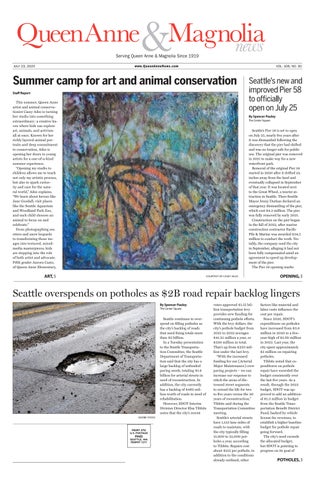
This summer, Queen Anne artist and animal conservationist Casey Ailes is turning her studio into something extraordinary: a creative haven where kids can explore art, animals, and activism all at once. Known for her richly layered animal portraits and deep commitment to conservation, Ailes is opening her doors to young artists for a one-of-a-kind summer experience.
“Opening my studio to children allows me to teach not only my artistic process, but also to spark curiosity and care for the natural world,” Ailes explains. “We learn about heroes like Jane Goodall, visit places like the Seattle Aquarium and Woodland Park Zoo, and each child chooses an animal to focus on and celebrate.”
From photographing sea otters and snow leopards to transforming those images into textured, mixedmedia masterpieces, kids are stepping into the role of both artist and advocate.
Fifth grader Aurora Casto, of Queen Anne Elementary, Staff Report

By Spencer Pauley The Center Square
Seattle’s Pier 58 is set to open on July 25, nearly five years after it was dismantled following the discovery that the pier had shifted and was no longer safe for public use. The original pier was removed in 2021 to make way for a new waterfront park.
Removal of the original Pier 58 started in 2020 after it drifted six inches away from the land and eventually collapsed in September of that year. It was located next to the Great Wheel, a tourist attraction in Seattle. Then-Seattle Mayor Jenny Durkan declared an emergency dismantling of the pier, which cost $4.3 million. The pier was fully removed by early 2021. Construction on the pier began in the fall of 2022, after marine construction contractor Pacific Pile & Marine was awarded $34.5 million to conduct the work. Notably, the company sued the city in September, alleging it had not been fully compensated amid an agreement to speed up development of the pier.
The Pier 58 opening marks
ADOBE STOCK
By Spencer Pauley The Center Square
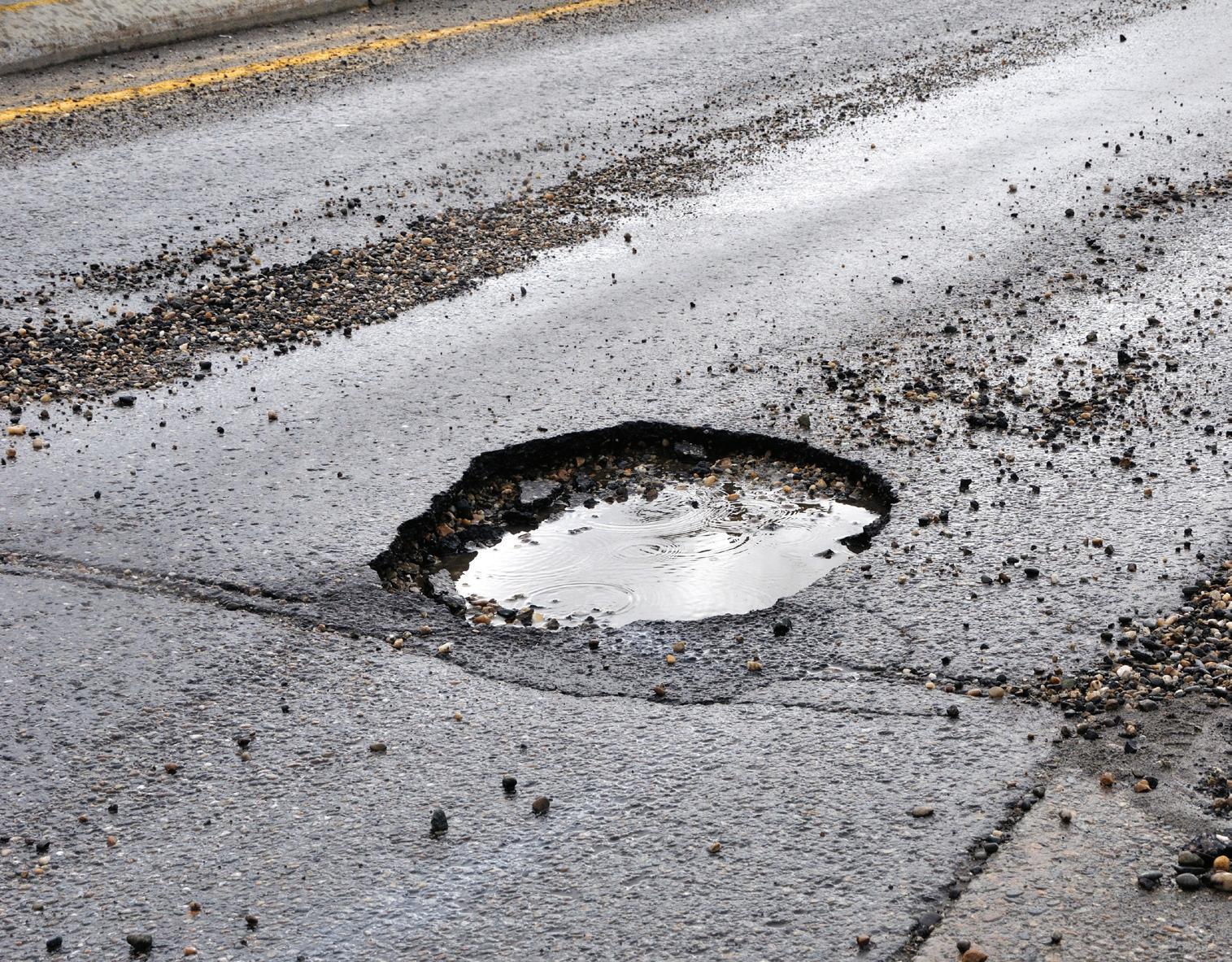
Seattle continues to overspend on filling potholes as the city’s backlog of roads that need fixing totals more than $2 billion.
In a Tuesday presentation to the Seattle Transportation Committee, the Seattle Department of Transportation said that the city has a large backlog of unfunded paving needs, totaling $1.8 billion for arterial streets in need of reconstruction. In addition, the city currently has a backlog of $460 million worth of roads in need of rehabilitation.
However, SDOT Interim Division Director Elsa Tibbits notes that the city’s recent
voter-approved $1.55 billion transportation levy provides new funding for continuing pothole efforts. With the levy dollars, the city’s pothole budget from 2025 to 2032 averages $41.25 million a year, or $330 million in total.
That’s up from $250 million under the last levy.
“With the increased funding for our [Arterial Major Maintenance] crew paving projects – we can increase our response to stitch the areas of distressed street segments to extend the life for two to five years versus the 20 years of reconstruction,” Tibbits said during the Transportation Committee meeting.
Seattle’s arterial streets have 1,153 lane miles of roads to maintain, with the city typically filling 15,000 to 25,000 potholes a year, according to Tibbits. Repairs cost about $152 per pothole, in addition to the conditions already outlined, other
factors like material and labor costs influence the cost per repair.
Since 2020, SDOT’s expenditures on potholes have increased from $3.8 million in 2020 to a fiveyear-high of $5.68 million in 2022. Last year, the city spent approximately $5 million on repairing potholes.
Tibbits noted that expenditures on pothole repair have exceeded the budget consistently over the last five years. As a result, through the 2023 budget, SDOT was approved to add an additional $1.3 million in budget from the Seattle Transportation Benefit District Fund, backed by vehicle license fee revenues, to establish a higher baseline budget for pothole repair going forward.
The city’s need exceeds the allocated budget, but SDOT is pointing to progress on its goal of

Sunday Worship at 10am
Twelfth Church of Christ, Scientist
In Person and Online Church Services
All are welcome & warmly invited to join these healing services
For best audio results, please join by clicking on the link from your computer or smartphone and choose “Call Over Internet”
All Zoom Services Meeting ID: 418 806 2637 https://us02web.zoom.us/j/4188062637
Sunday Services 11:00am – 12noon Pacific
Wednesday Testimonies 7:30pm – 8:30pm Pacific
Christian Science Quarterly Bible Lessons
Our weekly Bible Lesson Sermon may be found here: https://quarterly.christianscience.com/
Additional Healing Resources: ChristianScience.com CSWashington.com SeattleMetroReadingRoom.org
For additional assistance, please contact us at seattle12cs@gmail.com or 206.283.2300 ChristianScienceTwelfthSeattle.com
Queen Anne Dental Group
Dr. Frank J. Calvo & Family Cosmetic, Implant, & General Dentistry
Boston St. 206-284-7812 www.QADG.net





By Jim
Dear Savvy Senior, Are there any resources that you know of that can help seniors locate affordable housings? My sister, who’s 65 years old, needs to find a different place to live but has very little money. What can you tell me?
Searching Sister
Dear Searching, Finding affordable senior housing options can be challenging depending on where your sister lives. Senior apartments for some retirees are a good option, and you’ll be happy to know that there are several government programs that can help financially.
Here are some tips that can help your sister locate an apartment that fits her budget and living preferences.
START WITH HUD
The U.S. Department of Housing and Urban Development offers a variety of resources that can help lower-income people, like your sister, locate and pay for housing.
Here are three different programs to look into:
■ Privately owned subsidized apartments: HUD helps many apartment owners across the country offer reduced rents to lowincome tenants. To search for subsidized apartments in your area, visit Resources.hud.gov.
■ Housing choice
From page 1
voucher program: This program allows lowincome families, elderly, and disabled people afford decent, safe, and sanitary housing in the private market. The housing subsidy would be paid to the landlord each month.
Your sister would then pay the difference between the actual rent charged by the landlord and the amount subsidized by the program.
To learn more or apply, contact your local public housing agency (see HUD. gov/contactus/publichousing-contacts for contact information), or call 800-955-2232.
■ Public housing: This low-income housing option comes in all sizes and types, from scattered singlefamily houses to high rise apartments for elderly families. Your local public housing agency is again the resource for locating public housing in your area.
If you need more help or housing advice, contact a HUD-approved housing counseling agency near you. See HUD4.my.site. com/housingcounseling or call 800-569-4287 for contact information.
If you or your sister find several apartment choices that fall within her budget, she should consider what’s important to her.
She may want housing that’s close to family, religious organizations, senior centers, or places she visits regularly, like grocery
another milestone in the city’s efforts to redevelop the 20-acre Waterfront Park
The new park spans nearly 50,000 square feet and features a shaded tree grove, elevated lawn, a plaza and event space that can be used for concerts and other events. There will also be a children’s
Seattle’s Democracy Voucher program is a public campaign financing system that allows residents to support local candidates running for office. Funded through a small property tax, the program is designed to broaden participation in local elections—for both voters and candidates.
If you live in Seattle, here’s a quick overview of how it works and what to expect: What are Democracy Vouchers?

stores, parks or gyms.
Or, if she has a disabling condition, it may be especially critical for her to find a living space that has easy access to important services like senior transportation and healthcare centers.
In your housing search, you may also come across some red flags that indicate a retirement community wouldn’t be a good fit for your sister.
Keep an eye out for extra fees that may be applied to everyday items or perks you normally wouldn’t think about like laundry service, parking or pets. You should also make sure the apartment is in good condition and then scout out the neighborhood. Ask yourself if the community is clean and well maintained and if there is any debris or messy landscaping.
If you notice anything out of the ordinary, follow up with questions before your sister signs a rental contract.
In addition to affordable housing, there are a number of other financial assistance programs that may help your sister pay for things like food, medications, health care, utilities and more. To locate these programs, check her eligibility and apply, visit BenefitsCheckUp.org. Send your questions or comments to questions@ savvysenior.org, or to Savvy Senior, P.O. Box 5443, Norman, OK 73070.
playground featuring an 18-foot jellyfishinspired climbing structure, a slide with rolling tentacles and swinging features.
“Since 1974, Pier 58 — once known as Waterfront Park — has been part of so many waterfront memories,” Harrell said in a statement. “Now, we celebrate its return as yet another incredible piece of our reimagined, expanded 20-acre Waterfront Park, and a one-of-a-kind play space for
Democracy vouchers are basically coupons - Seattle homeowners pay an average of $8 per year in tax so that every resident gets $100 to give to local candidates to help fund their campaigns. Most candidates rely on democracy vouchers to run people-funded campaigns.
How do I use my democracy vouchers?
If you are a Seattle resident, spend 10 minutes going through your local candidates and assign your democracy vouchers using the instructions you received in the mail. If you have not received your vouchers in the mail or have lost them, go to DemocracyVoucher.seattle.gov to have them replaced, or fill out an online replacement form on a candidate’s website. You don’t have to give all four vouchers to the same candidate, and you don’t have to stress about who you give them to. Don’t think of them as a vote. Think of them as a way for you to say that you want to hear more from candidates who interest you.
What is Proposition 1?
Seattle will vote in the Aug. 5 primary on Proposition 1 to renew the democracy voucher program for another 10 years. This is an opportunity for you to show you care about having candidates of every income
From page 1
responding to reports of potholes within 72 hours. The department is informed of any potholes through any reports made on the Find It, Fix It app.
Last year, 90% of reported potholes were filled within 72 hours of the
our kids.”
bracket, gender, and race, and prevent us from becoming like other cities where you have to raise $10 million to run. With ranked-choice voting coming to Seattle in 2027, we are on the verge of having so many more choices in our local elections. The combination of ranked-choice ballots and people-funded campaigns can make Seattle the most truly representative example of democracy in the nation.
Why democracy vouchers?
Keeping Seattle’s “small money” powered elections is vital at our current moment. People across our country are tired of how much money drives politics, and are wondering: how do we break away from billionaires deciding who gets to run and win?
Giving $25 would usually not do much in comparison to a billion dollars, but if it’s combined with so many other people’s donations through public funding, it really makes a difference.
What have been the benefits of the democracy voucher program?
One of the main benefits of democracy vouchers is that they drive candidates out into the community. Vouchers not only changed who can run, but how they run. During my campaign, I quickly learned that the main person that earns people’s vouchers is the candidate themselves, not the volunteers canvassing parks and markets. I also couldn’t
report, according to SDOT. Seattle City Councilmember Dan Strauss notes communication challenges he’s witnessing between the city and residents in regards to street repairs. In one case, an individual had repeatedly submitted complaints through the Find It, Fix It app for a significantly large pothole. But Strauss said
The park will be managed by the Seattle Parks Department and Friends of Waterfront Seattle. A free community celebration is scheduled on July 25, between 4 p.m. and 8 p.m., following the official invite-only ribbon cutting.
Pier 58’s $34.5 million price tag is part of the larger Waterfront Park redevelopment project funded through a
just knock doors and ask for people’s vouchers; I had to talk about the issues that people cared about.
The program has also expanded and diversified who donates to elections. Nationally, very few Americans contribute to campaigns at all, but small donations multiplied fivefold in Seattle once the voucher system began. Many people who are now donors would have never given to political campaigns before simply because their money was already allocated to groceries, their electric bill, or even a family vacation. Vouchers have also been an opportunity to raise up young people to have more say. Many would otherwise have to ask their parents for help to donate any meaningful amount, and their parents have their own political opinions.
Can permanent residents use democracy vouchers? Yes! I have loved being able to go to my friends who have their green cards to tell them they can use democracy vouchers. Though these friends are impacted in so many ways by local issues, this program is one of the only ways they can impact their representation. In a time when many immigrants are being literally picked up off the street, Seattle recognizes that permanent residents are a beloved part of the public and our community.
the city never responded, because the hole did not fit into the city’s definition of a pothole.
“To a common person, they just see a hole in the road that’s going to mess up their axel,” Strauss said. “You’re out there doing good work, but we need to be better about communicating with the public.”
combination of public and private investments, with the city contributing $320 million.
The city most recently reached a major milestone last October when the Overlook Walk opened. The project bridges a near 100-foot vertical gap between Pike Place Market and the Seattle Waterfront. Construction on the walk first began in summer 2022.

to adjust for high-end earners – was $134,311, with $126,086 considered disposable income after taxes.
Fiscal Fallout: Washington state government spending surges 116% since 2015
Editor's Note: This investigative story is the first of an occasional series examining increases in state spending over several years and determining what taxpayers' money is being used for by state elected officials.
Washington state faces deficit spending by 2028 as lawmakers just hit taxpayers with the state's largest combined tax increase – all driven by massive state spending increases over the past decade, an investigation of state budgets by The Center Square found.
■ An increase in Washington State Department of Social and Health Services spending from $9 billion to $25.4 billion, a $15.6 billion or 182.22% increase
■ An increase in Long Term Care spending from $3.8 billion to $12.9 billion, a $9.1 billion or 239.47% increase
■ An increase in General Apportionment spending from $11.4 billion to $22.6 billion, a $11.2 billion or 98.25% increase
■ An increase in Public Schools spending from $17.7 billion to $37.4 billion, a $19.7 billion or 111.3% increase
However, he added that “we have time to make SPENDING adjustments to bring the outlook into balance – not to dip into emergency reserves. Budgets need to be written to expected revenues rather than to increase taxes to fund the budget written.”
Regarding the state spending increases, Orcutt said the growth has been funded by tax increases that he opposed.
Washington state ranks 14th in mean household disposable income and 15th in mean household personal income, according to new numbers released by the Bureau of Economic Analysis.
According to the most recent data from 2023, the average personal household income in the Evergreen State was $201,477, with $177,316 counted as disposable income, or the money taken home after taxes.
The median personal household income – the midpoint instead of the average
Washington's median income has risen over the past dozen years of data, going from 15th in 2013 to its current 9th ranking among all states. Mean personal household income went from 13th in 2013 to 8th in 2023.
When the data was all adjusted to 2017 dollars, Washington household personal income went from an average of $125,995 in 2012 to $154,026 in 2023, while median household personal income went from $83,432 in 2012 to $134,361 in 2023.
TJ
Editor's Note: This is part of an ongoing series examining increases in state spending over several years and determining what taxpayers' money is being used for by state elected officials.
As Washington state grapples with a potential fiscal crisis by 2027, the Legislature this session allocated $150 million to fund a Medicaid-style program offering healthcare to illegal aliens. It's a spending discretion that one lawmaker is criticizing given that the state has chronically undercompensated medical providers of Medicaid patients, while a top ranking legislator argues expanded access to healthcare avoids overwhelming emergency services and facilities.
“We should be taking care of the people who are here legally,” Rep. Joe Schmick, R-Colfax, told The Center Square. “If we’re going to spend any more money in Medicaid, how come we don’t pay providers? If we’re going to invest more money, we should have paid the providers to take care of the people here.”
Created through various legislative appropriations in 2022 and 2023, the Apple Health Expansion program
provides Medicaid-equivalent coverage for illegal aliens who are 19 and older and with incomes up to 138% of the Federal Poverty Level.
The program opened for participants on June 20, 2024, with a maximum allowance of 13,000 enrollees. That limit was met within 48 hours of the program launching, with 17,000 on the waiting list, according to the Health Care Authority.
During this year’s session, Rep. My-Linh Thai, D-Bellevue, introduced House Bill 1482 early in the session that would have opened the program to all immigrants who meet the income eligibility guidelines and other requirements. The bill would have also had the state “establish and maintain a culturally and geographically diverse and linguistically appropriate immigrant health coverage outreach and education campaign, including direct support to community-based partners.”
However, the bill did not receive a public hearing in the House Health Care & Wellness Committee.
When The Center Square reached out to Health Care & Wellness Chair Dan Bronoske, D-Lakewood, for comment on Apple Health Expansion and HB 1482, he wrote in an email that his priority “continues to be increasing access to care and
reducing costs for delivering care.”
“I believe it is good public policy for the people of the state of Washington to be covered and insured, so that they can get checkups and access care as soon as possible when they are sick,” he added. “Otherwise, people will delay seeking care and wait until their illnesses are so bad they require trips to the emergency rooms at our local hospitals. As a firefighter, I see this first-hand. This drives up costs for all us, the return on investment for health care spending is much higher when patients can address ailments like hypertension, diabetes, and get screened for cancer sooner rather than later.”
Schmick, who is the ranking minority member of Health Care & Wellness, said that “we need to pay for our citizens, those who are here legally, before we expand that pot of money or spread the peanut butter even thinner.”
Washington Policy Center’s Center for Health Care Director Elizabeth New told The Center Square that the Legislature didn’t expand the program this session because there was “no money to do so." A The Center Square investigation published Monday shows that the Legislature's $9 billion tax increases
Washington state spent about $80 billion in the 2013-15 budget but is set to spend more than $173 billion in 2025-27, a more than 116% increase over that time. U.S. inflation since 2015 has risen just 35.63%.
The surge in spending of taxpayer dollars prompted some policy analysts and lawmakers to say the increases must end sooner or later.
Washington State Economic and Revenue Forecast Council member and ranking minority member for House Appropriations Rep. Travis Couture, R-Allyn, told The Center Square that the only winners in Olympia are “politicians, bureaucrats and criminals.”
"At the end of the day you have to ask yourself, ‘What did we get for that new spending?" he asked. "At the end of the day, we don’t see the results on what we’re spending on.”
In just five specific budget areas, state spending increased by $77.2 billion since the 2013-15 biennium, although that spending includes more than just state revenues and in one area a shift occurred from local funding to state funding.
“I think that a combination of the fact that you already have a shortfall with a $9 billion tax increase, things have to change moving forward,”
Mountain States Policy Center Vice President and Director of Research Jason Mercier told The Center Square. “I don’t know if they can do much more. They’ve played all the games; they’ve done all the fund shifts. You just did a tax increase. It’s not going to get better; it’s going to get worse on the forecast. The question now with budget is at some point you have to do the responsible thing and cut some spending.”
According to an analysis of data from fiscal.wa.gov, the $77 billion increase over the past decade in just those five areas occurred within the following departments of the combined capital and operating budget:
■ An increase in Washington State Health Care Authority from $16.4 billion to $38 billion, a $21.6 billion or 131.71% increase
That spending far outpaces inflation and population growth.
According to the U.S. Bureau for Labor Statistics inflation calculator, there has been a cumulative price increase of 35.63% since July 2015. According to the state Office of Financial Management, the state population has grown from 7,061,410 to 8,035,700 in the same time period as of 2024, a 13.8% increase.
Mercier noted that compared to other states in the region, such as Idaho and Montana, Washington state spending is out of control.
“Washington is such an outlier on the spending increase," he said. "Other states are tracking very closely to inflation. Idaho was below inflation this past year.”
The state’s fiscal situation also comes amid record high revenues supported by the largest tax increase in state history. Rep. Ed Orcutt, R-Kalama, the ranking minority member of the House Finance Committee and a member of the state Economic and Revenue Forecast Council, wrote in an email to The Center Square that under the current forecast, the state ends with a $2 million balance at the end of 2027, but faces a $444 million fiscal deficit in 2028.
“We will have time to go in during the 2026 session that starts in January to make adjustments to the budget to make it balance across the 4-year outlook window … to prevent it from going negative,” he wrote. “If done early enough in session, amendments to the budget could allow for 2/3 of the 2025-27 budget cycle to absorb the changes – much better than trying to fix budget problems in the second year of the biennium when there is just a few months to absorb the changes needed to cover shortages between revenues and spending.”
“I have questioned the sustainability of most budgets passed since 2002, so I do indeed have concerns about the sustainability of spending since 2013," he wrote. "I have and will continue to oppose tax increases and will continue to advocate for budgets to be written based on expected revenues – not budgets written, then taxes increased to fund that budget.”
During the 2025 legislative session, the Legislature enacted or increased taxes and fees estimated to generate more than $9 billion over the next four years, and include the following:
■ Increased the business and occupation tax rate for most businesses from 1.2% to 1.5%, which is expected to generate $2 billion during the 2025-27 biennium
■ Expanded the retail sales tax base to include additional services, expected to generate $2.9 billion over the 2025-27 biennium and $4.7 billion over four years, making it the largest single revenue source among new taxes and fees
■ A 50% increase in over 40 liquor-related fees
■ Retroactively created a progressive rate structure for the existing 7% tax on income from the sale of capital gains above $270,000, with an additional 2.9% tax, 9.9% total, on gains exceeding $1 million, expected to generate $282 million over the 2025-27 biennium and $561 million over four years
■ Increased the estate tax exemption from $2.193 million to $3 million; the rate for estates worth $9 million or more was increased from 20 to 35%
■ Hiked the rental car sales tax from 5.9% to 11.9% in 2026
■ An additional luxury tax on the sale, lease, or transfer of vehicles exceeding $100,000
■ Created a B&O tax on the rental or lease of selfstorage units at 1.5 % or 1.75 %, depending on transaction cost
■ Increased the cost of a Discover Pass by 50%
■ Expanded the tobacco tax to include nicotine pouches
■ Raised hunting and
By Carleen Johnson
A new report from The Pew Charitable Trusts finds Washington among U.S. states struggling to make the investments necessary to preserve and maintain transportation systems, including roads and bridges.
“A situation that in turn threatens economic development, the safety of millions of drivers and residents, and the long-term sustainability of public budgets,” according to the report.
In fiscal year 2024, the latest year of available data, states spent about $247 billion – roughly 8% of their total expenditures that year –on roadway assets.
“One factor in these investment challenges is a persistent lack of consistent data on infrastructure conditions and spending needs, which – despite recent improvements in disclosure thanks to federally mandated reporting – has hindered policymakers’ ability to fully assess these capital assets, make spending decisions, and ensure public accountability and transparency,” the report said.
Pew analyzed information from all 50 states’ most recent Transportation Asset Management Plans, primarily released in 2022. The reports are a requirement for states that receive federal funding for highways.
Pew noted a range of strategies are available to fill the funding gaps, such as increasing gasoline and diesel taxes, which Washington state recently did,
From page 4
are a record, but the state still faces a budget shortfall. The latest forecast shows that the state will have just a $2 million funding balance by 2027 and a $400 million fiscal deficit by 2028, assuming no spending changes are made.
From page 4
fishing license fees by 38% and increased the cost of a combination fishing license from $45.50 to $62.49
■ Increased taxes on health insurance
■ Raised the cap on annual local property tax increases from 1% to 3%
■ Imposed a 10% excise tax on duty-free stores
■ A new ticket fee for sporting events and concerts
Initiative 960 passed in 2007 required non-binding public votes on tax increases enacted by the Legislature without voter approval. The advisory vote was repealed by the Legislature during the 2023 legislative session. In states like California and Colorado, voter approval is required for new taxes.
However, Orcutt noted that with public spending the increase
to prioritizing maintenance and preservation over new construction. Levying additional fees, using general fund revenues, issuing bonds, or adding user charges are among other solutions.
During a Tuesday webinar, Pew highlighted Washington state’s transportation funding challenges.
“We see the total needs over this period were a little under $3.6 billion from 2022 through 2031,”
David Drane, principal investigator and methodologist for Pew, said. “Meanwhile, total spending for preservation, rehabilitation, replacement and operational maintenance was expected to be a little over $2.1 billion, leaving a $1.4 billion shortfall over this period.
The report found an $836 million funding gap over 10 years to preserve and maintain Washington state bridges
The research found that Washington was one of 24 states reporting a combined $86.3 billion funding gap over a 10-year period.
As reported by The Center Square, the Washington State Department of Transportation closed the Fairfax Bridge on April 22. The 103-year-old bridge leads to the park’s northwest entrance, crossing the Carbon River Canyon to an area where around 30 residents live. They now have to drive another hour to get to town.
According to the American Road and Transportation Builders Association, Washington officials identified needed repairs on 7,376 bridges in 2024. Of the 8,474 bridges in the state, 462, or 5.5
However, New added that “I’m sure they’ll try to increase it again.”
The Temporary Community Engagement Advisory Committee is a collaboration between HCA and the Department of Social and Health Services and intended to “be a safe space for community members to receive information about, and provide input related to
doesn't tell the full story, “since there was a major reform of education funding in 2017 in response to the McCleary lawsuit. Local levies were lowered in exchange for an increase in state funding to make it revenue neutral overall.”
In 2012, the State Supreme Court ruled via the McCleary decision that the state Legislature was failing to adhere to its constitutional mandate to fully fund K-12 education.
At the same time, Couture said that “when we had McCleary, we spent billions more dollars, but where did that money go?”
The Annie E. Casey Foundation currently ranks Washington 27th in the nation in education, a drop from 20th a decade ago.
Couture argues that the state Legislature has budgeted for years beyond the current revenue levels in the hope that economic growth will increase, noting that while revenue is still increasing
percent, are classified as structurally deficient. This means one of the key elements is in poor or worse condition.
Washington's July 1 gas tax hike is expected to generate an additional $1.4 billion in revenue over the next six years. The revenue is primarily intended to fund transportation infrastructure projects. The majority is allocated to the state's motor vehicle fund for highway construction and maintenance.
Revive I-5 is “a multi-year project [that] includes significant work on the Ship Canal Bridge, with closures and lane restrictions planned for July and August 2025.”
The closure and lane reductions through mid-August will allow crews to repave the two left lanes of the bridge and replace stormwater drains to fix flooding issues that occur when it rains.
According to WSDOT, almost 240,000 vehicles travel the I-5 Ship Canal Bridge daily. The last major preservation effort was nearly 40 years ago, and the bridge deck shows considerable wear. Crews have completed more than 200 emergency repairs since 2019, causing unplanned traffic disruptions.
■ Monday, July 21 to Friday night, Aug. 15: Northbound I-5 reduced to two lanes across the Ship Canal Bridge
■ Friday, Aug. 15 to Monday morning, Aug. 18: Northbound I-5 closed from near the I-90 interchange to Northeast 45th Street
■ Monday morning, Aug. 18: All lanes of northbound I-5 reopen
the implementation of the Apple Health Expansion and the Qualified Health Plan Expansion programs.”
The Center Square reached out to Thai regarding whether she intends to reintroduce HB 1482 next session, and if so, what potential revenue sources might be proposed to cover it, but did not receive a response.
“it’s just growing slowly. It’s basically calming down to realistic growth levels.”
The Center Square reached out to Sen. June Robinson, who is an ERFC member and serves as the chair for the Senate Ways & Means Committee, for comment on the state spending increases, any notable achievements as a result, and whether the spending levels were sustainable. The Center Square did not receive a response by the time of publication.
The Center Square also reached out to Gov. Bob Ferguson's Office for comment regarding budget prioritization and spending level sustainability, but did not receive a response.
The Center Square reached out to Concerned Taxpayers of Washington State for comment, but did not receive a response. The Tax Foundation declined to comment for the story regarding the state spending increases, noting it’s beyond their scope of research.

By MetroCreative
Few breakfasts are as beloved as French toast, a dish so hearty and fulfilling that many people enjoy it for dinner. Though traditional French toast is very popular, the traditional recipe can be altered to make the dish even more delightful. Such is the case with the following recipe for "Panettone French Toast With Caramelized Apples" from Norman Kolpas' "Buongiorno!" (Contemporary Books).
PANETTONE FRENCH TOAST WITH CARAMELIZED APPLES
Serves 4
X 1/4 cup slivered almonds
X Caramelized Apples
X 2 tablespoons unsalted butter
X 2 Golden Delicious or Granny Smith apples, peeled, cored and cut into 1/2-inch thick wedges
X 1/4 cup apple juice
X 3 tablespoons honey
X Pinch of freshly grated nutmeg
PANETTONE FRENCH TOAST
X 2 extra-large eggs, lightly beaten
X 1/2 cup low-fat milk
X 1 tablespoon sugar
X 1/2 teaspoon almond extract
X 8 3/4-inch thick slices panettone or egg bread
X 4 tablespoons unsalted butter
From page 1
lights up as she describes it:
“I like making art with Casey because she helps everyone get better at their skills, and we work with all kinds of textures and materials. Casey cares about animals a lot, and I like her style.”
Ailes will also spend the summer working on her own series
Preheat the oven to 325 F. Put the almonds in a baking dish and toast in the oven until golden, about 5 to 7 minutes. Reduce the oven temperate to 200 F. For the caramelized apples, melt the butter in a nonstick skillet over medium heat. Add the apples and saute until lightly browned, about 5 minutes. Add the apple juice, honey and nutmeg and continue cooking, stirring frequently, until the apples are tender and a thick, caramellike sauce has formed. Cover and keep warm.
To make the French toast, stir together the eggs, milk, sugar, and almond extract in a wide, shallow bowl or baking dish. Add the bread slices to the mixture, turning to coat them evenly on both sides and then leaving them to soak.
Meanwhile, melt half of the butter in another nonstick skillet over medium heat. Add half of the bread slices and cook them until golden brown, about 4 to 5 minutes per side. Transfer them to a baking dish, cover with aluminum foil, and put in the oven to keep warm. Melt the remaining butter in the skillet and cook the remaining French toast. Serve topped with the caramelized apples and garnished with the toasted almonds.
featuring endangered species — starting with the Monarch Butterfly — capturing their beauty through paint, photo, and print.
In her words and her work, Ailes shows that art can do more than hang on a wall — it can help protect what we love. Step inside the studio. Discover more of Casey Ailes’ animalinspired artwork and youth art camps at caseyailes.com.