Cookies come in many flavors, shapes and sizes. While cookies have evolved over the years, one favorite remains a staple for many: sugar cookies. Enjoyed among adults and children alike, sugar cookies, like the following recipe for "Old-Fashioned Sugar Cookies" from the "Better Homes and Gardens(R) New Cookbook" (Meredith Books), make a delicious midday snack or post-dinner treat.
OLD-FASHIONED
SUGAR COOKIES
Makes about 48 cookies
Ingredients
■ 1 cup butter, softened
■ 1-1/2 cups sugar
■ 2 eggs
■ 1 teaspoon cream of tartar
■ 1 teaspoon baking soda
■ 1 teaspoon vanilla
■ 1/4 teaspoon salt
■ 2-3/4 cups all-purpose flour
■ 1/4 to 1/3 cup sugar
Directions
1. In a large mixing bowl, beat the butter with an electric mixer on medium to high speed for 30 seconds. Add the 1-1/2 cups sugar; beat until combined. Beat in eggs, cream of tartar, baking soda, vanilla,
and salt until combined. Beat in as much of the flour as you can with the mixer. Stir in remaining flour. Cover and chill for two to three hours.
2. Preheat oven to 375 degrees Fahrenheit. Shape dough into one-inch balls. Roll balls in the 1/4 cup sugar to coat. Place balls two inches apart on an ungreased cookie sheet.
3. Bake for 9-12 minutes or until light brown.
Report: WA lost more than 3,700 farms in 5 years; lawmaker blames regulations
By Carleen Johnson
Washington state loses on average two farms a day, with more than 3,700 farms lost between 2017 and 2022, according to the United States Department of Agriculture Census of Agriculture and noted in the recently released “Mental Health and Suicide Prevention for Agricultural Producers and Workers” report compiled by the Washington State Department of Agriculture.
Rep. Tom Dent, R-Moses Lake, secured funding in the 2024 supplemental operating budget to establish the WSDA-led work group that helped create the report.
WSDA’s work group included lawmakers, experts from Washington State University, behavioral health authorities and others, providing recommendations on mental health and suicide prevention for agricultural producers, farm workers and their families.
“The agriculture and rural mental health issues we’ve known were high, and suicide rates were high,” Dent told The Center Square on Tuesday. “I wanted to start looking at what the issue really is.”
The report cites many factors, including the rising cost of agricultural production.
“Economic hardship is just one element that has the potential to exacerbate mental health risks further,” the report notes. “For example, due to a high need for loans, borrowers are required to tolerate high financial risk. Loans that are unable to be paid lead to financial uncertainty and poverty.”
“What some of us have known is that we’ve been overregulated. We're regulating our agriculture producers into this unaffordable place to be, right?” said Dent, who owns a farm outside Moses Lake.
Dent explained that he rented out half of his farmland to make ends meet this season.
“Because I have animals to feed, in the last couple of years I'd have made more money if I had just paid the water and power and not grown anything,” he said.
“For two decades, Washington’s suicide rate has consistently exceeded the national average. From 2020 to 2022, the suicide rate for agricultural workers in Washington State was 21.1 per 100,000 people, compared with 14.9 per 100,000 for the state’s general population,” the report states.
According to the Centers for Disease Prevention and Control, farmers have suicide rates up
to three times higher than the national average.
“A multitude of factors – ranging from weather patterns and commodity prices to questions about legacy, access to farm labor, health care – all negatively impact this vital community of food providers … leading to mental health difficulties and, in the worst case, to death by suicide,” the report says.
“I cannot support a family when I have to pay $15 a bin to process my apples but only get $5 a bin on the market,” one Washington farmer was quoted in the report.
Dent has pushed for a suicide and mental health crisis line dedicated to the agricultural community.
“I knew 988 was a good thing, but I was concerned that people in the agricultural world wouldn't use it, OK? I really believe that we should maybe have a separate line for agriculture,” he emphasized.
The report recommends integrating “988 and an AgriStress Response hotline staffed with two positions who have Washington-specific agricultural knowledge and agricultural lived experience.”
The Farm Aid hotline is 1-800-FARM-AID. It's a resource for farmers who need support and connections with various resources and services.
988 is the suicide lifeline. It provides immediate and confidential support for individuals in emotional distress or experiencing a mental health crisis, including those at risk of suicide.
Dent said he has changed his approach to the issue.
“As we got into this, I shifted my focus away from the prevention part, and my focus became solving issues that are pushing people to suicide and pushing people into a mental health crisis,” he explained. “This regulatory environment is way bigger than I thought.”
Regulations affecting farmers and ranchers include changes in labor laws and environmental restrictions.
According to a May 2023 report by the U.S. Bureau of Labor Statistics, Washington pays the highest wages for farmworkers in the nation, with [at that time] an hourly mean wage of $17.84.
As for environmental rules stressing growers, regulations concerning water rights, irrigation, use of pesticides, and soil conservation add compliance costs.
The Climate Commitment Act, designed to reduce greenhouse gas emissions, is also causing challenges for farmers.
Savvy
Senior: Does Medicare cover ambulance rides
By Jim Miller
Dear Savvy Senior, Dear Savvy Senior,
A few months ago, I took an ambulance to the hospital emergency room because I had a nasty fall at home, but just received a hefty $1,050 bill from the ambulance company. Doesn’t Medicare cover ambulance rides?
Frustrated Beneficiary
Dear Beneficiary, Yes, Medicare does cover emergency ambulance services and, in limited cases, nonemergency ambulance services too, but only when they’re deemed medically necessary and reasonable.
So, what does that means?
First, it means that your medical condition must be serious enough that you need an ambulance to transport you safely to a hospital or other facility where you can receive care that Medicare covers.
If a car or taxi could transport you without endangering your health, Medicare won’t pay. For example, Medicare probably won’t pay for an ambulance to take someone with an arm fracture to a hospital. But if the patient goes into shock, or is prone to internal bleeding, ambulance transport may be medically necessary to ensure their safety on the way. The details make a difference. Second, the ambulance must take you to the nearest appropriate medical facility. If you choose to be transported to a facility farther away because the doctor you prefer has staff privileges there, expect to pay a greater share of the bill. Medicare will only cover the cost of ambulance transport to the nearest appropriate facility and no more.
Medicare may also pay for an emergency flight by plane or helicopter to the nearest appropriate medical center if the trip would take too long on the ground and endanger your health.
Nonemergency Situations
Medicare may also cover ambulance transportation in some cases when you’re not facing a medical emergency. But to receive this coverage, your doctor needs to write an order stating that an ambulance is medically necessary because other ways to get you to an appointment
could endanger your health.
For example, if you’ve been diagnosed with end-stage renal disease, Medicare may pay if you have a doctor’s order stating that it is medically necessary for you to use an ambulance to take you to and from a dialysis center. You also need to know that in nonemergency situations, ambulance companies are required to give you an Advance Beneficiary Notice of Noncoverage or ABN if they believe Medicare may not pay. This lets you know that you will be responsible for paying if Medicare doesn’t.
Ambulance Costs
Ambulance rides can vary from several hundred to several thousand dollars depending on where you live and how far you’re transported. Medicare Part B pays 80 percent of the Medicare-approved ambulance rides after you’ve met your annual Part B deductible ($257 in 2025). You, or your Medicare supplemental policy (if you have one), are responsible for the remaining 20 percent.
If you have a Medicare Advantage Plan, it must cover the same services as original Medicare, and may offer some additional transportation services. You’ll need to check with your plan for details.
How to Appeal
If an ambulance company bills you for services after Medicare denies payment, but you think the ride was medically necessary, you can appeal – see Medicare. gov, click on “Providers & Services” followed by “Claims, Appeals, and Complaints.” To help your case, ask the doctor who treated you for documentation that you needed an ambulance.
If you need some help, contact your State Health Insurance Assistance Program (SHIP), who can help you file an appeal. Go to ShipHelp.org or call 877-839-2675 for contact information.
Send your questions or comments to questions@savvysenior.org, or to Savvy Senior, P.O. Box 5443, Norman, OK 73070.
Send your questions or comments to questions@savvysenior.org, or to Savvy Senior, P.O. Box 5443, Norman, OK 73070.
The Center Square
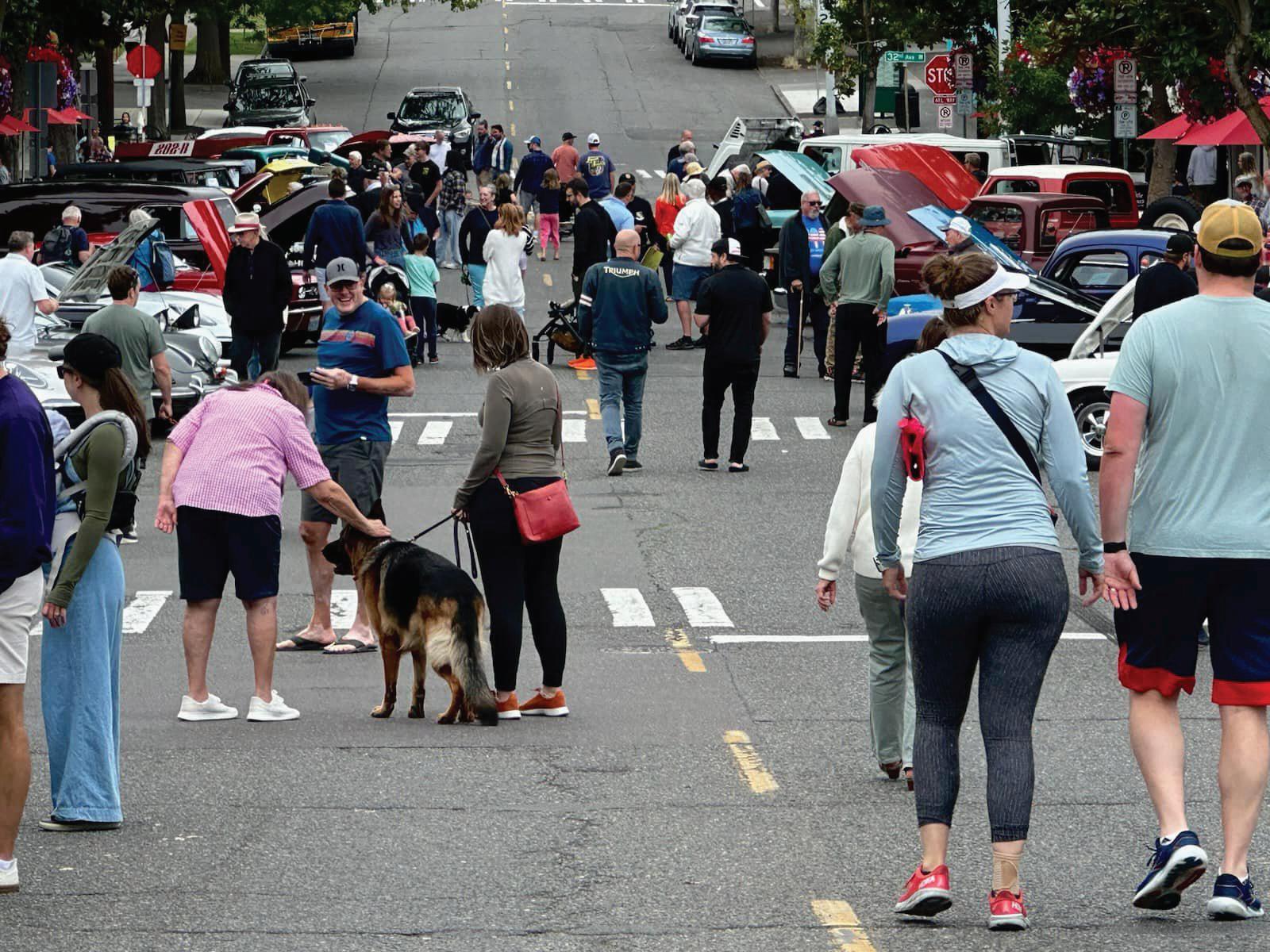
MAGNOLIA VILLAGE CAR SHOW AUG. 17
Seattle Public Library hosts programs for kids and families
The Seattle Public Library is hosting programs for kids and families throughout August. Festivities include magic shows, dance workshops and end-ofsummer celebrations.
Event lineup:
■ Summer of Learning: End of Summer Celebration: Monday, Aug. 18 from 1-3 p.m. at the Southwest Branch. Enjoy story time, crafts, and free cake. An additional celebration will be 6:30-7:30 p.m. Thursday, Aug. 28 at the Queen Anne Branch.
■ Join world-class magician Maritess Zurbano for a magic show from 3:30-4:30 p.m. Tuesday, Aug. 19 at the Ballard Branch. Zurbano will perform once again from 11 a.m. to noon Saturday, Aug. 23 at the Magnolia Branch.
Maritess the magician will perform at libraries across the city in August.
■ Coast Salish Class Time: Wednesday, Aug. 20 from 10:3011:30 a.m. Tulalip tribal member, carver, and storyteller Ty Juvinel brings local legends and history to life through stories and Pacific Northwest tribal art.
■ Magnolia StoryWalks continue through Aug. 31. Wander a StoryWalk at three locations: outside the
Magnolia Branch, at the Magnolia Farmers’ Market, and at Daybreak Star Indian Cultural Center. Each trail features a picture book by Indigenous authors. All events are free and open to the public. Registration is not required unless noted.
For information or to register, visit https://www.spl.org/ event-calendar.
WATCH: WA ranch
owner reacts
to gray wolf kill: ‘They're eating us alive, literally’
The Washington Department of Fish & Wildlife “lethally removed” an adult male wolf from the Togo pack territory in northeast Washington’s Ferry County this week.
WDFW approved the kill after three attacks on livestock on two different producer properties within a 14-day period earlier in July.
Kathy McKay of KDiamond-K Guest Ranch told The Center Square the wolves have decimated her ranch’s animals over the last decade.
“I would say we've lost over 100 over the last 10 years of our pets. Our horses, donkeys, alpaca, pigs, our cart pony, my milk cow, eight horses, dozens of cattle, and baby calves. It's devastating,” she explained. “They're eating us alive, literally.”
McKay, who operates a 1,600-acre guest ranch 125 miles North of Spokane in Eastern Washington, said the wolves have significantly impacted her business.
“The horses, when they watch their pasture mates tortured and killed and chased, they're a little more skittish and uneasy and less safe to ride for the guests,” she said. “The wolves come in waves, and there’s the lack of sleep and just trying to protect our livelihood and all our animals.”
Shubh Bhattacharjee, WDFW's wolf and grizzly bear policy lead, told The Center Square producers who suffered recent attacks on livestock had exhausted other means of dealing with the wolves.
“We found that a lot of human presence from the producer side, like their family members, their ranch hands, their employed cowboys, had already tried to look after those cattle, and still the wolves managed to kill them and injure them,” he said. “So, we decided that we needed lethal removal, and accordingly, the director approved the removal of one or two individuals.”
He explained that ranchers have the right to lethally remove a wolf caught in the act of attacking livestock.
Dr. Francisco SantiagoÁvila is the science and advocacy director for Washington Wildlife First. He told The Center Square that his organization opposes any wolf kills, especially since wolves are still considered
an endangered species.
“It's always unfortunate when a wolf has to be killed, especially because we have no evidence that wolf kills work for mitigating these types of conflicts with producers,” he said.
Washington Wildlife First believes producers and ranchers locating in corners of the state where wolves are repopulating creates a nowin situation.
“So, continuing to allow that kind of use of public lands is basically only leading to the destruction of wolves and wolf packs. So, we really need an honest conversation about what coexistence requires in terms of sharing the landscape and where it is simply not feasible,” Santiago-Ávila said.
“Producers care about their animals and owners care
about their pets, but they certainly live in areas where there needs to be some recognition of the risk that they're facing living alongside these animals, right?"
Sen. Shelly Short, R-Addy, whose district includes Ferry County, where the wolf kill took place, told The Center Square WDFW should take out more wolves.
“I know that this is a touchy subject and we've had a lot of groups that we continue to work with, but these are chronic conflict areas, and so that’s the frustration for me,” she said. “I know there are a couple of ranching families that got hit by wolves as soon as they started letting their cows out for grazing season; within days, they started having attacks. I'm grateful that they took action and it was
decisive, but is it enough?”
Short said her hope is to fairly compensate ranchers and producers losing livestock and pets to wolves.
“I had a bill last year to work on the indirect compensation,” she noted.
“Really, frankly, I think it's the state's responsibility. I don't like spending taxpayer dollars when we don't have to, but I think these are the state's wolves and they're here, and my ranchers in my community shouldn't bear that entire burden.”
McKay credits tribal members from the Colville Reservation for taking out wolves responsible for depredation.
“The tribe has helped us immensely,” she said. “The tribe realizes the depletion of their deer population and the wolves are taking
a number of them, so we’re blessed with having the tribe as a neighbor to help us.”
As of Dec. 31, 2024, WDFW and tribes have counted 230 wolves in 43 packs in Washington. Eighteen of these packs were successful breeding pairs. These numbers are comparable with the previous year’s count of 254 wolves in 42 packs and 24 breeding pairs.
Historically, gray wolves were common throughout much of Washington but were all but wiped out by the 1930s. In 2008, Washington wildlife managers documented the state’s first breeding wolf pack in modern times, and wolves have recovered in large numbers since, to the point that WDFW and its commission have differing opinions on whether to delist the gray wolf status from “endangered” to “protected.”
From McKay’s perspective, protecting the wolves has been given too much emphasis at the expense of protecting livestock and livelihoods.
“I've rescued and saved one of our little donkeys that got badly injured the same night as its best friend got killed,” she recalled. “And I doctored it for three weeks only to have the wolves come back and kill it. They just eat them alive. Cougars and bears are a little more kind, but they [wolves] just chase them till they're tired and … the thoughts of how they are killed … there's blood all over the field.”
Staci Lehman, communications manager at WDFW,
By Carleen Johnson
The Center Square
The Magnolia Village Car Show will be from 8 a.m. to 3:30 p.m. Sunday, Aug. 17 on W. McGraw St., in Magnolia Village.
The show will feature classic cars, muscle cars and unusual vehicles. Families and car enthusiasts are welcome.
ADOBE STOCK
Seattle revenue forecast improves slightly, but economic storm clouds linger
By
Seattle’s economic forecast improved from a pessimistic view in April after anticipated blows from tariffs were less than expected, but the city still has a $143 million budget deficit.
The Seattle Office of Economic and Revenue Forecast’s August baseline forecast anticipates a total 2025-26 general fund revenue increase of $62.8 million, excluding grants and transfers. Seattle’s 2025 general fund revenue is expected to total $1.63 billion.
Part of the improved outlook comes from national recession fears cooling down. Economists were surveyed by The Wall Street Journal in April, with findings showing a 45% probability of a recession in the next 12 months. In July, that probability dropped down to 33%.
Seattle Chief Economist Jan Duras said the optimistic outlook is a result of the implemented tariffs having not yet resulted in higher inflation or job losses, as many economists predicted. However, tariffs are still expected to increase inflation in the coming months.
From page 4
told The Center Square that those interested in participating in the ongoing discussion about wolf depredation can apply to join the next Wolf Advisory Group.
“We are opening our wolf advisory group recruitment,” she said. “They generally meet about four times a year, and it's a group of people who advise the department on anything to do with wolf management in Washington.”
McKay said that until people witness the gruesome result of a wolf attack on livestock, they can’t understand what her family is up against.
“Last fall, they got my Scottish
“The pessimistic scenario in April and the current pessimistic scenario are fundamentally different in regard to whether they expect the economy to go into a recession,” Duras said during an Economic and Revenue Forecast Council meeting on Monday. This improved forecast could be upended depending on new tariffs announced on July 31 and a recent weak jobs report.
The Jumpstart Payroll Expense tax – which relies heavily on a small group of businesses – is expected to total $382.9 million in 2025 and $388 million in 2026. In comparison, the tax generated $360 million in 2024.
The city’s business and and occupation tax, or B&O tax, was revised up $14.4 million in the August forecast to a total of $383 million. The tax represents Seattle’s economic activity. Despite the improvement, Seattle City Council President Sara Nelson was concerned about the city’s office vacancy rates, which are not expected to meaningfully decline at least until the mid-2030s, according to Monday’s presentation.
In the second quarter of this year, the Seattle Office Demand Index, as reported by the commercial real estate platform VTS, was 32% of the
Highlander [cow] and her calf, and then a horse, a big paint mare,” she said. “Just blood, everywhere. The poor big horse probably suffered the most because of her size. She was a healthy big mare, but they found her and, I mean, the blood was probably, I'd say like two or three football fields in our meadow, and so they probably, chased her for a while, and there's just a struggle and marks from her feet struggling to get up and then she's just bleeding out slowly. The next night, I've got a picture of six of them just eating on her.”
Lehman said WDFW has had nine documented livestock depredations so far this year and five wolf kills, including this week's.
Seattle's city attorney race may signal city’s progressive shift ahead
of November
By Spencer Pauley The Center Square
Seattle’s city attorney race shows a possible progressive shift in the city's political landscape.
Incumbent City Attorney Ann Davison, who was elected in 2021 with a toughon-crime platform, trails progressive challenger Erika Evans, who nearly has a 20% lead.
Evans, a former assistant lawyer for the U.S. Attorney’s Offices and the city of Seattle, seeks, according to her campaign website, to expand pre-filing diversion programs, establish an antihate and bias crimes unit, prosecute wage theft, and hold landlords accountable.
2018-19 average. This was the lowest among tracked cities as overall demand in the U.S. was 70%.
Seattle’s sales tax revenue collection has been consistently weak since the second half of 2023, largely due to the downturn in the construction sector which weighs down overall tax collection. For 2025, the tax is expected to generate $344.7 million this year and $361.1 million in 2026.
The Office of Economic and Revenue Forecast expects the trend to continue on as the value of construction permits issued by the city continue to decline. The value of these permits declined from $3.8 billion in 2021 to $2.3 billion in 2024.
This year, Seattle voters approved a social housing tax 5% on businesses with annual compensation above $1 million paid in Seattle to any employee. The Office of Economic and Revenue Forecast estimates the tax to generate $65.8 million in 2025. However, there is a “large amount of uncertainty to it” due to data limitations, according to Duras.
The Office of Economic and Revenue Forecast will revise projections again in October when the city council nears its revisions to the 2026 budget.
That does not include the number of wolves taken out by ranchers, producers, or tribal members that are not reported to WDFW.
Short said many ranchers in her district also don't report their livestock losses.
“My ranchers just want to be able to continue their livelihood, and there are some that will just, they will never [report livestock losses],” she said. “They don’t believe that they should seek state funding. But we've got the next generation that wants to take over from their parents and yet they're finding it increasingly hard to do that as we've just seen our livestock industry whittled down, and in large part it’s because of this issue.”
MAYOR
From page 1
“These results show Seattle is ready for change,” Evans’ campaign said in a social media post. “Our city deserves bold new leadership in the City Attorney’s Office.”
In her first term as city attorney, Davison cracked down on illegal graffiti, strengthened drug-related prosecutions, and eliminated an inherited criminal case backlog of nearly 2,000 misdemeanor cases.
Crime in Seattle also dropped 8.7% from a high of 50,367 cases in 2022 to 45,982 in 2024. As of Aug. 4, there have been 22,842 cases of crime in Seattle so far this year.
The latest primary results point to a shift in Seattle to a more progressive jurisdiction amid Donald Trump’s return as president this year.
Two years ago, the Seattle City Council saw a major overhaul of new council members that represented a more centered governance over the previous council.
Now that Trump is back, Seattleites seem more focused on fighting back against his executive orders.
While Davison is not
in some cities around the country; most prominently in New York City with Zohran Mamdani, a selfdescribed democratic socialist and the leading candidate to be the Big Apple's next mayor.
Harrell ran as a more centrist candidate during the 2021 mayoral race when the city council skewed further left on the political spectrum than currently. He won by the largest margin for a nonincumbent candidate since 1969.
Throughout Harrell’s first term, he has worked on policies as part of his “One Seattle” approach to improving the city. This includes creating the Community Assisted Response and
running as a Republican, Evans points out that she ran as one in the past.
Davison unsuccessfully ran for lieutenant governor of Washington as a Republican in 2020. She collected 12% of votes in the primary race. Davison would later get elected as Seattle city attorney in 2021 with 51% of votes.
In an endorsement interview with the 36th District Democrats, Evans said if she is elected, she would fight back against the Trump administration’s threats to halt federal funding to the city. Her opponent is already litigating.
Davison is leading her campaign under the promise that she will fight on behalf of the city against the Trump administration. So far this year, Davison’s office joined multiple lawsuits over Trump’s executive orders targeting gender ideology, DEI policies, sanctuary policies, and stalled counterterrorism funding.
The city’s shift is even more present in its mayoral race, where Katie Wilson, a more progressive candidate, leads incumbent Mayor Bruce Harrell with 48% of collected votes compared to his 43.5% as of Thursday morning.
When The Center Square asked Wilson's campaign about what factors contributed to her lead in the primary election, it pointed to the progressive wave happening in some cities around the country; most prominently in New York City with Zohran Mamdani, a self-described democratic socialist who is the leading candidate to become the largest U.S. city’s next mayor.
Evans and Davison will face off in the general election on Nov. 4, an election that typically sees a higher voter turnout.
Engagement, or CARE, department with behavioral health responders equipped to support people having behavioral health crises on city streets, improving police staffing levels and having two major levies approved by voters, including the largest tax package in city history in the form of a $1.55 billion transportation levy. With the city’s mayoral race down to two candidates and an expected larger turnout of voters on Nov. 4, the final race looks to be a close contest.
“We fully expect a torrent of money to rain down against us in the next few months, but that's okay, because while they may have more money than we do, we have more people,” Wilson’s campaign manager said.