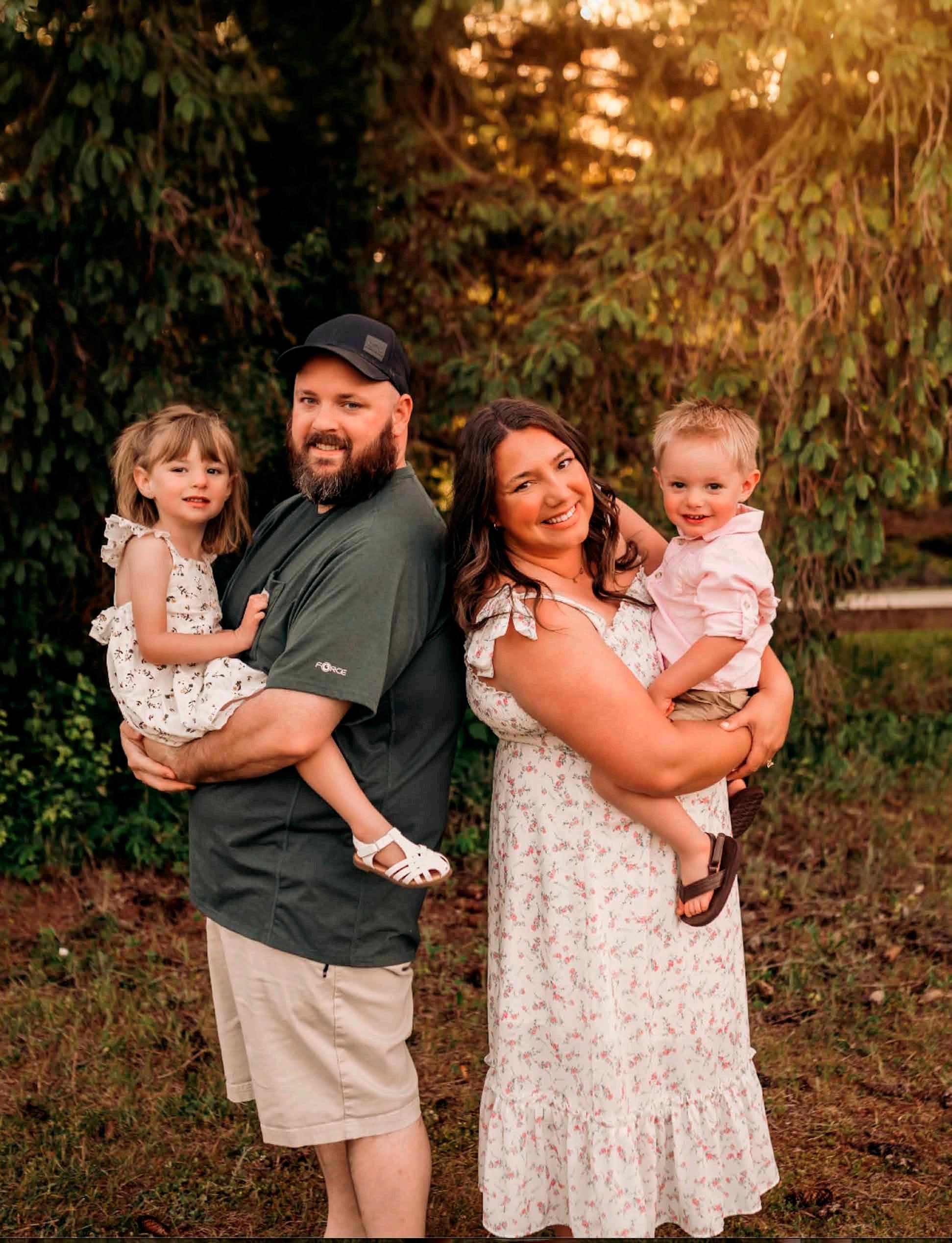
PHOTO BY KAYLA RENEE PHOTOGRAPHY
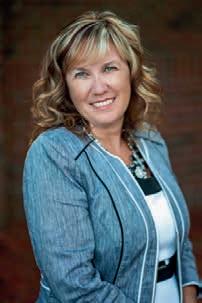


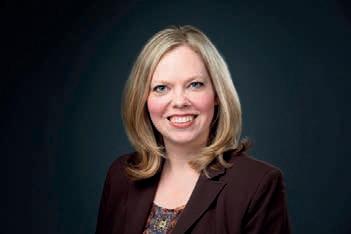
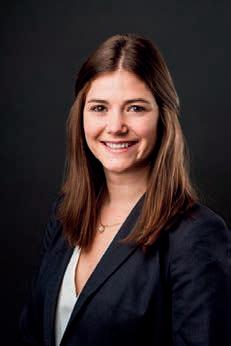
















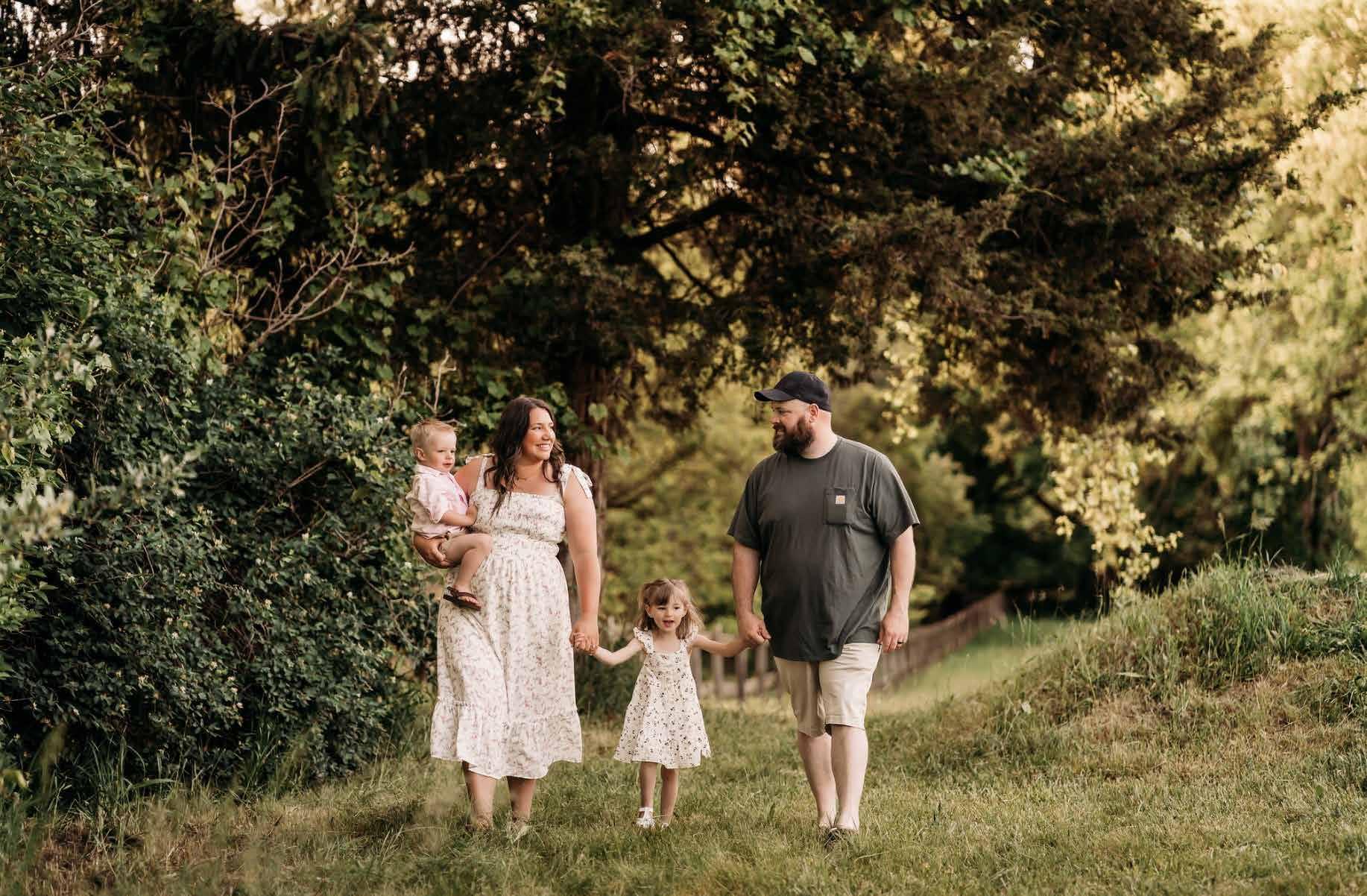





• Pages 6-9 Your Story Matters!: Meet the Ferrell Family
• Pages 10-11 Judson Center: The Heart of the Work, Why Autism Professionals Matter Now
• Pages 12-14 Sponsor Spotlight: RARA Recreation
• Page 15 Making A Difference: The ABLE (Achieving a Better Life Experience) Act
• Pages 16-17 See What’s Happening at STEP!: STEP Members Shine on Stage and in the Community!
• Pages 18-19 Healing Haven: The Importance of Early Intervention for Autism
• Page 20 Chapters of Change: Self-Esteem is Cool
• Page 21 Advocate Like A Mother
• Pages 22-24 Local Events
• Page 25 Save the Date: Detroit Symphony Orchestra Free Sensory-Friendly Concert
Olson


911
833-633-5788
833-633-5788
517-374-1171
269-345-1913
517-241-3740
517-241-3740
517-241-3740
833-808-7452
800-457-4584
313-446-4444 988
517-241-7004
517-284-7290
800-772-1213
1-800-772-1213
833-633-5788
517-203-1200
517-241-5324
Emergency Ealy On Michigan
https/www.michigan.gov/mde/services/earlylearners-and-care/special-ed-05/early-on-michigan
Michigan Department of Education: Office of Special Education https/www.michigan.gov/mde/services/ special-educationMichigan Family Forum
Michigan Family to Family www.f2fmichigan.org/
Michigan Foundation for the Blind and Visually Impaired
Michigan Department of Health and Human Services www.michigan.gov/mdhhs
Michigan Family and Social Services Administration (FSSA) www.michigan.gov/mdhhs
Michigan State Department of Health www.michigan.gov/mdhhs
Michigan Statewide Independent Living Council (MSILC) www.misilc.org/
Medicaid Disability
MI Choice Waiver Program
National Alliance on Mental Illness
Preschool & Out-of-School Time Learning
www.michigan.gov/mde/about-us/mde-divisions-andoffices/preschool-and-out-of-school-time-learning Self-Advocates of Michigan (SAM)
Social Security Administration (SSA)
Social Security Disability Insurance (SSDI)
Special Education Questions
United Cerebral Palsy Association of Michigan ucp@ucpmichigan.org
Vocational Rehabilitation Services (VR)

Jamie Olson: Uniquely You! Magazine Area Director jamie.olson@ n2co.com 248-882-8448
n2co.com
Celebrate. Connect. Impact. © 2026 The N2 Company, Inc..
DISCLAIMER: The views expressed in the articles and advertisements in Uniquely You are those of the authors and advertisers and do not necessarily reflect those of The N2 Company or the publisher. Inclusion of paid advertisements does not imply endorsement, and neither N2 nor the publisher is responsible for the business practices of advertisers. We are proud to feature businesses that share our commitment to showcasing local connections. Please note that businesses profiled may have provided free products and / or services for the review. Uniquely You is for general informational and entertainment purposes only and is not intended to provide medical, therapeutic, educational, or legal advice. Always consult qualified professionals regarding the care and support of individuals with disabilities. NOTE: When community events take place, photographers may be present to take photos for the event, and they may be used in this publication.
517-487-5426
877-463-2266
517-882-2800
517-241-3740
269-345-1913 517-241-3740
800-605-6722 517-333-6655
616-732-7358
269-337-3600 517-241-3740
Arc Michigan arcmi.org
Autism Alliance of Michigan https/autismallianceofmichigan.org/
Autism Support of Michigan https/autism-mi.org/
Behavioral Health and Developmental Disabilities Administrationwww.michigan.gov/mdhhs/ keep-mi-healthy/mentalhealth/procurement/ welcome-to-behavioral-health-and-developmentaldisabilities-administration
Michigan Foundation for the Blind and Visually Impaired Michigan Developmental Disabilities Council www.michigan.gov/mdhhs/keep-mi-healthy/ mentalhealth/developmentaldisability
Michigan Rehabilitation Services (MRS) Capital Area Down Syndrome Association www.cadsa.org
Deaf and Hard of Hearing Services (DHHS) www.deafhhs.org/
Disability Determination Bureau Division of Aging www.michigan.gov/mdhhs/adult-child-serv/adultsand-seniors/behavioral-and-physical-health-andaging-services/aging-services
517-241-3740
800-75-SEALS
Division of Family Resources (DFR) www.michigan.gov/mdhhs
Easterseals MORC www.easterseals.com/MORC/

Scan to view the past issues of Special Needs Living and Uniquely You!
Scan to view past digital copies, find resources, share a story or learn more about being involved.
Would you like to advertise in Uniquely You! to share valuable information and help support the community? Scan to grab some time to connect & learn more about being involved: https://calendly.com/ jamie-mccabe/special-needs-living-magazine
BY KRISTIN DILLON
pounds. No one told Ashley what happens when GBS slips through undetected.
“Group B doesn’t give you warning signs she was the happiest baby the night before,” Ashley says.
Addy’s brain was swelling. She had seizures, strokes, and brain bleeds. Doctors diagnosed her with a Severe Traumatic Brain Injury and told Ashley and Denny that if she survived, she would likely require a tracheostomy, would never walk, talk, eat, or live independently.
She also developed a blood clot and was placed on Lovenox injections, blood thinners Ashley had to administer twice a day for two months.

On May 10, 2021, Ashley Ferrell followed her gut. Her two-monthold daughter, Adalyn “Addy” woke up looking unwell. Their pediatrician recommended monitoring her at home, but as the day wore on, Ashley couldn’t shake the feeling that something was deeply wrong. By evening, she and her husband, Denny, rushed Addy to their local hospital in West Michigan.
They first went to their local hospital, where initial tests were run before Addy was transferred to Helen DeVos Children’s Hospital in Grand Rapids.
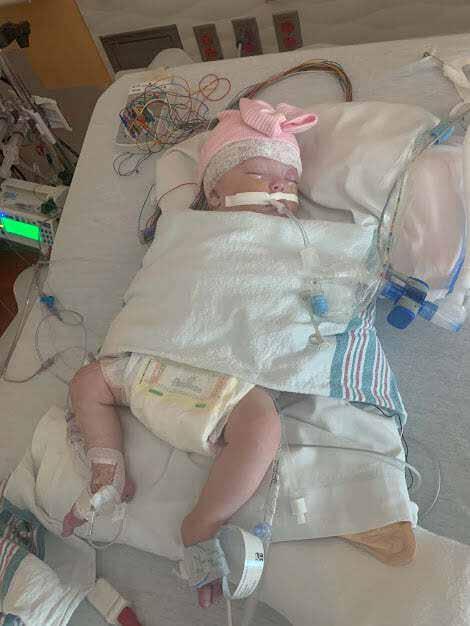
Upon arrival, Addy went unresponsive. She was intubated, and Ashley and Denny were ushered into a waiting room. A doctor soon arrived with the kind of news no parent expects to hear: their baby girl had a 1% chance of survival.
Ashley remembers walking back into the PICU and seeing her tiny daughter “hooked up to way too many tubes and wires a baby should ever be hooked up to.” The image is forever seared into her memory.
Addy was in total organ failure. Sepsis had taken hold. Her tiny body was also fighting meningitis of an unknown origin.
The next day brought an answer: Late Onset Group B Strep (GBS).
Most parents only hear about GBS in passing swabbed at 36 weeks, given penicillin if positive. But Addy came too fast at 37 weeks, weighing just under five
“Giving your three-month-old baby a shot in the leg every twelve hours was heartbreaking,” she recalls.
Ashley remembers those days as a blur of terror and stubborn faith: “They told us to prepare for the worst. But something in me said, this isn’t her story.”
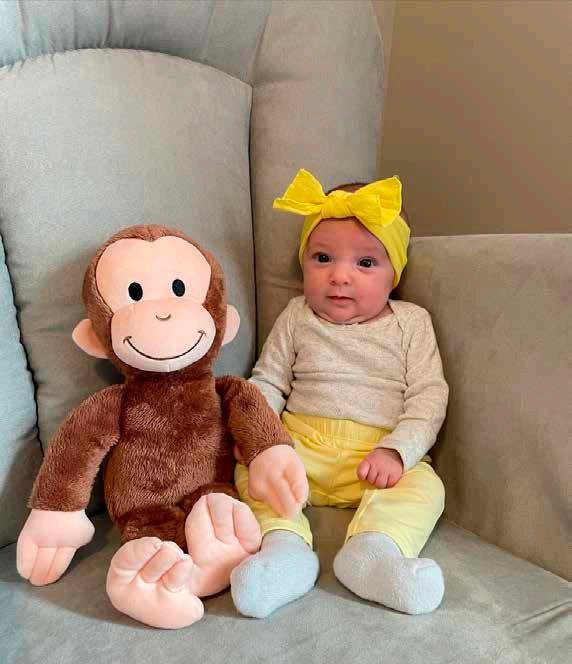
Curious George in the PICU
In the midst of machines and monitors, one unlikely companion became Addy’s anchor: Curious George
The cartoon was played during long, quiet hours when Addy needed to stay still for tube feeds. For Ashley, it was more than background noise, it was a thread of memory.
Before Addy was born, Ashley’s sister had passed away, and she loved Curious George. After her death, Ashley kept her artwork, handprints, gifts like sacred relics. And suddenly, here
was her daughter, clinging to the same character in the fight of her life.
The child life team at the hospital even printed Curious George artwork for Addy’s PICU door. Nurses began to call her “The Girl with the Yellow Bow” a gentle twist on Curious George and the Man with the Yellow Hat. For Ashley, it felt like her sister was there with them, woven into Addy’s fight.
Against every prediction, Addy began to fight back. She opened her eyes, one of them swollen shut, and slowly weaned off the ventilator until she was breathing on her own. Though she couldn’t eat by mouth, she came home with a feeding tube after 18 days in the PICU.
“If pulling those out was an Olympic sport, she’d be a gold medalist,” Ashley jokes.
By December 2021, Addy had a surgically placed G-tube, which she used for five months before retiring it completely.
Today, Addy is four years old. She walks. She runs. She eats. She swims. She laughs. She is nonverbal, but expressive and radiant. She recently had eye surgery to help with third nerve palsy caused by her illness, where doctors tightened and loosened muscles to improve movement in her right eye.
“She does everything they told us she wouldn’t do,” Ashley says.
And through it all, Curious George remains her comfort and joy.
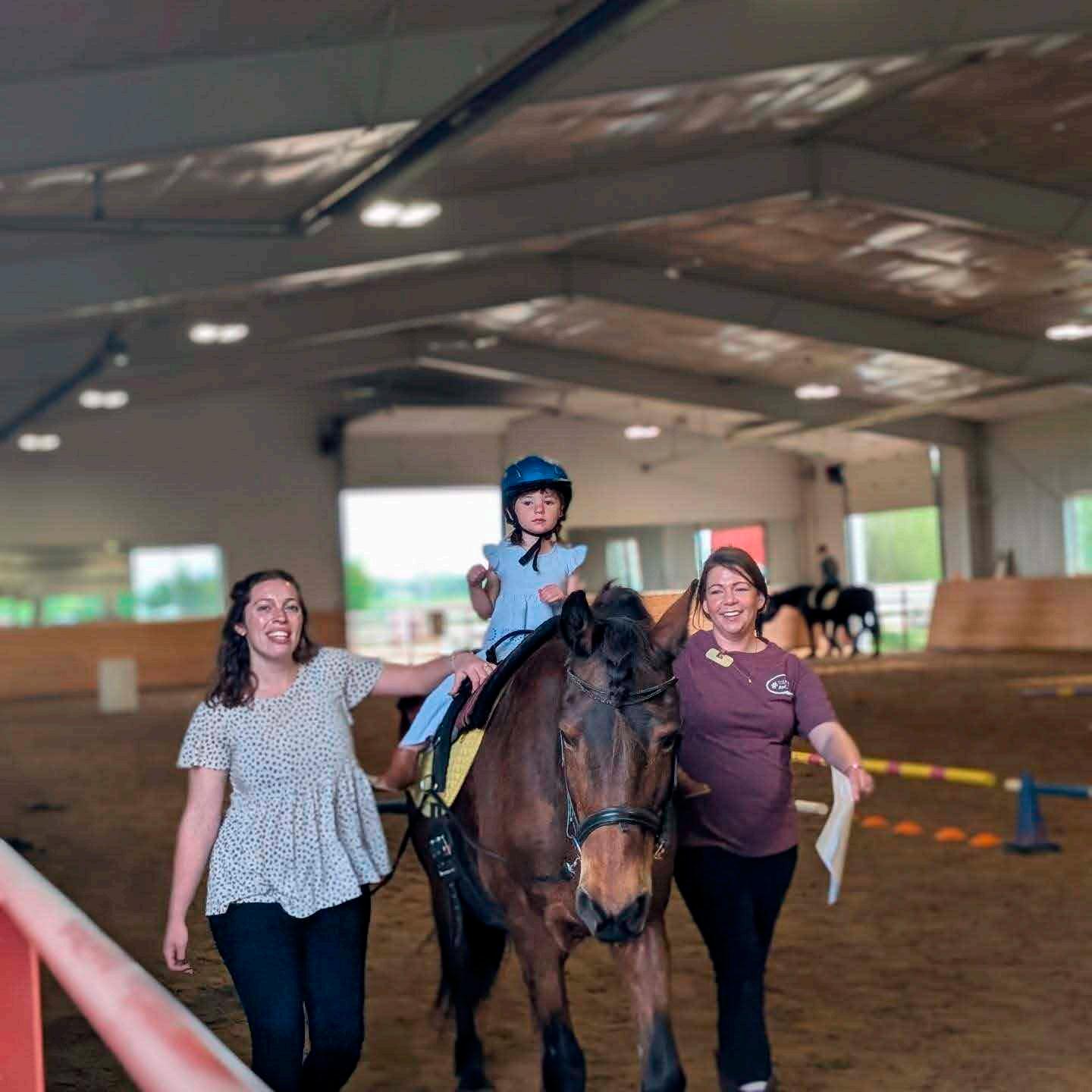
For the Ferrells, life changed overnight. In the four years since Addy’s diagnosis, therapy has become their full-time rhythm: physical, occupational, and speech, with an ever-expanding team of specialists. Addy also goes to school, and participates in equine therapy at Renew Therapeutic Riding Center, and will soon begin Applied Behavior Analysis (ABA).
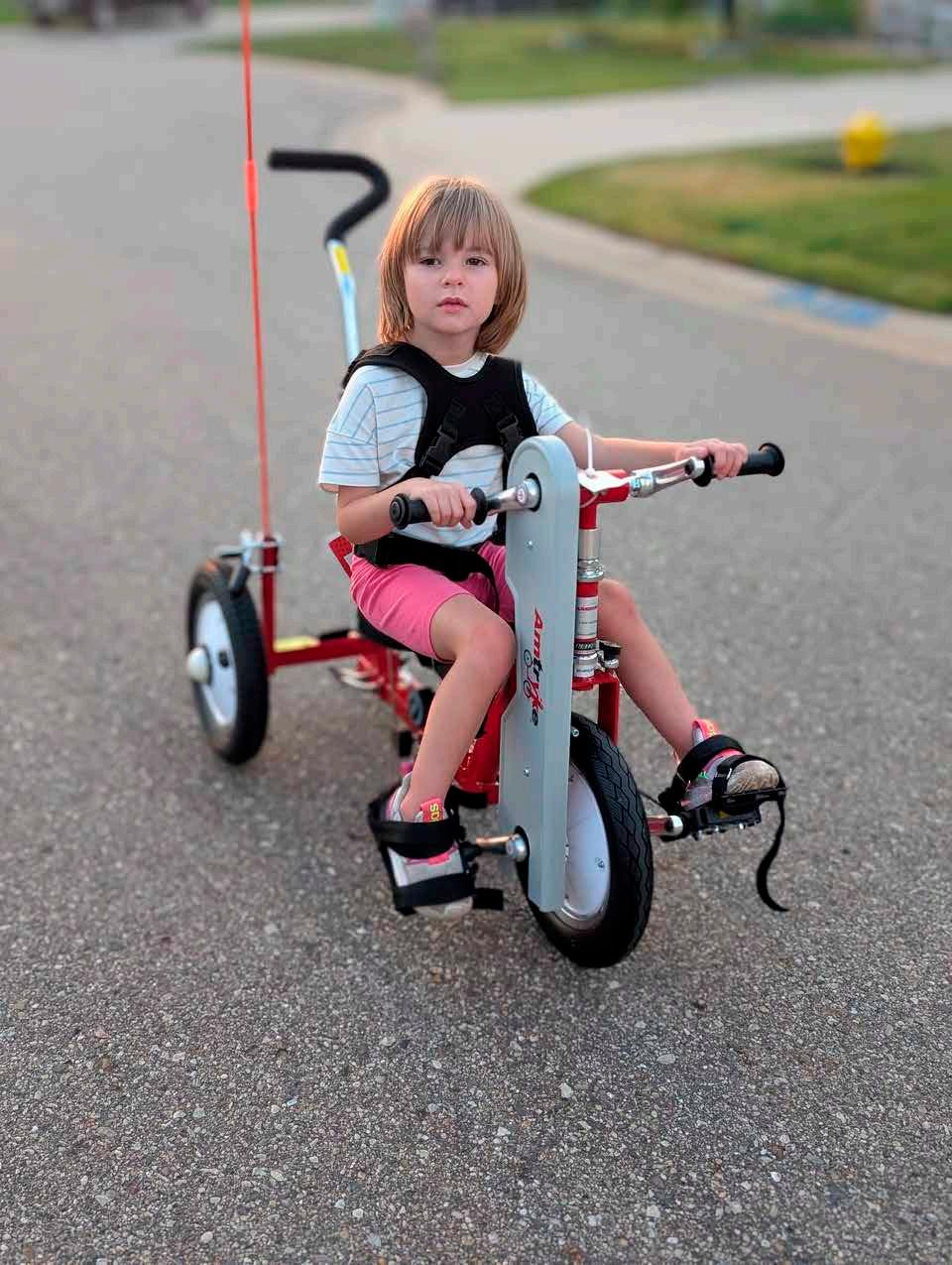
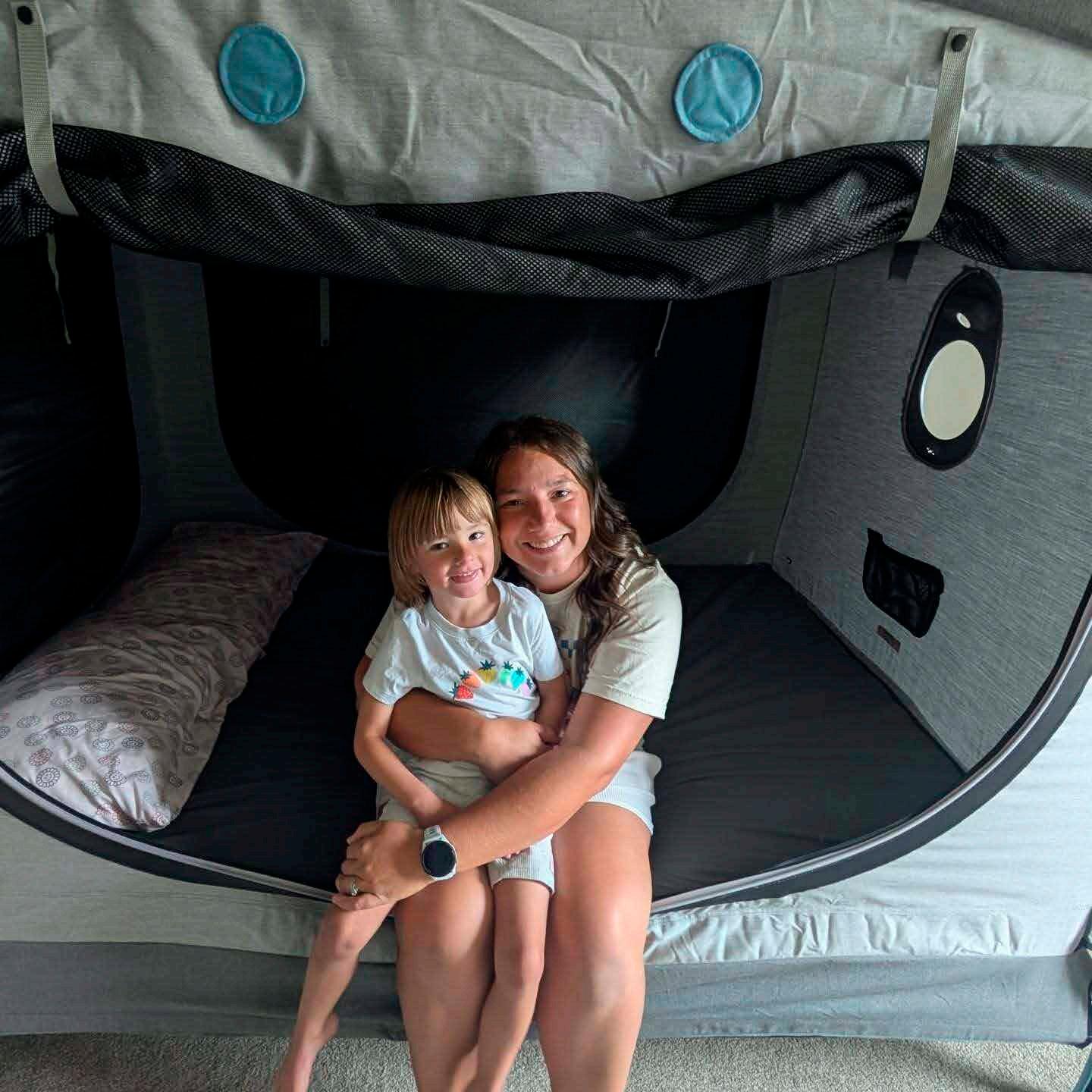
Ashley recalls many of the early challenges: watching Addy learn to walk with “the smallest and cutest walker you have ever seen,” getting fitted for a Cubby Bed to keep her safe at night, and learning to manage braces, and adaptive bikes that became everyday fixtures in their home.
There were also sensory challenges, Pica, and the ache of having no formal way to communicate with her.
“She’s nonverbal and doesn’t have an AAC device yet,” Ashley explains. “Right now, if she wants something, she might bring us to it, but there’s no clear way to know what she’s thinking or feeling.” This fall, Addy will begin trialing AAC technology at her clinic. “We’re hopeful,” Ashley says. “She’s so smart and so stubborn, when she decides to show us what she knows, it’s incredible.”
Ashley also remembers the difficulty of leaving their PICU family after 18 days. “Our nurses were amazing. I still talk with one daily. By the end of our stay, she could look at me during rounds and know

exactly what I was thinking, she’d start with, ‘Mom wants to know…’ and then ask the question for me. She just threw me under the bus like that!” Ashley laughs. “It was such a struggle to leave their 24/7 care.”
For all the medical milestones, Ashley is quick to emphasize Addy’s spirit.
“She’s the sweetest and happiest girl. She loves to laugh.”
What makes her light up? Running outside, swinging, and bouncing on the trampoline. And, always, Curious George
Addy’s determination has become her signature. In 2022, she crossed the finish
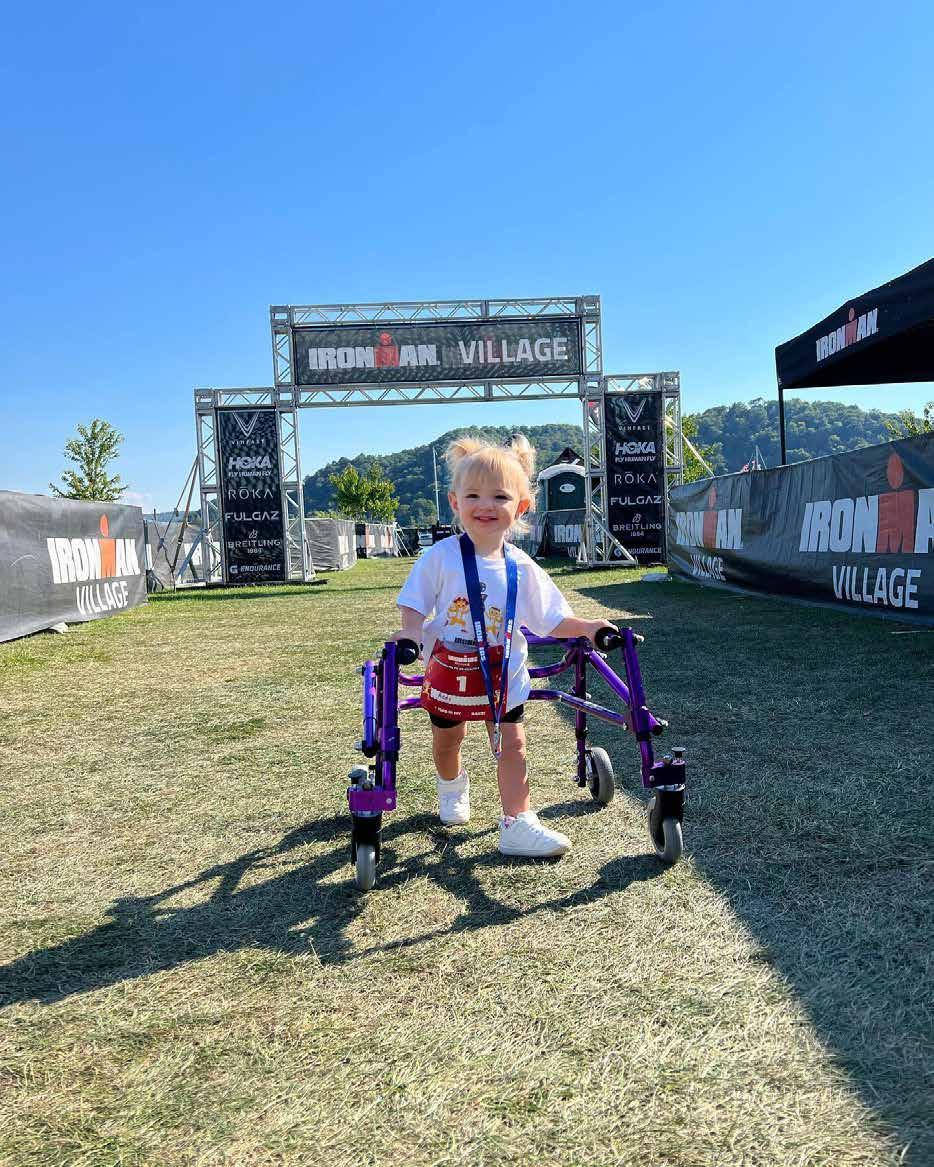
line with her walker at an Ironman kids race, bringing “tears to many eyes.” Even now, her favorite part of horseback riding is when the horse trots and she can feel the motion ripple through her body.
And recently, there was one moment that stopped Ashley and Denny in their tracks: Addy carried her water cup over to her dad and clearly said, “Wawa.” It hasn’t happened again, but the memory still fuels them. “The words are definitely in there.”
“It was like the universe reminding us, don’t count her out,” Ashley says.
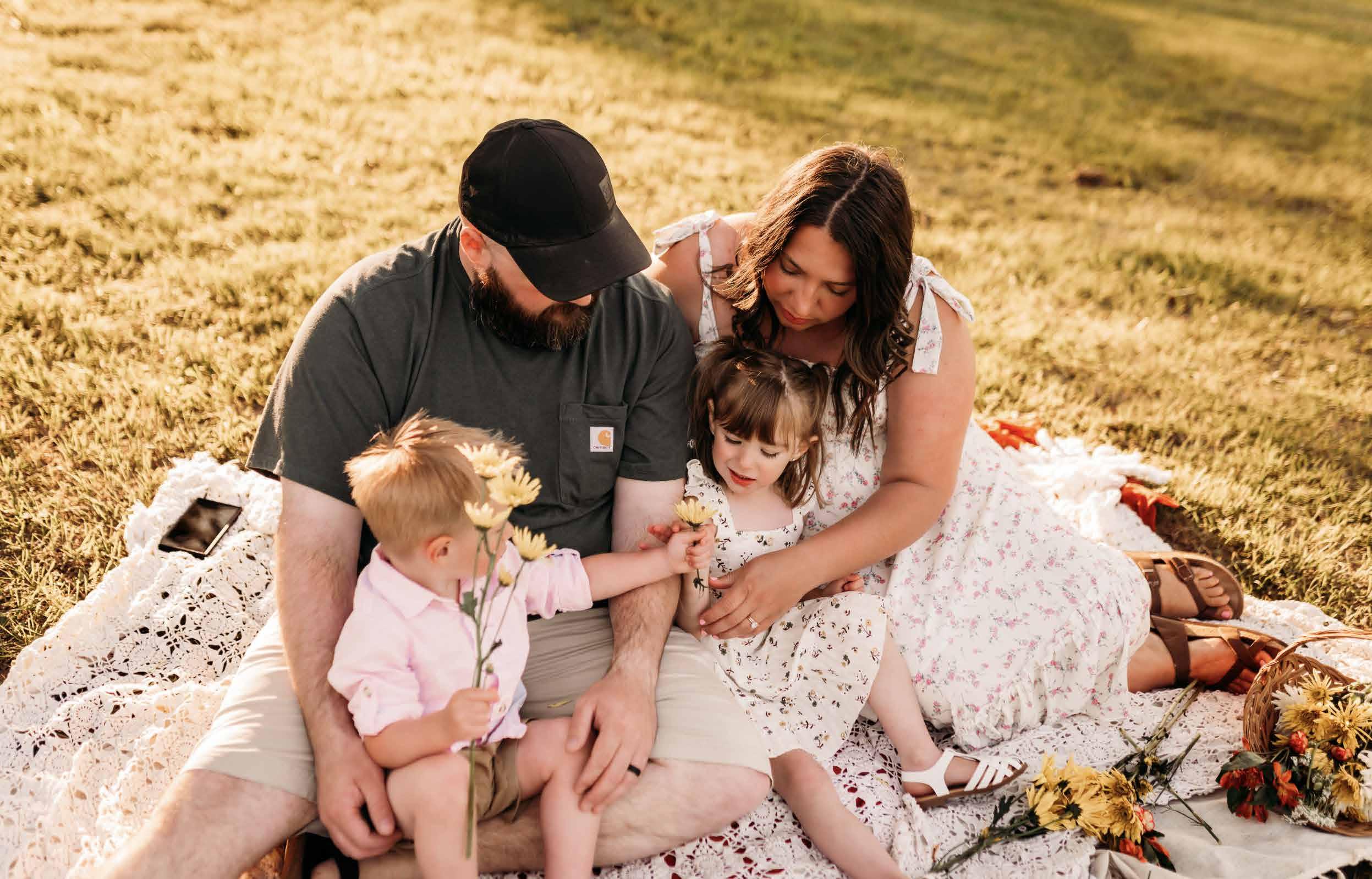
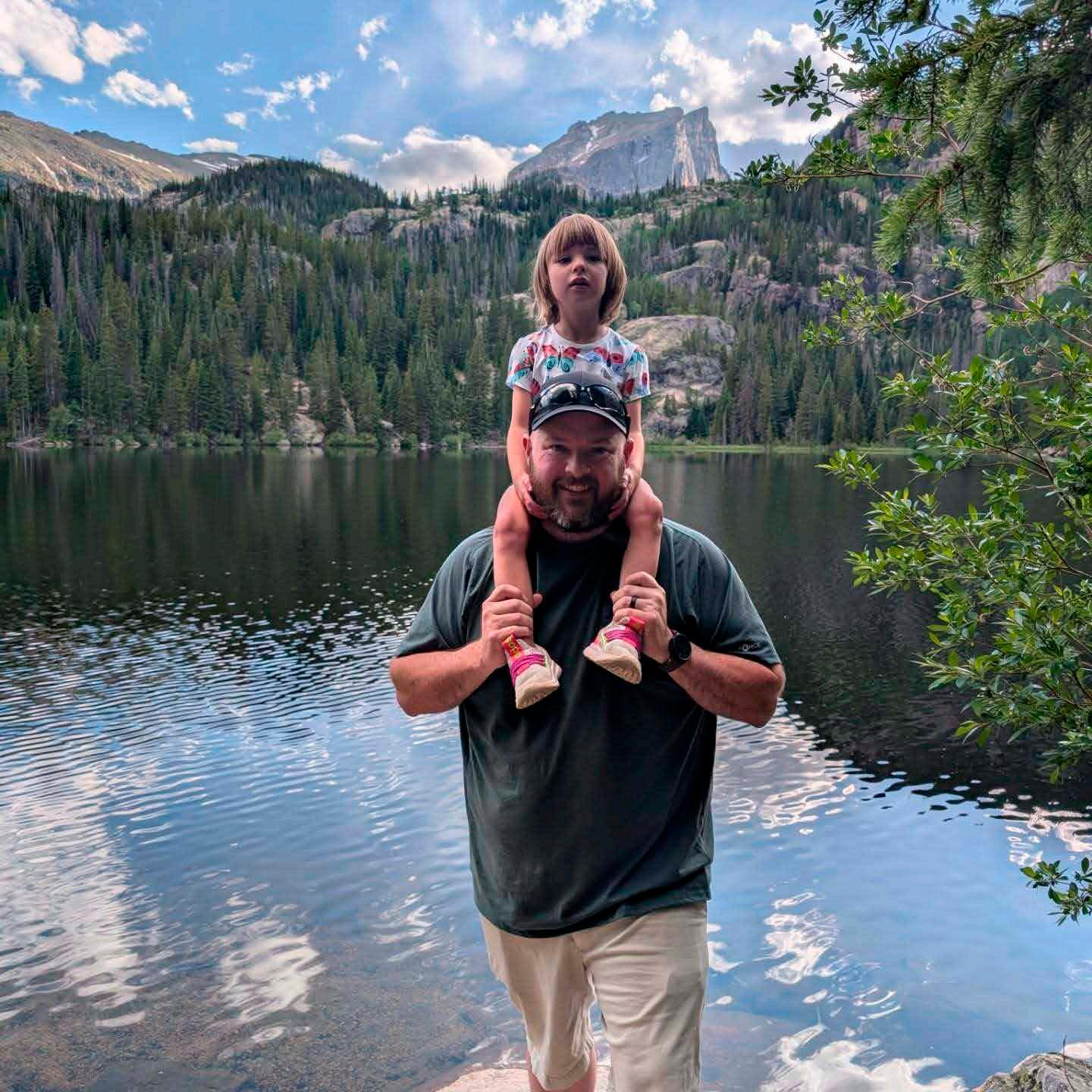
The Ferrells are a family that loves adventure, boating, camping, and dreaming of one day living full-time in their RV. Addy has a younger brother, Caden, who is two.
Though originally from the east side of Michigan, the family has built strong roots in West Michigan. Still, some of their greatest support has come from programs designed for children with medical complexities.
Early On, Michigan’s early intervention program, was a lifeline. “They were our ride-or-die,” Ashley says. “For three years, therapists came to our home and even met us at parks to help Addy engage with other kids.”
Another program, A Kid Again, has provided opportunities for joy and connection with families who understand this journey firsthand.
And then there’s Ashley’s own vision: she’s a photographer and hopes to use her skills to build visibility for families like hers. “It means so much to have someone capture your life without needing an explanation,” she says.
Ashley’s experience has also shifted how she sees disability.
Her brother became a quadriplegic after a neck injury, and she’s long resisted the catch-all “special needs” label. Addy’s brain injury has only deepened her perspective.
“Anyone with a brain injury can be given that label,” Ashley says. “But really, it’s about abilities, different abilities. Addy
has taught us there’s a whole spectrum of what life can look like.”
That perspective is something she hopes to bring to West Michigan through her involvement with Uniquely You! Magazine.
When asked what advice she would offer families who find themselves suddenly thrust into this world, Ashley pauses. Then she offers a list that is both fierce and tender:
• Stay in therapy.
• Have patience.
• Lean on your people.
• Love your baby!
For newcomers to the area, she adds: “If your child is under three, look into Early On. Go to playgroups. Talk to the other parents in the waiting room. You might be surprised how many of them are also craving connection.”
Her dream for Addy? The Special Olympics.
“She loves to run,” Ashley says, smiling. “And she loves watching other kids run. I think she’d thrive.”
Four years ago, doctors gave Addy a 1% chance of survival. Today, she’s proof of what relentless willpower, fierce parenting, and community support can build.
“She does everything they said she wouldn’t,” Ashley reflects. “And she does it with joy.”
And often, she does it with Curious George nearby,a reminder that memory, love, and resilience weave together in the most unexpected ways.
“She’s 100% heart,” Ashley says. “And that’s what carries us forward.”


Working in the autism field is one of those rare career paths where science, compassion, and real life impact intersect. It is not just a job, it is a front row seat to human growth, creativity, and problem solving. And if you talk to people in the field long enough, especially at Judson Center, you notice a theme. People get into the work because they want to make a difference, and they stay because the difference is real.
Autism is more widely recognized than ever. Current U.S. surveillance estimates that about one in 31 eight year old children are identified with autism, which means communities need more trained professionals who understand both evidence based intervention and the importance of dignity and respect in care (CDC, 2025). Judson Center has seen this need firsthand across its Autism Connections program, where waitlists, family outreach, and community requests continue to grow. As more families seek support earlier, the field needs people ready to blend skill and heart.
If you imagine someone endlessly patient and endlessly cheerful, yes, they exist. But they are not the only type who succeeds at Judson Center or across the field. What matters most is a mix of qualities that make the work sustainable and meaningful:
• You are patient enough to celebrate progress in inches, not miles.
• You enjoy analyzing what works and why, sometimes with the curiosity of a detective.
• You can shift communication styles quickly, whether with a child, a teen, or a parent navigating the system for the first time.
• You like collaborating with colleagues. At Judson Center, clinicians work closely with behavior technicians, family support staff, and community partners every day.
• You have emotional resilience and a steady sense of humor. The humor helps more than you think.
• You care deeply about honoring each person’s individuality and goals.
The reasons people choose this field vary, but there is a unifying thread. The work is deeply rewarding. One day you might support a child’s first successful communication attempt, and the next you might help a teenager prepare for a job interview. At Judson Center, staff often talk about the lasting relationships they form with both families and teammates. The organization also offers a range of professional pathways, from behavior analysis to community based support roles, which creates room for growth and specialization.
Think of the work as part science, part problem solving, part human connection. Evidence based practices like applied behavior analysis, functional communication training, and structured teaching form the foundation, but the most effective strategies are individualized. This aligns with current research emphasizing autistic people’s strengths and the value of more inclusive, person centered approaches (Cope et al., 2022). Judson Center’s Autism Connections program reflects this shift by blending structured intervention with naturalistic teaching, caregiver collaboration, and community integration.
If you are considering entering the field, focus on developing core competencies like behavior measurement, functional communication strategies, crisis planning, and effective family engagement. Judson Center invests heavily in professional development, especially for new RBTs and BCBAs, to make sure staff feel supported and well trained. Add ongoing learning in cultural humility and neurodiversity affirming care, and you will be positioned for long term success. And yes, bring strong self care habits. The work is meaningful, but it also requires balance.
Working in the autism field is demanding, but it offers moments of clarity and meaning that are rare in most careers. You see progress up close. You help families breathe a little easier. And each day, you know your work has purpose. Judson Center has spent more than a century serving Michigan families, and its Autism Connections program continues that tradition by creating pathways for skilled, compassionate professionals to do life changing work. If that is the kind of career you are looking for, this field might be exactly where you belong.
References:
Centers
and

greater products . greater purpose Every
POSSiBiLiTEEs is more than a business; it’s a mission. A place where individuals with special needs don’t just work—they thrive. Where they gain confidence, find purpose, and spread joy to everyone they meet. Every shirt we print is more than fabric—it’s a symbol of inclusion, ability, and the belief that everyone deserves a chance to shine.
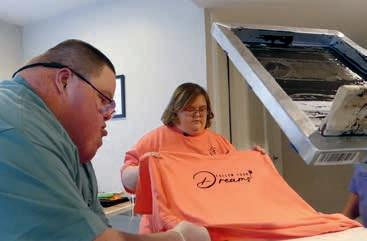

Wear what you believe in. Support inclusion, empowerment, and creativity with every purchase.
SHOP WITH INTENTION
For nearly eighty years, the Rochester Avon Recreation Authority—known throughout the region simply as RARA—has played an essential role in shaping the recreational landscape of Rochester, Rochester Hills, and Oakland Township. Since 1946, families have relied on RARA not only for its extensive recreation offerings but also for the sense of community, belonging, and wellbeing these experiences create. With more than 1,200 activities offered each year, RARA has remained steadfast in its mission: to strengthen community through play. Today, that mission continues through programs designed for people of all ages and ability levels, as well as a thriving adaptive services department that has become a lifeline for countless families.
While RARA began as a general recreation provider, its commitment to individuals with disabilities evolved over time in response to community needs. In the 1980s, the organization briefly offered a special needs summer camp called Camp Rainbow. However, the program ran only a few years, and by the early 1990s there were no dedicated adaptive
services available. Families of children with special needs felt the absence deeply, longing for opportunities that would allow their children to socialize, play, grow, and simply be themselves.
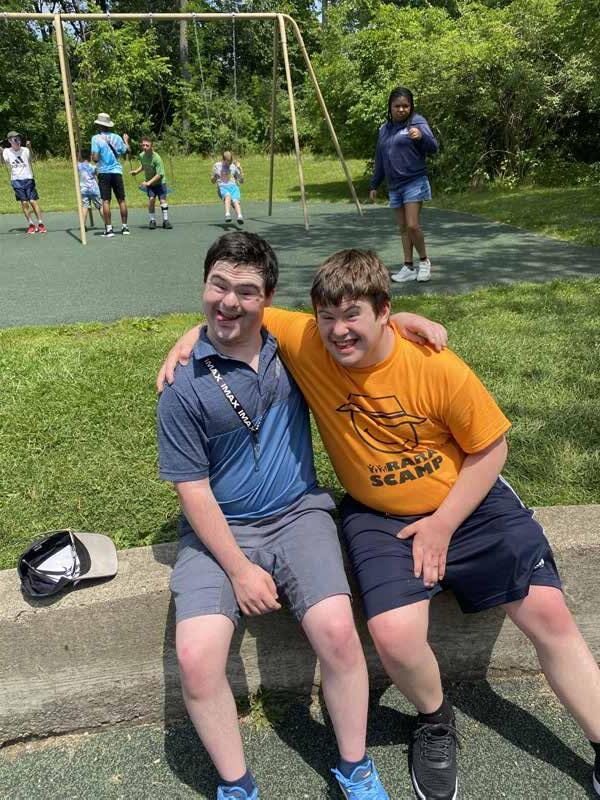
Everything changed in 1997 when a small group of determined parents decided to take action. United by a shared vision, they gathered to create a meaningful summer experience for their children—one that emphasized safety, friendship, recreation, and community. Through their leadership and collaboration with RARA, a new camp began to take shape. By 1998, the program had been officially named RARA SCAMP, and it quickly became a cherished summer tradition for families across the Greater Rochester Area.
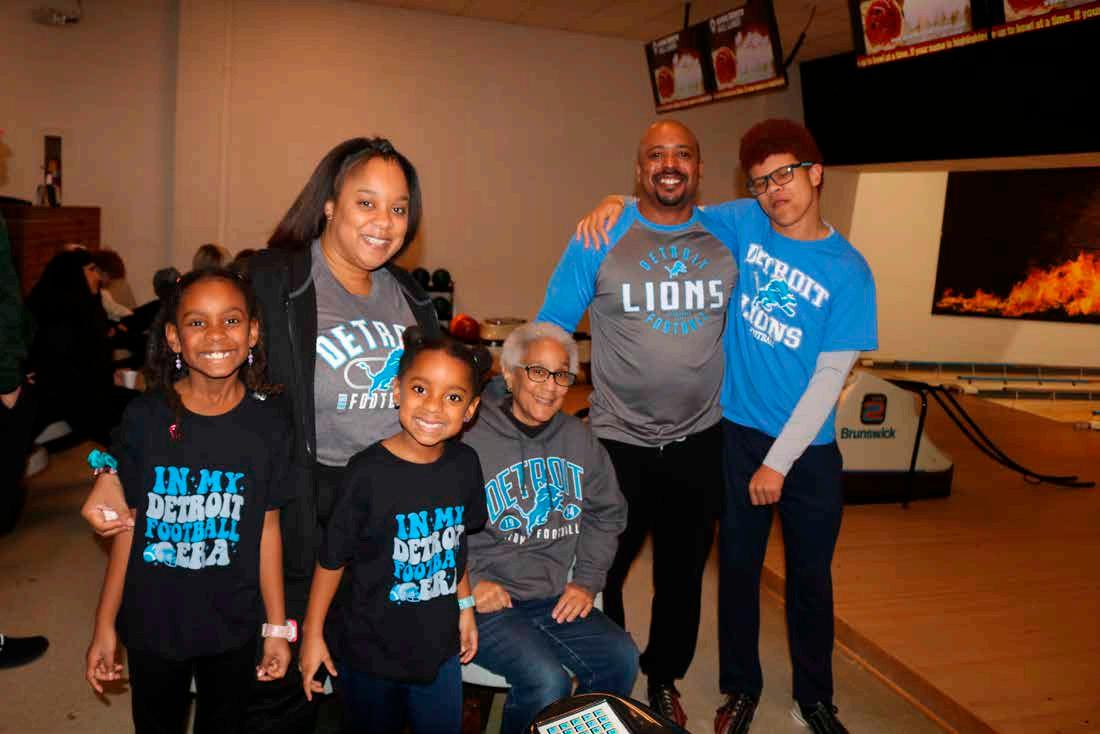
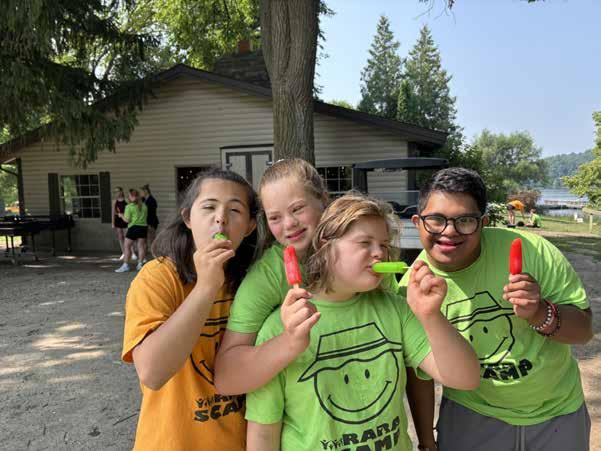
Today, RARA SCAMP stands proudly as the largest and longest-running special needs-specific summer camp in the region. Each summer, the camp welcomes approximately 60 campers ages 5 to 26 for a six-week program designed to support the whole child—emotionally, socially, physically, and creatively. SCAMP’s structure blends routine with adventure, allowing campers to feel secure while exploring new experiences every week. Mondays are dedicated to bowling, giving campers a fun and accessible physical activity that fosters teamwork, patience, and confidence. Tuesdays are filled with creativity through art and music. Wednesdays bring swimming, a highly anticipated activity that combines therapeutic benefits with pure joy. Thursdays are reserved for field trips, which are consistently
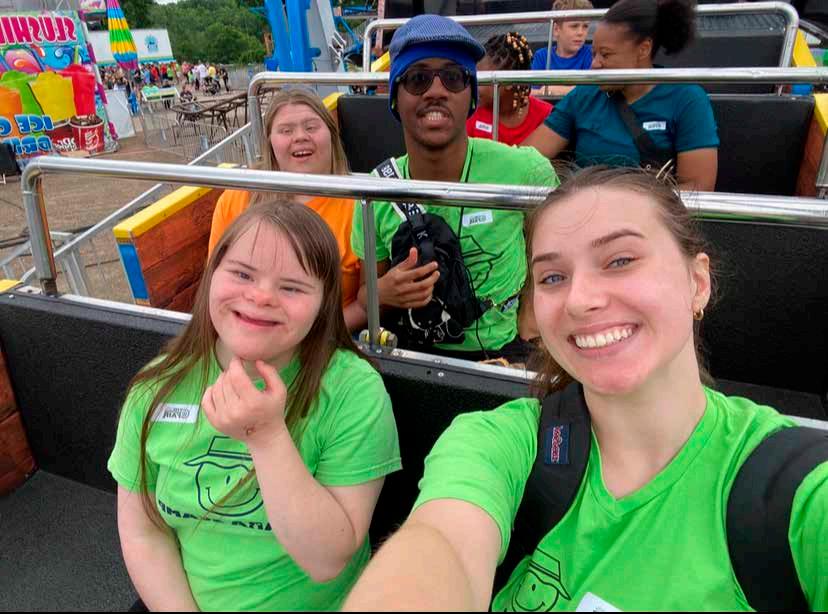
a highlight for campers and families alike. These excursions take campers to destinations such as the Detroit Zoo, Red Oaks Waterpark, Stoney Creek Metropark, and the 4H County Fair. On-site visits from community partners—including the Rochester Naturalist and The Reptarium gave even more variety and excitement. Safety and individualized attention remain a cornerstone of SCAMP’s success. The camp maintains a 3:1 camper-to-staff ratio, ensuring every participant receives appropriate support. To meet this standard, RARA hires more than 20 seasonal staff members each summer. These individuals are not only trained in safety and adaptive strategies but also handpicked for their compassion, energy, and dedication to creating a positive experience for every camper. Their attentiveness allows campers to explore freely, make friends, and participate in activities that might be otherwise inaccessible.
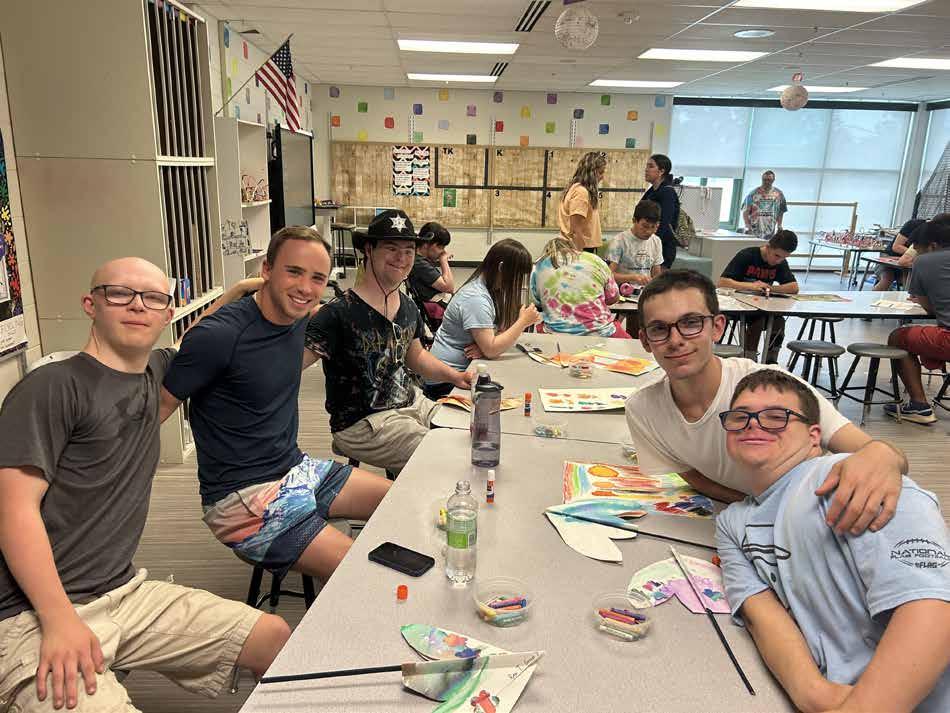
A cornerstone of SCAMP’s weekly schedule is its partnership with Paint a Miracle and OpenSpot Theatre. Each Tuesday, these organizations provide group sessions in art and movementbased expression. Campers are placed in groups of 10 to 15, with sessions running 30–45 minutes depending on age and ability level. Although the Tuesday programming is often highlighted for its creativity, SCAMP ensures that the arts are just one part of a larger, wellrounded set of experiences. The camp’s philosophy emphasizes that recreation, whether through art, nature, movement, or community exploration—is a powerful
tool for growth, communication, independence, and joy.
SCAMP embraces the belief that every individual, regardless of ability, deserves the chance to express themselves creatively and emotionally. Campers often use art as a way to communicate feelings that are difficult to express verbally. They gain confidence by making choices independently, experimenting with new materials, and sharing their creations with peers. RARA SCAMP views these experiences as essential pathways toward self-awareness, self-esteem, and meaningful participation in the world. The camp environment provides a safe place for campers to be seen and heard on their own terms—a “level playing field” where individuality is celebrated.
Families consistently express their gratitude for the impact SCAMP has had on their children’s lives. One parent
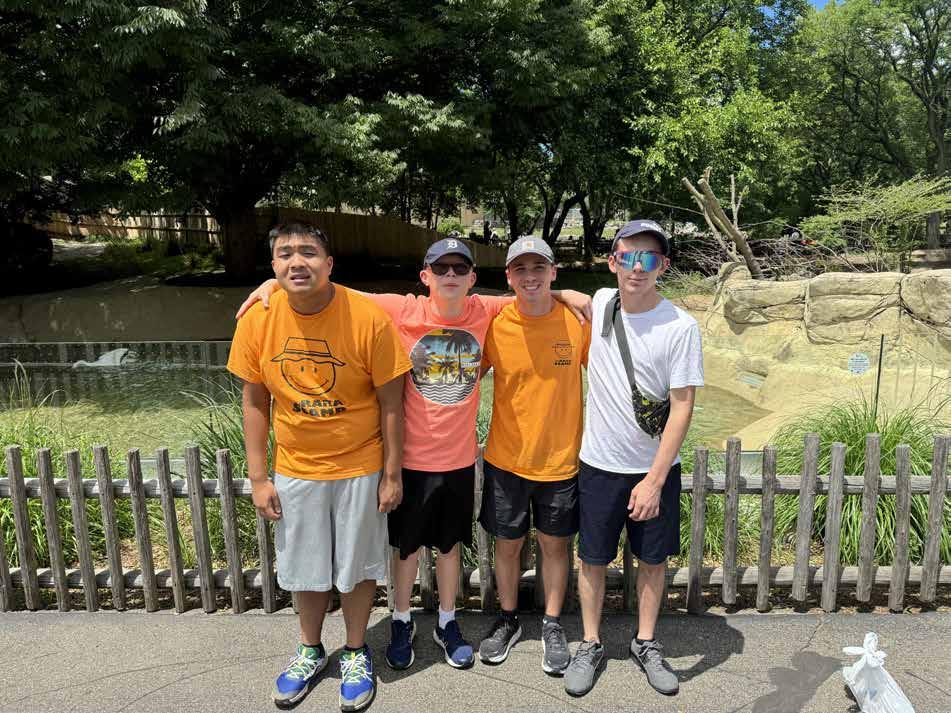
shared, “SCAMP is a wonderful gem in our community! The staff is always kind, helpful, and so caring toward our unique campers. My son has loved going to SCAMP and playing with his friends from the very first time he attended at just 5 years old. He looks forward to it every summer and talks about SCAMP throughout the school year.” Another parent echoed this sentiment, saying, “We have sent our son to SCAMP for around 14 years now. The staff always do so well with the children, and the
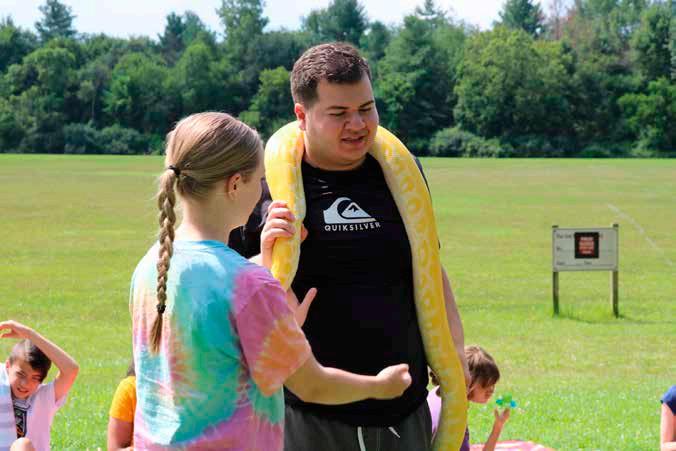
field trips are so much fun. He asks yearround for SCAMP.”
For many families, SCAMP is not only a beloved summer tradition but also a bridge to RARA’s extensive yearround adaptive programming. As campers grow older, many transitions into programs designed for teens and adults, continuing the friendships and connections built during summer. RARA offers adaptive sports, social engagement activities, dance and performing arts, fitness programs, art classes, and other specialized recreational opportunities. Programs run at least five days a week, and for individuals 14 and older, monthly events like Diners Club, Movie Night Out, Movie & Pizza Night, and RARA Social Nights offer chances to socialize in fun, safe, and structured settings. These programs help participants build independence, social skills, and strong connections within their community. For younger campers, SCAMP lays the foundation for a lifetime of participation by building confidence and teaching important social and recreational skills.
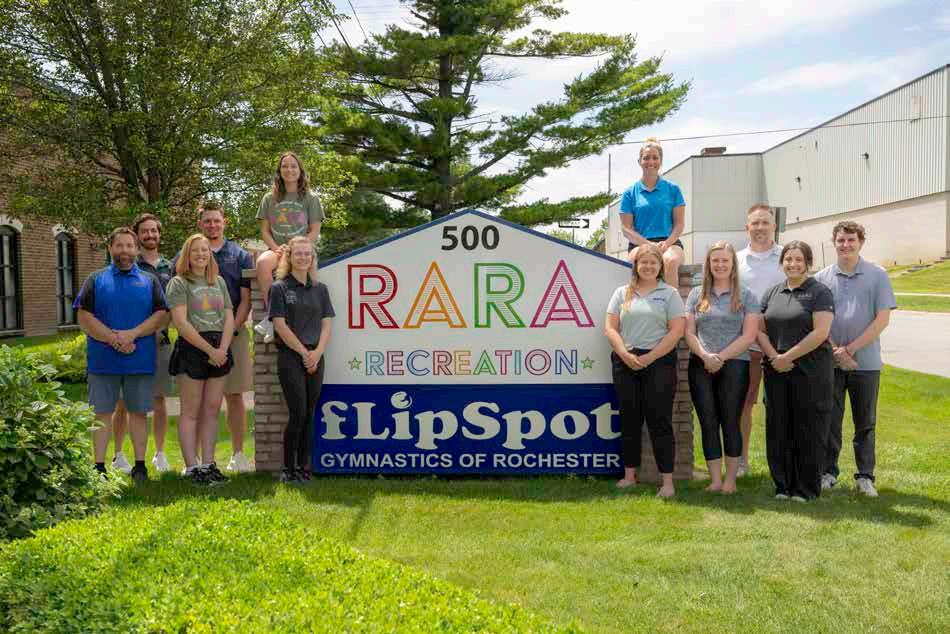
Beyond programming, RARA plays an active role in strengthening the broader community. When the team isn’t running activities, they are out attending local events, school district functions, homeowner association gatherings, and special celebrations. Through their mobile recreation program, they bring activities directly to events, making recreation accessible and fun for families across the region. They also partner with more than 30 businesses, offering both sponsorship and collaborative community experiences. Last year alone, RARA participated in more than 30 community events.
Fundraising remains an essential piece of sustaining SCAMP’s impact. RARA organizes multiple fundraisers annually, including their first-ever Comedy Night, which recently raised $3,000 for the camp. Volunteers also support the Kris Kringle Market in downtown Rochester, where the Rochester Downtown Development Authority donates half of its profit from the volunteer-run booth directly to SCAMP. Another anticipated fundraiser is the upcoming SuperBOWL SCAMP event on February 7, 2026, at Avon North Hill Lanes. For $25, participants enjoy two games of bowling, shoes, and pizza, as well as a silent auction, 50/50 raffle, and the exciting mystery pin challenge. Additionally, longstanding donors—including the West Middle School Student Council, Knights of Columbus Fr. Baumgartner Council No. 5452, the Werner family, and many generous individuals—continue to support SCAMP year after year.
One of the most meaningful aspects of RARA’s adaptive programming is the
strength and longevity of its community. Many participants have attended programs since childhood. They have grown up together, celebrated milestones together, and created friendships that feel like family. The adaptive community at RARA is unified by shared experiences, mutual support, and the joy that recreation brings.
Through every program, partnership, and fundraising effort, RARA continues to embody its mission of strengthening community through play. For the special needs community—and for the entire region—RARA SCAMP stands as a reminder of what is possible when families, leaders, and organizations come together with compassion, creativity, and a commitment to inclusion.
RECREATION AUTHORITY
500 E Second St, Rochester, MI 48307
Website: rararecreation.org
Phone: 947.886.0007
Social Media: @rararecreation
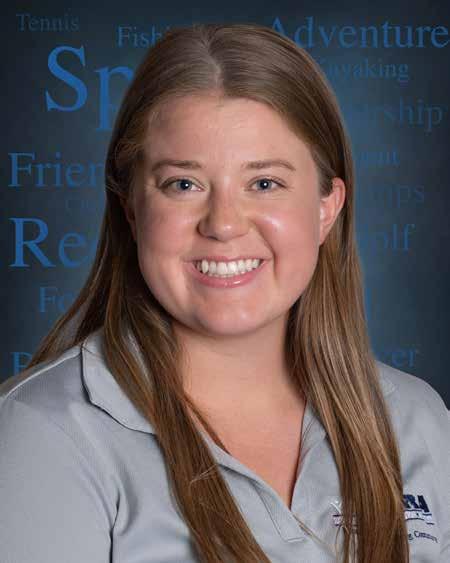
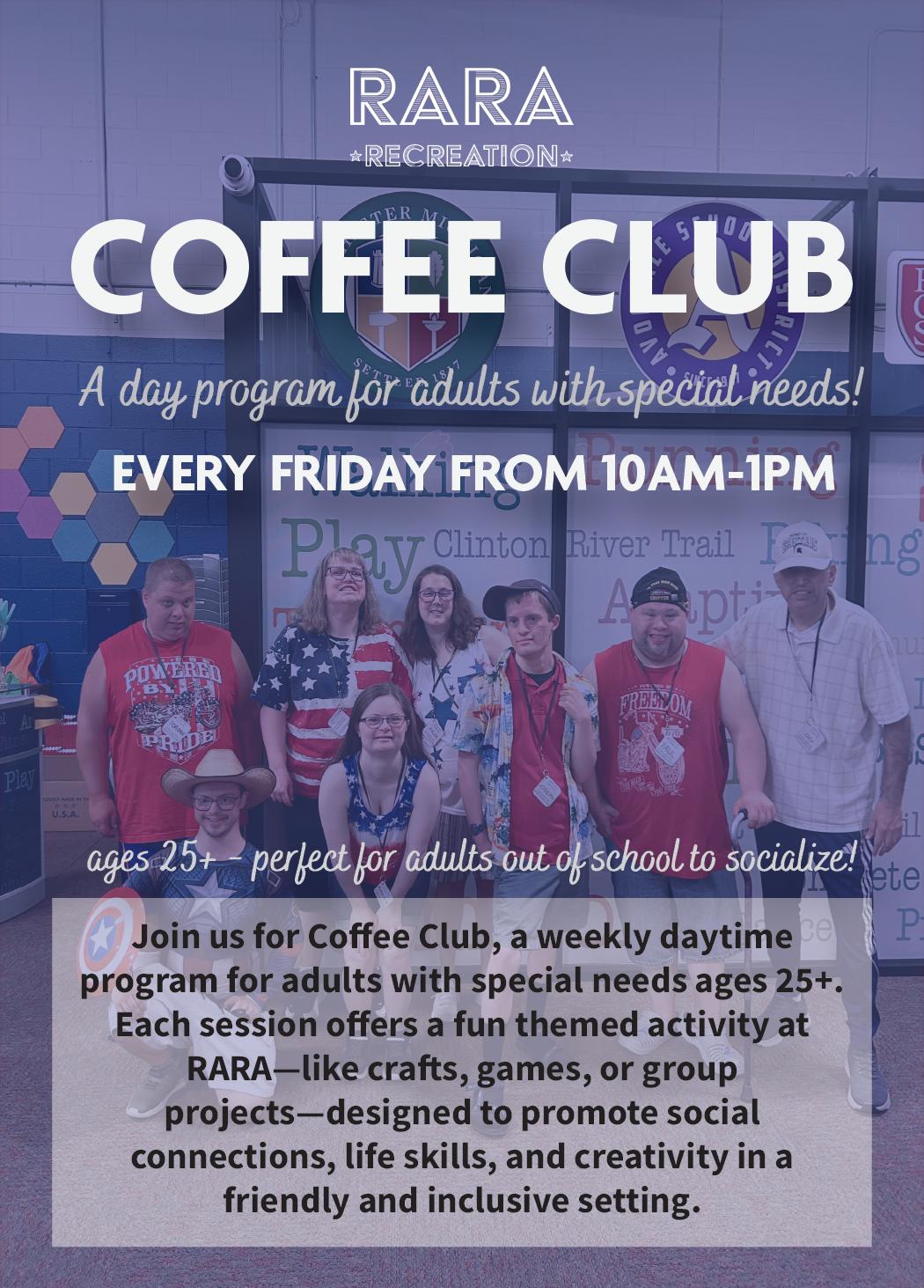
The RARA Coffee Club is an adult day program for individuals aged 26 and older with disabilities. The program takes place every Friday from 10:00 AM to 1:00 PM at RARA, providing a welcoming environment where participants can socialize with peers, engage in creative projects, and participate in physical activities. Since Coffee Club began in April, it has successfully served an average of 10 participants per week, with 17 unique individuals attending at least three sessions.
For all of the adults who love RARA and have aged out of RARA SCAMP, Coffee Club provides a similar experience of being with peers, and doing fun activities, only Coffee Club is year-round!


BY R SCOTT DE VARONA MBA EXECUTIVE DIRECTOR MIABLE 529(A)
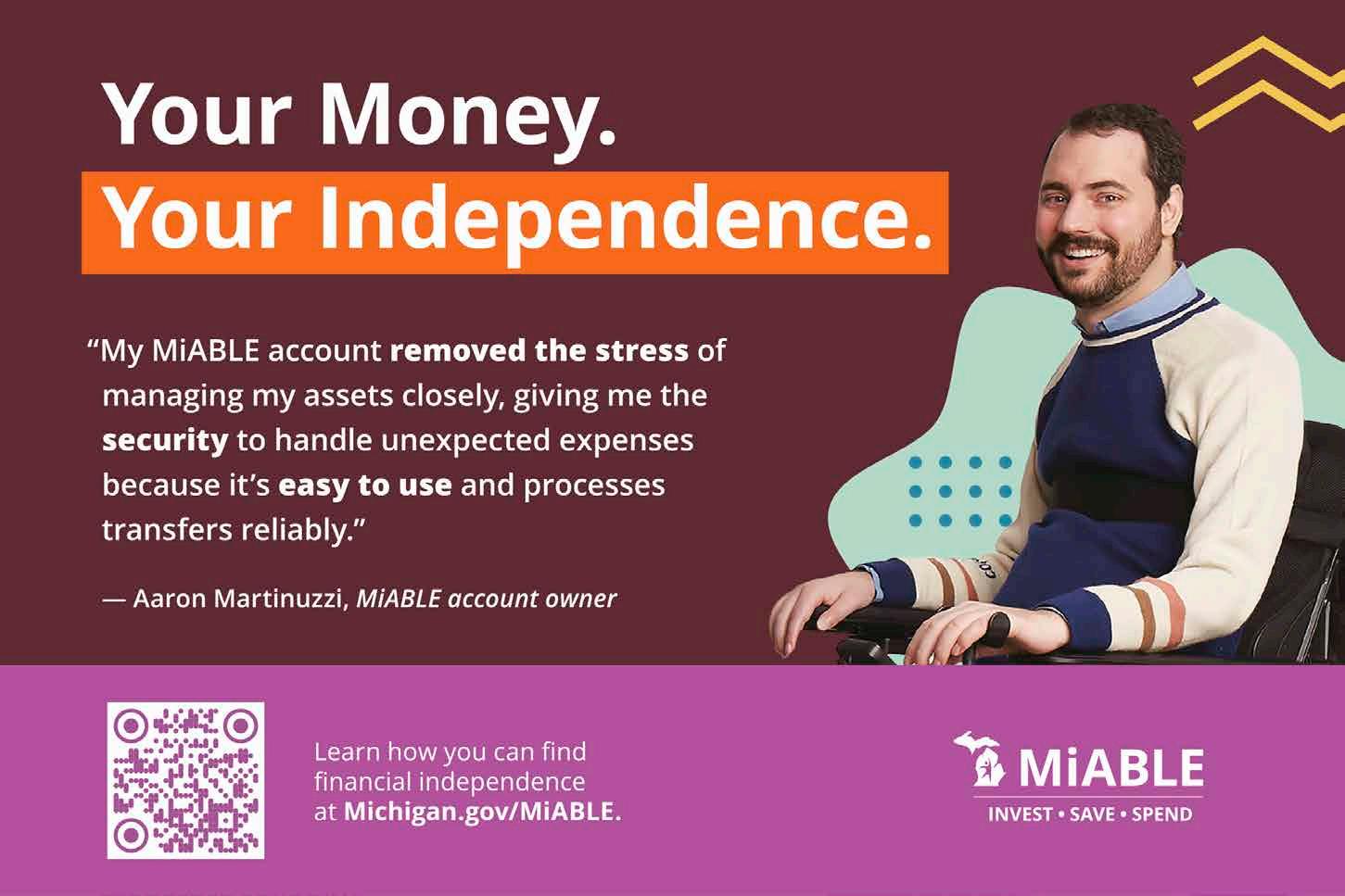
The ABLE (Achieving a Better Life Experience) Act was signed into law on December 19, 2014. The ABLE Act created taxfree savings accounts for individuals with disabilities to pay for qualified disability-related expenses (including education, housing, health care and transportation). The law made it possible, for the first time, for people with disabilities to save and pay for extra costs associated with living with a disability and to enhance their financial health, independence and quality of life.
Contributions are subject to annual and cumulative limits and are treated as gifts for federal gift tax purposes. Contributions deposited into an ABLE account must be used for Qualified Disability Expenses. MiABLE accounts offer checking and investment options. Investment growth is not taxable when the funds are used to pay for qualified disability expenses (QDEs).
After the initial ABLE Act was signed into law, there have been subsequent notices, proposed regulations, amendments, new acts and final regulations.
The ABLE Age Adjustment Act was enacted on December 29, 2022 and will go into effect on January 1, 2026.
This extends the age of onset of disability for ABLE account eligibility from 26 to 46 years old, expanding access to ABLE accounts for individuals who become disabled later in life.
This dramatically increases the number of individuals who can benefit from MiABLE accounts, enhancing financial security and support for a broader group of people with disabilities, including Veterans.


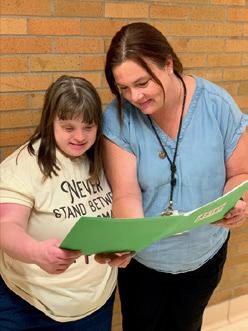
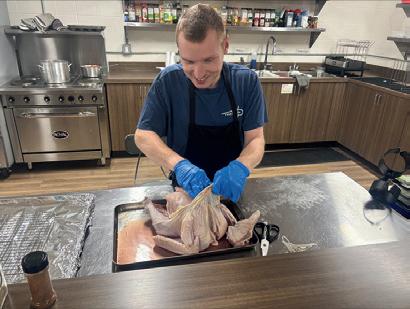
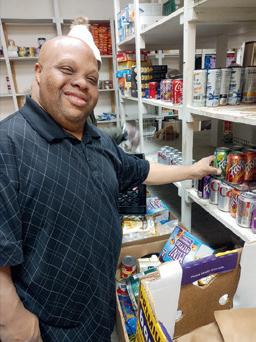

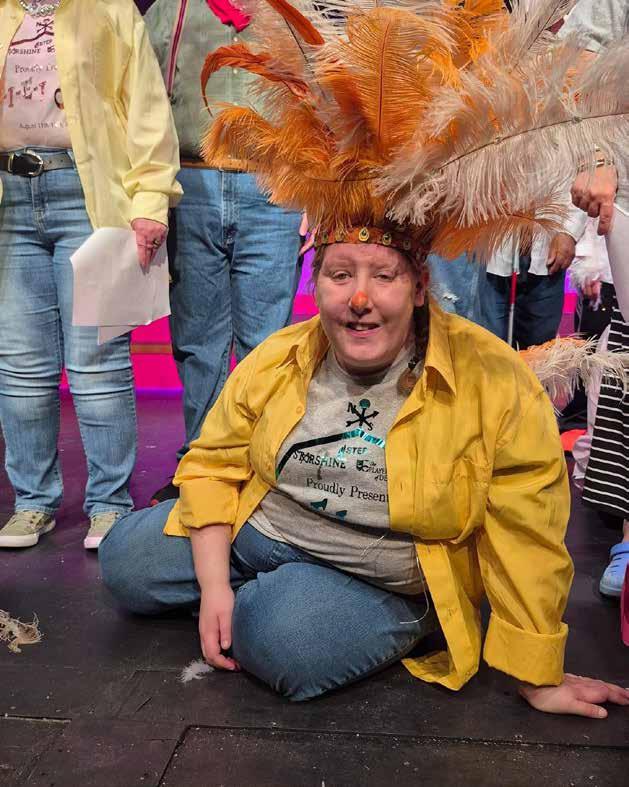
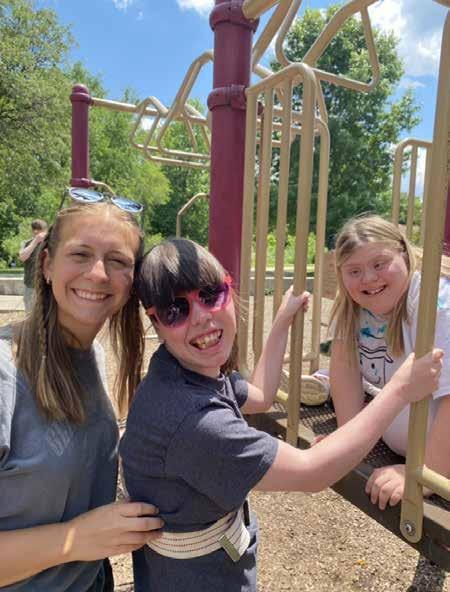
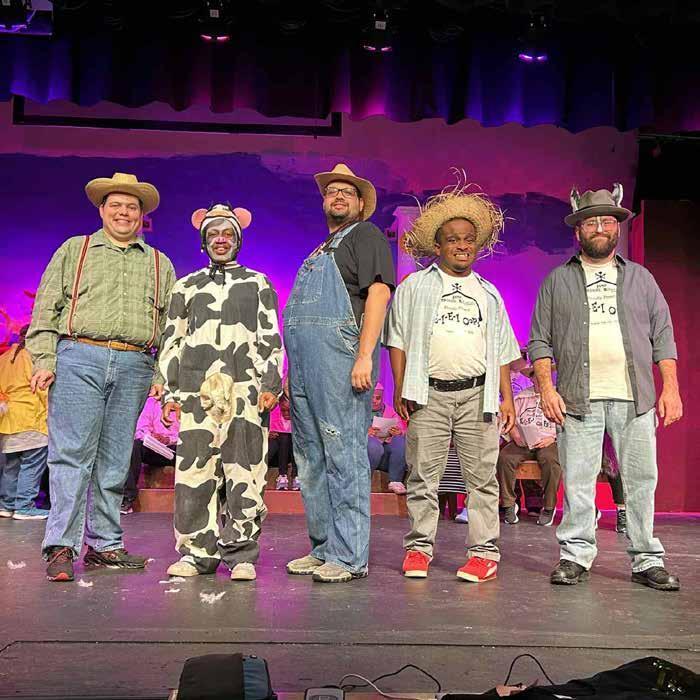
Our STEP members took center stage at the Starshine Theatre Workshop, hosted in partnership with the Players Guild of Dearborn, and what a week it was! The workshop offered an unforgettable opportunity for members to explore the world of theatre while connecting with the community in meaningful ways.
Throughout the week, members were immersed in every aspect of theatre life - auditioning for roles, learning songs, dances, and lines, and even assisting with costumes and set design. The experience went far beyond the stage - it was about teamwork, communication, and confidence-building, all in a supportive and inclusive environment.
The week culminated in a lively performance of “E-I-E-I Oops!”, where the Players Guild stage was transformed into a bustling barnyard. The energy was electric - singing, laughter, and applause filled the theatre as STEP members showcased their talent, enthusiasm, and hard work.
But the Starshine Theatre Workshop isn’t just about performing - it’s about community inclusion. Each year, this partnership allows STEP members to build lasting
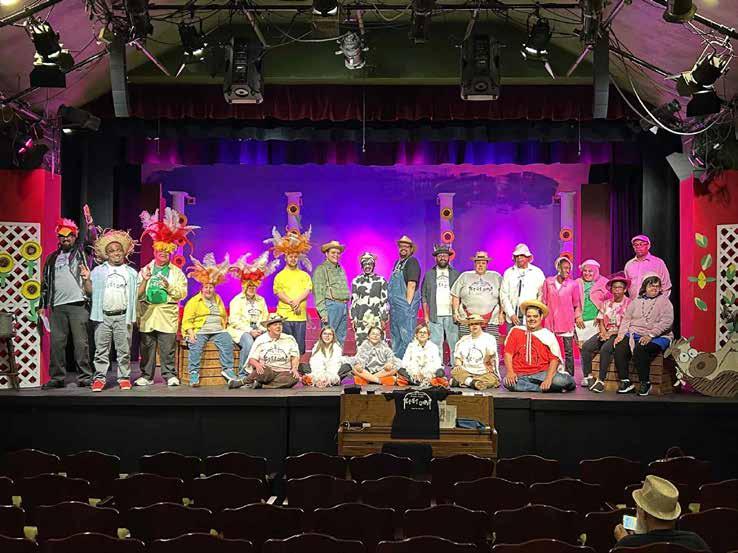
connections with local volunteers, theatre professionals, and audience members. These experiences help break down barriers, promote understanding, and show the community just how much individuals of all abilities can contribute when given the opportunity.
A heartfelt thank you to the Players Guild of Dearborn and everyone who supported our members throughout the week. Through partnerships like this, STEP continues to empower individuals to express themselves, share their gifts, and shineboth on stage and in the community.
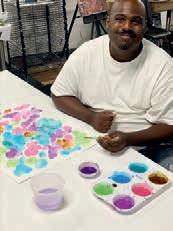
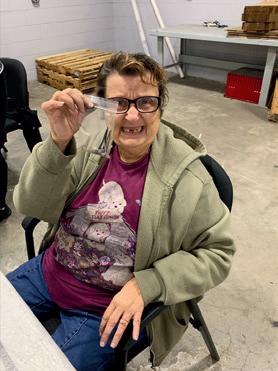
STEP is a non-profit organization that provides support and services to adults with disabilities and mental health needs residing in Washtenaw and Wayne counties. STEP helps individuals with barriers to employment reach their full potential and achieve their life goals through various programs and trainings. These include skill building, supported employment, volunteer opportunities, vocational rehabilitation, and more. With offerings like the Progressive Art Studio Collective (PASC), What’s Cooking at STEP, and training at our three STEP Thrift Store and Donation Centers, STEP offers opportunities to individuals of all abilities.
Empowering neurodivergent individuals and their communities to build healthy, meaningful relationships across the lifespan that honor their unique
Providing classes, coaching, and groups for neurodivergent individuals and their familes and caretakers.
Delivering training and consultation for practitioners, educators, and organizations to enhance neurodivergent-affirming practices in their service delivery and workplace.

BY HEALING HAVEN
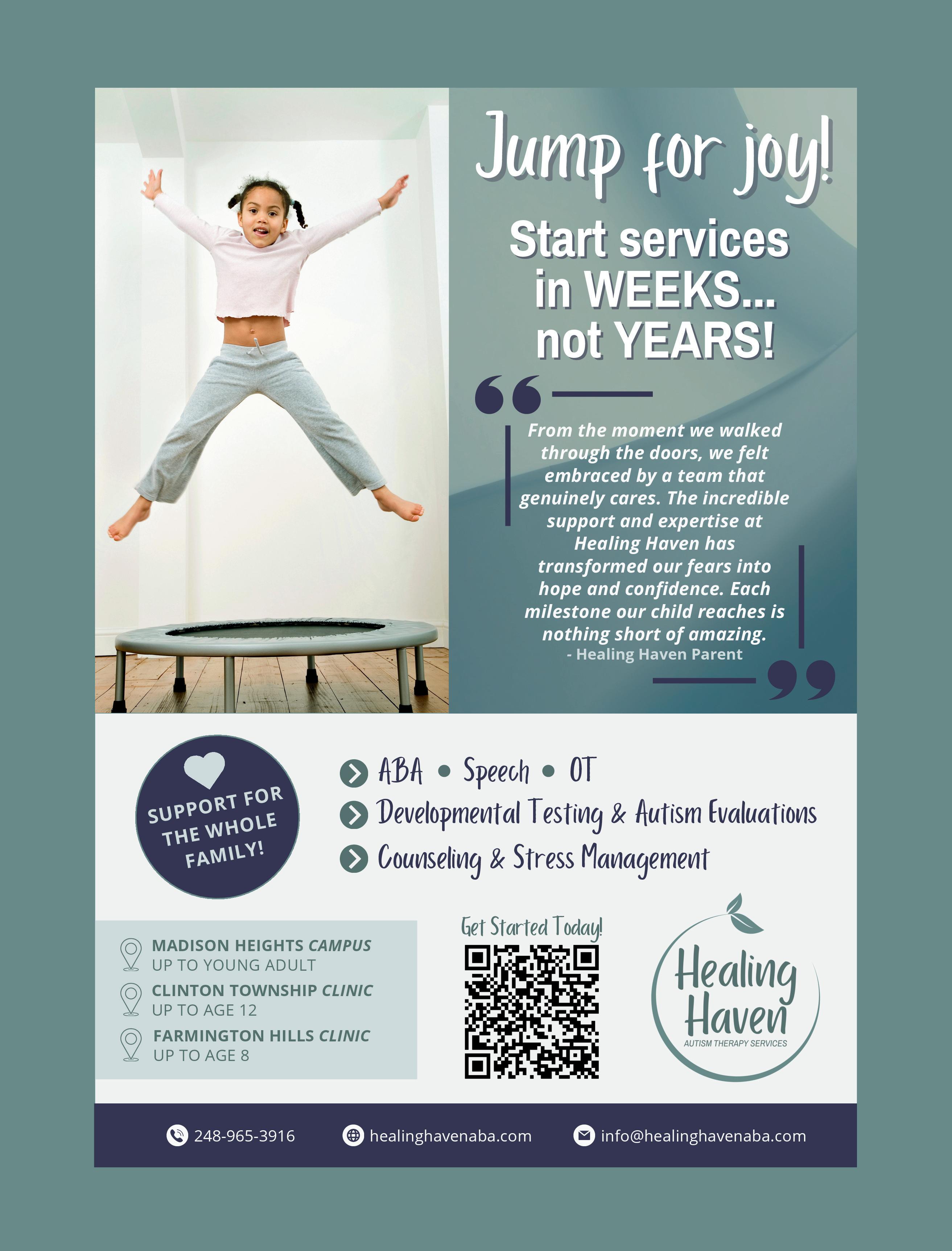
Over the past several years, we’ve seen more parents seeking services for toddlers as young as 2 to 3 years old—a promising shift toward earlier autism evaluations and diagnoses. While the CDC reports the average age of diagnosis is just under 4 years old, early developmental testing can lead to earlier intervention, which is crucial for developmental support.
Once a diagnosis is made, the next steps include choosing a treatment path. Applied Behavior Analysis (ABA) therapy is the most evidence-based and widely recommended therapy for autism.
“Research very clearly states that early intervention for children with autism and other developmental disabilities is vital,” says Jamie McGillivary, MS, LLP, BCBA, Founder and Chief Innovation Officer of Healing Haven. “Starting therapies like ABA early
provides strategic learning opportunities tailored to each child’s needs.”
Early intervention helps children develop foundational skills in communication, social interaction, play, and daily living—like brushing teeth, using utensils, and potty training. It also reduces the likelihood of challenging behaviors by teaching appropriate responses from the beginning.
ABA therapy is customized to each child. For example, if communication is a focus, Behavior Technicians may teach children to label items or make requests using pictures, gestures, devices, or spoken words.
For children with challenging behaviors—such as aggression, resistance to transitions, or excessive crying—Board Certified Behavior Analysts (BCBAs) create behavior plans to identify root causes and teach replacement skills.
“For example, some children flop to the ground when transitioning to a
new activity,” Jamie explains. “Their Behavior Technician may teach the child functional ways to communicate that they need a break. Or they may introduce proactive strategies to warn the child that a transition is about to occur. Giving warnings and visual information about what is to come helps decrease the anxiety surrounding transitions.”
As children meet their goals, one-onone support is gradually reduced. The goal is for them to generalize their skills across environments—home, school, and community. Healing Haven supports this process with additional programs and strong family involvement.
“We emphasize parent training and involvement,” Jamie explains. “When parents participate, it increases the chances that skills learned in therapy will carry over into everyday life.”
While ABA Therapy is the most recommended intervention for autism, many children also benefit from Speech and Occupational Therapies. These services provide targeted support in communication, social interaction, fine motor skills, feeding challenges, executive functioning, activities for daily living, emotional regulation, and more. And when the providers from ABA, Speech and OT collaborate, the child benefits from a coordinated team working together on the child’s goals.
Early intervention builds a strong foundation for children with autism to learn and thrive. Autism is a spectrum, and each child’s journey is unique—some may need ongoing support, while others transition successfully into school with varying levels of assistance.
A final thought – if your child did not receive an autism diagnosis until after 4 years old, please know that it’s not too late to start therapy support. And if you’re concerned about your child’s development, seek out a comprehensive evaluation.
Learn more about Healing Haven’s comprehensive autism services: Evaluations, ABA, Speech, OT and Counseling, visit healinghavenaba.com.
BY REBECCA PARTEN
Can you believe it’s already 2026?! With the start of the new year, many people (kids and adults!)
Decide to set goals to improve themselves. These can be very specific or very broad. But, one goal that I think everyone should set for themselves is to improve or maintain their self-esteem. Feeling good about yourself is so important and has many benefits - both physically and mentally.
For this month’s Chapters of Change review I wanted to read Self-Esteem is Cool: A children’s Book About Self-Esteem, Diversity, and Kindness by Beth Ann Bauer. Unfortunately, it was not really what I expected. I was drawn to it initially by the title, front cover illustration and summary. But when I sat down to actually read it, I was disappointed.
This picture book introduces you to a variety of characters with different traits like being tall, liking to make silly faces, being

mean to other kids, and using a wheelchair. Each character thinks that they are cool, not the previous one. At the end of the story we meet the character who was introducing us to the other kids and basically he says he doesn’t know what it means to be cool and his mom tells him just being himself is what makes him cool. This is definitely true, but I feel like the message came too late and the story ended abruptly.

To me, it felt like the story focused too much on each character thinking they were better than the others. While this could maybe lead to some good conversations about how the different characters made the reader feel, overall the story felt negative to me. I also thought there could have been more racial / ethnic diversity. All in all, I’m not sure I’d recommend this one.


Next month I’ll be reviewing Chronically Loved by Natasha Graves.
BY MARIA GIANCOTTI, M.ED. - STUDENT ADVOCACY MICHIGAN

Every parent wants school to be a safe place for their child. When a child is physically restrained or placed in seclusion at school, it can be frightening and confusing. Michigan law tightly limits these practices, but it’s important for parents to understand when they’re allowed, what the school must do afterward, and what rights you can assert to protect your child. Michigan allows seclusion and physical restraint only in narrow emergency circumstances, essentially, when a student poses an imminent danger of serious physical harm to themselves or others and no less-restrictive alternatives will work. Schools are also required to use positive, prevention-focused practices to avoid emergencies whenever possible, such as teaching coping skills, providing breaks, or using de-escalation strategies.
If seclusion or restraint is used, the school must document and report the incident using the state-required seclusion and restraint reporting forms. Michigan rules require written documentation of every use, including the reason, what was tried beforehand, start and stop times, any injuries, and who was present. That documentation must be reported to school administrators, the student’s parent or guardian, and the Michigan Department of Education using the state-required forms. Schools are also expected to debrief with families after incidents to review what happened and plan to prevent future occurrences.
Parents should request the written incident report and keep a copy. If a report is not provided, ask for a detailed account: who authorized the intervention, exactly what
happened and why, how long it lasted, any injuries, and what de-escalation strategies were used beforehand. Insist on a meeting to debrief and plan for future safety.
If your child’s behaviors place them at risk of repeated interventions, you can request a functional behavioral assessment (FBA) and a behavior intervention plan (BIP). For students with an IEP or 504 plan, a meeting can be called to add proactive supports. Michigan law encourages functional assessment and planning for any student who shows a pattern of behavior that could lead to emergency seclusion or restraint. Proactive behavioral support reduces the likelihood of future crises.
If you believe the school misused seclusion or restraint, for example, using it for discipline, convenience, retaliation, or when your child was not in imminent danger, you have options. Start by raising the issue with the school and requesting a written investigation. You may also request an IEP or 504 team meeting. If needed, parents can pursue formal dispute-resolution options: filing a state complaint, requesting a due process hearing under IDEA, or contacting the U.S. Department of Education’s Office for Civil Rights if discrimination is suspected. A special education advocate or advocacy organizations in Michigan can assist families in deciding the best course of action.
Keep detailed records: Save incident reports, emails, notes from meetings, witness names, and photos of any injuries. This documentation is essential if you need to advocate for your child later.
Ask questions: Don’t hesitate to request clarifications from the school about what happened, why the intervention was used, and what steps will be taken to prevent it in the future.
Request proactive supports: Functional behavioral assessments, positive behavior support plans, and training for staff in de-escalation strategies can help prevent emergencies.
Include advocates: Bring a trusted advocate, special education attorney, or knowledgeable friend to meetings if you feel unsure or overwhelmed.
Debrief with your child: Talk with your child about what happened, validate their feelings, and collaborate on strategies for coping with future challenges.
Monitor patterns: If similar incidents occur, request regular check-ins with the school team to review supports and adjust interventions as needed.
Seclusion and restraint are often traumatic for children and should always be last-resort measures. Michigan law and state policy emphasize prevention, careful documentation, family involvement, and planning to avoid recurrence. Parents who know their rights, insist on proper documentation, and push for positive, evidence-based supports help ensure that their child remains safe, physically, emotionally, and academically at school. If you need help navigating this situation or other IEP/504 concerns, contact Student Advocacy Michigan at 248-372-9770.

Through Museums for All, those receiving food assistance (SNAP benefits) can gain free or reduced admission to more than 1,000 museums throughout the United States simply by presenting their EBT card and a photo ID. Check here for participating museums. https://museums4all.org/
ELLA SHARP MUSEUM
SENSORY TIME
Every Saturday at 9-10 a.m. 3225 4th Street, Jackson, Michigan 49203
During sensory-friendly-hours, the Ella Sharp Museum will open its galleries at 9 a.m., one hour before the museum opens to the public. Families with members who are neurodiverse, autistic or have other sensory processing disorders or cognitive disabilities, are welcome to visit for a quieter experience in a controlled environment. Designated quiet zones will allow visitors to decompress and explore the museum at their own pace.
Before each program, families can browse “pre-visit” materials to help prepare for their visit, including social narratives and maps of the facility. These materials are also available to
assist families planning visits outside of program hours. A sensory backpack is available at the front desk for use.
To ensure the most sensoryfriendly environment possible, capacity during these special hours will be limited to 50 people. More information is available at ellasharpmuseum.org/ classes-and-events/sensory-time/.
IMPRESSION 5
Jan. 4 from 9:30-11:30 a.m. and Jan. 21 from 5:30-7:30 p.m.
Impression 5 Science Center, 200 Museum Dr., Lansing, MI 48933
Explore the Science Center during Sensory Friendly Hours, with select exhibits modified to reduce sounds, scents and lighting stimuli. Guests can expect limited building capacity, pop-up activities, and a map indicating the sensory experiences in each exhibit.
• Thanks to MiABLE for supporting Sensory Friendly.
• Admission is regular price; free for members.
• More information is available at impression5.org/sensoryfriendly
ABRAMS PLANETARIUM
SENSORY-FRIENDLY SHOWS
755 Science Road, East Lansing MI 48824
LIVING IN BALANCE: ANISHINAABE STAR KNOWLEDGE
Jan 18, 11:30 a.m.
Highlights Anishinaabe stories of constellations and moons in relation to contemporary insights about environmental changes. Teachings shared by Native Skywatchers Carl Gawboy, William Wilson, and Dr. Annette S. Lee are narrated by Aarin Dokum with Anishinaabemowin translations by Alphonse Pitawanakwat set to art by Elizabeth LaPensée.
THE GREAT SOLAR SYSTEM ADVENTURE
Jan. 18, 1:00 p.m.
Join showman extraordinaire “The Great Schiaparelli” as he takes the audience on a death-defying space-time adventure within his wondrous Observatorium. From the sun-scorched surface of Mercury to the icy expanses of Pluto and beyond, prepare to be subjected to the myriad dangers and wonders of our Solar System, on a breathtaking tour that reveals just how precious our home planet really is. Be warned though, the Observatorium isn’t just for show. It will transport the audience right to the heart of some of the deadliest locations in our slice of the heavens. It’s going to take some fancy flying to get everyone back in one piece! These shows will run with the lights up, the sound down and theater doors open so attendees can move around as needed. A “chill out” area is available in the lobby. All shows include a live star talk about what’s visible in the night
sky. A short break will occur between the main show and the star talk.
Information about what to expect will be provided when tickets are purchased.
• Cost: Adults, $5.50; students and senior citizens, $5; children 12 and under, $4.50.
• Friends of Abrams Planetarium members: free.
• Free with Museums for All (valid EBT, Medicaid or WIC card and photo ID required).
• More information: abramsplanetarium. org/Programs/Sensory.html
GRAND RAPIDS CHILDREN’S MUSEUM SENSORY-FRIENDLY PLAY
Monthly from 12:00 Noon to 3 pm. Check the website for upcoming events.
Grand Rapids Children’s Museum, 11 Sheldon Ave. NE, Grand Rapids, Michigan 49503
Together with Autism Support of Kent County, Grand Rapids Children’s Museum welcomes families to play in a calmer, quieter environment outside regular museum hours. Registration is required. Check the calendar for specific sensoryfriendly event dates: grpm.org/visit
More info: autismsupportofkentcounty. org/new-products/p/2024-nightat-the-gr-childrens-museum.
THERAPLAYYOGA: THERAPEUTIC PLAYFUL YOGA FOR DIVERSE ABILITIES
Adaptive Yoga Studio, 2015 E. Michigan Ave. Lansing, MI 48912
Inclusive and Accessible Yoga for Diverse Bodies, Brains and Abilities
Check the website for the current schedule.
Email: gloria@theraplayoga.com Website: theraplayoga.com
HIGH CALIBER KARTING –SENSORY-FRIENDLY SUNDAYS
Jan. 4, 11 a.m.- 2 p.m. $50
High Caliber Karting and Entertainment, 1982 W Grand River Ave #800. Okemos, MI 48864
On the first Sunday of every month, High Caliber opens early from 11 a.m. to 2 p.m. for sensory-friendly hours. If someone in your life would love to

drive a go-kart or play arcade games in a quieter, more accommodating environment, this is the perfect time to visit. High Caliber is committed to creating inclusive experiences for all guests. Learn more at highcaliberkarting. com/sensory-hours.
ADULT ADAPTIVE SOCIAL ENGAGEMENT: DINER’S CLUB
Jan 5, First Monday of the month. Enjoy a meal with friends at local restaurants in a welcoming and supportive setting. This program is designed for individuals with special needs and offers an opportunity to build social skills in a fun, inclusive environment.
Participants must be 14 or older and are responsible for the cost of their own meal, beverage and tip. Spots are extremely limited, so preregistration is required to ensure proper assistance and space.
The selected restaurant will be emailed to registered participants one week before the program. Check the website for dates, times and registration: rararecreation.org/ programs/social_engagement.php
CENTER SENSORY FRIENDLY PLAY
Jan 5, 9:30-11:30 a.m.
Outdoor Adventure Center, Globe Trading Company Building, 1801 Atwater St, Detroit, MI
The DNR Outdoor Adventure Center welcomes individuals and families with sensory processing differences to enjoy special sensory-friendly hours. During this time, building sounds and ambient noise levels will be reduced to create a more comfortable environment.
A quiet room with sensory materials will be available, and building capacity will be limited to ensure a calm experience.
Sensory-friendly hours end at noon, when the building opens to the general public and sound levels return to normal.
All staff members are certified through KultureCity to provide the best possible experience for guests with sensory needs. Various activities are scheduled throughout the month of October. Visit michigan.gov/oac for details.
FASCINATION FACTORY
SENSOR-FRIENDLY PLAY
Jan. 6, 2:30-5:30 p.m.
2295 E Lincoln St; Suite 150, Birmingham, MI
What to expect in our new sensorysensitive hours: Back door locked for safety, no music, noise cancelling headphones, and oral chews offered at check-in. Plus a calming corner tent. Minimized Capacity Families $30.00 https://autismallianceofmichigan.org/ events/list/?tribe-bar-date=2024-10-01
TOGETHER LET’S SING, DANCE AND JAM!!
Jan. 7, 6:30-7:30 p.m. Virtual Please join us for our monthly “virtual” music therapy event!! Please RSVP to Cathy Blatnik at blatsie63@yahoo. com with your name, age, contact phone number and e-mail address.
SENSORY-FRIENDLY JUMP AT LAUNCH LANSING
Jan. 7 and Jan. 21, 4-8 p.m. $17 1982 W. Grand River Ave., Okemos, MI 48864
1st and 3rd Wednesday of every month** Enjoy two hours of specially priced jump time during our sensory-friendly sessions. Additional discounts are available for families with more than one participant.
To create a more comfortable experience, music volume will be reduced and no special effects lighting will be used. Guests may borrow noise-reducing headphones and/or sunglasses free of charge. All rental items must be returned at the end of the visit for sanitation and future use.
Please note: Sensory-Friendly Nights are paused during school and holiday breaks, including Christmas, spring and summer break.
While the park remains open to the public during these evenings, this time typically sees low attendance, providing plenty of space for all guests to enjoy.
Learn more or reserve your spot: launchlansing.centeredgeonline.com.
Sensory-Friendly Evenings –Second Monday of Every Month
Jan. 12, 9 a.m.- 12 Noon
Throughout 2026, the Detroit Zoo will host Sensory-Friendly Hours— monthly opportunities for guests to experience the Zoo in a more inclusive, calming environment.
Held once a month from opening until noon, these hours are designed for individuals with sensory sensitivities or other sensory needs. The Zoo and its attractions remain open to all guests, with intentional adjustments to lighting and sound to create a more welcoming experience.
Modifications include reduced or altered volume and lighting throughout the Zoo and at select
Theater. Effects and lighting in the theater will also be adjusted.
KultureCity sensory bags—equipped with noise-canceling headphones, fidget tools and verbal cue cards—are available for guests who may feel overwhelmed. Bags can be checked out at Customer Care, the 4D Theater and the Park Safety Office. Weighted lap pads and strobe glasses are available upon request.
A designated indoor quiet space is located near the wolf habitat for those in need of a more secure and calming environment.
Sensory-Friendly Hours are included with Zoo admission and free for members. No registration is required. For more details, visit detroitzoo.org/ events/sensory-friendly-hours.
Jan. 2-4
Wild Lights has been lighting up the

and it’s easy to see why! This dazzling event is full of enchanting, animal-themed light sculptures that add a fun, whimsical twist to your festive adventures. https://detroitzoo.org/events/wild-lights/
INCLUSIVE GAME NIGHT
Jan 30, 6-7:30 p.m.
Therapeutic Concepts, LLC
38257 Mound Road, Building D, Sterling Heights, MI
This event is designed for the whole family, with a focus on inclusion, safety, and enjoyment. The cost is $10 per family, and registration is available online at therapeuticconceptsllc.com.
MJR DIGITAL CINEMA
SENSORY-FRIENDLY FILM
Check the website for movie times. 100 East Maple Road, Troy, MI, 48083, United States
https://www.mjrtheatres.com/sensoryfriendly-films?fbclid=IwAR1JnETT4LqVME0tv0TkWPiYH5lckEcSi4ou3EcdA4eyfbqJYLgmReJ00.
GIGI’S PLAYHOUSE
Monday through Thursday: 10 a.m.-6 p.m.
Friday: 10 a.m.-4 p.m.
19799 W. 12 Mile Road Suite L15, Southfield, Michigan
Various fun classes in art, dance, cooking, yoga and more are offered virtually and in person throughout the month.
See the calendar at gigisplayhouse. org/detroit/sfcalendar
COME JOIN SCOUT TROOP 1197!
FIRST ALL INCLUSIVE TROOP! 4920 Groveland Rd, Ortonville, MI 48462
The only troop of its kind in Michigan, Troop 1197 is currently meeting at O.A.T.S. (Offering Alternative Therapy with Smiles) in Ortonville for individuals with special needs ages 11 and older.
Designed by experienced scout leaders, the troop offers typical scouting activities, including camping and outdoor skills. For more information, email walkonoats@gmail.com.
Is there a local event for the special needs community you would like us to promote in an upcoming issue? Email us at Jamie.Olson@n2co.com

DATE AND TIME: Sunday, February 22, 2026 2 p.m.
WHERE: The Peter D. and Julie F. Cummings Cube, Max M. & Marjorie S. Fisher Music Center 3711 Woodward Avenue, Detroit, MI 48201
This free sensory-friendly concert welcomes teens and adults with neurodiversity and/or intellectual or developmental disabilities with their families and/or caregiver(s).
Join us for a 45-minute interactive concert featuring your favorite Motown hits played by tenor saxophonist Charles Prophet Jr. and his band. Following the concert, the fun continues with activity stations like instrument exploration, dancing, and a craft.

“Sensory friendly” events are designed for individuals on the autism spectrum and with other sensory sensitivities. Our culture can be unforgiving if you’re unable to conform to the standard concert etiquette of quietly sitting still for extended periods. This excludes individuals who are unable to sit still or who may express emotions such as joy or excitement through vocalization. This sensory-friendly concert aims to remove barriers, allowing everyone to be themselves and enjoy a musical experience in a safe and judgement-free environment.
• http://dso.org/sensory-friendly
• Reserve your FREE tickets: https://tickets.dso.org/ booking/production/bestavailable/11167
This section is here to give our readers easier access when searching for a trusted neighborhood partner to use. Get to know the businesses that make this magazine possible. Please support them in return and thank them if you get the chance!
ABA SERVICES
Budding Behavior Therapy (248) 622-5191
www.buddingbehavior.hi5aba.com
ABA SERVICES - IN HOME
Benevolent Behavior Therapy (947) 300-6700 www.benevolentbehaviortherapy.com
ABA/ BEHAVIORAL & AUTISM SERVICES
Healing Haven (248) 965-3916 www.thehealinghaven.net/
ABA/COMPREHENSIVE SERVICES
Total Spectrum ABA (844) 263-1613 totalspectrumcare.com
ADVOCACY
Student Advocacy Michigan (248) 372-9770 www.studentadvocacymi.com
ART STUDIO
Paint a Miracle (248) 652-2702 www.paintamiracle.org
ATTORNEY/WILLS, TRUSTS, ESTATE PLANNING
Chalgian & Tripp Law Offices PLLC (248) 799-2711
www.Mielderlaw.com
COMMUNITY SUPPORT
Judson Center (248) 837-2020
www.JudsonCenter.org
Work and Play Special Needs Resource Center Inc. (734) 780-6795 www.workandplaycenter.org
EMPLOYMENT AND TRAINING SERVICES
Services To Enhance Potential (STEP) (734) 718-0483 www.stepcentral.org
FINANCIAL
MIABLE (844) 656-7225 mi.savewithable.com
POST SECONDARY ED/LIFE SKILLS
Ready For Life (616) 248-3775 rflnetwork.org
PRINT SOLUTIONS: APPAREL & BEYOND POSSiBiliTEEs, LLC (616) 613-0386
www.POSSiBiliTEEs.shop
PRIVATE HIGH SCHOOL
AIM High School (248) 702-6922 www.aimhighschool.com
RECREATIONAL SUPPORT
Rochester Avon Recreation Authority (RARA) (947) 886-0084 www.rararecreation.org
RELATIONSHIP SUPPORT/SEXUAL HEALTH
My Relationships Project (313) 489-0043
www.myrelationshipsproject.com
SPECIAL NEEDS TRUST
Springhill Pooled Accounts Trust (248) 269-1319 springhillpooledtrust.org
SWIM SCHOOL
Suntastic Swim School (313) 558-0578 www.suntasticswimschool.com