Spring 2019
A Minority at the Margins A look into the Cambodian American experience
Issue 16
Tails of Japan
Highlighting three notable figures in Japanese folklore
The Digital Diaspora Subtle Asian Traits takes over the internet
spring 2019| 1
letter from the editor Dear reader, UNIVERSITY OF FLORIDA EDITOR-IN-CHIEF Alyssa Ramos MANAGING EDITOR Joanna Zhuang EDITORIAL CONTENT EDITORS Iesha Ismail, Kaylyn Ling DESIGN EDITORS Ingrid Wu, Allyson Martinez PHOTO EDITORS Claudia Forster Torres, Hye-Jin Min FINANCE DIRECTOR Warasinee Rattanaphong CONTENT PRINT WRITERS Mumtaz Abdulhussein, Vanessa Celino, Jamie Ang, Nazli Islam, Emma Ross, Zi Zheng, Brittany Wallace PHOTOGRAPHERS David Chan, Erin Cho, Lavanya Durai, Kylee Gates, Laura San Juan, Asena Markal, Maria Solano, Daniyah Sheikh, Sofia Zheng DESIGNERS Nabiha Azaz, Maria Solano, Tracy Lin, Karen Yung, Esther Zhan, Shuer Zhuo PUBLIC RELATIONS PROMOTIONS DIRECTOR Grace Song PROGRAMMING DIRECTOR Priya Mohan PR STAFF Jamie Ang, Nabiha Azaz, Josh Bronto, Hiya Chowdury, Yuting Wang COVER PHOTO Claudia Forster Torres, Hye-Jin Min DESIGN Ally Martinez, Ingrid Wu Model: Jarling Liu
UNIVERSITY OF CENTRAL FLORIDA EDITOR-IN-CHIEF Ann Dang MANAGING EDITOR Nica Angelica Ramirez PROGRAMMING DIRECTOR Jasmine Gabriel PROMOTIONS DIRECTOR Valentina Velasquez WRITERS Ayesha Faisal, Valentina Velasquez PHOTOGRAPHERS Paola Chinchilla, Minh Thu Nguyen Minh-Chau Le, Jasmine Gabriel DESIGNERS Simon Fevrier, Cassidy Nguyen PROMOTIONS STAFF Gabrielle Garcia, Adrian Lee Gabby Montoya UNIVERSITY OF SOUTH FLORIDA EDITOR-IN-CHIEF Aishani Shrinath MANAGING EDITOR Cynthia Lai CONTENT EDITOR Deeva Agravat PHOTOGRAPHY EDITOR Sophia Thai WRITERS Camille Custodio, Sucharita Gummalla, Bryant Nguyen, Trianna Nguyen DESIGNERS Ash Alonzo NATIONAL BOARD BOARD MEMBER & EXECUTIVE DIRECTOR Jason Liu CHAIR Kevina Lee Treasurer L.A. Geronimo Secretary Ricky Ly COMMUNICATIONS DIRECTOR Marcus Degnan, Katherine Ragamat MEMBERSHIP DIRECTOR Rikki Ocampos DIGITAL MEDIA COORDINATOR Angie Tran EXPANSION COORDINATOR Chelsey Gao WEB DEVELOPER Chris Tam ONLINE CONTRIBUTOR Monica Chen, Wanly Chen, John Cortez, EXTERNAL RELATIONS COORDINATOR Kim Hall OPERATIONS COORDINATORS Elizabeth Wang, Xue Wang DEVELOPMENT COORDINATORS Amy Cheng, Yen Le ONLINE COORDINATOR Minh-Tam Le BOARD OF DIRECTOR MEMBERS Ricky Ly, Lawrence Mabilangan
Sparks always reminds me that change is incremental. Sixteen issues later, and I admit that I still struggle to find engaging and fresh stories. It’s not for a lack of trying. We can only wax on and off about representation and colorism so much before it becomes stale. The fact is Asian American issues are relatively niche with little established research and dialogue. That’s not to say we haven’t made progress as a community. Asian Americans ticked off a number of firsts in 2018 alone. Of course, with the popularity of “Crazy Rich Asians,” “To All The Boys I’ve Loved Before,” and the rise of K-Pop stars, Asians are having a moment. Representation is a stepping stone, but we, as part of the Asian diaspora, seemingly struggle to find cultural experiences outside of boba. We are an immensely diverse community with our own struggles, languages and belief systems. It’s no wonder our issues center around identity. So who are we and where do we go from here? We so easily forget differents kinds of Asians in our narrative. The Subtle Asian Traits sensation on Facebook simultaneously unifies but limits us. Under the Trump administration, we’ve seen Asian Americans emerge to the forefront of politics. Our main story explores the gap among Asians Americans as waves of Cambodian
Americans experience low graduation rates and now fear deportation. It’s time we look beyond representation. Indifference is your worst enemy. Inform yourself, self-reflect and take action for issues you care about. We have a platform, but now we have to use it. Remember, we only have a foot in the door. As I wrap up my last year with Sparks, I would also like to take a moment to thank the people who have supported me. Thank you to my parents for collecting every issue. Thank you to my friends – your support means the world. Thank you to my dedicated team of writers, designers, photographers, and PR members. Never lose sight of your passion. Sparks has been another home where I’ve grown in wisdom and confidence while helping others find their passions. Even though I say goodbye here, let this issue of Sparks be a launching point for discovery and discussion to help us move forward.
Sincerely,
Alyssa Ramos Editor-In-Chief
2 | spring 2019
spring 2019| 3
table of contents 6 Missed Notifications BY mumtaz abdulhussein
30 More Than Manga BY valentina velasquez
10 The Digital Diaspora
32 Till Traditions Do Us Part
12 International Roots
34 Flavors of Thailand
14 The Little Soldier
36 The Literary Matchmaker
16 A Minority at the Margins
39 The Retrospective Look At
BY zi zheng
BY nazli islam
BY brittany wallace
BY brittany wallace
BY zi zheng
BY mumtaz abdulhussein
BY jamie ang
18 Island Womxn Rise: BY nica angelica ramirez
20 Tails of Japan
Asian Americans
BY ayesha faisal
6 16
20 32
BY emma ross
24 A Trip Down Bollywood Boulevard BY vanessa celino
26 Danny Khor BY kylee gates
4 | spring 2019
spring 2019| 5
Missed Notifications
2018 was a ground-breaking year of steps toward Asian American representation. Here’s your global events at a glance.
Aug 15, 2018
Asians Represented? Crazy! Apr 27, 2018 by mumtaz abdulhussein
Historic Summit on the Korean Peninsula North Korean leader Kim Jong Un made history by crossing over the demarcation line that has divided the Korean peninsula for 65 years. Classrooms and train stations in Korea broadcasted this first step, marking the first time a North Korean leader has entered South Korea since the end of the Korean War in 1953. He and South Korean President Moon Jae-in clasped hands before attending their historic summit to discuss denuclearization, sending a strong message and renewed hope for peace.
Source : The Howler
How Well Can You Spell? Karthik Nemmani, 14, won the 2018 Scripps National Spelling Bee after correctly spelling “koinonia.” This bee was the largest the organization had seen yet, with 515 competitors. Nemmani adds his name to the long line of South Asian champion spellers; 19 of the last 23 winners have been of South Asian descent.
6 | spring 2019
illustration + design/maria solano
May 31, 2018
The year 2018 marked a ground-breaking year for Asian representation in media. A University of Southern California Annenberg Inclusion Initiative study found that of the top 100 films of 2017, only 4.8 percent featured a character of Asian descent with a speaking role. In 2018, Hasan Minhaj became the first Indian American host of a weekly comedy show. Awkwafina became the second-ever Asian woman to host Saturday Night Live. Sandra Oh became the first actress of Asian descent to be nominated for Outstanding Lead Actress in a Drama Series at the Emmy Awards. Kelly Marie Tran, the first woman of color in the “Star Wars” franchise, explained the importance of representation best, saying, “I want to live in a world where children of color don’t spend their entire adolescence wishing to be white.”
Sept 05, 2018
India ’s Landmark Victory for LGBTQ+ Rights India’s Supreme Court issued a 5-0 judgment, striking down a colonial-era law prohibiting consensual “carnal intercourse against the order of nature.” While the law was rarely used to prosecute offenders, it provided backing for harassment, threats and blackmail leveled against members of the LGBTQ+ community. The ruling can serve as evidence of the fast-changing social beliefs in India, marking an incredible win for the country and global human rights.
spring 2019| 7
“More women and people of color would be holding office than ever before.” Nov 06, 2018
Record Number of Asian Americans in Congress
Sept 28, 2018
Indonesia Devastated After Earthquake and Tsunami More than 400 people died, and countless others were injured on the shorelines of Indonesian islands Java and Sumatra in the aftermath of a tsunami in late December. The archipelago consists of more than 17,000 islands, is home to more than 260 million people and sits in the Pacific “Ring of Fire,” an area with frequent tsunamis and earthquakes. Earlier in the year, a 7.5 magnitude earthquake devastated Sulawesi, one of Indonesia’s main islands, killing 2,000 and leaving tens of thousands homeless.
As Americans headed to the polls this past year, one thing became clear: more women and people of color would be holding office than ever before. The number hit a new high, with 20 elected Asian Pacific Islander Desi Americans (APIDA) officials for the second year in a row. These legislators include Andy Kim of New Jersey’s 3rd Congressional District, T.J. Cox of California’s 21st Congressional District and Michael San Nicolas, a non-voting representative for Guam.
Source : NPR
Oct 01, 2018
Immunologist Duo Win Nobel Prize
Dec 17, 2018
Tasuku Honjo, a Japanese immunologist, won the 2018 Nobel Prize for Physiology or Medicine along with his partner, James P. Allison, for their discovery of a new cancer therapy. Together, the duo showed how different strategies for inhibiting the brakes on the immune system can be used in the treatment of cancer. This is the first time a development in cancer therapy has been awarded a Nobel Prize.
In a breathtaking red dress inspired by the volcanoes near her home, Catriona Gray of the Philippines was crowned Miss Universe, making her the fourth Filipina to wear the crown. Gray, who advocates for social change, highlighted her work in providing relief to Manila’s slums. The win was a huge victory for her home country, despite recent controversy surrounding the sexist nature of pageants.
8 | spring 2019
Catriona Gray: Girl on Fire
spring 2019| 9
The Digital Diaspora Subtle Asian Traits takes over the internet
Subtle Asian Traits (SAT) is the Asian diaspora in a nutshell.
While the original creators never expected such skyrocketing popularity, Jiang believes the page fulfilled a need for the Asian community that never really had been met before. “I think having a community like SAT really enables us to embrace our own culture, and a recent boost of representation in the media such as in ‘Crazy Rich Asians’ has fortified that sentiment of belonging as well,” Jiang said. Generally, first and second generation Asians everywhere from Australia to the U.S. tag, comment, like and react on the page, Jiang said. A 2010 Pew Research Center study showed that 89% of Asian
10 | spring 2019
Asian minority groups often like to band together. They sort of segregate themselves and find others to unite together —Yiwen Niu Yiwen Niu, a 24-year-old graduate student from China, studies journalism at the University of Florida. Niu believes that SAT rose to popularity based on cultural identity, and in a way, solidarity.
Rosalind Zhang, a Chinese Canadian member of the group, moved to a small town in Germany. In response to an article she shared on SAT, she made observations living in a predominantly white community. “People have said unsolicited ‘Ni-Hao’s’ on the streets,” Zhang said in a post. “And people still make generalizations that haven’t been considered racially sensitive (and therefore taboo) yet.”
design/tracy lin
“I think the true beauty of humour is that it has the power to bring people together,” Lydia Jiang, one of the administrators of the SAT page, said.
Social media channels such as Facebook, Twitter, WeChat, WhatsApp, Naver and LINE connect Asians across the globe. These web apps provide digitized channels of communication that are unimpeded by physical location. For many Asian emigrants, these channels serve as the best way to talk with family overseas. For younger generations, SAT is the perfect environment to foster a pan-Asian community.
illustrator/ erin cho
Created in September of 2018, the small meme page was created by a group of friends to joke about familiar Asian tropes. Within a year, the Facebook group from Australia ballooned in popularity. Zhou, a 19-year-old economics major at the University of Florida, is one of 1.2 million members who scroll on the page daily.
American households owned a computer. Compared to other races, Asian Americans ranked number one in this statistic; white populations came runner-up with 81%.
by zi zheng
W
hen Ryan Zhou opens Facebook, cups of boba runneth over. On his feed, memes and Chinese characters fuse to form cheesy puns. Korean aunties dole out “Kimchi slaps.” Abnormally strong grandpas perform pull-ups. Then, of course, there’s the Chow Chows and Shibas.
dynamics or discrimination. Reminiscent of the way that social media has propelled the #MeToo movement, Asian diaspora generations have an international platform to voice their thoughts.
Originally from the diverse city of Toronto, Zhang said she had never experienced what she would consider a “truly racist” moment, but she was curious as to what people thought about certain microaggressions. “I, for one, advocate for those uncomfortable discussions to be had, as I feel it is the best way to educate and gain insight on various topics,” Jiang said. “I believe that the majority of our admin and mod team feel the same way.”
also emerged from the group to create more representative pages. Some who criticize the page also argue that SAT romanticizes problematic Asian family dynamics instead of actually addressing them. If anything, the Facebook page fills a space but also highlights cultural gaps that suggest that the Asian American community is not as monolithic as it seems. “The admin team and myself recognize our potential to make something more of SAT, something that can help give back to the community that has supported us all this way,” Jiang said. “We’re still discussing ideas, but our broad purpose is to bring people together to create rapports and encourage discussion around the world. The SAT page has surely sparked discussions on Asian American identity, granting it the power to prompt deeper discussions on everyone’s own unique experience in the U.S. Rather than an end-all-be-all page that sums up a so-called “Asian American culture,” SAT can act as a new ground zero for recognizing the nuanced differences and similarities among a culturally diverse yet unified Asian American community.
However, its popularity has spurred criticism as well. Many claimed that the page focuses mostly on East Asian culture — namely, Chinese. Sub-groups such as Subtle Curry Traits, Subtle Korean Traits and Subtle Asian Adoptee Traits have
“Asian minority groups often like to band together,” Niu said. “They sort of segregate themselves and find others to unite together.” Sometimes users who lack an Asian community can find unity and even solace through shared experiences. Since its humble beginnings, the page has transitioned between light-hearted memes to long text walls about struggles with self-identification, Asian family
spring 2019| 11
International Roots Exploring South Florida’s Morikami Museum and Gardens
Young and single, he traveled 7,317 miles in search of success in the state of white sands, clear waters and blazing heat.
The Morikami serves as a bridge for cultural exchange between the United States and Japan. —Bonnie LeMay
Morikami bought his own plot of land and lived in a small mobile home. While the original dream of the colony did not reach its full potential, his legacy remained firm and resolute in the face of change. His land, now located in Delray Beach, Florida, has become the Morikami Museum and Japanese Gardens. In the 41 years since the park’s opening, the museum has become a popular tourist attraction and cultural center. The director of the museum, Bonnie LeMay, said its presence supports the local business community in Palm Beach County. “The Morikami Museum serves as a bridge for cultural exchange
illustration/ laura san juan
Morikami was a member of a Japanese agricultural colony in what is now Boca Raton, Florida. Unlike the other settlers, he thought he would live in Florida for only a few years.
Everything changed when the U.S. Government seized the land In 1942, during World War II. The colony failed and a majority of the settlers returned to Japan . As fate would have it, Morikami stayed behind.
by brittany wallace
G
eorge Morikami was the last man standing from the Yamato Colony.
design/ nabiha azaz
12 | spring 2019
between the United States and Japan,” LeMay said. Exhibits such as “The Yamato Colony: Pioneering Japanese in Florida,” help her educate community on the unique history of the Yamato colony. The exhibit captivates audiences with the tale of Jo Sakai, who partnered with the Florida East Coast Railway to establish a the colony of Japanese settlers who would cultivate pineapples and later winter vegetables. The settlers also built their own Japanese style school room, which still stands today. Through the “Japan Through the Eyes of a Child,” visitors can take a peek at Japanese life. The exhibit also includes a tatami room, a Miyazu classroom and even a Japanese toilet and shower.
I will have accomplished my goal if visitors to the gardens come away refreshed and feeling better about themselves and their world while looking forward to sharing their experiences here with others. - Hoichi Kurisu In addition to its museum exhibits, Morikami boasts beautiful Japanese gardens. The Morikami gardens consist of six distinct Japanese gardens, each inspired by a famous Japanese garden style from a different historical period. Representing Japanese horticulture between the eighth and 20th centuries,
these styles include Shinden Garden, Paradise Garden, Early Rock Garden, Karesansui Garden, Hiraniwa Garden and Modern Romantic Garden. Together, they are named Roji-en: Garden of the Drops of Dew. These meticulously crafted gardens are encompassed within 16 acres of Morikami Museum’s 200 acres. Although inspired by historical Japanese garden styles, the gardens are not exact copies of them. The garden’s designer, Hoichi Kurisu, used plants native to Florida. He believes that the Japanese garden is not about items or plants that occupy it but the atmosphere it creates. “I will have accomplished my goal if visitors to the gardens come away refreshed and feeling better about themselves and their world while looking forward to sharing their experiences here with others,” Kurisu
said in a statement on Morikami’s website. Brianna Mazzocchi, a 21-year-old English major at the University of Florida, has traveled down to Delray Beach three times with friends. There, she enjoys strolling through the gardens. A red wooden bridge gleams in the sunlight and a peaceful aura washes over. It’s her favorite spot, she said. In front of her lies a crystal clear lake that reflects the densely packed trees hugging its sides. The serenity that cascades over her in the Roji-en gardens draws her back for another visit this spring. Countless other visitors share her fondness for the park. Unlike any other place in Florida, the Morikami Museum and Gardens brings a piece of Japan to the Sunshine State.
spring 2019| 13
The Little Soldier A personal narrative about a young boy who stops at nothing to protect his sacred Chinese island
W
hen I was six years old, I often sat on a stone seawall that separated the brown sea from the Hujiang village. Gentle breezes swayed the blue fishing boats anchored at the dock. Once a famous tourist area, Hujiang sat a few miles off the coast of southern China. But after years of barbarous littering, it dwindled to an inhabitable trash pile.
If a tourist ever started climbing up the staircase, my grandfather would scare them away with his impressive physique. At 6-foot-5-inches, he towered over everyone on our island. With his unfaltering gaze, beard as thick as the forest and baritone-range voice, my grandfather successfully fended off daring tourists. My grandfather loved the Sun-Watcher even more than I did. At our special
No matter where you sat on that hill, the sun remained in your sight. Sunrise was always the best time to find beetles. Everything became a little brighter, as if God had sprinkled a layer of gold over the world. A path named after the fishing goddess, Mazu, led the SunWatcher. Islanders often prayed to the statues of Mazu alongside the path. t A scarlet sequoia wood arch stood resolute, connecting the dock to
14 | spring 2019
“Tell me about your home,” “My Orlando home? Texas home? New York home? Gainesville home?” “No, your real home. Your motherland.”
In 2003, my grandfather died of lung cancer a few weeks before I left for America. Cigarettes, much like the ones that polluted our beautiful island, had done him in. We buried him on Sun-Watcher, as he requested. Now when I return to that hilltop, I cry for a completely different loss. After my grandfather’s death, the task of protecting Huijiang and the SunWatchers was up to me. One day, I climbed an oak tree that arched above Hujiang’s thin forest canopy. The flea market bustled with activity, fishermen unloaded their captures and a lonely white dog wandered among houses scavenging for leftovers. Huijang’s usual tranquility stopped when the tourist boat hit the dock. Flocks of foreigners flooded the island. Tacky caps topped their heads and cigarettes jutted out of their mouths like pacifiers. A teenage girl and boy stepped onto the staircase with cigarettes in their hands. Silky black hair flowed down the girl’s waist, while thick, dark locks covered the boy’s head. At first, fear stopped me from shouting,
illustraion + design/ally martinez
It was also my favorite spot to catch beetles. A light thicket housed the coolest and shiniest beetles I’d ever seen in my life. I called this place “the Sun-Watcher.”
Passing through the arch, a sandy staircase led to the Sun-Watcher. It was the pathway to heaven — at least, that’s what I’ve always thought.
spot atop the hill, we often competed to see who could catch the largest beetle using homemade nets. Somehow, my grandfather always managed to find the largest and brightest beetle. I would always cry when I lost.
by zi zheng
Rancid rats scurried beneath my feet, eating the trash left by tourists. Cigarette butts, wrapping paper and beer cans were scattered across the once yellow beach, emitting a rotten odor. The only spot free of litter was on a hilltop secluded from the village. No one touched it.
the path. It was the main symbol for the island. The word “Hujiang,” signed in brilliant bronze, dangled above. Patterns of saffron dragon fish swam from the bottom led to the top, where it sprouted outward into a physical structure of golden spirals.
but I couldn’t let these people soil my grandfather’s sacred place. My grandfather wouldn’t back down. I puffed my chest out like he would do. I felt his essence shield me like a suit of armor. His spirit controlled my small limbs, commanding me and thrusting me forward into danger. I growled and tightened my fist, ready for battle. Weaponized with snapped twigs and pebbles in the of pockets of my cargo shorts, I glared at them. I took a deep breath and hurled pebbles and twigs. Projectiles hit them like a mini blizzard. Pebbles bounced off their foreheads, causing them to stumble back. They screeched. One glance upward, and they spotted me. With the sun piercing above, the boy’s eyes glowed pure rage. He roared at me with cuss words I didn’t understand and sprinted up the staircase. My heart ticked like a bomb on the brink of explosion. Panicking, I scrambled for a weapon before noticing my jar.
Inside, a bronze beetle with a spiky back crawled around slowly. I looked downward. The boy was a little over halfway up the staircase. I held the beetle to my chest. I’m sorry … I don’t want to hurt you, I told him, but this is the only way I can protect your home. I popped open the lid and released the beetle, aiming for the girl. “Wait!” the girl cried, leaping after the boy.
Lounging on the branches of a nearby tree, I peered through the leaves into the village. Like ants, the tourists scuttled around the temples poking at Mazu’s nose. They spat on the ground and threw empty water bottles in the sea.
I realized then that I must defend my home.
My target moved away from her spot. I missed. Suddenly, a gentle wind carried the beetle to the center of the girl’s hair. It crawled carelessly up and down her tresses. Clearly, it was not in its usual habitat. The girl screeched. Her arms flailed. She sprinted down the staircase, nearly tripping. The guy chased her and managed to grab ahold of her arm. They argued at the foot of the stairs, and eventually, left.
At that moment, I realized that I had to defend my home and guard it from filth, just like my grandfather did. I walked down the staircase like a soldier going into war — a war to keep my refuge beautiful. If my grandfather were still alive, I know he would have stood beside me. But I know he’s still with me. He was the wind that carried the shiny bronze beetle.
spring 2019| 15
A Minority at the Margins
about [it]. I’m very nosy,” she said. “So I’ve kind of put a lot of things together and come up with a story.” When the war hit, it put a halt to her father’s early education, Som said. Her father escaped to Thailand where he lived in a refugee camp with his family members. From there, he was sent to the Philippines where he learned English until immigrating to the United States.
A look into the Cambodian American experience
S
ophan Seng remembered hiding from the militant groups in in the forests surrounding his villagewhen he was just 10 years old.
The regime advocated for a classless agrarian society achieved through labor camps, killing fields and targeted attacks against the country’s professional and technical class – this included journalists and students. While the Khmer Rouge formally fell in 1979, their grip on Cambodian life and politics held strong through the 1990s and still has lasting effects.
Eventually, they were caught. Seng grew up in the aftermath of the Khmer Rouge, the communist regime that ruled Cambodia from 1975 to 1979. During the Khmer Rouge’s rule, an estimated 1.5 million Cambodians were killed. Although the actual death toll could be as great as 3 million.
Southeast Asian Americans have some of the lowest high school graduation and bachelor’s degree rates in the United States. A study conducted by the Center for American Progress in 2015 found that 37% of Cambodian Americans did not complete high school, which is more than double the national average. Statistics like these highlight the fallacy of the model minority myth. When gone unchallenged, this myth has damaging repercus-
16 | spring 2019
“As a Cambodian American, I’m an underrepresented minority and the education system doesn’t see that,” Som said. She believes the education system tends to focus on minorities such as African Americans, Hispanic Americans and Native Americans, exclud-
As a Cambodian American, I’m an underrepresented minority and the education system doesn’t see that. - Salina Som ing a large portion of society who also needs equal educational opportunities. Even as Som applies for graduate school, she feels she must constantly justify to her peers and school officials that she’s a minority who should benefit from financial aid. Som’s father came to the United States as a refugee, and her mother followed him shortly after their marriage. Her parents were instrumental to her success by prioritizing education from an early age. Like many refugees, her dad avoids conversations about his experience during the war. “I actually have to kind of bug him
design/ingrid wu
Looking back, he never imagined he would pursue a career in politics. Under the Trump administration, several legal Cambodian immigrants fear deportation. Stricter immigration laws expand the list of people applicable for deportation. In 2017, I.C.E. deported 74 Cambodians and 29 in 2018. As systems of power unconsciously marginalize southeast Asian populations, Seng’s hopes to use his degree to improve the world around him. However, Seng is one of the outliers in the education system.
Salina Som, a first-generation University of Florida graduate in chemistry, has always wanted to go to college, but – compared to East Asians of a higher socioeconomic status – the application process proved to be difficult for her.
I’m so blessed we had people that supported us when we were here. - Ranida Repiedad
photography/ daniyah sheikh
To this day, Seng still thinks of the ones who returned home with missing limbs or worse, the ones that couldn’t come back.
In pursuit of greater opportunity, Seng left Cambodia in 1994. He attended the University of Hawaii, earning a master’s degree in political science and international relations. He now lives in Canada with his wife and three young kids, where he is a Ph.D. candidate and runs his own blog about Cambodian political issues.
sions for Cambodian American students navigating the education system.
by mumtaz abdulhussein
The fatigue easily lulled him to sleep despite the downpour of rain. When he woke up, water flooded up to his neck. With no fire to warm him during those long nights, he remembered his friends who struggled to remain pindrop silent throughout the night.
“The memory of a 10 year old is blurry, but bad memories stay intact,” he said.
Many Cambodian refugees fled to the United States with close to nothing. In fact, many refugee families had nothing left of their lives from Cambodia, not even a single picture. Instead, they carried mental and physical health problems as a result of the trauma they faced because of the Khmer Rouge. To this day, Som’s father still struggles with PostTraumatic Stress Disorder (PTSD).
Unfortunately, not all Cambodian Americans receive the same help. In larger cities and schools, teachers don’t have the resources to help students individually, leaving a new generation of Cambodian Americans who did attend school frustrated and discouraged. ““I’m so blessed we had people that supported us when we were here,” Repiedad said. In the midst of America’s debate over issues such as immigration and affirmative action, systems of power tend to overlook the socioeconomic gap within the Asian American community. As distinct needs of the Asian American community come to light, organizations can pave the way for a brighter and better future for Cambodian Americans. “We knew it would take hard work and education to improve our life and that was our goal,” Repiedad said. “My family truly believed this is the American dream.”
Other Cambodian refugees experience “Pol Pot Syndrome,” a form of PTSD nicknamed after the leader of the Khmer Rouge plaguing refugees in the form of insomnia, difficulty breathing or a sense of powerlessness. Som recognized a difference between her parents’ emphasis on education compared to that of other Cambodian Americans. The Khmer Rouge executed those who were educated, or those who simply appeared educated because they wore watches or glasses. Because of this, many parents were wary of the education system. “When you accept refugees, you not only want to make sure they have food, water, shelter, but also that they can be rehabilitated into American society, which takes money and effort,” Som said. When her parents resettled in the United States, their most immediate concerns were putting food on the table and a roof over their family’s heads. Som’s father worked just about any odd job to make ends meet. Ranida Repiedad was five years old when the Khmer Rouge came to power. After living in a refugee camp and moving to America five years later, Repiedad said failure was not an option. Repiedad’s success was bolstered under the guidance of their sponsors as they settled into a new home. For many refugee families who don’t speak English, the language barrier prevents them from accessing resources that existed for them. In school, Repiedad was pushed back to second grade because of her small stature and her limited knowledge of English, which she still believes was one of her biggest obstacles to overcome when she came to America. For Repiedad, one of her teachers took her under her wing and a sponsor would tutor her after school.
spring 2019| 17
Ibarra said that an immigration story would be incomplete without including Visayan, citing such an act as a disservice. Her album centers around interludes to form her narrative. One interlude, for instance, includes a sample of her mother’s oath of naturalization to juxtapose her American experiences with her Filipino roots. They were a large part of the album’s creation, she said. During the production process, she wrote the skits first and then produced songs to accompany them. “I knew that the Oath was going to be a big part of the immigration experience. When I listen back to it, it kind of gave me chills listening to my mother say the oath,” Ibarra said. “This part of the album was about us [immigrants] kind of losing a sense of ourselves … you’re kind of letting go anything from the past or where you come from.” To exemplify the barriers that are dismissed in conversations about the disillusioned American dream, Ibarra makes sure to include instances of discrimination and microaggression. One skit details an older man asking where she was ‘really from’ during a flight.
Island Womxn Rise A Conversation with Ruby Ibarra
Ruby Ibarra Ibarra identifies as Filipino American first, emphasizing her heritage both personally and artistically. She finds difficulty in relating her Asian American identity to her Visayan roots. Visaya is one of the three major geographical regions of the Philippines.
Her culture directly impacts her art through poetry and music. “My culture is a big proponent of who I am and how I grew up just because it [has] shaped how I live day-to-day,
18 | spring 2019
it’s shaped how I live day-to-day, how I interact with other people, [and] how I navigate my experiences growing up here as a first-generation filipino american. ” “Growing up, even in San Francisco - a sort of melting pot of different cultures, it was very rare to come across another Visayan. I’ve only met like two other, maybe three other Visayans,” Ibarra said. With her 2017 hip hop album “Circa91,” Ibarra explores both her sense of community and culture. Much of Ibarra’s
“They were really the ones [whose music] I remembered every single word [of], and they taught me a lot about my values and examining myself and my identity,” Ibarra said. “[They] have equally molded me into the artist that I am today and why I talk about the things I talk about.” Ibarra’s goal is to illustrate the firstgeneration immigrant experience through language. Whether it’s English, Tagalog or Visaya, she expresses her narrative through concise language. “Specifically, the Visayan dialect has a lot of consonants, and it even sounds like beatboxing when done acapella,” Ibarra said. Tagalog and the Visayan dialect are sonically pleasing, she said. “I think the beat of the language goes really well with rap, it goes perfectly with the art form,” Ibarra said.
“Seeing my mom’s experience made me realize that when we talk about the immigration experience, it’s not always the American Dream we talk about,” Ibarra said.
Isang Bagsak: Activism “My activism means everything to me,” Ibarra said. “I think when we think about rap, it’s really the music and the voice of the youth.” She credits hip hop as the voice of the marginalized and underrepresented.
“To me, Isang Bagsak means community
to me, isang bagsak means community and coming together. we’re all going to rise and fall together. and coming together. We’re all going to rise and fall together,” Ibarra said. “I never felt the power and impact of community until we came out with that ‘Us’ video. We had over 150 Pinays show up to that shoot … it’s all about us being shoulders for each other and lift[ing] each other up.” Ibarra’s growing brand and multi-faceted artistry continues to evolve, although this article only scratches the surface. Read more about the artistry behind her songs on our our online article: http:// www.sparks-mag.com/
“It’s perfect for the stories I’m trying [to]
design/ann dang
“I know when I was a little kid, that specific identity of being Visayan wasn’t something I couldn’t wrap my head around,” Ibarra said. “It’s something I’m still trying to learn.”
Many of Ibarra’s songs explore themes of immigration and naturalization. As a Visayan, her personal identity is rare to come across as a Filipino American.
inspiration stems from her experiences living in the Bay Area of California. She said she couldn’t go a day without hearing the beautiful sounds of another language. Growing up, she credits Lauryn Hill, Tupac and Francis M as musical inspirations.
Often, Ibarra references her mother as a strong role model and a vehicle for exploring themes of family and sisterhood.
Ibarra says she understood the power of a community’s voice after she filmed the video for her Filipina Anthem of sorts, “Us.” The music video features Filipina women of all ages and ethnic subgroups standing together and celebrating their culture and their strength.
photography/paola chinchilla
Ruby Ibarra: Tacloban City’s Finest
how I interact with other people [and] how I navigate my experiences growing up here as a first-generation Filipino American,” Ibarra said.
“The fact that colorism is very much still prevalent in the Philippines and even here,” Ibarra said. “I think especially in the Asian American communities, colorism can lead to racism and even the anti-blackness within that, so it’s important to constantly be having these conversations and constantly dismantle these colonial mentalities.”
share,” Ibarra said.
by nica angelica ramirez
R
uby Ibarra commands a room with her small stature and fierce presence. An up-and-coming Filipina American hip hop artist, she demands respect, and those in the room will obey her will. Her music speaks volumes about experiences that Filipino Americans and immigrants face.
She touches on colonialism and colorism
in her album, leading with “Brown Out,” a touching story about her experiences with postcolonial Filipino culture.
This story is by THE UNIVERSITY OF CENTRAL FLORIDA
spring 2019| 19
Tails of Japan Highlighting three most notable figures in Japanese folklore
Among the rubble of history, folklore leaves a footprint of the past for those to find in the present. More than just stories, folklore and mythology provide insight into how people perceive or manipulate the world around them.
“Traditional Japanese stories were orally passed from one generation to the next until 1910,” said associate Japanese professor at the University of Florida Ann Wehmeyer. Farmers usually circulated the stories as a form of entertainment to pass the time at night.
Japanese folklore continues to influence contemporary culture. Casual viewers of anime will see certain yokai, supernatural monsters, spirits or demons. The nine-tailed fox in the popular anime “Naruto” is one example. Another popular mythical figure, Yamauba, or Japanese witch, inspired the ganguro trend in 90s women’s fashion – in
20 | spring 2019
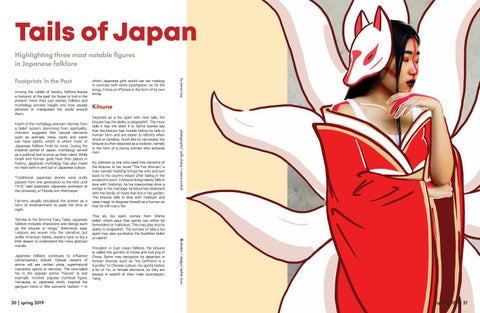
Depicted as a fox spirit with nine tails, the kitsune has the ability to shapeshift. The more tails it has, the older it is. Some stories say that the kitsune has trouble hiding its tails in human form and are easier to identify when drunk or careless. Much like its namesake, the kitsune is often depicted as a trickster, namely in the form of a young woman who seduces men. Kij Johnson is one who used this narrative of the kitsune. In her novel “The Fox Woman,” a man named Yoshifuji brings his wife and son back to his country estate after failing in the emperor’s court. A kitsune living nearby falls in love with Yoshifuji. As his insecurities drive a wedge in his marriage, he becomes obsessed with the family of foxes that live in his garden. The kitsune falls in love with Yoshijufi and uses magic to disguise herself as a human so that he will marry her. This sly fox spirit comes from Shinto belief, which says that spirits can either be benevolent or malicious. This may play into its ability to shapeshift. The number of tails a fox spirit may also symbolize the Buddhist belief of rebirth. Prevalent in East Asian folklore, the kitsune is called the gumiho in Korea and huli jing in China. Some may recognize its depiction in Korean dramas such as “My Girlfriend is a Gumiho.” In Chinese culture, fox spirits harbor a lot of Yin, or female elements, so they are always in search of their male counterpart, Yang.
illustration + design/ esther zhan
“Similar to the Grimms’ Fairy Tales, Japanese folklore includes characters and beings such as the kitsune or tengu,” Wehmeyer said. Lessons are woven into the narrative, but unlike American fables, readers have to dig a little deeper to understand the more abstract morals.
Kitsune
photography/ sofia zheng + asena markal
Much of the mythology animism derives from a belief system stemming from spirituality. Animism suggests that natural elements such as animals, trees, rocks and water can have spirits, which is where most of Japanese folklore finds its roots. During the imperial period of Japan, mythology served as a political tool to prop up their rulers. While Greek and Roman gods have their places in history, Japanese mythology has also made its mark both in and out of Japanese culture.
which Japanese girls would use tan makeup in contrast with white eyeshadow. As for the tengu, it lives on iPhones in the form of its own emoji.
by emma ross
Footprints In the Past
spring 2019| 21
Yamauba The yamauba is a mountain witch often depicted as a solitary figure with cannibalistic tendencies. She is said to have a room in her house that is filled with blood and human flesh. Even with these grotesque qualities, she occasionally has a soft spot for young women who have become lost and are in distress. Reminiscent of Cinderella, the tale of “The Blossom Princess” depicts the yamauba’s capacity for kindness. When the Blossom Princess’s mother dies, her doting father remarries. Her malicious stepmother kidnaps her then abandons her on a mountain. It is on this mountain that the Blossom Princess meets a yamauba. The yamauba gives her a small bag of treasures, which includes an ubakinu, a set of clothes that make the wearer appear older. The Blossom Princess uses the ubakinu to find work at the mansion of a middle councilor. Saisho, the youngest son of the councilor, falls in love with the Blossom Princess. Saisho’s mother tries to thwart their relationship by holding a competition for her son’s hand in marriage. On the day of the competition, the yamauba’s magic bag provides a set of fine clothes for the princess to wear. In true fairytale fashion, the Blossom Princess impresses everyone, happily marries Saisho and reunites with her father.
Tales such as “The Blossom Princess” reflect the worries and concerns of Japanese society. The yamauba in particular represents a woman’s fear of being left alone or the fear of aging and the elderly. While the Japanese people show immense respect for the elderly, from a more utilitarian perspective, they are no longer considered useful. “They may be good for sitting down and cooking, but essentially they are just another mouth to feed in a household,” Wehmeyer said. This sentiment arises from a period of economic hardship and famine. In times of hardship, families had to make a choice to remove a weak family member, so the rest could survive. Often times, the elderly were abandoned in the mountains and subject to the clutches of the yamauba. These ancient figures carry a renewed life, as modern Japanese media weaves them into their narratives. Every figure does not exist simply as a story but as a compelling marker of Japan’s social values and interests. Affecting the realms of fashion, religion, and literature and the like, Japanese folklore lives on in its influences.
Tengu Depicted as either a crow or another bird of prey, a larger tengu is the anthropomorphic version of a crow, with a long, beak-like nose and wings. “It appears to have originated in China, maybe as a comet,” Wehmeyer said. “The way its name is written means celestial dog, but in Japan, it is a crow-like figure.” Other times the tengu is depicted as a red-faced man with an exaggeratedly long nose. As part of the tengu’s mythology, they also own mystical objects such as a cloak of invisibility. Originally, the tengus were notorious as harbingers of war who opposed Buddhist beliefs. In early iterations of the tengu, they enjoy making fun of priests who became too full of themselves. “They’ll snatch priests up when they’re peeing off a veranda or something and drop them off at the peak of a mountain,” Wehmeyer said. In one story, “The Handcart Priest,” a once-venerable Zen priest builds a small cart and leaves home to follow monastic vows. A group of tengus approaches the priest amidst his journey with a mission to change the priest’s Buddhist views. The flock of tengu split the world apart and show him the depths of hell. After nearly being swayed, the priest regains composure and recites a spell. Purple clouds spread across the sky, and from the clouds, a multitude of demon-quelling gods appear that force the tengu to leave the Handcart Priest alone. Later portrayals of the spirit now paint the Tengu in a more favorable light. In a complete 180, they can also be seen as protective spirits of Buddhist temples. Despite its ambivalent depictions, the legend of the Tengu has withstood the test of time.
22 | spring 2019
spring 2019| 23
parents from bringing a dose of their Indian heritage home. Rele’s father would rent movies through the mail from an Indian store in St. Louis during the ‘70s. Access to Bollywood movies is now made easier with media and digital advancements. In India, these movies are a cheap form of entertainment provided through countless theaters across the subcontinent, making them available to the masses.
A Trip Down Bollywood Boulevard
We love to be a part of diverse cultures, too. So it’s kind of fun to know e ach other. It makes us feel very proud and very happy. - Priti Parikh
An in-depth look at Bollywood’s influence on Desi culture and beyond
by vanessa celino
“I feel like I knew Bollywood movies before I knew American movies,” said Nuha Chowdhury, a senior at the University of Florida. “That’s what I watched growing up,” The emergence of Desi faces like Jameela Jamil and Bollywood star Priyanka Chopra on the screen has stimulated a curiosity for Bollywood. The Hindi-speaking Indian film industry already boasts a large and established following across the Desi community. It’s often known as the Indian parallel of the American Hollywood industry. There are segments within Indian cinema that cater to different Indian languages and dialects, such as Tollywood, which speaks Telugu specifically. Bollywood happens to be the most popular, complete with its own unique cultural history and spectrum of actors, filmmakers and audiences. Vara Suresh, president of the Indian Culture Society in Jacksonville, Florida and Indian immigrant, recognizes the
24 | spring 2019
breadth of the industry as a whole. “You can name it and there are [Bollywood] movies for it - art movies, and documentaries, and award-winning films. Some of them are just pure musicals. We have every form and version you could think of,” Suresh said. Bollywood thrives in its bombastic dance numbers and dramatic love stories, but the genre has continuously evolved.
You can name it, and there are movies for it - art movies and documentaries and award-winning films. - Vara Suresh Shephali Rele, co-founder of the Tampabased Indian American newspaper, Khaas Baat, writes Bollywood movie previews and has noticed the industry’s changes over time. “In the ‘70s and ‘80s a lot of the cinema [were] called ‘masala entertainers,’ and ‘masala’ means ‘spices,’ They were called ‘masala movies’ or ‘masala entertainers’ because the filmmakers just threw in a
little bit of everything — a little spice of the drama, a little spice of comedy, a little spice of song and dance,” Rele said. Suresh’s Indian statewide newspaper, Khaas Baat, has also covered the International Indian Film Academy Awards (IIFA), nicknamed the “Bollywood Oscars,” that were held in Tampa in 2014. Bollywood films have also become more political in nature, producing a substantial amount of work ranging from “Dangal,” an inspirational film about a father who teaches his daughters how to wrestle and win the Commonwealth games, and “PK,” a controversial film that asked religious questions half of India didn’t want to answer. Today, Indian movies still don’t seem to follow a formula, going as far as mixing various genres and plots in an individual film. Music also plays an integral role in Indian cinema, and for many, it’s the soundtrack of their childhood. For many Desi Americans, Bollywood films provide a sense of comfort and familiarity. Rele, coming from a small Missouri town of approximately 22,000, did not grow up with much exposure to her culture outside the home. However, this did not stop her
photography/ lavanya durai design/ nabiha azaz
A
s Desi Americans yearn for a place in Hollywood, many confide in another cinematic world that has spoken to them since their childhood.
For audiences outside of India, there are streaming platforms such as Netflix, and theaters across the world premiere the latest Hindi films, making the Bollywood industry more accessible than ever. Now, audiences in the U.S. and even China and Japan can tune into Bollywood films. “I love to watch [Bollywood movies] with my Pakistani and Indian friends, but I’ve also gotten my American friends to watch it with me,” Chowdhury said. “So we watch it with subtitles, and they also really like it, so that’s really fun.”
Nowadays a lot of Bollywood movies are more modern; they’re pretty Americanized. I think that’s another reason I like it – because it’s changing with me. - Nuha Chowdhury
Celebrity culture is also big in India. Many Indian newspapers and magazines such as FilmFare, that offer the latest in Indian celebrity gossip exist for the pop culture fanatics among audiences. Bollywood megastars like the “King of Bollywood,” Shahrukh Khan, have an impressive following. Many Americans may know Priyanka Chopra and Deepika Padukone, two Bollywood actresses who have starred in Hollywood movies like “Isn’t It Romantic” and “XXX: Return of Xander Cage.” These actresses have devoted followings amounting to millions of Instagram followers on Instagram in addition to their Western fans. Bollywood is more than just a genre, but a path back to their heritage. Its widespread popularity can span various regions from India to Bangladesh to Pakistan. Indian immigrants like Priti Parikh works for an event management company that organizes Bollywood concerts in Seattle, Washington. A night watching Bollywood films bonds her to other Desi Americans in her community as well as stay connected to India. “We are absolutely in touch and attached to our own culture here,” Parikh said. “Going out to a movie theater and watching a Bollywood movie is a good way to meet with old friends, make new friends and have something common to speak on,” Parikh said. Bollywood isn’t for anyone. Ultimately, it completely depends on how someone was brought up. While film industries in Asia make their mark in the Western market, Bollywood continues to evolve in order and reflect contemporary values. “Nowadays a lot of Bollywood movies are more modern; they’re pretty Americanized,” Chowdhury said. “I think that’s another reason I like it – because it’s changing with me.”
spring 2019| 25
Danny Khor
Khor joined the University of Florida’s Chinese American Student Association (CASA) back in August of 2018. The first event they went to was the Fall “Big”/”Little reveal.
Fiery & Inimitable
In September 2018, they demonstrated in Turlington Plaza in order to raise awareness for campus sexual violence on college campuses. They stood outdoors with white shirts, Sharpies and a sign that said, “Draw a line on my shirt for every person you know who has been sexually harassed, assaulted or raped.” They spoke to students about the prevalence of sexual violence and how college campuses should be more attentive to incidents of assault by incorporating preventional measures.
26 | spring 2019
design/ingrid wu
In the Fall 2018 Khor contributed to the mural in the Asian Pacific Islander American Affairs office. The mural illustrated the progression of national Asian American history and its manifestation at UF. Danny painted a portrait of Patsy Mink, the first Asian American woman in Congress and a co-author of the Title lX Amendment of the Higher Education Act. This act bars any gender discrimination in federally funded educational environments.
“There are all these different assets to a person, and they combine in so many gorgeous ways.” - Danny Khor
story + photography/ kylee gates
D
anny Khor, 19, is a second-year marine science major with pronouns they/them. They are a queer transgender Taiwanese, Malaysian-Chinese American. When Danny came out to their family, their mom refused to talk to them for a year. However, they found a new, one who cares about most in the world. They are the people who keep them alive. Since coming to the University of Florida, Khor has been a passionate activist on campus.
In March 2018, Khor got a tattoo of an inhaler that reads “keep breathing.” While they find the tattoo comical, they also saw it as a reference to their severe asthma in the past. “The ‘keep breathing’ text serves as a mantra for when my depression is worse than normal,” Khor said.
spring 2019| 27
Khor has been interested in sharks since the second grade. “I guess it’s something about their power or how they’ve essentially found a cheat code for evolution, considering they haven’t had to seriously evolve for 100 million years,” Khor said.
Livia Chen, Khor’s “little” or mentee through CASA, looks up to them. “I truly think of them as bright, happy, strong and queer. I’m proud to call them my big,” Chen said.
Khor still keeps the T-shirt from their Turlington demonstration on sexual harassment.
Khor painted Patsy Mink for the Asian Pacific Islander American Affairs mural in Fall 2018.
28 | spring 2019
spring 2019| 29
More Than Manga Asian Americans in the comic industry
powers like the ability to shapeshift, time travel or control minds, these Asian characters can empower readers and creators alike.
Her comic’s concept was very heavily based on her own upbringing and hometown, keying in on distinct suburban issues.
With the good, however, comes the bad. Physical copies of comics and graphic novels are not always accessible to people given various financial situations, location and access to transportation. This has not h i n d e r e d individuals from consuming other forms of media though — leading to the rise of webcomics.
“Throughout high school I’ve been part of so many different friend groups, and I left a lot of friend groups for a plethora of reasons, some of those reasons I thought were kind of unjustifiable and I kinda wanted to shed light into these situations through a third lens because if they ever end up reading this comic I want them to see it how I saw it,” Wu said.
Line Webtoon has become one of the hottest sites to get
30 | spring 2019
Created during her junior year of high school, the comic, starring reckless and apathetic high school senior Luca Forte, is a multifaceted look into the lives of teenagers. This coming-of-age story paints a realistic image of adolescence and all its of the trials and tribulations – make friends, lose friends and fall in love.
ideas that I want to build on top of and, in the college that I plan on attending, I will be studying art and I think that will introduce like a whole new world of arts and change the definition [of art] for me as well.” Wu gained a passion for art at a young age, drawing inspiration from her older sister, her biggest role model. Over time, she developed her own artistic style by pulling inspiration from different manga and anime. Some of her biggest inspirations were Naoki Urasawa and Masaaki Yuasa. It was around middle school when she discovered Western comic book and graphic
novel artists such as Alan Moore and Frank Miller, as well are more Western art styles. “My style really started changing and drifting away from Asiancentric styles and kind of focused more on ‘white men’ style. Focusing a lot on really masculine drawings. I started getting more into painting and realism, and then from there I was really able to do a blend of both Asian and Western styles,” Wu said. One of her current inspirations, she said, is Los Angeles-based artist, Vewn. “I love her style. I base a lot of my color palettes off of her work actually because she uses a lot of the really bright warm tones,” Wu said.
Design/Cassidy Nguyen
representation in comics is extremely important especially for young asian american people...
free access to all sorts of webcomics from a variety of genres. Laura Wu, a Chinese American student from Tampa, Florida, is one of many talented creators on Webtoon under the screen name Amoxiliion. Her comic, “Salad Year,” a slice-of-life comic, reached over 6.1 thousand views on the site.
Illustration/laura wu
Throughout the years, the comic book industry has turned several content creators into household names, some of whom got their start producing fanart and posting their work to social media. Now, they have collaborations with some of the biggest titles in the comic book community. What was once considered a “nerdy” counterculture is now widely accepted as a mainstream art medium, opening the floor to many young creatives to channel their passion through a another kind of storytelling.
Representation matters in comics. It’s extremely important, especially for young Asian American women and girls. Asian heroines are more prevalent in the comic book realm, including characters like Ms. Marvel, Silk and Penny Parker. Artists such as Jen Bartel (Blackbird), Leslie Hung (Snotgirl), and Sana Takeda (Monstress) draw more representative characters. Portrayed with astonishing
by: valentina velasquez
C
omic books and graphic novels have been a staple in households for decades, with the first comic printed in color dating as far back as the ‘30s. Fast forward and the popularity of comics has soared with the rise of superhero films, social media, pop culture conventions and more. Films like “Captain Marvel”, which grossed $153,433,423 on opening weekend, have fans buying every comic that even mentions the titular hero.
the world is making a spot for more females and for more people of color... As a comic artist, particularly a woman of color, navigating a community that has been heavily dominated by white men has been a challenge. “For a while it actually really discouraged me because I thought if I wasn’t a white man I would have no place or I’d have at least a way harder time succeeding,” Wu said. However, this did not stop Wu from continuing her craft. She believes that a new age of representation is emerging, and it’s a world more welcoming to females and people of color. “A little ego goes a long way, especially when you’re an artist. We become so self aware of who we are and so introspective that it’s actually damaging to us,” Wu said.
Even though Wu took a brief hiatus from “Salad Year” to focus on schoolwork, she plans to update the comic in the summer. Later has plans to pursue her art once she finishes school.
In the vast, intricate world of comics, there’s room for everyone. Up-and-coming artists such as Wu are fueled by their passion for art, turning the page for many artists and changing the comic community for the better. In the vast intricate world of comics, there’s room for everyone.
“I’m always filled with a lot of ideas of potential comic
This story is by THE UNIVERSITY OF CENTRAL FLORIDA
spring 2019| 31
Till Traditions Do Us Part The evolution and impact of wedding traditions in Asian American weddings
O
second part of the mehndi celebration will follow this. The following day, the “shaadi,” has many traditions. The last day is the “walima,” similar to a Western wedding reception.
“That was really emotional,” the 25-year-old lawyer from San Francisco said.
While some Asian Americans fully embrace their traditional wedding customs, others have leaned more towards contemporary styles, as the years have passed. Alongside more traditional aspects of Asian American weddings come the modern, unconventional or Western aspects. Cake cutting has become especially popular. Cakes are a very Western tradition that more and more South Asians have added to their weddings. Ilyas had a pistachio cake, a very classic flavor found in South Asian desserts.
Many Asian Americans like Hossain fondly recall moments like these on her wedding day. Throughout history, weddings have brought families together through rich cultural traditions. As more Asian Americans marry into new cultures, couples are faced with the challenge of deciding which traditions to keep and which to disregard.
The next day will include the emotionally charged “nikkah,” or official Muslim wedding ceremony. The
32 | spring 2019
An East Asian wedding tradition that has stood the test of time is the Chinese tea ceremony. Linda Xia, a realtor from China who now lives in South Florida, had her wedding over 25 years ago. Xia’s wedding was only one day long, where they were married, served tea and had a reception. The serving of the tea is a particularly important tradition in Chinese culture because it serves as a moment to honor and appreciate the parents and elders of the family. Many East Asian couples may pick and choose significant rituals from each side of the couple. Brian Min, 30, and his wife admit that they’re fairly Americanized, so they wanted a Western wedding.
Sania Rahim, a 26-year-old graduate student from North Carolina who was married in May 2016, said that, “Those events were this really awesome opportunity that I had — that I probably won’t have ever again — for my friends from college and elsewhere, to kind of meet the people that I grew up with and my community.”
tensions also grow. Although the wedding might be for the couple, the people paying for it will likely have the last say. Sajeela Qureshi, a 51-year-old wedding planner based in Orlando, noted that the parents pay for almost all of the weddings she plans. The guest list causes the most stress because its creation turns almost political.
It’s Western in the way it looks, but Eastern inside. —Sama Ilyas, 25 “My parents just have so many friends... their cultural understanding of weddings is more like, ‘Oh, you invite everyone you know’… There is that cultural expectation of ‘Oh, I invited you to my house so many times, but you didn’t invite me to your daughter’s wedding?’” said Hossain. Qureshi has planned around 400 weddings in the past ten years, and the average wedding that she plans costs $100,000. The most expensive wedding she has planned required between
$600,000 and $700,000. “Honestly, if I had known how much weddings cost, I would have eloped,” Ilyas joked. The guests dictate the wedding’s atmosphere. Sometimes they can be almost impersonal. Qureshi has planned some weddings where the bride and groom met certain guests for the first time. “The wedding and the ceremonies and stuff, you think they’re about you, like the bride or the groom… they were a lot about our families… what they wanted, honoring that, and letting them have those moments,” Rahim said. With cultural and societal pressures and expectations, it’s easy to question a wedding’s worth. It’s even easier to forget the core purpose of marriage and why the wedding is important. Young and freshly married, Min remembers the first time he saw his wife in her wedding dress. The logistics, the last-minute details buzzed in his head, but when he saw her —they vanished. It was just her. He cried. “That was the moment when I would I say I came back to reality,” Min said. The cores of contemporary weddings matches that of any traditional wedding — the union of two lives and the representation of a new life. “Honestly, I am very grateful and very privileged to even have had a wedding… I’m just happy that I got married to my best friend,” Rahim said. “That’s it for me.”
design/shuer zhuo
Ilyas is excited for the mehndi ceremony the most. As part of this ritual, “mehndi,” or henna tattoos, are applied to the bride’s hands, arms and feet. The mehndi ceremony can be split between two days. One for application and another for a dance celebration. Historically, both the ceremony and celebration took place on the same day, but the modern standard is to separate the two events in order to allow the henna to dry. The application process takes place on the first day during the “dholki,” a celebration for the bride’s side of the family, full of dancing and singing.
“The cake — it’s perfect, it’s the perfect blend of Western and Eastern. It’s Western in the way it looks, but Eastern inside,” Ilyas said.
photography/ Jane Doe
Sama Ilyas, a 25-year-old medical student at the University of Florida, will be married in June 2019. Her wedding will include multiple traditions typical of South Asian weddings. The event will not be a singular day but span almost a week.
Wedding traditions give families the opportunity to celebrate the union with their loved ones.
As new traditions develop, generational by nazli islam
n Shajuti Hossain’s wedding day last year, she looked at her mother. Her eyes watered, but only a little. Once they went off stage and into another room, her mom began to cry.
for traditional ceremonies. They deferred to his wishes for a Western wedding, but did partake in the Chinese tea ceremony and had a 10-course meal during the reception. His wife, who is Chinese American, also wore a traditional red dress to the ceremony. “We wanted it to be our own wedding. As much it is for a family, we wanted it for ourselves,” Min said. “It was our wedding, it was our special day. We didn’t want that being dictated by tradition.”
Min is Korean, but his parents didn’t stress the need
spring 2019| 33
THAI TEA
by brittany wallace
Clarifying the origins of popular Thai food in America
True Thai cuisine is actually an amalgamation of numerous countries’ foods that have traveled across the peninsula’s winding trade routes. Their cuisine attacks the tongue with a full arsenal of flavors: sweet, salty, sour, bitter and spicy. Over time, Thai food’s journey to American dinner tables have created misleading preconceptions – masking the true beauty of Thai cuisine.
34 | spring 2019
SRIRACHA
While some believe Sriracha comes from Vietnam, the spicy sauce is actually of Thai invention. The association began when David Tran, Vietnamese creator of Huy Fong Food Inc., began commercially producing the popular condiment, complete with its signature rooster, pan-Asian characters and green squeeze cap. An LA Times article credits Thanom Chakkapak as the woman who invented the original condiment. Named after the Thai seaside town of Thai of Sri Racha, the sauce was paired with seafood dishes. Now found in any American grocery store and chain restaurants, Sriracha rarely graces Thai dinner tables.
“I’ll put it on other [non-Thai] dishes to make it spicier,” Visunraya Suepukdee, a Thai natural resource conservation student at the University of Florida said. Fish sauce and red chili paste are more common players in Thai dishes. The Portuguese introduced red chilis brought back from their missionary work in South America. Bow Vongvanij, an interior architecture major at UF student studying interior architecture, said they often incorporate these flavors into every main dish in Thai cuisine including Tom Yum Soup, a hot and sour soup, or Kaeng phet, a red curry.
design/ingrid wu
E
ast Asian food has been popular in America since the 20th century. In recent years, food from other regions of Asia has been gaining traction in the American food market, including Thai cuisine. However, many perceive Thai food through a Westernized filter, watering down the very culture that piqued Americans’ interests.
photography/ maria solano
Flavors of Thailand
PAD THAI
The history of this dish begins in China and was brought to Thailand in the 1930s. Since then, Thai people have put their own twist on the dish, varying the textures and flavors. It combines similar Chinese stir fry techniques. Still, this staple dish tops the list of Thai restaurants even though it doesn’t hold much deep cultural significance. Unlike traditional Pad Thai, some Thai restaurants in America mask its earthier flavors by adding more sugar and dialing down the spice, Vongvanij said. Two popular meals in Thailand are Pad Krapow and Som Tam. Pad Krapow is a stir fry with Thai holy basil. Som Tam is a spicy papaya salad made from unripened papaya. In fact, Suepukdee’s mother eats a papaya salad almost every day, she said.
A crowd favorite for boba tea lovers, the sweet drink combines ribbons of condensed milk and star anise into black or ceylon tea. Known by its bright orange color, Thai Tea is not a common beverage to a Thai native. Tea was originally brought from China in the 80s, but Thai Tea became common street fare. That said, it’s not much of a homemade drink. Some speculate that the drink was inspired by former Thai Prime Minister Plaek Phibunsong-khram who admired western culture, according to a Food and Wine article. This drink, though popular among American customers, is just one page in a long book of Thai beverages. Vongvanij’s personal favorite is Nom Yen, a bright pink bubble gum colored drink containing Sala syrup and hot milk together. People enjoy the drink with condensed milk as well. On blazing hot days paired with spicy foods, Thai Iced Tea is the perfect partner. .
Suepukdee and Vongvanij both understand that people have their preferences when it comes to food, but there’s more to Thai food than what is advertised. For Suepukdee, Thai food is home. She feels that it’s a shame when people limit their palettes. “With authentic food, there is a story behind it, and it is O.K. if you end up not liking it, but at least you tried it,” Suepukdee said.
With authentic food, there is a story behind it, and it is O.K. if you end up not liking it, but at least you tried it. - Visunraya Suepukdee spring 2019| 35
FOR THOSE INTERESTED IN ART, EMOTION, AND THE FAMILIAL EFFEC TS OF IMMIGR ATION
The Literary Matchmaker
The Best We Could Do by Thi Biu Bui’s illustrated memoir captures the layers of complexity within her family’s experience as refugees who escape war-torn Vietnam and must adapt to American life. How it depicts this story is deeply felt, filled with insight about the interior experience of many of the characters,” Margaret Galvan, assistant professor of visual rhetoric at the University of Florida said. Bui’s retelling of the past helps her navigate the perception of a family she feels indebted to, but often struggles to understand. The novel contains an underlying truth that often haunts immigrant families: distance will always exist even among the closest of people. Although experiences can be shared, they can never be felt in identical ways.
Who needs a soulmate when there’s a perfect book for everyone out there? Find your match from our inaugural list of APIDA books. FOR THOSE WONDERING IF GROWING UP TRULY MEANS GE T TING SMARTER
The Souls of Yellow Folk by Wesley Yang Yang’s collection of 13 essays discuss race, sex, perception, humanity and the indeterminable number of lines drawn and erased, around and in-between. Blunt titles such as “The Face of Seung-Hui Cho,” “On Reading the Sex Diaries” and “Is It O.K. to Be White?” explore dense and often sensitive subjects, delivering a beautiful yet brutal analysis of human lives. Yang’s writing digs into the layers of mud surrounding humanity. He explores the roots of prejudice and insecurities in us all — unfazed by the risk of unearthing inner ugliness to seek truth. Yang’s writing is an example that understands the origins of ugliness is, in itself, an act of love.
36 | spring 2019
design/karen yung
FOR THOSE WHO ENJOY DELIBER ATING DEEPLY R ANDOM YE T CULTUR ALLY RELEVANT TOPICS
photography/ laura san juan
At age 30, Ruth is freshly left by her fiancé, voluntarily unemployed and back to living with her parents. Her father, a stubborn academic, is losing his memory, and her mother is consumed by concern. Ruth reflects on life in the form of a journal, pondering daily minutia and the concealed faults of relationships in poignant, yet unassuming ways. She addresses her life with humor, honesty, clarity, triumph and sadness, without self-pity or pretension. Khong brings a whimsical nature to life with the curiosity and courage to follow even the simplest, seemingly senseless thoughts to an end. Her writing reflects the magic of unmediated insight — the type that comes from a spunky little girl or a senile old man.
by jamie ang
Goodbye, Vitamin by Rachel Khong
FOR THOSE WHO LOVE MYSTERY, BUT NEED TO KNOW EVERYONE’S STORY
Everything I Never Told You by Celeste Ng “Lydia is dead. But they don’t know this yet,” Ng pens. The opening of Ng’s novel is eerily straightforward but builds in complexity, as it explores the stories of a mixed-race family living in 1970s Ohio. Their teenage daughter, Lydia, mysteriously drowns, and the family has no simple answer to who, or what, is to blame. Ng delves into the family members’ histories, as they meditate on the cause of Lydia’s death and how their own lives may have impacted it. Rae X. Yan, a professor of British literature at the University of Florida, said, what makes Ng’s work so gripping is less the mystery behind Lydia’s death than the sense of alienation that haunts the Lee family. She uses the situation of the death to intimately explore issues of race, gender, cultural expectations and how they foster alienation — not only between individuals and society, but also between husbands and wives, siblings, parents and children.
FOR THOSE WHO LIKE TO USE LOGIC TO MAKE THE ILLOGICAL LOGICAL
Stories of Your Life and Others by Ted Chiang Chiang’s collection of 10 sci-fi short stories explores science, religion, mathematics and philosophy in a way that always manages to point back to humanity. Chiang’s intelligence shines throughout the anthology, not merely through the complex situations he creates but through his ability to make these situations comprehensible and strangely relatable. He tells stories of women learning to communicate with aliens, mathematicians on the verge of suicide and men climbing the Tower of Babylon while contemplating the morality of reaching heaven. Ultimately, Chiang uses brilliant logic to establish intriguingly humanistic characters in extraordinary situations. He uses human confliction and inquisitiveness as an anchor to ground distant worlds.
spring 2019| 37
A Retrospective Look at the Exclusion of Asian Americans an op-ed on America’s history of immigration policies
Night Sky With Exit Wounds by Ocean Vuong Ocean Vuong’s collection of poetry transitions fluidly among subjects of war, family, mythology, love and sex, tied together by an ever-present air of mystery and intensity. He writes “”That a woman on a sinking/ ship becomes a life raft – no matter how soft her skin” Verses likes these blurs the lines between the past and present, bringing familiarity to the unifamiliar and poignancy to what we may already know or think we understand.
Original illustration by: Jamie Ang
Rescinding DACA presents numerous implications for many Asian Pacific Islander Americans. According to Eugene Scott of The Washington Post, thousands of DACA recipients, nicknamed Dreamers, come from Asian countries, with the largest populations belonging to South Korea, India, Pakistan and the Philippines. The number of undocumented Asians has nearly tripled in the last two decades, Karthick Ramakrishnan said in an interview with The Washington Post.
The Chinese Exclusion Act was the culmination of many social issues of the time regarding Asian immigrants. One of the main reasons cited is the growing animosity between the Chinese and white Californians during the gold rush. These conflicts were exacerbated once gold became scarce,
Ramakrishnan, who is the founder of AAPI Data, collects data regarding APIA communities. Although they make up a large portion of recipients, APIA dreamers are often overlooked by major news organizations, with only CNN, the Washington Post, and NPR covering APIA dreamers. The first recorded instance of rescinding residency for Asian Pacific Islander Americans began in 1875 with the Page Act. The Page Act was the first restrictive immigration law, and It marked the end of open border. The act was designed to restrict the immigration of Chinese women into the United States, thereby preventing any natural born Chinese Americans. It also aimed to rid America of “cheap Chinese labor and immoral women,” as stated by its creator, Republican representative Horace Page. However, the Page Act also penalized Japanese, Korean, Vietnamese, and
38 | spring 2019
In 1882, the United States under President Chester A. Arthur, decided that the next best course of action would be to exclude Chinese male laborers under the Chinese Exclusion Act. The law was initially only supposed to last a decade, but ended up being renewed due to its popularity. It would be repealed with the Immigration and Nationality Act of 1943.
...there was no solid policy on admitting refugees until the 1980s, with the refugee act, which itself was a response to the wars in indochina. and California lawmakers soon began to pass discriminatory anti-Chinese acts. The Chinese Exclusion Act split many Chinese families apart, and gave Chinese immigrants the ultimatum of staying in the United States and facing discrimination or going back to China. Perhaps the most heinous of these measures to bar Asian Americans from the title of American were the Japanese Internment Camps, which were instituted via an executive order by President Roosevelt during the buildup to World War II. The internment camps were the result of the forced migration of between 110,000 and 120,000 Japanese
This story is by THE UNIVERSITY OF CENTRAL FLORIDA
Americans, many of whom were second and third generation Americans. As for the first-generation Americans, they were subject to the Alien Enemies Act, which barred them from gaining citizenship. Life in the internment camps was “bad and becoming worse rapidly” according to the Secretary of the Interior. Children who were in the camps underwent “reeducation” programs as opposed to a normal education. These programs were often underfunded, and taught children to reject their heritage. In addition to all of this, Japanese Americans were asked to “prove their loyalty to Uncle Sam,” despite already being citizens. A large part of America’s refugee crisis began with war conflicts. So came the United States Refugee Act of 1980, legislation which enabled refugees to escape Southeast Asian countries during and after the Vietnam War. This policy granted thousands of refugees asylum in the U.S., a policy that still stands today.
design/ann dang
FOR THOSE WHO VIBE WITH A GOOD VERSE
other East/Southeast Asian women from immigrating to the United States.
by ayesha faisal photo/david mark from Pixabay
D
eferred Action for Childhood Arrivals, also known as DACA, harkened a renewed hope for immigrant children across the U.S. Passed in 2012, DACA legislation allows children brought to the United States at a young age to apply to defer immigration action, allowing them to remain in the country for two-year periods. Recently, President Donald Trump’s 2017 phaseout of the DACA program has jeopardized the status of many DACA recipients.
The importance of understanding the past is to see how it impacts the future. Currently there are approximately 800,000 DACA recipients who await a decision in determining the status of their deferred action. According to Southeast Asia Resource Action Center (SEARAC), deportations in Southeast Asian communities have seen a sharp increase, many of whom are refugees brought to the United States as children. With recent moves to deport refugees from Vietnam, Cambodia, and Laos, the future of APIA deportations seems bleak. However, as DACA law stands now, the Dreamers are in limbo and their future seems uncertain.
spring 2019| 39
ACKNOWLEDGEMENTS ASIAN AMERICAN STUDENT UNION at the University of Florida ASIAN PACIFIC ISLANDER AMERICAN AFFAIRS at the University of Florida University of Florida STUDENT GOVERNMENT spring 2019| 40