MEET AMBER SOLTVEDT

MINDFUL OF MENTAL HEALTH
SOY CHECKOFF LOOKS TO DELIVER ROI
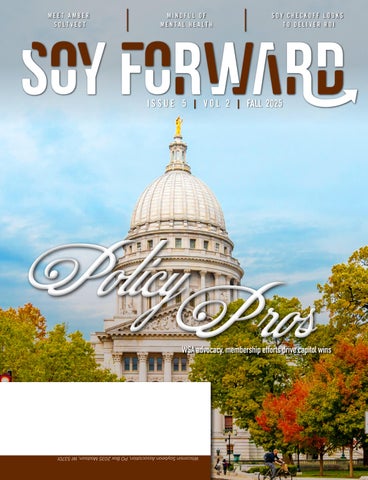
ISSUE 5 | VOL 2 | FALL 2025 WSA advocacy, membership efforts drive capitol wins

MEET AMBER SOLTVEDT
MINDFUL OF MENTAL HEALTH
SOY CHECKOFF LOOKS TO DELIVER ROI
ISSUE 5 | VOL 2 | FALL 2025 WSA advocacy, membership efforts drive capitol wins

From membership support to farmer leadership, it takes a strong team effort to accomplish the policy goals of Wisconsin Soybean Association. The game plan paid off this year, as WSA secured several legislative wins and put the pieces in place to position producers for success in 2026.
Board members from across the state represent the voices of Wisconsin soybean growers to advocate for government policies and support research that helps improve the profitability of soybean farmers.
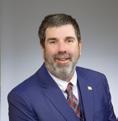
Doug serves as president on WSA’s officer team, representing District 3. He raises soybeans, corn and wheat in Janesville alongside his brothers and nephews.

Dr. Conley is a professor of agronomy and the soybean and small grains specialist at the University of Wisconsin-Madison. Shawn is WSA’s representative on the board for the University of Wisconsin’s College of Agricultural & Life Sciences.

Matt serves as WSA vice president and represents District 3. A first-generation farmer, he raises soybeans, corn and wheat on his operation in Darien.
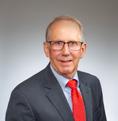
Dave is a recently retired banker with a lifetime of experience in both agricultural and commercial lending. He joined the WSA board in 2023 as an industry representative. Serving District 3, Dave was elected WSA treasurer in 2025.

Daniel represents District 1 and serves as WSA secretary. He grows a mix of soybeans and corn with his father on his farm in Mondovi. Along with crops, the Linses also raise turkeys.



Danny grows soybeans and corn near Columbus with his three uncles. He completed ASA’s Young Leader Program in 2024 and is an-large WSA director. Danny also works as a crop insurance agent, is involved in Astico Perseverance 4-H club and is a soil health advocate.
Katie was elected in 2024 as an industry director for WSA. She is the district sales manager for Legacy Seeds and resides in De Pere, representing District 4.
Brad is a WSA at-large director and recent graduate of ASA’s Young Leader Program. He farms in Columbus on a family dairy operation. In addition to cattle, Brad raises soybeans, corn, alfalfa and sorghum.
WSA Executive Director Adam Kask akask@wisoybean.org (608) 274-7522
Managing Editor Drew Lyon drew@agmgmtsolutions.com
Art Director Alex Troska atroska@agmgmtsolutions.com
Layout Editor Katelyn Engquist kengquist@agmgmtsolutions.com

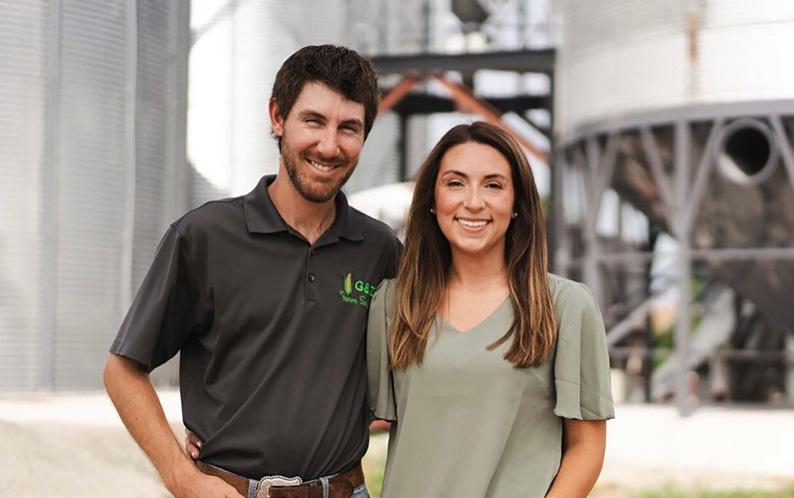
Amber joined WSA in 2025 as the District 4 director. Amber and her husband, Zac, raise soybeans, corn and wheat in Seymour. With a lifelong passion for ag, Amber is a past ASA Young Leader and currently a NK Seeds representative working with ag retailers and growers across northern Wisconsin


Jake farms in Mineral Point and serves as a WSA at-large director. He graduated from ASA’s Young Leader Program in 2023 and participated in the program’s third phase in Washington, D.C.
Sales Manager Erin Rossow erossow@agmgmtsolutions.com (507)-902-9191

Advertising space reservations can be made by the 15th day of the month prior to publication. In consideration of the acceptance of the advertisement, the agency and the advertiser must, in respect of the contents of the advertisement, indemnify and save the publisher harmless against any expense arising from claims or actions against the publisher because of the publication of the content of the advertisement.
Advertisements within this publication contain the opinions and information of the advertisers and do not necessarily reflect the opinions or views of the Wisconsin Soybean Program or affiliated groups.

Sara is WSA’s District 2 director and served as president from 2023-25. She operates a diverse farming operation that includes soybeans, corn, peas, green beans and cattle in Wautoma.

Tanner is a first-generation farmer from Prairie Farm. He is an at-large director for WSA and serves on the American Soybean Association (ASA) Executive Committee. Tanner is also a 2017 graduate of ASA’s Young Leader Program.
Don farms in the Central Sands region in Scandinavia, where he grows soybeans and corn with his brother and nephew. He is an at-large director for WSA and serves on ASA’s board.

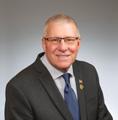
Steve is a past WSA president who currently represents District 1. He farms primarily soybeans and corn in the central Wisconsin area near Amherst.
Adam is the executive director of both WSA and the Wisconsin Soybean Marketing Board. A U.S. Army veteran, Adam has years of experience working in farm policy, market development and agronomy.
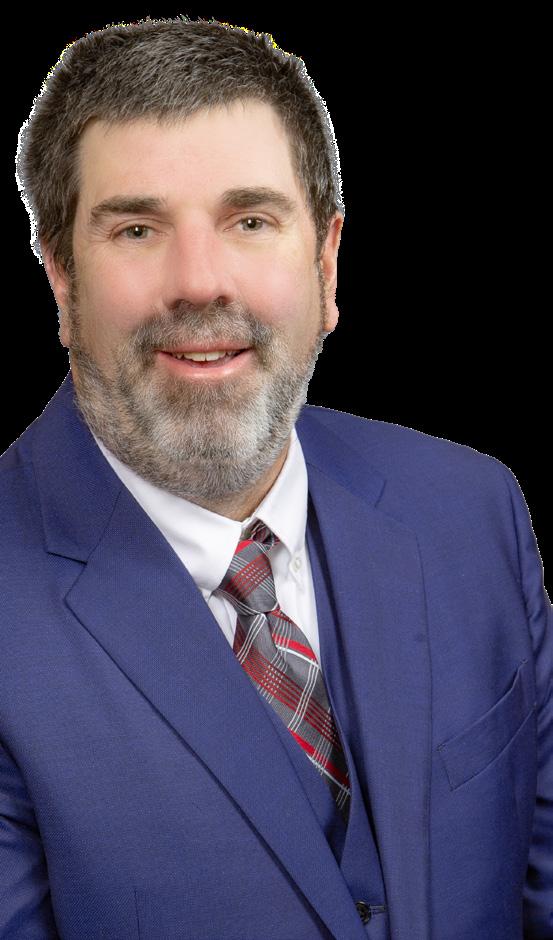
It is that exciting time of year again when we look at the results of the work done and what remains to finish the year on a positive note. We find ourselves doing things our neighbors have never done. Do we simply keep moving forward without changes, or do we make a quick trade to put the right pieces in place for a successful finish? That’s right; it is Packer season after all! Winning world championships is something our bordering states never get to enjoy.
It is amazing how you can look at a team like the Packers and compare it to our farms. Both begin strategizing for the next year as soon as the current season ends. We reflect on how the previous year went, make adjustments, evaluate the current season and plan for the next year, all in pursuit of continued success on our farms. As we consider these different keys to success, let’s take a step back and ask: What is success?
For the Packers, ultimate success is winning the Super Bowl. For farmers, the answer varies. Is it owning the most land, being the first in the fields or sustaining a multigenerational farm? There are countless ways to define success, and no single answer is better than another. In my opinion, the best definition is this: Am I happy, and is my family happy? If the answer is yes, then it doesn’t matter the size of your farm, the timing of your harvest, or even whether you had record yields. If you can pay your bills and spend time with your family — both on and off the farm — you are successful.
At the Wisconsin Soybean Association, our definition of success is representing soybean growers across our state. We are continually talking with legislators at both the state and federal levels about issues that help generate revenue for your farms. These issues range from herbicide use to biofuels and trade. Every step we take is aimed at ensuring your success. We also spend a lot of time in the media, making sure soybean farmers share their successes, their concerns and their general story. As you’ll read in this issue’s cover story, it takes a mix of offense and defense – along with strong membership – to produce a winning advocacy group in Madison. Like the Packers, we’re also looking for ways to improve our operations through trades. I saw that firsthand this summer, when I had the privilege of hosting a trade delegation representing nearly 10 countries. In football and farming, relationships are fundamental to success.
All of this culminates with an exciting opportunity to share these stories with you at the upcoming 2026 Wisconsin Corn•Soy Expo. Our marquee event will feature many valuable topics and ideas you can take back to your farm to plot for a championship season in 2026. Registration is now open, so please visit our website and get signed up today.
The essence of a winning team comes down to the players, the preparation and the game plan. Let’s execute a safe harvest this year, both physically and mentally, and gear up to root on the Packers and our farms.
Doug Rebout President, WSA

By Drew Lyon
Wisconsin farmer Doug Rebout wouldn’t trade his office for the world.
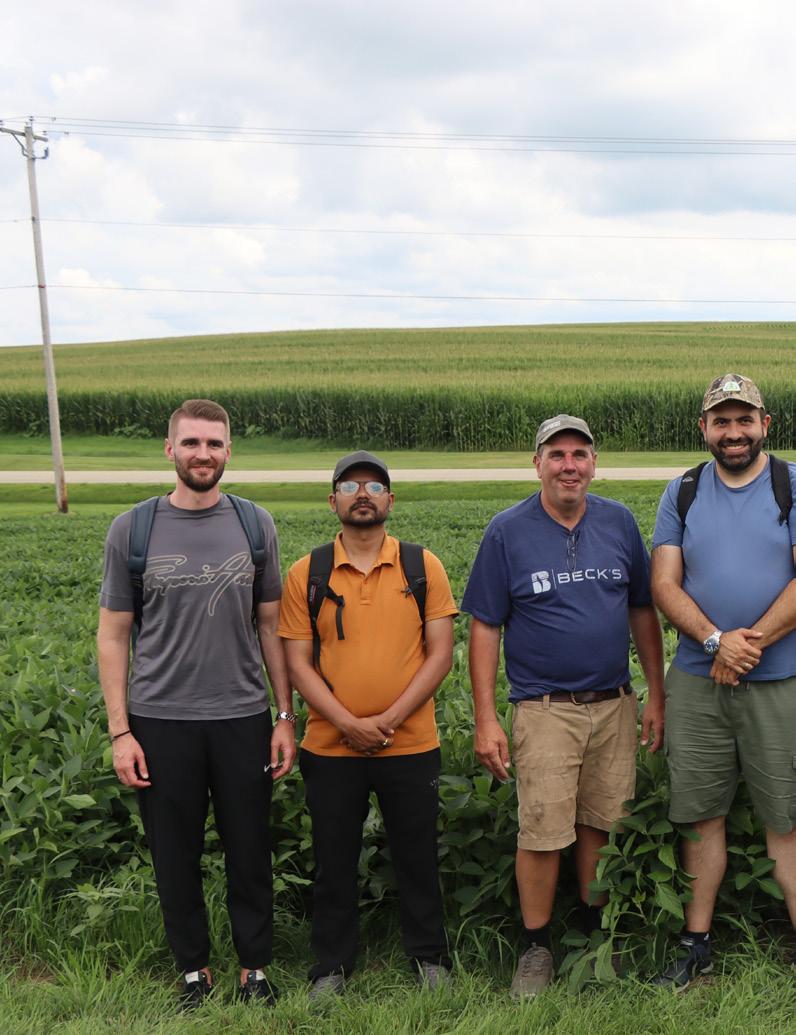
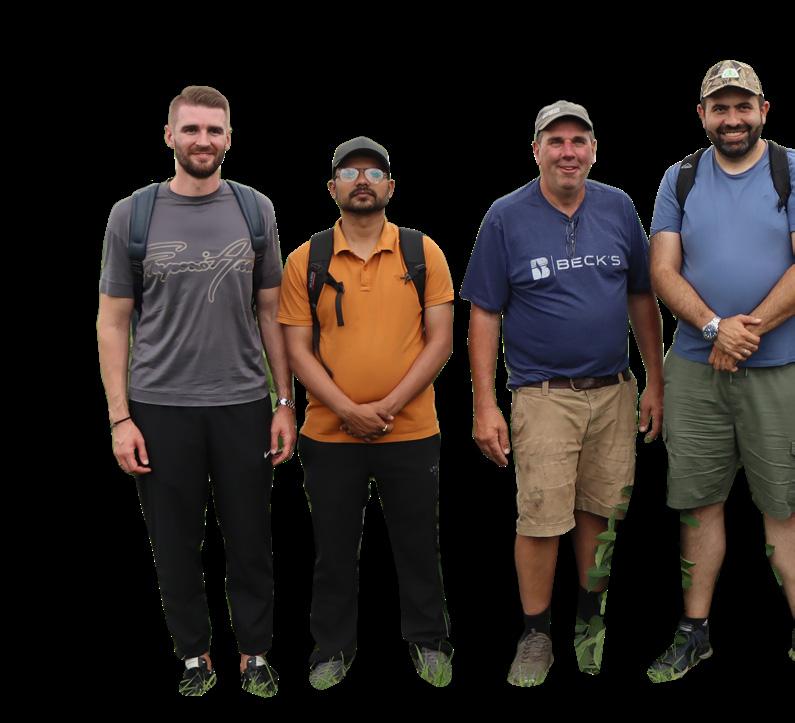
That’s the message the president of the Wisconsin Soybean Association (WSA) conveyed to an international trade delegation representing nearly 10 countries in late July 2025 during a trade team visit to his Janesville family farm.
All offers are off the table.
“I get to watch sunrises and sunsets while I’m working,” said Rebout, wearing a faded Wisconsin Soybean Program hat that blocked out the sun, “and I get to work with my family – it’s very important to our farm.”
Continued on page 10
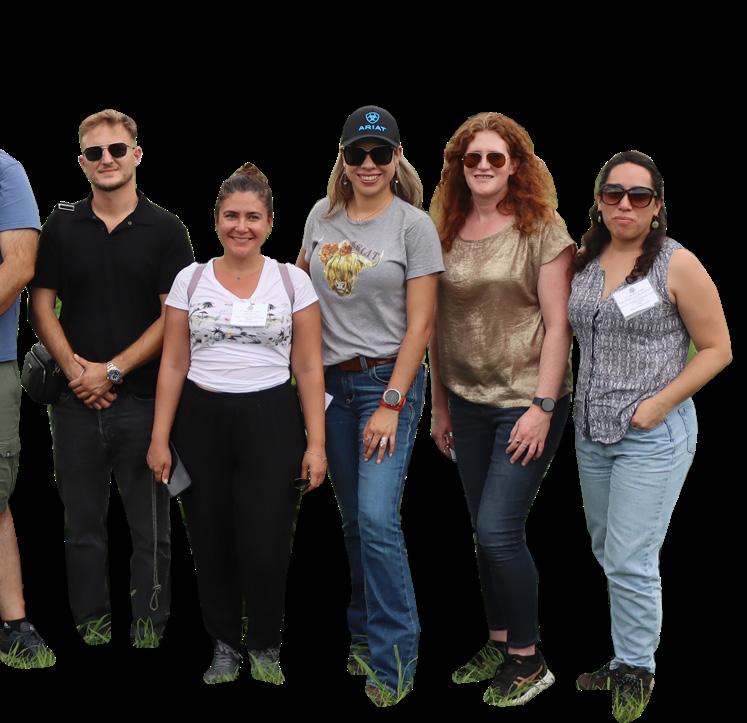
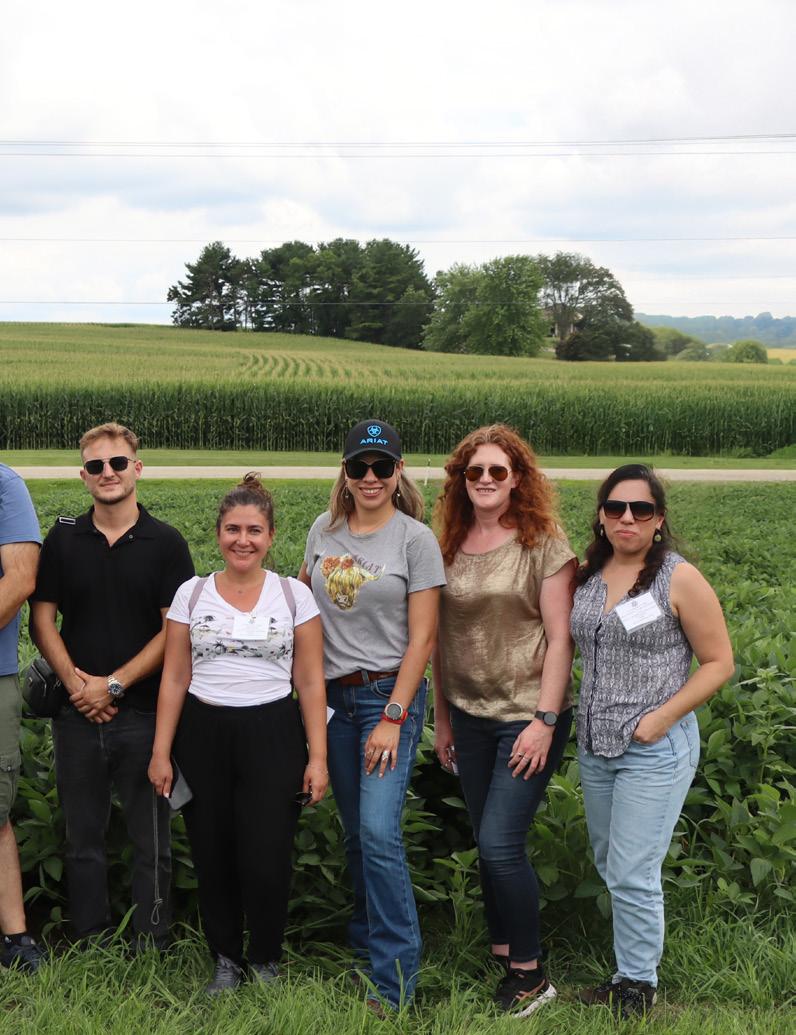
His healthy, waist-high soybean crop swaying in the background – and his brothers’ and mother’s homes just a stone’s throw away – Rebout hosted global ag and food business leaders from countries including Mexico, the U.K., Chile, Ukraine and Serbia.
During the two-hour engagement, Rebout explained how Wisconsin soybean growers are focused on diversifying markets for U.S. soybean farmers beyond their largest customer, China, which purchases more U.S. soy than all other export markets combined. Soybeans are the nation’s top ag export, valued at over $30 billion each year. Wisconsin soybean farmers export more than 50% of their crop to markets primarily in Mexico, Canada and China. And while most U.S. states saw their exports drop by 1% in ag exports, Wisconsin agriculture boosted its exports by nearly 2% over the past two years. In total, Wisconsin soybean farmers export more than 50% of their crop.
Yet the uncertainty of the current trade landscape is creating tension across farm country as the 2025 soybean harvest neared, Rebout said.
“Because we don’t have a processing facility here in Wisconsin, we rely on trade to build demand and move our crop,” Rebout said. “Building trust takes a lot of time, and it starts with getting to know
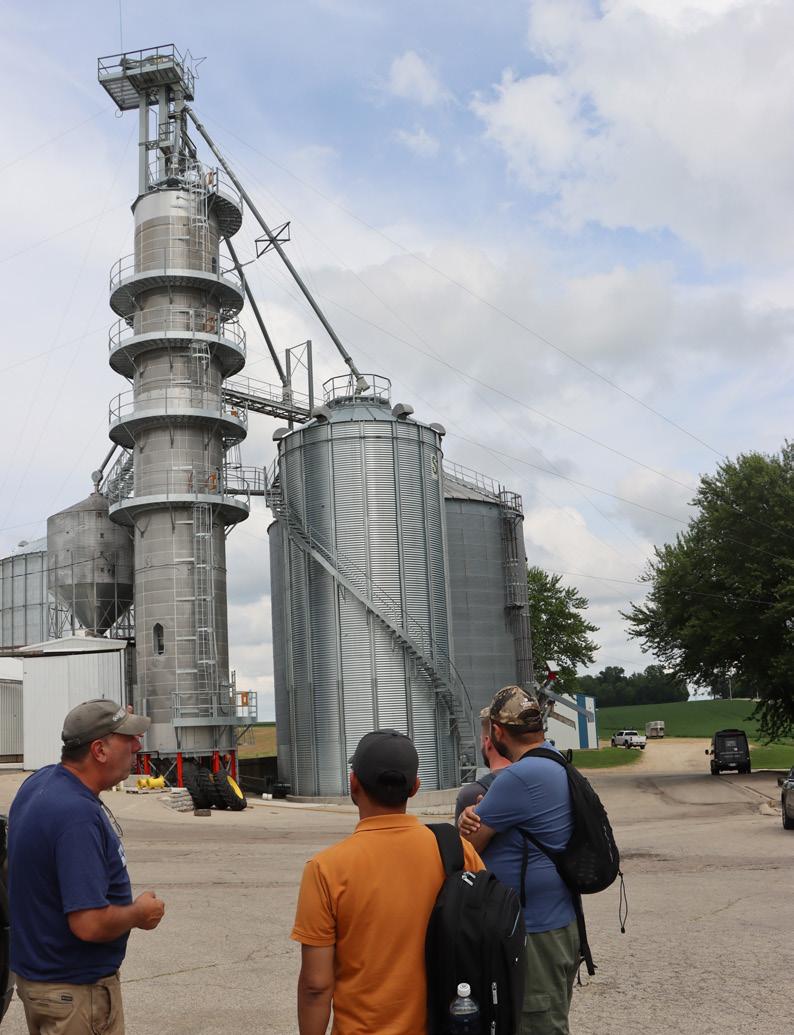
Rebout wasn’t done hosting international guests. During the 2025 harvest, he welcomed a television group from SRF Swiss Public Broadcasting to discuss how the current ag economy overlaps with politics.
each other and finding common ground, which is what we’re doing here today.”
Rebout began the visit by explaining the production practices he uses on his 4,200-acre farm, impressing his guests with the advanced drone technology he uses to manage weeds, improve soil health and increase yields. Rebout proudly noted his family was one of the first to adopt strip-tilling.
“We’ve always been pretty progressive in trying new practices,” he said. “We’re always trying to look ahead.”
Rebout grows soybeans and corn and raises custom heifers with his brothers Daniel and David and nephews on an operation that’s been in the family since the early 1960s. Modern farming, Rebout said, has changed with the times.
“A lot of people think the U.S. farmer isn’t sophisticated, but this equipment will tell you otherwise,” he said. “My nephews don’t even know what a pitchfork is.”
His visitors, who were nearing the end of a two-week tour arranged through the U.S. Department of State, peppered Rebout with questions: What’s your average bushels per acre? Price of seed per acre? How often do you test your soil? Do you use irrigation?
Rebout was impressed by their preparedness.
“You could tell they came ready to ask me some questions,” he said with a chuckle. “But as a farmer, we love talking about what we do. That’s the fun part.”
Serbian soybean farmer Milenko Jovanovic of the Serbian Young Farmers Association was a bit starstruck by his first visit to an American farm. The size of Rebout’s
operation, his equipment and reported average yield left Jovanovic inspired.
“I admire how much yield you can achieve here,” he said.
Rebout forged a special bond with Dmytro Kokhan, deputy chairman of the Ukranian Ag Council. Rebout’s daughter, Natalia, was adopted from Ukraine. Kokhan’s face lit up when Rebout told him of his daughter’s heritage and quickly presented Rebout with a Ukranian hat and pin. Even before he discovered a mutual Ukranian connection with Rebout, Kokhan was one of the most vocal participants in the trade team.
“That was a very special moment for me,” Rebout said. “Ukraine will always have a special place in my heart.”
Earlier in the trip, the international group met with WSA lobbyist Jordan Lamb to learn more about how farm groups like WSA lobby at the state and national capitals. Rebout also explained his passion for advocating for his fellow farmer and the soybean industry through educating lawmakers and regulatory leaders on farmfriendly policy. When he’s in a policy meeting, Rebout said he’s representing family farms beyond just his own.
“I take great pride in saying I’m here on behalf of 16,000 soybean farmers in Wisconsin,” he said. “I’m not just telling my story.”
After a group photo, Rebout left his new and grateful friends, who were departing for Ohio, with a Wisconsin Soybean Program hat and the latest issue of Soy Forward magazine.
“I think it’s safe to say it was a good experience for all,” Rebout said. “I know it was for me.”
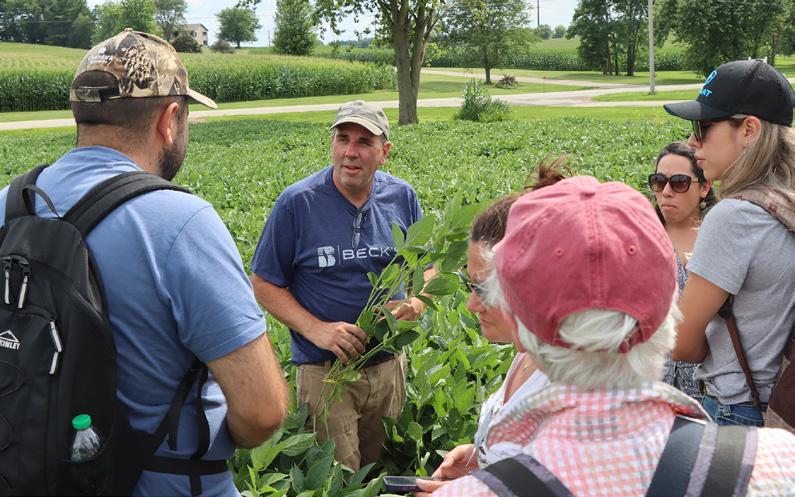
Doug Rebout answers questions from his guests and shows off his 2025 soybean crop on his Janesville farm.
There’s nothing like feeling the dirt kick up between my claws as I puff my chest and push play on my barnyard swagger. It’s morning time!
Cock-a-doodle-do!
That’s only the appetizer. My humans never hear my first alarm clock. Gotta strut up to the house so they can wake up and enjoy this sunrise with me!
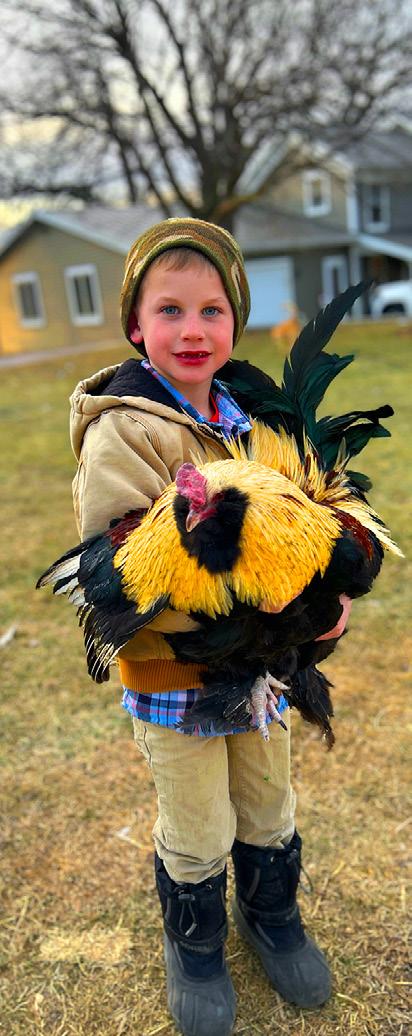
I’m Nugget and while it might sound appetizing to pick me up (my little humans like to do that) I’m the fastest nugget you’ll ever meet. Those sad little imposters that come in that box with the golden arches and the loud toy ain’t got nothin’ on me. No one can catch me, and if they do, I can flip up my wings, exert my dominance and show them who’s the boss of this farm.
Enough about my role as Chief Crow Officer of the farm, it’s time to wake up my humans!
Cock-a-doo-
“Oh Nugget! Go back to the barn!”
When I say no one can catch me, that might be a slight fib. Honey, the golden retriever, can’t get into the small spaces I can. But that little rascal, Beau, and his sneaky sister, Samantha, have been known to get ahold of me from time to time. That little Beau even took me on a roaring monster that sped through the snow, which was cold. I didn’t like that.
Some mornings, the old man stares at me and teases me with treats I can’t eat. I come right up to him, but an invisible force always blocks me from the inside. He tends to say something about eating my sister and holds up a leg of some sort. I don’t know that I like him as much as he likes me, but we make do.
I didn’t ask to end up on this farm. Some humans dropped me off and laughed as they sped away. But the old man and all those kids kept me around. I keep them in line, wake them up, and in return, I let those kids play tag with me.
Farmer’s note: Nugget eventually thought too much of his talent outrunning the little ones. He eventually got caught one too many times, had a meltdown, and no longer lives at the farm

What’s the definition of quality when it comes to grain wagons? Try ours: Unverferth high-capacity grain wagons will still be making trips to town when the others aren’t good for much except temporary storage. Only Unverferth grain wagons are designed and built with the innovative design and quality manufacturing characteristics of durability, performance and convenience. Unverferth grain wagons are specifically designed to be pulled in tandem, even when fully loaded, and feature easy connections for convenient linking of units.
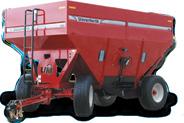
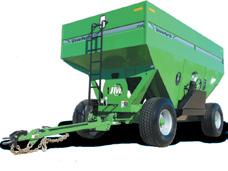
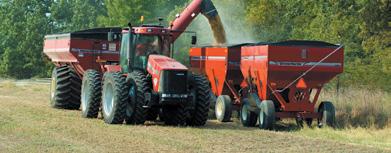

› Visit UMequip.com or see your nearest dealer today.
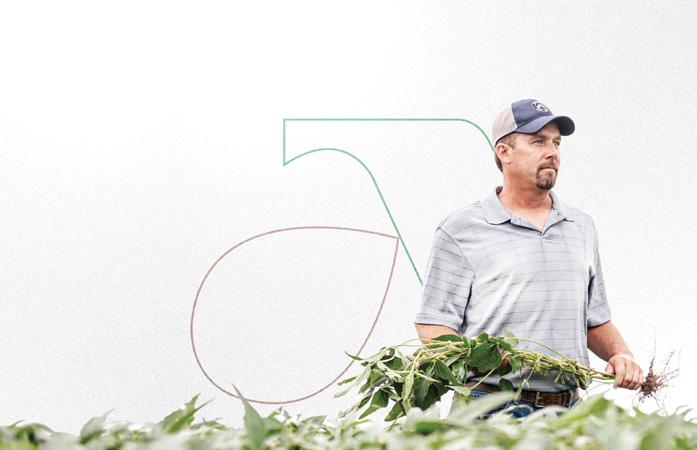
At Asgrow ® brand, not only are we all about the beans, we’re all about your success as well. That’s why we o er localized products with leading genetics, weed management systems and maximum pro t potential – all developed by soybean experts who put soybeans rst.
DISCOVER HOW IT’S ALL ABOUT THE BEANS. Asgrow.com

WSA welcomes newest board member
By Bailey Grubish
Amber Soltvedt might be the newest District 4 director on the Wisconsin Soybean Association (WSA) board, but she’s no rookie to agriculture.
Soltvedt fell in love with farming in high school through FFA and a friend’s farm. Her involvement inspired her to pursue a career in agriculture, leading to her current position with NK Seeds as a seed sales representative.
Connecting with WSA board members at the Wisconsin Corn•Soy Expo led her to consider the position when a seat opened.
“I jumped at the opportunity, and now I get to be a voice and pass what I hear from the growers every day on and know that that’s really valuable and hopefully help them know that their opinions are being heard at a higher level,” Soltvedt said. “It is important to share your opinions, your voice; people want to help, and they want to hear from you.”
Soltvedt was appointed to WSA in July but was unable to attend the first meeting. She’s excited to meet with the board for the first time during WSA’s September meeting. Soltvedt was initially recruited by a banking colleague, WSA Treasurer Dave Coggins. She’s also acquainted with other board members from various industry connections.
“Amber is a good addition,” Coggins said. “She’s young but experienced in the world of commodities and soybeans in particular, both as a seed salesperson and a
grower of soybeans, and that’s a good combination.”
Looking ahead as she jumps into her role, there are a few priority areas she’s ready to tackle.
She spoke about being involved in planning the 2026 Wisconsin Corn•Soy Expo and the corresponding networking opportunities the trade show and conference offers.
Soltvedt is also planning to advocate for biodiesel and growing its usage throughout Wisconsin and the U.S. By and large, legislators don’t know what they don’t know; that’s why Soltvedt said it’s important for farmers to relay their expertise to lawmakers.
“I’m very passionate about the biodiesel issue and helping find markets and advocate for farmers that way,” Soltvedt said. “It’s no secret that most would rather not have government assistance programs. We’d rather have strong markets and avenues to sell our products, but nobody wants to go broke, either, so having a way to do that is important. Also, then making sure that others know their voices are being heard is extremely important to me. I think it’s easy to think that folks out in Washington, D.C., don’t get it, don’t understand and don’t want to understand. That’s truly not the case. People want to hear, and they want to know what’s going on, and I want everybody to feel comfortable sharing that with folks.”
Soltvedt and her husband, Zac Soltvedt, farm by Seymour on his family farm.
As a fourth-generation operation, the Soltvedts grow soybeans, corn and wheat on their grain operation, with most of the soybeans raised as food-grade nonGMO. They have research plots for Syngenta, and a corn and soybean show plot for NK Seeds.
They also have a custom spray business with two sprayers and a small private grain elevator.
“What I love about agriculture is if you have a good work ethic and a good head on your shoulders, you can get really far in agriculture,” Soltvedt said. “We get to work with some of the best people. Farming with my husband and my day job definitely create a vested interest to advocate for farmers and help advance them further, to do what I can for them.”
Soltvedt’s career opened her eyes to what goes on daily for farmers and ag retailers. She felt she could use these insights for her new role on the WSA board.
Soltvedt started her leadership journey in FFA while growing up in Mauston. She continued her agriculture journey through an agronomy internship for two summers and worked as a seed sales intern in her hometown.
She obtained her degree from the University of Wisconsin-Platteville in agriculture business and soil and crop science. Soltvedt became involved in leadership training through the National AgriMarketing Association’s ag business club and soil and crops club.
While in college, she helped on her now-husband’s family farm. Following graduation, she worked for BASF in its professional development programs and managed specialty herbicides and fungicides. She then worked at Nicolet National Bank before moving to Syngenta.
Not only is Soltvedt interested in leadership, but her husband is, too. The duo are graduates of the American Soybean Association Corteva Young Leader Program, a prestigious offering that allows participants an up-close look at agriculture while growing their leadership skills. Following his participation, Zac now serves on the Wisconsin Corn Promotion Board as the District 3 representative.
Soltvedt said her husband’s role on the corn board gave her a closer view into the role of a farmer board director. In March 2025, she went with Zac to Washington, D.C., for hill visits and sat in on special interest groups. They met with other state corn boards, fuel advocacy groups, senators and district representatives.
“I realized how important it is for farmers to get involved and tell their story, because we are where these folks are getting their information from, and they truly value our experiences,” Soltvedt said. “I always thought you had to be an expert, or I didn’t have enough experience being someone young. But after being out in Washington, D.C., I realized we all have a valuable voice.”
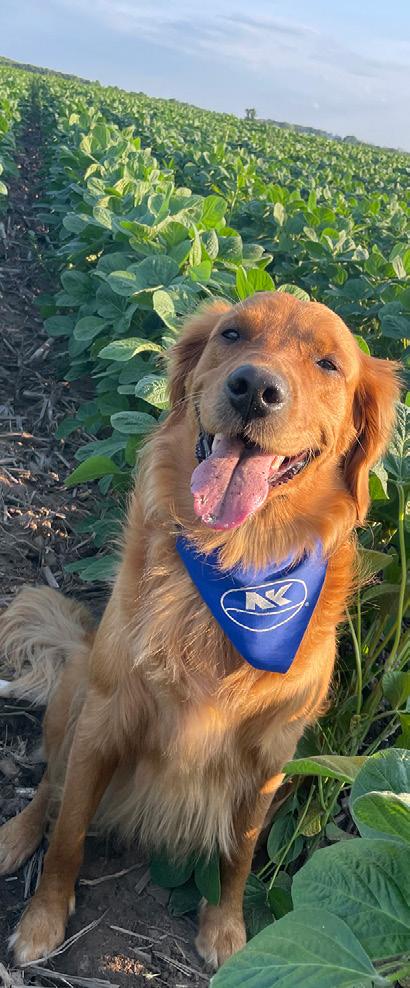
Tilly, the Soltvedt’s golden retriever, takes a break from scouting for pests and insects.
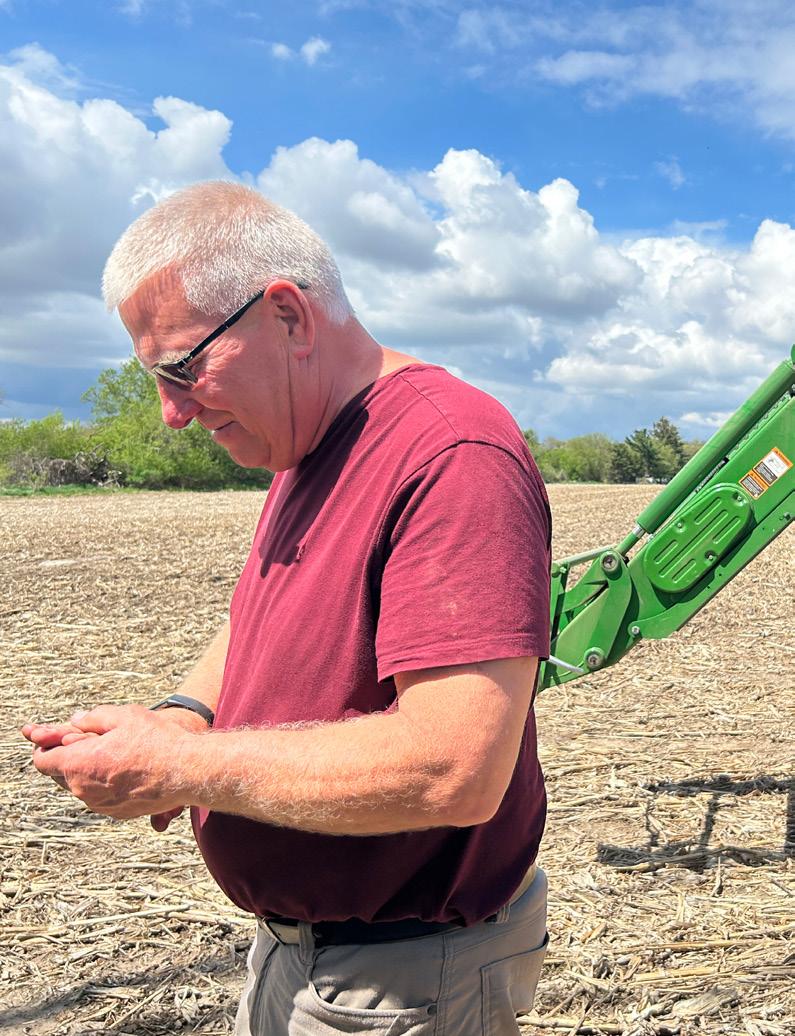
Trzebiatowski is a past WSA president, helping to lead the organization during a difficult transition following the 2022 death of longtime Executive Director Bob Karls. In December 2025, Trzebiatowski will take a national leadership role when he replaces Don Lutz on the American Soybean Association.
By Kelsey Barchenger
First impressions are simple, yet powerful. For those lucky enough to meet Wisconsin Soybean Association (WSA) Director Steve Trzebiatowski, who farms near Amherst, the initial buzzwords are humble and grateful.
“The enjoyment of doing what we do,” he said. “They always say if you enjoy your job, it’s not a job. I’ve done it long enough now and I enjoy what I do even though sometimes we get some long days. But I basically look at it like it’s my workout. This is how I get going and I look forward to that.”
From a young age he knew farming meant long days, and that quickly became his norm.
“I grew up on a dairy farm and my older brother left and so I was the next one in line and my dad really had no one to help him,” Trzebiatowski said. “I wanted to go on to school at that time, but what do you do when your dad needs help?”
Without hesitation, Trzebiatowski decided to continue the family legacy. He sprinkled in a few other careers along the way, but he decided farming would always be his meat and potatoes.
“We always say that we’re grain farmers because we don’t have cattle anymore, so we grow corn and beans and we also do small grains, rye specifically, and oats. It’s a good rotation in that a lot of times like with these soybeans this fall we’ll go till rye into here and that’s our crop for next year,” he said, “and they actually complement one another because the soybeans create nitrogen and that’s really good for the rye crop.”
To his better half, he has a different name for his passion.
“I told my wife, Sandy, maybe I’ll go into gardening,” he said with a chuckle. “She said, OK, you can do whatever you want. And I said OK, I’ll just garden acres.”
And Sandy happens to be his gardener in crime, serving as the farm bookkeeper.
“She’s very strict when it comes to what the numbers are because that was her livelihood in the companies she worked for,” he said. “And she’s very meticulous when it comes to balancing out to the penny.”
Between the long days and adding the unknowns of Mother Nature into the equation, what do you get?
“The most rewarding part of the day is the end of the day, when you can see what you accomplished and what you did throughout the day,” he said. “Just accomplishing so many things, like as we go through fields like this, you just keep knocking them off and just keep progressing along.”
Will there come a day when he decides to no longer make the climb to the cab? Yes, but on his terms.
“I always say that farmers don’t retire. We will,” Trzebiatowski said. “We’re slowly doing less and less. I will retire, but I’d like to retire in my timeframe.”
Because when you’re grateful for it all, your loyal roots grow so deep, that they’re hard to let go.
By Drew Lyon
In farm advocacy, it’s important to know when to manage expectations, take the wins where they can be found and live to fight for another round of policy debates in a split government that’s centered around compromise.
Centered in a so-called battleground state, the Wisconsin Soybean Association (WSA) appreciates this mindset. Janesville farmer Doug Rebout, who serves as WSA president, said he’s pleased by how Wisconsin legislators cooperated over the past several months to pass a budget that largely supports Wisconsin agriculture’s massive, $116.3 billion impact on the state’s economy.
“Economies in both rural and urban Wisconsin rely on agriculture for food, fuel and good-paying jobs,” Rebout said. “This budget does a solid job of reflecting Wisconsin ag’s impact across our state.”
The Wisconsin Legislature worked with Gov. Tony Evers to pass the $111.1 billion, 2025-2027 state biennial budget
bill, aka the 2025 Wisconsin Act 15. The bill was passed in both chambers with bipartisan support – a necessity in Wisconsin’s divided government. Working in alignment with the Wisconsin Ag Coalition, WSA advocated for a slew of farm-related policies that strive to expand demand for Wisconsin ag products, promote market access, support voluntary conservation programs and improve rural infrastructure.
Rebout, who visited with legislators at the Capitol multiple times in 2025, said legislators fulfilled their duties by working in good faith.
“There are some good policies in here for WSA and for agriculture in general,” Rebout said. “We’re pleased to see our legislative leaders work together –that makes me happy, because it affects both parties. Everyone should be ‘in’ on agriculture and helping Wisconsin have a thriving ag industry, because it’s such a huge part of our economy.”


Here are some ag-related highlights that made their way into the budget:
This popular program, which was first passed as part of the 2023-2025 biennial budget with $150 million in onetime funding through the Department of Transportation, will receive an additional $150 million in state support. The program provides grants for municipalities with posted roads and bridges to provide funding to improve outdated roads and upgrade them to non-posted construction standards. The funding, with broad bipartisan support, specifically targets areas that will increase access to farmland and ag facilities.
“It’s very exciting to see this program will continue to receive funding,” said WSA Director Sara Stelter, who promoted the program while serving as WSA president when ARIP was first passed in 2023.
After ARIP funding applications far exceeded available resources (the state received nearly 300 applications requesting over $500 million in funding), WSA advocated for extending the program and lawmakers approved an additional $150 million in ARIP funding in the 2025-27 budget. However, unlike the original program, $30 million of the $150 million will be targeted toward bridge and culvertrepair to help improve and repair deteriorating bridges across Wisconsin. In Rebout’s native Rock County,
he reported around 40 bridges are currently in disrepair and thus closed. Funding through ARIP could provide much-needed support across the state.
“In agriculture, everything starts on rural roads,” Rebout said. “The crops start here, and we have to make sure our crops get to market, so this is huge.”
Stay informed on applications for the next round of ARIP funding by visiting WSA’s website and social media channels.
This session, WSA and the Ag Coalition’s advocacy pushed to maintain funding for DATCP’s popular producerled Watershed Protection Grant program. The Legislature increased funding by $500,000 to $1 million annually to enable producers and producer-led groups to implement nonpoint source pollution abatement strategies to improve Wisconsin’s soil and water quality. An additional $1.6 million ($800,000 annually) was passed to support the cover crop insurance program, which assists farmers with $5 per acre rebates of a cover crop planted for crop insurance premiums paid on those acres.
$2 million ($1 million annually) was appropriated to continue the commercial Nitrogen Optimization Pilot Program, which helps protect the state’s vital soil and water resources.
Continued on page 20


WSA has been a longtime advocate for increasing rural mental health resources at the state and national levels. The Legislature and Gov. Evers signed off on legislation that directs $200,000 toward free resources for Wisconsin farmers’ mental health via services like the Wisconsin Farm Center.
“We’re very happy to see this funding in the budget,” Rebout said. “There are always different things affecting folks in farm country. When farmers are feeling stressed and overwhelmed, they can talk to someone and not feel judged about it, thanks to this funding.”
The budget also includes $10 million ($5 million annually) for the Food Security Initiative, a program created by Gov. Evers that connects local nonprofit food assistance programs, such as food pantries, with local producers to keep food shelves stocked with foods grown in Wisconsin.
$800,000 to increase ($1.2 million over the biennium) the available funding for the successful Dairy Processor Grant Program.
Budget funding provides three staff positions to DATCP’s Division of Animal Health to provide animal disease outbreak coordination and response.
Legislators returned in September to Madison to focus on stand-alone legislation. Wisconsin’s legislative session will continue into the spring of 2026. Top of mind for WSA is advocating for an income and franchise tax credit of $1.50 per gallon of sustainable aviation fuel (SAF) produced in Wisconsin. Senate Bill 284 was introduced by. Sens. Romaine Quin (R-Birchwood) and Patrick Testin (R-Stevens Point), while Assembly Bill 222 was introduced by Rep. David Steffen (R-Howard). Although Wisconsin doesn’t have a SAF production facility, a Wisconsin-based sustainable aviation fuel production company, Virent Inc., helped power the nation’s first domestic flight powered by 100% SAF in one of its engines.
In mid-September, WSA Vice President Matt Rehberg testified to the Assembly Transportation Committee in support of the bill. If passed,, the SAF tax credit would take effect in 2028. WSA will also monitor stand-alone legislation related to nutrient loss, pollinators, protecting crop inputs, PFAS (aka forever chemicals) and foreign investments in Wisconsin agricultural or forestry land.
“Soybeans are already an incredibly versatile crop –we feed animals, produce food products, keep firefighters free of PFAS with soy firefighting foam, and we make biodiesel. But sustainable aviation fuel is the next frontier,” Rehberg said. “It has the potential to create a durable, premium market for soybean oil, anchoring more demand right here in Wisconsin.”.
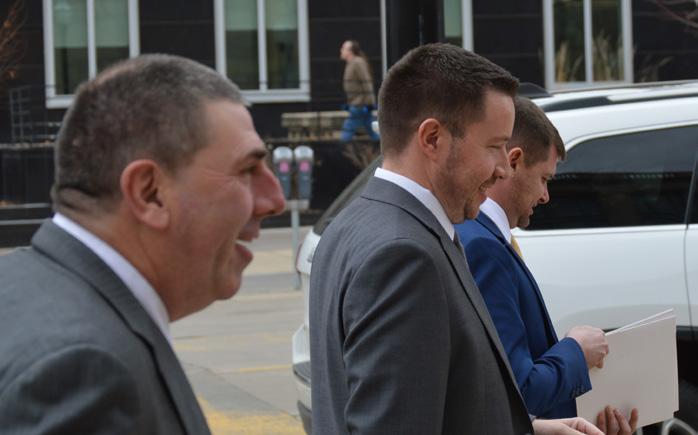
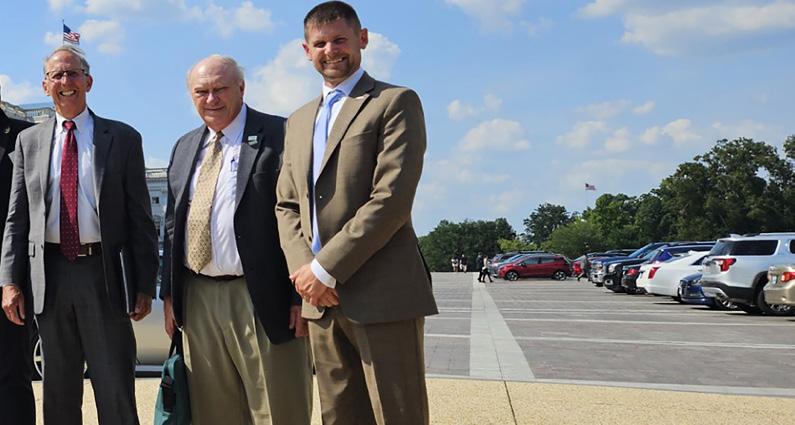
(L-R) WSA President Doug Rebout, Executive Director Adam Kask and VP Matt Rehberg head to the Capitol for policy meetings during the 2025 legislative session.
As the ink dried on his signature that passed the state budget, Democratic Gov. Tony Evers ended speculation on his political future by announcing he won’t run for a third term in 2026.
Evers said he was proud of his 50 years in public service, but it was time to forgo reelection and spend more time with his family.
“Gov. Evers has been a leader in supporting the producers, processors, and rural communities in our state,” said DATCP Sec. Randy Romanski, who was appointed by the governor in June 2020
Evers’ decision is bound to create a field of candidates over the next year, and the gubernatorial race will surely attract national coverage leading up to the Nov. 3, 2026, election. Just minutes after the governor’s announcement, Lt. Gov. Sara Rodriguez was the first to announce her candidacy. Other possible Democratic gubernatorial candidates include Attorney General Josh
Kaul, former Lt. Gov. Mandela Barnes, State Sen. Kelda Roys, Milwaukee Mayor Cavelier Johnson and Milwaukee County Executive David Crowley. Across the aisle on the Republican side, business owner Bill Berrien and Washington County Executive Josh Schoemann have announced their bids. U.S. Rep Tom Tiffany announced his candidacy in late September, touting his connections to agriculture, and State Sen. Mary Felzkowski is also a possibility. Former Gov. Tommy Thompson has indicated he’s leaving the door open to a return to office.
WSA Executive Director Adam Kask said the board is eager to host any gubernatorial candidates during the campaign season.
“Our farmer leaders are passionate about showing both elected officials and aspiring legislators what life is like on Wisconsin family farms, and we encourage candidates running to replace Gov. Evers to seek us out and get an up-close look at how soybeans are fueling Wisconsin,” he said.
By Bailey Grubish
Sometimes, it takes joining advocacy groups like the Wisconsin Soybean Association (WSA) to understand the broader impact farmers can have when they pool resources and rally behind a common cause.
“We need a voice. The number of farms is shrinking, so we need to band together and speak as one voice, and WSA gives us that opportunity,” said Doug Rebout, WSA president. “By joining a group like WSA, it gives them a voice.”
With so many membership opportunities out there, it’s important to know what you’re signing up for when joining. Sure, every membership organization uses the usual buzzwords – “join today,” “become a member,” etc. – to attract members, but WSA’s mission to promote farm-friendly policies is more than just lip service coated in catchy phrases. The proof is in the details and WSA’s legacy of earning tangible wins for its members.
Founded over 50 years ago, this grassroots organization is a farmer-led team representing over 1,200 soybean farmer members to ensure sound ag policies for the nearly 17,000 soybean farmers around Wisconsin. Yet having only about 7% of active soybean farmers as members limits WSA’s ability to advocate even further.
“The big benefit to me is just having an organization that talks for us and is there to help us so we can be as profitable on the farm as possible,” Rebout said. “The more members we have, the stronger we can be.”
All WSA members earn as part of their membership firm representation on policies related to biodiesel, educational programs, tax reform, opening markets, soybean processing and research, soybean science
outreach programs, sustainability and technology.
Members don’t always hear who’s going to bat for them, but WSA strives to work behind the scenes while also informing members of how their support is bringing profitability back to their operations. Members can also have their voices heard by attending WSA’s Annual Meeting during Corn•Soy Expo.
Along with a family farm membership, WSA offers several options for members to choose from:
• 1-year: $100
• 3-year: $150
• Farm Family: $250
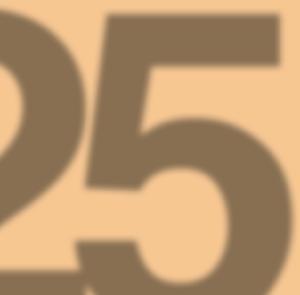
Members receive a range of benefits, including registration discounts (up to 25%) for Corn•Soy Expo, Commodity Classic and other events.
Agricultural businesses can also be members, amplifying WSA’s voice. When an agricultural business joins WSA, it shows not only support of the very customers that patron their business, but it brings a larger presence in numbers to overall membership.
WSA comprises volunteer soybean farmers from around Wisconsin who all represent the interests of soybean farmers. They live and see what farmers endure, understanding the issues important to the districts and farmers they serve.
WSA Vice President Matt Rehberg, representing District 3, conceded that it’s tough to see the benefit from membership in a palpable way, unless the farmer is involved in the organization or looking directly for the information.
When WSA prevents an issue or regulation from being enacted, or sends a letter of support to an organization,
those policy wins aren’t always grasped by members. Yet WSA pushes for policies that bring value back to farmers and also helps lay the groundwork for first-generation farmers like Rehberg to thrive.
“We need memberships,” Rehberg said. “We’re not supported by checkoff money and all the funds that we have are funds that we have to raise, and we’re small fish in a big pond. Our lobbying organization is nothing compared to a lot of other industries and groups with a lot more money and a lot more sway, but we make a little money go a long way.”
Hill Visits are one way WSA activates its membership resources.
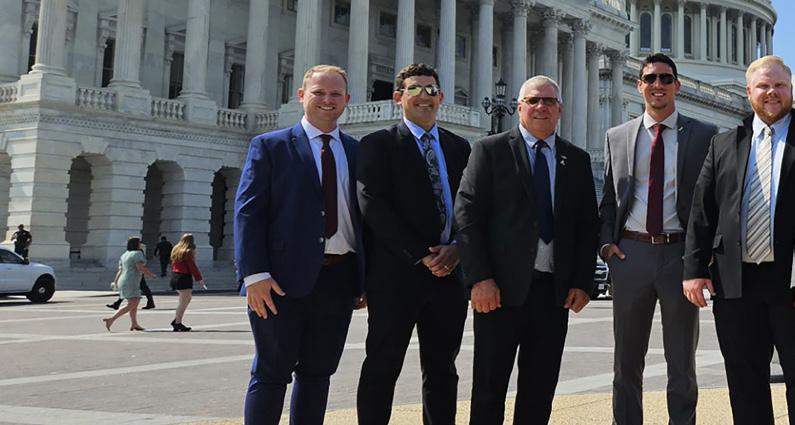
By sitting down with legislators, lawmakers and industry leaders in Washington, D.C., and sharing WSA’s policy priorities, farmer representatives are making a difference. When important dialogue is happening on pressing issues – trade wars, extending tax cuts, a new Farm Bill, protecting farm economy and defending sound science –WSA has a voice at the table, even in the nation’s capital.
WSA board members also represent at the state level in Madison. Members help support outreach events, including the Ag Coalition’s Ag Day at the Capitol. The sum is greater than the parts, Rehberg said.
“Becoming a member of WSA, especially an engaged member, is important because we’re definitely the minority industry,” Rehberg said. “There’s just not a lot of us that are either farmers or in the ag industry. We’re a pretty small family, but we are important. We contribute a lot to the economy. We contribute a lot to our small local communities. We’re making sure that we’re taking that opportunity to engage with our lawmakers and talk about
our story and what matters and what’s important, and make sure that policy matches both the needs of farmers and in the local economy.”
With full representation of the soybean industry, the WSA board is informed on what matters to the state’s soybean industry. When it’s time to focus on priorities each year, hearing from other soybean farmers on what they are seeing and what is affecting them helps to set the priorities.
A highlight for WSA over summer 2025 were some big wins in the One Big Beautiful Bill.
“We’re not looking for direct payment or something like that, we’re looking for safety nets,” Rehberg said. “Something to make our business either more efficient or more relevant to markets or give us access to new markets. A lot of that takes some seed money and some support, and we got a lot of that, which was amazing. We had a lot of wins in that.”
WSA prioritized in 2025 protecting soybean farmers’ freedom to thrive.
The Farm Bill, transportation infrastructure, export markets, crop input protection, tax relief, value-added uses and conservation programs were a few of the focuses for WSA with the soybean farmers in mind.
“Our numbers as individual farmers are going down,” Rebout said. “Belonging to an organization like WSA really strengthens our voice, because when we can go into an office and say, we’re talking on behalf of 17,000 soybean farmers across the state of Wisconsin, those legislators are more willing to listen to us.”
Invest in your business, your family and your future by becoming a WSA member today at wisoybean.org/ wsa/membership.
By Drew Lyon
Jeff Winton has traversed farm country on a personal mission to prevent suicides in rural communities. He’s all too familiar with the grief: In 2012, Winton, who was raised on a dairy farm in upstate New York, lost his nephew, Brooks Winton, to suicide just a few hours after celebrating a family wedding.
His loved ones were shocked.
“He was the last person in our family who we’d ever thought was struggling,” Winton said. “We had no idea he was struggling with mental illness or substance use disorder, or that he was contemplating suicide.”
In his role as founder and chairman of Rural Minds, Winton has shared the story of his nephew’s death countless times during meetings with advocacy groups, including the American Soybean Association (ASA). More than a dozen years since Brooks’ suicide, Jeff still chokes up recalling his final hug with his nephew and the grim moment he learned of Brooks’ decision to take his own life.
The shock reverberated throughout Winton’s family and farming community.
“It’s the worst thing that can ever happen to someone,” he said. “At that point, our world changed, our entire family changed. The dynamics in our family changed.”
With support from ASA, Rural Minds introduced in 2024 the Rural Mental Health Resilience Program toolkit with free mental health information, resources and training to assist rural residents in improving mental health in their communities. The Rural Mental Health Resilience Program acknowledges the self-reliance and do-it-yourself mindset that are common among farmers and others living in rural areas by providing online access to free educational content that can be printed for distribution, links to mental health support services, and a toolkit for planning, promoting and leading community conversations about rural mental health.
“We are grateful to the American Soybean Association for their partnership with Rural Minds to introduce the Rural Mental Health Resilience Program,” Winton said. “(Their support is) an important opportunity to provide potentially life-saving information to confront the mental health challenges in rural America and the stigma that surrounds mental illness.”
The initiative builds on ASA’s commitment to addressing rural mental health through its #SoyHelp program, which serves as a resource for national and state-specific mental health information in states with soy farmers. The
Wisconsin Soybean Association (WSA) has also supported the program through social media posts, media outreach and panels during Corn•Soy Expo
“Being mindful of your mental health is so critical to farming,” said WSA President Doug Rebout, who spoke on the panel alongside leaders from Wisconsin’s Farmer Wellness Program. “We think about our physical health, but we often neglect those factors that contribute to stress and depression.”
Removing the stigma around mental illness in rural America means addressing the crisis, not ignoring it. When Brooks died, community members were reluctant to discuss why and how he chose to end his life. Brooks’ family was advised to consider saying he instead perished in an accident or from a heart attack.
“They don’t want to talk about this epidemic,” Winton said.
Instead, the Wintons, led by Jeff’s late mother, Elaine, decided to lift the veil on rural mental health and confront some hard truths in rural communities, which encompass about 46 million Americans. Of those 46 million, about 25% of rural residents live with a behavioral health issue. In Winton’s small town, seemingly everyone had a story to tell about depression and addiction, either directly or through a loved one’s experiences.
Elaine Winton helped bring the topic out of the shadows. No more hiding.
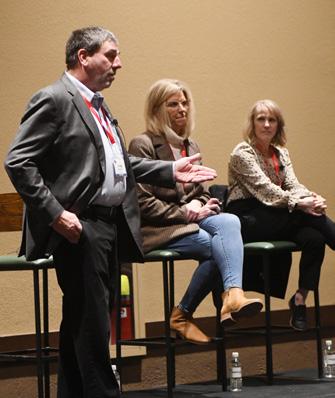
WSA President Doug Rebout speaks about the importance of rural mental wellness during a panel at the 2025 Wisconsin Corn•Soy Expo.
“We’re not only going to talk about it, we are going to talk about it in detail,” Winton said. “This has been going on in this farming community for far too long. I can count on both hands and feet and other appendages how many families have gone through this, and now we’re going to talk about it.”
Rural Minds was created three years ago with a focus on the agricultural community. Since its inception, the group is looking to work with indigenous and Amish population, the latter of which has a prominent farming presence in New York.
“We’re really focused on ensuring that the stigma gets addressed and that people are starting to feel comfortable to talk about this without being ashamed or embarrassed,” Winton said. “Mental illness is an illness like cancer or heart disease, and we’ve got to start treating it as such.”
Part of the issue with confronting mental wellness in rural America is a lack of resources, Winton said. About 75% of rural counties lack a licensed psychiatrist, and rural health care facilities have 20% fewer physicians than in urban counties, while 80% of rural Americans lack access to a psychiatric nurse. And telemedicine can also be a barrier: About 30% of rural residents can’t access the internet. In addition, millions of rural Americans are either uninsured or under-insured. However, many insurance companies offer patient assistance programs and community partners have also increased engagements. To complicate matters further, the opioid epidemic – which can lead to mental illness – has disproportionately affected rural communities.
“If a person has to decide between paying for their insulin or paying for an antipsychotic medication, they’re going to choose their insulin,” Winton said. “But there are a lot of programs that can help.”
The stereotypical strong, silent type in agriculture is outdated, Winton said. The culture has changed, and agriculture must continue bringing mental wellness to the forefront.
“We are in a race against time,” he said. “We’re striving to end the suffering, stigma and silence that surrounds mental illness in rural America.”
To learn more about free mental health resources and receive Rural Minds’ monthly newsletter, visit ruralminds.org.
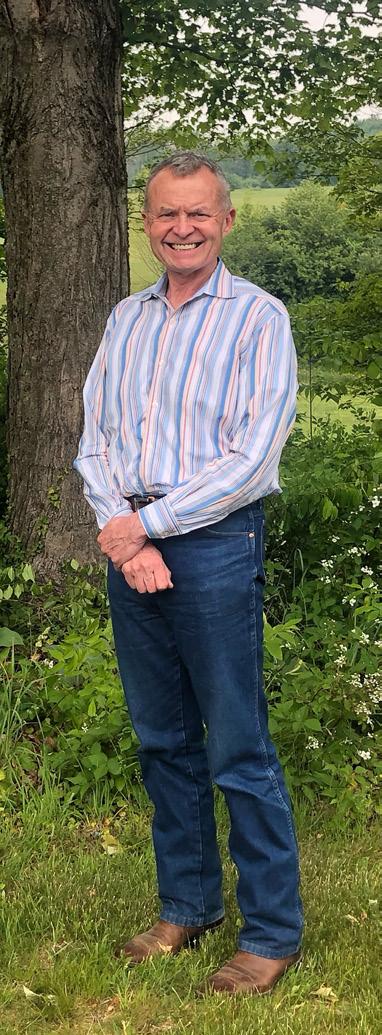
Winton urges growers to remember a three-digit number – 988 –which is a national network of local crisis centers providing free and confidential emotional support to people in suicidal crisis or emotional distress 24 hours a day, 7 days a week.
“Besides helping you in a crisis, they will also help you find local resources,” Winton said. “It’s a starting point.”
More mental health resources are available at soygrowers.com.























By Sydney Harris
Whether she’s in a combine, boardroom, tractor or airplane cabin, Wisconsin farmer Nancy Kavazanjian is ruminating: How can we invest soybean checkoff dollars to maximize farmer profitability?
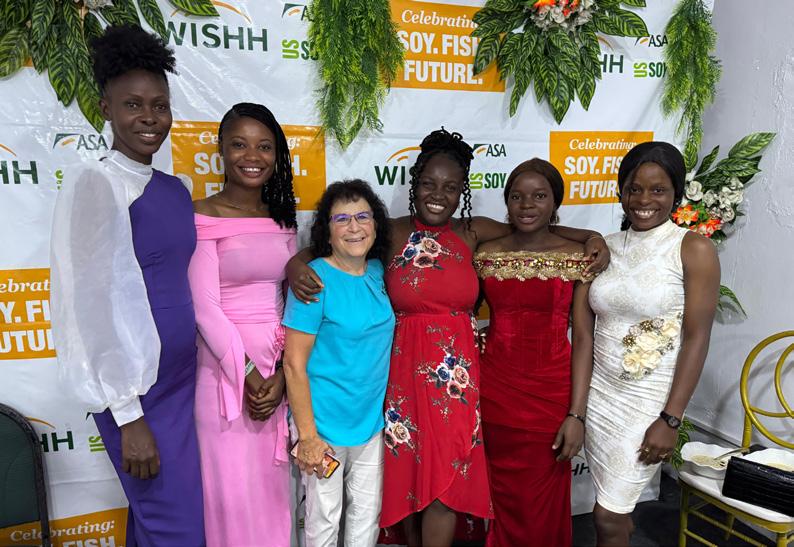
Investments in the World Initiative for Soy in Human Health (WISHH) have proven to be critical toward answering Kavazanjian’s question. In August, Kavazanjian dusted off her globe, traveling to Nigeria as part of a WISHH trade team. While there, she represented Wisconsin as a United Soybean Board director and delivered a message of solidarity.
“We really need to understand what we’re doing with our soy checkoff in a country like Nigeria, as it’s a longterm investment,” said Kavazanjian, who farms near Beaver Dam. “The demand for U.S. Soy is there, and we are going to be there to grow with them. They need to know that we care about them.”
Identifying markets that demonstrate growth potential and working within those systems to build resilience in trade, WISHH focuses on long-term development, and Nigeria is a top candidate. With 227.9 million people, which is more than two-thirds of the entire U.S. population, Nigeria has more than earned its moniker of the “Giant of Africa.” And with 28 percent of consumption of animal protein from fish, WISHH’s in-country investments are proving to pay-off for the U.S. soybean industry.
“WISHH has been in Nigeria for a while, working in the
food space with soy flour and soy foods,” Kavazanjian said. “They felt that developing the aquaculture industry was the next step.”
As the second largest aquaculture fish producer in subSaharan Africa, Nigeria accounts for 52 percent of the total farmed fish production in the region. Since WISHH began investing in Nigeria’s poultry and aquaculture sectors in 2014, soymeal usage in feed has increased by nearly 25 percent.
“Soy has a great role to play by being able to provide a cost effective and a really nutrient rich food for the fish,” Kavazanjian said. “Fish food, fish itself, is expensive, so soy is a great alternative to using other fish to feed fish.”
The WISHH delegation had plenty to celebrate while in Nigeria. On Tuesday, Aug. 19, WISHH’s Next Gen Leaders for Aquaculture Innovation Dialogue and Graduation ceremony took place at Sejfarms Consult Limited. This internship program has invested $100,000 of checkoff support toward making sure that young professionals are introduced to the best industry practices at Sejfarms.
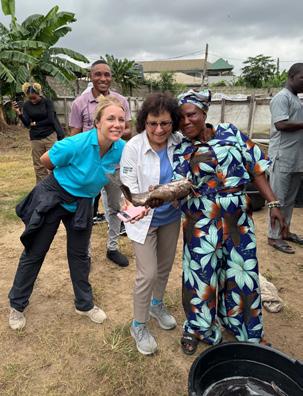
“These young people had gone through college to study aquaculture but had never been on a fish farm,” Kavazanjian said. “They had the book knowledge, but they needed the practical experience.”
As part of the event, Kavazanjian and Minnesota farmer Jamie Beyer were interviewed about their roles as U.S.
Nigeria’s use of soymeal has increased by nearly 25% in the past decade.
women farmer leaders. Kavazanjian also emceed a panel of WISHH leader-interns on what they learned as part of the program, how they intend to use what they learned and what their next career steps will be.
“It’s just so encouraging to see a country like Nigeria and to see the young people there really wanting to make something of themselves and help develop their country,” Kavazanjian said. “What WISHH is doing in Nigeria is really important to the future of soybeans in the United States.”
And knowledge has an uncanny way of multiplying.
“Now that these 10 young people have graduated, they’re going to go out and get jobs in Nigeria somewhere in aquaculture, feed or research and we now have a network of people on the ground in Nigeria to help us build our demand for soy in Nigeria,” Kavazanjian said.
Because fish feed is considered a bottleneck to future growth of Nigerian aquaculture, WISHH and Sejfarms signed a Memorandum of Understanding (MOU) for more collaboration to advance Nigeria’s fish production during their visit.
“The signing of the MOU was really important because the internship program was so successful,” Kavazanjian said. “The agreement allows us to continue the program
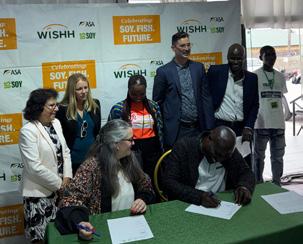
so we can build on it and continue to expand, promote and educate the young people in Nigeria in proper feeding of the aquaculture industry.”
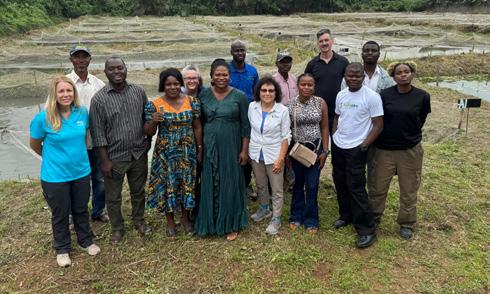
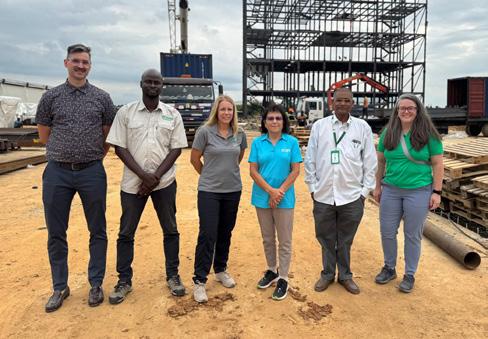
Along with Sejfarms, the WISHH delegation visited several feed mills, including Skretting, which can produce 125,000 metric tons of extruded fish and animal feeds per year, and a diagnostic lab, Rid Labs, that services aquaculture and feed farmers. They also toured an aquaculture research farm where they met members of the regional aquaculture association, discussing how they are helping area farmers modernize production and market their fish.
“It’s a country that is definitely going to be a great customer of ours,” Kavazanjian said.
WISHH’s work in Nigeria is far from over, but as the trade mission demonstrated, the foundation for a strong partnership with U.S. Soy is being laid.
“To have a good partner, you have to be a good partner,” Kavazanjian said. “It’s important to go to these places to build relationships and show that we’re a good, trustworthy, honest and caring partner.”
By Soy Forward staff
When crafting a budget to support an industry that contributes about $124 billion toward the U.S. economy, the United Soybean Board (USB) must walk a tightrope by remembering history while also looking toward the future and staying grounded in the present
In the year ahead, the United Soybean Board (USB) is striving to boost demand for U.S. Soy, drive on-farm resilience and bring value to the nearly half-million U.S. soybean farmers. Led by its 77 farmer-leaders, including three who represent Wisconsin, USB approved during summer 2025 a $121.3 million budget for the 2026 fiscal year, strategically allocating funds across vital research, promotion and education investments. This spans the food, feed, fuel, industrial, exports and sustainable production market segments.
“Just like we have done on our farms across the country, USB’s farmer-leaders have sharpened their pencils, identifying high-impact opportunities that provide return to America’s soybean farmers,” said Philip Good, USB chair from Macon, Miss. “As soybean farmers navigate the trade and input uncertainty, along with unpredictable weather, the Soy Checkoff aims to be the long-term, steady hand on the rudder. We’re looking 5-10 years out to ensure that U.S. farmers have viable markets and innovation to protect against weather, weed and disease pressures.”
The Wisconsin Soybean Marketing Board (WSMB) collaborates with USB to make wise checkoff investments in production research, market development and new uses. With three Wisconsin farmers representing the Badger State on USB – Nancy Kavazanjian, Tony Mellenthin and Sara Stelter – important decisions are made with Wisconsin’s soybean economy in mind.
“While it was difficult to make the tough cuts, the board worked together to get the best ROI for farmer checkoff dollars,” said Stelter, who farms near Wautoma.
The board approved the budget during USB’s summer meeting in Norfolk, Va., prioritizing strategic investment in several areas such as animal health and nutrition, infrastructure, production research and international trade. In addition, the board focuses its communication and education efforts on strengthening the reputation of U.S. Soy with customers, amplifying checkoff investments to inform U.S. soybean farmers and partnering with the over 30 state soybean boards on research and outreach.
“While the calendar says 2025, at USB we’re already finalizing 2026 programs and the July
USB meeting provided a check-in to make sure we’re on track,” said Kavazanjian, who farms near Beaver Dam. “We heard preliminary results of ongoing research, considered industry partner issues and met to consider additional projects that can accomplish our mission to create value for all U.S. soy farmers.”
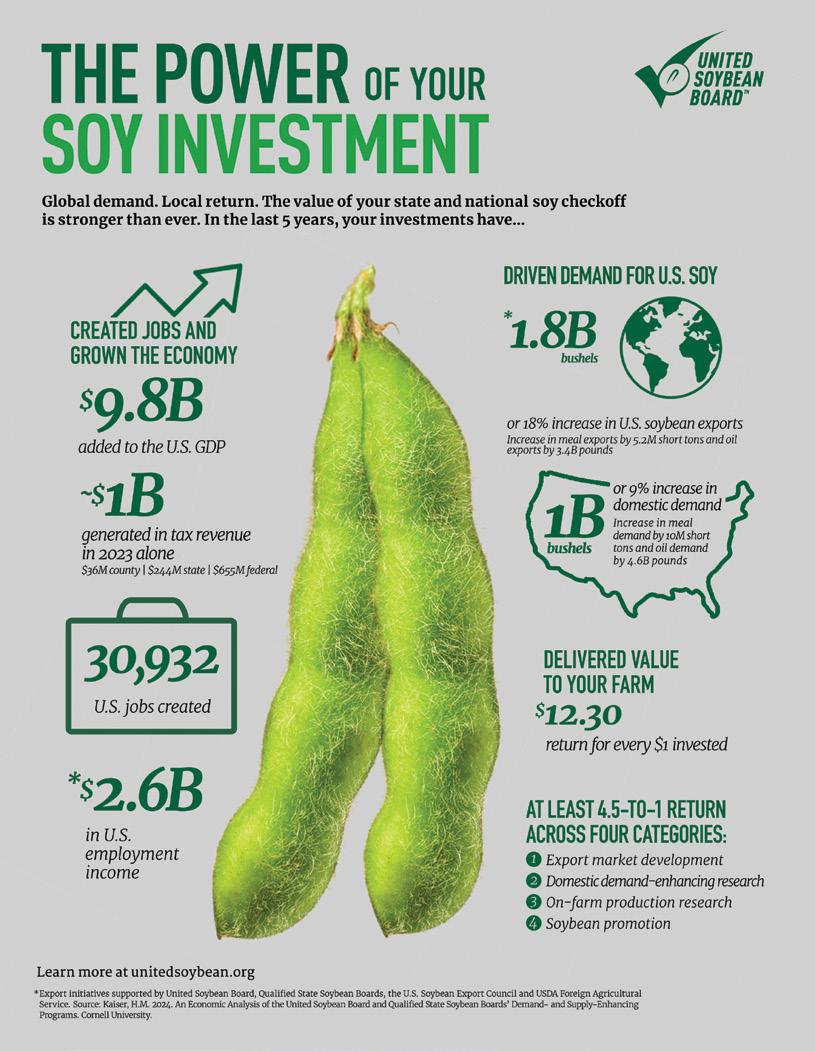
Wisconsin is home to nearly 17,000 soybean growers and for every dollar that Wisconsin soybean farmers pay into the checkoff, growers earn an estimated $12.30 in return value.
According to USB’s most recent data, the impact of soy checkoff investments includes:
• Total economic impact on the U.S. economy from the soybean sector averaging $124 billion, including $85.7 billion from soy production and $9.8 billion from soybean processing. The U.S. soy sector accounts for approximately 0.6 percent of the U.S. gross domestic product.
• More than 500,000 individuals involved in soy farm decision-making. This includes 223,000 paid, fulltime equivalent jobs and an additional 62,000 family members, beyond growers, who reside on farms and are integral to soybean farming operations.
• A total wage impact of the sector averaging $10 billion.
“USB is constantly looking ahead and identifying avenues for checkoff investments that will benefit producers,” said Mellenthin, who farms near Eau Galle. “The U.S. soybean industry – including Wisconsin – is made stronger through these investments.”
Key investments USB is prioritizing in the 2026 include:
• Food: Expanding high oleic soybeans as a strategic ingredient for the food industry. By leveraging gene editing for faster innovation, this strengthens the domestic supply chain and meets the growing demand from food manufacturers for functional oils that provide heart-health benefits.
• Feed: Advancing and deploying research and marketing to enhance demand of U.S. soymeal by supporting health, productivity and profitability of livestock and poultry production.
• Fuel: Positioning U.S. soybean oil as the preferred feedstock to meet the renewable volume obligation of 5.6 billion gallons of biomass-based diesel in 2026. USB aims to expand soy’s biofuel footprint through research demonstrating soy’s low carbon intensity and lifecycle greenhouse gas emissions. In addition, investments will increase the overall renewable fuels market through new market
development, with soy-based biofuels playing an important role in biodiesel, renewable diesel, Bioheat, and the marine, air and rail markets.
• Industrial uses: Furthering the commercialization of new soy-based technologies with the greatest potential to drive soybean demand. This includes expansion of soy oil-based lubricant and surfactant product lines, development of new uses for soy in tires, commercialization of soymeal wood adhesives, and certification of soy-based firefighting foam (SoyFoam) to replace PFAS, aka “forever chemicals.”
• Exports: Growing U.S. Soy exports into more than 80 established markets while diversifying into new markets through the promotion of U.S. Soy’s quality attributes. U.S. Soy provides value through its sustainability, consistency and reliability to downstream customers while demonstrating lower moisture content, superior amino acid profile and greater energy content. Ultimately, this increases animal performance and efficiency, maximizing economic return. Export partnerships also aim to raise consumption of U.S. meat, poultry, and eggs around the globe, which increases the demand for U.S. soybean meal in domestic animal diets.
• Sustainable production: Addressing major yield threats and exploring on-farm costsaving opportunities. Specific priorities include: mitigating soybean yield loss due to drought and soybean cyst nematode; measures to reduce fertilizer inputs; management systems leading to enhanced productivity and profitability; and advancing weed and slug management strategies in partnership with national extension programs, including the University of Wisconsin. Investments in sustainable production also further greenhouse gas research and carbon modeling updates to ensure U.S. Soy receives the credit and financial opportunities it’s earned in global markets.
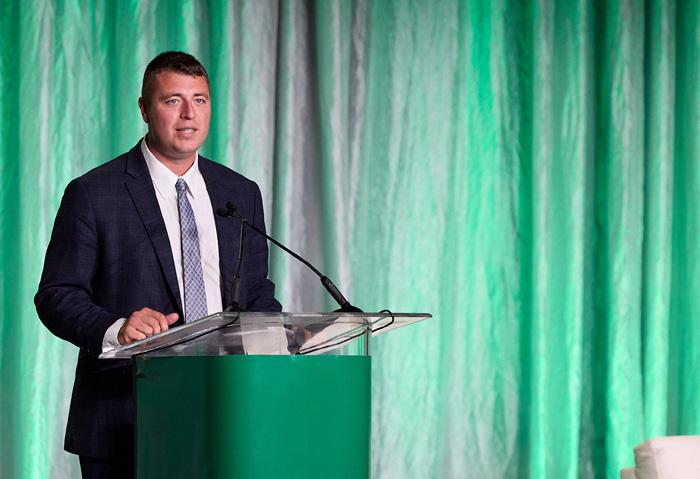
USB CEO Lucas Lentsch said Wisconsin’s USB directors play a critical role in bringing Wisconsin soy farmers’ interests to the national stage.
“Every farmer from every zip code plays a role in this organization because the soy checkoff starts at a local level,” Lentsch said. “Having Nancy, Tony and Sara represent Wisconsin as directors on the United Soybean Board ensures that local views and priorities are integrated into the larger checkoff strategy.”
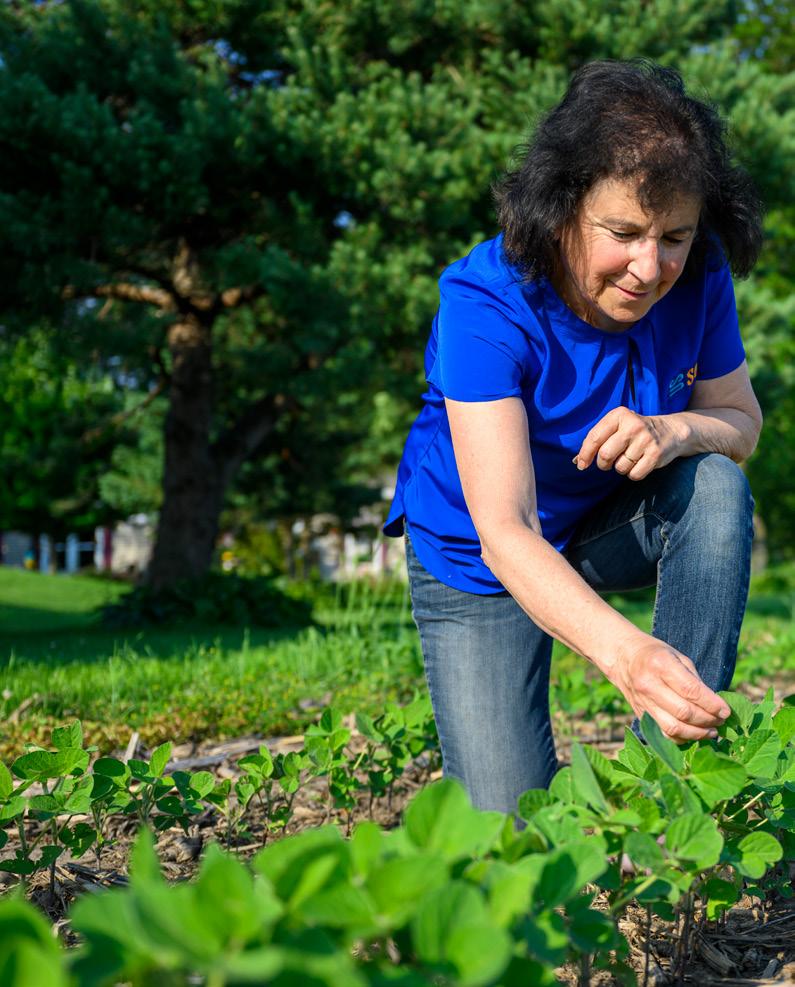
Nancy Kavazanjian has served two terms on the United Soybean Board.
Justman joins WSMB; Gibbs to lead another year
By Doug Monson
With harvest on most farmers’ minds, the Wisconsin Soybean Marketing Board (WSMB) convened one last time before turning their attention to the fields.
And with that meeting, directors from across the state welcomed the newest director to the board: David Justman.
Justman joined the Sept. 16 meeting in Madison after the Wisconsin Department of Agriculture, Trade and Consumer Protection (DATCP) announced results of the WSMB election, ushering in a new era of farmer leadership. He replaced outgoing director Kevin Bork, a Grand Marsh farmer who retired from WSMB after serving three terms.
Justman, of Platteville, now represents District 3 soybean producers on the board. Justman, who attended a special field day at Arlington Agriculture Research Station for WSMB directors, said he wasn’t fully aware of everything the board did.
“I didn’t realize the Marketing Board was so heavily involved in the research being done at the University of Wisconsin,” he said. “Actually, as I went around getting my petition signed, most people asked me, ‘Well, what does this board even do?’ Now I can go back to them and say, ‘Hey, you won’t believe all the cool stuff we’re
funding and working on!’”
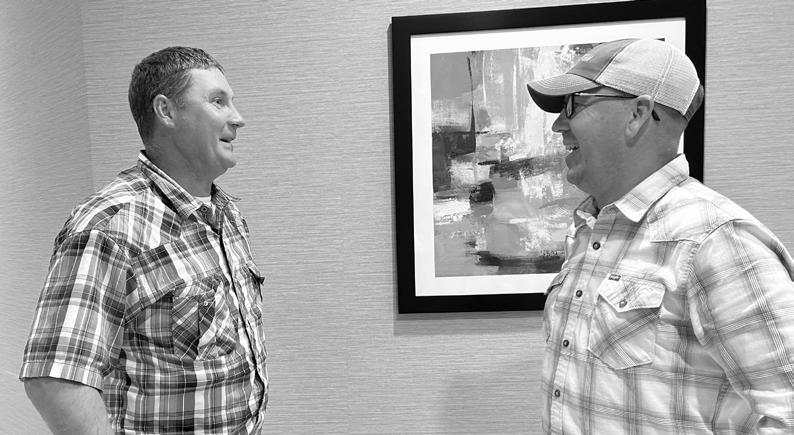
Jonathan Gibbs of Fox Lake (District 4) and Patrick Mullooly of Clinton (District 5). In addition, Gibbs was elected by the Marketing Board to serve a second term as president. The remainder of the executive team also stay unchanged: Matt Wagenson of Bear Creek (District 7) will serve as vice president and Steve Wilkens of Silver Creek (District 7) will serve as treasurer/secretary.
Gibbs said he looks forward to another year at the helm.
“We’ve really been working hard to focus on core areas of the Marketing Board,” he said. “This past year we continued a strong investment in research, we continue to work to unlock the power of the St. Lawrence Seaway and our ports, and we’ve focused attention on our non-farming neighbors across the state.”
Gibbs says he is also proud of the work on developing new products.
“We’ve focused a lot on our new uses program and supporting some of the things that are coming out of the United Soybean Board,” he said. “Products like soy-based firefighting foam, soy-based tires and all the different uses for our crop.”


By Sydney Harris
Out of nearly 6 million Wisconsin residents, only around 16,500 (about 2.75% ) are soybean farmers. That leaves a significant number of Wisconsinites who are unaware of the infinite uses of “the miracle bean.”
For that reason, the Wisconsin Soybean Marketing Board (WSMB) set out to spread soy’s word – focusing especially on soy-based products available commercially. “We’re always looking for ways to communicate with people that probably aren’t completely familiar with farming operations and where our soybeans actually end up,” said WSMB Director Justin Bauer, who represents District 2. This summer, WSMB’s vision came to fruition with a Consumer Campaign centered around streaming commercials highlighting the burning question: What will your soybeans grow up to be? With more than 5.8 million impressions (ads served) across digital platforms, the commercial is making waves in Wisconsin.
Bauer said the video, which depicts young soybeans growing into the cool (bean) kids at a high school reunion, offers a mixture of chuckles and awareness. “Our marketing team pushed us outside of our comfort zone with the commercial,” said Bauer, who farms near Eau Galle. “The first time I watched it, I thought, ‘That’s kind of cheesy.’ But I’ve shown it to some of my friends that aren’t familiar with the farm, and they all seemed to relate with it.”
Targeting non-farmers, the commercial streamed in full and condensed versions across multiple platforms, including History, Food Network, Fox Business and National Geographic, with an audio version streaming on Spotify and iHeart Radio. Digital graphics were also pushed on various social media platforms.
“WSMB is always looking for ways to reach out to the community to better educate where our soybeans are going,” Bauer said. “Most people think a majority of our soybeans get shipped overseas, but there are a lot more things that they’re used for here at home. So, by having this type of campaign, we’re reaching out and trying to show people that soybeans have a lot of uses. A lot of them are using soy and don’t even know it.”
While initial research, conducted by Clutch Performance, found that 81 percent of respondents viewed Wisconsin farmers with a favorable attitude, a deeper dive showed that no demographic realized the sheer number of soy-based products – over 1,000. The Consumer Campaign highlights soy’s many uses, which, hopefully, will get Wisconsin residents excited about the miracle crop growing in fields across the state.
“If we don’t have our communities on board for certain projects, like a soybean crush plant, they may have a negative opinion on having something like that in their area,” Bauer said. “But if they understand what’s going on and how they’re benefiting from soybean production in the state, it might shift their perspective.”
The bottom line of the campaign is simple – and delivered with a playful wink.
“I want them to know more about what soybeans are used for,” Bauer said.
Missed it the first time around? Go back to school by visiting Wisconsin Soybean Program’s YouTube page and watch the video in its entirety.

Optimize yield and profit on your farm with Agroptimizer
By Mark Askelson
Ever wondered how different management practices could impact your yield and profit on your farm? There’s an app for that, thanks to the soybean checkoff.
Agroptimizer is a cloud-based decision support tool with a user-friendly interface that producers across most of the U.S. can use to identify optimum soybean and corn cropping systems at the field level, going well beyond what traditional field trials can replicate.
“Essentially what it does is run a scenario-builder for, like if you made changes X, Y or Z to your farming operation, this is how it could optimize either your profitability or yield,” said Dr. Shawn Conley, professor and state soybean and small grain specialist at the University of WisconsinMadison. “Those changes could be changing your planting date, your seeding rate, whether or not you apply a foliar fungicide or insecticide. There’s a lot of different decisions farmers can make that impact their outcome.”
According to Conley, Agroptimizer uses algorithms that are trained on vast amounts of synthetic data and combines them with historical weather data to optimize management practices for the entire cropping system to maximize yield and profit. Farmers will need to input the location of their field using Google Maps, along with soil type and the management practices they use. It then will simulate the results of replicated field trials like they have been performed on their farm for five consecutive years and identifies the management practices with the best probability to increase yield and profit in each particular field.
“You can use it to maximize yield, and you can use it maximize profitability. As you know, those can be two different things, so this gives farmers that choice,” Conley said. “Right now, in this day and age, farmers are going to use it most likely to optimize profitability.”
Producers will need to know a handful of data pieces to help the Agroptimizer app make its assessments, including seed costs, costs of foliar applications, nitrogen costs and projected selling prices along with planting date, row spacing and seeding rate. It then takes your data and provides recommendations for optimizing your crops profit and yield.
A new feature in the app also allows farmers to pin up to five fields to figure out which will be the most profitable for planting first.
However, as more information becomes available, the app will be able to add more modules, such as white mold modeling and cover crop termination, and farmers
can continue to increase efficiency on their operation through the power of AI and open-crop management.
“An example would be cover crops, which we don’t have a ton of data on right now,” Conley said, “but as we go on and farmers utilize it the system learns from that info.”
But the question on everyone’s mind is: Does it work?
The Wisconsin Soybean Marketing Board helped fund a study to determine whether or the recommendations from the app were helpful in maximizing yield and profit. As part of that study, the University of Wisconsin conducted seven experiments between 2021-2023 to evaluate its effectiveness by comparing its recommendation versus typical recommendation of the experts at UW. The study found that the Agroptmizer recommendations resulted in a greater yield for soybeans and similar corn yield, as well as similar profits for soybean and corn, when compared to the UW recommendations. Conley noted that there was little to no risk associated with the recommendation management practices.
There are, however, a few limitations with Agroptimizer. It does not provide recommendations in regard to weed control, as there is currently not enough available data for that tool. It also does not have the capability to provide variety-specific yield data but instead works with the within the yield potential of maturity dates. And while it is a useful tool for many, Conley adds that if a grower is doing their own on-farm research, the Agroptimizer recommendations may be old news.
“The leaders in the farming industry are already buying into these practices and have seen the results, so there’s not a lot in this that surprises them,” Conley said. “But there’s still a lot of folks across Wisconsin who would benefit, and I encourage them to use it, especially now while it’s free.”
Thanks to funding from the North Central Soybean Research Program (NCSRP), the Agroptimizer app is currently free for all farmers across the country to use for at least the next two years. NCSRP Vice President Matt Wagenson, who also serves as WSMB vice president, strongly encourages producers to give it a try.
“NCSRP’s only goal is production research, so they’re always looking to find more ways to make farmers more profitable and produce more beans per acre,” said Wagenson, who farms near Bear Creek. “There’s a pretty big yield gap between our top producers and those who aren’t in the know when it comes to management, so the Agroptimizer is another tool in the toolbox to help get them there.”
Visit www.agroptimizer.com to learn more.
“You can use (Agroptimizer) to maximize yield, and you can use it maximize profitability. ... I encourage farmers to use it, especially now while it’s free.” - Dr. Shawn Conley
By Mark Askelson
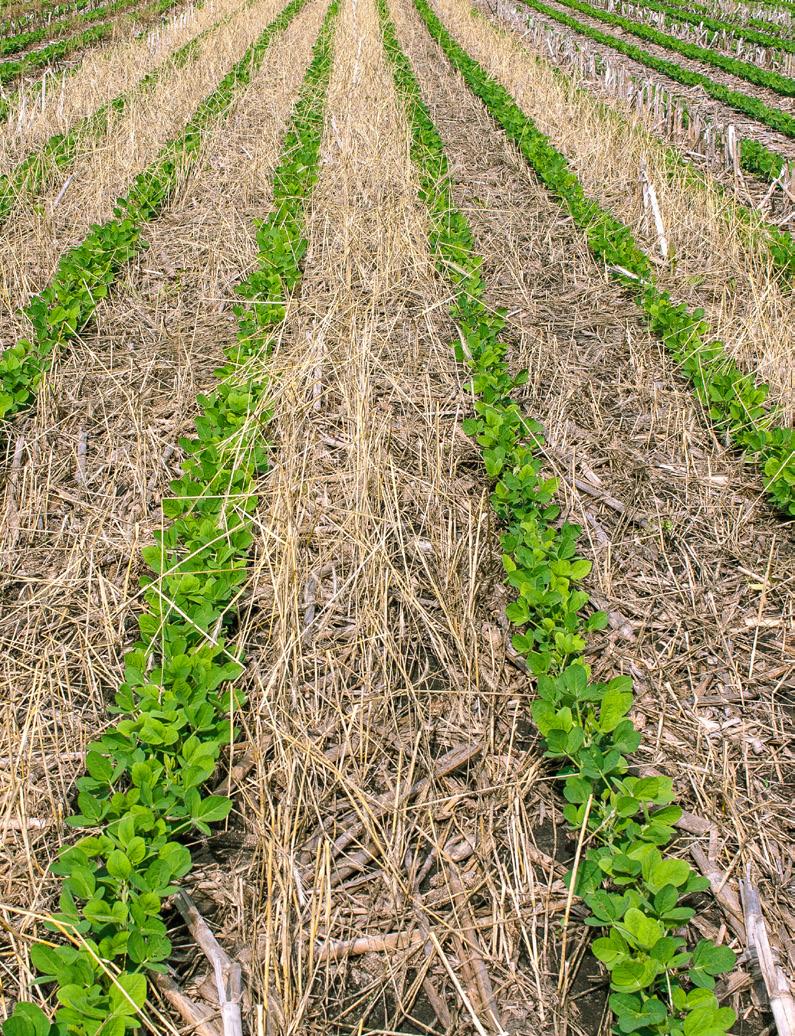
Controlling weeds this growing season proved unmanageable for many Wisconsin growers, but there is a post-harvest option that can suppress weeds, improve soil health and prevent erosion.
Checkoff-sponsored research conducted by the team at the University of Wisconsin-Madison indicates that planting a cover crop, primarily cereal rye, can be an effective tool against weed pressure in a corn and soybean rotation, if properly managed.
By planting cereal rye in the fall after your harvest, farmers can control weeds by outcompeting them, according to UW Assistant Professor and Weed Specialist Rodrigo Werle.
“Direct competition for resources is one way that cover crops can help us, especially when you’re talking about those winter annual weeds,” Werle said. “You’ll be seeing something out there you want to be growing other than a weed.”
While the common practice is to terminate the cereal rye cover crop approximately 10-14 days before planting to reduce impact on yield potential, Werle notes that by “planting green” (delaying termination until the crop is planted or shortly after), producers can increase biomass and prevent weed growth later in the year.
“What happens is that cover crop will alter the micro environmental conditions on top of the soil surface, which means you have less radiation reaching the soil surface, therefore reducing temperature fluctuations, which in turn reduces weed seed germination,” Werle said. “Waterhemp loves temperature fluctuations, so if you have enough biomass, you can trick it into not germinating.”
Delaying germination gives the farmer more time to deploy intervention. Increased biomass also leads to overall better soil health and stability.
“Just having a cover crop is not enough,” he said. “We need to let it accumulate and acquire biomass.”
‘Spreading the good news’
However, planting into a live cereal rye cover crop versus early termination can lead to a yield reduction, with corn being impacted greater than soybeans. Corn tends to struggle with high biomass systems as it ties up the nutrients, which Werle notes can be problematic. On the flipside, soybeans can be very successful in those situations pending you have enough moisture early in the season, and you have a planter that can handle the biomass.
“It’s not all roses,” Werle said. “High biomass cover crops can help with weed suppression, it can help with soil health, but it can cause some challenges for cash crop establishments, so farmers need to understand what their goals are and that they are properly set up for that type of management.”
As weed control issues, especially waterhemp, continue to grow throughout Wisconsin, so too has the interest in adopting cover crop applications, particularly in the last 5-10 years. But in years like 2025 where profit margins are razor thin (at best), Werle says farmers tend to be more concerned with maximizing profits and yields.
“Farmers talk to farmers and they’re spreading the good news about cover crops, so the interest is there, but with the markets being the way they are, they aren’t as willing to experiment and try new things,” Werle said. “Those who have adopted cover crops in the past will continue to do so, but we’re not seeing much of an increase in adoption with the way things are at the moment.”
For more information on cover crops and resources that are available, Werle recommends farmers visit with their local agronomist, extension staff or NRCS office. Farmers can also learn more about weed control at www.wiscweeds.info.











With growers harvesting their crop, meeting season for Wisconsin agriculture is just around the corner, and you know what that means: The Wisconsin Corn•Soy Expo is coming.
Registration for the 2026 Corn•Soy Expo is now open at cornsoyexpo.org. Remember, members of the Wisconsin Soybean Association (WSA) earn significant savings on registration costs.
WSA and the Wisconsin Soybean Marketing Board will have their usual presence at the two-day conference and trade show at the Kalahari Conference Center in Wisconsin Dells. Both boards will hold meetings, including WSA’s annual meeting and officer election. WSMB will discuss and review its 2026 research projects during its meeting. WSA will also announce the winners of the 2025 Yield Contest, while WSMB will keep things drafty during the popular Beer & Bull Session hosted by Dr. Shawn Conley. Visit cornsoyexpo.org for more agenda details in the weeks ahead.

WSA is imploring President Trump to prioritize soybeans in U.S.-China trade talks, warning that retaliatory tariffs are shutting farmers out of their largest export market during the 2025 harvest.
As this issue of Soy Forward went to press, growers were still hopeful a trade deal could be reached to avoid a long-term crisis. But as he prepared for harvest, WSA President Doug Rebout reported the economic situation across farm country was bleak and trending toward dire.
“Wisconsin soybean farmers are fed up,” Rebout said. “WSA calls on President Trump and his administration to immediately resolve the trade war with China, restore access to this vital market, and stop undermining the very farmers who feed and fuel this nation. Anything less is unacceptable.”
As a possibly record harvest loomed, the American Soybean Association urged the president to work on removing Chinese tariffs on U.S. soybeans and secure commitments for future purchases. ASA also released a white paper underscoring the dire financial consequences of losing long-term market share in China, while WSA has been vocal in its position that, minus a trade deal, Wisconsin’s farm economy will suffer.
China’s imports of U.S. soy are greater than all other international markets combined. China has historically imported more than 60% of the world’s soybean supplies, with the U.S. once serving as its top source. But retaliatory
tariffs now make U.S. soybeans 20% more expensive than South American supplies. As a result, China has turned to Brazil, which has expanded production to meet demand.
Wisconsin soybean farmers depend on trade by exporting more than 50% of their crop to international markets, primarily in China, Mexico and Canada. Soy farmers have skin in the game in China, Barron County farmer Tanner Johnson emphasized. Through advocacy and visionary soy checkoff investments, U.S. soybean farmers helped cultivate and grow the Chinese market across 40 years. Damaging once-stable market access could prove devastating for not just farmers, but rural economies and communities across the country.
Unlike the 2018-2019 trade war, farmers are coping with far thinner profit margins, marked by a one-two punch of low commodity prices and high input costs.
“China is an irreplaceable market; we’re working our tails off to find supplementary markets, but there’s no replacing China,” said Johnson, a member of ASA’s Executive Committee. “To watch (the market) get taken away from us by something completely out of our control, it’s a really hard pill to swallow. ... This administration has done a lot of good for soybean farmers, but everyone in the soy family knows that our No. 1 priority is open markets with China.”
WSA also criticized the U.S. government’s decision to extend a $20 billion swap line to Argentina, just as China purchased at least 20 shiploads of Argentine soybeans.
“This decision is indefensible, and it signals to rural America that our contributions to food security, trade and the broader economy are being taken for granted,” Rebout said.

Farmers are expressing alarm over China’s lack of purchases of U.S. soy since April 2025.
WISCONSIN SOYBEAN
Soybean advocacy groups, including WSA, expressed cautious optimism following the Make America Healthy Again Commission’s release of the Make Our Children Healthy Again Strategy and thanked the Trump administration for increasing engagement with agricultural stakeholders since the misguided May report.
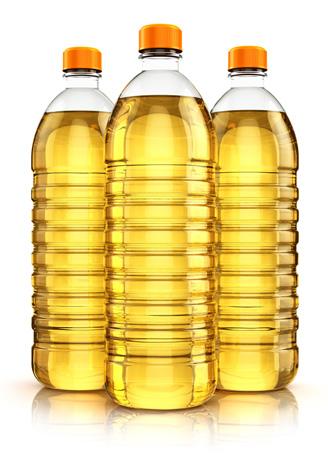
The strategy acknowledges the EPA’s robust, sciencebased pesticide approval process, a welcome shift from earlier critiques, and highlights the benefits of precision agriculture while proposing policies to expand access to these tools. WSA strongly rebuked the May report, which suggested that seed oils contribute to reduced human health. A study commissioned by ASA and the United Soybean Board found that removing seed oils from the food supply could raise consumer costs for edible fats and oil by nearly 50%
“Between the May report and today’s strategy, the Commission was accessible and open to learning more about modern farming practices,” ASA President Caleb Ragland said. We truly felt like we had a seat at the table, and for that, we are incredibly appreciative.”
ASA and WSA continue to urge careful consideration of any upcoming rulemakings that could negatively impact U.S. farmers and the public.”
wisoybean.org/wsa 608-274-7522 admin@wisoybean.org

From the Dairyland to D.C., Wisconsin Soybean Association (WSA) farmer directors work on behalf of 1,200 members to ensure sound ag policies for Wisconsin’s nearly 17,000 soybean farmers.
Your voice in Madison. Grassroots advocacy is at the core of WSA’s mission. Our volunteer farmer leaders serve as the voice of soybean farmers in Madison and Washington, D.C. WSA’s advocacy efforts are directed by farmer leaders and driven by membership dollars, lobbying support and collaborating with the American Soybean Association on federal policy issues.
Founded in 1973, WSA is a grassroots advocacy organization. We rely on volunteer members to help fund our advocacy efforts.
WSA is farmer led, which means the men and women fighting on your behalf understand the issues important to the districts and farmers they serve.
Profitability – by working to adopt usage of biodiesel, fighting to keep valuable farm inputs and more.
Ideas That Work – we push for plans that bring value back to farmers, such as biodiesel adoption.
Growing Markets – we work for state investments in infrastructure by land or water to get your crops to market.