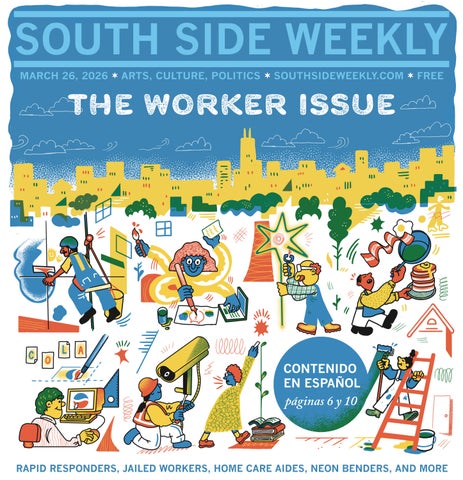
CONTENIDO EN ESPAÑOL
pág inas 6 y 10


pág inas 6 y 10
The South Side Weekly is an independent non-profit newspaper by and for the South Side of Chicago. We provide high-quality, critical arts and public interest coverage, and equip and develop journalists, artists, photographers, and mediamakers of all backgrounds.
Volume 13, Issue 6
IInterim
Editor-in-Chief Adam Przybyl
Immigration Project Editor Alma Campos
Senior Editors Martha Bayne
Christopher Good
Olivia Stovicek
Jocelyn MartinezRosales
Engagement Editor Chima Ikoro
Editor Emeritus Jacqueline Serrato
Public Meetings Editor Scott Pemberton
Art Director Shane Tolentino
Research Editor: Ellie Gilbert-Bair Fact Checkers: Ella Beiser
Patrick Edwards
Kate Gallagher
Jenna Mayzouni
Zara Norman
Rubi Valentin
Layout Editor Mel Dempsey
Publisher Malik Jackson
Office Manager Mary Leonard
Advertising Manager Susan Malone
The Weekly publishes online weekly and in print every other Thursday. We seek contributions from all over the city.
Send submissions, story ideas, comments, or questions to editor@southsideweekly.com or mail to:
South Side Weekly
6100 S. Blackstone Ave. Chicago, IL 60637
For advertising inquiries, please contact: Susan Malone (773) 358-3129 or email: malone@southsideweekly.com
For general inquiries, please call: (773) 643-8533
Cover illustration by
David Alvarado
remember the moment I realized the work required to make a newspaper. I was 11 or 12 years old, and reading a YA fantasy novel where the main character takes up a job at a newspaper. As he meets and befriends writers, editors, and delivery boys, I distinctly recall having the thought—at the time it was revelatory—that the newspapers my parents read at the kitchen table were created by real people, and lots of them, laboring day in and day out to produce something that we saw, picked up, and read all over the city.
I find it helpful to remind myself from time to time that almost everything we see and use throughout the day is made or maintained by real people, usually lots of them—and we almost never see them do it.
Take a look around you. Maybe you’re reading this at a cafe; how many people grew, washed, packaged, shipped, and prepared the coffee you’re drinking? Maybe you’re at home; who maintains the plumbing? Fixes the roof? Who’s working at the power plant, making sure the lights are on? Or perhaps you’re on the train; who laid down the tracks, built the platforms, and designed the look and feel of the space?
This issue is an ode to the hidden labors—and laborers—that make our world go round. We start with the rapid responders who have protected our immigrant communities for years, and especially over the last several months. Their work is not limited to whistle blowing and following federal agents around, although those efforts are crucial and valuable. But people play many roles in the coordinated defense of our communities—ourselves and our neighbors—from masked federal agents. A Q&A with labor rights organizer Jorge Mújica follows, containing crucial information about the rights all workers possess, regardless of immigration status.
We speak with an incarcerated worker at Cook County Jail, who’s been tasked with cleaning up flooded and burned cells for cents on the hour, while
navigating the realities and challenges of their disability.
We chronicle the experiences of Chicagoans who provide care for people living with disability. While caretaking is one of the fastest growing “work sectors” in the country, it is often informal and unpaid; we share resources for those called to this labor, who are caretakers of loved ones. We interview three grant writers on the difficult, critical fundraising work they engage in to sustain nonprofits, in the wake of Trump’s inauguration.
We review an exhibit at the National Museum of Mexican Art, exploring the history of Mexican workers who constructed Chicago’s railroad and industrial infrastructure in the early 20th century, before some of them were deported on the train lines they built.
And in the middle of the issue, we feature short profiles of a variety of workers: window washers, neon sign benders, a theater set designer, a high school agriculture teacher, a visual artist, and our very own and recently retired layout editor.
This issue will also be my last as interim editor-in-chief. It’s been the highest honor to steward the publication since October, and I’m grateful for the opportunity to have worked so closely with the staff and freelancers of the Weekly. Take a look at the names to the left and right; you would not be holding the paper now in your hands without the many contributions of these talented people.
I’m also thrilled to be passing the torch to Jill Petty, who will take over as the Weekly’s editor-in-chief starting with the next issue, out on April 9. Jill is a lifelong South Sider who brings years of experience in journalism, book editing, coaching and writing to this role. She is excited for the challenge.
After a short break, I’ll be sticking around as deputy editor. Stay tuned— this will be a big year for the Weekly.
– Adam Przybyl, interim editor-in-chief
neighbors at work: the people powering rapid response networks
Three rapid responders share how they protect their community from ICE, from Little Village to Minneapolis. alma campos ......................................4
el trabajo entre vecinos
Reflexiones de las personas detrás de las redes de respuesta rápida en Chicago y Minneapolis. alma campos, traducido por gisela orozco .........6
q& a with jorge mújica: 50 years fighting for labor rights
“As long as there’s something to fight, we’ll keep going,” said Jorge Mújica, a labor rights organizer. alma campos 8
pyr con jorge mújica: 50 años defendiendo a trabajadores
“Mientras se pueda luchar, ahí seguiremos”, dijo Jorge Mújica, organizador de derechos laborales. alma campos 10
los traqueros
Museum exhibit takes Mexican labor history in Chicago out of the shadows. jacqueline serrato .......................... 13
worker profiles
Window washers, teachers, neon benders, and more. ciaran delaney eubanks, sarah luyengi, zara norman, adam przybyl, dierdre robinson, susie xu .............................................. 14
earning a wage behind bars
One jail worker shares what it’s like to work while incarcerated. harley pomper 20
the hidden work of caregivers
Caregiving can take a physical, mental, and financial toll, but there are programs to line up caregivers with financial assistance.
pachina fletcher 23
what does a grant writer do?
Three professionals share their experience. jonah nink 26
the exchange
The Weekly’s poetry corner offers our thoughts in exchange for yours. chima ikoro, andrew ntamere 28
public meetings report
A recap of select open meetings at the local, county, and state level.
scott pemberton and documenters . 30
BY ALMA CAMPOS
As immigration enforcement intensified under the Trump administration, rapid response networks expanded across cities like Chicago and Minneapolis, where volunteers began responding in real time to reports of federal agents in their neighborhoods. In some places, that response has included people blowing whistles to alert neighbors or tracking ICE vehicles as they move through a neighborhood, alongside other forms of real-time coordination. Across cities, these networks have taken shape through hotlines, group chats, and neighborhood-based organizing.
Much of this happens out of view: distributing supplies, organizing legal observer trainings, documenting encounters on the street, connecting people to neighborhood networks, coordinating alerts, and supporting families with food and other needs.
In this story, I spoke to three people involved in rapid response efforts about the roles they’ve taken on. Two spoke on background to protect their identities.
Lucas* isn’t part of an organization. He doesn’t have formal training. He works a regular job at a print shop. But as immigration enforcement intensified in his neighborhood of Little Village he felt like he had to do something.
In the weeks leading up to the surge, he kept seeing videos, posts, people talking about whistles being used to warn others when agents were nearby.
Lucas had been hesitating about what he could do to help his neighbors but he didn’t know how. So he went
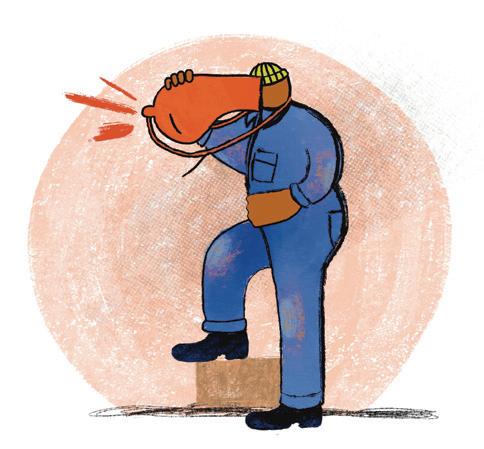
on Amazon and ordered more than a thousand whistles.
They began to pile up in his home with boxes stacked in his dining room. He then started handing them out directly in the neighborhood, especially to street vendors and people he came across in daily life: he said he would walk around asking people, “Do you have your whistle?” and giving them out for free.
Lucas said he brought whistles with him even when running errands at Walgreens and ended up giving them to people there too—even employees—who didn’t question what the whistles were for and just thanked him. “They know what it’s for,” he said.
Seeing him around the neighborhood, people wanted to know what organization he belonged to. “I was like, I’m sorry, It’s just me.”
But that led him to start a Facebook page so people could follow updates and help if they wanted to.
He and a few others pooled money to print Know Your Rights cards and created simple bilingual zines with instructions on how to use the whistles.
At work, he used what he had— paper, printers, layout tools—to put together those materials.
Quickly this grew into a collective effort, with volunteers assembling kits together and using the whistles to alert
neighbors in real time. As the group expanded, the work became constant— filling his days with organizing, printing, and responding to others.
He began organizing gatherings at local restaurants, including Aguascalientes in Little Village. Volunteers would sit around tables assembling kits. At one point, he said, they brought a batch directly to a local school, handing them off so they could be distributed more widely.
One day, he heard it himself. He followed the sound of a whistle while driving on his way to work, and found a young woman standing outside, blowing in short bursts, scanning the block.
He decided to pull over and ask her what she had seen. She pointed him in the direction of where agents had been spotted. Other people were there when he arrived—some of whom he recognized from the neighborhood. He pulled over close by, grabbed a bullhorn from his car, and started recording.
At one point, he yelled, “Get the fuck out of Little Village” to the agents. He said it came from somewhere deeper, something instinctive and protective of the neighborhood. Within minutes, the agents pulled back and left.
For him, it was one of the clearest examples of how whistles worked. “That whistle had a lot to do with it… kind of led you to that.”
I spoke with Lucas in December, just a few days after ICE agents had left Chicago, at a restaurant where he had assembled whistle kits. But the urgency of those early days still lingered.
“I’ve had, like, no free time,” he said. He said even when he tried to rest,

those moments stayed with him.
“I’m trying to find my way back home to who I am,” he said. But he also understands that something deeper shifted and things aren’t the same. “How much of this is now me?”

In Minneapolis, another volunteer, Brian* came into the work—but in a different capacity. He lives in the Powderhorn Park area of South Minneapolis, a neighborhood he described as diverse and close-knit. It was also one of the first places where enforcement activity became visible during Operation Midway Surge, a federal immigration enforcement effort launched in early December 2025 that deployed over 3,000 masked and armed federal agents in Minneapolis and St. Paul.
At the time, Brian wasn’t deeply involved in rapid response work. He had been involved in some mutual aid work since 2020, but he wasn’t connected to any specific group.
His involvement began when he saw agents moving through his neighborhood and chasing someone down the street.
Nearby, a young woman stood outside a car with her child. He and his partner stood outside too, trying to understand what they were seeing.
“I’m a little ashamed to say now
that we didn’t blow our whistles,” he said, describing how early it was in the operation, how uncertain everything felt.
They stayed, watching. Afterward, they followed one of the vehicles for a few blocks trying to track where it was going. Later, Brian tried to speak with the woman using Google Translate. He learned that agents had chased the child’s father from the car. He didn’t know what happened after that.
The reports didn’t stop. Alerts came in from blocks away about other people being chased, doors being forced open, neighbors showing up. “You would just see more and more stories like this come in, right near you,” he said.
That was when he began to get involved. At first Brian joined channels on Signal (a secure messaging app), attended early observer trainings, and kept an eye on what was happening. But as more people began trying to help, it became clear to him that there was a huge gap. People didn’t know how to help.
“There were so many people who wanted to get involved,” he said. “They just didn’t know how.”
So he stepped into what he describes as a connector role.
Throughout the Twin Cities, Brian helped create an extensive network that links people to local groups, intake routes, and response systems.
“We didn’t organize the groups,” he said. “We greased the wheels.”
He explained that in Minneapolis, neighborhoods are spread out and people relied more on cars and coordination. You could not depend on someone simply being nearby.
After the killing of Renee Good, and then Alex Pretti weeks later, more people began reaching out, trying to get involved and the need for coordination became harder to manage.
“It’s always changing,” Brian said. “You have to keep adjusting.” At its peak, he said he was spending 60 to 70 hours a week.
Over time, roles began to take shape. Some volunteers drove through neighborhoods looking for federal
agent vehicles. Others stayed in place, watching schools, churches, or business corridors. Dispatchers monitored incoming reports and directed people where to go. Others worked behind the scenes, checking information before it was shared more widely.
And so the work of connecting people, of making sure someone who wanted to help had somewhere to go, became his expertise. He was not always visible, but helped build a vital system. As an immigrant himself, he understood the fear that was moving through the community and so giving people something to do and a way to act, became important to do.
Looking ahead, Brian sees the work continuing to grow, such as people sharing what they have learned, building on each other’s strategies, and figuring out what works and what needs to change.
For people in other cities who are watching and unsure where to begin, his advice was simple: connection changes how people experience a crisis.
For those who don’t have it, or don’t feel able to respond, the weight can build quickly, especially when they are taking in information but don’t know what to do with it. “The more you can find something to do, the better you’re going to feel,” he said.
“Finding something to do about it, even a small thing, is so much better than doing nothing,” he said.
“The best thing to do, more than anything, is just to start getting to know your neighbors…start making connections with people,” he said.
Michael Urbanski of Northeast Minneapolis first got involved in rapid response networks early 2025, after attending a legal observer training just weeks into the Trump administration—one of the first large public entry points into what would become a much wider network.
More than a thousand people showed up, many of them, like him, “looking for something more immediate, something that felt closer than calling elected officials.” He had
been loosely involved in activism since 2020 after the murder of George Floyd by a police officer.
A legal observer, as he described it, is someone who shows up to document, to use their presence and their phone to record what happens to federal agents which are often moments that unfold quickly and without warning: when agents come into a neighborhood to kidnap people, storm into businesses or agitate neighbors. Urbanski said the role is structured, but also fluid. You might respond to an alert, or you might be on your way somewhere else and come across something, and in that moment, you become part of it.
“You show up to film,” he said. “You’re not there to escalate.”
Over time, his role shifted. What started as showing up turned into organizing the trainings themselves then into the quieter work behind it, answering messages, routing messages they received through the hotline, moving information, keeping track of where people were needed.
When the surge began in December, he said the alerts increased, and systems that had been built over the year began to strain under the weight of what was happening. By January, the intensity had shifted again.
“My palms were sweaty for all of January,” he said.
At a bus stop in Minneapolis, Urbanski watched as four vehicles pulled up fast around a man who was standing there alone, blocking traffic while agents got out and formed a perimeter. Within minutes, people began gathering. Some filming and others were trying to make sense of what was happening. Urbanski, there as a legal observer, focused on documenting the scene.
Urbanski stressed this work is important but it’s also complicated. On one hand, observers are there to make visible what might otherwise happen without witnesses. But on the other hand, Urbanski explains it also can draw attention to the person— turning someone else’s worst moment into something more exposed as you are in close proximity to someone else’s vulnerability.
“I don’t want to further dehumanize anybody,” he said, describing the line he was constantly trying to navigate.
He described standing outside a construction site for hours, watching, waiting, making sure workers could finish safely after agents had been approaching them. He knew this might help, but also, he was conflicted about how it would feel for them. When they came down, they thanked him. But it was something he hadn’t wanted because he didn’t want them to feel like they owed him anything.
As the work expands, so do the networks around it. Mutual aid efforts have grown alongside rapid response, often quietly, built through relationships rather than a formal structure, with people organizing food deliveries, rent support, rides, and other forms of care that has made it possible for others to stay safe or stay home.
But the work has drawn backlash. He said people called the hotline just to leave hostile messages, and the training inbox filled with emails accusing them of being criminals and domestic terrorists. He said someone told him that a person had been sitting on his block in a car, idling. But he never knew who this person was.
Urbanski had left his job in software engineering months earlier, a break he had planned, but as the work grew, it became harder to imagine returning to something that felt disconnected from what he had been doing.
“It would be pretty hard to go back,” he said. ¬
Alma Campos is the Weekly’s immigration reporter and project editor.
Reflexiones de las personas detrás de las redes de respuesta rápida en Chicago y Minneapolis.
Amedida que se intensificó el control migratorio durante la administración de Trump, las redes de respuesta rápida se expandieron en ciudades como Chicago y Minneapolis, donde voluntarios comenzaron a responder en tiempo real a reportes de agentes federales en sus vecindarios.
En algunos lugares, esa respuesta ha incluido a personas sonando silbatos para alertar a los vecinos o siguiendo a los vehículos del Servicio de Inmigración y Control de Aduanas (ICE) mientras se desplazan por el vecindario, junto con otras formas de coordinación en tiempo real. En varias ciudades, estas redes han tomado forma a través de líneas telefónicas de emergencia, chats grupales y la organización comunitaria del vecindario.
Gran parte de esta labor se lleva a cabo fuera de la vista pública: distribuyendo suministros, organizando capacitaciones para observadores legales, documentando los encuentros en la calle, conectando a las personas con las redes vecinales, coordinando alertas y brindando apoyo a las familias con alimentos y otras necesidades.
Para este reportaje, conversé con tres personas involucradas en las iniciativas de respuesta rápida acerca de los roles que han asumido. Dos de ellas hablaron bajo condición de anonimato para proteger sus identidades.
Lucas* no forma parte de ninguna organización. No cuenta con entrenamiento formal. Tiene un empleo normal en una imprenta. Sin embargo, a medida que se intensificaban las
operaciones de control migratorio en su vecindario de La Villita, sintió que debía hacer algo al respecto.
En las semanas previas a ese aumento, no dejaba de ver videos y publicaciones, y de escuchar a la gente hablar sobre el uso de silbatos para alertar a los demás cuando los agentes se encontraban cerca.
Había estado dudando sobre qué podría hacer para ayudar a sus vecinos, pero no sabía cómo hacerlo. Así que entró en Amazon y encargó más de mil silbatos.
Estos comenzaron a acumularse en su casa, con cajas amontonadas en el comedor. Entonces empezó a repartirlos directamente por el vecindario, especialmente entre los vendedores ambulantes y las personas con las que se cruzaba en su día a día. Relató que solía ir caminando por la zona preguntando a la gente: “¿Tienes tu silbato?”, y los entregaba gratis.
Al verlo por el vecindario, la gente quería saber a qué organización pertenecía. Él respondía: “Lo siento, pero sólo soy yo”.
Sin embargo, eso lo llevó a crear una página en Facebook para que la gente pudiera seguir las actualizaciones y colaborar si así lo querían.
Él y algunas otras personas reunieron fondos para imprimir tarjetas informativas de “Conozca sus derechos” y crearon unos sencillos folletos bilingües con instrucciones sobre cómo utilizar los silbatos.
En su trabajo, aprovechó los recursos que tenía a su alcance —papel, impresoras, herramientas de diseño— para elaborar dichos materiales.
Rápidamente, esto se convirtió en un esfuerzo colectivo, con voluntarios
reuniéndose para armar los kits y utilizando los silbatos para alertar a los vecinos en tiempo real. A medida que el grupo crecía, el trabajo se volvió constante, llenando sus días de tareas de organización, impresión y respuesta a los demás.
Un día, él mismo lo escuchó. Siguió el sonido de un silbato mientras conducía de camino al trabajo y encontró a una joven de pie en la calle, soplando el silbato en ráfagas cortas y explorando la cuadra.
Decidió detenerse y le preguntó qué había visto. Ella le señaló la dirección donde había visto a los agentes. Había otras personas allí cuando él llegó; a algunas las reconoció como vecinos del vecindario. Se estacionó cerca, tomó un megáfono de su automóvil y comenzó a grabar.
En un momento dado, les gritó a los agentes: “¡Lárguense de La Villita!”. Dijo que ese grito surgió de un lugar profundo, de algo instintivo y protector hacia el vecindario. A los pocos minutos, los agentes se retiraron y se marcharon.
Para él, fue uno de los ejemplos más claros de la eficacia de los silbatos. “Ese silbato tuvo mucho que ver... en cierto modo, te guiaba hacia el lugar”.
En Minneapolis, otro voluntario —Brian*— se incorporó a esta labor, aunque desde una perspectiva diferente. Vive en la zona de Powderhorn Park, en el sur de Minneapolis; un vecindario que describió como diverso y muy unido. Fue también uno de los primeros lugares donde se hizo visible la actividad de las fuerzas del orden

durante el Operativo Midway Surge”, un operativo federal de control migratorio lanzado a principios de diciembre de 2025, el cual desplegó a más de 3,000 agentes federales — enmascarados y armados— por las calles de Minneapolis y St. Paul.
En aquel entonces, no estaba profundamente involucrado en las labores de respuesta rápida. Había participado en algunas iniciativas de ayuda mutua desde el 2020, pero no estaba vinculado a ningún grupo específico.
Su participación comenzó cuando vio a varios agentes desplazándose por su vecindario, persiguiendo a alguien calle abajo.
Muy cerca de allí, una joven permanecía de pie junto a un vehículo, acompañada de su hijo. Él y su pareja también se quedaron afuera, tratando de comprender lo que tenían ante sus ojos.
“Ahora me avergüenza un poco reconocer que no sonamos nuestros silbatos”, comentó, al describir lo temprano que era y la gran incertidumbre que se respiraba en el ambiente.
Se quedaron allí, observando. Más tarde, siguieron a uno de los vehículos durante varias cuadras, intentando averiguar hacia dónde se dirigía. Posteriormente, intentó hablar con la joven utilizando Google Translate. Así se enteró de que los agentes habían perseguido al padre del niño, quien había huido del vehículo. No supo qué pasó después de eso.
Los reportes no paraban. Llegaban alertas desde cuadras cercanas informando sobre otras personas que estaban siendo perseguidas, puertas
que eran forzadas y vecinos que acudían al lugar. “Veías cada vez más historias como esta, ocurriendo justo cerca a casa a tu lado”, relató.
Fue entonces cuando decidió involucrarse.
Al principio, se unió a canales de comunicación en la aplicación Signal, asistió a las primeras sesiones de capacitación para observadores y se mantuvo atento a lo que sucedía. Sin embargo, a medida que más personas intentaban prestar ayuda, se hizo evidente para él que existía una enorme carencia.
La gente no sabía cómo ayudar. “Había muchísima gente que quería involucrarse —dijo él—. Simplemente no sabían cómo”.
Así que asumió lo que él describe como un rol de conector.
A lo largo de las “Ciudades Gemelas”, ayudó a crear una extensa red que vincula a las personas con grupos locales, vías de acceso y sistemas de respuesta.
“Nosotros no organizamos los grupos —afirmó—. Nosotros aceitamos los engranajes”.
Explicó que, en Minneapolis, los vecindarios están muy dispersos y la gente dependía más de los vehículos y de la coordinación. No se podía contar con el simple hecho de que alguien estuviera cerca.
Tras el asesinato de Renee Good, y semanas después el de Alex Pretti, más personas comenzaron a ponerse en contacto, intentando involucrarse, y la necesidad de coordinación se volvió más difícil de manejar.
“Todo cambia constantemente”, agregó. “Hay que seguir adaptándose”. En el momento de mayor intensidad, comentó que dedicaba entre 60 y 70 horas a la semana a esta labor.
Con el paso del tiempo, los roles comenzaron a definirse. Algunos voluntarios recorrían los vecindarios en sus vehículos en busca de agentes federales. Otros permanecían en puestos fijos, vigilando escuelas, iglesias o corredores comerciales. Los coordinadores monitoreaban los reportes entrantes y le indicaban
a la gente adónde dirigirse. Otros trabajaban tras bastidores, verificando la información antes de que esta se difundiera a un público más amplio.
Y así, la tarea de conectar a las personas, de asegurar que quien quisiera ayudar tuviera un lugar adonde acudir, se convirtió en su especialidad. No siempre estuvo a la vista, pero contribuyó a construir un sistema vital. Como inmigrante que es, comprendía el miedo que recorría la comunidad; por ello, brindar a la gente una tarea que realizar y una forma de actuar se convirtió en una labor fundamental.
Pensando en lo que viene, prevé que este trabajo siga creciendo: personas compartiendo lo que han aprendido, basándose en las estrategias de los demás y determinando qué funciona y qué necesita cambiar.
Para aquellas personas de otras ciudades que observan la situación, pero no saben por dónde empezar, su consejo fue sencillo.
Afirmó que la conexión transforma la manera en que las personas viven una crisis.
Para aquellos que no lo tienen, o que no se sienten capaces de reaccionar, la carga puede acumularse rápidamente, especialmente cuando reciben información pero no saben qué hacer con ella. “Cuanto más logres encontrar algo que hacer, mejor te sentirás”, afirmó.
“Encontrar algo que hacer al respecto —aunque sea algo pequeño— es mucho mejor que no hacer nada”, señaló.
“Lo mejor que se puede hacer, por encima de todo, es simplemente empezar a conocer a los vecinos... empezar a establecer vínculos con la gente”, dijo.
Otro rol en Minneapolis tomó forma en torno a la acción de presentarse en el lugar y documentar lo que ocurre en aquellos momentos en que los agentes entran en un vecindario para secuestrar personas, irrumpir en negocios o hostigar a los vecinos.
Michael Urbanski, del noreste de Minneapolis, se involucró por primera vez a principios de 2025, tras asistir a
una capacitación para observadores legales apenas unas semanas después del inicio de la nueva administración; este fue uno de los primeros grandes puntos de acceso público a lo que acabaría convirtiéndose en una red mucho más amplia.
Más de mil personas acudieron a la cita; muchas de ellas —al igual que él— buscaban “algo más inmediato, algo que se sintiera más cercano que simplemente llamar a los funcionarios electos”. Ya había participado de manera informal en el activismo desde 2020, a raíz del asesinato de George Floyd a manos de un oficial de policía.
Un observador legal, tal como él lo describió, es alguien que se presenta en el lugar para documentar, para utilizar su presencia y su teléfono móvil con el fin de grabar las actuaciones de los agentes federales; a menudo, se trata de momentos que se desarrollan con gran rapidez y sin previo aviso. Según explicó, se trata de un rol estructurado, pero a la vez fluido. Uno puede acudir en respuesta a una alerta, o bien puede ir de camino a otro sitio, toparse con algún incidente y, en ese preciso instante, pasar a formar parte de la situación.
“Te presentas allí para grabar”, comentó. “No estás allí para provocar una escalada del conflicto”.
Con el paso del tiempo, su rol fue cambiando. Lo que comenzó como una simple acción de presencia física se transformó en la organización de las propias capacitaciones y, posteriormente, en la labor más discreta que se lleva a cabo tras bastidores: responder mensajes, canalizar las comunicaciones recibidas a través de la línea de emergencia, gestionar el flujo de información y llevar un registro de los lugares donde se requería la presencia de personas.
Cuando en diciembre ocurrió el aumento de la actividad, señaló que el número de alertas se disparó y que los sistemas que se habían ido construyendo a lo largo del año comenzaron a verse sometidos a una presión extrema ante la magnitud de los acontecimientos. Para el mes de enero, la intensidad de la situación había vuelto a cambiar.
“Me sudaban las palmas de las manos durante todo enero”, confesó.
Urbanski subrayó que esta labor es importante, pero también compleja. Por un lado, los observadores están allí para visibilizar aquello que, de otro modo, podría ocurrir sin testigos. Pero, por otro lado, explica, su presencia también puede atraer la atención hacia la persona involucrada, convirtiendo el peor momento de alguien en una situación aún más expuesta, al encontrarse uno en estrecha proximidad con la vulnerabilidad ajena.
“No quiero deshumanizar aún más a nadie”, afirmó, describiendo la delgada línea por la que intentaba transitar constantemente.
A medida que esta labor se expande, también lo hacen las redes que la rodean. Las iniciativas de ayuda mutua han crecido a la par de los grupos de respuesta rápida, a menudo de manera discreta, construídas sobre la base de relaciones personales más que sobre estructuras formales; se trata de personas que organizan la entrega de alimentos, el apoyo para el pago del alquiler, el transporte y otras formas de ayuda que han hecho posible que otros puedan mantenerse a salvo o permanecer en sus hogares.
Urbanski había dejado su empleo en el ámbito de la ingeniería de software meses atrás, una pausa que ya tenía planificada; sin embargo, a medida que su nueva labor crecía, le resultaba cada vez más difícil imaginarse regresando a una ocupación que sentía totalmente desconectada de aquello a lo que se había estado dedicando.
“Sería sumamente difícil volver atrás”, aseguró. ¬
Alma Campos es la reportera de inmigración y editora de proyectos en el Weekly.
The longtime labor organizer shares about organizing unions in Mexico and Chicago, recovering thousands of dollars in lost wages, and what every worker should know about their rights.
BY ALMA CAMPOS
In Chicago, a city with a long history of labor organizing, where entire industries depend on immigrant labor, violations aren’t the exception, they’re routine: missing paychecks, shifting schedules, injuries that never get reported.
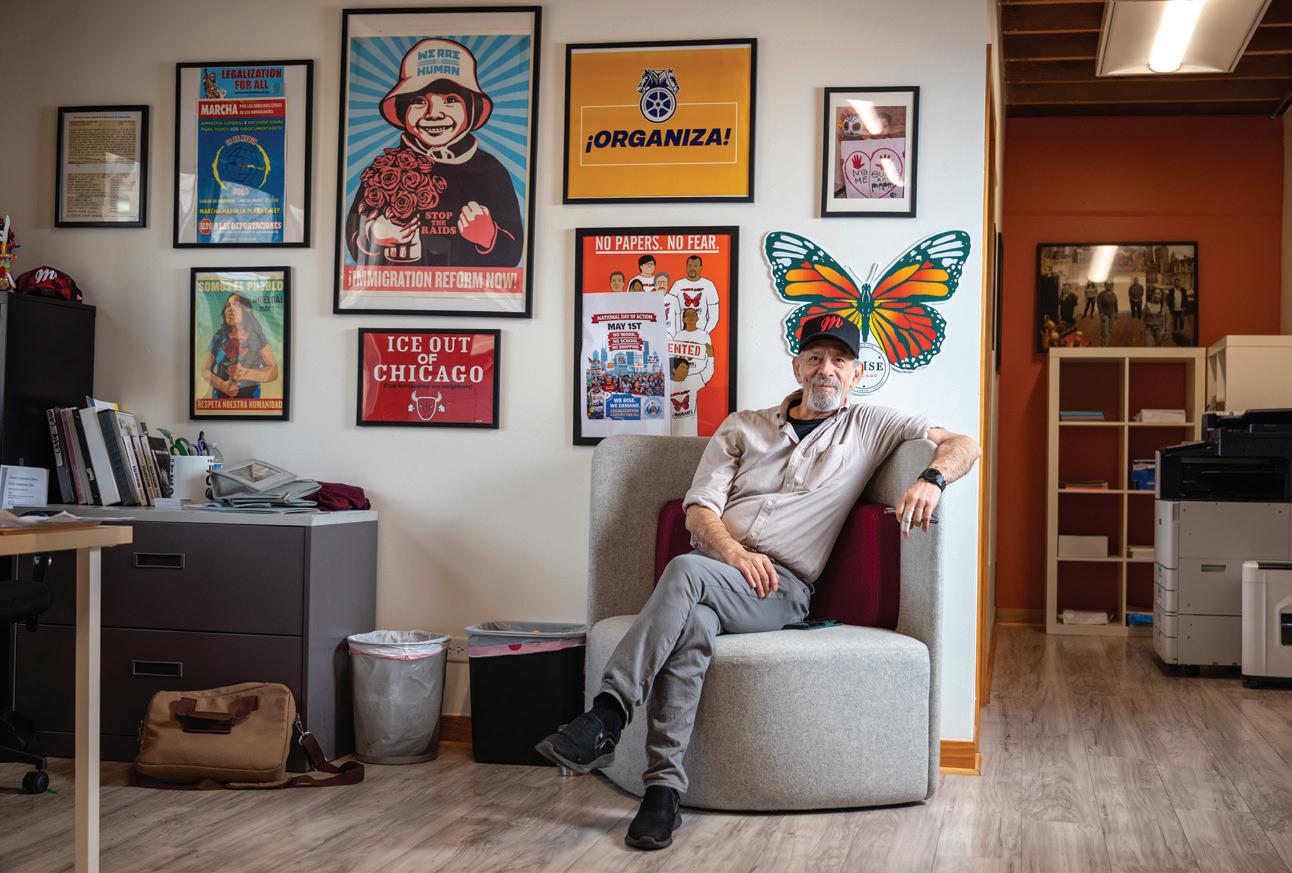
Jorge Mújica, a labor rights organizer, has spent decades listening to those stories.
He’s been doing this work for more than 50 years. He started in Mexico’s industrial zones, organizing factory workers and building unions in places where there were barely any protections. More than 30 years ago, he moved to Chicago and kept doing the same work. He was among the first in the city to offer labor rights education in Spanish. He has also been part of major immigrant rights mobilizations, including the 2006 “Day Without Immigrants” marches that brought hundreds of thousands into the streets and the ones already being organized for this May.
Workers find their way to him in different ways: through a relative, a coworker, a Facebook message. Sometimes it’s someone he helped years ago or someone who doesn’t even know if what they’re experiencing is illegal, they just know something isn’t right.
Over the years, he has helped recover millions of dollars in stolen wages. But the results aren’t always
consistent, and the process is slow. Cases drag on, sometimes months and at times for years. For Mújica, the problem isn’t complicated: people work, and they should be able to live with dignity. When that doesn’t happen, he says, it comes down to something basic; who has power, and who doesn’t.
In this conversation with the Weekly, he explains what rights workers actually have, how those rights play out in practice, and why fear continues to shape people’s lives on the job.
This interview has been edited for length and clarity.
How long have you been working on labor rights?
My whole life, more than 50 years. Here at Arise I’m about to hit 14 years, but I started doing this in Mexico, right out of school, working with Mexican unions in the industrial areas of Mexico City.
It’s called the Vallejo Azcapotzalco industrial zone. Think of something like Bedford Park. In Bedford Park maybe 500 people live there, but 15,000 workers work there. A typical industrial zone. I worked there with General Foods workers, with auto workers. Then in my own
job, I went to work at a publishing house, at the time the biggest in Latin America, Fondo de Cultura Económica and I organized the union there myself.
Later we created a nonprofit, the Center for Occupational Health, to advise workers on hygiene and safety issues, focused specifically on that. There was nothing like Occupational Safety and Health Administration (OSHA), let’s say—no limits, nothing. So we did a lot of that work, and then I came here to do the same thing, work on health and safety with Latino workers in the United States. Back then there was already a need to do all this work in Spanish, and nobody was doing it. When I got to Chicago, there were no worker education organizations except unions, and they only educated their own members. I started doing workplace health and safety education at the Chicago Lung Association, but they shut the program down because they said we should only talk about not smoking at work, not about organizing “illegals.”
You’ve been doing this work for more than 50 years. What has kept you in it?
Stubbornness? Well, the fact that there are always injustices, and I’ve learned they can be fought and that I can teach people how to fight them.
As long as there’s something to fight, we’ll keep going.
If you have a full-time job, you should be able to live. You shouldn’t be going hungry, or struggling to pay rent, or unable to feed your kids. A job should be enough to live with your family. And it isn’t, because of employers’ greed. It isn’t, because all they think about is making money, not distributing it.
What are the most common ways employers take advantage of undocumented workers in Chicago?
The fact that employers know a worker is undocumented and abuse that. That’s what we see most often, employers telling workers that because they don’t have papers, they don’t have rights. That because they don’t have papers, they’ll be paid in cash, below minimum wage. We see that all the time.
But being undocumented shouldn’t matter.
What kind of results have you seen from this work?
Arise has recovered about $10 million in unpaid wages, stolen wages. Sometimes it’s small amounts, $500, $800. Sometimes it’s hundreds of thousands. I had a case close to $250,000 for car wash workers.
There was retaliation against workers who wanted to organize at a gym. They were fired, illegally. Fired for trying to organize. It’s illegal to fire someone for talking about wages or making demands, and in that case we recovered $1 million in lost wages.
We just finished a case—$150,000 for three workers in Bedford Park. Same thing, illegal firing. It came out to about $50,000 for each of them.
There are workers scheduled seven days straight. That’s not the biggest harm, but it’s illegal. In those cases, the Department of Labor basically gives the employer a slap on the wrist, a $100 fine each time. So it’s not big money, but it’s about enforcing the law. That one took about
six months. Pretty fast. The car wash case took nine years.
Why did it take so long?
Because it went from the federal Department of Labor to the Illinois Department of Labor, then to the state attorney general, then to court, then to bankruptcy court. And bankruptcy court took nine years.
rights. If you ask for sick days, they can’t say, “undocumented workers don’t get sick days.” That’s illegal twice over; denying the right and threatening you.
But you also have to remember: an undocumented worker technically does not have the right to work. They are not authorized to work. So an employer can fire you and say, “you’re done,” and you don’t have recourse for that alone. That’s not discrimination.
“The law doesn’t protect fear; it protects action.”
What are the most important labor rights workers should know, regardless of immigration status?
The first thing is: no labor law distinguishes between citizens and non-citizens. None. No law says “undocumented worker.” A worker is a worker, period. Everyone has the same rights.
Not having papers does not mean you don’t have labor rights.
Can undocumented workers report wage theft or unsafe conditions without risking immigration consequences?
All laws apply to all workers. Most laws prohibit retaliation if you try to use them.
If I ask for sick days and the employer denies them and threatens to punish me, that’s retaliation. Any worker is protected from that.
Now, in reality, that’s not always what happens. You might have to fight your firing, and fight for your sick days, and fight for unpaid hours. But that’s true for any worker, not just undocumented ones. Anyone can be fired unless they have a union.
In Illinois, an employer cannot threaten you with your immigration status. They have no right to bring that up to stop you from exercising your
handles workers’ comp differently, and there they do consider immigration status.
Where can workers go if they’re facing abuse?
They can go to government agencies. The Department of Human Rights for discrimination. The Department of Labor for wage issues. They can also go to worker centers like us, Arise Chicago. We educate workers, support them, organize them. They can go to unions. A union is a permanent organization that makes sure the law is followed and fights for better conditions. We always try to start with education.
The discrimination comes if it’s retaliation.
What should someone do if their employer threatens to call ICE or uses immigration status to intimidate them?
For something to count as retaliation, you have to have done something first. If you were just quiet and the employer says something, that’s not retaliation. If you told the employer you were going to report them, or demanded they follow the law, or filed a complaint and then they act against you, that’s retaliation.
If I ask for overtime and they say they won’t pay me because I’m undocumented, that’s two violations. One for not paying overtime, and one for threatening me. But I have to act first.
Do undocumented workers have the right to minimum wage, overtime, and workers’ compensation if they’re injured on the job?
All workers in Illinois have the right to workers’ compensation. Of course they have the right to minimum wage, overtime, tips, everything the law says. Especially workers’ comp; it doesn’t matter what your status is.
But that’s Illinois. If you cross into Indiana, you lose that. Each state
How does that education process work?
Workshops. Workers call and say, “I have a problem,” and instead of spending an hour on the phone one by one, we tell them: come to a workers’ rights workshop next Wednesday. Sometimes we get people working seven days straight. We adjust the workshops to what people need.
What advice would you give workers who are afraid to report abuse?
The law doesn’t protect fear. There’s no law that protects scared workers. The law protects workers who take action. If you file a complaint, you’re protected from retaliation. But you have to act first. You can’t stay silent and then later say you were retaliated against. That doesn’t work. You have to act and you have to act collectively. Individual rights aren’t always protected. Collective rights are.
What are the consequences of staying silent?
If workers stay silent, they end up getting fired with no way to fight it. If they complain, protest, demand, then they gain legal protection. The law doesn’t protect fear. It protects action.
If you stay silent, your problems don’t go away.
What policy changes would better protect workers?
Make labor violations crimes. Wage theft should be a crime with jail time, depending on the amount like any theft. New York has moved in that direction. Here, we haven’t. And we would need prosecutors who actually enforce it.
In Illinois, how are labor violations like wage theft classified legally?
They are classified as a debt. The employer incurs a debt because the worker has worked and hasn’t been paid. Forget it. Failure to pay is one of the biggest problems we have when it comes to wage theft, because in the United States, stolen wages are treated as a debt, and you can’t send an employer to jail for it, no matter how
much they’ve taken. If I decide not to pay my workers, they can accuse me, there’s a trial, the judge orders me to pay them and I still don’t pay. Then what? Make me.
You mentioned that many people work full-time and still can’t live. What does that do to people over time?
Work is dangerous for your health. That’s why since 1886 people said: eight hours of work, eight hours of rest, and eight hours for whatever we want. That’s still the idea.
You shouldn’t spend your life working, living in misery, and dying like that. ¬
Alma Campos is the Weekly’s immigration reporter and project editor.
El organizador laboral de larga trayectoria habla sobre la organización de sindicatos en México y Chicago, la recuperación de miles de dólares en salarios perdidos y lo que todo trabajador debe
saber sobre sus derechos.
POR ALMA CAMPOS
En Chicago, una ciudad con una larga historia de organización laboral donde industrias enteras dependen del trabajo de inmigrantes, las violaciones suelen ser parte de lo cotidiano: cheques que no llegan, horarios que cambian sin aviso, lesiones que no se reportan.
Jorge Mújica, organizador de derechos laborales desde hace décadas, ha pasado años escuchando esas historias.
Lleva más de 50 años en este trabajo. Empezó en zonas industriales en México, organizando a trabajadores de fábrica y ayudando a formar sindicatos en espacios con pocas protecciones. Hace más de tres décadas se mudó a Chicago donde siguió con el mismo trabajo y fue entre los primeros en ofrecer educación sobre derechos laborales en español. También ha sido parte de movilizaciones importantes por los derechos de los inmigrantes,
incluyendo las marchas del “Día Sin Inmigrantes” en 2006, que llevaron a cientos de miles de personas a las calles, y las que ya se preparan para este mayo. Los trabajadores llegan a él de distintas formas: por un familiar, por un compañero, por un mensaje en Facebook. A veces es alguien a quien ayudó hace tiempo. A veces es alguien que no sabe si lo que está viviendo es ilegal, solo que algo no está bien. Con los años, ha ayudado a recuperar millones de dólares en salarios robados. Pero los resultados no son parejos, y el proceso es lento. Los casos se alargan —a veces son meses, a veces años. Para Mújica, el problema no es complicado. La gente trabaja y debería poder vivir con dignidad. Que muchas veces no sea así, dice, tiene que ver con algo más básico: quién tiene el poder y quién no.
En esta conversación con el Weekly, explica qué derechos tienen en realidad los trabajadores, cómo funcionan esos derechos en práctica y por qué, para muchos, el miedo sigue presente en su trabajo.
La siguiente entrevista ha sido ligeramente editada para mayor claridad.
¿Cuánto tiempo tiene usted trabajando en derechos para trabajadores?
Toda mi vida, más de 50 años. Aquí en Arise voy a cumplir 14 años, pero empecé a trabajar en esto desde México, desde que salí de la escuela, con los sindicatos mexicanos en las áreas industriales en la Ciudad de México.
Se llama la zona industrial Vallejo Azcapotzalco. Haz de cuenta Bedford Park. En Bedford Park viven 500 personas y trabajan 15,000 trabajadores. Una zona, así, típica industrial. Ahí trabajé con trabajadores de General Foods, con trabajadores automotrices. Después en mi propio trabajo entré a trabajar a una editorial—en ese tiempo era la editorial más grande de América Latina, el Fondo de Cultura Económica—y ahí organicé yo el sindicato.
Creamos después una organización no lucrativa, el Centro de Salud Laboral, para asesorar a trabajadores en cuestiones de higiene y seguridad, particularmente dedicado a eso. No existía nada como la Administración de Seguridad y Salud Ocupacional (OSHA), digamos; no había ningún tipo de límite, nada.
Entonces nos tocó participar mucho en esas tareas, y ya luego me vine para acá precisamente a trabajar en eso mismo, en higiene y seguridad con trabajadores latinos aquí en Estados Unidos. En ese entonces ya había la necesidad de hacer todo este trabajo en español, y no había nadie que lo hiciera. Cuando llegué a Chicago no había organizaciones de educación obrera, excepto los sindicatos, y educaban sólo a sus miembros.
Yo empecé a hacer educación sobre higiene y seguridad en el trabajo en la American Lung Association en Chicago pero cancelaron el programa porque dijeron que sólo debíamos
hablar de no fumar en el trabajo y no de organizar “ilegales”.
Usted lleva más de 50 años en este trabajo ¿qué es lo que lo ha mantenido en él?
¿Terquedad? Pues el hecho de que siempre hay injusticias y que he aprendido que se pueden combatir y que le puedo enseñar a la gente a combatirlas. Mientras se pueda luchar, ahí seguiremos.
Si tienes un trabajo de tiempo completo, debías tener la posibilidad de vivir regularmente, no pasar hambres ni problemas de poder pagar la renta o no poder alimentar a tus hijos. Un trabajo debería ser suficiente para poder vivir con tu familia y no lo es, por avaricia de los patrones. No lo es porque solo piensan en hacer dinero, no en distribuir su riqueza.
¿Cuáles son las formas más comunes en que los patrones se aprovechan de trabajadores indocumentados en Chicago?
El hecho de que los patrones sepan que el trabajador es indocumentado y abuse de ello. Eso es lo que vemos más frecuentemente—patrones que le dicen a sus trabajadores que como no tienen documentos, entonces tampoco tienen derechos; que como no tienen documentos, les van a pagar en efectivo—menos del salario mínimo. Eso lo vemos con frecuencia. Pero bueno, el hecho de que estén indocumentados no debe influir.
¿Qué tipo de resultados han visto con ese trabajo?
Arise ha recuperado aproximadamente $10 millones en salarios faltantes, salarios robados. Algunas veces han sido cantidades pequeñas, $500, $800 y en algunas ocasiones han sido cientos de miles de dólares. Yo tuve un caso cercano a $250,000 recuperados para trabajadores de un lavado de carros.
Hubo una represalia contra trabajadoras que se querían organizar en un gimnasio. Los despidieron y el
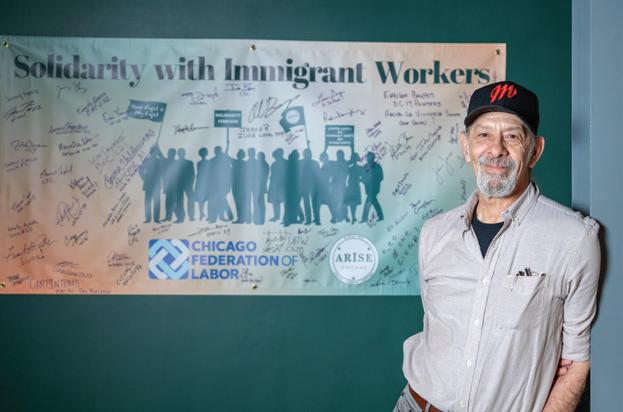
Jorge Mújica ha trabajado cerca de 14 años en Arise Chicago, el 20 de marzo de 2026. Foto por Tonal Simmons
despido fue ilegal. Los despidieron porque querían organizarse en el trabajo. Es ilegal que te despidan por hablar de tus salarios, por hacer demandas y ahí recuperamos $1 millón en salarios perdidos para los trabajadores.
Acabamos ahorita de terminar un caso de $150,000 para tres trabajadoras despedidas en Bedford Park. Igual, las despidió el patrón ilegalmente y entonces resolvió el caso a su favor como $50,000 para cada una en compensación.
Hay trabajadores que los programan para trabajar toda la semana, los siete días corridos. Ahí no te están causando un tremendo daño, pero están violando la ley y entonces ahí el departamento de trabajo le da un coscorrón en la cabeza al patrón y lo multa con $100 por cada vez que lo hizo. Entonces ahí no hay gran cantidad de dinero, pero se trata de que se ejerza la ley. Tardó aproximadamente seis meses. Fue bastante rápido. Bastante rápido. El caso de los trabajadores del car wash que te decía tardó nueve años.
Se tardó nueve años porque ese caso pasó del Departamento Federal del Trabajo al Departamento Estatal Illinois, de ahí a la procuraduría, al Attorney General de Illinois, de ahí a la corte, de ahí a la corte de bancarrota. Y finalmente la corte de bancarrota llevó nueve años.
¿Cuáles son los derechos laborales más importantes que deben conocer los trabajadores independiente de su estatus migratorio?
Lo primero que deben saber es que
ninguna ley del trabajo distingue entre ciudadano y no ciudadano. Ninguna ley del trabajo dice “trabajador indocumentado” o nada. Trabajador es trabajador, y punto, y…tienen los mismos derechos. El hecho de no tener documentos de ninguna manera quiere decir que no haya derechos laborales.
¿Los trabajadores indocumentados pueden denunciar el robo de salarios o condiciones de trabajo inseguras sin arriesgar consecuencias migratorias?
Todas las leyes se aplican a todos los trabajadores. La mayoría de las leyes prohíben tomar represalias en caso de ejercerlas. Es decir, yo pido mis días de enfermedad y el patrón me las niega y me dice que me va a castigar. Eso es una represalia. Cualquier trabajador bajo la ley está protegido contra esas represalias.
En la realidad, claro, que no sucede y tendrás que pelear el despido además de pelear las vacaciones o los días de enfermedad o además de pelear las horas que no te pagó pero eso no solamente a los trabajadores indocumentados. A cualquier trabajador lo pueden despedir a menos que tenga un sindicato. El hecho de ser indocumentado en el estado de Illinois previene al patrón de amenazarte con tu estatus migratorio. El patrón no tiene derecho de ninguna manera de sacar a relucir tu estatus migratorio para impedirle ejercer tus derechos. Si tú pides tus días de enfermedad, el patrón no te puede decir, “los indocumentados no tienen días de enfermedad.” Eso es una doble ilegalidad. No solo te está negando el derecho que establece la ley, sino además te está amenazando por tu estatus migratorio. Sin embargo, siempre hay que recordar que un trabajador indocumentado no tiene derecho al trabajo. Literalmente hablando, no está autorizado para trabajar. Entonces, cualquier día el patrón igual te puede decir, “estás despedido y ya te vas,” no tienes recurso contra ello. No te está discriminando. No es una discriminación despedir, pero la
discriminación puede estar en que sea una represalia.
¿Qué debe hacer una persona si su patrón amenaza con llamar a ICE o usa su estatus migratorio como forma de intimidación?
Para que exista la figura de la represalia, tú tienes que haber hecho algo primero. Si no, no es represalia. Yo estaba calladito en mi lugar y el patrón pasó por ahí y me dijo algo. Bueno, eso no es ninguna represalia.
Si yo le dije al patrón que lo iba a denunciar, si yo le exigía al patrón que cumpliera la ley, si yo metí una queja con una agencia de gobierno y el patrón me hace algo, entonces ahí sí el patrón está ejerciendo una represalia.
Si yo le digo al patrón que me pague mis horas extras y el patrón me dice que no me las paga porque yo soy indocumentado, de nuevo, doble violación. Una porque no me ha pagado mis horas extras y otra porque me está amenazando con mi estatus migratorio. Pero yo tengo que hacer algo primero.
¿Los trabajadores indocumentados tienen derecho al salario mínimo, pago de horas extra y compensación laboral si sufren una lesión en el trabajo?
Todos los trabajadores en Illinois tienen derecho a la compensación obrera. Por supuesto que tienen derecho al salario mínimo, tienen derecho al pago de horas extras regulares, tienen derecho a sus propinas, tienen derecho a todas las demás cosas que establecen las leyes. Particularmente en el caso de la compensación obrera en Illinois, no importa el estatus del trabajador. Pero eso es en el estado. Si cruzas para Indiana, ya no tienes derecho. Cada estado maneja su propia compensación obrera y allá sí ponen atención al estatus del trabajador.
¿A dónde pueden acudir los trabajadores si están enfrentando abusos?
Los trabajadores pueden acudir a
las agencias de gobierno. Existe el Departamento de Derechos Humanos para discriminaciones, el Departamento del Trabajo para cuestiones salariales, faltas de pago, violaciones a la ley, a las leyes distintas. Pueden acudir también a los centros de trabajadores como nosotros—Arise Chicago—un centro de trabajadores. Educamos a los trabajadores, los apoyamos en sus luchas, los organizamos.
Pueden acudir también con sindicatos. El sindicato es una organización permanente de los trabajadores para estar efectivamente vigilando que se cumpla la ley y para conseguir mejores beneficios. Nosotros siempre tratamos de empezar por la educación de los trabajadores.
¿Cómo funciona ese proceso de educación?
Talleres de derechos. Los trabajadores nos llaman diciendo “tengo un problema” y en vez de estar con ellos una hora por teléfono, uno por uno, les decimos: vengan por favor el próximo miércoles al taller de derechos en el trabajo. Hay veces que llega gente que los hace trabajar los siete días. Adecuamos los talleres a las necesidades del grupo.
¿Qué consejo le daría a trabajadores que tienen miedo de denunciar abusos?
Que las leyes no protegen el miedo. No hay ninguna ley que diga que los trabajadores miedosos tienen protección. Lo que las leyes dicen es que el trabajador que denuncia sí tiene protección contra las represalias, pero primero hay que acusar al patrón. No se puede uno quedarse callado y después argumentar que lo despidieron en represalia. Eso no funciona así. Hay que actuar y hay que actuar en grupo. Los derechos individuales no necesariamente están protegidos; los derechos colectivos sí.
¿Cuáles son las consecuencias de quedarse callado?
Cuando los trabajadores se quedan callados terminan siendo despedidos sin posibilidad de pelear el despido. Si demandan, protestan, se quejan, adquieren protección legal. Las leyes no protegen el miedo, protegen las acciones. Y cuando se quedan callados sus problemas siguen para siempre.
¿Qué cambios de política pública serían necesarios para proteger mejor a los trabajadores?
Convertir en crímenes las violaciones laborales. Es decir, convertir el robo de salarios en un crimen que se castigue con cárcel, dependiendo de la cantidad. Como en el robo. En Nueva York han avanzado en eso; ahí ya se puede tipificar como crimen el robo de salarios. Pero aquí no. También tendría que haber un procurador que realmente lo haga.
En Illinois, ¿cómo se clasifican legalmente las violaciones laborales, como el robo de salarios?
Se clasifican como una deuda. El patrón contrae una deuda porque el trabajador trabaja y no le han pagado. Olvídalo, es uno de los problemas más grandes que tenemos en el caso de salarios robados, porque en Estados Unidos los salarios robados son una deuda y entonces no puedes meter a la cárcel a ningún patrón. Se robe lo que se robe. Si quiero no le pago a mis trabajadores se me acusan, hay un juicio, el juez dice que les tengo que pagar y no les pago y a ver, hazme pagar.
Usted mencionó que muchas personas trabajan tiempo completo y aun así no pueden vivir ¿qué cree que eso hace a la gente con el tiempo?
El trabajo es peligroso para la salud. Por eso desde 1886 se dijo: ocho horas de trabajo, ocho de descanso y ocho para hacer lo que queramos. Ese sigue siendo el lema. No se vale trabajar de por vida, vivir en la miseria y morir así. ¬
Alma Campos es la reportera de inmigración y editora de proyectos del Weekly.


A museum exhibit takes Mexican labor history in Chicago out of the shadows, highlighting early railworkers and boxcar camps that formed on the South Side in the 1900s.
BY JACQUELINE SERRATO
The origin story of Mexicans in Chicago too often goes untold and unexplored in school history books, mainstream media, and the local narrative. While about a fifth of Chicagoans are descendants of Mexicans, this group is still frequently perceived as new immigrants—or perpetual foreigners, perhaps due to their association with manual labor, as well as their general invisibilization in academia, politics, and other institutions.
But as an exhibit at the National Museum of Mexican Art demonstrates, the presence and contributions of Mexican descendants in the United States extend well beyond the U.S. Southwest, and in Chicago and the Midwest this community goes back not a couple of decades, but at least a hundred years.
“Rieles y Raíces: Traqueros in Chicago and the Midwest” places Mexicans in Chicago in the early 1900s as laborers who helped to build the railroad and industrial hub that would develop into a world-class city.
The exhibit, which runs until April 26, relies on archival material that co-curators Ismael Cuevas and Dr. Alejandro Benavides gathered through a combination of their own research, Census records, and community-sourced photos, documents, and artifacts from local residents in the city and suburbs.
When people think about who built the railroads, we often think about Chinese and Black American workers—much of their work in the form of slave labor. In the northeast, people recall the labor of Irish, Italian, Polish, and Eastern European workers.
“I wanted to make sure that we included the Mexican history as well,” said Cuevas in an interview with South Side Weekly.
After the Chinese Exclusion Act of 1882—the first time that the federal government barred a group of immigrants on the basis of race or nationality—and later, the Immigration Act of 1924, which instituted quotas on European migrants, railroad companies set their sights on Mexico.
According to the exhibit, from the 1910s to the 1930s, American companies went to the border and deeper into Mexico to offer well-paying railroad jobs that welcomed workers’ families and promised them housing in Chicago.
But there was a catch. “You’re thinking you're going to be in a house... you’re not in a house. They were literally giving folks these abandoned boxcars. Imagine one of these train boxcars, they took off the wheels, and they just [parked] them adjacent to the railroad tracks,” Cuevas said.
The makeshift housing subjected traquero families to extreme temperatures, pollution, accidents, and unsafe conditions.
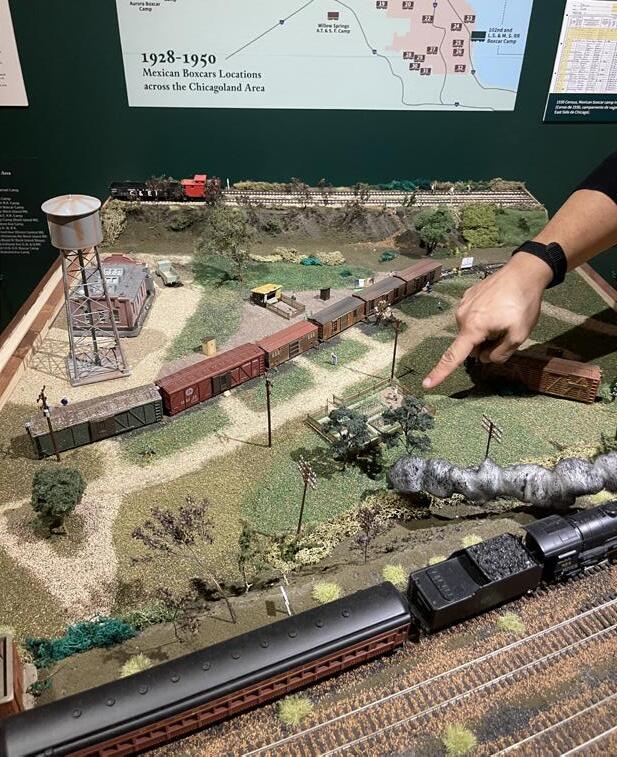
In 1928, a University of Chicago researcher, Anita Edgar Jones, identified about two dozen boxcar communities in Chicagoland. The museum curators took her thesis and mapped out all the locations, illustrating that more than twenty of those boxcar communities were on the South Side of Chicago, and they reached the western suburbs as far as Elgin and Aurora.
Cuevas pointed to the boxcar icons on the map, each one representing a community. “So you have here 19th and
Rockwell [in Little Village]. You have, for example, this one right here on 66th and Martin Luther King Drive, a.k.a. O Block. Right behind O Block there is a railroad yard: there was a boxcar community there.”
He pointed to the boxcar community at 102nd Street in East Side, another one in Hegewisch, and three camps in the Broadview and Bridgeview areas. “This is Midway; remember I was telling you about the railroad yard south of Midway? We found the Census record on 59th and Cicero; basically, where the [CTA] Orange Line ends there was a boxcar camp in the forties and the fifties.”
The railroad companies that employed Mexican immigrants varied by time period, but the New York Central Railroad, the Pennsylvania Railroad, the Illinois Central Railroad, the Burlington, and the Northern Santa Fe Railroad were prominent recruiters.
Cuevas is fascinated by the parallels between this era and the attitudes and policies toward Mexican workers today. Once the war effort of World War II was over and in the midst of the Bracero program that attracted thousands of Mexicans to work in agriculture, meatpacking, and the steel mills, immigration authorities launched Operation Wetback in 1954, “right around the Mexican Independence Day on September 16... which is the same [day] as when Operation Midwest Blitz started here in Chicago,” he pointed out.
The curators found a picture in Mike Amezcua’s book Making Mexican Chicago that shows the Illinois Central Railroad train deporting mexicanos “The Illinois Central Railroad train is
the same train that, for example, this gentleman [shown in an exhibit photo] Emilio Aguirre works for. The same railroad that we worked building is the same railroad that deported us a decade later,” Cuevas said.
The exhibit shows that laborer Miguel Nara bought a house in Chinatown in the 1960s, making him one of the first Mexicans in Chinatown, and displays the paperwork of the sale. Another gentleman’s grandkids submitted old documents to the museum, which showed that he had bought a house in the Fuller Park neighborhood in 1948, but in 1954 “self-deported” as a deportado voluntario.
“Railroad workers were buying and purchasing homes, literally pursuing the American dream,” Cuevas said. “And a few years later, they're literally being— the same way that our people are now— are being deported.”
Rieles y Raíces: Traqueros in Chicago and the Midwest. National Museum of Mexican Art, 1852 W. 19th St. Through April 26. Tuesday–Sunday, 10am–5pm; Wednesday, April 1, 10am–8pm. Free. (312) 738-1503. nationalmuseumofmexicanart.org ¬
Jacqueline Serrato is editor emeritus and the former editor-in-chief of the Weekly She’s also the editor of La Voz , the Spanishlanguage publication of the Sun-Times.
Window washing hundreds of feet above the ground takes careful planning, safety precautions, and plenty of skill.
BY ZARA NORMAN
On a cold, gray Tuesday in March, Jorge Chavez and Cristian Ilgor Moreno stood on the roof of a high-rise condominium complex in the Loop, steeling themselves for another long day of keeping our skyline sparkling.
The pair are window washers, two of 32 full-time employees at Ascent Building Services, who work year-round to polish the windows of everything from street-level storefronts to towering skyscrapers like this one.
High-rise season is just starting. It typically runs from March to November, even on clouded mornings like this one.
“We don’t need so much visibility as we need good wind conditions and good rain conditions,” said Weldon Rogers, Ascent’s vice president of sales. “It’s got to be above freezing.”
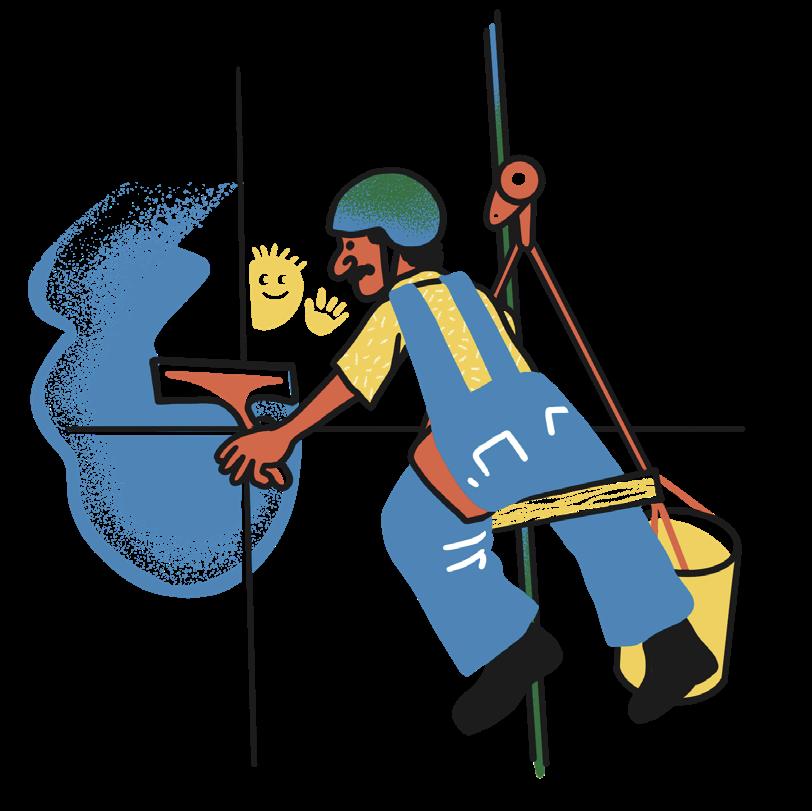
On a typical workday, Chavez and Moreno get to a job site by 7am and are clambering inside a rig resembling the industrial claw of an arcade game to wash windows by 8am.
Each rig, Rogers explained, is specifically designed for a building and all its idiosyncratic corners, edges and overhangs. The rigs—some of which date back to the 1960s—are incredibly temperamental and require constant fixing, he said. From within the rig, Chavez and Moreno control
the motorized system of pulleys. They raise and lower themselves along the skyscraper’s facade to clean windows, suspended by cables running from the roof-anchored rig.
“[People] say it's a very dangerous job. And it's actually not, if you're following the rules safely.”
- Jorge Chavez
Window washers always work in pairs, in case “something happens” to one, Rogers said. And something could happen. Suspended at dizzying heights and strapped into decadesold machinery, risks include falls, equipment failure, storms and falling debris.
“Because the job carries such great risk, you’ve got to be very focused without distractions,” said Chavez. “You’ve got to trust in your equipment and your capabilities on the job.”
Chavez, a 45-year-old journeyman who owns his home in Cicero, has the assurance in his capabilities that accompanies nearly three decades of experience. He
immigrated to Chicago from Mexico in 1997, and learned about a windowwashing job through a newspaper advertisement. He joined Ascent when the company started, ten years ago.
Chavez is physically spent by the end of each seven- or eighthour workday. The skyscraper the pair worked on that Tuesday would typically call for a month of long days to get to each window. They take breaks to go to the bathroom or eat snacks by returning to the roof.
But Chavez finds his job satisfying and far more exciting than his previous one as a landscaper. He has long gotten over his fear of falling, made $120,000 last year as a senior technician, and takes pride in being able to point out different buildings within Chicago’s skyline— like the John Hancock Center—and say: “I did that one.”
“[People] say it’s a very dangerous job. And it’s actually not, if you’re following the rules safely,” Chavez said.
Moreno, a 23-year-old apprentice who joined Ascent last year, is still finding his legs and biting back fear. Moreno immigrated from Mexico in 2023 and rents a room in Archer Heights. He learned about this job through a friend.
“If you get off balance due to
slipping or a wind, that can be scary,” Moreno said. “I just don’t look down.”
Window washing companies like Ascent—of which there are a handful in Chicago—put a huge premium on safety for that reason. All technicians wear personal protective gear including hard hats, harnesses and rope grabs. Equipment is to be inspected before each use. What Moreno has found most reassuring, though, is being paired with veterans like Chavez who can literally show him the ropes.
Apprenticeships are at least three months long, Rogers said. Moreno has been doing one for a year, but aspires to become a skilled technician like Chavez soon. Around two-thirds of Ascent’s staff are classed as “highly skilled” and can make up to low sixfigures, Rogers said.
That points to the biggest misconception people might have about their job. “They’re surprised that people, the window washers, have such skill,” said Chavez. ¬
Zara Norman is a reporter, fact-checker and graduate student at Northwestern University’s Medill School of Journalism. She previously covered housing statewide for the Bangor Daily News in Maine.
BY SARAH LUYENGI
Tulika Ladsariya has become quite adept at explaining herself to people who aren’t entirely consumed by the art world, but she doesn’t mind. The Mumbai native sees art everywhere, and she believes it’s not necessarily black and white—Ladsariya views many things as art, from propagating plants to helping her mom cook samosas or padpads during holidays like Diwali as a child. For her, creativity comes in small and subtle ways.
“I have had a lot of people asking me questions about my real job,” said Ladsariya. “And sometimes that can be the most frustrating part about being an artist, where in itself, it’s not considered a real job.”
Her family is an assortment of accountants and financial advisors, but Ladsariya pushed the envelope by leaning into art later in her career path and even as a parent. After all, she has always loved to make things with her hands and observe nature.
“[As a child] I would collect snails and bring them home as pets. I used to carry a little microscope around with me. I loved to draw as well—I did a lot of biology drawings in my journals.”
After working in banking for four years, and a stint at an auction house, Ladsariya transitioned into having a full-time studio practice. She also incorporated what she learned during a one-year art program in London,
which allowed her to immerse herself in galleries and libraries.
“My husband was super supportive,” she said. “I had my first solo show [in Mumbai], and then I brought that with me to Chicago when we moved here.”
Ladsariya’s exhibition footprint has travelled through the United States, UK and India. She’s showcased art at the Chicago Cultural Center, Hammond Museum NY, ART India Fair New Delhi, Kalakriti Art Gallery Hyderabad, Jamaat Art gallery Mumbai, Art Heritage Gallery New Delhi, and many more.
Ladsariya uses earth materials— like tree bark or moss—printmaking, and ceramics in much of her work. She believes in using her art to redefine our relationships with the land that we walk on. For her, these materials carry memory and history. They connect us to these different cycles of growth, decay, and regeneration.
She was a resident at the Hyde Park Art Center from 2019–2021, a BOLT resident at Chicago Artists Coalition from 2022–23, and, most recently, a 2026 resident at the Ragdale Foundation. The residency, located in Lake Forest, IL, offers ten to eleven 18-day sessions and uninterrupted time for work and creativity. Her cohort consisted of writers, visual artists, music composers, and dancers. Ragdale, like many residencies, allows like-minded artists to build community together in
“The pathways into art aren’t always obvious. But I’ve also seen efforts in Chicago to open these doors wider through community art spaces and public programming.”
- Tulika Ladsariya
a shared, creative space.
“We had not only our community time together, but also our personal time to spend in the studio,” said Ladsariya. “In the evenings, we would meet by the fireplace and sew and read and write together, which was very regenerative.”
During the residency, Ladsariya spent most of her time sewing and journaling. Her fascination with thread started young; she sees fabric as linking different worlds together. Journaling every night during her residency, surrounded by other artists, was also a cathartic process.
But Ladsariya stressed the practice of mindfulness after residencies because it is easy to forget the learnings taken from these experiences. She believes in creating everyday habits and expressing them in her studio, but, on the other hand, she’s also aware of the inaccessibility of residencies, and the elitism of the art world.
“I felt other-ed as an artist because I’m from a different country and I’m a parent,” she said. “The pathways into art aren’t always obvious. But I’ve also seen efforts in Chicago to open these doors wider through community art spaces and public programming.”
While every artist has different needs, Ladsariya believes that all artists should participate in residencies as the experience will only strengthen their craft by giving them the space and time to focus on their art, which is typically hard to balance in the outside world.
She also wants people to know that there’s a lot of behind-the-scenes work that entails artists in residency programs. From the administrative efforts, all the way down to the small details like the food—“a lot of people work behind the scenes to make residencies happen.”
An important lasting impression left by her experience in the Ragdale residency is the creative community and dialogue. “Community is vital when I go on residency programs. Being with so many incredible artists energizes me everyday.” ¬
Sarah Luyengi earned her B.A. in English with a concentration in creative writing from the University of Illinois at Chicago. Her work has appeared in Borderless Magazine, Third Coast Review, and Common Ground Review.
An interview with our longtime layout editor who retired in February after 45 years in the business.
BY ADAM PRZYBYL
This February, the staffs of South Side Weekly and Hyde Park Herald said our goodbyes to our long-time layout editor and production manager Tony Zralka, who retired after 45 years in the business. For the last few years at the Weekly, and since 1999 at the Herald, Zralka has nimbly put together the layout of each print paper, fitting text, photos, and ads together like puzzle pieces before sending it all to the printer.
For the Weekly, the process takes place over the course of a day and almost entirely via computer. Like Zralka, our new layout editor, Mel Dempsey, sets up the paper using Adobe InDesign, and includes ads created and sent in by South Side businesses. After text and visuals are set for a story, a PDF proof is shared via Slack, which we also use to send back edits and feedback. At the end of the day, a final file is uploaded to our printer's server, and two days later, the Weekly is hitting newsstands across the city.
In Zralka's telling, the job has changed dramatically in the last few decades. When he started in 1981 at the Daily Southtown as Layout Artist, his job was to design from scratch the ads going into the paper.
"The salesman would come in with a piece of paper that could have a rudimentary layout to it or just copy, and they would say, 'Put something together,'" he said. "Those days you
could use clip art books, or a lot of times we would actually have to produce a piece of art ourselves."
Zralka said the layout department would receive three or four clip art books every month, filled with a variety of images they could cut out and use in ads.
There was one problem with using the books: unlike digital clip art, the images were a set size. If he needed an image of a banana or a soda can to be a little larger or smaller to fit the layout of the ad, Zralka sent the image to the camera room, a separate department, with instructions to resize by a specific amount, like 150%. People in the camera room would capture the art on camera, and resize the image while developing the film.
In the composing room, people cut out all the text and visual elements to paste them out on a board. Then, a secretary would type all the raw copy up before sending it to the type setter. “And then once all that was done, they would take it to the large copier, and they would copy it, and then the next morning, that proof would go out to the salesperson,” Zralka said. "And this is all hand delivered, nothing electronic. You'd have to have a driver to come in and pick up an envelope."
The process took about a week, from initial copy to being placed into the right edition of the paper. "And then all the pages of the editorial, the ads, everything would be down on a board, and it would go back to the
“The salesman would come in with a piece of paper that could have a rudimentary layout to it or just copy, and they would say, 'Put something together'.”
- Tony Zralka
camera room, and they would shoot the negatives, process the plates, and the plates would go to the press," he said.
All in all, a single full page grocery ad "could easily go through 10 people's hands," Zralka said.
That began to change in the 1990s and into the 2000s. Copy machines that could enlarge and reduce images were one of the first major changes Zralka remembers. Soon, the Mac followed, and design programs like QuarkXpress and Adobe PageMaker, the predecessor to InDesign, allowed Zralka and his colleagues to create more layout independently, without the need for multiple departments.
"When you become more efficient, you need less and less people," Zralka said. He estimates there used to be 40 to 50 people involved in putting together a newspaper; nowadays you can make do with just a few.
For a while, at least, drivers were still integral to the process, delivering pieces of the layout between
departments and later to the printer. "We went from [using floppy disks] to these discs that would store 100 megabytes, which is like today, it's nothing, right?" he recalled. "We could only get the color pages on those then. Then finally, things got to the size where we could get everything on CDs."
Amidst all the change, for Zralka the most challenging part of making ads was just "not to make it look like the next guy's," he said, pointing out that more than half a dozen grocery stores might have ads in the same paper.
"The most fun were probably, I hate to say it, the liquor store ads," he said. "Those guys were more open to something wackier, as far as the theme goes. There was all that competition with the liquor stores, so they were more open to something that would catch your eye vs. the other guy's ad."
But more fun than the job itself were the people Zralka worked with. "The business, even then, was filled with characters. You could enjoy your job because you could do some wild and crazy things while you were working," Zralka said. "Joking around, bouncing ideas off each other. Somebody wants something and you can't visualize it, you'd get stuff out of the clip art books and do crazy shit with it. And for the most part everybody got along." To this day, he remains friends with someone he worked with 40 years ago. ¬
Adam Przybyl is the Weekly’s interim editor-in-chief.

Angie Viands teaches students at South Side
Occupational Academy how to raise chickens, tend orchards, and grow microgreens.
BY SUSIE XU
The idea of school can conjure up memories of sterile, brightly lit classrooms and lectures on grammar or quizzes on algebra. Students of Angie Viands’ class at South Side Occupational Academy, on the other hand, are encouraged to get their hands dirty. As a certified Career and Technical Education (CTE) teacher in Chicago Public Schools (CPS), Viands teaches agriculture, introducing students to urban farming techniques and organizations in the field.
South Side Occupational Academy serves students with disabilities aged 1622, though most join after graduating high school. Courses range from culinary classes to business, carpentry, and health sciences. The school also has a student-run pet store and cafe for acquiring various job skills.
Today, Viands’ classes are researching chicken breeds. Viands is working with the carpentry teacher to build coop perches and repair the chicken run, adding protective structures to prevent predator breakins. Once the chickens arrive, students
led her to work on invasive species removal and prescribed burns in Florida and Oregon. Her interest in agricultural work, however, started much earlier. “I was exposed at a young age because my grandparents had big outdoor gardens,” she said.
After AmeriCorps, Viands got her teaching certifications. She taught middle school, covering social and environmental sciences. She also spent a few years at the Field Museum as an educator before joining the Gary Comer Youth Center. There, her duties shifted to “actually growing food with teenagers.”
Like many teachers, Viands’ work hours can be long. It takes time for students to learn to perform the tasks; in the meantime, she puts in extra work to keep the vegetables and animals alive. She’s also always updating lesson plans.
Viands is a big proponent of career and technical education. “If we had career and technical education for everybody in high school, even people who are definitely going to college, it would help people focus on what they want to do a lot earlier,” she said.
Illustration by David Alvarado
will feed them, monitor their health, and maintain the coop.
In the fall, students tended to the school orchard. They learnt how to mulch, water, and use integrative pest management. The orchard includes apple, pear, and soon elderberry trees. They also raised microgreens indoors to package and take home.
Once a week, Viands’ classes do “community-based instructions,” visiting local and community-run agricultural spaces to see the work in action. Sometimes students get internships or jobs there.
“Chicago is actually a thriving hub of urban agriculture,” Viands said. “There are lots of little local farms growing produce and distributing through farmers’ markets.”
In Illinois, students with special needs are provided public education up to age 22. After graduation, Viands said, some of her students start working while some go on to community college. “Their paths vary widely."
When Viands was that age, she studied history and joined AmeriCorps to work on habitat restoration, which
When asked about her decision to return to CPS, Viands cited the teachers’ union and the pay scale as the top reasons. Currently, CPS has an annual “step increase” for teacher salaries based on seniority and cost of living adjustments. Viands also noted that they pay more for advanced degree holders. “Hopefully it benefits you to be a more skilled educator,” she said, “The pay scale incentivizes you to stick around.”
“I like doing this job because it’s applied sciences,” Viands said. “It’s very practical. A lot of us live life fastpaced, you know, getting food from the grocery store.”
Viands appreciates teaching young people how to grow food. “It connects people to nature,” she said. “To be outside, to get sunshine and fresh air and see green things—that’s just helpful for us.” ¬
Susie Xu lives and writes in Chicago.
Court Theatre prop manager
Lara Musard hunts down objects that help transform words on a page into a magical world on stage.
BY DIERDRE ROBINSON
When was the last time you paid attention to the props in a theatrical production? It may seem like a tiny detail, but imagine Phantom of the Opera without the chandelier, or Miss Julie, which
recently concluded its run at Court Theatre, without the kitchen table and bowl that anchors the opening scene.
While audiences may overlook the various objects on stage, theatrical and stage properties are an essential
aspect of storytelling; they help make a story feel real. Props fall into three main categories: furniture, like chairs or tables used on stage; dressing, such as pictures on a wall or books on a shelf; and hand props, items that actors physically touch or use during a performance.
But props don’t magically appear on stage. Behind every prop are people who are responsible for finding, placing, maintaining, and often creating each one—people like Court Theatre’s head of props Lara Musard.
Musard supports the rehearsal process, which means that she carefully reads each script to determine the needs of a scene, creates prop lists, and then sources and places the objects ahead of their stage debut.
Musard, who grew up in the south suburbs of Chicago, has been in the business for nearly twenty years, but didn’t initially envision herself in the role. In her twenties, Musard was living in New Orleans and working as a stage manager at Southern Repertory Theatre when one day she was asked to handle props for a show. She accepted the challenge, but admitted that she hated it.
“I hated it because when you do props, you have to know where everything is and you have to know the people to ask for this stuff...be able to source and have connections,” Musard said. “I was brand new to the city. So I had no idea what I was doing. Then Katrina hit, and I moved back to Chicago. I didn’t want to do stage management again. I really loved the idea of having a niche position in the show where I could be creative, add my part, and then be done with it.”
Today, Musard has almost 100 shows under her belt, and estimates that she has amassed thousands of props over the years.
While touring the Court Theatre prop house, I could see what looked like thousands of objects of all shapes, colors, and sizes stacked on shelves, tucked in boxes, and placed in bins throughout each massive room. Every
imaginable object was present: clocks, plants, dolls, lamps, cages, baskets, and even a pink, ceramic toilet. No space was unclaimed. Every object had a unique history or current purpose, and Musard knew where every one of them was located.
“There’s the folks who love figuring out the tricks, there’s folks who love building things. There’s folks who like doing the set dressing,” Musard said. “My favorite part is the hunt. I love when there’s something weird or specific, and I have to find it. That’s my favorite part.”
Musard shared that eBay, antique stores, and Facebook Marketplace are her go-tos for finding many of her props, and although she has to borrow objects from time to time, “it’s pretty easy to find things.”
Not so easy, perhaps, are the occasional challenges that come with the territory—the last-minute details.
“It comes down to when we’re about to open a show—the tiniest details,” Musard said. “So, like the felt pads on the chairs keep falling off. We need to do something about that. Or we need this book to open to the specific page, and it’s not working. So, there’s all these really little tasks that come at the end.”
While those ‘really little tasks’ might seem like no big deal to the average theater goer, they are, in fact, what make a production feel seamless to the audience.
So the next time you attend a play, be sure to take notice of the dressing, pay attention to the furniture, and look for that well-placed hand prop. Because of someone like Musard’s painstaking attention to the story, it’s made even more believable. ¬
Dierdre Robinson is a writer and accounting professional who covers arts, culture, and community stories on the South Side of Chicago. She has a BA in Journalism from Michigan State University. She last wrote about South Side Tours for the Weekly.
Now in his 40th year as a neon sign maker, Dino Rigoni shares the ins and outs of bending light.
BY CIARAN EUBANKS
There’s four of us sitting around a table at Dino’s home in Munster, Indiana: Dino, Tessa, my friend Ashley, and me.
Troutman, a trained glassblower and welder, met Dino through her dad, who grew up with him on Chicago’s South Side. For the last six years, she’s driven 40 minutes every Friday to Munster, Indiana, to learn the sign-making trade.
We’re drinking coffee after eating the pasta Donna Rigoni, Dino’s wife, made for us. (“It’s what I do,” she says. “Donna puts up with my eccentricity.” Dino chuckles in response.)
Dino’s been bending light since 1986. He grew up in Roseland, where his uncle had a sign-painting business in the basement of the family’s twoflat. When a beloved neon sculpture that Donna gifted him broke, he took it to a neon shop to have it repaired. (“You were there from the start,” Dino says to Donna—and she jokes back, “If only I knew.”).
Serendipiditously, the store owner needed someone to help out on neon jobs, and directed Dino to a neon-bending program in Tennessee. His uncle encouraged him to pursue it, saying it was a good craft; he knew there were few people doing it, yet he knew there was still demand.
Since then, Dino has had a hand in shaping countless neon signs,
including the original Blue Cross Blue Shield neon sign on the Prudential Building (“We had a helicopter lift them and put them in place”); the historic Cadillac Palace Theatre, and a dozen or so Buca di Beppo restaurants. I ask if he can estimate how many neon signs he’s made. He thinks for a second, kind of stumped, and tries to count. “God, I don't know. No, I couldn't.”
Dino’s mostly retired now and takes commissions, doesn’t advertise. In his garage studio, he shows us the fundamentals of bending: hold a glass tube above a fire, wait for it to slacken from a solid to a more versatile goo, and then bend. “First you learn how to cut the glass, weld it back together, then you learn those eight bends until you're really good at them. And then you start working your way through the ABCs.”
Tessa shows us how the plotter, a sketch of the final design, is written backwards. You essentially have to write backwards—with glass, over fire—to make it legible on finish. “It looks deceptively easy to do,” Dino says. “It took years before I was finally like, ‘oh, okay, I could show people.’” From my vantage point, it does not look deceptively easy. ¬
Ciaran Eubanks is an artist and writer based in Chicago, IL.
“The first rule of a glass shop is cold glass looks just like hot glass”
-Tessa Troutman
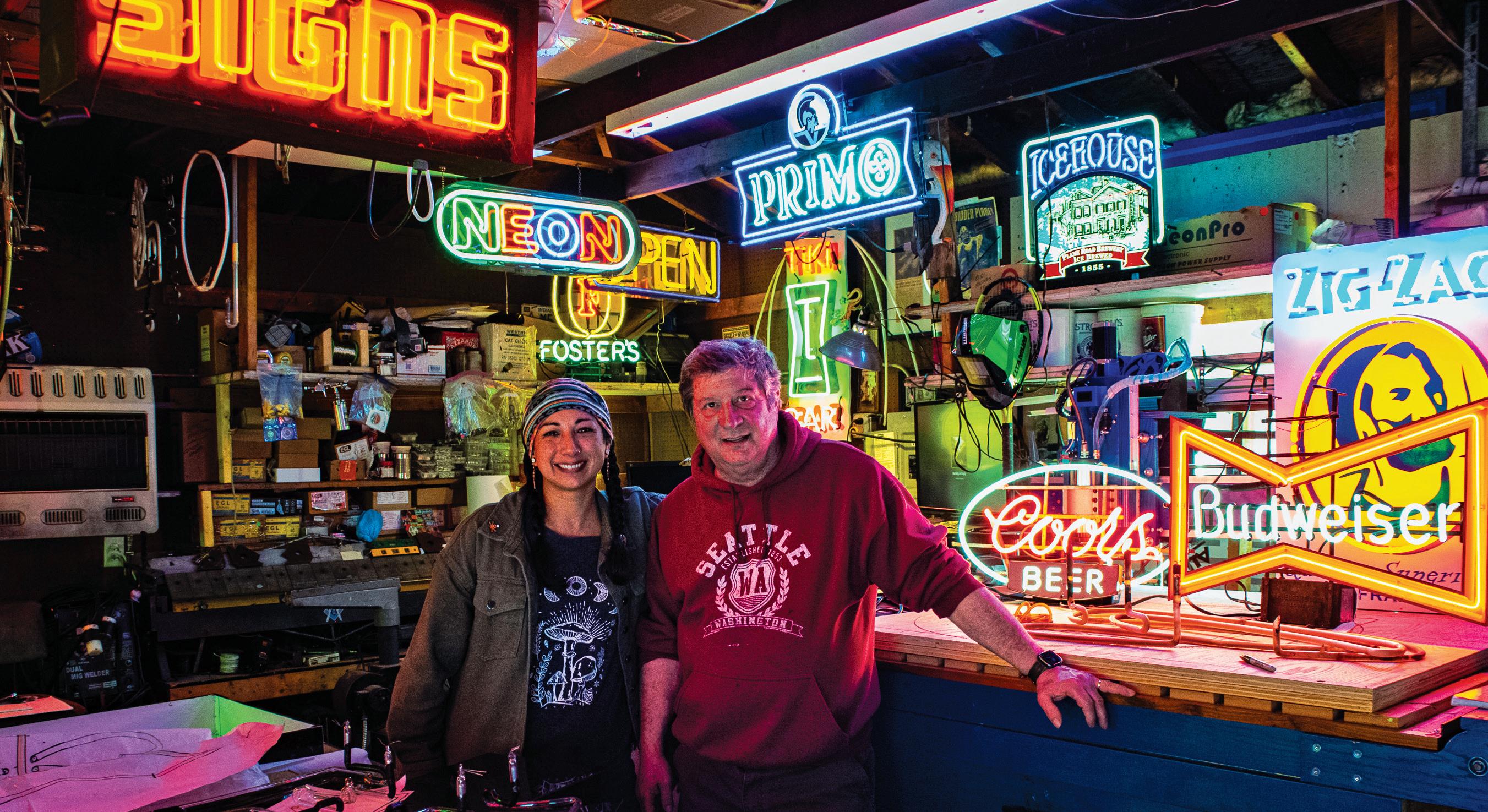
Dino Rigoni has spent the last 40 years making neon signs. We spent an afternoon in his studio in Muenster, Indiana, alongside his wife Donna and apprentice Tessa Troutman, as Rigoni recounted the signs he’d made over the course of his career and showed us how he designs, cuts, and shapes the glass.
¬
All photos by Ashley Lane.
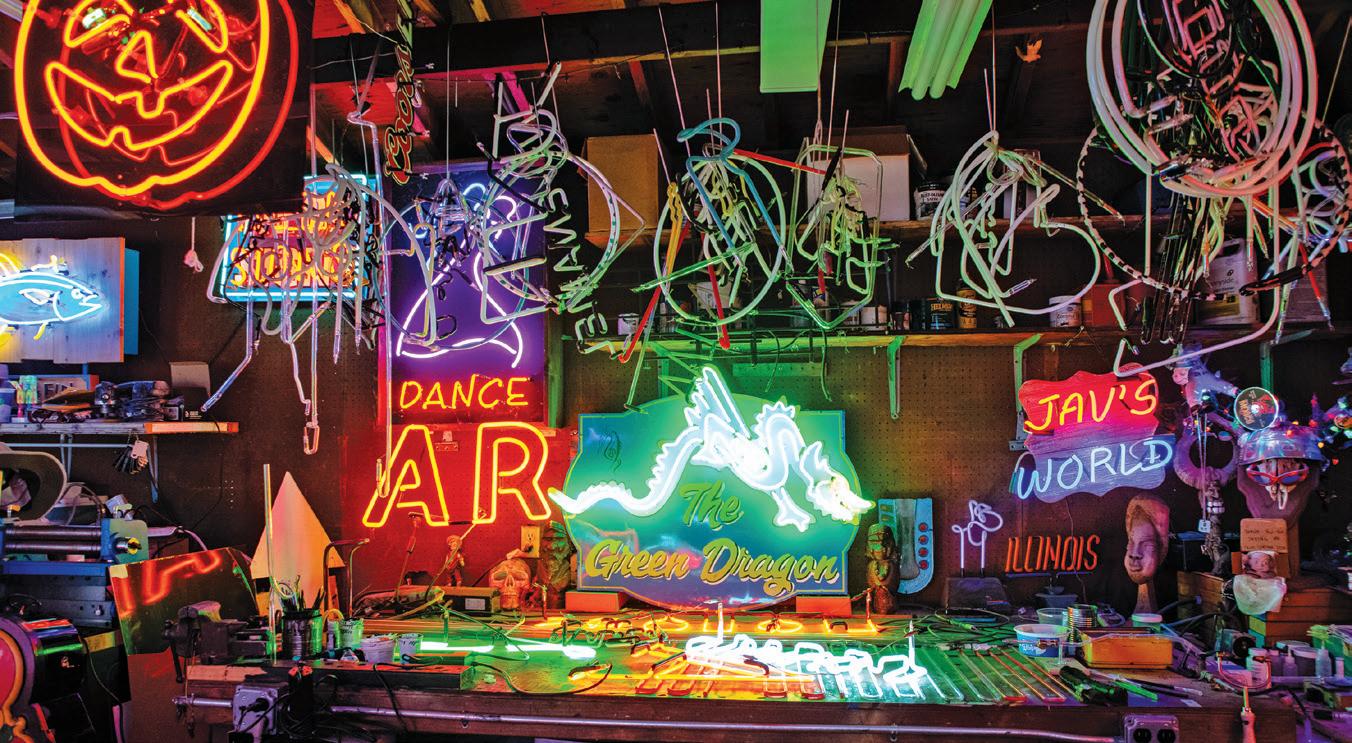
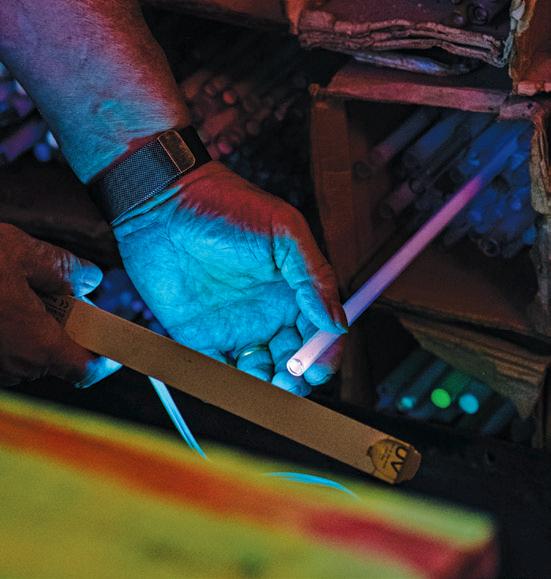
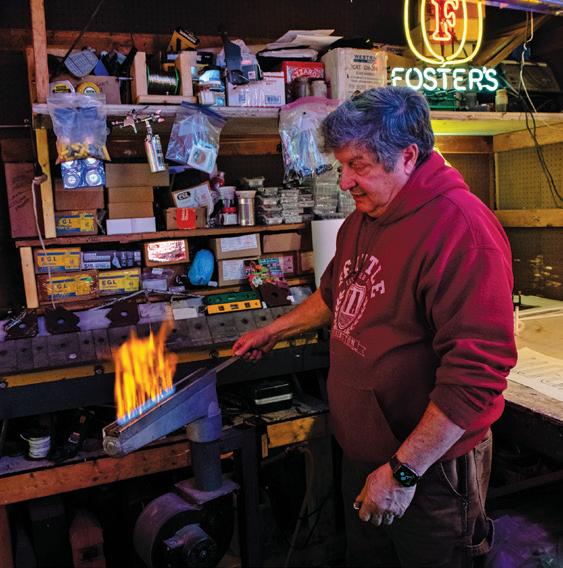
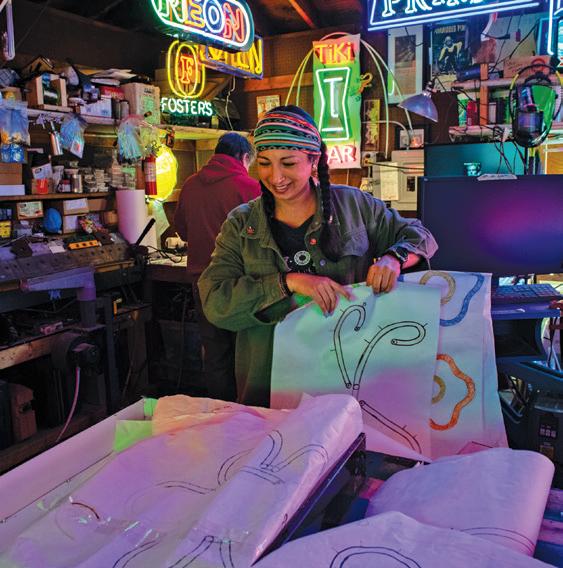
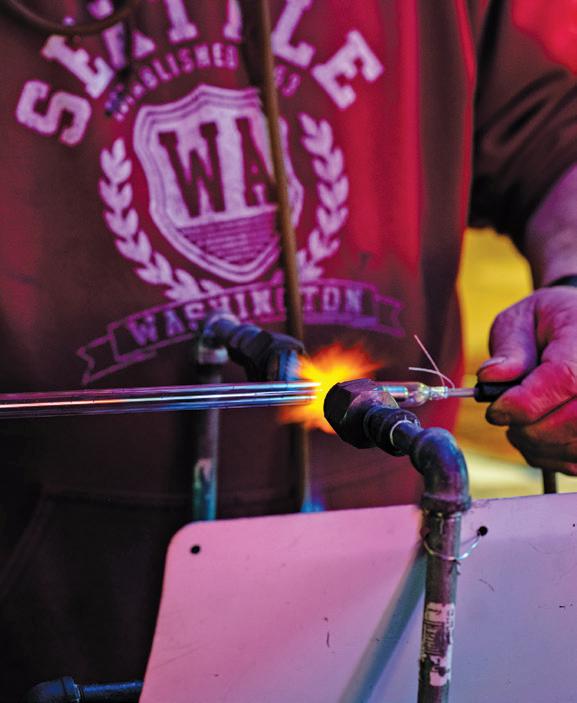
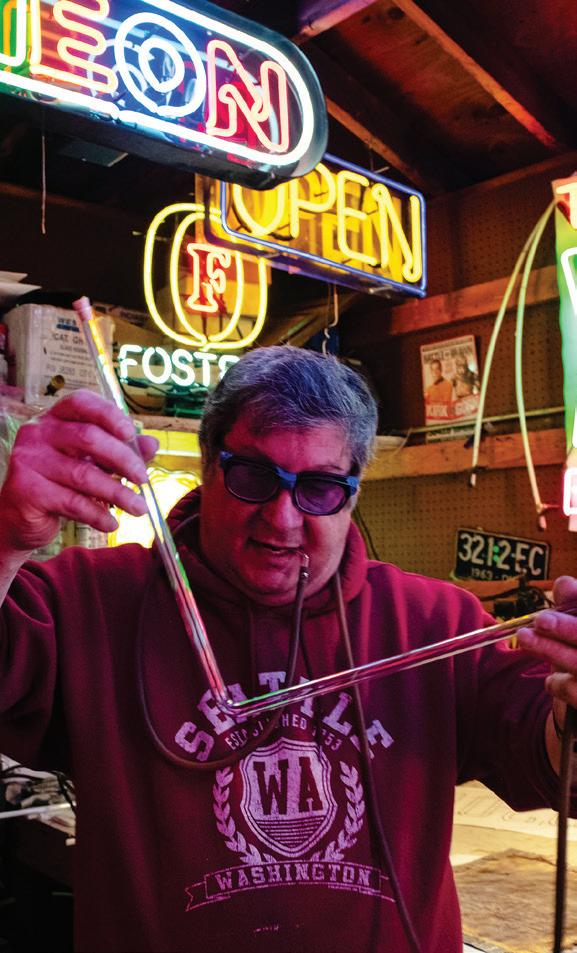

One jail worker shares what it’s like to work while incarcerated, from cleaning up flooded cells to doing laundry.
BY HARLEY POMPER
To protect people who choose to speak with the Weekly for our Doing Time series, we use pseudonyms to refer to insiders and only first names to refer to loved ones on the outside who visited insiders.
Every week, Cook County Jail (CCJ) employs hundreds of insiders to prepare meals, clean cells, wash clothes, run barbershops, and otherwise maintain the buildings in which close to 6,000 people are incarcerated at any given time.
Though the Cook County Sheriff’s Office (CCSO) describes the purpose of work assignments as enabling “individuals in custody to earn a wage, build a work ethic, practice responsibility, and learn practical job skills,” incarcerated workers make between $5 to $12 per eight-hour shift—or 4–9% of Chicago’s minimum wage. Their income is automatically applied to their commissary accounts. 393 insiders were working in paid positions during the March 1–7 pay period.
Not everyone is allowed to be a worker. Certain disciplinary infractions, for example, can prevent insiders from being authorized to
work. Disabled insiders are allowed to work but can face challenges. Though disabled insiders are supposed to have “equal access to programs and services, provided that they are able to perform the essential functions of the job and do not pose a legitimate safety concern,” according to a CCSO spokesperson, they can face challenges from officers.
Saint* has been incarcerated in CCJ since 2017, and spent much of the last six years employed as a building worker and laundry porter, preparing lunch trays and cleaning cells cells in general housing as well as the Special Management Unit (otherwise known as “the hole” or “seg” for segregated housing). He says that a few years ago, shortly after an officer saw him using a cane, they stopped calling him for formal employment. Eventually, he started helping with laundry on the tier without pay, and as of the last nine months, he has been back on the payroll.
Before being incarcerated, Saint helped support his two daughters by driving a medical van for a veteran’s hospital. Now, he spends his time playing chess, learning the law, and trying to help others with their cases. In the conversation below, Saint
talks about what it’s like to work while incarcerated, from cleaning burned cells to using a cane while incarcerated.
Harley Pomper: Can you tell me about your roles and workload as an incarcerated worker?
Saint: As a laundry worker, I would go to different tiers, and we’d pass out laundry tags [which make sure each article of clothing goes to its owner]. We would bag everything up, take it downstairs, and we’d wash all the clothes, dry ’em, and bring it back that evening and pass them out. The obstacle was for security to keep an eye on us to make sure we ain’t transporting anything, that nobody gets jumped on. And the sweet part about it is we’re able to wash our own clothes.
What do you talk about with the correctional officers when you walk around?
They might ask, “how long you been here?” We might ask, “how long you’ve been working here?” Small talk. I ask people all the time what they had for lunch, breakfast, dinner, because I know the food here is so horrible.
How are workers selected? Do you volunteer?
A worker says to the officers who choose the workers, “This my guy right here. You like the way I work? He’ll work just as hard as I work.” And you have somebody on the inside vouching for you.
Can you tell me why people would choose to work? What does it mean to work while you’re inside?
Me? I want to get out of the tier because I’m around these guys all the time. Just to move around. It helps the time go back faster instead of just being stuck in the dayroom. Being a building worker, you could wash your own clothes.
You get paid for it. I had two or three jobs at one time on the street. I’m not getting paid what I’m worth [here] but I can save a little money. I don’t have to put too much stress on my friends and family members sending me some money for my books, because I already have it. You can become friends with the officers, and they might give you some food, pizza, coffee. Commissary coffee is horrible, but they got some real Folger’s downstairs with real sugar.
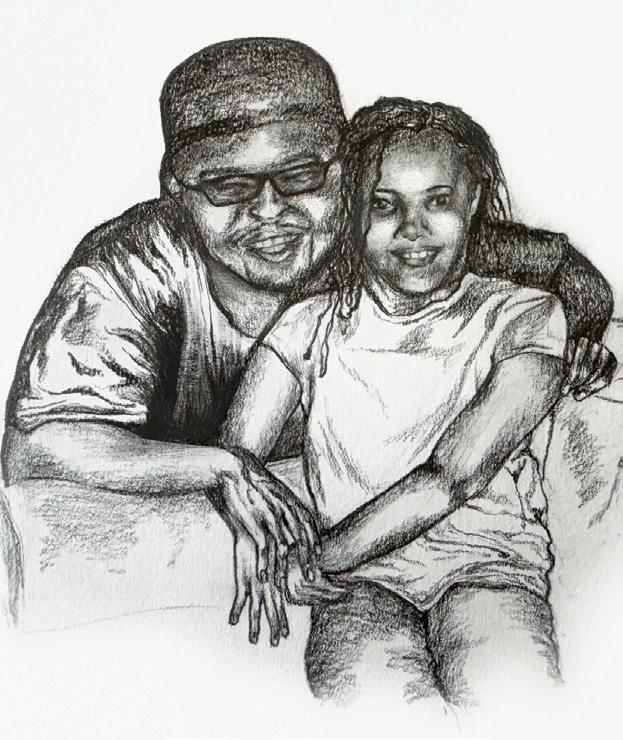
What is it like to use a cane while you’re a worker?
It was okay for a little while, until some officers see me going to Cermak [the on-site medical center], or see me going on a visit. One officer tells a sergeant or the lieutenant, “How you working when you got a cane?” And next thing you know, the lieutenant or the sergeant is telling them not to get me. So they’re not telling me I’m fired, they’re just not coming to get me for work.
So when I catch the officer, I say “You ain’t come get me in a while, what’s going on?” At first they’ll say, “We don’t need your help right now. We’ll try again later.” And after a while: “Well, am I fired? Where’s my pink slip? Tell me something!”They say,”’Yeah, you’re just a liability. So you got a cane.” But, I was still working, right? It’s not my cane, my hip wasn’t bothering me as much when I needed the cane. I’m still doing the job you had me down for. But they say, “Yeah, it’s just a liability. We don’t need you to fall.”
After a while, I saw one of the supervisors who do the payroll for the workers. I asked him, “Hey, man, why am I not getting pulled for work anymore?” They said, “Because you’re a liability. We think it’s better this way. Thank you for your hard work, but this is for you.” “For me?” I said. “I’m not asking for this.” That’s how
it went. No pink slip, like I wasn’t fired, no write up, no incident report. Just not coming to get me.
I’m working now on a tier doing laundry. It works out because I can sit in one spot and call, “Laundry tags! Get your laundry tags.” So I just holler it out, and people come to where I’m at to get the laundry tags, or I throw it across the dayroom.
Can you tell me about what it’s like to be a seg worker?
The guys in seg can be real disrespectful. The officers in seg are real disrespectful also. And some of the guys got beat up by the officers. Some of the detainees beat up the officers before. They put certain officers down there, with high aggression, to work in seg. So, anybody in seg get aggressive— they can beat the aggression with aggression.
For example, the lunch trays come with a hard plastic tray inside. [Building workers] take the hard plastic tray out, because they could use these trays and break them down and sharpen them up, make knives out of it. The officers pass the trays out because they don’t trust the guys in seg.
In seg, guys’ll coordinate to flood the cells. On each tier, there’s 22 cells. 11 on bottom deck, 11 on top deck. Two, three, four of the cells will flood at one time. The officer’s not gonna clean the water up. They’re gonna say, “Hey, get them guys to clean this mess up.” We’re down there cleaning the water up, and the guards would cut off the water for the cells involved for that day. And once we clean the water out, the cells whose water is not off... they’ll flood. We have to get called back.
People coordinate just to upset the officers, piss them off, and just to be doing something. The officer is not gonna do any of this work. So, they gotta have workers.
A CCSO spokesperson confirmed that there have been incidents of insiders
being assaulted by staff and vice versa. Charges were sought against four staff people last year. They also confirmed that incidents related to intentional flooding and fires have occurred.
What duties fall under being a seg worker?
When a guy that’s in seg gets matches or a lighter, and he sets the cell on fire, we have to clean the cell. I cleaned burned cells a few times in seg and on other tiers.
Walk me through step-by-step what cleaning a burned cell requires.
When you first walk in the tier, you would smell the fumes from the burned plastic, or the burned blankets or sheets, and you could just glance around the dayroom. Because over here, our doors are off-white, and when you come to the tier you can easily see the burned cell. We can see where flames is coming through the crack of the door, the charcoal and the window portion of the door, it’s black from the smoke. And nine times out of ten, they’ll have that door open to try to air it out. The doors are painted with cheap paint, so the flames will burn all the paint off the door to the steel.
It’s just smoke everywhere. It’s smoke up in the lights. Burnt spots on the ground and on a doorway from probably a mattress or the blanket. We gotta go in with a power wash kit that sometimes don’t get anything off the ground or the walls. Just do the best you can with what we got. Scrubbing. And once we finish, you can still tell this cell was set on fire.
How long does it take you to clean a burned cell?
Wooo! I wanna say they usually have four or five people doing one cell. First the one guy going with the power wash. He’s spraying everything. We’re trying to loosen it up. Then two, three, four people come in, scrubbing.
Scrubbing light fixtures, scrubbing the doors, scrubbing the bunk, scrubbing the tables, scrubbing the walls. Try to get everything off you can, but they don’t have the right equipment to get burned stuff off like this.
Now keep in mind, for a time they said I couldn’t work because I got a cane. But I was working before. On one of the tiers, one guy set his cell on fire and it was so bad, they had to move everybody out that tier to the gym and have people come up and clean it up. And I was one of the guys they came and got to help clean the cell up. We had to clean the cell and the tier, it was burned that bad.
When they came to get us, they were asking, “Hey, we need some volunteers to help clean a burnt cell.” They didn’t tell us we were cleaning the whole tier. And while we was over there, since all these guys was moved to the gym, we wound up cleaning up the other cells also.
But we spent a lot of time in that first cell. We had people on the outside getting the burnt spots off the door. Got people inside cleaning the door, the walls, box, tables, sink. On top of hitting the whole tier, scrubbing the walls—because it was a lot of smoke.
I don’t know how long it was burning, because usually they set fires in seg. So all the fire extinguishers are over in seg. There’s none over in the other tower, where that fire happened at. So when it first happened, the officer got to run to seg to get a fire extinguisher, and come back to that tier. All that time it’s burning, and these guys probably in the cell feeding the fire: their sheets, their blankets, their mattress. And it affects the whole tier.
A CCSO spokesperson said that “Fire extinguishers are accessible to staff for every tier. We are unable to identify a specific incident based on the details you’ve provided.”
What is it like to clean a burned cell, and what kinds of conversations happen while you’re doing that work?
Usually the phrase they use is “These guys got wild.”
And I seen guys who set fires. I went to Cermak for the eye doctor, and we took a guy with us that came out of seg, and the officer asked him, “Hey, man, you one of them guys that be setting the fires?” He said, “Yeah.” So the officer asked some questions. “Why are you doing that? It’s dangerous.” And the guy says the dumbest answer to me, that he wanted to move around. “I got tired of the view we got in the window. I just want to move around, and maybe go to Stroger’s Hospital.” I said, “Dude, you trying to hurt yourself just to take a trip to the hospital for a day and come back to jail?”
You seen guys whose cell caught on fire, and they got burnt real bad, where they had to wear some type of glove, and their skin was tight. Your hair doesn’t work the same because your skin is burnt so tight on you. It’s horrible.
Do you do any work that isn’t traditionally considered work, like caring for people?
I try to help guys out. I get paid for doing laundry. And there’s some guys here that’s unfortunate. I got loved ones who send me money, and I got the job. So I try to look out for people. Like, one guy’s a big coffee drinker, but he doesn’t have any money—
Jail Phone: You have one minute remaining.
He doesn’t have money to buy coffee like that. A three ounce bag of coffee costs $10. So his birthday came up last month, so I bought him a bag of coffee as a surprise.
Jail Phone: Thank you for using Global Tel Link. ¬
Harley Pomper is a PhD student in social work at the University of Chicago. They organize across jail walls to report on carceral injustices and political repression.

WILSON’S
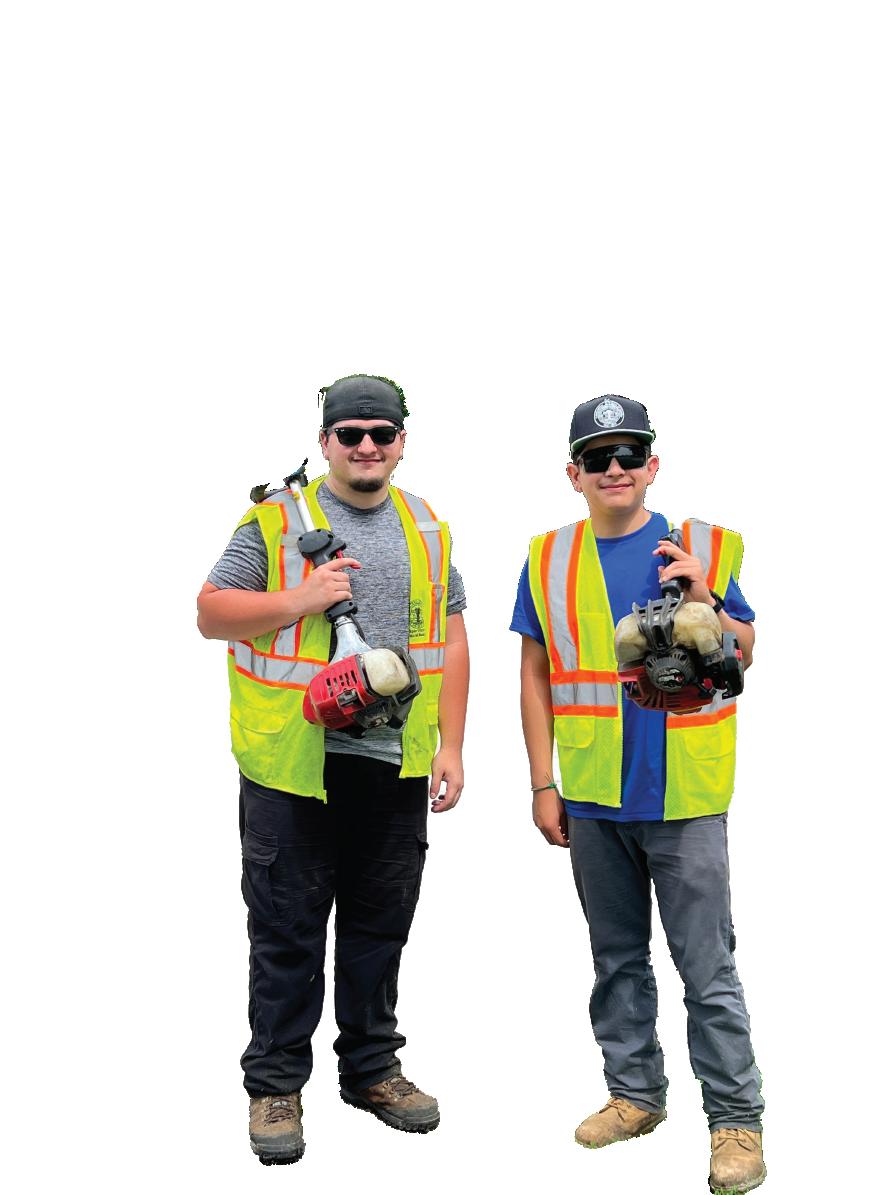
DIRECTED BY CHUCK SMITH ASSOCIATE DIRECTOR AND MUSIC DIRECTOR HARRY J. LENNIX

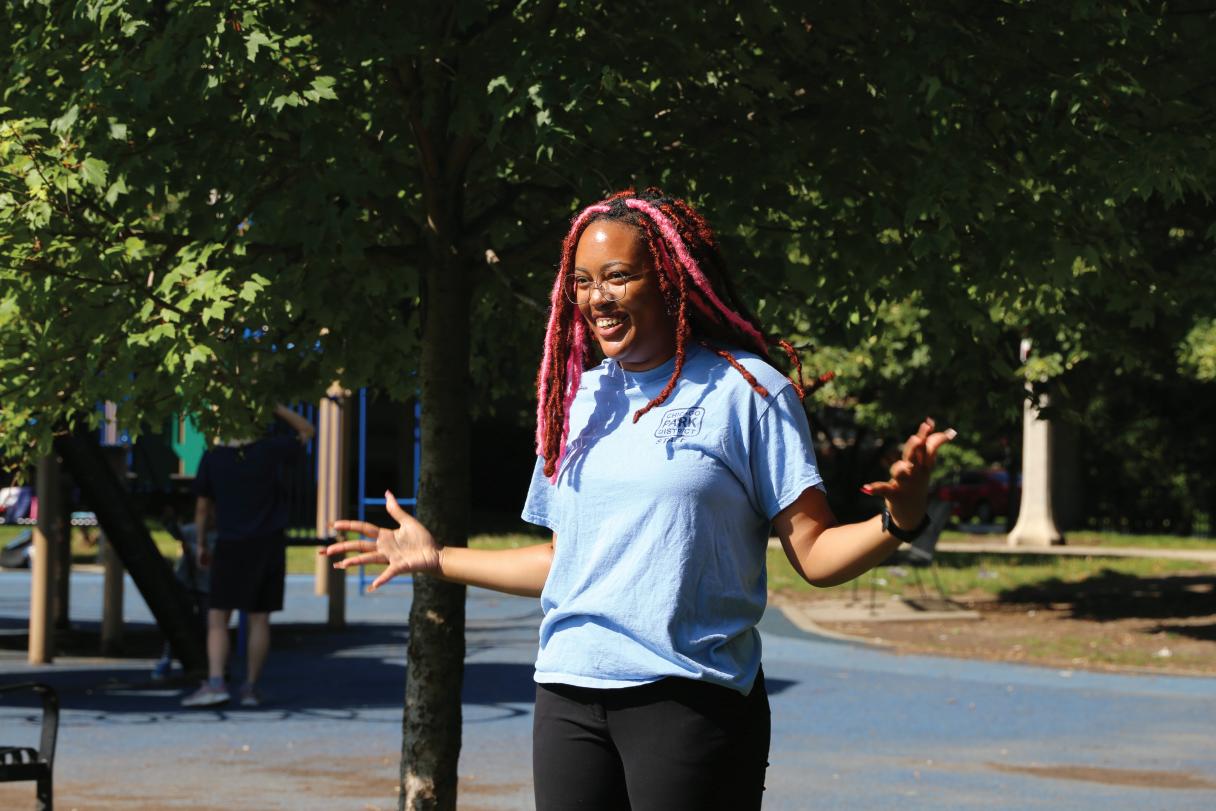
“THE MORE MUSIC YOU GOT IN THE WORLD, THE FULLER IT IS.”
Ma Rainey’s band is waiting. It’s 1927 Chicago, and “The Mother of the Blues” takes her time getting ready to record. Tensions and temperatures rise as the musicians recount tales of rage, joy, betrayal and faith in astonishing stories and a heartstopping climax. Chicago legends Chuck Smith and Harry J. Lennix reunite for the play that smashed box office records in its 1997 Goodman premiere for this major revival of “a genuine American Chicago Reader ).

MARCH 28 – APRIL 26

Caregiving can take a physical, mental, and financial toll, but there are programs to line up caregivers with financial assistance.
BY PACHINA FLETCHER
According to 2024 estimates by the Centers for Disease Control, nearly 30% of people in the U.S. live with a disability. As such, it’s likely you know someone who lives with a condition that makes “independent living” more difficult, if not impossible. This would include a senior who needs assistance at home; a neighbor who is having health challenges; your mother, father, grandparent, aunt, or close family friend; or, perhaps, even yourself.
And if they’re (or you’re) having a difficult time and in need of help to take care, your loved one (or you) is likely in need of a caregiver, or perhaps already has one. A 2025 report from AARP and the National Alliance on Caregiving found that roughly one in every four U.S. adults is a caregiver.
While people of all ages deal with significant medical challenges, aging increases the risk of certain disabilities. By 2030, all baby boomers (the largest population segment in the United States) will be 65 or older, which will put greater demands on public health systems. And the Census Bureau’s 2024 population estimates reveal that Illinois is home to almost 3.1 million people aged 60 and over; these residents make up nearly a quarter of the state population. Not surprisingly, the 2025 Respite Services Report, developed by the Illinois Department on Aging (IDOA), observes that “demands for home and communitybased alternatives to nursing facility care will continue to increase.”
Because Medicare doesn’t pay for long-term care in a nursing home,

many residents are forced to spend down their assets to live there. While many people receive at-home care from friends or family members, most of these caregivers are unpaid.
According to the 2025 AARP report, only 11.2 million of 59 million family caregivers receive pay for even a portion of the care they provide. However, the Illinois Department on Aging and the Illinois Department of Human Services sponsor programs that allow family members and friends to apply to become paid caregivers or “home care aides” for loved ones. Agencies can also select a trained professional home care aide to support those seeking help, with their input and approval. Home care aide duties include cooking, cleaning, washing clothes, and companionship; what they do depends on the client’s needs. In most of these programs, family and friends who seek to be
hired to provide home care undergo background checks and training for these positions, just like professional aides.
This was the choice I made, with my family’s approval. I am currently a caregiver and paid home care aide for my 86-year-old mother, Queen, through Addus Homecare. In addition to caring for my mother, I am an individual provider for a family friend with disabilities; my schedule is flexible, so it works out. I have two sisters, and we share the responsibilities of taking care of our mom. We realized about five years ago that her health was changing, and we could see she was needing more help. My sister works with seniors and is familiar with IDOA, so we contacted them and began the process of getting her services. We all work full-time and have our own families, but we have set a schedule for every
day of the week so someone can be with her most of the time, to make sure she eats and takes her meds. We perform household chores as well, and make sure my mother gets to doctor’s appointments, church, and other events she wants to attend. In addition to myself, my mother has another paid home care aide who comes Tuesday and Thursday mornings.
Thankfully, all of us are on the same page as far as her care and safety. And my mother is happy being at home and is comfortable and independent enough to do what she wants. But being a caregiver can be stressful, time-consuming, and mentally exhausting.
Research has shown that caregiving can take a toll physically, mentally, emotionally, and financially on a person. Also, our health may decline because of our duties and commitments. The 2025 AARP report found that 47% of family caregivers reported at least one negative impact on their finances, such as stopping saving or taking on more debt, and 23% reported it was difficult to take care of their own health as a result of caregiving. Seven in ten working-age family caregivers are employed, but many face disruptions and lack access to benefits that support caregivers— especially the over 80 million hourly wage workers in the United States. Families like mine face hard situations because of this limited support. I spoke with Kim Sims, whose father Sylvester was diagnosed with Alzheimer’s. Even though she was working a full-time job, Sims became her father’s official caregiver
in 2019. After taking care of him for three and a half years at home, Sims said that as his health declined, it was getting to be too challenging for them to keep him at home. They prayed about it, and decided to place him in a nursing home in June 2023. “It was so stressful...I really don’t understand how we made it, because you’re pretty much locked down, you know? And then I was still trying to work.”
After her father stayed at the facility temporarily, while she and her daughter took a well-deserved vacation, he didn’t want to come home when they came back. Her father’s comfort in his new home was a huge relief for Sims and her daughter, Jasmine, and they took it as a sign to try out the new living arrangement. They did not make the decision lightly, however, as some family and friends did not approve of their choice. “We were really trying as hard as we could, to do everything right for him, and we were being judged horribly. It hurt so bad,” she said.
They were satisfied with her father’s care for some time. Unfortunately, after a couple of years, Sims felt that the services at the nursing facility were beginning to deteriorate, so she moved him back into her home in January 2026. Her father is now in a hospice program, and his granddaughter has applied to be his paid caregiver through the Assyrian Cultural Foundation, which runs a home care agency that provides services in the IDOA’s Community Care program.
Kay McInnis, who lives in suburban Matteson, has been a caregiver since 1990. Over the last three decades, she has cared for children and adults with disabilities, elders, her sister, and her brother-inlaw. Currently she is hired by clients’ family members, rather than working through an agency, and she was a paid caregiver for her sister, but she has also experienced being an unpaid caregiver, when she took care of her
brother-in-law. “I had a full-time job, and after work I would go by and see him. I knew about the state caregiver programs, but again, I was working,” McInnis said.
When asked what she enjoys about being a caregiver, McInnis replied, “I have always been a caring person and enjoyed taking care of people even when I was a small child. I like helping others in any way I can.”
“Being a caregiver is not for everyone,” she said. “You have to have compassion, patience, and be reliable.”

When family members are ill and require more help to live safely and independently, where can their loved ones go for support and for reliable information?
To start, your physicians, friends and family members, churches, and social services organizations may be important resources. But state and city government agencies offer specific services to support seniors, people with disabilities, and their caregivers—including some that enable family or friends to be paid for care they provide.
In Illinois, there are state and federally supported programs to assist seniors and people with disabilities to continue to stay in their own homes, with the support of caregivers. These programs include the Community Care Program of the Illinois Department on Aging (IDOA) and the Home Services Program of the Division of Rehabilitation Services (DRS) within the Illinois Department of Human Services (IDHS). However, to qualify for these services, generally participants must have less than $17,500 in assets, and also be Medicaid-eligible—in 2025, this meant the maximum monthly income was approximately $1,366 for
an individual (around 138% of the federal poverty level).
DRS provides services for residents under 60 with special needs or disabilities. Through the Home Services Program, clients are provided with personal assistants or “homemakers.” In addition, eligible Illinois residents can receive homedelivered meals and home health services, along with other options to support their independence. To apply, go to the DHS website (dhs.state. il.us) or call (877) 581-3690.
For residents over 60, information about state-supported services can be found on the IDOA website (ilaging. illinois.gov) or by calling (800) 2528966. By searching my zip code in IDOA’s online service locator, I found the office of the local organization that coordinates the Community Care Program in my area and was then able to speak to an administrator and biller about potential services. Like me, other family members of people living with disabilities approach IDOA for help, and when they connect, they are asked basic information about their loved one and their conditions before a case manager is assigned to them. If your income is too high to qualify for CCP, you may be able to get at-home services through Illinois’s Health Benefits for Workers with Disabilities (HBWD) program, which allows higher income limits (350% of the federal poverty level) for people who are employed.
After an initial conversation, it may take several weeks for a case worker to visit your home to assess what your loved one’s needs are. During the visit, a case manager will gather the most important documentation for the person who needs care, including their Social Security card; their state ID or driver’s license; a list of their current medications; their insurance card; and recent bank statements, to prove they meet income requirements. After everything is processed and the care recipient’s application has
been approved, a list of agencies that connect people with caregivers and other resources is provided.
In an interview with the Weekly, Mary Killough, Director of the Illinois Department on Aging, stressed the importance of the Community Care Program. “We provide in-home services, and that service is provided by agencies that contract with the Department on Aging, and those agencies hire caregivers to work for individuals in their home.” Besides offering services for people in need of care, the IDOA also has resources and support programs for caregivers. When asked why some people are not familiar with these programs, Killough said, “Most people don’t think about aging services until, frankly, you need them...There’s usually some intervening event, usually a hospital stay or something, and I think there’s just a natural disconnection between the hospital discharge planners and understanding what other social elements are there to keep people in the community.” Killough encouraged everyone to consider IDOA as a resource. “Even if you don’t qualify for [the Community Care Program], you may be entitled to receive referrals for other services,” she said.
Finally, the city of Chicago offers some resources as well. For people with disabilities, the Mayor’s Office for People with Disabilities has an Independent Living Program, and the Department of Family and Support Services offers some programs and support services for caregivers of seniors, including support groups, training, and respite care. ¬
Pachina Fletcher is a freelance journalist and a Documenter for City Bureau. She is a member of the Chicago Journalists Association. She last wrote for the Weekly about Pullman and Roseland for the 2022 Best of the South Side issue.
Wonderful Studio For Sale Lake views! $109,999. 2901 S. Michigan. MLS#12516824
Charlotte Rehman
Real People Realty 773-369-4092
charlotter_reh@comcast.net Studio for Sale Krystal Jar, LLC With a Concierge Touch
Business Loans
$$Business Loans$$
Existing Business Only
Maurice @219.629.4964
GAW Paper Coating Systems Inc has openings for the position of Mechanical Engineer with a Master’s degree in Mechanics, Management or related to performing the process engineering activities from the initial conceptual studies and feasibility assessments through detailed design and system optimization. Define project design scope, and lead engineering efforts, including component specification, equipment sizing, and detailed engineering calculations. Develop, modify, and maintain Piping and Instrumentation Diagrams (P&IDs) using AutoCAD. Create and update 3D piping layouts and mechanical system models using SolidWorks. Design and prepare fabrication drawings for mechanical systems and equipment, including converters, pressure vessels, heat exchangers, and storage tanks. Ensure compliance with industry standards and applicable codes, such as ASME, API, and relevant safety regulations. Collaborate with cross-functional teams including project managers, procurement, and fabrication personnel to ensure accurate implementation of design specifications. The work location is Chicago, IL, with a requirement to travel and work from various unanticipated client work sites throughout the USA.
Please mail resumes to 5854 N Northwest Hwy, Chicago, IL-60631 (or) e-mail: adamg@gawpcsinc.com
Help Wanted

Construction
The University of Chicago seeks Sr. Software Engineer for various & unanticipated worksites throughout the U.S. (HQ:Chicago, IL). Bachelor’s in Comp Sci/related field +2yrs exp req’d. Req’d skills: 2 yrs exp w/each: React, TypeScript, Redux-toolkit, & UI design; REST APIs, including querying & integrating complex datasets; web accessibility (508 Compliance, WCAG 2.1 AA) including automated & manual testing; data visualization; handling large-scale datasets; CSS & responsive design techniques for enterprise-level applications; develop & troubleshoot frontend web applications, UI development & API integration; frontend performance optimization; SEO best practices; implement & maintain CI/CD pipelines w/ GitLab CI/CD & GitHub Actions. Exp must include: data analytics workflows. Background check including review of conviction history required. May work remote. $80,000/yr-$120,000/yr.
Apply online: https://www.uchicago.edu/jobs Job ID: JR33021
The University of Chicago is an Affirmative Action/Equal Opportunity/Disabled/Veterans Employer and does not discriminate on the basis of race, color, religion, sex, sexual orientation, gender identity, national or ethnic origin, age, status as an individual with a disability, protected veteran status, genetic information, or other protected classes under the law. For additional information please see the University’s Notice of Nondiscrimination at https://www.uchicago.edu/non_discrimination_statement/. Job seekers in need of a reasonable accommodation to complete the application process should call 773-702-5800 or submit a request via equalopportunity@uchicago.edu.
773-575-7220
773.802.5765 You Get ’em, We Kill ’em Exterminator
George Stalling Owner, Licenced Certified Technician Payment before or with work completed
$Used Cars For Sale$ Financed or Cash. Credit Score low as 500. Call Maurice at 219.629.4964 (Chgo) Used Cars for Sale

Three professional grant writers share what it’s like to do the work in the wake of Trump’s inauguration.
BY JONAH NINK
In the first few months of 2025, sweeping cuts made by the second Trump administration, representing billions of dollars in government grant funding across multiple sectors, took effect. The nonprofit funding ecosystem in America, already fragile and complex, was immediately destabilized, with federal arts, science, and education programming suffering the greatest losses. . According to Education Week, support for the K-12 education sector alone saw disruptions and cuts to $12 billion in federal funding in 2025.
For its 2026 fiscal year budget (covering October 2025 through September 2026) the administration outlined further cuts to so-called “Woke Programs,” including unprecedented reductions totalling $5.2 billion to grants issued by the National Science Foundation; these cuts amounted to 57% of the NSF’s existing budget. Within the fiscal year, the administration also aims to eliminate the Minority Business Development Agency, created in 1969 by the Nixon Administration to provide grants and resources to minority-owned businesses.
Grants provide the essential funding nonprofit organizations need to serve their communities. According to nonprofit information service specialist Candid, 26% of Illinois nonprofits rely on federal grant funding alone to make ends meet. With over 1.9 million IRSregistered nonprofits in the United States, the level of competition for grant monies is frequently fierce.
In its 2024 report on grantseeking, grant database manager GrantStation found that 91% of nonprofits surveyed applied for at least one grant in 2023. Depending on the organization, a grant’s
funding may not be disbursed all at once; it may be distributed in installments, or on a reimbursement basis, where organizations make purchases first and request repayment from the grantor. Organizations are often required by the grantor, especially at the federal level, to provide detailed reports on how funds are used. This arrangement allows for transparency and accountability, but also slows some crucial processes. For some organizations, especially small grassroots organizations at the community level, staying compliant presents its own challenges due to a lack of resources, training or administrative staff.
In addition to federal and state funding, organizations also often apply for grants from private foundations, individual philanthropists, and corporate-sponsored foundations. As federal funding sources shrink, more nonprofits have turned to private funding. Securing the funds to meet a budget is never guaranteed; every grant is a competition, and applicants need to make compelling cases for their causes.
When nonprofit staff lack the experience, bandwidth, or resources to write an effective grant proposal, professional grant writers often step in. Good ones are able to distill a nonprofit’s initiatives and mission into a compelling proposal aligned with the expectations of a funder.Blending elements of journalism, sales, and research, an effective grant writer can win nonprofits the resources they need to more effectively serve their communities. In the current economic and political environment, their skills and contributions have never been more crucial.
It’s also not uncommon for grant writers, particularly those operating
as independent contractors, to offer nonprofit support beyond basic proposal writing. Some offer strategic, programming or research assistance to help nonprofits find new opportunities and flesh out their own offerings. And grant writers also serve as peer reviewers for grant submissions, particularly for federal organizations.
What does it take to be a grant writer? We sat down with three independent grant writing professionals to learn more about the field:
Joyce Golbus Poll is the owner and founder of J.G. Poll and Associates, which has served family and healthcare nonprofits since 2004.
ASIL Ventures founder and president Lisa Green specializes in nonprofit services, grant peer review, and business development.
Vanessa Taliferro is the COO and senior consultant for AD-V Business Consulting, Inc., where she manages a team of grant writers specializing in multiple areas and services.
Vanessa Taliferro: For about sixteen years, I worked for a nonprofit organization. I was not the executive director but the director of business affairs, and kind of assimilated into the role of the executive director. And that’s where I learned how to create programs, program develop [as well as] learn how to write and apply for grants, and get the funding we needed to serve our target population. At that time, I was in the Austin community of Chicago. In 2016, I left there and started AD-V Business Consulting with my daughter, Ashley Taliferro.
Lisa Green: I actually started in contracts, so solicitations for forprofit opportunities. I would write the proposals for those types of opportunities. I did things for Medicare, Medicaid and the Department of Transportation. Then, about 2020, one of my clients asked if I could help write a grant. That’s how I spun into the grant world, but I still do both. I am a solo consultant-entrepreneur. I have my own business. Like everyone else, I started freelancing on the side and then I was able to go full-time.
Joyce Golbus Poll: I’ve had my own business as a freelancer for 21 years. I worked for other organizations before that. I was an administrator who learned how to do grant writing while on the job, and then decided at one juncture that I liked that better than anything else, so I went off on my own in 2004.
What kind of organizations do you enjoy working with?
VT: [My firm has] been serving predominantly South and West Side organizations, trying to break the barriers of receiving grant funds. I started with maybe one client, and built the business from the ground up, working with multiple grassroots organizations initially, helping them find smaller grant opportunities. We’ve been working nonstop since October 2019.
LG: I’ve always focused on the federal sector. I mostly help larger nonprofits or higher education [organizations].
JGP: Health and human services, as well as children and youth. If somebody is out there considering [grant writing], I say “What do you love to do” and then [tell them to] follow those organizations.
What expectations do you set, and what questions do you ask, when you first meet a client?
VT: For me, it’s about listening to each individual talk about their work. Generally, you can detect their passion about what they want to do. I’m able to translate that passion into words, using the language that funders like. A lot of that is referencing the grant’s notice of opportunity, and seeing how the organization aligns with what the funder is trying to do. You can have passion, but is there alignment?
LG: I stress open communication. [For clients] this is their job, this is their baby in some instances. My job is essentially communication.
JGP: I think it is important for [grant writers] to know that they should never accept work based on their proposal being approved. They need to be paid just as a lawyer or a plumber would be— before the work is proven. It is considered unethical by the Grant Professionals Association (GPA) and the Association of Fundraising Professionals (AFP) for grant professionals to accept pay based on a percentage of a grant award or only upon winning a grant. Such contingency, commission, or percentage-based compensation is against ethical codes because it creates conflicts of interest, treats fundraising as a commodity, and risks funder disapproval.
How do you best turn a nonprofit’s programs and initiatives into a compelling grant proposal?
VT: A lot of times [clients] don’t have the educational background in business or nonprofit management. They have a lot of passion, a heart and a love for the community, they’re out there doing the work. When I work with them, they may say “I serve single mothers.” A funder may say “who are your beneficiaries?” It’s about translating that language. I take your passion, and I put it into language that a funder likes to hear.
LG: I always try to write down what is the major thing I want [funders] to take away from the [proposal], and

how do I make sure that theme is seen throughout. I’ve learned I need logistics. “What does that mean? Explain it to me.” [I always want to convey] how it looks from the perspective of my client.
JGP: I put a lot of time into establishing the community and needs of the population, and backing that up. Because if the need is profound, then it’s really difficult for someone to turn their head and say “I’m sorry, I’m not funding you.” That means you’ve failed to make your case. Grant writing is sales on paper. I am selling, I am pitching, I am highly competitive. I couldn’t sell anything verbally.
Is it more common for nonprofits to have in-house grant writers or freelancers?
LG: I have found in my years of doing this that it really depends on the economic times. If the economy is strong, people like to have their grant writers in-house. When times are hard, especially during a recession, it is more likely to be outsourced.
Why might an organization not get funding?
LG: When it comes to foundations, if you’re going private sector [funding], a lot of private sector stuff is about who you know. If you had a misunderstanding with one organization, or did not like
the grant manager, they talk a lot. You can get blacklisted sometimes if you have a negative interaction with one private foundation, especially local. It’s very political.
JGP: The reality is proposals can get rejected for a lot more than the writing of the application. It could be the organization, the organization might have a bad rap. It might be political. The reviewer might have had a bad night. The funding organization might decide that they are only funding nonprofits that they have previously funded, because things are tight. You can’t blame that on the grant writer.
Do you help in other areas beyond the grant proposal stage?
VT: One client I started working with, their organization had been around for years. They received a $1.8 million R3 grant (‘Restore, Reinvest, Renew,’ an Illinois grant aimed to assist communities affected by violence, incarceration, and disinvestment). The executive director was like “we’ve never received this kind of money before, what do we do?” I worked with them throughout a three-year period, helping them with reporting and management of funds. I would do workshops, teaching them compliance, reporting, probably once or twice a month. Going through reports, discussing issues, and how to complete budgets. It was a
natural fit for me because I already had experience doing that.
LG: Peer review is when you submit a grant to a federal agency. Some things have changed recently, but typically you’d have external reviewers review the application, give it a score, and those scores are sent to the powers that be. That’s how [the government] kind of makes it a merit-based award, because you have people who are not in the industry and don’t play favorites. I do that for the Department of Labor, Department of Justice and AmeriCorps.
How do you feel about the future of grant writing and nonprofit funding?
VT: With the new administration, things changed. It’s a lot different from how I initially started. However, I think people are resilient and we can adapt. My masters degree is in nonprofit administration. One thing I learned [is] that back in the 80s, the federal government would send you the entire grant check up front. Then there was an administration shift and it was like “Oh no we can’t do that anymore, we have to [distribute funds] on a reimbursement basis.” Nonprofits adapted to those changes. If [nonprofits] have the infrastructure in place and a great board, you’ll know how to adapt, and you’ll learn how to diversify your funding. I do think the funding will increase eventually, because people are hurting.
LG: AI is a problem because people will use Chat GPT to help them [write grant proposals] as a shortcut. The problem with Chat PGT is it’s not tailored to your application. It will give you an answer, and it may not actually apply to what you do.
JGP: I think that for the grant writing arena, everybody is going to be affected by [federal funding cuts]. There’s going to be a ripple effect, the awards may become less, the competition is going to be more. There’s going to be higher expectations, tighter screening. ¬
Jonah Nink is a freelance writer based in Chicago with bylines in The Daily Herald, Chicago Reader and Business Insider.

The Exchange is the Weekly’s poetry corner, where a poem or piece of writing is presented with a prompt. Readers are welcome to respond to the prompt with original poems, and pieces may be featured in the next issue of the Weekly
by Chima “Naira” Ikoro
“Street Cleaning” is a myth. i know this, because i hosted a show and at that show, my friends partner brought us snacks and stuff for the green room, things from Trader Joe’s. Fruit Snacks. Drinks I went and picked this stuff up from her before the show and then i brought it to the venue and i put this stuff in the green room and unpacked everything, lined it up all neat,
put a few in the performers dressing rooms. i didn’t really eat any though so at the end of the show, when we were packing up to leave
i grabbed a few things, one of those things was a can of pineapple juice it was the last one. everyone said it was great, and that i deserved it, the last one.
so i put it in my bag. and went to my car. and drove home and parked on my block. and while i was juggling all the things i had my pineapple juice rolled out of my bag onto the sidewalk.
and then slipped slightly under my car and it was December and the ground was gross and i was exhausted and it was like midnight and i was really looking forward to drinking it and i’m an environmental studies minor so before you say shit to me about littering i was carrying so many things so i left it. there. and slammed my car door closed with my butt and went inside.
yesterday. i happened to park in the same spot. mind you, it’s March. the can of pineapple juice was flat as Florida rusted.
still at the edge of the curb just beneath the sidewalk unmoved.
so i would like to contest every ticket i’ve received for parking on a street that y’all claim you’re about to “Clean.” this is not a poem.
this is a draft letter to the Mayor's office please let me know if it sounds good. thanks.
Featured below is a reader response to a previous prompt.
by Slam Bandyt (Andrew Ntamere)
Been at this job for like a month, and yeah I know I chose the path of the few, but I’m like bitch let me get back inna stu, do what I actually do.
I’m just a poet, I be knowin’ most of the time it sound like rapping to you.
So if they say I hit my ceiling, then what’s after the roof?
I’m tryna show these niggas how to turn they passion to fruit.
Got raps that’s from the past and the new; them niggas cap they really lacking the truth.
Had to be more honest with myself.
You lying to yo’ self, that shit like tyranny fa sure, steady keeping up this image, I appear to be demure, but I’m dropping village love n’ I be clearly inna burbs.
Im tryna be in love but I be fearing for the worst. Scared to be committed, I’m just feeding all my urges.
But I know fear can be so detrimental that shit fuck wit yo mental,
I don’t talk to therapists, I talk to instrumentals.
To avoid embarrassment, I try to keep shit simple and I be anxious, but that’s just because of shit I been through.
My heart can’t take it, I’m like stop the Levo start the Phenyl
You think it’s mine the way I jump out when I park the rental.
You think it’s mine the way I jump out when I—
Been another couple months and yeah I know I chose the path of the few, but I’m like bitch let me get back inna stu, do what I actually do, and shorty knowing I’m da mack of da crew I’m just a poet, I be knowin’ most the time I’m just a rapper to you.
They know I’m African, too, so if they say I hit my ceiling then what’s after the roof? I’m tryna show these niggas how to turn they passion to fruit.
I got raps that’s from that’s past and the new them niggas cap they really lacking the truth.
Chima Ikoro is the Weekly’s Engagement Editor.
THIS WEEK’S PROMPT: “WHAT IS SOMETHING THAT SEEMS RELATIVELY REALISTIC THAT YOU SUSPECT IS ACTUALLY MADE-UP?”
This could be a poem, journal entry, or a stream-of-consciousness piece. Submissions could be new or formerly written pieces. Submissions can be sent to bit.ly/ssw-exchange or via email to chima.ikoro@southsideweekly.com
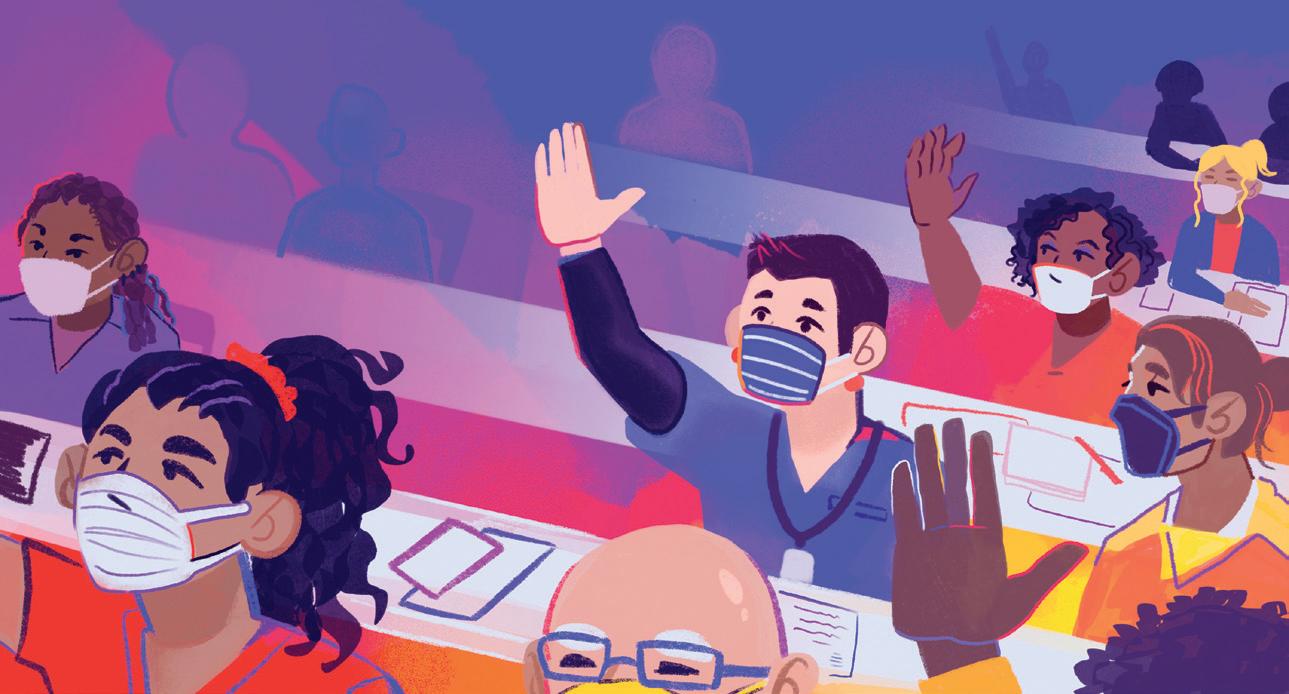
BY SCOTT PEMBERTON AND DOCUMENTERS
February 25
At its meeting, the 9th Police District Council—Deering heard concerns from public commenters about pedestrian and cyclist safety on Archer Avenue. Council members addressed those concerns and discussed the Archer and Kedzie “Complete Streets” safety program, which is designed to improve safety by installing curb extensions, bus islands, and bike lanes protected by concrete barriers. The initiative is administered by the Chicago Department of Transportation (CDOT) and construction is “substantially complete” along Kedzie Avenue between Archer Avenue and 28th Street. CDOT was invited to attend the meeting but did not send a representative. Council member and community engagement coordinator Erin Vogel led a discussion in which attendees offered ideas on what safe streets should look like, especially for the most vulnerable community members. The 9th Police District Council—Deering serves the New City, Gage Park, Near South Side, South Lawndale, Bridgeport, McKinley Park, Fuller Park, West Englewood, Englewood, Brighton Park, Douglas, Armour Square, and Lower West Side neighborhoods. Each of the city’s 22 police district councils includes three people chosen in municipal elections every four years. The first elections were in February 2023. The councils have several responsibilities, among which are building stronger connections between police and district residents, working with police to identify and address city problems, and developing policing initiatives. The councils meet each month.
The Chicago Department of Public Health (CDPH) Board reviewed their 2025 year-end report and passed 2026 expansion plans for mental health equity initiatives and "community-driven" marketing at its meeting. Board members also discussed the significant decline in federal public health funding due to a loss of ARPA (American Rescue Plan Act) funds, Medicaid cuts, and an increase in grant terminations. In her report, Dr. Olusimbo “Simbo” Ige, commissioner of the CDPH, noted that despite city funding allocated to the CDPH increasing $15 million from the previous fiscal year, the department’s budget dropped about $214 million, from $539 million in 2025 to $325 million in 2026. The loss in federal funding over the past five years has been significant: from $1 billion in 2021 to $230 million this year, largely due to the expiration of federal money initiated during the COVID-19 pandemic. When Ige was appointed by Mayor Brandon Johnson in 2023, she told WTTW that a priority was to replace some of the fourteen mental health clinics closed by previous administrations. “That is a commitment,” Ige said. “We are firm on that commitment, and we are not going to slow down in trying to achieve that goal. Right now, we’re working with the community representatives to help identify where these clinics should be located.” In January of 2025, the city reopened the Roseland East 115th Street Health Hub. CDPH is charged with providing “guidance, services, and strategies
that make Chicago a healthier and safer city,” according to the department’s website. The department offers programming in ten service areas, including behavioral health, chronic disease, emergency preparedness, healthy families, and community health.
March 3
At its meeting, the Chicago City Council Committee on Public Safety heard sharply divided opinions on proposed ordinances both from public commenters and from Committee members, eventually approving one, tabling one, and rejecting a third. Approved was an ordinance raising fines for animal abuse to a flat $5,000. Tabled was an ordinance that would increase penalties for wearing identity-concealing clothing— hoodies, personal protective equipment (PPE), or winter clothing, for example— during the commission of a crime due to concerns about its constitutionality. Aisha Davis, senior policy counsel at the American Civil Liberties Union (ACLU) of Illinois, said the ACLU was opposed to the proposed ordinance. The Committee rejected a proposal that would penalize parents for crimes committed by their minor children, even if there was no parental involvement. Davis argued against this proposal, too, which would have also increased fines significantly. Several Committee members and counsel for the city’s law department objected over concerns about constitutionality.
At its meeting, the City Colleges of Chicago (CCC) Finance and Administrative Services Committee and Board discussed the Board’s 2026-30 strategic plan, determining that the key points remain relevant and a new strategic plan isn’t necessary. Chief Financial Officer Maribel Rodriguez reported that the CCC is facing a projected $5.2 million deficit for the 2026 financial year. Revenues are projected to be $3.4 million over budget and expenses $8.6 million over budget. The Board’s student trustee, Widedji Deguenon, shared that students are asking for cheaper, healthier food options in the school’s cafeterias as well as longer service hours. Adjunct professors are seeking a contract with CCC. A teacher’s union representative reported that adjuncts receive no more than $30,000 annually, which the representative said is significantly less than what full professors receive. The Board cited “significant unforeseen conditions” in amending an agreement with the Public Building Commission of Chicago to increase the “not to exceed” cost for Malcolm X College renovations to $19.5 million from $17 million. Also approved was issuing up to $90 million in general obligation bonds to fund a variety of initiatives ranging across the colleges.
The Commission on Chicago Landmarks and the Permit Review Committee reviewed the proposed landmark status for several locations at back-to-back meetings. Two buildings on the DePaul University campus (Byrne Hall, 2219 N. Kenmore Avenue, and Cortelyou Commons, 2324 North Chalmers Street); the St. Paul Christian Methodist Episcopal (C.M.E.) Church, 4644 South Dearborn Street, and others were approved, subject to City Council consent. Only a portion of Byrne Hall received landmark status, prompting Ward Miller, executive director of Preservation Chicago, to express concern. A building at 2420 South Michigan Avenue in the city’s Motor Row District, formerly a showroom for the Pierce-Arrow Motor Car Company, also received landmark status Apollo’s 2000, an event venue and historic theater designated as a landmark in 2024, received approval for funding to repair deteriorated masonry. Established in 1968, the city’s landmark commission is “responsible for recommending buildings, sites, objects, and districts for legal protection as official Chicago landmarks,” according to its website. Its nine members are appointed by the mayor with the consent of the City Council. Other responsibilities include reviewing proposed changes to current landmarks and “proposed demolitions of structures considered to be historically or architecturally significant.” The commission meets once a month.
This information was collected and curated by the Weekly in large part using reporting from City Bureau’s Documenters at documenters.org.


GOLDEN STAR CLUB
Lindblom Park | 6054 S. Damen Avenue
April 15 | 10:30 a.m.–12:30 p.m.
FEED YOUR MIND, BODY & SOUL
AKARAMA Foundation | 6220 S. Ingleside Avenue
April 23 | 9:30–11:30 a.m.
MATHER AT DUSABLE
The DuSable Black History Museum and Education Center 740 E. 56th Place
April 30 | 10:00 a.m.–12:00 p.m.
Register today! Anyone 55+ is welcome to join