Dies at 84
inas 5 y 9 Rev. Jesse Jackson, Civil Rights Champion,


Dies at 84
inas 5 y 9 Rev. Jesse Jackson, Civil Rights Champion,
The South Side Weekly is an independent non-profit newspaper by and for the South Side of Chicago. We provide high-quality, critical arts and public interest coverage, and equip and develop journalists, artists, photographers, and mediamakers of all backgrounds.
Volume 13, Issue 4
Interim
Editor-in-Chief Adam Przybyl
Investigations Editor Jim Daley
Immigration Project
Editor Alma Campos
Senior Editors Martha Bayne
Christopher Good
Olivia Stovicek
Jocelyn Martinez-Rosales
Engagement Editor Chima Ikoro
Editor Emeritus Jacqueline Serrato
Public Meetings Editor Scott Pemberton
Art Director Shane Tolentino
Research Editor: Ellie Gilbert-Bair
Fact Checkers: Patrick Edwards
Kate Gallagher
Zara Norman
Lauren Sheperd
Arieon Whittsey
Susie Xu
Layout Editor Mel Dempsey
Publisher Malik Jackson
Office Manager Mary Leonard
Advertising Manager Susan Malone
The Weekly publishes online weekly and in print every other Thursday. We seek contributions from all over the city.
Send submissions, story ideas, comments, or questions to editor@southsideweekly.com or mail to:
South Side Weekly
6100 S. Blackstone Ave. Chicago, IL 60637
For advertising inquiries, please contact: Susan Malone (773) 358-3129 or email: malone@southsideweekly.com
For general inquiries, please call: (773) 643-8533
It’s easy to view grief as something that has a relegated time and place, like a funeral or in the immediate aftermath of a death. But it’s often more difficult to create a time and place for grief in our day-to-day. Amidst the continuous flow of life, and especially in adulthood, expressions of grief—like crying or sharing our feelings of sorrow or existential dread—are forced into private, isolated moments. Giving voice to these thoughts seems to interrupt our ability to be productive and to go about our daily lives.
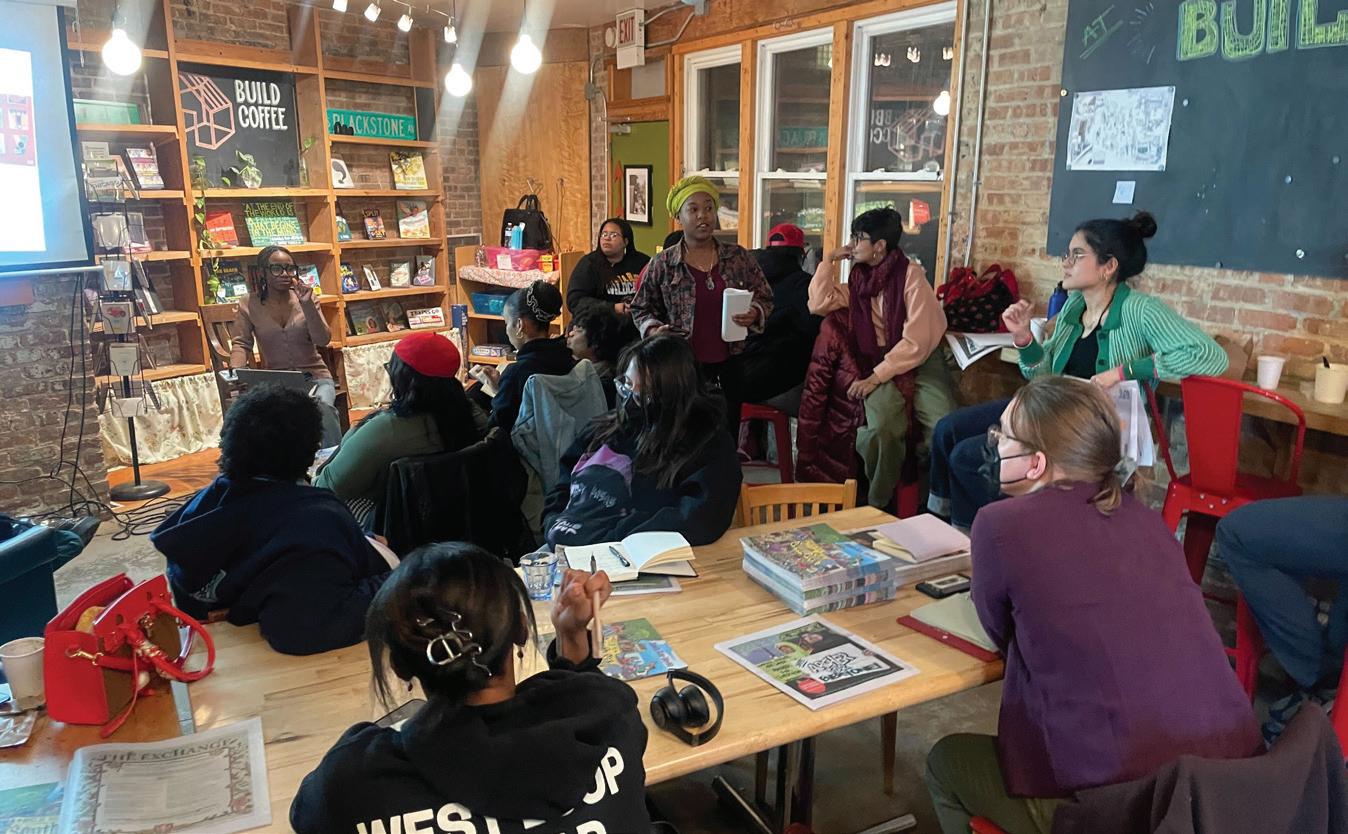
But the flip side is that feeling heard and seen by others in our grief can be transformative. This past Thursday, South Side Weekly and Build Coffee and Books hosted the first of our Third Thursdays open mic and writing workshop. The workshop I composed was inspired by a poem I included in the Exchange, the Weekly’s poetry corner, and explored the grief and warmth created by the passage of time. The past can be a place of deep comfort or sadness, whether we’re reminiscing on childhood memories or looking back to see loved ones that we no longer share space with on this side of earth.
Both the open mic and writing workshop created a moment of pause for participants, and several of them shared pieces that seemed to work perfectly together with this theme. It was almost as if we’d agreed that this was a safe place to be honest about things that are most heavy on our hearts. It makes me wonder: if our individual feelings of grief were more often given the proper space and time to be experienced within a collective, could we move from a state of constant coping to something more? It was empowering to see participants arrive as strangers and become comrades, even exchanging contact information, and reinforced all the reasons we wanted to launch this series in the first place.
The next Third Thursdays will take place on March 19 from 6:30–8:30pm at Build Coffee and Books.
public meetings report
A recap of select open meetings at the local, county, and state level.
scott pemberton and documenters 3
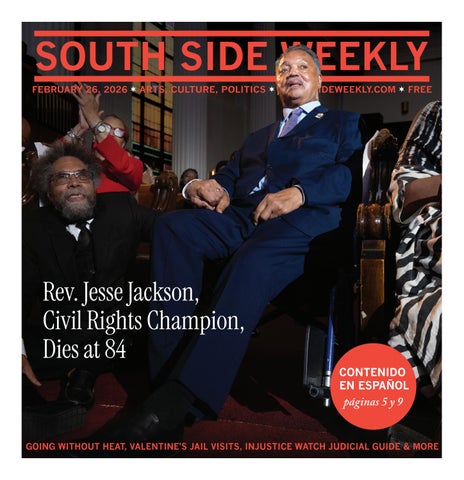
rev. jesse jackson, civil rights champion, dies at 84
While he didn’t match King’s commanding stature or Obama’s ultimate political triumph, Jackson became a moral and political force all the same.
max blaisdell, hyde park herald 4
muere a los 84 años el reverendo jesse jackson, líder de los derechos civiles
Aunque no alcanzó la imponente estatura de King ni el triunfo político final de Obama, Jackson se convirtió de todos modos en una fuerza moral y política. max blaisdell es redactor del hyde park herald, traducido por alma campos 5
march 17 primary election: how to register and vote
Key dates, ID requirements, and voting locations for the election.
chelsea zhao 8
elecciones primarias del 17 de marzo: cómo registrarse y votar
Fechas clave, requisitos de identificación y lugares de votación para las elecciones primarias del 17 de marzo. chelsea zhao, traducido por leslie hurtado ..............9
twenty minutes and a hug
As jails across the country move towards banning in-person physical visits, Cook County’s visitation policies can be a lifeline.
micah clark moody, harley pomper 10
baby, it’s cold inside
Despite Chicago’s heat ordinance, thousands of tenants go without adequate warmth each winter.
jinny kim 12
south, west siders want more indoor sports facilities for youth
“Why don’t we have one in the South Side? Or the West Side?” asks tennis coach Tyrone Mason about indoor courts. jewél jackson ............................................ 14
sol butler: a forgotten olympian in jim crow america
A once internationally known Black athlete comes alive again in a new biography detailing, in part, his life—and death—on the South Side of Chicago.
scott pemberton 15
darkly comic black cypress bayou leans into haunting ancestral pain
Playwright Calhoun and director Ratcliff unpack generational trauma and a whodunit conspiracy that leaves audiences reeling.
sarah luyengi 17 the exchange
The Weekly’s poetry corner offers our thoughts in exchange for yours. chima ikoro 19

A recap of select open meetings at the local, county, and state level.
BY SCOTT PEMBERTON AND DOCUMENTERS
December 29
At its meeting, the Chicago City Council Committee on Budget and Government Operations received clarification on Chicago Public Library funding and comments from Council Member Gilbert Villegas (36th Ward) about proposed state legislation that could jeopardize the city’s earnings from online gambling. Villegas also asked how advanced pension payments would be made. Annette Guzman, the city’s budget director, explained that payments are allocated proportionately across corporate funds, enterprise funds, and special revenue funds. She said an amendment seeks to “remove just over $22 million that was overallocated to the [city’s] corporate fund for additional pension advance.” Federal funding cuts were not discussed. At the general Council meeting that followed, several public commenters advocated to allocate funding to a ministry led by Pastor Sandie Norman, which aims to reduce gun violence.
January 22
At their meeting, commissioners on the board of the Metropolitan Water Reclamation District (MWRD) Board commemorated the life of Rick Garcia, an LGBTQ activist and civic-minded resident. “We are eternally grateful of his life’s work, and we commit to carrying his legacy forward,” said Commissioner Precious Brady-Davis, commenting on Garcia’s support of trans rights and advocacy for marriage equality. Brady-Davis is the “first Black openly trans woman appointed and elected to public office in Cook County history,” according to the district’s website. The Board learned that Tunnel and Reservoir Plan (TARP) mechanical equipment improvements at the Calumet Water Reclamation Plant are projected to cost between $24.23 and $29.33 million. Commissioner Sharon Waller thanked staff, the public, and her fellow commissioners for consideration of the collective value of public health. She said the federal administration has revised the cost/benefit analysis for setting pollution limits to consider “only the cost to industry,” not public health. She reaffirmed MWRD’s mission and requested that MWRD push for continued funding for a wastewater public health surveillance program.
At their meeting, members of the Gender-Based Violence Task Force expected to hear Chicago Police Department (CPD) officials discuss how they handle officers accused of gender-based violence. CPD cancelled the presentation less than twentyfour hours before the meeting. Gender-based violence programs received increased
city funding in the 2026 budget, with $15.5 million coming from the city’s corporate fund. According to the Office of Budget and Management, the corporate fund is the city’s “general operating fund.” It supports “basic city operations and services, such as public safety, public health, transportation, and small business assistance.” A total of $23.2 million is allocated to gender-based violence programs for 2026, an increase from $21.28 million in 2025. Domestic violence arrests have decreased among people who completed State of Illinois Partner Abuse Intervention Programs, according to a Michael Reese Health Trust report. Most participants were required to participate by the courts, signaling a need to increase voluntary participation and to prevent intimate partner violence earlier.
February 9
At its meeting, the Illinois Criminal Justice Information Authority: Missing and Murdered Chicago Women Taskforce (MMCWT) heard Mandy Sark, a cofounder of Chicago Missing Persons Guild, give a presentation about the guild and its history of supporting people looking for missing loved ones. Responding to a question, Sark reported on related trends, Sark said that people with disabilities, senior citizens, and people of color are often reported missing. Formed in 2023 by the Illinois General Assembly, the MMCWT’s responsibility is to investigate the causes of violence against women, girls, and missing persons. The group is made up of state legislators, subject area experts, law enforcement officers, and missing persons advocates. Not enough members attended to reach a quorum, and the task force could not conduct official business.
At their meeting, members of Police District Council 011—Harrison discussed the news that overall homicide numbers in Chicago have continued to fall, reaching a sixty-year low in 2025 and down 29 percent from 2024. Despite such encouraging numbers, community members are not feeling safer, in part blaming ICE activity in the district. Mayor Brandon Johson described 2025 as a “transformational year in our mission to build the safest and most affordable big city in America.” The CPD reported “double-digit decreases in every major category of crime and violence” through December 30. Percentage drops included overall violent crimes (21.3 percent), robberies (36.1 percent), shootings 34.5 (percent), vehicular hijackings 50.0 (percent), and human trafficking 31.3 (percent). Participating in the meeting were two of the three district council members: Chair Bryan Ramson, Jr. and Jocelyn Woodards, a member of the nominating committee. Community Engagement Coordinator Alees Edwards did not attend.
At its meeting, the Community Development Commission (CDC) set dates for public hearings on redevelopment projects in the 27th, 28th, and 34th Wards. It also authorized the city to negotiate a land sale and to select developers for a new affordable housing building in the 28th Ward. One public commenter expressed skepticism about development projects and questioned if migrants have impacted the availability of housing. A second commenter raised concern that homeless veterans receive less support than migrants. A third commenter claimed that the CDC and the government at large are racist and discriminatory. The Commission agreed to review the Eligibility Report and Redevelopment Plan for the proposed Central West Redevelopment Project Area Amendment No. 6; to set a date for a public meeting of the Joint Review Board, which reviews the performance of Tax Increment Financing (TIF) districts; and to set a date for a public hearing. The Commission also agreed to review the Eligibility Report and Redevelopment Plan for the proposed Canal/ Congress Redevelopment Plan Amendment No. 3.
This information was collected and curated by the Weekly in large part using reporting from City Bureau’s Documenters at documenters.org.
While he didn’t match King’s commanding stature or Obama’s ultimate political triumph, Jackson became a moral and political force all the same.
BY MAX BLAISDELL, HYDE PARK HERALD
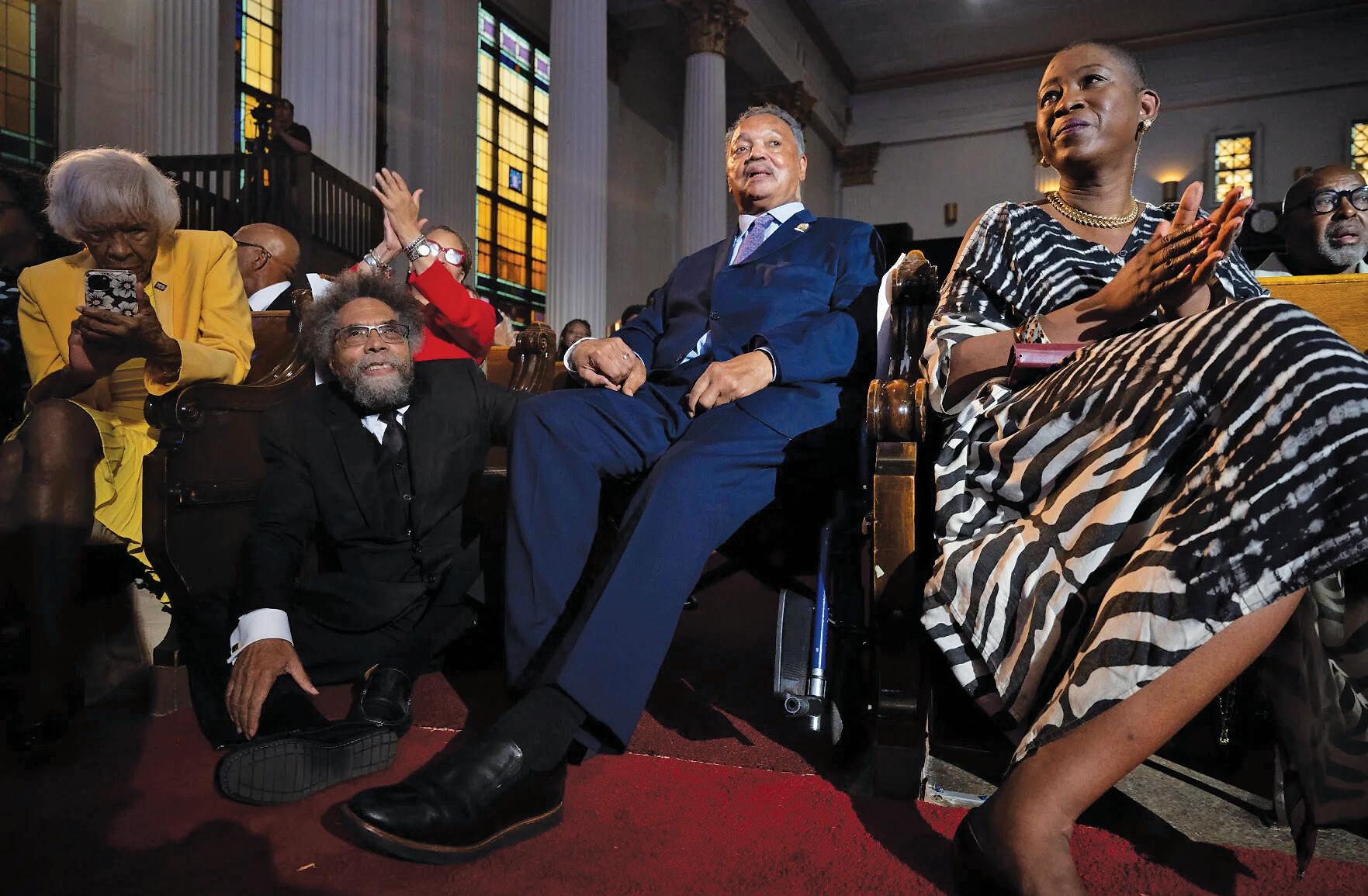
Rev. Jesse Jackson Sr., the impassioned voice of a “rainbow coalition” of the poor and dispossessed, a two-time presidential candidate and a civil rights icon who rose to become one of the country’s most influential Black political figures, died at his home February 17 with family close at hand. He was eighty-four.
“Our father was a servant leader— not only to our family, but to the oppressed, the voiceless, and the overlooked around the world,” his family said in a statement. “We shared him with the world, and in return, the world became part of our extended family. His unwavering belief in justice, equality, and love uplifted millions, and we ask you to honor his memory by continuing the fight for the values he lived by.”
Jackson had been dealing with Parkinson’s disease since 2017 and was diagnosed last year with progressive supranuclear palsy, a rare and severe neurodegenerative condition. He was briefly hospitalized in November.
He rose to national prominence after Rev. Dr. Martin Luther King Jr.’s assassination in 1968 and ran for president twice, long before former President Barack Obama’s election in 2008. While he didn’t match King’s commanding stature or Obama’s ultimate political triumph, through the combined strength of his rhetoric, energy and ambition, Jackson became a moral and political force all the same.
Jackson was born Jesse Louis Burns in 1941, in Greenville, South Carolina.
He was the son of Helen Burns, a sixteenyear-old high school majorette and sharecropper’s daughter, and her married next-door neighbor, a thirty-three-yearold ex-boxer who took no part in Jackson’s upbringing. Burns married Charles Jackson in 1943, and Charles formally adopted Jesse in 1957, giving Jackson his surname. Jackson had said the taunts he endured in his boyhood over his out-ofwedlock birth propelled his aspirations.
After excelling as a student and athlete at Greenville’s all-Black Sterling High School, Jackson enrolled at the University of Illinois Urbana-Champaign on a football scholarship. But he soon transferred to North Carolina Agricultural and Technical State University in Greensboro, a historically Black institution where he
became student body president and fell in love with Jacqueline Lavinia Brown, whom he married in 1962.
Stunned by the beating of demonstrators in Selma, Alabama, he organized fellow students at the Chicago Theological Seminary, where he had enrolled after graduating from Greensboro in 1964, to travel south and join the protests. There, marching for voting rights, he met King and joined the Southern Christian Leadership Conference (SCLC).
In 1966, King tapped Jackson to lead the Chicago chapter of the SCLC’s Operation Breadbasket, an economic justice campaign that mobilized Black churches to pressure businesses to hire and promote Black workers. Jackson was
with King and other civil rights leaders when King was fatally shot in Memphis in 1968. His conduct in the immediate aftermath, including appearing at a Chicago City Council memorial with what he said was King’s blood on his shirt and stating King died in his arms, drew criticism from members of King’s inner circle, who disputed his account of the moments after the shooting.
In 1971, after disputes with the SCLC’s new leadership, Jackson founded Operation PUSH (People United to Save Humanity), operating out of a former synagogue at 920 E. 50th St. in Chicago’s Kenwood neighborhood. Through PUSHled boycotts and negotiations, he pressured major corporations, including AnheuserBusch and Coca-Cola, to invest in Black communities and hire minority workers.
Jackson later merged Operation PUSH with his National Rainbow Coalition, which sought to unite Black voters with labor, farmers, immigrants, the poor and other marginalized groups around shared economic concerns—a vision that reshaped Democratic coalition politics for decades and helped power his presidential bids. The merger created the Rainbow PUSH Coalition, which remains headquartered in Kenwood.
Jackson’s presidential campaigns in 1984 and 1988 announced to the country that a Black candidate could be a serious contender for the country’s highest office. (Shirley Chisholm, a congresswoman from Brooklyn, was the first Black presidential candidate in U.S. history, but failed to garner much support in the 1972 Democratic primaries.)
Running on a populist agenda that challenged Reagan-era policies, Jackson
called for full employment, universal health care, expanded social programs and greater domestic investment, arguing that workers, farmers and the poor of all races shared common economic struggles.
In 1984, fueled by Black voters he had helped register in historic numbers across the South, Jackson garnered 3.2 million primary votes, about 18 percent of the total. In 1988, his progressive grassroots campaign earned nearly 7 million votes, winning thirteen of fifty-four contests, including a landslide over eventual nominee Michael Dukakis in Michigan.
Though he never secured the nomination, Jackson changed party politics. After the 1988 campaign, he helped push the Democratic Party to replace its winner-take-all delegate system with proportional allocation, a rule change that would later benefit Barack Obama’s 2008 campaign.
Jackson’s galvanizing speech at the 1984 Democratic National Convention in San Francisco remains one of the towering pieces of American political oratory. In it, he described America not as a racially homogenous blanket but as a quilt of “many patches, many pieces, many colors, many sizes, all woven and held together by a common thread.”
“The white, the Hispanic, the Black, the Arab, the Jew, the woman, the Native American, the small farmer, the businessperson, the environmentalist, the peace activist, the young, the old, the lesbian, the gay and the disabled make up the American quilt,” he said.
Jackson concluded his 1988 convention speech in Atlanta by shouting “Keep hope alive!” four times, which would become his organization’s signature catchphrase.
In recognition of his public service, Jackson was awarded the Presidential Medal of Freedom in 2000.
Jackson was also a fixture of Chicago civic life for more than half a century, living with his wife in the South Shore neighborhood and making the city his base even after brief stints in Washington, D.C.
Two of his sons, Jonathan and Jesse Jackson Jr., would end up back in Washington as congressmen representing South Side districts, but Jesse Jackson Jr. would resign from Congress while under federal investigation in 2012
for misusing $750,000 in campaign funds. In the waning days of the Biden administration, Jackson sought a pardon for Jesse Jackson Jr., comparing his son’s plight to that of the president's son, Hunter Biden.
Mayor Brandon Johnson, who credited Jackson with encouraging his own rise from a Chicago Teachers Union organizer to public office, called him “an architect of the soul of Chicago” when Jackson stepped down from leadership of Rainbow PUSH in 2023. His third son, Yusef, now runs the organization.
“Through decades of service, he has led the Rainbow PUSH Coalition at the forefront of the struggle for civil rights and social justice. His faith, his perseverance, his love, and his relentless dedication to people inspire all of us to keep pushing for a better tomorrow,” Johnson said.
Even after Jackson’s health began to deteriorate in the late-2010s, he remained publicly active. He spoke at demonstrations following the 2020 killing of George Floyd in Minneapolis and was arrested in Washington in 2021 while protesting Republican efforts to restrict voting rights. As recently as Christmas Day 2024, he was shaking hands with inmates at Cook County Jail after the Rainbow PUSH Coalition’s annual holiday service there. Jackson was also an outspoken supporter of Palestinian rights, for decades amplifying calls for Palestinian self-determination and calling for a ceasefire amid Israel’s recent war on Gaza.
Following news of Jackson’s death, Barack and Michelle Obama released a statement on X commending Jackson for his lifetime of public service.
“For more than sixty years, Reverend Jackson helped lead some of the most significant movements in human history,” the Obamas said. “He was relentless in his belief that we are all children of God, deserving of dignity and respect.”
Jackson is survived by his wife, Jacqueline, his children Santita, Jesse Jr., Jonathan, Yusef, Jacqueline and Ashley, and his grandchildren. Public observances will be held in Chicago, with final arrangements to be released by the Rainbow PUSH Coalition at jessejacksonlegacy.com. ¬
Max Blaisdell is a staff writer at Hyde Park Herald.
Aunque no alcanzó la imponente estatura de King ni el triunfo político final de Obama, Jackson se convirtió de
todos modos en una fuerza moral y política.
POR
MAX BLAISDELL
Esta historia fue publicada en el Hyde Park Herald.
El reverendo Jesse Jackson Sr., la voz apasionada de una “coalición arcoíris” para los pobres y desposeídos, dos veces candidato presidencial e ícono de los derechos civiles que se convirtió en una de las figuras políticas negras más influyentes del país, falleció el 17 de febrero, rodeado de su familia. Tenía 84 años.
“Nuestro padre fue un líder servidor, no sólo de nuestra familia, sino también de los oprimidos, los que no tienen voz y los marginados de todo el mundo”, declaró su familia en un comunicado. “Lo compartimos con el mundo y, a cambio, el mundo se convirtió en parte de nuestra familia extendida. Su inquebrantable creencia en la justicia, la igualdad y el amor inspiró a millones de personas, y les pedimos que honren su memoria continuando la lucha por los valores que él vivió”.
Jackson padecía la enfermedad de Parkinson desde 2017 y el año pasado le diagnosticaron parálisis supranuclear progresiva, una enfermedad neurodegenerativa rara y grave. En noviembre, fue hospitalizado brevemente.
Saltó a la fama nacional tras el asesinato del reverendo Dr. Martin Luther King Jr. en 1968 y se postuló a la presidencia en dos ocasiones, mucho antes de la elección del
TRADUCIDO POR GISELA OROZCO
expresidente Barack Obama en 2008. Si bien no alcanzó la imponente estatura de King ni el triunfo político final de Obama, gracias a la fuerza combinada de su retórica, energía y ambición, Jackson se convirtió en una fuerza moral y política.
Jackson nació como Jesse Louis Burns en 1941, en Greenville, Carolina del Sur. Era hijo de Helen Burns, una joven de 16 años, hija de un aparcero y majorette de la escuela secundaria, y su vecino casado, un ex boxeador de 33 años que no tuvo participación en la crianza de Jackson. Burns se casó con Charles Jackson en 1943, y Charles adoptó formalmente a Jesse en 1957, dándole a Jackson su apellido. Jackson había dicho que las burlas que soportó en su infancia por haber nacido fuera del matrimonio impulsaron sus aspiraciones. Tras destacar como estudiante y deportista en la escuela secundaria, Sterling High School de Greenville, una escuela exclusivamente negra, Jackson se inscribió en la universidad University of Illinois en Urbana-Champaign con una beca de fútbol americano. Sin embargo, pronto se trasladó a la universidad North Carolina Agricultural and Technical State University de Carolina del Norte en Greensboro, una institución históricamente negra, donde se convirtió en presidente del cuerpo estudiantil y se enamoró de Jacqueline Lavinia Brown, con quien se casó en 1962.
Aturdido por la paliza a los manifestantes en Selma, Alabama, organizó a sus compañeros del seminario, Chicago Theological Seminary, donde se inscribió tras graduarse de Greensboro en 1964, para que viajaran al sur y se unieran a las protestas. Allí, marchando por el derecho al voto, conoció a King y se unió a la organización Southern Christian Leadership Conference (SCLC) dedicada a la lucha por los derechos civiles.
En 1966, King nombró a Jackson para dirigir la sección de Chicago de la Operation Breadbasket de la SCLC, una campaña de justicia económica que movilizó a las iglesias negras para presionar a las empresas para que contrataran y ascendieran a trabajadores negros. Jackson estaba con King y otros líderes de los derechos civiles cuando King recibió un disparo mortal en Memphis en 1968. Su conducta inmediatamente después, incluyendo aparecer en un servicio conmemorativo del Concejo Municipal de Chicago diciendo que la sangre en su camisa era de King y afirmar que King murió en sus brazos, generó críticas de miembros del círculo íntimo de King, quienes cuestionaron su versión de los momentos posteriores al tiroteo.
En 1971, tras disputas con la nueva dirección de la SCLC, Jackson fundó la organización, Operation PUSH (Personas Unidas para Salvar a la Humanidad), que operaba desde una antigua sinagoga en el 920 E. 50th St., en el vecindario de Kenwood de Chicago. Mediante boicots y negociaciones liderados por PUSH, presionó a grandes corporaciones, como AnheuserBusch y Coca-Cola, para que invirtieran en las comunidades negras y contrataran a trabajadores pertenecientes a minorías.
Posteriormente, Jackson fusionó la Operación PUSH con su National Rainbow Coalition, una coalición nacional, cuyo objetivo era unir a los votantes negros con los trabajadores, agricultores, inmigrantes, personas de bajos recursos y otros grupos marginados en torno a preocupaciones económicas compartidas. Esta visión transformó la política de coalición demócrata durante décadas y contribuyó a impulsar sus candidaturas presidenciales. La fusión creó la Rainbow PUSH Coalition, cuya sede se mantiene en Kenwood.
Las campañas presidenciales de Jackson en 1984 y 1988 anunciaron al país que un candidato negro podría ser un serio contendiente para el cargo más alto del país. (Shirley Chisholm, congresista de Brooklyn, fue la primera candidata presidencial negra en la historia de
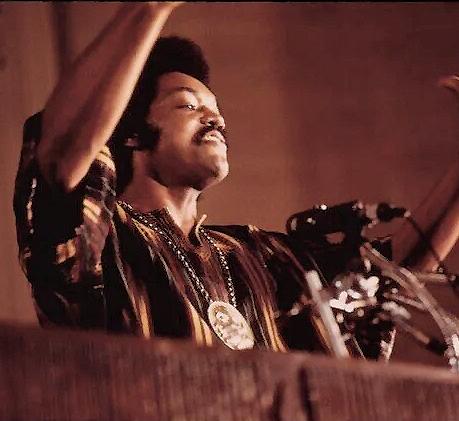
El reverendo Jessie Jackson Sr. habla en una transmisión de radio de la oficina central de la Operation PUSH en su convención anual, en julio de 1973
Estados Unidos, pero no logró mucho apoyo en las primarias demócratas de 1972).
Con una agenda populista que desafiaba las políticas de la era Reagan, Jackson abogó por el pleno empleo, la atención médica universal, la ampliación de los programas sociales y una mayor inversión nacional, argumentando que los trabajadores, los agricultores y los pobres de todas las razas compartían dificultades económicas comunes.

Jesse Jackson haciendo campaña en el Distrito Castro en San Francisco, California, el 6 de junio de 1988.
política estadounidense. En él, describió a Estados Unidos no como una manta racialmente homogénea, sino como una colcha de “muchos parches, muchas piezas, muchos colores, muchos tamaños, todos tejidos y unidos por un hilo común”.
“Los blancos, los hispanos, los negros, los árabes, los judíos, las mujeres, los nativos americanos, los pequeños agricultores, los empresarios, los ambientalistas, los activistas por la paz, los jóvenes, los ancianos, las lesbianas, los gays y los
“Durante más de 60 años, el reverendo Jackson ayudó a liderar algunos de los movimientos más significativos de la historia de la humanidad.”
En 1984, impulsado por los votantes negros que él ayudó a registrar en cifras históricas en todo el Sur, Jackson obtuvo 3.2 millones de votos en las primarias, aproximadamente el 18% del total. En 1988, su campaña progresista de base obtuvo casi 7 millones de votos, ganando 13 de 54 contiendas, incluyendo una victoria aplastante sobre el eventual candidato Michael Dukakis en Michigan.
Aunque nunca consiguió la nominación, Jackson cambió la política partidista. Después de la campaña de 1988, ayudó a impulsar al Partido Demócrata a reemplazar su sistema de delegados de “el ganador se lo lleva todo” por uno de asignación proporcional, un cambio de reglas que posteriormente beneficiaría la campaña de Barack Obama en 2008.
El discurso electrizante de Jackson en la Convención Nacional Demócrata de 1984 en San Francisco, California, sigue siendo una de las piezas más destacadas de la oratoria
de fondos de campaña. En los últimos días de la administración de Biden, Jackson solicitó el indulto para Jesse Jackson Jr., comparando la difícil situación de su hijo con la del hijo del presidente, Hunter Biden.
El alcalde Brandon Johnson, quien atribuyó a Jackson su propio ascenso desde organizador del Sindicato de Maestros de Chicago (CTU) hasta un cargo público, lo llamó “un arquitecto del alma de Chicago” cuando Jackson renunció al liderazgo de la Rainbow PUSH en 2023. Su tercer hijo, Yusef, ahora dirige la organización.
“A lo largo de décadas de servicio, ha liderado la Rainbow PUSH Coalition, a la vanguardia de la lucha por los derechos civiles y la justicia social. Su fe, su perseverancia, su amor y su incansable dedicación a la gente nos inspiran a todos a seguir luchando por un futuro mejor”, dijo Johnson.
Incluso después de que la salud de Jackson comenzara a deteriorarse a finales de la década de 2010, se mantuvo activo públicamente. Habló en manifestaciones tras el asesinato de George Floyd en Minneapolis en 2020 y fue arrestado en Washington en 2021 mientras protestaba contra los intentos republicanos de restringir el derecho al voto.
discapacitados conforman el mosaico estadounidense”, dijo.
Jackson concluyó su discurso en la convención de 1988 en Atlanta gritando “¡Mantengan viva la esperanza!” cuatro veces, lo que se convertiría en el lema distintivo de su organización.
En reconocimiento a su servicio público, Jackson recibió la Medalla Presidencial de la Libertad en el año 2000.
Jackson también fue una figura clave en la vida cívica de Chicago durante más de medio siglo, viviendo con su esposa en el vecindario de South Shore y haciendo de la ciudad su base incluso después de breves estancias en Washington, D.C.
Dos de sus hijos, Jonathan y Jesse Jackson Jr., regresaron a Washington como congresistas en representación de los distritos del lado sur, pero Jesse Jackson Jr. renunciaría al Congreso mientras estaba bajo investigación federal en 2012 por malversación de $750,000
Tan recientemente como el día de Navidad de 2024, saludó a reclusos de la cárcel del Condado de Cook después del servicio festivo anual de la Rainbow PUSH Coalition. Jackson también fue un firme defensor de los derechos palestinos, y durante décadas amplió los llamados a la autodeterminación palestina y exigió un alto el fuego en medio de la reciente guerra de Israel contra Gaza.
Tras la noticia de la muerte de Jackson, Barack y Michelle Obama emitieron un comunicado en X elogiando a Jackson por su trayectoria de servicio público.
“Durante más de 60 años, el reverendo Jackson ayudó a liderar algunos de los movimientos más significativos de la historia de la humanidad”, dijeron los Obama. “Fue inquebrantable en su creencia de que todos somos hijos de Dios, merecedores de dignidad y respeto”.
A Jackson le sobreviven su esposa, Jacqueline, sus hijos Santita, Jesse Jr., Jonathan, Yusef, Jacqueline y Ashley, y sus nietos. Las ceremonias públicas se celebrarán en Chicago; la Rainbow PUSH Coalition publicará los detalles finales en jessejacksonlegacy.com. ¬
Max Blaisdell es redactor del Hyde Park Herald.



Key
dates, ID requirements, and voting locations for
the March 17 primary election. A breakdown of who can vote, how to register, and where to cast a ballot.
BY CHELSEA ZHAO
In the Democratic U.S. Senate primary, Rep. Raja Krishnamoorthi (8th District), Lt. Gov. Juliana Stratton (formerly state House 5th District), and Rep. Robin Kelly (2nd District) are competing to replace retiring U.S. Sen. Dick Durbin.
In the Democratic primary for Illinois’ 2nd Congressional District, former Rep. Jesse Jackson Jr. (previously represented the 2nd District), Cook County Commissioner Donna Miller (6th District), State Sen. Robert Peters (15th District), State Sen. Willie Preston (16th District), and Metropolitan Water Reclamation District Commissioner Yumeka Brown, among others, are vying for the open seat.
Voters will also choose nominees for other U.S. House seats, state legislative districts, and a range of countywide and local offices, as well as judicial positions for circuit and appellate courts. Included with this issue is a judicial guide from Injustice Watch. The Weekly will have more election stories in an upcoming issue..
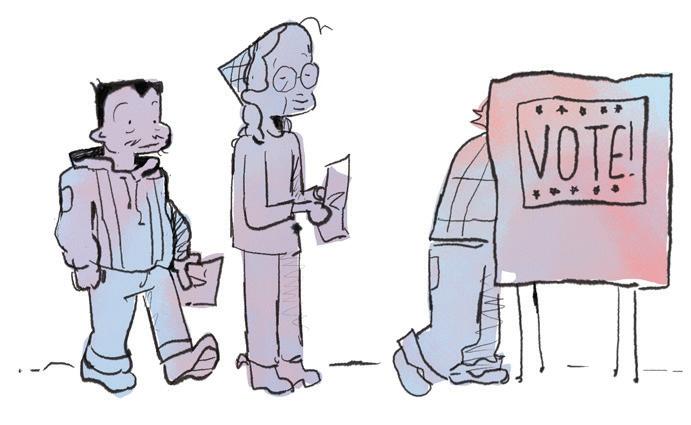
Who can vote
• U.S. citizens
• Must be at least eighteen years old on Election Day
• Have lived in your precinct at least thirty days before Election Day
• Have completed a felony prison sentence (you may vote even if you are on parole or probation)
• Residents of Illinois who attend college in another state or residents of another state who attend Illinois colleges
• Are not registered to vote in another state
• Regular registration closed twentyeight days before Election Day (Feb. 17—closed)
• Online registration is open until sixteen days prior to the Election Day
• Grace period registration and voting begin twenty-seven days before Election Day and voters can register in person at designated sites
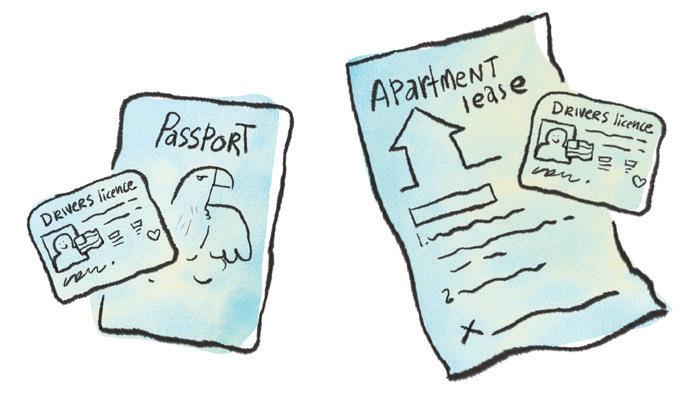
Acceptable forms of ID include:
• Passport or military ID
• Driver’s license or state ID card
• College, university or work ID
• Vehicle registration card
• Lease or mortgage documents
• Credit or debit card
• Civic, union of professional membership card
• Social Security, Medicare, or Medicaid card
• LINK or public aid card
• Illinois FOID card
Voters do not need to show an ID if they are already registered at their current address and voting in their home precinct. When an election judge challenges the person’s right to vote or when a voter submitted a mail-in registration with no Illinois ID, then the voter must submit a form of ID with the voter's current address. The voter must provide two forms of ID when he or she is filing an address or name change registering inperson in the home precinct.

Mail-in ballots
Illinois offers no-excuse vote-by-mail that allows voters to decide the best voting methods. The Chicago Board of Elections has secured drop boxes for voters to drop off their mail-in ballots at the fifty early voting sites and super-sites. Officials recommend mailing ballots early if using USPS. Changes to USPS transportation operations, which began January 1, mean that some mail will not arrive at processing facilities, where postmarking occurs, on the same day it is sent out. This means if the date the post office processes the mail—not when you drop it off— is the postmarked date for your eligible ballot.
A registered voter can cast a ballot through March 17 at an early voting center or office of the election authority. A registered voter
Early Voting Locations
Centros de Votación Anticipada
Supersites (begins February 12, 2026):
• 137 S. State St.
• 69 W. Washington St., 6th floor
Supercentros (a partir del 12 de febrero de 2026):
• 137 S. State St.
• 69 W. Washington St., 6. piso
can request absentee voting by mail or sign up to permanently vote by mail.
The primary election is Tuesday, March 17. Registration deadlines are:
• Online: Until Sunday, March 1
• By mail (postmarked): Until March 12.
• In-Person: Tuesday, March 17, 6am–7pm ¬
Chelsea Zhao is a Chicago-based freelance journalist who covers immigration, health, and environment. She works full-time in healthcare and received her MSJ from Medill School of Journalism at Northwestern University.
Ward voting sites: Centros de votación por distrito:
1 – 1615 W. Chicago Ave.
2 – 310 W. Division St.
3 – 3901 S. State St.
4 – 4314 S. Cottage Grove Ave.
5 – 6330 S. Stony Island Ave.
6 – 415 E. 79th St.
7 – 2400 E. 105th St.
8 – 10001 S. Woodlawn Ave.
9 – 201 E. 111th St.
10 – 3710 E. 106th St.
11 – 2901 S. Poplar Ave.
12 – 1915 W. 35th St.
13 – 6423 W. 63rd Pl.
14 – 5055 S. Archer Ave.
15 – 4830 S. Western Ave.
16 – 6054 S. Damen Ave.
17 – 7506 S. Racine Ave.
18 – 8530 S. Kedzie Ave.
19 – 3721 W. 111th St.
20 – 731 E. 63rd St.
21 – 830 W. 119th St.
22 – 2708 S. Pulaski Rd.
23 – 5157 S. McVicker Ave.
24 – 3151 W. Douglas Blvd.
25 – 1805 S. Loomis St.
26 – 1605 N. Troy St.
27 – 1501 W. Randolph St.
28 – 4624 W. Madison St.
29 – 6200 W. Bloomingdale Ave.
30 – 3501 N. Kilbourn Ave.
31 – 5108 W. Belmont Ave.
32 – 1701 N. Milwaukee Ave.
33 – 3401 W. Ainslie St.
34 – 750 S. Halsted St.
35 – 3390 N. Avondale Ave.
36 – 3104 N. Narragansett Ave.
37 – 4856 W. Chicago Ave.
38 – 8029 W. Forest Preserve Dr.
39 – 5801 N. Pulaski Rd.
40 – 5630 N. Lincoln Ave.
41 – 6083 N. Northwest Hwy.
42 – 803 N. Dearborn St.
43 – 1150 W. Fullerton Ave.
44 – 814 W. Nelson St.
45 – 5826 N. Elston Ave.
46 – 1145 W. Wilson Ave.
47 – 2333 W. Sunnyside Ave.
48 – 5917 N. Broadway St.
49 – 1610 W. Howard St.
50 – 6800 N. Western Ave.
Fechas clave, requisitos de identificación y lugares de votación para las elecciones primarias del 17 de marzo. Una guía sobre quién puede votar, cómo registrarse y dónde emitir su voto.
POR CHELSEA ZHAO TRADUCIDO POR LESLIE HURTADO
El día de las elecciones en Illinois es el 17 de marzo. En este ciclo se eligen cargos como senador de Estados Unidos, gobernador y vicegobernadora de Illinois, fiscal general, secretario de Estado, contralor estatal, tesorero estatal y superintendente regional de escuelas.
En la primaria demócrata para el Senado de los Estados Unidos, el representante Raja Krishnamoorthi (8.º Distrito), la vicegobernadora Juliana Stratton (antes representante del 5.º Distrito estatal) y la representante Robin Kelly (2.º Distrito) compiten para reemplazar al senador federal Dick Durbin, quien se retira.
En la primaria demócrata del 2.º Distrito Congresional de Illinois, el exrepresentante Jesse Jackson Jr. (quien representó anteriormente el 2.º Distrito), la comisionada del Condado de Cook Donna Miller (6.º Distrito), el senador estatal Robert Peters (15.º Distrito), el senador estatal Willie Preston (16.º Distrito) y la comisionada del Metropolitan Water Reclamation District, Yumeka Brown, entre otros, compiten por el escaño vacante.
Los votantes también elegirán a los candidatos nominados para otros escaños de la Cámara de Representantes de Estados Unidos, distritos legislativos estatales y varios cargos del condado y cargos locales, además de puestos judiciales en los tribunales de circuito y de apelaciones. Con esta edición se incluye una guía judicial de Injustice Watch. El Weekly tendrá más historias sobre las elecciones en una próxima edición.
¿Quién puede votar?
• Ciudadanos estadounidenses
• Deben tener al menos 18 años el día de la elección
• Haber vivido en su distrito al menos 30 días antes del día de la elección
• Haber cumplido una sentencia de prisión por delito grave (puede votar incluso si está en libertad condicional o en libertad
condicional)
• Residentes de Illinois que asisten a la universidad en otro estado o residentes de otro estado que asisten a universidades de Illinois
• No están registrados para votar en otro estado
Registrarse para votar/Cambiar de dirección o nombre
• El registro regular cerró 28 días antes del día de las elecciones (17 de febrero— cerrado).
• El registro en línea está abierto hasta 16 días antes del día de la elección
• El período de gracia de registro y votación comienza 27 días antes del día de la elección y los votantes pueden registrarse en persona en los sitios designados
Las formas aceptables de identificación incluyen:
• Pasaporte o identificación militar
• Licencia de conducir o tarjeta de identificación estatal
• Identificación universitaria, de trabajo o de colegio
• Tarjeta de registro del vehículo
• Documentos de arrendamiento o hipoteca
• Tarjeta de crédito o debito
• Tarjeta de afiliación cívica, sindical o profesional
• Tarjeta de Seguro Social, de Medicare o de Medicaid
• LINK o tarjeta de ayuda pública
• Tarjeta de identificación para propietarios de armas de fuego de Illinois (FOID)
Los votantes no necesitan mostrar una identificación si ya están registrados en su domicilio actual y votan en su distrito electoral. Si un juez electoral impugna el derecho a votar de una persona o si un votante presentó un registro por correo sin una identificación de Illinois, deberá presentar una identificación con su domicilio actual. El votante debe
proporcionar dos identificaciones al solicitar un cambio de domicilio o nombre registrándose en persona en su distrito electoral.
Boletas por correo
Illinois ofrece la opción de votar por correo. Cualquier votante registrado puede solicitar una boleta y elegir el método de votación que más le convenga. La Junta Electoral de Chicago ha habilitado buzones para que los votantes depositen sus boletas por correo en los cincuenta centros de votación anticipada y los supercentros de votación. Se recomienda enviar las boletas por correo anticipadamente si utilizan el Servicio Postal de Estados Unidos (USPS). Un nuevo cambio en la política postal, vigente desde el 24 de diciembre de 2025, establece que la fecha del matasellos corresponde a cuando el correo se procesa en una instalación postal, y no necesariamente a la fecha en que se depositó.
Votación anticipada
Los votantes registrados pueden emitir su voto antes del 17 de marzo en un centro de votación anticipada o en una oficina de la autoridad electoral. Pueden solicitar el voto en ausencia por correo o inscribirse para votar permanentemente por correo.
Día de las elecciones
Las elecciones primarias son el martes 17 de marzo. Las fechas límite de inscripción son:
• En línea: Hasta el domingo 1 de marzo
• Por correo postal (con matasellos): Hasta el 12 de marzo
• En persona: Martes 17 de marzo, de 6:00 a.m. – 7:00 p.m. ¬
Chelsea Zhao es una periodista independiente de Chicago. Zhao cubre temas de inmigración, salud y medio ambiente. Trabaja a tiempo completo en el sector de la salud y estudió una maestría en periodismo (MSJ) en la Medill School of Journalism de Northwestern University.

As jails across the country move towards banning in-person physical visits, Cook County’s visitation policies can be a lifeline.
BY MICAH CLARK MOODY, HARLEY POMPER
To protect people who choose to speak with the Weekly for our Doing Time series, we use pseudonyms to refer to insiders and only first names to refer to loved ones on the outside who visited insiders.
On Valentine’s Day, Star spent twenty minutes talking to her fiance across a long plastic table. As the visit came to an end, she finally got to do something she’d been waiting for the whole time: give her fiancé a big hug.
“I’ve been coming up here for eight months now; it’s a bit overwhelming still,” Star said. “But once—at the end of the visit—once I’m able to hug my loved one, it make me feel a whole lot better…It put a smile on my face, it relieves a little bit of stress until the next time.”
Research from the Prison Policy Initiative shows that regular contact, including physical contact, between incarcerated people and their loved ones, such as family members, partners, children, and friends, leads to better health and lower rates of both violence and recidivism for insiders.
Yet across the state and country, jails and prisons have increasingly banned inperson visits, replacing them with video calls from jail-specific kiosks about the size of an iPad. The trend picked up at the beginning of the pandemic, when jails that had instituted temporary bans
for reasons of public health never lifted them. The Weekly surveyed the visitation policies for all ninety-three jails in Illinois and found that sixty-three have banned in-person visits.
In this, Cook County Jail is an outlier. The jail brought in-person visits back after the height of the COVID-19 pandemic. According to a spokesperson with the Cook County Sheriff’s Office (CCSO), “Face-to-face contact is a vital part of preserving family bonds and supporting the well-being of those in custody. While video visits can supplement, they cannot replace the value of personal interaction. For this reason, we have chosen to
continue in-person visits as part of our commitment to promoting humane and meaningful family connections.”
In addition, the jail maintains nocost video calls and phone calls that are significantly cheaper than at jails across the state. While some jailed people are disciplined or punished by losing the privilege of visits, for many insiders and their loved ones, visits and calls are a crucial connection.
On Valentine’s Day, the Weekly interviewed five people leaving Cook County Jail after visits with their loved ones. Manda flew in from Colorado to see her boyfriend. Ashley brought her toddlers
to see their dad. Star visited her fiancé. Jose brought Rosary, his friend’s three-year-old daughter, to see her mom. Ravin visited her friend so he wouldn’t be alone.
The Weekly also spoke with two insiders: Anthony, who is one of nearly two hundred people in Cook County Jail who have been incarcerated for more than five years; and Manuel, who is facing deportation.
Everyone the Weekly spoke with said the most important moment of their visit is being able to hug.
Leading up to her visit, Ravin said she was “nervous, scary.” “I have been to jail before,” she said. “So, walking behind them walls ain’t nothing pleasant to me. The whole time I was jittery, stuff like that, because I don’t ever want to get locked up. I got locked up [for seventy-two hours] so I just don’t like coming here, I be nervous and scared every time I come to the county.”
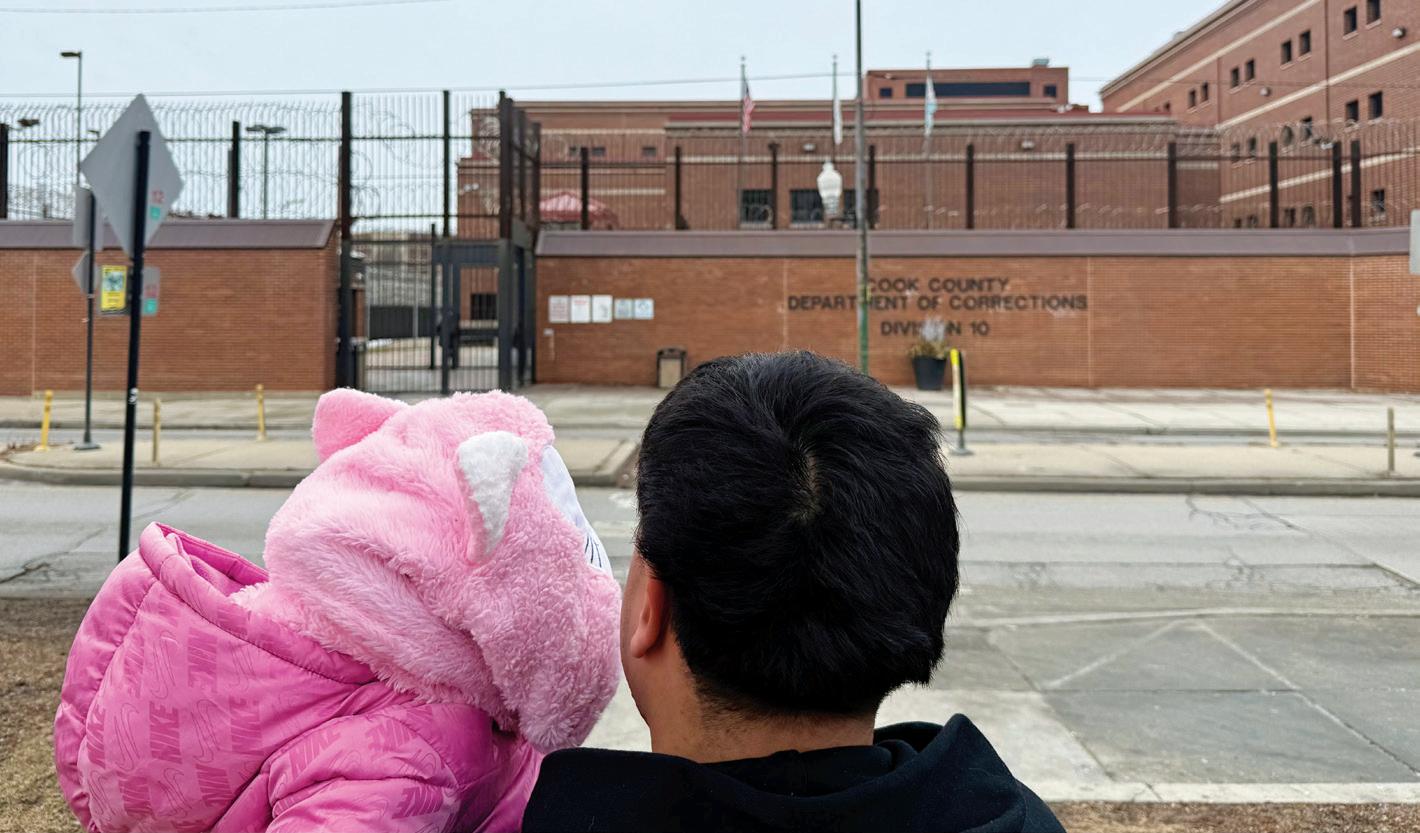
Entering the visiting room in Division 10, where Ravin saw her friend, involves walking up to the wall of the jail, walking through an external and internal gate, sitting in a waiting room, going through metal detectors, and then being escorted by guards to the visitation gymnasium.
Ravin said she came to surprise a friend despite her fear, “because today’s Valentine’s Day, and he didn’t expect nobody to come on Valentine’s Day.”
To Ravin, love means “just checking on people. You never know what nobody going through.”
Visits in Division 10 take place in a gym with insiders and loved ones sitting at opposite ends of a two-and-a-half by six foot folding table. “Division 10 is designed as an open concept within a large gymnasium with separate areas designated for male and female populations. Visiting stations are equipped with a table and chairs as well as a children’s play space to reduce anxieties and adverse experiences associated with correctional settings. There are no Plexiglass dividers separating individuals in custody from those who are visiting them,” according to a CCSO spokesperson.
“When I bring my kids he gets to sit and hold them the entire time,” Ashley said. “I like bringing them so he can have somebody to hold, because I know he can’t do that in there; he’s alone.”
Ashley’s children are two-year-old twins. Her jailed partner calls often, and the family also does video calls. Ashley said the kids ask for him a lot. She’s glad he can be with the kids the entire visit, and is grateful for their one hug at the end, but wishes, as adults, she could hold his hand their entire twenty minutes together.
Jose brings three-year-old Rosary to visit her mom. “She gets to go up to her [mom], she gets to touch her, she’s allowed to be with her [mom] the whole time,” Jose said. “[My friend and I] can’t touch but, at the end, I’m allowed to give her a hug before we say goodbye.”
Jose is close with Rosary’s mom because when he was feeling low, she consistently checked in on Jose, supporting him through a dark time. Now, Jose brings her daughter to visit every weekend and sometimes during the week. “If you have a loved one, if you really care about them, just try to do your best to be there for them physically and mentally,” Jose said. “You never know what someone's going through.”
“The first Valentine’s Day letter was actually sent from a man in prison in 1415,” Manda said after a jail visit with her boyfriend, referring to the oldest known surviving Valentine written by an imprisoned member of the French royal family to his wife.
“Valentine’s Day holds a significance for us, actually, because [when he was arrested] we were not together,” Manda said. She struggled with whether to send a
Valentine’s Day letter confessing her feelings and risk their fifteen-year friendship, but after reading her Valentine, he shared that he also had feelings for Manda. “It really meant a lot to him because he said he hadn’t gotten a Valentine’s Day card or celebrated since he was in fifth grade.”
Now, Manda flies from Colorado to Chicago to visit him after payday each month, and twice when she has the money.
“In Colorado we don’t have in-person visits, we have [calls] through the video screen,” said Manda. “[Chicago] is totally different than what I’m used to; [here] we get to hug them.”
Visit policy is set at the county level by sheriffs, which operate county jails. If someone is found guilty of a crime and sentenced to serve more time than they’ve already spent in jail, they are moved to prison where policies are set by a state-level Department of Corrections. Across the country, including in Manda’s home state of Colorado, many local sheriffs have chosen to ban visits. There is a pending lawsuit in Colorado alleging that banning visits violates children’s right to family integrity, children’s “right to hug” their parents.
In Illinois, visitation policies and the costs of phone calls and messaging services are set by county sheriffs. According to the Prison Policy Initiative, the average cost to make a call from a local jail in Illinois in 2024 was $3.01 for fifteen minutes. CCSO charges $0.75 for 15 minutes. In Los Angeles County, the only county larger than Cook County, phone calls are free.
Calls are a critical supplement to visits. Star talks with her fiance six or seven times a day, which costs about $9. Ashley calls two to four times per day, paying $3 to $6. Manda pays $6 a day, calling for the two hours her fiance is out of his cell.
Anthony is one of the 195 people who has been incarcerated in Cook County Jail for more than five years. That experience has been increasingly isolating, he said: “My brother, my mom, daughters, nobody is able to come and see me.”
Anthony got a ticket—the jail term for being written up for breaking a rule— and was punished by losing visits. Banning visits completely separates Anthony from his mother. “She’s from the hills, from Mexico,” he said. “She doesn’t know how to do technology; she barely uses cell phones.” Because of the restriction on
visits, Anthony hasn’t seen his mother in more than five months.
“I haven’t talked to my son in a long time,” he said. “I don’t know why, I don’t know what’s wrong with him. My daughter, she left for Georgia with her mother, far away. We love each other a lot, but I don't know why we're so distant. I blame it on the county because it makes everything so difficult here.”
Currently, out of 5,798 people jailed, 536 are on visit restriction. A CCSO spokesperson said visit restrictions are in response to major disciplinary infractions and that restrictions are “temporary.”
Manuel has been separated from his wife and four kids since last June. He is facing immigration proceedings in addition to his arrest and is afraid of being deported. Video calls are a distraction from this fear and a chance to connect with his family.
“You know, seeing my kids and my wife, seeing my newborn—it’s a lifting experience,” he said. When Manuel can see them on a video call, it feels like “you get to leave from this place within just ten or fifteen minutes.”
To Manda, Valentine’s Day seemed special for everyone. “I feel like people are
in a better mood. You got a lot of people in there wearing red, the kids got their hair done super cute.”
Everyone the Weekly interviewed wore a red or pink outfit.
Star’s outfit had a special significance. “When we went out last year, this is what I wore,” she said. “[My fiancé] wanted me to re-wear what I had on to get him back that memory of us being together.”
Ashley agreed the visiting room felt special. “It just felt like love was in the air, like everybody in the room was smiling. That’s what it felt like, just love everywhere.”
“You just got to try and be strong,” Manda said. “And if you love somebody on the inside, try to be strong for them. That’s all we can do.”¬
Micah Clark Moody is a PhD candidate in Sociology at Northwestern University. She has investigated pretrial jailing systems in Michigan, Los Angeles, and Chicago.
Harley Pomper is a PhD student in social work at the University of Chicago. They organize across jail walls to report on carceral injustices and political repression.

Despite Chicago’s heat ordinance, thousands of tenants go without adequate warmth each winter.
BY JINNY KIM
In December, twenty-seven-year old Daniela Silva experienced her first Chicago winter without heat.
After moving to the city with her partner and twelve-year old son last February from Bolivia by way of a shelter in San Antonio, Texas, they began renting a unit in a four-story apartment in South Shore. (“Daniela Silva” is a pseudonym the Weekly is using at her request).
Before the heat was cut off, Silva alerted the owners about water leaks that occurred when the heat was turned on. In response, they told her that they would shut off the heat and that she would need to purchase her own heaters.
As temperatures plummeted, the family burrowed under layers of blankets to stay warm, and it became challenging to cook.
“Because we weren’t eating properly, I didn’t have milk in my breasts because I wasn’t eating well,” Silva said. “It was the cold that prevented me from doing anything.”
“My son was getting thinner, because we only had tea or coffee with bread and an egg. That’s how we survived,” she said.
While the heat eventually returned, the water leak came back as well, resulting in the living room ceiling partially collapsing. “That’s how the madness began,” Silva said.
“Suddenly water started pouring down and hit the table, making my phone fly. That night, I really couldn’t sleep because I was in the final stages of labor,” she said. “I was scared. I was really afraid something would happen to my children, especially.”
When she notified the person collecting her rent, she was told that the owners were informed and they would come to meet with her.
But no one ever showed up.
Silva and her family eventually moved in January, after enduring a collapsed ceiling and water leaks in their
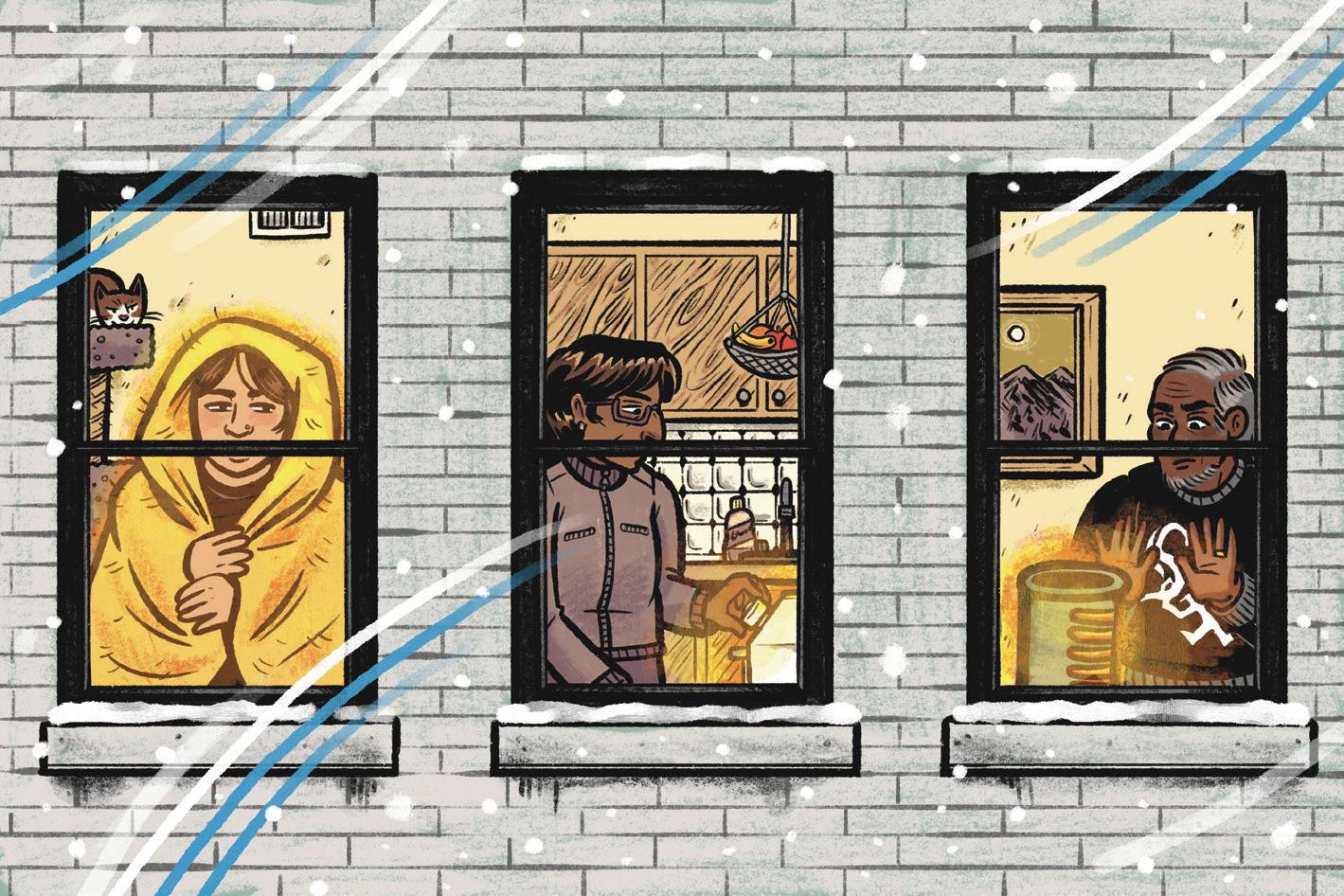
freezing apartment for a month.
When asked why she had not reported the landlord, Silva said she was afraid of retaliation, including possible eviction.
“I didn’t know what might happen if I reported it. Besides, I came to live there because I had nowhere else to live,” Silva said.
In Chicago, the city’s heat ordinance mandates that landlords keep apartment temperatures at a minimum of 68°F from 8:30am to 10:30pm and 66°F from 10:30pm to 8:30am from September 15 to June 1. For each day they’re not in compliance, landlords are fined $500 to $1,000 per violation.
The Residential Landlord and Tenant Ordinance (RLTO) also provides various tenant protections. Under RLTO, tenants are able to withhold a portion of their rent or terminate the lease if the landlord fails to supply heat within a given period after providing a written notice. Tenants can also find substitute housing or buy heaters and deduct the cost from their rent.
However, many tenants in Chicago still struggle to access adequate heat in
the winter every year.
Over the past two heating seasons, between September 15, 2024 and January 22, 2026, tenants made about 4,900 calls to the City of Chicago regarding inadequate heat, according to 311 City Services. Between September 15, 2024 and February 3, 2026, the City issued more than 800 violations for breaches of the heat ordinance.
Heat issues disproportionately impact residents of low-income communities, who are already experiencing housing insecurity and other financial strains.
About half of the calls and 63% of violations occurred in low-income neighborhoods (defined as Census tracts where at least a quarter of the population live below 125% of the poverty line).
These issues are also concentrated in majority-Black neighborhoods that have faced decades of segregation and disinvestment. Around half of the calls and 65% of violations were in majorityBlack neighborhoods, even though about 30% of the city consists of majority-Black census tracts.
Since 2021, about ninety-five properties have had at least three repeat violations. The top violator during this period is a property at 5947 S. Indiana Avenue in Hyde Park, owned by St. Edmund’s Manor LP, with eight violations. Three were logged in 2021, one in 2022, three in 2024, and one in 2025, according to documents reviewed by the Weekly
In an emailed response to the Weekly’s questions, a former property manager at St. Edmund’s Manor wrote, “We acknowledge that we had heating problems in 2023 that resulted in our replacing the boiler at a cost of $24,500 on or around October 2023.”
Tenant advocates say a major part of the problem is lack of maintenance.
“Not only are you [with low-income] more likely to live in a building that has an older or malfunctioning heat system, but you are more likely to have what some people call ‘landlord of last resort,’” said Jonah Karsh, a community organizer at the Metropolitan Tenants Organization. “There’s nowhere else that I can afford to live, so I’m living with the slumlord that not only knows there's no heat, [but] they don’t want to do anything about it.”
Evelyn Vargas, an organizer for the Autonomous Tenants Union, a tenantled, volunteer collective based in Albany Park, said that heat is one of the problems tenants call the union about. “One issue that they're calling us about is actually just a symptom of the larger problem, which is that often landlords felt like they could get away with anything.”
Tenants who face limited options often turn to portable heaters for supplemental heat, which are a major fire hazard during the winter. Chicago’s Heat Ordinance specifies that portable space heaters and cooking appliances, among other heat sources, cannot be used to meet the temperature requirements. Heating
has to be provided with a permanent space heating system, such as radiators or warm-air furnaces.
According to data the Weekly obtained from the Fire Department via a publicrecords request, there have been five fi res linked to space heaters during the past two heating seasons since September 15, 2024. One occurred in April 2025, when a fiveyear old girl and a woman in Woodlawn suffered burns and smoke inhalation, according to the Sun-Times
Faye Porter, who lived in the same Hyde Park apartment building for fi fteen years, faced persistent heat problems and wound up getting space heaters.
“There were a lot of things that were going on with my health,” Porter said. “It had a lot of a lot to do with heating.”
Cold homes are linked to significant health issues, especially for the elderly. Studies have linked cold indoor temperatures to a higher risk of hypertension, respiratory and cardiovascular diseases, and mental illnesses such as depression and anxiety.
has a dramatic impact on what you do,” she said. Heat is also a matter of personal autonomy. “If you can’t turn your heat up in cold weather, your landlord doesn’t want to pay for the bills, then they don’t have that control.”
Tenant advocates say that landlords sometimes install locks on thermostats or shut off the heat completely.
“It’s like putting someone in a cooler. Depriving people of heat is actually a form of torture,” said John Hieronymus, an organizer with Tenants United, a South Side tenants rights group. “If you have no control over the heat in your apartment, you are just sitting there freezing, not knowing what you can do to solve the problem other than complaining to your landlord, and if your landlord isn't responsive, I see it as a form of violence.”
City inspectors might also visit when the tenant is not home, sometimes resulting in case dismissals.
“People get very discouraged, because you get tired of calling 311, you get tired of calling the Department of
“[Tenants] have to know their rights. They have to learn the residential landlord tenants ordinance. And then they have to get rid of some of that fear, because that's what landlords bank on.” – Faye Porter
“When you’ve got a cold apartment, you tend to heat the body as much as you can, which restricts your movement, and it restricts your engagement with your home,” said Rebecca Wright, a historian at Northumbria University who examines the intersection of heat and poverty.
“Your home feels very different when you’re cold, you just cuddle up under something. And obviously that
Buildings,” Porter said. “You get tired of being told lies because they’re not going to do it.”
One way the city could protect tenants would be to publish a rental registry that shows buildings’ recent violations, said Sam Barth, a supervising attorney at the Law Center for Better Housing, a nonprofit law fi rm focused on supporting lower-income renters.
A rental registry could also help tenants know who their landlords are, potentially allowing for greater accountability. In Chicago, 16% of multifamily rentals and 34% of larger apartment buildings are owned by LLCs, whose owners can remain anonymous.
Rental registries already exist in cities such as Jersey City, Minneapolis, and Portland, Maine.
Advocates also say that proactive inspections can improve living conditions. In Chicago, regular inspections only take place for certain kinds of subsidized housing. For private rental units, inspections are sent in response to complaints.
Metropolitan Tenants Organization advocates for the Chicago Healthy Homes Ordinance, which would require routine apartment inspections. Ald. Rossana Rodríguez Sánchez (33rd Ward)

and five other alderpeople introduced the ordinance in December 2022, but it failed to pass.
“Landlords get away with what they do when it comes to heating because they can. The city of Chicago does not make them comply,” Porter said. “[Tenants] have to know their rights. They have to learn the residential landlord–tenant ordinance. And then they have to get rid of some of that fear, because that's what landlords bank on.
Th ose experiencing diffi culties in getting adequate heat in their residences can call 311 or find more information on the City of Chicago website here: https://bit. ly/3MG4BJd. ¬
Jinny Kim is a data reporter and graduate student studying computer science and public policy at the University of Chicago.




Chicago Park District


Saturday, Mar. 7*
10am - 2pm
Brighton Park
4830 S. Western Ave.
*Deaf & Hard of Hearing


Summer Jobs, Park Programs & Local Resources | AGES 16+






Saturday, Feb. 28 10am-1pm
Malcolm X College
1900 W. Jackson Blvd.
Saturday, Mar. 14 10am-1pm
Kennedy-King College
6301 S Halsted St

In survey responses, youth and parents told the Weekly the South Side needs more indoor facilities for sports and recreation—and better maintenance of existing ones
BY JEWÉL JACKSON
This story was produced with the support of Altavoz Lab, an organization dedicated to uplifting the work of community journalists.
On the third floor of New Covenant Missionary Baptist Church, Coach Tyrone Mason directed his “little and big” kids, as he likes to call them, \where to aim and hit a bright yellow tennis ball.
“They’re progressing really fast,” he told the Weekly. “Today we’re teaching them strategy.”
With a hopper of tennis balls next to him, Mason served the kids from the other side of the net so that each could take a swing with their racket.
“Cover shot!” he yelled as he threw the ball underhand to each eleven-year-old.
For thirty years, Mason has taught local youth who are predominantly from Black families on the South Side the game of tennis. He estimated that he’s taught hundreds of kids, adding that most families hear about him through word of mouth, since he doesn’t have a website.
In the summer months, Mason can be found using the two tennis courts at Kenwood Park, but said the space is too limited for the nearly fifty kids that he coaches throughout the season.
“There’s not a lot of indoor facilities on the South or West Side, so there’s a limit on where the kids can go in the wintertime to play,” he added.
In a couple of years, the seventy-yearold Mason hopes to retire—and also hopes to see more indoor and outdoor tennis courts built.
“In 2027, I want to have a facility built where the kids can play and it can be a staple for years to come,” he said. “I can leave and it’ll still be there for the kids. That’s my goal.”
He mentioned McFetridge Sports
Center, in Irving Park, the Park District’s only indoor tennis facility. McFetridge also includes an ice skating rink and hockey and dance lessons.
“Why don’t we have one in the South Side?” he asked. “Or the West Side?”
Mason told the Weekly that he’s not only trying to create a safe space for youth, but also aims to expose young people to new opportunities through sports.
“The people that you get to meet playing tennis, the travel that you get to do, it’s totally different,” compared to basketball, he said. “We don’t have enough safe environments on the South and West sides that aim to put different things in kids’ hands.”
For many Chicago kids, parents, and community members, finding safe, accessible indoor and outdoor courts for sports and play can be a challenge.
Maria, whose family receives lessons from Mason, said that she often has to drive outside her area of Brighton Park to find recreational spaces for her sons, ages six and twelve.
“I don’t have a tennis court that is within walking distance and so you start to see a lot of barriers to these sports that actually are the best sports for longevity and good health,” she said.
Young people in Chicago have seen increased policing of where they can go, for how long and when. In recent years, the City Council has debated various enhanced curfew policies designed to curb large youth gatherings. Critics of the curfew ordinances, including Mayor Brandon Johnson, have said they disproportionately target Black youth.
“It’s of critical importance in this particular moment where there's quite a bit of youth persecution and blame being placed on young people, [to have] spaces for them
to express themselves and create becomes all the more important because they don’t get into this kind of self-fulfilling prophecy around young people being inherently bad,” said David Stovall, a professor of Black Studies and Criminology, Law, and Justice at the University of Illinois, Chicago.
“Having those places for recreation, for creativity, is an important interruption to what the world often says about them, particularly when we’re talking about Black and brown youth in a city like Chicago.”
Since 2018, the Chicago Park District has cut funding for eightythree tennis courts and twelve basketball courts, according to budget appropriation documents. Baseball and softball fields have seen seven reductions, while the number of volleyball courts have remained unchanged.
Meanwhile, pickleball has exploded across Chicago parks. Since 2016, the number of pickleball courts has grown to 208. In 2022, the Park District announced “Pickleball Mania” and the goal to construct fifty new pickleball courts by the end of 2025 with funds from Chicago’s Recovery Plan. While the cost per court is unclear, documents the Weekly reviewed show that project costs can range from the $20,000 spent to install pickleball courts in Maggie Daley Park in 2018 to more than $1.4 million for tennis and pickleball courts installed in Grant Park in 2023.
Pickleball is similar to tennis, but is played with a smaller paddle, ball, and court. For many players, it can be an easier and more affordable game.
The Park District did not respond to questions about the declining number of basketball courts or why pickleball courts have increased.
“It's an interesting moment where pickleball is in its kind of apex moment

where you see courts pop up all over the place, but I wonder geographically where those pickleball courts are in relation to development in that area,” Stovall said. “Pickleball courts can be a marker of gentrification.”
Dozens of young people, parents and community members on the South and West Sides told the Weekly through digital and in-person surveying that they primarily use their local outdoor basketball and tennis courts, but want improved physical conditions and increased indoor court facilities for full year-round programming.
Survey respondents spoke of often seeing broken glass, trash, overgrown weeds, cracks within the pavement, lack of nighttime lighting, and broken fences in parks, adding that such conditions could dissuade them from using those spaces.
At Cole Park in Chatham, a father pointed out that only one of the two fullsize basketball courts was functional, due to missing nets.
A parent who completed a virtual survey stated that they use public basketball courts, but “most of the courts we try to
go to are a mess.” Other respondents said that they wished for more well-maintained parks and recreational spaces.
On a drive past Hamilton Park in the Englewood neighborhood, Te’Riah Montgomery, a mother of three boys, said she was surprised to see the condition of the park.
“I’ve never seen the weeds,” she said, recalling the park’s lush lawns during her childhood. “I used to hear so many crickets or cicadas, but [now] it was very quiet, very different, not inviting,” she said. “I see why these kids might not want to go.”
Chase, Montgomery’s seventeen-yearold son, said he has grown up loving to play basketball but has had to travel to different parks to find nets or rims on a court.
“It kind of makes me feel frustrated,” he said. “Why aren’t the rims on the basketball court?”
According to finance documents the Weekly obtained via a public-records request, the Park District spent nearly $2 million in 2012 to revitalize 100 basketball courts across the city through its “Slam Dunk” initiative.
The removal of basketball rims and nets has been debated by city leaders and officials as a potential means of decreasing violence that might occur at courts or in nearby areas.
When asked in the Weekly survey what they need in order to feel safe, respondents spoke of concerns related to violence but also wished “to know the community is invested [in]” courts and have “an active and effective government that supports an active community.”
Other respondents also mentioned policing, camera surveillance, increasing lightning, and “better looking areas,” in order to feel safe.
“People lose their lives due to anger at the court,” said Lady Sanders, a program manager for My Block, My Hood, My City, a nonprofit that serves youth on the South and West Sides. “I don’t think it should be blamed on the sport itself,” she said.
Sanders, who has worked with the organization to replace missing basketball rims, nets, and backboards for public courts, says that the removal of rims “should not be used as a punishment to everyone.”
She emphasized the need for young people to have an outlet.
“People don’t pay attention to what the kids are battling,” she said. “They need something to do, and having a court down
the street or up the block from them, can eliminate stress in ways that a lot of people don't understand.”
In 2024, the American Psychological Association (APA), reported that stress and related mental-health problems were at an all-time high. Between 2016 and 2020, the number of kids aged three to seventeen who were diagnosed with anxiety grew by 29%, while depression grew by 27%.
The American Institute of Stress (AIS) reported in 2024 that on average, American teenagers rated their stress level at 5.8 on a ten-point scale. Adults, meanwhile, averaged 3.8.
In addition to increased emotional and mental support—particularly from adults— the APA noted that youth need recreational spaces to maintain their mental health.
For South Side parents like Maria, knowing they can find Coach Mason at Kenwood Park in the summer is a relief.
“We don’t have enough safe environments on the South and West sides that aim to put different things in kids’ hands.”
– Coach Tyrone Mason
“This was one of the only spaces where Black children who are coming to the park [have] someone who knows them, knows their parents, and is sort of just watching the entire space and making sure that kids are safe,” Maria said. “I thought that was incredibly amazing in that, yes, there are tennis courts in Chicago, but this one is under amazing supervision under Coach Mason.”
With more than thirty years of interacting with and teaching Chicago kids, Coach Mason said providing them safety is an important part of his vision.
“When you have a facility, kids feel comfortable calling it their home,” he said. “‘I can go here, and mom can pick me up from here. I can get a chance to be in a safe environment.’” ¬
Jewél Jackson is an investigative, multimedia storyteller who reports on society, culture, and youth.
A once internationally known Black athlete comes alive again in a new biography detailing, in part, his life—and death—on the South Side of Chicago.
BY SCOTT PEMBERTON
Perhaps the most telling sentence in Sol Butler: An Olympian’s Odyssey through Jim Crow America is the first one: “In 1919, only days after being shackled by younger classmates in a college prank that evoked the specter of American slavery, Sol Butler began a journey that would bring him international fame.”
That summer, Butler headed off to Paris to represent the United States in the Inter-Allied Games, his ankles still sore from the shackles that had to be sawed off before he could compete for the nation in which his father had been a slave.
But that came later. First came his Olympics appearance.
The Inter-Allied Games (or, as they were also known, the Military Olympics) were founded to keep World War I allies busy and motivated while they waited to return home after the Great War. Butler had great success. “He leaped to a commanding first-place finish in the broad jump,” Hallstoos writes. “Already a Midwest celebrity, Butler quickly became known around the world.”
A year later, in qualifying for the U.S. 1920 Olympics team, Butler set an American record in the broad jump. But
“Butler made the most of other talents as well: songwriter, singer, dancer, actor, and social activist, to name a few.”
As upside-down as it might seem, that first sentence does reflect the world Butler lived in. But a lot happened along the way. Although he continued to pursue personal athletic success as his abilities diminished with age, he moved beyond impressive achievements in athletics to a broader impact on his community, especially coaching, mentoring, and counseling boys and young men in Chicago.
sensing an opportunity, the Olympic Committee then told Butler to “make one try for the world record,” Hallstoos notes, quoting a Boston Globe story. “He couldn’t refuse,” Hallstoos continues, “and the one extra jump proved to be fateful: Butler pulled a tendon, an injury that would cast a long shadow over his first and last Olympics.”
The injury did a lot more than cast a
shadow. It blotted out the sun, ultimately preventing Butler from even completing the 1920 Olympic trials in Belgium. In his first attempt, he landed badly and he “lay on the ground writhing in pain,” according to the New York Tribune. After passing up all the rest of his jumps to try one last time, the Baltimore Afro-American wrote, “His best effort was a bunny hop of not more than ten feet.” The New York Herald had the final word: “The American champion collapsed and retired crying.”
It was a tremendous disappointment for a highly accomplished athlete like Butler, who became a sensation early in his life, once scoring seven touchdowns in a high school football game.
But he pressed on throughout his career, playing against and coaching allBlack, mixed-race, and female teams in several sports. George Halas, as a playercoach of the Chicago Bears, for example, was a competitor and later a business associate. Butler clearly attempted to leverage his fame as an athlete into an entrepreneurial business career and had some success.
We don’t know from the book that Butler crossed paths with the legendary Abe Saperstein, founder of the Harlem Globetrotters, but their paths were similar in at least one way: they were both “barnstorming” the Midwest with their respective basketball teams around the same time. Butler had founded and trained the all-female Harlem Globe Trotterettes. He also served as manager and coach of other female teams.
The book was fittingly published last month, just in time for this year’s Black History Month. In 228 pages of narrative and 1,028 notes across seventy-six pages of back matter, University of Dubuque (Iowa) history professor Brian Hallstoos relates what seems to be nearly all of what happened in unrelenting detail. The publisher describes the book as the “story of a Black athlete's canny use of mainstream middle-class values and relationships with white society to transcend the athletic, economic, and social barriers imposed by white supremacy.”
A gifted athlete and diligent studentjournalist from Hutchinson, Kansas, Butler had studied his sport and in high school even published a book with his brother, Ben, in 1915. Three Years of High School Athletics contains photos of races

with instructive captions, hinting at the post-performance career he would have as a manager and coach. Here the brothers explain how to win a fifty-yard sprint: “Give every ounce of strength from the very start, hurling yourself at the tape when nearing the finish.” For the hundred-yard dash, then known as “the century,” the start “should be as quick as possible [and] the chest muscles should be relaxed until within fifteen yards from the finish.” The winner in each photo looks a lot like Sol. Butler made the most of other talents as well: songwriter, singer, dancer, actor, and social activist, to name a few.
epigraphs,” Hallstoos calls them—to “evoke the cultural landscape Butler occupied in ways that words cannot.” Hallstoos sees them as testifying to “the strength, depth, and richness of African American culture.”
They also pay tribute to the importance of Butler’s life outside athletics, especially music and stage performances. After the bombing of Pearl Harbor in 1941, for instance, Butler wrote the song “We Are Ready Uncle Sam” with well-known Black vaudeville singers Alberta and Alice Whitman.
Butler’s violent death in a shootout at a Chicago liquor store and bar, Pappy’s, at the corner of 47th St. and Cottage Grove Ave., came about because of his character and sense of responsibility.
Pappy’s was just a few blocks north of Washington Park, which Hallstoos describes as “near the heart of Black Chicago’s business and entertainment district.” A reporter for the Windy City Chatter wrote that Pappy’s was “one of the most popular spots on the south side” because it boasted “two of the nation’s top bartenders,” one of whom was Sol Butler. He was still a draw, and still, in the eyes of one South Side writer, a champion.
They brought him into contact with such notables as Louis Armstrong and Paul Robeson, a Black superstar performer in his own right, who most famously starred in the original Broadway production of Showboat. Butler also appeared in at least one movie with Mae West, in 1935.
Hallstoos uses these details (and an abundance of research) to tell Butler’s story in meaningful and imaginative ways, with a goal of communicating the Black experience Butler lived. Each of the eleven chapters, including the Warm-Up (introduction) and the Cooldown (conclusion) opens with a few bars of a musical score—“musical
On November 30, 1954, a wintry, hazy Tuesday night, a drunk man “stumbled in” and began harassing two women, one a waitress. Butler, Hallstoos writes, echoing the now-quaint-sounding language of the times, “reprimanded” him and “asked him to leave,” according to witnesses. The man vowed to return and, to everyone’s surprise, did just that a few minutes later. He “kicked the tavern door open and began firing a .45 automatic at Butler,” striking him in several places, including his chest. Butler then “grabbed a revolver … and returned fire” along with another bartender. They “shot [the man] several times.”
Both Butler and “the crazed gunman” died the next day, Butler at Provident Hospital and the shooter at Cook County Hospital. At fifty-nine, and despite “daily confrontations with injustice,” Sol Butler—the Olympian, the sportsman, the humanitarian—had come to rest.
Brian Hallstoos, Sol Butler: An Olympian’s Odyssey through Jim Crow America. Paperback $27.95. University of Illinois Press, 2026. 304 pages. ¬
Scott Pemberton is the Weekly’s public meetings editor.
BY SARAH LUYENGI
Nothing is as it seems in Black Cypress Bayou at Definition Theatre. Written by Kristen Adele Calhoun and directed by Ericka Ratcliff, the play dives into the lives of the women of the Manifolds, a Black family whose reality unravels as a murder mystery forces them to face generational trauma, family dynamics, and historical racial tension in the middle of COVID-19. While this is its Chicago premiere, the play was first produced in 2024 at the Geffen Playhouse in Los Angeles.
Definition Theatre’s production of Black Cypress Bayou , which runs through March 15, is an intriguing ride from start to finish as the play slowly peels back several layers to reveal the secrets of the Manifold family. The story takes several twists and turns, causing the viewers’ expectations to change as they can never get a firm grasp on where the story is headed—much like one of the buzzing mosquitoes in the sound design. The set itself is dreamlike: moss and fern hang from the ceiling with mist swirling through the air, courtesy of a fog machine, and dim lighting.
The scene opens on youngest daughter LadyBird Manifold (Michelle Renee Bester), whose anxiety and irritability grow by the minute as she’s unsure why her mother has suddenly reached out to her for an emergency night fishing trip. Bester fully inhabits LadyBird by showing her high-strung attitude and Type A personality—she continues to readjust her disposable gloves, almost as a nervous tic, and wipes her equipment with Lysol repeatedly as she mutters about COVID guidelines. Throughout the play, Bester makes exaggerated facial expressions and gestures when her
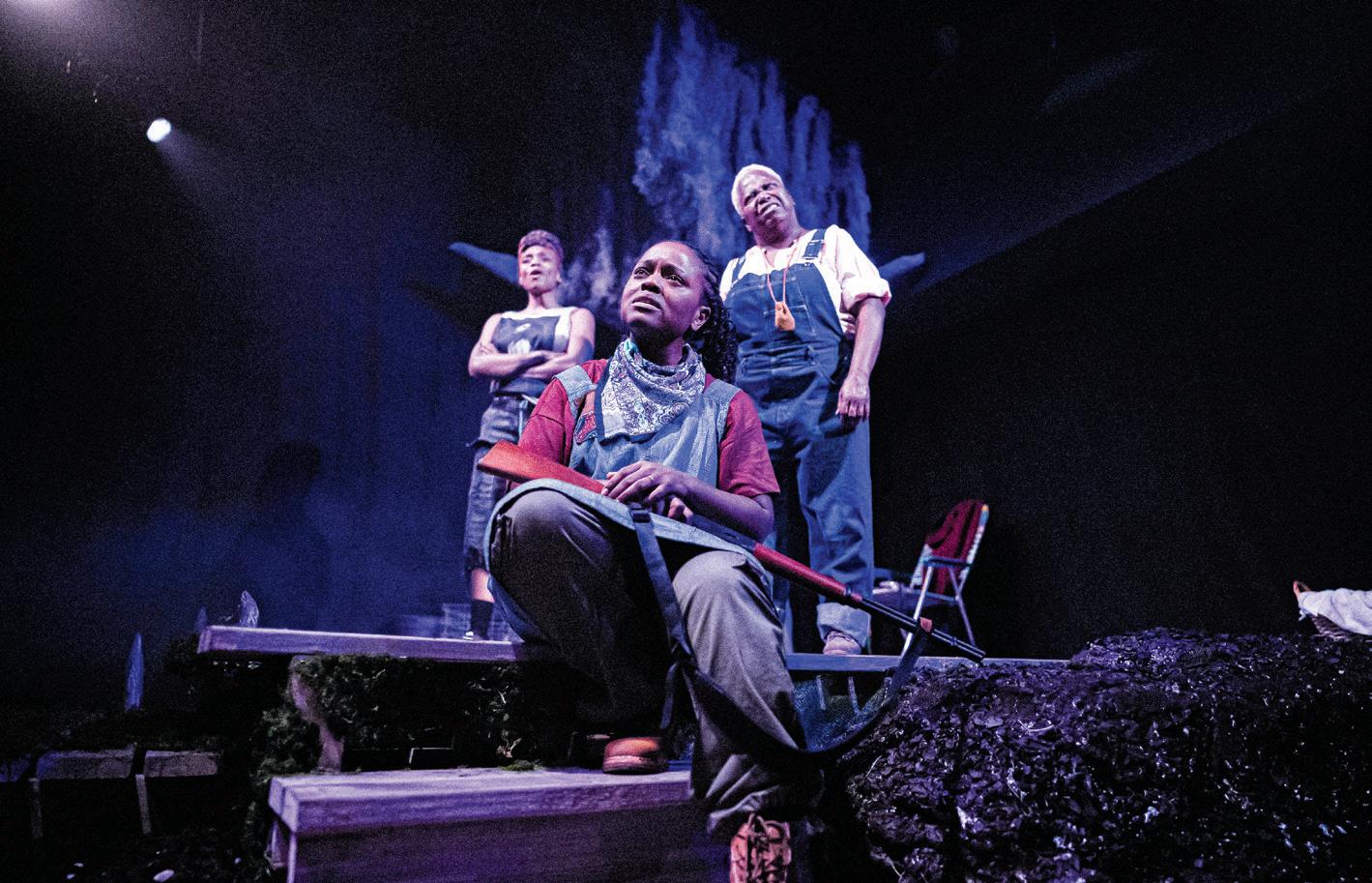
character disagrees with someone.
The story picks up the pace once mother Vernita (RjW Mays) enters the scene. In Mays’s hands, Vernita bounces off LadyBird and others with ease, even if Mays stumbles through a few of her lines here and there. Their chemistry is palpable as the two characters bicker about the reasoning for the sudden fishing trip and COVID restrictions—“We’ve gotta stay three feet apart!” LadyBird cries at one point when Vernita attempts to hug her. However, the lighthearted tone shifts into something more sinister once LadyBird notices the blood on her mother’s hands, and the suspicious laundry basket at her feet.
With an audible gasp, LadyBird discovers the head of Clayton Rutherford, the richest man in town, buried at the bottom of Vernita’s laundry basket. The atmosphere continues to grow
increasingly ominous while LadyBird panics, peppering Vernita with rapidfire questions that she has few answers for. The only thing Vernita stands by is that she has nothing to do with the man’s untimely demise. The police, repeatedly referred to as the “death squad,” are out of the question because of the power of the Rutherford name and their deep historical prejudices and trauma inflicted towards the Black community.
The family’s youngest daughter, RaeMeeka (Rita Wicks), hilariously stumbles onto the scene, partially high with a bag of Hot Cheetos in one hand, after LadyBird calls her for help. Wicks’s delivery is charming—her raspy voice and side quips depict her as the comic relief. As the Manifold women continue to argue about what to do next, secrets are revealed left and right, leading to the mysterious arrival of Taysha Hunter (Jyreika Guest).
The play ping-pongs between different tones—from comedy and hijinks to true crime and family drama. The moment when RaeMeeka uncovers the decapitated head is followed by a joke, and then, only a few moments later, the characters dive into the history of racial tension in the town, and the haunted souls of their ancestors. While at times it can be somewhat jarring for the viewer to keep up with these shifts, the script and directing keep the audience engaged. At one point, the light pans to RaeMeeka, and the actress captivates the viewers as she launches into a fantasy of picking up arms and avenging the unjust deaths of her ancestors. Vernita responds to her daughter’s speech by explaining the power the bayou holds from the blood of their descendants, and the themes of mysticism and spirituality take over the plot. I was quickly reminded of movies like The Skeleton Key and The Gift —as if stories based in the Deep South are, by law, supposed to have some element of the occult. The dialogue does the heavy lifting here as Vernita goes into details about the use of nature to create charms and mystic protections. Overall, the acting and dialogue pack an emotional punch, clearly resonating with the audience as they laugh and applaud.
Calhoun went back to her roots to create a play that follows a Black family forced to face the secrets kept buried for generations. In an interview with Broadway World , Calhoun recounted the inspiration for the play, saying, “What existing power structures must be eradicated for humanity to carry on? And to what degree does our survival depend on things we have forgotten? I wrote
Black Cypress Bayou to wrestle with these questions and to celebrate the people and places that made me.”
The energy of the play reverberated even after the curtains fell. Audience members buzzed among themselves, saying how surprised they were at the twists and turns of the production.
“I loved the themes and the characters. They reminded me of people in my own life,” one audience member said.
Black Cypress Bayou is not entirely perfect. There are times when the story feels disjointed, and the pacing of the
third act is drawn out. At more than one point, the story seemed as if it was about to end but suddenly, characters would say a line, and the scene continued.
But, in the end, the chemistry of the actors and the different themes pulled the play together. The production was the icing on top—from the set and props to the sound effects and lighting. Viewers are completely immersed into the story, and once the curtains fall and the cast takes a fi nal bow, you’re left blinking back the dazzling experience.
Black Cypress Bayou. Definition Theatre, 1160 E. 55th St. Th rough March
15. Thursday–Friday, 7:30pm; Saturday–Sunday, 3pm, with additional 7:30pm show on Saturday, March 7. Post-show discussion after performances on March 1 and 8. $29–$45; $15 students. (312) 469-0390. definitiontheatre.org. ¬
Sarah Luyengi earned her B.A. in English with a concentration in creative writing from the University of Illinois at Chicago. Her work has appeared in Borderless Magazine, Third Coast Review, and Common Ground Review. She last interviewed SERES founder Vanessa Arroyo for the Weekly.
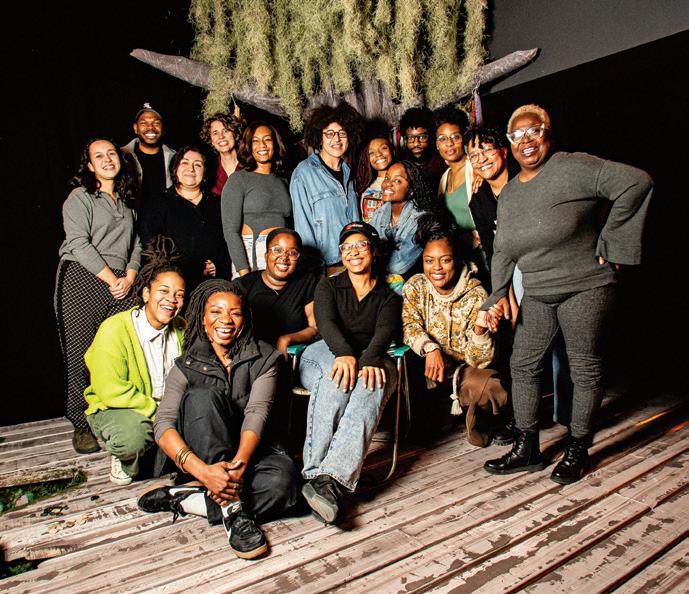
Cut along the dotted lines for a free, shareable pocket guide for how to protect yourself against fraudsters .
• Obtén una segunda opinión de una organización de ayuda legal confiable o clínica comunitaria.
• USCIS no llamará ni exigirá dinero por mensaje de texto o aplicación.
• Nunca pagues en efectivo sin un contrato escrito.
• Verifica credenciales con el colegio de abogados estatal o la lista de Representantes Acreditados del Departamento de Justicia de Estados Unidos (DOJ).
• Pregunta: ¿Es un abogado con licencia o un representante acreditado?
Consejos de seguridad rápidos (pasos claros): Antes de pagar o firmar:
• Get a second opinion from a trusted legal aid org or community clinic.
• USCIS will tno call and demand money by text or app.
• Never pay in cash without a written contract.
• Check credentials with your state bar or DOJ Accredited Representative list.
• Ask: Are they a licensed attorney or accredited representative?
• Solicitudes de dinero en efectivo acompañadas de amenazas
• Solicitudes de dinero en efectivo acompañadas de amenazas
• Mensajes o llamadas exigiendo pago
Notario que afirma tener habilidades legales
• Licencia válida
• Contrato escrito con tarifas claras
• Comunicación oficial del USCIS (correo)
• Abogado de inmigración con licencia
Amenazan con deportación si los denuncias

Contactan por WhatsApp, Facebook, TikTok, llamadas telefónicas o en persona
verdes o permisos de trabajo
Piden dinero por adelantado para visas, tarjetas




• No License/fake credentials Señales de alerta de estafa:
• Cash requests with threats
• Texts/calls demanding payment
Notario claiming legal skills
Safety Tips (clear steps): Before you pay or sign:

Find a DOJ-Accredited Representative
Local nonprofit legal clinics
State bar referral services
Dónde obtener ayuda segura:

Busca un Representante Acreditado por el Departamento de Justicia de Estados Unidos (DOJ)
Clínicas legales sin fines de lucro locales
Servicios de referencia del colegio de abogados estatal

• Contact local police if you’re threatened
• File a complaint with consumer protection



Scam Warning Signs:
• Report to your state Attorney General’s office
• Use city reporting tools (e.g., Chicago’s 311)

• Reporta a la oficina del Fiscal General de tu estado
• Contacta a la policía local si recibes amenazas
• Presenta una queja con la oficina de protección al consumidor
• Usa herramientas de reporte de la ciudad (por ejemplo, el 311 de Chicago)


• License Verdadero vs. falso Ayuda legal real
• Written contract with fees upfront
• Official USCS communication (mail)
• Licensed immigration attorney
Real Legal Help
Cobran miles de dólares sin ofrecer servicios reales
Personas que se hacen pasar por abogados/notarios ofreciendo ayuda legal


Cómo se ve la estafa:
Threatening deportation if you report them
Messaging through WhatsApp, Facebook, TikTok, phone calls, or in person
Asking for cash upfront for visas, green cards, or work permits


True vs. False
Charging thousands of dollars with no real services provided
People posing as lawyers/notarios offering legal help


What the Looks Like:

In Latin America: Notario Público
• Lawyer with legal authority
• Can give legal advice
• Handles immigration, property, wills, contracts
In the United States: Notary Public
• NOT a lawyer
• Cannot give legal or immigration advice
• Only witnesses signatures, transcribes work







En Latinoamérica: Notario Público
• Abogado con autoridad legal
• Puede dar asesoría legal
• Maneja inmigración, propiedad, testamentos, contratos
En Estados Unidos: Notary Public
• NO es abogado
• No puede dar asesoría legal ni de inmigración
• Solo certifica firmas y transcribe documentos
Scan the QR code for instructions and to read or listen to our story on immigration scams. Escanea el código QR para ver las instrucciones y leer o escuchar nuestra historia sobre estafas en español
estafas de servicios legales de inmigración—Conoce tus derechos y mantente seguro

The Exchange is the Weekly’s poetry corner, where a poem or piece of writing is presented with a prompt. Readers are welcome to respond to the prompt with original poems, and pieces may be featured in the next issue of the Weekly.
Featured below is a response to a previous prompt from a reader who is currently incarcerated.
Musings by justin dismuke
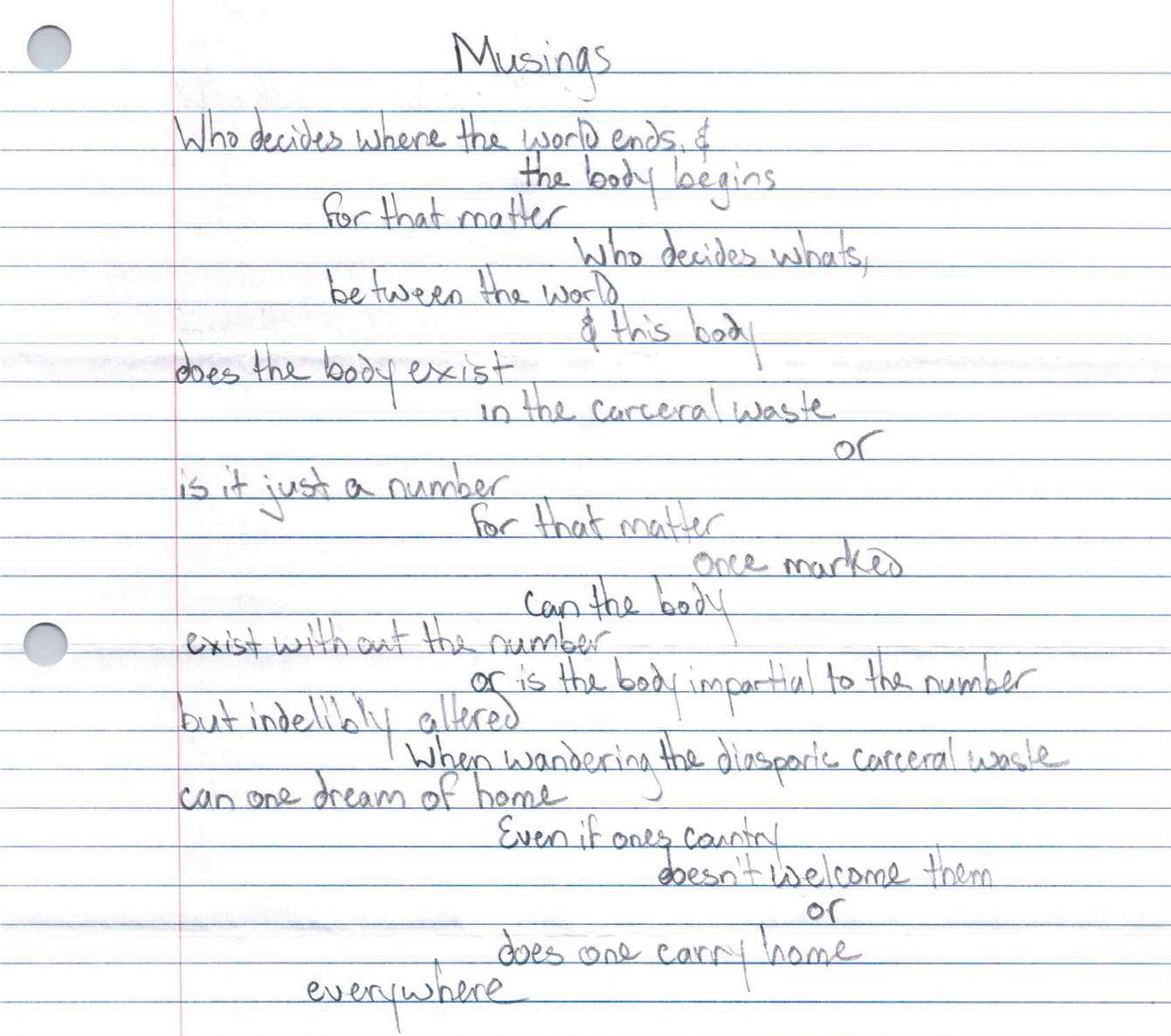
Chima Ikoro is the Weekly’s Engagement Editor.
THIS WEEK'S PROMPT: “OFTENTIMES, WE DESCRIBE WHO WE ARE. INSTEAD, DESCRIBE WHO YOU ARE NOT.”
This could be a poem, journal entry, or a stream-of-consciousness piece. Submissions could be new or formerly written pieces. Submissions can be sent to bit.ly/ssw-exchange or via email to chima.ikoro@southsideweekly.com

ARTS
GOLDEN
GOLDEN
Lindblom Park | 6054 S. Damen Avenue
Lindblom Park | 6054 S. Damen Avenue
March 18 | 10:30 a.m.–12:30p.m. FEED
March 18 | 10:30 a.m.–12:30p.m.
FEED YOUR MIND, BODY & SOUL
AKARAMA Foundation | 6220 S.
AKARAMA Foundation | 6220 S. Ingleside Avenue
March 19 | 9:30–11:30 a.m.
March 19 | 9:30–11:30 a.m.
WELLNESS
New Covenant Missionary Baptist Church | 754 E. 77th Street
Mondays–Thursdays | 3 programs daily
| 754 E.