Northerly Island: Parking is available for $3 per car (cash only). Come out and celebrate winter in Chicago! Saturday, Jan. 24 • 11am - 3pm Northerly Island
Feb. 21 • 11am - 3pm
Have fun while enjoying all the wonders of nature at Polar Adventure Days!
FEED YOUR MIND, BODY & SOUL
AKARAMA Foundation | 6220 S. Ingleside Avenue
February 19 | 9:30–11:30 a.m.
February 19 | 9:30–11:30 a.m.
MATHER AT DUSABLE
MATHER
The DuSable Black History Museum and Education Center
The DuSable Black History Museum and Education Center
740 E. 56th Place
740 E. 56th Place
February 25 | 10:00 a.m.–12:00 p.m.
February 25 | 10:00 a.m.–12:00 p.m.
WELLNESS AT THE COV New
SOUTH SIDE WEEKLY FROM THE EDITORS
The South Side Weekly is an independent non-profit newspaper by and for the South Side of Chicago. We provide high-quality, critical arts and public interest coverage, and equip and develop journalists, artists, photographers, and mediamakers of all backgrounds.
Volume 13, Issue 3
Interim
Editor-in-Chief Adam Przybyl
Investigations Editor Jim Daley
Immigration Project
Editor Alma Campos
Senior Editors Martha Bayne
Christopher Good
Olivia Stovicek
Jocelyn Martinez-Rosales
Engagement Editor Chima Ikoro
Editor Emeritus Jacqueline Serrato
Public Meetings Editor Scott Pemberton
Art Director Shane Tolentino
Research Editor: Ellie Gilbert-Bair
Fact Checkers: Nupur Bosmiya
Kate Gallagher
Zara Norman
Lauren Sheperd
Arieon Whittsey
Susie Xu
Layout Editor Mel Dempsey
Publisher Malik Jackson
Office Manager Mary Leonard
Advertising Manager Susan Malone
The Weekly publishes online weekly and in print every other Thursday. We seek contributions from all over the city.
Send submissions, story ideas, comments, or questions to editor@southsideweekly.com or mail to:
South Side Weekly
6100 S. Blackstone Ave. Chicago, IL 60637
For advertising inquiries, please contact: Susan Malone (773) 358-3129 or email: malone@southsideweekly.com
For general inquiries, please call: (773) 643-8533
On January 31, one week after Border Patrol agents fatally shot Alex Pretti in Minneapolis, Mayor Brandon Johnson signed an executive order directing Chicago police to investigate and document alleged illegal activity by federal immigration agents and identify the agents involved.
“This executive order will make Chicago the first city in the country to set the groundwork to prosecute ICE and Border Patrol agents for criminal misconduct,” Johnson said at the signing ceremony, to cheers from assembled supporters. “We need to send a clear message: if the federal government will not hold these rogue actors accountable, then Chicago will do everything in our power to bring these agents to justice.”
What that power is remains to be seen. Cook County State’s Attorney Eileen O’Neil Burke released a statement saying her office was not consulted on the executive order. “Because this order changes the process of how felony charges are evaluated, a thorough analysis is being conducted to assess its legality,” it read. The statement added the State’s Attorney’s Office is “committed to doing all we can under the law to support and review law enforcement investigations of that conduct and prosecute when appropriate.”
In an internal email obtained by WTTW, Burke wrote that Johnson’s order is “wholly inappropriate.” She has also declined to join Philadelphia District Attorney Larry Krasner’s coalition, the Project for the Fight Against Federal Overreach, which includes DAs from Texas, Virginia, Arizona and Minnesota. One of the coalition’s goals is for states to effectively investigate and prosecute federal immigration agents when they are accused of state crimes like assault or homicide—a process the Trump administration has obstructed by instructing the FBI to take over investigations into shootings by federal agents and claiming those agents have “absolute immunity.”
Burke’s office has not brought charges against the still-unidentified federal agent who fatally shot Silverio Villegas González in suburban Franklin Park in September, or against Charles Exum, a Border Patrol agent who shot and wounded Marimar Martínez in Chicago in October. Only one federal agent has been charged with a crime in Cook County since Operation Midway Blitz began last year: ICE agent Adam Saracco, who faces a misdemeanor count of battery for allegedly shoving a protester to the ground in Brookfield, IL while off duty.
Can police and prosecutors be relied on to rein in federal agents? It doesn’t seem likely. Outside Minneapolis’s Whipple federal building, Minnesota state police have arrested and beaten nonviolent protesters, echoing scenes outside the ICE detention center in Broadview, IL, where Cook County sheriffs and Illinois state police arrested and brutalized demonstrators in the fall. In Los Angeles, the county sheriff and LAPD have said their departments—both of which have arrested anti-ICE protesters—will not enforce a statewide ban on immigration agents wearing masks.
In Chicago, Police Superintendent Larry Snelling hasn’t commented on Johnson’s executive order, but he has been publicly reluctant to charge federal immigration agents, saying his officers “cannot and will not” arrest them. Fraternal Order of Police (FOP) President John Catanzara decried the executive order as potentially placing cops in legal jeopardy. The Civilian Office of Police Accountability claims it doesn’t have the purview to investigate Chicago cops who’ve been accused of violating the Welcoming City Ordinance. The Community Commission on Public Safety and Accountability (CCPSA) has been reticent, prompting hundreds of residents to pack a hearing last month and excoriate commissioners for what they deemed a lack of proper oversight.
Police and prosecutors are part of the same criminal-justice apparatus that the federal government is using to detain, dehumanize, and deport our neighbors. The tactics used by ICE and Border Patrol in their campaigns of terror have their roots in the strategies used by local police against Black and brown residents for decades.
As the speakers at the CCPSA meeting repeatedly asserted: only we can keep each other safe.
IN THIS ISSUE
public meetings report
A recap of select open meetings at the local, county, and state level.
scott pemberton and documenters 4 border patrol shooting survivor marimar martínez testifies before congress
In Chicago, a federal judge ruled that materials relevant to the government’s prosecution of Martínez are to be released. dave byrnes 5
marimar martínez, sobreviviente de tiroteo, testifica en el congreso
En Chicago, una jueza federal determinó que se deben hacer públicos materiales relacionados con el procesamiento de Martínez por parte del gobierno. dave byrnes, traducido por alma campos 6
neighbors rally for a cup of joe
Supporters rallied outside a Garfield Ridge café targeted for speaking out against ICE.
josé abonce 8
‘black creativity’ is more than aesthetics
It’s the longest continuously running juried exhibition of Black art in the nation.
jared brown 9
south side tours delivers history on the move
South Side Tours uses narration, local insight, and landmark stops to highlight the people and places that define Chicago’s South Side.
A selection of events that explore Black histories and celebrate Black creativity.
ellie gilbert-bair 23
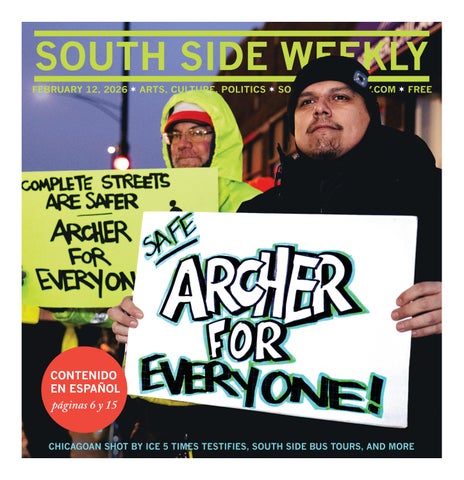
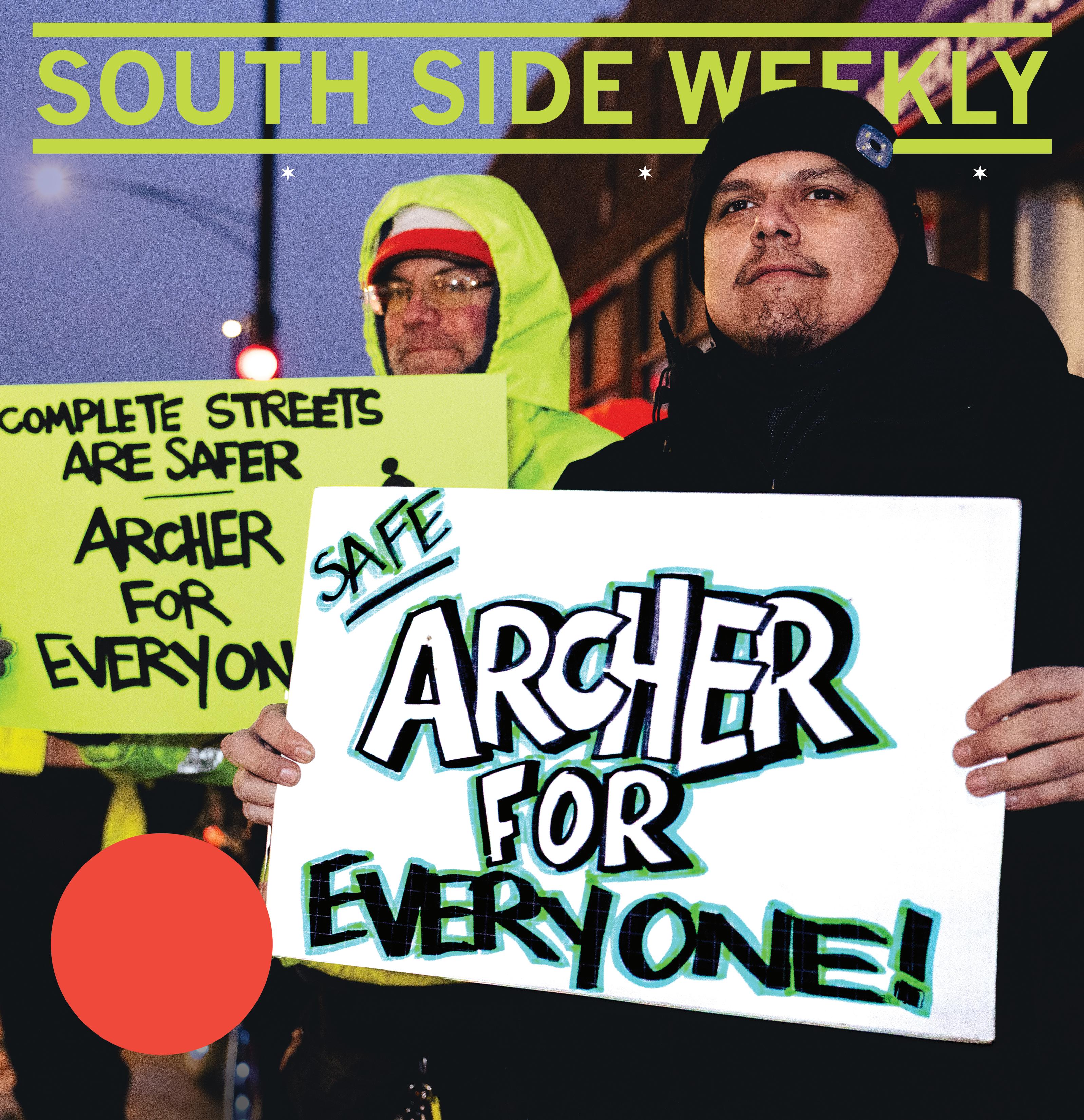
Cover photo by Caeli Kean
Public Meetings Report
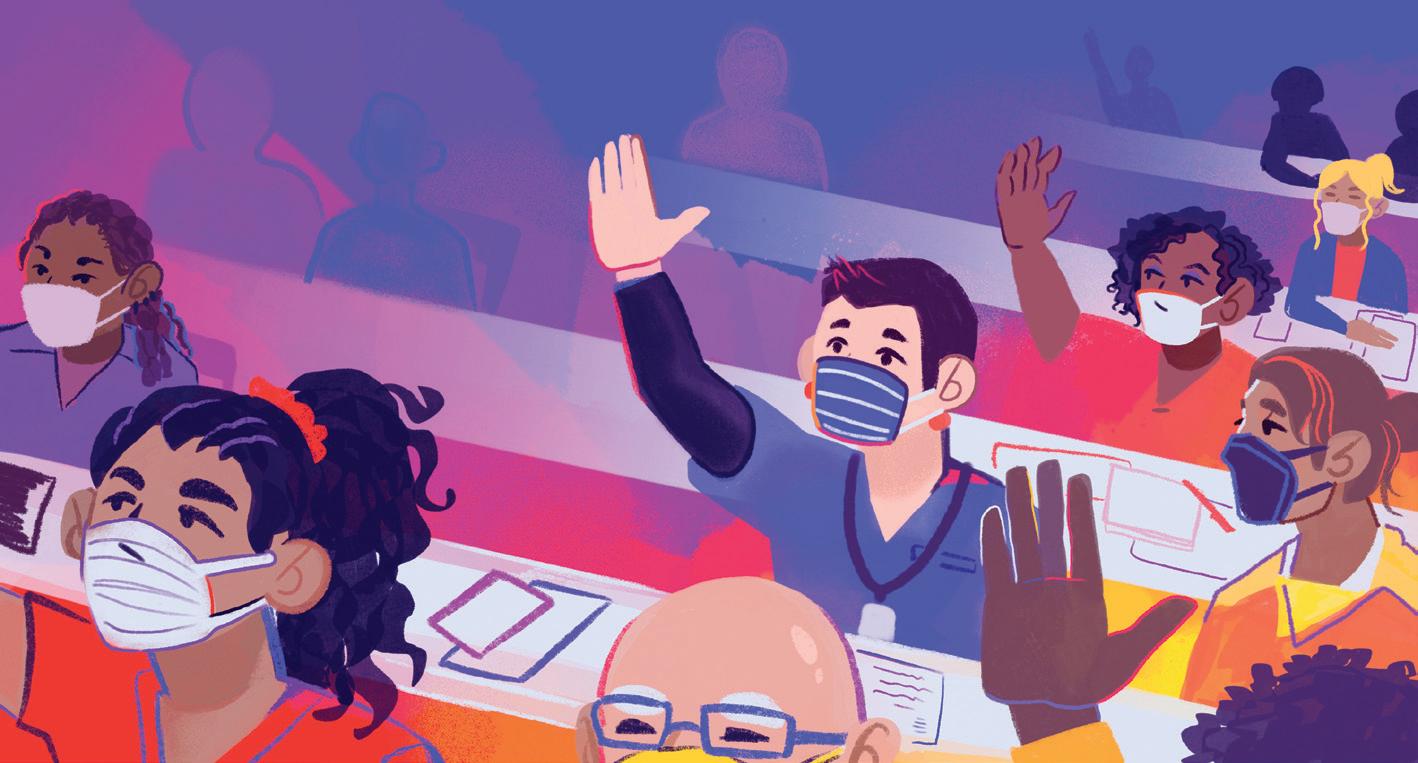
illustration by Holley Appold/South Side Weekly
A recap of select open meetings at the local, county, and state level.
BY SCOTT PEMBERTON AND DOCUMENTERS
December 3
At its meeting, the Committee on Housing and Real Estate approved a land transfer for Chicago Torture Justice Memorials (CTJM) in Washington Park after extensive public comment. Several survivors of Chicago police violence spoke about their experiences. “I stand here as a person violated, degraded, and humiliated…kicked, punched and spat on,” said one. “I plead for you all to vote ‘yes.’” Advocates said the public memorial will have psychological and educational benefits as well as boost the local economy. After public testimony concluded, Committee Chair Byron SigchoLopez (25th Ward) reported that sixteen out of eighteen written comments received by the committee supported the land transfer. The transfer honors those victimized under disgraced former Chicago Police Department Commander Jon Burge. The committee also approved multiple land sales, renewed city leases, and a measure to dissolve the Chicago Housing Trust (CHT) as a separate entity, incorporating it into the Department of Housing. Thirteen committee members were present at roll call, two attended remotely, and six were absent.
December 9
At its meeting, the Committee on Zoning, Landmarks and Building Standards approved all but one zoning and development item on its agenda. Ten individuals spoke during the public comment period. Commenters supported zoning amendments that would allow historic preservation in the 35th Ward and the Hazel Johnson Cumulative Impacts Ordinance, which was designed in part to combat environmental burdens in communities of color. One speaker opposed a zoning change to his small commercial garage that would bar automotive business-related work. Another speaker opposed an ordinance affecting his residential building. A third voiced frustration that she hadn’t received sufficient notice about her block being rezoned for “mixed use” to accommodate a new development. She also wanted to know what the potential development would look like. Committee members then considered and approved a substitute ordinance that would expand existing boundaries for additional dwelling units (ADUs). An ADU is a second residential unit located on the lot of a primary residence. It might be detached—a coach house, for example—or in an attic or basement of that residence.
December 10
Back-to-back meetings of the Chicago Transit Authority (CTA) board heard public comments on Grand Avenue bike lanes, a new bus lane along Ashland Avenue and
Wells Street, and the Red Line extension project, which will be completed by 2030. The Finance Audit and Budget (FAB) Committee met first and heard some good news from Chief Financial Officer Tom McKone: public funding from taxes brought in more revenue than expected and total 2025 expenses through October were approximately $78 million less than expected. The FAB Committee reviewed and approved a licensing agreement with Pharmabox to install, operate, and maintain retail vending machines selling over-the-counter pharmacy products, collectible trading cards, and other items at designated stations. Two of those stations would be at 95th Street and Grand Avenue. Then, at the CTA board meeting, a board member addressed concerns about safety and increased ridership by young people. Another speaker discussed station improvements that could assist disabled riders. Acting CTA Board President Nora Leerhsen reported on the success of the CTA’s Holiday Train, noting the hard work that goes into making it a success. She said that routes like the J14 and 60 Blue Island “continue to maintain an average of 15 percent growth in ridership year over year.”
December 15
At their meeting, members of Chicago Police District Council 011—Harrison reviewed district crime statistics. The district includes Humboldt Park, West Garfield Park, North Lawndale, East Garfield Park, Near West Side, and Austin Board members highlighted upcoming nominations for the Community Commission for Public Safety and Accountability (CCPSA). One council member encouraged individuals younger than twenty-eight years old to apply. Using data spanning 2001 to 2025, Chair Bryan Ramson, Jr. reported that certain crime statistics have changed minimally over the past fifteen years. He also displayed graphs that compare the number of crime reports to the number of arrests. Except for narcotics violations and motor vehicle theft, most crimes showed fewer arrests than reports. A community member identified motor vehicle theft trends as “the most alarming,” noting that the number of reports didn’t match the number of arrests. Chair Ramson pointed out that motor vehicle crimes are especially difficult for police to solve because suspects either need to be caught in the act or face a very strong case built on substantial circumstantial evidence. On the other hand, Ramson explained, arrests for alleged narcotics crimes generally match one-to-one with crime reports because police only make a report when they make an arrest. The board also heard from two representatives of the Garfield Park Rite to Wellness Collaborative (GPRWC). GPRWC is “a resident-led partnership transforming health, safety, and opportunity across Chicago’s West side,” according to its website, and expects to issue a “quality of life” plan this year.
December 17
During its meeting, the Chicago Department of Public Health (CDPH) presented its latest initiatives and accomplishments. Cook County saw the nation's largest reduction in opioid overdose deaths since the crisis' 2023 peak, according to the Guardian. “Citywide violence” also decreased thirty-three percent between 2024 and 2025. However, CDPH has seen increases in HIV/AIDS diagnoses for the second year in a row. In 2024, the department recorded 818 new diagnoses for HIV and 296 for AIDS. The department also noted that mental health ranks among the top five reasons Chicagoans are hospitalized. CDPH Commissioner Olusimbo Ige reported that ninety-three percent of reported possible lead poisoning cases in children received case management services from the department. Dr. Ige stated that the city’s lead abatement efforts are succeeding, resulting in a very small number of residences still facing lead reduction challenges. Reductions in budgets and grants for 2026 reduced full-time CDPH employees to 756 from 1,051.
This information was collected and curated by the Weekly in large part using reporting from City Bureau’s Documenters at documenters.org.
Border Patrol Shooting Survivor Marimar Martínez Testifies before Congress
In Chicago, a federal judge ruled that materials relevant to the government’s prosecution of Martínez are to be released.
BY DAVE BYRNES
On October 4, Border Patrol agent Charles Exum shot Chicago resident Marimar Martínez, a U.S. citizen who’d joined a group of rapid responders who were following Exum and other immigration agents on the Southwest Side. Then he bragged about it.
“I fired 5 rounds and she had 7 holes. Put that in your book boys,” Exum wrote in a text message that was made publicly available in court documents in November.
The texts came out in court as the Department of Justice (DOJ) prepared to take Martínez and a man named Anthony Ian Santos Ruiz to trial on charges they’d assaulted or impeded federal officers. The Department of Homeland Security (DHS), which oversees Immigration and Customs Enforcement (ICE) as well as Customs and Border Protection (CBP) and Border Patrol, deemed them “domestic terrorists” in an October 4 press statement. The department claimed Martínez and Santos Ruiz used their vehicles to ram Border Patrol agents’ own vehicles in Brighton Park on October 4, while eliding how Exum shot Martínez multiple times as “defensive fire.” The DOJ released a statement on October 5 announcing charges against the pair.
Less than three weeks after Exum’s text messages were made public, and Exum appeared in court, federal prosecutors moved to drop the case. District Judge Georgia Alexakis dismissed it with prejudice on November 20.
Now, even more material from the case is set to be released publicly. Alexakis said in a court hearing Friday morning, February 6, that she would largely grant Martínez’s motion to modify a protective
order the court placed on material relevant to her dropped prosecution including additional text messages sent by Exum, body camera footage from other agents on the day he shot Martínez (Exum did not have his body camera on at the time), and images gathered from Flock surveillance cameras in Chicago.
“I fired 5 rounds and she had 7 holes. Put that in your book boys.”
“Now we’ll pull the curtain back and you guys can see how the government itself responds to the interaction with these agents in the moments after one of
these shootings happens. I think that’s important for people to see,” Christopher Parente, Martínez’s attorney, told the press after Alexakis made her ruling on Friday, referencing the DHS killings of Renée Good, Alex Pretti, and Silverio Villegas González.
Martínez filed the motion to modify the protective order in the last week of January. The filing states her desire to inform the public “regarding how DHS responds in cases where their agents use deadly force against U.S. citizens,” and to counter the federal government’s ongoing accusation that she is a terrorist.
“Despite voluntarily dismissing the charges against Ms. Martínez, high ranking government officials continue to maintain that the sum and substance of the
facts alleged in Ms. Martínez’s indictment are accurate,” the motion states. “To this day, Ms. Martínez is described as a ‘domestic terrorist’ who ‘rammed federal agents with [her] vehicle’ on the website of the Department of Homeland Security.”
Martínez echoed both desires when she spoke at a bicameral (though not bipartisan, for no Republican lawmaker attended) February 3 Congressional forum on DHS agents violent actions in Washington DC. She testified before Democratic senators and representatives along with Luke and Brent Ganger, the brothers of Renée Nicole Good, whom ICE agent Jonathan Ross shot and killed in Minneapolis on January 7; Aliya Rahman, a Minneapolis resident and U.S. citizen with a brain injury whom federal agents violently pulled from her car and detained while she was headed to a health appointment on January 13; and Daniel Rascon, who along with other family members was violently confronted by armed federal agents in southern California over two separate days last August. In one of those encounters, while Rascon and his in-laws were driving, an agent shot at their car.
Martínez offered prepared testimony and fielded follow-up questions from the assembled lawmakers. She said what she wanted most from the government was an admission of wrongdoing.
“Just a, ‘sorry, you’re not a domestic terrorist.’ That’s it,” she told Democratic California Rep. Ro Khanna during the hearing. “That’s all I want, that’s all I’m asking for. For them to admit that they were wrong.”
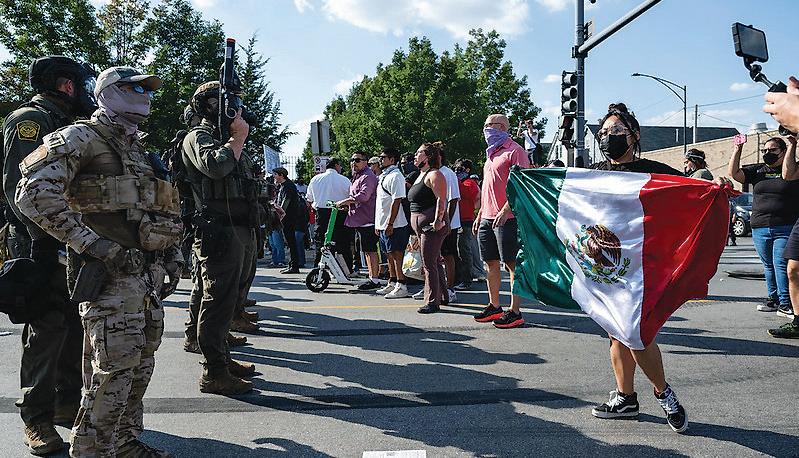
Federal agents and Chicago police officers guard the scene where a Border Patrol agent shot Marimar Martínez on October 4, 2025.
Photo by Paul Goyette
At press time, DHS’s statement labeling Martínez a terrorist remains viewable on its website, and a spokesperson for the department signaled it was unwilling to recant that label.
“DHS stands by our press releases and statements,” a DHS spokesperson told the Weekly. “The facts of what happened did not change.”
On Friday, Judge Alexakis ordered the parties to confer over modifications to the current protective order. Parente told press he would meet with government attorneys over the weekend and not to expect the newly modified order, nor any new materials it would unseal, before Monday, February 9.
“If there’s no justice for the people, let there be no peace for the government.”
Alexakis’s ruling came after both Martínez’s counsel and the DOJ filed competing arguments over her motion. The DOJ first claimed that Alexakis lacked jurisdiction to rule on the matter, as media organizations had their own notice of appeal on access to sealed materials pending before the Seventh Circuit Appellate Court. Assuming — correctly — that Alexakis wouldn’t buy this argument, they then urged the judge not to modify the protective order regarding text messages Exum sent his wife, brother, and coworkers, which were included in the discovery for Martínez and Santos Ruiz’s aborted trial.
The DOJ lawyers argued the messages had “no bearing on the key basis” of Martínez's motion, and would “serve only to further sully Agent Exum, his family, and co-workers.”
The government also sought to keep sealed images captured by license plate reader cameras and Flock security cameras around Chicago, claiming they were “lawenforcement sensitive.”
The government argued the images, if publicized, “may reveal the location of numerous Flock and LPR cameras that are utilized by law enforcement, thereby causing harm to future law
enforcement investigations and potentially compromising public safety.”
Martínez replied in a separate filing last Thursday, again stating that she wished to combat the government’s narrative, not compromise law-enforcement interests. And as to whether the text messages Exum sent would further “sully” him, Martínez’s counsel responded that he had already sullied himself.
“Agent Exum sent these messages in the minutes, hours, and days after the shooting” the reply filing states. “These are his words. To the extent they would ‘sully’ his reputation more than his previously disclosed disgusting text messages already have, it is a fully deserved self-imposed sullying.”
Alexakis largely sided with Martínez. The judge allowed Exum’s text messages to be released, provided redactions were made to protect third parties like his wife and the name of another federal agent he messaged. She barred the release of the images captured by license-plate-reader cameras, citing concern they could bring undue attention to uninvolved individuals. She noted Flock cameras are already located in public, and readily searchable online.
“You can google ‘Flock cameras’ and get a pretty good idea of what you would be looking for,” Alexakis said.
Martínez did not speak to the press Friday, but Parente emphasized that it was the recent DHS killings in Minneapolis that spurred her to seek the release of her case materials.
“It wasn’t until the killings of Mr. Pretti and Ms. Good that this came up. It’s because we know, sort of, what it looks like behind the curtain, and it’s scary,” Parente said.
Martínez did voice her desire for justice for the families of those killed by DHS agents when she addressed lawmakers last week, saying she felt the need to speak for the victims who no longer can.
“If there’s no justice for the people,” she said in her closing remarks, quoting the Mexican revolutionary Emiliano Zapata, “let there be no peace for the government.” ¬
Dave Byrnes is a Chicago-born independent journalist covering the Trump administration’s anti-immigrant blitz. He lives in Lincoln Square, but is a lifelong White Sox fan.
Marimar Martínez, sobreviviente de tiroteo, testifica en el Congreso
En Chicago, una jueza federal determinó que se deben hacer públicos materiales relacionados con el procesamiento de Martínez por parte del gobierno.
POR DAVE BYRNES TRADUCIDO POR ALMA CAMPOS
El 4 de octubre, el agente de la Patrulla Fronteriza Charles Exum disparó contra la residente de Chicago Marimar Martínez, una ciudadana estadounidense que se había unido a un grupo de respondedores rápidos que seguían a Exum y a otros agentes de inmigración en el suroeste de la ciudad. Luego, presumió de haberlo hecho.
“Disparé 5 veces y ella tenía 7 heridas de bala. Pongan eso en su libro, muchachos”, escribió Exum en un mensaje de texto que se hizo público en documentos judiciales en noviembre.
Los mensajes salieron a la luz en la corte mientras el Departamento de Justicia (DOJ, por sus siglas en inglés) se preparaba para llevar a juicio a Martínez y a un hombre llamado Anthony Ian Santos Ruiz, acusándolos de haber agredido u obstaculizado a agentes federales. El Departamento de Seguridad Nacional (DHS), que supervisa al Servicio de Inmigración y Control de Aduanas (ICE), así como a Aduanas y Protección Fronteriza (CBP) y a la Patrulla Fronteriza, los calificó de “terroristas domésticos” en un comunicado de prensa del 4 de octubre.
El departamento afirmó que Martínez y Santos Ruiz utilizaron sus vehículos para embestir a los vehículos
de los agentes de la Patrulla Fronteriza en Brighton Park ese mismo día, mientras omitía que Exum disparó varias veces contra Martínez, describiendo el hecho como “fuego defensivo”. El DOJ emitió un comunicado el 5 de octubre anunciando los cargos contra ambos. Menos de tres semanas después de que los mensajes de texto de Exum se hicieran públicos y de que él comparece ante la corte, los fiscales federales solicitaron desestimar el caso. La jueza del distrito Georgia Alexakis lo desestimó con perjuicio el 20 de noviembre.
“Disparé 5 tiros y ella terminó con 7 agujeros. Pónganlo en su librito, muchachos.”
Ahora, se prevé que se haga público aún más material del caso. Alexakis dijo en una audiencia judicial la mañana del viernes 6 de febrero que concedería en gran medida la moción de Martínez para modificar una orden de protección que en la corte había impuesto sobre material relacionado con su procesamiento ya desestimado. Esto incluye mensajes de texto adicionales enviados por Exum, grabaciones de cámaras corporales de otros agentes el día en que disparó contra Martínez (Exum
no tenía prendida su cámara corporal en ese momento) e imágenes recopiladas por cámaras de vigilancia Flock en Chicago.
“Ahora vamos a correr el telón y ustedes podrán ver cómo el propio gobierno responde a la interacción con estos agentes en los momentos posteriores a que ocurre uno de estos tiroteos. Creo que es importante que la gente lo vea”, dijo a la prensa Christopher Parente, abogado de Martínez, después de que Alexakis emitiera su fallo el viernes, en referencia a los asesinatos cometidos por el DHS de Renée Good, Alex Pretti y Silverio Villegas González.
Martínez presentó la moción para modificar la orden de protección en la última semana de enero. En el documento expresa su deseo de informar al público “sobre cómo responde el DHS en casos en los que sus agentes usan fuerza letal contra ciudadanos estadounidenses” y de contrarrestar la acusación continua del gobierno federal de que ella es una terrorista.
“A pesar de desestimar voluntariamente los cargos contra la Srta. Martínez, funcionarios gubernamentales de alto nivel continúan sosteniendo que el conjunto y la esencia de los hechos alegados en la acusación contra la Srta. Martínez son verídicos”, señala la moción. “Hasta el día de hoy, la Srta. Martínez es descrita como una ‘terrorista doméstica’ que ‘embistió a agentes federales con su vehículo’ en el sitio web del Departamento de Seguridad Nacional”.
Martínez reiteró ambos objetivos cuando habló en un foro congresional bicameral (aunque no bipartidista, ya que ningún legislador republicano asistió) el 3 de febrero sobre las acciones violentas de agentes del DHS en Washington, D.C.
Testificó ante senadores y representantes demócratas junto a Luke y Brent Ganger, hermanos de Renée Nicole Good, a quien el agente de ICE Jonathan Ross disparó y mató en Minneapolis el 7 de enero; Aliya Rahman, residente de Minneapolis y ciudadana estadounidense con una lesión cerebral, a quien agentes federales sacaron violentamente de su automóvil y detuvieron cuando se dirigía a una cita médica el 13 de enero; y Daniel Rascon, quien junto con otros familiares fue confrontado violentamente por agentes federales armados en el sur de California durante dos días distintos en agosto pasado. En uno de esos encuentros, mientras Rascon y sus suegros conducían,
un agente disparó contra su vehículo.
Martínez presentó un testimonio preparado y respondió preguntas de seguimiento de los legisladores presentes. Dijo que lo que más deseaba del gobierno era una admisión de culpa.
“Solo un ‘lo sentimos, usted no es una terrorista doméstica’. Eso es todo”, le dijo al representante demócrata de California Ro Khanna durante la audiencia. “Eso es lo único que quiero, eso es todo lo que estoy pidiendo. Que admitan que se equivocaron”.
Al cierre de esta edición, la declaración del DHS que califica a Martínez como terrorista sigue disponible en su sitio web, y un portavoz del departamento indicó que no estaba dispuesto a retractarse de esa etiqueta.
“El DHS respalda nuestros comunicados de prensa y declaraciones”, dijo un portavoz del DHS al Weekly. “Los hechos de lo ocurrido no han cambiado”.
El viernes, la jueza Alexakis ordenó a las partes que se reunieran para discutir modificaciones a la orden de protección vigente. Parente dijo a la prensa que se reuniría con los abogados del gobierno durante el fin de semana y que no se debía esperar la orden modificada, ni ningún nuevo material que se desclasificara, antes del lunes 9 de febrero.
El fallo de Alexakis se produjo después de que tanto la defensa de Martínez como el DOJ presentaran argumentos contrapuestos sobre su moción. El DOJ afirmó inicialmente que Alexakis carecía de jurisdicción para decidir sobre el asunto, dado que organizaciones de medios tenían su propia apelación pendiente ante
en los minutos, horas y días posteriores al tiroteo”, señala la respuesta. “Estas son sus propias palabras. En la medida en que puedan ‘manchar’ su reputación más de lo que ya lo han hecho sus mensajes de texto previamente revelados y repugnantes, se trata de una mancha plenamente merecida y autoimpuesta”.
la Corte de Apelaciones del Séptimo Circuito respecto al acceso a materiales sellados. Suponiendo — correctamente — que Alexakis no aceptaría ese argumento, los fiscales luego instaron a la jueza a no modificar la orden de protección respecto a los mensajes de texto que Exum envió a su esposa, hermano y compañeros de trabajo, los cuales formaban parte del descubrimiento del juicio abortado de Martínez y Santos Ruiz.
Los abogados del DOJ argumentaron que los mensajes no tenían “ninguna relación con la base central” de la moción de Martínez y que “solo servirían para manchar aún más al agente Exum, a su familia y a sus compañeros de trabajo”.
El gobierno también buscó mantener selladas las imágenes captadas por cámaras lectoras de placas y cámaras de seguridad Flock en Chicago, alegando que eran “sensibles para las fuerzas del orden”.
El gobierno sostuvo que, si se hicieran públicas, las imágenes “podrían revelar la ubicación de numerosas cámaras Flock y LPR utilizadas por las fuerzas del orden, lo que causaría daño a futuras investigaciones y podría comprometer la seguridad pública”.
Martínez respondió en un escrito separado presentado el jueves pasado, reiterando que su objetivo era combatir la narrativa del gobierno, no comprometer los intereses de las fuerzas del orden. En cuanto a si los mensajes de texto enviados por Exum mancharían aún más su reputación, la defensa de Martínez respondió que él ya se había manchado por sí mismo.
“El agente Exum envió estos mensajes
Alexakis se puso mayormente del lado de Martínez. Permitió que se hicieran públicos los mensajes de texto de Exum, siempre que se realizaran tachaduras para proteger a terceros, como su esposa y el nombre de otro agente federal con el que se comunicó. Prohibió la divulgación de las imágenes captadas por las cámaras lectoras de placas, citando su preocupación de que pudieran atraer atención indebida hacia personas no involucradas. Señaló que las cámaras Flock ya están ubicadas en espacios públicos y son fácilmente localizables en línea.
“Si no hay justicia para el pueblo, que no haya paz para el gobierno.”
“Puedes buscar en Google ‘cámaras Flock’ y tener una idea bastante clara de qué estarías buscando”, dijo Alexakis.
Martínez no habló con la prensa el viernes, pero Parente enfatizó que fueron los recientes asesinatos cometidos por el DHS en Minneapolis los que la impulsaron a solicitar la divulgación de los materiales de su caso.
“No fue hasta los asesinatos del Sr. Pretti y la Sra. Good que esto surgió. Es porque sabemos, en cierto modo, cómo se ve lo que hay detrás del telón, y es aterrador”, dijo Parente.
Martínez sí expresó su deseo de justicia para las familias de las personas asesinadas por agentes del DHS cuando se dirigió a los legisladores la semana pasada, diciendo que sentía la necesidad de hablar por las víctimas que ya no pueden hacerlo.
“Si no hay justicia para el pueblo”, dijo en sus palabras finales, citando al revolucionario mexicano Emiliano Zapata, “que no haya paz para el gobierno”. ¬
Dave Byrnes es un periodista independiente de Chicago que informa sobre la ofensiva antiinmigrante de la administración Trump. Vive en Lincoln Square y ha sido fanático de los White Sox toda su vida.
Residentes protestan después de que agentes federales le dispararan a Marimar Martínez el 4 de octubre de 2025. Foto por Paul Goyette
Neighbors Rally for A Cup of Joe
Supporters rallied outside a Garfield Ridge café targeted for speaking out against ICE.
BY JOSÉ ABONCE
ACup of Joe, a Mexican American–owned café that has served specialty lattes, café de olla, pastries, and tamales in Garfield Ridge since 2019, recently became the target of online harassment after an employee spoke out in support of immigrants. Some residents called for a boycott, and on Saturday, supporters showed up in large numbers to support the business.
The harassment began after an employee shared Anti-ICE posts on the café’s social media. Some people demanded the café fire the employee. But when the café’s owners refused, the online attacks escalated to one-star Google reviews and threats to report the business to city inspectors and the health department.
Some posters took screenshots of a social media post by A Cup of Jose owners supporting the employee and shared them in private Facebook groups. A flyer was later posted anonymously on the Clearing/ Garfield Ridge Facebook community page calling for a boycott and encouraging people to gather outside the café at 7:30am on Saturday, February 7. The flyer featured silhouettes holding American flags and “Trump 2024” flags, and encouraged people to bring their own.
“We support our employees and their right to freedom of speech,” read a statement that A Cup of Joe shared on Instagram. “All this for simply taking a firm stance against the illegal actions by a rogue government agency. Make no mistake, this is not just about our employee. This is about censorship from the side that calls for freedom. They are hypocrites.”
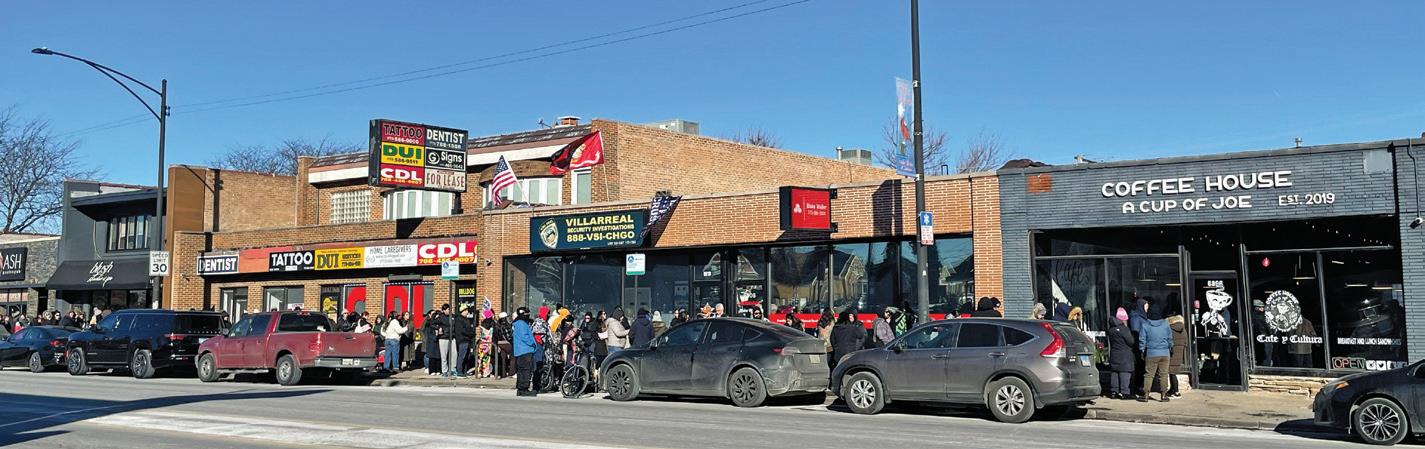
But rather than a boycott, that morning and early afternoon, hundreds lined up outside the coffee shop to support the business, forming a line that stretched a city block. Some waited more than an hour in the cold to show their support.
Karina Santana told the Weekly she saw a post about the planned boycott that a friend shared on Instagram. She was not sure what to expect and wondered if MAGA supporters were going to present. Though not a coffee drinker, she woke up at 4:50a.m. to be among the first to arrive.
“It’s nice to see the turnout,” she said. “I actually went outside to look at how long the line was. It’s going down the block.”
People waved flags from the roof of a neighboring business and throughout the crowd, including an American flag, a “Fuck Trump” flag, and several Mexican flags. Some supporters wore blankets reading “Abolish ICE” draped over their backs.
Victoria Alvarez, who came with her sister, said she loves A Cup of Joe’s “money matcha” and vegan scones. While she acknowledged the attempted boycott, she said she came to express her support. “I thought I would see more of the opposing side here, but I don’t see a single one,” Alvarez said.
Others, like Pat, a neighborhood resident for more than forty years, held signs along Archer Avenue reading “No human being is illegal” and “Leave our neighbors alone.” Passing cars honked in support. “Great neighbors, great block. I don’t judge someone by their color or anything,” Pat said, recalling when a Latino neighbor first moved onto her street in 1995.
To keep warm, some supporters danced to norteño music, including “Somos Más Americanos” (We Are More American), a ballad by the Mexican band Los Tigres del Norte. The song, blasted through a speaker carried by Gage Park cyclist Alfredo Valladares Jr., tells the story of an undocumented Mexican immigrant responding to people who tell him to “go back to your country,” despite the border having crossed him—a figurative response to the insult pointing out that the land he lives on was historically part of Mexico. The song also
Hundreds of supporters formed a line stretching down Archer Avenue outside A Cup of Joe in Garfield Ridge on Saturday, February 7, showing solidarity with the Mexican American–owned café after it became the target of online harassment for its pro-immigrant stance.
reminds listeners that several U.S. states were once Mexican territory.
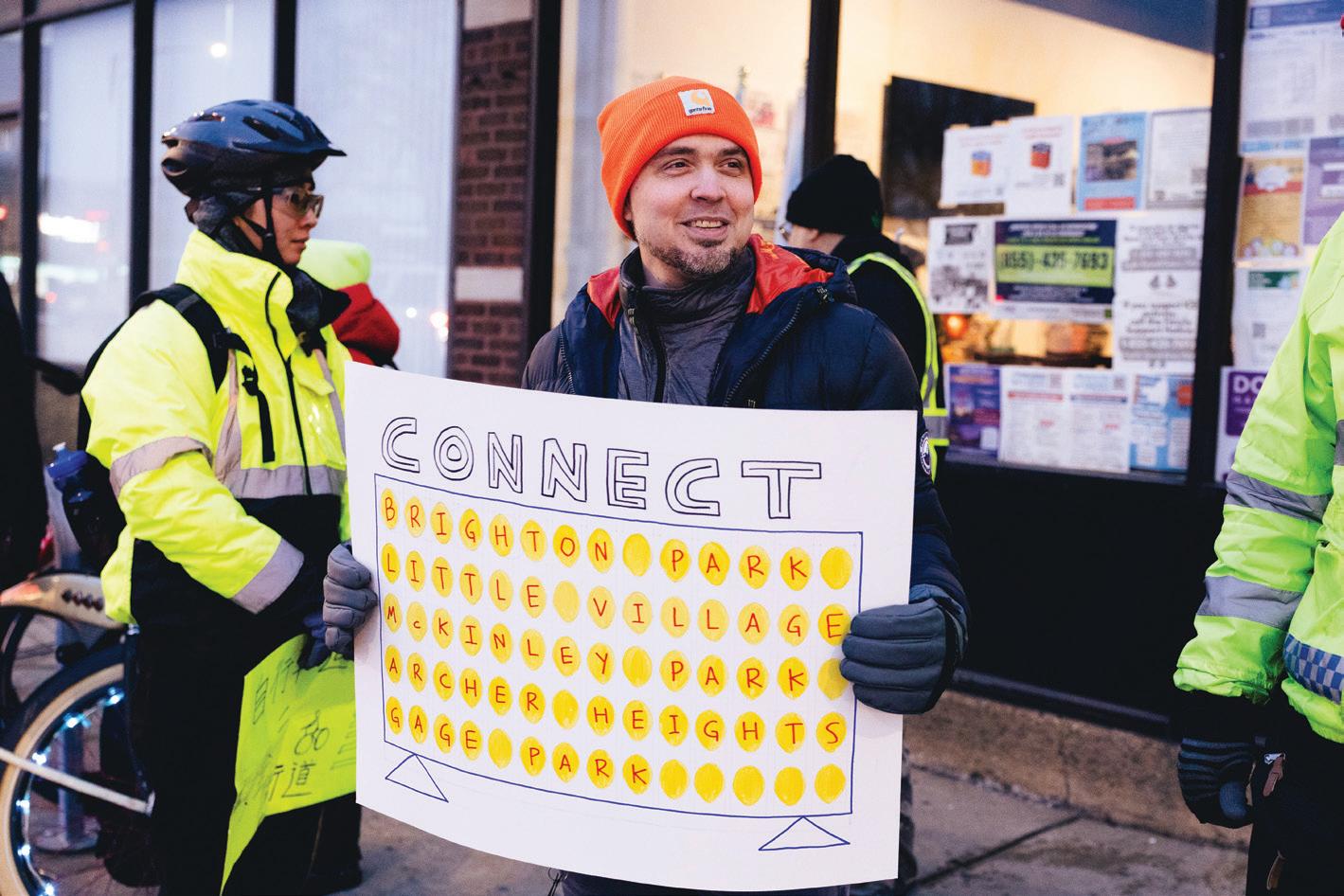
Valladares Jr. leads Gage Park Cyclists, a community group founded in 2021 that promotes cycling on the Southwest Side. As immigration enforcement has ramped up, he and fellow cyclists have built a coalition with Cycling X Solidarity. Together, they organize bike rides where participants buy out street vendors’ stock so they don’t have to be outside during ICE raids. The rides draw twenty to thirty cyclists and sometimes a couple hundred participants. The riders play a carefully curated playlist that includes “Somos Más Americanos” to share a message of solidarity.
“I want to get the message across that immigrants, we’re not bad people. They’re people that actually build. They’re people that support. They’re people that provide,” Valladares Jr. said. On Saturday, the group rode their bikes to A Cup of Joe in an act of solidarity.
Valladares Jr. said he did not see the protesters he had expected.
He did, however, notice about five pickup trucks and a sedan flying Trump 2028 flags circling the block, driven by white men wearing camouflage who repeatedly revved their engines. One driver stopped across the street and yelled references to ICE. “Let’s hear it for ICE, more ICE, they’re on their way,” Valladares Jr. recalled the man saying.
Photo by Jóse Abonce
“I invited him over to have some coffee with us and maybe discuss our differences, but of course he declined.”
Jorge Garcia, a McKinley Park resident carrying a bullhorn, also came to support A Cup of Joe. He joined Karina and two University of Illinois Chicago students. “It’s important to stand with businesses that advocate for the immigrant and Latino community,” he said.
According to A Cup of Joe’s statement, those behind the attempted boycott also tried to portray the café as anti-police. However, the owners shared a screenshot on Instagram from a local officer expressing support: “As a police officer we love you in our community and hope that your business continues to thrive!” it read. “I’ve loved A Cup of Joe since you guys opened and will always support.”
By midafternoon, the line had disappeared, and the café had sold out coffee and pastries, with even more neighbors having turned out to show their support. “I see more community, love, support, and that’s what I was hoping to see,” Alvarez said. ¬
José Abonce is the senior program manager for the Chicago Neighborhood Policing Initiative and a freelance reporter who focuses on immigration, public safety, politics, and race.
‘Black Creativity’ is More Than Aesthetics
It’s the longest continuously running juried exhibition of Black art in the nation
BY JARED BROWN
More than five decades after “Black Esthetics” debuted at the Museum of Science and Industry, the annual exhibition now known as “Black Creativity” opened last month with a juried show of professional and teen artists from Chicago and beyond.
“It’s the longest continuously running juried exhibition of Black art in the nation,” said Angela Williams, the museum’s director of design.
When “Black Esthetics” debuted in 1970, Chicago was in the midst of upheaval—reeling from the assassinations of Fred Hampton and Martin Luther King Jr., war protests, and economic disinvestment, while Black artists were building new cultural institutions of their own.
An outgrowth of Chicago’s Black Arts Movement, “Black Esthetics” was first curated by artist Douglas Williams, director of the South Side Community
Art Center from 1966 to 1970. The show included dance, sound, public programming as well as an exhibition of visual arts. Among the artists whose work was presented at “Black Esthetics” were Walter Sanford, Nathan Wright— who began painting while wrongfully imprisoned— Ben Bey, and Nii-Oti. The exhibition helped inspire other collectives and spaces, including the Black Arts Guild and the Chicago Mural Group.
In 1984, the program was renamed “Black Creativity” and expanded to celebrate work by artists and thinkers working across art and the sciences. That expansive definition continues to shape the exhibition today, with selected works addressing questions of identity, memory, history, and cultural inheritance across generations.
“We went through the 1,300 images and we brought that number down to the best 100,” said Norman Teague, an artist, designer and educator from Chicago’s South Side who served as one of the jurors this year alongside Akilah S. Halley, the executive director of Marwen.
A defining feature of the annual show is its emphasis on youth artists. Two galleries on the museum’s lower level are dedicated to Chicago-area teens. In “Angels Have Bad Days Too,” Morgan Park High School student Heaven Williams depicts a genderless Black angel wrapped in white fabric against a dark sky, with wings adorned in white flower petals. White shapes hover above the figure, evoking cowrie shells, which are frequently associated with wealth, prosperity and spiritual protection across the African diaspora.
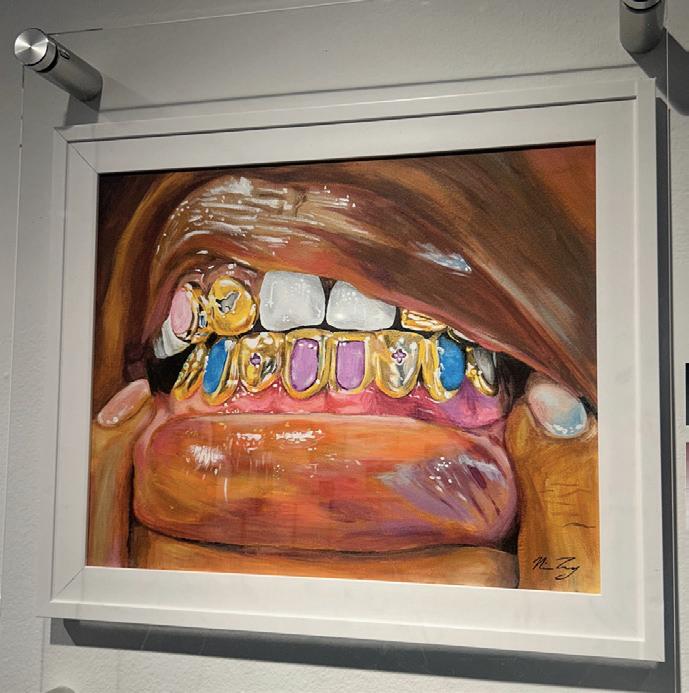
Another teen submission, Nia Terry’s “Grillz,” won third place in the teen category. The painting zooms in on a mouth adorned with gold fronts accented
by pink and blue stones. Terry, a high schooler from Racine, Wisconsin, cleverly uses light strokes of white paint to create a glossy sheen on the lips, referencing both contemporary hip-hop aesthetics and West African traditions of adornment.
In the main gallery, Chicagobased videographer Toni Daniels’ piece “Legacy on Record: Marie Henderson Out of the Past Records” centers on the cultural significance of Out of the Past Records, a longtime West Side record store. The video pairs a still image of the shop’s founder, Marie Henderson, with her narration, framing the store as both a neighborhood institution and a site of musical preservation. In doing so, the piece underscores the central role Black artists and communities have played in shaping all Western music—from blues and country to jazz, rock, disco and electronic—while paying homage to oral history as a means of cultural transmission.
Photographs in the exhibition
similarly explore Black American life and reflect cultural contributions. In stevia roxanne’s “Dedicated To,” a Black woman peers from behind a tree, her long braids blending into the surrounding soil and roots. Brian Edwards Jr.’s black-andwhite photograph “The Ride” captures a child riding a sheep at a rodeo, freezing a moment of exuberance and highlighting Black presence in contemporary rodeo culture.
More than five decades after “Black Esthetics” first emerged amid political and cultural upheaval, “Black Creativity” returns with new generations of artists responding to many of the same unresolved conditions that made the exhibition necessary in the first place. ¬
“Black Creativity” is open at the Griffin Museum of Science and Industry, 5700 S. DuSable Lake Shore Dr., through April 19. General admission is $25. Chicago residents get discounted admission.
This story was originally published by the Hyde Park Herald.
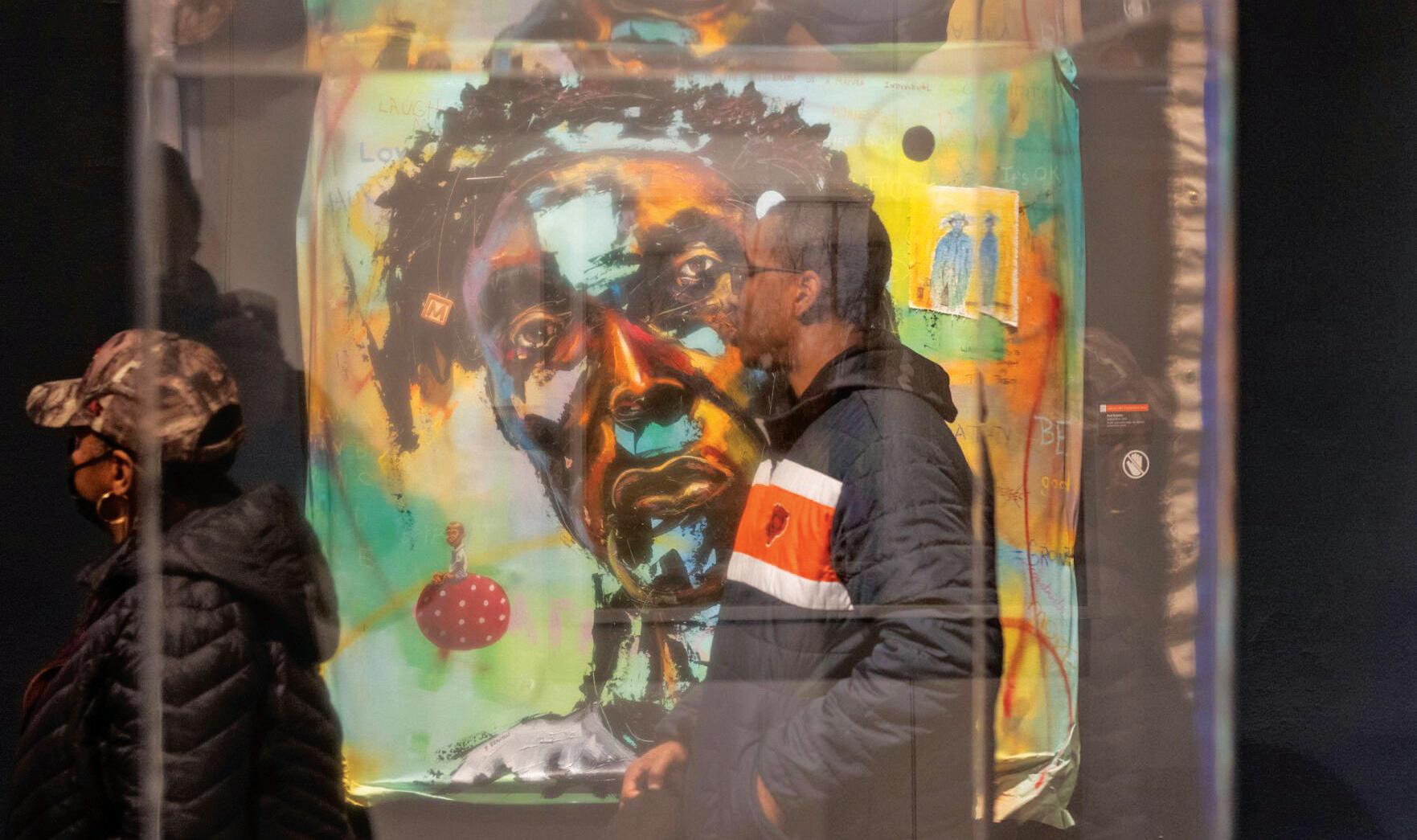
Visitors view artwork during the “Black Creativity” juried exhibition at the Griffin Museum of Science and Industry on Martin Luther King Jr. Day, Jan. 19, 2026. Photo by Spencer Bibbs
Nia Terry’s “Grillz,” on view at the Griffin Museum of Science and Industry’s “Black Creativity” exhibition. Photo by Jared Brown
South Side Tours Delivers History on the Move
South Side Tours uses narration, local insight, and landmark stops to highlight the people and places that define Chicago’s South Side.
BY DIERDRE ROBINSON
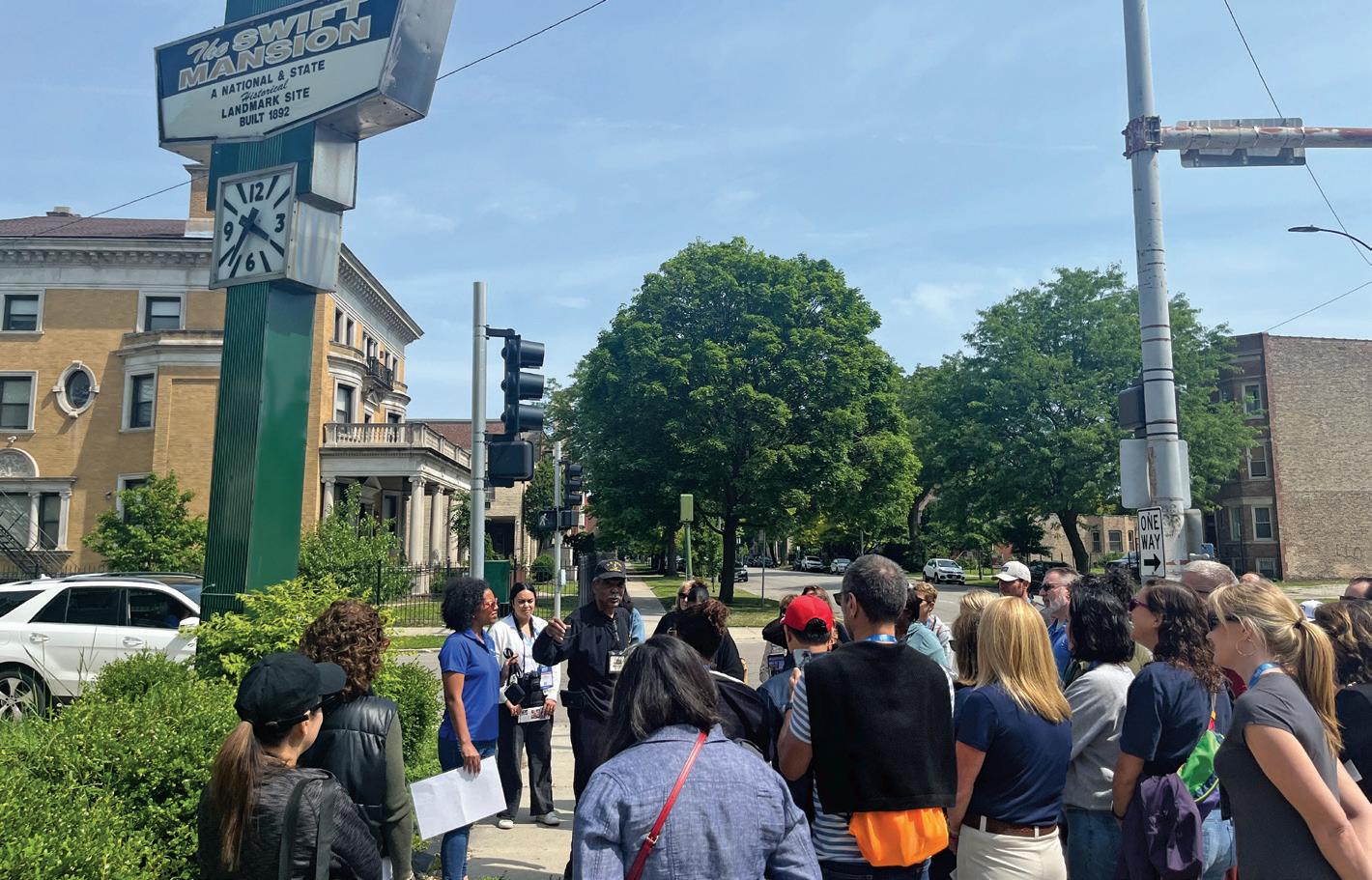
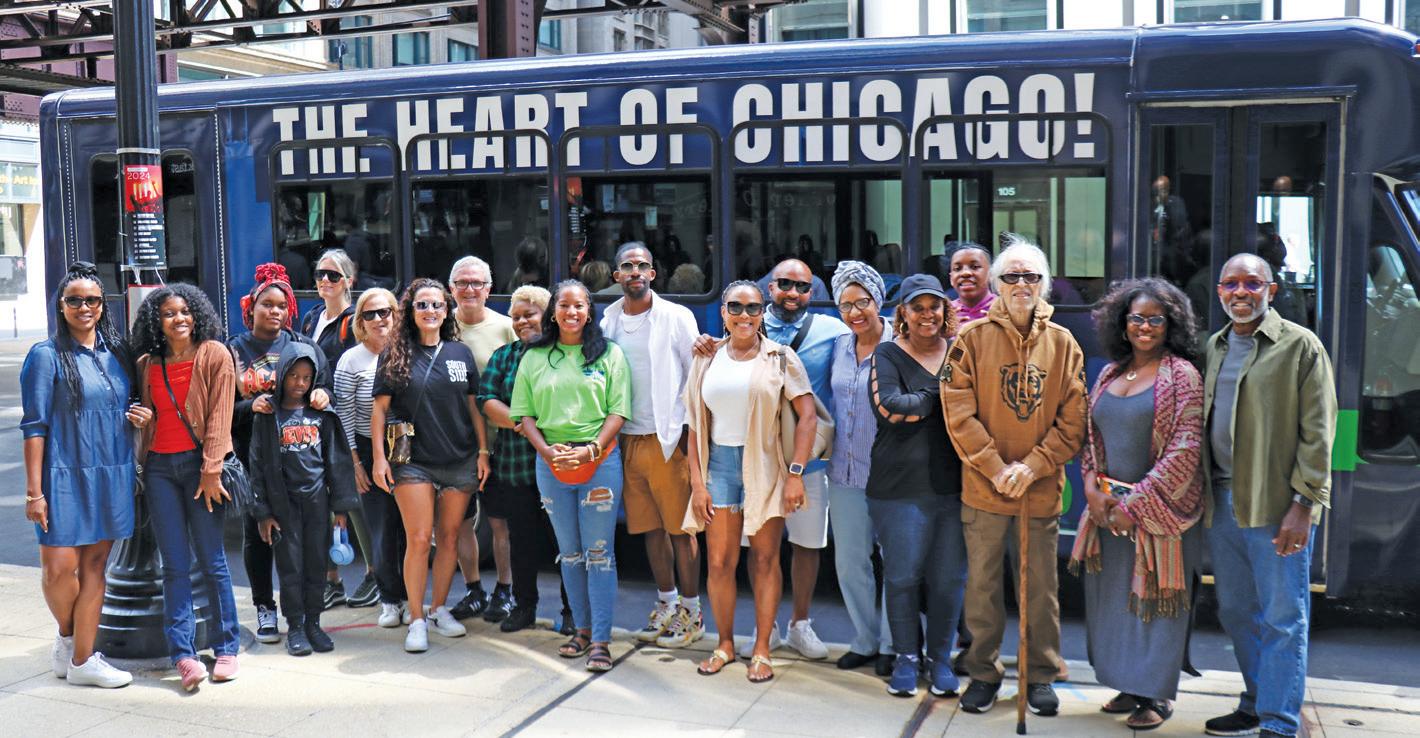
When Angela Dugan founded South Side Tours, she wasn’t just launching a business— she was creating a moving oral history project on wheels. Since rolling out its first official tour in August 2024, Dugan says South Side Tours has hosted about fifty more, introducing mostly out-oftown visitors to the neighborhoods, landmarks, and cultural history that rarely make it into mainstream news cycles and day-to-day narratives.
With a background in television production and inspired by a family trolley ride for her grandfather’s ninetieth birthday, Dugan has built her tours around real voices and real stories. Riders hear firsthand accounts of South Side history as the tour bus moves through historic corridors like Bronzeville, Woodlawn, Washington Park, and Back of the Yards, turning each stop into a living timeline of the Great Migration, Black culture, and community.
The tours start downtown at the Palmer House Hilton, then travel south past major cultural landmarks—from Quinn Chapel to the Obamas’ home, Emmett Till’s house, and the former Robert Taylor Homes. In this Q&A, Dugan talks about how a birthday trolley ride turned into a mission-driven business, why oral history is at the heart of her tours, and how she’s using storytelling to change perceptions of one of Chicago’s most culturally rich areas—the South Side.
This interview has been edited for length and clarity.
How would you describe South Side Tours, and how did it get started?
I would describe South Side Tours as if you’re seeing the South Side through the eyes of those who lived it. I spent years interviewing South Siders and had been ideating South Side Tours for over a decade. I got the idea and the push to do it in 2014, but I was working as a vice president of a production company, and I was living in L.A., so it was just something that I was going to do one day.
And so marrying the thought of showcasing the people from the South Side and telling their stories with the tour really didn’t become a part of the plan until I actually moved back to Chicago in 2021. I was separately putting my family’s stories on tape so that we could have them, and I realized it’s so much better to hear them tell their stories than me regurgitating their stories. I just wanted people to leave the tour and feel like, “Okay, I just hung out with a couple of South Siders for an hour or two, and they’re some cool folks.”
What inspired you to create South Side Tours?
The inspiration came from a multitude of places, but I would say the seed was planted with Isabel Wilkerson’s book, The Warmth of Other Suns. I read that when it came out in 2010, and it took me longer than usual to read. I was reading this book and coming to work, and I was angry. I had to put it down and read it gradually.
What I loved about the book was it reminded me of the stories of my family. We’ve always talked about the Great Migration; I’ve spent summers in the South. My family is from Louisiana,
Alabama, and Arkansas. It was really cool to read this book where these different stories were woven together with the history of the times as well.
There was a section of Isabel’s book where it talked about how the lynchings in Florida were just so gruesome compared to the rest of the South. And so to have my granddad, who lived in Alabama during that time, say, ‘Yeah, we went to Florida once, but you always knew you didn’t want to stay in Florida long,’ just things like that.
I went to college in New York, then came home for a summer, worked on Obama’s first campaign, and then right after the election, I moved to L.A. to start my career, or continue with my career. And whenever I would come to Chicago, I would just see how much things were changing, and the things that my dad
used to say growing up, because every car ride with him was a South Side tour. Now I’m coming home, and I’m like, “Wait, what happened to Moo & Oink and everything?”” That was the seed, and it just continued to grow.
So for my grandfather’s ninetieth birthday, my mom was like, “Okay, we’re gonna throw him a party, rent an event space.” And I’m like, “Mom, grandad can barely walk. Let’s just—” and I don’t know where this came from, but I said, “Let’s rent a trolley and let’s go around to the places that were special to him in his life,” because I did know that being older, memories become even more important. I had a friend from L.A. in town, and she came with us, and she said, “You need to turn this into a business.” She said, “I don’t even know your grandfather, and I’m scared of the South Side, but now I feel better
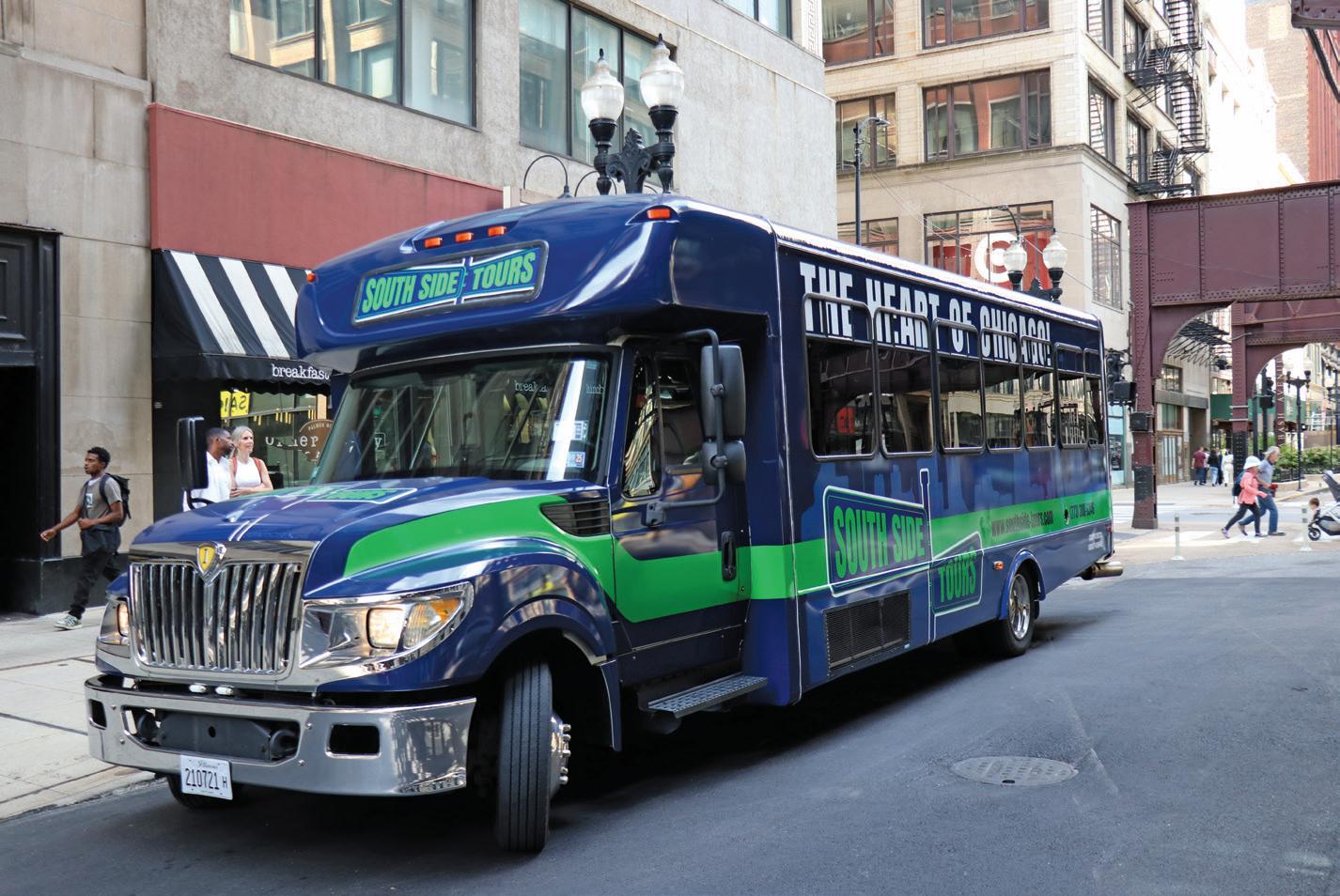
Photo Courtesy of South Side Tours
about the South Side.” That was 2014 when that happened, and I was like, “Okay.”
What’s the tour bus like? Is it handicap accessible?
The bus seats thirty. I max the tours out between twenty-four and twenty-six because we have a wheelchair lift. We’re ADA compliant.
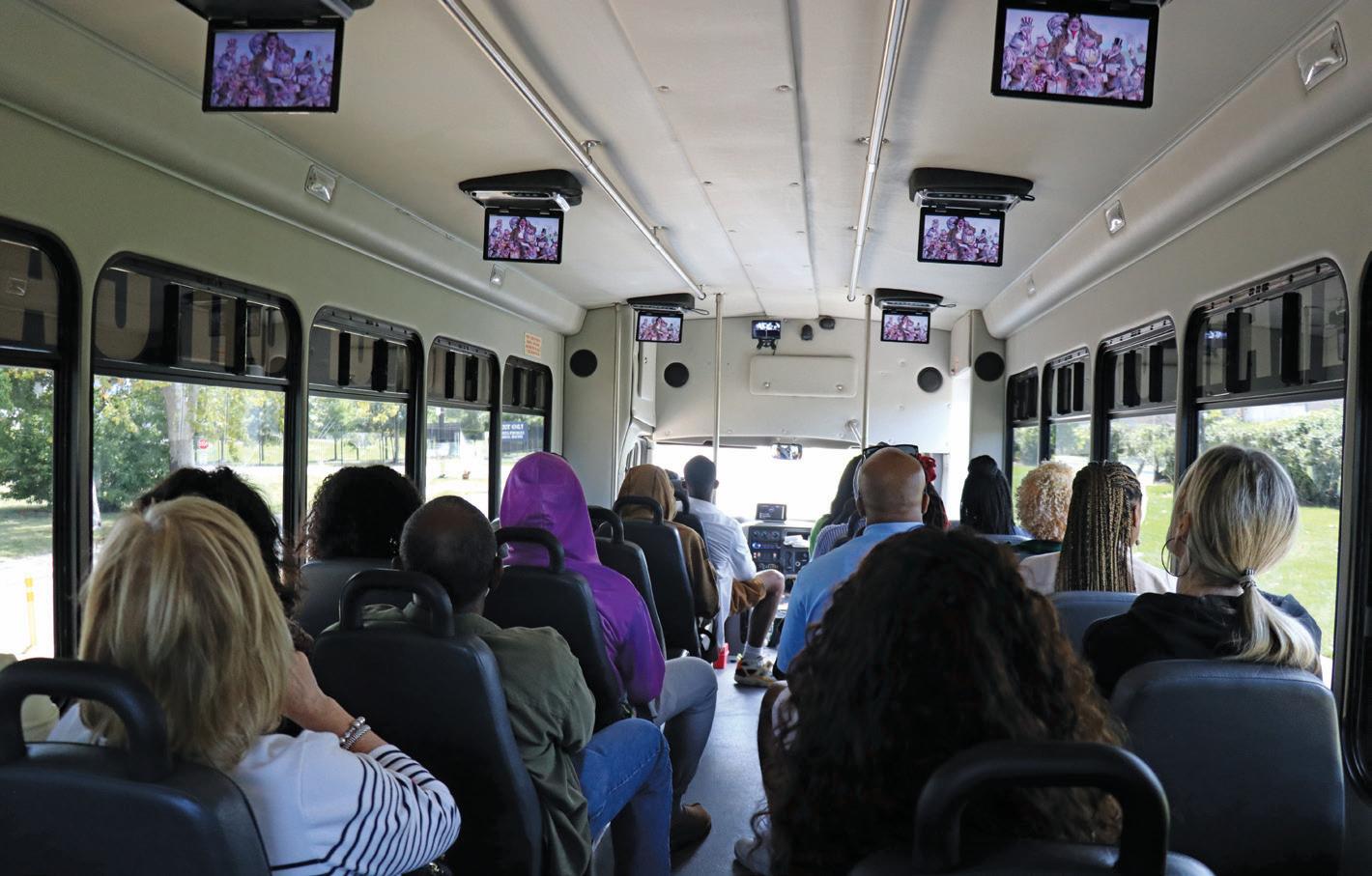
We have technology on the bus where, depending on where you are GPS-wise, it will trigger a story or a video. So when we ride down 63rd, you’ll hear people talking about growing up in Woodlawn in the ’60s.
When we go through Washington Park, that’s when people kind of talk about the Bud Billiken and being on the South Shore Drill Team and things like that.
Where does the tour go?
That tour started in front of the Palmer House. The demographic was people like my friend that day—people who are afraid of the South Side, people who aren’t from Chicago [and] don’t really know anything about the South Side. I wanted to catch them where they were, and I know they’re downtown. So we start at the Palmer House.
As we make that drive down Wabash to get to Quinn Chapel, you meet a series of people telling you about their story, which is mainly the Great Migration story, and of course, we give a nod to the Natives who were here prior to Jean Baptiste Pointe
DuSable coming. So by the time you get to the South Side, you kind of have an idea of this Great Migration that brought so many of us to this part of the city.
And so we go through Bronzeville. From Bronzeville, we go to Kenwood. We go past Elijah Muhammad, Louis Farrakhan, and Muhammad Ali’s homes. We go up the 53rd Street commercial corridor, pointing out all those businesses, talking about the University of Chicago, and kind of their history in the area. Of course, we go past the Obamas’ house—that’s everyone’s highlight. That tour was like two hours and forty-five minutes.
From there, we go through Washington Park, through Woodlawn, to Emmett Till’s house. We go past Parkway Gardens. And I love seeing people’s faces when we talk about Michelle Obama living there, what that land used to be—a whites-only amusement park. And we go past the old Robert Taylor Homes, which is probably my favorite, because that’s where you really hear from people who lived in the Robert Taylors and what it was like. I have a woman who represents a family that was one of the first families, and then someone who was there twenty years after her, and their experiences are completely different.
Then from there, we go past the stockyards, through Bridgeport, and come back around and see Comiskey Park and back to the Palmer House.
How do you choose your tour stops?
The oral history informed my route. What I had people talking about, that was very profound, informed that.
My grandfather was a butcher in the stockyards, and I also interviewed a family that grew up in Back of the Yards in the 1950s, so I kind of interwove those stories together. I don’t know how much people catch it, but based on the conversations we have after the tour, I think they do.
I’m always trying to draw parallels between then and now, because the stockyards are just so interesting to me—the evolution of Back of the Yards, the stockyards, and how it’s similar to workforce culture in Chicago today. You have different ethnic groups working together in the same industry. That really mirrors what we see now, and of course, you want to make sure you hit the hotspots like the Obama home and Comiskey Park. So that’s really how the route came together.
Would you describe this as a family business?
My father passed away last year, and I'm so glad he got to experience the tour before he passed. He’d be like “Is Chicago that interesting? Is the South Side that interesting? Is that interesting for a tour?” But, I mean— yes. Now that I'm thinking about it, it is a family business. Even if everybody ain’t on payroll, they’re chipping in.
What is typically the reaction of people after they’ve gone on one of your tours?
One of my favorite reactions to date was this couple from Houston. The husband said the South Side is so green. He really had an outburst because he [was like] “I didn’t know the South Side had trees.” It’s just crazy. And, several people have said just how green it is, how beautiful the homes are, the buildings [and] the two-flats especially when we go through Woodlawn. People can really appreciate them, and they compare them to the Greenline Homes. They’re not even from here, but they’re like, “What are these Greenline Homes? We don’t want them. They need to do what is already here, you know?” So, they definitely appreciate it. But the biggest thing is that they cannot believe how beautiful it is when we go down State Street, through Washington Park, and past the Robert Taylors—then we have a lot of conversations about food deserts. People notice the difference.
Would you say that the majority of the tour goers are not from Chicago?
Absolutely, yes, they’re from the South. And it’s so interesting, because the Great Migration is talked about so much. I forgot that there were people who stayed. There are so many people who come from the South who never heard of the Great Migration. And I’m like, what? But they’re like, “I’m fourth-generation Floridian.” So they’re from the Carolinas, Texas.
Photo Courtesy of South Side Tours
Photo Courtesy of South Side Tours
I would say Texas is probably my number one—huge shout out to Houston. I’m always getting people from Houston. But yeah, mainly from the South, and I love it. They’re people who intentionally want to see where Black people live, and that’s how I grew up. My dad was an Air Force vet, but didn’t fly by the time I was born, and we drove everywhere. And I remember everywhere we’d go, we’d do the touristy stuff, and then he’d stop people on the street and say “Hey brother, where do Black people live?” That’s how I get it.
What’s been your biggest challenge?
The biggest challenge is marketing— devoting the time to marketing. Marketing isn’t the challenge, but it’s a beast all on its own, especially now, living in a time where content creation is essential for business. And then myself, as a trained TV producer, that’s just a whole other conversation. Not to sound foofy, but the thought of, okay, we’re going to shoot something, edit it, and post—we spend three months on one episode. So I’ve had to adjust.
I’m sitting on tons of footage because whenever I bring people on, I don’t like the way they do it, and I’m like, “Alright, I’m doing it myself.” But when you’ve got to do it yourself—you’re writing the scripts, you’re doing the tour routes—the biggest challenge is devoting the time that marketing and social media need. And also letting go. Releasing some of those responsibilities.
One of my last questions is, what’s new? Any neighborhoods or new tours planned?
Neighborhoods—I can’t think of any off top that would be new, but we have a food tour coming that I’m actually super excited about, the South Side food tour. So that’s when we come back up in the spring. I really want to debut it when there’s no snow on the ground, so I could also get really great footage. I want to have it out there by April, because it’s done now and it’s ready. And I know my restaurant partners are kind of like, “Okay, when are we doing this?”
info too. Our website is www.southsidetours.com. We are also on TikTok at @southside_tours, same with Instagram and Facebook.
Just in time for Valentine’s Day, South Side Tours will host its “South Side Night Out” bus tour on February 14, 2026. The bus departs at 7 p.m. and returns at midnight. The cost of the tour is $25 plus tax, and tour stops will include Social Sip Bar & Grill, Park Manor 75, and W. Hideaway Lounge. You must be at least twenty-one years of age to participate. Tickets can be purchased on their website. ¬
What would you like the takeaway to be for people who go on your tours?
I don’t want to paint a picture like the South Side is perfect, but it’s worth it. It’s how I explain it to people: you have affluent areas of a city, you have middleclass areas, and you have areas that have a greater concentration of crime than other areas. This is a city.
Most people from cities don’t have a hard time understanding the South Side. But for instance, my friend who did my grandfather’s tour way back when—she was from L.A., and I had to give her a little speech because she was afraid of the South Side. But I think it was when we were driving through Beverly, and she was like, “This looks like a movie set. You have to tell people that this exists.”
And of course, when we went through Woodlawn, and I think we went to some parts of Englewood, she was like, “Okay, so this is what I know the South Side to be from TV.” But it’s some of everything. Even the places where people feel it’s harsh, there is so much history. Your favorite artist is from here. That’s the thing. Everyone wants to applaud what comes out of the South Side through the artistry and creativity, but this is what makes them who they are as artists.
So it’s really about gaining an appreciation and an understanding—not just “Yes, we’re going to see some nice things,” but also gaining an appreciation for the places that aren’t as affluent, knowing how they got there. When people learn about restrictive covenants and redlining, they realize it wasn’t by accident. It was by design.
How can someone find out more about South Side Tours?
Go on our website and subscribe because our email newsletters give a wealth of
Dierdre Robinson is a writer and accounting manager in Chicago. She has a BA in Journalism from Michigan State University. She last wrote about the Toro Nagashi Lantern Ceremony for Best of the South Side for the Weekly.
Photo Courtesy of South Side Tours
Archer Avenue Bike Lanes Fuel Political Ambitions
Some opposition
to
the
pedestrian
and cyclist safety improvements have been coordinated by the politically connected pro-charter school Urban Center in an attempt to unseat the local alder and mayor.
BY ALMA CAMPOS
Aredesign of Archer Avenue in Brighton Park that is intended to improve safety and accessibility along one of the Southwest Side’s busiest corridors has become a flashpoint for community debate and political tension.
The project, part of the city’s Complete Streets Program, has been underway for several months and includes bike lanes protected from the flow of traffic by a raised concrete curb, pedestrian refuge islands, curb extensions, and new turn lanes designed to slow traffic, shorten pedestrian crossings, and maintain parking where possible. Construction began in late 2025 and is expected to be completed in early 2026.
Ald. Julia Ramirez (12th), whose ward includes Brighton Park and McKinley Park, said the Archer Avenue project predates her time in office and reflects years of advocacy around traffic safety on the Southwest Side.
“A lot of different organizations and people wanted to build out a system where people felt safe on the Southwest Side, specifically on Archer Avenue,” she told the Weekly.
For many residents, this push is rooted in long-standing safety concerns. Alfredo Valladares Jr., a lifelong Gage Park resident and local cycling advocate, said the dangers along Archer are not new. Valladares Jr., a member of Gage Park Cyclists, said he has been riding in the area since high school and began organizing group rides in 2021 to build community and advocate for safer infrastructure. He recounted multiple fatal crashes and serious injuries involving neighbors over the past two decades.
Around fifteen years ago, Valladares Jr. said a school-aged girl was struck while crossing the street with her aunt and sister at
55th Street and Fairfield Avenue. Six years ago, a neighbor’s wife was injured while she had the right of way, crossing at 55th and California Avenue. Four years ago, a bicyclist was killed at 56th and California, an intersection with only a shared bike lane painted on the asphalt, and no physical barrier such as a raised concrete curb.
Valladares Jr. wants people to know that this project isn’t just about bike lanes, but about those who walk, too.
“People don’t feel safe crossing these streets,” he said.
According to data from the Chicago Department of Transportation (CDOT), during a community virtual meeting on the project, traffic injuries in Brighton Park outpace the rest of Chicago.
Archer and Kedzie account for many of the neighborhood’s traffic injuries and fatalities. The new design addresses some of the causes of these crashes. Similar features have reduced accidents, injuries, and speeding in other projects.
City transportation officials point to similar projects elsewhere in Chicago as evidence that street redesigns like the one on Archer Avenue can reduce serious crashes. On the West Side, CDOT’s Vision Zero initiative led to safety upgrades along major corridors in Austin, Garfield Park, and North Lawndale, resulting in a thirty-nine percent reduction in people killed or seriously injured between 2021 and 2024, more than double the citywide decline.
In Brighton Park, there have been over 6,000 traffic crashes, more than 1,500 injuries, and thirteen fatalities.
Compared to the average Chicago neighborhood, Brighton Park has 90 percent more traffic crashes.
As a community partner with CDOT from the beginning, transit advocacy steward Dixon Galvez- Searle of Southwest Collective described the redesign as “the first really significant protected bike lanes anywhere on the Southwest Side,” emphasizing that its benefits extend beyond cyclists.
“So if you live just a few blocks from your kids’ school, maybe you’ll feel comfortable letting your kids bike to school, or walking with them—trips you wouldn’t have felt safe doing before. If the project achieves that, it’s a boon for quality of life in the neighborhood.”
At community meetings, city transportation officials have said the project was shaped by extensive community engagement. CDOT conducted surveys, public meetings, and outreach that revealed strong interest in walking and cycling. Valladares Jr. said the findings reflected what many residents already knew.
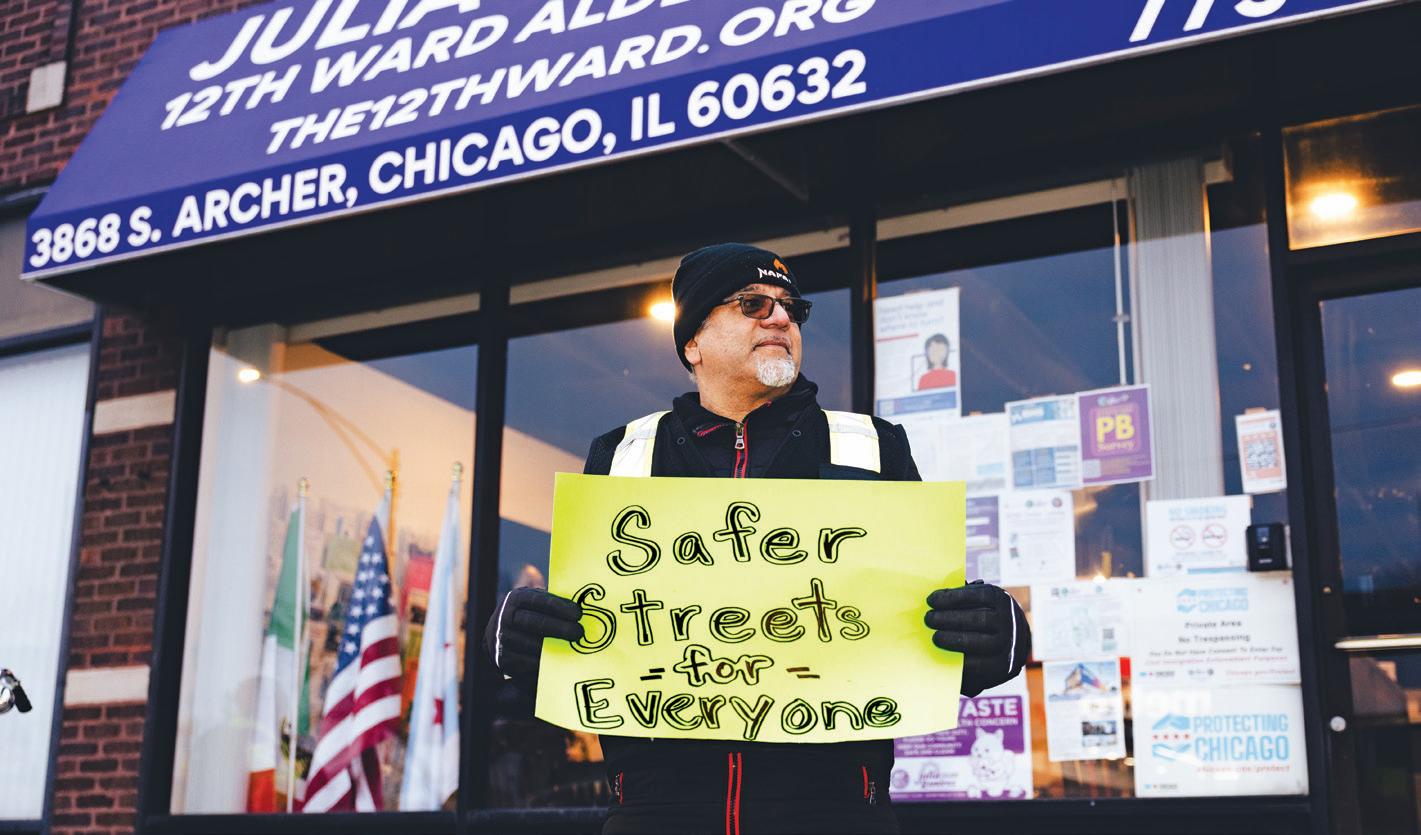
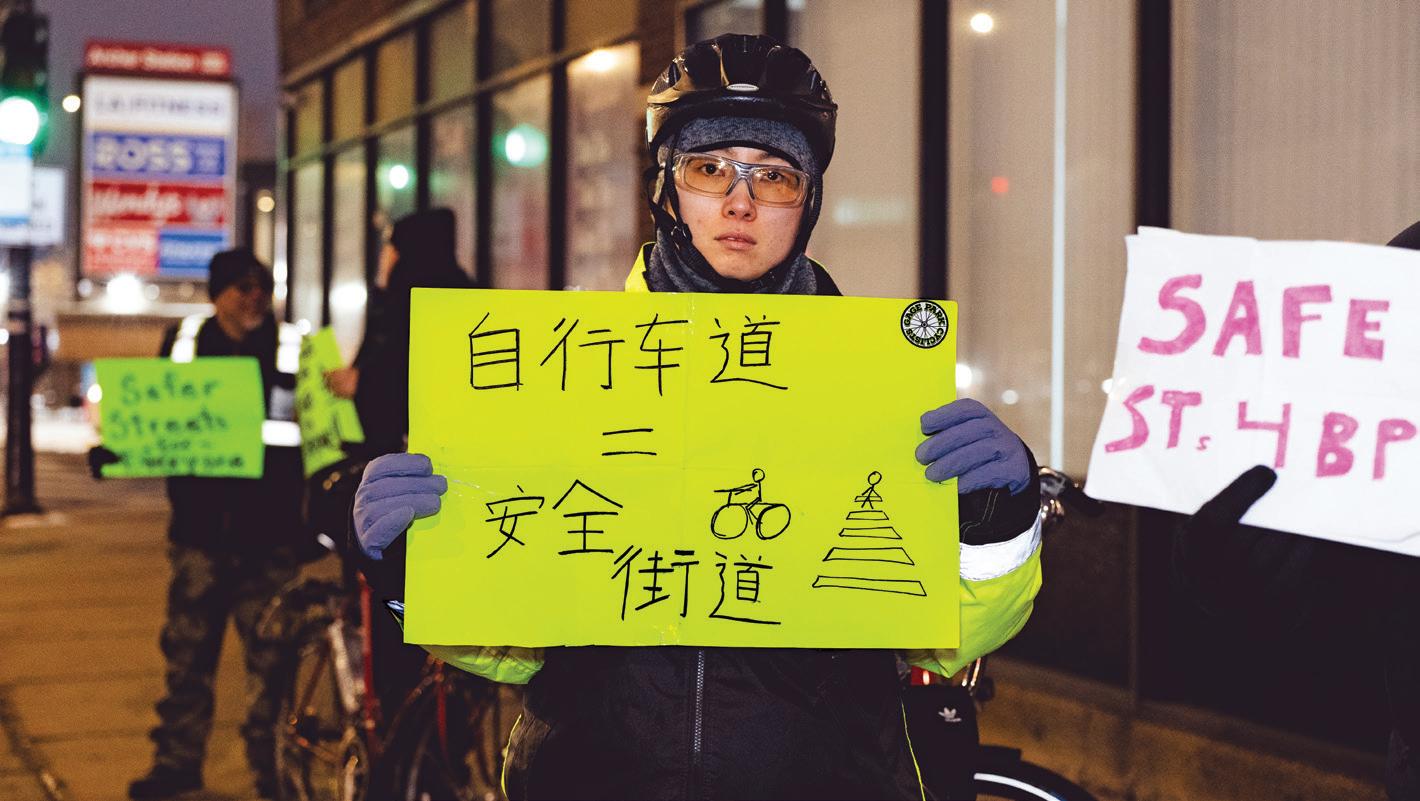
Yet the redesign, and especially its bike lanes, has drawn vocal opposition, some of it explicitly political. Protests outside Ramirez’s office that started in December 2025 not only raised concerns about parking loss, traffic congestion, and emergency vehicle access—issues the project addressed—but also carried messaging explicitly aimed at unseating Ramirez and Mayor Brandon Johnson. The Weekly obtained two mass text
Transit advocacy steward Dixon Galvez-Searle of the Southwest Collective holds a sign in support of bike lanes at a rally outside Ald. Ramirez’s office on Monday, Feb. 2.
Photo by Caeli Kean
messages and a press release sent by the Urban Center, a pro-charter school advocacy organization that has been active in campaigns opposing progressive elected officials.
Both texts carry the organization’s logo and teal-and-red color scheme, and use nearly identical talking points. One message says in part that Ramirez and Johnson “have forced their concrete bike lanes on our community who doesn’t want them,” claiming the lanes increase traffic, limit parking, and make it harder for emergency vehicles to get through.
The group opposing the project says it is not against bike lanes in general, but specifically opposes the installation of concrete-protected lanes along Archer Avenue. Research suggests that painted bike lanes alone can be less safe than having no lane at all, while protected lanes, like those planned for Archer, provide real safety benefits for cyclists and pedestrians.
CDOT pointed out that the project includes intersection designs, left-turn lanes, striped medians, and other features that give emergency vehicles space to maneuver, turn, and pull over when needed.
Another similarly states that “working families don’t want their concrete bike lanes” and encourages recipients to join Urban Center’s campaign to remove them, providing a link to the group’s advocacy site. Both texts explicitly name Ramirez and Johnson, signaling that the messages go beyond infrastructure concerns and are being used as a political tool.
the fundraising appeal casts the bike lane project as driven by political agendas rather than safety concerns, and urges supporters to “hold leaders accountable” when elected officials move forward despite opposition.
In 2024, Villalobos received more than $25,000 from the Urban Center during her unsuccessful Chicago School Board candidacy.
Urban Center is led by former UNO Charter School CEO Juan Rangel and is affiliated with Paul Vallas, the former Chicago Public Schools CEO who lost to Johnson in the 2023 mayoral runoff.
around. When asked about issues being leveraged in elections, specifically any backing for Zuno, he framed political consequences as a natural byproduct and not a goal, but not a problem either. “If leadership emerges out of their actions or our support, that’s not a bad thing.”
When asked about Urban’s Center’s broader political influence, Rangel downplayed its role in elections, describing the organization’s work as focused on “the issues and how the community reacts to these issues.”
A December 8 press release promoting a rally outside Ramirez’s ward office opposing the bike lanes listed contact information for Bobby Sylvester, vice president of Urban Center, and Claudia Zuno, listed as “Community Resident.” The release stated that “Brighton Park community residents will rally in protest of the concrete bike lanes,” citing concerns about rush-hour traffic backups and emergency vehicle access.
Discussions have circulated about a potential challenge to Ramirez, including the possibility of Zuno running in a future election.
When asked whether her involvement in opposition to the Archer bike lane was connected in any way to plans to seek elected office or support a challenge in the 12th Ward, Zuno told the Weekly, “If this is not a wake-up call for [Ramirez] to change course and genuinely listen to the people she represents, then it is a clear opportunity to step forward and advocate for the true interests of the 12th Ward community.”
Former School Board candidate Eva Villalobos has also emerged as a visible organizer of rallies opposing the Archer bike lanes.
On a GoFundMe page soliciting donations, Villalobos describes the group as a response to what she characterizes as decisions being “forced” onto the community without transparency or meaningful resident input. While the group states it is “not against cyclists,”
Rangel ran UNO, the nonprofit that opened many charter schools in Little Village and other Latino neighborhoods. He grew up in the area and over decades built connections in politics and city government. Under his leadership, UNO expanded rapidly, but he surrounded himself with family and political allies, and the organization’s finances were complex and opaque. Parents and critics complained that the schools sometimes prioritized growth and influence over students. In 2013, after investigations and lawsuits, he resigned.
Urban Center’s involvement in local politics extends beyond messaging about the Archer Avenue project. Records from state election filings show Urban Center Action, the organization’s super PAC, raised hundreds of thousands of dollars in the 2024 Chicago school board cycle and has spent on field work, mailers, text messaging and other campaign activity aimed at supporting or opposing specific candidates.
In 2025, The Triibe reported that Urban Center’s political action committee sent mass texts criticizing Johnson and several progressive alderpeople over the City Council’s vote on a controversial “snap curfew” ordinance. Political analysts say these efforts are often aimed at building a base and shaping elections long before candidates formally announce campaigns, illustrating how common neighborhood frustrations can be used in a larger strategic effort.
Similar tactics—coordinated messaging and rallies—are now appearing in Brighton Park over the Archer Avenue project.
Rangel told the Weekly community residents came to Urban Center with the issue, and that it is merely a response “to the community” not the other way
Although Ramirez has been on maternity leave for the past two months, she has stayed engaged with community concerns through calls, emails, and virtual one-on-one meetings. Her office coordinates a monthly small business meeting on the first Monday of each month with the McKinley Park Development Council. At the most recent meeting, protesters attended, causing disruptions, including yelling and unauthorized recording, that prevented the agenda from being completed and required security to be called.
“I think that we should push ourselves to see the benefit, even if it is an added few minutes of traffic, or the go around to find that parking spot,” Ramirez said. “It's ultimately worth it because of creating accessibility for other people.”
“A lot of people are being used. They’re angry, but they’re not always being told what the project actually does. And that anger is being turned into something political, instead of a real conversation about safety.”
Jaime Groth Searle, the executive director of Southwest Side Collective, who also has a background in marketing, said the opposition Facebook posts raised early red flags for her. She began noticing that different opponents on the platform, at protests, and even among some business
Gil “Pookie” Campos holds a sign that reads: “Safer Streets for Everyone” on Feb. 2 in support of safe bike lanes.
Photo by Caeli Kean
owners were repeating the same phrases about emergency vehicles, small businesses, and traffic congestion.
“It was different people, but saying the same things,” Groth-Searle said, adding that the repetition resembled what, in marketing, is known as a project briefing: a set of prescribed talking points and responses to anticipated pushback.
Groth-Searle also pointed to the role of Facebook’s “digital creator” tools, which reward engagement and can incentivize emotionally charged content. In her view, some participants appeared to be capitalizing on the controversy to build online followings, while others were simply expressing genuine frustration creating, intentionally or not, fertile ground for political groups to amplify and steer the narrative during an election cycle.
“We need to name the thing,” she said, describing how anger and frustration around a real inconvenience can be harnessed and redirected for political ends and cautioned against interpreting the visibility of the protests as evidence of broad opposition.
“I think if it were nice outside and people had better things to do, this would be such a non-factor.”
When Valladares Jr., found out about the weekly protests outside of Ramirez’s office, he decided to attend them with his own group of supporters.
But he said tensions escalated after members of his group began attending and that during one protest, one of the rally organizers attempted to “rip my sign out of my hand,” prompting a police officer to intervene and separate the groups.
Valladares Jr. said police have been present since the start of the protests, but began strictly enforcing physical separation after confrontations increased, with officers now stationed between the two sides to prevent further incidents.
He said he’s gotten threats through Facebook Messenger and TikTok, some implying potential physical harm. In one instance, a person referenced having delivered food to Valladares Jr.’s home via Uber Eats months earlier, an interaction he described as particularly unsettling.
In another instance, he said: I’ve had threats telling me that they’ve been
following me since the beginning, that this is bigger than I think, and that I just need to leave it alone. I don't know what they mean by that.
Julie Wu, a resident of McKinley Park in the 12th Ward, has been attending the weekly bike lane protests since early December 2025. Wu said she initially wasn’t planning to get involved, describing herself as “not the most politically active person.” But after seeing a Facebook post encouraging supporters to show up, she decided to attend and has returned nearly each week to ensure her side is represented.
At the protests, Wu said she observed tactics aimed at swaying supporters. On multiple occasions, opponents handed out flyers for the “Archer Guardians”, while pretending to be on the pro-bike side or filmed attendees under the guise of friendly engagement. These experiences, coupled with the political messaging circulating online, reinforced her understanding that the fight over bike lanes isn’t just about infrastructure—it has become a proxy for broader political debates in the ward.
Her involvement is also deeply personal. In the winter of 2022, she was hit by a car while riding a Divvy bike on Archer Avenue near Hoyne. Though she avoided serious injury, she called the incident “pretty scary,” highlighting the street’s unsafe design. “So if I’m in danger, I think about how much danger there could be to children and elderly people and people who are maybe not able-bodied,” she said.
While pro-bike lane advocates continue to emphasize safety for pedestrians and cyclists along Archer Avenue, the opposing side has become entangled with organized political messaging tied to Urban Center, highlighting how local infrastructure debates can intersect with broader election campaigns.
“A lot of people are being used,” Valladares Jr. said. “They’re angry, but they’re not always being told what the project actually does. And that anger is being turned into something political, instead of a real conversation about safety.” ¬
Alma Campos is the Weekly’s lead reporter and immigration project editor.
Tensión en sobre los carriles para bicicletas en Archer Avenue genera ambiciones políticas
Parte de la oposición a las mejoras en la seguridad para peatones y ciclistas ha sido coordinada por el Urban Center, organización con conexiones políticas que apoya las escuelas chárter y se han realizado intentos para destituir a la concejala y al alcalde locales.
POR
ALMA CAMPOS TRADUCIDO POR GISELA OROZCO
El rediseño de Archer Avenue en el vecindario de Brighton Park, que busca mejorar la seguridad y la accesibilidad a lo largo de uno de los corredores más transitados del suroeste de la ciudad, se ha convertido en un detonante de debate comunitario y de tensión política.
El proyecto, parte del Programa de Calles Completas (“Chicago Complete Streets”), lleva varios meses en marcha e incluye carriles para bicicletas protegidos del tráfico por un bordillo de concreto elevado, islas peatonales, extensiones de acera y nuevos carriles de giro diseñados para reducir la velocidad del tráfico, acortar los cruces peatonales y mantener el estacionamiento siempre que sea posible. La construcción comenzó a finales de 2025 y se espera que finalice a principios de 2026.
La concejala Julia Ramírez (distrito 12), cuyo distrito incluye los vecindarios de Brighton Park y McKinley Park,
afirmó que el proyecto de Archer Avenue es anterior a su mandato y refleja años de lucha por la seguridad vial en el suroeste de la ciudad.
“Muchas organizaciones y personas querían crear un sistema que hiciera que la gente se sintiera segura en el suroeste de la ciudad, específicamente en Archer Avenue”, declaró.
Para muchos residentes, esta iniciativa se basa en preocupaciones de seguridad de muchos años. Alfredo Valladares Jr., residente de Gage Park de toda la vida y activista local del ciclismo, afirmó que los peligros en Archer Avenue no son nuevos. Valladares Jr., miembro de Gage Park Cyclists, comentó que ha estado circulando en bicicleta por la zona desde la secundaria y comenzó a organizar paseos en grupo en 2021 para fortalecer la comunidad y abogar por una infraestructura más segura. Relató varios accidentes mortales y lesiones graves que involucraron a vecinos y que han ocurrido en las últimas dos décadas.
TRANSPORTE
Hace unos quince años, Valladares Jr. contó que una niña en edad escolar fue atropellada mientras cruzaba la calle con su tía y su hermana en la intersección de 55th Street y Fairfield Avenue. Hace seis años, la esposa de un vecino resultó herida a pesar de tener la preferencia de paso al cruzar la intersección de la 55th Street y California Avenue. Hace cuatro años, un ciclista murió en la intersección de 56th Street y California Avenue, un cruce que sólo cuenta con un carril bici pintado sobre el asfalto, sin ninguna barrera física como un bordillo de concreto elevado.
Valladares Jr. quiere que la gente sepa que este proyecto no se trata sólo de carriles para bicicletas, sino también de la seguridad de los peatones.
“La gente no se siente segura al cruzar estas calles”, aseguró.
Según datos del Departamento de Transporte de Chicago (CDOT), presentados durante una reunión virtual comunitaria sobre el proyecto, los accidentes de tráfico en Brighton Park superan la media del resto de Chicago. Las intersecciones de Archer y Kedzie concentran gran parte de los accidentes y de las muertes por tráfico en el vecindario. El nuevo diseño aborda algunas de las causas de estos accidentes. Características similares han reducido los accidentes, las lesiones y el exceso de velocidad en otros proyectos.
Los funcionarios de transporte de la Municipalidad señalan proyectos similares en otras partes de Chicago como prueba de que los rediseños de calles, como el de Archer Avenue, pueden disminuir los accidentes graves. En el lado oeste, la iniciativa “Vision Zero” del CDOT implementó mejoras de seguridad a lo largo de importantes corredores en Austin, Garfield Park y North Lawndale, lo que resultó en una reducción del treinta y nueve por ciento en el número de personas fallecidas o gravemente heridas entre 2021 y 2024, más del doble de la disminución registrada en toda la ciudad.
En Brighton Park, se han registrado más de 6,000 accidentes de tráfico, más de 1,500 heridos y trece fallecimientos. En comparación con el vecindario promedio de Chicago, Brighton Park tiene un 90 por ciento más de accidentes de tráfico.
Como socio comunitario del CDOT desde el principio, el defensor del transporte público Dixon Gálvez-Searle, de Southwest Collective, describió el rediseño como “los
primeros carriles para bicicletas protegidos realmente importantes en todo el lado suroeste”, enfatizando que sus beneficios se extienden más allá de los ciclistas.
En reuniones comunitarias, los funcionarios de transporte de la ciudad han afirmado que el proyecto se diseñó tras una amplia participación ciudadana. El CDOT realizó encuestas, reuniones públicas y actividades de divulgación que revelaron un gran interés por caminar y andar en bicicleta. Valladares Jr. afirmó que los resultados reflejaban lo que muchos residentes ya sabían.
Sin embargo, el rediseño, y en especial los carriles para bicicletas, ha generado una fuerte oposición, en parte de carácter explícitamente político. Las protestas frente a la oficina de Ramírez, que comenzaron en diciembre de 2025, no sólo plantearon preocupaciones sobre la pérdida de estacionamiento, la congestión del tráfico y el acceso de vehículos de emergencia — cuestiones que el proyecto abordó—, sino que también contenían mensajes dirigidos explícitamente a destituir a Ramírez y al alcalde Brandon Johnson. El Weekly obtuvo dos mensajes de texto masivos y un comunicado de prensa enviados por el Urban Center, organización que defiende las escuelas chárter y que ha participado activamente en campañas contra funcionarios electos progresistas.
Ambos mensajes de texto llevan el logotipo de la organización y su combinación de colores azul y rojo y utilizan argumentos casi idénticos. Un mensaje dice, en parte, que Ramírez y Johnson “han impuesto sus carriles de concreto para bicicletas a nuestra
Claudia Zuno, identificada como “residente de la comunidad”. El comunicado afirmaba que “los residentes de la comunidad de Brighton Park se manifestarán en protesta contra los carriles de concreto para bicicletas”, citando preocupaciones sobre los embotellamientos de tráfico en hora pico y el acceso de vehículos de emergencia. Se ha rumorado sobre posibles candidaturas contra Ramírez, incluida la posibilidad de que Zuno se postule en futuras elecciones.
comunidad, que no los quiere”, afirmando que los carriles aumentan el tráfico, limitan el estacionamiento y dificultan el paso de los vehículos de emergencia.
El grupo que se opone al proyecto afirma no estar en contra de los carriles para bicicletas en general, sino que se opone específicamente a la instalación de carriles protegidos de concreto a lo largo de Archer Avenue. Las investigaciones sugieren que los carriles para bicicletas pintados pueden ser menos seguros que no tener carriles, mientras que los carriles protegidos, como los planificados para Archer Avenue, brindan beneficios reales de seguridad para ciclistas y peatones.
El CDOT señaló que el proyecto incluye diseños de intersecciones, carriles para girar a la izquierda, medianas con señalización y otras características que brindan a los vehículos de emergencia espacio para maniobrar, girar y detenerse cuando sea necesario.
Otro mensaje similar afirma que “las familias trabajadoras no quieren sus carriles de concreto para bicicletas” y anima a los destinatarios a unirse a la campaña del Urban Center para eliminarlos, proporcionando un enlace al sitio web de la organización. Ambos mensajes nombran explícitamente a Ramírez y Johnson, lo que indica que los mensajes van más allá de las preocupaciones sobre infraestructura y se están utilizando como herramienta política.
Un comunicado de prensa del 8 de diciembre que promovía una manifestación frente a la oficina distrital de Ramírez incluía información de contacto de Bobby Sylvester, vicepresidente de Urban Center, y
Cuando se le preguntó si su participación en la oposición al carril de bicicletas de Archer estaba relacionada de alguna manera con planes para postularse a un cargo público o apoyar una candidatura en el Distrito 12, Zuno declaró al Weekly: “Si esto no es una llamada de atención para que [Ramírez] cambie de rumbo y escuche de verdad a la gente que representa, entonces es una clara oportunidad para dar un paso al frente y defender los verdaderos intereses de la comunidad del Distrito 12”.
La excandidata a la Junta Escolar, Eva Villalobos, también se ha convertido en una destacada organizadora de las manifestaciones contra los carriles para bicicletas de Archer.
En una página de GoFundMe para recaudar donaciones, Villalobos describe al grupo como una respuesta a lo que califica de decisiones “impuestas” a la comunidad sin transparencia ni participación significativa de los residentes. Si bien el grupo afirma no estar “en contra de los ciclistas”, la solicitud de donaciones presenta el proyecto del carril para bicicletas como impulsado por agendas políticas en lugar de por motivos de seguridad, e insta a los simpatizantes a “exigir responsabilidades a los líderes” cuando los funcionarios electos sigan adelante a pesar de la oposición.
En 2024, Villalobos recibió más de $25,000 de Urban Center durante su fallida candidatura a la Junta Escolar de Chicago. Urban Center está dirigido por el exdirector ejecutivo de UNO Chárter School, Juan Rangel, y está afiliado a Paul Vallas, exdirector ejecutivo de las Escuelas Públicas de Chicago (CPS), quien perdió ante Johnson en la segunda vuelta de las elecciones a la alcaldía de 2023. Rangel dirigió UNO, organización sin fines de lucro que abrió numerosas escuelas chárter en La Villita y otros vecindarios latinos. Creció en la zona y, a lo largo de décadas, forjó conexiones en la política y
Julie Wu, residente de McKinley Park, sostiene un cartel que dice: “Carriles bici = calles seguras” en una manifestación el lunes 2 de febrero. Foto por Caeli Kean
el gobierno municipal. Bajo su liderazgo, UNO se expandió rápidamente, pero se rodeó de familiares y aliados políticos, y las finanzas de la organización eran complejas y opacas. Padres y críticos se quejaron de que las escuelas a veces priorizaban el crecimiento y la influencia por encima de los estudiantes. En 2013, tras investigaciones y demandas, renunció.
La participación de Urban Center en la política local va más allá de la comunicación sobre el proyecto de Archer Avenue. Los registros de las declaraciones de financiación electoral estatales muestran que Urban Center Action, el comité de acción política de la organización, recaudó cientos de miles de dólares en el ciclo electoral de la junta escolar de Chicago de 2024 y los ha gastado en trabajo de campo, envíos postales, mensajes de texto y otras actividades de campaña destinadas a apoyar u oponerse a candidatos específicos.
En 2025, The Triibe informó que el comité de acción política de Urban Center envió mensajes de texto masivos criticando a Johnson y a varios concejales progresistas por la votación del Concejo Municipal sobre una controvertida ordenanza de “toque de queda”. Los analistas políticos afirman que estos esfuerzos frecuentemente tienen como objetivo construir una base de apoyo e influir en las elecciones mucho antes de que los candidatos anuncien formalmente sus campañas, lo que refleja cómo las frustraciones comunes de los vecindarios pueden utilizarse en una estrategia más amplia.
Tácticas similares —mensajes coordinados y manifestaciones— están apareciendo ahora en Brighton Park en relación con el proyecto de Archer Avenue.
Rangel declaró al Weekly que los residentes de la comunidad acudieron a Urban Center con este problema y que se trata simplemente de una respuesta “a la comunidad”, y no al revés. Cuando se le preguntó sobre el uso de estos problemas con fines electorales, específicamente sobre cualquier apoyo a Zuno, enmarcó las consecuencias políticas como un resultado natural y no como un objetivo, pero tampoco como un problema. “Si surge un liderazgo a partir de sus acciones o de nuestro apoyo, eso no es algo malo”.
Cuando se le preguntó sobre la influencia política más amplia de Urban Center, Rangel restó importancia a su papel en las elecciones, describiendo el trabajo
de la organización como centrado en “los problemas y cómo la comunidad reacciona ante ellos”.
Aunque Ramírez ha estado de baja por maternidad durante los últimos dos meses, se ha mantenido al tanto de las preocupaciones de la comunidad a través de llamadas, correos electrónicos y reuniones virtuales individuales. Su oficina coordina una reunión mensual para pequeñas empresas el primer lunes de cada mes con el McKinley Park Development Council. En la reunión más reciente, asistieron manifestantes, causando disturbios, entre ellos gritos y grabaciones no autorizadas, lo que impidió completar la agenda y obligó a llamar a seguridad.
“Creo que debemos esforzarnos por ver el beneficio, incluso si implica unos minutos adicionales de tráfico o tener que dar una vuelta para encontrar un lugar de estacionamiento”, dijo Ramírez. “En última instancia, vale la pena porque facilita el acceso a otras personas”.
Jaime Groth Searle, directora ejecutiva del Southwest Side Collective, quien también tiene experiencia en marketing, dijo que las publicaciones de oposición en Facebook le generaron sospechas desde el principio. Comenzó a notar que diferentes opositores en la plataforma, en las protestas e incluso entre algunos dueños de negocios, repetían las mismas frases sobre vehículos de emergencia, pequeñas empresas y la congestión del tráfico.
“Mucha gente está siendo manipulada”, aseguró Valladares Jr. “Están enojados, pero no siempre se les explica en qué consiste realmente el proyecto. Y ese enojo se está transformando en algo político, en lugar de una conversación real sobre seguridad.”
“Eran personas diferentes, pero decían lo mismo”, comentó Groth-Searle, y agregó que la repetición se parecía a lo que en marketing se conoce como un informe de proyecto: un conjunto de puntos clave y
respuestas preestablecidas para la posible oposición.
Groth-Searle también señaló el papel de las herramientas de “creador digital” de Facebook, que recompensan la interacción y pueden incentivar el contenido con carga emocional. En su opinión, algunos participantes parecían estar aprovechando la controversia para aumentar sus seguidores en línea, mientras que otros simplemente expresaban una frustración genuina, creando, intencionalmente o no, un terreno fértil para que los grupos políticos amplificaran y dirigieran la narrativa durante un ciclo electoral.
“Necesitamos ponerle nombre a esto”, aseguró, describiendo cómo la ira y la frustración ante una molestia real pueden ser aprovechadas y redirigidas con fines políticos, y advirtió contra interpretar la visibilidad de las protestas como evidencia de una amplia oposición.
“Creo que si hiciera buen tiempo y la gente tuviera mejores cosas que hacer, esto no sería un problema”.
Cuando Valladares Jr. se enteró de las protestas semanales frente a la oficina de Ramírez, decidió asistir con su propio grupo de seguidores.
Pero dijo que las tensiones aumentaron después de que miembros de su grupo comenzaron a asistir y que, durante una protesta, uno de los organizadores intentó “quitarme el letrero de las manos”, lo que provocó que un agente de policía interviniera y separara a los grupos.
Valladares Jr. dijo que la policía ha estado presente desde el comienzo de las protestas, pero comenzó a hacer cumplir estrictamente la separación física después de que aumentaron los enfrentamientos, con oficiales ahora situados entre ambos bandos para prevenir nuevos incidentes.
Señaló que ha recibido amenazas a través de Facebook Messenger y TikTok, algunas de ellas insinuando posibles daños físicos. En una ocasión, una persona hizo referencia a haberle entregado comida a su casa a través de Uber Eats meses antes, una interacción que describió como particularmente inquietante.
En otra ocasión, dijo: “He recibido amenazas que me dicen que me han estado siguiendo desde el principio, que esto es más grande de lo que creo y que simplemente debo dejarlo. No sé qué quieren decir con eso”.
Julie Wu, residente de McKinley Park
en el Distrito 12, ha estado asistiendo a las protestas semanales por el carril para bicicletas desde principios de diciembre de 2025. Wu dijo que inicialmente no planeaba involucrarse, describiéndose a sí misma como “no la persona más activa políticamente”. Pero después de ver una publicación en Facebook que animaba a los partidarios a presentarse, decidió asistir y ha regresado casi todas las semanas para asegurarse de que su postura esté representada.
Durante las protestas, Wu dijo que observó tácticas destinadas a influir en los partidarios. En varias ocasiones, los opositores repartieron folletos de los “Archer Guardians” (“Guardianes de Archer”), mientras fingían estar a favor del carril para bicicletas o grababan a los asistentes bajo la apariencia de una interacción amistosa. Estas experiencias, junto con los mensajes políticos que circulan en línea, reforzaron su comprensión de que la lucha por los carriles para bicicletas no se trata sólo de infraestructura, sino que se ha convertido en un pretexto para debates políticos más amplios en el distrito.
Su participación también es sumamente personal. En el invierno de 2022, fue atropellada por un auto mientras montaba en una bicicleta Divvy en Archer Avenue cerca de Hoyne. Aunque evitó lesiones graves, calificó el incidente de “bastante aterrador”, destacando el diseño inseguro de la calle. “Así que, si estoy en peligro, pienso en el peligro que podría haber para los niños, las personas mayores y las personas que quizás no tienen plena capacidad física”, compartió.
Mientras los defensores de los carriles para bicicletas continúan enfatizando la seguridad de peatones y ciclistas a lo largo de Archer Avenue, la parte opositora se ha visto envuelta en una campaña política organizada vinculada a Urban Center, lo que pone de manifiesto cómo los debates sobre infraestructura local pueden entrelazarse con campañas electorales más amplias.
“Mucha gente está siendo manipulada”, aseguró Valladares Jr. “Están enojados, pero no siempre se les explica en qué consiste realmente el proyecto. Y ese enojo se está transformando en algo político, en lugar de una conversación real sobre seguridad”. ¬
Alma Campos es la reportera de inmigración del Weekly y editora de proyectos.
BY MALACHI HAYES
Welcome to the South Side Sports Roundup! Check back every month for the latest news and updates on everything South Side sports fans need to know.
Baseball approaches on the South Side
The calendar has flipped to February, which means winter is all but over to those for whom pitchers and catchers reporting to training camp marks the start of baseball season. The first White Sox players have already arrived at their spring training facility in Glendale, Arizona, and their preseason officially kicks off with a crosstown bout against the Cubs on February 20. The offseason still hasn’t shown signs of slowing down for the South Siders, though, as they’ve generated a (by their standards) whirlwind of activity over the last six weeks after months of minimal activity to start the offseason.
The headliner: After years of rumors and speculation, a trade for fallen star outfielder Luis Robert Jr. finally materialized last month. The twentyeight-year-old was dealt to the New York Mets on January 20 for utility man Luisangel Acuña and minor-league reliever Truman Pauley. The move comes just over eight-and-a-half years after the White Sox made Robert the largest amateur signing in team history, and after a six-year big-league run that included a runner-up finish for AL Rookie of the Year in 2020, an All-Star nod and MVP consideration in 2023, and left him as one
of four Sox players with 100 career home runs and steals for the team. He departs as the last remaining member of the team’s 2021 divisional title squad, closing the books on perhaps the most disappointing era in the club’s history.
The ripple effects of the trade manifested quickly. General Manager Chris Getz remained active after the Robert deal, awarding right-hander Seranthony Domínguez a two-year, $20 million contract days later to be the Sox closer. A week later, the Sox tabbed free agent Austin Hays as an outfield replacement for Robert, signing the former Baltimore and Cincinnati regular to a one-year, $6 million contract.
All of that came on the heels of their December acquisition of star slugger Munetaka Murakami, who will make the leap to Chicago from the Yakult Swallows of Nippon Professional Baseball. Murakami unseated the legendary Sadaharu Oh to become Japan’s singleseason home run king in 2022, but fears about his defense and strikeout numbers led him to accept an under-market twoyear deal with the Sox.
Sox fans will have an opportunity to see twenty-six-year-old Murakami, who hails from Kumamoto in southwest Japan, in action earlier than usual when he suits up for his native country in this year’s World Baseball Classic in March. Typically there’s nearly two months of ramp-up work between the start of spring training and meaningful games taking place, but this year, baseball fans get nearly a month’s worth of fun and quality baseball before the regular season gets underway.
The Classic is also an opportunity for us to remain grounded in the fact that sports and politics are always intertwined. Sports aren’t an “escape” from the politics
of the real world—and the real world we exist in here is that the United States is currently slated to host games for multiple teams and thousands of fans hailing from sovereign countries and territories being actively targeted, slandered, and persecuted by the host government.
One thing that shouldn’t be lost on any of us as viewers is the cognitive dissonance of inviting Venezuelan players and fans to demonstrate their national pride a mere fifty miles removed from a detention camp where untold numbers of their countrymen and thousands of others are being illegally held and abused for the very fact of that nationality. We should not be comfortable being asked to be comfortable with such a reality, or with being asked to treat it as “just sports.” We do ourselves a disservice by allowing any measure of “sportswashing” while players themselves are calling out what they perceive to be discrimination in simply receiving insurance clearance to play in the tournament.
The Bulls did what now?
The good news? After years of seemingly interminable passivity that saw them go three consecutive years without making an in-season trade, fans of Jerry Reinsdorf’s other Chicago team were finally granted some relief at last week’s NBA trade deadline. The bad news? It probably won’t lead to many more wins anytime soon.
Since hiring Artūras Karnišovas to run their front office in 2020, no team
has embodied changeless stability like the Bulls. That’s all in the past, with the team’s roster having been all but blasted to smithereens over the course of three days last week after a league-leading seven deadline trades. Gone are three of the four current longest-tenured Bulls, including Coby White, Nikola Vučević, and Ayo Dosunmu. Two other regular rotation members, Kevin Huerter and Dalen Terry, were also dealt.
In return, the Bulls got themselves a whole new squad’s worth of guards, adding Jaden Ivey from Detroit, Anfernee Simons from Boston, Collin Sexton from Charlotte, and Rob Dillingham from Minnesota in the deals for Huerter, Vučević, White, and Dosunmu, respectively.
Bizarrely, the Bulls did not add a single first-round pick in any of the seven deals they swung last week, instead picking up an eye-popping eight secondround picks. It’s an unprecedented strategy, leaving fans and analysts both skeptical.
“How are you gonna improve your team if you never bring in anyone that’s great, and you never have a draft pick that’s great? And everything about your team is mediocrity, and you’re satisfied by that?” asked longtime fan Steve Carrig. His feeling, seemingly a common one among Bulls fans, is that the flurry of late activity still isn’t a departure in character from the too-little, too-late approach they’ve become known for. “To me that’s just the way of the Bulls,” Carrig continued. “Kind of half-assing it, kind of second-rate.”
Reactions to the trade were not improved when an injury revealed in White’s physical with Charlotte resulted in the Bulls receiving just two second round picks, rather than the initial three.
Illustrations by Kristel Becares
A South Bend, Indiana native, Ivey appeared to be a rising star before a significant leg injury prematurely ended his season last year and pushed him to the edge of a Pistons rotation trying to win a championship right now. Veterans of seven seasons, Simons and Sexton are both prolific scorers whose contracts expire at the end of this year. That duo may seem likely to go elsewhere, but the twenty-three-year-old Ivey is a restricted free agent and could be in the Bulls’ plans for the future, as he fits with team management’s reported desire to build around twenty-three-year-old Josh Giddey and twenty-one-year-old Matas Buzelis.
Entering the deadline on pace to make their fourth straight play-in tournament, the Bulls have lost all three games since making the trades, dropping them to 24-30 and 11th in the Eastern Conference. It’s not necessarily a bad thing. The team’s approach was clearly not working. The front office will have as much money to spend as anybody in the
NBA this offseason. Fans can only hope they use it to finally pick a direction.
Bears make minor adjustments to coaching staff
When a team changes coaches, it can take time for players to adjust to a new system on offense or defense.
American football is a complicated sport. Learning a playbook ain’t easy. Bears fans saw it in action this year. New coach Ben Johnson was acclaimed for his offensive acumen, but heading into their bye week after four games, the Bears’ offensive output was shaky. Coming out of that bye—a period that teams often use to re-set themselves and make major adjustments that can be
difficult when you have a game to focus on—they were a different animal. All it took was time.
This is why continuity is important. Football is a complicated game, but if a group of players works with a system long enough to master it, the result is usually a lot of wins.
The dust is settling around the NFL after an unusually chaotic coaching carousel that saw a record ten teams hire new head coaches. This meant that there were also a chaotic number of assistant coaches changing hands. The Bears, fortunately, emerged with their coaching staff relatively intact, with a couple notable exceptions.
Offensive coordinator Declan Doyle left to take the same position with the Baltimore Ravens, where unlike Chicago, he’ll have the opportunity to call plays with MVP quarterback Lamar Jackson at the helm. Running-backs coach Eric Bienemy also departed for an offensive coordinator position, this one with the Kansas City Chiefs, for whom
he served as OC from 2018-22.
Johnson tapped longtime coach Eric Studesville to replace Bienemy as RBs Coach. Studesville is a veteran of 29 NFL seasons, the last eight of which have been spent as Miami’s RBs Coach. Doyle’s position will be filled by Press Taylor, who spent 2025 as the Bears’ passing-game coordinator.
There will certainly be a number of roster changes in the coming offseason. Beyond free agency, perhaps the most pressing question among fans is whether the Bears will trade one-time star wide receiver D.J. Moore, who found himself relegated to a secondary role as rookies Colston Loveland and Luther Burden saw increased roles. Nonetheless, we hope the general continuity will lead to a full season of long-awaited dominance and celebration in 2026. ¬
Malachi Hayes is a Bridgeport-based writer and South Side native.
Mexican Band Enjambre Brings Romantic Rock Back to Chicago
Luis Humberto Navejas talks family and staying true to their sound.
BY JOCELYN MARTINEZ-ROSALES
by Eric Buccan
Justin time for romance season, emblematic Mexican rock band
Enjambre returns to the road for the second leg of its “Daños Luz” tour, including a stop at Chicago’s House of Blues in early February. After sold-out shows in Atlanta, Pomona, Phoenix, McAllen and San Diego, the band will debut songs from its upcoming album across eighteen U.S. dates.
With more than twenty years of musical history behind them, Enjambre returns with its unmistakable sense of nostalgia, delivering ballads like “Vínculo” that fans are already hailing as a classic. Daños Luz , which is also the
name of the tour, is the band’s upcoming studio album set to release next month.
The Weekly caught up with lead singer and guitarist Luis Humberto Navejas to talk about the process and continued inspiration behind the band’s deeply personal songwriting.
The following interview has been edited slightly for clarity.
After playing shows in Mexico, the second leg of the tour brings you back to the U.S. How do the crowds compare?
Photo
They go and they love to sing the songs at the top of their lungs. I think the difference is that there are a couple of things there; I think that in the United States they like our more rock-and-roll music, in addition to the ballads, while here in Mexico they seem to prefer the ballads. I also think there’s a sense of appreciation for something of their own that they don’t have in the United States, something that comes to visit them and sing for them.
And I guess since they don't have access to that as frequently, when they’re there, they’re completely immersed in the party atmosphere, up close, with a bunch of friends, buying the t-shirts. And it’s not that that doesn’t exist here in Mexico, but it feels different in the United States—in the best possible way.
Daños Luz has a very distinct sonic identity. Can you talk about the inspiration behind the album’s sound, and how you respond to frequent comparisons between Enjambre and Mexican icon José José?
I think all of our music has influences of rock and roll, maybe from the ’60s, and on this particular album, I think there's something kind of ’50s about it. I think it's like the transition between Noches de Salón and returning to rock, since Noches de Salón was our acoustic album, which had sounds more reminiscent of the ’30s and ’40s. [20th-century Mexican singer] José José has been a constant comparison, a great compliment, frankly. I didn’t listen to José José that much until people started telling me there were similarities, but my father, who is a great singer, sings beautifully, and he used to play many songs and ballads, and there was a recurring characteristic in his performances: the emotion. I think that was my main musical education, so maybe that’s why people associate our melodies with something like José José. Our melodies always tended towards a more dramatic, more nostalgic direction, and that’s what ended up becoming Enjambre’s sound, and I suppose it’s a recurring sound from album to album, even though each album has its own personality and its own quest, and they are different from one another. I think those are characteristics that are very much part of the band’s DNA.
How does Enjambre continue to be inspired to create in a manner that stays true to the DNA of the band?
The reason we’ve stayed active and inspired for so long—twenty years is a long time, and we’ve released many albums—is that we continue to do things the way we did from the very beginning, from the first time we connected. I consider that Enjambre truly came into existence with “Manía Cardiaca,” that song from the album El Segundo Es Felino. That’s when Enjambre really began, because that was the band’s sound, and what dictated everything that has happened since then. And we continue to approach our rehearsal and studio days with the same enthusiasm with which we composed that album, El Segundo Es Felino , with those same people, with the exception of the guitarist. It’s that same enthusiasm, that same joy. W’'re passionate about doing this. Many people are passionate about soccer or other things and spend their whole lives playing that sport or participating in related events.
That's what we do, rollas , and it continues to motivate us, it continues to inspire us, and there are always new things to sing about, always new things to express, always new sounds to explore. It’s something that’s endless.
Daños Luz feels like a dialogue between past and present. How does that sense of time influence your songwriting and lyrical approach?
We unearthed some songs from the past, from when the band started, that we had left abandoned because they had to do with this theme of damage, light, time, and what is lost.
I compose most of the songs; it’s always been that way. That’s my role in the band. Everyone contributes a lot, frankly, and everyone understands my point of view and identifies with it. We have similar tastes.
And there’s a song on this album called “Vinculo.” It's about a specific person, but it’s someone I’ve had a connection with since childhood, and now she’s my wife. And it’s very interesting how in the song I say that she’s my time machine. And that’s what these songs have made me feel now that we’re reinterpreting them.
It’s a journey through time where I can remember how I felt back then and see where I am now. And even though I feel very different now, I can see a clear line connecting who I was and who I am. And those are characteristics of these songs that shaped me into the human being I am today.
Enjambre has always been a family affair. What has it been like creating music alongside your brothers and cousins?
In our dressing rooms, we love having our children and wives there, my mom, my dad, uncles, cousins. It’s always been a family affair. Everything that has to do with my artistic expression is a family affair, and it’s very important to us that it stays that way, always.
Sometimes people find it strange, because, well, we don’t see it as a business; for us, it’s the way, the platform through which we express ourselves, and the people we want to share it with most are our loved ones.
Speaking about family, the country is seeing widespread protests against ICE raids that are impacting Latino and immigrant communities nationwide. How is the band processing this moment?
It breaks our hearts to witness the mistreatment of our people. Every human being should be treated with dignity. We hope this ends as soon as possible and everyone and their families stay safe. We send our love, prayers and music to everyone who’s going through these difficult times. ¬
Jocelyn Martinez-Rosales is a Mexican American independent journalist from Belmont Cragin committed to telling stories from communities of color through a social justice lens. She is also a senior editor at the Weekly.
Photo by Liliana Estrada
Our thoughts in exchange for yours.
The Exchange is the Weekly’s poetry corner, where a poem or piece of writing is presented with a prompt. Readers are welcome to respond to the prompt with original poems, and pieces may be featured in the next issue of the Weekly.
South Side Weekly and Build Coffee & Books will host our first open mic, featuring a writing workshop facilitated by Chima Ikoro, on February 19 at 6:30pm!
Big
i didn’t even realize you’re 21. i just knew you were older than me. went away to school before me you feel so old because i am 18 but we’re both broke smoking blacks here and there, we’re not so different. you just have answers to questions i’m asking for the first time.
when i turn 21, your agemates will say they didn’t realize i hadn’t made it yet. i still haven’t made it yet. but i’ve met so many people that seem like they have.
just yesterday 21 was not that long ago, and i rarely feel like i’m running out of time since none of us actually know what the clock says. that, for some reason, scares me more. the idea that i could be the oldest i’ll ever be right now, and i wouldn’t have a clue.
i look at your face some times. you look so young. 21 is not old at all actually. every time i see a 21 year old i try to imagine you
stuck younger than you felt. i’m older than you’ll ever be and some how you’re still older than me.
you now have questions for what i’d hope to answer and i redirect them to the front of every new notebook and every autumn. every fall, every tear, every time i encounter a situation that makes me want to call you and no one else. even still. after all this time.
i rarely feel like i am running out of time, instead, i wish i could run fast enough to lap it make it back to the place where you were as old as a boy can get before it’s too late so that we can be not so different again.
back when i didn’t know that what i asked you for the first time would be answered for the last. back when i didn’t realize what couldn’t last. back when i already trusted what could.
THIS WEEK'S PROMPT: “IF YOU COULD TRAVEL BACK IN TIME, INSTEAD OF THINKING ABOUT WHAT YOU COULD CHANGE, WRITE ABOUT WHAT YOU’D KEEP THE SAME”
This could be a poem, journal entry, or a stream-of-consciousness piece. Submissions could be new or formerly written pieces. Submissions can be sent to bit.ly/ssw-exchange or via email to chima.ikoro@southsideweekly.com
Chima Ikoro is the Weekly’s Engagement Editor.
Homie by chima “naira” ikoro
Black History Month Calendar
A selection of events that explore Black histories and celebrate Black creativity. By Ellie Gilbert-Bair
Performance
Uniting Voices: Voices of Àse
Auditorium Theatre, 50 E. Ida B. Wells Dr. Tuesday, February 24, 11am. Free. (312) 849-8300. unitingvoiceschicago.org
For their annual Black history concert, hundreds of students from Uniting Voices’ school program take the stage to showcase their newfound knowledge of blues, jazz, gospel, and house music. The theme, “voices of àse,” invokes the students’ “power to make things happen as [they] say,” according to West African Yorùbá philosophy.
Black Cypress Bayou
Definition Theatre, 1160 E. 55th St. February 13–March 13. $39–45. Buy tickets online. (312) 469-0390. definitiontheatre.org
Written by Kristen Adele Calhoun and directed by Ericka Ratcliff, “Black Cypress Bayou” transports audiences to a sweltering night in Texas, struck by a pandemic. When the richest man in East Texas winds up dead on Vernita Manifold’s doorstep, Manifold and her daughters must reckon with their loyalty, silence, and buried truths that begin to surface through family conflict.
Trial
in the
Delta: The Murder of Emmett Till
Kimball Arts Center, 1757 N. Kimball Ave. February 1–March 1. $25–55. Buy tickets online. (312) 226-9633. collaboraction.org
In 1955, Emmett Till’s murderers were acquitted by an all-white jury in Mississippi. Till’s brutal murder helped galvanize the Civil Rights movement, and today, Willie Round and G. Riley Mills co-adapt the trial transcript to create an immersive theater experience, interrogating America’s past and present. The production is directed by Anthony Moseley and Dana Anderson and features actors, scattered among the audience, rising as witnesses for the prosecution and defense.
Black and Highly Flavored: A Black Excellence Comedy Revue
UP Comedy Club, 230 W. North Ave. Thursdays and Fridays, February 5–March 20. $46–76. Buy tickets online. (800) 8968120. secondcity.com
The Second City returns with its annual Black Excellence Comedy Revue, this year centering joy as its theme. The six-person cast—E.J. Cameron, Jillian Ebanks, Jason Tolliver, Tyler Vanduvall, Kimberly Michelle Vaughn, and Lauren Walker—hopes to honor Black artistry, community, and humor with a collection of high-energy songs, sketches, and improv.
Exhibition
Connecting Threads—Africa Fashion in Chicago
Field Museum, 1400 S. DuSable Lake Shore
Dr. Through Saturday, February 28. Daily, 9am–5pm. $21–$30. Free on Wednesdays for Illinois residents. (312) 922-9410. fieldmuseum.org
Connecting Threads weaves “global traditions with local creativity,” featuring textiles, jewelry, and garments from Chicago designers who draw inspiration from both the Field Museum collections and Chicago’s African design scene. Designers include Olivia Ogbara, Stephane St. Jaymes, Hayet Rida, and Jennifer AkeseBurney.
Paris in Black: Internationalism and the Black Renaissance
The DuSable Black History Museum and Education Center, 740 E. 56th Pl. Through Tuesday, March 31. Tuesday–Sunday, 10am–5pm. $0–$13. Free on Wednesdays. (773) 947-0600. dusablemuseum.org
Curated by Danny Dunson, the Paris in Black exhibition captures the lives of Black artists and intellectuals who found liberty, creativity, and evolution in Paris. You’ll see familiar figures
like Josephine Baker, Langston Hughes, and James Baldwin living free from the immediate shackles of American racism. More information can be found on their website.
Black Creativity Juried Art Exhibition
Griffin Museum of Science and Industry, 5700 S. DuSable Lake Shore Dr. Through Sunday, April 19. Daily, 9:30am–4pm. $15–$26. (773) 684-1414. griffinmsi.org
The Museum of Science and Industry has a fresh collection of paintings, prints, sculptures, mixed-media works, and photography on display. In its 56th year, the museum’s annual Juried Art Exhibition highlights the spirited creativity of Black artists from across the country, amateur and professional, including youth artists ages fourteen to seventeen.
Crafting Character: The Costumes of Paul Tazewell
Griffin Museum of Science and Industry, 5700 S. DuSable Lake Shore Dr. Through Monday, September 7. Daily, 9:30am–4pm. $15–$26. (773) 684-1414. griffinmsi.org
Are you a fan of Glinda’s bubble dress or Elphaba’s infamous cardigan? Dive into the creative world of fashion and costume designer Paul Tazewall, who recently rose to prominence for his costume design on the Wicked set. Tazewall’s resume includes Janelle Monae’s MET Gala looks, Anita's yellow dress from Steven Spielberg's West Side Story, and several historical garments featured in Broadway’s Hamilton. The exhibit pulls back the curtain on his process, featuring sketches, photos, and dialogue with Tazewall in addition to his creations.
Interactive
Soulful Chicago Black History
Book Fair
Little Black Pearl, 1060 E. 47th St. Sunday,
February 15, 10am–6pm. (646) 359-6605. soulfulchicagobookfair.com
Celebrate the literary arts of the African diaspora with a day full of music, food, and books! Chicago has a rich Black literary history, shaped by writers like Ida B. Wells, Lorraine Hansberry, and Carter G Woodson. The fair honors the people carrying on this legacy today, stocking several newly released titles from authors often overlooked in the standard market.
Throw Black: Trivia and Game Night
Ahead Academy, 3521 S. King Dr. Saturday, February 21, 5pm–6pm. $25. Buy tickets online, bit.ly/4aGXl8T. (260) 657-0507. aheadacademy.org
Want to fuel your competitive side? Test your knowledge of Black music, history, and iconic moments in pop culture at Ahead Academy’s trivia and game night. Tickets include a drink and unlimited gameplay. Proceeds support Ahead Academy’s programs, which teach youth entrepreneurship and empowerment through hair.
ArteSana Workshop: La Danza de los Diablos Masks
18th Street Casa de Cultura, 2057 W. 18th St. Wednesday, February 25, 5pm–6:30pm. $5 adults; free for children. Buy tickets online, bit.ly/46GAnMJ. 18casadecultura.com
Design your own ancestral mask for the Dance of the Devils, an Afro-Mexican tradition from Guerrero and Oaxaca that was born out of resistance against colonial slavery. Throughout February, 18th Street Casa de Cultura is hosting workshops that celebrate Black culture, exploring Afro-Latinidad heritage and Black American social movements. Find the full catalog of workshops on their Eventbrite collection: bit.ly/4bmh5zx.