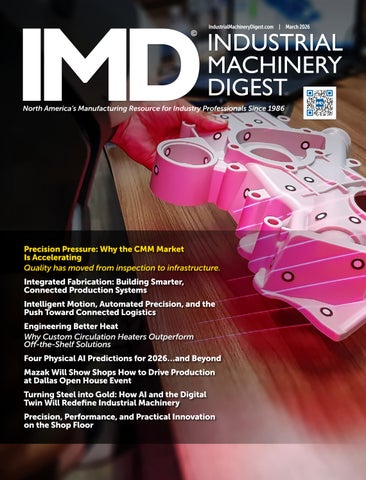
Industrial Machinery Digest - March 2026

Page 1


Precision Pressure: Why the CMM Market Is Accelerating Quality has moved from inspection to infrastructure.

Integrated Fabrication: Building Smarter, Connected Production Systems

Intelligent Motion, Automated Precision, and the Push Toward Connected Logistics

Engineering Better Heat Why Custom Circulation Heaters Outperform Off-the-Shelf Solutions

Four Physical AI Predictions for 2026…and Beyond

Mazak Will Show Shops How to Drive Production at Dallas Open House Event

Turning Steel into Gold: How AI and the Digital Twin Will Redefine Industrial Machinery

Precision, Performance, and Practical Innovation on the Shop Floor

YOUR PARTNER FOR PEACE OF MIND

Running your operation comes with enough challenges. Managing your industrial filtration systems doesn’t have to be one of them.

Partnering with Donaldson is like having the industry leader in filtration on your team. Custom solutions, performance insights, replacement filters and parts, and unrivaled service and support. Complete coverage from a single source.

THAT’S PEACE OF MIND. DELIVERED BY DONALDSON.

SCAN to schedule a free consultation with a Donaldson expert.

SETTING NEW STANDARDS FOR SAFE LIFTING

• Large range of sizes, up to M1000/UNC 4 "

• Embedded RFID creates easier inspections

• Replaceable bolt extends use, saves money

• Spring mechanism prevents sagging and transverse loads

• Huge selection of sizes are IN STOCK!

THE

TURNADO

North America’s Manufacturing Resource for Industry Professionals Since 1986

William C. Strickland III, Publisher william.strickland@indmacdig.com 800-366-0676 ext. 103 | Fax: 866-826-5918

Adrienne Gallender, Associate Publisher/Media Advisor agallender@indmacdig.com 847-612-1572 | Fax: 847-559-2909

Brian Self, Associate Editor/Podcast Producer brian@indmacdig.com 800-366-0676 ext. 104 | Fax: 866-826-5918

Shane Bell, Creative Director sbell@indmacdig.com

SALES

Glenn Raglin, National Sales Manager glenn@indmacdig.com (404) 905-8933

Lisa Hanschu, Sr. Account Executive lisa@indmacdig.com 785-366-0810

William C. Strickland III, National Sales 205-903-9178 | fax 866-826-5918

Susan Strickland, Accounting susan@indmacdig.com 205-542-1098 | Fax: 866-826-5918

CIRCULATION & SUBSCRIPTIONS

IMD, 3590-B hwy 31 South, Suite 233, Pelham, aL 35124 circulation@indmacdig.com | Fax: 866-826-5918

REPRINTS

To purchase article reprints please call 800-366-0676 ext. 103 or email wstrickland@indmacdig.com

Manufacturing in 2026 is defined less by expansion and more by refinement.

across every sector represented in this issue—metalworking, tooling, robotics, software, quality, and metrology—the consistent theme is not simply growth. It is precision under pressure. Shops are being asked to produce more complex parts, with tighter tolerances, under increasing cost constraints and workforce challenges. The response is not reactive. It is strategic.

Quality is no longer a downstream checkpoint. It is embedded directly into production systems. as our Quality feature explores, coordinate measuring machines are becoming infrastructure, not inspection tools. Inline verification, portable metrology, and digitally connected inspection workflows are redefining how manufacturers manage risk and protect margin.

at the same time, tooling strategies are evolving in response to material volatility and performance demands. Exchangeable-head systems, speed increasers, improved clamping architectures, and process-stable insert designs all point to a larger shift. Manufacturers are not just chasing cycle time. They are engineering resilience into their operations.

automation and robotics continue to expand beyond isolated deployments. Digital Twins, software-defined automation, and integrated motion platforms are enabling smarter factories where human expertise and machine intelligence operate in concert. The emphasis is not on replacing people, but on amplifying their impact.

and perhaps most importantly, the industry continues to invest in its future workforce. Programs that equip technical schools with industry-grade tooling recognize that advanced manufacturing requires advanced preparation. Precision begins long before a part hits the spindle.

The throughline across this issue is clear: competitiveness in modern manufacturing is built on integration. Integration of quality into production. Integration of software into hardware. Integration of automation with human skill. Integration of economic reality into tooling architecture.

Manufacturing has always been about performance. Today, it is equally about adaptability.

Thank you for being part of the Industrial Machinery Digest community. We remain committed to delivering the insights, innovations, and industry intelligence that help you navigate what’s next.

INDUSTRY NEWS

The Precious Human Resource

Turning the Manufacturing Skills Gap Into a Catalyst for Human Progress

Walk through a modern manufacturing facility today and the scale of technological advancement is unmistakable. automated machining cells operate with minimal intervention. robotics handle material transfer with repeatable precision. Digital dashboards monitor performance in real time, and aI-driven systems assist with predictive maintenance and process optimization.

Manufacturing has never been more technologically sophisticated.

Yet for all this progress, the industry faces a challenge that no machine can solve on its own. across North a merica and Europe, manufacturers continue to report difficulty attracting and retaining skilled workers. retirements are accelerating. Experience is leaving the floor. a nd younger generations are not entering the sector in sufficient numbers to replace it.

The issue is often described as a skills gap. That is accurate—but incomplete. What the industry is confronting is not simply a shortage of technical ability. It is a gap in perception, continuity, and connection.

automation has not eliminated the need for people. In many respects, it has elevated the importance of those capable of operating, interpreting, and refining advanced systems. Machines execute. Software calculates. But judgment, curiosity, and accountability remain distinctly human qualities.

a s helen Blomqvist, President of Sandvik coromant, observes, “The next generation holds the keys to the

future of the industry. They bring digital competence, perspective, curiosity, and a strong sense of purpose.” her point underscores a broader reality: the future of manufacturing will depend less on access to technology and more on the readiness of the workforce to apply it effectively.

The Readiness Gap Behind Digital Transformation

Manufacturers are investing heavily in automation and aI. Implementation timelines are shrinking. Software capabilities are expanding. Yet many organizations are discovering that digital tools alone do not guarantee transformation.

The barrier is rarely access to systems. It is adoption. aI platforms can be deployed quickly. Dashboards can be activated overnight. But confidence in using those tools develops more gradually. Leaders frequently cite hesitation, uneven engagement, and skills shortages as obstacles to realizing the full return on digital investments. at Sandvik coromant’s Gimo facility—recognized by the World Economic Forum as a Global Lighthouse for advanced automation—productivity improvements have been significant, including measurable reductions in scrap and increased efficiency. Even so, those gains are tied directly to a workforce capable of understanding and optimizing the systems in place.

Technology can amplify performance. It cannot replace expertise.

Without alignment between systems and skillsets,

digital transformation risks becoming infrastructure without impact.

When Experience Retires

Layered on top of digital acceleration is a demographic shift that is reshaping manufacturing worldwide. In the United States, nearly one-quarter of manufacturing workers are over the age of 55. Similar trends are evident across Europe and other advanced economies.

a s experienced technicians retire, they take with them knowledge that was never fully documented.

This tacit knowledge—acquired through years of hands-on work—often determines whether a process runs smoothly or struggles. It is the instinct to detect vibration changes before a tool fails. The accumulated understanding of material behavior. The subtle adjustments that prevent scrap and downtime.

Unlike formal training materials, tacit knowledge is transferred through mentorship, observation, and repetition. Once lost, it is difficult and costly to rebuild.

John Pusatera, Senior Training Specialist at Sandvik coromant, frames it plainly: “Please don’t hoard the knowledge. Share it. We’re all in this together.”

That call reflects a growing recognition across the industry. Knowledge transfer can no longer be informal. It must be structured and intentional.

Reframing Workforce Development as Capital Investment

For decades, workforce training was often categorized as a support function—necessary, but secondary to capital equipment investments. That hierarchy is changing.

Forward-looking manufacturers are treating skills development as strategic capital. Structured mentoring programs, digital documentation initiatives, and targeted upskilling efforts are increasingly seen as safeguards for long-term stability.

Pusatera reinforces this perspective: “Training is free, but it’s not free to use. There’s a cost at the beginning—but down the road, it becomes an investment.”

The return may not appear immediately on quarterly balance sheets. But it manifests in reduced errors, stronger retention, smoother technology adoption, and greater operational resilience.

Training is no longer a defensive measure. It is a competitive advantage.

Restoring Meaning in Modern Manufacturing

Beyond skills and systems lies another, less discussed challenge: engagement.

a s processes become more automated and specialized, employees can lose sight of the broader impact of their work. Parts move through complex supply chains. Operators monitor screens rather than finished assemblies. The connection between daily tasks and societal outcomes can become abstract.

For younger professionals entering the workforce, that

connection matters.

Gen Z employees consistently emphasize growth, purpose, and visible contribution. compensation and stability remain important, but they are not sufficient motivators on their own. If manufacturing fails to articulate how its work supports aerospace innovation, medical technology, infrastructure, and sustainable energy systems, it risks reinforcing outdated perceptions.

Professor Massimiliano a nnoni of Politecnico di Milano argues that the industry must rethink its narrative. “Manufacturers are protective of their knowledge. That’s detrimental. We need to change how we communicate manufacturing.” To attract emerging talent, he suggests, companies must link technological sophistication with human relevance.

This is not about marketing language. It is about ensuring that employees understand how their roles contribute to something tangible and significant.

Building Bridges Between Industry and Education

collaboration between manufacturers and educational institutions is becoming more deliberate. at Göranssonska Skolan in Sweden—owned by Sandvik—automation, robotics, and digital competencies are integrated directly into technical curricula. Programs evolve alongside industrial demand, reducing the lag between classroom instruction and shop-floor reality.

Such partnerships help address two challenges simultaneously: aligning skillsets with real-world needs and exposing students to the true nature of modern manufacturing.

On a broader scale, initiatives like Sandvik coromant academy—which trains more than 30,000 engineers annually—demonstrate the impact of structured learning programs. Participants consistently report high levels of relevance and practical application. When training aligns with operational goals, measurable performance improvements follow.

These efforts reinforce a simple principle: capability must grow alongside complexity.

A Strategic Imperative

Manufacturers that are making progress share common characteristics. They formalize knowledge transfer before retirements occur. They align training programs with new technology deployment. They track workforce development metrics alongside production metrics. and they treat mentorship as infrastructure rather than optional goodwill.

The skills gap is not solely about labor supply. It is about alignment between technological ambition and human capability.

Factories may be increasingly automated, but their success still rests on the people who design, operate, and improve them.

The most advanced equipment in the world cannot compensate for a workforce that feels unprepared or disconnected. But when technology and talent evolve

together, the results extend beyond productivity. They strengthen culture, resilience, and continuity.

The real question facing the industry is not whether it can afford to invest in its people.

It is whether it can afford not to.

6K Additive Selected as Preferred Supplier to AGF Defcom for Additive Manufacturing Powder Used in the Production of Suppressors

The companies have entered a strategic partnership to transform aGF Defcom’s manufacturing scrap including both solids and powder—into high-performance metal powder.

6K additive, a global leader in metal powder production, announced today at the Shot Show in Las Vegas that it has been selected as the strategic metal powder supplier for aGF Defcom. This partnership focuses on providing high-performance metal powders for aGF Defcom’s additive manufacturing (3D printing) of suppressors.

a cornerstone of this agreement is the implementation of a "closed loop" upcycling program. Using the proprietary UniMelt® microwave production system, 6K additive will transform aGF Defcom’s manufacturing scrap—both solids and powder—back into premium metal powder. This initiative ensures a secure,100% domestic supply chain while significantly reducing material waste and production costs.

Zoltan Kovacs, owner and cEO of aGF Defcom said, "The suppressor market is accelerating at an unprecedented pace, and our investment in additive manufacturing is driving significant interest. To succeed with this technology, high-quality powder is a non-negotiable requirement. While partnering with 6K additive ensures a premium domestic supply, the ability to upcycle our scrap is the real game changer. We have successfully transformed what was once a logistical and financial burden into a high-value asset that directly improves our bottom line."

The suppressor industry has entered a period of explosive growth in 2026, primarily catalyzed by the removal of the $200 federal tax stamp. This regulatory shift has unleashed significant pent-up demand, leading to an unprecedented surge in applications and a diversified

market for lower-priced consumer options. Industry analysts have officially dubbed 2026 the "Year of the Suppressor," forecasting record-breaking sales and a massive influx of first-time buyers. This high-volume environment creates a unique opening for advanced manufacturing techniques—particularly 3D printing—to scale production, even as the industry navigates potential fulfillment delays.

additive Manufacturing research’s Executive Vice President of research Scott Dunham said, "The additive suppressor market is one we've been watching since 2017, and its impact today on metal additive manufacturing is undeniable. additive technologies have enabled both business model innovation and product innovation in the area of suppressors, and within 5 years additive Manufacturing research expects a penetration of metal a M technologies into this market exceeding 70 percent. reminiscent of what polymer printing did to the hearing aid industry in the late 2000s, and what continues to happen today in space and rocket propulsion, suppressors are the latest market that will flip to an additive dominant production this decade. It's therefore important for stakeholders to be able to continue to bring a solid value proposition in this area to accelerate the transition and push the a M industry forward as a whole."

“With the suppressor market growing at a staggering 265% in just five years, teaming up with aGF Defcom is a perfect strategic fit. They have a 25-year legacy of manufacturing excellence, and we are excited to support their high-growth trajectory,” explained Frank roberts, cEO of 6K additive. “Beyond the business expansion, aGF Defcom truly understands the importance of converting scrap into high-performance powder. The fact that we are both U.S. suppliers makes this collaboration even more significant for the defense sector and domestic manufacturing.”

Organizations seeking to collaborate with 6K additive on specialized powder requirements are encouraged to visit 6K additive.com.

Alva Industries establishes US office and appoints Sales Director for North America alva Industries (alva), a manufacturer of frameless motors and the creator of FiberPrinting™ technology, today announced the expansion of its North american presence with the establishment of a US office and the appointment of David Eidelshtein as Sales Director North america.

North a merica is a key market for alva, and as part of this regional focus, the company has appointed David Eidelshtein as Sales Director North a merica. In this role, David will be responsible for building alva’s commercial

presence across the region, working closely with OEM customers from early technical engagement through long-term partnerships.

David brings more than 10 years of experience in global sales and business development within motion, automation, and advanced industrial technologies. he has led complex sales cycles with tier-one OEMs across robotics, semiconductor manufacturing, medical devices, and industrial automation. David holds a Bachelor of Technology in Mechatronics, robotics, and automation Engineering from the British columbia Institute of Technology. he will be supporting customers across North a merica.

“I’m energized by the opportunity to scale alva’s presence across North a merica by building strategic partnerships with OEMs developing next-generation technologies,” said David Eidelshtein, Sales Director North a merica at alva Industries. “Throughout my career, I’ve focused on introducing transformational innovations to applications where they create real impact. alva’s FiberPrinting™ technology represents a breakthrough that can redefine performance in critical markets. My approach has always been relationship-first, working closely with engineering teams and executives to convert design wins into long term partnerships.”

“David brings the right mix of industry expertise, technical depth, and entrepreneurial spirit to support alva’s ambitious growth plans,” said Nicolas Giraudo, ccO

of alva. “ his positive attitude and energy, combined with strong understanding of high-end markets position him to make an immediate impact as we scale our commercial presence internationally. We’re thrilled to welcome him to the team.”

Automate 2026 Brings Popular Humanoid Robot Forum and NVIDIA-Sponsored Humanoid Robot Pavilion to Show

This innovative tech showcase is another reason to attend North america’s largest automation event as it returns to chicago

The third annual humanoid robot Forum will be featured as part of automate, North a merica’s largest robotics and automation trade show slated for June 22-25 at Mccormick Place, chicago. automate also will

introduce a dedicated humanoid robot Pavilion on the show floor, sponsored by NVIDIa

“ humanoid robotics is generating a tremendous amount of interest across the automation ecosystem,” said Jeff Burnstein, president of a 3. “By bringing the humanoid robot Forum and a dedicated pavilion to automate, we’re giving attendees a practical opportunity to learn where the technology stands today, what challenges remain, and how humanoids may fit into real-world applications over time.” Burnstein added that humanoid robot exhibitors in the show will also get great feedback from the tens of thousands of customers who will attend the event.

humanoid robotics Takes a Larger role at automate 2026

The humanoid robot Forum will remain a separate, paid conference while being co-located at automate. The forum will take place Tuesday and Wednesday afternoons during automate, offering in-depth programming focused specifically on humanoid robot development, deployment, and enabling technologies.

On the automate exhibition floor, the humanoid robot Pavilion, sponsored by NVIDIa , is planned as a free-to-attend experience for all automate show attendees. In addition to demos, the pavilion will feature a theater for humanoid robot exhibitors to give presentations on their products throughout the show.

AWS Announces 2026 Event Schedule, Highlights

Key Educational Events

Four Major Technical conferences Showcase Welding Industry Innovation and Expertise

The a merican Welding Society ( aWS) recently announced its full schedule of 2026 conferences and events that include educational sessions, networking, and opportunities to connect with industry-leading subject matter experts. In addition to annual FaBTEch conferences, aWS will feature four comprehensive technical events in 2026: Inspection Expo & conference (IEc 2026), Shipbuilding and aluminum conference, Welding automation Expo & conference (WaEc), and Welding Summit™.

“These four educational events take a deep dive into current welding technology topics for welding professionals and industry experts,” says Jonathan Joseph, Manager, conferences, aWS. “If you’re interested in advancing your career goals by learning about new industry techniques and standards, as well as networking with a who’s who of industry professionals, you should consider these aWS conferences.”

The marquis events kick off in February with the Inspection Expo & conference, Feb. 3-4, 2026, in austin, Texas. The conference, hosted by aWS and the a merican Institute of Steel construction ( aISc), is the premier event hosted by inspectors for inspectors, focusing entirely on welding inspection.

“While the IEc is dedicated to the core areas of welding inspection, the conference will also highlight the recent and increasing role of artificial intelligence,” says Bill Newell, conferences chair. In addition, there will be a pre-conference event, Upholding Integrity: Legal and Ethical Standards in the Welding Industry, on Feb. 2 for those who want to learn more about legal and ethical responsibilities of a cWI.

From a pril 13-15, 2026, the third Shipbuilding and aluminum conference takes place in New Orleans. This three-day event brings together industry leaders, engineers, and professionals to explore the latest technologies, materials, and practices shaping shipbuilding and aluminum welding. The conference offers tabletop exhibits, a happy hour, and multiple opportunities to connect with peers, suppliers, and industry innovators.

The Welding automation Expo and conference happens June 2-4, 2026, in Minneapolis, Minn. WaEc features industry experts and end users who delve more deeply into automation. receptions and tours provide additional information and networking opportunities.

highlighting welding compliance, procedure and qualification, the premier welding event Welding Summit 2026: Improving Welding competency takes place aug. 5-7 at The Woodlands resort, Texas. Keynotes Dwayne Mattox, application engineer at Miller Electric, and Patrick Van Fleet, automation expert at a irgas, will speak to their professional welding experience in the military and beyond.

Visit aWS event calendar for upcoming 2026 conferences and additional information.

Hypertherm Associates Invites North American Schools to Apply for Spark Something Great Education Grant for Powermax45SYNC® Plasma System

hypertherm a ssociates, a U.S. based manufacturer of industrial cutting systems and software, is now accepting applications for its Spark Something Great educational grant program. The program will provide 12 North american schools with a Powermax45 SYNc® air plasma system and in-person training from a hypertherm product expert.

The Spark Something Great grant reinforces

hypertherm a sscoiate’s commitment to educators and schools responsible for developing the skilled metal workers of tomorrow. This grant ensures the next generation of metalworking professionals is familiar with one of the most efficient technologies for plasma cutting and gouging.

To date, the company has awarded systems to over 120 schools, and it will once again award 12 schools in the United States and c anada with the equipment and training needed to instruct new metal fabricators. The submission deadline is a pril 15, 2026 at 11:59 p.m. Eastern Time.

“North a merica faces a skills gap, and vocational programs and schools are vital to overcoming it,” said hypertherm a ssociates Director, regional Marketing & revenue Operations, Stephen Bruner. “Unfortunately, we’ve seen many programs in which dozens of students share a single system. We established this grant program to help educators prepare their students with direct access to the technologies they will use in the workforce.”

Jeff Sockwell, a previous grantee and agriculture science teacher, had nothing but praise for the system. “I think the Powermax SYNc is probably one of the best choices we made,” he says. “I would recommend it to anybody in the world.”

Public and not-for-profit institutions, including junior high school, high school, secondary, post-secondary technical, vocational schools, colleges, and universities located in the U.S. or c anada that offer welding or metal fabrication are invited to apply.

For more information and to apply, qualifying public and not-for-profit institutions can visit www.hypertherm.com/grant.

Mitsui Seiki USA Building New Innovation and Technology Center Bringing High Precision Machining Advancements to Franklin Lakes, New Jersey

Mitsui Seiki USa , recognized globally for its leadership in precision machine tool design for nearly 100 years, is pleased to announce that construction is actively underway on the Mitsui Seiki Innovation and Technology center at its Franklin Lakes, New Jersey, headquarters. This significant investment reinforces Mitsui Seiki USa’s long-term commitment to customers and partners across North america, Europe and the United Kingdom.

The Innovation and Technology center is being built as a fully integrated environment to foster advanced manufacturing processes, engineering collaboration and real-world application development. It is designed to be a place where customers can work side-by-side with Mitsui Seiki engineers, technology experts, and solutions partners to support low-volume product development, production implementation, part reprocessing and optimization, to solve manufacturing challenges, and chart the path ahead. The Tech center will provide hands-on access to Mitsui Seiki’s latest precision machining platforms, advanced processes, automation strategies, and supporting technologies. It will operate as a working hub for application development, process optimization, and collaborative problem solving, bringing together machine tools, automation, software, metrology, and engineering expertise under one roof.

This initiative represents more than the addition of a new facility. It reflects Mitsui Seiki’s continued focus on creating tangible customer value through cutting edge technology, strong partnerships, and manufacturing excellence. The Tech center will play a key role in supporting emerging applications, strengthening customer relationships, and demonstrating the many ways high precision manufacturing continues to evolve.

construction will be completed this Spring 2026. additional milestones will be shared as the project progresses with an Open house planned following completion. Mitsui Seiki USa looks forward to welcoming customers, partners and industry stakeholders to the Tech center. a s manufacturing demands continue to advance, this investment positions the company to support customers not only today but well into the future, reinforcing our role as a trusted partner in advanced and precision manufacturing.

“The Innovation and Technology center reflects how we believe advanced manufacturing should work. It is collaborative, application-driven, and grounded in real production needs,” said Daniel cleary, President & cEO, Mitsui Seiki US a . “This investment ensures our customers are not just buying high performance machines, but gaining a long-term partner in process, performance, and precision.”

For more information contact Mitsui Seiki USa , Inc., (201) 337-1300 or visit www.mitsuiseiki.com.

FABRICATION

Transforming Materials Into Excellence

Discover the innovative tools and technologies shaping today’s manufacturing landscape. Highlighting processes that transform raw materials into precision-crafted products, from advanced cutting and forming systems to welding and finishing techniques, the focus remains on efficiency, accuracy, and innovation driving modern fabrication.

From advancements in automation and sustainable manufacturing practices to the latest developments in material processing, gain insights into trends and solutions that enhance productivity, improve quality, and maintain competitiveness in a rapidly evolving industry. This overview showcases the equipment and expertise behind the products powering industries worldwide.

Integrated Fabrication: Building Smarter, Connected Production Systems

Fabrication continues to move toward deeper integration— where forming, welding, cutting, automation, and digital intelligence are no longer standalone processes but interconnected systems designed for speed, repeatability, and production scale.

across this month’s developments, manufacturers are aligning equipment with workflow intelligence. From aMaDa’s integrated approach to electric motor production and advanced weld control systems, to a xtra3D’s fully connected additive ecosystem, the focus is clear: process consistency and validation are becoming as important as raw output. at the same time, equipment advancements such as ESaB’s dual-feed welding systems, Integrion’s integrated tube forming solutions, and Machitech’s laser and nesting software collaboration reflect a broader push

toward flexibility and productivity in high-mix, high-demand environments. Whether supporting EV motor assembly, additive manufacturing scale-up, or advanced laser and tube processing, today’s fabrication landscape is defined by connected systems, automation readiness, and technologies engineered to reduce variation while increasing throughput. The emphasis is no longer just on making parts—it’s on building smarter, more unified production ecosystems.

Highlights Synergistic Capabilities to Streamline Electric Motor Manufacturing

a M aDa WELD TEch , together with a M aDa PrESS SYSTEM, is advancing

AMADA WELD TECH

electric motor manufacturing through an integrated approach that combines forming, stamping, and welding technologies. The collaboration brings together hairpin forming, stator stamping, and advanced welding solutions designed to improve efficiency, precision, and overall performance in high-volume production environments such as electric vehicle motor assembly.

a s electric motor design evolves, manufacturers are increasingly adopting pre-formed rectangular copper conductors, commonly referred to as “hairpins,” instead of traditional round-wire windings. These conductors are inserted into the stator core, secured in place, and joined at their ends. a M aDa PrESS SYSTEM’s ES-1 a 48-axis coil processing machine performs feeding, straightening, peeling, cutting, bending, and pressing flat copper wire in a continuous process, streamlining hairpin production.

In stator manufacturing, a M aDa PrESS SYSTEM’s modular three-segment stamping approach replaces traditional single-piece stamping, improving material yield, reducing required press size, and lowering total energy use. compact, high-precision presses such as the SDEW-i3 GOrIKI high-rigidity, high-speed precision series, paired with automated feeders like the aLFa S-03ar Z high-speed Nc roll feeder, enhance production consistency while minimizing infrastructure requirements.

For welding hairpin ends, a M aDa WELD TEch offers laser welding, micro TIG welding, and resistance brazing technologies. Laser welding provides a non-contact solution suitable for high-speed assembly and integration with vision systems for alignment and quality assurance. Micro TIG welding offers a flexible option for lower-volume or maintenance operations, while resistance brazing supports applications requiring strong joints across more forgiving geometries.

Through a M aDa ONE, an initiative uniting expertise across a M aDa Group companies, the integrated ecosystem supports improved quality control, streamlined workflows, and reduced operational costs while accelerating development of next-generation electric motors.

For More Information: https://amadaweldtech.com/blog/electric-motors-blog/

AMADA WELD

TECH

Releases

Next Generation Linear DC Weld Controls

a M aDa WELD TEch has introduced its next-generation UB Series Linear Dc resistance Weld controls, engineered to enhance precision, connectivity, and automation readiness. The updated platform features faster closed-loop feedback, expanded data handling capabilities, and strengthened network security to support repeatable results in critical welding applications.

The UB Series incorporates 40 khz closed-loop feedback, enabling faster and more accurate control of current or voltage. high-speed sampling improves energy delivery and waveform stability, contributing to greater weld consistency, reduced part distortion, and improved process reliability. a new “Weld to Displacement” feature automatically terminates the weld when a programmed displacement target is reached, supporting applications involving delicate or variable materials.

Designed for both benchtop and fully automated systems, the UB Series includes a 10-inch high-resolution touchscreen or optional remote display for flexible integration within production cells. connectivity options include rEST aPI, MQTT (IoT), optional EtherNet/IP, rS-232, and Direct I/O to support Industry 4.0 environments.

The system captures full waveform data for current, voltage, power, and resistance at 40 khz with 16-bit resolution, enabling detailed process monitoring and statistical analysis. remote access capabilities allow for diagnostics, updates, and maintenance, while certificatebased authentication and TLS encryption via OpenSSL help safeguard connected manufacturing environments.

For More Information: www.amadaweldtech.com

Unveils Axtra Workflow™, a Fully Connected, Validated Ecosystem

a xtra3D has introduced a xtra Workflow™, a fully connected and validated additive manufacturing ecosystem linking build setup, printing, post-processing, inspection, and data-driven traceability into a unified production backbone.

The launch includes three new products—a xtra.Wash, a xtra.cure, and a xtra. Insight—alongside significant upgrades to the LumiaX1 printer and Volume build-prep software. The workflow integrates hybrid PhotoSynthesis (hPS) printing with automated wash and dry processes, UV and thermal curing, and per-layer analytics to improve repeatability, throughput, and qualification readiness for industrial, dental, aerospace, and tooling manufacturers.

a xtra.Wash provides automated washing and drying with support for up to three cleaning agents and materialspecific profiles. a xtra.cure combines UV and thermal curing in a single unit, offering three independently controlled wavelength bands and thermal cycles up to 250°c a xtra.Insight aggregates data from more than 155 sensors across the workflow, delivering layer-level monitoring, predictive maintenance, MES integration, and full job history exports.

Updates to the LumiaX1 printer include enhanced TruLayer hardware, advanced linear sensing, refined encoder and gantry control, automatic Z recalibration, and a modern hMI with live sensor visibility. Volume Print Setup Software v25 adds native laser and DLP slicing, centralized fleet management, advanced compensation controls, and hybrid workflow support.

a xtra.Insight and the updated LumiaX1 and Volume software are available now. Pre-orders for a xtra.Wash and a xtra.cure are open, with shipments beginning in Q2 2026.

For More Information: www.axtra3d.com

ESAB

Introduces Warrior® DualFeed Wire Feeder for Multi-Process Welders

ESaB has introduced the Warrior® DualFeed heavy industrial dual wire feeding system, designed to operate with Warrior 400-, 500-, and 750-amp multiprocess welding power sources. The system enables operators

to switch between two wire diameters or types without downtime associated with changing consumables, supporting spool sizes up to 60 lbs. on both sides.

The DualFeed incorporates ESaB’s PreciDrive wire drive system, an encoder-based drive system featuring four gear-driven rolls with a 1.5-inch diameter for improved gripping area. The design delivers precision wire feeding with improved arc starts and stops while minimizing backlash. Wire feed speed ranges from 32 to 984 inches per minute.

Dual feeders are commonly used to alternate between solid MIG wire and cored wire for different weld passes, or to switch between shielding gases for short circuit MIG and spray transfer welding. Operators can change wire selection from the feeder controls or directly from the MIG gun trigger. Parameters including run-in speed, crater fill, and burn-back can be adjusted and saved individually.

The system includes digital parameter displays and a detachable control box for use in boom or mezzanine applications. MIG gun options include Tweco Supra XT 450, Spray Master 450, classic 5, Elite 450, and SEFc 350 for self-shielded wires.

For More Information: www.esab.com

INTEGRION AUTOMATION

Introduces Wauseon TubeTech™ Portfolio of Tube Forming Technologies

Integrion automation, a Wauseon company, has introduced Wauseon TubeTech™, a comprehensive portfolio of tube forming technologies designed for precision forming, bending, swaging, and trimming in industrial production environments. The unified portfolio

builds on established technology while supporting tight tolerances and complex tube geometries.

When combined with Integrion a utomation’s automation solutions, Wauseon TubeTech supports integrated manufacturing systems connecting tube forming with downstream handling and assembly. c ustom automation cells incorporate robotic integration and advanced controls to increase throughput and deliver consistent quality. Scalable system architectures allow manufacturers to expand capacity and introduce new part programs as production requirements evolve.

The company also provides application engineering, commissioning, and system optimization support. Field service capabilities include installation, maintenance, troubleshooting, and repair, supported by rapid-response service programs and experienced technicians.

For More Information: www.integrionautomation.com

MACHITECH

Announces Strategic Laser Partnership with Lantek

Machitech has announced a strategic partnership with Lantek Sheetmetal Solutions, integrating Lantek Expert

cut nesting software into Machitech Fiber Pr IME S high-power laser cutting machines and Lantek Flex3D nesting software into Machitech Fiber TUBE XL tube laser cutting systems. The collaboration also applies to Machitech press brakes.

The Fiber PrIME S series combines high-speed 4G acceleration with power ranges from 12 kW to 60 kW, supporting mild steel cutting up to 4 inches thick. Lantek Expert cut provides 2D caD/ca M nesting, including automatic, semi-automatic, and manual nesting functions, along with a ssembly 2 Nest ( a 2N) 3D importing for direct integration of common caD formats.

The Fiber TUBE XL systems offer 6–12 kW capability and process tube lengths up to 40 feet with diameters ranging from 0.8 inches to 25 inches. Features include a 3D contour bevel head, adaptive clamping, triple chuck system with zero tail cutting, servo-driven supports, and intelligent controls integrated with Lantek Flex3D software to support angled, hSS square, round profiles, and smaller h-Beams.

Machitech is headquartered in Quebec, c anada, and manufactures custom industrial cutting systems including plasma tables, fiber laser systems, and robotic cutting solutions. Lantek, based in Mason, Ohio, has specialized in digital transformation solutions for the sheet metal industry for more than 35 years.

For More Information: www.machitech.com

MATERIAL HANDLING

Empowering Efficiency and Precision

Material handling is at the heart of efficient industrial operations, focusing on the movement, storage, and organization of materials. This section highlights strategies and technologies that streamline these processes, from automated storage and retrieval systems to advanced conveyor solutions. Readers can explore innovations like forklifts, cranes, hoists, and magnetic lifters, which play a pivotal role in optimizing material flow across warehouses, factories, and supply chains.

In addition to hardware advancements, this area emphasizes cutting-edge solutions like warehouse management systems and parts tracking technologies, which integrate seamlessly into modern production environments to enhance operational control. Topics also cover sustainable practices, such as energy-efficient lift equipment and ergonomic tools designed to improve workplace safety while reducing strain. Whether tackling inventory management or enhancing material logistics, this section provides the insights and tools needed to excel in today’s industrial landscape.

Intelligent Motion, Automated Precision, and the Push Toward Connected Logistics

Material handling continues to evolve from standalone mechanical systems into integrated, intelligent environments where motion control, automation, and digital oversight work in concert. across warehouses, production floors, and industrial facilities, manufacturers are focused on improving precision, uptime, and repeatability while reducing manual strain and operational variability.

This month’s developments reflect that shift. From high-efficiency PMac motor technologies and oil shear clutch/brake systems delivering refined motion control, to autonomous vehicle patents advancing industrial mobility, the emphasis is on smarter movement. at the same time, integrated plateto-pallet laser automation, digital storage management platforms,

and ergonomic pick stations underscore a broader push toward seamless material flow and operatorcentered design.

Efficiency in material handling is no longer defined solely by speed. It is increasingly measured by synchronization—between machines, software, and human interaction. a s systems become more connected and responsive, manufacturers are building material handling strategies that prioritize control, traceability, and long-term reliability across the entire logistics chain.

Bison highlights its VFsync Permanent Magnet ac (PMac) motors, engineered to deliver advanced motion control and energy efficiency across a range of material handling applications. Designed and manufactured in North america, the VFsync line provides synchronized movement, precision control, and durable construction suited for automated systems requiring consistent performance.

VFsync PMac motors operate in synchrony with input ac frequency, maintaining constant output speed regardless of load or voltage fluctuations. Unlike traditional ac induction motors, the permanent magnet design minimizes energy loss while optimizing control, supporting improved system performance and reduced environmental impact. compatibility with Variable Frequency Drives (VFDs) enables precise speed regulation and smooth acceleration, making the motors suitable for applications demanding torque consistency, quiet operation, and responsive motion control.

Built with rugged materials for long service life and minimal maintenance, VFsync motors support pumps, conveyors, compressors, and other load-sensitive mechanisms. regional manufacturing ensures supply chain reliability and responsive support for OEMs and system integrators operating across diverse industries.

For More Information: www.bisongear.com

Receives Notice of Allowance for 24th U.S. Patent in Autonomous Vehicle Technologies

cyngn has received a notice of allowance for a new U.S. patent related to its autonomous vehicle (aV) solutions. The patent, titled System and Method of adaptive, real-Time Vehicle System Identification for autonomous Driving, is expected to be issued next month.

Since august 2023, cyngn has received thirteen newly issued patents, expanding its portfolio to 23 U.S. patents. according to cEO Lior Tal, the growing intellectual property portfolio reflects the company’s continued investment in autonomous innovation and its commitment to protecting technologies supporting real-world material handling applications.

cyngn’s DriveMod Tugger platform has seen expanded commercial deployments and deeper integrations with warehouse and manufacturing technologies. The company states that its patent portfolio supports broader efforts to accelerate adoption of scalable, flexible, and safe autonomous systems designed to reduce operating costs, improve safety, and increase operational efficiency in industrial environments.

For More Information: www.cyngn.com

FORCE CONTROL INDUSTRIES

POSIDYNE® #1.5 Clutch/Brake Delivers Precise Repeatability for Small Motor Applications

Force control Industries introduces the POSIDYNE® size #1.5 clutch/brake, designed to provide precise repeatability and control for drives up to 5 hP. Utilizing Oil Shear Technology, the unit supports rapid and accurate stopping,

starting, reversing, speed changes, and positioning without adjustment and with minimal maintenance.

The compact clutch/brake supports cycle rates up to 300 cycles per minute and offers a service life of 20 to 40 million cycles. a multiple disc design generates high torque in a compact package, while a split-clamped quill reduces shaft and keyway damage. Double c-Face mounting arrangements and hidden mounting spools simplify installation for smaller motor frames.

Oil Shear Technology allows torque transmission through a boundary layer of transmission fluid, reducing friction surface wear and dissipating heat as fluid circulates to the housing. cooling options include integral fans, water cooling, and external heat exchangers for high inertia or extreme temperature environments. The enclosed design resists dust, chemicals, washdowns, and harsh operating conditions, making it suitable for conveyors, packaging machinery, food processing, and other frequent start/ stop applications.

For More Information: www.forcecontrol.com

Showcases KASTOflow and KASTOlogic Mobile at LogiMAT

K aSTO will demonstrate integrated material handling and digital storage management solutions at LogiMaT in Stuttgart, hall 3, Stand D45. The exhibit will feature K aSTOflow for physical material movement and packaging, alongside K aSTOlogic mobile, a digital solution for product management and documentation.

K aSTOlogic mobile digitizes manual storage processes, enabling employees to track material locations and quantities through mobile devices. The system guides users through storage, provisioning, and quality control steps while supporting ErP integration, including SaP, and

compatibility with the K aSTOlogic warehouse management system. Features include real-time stock visibility, documentation, photo uploads for damaged goods, and automatic blocking for improved transparency.

K aSTOflow integrates coilers, buffers, lifts, sheet metal turnover devices, material buffer chains, and aGVs into streamlined storage and pre-processing workflows. Demonstrations will include a miniature bar stock storage system equipped with barcode-enabled shelves to illustrate simplified goods posting and tracking.

For More Information: www.kasto.com

LUBRICATION ENGINEERS

Highlights Monolec® Syn Industrial Oil for Extended Equipment Performance

Lubrication Engineers highlights its Monolec® Syn Industrial Oil, a synthetic lubricant designed to extend equipment life in high-temperature, high-load, and contaminated environments. Formulated with a high-viscosity synthetic base oil and proprietary Monolec® wear-reducing additive, the lubricant creates a molecular lubricating film that increases oil film strength without affecting clearances.

Monolec Syn Industrial Oil meets requirements for gearboxes, compressors, vacuum pumps, hydraulic systems, and roll mill bearings. The formulation maintains viscosity across temperature extremes, resists oxidation and thermal breakdown, and reduces sludge, varnish, and carbon deposits. Nonfoaming performance and compatibility with seals and plastics support consistent operation.

The lubricant’s low volatility and extended drain intervals reduce oil consumption and waste, supporting improved equipment reliability and reduced maintenance costs. available in ISO grades ranging from 32 to 680, the oil supports a wide range of industrial applications.

For More Information: www.LElubricants.com

TECOI USA

Integrates Sortec for Full Plate-toPallet Automation

TEcOI USa has integrated Sortec material handling sorting technology to deliver full automation from plate reception through palletizing. The system integrates Loadtec automated plate handling, caP automatic loading and unloading for large-format laser cutting machines, and robotec automatic sorting and palletizing.

The LS Large-Format Laser cutting Machine features dual straight laser heads and 24 kW production power, supporting high production rates with consistent precision. Sortec manages plate reception, alignment, cutting transfer, sorting, stacking, pallet management, and scrap handling within a unified workflow. Systems are customizable to customer requirements and designed for steel service centers, heavy machinery, shipyards, wind power, and other metal processing sectors.

For More Information: www.tecoiusa.com

FAST PICK STATION Enhances Ergonomics and Mixed Packing Efficiency

WINKEL introduces the FaST PIcK STaTION, designed to improve palletizing, depalletizing, and mixed packing operations. The system features a height-adjustable picking table mounted on a platform with a load transfer shaft and integrated stretch-wrapping capability.

Operators can adjust table height to reduce lifting strain and move items horizontally for improved ergonomics. When a pallet is full, it lowers automatically to the wrapping station while a new carrier is positioned to maintain workflow continuity. The system supports mixed SKU handling across industries including automotive, food and beverage, textiles, and healthcare.

capable of up to 800 picks per hour, the FaST PIcK STaTION supports dual-operator functionality and integration with robotic automation systems. The design emphasizes space optimization, reduced handling steps, and consistent mixed-load stability.

For More Information: www.winkelinc.com

Safety & Maintenance

The Cornerstones of Operational Excellence

The Safety & Maintenance section is dedicated to creating safer workplaces and ensuring equipment longevity. Covering everything from cutting-edge machine guarding systems to advanced air filtration and dust collection solutions, this section provides actionable insights into workplace protection and preventative maintenance. Whether you're exploring ergonomic tools to reduce operator strain or electrical systems that enhance reliability, this section focuses on products and practices that prioritize both people and machines.

In addition to highlighting safety innovations, this section delves into essential maintenance strategies, including retrofitting, rebuilding, and remanufacturing, ensuring that machinery operates efficiently and reliably over time. Maintenance supplies, facility equipment, and accessories are explored alongside new safety technologies designed to meet evolving compliance standards. Readers will discover how a proactive approach to safety and maintenance not only minimizes risks and downtime but also fosters a culture of care and continuous improvement within industrial settings.

Engineering Better Heat

why Custom Circulation Heaters Outperform Off-the-Shelf Solutions

In process heating applications ranging from water and oil to air and specialty gases, electric circulation heaters are widely relied upon for efficiency and precision. however, not all heaters are created equal. Selecting the right solution requires more than matching specifications on a datasheet. Design decisions made at the outset of a project often determine whether a heater delivers years of seamless operation—or leads to premature failure, fluid degradation, and costly downtime.

For engineers and specifiers, long-term success depends on working with a manufacturer that understands how to tailor heater design to the application. customization, thermal expertise, and application knowledge play a central role in ensuring that circulation heaters perform safely, efficiently, and reliably under real-world conditions.

Why Watt Density Matters

One of the most critical variables in heater design is watt density—the amount of heat output per unit surface area of the heating element.

When properly specified, watt density supports energy-efficient heating and extended service life. When miscalculated, it can result in burned-out elements, fluid damage, and reduced system efficiency. If watt density is too high for a given application, fluids may carbonize or chemically degrade. In extreme cases, heating elements can overheat and fail prematurely. While standard heaters may suffice for basic applications, most process heating environments demand more nuanced engineering. heating chocolate, high-pressure gases, or cryogenic fluids, for example, each presents distinct challenges requiring different configurations.

circulation heaters also play a significant role in power generation, where they are used for natural gas conditioning, standby fuel heating, steam superheating, boiler feedwater preheating, and turbine lube oil heating. In these applications, precise temperature control reduces thermal shock risks, maintains oil viscosity, enhances boiler efficiency, lowers energy consumption, and minimizes machinery wear.

Proper specification begins with a clear understanding of operating conditions. critical factors include minimum and maximum flow rates, operating pressure, outlet temperature, and the thermal properties of the process fluid—such as specific heat, viscosity, thermal conductivity, and allowable sheath temperature. When these parameters are addressed during design, the resulting heater is more likely to meet performance requirements while protecting fluid integrity, minimizing maintenance, and extending equipment life.

The Hidden Power of Fluid Dynamics

Fluid movement through a circulation heater directly affects heat transfer performance. In most applications, turbulent flow—characterized by velocity fluctuations and mixing—is preferred. Turbulence promotes efficient heat removal from the heating element surface, reducing the likelihood of hotspots.

hotspots occur when localized areas of the heating element become significantly hotter than the surrounding fluid due to inadequate heat dissipation. These elevated temperatures can lead to fluid breakdown, accelerated scale buildup, and shortened element life. Designing for controlled turbulence helps prevent these issues by ensuring heat is evenly distributed throughout the fluid.

Laminar flow, by contrast, involves smooth, parallel fluid layers with minimal mixing. This creates a thin boundary layer near the heating element surface where heat transfer is less efficient. a s a result, localized overheating and reduced system performance may occur. While laminar flow theoretically develops over long, uninterrupted flow paths, most circulation heaters are compact and include internal components—such as support spacers or baffles—that disrupt smooth flow. In practice, flow inside a circulation heater typically consists of mixed regimes influenced by geometry and internal structure.

Most real-world systems operate within the transition flow range, where behavior shifts between laminar and turbulent depending on pressure, temperature, and flow rate. This variability underscores the importance of heater design beyond basic heating calculations. Vessel

orientation (vertical or horizontal mounting), fluid direction, and internal design features all shape flow behavior. Small adjustments that encourage turbulence at strategic points can significantly improve heat transfer efficiency and temperature uniformity.

Smart Geometry and Design Tools

advanced heater manufacturers rely on computer-aided design (caD) tools to simulate interactions between heat, pressure, and fluid flow before fabrication begins. These digital models allow engineers to evaluate heater performance during startup conditions, full-load operation, and fluctuating process demands.

caD modeling helps identify potential concerns such as uneven heating, excessive pressure drop, or fluid stagnation zones early in the design phase. This is particularly important in gas heating applications, where temperature increases alter pressure, viscosity, and thermal conductivity. at higher pressures, these property changes become even more pronounced. Failure to account for them can lead to underperformance or unsafe operation.

radiant heat emitted by heating elements must also be considered, especially in gas systems where excessive radiant energy may damage adjacent components or create unexpected temperature spikes.

By modeling multiple design scenarios and optimizing variables, manufacturers can produce heaters that are

Heavy Gauge Steel Design

Press Bed bolted on, not welded, to prevent

Large press bed to accommodate a variety of tooling other than just punching.

Pump, motor, valve and reservoir are all easily accessible for maintenance.

Large rectangular tubes used at base of machine to give safe, instant portability.

not only efficient and reliable but specifically tailored to application demands. This level of precision engineering ensures consistent heat delivery, fluid protection, and safe operation within system limits.

Heater Design Is a Process, Not a Product

Designing an effective circulation heater is not simply a matter of selecting a catalog item. It is a collaborative engineering process that considers fluid properties, operating parameters, system layout, and installation constraints.

Manufacturers with deep thermal expertise and application experience bring critical value to this process. Indeeco, for example, provides customizable electric heating solutions engineered to meet complex process requirements. Its engineering team evaluates process conditions, simulates performance, and tailors each heater design to ensure reliability, efficiency, and long-term operational stability.

Custom Circulation Heaters Outshine Off-theShelf Solutions

In industrial environments where precision, safety, and efficiency are essential, heater selection has lasting implications for process outcomes and operating costs. While off-the-shelf solutions may offer convenience, they often overlook the critical variables that define real-world performance: fluid characteristics, flow dynamics, operating pressures, and system geometry. an application-specific design approach addresses these complexities directly. By collaborating with a manufacturer that understands the interplay between thermal performance and process conditions, engineers, facility managers, and OEMs can achieve reliable heat delivery, greater process control, improved energy efficiency, and extended system longevity. across industries—from food processing and petrochemicals to manufacturing and specialized industrial applications—custom-engineered circulation heaters provide solutions designed to perform from day one and optimized for sustained operation over time.

For More Information, visit www.indeeco.com

Stainless Steel Wall Canopy Hoods Designed for Corrosive Vapor Exhaust

hEMcO Stainless Steel Wall canopy hoods are engineered to collect and exhaust corrosive vapors, heat, steam, and odors in laboratory and industrial environments. available in 36", 48", 72", and 96" wall-mount models, the hoods are constructed from welded Type 304 stainless steel and include a wall mounting kit.

custom-size canopy hoods can be manufactured to meet specific dimensional and application requirements. Optional features include vapor-proof lights and switches, as well as side and rear enclosure panels to prevent crossdrafts and improve airflow containment. Exhaust blowers, ducting, and inline hEPa or carbon filtration systems can be engineered to meet ventilation specifications and regulatory requirements.

For More Information: www.hEMcOcorp.com

NORSTAT

PICO-02 Pressure & Vacuum Sensor with Rotatable Display and Keypad

Norstat introduces the PIcO-02 pressure and vacuum sensor from M-P Sensor, featuring an integrated rotatable digital display and keypad. The compact sensor incorporates two independent and adjustable transistor switching outputs capable of handling 250 ma each, allowing direct or indirect actuator control without the need for a PLc

HEMCO

Designed for applications such as vacuum lifting systems and valve control, the PIcO-02 is available in multiple measuring ranges and is suitable for filtered, dry, or oiled air and non-corrosive gases. The sensor is IO-Link compatible and includes LED status indicators. constructed with a plastic housing and M8 or M12 (4-pole) electrical connections, the unit carries an IP65 protection rating.

For More Information: www.norstat.com

Aluminum Enclosures Provide Protection for Sensitive Components

The design includes dual contacts with increased copper and silver content to support high fault-clearing capacity and extended service life. constructed with cadmium-free materials, the breaker is tested for vibration (up to 8g), shock (up to 25g), salt spray (96 hours), and humidity (240 hours at 95% rh). Engineered in the USa , the MP Series 87 is built for long-term reliability in demanding conditions.

For More Information: www.wesgarde.com

WOOSTER PRODUCTS

Norstat offers a complete line of aluminum enclosures from Multi-Box designed to protect electrical, electronic, and pneumatic components. Manufactured using aluminum die casting or gravity casting methods, the enclosures undergo chromate treatment and are finished with polyester-based powder coating. Durability testing includes a 1000-hour salt spray test. available in a range of sizes and configurations, the enclosures support use as terminal enclosures within modular systems through the addition of clamps and cable glands. They may also function as junction boxes or protective housings for sensitive electronics in environments exposed to water, dust, or dirt. With IP66 and IP67 protection ratings, the enclosures are suited for aggressive or harsh operating conditions.

For More Information: www.norstat.com

WESGARDE

MP Series 87 Heavy Duty Marine Rated Circuit Breaker Delivers Durable Power Protection

Wesgarde highlights the MP Series 87 heavy Duty Marine rated circuit Breaker, designed for marine, vehicle, and rugged industrial applications. The manually resettable breaker provides true On-Off functionality for safe circuit isolation during maintenance or emergency situations. available in amperage ratings from 25 to 250 amps, the MP Series 87 supports panel or surface mounting and features dual terminal stud sizes (5/16-18 and 3/8-16) to accommodate varying wire requirements. The breaker is ignition protected to SaE J1171 standards, aBYc compliant, and carries an IP66 weatherproof rating.

StairMaster® Safety Treads Upgrade Grated Stairwells

and Landings

Wooster Products’ StairMaster® renovation safety treads are designed to improve safety on grated stairs and landings in manufacturing facilities, warehouses, and distribution centers. constructed with a heat-treated, corrosionresistant aluminum substrate and aluminum oxide filler, the treads provide a high coefficient of friction for improved footing, even in wet conditions. available in 9-inch and 11-inch widths and custom lengths up to 8 feet, StairMaster® treads can be cut to exact dimensions for simplified installation. color options include contrasting shades and glow-in-the-dark NITEGLOW® photoluminescent technology to enhance edge visibility. The renovation treads meet 2021 IFc code compliance and are suitable for interior and exterior retrofit applications. a proprietary bonding process supports extended service life under heavy pedestrian traffic. The system includes a beveled aluminum base with countersunk holes and anchor options including Tapcon, wood, machine, or expansion screws.

For More Information: www.woosterproducts.com

QUALITY

Ensuring Precision and Performance

Quality control and assurance are the backbone of manufacturing, ensuring every product meets rigorous standards for precision, performance, and reliability. This section delves into the tools and technologies that enable manufacturers to uphold the highest quality standards. From advanced coordinate measuring machines (CMM) to vision systems and laser inspection equipment, the spotlight is on innovations that enhance accuracy and efficiency in measurement and inspection.

Nondestructive testing (NDT) equipment and positional measuring machines are also featured, allowing manufacturers to evaluate products without damage. Tools such as form measurement gauges, cutting tool inspection systems, and tool condition monitoring devices refine production processes and reduce errors. Whether through shrink-fit technologies or video inspection systems, this section highlights the importance of advanced solutions in maintaining precision, ensuring compliance, and driving continuous improvement in industrial operations.

Precision Pressure: Why the CMM Market Is Accelerating

Quality has moved from inspection to infrastructure.

Across automotive, aerospace, electronics, medical devices, and heavy machinery manufacturing, dimensional verification is no longer a downstream checkpoint—it is embedded directly into production strategy. That shift is reflected in the rapid expansion of the global coordinate Measuring Machine (cMM) market.

according to DataM Intelligence, the global cMM market reached US$ 3.94 billion in 2024 and is projected to reach US$ 8.34 billion by 2032, growing at a caG r of 9.96% from 2025 to 2032. Growth is being driven by rising demand for high-precision measurement, increasing automation, Industry 4.0 integration, and stricter quality and compliance requirements across manufacturing sectors.

a s product complexity increases, tolerance windows shrink.

Modern vehicles contain thousands of precision-engineered components where micron-level deviations can impact safety, durability, and performance. The

transition to electric vehicles intensifies those demands further. Battery housings, motor assemblies, lightweight structures, and composite materials all require tighter dimensional control and repeatable validation.

cMMs are increasingly deployed inline and directly on the shop floor to reduce scrap, limit rework, and improve yield. Quality inspection is becoming faster, more automated, and more tightly integrated with digital production workflows.

Portable and Non-Contact Systems Reshape Inspection

a major growth driver within the broader cMM market is the increasing adoption of portable and non-contact systems.

Portable cMMs allow manufacturers to perform on-site measurement without moving large or heavy components to fixed metrology labs. This reduces downtime and improves production efficiency. a rticulated arms, laser

trackers, and handheld systems enable rapid in-process verification, supporting faster production cycles while maintaining tolerance control.

Non-contact cMMs, leveraging laser scanning and optical technologies, are increasingly used to inspect complex geometries and freeform surfaces. These systems capture high-density 3D data quickly and are particularly valuable for delicate or lightweight components where traditional probing may not be suitable.

In June 2024, Keyence introduced a Portable Wide a rea cMM capable of measuring large targets up to 25 meters using laser scanning technology. In October 2024, FarO Technologies launched the Quantum X Faroa rm Series, delivering up to a 15% improvement in accuracy over earlier models. These developments reflect a broader industry focus on flexible, high-precision, and mobile metrology solutions.

Automotive Quality Pressures Intensify

The automotive sector remains a primary driver of cMM demand.

Manufacturers face constant pressure to reduce defect rates, recalls, and warranty costs while managing high production volumes and platform standardization. Precision inspection of engines, transmissions, chassis components, and body-in-white assemblies is critical to maintaining performance and compliance standards. regulatory requirements related to vehicle safety and emissions further elevate the importance of dimensional verification. at the same time, the increasing use of aluminum, composites, and lightweight materials demands greater measurement accuracy to ensure structural integrity.

Portable and automated cMM systems are helping manufacturers maintain throughput while reinforcing quality validation across the production cycle.

North America’s Role in Advanced Metrology

North america continues to play a significant role in global cMM adoption.

The region’s strong base of automotive, aerospace and defense, and medical device manufacturing supports consistent demand for advanced metrology solutions. Early adoption of Industry 4.0, automation, and smart factory initiatives has accelerated deployment of automated and inline inspection systems.

Investments in electric vehicle production and aerospace programs are reinforcing the need for high-precision measurement technologies. The presence of established cMM manufacturers and software innovators further supports rapid integration of connected inspection platforms.

Competitive Landscape and Innovation

The cMM market is characterized by established metrology and industrial automation providers including hexagon aB, Zeiss Group, FarO, Siemens, renishaw plc, LK Metrology, and Mitutoyo corporation.

competition centers on multisensor technologies, non-contact inspection capabilities, portable systems, and software-driven measurement platforms compatible with Industry 4.0 environments. Integration of automation, data analytics, and digital inspection workflows continues to define the next phase of market expansion.

In 2025, hexagon aB launched M aESTrO, a next-generation cMM designed to support high-speed, connected inspection workflows. LK Metrology introduced its M a XIM a and M a XIM a r bridge-type cMM ranges for high-precision measurement of large and complex components and expanded into industrial computed tomography through acquisition of Procon X-ray Gmbh

These developments signal continued emphasis on speed, connectivity, scalability, and advanced non-destructive inspection technologies.

Quality as a Production Strategy

The future of the cMM market is closely aligned with the evolution of manufacturing itself.

Inspection is no longer isolated from production. It is integrated into digital workflows, predictive quality management, and real-time decision-making environments. advances in multisensor technology, software connectivity, and shop-floor deployment are reinforcing the role of metrology as a core operational discipline.

a s manufacturers pursue zero-defect initiatives, tighter tolerance control, and increased automation, cMM systems are becoming essential infrastructure rather than optional validation tools.

The expansion of the global cMM market reflects more than equipment growth—it signals a structural shift in how quality is defined, measured, and sustained across modern manufacturing environments.

ROBOTICS

Driving Automation and Innovation

Robotics and automation are transforming modern manufacturing, redefining efficiency, precision, and versatility across industrial processes. From welding robots and robotic tooling to autonomous technology and cobots (collaborative robots), innovations are seamlessly integrating robotics into diverse manufacturing workflows.

Key advancements include automated cells and press transfer robotics, enabling streamlined operations and reduced cycle times. Solutions like material handling systems and end effectors highlight the adaptability of robotics in tasks ranging from machining to assembly. With a focus on enhancing safety and productivity, the integration of RFID and enclosure systems, along with comprehensive training, empowers manufacturers to harness the full potential of robotics in an increasingly automated world.

Four Physical AI Predictions for 2026…and Beyond

The robotics industry continues to evolve at an accelerating pace, and the signals of what comes next are already visible. a s automation advances, several emerging trends are poised to redefine how robots create value across manufacturing, logistics, and beyond. From predictive mathematics and cooperative behaviors to industry-specific aI and a new data economy, the following four developments are likely to shape the next phase of physical aI.

#1 Predictive Math – A Silent Revolution

The next major leap in robotics is unlikely to come from hardware. It will come from mathematics.

Today’s robots are largely reactive, responding to inputs and adapting in real time. The next generation will increasingly anticipate outcomes before movement occurs. Emerging mathematical techniques

such as dual numbers and jets are influencing how engineers model change within robotic systems. These approaches enable systems to capture not only motion, but how those movements affect the surrounding environment.

The result is faster optimization, richer scenario planning, and adaptive control that appears intuitive. robots will be able to forecast the impact of a path adjustment before executing it, or simulate multiple “what-if” scenarios in milliseconds. While many of these methods remain in research phases, their potential to redefine predictive intelligence in automation is significant.

Predictive capability is expected to become a defining characteristic of next-generation robotic platforms, shifting robotics from responsive automation to anticipatory systems.

#2 From Solo to Synergy

Imitation learning is emerging as a defining capability in the next

wave of automation.

Most robots today operate as independent units, managed by centralized fleet systems or pre-programmed routines. Increasingly, however, robots are beginning to learn from one another and from human operators. Some learning processes are guided; others are autonomous. The outcome is adaptive teams capable of sharing behaviors and strategies in real time.

This evolution builds on research demonstrating that robots can observe, imitate, and refine actions collaboratively rather than simply following fixed trajectories. While industrial robotics vendors have already introduced fleet management and synchronized motion systems, true peer-to-peer learning and self-organization are still developing. Deployment of imitation-learned physical aI models is expected to expand in 2026.

The advantages are clear:

In industrial settings, aI systems are helping robots manage variability in parts and processes. In service and logistics environments, similar capabilities are supporting packaging, sorting, and delicate material handling.

» Faster configuration and reconfiguration of workflows without complex programming

» Improved resilience in changing production environments

» More intuitive human-robot collaboration, where robots follow human intent or adapt to a lead robot’s pace

a s safety standards, communication protocols, and orchestration tools mature, imitation-driven collaboration is likely to move from pilot programs into broader industrial adoption. robots will transition from isolated units into cooperative, continuously learning teams.

#3 Purpose-Built AI

rather than relying on generic aI platforms, manufacturers are increasingly adopting task-specific aI applications. Solutions designed specifically for welding, sanding, inspection, assembly, and similar processes are becoming standard components of robotic cells.

These vertical aI applications are typically delivered pre-trained and pre-integrated, allowing faster deployment and measurable gains from initial implementation. Welding is one of the most visible examples, where vision-guided seam tracking and machine learning-assisted parameter optimization are already influencing production outcomes.

The next frontier involves more complex, dexterous tasks such as assembly, fastening, and intricate handling—areas historically resistant to automation.

Logistics has already seen notable progress in aI-powered pick-and-place and stow operations. continued investment is expected to extend these capabilities into adjacent sectors, including retail, bringing robotic automation closer to everyday consumer environments.

#4 Data Is the New Fuel

The next major shift in robotics will not only involve how robots move or think, but how their data creates value. robots generate extensive operational data, including sensor readings, vision frames, and force profiles. Much of this data remains localized within customer facilities for privacy and performance reasons. While this protects sensitive information, it can limit the data available to aI developers seeking to refine models.

Looking ahead, manufacturers may develop secure, opt-in data exchange frameworks. With customer consent and robust privacy safeguards, anonymized performance data could be aggregated and used to train aI applications. For example, welding robots might contribute de-identified seam quality metrics, or sanding cobots might share surface finish data to enhance defect detection and predictive maintenance algorithms.

Transforming raw telemetry into structured, privacypreserved insights presents a significant opportunity. For manufacturers, this approach could support new revenue models and continuous product improvement. For customers, it could mean aI systems trained on broader real-world conditions without compromising confidentiality.

The outcome would be a reinforcing cycle in which deployed robots contribute to smarter next-generation systems.

Increased Mission ROI: The Payoff of Predictive Robotics

The future of robotics will be shaped by the convergence of advanced mathematical modeling, cooperative intelligence, vertical aI applications, and data-driven ecosystems.

Predictive techniques will enable faster scenario analysis and adaptive control. Imitation learning will support flexible, team-based automation. Purpose-built aI applications will deliver process-specific intelligence from initial deployment. a structured data economy will allow anonymized insights to accelerate innovation across the robotics ecosystem.

collectively, these developments promise a measurable improvement in mission rOI: greater productivity per robot hour, faster deployment and reconfiguration, reduced downtime, and continuous performance improvement driven by real-world data.

ABOUT THE AUTHOR

anders Billesø Beck is Vice President, aI robotics Products, at Universal robots, where he leads the global aI product strategy for the company’s collaborative robot platform. he focuses on innovation, adaptability, and the development of the broader aI ecosystem.

With more than 20 years of experience in flexible and collaborative automation, Beck has held previous leadership roles at Universal robots, including Vice President of Technology and Vice President for Strategy & Innovation. h e serves on the board of Odense robotics, Denmark’s national robotics cluster, and is a frequent speaker at global industry events.

AGILITY ROBOTICS

Agility Robotics Announces Commercial Agreement with Toyota Motor Manufacturing Canada

Following a successful pilot at Toyota Motor Manufacturing canada (TMMc), agility robotics has signed a commercial robots-as-a-Service (raaS) agreement to deploy its

general-purpose humanoid robot, Digit®, in TMMc facilities. Digit will support manufacturing, supply chain, and logistics operations, helping automate repetitive and physically demanding tasks while improving operational efficiency. Toyota evaluated multiple robotic systems before selecting Digit to enhance team member experience and increase production efficiency. The companies will continue assessing additional use cases where robotics and aI can augment automotive production, particularly for repetitive and physically taxing tasks on assembly lines.

Digit is designed for logistics and manufacturing environments and integrates into facilities without major retrofits. Paired with agility a rc, the company’s cloud automation platform, Digit can be deployed and managed as part of scalable fleets. agility reports that Fortune 500 companies including GXO, Schaeffler, and a mazon are also deploying Digit globally.

For More Information: www.agilityrobotics.com

BOSTON DYNAMICS

The Form & Function of Enterprise Humanoid Design

Boston Dynamics will host a 30-minute technical session exploring how core industrial requirements shaped the design of atlas®. Scheduled for March 18 at 11:00 aM ET, the session will feature chris Thorne (Director of hardware Innovation), James cuseo (Technical Director of compute and Sensing), and aaron abroff (head of Industrial Design).

The presentation will examine actuator strategy, including modular high-performance actuators that enable continuous rotation and increased flexibility. It will also address the robot’s safety philosophy, passive thermal design using a fanless cooling system, and head design considerations that shaped both user experience and perception capabilities.

The session is intended for operations and automation professionals evaluating next-generation robotics for industrial facilities.

For More Information: www.bostondynamics.com

HENNIG

Hennig WorkFlow Automates Pallet Loading for CNC Manufacturers

hennig has expanded its Machine Tool Ecosystem with WorkFlow, a plug-and-play pallet automation system designed for high-mix, medium-volume cNc environments. WorkFlow integrates with existing chip conveyors, coolant systems, and machine protection components to maintain clean, reliable operation during lights-out production.

The system automates pallet loading to keep spindles cutting through breaks, shift changes, and weekends without a dedicated operator. It handles up to 40 pallets, supports work envelopes up to 300 mm cube per pallet, and accommodates pallet loads up to 125 lbs.

WorkFlow is engineered for compact installation and integrates directly into existing machining environments without major reconfiguration. By automating pallet loading rather than individual part handling, it reduces programming complexity and supports flexible production. Shops adopting the system report increased spindle utilization and reduced unplanned downtime.

For More Information: www.hennigworldwide.com/workflow

ONROBOT

OnRobot to Host Automation Roadmap Event in Dallas

Onrobot will host its “Build Your automation roadmap” event in Dallas on February 19, 2026, at The Westin Irving convention center at Las colinas. The free in-person event is designed for manufacturers across metal fabrication, cNc machining, electronics, aerospace, food and beverage, and industrial equipment manufacturing.

The event will feature live FaNUc robot demonstrations equipped with Onrobot end-of-arm tooling for applications including machine tending, material handling, assembly, packaging, and quality inspection. Expert-led workshops and presentations will address automation adoption strategies in response to persistent labor shortages.

Speakers include Kristian hulgard, General Manager americas at Onrobot; Brent Lindell, District Manager at FaNUc america; ruben Lanz, Vice President at adaptive Vision and robotics; and Derrell Guillory, Technical account Manager at aWc

For More Information: www.onrobot.info/industrial_openhouse

SEREACT

Sereact Introduces Cortex 2.0 to Advance Predictive Physical AI

Stuttgart-based aI company Sereact has introduced cortex 2.0, a next-generation physical aI system designed to

evaluate the consequences of robotic actions before they occur. rather than focusing solely on faster reactions, cortex 2.0 emphasizes predictive decision-making to reduce downtime and improve operational stability.

The system supplements robotic control with predictive assessment of possible courses of action, learning from real-world operational data rather than simulation alone. Sereact reports that several hundred robots are operating in productive environments across Europe and the U.S., generating data that informs cortex’s learning models.

cortex 2.0 separates execution and evaluation, maintaining fast operations while improving decision quality through parallel analysis. The approach is positioned to support collaborative robots, multi-stage processes, and future humanoid applications where stability and consequence awareness are critical.

For More Information: www.sereact.ai

TRENER ROBOTICS

Trener Robotics Raises $32M to Deliver Pre-Trained Physical AI Skills for CNC Automation

Trener robotics (formerly T-robotics) has raised $32 million in a Series a funding round co-led by Engine Ventures and IaG capital Partners, bringing total funding to over $38 million. The company’s acteris platform replaces procedural robot programming with pre-trained Physical aI skills, allowing cNc operators to describe robotic tasks conversationally and translate them into executable automation.

acteris is positioned as a software-defined intelligence layer that enables robots to self-learn and adapt in high-mix production environments. The platform currently focuses on robotic cNc machine tending and is compatible with aBB, Universal robots, and FaNUc systems.

Machine shops using acteris gain a natural language interface, adaptive motion optimization, intelligent collision avoidance, part identification under challenging conditions, and real-time production dashboards. Trener robotics reports partnerships with more than 15 solution and integration partners across Europe and the U.S.

The company recently won the Machine Tool Innovation award at EMO hannover and was selected as a winner in the aBB aI Startup challenge.

For More Information: www.trener.ai

METALWORKING

Precision and Craftsmanship in Manufacturing

Metalworking encompasses the tools, technologies, and processes that drive precision manufacturing. This area highlights advancements in machining, grinding, lathing, and cutting systems, along with innovations like EDM (Electronic Discharge Machining). It captures the synergy between precision equipment and skilled craftsmanship, essential for producing high-quality components across diverse industries.

Focusing on the integration of controls, machining tools, and accessories, metalworking emphasizes the efficiency and accuracy demanded by modern manufacturing. From contract manufacturing to heat treating and gear machinery, it reflects the essential techniques and equipment shaping today’s industrial landscape. Whether utilizing traditional methods or cutting-edge innovations, metalworking celebrates the pursuit of excellence in every detail.

Mazak Will Show Shops How to Drive Production at Dallas Open House Event

With a focus on motorsports part production and high-efficiency machining strategies, Mazak will host its DIScOVEr MOrE WITh M a Z aK Open house at the company’s Dallas Technical center from March 11–12. The event will showcase advanced machining platforms and automation technologies designed to help manufacturers increase productivity, reduce setup time, and strengthen competitive performance.

attendees will see live demonstrations of the VarIa XIS i-700T 5-axis Machining center, the QT-Ez 12MY horizontal Turning center, the INTEG rEX j-200S NEO Multi-Tasking Machine, and the SYNcrEX 38/9 Swiss-type Turning Machine.

“Dallas and the surrounding areas are home to some of the nation’s top manufacturers, supporting a variety of industries,” said Don Miller, regional General Manager with Mazak. “These shops stay competitive only when

they incorporate the latest, most advanced and productive machine tool and automation systems. Like all our DIScOVEr MOrE WITh M a Z aK regional events, we bring those technologies to them for easy accessibility coupled with applications support that will ensure their success.” at the center of the event is the VarIa XIS i-700T, which delivers simultaneous 5-axis milling and turning within a single integrated platform. Designed for DONE IN ONE® part processing, the machine enables shops to move from raw material to finished component in one setup, minimizing handling and reducing lead times. The system features a compact, high-speed spindle reaching up to 18,000 rpm and a rigid tilting rotary table that provides full accessibility for complex multi-surface part geometries.

also featured is the QT-Ez 12MY horizontal Turning center. Equipped with a 3,300 rpm, 22 kW (30 hp) spindle and a 12-inch chuck, the

machine supports up to 3-inch diameter bar capacity and handles workpieces up to 14 inches in diameter and 19 inches in length. The 12-tool turret configuration, integral motor headstock, hybrid MX roller guideways, and pre-tensioned ball screws contribute to thermally stable, precise axis movement. a n optimized bed casting design enhances rigidity while streamlining chip flow to support continuous automated operation.

Programming efficiency is supported by Mazak’s Ma Z aTrOL SmoothEz cNc , featuring dual 800 Mhz processors, 512 MB of raM, a 15-inch capacitive touchscreen, and full keyboard. The control supports both G-code and Ma Z aTrOL conversational programming, while Ma Z aTrOL TWINS enables integration with Solid Ma Z aTrOL, Virtual Machining, cutting adviser through Smooth cam ai, and centralized project management tools.

For high-volume production of small precision components, the SYNcrEX 38/9 Swiss-type Turning Machine offers a high-damping composite casting base designed to reduce vibration and thermal growth. The machine processes bar stock up to 1.5 inches in diameter and allows full bar capacity without special bar-end preparation. Its 9-axis configuration includes 10 hP main and secondary spindles, four cross working live tools, a 9,000 rpm B-axis tool spindle, and up to six live tools with Y-axis capability for the counter spindle.

The system also features a removable guide bushing adapter for external presetting and quick changeover between guide bushing and chucker modes. Equipped with M a Z aTrOL SmoothSt control and optional Swiss Setup a ssist (MSSa ) and Dynamic chip control (MDcc) functions, the machine supports faster setups and improved chip management.

rounding out the showcase is the INTEGrEX j-200S NEO Multi-Tasking Machine, designed to reduce setup time and improve accuracy through a second spindle configuration. Enhancements include higher torque integral spindle technology, faster spindle speeds, expanded tool magazine capacity, and heat displacement compensation for stable continuous operation. Spindle torque reaches up to 20 hP on the main spindle and 15 hP on the second spindle, with B-axis indexing increments of 0.0001 degrees.

The machine integrates Mazak’s a i Thermal Shield for temperature compensation and the Smooth coolant System to improve energy efficiency, reduce maintenance demands, and lower cutting power consumption. Powered

by the M a Z aTrOL SmoothG control, the system supports both G-code and conversational programming through a 19-inch touchscreen interface.

all Mazak machines are supported by the company’s MPower complete customer c are program, along with Mazak c apital Equipment Financing options designed to simplify equipment acquisition.

Mazak corporation designs and manufactures productive machine tool solutions at its Florence, Kentucky facility, producing over 70 models of turning centers, Multi-Tasking machines, vertical machining centers, 5-axis systems, hYBrID additive machines, and Swiss turning machines. The company maintains eight Technology centers across North a merica to provide localized applications, service, and sales support.

For More Information: www.Mazak.com

IPSEN USA

Ipsen USA Announces Updates for 2026 Ipsen U Classes

Ipsen USa has announced updates to its 2026 Ipsen U schedule, introducing new instructors, interactive elements, and expanded hands-on demonstrations within its vacuum furnace training program.

Ipsen U is a three-day program designed for vacuum furnace operators and maintenance personnel, focusing on equipment operation, performance, and long-term reliability. according to Ipsen, the program provides direct engagement with engineers, builders, and support technicians to deliver a comprehensive understanding of vacuum furnace function, operation, and maintenance.

New for 2026, the curriculum will include vacuum bell jar demonstrations and leak-testing exercises conducted alongside Ipsen quality control staff. Participants will receive instruction on helium mass spectrometer setup and best practices for identifying and diagnosing common vacuum system leaks. The hands-on sessions are structured to connect classroom learning with real-world pressure changes and system integrity challenges.

2026 Ipsen U sessions are scheduled for a pril 7–9, June 16–18, august 4–6, and October 6–8.

For More Information: www.ipsenglobal.com/ipsen-u

MAZAK CORPORATION

New Mazak Phoenix Technical Center Opens for Business, Expands Regional Service and Support

Mazak corporation has officially opened its new Phoenix Technical center, expanding service and support capabilities

for manufacturers throughout the Western United States. a grand opening event is planned for later this year to showcase the facility.

The Phoenix Technical center is positioned to serve key regional industries including semiconductor, aerospace and defense, and electronics. The facility provides access to process and application engineering expertise, training programs, and collaborative development opportunities for new manufacturing solutions.

The center houses a call center along with applications engineers and sales and service support personnel. It also offers programming classes, machine demonstrations, test cuts, machining system run-offs, and regularly scheduled Mazak DIScOVEr technology and education events.

With this addition, Mazak now operates six Technical centers and eight Technology centers across North a merica to support local manufacturers.

For More Information: www.mazak.com

BLASER SWISSLUBE, INC.

Blaser Swisslube and NIDEC MACHINE TOOL AMERICA Announce Strategic Partnership

Blaser Swisslube, Inc. and NIDEc MachINE TOOL aMErIca have announced a strategic partnership aimed at enhancing productivity, precision, and process reliability in metalworking operations.

The collaboration combines Blaser Swisslube’s Liquid Tool approach—which positions metalworking fluid as a performance driver—with NIDEc M achINE TOOL a MErIca’s gear manufacturing and precision machining technologies. The companies will provide integrated, application-driven solutions designed to deliver measurable shop floor improvements.

Under the partnership, customers will have coordinated access to joint process evaluations to optimize machine, tool, and fluid interactions; application-specific metalworking fluid recommendations with on-site support; and data-driven trials focused on improving cycle times, tool life, and surface quality.

The companies state that the collaboration is structured to strengthen process performance while reducing total manufacturing costs across a range of machining applications.

For More Information: www.blaser.com

PRECISION METALFORMING

ASSOCIATION

(PMA) February 2026 Business Conditions Report:

The February 2026 PMa Business conditions report indicates stable economic expectations among metalforming manufacturers, with improvements in shipping levels and incoming orders.

according to the monthly survey of 90 companies in the United States and c anada, 41% of respondents expect an increase in general economic activity over the next three months, 53% anticipate no change, and 6% forecast a decrease.

Incoming orders are projected to rise, with 57% of respondents predicting increased orders, 41% expecting no change, and 2% forecasting a decline. Shipping levels rose for the second consecutive month, with 34% reporting increased average daily shipping levels.

The survey also showed that 2% of respondents reported workers on short time or layoff in February, the lowest level since January 2023, while 33% are expanding their workforce. Lead times decreased slightly compared to January.

For More Information: www.pma.org

F. ZIMMERMANN

Zimmermann Introduces FZG Portal Milling Machine with Low Rail Gantry

Zimmermann has introduced the FZG, a 5-axis portal milling machine featuring a low rail gantry design optimized for processing particularly long components. The side-accessible configuration simplifies loading and unloading while maintaining high precision for largeformat applications.

The FZG builds on Zimmermann’s thermosymmetrical portal concept, redesigned with a groundlevel base structure that allows the portal to move horizontally across extended lengths. The system is suited for applications in aerospace, energy, rail, and defense industries, including wing structures, railway wagon sections, tanks, and other large components.

The machine utilizes Zimmermann’s modular system architecture, offering multiple length and height variants along with equipment options such as minimum quantity lubrication, onboard movable vacuum dust extraction for abrasive materials and plastics, and a movable tool changer. Energy supply and covers are recessed into the floor for improved accessibility.

The thermo-symmetrical design is engineered to mitigate thermal influence by arranging structural and drive components to expand in non-critical directions. a centrally guided Z-slide in double-bridge construction enhances rigidity and supports high-precision machining performance.

For More Information: www.zimmermann-portal-milling.com

SOFTWARE

The Digital Backbone of Modern Manufacturing

In an era where innovation drives productivity, the Software section explores the cutting-edge tools empowering manufacturers to streamline operations, enhance precision, and optimize performance. From CAD/CAM/CAE design platforms to CNC simulation and process verification, this category reveals how digital solutions are revolutionizing the way products are conceptualized, created, and delivered.

Covering a broad spectrum of applications—such as ERP systems, factory floor software, and industrial IT—this section emphasizes the importance of connectivity and real-time data in achieving operational excellence. Topics like quality control, job tracking, and program optimization showcase how software bridges the gap between vision and execution, enabling manufacturers to stay competitive in a fast-evolving industry.

Turning Steel into Gold: How AI and the Digital Twin Will Redefine Industrial Machinery

Becoming a digital enterprise is no longer optional for machine builders. Labor shortages, tightening margins, and increasing production complexity are accelerating digital transformation across industrial manufacturing. Technologies such as the Digital Twin and artificial intelligence—including traditional, generative, and emerging agentic systems—are reshaping how companies operate, compete, and scale automation while keeping people central to decision-making. Digitalization has become synonymous with competitiveness. at the core of this shift is the comprehensive Digital Twin, supported by digital threads that connect every stage of a product’s lifecycle—from concept and

engineering through manufacturing— into a unified, data-driven framework. These digital threads align processes and systems, enabling collaboration across departments while easing integration of new technologies.

AI and the Comprehensive Digital Twin: Democratizing Transformation

The integration of aI across design, operations, and supply chains continues to disrupt industrial machinery. accessibility is increasingly critical as aI capabilities accelerate. Enterprises of all sizes are modernizing systems and workflows, including small and mid-sized businesses and brownfield facilities that may initially view digital transformation as complex or costly.

Rahul Garg

Large language models (LLMs) have emerged as an early entry point. Over the past year, many manufacturers have deployed LLMs to bridge knowledge gaps and strengthen connections between human operators and machine systems. These foundational tools allow engineers and designers to become comfortable with aI-enabled processes while identifying practical, high-value use cases.

Incremental adoption is proving effective. By introducing aI-infused solutions that directly support engineering and manufacturing workflows, companies can gradually build toward more advanced generative aI and autonomous agent systems. Once value is established, in-house aI models can be trained to automate complex workflows and generate new engineering and production content.

Strategic planning remains essential. For many OEMs, the Digital Twin serves as the testing ground through virtual commissioning. Before integrating new machines or processes into live operations, manufacturers can simulate performance within an accurate, real-time virtual model of the factory. This shared digital environment provides visibility across teams and disciplines, reducing risk while accelerating implementation.

Harmonizing Humans, Robots, and Automation

Digitalization does not require abandoning legacy

equipment. Many manufacturers are realizing measurable returns by integrating collaborative robots into existing operations. cobots allow automation to coexist with manual systems, improving productivity without disrupting established workflows.

When fully integrated with the Digital Twin, aI amplifies these gains. Manufacturers can build immersive virtual environments that mirror physical production lines, dramatically accelerating robot programming and training. Tasks that once required months of physical iteration can now be simulated, optimized, and validated in hours.

These capabilities also lay groundwork for the next generation of robotics, including humanoid systems. a s humanoids move closer to real-world factory deployment, virtual commissioning will play an increasingly important role. Digital Twins enable simulation of human-robot interaction scenarios before physical integration, improving safety, workflow efficiency, and operational harmony.

The Pivot from Hardware to Software

Industrial manufacturing faces mounting pressure: workforce shortages, volatile supply chains, and increasing demands for sustainable, resource-efficient production. autonomous operations are emerging as a response. a central component of this evolution is the shift from hardware-centric automation to software-defined automation (SDa ). rather than relying on fixed hardware for functionality, SDa uses software to control, enhance, and update operational capabilities. By combining the flexibility of information technology with the robustness of operational technology, SDa allows manufacturers to adapt more rapidly.

Brownfield facilities stand to benefit significantly. SDa enables legacy equipment to connect with modern data-driven systems, helping older factories build their own digital threads and move toward higher levels of automation without complete infrastructure replacement.

Journey, Not Destination

Industrial machinery is entering a new phase of growth driven by aI and digital integration. For machine, equipment, and component manufacturers, the digital enterprise model represents a structural transformation—where data, automation, and real-time insights interconnect every aspect of operations.

Integrating the Digital Twin with aI allows organizations to move beyond fragmented systems and toward flexible frameworks capable of addressing both current challenges and future volatility. a s adoption expands, digital transformation becomes less a competitive advantage and more a prerequisite for long-term resilience and growth.

ABOUT THE AUTHOR

rahul Garg is Vice President for Industrial Machinery Vertical Software Strategy at Siemens Digital Industries Software. he focuses on simplifying complex challenges for customers and delivering practical solutions that support small and mid-sized businesses. With experience spanning multiple start-ups and large enterprise environments, Garg has worked closely with technology-led organizations to overcome operational challenges and drive revenue growth through strategic, data-driven solutions.

BECKHOFF AUTOMATION

TwinCAT MC3 Unlocks Next Level Motion Control Without Axis Limitations

Beckhoff has introduced TwincaT Mc3, the next generation of its multi-axis motion control software within the TwincaT automation platform. Designed with a modular architecture optimized for multi-core and multi-tasking support, TwincaT Mc3 enables a single industrial Pc to automate highly complex machines, including systems with hundreds of axes requiring high-performance motion control.

TwincaT Mc 3 includes all features of the previous TwincaT Nc2 motion control solutions and can operate in parallel with Nc2 axes. This allows new machine components to be implemented using Mc 3 without requiring modifications to existing systems.

The updated architecture removes fixed restrictions on the number of axes within a machine and supports full machine simulation for programming, allowing users to translate a real machine into an accurate simulation with minimal rework.

The system distributes motion control tasks across multiple cPU cores, enabling synchronized movement across all cores. a xes can operate at different cycle times on the same cPU core based on speed and functional requirements, improving cPU utilization and eliminating the limitation of the fastest axis setting the rate for all others.

HEXAGON

Red Bull Ford Powertrains Uses Hexagon Technology to Deliver Precision for 2026 F1™ Powertrain

hexagon’s advanced measurement technologies have supported the development and production of the first-ever powertrain built by red Bull Ford Powertrains for the 2026 Formula 1™ season. Designed to meet new regulations requiring smaller, lighter, and more agile vehicles, the 1.6-liter V6 turbo hybrid powertrain was developed with sub-micron tolerances using hexagon’s coordinate measuring machines (cMMs), 3D laser scanners, and metrology software.

a s exclusive metrology partner, hexagon supports both chassis and engine production, enabling precise dimensional verification across thousands of engine components. Technologies including the Leitz PMM- c Precision cMM and Leica a bsolute Scanner a S1 accelerate inspection during r&D, prototyping, and production at the Milton Keynes facility.

hexagon’s QUINDOS metrology software captures complex geometry data, while Q-Da S software enables statistical analysis and cNc monitoring feedback to ensure first-time manufacturing accuracy. Laser trackers and portable scanning systems are used trackside to support continuous refinement throughout the racing season, which can involve up to 30,000 design changes annually.

The integration of digital measurement and inspection technologies enables compliance with 2026 engine cost caps while maintaining precision and performance standards required for competitive Formula 1 racing.

For More Information: hexagon.com

SCHNEIDER ELECTRIC

Schneider Electric Introduces EcoStruxure™ Foxboro Software Defined Automation

Schneider Electric has announced EcoStruxure™ Foxboro Software Defined automation (SDa), described as the industry’s first open, software-defined distributed control system (DcS). The system combines Foxboro’s established

control platform with software-defined architecture to deliver greater flexibility, scalability, and modernization capabilities for hybrid and process industries.

Foxboro SDa decouples software from hardware, enabling interoperability, vendor independence, and lower-risk modernization paths while protecting existing automation investments. The architecture is built with secure-by-design principles and complies with IEc 62443-3-3 cybersecurity standards, supporting IT/OT convergence and integration with advanced technologies including aI and machine learning.

Powered by EcoStruxure automation Expert, the platform maintains digital continuity across the plant lifecycle—from design through production and maintenance—while enabling predictive maintenance, reduced downtime, and simplified deployment. Schneider Electric positions Foxboro SDa as a strategic enabler for digital transformation in industrial automation environments.

For More Information: www.se.com

CHAR-LYNN HYDRAULIC PRODUCTS

LOW SPEED HIGH-TORQUE MOTORS… The Char-Lynn motor range consists of three major types based on the valving used to distribute fluid through the Orbit gear set (geroler or gerotor), Spool Valve, Disc Valve and VIS (Valve-in-Star). A variety of displacement sizes are available in each of the three motor types to provide a wide range of speeds and torques.

STEERING CONTROL UNITS… offer these advantages:

• Minimal steering linkage reduces cost, provides design flexibility.

• Complete isolation of load forces from the control station.

• Continuous, unlimited control action with low output torque.

• Wide selection of control circuits and meter sizes.

• Works with many kinds of power steering pumps or fluid supply.

GEAR PUMPS… DANFOSS 26 gear pumps with 13-tooth gears minimizes flow ripple to reduce noise and vibration. Bearing lubrication system uses inlet oil rather than high pressure oil, improving volumetric efficiency and power output. The 13 available displacements and many mounting configurations provide for an easy retrofit. Other series available.

TOOLING AND WORKHOLDING

Precision in Action

Tooling and Workholding is the cornerstone of precision manufacturing, ensuring that materials are securely held and processes are executed with unparalleled accuracy. This section highlights the latest innovations in clamps, chucks, collets, and magnetic workholding, alongside advancements in rotary tables, toolholders, and modular fixturing systems. Together, these solutions enable manufacturers to achieve repeatability, reduce setup times, and enhance overall productivity.

From versatile milling and turning tools to specialized threading and gear-cutting instruments, this category delves into the diverse range of equipment designed to meet the unique demands of every operation. Whether exploring robotic end-effectors for automation or custom fixtures for intricate designs, Tooling and Workholding underscores the critical role these components play in driving efficiency and precision across the manufacturing spectrum.

Precision, Performance, and Practical Innovation on the Shop Floor

Tooling and workholding remain at the center of manufacturing performance, especially as shops navigate rising raw material costs, tighter tolerances, and accelerating production cycles. In 2026, the conversation is not simply about cutting faster. It is about cutting smarter — extending tool life, minimizing waste, simplifying setups, and building resilience into machining strategies.

Escalating carbide costs and supply pressures are forcing manufacturers to reconsider how tools are designed, replaced, and inventoried. Modular and exchangeable-head systems are gaining attention because they reduce material consumption while preserving machining performance. Instead of discarding entire solid carbide tools, shops can replace only worn cutting heads, lowering exposure to raw material volatility and reducing environmental impact. This architectural shift reflects a broader

industry effort to build long-term cost stability directly into tooling strategy. at the same time, machine productivity continues to push upward. high-speed machining applications, particularly in medical, aerospace, and precision manufacturing, require higher spindle speeds and optimized tool interfaces. Speed increasers and live tooling enhancements are helping shops unlock additional rpm capacity from existing platforms without full equipment replacement. This approach allows manufacturers to meet smaller feature sizes and higher surface finish requirements while maximizing return on capital investments already in place.

Process reliability is another dominant theme. Whether through advanced thread milling designs engineered for stability and chip control, or grooving systems built with secure insert clamping profiles to resist lateral forces, manufacturers are demanding tooling that performs

predictably in demanding environments. reducing setup time, eliminating misalignment, compensating for jaw lift, and improving concentricity are no longer incremental improvements — they are essential to maintaining throughput and protecting margins.

Workholding and motion components are evolving in parallel. Solutions that simplify installation, reduce manual adjustment, and deliver consistent gripping pressure contribute directly to uptime. In high-mix, high-precision environments, even small gains in setup efficiency compound quickly across production runs.

Beyond performance on the spindle, the industry is also investing in performance in the classroom. Workforce development programs that provide technical schools with access to industry-standard tooling recognize a fundamental truth: advanced manufacturing requires advanced training. Students trained with professionalgrade holders, cutting tools, and workholding systems are better prepared to enter shops already operating at the edge of precision.

Together, these developments reflect a unifying direction for the tooling and workholding sector. Innovation is not focused solely on breakthrough materials or dramatic redesigns. It is increasingly about refining architecture, improving modularity, enhancing reliability, and aligning tooling strategies with both economic realities and workforce readiness. In a manufacturing landscape defined by volatility and opportunity, precision is becoming as much about adaptability as it is about accuracy.

BIG DAISHOWA

BIG DAISHOWA Supports Future of Manufacturing with Tools for Schools Program

BIG DaIShOWa’s Tools for Schools program has entered its fourth year, awarding $51,000 in tooling certificates to technical schools selected by BIG DaIShOWa customers.

With this year’s awards, the program’s cumulative impact now approaches $120,000 in donated tooling certificates.

From November 2025 through January 2026, customers were invited to nominate a school to receive a tooling certificate valued at 20% of qualifying orders. The certificates may be redeemed for any BIG DaIShOWa product, including tool holders, boring tools, cutting tools, workholding products and presetters.

according to company leadership, the initiative strengthens ties between manufacturers and their local

Handling, moving and working with large dies or molds can present a ton of problems. Damage to equipment, dies or molds, as well as worker safety are just the beginning.

With EMH Overhead Cranes, count on safety, efficiency, and precision accuracy, while you dramatically reduce the chance of damage. Then, with virtually unlimited tonnage capacity and availabiltiy in varied congurations to suit almost any application need, you can count on all the lift needed.

Call (330) 220-8600 www.emhcranes.com info@emhcranes.com

communities while helping develop the next generation of skilled manufacturing professionals.

For More Information: www.bigdaishowa.com

DILLON MANUFACTURING

No-Tools Installation of Jaw Boring Rings Slashes Set-Up Time

Dillon self-centering Jaw Forming rings attach to the front of jaws without tools, reducing installation time and simplifying set-ups. The rings provide a jaw surface that is true to the machine centerline, improving uptime when running machined parts and producing a more consistent bore on large diameter chucks.

Designed to compensate for jaw lift, even in worn chucks, the system improves part concentricity. Soft jaws, round jaws and full-grip jaws can be precisely machined for improved workpiece grip. Dillon Jaw Boring rings are available in chuck-diameter-specific and adjustable models ranging from 6 to 18 inches in diameter.

For More Information: www.dillonmfg.com

FAIRLANE PRODUCTS

Clutch Bearing Rollers Provide Smooth, Quiet and Non-Marring Operation

Fairlane Products offers a complete line of One Directional clutch Bearing rollers designed for materials handling, assembly and manufacturing applications. The rollers are available with neoprene, nitrile or urethane surfaces in solid, finned and DuraSoft configurations.

Solid rollers feature a smooth surface permanently bonded to a steel insert with the bearing pack pressed in place. The clutch bearings allow rotation in only one direction and are available in hardness ratings from 20 to 95 durometer in right- or left-hand rotation.

Finned rollers incorporate surface grooves and are available in hardness from 20 to 60 durometer. DuraSoft rollers include teardrop holes that allow flexing for firm yet non-damaging contact. all rollers are designed to provide smooth, quiet and non-marring operation and are available in diameters from 1.50 to 4.00 inches with widths from 1 to 2 inches.

For More Information: www.fairlaneproducts.com

PLATINUM TOOLING TECHNOLOGIES

Heimatec Speed Increasers Maximize Productivity for Lathes and SwissStyle Machines

Platinum Tooling Technologies offers heimatec speed increasers designed to enhance spindle rpm capability across live tool lathes and Swiss-style machines. The speed increasers are available with gear ratios of 1:2, 1:3 and 1:4 and maximum speeds up to 48,000 rpm. configurations include straight, offset, 90-degree and universal adjustable designs with external or internal coolant options. Mounting interfaces include BMT, Swiss-style machine and VDI. Speed increasers are available for machines from citizen, Tsugami, Star, Nakamura, Miyano, DN Solutions and haas, with additional models available from factory inventory. Engineered for precision and durability, the tools are designed to support high-speed, high-precision manufacturing environments.

For More Information: www.platinumtooling.com

TUNGALOY

Tungaloy Addresses Rising Carbide Costs with Exchangeable-Head Tooling Systems

In response to rising tungsten prices and raw material pressures, Tungaloy is promoting exchangeable-head solid carbide systems designed to reduce material consumption

while maintaining machining performance.

Unlike conventional solid carbide tools that require full replacement once worn, exchangeable-head systems replace only the cutting head. Tungaloy’s DrillMeister drilling system and TungMeister milling system are built on this modular approach, reducing carbide use and exposure to raw material price volatility.

The systems provide versatility across high-feed, face, shoulder, slotting and chamfering operations, while supporting tight tolerances and stable processes required in advanced manufacturing sectors.

For More Information: www.tungaloy.com/think-green

WALTER

Walter Introduces TD610 Supreme Thread Milling Cutter

Walter has introduced the TD610 Supreme full-effective thread milling cutter for blind-hole and through-hole threads. The tool can be used with or without internal cooling and is suitable for thread depths up to 2.0 × nominal diameter.

The TD610 is designed for steel, stainless steel, cast iron, non-ferrous metals and super alloys up to 48 hrc Features include a short flute geometry for stability, differential pitch for smooth running and modified neck geometry. The cutter is manufactured in Walter’s WB10TU grade and produced according to DIN 6535 hB standards.

For More Information: www.walter-tools.com/us

Walter Expands Groov∙tec™ GD Grooving and Parting Systems

Walter has expanded its Groov∙tec™ GD system with the introduction of the G5111 axial grooving tool, G5041 reinforced parting blades, G5042 deep-parting blades and additions to the G5011 radial grooving system.

The system features a double serration insert profile designed to increase stability and process reliability. The G5111 axial grooving tool supports cutting depths of 12, 21 and 25 mm and axial grooving diameters from 34 to 500 mm.

The reinforced G5041 blades are available in right-hand, left-hand and contra versions, while the G5042 blades support deep grooving and parting applications. The product line is designed to maximize process reliability, productivity and service life.

For More Information: www.walter-tools.com/us

AUCTIONS MACHINES SERVICES

Turn static files into dynamic content formats.

Create a flipbook