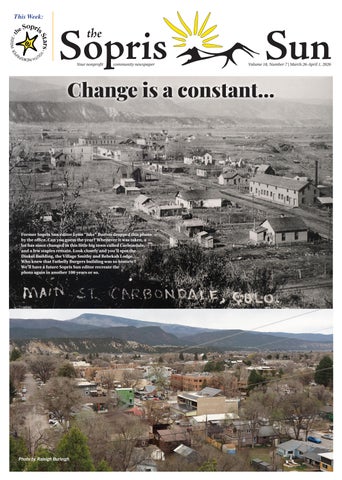
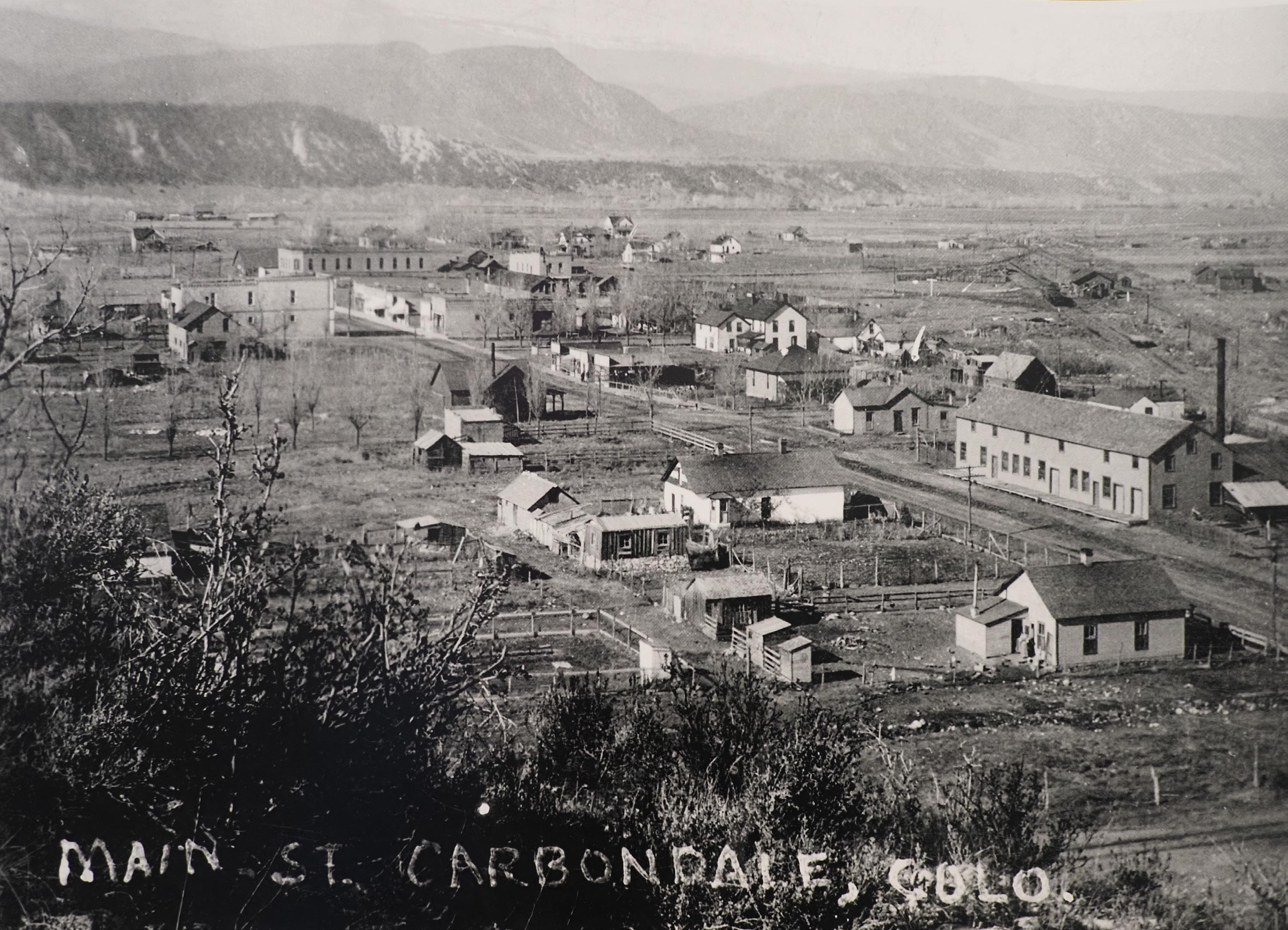
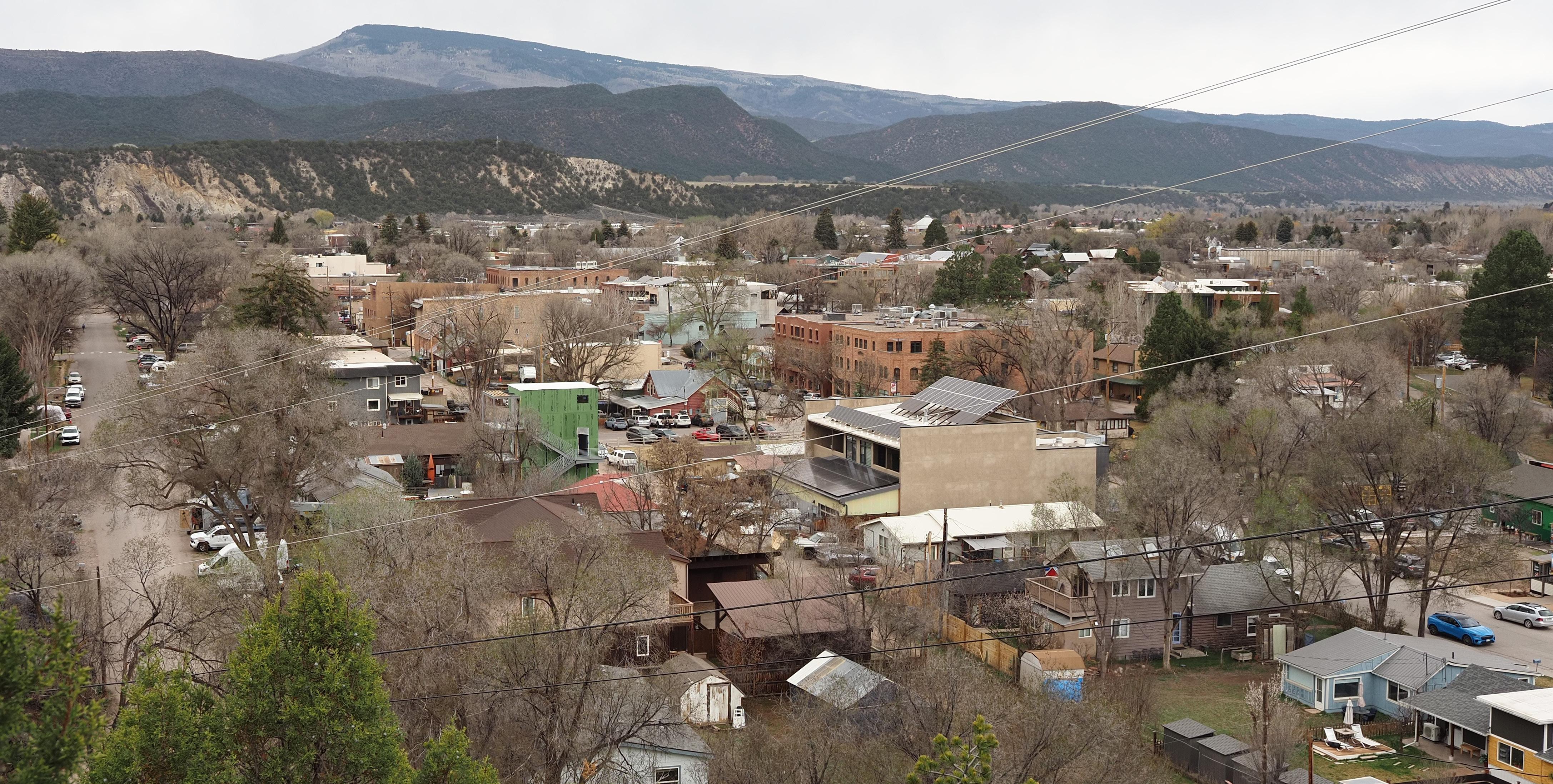
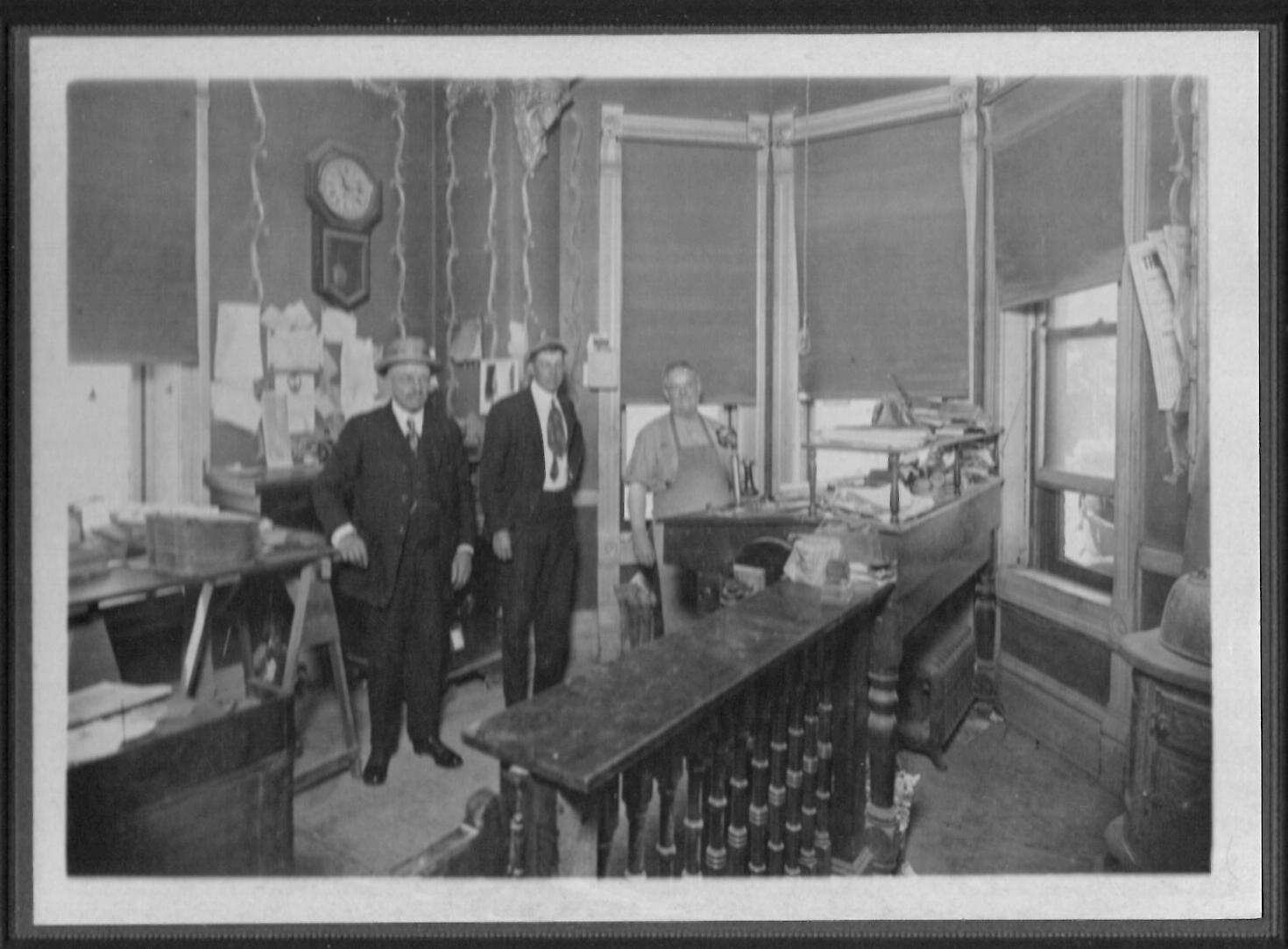
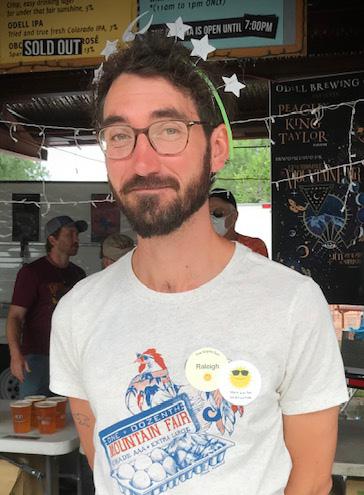
Former Sopris Sun editor Lynn “Jake” Burton dropped this photo by the office. Can you guess the year? Whenever it was taken, a lot has since changed in this little big town called Carbondale, and a few staples remain. Look closely and you’ll spot the Dinkel Building, the Village Smithy and Rebekah Lodge. Who knew that Fatbelly Burgers building was so historic? We’ll have a future Sopris Sun editor recreate the photo again in another 100 years or so.
Photo by Raleigh Burleigh
Flow the Acequia Madre
I am just back from the Land of Enchantment and I am still under the spell. On my sojourn through northern New Mexico I wandered through the cacophony of tan hills and deep arroyos (gulches) filled with small villages and intimate neighborhoods.
I ate my way from pueblo to pueblo, savoring food that is typical only to this small region. The green chile, blue corn, piñon nuts, beans and squash are a delight, but it is the red chili that makes the definitive statement. Made from finely ground dried red chili peppers, I have never had two chilis the same. Some chili powders are almost pink or brick red varying all the way to a rich blood red. This red conjures the association of their mountains at sunset, the “Sangre de Cristo” or Blood of Christ. New Mexicans will tell you that it is their family’s recipe passed down from their “abuela” (grandmother) or even her grandmother. The recipes are different but each seed strain of local chili pepper is also guarded through the generations.
He, a well-respected elder, is the “mayordomo.” As the responsible, wise and seasoned civic leader, he directs the commune in this annual ritual. Each of the ditch users must supply the requisite amount of manpower corresponding to his share of the ditch. The mayordomo is the quality controller for this volunteer group of neighbors. It is hard, dirty and rewarding work.
OPINION
None of this rich cultural and gastronomic evolution could have happened without one critical element. It is the 400 year old system of acequias. This network of hand-dug, gravity flow irrigation ditches has been bringing the precious waters from the Sangres to family farms and gardens long before the United States was united. Closer to the headwaters, the primary canal in this arterial system is the “Acequia Madre,” the mother ditch. These acequias weave their way through the wrinkled topography bringing the lifeblood of the region to the people. I stood under a blossoming fruit tree in front of the half-subterranean adobe museum in a tiny town when a stocky man walked up. A short man, he wore a cool, closely-cropped Mohican on his otherwise bald, sun worn head. He was curator of the museum, and after five minutes I felt that I had known him for years. He left the museum to me and explained he had some obligations to attend to. He lives in a small, very old village called Cundiyo, meaning “round hill of the little bells.” The next day was “limpio,” he explained, the vernal weekend when the community members that draw water from the acequia meet to collectively clean their ditch.
He laughed when I said I was very familiar with this task and that I consider the task “love-hate.” As a young man, I cleaned ditch for a number of years here with my “mayordomo.” Now my water shares come from the Crystal River via the Rockford Ditch. The Rockford Ditch was hand-dug (likely using beasts of burden) in 1883 and is the oldest ditch in the Valley, dug several years prior to the establishment of Carbondale. The maturity of this water right secures its priority over water rights initiated at a later date. The first entity to divert and beneficially use water has the senior water right. “First in time, first in right” is the legal and defining principle for the management of Colorado River water.
CVEPA VIEWS
By John Armstrong
In 1916, the Bureau of Reclamation built a 14-foot-tall, river-wide, concrete “roller dam” on the Colorado River at Cameo upriver from Grand Junction. To release water, the dam has six roller gates on it and was the first place in the country to utilize this unique German technology. It is now on the National Historic Register. The Highline Canal irrigates over 33,000 acres in the Grand Valley. The spectre of the dreaded “Cameo Call” for more water strikes fear into the hearts of all water rights holders that are junior, or younger than this water right. Their legal use of the water will be compromised in order to fulfill the Cameo adjudication. If there is ever a year that challenges the system of water rights it will be 2026. If water is the life blood of the land and the ditches (and acequias) are the arterial and vascular system, then our beloved mountains and their essential snowpack are surely the heart of the West. The Crystal Valley Environmental Protection Association (CVEPA) believes that water conservation is essential to the western environment.
To learn more about CVEPA and to support our work, access www.cvepa.org or visit us on facebook.
LETTERS
Dear Jamie LaRue,
Thank you for very nearly four years of incredibly compassionate leadership of the Garfield County Libraries! We so needed you! Thank you for listening to staff, for letting them take the ball and run with their passions, creativity and innovative ideas. Your dedication inspired so many people!
Thank you for expanding the outreach of our district’s libraries, for reflecting the diversity of our communities within your libraries’ staffs and collections, for early literacy programs, special events, performances, partnerships, for steadfastly preserving our threatened intellectual freedoms and First Amendment rights!
Thank you for your eloquent and enlightening opinion pieces, for your kindness, and generosity, and gently firm leadership. It is apparent that you care deeply for our diverse communities’ go-to learning repositories.
Our district’s current libraries truly do make our communities great. They foster inclusivity! They “encourage curiosity!” Jamie LaRue, in true partnership with your district’s staff, you have done your fiscal homework, promoted and reinvented a vibrant, welcoming, free-to-all resource — a force for learning and growing and expanding our horizons.
I thank you for being here for us all. Now, get out there and dive into your next chapter!
Wishing you all the very best, Jenny Tempest Carbondale
Sparhawk for mayor
In times when it can be hard to feel hopeful, Erica Sparhawk gives me hope! She is so smart, thoughtful, dedicated, engaged, considerate and truly cares for Carbondale as a COMMUNITY. She’s been a great town trustee, and I am so glad she is running for mayor! Vote for Erica for Carbondale mayor.
Zuleika Pevec Carbondale
Entrance to Aspen
It looks like Mother Nature answered our prayers for a solution to the entrance to Aspen. “No snow. No traffic.” Problem solved by Mother Nature.
While this works for the short-term, it is not going to work for the future. The City of Aspen wants to do better than the Solution of “no snow no traffic.”
Find out about the City’s Solutions. Give your opinion.
Open house: Thursday, March 26, 4pm to 6:30pm, CMC Aspen across from the airport. Short presentations, 5pm and 6pm. Free food and drinks.
Visit the Entrance to Aspen website to learn more: www.entrancetoaspen.co
Until then... Pray for rain to keep us from fire danger.
Toni Kronberg Snowmass Canyon
Voting rights
Every politician who voted (or will vote) for the SAVE Act, including our Representative Jeff Hurd, should be voted out of office. Under the guise of “safe-guarding” voting, it is designed to thwart democracy. Although Republicans have been unable to prove widespread voter fraud, they are willing to challenge millions of women who took their husband’s last name, or voters who vote by mail, or voters who don’t have access to passports or birth certificates. Voter fraud is astonishingly rare, and it’s just as likely to occur with Republicans as Democrats. The SAVE Act is nothing more than 21st century Jim Crow laws.
Peter Westcott Missouri Heights
Water restrictions, please
The writing is on the wall. We are so, so dry. Little rain all last year, barely any snow this winter and a remarkably early spring … Unless we get A LOT of rain very soon, our water supplies will be extremely limited this summer. Instead of waiting, might the Carbondale “Powers That Be” decide on some kind of water restriction sooner rather than later? Are pristine green lawns worth compromising water supply for the fire mitigation that will certainly be a concern this continued on page 22
LETTERS POLICY: The Sopris Sun welcomes local letters to the editor. Shorter letters stand a better chance of being printed. Letters exclusive to The Sopris Sun (not appearing in other papers) are particularly welcome. Please, no smearing, cite your facts and include your name and place of residence or association. Letters are due to news@soprissun.com by noon on the Monday before we go to print.
Editor James Steindler 970-510-3003 news@soprissun.com
Managing Editor Skyler Stark-Ragsdale
Sol del Valle Editora Bianca Godina bianca@soldelvalle.org
Digital Editor
Ingrid Celeste Zúniga ingrid@soldelvalle.org
Lead Editorial Designer
Terri Ritchie
Partnerships & Engagement Manager Luise Nieslanik
Advertising Department adsales@soprissun.com
Sol del Valle Marketing & Development Manager
Margarita Alvarez margarita@soldelvalle.org
Advertising Designer
Emily Blong
Delivery Frederic Kischbaum
Bartlett
Proofreaders
Lee Beck
Tracy Kallassy
Ken Pletcher
Hank van Berlo
Executive Director
Todd Chamberlin 970-510-0246 todd@soprissun.com
Board Members / Mesa Directiva board@soprissun.com
Klaus Kocher • Kay Clarke • Eric Smith
Roger Berliner • Elizabeth Phillips
Anna Huntington • Loren Jenkins
Carlos Ramos • Gayle Wells
The Sopris Sun Board meets at 6pm on second Thursdays at the Third Street Center. The Sopris Sun, Inc. is a 501(c)(3) nonprofit corporation with a mission to inform, inspire and build community by fostering diverse and independent journalism. Donations are fully tax deductible.
Sincerest thanks to our Honorary Publishers for their annual commitment of $1,000+
Kathy & Carter Barger
Lee Beck & John Stickney
Karen & Roger Berliner
Emily & George Bohmfalk
Kay Brunnier
Michelle & Ed Buchman
Sandy & Paul Chamberlin
Frances Dudley
Sue Edelstein & Bill Spence
Deborah & Shane Evans
Greg & Kathy Feinsinger
Peter & Mike Gilbert
Michael & Nancy Kish
Gary & Jill Knaus
Jan & Warren Koster
Bob & Dori Libson
Donna & Ken Riley
Eric Smith
Patti & George Stranahan
Gayle & Dick Wells
Elizabeth Wysong
Legacy Givers for including us in their final wishes. Mary Lilly
Donate by mail or online: P.O. Box 399 Carbondale, CO 81623
520 S. Third Street #26 970-510-3003
soprissun.com/Donate
The Sopris Sun, Inc. is a proud member of the Carbondale Creative District
SCUTTLEBUTT
Ace reporter seeks housing
Amy Hadden Marsh, one of the Valley’s top reporters, and her indoor cat (Dizzy) are in need of a place to live. Marsh lost her housing of 27 years due to circumstances beyond her control and hopes to remain local. If you know of a reasonably-priced place, please email amy@soprissun.com
Ski and snowboard recycling
Ready to ditch this season’s rock skis/ board? The City of Aspen, in partnership with Colorado Ski Furniture, is collecting skis and snowboards to be recycled now through May 16 at the Rio Grande Recycle Center. Bindings and poles are also eligible, but not helmets nor boots. Last year, this program diverted over 1,200 pounds of gear from going to the Pitkin County landfill.
5 Point Film lineup
FirstBank Alpine Bank
Colorado Mountain College
Nordic Gardens
Hilary Porterfield
Basalt Library
NONPROFIT PARTNERS
Two Rivers
Unitarian Universalist
Carbondale Arts
Carbondale Rotary Club
Colorado Animal Rescue
Interested in becoming an Underwriter or Nonprofit Partner? Email Todd@soprissun.com or call 970-987-9866
Carbondale’s 5 Point Adventure Film Festival announced last week the film lineup for its 19th annual festival, slated for April 21-26 at the Crystal Theatre, Carbondale Rec Center and other locations in town. Headliners include “Les Tufs,” a film by French freeskier Candide Thovex, “Old Ladies Against Underwater Garbage,” a story about a group of elders tackling environmental stewardship, “Rodeo On Ice,” a skijoring film, and more. For tickets and more information, visit www.5pointfilm.org
GarCo v. Glenwood Springs
Garfield County last week threatened the City of Glenwood Springs with an injunction, should the City refuse to file a permit request giving the County increased authority over aspects of the South Bridge Project. The project would construct a bridge across the Roaring Fork River south of Glenwood connecting Highway 82 with Airport Road.
“The most expensive part of the project will likely be the bridge crossing the Roaring Fork River and that’s in unincorporated Garfield County,” Commissioner Tom Jankovsky said in a press release. “This is really about the procedure in our land-use code and not a motion for or against the project.”
CMC revamps paramedic edu
Interested in pursuing careers in emergency medicine? Colorado Mountain College’s (CMC) newly improved paramedic program offers students in-depth training over the course of a year. The program is hosted at the CMC Vail Valley campus in Edwards, though is open to all students in the CMC district, with 16 to 18 admitted per cohort. Applications for the 2026-27 program, which will run from August to August, are currently being accepted. Graduates will be eligible to take
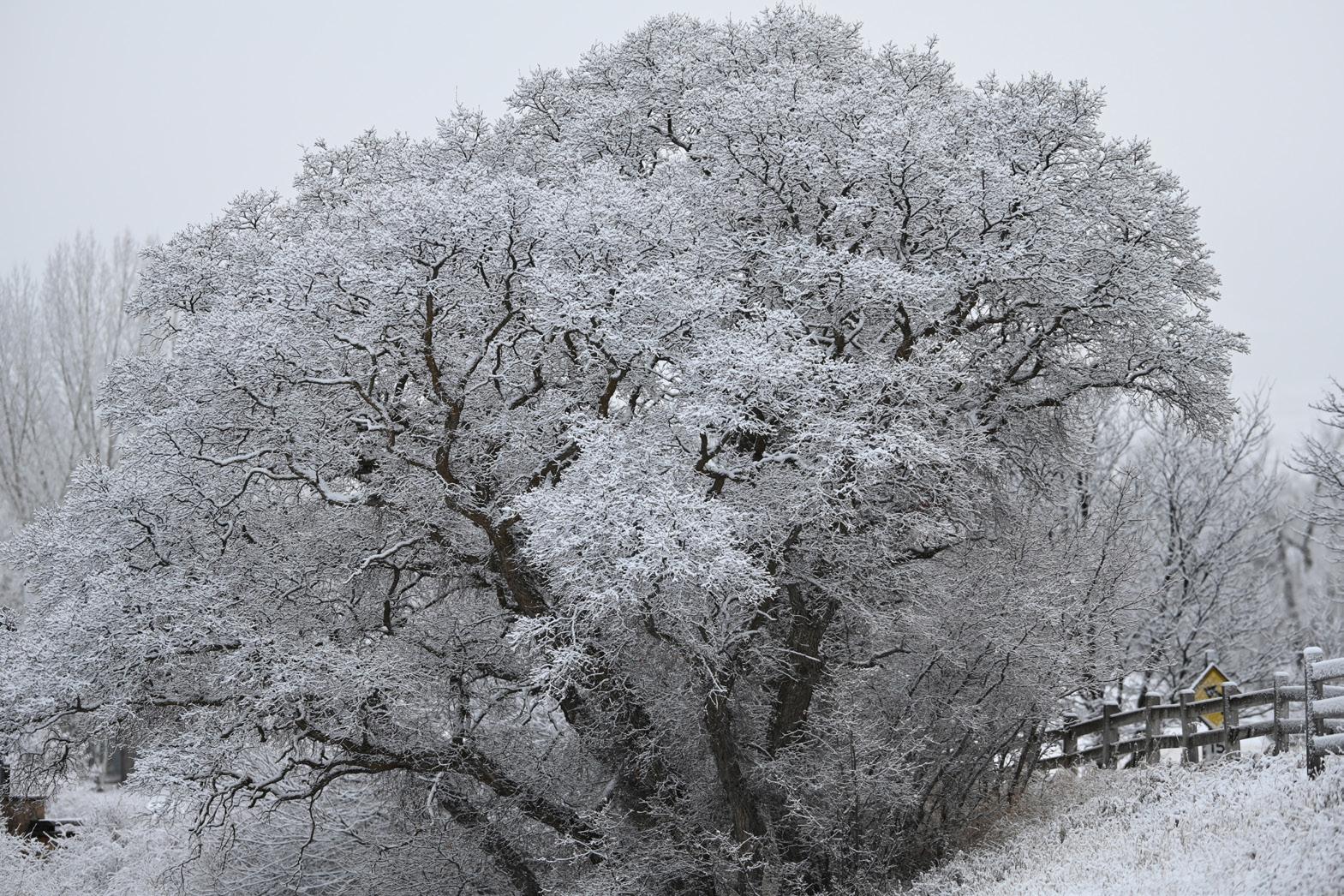
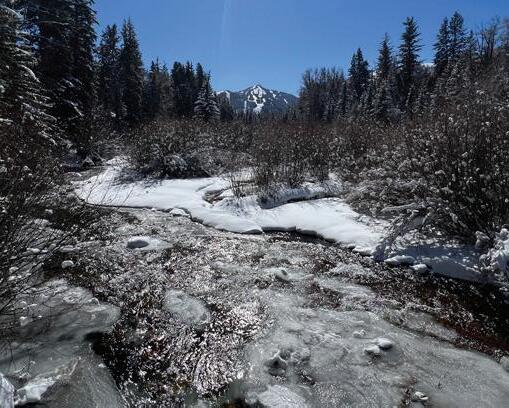
The first day of spring has come and it feels like winter itself hibernated this season, with the exception of a sparse flurries, including a recent snow on March 6, decorating the Roaring Fork Valley. The Roaring Fork Conservancy reported on March 19 that snowpack decreased by 2.1 inches at McClure Pass in a week, “nearly a quarter of the total [snowpack] accumulated at the site this winter.” Colorado, Wyoming and Utah all experienced their warmest winter season on record.
Photo by Tommy Sands
Colorado and National Registry of Emergency Medical Technicians certification exams, and will be awarded a certificate of occupational proficiency. For more information, visit coloradomtn.edu/programs/paramedic
Prop 110
The Colorado Secretary of State’s office announced on March 17 that proponents for Proposed Initiative 110, “Prohibit Certain Surgeries on Minors,” submitted enough signatures for the measure to appear on the Nov. 3 general election ballot. If passed, surgeries “altering [a] minor’s biological sex characteristics” would be prohibited, as well as government funding for associated procedures.
Boot Tan, no ski boots
The women and gender-queer exclusive Boot Tan Fest is still a go at Sunlight Mountain Resort, despite skiing not being an option due to the lack of snow. The Sun received an email from a ticketholder that organizers have not responded to requests for partial refunds, though the event typically includes snow sports and lift access. Tickets are currently advertised for $275 for the April 10-12 weekend event, which is still expected to be a good time!
Craig coal plant
Environmental advocacy nonprofits including the Sierra Club and Environmental Defense Fund are suing the Trump administration over an emergency order to keep the
Craig Unit 1 coal plant operational past its scheduled retirement date (Dec. 31, 2025). The State of Colorado has filed its own challenge. The coal plant’s owners, Tri-State and Platte River utility companies, were the first to request a rehearing of the order, warning it causes them to incur costs which will be passed along to billpayers.
Opioid overdoses
The Common Sense Institute (CSI), a conservative-leaning think tank, reports that “while synthetic opioid overdose deaths have begun declining nationwide, Colorado is moving in the opposite direction.” According to CSI research fellow Paul Pazen, deaths in Colorado have increased by 17% since December 2024. Colorado was one of five states to see an increase in deaths in this period. CSI recommends strengthened criminal penalties for fentanyl possession and distribution, which has been effective in other states including Texas. They say it’s your birthday!
Folks celebrating another trip around the sun this week include: Ruby Marker and Brian McIsaac (March 26); Shea Courtney and Drea Marsh (March 27); Hank van Berlo, Madilyn Ebel, John Field, Damon Scher and Pat Wanner (March 28); Stacey Bernot, Lyzzi Borkenhagen, David Hayes, Lucy Perutz, Bob Schultz and Jesse Terrell (March 29); Jorie DeVilbiss and Megan Wussow (March 30); Georgia Ackerman, Colleen Borkovec and Jane Hart (March 31).
Ways of Making: Drawing like Pheidippides
MIKE DE LA ROSA
Arts Correspondent
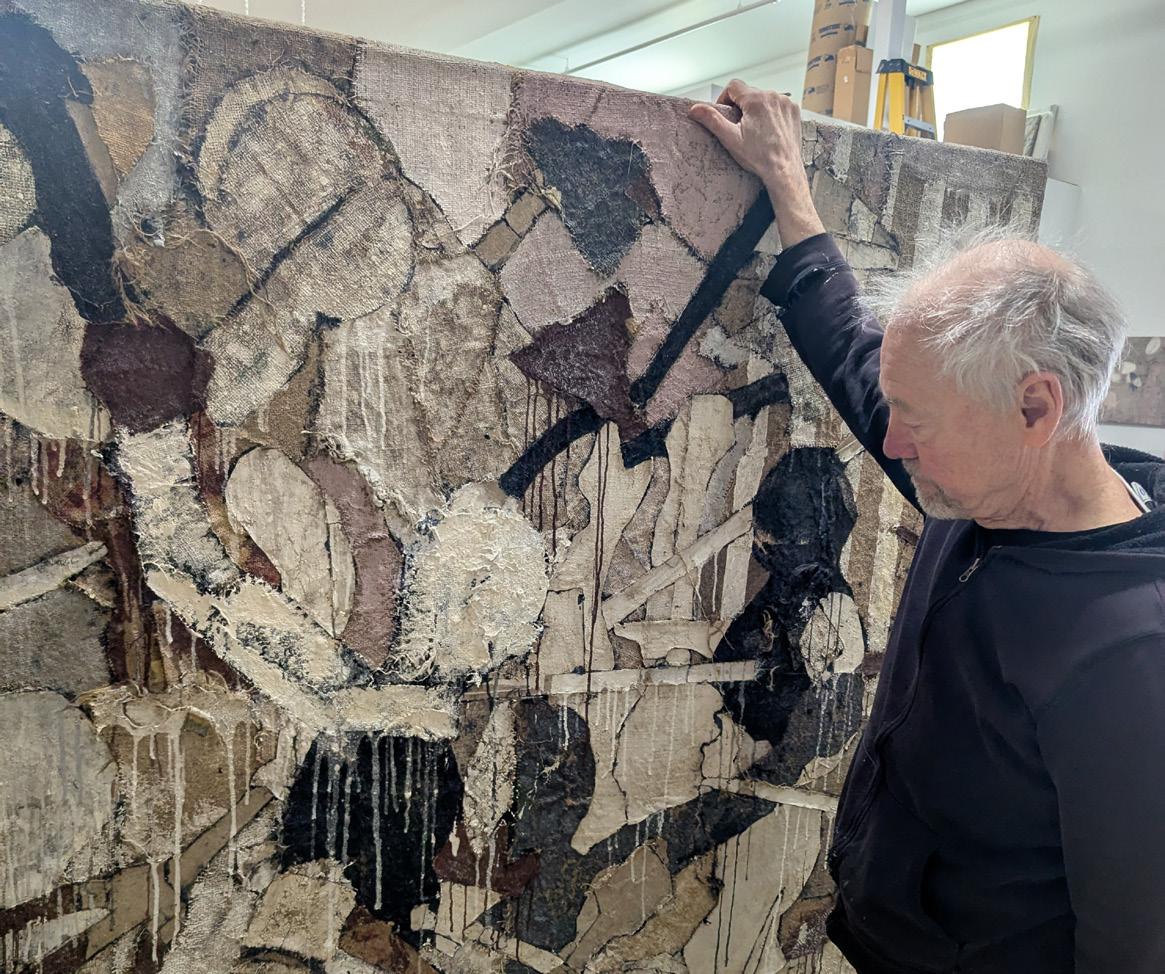
Sitting in Julian Schnabel’s old crusty painting chair, I discussed art with Paul Manes in his Carbondale studio. Spacious and productively cluttered, the studio is active with supplies, works in progress and a delicious amount of debris. Turpentine vessels caked in substrate cling like lichen to rock, the groundwork for something new. There is a pulse animating the studio.
Manes’s work often repeats forms and gestures into worlds, looking and looking again at the same thing, so we began our discussion around drawing. The artist’s ethos reflects some old-school ideas regarding rigor as a fundamental aspect of drawing. In short, it’s a framework that believes revelations can be earned through attentive self-awareness. What’s exciting in these revelations is that they emerge—there is no precise plan when what you want is a surprise, which creates dynamic compositions.
In Manes’s words, “You back up, and then you start seeing it. After you get down the line a ways the piece starts to talk to you, communicates what it needs.
That develops … and the longer you do it in a focused way it comes out of you — you become what it is. It’s a great process.”
How art “talks back” is always a thrilling discussion with artists; how artists learn to be mad, as their work begins to express its own agency. Perhaps out of the realization that the process can outperform premeditation, artists can start sounding like fanatics.
“Titian, when he was 90 years old, said, ‘If I could only live 10 more years, I could really learn how to draw.’ There is no end to it.” It’s running a marathon, but instead of 26 miles your focus is on running until your heart goes out like Pheidippides.
Manes came to art somewhat late, after first trying a traditional career track out of practical concern.
“In 1966, when I got out of high school, I heard somebody say that accountants made $35,000 a year … So I thought, ‘Well I’ll just go to business school,’ which was the most idiotic thing I’ve ever done.”
Returning to school years later in his thirties, he dove into the art program. He recounts drawing until his fingers bled: “I was on fire back then.”
His career took off when he
won a juried exhibition at the Beaumont Art Museum (Texas), which came with a solo exhibition opportunity. Today, the museum has a 25-foot painting from Manes on permanent display in its foyer, a culmination of a long relationship.
“I had worked in that museum, shining the floors, doing the lighting and hanging the shows, stuff like that … I made $4,000 from the sales in that show and my mother gave me $4,000, and off I went to New York.”
Manes landed in Williamsburg, which at the time was a rough district of artists and misfits, where he rubbed shoulders with legendary artists and pool hustlers alike.
Currently, his studio has three bodies of work in development. Manes’s most recognizable work may be a long running series on bowls. They function from repetition, a pared-down, slightly oblong platonic vessel often stacked aggressively and defying gravity or physics.
“I painted a little bowl on newspaper, put it on paper and put it in a show in the mid ‘80s. Somebody bought it, so I did another, and so on. Then I started stacking them up.”
He uses a template to draw the lines before painting them in. Eventually he commissioned someone to make him 100 little ceramic bowls to work from.
They are bizarre paintings. The bowls are essential in their design, perfect platonic shapes but completely devoid of ornamentation, which makes them unnervingly ordinary. They are painted with dramatic light, but roughly; the material scratches and pours, sometimes color feeling like a blemish or bruise on the surface of these paintings.
“Everybody on earth has a bowl — they all have different things in them. Some have
nothing in them.” It seems to ask, “How do perfect shapes exist in the real world?”
Alongside these are paintings of poppy flower fields. They caught me off guard as more sentimental, more direct in the pursuit of making a pretty picture. The dissonance appears when Manes revealed they are paintings of the fields at Flanders, which shatters the idealism and turns the vivid red into a visceral memory of soldiers charging into the earth.
The last body of work depicted rain. Some are atmospheric, immersive and familiar; others
continued on page 19 Working Together For Pets And Their People
(970)947-9173CO
CARE currently has and 17 cats, available for
RJ PADDYWACKS offers a “C.A.R.E. package” for new adoptive families, including a “Paws for Points” plan and a first time 15% discount for your new pet.
RJ PADDYWACKS offers a “C.A.R.E. package” for new adoptive families, including a “Paws for Points” and a first time 15% discount for your new pet.
Iris is a 4 year old looking for a fun-loving family! She thinks her toys and balls are just the best thing in the world, followed by a nice snooze on the couch. She has an old injury causing arthritis and a limp in her front leg, but she doesn’t let this cause her too much trouble. Overall, she is a silly and bouncy lady that has a whole lot of love to give. Call C.A.R.E. to come meet her today! RJ Paddywacks
Bring a basket and join the fun! Saturday March 28th 11:00 am
Paul Manes holds up a painting in his Carbondale studio.
Photo by Mike de la Rosa
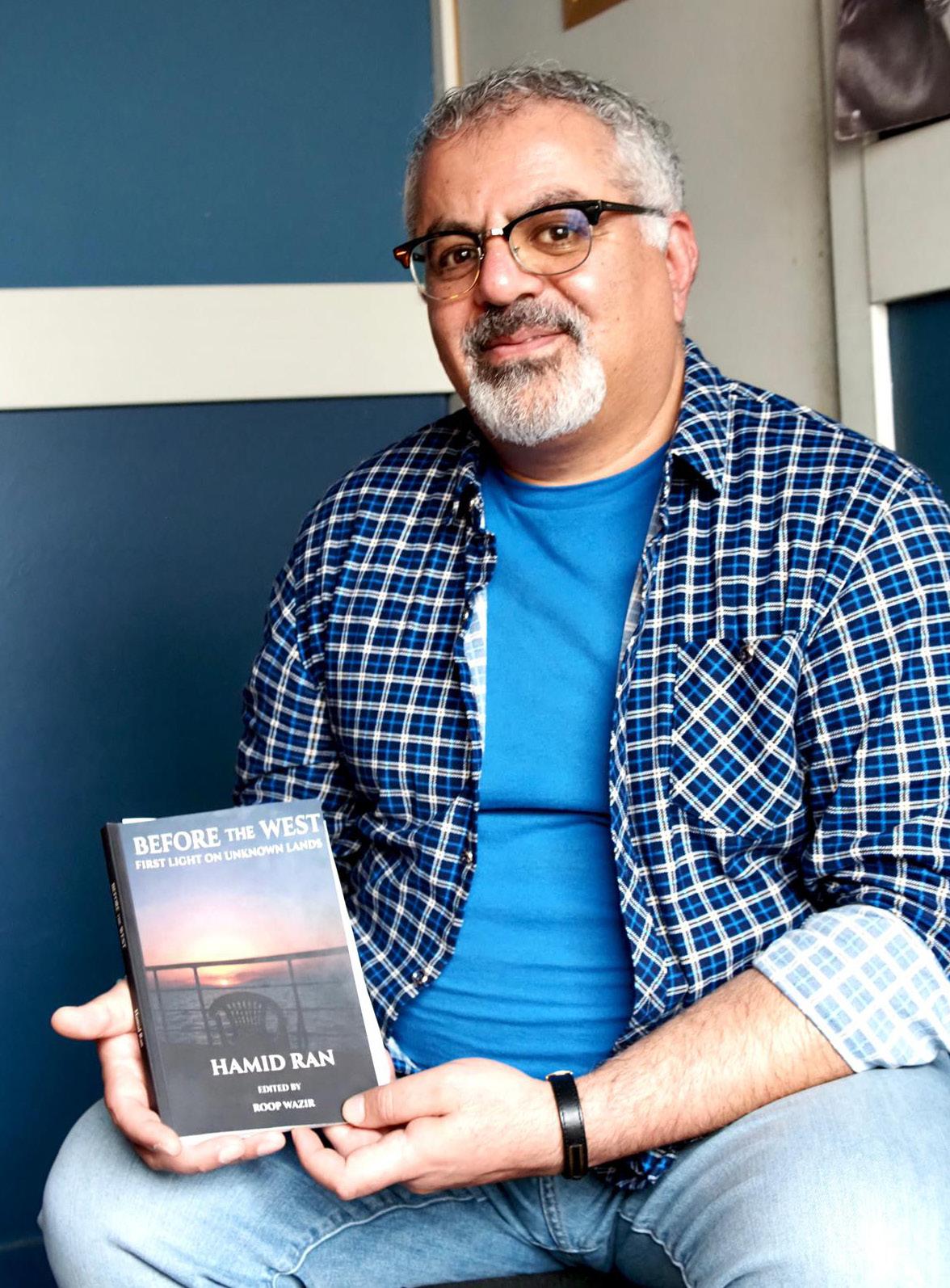
Iranian author presents new memoir on April 4
Hamid Ran dreamed of becoming a journalist. From a young age, he was an adamant reader. Given the opportunity to work at a daily newspaper in Tehran, he accepted six months without pay, just to get his foot in the door.
Because Ran lived under the Islamic Republic of Iran, his profession quickly became dangerous. Reporting on the Public Transportation Bus Drivers Union, the first major union to form after the Islamic Revolution, he was blacklisted. Newspapers throughout the country were told by the government they would be shut down — a common occurrence at the time — if they published anything Ran wrote, on any topic.
Today, from his home in New Castle, Ran is proud to present “Before the West: First Light on Unknown Lands.” This memoir details his arduous journey as a refugee from Iran to Turkey and, eventually, the United States. Within its pages, Ran recounts the hardship of leaving family and home, likely forever, and having one’s life at the mercy of bureaucratic systems in a foreign land.
“Every immigrant understands this conflict. When you leave a country without the possibility of returning, the emotional cost is enormous,” Ran writes, describing interwoven feelings of joy and fear, hope and heartbreak. Early in the book, he describes his final night in Zanjan, his hometown, writing, “My eyes were wide open as I tried to memorize every single inch of those streets.”
At the age of 31, in 2008, Ran left Zanjan. He was temporarily relocated to Niğde, Turkey, where he fell in love with the culture and the people. “Even the birds sensed they were freer here,” he writes.
Ran’s book offers insight into life under an oppressive regime. Imagine being arrested for carrying a book by a specific author, or spending days in a military
prison for getting spotted making tea before sundown during Ramadan. Imagine as a woman having to always cover your head with a scarf. “People were forced to live with two personalities: one at home, and one outside,” he reflects.
The book was published on Feb. 7, 2026, less than a month before the United States and Israel attacked Iran with coordinated airstrikes, initiating a new war. “I am happy that the Ayatollah is dead and that the other leaders are dead,” Ran told The Sopris Sun in an interview. “But on the other hand, I really don’t think that war is the solution.”
In one chapter, Ran explains how his childhood was destroyed by a war between Iran and Iraq. He remembers living in constant fear — “fear of bombs falling, fear of dying, fear that my family or friends might die.” He writes, “War is a game of money and power, played by a few, paid for by millions.”
Ran believes firmly that “the entire world is made of citizens of this planet.” He writes, “There is no difference between a child born in Iran and a child born in America; we don’t choose where we are born. Yet the people in power choose whether we live in peace or grow up in fear.”
Now employed by Pitkin County Human Services, Ran is already working on part two of his memoir, picking up where his journey to the United States begins after nearly two years of living in Turkey while his application was being processed.
Born to illiterate parents, this man has written a memoir in English, his fourth language. It is poetically composed and charged with emotional vulnerability. Moments of friendship, wonder and perseverance uplift the narrative as Ran discovers the kindness of strangers and the magic of trusting a great unknown. Join the author at Barnes & Noble in Glenwood Springs on April 4, from 2 to 4pm, for the opportunity to purchase a copy and hear stories first-hand.
This week’s Everything Under The Sun, March 26 at 4pm on KDNK, will feature an interview with Ran about the book and the war currently unfolding.
With Us, Your Health is Personal
“Journalism is something I have never regretted pursuing. Not for a single moment. It became another essential path in my life, one that shaped me in the way I had always hoped my life would be shaped,” author Hamid Ran wrote in “Before the West: First Light on Unknown Lands.” Photo by Raleigh Burleigh
Frank Sweet: The man behind the Sweet Jessup ditch
LYNN BURTON
Sopris Sun Correspondent
EDITOR’S NOTE: Most of this article is taken from Edna Sweet’s 1947 book “Carbondale Pioneers, 1879-1890.” She based the book on interviews and her own memory.
When Frank Sweet arrived in the Carbondale area from Connecticut in 1882, the dry ground was covered with nothing but sagebrush as far as his eye could see. He’d loved the green valleys of his home state, but upon first glance became imbued with the idea of making what he would later describe as a desert “bloom like a rose.”
Within 25 years, Sweet organized companies that would build the 12-mile east mesa ditch and the 19-mile Sweet Jessup ditch west of town. Sweet traveled to the Carbondale area to join his uncle, William Walden, on his ranch west of what would become the town. Locals called Walden “Yank” because he was known for his shrewd business dealings. Yank Creek, which feeds Thompson Creek, is named after Walden.
Sweet homesteaded west of town on a portion of what’s now Crystal River Ranch. He married Edna Denmark, who herself was a pioneer schoolteacher. They had five children: Irene, Walden, Julian, Dorothy and Harold.
Besides working his homestead, Sweet soon started working as a clerk and bookkeeper for William Dinkel in his two-story brick building at Fourth and Main, because Dinkel wanted to spend more time running his bank. Lafayette Gardner, from Missouri, also worked for Dinkel, driving wagonloads
of goods to Marion and Spring Gulch. Sweet and Gardner later partnered with Dinkel to form Dinkel Mercantile, selling a variety of provisions to local residents and travelers. The three also partnered to buy ranches near Sweet’s original homestead. Sweet had an interest in a ranch east of town and was put in charge of building a ditch on the east mesa.
Sweet was suffering from health problems when he first moved from Connecticut to Carbondale. He remained in ill health and was forced to sell his local interests and moved to Denver, then two years after that
to New York. “But his heart was still in Colorado,” Edna Sweet wrote. “He had a vision to build a much bigger ditch that would serve 2,000 acres on the west mesa. In 1904, Sweet returned to Carbondale and formed the Sweet Jessup Canal Company. Lon Sweet of Denver served as promoter for the young company and Clay Jessup as the third partner. Jessup and his wife had homesteaded in Kansas “until rattlesnakes ran them out.” Jessup took charge of physically building the canal. Many felt the canal would never deliver water. Jessup became discouraged and sold his share in the company for
$10,000. When finished, the ditch ran for 19 miles from its headgate on the Crystal River to the top of what is now Sweet Hill. It took another three years for the land, which had been dry “through the ages,” to drink enough water to start producing crops.
Sweet built a ranch house at the foot of East Mesa and, in 1920, he built a residence in town. “He loved the land … and worked ceaselessly through the years for the betterment of the town and valley,” Sweet wrote. In the early days, Sweet served as a city councilman. He fought for the town to set out trees. “It was a bitter fight but they won, and they lived to see the fruit of their labor … in the town’s shaded streets.” Sweet continued, “When I climb the East Mesa and view our little village, lying so peacefully at the foot of Mt. Sopris, with its beautiful homes, trees and flowers, then go back in my memory to my first glance of the treeless desert, I feel that we have rubbed Aladdin’s wonderful lamp and that the town and mountain is, indeed, one of the most scenic spots in the world, worth all the toil, the strife and tears that went into the building it.”
As for Jessup, after severing connections with the Sweet Jessup Canal Company, he was elected Garfield County Sheriff a number of times. He made his home in Glenwood Springs and also became involved in farming on Divide Creek. He and Sweet remained friends for life. Frank Sweet died in the mid-1930s. Edna Sweet died in 1954. The entire family is buried at Hillcrest Cemetery, overlooking the town they labored to grow.
Frank Sweet, far-left, upstairs in the Dinkel building in 1917. Sweet eventually became William Dinkel’s clerk. Courtesy photo
KEN PLETCHER
Sopris Sun Correspondent
So mused Carbondale resident Lynn Siodmak when describing the house she and her partner Joel Rem had purchased at the corner of Euclid Avenue and 2nd Street last fall. As it turns out, the walls — and house — had a lot to say, thanks to her research and that by members of the Carbondale Historic Preservation Commission (CHPC).
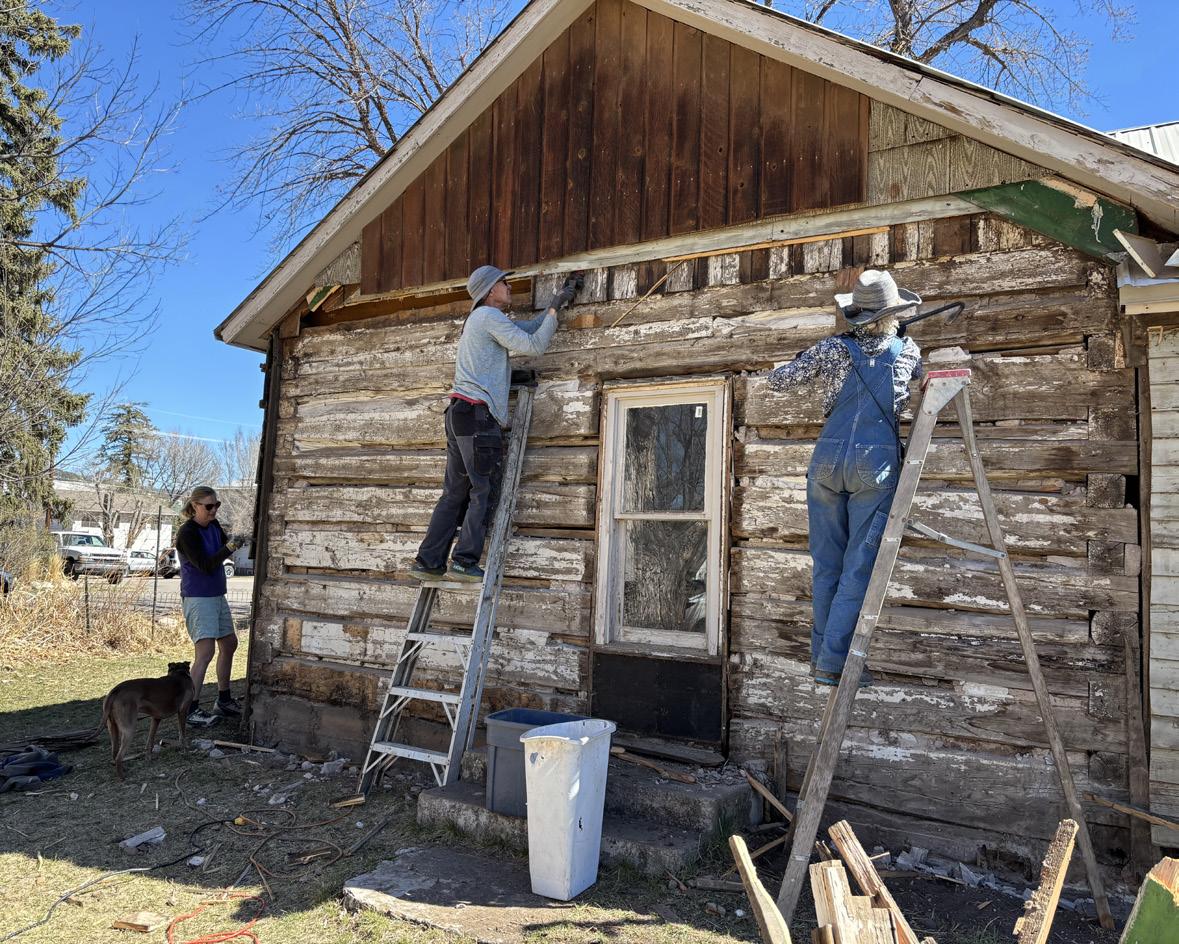
The Sopris Sun recently sat down with Siodmak and Eric Doud, chair of the CHPC, to discuss the building and its history. County tax records for the property date only to 1949, but Doud knew the house was much older than that. The structure required some asbestos remediation work. During that process all interior wall and ceiling materials were removed down to the outer shell, revealing much about its construction and age.
202 Euclid and its owners
The house was built in three stages. The first was a rectangular log cabin, oriented east-west along the northern (Euclid) side of the property. Doud estimated that it dates from the mid-1890s.
are representative of that period.” The squared logs, undoubtedly cut from the surrounding forests, were chinked with scrap wood and lime.
Doud characterized the construction as “pioneer” style, adding, “It has to be a very early house in Carbondale’s history, one of the very first.” He elaborated, “It’s a very simple house … but it is an extremely good representative of that particular style and period. Its simplicity is [of] exceptional value,” and its humble style “fits the bill” of Carbondale as “a working-class town.”
The second portion, an addition perpendicular to the first, was probably added soon thereafter. It extended south from the original structure and also consisted of squared, chinked logs. Interestingly, the original Douglas fir flooring in these sections had to be brought in by train.
The exposed raw interior of the house revealed remnants of a fire, probably in a stove or chimney, but the damage was repaired. At some point after that (probably in the 1910s or 1920s) the addition was extended farther south, this time with frame construction. A gabled roof in two sections (east-west and
cladding. However, underneath those could be seen whitewash on the original log walls. Siodmak wondered if that was an attempt to make the structure look more like a “town home,” to which Doud responded humorously, “Only miners and derelicts lived in cabins.”
The first known owners of the 202 Euclid house were Beulah and Bailey Sterrett, who acquired it in 1937. The two had moved from Virginia to the Valley in 1920, establishing a ranch west of town. Bailey died in 1943, and Beulah later married John Wilson, who had arrived in the Valley in 1904.
Beulah (1900–99) had a remarkable life – truly one of Carbondale’s “town mothers.”
As Siodmak described her, “She helped to establish the Carbondale Fire District, the Gordon Cooper Library (now the Carbondale branch of GCPL), the Rebekah’s Near New store, the Tri-County Medical Clinic, and Carbondale Senior Housing. She was a caseworker for Garfield County for 24 years and retired as the Director of Public Welfare.”
A September 1978 front-page article in the Valley Journal highlighted her 50 years of service to
Switzerland, renting the house out. Siodmak and Rem bought the property from an Erzinger descendant in 2025.
Future plans
Initially, Siodmak hoped that she and Rem might “integrate the old house with the new” one they are planning for the north side of their lot. She has had considerable experience renovating and restoring old homes, as well as a couple of Airstream
will make using any of the inefficient old building problematic. They intend to use some of the original logs to make interior wall paneling. Siodmak said she would like to use some of the old logs to make a free-standing “weaver’s cottage” structure but doesn’t know if there will be room for it in the house footprint. She and Rem plan to deconstruct the old house and have reached out to salvage operations, since “the logs can be saved.”
Homeowners Joel Rem (center) and Lynn Siodmak removing layers of exterior cladding to expose the original 1890s log walls of the 202 Euclid house. Helping them (left) is their friend and neighbor Nicki Cannon.
Photo by Diane Wills
Trustees address waste, water and housing
RALEIGH BURLEIGH
Sopris Sun Editor
All Carbondale trustees were present for the continuation of a hearing on new accessory dwelling units (ADU) regulations that will make the process easier for homeowners to build them. Several other important topics graced the agenda.
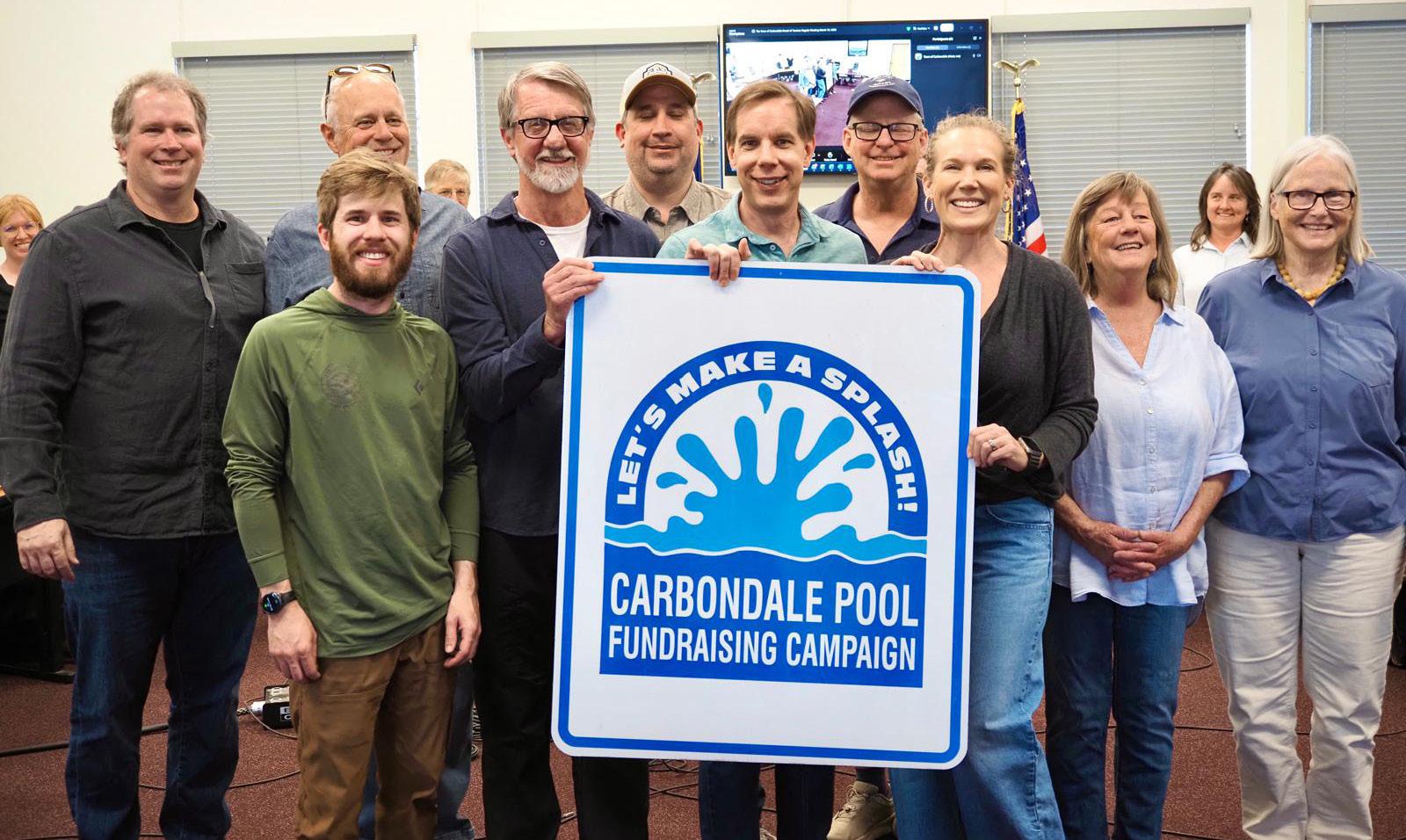
It began with two proclamations. The first honored April 2026 as National Donate Life Month. The second celebrated the “Let’s Make a Splash” capital campaign committee for raising $2.1 million toward building the new aquatics center poised to open May 23.
The consent agenda: authorized Town Clerk Patrick Thibault to appoint judges for the April 7 municipal election; awarded a chip sealing contract to GMCO, LLC for $258,745; approved the purchase of KARDA software for the Police Department at $8,400 per year to assist with drafting police reports using artificial intelligence (AI). Town Manager Ryan Hyland explained that use of the KARDA tool will comply with the Town’s overarching AI policy which is reviewed annually.
For general public comments, Lisa Paige, chair of the Tree Board, announced an Arbor Day planting at Hendrick Park on May 2. Jessica
Congdon expressed dismay with overdevelopment and increasing costs. “How can we quit advertising and promoting Carbondale so it is not so ripe with profit potential?” she asked. “How can we go quiet for a few years and focus on the bigger picture of humanity’s evolution?”
The first action item was an agreement with Mountain Waste & Recycling to take over
operations of the yard waste drop site which EverGreen ZeroWaste managed for four years. A second item extended the residential curbside trash and recycling collection with Mountain Waste for another two years. Both items were unanimously approved.
Next, the Public Works Department requested increasing a fee in lieu of water rights dedication
NOW RECRUITING
VISITOR INFORMATION VOLUNTEERS
Make a real difference for visitors and the forest.
• Welcome visitors at the Forest Service Carbondale Office
• Share helpful information and local knowledge
• Offer guidance that supports safe, responsible recreation
Scan to learn more and apply: https://forestconservancy.com
from $3,465 per acre-foot to $13,400 per acre-foot for new development given the current cost of obtaining senior water rights.
As explained by Public Works Director Kevin Schorzman, Carbondale has a strong water rights portfolio, “but as we expand, the cushion — the excess capacity of those — gets smaller.” He suggested that larger develop-
ments, like Downtown North, should be made to acquire actual water rights, while this fee would apply to smaller infill projects, lot splits and ADUs. An official proposal will be prepared for approval at the next regular meeting.
Lastly, Trustees continued their hearing on a code amendment to facilitate the building of ADUs. The March 11 discussion resulted in the Trustees supporting the allowance of short-term rentals in ADUs, which went against the Planning and Zoning Commission (P&Z) recommendation. P&Z followed up with a memo reiterating their posture.
During public comments, P&Z member Jeff Davlyn also raised the concern of not requiring a parking space for an ADU unless it has more than one bedroom. This, in conjunction with allowing short-term rentals, could have significant impacts on a neighborhood, he warned.
The Trustees stuck by their previous analysis: Homeowners should be allowed the flexibility to use an ADU as they choose and ordinances governing shortterm rentals can be more easily adjusted as necessary. The decision to not require parking unless an ADU has more than one bedroom was also upheld.
Members of the “Let’s Make a Splash” capital campaign committee received accolades at the meeting. Pictured: (back row) Craig Wheeless, Sloan Shoemaker, Kiko Pena, Malcolm McMichael; (front row) Brian Froelich, Eric Brendlinger, Todd Chamerblin, Kathleen Wanatowicz, Carolyn Fisher, Cynthia Colebrook. Not pictured: Hollis Sutherland, Rose Rossello, Steve Vanderhoof and Kayo Ogilby, Rachel Brenneman. Photo by Raleigh Burleigh
Council hesitant on storage/housing in Southside
WILL BUZZERD
Sopris Sun Correspondent
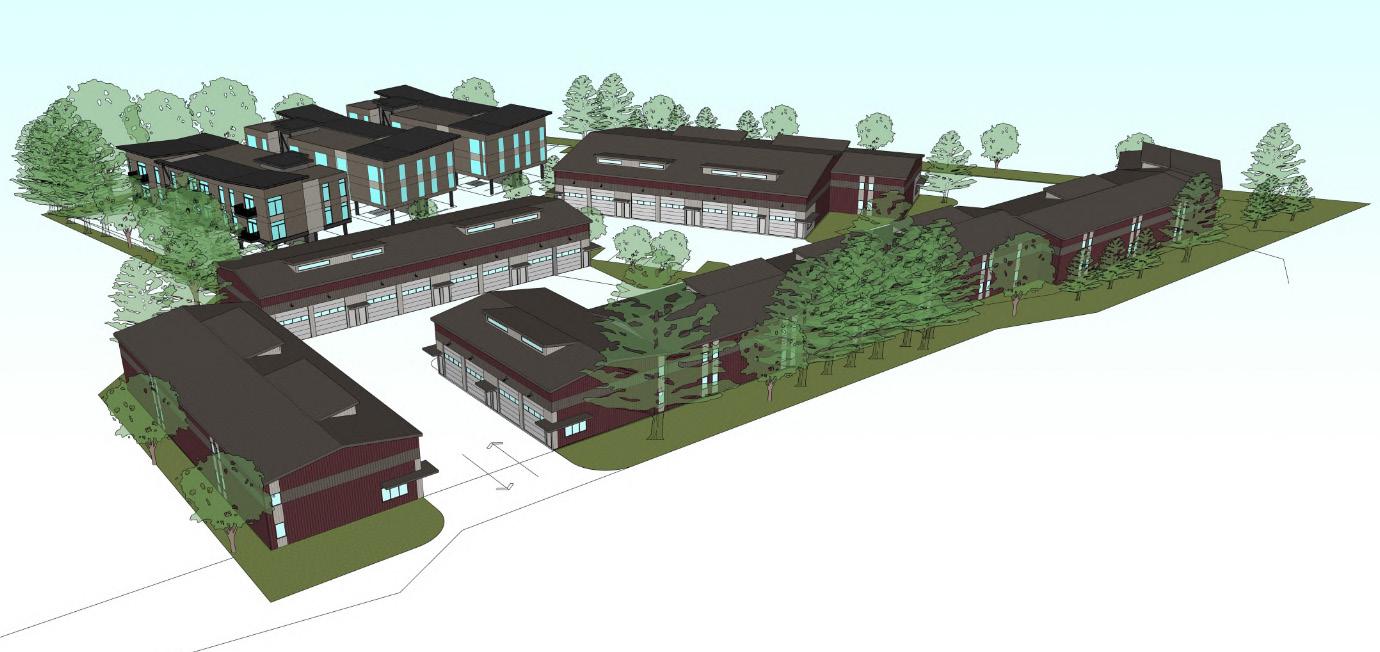
Basalt Town Council showed apprehension on Tuesday during the first public hearing for the development of 54 commercial storage units and 47 residential housing units at 555 Basalt Avenue, citing concerns about traffic and necessary amendments to Town policies.
The development, located just south of the Basalt Avenue/Highway 82 intersection, would be on the current site of Myers & Company Architectural Metals. Housing would be located on the north side of the property, nearer to the Park & Ride, and the storage units would be located further south.
The residential portion of the development would consist of three, three-story apartment buildings primarily consisting of one-bedroom units. Eleven of the 47 units would be deed restricted — a 23% proportion in keeping with the Town’s 20% minimum affordable housing requirement.
Basalt’s 2020 Master Plan identifies vacant parcels in the Southside area — the area south of the Basalt Avenue and Highway 82 intersection on the way to Basalt High School — as an ideal area for development to address housing shortages. While 555 Basalt Avenue falls within the Master
This 3D rendering depicts proposed development just southwest of the intersection between Basalt Avenue and Highway 82, consisting of 47 small residential units and 54 units of storage, replacing an existing metal fabrication shop. Courtesy graphic
Plan’s urban growth boundary, the property is currently occupied, and the Master Plan will need to be amended to change the site to “mixed use” in order for development to proceed. Traffic management is one of the Town’s primary concerns regarding this new development. The Master Plan states that, should the Southside area be further developed, an additional access point onto Highway 82 will have to be constructed in the area to accommodate for increased traffic. While that isn’t yet
GLENWOOD SPRINGS REPORT
considered necessary, the Town has identified that creating a traffic circle or mini roundabout at the intersection of Basalt Avenue and Cody Lane could serve as an interim improvement in order to ease traffic in the area. The Town therefore expects developers in the Southside area to contribute to the estimated $1 million toward constructing the traffic circle.
In addition, Fiou Lane — the public street which runs along the south side of the property — narrows from a two-way to a one-way street. Basalt Planning
City begins enforcement action against ICE detention facility, will review police SPEAR partnership
JOHN STROUD
Sopris Sun Correspondent
The City of Glenwood Springs was expected to formally begin enforcement action this week against the U.S. Immigration and Customs Enforcement (ICE) detention facility located on the far west end of Midland Avenue. The action is based on evidence presented to and confirmed by City officials in recent weeks that the facility in the Midland Center at 100 Midland Ave. has on several occasions held detainees for longer than the 12-hour limit spelled out in a special-use permit that was issued in 2003.
City Attorney Karl Hanlon explained at the regular March 19 City Council meeting that, once a formal Notice of Violation is issued, it triggers a City review of the special-use permit. Ultimately, the matter could end up before the state and/or federal courts and could take years to reach a final judgment, he said.
For that reason, Hanlon warned Council members to avoid making any comments or engaging with the public in ways
that could jeopardize the City’s legal position.
“My goal here is to have the most defensible decision possible,” he said, adding that there would be no Council discussion or decisions made at that night’s meeting.
“I am asking you not to engage, so that we can produce the cleanest process possible and the most defensible outcomes we possibly can,” he said.
That said, after reviewing information presented to the City by several members of the public that came from data collected through federal Freedom of Information requests via the third-party Deportation Data Project, it does appear there have been multiple violations of the 12-hour hold rule, counter to the terms and conditions of the ICE facility’s permit, Hanlon said.
Because it was the city’s Planning and Zoning Commission that first heard and approved the permit request 23 years ago, that body is scheduled to hold a public review hearing at 6pm on Tuesday, April 28.
Any decision rendered by P&Z can be appealed to City Council
within seven days, and another public hearing would be held on the “next available” Council agenda.
Public comments would be taken as part of the official record at both hearings, Hanlon said.
From there, any party can then file an appeal in Colorado District Court. If it were to be appealed to the state courts, it’s possible the federal government may ask that the case be directly dealt with in the federal courts, he said.
“This is a grind,” Hanlon forewarned, much to the chagrin of several members of the public who again showed up at the March 19 meeting to comment on the City’s dealings with ICE and other related topics.
Some of the dozen people who spoke said they want the City to take immediate enforcement action, including “red tagging” the detention center and/or condemning the section of the larger commercial plaza where it operates, rather than dragging things out through a hearing process.
Doing so could protect the City from being caught up in a
that the proposed development generates no net increase in traffic above the current level generated by operations at Myers & Company. This report is based off of one day of operations at the company in May 2025.
“We’re all a little incredulous on the data,” Mayor David Knight said regarding the traffic study. “The numbers don’t seem to add up to us.”
and Zoning (P&Z) discussed extensively whether this road should remain as-is or potentially be expanded to be two-way in its entirety. The majority of P&Z members wished for it to remain the same, and Jim Charlier of transportation planning firm Charlier Associates, Inc. is presently evaluating alternative options for Fiou Lane and will present a recommendation before Council makes a final decision on the application. Engineering and design consultants from Kimley-Horn prepared a traffic study which concludes
potential human rights violation and the legal liability that could come with that, some warned.
SPEAR questioned
Aside from the ICE facility concerns, several of those who commented renewed calls for the City to halt data collection and police information sharing through its public surveillance camera system, and to end the Glenwood Springs Police Department’s relationship with the inter-agency Special Problems Enforcement and Response (SPEAR) task force.
SPEAR was initiated by the Garfield County Sheriff’s Office in 2022 as a “major crimes” unit that local police departments can join, as a means to share information that could lead to broader investigations and arrests. It merged the former Two Rivers Drug Enforcement Team (TRIDENT) that had been operating since 1994, and the Threat Assessment Group (TAG) that came about in 2008 to monitor and act on gang involvement in Garfield County.
SPEAR encompasses all types of crime that often cross jurisdictional boundaries, such as drug, human trafficking, and auto theft rings, according to an explanation on the Garfield County Sheriff’s Office website.
The Glenwood Springs Police
Town Staff asked Charlier to prepare a third-party review of this traffic report, and found that the applicant must be able to ensure that, in order to mitigate traffic, the storage spaces as part of the development are not used for business and are kept only as storage. The applicant responded that the HOA could potentially enforce such a rule.
Councilors Andrea DupreButchart and Hannah Berman pushed back on the plan, citing the number of concessions necessary to make the development work — including traffic adjustments, amending the master plan and a height variance for the residential units.
“As desperate as we as a town and a valley might be for affordable housing … it is not worth the trade-off for 11 affordable
continued on page 19
Department formally signed on in July of last year, but apparently without City Council approval.
How inter-agency police information is used and possibly shared with federal immigration enforcement is a major concern, and could have a chilling effect for people reporting legitimate crimes, said Glenwood Springs resident Hannah Saggau.
“You are creating an environment where undocumented people are afraid to call on law enforcement even when they are in danger,” she said. “It’s a moral issue, but it’s also a liability issue for the City.”
Later in the meeting, Council member David Townsley asked about the Police Department’s cooperation with SPEAR. Hanlon said staff plans to provide background and other information about that at a future meeting.
In other business
After two items were continued until the April 2 meeting, including a presentation by the City Charter Commission and consideration of a minor site and architectural plan for 210 Eighth Street, the only other action item on the agenda was a second reading of the Colorado Wildfire Resiliency Code. It was approved 6-0, with Councilor Sumner Schachter absent.
Mayors from Aspen to Rifle talk shop and inspiration
AMY HADDEN MARSH
Sopris Sun Correspondent
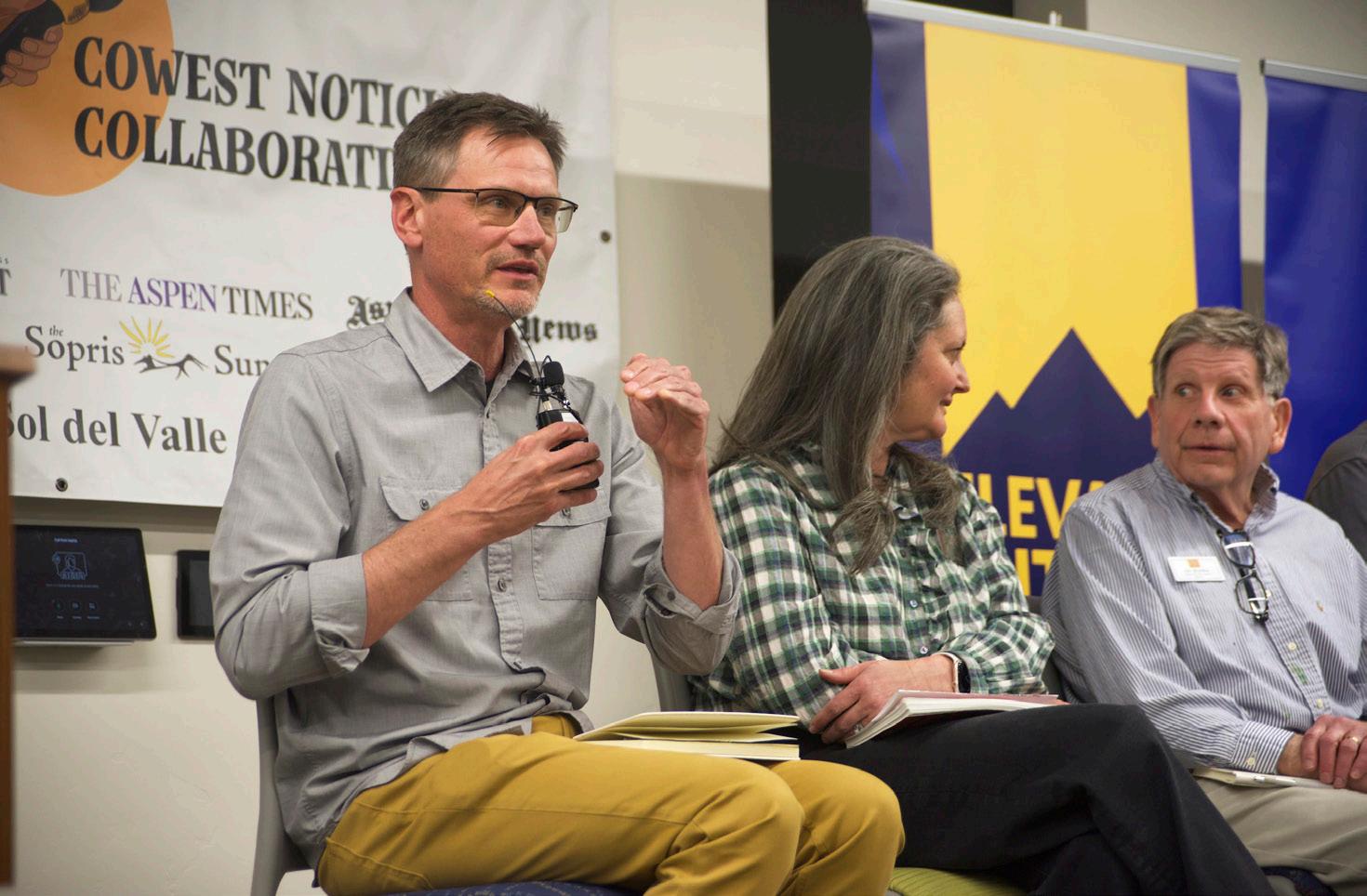
It’s a rare feat to have mayors from seven towns in the Roaring Fork and Colorado River valleys in the same room at the same time. But, the CoWest Noticias Collaborative and Colorado Mountain College’s Center for Civics Education and Engagement managed to accomplish that on Thursday, March 19, hosting a panel discussion with the local elected officials about affordability, strategies to work with bilingual communities and more.
Mayors on-hand at Morgridge Commons in Glenwood Springs included Rachel Richards of Aspen, Alyssa Shenk of Snowmass Village, Basalt’s David Knight, Carbondale’s Ben Bohmfalk, Art Riddle of New Castle and Clint Hostettler of Rifle. Mayor Pro-Tem Derek Hanrahan represented Silt, filling in for Mayor Keith Richel. Glenwood Springs Mayor Marco Dehm was not present, due to a City Council meeting taking place at the same time. About 50 people attended.
Dr. Matt Gianneschi, president and CEO of Colorado Mountain College, was the moderator for the evening. His opening remarks invoked 19th century French historian Alexis de Tocqueville, perhaps most famous for his book “Democracy in America.” De Tocqueville exalts the practice of democracy in the U.S. “He saw a nation defined by the energy of its people, their associations, their town meetings and their willingness to come together and solve problems,” Ginneschi said. “What he admired most about America was not just its sense of liberty, but its duty of participation.”
Photo by James Steindler
Of course, housing of the affordable kind popped up. Knight, of Basalt, mentioned how the Town is “chipping away” at it by building more units. He also mentioned the West Mountain Regional Housing Coalition’s work with the Aspen/ Basalt Mobile Home Park and the Mountain Valley Mobile Home Park. “It was beautiful in the sense that private businesses, government donors, nonprofits all came together with the residents in the lead to help them purchase their mobile home park,” he said, adding that he would like to see this happen on a broader scale.
Richards cautioned about trying to replenish dwellings that disappear into
the second-home market. “Part of it is an acknowledgement and a realization that you’re never going to replace all the housing,” she explained. “We’re going to lose affordability and you can’t just keep re-creating a new 20,000 units every 10 years because the other ones have become second homes or unaffordable.” She added that people from San Francisco, LA or New York are selling their homes and moving to this area because it’s cheaper. “That’s the dynamic we’re facing,” she said.
Riddle said that it’s too expensive for New Castle to build its own affordable housing. “We are negotiating with developers because we don’t have the money to really
get into affordable housing,” he explained. “Coalition after coalition has been trying and it’s just too difficult, so we’re going in through the back door with the developer.”
Snowmass is approaching the issue through a new childcare facility and apartments. The sole existing childcare facility serves about 30 children, Shenk said. So, the Town is building a new one at double the size that will include infant care. The village is also building a 62-unit affordable apartment complex. “We’re trying to figure out ways in which we can ease burdens on people so that they can thrive, not just survive, in Snowmass Village,” she explained. “We are looking to form a citizen group … and come up with ideas that we can make things more accessible, affordable and just maybe take some daily burdens off of people.”
Silt’s new wastewater treatment plant will open the door to more housing. “We’ve got over a thousand units in the pipeline that are going to be built over the next 10 to 15 years,” Hanrahan said. “It’s infrastructure supporting development, which then transitions into supporting affordable, attainable workforce housing.” He added that the issue is best addressed collectively.
“It’s so critical that we have not just public forums like this, but we have the mayor’s meeting that the county commissioners put on where we can kind of detail how the sausage gets made,” he said. “All the stakeholders are in the room and we can have honest discussions about stuff and try to move things forward.”
Questions from the audience included how officials are working with Latino and
continued on page 23
The Mayors Forum was one of the final public appearances Ben Bohmfalk will make as Carbondale’s mayor, as he prepares to pass the torch following April’s election.
Basalt candidate questions
1 What inspires you to run for election/re-election?
2 What qualifies you to represent the interests of Basalt residents?
3 What’s one thing you’d like to see completed with a four-year term?
4 Besides housing affordability, is there anything about Basalt’s current trajectory that worries you, which you’d hope to address?
The Town of Basalt will hold its regular municipal election on Tuesday, April 7. Three council seats are up for election, each to serve a term of four years. Ballots have been mailed and can be returned by mail, or dropped off anytime at the ballot box behind the Basalt Town Hall, 101 Midland Avenue, through April 7 at 7pm. The Sopris Sun presents a few getting-to-know-you questions and candidate responses.
ANGELA ANDERSON
1 Basalt is home — and I want to continue doing my part to care for it. I’m a mom of three boys, a regular guest teacher at Basalt Elementary, and proud to represent the thriving Willits neighborhood on Town Council. Four years ago I showed up with zero government experience and a lot to learn. Now I know how things work, I know the right questions to ask, and I have real relationships with town staff and my co-councilors. With housing, childcare, and the airport closure all coming to a head, re-electing a seasoned councilor is the best choice for Basaltines.
2 Four years on Council means four years of real decisions with real impact. I helped shepherd Basalt’s Midland Avenue redevelopment from start to finish. I voted to implement a short-term rentals fee that feeds directly into our affordable housing fund. I’ve helped direct around $250,000 in tobacco tax dollars to local nonprofits — YouthZone, Focused Kids, the Family Resource Center — organizations that make daily life better for our neighbors. But beyond the résumé, I’m embedded in this community. I know how to listen at school pickup and in front porch conversations, get concerns addressed, and help good ideas become real outcomes.
3 A new police station. This isn’t glamorous, but it’s urgent. Basalt has grown significantly, and our police department has simply outgrown its building — and that has consequences. We’re talking about hiring and retention challenges, inadequate space for evidence, no proper break room or interview room. We recently had to contract with Pitkin County for additional officers just to keep up. That’s a sign we’ve fallen behind. Our community deserves a police force that’s fully equipped and properly housed. Getting a new station built is one of the most tangible, meaningful things this council can deliver in the next four years.
4 Our aging population. Basalt’s most recent housing study shows the majority of homes are occupied by people aged 55 and up. We should make a focused effort to engage them at the town level. I’ve spent four years focused heavily on families and young children, and I’m proud of that work. But in my next term, I want to show up for our seniors the way they show up for us. Because they do — I see them substituting at schools,
tutoring at the library, filling gaps in medical offices. They’re active, they’re vital, and they’re essential to a healthy Basalt.
BENJAMIN FIERSTEIN
1 Building off the meaningful changes that the current staff and Council have already established. The upcoming projects planned throughout this entire valley provide proactive opportunities for Basalt to see its own rapidly increasing worth. I intend to provide the Council an understanding of the development lens.
2 In the development world, every day I am asked to evaluate decisions involving community impact, schedule, and cost to ultimately decide on the appropriateness of these choices. This analysis never operates in a vacuum as I seek and aggregate the expertise of those most qualified for greater context. My track record with P&Z involves listening and weighing the words of the citizens of Basalt, the applicant, and my fellow commissioners.
3 There are visionary goals, like continued connection and collaboration with our surrounding partners within the Valley. There are needed improvement goals like seeing the Basalt Police Department and Public Works building constructed. Lastly, there are small achievable goals that need to come to fruition. Both the Basalt Connect and our after school programs/bussing should serve Crown Mountain Park — that simple microtransit change would allow our students, our families and our seniors to take advantage of one of our most used mid-valley resources. We cannot be defined by these invisible barriers at the detriment of our community members.
4 Sustained financial revenue trajectory. As developable parcels become the limiting reagent, the Town’s revenue sources will need to evolve. We all feel the tax fatigue and recognize the areas of deferred maintenance. Our goals require us as a town to be creative to take advantage of unique funding sources and evolving strategies.
ELYSE HOTTEL
1 When I left office in 2024 due to housing insecurity, I was deeply disappointed. The Town and Council were on a strong trajectory, and I felt I was stepping away with important work unfinished. After four valuable years of service — much of it
during COVID, when our focus necessarily shifted from advancing strategic priorities — I was reluctant to pause that momentum. I’m seeking to return to pick up where I left off and help move the Town forward, particularly in sustainability, affordable/ workforce housing, and overall community vitality.
2 I moved to the Roaring Fork Valley in 2005 and have lived in Basalt on and off since 2009. I’ve watched it evolve from a quiet retirement village to an Aspen “suburb,” and now into a self-sustaining resort community with small-town charm, as demographics shifted. Today, Basalt serves as a mid-valley hub whose influence extends well beyond its city limits, requiring thoughtful regional partnership. I understand the community’s commitment to advancing sustainability, expanding housing opportunities and strengthening the local economy; I’m eager to contribute my experience and energy in these areas.
3 I’m especially excited to help shape the future of Parcel 2E on Lewis Way, across from TACAW and adjacent to Linear Park and nearby homes. As one of the last Town-owned parcels, it presents a rare opportunity — and responsibility. Determining its highest and best use, whether for workforce housing, community or senior space, childcare, or emergency shelter, will require thoughtful study, careful design, and community input. Real-time pilots, such as TACAW’s after-school space request, can help inform decisions. Getting this right will demand balance, creativity and a clear understanding of long-term community needs.
4 Basalt has few remaining undeveloped parcels within town limits, making careful consideration of their long-term use essential. Discussions around annexation and mid-valley density must balance economic vitality with the land’s carrying capacity. Like many mountain communities, Basalt is inseparable from its physical environment. This year’s low snowpack and the potential for limited water supply heighten concerns about drought and wildfire. While these challenges aren’t unique to Basalt, they demand foresight and thoughtful planning, particularly as decisions about how and where we grow will shape our community’s resilience for decades.
GREG SHAFFRAN
1 Living in Basalt has shown me how much local decisions shape everyday life. My
neighborhood was the result of a long development agreement between the Town and a developer that began in 2007. After moving in and serving as HOA president, I worked with neighbors, the development team and town staff to address issues that became clear once people were living there. That experience showed me how thoughtful local government, productive conversations with developers and strong communication with neighbors can solve real problems. The Roaring Fork Valley has been part of my life since the day I was born, and I’m eager to help shape the future of the community my daughter will grow up calling home.
2 I’ve spent much of my life showing up for the communities that shaped me. For more than 15 years I’ve served with Mountain Rescue Aspen, including leadership and board roles where decisions often involve public safety and complex, high-stakes situations. I also serve on the board of the Alfred Braun Hut System and have volunteered with local organizations such as Response and Meals on Wheels. Those experiences — along with working a wide range of jobs in this valley over the years — have taught me to pay attention to the quieter parts of a community: the people and issues that may not always be the loudest, but still deserve to be heard.
3 I would like to see Basalt make measurable progress on affordable housing so the people who work here have a real chance to live here. That means aligning land use policy, development agreements and regional partnerships to create more attainable ownership and rental opportunities. Housing solutions take time, but four years is enough to move projects from discussion to implementation. My goal is to ensure Basalt consistently advances practical housing solutions that support local businesses, families and the long-term health of the community.
4 Public safety and community preparedness are becoming more important for mountain towns. With changing weather patterns and winters like the one we’ve seen this year, Basalt should continue strengthening contingency planning for natural disasters and other emergencies. I would like to see the Town prioritize strong emergency planning, regional coordination, and clear communication with the community so we are prepared to respond when challenges arise.
Find more information about each candidate at www.bit.ly/Basalt-candidates
Angela Anderson Benjamin Fierstein
Elyse Hottel
Greg Shaffran
Spring Health Fair
We are delighted to offer you, our community, the opportunity to take advantage of low-cost blood tests
June 5 and 6
ASPEN
Aspen Ambulance Building
Aspen Valley Health Medical Center 0403 Castle Creek Road
June 7
EL JEBEL
Eagle County Community Center 20 Eagle County Drive
By appointment only 8-11:30 am
Lab Tests Offered
• HealthScreen w/CBC – $79 Includes CBC, CMP, Ferritin, Iron Panel, Lipid Panel, TSH and Uric Acid (Fasting Required)
• hsCardio CRP – $42
• Hemoglobin A1C & EAG –$44
• PSA, Total – $47
• Vitamin D – $54
• T3, Free – $32
• T4, Free – $32
• CBC (Complete Blood Count) –$32
Visit aspenvalleyhealth.org/health-fair or scan the code for complete details.
Make your appointment starting April 22.
THURSDAY, MARCH 26
CLIMATE WEEK
Rocky Mountain Institute is kicking off the second annual state-wide Colorado Climate Week, hosting two panel discussions from 3 to 5pm followed by happy hour at the Tipsy Trout. Register at luma.com/eav0x6ej
MEMORIAL
Thane Lincicome’s memorial celebration will be held at 5:30pm at the Calaway Room in Carbondale’s Third Street Center. A light dinner will be provided.
WHISTLING COMPETITION
JC Food Truck and the Crystal Theatre Alliance host the Valley’s first-ever whistling competition at 6pm.
CAPTION THIS
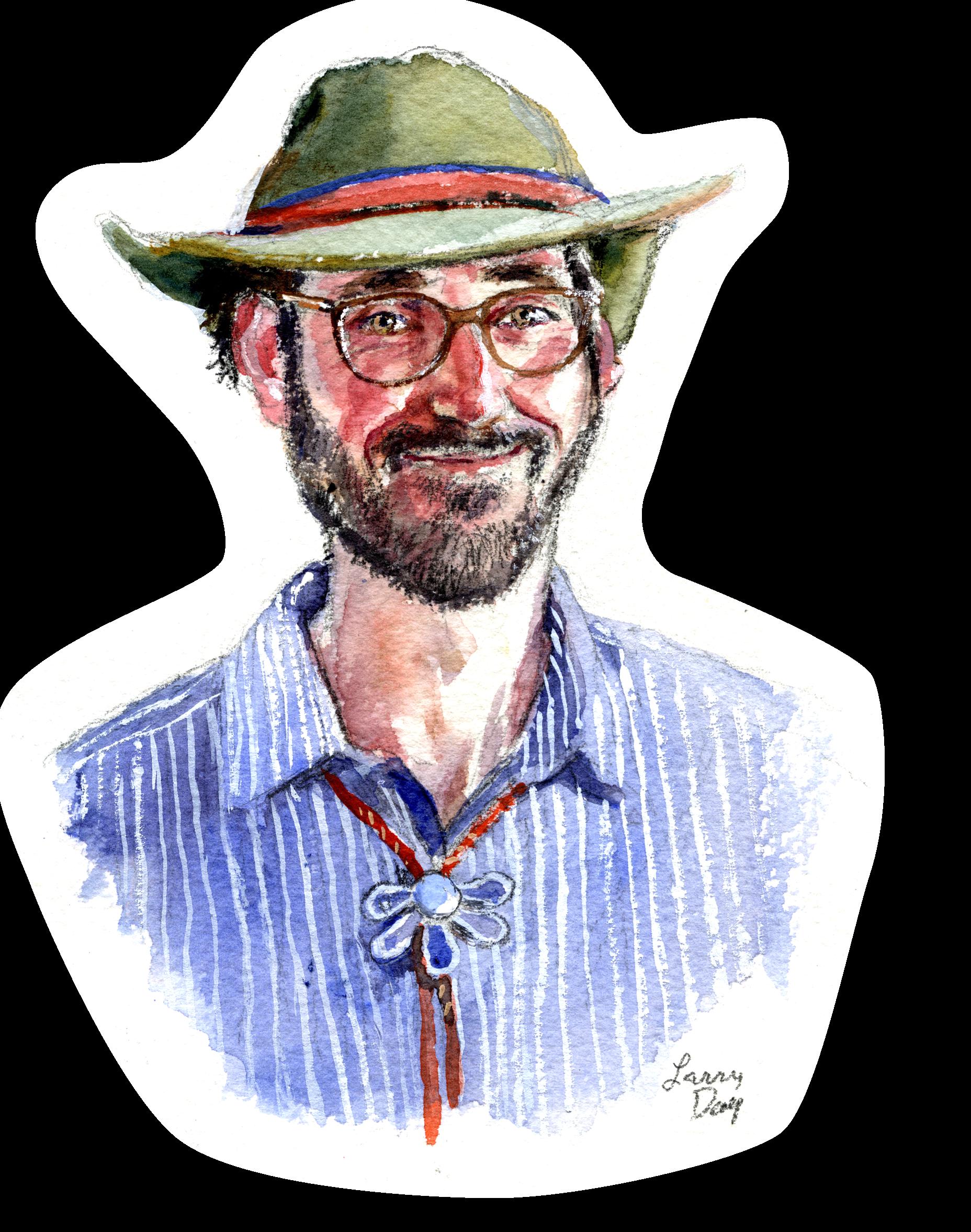
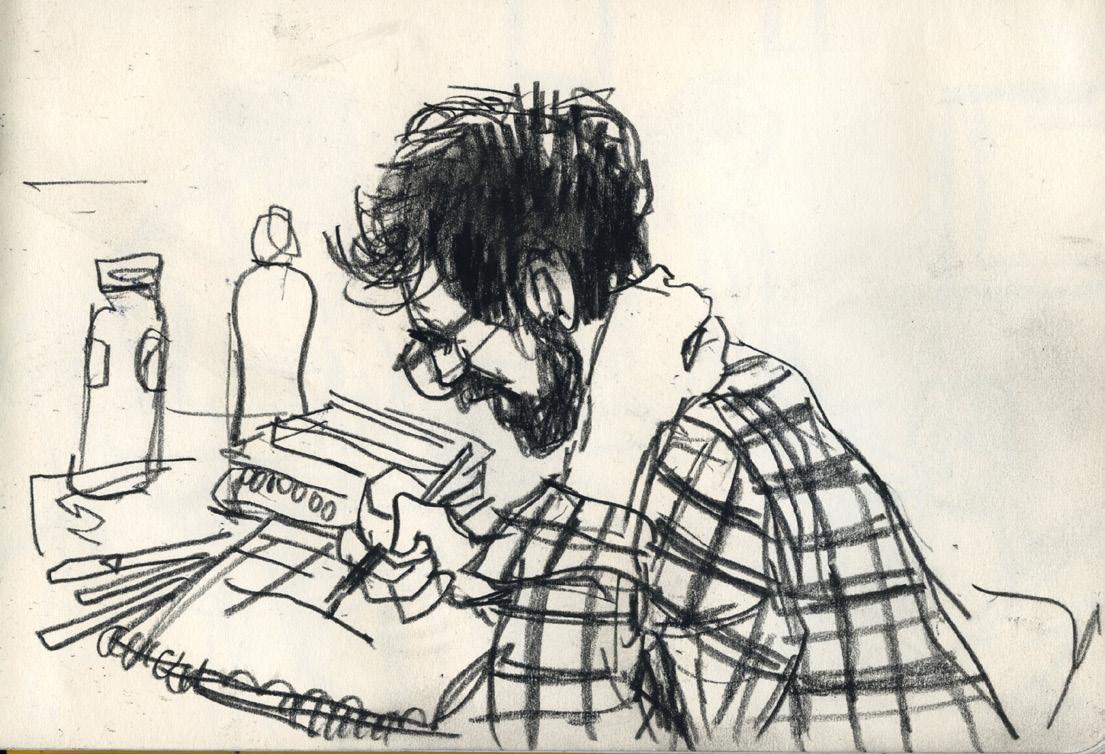
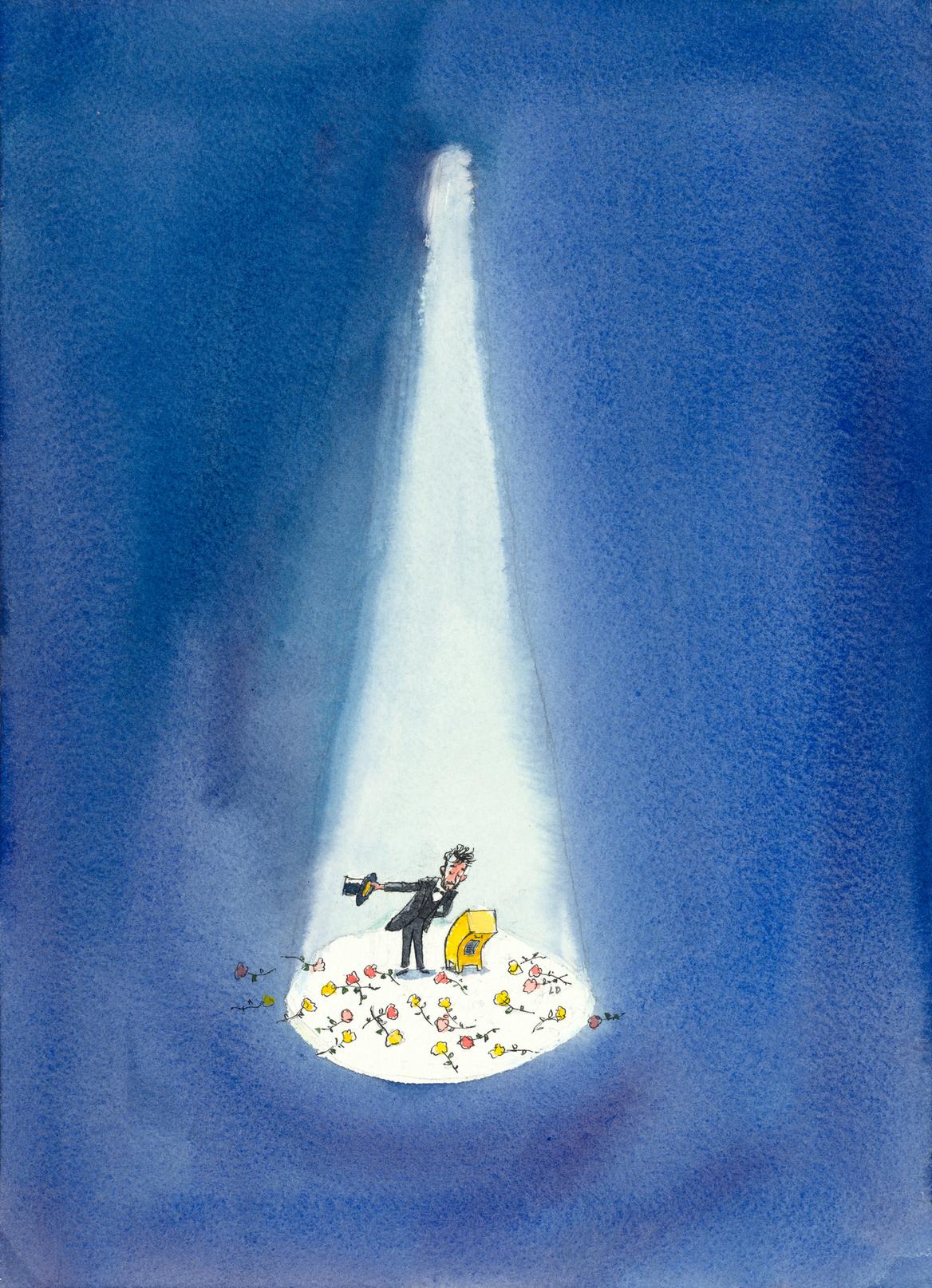
Larry Day returns to The Art Base for another “Caption This!” contest from 6 to 8pm. Participants will compete to think of the best caption for an original cartoon drawn on the fly. No registration necessary!
YOGA EN ESPAÑOL
True Nature hosts a monthly yoga class in Spanish in collaboration with Stepping Stones from 6:30 to 8:15pm. Learn more atwww.truenaturehealingarts.com
MUSICAL PREVIEW
TACAW invites you to a sneak preview of Basalt Schools’ spring musical, “Six,” at 6:30pm. RSVP at www.tacaw.org
MOUNTAINFILM ON TOUR
Catch short documentaries curated by Mountainfilm at The Wheeler Opera House at 6:30pm. Tickets at www.aspenshowtix.com
FRIDAY, MARCH 27
CMC STUDENT WORKS
Enjoy an exhibition of student photography from the Colorado Mountain College professional photo/video program at Morgridge Commons in Glenwood Springs from 5 to 7pm.
CRYSTAL THEATRE
The Crystal Theatre screens “Project Hail Mary” at 7pm tonight, tomorrow and Monday. Catch a 5pm matinee (captioned) on Sunday at 5pm.
CIMAFUNK
Cimafunk performs at the Paul JAS Center at 7 and 9:15pm tonight. Tickets at www.jazzaspensnowmass.org/ jas-center
SONIC FUSION
Steely Dead opens for Pink Talking Fish for a night of Steely Dan, Grateful Dead, Pink Floyd, Talking Heads and Phish music beginning at 8pm. Tickets at www.tacaw.org
MELVIN SEALS
Keyboardist Melvin Seals, known for performing with the Jerry Garcia Band, brings his Hammond B-3 organ to the Belly Up Aspen for a 9:30pm show. Tickets at www.bellyupaspen.com
SATURDAY, MARCH 28
COSMIC GARDENING
Jared Minori teaches the basics of Biodynamic agriculture at Sustainable Settings from 10am to noon. This is the first in a two-part series. Sign up at www.bit.ly/SS-March28
NO KINGS
Protestors return to the streets for the third national No Kings march. The local version will start on Grand Avenue in Glenwood Springs at 1pm and conclude in Sayre Park from 2 to 3pm.
ROMA RANSOM
Roma Ransom brings a unique blend of eclectic world folk jazz music to Rock Island in Snowmass Village from 3 to 6pm.
‘THE AMERICAN SOUTHWEST’
The second event in Middle Colorado Watershed Council’s Fire & Water Speaker Series features “The American Southwest,” a documentary tracing the Colorado River from its alpine headwaters to the desert delta. Biologist Ryan Olinger will give the audience behind-thescenes insights and answer audience questions. The Vaudeville Theater hosts from 5:30 to 8:30pm. Tickets at www.midcowatershed.org/events
STEVE’S GUITARS
Average Joey and Mugsy Fay perform at Steve’s Guitars at 8pm. Tickets at www.stevesguitars.net
SUNDAY, MARCH 29
CONTEMPLATIVE OUTREACH
Pat Johnson hosts “Contemplative Outreach: Old Snowmass Monastery” from 10 to 11am at A Spiritual Center, Room 31 of Carbondale’s Third Street Center.
MONDAY, MARCH 30
SPRING BREAK
School is out for Roaring Fork School District students through next Monday!
LIAR’S CONTEST
Aspen Public Radio presents the seventh annual Liar’s Contest at the Wheeler Opera House with special guest Peter Sagal, host of “Wait, Wait … Don’t Tell Me!” The panel of judges includes Steve Child, Chris Wheatley, Torre and Mayor Rachael Richards, with storytellers Nina Gabianelli, Mike Monroney, Doc Eason and Sylvia Wendrow each telling their best fantastical tale. The show starts at 5:30pm. Tickets at www.aspenshowtix.com
WEAVING WISDOM
An intergenerational gathering of women takes place at True Nature from 6:30 to 8:30pm. Details at www.truenaturehealingarts.com
MARK WINTERS
Texas musician Mark Winters brings his Good Vibes Highway Tour to Steve’s Guitars at 8pm. Tickets at www.stevesguitars.net
TUESDAY, MARCH 31
TRANSGENDER
FILMS
PFLAG Roaring Fork Valley hosts a Transgender Day of Visibility film festival at the Crystal Theatre in Carbondale at 6:30pm. This event is free. Between films local members of the trans community will share their stories.
DRAWING CLUB
The Roaring Fork Drawing Club journeys up to the Aspen Art Museum for a social art-making session at 6:30pm.
FLY FISHING FILM TOUR
The Wheeler Opera House presents the 20th annual Fly Fishing Film Tour at 7pm. Tickets at www.aspenshowtix.com
ACES YOUTH CAMP
Aspen Center for Environmental Studies hosts its Spring Explorations Camp, which runs until April 2. Hosted at Basalt’s Rock Bottom Ranch and Aspen’s Hallam Lake, the camp is directed toward students in grades K-4. Details at www.aspennature.org
theSopris Stars
A youth newspaper powered by The Sopris Sun
Volume 1, Number 6 | March 26 - April 29, 2026
IN THIS ISSUE
The growing importance of music at Glenwood Springs High School
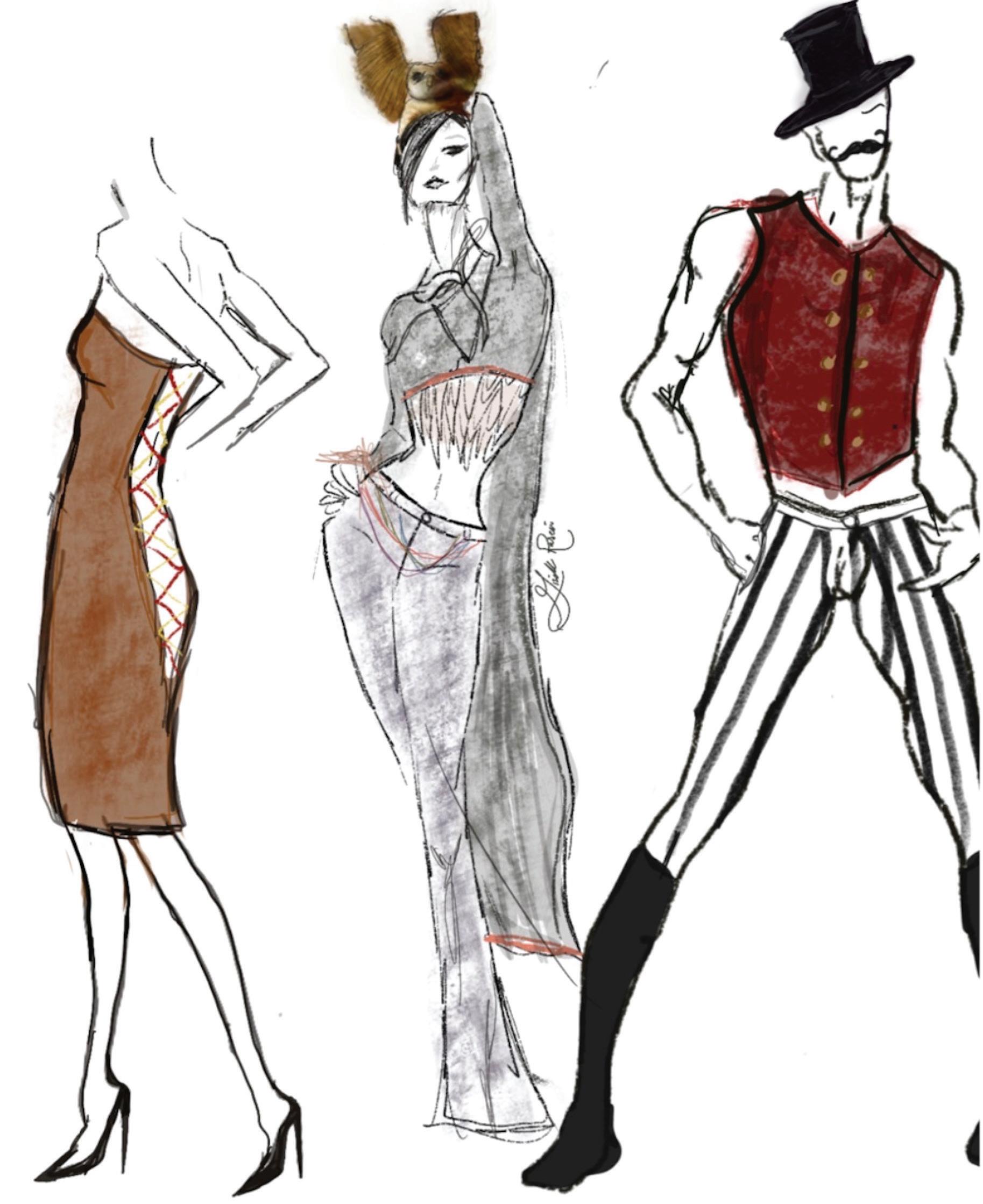
“I saw the power of combining story with dance and fashion and was really intrigued by the dynamics of that combination,” Amy Kimberly, former executive of Carbondale Arts, stated on the Carbondale Arts website.
That legacy was beautifully echoed in this year’s Carbondale “Step Right Up” Fashion Show, which ran March 12-14, as direction was passed down to Emily Fifer and Meagan Londy Shapiro to creatively build on Kimberly's approach to express story through fashion.
This year's carnival theme began by introducing the infamous roles that make a circus what it is, to the weaving of a narrative through movement, music and garments. The production transformed the runway into something more theatrical than traditional fashion. The hypnotic yet alluring performances of the aerialists, vintage circus advertisements and the doll-like elements that flowed through hair and makeup were factors that all heightened that nostalgic carnival feel.
I’ve attended a handful of fashion shows over the past few years, yet there’s something about Carbondale’s that has so far enlightened me the most. Possibly, it’s the opportunity to design? The anticipation of knowing what the upcoming theme is, the choreography, or just the overall thrill of experiencing the work of artists in our own community. But as my eyes wandered around the room, it made sense what the foundation is that makes this event so memorable.
Those lucky enough to attend the annual show might have caught themselves — maybe consciously, possibly not — bopping their heads like a flock of urban pigeons to the energetic soundtrack and the models' bold on-beat runway walks.
What makes this fashion show so special isn’t just the clothes, but the love we have for each other as a community. The countless volunteer hours that go into enriching the experience, and the local businesses giving a hand in any way they can.
Carbondale is crazy; creatively crazy. The kind of crazy where dancers, designers and volunteers collide to create something bigger than themselves. And for a few nights each year, that chaos is highly awaited.
Don't get me wrong about the following statements. I love shows; I love seeing people's eyes drag themselves from look to look, like grandfather clocks, stepping into crazy sets. It's a blessing to experience a passion for the art with others, but there are times when I yearn for that chaos. And dare I say, I'll miss Carbondale's extravagant approach to fashion.
The more open I’ve become with people about fashion and the art it has to offer, the more I’ve realized that some people — not everyone — assume fashion is only about appearance, and about caring too much on how you’re perceived, or proving yourself materially. Or they reduce it to the simple act of covering yourself, for God’s sake.
But fashion goes much deeper than what you see. Fashion is felt, it's political, hectic, beautiful and expressive all at once. And right now, as we are all living through a questionable and concerning state of the world's politics and society, this year’s show left me with something beyond a good laugh to take home.
The way our society has been gradually emerging into something almost satirical and obscure, far from what many of us envisioned for ourselves, took center stage.
There were lines that, sure, were off-theme but gave a chaotic sense in their own way, and more like
reflections of who we’ve become.
“Kingdom of the Sporeborne: Icons of the Mycoverse” by Lawrence Pevec, Hamilton Pevec and Ayana Pevec Brown grounded the runway in something ancient and organic with exotic fungal forms that spoke to our deep, rooted connection to earth. Beautiful Polynesian dancers, “Golden Souls of Nature” by Aspen Polynesia, brought the natural world to the runway with feather-covered attire. In contrast, “Plastic Revival,” a
line constructed of recycled material, tagged along with model Anders Carlson and his bold caveman-like stage presence, felt hardly jarring in the slight reminder of who we once were. It made me think about our evolution and how our reliance on synthetic materials has reshaped not only our environment but also our identity, taking over our lives entirely. The ecological narratives continued through “Felt Goods” by Jill Scher
continued on page 7
Art by Giselle "Gigi" Rascon
I'm writing this because I want to see more teenagers at the No Kings protest on March 28. We should be at these protests because we are all affected by what the Trump administration and Congress have been doing, whether you know it yet or not.
Countless masked Immigration & Customs Enforcement (ICE) agents have been sent into American cities to capture people. Legislation that would deprive millions of voters of their right to participate in free and fair elections is at stake, as is the rollback of climate change policies. Along with the Israeli prime minister, the executive branch has started a war with Iran, and that was following the clandestine kidnapping of the president of Venezuela. And the release of the Epstein files has not complied with the law’s timeline, an assumed effort to protect the president. All of these examples affect teenagers in some way.
Trump won't be the last person to threaten our safety and freedom, but he is that to us now. I know I'm not the only teenager who cares about those fundamental rights. But when I go to protests or meetings, I rarely see other teenagers there. This worries me.
While the high school walkouts were great, we need
Kids for No Kings
more teenagers to keep going to protests and to find a way to stay involved. It's important for young people to do so, so we can learn from experienced organizers. We're going to inherit this world, and we will need to know how to build successful movements.
We know that more than 30 people died while in ICE custody in 2025 alone. In January of 2026, two Minnesotans were shot and killed by ICE. This was murder and sanctioned by the state after the fact. This massive ICE overreach and abuse of power needs to stop, and we have to make it very clear to our government that we will not stand for it.
months, years or if they have been shipped thousands of miles to another country. No kid should have to worry about that.
By Sagan Mulry Green
In a healthy society, everyone should feel safe leaving their house, and ICE is making this impossible by tearing families apart. We have friends and classmates who have to worry that their parents will be taken away and they won't see them or know where they are for
At the very least, we need ICE to step way back and follow the law. In the beginning, Trump said that hard criminals would be targeted. In reality, the reach has become much more expansive. How long will it be before everyone who criticizes Trump is targeted? The protesters in Minnesota understood the threat and showed us how to respond. Trump is pushing legislation that would make it much more difficult for anyone who isn't a cis man to vote. The SAVE America Act double's down on the SAVE act, which already passed the House. It's important that everyone has access to vote for democracy to function. We believe that Trump doesn't want everybody to be able to vote. This is one thing we are protesting at No Kings. We're the ones who are going to have to lead the fight
against climate change, because we’re the ones who are going to have to deal with it for the rest of our lives. I don't want to have to start adulthood in the broken remains of what used to be the US, with coastal cities underwater and the other half burned to a crisp. We all remember the Lake Christine Fire. It will take another 10 years or more for Basalt Mountain to recover, and by then there will likely have been many more fires. It’s more than possible that we’ll see ski resorts close due to the lack of snow in our lifetimes.
In Iran, the US literally bombed an elementary school that reportedly killed over 175 people, most of them children. Hundreds more were wounded. Here, the war has caused gas prices to go up 80 cents in the last month.
If these issues matter to you, it's time to speak up and do something. It's our future at stake. I encourage everyone, but especially teenagers, to attend No Kings this Saturday, March 28, from 1 to 3pm, starting with a march on Grand Avenue then gathering in Sayre Park for a rally at 2pm. If you want to get more involved, talk to people at the information tables. I hope to see you at No Kings!
The dichotomy of role confusion
The teen years are such an important time of self discovery and the formation of identity. However, this is simultaneously contradicted by the desire to fit in and conform to the role that others have set for them. In psychology, this dichotomy is referred to as “identity versus role confusion.” This term was coined by Erik Erikson, and refers to psycho-social development of young people between 12 and 18 years old who want to stand out and fit in at the same time.
In other words, there is a delicate balance between standing out and belonging, for most, if not all, teenagers. Many have experimented with something about themselves at some point, probably having to do with their physical appearance. This could be dyeing their hair, experimenting with different fashion trends, etcetera. This all contributes to their sense of identity by having them essentially “try on” different identities to
see what they like.
Identity also includes social identity, or how someone wants to be perceived by others. This is when the “role confusion” piece comes into play; due to teens not knowing their identity fully, they might try to take on one that they want others to see them as.
of person, then those peers may not accept their forming sense of identity. This is the perfect example of identity versus role confusion, where there is the need to grow into one’s identity, while simultaneously feeling like they need to belong to a group.
This is amplified by globalization, with trends being
"YOU CAN BE TRUE TO YOUR IDENTITY AND PARTICIPATE IN TRENDS, AS LONG AS YOU STAY TRUE TO WHO YOU ARE."
Their fashion aesthetics, music tastes, hobbies, career interests and more all contribute to their sense of identity, and, in a way, their sense of belonging to a group. However, sometimes this can lead to role confusion if the teen is in a different role than what they want their identity to be, in part due to the friend group they are in. If their current friend group only accepts a certain type
set worldwide, in no small part due to the rise of social media. Teenagers around the world feel increased pressure to, again, blend in yet stand out. Social media definitely adds pressure for teens to conform to the norms that have been set for them, which often leads to negative mental health impacts, such as increased anxiety and lower self esteem. That's not to say that social media is all bad. It’s a
the Sopris Stars
Youth Editor Lou Gall lou@soprissun.com
Anna Sophia Brown anna@soprissun.com
Arthur Cherith arthur@soprissun.com
Hana Creyts hana@soprissun.com
Aurora Egan aurora@soprissun.com
Kate Ott katelynn@soprissun.com
Giselle “Gigi” Rascon giselle@soprissun.com
Vivienne Shapiro vivienne@soprissun.com
Youth Journalism Director
James Steindler james@soprissun.com
Youth Journalism Instructor
Skyler Stark-Ragsdale
Graphic Designer
Terri Ritchie
The Sopris Sun, Inc. is a 501(c)(3) nonprofit corporation with a mission to inform, inspire and build community by fostering diverse and independent journalism. Donations are fully tax deductible. The Sopris Stars is made possible thanks to The Sopris Sun.
Support The Sopris Stars Youth News Bureau by making a donation at www.soprissun.com/donate
Letters to the Editor
Shoutout to Caden Smith, whose birthday was March 19! Email your letters or shoutouts to youthnews@soprissun.com
double edged sword. It can, in fact, be a very positive space for teens to explore their identities, too.
The viral meme “6-7,” TikTok dances, fashion trends that last less than a week, different overly “workshopped” personalities and aesthetics are examples of trends kids either clamor to or completely ignore.
There is nothing wrong with jumping on the bandwagon. However, what social media can create, beyond just the TikTok dances and outward appearances, is a sense of monoculture. If everyone dyes their hair the same color, wears the same clothes, acts the same for the most part and participates in the same trends, that would be pretty boring.
It can also lead to increased role confusion if a teen doesn’t feel like they fit in with everyone else online, so they try to conform to the norm even if it doesn't interest them. It seems like almost
OPINION
By Hana Creyts
no one is uniquely themselves anymore. And, whenever someone is uniquely themselves, they may be shut down because they aren’t conforming to a role.
Trends aren’t bad things, especially if you resonate with them on some level. For example, if you like a certain makeup style, certain clothes and accessories, a certain hair color, and it’s trending, then, by all means, try it out. Trends just become harmful when someone starts to mask who they are. You can be true to your identity and participate in trends, as long as you stay true to who you are.
The growing importance of music at Glenwood Springs High School
AURORA EGAN
Sopris Stars Correspondent
EDITOR’S NOTE: Aurora Egan is a member of the Glenwood Springs High School band programs and choir
Music plays a principal part in the Roaring Fork Valley.
For many students, however, their options can become limited due to issues such as lack of funding, lack of interest and difficulty in finding music teachers. At Glenwood Springs High School (GSHS), Shanti Gruber, the choir director, and Tamara McSwain, the band director, share the idea that music education is a fundamental part of the school.
“Music has given GSHS a sense of identity and tradition,” Gruber said. “It has shaped us into a place that values expression just as much as competition or testing.”
Mark Johnson, a jazz musician in the Roaring Fork Valley who tragically passed away last year, left a lasting effect on music education in the Valley. After his death, Jazz Aspen Snowmass set up the Mark Johnson Memorial Fund. Through this resource, funds were raised to hire a full-time music instructor for the Car-
bondale program this year, and JAS states that it will continue to support the position next year. At GSHS, Johnson played a pivotal role in music education, often coming into band classes to assist students.
Johnson, who McSwain described as a “performer first and an educator second,” used his knowledge of performing and gigging to bring a new set of skills and perspective to the band room.
According to Mcswain, Johnson’s high standards consistently pushed students to improve their musical skills. He also invested in students he saw as having great potential and motivation. He spent a large amount of time outside of class assisting these students to grow as musicians. Johnson helped in providing them with special mouthpieces, reeds and instruments, as well as aiding in audition recordings.
Anderson Amaya, a junior at GSHS, expressed his gratitude for Johnson’s work with the band program.
“Mark changed what the meaning of band was in many hearts, especially mine,” Amaya said “For all of the kids that Mark Johnson has worked with
… all of them improved, even if it was just a couple of words that he had said.”
McSwain described the importance of music not only for the students she teaches, but also in her own life. Growing up, McSwain said that her favorite place to be is in the band room, and being a part of a group of musicians.
As an educator, McSwain said that she has watched music education affect students in a multitude of ways. She has observed that students who have come from many different musical backgrounds have flourished under the band programs. Students have been known to find their social circles within music education,which has encouraged them to participate in other relevant opportunities at GSHS, such as choir, drama and beyond, she said.
“It becomes a part of our community,” McSwain said. “It becomes part of how we spend our time outside of work and friends.”
When asked about the reasons behind the influx of music programs being cut in recent years in the Roaring Fork Valley, McSwain said that it is
quite complicated. She added that good music teachers are difficult to come across, and when students don’t connect with the music teacher, they won’t take the course. A lack of participation in a course can cause a program to be cut.
McSwain is thankful, however, that the administrators across the Roaring Fork School District are continually fighting for music to stay in schools.
Gruber believes that music is the heart and soul of GSHS. Offering music classes to students, she said, grows strength in other academic areas, such as math and language arts.
After teaching for 18 years, she has observed that music education is a motivator for students to show up to school at all.
Gruber has watched students she has taught grow confidence in their musical abilities, some often going on to pursue performance or music education as a career.
When schools are unable to offer music classes to students, Gruber believes that the student body as a whole suffers greatly, noting that the arts provide a large outlet for students to cope with stress and grow school spirit.
The reasons behind funding cuts to music programs, Gruber elaborates, comes down to the number of students signed up for the classes. She stated that music classes are often viewed as a luxury in schools, and, therefore, are the first to get cut if participation numbers are low.
A collection of quotes written by music students over the years at GSHS. Photo by Aurora Egan
Megan Hiles, MD, MBA, FACP
A story to remember Reflections on the Holocaust
PHOTOS AND REFLECTION
by Kate Ott Sopris Stars Correspondent
The Holocaust was one of the worst genocides in human history. Considering it wasn't even 100 years ago, it's still terrifying. The systematic, industrial killing of over 6 million people over the course of seven years, is anything but natural. I struggle to wrap my head around the fact that humans were capable of doing such things to each other. The following is a series of thoughts and reflections from my time experiencing ground-zero of the Holocaust.
In early February, I had the opportunity to spend two weeks traveling throughout Germany and Poland to study the Holocaust. The trip took my group from Munich, to Berlin and finally to Krakow. While we had time to explore new cities, the trip was largely focused on visiting historical sites — museums, memorials and concentration camps, including Auschwitz and Dachau (one of the first concentration camps built under the Nazi regime).
I’ll admit, I struggle to put it into words, but being there was entirely different than just learning about it at school. I spent about a full day at Dachau on a guided tour, where we went through on-site museums and preserved buildings.
I was struck by how much I didn't know. I didn't know about the Jewish ghettos, or that the concentration camps worked in systems. All I really knew was from pop culture, and I can't remember the last time I learned about the Holocaust in school. For an atrocity of that scale, I didn't understand why it wasn't a bigger part of my education.
Walking through Dachau I couldn't wrap my head around the fact that the Holocaust really happened. The sheer number of people who would have been working in Dachau alone was impossible to visualize. Visiting Auschwitz felt like walking into a movie I wished was fictional. No amount of
reading or studying could ever replicate what it was like being there.
There was one part of the exhibit that I was not allowed to photograph that made me sick: a room full of hair taken from victims. When I first entered and went to my right, there was a display case with several neatly braided bunches of hair raised on what looked to be a 20-to-30-foot, rolled up, rug-like textile. The entire piece was made with human hair.
I followed the edge of the room, and was met with a case that spanned the entire length of the wall. It was filled with a two-ton pile of hair, taken from over 30,000 women. The hair was discovered, after the camp's liberation in 1945, in piles that were ready to be shipped to textile factories. My words can’t describe how it made me feel, but nothing has ever left a deeper pit in my stomach. Seeing the remains of so many people being stripped of their humanity and treated like cattle was devastating.
A phrase our tour guide used often was “industrial killing.” I thought at first it was another buzz-word kind of saying, but I was incredibly wrong. The term fits too well. Everything was built for efficiency and left no space for humanity. Over-crowded barracks, terribly unsanitary facilities and unsustainable rations of 1,000 calories a day for 16 hours of labor. The level of dehumanization these victims felt, and the system that perpetuated it was so severe that you start to question how people could even manufacture that reality.
Visiting these places drove home just how recent the Holocaust was. This was such a big event in history that can’t be ignored and its remains are scattered throughout today.
George Santayana, a Spanish philosopher, once famously said: "Those who don't learn history are doomed to repeat it.” Considering some of the parallels I've drawn, I understand exactly what he meant.
The Schutzstaffel (SS), who managed concentration camps, called the hallway of Dachau’s prison the “garrison detention.” Prisoners referred to it as the “bunker.” Dachau was the first concentration camp built during the Holocaust, first detaining innocents in March of 1933. It was the center for torture, where people endured brutal treatment.
Remains of gas chamber two, one of the main gas chambers used at Auschwitz-Birkenau. Coupled with gas chamber three, over one-million people were killed in the two buildings. In an attempt to destroy evidence at the end of the war, both chambers were bombed with explosives.
Empty containers of zyklon-B (a form of hydrogen cyanide) displayed in the Auschwitz 1 museum. Zyklon-B was the main chemical used in the chambers, and was first experimented on humans at the same site.
A photo of "Fallen Leaves,” an installation by Menashe Kadishman made up of roughly 10,000 face cut-outs made from thick steel plates meant to represent the Jewish victims of the Holocaust. Visitors are encouraged to walk across and back while looking down.
Auschwitz-Birkenau as seen from the train tracks. The watch tower was used for security monitoring. In the background are hundreds of brick chimneys, each one belonging to a different barrack. The chimneys are the only thing standing because the barracks in this section were made out of wood planks. Only 10% of people brought here lived in this area, the rest were immediately sent to the gas chambers.
A pile of shoes collected from the belongings of new arrivals at the camp. Prisoners called the warehouses where goods were sorted “Kanada” (Canada in German). To prisoners, Canada symbolized wealth, and the warehouses were full of people's personal belongings.
This is the outer barrier of Auschwitz I. On the left are former barracks and on the right S.S. offices, houses and administrative buildings. Some spaces are still used today as offices for the museum.
Inside a restored barrack at Auschwitz-Birkenau (Auschwitz II), each level of the three-tiered bunks held 10 people. Some barracks held over 1,000 at a time, with no bathrooms or sanitary facilities.
Restaurant reviews, en español
We are Mrs. Lasko’s seventh grade Spanish class from Carbondale Middle School. As a way to demonstrate our language abilities, and wrap up our most recent unit, we wrote reviews of our favorite restaurants in the Roaring Fork Valley. We hope you enjoy testing out your Spanish and perhaps visit one of our favorite restaurants!
Kedai
Por Logan Averill
Kedai es un restaurante muy bueno. El servicio es un poquito lento pero la comida vale la pena. Kedai está cerca del café Pájaro Azúl en Glenwood y la comida es de Japón. Tiene ramen, sushi, udon bol (que es una sopa con carne, fideos, y verduras) y otras sopas. También los camareros son muy amables y simpáticos. Las horas son de las 11am hasta las 9pm sábado y domingo, pero durante la semana las horas son de 11am a 3pm. Mi comida favorita es un udon bol de pollo y mi bebida favorita es la boba del durazno y crema. Los postres son pastel de Japón, mochis y pelotas dulces de sésamo. En general Kedai es un restaurante muy bueno y yo aconsejo que lo visites allí.
Dos Gringos
Por Sterling Drake
Dos Gringos es un restaurante buenísimo. El ambiente es fantástico y sirve a toda la comunidad de Carbondale. Los precios son medios y la comida es muy buena. Los platos principales son burritos y mucho más. Mi plato principal favorito son los tacos de desayuno. Otras cosas son chai, matcha, batidos de fruta y muchas bebidas de cafe. Tiene muchos postres. Por ejemplo, rosquillas, rollos de canela y otras cosas muy buenas. El servicio es muy bueno también. Es muy rápido y los camareros son muy amables. Está entre la ciclovía y la carretera 133.
3 B’s Bakery
Por Myel Edmiston
3 B's Bakery es una panadería muy deliciosa, está en la calle principal de Carbondale. Tiene muchos postres y cafés. Tiene pasteles, galletas y pastelitos. Las horas son de 9am a 4pm los miércoles a sábado. El servicio es excelente y el interior está muy encantado. Normalmente pido la galleta de galletas y crema. La comida es un poco cara pero vale la pena. Las camareras en 3 B's Bakery son muy simpáticas. No tienen los platos principales en una panadería.
Peppino's Pizza
Por Harper Fedishen
Peppino's está cerca del parque Sopris y está en la calle principal de Carbondale. Peppino's tiene muchos platos principales, no solo pizza. Tiene
FASHION SHOW
from Cover
and “Colorado Animals” by Rae Swon, who worked along with Heirlooms Consignment by curating outfits, where motifs such as the beautiful animal headpieces and colorful palettes resembled our roots in land and wildlife, prompting me to think further about where we come from and what we are becoming.
“Vallee Noone” made that looming aspect of the show
strombolis, ensaladas y sándwiches. Peppino's tiene bebidas también, tiene limonada (mi favorita) y otros refrescos. El servicio es muy bueno y los camareros son simpatiquísimos. Peppino's tiene helado para los postres. El helado puede venir con chocolate encima o con un bizcocho de chocolate o con una galleta chispas de chocolate o con algunas granas. Peppino's es un restaurante local. Las horas de Peppino's son de las 11am a las 9pm de martes a sábado. Peppino's es un lugar tranquilo y los precios son buenos porque no son caros ni son baratos. Yo voy a Peppino's mucho con mis amigas y con mi familia para la cena o para el almuerzo.
Nepal Restaurant
Por Elsie Field
El servicio del restaurante de Nepal es muy bueno, y los camareros son muy simpáticos. El restaurante tiene un robot que ayuda con el servicio. Los platos principales en el restaurante son deliciosísimos. El ambiente es bueno y me gusta mucho. También, las bebidas son dulces, y la comida es mantecosa. Mi bebida favorita es el lassi de mango, y mi comida favorita es el pan de naan. También, el restaurante tiene postres muy buenos. El restaurante de Nepal está entre Carbondale y Glenwood Springs. El restaurante es fantástico y la comida es muy sabrosa.
¿Cuál es tu restaurante favorito?
feel tender to the subject of growth within civilization and our personal moral relation to it through its use of structured cardboard and ribbon and the beautiful fragility carried by the models themselves.
But the collection that has been lingering with me most was “Branded” by Bineke Kiernan. It was the one I couldn’t immediately decode, the Campbell Soup. The
configuration some of these looks carried made me eager to try to understand the concept at its slightest.
For those who understand Spanish, I hope you picked up on the chosen song for this line. “Shock,” a Spanish song by Ana Tijoux, additionally revealed a layer of what this line was about.
What I took note of through my channeled Dumbo ears: the song grounds it-
Bonfire
Por Scarlet Reiss
Bonfire es un café excelentísimo. Bonfire Tiene muchas opciones de comida. El servicio es superior y rápido. Está en Carbondale y es un café local. Las horas de Bonfire son de 6:30am hasta las 2pm de lunes a domingo. Los platos principales de Bonfire son rosquillas, sándwiches y más. Bonfire también tiene bebidas. Las bebidas son té matcha, café, y té chai. Los camareros de Bonfire son cariñosos y simpáticos. Los pasteles son mis postres favoritos de Bonfire. Bonfire está en la calle principal de Carbondale.
¡Bonfire, tambien!
Por Lilah Yoder
Bonfire tiene comida buena. Tiene pan de plátano, café, roscas y mucho más. Tu puedes ver la cocina en Bonfire, está detrás de la cajera. Los platos principales incluyen roscas, huevos, omelettes, y todos son buenísimos. También allí hay muchos postres, galletas, rollos de canela, garra de oso y batidos de fruta. Los batidos de frutas son increíbles. Los camareros son muy responsables y son muy simpáticos. Otros postres son galletas y chocolate caliente. Mi postre favorito es la galleta de arándano azul y lima, Son increíbles. Las horas son de 6:30am a 2pm. Está en la calle principal de Carbondale. Bonfire es increíble. ¡Adiós!
self in the idea of anti-capitalism and the webbed concerns of political resistance, further speaking to systems of control within our government and societal dissensions. And that was feasibly the point. In a modern world where everything carries a name, is marketed, consumed and owned, what exactly does it mean to be “branded”?
Each form of art presented on that runway revealed
the deeper side of fashion that I wish the industry would showcase even further. Along with the roles played within a carnival was the chaotic beauty of taking risks, the concerns we hold about the world we live in and what it means to be part of it. In the long run, life is a circus. This year, Carbondale didn’t try to tame that chaos but wonderfully embraced it to its fullest.
Krista Lasko stands behind her seventh-grade Spanish students: (left to right) Scarlet Reiss, Myel Edmiston, Harper Fedishen, Sterling Drake, Logan Averill, Lilah Yoder, Eleanor Nixon and Elsie Field. Courtesy photo
The school yard scaries THE IDES OF MARCH (Crosswording
ACROSS
What has become of school culture at Glenwood High
“Where do I sit?”
A question every student asks themselves at one point or another. It’s the choice that defines your status, the power you hold and the involvement you have. Choose wisely. Every educational institution I have ever seen preaches the importance of connection among students. However, after speaking to both students and staff it’s apparent that that’s not always the case. They sit in the same place, talk to the same group and are scared of answering questions. The solidarity once held in schools has become divided, with little turnout to school events. We are left to wonder, is school culture dead?
OPINION
By Lou Gall
“For it to be valuable for students, I think it has to come from students,” Garret Peters, Glenwood Springs High School dean of culture, said of student involvement in the school community.
Peters discussed how students have become less and less involved in school in the past few years.
Engagement is down, “but a lot of times the students that don't want to engage in community are also not as interested in engaging in academics,” he said. This engagement, or lack thereof, extends into the classroom as “the students that do raise their hands and ask questions generally outperform those that don’t,” Peters said.
We understand that participation is down, but the reasoning as to why is more unclear. The obvious answer every adult can offer is social media, which I agree with; the youth face a loneliness crisis on an unprecedented level. Having a world of information at your fingertips changes the way one perceives the world, degrading basic human connection.
Coupled with the rise in artificial intelligence, there is a distortion of reality that we have yet to mitigate. As communication between people shifts to a more and more digital format, we see many harmful impacts on adolescents' development, reducing attention spans and warping self-perception.
Social media has created so many acutely modern issues for students. However, we have also seen a rise in social media usage to develop school culture. School administrators have begun creating accounts on websites such as Instagram and TikTok in order to promote school events and attendance. These accounts feature everything from student council activities to “tea time” with principals, all in an attempt to relate to the youth and stir up excitement over upcoming events.
To some extent, this has worked, replacing the school newspapers of old with a new digitised version, offering students a chance to learn about school events in a largely accessible way.
This seems like the perfect solution to the problem of involvement, and yet we still see a decline. Part of the problem with the media of a modern age is the culture online. Being a “try-hard” has become a negative stereotype; many students have been ridiculed over effort, effectively creating a hostile environment for any student seen as hardworking.
This hostility feeds into classroom culture, where there can be low engagement rates and an overall difficulty in getting students to speak up. Even advanced placement courses have issues with student engagement, and teachers running discussion-based classrooms tend to find a small handful of students willing to speak up and share. This is found across schools and seems to be one of the hardest issues for educators to tackle.
“You get what you put into it,” Peters said.
Teachers watch as the people who try to put whatever they can into school continually succeed, while the ones who treat education with apathy tend to do worse overall.
“If you don’t care about the world around you, the people that do are going to make decisions,” Peters said.
For many students, school is not about learning but rather ticking off graduation requirements. As apathy grows, school culture declines, only widening the gap between students and learning. Often teachers who care the most inspire students to do the same, highlighting personal growth over academics. This is where students flourish. Feeling a human connection between student and educator helps to create a more welcoming environment for growth.
“Where do I sit?”
In a divided school system, choosing one's seat has never been so daunting. But maybe it's time to try sitting with someone new.
through the Roman Empire)
2. The highest ranking religious office
4. First Christian emperor
6. Baddie from Egypt
7. Roman word for Hades (no longer a planet in our system)
10. Public speaker brothers (started fall of Republic)
13. The god of fire and blacksmiths
14. “Stop quoting laws, we carry weapons.”
16. A gladiator/slave turned revolutionary
17. The richest member of the Triumvirate
18. The number of times Julius Caesar was stabbed
19. A famous Disney movie about a demigod
DOWN
1. First Roman emperor (dictator for life)
3. Julius Caesar’s last words
5. A violent form of entertainment
8. “Best men” party
9. Brutal fifth emperor famous for burning Christians
11. The lower class
12. Roman equivalent of Hera (namesake of June)
15. The political left
17. Not Istanbul, but
SUPPORT THE SOPRIS STARS YOUTH NEWS BUREAU
Ensure the journalism of tomorrow by supporting our youth program today.
The Sopris Sun’s youth journalism program is in its fifth year, but recently published the first Sopris Stars insert on Oct. 30, 2025, a monthly publication where all
youth-generated content will live.
Our Sopris Stars interns learn from a plethora of talented professionals, from top-notch journalists to cartoonists and photographers. Interns practice handson journalism, from requesting an interview to finalizing an article, with
guidance from regular instructors. The intent of The Sopris Stars insert is to provide young people with a reliable and accountable source of news meant for both their eyes and the wider community. High school students interested in participating, can visit www.soprissun.com/future
MOTHER’S DAY IS RAPIDLY APPROACHING
All local mothers who have welcomed a baby into their lives this past year are invited to have a portrait taken to run in The Sopris Sun’s May 7 edition.
Our professional photographer is taking reservations now for photo sessions:
• Sunday, April 19 and Saturday, April 25 from 9am-1pm at The Sopris Sun o ce at the Third Street Center, 520 S. Third Street, #26 in Carbondale
• Sunday, April 26 at the Glenwood Springs Library from 10am-12pm.
Please email Terri Ritchie at terrir@soprissun.com or call 970-510-3003 to schedule.
Llame a 970-274-6513 Klaus Kocher o mande un correo electrónico a klauskocherfotograf@gmail.com parahacer una reservación. Se habla español.
Please reserve by Friday, April 17.
Can't make any of these dates? Reach out and we'll see what we can do.
WEDNESDAY, APRIL 1
WILD MUSTANGS
Friends of the Mustangs present “Wild Mustangs of Colorado: From Range to Home,” to include information about Bureau of Land Management adoption requirements, at the Carbondale Library at 5:30pm. Free and open to all.
‘DUMB AND DUMBER’
Just in time for April Fool Day (but seriously), The Crystal Theatre screens the notorious Aspen-based farce “Dumb and Dumber” at 7pm.
THURSDAY, APRIL 2
‘ANYTHING GOES’
The Glenwood Springs Library hosts an opening for “Anything Goes,” an art exhibit consisting of works by members of the Glenwood Springs Art Guild, from 4 to 6pm. The show will be up through May 15. Visitors can vote for their favorite pieces, and awards will be doled out once the exhibit closes.
WILD THINGS
The Crystal Theatre screens short films about rangelands and pastoral communities across the globe from 6 to 8pm in celebration of the United Nations International Year of Rangelands and Pastoralists. Tickets at www.tinyurl.com/RangelandsAtTheCrystal FAREWELL TO THE BARD
Olivia The Bard “bids farewell to her home of 25 years. Will she be back? Of course she will!” Catch the concert at Steve’s Guitars at 8pm. Tickets at www.stevesguitars.net
FRIDAY, APRIL 3
BEAUTY OF WATER
The Basalt Library hosts an opening exhibition for “The Beauty of Water,” a watercolor exhibition featuring local artists, from 4 to 6pm.
SPRING INTO WELLNESS
The Spring Into Wellness First Friday event is back, featuring wellness practitioners and businesses at the Carbondale Rec Center and downtown from 5 to 8pm. Pick up a Spring Into Wellness Bingo card at the Rec Center and check off boxes by visiting various participating organizations. For details, visit www.tinyurl.com/ WellnessCarbondale
‘CHROMATIC HARMONY’
Carbondale Clay Center hosts an opening for “Chromatic Harmony” at Main Street Gallery & the Framer (399 Main Street, Carbondale) from 6 to 8pm.
THE WOOD BROTHERS
The Wheeler Opera House presents The Wood Brothers at 7:30pm. Tickets at www.aspenshowtix.com
SATURDAY, APRIL 4
FLY TYING TO CASTING
The Silt Library will host part one of a three-part flyfishing workshop, “River Ready: Flyfishing to Casting,” from 11am to 1pm. The workshops are designed for “adults who want to learn the fundamentals of fly fishing in a supportive, beginner-friendly environment.” Part two of the workshop will be held at the same time and place on April 11, and part three will be held from 10am to noon at the New Castle Boat Ramp on April 25. For details, call the Silt Library at 970-876-5500.
POWWOW
Aspen Indigenous Foundation hosts a powwow from 4 to 5pm at the Sister Cities Plaza in Aspen. For details, visit www.aspenaif.org
ARTFUL STORY HOUR
The Powers Art Center hosts a themed story and craft hour for kids from 11am to noon.
DAY RETREAT
True Nature offers the “Into the Bloom Day Retreat,” from noon to 5pm. Tickets at www.truenaturehealingarts.com
SUNDAY, APRIL 5
CAVE BUNNY
The Easter Bunny hops by the Glenwood Caverns from noon to 3pm.
SOUND IMMERSION
Ananda Mandala guides a sound immersion experience at the Glenwood Library from 3 to 4pm. Participants should bring a yoga mat, camping pad or cushion, plus a blanket, pillow, eye mask, water bottle, journal and pen.
ECSTATIC DANCE
DJ Gabriela Mejia plays tunes at the Old Thompson Barn in River Valley Ranch for a full moon ecstatic dance from 5 to 7pm. For tickets, email alya@alyasumbrella.com
Accomplishments while on Town council:
New solar powered community swimming pool
Regulations to address youth vaping
Funding for mental health staff in schools
Additional affordable housing units
Funding for purchase of mobile home park
Short-term rental regulations
Pushed for WeCycle, Downtowner and mobility projects
Leadership at Colorado Communities for Climate Action
Single hauler contract for trash and recycling
Intensive planning for drought
Partnership with Fire District for emergency and wildfire preparedness
Leadership during pandemic
Natalie Spears, along with bassist Carl Meinecke, serenaded an intimate crowd in the kiva at True Nature Healing Arts this past Saturday. Spears picks up the tempo for the next Roaring Fork Contra Dance at the Carbondale Community School on Saturday, April 4, with a walk through at 7pm and dancing from 7:30 to 9:30pm. Photo by Katalina Villarreal
June Finance Camp gives teens a head start in money management
JOHN STROUD
Sopris Sun Correspondent
Roaring Fork High School sophomore Dylan Riley has an early grasp on his financial future, thanks to a unique summer camp experience that is expanding and moving to a new venue this year.
Last summer, Riley attended The Finance Camp, founded by Carbondale businessman Ron Speaker, which taught him about investing, trading and generally conducting himself in a businesslike manner.
“It’s just a great way to learn how to start your account, what to look for in your stock picks, AI crypto manners, things like that,” Riley said, “… definitely things you can use in your life, whether it be a career or just personal finance.”
Riley was the winner of the 2025 investment competition, using the concepts he learned during the camp to invest $1,200. Over the course of 5 ½ months he increased his portfolio by 50%, the best result in the three-year history of the Finance Camp.
It was an invaluable experience that Riley encourages other students his age to take advantage of, if given the opportunity.
“You’re learning a lot of information and how to be successful for the rest of life,” he said.
Now going into its fourth year, The Finance Camp was inspired by the personal mentorship Speaker said he had early in his career, and aims to provide general financial education to young individuals.
To date, the camp has supported over 45 students, and another 200 through various events over the course of the year, Speaker said.
Applications are open until April 15 for the next group of 15-20 students, ages 14 to 17, who will be participating in the camp. The camp takes place from June 8-12 at a new location, the Hoffman Hotel conference center in Basalt.
For the first three years, Speaker held the camp in the Fourth Street building in Carbondale previously owned by one of his mentors, Tom Bailey, founder of Janus Capital Group along with Michael McGoldrick.
“The camp was really an ode back to those mentors of mine who were kind enough to give me their time and attention and support over all those years,” Speaker said.
Speaker operated his own company, Equus Private Wealth, out of the same location until Bailey’s death this past year. The building has since been sold.
There is no fee to enroll in the camp, but selected applicants are expected to earn their spot by performing $500 worth of community service, or 25 hours, before the camp begins.
Speaker works with the investment firm Charles Schwab to provide the $500 in working capital, which is transferred into the trading accounts the students will set up at the start of the camp.
“I’m really adamant about using real money versus fake money, because kids behave differently when it’s a game using simulations,” Speaker said. “And I firmly believe that this head start gives these students 50 years of compounding, where they can grow their money over 100-fold.”
Starting at a young age also gives people the chance to learn from mistakes early on, so that they don’t make the same mistakes later in life when the stakes are higher.
“Someone like Dylan is easy to celebrate, but we also want to help the kid who was maybe down 30% and is looking for ways to increase their yield,” Speaker said, adding that he has a goal to help 100 kids from the Roaring Fork Valley become millionaires before he dies.
He even had that goal tattooed on his forearm. Speaker and one of his own sons are also working on a financial gaming app that he hopes will spark interest among young people.
“But the message of the camp is that you don’t have to
make a million dollars to have financial freedom, you just need to have the discipline to make good money decisions,” he said.
Like when you get that bonus check later in life, and instead of buying that boat you always wanted and saddling yourself with a loan, you invest it instead, Speaker explained.
Helping to run the camp are various crypto and AI experts, and longtime Valley resident Alex Yajko, who conducts the etiquette session.
And, for his part, to help share his new wealth of knowledge with other students his age, Riley is trying to start an investment club at Roaring Fork High.
For more information about The Finance Camp and how to apply, visit www.thefinancecamp.com
Dylan Riley, a sophomore at Roaring Fork High School, set a Finance Camp record, growing $1,200 by 50% in 5 ½ months.
Photo by Alison Osius
New season of high school sports spring into action
JOHN STROUD
Sopris Sun Correspondent
Spring sports for Colorado high schools are now underway. Here’s a look at results from recent action for our local Carbondale teams.
RFHS Baseball: Lost 14-3 and 12-5 at Colorado Academy and Castle View, respectively.
RFHS girls soccer: Lost 3-1 and 4-0 at Battle Mountain and Glenwood Springs, respectively.
CRMS girls soccer: Won 1-0 at Moffat County; lost 5-1, 2-1, 3-0 and 7-0 at Vail Christian, Basalt, Rifle, and Ridgway, respectively.
RFHS girls lacrosse: Lost 16-5 at Battle Mountain; won 12-9 vs. Steamboat Springs.
RFHS
BASEBALL
Trent Goscha Tournament
(all games at Ron Patch Memorial Field):
April 2 vs. Montezuma-Cortez, 2pm;
April 3 vs. Salida, 2pm; April 4, TBA.
April 18 vs. Basalt, 11am
April 29 vs. Rifle, 3pm
May 2 doubleheader vs. Moffat County, 11am and 1pm
No home meets are scheduled, but the nearest competitions will be April 4 at the Eagle Valley Invitational, Gypsum; April 11 at the Glenwood Springs Demon Invitational; April 17 at the Coal Ridge Invitational, New Castle; and April 30 to May 1 at the 3A Western Slope League Championships, also at Coal Ridge.
April 9-12
Third ST Center in Carbondale
Programs every evening: Tea Ceremony, Purification Ritual, Tara Empowerment, and a special Tibetan Momo Dinner The monks are also available for personal healings, home and work blessings wocdc.org
QR code for full schedule
In The Heart of the Carbondale Creative District
This evening features extended hours and special events at local shops, galleries, and restaurants; plus a Spring Into Wellness symposium, games and activities by community booths, food trucks, music, and more
Spring Into Wellness Symposium hosted by the Center for Human Flourishing | The Carb ondale Re c re at ion C ente r, 5-8 p m
Streetside corn hole | Mountain Tide Provisions, 5-8 p m
KDNK volunteer DJs spin live | Chacos Park, 5-8 p m
Nibbles, sips, and First Friday specials on wellness & self care goods
Reception of Chromatic Harmony hosted by the Carbondale Clay Center | Main St re e t Galle r y, 5:30-8:30pm
Live music by Stevie Lizard | Townline Trucks, 7-10 p m
Sign up to volunteer with us during First Fridays! Main Street is closed to thru traffic from Weant Blvd to 3rd Street
Full details at carbondalearts.com | Nido Bout ique, 5-8 p m
Spring sports, including Roaring Fork track and field, are off. Photo by James Steindler
I’m running for re-election to build on successes over the last 4 years:
Affordable Housing
Helped support resident purchase of two mobile home parks—protecting homes for 139 families (about 500 residents)—and helped over 20 families create affordable housing units.
Livability
Why you don’t remember your dreams
Natalia Snider is a certified dream practitioner living in Carbondale. She works with people’s dreams and imaginations to facilitate self-healing. Every month, she will analyze someone’s dream in The Sopris Sun. Anyone can submit a dream for personal analysis or inclusion in this column by visiting: www.dreamhealings.com
The number one, most-asked question I get as a dream guide is: “Why can’t I remember my dreams?” This month I’m going to set aside the normal format of dream and analysis to answer this question.
Firstly, I want to state clearly that every person is different and that there are a variety of reasons that are highly specific to each person as to why they don’t recall their dreams. Now, with that being said, from my experience, most of these reasons can be distilled into roughly three types of dreamer.
OPINION
First, I must point out that one reason is not included. That is, the use of any sort of substance, medicinal or otherwise, before bed. Many people don’t realize that medications or herbs can be blocking their dream recall and the reason you’re not remembering your dreams is simply because of that substance. Once stopped, most individuals will go back to recalling dreams or fall into one of the following types of dreamer.
DREAM WELL
By Natalia Snider
Invested in safer streets with crosswalks and bike lanes, and expanded mobility through WeCycle and the Downtowner.
Community Resilience
Upgrading water and wastewater systems, transitioning town facilities to cleaner energy, and working with the fire district to reduce wildfire risk.
Community Investment
Smart planning and fiscal responsibility to keep Carbondale a thriving place to live, work, and raise a family.
Type One: The common type. You’re not remembering your dreams because you are not giving yourself space in the morning to try to understand where your consciousness just was. You wake up too fast and get to your physical world and day too quickly. There is no recognition given to your subconscious state. Sleeping is just sleeping and what your consciousness is up to when you’re sleeping is of no concern, or that is what you’re unknowingly training your mind to understand. Then, hard truth, even when you wish you could remember your dreams you are not giving the effort to trying to remember
them. But don’t worry, it’s not your fault. This is a long-term societal issue but one that is easily overcome if you so desire. If this is you, give yourself three to five minutes when you first wake up to stay in the exact same position as you were when you were just asleep (muscle memory works here). Then, become curious. Think about where you just were. Think about what you were just experiencing. Ask yourself investigative questions. If something comes to you, take note, not because you might want to read it later, but because it tells your brain that you desire to remember. That begins the training process. Repetition and practice is key. It’s like training your brain to recall the colors in a room with your eyes closed. You might not remember any at first, but if you train your brain to remember unconsciously you’ll start to recall more and more. Same with dreams. Type Two: Not common. You’re not supposed to remember. Your life purpose is a physical one and to remember your dreams or to be connected in any way to the astral realms would be a distraction from your ultimate goal in this lifetime. We are not all here to do the same things and accomplish the same goals. There are individuals who are meant to be firmly rooted in the physical. If this is you, then you can release the worry that you’re supposed to be remembering, because you’re not. If you do remember one, then take note because it broke through on purpose. But, be very cautious here that you are not being a lazy
continued on page 17
Singing for change
EDITOR’S NOTE: The author of this piece sings with the Joyful Resistance Choir.
Amidst the chaos of political discourse and everyday life, people in Minneapolis gathered to use their voice for hope, peace, and to bring some joy back into the world. Led by women, the Minneapolis Resistance Choir grew and news spread about their incredible act of protest. A few weeks back, I found them while I was scrolling on Instagram and thought, “Wow, I want to be a part of that.” Well, lucky for me I mentioned this to local singer and songwriter Natalie Spears who informed me that our lovely Roaring Fork Valley has a resistance choir of our own: The Joyful Resistance Choir, organized and founded by Emma Keiran Schaffer and continued with Katia Galambos.
about how the collective voice is powerful, spiritual, and is not something that can be taken away. Community singing is a great access point for anyone wanting to participate in advocacy.
GUEST OPINION
By Katalina Villarreal
Life is better in community and art is one of the best examples of this. We come together in dance, art, song, and all other forms of human expression. Music is powerful; it creates frequencies that resonate in our bodies even after a song ends. Because of this, there is real power and strength in the collective voice. It is encouraging to know that you do not have to consider yourself a “good” singer to lend your voice to that strength. All voices are needed and welcomed.
Ukrainian Egg Decorating with
Jill Scher
Learn this traditional method to create beautiful eggs with colored patterns using beeswax resist. Saturday, 10am-3pm, 3/28 Register Today
Community Ed
BEGINNER OIL PAINTING
Learn the basics of painting and mixing water-based oils. Tues, 5:30-8:30pm, 4/7-4/28
FUNDRAISING FOR NON-PROFITS
Learn development tools to build your resource base. Tues, 5:30-8:30pm, 4/7 ONLINE
SWING DANCE - LINDY HOP
Build on the basics with Charleston Lindy Hop. Wed, 6:30-8:30pm, 4/8-4/29
UTE AND INDIGENOUS CULTURE CONVERSATION FREE TALK Tuesday, 6-7:30pm, 5/19 Exhibit on campus 5/15-5/29
US CONSTITUTION FREE TALK Wednesday, 6-8:30pm, 5/20
WATERCOLOR WORKSHOP: EN PLEIN AIR Wed-Thurs, 1-5pm, 5/20-5/21
Credit Art Classes
From Parachute to Aspen, this group is calling all to join in, take action, and have a little fun through singing.
“Singing is a natural human behavior,” the organization said through its Instagram account, singingresistancecowestslope. “Here, we unlearn the need to be ‘perfect’ at singing and recover how to sing simply for joy and connection.”
I had no clue how many people were a part of this singing movement, and it turns out there are thousands all across the country. There is a toolkit and song book included in the Singing Resistance linketree, linktr.ee/singingresistance, so anyone can access, learn and teach these resistance songs. The local chapter, Joyful Resistance Choir, usually meets on Sundays at the Third Street Center in Carbondale.
One of the best parts about living in this gorgeous mountain valley is how the community supports the arts. Well, this is the arts supporting the community.
“People want to sing!” Spears said in our conversation about the singing movement.
She noted that many people ask her about voice lessons and that she thinks “everyone can sing” they “just [want] a reason to feel connected and [singing] would fill that void.” We went on to talk
DREAM WELL
from page 16
Type One trying to pass yourself off as a Type Two. If you are truly a Type Two there will be a myriad of signs. Firstly, you may not even be reading this because things like this don’t interest you. Your astrology (which also doesn’t interest you) might be covered in earth signs in the houses that deal with other realms, especially the 12th house and you most likely don’t have any strong feelings about spirituality.
Type Three: You’ve unconsciously blocked yourself from your own dream realm — most commonly because of childhood trauma where you needed to “grow up” faster to be safe. You cut the cord to the thing that is deemed in our society as the closest thing to immaturity, your imagination, in order to “get real” and “grow up.” The dream realm is directly connected to the imagination.
Some of these singing groups stand outside of ICE locations and sing of hope, forgiveness, and love. With lyrics like “It’s okay to change your mind,” these singers are creating the opportunity for ICE agents to listen, reflect, and change their behavior. These singers are teaching us that it is never too late to do better for your community and for yourself. There is no shame in redirecting negative energy into positive energy. When singing in a group, there is spiritual energy created that ignites positive action. Make the choice to operate out of love instead of fear. People in power want to separate us, divide us, and make us fear community. Why? Because that is where creation, love, innovation, solution, and much more is born. We will not grow out of fear, hate, and individualism –– we will grow from the collective, community, forgiveness, and understanding.
Follow singingresistance-cowestslope (singing resistance co west slope) on Instagram or reach out to katiagalambos@ gmail.com to get updates on meetings and the group.
Join the Joyful Resistance Choir, as well as the Ragging Grannies and other singers, at the No Kings protest on March 28th in Glenwood Springs at Sayre Park.
If this is you, you may also have trouble visualizing or being creative without inspiration. You may adhere to the statement that imagination equals fake. Your astrology might point to other realms in your north node as things you need to take on and overcome in this lifetime. You might lean on plant medicine to access altered states because you are drawn to them but aren’t able to access them without help. If this is you, you probably already know or have your suspicions. Take heart, this is not a permanent block. It’s something you decided to put in place and can remove. Most importantly, remember — you choose if taking it down is challenging or easy. So, what type are you? Do you have questions? Send them to me. I’m here to help all who desire to recall or connect with their dreams.
PLANTING A NATIVE MEDICINAL POLLINATOR PARADISE
Plants that attract beneficial insects, and improve soil. Thursday, 7-8pm, 4/9
MEDICINE OF OUR TREES
Learn the healing properties of several RF Valley tree species. Thursday, 6-8pm, 4/23
GRAPHICS FOR APPAREL* Thurs, 5-7:20pm, 5/21-7/9, Aspen
*Call for more information and registration. Open to community members. Senior Discount.
Scan for Community
Tragedy at Coal Basin
On Highway 133, near Redstone, Colorado, a memorial plaque reads: This monument stands in tribute to the miners of Coal Basin, who confronted adversity and proved themselves resourceful, innovative and intrepid. We honor their achievements and their sacrifices, remembering in particular those brave, good men whose lives were lost in the mines … Placed with gratitude and respect by the Mid-Continent Companies.
The plaque describes Coal Basin, four miles west of the monument, as a 27-square-mile basin with outcropping coal seams beneath the Huntsman Ridge escarpment. Mine entries were constructed in 1900 by Colorado Fuel and Iron Company, which extracted a million tons of coal until 1909, then by Mid-Continent Resources in 1956, which mined 28 million tons of coal until 1991.
Explosions are a tragic fact of coal mining. The decomposing plants that create coal also release various gasses, of which methane is the most explosive. The Dutch Creek Mine in Coal Basin was known as the gassiest mine in Colorado, and the second gassiest in the US, making it one of the most dangerous mines in the country. That danger was realized one
terrible night in 1965.
Aspen Illustrated News, Jan. 1, 1966:
At dawn on Wednesday morning, Dec. 29, [1965] word reached the tiny town of Redstone, South of Carbondale, that there had been an accident at the Dutch Creek coal mine. The accident that killed nine experienced miners occurred … as a result of a methane gas explosion … The victims, who had been working overtime in order to have New Year’s Eve off, all died of burns and concussions.
The men were between the ages of 22 and 48, and hailed from Carbondale, Glenwood Springs and Silt. The Dec. 30,, 1965 issue of Rocky Mountain News listed the names: Magnus (Gus) Abelin, James Amiday, George Dunlap, Easton Snow, Robert Storey, Glen Anderson, Albert J. Oberster, Ed Smith and Marvin Cattoor.
An investigation determined human error was the cause of the explosion. A pile of coal dust had accumulated near the entrance of the shaft, cutting off ventilation and allowing methane gas to build up. The workers decided to clear the coal, but the loading machine snagged a cable, causing a spark
HISTORIOGRAPHY
By Sue Gray
that ignited the gas. That incident resulted in new safety regulations and equipment.
The Rocky Mountain News, March 2, 1966: Mid-Continent Coal Company … has now inaugurated … installation of methane monitoring devices on two machines. These are designed to keep a constant check on gas concentrations, and to stop the mining machine when buildups are too great.
But just over a decade later tragedy struck again, as described by Jim Nelson in his book, “Marble and Redstone, A Quick History”:
On April 15, 1981, 22 men were working in the Dutch Creek #1 mine. About 4:15 in the afternoon, there was a massive explosion some 7,200 feet from the surface. The blast knocked out both the ventilation system
and communication system, making rescue efforts even more hazardous. A short time after the explosion, three men emerged from the mine entrance uninjured. Then, a rescue team brought out four more men, all alive but with varying degrees of burns or other injuries.
The families of the 15 men still missing set up a vigil around campfires … Finally, a day and a half after the blast … nine of the miners were found. It appeared that they had died instantly. As one miner put it, “Being near a methane explosion in a mine shaft would be like being in an exploding gun barrel.” About three hours later another five were found, and the fifteenth body was discovered another three hours later. The vigil of the families was at last over.
Again, human error was found to be the cause. The methane detector, required after the 1965 incident, failed to shut off equipment headlights during a buildup of methane, due to faulty wiring. When the lights were manually switched off by one of the miners, a spark caused the methane to ignite.
In his book, “The Mines of Coal Basin, 1956 to 1991,” former President of Mid-Continent Resources, John A. Reeves explained:
All of this was on account of a machine with improper wiring being approved by an MSHA [Mine Safety and Health Administration] electrical inspector.
What a terrible loss of human life for a stupid mistake! But isn’t that often the case?
The tragedy caused a shockwave throughout the community. Everyone knew someone who died in the mine. The week after the disaster, The Roaring Fork Valley Journal featured a front-page photo of a candlelight vigil in Carbondale. Following were four pages of reporting, obituaries and tributes, including a letter to the editor with this heartbreaking passage: The dawning of this day will bring about change to many lives. Their women will mourn the passing of these men who were their companions and soul-mates, finding the void in their lives seemingly irreparable. Their parents will be numb, feeling that a part of them has been lost. We will hope that their youngest children will remember the little something of the man who is their father, while the older children will know the loss, no longer having the wisdom and guidance of these men. They were Ronald W. Patch, Thomas Vetter, Glen William Sharp, Terry E. Lucero, John Ayala, Loren H. Mead, Kyle Cook, Kelly B. Greene, Richard D. Lincoln, William E. Gutherie, Daniel Litwiller, Brett Tucker, John D. Rhodes, Robert H. Ragle and Hugh W. Pierce Jr.
Their legacies live on through their descendants, and in the memories of the Carbondale community.
were surfaces that seemed to be punctured by the rain — like bullets raining from the heavens in an indiscriminate spray. In all of them the rain functioned like a residue of individuality. Like the bowls, the repetition has rhythms and outliers but maintains a feeling of being a general record of struggle as an existential condition.
In our closing remarks, Manes reflected on the continuum of his practice and again, how it doesn’t end.
CARBONDALE from page 8
Impervious lot coverage was briefly addressed. This determines how much of a property can be built on, including surface-level improvements where water is obstructed from seeping into the ground, such as a driveway. The Old Town Residential (OTR) zone district allows for less impervious lot coverage. Homeowner Kenny Teitler requested during public comment that the OTR be treated the same as other low-density residential areas. The broader conversation was saved for another time.
To further facilitate the construction of ADUs, a third tier for the approval process was removed from the original proposal. Now, ADUs that are fully-contained within an existing structure would require only a building permit. All ADUs that involve exterior modifications to an existing
BASALT from page 9
housing units,” Dupre-Butchart said.
Councilor Ryan Slack also disliked the concept and pondered whether the project was closer in spirit to a mixeduse commercial development like other parts of Southside.
“That’s not my ideal,” Slack said. “There’s no green space. To me, there’s not one benefit to this community from this development.”
Despite criticisms from a majority of town council members regarding the existing plan, the council voted
“I can’t imagine being an accountant or banker. You retire at 65, and then what do you do? Maybe you say ‘I’m going to become a fisherman,’ so you spend $15k on a boat and get the rods and hats, all the stuff. Then you go out in the stream someplace, you don’t catch anything, you get eaten by mosquitoes and you think, ‘God damn, I hate this shit.’”
To invite us into your studio, email Mike@SoprisSun.com
primary structure or are detached would require an administrative site plan review by town staff. Appeals and variances can be heard by the Board of Adjustments.
Carbondale has many planned unit developments (PUD) each governed by their own rules and many disallow ADUs. For changes to apply to those areas, the Town will explore initiating a PUD amendment per PUD which would involve a public hearing with those residents.
This hearing was continued to April 14, the final meeting with this specific composition of the Board of Trustees. Newly-elected trustees will be inaugurated on April 21. Public comments on the proposed changes can still be emailed to trustees@carbondaleco.net for inclusion in the public record.
unanimously to continue the public hearing to April 14. The applicant indicated, however, that more time may be necessary.
In other news…
Councilors approved a 12-year lease agreement of Town-owned, unoccupied space on East Village Road in Willits, paving the way for a new education facility under the umbrella of arts nonprofit TACAW.
Diana Quinn
May 26, 1950March 1, 2026
Diana Quinn went to be with her Lord on March 1, when a vehicle accident on Highway 133 took her life. She married her husband, Frank, on June 3, 1968, and they moved to the Roaring Fork Valley in the 1980s. Diana is survived by two children, Craig and Pat, and seven grandchildren.
A memorial and funeral service will be held on March 28 at the Crystal River Baptist Church at 2pm. Family and friends are encouraged to attend, with fellowship and a meal to follow the service.
‘Beyond the ice and trout’
Defiende Nuestra Tierra
What began as a new experience for many became a day filled with learning, connection and shared discovery. On March 7, Wilderness Workshop joined 62 community members at Sylvan Lake State Park for the first-ever Defiende Nuestra Tierra ice fishing event.
Among those who attended, 25 participants received sponsored day fishing licenses and many learned how to create their own accounts with Colorado Parks and Wildlife, giving them the tools to continue fishing beyond the event.
“Beyond the ice and trout, the true highlight of the day was community,” said Alejandro Jaquez-Caro, Latino community organizer at Wilderness Workshop. “We shared burritos, sat together on the frozen lake and developed new skills. These moments are what Defiende Nuestra Tierra is all about, building a sense of belonging and deeper connections to the outdoors.”
The day was full of firsts for many: visiting Sylvan Lake, trying ice fishing, catching a fish, learning about the surrounding landscape including Red Table Mountain. This area is part of Wilderness Workshop’s Wild For Good initiative, a long-term effort to protect landscapes so future generations can continue to experience their beauty.
Another highlight was the opportunity to engage directly with land managers. Staff from Colorado Parks and Wildlife helped lead activities, answered questions and introduced participants to outdoor information resources like websites and visitor centers.
Water Education Colorado and Exploremos also helped support a great day on the lake. For more information n future events, visit: www.wildernessworkshop.org
Follow Leonardo Occhipinti’s “Nuevo Mundo” in Sol del Valle every week in Spanish.
Top-right photo by Alejandro Jaquez-Caro, other photos by Jennifer Balmes
Share your works in progress with readers by emailing illustrations, creative writings and poetry to fiction@soprissun.com
A GOOD BYE-LINE
To: Raleigh Burleigh From: JB
The Sun is setting On our editor, Raleigh. And he’s not just leaving To go get a tamale.
He’s leaving our town, And The Sopris Sun , To explore what’s out there … He’s had such a great run!
The Sun won’t shine nearly as bright, Without you as our chief; It just doesn’t seem right. It’s been several years With you as our leader, And only once in a while Have you pissed off a reader!
You’re off to New Mexico, Though we won’t disclose where. We do know it’s artsy And has a bit of flair.
The big question is, For those who read The Sun : Will James be able To take the ball and run?
We know you wouldn’t leave us All high and dry, With some flakey editor You found on the fly.
So, we’ll give James a chance To see what he can do. Though rumor has it He might have a loose screw.
So what if he does! We’re sure to be In good hands. And we know James can handle All the demands.
One thing we do know, And this is no rumor; Our new leader-to-be Has a great sense of humor!
So, stay-tuned to the future Of our beloved Sopris Sun And good luck, Raleigh, We’ll miss you… Have fun!
Comparte tus proyectos creativos aún en proceso con nuestros lectores. Puedes enviarnos un correo electrónico con tus ilustraciones, creaciones literarias y poesía a fiction@soprissun.com
As for you, James… We’re aware That The Sun won’t burn you out. What will, are all the stories On our valley’s growing drought!
Xoxox, Jane
Raleigh at work.
Photo by Just Jim
Lucky for us, Raleigh will be anchored, in the best sense, by Satank (and Carbondale). Photo by JM Jesse
Raleigh as the Tin Man in the Dandelion Day Parade.
Photo by Kay Clarke
Raleigh illuminated by The Sun.
Photo by Kay Clarke
summer? Thank you for considering an early proactive water plan, rather than a later
Carbondale
On March 31 at 6:30pm, PFLAG Roaring Fork Valley will be hosting a Transgender Day of Visibility Film Festival at Crystal Theatre in Carbondale. This free event is an opportunity I hope our community won’t miss.
For many in the Roaring Fork Valley, transgender people exist primarily as a political debate, something argued about in school board meetings or on social media. But we’re not abstractions. We’re your neighbors, coworkers, the parents at your kids’ school, the server at your favorite restaurant. We have the same hopes, struggles and dreams as anyone else in this valley.
This film festival is a chance to get to know us. We’ll be screening “Expanding Gender,” a collection of award-winning documentaries featuring the lives of trans youth and young adults: from a 7 year old who loves hockey and wearing skirts to a Hawaiian girl dreaming of leading her school’s hula troupe to young trans men of color navigating their identities. Between films, trans community members from right here in the Roaring Fork Valley will share their own stories.
If you’ve never had the opportunity to sit down with a trans person and hear their story, this is your invitation. Come learn about our lives beyond the headlines. See our humanity. Connect with the real people behind the political rhetoric.
And for those within our LGBTQ+ community, this is an evening to celebrate the beauty and resilience of trans lives, to hear stories that might mirror your own and to stand together in visibility and pride.
Everyone is welcome. Free admission. Crystal Theatre, March 31, 6:30pm.
We look forward to seeing you there.
Ashley Stahl PFLAG Roaring Fork Valley
If you’re all depressed about the state of the world, you’re not alone. But maybe you’ll sleep better if you join like-minded citizens at the No Kings rally on Grand Avenue and culminating at Sayre Park in Glenwood, 1 to 3pm, this coming Saturday, Mar. 28.
You could make an eyecatching sign to hold up for traffic on Grand Avenue, or wave Old Glory. You’d be astonished at how many passing motorists honk and wave. It’s actually kind of fun. Peacefully protesting authoritarianism and the secret police does not make you a terrorist or Antifa operative. It makes you a patriot.
You’ll surely be impressed by how many of your friends and neighbors from up and down the Valley you run into, judging by the size of the turnout (4,000) at the last one!
I guess you could play golf that afternoon instead, or catch up around the house, if you’re not working three jobs to pay the rent. But Saturday offers an opportunity.
We stare into an abyss. Look away, or stand up for America. You decide. Down the road, what if your grandkids ask, “Were you, like, part of that democracy movement back in the day?” What are you going to tell them?
Ed Colby New Castle
Talk’n mushrooms
Morel season is right around the corner for the Valley, and for those hoping to strike fungal gold, here’s a pro tip from the Western
Colorado Mycological Association (WCMA): Watch riverbanks and grassy floodplains near narrowleaf cottonwoods (look when they start leafing). Morels are often associated with these riparian zones because of the moisture, soil biology and tree relationships that make them a happy springtime companion. They’re elusive, delicious and just unpredictable enough to keep the rest of us humble.
If you’d like to learn more about mushrooms, mycology and how to tell a choice edible from a bad idea, consider joining WCMA. Our next club meeting is April 6, from 6 to 8pm, at the Carbondale Community School, featuring Dr. Gordon Walker, @fascinatedbyfungi. Dr. Walker, author of “Passport to Kingdom Fungi,” offers an engaging and accessible introduction to the strange and astonishing world of fungi.
Widely regarded as a go-to resource for a new generation of mycophiles, foragers, wild food enthusiasts and fermentation nerds, Walker’s work has helped transform the way people learn about mushrooms. This talk explores the remarkable diversity of fungi, the surprising ways they live and the many ways they shape our lives. Attendees will also get an overview of edible, toxic, functional and dye mushrooms, making this an ideal event for both curious beginners and longtime mushroom lovers.
And it’s free and open to everyone!
Hamilton Pevec
Carbondale
MAGA
I want to thank the letter writing disciples of No Kings for alerting me to the next No Kings on Saturday, March 28, from 1 to 3pm. I will be there … across Grand Avenue with my lonely conservative signs and “not-fit-for-print” t-shirts.
I say lonely because most MAGA folks spend their weekends with family and home projects. But if you can spare a few minutes, the show in the park is free. Besides, their silly signs and Halloween costumes are hilarious. So come join me on the sane side of Grand Avenue for grins and giggles Bruno Kirchenwitz Rifle
Urban identity theft
Glenwood Springs and Carbondale are both unique small towns.
Each has its own “personality” and charm. Even the people living in both are different in how they view the Roaring Fork Valley, Garfield County, Colorado and our nation. And that is how it should be in a democracy. Now, we are faced with a proposal for a very large housing project half way between Glenwood Springs and Carbondale on the already over-utilized Highway 82.
The obvious problems in regard to the effect on wildlife and increased traffic have been addressed by many and are very important reasons for the Garfield commissioners to reject this urban project. Less obvious, perhaps, is the possibility that such a project would be the missing link to unite Glenwood Springs and Carbondale as one continuous town; a town that will, perhaps one day, be called Glendale, Colorado — preserving a little reminder of both communities when they were separate and uniquely different. If you are concerned about the impact of this project in regard to wildlife, increased traffic, urban density and/or loss of your urban identity, please contact your local commissioners.
Clay Boland Jr. Carbondale
PARTING SHOTS
PUBLIC NOTICE
PUBLIC NOTICE
NOTICE OF REGULAR MUNICIPAL ELECTION
NOTICE OF REGULAR MUNICIPAL ELECTION
NOTICE IS HEREBY GIVEN that the regular municipal election of the Town of Carbondale, Colorado, will be held on Tuesday, April 7, 2026. The details and information pertaining to said election are as follows:
NOTICE IS HEREBY GIVEN that the regular municipal election of the Town of Carbondale, Colorado, will be held on Tuesday, April 7, 2026. The details and information pertaining to said election are as follows:
This is a mail ballot election. You may return your voted ballot by mail (do not forget to include adequate postage), or you may hand deliver your ballot to the designated drop-off locations listed below.
This is a mail ballot election. You may return your voted ballot by mail (do not forget to include adequate postage), or you may hand deliver your ballot to the designated drop-off locations listed below.
Beginning March 23, 2026, ballots may be dropped off at Carbondale Town Hall, 511 Colorado Avenue, Carbondale, Colorado. The ballot box is located OUTSIDE of Town Hall and is open 24 hours a day, 7 days a week through Election Day.
Beginning March 23, 2026, ballots may be dropped off at Carbondale Town Hall, 511 Colorado Avenue, Carbondale, Colorado. The ballot box is located OUTSIDE of Town Hall and is open 24 hours a day, 7 days a week through Election Day.
Voting is available INSIDE Town Hall, 511 Colorado Ave., Carbondale, CO on Election Day, Tuesday, April 7, 2026, from 7:00 a.m. – 7:00 p.m.
Voting is available INSIDE Town Hall, 511 Colorado Ave., Carbondale, CO on Election Day, Tuesday, April 7, 2026, from 7:00 a.m. – 7:00 p.m.
QUALIFICATIONS OF PERSONS ELIGIBLE TO VOTE
QUALIFICATIONS OF PERSONS ELIGIBLE TO VOTE
In order to vote in the election, an elector must be eighteen (18) years of age as of the day of the election, be a citizen of the United States of America, be registered to vote, not be in prison, and have legally resided for at least thirty (30) days immediately preceding the election in Colorado and in an area that is within the municipal limits of the Town as of the date of the election (Town of Carbondale Home Rule Charter.)
In order to vote in the election, an elector must be eighteen (18) years of age as of the day of the election, be a citizen of the United States of America, be registered to vote, not be in prison, and have legally resided for at least thirty (30) days immediately preceding the election in Colorado and in an area that is within the municipal limits of the Town as of the date of the election (Town of Carbondale Home Rule Charter.)
OFFICERS TO BE ELECTED
OFFICERS TO BE ELECTED
Voters will elect the Mayor and three Trustees, at large, from the entire Town. The three Trustee candidates receiving the highest number of votes will each serve a four-year term.
Voters will elect the Mayor and three Trustees, at large, from the entire Town. The three Trustee candidates receiving the highest number of votes will each serve a four-year term.
NAME OF CANDIDATES FOR MAYOR
NAME OF CANDIDATES FOR MAYOR
Patricia Savoy
Patricia Savoy
Erica Sparhawk
Erica Sparhawk
NAME OF CANDIDATES FOR TRUSTEE
NAME OF CANDIDATES FOR TRUSTEE
Vote for up to three (3)
Vote for up to three (3)
Jo Anne Teeple
Jo Anne Teeple
Kade Gianinetti
Kade Gianinetti
Colin Laird
Colin Laird
Chris Hassig
Chris Hassig
There wasn’t much left to ski at Sunlight Mountain Resort on closing day, March 22. High temps and low snowpack drove the resort to close two weeks earlier than anticipated as the slush turned to rivers turned to mud. Nonetheless, faithful patrons made the trek to get a few extra turns in before calling it a season.
by Chris Treese
MAYORS
from page 10
bilingual communities and encouraging participation in local government.
Riddle gave a shout-out to Crystal Mariscal, the first Latina to serve on New Castle’s City Council. Riddle said he has tried to “embrace the Latino community” through town events over the past decade but it has been difficult to attract attendance. “We haven’t reaped what we have sown but we’ll keep trying,” he said, acknowledging that Latinos make up close to 50% of enrollment in two local school districts and the areas surrounding New Castle.
Bohmfalk added that the immigrant community is diverse, a mix of recent immigrants, multiple generations of longtime
residents and those who were born in the US. “Where you came from might not welcome people coming to the mayor and talking to them about local issues,” he said. “So I think we have a role to play in civic education and outreach.”
He explained that Carbondale’s Latino Advisory Board has not seen much success. “It’s not a simple thing,” he said, encouraging everyone to pick an issue and get involved, which could spark a chain reaction. “People will tap you on the shoulder and say, ‘Hey, I want to run for council’. And then they’ll say, ‘Hey, I want to run for mayor,’” he said. “And then, I think, we’ll have a more representative government.”
Photo
Happy trails, Raleigh
BY JAMES STEINDLER Contributing Editor
I’ve been tasked with a handful of recommendation letters over the past few years. It comes easier to me— speaking to what makes a colleague or intern exceptional. Yet it carries a sense of immense pressure. Will these words hold a candle to the person they describe? The answer is mostly no. With all of the beauty of language at our fingertips, someone doesn’t simply fit within the margins of a page. That’s certainly the case for our friend and The Sopris Sun’s guiding star these past several years, Raleigh Burleigh.
But here goes ...
(From the top) a portrait of Raleigh by Larry Day, inspired by a Klaus Kocher photo; the first papers under Raleigh’s editorship of Sol del Valle and The Sopris Sun; a Larry Day sketch of Raleigh at Roaring Fork Drawing Club; and Raleigh working a Cantina shift at Mountain Fair. He’s always willing to lend a helping hand.
I grew up in Carbondale, same as Raleigh, but our paths didn’t cross until The Sun shone a path. It was 2019, when I first heard of this intriguing fellow after I enrolled in the theater program at Colorado Mountain College. He had acted in the school’s production of “Rosencrantz & Guildenstern are Dead” two years before, and the reminiscing of his wistful performance, as Hamlet no less (but with fewer lines, he jests today), echoed. I found myself already measuring myself up (a terrible habit he’s tried to break me of) to an artist I’d yet to meet, but somehow knew I was destined to.
The chance came at the onset of COVID, shrouded in the darkness in the wee hours one morning outside his parents’ Satank home, we traded off the papers he’d volunteered to trans port; I was paid to do half the route. He was a board member at the time, while working as the news director at KDNK. A year later, Raleigh was hired as the editor, taking over for another Carbon dale local who lived and breathed the role, Will Grandbois, who’s said to have left Raleigh a note that went something like: no editor is perfect; you’ll make your mark. Will the Wise foretold the future.
The Sun has grown to a regular 24-page paper, inviting local poetry and art weekly through the Works in Progress page, while teaching young people the imperativeness of journalism in a democracy through the Youth Journalism Program and balancing the access of print journalism for monolingual Spanish speakers by printing, for five years now, Sol del Valle. Raleigh hasn’t only left a mark, but set a bigger table.
The result? I’ll echo Sol Del Valle Editor Biana Godina’s sentiment in her column two weeks ago: a publication that even more wholly reflects its community. Conservatives, liberals, Christians, atheists, Latinos, Anglos, all are lent an ear and ink on the page. At a time when civil discourse is elusive, The Sopris Sun and Sol del Valle have strived to include diverse voices.
Raleigh would be the last person to assume all the credit. His wins are all of ours; our fail ures are his own. He shares responsibility for
every correction we run and the accolades of his accomplishments, including the prestigious Colorado Press Association’s Innovation Award bestowed upon him in 2022.
Raleigh is the most thoughtful listener, making space for every conversation, whether it be with a source, colleague or friend. His open spirit makes every chance encounter full of possibility.
Take his introduction with Sopris Sun cartoonist Larry Day, for example, on a rainy day at Staircase Park that led to a beautiful partnership. Raleigh lets little, if anything, fall through the cracks, dutifully monitoring our news inbox that easily receives a hundred emails a day (some of it junk, to be fair), promptly returning messages and jotting down reminders, colorfully coded in pristine penmanship.
He is a friend to many of us, which makes this so much more than a transition. He’s part art of the fabric of our community, having grown up here to later explore South America and share the wonders of his adventures eloquently. Many of us would never have known about the Indigenous Mapuche, people of the earth, and the land which they’ve long lived on that was carved up by colonialism and their resistance that continues today.
At the time of someone’s passing, an elder Mapuche storyteller, wepife, shares wholly and honestly about their life. While Raleigh has yet to grow into those years, I believe he will be one of the best truth-tellers to ever live. Until then, he’ll continue walking through the makings of a beautiful story of his own.